Kmart
Strategic Management Case Study
February 24, 2015
Bailey Hopper, Justin Howard, Taylor Houle, Christopher Goggin, Jared Hofer, Ge Changlin, & Iesha Hall
The Start of KMart
• Founded in 1899
• Filed Chapter 11 in 2002
• Acquired by Sears in March 24, 2005
• Sears Holdings Company is located in
Hoffmann Estates, IL.
Sears Holding Corporation
(SHC)
• Kmart and Sears merger in March 24, 2005
• There are operations in three business
segments: Kmart, Sears Domestic, and Sears
Canada.
SHC & Kmart’s
Strategy?
“Focus on a member-centric retailer leveraging
Shop Your Way and Integrated Retail”
Mission
"We are committed to improving the lives of our customers by
providing quality services, products and solutions that earn their
trust and build lifetime relationships."
Vision
Create lifelong relationships built on trust.
5 Key Pillars for Kmart’s Strategy
(Core Competencies)
1. Creating lasting relationships with customers by empowering
them to manage their lives.
2. Attaining best in class productivity and efficiency.
3. Building our brands.
4. Reinventing the company continuously through technology
and innovation.
5. Reinforcing “The SHC Way” by living our values every day.
The plan to succeed
in transformation?
• “Leveraging Shop Your Way and Integrated Retail as the
foundation of our member-centric business model
• Realignment of our of businesses to become a more focused
company
• Enhancing our financial flexibility to support and fund our
transformation
• Allowing shareholders to participate in value creation actions”
Is the strategy working?
Analyzing SHC/Kmart’s Financial Data
Current Price 52 Week High Market Cap. Existing # of Shares
Sears Holding $32.94 $48.25 $3.51 Billion 106.5 Million
Stock Information
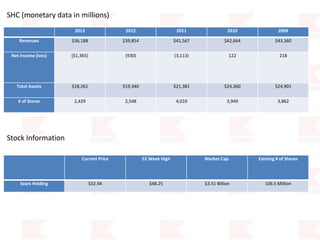
2013 2012 2011 2010 2009
Revenues $36,188 $39,854 $41,567 $42,664 $43,360
Net Income (loss) ($1,365) (930) (3,113) 122 218
Total Assets $18,261 $19,340 $21,381 $24,360 $24,901
# of Stores 2,429 2,548 4,010 3,949 3,862
SHC (monetary data in millions)
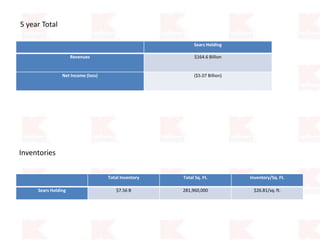
5 year Total
Sears Holding
Revenues $164.6 Billion
Net Income (loss) ($5.07 Billion)
Total Inventory Total Sq. Ft. Inventory/Sq. Ft.
Sears Holding $7.56 B 281,960,000 $26.81/sq. ft.
Inventories
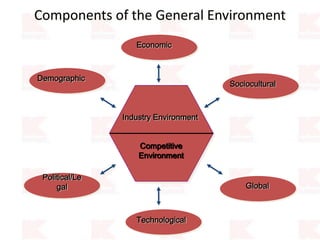
General Environment Analysis
Political/Le
gal
Economic
Technological
Global
Demographic
Sociocultural
Competitive
Environment
Industry Environment
Components of the General Environment
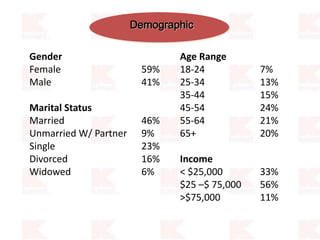
Demographic
Gender
Female 59%
Male 41%
Marital Status
Married 46%
Unmarried W/ Partner 9%
Single 23%
Divorced 16%
Widowed 6%
Age Range
18-24 7%
25-34 13%
35-44 15%
45-54 24%
55-64 21%
65+ 20%
Income
< $25,000 33%
$25 –$ 75,000 56%
>$75,000 11%
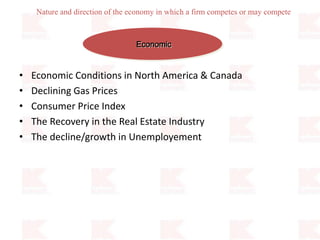
Economic
Nature and direction of the economy in which a firm competes or may compete
• Economic Conditions in North America & Canada
• Declining Gas Prices
• Consumer Price Index
• The Recovery in the Real Estate Industry
• The decline/growth in Unemployement
Sociocultural
• Hassle free parking
• Rewards program: Kmart offers loyalty cards that give customers points. Users
gets $1 in store credit for every $100 spent
• Kmart targets ethnic customers
• 15.2% are Hispanic 15.4% are African American 4.8% are Asian Pacifier
• Approximately 35% of Kmart’s workforce represent multicultural minorities
• 53% of the workforce is made up of females and 47% males
• Kmart works with minority owned vendors
• Kmart promotes battery recycling
Global
• Canada
• First store built in 1929
• In 1983, Company restructuring and closed 5 Montreal store
• In 1998, Financial difficulties, sell 112 stores to sellers (HBC)
• Australia
• There is 15 stores in New Zealand (Richmond Nelson)
• Eastern Europe
• Purchased 13 communist department stores
• There are large troubles in US caught up with its European
operation later in the decade.
• The K-Mart sold its 13 stores to force operation in North American
• Mexico
• There are 4 stores in suburbs of city; half of store area is devoted
of groceries
• In 1997, sold to Mhyper Market.
Technological
• Retail relies on computer systems to process transactions, summarize
results, and manage the overall business.
• Technology is reshaping business
• Internet is offering customers more shopping options.
• More competition
• Web-based markets  Amazon.com
• Television  Shopping Network
• Barcoding and computerized billing systems
• Point-of-sale systems increase sales
• Cash, check, credit- and debit-card payments.
Political
/Legal
• Handling of hazardous waste
• “Failure to warn”
• Sales Tax
• Federal Food Stamp Act
• Asbestos regulation
• Accurate weights and
measurements
• Price-fixing (colluding with
other big-box retailers)
• Alcoholic Beverage Control Act
• Sales of expired products
• Federal labeling and packaging
requirements
• Disabled access (ADA / Unruh
Act)
• Exclusive business dealing
(special deals for specific
vendors)
• False advertising
• Tobacco regulation
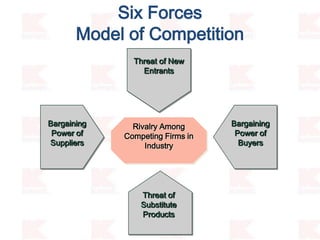
Industry Analysis
Threat of
Substitute
Products
Threat of
New
Entrants
Threat of New
Entrants
Rivalry Among
Competing Firms in
Industry
Bargaining
Power of
Buyers
Bargaining
Power of
Suppliers
Six Forces
Model of Competition
Threat of New Entrants
Low
• Barriers of entry are relatively high in discount
retail industry.
– There is a lot of investment and capital needed to
open large discount stores
• Difficult to create reliable suppliers
• Economies of scale
• Difficult to establish brand loyalty with new
entrant
Bargaining Power of Suppliers
Low
• Large retail stores have a diverse range of
suppliers
• There are multiple suppliers that offer
substitutes for products
• Switching costs are low for retailers
• Buying in bulk
Bargaining Power of Buyers
High
• Consumers are extremely price sensitive
• Low switching costs
• Little brand loyalty when it comes to bargain shopping
• Large number of retailers
Threat of Substitute Products
High
• Customers are price and quality sensitive of
products.
• Switching costs are low.
• However, in bargain retail, the cleanliness of
stores, number of products, and variety matter.
Rivalry/Competition
High
• Many retail store with similar products,
quality, and prices
• Walmart #1 US retailer and Target #4
• Wal-Mart and Target have defined strategies
– Wal-Mart  Low cost
– Target  Differentiation
Competitor Analysis
vs.
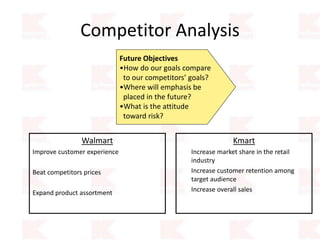
Competitor Analysis
Walmart
Improve customer experience
Beat competitors prices
Expand product assortment
Future Objectives
•How do our goals compare
to our competitors’ goals?
•Where will emphasis be
placed in the future?
•What is the attitude
toward risk?
Kmart
n Increase market share in the retail
industry
n Increase customer retention among
target audience
n Increase overall sales
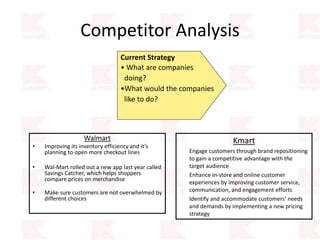
Competitor Analysis
Walmart
• Improving its inventory efficiency and it's
planning to open more checkout lines
• Wal-Mart rolled out a new app last year called
Savings Catcher, which helps shoppers
compare prices on merchandise
• Make sure customers are not overwhelmed by
different choices
Kmart
• Engage customers through brand repositioning
to gain a competitive advantage with the
target audience
• Enhance in-store and online customer
experiences by improving customer service,
communication, and engagement efforts
• Identify and accommodate customers’ needs
and demands by implementing a new pricing
strategy
Current Strategy
• What are companies
doing?
•What would the companies
like to do?
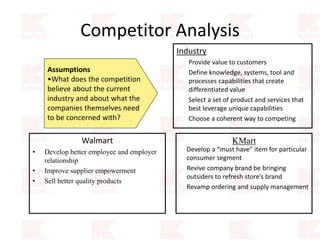
Competitor Analysis
Walmart
• Develop better employee and employer
relationship
• Improve supplier empowerment
• Sell better quality products
KMart
Industry
• Provide value to customers
• Define knowledge, systems, tool and
processes capabilities that create
differentiated value
• Select a set of product and services that
best leverage unique capabilities
• Choose a coherent way to competing
• Develop a “must have” item for particular
consumer segment
• Revive company brand be bringing
outsiders to refresh store’s brand
• Revamp ordering and supply management
Assumptions
•What does the competition
believe about the current
industry and about what the
companies themselves need
to be concerned with?
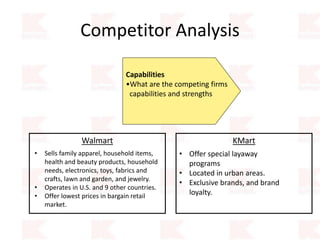
Competitor Analysis
Walmart KMart
Capabilities
•What are the competing firms
capabilities and strengths
• Sells family apparel, household items,
health and beauty products, household
needs, electronics, toys, fabrics and
crafts, lawn and garden, and jewelry.
• Operates in U.S. and 9 other countries.
• Offer lowest prices in bargain retail
market.
• Offer special layaway
programs
• Located in urban areas.
• Exclusive brands, and brand
loyalty.
Competitor Analysis
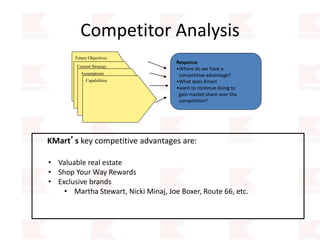
n KMart’s key competitive advantages are:
Future Objectives
Current Strategy
Assumptions
Capabilities
Response
•Where do we have a
competitive advantage?
•What does Kmart
•want to continue doing to
gain market share over the
competition?
• Valuable real estate
• Shop Your Way Rewards
• Exclusive brands
• Martha Stewart, Nicki Minaj, Joe Boxer, Route 66, etc.
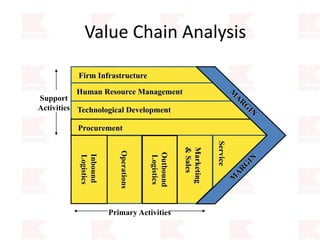
Value Chain Analysis
Operations
Outbound
Logistics
Support
Activities
Primary Activities
Firm Infrastructure
Human Resource Management
Technological Development
Procurement
Inbound
Logistics
Marketing
&Sales
Service
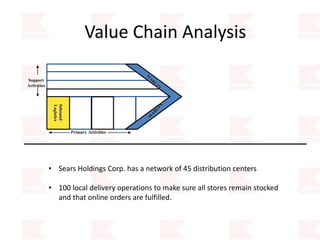
Value Chain Analysis
Primary Activities
Support
Activities
Inbound
Logistics
• Sears Holdings Corp. has a network of 45 distribution centers
• 100 local delivery operations to make sure all stores remain stocked
and that online orders are fulfilled.
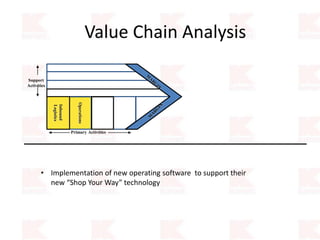
Value Chain Analysis
Primary Activities
Operations
Support
Activities
Inbound
Logistics
• Implementation of new operating software to support their
new “Shop Your Way” technology
Value Chain Analysis
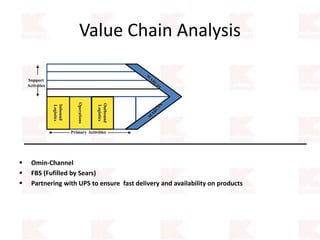
 Omin-Channel
 FBS (Fufilled by Sears)
 Partnering with UPS to ensure fast delivery and availability on products
Primary Activities
Operations
Outbound
Logistics
Support
Activities
Inbound
Logistics
Value Chain Analysis
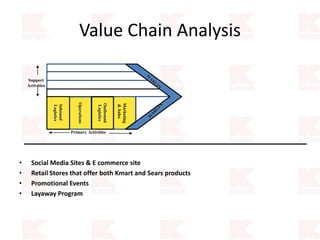
• Social Media Sites & E commerce site
• Retail Stores that offer both Kmart and Sears products
• Promotional Events
• Layaway Program
Primary Activities
Operations
Outbound
Logistics
Support
Activities
Inbound
Logistics
Marketing
&Sales
Value Chain Analysis
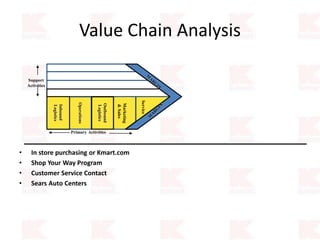
• In store purchasing or Kmart.com
• Shop Your Way Program
• Customer Service Contact
• Sears Auto Centers
Primary Activities
Operations
Outbound
Logistics
Support
Activities
Inbound
Logistics
Marketing
&Sales
Service
Value Chain Analysis
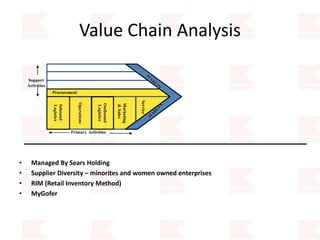
• Managed By Sears Holding
• Supplier Diversity – minorites and women owned enterprises
• RIM (Retail Inventory Method)
• MyGofer
Primary Activities
Operations
Outbound
Logistics
Support
Activities
Inbound
Logistics
Marketing
&Sales
Service
Procurement
Value Chain Analysis
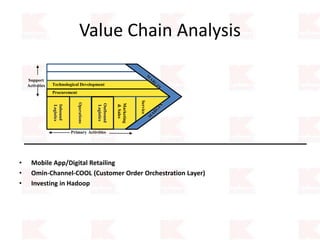
• Mobile App/Digital Retailing
• Omin-Channel-COOL (Customer Order Orchestration Layer)
• Investing in Hadoop
Primary Activities
Operations
Outbound
Logistics
Support
Activities
Inbound
Logistics
Marketing
&Sales
Service
Procurement
Technological Development
Value Chain Analysis
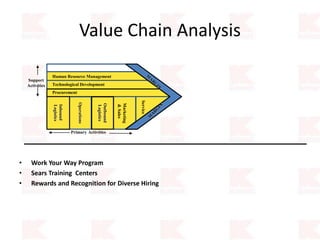
• Work Your Way Program
• Sears Training Centers
• Rewards and Recognition for Diverse Hiring
Primary Activities
Operations
Outbound
Logistics
Support
Activities
Inbound
Logistics
Marketing
&Sales
Service
Procurement
Technological Development
Human Resource Management
Value Chain Analysis
Primary Activities
Operations
Outbound
Logistics
Support
Activities
Inbound
Logistics
Marketing
&Sales
Service
Procurement
Technological Development
Human Resource Management
Firm Infrastructure
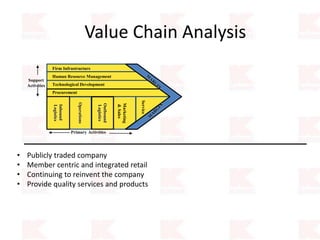
• Publicly traded company
• Member centric and integrated retail
• Continuing to reinvent the company
• Provide quality services and products
Value System Analysis
Supplier Value Chain Firm Value Chain Channel Value Chain Buyer Value Chain
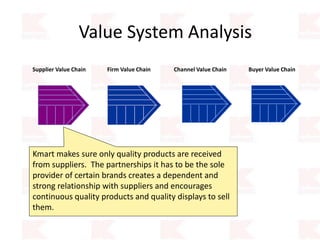
Kmart makes sure only quality products are received
from suppliers. The partnerships it has to be the sole
provider of certain brands creates a dependent and
strong relationship with suppliers and encourages
continuous quality products and quality displays to sell
them.
Value System Analysis
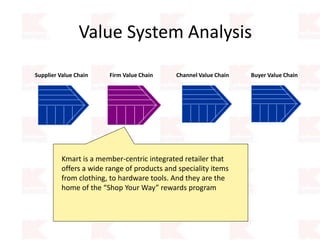
Kmart is a member-centric integrated retailer that
offers a wide range of products and speciality items
from clothing, to hardware tools. And they are the
home of the “Shop Your Way” rewards program
Supplier Value Chain Firm Value Chain Channel Value Chain Buyer Value Chain
Value System Analysis
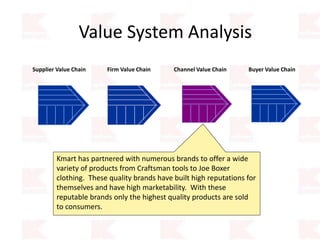
Kmart has partnered with numerous brands to offer a wide
variety of products from Craftsman tools to Joe Boxer
clothing. These quality brands have built high reputations for
themselves and have high marketability. With these
reputable brands only the highest quality products are sold
to consumers.
Supplier Value Chain Firm Value Chain Channel Value Chain Buyer Value Chain
Value System Analysis
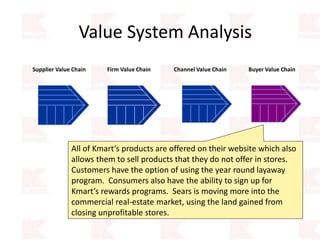
All of Kmart’s products are offered on their website which also
allows them to sell products that they do not offer in stores.
Customers have the option of using the year round layaway
program. Consumers also have the ability to sign up for
Kmart’s rewards programs. Sears is moving more into the
commercial real-estate market, using the land gained from
closing unprofitable stores.
Supplier Value Chain Firm Value Chain Channel Value Chain Buyer Value Chain
SWOT Analysis
Strengths
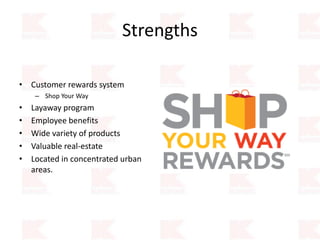
• Customer rewards system
– Shop Your Way
• Layaway program
• Employee benefits
• Wide variety of products
• Valuable real-estate
• Located in concentrated urban
areas.
Weaknesses
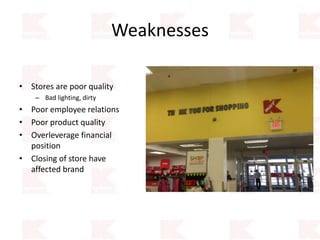
• Stores are poor quality
– Bad lighting, dirty
• Poor employee relations
• Poor product quality
• Overleverage financial
position
• Closing of store have
affected brand
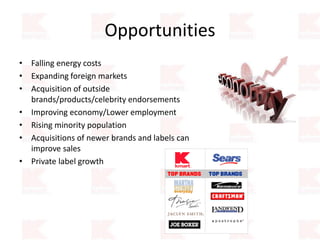
Opportunities
• Falling energy costs
• Expanding foreign markets
• Acquisition of outside
brands/products/celebrity endorsements
• Improving economy/Lower employment
• Rising minority population
• Acquisitions of newer brands and labels can
improve sales
• Private label growth
Threats
• Competition
• Reduction in government subsidies
• Reduced negotiation power with suppliers due to
reduced size
• Economic Downturn
• Data breach/payment information theft
Strategic Formulation
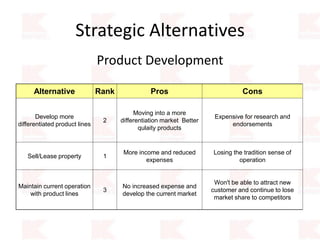
Strategic Alternatives
• Product development
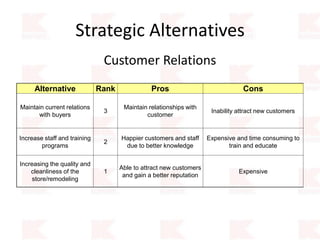
• Customer Relationships
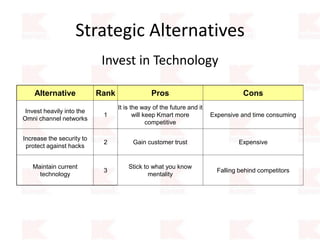
• Invest in technology
Strategic Alternatives
Product Development
Alternative Rank Pros Cons
Develop more
differentiated product lines
2
Moving into a more
differentiation market Better
qulaity products
Expensive for research and
endorsements
Sell/Lease property 1
More income and reduced
expenses
Losing the tradition sense of
operation
Maintain current operation
with product lines
3
No increased expense and
develop the current market
Won't be able to attract new
customer and continue to lose
market share to competitors
Strategic Alternatives
Customer Relations
Alternative Rank Pros Cons
Maintain current relations
with buyers
3
Maintain relationships with
customer
Inability attract new customers
Increase staff and training
programs
2
Happier customers and staff
due to better knowledge
Expensive and time consuming to
train and educate
Increasing the quality and
cleanliness of the
store/remodeling
1
Able to attract new customers
and gain a better reputation
Expensive
Strategic Alternatives
Invest in Technology
Alternative Rank Pros Cons
Invest heavily into the
Omni channel networks
1
It is the way of the future and it
will keep Kmart more
competitive
Expensive and time consuming
Increase the security to
protect against hacks
2 Gain customer trust Expensive
Maintain current
technology
3
Stick to what you know
mentality
Falling behind competitors
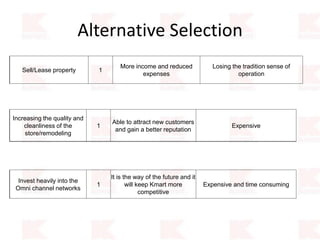
Alternative Selection
Increasing the quality and
cleanliness of the
store/remodeling
1
Able to attract new customers
and gain a better reputation
Expensive
Invest heavily into the
Omni channel networks
1
It is the way of the future and it
will keep Kmart more
competitive
Expensive and time consuming
Sell/Lease property 1
More income and reduced
expenses
Losing the tradition sense of
operation
Questions

Kmart pp2

  • 1.
    Kmart Strategic Management CaseStudy February 24, 2015 Bailey Hopper, Justin Howard, Taylor Houle, Christopher Goggin, Jared Hofer, Ge Changlin, & Iesha Hall
  • 2.
    The Start ofKMart • Founded in 1899 • Filed Chapter 11 in 2002 • Acquired by Sears in March 24, 2005 • Sears Holdings Company is located in Hoffmann Estates, IL.
  • 3.
    Sears Holding Corporation (SHC) •Kmart and Sears merger in March 24, 2005 • There are operations in three business segments: Kmart, Sears Domestic, and Sears Canada.
  • 4.
    SHC & Kmart’s Strategy? “Focuson a member-centric retailer leveraging Shop Your Way and Integrated Retail”
  • 5.
    Mission "We are committedto improving the lives of our customers by providing quality services, products and solutions that earn their trust and build lifetime relationships." Vision Create lifelong relationships built on trust.
  • 6.
    5 Key Pillarsfor Kmart’s Strategy (Core Competencies) 1. Creating lasting relationships with customers by empowering them to manage their lives. 2. Attaining best in class productivity and efficiency. 3. Building our brands. 4. Reinventing the company continuously through technology and innovation. 5. Reinforcing “The SHC Way” by living our values every day.
  • 7.
    The plan tosucceed in transformation? • “Leveraging Shop Your Way and Integrated Retail as the foundation of our member-centric business model • Realignment of our of businesses to become a more focused company • Enhancing our financial flexibility to support and fund our transformation • Allowing shareholders to participate in value creation actions”
  • 8.
    Is the strategyworking? Analyzing SHC/Kmart’s Financial Data
  • 9.
    Current Price 52Week High Market Cap. Existing # of Shares Sears Holding $32.94 $48.25 $3.51 Billion 106.5 Million Stock Information 2013 2012 2011 2010 2009 Revenues $36,188 $39,854 $41,567 $42,664 $43,360 Net Income (loss) ($1,365) (930) (3,113) 122 218 Total Assets $18,261 $19,340 $21,381 $24,360 $24,901 # of Stores 2,429 2,548 4,010 3,949 3,862 SHC (monetary data in millions)
  • 11.
    5 year Total SearsHolding Revenues $164.6 Billion Net Income (loss) ($5.07 Billion) Total Inventory Total Sq. Ft. Inventory/Sq. Ft. Sears Holding $7.56 B 281,960,000 $26.81/sq. ft. Inventories
  • 12.
  • 13.
  • 14.
    Demographic Gender Female 59% Male 41% MaritalStatus Married 46% Unmarried W/ Partner 9% Single 23% Divorced 16% Widowed 6% Age Range 18-24 7% 25-34 13% 35-44 15% 45-54 24% 55-64 21% 65+ 20% Income < $25,000 33% $25 –$ 75,000 56% >$75,000 11%
  • 15.
    Economic Nature and directionof the economy in which a firm competes or may compete • Economic Conditions in North America & Canada • Declining Gas Prices • Consumer Price Index • The Recovery in the Real Estate Industry • The decline/growth in Unemployement
  • 16.
    Sociocultural • Hassle freeparking • Rewards program: Kmart offers loyalty cards that give customers points. Users gets $1 in store credit for every $100 spent • Kmart targets ethnic customers • 15.2% are Hispanic 15.4% are African American 4.8% are Asian Pacifier • Approximately 35% of Kmart’s workforce represent multicultural minorities • 53% of the workforce is made up of females and 47% males • Kmart works with minority owned vendors • Kmart promotes battery recycling
  • 17.
    Global • Canada • Firststore built in 1929 • In 1983, Company restructuring and closed 5 Montreal store • In 1998, Financial difficulties, sell 112 stores to sellers (HBC) • Australia • There is 15 stores in New Zealand (Richmond Nelson) • Eastern Europe • Purchased 13 communist department stores • There are large troubles in US caught up with its European operation later in the decade. • The K-Mart sold its 13 stores to force operation in North American • Mexico • There are 4 stores in suburbs of city; half of store area is devoted of groceries • In 1997, sold to Mhyper Market.
  • 18.
    Technological • Retail relieson computer systems to process transactions, summarize results, and manage the overall business. • Technology is reshaping business • Internet is offering customers more shopping options. • More competition • Web-based markets  Amazon.com • Television  Shopping Network • Barcoding and computerized billing systems • Point-of-sale systems increase sales • Cash, check, credit- and debit-card payments.
  • 19.
    Political /Legal • Handling ofhazardous waste • “Failure to warn” • Sales Tax • Federal Food Stamp Act • Asbestos regulation • Accurate weights and measurements • Price-fixing (colluding with other big-box retailers) • Alcoholic Beverage Control Act • Sales of expired products • Federal labeling and packaging requirements • Disabled access (ADA / Unruh Act) • Exclusive business dealing (special deals for specific vendors) • False advertising • Tobacco regulation
  • 20.
  • 21.
    Threat of Substitute Products Threat of New Entrants Threatof New Entrants Rivalry Among Competing Firms in Industry Bargaining Power of Buyers Bargaining Power of Suppliers Six Forces Model of Competition
  • 22.
    Threat of NewEntrants Low • Barriers of entry are relatively high in discount retail industry. – There is a lot of investment and capital needed to open large discount stores • Difficult to create reliable suppliers • Economies of scale • Difficult to establish brand loyalty with new entrant
  • 23.
    Bargaining Power ofSuppliers Low • Large retail stores have a diverse range of suppliers • There are multiple suppliers that offer substitutes for products • Switching costs are low for retailers • Buying in bulk
  • 24.
    Bargaining Power ofBuyers High • Consumers are extremely price sensitive • Low switching costs • Little brand loyalty when it comes to bargain shopping • Large number of retailers
  • 25.
    Threat of SubstituteProducts High • Customers are price and quality sensitive of products. • Switching costs are low. • However, in bargain retail, the cleanliness of stores, number of products, and variety matter.
  • 26.
    Rivalry/Competition High • Many retailstore with similar products, quality, and prices • Walmart #1 US retailer and Target #4 • Wal-Mart and Target have defined strategies – Wal-Mart  Low cost – Target  Differentiation
  • 27.
  • 28.
    Competitor Analysis Walmart Improve customerexperience Beat competitors prices Expand product assortment Future Objectives •How do our goals compare to our competitors’ goals? •Where will emphasis be placed in the future? •What is the attitude toward risk? Kmart n Increase market share in the retail industry n Increase customer retention among target audience n Increase overall sales
  • 29.
    Competitor Analysis Walmart • Improvingits inventory efficiency and it's planning to open more checkout lines • Wal-Mart rolled out a new app last year called Savings Catcher, which helps shoppers compare prices on merchandise • Make sure customers are not overwhelmed by different choices Kmart • Engage customers through brand repositioning to gain a competitive advantage with the target audience • Enhance in-store and online customer experiences by improving customer service, communication, and engagement efforts • Identify and accommodate customers’ needs and demands by implementing a new pricing strategy Current Strategy • What are companies doing? •What would the companies like to do?
  • 30.
    Competitor Analysis Walmart • Developbetter employee and employer relationship • Improve supplier empowerment • Sell better quality products KMart Industry • Provide value to customers • Define knowledge, systems, tool and processes capabilities that create differentiated value • Select a set of product and services that best leverage unique capabilities • Choose a coherent way to competing • Develop a “must have” item for particular consumer segment • Revive company brand be bringing outsiders to refresh store’s brand • Revamp ordering and supply management Assumptions •What does the competition believe about the current industry and about what the companies themselves need to be concerned with?
  • 31.
    Competitor Analysis Walmart KMart Capabilities •Whatare the competing firms capabilities and strengths • Sells family apparel, household items, health and beauty products, household needs, electronics, toys, fabrics and crafts, lawn and garden, and jewelry. • Operates in U.S. and 9 other countries. • Offer lowest prices in bargain retail market. • Offer special layaway programs • Located in urban areas. • Exclusive brands, and brand loyalty.
  • 32.
    Competitor Analysis n KMart’skey competitive advantages are: Future Objectives Current Strategy Assumptions Capabilities Response •Where do we have a competitive advantage? •What does Kmart •want to continue doing to gain market share over the competition? • Valuable real estate • Shop Your Way Rewards • Exclusive brands • Martha Stewart, Nicki Minaj, Joe Boxer, Route 66, etc.
  • 33.
    Value Chain Analysis Operations Outbound Logistics Support Activities PrimaryActivities Firm Infrastructure Human Resource Management Technological Development Procurement Inbound Logistics Marketing &Sales Service
  • 34.
    Value Chain Analysis PrimaryActivities Support Activities Inbound Logistics • Sears Holdings Corp. has a network of 45 distribution centers • 100 local delivery operations to make sure all stores remain stocked and that online orders are fulfilled.
  • 35.
    Value Chain Analysis PrimaryActivities Operations Support Activities Inbound Logistics • Implementation of new operating software to support their new “Shop Your Way” technology
  • 36.
    Value Chain Analysis Omin-Channel  FBS (Fufilled by Sears)  Partnering with UPS to ensure fast delivery and availability on products Primary Activities Operations Outbound Logistics Support Activities Inbound Logistics
  • 37.
    Value Chain Analysis •Social Media Sites & E commerce site • Retail Stores that offer both Kmart and Sears products • Promotional Events • Layaway Program Primary Activities Operations Outbound Logistics Support Activities Inbound Logistics Marketing &Sales
  • 38.
    Value Chain Analysis •In store purchasing or Kmart.com • Shop Your Way Program • Customer Service Contact • Sears Auto Centers Primary Activities Operations Outbound Logistics Support Activities Inbound Logistics Marketing &Sales Service
  • 39.
    Value Chain Analysis •Managed By Sears Holding • Supplier Diversity – minorites and women owned enterprises • RIM (Retail Inventory Method) • MyGofer Primary Activities Operations Outbound Logistics Support Activities Inbound Logistics Marketing &Sales Service Procurement
  • 40.
    Value Chain Analysis •Mobile App/Digital Retailing • Omin-Channel-COOL (Customer Order Orchestration Layer) • Investing in Hadoop Primary Activities Operations Outbound Logistics Support Activities Inbound Logistics Marketing &Sales Service Procurement Technological Development
  • 41.
    Value Chain Analysis •Work Your Way Program • Sears Training Centers • Rewards and Recognition for Diverse Hiring Primary Activities Operations Outbound Logistics Support Activities Inbound Logistics Marketing &Sales Service Procurement Technological Development Human Resource Management
  • 42.
    Value Chain Analysis PrimaryActivities Operations Outbound Logistics Support Activities Inbound Logistics Marketing &Sales Service Procurement Technological Development Human Resource Management Firm Infrastructure • Publicly traded company • Member centric and integrated retail • Continuing to reinvent the company • Provide quality services and products
  • 43.
    Value System Analysis SupplierValue Chain Firm Value Chain Channel Value Chain Buyer Value Chain Kmart makes sure only quality products are received from suppliers. The partnerships it has to be the sole provider of certain brands creates a dependent and strong relationship with suppliers and encourages continuous quality products and quality displays to sell them.
  • 44.
    Value System Analysis Kmartis a member-centric integrated retailer that offers a wide range of products and speciality items from clothing, to hardware tools. And they are the home of the “Shop Your Way” rewards program Supplier Value Chain Firm Value Chain Channel Value Chain Buyer Value Chain
  • 45.
    Value System Analysis Kmarthas partnered with numerous brands to offer a wide variety of products from Craftsman tools to Joe Boxer clothing. These quality brands have built high reputations for themselves and have high marketability. With these reputable brands only the highest quality products are sold to consumers. Supplier Value Chain Firm Value Chain Channel Value Chain Buyer Value Chain
  • 46.
    Value System Analysis Allof Kmart’s products are offered on their website which also allows them to sell products that they do not offer in stores. Customers have the option of using the year round layaway program. Consumers also have the ability to sign up for Kmart’s rewards programs. Sears is moving more into the commercial real-estate market, using the land gained from closing unprofitable stores. Supplier Value Chain Firm Value Chain Channel Value Chain Buyer Value Chain
  • 47.
  • 48.
    Strengths • Customer rewardssystem – Shop Your Way • Layaway program • Employee benefits • Wide variety of products • Valuable real-estate • Located in concentrated urban areas.
  • 49.
    Weaknesses • Stores arepoor quality – Bad lighting, dirty • Poor employee relations • Poor product quality • Overleverage financial position • Closing of store have affected brand
  • 50.
    Opportunities • Falling energycosts • Expanding foreign markets • Acquisition of outside brands/products/celebrity endorsements • Improving economy/Lower employment • Rising minority population • Acquisitions of newer brands and labels can improve sales • Private label growth
  • 51.
    Threats • Competition • Reductionin government subsidies • Reduced negotiation power with suppliers due to reduced size • Economic Downturn • Data breach/payment information theft
  • 52.
  • 53.
    Strategic Alternatives • Productdevelopment • Customer Relationships • Invest in technology
  • 54.
    Strategic Alternatives Product Development AlternativeRank Pros Cons Develop more differentiated product lines 2 Moving into a more differentiation market Better qulaity products Expensive for research and endorsements Sell/Lease property 1 More income and reduced expenses Losing the tradition sense of operation Maintain current operation with product lines 3 No increased expense and develop the current market Won't be able to attract new customer and continue to lose market share to competitors
  • 55.
    Strategic Alternatives Customer Relations AlternativeRank Pros Cons Maintain current relations with buyers 3 Maintain relationships with customer Inability attract new customers Increase staff and training programs 2 Happier customers and staff due to better knowledge Expensive and time consuming to train and educate Increasing the quality and cleanliness of the store/remodeling 1 Able to attract new customers and gain a better reputation Expensive
  • 56.
    Strategic Alternatives Invest inTechnology Alternative Rank Pros Cons Invest heavily into the Omni channel networks 1 It is the way of the future and it will keep Kmart more competitive Expensive and time consuming Increase the security to protect against hacks 2 Gain customer trust Expensive Maintain current technology 3 Stick to what you know mentality Falling behind competitors
  • 57.
    Alternative Selection Increasing thequality and cleanliness of the store/remodeling 1 Able to attract new customers and gain a better reputation Expensive Invest heavily into the Omni channel networks 1 It is the way of the future and it will keep Kmart more competitive Expensive and time consuming Sell/Lease property 1 More income and reduced expenses Losing the tradition sense of operation
  • 58.