Kmart vs. Wal-Mart: A Competitive Analysis of Their Respective Business Strategies
Kmart vs. Wal-Mart: A Comparative Analysis of Their Respective Business Strategies
Cory Haggett
Norwich University
GB 560
11/3/2016
Kmart vs. Wal-Mart: A Competitive Analysis of Their Respective Business Strategies
Abstract
Kmart and Wal-Mart have long been synonymous with low price or discount retailing. They’ve
each grown from their humble beginnings to become household names in discount retailing and
destinations for value conscience customers. However, that’s where the similarities end. Today,
Kmart’s a shell of its former self. Slumping sales and dilapidated, dirty and poorly stocked stores
have forced Kmart to close over half of its locations as it struggles to define itself to customers
who are abandoning it in droves. Compare this to Wal-Mart who’s enjoyed unprecedented
success in the discount retailing sector with increasing revenues and store locations. What set
these two seemingly similar companies on different trajectories? It can be summed up as simply
as their company strategy or lack of it. Early on Kmart adopted a strategy of selling at an
everyday price with periodic sales and their famous Blue Light Specials to entice deal seeking
customers into its stores. Wal-Mart on the other hand developed a strategy of selling at an
everyday low price made possible by stringent internal and external cost controls and while
becoming an industry innovator in supply chain management. This paper will examine each
company’s strategy; compare them and provide conclusions as to why Wal-Mart has become an
industry leader while Kmart has struggled to remain relevant.
Keywords: everyday low price strategy, high/low price strategy
Kmart vs. Wal-Mart: A Competitive Analysis of Their Respective Business Strategies
Kmart (owned by Sears Holdings Corporation) and Wal-Mart, Inc. (Wal-Mart)
essentially operate within the same business segment, discount retailing. They both have a
storied retail legacy and at one point were nearly identical in size and revenue. In fact, it wasn’t
until 1990 that Wal-Mart overtook Kmart in sales (marketmadhouse.com, 2015). However, today
these two companies look much different. Between 2000 and 2014 Kmart’s sales fell by 67%
and its number of stores shrank from 2,165 to just 979 (marketmadhouse.com, 2015). Compare
that to Wal-Mart’s 63% increase in sales between 2000 and 2014 and an ever increasing number
of US locations. This paper will look at each company and examine their humble beginnings and
their growth within the US discount retailing segment. This paper will also look at each
company’s price strategy and analyze them and finally, attempt to explain why Wal-Mart has
become America’s leading discount retailer while Kmart is struggling and is on the edge of the
retailing abyss.
In 1962 the first Kmart store opened in Garden City, MI, that same year Sam Walton
opened his first Wal-Mart store in Rogers, AR (pcmag.com, 2001). By the end of 1963 Kmart
had 53 stores while Walton was still planning his second (pcmag.com, 2001). What followed
was a rapid increase in discount retailing a crossed the United States and has ultimately led each
company to a present state that can best be described as polar opposite. Wal-Mart (see Appendix
1) is the undisputed king of discount retailing while Kmart (see Appendix 2) continues to
struggle quarter after quarter and is seen by many as a brand in decline.
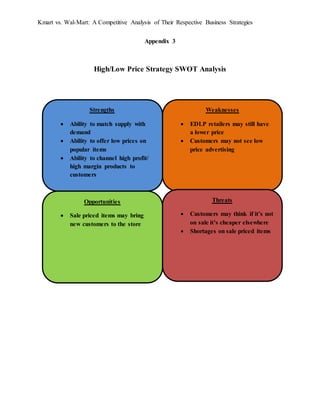
Kmart’s strategy can best be described by Gauri, Trivedi and Grewal as one of high/low
pricing (HiLo) (see Appendix 3) (2008). This strategy is just as its name implies the process of
selling products at regular prices and then having sales to lower prices which is intended to
attract customers. Kmart has long used promotional materials such as newspaper inserts to entice
Kmart vs. Wal-Mart: A Competitive Analysis of Their Respective Business Strategies
customers into its store to save on a particular product whose price has been reduced for a set
period of time. Kmart also developed the famous “Blue Light Special” to alert customers of great
limited time deals and has even adapted this promotional campaign to coincide with the
increased usage of smartphones by developing a Blue Light Special application (app)
(prnewswire.com., 2015). While their HiLo strategy has worked well in the past it’s struggled as
of late due, in part, to a lack of corporate leadership which has only added to their continued
financial woes.
Kmart’s HiLo strategy has some advantages and disadvantages. One advantage this
strategy has is its ability to attract customers to a store to purchase specific items. By attracting
customers who are looking to purchase specific items Kmart can tailor its inventory to the
products its customers will be actively seeking to buy thus better matching their supply with their
customer’s demand improving the efficiency its supply chain. If this strategy is used effectively
it can be used to guide customers to higher priced and higher margin items leading to an increase
in overall profitability. An additional benefit of using the Hi/Lo strategy is the potential of
drawing new customers into Kmart stores. These customers may be unfamiliar with Kmart or
what the brand has to offer and a “deal” may expand their brand awareness. While this strategy
has several outstanding advantages it has several potential drawbacks or disadvantages as well.
First, by advertising discounted price offerings on only a small portion of Kmart’s overall
product offerings customers may feel as though other retailers have everyday prices on their
entire product line that’s lower than Kmart’s due to their EDLP strategy. Second, a HiLo strategy
could lead customers to only purchase the advertised sale price items and not purchase Kmart’s
regularly priced product offerings which are not advertised as being on sale. Third, a HiLo
strategy may leave customers wondering if the product they’re purchasing could be bought
Kmart vs. Wal-Mart: A Competitive Analysis of Their Respective Business Strategies
cheaper elsewhere as Kmart’s price may not be an everyday low price. Finally, by only offering
certain products at a discounted price other non-sale priced items may see reduced or stagnated
inventory turnover rates which could drive up Kmart’s inventory costs; another way of stating
this potential disadvantage is there would be a loss of Kmart’s economies of scale with respect to
its purchasing power.
Wal-Mart’s strategy can best be described by Gauri, Trivedi and Grewal as one of
everyday low prices (EDLP) (see Appendix 4) (2008). This strategy is just as its name implies
the process of selling products at a rock bottom price every day. Wal-Mart has even adopted a
slogan that embodies their pricing strategy: “always low prices” (Leinwand & Mainardi, 2010).
Wal-Mart accomplishes its mission of sell at everyday low prices by effectively managing their
input costs. They meticulously analyze and evaluate every aspect of their supply chain to keep
just the right products in stock at just the right time (pcmag.com, 2001). In fact, Wal-Mart’s
founder Sam Walton was an early adopter of what we today call supply chain management and
his early focus on this critical retailing function is one reason Wal-Mart’s become a discount
retailing juggernaut. Other factors in Wal-Mart’s strategy include real estate acquisitions, a no
frills store design and a focus on controlling the costs of consumer staples such as prescriptions
and electronics (Leinwand & Mainardi, 2010). Wal-Mart’s pricing strategy and relentless cost
controls have helped it become a leader in the EDLP strategy retailing segment.
Wal-Mart’s EDLP strategy has led it to become a market leader in discount retailing. One
benefit the EDLP strategy has is it develops a mindset within its customers that every product
Wal-Mart offers is at a rock bottom or everyday low price that’s always lower than its
competitors. The development of this mindset is an essential element to the EDLP strategy as it
gives the Wal-Mart brand the perception that it’s always the lowest price retailer on every item
Kmart vs. Wal-Mart: A Competitive Analysis of Their Respective Business Strategies
every day. This plays directly into an additional benefit of Wal-Mart’s customers being able to
depend on a constant and stable price for a particular product. This is crucial as this strategy
helps to establish consumer habits and creates a sense of consistency with Wal-Mart s customers.
A final benefit of Wal-Mart’s EDLP strategy is it helps establish the consistency of demand for a
particular product. This consistency helps Wal-Mart better predict which products will sell
quicker and what products will sell slower. One disadvantage Wal-Mart’s EDLP strategy has is
if a customer can find a particular product elsewhere for less money they may lose confidence
that Wal-Mart is truly always the lowest price retailer on every item every day.
As the comparative analysis has shown both strategies have their advantages and
disadvantages. Does one particular pricing strategy poses certain benefits that will result in
building and sustaining long term growth in the retail sector? I believe that both strategies, if
applied correctly, can build and sustain long term growth, however, I believe an EDLP strategy
is better suited to today’s business climate. By using an EDLP strategy retailers will help to
ensure that customers believe they’re getting the best deal possible on a particular product. In an
age where finding most every product’s lowest price is only a mouse click away having the
ability to be seen as always having the lowest price is crucial. Instilling this mindset in customers
will limit the potential competition from online retailers that may be seeking to compete within
similar product categories. While retailers like Wal-Mart may not always have the lowest price
on every item everyday their ability to market themselves as the lowest cost retailer is invaluable
and is difficult for both HiLo retailers like Kmart and online discount retailers like Amazon.com
to overcome. I would liken Wal-Mart’s EDLP strategy to the mindset of: “Wal-Mart doesn’t
always have to be the lowest cost retailer on every item as long as its customer’s believe that
they are the low price retailer on every item they’ll be just fine”.
Kmart vs. Wal-Mart: A Competitive Analysis of Their Respective Business Strategies
Whether a retailer chooses a high low price strategy or an everyday low price strategy
they must invest human, organizational and monetary capital into their brand to be successful.
We’ve seen Kmart use the high low price strategy ineffectively and their brand has suffered as a
result. We’ve also seen Wal-Mart use the everyday low pricing very effectively and as a result
prosper and grow. One conclusion I would offer is while differing strategies can have differing
results each must be accompanied by solid corporate management, inventory cost and control
systems and a reasonable amount of capital reinvestment to be successful. Could Wal-Mart have
used the high low price strategy with its effective corporate management, superior inventory
management system and intensive capital reinvestment strategy effectively? I believed it could
have. Could Kmart have used the everyday low price strategy with its ineffective corporate
management, poor inventory management system and practically non-existent capital
reinvestment strategy effectively? I don’t believe so. I believe my conclusion is the particular
pricing strategy, either high low or everyday low price, is less important than the presence of an
effective corporate management structure making wise and practical decisions to lower costs and
create operational efficiencies. As a result of its effective strategy I believe Wal-Mart will be a
factor in discount retailing for the foreseeable future and Kmart may ultimately fade into the
annals of discount retailing history.
Kmart vs. Wal-Mart: A Competitive Analysis of Their Respective Business Strategies
References
Gauri, D. K., Trivedi, M., & Grewal, D. (2008). Understanding the determinants of retail
strategy: an empirical analysis. Journal of Retailing, 84 (3), 256-267.
Leinwand, P. & Mainardi, C. (2010, December, 15). Hbr.org. Why can’t Kmart be
Successful While Target and Walmart Thrive? Retrieved November 3, 2016 from:
http://hbr.org/2010/12/why-cna’t-kmart-be-successful-while-target-and-walmart-thrive
Madhousemarketing.com. (2015, August 16) Madhousemarketing.com. Kmart has Lost 67% of
its Business in 15 Years. Retrieved November 3, 2016 from:
http://marketmadhouse.com/kmart-has-lost-67-of-its-business-in-15-years/
Miglani, J. (2015, July, 15). Revenuesandprofits.com. Amazon vs Walmart Revenues and
Profits 1995-2014. Retrieved November 3, 2016 from:
http://revenuesandprofits.com/amazon-vs-walmart-revenues-and-profits-1995-2014/
Pcmag.com. (2001, December 10). Pcmag.com. How Kmart Fell Behind. Retrieved
November 3, 2016, from http://www.pcmag.com/article2/0,2817,18993,00.asp
Prnewswire.com. (2015, November 24). Prnewswire.com. Oh What Fun! Kmart's Mobile
App Adds Bluelight Special Alerts, Layaway and Exclusive Offers Just in Time for the
Holidays. Retrieved November 03, 2016, from http://www.prnewswire.com/news-
releases/oh-what-fun-kmarts-mobile-app-adds-bluelight-special-alerts-layaway-and-
exclusive-offers-just-in-time-for-the-holidays-
Kmart vs. Wal-Mart: A Competitive Analysis of Their Respective Business Strategies
Appendix 1
Wal-Mart SWOT Analysis
Weaknesses
 Perception of low quality
merchandise
 Changing consumer
preferences
Strengths
 Reputation as “the” low price
retailer
 Supply chain management
 Information technology
Threats
 Low cost “dollar” type stores
 Global economic conditions
Opportunities
 A viable alternative to Kmart
Kmart vs. Wal-Mart: A Competitive Analysis of Their Respective Business Strategies
Appendix 2
Kmart SWOT Analysis
Weaknesses
 Dirty, dilapidated,
understocked and
understaffed stores
 Supply chain uncertainties
 Limited information
technology
 Low inventory turnover rates
Strengths
 Reputation as discount retailer
 Urban locations
Threats
 Low cost “dollar” type stores
 Global economic conditions
 Continued poor economic
performance
 Asset liquidation
Opportunities
 A viable alternative to Wal-
Mart
Kmart vs. Wal-Mart: A Competitive Analysis of Their Respective Business Strategies
Appendix 3
High/Low Price Strategy SWOT Analysis
Weaknesses
 EDLP retailers may still have
a lower price
 Customers may not see low
price advertising
Strengths
 Ability to match supply with
demand
 Ability to offer low prices on
popular items
 Ability to channel high profit/
high margin products to
customers
Threats
 Customers may think if it’s not
on sale it’s cheaper elsewhere
 Shortages on sale priced items
Opportunities
 Sale priced items may bring
new customers to the store
Kmart vs. Wal-Mart: A Competitive Analysis of Their Respective Business Strategies
Appendix 4
Everyday Low Pricing Structure SWOT Analysis
Weaknesses
 Inconsistent demand on non-
essential products
Strengths
 Consumer’s mindset regarding
everyday low prices
 Constant demand on consumer
staples
Threats
 If a low price is discovered
elsewhere customer loyalty
may be at risk
Opportunities
 “Deal” hunters may become
regular customers

Kmart vs Wal-Mart Week 9

  • 1.
    Kmart vs. Wal-Mart:A Competitive Analysis of Their Respective Business Strategies Kmart vs. Wal-Mart: A Comparative Analysis of Their Respective Business Strategies Cory Haggett Norwich University GB 560 11/3/2016
  • 2.
    Kmart vs. Wal-Mart:A Competitive Analysis of Their Respective Business Strategies Abstract Kmart and Wal-Mart have long been synonymous with low price or discount retailing. They’ve each grown from their humble beginnings to become household names in discount retailing and destinations for value conscience customers. However, that’s where the similarities end. Today, Kmart’s a shell of its former self. Slumping sales and dilapidated, dirty and poorly stocked stores have forced Kmart to close over half of its locations as it struggles to define itself to customers who are abandoning it in droves. Compare this to Wal-Mart who’s enjoyed unprecedented success in the discount retailing sector with increasing revenues and store locations. What set these two seemingly similar companies on different trajectories? It can be summed up as simply as their company strategy or lack of it. Early on Kmart adopted a strategy of selling at an everyday price with periodic sales and their famous Blue Light Specials to entice deal seeking customers into its stores. Wal-Mart on the other hand developed a strategy of selling at an everyday low price made possible by stringent internal and external cost controls and while becoming an industry innovator in supply chain management. This paper will examine each company’s strategy; compare them and provide conclusions as to why Wal-Mart has become an industry leader while Kmart has struggled to remain relevant. Keywords: everyday low price strategy, high/low price strategy
  • 3.
    Kmart vs. Wal-Mart:A Competitive Analysis of Their Respective Business Strategies Kmart (owned by Sears Holdings Corporation) and Wal-Mart, Inc. (Wal-Mart) essentially operate within the same business segment, discount retailing. They both have a storied retail legacy and at one point were nearly identical in size and revenue. In fact, it wasn’t until 1990 that Wal-Mart overtook Kmart in sales (marketmadhouse.com, 2015). However, today these two companies look much different. Between 2000 and 2014 Kmart’s sales fell by 67% and its number of stores shrank from 2,165 to just 979 (marketmadhouse.com, 2015). Compare that to Wal-Mart’s 63% increase in sales between 2000 and 2014 and an ever increasing number of US locations. This paper will look at each company and examine their humble beginnings and their growth within the US discount retailing segment. This paper will also look at each company’s price strategy and analyze them and finally, attempt to explain why Wal-Mart has become America’s leading discount retailer while Kmart is struggling and is on the edge of the retailing abyss. In 1962 the first Kmart store opened in Garden City, MI, that same year Sam Walton opened his first Wal-Mart store in Rogers, AR (pcmag.com, 2001). By the end of 1963 Kmart had 53 stores while Walton was still planning his second (pcmag.com, 2001). What followed was a rapid increase in discount retailing a crossed the United States and has ultimately led each company to a present state that can best be described as polar opposite. Wal-Mart (see Appendix 1) is the undisputed king of discount retailing while Kmart (see Appendix 2) continues to struggle quarter after quarter and is seen by many as a brand in decline. Kmart’s strategy can best be described by Gauri, Trivedi and Grewal as one of high/low pricing (HiLo) (see Appendix 3) (2008). This strategy is just as its name implies the process of selling products at regular prices and then having sales to lower prices which is intended to attract customers. Kmart has long used promotional materials such as newspaper inserts to entice
  • 4.
    Kmart vs. Wal-Mart:A Competitive Analysis of Their Respective Business Strategies customers into its store to save on a particular product whose price has been reduced for a set period of time. Kmart also developed the famous “Blue Light Special” to alert customers of great limited time deals and has even adapted this promotional campaign to coincide with the increased usage of smartphones by developing a Blue Light Special application (app) (prnewswire.com., 2015). While their HiLo strategy has worked well in the past it’s struggled as of late due, in part, to a lack of corporate leadership which has only added to their continued financial woes. Kmart’s HiLo strategy has some advantages and disadvantages. One advantage this strategy has is its ability to attract customers to a store to purchase specific items. By attracting customers who are looking to purchase specific items Kmart can tailor its inventory to the products its customers will be actively seeking to buy thus better matching their supply with their customer’s demand improving the efficiency its supply chain. If this strategy is used effectively it can be used to guide customers to higher priced and higher margin items leading to an increase in overall profitability. An additional benefit of using the Hi/Lo strategy is the potential of drawing new customers into Kmart stores. These customers may be unfamiliar with Kmart or what the brand has to offer and a “deal” may expand their brand awareness. While this strategy has several outstanding advantages it has several potential drawbacks or disadvantages as well. First, by advertising discounted price offerings on only a small portion of Kmart’s overall product offerings customers may feel as though other retailers have everyday prices on their entire product line that’s lower than Kmart’s due to their EDLP strategy. Second, a HiLo strategy could lead customers to only purchase the advertised sale price items and not purchase Kmart’s regularly priced product offerings which are not advertised as being on sale. Third, a HiLo strategy may leave customers wondering if the product they’re purchasing could be bought
  • 5.
    Kmart vs. Wal-Mart:A Competitive Analysis of Their Respective Business Strategies cheaper elsewhere as Kmart’s price may not be an everyday low price. Finally, by only offering certain products at a discounted price other non-sale priced items may see reduced or stagnated inventory turnover rates which could drive up Kmart’s inventory costs; another way of stating this potential disadvantage is there would be a loss of Kmart’s economies of scale with respect to its purchasing power. Wal-Mart’s strategy can best be described by Gauri, Trivedi and Grewal as one of everyday low prices (EDLP) (see Appendix 4) (2008). This strategy is just as its name implies the process of selling products at a rock bottom price every day. Wal-Mart has even adopted a slogan that embodies their pricing strategy: “always low prices” (Leinwand & Mainardi, 2010). Wal-Mart accomplishes its mission of sell at everyday low prices by effectively managing their input costs. They meticulously analyze and evaluate every aspect of their supply chain to keep just the right products in stock at just the right time (pcmag.com, 2001). In fact, Wal-Mart’s founder Sam Walton was an early adopter of what we today call supply chain management and his early focus on this critical retailing function is one reason Wal-Mart’s become a discount retailing juggernaut. Other factors in Wal-Mart’s strategy include real estate acquisitions, a no frills store design and a focus on controlling the costs of consumer staples such as prescriptions and electronics (Leinwand & Mainardi, 2010). Wal-Mart’s pricing strategy and relentless cost controls have helped it become a leader in the EDLP strategy retailing segment. Wal-Mart’s EDLP strategy has led it to become a market leader in discount retailing. One benefit the EDLP strategy has is it develops a mindset within its customers that every product Wal-Mart offers is at a rock bottom or everyday low price that’s always lower than its competitors. The development of this mindset is an essential element to the EDLP strategy as it gives the Wal-Mart brand the perception that it’s always the lowest price retailer on every item
  • 6.
    Kmart vs. Wal-Mart:A Competitive Analysis of Their Respective Business Strategies every day. This plays directly into an additional benefit of Wal-Mart’s customers being able to depend on a constant and stable price for a particular product. This is crucial as this strategy helps to establish consumer habits and creates a sense of consistency with Wal-Mart s customers. A final benefit of Wal-Mart’s EDLP strategy is it helps establish the consistency of demand for a particular product. This consistency helps Wal-Mart better predict which products will sell quicker and what products will sell slower. One disadvantage Wal-Mart’s EDLP strategy has is if a customer can find a particular product elsewhere for less money they may lose confidence that Wal-Mart is truly always the lowest price retailer on every item every day. As the comparative analysis has shown both strategies have their advantages and disadvantages. Does one particular pricing strategy poses certain benefits that will result in building and sustaining long term growth in the retail sector? I believe that both strategies, if applied correctly, can build and sustain long term growth, however, I believe an EDLP strategy is better suited to today’s business climate. By using an EDLP strategy retailers will help to ensure that customers believe they’re getting the best deal possible on a particular product. In an age where finding most every product’s lowest price is only a mouse click away having the ability to be seen as always having the lowest price is crucial. Instilling this mindset in customers will limit the potential competition from online retailers that may be seeking to compete within similar product categories. While retailers like Wal-Mart may not always have the lowest price on every item everyday their ability to market themselves as the lowest cost retailer is invaluable and is difficult for both HiLo retailers like Kmart and online discount retailers like Amazon.com to overcome. I would liken Wal-Mart’s EDLP strategy to the mindset of: “Wal-Mart doesn’t always have to be the lowest cost retailer on every item as long as its customer’s believe that they are the low price retailer on every item they’ll be just fine”.
  • 7.
    Kmart vs. Wal-Mart:A Competitive Analysis of Their Respective Business Strategies Whether a retailer chooses a high low price strategy or an everyday low price strategy they must invest human, organizational and monetary capital into their brand to be successful. We’ve seen Kmart use the high low price strategy ineffectively and their brand has suffered as a result. We’ve also seen Wal-Mart use the everyday low pricing very effectively and as a result prosper and grow. One conclusion I would offer is while differing strategies can have differing results each must be accompanied by solid corporate management, inventory cost and control systems and a reasonable amount of capital reinvestment to be successful. Could Wal-Mart have used the high low price strategy with its effective corporate management, superior inventory management system and intensive capital reinvestment strategy effectively? I believed it could have. Could Kmart have used the everyday low price strategy with its ineffective corporate management, poor inventory management system and practically non-existent capital reinvestment strategy effectively? I don’t believe so. I believe my conclusion is the particular pricing strategy, either high low or everyday low price, is less important than the presence of an effective corporate management structure making wise and practical decisions to lower costs and create operational efficiencies. As a result of its effective strategy I believe Wal-Mart will be a factor in discount retailing for the foreseeable future and Kmart may ultimately fade into the annals of discount retailing history.
  • 8.
    Kmart vs. Wal-Mart:A Competitive Analysis of Their Respective Business Strategies References Gauri, D. K., Trivedi, M., & Grewal, D. (2008). Understanding the determinants of retail strategy: an empirical analysis. Journal of Retailing, 84 (3), 256-267. Leinwand, P. & Mainardi, C. (2010, December, 15). Hbr.org. Why can’t Kmart be Successful While Target and Walmart Thrive? Retrieved November 3, 2016 from: http://hbr.org/2010/12/why-cna’t-kmart-be-successful-while-target-and-walmart-thrive Madhousemarketing.com. (2015, August 16) Madhousemarketing.com. Kmart has Lost 67% of its Business in 15 Years. Retrieved November 3, 2016 from: http://marketmadhouse.com/kmart-has-lost-67-of-its-business-in-15-years/ Miglani, J. (2015, July, 15). Revenuesandprofits.com. Amazon vs Walmart Revenues and Profits 1995-2014. Retrieved November 3, 2016 from: http://revenuesandprofits.com/amazon-vs-walmart-revenues-and-profits-1995-2014/ Pcmag.com. (2001, December 10). Pcmag.com. How Kmart Fell Behind. Retrieved November 3, 2016, from http://www.pcmag.com/article2/0,2817,18993,00.asp Prnewswire.com. (2015, November 24). Prnewswire.com. Oh What Fun! Kmart's Mobile App Adds Bluelight Special Alerts, Layaway and Exclusive Offers Just in Time for the Holidays. Retrieved November 03, 2016, from http://www.prnewswire.com/news- releases/oh-what-fun-kmarts-mobile-app-adds-bluelight-special-alerts-layaway-and- exclusive-offers-just-in-time-for-the-holidays-
  • 9.
    Kmart vs. Wal-Mart:A Competitive Analysis of Their Respective Business Strategies Appendix 1 Wal-Mart SWOT Analysis Weaknesses  Perception of low quality merchandise  Changing consumer preferences Strengths  Reputation as “the” low price retailer  Supply chain management  Information technology Threats  Low cost “dollar” type stores  Global economic conditions Opportunities  A viable alternative to Kmart
  • 10.
    Kmart vs. Wal-Mart:A Competitive Analysis of Their Respective Business Strategies Appendix 2 Kmart SWOT Analysis Weaknesses  Dirty, dilapidated, understocked and understaffed stores  Supply chain uncertainties  Limited information technology  Low inventory turnover rates Strengths  Reputation as discount retailer  Urban locations Threats  Low cost “dollar” type stores  Global economic conditions  Continued poor economic performance  Asset liquidation Opportunities  A viable alternative to Wal- Mart
  • 11.
    Kmart vs. Wal-Mart:A Competitive Analysis of Their Respective Business Strategies Appendix 3 High/Low Price Strategy SWOT Analysis Weaknesses  EDLP retailers may still have a lower price  Customers may not see low price advertising Strengths  Ability to match supply with demand  Ability to offer low prices on popular items  Ability to channel high profit/ high margin products to customers Threats  Customers may think if it’s not on sale it’s cheaper elsewhere  Shortages on sale priced items Opportunities  Sale priced items may bring new customers to the store
  • 12.
    Kmart vs. Wal-Mart:A Competitive Analysis of Their Respective Business Strategies Appendix 4 Everyday Low Pricing Structure SWOT Analysis Weaknesses  Inconsistent demand on non- essential products Strengths  Consumer’s mindset regarding everyday low prices  Constant demand on consumer staples Threats  If a low price is discovered elsewhere customer loyalty may be at risk Opportunities  “Deal” hunters may become regular customers