
Introduction

Since 1910 Black and Decker (B&D) has dominated the tool industryi. With clear dominance in the this
industry, B&D set it’s eyes on expanding. Did B&D bite off more than it could chew? How do
potential shareholders feel about a company known for making drills expanding its portfolio as far out
as golf clubs? This report will address the mistakes B&D made, and may still be making.

How does the best get better?

The power tool market is a mature and cyclical market, with an annual growth rate around 4%.ii CEO
Archibald felt that diversifying out of B&D’s core competency of power tools, was necessary to
achieve satisfactory corporate growth.


  Black & Decker
  Manufacturing
     Company

       (1984)

 Global Leader in
Consumer & Power
     Tools

 B&D Acquires GE Small Appliances
         Division (1984)
 B&D Acquires GE Small Appliances
         Division (1984)

Advantages         Disadvantages

Market Leader      Low profit margin
(25%)              ½ revenue comes
                   from 1/150 product)
$500 million       Strong brand alliance
annual revenue       to GE

                     “Would you buy a
                     toaster from a
                     drillmaker?”

Black & Decker
 Corporation
    (1985)

 Emphasis being
 on marketing &
sales of consumer
    products


CEO Archibald had turned a B&D which had posted $156.4 million loss in 1985, into a thriving
profitable firm posting profits of $91.7 million in 1988. Archibald’s success lies within his strategy.


                      ARCHIBALD’S STRATEGY
                      ARCHIBALD’S STRATEGY
Consolidate Production – Boost factory          Increase Research and Development –
production by utilizing newer plants more       Goaled division to produce 12+/year
efficiently & closing down the older ones.

Centralized Global Operations – product         Diversification – growth as a company lied
variations reduced, and production runs         within expanding products and services
were lengthened.
Archibald Goes Overboard

With a successful rebranding strategy of GE products previously acquired under his belt, Archibald
attempted to acquire two other firms unsuccessfully. In 1989, B&D agreed to acquire Emhart
Corporation for $2.8 billion.

 Concerns with Emhart Purchase

Stockholders failed to see ‘strategic
fit’
Substantially larger than B&D per
businesses and products
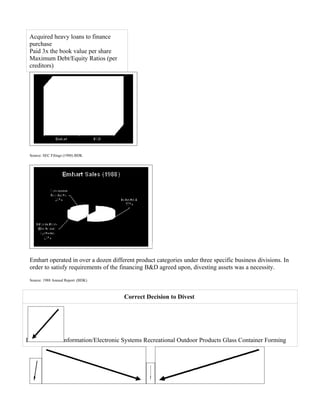
Acquired heavy loans to finance
    purchase
    Paid 3x the book value per share
    Maximum Debt/Equity Ratios (per
    creditors)


    Source: SEC Filings (1988) BDK


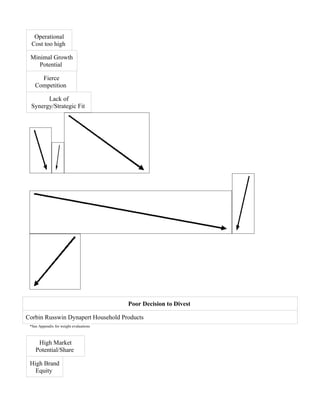
    Emhart operated in over a dozen different product categories under three specific business divisions. In
    order to satisfy requirements of the financing B&D agreed upon, divesting assets was a necessity.
    Source: 1988 Annual Report (BDK)


                                             Correct Decision to Divest


I                      nformation/Electronic Systems Recreational Outdoor Products Glass Container Forming
Operational
  Cost too high

 Minimal Growth
    Potential

      Fierce
    Competition

       Lack of
 Synergy/Strategic Fit


                                        Poor Decision to Divest

Corbin Russwin Dynapert Household Products
 *See Appendix for weight evaluations


     High Market
    Potential/Share

 High Brand
   Equity
Synergy w/
B&D products

Strategic Fit
Black and Decker Today

B&D Companies

     (2005)

Black and Decker

     Dewalt

  Porter-Cable

Delta Machinery

Kwikset

    Baldwin

  Weiser Lock

  Price Pfister

    Emhart
  Teknologies
Black and Decker currently own a variety of brands under 9 different companies. Net income has
continued to rise for B&D since 2001 with net income last

reported of $543.9 million.
Black and Decker continues its quest to perfect its portfolio. B&D purchased Baldwin Hardware
Corporation and Weiser Lock Corporation from Masco for $275 million in 2003.iii B&D companies
like Porter-Cable and Delta were purchased as a part of Tools Group from Pentair, Inc in 2004 for $775
million.iv

Stockholder’s Point of View

For nearly 100 years B&D has been discovering new ways to tap a mature market. Innovations like the
Snakelight flashlight and cordless tools have found ways to keep demand alive in a saturated market.
Stockholders today shouldn’t be surprised that B&D look constantly to find ways and means to make
the company more profitable. The only realm B&D is not willing to do business outside of is the realm
of profitless opportunities.

Quick Current

Shareholders should take notice the drastic difference

1996       .54     1.20

1997       .86     1.51

1998       .64     1.27

1999       .62     1.22

2000       .56     1.20

2001       .89     1.77

2002       .86     1.51

2003       .85     1.68

2004       .87     1.63

2005       .93     1.48
between the quick and the current ratios. The difference is showing that in order to meet all current
liabilities,

inventory would have to be sold.1

1996     1.04

1997     1.04

1998     2.37

1999     1.55
2000     1.80

2001     1.65

2002     2.08

2003     1.08

2004     .77

2005     1.15
Debt/Equity Ratio

                                    Shareholders should be aware that B&D isn’t afraid to finance their

                                                               Growth and expansion as shown by a not

                                                                           favorable Debt/Equity Ratio.

Profits are on the rise, as well as corporate growth on the whole. Earnings Per Share have increased
steadily since 1998 to a 10 year in 2005.v

Some at B&D will argue they paid down the entire balance of their Emhart acquisition loan as early as
1990.

Since so much of their operations are financed by debt, could it be possible they merely “robbed Peter
to pay Paul?”

Stockholder Suggestion: Due to high debt burden, slow market growth (4%) and risk taking
management, Do not purchase Black and Decker.

Conclusion

While B&D was trying to get their sales figures in line with the goals and expectations of the creditors,
they ignored the shareholders. B&G was stretched too thin. In a firm highly leveraged by debt, it can
not afford to tarnish its reputation and credibility with creditors. Shareholders come second to the bank
in the decision making process. To have to acquire the “package deal” of Emhart was not a sound
strategic move. Opportunity Costs of other firms that could have been easier managed were not an
option. Selling many of the firms under management expectations is another indication of its
dissatisfactory performance. B&D would have been better off doing nothing than trying to triple
products over night.

1 All data used for ratios were provided by Securities Exchange Commission Reports/Annual Reports
from 1996-2005 for Black and Decker Corporation (BDK)

i Black and Decker Corporation. http://www.bdk.com/ 2006

ii “Tool market to exceed $13 billion”, Assembly 43 (5) May 2000
iii Black & Decker Company Information.
http://www.blackanddecker.com/CustomerCenter/Company-Information.aspx 2006

iv Black & Decker Company Information.
http://www.blackanddecker.com/CustomerCenter/Company-Information.aspx 2006

v SEC Filings for BDK Annual Reports

                                                                             1

Case Study_ Black & Decker.doc

  • 1.
    Introduction Since 1910 Blackand Decker (B&D) has dominated the tool industryi. With clear dominance in the this industry, B&D set it’s eyes on expanding. Did B&D bite off more than it could chew? How do potential shareholders feel about a company known for making drills expanding its portfolio as far out as golf clubs? This report will address the mistakes B&D made, and may still be making. How does the best get better? The power tool market is a mature and cyclical market, with an annual growth rate around 4%.ii CEO Archibald felt that diversifying out of B&D’s core competency of power tools, was necessary to achieve satisfactory corporate growth. Black & Decker Manufacturing Company (1984) Global Leader in Consumer & Power Tools B&D Acquires GE Small Appliances Division (1984) B&D Acquires GE Small Appliances Division (1984) Advantages Disadvantages Market Leader Low profit margin (25%) ½ revenue comes from 1/150 product) $500 million Strong brand alliance
  • 2.
    annual revenue to GE “Would you buy a toaster from a drillmaker?” Black & Decker Corporation (1985) Emphasis being on marketing & sales of consumer products CEO Archibald had turned a B&D which had posted $156.4 million loss in 1985, into a thriving profitable firm posting profits of $91.7 million in 1988. Archibald’s success lies within his strategy. ARCHIBALD’S STRATEGY ARCHIBALD’S STRATEGY Consolidate Production – Boost factory Increase Research and Development – production by utilizing newer plants more Goaled division to produce 12+/year efficiently & closing down the older ones. Centralized Global Operations – product Diversification – growth as a company lied variations reduced, and production runs within expanding products and services were lengthened. Archibald Goes Overboard With a successful rebranding strategy of GE products previously acquired under his belt, Archibald attempted to acquire two other firms unsuccessfully. In 1989, B&D agreed to acquire Emhart Corporation for $2.8 billion. Concerns with Emhart Purchase Stockholders failed to see ‘strategic fit’ Substantially larger than B&D per businesses and products
  • 3.
    Acquired heavy loansto finance purchase Paid 3x the book value per share Maximum Debt/Equity Ratios (per creditors) Source: SEC Filings (1988) BDK Emhart operated in over a dozen different product categories under three specific business divisions. In order to satisfy requirements of the financing B&D agreed upon, divesting assets was a necessity. Source: 1988 Annual Report (BDK) Correct Decision to Divest I nformation/Electronic Systems Recreational Outdoor Products Glass Container Forming
  • 4.
    Operational Costtoo high Minimal Growth Potential Fierce Competition Lack of Synergy/Strategic Fit Poor Decision to Divest Corbin Russwin Dynapert Household Products *See Appendix for weight evaluations High Market Potential/Share High Brand Equity
  • 5.
    Synergy w/ B&D products StrategicFit Black and Decker Today B&D Companies (2005) Black and Decker Dewalt Porter-Cable Delta Machinery Kwikset Baldwin Weiser Lock Price Pfister Emhart Teknologies Black and Decker currently own a variety of brands under 9 different companies. Net income has continued to rise for B&D since 2001 with net income last reported of $543.9 million.
  • 6.
    Black and Deckercontinues its quest to perfect its portfolio. B&D purchased Baldwin Hardware Corporation and Weiser Lock Corporation from Masco for $275 million in 2003.iii B&D companies like Porter-Cable and Delta were purchased as a part of Tools Group from Pentair, Inc in 2004 for $775 million.iv Stockholder’s Point of View For nearly 100 years B&D has been discovering new ways to tap a mature market. Innovations like the Snakelight flashlight and cordless tools have found ways to keep demand alive in a saturated market. Stockholders today shouldn’t be surprised that B&D look constantly to find ways and means to make the company more profitable. The only realm B&D is not willing to do business outside of is the realm of profitless opportunities. Quick Current Shareholders should take notice the drastic difference 1996 .54 1.20 1997 .86 1.51 1998 .64 1.27 1999 .62 1.22 2000 .56 1.20 2001 .89 1.77 2002 .86 1.51 2003 .85 1.68 2004 .87 1.63 2005 .93 1.48 between the quick and the current ratios. The difference is showing that in order to meet all current liabilities, inventory would have to be sold.1 1996 1.04 1997 1.04 1998 2.37 1999 1.55
  • 7.
    2000 1.80 2001 1.65 2002 2.08 2003 1.08 2004 .77 2005 1.15 Debt/Equity Ratio Shareholders should be aware that B&D isn’t afraid to finance their Growth and expansion as shown by a not favorable Debt/Equity Ratio. Profits are on the rise, as well as corporate growth on the whole. Earnings Per Share have increased steadily since 1998 to a 10 year in 2005.v Some at B&D will argue they paid down the entire balance of their Emhart acquisition loan as early as 1990. Since so much of their operations are financed by debt, could it be possible they merely “robbed Peter to pay Paul?” Stockholder Suggestion: Due to high debt burden, slow market growth (4%) and risk taking management, Do not purchase Black and Decker. Conclusion While B&D was trying to get their sales figures in line with the goals and expectations of the creditors, they ignored the shareholders. B&G was stretched too thin. In a firm highly leveraged by debt, it can not afford to tarnish its reputation and credibility with creditors. Shareholders come second to the bank in the decision making process. To have to acquire the “package deal” of Emhart was not a sound strategic move. Opportunity Costs of other firms that could have been easier managed were not an option. Selling many of the firms under management expectations is another indication of its dissatisfactory performance. B&D would have been better off doing nothing than trying to triple products over night. 1 All data used for ratios were provided by Securities Exchange Commission Reports/Annual Reports from 1996-2005 for Black and Decker Corporation (BDK) i Black and Decker Corporation. http://www.bdk.com/ 2006 ii “Tool market to exceed $13 billion”, Assembly 43 (5) May 2000
  • 8.
    iii Black &Decker Company Information. http://www.blackanddecker.com/CustomerCenter/Company-Information.aspx 2006 iv Black & Decker Company Information. http://www.blackanddecker.com/CustomerCenter/Company-Information.aspx 2006 v SEC Filings for BDK Annual Reports 1