CASE STUDY
                        Assistive Technology Wiki


                                            by
                                      Veronique Maes


This document is part of the overall European project LINKS-UP - Learning 2.0 for an Inclusive
Knowledge Society – Understanding the Picture. Further case studies and project results can be
downloaded from the project website http://www.linksup.eu.


Copyright
                       This work has been licensed under a Creative                   Commons      License:
                       Attribution-NonCommercial-NoDerivs
                       http://creativecommons.org/licenses/by-nc-nd/3.0/


                           This project has been funded with support from the European Commission. This
                           publication reflects the views only of the author(s), and the Commission cannot be
                           held responsible for any use which may be made of the information contained
                           therein.
The Assistive Technology Wiki is an initiative developed and implemented by AbilityNet.
          AbilityNet is a national UK charity that has been running for over 20 years. Their main
          mission and objective is to promote better design and diffusion of ICT for people with
          disabilities, and to support disabled adults and children in using them. They contribute
          to developing adaptive and assistive technologies to do this. Adaptive technologies sup-
          ported by AbilityNet include screen magnifiers, on screen keyboards, voice recognition
          and narrators, and predictive text. However, adaptive technologies are on their own not
          enough to support people with disabilities – education and skills is the major problem.
          So AbilityNet deliver online e-learning to get people to learn to use technologies and ad-
          aptive systems. This is where the ‘Assistive Technology Wiki’ comes in.

          Case profile – AT Wiki in a nutshell

                                      Assistive Technology Wiki


Website                               http://abilitynet.wetpaint.com/
Status                                07/2008 – ongoing
                                      CEO of AbilityNet
Interviewed person                    Director of Development at AbilityNet,
                                      AT Wiki creator and co-ordinator
                                      The funding to start the initiative came internally from AbilityNet.
                                      Overall, it is supported by donations (around 20%), government
Funded and promoted by…               grants, fees earned from services provided, for example disability
                                      awareness training for employers, in-kind support from compan-
                                      ies.
                                      The target user group for the wiki is anyone interested in the
Target group(s)                       needs of disabled people. This includes equipment vendors, char-
                                      ities, public sector agencies and disabled people themselves.
Number of users                       About 80 users but increases steadily
                                      Vocational Education       &      Training,   Workplace   Learning,
Educational Sector(s)
                                      Lifelong/Adult Learning
Category of the Learning Activities   Informal learning
Web 2.0 technologies used...          Wiki, media sharing, Moodle
                                      Open for everybody in order to get access to valuable information,
Methods to support inclusion
                                      as well as contact to the peer-community

          Short description and key characteristics
          The wiki aims to provide flexible, up-to-date information on all aspects of assistive tech-
          nology, including the latest products available. The wiki allows its members to share
          knowledge and opinion on this information, as well as suggest and discuss new products
          and services. There are currently over 80 members in the AT Wiki community and it is
          steadily increasing. Most of these are Assistive Technology professionals. A minority are
          people with disabilities. Users also include equipment vendors, charities, public sector


                                                   2
agencies, therapists, health professionals and parents. The target user group for the wiki
is anyone interested in the needs of disabled people.
From the results of the Self-Administered-Questionnaire, respondents identified them-
selves as accessibility consultants, technology providers, some of whom are AbilityNet
employees, web accessibility administrators, open source software developers, as well
as carers and volunteer workers. Wiki member profiles confirm that the wiki is being
used by AbilityNet employees and interns, voluntary and charity workers, employees of
other assistive technology organisations or departments, for example BT’s Consumer Af-
fairs and Inclusion Team, software developers, technology writers, IT trainers and con-
sultants and relatives of people who use assistive technology.
The wiki was launched in July 2008. The rationale for the wiki comes from problems as-
sociated with the fact that the resource base used by AbilityNet – including training
courses, information on new products, standards information, disability discrimination
act compliance checks – had become static and was not developing as the state of the
art evolved.
The funding to start the initiative came internally from AbilityNet. Overall, it is suppor-
ted by donations (around 20%), government grants, fees earned from services provided,
for example disability awareness training for employers, in-kind support from compan-
ies. The initiative involves minimal capital and operational costs since ‘wetpaint’ is open
source and free to use. The initiative has only recently been launched, so exploitation
and sustainability plans are at an early stage.
The stakeholders and partners involved are mostly vendors of assistive technologies
(e.g. Agilent Technologies, British Telecom, Microsoft), disabled people, NGOs support-
ing disabled people.

Dimension of learning and inclusion
The wiki is accessed via the AbilityNet forum. It integrates a content developer and edit-
or (‘Easyedit’) to create content and incorporates blogs and discussion forums to enable
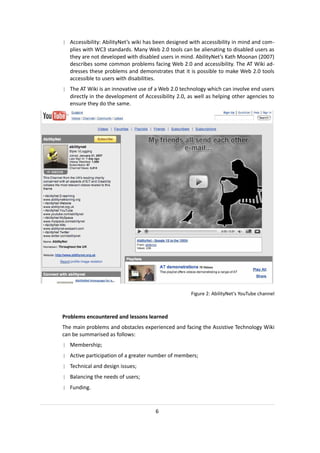
content to be reviewed. The platform uses embedded YouTube videos that provide illus-
trations of the latest assistive technologies and how they are used. There are links to the
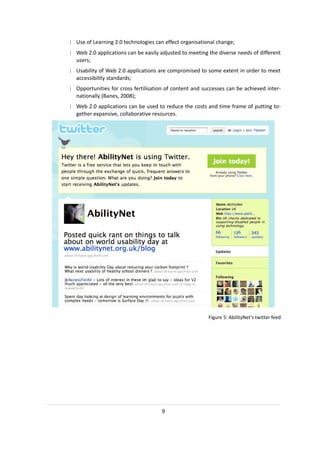
wiki from AbilityNet ‘Twitterfeed’. The main innovative aspect of the Assistive Techno-
logy Wiki is its pedagogic model, which involves a collaborative knowledge production
approach, based on ‘routes of desire’. This involves an ‘open pedagogy’ method – sup-
porting people to find their own routes to learning through different systems and tech-
nologies, rather than a ‘didactic’ approach.
AbilityNet’s ‘open pedagogy’ approach makes the most of the knowledge, expertise and
experience of its users, whatever their background (e.g. disabled user, healthcare pro-
fessional, AbilityNet employee), and provides them with a flexible knowledge system
that can incorporate many different resources (including other AbilityNet services) to
provide a tailored information source and learning experience for each individual user.
From the Self-Administered-Questionnaire, it is evident that the AT Wiki is mainly used
to share the latest information on assistive technologies (75%) and for networking with
other interested parties (50%). Most of the respondents agree that the wiki helps to de-
velop networks that provide opportunities; helps members to feel more involved in the
community and provides better information. Furthermore the user feel that the wiki is
beneficial for:


                                        3
| “Getting to know new people” (Accessibility Consultant)
| “Feeling part of a widespread community” (Technology provider)
| “Sharing information…creating an information resource” (Technology provider)
| “Ensure people are aware of Open Source software solutions” (Open source techno-
  logy software developer)
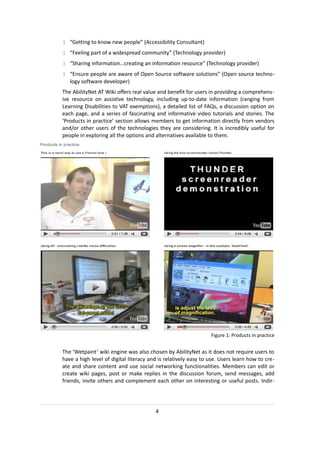
The AbilityNet AT Wiki offers real value and benefit for users in providing a comprehens-
ive resource on assistive technology, including up-to-date information (ranging from
Learning Disabilities to VAT exemptions), a detailed list of FAQs, a discussion option on
each page, and a series of fascinating and informative video tutorials and stories. The
‘Products in practice’ section allows members to get information directly from vendors
and/or other users of the technologies they are considering. It is incredibly useful for
people in exploring all the options and alternatives available to them.


                                                                Figure 1: Products in practice


The ‘Wetpaint’ wiki engine was also chosen by AbilityNet as it does not require users to
have a high level of digital literacy and is relatively easy to use. Users learn how to cre-
ate and share content and use social networking functionalities. Members can edit or
create wiki pages, post or make replies in the discussion forum, send messages, add
friends, invite others and complement each other on interesting or useful posts. Indir-


                                        4
ectly, the wiki may help to develop ICT skills by offering valuable information on devel-
oping ICT skills for disabled people through promoting access to advanced technologies.
As the AT Wiki is predominantly used by professionals, improving the ‘soft skills’ of
members is not a key outcome. However, participation in the AT Wiki can have a positive
impact on user skills which, through the nature of the wiki environment, are difficult to
monitor:
| Social interaction: One of the key things about the AT Wiki is its networking potential
  through information sharing. Socialisation tools are teamed with online knowledge
  production, allowing members to make new friends and professional acquaintances
  and help them to feel part of a wider community.
| Active citizenship: Active citizenship is also encouraged through sharing information
  that is valuable to others and can help them to improve their quality of life.
| There is also evidence to suggest that it can help reduced isolation of disabled users.
The Disability Rights Commission advocates a society ‘where all disabled people can par-
ticipate fully as equal citizens [… where] this new and powerful technology does not
leave [them] behind” (Disability Right Commission, 2004). AbilityNet provides easy ac-
cess to important information, useful tools, invaluable software and training, as well as a
network of web users in a similar position, all of which is expanded upon by the AT Wiki.
Overall, this blended e-Learning model incorporates as many Web 2.0 technologies as
possible, giving previously excluded groups access to the internet and the opportunity
to participate in collaborative learning, sharing their knowledge on what ICT technolo-
gies work for their disability, which may help other excluded users. This may help reduce
disabled people’s isolation.
The positive outcomes which are already evident are that it contributes to raising
awareness of the needs of disabled people and promotes knowledge sharing and tech-
nical development between AT professionals, leading to better technology solutions for
disabled users.

Innovative elements and key success factors
The main factors contributing to the successful outcomes of the initiative are as follows:
| The pedagogic model, with a ‘routes of desire’ approach, linking members to a value
  chain of information and services. Users have access to a wide range of Web 2.0 and
  non Web 2.0 services including traditional training and consultancy, e-Learning, and
  AbilityNet’s YouTube channel, Twitterfeed and Myspace and Facebook sites.
| Use of socialisation tools within a wiki platform to encourage networking between
  different agencies and develop a more informed resource database on state-of-the-
  art technologies. For assistive technology stakeholders the AT Wiki is a valuable plat-
  form for collating and organising existing information, enabling them to deliver bet-
  ter services to their clients. Moreover, since the wiki encourages networking
  between different agencies interested in assistive technologies it creates a pooling of
  expert knowledge, which in time can be added to by the experiences of disabled
  people themselves, as well as their relatives and carers. As the wiki is updated and
  expanded by this interaction between members, it is able to offer more informed
  and varied opinion on state-of-the- art solutions:


                                        5
| Accessibility: AbilityNet’s wiki has been designed with accessibility in mind and com-
  plies with WC3 standards. Many Web 2.0 tools can be alienating to disabled users as
  they are not developed with disabled users in mind. AbilityNet’s Kath Moonan (2007)
  describes some common problems facing Web 2.0 and accessibility. The AT Wiki ad-
  dresses these problems and demonstrates that it is possible to make Web 2.0 tools
  accessible to users with disabilities.
| The AT Wiki is an innovative use of a Web 2.0 technology which can involve end users
  directly in the development of Accessibility 2.0, as well as helping other agencies to
  ensure they do the same.


                                                     Figure 2: AbilityNet's YouTube channel


Problems encountered and lessons learned
The main problems and obstacles experienced and facing the Assistive Technology Wiki
can be summarised as follows:
| Membership;
| Active participation of a greater number of members;
| Technical and design issues;
| Balancing the needs of users;
| Funding.


                                      6
Membership: As AbilityNet is already a successful organisation, membership will steadily
grow through promotion and word of mouth, informing people through training pro-
grammes, links with other accessibility consultants and assistive technology vendors. So-
cial networking tools on the wiki itself, which, as mentioned earlier, allow members to
invite other users to join. Expanding membership will also increase wiki activity and gen-
erate further discussion. The problem here is that the participation of new members in
the forum and wiki is relatively slow to catch up. Most of the forum and wiki content is
generated and modified by only a few key members, who have been participants since
the wiki’s early stages. From the forum contributions analysis it is clear to see that
nearly half (44%) of all forum activity is generated by one user, and that just over three
quarters (76%) of all forum activity is generated by just three of the wiki members.
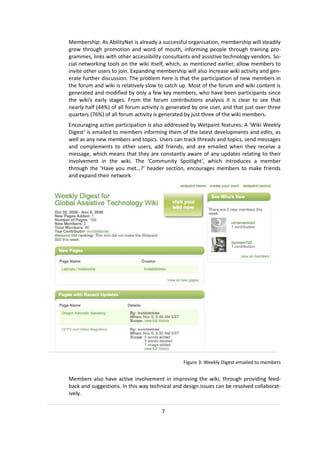
Encouraging active participation is also addressed by Wetpaint features: A ‘Wiki Weekly
Digest’ is emailed to members informing them of the latest developments and edits, as
well as any new members and topics. Users can track threads and topics, send messages
and complements to other users, add friends, and are emailed when they receive a
message, which means that they are constantly aware of any updates relating to their
involvement in the wiki. The ‘Community Spotlight’, which introduces a member
through the ‘Have you met…?’ header section, encourages members to make friends
and expand their network.


                                                Figure 3: Weekly Digest emailed to members


Members also have active involvement in improving the wiki, through providing feed-
back and suggestions. In this way technical and design issues can be resolved collaborat-
ively.


                                       7
The wiki is still being used as a traditional information source for the majority of users,
which needs to be addressed by greater involvement of the expanding membership.
Some issues mentioned by the SAQ respondents addressed incorporating minor
changes to improve usability:
| “Removing wetpaint branding. Better layout, clearer templates...Better navigation,
  specifically, better navigation box split to just show real content. A little usability
  study on it and modify layout accordingly? Think the challenge of wikis is making
  them clear/simple.” (AT Wiki member, technology provider)
| “It’s labelling and association problem” (Accessibility Consultant)
| “Logging in using an open id” (Technology provider)
| Would like to see “short, entertaining and informative tutorials” included on the wiki.
  (Web accessibility administrator)
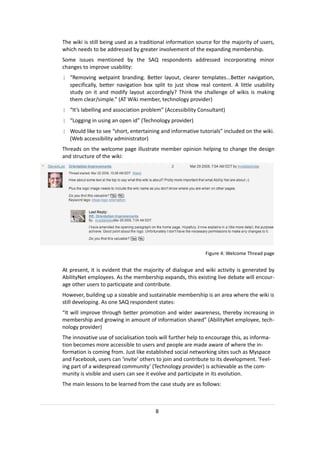
Threads on the welcome page illustrate member opinion helping to change the design
and structure of the wiki:


                                                             Figure 4: Welcome Thread page


At present, it is evident that the majority of dialogue and wiki activity is generated by
AbilityNet employees. As the membership expands, this existing live debate will encour-
age other users to participate and contribute.
However, building up a sizeable and sustainable membership is an area where the wiki is
still developing. As one SAQ respondent states:
“It will improve through better promotion and wider awareness, thereby increasing in
membership and growing in amount of information shared” (AbilityNet employee, tech-
nology provider)
The innovative use of socialisation tools will further help to encourage this, as informa-
tion becomes more accessible to users and people are made aware of where the in-
formation is coming from. Just like established social networking sites such as Myspace
and Facebook, users can ‘invite’ others to join and contribute to its development. ‘Feel-
ing part of a widespread community’ (Technology provider) is achievable as the com-
munity is visible and users can see it evolve and participate in its evolution.
The main lessons to be learned from the case study are as follows:


                                        8
| Use of Learning 2.0 technologies can effect organisational change;
| Web 2.0 applications can be easily adjusted to meeting the diverse needs of different
  users;
| Usability of Web 2.0 applications are compromised to some extent in order to meet
  accessibility standards;
| Opportunities for cross fertilisation of content and successes can be achieved inter-
  nationally (Banes, 2008);
| Web 2.0 applications can be used to reduce the costs and time frame of putting to-
  gether expansive, collaborative resources.


                                                         Figure 5: AbilityNet’s twitter feed


                                      9
Collaborating institutions in LINKS-UP

                 Institute for Innovation in Learning, Friedrich-Alex-
                 ander-Universität Erlangen-Nürnberg, Erlangen,
                 Germany
                 www.fim.uni-erlangen.de


                 Arcola Research LLP, London, United Kingdom
                 www.arcola-research.co.uk


                 eSociety Institute, The Hague University of Applied
                 Sciences, The Hague, The Netherlands
                 www.esocietyinstituut.nl


                 Servizi Didattici e Scientifici per l’Università di Firen-
                 ze, Prato, Italy
                 www.pin.unifi.it


                 Salzburg Research Forschungsgesellschaft, Salzburg,
                 Austria
                 www.salzburgresearch.at


                 European Distance and E-Learning Network (EDEN),
                 Milton Keynes, United Kingdom
                 www.eden-online.org


                   10

Case study AT Wiki

  • 1.
    CASE STUDY Assistive Technology Wiki by Veronique Maes This document is part of the overall European project LINKS-UP - Learning 2.0 for an Inclusive Knowledge Society – Understanding the Picture. Further case studies and project results can be downloaded from the project website http://www.linksup.eu. Copyright This work has been licensed under a Creative Commons License: Attribution-NonCommercial-NoDerivs http://creativecommons.org/licenses/by-nc-nd/3.0/ This project has been funded with support from the European Commission. This publication reflects the views only of the author(s), and the Commission cannot be held responsible for any use which may be made of the information contained therein.
  • 2.
    The Assistive TechnologyWiki is an initiative developed and implemented by AbilityNet. AbilityNet is a national UK charity that has been running for over 20 years. Their main mission and objective is to promote better design and diffusion of ICT for people with disabilities, and to support disabled adults and children in using them. They contribute to developing adaptive and assistive technologies to do this. Adaptive technologies sup- ported by AbilityNet include screen magnifiers, on screen keyboards, voice recognition and narrators, and predictive text. However, adaptive technologies are on their own not enough to support people with disabilities – education and skills is the major problem. So AbilityNet deliver online e-learning to get people to learn to use technologies and ad- aptive systems. This is where the ‘Assistive Technology Wiki’ comes in. Case profile – AT Wiki in a nutshell Assistive Technology Wiki Website http://abilitynet.wetpaint.com/ Status 07/2008 – ongoing CEO of AbilityNet Interviewed person Director of Development at AbilityNet, AT Wiki creator and co-ordinator The funding to start the initiative came internally from AbilityNet. Overall, it is supported by donations (around 20%), government Funded and promoted by… grants, fees earned from services provided, for example disability awareness training for employers, in-kind support from compan- ies. The target user group for the wiki is anyone interested in the Target group(s) needs of disabled people. This includes equipment vendors, char- ities, public sector agencies and disabled people themselves. Number of users About 80 users but increases steadily Vocational Education & Training, Workplace Learning, Educational Sector(s) Lifelong/Adult Learning Category of the Learning Activities Informal learning Web 2.0 technologies used... Wiki, media sharing, Moodle Open for everybody in order to get access to valuable information, Methods to support inclusion as well as contact to the peer-community Short description and key characteristics The wiki aims to provide flexible, up-to-date information on all aspects of assistive tech- nology, including the latest products available. The wiki allows its members to share knowledge and opinion on this information, as well as suggest and discuss new products and services. There are currently over 80 members in the AT Wiki community and it is steadily increasing. Most of these are Assistive Technology professionals. A minority are people with disabilities. Users also include equipment vendors, charities, public sector 2
  • 3.
    agencies, therapists, healthprofessionals and parents. The target user group for the wiki is anyone interested in the needs of disabled people. From the results of the Self-Administered-Questionnaire, respondents identified them- selves as accessibility consultants, technology providers, some of whom are AbilityNet employees, web accessibility administrators, open source software developers, as well as carers and volunteer workers. Wiki member profiles confirm that the wiki is being used by AbilityNet employees and interns, voluntary and charity workers, employees of other assistive technology organisations or departments, for example BT’s Consumer Af- fairs and Inclusion Team, software developers, technology writers, IT trainers and con- sultants and relatives of people who use assistive technology. The wiki was launched in July 2008. The rationale for the wiki comes from problems as- sociated with the fact that the resource base used by AbilityNet – including training courses, information on new products, standards information, disability discrimination act compliance checks – had become static and was not developing as the state of the art evolved. The funding to start the initiative came internally from AbilityNet. Overall, it is suppor- ted by donations (around 20%), government grants, fees earned from services provided, for example disability awareness training for employers, in-kind support from compan- ies. The initiative involves minimal capital and operational costs since ‘wetpaint’ is open source and free to use. The initiative has only recently been launched, so exploitation and sustainability plans are at an early stage. The stakeholders and partners involved are mostly vendors of assistive technologies (e.g. Agilent Technologies, British Telecom, Microsoft), disabled people, NGOs support- ing disabled people. Dimension of learning and inclusion The wiki is accessed via the AbilityNet forum. It integrates a content developer and edit- or (‘Easyedit’) to create content and incorporates blogs and discussion forums to enable content to be reviewed. The platform uses embedded YouTube videos that provide illus- trations of the latest assistive technologies and how they are used. There are links to the wiki from AbilityNet ‘Twitterfeed’. The main innovative aspect of the Assistive Techno- logy Wiki is its pedagogic model, which involves a collaborative knowledge production approach, based on ‘routes of desire’. This involves an ‘open pedagogy’ method – sup- porting people to find their own routes to learning through different systems and tech- nologies, rather than a ‘didactic’ approach. AbilityNet’s ‘open pedagogy’ approach makes the most of the knowledge, expertise and experience of its users, whatever their background (e.g. disabled user, healthcare pro- fessional, AbilityNet employee), and provides them with a flexible knowledge system that can incorporate many different resources (including other AbilityNet services) to provide a tailored information source and learning experience for each individual user. From the Self-Administered-Questionnaire, it is evident that the AT Wiki is mainly used to share the latest information on assistive technologies (75%) and for networking with other interested parties (50%). Most of the respondents agree that the wiki helps to de- velop networks that provide opportunities; helps members to feel more involved in the community and provides better information. Furthermore the user feel that the wiki is beneficial for: 3
  • 4.
    | “Getting toknow new people” (Accessibility Consultant) | “Feeling part of a widespread community” (Technology provider) | “Sharing information…creating an information resource” (Technology provider) | “Ensure people are aware of Open Source software solutions” (Open source techno- logy software developer) The AbilityNet AT Wiki offers real value and benefit for users in providing a comprehens- ive resource on assistive technology, including up-to-date information (ranging from Learning Disabilities to VAT exemptions), a detailed list of FAQs, a discussion option on each page, and a series of fascinating and informative video tutorials and stories. The ‘Products in practice’ section allows members to get information directly from vendors and/or other users of the technologies they are considering. It is incredibly useful for people in exploring all the options and alternatives available to them. Figure 1: Products in practice The ‘Wetpaint’ wiki engine was also chosen by AbilityNet as it does not require users to have a high level of digital literacy and is relatively easy to use. Users learn how to cre- ate and share content and use social networking functionalities. Members can edit or create wiki pages, post or make replies in the discussion forum, send messages, add friends, invite others and complement each other on interesting or useful posts. Indir- 4
  • 5.
    ectly, the wikimay help to develop ICT skills by offering valuable information on devel- oping ICT skills for disabled people through promoting access to advanced technologies. As the AT Wiki is predominantly used by professionals, improving the ‘soft skills’ of members is not a key outcome. However, participation in the AT Wiki can have a positive impact on user skills which, through the nature of the wiki environment, are difficult to monitor: | Social interaction: One of the key things about the AT Wiki is its networking potential through information sharing. Socialisation tools are teamed with online knowledge production, allowing members to make new friends and professional acquaintances and help them to feel part of a wider community. | Active citizenship: Active citizenship is also encouraged through sharing information that is valuable to others and can help them to improve their quality of life. | There is also evidence to suggest that it can help reduced isolation of disabled users. The Disability Rights Commission advocates a society ‘where all disabled people can par- ticipate fully as equal citizens [… where] this new and powerful technology does not leave [them] behind” (Disability Right Commission, 2004). AbilityNet provides easy ac- cess to important information, useful tools, invaluable software and training, as well as a network of web users in a similar position, all of which is expanded upon by the AT Wiki. Overall, this blended e-Learning model incorporates as many Web 2.0 technologies as possible, giving previously excluded groups access to the internet and the opportunity to participate in collaborative learning, sharing their knowledge on what ICT technolo- gies work for their disability, which may help other excluded users. This may help reduce disabled people’s isolation. The positive outcomes which are already evident are that it contributes to raising awareness of the needs of disabled people and promotes knowledge sharing and tech- nical development between AT professionals, leading to better technology solutions for disabled users. Innovative elements and key success factors The main factors contributing to the successful outcomes of the initiative are as follows: | The pedagogic model, with a ‘routes of desire’ approach, linking members to a value chain of information and services. Users have access to a wide range of Web 2.0 and non Web 2.0 services including traditional training and consultancy, e-Learning, and AbilityNet’s YouTube channel, Twitterfeed and Myspace and Facebook sites. | Use of socialisation tools within a wiki platform to encourage networking between different agencies and develop a more informed resource database on state-of-the- art technologies. For assistive technology stakeholders the AT Wiki is a valuable plat- form for collating and organising existing information, enabling them to deliver bet- ter services to their clients. Moreover, since the wiki encourages networking between different agencies interested in assistive technologies it creates a pooling of expert knowledge, which in time can be added to by the experiences of disabled people themselves, as well as their relatives and carers. As the wiki is updated and expanded by this interaction between members, it is able to offer more informed and varied opinion on state-of-the- art solutions: 5
  • 6.
    | Accessibility: AbilityNet’swiki has been designed with accessibility in mind and com- plies with WC3 standards. Many Web 2.0 tools can be alienating to disabled users as they are not developed with disabled users in mind. AbilityNet’s Kath Moonan (2007) describes some common problems facing Web 2.0 and accessibility. The AT Wiki ad- dresses these problems and demonstrates that it is possible to make Web 2.0 tools accessible to users with disabilities. | The AT Wiki is an innovative use of a Web 2.0 technology which can involve end users directly in the development of Accessibility 2.0, as well as helping other agencies to ensure they do the same. Figure 2: AbilityNet's YouTube channel Problems encountered and lessons learned The main problems and obstacles experienced and facing the Assistive Technology Wiki can be summarised as follows: | Membership; | Active participation of a greater number of members; | Technical and design issues; | Balancing the needs of users; | Funding. 6
  • 7.
    Membership: As AbilityNetis already a successful organisation, membership will steadily grow through promotion and word of mouth, informing people through training pro- grammes, links with other accessibility consultants and assistive technology vendors. So- cial networking tools on the wiki itself, which, as mentioned earlier, allow members to invite other users to join. Expanding membership will also increase wiki activity and gen- erate further discussion. The problem here is that the participation of new members in the forum and wiki is relatively slow to catch up. Most of the forum and wiki content is generated and modified by only a few key members, who have been participants since the wiki’s early stages. From the forum contributions analysis it is clear to see that nearly half (44%) of all forum activity is generated by one user, and that just over three quarters (76%) of all forum activity is generated by just three of the wiki members. Encouraging active participation is also addressed by Wetpaint features: A ‘Wiki Weekly Digest’ is emailed to members informing them of the latest developments and edits, as well as any new members and topics. Users can track threads and topics, send messages and complements to other users, add friends, and are emailed when they receive a message, which means that they are constantly aware of any updates relating to their involvement in the wiki. The ‘Community Spotlight’, which introduces a member through the ‘Have you met…?’ header section, encourages members to make friends and expand their network. Figure 3: Weekly Digest emailed to members Members also have active involvement in improving the wiki, through providing feed- back and suggestions. In this way technical and design issues can be resolved collaborat- ively. 7
  • 8.
    The wiki isstill being used as a traditional information source for the majority of users, which needs to be addressed by greater involvement of the expanding membership. Some issues mentioned by the SAQ respondents addressed incorporating minor changes to improve usability: | “Removing wetpaint branding. Better layout, clearer templates...Better navigation, specifically, better navigation box split to just show real content. A little usability study on it and modify layout accordingly? Think the challenge of wikis is making them clear/simple.” (AT Wiki member, technology provider) | “It’s labelling and association problem” (Accessibility Consultant) | “Logging in using an open id” (Technology provider) | Would like to see “short, entertaining and informative tutorials” included on the wiki. (Web accessibility administrator) Threads on the welcome page illustrate member opinion helping to change the design and structure of the wiki: Figure 4: Welcome Thread page At present, it is evident that the majority of dialogue and wiki activity is generated by AbilityNet employees. As the membership expands, this existing live debate will encour- age other users to participate and contribute. However, building up a sizeable and sustainable membership is an area where the wiki is still developing. As one SAQ respondent states: “It will improve through better promotion and wider awareness, thereby increasing in membership and growing in amount of information shared” (AbilityNet employee, tech- nology provider) The innovative use of socialisation tools will further help to encourage this, as informa- tion becomes more accessible to users and people are made aware of where the in- formation is coming from. Just like established social networking sites such as Myspace and Facebook, users can ‘invite’ others to join and contribute to its development. ‘Feel- ing part of a widespread community’ (Technology provider) is achievable as the com- munity is visible and users can see it evolve and participate in its evolution. The main lessons to be learned from the case study are as follows: 8
  • 9.
    | Use ofLearning 2.0 technologies can effect organisational change; | Web 2.0 applications can be easily adjusted to meeting the diverse needs of different users; | Usability of Web 2.0 applications are compromised to some extent in order to meet accessibility standards; | Opportunities for cross fertilisation of content and successes can be achieved inter- nationally (Banes, 2008); | Web 2.0 applications can be used to reduce the costs and time frame of putting to- gether expansive, collaborative resources. Figure 5: AbilityNet’s twitter feed 9
  • 10.
    Collaborating institutions inLINKS-UP Institute for Innovation in Learning, Friedrich-Alex- ander-Universität Erlangen-Nürnberg, Erlangen, Germany www.fim.uni-erlangen.de Arcola Research LLP, London, United Kingdom www.arcola-research.co.uk eSociety Institute, The Hague University of Applied Sciences, The Hague, The Netherlands www.esocietyinstituut.nl Servizi Didattici e Scientifici per l’Università di Firen- ze, Prato, Italy www.pin.unifi.it Salzburg Research Forschungsgesellschaft, Salzburg, Austria www.salzburgresearch.at European Distance and E-Learning Network (EDEN), Milton Keynes, United Kingdom www.eden-online.org 10