CASE STUDY
                                        Cyberhus


                                              by
                                        Martijn Hartog


This document is part of the overall European project LINKS-UP - Learning 2.0 for an Inclusive
Knowledge Society – Understanding the Picture. Further case studies and project results can be
downloaded from the project website http://www.linksup.eu.


Copyright
                       This work has been licensed under a Creative                   Commons      License:
                       Attribution-NonCommercial-NoDerivs
                       http://creativecommons.org/licenses/by-nc-nd/3.0/


                           This project has been funded with support from the European Commission. This
                           publication reflects the views only of the author(s), and the Commission cannot be
                           held responsible for any use which may be made of the information contained
                           therein.
Cyberhus is a Danish 100% non-profit organization located in Aarhus. Cyberhus was
          founded in 2004 as a partner charity under the youth charity, Ungdommens Vel ('Youth
          Welfare') and is today staffed by more than 70 people - mainly volunteers. Cyberhus is a
          virtual house or club that offers online counselling for vulnerable children and teens.
          Counselling is undertaken mainly by volunteer chat-counsellors, all with relevant educa-
          tional backgrounds, such as teachers, pedagogues, social workers and psychology stu-
          dents. In December 2008 Cyberhus was ranked among the 5 best European websites for
          marginalized young people (E-inclusion). From September onwards Cyberhus has been
          chosen as the Danish helpline in the European network INSAFE.
          Cyberhus is organized within the 100-year-old national association Ungdommens Vel
          ('Youth Welfare'), which run youth shelters, children's homes, institutions for at-risk chil-
          dren, therapy groups, youth hostels and continuation schools throughout Denmark:
          www.ungdommens-vel.dk
          96% of Cyberhus’ users are children and teens aged between 9 and 18. They have more
          then 9000 unique visitors every month. From the starting period in 2004 there were
          4421 online one on one chats consultations / sessions.

          Case profile – Cyberhus in a nutshell

                                       Cyberhus
                                       Online counselling and more


Website                               http://www.cyberhus.dk
Status                                Active/running (since May 2004)
Interviewed person                    Kristian Lund
                                      Cyberhus is a 100% non-profit making online youth service sup-
Funded and promoted by…               ported by the Ministry of Social Affairs, private funds and the local
                                      authorities.
Location of the Learning Activities   Formal setting
Target group(s)                       Vulnerable children and teenagers
Number of users                       More than 4000 children and parents since 2007
Educational Sector(s)                 Therapeutically based
Category of the Learning Activities   Informal
                                      Social bookmarking, feeds, Blogs, Online chat, peer-to-peer de-
Web 2.0 technologies used...
                                      bate forums
Methods to support inclusion          Social networks, skill development

          Short description and key characteristics
          Cyberhus is first and foremost an anonymous online counselling service, offering chat,
          question and answer columns and forums to provide kids and young people with help
          and encouragement. They focus on excluded and vulnerable young, but believe that
          everyone can be vulnerable at some point in their lives. They mainly use volunteers for


                                                   2
direct online contact with kids and young people, but have their own moderators and
supervisors to support and ensure the quality of the counselling.
In addition, Cyberhus helps schools and parents tackle new challenges brought on by
ubiquitous computers and phones, and they are involved in national and European initi-
atives that deal with vulnerable youths and the 'new media'.
The Danish non-profit Ungdommens Vel (‘Youth Welfare’),that runs a wide variety of
youth homes, counselling services, schools and drop-in youth clubs started Cyberhus,
based on an idea by Anni Marquard, who was and is the main force in starting and oper-
ating Cyberhus. Apart from the Ministry of Social Affairs, a few counties and foundations
have helped out Cyberhus financially. They are still organisationally part of Ungdom-
mens Vel. Cyberhus forms partnerships on a project basis, and the core counselling
functions run almost entirely in-house. A few organisations such as Centre for Voldtægt-
sofre i Århus and Børnetinget do some of their counselling through Cyberhus' question
and answers-columns.

Dimension of learning and inclusion
Cyberhus its counselling services do not provide learning per se, the focus also lays with-
in their school service, Cyberskole, and related activities. Cyberskolen visits classrooms
to inform and discuss web ethics and netiquette. Initially, this was for the 14-16 year age
group, but by 2008 it was mostly kids around age 10-12. They have found that this is the
age where kids are beginning to use the net, have the most to learn and are most open
to discussion. They have also done workshops centred around a forum theatre show
which they helped to develop, and will soon begin a shoot-your-own-film campaign
(called Mobiler Mod Mobning, or Mobiles Against Bullying) against online bullying. Fur-
thermore they have follow-up parents evenings where they inform and discuss chil-
dren’s online life and the parents' role in guiding and helping. They do not use a particu-
lar pedagogic model but they focus on user participation and discussion rather than get-
ting a certain curriculum across. The topics they cover are far too vast to cover in any
comprehensive fashion, so enabling discussion of the topics that are most relevant and
interesting to the group at hand works better.
With a normal school visit they deliver over two standard lessons (2x45 minutes), they
present their selves and the topic, the kids answer predefined questions in their online
forums, two and two together, and after a break they have a discussion for the entire
class, based on those answers. For parents evenings, they have a list of points, facts and
topics they want to cover, but encourage as much discussion as the group can and will in
between delivering this. Most of the time is spent reacting to and controlling the discus-
sion.
Apart from being specially geared towards the excluded and vulnerable, they hope to
help those with decreased social abilities in using the net positively. Their Mobiler Mod
Mobning project is directly aimed at bullying, and hence towards inclusion. Everyone
and every problem is welcome at Cyberhus, and they have been able to foster this out-
look in their user forums, with very little need for adult moderation. They are more in-
volved with alleviating problems, than in helping towards some positive goal. To some
extend, these cannot be separated, and they obviously encourage seeking help, staying
in school, participating in social and work life, etc. as part of counselling.


                                        3
Innovative elements and key success factors
Other initiatives now offer counselling, but mostly in addition to other services and al-
ways to a specific group or with regards to a certain kind of problems. Cyberhus is
unique in offering general help to any problem, even if you cannot articulate what that
problem is! This enables them to help those with the least understanding of their situ-
ation, or the most fear of it - often those most in need.
It also means early help for those with seemingly lesser problems, that can be alleviated
more easily before they begin to seem or become bigger. Cyberhus' innovation is based
on a positive outlook on the new media.
Kids and young people are socialising and living their lives 'out there', and it seems the
most natural thing in the world to reach out for that, teach and involve ourselves in that
life.
Cyberhus offers help and encouragement to those who are in need of inclusion in soci-
ety in order to take the steps they need towards a better life, including better inclusion.
They also 'mix' users of very varying backgrounds and problems; users may give and re-
ceive advice from others that are very different from them selves, or just see that others
have the same sort of problems, despite their social and economic differences. They are
an anonymous service, despite they have a few opportunities for collecting statistics -
they know how many answers they provide, and how many chats they offer per year.
And they firmly believe that encouragement, advice and being able to discuss your
problems is helpful – they have many successful sessions that end with Cyberhus being
able to suggest a next step in resolving a difficult issue.


                                        4
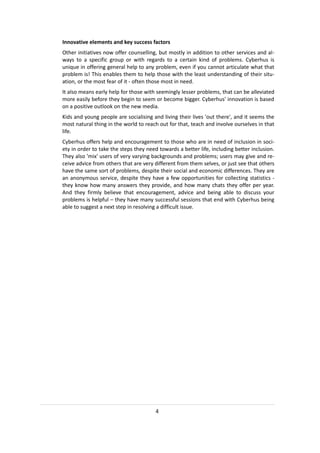
Figure 1: Das Clubhaus auf Cyberhus
                                                                    http://www.cyberhus.dk/


The first figure shows the homepage of Cyberhus with resent videos, upcoming events.
If you click on the front door of you will get access to four environments / stages with
different locations according the visitor’s interests and needs.


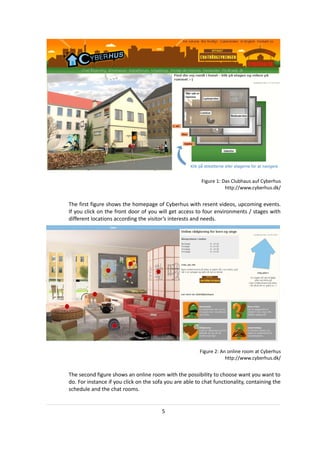
                                                        Figure 2: An online room at Cyberhus
                                                                    http://www.cyberhus.dk/


The second figure shows an online room with the possibility to choose want you want to
do. For instance if you click on the sofa you are able to chat functionality, containing the
schedule and the chat rooms.


                                        5
Problems encountered and lessons learned
Cyberhus' original and core service is ‘counselling’, primarily ‘chat counselling’. This has
changed little in structure or form, except from longer opening hours and continuous
improvements as their experience and knowledge grows. When they changed to a mod-
ern CMS system (Drupal) in January 2009, they saw an explosion in use of our forums
and question and answers columns, which led to an increased focus on moderation and
ensuring the quality of their answers. This meant bringing in more volunteers and part-
ners, and learning to guide and help a larger number of same. Since the launch in 2004,
the Chat counselling staff has completed more than 3600 online conversations with chil-
dren and young people. They have also gathered a lot of knowledge about young people
and their use of the net, and they are currently making the move becoming more of a
knowledge centre on these issues.
Cyberhus is focused on the moderation and the netiquette of their users directly; a so-
cial blunder or outlash from a user is less of a problem and more of a learning opportun-
ity - if nothing else, for the other young who learn to adapt and see how such issues can
be dealt with positively by other youths or adults


                                        6
Collaborating institutions in LINKS-UP

                 Institute for Innovation in Learning, Friedrich-Alex-
                 ander-Universität Erlangen-Nürnberg, Erlangen,
                 Germany
                 www.fim.uni-erlangen.de


                 Arcola Research LLP, London, United Kingdom
                 www.arcola-research.co.uk


                 eSociety Institute, The Hague University of Applied
                 Sciences, The Hague, The Netherlands
                 www.esocietyinstituut.nl


                 Servizi Didattici e Scientifici per l’Università di Firen-
                 ze, Prato, Italy
                 www.pin.unifi.it


                 Salzburg Research Forschungsgesellschaft, Salzburg,
                 Austria
                 www.salzburgresearch.at


                 European Distance and E-Learning Network (EDEN),
                 Milton Keynes, United Kingdom
                 www.eden-online.org


                   7

Case study Cyberhus

  • 1.
    CASE STUDY Cyberhus by Martijn Hartog This document is part of the overall European project LINKS-UP - Learning 2.0 for an Inclusive Knowledge Society – Understanding the Picture. Further case studies and project results can be downloaded from the project website http://www.linksup.eu. Copyright This work has been licensed under a Creative Commons License: Attribution-NonCommercial-NoDerivs http://creativecommons.org/licenses/by-nc-nd/3.0/ This project has been funded with support from the European Commission. This publication reflects the views only of the author(s), and the Commission cannot be held responsible for any use which may be made of the information contained therein.
  • 2.
    Cyberhus is aDanish 100% non-profit organization located in Aarhus. Cyberhus was founded in 2004 as a partner charity under the youth charity, Ungdommens Vel ('Youth Welfare') and is today staffed by more than 70 people - mainly volunteers. Cyberhus is a virtual house or club that offers online counselling for vulnerable children and teens. Counselling is undertaken mainly by volunteer chat-counsellors, all with relevant educa- tional backgrounds, such as teachers, pedagogues, social workers and psychology stu- dents. In December 2008 Cyberhus was ranked among the 5 best European websites for marginalized young people (E-inclusion). From September onwards Cyberhus has been chosen as the Danish helpline in the European network INSAFE. Cyberhus is organized within the 100-year-old national association Ungdommens Vel ('Youth Welfare'), which run youth shelters, children's homes, institutions for at-risk chil- dren, therapy groups, youth hostels and continuation schools throughout Denmark: www.ungdommens-vel.dk 96% of Cyberhus’ users are children and teens aged between 9 and 18. They have more then 9000 unique visitors every month. From the starting period in 2004 there were 4421 online one on one chats consultations / sessions. Case profile – Cyberhus in a nutshell Cyberhus Online counselling and more Website http://www.cyberhus.dk Status Active/running (since May 2004) Interviewed person Kristian Lund Cyberhus is a 100% non-profit making online youth service sup- Funded and promoted by… ported by the Ministry of Social Affairs, private funds and the local authorities. Location of the Learning Activities Formal setting Target group(s) Vulnerable children and teenagers Number of users More than 4000 children and parents since 2007 Educational Sector(s) Therapeutically based Category of the Learning Activities Informal Social bookmarking, feeds, Blogs, Online chat, peer-to-peer de- Web 2.0 technologies used... bate forums Methods to support inclusion Social networks, skill development Short description and key characteristics Cyberhus is first and foremost an anonymous online counselling service, offering chat, question and answer columns and forums to provide kids and young people with help and encouragement. They focus on excluded and vulnerable young, but believe that everyone can be vulnerable at some point in their lives. They mainly use volunteers for 2
  • 3.
    direct online contactwith kids and young people, but have their own moderators and supervisors to support and ensure the quality of the counselling. In addition, Cyberhus helps schools and parents tackle new challenges brought on by ubiquitous computers and phones, and they are involved in national and European initi- atives that deal with vulnerable youths and the 'new media'. The Danish non-profit Ungdommens Vel (‘Youth Welfare’),that runs a wide variety of youth homes, counselling services, schools and drop-in youth clubs started Cyberhus, based on an idea by Anni Marquard, who was and is the main force in starting and oper- ating Cyberhus. Apart from the Ministry of Social Affairs, a few counties and foundations have helped out Cyberhus financially. They are still organisationally part of Ungdom- mens Vel. Cyberhus forms partnerships on a project basis, and the core counselling functions run almost entirely in-house. A few organisations such as Centre for Voldtægt- sofre i Århus and Børnetinget do some of their counselling through Cyberhus' question and answers-columns. Dimension of learning and inclusion Cyberhus its counselling services do not provide learning per se, the focus also lays with- in their school service, Cyberskole, and related activities. Cyberskolen visits classrooms to inform and discuss web ethics and netiquette. Initially, this was for the 14-16 year age group, but by 2008 it was mostly kids around age 10-12. They have found that this is the age where kids are beginning to use the net, have the most to learn and are most open to discussion. They have also done workshops centred around a forum theatre show which they helped to develop, and will soon begin a shoot-your-own-film campaign (called Mobiler Mod Mobning, or Mobiles Against Bullying) against online bullying. Fur- thermore they have follow-up parents evenings where they inform and discuss chil- dren’s online life and the parents' role in guiding and helping. They do not use a particu- lar pedagogic model but they focus on user participation and discussion rather than get- ting a certain curriculum across. The topics they cover are far too vast to cover in any comprehensive fashion, so enabling discussion of the topics that are most relevant and interesting to the group at hand works better. With a normal school visit they deliver over two standard lessons (2x45 minutes), they present their selves and the topic, the kids answer predefined questions in their online forums, two and two together, and after a break they have a discussion for the entire class, based on those answers. For parents evenings, they have a list of points, facts and topics they want to cover, but encourage as much discussion as the group can and will in between delivering this. Most of the time is spent reacting to and controlling the discus- sion. Apart from being specially geared towards the excluded and vulnerable, they hope to help those with decreased social abilities in using the net positively. Their Mobiler Mod Mobning project is directly aimed at bullying, and hence towards inclusion. Everyone and every problem is welcome at Cyberhus, and they have been able to foster this out- look in their user forums, with very little need for adult moderation. They are more in- volved with alleviating problems, than in helping towards some positive goal. To some extend, these cannot be separated, and they obviously encourage seeking help, staying in school, participating in social and work life, etc. as part of counselling. 3
  • 4.
    Innovative elements andkey success factors Other initiatives now offer counselling, but mostly in addition to other services and al- ways to a specific group or with regards to a certain kind of problems. Cyberhus is unique in offering general help to any problem, even if you cannot articulate what that problem is! This enables them to help those with the least understanding of their situ- ation, or the most fear of it - often those most in need. It also means early help for those with seemingly lesser problems, that can be alleviated more easily before they begin to seem or become bigger. Cyberhus' innovation is based on a positive outlook on the new media. Kids and young people are socialising and living their lives 'out there', and it seems the most natural thing in the world to reach out for that, teach and involve ourselves in that life. Cyberhus offers help and encouragement to those who are in need of inclusion in soci- ety in order to take the steps they need towards a better life, including better inclusion. They also 'mix' users of very varying backgrounds and problems; users may give and re- ceive advice from others that are very different from them selves, or just see that others have the same sort of problems, despite their social and economic differences. They are an anonymous service, despite they have a few opportunities for collecting statistics - they know how many answers they provide, and how many chats they offer per year. And they firmly believe that encouragement, advice and being able to discuss your problems is helpful – they have many successful sessions that end with Cyberhus being able to suggest a next step in resolving a difficult issue. 4
  • 5.
    Figure 1: DasClubhaus auf Cyberhus http://www.cyberhus.dk/ The first figure shows the homepage of Cyberhus with resent videos, upcoming events. If you click on the front door of you will get access to four environments / stages with different locations according the visitor’s interests and needs. Figure 2: An online room at Cyberhus http://www.cyberhus.dk/ The second figure shows an online room with the possibility to choose want you want to do. For instance if you click on the sofa you are able to chat functionality, containing the schedule and the chat rooms. 5
  • 6.
    Problems encountered andlessons learned Cyberhus' original and core service is ‘counselling’, primarily ‘chat counselling’. This has changed little in structure or form, except from longer opening hours and continuous improvements as their experience and knowledge grows. When they changed to a mod- ern CMS system (Drupal) in January 2009, they saw an explosion in use of our forums and question and answers columns, which led to an increased focus on moderation and ensuring the quality of their answers. This meant bringing in more volunteers and part- ners, and learning to guide and help a larger number of same. Since the launch in 2004, the Chat counselling staff has completed more than 3600 online conversations with chil- dren and young people. They have also gathered a lot of knowledge about young people and their use of the net, and they are currently making the move becoming more of a knowledge centre on these issues. Cyberhus is focused on the moderation and the netiquette of their users directly; a so- cial blunder or outlash from a user is less of a problem and more of a learning opportun- ity - if nothing else, for the other young who learn to adapt and see how such issues can be dealt with positively by other youths or adults 6
  • 7.
    Collaborating institutions inLINKS-UP Institute for Innovation in Learning, Friedrich-Alex- ander-Universität Erlangen-Nürnberg, Erlangen, Germany www.fim.uni-erlangen.de Arcola Research LLP, London, United Kingdom www.arcola-research.co.uk eSociety Institute, The Hague University of Applied Sciences, The Hague, The Netherlands www.esocietyinstituut.nl Servizi Didattici e Scientifici per l’Università di Firen- ze, Prato, Italy www.pin.unifi.it Salzburg Research Forschungsgesellschaft, Salzburg, Austria www.salzburgresearch.at European Distance and E-Learning Network (EDEN), Milton Keynes, United Kingdom www.eden-online.org 7