1
Amrita School of Business, Kochi
Case analysis of
Bharat Sports Daily
Contents
 About the Case
 Problem Identification Process
 Management Decision Problem
 Narrowing down of a broad
decision problem
 Management Research problem
 Type of Research
 Unit of Analysis
 Dependent Variable
 Independent Variable
 Moderate Variable
 Intervening Variable
 Extraneous Variable
 Analytical Model
 Research Objectives
 Research Hypothesis
2
About the case
 Mr. Anil Mehra, a senior executive in a newspaper firm,
proposed the idea of launching a sports daily to the top
management.
 Mr. Mehra, just wrote a few notes on explaining the
need of such a daily.
 But, he has no answers when asked for estimates of
demand in the first year and etc. His proposal was
rejected.
 His superior Mr. Ashok Kapoor, suggested Mehra to
convince him with the help of an empirical or scientific
study.
3
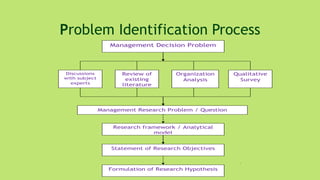
Problem Identification Process
Management Decision Problem
Discussions
with subject
experts
Review of
existing
literature
Organization
Analysis
Qualitative
Survey
Management Research Problem / Question
Research framework / Analytical
model
Statement of Research Objectives
Formulation of Research Hypothesis
4
Management Decision Problem
 It is defined as the issue/decision that needs
to be resolved through research.
 Here the MDPs are,
‐ “Whether to launch a sports daily?”
‐ “What is the demand in the first year?”
‐ “Is it going to be profitable?”
5
Discussions with subject experts
 By discussing the MDP to the subject and industry experts, the
current and probable scenario is understood.
Review of existing literature
 Looking through published data like articles and journals also
going through unpublished data also helps in research.
Organizational analysis
 Organizational demographics- firm, size, assets, nature of
business, location, etc. are used to define research problem
Qualitative Survey
 Survey with readers and conducting focus group discussion to
uncover relevant and typical issues in the problem
Narrowing down of broad decision problem
6
Management Research problem
 Once the audit of all secondary review and interviews
and survey is over, the researcher defines the issue
further, in the form of an unambiguous and clearly-
defined research problem.
 Here the MRPs are,
‐ “What is the awareness and perception of sports lovers
for sports daily?”
‐ “What is the purchase intentions for sports daily?”
‐ “How is the current environment for a sports daily?”
7
Here the goal of the research is action oriented and
focuses on immediate results. Therefore we are
conducting an applied research.
And, we will conduct a triangulation research, because it
resolves the ambiguity and gives a better understanding
of the concept and also provides a direction to initiate.
And also, drives us to a conclusion.
Type of Research
8
Unit of Analysis
 Identifying that particular source from which
the required research information is obtained.
 Here the UoA is,
‐ “The people who are interested in reading sports
related news.”
‐ “Experts in the area of sports.”
9
Dependent Variable
 A dependent variable is measurable and
quantifiable variable in nature. It is most crucial
variable to be analyzed in a research study.
 Here the D.Vs are,
‐ “The demand for a sports daily in the current
scenario?”
‐ “The purchase intensions of the sports enthusiasts”
‐ “The sales of sports magazines in the market”
10
Independent Variable
 An independent variable is one that influences
dependent variable in either a positive or
negative way.
 Here the I.Vs are,
‐ “Attitudes of people towards the sports?”
‐ “Demographic environments of the consumers”
11
Moderate Variable
 A moderating variable is the one that has a
strong contingent effect on the relationship b/w
independent and dependent variable.
 Here the M.Vs are,
‐ “Literacy rate in the society”
‐ “Influence from the family”
12
 A intervening variable is a temporal occurrence
which follows the Independent and precedes the
dependent variable.
 Here the IVVs are,
‐ “Performance of the Indian sports teams ”
13
Intervening Variable
 An extraneous variable is responsible for the
chance variations that are often observed in
research investigation.
 Here the E.Vs are,
‐ “Increased focus of Government on sports”
14
Extraneous Variable
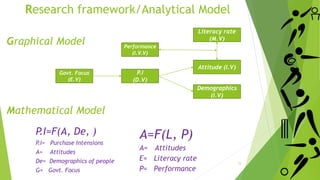
Research framework/Analytical Model
P.I=F(A, De, )
P.I= Purchase Intensions
A= Attitudes
De= Demographics of people
G= Govt. Focus
15
P.I
(D.V)
Attitude (I.V)
Demographics
(I.V)
Literacy rate
(M.V)
Performance
(I.V.V)
Govt. Focus
(E.V)
Graphical Model
Mathematical Model
A=F(L, P)
A= Attitudes
E= Literacy rate
P= Performance
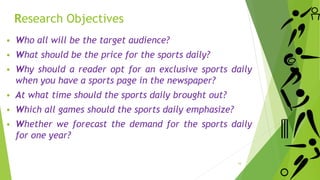
Research Objectives
 Who all will be the target audience?
 What should be the price for the sports daily?
 Why should a reader opt for an exclusive sports daily
when you have a sports page in the newspaper?
 At what time should the sports daily brought out?
 Which all games should the sports daily emphasize?
 Whether we forecast the demand for the sports daily
for one year?
16
Research Hypothesis
 Relational Hypothesis: In this hypothesis there is
a typical relationship between the two variables.
 H0: Attitudes of people has an impact on the
purchase intensions of the sports daily
H1: Attitudes of people has no impact on the purchase
intensions of the sports daily
Other Hypothesis:
 H0: The literacy level of people has positive
relation with the purchase intensions
 H0: Demographic environments of consumers has a
relationship with the sales of the sports daily.
17
18
19

Case analysis of Bharat Sports Daily

  • 1.
    1 Amrita School ofBusiness, Kochi Case analysis of Bharat Sports Daily
  • 2.
    Contents  About theCase  Problem Identification Process  Management Decision Problem  Narrowing down of a broad decision problem  Management Research problem  Type of Research  Unit of Analysis  Dependent Variable  Independent Variable  Moderate Variable  Intervening Variable  Extraneous Variable  Analytical Model  Research Objectives  Research Hypothesis 2
  • 3.
    About the case Mr. Anil Mehra, a senior executive in a newspaper firm, proposed the idea of launching a sports daily to the top management.  Mr. Mehra, just wrote a few notes on explaining the need of such a daily.  But, he has no answers when asked for estimates of demand in the first year and etc. His proposal was rejected.  His superior Mr. Ashok Kapoor, suggested Mehra to convince him with the help of an empirical or scientific study. 3
  • 4.
    Problem Identification Process ManagementDecision Problem Discussions with subject experts Review of existing literature Organization Analysis Qualitative Survey Management Research Problem / Question Research framework / Analytical model Statement of Research Objectives Formulation of Research Hypothesis 4
  • 5.
    Management Decision Problem It is defined as the issue/decision that needs to be resolved through research.  Here the MDPs are, ‐ “Whether to launch a sports daily?” ‐ “What is the demand in the first year?” ‐ “Is it going to be profitable?” 5
  • 6.
    Discussions with subjectexperts  By discussing the MDP to the subject and industry experts, the current and probable scenario is understood. Review of existing literature  Looking through published data like articles and journals also going through unpublished data also helps in research. Organizational analysis  Organizational demographics- firm, size, assets, nature of business, location, etc. are used to define research problem Qualitative Survey  Survey with readers and conducting focus group discussion to uncover relevant and typical issues in the problem Narrowing down of broad decision problem 6
  • 7.
    Management Research problem Once the audit of all secondary review and interviews and survey is over, the researcher defines the issue further, in the form of an unambiguous and clearly- defined research problem.  Here the MRPs are, ‐ “What is the awareness and perception of sports lovers for sports daily?” ‐ “What is the purchase intentions for sports daily?” ‐ “How is the current environment for a sports daily?” 7
  • 8.
    Here the goalof the research is action oriented and focuses on immediate results. Therefore we are conducting an applied research. And, we will conduct a triangulation research, because it resolves the ambiguity and gives a better understanding of the concept and also provides a direction to initiate. And also, drives us to a conclusion. Type of Research 8
  • 9.
    Unit of Analysis Identifying that particular source from which the required research information is obtained.  Here the UoA is, ‐ “The people who are interested in reading sports related news.” ‐ “Experts in the area of sports.” 9
  • 10.
    Dependent Variable  Adependent variable is measurable and quantifiable variable in nature. It is most crucial variable to be analyzed in a research study.  Here the D.Vs are, ‐ “The demand for a sports daily in the current scenario?” ‐ “The purchase intensions of the sports enthusiasts” ‐ “The sales of sports magazines in the market” 10
  • 11.
    Independent Variable  Anindependent variable is one that influences dependent variable in either a positive or negative way.  Here the I.Vs are, ‐ “Attitudes of people towards the sports?” ‐ “Demographic environments of the consumers” 11
  • 12.
    Moderate Variable  Amoderating variable is the one that has a strong contingent effect on the relationship b/w independent and dependent variable.  Here the M.Vs are, ‐ “Literacy rate in the society” ‐ “Influence from the family” 12
  • 13.
     A interveningvariable is a temporal occurrence which follows the Independent and precedes the dependent variable.  Here the IVVs are, ‐ “Performance of the Indian sports teams ” 13 Intervening Variable
  • 14.
     An extraneousvariable is responsible for the chance variations that are often observed in research investigation.  Here the E.Vs are, ‐ “Increased focus of Government on sports” 14 Extraneous Variable
  • 15.
    Research framework/Analytical Model P.I=F(A,De, ) P.I= Purchase Intensions A= Attitudes De= Demographics of people G= Govt. Focus 15 P.I (D.V) Attitude (I.V) Demographics (I.V) Literacy rate (M.V) Performance (I.V.V) Govt. Focus (E.V) Graphical Model Mathematical Model A=F(L, P) A= Attitudes E= Literacy rate P= Performance
  • 16.
    Research Objectives  Whoall will be the target audience?  What should be the price for the sports daily?  Why should a reader opt for an exclusive sports daily when you have a sports page in the newspaper?  At what time should the sports daily brought out?  Which all games should the sports daily emphasize?  Whether we forecast the demand for the sports daily for one year? 16
  • 17.
    Research Hypothesis  RelationalHypothesis: In this hypothesis there is a typical relationship between the two variables.  H0: Attitudes of people has an impact on the purchase intensions of the sports daily H1: Attitudes of people has no impact on the purchase intensions of the sports daily Other Hypothesis:  H0: The literacy level of people has positive relation with the purchase intensions  H0: Demographic environments of consumers has a relationship with the sales of the sports daily. 17
  • 18.
  • 19.

Editor's Notes

  • #13 Education has a direct relationship with the demand for the daily. If the education level increases, the potential readers for the daily will increase, if it remains the same then the number of readers will remain constant in an approximate manner.
  • #14 If the sports daily is based primarily on Cricket, then the performance of the Indian Cricket team can influence the attitude of the readers/followers
  • #15 Increased focus of Government on sports can be a variable which can have an effect on the demand of the sports daily but at the same time can be excluded from the study by the researcher.