Carrier as a ServiceFinding the Carrier through the CloudVish NandlallSVP & CTO Extreme Networks
The Case for Carrier as a Service The Carrier CloudCloud & Long Tail ApplicationsNext Gen ARPU and Telco 2.0 Leveraging SON concepts
Custom & Utility Computing
Web 2.0 MashupsSubscriber InformationCore ServicesNetwork ServicesVolume Economics
Two-sided models
New Markets 2
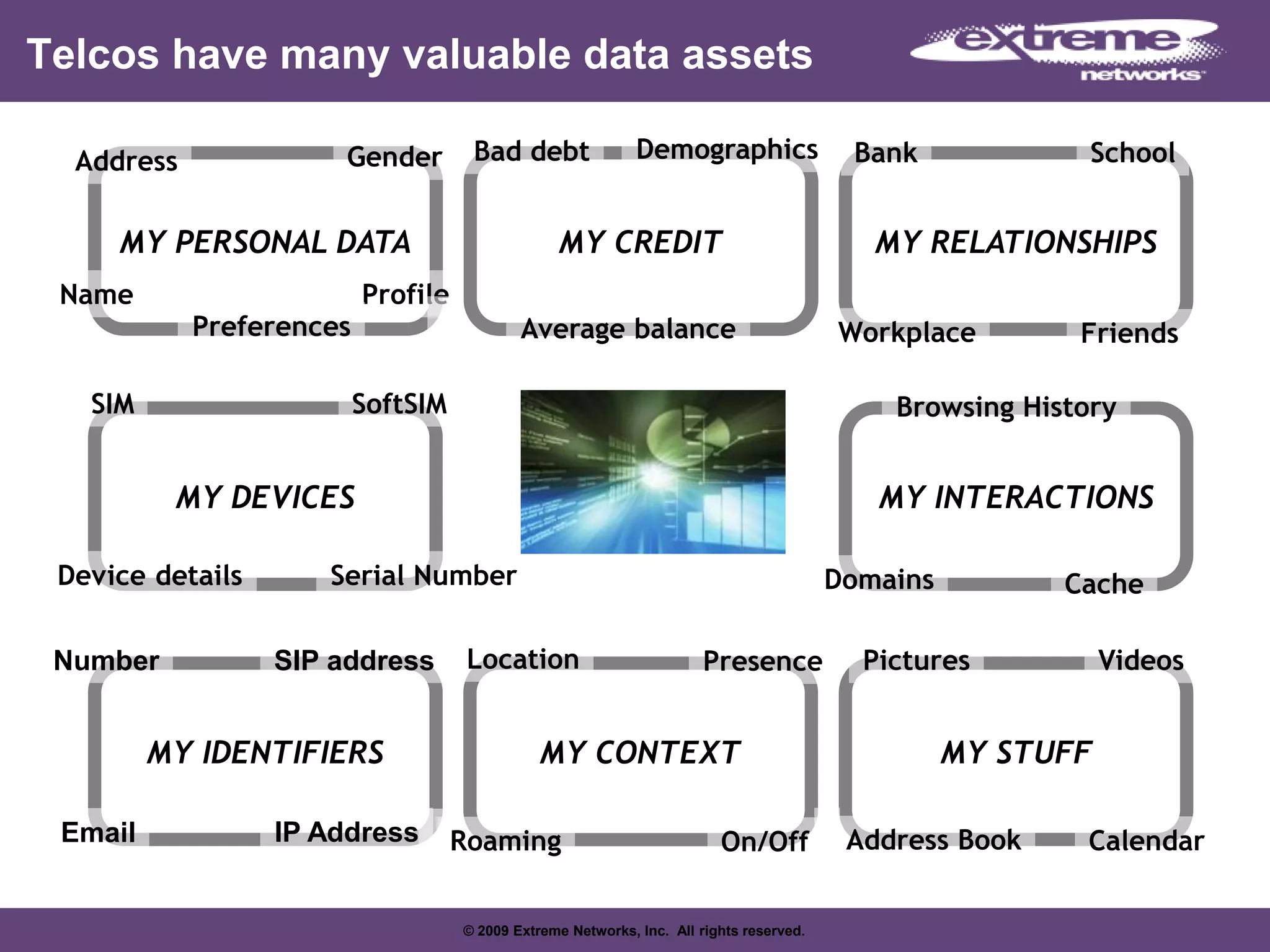
Telcos have many valuable data assetsMY PERSONAL DATAMY RELATIONSHIPSMY CREDITGenderAddressNameProfileMY INTERACTIONSMY DEVICESPreferencesLocationPresenceDemographicsSIMSoftSIMPicturesVideosBankSchoolBrowsing HistoryBad debtMY STUFFMY IDENTIFIERSMY CONTEXTCacheSerial NumberDevice detailsCalendarFriendsOn/OffNumberSIP addressIP AddressEmailDomainsAddress BookWorkplaceRoamingAverage balance
...and many valuable Network assetsServersRoutersSwitchesPortalsCompute EthernetApplication EnvironmentApplication DeliveryStorageFTTHLoad BalancingBackupCachingDNSPolicyIPMPLSQoS(R)SPTLTENetwork ServicesSession ControlLast Mile AccessQoSOptimizationDatabaseRecoveryDocsis 3.0ManagementSIPSS7SIP-IMAPOSPF/BGPPBB-TE/PBTFirewallSecurity(V)DSL
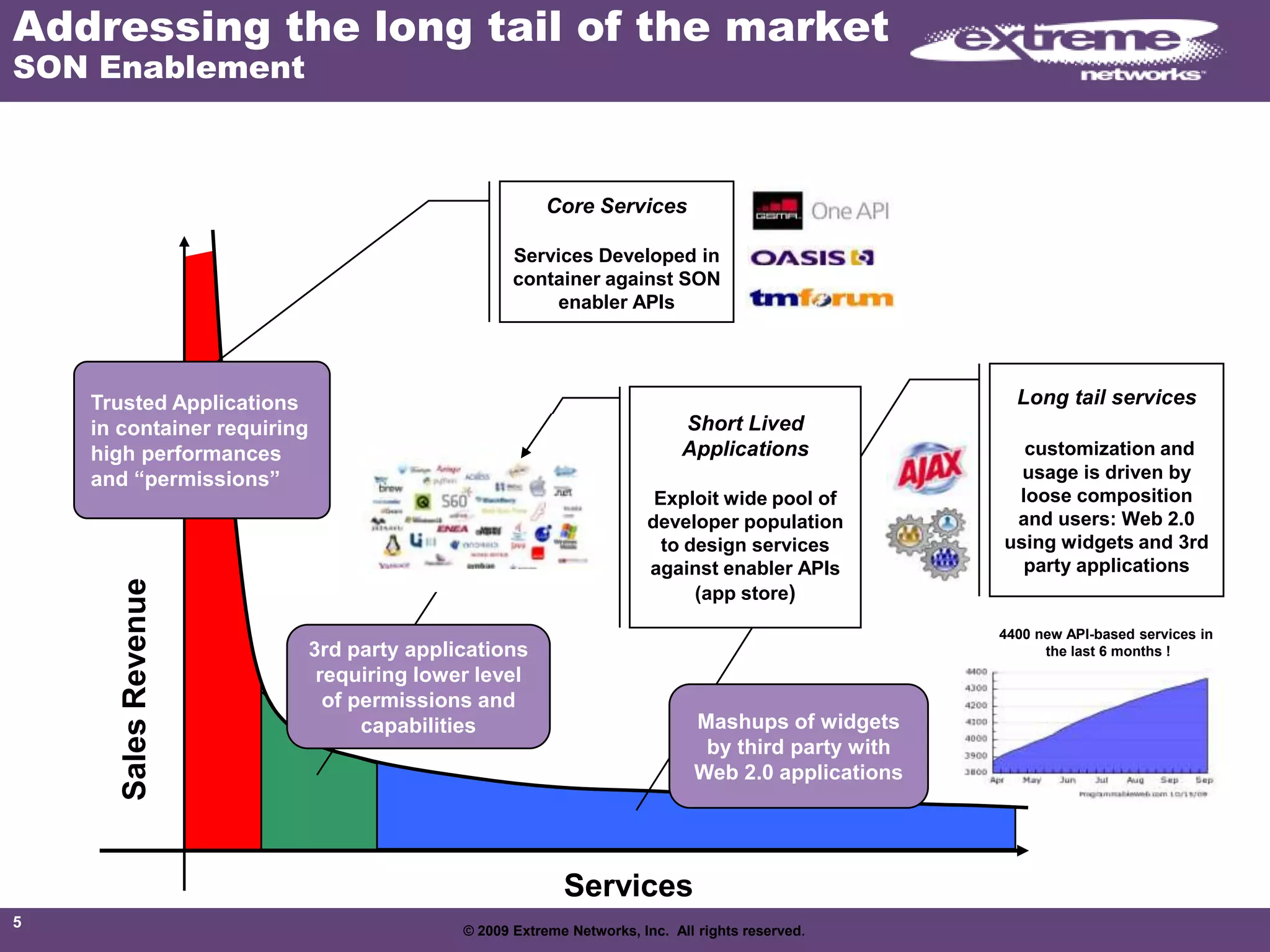
Addressing the long tail of the marketSON EnablementCore ServicesServices Developed in  container against SON enabler APIsTrusted Applications in container requiring high performances and “permissions”Long tail servicescustomization and usage is driven by loose composition and users: Web 2.0  using widgets and 3rd party applications Short Lived ApplicationsExploit wide pool of developer population to design services against enabler APIs (app store)4400 new API-based services in the last 6 months !3rd party applications requiring lower level of permissions and capabilitiesSales RevenueMashups of widgets by third party with Web 2.0 applicationsServices5
Service ApplicationsLocationContactsVoice+++Augmented Reality BrowserCloud Voice Social Address BookCarrier Provides “Location API”Carrier Provides “Social Sync API”Carrier Provides “PSTN API”
Network ApplicationsComputeLast MileTransport+++Cloud TransmissionCloud Transport Cloud CloningCarrier Provides “Connectivity API”Carrier Provides “Compute API”Carrier Provides “P2P API”
1:N Cloud (Elastic Compute) Control 1:1 Embedded ControlBGP ISIS NACADCVM 1VM 2VM 3VMnVirtual Server Real EstateControl PlaneData PathData PathSwitchSwitchStabilityPerformanceScaleStabilityScalePerformanceSVC 1SVC 2SVC 3SVC nSVC 1SVC 2SVC 3SVC nThe Future  Cloud SwitchingServices (NAC, ADC, End-Point Profiling) are run as virtual machines through an OpenFlow–patterned interface – Lower Opex, Lower Capex
Various types of ”understood” business modelsThe online content business model (iPod, upgrades, information etc.)The freemium business model (Skype, Launchcast (Yahoo) etc.) The premium business model (IPTV)The professional open-source model (free software + consulting)Various distribution business models (through which channel the product/service is distributed)
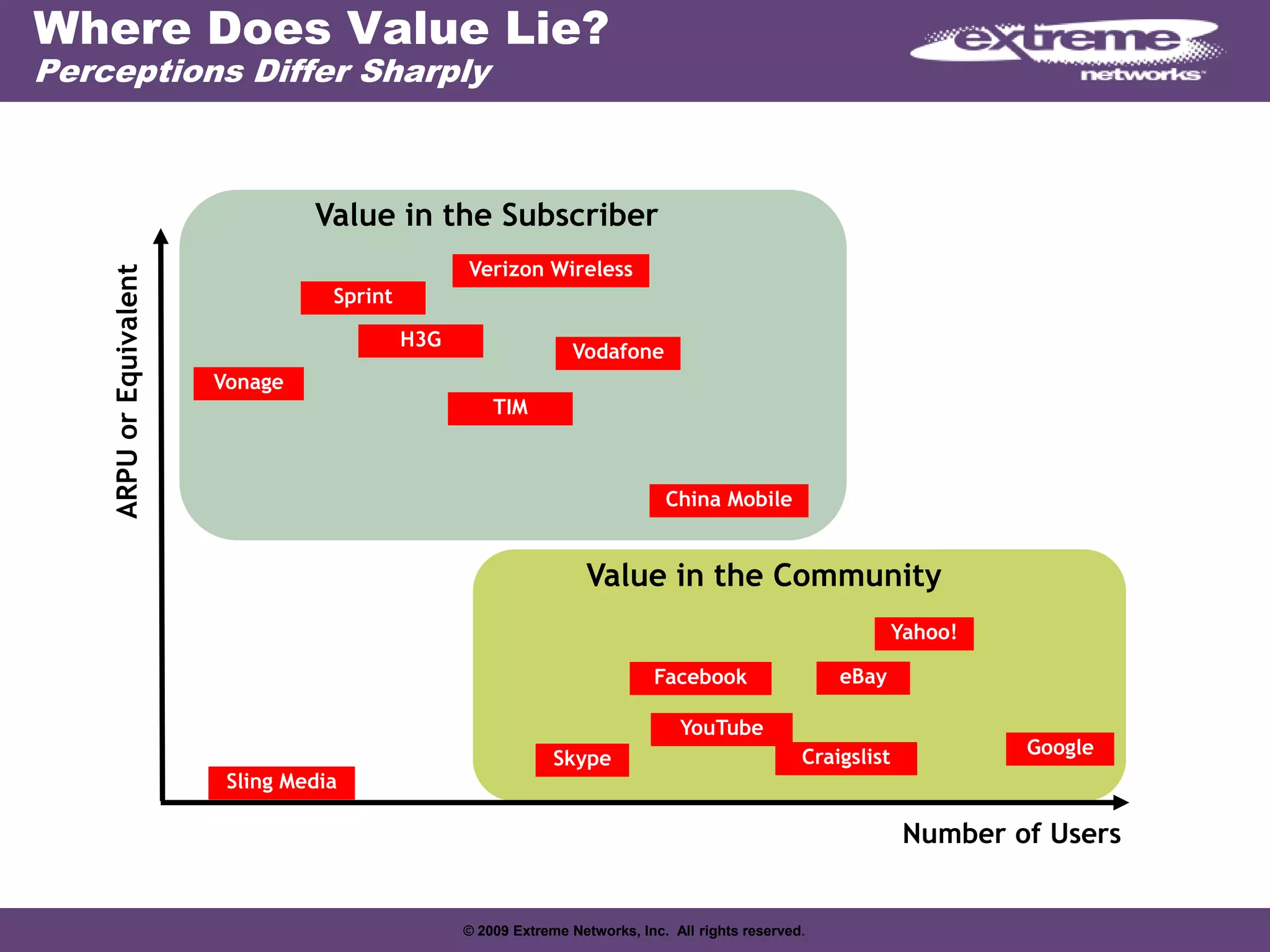
Where Does Value Lie? Perceptions Differ SharplyValue in the SubscriberVerizon WirelessSprintH3GVodafoneVonageARPU or EquivalentTIMChina MobileValue in the CommunityYahoo!eBayFacebookYouTubeGoogleCraigslistSkypeSling MediaNumber of Users
New Business ModelsIn the last 2 years three new markets have been formed around new solution typesApp StoresSocial AddressbooksService AnalyticsNew revenue models are being pioneered to exploit these marketsCost-per-follower  (Twitter)Pay-per-app activation (Apple Appstore)Virtual Goods (Flirtomatic and Tencent)Wholesale (Amazon pays $2 to Sprint for every Kindle connection)
Telco 2.0  with SON  EnablesPOWERVALUELITEEvolved Business ModelsFrom “take what you are given” to “take what you want”3.Context Services Mash Up ServicesThird Party Services $$$2.EnablesFlat RateBundlesB/W-basedTiered Services$$$Personal Communication ServicesLegal Download ServicesOn-Deck Portal ServicesSecurity ServicesOn-Demand QoS/BWNavigation1.BasicInternet Service10% consume 80% of B/w 0.5% consume about 40% of B/w80% use less than 10% of B/w 12

Carrier As A Service15102009

  • 1.
    Carrier as aServiceFinding the Carrier through the CloudVish NandlallSVP & CTO Extreme Networks
  • 2.
    The Case forCarrier as a Service The Carrier CloudCloud & Long Tail ApplicationsNext Gen ARPU and Telco 2.0 Leveraging SON concepts
  • 3.
  • 4.
    Web 2.0 MashupsSubscriberInformationCore ServicesNetwork ServicesVolume Economics
  • 5.
  • 6.
  • 7.
    Telcos have manyvaluable data assetsMY PERSONAL DATAMY RELATIONSHIPSMY CREDITGenderAddressNameProfileMY INTERACTIONSMY DEVICESPreferencesLocationPresenceDemographicsSIMSoftSIMPicturesVideosBankSchoolBrowsing HistoryBad debtMY STUFFMY IDENTIFIERSMY CONTEXTCacheSerial NumberDevice detailsCalendarFriendsOn/OffNumberSIP addressIP AddressEmailDomainsAddress BookWorkplaceRoamingAverage balance
  • 8.
    ...and many valuableNetwork assetsServersRoutersSwitchesPortalsCompute EthernetApplication EnvironmentApplication DeliveryStorageFTTHLoad BalancingBackupCachingDNSPolicyIPMPLSQoS(R)SPTLTENetwork ServicesSession ControlLast Mile AccessQoSOptimizationDatabaseRecoveryDocsis 3.0ManagementSIPSS7SIP-IMAPOSPF/BGPPBB-TE/PBTFirewallSecurity(V)DSL
  • 9.
    Addressing the longtail of the marketSON EnablementCore ServicesServices Developed in container against SON enabler APIsTrusted Applications in container requiring high performances and “permissions”Long tail servicescustomization and usage is driven by loose composition and users: Web 2.0 using widgets and 3rd party applications Short Lived ApplicationsExploit wide pool of developer population to design services against enabler APIs (app store)4400 new API-based services in the last 6 months !3rd party applications requiring lower level of permissions and capabilitiesSales RevenueMashups of widgets by third party with Web 2.0 applicationsServices5
  • 10.
    Service ApplicationsLocationContactsVoice+++Augmented RealityBrowserCloud Voice Social Address BookCarrier Provides “Location API”Carrier Provides “Social Sync API”Carrier Provides “PSTN API”
  • 11.
    Network ApplicationsComputeLast MileTransport+++CloudTransmissionCloud Transport Cloud CloningCarrier Provides “Connectivity API”Carrier Provides “Compute API”Carrier Provides “P2P API”
  • 12.
    1:N Cloud (ElasticCompute) Control 1:1 Embedded ControlBGP ISIS NACADCVM 1VM 2VM 3VMnVirtual Server Real EstateControl PlaneData PathData PathSwitchSwitchStabilityPerformanceScaleStabilityScalePerformanceSVC 1SVC 2SVC 3SVC nSVC 1SVC 2SVC 3SVC nThe Future  Cloud SwitchingServices (NAC, ADC, End-Point Profiling) are run as virtual machines through an OpenFlow–patterned interface – Lower Opex, Lower Capex
  • 13.
    Various types of”understood” business modelsThe online content business model (iPod, upgrades, information etc.)The freemium business model (Skype, Launchcast (Yahoo) etc.) The premium business model (IPTV)The professional open-source model (free software + consulting)Various distribution business models (through which channel the product/service is distributed)
  • 14.
    Where Does ValueLie? Perceptions Differ SharplyValue in the SubscriberVerizon WirelessSprintH3GVodafoneVonageARPU or EquivalentTIMChina MobileValue in the CommunityYahoo!eBayFacebookYouTubeGoogleCraigslistSkypeSling MediaNumber of Users
  • 15.
    New Business ModelsInthe last 2 years three new markets have been formed around new solution typesApp StoresSocial AddressbooksService AnalyticsNew revenue models are being pioneered to exploit these marketsCost-per-follower (Twitter)Pay-per-app activation (Apple Appstore)Virtual Goods (Flirtomatic and Tencent)Wholesale (Amazon pays $2 to Sprint for every Kindle connection)
  • 16.
    Telco 2.0 with SON EnablesPOWERVALUELITEEvolved Business ModelsFrom “take what you are given” to “take what you want”3.Context Services Mash Up ServicesThird Party Services $$$2.EnablesFlat RateBundlesB/W-basedTiered Services$$$Personal Communication ServicesLegal Download ServicesOn-Deck Portal ServicesSecurity ServicesOn-Demand QoS/BWNavigation1.BasicInternet Service10% consume 80% of B/w 0.5% consume about 40% of B/w80% use less than 10% of B/w 12
  • 17.
    ConclusionService Oriented Networkingis a Game Changer for TelcoNew technologies (CPUs, virtualization, dynamic network, LTE) have defined a starting point for the art of the possibleThe Carrier is transforming to a service and network cloud providerNew business models are being created around the emerging solution marketsVisit my blog at www.theinvisibleinternet.com
  • 18.
  • 19.
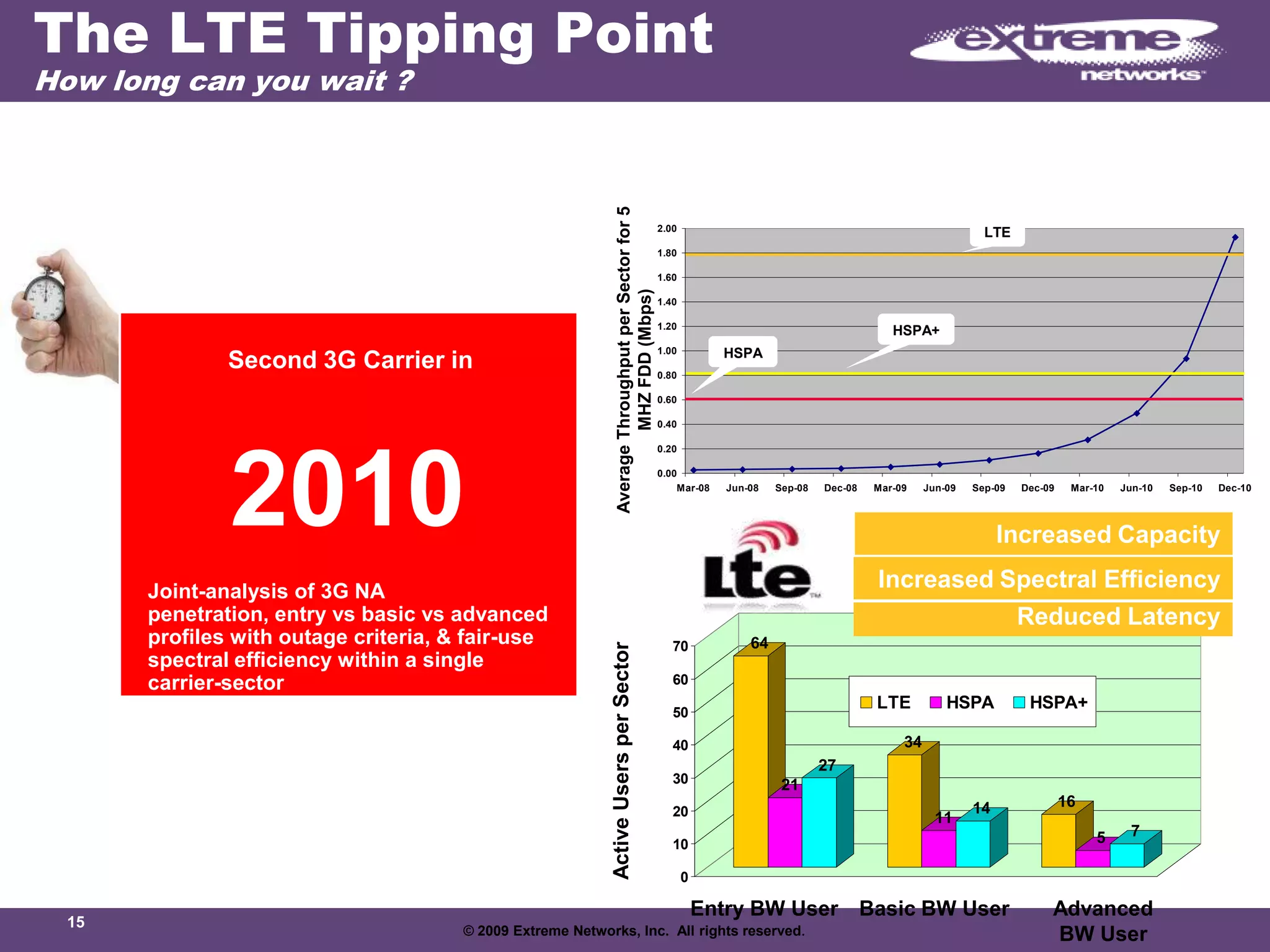
    The LTE TippingPoint How long can you wait ?15LTEHSPA+Average Throughput per Sector for 5 MHZ FDD (Mbps)HSPASecond 3G Carrier in 2010Joint-analysis of 3G NA penetration, entry vs basic vs advanced profiles with outage criteria, & fair-use spectral efficiency within a single carrier-sectorIncreased CapacityIncreased Spectral EfficiencyReduced LatencyActive Users per SectorEntry BW UserBasic BW UserAdvanced BW User
  • 20.
    16Understanding the Uxfor Data Engineering Cell-Edge Beyond Voice Requirements5.0 (MB)0.00.51.01.52.02.53.03.54.04.5From Mobile Web 0.1 to 2.0The Impatience IndexTotal TimeCell EdgeGPRS35 kbps19.5 minsCDMA 1X60 kbps11.5 minsEDGE115 kbps6 minsUMTS256 kbps2.5 mins400 kbpsEV-DO1.5 min1.0 MbpsHSPA+40 secs10 secs4.0 MbpsLTEMP3Rich Web PageYou can’t have broadband without the user experience !

Editor's Notes

  • #7 Google Voice reverses the traditional arrangement of call control with added applications. It effectively outsources basic call control. Ignoring the burden of phone system hardware (and 911 liability), and focuses only on the applications. Rather than develop proprietary interfaces to work with each phone system, they simply call phones to make them ring; introducing the "PSTN API.“This feature can be augmented by allowing a call to go to a user IMS SIP addressA social address book (SAB) is an online service which allows end-users to save their mobile contacts, synchronize them and link them up with their social network profiles. The contacts are no longer static, as they display presence, location and status updates. A social address book is usually coupled with a new mobile address book application, a type of ‘phonebook 2.0‘ which similarly transforms static contacts into a Skype-like buddy list. Mobile operators: 3 was the first operator to launch a phonebook 2.0 application with the INQ 1 phone. They will not remain alone very long. A video leaked on Techcrunch UK about a service called People that Vodafone is about to launch. Technology is another important factor. The synchronization protocols (SyncML or Exchange Active Sync) are mature and widely deployed while mobile platforms are much more open.There’s been a lot of buzz recently around augmented reality browsers. These browsers bring augmented reality to the mass market; now you can scan through the surroundings through your phone’s camera and see information superimposed, from advertising to siteseeing in real time. Augmented reality browsers have been made possible in a mass market sense thanks to the GPS and compass sensors  first appearing within Android and iPhone devices. The value in augmented reality browsing is in the connection between the physical world (what the camera captures) and the commercial information that is displayed on top. Already a number of startups have emerged to capture value in augmented reality browsers like Metaio, Total Immersion, Zugara, Layar, Mobilizy and Tonchidot (see here for a detailed review of augmented reality startups)
  • #12 Once in a while, new revenue models or new markets surface, which are followed by a string of industry capital movements. Take for example new revenue models being pioneered in the Internet like the cost-per-follower (ie being paid based on how many people are following you on twitter) or in the mobile domain (pay-per-app-activation when B2B provisioning applications on a device). New markets are continually formed around new solution types; in the fast-moving mobile industry for example, App Stores,  Social Addressbooks and Service Analytics are  new solution markets which emerged only in the last two years.Flirtomatic, a popular mobile dating service in the UK, Germany and USA, monetises by offering social capital for sale. Flirtomatic allows users to buy social capital; users can send virtual ice cubes, auction themselves to the top of the service homepage, or even buy Ego services so they can eliminate bad ratings on their profile or bend the voting rules Fortune reported that the market in China for virtual goods is larger than the market for online advertising with Tencent, China’s largest messaging+Avatar+social networking service, generating $1 billion  in revenues in 2008, 90% of which is from virtual goods, as cited in the Business Model Database.A barcode (or QR Code, Data Matrix and Ezcode)  allows a mobile device to connect a physical product in a store or a poster in the train station to a wealth of online information, such as where the product ingredients came from, or when is the next train (the Economist has a good update on the commercialisation of 2D codes). Again monetisation is by providing the connection between physical and virtual worlds.Anoto, a Swedish company, produces technology to connect a digital pen with the origin of the paper that it’s writing on. For example, by writing on a business card, you can send that to the contact directly, or by writing on a recruitment form, you can have your job application dispatched immediately. Anotomonetises by acting as the link between the physical world (pen and paper) and the virtual world (that of service providers of business information, recruiters, etc).