


This document is offered compliments of
BSP Media Group. www.bspmediagroup.com
All rights reserved.
SERVICE MANAGEMENT IN THE LTE WORLD
12th NOVEMBER 2013
Sherry Zameer
Head of Solution Sales, CISMEA

Generating new revenue streams,
Enabling multiple subscriptions,
Managing on-demand,
Advanced connectivity and access to new services,
Leveraging high speed access to the SIM,
Turnkey solution for remote updates, provisioning and activation,
Optimising the network by measuring quality of experience.
LTE is launched … what next?

How can the MNO be a part of the value chain?

Maintain High Speed connection with SIM card.
Create software marketplace for content and applications
Leverage on user billing relationship for distribution

2
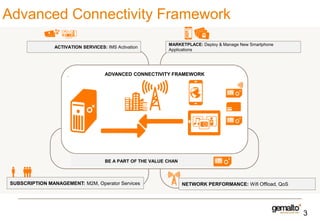
Advanced Connectivity Framework
ACTIVATION SERVICES: IMS Activation

MARKETPLACE: Deploy & Manage New Smartphone
Applications

ADVANCED CONNECTIVITY FRAMEWORK

BE A PART OF THE VALUE CHAN

SUBSCRIPTION MANAGEMENT: M2M, Operator Services

NETWORK PERFORMANCE: Wifi Offload, QoS

3
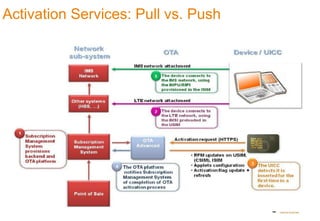
Activation Services
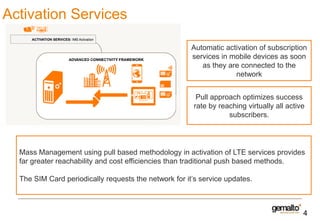
Automatic activation of subscription
services in mobile devices as soon
as they are connected to the
network
Pull approach optimizes success
rate by reaching virtually all active
subscribers.

Mass Management using pull based methodology in activation of LTE services provides
far greater reachability and cost efficiencies than traditional push based methods.
The SIM Card periodically requests the network for it’s service updates.

4
Activation Services: Pull vs. Push

5
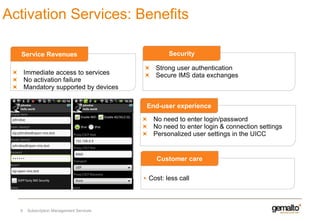
Activation Services: Benefits
Service Revenues

Immediate access to services
No activation failure
Mandatory supported by devices

Security
Strong user authentication
Secure IMS data exchanges

End-user experience
No need to enter login/password
No need to enter login & connection settings
Personalized user settings in the UICC

Customer care
Cost: less call

6

Subscription Management Services
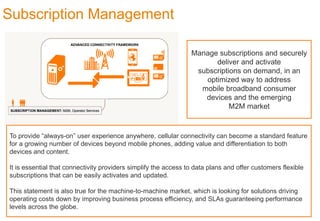
Subscription Management
Manage subscriptions and securely
deliver and activate
subscriptions on demand, in an
optimized way to address
mobile broadband consumer
devices and the emerging
M2M market

To provide “always-on” user experience anywhere, cellular connectivity can become a standard feature
for a growing number of devices beyond mobile phones, adding value and differentiation to both
devices and content.
It is essential that connectivity providers simplify the access to data plans and offer customers flexible
subscriptions that can be easily activates and updated.
This statement is also true for the machine-to-machine market, which is looking for solutions driving
operating costs down by improving business process efficiency, and SLAs guaranteeing performance
levels across the globe.

7
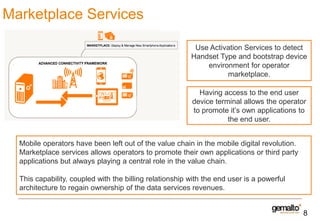
Marketplace Services
Use Activation Services to detect
Handset Type and bootstrap device
environment for operator
marketplace.
Having access to the end user
device terminal allows the operator
to promote it’s own applications to
the end user.
Mobile operators have been left out of the value chain in the mobile digital revolution.
Marketplace services allows operators to promote their own applications or third party
applications but always playing a central role in the value chain.
This capability, coupled with the billing relationship with the end user is a powerful
architecture to regain ownership of the data services revenues.

8
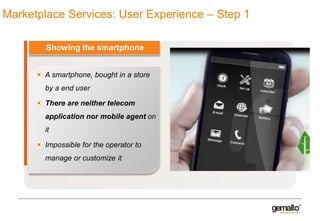
Marketplace Services: User Experience – Step 1
Showing the smartphone
A smartphone, bought in a store
by a end user
There are neither telecom
application nor mobile agent on

it
Impossible for the operator to
manage or customize it
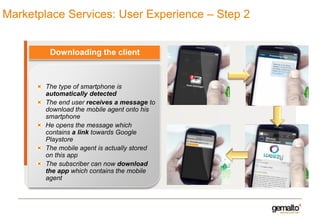
Marketplace Services: User Experience – Step 2

Downloading the client

The type of smartphone is
automatically detected
The end user receives a message to
download the mobile agent onto his
smartphone
He opens the message which
contains a link towards Google
Playstore
The mobile agent is actually stored
on this app
The subscriber can now download
the app which contains the mobile
agent
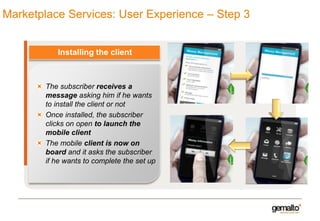
Marketplace Services: User Experience – Step 3

Installing the client

The subscriber receives a
message asking him if he wants
to install the client or not
Once installed, the subscriber
clicks on open to launch the
mobile client
The mobile client is now on
board and it asks the subscriber
if he wants to complete the set up
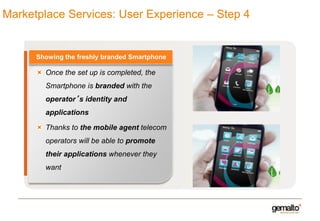
Marketplace Services: User Experience – Step 4

Showing the freshly branded Smartphone

Once the set up is completed, the

Smartphone is branded with the
operator’s identity and
applications

Thanks to the mobile agent telecom
operators will be able to promote
their applications whenever they
want
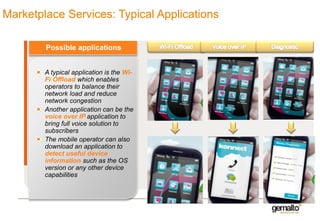
Marketplace Services: Typical Applications
Possible applications
A typical application is the WiFi Offload which enables
operators to balance their
network load and reduce
network congestion
Another application can be the
voice over IP application to
bring full voice solution to
subscribers
The mobile operator can also
download an application to
detect useful device
information such as the OS
version or any other device
capabilities
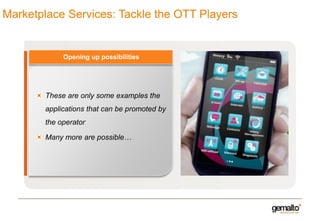
Marketplace Services: Tackle the OTT Players

Opening up possibilities

These are only some examples the
applications that can be promoted by
the operator
Many more are possible…
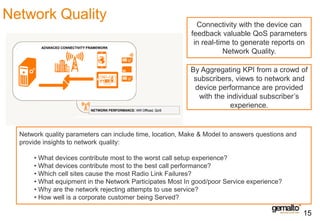
Network Quality

Connectivity with the device can
feedback valuable QoS parameters
in real-time to generate reports on
Network Quality.
By Aggregating KPI from a crowd of
subscribers, views to network and
device performance are provided
with the individual subscriber’s
experience.

Network quality parameters can include time, location, Make & Model to answers questions and
provide insights to network quality:
• What devices contribute most to the worst call setup experience?
• What devices contribute most to the best call performance?
• Which cell sites cause the most Radio Link Failures?
• What equipment in the Network Participates Most In good/poor Service experience?
• Why are the network rejecting attempts to use service?
• How well is a corporate customer being Served?

15
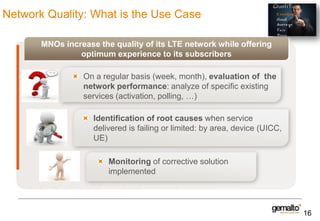
Network Quality: What is the Use Case
MNOs increase the quality of its LTE network while offering
optimum experience to its subscribers
On a regular basis (week, month), evaluation of the
network performance: analyze of specific existing
services (activation, polling, …)
Identification of root causes when service
delivered is failing or limited: by area, device (UICC,
UE)
Monitoring of corrective solution
implemented

16
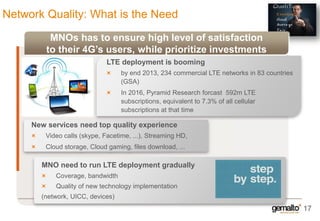
Network Quality: What is the Need
MNOs has to ensure high level of satisfaction
to their 4G’s users, while prioritize investments
LTE deployment is booming
by end 2013, 234 commercial LTE networks in 83 countries
(GSA)
In 2016, Pyramid Research forcast 592m LTE
subscriptions, equivalent to 7.3% of all cellular
subscriptions at that time

New services need top quality experience
Video calls (skype, Facetime, ...), Streaming HD,

Cloud storage, Cloud gaming, files download, ...

MNO need to run LTE deployment gradually
Coverage, bandwidth

Quality of new technology implementation
(network, UICC, devices)

17
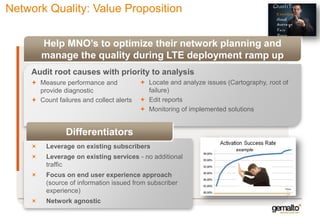
Network Quality: Value Proposition
Help MNO’s to optimize their network planning and
manage the quality during LTE deployment ramp up
Audit root causes with priority to analysis
 Measure performance and
provide diagnostic
 Count failures and collect alerts

 Locate and analyze issues (Cartography, root of
failure)
 Edit reports
 Monitoring of implemented solutions

Differentiators
Leverage on existing subscribers

example

Leverage on existing services - no additional
traffic
Focus on end user experience approach
(source of information issued from subscriber
experience)

Time

Network agnostic

18
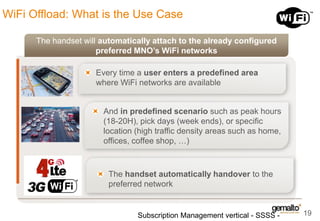
WiFi Offload: What is the Use Case
The handset will automatically attach to the already configured
preferred MNO’s WiFi networks
Every time a user enters a predefined area
where WiFi networks are available

And in predefined scenario such as peak hours
(18-20H), pick days (week ends), or specific
location (high traffic density areas such as home,
offices, coffee shop, …)

The handset automatically handover to the
preferred network

Subscription Management vertical - SSSS -

19
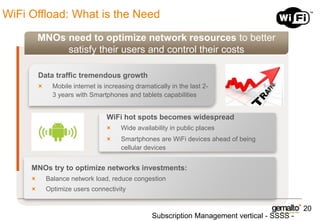
WiFi Offload: What is the Need
MNOs need to optimize network resources to better
satisfy their users and control their costs
Data traffic tremendous growth
Mobile internet is increasing dramatically in the last 23 years with Smartphones and tablets capabilities

WiFi hot spots becomes widespread
Wide availability in public places

Smartphones are WiFi devices ahead of being
cellular devices

MNOs try to optimize networks investments:
Balance network load, reduce congestion
Optimize users connectivity

20

Subscription Management vertical - SSSS -
WiFi Offload: Value Proposition
Optimize network bandwidth Investment with the best user
experience
Services / Revenues
Reduce congestion
Increase usage

Cost optimization
Balance network load
Smooth Network investment

End-user experience
Transparent for user
Already available for Androïd (min V2.2)

Subscription Management vertical - SSSS -

21
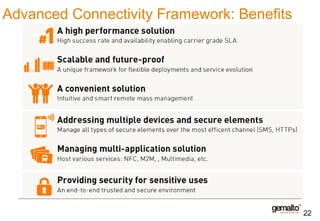
Advanced Connectivity Framework: Benefits

22
Thank You!

Maximizing your vas services with mobile marketing

  • 1.
    This document isoffered compliments of BSP Media Group. www.bspmediagroup.com All rights reserved.
  • 2.
    SERVICE MANAGEMENT INTHE LTE WORLD 12th NOVEMBER 2013 Sherry Zameer Head of Solution Sales, CISMEA Generating new revenue streams, Enabling multiple subscriptions, Managing on-demand, Advanced connectivity and access to new services, Leveraging high speed access to the SIM, Turnkey solution for remote updates, provisioning and activation, Optimising the network by measuring quality of experience.
  • 3.
    LTE is launched… what next? How can the MNO be a part of the value chain? Maintain High Speed connection with SIM card. Create software marketplace for content and applications Leverage on user billing relationship for distribution 2
  • 4.
    Advanced Connectivity Framework ACTIVATIONSERVICES: IMS Activation MARKETPLACE: Deploy & Manage New Smartphone Applications ADVANCED CONNECTIVITY FRAMEWORK BE A PART OF THE VALUE CHAN SUBSCRIPTION MANAGEMENT: M2M, Operator Services NETWORK PERFORMANCE: Wifi Offload, QoS 3
  • 5.
    Activation Services Automatic activationof subscription services in mobile devices as soon as they are connected to the network Pull approach optimizes success rate by reaching virtually all active subscribers. Mass Management using pull based methodology in activation of LTE services provides far greater reachability and cost efficiencies than traditional push based methods. The SIM Card periodically requests the network for it’s service updates. 4
  • 6.
  • 7.
    Activation Services: Benefits ServiceRevenues Immediate access to services No activation failure Mandatory supported by devices Security Strong user authentication Secure IMS data exchanges End-user experience No need to enter login/password No need to enter login & connection settings Personalized user settings in the UICC Customer care Cost: less call 6 Subscription Management Services
  • 8.
    Subscription Management Manage subscriptionsand securely deliver and activate subscriptions on demand, in an optimized way to address mobile broadband consumer devices and the emerging M2M market To provide “always-on” user experience anywhere, cellular connectivity can become a standard feature for a growing number of devices beyond mobile phones, adding value and differentiation to both devices and content. It is essential that connectivity providers simplify the access to data plans and offer customers flexible subscriptions that can be easily activates and updated. This statement is also true for the machine-to-machine market, which is looking for solutions driving operating costs down by improving business process efficiency, and SLAs guaranteeing performance levels across the globe. 7
  • 9.
    Marketplace Services Use ActivationServices to detect Handset Type and bootstrap device environment for operator marketplace. Having access to the end user device terminal allows the operator to promote it’s own applications to the end user. Mobile operators have been left out of the value chain in the mobile digital revolution. Marketplace services allows operators to promote their own applications or third party applications but always playing a central role in the value chain. This capability, coupled with the billing relationship with the end user is a powerful architecture to regain ownership of the data services revenues. 8
  • 10.
    Marketplace Services: UserExperience – Step 1 Showing the smartphone A smartphone, bought in a store by a end user There are neither telecom application nor mobile agent on it Impossible for the operator to manage or customize it
  • 11.
    Marketplace Services: UserExperience – Step 2 Downloading the client The type of smartphone is automatically detected The end user receives a message to download the mobile agent onto his smartphone He opens the message which contains a link towards Google Playstore The mobile agent is actually stored on this app The subscriber can now download the app which contains the mobile agent
  • 12.
    Marketplace Services: UserExperience – Step 3 Installing the client The subscriber receives a message asking him if he wants to install the client or not Once installed, the subscriber clicks on open to launch the mobile client The mobile client is now on board and it asks the subscriber if he wants to complete the set up
  • 13.
    Marketplace Services: UserExperience – Step 4 Showing the freshly branded Smartphone Once the set up is completed, the Smartphone is branded with the operator’s identity and applications Thanks to the mobile agent telecom operators will be able to promote their applications whenever they want
  • 14.
    Marketplace Services: TypicalApplications Possible applications A typical application is the WiFi Offload which enables operators to balance their network load and reduce network congestion Another application can be the voice over IP application to bring full voice solution to subscribers The mobile operator can also download an application to detect useful device information such as the OS version or any other device capabilities
  • 15.
    Marketplace Services: Tacklethe OTT Players Opening up possibilities These are only some examples the applications that can be promoted by the operator Many more are possible…
  • 16.
    Network Quality Connectivity withthe device can feedback valuable QoS parameters in real-time to generate reports on Network Quality. By Aggregating KPI from a crowd of subscribers, views to network and device performance are provided with the individual subscriber’s experience. Network quality parameters can include time, location, Make & Model to answers questions and provide insights to network quality: • What devices contribute most to the worst call setup experience? • What devices contribute most to the best call performance? • Which cell sites cause the most Radio Link Failures? • What equipment in the Network Participates Most In good/poor Service experience? • Why are the network rejecting attempts to use service? • How well is a corporate customer being Served? 15
  • 17.
    Network Quality: Whatis the Use Case MNOs increase the quality of its LTE network while offering optimum experience to its subscribers On a regular basis (week, month), evaluation of the network performance: analyze of specific existing services (activation, polling, …) Identification of root causes when service delivered is failing or limited: by area, device (UICC, UE) Monitoring of corrective solution implemented 16
  • 18.
    Network Quality: Whatis the Need MNOs has to ensure high level of satisfaction to their 4G’s users, while prioritize investments LTE deployment is booming by end 2013, 234 commercial LTE networks in 83 countries (GSA) In 2016, Pyramid Research forcast 592m LTE subscriptions, equivalent to 7.3% of all cellular subscriptions at that time New services need top quality experience Video calls (skype, Facetime, ...), Streaming HD, Cloud storage, Cloud gaming, files download, ... MNO need to run LTE deployment gradually Coverage, bandwidth Quality of new technology implementation (network, UICC, devices) 17
  • 19.
    Network Quality: ValueProposition Help MNO’s to optimize their network planning and manage the quality during LTE deployment ramp up Audit root causes with priority to analysis  Measure performance and provide diagnostic  Count failures and collect alerts  Locate and analyze issues (Cartography, root of failure)  Edit reports  Monitoring of implemented solutions Differentiators Leverage on existing subscribers example Leverage on existing services - no additional traffic Focus on end user experience approach (source of information issued from subscriber experience) Time Network agnostic 18
  • 20.
    WiFi Offload: Whatis the Use Case The handset will automatically attach to the already configured preferred MNO’s WiFi networks Every time a user enters a predefined area where WiFi networks are available And in predefined scenario such as peak hours (18-20H), pick days (week ends), or specific location (high traffic density areas such as home, offices, coffee shop, …) The handset automatically handover to the preferred network Subscription Management vertical - SSSS - 19
  • 21.
    WiFi Offload: Whatis the Need MNOs need to optimize network resources to better satisfy their users and control their costs Data traffic tremendous growth Mobile internet is increasing dramatically in the last 23 years with Smartphones and tablets capabilities WiFi hot spots becomes widespread Wide availability in public places Smartphones are WiFi devices ahead of being cellular devices MNOs try to optimize networks investments: Balance network load, reduce congestion Optimize users connectivity 20 Subscription Management vertical - SSSS -
  • 22.
    WiFi Offload: ValueProposition Optimize network bandwidth Investment with the best user experience Services / Revenues Reduce congestion Increase usage Cost optimization Balance network load Smooth Network investment End-user experience Transparent for user Already available for Androïd (min V2.2) Subscription Management vertical - SSSS - 21
  • 23.
  • 24.