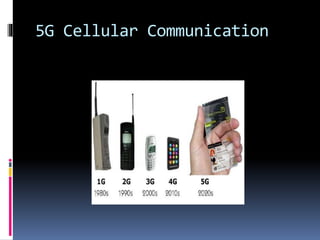
5G Cellular Communication
Abstract:
 The objective of this paper is comprehensive study related to 5G technology
of mobile communication. The most important technologies for 5G
technologies are 802.11 Wireless Local Area Networks (WLAN) and 802.16
Wireless Metropolitan Area Networks (WMAN),Ad-hoc Wireless Personal
Area Network (WPAN) and Wireless networks for digital communication.
 In the near future beyond 4G, some of the prime objectives or demands that
need to be addressed are increased capacity, improved data rate, decreased
latency and better quality of service. To meet these demands, drastic
improvements need to be made in cellular network architecture.
 This paper presents the results of a detailed survey on the fifth generation
(5G) cellular network architecture and some of the key emerging
technologies. The major contribution of this paper is the key provisions of
5G (Fifth Generation) technology of mobile communication, which is seen
as consumer oriented.
 5G technology is to make use of mobile phones within very high bandwidth.
The 5G technologies include all types of advanced features which make 5G
technology most dominant technology in near future.
Introduction
Today and in the recent future, to fulfill the presumptions and
challenges of the near future, the wireless based networks of today will have
to advanced technology in various ways. Recent technology constituent like
high-speed packet access (HSPA) and long-term evolution (LTE) will be
launched as a segment of the advancement of current wireless based
technologies.
Since its initiation in the late 1970s,mobile wireless communication has
come across from analog voice calls to current modern technologies of
providing high quality mobile broadband services with end-user data rates of
several megabits per second over wide areas . The extensive improvements
in terms of potentiality of mobile communication networks, along with the
initiation of new types of mobile devices such as smart phones and tablets,
have produced an eruption of new applications which will be used in cases
for mobile connectivity and a resultant exponential growth in network traffic.
This paper presents our view on the future of wireless communication for
2020 and beyond. In this paper, we describe the key challenges that will be
encountered by future wireless communication while enabling the network.It
is unbounded access to information and sharing of data which is accessible
everywhere and every time for everyone and everything.
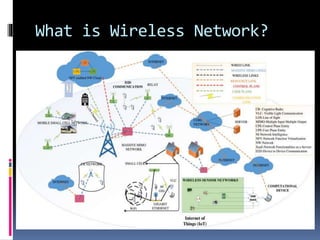
What is Wireless Network?
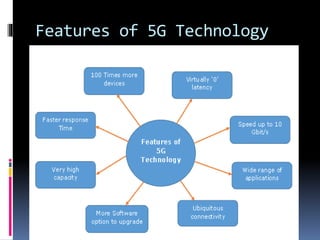
Features of 5G Technology
Literature review
 Researchers of China Mobile Research Institute (2014) says that in order
to meet the requirement of the future in the field of Internet,
technologists worldwide have started looking for next generation
wireless solutions after the launch of 4G system. So, research on Fifth
generation (5G) for wireless communication technology, which is a new
and advanced technology in the field of communication, has slowly
started to build from last year. In the past, 3G and 4G have been evolved
mainly due to the demand of data services over the internet but in case
of 5G, it could be more than just data. According toThompson and his
other six colleagues (2014) 5G technology is expected to be implemented
around 2020 which is a single unified wireless technology with more
advanced capacity network and is energy efficient than existing
technology. Hossain (2013) predicts that it will definitely raise system
space and nature within the limited available frequency spectrum, whose
frequency band could be around 3 to 300 GHz and Data Bandwidth up to
1Gbps or higher.
 According to Thompson and his other six colleagues (2014) 5G technology is
expected to be implemented around 2020 which is a single unified wireless
technology with more advanced capacity network and is energy efficient than
existing technology. Hossain (2013) predicts that it will definitely raise
system space and nature within the limited available frequency spectrum,
whose frequency band could be around 3 to 300 GHz and Data Bandwidth up
to 1Gbps or higher.
 Samsung Research America (2014) mentioned some very interesting
information regarding the amount of money invested in the research of 5G
and potential benefits of 5G. The European Commission announced to invest
€50 million in 2013 for 5G research in multiple projects which is followed by
the establishment of group led by Chinese authority and the commencement
of the Korean government led forum. It also provides the initial field trial
results of a practical 30 GHz antenna array system tested in Korea. 5G is
expected to provide good cellular coverage with the increase in data service
to fulfill rapidly increasing demand of the future and offer at least 1 Gb/s data
rate with high mobility and consistent gigabits experience per second for
users. Samsung Research America had done some initial feasibility study for
data transmission and field trail using 30GHz antenna array system
inKorea in both open and closed areas. Good cellular coverage was produced
for both the scenarios; hence they came into conclusion for the use of
millimetre-wave frequencies for 5G systems.
 There are many challenges that need to be overcome to make successful
implementation of 5G.There are all together nine articles published so far
analysing the challenges related with 5G and some of them are analysed
below. Analysts from China Mobile Research Institute (2014), Alcatel-
Lucent Bell Labs (2013) and that of Intel labs (2014) mentioned that big
multiple input multiple-output (MIMO) (also called Large-ScaleAntenna
Systems) technologies; device-to-device communications and high
frequency wave bands are required for successful implementation of 5G.
The main focus should be the design of energy efficient radio networks
and cellular networks respectively in which base site is transferred to the
Internet cloud which is called C-RAN approach. Similar things are
mentioned by researchers from the United Kingdom and China (2014).
They said that MIMO and spatial modulation is a way to increase the
capacity of antenna array systems.They also discussed the use of
cognitive radio effectively in future to produce greener communication
technology since 5G is expected to be a greener that previous ones.Their
article also reveals a cellular network planning to use a combination of
macro cells for outdoor coverage and communication, and small cells for
indoor.
 According to Hossain, S. (2013), some reasons for the need for 5G are less
battery consumption and outage probability; high coverage and data rates
available, possibly 1Gbps or higher data rate; higher security and system
level spectral efficiency; very minimal or zero harm to human health as it
focuses on greener environment; more applications combined with
Artificial Intelligent (AI); a common platform for all the technologies;
cheaper traffic fees due to the use of low infrastructure implementation
cost and antenna systems; brings better revenue to existing global
operators worldwide; improves data coding and modulation approach;
numerous concurrent data transfer paths; worldWideWirelessWeb
(WWWW), wireless-based web operation that consist full multimedia
capability beyond 4G speeds and beneficial use of low wave
frequencies for wireless access and back haul.
Furthermore, Hossain, S. (2013) says 5G communication system is
designed to fulfil the endless purpose up to the next two centuries. Some
of them are downloading of files (even music videos) quickly; uploading of
web page in the blink of eye; easy playing of online game; cheap 5G
equipment's as compared to existing ones; even supportive to previous
generation communication system; no limitation of user demands;
upgradeable both hardware and software; fill user’s demand at least up to
10 decades; facility of storing data in central data mines and high security.
 To conclude, in spite of many challenges and requirements necessary for
the successful implementation of 5G, revolutionary emerging
technology 5G is required to be launched for the benefit of mankind. It
seems to bring revolution in the field of communication system, since it
can minimize problems in many ways in the field of computer system
that previous technologies have, not just in terms of speed and security
but also in terms of increase number of connected devices and high
efficiency. It seems to be far better than the previous technologies in the
field of communication systems with numerous benefits.The main
reason of 5G could be to meet the market demands that 3G or 4G can’t
fulfil. It seems that there would be no looking back for decades in the
field of internet after 5G is launched. However, still no international 5G
development projects have officially launched which can make provide
some hope of 5G coming in near future and can be termed as one of the
best emerging technology. Since, 4G system is still seems to be in a
research and development phase, even though it has been launched in
some places, it may take more time than predicted by the analyst as
mentioned for 5G to emerge. Also, very less or no evidence is published
that can show the drawbacks of 5G since there could be some during the
early stage of every technology.

Proposed System
 A potential cellular architecture that separates indoor and
outdoor scenarios, and discuss various promising
technologies for 5G wireless communication systems, such
as massive MIMO, energy-efficient communications,
cognitive radio networks, and visible light communications.
 we envision a two-tier cellular network that involves a
macrocell tier (i.e., BS-to-device communications) and a
device tier (i.e., device-to-device communications).This is
obviously a dramatic departure from the conventional
cellular architecture and brings unique technical challenges.
In such a two-tier cellular system. since the user data is
routed through other users' devices, security must be
maintained for privacy.To ensure minimal impact on the
performance of existing macrocell BSs, the two-tier
network needs to be designed with smart interference
management strategies and appropriate resource allocation
schemes.
The main technologies will be present in the architecture to
address these requirements can be classified as follows :-
 Intensification of existing mobile networks with the massive
addition of small cells, and presenting peer to-peer (P2P)
communication such as: device-to device [D2D] and machine-
to-machine [M2M] in multi-tier heterogeneous networks.
 Both transmission and reception are synchronous like using
full-duplex technique.
 Applying massive multiple-input multiple-output (massive-
MIMO) and millimeter-wave (mm-wave) communications
technologies.
 Applying energy-aware communication and energy
harvesting to improve energy efficiency. Using Cloud Radio
Access Network (C-RAN) technology. Virtualization of
wireless resources.
5g cellular communication

5g cellular communication

  • 1.
  • 2.
    5G Cellular Communication Abstract: The objective of this paper is comprehensive study related to 5G technology of mobile communication. The most important technologies for 5G technologies are 802.11 Wireless Local Area Networks (WLAN) and 802.16 Wireless Metropolitan Area Networks (WMAN),Ad-hoc Wireless Personal Area Network (WPAN) and Wireless networks for digital communication.  In the near future beyond 4G, some of the prime objectives or demands that need to be addressed are increased capacity, improved data rate, decreased latency and better quality of service. To meet these demands, drastic improvements need to be made in cellular network architecture.  This paper presents the results of a detailed survey on the fifth generation (5G) cellular network architecture and some of the key emerging technologies. The major contribution of this paper is the key provisions of 5G (Fifth Generation) technology of mobile communication, which is seen as consumer oriented.  5G technology is to make use of mobile phones within very high bandwidth. The 5G technologies include all types of advanced features which make 5G technology most dominant technology in near future.
  • 3.
    Introduction Today and inthe recent future, to fulfill the presumptions and challenges of the near future, the wireless based networks of today will have to advanced technology in various ways. Recent technology constituent like high-speed packet access (HSPA) and long-term evolution (LTE) will be launched as a segment of the advancement of current wireless based technologies. Since its initiation in the late 1970s,mobile wireless communication has come across from analog voice calls to current modern technologies of providing high quality mobile broadband services with end-user data rates of several megabits per second over wide areas . The extensive improvements in terms of potentiality of mobile communication networks, along with the initiation of new types of mobile devices such as smart phones and tablets, have produced an eruption of new applications which will be used in cases for mobile connectivity and a resultant exponential growth in network traffic. This paper presents our view on the future of wireless communication for 2020 and beyond. In this paper, we describe the key challenges that will be encountered by future wireless communication while enabling the network.It is unbounded access to information and sharing of data which is accessible everywhere and every time for everyone and everything.
  • 4.
  • 5.
    Features of 5GTechnology
  • 6.
    Literature review  Researchersof China Mobile Research Institute (2014) says that in order to meet the requirement of the future in the field of Internet, technologists worldwide have started looking for next generation wireless solutions after the launch of 4G system. So, research on Fifth generation (5G) for wireless communication technology, which is a new and advanced technology in the field of communication, has slowly started to build from last year. In the past, 3G and 4G have been evolved mainly due to the demand of data services over the internet but in case of 5G, it could be more than just data. According toThompson and his other six colleagues (2014) 5G technology is expected to be implemented around 2020 which is a single unified wireless technology with more advanced capacity network and is energy efficient than existing technology. Hossain (2013) predicts that it will definitely raise system space and nature within the limited available frequency spectrum, whose frequency band could be around 3 to 300 GHz and Data Bandwidth up to 1Gbps or higher.
  • 7.
     According toThompson and his other six colleagues (2014) 5G technology is expected to be implemented around 2020 which is a single unified wireless technology with more advanced capacity network and is energy efficient than existing technology. Hossain (2013) predicts that it will definitely raise system space and nature within the limited available frequency spectrum, whose frequency band could be around 3 to 300 GHz and Data Bandwidth up to 1Gbps or higher.  Samsung Research America (2014) mentioned some very interesting information regarding the amount of money invested in the research of 5G and potential benefits of 5G. The European Commission announced to invest €50 million in 2013 for 5G research in multiple projects which is followed by the establishment of group led by Chinese authority and the commencement of the Korean government led forum. It also provides the initial field trial results of a practical 30 GHz antenna array system tested in Korea. 5G is expected to provide good cellular coverage with the increase in data service to fulfill rapidly increasing demand of the future and offer at least 1 Gb/s data rate with high mobility and consistent gigabits experience per second for users. Samsung Research America had done some initial feasibility study for data transmission and field trail using 30GHz antenna array system inKorea in both open and closed areas. Good cellular coverage was produced for both the scenarios; hence they came into conclusion for the use of millimetre-wave frequencies for 5G systems.
  • 8.
     There aremany challenges that need to be overcome to make successful implementation of 5G.There are all together nine articles published so far analysing the challenges related with 5G and some of them are analysed below. Analysts from China Mobile Research Institute (2014), Alcatel- Lucent Bell Labs (2013) and that of Intel labs (2014) mentioned that big multiple input multiple-output (MIMO) (also called Large-ScaleAntenna Systems) technologies; device-to-device communications and high frequency wave bands are required for successful implementation of 5G. The main focus should be the design of energy efficient radio networks and cellular networks respectively in which base site is transferred to the Internet cloud which is called C-RAN approach. Similar things are mentioned by researchers from the United Kingdom and China (2014). They said that MIMO and spatial modulation is a way to increase the capacity of antenna array systems.They also discussed the use of cognitive radio effectively in future to produce greener communication technology since 5G is expected to be a greener that previous ones.Their article also reveals a cellular network planning to use a combination of macro cells for outdoor coverage and communication, and small cells for indoor.
  • 9.
     According toHossain, S. (2013), some reasons for the need for 5G are less battery consumption and outage probability; high coverage and data rates available, possibly 1Gbps or higher data rate; higher security and system level spectral efficiency; very minimal or zero harm to human health as it focuses on greener environment; more applications combined with Artificial Intelligent (AI); a common platform for all the technologies; cheaper traffic fees due to the use of low infrastructure implementation cost and antenna systems; brings better revenue to existing global operators worldwide; improves data coding and modulation approach; numerous concurrent data transfer paths; worldWideWirelessWeb (WWWW), wireless-based web operation that consist full multimedia capability beyond 4G speeds and beneficial use of low wave frequencies for wireless access and back haul. Furthermore, Hossain, S. (2013) says 5G communication system is designed to fulfil the endless purpose up to the next two centuries. Some of them are downloading of files (even music videos) quickly; uploading of web page in the blink of eye; easy playing of online game; cheap 5G equipment's as compared to existing ones; even supportive to previous generation communication system; no limitation of user demands; upgradeable both hardware and software; fill user’s demand at least up to 10 decades; facility of storing data in central data mines and high security.
  • 10.
     To conclude,in spite of many challenges and requirements necessary for the successful implementation of 5G, revolutionary emerging technology 5G is required to be launched for the benefit of mankind. It seems to bring revolution in the field of communication system, since it can minimize problems in many ways in the field of computer system that previous technologies have, not just in terms of speed and security but also in terms of increase number of connected devices and high efficiency. It seems to be far better than the previous technologies in the field of communication systems with numerous benefits.The main reason of 5G could be to meet the market demands that 3G or 4G can’t fulfil. It seems that there would be no looking back for decades in the field of internet after 5G is launched. However, still no international 5G development projects have officially launched which can make provide some hope of 5G coming in near future and can be termed as one of the best emerging technology. Since, 4G system is still seems to be in a research and development phase, even though it has been launched in some places, it may take more time than predicted by the analyst as mentioned for 5G to emerge. Also, very less or no evidence is published that can show the drawbacks of 5G since there could be some during the early stage of every technology. 
  • 11.
    Proposed System  Apotential cellular architecture that separates indoor and outdoor scenarios, and discuss various promising technologies for 5G wireless communication systems, such as massive MIMO, energy-efficient communications, cognitive radio networks, and visible light communications.  we envision a two-tier cellular network that involves a macrocell tier (i.e., BS-to-device communications) and a device tier (i.e., device-to-device communications).This is obviously a dramatic departure from the conventional cellular architecture and brings unique technical challenges. In such a two-tier cellular system. since the user data is routed through other users' devices, security must be maintained for privacy.To ensure minimal impact on the performance of existing macrocell BSs, the two-tier network needs to be designed with smart interference management strategies and appropriate resource allocation schemes.
  • 12.
    The main technologieswill be present in the architecture to address these requirements can be classified as follows :-  Intensification of existing mobile networks with the massive addition of small cells, and presenting peer to-peer (P2P) communication such as: device-to device [D2D] and machine- to-machine [M2M] in multi-tier heterogeneous networks.  Both transmission and reception are synchronous like using full-duplex technique.  Applying massive multiple-input multiple-output (massive- MIMO) and millimeter-wave (mm-wave) communications technologies.  Applying energy-aware communication and energy harvesting to improve energy efficiency. Using Cloud Radio Access Network (C-RAN) technology. Virtualization of wireless resources.