
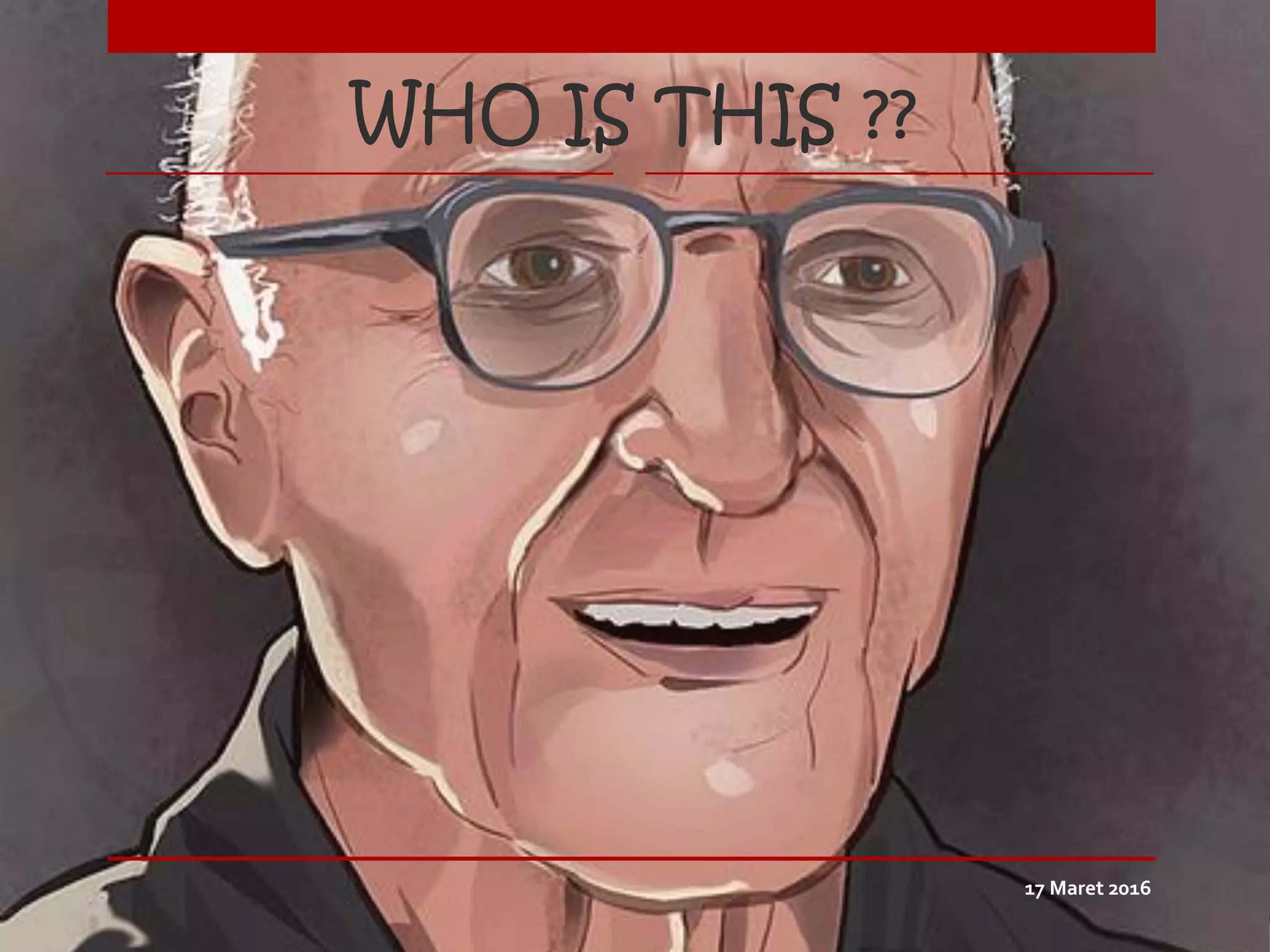
WHO IS THIS ??
17 Maret 2016
OLEH :
JAP NITA & NIKEN WIDYANINGRUM
17 Maret 2016
OVERVIEW
1. NATUR MANUSIA
2. KONSEP UTAMA
3. TEORI KONSELING
4. METODE CONSELING
5. APLIKASI
• CHILD-CENTERED COUNSELING & DEVELOPMENT OF
SELF-ESTEEM)
• MOTIVATIONALTHERAPHY
• CHILD-CENTERED PLAYTHERAPY
• DIVERSITYAPPLICATION OF CHILD CENTERTHERAPHY
17 Maret 2016
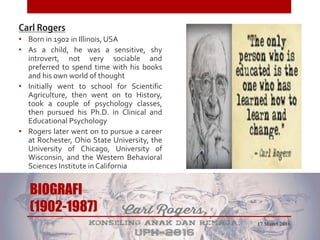
BIOGRAFI
(1902-1987)
• Born in 1902 in Illinois, USA
• As a child, he was a sensitive, shy
introvert, not very sociable and
preferred to spend time with his books
and his own world of thought
• Initially went to school for Scientific
Agriculture, then went on to History,
took a couple of psychology classes,
then pursued his Ph.D. in Clinical and
Educational Psychology
• Rogers later went on to pursue a career
at Rochester, Ohio State University, the
University of Chicago, University of
Wisconsin, and the Western Behavioral
Sciences Institute in California
17 Maret 2016
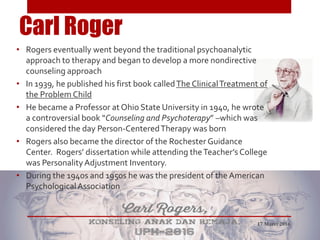
Carl Roger
• Rogers eventually went beyond the traditional psychoanalytic
approach to therapy and began to develop a more nondirective
counseling approach
• In 1939, he published his first book calledThe ClinicalTreatment of
the Problem Child
• He became a Professor at Ohio State University in 1940, he wrote
a controversial book “Counseling and Psychoterapy” –which was
considered the day Person-CenteredTherapy was born
• Rogers also became the director of the Rochester Guidance
Center. Rogers’ dissertation while attending theTeacher’s College
was PersonalityAdjustment Inventory.
• During the 1940s and 1950s he was the president of the American
PsychologicalAssociation
17 Maret 2016
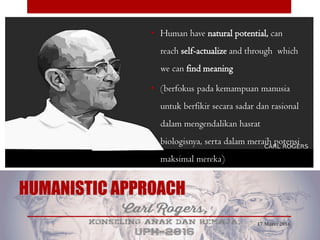
HUMANISTIC APPROACH
• Human have natural potential, can
reach self-actualize and through which
we can find meaning
• (berfokus pada kemampuan manusia
untuk berfikir secara sadar dan rasional
dalam mengendalikan hasrat
biologisnya, serta dalam meraih potensi
maksimal mereka)
17 Maret 2016
NATURAL PEOPLE
• People as Rational, Socialized, Forward-moving, and Realistic Beings
• Negative , antisocial emotions result of frustrated basic impulses
( Maslow’s hierarchy needs  failure to meet basic needs of love and
belonging.)
• People posses capacity to experience
( capacity to control and regulate their own behavior)
• People move toward actualization  psychological adjustment
17 Maret 2016
CORE CONCEPT
• PERSON
- The center and all components of the human beings
(Behavior, thought, feeling, and physical self)
- Motivation by inner-directed to become fully functioning,
improving  more independent & enhancing themselves
• WORLD
- Everything the childeren’s experiences (external/internal)
• SELF
- The person’s private world that becomes recognized as “me”
- Totality of the perceptions of the child
17 Maret 2016
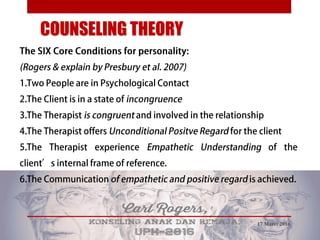
COUNSELING THEORY
17 Maret 2016
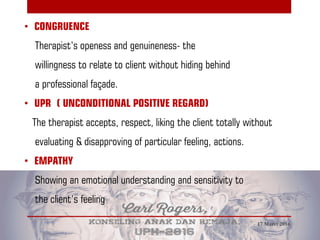
• CONGRUENCE
Therapist’s openess and genuineness- the
willingness to relate to client without hiding behind
a professional façade.
• UPR ( UNCONDITIONAL POSITIVE REGARD)
The therapist accepts, respect, liking the client totally without
evaluating & disapproving of particular feeling, actions.
• EMPATHY
Showing an emotional understanding and sensitivity to
the client’s feeling
17 Maret 2016
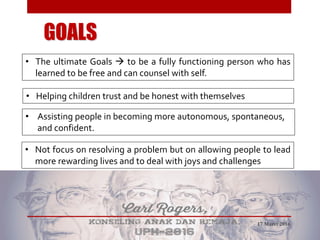
GOALS
• Assisting people in becoming more autonomous, spontaneous,
and confident.
• Helping children trust and be honest with themselves
• Not focus on resolving a problem but on allowing people to lead
more rewarding lives and to deal with joys and challenges
• The ultimate Goals  to be a fully functioning person who has
learned to be free and can counsel with self.
17 Maret 2016
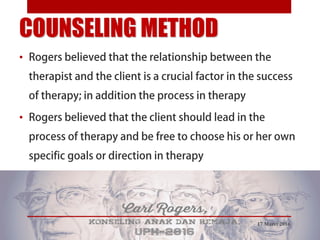
COUNSELING METHOD
•
•
17 Maret 2016
COUNSELING METHOD
• Based on counseling process is not to solve problems but to provide the
necessary and sufficient therapeutic conditions of congruence,
unconditional positive regard, and empathetic understanding so that the
client can freely grow to become more of a fully functioning person in a
safe and supportive therapeutic environment
• There is no specific technique in the practice of traditional person-
centered therapy, however, general attitudes of a person-centered therapist
may be described according to the three major factors Rogers has
explained:
1. Congruence- genuineness, honesty with the client
2. Empathy- the ability to feel what the client feels.
3. Respect- acceptance, unconditional positive regard towards the
client
17 Maret 2016
COUNSELING METHOD
• Good therapist is how the therapist
bulid a good relationship with the
client.
1. Acceptance
2. Congruence
3. Understanding
4. Nonjudgemental
17 Maret 2016
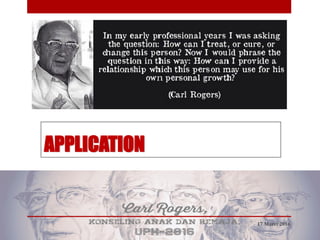
APPLICATION
17 Maret 2016
Child Centered Counseling and Development of
Self Esteem
• Self esteem in children improved when they can see a good thing in
their education and daily life
• Three steps for counselor help children improve their self esteem :
1. “All peope special and valuable because they are unique”
2. “Because people are special and unique, they have responsibilty
to help and not hurt themself”
3. “People are responsible for watching their action to see if they
are remembering the truth they are special”
• After children can see positive things, therapist will help them to
make their activities continue. It’s call self esteem series weave.The
activity should be consistant
• Self esteem development is good way to help children improve their
aademic performance
17 Maret 2016
MOTIVATIONAL INTERVIEW
FOUR PRINCIPLES OF MOTIVATIONAL INTERVIEW:
(MILLER and ROLLNICK)
•The Counselor uses reflective listening to convery understanding of
the message & caring the person
•The Counselor must develop the discrepancy between the person’s
stated values and current behavior.
•The counselor addresses resistance with reflection rather than
confrontation
•The Counselor supports the client’s self-efficacy by giving the
message (client capable of change)
17 Maret 2016
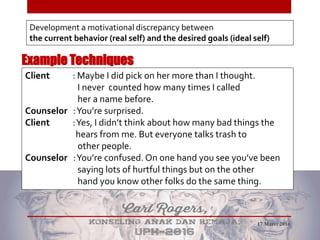
Example Techniques
Development a motivational discrepancy between
the current behavior (real self) and the desired goals (ideal self)
Client : Maybe I did pick on her more than I thought.
I never counted how many times I called
her a name before.
Counselor :You’re surprised.
Client :Yes, I didn’t think about how many bad things the
hears from me. But everyone talks trash to
other people.
Counselor :You’re confused. On one hand you see you’ve been
saying lots of hurtful things but on the other
hand you know other folks do the same thing.
17 Maret 2016
CHILD CENTERED PLAY THERAPY
• Child-Centerd PlayTherapy =
- Attitude, a philosophy, and a way of being.
- Based on beliefs in the child’s innate desire for growth and
capacity for self-direction
- Focus is on the relationship (central to success or failure counseling)
 Child leads
- Counselor focus on the child’s strengts reflects the child’s feeling, and
recognize the power of warm, caring acceptance and sensitive
• PlayTherapy
The art relationship contains details about accomplishing these goals and about
setting up a play area.
17 Maret 2016
•Must develop a warm and friendly relationship with the child.
•Accepts the child as she or he is.
•Establishes a feeling of permission in the relationship so that the child feels free to express his or
her feelings completely.
•Is alert to recognise the feelings the child is expressing and reflects these feelings back in such a
manner that the child gains insight into his/her behaviour.
•Maintains a deep respect for the child’s ability to solve his/her problems and gives the child the
opportunity to do so.
•Does not attempt to direct the child’s actions or conversations in any manner.
•Does not hurry the therapy along.
•Only establishes those limitations necessary to anchor the therapy to the world of reality and to
make the child aware of his/her responsibility in the relationship.
BASIC PRINCIPLES OF THE CHILD-CENTERED RELATIONSHIP
17 Maret 2016
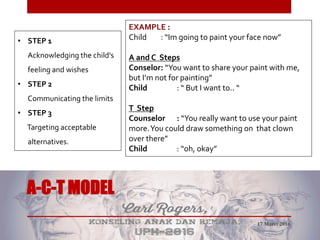
A-C-T MODEL
• STEP 1
Acknowledging the child’s
feeling and wishes
• STEP 2
Communicating the limits
• STEP 3
Targeting acceptable
alternatives.
EXAMPLE :
Child : “Im going to paint your face now”
A and C Steps
Conselor: “You want to share your paint with me,
but I’m not for painting”
Child : “ But I want to.. “
T Step
Counselor : “You really want to use your paint
more.You could draw something on that clown
over there”
Child : “oh, okay”
17 Maret 2016
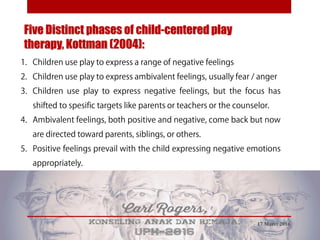
Five Distinct phases of child-centered play
therapy, Kottman (2004):
17 Maret 2016
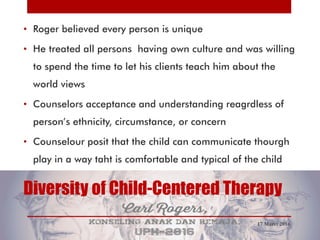
Diversity of Child-Centered Therapy
• Roger believed every person is unique
• He treated all persons having own culture and was willing
to spend the time to let his clients teach him about the
world views
• Counselors acceptance and understanding reagrdless of
person’s ethnicity, circumstance, or concern
• Counselour posit that the child can communicate thourgh
play in a way taht is comfortable and typical of the child
17 Maret 2016
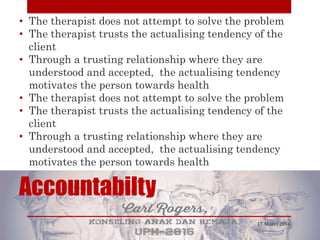
Accountabilty
• The therapist does not attempt to solve the problem
• The therapist trusts the actualising tendency of the
client
• Through a trusting relationship where they are
understood and accepted, the actualising tendency
motivates the person towards health
• The therapist does not attempt to solve the problem
• The therapist trusts the actualising tendency of the
client
• Through a trusting relationship where they are
understood and accepted, the actualising tendency
motivates the person towards health
17 Maret 2016
DAFTAR PUSTAKA• Axline, V. (1947). Play Therapy: The Inner dynamics of childhood. Boston: Houghton Mifflin.
• Baggerly,J.,& Parker, M. (2005). Child-Centered group play therapy with African American Boys at the elemantary
school level. Journal of Conseling & Development, 83, 387-396.
• Carkhuff,R. (1973, March). Human Achievement, educational, career achievement: Essential ingredients of elementary
school guidance. Paper presented at the National Elementary School Guidance conference, Louisville, KY.
• Rogers,C. (1986). Carl Rogers on the Development of the Person-Centered Approach. Person-Centered Review.
1(3).257-259.
• Prout, H. T., & Brown, D. T. (1999). Counseling and psychotherapy with children and adolescents: Theory and
practice for school and clinical settings. Retrieved February 2, 2016, from
https://books.google.co.id/books?id=N6U6nvb8tlkC&printsec=frontcover&hl=id#v=onepage&q&f=false
• Gladding, S.T. (2013). Counseling: A Comprehensive Profession. 7thEd. Upper Saddle River, NJ: Pearson
• Kirschenbaum, H. (2004). Carl Rogers’s life and works: An assessment on the 100th anniversary of his birth [Electronic
version]. Journal of Counseling and Development, 82, 116-124
• Rogers, C. R., & Dymond, R. F. (1954). Psychotherapy and personality change. Chicago: University of Chicago Press
• Thompson, C. L., Rudolph, L. B., & Henderson, D. A. (2004). Counseling children. Belmont, CA: Thomson/Brooks/Cole
17 Maret 2016

Carl Rogers Persentasi

  • 1.
    WHO IS THIS?? 17 Maret 2016
  • 2.
    OLEH : JAP NITA& NIKEN WIDYANINGRUM 17 Maret 2016
  • 3.
    OVERVIEW 1. NATUR MANUSIA 2.KONSEP UTAMA 3. TEORI KONSELING 4. METODE CONSELING 5. APLIKASI • CHILD-CENTERED COUNSELING & DEVELOPMENT OF SELF-ESTEEM) • MOTIVATIONALTHERAPHY • CHILD-CENTERED PLAYTHERAPY • DIVERSITYAPPLICATION OF CHILD CENTERTHERAPHY 17 Maret 2016
  • 4.
    BIOGRAFI (1902-1987) • Born in1902 in Illinois, USA • As a child, he was a sensitive, shy introvert, not very sociable and preferred to spend time with his books and his own world of thought • Initially went to school for Scientific Agriculture, then went on to History, took a couple of psychology classes, then pursued his Ph.D. in Clinical and Educational Psychology • Rogers later went on to pursue a career at Rochester, Ohio State University, the University of Chicago, University of Wisconsin, and the Western Behavioral Sciences Institute in California 17 Maret 2016
  • 5.
    Carl Roger • Rogerseventually went beyond the traditional psychoanalytic approach to therapy and began to develop a more nondirective counseling approach • In 1939, he published his first book calledThe ClinicalTreatment of the Problem Child • He became a Professor at Ohio State University in 1940, he wrote a controversial book “Counseling and Psychoterapy” –which was considered the day Person-CenteredTherapy was born • Rogers also became the director of the Rochester Guidance Center. Rogers’ dissertation while attending theTeacher’s College was PersonalityAdjustment Inventory. • During the 1940s and 1950s he was the president of the American PsychologicalAssociation 17 Maret 2016
  • 6.
    HUMANISTIC APPROACH • Humanhave natural potential, can reach self-actualize and through which we can find meaning • (berfokus pada kemampuan manusia untuk berfikir secara sadar dan rasional dalam mengendalikan hasrat biologisnya, serta dalam meraih potensi maksimal mereka) 17 Maret 2016
  • 7.
    NATURAL PEOPLE • Peopleas Rational, Socialized, Forward-moving, and Realistic Beings • Negative , antisocial emotions result of frustrated basic impulses ( Maslow’s hierarchy needs  failure to meet basic needs of love and belonging.) • People posses capacity to experience ( capacity to control and regulate their own behavior) • People move toward actualization  psychological adjustment 17 Maret 2016
  • 8.
    CORE CONCEPT • PERSON -The center and all components of the human beings (Behavior, thought, feeling, and physical self) - Motivation by inner-directed to become fully functioning, improving  more independent & enhancing themselves • WORLD - Everything the childeren’s experiences (external/internal) • SELF - The person’s private world that becomes recognized as “me” - Totality of the perceptions of the child 17 Maret 2016
  • 9.
  • 10.
    • CONGRUENCE Therapist’s openessand genuineness- the willingness to relate to client without hiding behind a professional façade. • UPR ( UNCONDITIONAL POSITIVE REGARD) The therapist accepts, respect, liking the client totally without evaluating & disapproving of particular feeling, actions. • EMPATHY Showing an emotional understanding and sensitivity to the client’s feeling 17 Maret 2016
  • 11.
    GOALS • Assisting peoplein becoming more autonomous, spontaneous, and confident. • Helping children trust and be honest with themselves • Not focus on resolving a problem but on allowing people to lead more rewarding lives and to deal with joys and challenges • The ultimate Goals  to be a fully functioning person who has learned to be free and can counsel with self. 17 Maret 2016
  • 12.
  • 13.
    COUNSELING METHOD • Basedon counseling process is not to solve problems but to provide the necessary and sufficient therapeutic conditions of congruence, unconditional positive regard, and empathetic understanding so that the client can freely grow to become more of a fully functioning person in a safe and supportive therapeutic environment • There is no specific technique in the practice of traditional person- centered therapy, however, general attitudes of a person-centered therapist may be described according to the three major factors Rogers has explained: 1. Congruence- genuineness, honesty with the client 2. Empathy- the ability to feel what the client feels. 3. Respect- acceptance, unconditional positive regard towards the client 17 Maret 2016
  • 14.
    COUNSELING METHOD • Goodtherapist is how the therapist bulid a good relationship with the client. 1. Acceptance 2. Congruence 3. Understanding 4. Nonjudgemental 17 Maret 2016
  • 15.
  • 16.
    Child Centered Counselingand Development of Self Esteem • Self esteem in children improved when they can see a good thing in their education and daily life • Three steps for counselor help children improve their self esteem : 1. “All peope special and valuable because they are unique” 2. “Because people are special and unique, they have responsibilty to help and not hurt themself” 3. “People are responsible for watching their action to see if they are remembering the truth they are special” • After children can see positive things, therapist will help them to make their activities continue. It’s call self esteem series weave.The activity should be consistant • Self esteem development is good way to help children improve their aademic performance 17 Maret 2016
  • 17.
    MOTIVATIONAL INTERVIEW FOUR PRINCIPLESOF MOTIVATIONAL INTERVIEW: (MILLER and ROLLNICK) •The Counselor uses reflective listening to convery understanding of the message & caring the person •The Counselor must develop the discrepancy between the person’s stated values and current behavior. •The counselor addresses resistance with reflection rather than confrontation •The Counselor supports the client’s self-efficacy by giving the message (client capable of change) 17 Maret 2016
  • 18.
    Example Techniques Development amotivational discrepancy between the current behavior (real self) and the desired goals (ideal self) Client : Maybe I did pick on her more than I thought. I never counted how many times I called her a name before. Counselor :You’re surprised. Client :Yes, I didn’t think about how many bad things the hears from me. But everyone talks trash to other people. Counselor :You’re confused. On one hand you see you’ve been saying lots of hurtful things but on the other hand you know other folks do the same thing. 17 Maret 2016
  • 19.
    CHILD CENTERED PLAYTHERAPY • Child-Centerd PlayTherapy = - Attitude, a philosophy, and a way of being. - Based on beliefs in the child’s innate desire for growth and capacity for self-direction - Focus is on the relationship (central to success or failure counseling)  Child leads - Counselor focus on the child’s strengts reflects the child’s feeling, and recognize the power of warm, caring acceptance and sensitive • PlayTherapy The art relationship contains details about accomplishing these goals and about setting up a play area. 17 Maret 2016
  • 20.
    •Must develop awarm and friendly relationship with the child. •Accepts the child as she or he is. •Establishes a feeling of permission in the relationship so that the child feels free to express his or her feelings completely. •Is alert to recognise the feelings the child is expressing and reflects these feelings back in such a manner that the child gains insight into his/her behaviour. •Maintains a deep respect for the child’s ability to solve his/her problems and gives the child the opportunity to do so. •Does not attempt to direct the child’s actions or conversations in any manner. •Does not hurry the therapy along. •Only establishes those limitations necessary to anchor the therapy to the world of reality and to make the child aware of his/her responsibility in the relationship. BASIC PRINCIPLES OF THE CHILD-CENTERED RELATIONSHIP 17 Maret 2016
  • 21.
    A-C-T MODEL • STEP1 Acknowledging the child’s feeling and wishes • STEP 2 Communicating the limits • STEP 3 Targeting acceptable alternatives. EXAMPLE : Child : “Im going to paint your face now” A and C Steps Conselor: “You want to share your paint with me, but I’m not for painting” Child : “ But I want to.. “ T Step Counselor : “You really want to use your paint more.You could draw something on that clown over there” Child : “oh, okay” 17 Maret 2016
  • 22.
    Five Distinct phasesof child-centered play therapy, Kottman (2004): 17 Maret 2016
  • 23.
    Diversity of Child-CenteredTherapy • Roger believed every person is unique • He treated all persons having own culture and was willing to spend the time to let his clients teach him about the world views • Counselors acceptance and understanding reagrdless of person’s ethnicity, circumstance, or concern • Counselour posit that the child can communicate thourgh play in a way taht is comfortable and typical of the child 17 Maret 2016
  • 24.
    Accountabilty • The therapistdoes not attempt to solve the problem • The therapist trusts the actualising tendency of the client • Through a trusting relationship where they are understood and accepted, the actualising tendency motivates the person towards health • The therapist does not attempt to solve the problem • The therapist trusts the actualising tendency of the client • Through a trusting relationship where they are understood and accepted, the actualising tendency motivates the person towards health 17 Maret 2016
  • 25.
    DAFTAR PUSTAKA• Axline,V. (1947). Play Therapy: The Inner dynamics of childhood. Boston: Houghton Mifflin. • Baggerly,J.,& Parker, M. (2005). Child-Centered group play therapy with African American Boys at the elemantary school level. Journal of Conseling & Development, 83, 387-396. • Carkhuff,R. (1973, March). Human Achievement, educational, career achievement: Essential ingredients of elementary school guidance. Paper presented at the National Elementary School Guidance conference, Louisville, KY. • Rogers,C. (1986). Carl Rogers on the Development of the Person-Centered Approach. Person-Centered Review. 1(3).257-259. • Prout, H. T., & Brown, D. T. (1999). Counseling and psychotherapy with children and adolescents: Theory and practice for school and clinical settings. Retrieved February 2, 2016, from https://books.google.co.id/books?id=N6U6nvb8tlkC&printsec=frontcover&hl=id#v=onepage&q&f=false • Gladding, S.T. (2013). Counseling: A Comprehensive Profession. 7thEd. Upper Saddle River, NJ: Pearson • Kirschenbaum, H. (2004). Carl Rogers’s life and works: An assessment on the 100th anniversary of his birth [Electronic version]. Journal of Counseling and Development, 82, 116-124 • Rogers, C. R., & Dymond, R. F. (1954). Psychotherapy and personality change. Chicago: University of Chicago Press • Thompson, C. L., Rudolph, L. B., & Henderson, D. A. (2004). Counseling children. Belmont, CA: Thomson/Brooks/Cole 17 Maret 2016