Career Development Theories
( Trait and Factors Theories)
Reported by:
Iris Frani
What is career development theory?
• It is a set of concepts, propositions, and ideas
that provides us with insights into what is
believed to be true about the process of career
development.
Trait-Oriented Theories
• They are embedded in Parson’s (1909)
vocational counseling paradigm of matching
individual traits with requirements of
occupations.
• A key finding was potential sets of reinforces
in the work environment that enhance job
satisfaction.
Trait-and-Factor Theory
• Among the earliest theorists on vocational
counseling, Parsons (1909) maintained that
vocational guidance is accomplished:
1. studying the individual
2. surveying occupations
3. matching the individual with the occupation
• This theory greatly influenced the study of job
descriptions and job requirements as theorists
attempted to predict future job success by
measuring job-related traits.
• The development of assessment instruments
and the refinement of occupational
information are closely associated with the
trait-and-factor theory.
• Williamson was a prominent advocate of trait-
and-factor counseling. Williamson’s
counseling procedures maintained the early
impetus of the trait and factor approach that
evolved from Parsons’s work.
• This straightforward approach to counseling
contained six sequential steps:
1. Analysis
2. Synthesis
3. Diagnosis
4. Prognosis
5. Counseling
6. Follow-up
• The following assumptions of the trait-and-
factor approach also raise concerns about this
theory:
(1) There is a single career goal for everyone.
(2) Career decisions are based primarily on
measured abilities (Herr, Cramer, & Niles,
2004).
Will trait-and-factor theory be
revitalized for the 21st century?
• Prediger (1995) suggests that person-
environment fit theory has indeed enhanced
the potential for a closer relationship between
assessment and career counseling; assessment
information can provide the basis for
developing career possibilities into realities.
Person-Environment-Correspondence
(PEC) Counseling
• it was referred to as the theory of work
adjustment (TWA). In 1991, it was revised
once again to include descriptions of the
differences between personality structure and
personality style and between personality
style and adjustment style.
• According to Dawis and Lofquist, individuals
bring their requirements to a work
environment, and the work environment
makes its requirements of individuals. To
survive, the individual and the work
environment must achieve some degree of
congruence (correspondence).
Four key points of Dawis’s and Lofquist’s
theory are summarized as follows:
(1) work personality and work environment
should be amenable,
(2) individual needs are most important in
determining an individual’s fit into the work
environment,
(3) individual needs and the reinforce system that
characterizes the work setting are important
aspects of stability and tenure,
(4) job placement is best accomplished through a
match of worker traits with the requirements of
a work environment.
John Holland’s Typology
• According to John Holland (1992), individuals
are attracted to a given career because of
their particular personalities and numerous
variables that constitute their backgrounds.
• First, career choice is an expression of, or an
extension of, personality into the world of
work, followed by subsequent identification
with specific occupational stereotypes.
• Congruence of one’s view of self with
occupational preference establishes what
Holland refers to as the modal personal style.
• If the individual has developed a strong
dominant orientation, satisfaction is probable
in a corresponding occupational environment.
If, however, the orientation is one of
indecision, the likelihood of satisfaction
diminishes.
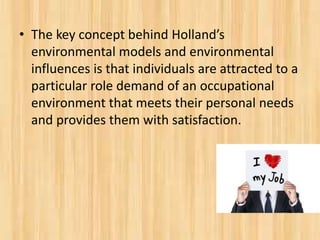
• The key concept behind Holland’s
environmental models and environmental
influences is that individuals are attracted to a
particular role demand of an occupational
environment that meets their personal needs
and provides them with satisfaction.
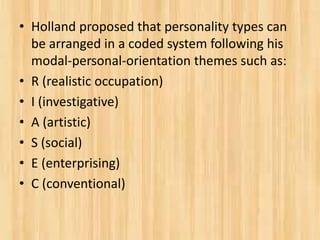
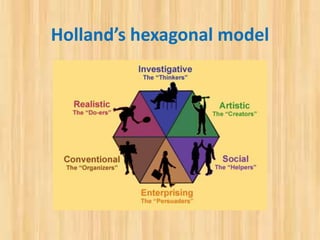
• Holland proposed that personality types can
be arranged in a coded system following his
modal-personal-orientation themes such as:
• R (realistic occupation)
• I (investigative)
• A (artistic)
• S (social)
• E (enterprising)
• C (conventional)
Holland’s hexagonal model
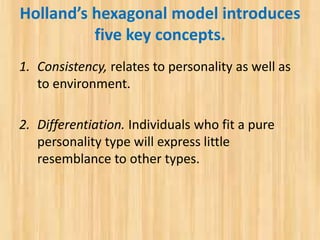
Holland’s hexagonal model introduces
five key concepts.
1. Consistency, relates to personality as well as
to environment.
2. Differentiation. Individuals who fit a pure
personality type will express little
resemblance to other types.
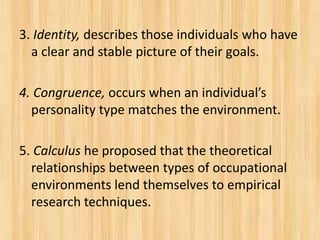
3. Identity, describes those individuals who have
a clear and stable picture of their goals.
4. Congruence, occurs when an individual’s
personality type matches the environment.
5. Calculus he proposed that the theoretical
relationships between types of occupational
environments lend themselves to empirical
research techniques.
• In the process of career decision making,
Holland postulated that the hierarchy or level
of attainment in a career is determined
primarily by individual self evaluations.
• According to Holland, the stability of career
choice depends primarily on the dominance of
personal orientation.
• Holland’s theory is primarily descriptive, with
little emphasis on explaining the causes and
the timing of the development of hierarchies
of the personal modal styles. He concentrated
on the factors that influence career choice
rather than on the developmental process
that leads to career choice.
• The RIASEC model has been tested with a
wide range of ethnically diverse individuals,
including those from different socioeconomic
backgrounds, and with international groups.
• Holland’s theory emphasizes the accuracy of
self-knowledge and the career information
necessary for career decision making.
What Counselor’s should do?
• Counselors have to assess the client’s ability to
perform work related tasks.
• Counselors have to assess the overall job
satisfaction.
• Counselors have to be aware of how stable or
permanent a job will be.
• Be able to learn a client’s needs and values and
factor that in to how well they will adjust to work.
Implication for Counselors
• Relies too heavily on assessments and test
results.
• Static
• Too simple
• Career goals primarily based on abilities
• Counselors own values and judgments toward
different careers
References:
• Zunker, V. G, Career counseling: A Hollistic Approach
• http://wps.ablongman.com/wps/media/objects/208/2
13944/trait.pdf.
• https://prezi.com/5xg9iyvv9bk4/traitfactor-theory/

Career Development Theories

  • 1.
    Career Development Theories (Trait and Factors Theories) Reported by: Iris Frani
  • 2.
    What is careerdevelopment theory? • It is a set of concepts, propositions, and ideas that provides us with insights into what is believed to be true about the process of career development.
  • 3.
    Trait-Oriented Theories • Theyare embedded in Parson’s (1909) vocational counseling paradigm of matching individual traits with requirements of occupations. • A key finding was potential sets of reinforces in the work environment that enhance job satisfaction.
  • 4.
    Trait-and-Factor Theory • Amongthe earliest theorists on vocational counseling, Parsons (1909) maintained that vocational guidance is accomplished: 1. studying the individual 2. surveying occupations 3. matching the individual with the occupation
  • 5.
    • This theorygreatly influenced the study of job descriptions and job requirements as theorists attempted to predict future job success by measuring job-related traits.
  • 6.
    • The developmentof assessment instruments and the refinement of occupational information are closely associated with the trait-and-factor theory. • Williamson was a prominent advocate of trait- and-factor counseling. Williamson’s counseling procedures maintained the early impetus of the trait and factor approach that evolved from Parsons’s work.
  • 7.
    • This straightforwardapproach to counseling contained six sequential steps: 1. Analysis 2. Synthesis 3. Diagnosis 4. Prognosis 5. Counseling 6. Follow-up
  • 8.
    • The followingassumptions of the trait-and- factor approach also raise concerns about this theory: (1) There is a single career goal for everyone. (2) Career decisions are based primarily on measured abilities (Herr, Cramer, & Niles, 2004).
  • 9.
    Will trait-and-factor theorybe revitalized for the 21st century? • Prediger (1995) suggests that person- environment fit theory has indeed enhanced the potential for a closer relationship between assessment and career counseling; assessment information can provide the basis for developing career possibilities into realities.
  • 10.
    Person-Environment-Correspondence (PEC) Counseling • itwas referred to as the theory of work adjustment (TWA). In 1991, it was revised once again to include descriptions of the differences between personality structure and personality style and between personality style and adjustment style.
  • 11.
    • According toDawis and Lofquist, individuals bring their requirements to a work environment, and the work environment makes its requirements of individuals. To survive, the individual and the work environment must achieve some degree of congruence (correspondence).
  • 12.
    Four key pointsof Dawis’s and Lofquist’s theory are summarized as follows: (1) work personality and work environment should be amenable, (2) individual needs are most important in determining an individual’s fit into the work environment,
  • 13.
    (3) individual needsand the reinforce system that characterizes the work setting are important aspects of stability and tenure, (4) job placement is best accomplished through a match of worker traits with the requirements of a work environment.
  • 14.
    John Holland’s Typology •According to John Holland (1992), individuals are attracted to a given career because of their particular personalities and numerous variables that constitute their backgrounds. • First, career choice is an expression of, or an extension of, personality into the world of work, followed by subsequent identification with specific occupational stereotypes.
  • 15.
    • Congruence ofone’s view of self with occupational preference establishes what Holland refers to as the modal personal style. • If the individual has developed a strong dominant orientation, satisfaction is probable in a corresponding occupational environment. If, however, the orientation is one of indecision, the likelihood of satisfaction diminishes.
  • 16.
    • The keyconcept behind Holland’s environmental models and environmental influences is that individuals are attracted to a particular role demand of an occupational environment that meets their personal needs and provides them with satisfaction.
  • 17.
    • Holland proposedthat personality types can be arranged in a coded system following his modal-personal-orientation themes such as: • R (realistic occupation) • I (investigative) • A (artistic) • S (social) • E (enterprising) • C (conventional)
  • 18.
  • 19.
    Holland’s hexagonal modelintroduces five key concepts. 1. Consistency, relates to personality as well as to environment. 2. Differentiation. Individuals who fit a pure personality type will express little resemblance to other types.
  • 20.
    3. Identity, describesthose individuals who have a clear and stable picture of their goals. 4. Congruence, occurs when an individual’s personality type matches the environment. 5. Calculus he proposed that the theoretical relationships between types of occupational environments lend themselves to empirical research techniques.
  • 21.
    • In theprocess of career decision making, Holland postulated that the hierarchy or level of attainment in a career is determined primarily by individual self evaluations. • According to Holland, the stability of career choice depends primarily on the dominance of personal orientation.
  • 22.
    • Holland’s theoryis primarily descriptive, with little emphasis on explaining the causes and the timing of the development of hierarchies of the personal modal styles. He concentrated on the factors that influence career choice rather than on the developmental process that leads to career choice.
  • 23.
    • The RIASECmodel has been tested with a wide range of ethnically diverse individuals, including those from different socioeconomic backgrounds, and with international groups. • Holland’s theory emphasizes the accuracy of self-knowledge and the career information necessary for career decision making.
  • 24.
    What Counselor’s shoulddo? • Counselors have to assess the client’s ability to perform work related tasks. • Counselors have to assess the overall job satisfaction. • Counselors have to be aware of how stable or permanent a job will be. • Be able to learn a client’s needs and values and factor that in to how well they will adjust to work.
  • 25.
    Implication for Counselors •Relies too heavily on assessments and test results. • Static • Too simple • Career goals primarily based on abilities • Counselors own values and judgments toward different careers
  • 26.
    References: • Zunker, V.G, Career counseling: A Hollistic Approach • http://wps.ablongman.com/wps/media/objects/208/2 13944/trait.pdf. • https://prezi.com/5xg9iyvv9bk4/traitfactor-theory/