
Changing your Career
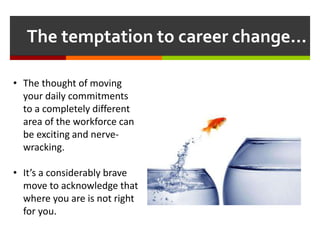
The temptation to career change…
• The thought of moving
your daily commitments
to a completely different
area of the workforce can
be exciting and nerve-
wracking.
• It’s a considerably brave
move to acknowledge that
where you are is not right
for you.
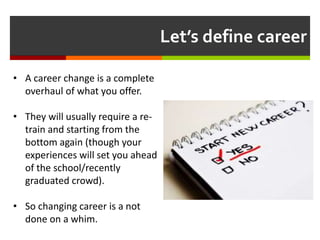
Let’s define career
• A career change is a complete
overhaul of what you offer.
• They will usually require a re-
train and starting from the
bottom again (though your
experiences will set you ahead
of the school/recently
graduated crowd).
• So changing career is a not
done on a whim.
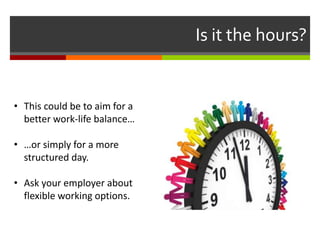
Is it the hours?
• This could be to aim for a
better work-life balance…
• …or simply for a more
structured day.
• Ask your employer about
flexible working options.
Is it your colleagues?
• If you changed role
within the
organisation and
worked alongside
different people, your
opinion of the
workplace could
change.
Is it your colleagues?
• That said, a change of
career is sometimes
necessary for this; it
could be that the ‘type’
of worker in your career
just doesn’t match with
you.
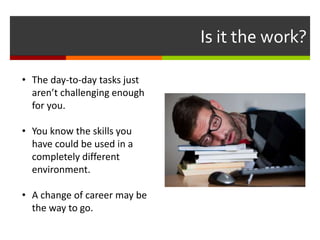
Is it the work?
• The day-to-day tasks just
aren’t challenging enough
for you.
• You know the skills you
have could be used in a
completely different
environment.
• A change of career may be
the way to go.
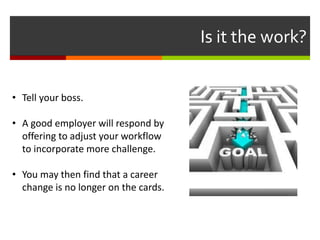
Is it the work?
• Tell your boss.
• A good employer will respond by
offering to adjust your workflow
to incorporate more challenge.
• You may then find that a career
change is no longer on the cards.
So you’ve figured out that changes to the hours,
people and work itself aren’t going to satisfy you.
If you have set your mind to it, then a career change
needs to be prepared for.
But where do you start?
Assess your current situation
Look at your skills
and what is
missing from your
current career.
Consider the
following
questions…
• What have you achieved in your
career and which of those are you
proud of?
• Have you enjoyed the challenges, or
preferred the steadier work?
• How did promotions, if any, make
you feel?
• Did your salary allow you to live
the way you wanted, and what
level could that reasonably be?
• What expertise have you got to
carry over elsewhere?
• Then, finally, will you regret it if
you don’t?
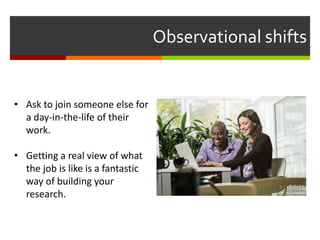
Observational shifts
• Ask to join someone else for
a day-in-the-life of their
work.
• Getting a real view of what
the job is like is a fantastic
way of building your
research.
Work experience
• Obtaining part-time work, an
internship or voluntary
experience in the field will
help to boost your chances of
actually getting hired.
• Build your understanding of
the career.
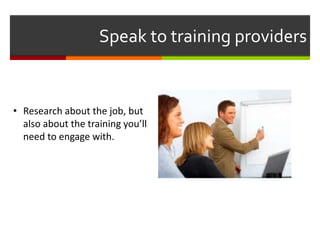
Speak to training providers
• Research about the job, but
also about the training you’ll
need to engage with.
Recruitment consultant
• Getting in touch with a
recruitment consultant could
be the key to your concerns.
• They will likely have had
experience with many career
changes, and will know about
the route you wish to take.
What else could help?
• Look at the education and training
required if you need to re-train.
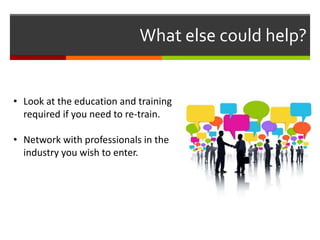
• Network with professionals in the
industry you wish to enter.
What else could help?
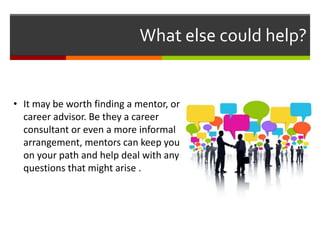
• It may be worth finding a mentor, or
career advisor. Be they a career
consultant or even a more informal
arrangement, mentors can keep you
on your path and help deal with any
questions that might arise .
Follow our advice if
you want to take
the career plunge

Career change

  • 1.
  • 2.
    The temptation tocareer change… • The thought of moving your daily commitments to a completely different area of the workforce can be exciting and nerve- wracking. • It’s a considerably brave move to acknowledge that where you are is not right for you.
  • 4.
    Let’s define career •A career change is a complete overhaul of what you offer. • They will usually require a re- train and starting from the bottom again (though your experiences will set you ahead of the school/recently graduated crowd). • So changing career is a not done on a whim.
  • 6.
    Is it thehours? • This could be to aim for a better work-life balance… • …or simply for a more structured day. • Ask your employer about flexible working options.
  • 7.
    Is it yourcolleagues? • If you changed role within the organisation and worked alongside different people, your opinion of the workplace could change.
  • 8.
    Is it yourcolleagues? • That said, a change of career is sometimes necessary for this; it could be that the ‘type’ of worker in your career just doesn’t match with you.
  • 9.
    Is it thework? • The day-to-day tasks just aren’t challenging enough for you. • You know the skills you have could be used in a completely different environment. • A change of career may be the way to go.
  • 10.
    Is it thework? • Tell your boss. • A good employer will respond by offering to adjust your workflow to incorporate more challenge. • You may then find that a career change is no longer on the cards.
  • 11.
    So you’ve figuredout that changes to the hours, people and work itself aren’t going to satisfy you. If you have set your mind to it, then a career change needs to be prepared for. But where do you start?
  • 12.
    Assess your currentsituation Look at your skills and what is missing from your current career. Consider the following questions…
  • 13.
    • What haveyou achieved in your career and which of those are you proud of? • Have you enjoyed the challenges, or preferred the steadier work? • How did promotions, if any, make you feel?
  • 14.
    • Did yoursalary allow you to live the way you wanted, and what level could that reasonably be? • What expertise have you got to carry over elsewhere? • Then, finally, will you regret it if you don’t?
  • 16.
    Observational shifts • Askto join someone else for a day-in-the-life of their work. • Getting a real view of what the job is like is a fantastic way of building your research.
  • 17.
    Work experience • Obtainingpart-time work, an internship or voluntary experience in the field will help to boost your chances of actually getting hired. • Build your understanding of the career.
  • 18.
    Speak to trainingproviders • Research about the job, but also about the training you’ll need to engage with.
  • 19.
    Recruitment consultant • Gettingin touch with a recruitment consultant could be the key to your concerns. • They will likely have had experience with many career changes, and will know about the route you wish to take.
  • 20.
    What else couldhelp? • Look at the education and training required if you need to re-train. • Network with professionals in the industry you wish to enter.
  • 21.
    What else couldhelp? • It may be worth finding a mentor, or career advisor. Be they a career consultant or even a more informal arrangement, mentors can keep you on your path and help deal with any questions that might arise .
  • 22.
    Follow our adviceif you want to take the career plunge