The Lehigh-KEEN Initiative: Developing the
Next Generation of Entrepreneurial Leaders
Professor John B Ochs, Ph D
Outline
 Define KEEN
 Lehigh’s contribution to KEEN
 Lehigh’s Framework for EM learning
 Our shared taxonomy
 Examples of curriculum innovation
 Curriculum change methodology
 Institutional impact
 Introduce our Entrepreneurship Ecosystem
What is KEEN? (Kern Entrepreneurial
Engineering Network)
 A network of engineering schools committed to
infect all students with entrepreneurial mindset
(EM)
 Funded by the Kern Family Foundation through
grant program (www.engineeringunleashed.com)
 Currently 31 schools; growing to 72 by 2035
(20% of all engineering school)
 KEEN is a competitive cooperative of like-
minded faculty & students seeking continuous
innovation of engineering curricula
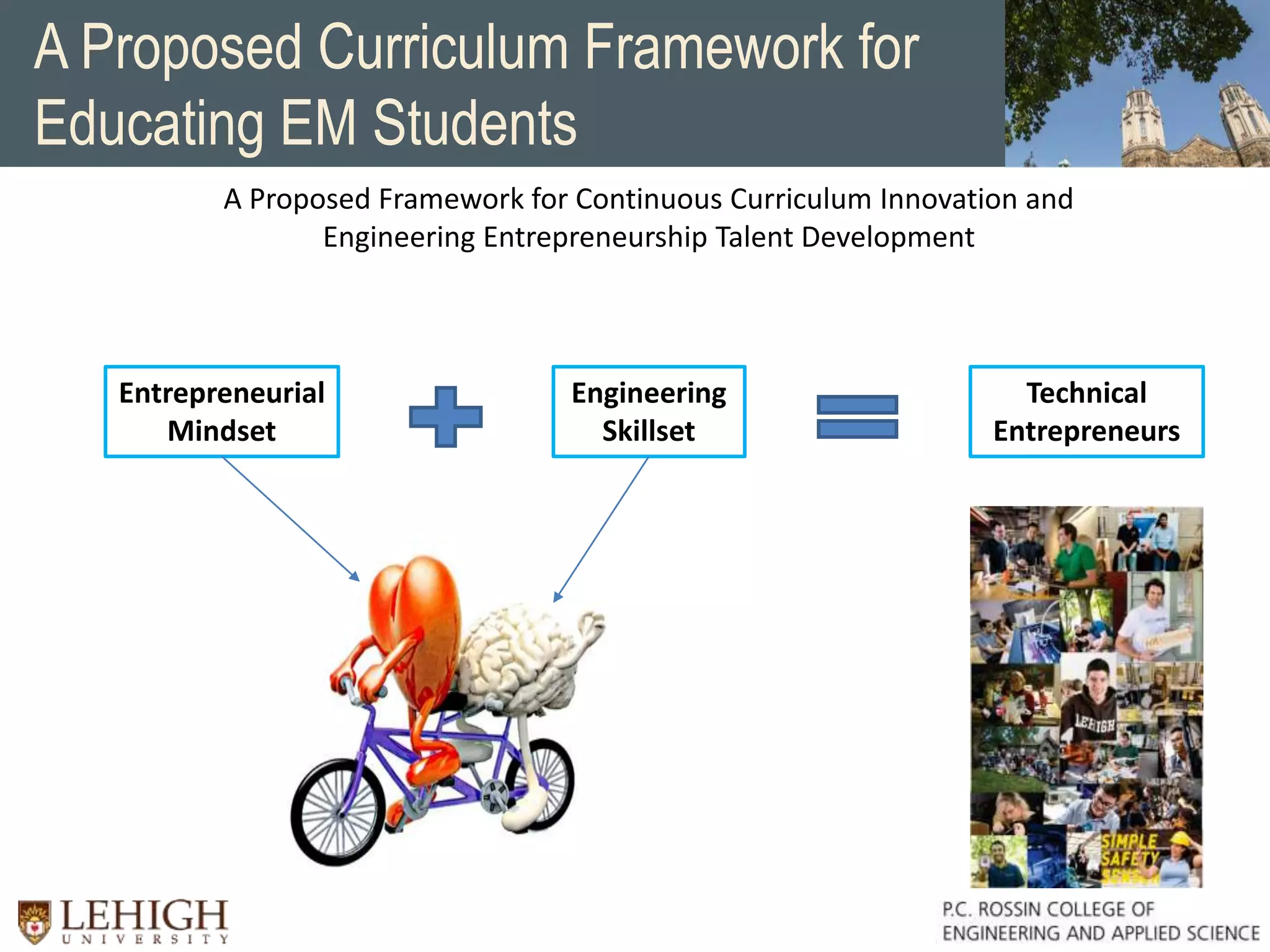
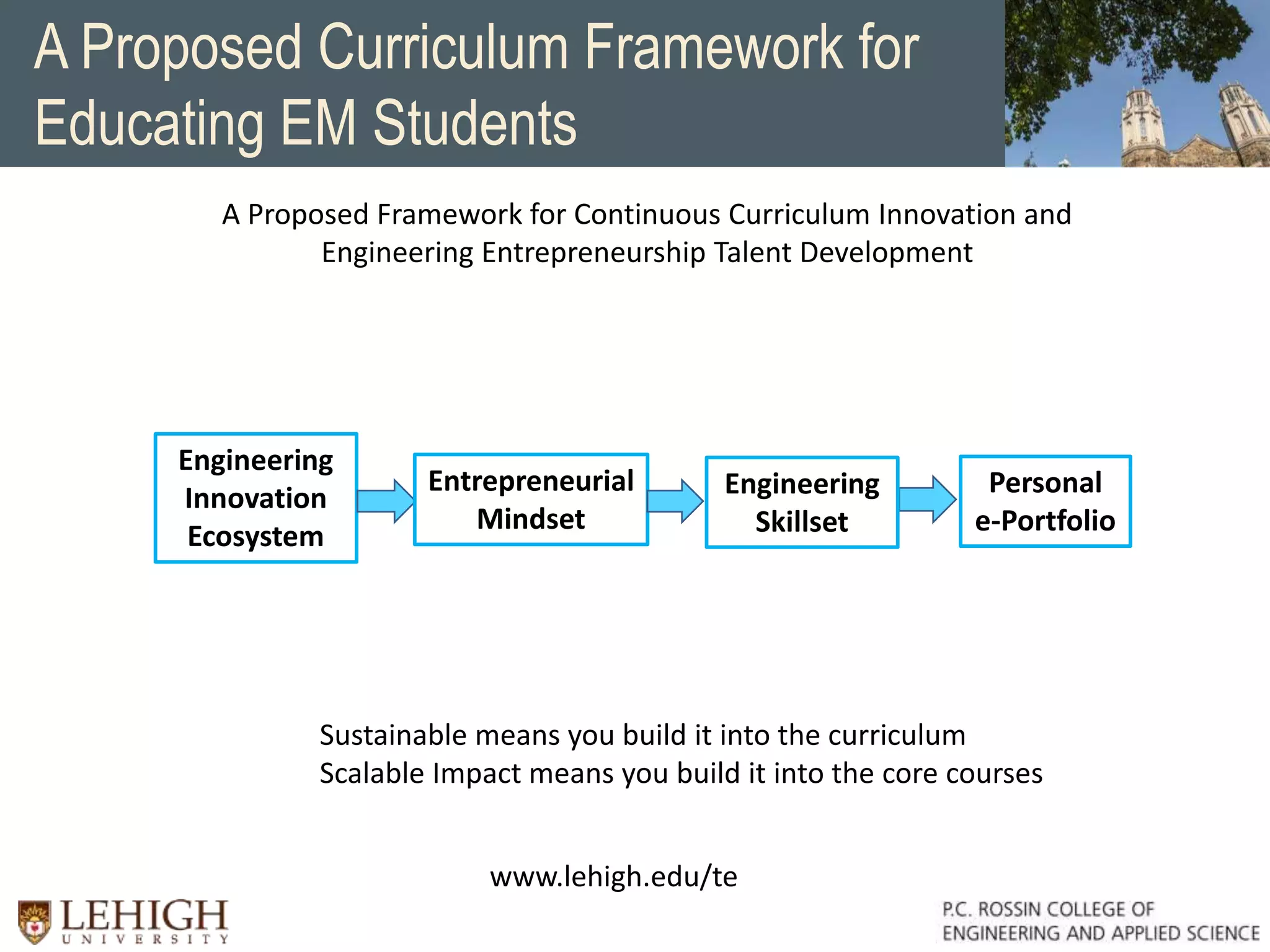
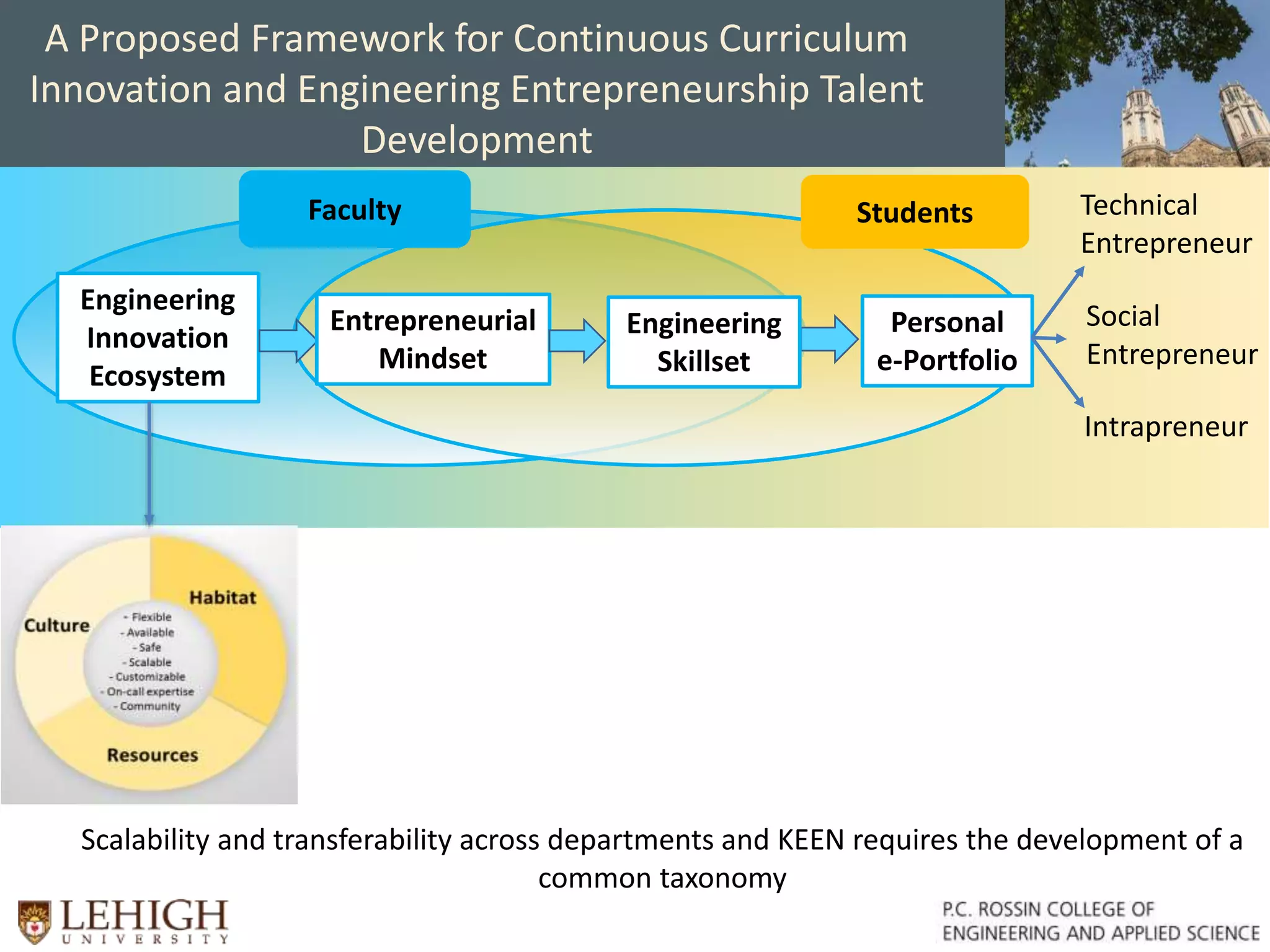
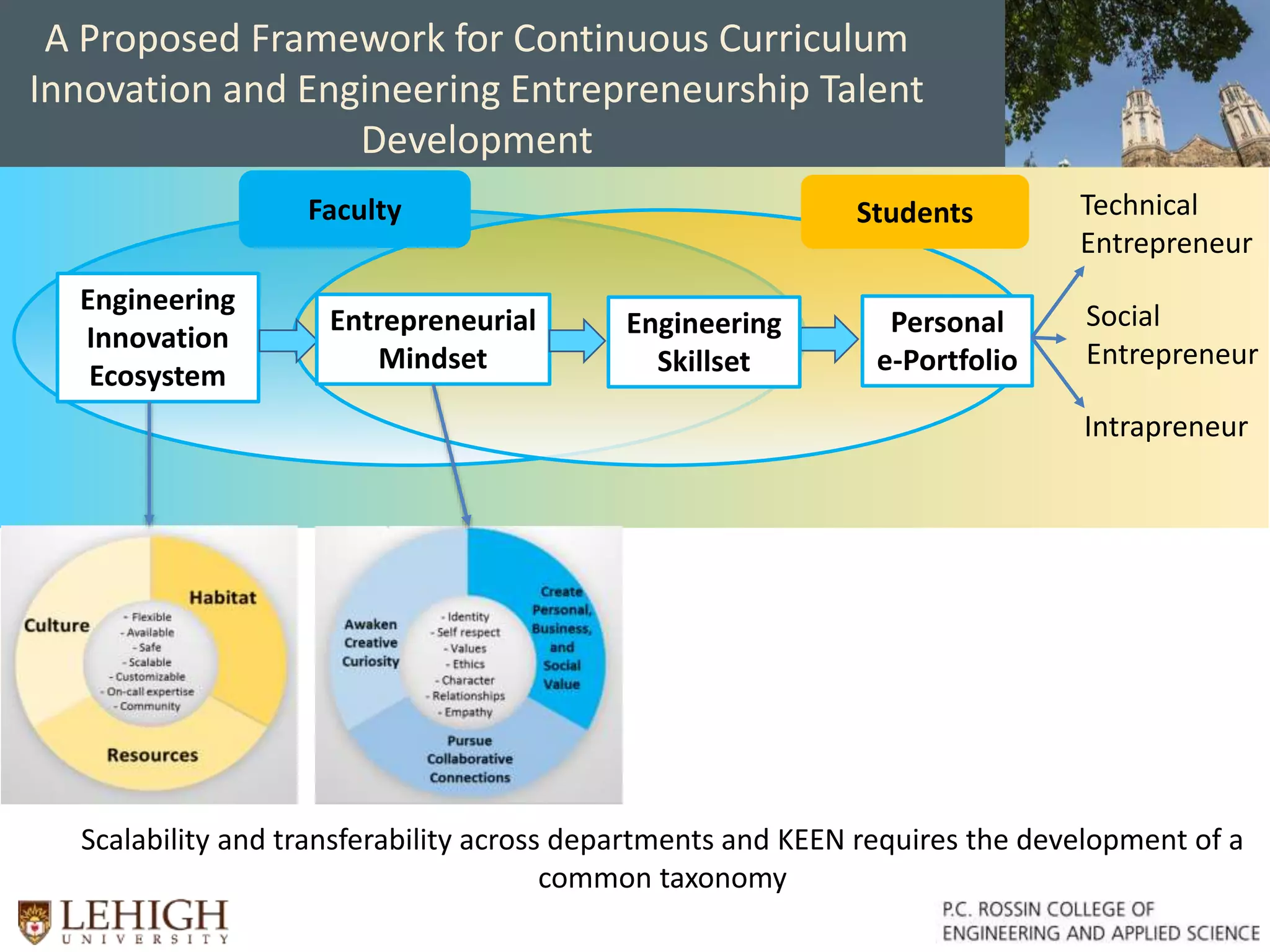
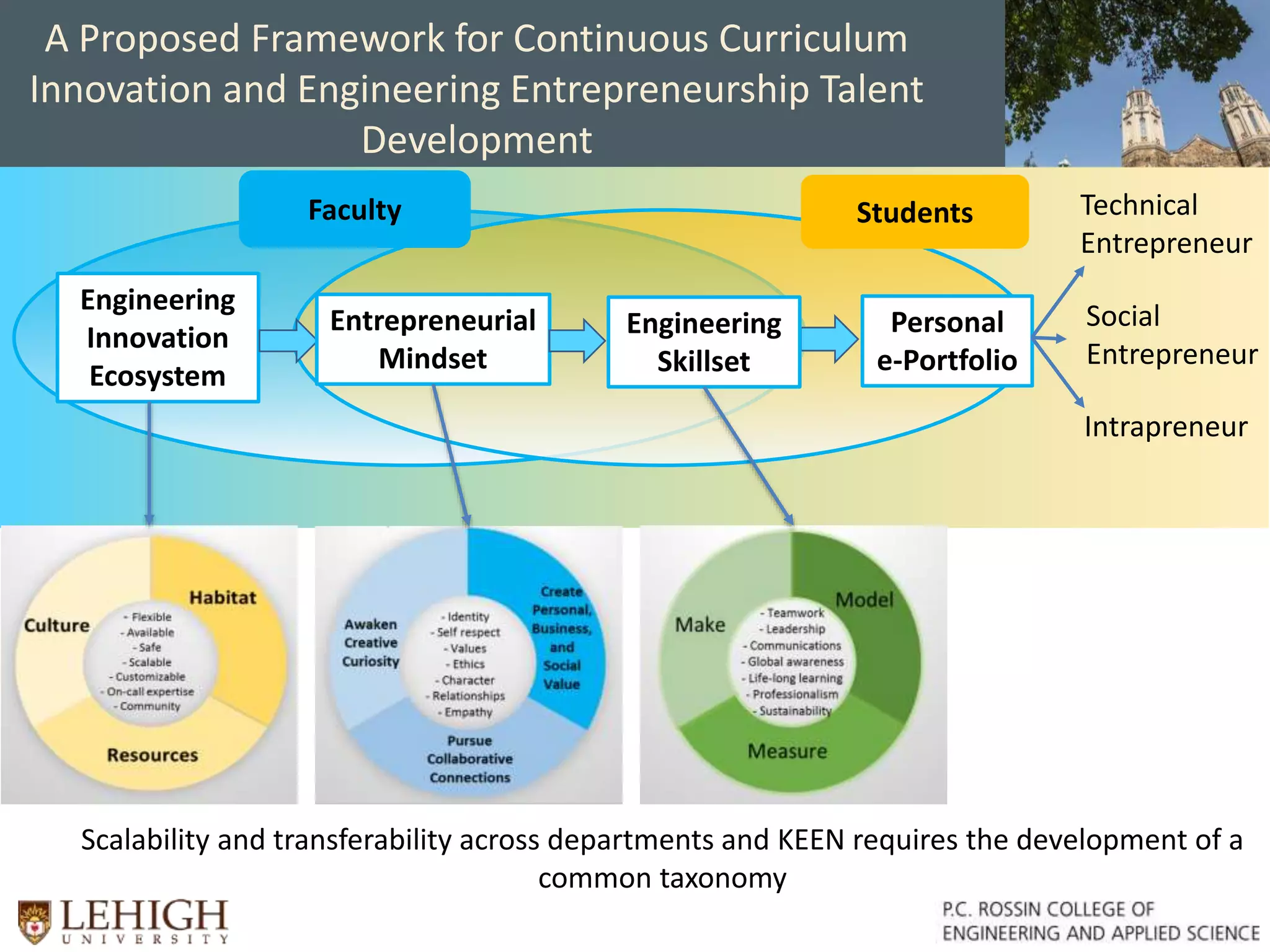
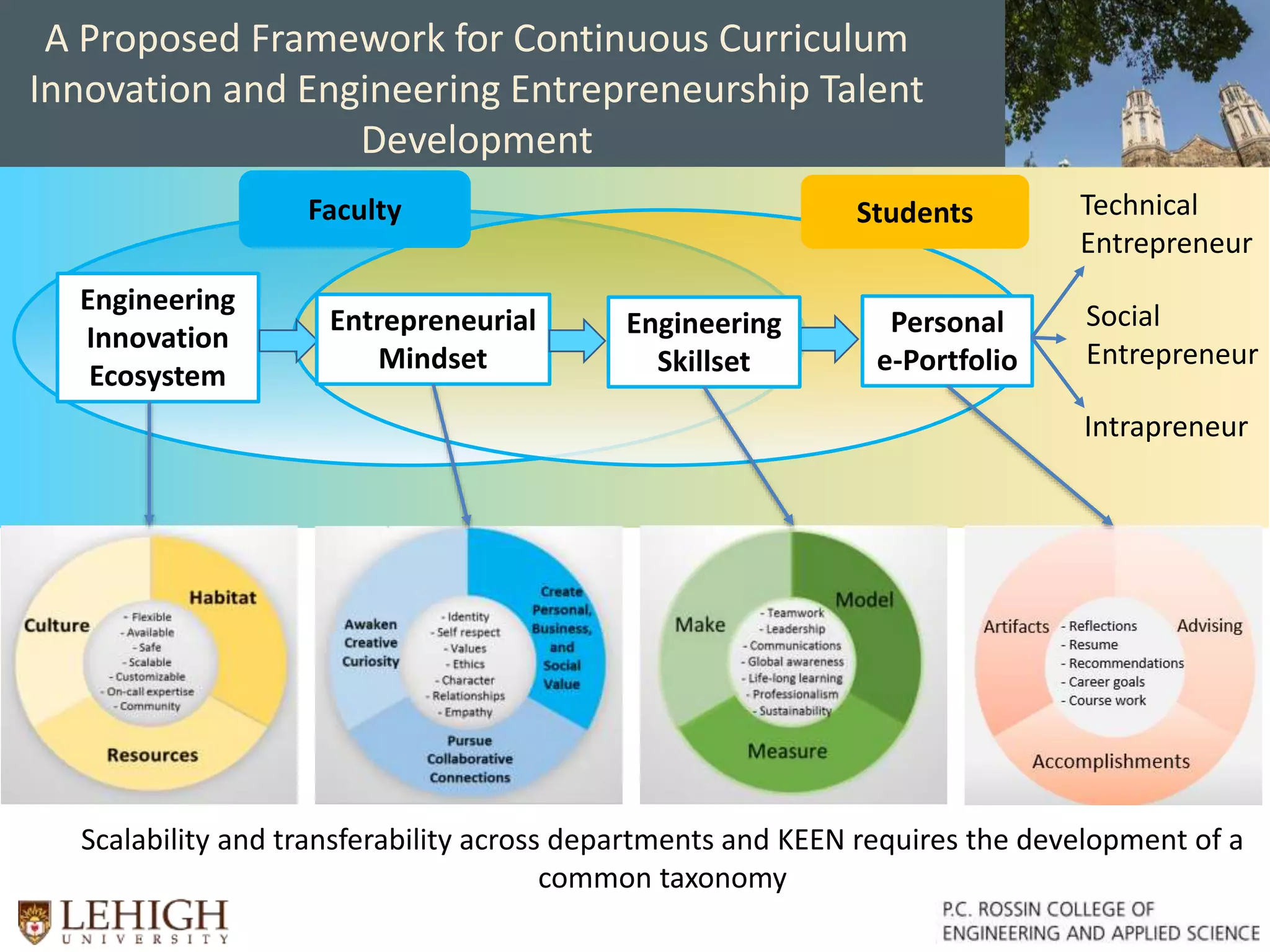
A Proposed Framework for Continuous Curriculum Innovation and
Engineering Entrepreneurship Talent Development
A Proposed Curriculum Framework for
Educating EM Students
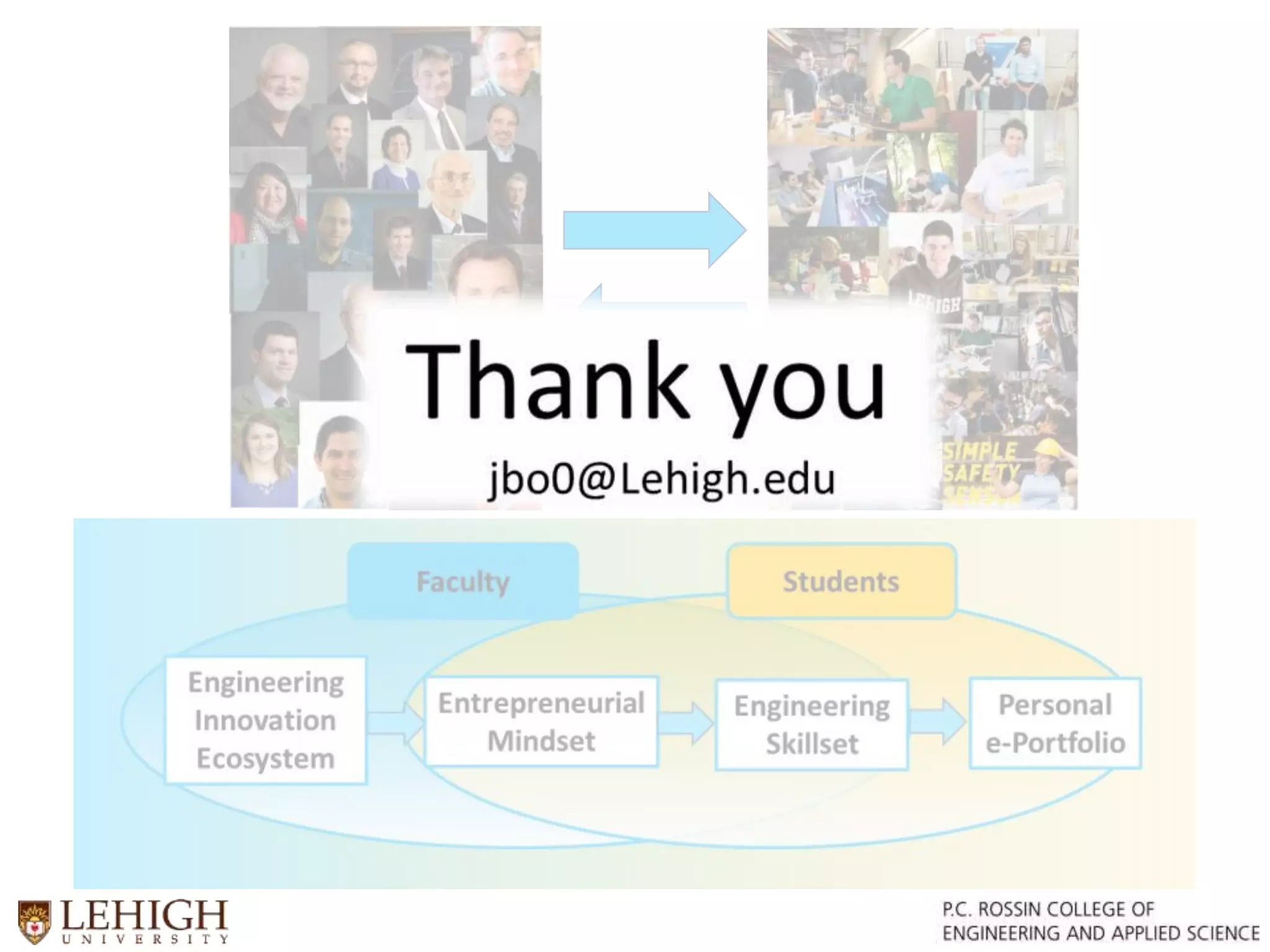
Entrepreneurial
Mindset
Engineering
Skillset
Technical
Entrepreneurs
A Proposed Framework for Continuous Curriculum Innovation and
Engineering Entrepreneurship Talent Development
www.lehigh.edu/te
A Proposed Curriculum Framework for
Educating EM Students
Engineering
Innovation
Ecosystem
Entrepreneurial
Mindset
Engineering
Skillset
Personal
e-Portfolio
Sustainable means you build it into the curriculum
Scalable Impact means you build it into the core courses
A Proposed Framework for Continuous Curriculum Innovation and
Engineering Entrepreneurship Talent Development
www.lehigh.edu/te
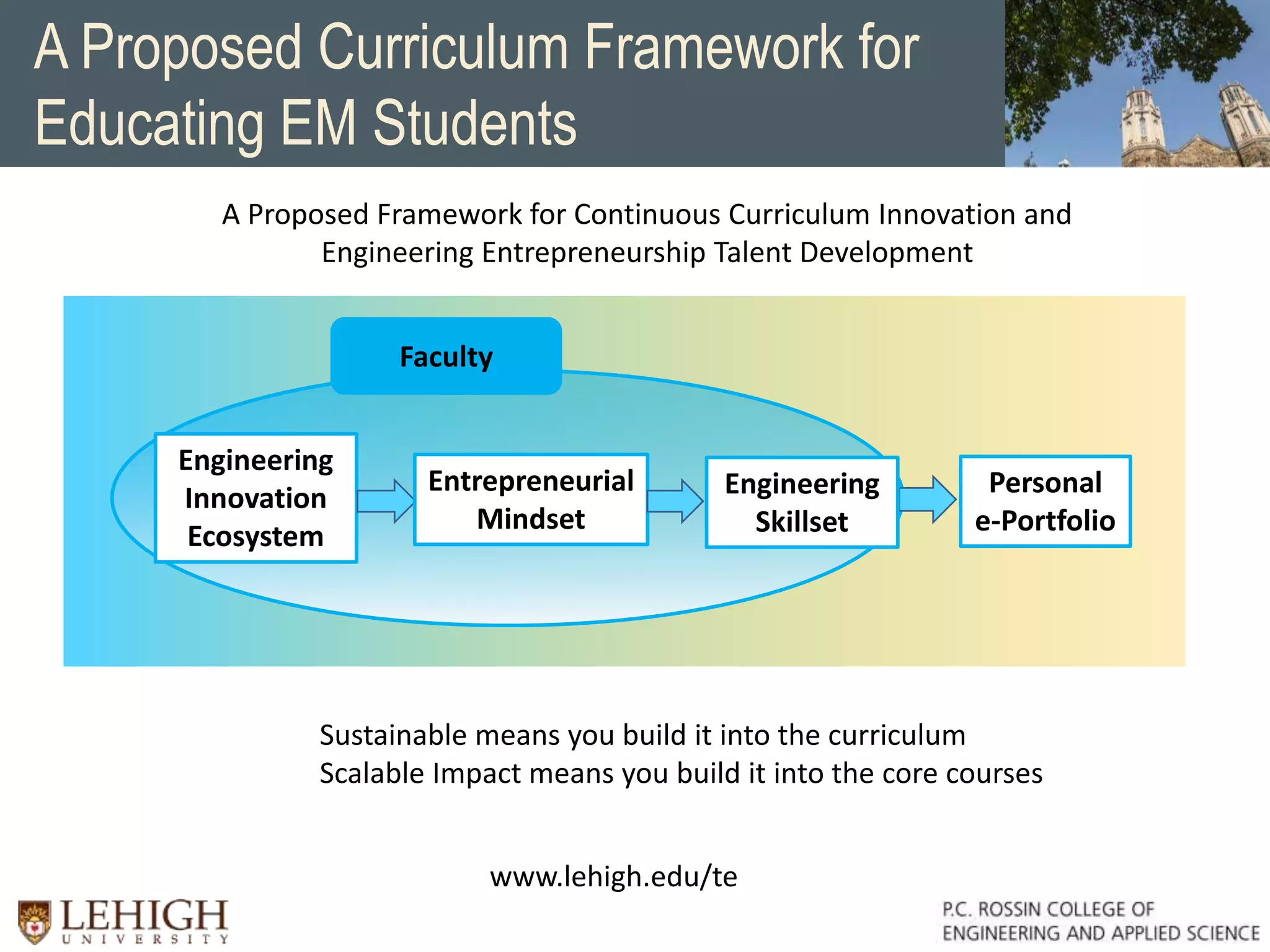
A Proposed Curriculum Framework for
Educating EM Students
Engineering
Innovation
Ecosystem
Entrepreneurial
Mindset
Engineering
Skillset
Personal
e-Portfolio
Sustainable means you build it into the curriculum
Scalable Impact means you build it into the core courses
Faculty
A Proposed Framework for Continuous Curriculum Innovation and
Engineering Entrepreneurship Talent Development
www.lehigh.edu/te
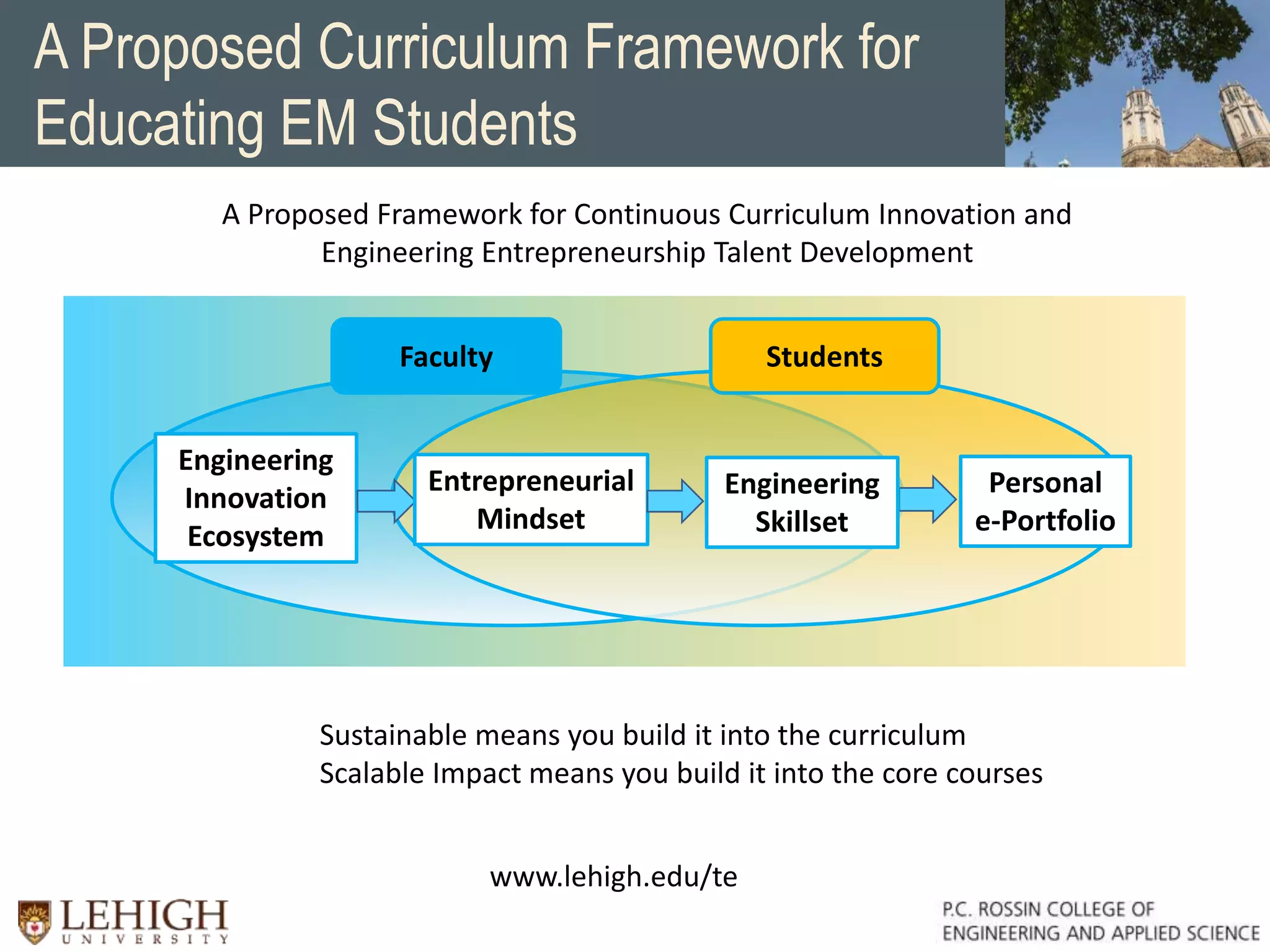
A Proposed Curriculum Framework for
Educating EM Students
Engineering
Innovation
Ecosystem
Entrepreneurial
Mindset
Engineering
Skillset
Personal
e-Portfolio
Sustainable means you build it into the curriculum
Scalable Impact means you build it into the core courses
Faculty Students
www.lehigh.edu/te
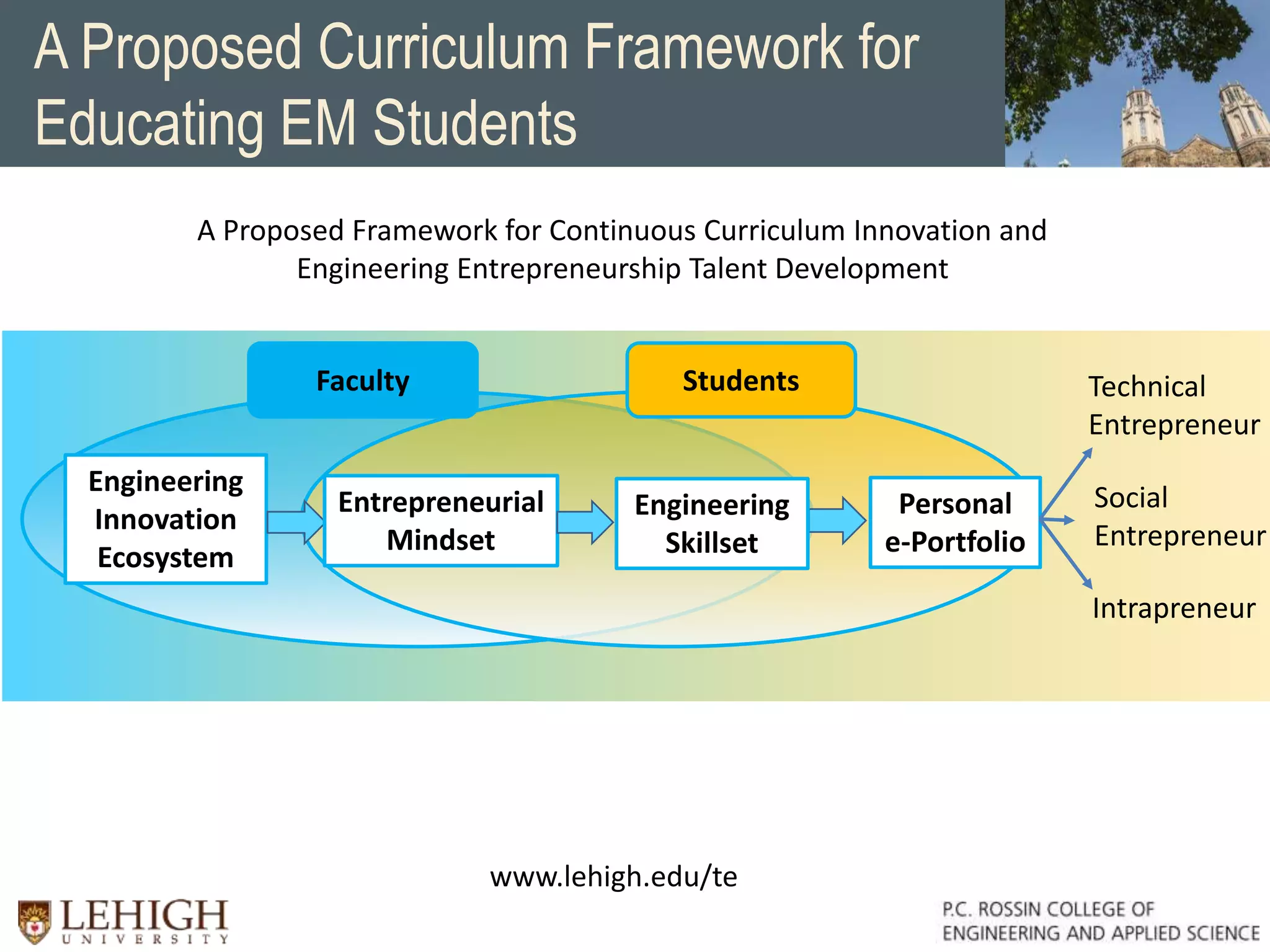
A Proposed Curriculum Framework for
Educating EM Students
Faculty Students
Engineering
Innovation
Ecosystem
Entrepreneurial
Mindset
Engineering
Skillset
Personal
e-Portfolio
Technical
Entrepreneur
Intrapreneur
Social
Entrepreneur
A Proposed Framework for Continuous Curriculum Innovation and
Engineering Entrepreneurship Talent Development
A Proposed Framework for Continuous Curriculum
Innovation and Engineering Entrepreneurship Talent
Development
Scalability and transferability across departments and KEEN requires the development of a
common taxonomy
Faculty
Engineering
Innovation
Ecosystem
Entrepreneurial
Mindset
Engineering
Skillset
Personal
e-Portfolio
Technical
Entrepreneur
Intrapreneur
Social
Entrepreneur
Students
A Proposed Framework for Continuous Curriculum
Innovation and Engineering Entrepreneurship Talent
Development
Scalability and transferability across departments and KEEN requires the development of a
common taxonomy
Faculty
Engineering
Innovation
Ecosystem
Entrepreneurial
Mindset
Engineering
Skillset
Personal
e-Portfolio
Technical
Entrepreneur
Intrapreneur
Social
Entrepreneur
Students
A Proposed Framework for Continuous Curriculum
Innovation and Engineering Entrepreneurship Talent
Development
Scalability and transferability across departments and KEEN requires the development of a
common taxonomy
Faculty
Engineering
Innovation
Ecosystem
Entrepreneurial
Mindset
Engineering
Skillset
Personal
e-Portfolio
Technical
Entrepreneur
Intrapreneur
Social
Entrepreneur
Students
A Proposed Framework for Continuous Curriculum
Innovation and Engineering Entrepreneurship Talent
Development
Scalability and transferability across departments and KEEN requires the development of a
common taxonomy
Faculty
Engineering
Innovation
Ecosystem
Entrepreneurial
Mindset
Engineering
Skillset
Personal
e-Portfolio
Technical
Entrepreneur
Intrapreneur
Social
Entrepreneur
Students
The Lehigh-KEEN Vision
 Faculty are responsible for curriculum:
• Not the dean, provost or president
• We rarely exercise that responsibility
• It’s time to change that
• Sustainability means you build it into the
curriculum
 In this context the curriculum is both
Skillset and Mindset development
KEEN’s Entrepreneurial Mindset and
Engineering’s Technical Skillset
The Lehigh-KEEN Target Curricula (14)
• Mechanical
• Chemical
• Civil
• Environmental
• Industrial
• Material
• Electrical
• Computer Science
• Computer Engineering
• Bioengineering
• Computer Science and
Business (CSB)
• Integrated Business and
Engineering (IBE)
• Integrated Degrees in
Engineering, Arts and
Science (IDEAS)
• Technical
Entrepreneurship (TE)
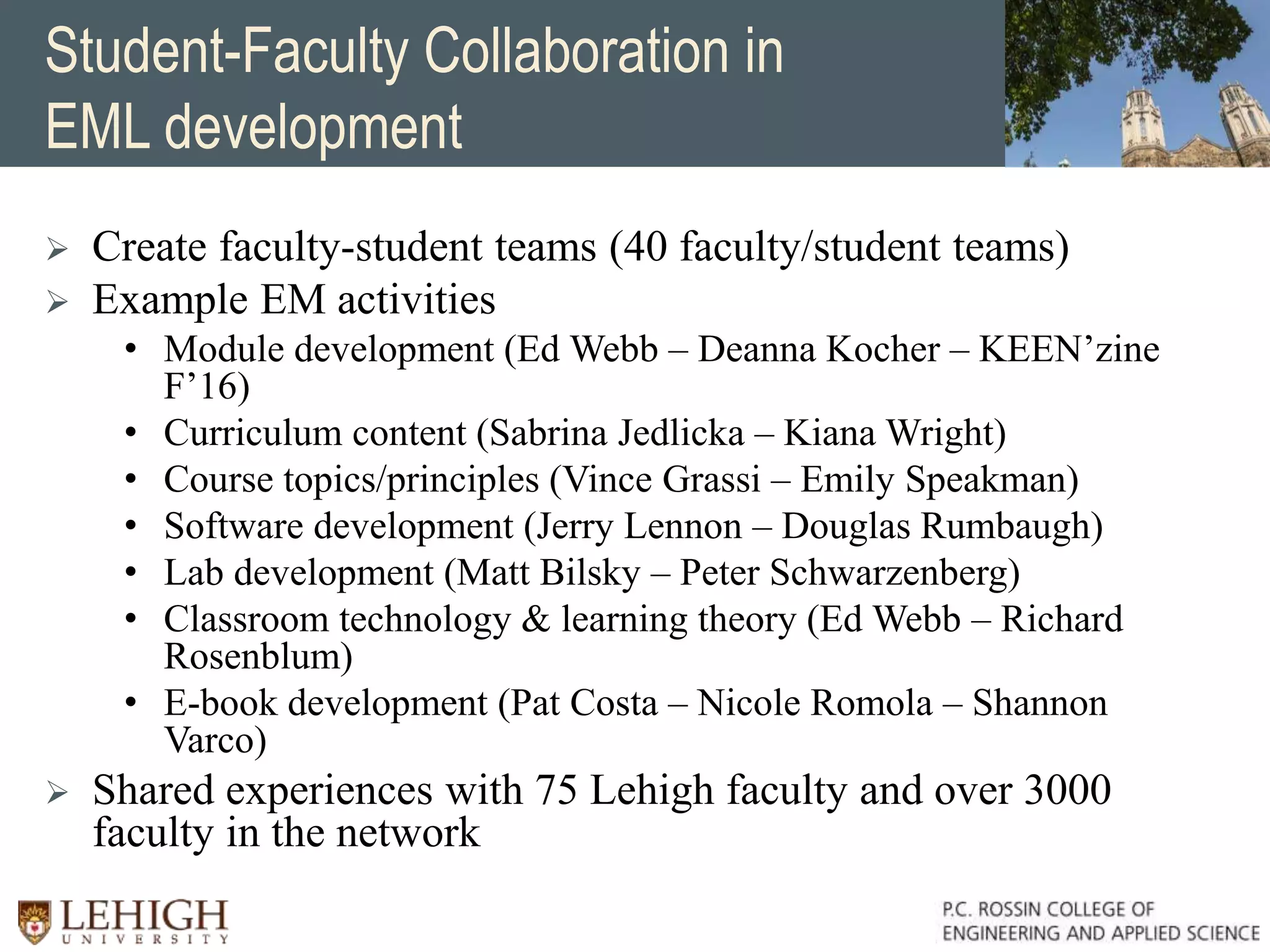
Student-Faculty Collaboration in
EML development
 Create faculty-student teams (40 faculty/student teams)
 Example EM activities
• Module development (Ed Webb – Deanna Kocher – KEEN’zine
F’16)
• Curriculum content (Sabrina Jedlicka – Kiana Wright)
• Course topics/principles (Vince Grassi – Emily Speakman)
• Software development (Jerry Lennon – Douglas Rumbaugh)
• Lab development (Matt Bilsky – Peter Schwarzenberg)
• Classroom technology & learning theory (Ed Webb – Richard
Rosenblum)
• E-book development (Pat Costa – Nicole Romola – Shannon
Varco)
 Shared experiences with 75 Lehigh faculty and over 3000
faculty in the network
Typical Curriculum Collection Upload
Transferable means you share your development across the Network
Lehigh KEEN Initiative Entrepreneurial
Mindset Learning (EML) Institutional Impact
Faculty Development Curriculum Development Student Development
“Strategic Doing” Change Methodology
Across 14 Majors and Programs
Why Entrepreneurial Mindset (EM) ?
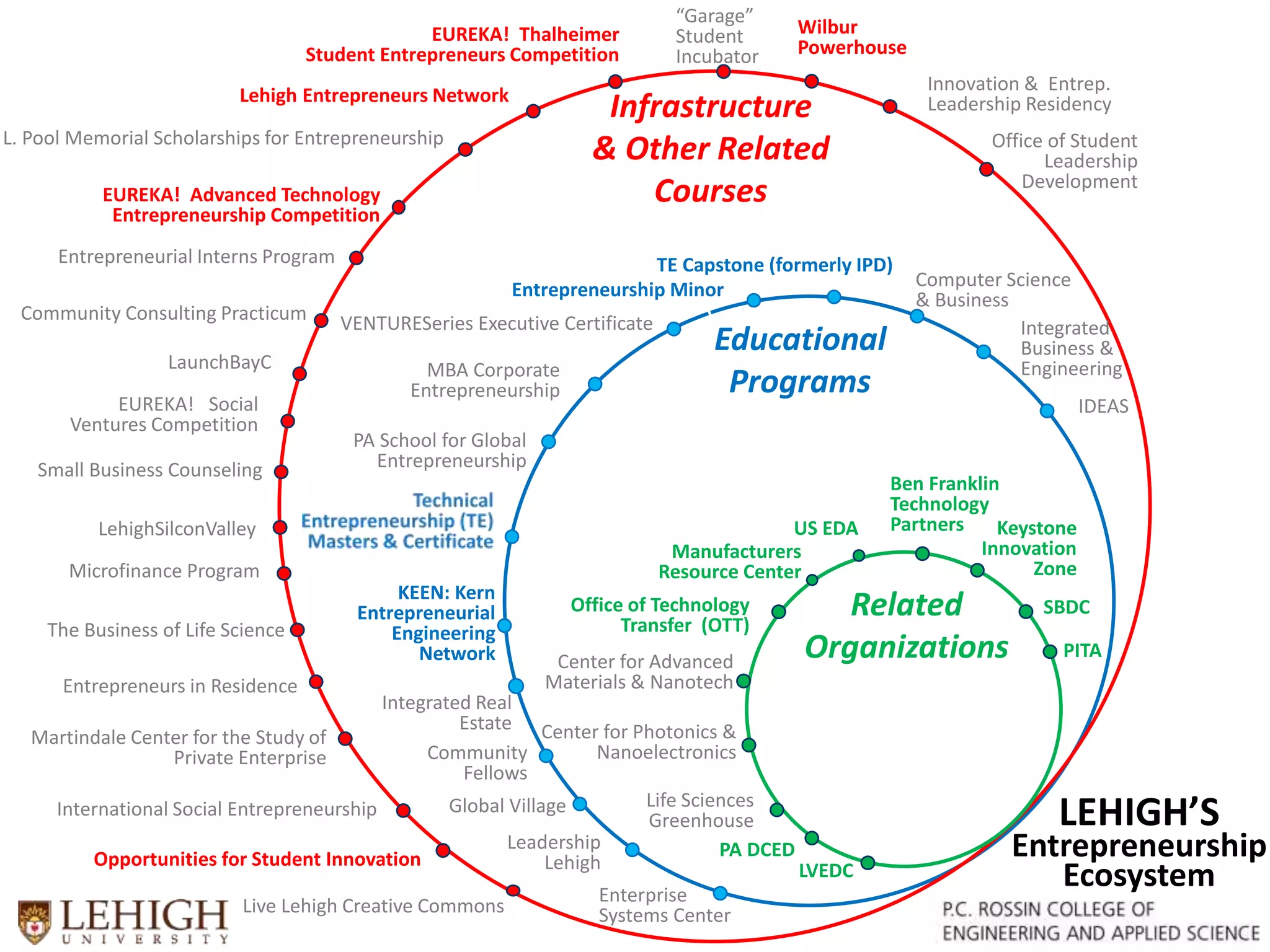
LEHIGH’S
Entrepreneurship
Ecosystem
Infrastructure
& Other Related
Courses
Integrated
Business &
Engineering
TE Capstone (formerly IPD)
Community Consulting Practicum
Microfinance Program
EUREKA! Thalheimer
Student Entrepreneurs Competition
KEEN: Kern
Entrepreneurial
Engineering
Network
Community
Fellows
Opportunities for Student Innovation
EUREKA! Advanced Technology
Entrepreneurship Competition
Entrepreneurial Interns Program
Center for Advanced
Materials & Nanotech
SBDC
Keystone
Innovation
Zone
Manufacturers
Resource Center
Enterprise
Systems Center
L. Pool Memorial Scholarships for Entrepreneurship
PA School for Global
EntrepreneurshipSmall Business Counseling
MBA Corporate
Entrepreneurship
VENTURESeries Executive Certificate
Educational
Programs
Related
Organizations
Ben Franklin
Technology
Partners
Wilbur
Powerhouse
Life Sciences
Greenhouse
“Garage”
Student
Incubator
Office of Technology
Transfer (OTT)
Lehigh Entrepreneurs Network
Integrated Real
Estate
LaunchBayC
Entrepreneurship Minor Computer Science
& Business
Center for Photonics &
Nanoelectronics
The Business of Life Science
Global Village
Leadership
Lehigh
Office of Student
Leadership
Development
IDEAS
Martindale Center for the Study of
Private Enterprise
Innovation & Entrep.
Leadership Residency
International Social Entrepreneurship
EUREKA! Social
Ventures Competition
LehighSilconValley
Entrepreneurs in Residence
Live Lehigh Creative Commons
PITA
PA DCED
US EDA
LVEDC
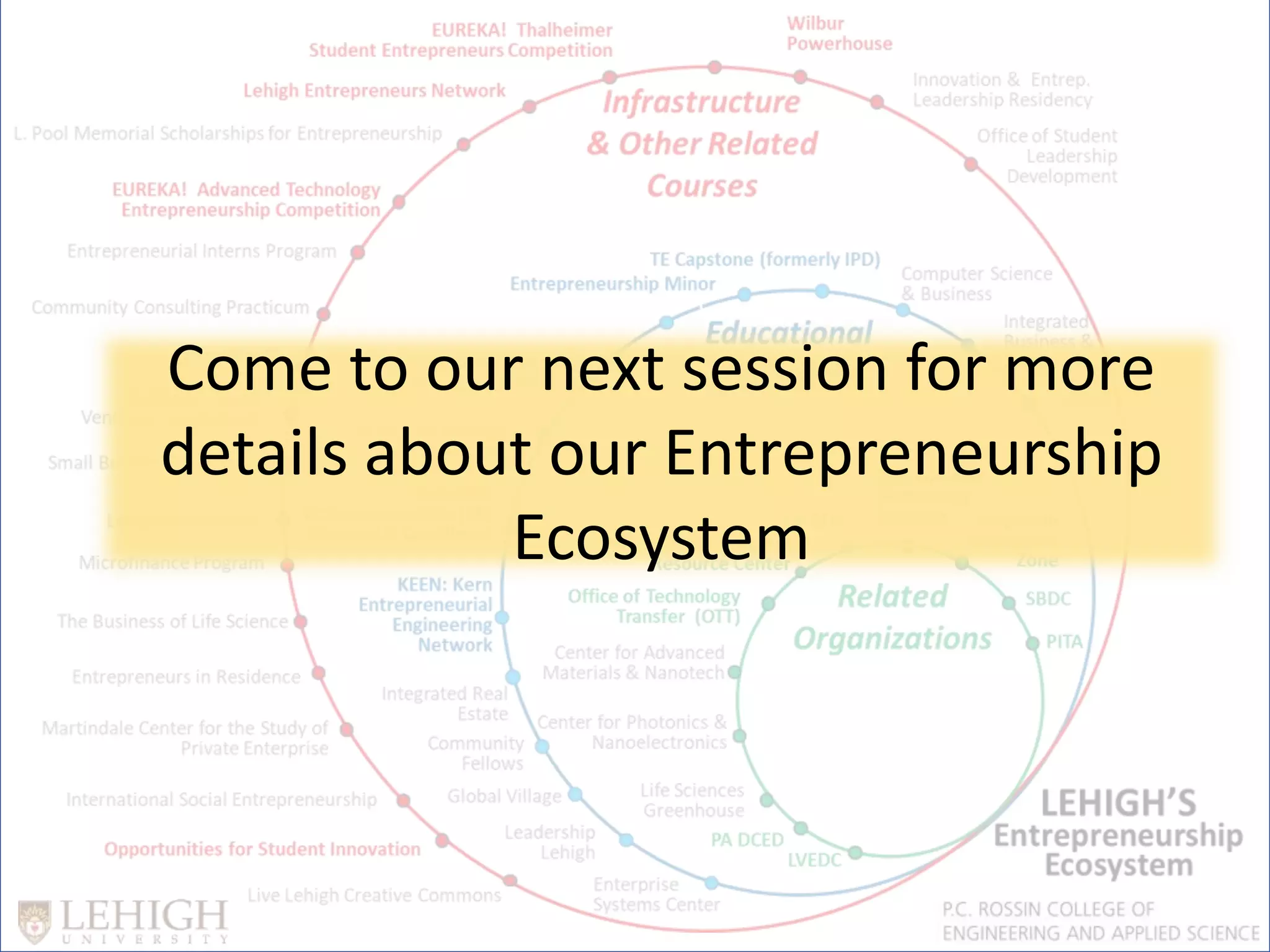
Come to our next session for more
details about our Entrepreneurship
Ecosystem
Extra Slides
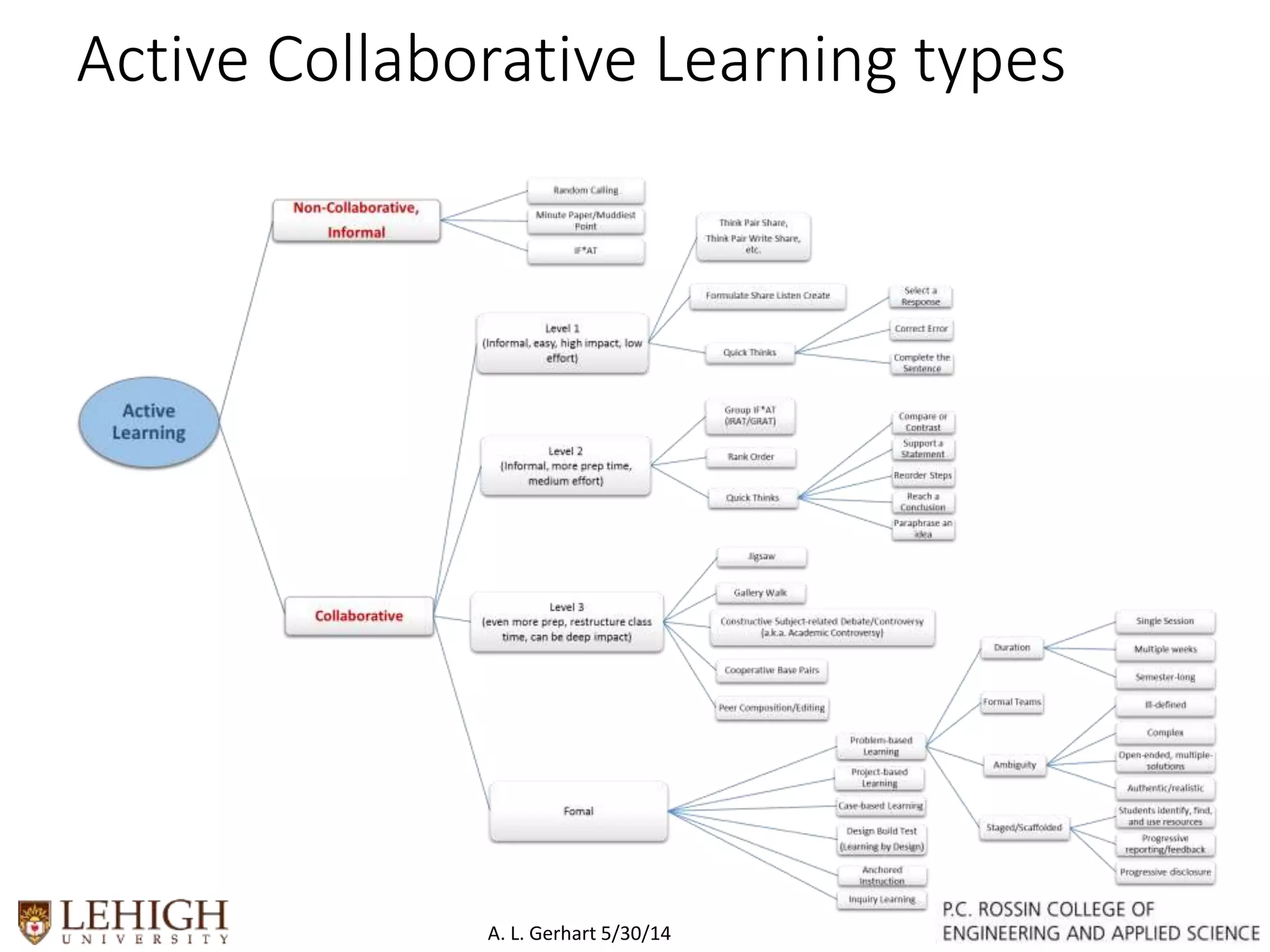
Active Collaborative Learning types
A. L. Gerhart 5/30/14
Freshman Year
(31 cr)
SOPH 1
(17-18 cr)
SOPH 2
(18 cr)
JR 1
(17-18 cr)
JR 2
(17 cr)
Senior Year
(35-37 cr)
Free Elective (3)
ECE 138
Digital Systems
Lab (2)
MATH 231
Probability &
Stats (3)
ECE 257
Senior Lab I (3)
Free Elective
(3)
Technical
Elective (3)
ECE 337
Micro &
Nanofabrication
(3)
HSS Elective
(3-4)
HSS Elective
(3)
HSS Elective
(3-4)
Free Elective
(3)
HSS Elective
(3-4)
ECECompleteCurriculumFlowchartIncludingElectives
Total Credits Required: 134
Rev 9 -10-15
MATH 021
Calculus I (4)
PHY 11, 12
Intro Physics I
w/lab (5)
ENGL 001
Comp & Lit
(3)
ENGL 002
Comp & Lit II
(3)
ENGR 010
Engr Comp
(2)
CHEM 030
Intro Chem (4)
MATH 22
Calculus II (4)
ECE 33
Intro to CompE
(4)
ECE 081
Princ of
Electrical Eng
(4)
PHY 21, 22
Intro Physics
II w/lab (5)
MATH 23
Calculus III (4)
ECE 121
Elec. Circuits Lab
(2)
MATH 205
Linear Methods
(3)
ECO 001
Principles of
Economics (4)
ECE 108
Signals &
Systems (4)
MATH 208
Complex
Variables (3)
ECE 203
Electromag.
Waves (3)
ECE 125
Circuits (3)
ECE 258
Senior Lab II (2)
Technical Elective
(3)
HSS Elective
(3-4)
Free Elective
(3)
ECE 136
Electromechanics
(3)
Technical Elective
(3)
ENGR 005
Intro to
Engineering
(2)
ECE 202 Intro to
Electromagnetics
(3)
ECE 126
Fund. Of Semi
Conductor
Devices (3)
ECE 123 Elec.
Circuits (3)
ECE 182
Junior Lab (1)
Technical Elective
(3)
Technical Elective
MAT 033 Eng
Materials &
Processes
(recommended)
(3)
“C” = Co-Requisite. Courses can be taken concurrently
C
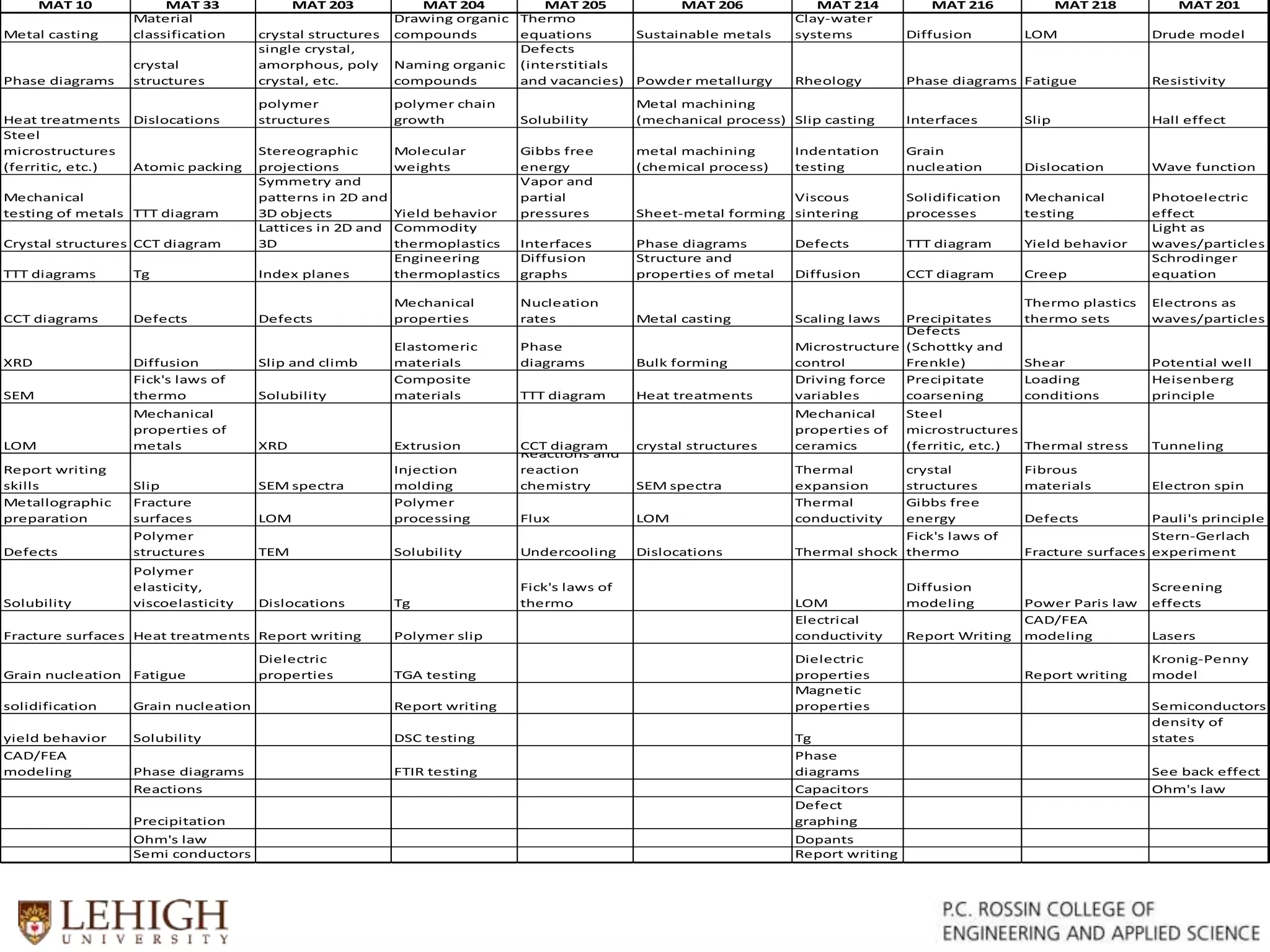
MAT 10 MAT 33 MAT 203 MAT 204 MAT 205 MAT 206 MAT 214 MAT 216 MAT 218 MAT 201
Metal casting
Material
classification crystal structures
Drawing organic
compounds
Thermo
equations Sustainable metals
Clay-water
systems Diffusion LOM Drude model
Phase diagrams
crystal
structures
single crystal,
amorphous, poly
crystal, etc.
Naming organic
compounds
Defects
(interstitials
and vacancies) Powder metallurgy Rheology Phase diagrams Fatigue Resistivity
Heat treatments Dislocations
polymer
structures
polymer chain
growth Solubility
Metal machining
(mechanical process) Slip casting Interfaces Slip Hall effect
Steel
microstructures
(ferritic, etc.) Atomic packing
Stereographic
projections
Molecular
weights
Gibbs free
energy
metal machining
(chemical process)
Indentation
testing
Grain
nucleation Dislocation Wave function
Mechanical
testing of metals TTT diagram
Symmetry and
patterns in 2D and
3D objects Yield behavior
Vapor and
partial
pressures Sheet-metal forming
Viscous
sintering
Solidification
processes
Mechanical
testing
Photoelectric
effect
Crystal structures CCT diagram
Lattices in 2D and
3D
Commodity
thermoplastics Interfaces Phase diagrams Defects TTT diagram Yield behavior
Light as
waves/particles
TTT diagrams Tg Index planes
Engineering
thermoplastics
Diffusion
graphs
Structure and
properties of metal Diffusion CCT diagram Creep
Schrodinger
equation
CCT diagrams Defects Defects
Mechanical
properties
Nucleation
rates Metal casting Scaling laws Precipitates
Thermo plastics
thermo sets
Electrons as
waves/particles
XRD Diffusion Slip and climb
Elastomeric
materials
Phase
diagrams Bulk forming
Microstructure
control
Defects
(Schottky and
Frenkle) Shear Potential well
SEM
Fick's laws of
thermo Solubility
Composite
materials TTT diagram Heat treatments
Driving force
variables
Precipitate
coarsening
Loading
conditions
Heisenberg
principle
LOM
Mechanical
properties of
metals XRD Extrusion CCT diagram crystal structures
Mechanical
properties of
ceramics
Steel
microstructures
(ferritic, etc.) Thermal stress Tunneling
Report writing
skills Slip SEM spectra
Injection
molding
Reactions and
reaction
chemistry SEM spectra
Thermal
expansion
crystal
structures
Fibrous
materials Electron spin
Metallographic
preparation
Fracture
surfaces LOM
Polymer
processing Flux LOM
Thermal
conductivity
Gibbs free
energy Defects Pauli's principle
Defects
Polymer
structures TEM Solubility Undercooling Dislocations Thermal shock
Fick's laws of
thermo Fracture surfaces
Stern-Gerlach
experiment
Solubility
Polymer
elasticity,
viscoelasticity Dislocations Tg
Fick's laws of
thermo LOM
Diffusion
modeling Power Paris law
Screening
effects
Fracture surfaces Heat treatments Report writing Polymer slip
Electrical
conductivity Report Writing
CAD/FEA
modeling Lasers
Grain nucleation Fatigue
Dielectric
properties TGA testing
Dielectric
properties Report writing
Kronig-Penny
model
solidification Grain nucleation Report writing
Magnetic
properties Semiconductors
yield behavior Solubility DSC testing Tg
density of
states
CAD/FEA
modeling Phase diagrams FTIR testing
Phase
diagrams See back effect
Reactions Capacitors Ohm's law
Precipitation
Defect
graphing
Ohm's law Dopants
Semi conductors Report writing
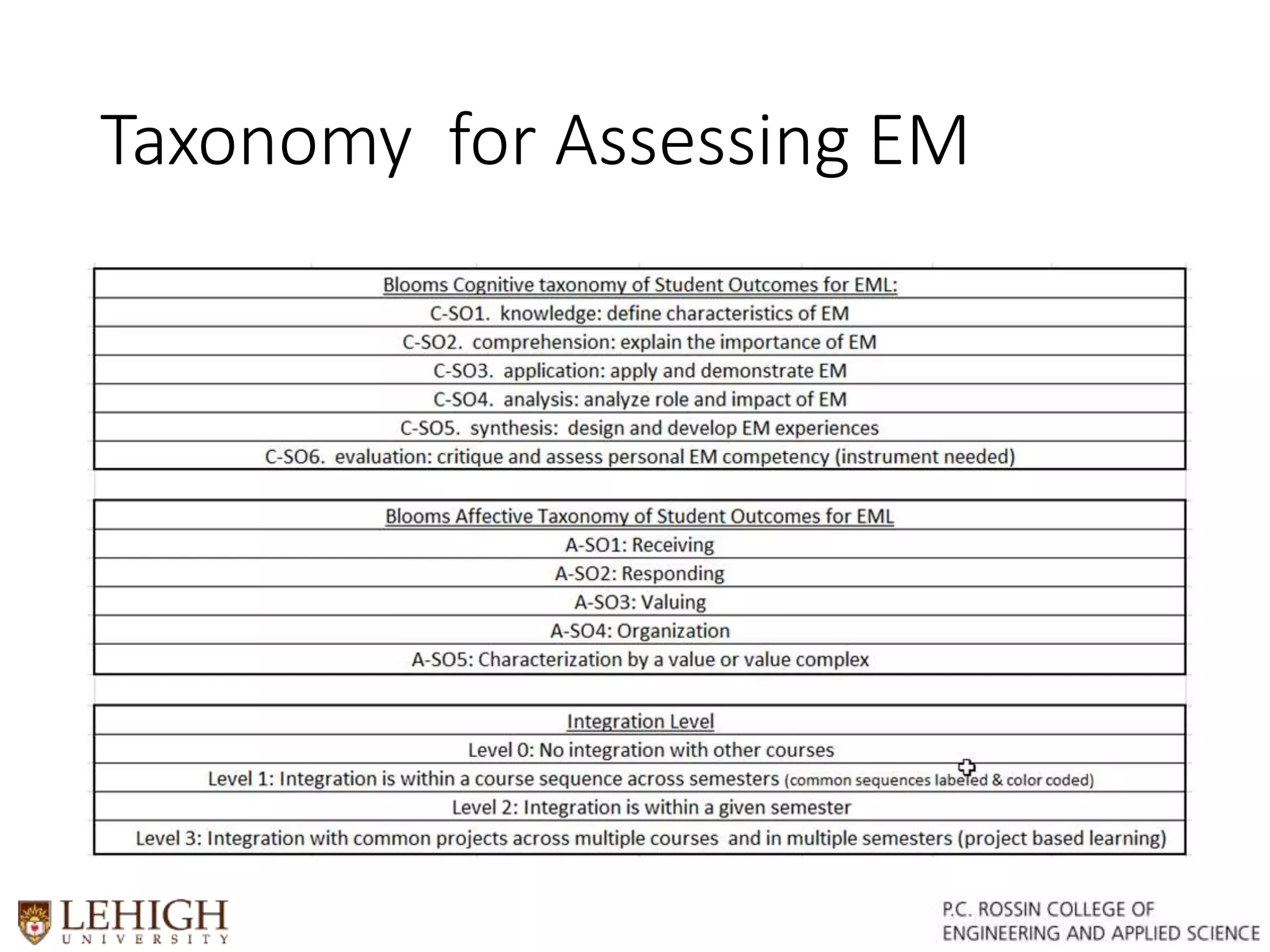
Taxonomy for Assessing EM
ONU Examples of 3 C’s (plus)
• Related to Curiosity
• Develop a propensity to ask MORE questions.
• Be able to formulate SALIENT questions.
• Question information that is given without sufficient justification.
• Collects feedback and data from many customers and customer segments.
• Recognize and explore knowledge gaps.
• Critically observes surroundings to recognize opportunity.
• View problems with an open mindset and explore opportunities with
passion.
• Be able to self-reflect and evaluate preconceived ideas, thoughts, and
accepted solutions.
• Explores multiple solution paths.
• Gathers data to support and refute ideas.
• Suspends initial judgement on new ideas.
• Take ownership of, and express interest in topic/expertise/project.
• Observes trends about the changing world with a future-focused
orientation/perspective.
• [Other student learning outcomes of your own design]
• Related to Connections
• Understand ramifications (technical and non-technical) of design decisions.
• Identify and evaluate sources of information.
• Connect life experiences with class content.
• Connect content from multiple courses to solve a problem.
• Integrates/synthesizes different kinds of knowledge
• Consider a problem from multiple viewpoints.
• Persuades why a discovery adds value from multiple perspectives
(technological, societal, financial, environmental, etc.)
• Articulates the idea to diverse audiences
• Understands how elements of an ecosystem are connected
• Identifies and works with individuals with complementary skill sets,
expertise, etc.
• Develop a professional network.
• [Other student learning outcomes of your own design]
• Related to Creating Value
• Identify the needs and motivations of various stakeholders.
• Express empathy in identifying problems and exploring
solutions.
• Create solutions that meet customer needs.
• Defines a market and market opportunities
• Craft a compelling value proposition tailored to specific
stakeholders.
• Integrate non-monetary and monetary factors into a triple
bottom line assessment.
• Applies technical skills/knowledge to the development of a
technology/product
• Modifies an idea/product based on feedback
• Focuses on understanding the value proposition of a discovery
• Describes how a discovery could be scaled and/or sustained,
using elements such as revenue streams, key partners, costs,
and key resources
• Engages in actions with the understanding that they have the
potential to lead to both gains or losses
• Communication
• Present technical information effectively (graphs, tables,
equations).
• Identify and organize information in a format suited to the
audience.
• Provide and accept constructive criticism, including self-
evaluation.
• Produce effective written reports.
• Produce effective verbal presentations.
• Manage informal communications (meetings, networking, etc.).
• Collaboration
• Recognize their own strengths, skills, and weaknesses, as well as
those of others.
• Be able to lead, delegate, and follow.
• Be aware of and able to work through interpersonal conflict.
• Be able to teach and learn from peers.
• Be able to network and see the value of others.
• Character
• Demonstrate an ability to set, evaluate, and achieve personal
and professional goals.
• Meet commitments.
• Recognize and evaluate potential impacts while making
informed ethical and professional decisions.
• Accept responsibility for their own actions, and credit the
actions of others.
• Develop an appreciation of hard work and recognize the benefits
of focused and fervent effort.
• Work toward the betterment of society.
The Lehigh-KEEN (Kern Entrepreneurial Engineering Network) Initiative

The Lehigh-KEEN (Kern Entrepreneurial Engineering Network) Initiative

  • 1.
    The Lehigh-KEEN Initiative:Developing the Next Generation of Entrepreneurial Leaders Professor John B Ochs, Ph D
  • 2.
    Outline  Define KEEN Lehigh’s contribution to KEEN  Lehigh’s Framework for EM learning  Our shared taxonomy  Examples of curriculum innovation  Curriculum change methodology  Institutional impact  Introduce our Entrepreneurship Ecosystem
  • 3.
    What is KEEN?(Kern Entrepreneurial Engineering Network)  A network of engineering schools committed to infect all students with entrepreneurial mindset (EM)  Funded by the Kern Family Foundation through grant program (www.engineeringunleashed.com)  Currently 31 schools; growing to 72 by 2035 (20% of all engineering school)  KEEN is a competitive cooperative of like- minded faculty & students seeking continuous innovation of engineering curricula
  • 4.
    A Proposed Frameworkfor Continuous Curriculum Innovation and Engineering Entrepreneurship Talent Development A Proposed Curriculum Framework for Educating EM Students Entrepreneurial Mindset Engineering Skillset Technical Entrepreneurs
  • 5.
    A Proposed Frameworkfor Continuous Curriculum Innovation and Engineering Entrepreneurship Talent Development www.lehigh.edu/te A Proposed Curriculum Framework for Educating EM Students Engineering Innovation Ecosystem Entrepreneurial Mindset Engineering Skillset Personal e-Portfolio Sustainable means you build it into the curriculum Scalable Impact means you build it into the core courses
  • 6.
    A Proposed Frameworkfor Continuous Curriculum Innovation and Engineering Entrepreneurship Talent Development www.lehigh.edu/te A Proposed Curriculum Framework for Educating EM Students Engineering Innovation Ecosystem Entrepreneurial Mindset Engineering Skillset Personal e-Portfolio Sustainable means you build it into the curriculum Scalable Impact means you build it into the core courses Faculty
  • 7.
    A Proposed Frameworkfor Continuous Curriculum Innovation and Engineering Entrepreneurship Talent Development www.lehigh.edu/te A Proposed Curriculum Framework for Educating EM Students Engineering Innovation Ecosystem Entrepreneurial Mindset Engineering Skillset Personal e-Portfolio Sustainable means you build it into the curriculum Scalable Impact means you build it into the core courses Faculty Students
  • 8.
    www.lehigh.edu/te A Proposed CurriculumFramework for Educating EM Students Faculty Students Engineering Innovation Ecosystem Entrepreneurial Mindset Engineering Skillset Personal e-Portfolio Technical Entrepreneur Intrapreneur Social Entrepreneur A Proposed Framework for Continuous Curriculum Innovation and Engineering Entrepreneurship Talent Development
  • 9.
    A Proposed Frameworkfor Continuous Curriculum Innovation and Engineering Entrepreneurship Talent Development Scalability and transferability across departments and KEEN requires the development of a common taxonomy Faculty Engineering Innovation Ecosystem Entrepreneurial Mindset Engineering Skillset Personal e-Portfolio Technical Entrepreneur Intrapreneur Social Entrepreneur Students
  • 10.
    A Proposed Frameworkfor Continuous Curriculum Innovation and Engineering Entrepreneurship Talent Development Scalability and transferability across departments and KEEN requires the development of a common taxonomy Faculty Engineering Innovation Ecosystem Entrepreneurial Mindset Engineering Skillset Personal e-Portfolio Technical Entrepreneur Intrapreneur Social Entrepreneur Students
  • 11.
    A Proposed Frameworkfor Continuous Curriculum Innovation and Engineering Entrepreneurship Talent Development Scalability and transferability across departments and KEEN requires the development of a common taxonomy Faculty Engineering Innovation Ecosystem Entrepreneurial Mindset Engineering Skillset Personal e-Portfolio Technical Entrepreneur Intrapreneur Social Entrepreneur Students
  • 12.
    A Proposed Frameworkfor Continuous Curriculum Innovation and Engineering Entrepreneurship Talent Development Scalability and transferability across departments and KEEN requires the development of a common taxonomy Faculty Engineering Innovation Ecosystem Entrepreneurial Mindset Engineering Skillset Personal e-Portfolio Technical Entrepreneur Intrapreneur Social Entrepreneur Students
  • 13.
    The Lehigh-KEEN Vision Faculty are responsible for curriculum: • Not the dean, provost or president • We rarely exercise that responsibility • It’s time to change that • Sustainability means you build it into the curriculum  In this context the curriculum is both Skillset and Mindset development
  • 14.
    KEEN’s Entrepreneurial Mindsetand Engineering’s Technical Skillset
  • 15.
    The Lehigh-KEEN TargetCurricula (14) • Mechanical • Chemical • Civil • Environmental • Industrial • Material • Electrical • Computer Science • Computer Engineering • Bioengineering • Computer Science and Business (CSB) • Integrated Business and Engineering (IBE) • Integrated Degrees in Engineering, Arts and Science (IDEAS) • Technical Entrepreneurship (TE)
  • 17.
    Student-Faculty Collaboration in EMLdevelopment  Create faculty-student teams (40 faculty/student teams)  Example EM activities • Module development (Ed Webb – Deanna Kocher – KEEN’zine F’16) • Curriculum content (Sabrina Jedlicka – Kiana Wright) • Course topics/principles (Vince Grassi – Emily Speakman) • Software development (Jerry Lennon – Douglas Rumbaugh) • Lab development (Matt Bilsky – Peter Schwarzenberg) • Classroom technology & learning theory (Ed Webb – Richard Rosenblum) • E-book development (Pat Costa – Nicole Romola – Shannon Varco)  Shared experiences with 75 Lehigh faculty and over 3000 faculty in the network
  • 18.
    Typical Curriculum CollectionUpload Transferable means you share your development across the Network
  • 19.
    Lehigh KEEN InitiativeEntrepreneurial Mindset Learning (EML) Institutional Impact Faculty Development Curriculum Development Student Development
  • 20.
    “Strategic Doing” ChangeMethodology Across 14 Majors and Programs
  • 21.
  • 22.
    LEHIGH’S Entrepreneurship Ecosystem Infrastructure & Other Related Courses Integrated Business& Engineering TE Capstone (formerly IPD) Community Consulting Practicum Microfinance Program EUREKA! Thalheimer Student Entrepreneurs Competition KEEN: Kern Entrepreneurial Engineering Network Community Fellows Opportunities for Student Innovation EUREKA! Advanced Technology Entrepreneurship Competition Entrepreneurial Interns Program Center for Advanced Materials & Nanotech SBDC Keystone Innovation Zone Manufacturers Resource Center Enterprise Systems Center L. Pool Memorial Scholarships for Entrepreneurship PA School for Global EntrepreneurshipSmall Business Counseling MBA Corporate Entrepreneurship VENTURESeries Executive Certificate Educational Programs Related Organizations Ben Franklin Technology Partners Wilbur Powerhouse Life Sciences Greenhouse “Garage” Student Incubator Office of Technology Transfer (OTT) Lehigh Entrepreneurs Network Integrated Real Estate LaunchBayC Entrepreneurship Minor Computer Science & Business Center for Photonics & Nanoelectronics The Business of Life Science Global Village Leadership Lehigh Office of Student Leadership Development IDEAS Martindale Center for the Study of Private Enterprise Innovation & Entrep. Leadership Residency International Social Entrepreneurship EUREKA! Social Ventures Competition LehighSilconValley Entrepreneurs in Residence Live Lehigh Creative Commons PITA PA DCED US EDA LVEDC
  • 23.
    Come to ournext session for more details about our Entrepreneurship Ecosystem
  • 26.
  • 27.
    Active Collaborative Learningtypes A. L. Gerhart 5/30/14
  • 29.
    Freshman Year (31 cr) SOPH1 (17-18 cr) SOPH 2 (18 cr) JR 1 (17-18 cr) JR 2 (17 cr) Senior Year (35-37 cr) Free Elective (3) ECE 138 Digital Systems Lab (2) MATH 231 Probability & Stats (3) ECE 257 Senior Lab I (3) Free Elective (3) Technical Elective (3) ECE 337 Micro & Nanofabrication (3) HSS Elective (3-4) HSS Elective (3) HSS Elective (3-4) Free Elective (3) HSS Elective (3-4) ECECompleteCurriculumFlowchartIncludingElectives Total Credits Required: 134 Rev 9 -10-15 MATH 021 Calculus I (4) PHY 11, 12 Intro Physics I w/lab (5) ENGL 001 Comp & Lit (3) ENGL 002 Comp & Lit II (3) ENGR 010 Engr Comp (2) CHEM 030 Intro Chem (4) MATH 22 Calculus II (4) ECE 33 Intro to CompE (4) ECE 081 Princ of Electrical Eng (4) PHY 21, 22 Intro Physics II w/lab (5) MATH 23 Calculus III (4) ECE 121 Elec. Circuits Lab (2) MATH 205 Linear Methods (3) ECO 001 Principles of Economics (4) ECE 108 Signals & Systems (4) MATH 208 Complex Variables (3) ECE 203 Electromag. Waves (3) ECE 125 Circuits (3) ECE 258 Senior Lab II (2) Technical Elective (3) HSS Elective (3-4) Free Elective (3) ECE 136 Electromechanics (3) Technical Elective (3) ENGR 005 Intro to Engineering (2) ECE 202 Intro to Electromagnetics (3) ECE 126 Fund. Of Semi Conductor Devices (3) ECE 123 Elec. Circuits (3) ECE 182 Junior Lab (1) Technical Elective (3) Technical Elective MAT 033 Eng Materials & Processes (recommended) (3) “C” = Co-Requisite. Courses can be taken concurrently C
  • 30.
    MAT 10 MAT33 MAT 203 MAT 204 MAT 205 MAT 206 MAT 214 MAT 216 MAT 218 MAT 201 Metal casting Material classification crystal structures Drawing organic compounds Thermo equations Sustainable metals Clay-water systems Diffusion LOM Drude model Phase diagrams crystal structures single crystal, amorphous, poly crystal, etc. Naming organic compounds Defects (interstitials and vacancies) Powder metallurgy Rheology Phase diagrams Fatigue Resistivity Heat treatments Dislocations polymer structures polymer chain growth Solubility Metal machining (mechanical process) Slip casting Interfaces Slip Hall effect Steel microstructures (ferritic, etc.) Atomic packing Stereographic projections Molecular weights Gibbs free energy metal machining (chemical process) Indentation testing Grain nucleation Dislocation Wave function Mechanical testing of metals TTT diagram Symmetry and patterns in 2D and 3D objects Yield behavior Vapor and partial pressures Sheet-metal forming Viscous sintering Solidification processes Mechanical testing Photoelectric effect Crystal structures CCT diagram Lattices in 2D and 3D Commodity thermoplastics Interfaces Phase diagrams Defects TTT diagram Yield behavior Light as waves/particles TTT diagrams Tg Index planes Engineering thermoplastics Diffusion graphs Structure and properties of metal Diffusion CCT diagram Creep Schrodinger equation CCT diagrams Defects Defects Mechanical properties Nucleation rates Metal casting Scaling laws Precipitates Thermo plastics thermo sets Electrons as waves/particles XRD Diffusion Slip and climb Elastomeric materials Phase diagrams Bulk forming Microstructure control Defects (Schottky and Frenkle) Shear Potential well SEM Fick's laws of thermo Solubility Composite materials TTT diagram Heat treatments Driving force variables Precipitate coarsening Loading conditions Heisenberg principle LOM Mechanical properties of metals XRD Extrusion CCT diagram crystal structures Mechanical properties of ceramics Steel microstructures (ferritic, etc.) Thermal stress Tunneling Report writing skills Slip SEM spectra Injection molding Reactions and reaction chemistry SEM spectra Thermal expansion crystal structures Fibrous materials Electron spin Metallographic preparation Fracture surfaces LOM Polymer processing Flux LOM Thermal conductivity Gibbs free energy Defects Pauli's principle Defects Polymer structures TEM Solubility Undercooling Dislocations Thermal shock Fick's laws of thermo Fracture surfaces Stern-Gerlach experiment Solubility Polymer elasticity, viscoelasticity Dislocations Tg Fick's laws of thermo LOM Diffusion modeling Power Paris law Screening effects Fracture surfaces Heat treatments Report writing Polymer slip Electrical conductivity Report Writing CAD/FEA modeling Lasers Grain nucleation Fatigue Dielectric properties TGA testing Dielectric properties Report writing Kronig-Penny model solidification Grain nucleation Report writing Magnetic properties Semiconductors yield behavior Solubility DSC testing Tg density of states CAD/FEA modeling Phase diagrams FTIR testing Phase diagrams See back effect Reactions Capacitors Ohm's law Precipitation Defect graphing Ohm's law Dopants Semi conductors Report writing
  • 32.
  • 33.
    ONU Examples of3 C’s (plus) • Related to Curiosity • Develop a propensity to ask MORE questions. • Be able to formulate SALIENT questions. • Question information that is given without sufficient justification. • Collects feedback and data from many customers and customer segments. • Recognize and explore knowledge gaps. • Critically observes surroundings to recognize opportunity. • View problems with an open mindset and explore opportunities with passion. • Be able to self-reflect and evaluate preconceived ideas, thoughts, and accepted solutions. • Explores multiple solution paths. • Gathers data to support and refute ideas. • Suspends initial judgement on new ideas. • Take ownership of, and express interest in topic/expertise/project. • Observes trends about the changing world with a future-focused orientation/perspective. • [Other student learning outcomes of your own design] • Related to Connections • Understand ramifications (technical and non-technical) of design decisions. • Identify and evaluate sources of information. • Connect life experiences with class content. • Connect content from multiple courses to solve a problem. • Integrates/synthesizes different kinds of knowledge • Consider a problem from multiple viewpoints. • Persuades why a discovery adds value from multiple perspectives (technological, societal, financial, environmental, etc.) • Articulates the idea to diverse audiences • Understands how elements of an ecosystem are connected • Identifies and works with individuals with complementary skill sets, expertise, etc. • Develop a professional network. • [Other student learning outcomes of your own design] • Related to Creating Value • Identify the needs and motivations of various stakeholders. • Express empathy in identifying problems and exploring solutions. • Create solutions that meet customer needs. • Defines a market and market opportunities • Craft a compelling value proposition tailored to specific stakeholders. • Integrate non-monetary and monetary factors into a triple bottom line assessment. • Applies technical skills/knowledge to the development of a technology/product • Modifies an idea/product based on feedback • Focuses on understanding the value proposition of a discovery • Describes how a discovery could be scaled and/or sustained, using elements such as revenue streams, key partners, costs, and key resources • Engages in actions with the understanding that they have the potential to lead to both gains or losses • Communication • Present technical information effectively (graphs, tables, equations). • Identify and organize information in a format suited to the audience. • Provide and accept constructive criticism, including self- evaluation. • Produce effective written reports. • Produce effective verbal presentations. • Manage informal communications (meetings, networking, etc.). • Collaboration • Recognize their own strengths, skills, and weaknesses, as well as those of others. • Be able to lead, delegate, and follow. • Be aware of and able to work through interpersonal conflict. • Be able to teach and learn from peers. • Be able to network and see the value of others. • Character • Demonstrate an ability to set, evaluate, and achieve personal and professional goals. • Meet commitments. • Recognize and evaluate potential impacts while making informed ethical and professional decisions. • Accept responsibility for their own actions, and credit the actions of others. • Develop an appreciation of hard work and recognize the benefits of focused and fervent effort. • Work toward the betterment of society.