Career Development: Solid Suggestions for Savvy Seniors Becky Campbell Director - CareerWorks
CareerWorks Mission Statement … the career development process promotes a high level of self-knowledge and career competency through self-assessment, career exploration, job-search skill development, and decision-making.  CareerWorks provides resources and services based on this foundation.
WHY NOW? Why not now? Career management is your responsibility now and in the future.
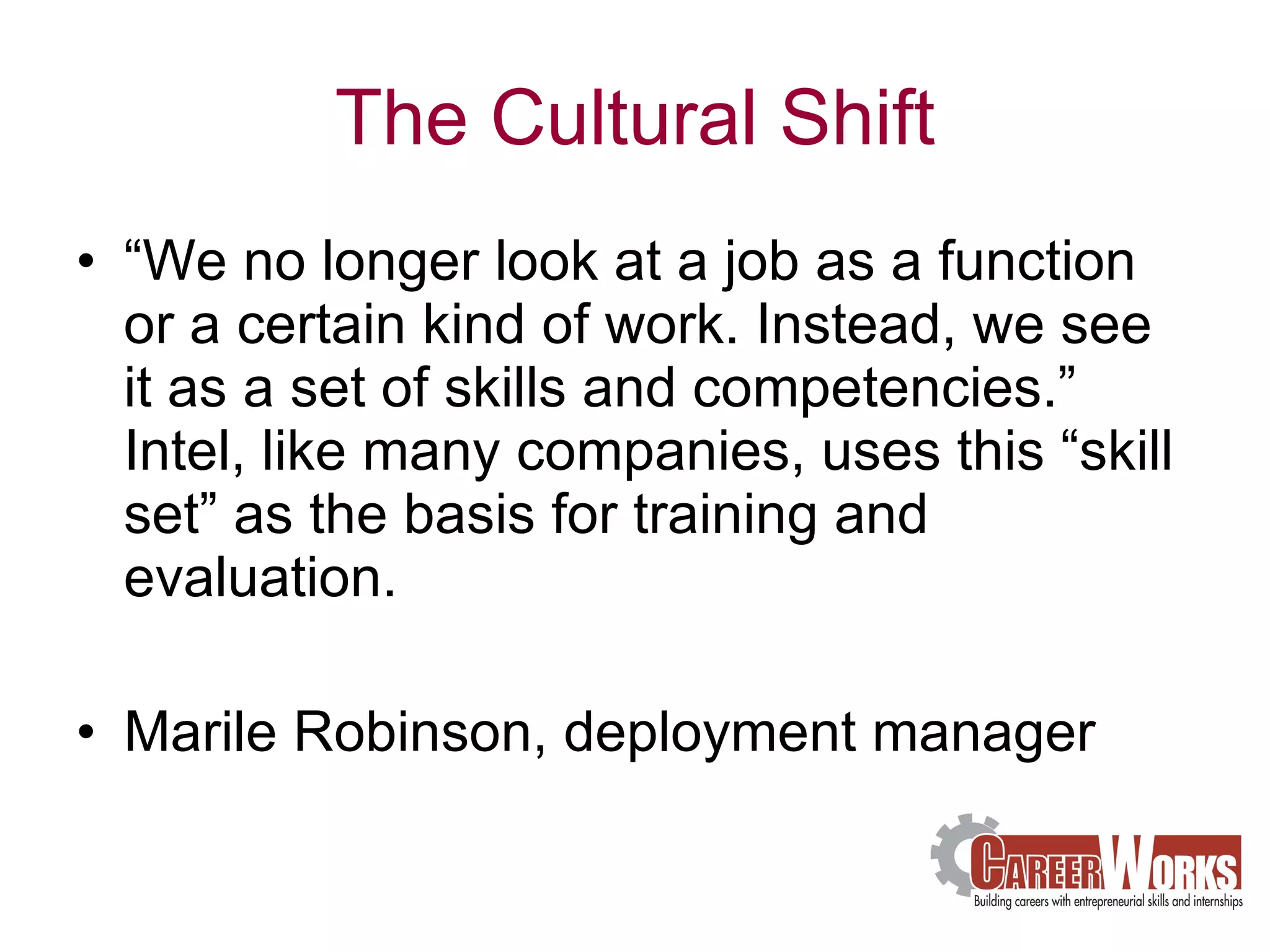
The Cultural Shift “ We no longer look at a job as a function or a certain kind of work. Instead, we see it as a set of skills and competencies.” Intel, like many companies, uses this “skill set” as the basis for training and evaluation. Marile Robinson, deployment manager
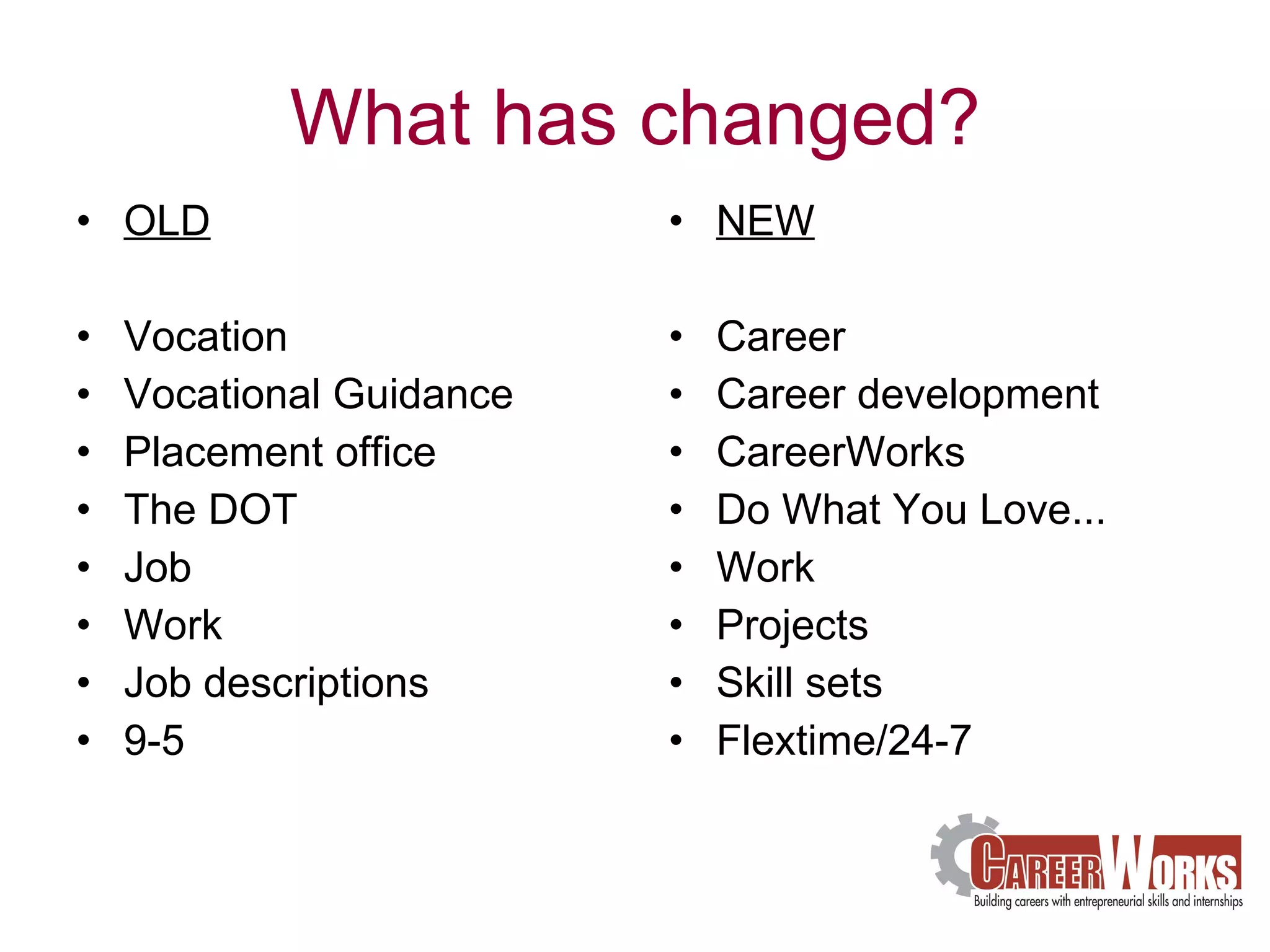
What has changed? OLD Vocation Vocational Guidance Placement office The DOT Job Work Job descriptions 9-5 NEW Career Career development CareerWorks Do What You Love... Work Projects Skill sets Flextime/24-7
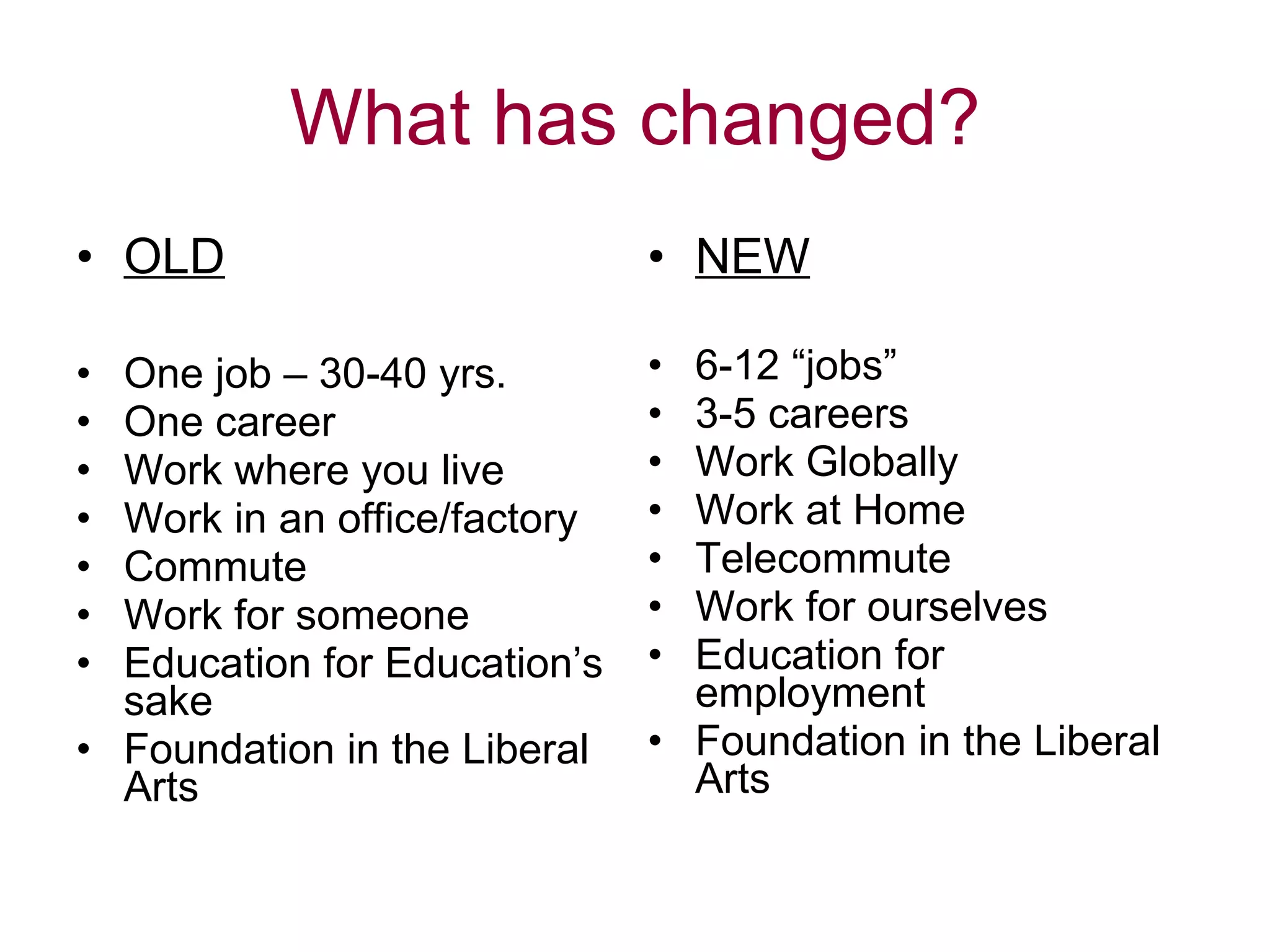
What has changed? OLD One job – 30-40 yrs. One career Work where you live Work in an office/factory Commute Work for someone Education for Education’s sake Foundation in the Liberal Arts NEW 6-12 “jobs” 3-5 careers Work Globally Work at Home Telecommute Work for ourselves Education for employment Foundation in the Liberal Arts
The Career Development Model and the Pyramid of Success
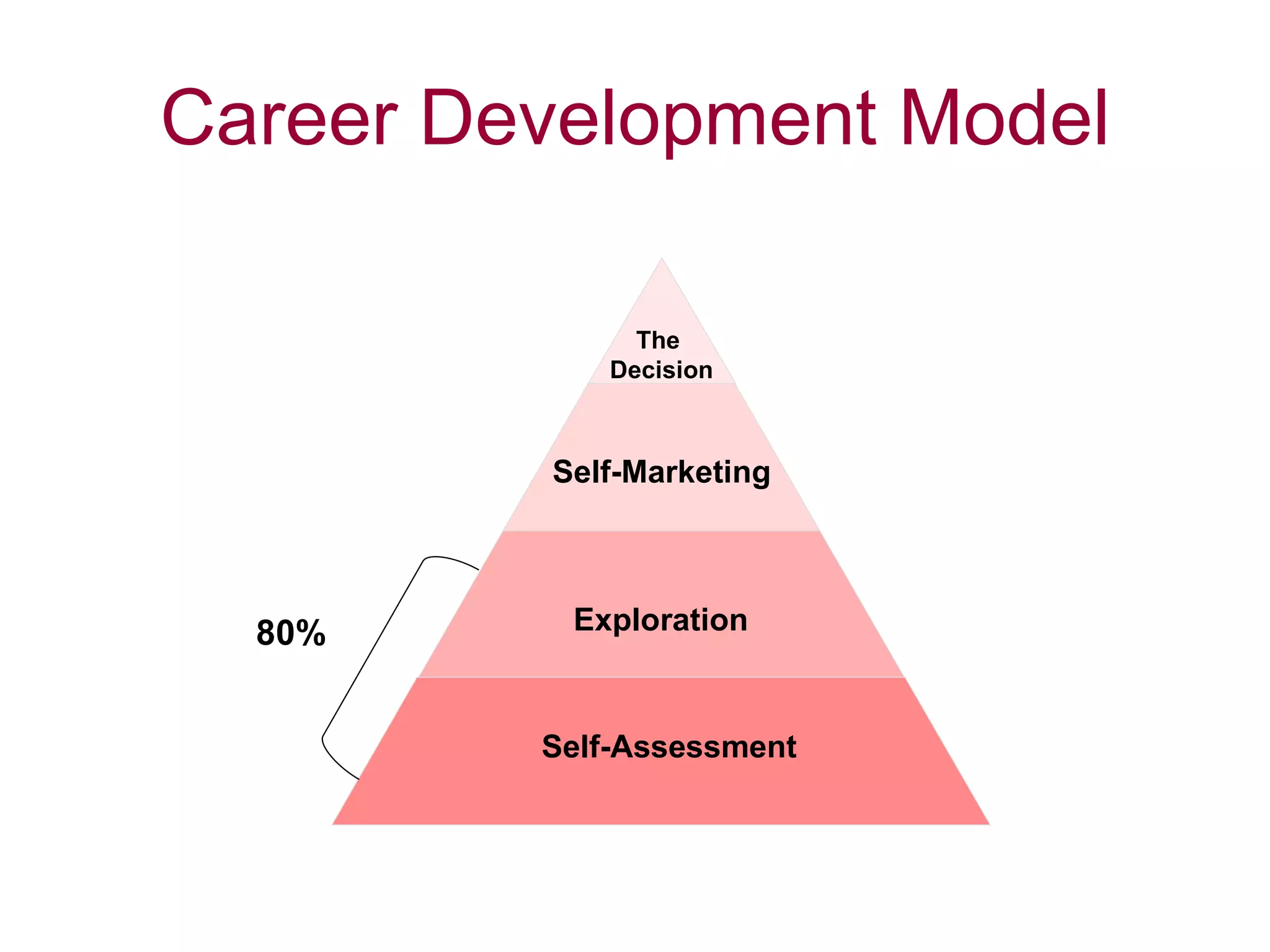
Career Development Model Self-Assessment Exploration Self-Marketing 80% The  Decision
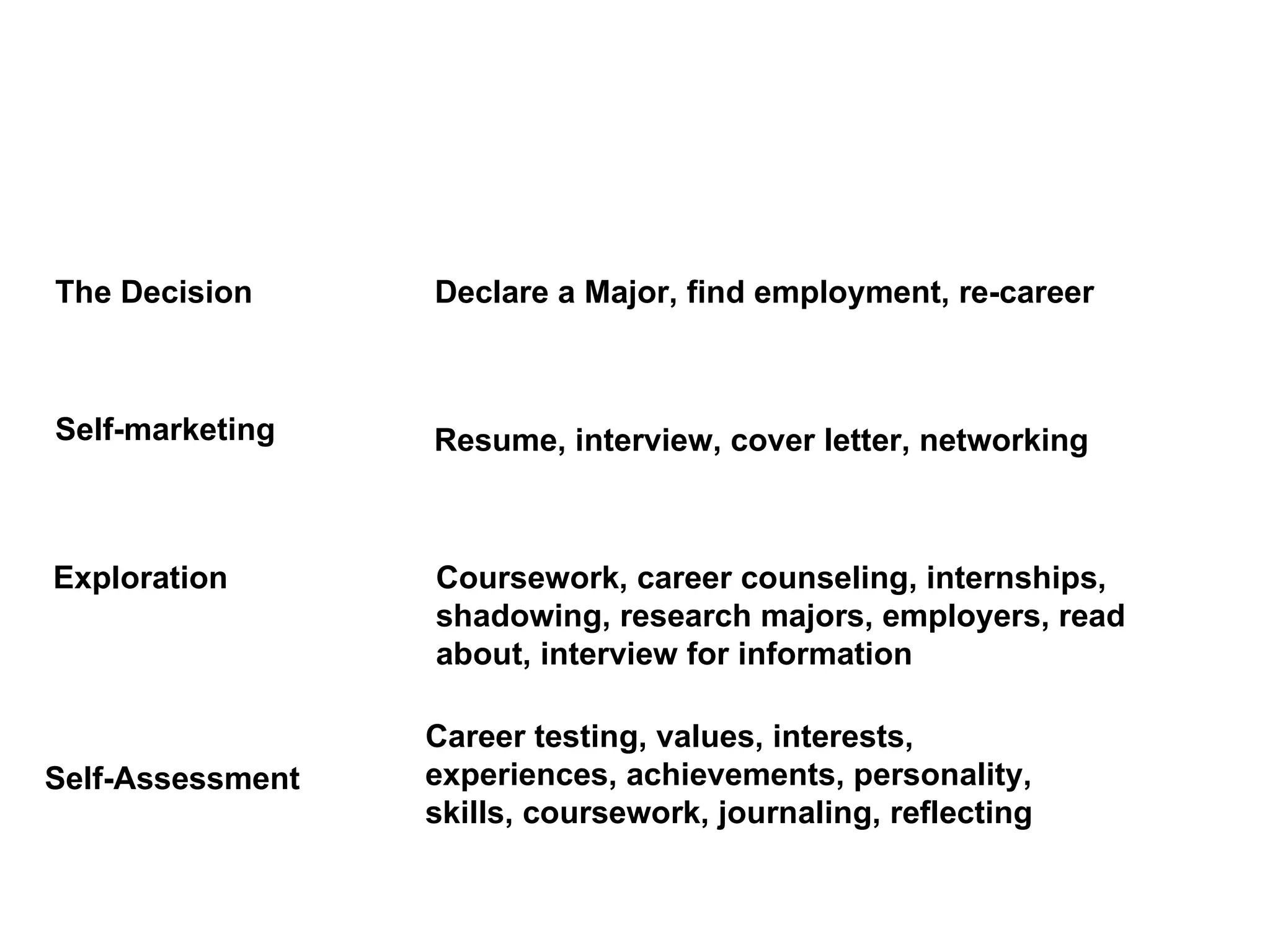
Career testing, values, interests, experiences, achievements, personality, skills, coursework, journaling, reflecting Coursework, career counseling, internships, shadowing, research majors, employers, read about, interview for information Resume, interview, cover letter, networking Declare a Major, find employment, re-career Self-Assessment Exploration Self-marketing The Decision
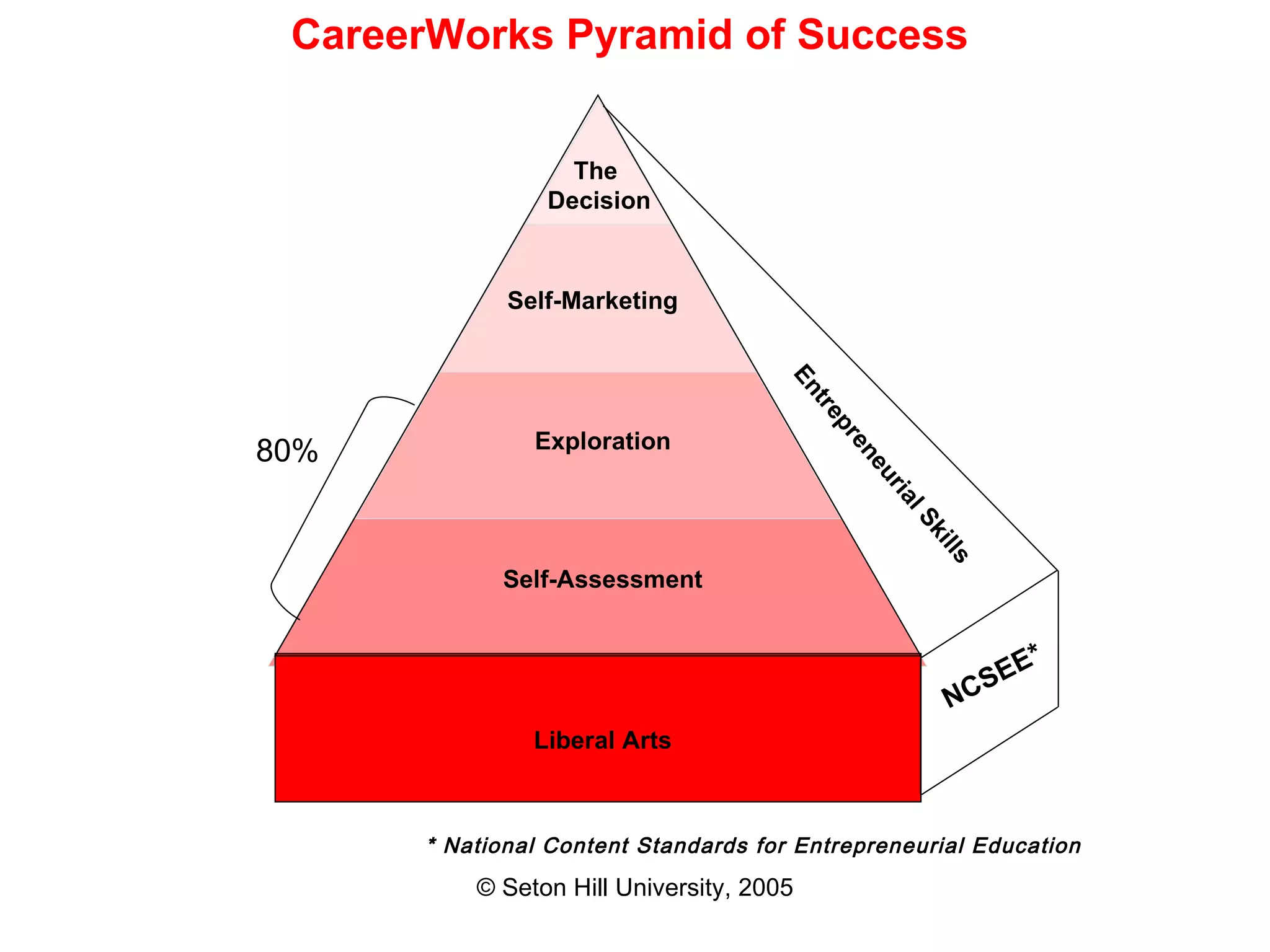
Entrepreneurial Skills Liberal Arts Self-Marketing Exploration Self-Assessment CareerWorks Pyramid of Success NCSEE* The  Decision * National Content Standards for Entrepreneurial Education 80%
Liberal Arts & The “E” Word
Entrepreneurship Defined at SHU Using your resources creatively for an optimal outcome.
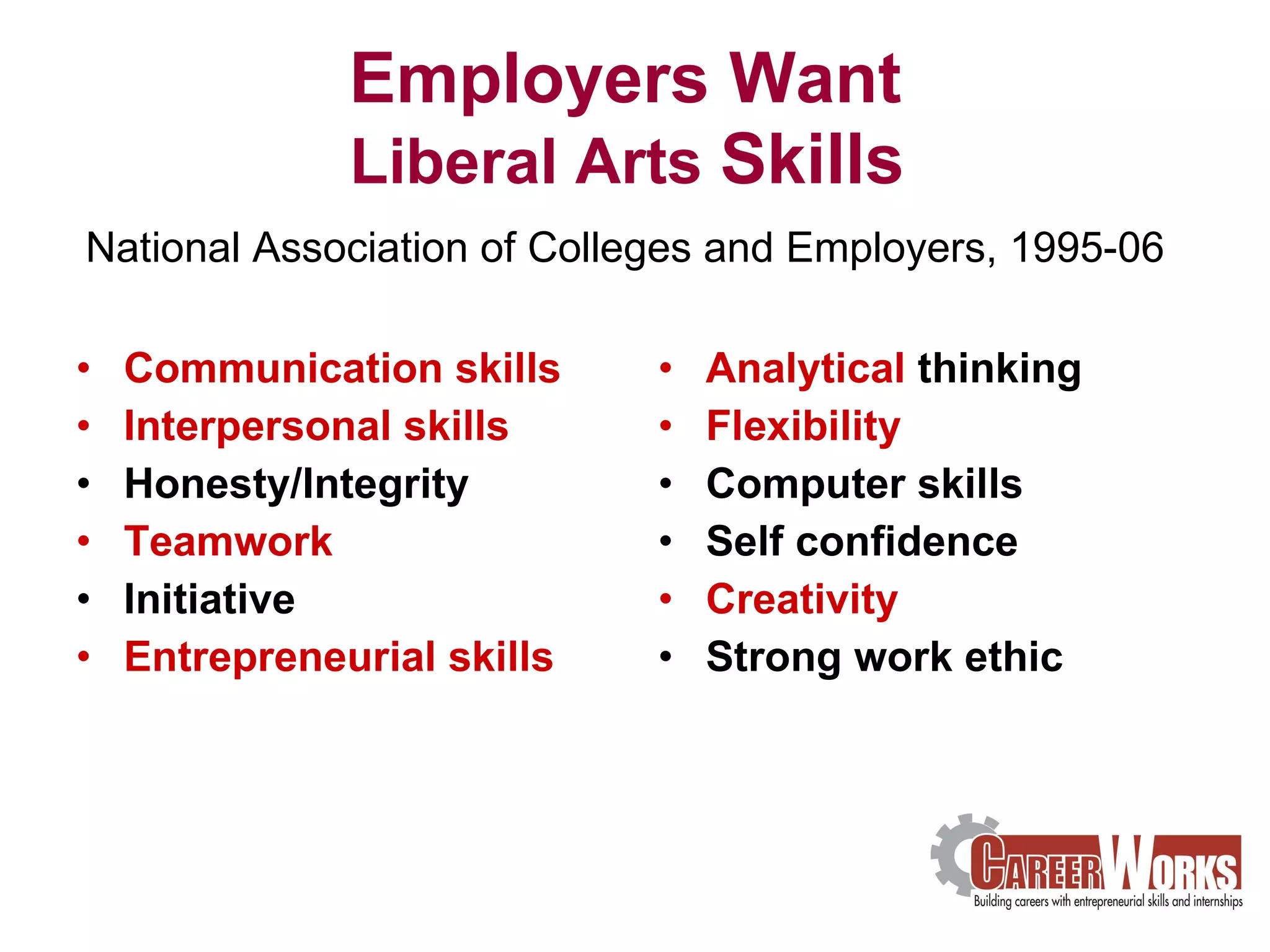
Employers Want  Liberal Arts  Skills   National Association of Colleges and Employers, 1995-06   Communication skills Interpersonal skills Honesty/Integrity Teamwork  Initiative Entrepreneurial skills Analytical  thinking Flexibility  Computer skills Self confidence Creativity Strong work ethic
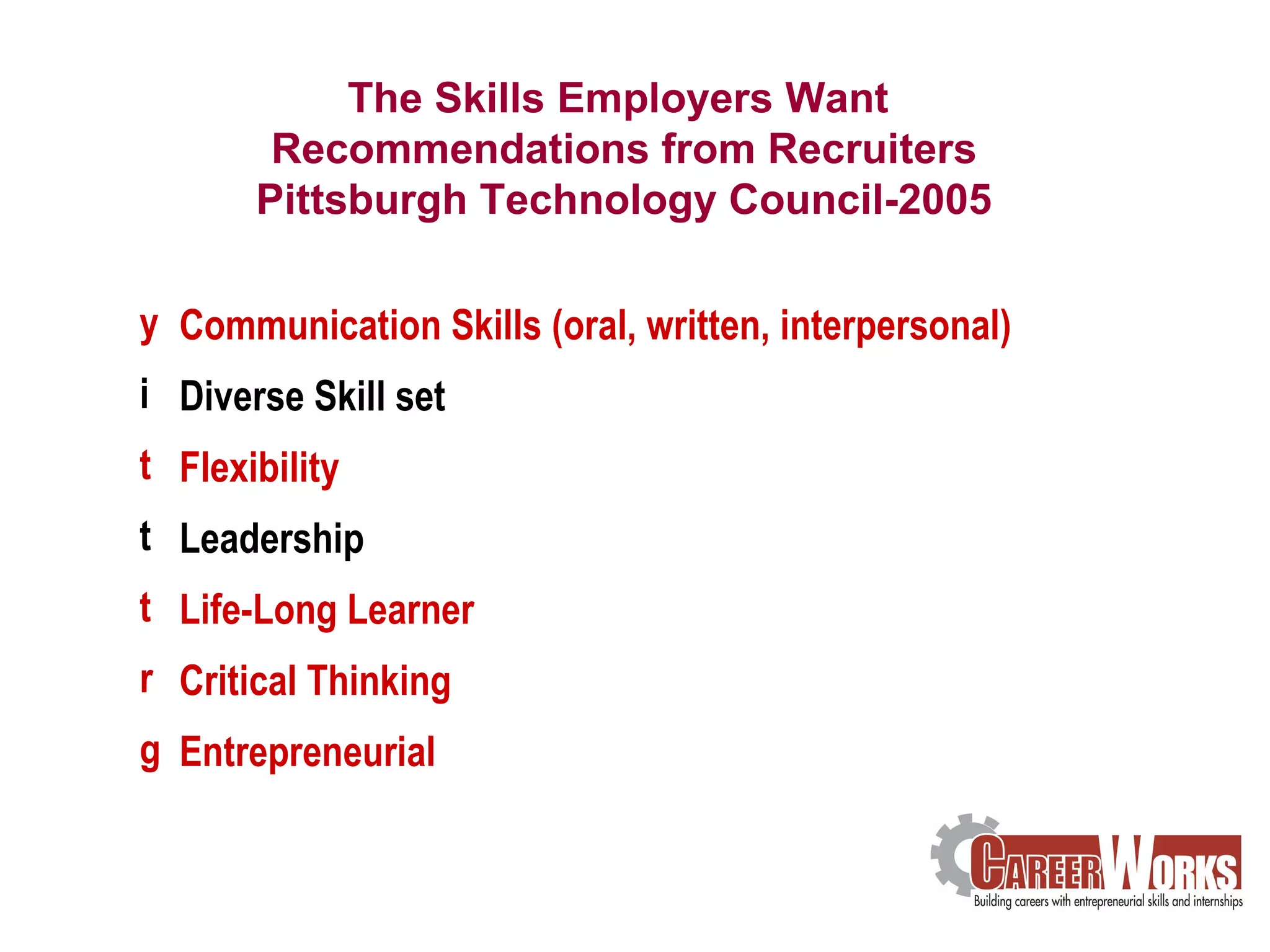
The Skills Employers Want  Communication Skills (oral, written, interpersonal) Diverse Skill set Flexibility Leadership Life-Long Learner Critical Thinking Entrepreneurial The Skills Employers Want  Recommendations from Recruiters Pittsburgh Technology Council-2005
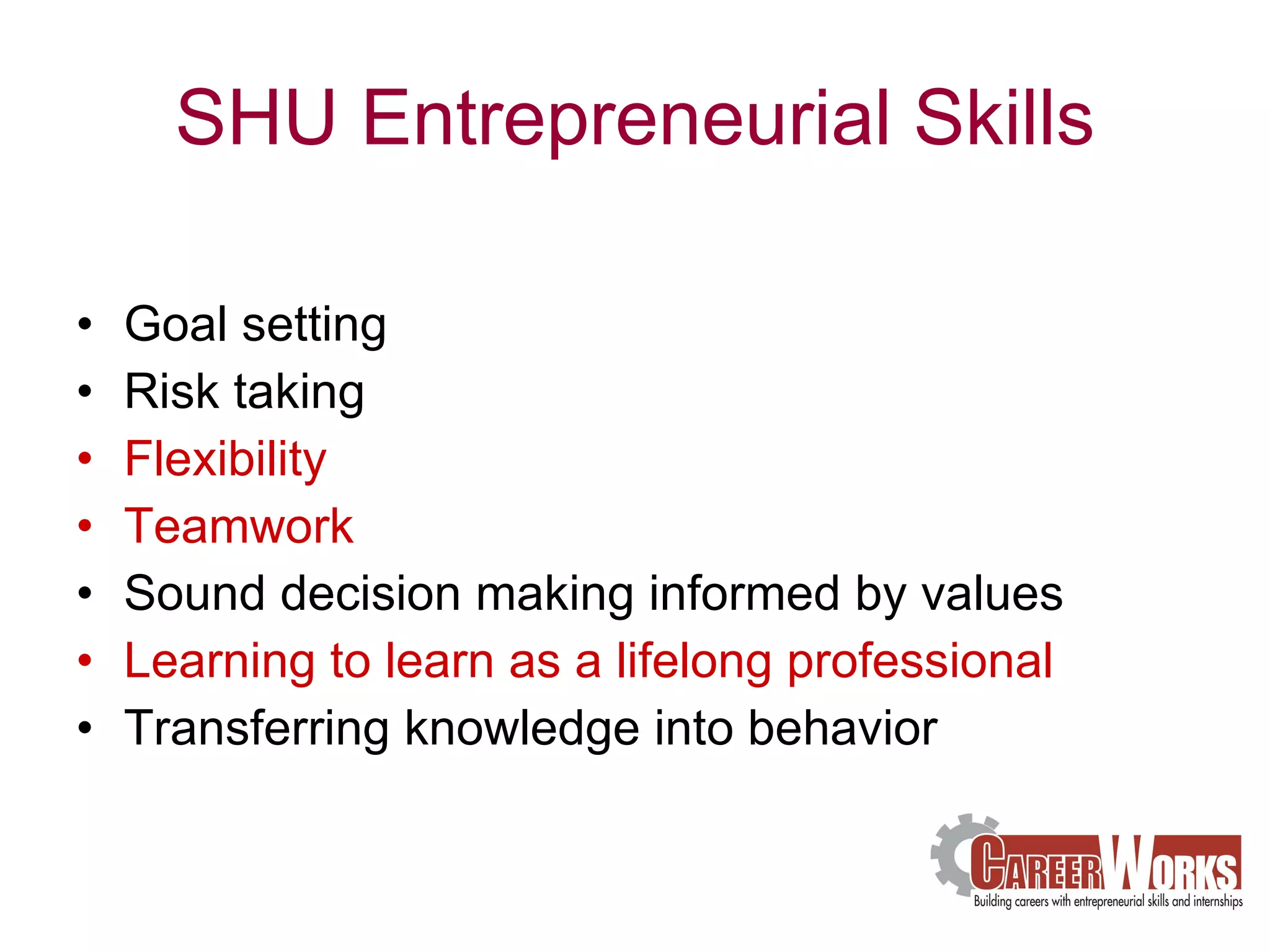
SHU Entrepreneurial Skills Goal setting Risk taking Flexibility Teamwork Sound decision making informed by values Learning to learn as a lifelong professional Transferring knowledge into behavior
Key Phrases in Job Descriptions Source: Monster.com, 2006 Seeking  entrepreneurial  candidates with MS/BS degree in computer science,  problem solving  skills and desire to succeed.  Able to work in a culture/environment that promotes an  entrepreneurial spirit  and a  “let’s get it done now attitude.”   Strong sense of  confidence , maturity and intelligence.  Self-starting  leader with… an  entrepreneurial spirit .  Employees will be expected to work as a  team , be  entrepreneurial , passionate, accountable,  strong work ethic , balanced life and  communicate, com., com .
Key Phrases in Job Descriptions Monroeville Mall is looking for an  energetic,  positive,  entrepreneur-like  intern to assist and learn the basics of Specialty Leasing in a retail environment. This will involve the day-to-day operations like canvassing local area for leads and new tenants, negotiating deals, collecting rents and sales, improving visuals, and meeting and exceeding  goals.   
Philosophy of Service Career development begins when a student enters the University.  It continues through graduation and extends to a life long career management process.  All students are encouraged to use the services of CareerWorks throughout their studies at the university.
The New Model
The Cultural Shift The average age of an entrepreneur in the United States has dropped recently from 40 to 34 and continues to fall.  (Entrepreneurs Organization, Alexandria, VA) The “entrepreneurial spirit” remains elusive, according to the Herman Group. “This perspective, and the courage that goes with it, has not been taught by enough schools…”  (Herman Trend Alert: The Secondary Talent Problem, June 2005)
Experiential Learning Experiential learning has risen to the forefront of entrepreneurship education and colleges and universities are responding to research that encourages both real-world projects and extracurricular learning activities, such as internships, to better teach entrepreneurship.  ( The Growth and Advancement of Entrepreneurship in Higher Education: An Environmental Scan of College Initiatives ,  Kauffman Center for Entrepreneurial Leadership, 2001 .)
Enhance the Internship Program Internships integrate the theory of the classroom with the world of work. Students apply skills and knowledge to a project. Career development is an integral process within the internship, formal and informal. Goals: Improve the quality of internships. Train internship supervisors. Integrate entrepreneurial skills. Develop a better process for students, faculty, employers. Collect data for all experiential learning at the University.
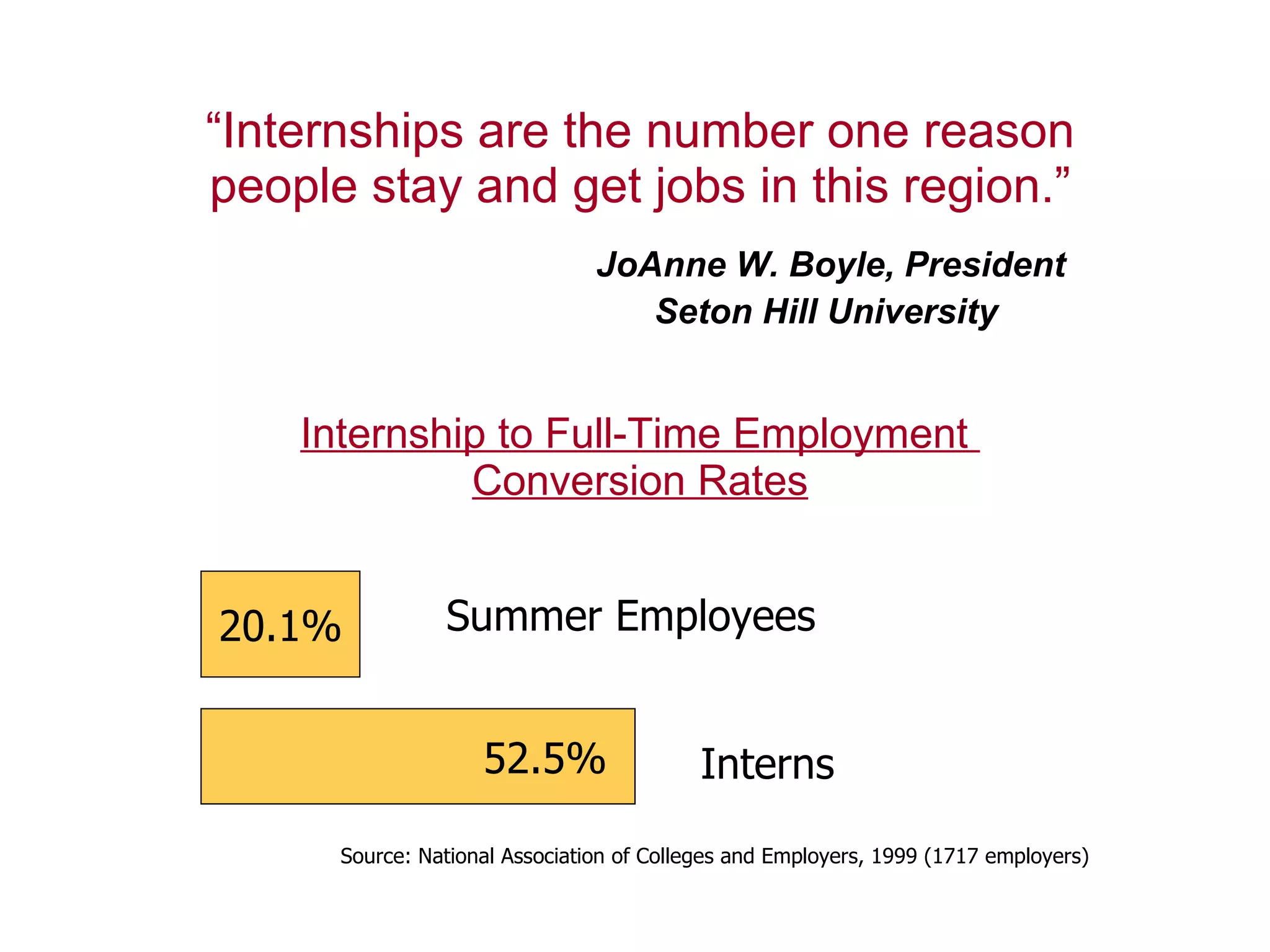
  “ Internships are the number one reason people stay and get jobs in this region.” JoAnne W. Boyle, President Seton Hill University   Internship to Full-Time Employment  Conversion Rates 20.1% 52.5% Summer Employees Interns Source: National Association of Colleges and Employers, 1999 (1717 employers)
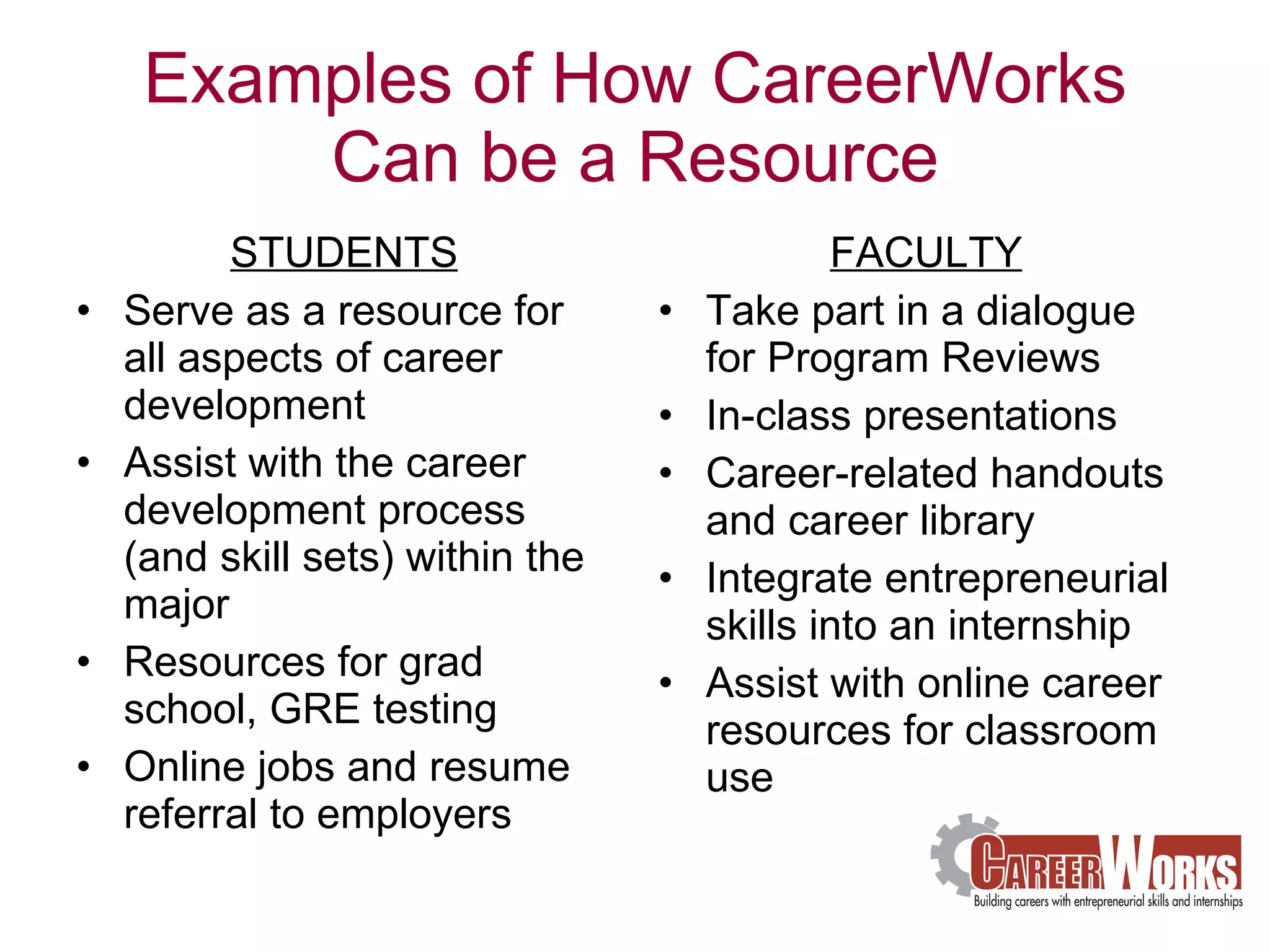
Examples of How CareerWorks Can be a Resource STUDENTS Serve as a resource for all aspects of career development Assist with the career development process (and skill sets) within the major Resources for grad school, GRE testing Online jobs and resume referral to employers FACULTY Take part in a dialogue for Program Reviews In-class presentations Career-related handouts and career library Integrate entrepreneurial skills into an internship Assist with online career resources for classroom use
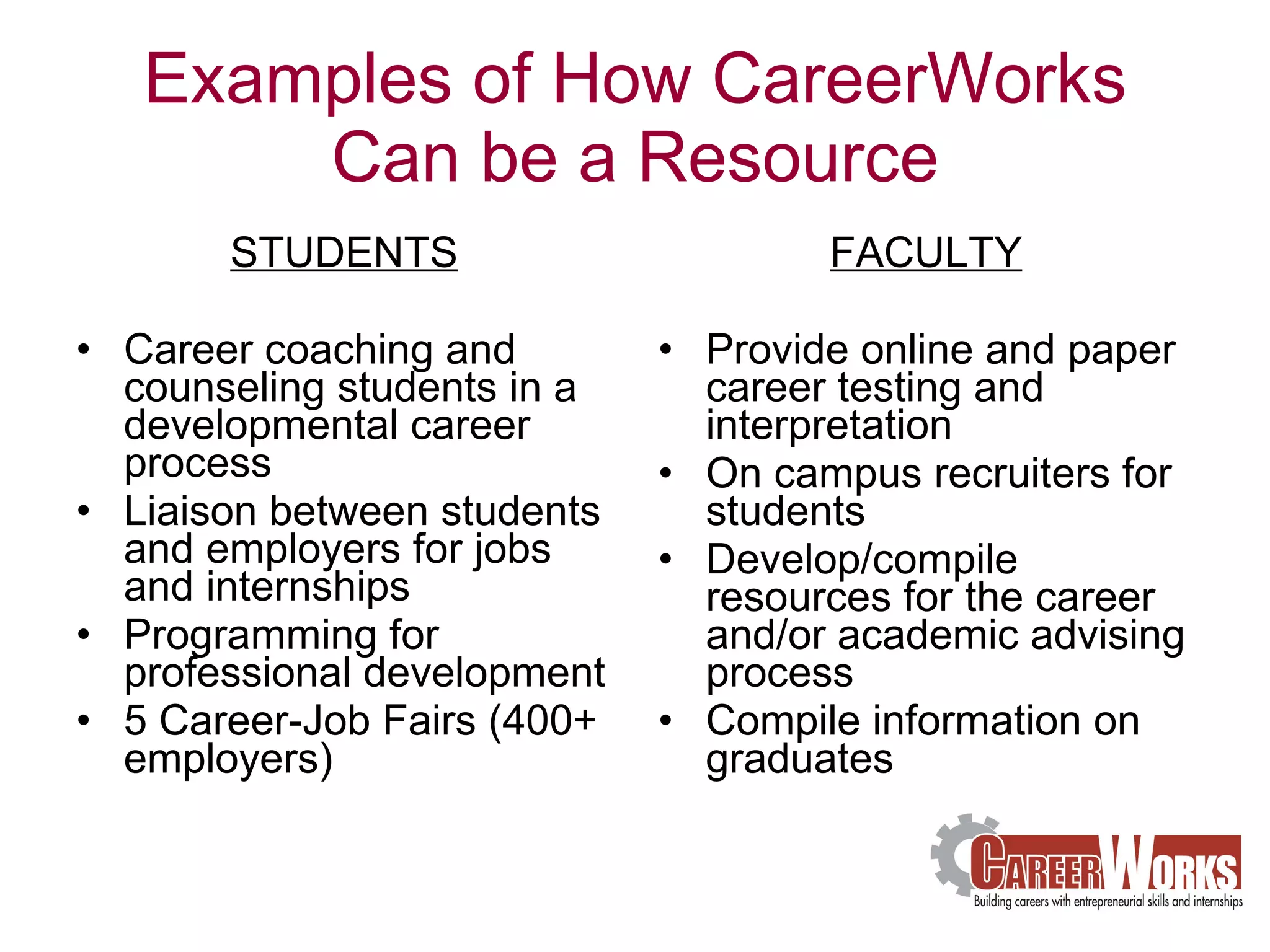
Examples of How CareerWorks Can be a Resource STUDENTS Career coaching and counseling students in a developmental career process Liaison between students and employers for jobs and internships Programming for professional development  5 Career-Job Fairs (400+ employers) FACULTY Provide online and paper career testing and  interpretation On campus recruiters for students  Develop/compile resources for the career and/or academic advising process Compile information on graduates
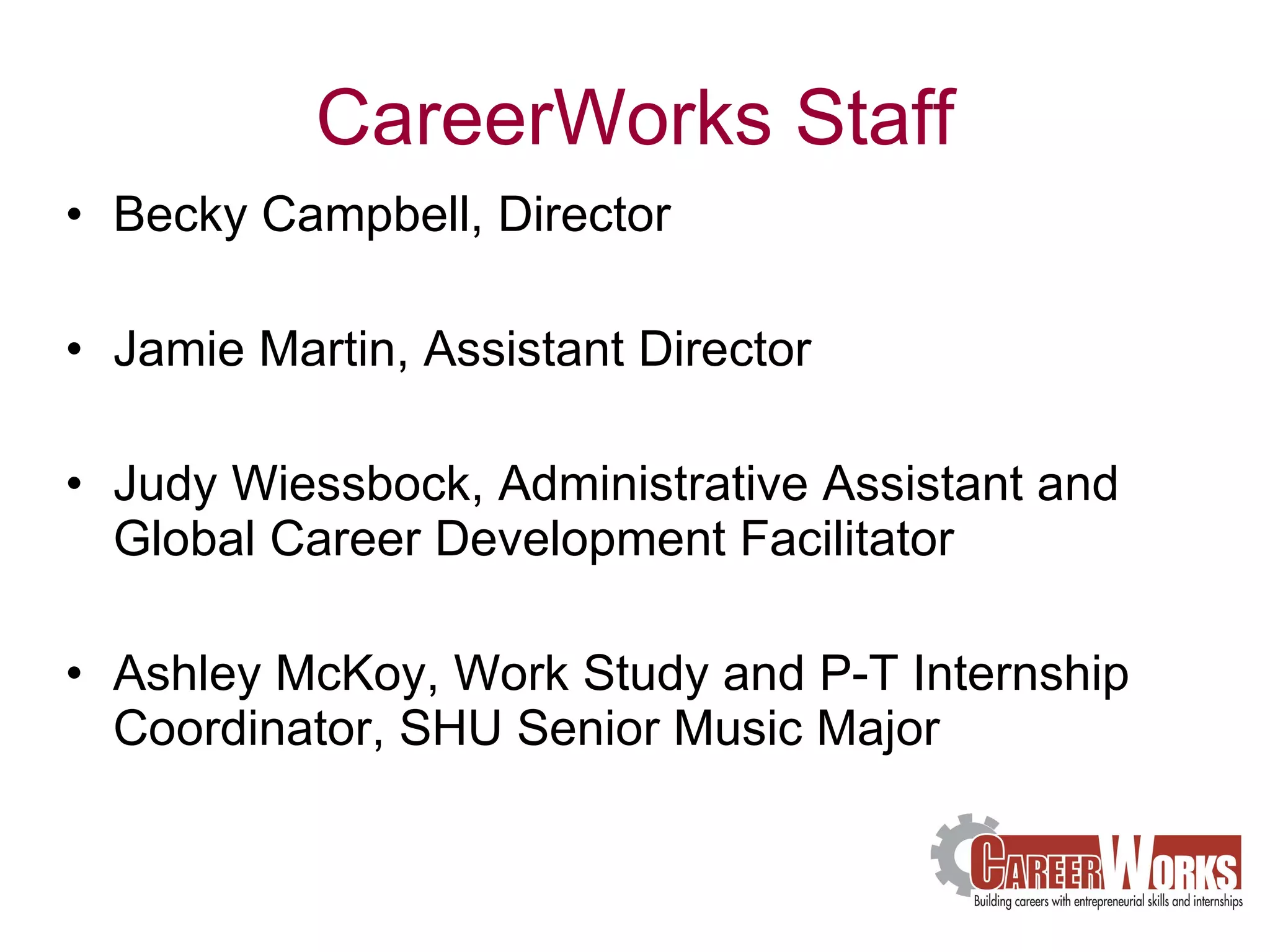
CareerWorks Staff Becky Campbell, Director Jamie Martin, Assistant Director Judy Wiessbock, Administrative Assistant and Global Career Development Facilitator  Ashley McKoy, Work Study and P-T Internship Coordinator, SHU Senior Music Major
Your Invitation to Join the CareerWorks Advisory Committee Help us to develop a process for students that will link career development and entrepreneurial skills to experiential learning/internships. “Volunteers will be invited by name if people don’t come forth.”  Mary Ann G.
Another invitation… CareerWorks and E-Magnify Open House  Third Administration October 12, 2006  3:00 p.m. – 6:00 p.m. (tentative) Food Prizes “Giveaways”
A final quote from William Bridges What you will need (the person and the organization) is the ability to bend and not break, to let go readily of the outdated and learn the new, to bounce back quickly from disappointment, to live with high levels of uncertainty, and to find your security  from within rather than from outside.

Test - CareerWorks intro presentation

  • 1.
  • 2.
    Career Development: SolidSuggestions for Savvy Seniors Becky Campbell Director - CareerWorks
  • 3.
    CareerWorks Mission Statement… the career development process promotes a high level of self-knowledge and career competency through self-assessment, career exploration, job-search skill development, and decision-making. CareerWorks provides resources and services based on this foundation.
  • 4.
    WHY NOW? Whynot now? Career management is your responsibility now and in the future.
  • 5.
    The Cultural Shift“ We no longer look at a job as a function or a certain kind of work. Instead, we see it as a set of skills and competencies.” Intel, like many companies, uses this “skill set” as the basis for training and evaluation. Marile Robinson, deployment manager
  • 6.
    What has changed?OLD Vocation Vocational Guidance Placement office The DOT Job Work Job descriptions 9-5 NEW Career Career development CareerWorks Do What You Love... Work Projects Skill sets Flextime/24-7
  • 7.
    What has changed?OLD One job – 30-40 yrs. One career Work where you live Work in an office/factory Commute Work for someone Education for Education’s sake Foundation in the Liberal Arts NEW 6-12 “jobs” 3-5 careers Work Globally Work at Home Telecommute Work for ourselves Education for employment Foundation in the Liberal Arts
  • 8.
    The Career DevelopmentModel and the Pyramid of Success
  • 9.
    Career Development ModelSelf-Assessment Exploration Self-Marketing 80% The Decision
  • 10.
    Career testing, values,interests, experiences, achievements, personality, skills, coursework, journaling, reflecting Coursework, career counseling, internships, shadowing, research majors, employers, read about, interview for information Resume, interview, cover letter, networking Declare a Major, find employment, re-career Self-Assessment Exploration Self-marketing The Decision
  • 11.
    Entrepreneurial Skills LiberalArts Self-Marketing Exploration Self-Assessment CareerWorks Pyramid of Success NCSEE* The Decision * National Content Standards for Entrepreneurial Education 80%
  • 12.
    Liberal Arts &The “E” Word
  • 13.
    Entrepreneurship Defined atSHU Using your resources creatively for an optimal outcome.
  • 14.
    Employers Want Liberal Arts Skills National Association of Colleges and Employers, 1995-06 Communication skills Interpersonal skills Honesty/Integrity Teamwork Initiative Entrepreneurial skills Analytical thinking Flexibility Computer skills Self confidence Creativity Strong work ethic
  • 15.
    The Skills EmployersWant Communication Skills (oral, written, interpersonal) Diverse Skill set Flexibility Leadership Life-Long Learner Critical Thinking Entrepreneurial The Skills Employers Want Recommendations from Recruiters Pittsburgh Technology Council-2005
  • 16.
    SHU Entrepreneurial SkillsGoal setting Risk taking Flexibility Teamwork Sound decision making informed by values Learning to learn as a lifelong professional Transferring knowledge into behavior
  • 17.
    Key Phrases inJob Descriptions Source: Monster.com, 2006 Seeking entrepreneurial candidates with MS/BS degree in computer science, problem solving skills and desire to succeed. Able to work in a culture/environment that promotes an entrepreneurial spirit and a “let’s get it done now attitude.” Strong sense of confidence , maturity and intelligence. Self-starting leader with… an entrepreneurial spirit . Employees will be expected to work as a team , be entrepreneurial , passionate, accountable, strong work ethic , balanced life and communicate, com., com .
  • 18.
    Key Phrases inJob Descriptions Monroeville Mall is looking for an energetic, positive, entrepreneur-like intern to assist and learn the basics of Specialty Leasing in a retail environment. This will involve the day-to-day operations like canvassing local area for leads and new tenants, negotiating deals, collecting rents and sales, improving visuals, and meeting and exceeding goals.  
  • 19.
    Philosophy of ServiceCareer development begins when a student enters the University.  It continues through graduation and extends to a life long career management process.  All students are encouraged to use the services of CareerWorks throughout their studies at the university.
  • 20.
  • 21.
    The Cultural ShiftThe average age of an entrepreneur in the United States has dropped recently from 40 to 34 and continues to fall. (Entrepreneurs Organization, Alexandria, VA) The “entrepreneurial spirit” remains elusive, according to the Herman Group. “This perspective, and the courage that goes with it, has not been taught by enough schools…” (Herman Trend Alert: The Secondary Talent Problem, June 2005)
  • 22.
    Experiential Learning Experientiallearning has risen to the forefront of entrepreneurship education and colleges and universities are responding to research that encourages both real-world projects and extracurricular learning activities, such as internships, to better teach entrepreneurship. ( The Growth and Advancement of Entrepreneurship in Higher Education: An Environmental Scan of College Initiatives , Kauffman Center for Entrepreneurial Leadership, 2001 .)
  • 23.
    Enhance the InternshipProgram Internships integrate the theory of the classroom with the world of work. Students apply skills and knowledge to a project. Career development is an integral process within the internship, formal and informal. Goals: Improve the quality of internships. Train internship supervisors. Integrate entrepreneurial skills. Develop a better process for students, faculty, employers. Collect data for all experiential learning at the University.
  • 24.
    Internships are the number one reason people stay and get jobs in this region.” JoAnne W. Boyle, President Seton Hill University Internship to Full-Time Employment Conversion Rates 20.1% 52.5% Summer Employees Interns Source: National Association of Colleges and Employers, 1999 (1717 employers)
  • 25.
    Examples of HowCareerWorks Can be a Resource STUDENTS Serve as a resource for all aspects of career development Assist with the career development process (and skill sets) within the major Resources for grad school, GRE testing Online jobs and resume referral to employers FACULTY Take part in a dialogue for Program Reviews In-class presentations Career-related handouts and career library Integrate entrepreneurial skills into an internship Assist with online career resources for classroom use
  • 26.
    Examples of HowCareerWorks Can be a Resource STUDENTS Career coaching and counseling students in a developmental career process Liaison between students and employers for jobs and internships Programming for professional development 5 Career-Job Fairs (400+ employers) FACULTY Provide online and paper career testing and interpretation On campus recruiters for students Develop/compile resources for the career and/or academic advising process Compile information on graduates
  • 27.
    CareerWorks Staff BeckyCampbell, Director Jamie Martin, Assistant Director Judy Wiessbock, Administrative Assistant and Global Career Development Facilitator Ashley McKoy, Work Study and P-T Internship Coordinator, SHU Senior Music Major
  • 28.
    Your Invitation toJoin the CareerWorks Advisory Committee Help us to develop a process for students that will link career development and entrepreneurial skills to experiential learning/internships. “Volunteers will be invited by name if people don’t come forth.” Mary Ann G.
  • 29.
    Another invitation… CareerWorksand E-Magnify Open House Third Administration October 12, 2006 3:00 p.m. – 6:00 p.m. (tentative) Food Prizes “Giveaways”
  • 30.
    A final quotefrom William Bridges What you will need (the person and the organization) is the ability to bend and not break, to let go readily of the outdated and learn the new, to bounce back quickly from disappointment, to live with high levels of uncertainty, and to find your security from within rather than from outside.

Editor's Notes

  • #2 Career development can happen formally or informally. We do what our mom tells us to do; we change our major because our roommate thinks it is weird, we don’t take the class that we really need because it starts at 8 am; you got your first job because you knew someone. These are scenarios that are real. The new vision for CareerWorks is that we will have a process that will link career development and entrepreneurial skills to experiential learning and internships. CW is a new department because of the hard work of many of you out there. This is a vision that has a foundation in the past but looks forward to the future to build on what we do well and what we can do better: integrate career development, entrepreneurial skills and internships within a liberal arts curriculum.
  • #3 4 points that I want to address in this presentation: 1.Why now? 2. What career dev means for our students 3. What entrep skills and the liberal arts skills mean for our students?4. The New Model for CW I want to give you a chance to remember your own career development before we talk about the new CareerWorks vision and plan These questions that I will be asking are the questions that our students will struggle with. These are career and life decisions that they will make over the next 4…or 6 years.. What decisions did you made along the way, what path did you take and why, and how the heck you got where you are! Turn to one person around you and quickly answer this question: What did you want to be when you grew up? How many people said to themselves or someone, “I still don’t know what I want to be when I grow up“? We change – the world is changing How did you choose your major? Or your life’s work? When you chose a major, how did you decide on the career that you would pursue? Who helped to guide or mentor you? How did you develop the skills that you have? How did you find your first job? And now think about our students… From the first year at SH through the senior year, how and where do our students get exposure to c.d.? (Connections, experiential learning, learning about professions.)
  • #5 The Office of Career Development, (1987-2005), operated from a single dimensional career development model (more on the model later) that assisted students in self assessment, career exploration and self-marketing as the pathway to career decision-making. Using this traditional career development model, the office provided –and continues to provide --career services and programming in over 20 areas including the internship program, career and web-based counseling, career testing, job and career fairs, and website initiatives, mock interviews, resume referral, among others. Employers have much to say when I talk to them about what skills and behaviors they would like to have in their employees. They want students to hit the ground running and frankly, that is difficult, if a student has not had an internship or worked in their field. While CareerWorks will continue to provide the traditional career development services that form the foundation of a university career center, our vision for CareerWorks is entrepreneurial, unique and innovative. We see the career development process through a different lens.
  • #6 Skill sets, competencies have become the new language for organizations. We have had the de-jobbing of America. We now have work that needs to be done and it is organized into teams and projects. Think about how much more you are collaborating possibly in Interdisciplinary studies.
  • #8 6-12 full time gigs; part time work; go in and out of the workplace with spouse; temp work that may lead to full time work on a project
  • #10 Traditional model of cd that I have used for at least the last 5 years. I use in one on one with a student and I have used it in some of your classes. What’s one of the first questions that we ask a student that is on the way to college? They choose a major without a lot of thought: My dad won’t pay for college…Science story. Senior hates their major –FBI. I am sure thatin the advising process you have also heard some equally harrowing stories from students who are confused about their decision. Run to registrar’s office because everyone is asking them about their major. Not uncommon to have a student change their major 2, 3, 4 times. Students won’t do it unless it is a process within coursework or their major.
  • #11 . If 80% of career devel is self assessment and career exploration, how can we assist our students to better understand and experience this process? The Mystery Job- One of the exercises that I have completed in a class, sometimes to make a point, or to keep people awake, is called the mystery job. The MJ helps students to think about themselves in relation to their personal values, interests, and occupational exploration. To keep you in an active learning mode…
  • #12 The emerging multidimensional model, the CareerWorks Pyramid of Success, builds on the original model to integrate career development with the liberal arts, entrepreneurial skills, and the National Content Standards for Entrepreneurship Education. The NCSEE, developed by the Consortium for Entrepreneurship Education include “liberal arts” skills such as oral and written communication, leadership, personal management, creativity, goal-setting, valuing diversity, problem-solving and decision-making, personal responsibility, dealing with conflict, and career planning. We are not talking about teaching all students to start a business, although we have many students of all majors, who will eventually do just that. We want our graduates to understand that the world they are going into expects certain behaviors and skills. They can learn these while at Seton Hill. I am here to de-mystify what I lovingly refer to as the “E” word.
  • #13 Tie this slide in with the pyramid. We began talking about Entrepreneurial skills in the late 80’s with the inclusion of entrepreneurial skills as one of the 11 learning objectives of the University.
  • #14 This is the broad definition of entrepreneurship that has been used at SH for a decade or more. It is appropriate for all students from all majors of the liberal arts. People are creating their own lives, their own careers and their own successes. There are fewer manmmoth corporations. One of the hottest new companies in Pgh is __________, a company few of you have heard of. But they are hiring. Small companies that we never heard of is where we need to lead our students. They still look for the large corporate names- companies that continue to downsize or re-engineer.
  • #15 Entrepreneurial thinking and skill development are terms that have become central to our culture. They are Marketplace driven. Students want employment upon graduation. Employers want skills and they want to know what students can DO. The career dev process helps them to know themselves and the world of work so that they can get to where they want to go with some planning and thought. We speak about values, goals, and skills in senior seminar. The showcase portfolio can bring all of this together into one package so that students can truly reflect on who they are and who they want to be going into the world of work or grad or professional school.
  • #17 We are still looking at liberal arts skills – the skills that employers want and that students need to demonstrate prior to graduation.
  • #18 The E word is showing up everywhere. Liberal arts skills are showing up too. These are skills employers want. You don’t see a major listed.
  • #19 This internship came into CareerWorks last week. You see the E word in profit and not for profit descriptions. This internship could be for a communications major, a business marketing major.
  • #22 Herman Group - Futurists
  • #23 One of the reasons for CareerWorks now has been a shift in our culture from an industrial age to a knowledge economy where many businesses are related to technology, bio-tech, services. WE still have the education and manufacturing sector but things have shifted dramatically over the last 20-30 years. Kauffman Foundation and the Kauffmann Center – national org that funds much of the national research and initiatives for entre education.
  • #24 One of the important initiatives of CW will be to enhance all apects of the internship program. One of our initiatives over the past 3 years- the Small Business Internship Training Program has gained national attention as Doina Vlad, Marily S-C, Jayne Huston and I have presented information about the training and the evaluation at 3 state and natl conferences with one more to come in Phoenix in Nov.
  • #25 Program currently undergoing infrastructure changes so that internships are easily organized into electronic folders for access by faculty and students. This process and the evaluation tools as well as new curricular tools are things that will be developed this year and beyond. More about this later.
  • #26 (Resumes aren’t the only thing we do.) We have over 20 distinct services for students and alumni.
  • #29 Our goal is to create a premier national model of career and professional development that will benefit all liberal arts students, regardless of their academic major. Seeking committee representation from all divisions, students, employers, prof staff. Strengthen internship program, link entrep skills, seamless process that goes throughout the 4 years. Integrate career into classes in the major. Where and how do we do this? One of our first steps will be to look at what we are already doing well. I can email an Information sheet for anyone interested. If you have already spoken to me about your interest, please still email me.
  • #31 Bridges is an internationally renowned consultant, author and expert on change and transitions for individuals and organizations. READ Closing: We are all now in business for ourselves. Our students are entrepreneurs of their careers. Let’s give them the skills that they need to go into this new world. We can be a premier liberal arts institution on the cutting edge of a new and innovative process of integrating entrepreneurial skills, career development and internships. Let’s get it done…together!