CARDIAC ARREST/
CARDIO PULMONARY RESUCITATION/
SHOCK
Dr. Boudhayan Bhattacharjee
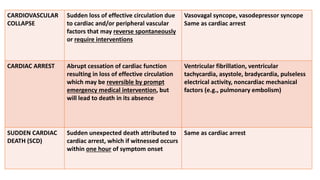
CARDIOVASCULAR
COLLAPSE
Sudden loss of effective circulation due
to cardiac and/or peripheral vascular
factors that may reverse spontaneously
or require interventions
Vasovagal syncope, vasodepressor syncope
Same as cardiac arrest
CARDIAC ARREST Abrupt cessation of cardiac function
resulting in loss of effective circulation
which may be reversible by prompt
emergency medical intervention, but
will lead to death in its absence
Ventricular fibrillation, ventricular
tachycardia, asystole, bradycardia, pulseless
electrical activity, noncardiac mechanical
factors (e.g., pulmonary embolism)
SUDDEN CARDIAC
DEATH (SCD)
Sudden unexpected death attributed to
cardiac arrest, which if witnessed occurs
within one hour of symptom onset
Same as cardiac arrest
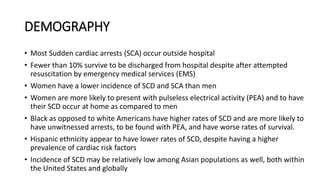
DEMOGRAPHY
• Most Sudden cardiac arrests (SCA) occur outside hospital
• Fewer than 10% survive to be discharged from hospital despite after attempted
resuscitation by emergency medical services (EMS)
• Women have a lower incidence of SCD and SCA than men
• Women are more likely to present with pulseless electrical activity (PEA) and to have
their SCD occur at home as compared to men
• Black as opposed to white Americans have higher rates of SCD and are more likely to
have unwitnessed arrests, to be found with PEA, and have worse rates of survival.
• Hispanic ethnicity appear to have lower rates of SCD, despite having a higher
prevalence of cardiac risk factors
• Incidence of SCD may be relatively low among Asian populations as well, both within
the United States and globally
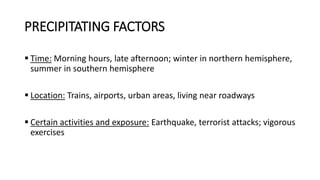
PRECIPITATING FACTORS
 Time: Morning hours, late afternoon; winter in northern hemisphere,
summer in southern hemisphere
 Location: Trains, airports, urban areas, living near roadways
 Certain activities and exposure: Earthquake, terrorist attacks; vigorous
exercises
ETIOLOGY
 Cardiac causes:
a) Coronary artery disease (40-70%)- Ischemic heart disease
b) Non- ischemic heart disease- Cardiomyopathies. Arrythmias (VT,
VF, PEA), Congenital heart disease, valvular heart diseases (MVPS,
MR, AS), WPW, electrolyte abnormalities
 Non- cardiac causes: Stroke, Pulmonary embolism, aortic dissection,
exsanguination, tension pneumothorax, sepsis, medication overdose,
neurogenic
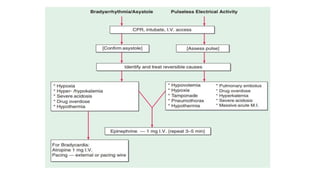
TREATABLE CAUSES OF CARDIAC ARREST
 Hypoxia
 Hypovolemia
 Hydrogen ion (acidosis)
 Hypo-/hyperkalaemia
 Hypothermia
 Toxins
 Tamponade (cardiac)
 Tension pneumothorax
 Thrombosis (pulmonary)
 Thrombosis (coronary)
SIGNS & SYMPTOMS
 Unconsciousness
 No breathing
 No blood pressure
 Pupils dilated (within 45 seconds)
 Seizures
 Death- like appearance
 Lips & nail beds- turns blue
Diagnosis: Lack of carotid pulse
“OUT-OF-HOSPITAL CHAIN OF SURVIVAL”
 Initial evaluation and recognition of the SCA
 Rapid initiation of cardiopulmonary resuscitation (CPR) with an emphasis on
chest compressions
 Defibrillation as quickly as possible usually with an automatic external
defibrillation(AED) applied by the lay rescuer or EMT
 Basic and advanced EMS
 Advanced life support and postcardiac arrest care
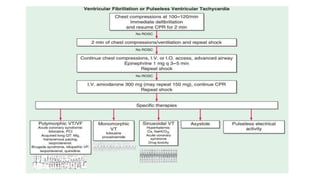
Initial goal of resuscitation is - achieve the return of spontaneous circulation
Success is related to the time between collapse and initiation of resuscitation,
decreasing markedly after 5 min, and the rhythm at the time of EMT arrival, being
best for VT (25–30%), worse for VF and poor for PEA and asystole (<5%).
EFFECTIVE CPR
 Provides 1/4th to 1/3rd of normal blood flow
 Rescue breath contain 16% of oxygen
TIME LOSS
 BP measurement
 Checking peripheral artery pulse
 Listening to heart sounds
 10 seconds for checking responsiveness
 10 seconds to resume chest compression for rescue breaths
 10 seconds to checking central pulses
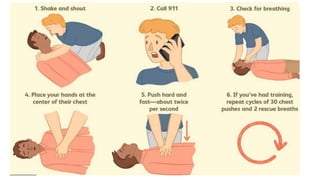
CIRCULATION- AIRWAY- BREATHING (CAB)
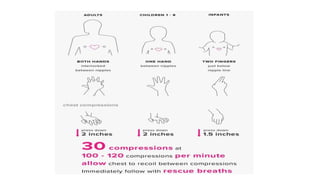
 Circulation: chest compressions (100-120/min)
 Airway: Head tilt, chin lift (open airways)
 Breathing: Rescue breaths (30:2= compressions: breath; victim’s nose
pinch; over one second; with visible chest rise)
ADVANCED AIRWAY- 8-10 breaths/min (not synchronised with
compressions)
RESCUER- one/two; interchange every two minutes
WHEN TO STOP CPR
• Revives and starts breathing
• Advanced medical help arrives
• Exhaustion of rescuer
• Death
• Time of onset of CPR >6 minutes: continue for 15 minutes
• Time of onset of CPR <6 minutes: continue for 30 minutes
AFTER RETURN OF SPONTANEOUS
CIRCULATION (ROSC)
• SpO2 ≥ 94%
• Do not hyperventilate
• Advanced airway capnography
• Treat hypotension (SBP< 90 mm of Hg)- IV fluid bolus, vasopressors,
consider treatable causes, do ECG
• Induce hypothermia
• Cardiac catheterisation

Cardiac arrest cpr shock

  • 1.
    CARDIAC ARREST/ CARDIO PULMONARYRESUCITATION/ SHOCK Dr. Boudhayan Bhattacharjee
  • 2.
    CARDIOVASCULAR COLLAPSE Sudden loss ofeffective circulation due to cardiac and/or peripheral vascular factors that may reverse spontaneously or require interventions Vasovagal syncope, vasodepressor syncope Same as cardiac arrest CARDIAC ARREST Abrupt cessation of cardiac function resulting in loss of effective circulation which may be reversible by prompt emergency medical intervention, but will lead to death in its absence Ventricular fibrillation, ventricular tachycardia, asystole, bradycardia, pulseless electrical activity, noncardiac mechanical factors (e.g., pulmonary embolism) SUDDEN CARDIAC DEATH (SCD) Sudden unexpected death attributed to cardiac arrest, which if witnessed occurs within one hour of symptom onset Same as cardiac arrest
  • 3.
    DEMOGRAPHY • Most Suddencardiac arrests (SCA) occur outside hospital • Fewer than 10% survive to be discharged from hospital despite after attempted resuscitation by emergency medical services (EMS) • Women have a lower incidence of SCD and SCA than men • Women are more likely to present with pulseless electrical activity (PEA) and to have their SCD occur at home as compared to men • Black as opposed to white Americans have higher rates of SCD and are more likely to have unwitnessed arrests, to be found with PEA, and have worse rates of survival. • Hispanic ethnicity appear to have lower rates of SCD, despite having a higher prevalence of cardiac risk factors • Incidence of SCD may be relatively low among Asian populations as well, both within the United States and globally
  • 4.
    PRECIPITATING FACTORS  Time:Morning hours, late afternoon; winter in northern hemisphere, summer in southern hemisphere  Location: Trains, airports, urban areas, living near roadways  Certain activities and exposure: Earthquake, terrorist attacks; vigorous exercises
  • 5.
    ETIOLOGY  Cardiac causes: a)Coronary artery disease (40-70%)- Ischemic heart disease b) Non- ischemic heart disease- Cardiomyopathies. Arrythmias (VT, VF, PEA), Congenital heart disease, valvular heart diseases (MVPS, MR, AS), WPW, electrolyte abnormalities  Non- cardiac causes: Stroke, Pulmonary embolism, aortic dissection, exsanguination, tension pneumothorax, sepsis, medication overdose, neurogenic
  • 6.
    TREATABLE CAUSES OFCARDIAC ARREST  Hypoxia  Hypovolemia  Hydrogen ion (acidosis)  Hypo-/hyperkalaemia  Hypothermia  Toxins  Tamponade (cardiac)  Tension pneumothorax  Thrombosis (pulmonary)  Thrombosis (coronary)
  • 7.
    SIGNS & SYMPTOMS Unconsciousness  No breathing  No blood pressure  Pupils dilated (within 45 seconds)  Seizures  Death- like appearance  Lips & nail beds- turns blue Diagnosis: Lack of carotid pulse
  • 8.
    “OUT-OF-HOSPITAL CHAIN OFSURVIVAL”  Initial evaluation and recognition of the SCA  Rapid initiation of cardiopulmonary resuscitation (CPR) with an emphasis on chest compressions  Defibrillation as quickly as possible usually with an automatic external defibrillation(AED) applied by the lay rescuer or EMT  Basic and advanced EMS  Advanced life support and postcardiac arrest care Initial goal of resuscitation is - achieve the return of spontaneous circulation Success is related to the time between collapse and initiation of resuscitation, decreasing markedly after 5 min, and the rhythm at the time of EMT arrival, being best for VT (25–30%), worse for VF and poor for PEA and asystole (<5%).
  • 11.
    EFFECTIVE CPR  Provides1/4th to 1/3rd of normal blood flow  Rescue breath contain 16% of oxygen TIME LOSS  BP measurement  Checking peripheral artery pulse  Listening to heart sounds  10 seconds for checking responsiveness  10 seconds to resume chest compression for rescue breaths  10 seconds to checking central pulses
  • 12.
    CIRCULATION- AIRWAY- BREATHING(CAB)  Circulation: chest compressions (100-120/min)  Airway: Head tilt, chin lift (open airways)  Breathing: Rescue breaths (30:2= compressions: breath; victim’s nose pinch; over one second; with visible chest rise) ADVANCED AIRWAY- 8-10 breaths/min (not synchronised with compressions) RESCUER- one/two; interchange every two minutes
  • 13.
    WHEN TO STOPCPR • Revives and starts breathing • Advanced medical help arrives • Exhaustion of rescuer • Death • Time of onset of CPR >6 minutes: continue for 15 minutes • Time of onset of CPR <6 minutes: continue for 30 minutes
  • 16.
    AFTER RETURN OFSPONTANEOUS CIRCULATION (ROSC) • SpO2 ≥ 94% • Do not hyperventilate • Advanced airway capnography • Treat hypotension (SBP< 90 mm of Hg)- IV fluid bolus, vasopressors, consider treatable causes, do ECG • Induce hypothermia • Cardiac catheterisation