CARBON MARKET AND ITS
PERFORMANCE
OVER VIEW
1. GLOBAL WARMING
AND CLIMATE
CHANGE
2. KYOTO PROTOCOL
3. CARBON TRADING
AND CARBON
MARKETS
4. PERFORMANCE OF
CARBON MARKETS
5. ADVANTAGES AND
DISADVANTAGES OF
CARBON MARKETS
6. INDIA ‘S ROLE IN
CARBON TRADE
7. CARBON TRADE
ASSOCIATED JOB
OPPERTUNITIES
GLOBAL WARMING AND CLIMATE CHANGE
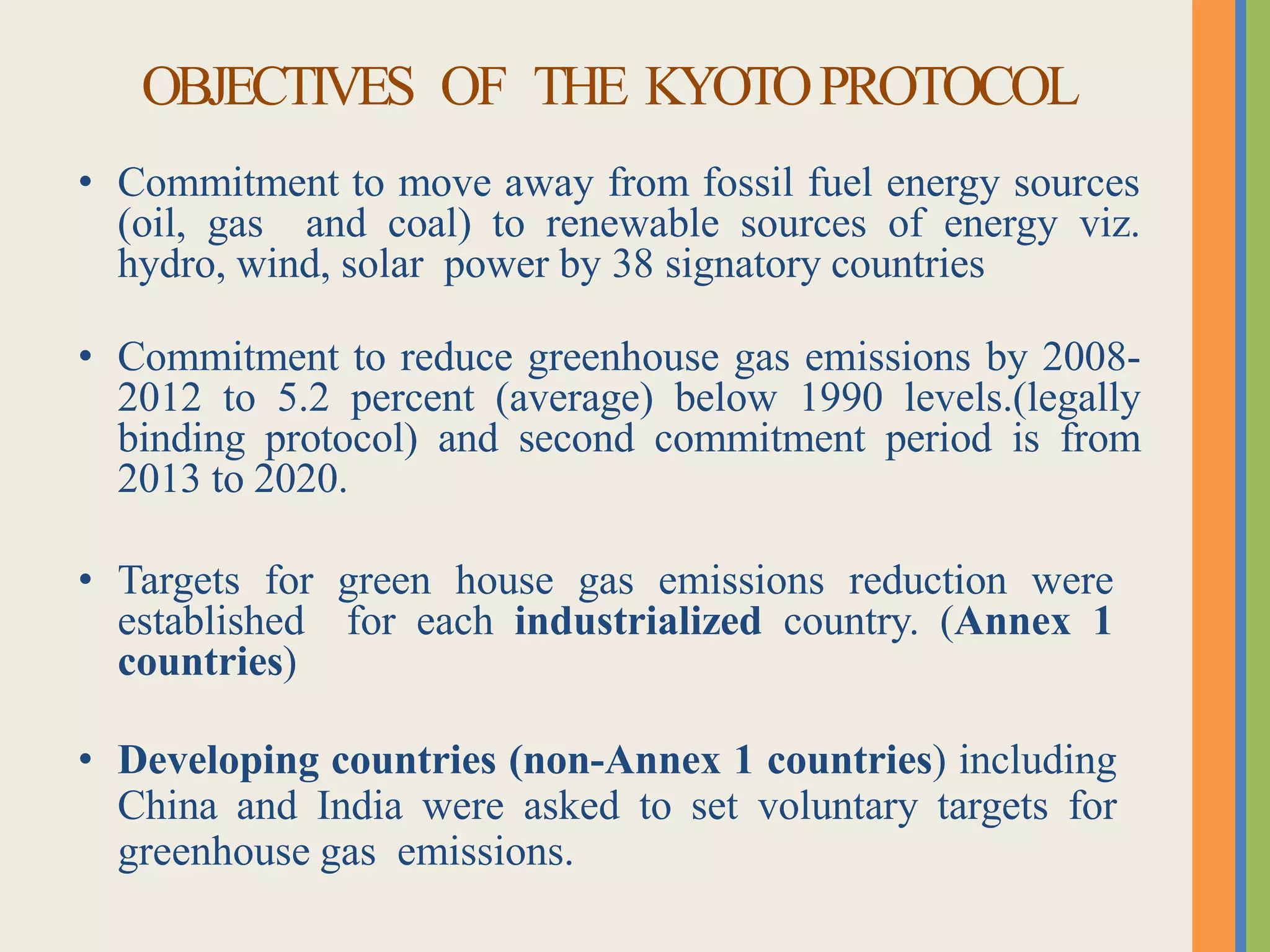
• Global warming is the long term heating of Earth’s climate
system observed since the pre-industrial period (1850-1900)
• It is the increase in average temperature of earth surface due to
the increasing concentration of carbon dioxide in atmosphere.
• Climate change is a long term change in the average weather
patterns that have come to define earths local, regional and
global climates.
• Natural processes can also contribute to climate change.
• But global warming is due to human activities primarily fossil
fuel burning which increases trapping green house gases in
atmosphere
GREEN HOUSE GASES
 CO2
 Methane
 Nitrous Oxide
 Hydroflourocarb
on
 Sulphur
Hexaflouride
 Perflourocarbon
THE KYOTO PROTOCOL
• An United Nation- led international agreement reached in
11th December 1997 in Kyoto, Japan under UNFCCC
(United Nations Framework Convection on Climate
Change)
• Put to force on 16 th February 2005.
• To address the problems of climate change and the reduction
of greenhouse gas emissions.
OBJECTIVES OF THE KYOTOPROTOCOL
• Commitment to move away from fossil fuel energy sources
(oil, gas and coal) to renewable sources of energy viz.
hydro, wind, solar power by 38 signatory countries
• Commitment to reduce greenhouse gas emissions by 2008-
2012 to 5.2 percent (average) below 1990 levels.(legally
binding protocol) and second commitment period is from
2013 to 2020.
• Targets for green house gas emissions reduction were
established for each industrialized country. (Annex 1
countries)
• Developing countries (non-Annex 1 countries) including
China and India were asked to set voluntary targets for
greenhouse gas emissions.
PRINCIPLE:
COMMON
BUT
DIFFERENTIATED
RESPONSIBILITY
KYOTO MECHANISMS
• Clean Development Mechanism (CDM)
• Developed countries can fund emission reduction projects
(e.g. Solar energy, wind energy and other green
technologies) in developing nations that did not sign Kyoto
Protocol.
• In exchange, the developed countries earn legally
recognized emission credits called CERs (Certified
Emission Reduction) to offset their emission obligations.
KYOTO MECHANISMS
• Joint implementation (JI)
• Developed countries can implement emission reduction
projects in another developed or developing country and
earn Emission Reduction Units (ERUs).
• ERUs can be used to meet the carbon allowance or can be
sold in the market.
KYOTO MECHANISMS
• Emission Trading (ET)
• Countries whose emissions are less than their
assigned amount can sell the excess amount to
countries whose emissions have exceeded their
assigned amount
The Assigned amounts can be defined as a tradable
allowances, or commodity, and this free market is
known as the “CARBON MARKET."
CARBON TRADING
• Carbon trading or carbon emission trading is a form of
emission trading that specifically targets carbon dioxide
(calculated in tonnes of carbon dioxide equivalent).
• It currently constitutes the bulk of emission trading.
• This form of permit trading is a common method countries
utilize in order to meet their obligations specified by kyoto
protocol to mitigate future climate change .
CARBON MARKETS
• Carbon markets aim to reduce green house gas emissions
cost effectively by setting limits on emission enabling the
trade of emission units ,which are the instruments
representing emission reductions .
• Trading enables entities that can reduce emissions at lower
cost to be paid to do so by higher –cost emitters ,thus
lowering the economic cost of reducing emissions.
CARBON MARKETS
• A carbon market is where carbon emission offsets or
permit credits are bought and sold.
There are two types of carbon markets:
• Compliance market
• Voluntary market
Compliance market
In the compliance market, companies, governments, or other
entities buy carbon offsets in order to comply with caps on
the total amount of greenhouse gas (GHG) they are allowed to
emit within a CAP & TRADE SYSTEM
Voluntary market
In the voluntary market, individuals, companies, or
governments purchase carbon offsets to compensate for their
own greenhouse gas emissions.
Example : Air travelers purchase carbon offsets to compensate
for the green house gas emissions from their flights. Many
airlines offer offsets as you purchase your tickets.
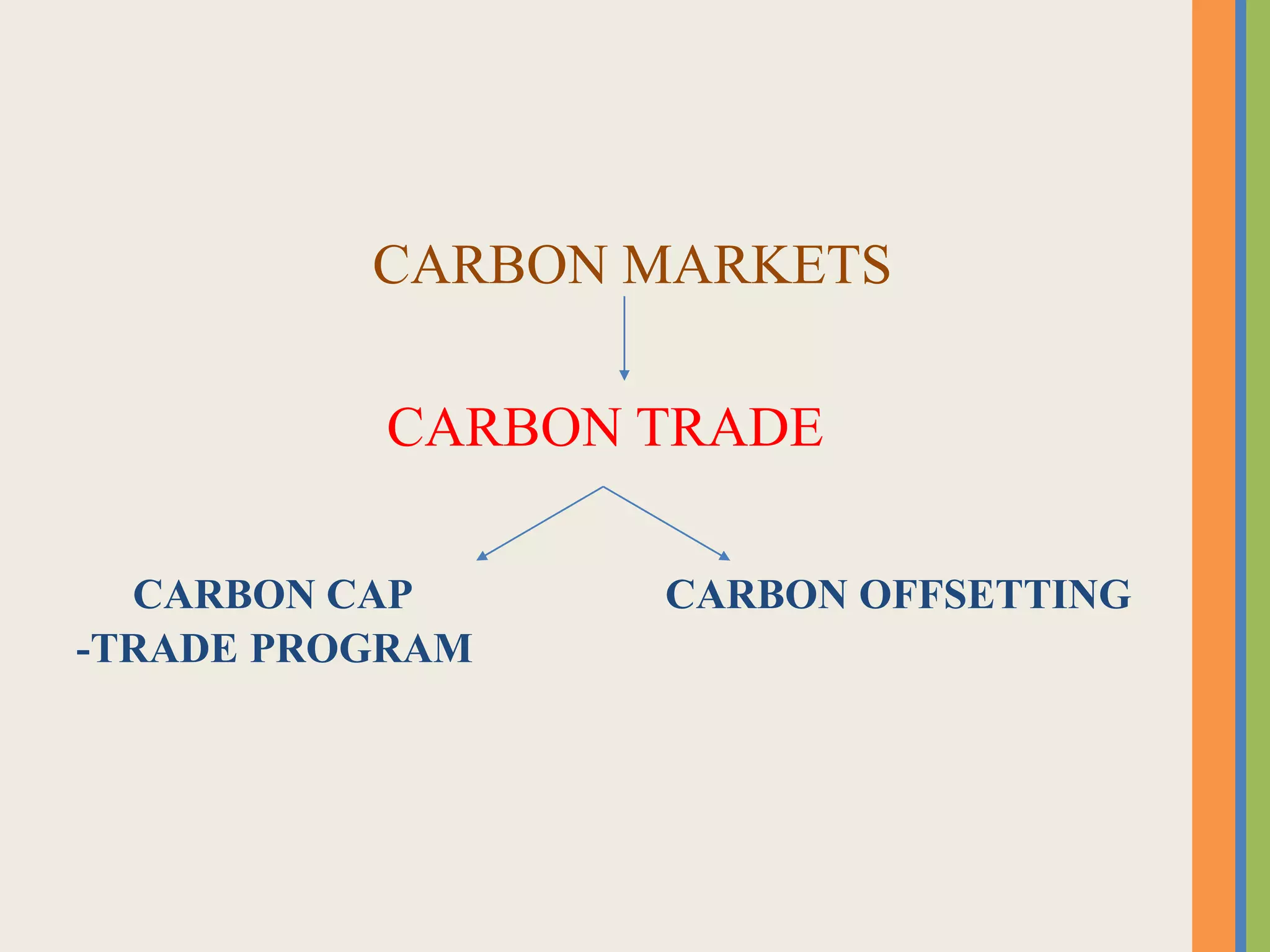
CARBON MARKETS
CARBON TRADE
CARBON CAP CARBON OFFSETTING
-TRADE PROGRAM
CARBON CAP-TRADE PROGRAM
• CAP- Assignment of an upper threshold limit on the
amount of pollutant that can be emitted (measured in
Assigned Amount Units or AAUs) by a country.
• Emission permits or equivalent number of
allowances or credits are issued to emit a specific
amount of carbon dioxide (cap) to the country.
1 credit= 1 ton of carbon dioxide
CARBON CAP-TRADE PROGRAM
• TRADE- the transfer or trade of allowances.
• Excess or unused allowances/credits can be traded to the
countries whose emissions have exceeded their assigned
cap.
• The purchased allowances can be used to increase the
allowance limit by the purchasing country.
CARBON CAP-TRADE PROGRAM
• Countries whose emissions are less than their assigned
amount or the CAP can sell or TRADE the excess amount
to countries whose emissions have exceeded their assigned
amount
CARBON OFFSETTING
• Offset Credits for eco-friendly technologies are
purchased by developed nations to avoid or
substitute reduction in their own emission.
• Investments in green technologies and harness
alternative forms of energy in the developing nations.
Benefits of carbon trading
• Reduction in green house gas emission
Stringency in the cap or the upper threshold limit is
contributing to lower emission over the years
• Source of revenue for developing nations
Developing nations can earn revenue by selling
carbon credits to countries with more fossil fuel demand.
• Supports a free market system
The carbon trade market is without any economic
intervention and regulation by government except to
regulate against force or fraud
• Alternative sources of energy or green technology
Threshold limits encourages industries to harness
alternative sources of energy and invest in green
technology globally or in indigenous research.
Disadvantages of carbon trading
• Right to pollute
Industries in the ratified nations are purchasing legal
rights to pollute the atmosphere
• Slow process
Industries are opting the easy way– purchase
more allowances than implementing greener
technologies
• Lack of centralized system or global framework
Absence of a centralized and accepted global
standards/act are missing
• No effective carbon reduction in the atmosphere
Leads to carbon reduction in one place and results
in carbon emission in some other place
What should be the price of carbon????
At present, price of 1 carbon credit
is 10 Euro to 15 Euro
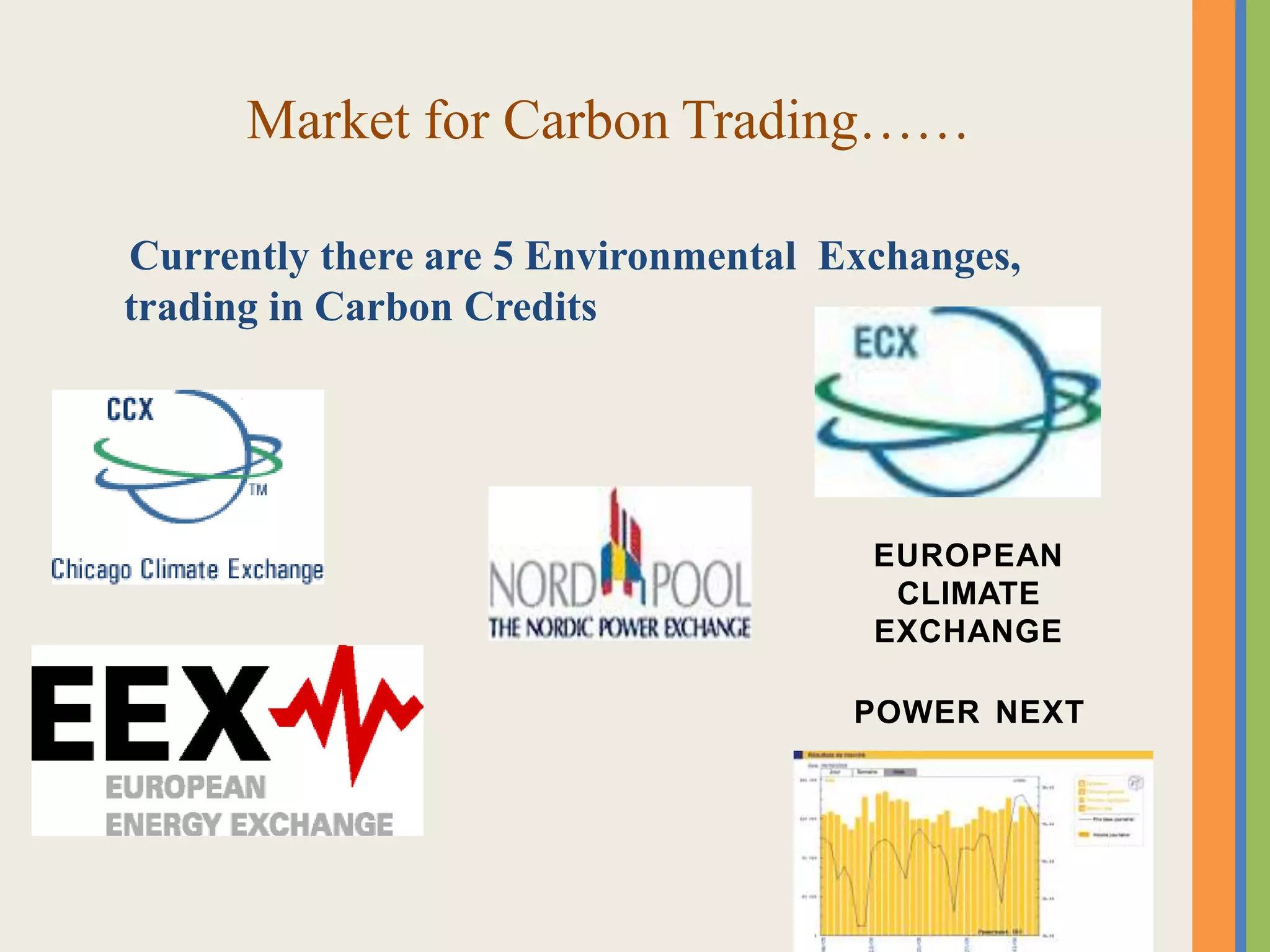
Market for Carbon Trading……
Currently there are 5 Environmental Exchanges,
trading in Carbon Credits
EUROPEAN
CLIMATE
EXCHANGE
POWER NEXT
India along with China, lead countries in
earning Carbon Credit
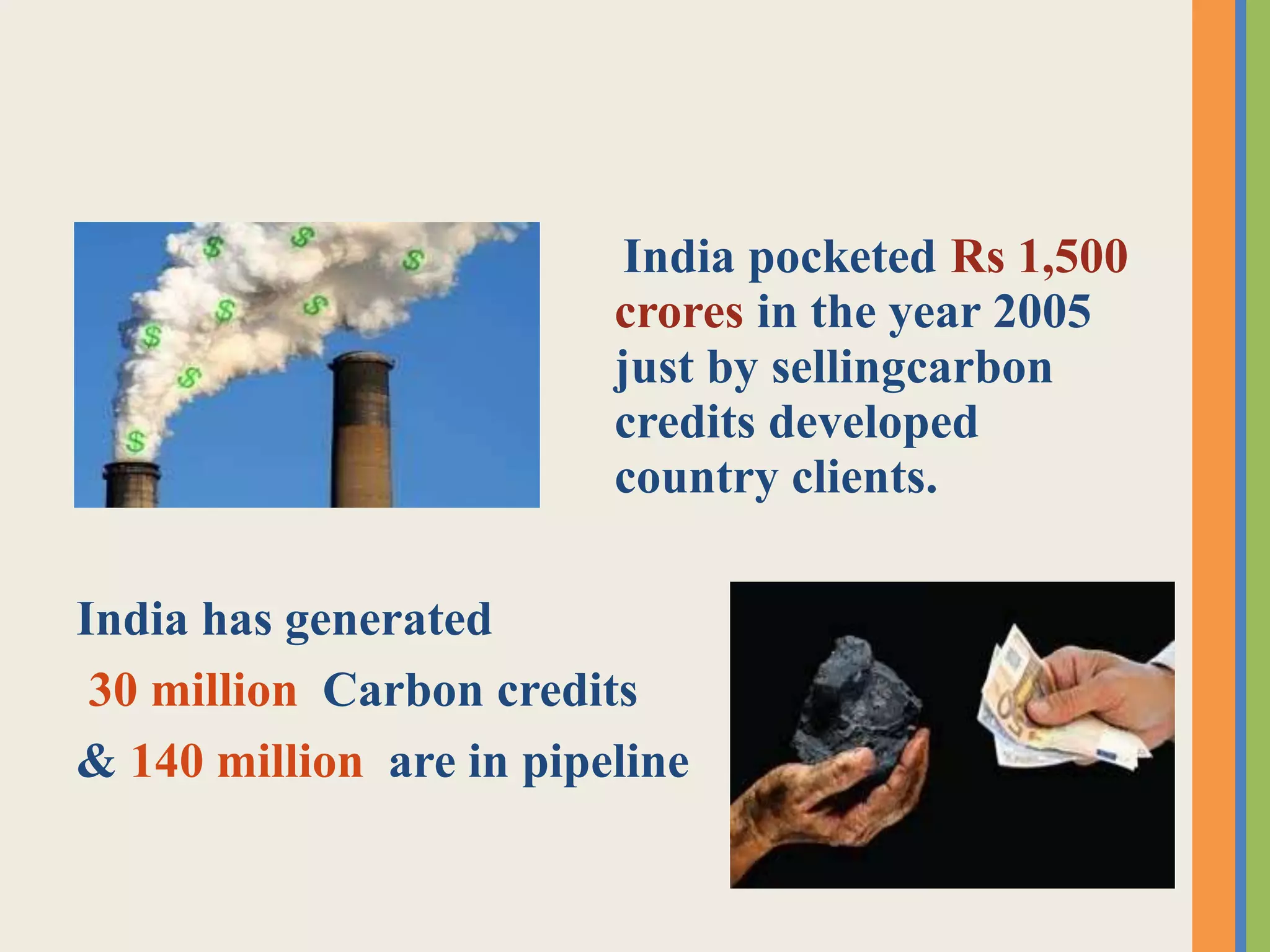
India pocketed Rs 1,500
crores in the year 2005
just by sellingcarbon
credits developed
country clients.
India has generated
30 million Carbon credits
& 140 million are in pipeline
Some of the Leading companies of India
using & selling Carbon Credits…
C
GUJARAT
FLOUROCARBONS Ltd
Carbon trading associated job opportunities
• Scope for Chartered Accountants
• As an auditor in audit of carbon trading
• As aCarbon Trading
Consultant
• Carbon Trading Broker
PERFORMANCE OF CARBON MARKETS
Performance of EU
• Set up in 2005, the EU ETS is the world's
first international emissions trading system.
• It remains the biggest one, accounting for over three-
quarters of internationl carbon trading.
• The EU ETS is also inspiring the development of emissions
trading in other countries and regions. The EU aims to link
the EU ETS with other compatible systems.
• The EU ETS has proved that putting a price on carbon and
trading in it can work. Emissions from installations in the
system are falling as intended – by slightly over 8%
compared to the beginning of phase 3 .
• In 2020, emissions from sectors covered by the system will
be 21% lower than in 2005.
• In 2030, under the revised system they will be 43% lower.
Performance of CCX
• The Chicago Climate Exchange (CCX) was North America’s
only voluntary, legally binding greenhouse gas (GHG) reduction
and trading system for emission sources and offset projects in
North America and Brazil.
• CCX employed independent verification, included six
greenhouse gases, and traded greenhouse gas emission
allowances from 2003 to 2010.
• The companies joining the exchange committed to reducing their
aggregate emissions by 6% by 2010. CCX had an aggregate
baseline of 680 million metric tons of CO2 equivalent
• The exchange had more than 400 members ranging from
corporations like Ford, DuPont, and Motorola, to state and
municipalities such as Oakland and Chicago, to educational
institutions such as University of California
CARBON TRADING IN INDIA
Jindal Vijaynagar Steel
The Jindal Vijaynagar Steel has recently declared that by
the next ten years it will be ready to sell $225 million
worth of saved carbon. This was made possible since their
steel plant uses the Corex furnace technology which
prevents 15 million tonnes of carbon from being
discharged into the atmosphere.
Powerguda in Andhra Pradesh
The village in Andhra Pradesh was selling 147 tonnes
equivalent of saved carbon dioxide credits. The company
has made a claim of having saved 147 MT of CO2. This
was done by extracting bio-diesel from 4500 Pongamia
trees in their village.
Handia Forest in Madhya Pradesh
In Madhya Pradesh, it is estimated that 95 very poor rural
villages would jointly earn at least US$300,000 every year
from carbon payments by restoring 10,000 hectares of
degraded community forests.
CONCLUSION
o Carbon Trading brings forth financial incentives to reduce
carbon dioxide emission and implement eco-friendly/green
technologies.
o Stringent assignment of the caps or the upper threshold
limits over the years can ameliorate the green house gas
emission problem.
o The alternative/renewable sources of energy like wind, solar
and hydro are supposed to get financial boost
to substitute fossil fuels
REFERENCE
• https://www.wikipedia.org
• https://unfccc.int/topics/market-and-non-market-
mechanisms/the-big-picture/what-are-market-and-non-
market-mechanisms
• https://www.wto.org/
• https://ec.europa.eu/clima/policies/ets_
• https://en.wikipedia.org/wiki/Chicago_Climate_Exchange
• http://www.legalservicesindia.com/article/264/Carbon-
Trading-In-India.html
THANK YOU
Prepared by : SHILPA P ,M.Sc Agricultural Extenson ,KAU,Thrissur

Carbon markets and its performance

  • 1.
    CARBON MARKET ANDITS PERFORMANCE
  • 2.
    OVER VIEW 1. GLOBALWARMING AND CLIMATE CHANGE 2. KYOTO PROTOCOL 3. CARBON TRADING AND CARBON MARKETS 4. PERFORMANCE OF CARBON MARKETS 5. ADVANTAGES AND DISADVANTAGES OF CARBON MARKETS 6. INDIA ‘S ROLE IN CARBON TRADE 7. CARBON TRADE ASSOCIATED JOB OPPERTUNITIES
  • 3.
    GLOBAL WARMING ANDCLIMATE CHANGE • Global warming is the long term heating of Earth’s climate system observed since the pre-industrial period (1850-1900) • It is the increase in average temperature of earth surface due to the increasing concentration of carbon dioxide in atmosphere. • Climate change is a long term change in the average weather patterns that have come to define earths local, regional and global climates.
  • 4.
    • Natural processescan also contribute to climate change. • But global warming is due to human activities primarily fossil fuel burning which increases trapping green house gases in atmosphere
  • 5.
    GREEN HOUSE GASES CO2  Methane  Nitrous Oxide  Hydroflourocarb on  Sulphur Hexaflouride  Perflourocarbon
  • 6.
    THE KYOTO PROTOCOL •An United Nation- led international agreement reached in 11th December 1997 in Kyoto, Japan under UNFCCC (United Nations Framework Convection on Climate Change) • Put to force on 16 th February 2005. • To address the problems of climate change and the reduction of greenhouse gas emissions.
  • 7.
    OBJECTIVES OF THEKYOTOPROTOCOL • Commitment to move away from fossil fuel energy sources (oil, gas and coal) to renewable sources of energy viz. hydro, wind, solar power by 38 signatory countries • Commitment to reduce greenhouse gas emissions by 2008- 2012 to 5.2 percent (average) below 1990 levels.(legally binding protocol) and second commitment period is from 2013 to 2020. • Targets for green house gas emissions reduction were established for each industrialized country. (Annex 1 countries) • Developing countries (non-Annex 1 countries) including China and India were asked to set voluntary targets for greenhouse gas emissions.
  • 8.
  • 9.
    KYOTO MECHANISMS • CleanDevelopment Mechanism (CDM) • Developed countries can fund emission reduction projects (e.g. Solar energy, wind energy and other green technologies) in developing nations that did not sign Kyoto Protocol. • In exchange, the developed countries earn legally recognized emission credits called CERs (Certified Emission Reduction) to offset their emission obligations.
  • 10.
    KYOTO MECHANISMS • Jointimplementation (JI) • Developed countries can implement emission reduction projects in another developed or developing country and earn Emission Reduction Units (ERUs). • ERUs can be used to meet the carbon allowance or can be sold in the market.
  • 11.
    KYOTO MECHANISMS • EmissionTrading (ET) • Countries whose emissions are less than their assigned amount can sell the excess amount to countries whose emissions have exceeded their assigned amount The Assigned amounts can be defined as a tradable allowances, or commodity, and this free market is known as the “CARBON MARKET."
  • 12.
    CARBON TRADING • Carbontrading or carbon emission trading is a form of emission trading that specifically targets carbon dioxide (calculated in tonnes of carbon dioxide equivalent). • It currently constitutes the bulk of emission trading. • This form of permit trading is a common method countries utilize in order to meet their obligations specified by kyoto protocol to mitigate future climate change .
  • 13.
    CARBON MARKETS • Carbonmarkets aim to reduce green house gas emissions cost effectively by setting limits on emission enabling the trade of emission units ,which are the instruments representing emission reductions . • Trading enables entities that can reduce emissions at lower cost to be paid to do so by higher –cost emitters ,thus lowering the economic cost of reducing emissions.
  • 14.
    CARBON MARKETS • Acarbon market is where carbon emission offsets or permit credits are bought and sold. There are two types of carbon markets: • Compliance market • Voluntary market
  • 15.
    Compliance market In thecompliance market, companies, governments, or other entities buy carbon offsets in order to comply with caps on the total amount of greenhouse gas (GHG) they are allowed to emit within a CAP & TRADE SYSTEM Voluntary market In the voluntary market, individuals, companies, or governments purchase carbon offsets to compensate for their own greenhouse gas emissions. Example : Air travelers purchase carbon offsets to compensate for the green house gas emissions from their flights. Many airlines offer offsets as you purchase your tickets.
  • 16.
    CARBON MARKETS CARBON TRADE CARBONCAP CARBON OFFSETTING -TRADE PROGRAM
  • 17.
    CARBON CAP-TRADE PROGRAM •CAP- Assignment of an upper threshold limit on the amount of pollutant that can be emitted (measured in Assigned Amount Units or AAUs) by a country. • Emission permits or equivalent number of allowances or credits are issued to emit a specific amount of carbon dioxide (cap) to the country. 1 credit= 1 ton of carbon dioxide
  • 18.
    CARBON CAP-TRADE PROGRAM •TRADE- the transfer or trade of allowances. • Excess or unused allowances/credits can be traded to the countries whose emissions have exceeded their assigned cap. • The purchased allowances can be used to increase the allowance limit by the purchasing country.
  • 19.
    CARBON CAP-TRADE PROGRAM •Countries whose emissions are less than their assigned amount or the CAP can sell or TRADE the excess amount to countries whose emissions have exceeded their assigned amount
  • 20.
    CARBON OFFSETTING • OffsetCredits for eco-friendly technologies are purchased by developed nations to avoid or substitute reduction in their own emission. • Investments in green technologies and harness alternative forms of energy in the developing nations.
  • 21.
    Benefits of carbontrading • Reduction in green house gas emission Stringency in the cap or the upper threshold limit is contributing to lower emission over the years • Source of revenue for developing nations Developing nations can earn revenue by selling carbon credits to countries with more fossil fuel demand.
  • 22.
    • Supports afree market system The carbon trade market is without any economic intervention and regulation by government except to regulate against force or fraud • Alternative sources of energy or green technology Threshold limits encourages industries to harness alternative sources of energy and invest in green technology globally or in indigenous research.
  • 23.
    Disadvantages of carbontrading • Right to pollute Industries in the ratified nations are purchasing legal rights to pollute the atmosphere • Slow process Industries are opting the easy way– purchase more allowances than implementing greener technologies
  • 24.
    • Lack ofcentralized system or global framework Absence of a centralized and accepted global standards/act are missing • No effective carbon reduction in the atmosphere Leads to carbon reduction in one place and results in carbon emission in some other place
  • 25.
    What should bethe price of carbon???? At present, price of 1 carbon credit is 10 Euro to 15 Euro
  • 26.
    Market for CarbonTrading…… Currently there are 5 Environmental Exchanges, trading in Carbon Credits EUROPEAN CLIMATE EXCHANGE POWER NEXT
  • 27.
    India along withChina, lead countries in earning Carbon Credit
  • 28.
    India pocketed Rs1,500 crores in the year 2005 just by sellingcarbon credits developed country clients. India has generated 30 million Carbon credits & 140 million are in pipeline
  • 29.
    Some of theLeading companies of India using & selling Carbon Credits… C GUJARAT FLOUROCARBONS Ltd
  • 30.
    Carbon trading associatedjob opportunities • Scope for Chartered Accountants
  • 31.
    • As anauditor in audit of carbon trading • As aCarbon Trading Consultant • Carbon Trading Broker
  • 32.
  • 33.
    Performance of EU •Set up in 2005, the EU ETS is the world's first international emissions trading system. • It remains the biggest one, accounting for over three- quarters of internationl carbon trading. • The EU ETS is also inspiring the development of emissions trading in other countries and regions. The EU aims to link the EU ETS with other compatible systems.
  • 34.
    • The EUETS has proved that putting a price on carbon and trading in it can work. Emissions from installations in the system are falling as intended – by slightly over 8% compared to the beginning of phase 3 . • In 2020, emissions from sectors covered by the system will be 21% lower than in 2005. • In 2030, under the revised system they will be 43% lower.
  • 35.
    Performance of CCX •The Chicago Climate Exchange (CCX) was North America’s only voluntary, legally binding greenhouse gas (GHG) reduction and trading system for emission sources and offset projects in North America and Brazil. • CCX employed independent verification, included six greenhouse gases, and traded greenhouse gas emission allowances from 2003 to 2010. • The companies joining the exchange committed to reducing their aggregate emissions by 6% by 2010. CCX had an aggregate baseline of 680 million metric tons of CO2 equivalent
  • 36.
    • The exchangehad more than 400 members ranging from corporations like Ford, DuPont, and Motorola, to state and municipalities such as Oakland and Chicago, to educational institutions such as University of California
  • 37.
    CARBON TRADING ININDIA Jindal Vijaynagar Steel The Jindal Vijaynagar Steel has recently declared that by the next ten years it will be ready to sell $225 million worth of saved carbon. This was made possible since their steel plant uses the Corex furnace technology which prevents 15 million tonnes of carbon from being discharged into the atmosphere.
  • 38.
    Powerguda in AndhraPradesh The village in Andhra Pradesh was selling 147 tonnes equivalent of saved carbon dioxide credits. The company has made a claim of having saved 147 MT of CO2. This was done by extracting bio-diesel from 4500 Pongamia trees in their village. Handia Forest in Madhya Pradesh In Madhya Pradesh, it is estimated that 95 very poor rural villages would jointly earn at least US$300,000 every year from carbon payments by restoring 10,000 hectares of degraded community forests.
  • 40.
    CONCLUSION o Carbon Tradingbrings forth financial incentives to reduce carbon dioxide emission and implement eco-friendly/green technologies. o Stringent assignment of the caps or the upper threshold limits over the years can ameliorate the green house gas emission problem. o The alternative/renewable sources of energy like wind, solar and hydro are supposed to get financial boost to substitute fossil fuels
  • 41.
    REFERENCE • https://www.wikipedia.org • https://unfccc.int/topics/market-and-non-market- mechanisms/the-big-picture/what-are-market-and-non- market-mechanisms •https://www.wto.org/ • https://ec.europa.eu/clima/policies/ets_ • https://en.wikipedia.org/wiki/Chicago_Climate_Exchange • http://www.legalservicesindia.com/article/264/Carbon- Trading-In-India.html
  • 42.
    THANK YOU Prepared by: SHILPA P ,M.Sc Agricultural Extenson ,KAU,Thrissur