Natural Environment
Dr. Ankit Jain
Environment
• Environment is sum total of air, water and land, the
interrelationship among themselves with human beings and
other living organism.
• The surrounding or condition in which a person, plant or animal
can live or operate is called environment.
• So in nut shell we can say that "environment" is total
surroundings of an organism.
Major Environment Issues
• Global Warming
• Pollution
• Deforestation
• Water Scarcity
• Loss of Biodiversity
• Soil Erosion
Global Warming
Global warming is the increase in temperature of the Earth's
surface (both land and water) as well as it's atmosphere.
Green House Effect
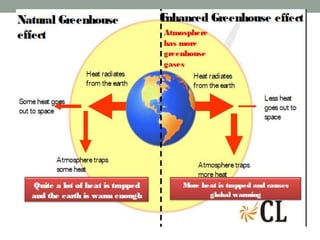
• The green house effect is a natural process that warms the earth
surface.
• When the Sun’s energy reaches the earths atmosphere, some of
it is reflected back to space and the rest is absorbed and
reradiated by green house gases.
• The absorbed energy warms the atmosphere and the surface of
earth.
Contribution to Green House Gases
Green house gases include:
• Carbon Dioxide
• Water Vapor
• Methane
• Ozone
• Nitrous Oxide
• Chlorofluorocarbons Gases
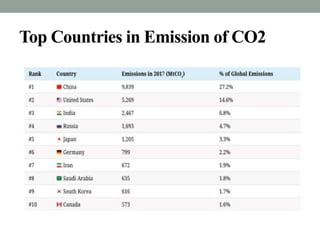
Top Countries in Emission of CO2
ImportantAgreement
• Kyoto Protocol
• Paris Climate Agreement
Kyoto Protocol
• The Kyoto Protocol is an international agreement agreed in
Kyoto, Japan in December 1997to reduce worldwide emission
of green house gases.
Kyoto Protocol
• The Kyoto Protocol is a protocol to the United Nations
Framework Convention on Climate Change (UNFCCC),
aimed at fighting global warming.
• The Kyoto Protocol, also known as the Kyoto Accord, is an
international treaty among different member nation that on
industrialized nations sets mandatory limits on greenhouse gas
emissions.
• The initial treaty was signed in Kyoto, Japan in 1997.
• It was implemented in 2005.
• At negotiations, Annex I countries (including the US)
collectively agreed to reduce their greenhouse gas emissions by
5.2% on average for the period 2008-2012.
• Since the US has not ratified the treaty, the collective emissions
reduction of Annex I Kyoto countries falls from 5.2 % to 4.2%
below base year.
• Clean Development Mechanism was designed to limit
emissions in developing countries
Kyoto Protocol
The United States has not ratified the Kyoto Protocol due to
following reasons:
• The main objection of the US to ratification is regarding the
nature of participation of developing countries. The US will not
ratify the Protocol unless developing countries are also required
to keep greenhouse gas levels at targeted minimums.
• The US feels that the Kyoto Protocol is unfair in that countries
like itself will be harmed economically because they will have
to make the most changes in order to adhere to targeted levels of
CO2 levels set forth in the Kyoto Protocol.
• In 2011 Canada withdraw from kyoto protocol.
The Unresolved issues in KYOTO
• No details on specific policies and measures to meet reduction
targets.
• No commitments from developing nations.
• No details about penalties.
• No details on funding mechanisms for developing nations.
Paris ClimateAgreement
• Paris climate agreement is an international agreement to combat
climate change.
• The deal unites all the world's nations in a single agreement on
tackling climate change for the first time in history.
• The Kyoto Protocol of 1997 set emission cutting targets for a
handful of developed countries, but the US pulled out and
others failed to comply.
Paris ClimateAgreement
• From 30 November to 11 December 2015, the governments of
195 nations gathered in Paris, France, and discussed a possible
new global agreement on climate change, aimed at reducing
global greenhouse gas emissions and thus reduce the threat of
dangerous climate change.
• It was implemented from Feb 2020.
Key element of ParisAgreement
• The Paris Agreement, in seeking to strengthen the global
response to climate change, reaffirms the goal of limiting global
temperature increase to well below 2 degrees Celsius, while
pursuing efforts to limit the increase to 1.5 degrees.
• Strengthen the ability of countries to deal with the impacts of
climate change.
• It also mentions the need to review each country’s contribution
to cutting emissions every five years so they scale up to the
challenge.
• Rich countries should help poorer nations by providing ā€œclimate
financeā€ to adapt to climate change and switch to renewable
energy.
Key features of India’s targets
• To bring down its emissions intensity by 30 to 33 per cent from 2005
levels by 2030.
• To increase the share of non-fossil fuel energy to 40 per cent by 2030.
• To create an additional carbon sink of 2.5 to 3 billion tonnes of
carbon di-oxide (CO2) equivalent by increasing its forest and tree
cover by 2030.
• To invest in development programs in areas vulnerable to climate
change and also to health and disaster management.
Important Terms
• Carbon Credit
• Carbon Offsetting
• Carbon Tax
• Carbon Foot Print
• Carbon Sink
• Carbon Dieting
Carbon Credit
• A carbon credit is a permit or certificate allowing the holder to emit carbon
dioxide or other greenhouse gases.
• The credit limits the emission to a mass equal to one ton of carbon
dioxide.
• The issuance of carbon credits aims to reduce the emission of greenhouse
gases into the atmosphere.
• Carbon credit can be used by governments, industry or private individuals
to compensate for the emissions they are generating.
• It is also known as cap and trade system.
How Carbon Credit Works
• A national or supranational authority sets a global cap on CO2
emissions.
• This value is divided among countries and businesses into ā€œemission
rightsā€.
• Their commitment is to maintain CO2 emissions lower or equal to the
Assigned Amount.
• If their emissions are higher than the Assigned Amount, the subject
has to purchase the missing credits from those who have extra credits
because they have succeeded in limiting their emissions in relation to
the cap.
• If any country exceeds this limit, they have to buy carbon
credits from the country with less emission (Trading).
• In India carbon trade is like a commodity which is traded on
MCX.
• 1 Carbon Credit = 1 tonne of Carbon emission rights.
• India’s contribution to global carbon trading market is
increasing.
Areas of Carbon Credit Generation
• Wind Power Company
• Reforestation
• Solar Energy
Carbon Offsetting
• Carbon offsetting is an internationally recognized way to take responsibility for
unavoidable carbon emissions.
• Reduction in emission of green house gases made in order to compensate for
(offset)emission made elsewhere.
• For example, suppose a thermal plant of 800 megawatt capacity emit 400
carbon-equivalent in the atmosphere.
• Now other country builds up a 800 megawatt wind energy plant which does not
generate any amount of emission as an alternative of the thermal plant. Then by
investing in this project the country will earn 400 carbon-equivalent.
Carbon Tax
• A carbon tax is a fee for making users of fossil fuels pay for climate
damage their fuel use imposes by releasing carbon dioxide into the
atmosphere, and for motivating switches to clean energy
• Carbon tax is a form of pollution tax.
• India introduced a nationwide carbon tax in 2010, which is currently
Rs.400/tonne.
• The carbon tax that was introduced a few years ago is now at Rs400
per tonne, almost one-fifth the cost of mining coal.
Why Carbon tax is Levied ?
• Encourage Renewable source of Energy.
• Less Carbon dioxide emission.
• Minimized global warming effect.
• Government Revenue.
Carbon Sink
• Carbon sinks are natural systems that suck up and store carbon
dioxide from the atmosphere.
• The main natural carbon sinks are plants, the ocean and soil.
• Oceans are the largest active carbon sink on Earth, absorbing
more than a quarter of the carbon dioxide that humans put into
the air.
Carbon Foot Print
The amount of carbon dioxide released into the atmosphere as a
result of the activities of a particular individual, organization, or
community.
Foot print you leave on environment with every release of CO2
due to burning of fossil fuel.
• When you drive a car, the engine burns fuel which creates a certain
amount of CO2, depending on its fuel consumption and the driving
distance.
• When you use oil, gas or coal, then you also generate CO2.
• Even if we use electricity the electrical power may also have emitted
a certain amount of CO2.
• When you buy food and goods, the production of the food and goods
also emitted some quantities of CO2.
• Your carbon footprint is the sum of all emissions of CO2
(carbon dioxide), which were induced by your activities in a
given time frame.
• Usually a carbon footprint is calculated for the time period of a
year.
Carbon Dieting
• Dieting is a term that people use to refer to the activities to
reduce their body weight to balance with idle weight.
• A carbon diet refers to making lifestyle choices to reduce the
greenhouse gas emissions (GHGe) resulting from consumption
decisions.
How can we reduce Carbon Footprint
• Use public mode of transportation
• Modernization of industries
• Plantation of trees
• Emphasis on clean energy resources
• Use energy efficient devices
• Change in life style
Pollution
• When Harmful Substances Contaminate the Environment it is
Called Pollution.
• The things which pollute our environment are called pollutants.
There are three types of Pollution
• Air Pollution
• Water Pollution
• Land Pollution
Air Pollution
• Air pollution is responsible for 12.5 per cent of all deaths in India.
• Every hour 800 people or 13 every minute are dying due to suffering
from cancer, respiratory illnesses or heart disease directly caused by
breathing bad air.
• 93 per cent of children worldwide live in areas where air pollution
exceeds WHO guidelines.
• Over 100,000 children below the age of five die due to bad air in the
country.
Air Pollution
Air pollution means the presence of chemicals or compounds in
the air which are usually not present and which lower the quality
of the air or cause detrimental changes to the quality of life (such
as the damaging of the ozone layer or causing global warming).
Causes ofAir Pollution
• Burning of Fossil Fuels
• Emission of harmful gases from factories and industries
• Woods use for cooking
• Dust Particles
• Forest fire
Effects ofAir pollution
• Respiratory and heart problems
• Global warming
• Acid Rain
• Depletion of Ozone layer
Measurement ofAir Pollution
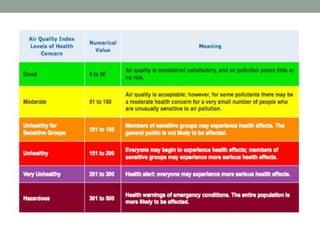
Air quality is measured with the Air Quality Index, or AQI. The
AQI works sort of like a thermometer that runs from 0 to 500
degrees.
Facts on Water Pollution
• Fresh water on earth is only 2.5% of the total water when 70%
of the earth's surface is covered by water.
• Around 70% of industrial waste is dumped to water.
• Asia has the highest number of contaminated rivers than any
other continent, mainly of bacteria from human waste.
Causes of Water Pollution
• Industrial waste
• Sewage and waste water
• Mining activities
• Accidental Oil leakage
• Chemical fertilizers and pesticides
Effects of Water Pollution
• Diseases like Cholera
• Malaria
• Typhoid (spread during the rainy season )
• Aquatic life gets destroyed
Causes of Land Pollution
• Deforestation and soil erosion
• Agricultural activities(Use of pesticides )
• Mining activities
• Industrialization
How Environmental FactorsAffect
Business
• Environmental Policies
• Climate Change
• Green Agenda (Environment Friendly Policies)
• Pollution
• Availability of natural resources
• Recycling
• Waste Disposal

Natural environment ppt

  • 1.
  • 2.
    Environment • Environment issum total of air, water and land, the interrelationship among themselves with human beings and other living organism. • The surrounding or condition in which a person, plant or animal can live or operate is called environment. • So in nut shell we can say that "environment" is total surroundings of an organism.
  • 3.
    Major Environment Issues •Global Warming • Pollution • Deforestation • Water Scarcity • Loss of Biodiversity • Soil Erosion
  • 4.
    Global Warming Global warmingis the increase in temperature of the Earth's surface (both land and water) as well as it's atmosphere.
  • 5.
    Green House Effect •The green house effect is a natural process that warms the earth surface. • When the Sun’s energy reaches the earths atmosphere, some of it is reflected back to space and the rest is absorbed and reradiated by green house gases. • The absorbed energy warms the atmosphere and the surface of earth.
  • 7.
    Contribution to GreenHouse Gases Green house gases include: • Carbon Dioxide • Water Vapor • Methane • Ozone • Nitrous Oxide • Chlorofluorocarbons Gases
  • 8.
    Top Countries inEmission of CO2
  • 9.
  • 10.
    Kyoto Protocol • TheKyoto Protocol is an international agreement agreed in Kyoto, Japan in December 1997to reduce worldwide emission of green house gases.
  • 11.
    Kyoto Protocol • TheKyoto Protocol is a protocol to the United Nations Framework Convention on Climate Change (UNFCCC), aimed at fighting global warming. • The Kyoto Protocol, also known as the Kyoto Accord, is an international treaty among different member nation that on industrialized nations sets mandatory limits on greenhouse gas emissions. • The initial treaty was signed in Kyoto, Japan in 1997. • It was implemented in 2005.
  • 12.
    • At negotiations,Annex I countries (including the US) collectively agreed to reduce their greenhouse gas emissions by 5.2% on average for the period 2008-2012. • Since the US has not ratified the treaty, the collective emissions reduction of Annex I Kyoto countries falls from 5.2 % to 4.2% below base year. • Clean Development Mechanism was designed to limit emissions in developing countries
  • 13.
    Kyoto Protocol The UnitedStates has not ratified the Kyoto Protocol due to following reasons: • The main objection of the US to ratification is regarding the nature of participation of developing countries. The US will not ratify the Protocol unless developing countries are also required to keep greenhouse gas levels at targeted minimums. • The US feels that the Kyoto Protocol is unfair in that countries like itself will be harmed economically because they will have to make the most changes in order to adhere to targeted levels of CO2 levels set forth in the Kyoto Protocol. • In 2011 Canada withdraw from kyoto protocol.
  • 14.
    The Unresolved issuesin KYOTO • No details on specific policies and measures to meet reduction targets. • No commitments from developing nations. • No details about penalties. • No details on funding mechanisms for developing nations.
  • 15.
  • 16.
    Paris ClimateAgreement • Parisclimate agreement is an international agreement to combat climate change. • The deal unites all the world's nations in a single agreement on tackling climate change for the first time in history. • The Kyoto Protocol of 1997 set emission cutting targets for a handful of developed countries, but the US pulled out and others failed to comply.
  • 17.
    Paris ClimateAgreement • From30 November to 11 December 2015, the governments of 195 nations gathered in Paris, France, and discussed a possible new global agreement on climate change, aimed at reducing global greenhouse gas emissions and thus reduce the threat of dangerous climate change. • It was implemented from Feb 2020.
  • 18.
    Key element ofParisAgreement • The Paris Agreement, in seeking to strengthen the global response to climate change, reaffirms the goal of limiting global temperature increase to well below 2 degrees Celsius, while pursuing efforts to limit the increase to 1.5 degrees. • Strengthen the ability of countries to deal with the impacts of climate change.
  • 19.
    • It alsomentions the need to review each country’s contribution to cutting emissions every five years so they scale up to the challenge. • Rich countries should help poorer nations by providing ā€œclimate financeā€ to adapt to climate change and switch to renewable energy.
  • 20.
    Key features ofIndia’s targets • To bring down its emissions intensity by 30 to 33 per cent from 2005 levels by 2030. • To increase the share of non-fossil fuel energy to 40 per cent by 2030. • To create an additional carbon sink of 2.5 to 3 billion tonnes of carbon di-oxide (CO2) equivalent by increasing its forest and tree cover by 2030. • To invest in development programs in areas vulnerable to climate change and also to health and disaster management.
  • 21.
    Important Terms • CarbonCredit • Carbon Offsetting • Carbon Tax • Carbon Foot Print • Carbon Sink • Carbon Dieting
  • 22.
    Carbon Credit • Acarbon credit is a permit or certificate allowing the holder to emit carbon dioxide or other greenhouse gases. • The credit limits the emission to a mass equal to one ton of carbon dioxide. • The issuance of carbon credits aims to reduce the emission of greenhouse gases into the atmosphere. • Carbon credit can be used by governments, industry or private individuals to compensate for the emissions they are generating. • It is also known as cap and trade system.
  • 23.
    How Carbon CreditWorks • A national or supranational authority sets a global cap on CO2 emissions. • This value is divided among countries and businesses into ā€œemission rightsā€. • Their commitment is to maintain CO2 emissions lower or equal to the Assigned Amount. • If their emissions are higher than the Assigned Amount, the subject has to purchase the missing credits from those who have extra credits because they have succeeded in limiting their emissions in relation to the cap.
  • 24.
    • If anycountry exceeds this limit, they have to buy carbon credits from the country with less emission (Trading). • In India carbon trade is like a commodity which is traded on MCX. • 1 Carbon Credit = 1 tonne of Carbon emission rights. • India’s contribution to global carbon trading market is increasing.
  • 25.
    Areas of CarbonCredit Generation • Wind Power Company • Reforestation • Solar Energy
  • 26.
    Carbon Offsetting • Carbonoffsetting is an internationally recognized way to take responsibility for unavoidable carbon emissions. • Reduction in emission of green house gases made in order to compensate for (offset)emission made elsewhere. • For example, suppose a thermal plant of 800 megawatt capacity emit 400 carbon-equivalent in the atmosphere. • Now other country builds up a 800 megawatt wind energy plant which does not generate any amount of emission as an alternative of the thermal plant. Then by investing in this project the country will earn 400 carbon-equivalent.
  • 27.
    Carbon Tax • Acarbon tax is a fee for making users of fossil fuels pay for climate damage their fuel use imposes by releasing carbon dioxide into the atmosphere, and for motivating switches to clean energy • Carbon tax is a form of pollution tax. • India introduced a nationwide carbon tax in 2010, which is currently Rs.400/tonne. • The carbon tax that was introduced a few years ago is now at Rs400 per tonne, almost one-fifth the cost of mining coal.
  • 28.
    Why Carbon taxis Levied ? • Encourage Renewable source of Energy. • Less Carbon dioxide emission. • Minimized global warming effect. • Government Revenue.
  • 29.
    Carbon Sink • Carbonsinks are natural systems that suck up and store carbon dioxide from the atmosphere. • The main natural carbon sinks are plants, the ocean and soil. • Oceans are the largest active carbon sink on Earth, absorbing more than a quarter of the carbon dioxide that humans put into the air.
  • 30.
    Carbon Foot Print Theamount of carbon dioxide released into the atmosphere as a result of the activities of a particular individual, organization, or community. Foot print you leave on environment with every release of CO2 due to burning of fossil fuel.
  • 31.
    • When youdrive a car, the engine burns fuel which creates a certain amount of CO2, depending on its fuel consumption and the driving distance. • When you use oil, gas or coal, then you also generate CO2. • Even if we use electricity the electrical power may also have emitted a certain amount of CO2. • When you buy food and goods, the production of the food and goods also emitted some quantities of CO2.
  • 32.
    • Your carbonfootprint is the sum of all emissions of CO2 (carbon dioxide), which were induced by your activities in a given time frame. • Usually a carbon footprint is calculated for the time period of a year.
  • 33.
    Carbon Dieting • Dietingis a term that people use to refer to the activities to reduce their body weight to balance with idle weight. • A carbon diet refers to making lifestyle choices to reduce the greenhouse gas emissions (GHGe) resulting from consumption decisions.
  • 34.
    How can wereduce Carbon Footprint • Use public mode of transportation • Modernization of industries • Plantation of trees • Emphasis on clean energy resources • Use energy efficient devices • Change in life style
  • 35.
    Pollution • When HarmfulSubstances Contaminate the Environment it is Called Pollution. • The things which pollute our environment are called pollutants. There are three types of Pollution • Air Pollution • Water Pollution • Land Pollution
  • 36.
    Air Pollution • Airpollution is responsible for 12.5 per cent of all deaths in India. • Every hour 800 people or 13 every minute are dying due to suffering from cancer, respiratory illnesses or heart disease directly caused by breathing bad air. • 93 per cent of children worldwide live in areas where air pollution exceeds WHO guidelines. • Over 100,000 children below the age of five die due to bad air in the country.
  • 37.
    Air Pollution Air pollutionmeans the presence of chemicals or compounds in the air which are usually not present and which lower the quality of the air or cause detrimental changes to the quality of life (such as the damaging of the ozone layer or causing global warming).
  • 38.
    Causes ofAir Pollution •Burning of Fossil Fuels • Emission of harmful gases from factories and industries • Woods use for cooking • Dust Particles • Forest fire
  • 39.
    Effects ofAir pollution •Respiratory and heart problems • Global warming • Acid Rain • Depletion of Ozone layer
  • 40.
    Measurement ofAir Pollution Airquality is measured with the Air Quality Index, or AQI. The AQI works sort of like a thermometer that runs from 0 to 500 degrees.
  • 42.
    Facts on WaterPollution • Fresh water on earth is only 2.5% of the total water when 70% of the earth's surface is covered by water. • Around 70% of industrial waste is dumped to water. • Asia has the highest number of contaminated rivers than any other continent, mainly of bacteria from human waste.
  • 43.
    Causes of WaterPollution • Industrial waste • Sewage and waste water • Mining activities • Accidental Oil leakage • Chemical fertilizers and pesticides
  • 44.
    Effects of WaterPollution • Diseases like Cholera • Malaria • Typhoid (spread during the rainy season ) • Aquatic life gets destroyed
  • 45.
    Causes of LandPollution • Deforestation and soil erosion • Agricultural activities(Use of pesticides ) • Mining activities • Industrialization
  • 46.
    How Environmental FactorsAffect Business •Environmental Policies • Climate Change • Green Agenda (Environment Friendly Policies) • Pollution • Availability of natural resources • Recycling • Waste Disposal