Carbon Fact
Carbon Fact
#
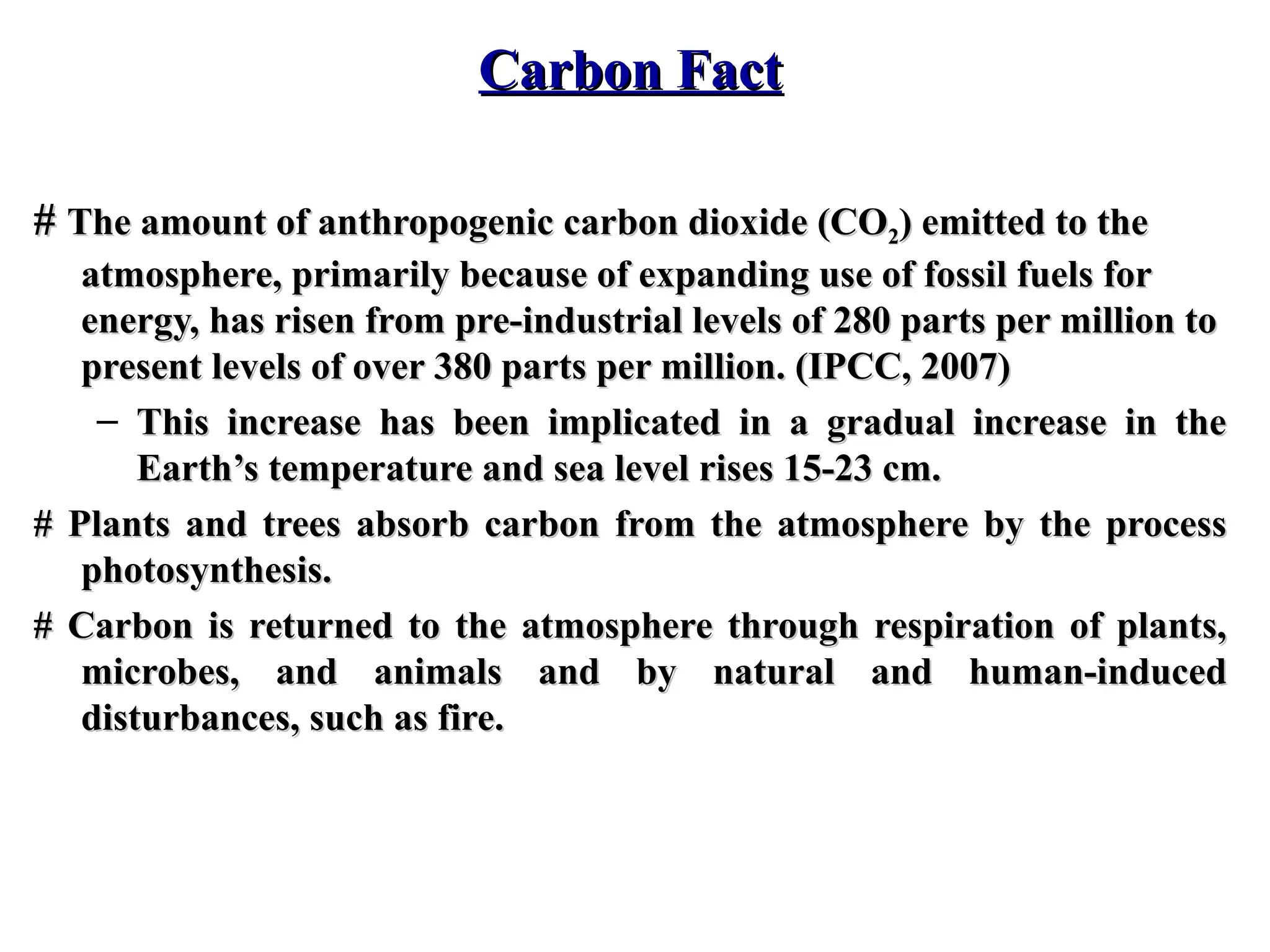
#The amount of anthropogenic carbon dioxide (CO
The amount of anthropogenic carbon dioxide (CO2
2) emitted to the
) emitted to the
atmosphere, primarily because of expanding use of fossil fuels for
atmosphere, primarily because of expanding use of fossil fuels for
energy, has risen from pre-industrial levels of 280 parts per million to
energy, has risen from pre-industrial levels of 280 parts per million to
present levels of over 380 parts per million. (IPCC, 2007)
present levels of over 380 parts per million. (IPCC, 2007)
– This increase has been implicated in a gradual increase in the
This increase has been implicated in a gradual increase in the
Earth’s temperature and sea level rises 15-23 cm.
Earth’s temperature and sea level rises 15-23 cm.
# Plants and trees absorb carbon from the atmosphere by the process
# Plants and trees absorb carbon from the atmosphere by the process
photosynthesis.
photosynthesis.
# Carbon is returned to the atmosphere through respiration of plants,
# Carbon is returned to the atmosphere through respiration of plants,
microbes, and animals and by natural and human-induced
microbes, and animals and by natural and human-induced
disturbances, such as fire.
disturbances, such as fire.
5.
UN Framework Conventionon Climate Change
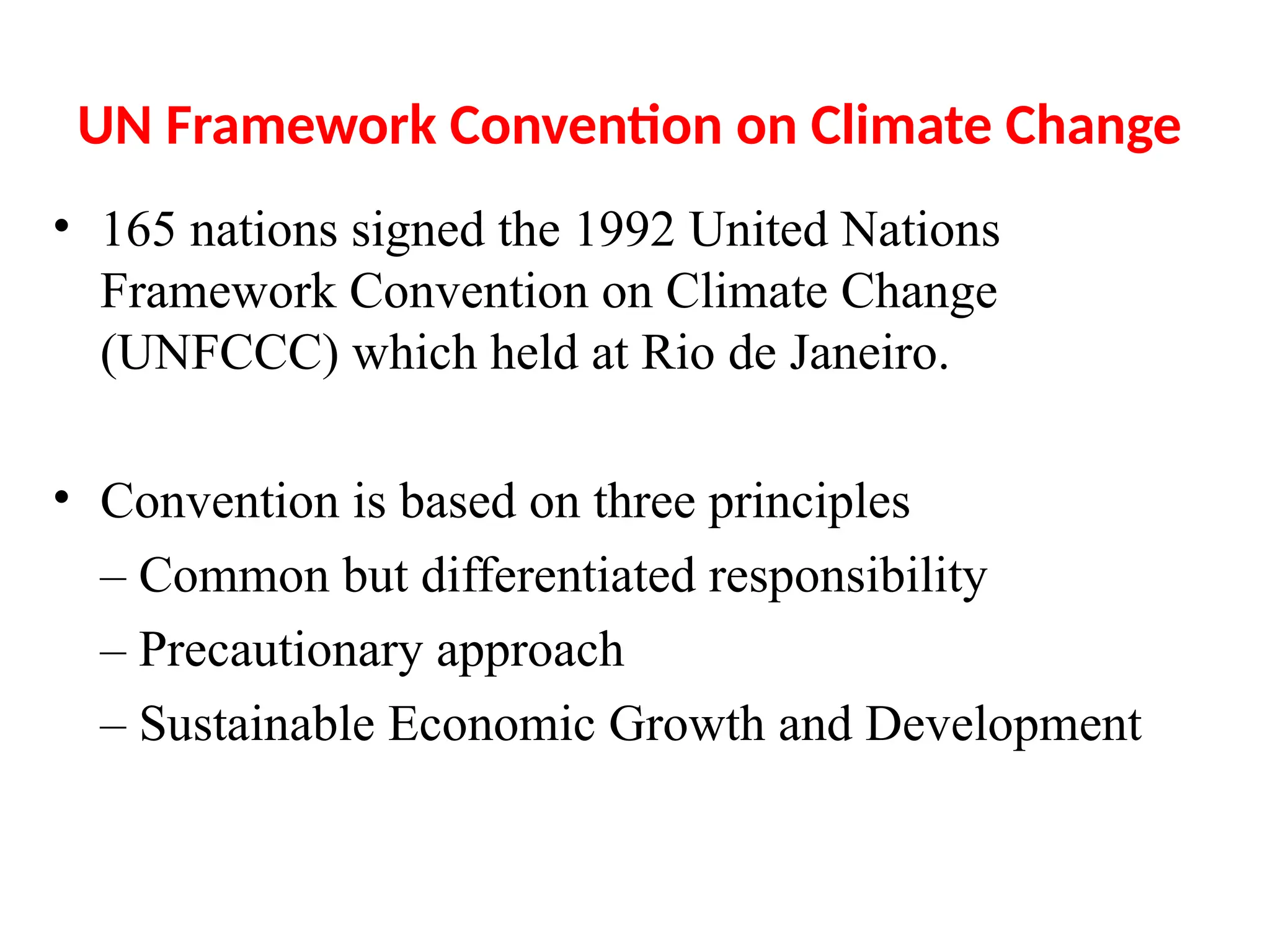
• 165 nations signed the 1992 United Nations
Framework Convention on Climate Change
(UNFCCC) which held at Rio de Janeiro.
• Convention is based on three principles
– Common but differentiated responsibility
– Precautionary approach
– Sustainable Economic Growth and Development
6.
Kyoto Protocol
• Negotiatedin Kyoto, Japan in December 1997.
• Opened for signature on March 16, 1998.
• Came into force on February 16, 2005.
• Binding 'industrialized’ or 'developed’ countries, listed in Annex 1 of the
UNFCCC.
• Commits developed countries to specific targets for reducing their green
house emissions.
• Each country has a prescribed number of 'emission units' which make up the
target emission units.
• The Kyoto Protocol provides mechanisms for countries to meet their emission
targets.
• Developing nations like India, should reduce GHG emission but not
compulsory.
• Although various countries signed Kyoto Protocol in 1997, it did not came
into force immediately.
• Kyoto protocol came into force only after required number of Annex 1
Countries ratified it.
7.
Results: March towardsa Green Planet
Commitment to move away from fossil fuel energy sources (oil,
gas and coal) to renewable sources of energy viz. hydro, wind,
solar power by 38 signatory countries.
Commitment to reduce greenhouse gas emissions by 2008-2012 to
5.2 percent below 1990 levels.(legally binding protocol).
Targets for greenhouse gas emissions reduction were established
for each industrialized country. (Annex 1 countries).
Developing countries (Non-Annex 1 countries) including China
and India were asked to set voluntary targets for greenhouse gas
emissions.
8.
• Annex I
•List of industrialized countries and economies in transition: US,
France, Japan etc.
• These countries had pledged to reduce their greenhouse gas
emissions to 1990 levels by the year 2000.
• Annex II
• A sub-group of Annex 1 Countries, these Annex II countries are
required to give financial assistance and technology to the
developing countries (Non-Annex countries).
• Non Annex- Developing countries like India, Brazil, China.
• They do not have compulsory binding targets to reduce green
house gas emission, although they are encouraged to do it.
9.
Carbon Credits
• Acarbon credit is a financial instrument that represents a tonne of
CO2 or CO2e (carbon dioxide equivalent gases) removed or reduced
from the atmosphere from an emission reduction project.
• Carbon credits are measured in units of certified emission
reductions (CERs).
• Each CER is equivalent to one ton of carbon dioxide reduction.
• Such a credit can be sold in the international market at a prevailing
market rate.
Carbon credit and CER
10.
CARBON TRADING
CARBON CAP-TRADEPROGRAM
CARBON CAP-TRADE Program
CAP- Assignment of an upper threshold limit on the amount of pollutant that can be
emitted (measured in Assigned Amount Units or AAUs) by a country.
Emission permits or equivalent number of allowances or credits are issued to emit a
specific amount of carbon dioxide (cap) to the country.
1 credit= 1 ton of carbon dioxide
TRADE- the transfer or trade of allowances
Excess or unused allowances/credits can be traded to the countries whose emissions
have exceeded their assigned cap.
The purchased allowances can be used to increase the allowance limit by the
purchasing country.
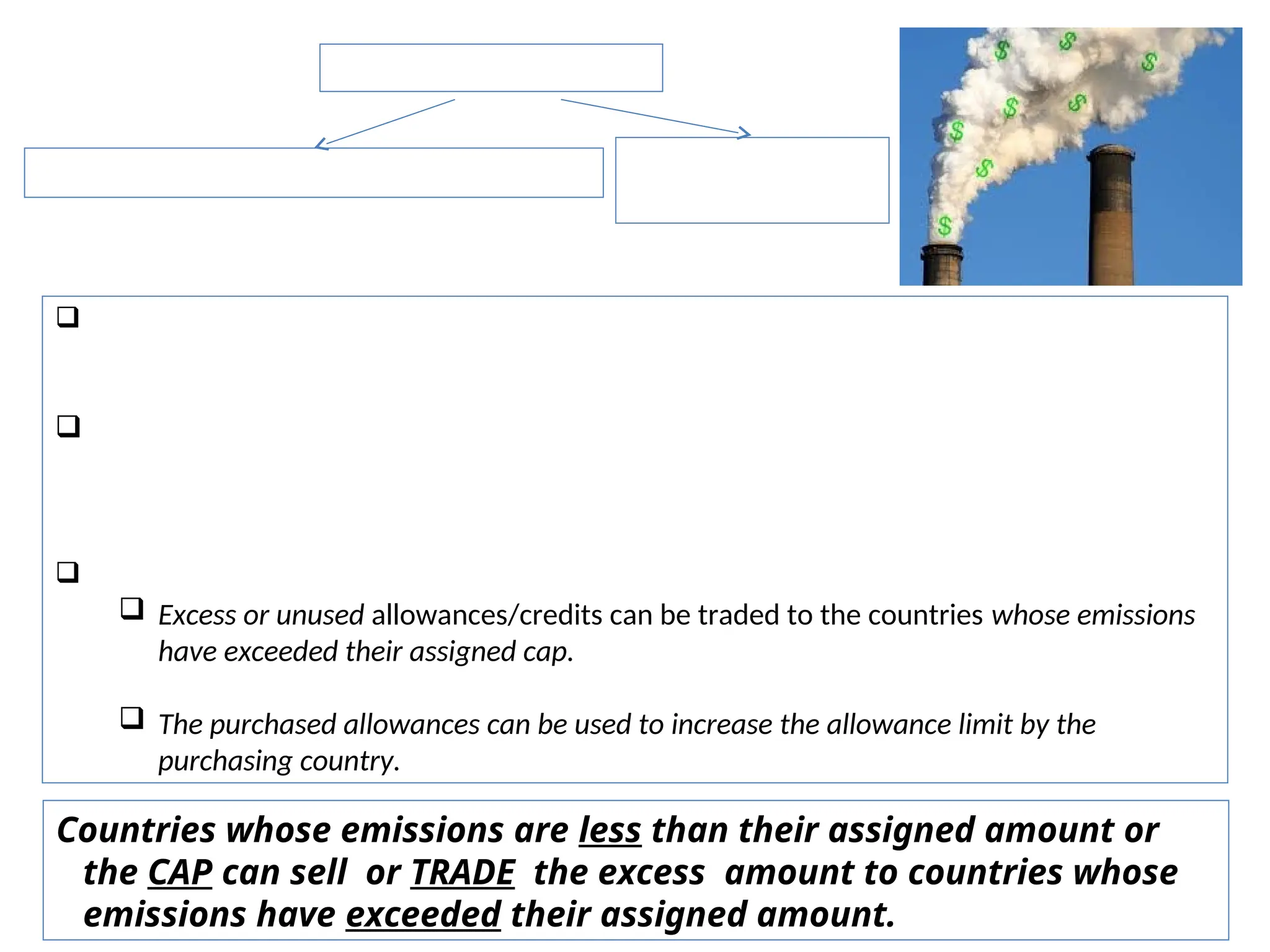
Countries whose emissions are less than their assigned amount or
the CAP can sell or TRADE the excess amount to countries whose
emissions have exceeded their assigned amount.
CARBON
OFFSETTING
11.
Under Kyoto Protocol,each Annex-B country is given emission target
“quota” (Kyoto Units).
For example, for the year 2009, Australia’s allowed quota was 2,957,579,143
Kyoto units. (each unit is equivalent to 1 ton of carbon dioxide)
Now, as long as Australia emits that much green house gas= no problem.
So first of all, Australian Government should do all steps to make sure it doesn’t
cross that quota for example
Making compulsory anti-pollution laws: for example a Tire making company
with daily output of 200 tires must not emit more than 200 tonnes of green
house gas per year.
Promoting solar energy, reducing tax on solar cells, wind mill equipments etc.
If a family buys second car then it will have to pay higher tax (just like
China’s one child policy but with cars!)
if a kid is found bunking his college lecture and loitering on his motorbike
then he’ll be fined for polluting the environment.
But even after all these measures, if Australia wants to emit more green house
gas, then it will have to buy additional ‘quota or units’ from another country.
12.
Carbon Trading ImplementationMechanisms:
• Suppose two Annex B parties are Japan and Australia.
• Japan was given quota of 100 units.
• and Australia was given quota of 200 units.
• But Australian Government is unable to maintain this limit and Australia emits 210 units of
green house gas, in given year.
• On the other side, Japanese Government takes very strong steps to control emission and hence
they only emit 90 units of Green House gas. So it has spare 10 Kyoto Units.
• Now, under Emission trading system, Australia can buy this 10 spare Kyoto units from Japan
and thus remain within its limit.
• In real life scenario, each annex B country makes law giving fixed quota to the companies.
Suppose steel factory cannot emit more than 1 ton of Green house gas
Tire company cannot emit more than 2 tones of green house gas.
So if tire company owner buys superfine machineries that produce less gas so he has some
spare credit/quota (say 1 ton)
While Steel factory emits more than its allowed quota (suppose it was allowed 2 tones but
emitted 3 tones)
Then the steel company can pay the tire company and get a certificate that we’ve purchase 1
ton quota from this xyz tire company. This Is the essence of “Carbon Trading.”
13.
Clean Development Mechanism(CDM)
Developed countries can fund emission reduction projects (e.g. Solar
energy, wind energy and other green technologies) in developing nations
that did not sign Kyoto Protocol.
In exchange, the developed countries earn legally recognized emission
credits called CERs (Certified Emission Reduction) to offset their emission
obligations.
• Joint implementation (JI)
Developed countries can implement emission reduction projects in
another developed or developing country and earn Emission
Reduction Units (ERUs)
ERUs can be used to meet the carbon allowance or can be sold
in the market
14.
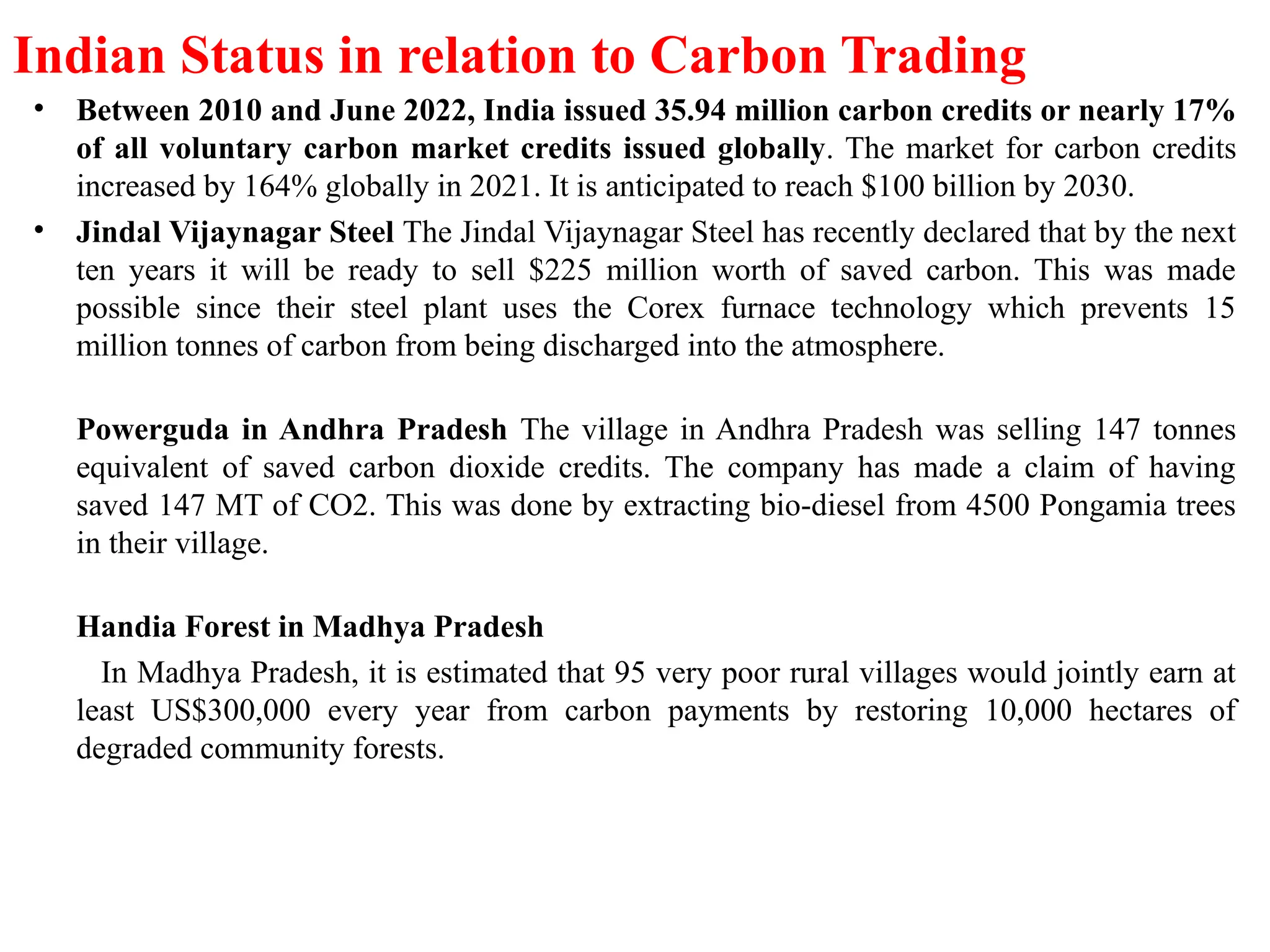
• Between 2010and June 2022, India issued 35.94 million carbon credits or nearly 17%
of all voluntary carbon market credits issued globally. The market for carbon credits
increased by 164% globally in 2021. It is anticipated to reach $100 billion by 2030.
• Jindal Vijaynagar Steel The Jindal Vijaynagar Steel has recently declared that by the next
ten years it will be ready to sell $225 million worth of saved carbon. This was made
possible since their steel plant uses the Corex furnace technology which prevents 15
million tonnes of carbon from being discharged into the atmosphere.
Powerguda in Andhra Pradesh The village in Andhra Pradesh was selling 147 tonnes
equivalent of saved carbon dioxide credits. The company has made a claim of having
saved 147 MT of CO2. This was done by extracting bio-diesel from 4500 Pongamia trees
in their village.
Handia Forest in Madhya Pradesh
In Madhya Pradesh, it is estimated that 95 very poor rural villages would jointly earn at
least US$300,000 every year from carbon payments by restoring 10,000 hectares of
degraded community forests.
Indian Status in relation to Carbon Trading
17.
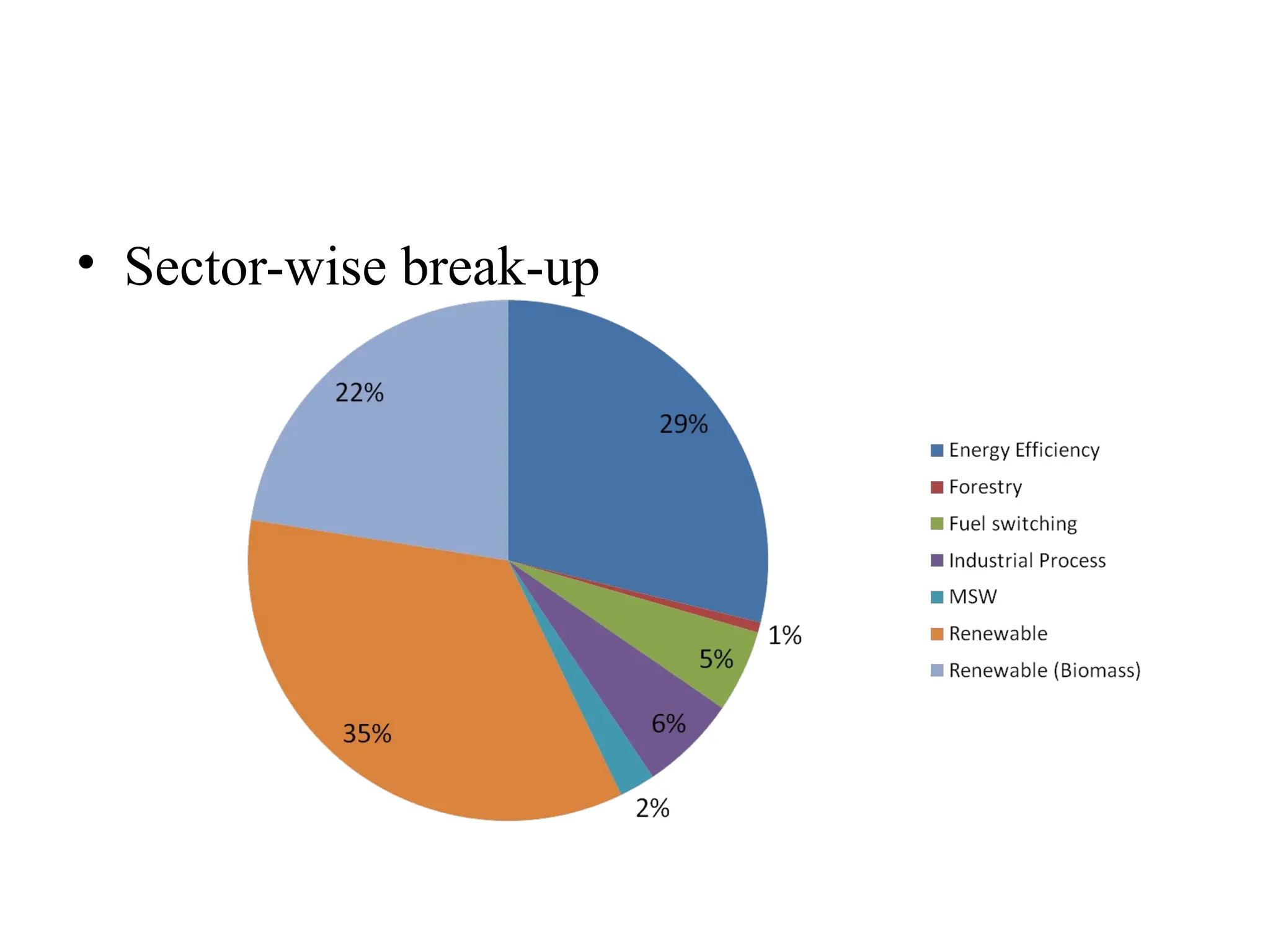
• Sector-wise break-up
TotalNo. of Projects = 1578
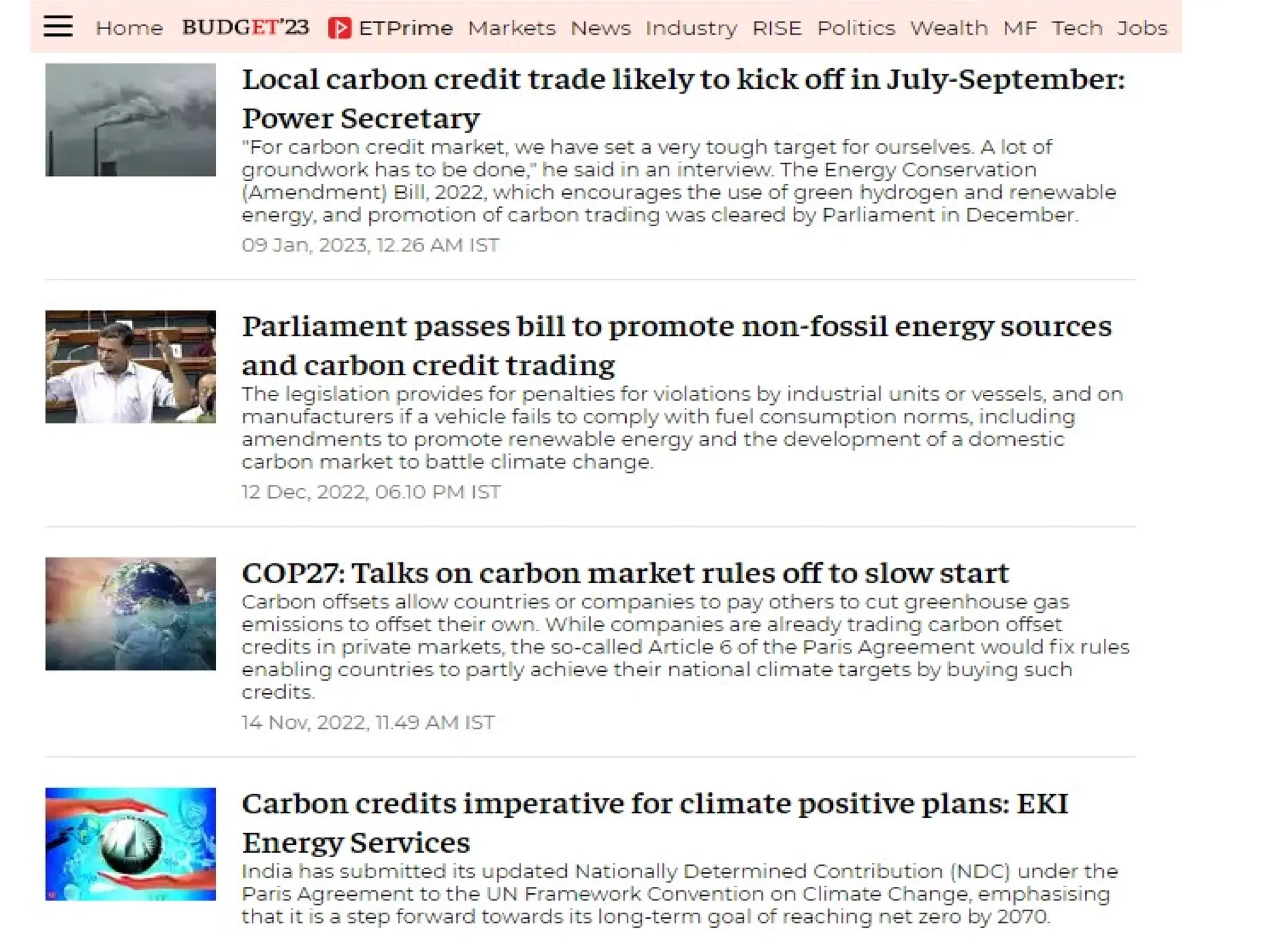
India's green energy companies, such as Adani Greens, owned by billionaire
Gautam Adani's Adani Group, and carbon off-setters like EKI Energy
Services, have come together to develop a carbon credit market to help
achieve energy transition goals.
18.
Benefits of CARBONTRADING:
• Reduction in green house gas emission
Stringency in the cap or the upper threshold limit is contributing
to lower emission over the years
• Source of revenue for developing nations
Developing nations can earn revenue by selling carbon credits to countries with
more fossil fuel demand.
• Supports a free market system
The carbon trade market is without any economic intervention and regulation by
government except to regulate against force or fraud
• Impetus for Alternative sources of energy or green technology
Threshold limits encourages industries to harness alternative sources of energy and
invest in green technology globally or in indigenous research.
19.
Disadvantages of CARBONTRADING:
• Right to pollute
Industries in the ratified nations are purchasing legal rights to pollute
the
atmosphere
• Slow process
Industries are opting the easy way– purchase more allowances than
implementing greener technologies
• Lack of centralized system or global framework
Absence of a centralized and accepted global standards/act are missing
• No effective carbon reduction in the atmosphere
Leads to carbon reduction in one place and results in carbon emission in