ATIF MEHMOOD
L E C T U R E R I N R A D I O L O G Y K M U
BIOCHEMISTRY
Carbohydrates
Carbohydrates
2
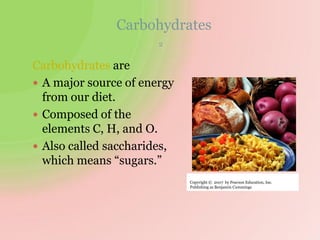
Carbohydrates are
 A major source of energy
from our diet.
 Composed of the
elements C, H, and O.
 Also called saccharides,
which means ―sugars.‖
Copyright © 2007 by Pearson Education, Inc.
Publishing as Benjamin Cummings
Carbohydrates
3
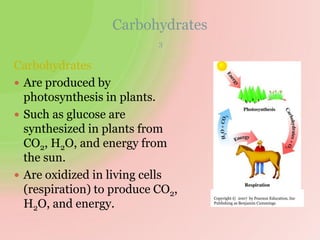
Carbohydrates
 Are produced by
photosynthesis in plants.
 Such as glucose are
synthesized in plants from
CO2, H2O, and energy from
the sun.
 Are oxidized in living cells
(respiration) to produce CO2,
H2O, and energy.
Copyright © 2007 by Pearson Education, Inc
Publishing as Benjamin Cummings
CARBOHYDRATES
 Carbohydrates are aldehyde or ketone compounds
with multiple(two or more)hydroxyl groups.
 They are polyhydroxylated compounds with
atleast three carbon atoms, with potentially active
carbonyl groups which may either be aldehyde or
ketone groups.
 The term applied to a large number of relatively
heterogeneous compounds found in all animals
and plants.
 Carbohydrates including sugars are also called
saccharides(saccharide=sugar).
Types of Carbohydrates
5
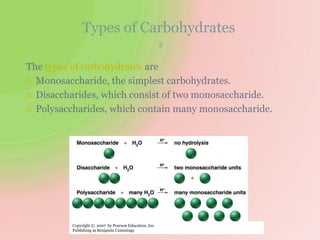
The types of carbohydrates are
 Monosaccharide, the simplest carbohydrates.
 Disaccharides, which consist of two monosaccharide.
 Polysaccharides, which contain many monosaccharide.
Copyright © 2007 by Pearson Education, Inc.
Publishing as Benjamin Cummings
CLASSIFICATION OF CARBOHYDRATES:
 MONOSACCHARIDES
 DISACCHARIDES
 OLIGOSAACHARIDES
 POLISAACHARIDES
Monosaccharides
7
Monosaccharides consist of
 3 to 6 carbon atoms, typically.
 A carbonyl group (aldehyde or ketone).
 Several hydroxyl groups.
MONOSACCHARIDES:
 Also called simple sugars ,are those which can not be
hydrolyzed further into simpler forms.
 General formula------------CnH2nOn
 They can be subdivided further ,
 A) Depending upon the number of carbon atoms
they possess ,as
trioses,tetroses,pentoses,hexoses,etc.
 B) Depending upon whether aldehyde(-CHO) or
ketone(-CO) groups are present as aldoses or ketoses
Aldoses
9
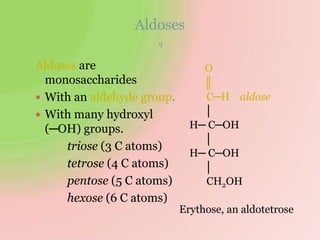
Aldoses are
monosaccharides
 With an aldehyde group.
 With many hydroxyl
(─OH) groups.
triose (3 C atoms)
tetrose (4 C atoms)
pentose (5 C atoms)
hexose (6 C atoms)
O
║
C─H aldose
│
H─ C─OH
│
H─ C─OH
│
CH2OH
Erythose, an aldotetrose
Ketoses
10
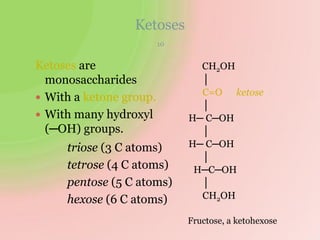
Ketoses are
monosaccharides
 With a ketone group.
 With many hydroxyl
(─OH) groups.
triose (3 C atoms)
tetrose (4 C atoms)
pentose (5 C atoms)
hexose (6 C atoms)
CH2OH
│
C=O ketose
│
H─ C─OH
│
H─ C─OH
│
H─C─OH
│
CH2OH
Fructose, a ketohexose
Learning Check
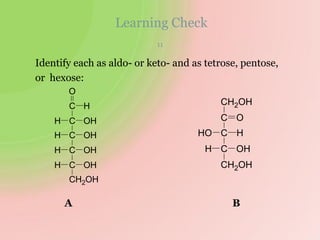
Identify each as aldo- or keto- and as tetrose, pentose,
or hexose:
A B
H
CH2OH
OHC
H
H
H
OH
OH
OH
C
C
C
HC
O
CH2OH
HHO
CH2OH
O
H OHC
C
C
11
Solution
12
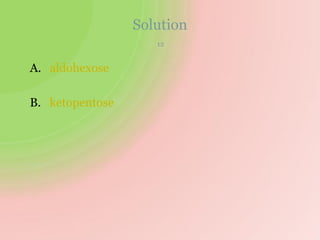
A. aldohexose
B. ketopentose
D-Glucose
13
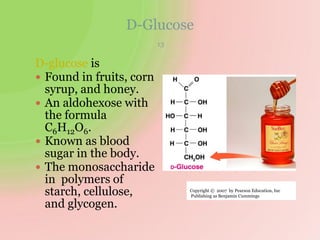
D-glucose is
 Found in fruits, corn
syrup, and honey.
 An aldohexose with
the formula
C6H12O6.
 Known as blood
sugar in the body.
 The monosaccharide
in polymers of
starch, cellulose,
and glycogen.
Copyright © 2007 by Pearson Education, Inc
Publishing as Benjamin Cummings
Blood Glucose Level
14
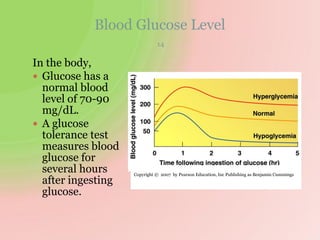
In the body,
 Glucose has a
normal blood
level of 70-90
mg/dL.
 A glucose
tolerance test
measures blood
glucose for
several hours
after ingesting
glucose.
Copyright © 2007 by Pearson Education, Inc Publishing as Benjamin Cummings
D-Fructose
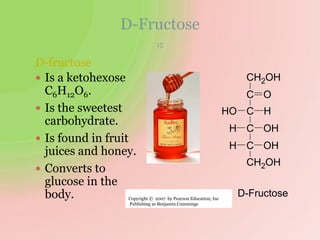
D-fructose
 Is a ketohexose
C6H12O6.
 Is the sweetest
carbohydrate.
 Is found in fruit
juices and honey.
 Converts to
glucose in the
body.
H OH
CH2OH
C
HO
H OH
H
C
O
C
C
CH2OH
D-Fructose
15
Copyright © 2007 by Pearson Education, Inc
Publishing as Benjamin Cummings
D-Galactose
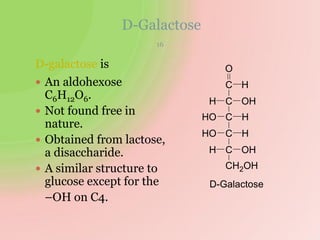
D-galactose is
 An aldohexose
C6H12O6.
 Not found free in
nature.
 Obtained from lactose,
a disaccharide.
 A similar structure to
glucose except for the
–OH on C4.
H
H
H OH
CH2OH
C
HO
HO HC
OH
C
C
O
C H
D-Galactose
16
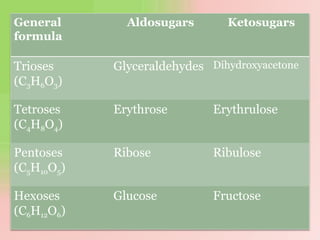
General
formula
Aldosugars Ketosugars
Trioses
(C3H6O3)
Glyceraldehydes Dihydroxyacetone
Tetroses
(C4H8O4)
Erythrose Erythrulose
Pentoses
(C5H10O5)
Ribose Ribulose
Hexoses
(C6H12O6)
Glucose Fructose
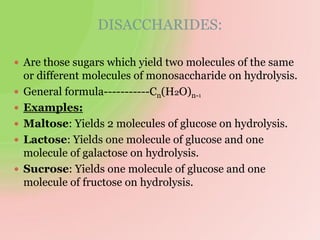
DISACCHARIDES:
 Are those sugars which yield two molecules of the same
or different molecules of monosaccharide on hydrolysis.
 General formula-----------Cn(H2O)n-1
 Examples:
 Maltose: Yields 2 molecules of glucose on hydrolysis.
 Lactose: Yields one molecule of glucose and one
molecule of galactose on hydrolysis.
 Sucrose: Yields one molecule of glucose and one
molecule of fructose on hydrolysis.
Important Disaccharides
19
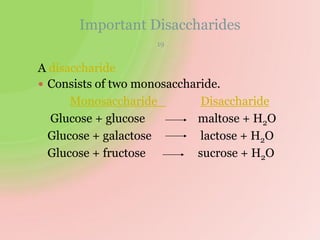
A disaccharide
 Consists of two monosaccharide.
Monosaccharide Disaccharide
Glucose + glucose maltose + H2O
Glucose + galactose lactose + H2O
Glucose + fructose sucrose + H2O
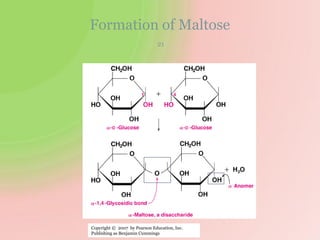
Maltose
20
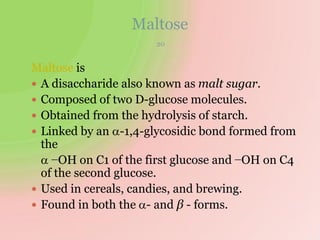
Maltose is
 A disaccharide also known as malt sugar.
 Composed of two D-glucose molecules.
 Obtained from the hydrolysis of starch.
 Linked by an -1,4-glycosidic bond formed from
the
 −OH on C1 of the first glucose and −OH on C4
of the second glucose.
 Used in cereals, candies, and brewing.
 Found in both the - and β - forms.
Formation of Maltose
21
Copyright © 2007 by Pearson Education, Inc.
Publishing as Benjamin Cummings
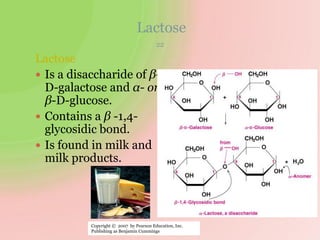
Lactose
Lactose
 Is a disaccharide of β-
D-galactose and α- or
β-D-glucose.
 Contains a β -1,4-
glycosidic bond.
 Is found in milk and
milk products.
22
α-form
Copyright © 2007 by Pearson Education, Inc.
Publishing as Benjamin Cummings
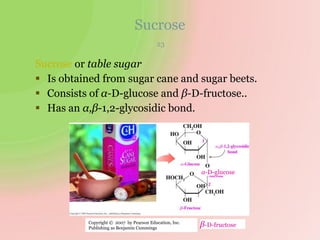
Sucrose
23
Sucrose or table sugar
 Is obtained from sugar cane and sugar beets.
 Consists of α-D-glucose and β-D-fructose..
 Has an α,β-1,2-glycosidic bond.
α-D-glucose
β-D-fructoseCopyright © 2007 by Pearson Education, Inc.
Publishing as Benjamin Cummings
OLIGOSAACHRIDES:
 Are those which yield 3 to 10 monosaccharides units
on hydrolysis,e.g.Maltotriose.
 These are short chain condensation products of two
to ten monosaccharide units or residues joined to
each other covalently through O- glycoside bonds or
linkages.
 Some oligosaccharides are,
 α-dextrins (polymers of eight glucose units)
 Maltotriose (has three glucose units)
 Isomaltose
Carbohydrates
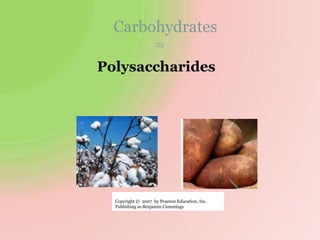
Polysaccharides
25
Copyright © 2007 by Pearson Education, Inc.
Publishing as Benjamin Cummings
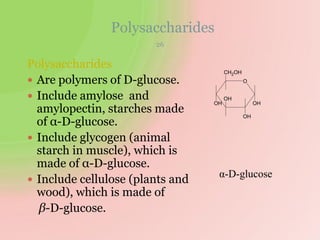
Polysaccharides
Polysaccharides
 Are polymers of D-glucose.
 Include amylose and
amylopectin, starches made
of α-D-glucose.
 Include glycogen (animal
starch in muscle), which is
made of α-D-glucose.
 Include cellulose (plants and
wood), which is made of
β-D-glucose.
O
CH2OH
OH
OH
OH
OH
26
α-D-glucose
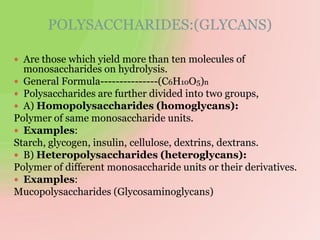
POLYSACCHARIDES:(GLYCANS)
 Are those which yield more than ten molecules of
monosaccharides on hydrolysis.
 General Formula---------------(C6H10O5)n
 Polysaccharides are further divided into two groups,
 A) Homopolysaccharides (homoglycans):
Polymer of same monosaccharide units.
 Examples:
Starch, glycogen, insulin, cellulose, dextrins, dextrans.
 B) Heteropolysaccharides (heteroglycans):
Polymer of different monosaccharide units or their derivatives.
 Examples:
Mucopolysaccharides (Glycosaminoglycans)
BIOMEDICAL IMPORTANCE OF
CARBOHYDRATES:
 Chief source of energy
 Constituents of compound lipids and conjugated proteins
 Certain carbohydrate derivates are used as drugs like
cardiac glycosides/antibiotics
 Lactose principal sugar of milk—in lactating mammary
glands.
 Degradation products utilized for the synthesis of other
substances such as fatty acids, cholesterol, amino acids
etc.
 Derangement of glucose metabolism is seen in Diabetic
mellitus.
Carbohydrrates lecture

Carbohydrrates lecture

  • 1.
    ATIF MEHMOOD L EC T U R E R I N R A D I O L O G Y K M U BIOCHEMISTRY Carbohydrates
  • 2.
    Carbohydrates 2 Carbohydrates are  Amajor source of energy from our diet.  Composed of the elements C, H, and O.  Also called saccharides, which means ―sugars.‖ Copyright © 2007 by Pearson Education, Inc. Publishing as Benjamin Cummings
  • 3.
    Carbohydrates 3 Carbohydrates  Are producedby photosynthesis in plants.  Such as glucose are synthesized in plants from CO2, H2O, and energy from the sun.  Are oxidized in living cells (respiration) to produce CO2, H2O, and energy. Copyright © 2007 by Pearson Education, Inc Publishing as Benjamin Cummings
  • 4.
    CARBOHYDRATES  Carbohydrates arealdehyde or ketone compounds with multiple(two or more)hydroxyl groups.  They are polyhydroxylated compounds with atleast three carbon atoms, with potentially active carbonyl groups which may either be aldehyde or ketone groups.  The term applied to a large number of relatively heterogeneous compounds found in all animals and plants.  Carbohydrates including sugars are also called saccharides(saccharide=sugar).
  • 5.
    Types of Carbohydrates 5 Thetypes of carbohydrates are  Monosaccharide, the simplest carbohydrates.  Disaccharides, which consist of two monosaccharide.  Polysaccharides, which contain many monosaccharide. Copyright © 2007 by Pearson Education, Inc. Publishing as Benjamin Cummings
  • 6.
    CLASSIFICATION OF CARBOHYDRATES: MONOSACCHARIDES  DISACCHARIDES  OLIGOSAACHARIDES  POLISAACHARIDES
  • 7.
    Monosaccharides 7 Monosaccharides consist of 3 to 6 carbon atoms, typically.  A carbonyl group (aldehyde or ketone).  Several hydroxyl groups.
  • 8.
    MONOSACCHARIDES:  Also calledsimple sugars ,are those which can not be hydrolyzed further into simpler forms.  General formula------------CnH2nOn  They can be subdivided further ,  A) Depending upon the number of carbon atoms they possess ,as trioses,tetroses,pentoses,hexoses,etc.  B) Depending upon whether aldehyde(-CHO) or ketone(-CO) groups are present as aldoses or ketoses
  • 9.
    Aldoses 9 Aldoses are monosaccharides  Withan aldehyde group.  With many hydroxyl (─OH) groups. triose (3 C atoms) tetrose (4 C atoms) pentose (5 C atoms) hexose (6 C atoms) O ║ C─H aldose │ H─ C─OH │ H─ C─OH │ CH2OH Erythose, an aldotetrose
  • 10.
    Ketoses 10 Ketoses are monosaccharides  Witha ketone group.  With many hydroxyl (─OH) groups. triose (3 C atoms) tetrose (4 C atoms) pentose (5 C atoms) hexose (6 C atoms) CH2OH │ C=O ketose │ H─ C─OH │ H─ C─OH │ H─C─OH │ CH2OH Fructose, a ketohexose
  • 11.
    Learning Check Identify eachas aldo- or keto- and as tetrose, pentose, or hexose: A B H CH2OH OHC H H H OH OH OH C C C HC O CH2OH HHO CH2OH O H OHC C C 11
  • 12.
  • 13.
    D-Glucose 13 D-glucose is  Foundin fruits, corn syrup, and honey.  An aldohexose with the formula C6H12O6.  Known as blood sugar in the body.  The monosaccharide in polymers of starch, cellulose, and glycogen. Copyright © 2007 by Pearson Education, Inc Publishing as Benjamin Cummings
  • 14.
    Blood Glucose Level 14 Inthe body,  Glucose has a normal blood level of 70-90 mg/dL.  A glucose tolerance test measures blood glucose for several hours after ingesting glucose. Copyright © 2007 by Pearson Education, Inc Publishing as Benjamin Cummings
  • 15.
    D-Fructose D-fructose  Is aketohexose C6H12O6.  Is the sweetest carbohydrate.  Is found in fruit juices and honey.  Converts to glucose in the body. H OH CH2OH C HO H OH H C O C C CH2OH D-Fructose 15 Copyright © 2007 by Pearson Education, Inc Publishing as Benjamin Cummings
  • 16.
    D-Galactose D-galactose is  Analdohexose C6H12O6.  Not found free in nature.  Obtained from lactose, a disaccharide.  A similar structure to glucose except for the –OH on C4. H H H OH CH2OH C HO HO HC OH C C O C H D-Galactose 16
  • 17.
    General formula Aldosugars Ketosugars Trioses (C3H6O3) Glyceraldehydes Dihydroxyacetone Tetroses (C4H8O4) ErythroseErythrulose Pentoses (C5H10O5) Ribose Ribulose Hexoses (C6H12O6) Glucose Fructose
  • 18.
    DISACCHARIDES:  Are thosesugars which yield two molecules of the same or different molecules of monosaccharide on hydrolysis.  General formula-----------Cn(H2O)n-1  Examples:  Maltose: Yields 2 molecules of glucose on hydrolysis.  Lactose: Yields one molecule of glucose and one molecule of galactose on hydrolysis.  Sucrose: Yields one molecule of glucose and one molecule of fructose on hydrolysis.
  • 19.
    Important Disaccharides 19 A disaccharide Consists of two monosaccharide. Monosaccharide Disaccharide Glucose + glucose maltose + H2O Glucose + galactose lactose + H2O Glucose + fructose sucrose + H2O
  • 20.
    Maltose 20 Maltose is  Adisaccharide also known as malt sugar.  Composed of two D-glucose molecules.  Obtained from the hydrolysis of starch.  Linked by an -1,4-glycosidic bond formed from the  −OH on C1 of the first glucose and −OH on C4 of the second glucose.  Used in cereals, candies, and brewing.  Found in both the - and β - forms.
  • 21.
    Formation of Maltose 21 Copyright© 2007 by Pearson Education, Inc. Publishing as Benjamin Cummings
  • 22.
    Lactose Lactose  Is adisaccharide of β- D-galactose and α- or β-D-glucose.  Contains a β -1,4- glycosidic bond.  Is found in milk and milk products. 22 α-form Copyright © 2007 by Pearson Education, Inc. Publishing as Benjamin Cummings
  • 23.
    Sucrose 23 Sucrose or tablesugar  Is obtained from sugar cane and sugar beets.  Consists of α-D-glucose and β-D-fructose..  Has an α,β-1,2-glycosidic bond. α-D-glucose β-D-fructoseCopyright © 2007 by Pearson Education, Inc. Publishing as Benjamin Cummings
  • 24.
    OLIGOSAACHRIDES:  Are thosewhich yield 3 to 10 monosaccharides units on hydrolysis,e.g.Maltotriose.  These are short chain condensation products of two to ten monosaccharide units or residues joined to each other covalently through O- glycoside bonds or linkages.  Some oligosaccharides are,  α-dextrins (polymers of eight glucose units)  Maltotriose (has three glucose units)  Isomaltose
  • 25.
    Carbohydrates Polysaccharides 25 Copyright © 2007by Pearson Education, Inc. Publishing as Benjamin Cummings
  • 26.
    Polysaccharides Polysaccharides  Are polymersof D-glucose.  Include amylose and amylopectin, starches made of α-D-glucose.  Include glycogen (animal starch in muscle), which is made of α-D-glucose.  Include cellulose (plants and wood), which is made of β-D-glucose. O CH2OH OH OH OH OH 26 α-D-glucose
  • 27.
    POLYSACCHARIDES:(GLYCANS)  Are thosewhich yield more than ten molecules of monosaccharides on hydrolysis.  General Formula---------------(C6H10O5)n  Polysaccharides are further divided into two groups,  A) Homopolysaccharides (homoglycans): Polymer of same monosaccharide units.  Examples: Starch, glycogen, insulin, cellulose, dextrins, dextrans.  B) Heteropolysaccharides (heteroglycans): Polymer of different monosaccharide units or their derivatives.  Examples: Mucopolysaccharides (Glycosaminoglycans)
  • 28.
    BIOMEDICAL IMPORTANCE OF CARBOHYDRATES: Chief source of energy  Constituents of compound lipids and conjugated proteins  Certain carbohydrate derivates are used as drugs like cardiac glycosides/antibiotics  Lactose principal sugar of milk—in lactating mammary glands.  Degradation products utilized for the synthesis of other substances such as fatty acids, cholesterol, amino acids etc.  Derangement of glucose metabolism is seen in Diabetic mellitus.