BIO-FUEL
Carbohy-drate (CHO) /Saccharied
Origin
Definition
 Carbohydrates are naturally occurring
compounds that consist of carbon, hydrogen, and
oxygen, and are produced by green plants in the
process of undergoing photosynthesis.
 Any of a class of organic compounds that are
polyhydroxy aldehydes or polyhydroxy ketones.
 Mainly sugars and starches, together constituting
one of the three principal types of nutrients used
as energy sources (calories) by the body.
Re-action
6co2+6H2O Chlorophyll 6o2+C6H12O6
Classification
Simple carbohydrate
 Simple carbohydrates are quick energy sources, but
they do not usually supply any other nutrients or
fiber.
Mono- saccharied
Di-saccharied
Mono
saccharied
Fructose
Glucose
Galactose
Glucose
Glukus
(Greek)
Glucose
Sweet
Glucose(C6H12O6 )
Grape sugar/Dextrose
Function Of glucose
 Blood sugar (80-120 mg/dl)
 Available in ripe fruits
 No need to digestion
 Many of these metabolic processes occur within the
liver and depend mostly upon the sugar glucose for
fuel.
 glucose is a source of energy. It is decomposed to CO2
and H2O. Energy of electrons gained from
decomposition of the glucose are used for synthesis of
ATP.( mitochondria in cell)
 The glucose helps the brain function properly(140gm)
 Your brain cells need two times more energy than the
other cells in your body.
Lacking
Without insulin
glucose can not reach
in to the cell.
Food source
Fructose
Fructose/Fruit sugar
Function
 In contrast to beta-galactose, fructose is structurally
different from glucose and under normal
circumstances can only be metabolized by the liver.
 Without insulin reach into the cell.
 Decrease insulin demand.
 Large amounts of fructose find in honey and
processed sweeteners.
 fructose to provide cells with energy.
FRUCTOSE + GLUCOSE
High fructose corn syrup
(HFCS)
Ripe fruits
Honey
Double sugar
Food source
Galactose
Galactose(4% of lactose)
Function
 Galactose is a carbohydrate monomer, from
lactose (a disaccharide made of glucose and
galactose). Major sources would be dairy
products, specifically milk. Incidentially the
human body also makes galactose from glucose,
obviously for human milk, but it has other
purposes as well in glycoaminoglycans, a
substance in the extracellular matrix .
 Production of glucose.
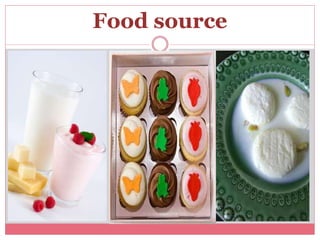
Food source
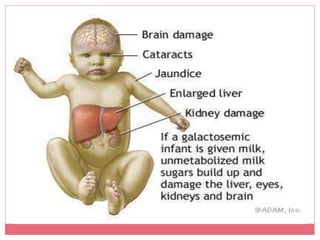
Galactose disorder
 Galactsemia
 Obesity
 Coronary Disease
(Coronary Heart Disease)
 Hypoglycemia (Reactive Hypoglycemia)
 Gestational Diabetes (Gestational
Diabetes Mellitus)
 Liver Diseases (Liver Disease)
Maltose(Beer, baby food)
Glucose
Glucose
Maltose
Lactose(Preservative, Bakery)
Glucose
Galactose
Lactose
Sucrose(Sugarcane sugar)
 Find in sugar, sugarcane, fruits & vegetables.
Glucose
Fructose
Sucrose
Complex Carbohydrate
 A polysaccharide, such as a carbohydrate, that
is composed of a large number of glucose
molecules, so called to distinguish it from a
simple sugar.
 Complex carbohydrates are long chain of sugar
molecules.
 A polysaccharide (as starch or cellulose)
consisting of usually hundreds or thousands of
monosaccharide units, that is called complex
CHO.
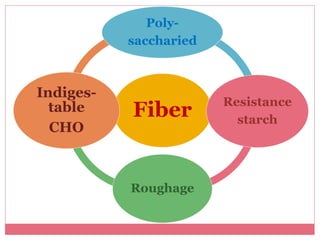
Fiber
Poly-
saccharied
Resistance
starch
Roughage
Indiges-
table
CHO
Classification
Cellulose
• Soften the
stools
• Help level out
glucose in the
blood
• Reduce weight
gain
Hemi
cellulose
• Relive
constipation
• Reduce
weight
Pectin
• Lower CHOL
• Help eliminate
bile acid
• Preventing gall
stone
• Decrease colon
cancer
Lignin
• Remove bile
acid
• Control
CHOL
• Prevent
formation of
gall stone
Starch
• Weight
cntrol
• Decrease
cancer(col
on,breast)
Gum &
mucilage
• Dietary
control
of
diabetes
&CHOL
Function
• Absorber of water
• Stay in colon & clean intestine
Constipation
• Satisfaction of meal
• Weight reductionSatiety
• Produce pectin CHOL complex
• Control lipid balance
Decrease
Blood
CHOL/TG
• Decrease toxic compound
&
• Risk of cancer
Decrease
Transit
time
• Reduce insulin resistance
• Increase glucose
tolerance power.
Control
diabetes
• Control sugar level
• Prevent hyperglycemia
Decrease
sugar
level
• Balanced lipid profile
• Increase HDL
Heart
disease
• Breast cancer(>85%)
• Colon cancerCancer
• Decrease appetite
• Give satisfaction
Decrease
obesity
• Gall stone
• Kidney stone
Increase
bile salt
• Absorber for toxic element
• Reduce free radical
Detoxificat
ion
• Remove acid & gas
• Causes of fermentation guesses
are arising & enlarge the stools
Participate in
fermentation
• Hormone
• Enzyme
Healthy
pancreas
• Clean gastro-intestinal
tractGastric
• Convert long chain fatty
acid into short chain fatty
acid.
Fatty
acid
• Release harmful bacteria
• Broken-down huge
population of bacteria
Bacteria
• Natural body cleanser
• Clean teeth
Cleanser
• Increase digestion powerIBS
Food source
Food source
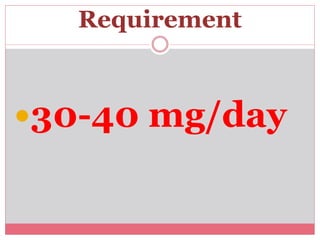
Requirement
30-40 mg/day

Carbohaidrate