










sensor-ship    why individual bay sensors provide the ultimate in car park management
What the customer wants What the owner wants How it works Benefits Example installations What to look out for
1. What the customer wants
What the customer wants
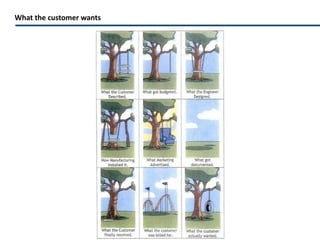
What the customer wants  Location (near destination) Good lighting Security (staff presence) Price Size of bays Cleanliness Free spaces Clear signs and wayfinding User friendly Extended opening hours Items in red represent areas where PGS can provide benefits
In general terms… Customers want parking that requires  NO EFFORT at MINIMAL COST and within a SECURE ENVIRONMENT
2. What the owner wants
The owner’s objectives…. Maximise revenues Maximise space utilisation Ensure customer loyalty Minimise expenses Obtain relevant information
3. How it works
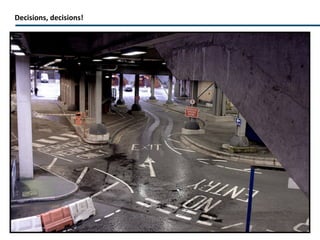
Decisions, decisions!
PGS – Design Components External Traffic Guidance Car park entry information boards Internal: Major decision points Aisle signage Individual bay indicators
External Traffic Guidance  Large format signage Includes static direction to the most appropriate vehicle entry for parking locations convenient to specific areas of the site
External Traffic Guidance
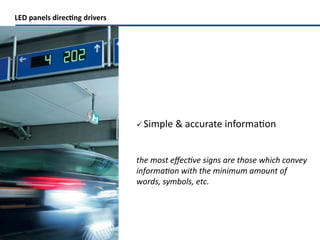
LED panels directing drivers  Simple & accurate information  the most effective signs are those which convey information with the minimum amount of words, symbols, etc.
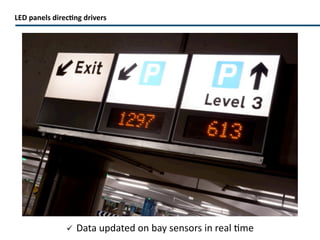
LED panels directing drivers  Data updated on bay sensors in real time
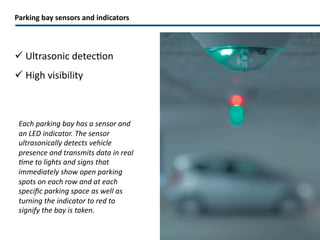
Parking bay sensors and indicators Ultrasonic detection High visibility Each parking bay has a sensor and an LED indicator. The sensor ultrasonically detects vehicle presence and transmits data in real time to lights and signs that immediately show open parking spots on each row and at each specific parking space as well as turning the indicator to red to signify the bay is taken.
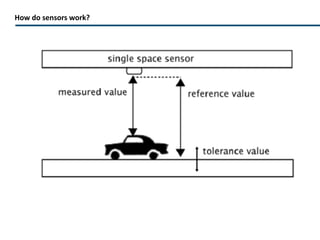
How do sensors work?
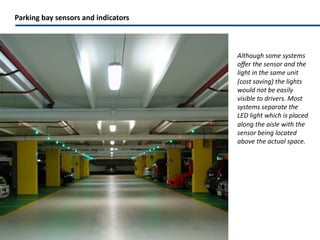
Parking bay sensors and indicators Although some systems offer the sensor and the light in the same unit (cost saving) the lights would not be easily visible to drivers. Most systems separate the LED light which is placed along the aisle with the sensor being located above the actual space.
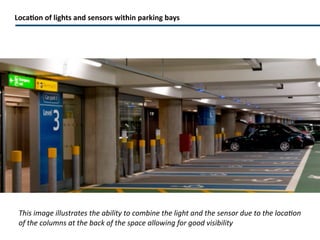
Location of lights and sensors within parking bays This image illustrates the ability to combine the light and the sensor due to the location of the columns at the back of the space allowing for good visibility
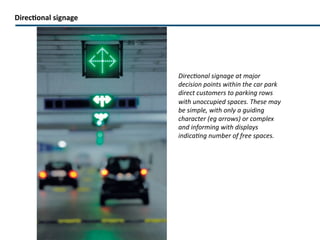
Directional signage Directional signage at major decision points within the car park direct customers to parking rows with unoccupied spaces. These may be simple, with only a guiding character (eg arrows) or complex and informing with displays indicating number of free spaces.
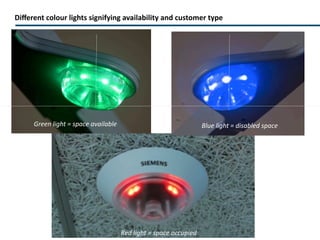
Different colour lights signifying availability and customer type Green light = space available  Blue light = disabled space  Red light = space occupied
Ancillary Signage
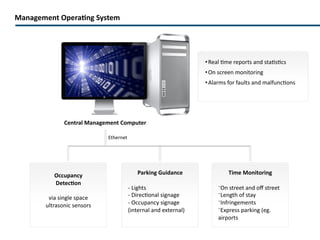
Management Operating System Central Management Computer Real time reports and statistics On screen monitoring Alarms for faults and malfunctions Occupancy Detection   via  s ingle space   u ltrasonic sensors Parking Guidance   - Lights - Directional signage - Occupancy signage  (internal and external)   Time Monitoring   On street and off street Length of stay Infringements Express parking (eg. airports   Ethernet
4. Benefits
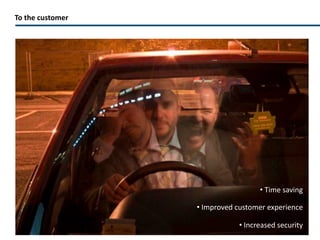
To the customer Time saving Improved customer experience Increased security
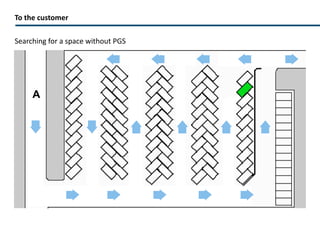
To the customer Searching for a space without PGS A
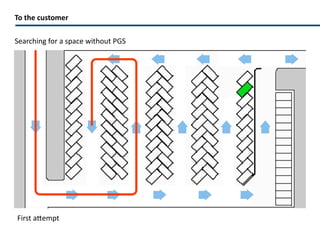
To the customer Searching for a space without PGS First attempt
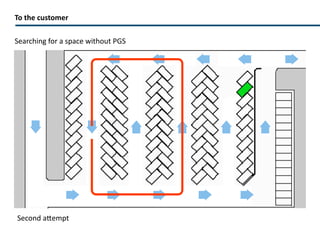
To the customer Searching for a space without PGS Second attempt
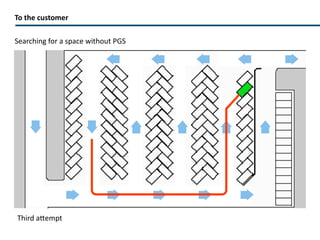
To the customer Searching for a space without PGS Third attempt
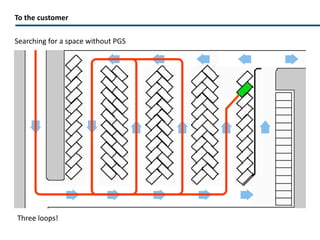
To the customer Searching for a space without PGS Three loops!
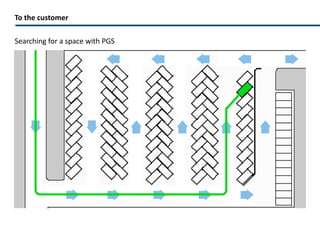
To the customer Searching for a space with PGS
To the owner ENVIRONMENTAL Energy efficient  Carbon dioxide (CO 2 ) emissions reduced  Thermal map
To the owner REVENUE OPTIMISATION Customer satisfaction Loyalty New customers 100% utilization Optimize parking Increased retail sales
To the owner REDUCTION IN OPERATING COSTS Lower energy consumption Staff reduction Save annual greenhouse gas emissions
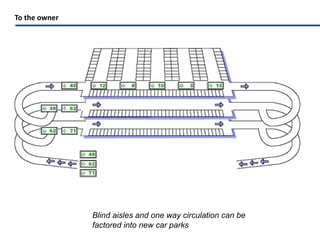
To the owner Blind aisles and one way circulation can be factored into new car parks
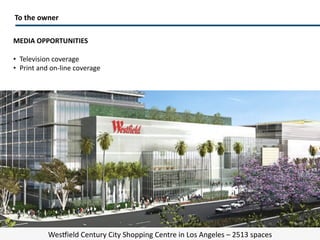
To the owner MEDIA OPPORTUNITIES Television coverage Print and on-line coverage Westfield Century City Shopping Centre in Los Angeles – 2513 spaces
5. Example installations
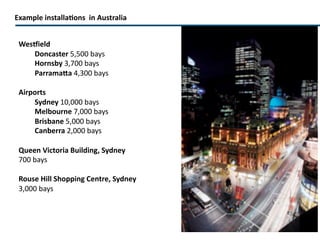
Example installations  in Australia Westfield  Doncaster  5,500 bays Hornsby  3,700 bays Parramatta  4,300 bays Airports Sydney  10,000 bays Melbourne  7,000   bays   (on hold) Brisbane  5,000 bays Canberra  2,000 bays Queen Victoria Building, Sydney 700 bays Rouse Hill Shopping Centre, Sydney 3,000 bays Canberra Centre  (under installation) 5,200 bays
6. What to look out for
What to look out for…. Proven reliability (100%) Clear informative panels Direction of lights Simple and low cost maintenance Method of installation  Price Ease of customization Detection of non vehicle “occupancy”  Integration into access control equipment and other systems Client support
What to look for… Exclusions in the package (supply of power, communications for example)  Remote operating and monitoring Ongoing product improvement SMS alerts to user and operator Ultrasonic technology  First class management software Real time visualization of car park User friendly graphic interface Durability of external signs (weather conditions)
Parking Consultants International [email_address] www.parkingconsultants.com subscribe to PCI’s blog for the latest in parking industry news

Parking Guidance Systems

  • 1.
    sensor-ship why individual bay sensors provide the ultimate in car park management
  • 2.
    What the customerwants What the owner wants How it works Benefits Example installations What to look out for
  • 3.
    1. What thecustomer wants
  • 4.
  • 5.
    What the customerwants Location (near destination) Good lighting Security (staff presence) Price Size of bays Cleanliness Free spaces Clear signs and wayfinding User friendly Extended opening hours Items in red represent areas where PGS can provide benefits
  • 6.
    In general terms…Customers want parking that requires NO EFFORT at MINIMAL COST and within a SECURE ENVIRONMENT
  • 7.
    2. What theowner wants
  • 8.
    The owner’s objectives….Maximise revenues Maximise space utilisation Ensure customer loyalty Minimise expenses Obtain relevant information
  • 9.
    3. How itworks
  • 10.
  • 11.
    PGS – DesignComponents External Traffic Guidance Car park entry information boards Internal: Major decision points Aisle signage Individual bay indicators
  • 12.
    External Traffic Guidance Large format signage Includes static direction to the most appropriate vehicle entry for parking locations convenient to specific areas of the site
  • 13.
  • 14.
    LED panels directingdrivers Simple & accurate information the most effective signs are those which convey information with the minimum amount of words, symbols, etc.
  • 15.
    LED panels directingdrivers Data updated on bay sensors in real time
  • 16.
    Parking bay sensorsand indicators Ultrasonic detection High visibility Each parking bay has a sensor and an LED indicator. The sensor ultrasonically detects vehicle presence and transmits data in real time to lights and signs that immediately show open parking spots on each row and at each specific parking space as well as turning the indicator to red to signify the bay is taken.
  • 17.
  • 18.
    Parking bay sensorsand indicators Although some systems offer the sensor and the light in the same unit (cost saving) the lights would not be easily visible to drivers. Most systems separate the LED light which is placed along the aisle with the sensor being located above the actual space.
  • 19.
    Location of lightsand sensors within parking bays This image illustrates the ability to combine the light and the sensor due to the location of the columns at the back of the space allowing for good visibility
  • 20.
    Directional signage Directionalsignage at major decision points within the car park direct customers to parking rows with unoccupied spaces. These may be simple, with only a guiding character (eg arrows) or complex and informing with displays indicating number of free spaces.
  • 21.
    Different colour lightssignifying availability and customer type Green light = space available Blue light = disabled space Red light = space occupied
  • 22.
  • 23.
    Management Operating SystemCentral Management Computer Real time reports and statistics On screen monitoring Alarms for faults and malfunctions Occupancy Detection   via s ingle space u ltrasonic sensors Parking Guidance   - Lights - Directional signage - Occupancy signage (internal and external)   Time Monitoring   On street and off street Length of stay Infringements Express parking (eg. airports   Ethernet
  • 24.
  • 25.
    To the customerTime saving Improved customer experience Increased security
  • 26.
    To the customerSearching for a space without PGS A
  • 27.
    To the customerSearching for a space without PGS First attempt
  • 28.
    To the customerSearching for a space without PGS Second attempt
  • 29.
    To the customerSearching for a space without PGS Third attempt
  • 30.
    To the customerSearching for a space without PGS Three loops!
  • 31.
    To the customerSearching for a space with PGS
  • 32.
    To the ownerENVIRONMENTAL Energy efficient Carbon dioxide (CO 2 ) emissions reduced Thermal map
  • 33.
    To the ownerREVENUE OPTIMISATION Customer satisfaction Loyalty New customers 100% utilization Optimize parking Increased retail sales
  • 34.
    To the ownerREDUCTION IN OPERATING COSTS Lower energy consumption Staff reduction Save annual greenhouse gas emissions
  • 35.
    To the ownerBlind aisles and one way circulation can be factored into new car parks
  • 36.
    To the ownerMEDIA OPPORTUNITIES Television coverage Print and on-line coverage Westfield Century City Shopping Centre in Los Angeles – 2513 spaces
  • 37.
  • 38.
    Example installations in Australia Westfield Doncaster 5,500 bays Hornsby 3,700 bays Parramatta 4,300 bays Airports Sydney 10,000 bays Melbourne 7,000 bays (on hold) Brisbane 5,000 bays Canberra 2,000 bays Queen Victoria Building, Sydney 700 bays Rouse Hill Shopping Centre, Sydney 3,000 bays Canberra Centre (under installation) 5,200 bays
  • 39.
    6. What tolook out for
  • 40.
    What to lookout for…. Proven reliability (100%) Clear informative panels Direction of lights Simple and low cost maintenance Method of installation Price Ease of customization Detection of non vehicle “occupancy” Integration into access control equipment and other systems Client support
  • 41.
    What to lookfor… Exclusions in the package (supply of power, communications for example) Remote operating and monitoring Ongoing product improvement SMS alerts to user and operator Ultrasonic technology First class management software Real time visualization of car park User friendly graphic interface Durability of external signs (weather conditions)
  • 42.
    Parking Consultants International[email_address] www.parkingconsultants.com subscribe to PCI’s blog for the latest in parking industry news

Editor's Notes

  • #6 - PARKING GUIDANCE SYSTEMS SATISFY A NUMBER OF THESE “WANTS” – INCLUDING 1, 5, 7, 8 AND 9
  • #7 CUSTOMERS WANT PARKING THAT REQUIRES NO EFFORT AT A MINIMAL COST WITHIN A SECURE ENVIRONMENT
  • #9 ACCURATE AND RELIABLE REAL TIME INFORMATION ABOUT OCCUPANCY, TURNOVER, ETC.
  • #11 Directs drivers from the moment they enter the car park (and sometimes even before, in the street) to the closest available parking bay using informative LED panels indicating the direction to follow and the number of spaces available in that particular area.
  • #12 Directs drivers from the moment they enter the car park (and sometimes even before, in the street) to the closest available parking bay using informative LED panels indicating the direction to follow and the number of spaces available in that particular area.
  • #13 THE MOST EFFECTIVE SIGNS ARE THOSE WHICH CONVEY INFORMATION WITH THE MINIMUM AMOUNT OF WORDS, SYMBOLS, NUMBERS ETC.
  • #14 THE MOST EFFECTIVE SIGNS ARE THOSE WHICH CONVEY INFORMATION WITH THE MINIMUM AMOUNT OF WORDS, SYMBOLS, NUMBERS ETC.
  • #15 THE MOST EFFECTIVE SIGNS ARE THOSE WHICH CONVEY INFORMATION WITH THE MINIMUM AMOUNT OF WORDS, SYMBOLS, NUMBERS ETC.
  • #16 Directs drivers from the moment they enter the car park (and sometimes even before, in the street) to the closest available parking bay using informative LED panels indicating the direction to follow and the number of spaces available in that particular area.
  • #17 Each parking bay has a sensor and an LED indicator. The sensor ultrasonically detects vehicle presence and transmits data in real time to lights and signs that immediately show open parking spots on each row and at each specific parking space as well as turning the indicator to red to signify the bay is taken. THE SENSOR EMITS AN ULTRASONIC PULSE AT REGULAR INTERVALS AND MEASURES THE TIME DELAY UNTIL THE ECHO PULSE IS RECEIVED. THE SLAVE LED IS MOUNTED ALONG THE AISLE FOR GREATER VISIBILITY
  • #18 THIS DIAGRAM ILLUSTRATES THE FUNCTIONALITY OF THE SENSOR.
  • #19 ALTHOUGH SOME SYSTEMS OFFER THE SENSOR AND THE LIGHT IN THE SAME UNIT (COST SAVING) THE LIGHTS WOULD NOT BE EASILY VISIBLE TO THE DRIVERS. MOST SYSTEMS SEPARATE THE LED LIGHT WHICH IS PLACED ALONG THE AISLE WHEREAS THE SENSOR IS SITUATED RIGHT ABOVE THE PARKING SPACE.
  • #20 THIS PICTURE SHOWS SPACES RESERVED TO DISABLED DRIVERS. THESE SPACES AND OTHERS SUCH AS PARENTS WITH PRAMS ARE WIDER THAN NORMAL SPACES AND THEREFORE THEY MAY REQUIRE ONE OR MORE LSAVE SENSORS DUE TO THE FACT THAT DRIVERS MAY NOT NECESSARILY PARK EXACTLY IN THE CENTRE OF THE BAY.
  • #21 Directional signage at major decision points within the car park direct customers to parking rows with unoccupied spaces. These may be simple, with only a guiding character (indicational arrows) or complex and informing with displays indicating number of free spaces.
  • #22 A system of colored lights signifies parking space location and availability. For example: Green – unoccupied Red – occupied – THEORETICALLY THE RED LIGHT IS NOT REQUIRED AS DIRECTING TRAFFIC TO OCCUPIED SPACES IS NOT REQUIRED Blue – Disabled Purple or pink – parents with prams Yellow – Reserved (ONLY NECESSARY IF PERMANENT SPACES ARE LOCATED WITHIN THE CASUAL CARPARK) FLASHING LIGHT – SENSOR OUT OF ORDER
  • #24 The Central Management Computer carries out the following functions: Zone maintenance Device maintenance Operating hours maintenance Profile maintenance System parameter maintenance User maintenance Real time reports: - Occupancy - Stay duration - Historical reports - Parking Bay history - Sensor history Data collection from loop detectors and bay sensors Updates signage information Provision of real time and historical management information concerning overall occupancy and individual bays. Information collated by a central management computer Should be accurate to within 10 seconds but even 60 seconds would be acceptable
  • #26 Customer experience normally deteriorates once occupancy exceeds 85%, particularly in car parks with long parking lanes and poor lighting. Time reduced in searching, locating space and parking Reduced stress and therefore improved customer experience Saving petrol and vehicle wear and tear Increased Security
  • #27 LETS SEE WHAT HAPPENS TO A DRIVER ENTERING THE CAR PARK AT LANE A WHERE THE ONLY SPACE AVAILABLE IS SHOWN IN GREEN
  • #30 Customer experience normally deteriorates once occupancy exceeds 85%, particularly in car parks with long parking lanes and poor lighting. Time reduced in searching, locating space and parking Reduced stress and therefore improved customer experience Saving petrol and vehicle wear and tear Increased Security
  • #32 IN THIS PARTICULAR DESIGN THERE WILL BE A SIGN AT THE BEGINNING OF EACH AISLE SHOWING THAT ALL PARKING SPACES ARE FULL IN THAT AISLE AND THEREFORE TO PROCEED TO THE AISLE THAT CONTAINS THE AVAILABLE SPACE THE GREEN LIGHT ABOVE THE SPACE WILL ALLOW THE DRIVER TO PROCEED DIRECTLY TO THAT SPACE WITHOUT NEEDING TO SLOW DOWN Reduced search time: Before: 15.2% of customers spent more than 5 minutes searching After: this was reduced to 3.4%.
  • #33 ENVIRONMENTAL Energy efficient, employs low voltage LED lights Carbon dioxide (CO2) emissions reduced due to less travel time inside the car park Some software packages will generate a thermal map of each parking level showing the temperature for each parking space for control of ventilation systems and temperatures and security system to prevent fires.
  • #34 REVENUE OPTIMISATION Encourages customer satisfaction and therefore – loyalty Will attract new customers Allows 100% utilization against industry standard of 92% (drivers able to find last remaining spaces) Effective capacity can be raised 8-10% in peak times Optimize parking mix to achieve maximum revenues (Unlimited parking, Express, staff) For car parks attached to shopping malls, retail should experience increased sales from stress free customers
  • #35 REDUCTION IN OPERATING COSTS Lower energy consumption for air-purifying machines and ventilation equipment within the car park. Staff reduction: personnel costs for security and monitoring can be minimized.
  • #36 NEW CAR PARK PLANNING: Less spaces need to be built if occupancy can be increased to or close to 100%. Depending on layout of the site can create blind spots which are not normally possible in a traditional design Can also plan on one way circulation routes
  • #37 Television coverage included viewership of over 2 million people Print and on-line coverage equivalent to over 1 million circulation/hits Total media coverage estimated at over $US403,000 (September 2008)
  • #39 Westfield Century City USA 2,600 spaces – Park Assist. Madrid Airport New Terminal – 9000 spaces Hyperlink http://www.youtube.com/watch?v=U3Uw8K63-eE
  • #41 Proven reliability of data (system rapidly loses credibility if unreliable) Clear informative panels. Optimum visibility at distance (LED technology) angled visions allows circuit direction changes to be made. Alphanumeric signs Direction of lights (360 degrees, bi-directional) Simple and low cost maintenance and/or replacement parts Rapid and easy installation (ParkHelp uses aluminium canalization avoiding use of screws) Quality price ratio Simple an low cost maintenance and/or replacement parts Ease of customization Operator alerted to unusual situations Clear informative panels. Full matrix multicolour display. Pixels per module. Optimum visibility at distance (LED technology) angled visions allows circuit direction changes to be made. Alphanumeric. Ease of integration into existing systems Synchronisation of sensors to prevent silmultaneous signal emission with adjacent sensor. Ultrasonic measurement process excludes pedestrians Client support
  • #42 Possibility of using other colour indicators (other than red or green) ie blue for disabled etc. Visibility of indicators and signage at long distance. Bright intensity and illumination.OK for bi-directional traffic. Remote operating and monitoring Ongoing product improvement Mobile phone alerts to car space user as well as manager via SMS Proven product Ultrasonic technology that guarantees recognition of non-ferromagnetic materials such as plastic or aluminium First class management software Real time visualization of car park User friendly graphic interface