42nd Aerospace Sciences Meeting and Exhibit                                                                        AIAA 2004-895
5-8 January 2004, Reno, Nevada


GENERIC PROCESS FOR AIR VEHICLE CONCEPT DESIGN AND ASSESSMENT
                                      John J. Doherty* and Stephen C. McParlin†
                         QinetiQ Ltd., Farnborough, Hampshire, United Kingdom, GU14 0LX


                           Abstract                                   the assumed mission performance levels, is typically
                                                                      based on simple operational analysis type methods.
In recent years, the UK Ministry of Defence (MOD)
has funded development, by QinetiQ and its                            These notional, mission requirements were interpreted
predecessor organisations, of processes and tools to                  to refine the requirements for a more detailed
assess the performance of air vehicles, with the                      assessment process. The aim of this detailed
objective of maintaining status as an intelligent                     assessment process was to check the validity of the
customer for a variety of air vehicle types. During this              mission described above, to identify particular risk
period, Operational Requirements have been                            areas, and to provide additional supporting
evolving, requiring increased flexibility and the                     information. In order to meet this aim it was
capability to produce accurate performance data for                   necessary to effectively design a manned aircraft
novel air vehicle concepts, including those which are                 concept which, if successful, would meet or surpass
not adequately represented by existing semi-empirical                 each of the assumed mission performance targets.
methods and databases. In order to explain the                        Hence, there is actually a dual requirement, for both a
assessment process that has been developed, an                        design and a detailed assessment process. This
example manned aircraft application is described. The                 process both establishes confidence in, and improves
component parts of the assessment process, and the                    the accuracy of, the original operational level study.
underlying techniques and technologies are also                       This is key to meeting the overall requirement for
described. Finally, indications are given of possible                 maintaining intelligent customer status. The design
future directions.                                                    and detailed assessment process, together with its
                                                                      application to the example manned aircraft concept, is
                        Introduction                                  described in the next section.

UK MOD is involved in the procurement and use of                                 The design and assessment process
complex systems, including air vehicles, for a variety
of roles and requirements. Processes are required to                  Conceptual design synthesis
establish whether candidate systems fulfil Operational
Requirements at appropriate levels of cost and risk.                  Following the derivation of design requirements from
To determine the suitability of equipment for specific                the operational level assumptions, the first stage of
tasks, it is necessary to understand the implications of              the process is air-vehicle conceptual design. The main
these requirements on the cost and performance of the                 tool used for concept studies for air vehicles, in both
systems, and to be able to conduct trade studies such                 QinetiQ and MOD, over recent years is the
that equipment is both fit for purpose and                            Multivariate Optimisation (MVO) design synthesis
economically appropriate. The use of these processes                  method. This has evolved gradually since initial use1
to support investment and procurement decisions is                    in the early 1980s to cover a wider range of concepts
described as Intelligent Customer capability.                         and options2, and has recently been extended to cover
                                                                      unmanned vehicles, but has remained basically
         Manned aircraft assessment example                           similar in concept. The MVO method has a simple
                                                                      parametric model of an aircraft, the performance of
To explain the typical requirements of an air-vehicle                 which is assessed against a range of mission and point
assessment study, an example manned aircraft                          performance requirements, using relatively simple,
concept, for which the assessment process has been                    low-fidelity, semi-empirical, aerodynamic and mass
completed, is now described. The starting point for                   estimation methods.
the example study was a set of notional, operational
level, mission performance requirements for a                         Figure 1 shows a schematic of the MVO synthesis
manned aircraft. In particular a deep strike mission                  process. This is controlled by the QinetiQ general-
was defined, with specific payload and range                          purpose constrained optimisation method, RQPMIN3.
requirements. At the beginning of the study there                     RQPMIN minimises an objective function, subject to
were no specific details defining the concept                         a number of constraints. The objective function is
geometry. This type of operational level study, and                   usually basic mass empty (BME), but can also be a

*
    Member AIAA, Technology Chief, Aerodynamic Design and Optimisation, Aerodynamic Technology
†
    Senior Member AIAA, Principal Scientist, Aerodynamic Technology

                                                                     1
Copyright Ó2004 by QinetiQ Ltd. Published by the American Institute of Aeronautics and Astronautics, Inc., with permission.
42nd Aerospace Sciences Meeting and Exhibit                                                                        AIAA 2004-895
5-8 January 2004, Reno, Nevada


parameter related to life cycle cost. For the manned                  The initial stage involves the creation of an initial 3D
aircraft example the BME was minimised. The range                     Computer Aided Design (CAD) model of the air-
of constraints is variable, but all of the mission and                vehicle configuration. This initial representation will
point performance targets are set as constraints. For                 be used as the starting point for further detailed
the manned aircraft example these mission and point                   design. The initial CAD model is primarily derived
performance targets were derived from the mission                     from the available MVO output information, which
requirements. The converged solution concept is one                   defines the overall configuration layout and key
for which the objective function has been minimised,                  packaging components. The generation of this initial
while the constraints have all been met.                              CAD model is automated through the use of
                                                                      parametric, knowledge-based (rules-based) CAD, as
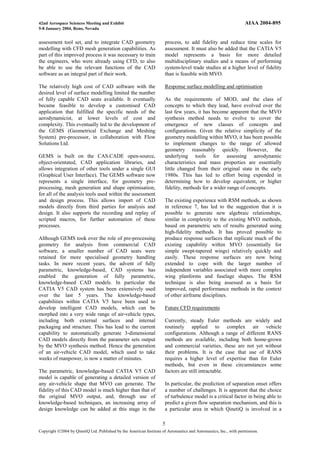
Figure 2 shows the result of the MVO design                           described later in this paper. Figure 4 shows the initial
synthesis for the manned aircraft example. The                        stage of this CAD model creation for the manned
overall configuration layout has been designed,                       aircraft concept, showing the internal components and
including concept sizing and mass, wing planform,                     the skeleton of the external surfaces.
control surfaces and internal packaging arrangement.
                                                                      During the creation of the initial external surfaces it is
It is usual to find that some of the performance targets              sensible to build in basic aerodynamic design features
are met exactly, while others are exceeded. This is                   from the outset. This includes choice of initial wing
important, in that it identifies the driving performance              sectional shapes, based on the required design
requirements. A fundamental aspect of combat                          conditions, and the desire for smooth, continuous
aircraft design is that there are usually multiple,                   surface shaping. Wing-body blending, and details of
frequently conflicting, performance requirements with                 intake and nozzle shaping can also be added. Figure 5
associated design points. In most cases, the best                     shows the completed initial CAD model for the
design represents the most effective compromise                       manned aircraft concept. The generation of these
between these.                                                        external surfaces is a semi-automated process,
                                                                      involving a combination of aerodynamic design
During the manned aircraft MVO design, one of the                     experience and knowledge-based CAD.
performance constraints applied was the time taken to
accelerate from a cruise Mach number of 0.85 to 1.4.                  Detailed configuration design
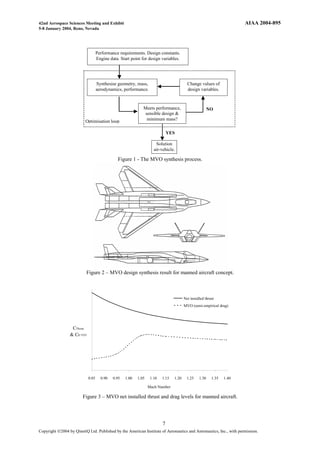
Figure 3 shows the available net installed engine
thrust coefficient and the MVO predicted total drag                   As previously described, the initial CAD model of the
coefficient, for the final MVO design. The time taken                 configuration contains some basic aerodynamic
to accelerate from M=0.85 to 1.4 is derived from a                    design features. However, to derive a prediction of
time integral, based on the difference between the net                the realistic aerodynamic performance of an air-
installed thrust and the drag. It was noted that this                 vehicle, a realistic, and therefore comprehensively
acceleration time constraint was the critical, limiting               designed geometry, must be obtained. Hence detailed
constraint within the optimisation problem. Hence                     design features, such as camber, twist, volume
meeting this performance constraint was identified as                 distributions and overall local surface shaping must
a priority area for subsequent detailed study. In                     be incorporated. In addition the stability and control
addition, it was apparent that if the MVO drag levels                 of the configuration, including device scheduling and
could be improved upon, without significantly                         trimming, must also be addressed. The main tool
penalising other performance requirements, then the                   developed for this purpose, now in use for
acceleration time constraint could be more readily                    approximately 12 years, is the CODAS (Constrained
satisfied, and the overall configuration could be                     Optimisation Design of Aerodynamic Shapes)
further optimised.                                                    method4. Figure 6 shows a schematic diagram of the
                                                                      CODAS process. This couples a more detailed,
Initial CAD model creation                                            parametric, 3-dimensional CAD description of the
                                                                      configuration geometry with a range of
The MVO output is primarily in the form of a 2-                       Computational Fluid Dynamics (CFD) analysis
dimensional representation of the configuration                       methods, again controlled by the RQPMIN
(Figure 2), together with additional information                      optimisation method. CODAS is used to perform
defining the 3-dimensional size and position of key                   aerodynamic design of the configuration, usually for
internal packaging components. Given this outline                     multiple design points, subject to constraints on both
definition of an air vehicle concept from MVO,                        the configuration geometry (e.g. packaging, structural
detailed assessment of the performance of the vehicle                 considerations) and the development of the flow field.
requires more detailed geometric representation and
some degree of detailed design. Achieving this within                 The capability for multiple design points and
a relatively short space of time has been a primary                   constraint-dominated problems is fundamental to the
area for process improvement in recent years.                         rationale of the design technique, and distinguishes

                                                                     2
Copyright Ó2004 by QinetiQ Ltd. Published by the American Institute of Aeronautics and Astronautics, Inc., with permission.
42nd Aerospace Sciences Meeting and Exhibit                                                                        AIAA 2004-895
5-8 January 2004, Reno, Nevada


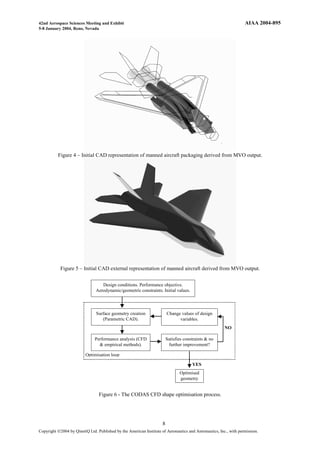
CODAS from many of the design optimisation                            design process all of the constraints were satisfied,
techniques that have emerged in the last decade.                      including the incorporation of the additional 25% of
Although most design is performed using block-                        fuel volume, and the dash elapse time was reduced by
structured Euler methods; Unstructured Euler,                         20% compared to the original MVO prediction. The
Viscous-coupled Euler, Full Potential, Panel and                      configuration was also fully trimmed for each stage of
Vortex Lattice methods have also been integrated.                     the transonic to supersonic dash, and the transonic
The choice of analysis method depends on the                          manoeuvre condition. The predicted drag level for the
problem in hand at any time.                                          final design can be seen in Figure 7, which shows that
                                                                      the CODAS process was able to increase the
CODAS allows a reasonably high standard of                            configuration volume, whilst simultaneously reducing
aerodynamic design to be achieved within a short                      the drag over most of the transonic and supersonic
time. The main issue determining the length of the                    dash conditions. Figure 8 shows the CAD model for
detail design process is the trade-off between multiple               the final CODAS design, which was subsequently
design requirements. It is usually the case that the set              used for wind-tunnel model manufacture.
of constraints is refined during the design process,
yielding valuable information on more detailed trade-                 Post-design CFD Analysis
offs between design conditions.
                                                                      Generally speaking, there will be a lag between the
For the manned aircraft concept, both transonic and                   definition of detailed configuration lines and the
supersonic design conditions were of interest. Hence                  availability of a wind tunnel model. In the interim,
CODAS was employed with block-structured Euler                        CFD analyses are used to determine the basic lift,
CFD, combined with empirical skin friction estimates.                 drag and pitching moment characteristics of the
Approximately 60 surface shape parameters were                        vehicle. As well as providing useful performance
simultaneously designed, controlling wing camber,                     data, the results of the analyses allow refinement of
twist and thickness, leading and trailing edge control                the eventual wind tunnel test programme.
device deflection, tail-plane deflection, fin deflection,
and fuselage upper surface shaping. Numerous                          Drag prediction with CFD has, like optimisation
constraints were incorporated into the design                         design, evolved over the last 10-12 years. Initial
optimisation problem, addressing the internal                         experience with block-structured Euler methods, for
packaging considerations, wing structural thickness,                  supersonic drag prediction5, in combination with
wing and fuselage fuel volume, control device hinge                   empirical skin-friction estimates, has grown to the
lines, and configuration trim. In addition local flow                 stage where Reynolds-Averaged Navier-Stokes
velocities and pressure gradients over the surface of                 (RANS) methods can give reasonable predictions of
the configuration were constrained to tailor the onset                drag over much of the likely flight envelope, at least
of flow separation at more extreme flight conditions.                 in attached flow conditions6.

At the start of the CODAS process it was noted that                   Although expectations with regard to the capability of
the initial CAD model did not meet the required                       CFD methods have increased significantly over the
internal fuel volume requirement. In fact the fuel                    last 12 years, the maturity of CFD methods,
volume was approximately 25% lower than required.                     particularly RANS techniques, has not reached the
This meant that the initial configuration had an                      stage where subsequent wind tunnel testing does not
unrealistically low overall volume. Hence an                          yield some surprises. Much of the flight envelope of
unrealistically low level of supersonic drag would be                 combat aircraft lies beyond the onset of flow
expected. This can be seen in Figure 7, which shows                   separation, which still represents a practical boundary
that the predicted level of total drag for the initial                for most CFD methods.
CAD model, derived from CFD, is generally lower
than the original MVO semi-empirical drag at                          Wind tunnel testing
supersonic conditions. Figure 7 also highlights that
the drag for the initial CAD model is higher than the                 The main means of producing performance data sets
MVO prediction at transonic conditions. This latter                   for air vehicle concepts remains the wind tunnel,
feature is primarily due to the fact that the initial CAD             particularly for portions of the flight regime beyond
model has a non-designed wing, giving an                              separation onset, up to maximum useable lift. For
unrealistically high level of drag.                                   concepts where a higher level of fidelity in
                                                                      performance, stability and control is required, wind
CODAS was used to design the manned aircraft                          tunnel models are manufactured and tested to provide
configuration for multiple design points. In particular               a comprehensive loads database. It is also our normal
the elapse time for transonic to supersonic dash was                  practice to make extensive surface pressure
minimised, whilst also controlling the transonic                      measurements, for comparison with the design and
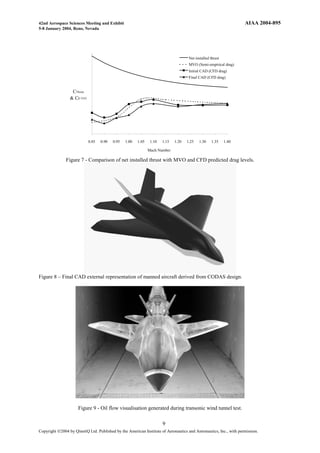
sustained turn condition. At the end of the CODAS                     subsequent CFD analyses. Figure 9 shows a surface

                                                                     3
Copyright Ó2004 by QinetiQ Ltd. Published by the American Institute of Aeronautics and Astronautics, Inc., with permission.
42nd Aerospace Sciences Meeting and Exhibit                                                                        AIAA 2004-895
5-8 January 2004, Reno, Nevada


oil flow run for the designed manned aircraft model in                RSM method and optimisation technique used for
a transonic wind tunnel. Flow visualisation is a                      trimming were originally developed as an alternative
particular area where wind tunnel testing contributes                 approach for aerodynamic shape optimisation7, but
to the understanding of the underlying fluid                          because of the modular nature of the software used,
mechanics, which affect aircraft performance,                         they have proven suitable for more general
stability and control.                                                application. The effect of scale on drag is determined
                                                                      by calculating incremental effect of Reynolds number
Depending on the primary areas of concern in the                      on the zero-lift skin friction, using empirical skin
flight envelope, both low speed wind tunnel and high-                 friction methods, applied to the geometry used for
speed wind tunnel models will be manufactured. In                     CFD calculations.
practice, the economics of experimental testing are
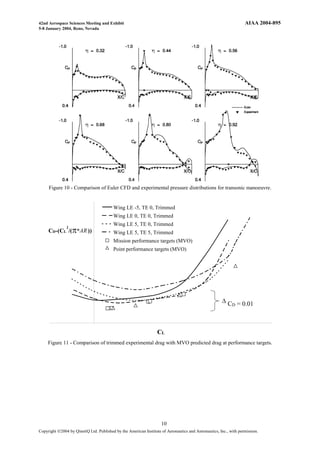
such that the majority of the variable-geometry                       Figure 11 shows trimmed drag polars for the manned
elements (e.g. flap schedules and control effectors) of               aircraft concept, derived from wind tunnel data by the
the concepts will be evaluated at low speed only, with                RSM methodology. The drag curves are presented for
a smaller subset manufactured for testing at higher                   a variety of fixed leading and trailing device
Mach number. Thus high lift, stability and control are                deflections. Alternatively the RSM technique allows a
predominantly investigated in low-speed tests, while                  drag curve to be derived for which device deflections
the main function of high speed testing is to                         are optimised, in addition to the configuration being
investigate performance, although high-speed stability                trimmed. Also shown are the drag levels, predicted by
characteristics are also important, particularly where                MVO, for a range of mission and point performance
non-linearities develop in separated flows, beyond the                targets. Note that the experimental drag polars in
useable limits of existing CFD methods.                               Figure 11 have not been corrected to full-scale
                                                                      Reynolds number. When these corrections are taken
Figure 10 shows a comparison of Euler CFD and                         into consideration, the vast majority of the target
experimental pressure distributions across the span of                performance levels are met for the manned aircraft
the wing, for the designed manned aircraft concept.                   concept, although there remain some points where the
Figure 10 corresponds to a transonic manoeuvre                        final levels of drag are slightly above the target.
condition, including leading and trailing edge control
device deflections. Generally the agreement between                   Closing the loop
CFD and experiment is good indicating that the
design process has successfully achieved primarily                    It can be seen that the assessment process generates
attached flow.                                                        data of increasingly high fidelity with time. It is
                                                                      important, given the dependence on low-fidelity
Synthesis of aerodynamic data sets                                    methods in the initial stages of the process, that
                                                                      comparisons are made between the results generated
Although both wind tunnel measurements and CFD-                       at each stage of the process. This provides an
based aerodynamic loads will be available, in general                 important sanity check, given that the system-level
these will be untrimmed, for fixed geometry and at                    mass and cost implications are only determined using
either sub-scale or infinite (inviscid) Reynolds                      the lowest-fidelity portion of the process. Usually, the
number. Also, in most cases, wind tunnel models will                  level of agreement between the initial MVO
be designed and tested without flow-through,                          performance output and the final versions is fairly
representing intake and nozzle effects, to reduce                     good, although there are frequent differences, some of
costs. As with the air vehicle data, it is also possible              which are systematic. A programme is now well under
to generate intake and afterbody drag contributions at                way to improve the fidelity of the methods within
various levels of fidelity, using semi-empirical, CFD,                MVO to better reflect the results obtained with higher
or experimental methods.                                              fidelity tools.

To provide an accurate performance data set, it is                                    Underpinning technologies
necessary to correct the available data to reflect the
effects of device scheduling, trim, scale effects and                 Integration of CAD within the assessment process
propulsion integration. To address this trim
requirement, optimal trimmed device schedules can                     In the early 1990’s, during initial applications for
be derived from untrimmed wind tunnel                                 blended wing-body configurations, it became
measurements, using numerical optimisation. The                       increasingly obvious that it was necessary to use CAD
wind tunnel data set is interpolated using a response                 both to define and manipulate complex aerodynamic
surface modelling (RSM) technique, with air vehicle                   shapes. It then became apparent that the time taken to
attitude, the control effector and high lift device                   pre-process geometry was a significant factor in the
settings as independent variables and the force and                   time taken to perform CFD analyses. As a result, the
moment coefficients as dependent variables. The                       decision was made to embrace CAD as part of the

                                                                     4
Copyright Ó2004 by QinetiQ Ltd. Published by the American Institute of Aeronautics and Astronautics, Inc., with permission.
42nd Aerospace Sciences Meeting and Exhibit                                                                        AIAA 2004-895
5-8 January 2004, Reno, Nevada


assessment tool set, and to integrate CAD geometry                    process, to add fidelity and reduce time scales for
modelling with CFD mesh generation capabilities. As                   assessment. It must also be added that the CATIA V5
part of this improved process it was necessary to train               model represents a basis for more detailed
the engineers, who were already using CFD, to also                    multidisciplinary studies and a means of performing
be able to use the relevant functions of the CAD                      system-level trade studies at a higher level of fidelity
software as an integral part of their work.                           than is feasible with MVO.

The relatively high cost of CAD software with the                     Response surface modelling and optimisation
desired level of surface modelling limited the number
of fully capable CAD seats available. It eventually                   As the requirements of MOD, and the class of
became feasible to develop a customised CAD                           concepts to which they lead, have evolved over the
application that fulfilled the specific needs of the                  last few years, it has become apparent that the MVO
aerodynamicist, at lower levels of cost and                           synthesis method needs to evolve to cover the
complexity. This eventually led to the development of                 emergence of new classes of concepts and
the GEMS (Geometrical Exchange and Meshing                            configurations. Given the relative simplicity of the
System) pre-processor, in collaboration with Flow                     geometry modelling within MVO, it has been possible
Solutions Ltd.                                                        to implement changes to the range of allowed
                                                                      geometry reasonably quickly. However, the
GEMS is built on the CAS.CADE open-source,                            underlying tools for assessing aerodynamic
object-orientated, CAD application libraries, and                     characteristics and mass properties are essentially
allows integration of other tools under a single GUI                  little changed from their original state in the early
(Graphical User Interface). The GEMS software now                     1980s. This has led to effort being expended in
represents a single interface, for geometry pre-                      determining how to develop equivalent, or higher
processing, mesh generation and shape optimisation,                   fidelity, methods for a wider range of concepts.
for all of the analysis tools used within the assessment
and design process. This allows import of CAD                         The existing experience with RSM methods, as shown
models directly from third parties for analysis and                   in reference 7, has led to the suggestion that it is
design. It also supports the recording and replay of                  possible to generate new algebraic relationships,
scripted macros, for further automation of these                      similar in complexity to the existing MVO methods,
processes.                                                            based on parametric sets of results generated using
                                                                      high-fidelity methods. It has proved possible to
Although GEMS took over the role of pre-processing                    produce response surfaces that replicate much of the
geometry for analysis from commercial CAD                             existing capability within MVO (essentially for
software, a smaller number of CAD seats were                          simple swept-tapered wings) relatively quickly and
retained for more specialised geometry handling                       easily. These response surfaces are now being
tasks. In more recent years, the advent of fully                      extended to cope with the larger number of
parametric, knowledge-based, CAD systems has                          independent variables associated with more complex
enabled the generation of fully parametric,                           wing planforms and fuselage shapes. The RSM
knowledge-based CAD models. In particular the                         technique is also being assessed as a basis for
CATIA V5 CAD system has been extensively used                         improved, rapid performance methods in the context
over the last 5 years. The knowledge-based                            of other airframe disciplines.
capabilities within CATIA V5 have been used to
develop intelligent CAD models, which can be                          Future CFD requirements
morphed into a very wide range of air-vehicle types,
including both external surfaces and internal                         Currently, steady Euler methods are widely and
packaging and structure. This has lead to the current                 routinely applied to complex air vehicle
capability to automatically generate 3-dimensional                    configurations. Although a range of different RANS
CAD models directly from the parameter sets output                    methods are available, including both home-grown
by the MVO synthesis method. Hence the generation                     and commercial varieties, these are not yet without
of an air-vehicle CAD model, which used to take                       their problems. It is the case that use of RANS
weeks of manpower, is now a matter of minutes.                        requires a higher level of expertise than for Euler
                                                                      methods, but even in these circumstances some
The parametric, knowledge-based CATIA V5 CAD                          factors are still intractable.
model is capable of generating a detailed version of
any air-vehicle shape that MVO can generate. The                      In particular, the prediction of separation onset offers
fidelity of this CAD model is much higher than that of                a number of challenges. It is apparent that the choice
the original MVO output, and, through use of                          of turbulence model is a critical factor in being able to
knowledge-based techniques, an increasing array of                    predict a given flow separation mechanism, and this is
design knowledge can be added at this stage in the                    a particular area in which QinetiQ is involved in a

                                                                     5
Copyright Ó2004 by QinetiQ Ltd. Published by the American Institute of Aeronautics and Astronautics, Inc., with permission.
42nd Aerospace Sciences Meeting and Exhibit                                                                        AIAA 2004-895
5-8 January 2004, Reno, Nevada


number of research activities. There is currently                     2.    Crawford C. A. and Simm S. E., “Conceptual
reasonable confidence in the ability to predict                             design and optimisation of modern combat
transonic shock-induced flow separations, but                               aircraft”, in “Aerodynamic design and
predicting the onset of vortical separations from                           optimisation of flight vehicles in a concurrent
wings with finite leading edge radius, twist and                            multi-disciplinary environment”, NATO RTO
camber appears to be more problematic at this stage,                        Symposium, Ottawa, Canada, 18-21 October
with transition modelling and curvature effects                             1999.
emerging as potential factors.                                        3.    Skrobanski J. J., “Optimisation subject to non-
                                                                            linear constraints”, PhD. Thesis, University of
The eventual objective for CFD must be the ability to                       London, 1986.
predict aerodynamic loads for unsteady separated                      4.    Lovell D. A. and Doherty J. J., “Aerodynamic
flows up to the boundaries of the flight envelope. This                     design of aerofoils and wings using a constrained
is a significant challenge, and one that ensures that the                   optimisation method”, Paper ICAS-94-2.1.2,
wind tunnel will remain the main tool for determining                       International Congress of the Aerospace
aerodynamic characteristics for separated and                               Sciences, Anaheim, California, 1994.
unsteady flows in the immediate future. Given the                     5.    McParlin S. C., Doherty J. J. and Wood S. E.,
expansion in the use of CFD over the last 10-15 years,                      “Validation of a multi-block Euler method for
the increased expectations associated with this, and                        supersonic flows about complex aircraft
ongoing reductions in time and cost to perform CFD                          configurations”, Royal Aeronautical Society
analyses, it appears that the balance between CFD and                       Conference on “Recent developments and
experiment will continue to shift in favour of the                          applications in aeronautical CFD”, Bristol,
former.                                                                     September 1993.
                                                                      6.    McParlin S. C., and Adamczak D. W.,
                        Conclusions                                         “Prediction     of    transonic     shock-induced
                                                                            separation for 40° lambda wings”, AIAA 2003-
Over the last 10-12 years, QinetiQ and its                                  599, 41st ASME, Reno, Nevada, 6-9 Jan 2003.
predecessors have been funded by UK MOD to assess                     7.    Fenwick S. V. and Harris J. ap C., “The
potential concepts to meet a range of Operational                           application of Pareto Frontier methods in the
Requirements. The evolution of these requirements,                          multi-disciplinary wing design of a generic
and the introduction of novel air vehicle concepts, has                     modern military delta aircraft”, in “Aerodynamic
led to a need for rapid, flexible and accurate methods                      design and optimisation of flight vehicles in a
for assessment of their performance. The existing                           concurrent multi-disciplinary environment”,
assessment and design process, developed to meet                            NATO RTO Symposium, Ottawa, Canada, 18-21
this need, has been described, and it’s successful                          October 1999.
application for a manned aircraft example presented.

As part of the development of this assessment and
design process, QinetiQ has harnessed and matured a
number of technologies, not all of them originating
within aerodynamics. Some elements of this
capability are less mature than others, and therefore
the process is undergoing continuous evolutionary
improvement.

The development of this process, in the context of
many radically different air vehicle types, has led to a
capability that is now essentially generic in nature.
Hence the process provides a firm basis for
assessment and conceptual design of future air
vehicles.

                         References

1.   Lovell D. A., “Some experiences with numerical
     optimisation in aircraft specification and
     preliminary design studies”, 12th International
     Congress of the Aerospace Sciences, Munich,
     October 1980.


                                                                     6
Copyright Ó2004 by QinetiQ Ltd. Published by the American Institute of Aeronautics and Astronautics, Inc., with permission.
42nd Aerospace Sciences Meeting and Exhibit                                                                            AIAA 2004-895
5-8 January 2004, Reno, Nevada


                                   Performance requirements. Design constants.
                                   Engine data. Start point for design variables.


                                   Synthesise geometry, mass,                            Change values of
                                   aerodynamics, performance.                            design variables.


                                                             Meets performance,                         NO
                                                             sensible design &
                          Optimisation loop                   minimum mass?

                                                                             YES

                                                                     Solution
                                                                    air-vehicle.

                                               Figure 1 - The MVO synthesis process.


                          Figure 2 – MVO design synthesis result for manned aircraft concept.


                                                                                       Net installed thrust
                                                                                       MVO (semi-empirical drag)


                  CThrust
                 & CD TOT


                            0.85     0.90   0.95   1.00   1.05    1.10   1.15   1.20     1.25    1.30    1.35   1.40

                                                                 Mach Number

                        Figure 3 – MVO net installed thrust and drag levels for manned aircraft.


                                                                         7
Copyright Ó2004 by QinetiQ Ltd. Published by the American Institute of Aeronautics and Astronautics, Inc., with permission.
42nd Aerospace Sciences Meeting and Exhibit                                                                        AIAA 2004-895
5-8 January 2004, Reno, Nevada


          Figure 4 – Initial CAD representation of manned aircraft packaging derived from MVO output.


            Figure 5 – Initial CAD external representation of manned aircraft derived from MVO output.


                                   Design conditions. Performance objective.
                                Aerodynamic/geometric constraints. Initial values.


                                Surface geometry creation                Change values of design
                                   (Parametric CAD).                           variables.
                                                                                                        NO

                               Performance analysis (CFD                 Satisfies constraints & no
                                 & empirical methods).                    further improvement?

                          Optimisation loop

                                                                                       YES
                                                                                Optimised
                                                                                geometry


                                 Figure 6 - The CODAS CFD shape optimisation process.


                                                                     8
Copyright Ó2004 by QinetiQ Ltd. Published by the American Institute of Aeronautics and Astronautics, Inc., with permission.
42nd Aerospace Sciences Meeting and Exhibit                                                                         AIAA 2004-895
5-8 January 2004, Reno, Nevada


                                                                                      Net installed thrust
                                                                                      MVO (Semi-empirical drag)
                                                                                      Initial CAD (CFD drag)
                                                                                      Final CAD (CFD drag)


                  CThrust
                 & CD TOT


                            0.85   0.90   0.95   1.00   1.05    1.10   1.15   1.20   1.25   1.30    1.35     1.40

                                                               Mach Number

               Figure 7 - Comparison of net installed thrust with MVO and CFD predicted drag levels.


Figure 8 – Final CAD external representation of manned aircraft derived from CODAS design.


                      Figure 9 - Oil flow visualisation generated during transonic wind tunnel test.

                                                                       9
Copyright Ó2004 by QinetiQ Ltd. Published by the American Institute of Aeronautics and Astronautics, Inc., with permission.
42nd Aerospace Sciences Meeting and Exhibit                                                                        AIAA 2004-895
5-8 January 2004, Reno, Nevada


     Figure 10 - Comparison of Euler CFD and experimental pressure distributions for transonic manoeuvre.


                                         Wing LE -5, TE 0, Trimmed
                                         Wing LE 0, TE 0, Trimmed
                                         Wing LE 5, TE 0, Trimmed
     CD-(CL /(p*AR ))
               2
                                         Wing LE 5, TE 5, Trimmed
                                         Mission performance targets (MVO)
                                         Point performance targets (MVO)


                                                                                                      D C = 0.01
                                                                                                         D


                                                                  CL
     Figure 11 - Comparison of trimmed experimental drag with MVO predicted drag at performance targets.


                                                                    10
Copyright Ó2004 by QinetiQ Ltd. Published by the American Institute of Aeronautics and Astronautics, Inc., with permission.

Invited Paper for ASM 2004

  • 1.
    42nd Aerospace SciencesMeeting and Exhibit AIAA 2004-895 5-8 January 2004, Reno, Nevada GENERIC PROCESS FOR AIR VEHICLE CONCEPT DESIGN AND ASSESSMENT John J. Doherty* and Stephen C. McParlin† QinetiQ Ltd., Farnborough, Hampshire, United Kingdom, GU14 0LX Abstract the assumed mission performance levels, is typically based on simple operational analysis type methods. In recent years, the UK Ministry of Defence (MOD) has funded development, by QinetiQ and its These notional, mission requirements were interpreted predecessor organisations, of processes and tools to to refine the requirements for a more detailed assess the performance of air vehicles, with the assessment process. The aim of this detailed objective of maintaining status as an intelligent assessment process was to check the validity of the customer for a variety of air vehicle types. During this mission described above, to identify particular risk period, Operational Requirements have been areas, and to provide additional supporting evolving, requiring increased flexibility and the information. In order to meet this aim it was capability to produce accurate performance data for necessary to effectively design a manned aircraft novel air vehicle concepts, including those which are concept which, if successful, would meet or surpass not adequately represented by existing semi-empirical each of the assumed mission performance targets. methods and databases. In order to explain the Hence, there is actually a dual requirement, for both a assessment process that has been developed, an design and a detailed assessment process. This example manned aircraft application is described. The process both establishes confidence in, and improves component parts of the assessment process, and the the accuracy of, the original operational level study. underlying techniques and technologies are also This is key to meeting the overall requirement for described. Finally, indications are given of possible maintaining intelligent customer status. The design future directions. and detailed assessment process, together with its application to the example manned aircraft concept, is Introduction described in the next section. UK MOD is involved in the procurement and use of The design and assessment process complex systems, including air vehicles, for a variety of roles and requirements. Processes are required to Conceptual design synthesis establish whether candidate systems fulfil Operational Requirements at appropriate levels of cost and risk. Following the derivation of design requirements from To determine the suitability of equipment for specific the operational level assumptions, the first stage of tasks, it is necessary to understand the implications of the process is air-vehicle conceptual design. The main these requirements on the cost and performance of the tool used for concept studies for air vehicles, in both systems, and to be able to conduct trade studies such QinetiQ and MOD, over recent years is the that equipment is both fit for purpose and Multivariate Optimisation (MVO) design synthesis economically appropriate. The use of these processes method. This has evolved gradually since initial use1 to support investment and procurement decisions is in the early 1980s to cover a wider range of concepts described as Intelligent Customer capability. and options2, and has recently been extended to cover unmanned vehicles, but has remained basically Manned aircraft assessment example similar in concept. The MVO method has a simple parametric model of an aircraft, the performance of To explain the typical requirements of an air-vehicle which is assessed against a range of mission and point assessment study, an example manned aircraft performance requirements, using relatively simple, concept, for which the assessment process has been low-fidelity, semi-empirical, aerodynamic and mass completed, is now described. The starting point for estimation methods. the example study was a set of notional, operational level, mission performance requirements for a Figure 1 shows a schematic of the MVO synthesis manned aircraft. In particular a deep strike mission process. This is controlled by the QinetiQ general- was defined, with specific payload and range purpose constrained optimisation method, RQPMIN3. requirements. At the beginning of the study there RQPMIN minimises an objective function, subject to were no specific details defining the concept a number of constraints. The objective function is geometry. This type of operational level study, and usually basic mass empty (BME), but can also be a * Member AIAA, Technology Chief, Aerodynamic Design and Optimisation, Aerodynamic Technology † Senior Member AIAA, Principal Scientist, Aerodynamic Technology 1 Copyright Ó2004 by QinetiQ Ltd. Published by the American Institute of Aeronautics and Astronautics, Inc., with permission.
  • 2.
    42nd Aerospace SciencesMeeting and Exhibit AIAA 2004-895 5-8 January 2004, Reno, Nevada parameter related to life cycle cost. For the manned The initial stage involves the creation of an initial 3D aircraft example the BME was minimised. The range Computer Aided Design (CAD) model of the air- of constraints is variable, but all of the mission and vehicle configuration. This initial representation will point performance targets are set as constraints. For be used as the starting point for further detailed the manned aircraft example these mission and point design. The initial CAD model is primarily derived performance targets were derived from the mission from the available MVO output information, which requirements. The converged solution concept is one defines the overall configuration layout and key for which the objective function has been minimised, packaging components. The generation of this initial while the constraints have all been met. CAD model is automated through the use of parametric, knowledge-based (rules-based) CAD, as Figure 2 shows the result of the MVO design described later in this paper. Figure 4 shows the initial synthesis for the manned aircraft example. The stage of this CAD model creation for the manned overall configuration layout has been designed, aircraft concept, showing the internal components and including concept sizing and mass, wing planform, the skeleton of the external surfaces. control surfaces and internal packaging arrangement. During the creation of the initial external surfaces it is It is usual to find that some of the performance targets sensible to build in basic aerodynamic design features are met exactly, while others are exceeded. This is from the outset. This includes choice of initial wing important, in that it identifies the driving performance sectional shapes, based on the required design requirements. A fundamental aspect of combat conditions, and the desire for smooth, continuous aircraft design is that there are usually multiple, surface shaping. Wing-body blending, and details of frequently conflicting, performance requirements with intake and nozzle shaping can also be added. Figure 5 associated design points. In most cases, the best shows the completed initial CAD model for the design represents the most effective compromise manned aircraft concept. The generation of these between these. external surfaces is a semi-automated process, involving a combination of aerodynamic design During the manned aircraft MVO design, one of the experience and knowledge-based CAD. performance constraints applied was the time taken to accelerate from a cruise Mach number of 0.85 to 1.4. Detailed configuration design Figure 3 shows the available net installed engine thrust coefficient and the MVO predicted total drag As previously described, the initial CAD model of the coefficient, for the final MVO design. The time taken configuration contains some basic aerodynamic to accelerate from M=0.85 to 1.4 is derived from a design features. However, to derive a prediction of time integral, based on the difference between the net the realistic aerodynamic performance of an air- installed thrust and the drag. It was noted that this vehicle, a realistic, and therefore comprehensively acceleration time constraint was the critical, limiting designed geometry, must be obtained. Hence detailed constraint within the optimisation problem. Hence design features, such as camber, twist, volume meeting this performance constraint was identified as distributions and overall local surface shaping must a priority area for subsequent detailed study. In be incorporated. In addition the stability and control addition, it was apparent that if the MVO drag levels of the configuration, including device scheduling and could be improved upon, without significantly trimming, must also be addressed. The main tool penalising other performance requirements, then the developed for this purpose, now in use for acceleration time constraint could be more readily approximately 12 years, is the CODAS (Constrained satisfied, and the overall configuration could be Optimisation Design of Aerodynamic Shapes) further optimised. method4. Figure 6 shows a schematic diagram of the CODAS process. This couples a more detailed, Initial CAD model creation parametric, 3-dimensional CAD description of the configuration geometry with a range of The MVO output is primarily in the form of a 2- Computational Fluid Dynamics (CFD) analysis dimensional representation of the configuration methods, again controlled by the RQPMIN (Figure 2), together with additional information optimisation method. CODAS is used to perform defining the 3-dimensional size and position of key aerodynamic design of the configuration, usually for internal packaging components. Given this outline multiple design points, subject to constraints on both definition of an air vehicle concept from MVO, the configuration geometry (e.g. packaging, structural detailed assessment of the performance of the vehicle considerations) and the development of the flow field. requires more detailed geometric representation and some degree of detailed design. Achieving this within The capability for multiple design points and a relatively short space of time has been a primary constraint-dominated problems is fundamental to the area for process improvement in recent years. rationale of the design technique, and distinguishes 2 Copyright Ó2004 by QinetiQ Ltd. Published by the American Institute of Aeronautics and Astronautics, Inc., with permission.
  • 3.
    42nd Aerospace SciencesMeeting and Exhibit AIAA 2004-895 5-8 January 2004, Reno, Nevada CODAS from many of the design optimisation design process all of the constraints were satisfied, techniques that have emerged in the last decade. including the incorporation of the additional 25% of Although most design is performed using block- fuel volume, and the dash elapse time was reduced by structured Euler methods; Unstructured Euler, 20% compared to the original MVO prediction. The Viscous-coupled Euler, Full Potential, Panel and configuration was also fully trimmed for each stage of Vortex Lattice methods have also been integrated. the transonic to supersonic dash, and the transonic The choice of analysis method depends on the manoeuvre condition. The predicted drag level for the problem in hand at any time. final design can be seen in Figure 7, which shows that the CODAS process was able to increase the CODAS allows a reasonably high standard of configuration volume, whilst simultaneously reducing aerodynamic design to be achieved within a short the drag over most of the transonic and supersonic time. The main issue determining the length of the dash conditions. Figure 8 shows the CAD model for detail design process is the trade-off between multiple the final CODAS design, which was subsequently design requirements. It is usually the case that the set used for wind-tunnel model manufacture. of constraints is refined during the design process, yielding valuable information on more detailed trade- Post-design CFD Analysis offs between design conditions. Generally speaking, there will be a lag between the For the manned aircraft concept, both transonic and definition of detailed configuration lines and the supersonic design conditions were of interest. Hence availability of a wind tunnel model. In the interim, CODAS was employed with block-structured Euler CFD analyses are used to determine the basic lift, CFD, combined with empirical skin friction estimates. drag and pitching moment characteristics of the Approximately 60 surface shape parameters were vehicle. As well as providing useful performance simultaneously designed, controlling wing camber, data, the results of the analyses allow refinement of twist and thickness, leading and trailing edge control the eventual wind tunnel test programme. device deflection, tail-plane deflection, fin deflection, and fuselage upper surface shaping. Numerous Drag prediction with CFD has, like optimisation constraints were incorporated into the design design, evolved over the last 10-12 years. Initial optimisation problem, addressing the internal experience with block-structured Euler methods, for packaging considerations, wing structural thickness, supersonic drag prediction5, in combination with wing and fuselage fuel volume, control device hinge empirical skin-friction estimates, has grown to the lines, and configuration trim. In addition local flow stage where Reynolds-Averaged Navier-Stokes velocities and pressure gradients over the surface of (RANS) methods can give reasonable predictions of the configuration were constrained to tailor the onset drag over much of the likely flight envelope, at least of flow separation at more extreme flight conditions. in attached flow conditions6. At the start of the CODAS process it was noted that Although expectations with regard to the capability of the initial CAD model did not meet the required CFD methods have increased significantly over the internal fuel volume requirement. In fact the fuel last 12 years, the maturity of CFD methods, volume was approximately 25% lower than required. particularly RANS techniques, has not reached the This meant that the initial configuration had an stage where subsequent wind tunnel testing does not unrealistically low overall volume. Hence an yield some surprises. Much of the flight envelope of unrealistically low level of supersonic drag would be combat aircraft lies beyond the onset of flow expected. This can be seen in Figure 7, which shows separation, which still represents a practical boundary that the predicted level of total drag for the initial for most CFD methods. CAD model, derived from CFD, is generally lower than the original MVO semi-empirical drag at Wind tunnel testing supersonic conditions. Figure 7 also highlights that the drag for the initial CAD model is higher than the The main means of producing performance data sets MVO prediction at transonic conditions. This latter for air vehicle concepts remains the wind tunnel, feature is primarily due to the fact that the initial CAD particularly for portions of the flight regime beyond model has a non-designed wing, giving an separation onset, up to maximum useable lift. For unrealistically high level of drag. concepts where a higher level of fidelity in performance, stability and control is required, wind CODAS was used to design the manned aircraft tunnel models are manufactured and tested to provide configuration for multiple design points. In particular a comprehensive loads database. It is also our normal the elapse time for transonic to supersonic dash was practice to make extensive surface pressure minimised, whilst also controlling the transonic measurements, for comparison with the design and sustained turn condition. At the end of the CODAS subsequent CFD analyses. Figure 9 shows a surface 3 Copyright Ó2004 by QinetiQ Ltd. Published by the American Institute of Aeronautics and Astronautics, Inc., with permission.
  • 4.
    42nd Aerospace SciencesMeeting and Exhibit AIAA 2004-895 5-8 January 2004, Reno, Nevada oil flow run for the designed manned aircraft model in RSM method and optimisation technique used for a transonic wind tunnel. Flow visualisation is a trimming were originally developed as an alternative particular area where wind tunnel testing contributes approach for aerodynamic shape optimisation7, but to the understanding of the underlying fluid because of the modular nature of the software used, mechanics, which affect aircraft performance, they have proven suitable for more general stability and control. application. The effect of scale on drag is determined by calculating incremental effect of Reynolds number Depending on the primary areas of concern in the on the zero-lift skin friction, using empirical skin flight envelope, both low speed wind tunnel and high- friction methods, applied to the geometry used for speed wind tunnel models will be manufactured. In CFD calculations. practice, the economics of experimental testing are such that the majority of the variable-geometry Figure 11 shows trimmed drag polars for the manned elements (e.g. flap schedules and control effectors) of aircraft concept, derived from wind tunnel data by the the concepts will be evaluated at low speed only, with RSM methodology. The drag curves are presented for a smaller subset manufactured for testing at higher a variety of fixed leading and trailing device Mach number. Thus high lift, stability and control are deflections. Alternatively the RSM technique allows a predominantly investigated in low-speed tests, while drag curve to be derived for which device deflections the main function of high speed testing is to are optimised, in addition to the configuration being investigate performance, although high-speed stability trimmed. Also shown are the drag levels, predicted by characteristics are also important, particularly where MVO, for a range of mission and point performance non-linearities develop in separated flows, beyond the targets. Note that the experimental drag polars in useable limits of existing CFD methods. Figure 11 have not been corrected to full-scale Reynolds number. When these corrections are taken Figure 10 shows a comparison of Euler CFD and into consideration, the vast majority of the target experimental pressure distributions across the span of performance levels are met for the manned aircraft the wing, for the designed manned aircraft concept. concept, although there remain some points where the Figure 10 corresponds to a transonic manoeuvre final levels of drag are slightly above the target. condition, including leading and trailing edge control device deflections. Generally the agreement between Closing the loop CFD and experiment is good indicating that the design process has successfully achieved primarily It can be seen that the assessment process generates attached flow. data of increasingly high fidelity with time. It is important, given the dependence on low-fidelity Synthesis of aerodynamic data sets methods in the initial stages of the process, that comparisons are made between the results generated Although both wind tunnel measurements and CFD- at each stage of the process. This provides an based aerodynamic loads will be available, in general important sanity check, given that the system-level these will be untrimmed, for fixed geometry and at mass and cost implications are only determined using either sub-scale or infinite (inviscid) Reynolds the lowest-fidelity portion of the process. Usually, the number. Also, in most cases, wind tunnel models will level of agreement between the initial MVO be designed and tested without flow-through, performance output and the final versions is fairly representing intake and nozzle effects, to reduce good, although there are frequent differences, some of costs. As with the air vehicle data, it is also possible which are systematic. A programme is now well under to generate intake and afterbody drag contributions at way to improve the fidelity of the methods within various levels of fidelity, using semi-empirical, CFD, MVO to better reflect the results obtained with higher or experimental methods. fidelity tools. To provide an accurate performance data set, it is Underpinning technologies necessary to correct the available data to reflect the effects of device scheduling, trim, scale effects and Integration of CAD within the assessment process propulsion integration. To address this trim requirement, optimal trimmed device schedules can In the early 1990’s, during initial applications for be derived from untrimmed wind tunnel blended wing-body configurations, it became measurements, using numerical optimisation. The increasingly obvious that it was necessary to use CAD wind tunnel data set is interpolated using a response both to define and manipulate complex aerodynamic surface modelling (RSM) technique, with air vehicle shapes. It then became apparent that the time taken to attitude, the control effector and high lift device pre-process geometry was a significant factor in the settings as independent variables and the force and time taken to perform CFD analyses. As a result, the moment coefficients as dependent variables. The decision was made to embrace CAD as part of the 4 Copyright Ó2004 by QinetiQ Ltd. Published by the American Institute of Aeronautics and Astronautics, Inc., with permission.
  • 5.
    42nd Aerospace SciencesMeeting and Exhibit AIAA 2004-895 5-8 January 2004, Reno, Nevada assessment tool set, and to integrate CAD geometry process, to add fidelity and reduce time scales for modelling with CFD mesh generation capabilities. As assessment. It must also be added that the CATIA V5 part of this improved process it was necessary to train model represents a basis for more detailed the engineers, who were already using CFD, to also multidisciplinary studies and a means of performing be able to use the relevant functions of the CAD system-level trade studies at a higher level of fidelity software as an integral part of their work. than is feasible with MVO. The relatively high cost of CAD software with the Response surface modelling and optimisation desired level of surface modelling limited the number of fully capable CAD seats available. It eventually As the requirements of MOD, and the class of became feasible to develop a customised CAD concepts to which they lead, have evolved over the application that fulfilled the specific needs of the last few years, it has become apparent that the MVO aerodynamicist, at lower levels of cost and synthesis method needs to evolve to cover the complexity. This eventually led to the development of emergence of new classes of concepts and the GEMS (Geometrical Exchange and Meshing configurations. Given the relative simplicity of the System) pre-processor, in collaboration with Flow geometry modelling within MVO, it has been possible Solutions Ltd. to implement changes to the range of allowed geometry reasonably quickly. However, the GEMS is built on the CAS.CADE open-source, underlying tools for assessing aerodynamic object-orientated, CAD application libraries, and characteristics and mass properties are essentially allows integration of other tools under a single GUI little changed from their original state in the early (Graphical User Interface). The GEMS software now 1980s. This has led to effort being expended in represents a single interface, for geometry pre- determining how to develop equivalent, or higher processing, mesh generation and shape optimisation, fidelity, methods for a wider range of concepts. for all of the analysis tools used within the assessment and design process. This allows import of CAD The existing experience with RSM methods, as shown models directly from third parties for analysis and in reference 7, has led to the suggestion that it is design. It also supports the recording and replay of possible to generate new algebraic relationships, scripted macros, for further automation of these similar in complexity to the existing MVO methods, processes. based on parametric sets of results generated using high-fidelity methods. It has proved possible to Although GEMS took over the role of pre-processing produce response surfaces that replicate much of the geometry for analysis from commercial CAD existing capability within MVO (essentially for software, a smaller number of CAD seats were simple swept-tapered wings) relatively quickly and retained for more specialised geometry handling easily. These response surfaces are now being tasks. In more recent years, the advent of fully extended to cope with the larger number of parametric, knowledge-based, CAD systems has independent variables associated with more complex enabled the generation of fully parametric, wing planforms and fuselage shapes. The RSM knowledge-based CAD models. In particular the technique is also being assessed as a basis for CATIA V5 CAD system has been extensively used improved, rapid performance methods in the context over the last 5 years. The knowledge-based of other airframe disciplines. capabilities within CATIA V5 have been used to develop intelligent CAD models, which can be Future CFD requirements morphed into a very wide range of air-vehicle types, including both external surfaces and internal Currently, steady Euler methods are widely and packaging and structure. This has lead to the current routinely applied to complex air vehicle capability to automatically generate 3-dimensional configurations. Although a range of different RANS CAD models directly from the parameter sets output methods are available, including both home-grown by the MVO synthesis method. Hence the generation and commercial varieties, these are not yet without of an air-vehicle CAD model, which used to take their problems. It is the case that use of RANS weeks of manpower, is now a matter of minutes. requires a higher level of expertise than for Euler methods, but even in these circumstances some The parametric, knowledge-based CATIA V5 CAD factors are still intractable. model is capable of generating a detailed version of any air-vehicle shape that MVO can generate. The In particular, the prediction of separation onset offers fidelity of this CAD model is much higher than that of a number of challenges. It is apparent that the choice the original MVO output, and, through use of of turbulence model is a critical factor in being able to knowledge-based techniques, an increasing array of predict a given flow separation mechanism, and this is design knowledge can be added at this stage in the a particular area in which QinetiQ is involved in a 5 Copyright Ó2004 by QinetiQ Ltd. Published by the American Institute of Aeronautics and Astronautics, Inc., with permission.
  • 6.
    42nd Aerospace SciencesMeeting and Exhibit AIAA 2004-895 5-8 January 2004, Reno, Nevada number of research activities. There is currently 2. Crawford C. A. and Simm S. E., “Conceptual reasonable confidence in the ability to predict design and optimisation of modern combat transonic shock-induced flow separations, but aircraft”, in “Aerodynamic design and predicting the onset of vortical separations from optimisation of flight vehicles in a concurrent wings with finite leading edge radius, twist and multi-disciplinary environment”, NATO RTO camber appears to be more problematic at this stage, Symposium, Ottawa, Canada, 18-21 October with transition modelling and curvature effects 1999. emerging as potential factors. 3. Skrobanski J. J., “Optimisation subject to non- linear constraints”, PhD. Thesis, University of The eventual objective for CFD must be the ability to London, 1986. predict aerodynamic loads for unsteady separated 4. Lovell D. A. and Doherty J. J., “Aerodynamic flows up to the boundaries of the flight envelope. This design of aerofoils and wings using a constrained is a significant challenge, and one that ensures that the optimisation method”, Paper ICAS-94-2.1.2, wind tunnel will remain the main tool for determining International Congress of the Aerospace aerodynamic characteristics for separated and Sciences, Anaheim, California, 1994. unsteady flows in the immediate future. Given the 5. McParlin S. C., Doherty J. J. and Wood S. E., expansion in the use of CFD over the last 10-15 years, “Validation of a multi-block Euler method for the increased expectations associated with this, and supersonic flows about complex aircraft ongoing reductions in time and cost to perform CFD configurations”, Royal Aeronautical Society analyses, it appears that the balance between CFD and Conference on “Recent developments and experiment will continue to shift in favour of the applications in aeronautical CFD”, Bristol, former. September 1993. 6. McParlin S. C., and Adamczak D. W., Conclusions “Prediction of transonic shock-induced separation for 40° lambda wings”, AIAA 2003- Over the last 10-12 years, QinetiQ and its 599, 41st ASME, Reno, Nevada, 6-9 Jan 2003. predecessors have been funded by UK MOD to assess 7. Fenwick S. V. and Harris J. ap C., “The potential concepts to meet a range of Operational application of Pareto Frontier methods in the Requirements. The evolution of these requirements, multi-disciplinary wing design of a generic and the introduction of novel air vehicle concepts, has modern military delta aircraft”, in “Aerodynamic led to a need for rapid, flexible and accurate methods design and optimisation of flight vehicles in a for assessment of their performance. The existing concurrent multi-disciplinary environment”, assessment and design process, developed to meet NATO RTO Symposium, Ottawa, Canada, 18-21 this need, has been described, and it’s successful October 1999. application for a manned aircraft example presented. As part of the development of this assessment and design process, QinetiQ has harnessed and matured a number of technologies, not all of them originating within aerodynamics. Some elements of this capability are less mature than others, and therefore the process is undergoing continuous evolutionary improvement. The development of this process, in the context of many radically different air vehicle types, has led to a capability that is now essentially generic in nature. Hence the process provides a firm basis for assessment and conceptual design of future air vehicles. References 1. Lovell D. A., “Some experiences with numerical optimisation in aircraft specification and preliminary design studies”, 12th International Congress of the Aerospace Sciences, Munich, October 1980. 6 Copyright Ó2004 by QinetiQ Ltd. Published by the American Institute of Aeronautics and Astronautics, Inc., with permission.
  • 7.
    42nd Aerospace SciencesMeeting and Exhibit AIAA 2004-895 5-8 January 2004, Reno, Nevada Performance requirements. Design constants. Engine data. Start point for design variables. Synthesise geometry, mass, Change values of aerodynamics, performance. design variables. Meets performance, NO sensible design & Optimisation loop minimum mass? YES Solution air-vehicle. Figure 1 - The MVO synthesis process. Figure 2 – MVO design synthesis result for manned aircraft concept. Net installed thrust MVO (semi-empirical drag) CThrust & CD TOT 0.85 0.90 0.95 1.00 1.05 1.10 1.15 1.20 1.25 1.30 1.35 1.40 Mach Number Figure 3 – MVO net installed thrust and drag levels for manned aircraft. 7 Copyright Ó2004 by QinetiQ Ltd. Published by the American Institute of Aeronautics and Astronautics, Inc., with permission.
  • 8.
    42nd Aerospace SciencesMeeting and Exhibit AIAA 2004-895 5-8 January 2004, Reno, Nevada Figure 4 – Initial CAD representation of manned aircraft packaging derived from MVO output. Figure 5 – Initial CAD external representation of manned aircraft derived from MVO output. Design conditions. Performance objective. Aerodynamic/geometric constraints. Initial values. Surface geometry creation Change values of design (Parametric CAD). variables. NO Performance analysis (CFD Satisfies constraints & no & empirical methods). further improvement? Optimisation loop YES Optimised geometry Figure 6 - The CODAS CFD shape optimisation process. 8 Copyright Ó2004 by QinetiQ Ltd. Published by the American Institute of Aeronautics and Astronautics, Inc., with permission.
  • 9.
    42nd Aerospace SciencesMeeting and Exhibit AIAA 2004-895 5-8 January 2004, Reno, Nevada Net installed thrust MVO (Semi-empirical drag) Initial CAD (CFD drag) Final CAD (CFD drag) CThrust & CD TOT 0.85 0.90 0.95 1.00 1.05 1.10 1.15 1.20 1.25 1.30 1.35 1.40 Mach Number Figure 7 - Comparison of net installed thrust with MVO and CFD predicted drag levels. Figure 8 – Final CAD external representation of manned aircraft derived from CODAS design. Figure 9 - Oil flow visualisation generated during transonic wind tunnel test. 9 Copyright Ó2004 by QinetiQ Ltd. Published by the American Institute of Aeronautics and Astronautics, Inc., with permission.
  • 10.
    42nd Aerospace SciencesMeeting and Exhibit AIAA 2004-895 5-8 January 2004, Reno, Nevada Figure 10 - Comparison of Euler CFD and experimental pressure distributions for transonic manoeuvre. Wing LE -5, TE 0, Trimmed Wing LE 0, TE 0, Trimmed Wing LE 5, TE 0, Trimmed CD-(CL /(p*AR )) 2 Wing LE 5, TE 5, Trimmed Mission performance targets (MVO) Point performance targets (MVO) D C = 0.01 D CL Figure 11 - Comparison of trimmed experimental drag with MVO predicted drag at performance targets. 10 Copyright Ó2004 by QinetiQ Ltd. Published by the American Institute of Aeronautics and Astronautics, Inc., with permission.