Principles of Management
Management
Yesterday &
Today
CHAPTER-2
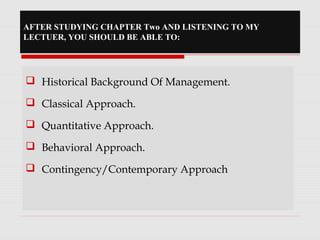
AFTER STUDYING CHAPTER Two AND LISTENING TO MY
LECTUER, YOU SHOULD BE ABLE TO:
 Historical Background Of Management.
 Classical Approach.
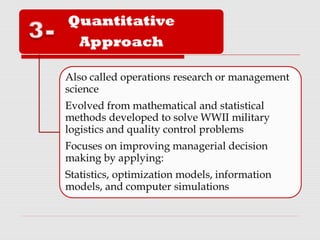
 Quantitative Approach.
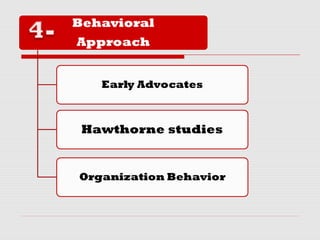
 Behavioral Approach.
 Contingency/Contemporary Approach
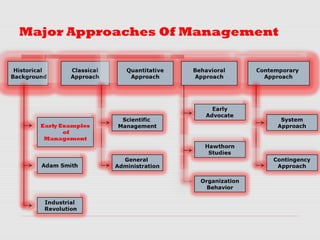
Organization
Behavior
Scientific
Management
General
Administration
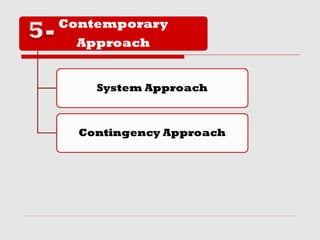
System
Approach
Contingency
Approach
Major Approaches Of Management
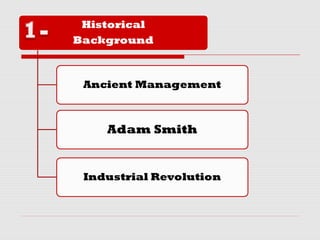
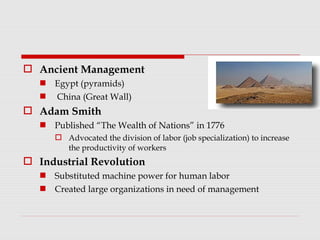
 Ancient Management
 Egypt (pyramids)
 China (Great Wall)
 Adam Smith
 Published “The Wealth of Nations” in 1776
 Advocated the division of labor (job specialization) to increase
the productivity of workers
 Industrial Revolution
 Substituted machine power for human labor
 Created large organizations in need of management
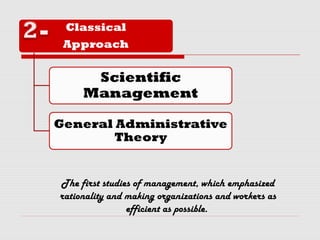
The first studies of management, which emphasized
rationality and making organizations and workers as
efficient as possible.
Classical
Approach
Scientific
Management
An approach that involves using the scientific
method to determine the “One Best Way” for a job
to be done.
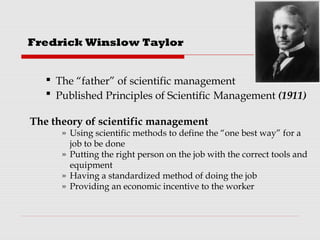
 The “father” of scientific management
 Published Principles of Scientific Management (1911)
The theory of scientific management
» Using scientific methods to define the “one best way” for a
job to be done
» Putting the right person on the job with the correct tools and
equipment
» Having a standardized method of doing the job
» Providing an economic incentive to the worker
Fredrick Winslow Taylor
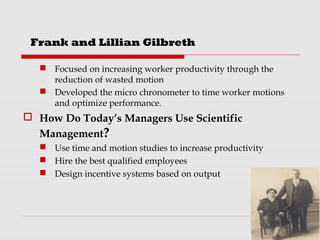
 Focused on increasing worker productivity through the
reduction of wasted motion
 Developed the micro chronometer to time worker motions
and optimize performance.
 How Do Today’s Managers Use Scientific
Management?
 Use time and motion studies to increase productivity
 Hire the best qualified employees
 Design incentive systems based on output
Frank and Lillian Gilbreth
General Administrative
Theory
An Approach to management that focuses on
describing what mangers do and what constitutes
good management practice.
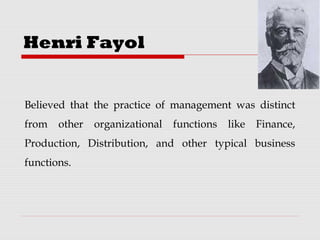
Believed that the practice of management was distinct
from other organizational functions like Finance,
Production, Distribution, and other typical business
functions.
Henri Fayol
Fayal's 14 principles of Management
Developed fourteen principles of management that applied to
all organizational situations.
1. Division of labor.
2. Authority.
3. Discipline.
4. Unity of command.
5. Unity of direction.
6. Subordination of individual interests to the general interests.
7. Remuneration.
8. Centralization.
9. Scalar chain.
10. Order.
11. Equity.
12. Stability.
13. Initiative.
14. Esprit de corps.
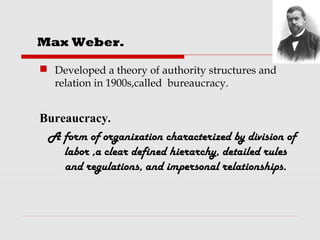
 Developed a theory of authority structures and
relation in 1900s,called bureaucracy.
Bureaucracy.
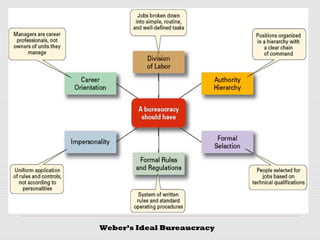
A form of organization characterized by division of
labor ,a clear defined hierarchy, detailed rules
and regulations, and impersonal relationships.
Max Weber.
Weber’s Ideal Bureaucracy
Quality Management
A philosophy of management driven by continual
improvement in the quality of work processes and
responding to customer needs and expectations
oIntense focus on the customer.
oConcern for continual improvement
oProcess-focused.
oImprovement in the quality of everything.
oAccurate measurement.
oEmpowerment of employees.
What is Quality Management?
Early Advocates
The study of the actions of people at
work; people are the most important
asset of an organization
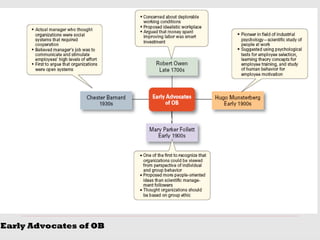
Early Advocates of OBEarly Advocates of OB
Hawthorne studies
A series of studies during the 1920s and 1930s that
provided new insights into individual and group
behavior
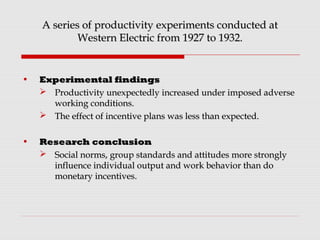
• Experimental findingsExperimental findings
 Productivity unexpectedly increased under imposed adverseProductivity unexpectedly increased under imposed adverse
working conditions.working conditions.
 The effect of incentive plans was less than expected.The effect of incentive plans was less than expected.
• Research conclusionResearch conclusion
 Social norms, group standards and attitudes more stronglySocial norms, group standards and attitudes more strongly
influence individual output and work behavior than doinfluence individual output and work behavior than do
monetary incentives.monetary incentives.
A series of productivity experiments conducted atA series of productivity experiments conducted at
Western Electric from 1927 to 1932.Western Electric from 1927 to 1932.
The field of study concerned with the actions
(behavior) of people at work.
Organization Behavior
A set of interrelated and interdependent parts arranged
in a manner that produces a unified whole.
System Approach
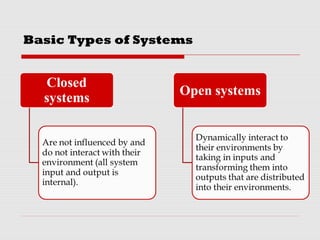
Basic Types of Systems
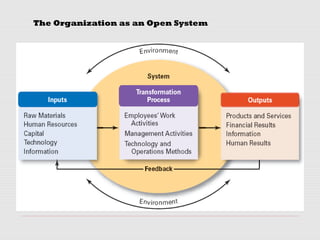
The Organization as an Open System
A management approach which says that organization
are different, face different situations (contingencies),
and require different ways of managing
Contingency Approach
Popular Contingency Variables
• Organization size
• As size increases, so do the problems of coordination.
• Routineness of task technology
• Routine technologies require organizational structures, leadership
styles, and control systems that differ from those required by
customized or non-routine technologies.
• Environmental uncertainty
• What works best in a stable and predictable environment may be
totally inappropriate in a rapidly changing and unpredictable
environment.
• Individual differences
• Individuals differ in terms of their desire for growth, autonomy,
tolerance of ambiguity, and expectations.

Rizwan haseeb

  • 1.
  • 2.
    AFTER STUDYING CHAPTERTwo AND LISTENING TO MY LECTUER, YOU SHOULD BE ABLE TO:  Historical Background Of Management.  Classical Approach.  Quantitative Approach.  Behavioral Approach.  Contingency/Contemporary Approach
  • 3.
  • 5.
     Ancient Management Egypt (pyramids)  China (Great Wall)  Adam Smith  Published “The Wealth of Nations” in 1776  Advocated the division of labor (job specialization) to increase the productivity of workers  Industrial Revolution  Substituted machine power for human labor  Created large organizations in need of management
  • 6.
    The first studiesof management, which emphasized rationality and making organizations and workers as efficient as possible.
  • 7.
    Classical Approach Scientific Management An approach thatinvolves using the scientific method to determine the “One Best Way” for a job to be done.
  • 8.
     The “father”of scientific management  Published Principles of Scientific Management (1911) The theory of scientific management » Using scientific methods to define the “one best way” for a job to be done » Putting the right person on the job with the correct tools and equipment » Having a standardized method of doing the job » Providing an economic incentive to the worker Fredrick Winslow Taylor
  • 9.
     Focused onincreasing worker productivity through the reduction of wasted motion  Developed the micro chronometer to time worker motions and optimize performance.  How Do Today’s Managers Use Scientific Management?  Use time and motion studies to increase productivity  Hire the best qualified employees  Design incentive systems based on output Frank and Lillian Gilbreth
  • 10.
    General Administrative Theory An Approachto management that focuses on describing what mangers do and what constitutes good management practice.
  • 11.
    Believed that thepractice of management was distinct from other organizational functions like Finance, Production, Distribution, and other typical business functions. Henri Fayol
  • 12.
    Fayal's 14 principlesof Management Developed fourteen principles of management that applied to all organizational situations. 1. Division of labor. 2. Authority. 3. Discipline. 4. Unity of command. 5. Unity of direction. 6. Subordination of individual interests to the general interests. 7. Remuneration. 8. Centralization. 9. Scalar chain. 10. Order. 11. Equity. 12. Stability. 13. Initiative. 14. Esprit de corps.
  • 13.
     Developed atheory of authority structures and relation in 1900s,called bureaucracy. Bureaucracy. A form of organization characterized by division of labor ,a clear defined hierarchy, detailed rules and regulations, and impersonal relationships. Max Weber.
  • 14.
  • 16.
    Quality Management A philosophyof management driven by continual improvement in the quality of work processes and responding to customer needs and expectations
  • 17.
    oIntense focus onthe customer. oConcern for continual improvement oProcess-focused. oImprovement in the quality of everything. oAccurate measurement. oEmpowerment of employees. What is Quality Management?
  • 19.
    Early Advocates The studyof the actions of people at work; people are the most important asset of an organization
  • 20.
    Early Advocates ofOBEarly Advocates of OB
  • 21.
    Hawthorne studies A seriesof studies during the 1920s and 1930s that provided new insights into individual and group behavior
  • 22.
    • Experimental findingsExperimentalfindings  Productivity unexpectedly increased under imposed adverseProductivity unexpectedly increased under imposed adverse working conditions.working conditions.  The effect of incentive plans was less than expected.The effect of incentive plans was less than expected. • Research conclusionResearch conclusion  Social norms, group standards and attitudes more stronglySocial norms, group standards and attitudes more strongly influence individual output and work behavior than doinfluence individual output and work behavior than do monetary incentives.monetary incentives. A series of productivity experiments conducted atA series of productivity experiments conducted at Western Electric from 1927 to 1932.Western Electric from 1927 to 1932.
  • 23.
    The field ofstudy concerned with the actions (behavior) of people at work. Organization Behavior
  • 25.
    A set ofinterrelated and interdependent parts arranged in a manner that produces a unified whole. System Approach
  • 26.
  • 27.
    The Organization asan Open System
  • 28.
    A management approachwhich says that organization are different, face different situations (contingencies), and require different ways of managing Contingency Approach
  • 29.
    Popular Contingency Variables •Organization size • As size increases, so do the problems of coordination. • Routineness of task technology • Routine technologies require organizational structures, leadership styles, and control systems that differ from those required by customized or non-routine technologies. • Environmental uncertainty • What works best in a stable and predictable environment may be totally inappropriate in a rapidly changing and unpredictable environment. • Individual differences • Individuals differ in terms of their desire for growth, autonomy, tolerance of ambiguity, and expectations.