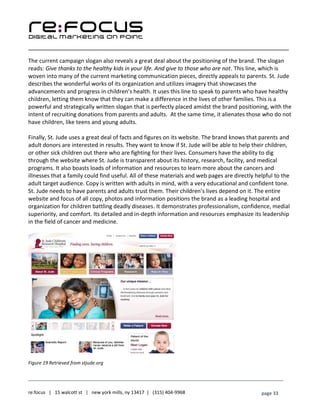
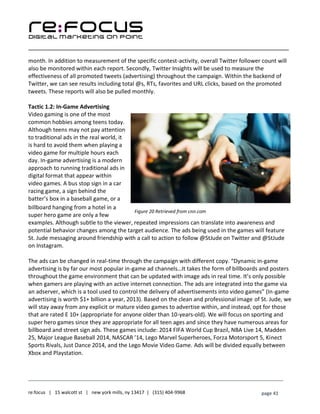
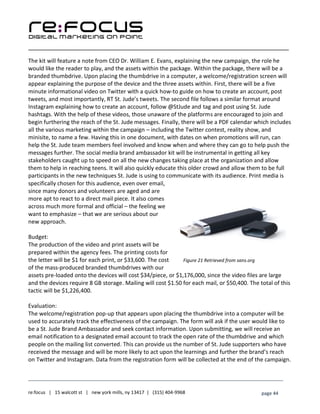
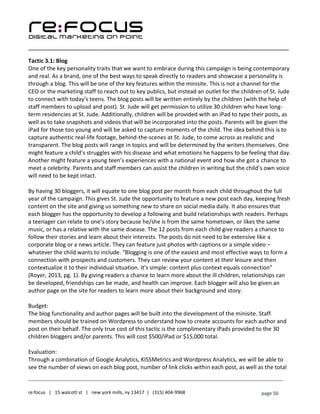
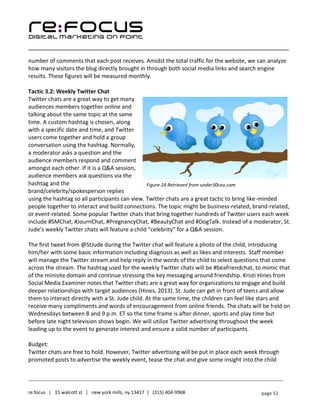
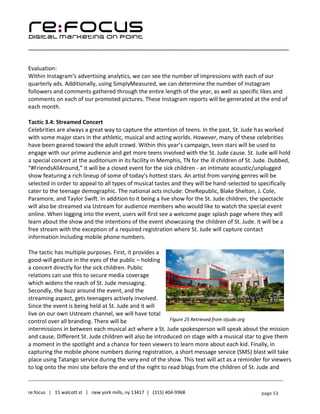
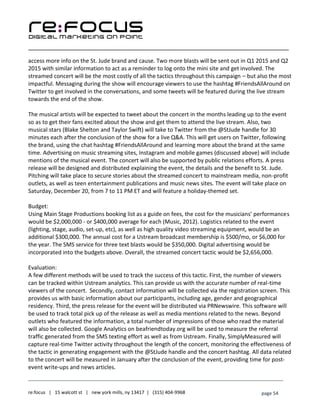
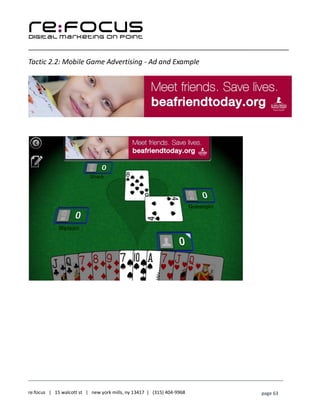
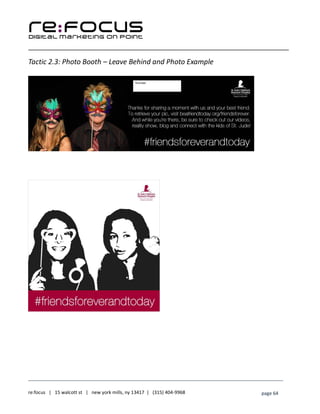
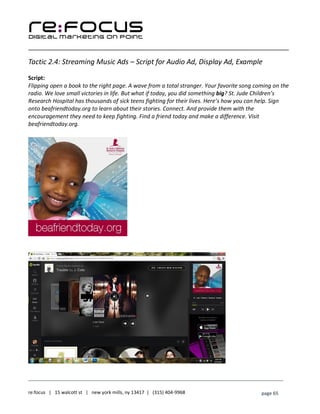
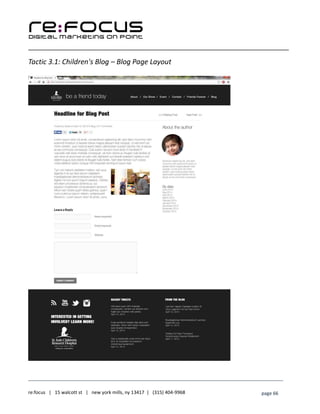
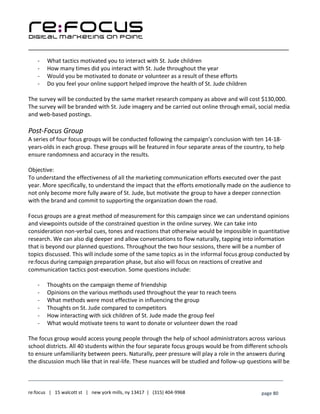
____________________________________________________________________________________________________
___________________________________________________________________________
re:focus | 15 walcott st | new york mills, ny 13417 | (315) 404-9968 page 1
Thomas J. Armitage
St. Jude Children’s Research Hospital
Integrated Marketing Communication Plan
May 2014
____________________________________________________________________________________________________
___________________________________________________________________________
re:focus | 15 walcott st | new york mills, ny 13417 | (315) 404-9968 page 2
Table of Contents
Agency Materials
Logo & Business Cards.......... 3
Letterhead.......... 5
Cover Sheet.......... 6
Opening Letter.......... 7
Agency Credentials & Identity.......... 8
News Release.......... 10
Executive Summary………. 11
Client Background
Situation Analysis.......... 12
Target Audience.......... 18
SWOT Analysis.......... 26
Brand Perception.......... 27
Brand Positioning.......... 31
Brand Personality.......... 35
Creative
Strategy Statement.......... 37
Creative Brief.......... 38
Objectives & Tactics………. 39
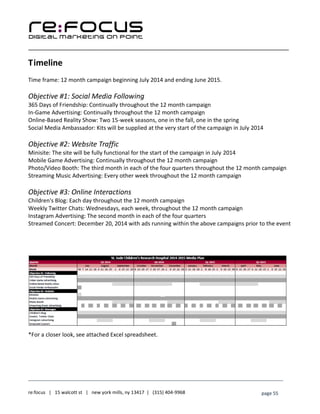
Timeline………. 55
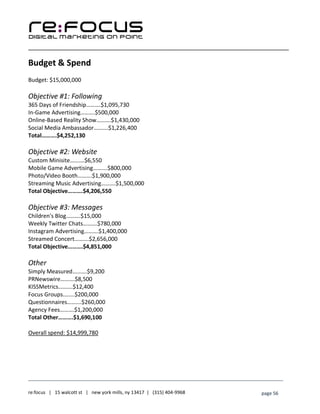
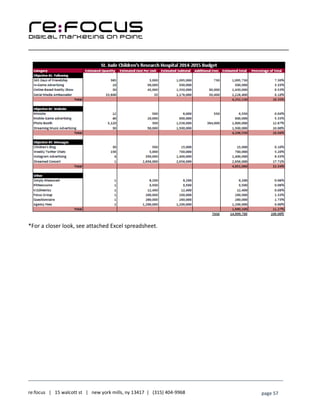
Budget & Spend………. 56
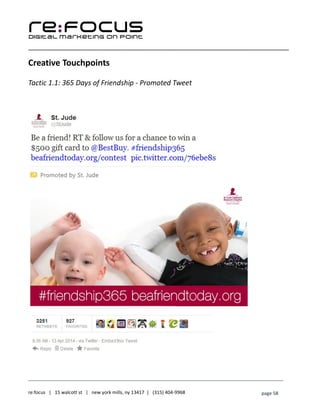
Creative Touchpoints………. 58
Measurement
Focus Group Findings………. 71
Evaluation………. 78
Conclusion………. 82
Appendices
Online Survey………. 83
Focus Group Moderator’s Guide………. 99
Sources………. 102
____________________________________________________________________________________________________
___________________________________________________________________________
re:focus | 15 walcott st | new york mills, ny 13417 | (315) 404-9968 page 3
____________________________________________________________________________________________________
___________________________________________________________________________
re:focus | 15 walcott st | new york mills, ny 13417 | (315) 404-9968 page 4
____________________________________________________________________________________________________
___________________________________________________________________________
re:focus | 15 walcott st | new york mills, ny 13417 | (315) 404-9968 page 5
Headline
Subheads
This is sample text to demonstrate the font and layout of this letterhead.
____________________________________________________________________________________________________
___________________________________________________________________________
re:focus | 15 walcott st | new york mills, ny 13417 | (315) 404-9968 page 6
Intent of Effort
Through strategic marketing communication efforts, we will work to better
understand the 14-18 year-old audience and their willingness to support St. Jude
Children’s Research Hospital as we prepare a comprehensive marketing
communication plan, focused around digital media, which will lead to heightened
engagement among this target market.
St. Jude Children’s Research Hospital re:focus
Finding Cures. Saving Children. digital marketing on point
262 Danny Thomas Place 15 Walcott St.
Memphis, TN 38105 New York Mills, NY 13417
May 9, 2014. St. Jude Children's Research Hospital Campaign Proposal. Copyright ©2014. re:focus. CONFIDENTIAL.
____________________________________________________________________________________________________
___________________________________________________________________________
re:focus | 15 walcott st | new york mills, ny 13417 | (315) 404-9968 page 7
May 9, 2014
Ms. Melanne Hannock
Sr. Vice President, Marketing
St. Jude Children's Research Hospital
262 Danny Thomas Place
Memphis, TN 38015-3678
cc: Ms. Sarah Wright
Dear Ms. Hannock,
I want to thank you, first and foremost, for the opportunity to submit a campaign proposal to your
team at St. Jude Children’s Research Hospital. It would be a tremendous honor to collaborate and work
side-by-side with the caring and talented members of your team - from the volunteers to management
to the wonderful doctors and nurses performing direct care.
Our team at re:focus specializes in digital marketing through new media, digital storytelling and web
and mobile communication. More specifically, our mission is to reach and resonate with today’s youth
and the millennial markets. We understand the need for St. Jude to reach today’s teens and begin
laying the foundation for this audience to become future donors, volunteers and/or employees. It is
also important to tap this trendsetting generation to help push the very important messages of St. Jude
and influence others. Strategy always takes precedence and we place heavy emphasis on research
when presented with business and branding challenges. We utilize video, social media, content
marketing, and other new techniques to engage targeted individuals. Our agency’s primary talents are
the perfect fit to help St. Jude reach its marketing goals.
Over the years, I’ve been moved by your organization’s initiatives and the way your team tells the
stories of St. Jude children and their loved ones. re:focus is eager to take your rich history and mission,
craft it for the digital age, and reach out to the youth of today to have them begin building long-lasting,
loyal relationships with your organization. Once again, I thank you for the opportunity to submit a
proposal to St. Jude Children’s Research Hospital. I look forward to hearing from you and hope we have
the opportunity to work together very soon.
Best Wishes,
Thomas J. Armitage
CEO and Director of Strategy
____________________________________________________________________________________________________
___________________________________________________________________________
re:focus | 15 walcott st | new york mills, ny 13417 | (315) 404-9968 page 8
Agency Credentials
Helping brands refocus is in our genes. Whether those focuses are on a current or potentially new
audience, a new creative approach, or new messaging to better communicate with key publics - we
help brands develop a strategic plan of attack and accomplish business goals efficiently.
re:focus is a newly launched boutique digital marketing agency with an emphasis on B2C brands who
target youth and millennials. We have a number of specialties that we are proud to manage for a
variety of both small and large clients including:
- New media management and strategic planning incorporating social media channels like
Facebook, YouTube, Twitter, LinkedIn, Instagram, Vine, Google+, SnapChat and more.
- Digital storytelling, with the help of creative graphics and video, to take everyday messages and
stories and make them real, authentic and interesting, which makes them thrive online and
reach vast numbers of viewers in a short amount of time.
- Web and mobile communication including e-mail marketing campaigns and SMS outreach to
embrace the most popular and most preferred platforms for consumer-brand conversations to
build and cultivate those relationships.
- Public relations for the new age, using social media to establish positive rapport with the most
fitting journalists, editors and online bloggers, and to efficiently manage digital assets to quickly
react to writers’ needs and provide them with the best information, quotes and multimedia for
their stories being published in real-time.
- Online marketing, concentrating on both paid traffic campaigns as well as search engine
optimization, a result of heavy keyword research to ensure solid rankings for the top terms that
teens, families, volunteers and other audiences are using to find stjude.org on the web.
Brands face many challenges today. Not only can it be tough to stay up with all the new trends in the
rapidly changing media landscape, but brands must break through the extreme clutter of all that noise
and find ways to reach targeted audiences and encourage them to react to key messages. re:focus
knows these challenges all too well and we’ve worked to master our skills to help brands embrace all
the new techniques available today in the digital age and, more importantly, meet their most
important marketing objectives.
re:focus was created with digital in mind. For brands that are looking for a refresh, a re-boost, or a
restart in the midst of today’s hyper-digital world, re:focus is on point and the perfect fit.
____________________________________________________________________________________________________
___________________________________________________________________________
re:focus | 15 walcott st | new york mills, ny 13417 | (315) 404-9968 page 9
Agency Identity
Many companies and organizations today with rich histories have thrived in the past through
traditional branding and marketing efforts. But since the media landscape has begun to change, these
once successful brands are noticing the uphill battle ahead. They realize the need to re-identify their
target audiences, realign their marketing messages, and refocus their attention on the new ways that
we are all communicating today. The millennial generation will be the largest demographic in the
workforce in less than 10 years. The plural generation will be the first in America to not feature whites
as the most dominant race. Whether we want to face it or not, our audience, their behaviors, and the
way they learn about brands and interact with them are changing.
re:focus is a newly launched boutique digital marketing agency specializing in new media, digital
storytelling and web and mobile communication. We research the changing trends in today’s digital
world and apply them to our clients for high levels of exposure. We specialize in helping brands reach
today’s youth and the younger demographics that have vastly different behaviors than their older
counterparts. Our team is made up of strategic thinkers on the forefront of the marketing scene,
creative designers who work to captivate audience members, and inspiring writers who turn content
into fascinating digital pieces that turn visitors into engaged fans, and engaged fans into loyal brand
ambassadors. Our team works with the latest and greatest tools and software available to more easily
put our skills to work to redefine and revitalize our client’s brands.
By arranging strategically tailored marketing communication plans around digital media, brands can
take full control of their marketing efforts and refocus their attention on the right media used by their
target audiences. This, in turn, leads to not only a more impactful and meaningful online presence but
attainment of goals - whether that’s web hits, leads, sales, donations, attendees, volunteers, or
beyond. The emphasis on achievement today trumps that of awareness or promotion. We look at goals
while building brand images for a long-lasting return on investment.
____________________________________________________________________________________________________
___________________________________________________________________________
re:focus | 15 walcott st | new york mills, ny 13417 | (315) 404-9968 page 10
For Immediate Release
January 2, 2014
Contact:
Thomas J. Armitge
CEO and Director of Strategy
thomas.j.armitage@gmail.com
(315) 404-9968
Digital Marketing Agency re:focus Opens for Business
New Agency Focuses on Digital Storytelling and New Media to Revitalize Brands
New York Mills, NY (January 2, 2014) – re:focus, a boutique digital marketing agency in New York Mills,
NY, has announced its official launch. The eight-team group caters to business-to-consumer (B2C)
clients looking to redesign, redefine or revitalize their brand presence.
re:focus recognizes the shifting landscape of today. Placing heavy focus on longstanding, yet outdated
brands, the agency uses new techniques like content marketing, digital storytelling and web and
mobile communication to tap target audiences and meet goals. re:focus has a special interest in
reaching today’s youth and millennials who are most likely to react and engage with brands online.
“There are hundreds of thousands of content pieces and marketing messages floating out there on the
web each day,” said Thomas J. Armitage, CEO and director of strategy at re:focus. “These brands that
are celebrating their 50, 60, 70 year anniversaries and beyond cannot be using the same marketing
techniques they once did. It’s just not effective anymore. Social, mobile, and digital communication is
here to stay and our group recognizes the importance of making these strategies the most prominent
components of a marketing plan.”
Behind Armitage is a team of marketers with varying backgrounds and areas of expertise including a
designer, developer, photographer/videography, online marketer (SEO + PPC), social media strategist,
public relations expert, and creative writer. The team works with the latest tools and software
available to more efficiently redefine and revitalize brands and help accomplish business goals.
The agency is currently accepting new clients and will also be submitting request for proposals (RFPs).
For more information on re:focus, please visit refocusdigital.com or tweet @refocusdigital.
# # #
About re:focus
re:focus is a boutique digital marketing agency based out of New York Mills, NY. Specializing in B2C clients, the group works
to redesign, redefine and revitalize brand presences. Through digital storytelling, content marketing, web and mobile
communication, and other new media strategies, re:focus takes aging, outdated or digitally-challenged brands to a new,
lively, fresh state to more easily and more quickly accomplish top-level goals, be that leads, sales, web visits, or beyond. At
re:focus, strategies are always on point. For more information on re:focus, visit refocusdigital.com or tweet @refocusdigital.
____________________________________________________________________________________________________
___________________________________________________________________________
re:focus | 15 walcott st | new york mills, ny 13417 | (315) 404-9968 page 11
Executive Summary
They may seem young, immature, jobless and moneyless to some. But for many brands, the 14-18-
year-old audience, or plurals, is the single most important generation to give attention to today. Not
only will they usher in the next set of buyers, donors and volunteers over the next 10-20 years, but
when it comes to the online space, they are the ultimate influencers. And they aren’t just affecting
what their peers think, but many older groups as well, including the prevalent millennials, generation
Xers, and even baby boomers. Non-profits like St. Jude Children’s Research Hospital can leverage this
youthful audience in many ways. By influencing them through digital means, St. Jude can begin to
cultivate long-lasting relationships to ensure a solid support system in the future. It can also encourage
social sharing which can exponentially grow the number of message impressions and interactions
between consumer and brand each day. By embarking on a strategic marketing communication
campaign with extreme focus on digital marketing, St. Jude Children’s Research Hospital can work to
emphasize its updated brand personality, tap a new and unaware audience and help improve the
health of its children at the same time.
____________________________________________________________________________________________________
___________________________________________________________________________
re:focus | 15 walcott st | new york mills, ny 13417 | (315) 404-9968 page 12
Situation Analysis
Finding Cures. Saving Lives. That is the prime focus of St. Jude Children’s Research Hospital. And to help
accomplish this lofty goal, there is a support system made up of millions of doctors, nurses, volunteers,
donors and brand ambassadors who work each year to raise awareness for the organization and its
cause, and work towards finding those cures. According to Forbes, St. Jude is the 11th largest non-
profit in the U.S. with annual revenues over $970 million. Led by Dr. William Evans, the organization is
headquartered in Memphis, TN with several affiliate hospitals across the country (St. Jude Children’s
Research Hospital, 2013).
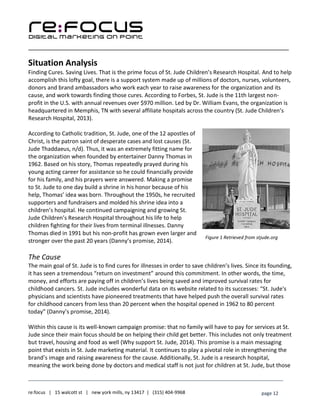
According to Catholic tradition, St. Jude, one of the 12 apostles of
Christ, is the patron saint of desperate cases and lost causes (St.
Jude Thaddaeus, n/d). Thus, it was an extremely fitting name for
the organization when founded by entertainer Danny Thomas in
1962. Based on his story, Thomas repeatedly prayed during his
young acting career for assistance so he could financially provide
for his family, and his prayers were answered. Making a promise
to St. Jude to one day build a shrine in his honor because of his
help, Thomas’ idea was born. Throughout the 1950s, he recruited
supporters and fundraisers and molded his shrine idea into a
children’s hospital. He continued campaigning and growing St.
Jude Children’s Research Hospital throughout his life to help
children fighting for their lives from terminal illnesses. Danny
Thomas died in 1991 but his non-profit has grown even larger and
stronger over the past 20 years (Danny’s promise, 2014).
The Cause
The main goal of St. Jude is to find cures for illnesses in order to save children’s lives. Since its founding,
it has seen a tremendous “return on investment” around this commitment. In other words, the time,
money, and efforts are paying off in children’s lives being saved and improved survival rates for
childhood cancers. St. Jude includes wonderful data on its website related to its successes: “St. Jude's
physicians and scientists have pioneered treatments that have helped push the overall survival rates
for childhood cancers from less than 20 percent when the hospital opened in 1962 to 80 percent
today” (Danny’s promise, 2014).
Within this cause is its well-known campaign promise: that no family will have to pay for services at St.
Jude since their main focus should be on helping their child get better. This includes not only treatment
but travel, housing and food as well (Why support St. Jude, 2014). This promise is a main messaging
point that exists in St. Jude marketing material. It continues to play a pivotal role in strengthening the
brand’s image and raising awareness for the cause. Additionally, St. Jude is a research hospital,
meaning the work being done by doctors and medical staff is not just for children at St. Jude, but those
Figure 1 Retrieved from stjude.org
____________________________________________________________________________________________________
___________________________________________________________________________
re:focus | 15 walcott st | new york mills, ny 13417 | (315) 404-9968 page 13
afflicted with illnesses all over the world – now and in the future. “St. Jude freely shares the
breakthroughs we make, and every child saved at St. Jude means doctors and scientists worldwide can
use that knowledge to save thousands of more children…St. Jude is where doctors send their toughest
cases because we have the best world’s best survival rates for the most aggressive childhood cancers”
(Why support St. Jude, 2014, pg. 1).
Support System
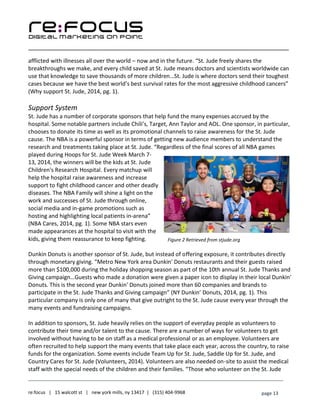
St. Jude has a number of corporate sponsors that help fund the many expenses accrued by the
hospital. Some notable partners include Chili’s, Target, Ann Taylor and AOL. One sponsor, in particular,
chooses to donate its time as well as its promotional channels to raise awareness for the St. Jude
cause. The NBA is a powerful sponsor in terms of getting new audience members to understand the
research and treatments taking place at St. Jude. “Regardless of the final scores of all NBA games
played during Hoops for St. Jude Week March 7-
13, 2014, the winners will be the kids at St. Jude
Children's Research Hospital. Every matchup will
help the hospital raise awareness and increase
support to fight childhood cancer and other deadly
diseases. The NBA Family will shine a light on the
work and successes of St. Jude through online,
social media and in-game promotions such as
hosting and highlighting local patients in-arena”
(NBA Cares, 2014, pg. 1). Some NBA stars even
made appearances at the hospital to visit with the
kids, giving them reassurance to keep fighting.
Dunkin Donuts is another sponsor of St. Jude, but instead of offering exposure, it contributes directly
through monetary giving. “Metro New York area Dunkin' Donuts restaurants and their guests raised
more than $100,000 during the holiday shopping season as part of the 10th annual St. Jude Thanks and
Giving campaign…Guests who made a donation were given a paper icon to display in their local Dunkin'
Donuts. This is the second year Dunkin' Donuts joined more than 60 companies and brands to
participate in the St. Jude Thanks and Giving campaign” (NY Dunkin’ Donuts, 2014, pg. 1). This
particular company is only one of many that give outright to the St. Jude cause every year through the
many events and fundraising campaigns.
In addition to sponsors, St. Jude heavily relies on the support of everyday people as volunteers to
contribute their time and/or talent to the cause. There are a number of ways for volunteers to get
involved without having to be on staff as a medical professional or as an employee. Volunteers are
often recruited to help support the many events that take place each year, across the country, to raise
funds for the organization. Some events include Team Up for St. Jude, Saddle Up for St. Jude, and
Country Cares for St. Jude (Volunteers, 2014). Volunteers are also needed on-site to assist the medical
staff with the special needs of the children and their families. “Those who volunteer on the St. Jude
Figure 2 Retrieved from stjude.org
____________________________________________________________________________________________________
___________________________________________________________________________
re:focus | 15 walcott st | new york mills, ny 13417 | (315) 404-9968 page 14
Children’s Research Hospital campus and beyond are the lifeblood of St. Jude. They provide crucial
support services that are vital to the hospital and the well-being of its patients. Each day, willing
volunteers come to the St. Jude campus to donate their time and energy so that St. Jude can fulfill its
mission of finding cures and saving children” (Volunteers, 2014). St. Jude must continue to have a
steady flow of volunteers each year in order to efficiently execute both its day-to-day work and its
fundraising events.
Competition
Many do not view non-profits as having direct competition, perhaps because revenue is not the
primary goal. But competition is just as real, and sometimes just as fierce, as the for-profit, business
world. St. Jude is positioned against a number of organizations who have similar causes and fight for
the same grants, donations, volunteers and attention from the public. According to Hoovers, some
direct competitors of St. Jude include: Hospital Corporation of America, Nationwide Children’s
Hospital, and Children’s National Medical Center (St. Jude Children's Research Hospital, Inc.
competition, 2014). These all cater to healthcare. Looking more at the audience of children itself, this
opens the doors further and has St. Jude competing with groups like the United Nations Children’s
Fund (UNICEF), Make-A-Wish Foundation, the Boys & Girls Club of American, and Alex’s Lemonade
Stand.
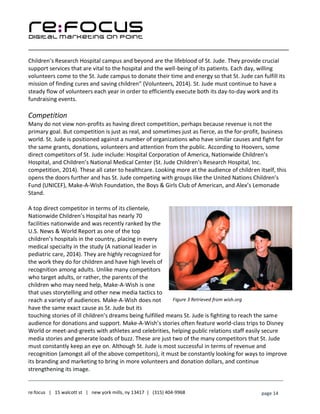
A top direct competitor in terms of its clientele,
Nationwide Children’s Hospital has nearly 70
facilities nationwide and was recently ranked by the
U.S. News & World Report as one of the top
children’s hospitals in the country, placing in every
medical specialty in the study (A national leader in
pediatric care, 2014). They are highly recognized for
the work they do for children and have high levels of
recognition among adults. Unlike many competitors
who target adults, or rather, the parents of the
children who may need help, Make-A-Wish is one
that uses storytelling and other new media tactics to
reach a variety of audiences. Make-A-Wish does not
have the same exact cause as St. Jude but its
touching stories of ill children’s dreams being fulfilled means St. Jude is fighting to reach the same
audience for donations and support. Make-A-Wish’s stories often feature world-class trips to Disney
World or meet-and-greets with athletes and celebrities, helping public relations staff easily secure
media stories and generate loads of buzz. These are just two of the many competitors that St. Jude
must constantly keep an eye on. Although St. Jude is most successful in terms of revenue and
recognition (amongst all of the above competitors), it must be constantly looking for ways to improve
its branding and marketing to bring in more volunteers and donation dollars, and continue
strengthening its image.
Figure 3 Retrieved from wish.org
____________________________________________________________________________________________________
___________________________________________________________________________
re:focus | 15 walcott st | new york mills, ny 13417 | (315) 404-9968 page 15
Branding and Marketing
St. Jude has a very strong brand image and is well-positioned in the marketplace. It holds numerous
events each year that are supported and attended by many and enlists major celebrities for guest
appearances like actress Sofia Vergara and former NFL star Michael Strahan. In fact, St Jude has a
history of bringing in stars to interact with the children, sign autographs and generate awareness for
the events and the St. Jude cause. Frank Sinatra, Elvis Presley and President Gerald Ford are only a few
who have made appearances in the past. The brand itself has become well-known for its rich history,
contributions to the field of medicine, and its great cause of helping children in need, without charging
families for the medical assistance. According to a recent study, “St. Jude Children’s Research Hospital
and Susan G. Komen for the Cure are the two most trusted nonprofit brand names in America,
according to a new survey by Harris Interactive. While St. Jude, in Memphis, placed first as the most-
trusted nonprofit brands, ahead of No. 2 Komen, the organizations’ rankings were reversed in the
category of brand equity, or overall brand value” (Joslyn, 2010, pg. 1).
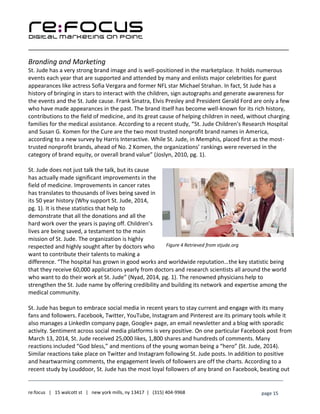
St. Jude does not just talk the talk, but its cause
has actually made significant improvements in the
field of medicine. Improvements in cancer rates
has translates to thousands of lives being saved in
its 50 year history (Why support St. Jude, 2014,
pg. 1). It is these statistics that help to
demonstrate that all the donations and all the
hard work over the years is paying off. Children’s
lives are being saved, a testament to the main
mission of St. Jude. The organization is highly
respected and highly sought after by doctors who
want to contribute their talents to making a
difference. “The hospital has grown in good works and worldwide reputation…the key statistic being
that they receive 60,000 applications yearly from doctors and research scientists all around the world
who want to do their work at St. Jude” (Nyad, 2014, pg. 1). The renowned physicians help to
strengthen the St. Jude name by offering credibility and building its network and expertise among the
medical community.
St. Jude has begun to embrace social media in recent years to stay current and engage with its many
fans and followers. Facebook, Twitter, YouTube, Instagram and Pinterest are its primary tools while it
also manages a LinkedIn company page, Google+ page, an email newsletter and a blog with sporadic
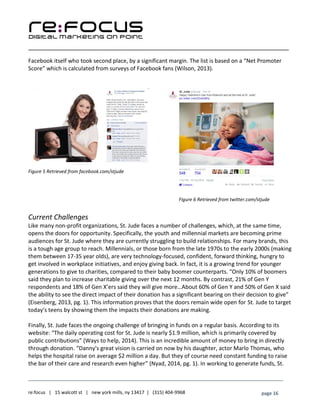
activity. Sentiment across social media platforms is very positive. On one particular Facebook post from
March 13, 2014, St. Jude received 25,000 likes, 1,800 shares and hundreds of comments. Many
reactions included “God bless,” and mentions of the young woman being a “hero” (St. Jude, 2014).
Similar reactions take place on Twitter and Instagram following St. Jude posts. In addition to positive
and heartwarming comments, the engagement levels of followers are off the charts. According to a
recent study by Louddoor, St. Jude has the most loyal followers of any brand on Facebook, beating out
Figure 4 Retrieved from stjude.org
____________________________________________________________________________________________________
___________________________________________________________________________
re:focus | 15 walcott st | new york mills, ny 13417 | (315) 404-9968 page 16
Facebook itself who took second place, by a significant margin. The list is based on a “Net Promoter
Score” which is calculated from surveys of Facebook fans (Wilson, 2013).
Figure 5 Retrieved from facebook.com/stjude
Figure 6 Retrieved from twitter.com/stjude
Current Challenges
Like many non-profit organizations, St. Jude faces a number of challenges, which, at the same time,
opens the doors for opportunity. Specifically, the youth and millennial markets are becoming prime
audiences for St. Jude where they are currently struggling to build relationships. For many brands, this
is a tough age group to reach. Millennials, or those born from the late 1970s to the early 2000s (making
them between 17-35 year olds), are very technology-focused, confident, forward thinking, hungry to
get involved in workplace initiatives, and enjoy giving back. In fact, it is a growing trend for younger
generations to give to charities, compared to their baby boomer counterparts. “Only 10% of boomers
said they plan to increase charitable giving over the next 12 months. By contrast, 21% of Gen Y
respondents and 18% of Gen X’ers said they will give more…About 60% of Gen Y and 50% of Gen X said
the ability to see the direct impact of their donation has a significant bearing on their decision to give”
(Eisenberg, 2013, pg. 1). This information proves that the doors remain wide open for St. Jude to target
today’s teens by showing them the impacts their donations are making.
Finally, St. Jude faces the ongoing challenge of bringing in funds on a regular basis. According to its
website: “The daily operating cost for St. Jude is nearly $1.9 million, which is primarily covered by
public contributions” (Ways to help, 2014). This is an incredible amount of money to bring in directly
through donation. “Danny's great vision is carried on now by his daughter, actor Marlo Thomas, who
helps the hospital raise on average $2 million a day. But they of course need constant funding to raise
the bar of their care and research even higher” (Nyad, 2014, pg. 1). In working to generate funds, St.
____________________________________________________________________________________________________
___________________________________________________________________________
re:focus | 15 walcott st | new york mills, ny 13417 | (315) 404-9968 page 17
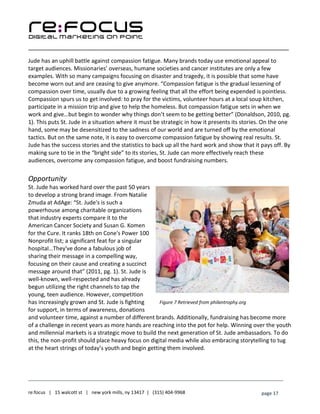
Jude has an uphill battle against compassion fatigue. Many brands today use emotional appeal to
target audiences. Missionaries’ overseas, humane societies and cancer institutes are only a few
examples. With so many campaigns focusing on disaster and tragedy, it is possible that some have
become worn out and are ceasing to give anymore. “Compassion fatigue is the gradual lessening of
compassion over time, usually due to a growing feeling that all the effort being expended is pointless.
Compassion spurs us to get involved: to pray for the victims, volunteer hours at a local soup kitchen,
participate in a mission trip and give to help the homeless. But compassion fatigue sets in when we
work and give…but begin to wonder why things don’t seem to be getting better” (Donaldson, 2010, pg.
1). This puts St. Jude in a situation where it must be strategic in how it presents its stories. On the one
hand, some may be desensitized to the sadness of our world and are turned off by the emotional
tactics. But on the same note, it is easy to overcome compassion fatigue by showing real results. St.
Jude has the success stories and the statistics to back up all the hard work and show that it pays off. By
making sure to tie in the “bright side” to its stories, St. Jude can more effectively reach these
audiences, overcome any compassion fatigue, and boost fundraising numbers.
Opportunity
St. Jude has worked hard over the past 50 years
to develop a strong brand image. From Natalie
Zmuda at AdAge: “St. Jude's is such a
powerhouse among charitable organizations
that industry experts compare it to the
American Cancer Society and Susan G. Komen
for the Cure. It ranks 18th on Cone's Power 100
Nonprofit list; a significant feat for a singular
hospital…They've done a fabulous job of
sharing their message in a compelling way,
focusing on their cause and creating a succinct
message around that” (2011, pg. 1). St. Jude is
well-known, well-respected and has already
begun utilizing the right channels to tap the
young, teen audience. However, competition
has increasingly grown and St. Jude is fighting
for support, in terms of awareness, donations
and volunteer time, against a number of different brands. Additionally, fundraising has become more
of a challenge in recent years as more hands are reaching into the pot for help. Winning over the youth
and millennial markets is a strategic move to build the next generation of St. Jude ambassadors. To do
this, the non-profit should place heavy focus on digital media while also embracing storytelling to tug
at the heart strings of today’s youth and begin getting them involved.
Figure 7 Retrieved from philantrophy.org
____________________________________________________________________________________________________
___________________________________________________________________________
re:focus | 15 walcott st | new york mills, ny 13417 | (315) 404-9968 page 18
Target Audience
Todays’ teens are far different from those of previous generations. Interests and trends have changed
and they consume information through new media, and interact with brands much differently. The 14-
18-year-old market, made up mostly of high school students and some college freshmen, is quite
lucrative. Not only do they have buying power but they are influential. “The teenage market itself is
huge; in the U.S. alone, consumers ages 12 to 17 spent more than $200 billion on products in 2011…It’s
important for marketers to understand what’s happening with this group because these are the future
consumers…The trends that emerge from what the youngest consumers are doing tend to spread to
the broader population” (Gerdeman, 2013, pg. 1). It is imperative that brands not only understand the
traits and behaviors of this audience but realize the best ways to reach them through marketing.
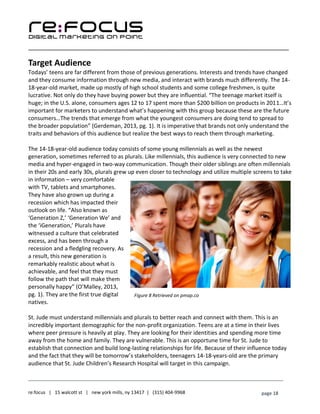
The 14-18-year-old audience today consists of some young millennials as well as the newest
generation, sometimes referred to as plurals. Like millennials, this audience is very connected to new
media and hyper-engaged in two-way communication. Though their older siblings are often millennials
in their 20s and early 30s, plurals grew up even closer to technology and utilize multiple screens to take
in information – very comfortable
with TV, tablets and smartphones.
They have also grown up during a
recession which has impacted their
outlook on life. “Also known as
‘Generation Z,’ ‘Generation We’ and
the ‘iGeneration,’ Plurals have
witnessed a culture that celebrated
excess, and has been through a
recession and a fledgling recovery. As
a result, this new generation is
remarkably realistic about what is
achievable, and feel that they must
follow the path that will make them
personally happy” (O’Malley, 2013,
pg. 1). They are the first true digital
natives.
St. Jude must understand millennials and plurals to better reach and connect with them. This is an
incredibly important demographic for the non-profit organization. Teens are at a time in their lives
where peer pressure is heavily at play. They are looking for their identities and spending more time
away from the home and family. They are vulnerable. This is an opportune time for St. Jude to
establish that connection and build long-lasting relationships for life. Because of their influence today
and the fact that they will be tomorrow’s stakeholders, teenagers 14-18-years-old are the primary
audience that St. Jude Children’s Research Hospital will target in this campaign.
Figure 8 Retrieved on pmap.co
____________________________________________________________________________________________________
___________________________________________________________________________
re:focus | 15 walcott st | new york mills, ny 13417 | (315) 404-9968 page 19
Demographics
According to the National Institute of Education Statistics, there are nearly 15 million high school
students in the U.S. (Fast Facts, 2013). These kids today are very close to their technological devices
and have very distinct habits in how they interact with brands – both corporate and non-profit. Having
tendencies of the millennial market, they have grown up on the Internet and social media and have
low tolerance for non-immediate communication. St. Jude must first understand these teens, their
qualities, interests and behaviors, before implementing a strategic marketing plan to begin engaging
and influencing.
It is important first to note that the teenage audience in America is not made up solely of whites. From
Nielsen records: “The 12-17, 18-24 and 25-34 groups are almost identically multicultural, as 42 percent
of each comprises Hispanics, African-Americans and Asian-Americans. This is only the tip of the
iceberg—U.S. Census data shows that African-Americans, Asian-Americans and Hispanics will generate
the vast majority of the U.S. population growth over the next few decades” (The Teen Transition, 2013,
pg. 1). At just less than 50% featuring ethnicities other than white, St. Jude must always be
cognoscente of its creative and photography, showcasing whites, Hispanics, African-American and
Asian-Americans equally so as to appeal to all audiences and be more accurate in the representation of
the market. If fact, these ethnic stats are the first of its kind in America, meaning this will be the first
generation in America that will not be predominantly white. “In addition to being the last American
generation with a Caucasian majority, the Pluralist Generation will also be the first to become
pluralistic, or not have a majority race. According to Magid Generational Strategies' calculations of U.S.
Census data and immigration numbers, that will happen in 17 years. The entire U.S. population will
become pluralistic in 2042” (Hartwell, 2012, pg. 1).
Between money in their own pockets or that given to them by parents or relatives, teens are very
independent when it comes to making decisions on what they would like to buy or give money
towards. Unlike brands who must speak to decision-making parents, St. Jude can communicate directly
to teens with hopes of influencing their decisions to support its cause.
Another important feature of teens today is that it is becoming increasingly common that they do not
live in intact families. According to a recent study, about 55% of teens live in divorced or broken
homes. Moreover, 40% of children are born out of wedlock today (Ford, 2014). A few things can be
interpreted from these statistics. The first is that it means an even heavier emphasis is placed on
relationships between friends. Peer pressure has always been a facet of teenagers but without a
supportive home life, friends build even stronger bonds and rely on each other for help in making
decisions. Secondly, this non-intact home environment makes teens even more independent than
usual. Without having two authority figures, it lessens the amount of watch kept over them, giving
them the opportunity to be more in control of their actions - whether that is purchasing, spending time
with friends, gaming, or utilizing the Internet and social media.
____________________________________________________________________________________________________
___________________________________________________________________________
re:focus | 15 walcott st | new york mills, ny 13417 | (315) 404-9968 page 20
The teenage years make up the most important time period when individuals are trying to find
themselves. They like to test out new hobbies, participate in trends, and embrace new social circles.
One common teenage practice is trying out new fashions. According to one research study in AdWeek:
“When it comes to teen males, the report found that "young metrosexuals," those classified as
individuals who focus on their outward appearance, make up more than 25 percent [the largest
group]…"Jockettes," young women who embody active lifestyles and participate in sports, are the most
common female segment that makes up over 25 percent” (Straczynski, 2009, pg. 1). This helps to
emphasize that gender roles, at least in terms of outward appearances, are diminishing. No longer are
males and females seen a certain way but the lines are being blurred. St. Jude should keep this in mind
with its creative and messaging so as to appeal to the widest range of audience members.
Finally, although they live with their parents now, it must be stressed that in just a few short years,
they will be either attending college or beginning their careers. It is important to know that the most
popular majors today include business, social sciences and history, and health professions (Most
popular majors, 2013). Piggybacking on this trend, St. Jude can appeal to many in the health and
medical fields. Furthermore, upon entering the real-world, plurals and millennials are migrating
towards the suburbs, much like past generations. From Joel Kotkin at Forbes, “As it turns out, the vast
majority of young people in their late teens and 20s – over 80 percent — live outside core cities.
Roughly 38 percent of young Americans live in suburban areas, while another 45 percent live outside
the largest metropolitan areas, mostly in smaller metro areas” (2013, pg. 1). This suburban lifestyle is
much more relaxed than that of city-life, where they can soon focus on their careers as well as starting
and raising families.
In summary, key demographic points about 14-18 year-olds include:
- They are multicultural with almost 50% being non-white.
- Extremely large in size and they have high levels of buying power.
- Many come from families that are not intact.
- The largest fashion groups are “metrosexual” among boys and “jockettes” among girls.
- They primarily live with parents in the suburbs and will eventually live in the suburbs once they
begin their careers.
- They have an interest in business, social sciences and health care.
Psychographics
When discussing behaviors with the teenage audience, it is most fitting to first address their use of new
media. Born between 1995 and 2000, teenagers today do not know what life was like without the
Internet, instant messaging, cell phones and texting, digital music, online streaming and social media.
And their behaviors truly reflect this as they are completely comfortable and emerged in these
technologies. “These 79 million Americans have a tremendous amount of power online as they
comment and share incessantly via Facebook, Twitter, Pinterest, Instagram and Tumblr, letting friends,
family and others in their vast social networks know what they’re doing and how they feel about it.
____________________________________________________________________________________________________
___________________________________________________________________________
re:focus | 15 walcott st | new york mills, ny 13417 | (315) 404-9968 page 21
Because these ‘digital natives’ grew up with technology, they expect almost immediate gratification
with products and customer service” (Nieuwenhuis, 2013, pg. 1).
Marketer Heidi Cohen blogged about a recent Business Insider report that listed trends among
teenagers. She noted that teens today communicate constantly with their friends through popular real-
time social media sites rather than voice calling (Cohen, 2013). Facebook is no longer appealing to
teens. Once their parents and grandparents joined, it no longer was the playground for youth that it
once was. Statistics still show high levels of teen accounts, but usage has been dramatically dwindling.
“With more than half of teens stating social media plays a role in purchases, Twitter has surpassed
Facebook as the site deemed most important…The report also found Facebook's popularity is
diminishing among this key demographic, with 23 percent of teenagers stating it is the most important
social network site, down from 33 percent six months ago and 42 percent a year ago” (Garton, 2013,
pg. 1). Instead of Facebook, teens are aggregating towards sites that are much simpler, quicker and do
not have many older users. Twitter, Instagram, Snapchat are the top picks today.
Teenagers today are different compared to past generations in their viewing of television shows. While
TV was a relatively new phenomenon for baby boomers, and 30 and 40 year olds were addicted when
they were younger (i.e. I want my MTV!), teens today go elsewhere for their video consumption. They
primarily view on mobile through streaming services. “While everyone under 34 is spending less time
in front of the TV, viewing preferences aren’t consistent across the 12-17, 18-24 and 25-34 year old
groups. For example, teens like to watch on mobile more than anyone else. In fact, they watched 18
percent more video on their mobile phones than persons 18-24 and 46 percent more than persons 25-
34” (The teen transition, 2013, pg. 1). More importantly, teens are loyal to the content rather than the
platform. “What's important to keep in mind is that they're agnostic in terms of system; teens are
engaging on numerous platforms, but content is key” (Prezant, 2013, pg. 1). This might mean using
DVR, watching television shows on the network’s website rather than the network, viewing on-demand
at a later date, or watching on Netflix, Hulu, or other streaming services.
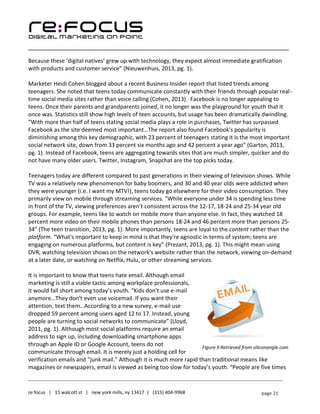
It is important to know that teens hate email. Although email
marketing is still a viable tactic among workplace professionals,
it would fall short among today’s youth. “Kids don't use e-mail
anymore…They don't even use voicemail. If you want their
attention, text them…According to a new survey, e-mail use
dropped 59 percent among users aged 12 to 17. Instead, young
people are turning to social networks to communicate” (Lloyd,
2011, pg. 1). Although most social platforms require an email
address to sign up, including downloading smartphone apps
through an Apple ID or Google Account, teens do not
communicate through email. It is merely just a holding cell for
verification emails and “junk mail.” Although it is much more rapid than traditional means like
magazines or newspapers, email is viewed as being too slow for today’s youth. “People are five times
Figure 9 Retrieved from siliconangle.com
____________________________________________________________________________________________________
___________________________________________________________________________
re:focus | 15 walcott st | new york mills, ny 13417 | (315) 404-9968 page 22
more likely to open a text than an email…People respond to texts within one to three minutes, in
general…Consumers generally open emails only after six to 12 hours, if they open them at all. Teens
and young adults also are more likely to forward a marketing text than an email to a friend” (Binkley,
2012, pg. 1). Teens want real-time communication which cannot be offered with email, but they can
instead find it through text, chat and social media.
A variety of marketers in varying capacities shared their insight with the Huffington Post into the best
ways for brands to reach today’s teens. Some included: get them involved, keep your messages short,
be relatable, and reply quick. Moreover, teens often like using free music streaming software and
enjoy posting and sharing video online (9 tips for marketing to kids, 2014). Music is an important key
psychographic element among teenagers. It always has been. Bands, artists and songs are a way for
this age group to define themselves or more closely associate with friends. It is also a great way to
keep up with pop culture and fit in. However, to find new music, terrestrial radio is on the outs with
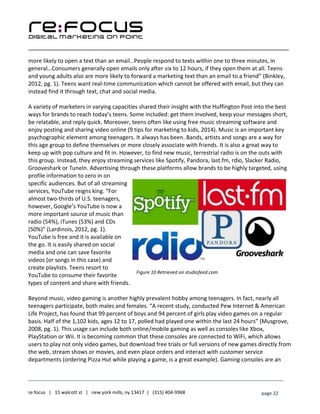
this group. Instead, they enjoy streaming services like Spotify, Pandora, last.fm, rdio, Slacker Radio,
Grooveshark or TuneIn. Advertising through these platforms allow brands to be highly targeted, using
profile information to zero in on
specific audiences. But of all streaming
services, YouTube reigns king. “For
almost two-thirds of U.S. teenagers,
however, Google’s YouTube is now a
more important source of music than
radio (54%), iTunes (53%) and CDs
(50%)” (Lardinois, 2012, pg. 1).
YouTube is free and it is available on
the go. It is easily shared on social
media and one can save favorite
videos (or songs in this case) and
create playlists. Teens resort to
YouTube to consume their favorite
types of content and share with friends.
Beyond music, video gaming is another highly prevalent hobby among teenagers. In fact, nearly all
teenagers participate, both males and females. “A recent study, conducted Pew Internet & American
Life Project, has found that 99 percent of boys and 94 percent of girls play video games on a regular
basis. Half of the 1,102 kids, ages 12 to 17, polled had played one within the last 24 hours” (Musgrove,
2008, pg. 1). This usage can include both online/mobile gaming as well as consoles like Xbox,
PlayStation or Wii. It is becoming common that these consoles are connected to WiFi, which allows
users to play not only video games, but download free trials or full versions of new games directly from
the web, stream shows or movies, and even place orders and interact with customer service
departments (ordering Pizza Hut while playing a game, is a great example). Gaming consoles are an
Figure 10 Retrieved on studiofeed.com
____________________________________________________________________________________________________
___________________________________________________________________________
re:focus | 15 walcott st | new york mills, ny 13417 | (315) 404-9968 page 23
extension of a computer or smartphone, allowing the user to manage all communication and
interactions from the one device rather than multiple devices.
Finally, one last key lifestyle among teenagers is bullying. Despite all the efforts by many organizations
and schools today to prevent it, bullying still very much exists. In fact, “According to a paper published
in the American Sociological Review, the more central you are to your school's social network, the
more aggressive you are as well…Social climbing equals meanness” (Lloyd, 2011, pg. 1). St. Jude should
understand this and try to relate to both types of teenagers in its messaging – bullies as well as those
who are bullied. The National Center for Education Statistics reports that nearly 25% of all high school
students reported being bullied (Koebler, 2011). St. Jude has historically made efforts to emphasize
children’s beauty. Knowing that so many of today’s youth are bullied, St. Jude could use this messaging
for teens to relate to the patients of St. Jude, building relationships and learning about the cause at the
same time.
In summary, key psychographics points of 14-18 year-olds include:
- These “digital natives” grew up on the Internet and social media. Although they’ve begun
abandoning Facebook, they are very active on Twitter, Instagram, and SnapChat.
- They love shows but are not always watching on television sets but instead consume content
online and through streaming services.
- Music streaming services are heavily used, with YouTube reigning king.
- Video gaming is a primary hobby and they use their consoles for more than just gaming.
- Bullying and peer pressure are often motivators in making decisions including what brands they
support, and what content they share.
Current Feelings
Young people today are very interested in
participating in non-profit causes. “According to the
recent [report], 75 percent of young people donated
to causes last year and 63 percent said they gave their
time to volunteer” (Charitable Giving, 2012). St. Jude
must get in front of today’s teens and encourage them
to begin participating in the cause. Peer pressure is a
key motivator. “More than half of American teenagers
and young adults volunteered last year, and the best
way to enlist this group turns out to be peer pressure”
(Hall, 2012, pg. 14). Teens are very self-conscience and
have a need to fit in. By influencing group leaders and
trendsetters, St. Jude can have them leverage their
influence and get friends and followers involved. First however, teenagers must understand and
believe in the mission of St. Jude. “Though Millennials are keen on contributing, they’re not just giving
blindly. According to the study, this generation wants to see tangible results and is doing its research.
Figure 11 Retrieved from sru.edu
____________________________________________________________________________________________________
___________________________________________________________________________
re:focus | 15 walcott st | new york mills, ny 13417 | (315) 404-9968 page 24
Nine out of 10 said they will investigate an organization’s mission statement before giving over their
money or time” (Charitable giving, 2012, pg. 1). More important, St. Jude must be transparent with its
efforts and make sure to weave in the return on investment, which are the achievements through
research and the number of children’s lives being saved. By showing the accomplishments of the
efforts, St. Jude can make teens believe in the mission and know that their time and money is being
well spent and that they are actually contributing towards making a difference.
According to the St. Jude brand book, “84% of the general population surveyed, when asked directly, is
aware of St. Jude Children’s Research Hospital” (Messaging & brand information, 2013, pg. 2). But
although St. Jude is well-engrained in the minds of adults, we know that the relationship between St.
Jude and teens is not nearly as strong. Through an informal survey conducted by re:focus, it can be
assumed that many teens do not know St. Jude or are aware of its mission and cause. In fact, of the
more than 50 teenagers surveyed, more than 40% stated they knew nothing about St. Jude or its
mission. The remaining teens had varied levels of knowledge, some associated it with children while
some also made the connecting between St. Jude and childhood cancers. On the upside, nearly 80%
had positive feelings towards non-profit organizations, providing the potential for St. Jude to reach and
engage with this group. Moreover, the majority noted that they would be willing to play a role with St.
Jude and its cause, whether through volunteering, donating or online brand ambassadorship
(Armitage, 2014). This data suggests that there is much room for growth in understanding and reaching
this teen audience.
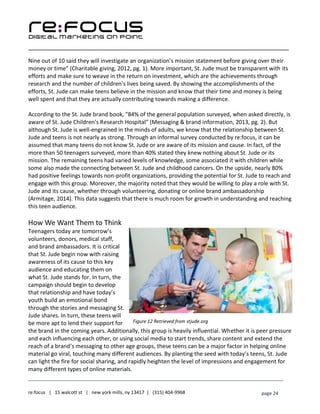
How We Want Them to Think
Teenagers today are tomorrow’s
volunteers, donors, medical staff,
and brand ambassadors. It is critical
that St. Jude begin now with raising
awareness of its cause to this key
audience and educating them on
what St. Jude stands for. In turn, the
campaign should begin to develop
that relationship and have today’s
youth build an emotional bond
through the stories and messaging St.
Jude shares. In turn, these teens will
be more apt to lend their support for
the brand in the coming years. Additionally, this group is heavily influential. Whether it is peer pressure
and each influencing each other, or using social media to start trends, share content and extend the
reach of a brand’s messaging to other age groups, these teens can be a major factor in helping online
material go viral, touching many different audiences. By planting the seed with today’s teens, St. Jude
can light the fire for social sharing, and rapidly heighten the level of impressions and engagement for
many different types of online materials.
Figure 12 Retrieved from stjude.org
____________________________________________________________________________________________________
___________________________________________________________________________
re:focus | 15 walcott st | new york mills, ny 13417 | (315) 404-9968 page 25
St. Jude needs teens to think of its brand in a positive light, understand and respect its cause,
emotionally connect with the patients, and want to contribute to the mission of St. Jude either now or
in future, through donations, volunteering or ambassadorship. In order to accomplish this, St. Jude
must take to the web and social media channels and embark on an aggressive digital marketing
campaign to not only reach and educate today’s youth but begin building relationships and getting
them involved. Building that rapport and setting the stage for a lifelong commitment is critical to
ensuring future donations and volunteer success. Currently, there are many brands vying for this
group’s attention. This includes corporate brands like Hollister and American Eagle, athletics and
celebrity brands like the NBA, NFL and MTV, as well as non-profits like Make-A-Wish and the Boys &
Girls Club of America. All of these brands, and many more, are utilizing various marketing methods to
capture teens’ attentions and influence them to invest in their brands. St. Jude must be strategic in its
approach, as well as unique in its content and messaging, to break through the clutter, stand out, and
get teens to contribute towards the St. Jude cause.
____________________________________________________________________________________________________
___________________________________________________________________________
re:focus | 15 walcott st | new york mills, ny 13417 | (315) 404-9968 page 26
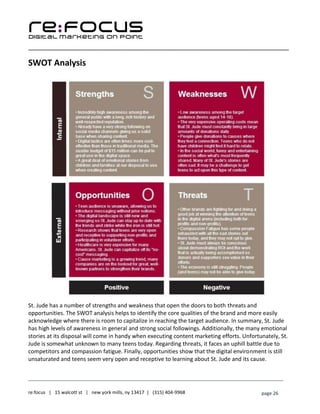
SWOT Analysis
St. Jude has a number of strengths and weakness that open the doors to both threats and
opportunities. The SWOT analysis helps to identify the core qualities of the brand and more easily
acknowledge where there is room to capitalize in reaching the target audience. In summary, St. Jude
has high levels of awareness in general and strong social followings. Additionally, the many emotional
stories at its disposal will come in handy when executing content marketing efforts. Unfortunately, St.
Jude is somewhat unknown to many teens today. Regarding threats, it faces an uphill battle due to
competitors and compassion fatigue. Finally, opportunities show that the digital environment is still
unsaturated and teens seem very open and receptive to learning about St. Jude and its cause.
____________________________________________________________________________________________________
___________________________________________________________________________
re:focus | 15 walcott st | new york mills, ny 13417 | (315) 404-9968 page 27
Brand Perception
Brand perception of St. Jude Children’s Research Hospital among adults is very strong. According to a
report, “[St. Jude] ranks 18th on Cone's Power 100 Nonprofit list; a significant feat for a singular
hospital. And this past holiday season 18% of Americans said they planned to support St. Jude's Thanks
and Giving program” (Zmuda, 2011, pg. 1). Reviewing social media channels, one can see the trust and
support from this older age group. On a photo of two friends battling cancer together at St. Jude, one
fan, Cheryl Kay Nelson Nichols, wrote: “Praise the Lord for St Jude's. May The Lord bless and keep
these best friends together. Thank you, St Jude's.” On another image, Tita Mora Ford posted: “This is
why my family supports St. Jude Hospital. Danny Thomas is an angel. God guided him to do such an
amazing gift. Thank[s] Danny” (St. Jude Children’s Research Hospital, 2014, pg. 1). Perception is also
very positive among staff members and volunteers – seeing St. Jude as an excellent and satisfying place
to work. In fact, St. Jude was ranked #30 on the list of the top 100 companies to work for, from surveys
carried out by CNN Money (100 Best Companies, 2014).
Though adults perceive the brand very positively with strong brand recognition, it is a different story
for the target audience of 14-18-year-olds where a majority remains unaware. However, the audience
has demonstrated positive feelings towards non-profits and willingness to become more aware of St.
Jude, which shows great potential for success in reaching this audience. Informal surveys were carried
out by re:focus among 54 high school students, aged 14-18 year olds, exploring their thoughts and
opinions on non-profits and the St. Jude brand (additional ages participated but only data from
teenage responses was extracted).
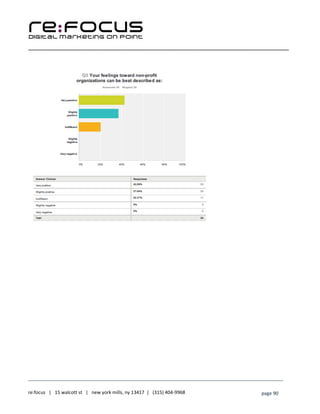
Of the 54 total survey participants, nearly 80% noted that they have positive feelings towards non-
profit organizations while zero said that they have negative feelings.
Figure 13 Retrieved from Armitage, 2014
____________________________________________________________________________________________________
___________________________________________________________________________
re:focus | 15 walcott st | new york mills, ny 13417 | (315) 404-9968 page 28
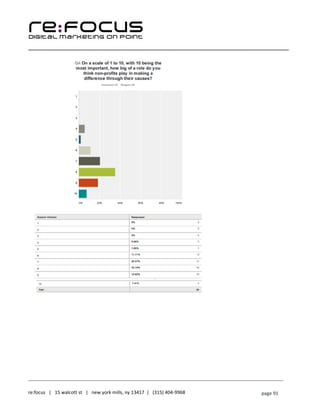
Secondly, 44 respondents, or 81.5%, marked a score of 7 or higher when asked to rate how important
of a role non-profits play in making a difference in society through their causes. Additionally, 47
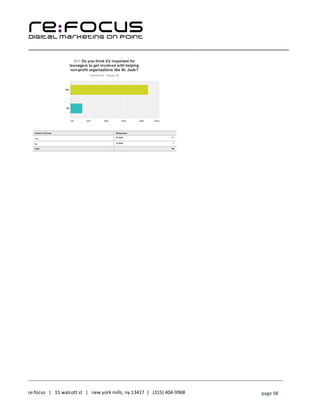
respondents, or 87%, think that it is important to get involved in helping a non-profit organization like
St. Jude. This suggests that St. Jude can leverage these attitudes and encourage teenagers to become
invested as supporters of the cause. Showing positive results (i.e. the actual children’s lives that are
saved) will become an important factor to help build credibility and ensure that St. Jude is making a
real difference in society, and that donations and volunteer efforts are needed to keep the brand alive
and strong.
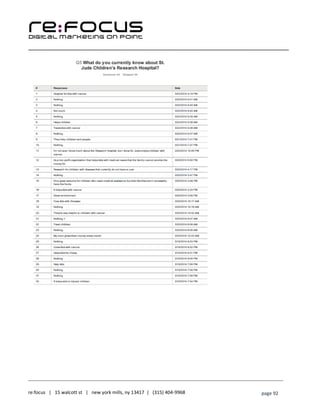
Although thoughts on non-profits remain positive, it is obvious that there is either a lack of knowledge
of the St. Jude brand or an incomplete understanding of its cause, among this age group. In fact, more
than 44% revealed they know nothing about St. Jude. Meanwhile, 35% noted St. Jude has to do with
medical issues, cancer or illness, and 38.2% said St. Jude is associated with children. Finally, only 5.6%
included that St. Jude offers services for free to families who cannot afford to pay. Some did have
some basic understanding of the brand:
“[St. Jude is] a great resource for children who need medical assistance but their families don't
necessarily have the funds.”
“[St. Jude conducts] research for children with diseases that currently do not have a cure”
“[St. Jude] is a non-profit organization that helps kids with medical needs that the family cannot
provide the money for”
Through the survey, it can be assumed that there is great potential to tap this audience, with some
individuals even displaying a willingness to know more and regret knowing little. One responded that
he/she knew “nothing” but added a confused emoticon, suggesting a sense of uncertainty and/or
embarrassment for that being the case. Another responded that, of the St. Jude brand, he/she knew:
“Not much, sadly.”
Outside of the survey, there does seem to be some teens across the country with high levels of
awareness of the brand, at least in terms of its medical prowess. According to a recent survey
conducted by the National Society of High School Scholars in Atlanta, “St. Jude Children's Research
Hospital in Memphis emerged as the No. 1 choice of places to work among thousands of high school
and college students as well as recent college graduates” (McKenzie, 2013, pg. 1). This could likely be a
result of past volunteer efforts. One such program is geared toward teens, which gives a select group
of high school students each summer the opportunity to work alongside medical staff and directly care
for ill children (Teen volunteer time and talent, 2011). These stats can reassure St. Jude that the brand
is sporadically known and it does have high levels of association with being a great place to
work/volunteer due to its research and high quality healthcare. It also suggests that volunteering is a
great way to establish the relationship and set the tone for years to come.
____________________________________________________________________________________________________
___________________________________________________________________________
re:focus | 15 walcott st | new york mills, ny 13417 | (315) 404-9968 page 29
Beyond the Best Places to Work report, it can be agreed that there is vast discrepancy between
awareness and brand perception among adults compared to teens. Historically, all of St. Jude
messaging has been aimed directly at parents/adults. By making a dramatic shift and focusing all
efforts on reaching teens, there will be a heightened level of awareness among the target audience
with stronger brand perception too.
St. Jude has exercised a great deal of effort over the
years to either introduce or reinforce its messaging
to adults - its key givers and volunteers. But the
tactics have been geared toward parents so they
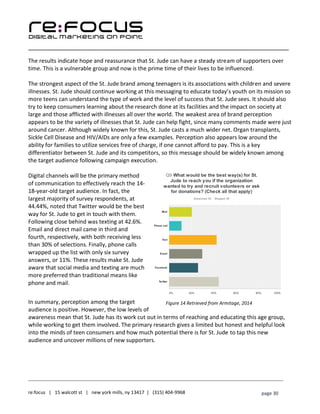
are often missed by teens. Just over 37% in the
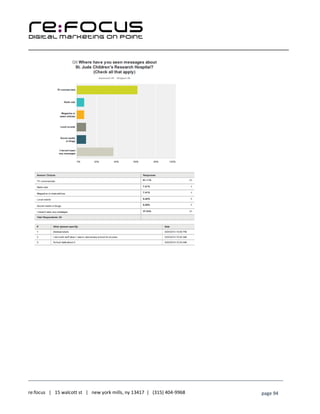
survey indicated that they have not even seen
messages by St. Jude. Meanwhile, 61.1% have seen
television ads, 9.26% local events, 7.41% radio ads,
and 7.41% magazine or news articles. Interestingly,
only 9.26% had seen St. Jude messages via social
media, indicating that the majority of St. Jude
followers on social channels today are probably
parents and adults, its current target market. Digital
marketing will be the best approach to tap this
young audience and balance out this ratio. Through
a wide mix of efforts via social, video, and mobile, St. Jude
can have a better chance at breaking through the clutter, capturing the attention of teens and
beginning to build relationships with them.
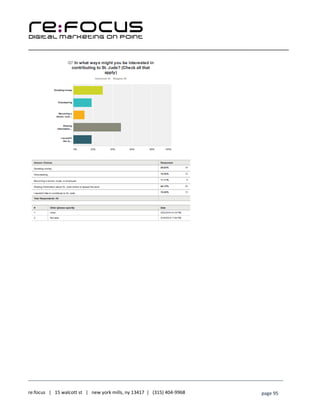
Despite the lack of awareness, there were positive sentiments towards contributing to the St. Jude
cause. Only 18.5% noted that they would not like to contribute, while almost 30% would be willing to
donate money, 18.5% would be willing to volunteer, and almost 50% would be open to sharing St. Jude
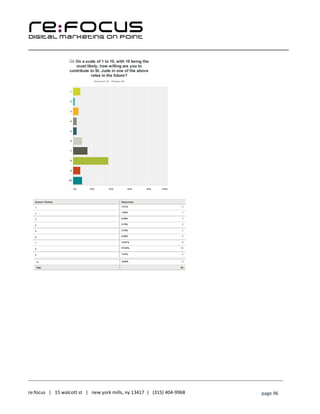
information and content online. Looking into the future, 68.5% indicated strong wishes to give in some
capacity down the road. These numbers are very reassuring. First, it shows that many teens today are
interested in getting involved with the cause. Although donation and volunteer interests are relatively
low, becoming online brand ambassadors by sharing St. Jude content online is very likely. We know
that plurals and millennials are trendsetters and online influencers. By taking hold of St. Jude content
and promoting it to the many followers in their networks, St. Jude can get in front of mass audiences
with its key messages. This rippled effect will likely hit other generations including those parents and
adults who are likely to donate immediately.
The survey results also indicate heavy interest in getting involved down the road, most likely when
these teens are in their 20s and 30s. By starting the conversation now, St. Jude can continue cultivating
the relationships in the future and look to attract donations or volunteers 10 or 20 years from now.
Figure 14 Retrieved from Armitage, 2014
____________________________________________________________________________________________________
___________________________________________________________________________
re:focus | 15 walcott st | new york mills, ny 13417 | (315) 404-9968 page 30
The results indicate hope and reassurance that St. Jude can have a steady stream of supporters over
time. This is a vulnerable group and now is the prime time of their lives to be influenced.
The strongest aspect of the St. Jude brand among teenagers is its associations with children and severe
illnesses. St. Jude should continue working at this messaging to educate today’s youth on its mission so
more teens can understand the type of work and the level of success that St. Jude sees. It should also
try to keep consumers learning about the research done at its facilities and the impact on society at
large and those afflicted with illnesses all over the world. The weakest area of brand perception
appears to be the variety of illnesses that St. Jude can help fight, since many comments made were just
around cancer. Although widely known for this, St. Jude casts a much wider net. Organ transplants,
Sickle Cell Disease and HIV/AIDs are only a few examples. Perception also appears low around the
ability for families to utilize services free of charge, if one cannot afford to pay. This is a key
differentiator between St. Jude and its competitors, so this message should be widely known among
the target audience following campaign execution.
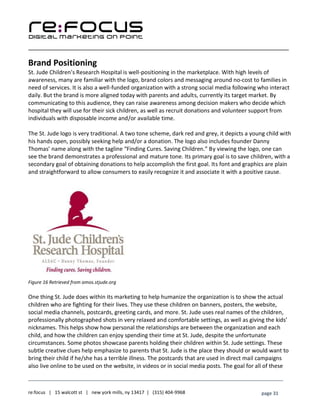
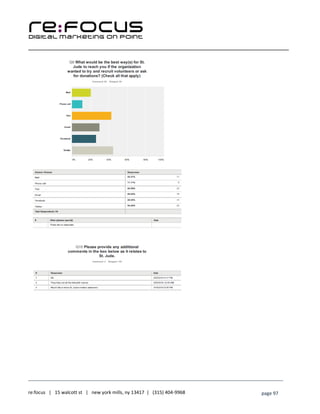
Digital channels will be the primary method
of communication to effectively reach the 14-
18-year-old target audience. In fact, the
largest majority of survey respondents, at
44.44%, noted that Twitter would be the best
way for St. Jude to get in touch with them.
Following close behind was texting at 42.6%.
Email and direct mail came in third and
fourth, respectively, with both receiving less
than 30% of selections. Finally, phone calls
wrapped up the list with only six survey
answers, or 11%. These results make St. Jude
aware that social media and texting are much
more preferred than traditional means like
phone and mail.
In summary, perception among the target
audience is positive. However, the low levels of
awareness mean that St. Jude has its work cut out in terms of reaching and educating this age group,
while working to get them involved. The primary research gives a limited but honest and helpful look
into the minds of teen consumers and how much potential there is for St. Jude to tap this new
audience and uncover millions of new supporters.
Figure 14 Retrieved from Armitage, 2014
____________________________________________________________________________________________________
___________________________________________________________________________
re:focus | 15 walcott st | new york mills, ny 13417 | (315) 404-9968 page 31
Brand Positioning
St. Jude Children’s Research Hospital is well-positioning in the marketplace. With high levels of
awareness, many are familiar with the logo, brand colors and messaging around no-cost to families in
need of services. It is also a well-funded organization with a strong social media following who interact
daily. But the brand is more aligned today with parents and adults, currently its target market. By
communicating to this audience, they can raise awareness among decision makers who decide which
hospital they will use for their sick children, as well as recruit donations and volunteer support from
individuals with disposable income and/or available time.
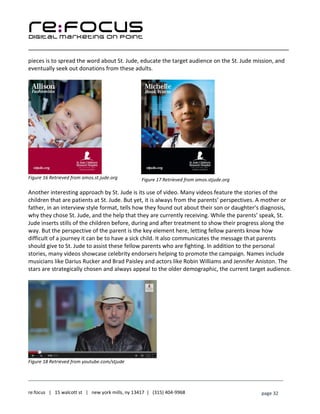
The St. Jude logo is very traditional. A two tone scheme, dark red and grey, it depicts a young child with
his hands open, possibly seeking help and/or a donation. The logo also includes founder Danny
Thomas’ name along with the tagline “Finding Cures. Saving Children.” By viewing the logo, one can
see the brand demonstrates a professional and mature tone. Its primary goal is to save children, with a
secondary goal of obtaining donations to help accomplish the first goal. Its font and graphics are plain
and straightforward to allow consumers to easily recognize it and associate it with a positive cause.
Figure 16 Retrieved from amos.stjude.org
One thing St. Jude does within its marketing to help humanize the organization is to show the actual
children who are fighting for their lives. They use these children on banners, posters, the website,
social media channels, postcards, greeting cards, and more. St. Jude uses real names of the children,
professionally photographed shots in very relaxed and comfortable settings, as well as giving the kids’
nicknames. This helps show how personal the relationships are between the organization and each
child, and how the children can enjoy spending their time at St. Jude, despite the unfortunate
circumstances. Some photos showcase parents holding their children within St. Jude settings. These
subtle creative clues help emphasize to parents that St. Jude is the place they should or would want to
bring their child if he/she has a terrible illness. The postcards that are used in direct mail campaigns
also live online to be used on the website, in videos or in social media posts. The goal for all of these
____________________________________________________________________________________________________
___________________________________________________________________________
re:focus | 15 walcott st | new york mills, ny 13417 | (315) 404-9968 page 32
pieces is to spread the word about St. Jude, educate the target audience on the St. Jude mission, and
eventually seek out donations from these adults.
Figure 16 Retrieved from amos.st.jude.org
Another interesting approach by St. Jude is its use of video. Many videos feature the stories of the
children that are patients at St. Jude. But yet, it is always from the parents’ perspectives. A mother or
father, in an interview style format, tells how they found out about their son or daughter’s diagnosis,
why they chose St. Jude, and the help that they are currently receiving. While the parents’ speak, St.
Jude inserts stills of the children before, during and after treatment to show their progress along the
way. But the perspective of the parent is the key element here, letting fellow parents know how
difficult of a journey it can be to have a sick child. It also communicates the message that parents
should give to St. Jude to assist these fellow parents who are fighting. In addition to the personal
stories, many videos showcase celebrity endorsers helping to promote the campaign. Names include
musicians like Darius Rucker and Brad Paisley and actors like Robin Williams and Jennifer Aniston. The
stars are strategically chosen and always appeal to the older demographic, the current target audience.
Figure 18 Retrieved from youtube.com/stjude
Figure 17 Retrieved from amos.stjude.org
____________________________________________________________________________________________________
___________________________________________________________________________
re:focus | 15 walcott st | new york mills, ny 13417 | (315) 404-9968 page 33
The current campaign slogan also reveals a great deal about the positioning of the brand. The slogan
reads: Give thanks to the healthy kids in your life. And give to those who are not. This line, which is
woven into many of the current marketing communication pieces, directly appeals to parents. St. Jude
describes the wonderful works of its organization and utilizes imagery that showcases the
advancements and progress in children’s health. It uses this line to speak to parents who have healthy
children, letting them know that they can make a difference in the lives of other families. This is a
powerful and strategically written slogan that is perfectly placed amidst the brand positioning, with the
intent of recruiting donations from parents and adults. At the same time, it alienates those who do not
have children, like teens and young adults.
Finally, St. Jude uses a great deal of facts and figures on its website. The brand knows that parents and
adult donors are interested in results. They want to know if St. Jude will be able to help their children,
or other sick children out there who are fighting for their lives. Consumers have the ability to dig
through the website where St. Jude is transparent about its history, research, facility, and medical
programs. It also boasts loads of information and resources to learn more about the cancers and
illnesses that a family could find useful. All of these materials and web pages are directly helpful to the
adult target audience. Copy is written with adults in mind, with a very educational and confident tone.
St. Jude needs to have parents and adults trust them. Their children’s lives depend on it. The entire
website and focus of all copy, photos and information positions the brand as a leading hospital and
organization for children battling deadly diseases. It demonstrates professionalism, confidence, medial
superiority, and comfort. Its detailed and in-depth information and resources emphasize its leadership
in the field of cancer and medicine.
Figure 19 Retrieved from stjude.org
____________________________________________________________________________________________________
___________________________________________________________________________
re:focus | 15 walcott st | new york mills, ny 13417 | (315) 404-9968 page 34
In summary, St. Jude is well-positioned, utilizing rich information and images of children to
demonstrate the greatness of the organization, its facilities and staff. Its brand is very traditional and
utilizes creative pieces and tactics that directly reach parents and adults as they work to seek
donations to help provide funding to continue saving children’s lives. Unfortunately, the
communication today speaks directly to adults and does not resonate with our new target audience –
teenagers aged 14-18-years-old. New marketing communication tactics should be put in place to speak
to this audience and influence them to act upon St. Jude messaging. An updated positioning statement
is needed to help align the brand more closely with the teenage audience. This sets the stage for
updated personality, strategy statement, and tactics that will work to directly appeal to them and
continue strengthening the brand in its new position in the marketplace. The updated positioning
statement is as follows:
St. Jude Children’s Research Hospital offers care and cures to children with life threatening illnesses as
well as hope to those families in need. Through a combination of groundbreaking research, medical
treatments and compassionate companionship, it works to keep spirits high and families fighting
strong.
Teenagers are an important audience for St. Jude. One of the most important features is their ability to
further the reach of key messages, ensuring that more people become aware of St. Jude and its cause.
This group is very influential online. St. Jude can increase the likelihood of its content going viral to
influence the masses. This audience can also offer their attention and friendship to the ill children at St.
Jude, giving them hope and a stronger will to fight and live. In the new positioning, equal favor is given
to the research and treatment as it is to the companionship that individuals can provide to the St. Jude
children. This particular angle specifically helps include the teen audience who may not be ready or
willing to give in terms of monetary donations or volunteer hours. Simply by offering friendship,
through online support, they can get involved with the St. Jude cause and begin building that
relationship with the brand.
____________________________________________________________________________________________________
___________________________________________________________________________
re:focus | 15 walcott st | new york mills, ny 13417 | (315) 404-9968 page 35
Brand Personality
All strong brands have personalities – formed over the years through a combination of efforts, from
experiences with customer services, marketing and advertising, the tonality behind written and spoken
messages, and more. St. Jude represents a personality to the public, one that is professional, caring,
compassionate, and affectionate. St. Jude makes its children and families feel comfortable, safe and
reassured, letting them know that their children will be cured. The personality is also informative and
knowledgeable, demonstrating to the target audience that the staff is highly qualified to care for the
many illnesses that they encounter. But this personality is very appropriate for the adult population. A
new personality should be established and emphasized in new marketing communication tactics that
better speaks to the 14-18-year-old audience. Teenagers have different personalities themselves, and
only interact with brands that appeal to them. In order to be most effective in reaching today’s youth,
St. Jude must form a personality that is real, uplifting, contemporary, and friendly.
Real
Transparency is key in society today. Social media has
created two-way communication between consumers and
brands. It is difficult, if not impossible, to hide from the
public eye. Thus, brands are realizing that it is better to be
upfront and open with consumers. St. Jude must remember to always be real. People today, especially
plurals and millennials, are very skeptical of advertisements. Young people do not always trust ads
because they know ads consist of messages controlled by brands. We live in a world where word of
mouth reviews and peer referrals are available at any time, making advertisements less credible in
comparison. Being real speaks to teens. They want to know what St. Jude is all about. They want the
inside look into the research, the inside scoop on the children’s stories, information on the treatments,
and more. Being real means St. Jude should be honest in all of its statistics and findings, authentic in
how they describe children’s illnesses and how it affects them, and realistic in the struggles faced by
families. Within the tactics, St. Jude should be lenient in controlling the messages and let parents and
children describe the stories in their own words. It should be less “professional” in the photography
and videography, showing real-life shots (when appropriate) instead of carefully placed and crafted
images. And finally, it should be relaxed and human in all communication so teens know St. Jude is
speaking directly to them.
Uplifting
The core motivator for people to give to St. Jude is not only
seeing the struggles a family faces when a child has a life-
threatening illness, but the joy and pure happiness the
families experience after overcoming the disease, through
the help of St. Jude. The content and stories shared by St. Jude within this campaign should have an
uplifting message. By doing so, it will set the stage for the content to be shared by teens and make
waves throughout the social web. Additionally, it helps motivate teens, and other audiences, to get
____________________________________________________________________________________________________
___________________________________________________________________________
re:focus | 15 walcott st | new york mills, ny 13417 | (315) 404-9968 page 36
involved. They must understand what their support or donations will be contributing towards. As
mentioned, plurals and millennials are very active in volunteering and charity giving as long as they can
see the fruits of their labor. In the case of St. Jude, these fruits are children’s lives being saved and the
number of disease-based deaths declining. The uplifting messages will help to accurately tell these
stories and at the same time promote the cause and recruit new supporters.
Contemporary
St. Jude must be modern, fresh and contemporary in all of
its communication. There are thousands of brands fighting
for the attention of teenagers today. And social media
makes the space even more crowded since consumers choose who they want to listen to, compared to
traditional methods where they had no choice (i.e. TV and radio). In order to get in front of teens and
have them opt to follow and interact with St. Jude, the brand must be up with the latest trends and
develop content that resonates. Being contemporary means utilizing the latest and most popular
channels of communication like Twitter and Instagram. It means speaking to teens in a voice that
makes them relaxed - using the lingo of today and the shorthand that is common on social media and
in texting. It also means that St. Jude should be exercising the newest tactics in content marketing,
embracing mobile and video, and reaching teens with the most progressive tools and software. St. Jude
should also be demonstrating the modernity and progressiveness of the research and technology that
is being used to assist the children in fighting illnesses. Being contemporary differentiates St. Jude with
its traditional past that had previously targeted parents, and instead fights to get in front of teens who
need a fresh way of looking at the brand.
Friendly
Lastly, but most important of all, is friendliness. This is a key
aspect in this campaign. How do friends communicate with
each other? Being friendly in all marketing communication
demonstrates a welcoming and comfortable environment at
St. Jude, letting the target audience know that families can feel at ease. At the same time, it makes the
teenagers open to engaging and interacting with the brand. Many of the successful teen brands out
there today are extremely conversational and friendly in their interactions with consumers. This
approach encourages more audience members to follow along and get involved in the conversations
taking place. Relationships are then built. And the anticipation is that relationships are not only
between consumers and the St. Jude brand, but amongst the children of St. Jude as well. This helps to
raise the kids’ sprits and keep them fighting for better health. The teenagers can feel good about
helping those in need and gladdened knowing they are having a positive impact on their many new
friends at St. Jude. Friendliness rubs off. As St. Jude accentuates this personality trait, it will build a
more supportive and kind environment surrounding the brand – made up of friends, volunteers and
supporters – all working towards strengthening the brand and saving children’s lives.
____________________________________________________________________________________________________
___________________________________________________________________________
re:focus | 15 walcott st | new york mills, ny 13417 | (315) 404-9968 page 37
Integrated Communication Strategy Statement
At St. Jude Children’s Research Hospital, cures don’t always come from surgeries, medication and
treatment. Sometimes, friendship is just what the doctor ordered.
____________________________________________________________________________________________________
___________________________________________________________________________
re:focus | 15 walcott st | new york mills, ny 13417 | (315) 404-9968 page 38
Creative Brief
Client: St. Jude Children’s Research Hospital Date: May 2014
Type: Integrated Marketing Communication Campaign Pages: 1
____________________________________________________________________________________
Why are we advertising?
To begin building relationships with teenagers so they are aware of the St. Jude Children’s Research
Hospital brand and will be more inclined to support, give and volunteer either now or in the future.
Whom are we talking to?
We are speaking to 14-18-year-olds across the United States who are active online and on mobile
devices.
What do they currently think?
They have a limited understanding of St. Jude and know that it assists children who have cancer but
have no real reason to support it. St. Jude is very focused on illnesses (and overcoming them) and is
always seeking donations. It’s a brand their parents support, but not them.
What would we like them to think?
St. Jude is the top organization in the country when it comes to disease and cancer research and saving
the lives of children. Even teens can make a difference in helping improve the health of those children.
What is the single most persuasive idea we can convey?
Friendship is just as important as medicine, surgeries and treatment when it comes to helping ill
children fight for their lives.
Why should they believe it?
Emotional health can play a major role in improving physical health. By simply being a friend, you can
help a child in need.
Are there any creative guidelines?
There will be a variety of tactics carried out within this campaign, all of which will live in the digital
space. Advertising will exist in social media, mobile marketing, streaming music, and in video. All ads
should quickly captivate audience members and include online-based call to actions.
____________________________________________________________________________________________________
___________________________________________________________________________
re:focus | 15 walcott st | new york mills, ny 13417 | (315) 404-9968 page 39
Objectives and Tactics
The goal of the integrated marketing campaign is to heighten the level of awareness of the St. Jude
Children’s Research Hospital brand among the target audience of 14-18-year-olds. Additionally, by
using the theme of friendship, we will work to bring teens and the sick children of St. Jude together
and allow them to converse and interact through digital means, helping foster a positive atmosphere
to raise the spirits of the children and improve their health. There will be three objectives carried out
throughout the campaign that will take place between July 2014 and June 2015. All tactics within the
integrated marketing communication plan will be executed on a $15 million budget. Roughly 28% is
devoted to objective one to boost social media following, 28% to objective two to boost website
visitors, and a little more than 32% to objective three to foster messages to St. Jude teens. The
remaining budget is for agencies fees, software and tools, and evaluation costs. The largest among of
budget is devoted to objective three since this will drive the most important results within our
campaign. All tactics focus on digital media based on our target audience’s behaviors and habits and
we have strategically opted to stay away from traditional media and print media (with the exception of
our internal tactic). Within the campaign, we are looking to saturate the market so more than 85% of
all teens in the target audience are aware of St. Jude and its cause by the end of the campaign.
Objective #1: Boost the number of social media followers on both Twitter and
Instagram by 50% by June 2015.
One of the best ways to establish a connection with teenagers today is through social media. St. Jude
currently has a strong online following but made up mostly of parents, adults, volunteers and donors.
We need to balance the ratio and build up the number of followers of teenagers 14-18-years-old.
Based on their most preferred platforms today, our focus will revolve around Twitter and Instagram.
Twitter features short bursts of information, including text, links and embedded multimedia for quick
communication, while Instagram focuses on a stream of images, videos and captions. By recruiting
more teen followers, we can nab and maintain this audience for future communication where we can
steadily educate them on the St. Jude brand, encourage them to interact with St. Jude children, get
them more involved as brand ambassadors, and eventually encourage them to donate and volunteer
down the road. It begins here. This is the first touch point. As the initial interaction with St. Jude, and
possibly the first time they are even hearing about the brand, this communication is very important
and must emphasize the brand personality while working to start the relationship off on the right foot.
By incorporating a Twitter contest with promoted tweets, video game advertising, Instagram ads, and a
reality-based online show that promotes the two handles, we can develop a stronger follower base for
future communication with the teen audience. Organic activity on Twitter and Instagram will be
ongoing and heavy amidst the other marketing communication tactics taking place throughout the
year-long campaign.
Tactic 1.1: 365 Days of Friendship Contest
Twitter is a go-to resource for teenagers to interact with each other, follow celebrities and brands, and
share articles, images and videos. St. Jude currently has a very strong following (331,000 followers) but
____________________________________________________________________________________________________
___________________________________________________________________________
re:focus | 15 walcott st | new york mills, ny 13417 | (315) 404-9968 page 40
made up mostly of parents and adults, its previous target audience. In order to attract a stronger
following of teenagers, tactics must be carried out on this platform to not only get teens to notice the
handle but to follow and stay tuned in to its tweets. Teens need a reason to follow St. Jude. It will not
happen naturally, like friends following friends. Through a Twitter contest dubbed “365 Days of
Friendship,” promoted through Twitter advertising, St. Jude can build its following of teens. The “365
Days of Friendship” contest is a basic sweepstakes, meaning there is no skill involved. Users must
follow the St. Jude handle on Twitter and RT the special “Tweet of the Day” for a chance to win. The
winner will be chosen out of those who RT the special tweet and follow the brand. Twitterers will know
the special tweet each day by the designated contest hashtag: #friendship365. This will make the tweet
stand out from other St. Jude tweets throughout the day. Within the contest tweet, there will be a
direct link to the St. Jude minisite where users can learn more about the brand and the other elements
within our campaign.
The prize awarded each day will be a $500 gift card to Best Buy as a result of a co-op partnership with
the electronics retailer. In exchange for St. Jude purchasing $182,500 worth of gift cards, and giving
Best Buy exposure through the tweets and contest mentions, Best Buy will be expected to share a
contest tweet at least once per week, as well as devote $50,000 of its own towards Twitter advertising
of the St. Jude’s contest (Twitter recently rolled out a feature for brands to sponsor partner tweets). By
having Best Buy promote the contest using its own handle, the contest tweets can have an even
greater reach and tap their followers. Many brands conduct contests on Twitter. Since the “365 Days of
Friendship” contests takes place every day for a whole year with a very significant prize size, it will
likely be noticed by the teen audience. Furthermore, Twitter promoted tweets will be utilized each day
to get the tweet in front of more teens. By using targeted handles like @AmericanEagle, @Xbox,
@Playstation, @Disney, @NBA and @KatyPerry, we can get in front of mass audiences of teens each
day to participate in the contest and follow the @StJude handle. Users will not know when the tweet
will be delivered, ensuring that the audience is captive and engaged at all times, while inevitably paying
attention to other tweets throughout the day where we will then educate teens on St. Jude and its
cause.
Budget:
The contest takes place for a full year – 365 days. The Best Buy gift card amount is $182,500, or $500
per day. Additionally, St. Jude will budget $2,500 daily to promote the contest tweets. This brings the
total cost per tweet to $3,000 between prize and advertising. The budget will also take into
consideration $730, or $2 each day, for postage and printing costs for a congratulatory letter sent to
each winner of the prize. The letter will also discuss St. Jude and its key mission. The total amount for
this tactic is $1,095,730.
Evaluation:
To measure the results of this effort, we will use the software SimplyMeasured. By doing so, we can
not only track the number of twitterers using the hashtag #friendship365, but also the number of RTs
on each of our contest-related tweets. SimplyMeasured reports will be pulled at the end of each
____________________________________________________________________________________________________
___________________________________________________________________________
re:focus | 15 walcott st | new york mills, ny 13417 | (315) 404-9968 page 41
month. In addition to measurement of the specific contest-activity, overall Twitter follower count will
also be monitored within each report. Secondly, Twitter Insights will be used to measure the
effectiveness of all promoted tweets (advertising) throughout the campaign. Within the backend of
Twitter, we can see results including total @s, RTs, favorites and URL clicks, based on the promoted
tweets. These reports will also be pulled monthly.
Tactic 1.2: In-Game Advertising
Video gaming is one of the most
common hobbies among teens today.
Although teens may not pay attention
to traditional ads in the real world, it
is hard to avoid them when playing a
video game for multiple hours each
day. In-game advertising is a modern
approach to running traditional ads in
digital format that appear within
video games. A bus stop sign in a car
racing game, a sign behind the
batter’s box in a baseball game, or a
billboard hanging from a hotel in a
super hero game are only a few
examples. Although subtle to the viewer, repeated impressions can translate into awareness and
potential behavior changes among the target audience. The ads being used in the games will feature
St. Jude messaging around friendship with a call to action to follow @StJude on Twitter and @StJude
on Instagram.
The ads can be changed in real-time through the campaign with different copy. “Dynamic in-game
advertising is by far our most popular in-game ad channels…It takes the form of billboards and posters
throughout the game environment that can be updated with image ads in real time. It’s only possible
when gamers are playing with an active internet connection. The ads are integrated into the game via
an adserver, which is a tool used to control the delivery of advertisements into video games” (In-game
advertising is worth $1+ billion a year, 2013). Based on the clean and professional image of St. Jude, we
will stay away from any explicit or mature video games to advertise within, and instead, opt for those
that are rated E 10+ (appropriate for anyone older than 10-years-old). We will focus on sporting and
super hero games since they are appropriate for all teen ages and since they have numerous areas for
billboard and street sign ads. These games include: 2014 FIFA World Cup Brazil, NBA Live 14, Madden
25, Major League Baseball 2014, NASCAR ’14, Lego Marvel Superheroes, Forza Motorsport 5, Kinect
Sports Rivals, Just Dance 2014, and the Lego Movie Video Game. Ads will be divided equally between
Xbox and Playstation.
Figure 20 Retrieved from cnn.com
____________________________________________________________________________________________________
___________________________________________________________________________
re:focus | 15 walcott st | new york mills, ny 13417 | (315) 404-9968 page 42
Budget:
Ten games have been selected and a $50,000 spend will be directed towards each game to run the in-
game ads continuously over the course of the year. The creative and management of the ads is
included in the agency fees. This brings the total cost for this tactic to $500,000.
Evaluation:
Ad impressions will be measured based on data provided by Xbox and Playstation. By calculating the
number of games purchased, we can have a firm idea of the number of views of each of our ads from
console-based platforms. Secondly, we can add that number to the impression totals of those who
have a live internet connection – also provided by the video game service companies. We will use
SimplyMeasured to track the number of Twitter follower who also follow Xbox and/or @Playstation at
the start of the campaign, and again at the conclusion of the campaign. The increase in followers will
be directly associated with this in-game advertising effort.
Tactic 1.3: Online-Based Reality Show
The online reality show will be the main driver to push St. Jude messaging to the target audience and
boost a social media following among this targeted age group. Reality shows are still alive and well,
especially among the teen audience. The Teen Mom series, Catfish: The TV Show and the Real World,
all on MTV, are great examples of the successes seen with this type of programming. Secondly, we
know that teenagers are not sitting down during premier broadcasts and watching on television. They
are instead opting to watch on their own time through online/mobile means. Taking both of these
points into consideration, we will produce a full reality show called “St. Jude & Friends.” The show will
feature children of St. Jude along with staff and volunteers, and it will be published through online
streaming partner Hulu. The videos will be embedded into the “Our Show” section of the minisite to
attract teen viewers to the website and expose them to other key messages about the brand. Short ads
will run during the show to give viewers additional insight into the brand.
The content of the show take a very similar approach to that of Teen Mom. Videographers will follow
five ill children at St. Jude throughout the course of four months. They will track their ups and down,
the good times and the bad, with the hope of showcasing the struggles that the children of St. Jude
face – while also showing the benefits of St. Jude and what the hospital offers to those in need. This
purpose is to be contemporary and capture the true nature of what goes on at the hospital and in the
lives of these children. The show will be promoted within the mix of online-based ads utilized within
the campaign. In addition to the show itself, the videos are being strategically placed on the website
(powered by Hulu) to allow viewers to comment beneath the videos and communicate with the show’s
“stars.” The website set-up will also make it easy for viewers to navigate to the blog section to read
and learn more about each individual child that appears in the show. Permission will be obtained from
parents before filming but the children and parents will be encouraged to be themselves all throughout
to demonstrate authenticity, realness and transparency.
____________________________________________________________________________________________________
___________________________________________________________________________
re:focus | 15 walcott st | new york mills, ny 13417 | (315) 404-9968 page 43
The online show is an ideal fit for the teenage demographic. We want to build a strong connection
between viewers and the St. Jude children. Sometimes a quick ad makes that very difficult. By investing
hours at a time over the course of multiple months, viewers can feel invested into the lives of these
children and get to know them on a personal level. The virtual friendship that is formed will lead to
boosts in following, an increase in interactions over the web, and raised spirits among the struggling
kids. There will be two “seasons” of the show, during the fall and spring seasons, from September
through December and February through May (to follow along with the traditional television show
calendars). Each season will feature 15 episodes, one episode per week each season, meaning there
will be a total of 30 episodes throughout the year. There will be a short ad at the “intermission” of the
show as well as at the conclusion, encouraging viewers to follow @StJude on Twitter and Instagram via
hyperlinks.
Budget:
Since the show will require constant filming, so additional help will be needed outside of the standard
agency fees in order to film and produce the show. Based on the extra help and added equipment, this
will cost $45,000 for each episode. The management of the videos and upload to the web will be
handled by the agency. There will be an additional fee of $80,000 provided to partner Hulu to have the
ability to run our own ads during the content and fully control the messaging on each video. This brings
the total of this tactic to $1,430,000.
Evaluation:
Measurement for this tactic will take place on two fronts. First, we will record the number of total
views for each video. Our anticipation is that this number will grow over time as more traction is built
throughout the year through word-of-mouth among the teen audience. We will measure views
through Hulu for the original stream. Back-dated shows will later be uploaded to YouTube (Hulu can
only house up to 8 episodes at once), where we will monitor YouTube analytics for total views, minutes
watched, comments, and more. Secondly, the ads featured within the shows will direct users to Twitter
and Instagram. These external links will be monitored to track the number of people who follow the
brand through this path. Video analytics reports will be run at the end of each month.
Tactic 1.4: Social Media Ambassador Kit (Internal)
St. Jude’s internal audiences must be put to work. We have thousands of employees, volunteers and
donors at our disposal that can be put to use to help further the reach of the messages within this
campaign. Though St. Jude members are not all within the target audience, we can leverage this group
to spread the word to teens – whether that is our members’ children, nieces and nephews, students,
friends, etc. But one challenge is the lack of social media savviness among this group. By supplying our
internal audience with educational material within social media ambassador kits, we can fully prepare
our team to help spread the word to their individual networks. The social media ambassador kit will be
a direct mail piece provided to everyone within St. Jude’s distribution channel. This includes a list of
33,600 made up of 3,600 employees, the most recent 10,000 volunteers, and 20,000 high-level donors.
____________________________________________________________________________________________________
___________________________________________________________________________
re:focus | 15 walcott st | new york mills, ny 13417 | (315) 404-9968 page 44
The kit will feature a note from CEO Dr. William E. Evans, explaining the new campaign, the role he
would like the reader to play, and the assets within the package. Within the package, there will be a
branded thumbdrive. Upon placing the thumbdrive in a computer, a welcome/registration screen will
appear explaining the purpose of the device and the three assets within. First, there will be a five
minute informational video on Twitter with a quick how-to guide on how to create an account, post
tweets, and most importantly, RT St. Jude’s tweets. The second file follows a similar format around
Instagram explaining how to create an account, follow @StJude and tag and post using St. Jude
hashtags. With the help of these videos, those unaware of the platforms are encouraged to join and
begin furthering the reach of the St. Jude messages. Finally, there will be a PDF calendar which includes
all the various marketing within the campaign – including the Twitter contest, reality show, and
minisite, to name a few. Having this in one document, with dates on when promotions will run, can
help the St. Jude team members feel involved and know when and where they can go to help push the
messages further. The social media brand ambassador kit will be instrumental in getting all key
stakeholders caught up to speed on all the new changes taking place at the organization and allow
them to help in reaching teens. It will also quickly educate this older crowd and allow them to be full
participants in the new techniques St. Jude is using to communicate with its audience. Print media is
specifically chosen for this audience, even over email,
since many donors and volunteers are aged and are
more apt to react to a direct mail piece. It also comes
across much more formal and official – the feeling we
want to emphasize – that we are serious about our
new approach.
Budget:
The production of the video and print assets will be
prepared within the agency fees. The printing costs for
the letter will be $1 for each print, or $33,600. The cost
of the mass-produced branded thumbdrives with our
assets pre-loaded onto the devices will cost $34/piece, or $1,176,000, since the video files are large
and the devices require 8 GB storage. Mailing will cost $1.50 for each mail, or $50,400. The total of this
tactic will be $1,226,400.
Evaluation:
The welcome/registration pop-up that appears upon placing the thumbdrive into a computer will be
used to accurately track the effectiveness of the campaign. The form will ask if the user would like to
be a St. Jude Brand Ambassador and seek contact information. Upon submitting, we will receive an
email notification to a designated email account to track the open rate of the thumbdrive and which
people on the mailing list converted. This can provide us the number of St. Jude supporters who have
received the message and will be more likely to act upon the learnings and further the brand’s reach
on Twitter and Instagram. Data from the registration form will be collected at the end of the campaign.
Figure 21 Retrieved from sans.org
____________________________________________________________________________________________________
___________________________________________________________________________
re:focus | 15 walcott st | new york mills, ny 13417 | (315) 404-9968 page 45
Objective #2: Increase the number of visitors to stjude.org by 35% by June 2015.
The main goal of the campaign is to educate teenagers on St. Jude and its cause while promoting
friendship between audience members and the sick children at St. Jude. The website will be an integral
part to this mission. Not only does the site boast an incredible wealth of information about St. Jude
and all of its rich offerings, but it can be customized to specifically meet our needs (more so than a
third party site or platform). A minisite will be built out to aggregate all the various social media
channels and encourage commenting/conversation between visitors and the St. Jude kids. More
importantly, this tactic is highly measurable through Google Analytics where we can easily monitor
traffic levels, bounce rates, most viewed pages, time on site, and other key metrics. All of the tactics
are directly geared toward 14-18-year-olds, so we can assume traffic to the minisite will be mainly
made up of this new audience. The website allows us to feature storytelling, control the message, and
educate the awareness level of visitors while also pushing those viewers to participate in
conversations. To drive visitors to the minisite (and to stjude.org), we will use several tactics including
mobile gaming ads, a photo booth concept, and music streaming ads.
Tactic 2.1: Minisite
The current website is information and functional, but not necessarily appealing to the teenage
audience. We do not want to do a full website overhaul since we still must accommodate the
parent/adult audience - currently our largest group of stakeholders, donors and volunteers. So instead,
we will build out a minisite that is geared directly toward the 14-18-year-old audience. Visitors can
easily find their way from this site to the corporate site through a prominent link in the footer and visa
versa through a link in the main navigation. More importantly, it will be a central hub for all
components of the campaign, including social activity, videos, and blogging efforts. It will be the
landing page for ads, the location to access information about the contest and event, the main link
within organic social media activity, and the primary place for teens to interact with the St. Jude
children. This is the conversation center.
The site will be built using the blogging/website software Wordpress to take advantage of the open-
source nature, its easy content management system (CMS), and ability to give multiple administrators
access to make edits and publish blog posts. It will also feature a custom domain name to make the
URL easily remembered among the target audience, and also more easily incorporated into
advertisements and other calls to action. Using beafriendtoday.org, St. Jude can emphasize the
campaign theme while also making it easy for teens to see and recall at a later time and date. The site
will be clean, modern and ultra-visual with key focuses around the blog and interactive channels. The
site will be responsive design – making it render neatly and cleanly on mobile devices to accommodate
the teen’s mobile use – and will be built in the premium theme of Trust (themetrust.com) which uses a
new-style panel approach with a vibrant, a full-sized homepage image, and social integration.
Budget:
The cost behind the creation of the minisite will be minimal. In order to carry out this tactic, sitemap,
wireframe, design, and development processes will be executed. All of these hours will be included in
____________________________________________________________________________________________________
___________________________________________________________________________
re:focus | 15 walcott st | new york mills, ny 13417 | (315) 404-9968 page 46
the agency fees. There will, however, be costs associated with the Wordpress theme purchase ($500),
domain name rights ($50), and monthly hosting fees through RackSpace ($500/mo). This brings the
total for this tactic to $6,550.
Evaluation:
Google Analytics and third party analytics software KISSMetrics will be set-up for the custom mini site.
By doing so, we can collect a plethora of data including total visitors, referrals (which sites directed
users to the minisite), as well as outbound links (which links users clicked upon within the website). We
can also see what type of content is most and least popular on the site. Specifically, we will track the
number of external links directing users to stjude.org (within the footer) so we can learn how many
actively sought more information and were motivated to learn about donating or volunteer efforts.
We will also be monitoring Google Analytics and KISSMetrics for stjude.org to track the number of
referrals that came from beafriendtoday.org as well as added insight like what pages did they explore
once they arrived.
Tactic 2.2: Mobile Game Advertising
Teenagers are strapped to their mobile
devices. A multi-screen generation, this
means that smartphone and tablets are
the go-to tools for media consumption.
Mobile gaming is a prevalent pastime
as they kill time on the school bus, in
their rooms, during study hall at
school, and more. “Teens ages 12 to 17
are driving the [mobile gaming] trend
by dedicating an average of seven
hours per week on mobile gaming
activity, up from five hours a week in
2012” (Ankeny, 2014, pg. 1). Mobile games are different in that they are often times quick games to
easily be played when one has a few free minutes or feature continuation qualities so one can pick up
the game where one left off last time. Using mobile advertising is a fitting technique since it gets St.
Jude in front of mass amounts of target audience members. With a pay-per-click (PPC) model, it is also
a very cost-effective approach compared to more traditional online advertising means like Google
AdWords search campaigns or banner ads on news websites (which would not be strategic based on
the audience). Finally, mobile ads give us the ability to be highly specific in the audience we are
reaching through demographic profiling. The ads will be featured on top gaming apps including Angry
Birds, Candy Crush, Subway Surfers, Temple Run 2, Despicable Me, Solitaire, Texas Hold ‘Em Poker,
Blackjack, Hearts, and Fruit Ninja (Nutt, 2014). These ads will be managed through Millennial Media
and will feature both still ads as well as video ads and will direct users to the minisite to learn more
about St. Jude.
Figure 22 Retrieved from dailytech.com
____________________________________________________________________________________________________
___________________________________________________________________________
re:focus | 15 walcott st | new york mills, ny 13417 | (315) 404-9968 page 47
Budget:
According to TechCrunch, costs per click on mobile gaming ads range between $1.40 and $1.90,
depending on the game and competition (Perez, 2014). Based on these statistics, we would utilize 40
ads throughout the year-long campaign with a budget of $20,000 per ad, or $800,000 total for this
effort. Using $1.75/click as a baseline, this would equate to roughly 457,000 visitors to the St. Jude
minisite by way of mobile ads.
Evaluation:
Through Millennial Media, we will be able to track the number of impressions and clicks on each of our
ads, as well as which games brought about the best performance. On the backend, in Google Analytics,
we will be able to see the number of referrals that came directly from mobile gaming ads and view the
quality of those visitors through key identifiers like bounce rate, pages/visit and time on time. This data
will be collected at the end of each quarter.
Tactic 2.3: Photo Booth
Face-to-face communication can be an extremely effective way to speak to teens and influence their
attitudes towards St. Jude. Unfortunately, many teens today are stuck on their smartphones and have
begun opting out of traditional activities like parks or skate rinks. Although they have seen a decline in
recent years, much attributed to social media and mobile activities, malls are still a great way to get in
front of a diverse set of teenagers. In fact, on average, teens visit the mall almost 30 times per year
(McDuling, 2013, pg. 1). St. Jude will set-up photo booths at the most popular 20 malls across America
for 16 weekends during the year. Some malls include King of Prussia Mall in Philadelphia, PA, Mall of
America in Bloomington, MN, and Destiny USA in Syracuse, NY. The booths will be managed by
volunteer ambassadors enlisted by St. Jude and the efforts will take place one month each quarter
throughout the year-long campaign – including September for back-to-school shoppers, December for
holiday shoppers, March for spring-break shoppers, and June for school’s out shoppers.
The effort, dubbed “Friends Forever,” will give teens the opportunity to share the booth with their best
friends for a funny photo. Much like photo booths at weddings, participants will have the opportunity
to put on funny outfits or incorporate quirky props into their stills. After the photo is taken, they can
choose from artistic and quirky filters to customize the image. Teens will be encouraged to visit the
minisite to retrieve their free photo and then post it on Instagram with the special hashtag
#friendsforeverandtoday. The finished photos will be branded with the St. Jude logo as well as the
feature the hashtag #friendsforeverandtoday in the footer so Instagram users can learn of the hashtag
and use it themselves when posting images with their best friends. All photos will be housed at
beafriendtoday.org/friendsforever. To help participants remember which site to visit, ambassadors will
hand out small sheets which include the URL as well as note other key elements of the campaign like
the Twitter contest and St. Jude & Friends show. It also contains a white area on the card where the
ambassador will write the time/date of the photo. This allows the participants to more easily find their
photo on the minisite where they can search for the correct location and date and sort by time to
retrieve their photo. This tactic gives teens face time with St. Jude ambassadors to ask questions about
____________________________________________________________________________________________________
___________________________________________________________________________
re:focus | 15 walcott st | new york mills, ny 13417 | (315) 404-9968 page 48
the brand, as well as connects something tangible (the photo booth) with digital features which will
have a longer lasting effect on the teen audience. Most importantly, it drives participants to the
website to retrieve the photos which gives them the opportunity to read the blog, view the videos, and
learn more about the brand.
Budget:
Most of the budget for this tactic is devoted to photo booth rental fees. According to one vendor, it
costs $600/hr to rent the booth on weekends (Photo booth rentals, 2014). We would utilize these
booths for eight hours on 16 Saturdays throughout the year at 20 malls across America, making for
5120 total hours. At $600/hr, this would translate to $1,536,000. Built into this vendor charge is the
photo processing and automatic upload to beafriendtoday.org/friendsforever. Additionally, there are
printing fees for the handout which directs participants to the website to retrieve their photos. At
$0.10/piece, this would cost $364,000. The total amount of this tactic equals $1,900,000.
Evaluation:
This tactic will be measured in two ways. On the front end, the photography system can track the
number of photos taken at each of the mall locations. This can indicate the level of foot traffic that
were impressed by the branded photo booth material by getting their photos taken and interacting
with the brand ambassador. Secondly, beafriendtoday.com/friendsforever is a hidden URL, meaning
there is no link present on the website nor can it be found in search engines. This means that any
visitor coming to this website is a direct result of the handout provided after getting a photo taken.
Through Google Analytics, we can determine the visitors to this web page as well as photos
downloaded and if these visitors browsed to other sections of the website during that same session.
Through SimplyMeasured, we will also monitor the use of #friendsforeverandtoday on both Twitter
and Instagram. Photo booth findings will be collected at the end of the campaign while Google
Analytics reports and SimplyMeasured reports will be generated each quarter.
Tactic 2.4: Streaming Music Advertising
Music streaming is a widely practiced activity among 14-
18-year-olds. They have opted against terrestrial radio and
are using music streaming sites from their laptops and
mobile devices to play their favorite artists, discover new
songs and share those songs on the social web. Of the top
streaming sites, Spotify and Pandora are prime
contenders. By advertising audio ads, accompanied with
thumbnail display ads, on these platforms, St. Jude can
target teens by age and musical interests. By focusing on
today’s top artists in the country, rock, top 40, EDM, and
hip-hop genres, a wide variety of teens can be reached.
These ads will be 30 seconds long and push the message
around friendship, directing listeners to the minisite through Figure 23 Retrieved from fastcompany.com
____________________________________________________________________________________________________
___________________________________________________________________________
re:focus | 15 walcott st | new york mills, ny 13417 | (315) 404-9968 page 49
the display portion to get in touch with a new friend. The stations limit the number of ads played over
a given hour, making the ads that do play, stand out. “Woven between songs, your essentially
unavoidable audio message is integrated right into the listener’s experience” (Biernacki, 2013, pg. 1).
By targeting artists like Lourde, Kendrick Lamar, Sunny Sweeney, Florida Georgia Line, Luke Bryan,
Miley Cyrus, Avicii, Hardwell, Justin Timberlake and Kanye West, St. Jude can ensure impressions
among teens with a variety of musical interests. Streaming ads will be authentic and real and capture
listeners’ attention within seconds. The ads will be featured every other week throughout the length of
the campaign.
Budget:
Music streaming ads are worthwhile to reach the target market based on the high levels of user hours
among teens. We will be running 30 variations of the ad throughout the 2014-2015 campaign. It costs
around $25 per thousand impression (CPM) for both Spotify and Pandora. If we are looking to target
2,000,000 teens with each ad, it will cost $1,500,000 total for this tactic, or $50,000/ad. Audio
production will be carried out by the agency within its standard fees so the cost is devoted totally to
media buys. It will be split evenly between Spotify and Pandora.
Evaluation:
Through Spotify and Pandora advertising, we can track the number of impressions from our radio
spots, as well as the artist stations that were being played while the ads occurred. Moreover, we can
see the number of clicks on the display ads. In Google Analytics, we can track the number of referrals
from spotify.com and pandora.com and how they behaved on the website after arrival, if they
navigated deeper into the site, and if they interacted. Data will be analyzed each quarter.
Objective #3: Collect three million messages (i.e. blog comments + tweets +
Instagram comments) by June 2015.
This objective is the most important of all within the campaign. By building connections between our
teenage audience and the children of St. Jude, we can cultivate long-term relationships with the teens
for long-lasting support. The tactics in this section are not just about awareness. They are about action.
They are about welcoming teens into the world of the children of St. Jude and allowing them to directly
interact. These conversations are the bread of butter of the integrated marketing communication
campaign. The friendships built and communication taking place here lead to strong ties between the
target audience and the brand. By giving the teens a way to meet, comment and build a rapport with
the ill children, they can become fully invested in the cause and be more apt to give or volunteer down
the road. While the first two objectives and their tactics work to capture the attention of teens, the
tactics below work to keep it. By welcoming them back, ties can be built between friends, offering
teens a chance to feel good by supporting children in need, and helping the ill children fight harder
through the positive words and encouragement. To help accomplish this aggressive objective, we will
utilize a blog, Twitter chats, Instagram advertising, and an online-based musical concert.
____________________________________________________________________________________________________
___________________________________________________________________________
re:focus | 15 walcott st | new york mills, ny 13417 | (315) 404-9968 page 50
Tactic 3.1: Blog
One of the key personality traits that we want to embrace during this campaign is being contemporary
and real. As a brand, one of the best ways to speak directly to readers and showcase a personality is
through a blog. This will be one of the key features within the minisite. This is not a channel for the
CEO or the marketing staff to reach out to key publics, but instead an outlet for the children of St. Jude
to connect with today’s teens. The blog posts will be written entirely by the children (with the help of
staff members to upload and post). St. Jude will get permission to utilize 30 children who have long-
term residencies at St. Jude. Additionally, children will be provided with an iPad to type their posts, as
well as to take snapshots and videos that will be incorporated into the posts. Parents will be given the
iPad for those too young and will be asked to capture moments of the child. The idea behind this is to
capture authentic real-life footage, behind-the-scenes at St. Jude, to come across as realistic and
transparent. The blog posts will range in topics and will be determined by the writers themselves. One
might feature a child’s struggles with his disease and what emotions he happens to be feeling that day.
Another might feature a young teen’s experiences with a national event and how she got a chance to
meet a celebrity. Parents and staff members can assist the children in writing but the child’s own voice
will need to be kept intact.
By having 30 bloggers, it will equate to one blog post per month from each child throughout the full
year of the campaign. This gives St. Jude the opportunity to feature a new post each day, keeping fresh
content on the site and giving us something new to share on social media daily. It also ensures that
each blogger has the opportunity to develop a following and build relationships with readers. Perhaps
a teenager can relate to one’s story because he/she is from the same hometown, or likes the same
music, or has a relative with the same disease. The 12 posts from each child give readers a chance to
follow their stories and learn about their interests. The posts do not need to be extensive like a
corporate blog or a news article. They can feature just photos with captions or a simple video –
whatever the child wants to include. “Blogging is one of the easiest and most effective ways to form a
connection with prospects and customers. They can review your content at their leisure and then
contextualize it to their individual situation. It's simple: content plus context equals connection”
(Royer, 2013, pg. 1). By giving readers a chance to learn more about the ill children, relationships can
be developed, friendships can be made, and health can improve. Each blogger will also be given an
author page on the site for readers to learn more about their background and story.
Budget:
The blog functionality and author pages will be built into the development of the minisite. Staff
members should be trained on Wordpress to understand how to create accounts for each author and
post on their behalf. The only true cost of this tactic is the complimentary iPads provided to the 30
children bloggers and/or parents. This will cost $500/iPad or $15,000 total.
Evaluation:
Through a combination of Google Analytics, KISSMetrics and Wordpress Analytics, we will be able to
see the number of views on each blog post, number of link clicks within each post, as well as the total
____________________________________________________________________________________________________
___________________________________________________________________________
re:focus | 15 walcott st | new york mills, ny 13417 | (315) 404-9968 page 51
number of comments that each post receives. Amidst the total traffic for the website, we can analyze
how many visitors the blog directly brought in through both social media links and search engine
results. These figures will be measured monthly.
Tactic 3.2: Weekly Twitter Chat
Twitter chats are a great way to get many
audiences members together online and
talking about the same topic at the same
time. A custom hashtag is chosen, along
with a specific date and time, and Twitter
users come together and hold a group
conversation using the hashtag. Normally,
a moderator asks a question and the
audience members respond and comment
amongst each other. If it is a Q&A session,
audience members ask questions via the
hashtag and the
brand/celebrity/spokesperson replies
using the hashtag so all participants can view. Twitter chats are a great tactic to bring like-minded
people together to interact and build connections. The topic might be business-related, brand-related,
or event-related. Some popular Twitter chats that bring together hundreds of Twitter users each week
include #SMChat, #JournChat, #PregnancyChat, #BeautyChat and #DogTalk. Instead of a moderator, St.
Jude’s weekly Twitter chats will feature a child “celebrity” for a Q&A session.
The first tweet from @StJude during the Twitter chat will feature a photo of the child, introducing
him/her with some basic information including diagnosis as well as likes and interests. Staff member
will manage the Twitter stream and help reply in the words of the child to select questions that come
across the stream. The hashtag used for the weekly Twitter chats will be #beafriendchat, to mimic that
of the minisite domain and continue stressing the key messaging around friendship. Kristi Hines from
Social Media Examiner notes that Twitter chats are a great way for organizations to engage and build
deeper relationships with target audiences (Hines, 2013). St. Jude can get in front of teens and allow
them to interact directly with a St. Jude child. At the same time, the children can feel like stars and
receive many compliments and words of encouragement from online friends. The chats will be held on
Wednesdays between 8 and 9 p.m. ET so the time frame is after dinner, sports and play time but
before late night television shows begin. We will utilize Twitter advertising throughout the week
leading up to the event to generate interest and ensure a solid number of participants.
Budget:
Twitter chats are free to hold. However, Twitter advertising will be put in place each week through
promoted posts to advertise the weekly event, tease the chat and give some insight into the child
Figure 24 Retrieved from under30ceo.com
____________________________________________________________________________________________________
___________________________________________________________________________
re:focus | 15 walcott st | new york mills, ny 13417 | (315) 404-9968 page 52
“star.” Three tweets will be promoted each week leading up to the chat with a budget of $5,000 for
each tweet, for a total of 156 tweets. This brings the total cost for this tactic to $780,000.
Evaluation:
Using SimplyMeasured once again, we can track the number of participants using the Twitter Chat
hashtag as well as the number of replies on each one of the @StJude Twitter chat tweets. We can also
identify success of each promoted tweet using Twitter Insight. We can view total new followers, @
replies, RTs, favorites, as well as clicks to the website. Twitter reports will be created at the end of each
month to measure the effectiveness of this tactic.
Tactic 3.3: Instagram Advertising
Instagram is a prime platform for teens to exchange photos and videos and comment on each other’s
multimedia. It also features a direct messaging feature, like SnapChat, where one can exchange images
directly with another user – rather than having it available for all to see. By making use of organic
activity on the St. Jude Instagram account, we can begin setting the stage for a relationship with teens.
This does not mean just posting images and videos but commenting and liking teen users’ photos too.
St. Jude must also be conscious of its photo and video posts. Throughout the campaign, the images
shared from St. Jude will be geared toward the teen audience. This mean they will be real and
contemporary, taken from a smartphone without any touch-up, from the perspective of the St. Jude
children. In other words, they will look like the children took the photos themselves - not professional
marketers with expensive equipment. This will help appeal to the teen audience and reinforce the new
brand personality.
Additionally, we will engage in Instagram advertising. This is a fitting tactic since it is a very new ad
platform and the space is not yet saturated. The price tag on ads also ensures that only big brands can
“make the cut.” “A third [test] put the lower end of monthly pricing at around $350,000 to $450,000
with the higher end south of $1 million, while noting that no range has been set in stone. Instagram
doesn't have a rate card, and CPMs are based on factors like targeting (gender and age are the only
parameters now available), reach and frequency” (Delo, 2014, pg. 1). We will be targeted both boys
and girls who are 14-18-years old across the United States. Only four monthly ad campaigns will run,
one each quarter, with a variety of images used to push the friendship messaging. The ads will build a
solid base of Instagram followers for St. Jude and allow the brand to continue to engage down the road
through organic means. It also gives users the opportunity to like and comment on the photos, sending
positive words to the child who is showcased.
Budget:
Organic activity will be carried out through previously owned smartphones (marketing staff members
utilize iPhones) so no additional equipment is needed and therefore no additional fees. The total spend
of advertising will be $350,000 a month for four months. This brings the total for this tactic to
$1,400,000.
____________________________________________________________________________________________________
___________________________________________________________________________
re:focus | 15 walcott st | new york mills, ny 13417 | (315) 404-9968 page 53
Evaluation:
Within Instagram’s advertising analytics, we can see the number of impressions with each of our
quarterly ads. Additionally, using SimplyMeasured, we can determine the number of Instagram
followers and comments gathered through the entire length of the year, as well as specific likes and
comments on each of our promoted pictures. These Instagram reports will be generated at the end of
each month.
Tactic 3.4: Streamed Concert
Celebrities are always a great way to capture the attention of teens. In the past, St. Jude has worked
with some major stars in the athletic, musical and acting worlds. However, many of these celebrities
have been geared toward the adult crowd. Within this year’s campaign, teen stars will be used to
engage with our prime audience and get more teens involved with the St. Jude cause. St. Jude will hold
a special concert at the auditorium in its facility in Memphis, TN for the ill children of St. Jude. Dubbed,
“#FriendsAllAround,” it will be a closed event for the sick children - an intimate acoustic/unplugged
show featuring a rich lineup of some of today’s hottest stars. An artist from varying genres will be
selected in order to appeal to all types of musical tastes and they will be hand-selected to specifically
cater to the teenage demographic. The national acts include: OneRepublic, Blake Shelton, J. Cole,
Paramore, and Taylor Swift. In addition to it being a live show for the St. Jude children, the spectacle
will also be streamed via Ustream for audience members who would like to watch the special event
online. When logging into the event, users will first see a welcome page splash page where they will
learn about the show and the intentions of the event showcasing the children of St. Jude. It will be a
free stream with the exception of a required registration where St. Jude will capture contact
information including mobile phone numbers.
The tactic has multiple purposes. First, it provides a
good-will gesture in the eyes of the public – holding
a concert directly for the sick children. Public
relations can use this to secure media coverage
which widens the reach of St. Jude messaging.
Secondly, the buzz around the event, and the
streaming aspect, gets teenagers actively involved.
Since the event is being held at St. Jude and it will
live on our own Ustream channel, we will have total
control over all branding. There will be
intermissions in between each musical act where a St. Jude spokesperson will speak about the mission
and cause. Different St. Jude children will also be introduced on stage with a musical star to give them
a moment in the spotlight and a chance for teen viewers to learn more about each kid. Finally, in
capturing the mobile phone numbers during registration, a short message service (SMS) blast will take
place using Tatango service during the very end of the show. This text will act as a reminder for viewers
to log onto the mini site before the end of the night to read blogs from the children of St. Jude and
Figure 25 Retrieved from stjude.org
____________________________________________________________________________________________________
___________________________________________________________________________
re:focus | 15 walcott st | new york mills, ny 13417 | (315) 404-9968 page 54
access more info on the St. Jude brand and cause. Two more blasts will be sent out in Q1 2015 and Q2
2015 with similar information to act as a reminder to log onto the mini site and get involved. The
streamed concert will be the most costly of all the tactics throughout this campaign – but also the most
impactful. Messaging during the show will encourage viewers to use the hashtag #FriendsAllAround on
Twitter to get involved in the conversations, and some tweets will be featured during the live stream
towards the end of the show.
The musical artists will be expected to tweet about the concert in the months leading up to the event
so as to get their fans excited about the show and get them to attend the live stream. Also, two
musical stars (Blake Shelton and Taylor Swift) will take to Twitter from the @StJude handle for 30
minutes each after the conclusion of the show for a live Q&A. This will get users on Twitter, following
the brand, using the chat hashtag #FriendsAllAround and learning more about the brand at the same
time. Advertising on music streaming sites, Instagram and mobile games (discussed above) will include
mentions of the musical event. The concert will also be supported by public relations efforts. A press
release will be designed and distributed explaining the event, the details and the benefit to St. Jude.
Pitching will take place to secure stories about the streamed concert to mainstream media, non-profit
outlets, as well as teen entertainment publications and music news sites. The event will take place on
Saturday, December 20, from 7 to 11 PM ET and will feature a holiday-themed set.
Budget:
Using Main Stage Productions booking list as a guide on fees, the cost for the musicians’ performances
would be $2,000,000 - or $400,000 average for each (Music, 2012). Logistics related to the event
(lighting, stage, audio, set-up, etc), as well as high quality video streaming equipment, would be an
additional $300,000. The annual cost for a Ustream broadcast membership is $500/mo, or $6,000 for
the year. The SMS service for three text blasts would be $350,000. Digital advertising would be
incorporated into the budgets above. Overall, the streamed concert tactic would be $2,656,000.
Evaluation:
A few different methods will be used to track the success of this tactic. First, the number of viewers
can be tracked within Ustream analytics. This can provide us with the accurate number of real-time
viewers of the concert. Secondly, contact information will be collected via the registration screen. This
provides us with basic information about our participants, including age, gender and geographical
residency. Third, the press release for the event will be distributed via PRNewswire. This software will
be used to track total pick up of the release as well as media mentions related to the news. Beyond
outlets who featured the information, a total number of impressions of those who read the material
will also be collected. Google Analytics on beafriendtoday.org will be used to measure the referral
traffic generated from the SMS texting effort as well as from Ustream. Finally, SimplyMeasured will
capture real-time Twitter activity throughout the length of the concert, monitoring the effectiveness of
the tactic in generating engagement with the @StJude handle and the concert hashtag. All data related
to the concert will be measured in January after the conclusion of the event, providing time for post-
event write-ups and news articles.
____________________________________________________________________________________________________
___________________________________________________________________________
re:focus | 15 walcott st | new york mills, ny 13417 | (315) 404-9968 page 55
Timeline
Time frame: 12 month campaign beginning July 2014 and ending June 2015.
Objective #1: Social Media Following
365 Days of Friendship: Continually throughout the 12 month campaign
In-Game Advertising: Continually throughout the 12 month campaign
Online-Based Reality Show: Two 15-week seasons, one in the fall, one in the spring
Social Media Ambassador: Kits will be supplied at the very start of the campaign in July 2014
Objective #2: Website Traffic
Minisite: The site will be fully functional for the start of the campaign in July 2014
Mobile Game Advertising: Continually throughout the 12 month campaign
Photo/Video Booth: The third month in each of the four quarters throughout the 12 month campaign
Streaming Music Advertising: Every other week throughout the 12 month campaign
Objective #3: Online Interactions
Children's Blog: Each day throughout the 12 month campaign
Weekly Twitter Chats: Wednesdays, each week, throughout the 12 month campaign
Instagram Advertising: The second month in each of the four quarters
Streamed Concert: December 20, 2014 with ads running within the above campaigns prior to the event
*For a closer look, see attached Excel spreadsheet.
____________________________________________________________________________________________________
___________________________________________________________________________
re:focus | 15 walcott st | new york mills, ny 13417 | (315) 404-9968 page 56
Budget & Spend
Budget: $15,000,000
Objective #1: Following
365 Days of Friendship……….$1,095,730
In-Game Advertising……….$500,000
Online-Based Reality Show……….$1,430,000
Social Media Ambassador……….$1,226,400
Total……….$4,252,130
Objective #2: Website
Custom Minisite……….$6,550
Mobile Game Advertising……….$800,000
Photo/Video Booth……….$1,900,000
Streaming Music Advertising……….$1,500,000
Total Objective……….$4,206,550
Objective #3: Messages
Children's Blog……….$15,000
Weekly Twitter Chats……….$780,000
Instagram Advertising……….$1,400,000
Streamed Concert……….$2,656,000
Total Objective……….$4,851,000
Other
Simply Measured……….$9,200
PRNewswire……….$8,500
KISSMetrics……….$12,400
Focus Groups.…….$200,000
Questionnaires……….$260,000
Agency Fees……….$1,200,000
Total Other……….$1,690,100
Overall spend: $14,999,780
____________________________________________________________________________________________________
___________________________________________________________________________
re:focus | 15 walcott st | new york mills, ny 13417 | (315) 404-9968 page 57
*For a closer look, see attached Excel spreadsheet.
____________________________________________________________________________________________________
___________________________________________________________________________
re:focus | 15 walcott st | new york mills, ny 13417 | (315) 404-9968 page 58
Creative Touchpoints
Tactic 1.1: 365 Days of Friendship - Promoted Tweet
____________________________________________________________________________________________________
___________________________________________________________________________
re:focus | 15 walcott st | new york mills, ny 13417 | (315) 404-9968 page 59
Tactic 1.2: In-Game Advertising – Ad and Example
____________________________________________________________________________________________________
___________________________________________________________________________
re:focus | 15 walcott st | new york mills, ny 13417 | (315) 404-9968 page 60
Tactic 1.3: Online-Based Reality Show – Storyboard for Episode
Ten year old Zach and his
parents are talking about the
trip they are taking today,
driving from St. Louis to
Memphis to go over test results
and review options at St. Jude.
Zach and his parents drive the
four hours to the hospital. Zach
shows signs of fear and
uncertainly while his parents
comfort him.
On the way to Memphis, the
family makes a stop at a
restaurant. Here, they reveal a
bit more about their journey so
far and talk a bit about Zach’s
struggles.
Upon arrival, the doctors greet
the family in the lobby. They are
cheerful, hopeful and pleasant
and tell a bit about what they
hope to accomplish today.
First, Dr. Roberts gives the
family a tour of the St. Jude
campus to let them feel at ease
and give them a look at all the
things available to patients.
While passing by the on-campus
park, Dr. Roberts and Zach’s
parents let him play with the
kids (while a staff member looks
on) while they plan to review his
tests and diagnosis.
Reviewing the results together,
Dr. Roberts reveals that Zach
has leukemia and will need to
reside at St. Jude during
treatment. Zach’s parents are
distraught but comforted from
their visit and what they’ve
learned about St. Jude.
On the ride home, Zach’s parents
let him know that he will be
staying at St. Jude for a while
until he gets better. He asks a lot
of questions and his parents do
their best to answer them.
Finally at home after a long day,
Zach’s parents let him know
that they will be planning to
pack and get things ready to go
back to St. Jude in a week. He is
nervous but he liked the campus
and thinks he could meet some
great new friends there. He
hopes St. Jude can help him.
____________________________________________________________________________________________________
___________________________________________________________________________
re:focus | 15 walcott st | new york mills, ny 13417 | (315) 404-9968 page 61
Tactic 1.4: Social Media Ambassador – Letter to Team Members
Mr. John Doe
1234 Main St.
Utica, NY 13502
Dear John,
Your time and support is the driving force behind the success of St. Jude Children’s Research Hospital.
And I’m writing you today to ask for some extra help this year. St. Jude is embarking on a journey to
reach today’s teens. It’s a very unique time to be seeking attention from such a diverse audience.
Teens today are totally consumed by their mobile devices. Whether it’s online radio, streaming video,
or social media, most of teen’s free time is spent in front of screens. So that’s where we need to be!
Our campaign this year focuses on friendship. We want to introduce teenagers to St. Jude and connect
them to our children. By doing so, we can strengthen ties and usher in the next generation of
employees, donors, and volunteers – to support you and your teammate’s efforts. To do this, we are
managing a number of promotions on the web and on mobile devices. Some include: a reality show, a
Twitter contest, and children’s blog. The goal is to get teens to visit our site, interact with our children,
and allow them to fall in love with St. Jude. Here’s how you can help…
Upon inserting this thumbdrive in your computer, please register so we know you’re on board. Next,
you’ll find two video files and a PDF document. I urge you to please take a few minutes and view the
videos. These resources will help instruct you how to create accounts on Twitter and Instragram, and
get caught up to speed on how to use them to help further the reach of St. Jude messages. By doing so,
we can get even more teens involved with our cause. The PDF document features a timeline of all our
efforts this year. Please keep this document handy as it will help you keep an eye on our activities.
Let’s foster friendships this year. We must work together to raise the spirits of our children and keep
them fighting strong for better help. As you know, a positive outlook can make all the difference in
saving our children’s lives! For a quick look at some of our efforts taking place this year, visit
beafriendtoday.org. As always, I thank you for your continued devoting to the St. Jude cause!
Your friend,
Dr. William Evans
CEO of St. Jude Children’s Research Hospital
____________________________________________________________________________________________________
___________________________________________________________________________
re:focus | 15 walcott st | new york mills, ny 13417 | (315) 404-9968 page 62
Tactic 2.1: Minisite – Homepage Layout
____________________________________________________________________________________________________
___________________________________________________________________________
re:focus | 15 walcott st | new york mills, ny 13417 | (315) 404-9968 page 63
Tactic 2.2: Mobile Game Advertising - Ad and Example
____________________________________________________________________________________________________
___________________________________________________________________________
re:focus | 15 walcott st | new york mills, ny 13417 | (315) 404-9968 page 64
Tactic 2.3: Photo Booth – Leave Behind and Photo Example
____________________________________________________________________________________________________
___________________________________________________________________________
re:focus | 15 walcott st | new york mills, ny 13417 | (315) 404-9968 page 65
Tactic 2.4: Streaming Music Ads – Script for Audio Ad, Display Ad, Example
Script:
Flipping open a book to the right page. A wave from a total stranger. Your favorite song coming on the
radio. We love small victories in life. But what if today, you did something big? St. Jude Children’s
Research Hospital has thousands of sick teens fighting for their lives. Here’s how you can help. Sign
onto beafriendtoday.org to learn about their stories. Connect. And provide them with the
encouragement they need to keep fighting. Find a friend today and make a difference. Visit
beafriendtoday.org.
____________________________________________________________________________________________________
___________________________________________________________________________
re:focus | 15 walcott st | new york mills, ny 13417 | (315) 404-9968 page 66
Tactic 3.1: Children's Blog – Blog Page Layout
____________________________________________________________________________________________________
___________________________________________________________________________
re:focus | 15 walcott st | new york mills, ny 13417 | (315) 404-9968 page 67
Tactic 3.2: Weekly Twitter Chats – Promoted Tweet
____________________________________________________________________________________________________
___________________________________________________________________________
re:focus | 15 walcott st | new york mills, ny 13417 | (315) 404-9968 page 68
Tactic 3.3: Instagram Advertising – Promoted Photo
____________________________________________________________________________________________________
___________________________________________________________________________
re:focus | 15 walcott st | new york mills, ny 13417 | (315) 404-9968 page 69
Tactic 3.4: Streamed Concert – News Release
For Immediate Release
St. Jude Children’s Research Hospital Announces Holiday Concert
Pop Stars to Perform for St. Jude Children With Live Stream for Fans
Memphis, TN (September 23, 2014) – St. Jude Children’s Research Hospital, the premier provider of
healthcare for children with cancer and other terminal illness, will host a live concert for its children on
Saturday, December 20 from 7 to 11 p.m. ET. The holiday-themed concert takes place at St. Jude in
Memphis, TN but will be streamed live for public viewing.
Titled “#FriendsAllAround,” the special concert will be a closed event for the sick children at St. Jude
Children’s Research Hospital. The lineup includes major national acts including OneRepublic, Blake
Shelton, J. Cole, Paramore, and Taylor Swift who will perform an intimate acoustic/unplugged show for
the children. Taking place at the auditorium at St. Jude Children’s Research Hospital, the show will be
streamed live via Ustream for the general public. Viewers must register but access is free and open to
anyone with an internet connection.
“Each December during the holiday season, we try to do something different for the children,” said
Melanne Hannock, senior vice president of marketing at St. Jude Children's Research Hospital. “A
concert is a great way to let the kids have an enjoyable time while also raising awareness to the public
of our cause. The music stars performing are highly appealing to today’s teens. Our key mission this
year is to help teens connect with our children, develop friendships and help inspire each other.”
Throughout the show, the children of St. Jude will have the opportunity to join the stars on stage for a
chance in the spotlight. For more information on the show, visit beafriendtoday.org/event. To view the
live stream on December 20, sign onto ustream.tv/stjude.
# # #
About St. Jude Children’s Research Hospital
St. Jude Children’s Research Hospital is leading the way the world understands, treats and defeats childhood cancer and
other deadly diseases. St. Jude has the world’s best survival rates for the most aggressive childhood cancers, and treatments
invented at St. Jude have helped push the overall childhood cancer survival rate from 20 percent to 80 percent since we
opened more than 50 years ago. St. Jude is working to drive the overall survival rate for childhood cancer to 90 percent in
the next decade. St. Jude freely shares the breakthroughs we make, and every child saved at St. Jude means doctors and
scientists worldwide can use that knowledge to save thousands more children. Families never receive a bill from St. Jude for
treatment, travel, housing or food — because all a family should worry about is helping their child live. Join the St. Jude
mission by visiting stjude.org or following St. Jude on facebook.com/stjude and twitter.com/stjude.
____________________________________________________________________________________________________
___________________________________________________________________________
re:focus | 15 walcott st | new york mills, ny 13417 | (315) 404-9968 page 70
Tactic 3.4: Streamed Concert – SMS During Concert
____________________________________________________________________________________________________
___________________________________________________________________________
re:focus | 15 walcott st | new york mills, ny 13417 | (315) 404-9968 page 71
Focus Group Findings
The focus group took place on Tuesday, April 22 from 1 to 2:30 p.m. in the library at Utica College, a
small private college located in Utica, NY. There were seven participants ranging in ages 18-21-years-
old. Their majors included public relations, journalism and marketing – allowing them to have a basic
understanding of marketing communication and be able to supply more useful recommendations as it
relates to branding and the use of strategy, tactics, and graphics. The library offered a much more
relaxed environment compared to a traditional classroom setting. Students sat in a horseshoe around a
table and the moderator (myself, representing re:focus) was at the head of the table. On the wall was a
monitor which was used to demonstrate the creative elements. Pizza, wings, and soda were provided
at the beginning of the session and they were given the chance to snack during the chat as well. The
seven students were a mix of males and females, are active social media users, and come from various
locations across the Northeast. The group was asked a number of questions related to St. Jude,
teenagers today and their daily habits, the integrated strategy statement, and were asked for feedback
on each of the 12 tactics. A number of takeaways were generated from the focus group session and
changes appropriate were made to several aspects of the creative.
The questions presented to the group included:
- What do you currently know about St. Jude?
- For those who know about St. Jude, where have you seen their marketing messages?
- What are the most popular online/mobile habits of teens today?
- Do you think teens are interested in donating towards non-profits? How about volunteering?
- What are your thoughts on the integrated communication strategy statement?
- What are your thoughts on the 12 tactics that will be executed?
- With all of these tactics together, do you think the teen audience will have a better
understanding of St. Jude and be more willing to support it?
Teenagers Today
According to the group, teenagers today are extremely tech savvy and are constantly on social media.
More importantly, this group is very interactive with each other and influences other groups both
within and outside of their generation. They live at home but also live online. According to one
participant: “14 year olds and the other younger ages with not be able to give [money] since they are
not working yet.” However, they can make up for the lack of payment in other ways. “They can get the
word out there since they are very active online” added another. The group collectively agreed that if
there is a trend online, it is likely that it was first embraced and shared by this young audience. The
most preferred social media platforms among this group include Twitter, Instagram, SnapChat and
Vine. These each give teens the ability to “be creative” and they are also specifically selected because
“they’re parents are not there.” It is also important to note that the participants stressed that teens
use social media to communicate with friends not brands. Teenagers enjoy YouTube, blogs and also
participate in mobile gaming and video games. “If [a brand] can find a way to get in front of a 15-year
____________________________________________________________________________________________________
___________________________________________________________________________
re:focus | 15 walcott st | new york mills, ny 13417 | (315) 404-9968 page 72
old kid playing Call of Duty, they are really going to make strides” stated one male participant.
Volunteering can be taken advantage of by some high schoolers but it is not really until college when
they are starting to mature and give this practice more attention. Finally, teens are impressionable and
they might do something if they know their friends are doing it. Taking advantage of this peer pressure
could be a useful approach. The 14-18-year-old-group is influential, tech savvy, do not have much
money to spend, but can be a very valuable to the St. Jude brand.
Thoughts on St. Jude
The college students knew very little about St. Jude Children’s Research Hospital, which is in line with
what research has shown. “I don’t really know much [about St. Jude],” stated one participant. “I think it
has something to do with cancer, but I’m not really sure.” “I don’t know anything,” stated another two.
However, some keywords that emerged during the discussion around St. Jude included “hospital,”
“children,” and “cancer,” though no one showed any level of confidence in their answers and it
seemed this basis knowledge was picked up over the years subconsciously. They could not identify
where St. Jude was located, any sort of background or history, or any key messaging including that
families do not need to pay for services. They even showed non-verbal signs of surprise when it was
explained how large the non-profit organization was and how much they have single-handedly helped
curb the cancer death rate among children. Overall, it was apparent that the limited knowledge was in
line with that of 14-18-year-olds – it was very basic and there is great potential to impress and
influence the audience in terms of St. Jude, its messaging and its cause.
Thoughts on Strategy Statement:
The group collectively thought the strategy statement was creative. “It’s a win-win for both the kids
that are sick and the kids who are not sick,” stated a female focus group member. “They get to help
out and see that there are kids less fortunate out there.” Many also emphasized that you do not have
to ask much for friendship. As opposed to money and volunteering (time), friendship does not seem
like such a difficult commitment – especially for teens. It is also important to teens at the same time.
“Friendship is a major part of the teenage years,” noted one participant. “You are figuring out who you
are and everyone is trying to establish relationships.” On the downside, some expressed concern that
the friendship message may backfire it a teen was to build a relationship with a sick child at St. Jude
and he/she were to die of the illness. The trauma for a young teen could be a risk associated with the
campaign. However, others noted that by 14-years-old, one should know about life, sickness and death
and the death should not affect the perception on the brand. “On the opposite end of the spectrum, I
lost a friend to leukemia,” one female noted. “The whole time she was really sick, all she wanted was
her friends. So at the same time, I think the statement is spot on.” Some others agreed that having
friends during this really difficult time could prove to be extremely beneficial to those who are
struggling. “[Even if the child dies], I believe they will think positively of the hospital. I don’t think they
would think it’s the hospital’s fault. Maybe during the “shock” period but not permanently.”
____________________________________________________________________________________________________
___________________________________________________________________________
re:focus | 15 walcott st | new york mills, ny 13417 | (315) 404-9968 page 73
Additionally, the friendship theme was discussed as being the focal point of the campaign. Many
suggested that face to face interactions between the teens and the children would be powerful and
there might be some displacement with trying to manage a relationship online. “I don’t think real
support can be felt through an email,” said one focus group member. However, others noted that even
a virtual relationship could still make an impact for both parties. One participant revealed: “I had a
pen-pal from Italy when I was a kid. We wrote, sent pictures and it was a sort of friendship in a way.
We became very close.” Several also noted that it can be fun for teens to meet new people and learn
their stories. It was specifically noted that being friends through Instagram, as an example, would be a
great platform to communicate and help foster those friendships. “If the kids who are not healthy are
posting on Instagram and the healthy kids are posting comments, [the sick ones] will feel more similar
to the healthy kids and feel more involved. They might forget their sickness for a while.” It was also
stressed that the children of St. Jude would probably find it “cool” that they had friends all over the
United States. Overall, the friendship theme seemed to present some risks if they are managed
through online means, but the impact could still be felt if executed through the proper channels. It is
also beneficial to both parties and would help foster a long-term relationship between the teens and
the brand.
The students made sure to note that the calls to action should remain on “friendship” and should not
seek to gather donations. By asking for donations to this age group, it could come across as trying to
use the kids’ sympathy to earn dollars and the mixed messaging may confuse audience members. The
focus group members also noted that the friendship theme is a long-term strategy, eventually bringing
in donations down the road once the teens are a bit older. For now, the campaign should just focus on
building relationships and laying the groundwork. “This is a long term investment. Don’t put ‘donate’
within [the messaging]. But let them go to the website so they can donate if they want to,” noted one
participant. “This will indirectly bring in money,” noted another. Most agreed that the option to donate
should be available but it should not be the primary focus. As an alternative, they mentioned that
there should be opportunities to find the areas to donate or volunteer, if one is interested. “Make it
easy to donate but not by saying the word. Let them do it if they want to but don’t make them feel like
they have to.” They suggested putting a link in the header or footer of the minisite.
Thoughts on Creative:
The 12 creative communication touchpoints were explained and presented to the focus group
participants and feedback was provided on each’s effectiveness to reach the target audience, as well as
how well it was on-point with the strategy statement. They also provided critiques on the design
aspect from a consistency point of view.
Objective #1
Around the Twitter contest, the participants thought the tactic would be extremely effective at
reaching today’s teens. They noted that it is easy for many people to participate and that @BestBuy is
the perfect partner since all teens can find something they like at the retail giant. One concern that
arose is that some teens might get tired of not winning after a while and unfollow the brand. But
____________________________________________________________________________________________________
___________________________________________________________________________
re:focus | 15 walcott st | new york mills, ny 13417 | (315) 404-9968 page 74
others disputed and suggested that some teens might enjoy the constant reminder and continue trying
to win the money each day. One interesting suggestion was to manipulate the hashtag each day
depending on how many days have passed in the contest. For example, instead of using #friendship365
each day, have that be for the first day, while #freindship364 is for the second, #friendship363 is for
the third, and so on. That way, people can visually see how many days there are left to win. Though
this is an interesting concept and one that certainly has benefits, it takes away from the uniformity of
the hashtag and also makes it much more difficult to track since there would be 365 hashtags instead
of one. Managing 365 Twitter streams, in order to reply to users, would also be quite cumbersome.
The students demonstrated full support for the in-game ads. “It’s very subtle and it’s not in your face.
“You have the child, the hashtag, it’s adorable,” noted one girl. “I feel like if I was 14 and I saw the ad,
I’d want to check out the hashtag and see what it was all about.” The group collectively liked where the
ad was placed so that it was not distracting to the game but it also made you look at it. The message is
also short enough to remember, even if you see it in passing. They stated that if teens are playing for
multiple hours each day, it will certainly be remembered, and teens will eventually check out the
@StJude Twitter handle. One feedback point is that some ad placements do not warrant much
attention from gamers. Although the MLB 2014 example is great, other games might features ads that
are more often overlooked. This could be kept in mind during the media buy, though the package will
likely feature a random rotation through all the ads within the games selected.
The group showed great feedback when discussing the online-based reality show. “I think it’s a great
idea,” noted one, while another added, “I think it’s awesome. People love those kinds of stories.” The
general consensus is that many probably do not know what happens inside of a hospital like St. Jude,
so this could be a great way to offer the “inside look.” One concern was that the stories may be too sad
since it is reality and it will show exactly what the children go through, in terms of treatment and
heartache. Part of the point of this tactic is to be truly authentic and real with the audience. Although
some parts will certainly be sad, other portions, like if and when children beat their illnesses, will also
showcased. These moments will be very well-received from the audience. We cannot hide the sadness
since that is a part of their journey but we will certainly showcase the happy times as well. A second
concern raised by the group was jealousy among the sick children for those who would be selected to
be the “stars” in the show. However, others debated and said that the kids will likely be concerned
more about getting better than about any fame. “I think the ones in the show can be an inspiration to
the others,” added one female. Regardless, there will be a process in place to select the children. It will
be based upon age, gender and ethnicity (there will be a mix), parental consent, and finally there will
be a rotation for other children to be featured in other forms of marketing. The entire group finished
by adding that the placement online is accurate for the target audience.
With the intent of getting St. Jude staff involved, it was agreed that the brand ambassador kits were a
great idea. “I think it’s a great tactic,” said one female. “They have millions of friends in their own
networks, so it’s great to put them to use.” Additionally, the videos would get everyone involved and
trained, regardless of position or previously experience on social media. This helps all St. Jude
____________________________________________________________________________________________________
___________________________________________________________________________
re:focus | 15 walcott st | new york mills, ny 13417 | (315) 404-9968 page 75
members to feel important and that they can provide value in reaching today’s teens. The only concern
presented is that any disgruntled employees or volunteers would now have access to all upcoming
plans within the campaign and can plan to smear the online efforts. This is a risk that can be associated
with any type of online campaign for any brand. Just as a precaution, the marketing team should be
constantly monitoring all the online activity and respond appropriately if there are any signs of
negative comments from a past employee, volunteer or donor. Additionally, if management knows of
any past employee or volunteer who were troublesome, they will not be sent the ambassador kit.
Objective #2
Next, the minisite example was showcased to the focus group. This is the crux of the campaign, acting
as the landing page in most tactics’ calls to action. The entire group expressed satisfaction with the
look of the minisite. They also liked the vibrant yet simple imagery and the ability to navigate through
the recent social media posts, including areas for Instagram pictures, tweets, and recent YouTube
uploads. One important critique that came out of this discussion was to make sure we give users an
easy way to access the full website at stjude.org. Not only because one of the campaign objectives is to
obtain more website visitors, but also for those visitors who may be more interested in getting
involved beyond online interactions. By providing a call to action with a link back to st.jude.org, the
fully invested visitors can donate or volunteer if they are interested. As a result of the feedback, a large
and very prominent link has been added in the footer area, which will remain consistent on all pages
throughout the minisite.
Ads were discussed that will appear in mobile games on smartphones and tablets. An example of one
ad within the game Hearts was specifically shown. “What I like is that it’s at the top of the screen and
doesn’t disrupt the game,” said one participant. Another stressed that she liked the photo chosen and
that all the photos within the ads should be emotional. This can capitalize on gamers who may feel
inclined to visit the site after seeing children who are less fortunate in poor health. Like the in-game
ads, the group agreed that many teens are probably playing these games for hours each day so the ads
will be a constant reinforcement for the brand and the minisite URL. One complaint was that the St.
Jude logo needs to be bigger, which was adjusted accordingly.
The group shared extremely positive sentiments surrounding the mall photo booth idea. One girl liked
that the booth lets friends do something together – a direct tie in to the theme of the campaign. They
enjoyed the idea of them being in the largest malls, allowing St. Jude to intercept many teenagers at
once. A few also suggested that malls are ideal because teens may see it as something cool while they
walk by. “When teens are bored in the mall, they might [get their photo taken]. Even if they don’t
realize it’s for St. Jude yet, they will participate because it’s something to do with their friends.” One
recommendation was to make the image retrieval process more seamless by using a QR tag on the
handout. Although QR codes would be extremely convenient, it also poses some challenges. First, QR
codes never saw the popularity that was predicted and as a result, many people, especially teens, do
not use scanner apps on their phones. Secondly, it would pose some extra logistic considerations. For
example, the QR tags would need to be printed on the handout in real-time after photos are taken to
____________________________________________________________________________________________________
___________________________________________________________________________
re:focus | 15 walcott st | new york mills, ny 13417 | (315) 404-9968 page 76
ensure that the tag corresponds with the correct image. This would require unique printing equipment
on site and added costs. As a result, the time/date search solution will remain as the method for
participants to find their photos manually on the website.
Finally, within this objective is music streaming ads. In addition to the audio script, a display ad that
would appear within the Spotify and Pandora streams was displayed to the group. “You will definitely
reach teens with these ads,” said one participant. “All the popular artists [stations] always have teens
listening.” Many also stressed that even if listeners ignore the ads a few times, they will eventually
notice if the ads run throughout the entire year. One focus group member especially liked that there is
no mention of donation, which is unique for radio ads which tend to have aggressive calls to action.
“The whole concept of not donating - but instead to just ‘be a friend,’ will be more effective.”
Objective #3
“I like having the idea of having the kids do it,” expressed one participant when discussing the blog
tactic, which will help drive interactions between teens and St. Jude children. The blog will be one
portion on the minisite and feature many St. Jude children writing about their experiences at St. Jude
and battling their illnesses. This “inside look” at the children’s lives will elicit emotions from readers
and draw them in to the brand experience. “[The blog] is really nice. It’s easily shareable. And it’s
effective,” stated a participant. One concern was if a child dies. Clearly the point of the blog is to
develop strong connections between writers and readers. Focus group members made sure to
emphasize that if a child passes away an update or memorial post needs to be made by St. Jude so
there is some sort of update and closure for the teen friends. This will surely be tied into the effort.
The Twitter chats will be held weekly and give teens a chance to ask questions with St. Jude kids and
learn some of challenges they face on a daily basis. Promoted tweets will be used to drive more people
to the Wednesday chats. There was much positive feedback around this tactic with many
acknowledging that it is extremely interactive and keeps the focus on friendship rather than donation.
One participant noted: “It’s absolutely going to be effective, especially if promoted through
advertising.” Another said, “Some great questions will probably come up about treatment and what
they are going through. This gives the child a great opportunity to talk about St. Jude and their great
services.”
The focus group members had a great deal of input when discussing teens’ habits and placed a lot of
emphasis on the popularity of Instagram. As expected, this tactic was well-received. Most especially,
they liked the style of the photos being very “normal” and “ordinary” as if St. Jude children actually
took them. They noted that regular images would stand out more and not be seen as advertisements.
“It needs to be real photography, then people will notice it,” said one Instagram user and participant. “I
think ads will be very successful here,” added another. One person, however, challenged how much
teens would actually comment on the photos, which is the main goal of the ads. She suggested that
many would probably “like” the photos but may not have a motivation to comment and provide some
inspiration for the children. One way to help arrange a subtle call to action would be to tie it into the
____________________________________________________________________________________________________
___________________________________________________________________________
re:focus | 15 walcott st | new york mills, ny 13417 | (315) 404-9968 page 77
photo itself. For example, if the kids were drawing a picture in the photo, they could write out a note
like “I’m Brooklyn! Say hi below!” This would keep the authenticity of the photo intact, but help
encourage comments below the caption.
The final tactic reviewed with the group was the streamed online concert. It was noted that this was
the most costly of all the tactics and would play the most significant role in reaching a mass audience
at one time while also encouraging interactions with the St. Jude kids. They liked the mix of musical
artists to try and capture a variety of interests. They also showed support of the concert being in front
of the sick children, letting it be somewhat of a charity effort at the same time. Overall, they believe
this will be a creative and effective way at getting many teens to pay attention to St. Jude and establish
that relationship. They specifically noted that the artists should help promote the event through their
own channels. For example, they noted that it should be arranged in their contracts that a certain
amount of tweets or social media posts should be put out by the artists to leverage their own
networks. This is a great idea and was incorporated accordingly. Secondly, they had a great idea to let
teen viewers interact with the artists after they perform. As a result, a Twitter chat with two artists was
set to take place following the concert. “Let the discussion be about the kids and St. Jude and not
about the ‘drama’ in their personal lives,” said one participant. This will be carried out through the
concert hashtag #friendsallaround and the artists will hand select what questions they answer and can
control the conversation, keeping it focused on the concert itself and St. Jude. The chat will help
further grow the excitement about the concert, get more people using the hashtag, and boost the
number following St. Jude. Overall, they enjoyed this tactic and believe it will make a profound impact
on introducing St. Jude to the target audience.
Key Findings:
Overall, the focus group participants shared many great details about the teen audience, including
their ability to influence online and their interest and savviness in social and mobile communication.
Many of the psychographic details support primary research findings. For example, they like to spend
their time on Instagram, Twitter, Xbox, etc and like to communicate with friends. Finally, their
knowledge of St. Jude is limited and there is great potential to educate and raise awareness. All of
these points tie perfectly to the tactics that were strategically selected for this campaign. Meanwhile,
the feedback around the strategy statement shows that friendship can certainly help grow the brand
and build strong ties between consumers and St. Jude. This is a long-term strategy but the foundation
is being laid now for long-lasting relationships and future donations and volunteering. The participants
offered honest feedback to the creative elements within the campaign. Specifically some things
changed as a direct result of their input include: a more prominent link to stjude.com from the mini
site, larger St. Jude logos in multiple pieces, and a conversation element build into the concert tactic
for fans to directly talk with artists. Overall, both the strategy statement and the creative were well-
received by the audience and should perform well when put into action. Based on the focus group
findings, the campaign should do a nice job at reaching and impressing the 14-18-year-old audience
and fostering relationships between teen and child.
____________________________________________________________________________________________________
___________________________________________________________________________
re:focus | 15 walcott st | new york mills, ny 13417 | (315) 404-9968 page 78
Evaluation
Each tactic will each have its own evaluation measures to determine the effectiveness of each effort.
Through a combination of Google Analytics and web tracking, SimplyMeasured and social media
insight, and media monitoring, we can better understand the return on investment for each spend and
if our efforts were worthwhile. But in order to measure the success of the collective year-long
campaign, evaluation measures will be carried out both before the start of the campaign in May 2014
as well as after the campaign concludes in July 2015. By conducting a questionnaire beforehand, we
can determine our starting point, and by conducting a focus group and questionnaire after the
campaign ends, we can determine where we end up. Our goal is to raise awareness for St. Jude among
14-18-year-olds. By taking a close look at our target at the conclusion of the campaign through both
qualitative and quantitative research, we can determine the impact that was made with our efforts.
We will look forward to seeing significant increases in brand recognition and more willingness to
support the St. Jude brand long-term.
Pre-Questionnaire
An online-based survey will be distributed to teens in the target audience. This will be executed before
the start of the campaign to establish a baseline.
Objective:
To understand the initial levels of knowledge around St. Jude and its cause and the best ways to
effectively reach today’s teens.
In order to be statistically significant, this effort will be completed by 20,000 teens in the targeted age
demographic, both males and females, from various ethnic backgrounds and from different
geographical locations across the U.S. Questions included in the survey will mirror that of the informal
survey conducted by re:focus, but will include some additional questions and topics as well.
- Gender
- Age
- Feelings towards non-profit organizations
- Role that non-profits play in making a difference through their causes
- Current knowledge of St. Jude Children’s Research Hospital
- Adjectives used to describe St. Jude
- Level of knowledge around St. Jude competitors
- Where one may have seen messages about St. Jude
- Ways one might be interested in contributing to St. Jude
- Best ways for St. Jude to reach teens
- Importance for teens to get involved with St. Jude
- Willingness to contribute to St. Jude
____________________________________________________________________________________________________
___________________________________________________________________________
re:focus | 15 walcott st | new york mills, ny 13417 | (315) 404-9968 page 79
The surveys will give us a clear understanding of what teens know before any efforts are executed.
According to one market researcher, online surveys boast a number of benefits compared to other
market research tactics including ease of data gathering, cost efficiency, automation in data input,
higher response rates (over traditional means like phone calls or direct mail), and flexibility in design
(Sincero, 2012). Data will be crunched following the close of the survey period so we can understand
the percentage of answers and clearly identify the starting point of the campaign. Shared through
social media and other online communications, the surveys allow us to tap a variety of teens through
the very channels that we are looking to explore – digital and interactive media. This means that those
who answer the survey are directly in line with those who we are working to reach and who will likely
be impacted by our campaign.
The budget for this method will be $130,000, paid to outsourced firm Edge Research. Based in
Arlington, VA, Edge specializes in a variety of market research tactics including focus groups, in-depth
interviews, phone and online surveys, a/b testing and more. More importantly, Edge is heavily
experienced in conducting research on behalf of non-profit organizations and has worked with
agencies in the past like AARP, American Kidney Fund, Catholic Charities, the Sierra Club, and the
World Wildlife Fund.
Post-Questionnaire
To obtain a statistically significant snapshot of 14-18-year-olds’ opinions of St. Jude, an extensive
questionnaire will be carried out following the conclusion of the campaign.
Objective:
To understand the current levels of knowledge of St Jude and the impact of the marketing efforts that
took place throughout the past year.
This questionnaire will feature some similar questions to the survey at the start of the campaign to be
able to accurately measure any changes that took place as a direct result of the marketing
communication efforts. There will also be some campaign-specific questions (that would not have been
relevant prior to execution). Here is the list of the questions that will be included in this survey:
- Gender
- Age
- Feelings towards non-profit organizations
- Role that non-profits play in making a difference through their causes
- Current knowledge of St. Jude Children’s Research Hospital
- Adjectives used to describe St. Jude
- Level of knowledge around St. Jude competitors
- Where one may have seen messages about St. Jude
- Which tactics were most effective at reaching your age group
____________________________________________________________________________________________________
___________________________________________________________________________
re:focus | 15 walcott st | new york mills, ny 13417 | (315) 404-9968 page 80
- What tactics motivated you to interact with St. Jude children
- How many times did you interact with St. Jude throughout the year
- Would you be motivated to donate or volunteer as a result of these efforts
- Do you feel your online support helped improve the health of St. Jude children
The survey will be conducted by the same market research company as above and will cost $130,000.
The survey will be branded with St. Jude imagery and be carried out online through email, social media
and web-based postings.
Post-Focus Group
A series of four focus groups will be conducted following the campaign’s conclusion with ten 14-18-
years-olds in each group. These groups will be featured in four separate areas of the country, to help
ensure randomness and accuracy in the results.
Objective:
To understand the effectiveness of all the marketing communication efforts executed over the past
year. More specifically, to understand the impact that the efforts emotionally made on the audience to
not only become more fully aware of St. Jude, but motivate the group to have a deeper connection
with the brand and commit to supporting the organization down the road.
Focus groups are a great method of measurement for this campaign since we can understand opinions
and viewpoints outside of the constrained question in the online survey. We can take into
consideration non-verbal cues, tones and reactions that otherwise would be impossible in quantitative
research. We can also dig deeper and allow conversations to flow naturally, tapping into information
that is beyond our planned questions. Throughout the two hour sessions, there will be a number of
topics discussed. This will include some of the same topics as in the informal focus group conducted by
re:focus during campaign preparation phase, but also will focus on reactions of creative and
communication tactics post-execution. Some questions include:
- Thoughts on the campaign theme of friendship
- Opinions on the various methods used throughout the year to reach teens
- What methods were most effective in influencing the group
- Thoughts on St. Jude compared to competitors
- How interacting with sick children of St. Jude made the group feel
- What would motivate teens to want to donate or volunteer down the road
The focus group would access young people through the help of school administrators across various
school districts. All 40 students within the four separate focus groups would be from different schools
to ensure unfamiliarity between peers. Naturally, peer pressure will play a role in the answers during
the discussion much like that in real-life. These nuances will be studied and follow-up questions will be
____________________________________________________________________________________________________
___________________________________________________________________________
re:focus | 15 walcott st | new york mills, ny 13417 | (315) 404-9968 page 81
used to specifically target both dominant and introverted participants. Refreshments will be provided
at the start of the session to help foster a more relaxed setting.
According to marketer Alexis Writing, focus groups are great at capturing the reactions of a target
audience to a new product/service or marketing strategy. They provide immediately ideas and help
gauge the positioning of a company or product compared to competitors (2008). Specifically, this is an
ideal forum to understand if the new positioning and brand personality established for St. Jude has had
an impact on the target audience throughout the year. In short, did all the efforts work?
This qualitative research effort will cost a total of $200,000. This includes stipend for the 40
participants, rental of facilities, and payment to Edge Marketing, who will conduct the focus group,
record and note-take, and also synthesize and deliver the data and findings.
Overall, both pre- and post-evaluation efforts will cost $460,000 for the three efforts. All project
management around these market research efforts will be managed by re:focus who will also perform
individual evaluation of each tactic.
____________________________________________________________________________________________________
___________________________________________________________________________
re:focus | 15 walcott st | new york mills, ny 13417 | (315) 404-9968 page 82
Conclusion
St. Jude Children’s Research Hospital must act now. The digital landscape is changing and with that, the
way that teenagers communicate with each other, and with their favorite brands. By developing a
strategic marketing communications plan, we can not only stay relevant but purposefully reach 14-18-
year-olds through a variety of tactics. Music streaming ads, Twitter chats, blogging, and an online-
based concert are only a few of the many ways that we will capture the attention of teenagers and
educate them on our brand and messaging. Not only will this multi-platform approach help obtain
dozens of touchpoints over the course of the year-long campaign, but the interactive nature of each
allows two-way communication between the consumer and the children of St. Jude. These real,
uplifting, contemporary and friendly conversations taking place over the screens will foster strong
relationships with this important audience and lead to long-lasting support. This is the future of our
organization: our future doctors and nurses, our future donors, our future volunteers, and our future
decision-makers in terms of patient care. Through the theme of friendship, we will establish these
relationships, strengthen them over time, and welcome these teens into the St. Jude family.
____________________________________________________________________________________________________
___________________________________________________________________________
re:focus | 15 walcott st | new york mills, ny 13417 | (315) 404-9968 page 83
See below for appendices
Online Survey
Conducted through SurveyMonkey.
Shared via email, Facebook, Twitter, Instagram, LinkedIn, Google+ with custom URL: bit.ly/stjudesurvey
Housed at: http://thomasjarmitage.com/survey/
1. *What is your gender?
a. Female
b. Male
2. *What is your age?
a. 14-18
b. 19-22
c. 23-34
d. 35-44
e. 45-54
f. 55-64
g. 65+
14-18 year olds then answer these questions:
3. *Your feelings towards non-profit organizations can best be described as:
a. Very positive
b. Slightly positive
c. Indifferent
d. Slightly negative
e. Very negative
4. *On a scale of 1 to 10, with 10 being the most important, how big of a role do you think non-
profits play in making a difference through their causes?
1 2 3 4 5 6 7 8 9 10
5. *What do you currently know about St. Jude Children’s Research Hospital?
6. *Where have you seen messages about St. Jude Children’s Research Hospital? (Check all that
apply)
____________________________________________________________________________________________________
___________________________________________________________________________
re:focus | 15 walcott st | new york mills, ny 13417 | (315) 404-9968 page 84
a. TV commercials
b. Radio ads
c. Magazine or news articles
d. Local events
e. Social media or blogs
f. I haven’t seen any messages
g. Other
7. *In what ways might you be interested in contributing to St. Jude? (Check all that apply)
a. Donating money
b. Volunteering
c. Becoming a doctor, nurse, or employee
d. Sharing information about St. Jude online to spread the word
e. I wouldn’t like to contribute to St. Jude
f. Other (Please explain)
8. *On a scale of 1 to 10, with 10 being the most likely, how willing are you to contribute to St.
Jude in one of the above roles in the future?
1 2 3 4 5 6 7 8 9 10
9. *What would be the best way(s) for St. Jude to reach you if it wanted to try and recruit
volunteers or ask for donations? (Check all that apply)
a. Mail
b. Phone call
c. Texting
d. Email
e. Facebook
f. Twitter
g. Other (Please explain)
10. Please provide any additional comments in the box below as it relates to St. Jude. (Question
Type: Comment/Essay Box)
11. Do you think that it’s important for teenagers to get involved with non-profits like St. Jude?
a. Yes
b. No
[End of survey for 14-18 year olds]
____________________________________________________________________________________________________
___________________________________________________________________________
re:focus | 15 walcott st | new york mills, ny 13417 | (315) 404-9968 page 85
All other ages answer these questions:
3. Your feelings towards non-profit organizations can best be described as:
a. Very positive
b. Slightly positive
c. Indifferent
d. Slightly negative
e. Very negative
4. What do you currently know about St. Jude Children’s Research Hospital?
5. Where have you seen messages about St. Jude Children’s Research Hospital? (Check all that
apply)
a. TV commercials
b. Radio ads
c. Magazine or news articles
d. Local events
e. Social media or blogs
f. I haven’t seen any messages
g. Other
6. In what ways might you be interested in contributing to St. Jude? (Check all that apply)
a. Donating money
b. Volunteering
c. Becoming a doctor, nurse, or employee
d. Sharing information about St. Jude online to spread the word
e. I wouldn’t like to contribute to St. Jude
f. Other (Please explain)
7. What would be the best way(s) for St. Jude to reach you if it wanted to try and recruit
volunteers or ask for donations? (Check all that apply)
a. Mail
b. Phone call
c. Texting
d. Email
e. Facebook
f. Twitter
g. Other (Please explain)
8. Please provide any additional comments in the box below as it relates to St. Jude. (Question
Type: Comment/Essay Box)
____________________________________________________________________________________________________
___________________________________________________________________________
re:focus | 15 walcott st | new york mills, ny 13417 | (315) 404-9968 page 86
For those 14-18 years old:
____________________________________________________________________________________________________
___________________________________________________________________________
re:focus | 15 walcott st | new york mills, ny 13417 | (315) 404-9968 page 87
____________________________________________________________________________________________________
___________________________________________________________________________
re:focus | 15 walcott st | new york mills, ny 13417 | (315) 404-9968 page 88
For those older than 18 years old:
____________________________________________________________________________________________________
___________________________________________________________________________
re:focus | 15 walcott st | new york mills, ny 13417 | (315) 404-9968 page 89
Results:
____________________________________________________________________________________________________
___________________________________________________________________________
re:focus | 15 walcott st | new york mills, ny 13417 | (315) 404-9968 page 90
____________________________________________________________________________________________________
___________________________________________________________________________
re:focus | 15 walcott st | new york mills, ny 13417 | (315) 404-9968 page 91
____________________________________________________________________________________________________
___________________________________________________________________________
re:focus | 15 walcott st | new york mills, ny 13417 | (315) 404-9968 page 92
____________________________________________________________________________________________________
___________________________________________________________________________
re:focus | 15 walcott st | new york mills, ny 13417 | (315) 404-9968 page 93
____________________________________________________________________________________________________
___________________________________________________________________________
re:focus | 15 walcott st | new york mills, ny 13417 | (315) 404-9968 page 94
____________________________________________________________________________________________________
___________________________________________________________________________
re:focus | 15 walcott st | new york mills, ny 13417 | (315) 404-9968 page 95
____________________________________________________________________________________________________
___________________________________________________________________________
re:focus | 15 walcott st | new york mills, ny 13417 | (315) 404-9968 page 96
____________________________________________________________________________________________________
___________________________________________________________________________
re:focus | 15 walcott st | new york mills, ny 13417 | (315) 404-9968 page 97
____________________________________________________________________________________________________
___________________________________________________________________________
re:focus | 15 walcott st | new york mills, ny 13417 | (315) 404-9968 page 98
____________________________________________________________________________________________________
___________________________________________________________________________
re:focus | 15 walcott st | new york mills, ny 13417 | (315) 404-9968 page 99
Focus Group Moderator’s Guide
Outcome:
To obtain insight among college students (who are close in age to the teen target audience) about the
strategic strategy statement and theme of the campaign, as well as the creative executions, in order to
anticipate campaign performance and make necessary adjustments before execution.
Timeline
The focus group will take place in a reserved room in the Utica College library from 1 to 2:30 p.m. on
Tuesday, April 22, 2014. The estimated timeframe for the session is 90 minutes.
1:00 PM: Introduction and explanation of the integrated marketing project, and why they are here
1:05 PM: Initial questions and current understanding of St. Jude Children’s Research Hospital
1:15 PM: Understanding best ways to reach the teen audience today
1:25 PM: Thoughts and opinions on the IMC strategy statement and theme of campaign
1:40 PM: Tactics and creative
2:25 PM: Wrap up, thank-you’s, and conclude
Checklist
- iPhone for audio recording
- Computer for presentation
- Note pads
- Pens
- Focus group script
- Refreshments
- Watch
Participants
There will be a total of six participants in the focus group. They will be varying ages in the 18-21 year-
old range and different backgrounds to help provide more accurate and comprehensive results. The
participants should be somewhat attentive to the American landscape to understand top brands, top
non-profits and how these brands reach key audiences. Secondly, they should be heavy mobile users
so they know all the terminology and vehicles being discussed during the focus group.
Opening Script
Good afternoon, everyone. Thank you for all taking time out of your busy college schedules, in
between classes, work and sports, to spend an hour and a half here and contribute to this important
project. This will be a very structured session so we can stay on schedule and accomplish our tasks. My
____________________________________________________________________________________________________
___________________________________________________________________________
re:focus | 15 walcott st | new york mills, ny 13417 | (315) 404-9968 page 100
goal over a nine week period is to build a comprehensive integrated marketing communication plan to
help St. Jude reach the 14-18-year-old audience and begin getting them involved with its cause. The
purpose of this focus group is for me to understand your current levels of knowledge around St. Jude
(which we will assume is similar to the younger generation) and to listen to your thoughts on whether
the creative and communication tools being used within this campaign will be effective.
The outcomes I’m looking for over the next hour and a half are your opinions on the theme of the
campaign, the channels selected to try and reach this audience, and the actual design work for the ads,
promotions and tactics. This session will be recorded which will allow me to accurately incorporate
quotes and ideas that you present into my summary of findings. All attributions will remain
anonymous. This report will provide an indication as to the starting point for this campaign and the
potential success of the creative elements. There are three overall objectives to this campaign which
should be accomplished over the course of a one year period: 1) to increase the number followers on
St. Jude on Twitter and Instagram, 2) boost the number of website visitors, and 3) foster interactions
between the target audience and the children of St. Jude.
Your role will be to provide answers to my questions, feedback to the suggested campaign elements,
and reactions to creative. You should be open and candid in your responses and should not be afraid to
debate peers if you agree or disagree with their suggestions. All opinions are valuable and differences
in points of view are needed for a more exhaustive analysis. These healthy debates will help us uncover
additional information and know where there is room for improvement. My role will solely be a
facilitator. I will ask initial questions, ask follow up questions, manage debates taking place, and keep
us on schedule and on task. I will not influence any member of the group with my opinions or steer you
towards any certain type of thinking. I want your answers to be honest and thorough.
There are just a few ground rules during the session:
- One person speaks at a time and no side conversations
- There are no right or wrong answers, all opinions are valid
- We will try to keep best to our timeline
- The session will be audio recorded via iPhone
Once we complete this session, I will later transcribe the recording, pull out any appropriate quotes
and prepare a summary, detailing all key findings. I will also make necessary adjustments to the
creative executions before final submissions.
Questions
- What do you currently know about St. Jude?
- For those who know about St. Jude, where have you seen their marketing messages?
- What are the most popular online/mobile habits of teens today?
- Do you think teens are interested in donating towards non-profits? How about volunteering?
____________________________________________________________________________________________________
___________________________________________________________________________
re:focus | 15 walcott st | new york mills, ny 13417 | (315) 404-9968 page 101
- What are your thoughts on the integrated communication strategy statement: “At St. Jude
Children’s Research Hospital, cures don’t always come from surgeries, medication and
treatment. Sometimes, friendship is just what the doctor ordered.”
o What do you like/dislike about this St. Jude campaign theme?
o What value do you think there is in teens following St. Jude and interacting with its
children?
- There are 12 tactics being executed within the campaign to help accomplish the three
objectives. What are your thoughts on the following:
o Twitter contest
o In-game ads
o Online-based reality show
o Social media ambassador kit
o Minisite
o Mobile game ads
o Photo booth
o Streaming music ads
o Children's blog
o Twitter chats
o Instagram ads
o Streamed concert
- With all of these tactics together, do you think the teen audience will have a better
understanding of St. Jude and be more willing to support it?
- If you could design a new campaign from scratch, what would you do to make it better?
o What other vehicles do you think would be better in terms of reaching the teenage
audience?
Closing Script
Thank you all for taking time out of your day to participate in this focus group. As a recap, today we
reviewed current thoughts of teenagers toward St. Jude, the communication strategy statement and
how well it might be received by teens, the potential success of each tactic and any other tactics that
should be considered. I thank you for your candor and healthy debates which led to valuable input and
discussions. The feedback and information shared here will be put towards helping better understand
the target audience and improving this campaign. Once the project is complete, I will provide you all
with a copy of the report so you can see how your input was incorporated into the overall effort.
____________________________________________________________________________________________________
___________________________________________________________________________
re:focus | 15 walcott st | new york mills, ny 13417 | (315) 404-9968 page 102
Sources
9 tips for marketing to kids and teens successfully. (2014, January 28). The Huffington Post. Retrieved
on March 16, 2014 from http://www.huffingtonpost.com/young-entrepreneur-council/9-tips-
for-marketing-to-k_b_4682018.html
100 best companies to work for. (2014). CNN Money. Retrieved on March 25, 2014 from
http://money.cnn.com/magazines/fortune/best-companies/2014/snapshots/30.html
A national leader in pediatric care. (2014). nationwidechildrens.org. Retrieved on March 16, 2014
from http://www.nationwidechildrens.org/about-nationwide-childrens
About music gives to St. Jude kids. (2014). St. Jude Children’s Research Hospital. Retrieved on March
16, 2014 from
http://www.stjude.org/stjude/v/index.jsp?vgnextoid=1ce102a490fb1310VgnVCM10000029011
5acRCRD&vgnextchannel=13d002a490fb1310VgnVCM100000290115acRCRD
Ankeny, J. (2013, September 13). NPD: teens spending seven hours per week on mobile gaming.
FierceMobileIT. Retrieved on April 12, 2014 from http://www.fiercemobileit.com/story/npd-
teens-spending-seven-hours-week-mobile-gaming/2013-09-13#ixzz2ygOcpicS
Armitage, T. (2014, March 20). St. Jude Children's Research Hospital Survey. Retrieved on March 20,
2014 and conducted through Survey Monkey.
Back to school statistics. (2013). National Institute of Educational Statistics. Retrieved on March 18,
2014 from http://nces.ed.gov/fastfacts/display.asp?id=372
Biernacki, S. (2013, October 14). Pandora and Spotify: what advertisers need to know. Educational
Marketing Group. Retrieved on April 7, 2014 from
http://emgonline.com/blog/2013/10/pandora-and-spotify-what-advertisers-need-to-know/
Binkley, C. (2012, August 1). Teen stores try texts as gr8 nu way to reach out. The Wall Street
Journal. Retrieved on March 18, 2014 from
http://online.wsj.com/news/articles/SB10000872396390444405804577561093050635960
Charitable giving: 75% of millennials donated money to causes In 2011. (2012, June 12). The
Huffington Post. Retrieved on March 18, 2014 from
http://www.huffingtonpost.com/2012/06/12/charitable-giving-millennial-
generation_n_1590389.html
Cohen, H. (2013, November 13). 5 things marketers can learn from high school students.
heidicohen.com. Retrieved on March 18, 2014 from http://heidicohen.com/5-things-marketers-
can-learn-high-school-students/
Corporate Sponsors. (2014). St. Jude Children’s Research Hospital. Retrieved on March 15, 2014 from
http://www.stjude.org/stjude/v/index.jsp?vgnextoid=2285eca9d5abc110VgnVCM1000001e021
5acRCRD&plt=CALGENLKALSAC1000001
Danny's Promise. (2014). St. Jude Children’s Research Hospital. Retrieved on March 15, 2014 from
http://www.stjude.org/stjude/v/index.jsp?vgnextoid=576bfa2454e70110VgnVCM1000001e021
5acRCRD&vgnextchannel=d48478b27119a210VgnVCM1000001e0215acRCRD
Delo, C. (2014, April 2). Monthly cost of an Instagram ad campaign can approach $1M. AdAge.
____________________________________________________________________________________________________
___________________________________________________________________________
re:focus | 15 walcott st | new york mills, ny 13417 | (315) 404-9968 page 103
Retrieved on April 10, 2014 from http://adage.com/article/digital/monthly-cost-instagram-ad-
campaign-approach-1m/292441/
Donaldson, D. (2010). Overcoming compassion fatigue. Relevant Magazine. Retrieved on March 16,
2014 from http://www.relevantmagazine.com/reject-apathy/worldview/features/26062-
overcoming-compassion-fatigue#R0kcYEoxPjwhIdF1.99
Eisenberg, R. (2013, October 4). The charity divide: boomers vs Gen X and Gen Y. Forbes. Retrieved o
March 16, 2014 from http://www.forbes.com/sites/nextavenue/2013/10/04/the-charity-
divide-boomers-vs-gen-x-and-gen-y/
Elliott, A. (2014, August 7). The second largest search engine. Social Media Today. Retrieved on April 7,
2014 from http://socialmediatoday.com/socialbarrel/1650226/second-largest-search-engine-
infographic
Elmer-DeWitt, P. (2012, September 10). Nielsen: 58% of American teens 13-17 now own smartphones.
CNN. Retrieved on March 18, 2014 from http://tech.fortune.cnn.com/2012/09/10/nielsen-58-
of-u-s-teens-and-74-of-25-34-year-olds-now-own-smartphones/
Ford, L. (2014, February 13). New report: majority of U.S. teens don’t live in intact families. The
Foundry. Retrieved on March 19, 2014 from http://blog.heritage.org/2014/02/13/new-report-
majority-u-s-teens-dont-live-intact-families/
Garton, C. (2013, November 12). Move over Facebook: where millennials are flocking to next and how
to reach them. Entrepreneur. Retrieved on March 18, 2014 from
http://www.entrepreneur.com/article/229815
Gerdeman, D. (2013, July 8). Teens and tech: why marketers should follow their lead. CMO. Retrieved
on March 18, 2014 from http://www.cmo.com/content/cmo-
com/home/articles/2013/7/5/teens_and_tech.html
Hall, H. (2012, November 1). Half of American teenagers volunteer, often because their friends do.
Chronicle of Philanthropy, Vol. 25, Issue 2. Retrieved on March 18, 2014 from EbscoHost
Research Databases.
Hartwell, S. (2012, April 30). Move over millennials, make way for plurals. Examiner.com. Retrieved on
April 1, 2014 from http://www.examiner.com/article/move-over-millennials-make-way-for-
plurals
Hines, K. (2013, November 27). 5 ways Twitter chats can help your business. Social Media Examiner.
Retrieved on April 8, 2014 from http://www.socialmediaexaminer.com/twitter-chats-for-
business/
In-game advertising is worth $1+ billion a year – is PS4′s future commercial? (2013, November 1).
PlayStation Official Magazine UK. Retrieved on April 10, 2014 from
http://www.officialplaystationmagazine.co.uk/2013/11/01/when-ads-invade-games-in-game-
advertising-is-worth-over-1-billion-a-year/
Joslyn, H. (2010, March 4). Two health charities rank as America's most trusted nonprofit brands.
Philantrophy.org. Retrieved on March 16, 2014 from http://philanthropy.com/article/Two-
Health-Charities-Rank-as/64512/
Koebler, J. (2011, August 24). Bullying affects a quarter of high schools students. US News. Retrieved
____________________________________________________________________________________________________
___________________________________________________________________________
re:focus | 15 walcott st | new york mills, ny 13417 | (315) 404-9968 page 104
on March 17, 2014 http://www.usnews.com/education/blogs/high-school-
notes/2011/08/24/bullying-affects-a-quarter-of-high-schools-students
Kotkin, J. (2013, December 9). The geography of aging: why millennials are headed to the suburbs.
Forbes. Retrieved on March 19, 2014 from
http://www.forbes.com/sites/joelkotkin/2013/12/09/the-geography-of-aging-why-millenials-
are-headed-to-the-suburbs/
Lardinois, F. (2012, August 14). Nielsen: more teens now listen to music through YouTube than any
Other source. TechCrunch. Retrieved on March 18, 2014 from
http://techcrunch.com/2012/08/14/youtube-is-for-music/
Lloyd, D. (2011, February 23). 5 new facts about today’s teenagers. The Huffington Post. Retrieved on
March 17, 2014 from http://www.huffingtonpost.com/delia-lloyd/teenagers_b_824218.html
McKenzie, K. (2013, May 14). St. Jude ranked No. 1 place to work in next generation survey. The
Commercial Appeal. Retrieved on March 25, 2014 from EbscoHost Research Databases
Messaging & brand information. (2013, October 18). St. Jude Children’s Research Hospital. Retrieved
on March 20, 2014 from
http://www.stjude.org/stjude/v/index.jsp?vgnextoid=20d1ddd32a526110VgnVCM1000001e02
15acRCRD&vgnextchannel=ff3401a7eb01b210VgnVCM1000001e0215acRCRD
Most popular majors. (2013). National Center for Educational Statistics. Retrieved on March 19, 2014
from https://nces.ed.gov/fastfacts/display.asp?id=37
McDuling, J. (2013, April 11). America’s teens don’t hang out at malls anymore. They eat at restaurant.
Quartz. Retrieved on April 18, 2014 from http://qz.com/197740/american-teens-dont-hang-
out-at-malls-anymore-they-eat-at-restaurants/#/h/60639,2/
Musgrove, M. (2008, September 17). New research: nearly all teens play video games. Washington
Post. Retrieved on March 18, 2014 from http://vo
ices.washingtonpost.com/posttech/2008/09/new_research_nearly_all_kids_p.html
Music. (2012). Main Stage Productions. http://main-stageproductions.com/music
NBA Cares, St. Jude Children's Research Hospital® team up for kids battling cancer and other deadly
diseases. (2014, May 7). PR Newswire. Retrieved on March 15, 2014 from
http://www.prnewswire.com/news-releases/nba-cares-st-jude-childrens-research-hospital-
team-up-for-kids-battling-cancer-and-other-deadly-diseases-249022171.html
Nieuwenhuis, J. (2013, September 27). Millennials have the power to influence brand in their hands.
Business Journal. Retrieved on March 18, 2014 from http://www.bizjournals.com/seattle/print-
edition/2013/09/27/millennials-power-brand-influence.html?page=all
Nutt, C. (2014, January 30). The most successful mobile games of 2013. Gamasutra. Retrieved on April
7, 2014 from
http://www.gamasutra.com/view/news/209611/The_most_successful_mobile_games_of_201
3.php
NY Dunkin’ Donuts raises $100k for St. Jude. (2014, March 11). QSRWeb. Retrieved on March 15, 2014
from http://www.qsrweb.com/article/229201/NY-Dunkin-Donuts-raises-100K-for-St-Jude-s
Nyad, D. (2014, March 12). St. Jude Children's Research Hospital, an American national treasure. The
____________________________________________________________________________________________________
___________________________________________________________________________
re:focus | 15 walcott st | new york mills, ny 13417 | (315) 404-9968 page 105
Huffington Post. Retrieved on March 15, 2014 from http://www.huffingtonpost.com/diana-
nyad/st-jude-childrens-researc_b_4952407.html
O’Malley, G. (2013, March 14). 'Plural' generation presents unique challenges for marketers
MediaPost. Retrieved on April 1, 2014 from
http://www.mediapost.com/publications/article/195843/plural-generation-presents-unique-
challenges-for.html
Perez, S. (2014, January 3). Mobile app marketing costs hit record high in 2013. TechCrunch. Retrieved
on April 7, 2014 from http://techcrunch.com/2014/01/03/mobile-app-marketing-costs-hit-
record-highs-in-2013/
Photo booth rentals for weddings, birthdays, holidays and other grand events. (2014). Photo Booth
Royale. Retrieved on April 18, 2014 from http://www.photoboothroyale.com/
Prezant, J. (2013, July 15). For teens, it’s all about the content. Direct Marketing News. Retrieved on
March 18, 2014 from http://www.dmnews.com/for-teens-its-all-about-the-
content/article/303095/
Royer, S. (2013, December 18). Is blogging really a necessary marketing tool? Social Media Today.
Retrieved on April 8, 2014 from http://socialmediatoday.com/seanroyer/2007981/blogging-
really-necessary-marketing-tool
Sincero, S.M. (2012). Online surveys. Retrieved on April 29, 2014 from https://explorable.com/online-
surveys
St. Jude Children's Research Hospital. (2014). Facebook.com. Retrieved on March 25, 2014 from
https://www.facebook.com/stjude
St. Jude Children's Research Hospital. (2013). Forbes. Retrieved on March 15, 2014 from
http://www.forbes.com/companies/st-jude-childrens-research-hospital/
St. Jude Children's Research Hospital, Inc. Competition. (2014). Hoovers. Retrieved on March 15, 2014
from Hoovers Databases
St. Jude Thaddaeus. (n/d). Catholic.org. Retrieved on March 15, 2014 from
http://www.catholic.org/saints/saint.php?saint_id=127
Sterling, G. (2013, May 21). Pew: 94% Of teenagers use Facebook, have 425 Facebook friends, but
Twitter & Instagram adoption way up. Marketing Land. Retrieved on March 18, 2014 from
http://marketingland.com/pew-the-average-teenager-has-425-4-facebook-friends-44847
Straczynski, S. (2009, September 23). Probing the minds of teenage consumers. AdWeek. Retrieved on
March 18, 2014 from http://www.adweek.com/news/advertising-branding/probing-minds-
teenage-consumers-100430
Teens volunteer time and talent during summer to St. Jude patients. (2011). St. Jude Children’s
Research Hospital. Retrieved on March 25, 2014 from
http://www.stjude.org/stjude/v/index.jsp?vgnextoid=3d9df5c8944d1310VgnVCM10000029011
5acRCRD&vgnextchannel=6d9ee9e7f6990310VgnVCM1000001e0215acRCRD
The Teen Transition: Adolescents of Today, Adults of Tomorrow. (2013, April 16). Nielsen. Retrieved on
March 18, 2014 from http://www.nielsen.com/us/en/newswire/2013/the-teen-transition--
adolescents-of-today--adults-of-tomorrow.html
Volunteers. (2014). St. Jude Children’s Research Hospital. Retrieved on March 15, 2014 from
____________________________________________________________________________________________________
___________________________________________________________________________
re:focus | 15 walcott st | new york mills, ny 13417 | (315) 404-9968 page 106
http://www.stjude.org/volunteers
Ways to Help. (2014). St. Jude Children’s Research Hospital. Retrieved on March 15, 2014 from
http://www.stjude.org/stjude/v/index.jsp?vgnextoid=434d1976d1e70110VgnVCM1000001e02
15acRCRD&vgnextchannel=f46013c016118010VgnVCM1000000e2015acRCRD&%20fnl=WTHO
M2
Why support St. Jude. (2014). St. Jude Children’s Research Hospital. Retrieved on March 16, 2014 from
http://www.stjude.org/whysupport?fnl=HomeWS3
Wilson, M. (2013, February 26). How St. Jude became the most-loyal brand on Facebook. Health Care
Communication News. Retrieved on March 16, 2014 from
http://www.healthcarecommunication.com/Main/Articles/How_St_Jude_became_the_mostloy
al_brand_on_Facebook_10431.aspx
Writing, A. (2008). Advantages & disadvantages of a focus group. Houston Chronicle.
http://smallbusiness.chron.com/advantages-disadvantages-focus-group-784.html
Zmuda, N. (2011, February 14). St. Jude's goes from humble beginnings to media ubiquity. AdAge.
Retrieved on March 25, 2014 from http://adage.com/article/news/st-jude-s-humble-
beginnings-media-ubiquity/148820/

Integrated Marketing Communication Plan for WVU IMC Program

  • 1.
    ____________________________________________________________________________________________________ ___________________________________________________________________________ re:focus | 15walcott st | new york mills, ny 13417 | (315) 404-9968 page 1 Thomas J. Armitage St. Jude Children’s Research Hospital Integrated Marketing Communication Plan May 2014
  • 2.
    ____________________________________________________________________________________________________ ___________________________________________________________________________ re:focus | 15walcott st | new york mills, ny 13417 | (315) 404-9968 page 2 Table of Contents Agency Materials Logo & Business Cards.......... 3 Letterhead.......... 5 Cover Sheet.......... 6 Opening Letter.......... 7 Agency Credentials & Identity.......... 8 News Release.......... 10 Executive Summary………. 11 Client Background Situation Analysis.......... 12 Target Audience.......... 18 SWOT Analysis.......... 26 Brand Perception.......... 27 Brand Positioning.......... 31 Brand Personality.......... 35 Creative Strategy Statement.......... 37 Creative Brief.......... 38 Objectives & Tactics………. 39 Timeline………. 55 Budget & Spend………. 56 Creative Touchpoints………. 58 Measurement Focus Group Findings………. 71 Evaluation………. 78 Conclusion………. 82 Appendices Online Survey………. 83 Focus Group Moderator’s Guide………. 99 Sources………. 102
  • 3.
  • 4.
  • 5.
    ____________________________________________________________________________________________________ ___________________________________________________________________________ re:focus | 15walcott st | new york mills, ny 13417 | (315) 404-9968 page 5 Headline Subheads This is sample text to demonstrate the font and layout of this letterhead.
  • 6.
    ____________________________________________________________________________________________________ ___________________________________________________________________________ re:focus | 15walcott st | new york mills, ny 13417 | (315) 404-9968 page 6 Intent of Effort Through strategic marketing communication efforts, we will work to better understand the 14-18 year-old audience and their willingness to support St. Jude Children’s Research Hospital as we prepare a comprehensive marketing communication plan, focused around digital media, which will lead to heightened engagement among this target market. St. Jude Children’s Research Hospital re:focus Finding Cures. Saving Children. digital marketing on point 262 Danny Thomas Place 15 Walcott St. Memphis, TN 38105 New York Mills, NY 13417 May 9, 2014. St. Jude Children's Research Hospital Campaign Proposal. Copyright ©2014. re:focus. CONFIDENTIAL.
  • 7.
    ____________________________________________________________________________________________________ ___________________________________________________________________________ re:focus | 15walcott st | new york mills, ny 13417 | (315) 404-9968 page 7 May 9, 2014 Ms. Melanne Hannock Sr. Vice President, Marketing St. Jude Children's Research Hospital 262 Danny Thomas Place Memphis, TN 38015-3678 cc: Ms. Sarah Wright Dear Ms. Hannock, I want to thank you, first and foremost, for the opportunity to submit a campaign proposal to your team at St. Jude Children’s Research Hospital. It would be a tremendous honor to collaborate and work side-by-side with the caring and talented members of your team - from the volunteers to management to the wonderful doctors and nurses performing direct care. Our team at re:focus specializes in digital marketing through new media, digital storytelling and web and mobile communication. More specifically, our mission is to reach and resonate with today’s youth and the millennial markets. We understand the need for St. Jude to reach today’s teens and begin laying the foundation for this audience to become future donors, volunteers and/or employees. It is also important to tap this trendsetting generation to help push the very important messages of St. Jude and influence others. Strategy always takes precedence and we place heavy emphasis on research when presented with business and branding challenges. We utilize video, social media, content marketing, and other new techniques to engage targeted individuals. Our agency’s primary talents are the perfect fit to help St. Jude reach its marketing goals. Over the years, I’ve been moved by your organization’s initiatives and the way your team tells the stories of St. Jude children and their loved ones. re:focus is eager to take your rich history and mission, craft it for the digital age, and reach out to the youth of today to have them begin building long-lasting, loyal relationships with your organization. Once again, I thank you for the opportunity to submit a proposal to St. Jude Children’s Research Hospital. I look forward to hearing from you and hope we have the opportunity to work together very soon. Best Wishes, Thomas J. Armitage CEO and Director of Strategy
  • 8.
    ____________________________________________________________________________________________________ ___________________________________________________________________________ re:focus | 15walcott st | new york mills, ny 13417 | (315) 404-9968 page 8 Agency Credentials Helping brands refocus is in our genes. Whether those focuses are on a current or potentially new audience, a new creative approach, or new messaging to better communicate with key publics - we help brands develop a strategic plan of attack and accomplish business goals efficiently. re:focus is a newly launched boutique digital marketing agency with an emphasis on B2C brands who target youth and millennials. We have a number of specialties that we are proud to manage for a variety of both small and large clients including: - New media management and strategic planning incorporating social media channels like Facebook, YouTube, Twitter, LinkedIn, Instagram, Vine, Google+, SnapChat and more. - Digital storytelling, with the help of creative graphics and video, to take everyday messages and stories and make them real, authentic and interesting, which makes them thrive online and reach vast numbers of viewers in a short amount of time. - Web and mobile communication including e-mail marketing campaigns and SMS outreach to embrace the most popular and most preferred platforms for consumer-brand conversations to build and cultivate those relationships. - Public relations for the new age, using social media to establish positive rapport with the most fitting journalists, editors and online bloggers, and to efficiently manage digital assets to quickly react to writers’ needs and provide them with the best information, quotes and multimedia for their stories being published in real-time. - Online marketing, concentrating on both paid traffic campaigns as well as search engine optimization, a result of heavy keyword research to ensure solid rankings for the top terms that teens, families, volunteers and other audiences are using to find stjude.org on the web. Brands face many challenges today. Not only can it be tough to stay up with all the new trends in the rapidly changing media landscape, but brands must break through the extreme clutter of all that noise and find ways to reach targeted audiences and encourage them to react to key messages. re:focus knows these challenges all too well and we’ve worked to master our skills to help brands embrace all the new techniques available today in the digital age and, more importantly, meet their most important marketing objectives. re:focus was created with digital in mind. For brands that are looking for a refresh, a re-boost, or a restart in the midst of today’s hyper-digital world, re:focus is on point and the perfect fit.
  • 9.
    ____________________________________________________________________________________________________ ___________________________________________________________________________ re:focus | 15walcott st | new york mills, ny 13417 | (315) 404-9968 page 9 Agency Identity Many companies and organizations today with rich histories have thrived in the past through traditional branding and marketing efforts. But since the media landscape has begun to change, these once successful brands are noticing the uphill battle ahead. They realize the need to re-identify their target audiences, realign their marketing messages, and refocus their attention on the new ways that we are all communicating today. The millennial generation will be the largest demographic in the workforce in less than 10 years. The plural generation will be the first in America to not feature whites as the most dominant race. Whether we want to face it or not, our audience, their behaviors, and the way they learn about brands and interact with them are changing. re:focus is a newly launched boutique digital marketing agency specializing in new media, digital storytelling and web and mobile communication. We research the changing trends in today’s digital world and apply them to our clients for high levels of exposure. We specialize in helping brands reach today’s youth and the younger demographics that have vastly different behaviors than their older counterparts. Our team is made up of strategic thinkers on the forefront of the marketing scene, creative designers who work to captivate audience members, and inspiring writers who turn content into fascinating digital pieces that turn visitors into engaged fans, and engaged fans into loyal brand ambassadors. Our team works with the latest and greatest tools and software available to more easily put our skills to work to redefine and revitalize our client’s brands. By arranging strategically tailored marketing communication plans around digital media, brands can take full control of their marketing efforts and refocus their attention on the right media used by their target audiences. This, in turn, leads to not only a more impactful and meaningful online presence but attainment of goals - whether that’s web hits, leads, sales, donations, attendees, volunteers, or beyond. The emphasis on achievement today trumps that of awareness or promotion. We look at goals while building brand images for a long-lasting return on investment.
  • 10.
    ____________________________________________________________________________________________________ ___________________________________________________________________________ re:focus | 15walcott st | new york mills, ny 13417 | (315) 404-9968 page 10 For Immediate Release January 2, 2014 Contact: Thomas J. Armitge CEO and Director of Strategy thomas.j.armitage@gmail.com (315) 404-9968 Digital Marketing Agency re:focus Opens for Business New Agency Focuses on Digital Storytelling and New Media to Revitalize Brands New York Mills, NY (January 2, 2014) – re:focus, a boutique digital marketing agency in New York Mills, NY, has announced its official launch. The eight-team group caters to business-to-consumer (B2C) clients looking to redesign, redefine or revitalize their brand presence. re:focus recognizes the shifting landscape of today. Placing heavy focus on longstanding, yet outdated brands, the agency uses new techniques like content marketing, digital storytelling and web and mobile communication to tap target audiences and meet goals. re:focus has a special interest in reaching today’s youth and millennials who are most likely to react and engage with brands online. “There are hundreds of thousands of content pieces and marketing messages floating out there on the web each day,” said Thomas J. Armitage, CEO and director of strategy at re:focus. “These brands that are celebrating their 50, 60, 70 year anniversaries and beyond cannot be using the same marketing techniques they once did. It’s just not effective anymore. Social, mobile, and digital communication is here to stay and our group recognizes the importance of making these strategies the most prominent components of a marketing plan.” Behind Armitage is a team of marketers with varying backgrounds and areas of expertise including a designer, developer, photographer/videography, online marketer (SEO + PPC), social media strategist, public relations expert, and creative writer. The team works with the latest tools and software available to more efficiently redefine and revitalize brands and help accomplish business goals. The agency is currently accepting new clients and will also be submitting request for proposals (RFPs). For more information on re:focus, please visit refocusdigital.com or tweet @refocusdigital. # # # About re:focus re:focus is a boutique digital marketing agency based out of New York Mills, NY. Specializing in B2C clients, the group works to redesign, redefine and revitalize brand presences. Through digital storytelling, content marketing, web and mobile communication, and other new media strategies, re:focus takes aging, outdated or digitally-challenged brands to a new, lively, fresh state to more easily and more quickly accomplish top-level goals, be that leads, sales, web visits, or beyond. At re:focus, strategies are always on point. For more information on re:focus, visit refocusdigital.com or tweet @refocusdigital.
  • 11.
    ____________________________________________________________________________________________________ ___________________________________________________________________________ re:focus | 15walcott st | new york mills, ny 13417 | (315) 404-9968 page 11 Executive Summary They may seem young, immature, jobless and moneyless to some. But for many brands, the 14-18- year-old audience, or plurals, is the single most important generation to give attention to today. Not only will they usher in the next set of buyers, donors and volunteers over the next 10-20 years, but when it comes to the online space, they are the ultimate influencers. And they aren’t just affecting what their peers think, but many older groups as well, including the prevalent millennials, generation Xers, and even baby boomers. Non-profits like St. Jude Children’s Research Hospital can leverage this youthful audience in many ways. By influencing them through digital means, St. Jude can begin to cultivate long-lasting relationships to ensure a solid support system in the future. It can also encourage social sharing which can exponentially grow the number of message impressions and interactions between consumer and brand each day. By embarking on a strategic marketing communication campaign with extreme focus on digital marketing, St. Jude Children’s Research Hospital can work to emphasize its updated brand personality, tap a new and unaware audience and help improve the health of its children at the same time.
  • 12.
    ____________________________________________________________________________________________________ ___________________________________________________________________________ re:focus | 15walcott st | new york mills, ny 13417 | (315) 404-9968 page 12 Situation Analysis Finding Cures. Saving Lives. That is the prime focus of St. Jude Children’s Research Hospital. And to help accomplish this lofty goal, there is a support system made up of millions of doctors, nurses, volunteers, donors and brand ambassadors who work each year to raise awareness for the organization and its cause, and work towards finding those cures. According to Forbes, St. Jude is the 11th largest non- profit in the U.S. with annual revenues over $970 million. Led by Dr. William Evans, the organization is headquartered in Memphis, TN with several affiliate hospitals across the country (St. Jude Children’s Research Hospital, 2013). According to Catholic tradition, St. Jude, one of the 12 apostles of Christ, is the patron saint of desperate cases and lost causes (St. Jude Thaddaeus, n/d). Thus, it was an extremely fitting name for the organization when founded by entertainer Danny Thomas in 1962. Based on his story, Thomas repeatedly prayed during his young acting career for assistance so he could financially provide for his family, and his prayers were answered. Making a promise to St. Jude to one day build a shrine in his honor because of his help, Thomas’ idea was born. Throughout the 1950s, he recruited supporters and fundraisers and molded his shrine idea into a children’s hospital. He continued campaigning and growing St. Jude Children’s Research Hospital throughout his life to help children fighting for their lives from terminal illnesses. Danny Thomas died in 1991 but his non-profit has grown even larger and stronger over the past 20 years (Danny’s promise, 2014). The Cause The main goal of St. Jude is to find cures for illnesses in order to save children’s lives. Since its founding, it has seen a tremendous “return on investment” around this commitment. In other words, the time, money, and efforts are paying off in children’s lives being saved and improved survival rates for childhood cancers. St. Jude includes wonderful data on its website related to its successes: “St. Jude's physicians and scientists have pioneered treatments that have helped push the overall survival rates for childhood cancers from less than 20 percent when the hospital opened in 1962 to 80 percent today” (Danny’s promise, 2014). Within this cause is its well-known campaign promise: that no family will have to pay for services at St. Jude since their main focus should be on helping their child get better. This includes not only treatment but travel, housing and food as well (Why support St. Jude, 2014). This promise is a main messaging point that exists in St. Jude marketing material. It continues to play a pivotal role in strengthening the brand’s image and raising awareness for the cause. Additionally, St. Jude is a research hospital, meaning the work being done by doctors and medical staff is not just for children at St. Jude, but those Figure 1 Retrieved from stjude.org
  • 13.
    ____________________________________________________________________________________________________ ___________________________________________________________________________ re:focus | 15walcott st | new york mills, ny 13417 | (315) 404-9968 page 13 afflicted with illnesses all over the world – now and in the future. “St. Jude freely shares the breakthroughs we make, and every child saved at St. Jude means doctors and scientists worldwide can use that knowledge to save thousands of more children…St. Jude is where doctors send their toughest cases because we have the best world’s best survival rates for the most aggressive childhood cancers” (Why support St. Jude, 2014, pg. 1). Support System St. Jude has a number of corporate sponsors that help fund the many expenses accrued by the hospital. Some notable partners include Chili’s, Target, Ann Taylor and AOL. One sponsor, in particular, chooses to donate its time as well as its promotional channels to raise awareness for the St. Jude cause. The NBA is a powerful sponsor in terms of getting new audience members to understand the research and treatments taking place at St. Jude. “Regardless of the final scores of all NBA games played during Hoops for St. Jude Week March 7- 13, 2014, the winners will be the kids at St. Jude Children's Research Hospital. Every matchup will help the hospital raise awareness and increase support to fight childhood cancer and other deadly diseases. The NBA Family will shine a light on the work and successes of St. Jude through online, social media and in-game promotions such as hosting and highlighting local patients in-arena” (NBA Cares, 2014, pg. 1). Some NBA stars even made appearances at the hospital to visit with the kids, giving them reassurance to keep fighting. Dunkin Donuts is another sponsor of St. Jude, but instead of offering exposure, it contributes directly through monetary giving. “Metro New York area Dunkin' Donuts restaurants and their guests raised more than $100,000 during the holiday shopping season as part of the 10th annual St. Jude Thanks and Giving campaign…Guests who made a donation were given a paper icon to display in their local Dunkin' Donuts. This is the second year Dunkin' Donuts joined more than 60 companies and brands to participate in the St. Jude Thanks and Giving campaign” (NY Dunkin’ Donuts, 2014, pg. 1). This particular company is only one of many that give outright to the St. Jude cause every year through the many events and fundraising campaigns. In addition to sponsors, St. Jude heavily relies on the support of everyday people as volunteers to contribute their time and/or talent to the cause. There are a number of ways for volunteers to get involved without having to be on staff as a medical professional or as an employee. Volunteers are often recruited to help support the many events that take place each year, across the country, to raise funds for the organization. Some events include Team Up for St. Jude, Saddle Up for St. Jude, and Country Cares for St. Jude (Volunteers, 2014). Volunteers are also needed on-site to assist the medical staff with the special needs of the children and their families. “Those who volunteer on the St. Jude Figure 2 Retrieved from stjude.org
  • 14.
    ____________________________________________________________________________________________________ ___________________________________________________________________________ re:focus | 15walcott st | new york mills, ny 13417 | (315) 404-9968 page 14 Children’s Research Hospital campus and beyond are the lifeblood of St. Jude. They provide crucial support services that are vital to the hospital and the well-being of its patients. Each day, willing volunteers come to the St. Jude campus to donate their time and energy so that St. Jude can fulfill its mission of finding cures and saving children” (Volunteers, 2014). St. Jude must continue to have a steady flow of volunteers each year in order to efficiently execute both its day-to-day work and its fundraising events. Competition Many do not view non-profits as having direct competition, perhaps because revenue is not the primary goal. But competition is just as real, and sometimes just as fierce, as the for-profit, business world. St. Jude is positioned against a number of organizations who have similar causes and fight for the same grants, donations, volunteers and attention from the public. According to Hoovers, some direct competitors of St. Jude include: Hospital Corporation of America, Nationwide Children’s Hospital, and Children’s National Medical Center (St. Jude Children's Research Hospital, Inc. competition, 2014). These all cater to healthcare. Looking more at the audience of children itself, this opens the doors further and has St. Jude competing with groups like the United Nations Children’s Fund (UNICEF), Make-A-Wish Foundation, the Boys & Girls Club of American, and Alex’s Lemonade Stand. A top direct competitor in terms of its clientele, Nationwide Children’s Hospital has nearly 70 facilities nationwide and was recently ranked by the U.S. News & World Report as one of the top children’s hospitals in the country, placing in every medical specialty in the study (A national leader in pediatric care, 2014). They are highly recognized for the work they do for children and have high levels of recognition among adults. Unlike many competitors who target adults, or rather, the parents of the children who may need help, Make-A-Wish is one that uses storytelling and other new media tactics to reach a variety of audiences. Make-A-Wish does not have the same exact cause as St. Jude but its touching stories of ill children’s dreams being fulfilled means St. Jude is fighting to reach the same audience for donations and support. Make-A-Wish’s stories often feature world-class trips to Disney World or meet-and-greets with athletes and celebrities, helping public relations staff easily secure media stories and generate loads of buzz. These are just two of the many competitors that St. Jude must constantly keep an eye on. Although St. Jude is most successful in terms of revenue and recognition (amongst all of the above competitors), it must be constantly looking for ways to improve its branding and marketing to bring in more volunteers and donation dollars, and continue strengthening its image. Figure 3 Retrieved from wish.org
  • 15.
    ____________________________________________________________________________________________________ ___________________________________________________________________________ re:focus | 15walcott st | new york mills, ny 13417 | (315) 404-9968 page 15 Branding and Marketing St. Jude has a very strong brand image and is well-positioned in the marketplace. It holds numerous events each year that are supported and attended by many and enlists major celebrities for guest appearances like actress Sofia Vergara and former NFL star Michael Strahan. In fact, St Jude has a history of bringing in stars to interact with the children, sign autographs and generate awareness for the events and the St. Jude cause. Frank Sinatra, Elvis Presley and President Gerald Ford are only a few who have made appearances in the past. The brand itself has become well-known for its rich history, contributions to the field of medicine, and its great cause of helping children in need, without charging families for the medical assistance. According to a recent study, “St. Jude Children’s Research Hospital and Susan G. Komen for the Cure are the two most trusted nonprofit brand names in America, according to a new survey by Harris Interactive. While St. Jude, in Memphis, placed first as the most- trusted nonprofit brands, ahead of No. 2 Komen, the organizations’ rankings were reversed in the category of brand equity, or overall brand value” (Joslyn, 2010, pg. 1). St. Jude does not just talk the talk, but its cause has actually made significant improvements in the field of medicine. Improvements in cancer rates has translates to thousands of lives being saved in its 50 year history (Why support St. Jude, 2014, pg. 1). It is these statistics that help to demonstrate that all the donations and all the hard work over the years is paying off. Children’s lives are being saved, a testament to the main mission of St. Jude. The organization is highly respected and highly sought after by doctors who want to contribute their talents to making a difference. “The hospital has grown in good works and worldwide reputation…the key statistic being that they receive 60,000 applications yearly from doctors and research scientists all around the world who want to do their work at St. Jude” (Nyad, 2014, pg. 1). The renowned physicians help to strengthen the St. Jude name by offering credibility and building its network and expertise among the medical community. St. Jude has begun to embrace social media in recent years to stay current and engage with its many fans and followers. Facebook, Twitter, YouTube, Instagram and Pinterest are its primary tools while it also manages a LinkedIn company page, Google+ page, an email newsletter and a blog with sporadic activity. Sentiment across social media platforms is very positive. On one particular Facebook post from March 13, 2014, St. Jude received 25,000 likes, 1,800 shares and hundreds of comments. Many reactions included “God bless,” and mentions of the young woman being a “hero” (St. Jude, 2014). Similar reactions take place on Twitter and Instagram following St. Jude posts. In addition to positive and heartwarming comments, the engagement levels of followers are off the charts. According to a recent study by Louddoor, St. Jude has the most loyal followers of any brand on Facebook, beating out Figure 4 Retrieved from stjude.org
  • 16.
    ____________________________________________________________________________________________________ ___________________________________________________________________________ re:focus | 15walcott st | new york mills, ny 13417 | (315) 404-9968 page 16 Facebook itself who took second place, by a significant margin. The list is based on a “Net Promoter Score” which is calculated from surveys of Facebook fans (Wilson, 2013). Figure 5 Retrieved from facebook.com/stjude Figure 6 Retrieved from twitter.com/stjude Current Challenges Like many non-profit organizations, St. Jude faces a number of challenges, which, at the same time, opens the doors for opportunity. Specifically, the youth and millennial markets are becoming prime audiences for St. Jude where they are currently struggling to build relationships. For many brands, this is a tough age group to reach. Millennials, or those born from the late 1970s to the early 2000s (making them between 17-35 year olds), are very technology-focused, confident, forward thinking, hungry to get involved in workplace initiatives, and enjoy giving back. In fact, it is a growing trend for younger generations to give to charities, compared to their baby boomer counterparts. “Only 10% of boomers said they plan to increase charitable giving over the next 12 months. By contrast, 21% of Gen Y respondents and 18% of Gen X’ers said they will give more…About 60% of Gen Y and 50% of Gen X said the ability to see the direct impact of their donation has a significant bearing on their decision to give” (Eisenberg, 2013, pg. 1). This information proves that the doors remain wide open for St. Jude to target today’s teens by showing them the impacts their donations are making. Finally, St. Jude faces the ongoing challenge of bringing in funds on a regular basis. According to its website: “The daily operating cost for St. Jude is nearly $1.9 million, which is primarily covered by public contributions” (Ways to help, 2014). This is an incredible amount of money to bring in directly through donation. “Danny's great vision is carried on now by his daughter, actor Marlo Thomas, who helps the hospital raise on average $2 million a day. But they of course need constant funding to raise the bar of their care and research even higher” (Nyad, 2014, pg. 1). In working to generate funds, St.
  • 17.
    ____________________________________________________________________________________________________ ___________________________________________________________________________ re:focus | 15walcott st | new york mills, ny 13417 | (315) 404-9968 page 17 Jude has an uphill battle against compassion fatigue. Many brands today use emotional appeal to target audiences. Missionaries’ overseas, humane societies and cancer institutes are only a few examples. With so many campaigns focusing on disaster and tragedy, it is possible that some have become worn out and are ceasing to give anymore. “Compassion fatigue is the gradual lessening of compassion over time, usually due to a growing feeling that all the effort being expended is pointless. Compassion spurs us to get involved: to pray for the victims, volunteer hours at a local soup kitchen, participate in a mission trip and give to help the homeless. But compassion fatigue sets in when we work and give…but begin to wonder why things don’t seem to be getting better” (Donaldson, 2010, pg. 1). This puts St. Jude in a situation where it must be strategic in how it presents its stories. On the one hand, some may be desensitized to the sadness of our world and are turned off by the emotional tactics. But on the same note, it is easy to overcome compassion fatigue by showing real results. St. Jude has the success stories and the statistics to back up all the hard work and show that it pays off. By making sure to tie in the “bright side” to its stories, St. Jude can more effectively reach these audiences, overcome any compassion fatigue, and boost fundraising numbers. Opportunity St. Jude has worked hard over the past 50 years to develop a strong brand image. From Natalie Zmuda at AdAge: “St. Jude's is such a powerhouse among charitable organizations that industry experts compare it to the American Cancer Society and Susan G. Komen for the Cure. It ranks 18th on Cone's Power 100 Nonprofit list; a significant feat for a singular hospital…They've done a fabulous job of sharing their message in a compelling way, focusing on their cause and creating a succinct message around that” (2011, pg. 1). St. Jude is well-known, well-respected and has already begun utilizing the right channels to tap the young, teen audience. However, competition has increasingly grown and St. Jude is fighting for support, in terms of awareness, donations and volunteer time, against a number of different brands. Additionally, fundraising has become more of a challenge in recent years as more hands are reaching into the pot for help. Winning over the youth and millennial markets is a strategic move to build the next generation of St. Jude ambassadors. To do this, the non-profit should place heavy focus on digital media while also embracing storytelling to tug at the heart strings of today’s youth and begin getting them involved. Figure 7 Retrieved from philantrophy.org
  • 18.
    ____________________________________________________________________________________________________ ___________________________________________________________________________ re:focus | 15walcott st | new york mills, ny 13417 | (315) 404-9968 page 18 Target Audience Todays’ teens are far different from those of previous generations. Interests and trends have changed and they consume information through new media, and interact with brands much differently. The 14- 18-year-old market, made up mostly of high school students and some college freshmen, is quite lucrative. Not only do they have buying power but they are influential. “The teenage market itself is huge; in the U.S. alone, consumers ages 12 to 17 spent more than $200 billion on products in 2011…It’s important for marketers to understand what’s happening with this group because these are the future consumers…The trends that emerge from what the youngest consumers are doing tend to spread to the broader population” (Gerdeman, 2013, pg. 1). It is imperative that brands not only understand the traits and behaviors of this audience but realize the best ways to reach them through marketing. The 14-18-year-old audience today consists of some young millennials as well as the newest generation, sometimes referred to as plurals. Like millennials, this audience is very connected to new media and hyper-engaged in two-way communication. Though their older siblings are often millennials in their 20s and early 30s, plurals grew up even closer to technology and utilize multiple screens to take in information – very comfortable with TV, tablets and smartphones. They have also grown up during a recession which has impacted their outlook on life. “Also known as ‘Generation Z,’ ‘Generation We’ and the ‘iGeneration,’ Plurals have witnessed a culture that celebrated excess, and has been through a recession and a fledgling recovery. As a result, this new generation is remarkably realistic about what is achievable, and feel that they must follow the path that will make them personally happy” (O’Malley, 2013, pg. 1). They are the first true digital natives. St. Jude must understand millennials and plurals to better reach and connect with them. This is an incredibly important demographic for the non-profit organization. Teens are at a time in their lives where peer pressure is heavily at play. They are looking for their identities and spending more time away from the home and family. They are vulnerable. This is an opportune time for St. Jude to establish that connection and build long-lasting relationships for life. Because of their influence today and the fact that they will be tomorrow’s stakeholders, teenagers 14-18-years-old are the primary audience that St. Jude Children’s Research Hospital will target in this campaign. Figure 8 Retrieved on pmap.co
  • 19.
    ____________________________________________________________________________________________________ ___________________________________________________________________________ re:focus | 15walcott st | new york mills, ny 13417 | (315) 404-9968 page 19 Demographics According to the National Institute of Education Statistics, there are nearly 15 million high school students in the U.S. (Fast Facts, 2013). These kids today are very close to their technological devices and have very distinct habits in how they interact with brands – both corporate and non-profit. Having tendencies of the millennial market, they have grown up on the Internet and social media and have low tolerance for non-immediate communication. St. Jude must first understand these teens, their qualities, interests and behaviors, before implementing a strategic marketing plan to begin engaging and influencing. It is important first to note that the teenage audience in America is not made up solely of whites. From Nielsen records: “The 12-17, 18-24 and 25-34 groups are almost identically multicultural, as 42 percent of each comprises Hispanics, African-Americans and Asian-Americans. This is only the tip of the iceberg—U.S. Census data shows that African-Americans, Asian-Americans and Hispanics will generate the vast majority of the U.S. population growth over the next few decades” (The Teen Transition, 2013, pg. 1). At just less than 50% featuring ethnicities other than white, St. Jude must always be cognoscente of its creative and photography, showcasing whites, Hispanics, African-American and Asian-Americans equally so as to appeal to all audiences and be more accurate in the representation of the market. If fact, these ethnic stats are the first of its kind in America, meaning this will be the first generation in America that will not be predominantly white. “In addition to being the last American generation with a Caucasian majority, the Pluralist Generation will also be the first to become pluralistic, or not have a majority race. According to Magid Generational Strategies' calculations of U.S. Census data and immigration numbers, that will happen in 17 years. The entire U.S. population will become pluralistic in 2042” (Hartwell, 2012, pg. 1). Between money in their own pockets or that given to them by parents or relatives, teens are very independent when it comes to making decisions on what they would like to buy or give money towards. Unlike brands who must speak to decision-making parents, St. Jude can communicate directly to teens with hopes of influencing their decisions to support its cause. Another important feature of teens today is that it is becoming increasingly common that they do not live in intact families. According to a recent study, about 55% of teens live in divorced or broken homes. Moreover, 40% of children are born out of wedlock today (Ford, 2014). A few things can be interpreted from these statistics. The first is that it means an even heavier emphasis is placed on relationships between friends. Peer pressure has always been a facet of teenagers but without a supportive home life, friends build even stronger bonds and rely on each other for help in making decisions. Secondly, this non-intact home environment makes teens even more independent than usual. Without having two authority figures, it lessens the amount of watch kept over them, giving them the opportunity to be more in control of their actions - whether that is purchasing, spending time with friends, gaming, or utilizing the Internet and social media.
  • 20.
    ____________________________________________________________________________________________________ ___________________________________________________________________________ re:focus | 15walcott st | new york mills, ny 13417 | (315) 404-9968 page 20 The teenage years make up the most important time period when individuals are trying to find themselves. They like to test out new hobbies, participate in trends, and embrace new social circles. One common teenage practice is trying out new fashions. According to one research study in AdWeek: “When it comes to teen males, the report found that "young metrosexuals," those classified as individuals who focus on their outward appearance, make up more than 25 percent [the largest group]…"Jockettes," young women who embody active lifestyles and participate in sports, are the most common female segment that makes up over 25 percent” (Straczynski, 2009, pg. 1). This helps to emphasize that gender roles, at least in terms of outward appearances, are diminishing. No longer are males and females seen a certain way but the lines are being blurred. St. Jude should keep this in mind with its creative and messaging so as to appeal to the widest range of audience members. Finally, although they live with their parents now, it must be stressed that in just a few short years, they will be either attending college or beginning their careers. It is important to know that the most popular majors today include business, social sciences and history, and health professions (Most popular majors, 2013). Piggybacking on this trend, St. Jude can appeal to many in the health and medical fields. Furthermore, upon entering the real-world, plurals and millennials are migrating towards the suburbs, much like past generations. From Joel Kotkin at Forbes, “As it turns out, the vast majority of young people in their late teens and 20s – over 80 percent — live outside core cities. Roughly 38 percent of young Americans live in suburban areas, while another 45 percent live outside the largest metropolitan areas, mostly in smaller metro areas” (2013, pg. 1). This suburban lifestyle is much more relaxed than that of city-life, where they can soon focus on their careers as well as starting and raising families. In summary, key demographic points about 14-18 year-olds include: - They are multicultural with almost 50% being non-white. - Extremely large in size and they have high levels of buying power. - Many come from families that are not intact. - The largest fashion groups are “metrosexual” among boys and “jockettes” among girls. - They primarily live with parents in the suburbs and will eventually live in the suburbs once they begin their careers. - They have an interest in business, social sciences and health care. Psychographics When discussing behaviors with the teenage audience, it is most fitting to first address their use of new media. Born between 1995 and 2000, teenagers today do not know what life was like without the Internet, instant messaging, cell phones and texting, digital music, online streaming and social media. And their behaviors truly reflect this as they are completely comfortable and emerged in these technologies. “These 79 million Americans have a tremendous amount of power online as they comment and share incessantly via Facebook, Twitter, Pinterest, Instagram and Tumblr, letting friends, family and others in their vast social networks know what they’re doing and how they feel about it.
  • 21.
    ____________________________________________________________________________________________________ ___________________________________________________________________________ re:focus | 15walcott st | new york mills, ny 13417 | (315) 404-9968 page 21 Because these ‘digital natives’ grew up with technology, they expect almost immediate gratification with products and customer service” (Nieuwenhuis, 2013, pg. 1). Marketer Heidi Cohen blogged about a recent Business Insider report that listed trends among teenagers. She noted that teens today communicate constantly with their friends through popular real- time social media sites rather than voice calling (Cohen, 2013). Facebook is no longer appealing to teens. Once their parents and grandparents joined, it no longer was the playground for youth that it once was. Statistics still show high levels of teen accounts, but usage has been dramatically dwindling. “With more than half of teens stating social media plays a role in purchases, Twitter has surpassed Facebook as the site deemed most important…The report also found Facebook's popularity is diminishing among this key demographic, with 23 percent of teenagers stating it is the most important social network site, down from 33 percent six months ago and 42 percent a year ago” (Garton, 2013, pg. 1). Instead of Facebook, teens are aggregating towards sites that are much simpler, quicker and do not have many older users. Twitter, Instagram, Snapchat are the top picks today. Teenagers today are different compared to past generations in their viewing of television shows. While TV was a relatively new phenomenon for baby boomers, and 30 and 40 year olds were addicted when they were younger (i.e. I want my MTV!), teens today go elsewhere for their video consumption. They primarily view on mobile through streaming services. “While everyone under 34 is spending less time in front of the TV, viewing preferences aren’t consistent across the 12-17, 18-24 and 25-34 year old groups. For example, teens like to watch on mobile more than anyone else. In fact, they watched 18 percent more video on their mobile phones than persons 18-24 and 46 percent more than persons 25- 34” (The teen transition, 2013, pg. 1). More importantly, teens are loyal to the content rather than the platform. “What's important to keep in mind is that they're agnostic in terms of system; teens are engaging on numerous platforms, but content is key” (Prezant, 2013, pg. 1). This might mean using DVR, watching television shows on the network’s website rather than the network, viewing on-demand at a later date, or watching on Netflix, Hulu, or other streaming services. It is important to know that teens hate email. Although email marketing is still a viable tactic among workplace professionals, it would fall short among today’s youth. “Kids don't use e-mail anymore…They don't even use voicemail. If you want their attention, text them…According to a new survey, e-mail use dropped 59 percent among users aged 12 to 17. Instead, young people are turning to social networks to communicate” (Lloyd, 2011, pg. 1). Although most social platforms require an email address to sign up, including downloading smartphone apps through an Apple ID or Google Account, teens do not communicate through email. It is merely just a holding cell for verification emails and “junk mail.” Although it is much more rapid than traditional means like magazines or newspapers, email is viewed as being too slow for today’s youth. “People are five times Figure 9 Retrieved from siliconangle.com
  • 22.
    ____________________________________________________________________________________________________ ___________________________________________________________________________ re:focus | 15walcott st | new york mills, ny 13417 | (315) 404-9968 page 22 more likely to open a text than an email…People respond to texts within one to three minutes, in general…Consumers generally open emails only after six to 12 hours, if they open them at all. Teens and young adults also are more likely to forward a marketing text than an email to a friend” (Binkley, 2012, pg. 1). Teens want real-time communication which cannot be offered with email, but they can instead find it through text, chat and social media. A variety of marketers in varying capacities shared their insight with the Huffington Post into the best ways for brands to reach today’s teens. Some included: get them involved, keep your messages short, be relatable, and reply quick. Moreover, teens often like using free music streaming software and enjoy posting and sharing video online (9 tips for marketing to kids, 2014). Music is an important key psychographic element among teenagers. It always has been. Bands, artists and songs are a way for this age group to define themselves or more closely associate with friends. It is also a great way to keep up with pop culture and fit in. However, to find new music, terrestrial radio is on the outs with this group. Instead, they enjoy streaming services like Spotify, Pandora, last.fm, rdio, Slacker Radio, Grooveshark or TuneIn. Advertising through these platforms allow brands to be highly targeted, using profile information to zero in on specific audiences. But of all streaming services, YouTube reigns king. “For almost two-thirds of U.S. teenagers, however, Google’s YouTube is now a more important source of music than radio (54%), iTunes (53%) and CDs (50%)” (Lardinois, 2012, pg. 1). YouTube is free and it is available on the go. It is easily shared on social media and one can save favorite videos (or songs in this case) and create playlists. Teens resort to YouTube to consume their favorite types of content and share with friends. Beyond music, video gaming is another highly prevalent hobby among teenagers. In fact, nearly all teenagers participate, both males and females. “A recent study, conducted Pew Internet & American Life Project, has found that 99 percent of boys and 94 percent of girls play video games on a regular basis. Half of the 1,102 kids, ages 12 to 17, polled had played one within the last 24 hours” (Musgrove, 2008, pg. 1). This usage can include both online/mobile gaming as well as consoles like Xbox, PlayStation or Wii. It is becoming common that these consoles are connected to WiFi, which allows users to play not only video games, but download free trials or full versions of new games directly from the web, stream shows or movies, and even place orders and interact with customer service departments (ordering Pizza Hut while playing a game, is a great example). Gaming consoles are an Figure 10 Retrieved on studiofeed.com
  • 23.
    ____________________________________________________________________________________________________ ___________________________________________________________________________ re:focus | 15walcott st | new york mills, ny 13417 | (315) 404-9968 page 23 extension of a computer or smartphone, allowing the user to manage all communication and interactions from the one device rather than multiple devices. Finally, one last key lifestyle among teenagers is bullying. Despite all the efforts by many organizations and schools today to prevent it, bullying still very much exists. In fact, “According to a paper published in the American Sociological Review, the more central you are to your school's social network, the more aggressive you are as well…Social climbing equals meanness” (Lloyd, 2011, pg. 1). St. Jude should understand this and try to relate to both types of teenagers in its messaging – bullies as well as those who are bullied. The National Center for Education Statistics reports that nearly 25% of all high school students reported being bullied (Koebler, 2011). St. Jude has historically made efforts to emphasize children’s beauty. Knowing that so many of today’s youth are bullied, St. Jude could use this messaging for teens to relate to the patients of St. Jude, building relationships and learning about the cause at the same time. In summary, key psychographics points of 14-18 year-olds include: - These “digital natives” grew up on the Internet and social media. Although they’ve begun abandoning Facebook, they are very active on Twitter, Instagram, and SnapChat. - They love shows but are not always watching on television sets but instead consume content online and through streaming services. - Music streaming services are heavily used, with YouTube reigning king. - Video gaming is a primary hobby and they use their consoles for more than just gaming. - Bullying and peer pressure are often motivators in making decisions including what brands they support, and what content they share. Current Feelings Young people today are very interested in participating in non-profit causes. “According to the recent [report], 75 percent of young people donated to causes last year and 63 percent said they gave their time to volunteer” (Charitable Giving, 2012). St. Jude must get in front of today’s teens and encourage them to begin participating in the cause. Peer pressure is a key motivator. “More than half of American teenagers and young adults volunteered last year, and the best way to enlist this group turns out to be peer pressure” (Hall, 2012, pg. 14). Teens are very self-conscience and have a need to fit in. By influencing group leaders and trendsetters, St. Jude can have them leverage their influence and get friends and followers involved. First however, teenagers must understand and believe in the mission of St. Jude. “Though Millennials are keen on contributing, they’re not just giving blindly. According to the study, this generation wants to see tangible results and is doing its research. Figure 11 Retrieved from sru.edu
  • 24.
    ____________________________________________________________________________________________________ ___________________________________________________________________________ re:focus | 15walcott st | new york mills, ny 13417 | (315) 404-9968 page 24 Nine out of 10 said they will investigate an organization’s mission statement before giving over their money or time” (Charitable giving, 2012, pg. 1). More important, St. Jude must be transparent with its efforts and make sure to weave in the return on investment, which are the achievements through research and the number of children’s lives being saved. By showing the accomplishments of the efforts, St. Jude can make teens believe in the mission and know that their time and money is being well spent and that they are actually contributing towards making a difference. According to the St. Jude brand book, “84% of the general population surveyed, when asked directly, is aware of St. Jude Children’s Research Hospital” (Messaging & brand information, 2013, pg. 2). But although St. Jude is well-engrained in the minds of adults, we know that the relationship between St. Jude and teens is not nearly as strong. Through an informal survey conducted by re:focus, it can be assumed that many teens do not know St. Jude or are aware of its mission and cause. In fact, of the more than 50 teenagers surveyed, more than 40% stated they knew nothing about St. Jude or its mission. The remaining teens had varied levels of knowledge, some associated it with children while some also made the connecting between St. Jude and childhood cancers. On the upside, nearly 80% had positive feelings towards non-profit organizations, providing the potential for St. Jude to reach and engage with this group. Moreover, the majority noted that they would be willing to play a role with St. Jude and its cause, whether through volunteering, donating or online brand ambassadorship (Armitage, 2014). This data suggests that there is much room for growth in understanding and reaching this teen audience. How We Want Them to Think Teenagers today are tomorrow’s volunteers, donors, medical staff, and brand ambassadors. It is critical that St. Jude begin now with raising awareness of its cause to this key audience and educating them on what St. Jude stands for. In turn, the campaign should begin to develop that relationship and have today’s youth build an emotional bond through the stories and messaging St. Jude shares. In turn, these teens will be more apt to lend their support for the brand in the coming years. Additionally, this group is heavily influential. Whether it is peer pressure and each influencing each other, or using social media to start trends, share content and extend the reach of a brand’s messaging to other age groups, these teens can be a major factor in helping online material go viral, touching many different audiences. By planting the seed with today’s teens, St. Jude can light the fire for social sharing, and rapidly heighten the level of impressions and engagement for many different types of online materials. Figure 12 Retrieved from stjude.org
  • 25.
    ____________________________________________________________________________________________________ ___________________________________________________________________________ re:focus | 15walcott st | new york mills, ny 13417 | (315) 404-9968 page 25 St. Jude needs teens to think of its brand in a positive light, understand and respect its cause, emotionally connect with the patients, and want to contribute to the mission of St. Jude either now or in future, through donations, volunteering or ambassadorship. In order to accomplish this, St. Jude must take to the web and social media channels and embark on an aggressive digital marketing campaign to not only reach and educate today’s youth but begin building relationships and getting them involved. Building that rapport and setting the stage for a lifelong commitment is critical to ensuring future donations and volunteer success. Currently, there are many brands vying for this group’s attention. This includes corporate brands like Hollister and American Eagle, athletics and celebrity brands like the NBA, NFL and MTV, as well as non-profits like Make-A-Wish and the Boys & Girls Club of America. All of these brands, and many more, are utilizing various marketing methods to capture teens’ attentions and influence them to invest in their brands. St. Jude must be strategic in its approach, as well as unique in its content and messaging, to break through the clutter, stand out, and get teens to contribute towards the St. Jude cause.
  • 26.
    ____________________________________________________________________________________________________ ___________________________________________________________________________ re:focus | 15walcott st | new york mills, ny 13417 | (315) 404-9968 page 26 SWOT Analysis St. Jude has a number of strengths and weakness that open the doors to both threats and opportunities. The SWOT analysis helps to identify the core qualities of the brand and more easily acknowledge where there is room to capitalize in reaching the target audience. In summary, St. Jude has high levels of awareness in general and strong social followings. Additionally, the many emotional stories at its disposal will come in handy when executing content marketing efforts. Unfortunately, St. Jude is somewhat unknown to many teens today. Regarding threats, it faces an uphill battle due to competitors and compassion fatigue. Finally, opportunities show that the digital environment is still unsaturated and teens seem very open and receptive to learning about St. Jude and its cause.
  • 27.
    ____________________________________________________________________________________________________ ___________________________________________________________________________ re:focus | 15walcott st | new york mills, ny 13417 | (315) 404-9968 page 27 Brand Perception Brand perception of St. Jude Children’s Research Hospital among adults is very strong. According to a report, “[St. Jude] ranks 18th on Cone's Power 100 Nonprofit list; a significant feat for a singular hospital. And this past holiday season 18% of Americans said they planned to support St. Jude's Thanks and Giving program” (Zmuda, 2011, pg. 1). Reviewing social media channels, one can see the trust and support from this older age group. On a photo of two friends battling cancer together at St. Jude, one fan, Cheryl Kay Nelson Nichols, wrote: “Praise the Lord for St Jude's. May The Lord bless and keep these best friends together. Thank you, St Jude's.” On another image, Tita Mora Ford posted: “This is why my family supports St. Jude Hospital. Danny Thomas is an angel. God guided him to do such an amazing gift. Thank[s] Danny” (St. Jude Children’s Research Hospital, 2014, pg. 1). Perception is also very positive among staff members and volunteers – seeing St. Jude as an excellent and satisfying place to work. In fact, St. Jude was ranked #30 on the list of the top 100 companies to work for, from surveys carried out by CNN Money (100 Best Companies, 2014). Though adults perceive the brand very positively with strong brand recognition, it is a different story for the target audience of 14-18-year-olds where a majority remains unaware. However, the audience has demonstrated positive feelings towards non-profits and willingness to become more aware of St. Jude, which shows great potential for success in reaching this audience. Informal surveys were carried out by re:focus among 54 high school students, aged 14-18 year olds, exploring their thoughts and opinions on non-profits and the St. Jude brand (additional ages participated but only data from teenage responses was extracted). Of the 54 total survey participants, nearly 80% noted that they have positive feelings towards non- profit organizations while zero said that they have negative feelings. Figure 13 Retrieved from Armitage, 2014
  • 28.
    ____________________________________________________________________________________________________ ___________________________________________________________________________ re:focus | 15walcott st | new york mills, ny 13417 | (315) 404-9968 page 28 Secondly, 44 respondents, or 81.5%, marked a score of 7 or higher when asked to rate how important of a role non-profits play in making a difference in society through their causes. Additionally, 47 respondents, or 87%, think that it is important to get involved in helping a non-profit organization like St. Jude. This suggests that St. Jude can leverage these attitudes and encourage teenagers to become invested as supporters of the cause. Showing positive results (i.e. the actual children’s lives that are saved) will become an important factor to help build credibility and ensure that St. Jude is making a real difference in society, and that donations and volunteer efforts are needed to keep the brand alive and strong. Although thoughts on non-profits remain positive, it is obvious that there is either a lack of knowledge of the St. Jude brand or an incomplete understanding of its cause, among this age group. In fact, more than 44% revealed they know nothing about St. Jude. Meanwhile, 35% noted St. Jude has to do with medical issues, cancer or illness, and 38.2% said St. Jude is associated with children. Finally, only 5.6% included that St. Jude offers services for free to families who cannot afford to pay. Some did have some basic understanding of the brand: “[St. Jude is] a great resource for children who need medical assistance but their families don't necessarily have the funds.” “[St. Jude conducts] research for children with diseases that currently do not have a cure” “[St. Jude] is a non-profit organization that helps kids with medical needs that the family cannot provide the money for” Through the survey, it can be assumed that there is great potential to tap this audience, with some individuals even displaying a willingness to know more and regret knowing little. One responded that he/she knew “nothing” but added a confused emoticon, suggesting a sense of uncertainty and/or embarrassment for that being the case. Another responded that, of the St. Jude brand, he/she knew: “Not much, sadly.” Outside of the survey, there does seem to be some teens across the country with high levels of awareness of the brand, at least in terms of its medical prowess. According to a recent survey conducted by the National Society of High School Scholars in Atlanta, “St. Jude Children's Research Hospital in Memphis emerged as the No. 1 choice of places to work among thousands of high school and college students as well as recent college graduates” (McKenzie, 2013, pg. 1). This could likely be a result of past volunteer efforts. One such program is geared toward teens, which gives a select group of high school students each summer the opportunity to work alongside medical staff and directly care for ill children (Teen volunteer time and talent, 2011). These stats can reassure St. Jude that the brand is sporadically known and it does have high levels of association with being a great place to work/volunteer due to its research and high quality healthcare. It also suggests that volunteering is a great way to establish the relationship and set the tone for years to come.
  • 29.
    ____________________________________________________________________________________________________ ___________________________________________________________________________ re:focus | 15walcott st | new york mills, ny 13417 | (315) 404-9968 page 29 Beyond the Best Places to Work report, it can be agreed that there is vast discrepancy between awareness and brand perception among adults compared to teens. Historically, all of St. Jude messaging has been aimed directly at parents/adults. By making a dramatic shift and focusing all efforts on reaching teens, there will be a heightened level of awareness among the target audience with stronger brand perception too. St. Jude has exercised a great deal of effort over the years to either introduce or reinforce its messaging to adults - its key givers and volunteers. But the tactics have been geared toward parents so they are often missed by teens. Just over 37% in the survey indicated that they have not even seen messages by St. Jude. Meanwhile, 61.1% have seen television ads, 9.26% local events, 7.41% radio ads, and 7.41% magazine or news articles. Interestingly, only 9.26% had seen St. Jude messages via social media, indicating that the majority of St. Jude followers on social channels today are probably parents and adults, its current target market. Digital marketing will be the best approach to tap this young audience and balance out this ratio. Through a wide mix of efforts via social, video, and mobile, St. Jude can have a better chance at breaking through the clutter, capturing the attention of teens and beginning to build relationships with them. Despite the lack of awareness, there were positive sentiments towards contributing to the St. Jude cause. Only 18.5% noted that they would not like to contribute, while almost 30% would be willing to donate money, 18.5% would be willing to volunteer, and almost 50% would be open to sharing St. Jude information and content online. Looking into the future, 68.5% indicated strong wishes to give in some capacity down the road. These numbers are very reassuring. First, it shows that many teens today are interested in getting involved with the cause. Although donation and volunteer interests are relatively low, becoming online brand ambassadors by sharing St. Jude content online is very likely. We know that plurals and millennials are trendsetters and online influencers. By taking hold of St. Jude content and promoting it to the many followers in their networks, St. Jude can get in front of mass audiences with its key messages. This rippled effect will likely hit other generations including those parents and adults who are likely to donate immediately. The survey results also indicate heavy interest in getting involved down the road, most likely when these teens are in their 20s and 30s. By starting the conversation now, St. Jude can continue cultivating the relationships in the future and look to attract donations or volunteers 10 or 20 years from now. Figure 14 Retrieved from Armitage, 2014
  • 30.
    ____________________________________________________________________________________________________ ___________________________________________________________________________ re:focus | 15walcott st | new york mills, ny 13417 | (315) 404-9968 page 30 The results indicate hope and reassurance that St. Jude can have a steady stream of supporters over time. This is a vulnerable group and now is the prime time of their lives to be influenced. The strongest aspect of the St. Jude brand among teenagers is its associations with children and severe illnesses. St. Jude should continue working at this messaging to educate today’s youth on its mission so more teens can understand the type of work and the level of success that St. Jude sees. It should also try to keep consumers learning about the research done at its facilities and the impact on society at large and those afflicted with illnesses all over the world. The weakest area of brand perception appears to be the variety of illnesses that St. Jude can help fight, since many comments made were just around cancer. Although widely known for this, St. Jude casts a much wider net. Organ transplants, Sickle Cell Disease and HIV/AIDs are only a few examples. Perception also appears low around the ability for families to utilize services free of charge, if one cannot afford to pay. This is a key differentiator between St. Jude and its competitors, so this message should be widely known among the target audience following campaign execution. Digital channels will be the primary method of communication to effectively reach the 14- 18-year-old target audience. In fact, the largest majority of survey respondents, at 44.44%, noted that Twitter would be the best way for St. Jude to get in touch with them. Following close behind was texting at 42.6%. Email and direct mail came in third and fourth, respectively, with both receiving less than 30% of selections. Finally, phone calls wrapped up the list with only six survey answers, or 11%. These results make St. Jude aware that social media and texting are much more preferred than traditional means like phone and mail. In summary, perception among the target audience is positive. However, the low levels of awareness mean that St. Jude has its work cut out in terms of reaching and educating this age group, while working to get them involved. The primary research gives a limited but honest and helpful look into the minds of teen consumers and how much potential there is for St. Jude to tap this new audience and uncover millions of new supporters. Figure 14 Retrieved from Armitage, 2014
  • 31.
    ____________________________________________________________________________________________________ ___________________________________________________________________________ re:focus | 15walcott st | new york mills, ny 13417 | (315) 404-9968 page 31 Brand Positioning St. Jude Children’s Research Hospital is well-positioning in the marketplace. With high levels of awareness, many are familiar with the logo, brand colors and messaging around no-cost to families in need of services. It is also a well-funded organization with a strong social media following who interact daily. But the brand is more aligned today with parents and adults, currently its target market. By communicating to this audience, they can raise awareness among decision makers who decide which hospital they will use for their sick children, as well as recruit donations and volunteer support from individuals with disposable income and/or available time. The St. Jude logo is very traditional. A two tone scheme, dark red and grey, it depicts a young child with his hands open, possibly seeking help and/or a donation. The logo also includes founder Danny Thomas’ name along with the tagline “Finding Cures. Saving Children.” By viewing the logo, one can see the brand demonstrates a professional and mature tone. Its primary goal is to save children, with a secondary goal of obtaining donations to help accomplish the first goal. Its font and graphics are plain and straightforward to allow consumers to easily recognize it and associate it with a positive cause. Figure 16 Retrieved from amos.stjude.org One thing St. Jude does within its marketing to help humanize the organization is to show the actual children who are fighting for their lives. They use these children on banners, posters, the website, social media channels, postcards, greeting cards, and more. St. Jude uses real names of the children, professionally photographed shots in very relaxed and comfortable settings, as well as giving the kids’ nicknames. This helps show how personal the relationships are between the organization and each child, and how the children can enjoy spending their time at St. Jude, despite the unfortunate circumstances. Some photos showcase parents holding their children within St. Jude settings. These subtle creative clues help emphasize to parents that St. Jude is the place they should or would want to bring their child if he/she has a terrible illness. The postcards that are used in direct mail campaigns also live online to be used on the website, in videos or in social media posts. The goal for all of these
  • 32.
    ____________________________________________________________________________________________________ ___________________________________________________________________________ re:focus | 15walcott st | new york mills, ny 13417 | (315) 404-9968 page 32 pieces is to spread the word about St. Jude, educate the target audience on the St. Jude mission, and eventually seek out donations from these adults. Figure 16 Retrieved from amos.st.jude.org Another interesting approach by St. Jude is its use of video. Many videos feature the stories of the children that are patients at St. Jude. But yet, it is always from the parents’ perspectives. A mother or father, in an interview style format, tells how they found out about their son or daughter’s diagnosis, why they chose St. Jude, and the help that they are currently receiving. While the parents’ speak, St. Jude inserts stills of the children before, during and after treatment to show their progress along the way. But the perspective of the parent is the key element here, letting fellow parents know how difficult of a journey it can be to have a sick child. It also communicates the message that parents should give to St. Jude to assist these fellow parents who are fighting. In addition to the personal stories, many videos showcase celebrity endorsers helping to promote the campaign. Names include musicians like Darius Rucker and Brad Paisley and actors like Robin Williams and Jennifer Aniston. The stars are strategically chosen and always appeal to the older demographic, the current target audience. Figure 18 Retrieved from youtube.com/stjude Figure 17 Retrieved from amos.stjude.org
  • 33.
    ____________________________________________________________________________________________________ ___________________________________________________________________________ re:focus | 15walcott st | new york mills, ny 13417 | (315) 404-9968 page 33 The current campaign slogan also reveals a great deal about the positioning of the brand. The slogan reads: Give thanks to the healthy kids in your life. And give to those who are not. This line, which is woven into many of the current marketing communication pieces, directly appeals to parents. St. Jude describes the wonderful works of its organization and utilizes imagery that showcases the advancements and progress in children’s health. It uses this line to speak to parents who have healthy children, letting them know that they can make a difference in the lives of other families. This is a powerful and strategically written slogan that is perfectly placed amidst the brand positioning, with the intent of recruiting donations from parents and adults. At the same time, it alienates those who do not have children, like teens and young adults. Finally, St. Jude uses a great deal of facts and figures on its website. The brand knows that parents and adult donors are interested in results. They want to know if St. Jude will be able to help their children, or other sick children out there who are fighting for their lives. Consumers have the ability to dig through the website where St. Jude is transparent about its history, research, facility, and medical programs. It also boasts loads of information and resources to learn more about the cancers and illnesses that a family could find useful. All of these materials and web pages are directly helpful to the adult target audience. Copy is written with adults in mind, with a very educational and confident tone. St. Jude needs to have parents and adults trust them. Their children’s lives depend on it. The entire website and focus of all copy, photos and information positions the brand as a leading hospital and organization for children battling deadly diseases. It demonstrates professionalism, confidence, medial superiority, and comfort. Its detailed and in-depth information and resources emphasize its leadership in the field of cancer and medicine. Figure 19 Retrieved from stjude.org
  • 34.
    ____________________________________________________________________________________________________ ___________________________________________________________________________ re:focus | 15walcott st | new york mills, ny 13417 | (315) 404-9968 page 34 In summary, St. Jude is well-positioned, utilizing rich information and images of children to demonstrate the greatness of the organization, its facilities and staff. Its brand is very traditional and utilizes creative pieces and tactics that directly reach parents and adults as they work to seek donations to help provide funding to continue saving children’s lives. Unfortunately, the communication today speaks directly to adults and does not resonate with our new target audience – teenagers aged 14-18-years-old. New marketing communication tactics should be put in place to speak to this audience and influence them to act upon St. Jude messaging. An updated positioning statement is needed to help align the brand more closely with the teenage audience. This sets the stage for updated personality, strategy statement, and tactics that will work to directly appeal to them and continue strengthening the brand in its new position in the marketplace. The updated positioning statement is as follows: St. Jude Children’s Research Hospital offers care and cures to children with life threatening illnesses as well as hope to those families in need. Through a combination of groundbreaking research, medical treatments and compassionate companionship, it works to keep spirits high and families fighting strong. Teenagers are an important audience for St. Jude. One of the most important features is their ability to further the reach of key messages, ensuring that more people become aware of St. Jude and its cause. This group is very influential online. St. Jude can increase the likelihood of its content going viral to influence the masses. This audience can also offer their attention and friendship to the ill children at St. Jude, giving them hope and a stronger will to fight and live. In the new positioning, equal favor is given to the research and treatment as it is to the companionship that individuals can provide to the St. Jude children. This particular angle specifically helps include the teen audience who may not be ready or willing to give in terms of monetary donations or volunteer hours. Simply by offering friendship, through online support, they can get involved with the St. Jude cause and begin building that relationship with the brand.
  • 35.
    ____________________________________________________________________________________________________ ___________________________________________________________________________ re:focus | 15walcott st | new york mills, ny 13417 | (315) 404-9968 page 35 Brand Personality All strong brands have personalities – formed over the years through a combination of efforts, from experiences with customer services, marketing and advertising, the tonality behind written and spoken messages, and more. St. Jude represents a personality to the public, one that is professional, caring, compassionate, and affectionate. St. Jude makes its children and families feel comfortable, safe and reassured, letting them know that their children will be cured. The personality is also informative and knowledgeable, demonstrating to the target audience that the staff is highly qualified to care for the many illnesses that they encounter. But this personality is very appropriate for the adult population. A new personality should be established and emphasized in new marketing communication tactics that better speaks to the 14-18-year-old audience. Teenagers have different personalities themselves, and only interact with brands that appeal to them. In order to be most effective in reaching today’s youth, St. Jude must form a personality that is real, uplifting, contemporary, and friendly. Real Transparency is key in society today. Social media has created two-way communication between consumers and brands. It is difficult, if not impossible, to hide from the public eye. Thus, brands are realizing that it is better to be upfront and open with consumers. St. Jude must remember to always be real. People today, especially plurals and millennials, are very skeptical of advertisements. Young people do not always trust ads because they know ads consist of messages controlled by brands. We live in a world where word of mouth reviews and peer referrals are available at any time, making advertisements less credible in comparison. Being real speaks to teens. They want to know what St. Jude is all about. They want the inside look into the research, the inside scoop on the children’s stories, information on the treatments, and more. Being real means St. Jude should be honest in all of its statistics and findings, authentic in how they describe children’s illnesses and how it affects them, and realistic in the struggles faced by families. Within the tactics, St. Jude should be lenient in controlling the messages and let parents and children describe the stories in their own words. It should be less “professional” in the photography and videography, showing real-life shots (when appropriate) instead of carefully placed and crafted images. And finally, it should be relaxed and human in all communication so teens know St. Jude is speaking directly to them. Uplifting The core motivator for people to give to St. Jude is not only seeing the struggles a family faces when a child has a life- threatening illness, but the joy and pure happiness the families experience after overcoming the disease, through the help of St. Jude. The content and stories shared by St. Jude within this campaign should have an uplifting message. By doing so, it will set the stage for the content to be shared by teens and make waves throughout the social web. Additionally, it helps motivate teens, and other audiences, to get
  • 36.
    ____________________________________________________________________________________________________ ___________________________________________________________________________ re:focus | 15walcott st | new york mills, ny 13417 | (315) 404-9968 page 36 involved. They must understand what their support or donations will be contributing towards. As mentioned, plurals and millennials are very active in volunteering and charity giving as long as they can see the fruits of their labor. In the case of St. Jude, these fruits are children’s lives being saved and the number of disease-based deaths declining. The uplifting messages will help to accurately tell these stories and at the same time promote the cause and recruit new supporters. Contemporary St. Jude must be modern, fresh and contemporary in all of its communication. There are thousands of brands fighting for the attention of teenagers today. And social media makes the space even more crowded since consumers choose who they want to listen to, compared to traditional methods where they had no choice (i.e. TV and radio). In order to get in front of teens and have them opt to follow and interact with St. Jude, the brand must be up with the latest trends and develop content that resonates. Being contemporary means utilizing the latest and most popular channels of communication like Twitter and Instagram. It means speaking to teens in a voice that makes them relaxed - using the lingo of today and the shorthand that is common on social media and in texting. It also means that St. Jude should be exercising the newest tactics in content marketing, embracing mobile and video, and reaching teens with the most progressive tools and software. St. Jude should also be demonstrating the modernity and progressiveness of the research and technology that is being used to assist the children in fighting illnesses. Being contemporary differentiates St. Jude with its traditional past that had previously targeted parents, and instead fights to get in front of teens who need a fresh way of looking at the brand. Friendly Lastly, but most important of all, is friendliness. This is a key aspect in this campaign. How do friends communicate with each other? Being friendly in all marketing communication demonstrates a welcoming and comfortable environment at St. Jude, letting the target audience know that families can feel at ease. At the same time, it makes the teenagers open to engaging and interacting with the brand. Many of the successful teen brands out there today are extremely conversational and friendly in their interactions with consumers. This approach encourages more audience members to follow along and get involved in the conversations taking place. Relationships are then built. And the anticipation is that relationships are not only between consumers and the St. Jude brand, but amongst the children of St. Jude as well. This helps to raise the kids’ sprits and keep them fighting for better health. The teenagers can feel good about helping those in need and gladdened knowing they are having a positive impact on their many new friends at St. Jude. Friendliness rubs off. As St. Jude accentuates this personality trait, it will build a more supportive and kind environment surrounding the brand – made up of friends, volunteers and supporters – all working towards strengthening the brand and saving children’s lives.
  • 37.
    ____________________________________________________________________________________________________ ___________________________________________________________________________ re:focus | 15walcott st | new york mills, ny 13417 | (315) 404-9968 page 37 Integrated Communication Strategy Statement Integrated Communication Strategy Statement At St. Jude Children’s Research Hospital, cures don’t always come from surgeries, medication and treatment. Sometimes, friendship is just what the doctor ordered.
  • 38.
    ____________________________________________________________________________________________________ ___________________________________________________________________________ re:focus | 15walcott st | new york mills, ny 13417 | (315) 404-9968 page 38 Creative Brief Client: St. Jude Children’s Research Hospital Date: May 2014 Type: Integrated Marketing Communication Campaign Pages: 1 ____________________________________________________________________________________ Why are we advertising? To begin building relationships with teenagers so they are aware of the St. Jude Children’s Research Hospital brand and will be more inclined to support, give and volunteer either now or in the future. Whom are we talking to? We are speaking to 14-18-year-olds across the United States who are active online and on mobile devices. What do they currently think? They have a limited understanding of St. Jude and know that it assists children who have cancer but have no real reason to support it. St. Jude is very focused on illnesses (and overcoming them) and is always seeking donations. It’s a brand their parents support, but not them. What would we like them to think? St. Jude is the top organization in the country when it comes to disease and cancer research and saving the lives of children. Even teens can make a difference in helping improve the health of those children. What is the single most persuasive idea we can convey? Friendship is just as important as medicine, surgeries and treatment when it comes to helping ill children fight for their lives. Why should they believe it? Emotional health can play a major role in improving physical health. By simply being a friend, you can help a child in need. Are there any creative guidelines? There will be a variety of tactics carried out within this campaign, all of which will live in the digital space. Advertising will exist in social media, mobile marketing, streaming music, and in video. All ads should quickly captivate audience members and include online-based call to actions.
  • 39.
    ____________________________________________________________________________________________________ ___________________________________________________________________________ re:focus | 15walcott st | new york mills, ny 13417 | (315) 404-9968 page 39 Objectives and Tactics The goal of the integrated marketing campaign is to heighten the level of awareness of the St. Jude Children’s Research Hospital brand among the target audience of 14-18-year-olds. Additionally, by using the theme of friendship, we will work to bring teens and the sick children of St. Jude together and allow them to converse and interact through digital means, helping foster a positive atmosphere to raise the spirits of the children and improve their health. There will be three objectives carried out throughout the campaign that will take place between July 2014 and June 2015. All tactics within the integrated marketing communication plan will be executed on a $15 million budget. Roughly 28% is devoted to objective one to boost social media following, 28% to objective two to boost website visitors, and a little more than 32% to objective three to foster messages to St. Jude teens. The remaining budget is for agencies fees, software and tools, and evaluation costs. The largest among of budget is devoted to objective three since this will drive the most important results within our campaign. All tactics focus on digital media based on our target audience’s behaviors and habits and we have strategically opted to stay away from traditional media and print media (with the exception of our internal tactic). Within the campaign, we are looking to saturate the market so more than 85% of all teens in the target audience are aware of St. Jude and its cause by the end of the campaign. Objective #1: Boost the number of social media followers on both Twitter and Instagram by 50% by June 2015. One of the best ways to establish a connection with teenagers today is through social media. St. Jude currently has a strong online following but made up mostly of parents, adults, volunteers and donors. We need to balance the ratio and build up the number of followers of teenagers 14-18-years-old. Based on their most preferred platforms today, our focus will revolve around Twitter and Instagram. Twitter features short bursts of information, including text, links and embedded multimedia for quick communication, while Instagram focuses on a stream of images, videos and captions. By recruiting more teen followers, we can nab and maintain this audience for future communication where we can steadily educate them on the St. Jude brand, encourage them to interact with St. Jude children, get them more involved as brand ambassadors, and eventually encourage them to donate and volunteer down the road. It begins here. This is the first touch point. As the initial interaction with St. Jude, and possibly the first time they are even hearing about the brand, this communication is very important and must emphasize the brand personality while working to start the relationship off on the right foot. By incorporating a Twitter contest with promoted tweets, video game advertising, Instagram ads, and a reality-based online show that promotes the two handles, we can develop a stronger follower base for future communication with the teen audience. Organic activity on Twitter and Instagram will be ongoing and heavy amidst the other marketing communication tactics taking place throughout the year-long campaign. Tactic 1.1: 365 Days of Friendship Contest Twitter is a go-to resource for teenagers to interact with each other, follow celebrities and brands, and share articles, images and videos. St. Jude currently has a very strong following (331,000 followers) but
  • 40.
    ____________________________________________________________________________________________________ ___________________________________________________________________________ re:focus | 15walcott st | new york mills, ny 13417 | (315) 404-9968 page 40 made up mostly of parents and adults, its previous target audience. In order to attract a stronger following of teenagers, tactics must be carried out on this platform to not only get teens to notice the handle but to follow and stay tuned in to its tweets. Teens need a reason to follow St. Jude. It will not happen naturally, like friends following friends. Through a Twitter contest dubbed “365 Days of Friendship,” promoted through Twitter advertising, St. Jude can build its following of teens. The “365 Days of Friendship” contest is a basic sweepstakes, meaning there is no skill involved. Users must follow the St. Jude handle on Twitter and RT the special “Tweet of the Day” for a chance to win. The winner will be chosen out of those who RT the special tweet and follow the brand. Twitterers will know the special tweet each day by the designated contest hashtag: #friendship365. This will make the tweet stand out from other St. Jude tweets throughout the day. Within the contest tweet, there will be a direct link to the St. Jude minisite where users can learn more about the brand and the other elements within our campaign. The prize awarded each day will be a $500 gift card to Best Buy as a result of a co-op partnership with the electronics retailer. In exchange for St. Jude purchasing $182,500 worth of gift cards, and giving Best Buy exposure through the tweets and contest mentions, Best Buy will be expected to share a contest tweet at least once per week, as well as devote $50,000 of its own towards Twitter advertising of the St. Jude’s contest (Twitter recently rolled out a feature for brands to sponsor partner tweets). By having Best Buy promote the contest using its own handle, the contest tweets can have an even greater reach and tap their followers. Many brands conduct contests on Twitter. Since the “365 Days of Friendship” contests takes place every day for a whole year with a very significant prize size, it will likely be noticed by the teen audience. Furthermore, Twitter promoted tweets will be utilized each day to get the tweet in front of more teens. By using targeted handles like @AmericanEagle, @Xbox, @Playstation, @Disney, @NBA and @KatyPerry, we can get in front of mass audiences of teens each day to participate in the contest and follow the @StJude handle. Users will not know when the tweet will be delivered, ensuring that the audience is captive and engaged at all times, while inevitably paying attention to other tweets throughout the day where we will then educate teens on St. Jude and its cause. Budget: The contest takes place for a full year – 365 days. The Best Buy gift card amount is $182,500, or $500 per day. Additionally, St. Jude will budget $2,500 daily to promote the contest tweets. This brings the total cost per tweet to $3,000 between prize and advertising. The budget will also take into consideration $730, or $2 each day, for postage and printing costs for a congratulatory letter sent to each winner of the prize. The letter will also discuss St. Jude and its key mission. The total amount for this tactic is $1,095,730. Evaluation: To measure the results of this effort, we will use the software SimplyMeasured. By doing so, we can not only track the number of twitterers using the hashtag #friendship365, but also the number of RTs on each of our contest-related tweets. SimplyMeasured reports will be pulled at the end of each
  • 41.
    ____________________________________________________________________________________________________ ___________________________________________________________________________ re:focus | 15walcott st | new york mills, ny 13417 | (315) 404-9968 page 41 month. In addition to measurement of the specific contest-activity, overall Twitter follower count will also be monitored within each report. Secondly, Twitter Insights will be used to measure the effectiveness of all promoted tweets (advertising) throughout the campaign. Within the backend of Twitter, we can see results including total @s, RTs, favorites and URL clicks, based on the promoted tweets. These reports will also be pulled monthly. Tactic 1.2: In-Game Advertising Video gaming is one of the most common hobbies among teens today. Although teens may not pay attention to traditional ads in the real world, it is hard to avoid them when playing a video game for multiple hours each day. In-game advertising is a modern approach to running traditional ads in digital format that appear within video games. A bus stop sign in a car racing game, a sign behind the batter’s box in a baseball game, or a billboard hanging from a hotel in a super hero game are only a few examples. Although subtle to the viewer, repeated impressions can translate into awareness and potential behavior changes among the target audience. The ads being used in the games will feature St. Jude messaging around friendship with a call to action to follow @StJude on Twitter and @StJude on Instagram. The ads can be changed in real-time through the campaign with different copy. “Dynamic in-game advertising is by far our most popular in-game ad channels…It takes the form of billboards and posters throughout the game environment that can be updated with image ads in real time. It’s only possible when gamers are playing with an active internet connection. The ads are integrated into the game via an adserver, which is a tool used to control the delivery of advertisements into video games” (In-game advertising is worth $1+ billion a year, 2013). Based on the clean and professional image of St. Jude, we will stay away from any explicit or mature video games to advertise within, and instead, opt for those that are rated E 10+ (appropriate for anyone older than 10-years-old). We will focus on sporting and super hero games since they are appropriate for all teen ages and since they have numerous areas for billboard and street sign ads. These games include: 2014 FIFA World Cup Brazil, NBA Live 14, Madden 25, Major League Baseball 2014, NASCAR ’14, Lego Marvel Superheroes, Forza Motorsport 5, Kinect Sports Rivals, Just Dance 2014, and the Lego Movie Video Game. Ads will be divided equally between Xbox and Playstation. Figure 20 Retrieved from cnn.com
  • 42.
    ____________________________________________________________________________________________________ ___________________________________________________________________________ re:focus | 15walcott st | new york mills, ny 13417 | (315) 404-9968 page 42 Budget: Ten games have been selected and a $50,000 spend will be directed towards each game to run the in- game ads continuously over the course of the year. The creative and management of the ads is included in the agency fees. This brings the total cost for this tactic to $500,000. Evaluation: Ad impressions will be measured based on data provided by Xbox and Playstation. By calculating the number of games purchased, we can have a firm idea of the number of views of each of our ads from console-based platforms. Secondly, we can add that number to the impression totals of those who have a live internet connection – also provided by the video game service companies. We will use SimplyMeasured to track the number of Twitter follower who also follow Xbox and/or @Playstation at the start of the campaign, and again at the conclusion of the campaign. The increase in followers will be directly associated with this in-game advertising effort. Tactic 1.3: Online-Based Reality Show The online reality show will be the main driver to push St. Jude messaging to the target audience and boost a social media following among this targeted age group. Reality shows are still alive and well, especially among the teen audience. The Teen Mom series, Catfish: The TV Show and the Real World, all on MTV, are great examples of the successes seen with this type of programming. Secondly, we know that teenagers are not sitting down during premier broadcasts and watching on television. They are instead opting to watch on their own time through online/mobile means. Taking both of these points into consideration, we will produce a full reality show called “St. Jude & Friends.” The show will feature children of St. Jude along with staff and volunteers, and it will be published through online streaming partner Hulu. The videos will be embedded into the “Our Show” section of the minisite to attract teen viewers to the website and expose them to other key messages about the brand. Short ads will run during the show to give viewers additional insight into the brand. The content of the show take a very similar approach to that of Teen Mom. Videographers will follow five ill children at St. Jude throughout the course of four months. They will track their ups and down, the good times and the bad, with the hope of showcasing the struggles that the children of St. Jude face – while also showing the benefits of St. Jude and what the hospital offers to those in need. This purpose is to be contemporary and capture the true nature of what goes on at the hospital and in the lives of these children. The show will be promoted within the mix of online-based ads utilized within the campaign. In addition to the show itself, the videos are being strategically placed on the website (powered by Hulu) to allow viewers to comment beneath the videos and communicate with the show’s “stars.” The website set-up will also make it easy for viewers to navigate to the blog section to read and learn more about each individual child that appears in the show. Permission will be obtained from parents before filming but the children and parents will be encouraged to be themselves all throughout to demonstrate authenticity, realness and transparency.
  • 43.
    ____________________________________________________________________________________________________ ___________________________________________________________________________ re:focus | 15walcott st | new york mills, ny 13417 | (315) 404-9968 page 43 The online show is an ideal fit for the teenage demographic. We want to build a strong connection between viewers and the St. Jude children. Sometimes a quick ad makes that very difficult. By investing hours at a time over the course of multiple months, viewers can feel invested into the lives of these children and get to know them on a personal level. The virtual friendship that is formed will lead to boosts in following, an increase in interactions over the web, and raised spirits among the struggling kids. There will be two “seasons” of the show, during the fall and spring seasons, from September through December and February through May (to follow along with the traditional television show calendars). Each season will feature 15 episodes, one episode per week each season, meaning there will be a total of 30 episodes throughout the year. There will be a short ad at the “intermission” of the show as well as at the conclusion, encouraging viewers to follow @StJude on Twitter and Instagram via hyperlinks. Budget: Since the show will require constant filming, so additional help will be needed outside of the standard agency fees in order to film and produce the show. Based on the extra help and added equipment, this will cost $45,000 for each episode. The management of the videos and upload to the web will be handled by the agency. There will be an additional fee of $80,000 provided to partner Hulu to have the ability to run our own ads during the content and fully control the messaging on each video. This brings the total of this tactic to $1,430,000. Evaluation: Measurement for this tactic will take place on two fronts. First, we will record the number of total views for each video. Our anticipation is that this number will grow over time as more traction is built throughout the year through word-of-mouth among the teen audience. We will measure views through Hulu for the original stream. Back-dated shows will later be uploaded to YouTube (Hulu can only house up to 8 episodes at once), where we will monitor YouTube analytics for total views, minutes watched, comments, and more. Secondly, the ads featured within the shows will direct users to Twitter and Instagram. These external links will be monitored to track the number of people who follow the brand through this path. Video analytics reports will be run at the end of each month. Tactic 1.4: Social Media Ambassador Kit (Internal) St. Jude’s internal audiences must be put to work. We have thousands of employees, volunteers and donors at our disposal that can be put to use to help further the reach of the messages within this campaign. Though St. Jude members are not all within the target audience, we can leverage this group to spread the word to teens – whether that is our members’ children, nieces and nephews, students, friends, etc. But one challenge is the lack of social media savviness among this group. By supplying our internal audience with educational material within social media ambassador kits, we can fully prepare our team to help spread the word to their individual networks. The social media ambassador kit will be a direct mail piece provided to everyone within St. Jude’s distribution channel. This includes a list of 33,600 made up of 3,600 employees, the most recent 10,000 volunteers, and 20,000 high-level donors.
  • 44.
    ____________________________________________________________________________________________________ ___________________________________________________________________________ re:focus | 15walcott st | new york mills, ny 13417 | (315) 404-9968 page 44 The kit will feature a note from CEO Dr. William E. Evans, explaining the new campaign, the role he would like the reader to play, and the assets within the package. Within the package, there will be a branded thumbdrive. Upon placing the thumbdrive in a computer, a welcome/registration screen will appear explaining the purpose of the device and the three assets within. First, there will be a five minute informational video on Twitter with a quick how-to guide on how to create an account, post tweets, and most importantly, RT St. Jude’s tweets. The second file follows a similar format around Instagram explaining how to create an account, follow @StJude and tag and post using St. Jude hashtags. With the help of these videos, those unaware of the platforms are encouraged to join and begin furthering the reach of the St. Jude messages. Finally, there will be a PDF calendar which includes all the various marketing within the campaign – including the Twitter contest, reality show, and minisite, to name a few. Having this in one document, with dates on when promotions will run, can help the St. Jude team members feel involved and know when and where they can go to help push the messages further. The social media brand ambassador kit will be instrumental in getting all key stakeholders caught up to speed on all the new changes taking place at the organization and allow them to help in reaching teens. It will also quickly educate this older crowd and allow them to be full participants in the new techniques St. Jude is using to communicate with its audience. Print media is specifically chosen for this audience, even over email, since many donors and volunteers are aged and are more apt to react to a direct mail piece. It also comes across much more formal and official – the feeling we want to emphasize – that we are serious about our new approach. Budget: The production of the video and print assets will be prepared within the agency fees. The printing costs for the letter will be $1 for each print, or $33,600. The cost of the mass-produced branded thumbdrives with our assets pre-loaded onto the devices will cost $34/piece, or $1,176,000, since the video files are large and the devices require 8 GB storage. Mailing will cost $1.50 for each mail, or $50,400. The total of this tactic will be $1,226,400. Evaluation: The welcome/registration pop-up that appears upon placing the thumbdrive into a computer will be used to accurately track the effectiveness of the campaign. The form will ask if the user would like to be a St. Jude Brand Ambassador and seek contact information. Upon submitting, we will receive an email notification to a designated email account to track the open rate of the thumbdrive and which people on the mailing list converted. This can provide us the number of St. Jude supporters who have received the message and will be more likely to act upon the learnings and further the brand’s reach on Twitter and Instagram. Data from the registration form will be collected at the end of the campaign. Figure 21 Retrieved from sans.org
  • 45.
    ____________________________________________________________________________________________________ ___________________________________________________________________________ re:focus | 15walcott st | new york mills, ny 13417 | (315) 404-9968 page 45 Objective #2: Increase the number of visitors to stjude.org by 35% by June 2015. The main goal of the campaign is to educate teenagers on St. Jude and its cause while promoting friendship between audience members and the sick children at St. Jude. The website will be an integral part to this mission. Not only does the site boast an incredible wealth of information about St. Jude and all of its rich offerings, but it can be customized to specifically meet our needs (more so than a third party site or platform). A minisite will be built out to aggregate all the various social media channels and encourage commenting/conversation between visitors and the St. Jude kids. More importantly, this tactic is highly measurable through Google Analytics where we can easily monitor traffic levels, bounce rates, most viewed pages, time on site, and other key metrics. All of the tactics are directly geared toward 14-18-year-olds, so we can assume traffic to the minisite will be mainly made up of this new audience. The website allows us to feature storytelling, control the message, and educate the awareness level of visitors while also pushing those viewers to participate in conversations. To drive visitors to the minisite (and to stjude.org), we will use several tactics including mobile gaming ads, a photo booth concept, and music streaming ads. Tactic 2.1: Minisite The current website is information and functional, but not necessarily appealing to the teenage audience. We do not want to do a full website overhaul since we still must accommodate the parent/adult audience - currently our largest group of stakeholders, donors and volunteers. So instead, we will build out a minisite that is geared directly toward the 14-18-year-old audience. Visitors can easily find their way from this site to the corporate site through a prominent link in the footer and visa versa through a link in the main navigation. More importantly, it will be a central hub for all components of the campaign, including social activity, videos, and blogging efforts. It will be the landing page for ads, the location to access information about the contest and event, the main link within organic social media activity, and the primary place for teens to interact with the St. Jude children. This is the conversation center. The site will be built using the blogging/website software Wordpress to take advantage of the open- source nature, its easy content management system (CMS), and ability to give multiple administrators access to make edits and publish blog posts. It will also feature a custom domain name to make the URL easily remembered among the target audience, and also more easily incorporated into advertisements and other calls to action. Using beafriendtoday.org, St. Jude can emphasize the campaign theme while also making it easy for teens to see and recall at a later time and date. The site will be clean, modern and ultra-visual with key focuses around the blog and interactive channels. The site will be responsive design – making it render neatly and cleanly on mobile devices to accommodate the teen’s mobile use – and will be built in the premium theme of Trust (themetrust.com) which uses a new-style panel approach with a vibrant, a full-sized homepage image, and social integration. Budget: The cost behind the creation of the minisite will be minimal. In order to carry out this tactic, sitemap, wireframe, design, and development processes will be executed. All of these hours will be included in
  • 46.
    ____________________________________________________________________________________________________ ___________________________________________________________________________ re:focus | 15walcott st | new york mills, ny 13417 | (315) 404-9968 page 46 the agency fees. There will, however, be costs associated with the Wordpress theme purchase ($500), domain name rights ($50), and monthly hosting fees through RackSpace ($500/mo). This brings the total for this tactic to $6,550. Evaluation: Google Analytics and third party analytics software KISSMetrics will be set-up for the custom mini site. By doing so, we can collect a plethora of data including total visitors, referrals (which sites directed users to the minisite), as well as outbound links (which links users clicked upon within the website). We can also see what type of content is most and least popular on the site. Specifically, we will track the number of external links directing users to stjude.org (within the footer) so we can learn how many actively sought more information and were motivated to learn about donating or volunteer efforts. We will also be monitoring Google Analytics and KISSMetrics for stjude.org to track the number of referrals that came from beafriendtoday.org as well as added insight like what pages did they explore once they arrived. Tactic 2.2: Mobile Game Advertising Teenagers are strapped to their mobile devices. A multi-screen generation, this means that smartphone and tablets are the go-to tools for media consumption. Mobile gaming is a prevalent pastime as they kill time on the school bus, in their rooms, during study hall at school, and more. “Teens ages 12 to 17 are driving the [mobile gaming] trend by dedicating an average of seven hours per week on mobile gaming activity, up from five hours a week in 2012” (Ankeny, 2014, pg. 1). Mobile games are different in that they are often times quick games to easily be played when one has a few free minutes or feature continuation qualities so one can pick up the game where one left off last time. Using mobile advertising is a fitting technique since it gets St. Jude in front of mass amounts of target audience members. With a pay-per-click (PPC) model, it is also a very cost-effective approach compared to more traditional online advertising means like Google AdWords search campaigns or banner ads on news websites (which would not be strategic based on the audience). Finally, mobile ads give us the ability to be highly specific in the audience we are reaching through demographic profiling. The ads will be featured on top gaming apps including Angry Birds, Candy Crush, Subway Surfers, Temple Run 2, Despicable Me, Solitaire, Texas Hold ‘Em Poker, Blackjack, Hearts, and Fruit Ninja (Nutt, 2014). These ads will be managed through Millennial Media and will feature both still ads as well as video ads and will direct users to the minisite to learn more about St. Jude. Figure 22 Retrieved from dailytech.com
  • 47.
    ____________________________________________________________________________________________________ ___________________________________________________________________________ re:focus | 15walcott st | new york mills, ny 13417 | (315) 404-9968 page 47 Budget: According to TechCrunch, costs per click on mobile gaming ads range between $1.40 and $1.90, depending on the game and competition (Perez, 2014). Based on these statistics, we would utilize 40 ads throughout the year-long campaign with a budget of $20,000 per ad, or $800,000 total for this effort. Using $1.75/click as a baseline, this would equate to roughly 457,000 visitors to the St. Jude minisite by way of mobile ads. Evaluation: Through Millennial Media, we will be able to track the number of impressions and clicks on each of our ads, as well as which games brought about the best performance. On the backend, in Google Analytics, we will be able to see the number of referrals that came directly from mobile gaming ads and view the quality of those visitors through key identifiers like bounce rate, pages/visit and time on time. This data will be collected at the end of each quarter. Tactic 2.3: Photo Booth Face-to-face communication can be an extremely effective way to speak to teens and influence their attitudes towards St. Jude. Unfortunately, many teens today are stuck on their smartphones and have begun opting out of traditional activities like parks or skate rinks. Although they have seen a decline in recent years, much attributed to social media and mobile activities, malls are still a great way to get in front of a diverse set of teenagers. In fact, on average, teens visit the mall almost 30 times per year (McDuling, 2013, pg. 1). St. Jude will set-up photo booths at the most popular 20 malls across America for 16 weekends during the year. Some malls include King of Prussia Mall in Philadelphia, PA, Mall of America in Bloomington, MN, and Destiny USA in Syracuse, NY. The booths will be managed by volunteer ambassadors enlisted by St. Jude and the efforts will take place one month each quarter throughout the year-long campaign – including September for back-to-school shoppers, December for holiday shoppers, March for spring-break shoppers, and June for school’s out shoppers. The effort, dubbed “Friends Forever,” will give teens the opportunity to share the booth with their best friends for a funny photo. Much like photo booths at weddings, participants will have the opportunity to put on funny outfits or incorporate quirky props into their stills. After the photo is taken, they can choose from artistic and quirky filters to customize the image. Teens will be encouraged to visit the minisite to retrieve their free photo and then post it on Instagram with the special hashtag #friendsforeverandtoday. The finished photos will be branded with the St. Jude logo as well as the feature the hashtag #friendsforeverandtoday in the footer so Instagram users can learn of the hashtag and use it themselves when posting images with their best friends. All photos will be housed at beafriendtoday.org/friendsforever. To help participants remember which site to visit, ambassadors will hand out small sheets which include the URL as well as note other key elements of the campaign like the Twitter contest and St. Jude & Friends show. It also contains a white area on the card where the ambassador will write the time/date of the photo. This allows the participants to more easily find their photo on the minisite where they can search for the correct location and date and sort by time to retrieve their photo. This tactic gives teens face time with St. Jude ambassadors to ask questions about
  • 48.
    ____________________________________________________________________________________________________ ___________________________________________________________________________ re:focus | 15walcott st | new york mills, ny 13417 | (315) 404-9968 page 48 the brand, as well as connects something tangible (the photo booth) with digital features which will have a longer lasting effect on the teen audience. Most importantly, it drives participants to the website to retrieve the photos which gives them the opportunity to read the blog, view the videos, and learn more about the brand. Budget: Most of the budget for this tactic is devoted to photo booth rental fees. According to one vendor, it costs $600/hr to rent the booth on weekends (Photo booth rentals, 2014). We would utilize these booths for eight hours on 16 Saturdays throughout the year at 20 malls across America, making for 5120 total hours. At $600/hr, this would translate to $1,536,000. Built into this vendor charge is the photo processing and automatic upload to beafriendtoday.org/friendsforever. Additionally, there are printing fees for the handout which directs participants to the website to retrieve their photos. At $0.10/piece, this would cost $364,000. The total amount of this tactic equals $1,900,000. Evaluation: This tactic will be measured in two ways. On the front end, the photography system can track the number of photos taken at each of the mall locations. This can indicate the level of foot traffic that were impressed by the branded photo booth material by getting their photos taken and interacting with the brand ambassador. Secondly, beafriendtoday.com/friendsforever is a hidden URL, meaning there is no link present on the website nor can it be found in search engines. This means that any visitor coming to this website is a direct result of the handout provided after getting a photo taken. Through Google Analytics, we can determine the visitors to this web page as well as photos downloaded and if these visitors browsed to other sections of the website during that same session. Through SimplyMeasured, we will also monitor the use of #friendsforeverandtoday on both Twitter and Instagram. Photo booth findings will be collected at the end of the campaign while Google Analytics reports and SimplyMeasured reports will be generated each quarter. Tactic 2.4: Streaming Music Advertising Music streaming is a widely practiced activity among 14- 18-year-olds. They have opted against terrestrial radio and are using music streaming sites from their laptops and mobile devices to play their favorite artists, discover new songs and share those songs on the social web. Of the top streaming sites, Spotify and Pandora are prime contenders. By advertising audio ads, accompanied with thumbnail display ads, on these platforms, St. Jude can target teens by age and musical interests. By focusing on today’s top artists in the country, rock, top 40, EDM, and hip-hop genres, a wide variety of teens can be reached. These ads will be 30 seconds long and push the message around friendship, directing listeners to the minisite through Figure 23 Retrieved from fastcompany.com
  • 49.
    ____________________________________________________________________________________________________ ___________________________________________________________________________ re:focus | 15walcott st | new york mills, ny 13417 | (315) 404-9968 page 49 the display portion to get in touch with a new friend. The stations limit the number of ads played over a given hour, making the ads that do play, stand out. “Woven between songs, your essentially unavoidable audio message is integrated right into the listener’s experience” (Biernacki, 2013, pg. 1). By targeting artists like Lourde, Kendrick Lamar, Sunny Sweeney, Florida Georgia Line, Luke Bryan, Miley Cyrus, Avicii, Hardwell, Justin Timberlake and Kanye West, St. Jude can ensure impressions among teens with a variety of musical interests. Streaming ads will be authentic and real and capture listeners’ attention within seconds. The ads will be featured every other week throughout the length of the campaign. Budget: Music streaming ads are worthwhile to reach the target market based on the high levels of user hours among teens. We will be running 30 variations of the ad throughout the 2014-2015 campaign. It costs around $25 per thousand impression (CPM) for both Spotify and Pandora. If we are looking to target 2,000,000 teens with each ad, it will cost $1,500,000 total for this tactic, or $50,000/ad. Audio production will be carried out by the agency within its standard fees so the cost is devoted totally to media buys. It will be split evenly between Spotify and Pandora. Evaluation: Through Spotify and Pandora advertising, we can track the number of impressions from our radio spots, as well as the artist stations that were being played while the ads occurred. Moreover, we can see the number of clicks on the display ads. In Google Analytics, we can track the number of referrals from spotify.com and pandora.com and how they behaved on the website after arrival, if they navigated deeper into the site, and if they interacted. Data will be analyzed each quarter. Objective #3: Collect three million messages (i.e. blog comments + tweets + Instagram comments) by June 2015. This objective is the most important of all within the campaign. By building connections between our teenage audience and the children of St. Jude, we can cultivate long-term relationships with the teens for long-lasting support. The tactics in this section are not just about awareness. They are about action. They are about welcoming teens into the world of the children of St. Jude and allowing them to directly interact. These conversations are the bread of butter of the integrated marketing communication campaign. The friendships built and communication taking place here lead to strong ties between the target audience and the brand. By giving the teens a way to meet, comment and build a rapport with the ill children, they can become fully invested in the cause and be more apt to give or volunteer down the road. While the first two objectives and their tactics work to capture the attention of teens, the tactics below work to keep it. By welcoming them back, ties can be built between friends, offering teens a chance to feel good by supporting children in need, and helping the ill children fight harder through the positive words and encouragement. To help accomplish this aggressive objective, we will utilize a blog, Twitter chats, Instagram advertising, and an online-based musical concert.
  • 50.
    ____________________________________________________________________________________________________ ___________________________________________________________________________ re:focus | 15walcott st | new york mills, ny 13417 | (315) 404-9968 page 50 Tactic 3.1: Blog One of the key personality traits that we want to embrace during this campaign is being contemporary and real. As a brand, one of the best ways to speak directly to readers and showcase a personality is through a blog. This will be one of the key features within the minisite. This is not a channel for the CEO or the marketing staff to reach out to key publics, but instead an outlet for the children of St. Jude to connect with today’s teens. The blog posts will be written entirely by the children (with the help of staff members to upload and post). St. Jude will get permission to utilize 30 children who have long- term residencies at St. Jude. Additionally, children will be provided with an iPad to type their posts, as well as to take snapshots and videos that will be incorporated into the posts. Parents will be given the iPad for those too young and will be asked to capture moments of the child. The idea behind this is to capture authentic real-life footage, behind-the-scenes at St. Jude, to come across as realistic and transparent. The blog posts will range in topics and will be determined by the writers themselves. One might feature a child’s struggles with his disease and what emotions he happens to be feeling that day. Another might feature a young teen’s experiences with a national event and how she got a chance to meet a celebrity. Parents and staff members can assist the children in writing but the child’s own voice will need to be kept intact. By having 30 bloggers, it will equate to one blog post per month from each child throughout the full year of the campaign. This gives St. Jude the opportunity to feature a new post each day, keeping fresh content on the site and giving us something new to share on social media daily. It also ensures that each blogger has the opportunity to develop a following and build relationships with readers. Perhaps a teenager can relate to one’s story because he/she is from the same hometown, or likes the same music, or has a relative with the same disease. The 12 posts from each child give readers a chance to follow their stories and learn about their interests. The posts do not need to be extensive like a corporate blog or a news article. They can feature just photos with captions or a simple video – whatever the child wants to include. “Blogging is one of the easiest and most effective ways to form a connection with prospects and customers. They can review your content at their leisure and then contextualize it to their individual situation. It's simple: content plus context equals connection” (Royer, 2013, pg. 1). By giving readers a chance to learn more about the ill children, relationships can be developed, friendships can be made, and health can improve. Each blogger will also be given an author page on the site for readers to learn more about their background and story. Budget: The blog functionality and author pages will be built into the development of the minisite. Staff members should be trained on Wordpress to understand how to create accounts for each author and post on their behalf. The only true cost of this tactic is the complimentary iPads provided to the 30 children bloggers and/or parents. This will cost $500/iPad or $15,000 total. Evaluation: Through a combination of Google Analytics, KISSMetrics and Wordpress Analytics, we will be able to see the number of views on each blog post, number of link clicks within each post, as well as the total
  • 51.
    ____________________________________________________________________________________________________ ___________________________________________________________________________ re:focus | 15walcott st | new york mills, ny 13417 | (315) 404-9968 page 51 number of comments that each post receives. Amidst the total traffic for the website, we can analyze how many visitors the blog directly brought in through both social media links and search engine results. These figures will be measured monthly. Tactic 3.2: Weekly Twitter Chat Twitter chats are a great way to get many audiences members together online and talking about the same topic at the same time. A custom hashtag is chosen, along with a specific date and time, and Twitter users come together and hold a group conversation using the hashtag. Normally, a moderator asks a question and the audience members respond and comment amongst each other. If it is a Q&A session, audience members ask questions via the hashtag and the brand/celebrity/spokesperson replies using the hashtag so all participants can view. Twitter chats are a great tactic to bring like-minded people together to interact and build connections. The topic might be business-related, brand-related, or event-related. Some popular Twitter chats that bring together hundreds of Twitter users each week include #SMChat, #JournChat, #PregnancyChat, #BeautyChat and #DogTalk. Instead of a moderator, St. Jude’s weekly Twitter chats will feature a child “celebrity” for a Q&A session. The first tweet from @StJude during the Twitter chat will feature a photo of the child, introducing him/her with some basic information including diagnosis as well as likes and interests. Staff member will manage the Twitter stream and help reply in the words of the child to select questions that come across the stream. The hashtag used for the weekly Twitter chats will be #beafriendchat, to mimic that of the minisite domain and continue stressing the key messaging around friendship. Kristi Hines from Social Media Examiner notes that Twitter chats are a great way for organizations to engage and build deeper relationships with target audiences (Hines, 2013). St. Jude can get in front of teens and allow them to interact directly with a St. Jude child. At the same time, the children can feel like stars and receive many compliments and words of encouragement from online friends. The chats will be held on Wednesdays between 8 and 9 p.m. ET so the time frame is after dinner, sports and play time but before late night television shows begin. We will utilize Twitter advertising throughout the week leading up to the event to generate interest and ensure a solid number of participants. Budget: Twitter chats are free to hold. However, Twitter advertising will be put in place each week through promoted posts to advertise the weekly event, tease the chat and give some insight into the child Figure 24 Retrieved from under30ceo.com
  • 52.
    ____________________________________________________________________________________________________ ___________________________________________________________________________ re:focus | 15walcott st | new york mills, ny 13417 | (315) 404-9968 page 52 “star.” Three tweets will be promoted each week leading up to the chat with a budget of $5,000 for each tweet, for a total of 156 tweets. This brings the total cost for this tactic to $780,000. Evaluation: Using SimplyMeasured once again, we can track the number of participants using the Twitter Chat hashtag as well as the number of replies on each one of the @StJude Twitter chat tweets. We can also identify success of each promoted tweet using Twitter Insight. We can view total new followers, @ replies, RTs, favorites, as well as clicks to the website. Twitter reports will be created at the end of each month to measure the effectiveness of this tactic. Tactic 3.3: Instagram Advertising Instagram is a prime platform for teens to exchange photos and videos and comment on each other’s multimedia. It also features a direct messaging feature, like SnapChat, where one can exchange images directly with another user – rather than having it available for all to see. By making use of organic activity on the St. Jude Instagram account, we can begin setting the stage for a relationship with teens. This does not mean just posting images and videos but commenting and liking teen users’ photos too. St. Jude must also be conscious of its photo and video posts. Throughout the campaign, the images shared from St. Jude will be geared toward the teen audience. This mean they will be real and contemporary, taken from a smartphone without any touch-up, from the perspective of the St. Jude children. In other words, they will look like the children took the photos themselves - not professional marketers with expensive equipment. This will help appeal to the teen audience and reinforce the new brand personality. Additionally, we will engage in Instagram advertising. This is a fitting tactic since it is a very new ad platform and the space is not yet saturated. The price tag on ads also ensures that only big brands can “make the cut.” “A third [test] put the lower end of monthly pricing at around $350,000 to $450,000 with the higher end south of $1 million, while noting that no range has been set in stone. Instagram doesn't have a rate card, and CPMs are based on factors like targeting (gender and age are the only parameters now available), reach and frequency” (Delo, 2014, pg. 1). We will be targeted both boys and girls who are 14-18-years old across the United States. Only four monthly ad campaigns will run, one each quarter, with a variety of images used to push the friendship messaging. The ads will build a solid base of Instagram followers for St. Jude and allow the brand to continue to engage down the road through organic means. It also gives users the opportunity to like and comment on the photos, sending positive words to the child who is showcased. Budget: Organic activity will be carried out through previously owned smartphones (marketing staff members utilize iPhones) so no additional equipment is needed and therefore no additional fees. The total spend of advertising will be $350,000 a month for four months. This brings the total for this tactic to $1,400,000.
  • 53.
    ____________________________________________________________________________________________________ ___________________________________________________________________________ re:focus | 15walcott st | new york mills, ny 13417 | (315) 404-9968 page 53 Evaluation: Within Instagram’s advertising analytics, we can see the number of impressions with each of our quarterly ads. Additionally, using SimplyMeasured, we can determine the number of Instagram followers and comments gathered through the entire length of the year, as well as specific likes and comments on each of our promoted pictures. These Instagram reports will be generated at the end of each month. Tactic 3.4: Streamed Concert Celebrities are always a great way to capture the attention of teens. In the past, St. Jude has worked with some major stars in the athletic, musical and acting worlds. However, many of these celebrities have been geared toward the adult crowd. Within this year’s campaign, teen stars will be used to engage with our prime audience and get more teens involved with the St. Jude cause. St. Jude will hold a special concert at the auditorium in its facility in Memphis, TN for the ill children of St. Jude. Dubbed, “#FriendsAllAround,” it will be a closed event for the sick children - an intimate acoustic/unplugged show featuring a rich lineup of some of today’s hottest stars. An artist from varying genres will be selected in order to appeal to all types of musical tastes and they will be hand-selected to specifically cater to the teenage demographic. The national acts include: OneRepublic, Blake Shelton, J. Cole, Paramore, and Taylor Swift. In addition to it being a live show for the St. Jude children, the spectacle will also be streamed via Ustream for audience members who would like to watch the special event online. When logging into the event, users will first see a welcome page splash page where they will learn about the show and the intentions of the event showcasing the children of St. Jude. It will be a free stream with the exception of a required registration where St. Jude will capture contact information including mobile phone numbers. The tactic has multiple purposes. First, it provides a good-will gesture in the eyes of the public – holding a concert directly for the sick children. Public relations can use this to secure media coverage which widens the reach of St. Jude messaging. Secondly, the buzz around the event, and the streaming aspect, gets teenagers actively involved. Since the event is being held at St. Jude and it will live on our own Ustream channel, we will have total control over all branding. There will be intermissions in between each musical act where a St. Jude spokesperson will speak about the mission and cause. Different St. Jude children will also be introduced on stage with a musical star to give them a moment in the spotlight and a chance for teen viewers to learn more about each kid. Finally, in capturing the mobile phone numbers during registration, a short message service (SMS) blast will take place using Tatango service during the very end of the show. This text will act as a reminder for viewers to log onto the mini site before the end of the night to read blogs from the children of St. Jude and Figure 25 Retrieved from stjude.org
  • 54.
    ____________________________________________________________________________________________________ ___________________________________________________________________________ re:focus | 15walcott st | new york mills, ny 13417 | (315) 404-9968 page 54 access more info on the St. Jude brand and cause. Two more blasts will be sent out in Q1 2015 and Q2 2015 with similar information to act as a reminder to log onto the mini site and get involved. The streamed concert will be the most costly of all the tactics throughout this campaign – but also the most impactful. Messaging during the show will encourage viewers to use the hashtag #FriendsAllAround on Twitter to get involved in the conversations, and some tweets will be featured during the live stream towards the end of the show. The musical artists will be expected to tweet about the concert in the months leading up to the event so as to get their fans excited about the show and get them to attend the live stream. Also, two musical stars (Blake Shelton and Taylor Swift) will take to Twitter from the @StJude handle for 30 minutes each after the conclusion of the show for a live Q&A. This will get users on Twitter, following the brand, using the chat hashtag #FriendsAllAround and learning more about the brand at the same time. Advertising on music streaming sites, Instagram and mobile games (discussed above) will include mentions of the musical event. The concert will also be supported by public relations efforts. A press release will be designed and distributed explaining the event, the details and the benefit to St. Jude. Pitching will take place to secure stories about the streamed concert to mainstream media, non-profit outlets, as well as teen entertainment publications and music news sites. The event will take place on Saturday, December 20, from 7 to 11 PM ET and will feature a holiday-themed set. Budget: Using Main Stage Productions booking list as a guide on fees, the cost for the musicians’ performances would be $2,000,000 - or $400,000 average for each (Music, 2012). Logistics related to the event (lighting, stage, audio, set-up, etc), as well as high quality video streaming equipment, would be an additional $300,000. The annual cost for a Ustream broadcast membership is $500/mo, or $6,000 for the year. The SMS service for three text blasts would be $350,000. Digital advertising would be incorporated into the budgets above. Overall, the streamed concert tactic would be $2,656,000. Evaluation: A few different methods will be used to track the success of this tactic. First, the number of viewers can be tracked within Ustream analytics. This can provide us with the accurate number of real-time viewers of the concert. Secondly, contact information will be collected via the registration screen. This provides us with basic information about our participants, including age, gender and geographical residency. Third, the press release for the event will be distributed via PRNewswire. This software will be used to track total pick up of the release as well as media mentions related to the news. Beyond outlets who featured the information, a total number of impressions of those who read the material will also be collected. Google Analytics on beafriendtoday.org will be used to measure the referral traffic generated from the SMS texting effort as well as from Ustream. Finally, SimplyMeasured will capture real-time Twitter activity throughout the length of the concert, monitoring the effectiveness of the tactic in generating engagement with the @StJude handle and the concert hashtag. All data related to the concert will be measured in January after the conclusion of the event, providing time for post- event write-ups and news articles.
  • 55.
    ____________________________________________________________________________________________________ ___________________________________________________________________________ re:focus | 15walcott st | new york mills, ny 13417 | (315) 404-9968 page 55 Timeline Time frame: 12 month campaign beginning July 2014 and ending June 2015. Objective #1: Social Media Following 365 Days of Friendship: Continually throughout the 12 month campaign In-Game Advertising: Continually throughout the 12 month campaign Online-Based Reality Show: Two 15-week seasons, one in the fall, one in the spring Social Media Ambassador: Kits will be supplied at the very start of the campaign in July 2014 Objective #2: Website Traffic Minisite: The site will be fully functional for the start of the campaign in July 2014 Mobile Game Advertising: Continually throughout the 12 month campaign Photo/Video Booth: The third month in each of the four quarters throughout the 12 month campaign Streaming Music Advertising: Every other week throughout the 12 month campaign Objective #3: Online Interactions Children's Blog: Each day throughout the 12 month campaign Weekly Twitter Chats: Wednesdays, each week, throughout the 12 month campaign Instagram Advertising: The second month in each of the four quarters Streamed Concert: December 20, 2014 with ads running within the above campaigns prior to the event *For a closer look, see attached Excel spreadsheet.
  • 56.
    ____________________________________________________________________________________________________ ___________________________________________________________________________ re:focus | 15walcott st | new york mills, ny 13417 | (315) 404-9968 page 56 Budget & Spend Budget: $15,000,000 Objective #1: Following 365 Days of Friendship……….$1,095,730 In-Game Advertising……….$500,000 Online-Based Reality Show……….$1,430,000 Social Media Ambassador……….$1,226,400 Total……….$4,252,130 Objective #2: Website Custom Minisite……….$6,550 Mobile Game Advertising……….$800,000 Photo/Video Booth……….$1,900,000 Streaming Music Advertising……….$1,500,000 Total Objective……….$4,206,550 Objective #3: Messages Children's Blog……….$15,000 Weekly Twitter Chats……….$780,000 Instagram Advertising……….$1,400,000 Streamed Concert……….$2,656,000 Total Objective……….$4,851,000 Other Simply Measured……….$9,200 PRNewswire……….$8,500 KISSMetrics……….$12,400 Focus Groups.…….$200,000 Questionnaires……….$260,000 Agency Fees……….$1,200,000 Total Other……….$1,690,100 Overall spend: $14,999,780
  • 57.
  • 58.
    ____________________________________________________________________________________________________ ___________________________________________________________________________ re:focus | 15walcott st | new york mills, ny 13417 | (315) 404-9968 page 58 Creative Touchpoints Tactic 1.1: 365 Days of Friendship - Promoted Tweet
  • 59.
  • 60.
    ____________________________________________________________________________________________________ ___________________________________________________________________________ re:focus | 15walcott st | new york mills, ny 13417 | (315) 404-9968 page 60 Tactic 1.3: Online-Based Reality Show – Storyboard for Episode Ten year old Zach and his parents are talking about the trip they are taking today, driving from St. Louis to Memphis to go over test results and review options at St. Jude. Zach and his parents drive the four hours to the hospital. Zach shows signs of fear and uncertainly while his parents comfort him. On the way to Memphis, the family makes a stop at a restaurant. Here, they reveal a bit more about their journey so far and talk a bit about Zach’s struggles. Upon arrival, the doctors greet the family in the lobby. They are cheerful, hopeful and pleasant and tell a bit about what they hope to accomplish today. First, Dr. Roberts gives the family a tour of the St. Jude campus to let them feel at ease and give them a look at all the things available to patients. While passing by the on-campus park, Dr. Roberts and Zach’s parents let him play with the kids (while a staff member looks on) while they plan to review his tests and diagnosis. Reviewing the results together, Dr. Roberts reveals that Zach has leukemia and will need to reside at St. Jude during treatment. Zach’s parents are distraught but comforted from their visit and what they’ve learned about St. Jude. On the ride home, Zach’s parents let him know that he will be staying at St. Jude for a while until he gets better. He asks a lot of questions and his parents do their best to answer them. Finally at home after a long day, Zach’s parents let him know that they will be planning to pack and get things ready to go back to St. Jude in a week. He is nervous but he liked the campus and thinks he could meet some great new friends there. He hopes St. Jude can help him.
  • 61.
    ____________________________________________________________________________________________________ ___________________________________________________________________________ re:focus | 15walcott st | new york mills, ny 13417 | (315) 404-9968 page 61 Tactic 1.4: Social Media Ambassador – Letter to Team Members Mr. John Doe 1234 Main St. Utica, NY 13502 Dear John, Your time and support is the driving force behind the success of St. Jude Children’s Research Hospital. And I’m writing you today to ask for some extra help this year. St. Jude is embarking on a journey to reach today’s teens. It’s a very unique time to be seeking attention from such a diverse audience. Teens today are totally consumed by their mobile devices. Whether it’s online radio, streaming video, or social media, most of teen’s free time is spent in front of screens. So that’s where we need to be! Our campaign this year focuses on friendship. We want to introduce teenagers to St. Jude and connect them to our children. By doing so, we can strengthen ties and usher in the next generation of employees, donors, and volunteers – to support you and your teammate’s efforts. To do this, we are managing a number of promotions on the web and on mobile devices. Some include: a reality show, a Twitter contest, and children’s blog. The goal is to get teens to visit our site, interact with our children, and allow them to fall in love with St. Jude. Here’s how you can help… Upon inserting this thumbdrive in your computer, please register so we know you’re on board. Next, you’ll find two video files and a PDF document. I urge you to please take a few minutes and view the videos. These resources will help instruct you how to create accounts on Twitter and Instragram, and get caught up to speed on how to use them to help further the reach of St. Jude messages. By doing so, we can get even more teens involved with our cause. The PDF document features a timeline of all our efforts this year. Please keep this document handy as it will help you keep an eye on our activities. Let’s foster friendships this year. We must work together to raise the spirits of our children and keep them fighting strong for better help. As you know, a positive outlook can make all the difference in saving our children’s lives! For a quick look at some of our efforts taking place this year, visit beafriendtoday.org. As always, I thank you for your continued devoting to the St. Jude cause! Your friend, Dr. William Evans CEO of St. Jude Children’s Research Hospital
  • 62.
  • 63.
  • 64.
  • 65.
    ____________________________________________________________________________________________________ ___________________________________________________________________________ re:focus | 15walcott st | new york mills, ny 13417 | (315) 404-9968 page 65 Tactic 2.4: Streaming Music Ads – Script for Audio Ad, Display Ad, Example Script: Flipping open a book to the right page. A wave from a total stranger. Your favorite song coming on the radio. We love small victories in life. But what if today, you did something big? St. Jude Children’s Research Hospital has thousands of sick teens fighting for their lives. Here’s how you can help. Sign onto beafriendtoday.org to learn about their stories. Connect. And provide them with the encouragement they need to keep fighting. Find a friend today and make a difference. Visit beafriendtoday.org.
  • 66.
  • 67.
  • 68.
  • 69.
    ____________________________________________________________________________________________________ ___________________________________________________________________________ re:focus | 15walcott st | new york mills, ny 13417 | (315) 404-9968 page 69 Tactic 3.4: Streamed Concert – News Release For Immediate Release St. Jude Children’s Research Hospital Announces Holiday Concert Pop Stars to Perform for St. Jude Children With Live Stream for Fans Memphis, TN (September 23, 2014) – St. Jude Children’s Research Hospital, the premier provider of healthcare for children with cancer and other terminal illness, will host a live concert for its children on Saturday, December 20 from 7 to 11 p.m. ET. The holiday-themed concert takes place at St. Jude in Memphis, TN but will be streamed live for public viewing. Titled “#FriendsAllAround,” the special concert will be a closed event for the sick children at St. Jude Children’s Research Hospital. The lineup includes major national acts including OneRepublic, Blake Shelton, J. Cole, Paramore, and Taylor Swift who will perform an intimate acoustic/unplugged show for the children. Taking place at the auditorium at St. Jude Children’s Research Hospital, the show will be streamed live via Ustream for the general public. Viewers must register but access is free and open to anyone with an internet connection. “Each December during the holiday season, we try to do something different for the children,” said Melanne Hannock, senior vice president of marketing at St. Jude Children's Research Hospital. “A concert is a great way to let the kids have an enjoyable time while also raising awareness to the public of our cause. The music stars performing are highly appealing to today’s teens. Our key mission this year is to help teens connect with our children, develop friendships and help inspire each other.” Throughout the show, the children of St. Jude will have the opportunity to join the stars on stage for a chance in the spotlight. For more information on the show, visit beafriendtoday.org/event. To view the live stream on December 20, sign onto ustream.tv/stjude. # # # About St. Jude Children’s Research Hospital St. Jude Children’s Research Hospital is leading the way the world understands, treats and defeats childhood cancer and other deadly diseases. St. Jude has the world’s best survival rates for the most aggressive childhood cancers, and treatments invented at St. Jude have helped push the overall childhood cancer survival rate from 20 percent to 80 percent since we opened more than 50 years ago. St. Jude is working to drive the overall survival rate for childhood cancer to 90 percent in the next decade. St. Jude freely shares the breakthroughs we make, and every child saved at St. Jude means doctors and scientists worldwide can use that knowledge to save thousands more children. Families never receive a bill from St. Jude for treatment, travel, housing or food — because all a family should worry about is helping their child live. Join the St. Jude mission by visiting stjude.org or following St. Jude on facebook.com/stjude and twitter.com/stjude.
  • 70.
  • 71.
    ____________________________________________________________________________________________________ ___________________________________________________________________________ re:focus | 15walcott st | new york mills, ny 13417 | (315) 404-9968 page 71 Focus Group Findings The focus group took place on Tuesday, April 22 from 1 to 2:30 p.m. in the library at Utica College, a small private college located in Utica, NY. There were seven participants ranging in ages 18-21-years- old. Their majors included public relations, journalism and marketing – allowing them to have a basic understanding of marketing communication and be able to supply more useful recommendations as it relates to branding and the use of strategy, tactics, and graphics. The library offered a much more relaxed environment compared to a traditional classroom setting. Students sat in a horseshoe around a table and the moderator (myself, representing re:focus) was at the head of the table. On the wall was a monitor which was used to demonstrate the creative elements. Pizza, wings, and soda were provided at the beginning of the session and they were given the chance to snack during the chat as well. The seven students were a mix of males and females, are active social media users, and come from various locations across the Northeast. The group was asked a number of questions related to St. Jude, teenagers today and their daily habits, the integrated strategy statement, and were asked for feedback on each of the 12 tactics. A number of takeaways were generated from the focus group session and changes appropriate were made to several aspects of the creative. The questions presented to the group included: - What do you currently know about St. Jude? - For those who know about St. Jude, where have you seen their marketing messages? - What are the most popular online/mobile habits of teens today? - Do you think teens are interested in donating towards non-profits? How about volunteering? - What are your thoughts on the integrated communication strategy statement? - What are your thoughts on the 12 tactics that will be executed? - With all of these tactics together, do you think the teen audience will have a better understanding of St. Jude and be more willing to support it? Teenagers Today According to the group, teenagers today are extremely tech savvy and are constantly on social media. More importantly, this group is very interactive with each other and influences other groups both within and outside of their generation. They live at home but also live online. According to one participant: “14 year olds and the other younger ages with not be able to give [money] since they are not working yet.” However, they can make up for the lack of payment in other ways. “They can get the word out there since they are very active online” added another. The group collectively agreed that if there is a trend online, it is likely that it was first embraced and shared by this young audience. The most preferred social media platforms among this group include Twitter, Instagram, SnapChat and Vine. These each give teens the ability to “be creative” and they are also specifically selected because “they’re parents are not there.” It is also important to note that the participants stressed that teens use social media to communicate with friends not brands. Teenagers enjoy YouTube, blogs and also participate in mobile gaming and video games. “If [a brand] can find a way to get in front of a 15-year
  • 72.
    ____________________________________________________________________________________________________ ___________________________________________________________________________ re:focus | 15walcott st | new york mills, ny 13417 | (315) 404-9968 page 72 old kid playing Call of Duty, they are really going to make strides” stated one male participant. Volunteering can be taken advantage of by some high schoolers but it is not really until college when they are starting to mature and give this practice more attention. Finally, teens are impressionable and they might do something if they know their friends are doing it. Taking advantage of this peer pressure could be a useful approach. The 14-18-year-old-group is influential, tech savvy, do not have much money to spend, but can be a very valuable to the St. Jude brand. Thoughts on St. Jude The college students knew very little about St. Jude Children’s Research Hospital, which is in line with what research has shown. “I don’t really know much [about St. Jude],” stated one participant. “I think it has something to do with cancer, but I’m not really sure.” “I don’t know anything,” stated another two. However, some keywords that emerged during the discussion around St. Jude included “hospital,” “children,” and “cancer,” though no one showed any level of confidence in their answers and it seemed this basis knowledge was picked up over the years subconsciously. They could not identify where St. Jude was located, any sort of background or history, or any key messaging including that families do not need to pay for services. They even showed non-verbal signs of surprise when it was explained how large the non-profit organization was and how much they have single-handedly helped curb the cancer death rate among children. Overall, it was apparent that the limited knowledge was in line with that of 14-18-year-olds – it was very basic and there is great potential to impress and influence the audience in terms of St. Jude, its messaging and its cause. Thoughts on Strategy Statement: The group collectively thought the strategy statement was creative. “It’s a win-win for both the kids that are sick and the kids who are not sick,” stated a female focus group member. “They get to help out and see that there are kids less fortunate out there.” Many also emphasized that you do not have to ask much for friendship. As opposed to money and volunteering (time), friendship does not seem like such a difficult commitment – especially for teens. It is also important to teens at the same time. “Friendship is a major part of the teenage years,” noted one participant. “You are figuring out who you are and everyone is trying to establish relationships.” On the downside, some expressed concern that the friendship message may backfire it a teen was to build a relationship with a sick child at St. Jude and he/she were to die of the illness. The trauma for a young teen could be a risk associated with the campaign. However, others noted that by 14-years-old, one should know about life, sickness and death and the death should not affect the perception on the brand. “On the opposite end of the spectrum, I lost a friend to leukemia,” one female noted. “The whole time she was really sick, all she wanted was her friends. So at the same time, I think the statement is spot on.” Some others agreed that having friends during this really difficult time could prove to be extremely beneficial to those who are struggling. “[Even if the child dies], I believe they will think positively of the hospital. I don’t think they would think it’s the hospital’s fault. Maybe during the “shock” period but not permanently.”
  • 73.
    ____________________________________________________________________________________________________ ___________________________________________________________________________ re:focus | 15walcott st | new york mills, ny 13417 | (315) 404-9968 page 73 Additionally, the friendship theme was discussed as being the focal point of the campaign. Many suggested that face to face interactions between the teens and the children would be powerful and there might be some displacement with trying to manage a relationship online. “I don’t think real support can be felt through an email,” said one focus group member. However, others noted that even a virtual relationship could still make an impact for both parties. One participant revealed: “I had a pen-pal from Italy when I was a kid. We wrote, sent pictures and it was a sort of friendship in a way. We became very close.” Several also noted that it can be fun for teens to meet new people and learn their stories. It was specifically noted that being friends through Instagram, as an example, would be a great platform to communicate and help foster those friendships. “If the kids who are not healthy are posting on Instagram and the healthy kids are posting comments, [the sick ones] will feel more similar to the healthy kids and feel more involved. They might forget their sickness for a while.” It was also stressed that the children of St. Jude would probably find it “cool” that they had friends all over the United States. Overall, the friendship theme seemed to present some risks if they are managed through online means, but the impact could still be felt if executed through the proper channels. It is also beneficial to both parties and would help foster a long-term relationship between the teens and the brand. The students made sure to note that the calls to action should remain on “friendship” and should not seek to gather donations. By asking for donations to this age group, it could come across as trying to use the kids’ sympathy to earn dollars and the mixed messaging may confuse audience members. The focus group members also noted that the friendship theme is a long-term strategy, eventually bringing in donations down the road once the teens are a bit older. For now, the campaign should just focus on building relationships and laying the groundwork. “This is a long term investment. Don’t put ‘donate’ within [the messaging]. But let them go to the website so they can donate if they want to,” noted one participant. “This will indirectly bring in money,” noted another. Most agreed that the option to donate should be available but it should not be the primary focus. As an alternative, they mentioned that there should be opportunities to find the areas to donate or volunteer, if one is interested. “Make it easy to donate but not by saying the word. Let them do it if they want to but don’t make them feel like they have to.” They suggested putting a link in the header or footer of the minisite. Thoughts on Creative: The 12 creative communication touchpoints were explained and presented to the focus group participants and feedback was provided on each’s effectiveness to reach the target audience, as well as how well it was on-point with the strategy statement. They also provided critiques on the design aspect from a consistency point of view. Objective #1 Around the Twitter contest, the participants thought the tactic would be extremely effective at reaching today’s teens. They noted that it is easy for many people to participate and that @BestBuy is the perfect partner since all teens can find something they like at the retail giant. One concern that arose is that some teens might get tired of not winning after a while and unfollow the brand. But
  • 74.
    ____________________________________________________________________________________________________ ___________________________________________________________________________ re:focus | 15walcott st | new york mills, ny 13417 | (315) 404-9968 page 74 others disputed and suggested that some teens might enjoy the constant reminder and continue trying to win the money each day. One interesting suggestion was to manipulate the hashtag each day depending on how many days have passed in the contest. For example, instead of using #friendship365 each day, have that be for the first day, while #freindship364 is for the second, #friendship363 is for the third, and so on. That way, people can visually see how many days there are left to win. Though this is an interesting concept and one that certainly has benefits, it takes away from the uniformity of the hashtag and also makes it much more difficult to track since there would be 365 hashtags instead of one. Managing 365 Twitter streams, in order to reply to users, would also be quite cumbersome. The students demonstrated full support for the in-game ads. “It’s very subtle and it’s not in your face. “You have the child, the hashtag, it’s adorable,” noted one girl. “I feel like if I was 14 and I saw the ad, I’d want to check out the hashtag and see what it was all about.” The group collectively liked where the ad was placed so that it was not distracting to the game but it also made you look at it. The message is also short enough to remember, even if you see it in passing. They stated that if teens are playing for multiple hours each day, it will certainly be remembered, and teens will eventually check out the @StJude Twitter handle. One feedback point is that some ad placements do not warrant much attention from gamers. Although the MLB 2014 example is great, other games might features ads that are more often overlooked. This could be kept in mind during the media buy, though the package will likely feature a random rotation through all the ads within the games selected. The group showed great feedback when discussing the online-based reality show. “I think it’s a great idea,” noted one, while another added, “I think it’s awesome. People love those kinds of stories.” The general consensus is that many probably do not know what happens inside of a hospital like St. Jude, so this could be a great way to offer the “inside look.” One concern was that the stories may be too sad since it is reality and it will show exactly what the children go through, in terms of treatment and heartache. Part of the point of this tactic is to be truly authentic and real with the audience. Although some parts will certainly be sad, other portions, like if and when children beat their illnesses, will also showcased. These moments will be very well-received from the audience. We cannot hide the sadness since that is a part of their journey but we will certainly showcase the happy times as well. A second concern raised by the group was jealousy among the sick children for those who would be selected to be the “stars” in the show. However, others debated and said that the kids will likely be concerned more about getting better than about any fame. “I think the ones in the show can be an inspiration to the others,” added one female. Regardless, there will be a process in place to select the children. It will be based upon age, gender and ethnicity (there will be a mix), parental consent, and finally there will be a rotation for other children to be featured in other forms of marketing. The entire group finished by adding that the placement online is accurate for the target audience. With the intent of getting St. Jude staff involved, it was agreed that the brand ambassador kits were a great idea. “I think it’s a great tactic,” said one female. “They have millions of friends in their own networks, so it’s great to put them to use.” Additionally, the videos would get everyone involved and trained, regardless of position or previously experience on social media. This helps all St. Jude
  • 75.
    ____________________________________________________________________________________________________ ___________________________________________________________________________ re:focus | 15walcott st | new york mills, ny 13417 | (315) 404-9968 page 75 members to feel important and that they can provide value in reaching today’s teens. The only concern presented is that any disgruntled employees or volunteers would now have access to all upcoming plans within the campaign and can plan to smear the online efforts. This is a risk that can be associated with any type of online campaign for any brand. Just as a precaution, the marketing team should be constantly monitoring all the online activity and respond appropriately if there are any signs of negative comments from a past employee, volunteer or donor. Additionally, if management knows of any past employee or volunteer who were troublesome, they will not be sent the ambassador kit. Objective #2 Next, the minisite example was showcased to the focus group. This is the crux of the campaign, acting as the landing page in most tactics’ calls to action. The entire group expressed satisfaction with the look of the minisite. They also liked the vibrant yet simple imagery and the ability to navigate through the recent social media posts, including areas for Instagram pictures, tweets, and recent YouTube uploads. One important critique that came out of this discussion was to make sure we give users an easy way to access the full website at stjude.org. Not only because one of the campaign objectives is to obtain more website visitors, but also for those visitors who may be more interested in getting involved beyond online interactions. By providing a call to action with a link back to st.jude.org, the fully invested visitors can donate or volunteer if they are interested. As a result of the feedback, a large and very prominent link has been added in the footer area, which will remain consistent on all pages throughout the minisite. Ads were discussed that will appear in mobile games on smartphones and tablets. An example of one ad within the game Hearts was specifically shown. “What I like is that it’s at the top of the screen and doesn’t disrupt the game,” said one participant. Another stressed that she liked the photo chosen and that all the photos within the ads should be emotional. This can capitalize on gamers who may feel inclined to visit the site after seeing children who are less fortunate in poor health. Like the in-game ads, the group agreed that many teens are probably playing these games for hours each day so the ads will be a constant reinforcement for the brand and the minisite URL. One complaint was that the St. Jude logo needs to be bigger, which was adjusted accordingly. The group shared extremely positive sentiments surrounding the mall photo booth idea. One girl liked that the booth lets friends do something together – a direct tie in to the theme of the campaign. They enjoyed the idea of them being in the largest malls, allowing St. Jude to intercept many teenagers at once. A few also suggested that malls are ideal because teens may see it as something cool while they walk by. “When teens are bored in the mall, they might [get their photo taken]. Even if they don’t realize it’s for St. Jude yet, they will participate because it’s something to do with their friends.” One recommendation was to make the image retrieval process more seamless by using a QR tag on the handout. Although QR codes would be extremely convenient, it also poses some challenges. First, QR codes never saw the popularity that was predicted and as a result, many people, especially teens, do not use scanner apps on their phones. Secondly, it would pose some extra logistic considerations. For example, the QR tags would need to be printed on the handout in real-time after photos are taken to
  • 76.
    ____________________________________________________________________________________________________ ___________________________________________________________________________ re:focus | 15walcott st | new york mills, ny 13417 | (315) 404-9968 page 76 ensure that the tag corresponds with the correct image. This would require unique printing equipment on site and added costs. As a result, the time/date search solution will remain as the method for participants to find their photos manually on the website. Finally, within this objective is music streaming ads. In addition to the audio script, a display ad that would appear within the Spotify and Pandora streams was displayed to the group. “You will definitely reach teens with these ads,” said one participant. “All the popular artists [stations] always have teens listening.” Many also stressed that even if listeners ignore the ads a few times, they will eventually notice if the ads run throughout the entire year. One focus group member especially liked that there is no mention of donation, which is unique for radio ads which tend to have aggressive calls to action. “The whole concept of not donating - but instead to just ‘be a friend,’ will be more effective.” Objective #3 “I like having the idea of having the kids do it,” expressed one participant when discussing the blog tactic, which will help drive interactions between teens and St. Jude children. The blog will be one portion on the minisite and feature many St. Jude children writing about their experiences at St. Jude and battling their illnesses. This “inside look” at the children’s lives will elicit emotions from readers and draw them in to the brand experience. “[The blog] is really nice. It’s easily shareable. And it’s effective,” stated a participant. One concern was if a child dies. Clearly the point of the blog is to develop strong connections between writers and readers. Focus group members made sure to emphasize that if a child passes away an update or memorial post needs to be made by St. Jude so there is some sort of update and closure for the teen friends. This will surely be tied into the effort. The Twitter chats will be held weekly and give teens a chance to ask questions with St. Jude kids and learn some of challenges they face on a daily basis. Promoted tweets will be used to drive more people to the Wednesday chats. There was much positive feedback around this tactic with many acknowledging that it is extremely interactive and keeps the focus on friendship rather than donation. One participant noted: “It’s absolutely going to be effective, especially if promoted through advertising.” Another said, “Some great questions will probably come up about treatment and what they are going through. This gives the child a great opportunity to talk about St. Jude and their great services.” The focus group members had a great deal of input when discussing teens’ habits and placed a lot of emphasis on the popularity of Instagram. As expected, this tactic was well-received. Most especially, they liked the style of the photos being very “normal” and “ordinary” as if St. Jude children actually took them. They noted that regular images would stand out more and not be seen as advertisements. “It needs to be real photography, then people will notice it,” said one Instagram user and participant. “I think ads will be very successful here,” added another. One person, however, challenged how much teens would actually comment on the photos, which is the main goal of the ads. She suggested that many would probably “like” the photos but may not have a motivation to comment and provide some inspiration for the children. One way to help arrange a subtle call to action would be to tie it into the
  • 77.
    ____________________________________________________________________________________________________ ___________________________________________________________________________ re:focus | 15walcott st | new york mills, ny 13417 | (315) 404-9968 page 77 photo itself. For example, if the kids were drawing a picture in the photo, they could write out a note like “I’m Brooklyn! Say hi below!” This would keep the authenticity of the photo intact, but help encourage comments below the caption. The final tactic reviewed with the group was the streamed online concert. It was noted that this was the most costly of all the tactics and would play the most significant role in reaching a mass audience at one time while also encouraging interactions with the St. Jude kids. They liked the mix of musical artists to try and capture a variety of interests. They also showed support of the concert being in front of the sick children, letting it be somewhat of a charity effort at the same time. Overall, they believe this will be a creative and effective way at getting many teens to pay attention to St. Jude and establish that relationship. They specifically noted that the artists should help promote the event through their own channels. For example, they noted that it should be arranged in their contracts that a certain amount of tweets or social media posts should be put out by the artists to leverage their own networks. This is a great idea and was incorporated accordingly. Secondly, they had a great idea to let teen viewers interact with the artists after they perform. As a result, a Twitter chat with two artists was set to take place following the concert. “Let the discussion be about the kids and St. Jude and not about the ‘drama’ in their personal lives,” said one participant. This will be carried out through the concert hashtag #friendsallaround and the artists will hand select what questions they answer and can control the conversation, keeping it focused on the concert itself and St. Jude. The chat will help further grow the excitement about the concert, get more people using the hashtag, and boost the number following St. Jude. Overall, they enjoyed this tactic and believe it will make a profound impact on introducing St. Jude to the target audience. Key Findings: Overall, the focus group participants shared many great details about the teen audience, including their ability to influence online and their interest and savviness in social and mobile communication. Many of the psychographic details support primary research findings. For example, they like to spend their time on Instagram, Twitter, Xbox, etc and like to communicate with friends. Finally, their knowledge of St. Jude is limited and there is great potential to educate and raise awareness. All of these points tie perfectly to the tactics that were strategically selected for this campaign. Meanwhile, the feedback around the strategy statement shows that friendship can certainly help grow the brand and build strong ties between consumers and St. Jude. This is a long-term strategy but the foundation is being laid now for long-lasting relationships and future donations and volunteering. The participants offered honest feedback to the creative elements within the campaign. Specifically some things changed as a direct result of their input include: a more prominent link to stjude.com from the mini site, larger St. Jude logos in multiple pieces, and a conversation element build into the concert tactic for fans to directly talk with artists. Overall, both the strategy statement and the creative were well- received by the audience and should perform well when put into action. Based on the focus group findings, the campaign should do a nice job at reaching and impressing the 14-18-year-old audience and fostering relationships between teen and child.
  • 78.
    ____________________________________________________________________________________________________ ___________________________________________________________________________ re:focus | 15walcott st | new york mills, ny 13417 | (315) 404-9968 page 78 Evaluation Each tactic will each have its own evaluation measures to determine the effectiveness of each effort. Through a combination of Google Analytics and web tracking, SimplyMeasured and social media insight, and media monitoring, we can better understand the return on investment for each spend and if our efforts were worthwhile. But in order to measure the success of the collective year-long campaign, evaluation measures will be carried out both before the start of the campaign in May 2014 as well as after the campaign concludes in July 2015. By conducting a questionnaire beforehand, we can determine our starting point, and by conducting a focus group and questionnaire after the campaign ends, we can determine where we end up. Our goal is to raise awareness for St. Jude among 14-18-year-olds. By taking a close look at our target at the conclusion of the campaign through both qualitative and quantitative research, we can determine the impact that was made with our efforts. We will look forward to seeing significant increases in brand recognition and more willingness to support the St. Jude brand long-term. Pre-Questionnaire An online-based survey will be distributed to teens in the target audience. This will be executed before the start of the campaign to establish a baseline. Objective: To understand the initial levels of knowledge around St. Jude and its cause and the best ways to effectively reach today’s teens. In order to be statistically significant, this effort will be completed by 20,000 teens in the targeted age demographic, both males and females, from various ethnic backgrounds and from different geographical locations across the U.S. Questions included in the survey will mirror that of the informal survey conducted by re:focus, but will include some additional questions and topics as well. - Gender - Age - Feelings towards non-profit organizations - Role that non-profits play in making a difference through their causes - Current knowledge of St. Jude Children’s Research Hospital - Adjectives used to describe St. Jude - Level of knowledge around St. Jude competitors - Where one may have seen messages about St. Jude - Ways one might be interested in contributing to St. Jude - Best ways for St. Jude to reach teens - Importance for teens to get involved with St. Jude - Willingness to contribute to St. Jude
  • 79.
    ____________________________________________________________________________________________________ ___________________________________________________________________________ re:focus | 15walcott st | new york mills, ny 13417 | (315) 404-9968 page 79 The surveys will give us a clear understanding of what teens know before any efforts are executed. According to one market researcher, online surveys boast a number of benefits compared to other market research tactics including ease of data gathering, cost efficiency, automation in data input, higher response rates (over traditional means like phone calls or direct mail), and flexibility in design (Sincero, 2012). Data will be crunched following the close of the survey period so we can understand the percentage of answers and clearly identify the starting point of the campaign. Shared through social media and other online communications, the surveys allow us to tap a variety of teens through the very channels that we are looking to explore – digital and interactive media. This means that those who answer the survey are directly in line with those who we are working to reach and who will likely be impacted by our campaign. The budget for this method will be $130,000, paid to outsourced firm Edge Research. Based in Arlington, VA, Edge specializes in a variety of market research tactics including focus groups, in-depth interviews, phone and online surveys, a/b testing and more. More importantly, Edge is heavily experienced in conducting research on behalf of non-profit organizations and has worked with agencies in the past like AARP, American Kidney Fund, Catholic Charities, the Sierra Club, and the World Wildlife Fund. Post-Questionnaire To obtain a statistically significant snapshot of 14-18-year-olds’ opinions of St. Jude, an extensive questionnaire will be carried out following the conclusion of the campaign. Objective: To understand the current levels of knowledge of St Jude and the impact of the marketing efforts that took place throughout the past year. This questionnaire will feature some similar questions to the survey at the start of the campaign to be able to accurately measure any changes that took place as a direct result of the marketing communication efforts. There will also be some campaign-specific questions (that would not have been relevant prior to execution). Here is the list of the questions that will be included in this survey: - Gender - Age - Feelings towards non-profit organizations - Role that non-profits play in making a difference through their causes - Current knowledge of St. Jude Children’s Research Hospital - Adjectives used to describe St. Jude - Level of knowledge around St. Jude competitors - Where one may have seen messages about St. Jude - Which tactics were most effective at reaching your age group
  • 80.
    ____________________________________________________________________________________________________ ___________________________________________________________________________ re:focus | 15walcott st | new york mills, ny 13417 | (315) 404-9968 page 80 - What tactics motivated you to interact with St. Jude children - How many times did you interact with St. Jude throughout the year - Would you be motivated to donate or volunteer as a result of these efforts - Do you feel your online support helped improve the health of St. Jude children The survey will be conducted by the same market research company as above and will cost $130,000. The survey will be branded with St. Jude imagery and be carried out online through email, social media and web-based postings. Post-Focus Group A series of four focus groups will be conducted following the campaign’s conclusion with ten 14-18- years-olds in each group. These groups will be featured in four separate areas of the country, to help ensure randomness and accuracy in the results. Objective: To understand the effectiveness of all the marketing communication efforts executed over the past year. More specifically, to understand the impact that the efforts emotionally made on the audience to not only become more fully aware of St. Jude, but motivate the group to have a deeper connection with the brand and commit to supporting the organization down the road. Focus groups are a great method of measurement for this campaign since we can understand opinions and viewpoints outside of the constrained question in the online survey. We can take into consideration non-verbal cues, tones and reactions that otherwise would be impossible in quantitative research. We can also dig deeper and allow conversations to flow naturally, tapping into information that is beyond our planned questions. Throughout the two hour sessions, there will be a number of topics discussed. This will include some of the same topics as in the informal focus group conducted by re:focus during campaign preparation phase, but also will focus on reactions of creative and communication tactics post-execution. Some questions include: - Thoughts on the campaign theme of friendship - Opinions on the various methods used throughout the year to reach teens - What methods were most effective in influencing the group - Thoughts on St. Jude compared to competitors - How interacting with sick children of St. Jude made the group feel - What would motivate teens to want to donate or volunteer down the road The focus group would access young people through the help of school administrators across various school districts. All 40 students within the four separate focus groups would be from different schools to ensure unfamiliarity between peers. Naturally, peer pressure will play a role in the answers during the discussion much like that in real-life. These nuances will be studied and follow-up questions will be
  • 81.
    ____________________________________________________________________________________________________ ___________________________________________________________________________ re:focus | 15walcott st | new york mills, ny 13417 | (315) 404-9968 page 81 used to specifically target both dominant and introverted participants. Refreshments will be provided at the start of the session to help foster a more relaxed setting. According to marketer Alexis Writing, focus groups are great at capturing the reactions of a target audience to a new product/service or marketing strategy. They provide immediately ideas and help gauge the positioning of a company or product compared to competitors (2008). Specifically, this is an ideal forum to understand if the new positioning and brand personality established for St. Jude has had an impact on the target audience throughout the year. In short, did all the efforts work? This qualitative research effort will cost a total of $200,000. This includes stipend for the 40 participants, rental of facilities, and payment to Edge Marketing, who will conduct the focus group, record and note-take, and also synthesize and deliver the data and findings. Overall, both pre- and post-evaluation efforts will cost $460,000 for the three efforts. All project management around these market research efforts will be managed by re:focus who will also perform individual evaluation of each tactic.
  • 82.
    ____________________________________________________________________________________________________ ___________________________________________________________________________ re:focus | 15walcott st | new york mills, ny 13417 | (315) 404-9968 page 82 Conclusion St. Jude Children’s Research Hospital must act now. The digital landscape is changing and with that, the way that teenagers communicate with each other, and with their favorite brands. By developing a strategic marketing communications plan, we can not only stay relevant but purposefully reach 14-18- year-olds through a variety of tactics. Music streaming ads, Twitter chats, blogging, and an online- based concert are only a few of the many ways that we will capture the attention of teenagers and educate them on our brand and messaging. Not only will this multi-platform approach help obtain dozens of touchpoints over the course of the year-long campaign, but the interactive nature of each allows two-way communication between the consumer and the children of St. Jude. These real, uplifting, contemporary and friendly conversations taking place over the screens will foster strong relationships with this important audience and lead to long-lasting support. This is the future of our organization: our future doctors and nurses, our future donors, our future volunteers, and our future decision-makers in terms of patient care. Through the theme of friendship, we will establish these relationships, strengthen them over time, and welcome these teens into the St. Jude family.
  • 83.
    ____________________________________________________________________________________________________ ___________________________________________________________________________ re:focus | 15walcott st | new york mills, ny 13417 | (315) 404-9968 page 83 See below for appendices Online Survey Conducted through SurveyMonkey. Shared via email, Facebook, Twitter, Instagram, LinkedIn, Google+ with custom URL: bit.ly/stjudesurvey Housed at: http://thomasjarmitage.com/survey/ 1. *What is your gender? a. Female b. Male 2. *What is your age? a. 14-18 b. 19-22 c. 23-34 d. 35-44 e. 45-54 f. 55-64 g. 65+ 14-18 year olds then answer these questions: 3. *Your feelings towards non-profit organizations can best be described as: a. Very positive b. Slightly positive c. Indifferent d. Slightly negative e. Very negative 4. *On a scale of 1 to 10, with 10 being the most important, how big of a role do you think non- profits play in making a difference through their causes? 1 2 3 4 5 6 7 8 9 10 5. *What do you currently know about St. Jude Children’s Research Hospital? 6. *Where have you seen messages about St. Jude Children’s Research Hospital? (Check all that apply)
  • 84.
    ____________________________________________________________________________________________________ ___________________________________________________________________________ re:focus | 15walcott st | new york mills, ny 13417 | (315) 404-9968 page 84 a. TV commercials b. Radio ads c. Magazine or news articles d. Local events e. Social media or blogs f. I haven’t seen any messages g. Other 7. *In what ways might you be interested in contributing to St. Jude? (Check all that apply) a. Donating money b. Volunteering c. Becoming a doctor, nurse, or employee d. Sharing information about St. Jude online to spread the word e. I wouldn’t like to contribute to St. Jude f. Other (Please explain) 8. *On a scale of 1 to 10, with 10 being the most likely, how willing are you to contribute to St. Jude in one of the above roles in the future? 1 2 3 4 5 6 7 8 9 10 9. *What would be the best way(s) for St. Jude to reach you if it wanted to try and recruit volunteers or ask for donations? (Check all that apply) a. Mail b. Phone call c. Texting d. Email e. Facebook f. Twitter g. Other (Please explain) 10. Please provide any additional comments in the box below as it relates to St. Jude. (Question Type: Comment/Essay Box) 11. Do you think that it’s important for teenagers to get involved with non-profits like St. Jude? a. Yes b. No [End of survey for 14-18 year olds]
  • 85.
    ____________________________________________________________________________________________________ ___________________________________________________________________________ re:focus | 15walcott st | new york mills, ny 13417 | (315) 404-9968 page 85 All other ages answer these questions: 3. Your feelings towards non-profit organizations can best be described as: a. Very positive b. Slightly positive c. Indifferent d. Slightly negative e. Very negative 4. What do you currently know about St. Jude Children’s Research Hospital? 5. Where have you seen messages about St. Jude Children’s Research Hospital? (Check all that apply) a. TV commercials b. Radio ads c. Magazine or news articles d. Local events e. Social media or blogs f. I haven’t seen any messages g. Other 6. In what ways might you be interested in contributing to St. Jude? (Check all that apply) a. Donating money b. Volunteering c. Becoming a doctor, nurse, or employee d. Sharing information about St. Jude online to spread the word e. I wouldn’t like to contribute to St. Jude f. Other (Please explain) 7. What would be the best way(s) for St. Jude to reach you if it wanted to try and recruit volunteers or ask for donations? (Check all that apply) a. Mail b. Phone call c. Texting d. Email e. Facebook f. Twitter g. Other (Please explain) 8. Please provide any additional comments in the box below as it relates to St. Jude. (Question Type: Comment/Essay Box)
  • 86.
  • 87.
  • 88.
  • 89.
  • 90.
  • 91.
  • 92.
  • 93.
  • 94.
  • 95.
  • 96.
  • 97.
  • 98.
  • 99.
    ____________________________________________________________________________________________________ ___________________________________________________________________________ re:focus | 15walcott st | new york mills, ny 13417 | (315) 404-9968 page 99 Focus Group Moderator’s Guide Outcome: To obtain insight among college students (who are close in age to the teen target audience) about the strategic strategy statement and theme of the campaign, as well as the creative executions, in order to anticipate campaign performance and make necessary adjustments before execution. Timeline The focus group will take place in a reserved room in the Utica College library from 1 to 2:30 p.m. on Tuesday, April 22, 2014. The estimated timeframe for the session is 90 minutes. 1:00 PM: Introduction and explanation of the integrated marketing project, and why they are here 1:05 PM: Initial questions and current understanding of St. Jude Children’s Research Hospital 1:15 PM: Understanding best ways to reach the teen audience today 1:25 PM: Thoughts and opinions on the IMC strategy statement and theme of campaign 1:40 PM: Tactics and creative 2:25 PM: Wrap up, thank-you’s, and conclude Checklist - iPhone for audio recording - Computer for presentation - Note pads - Pens - Focus group script - Refreshments - Watch Participants There will be a total of six participants in the focus group. They will be varying ages in the 18-21 year- old range and different backgrounds to help provide more accurate and comprehensive results. The participants should be somewhat attentive to the American landscape to understand top brands, top non-profits and how these brands reach key audiences. Secondly, they should be heavy mobile users so they know all the terminology and vehicles being discussed during the focus group. Opening Script Good afternoon, everyone. Thank you for all taking time out of your busy college schedules, in between classes, work and sports, to spend an hour and a half here and contribute to this important project. This will be a very structured session so we can stay on schedule and accomplish our tasks. My
  • 100.
    ____________________________________________________________________________________________________ ___________________________________________________________________________ re:focus | 15walcott st | new york mills, ny 13417 | (315) 404-9968 page 100 goal over a nine week period is to build a comprehensive integrated marketing communication plan to help St. Jude reach the 14-18-year-old audience and begin getting them involved with its cause. The purpose of this focus group is for me to understand your current levels of knowledge around St. Jude (which we will assume is similar to the younger generation) and to listen to your thoughts on whether the creative and communication tools being used within this campaign will be effective. The outcomes I’m looking for over the next hour and a half are your opinions on the theme of the campaign, the channels selected to try and reach this audience, and the actual design work for the ads, promotions and tactics. This session will be recorded which will allow me to accurately incorporate quotes and ideas that you present into my summary of findings. All attributions will remain anonymous. This report will provide an indication as to the starting point for this campaign and the potential success of the creative elements. There are three overall objectives to this campaign which should be accomplished over the course of a one year period: 1) to increase the number followers on St. Jude on Twitter and Instagram, 2) boost the number of website visitors, and 3) foster interactions between the target audience and the children of St. Jude. Your role will be to provide answers to my questions, feedback to the suggested campaign elements, and reactions to creative. You should be open and candid in your responses and should not be afraid to debate peers if you agree or disagree with their suggestions. All opinions are valuable and differences in points of view are needed for a more exhaustive analysis. These healthy debates will help us uncover additional information and know where there is room for improvement. My role will solely be a facilitator. I will ask initial questions, ask follow up questions, manage debates taking place, and keep us on schedule and on task. I will not influence any member of the group with my opinions or steer you towards any certain type of thinking. I want your answers to be honest and thorough. There are just a few ground rules during the session: - One person speaks at a time and no side conversations - There are no right or wrong answers, all opinions are valid - We will try to keep best to our timeline - The session will be audio recorded via iPhone Once we complete this session, I will later transcribe the recording, pull out any appropriate quotes and prepare a summary, detailing all key findings. I will also make necessary adjustments to the creative executions before final submissions. Questions - What do you currently know about St. Jude? - For those who know about St. Jude, where have you seen their marketing messages? - What are the most popular online/mobile habits of teens today? - Do you think teens are interested in donating towards non-profits? How about volunteering?
  • 101.
    ____________________________________________________________________________________________________ ___________________________________________________________________________ re:focus | 15walcott st | new york mills, ny 13417 | (315) 404-9968 page 101 - What are your thoughts on the integrated communication strategy statement: “At St. Jude Children’s Research Hospital, cures don’t always come from surgeries, medication and treatment. Sometimes, friendship is just what the doctor ordered.” o What do you like/dislike about this St. Jude campaign theme? o What value do you think there is in teens following St. Jude and interacting with its children? - There are 12 tactics being executed within the campaign to help accomplish the three objectives. What are your thoughts on the following: o Twitter contest o In-game ads o Online-based reality show o Social media ambassador kit o Minisite o Mobile game ads o Photo booth o Streaming music ads o Children's blog o Twitter chats o Instagram ads o Streamed concert - With all of these tactics together, do you think the teen audience will have a better understanding of St. Jude and be more willing to support it? - If you could design a new campaign from scratch, what would you do to make it better? o What other vehicles do you think would be better in terms of reaching the teenage audience? Closing Script Thank you all for taking time out of your day to participate in this focus group. As a recap, today we reviewed current thoughts of teenagers toward St. Jude, the communication strategy statement and how well it might be received by teens, the potential success of each tactic and any other tactics that should be considered. I thank you for your candor and healthy debates which led to valuable input and discussions. The feedback and information shared here will be put towards helping better understand the target audience and improving this campaign. Once the project is complete, I will provide you all with a copy of the report so you can see how your input was incorporated into the overall effort.
  • 102.
    ____________________________________________________________________________________________________ ___________________________________________________________________________ re:focus | 15walcott st | new york mills, ny 13417 | (315) 404-9968 page 102 Sources 9 tips for marketing to kids and teens successfully. (2014, January 28). The Huffington Post. Retrieved on March 16, 2014 from http://www.huffingtonpost.com/young-entrepreneur-council/9-tips- for-marketing-to-k_b_4682018.html 100 best companies to work for. (2014). CNN Money. Retrieved on March 25, 2014 from http://money.cnn.com/magazines/fortune/best-companies/2014/snapshots/30.html A national leader in pediatric care. (2014). nationwidechildrens.org. Retrieved on March 16, 2014 from http://www.nationwidechildrens.org/about-nationwide-childrens About music gives to St. Jude kids. (2014). St. Jude Children’s Research Hospital. Retrieved on March 16, 2014 from http://www.stjude.org/stjude/v/index.jsp?vgnextoid=1ce102a490fb1310VgnVCM10000029011 5acRCRD&vgnextchannel=13d002a490fb1310VgnVCM100000290115acRCRD Ankeny, J. (2013, September 13). NPD: teens spending seven hours per week on mobile gaming. FierceMobileIT. Retrieved on April 12, 2014 from http://www.fiercemobileit.com/story/npd- teens-spending-seven-hours-week-mobile-gaming/2013-09-13#ixzz2ygOcpicS Armitage, T. (2014, March 20). St. Jude Children's Research Hospital Survey. Retrieved on March 20, 2014 and conducted through Survey Monkey. Back to school statistics. (2013). National Institute of Educational Statistics. Retrieved on March 18, 2014 from http://nces.ed.gov/fastfacts/display.asp?id=372 Biernacki, S. (2013, October 14). Pandora and Spotify: what advertisers need to know. Educational Marketing Group. Retrieved on April 7, 2014 from http://emgonline.com/blog/2013/10/pandora-and-spotify-what-advertisers-need-to-know/ Binkley, C. (2012, August 1). Teen stores try texts as gr8 nu way to reach out. The Wall Street Journal. Retrieved on March 18, 2014 from http://online.wsj.com/news/articles/SB10000872396390444405804577561093050635960 Charitable giving: 75% of millennials donated money to causes In 2011. (2012, June 12). The Huffington Post. Retrieved on March 18, 2014 from http://www.huffingtonpost.com/2012/06/12/charitable-giving-millennial- generation_n_1590389.html Cohen, H. (2013, November 13). 5 things marketers can learn from high school students. heidicohen.com. Retrieved on March 18, 2014 from http://heidicohen.com/5-things-marketers- can-learn-high-school-students/ Corporate Sponsors. (2014). St. Jude Children’s Research Hospital. Retrieved on March 15, 2014 from http://www.stjude.org/stjude/v/index.jsp?vgnextoid=2285eca9d5abc110VgnVCM1000001e021 5acRCRD&plt=CALGENLKALSAC1000001 Danny's Promise. (2014). St. Jude Children’s Research Hospital. Retrieved on March 15, 2014 from http://www.stjude.org/stjude/v/index.jsp?vgnextoid=576bfa2454e70110VgnVCM1000001e021 5acRCRD&vgnextchannel=d48478b27119a210VgnVCM1000001e0215acRCRD Delo, C. (2014, April 2). Monthly cost of an Instagram ad campaign can approach $1M. AdAge.
  • 103.
    ____________________________________________________________________________________________________ ___________________________________________________________________________ re:focus | 15walcott st | new york mills, ny 13417 | (315) 404-9968 page 103 Retrieved on April 10, 2014 from http://adage.com/article/digital/monthly-cost-instagram-ad- campaign-approach-1m/292441/ Donaldson, D. (2010). Overcoming compassion fatigue. Relevant Magazine. Retrieved on March 16, 2014 from http://www.relevantmagazine.com/reject-apathy/worldview/features/26062- overcoming-compassion-fatigue#R0kcYEoxPjwhIdF1.99 Eisenberg, R. (2013, October 4). The charity divide: boomers vs Gen X and Gen Y. Forbes. Retrieved o March 16, 2014 from http://www.forbes.com/sites/nextavenue/2013/10/04/the-charity- divide-boomers-vs-gen-x-and-gen-y/ Elliott, A. (2014, August 7). The second largest search engine. Social Media Today. Retrieved on April 7, 2014 from http://socialmediatoday.com/socialbarrel/1650226/second-largest-search-engine- infographic Elmer-DeWitt, P. (2012, September 10). Nielsen: 58% of American teens 13-17 now own smartphones. CNN. Retrieved on March 18, 2014 from http://tech.fortune.cnn.com/2012/09/10/nielsen-58- of-u-s-teens-and-74-of-25-34-year-olds-now-own-smartphones/ Ford, L. (2014, February 13). New report: majority of U.S. teens don’t live in intact families. The Foundry. Retrieved on March 19, 2014 from http://blog.heritage.org/2014/02/13/new-report- majority-u-s-teens-dont-live-intact-families/ Garton, C. (2013, November 12). Move over Facebook: where millennials are flocking to next and how to reach them. Entrepreneur. Retrieved on March 18, 2014 from http://www.entrepreneur.com/article/229815 Gerdeman, D. (2013, July 8). Teens and tech: why marketers should follow their lead. CMO. Retrieved on March 18, 2014 from http://www.cmo.com/content/cmo- com/home/articles/2013/7/5/teens_and_tech.html Hall, H. (2012, November 1). Half of American teenagers volunteer, often because their friends do. Chronicle of Philanthropy, Vol. 25, Issue 2. Retrieved on March 18, 2014 from EbscoHost Research Databases. Hartwell, S. (2012, April 30). Move over millennials, make way for plurals. Examiner.com. Retrieved on April 1, 2014 from http://www.examiner.com/article/move-over-millennials-make-way-for- plurals Hines, K. (2013, November 27). 5 ways Twitter chats can help your business. Social Media Examiner. Retrieved on April 8, 2014 from http://www.socialmediaexaminer.com/twitter-chats-for- business/ In-game advertising is worth $1+ billion a year – is PS4′s future commercial? (2013, November 1). PlayStation Official Magazine UK. Retrieved on April 10, 2014 from http://www.officialplaystationmagazine.co.uk/2013/11/01/when-ads-invade-games-in-game- advertising-is-worth-over-1-billion-a-year/ Joslyn, H. (2010, March 4). Two health charities rank as America's most trusted nonprofit brands. Philantrophy.org. Retrieved on March 16, 2014 from http://philanthropy.com/article/Two- Health-Charities-Rank-as/64512/ Koebler, J. (2011, August 24). Bullying affects a quarter of high schools students. US News. Retrieved
  • 104.
    ____________________________________________________________________________________________________ ___________________________________________________________________________ re:focus | 15walcott st | new york mills, ny 13417 | (315) 404-9968 page 104 on March 17, 2014 http://www.usnews.com/education/blogs/high-school- notes/2011/08/24/bullying-affects-a-quarter-of-high-schools-students Kotkin, J. (2013, December 9). The geography of aging: why millennials are headed to the suburbs. Forbes. Retrieved on March 19, 2014 from http://www.forbes.com/sites/joelkotkin/2013/12/09/the-geography-of-aging-why-millenials- are-headed-to-the-suburbs/ Lardinois, F. (2012, August 14). Nielsen: more teens now listen to music through YouTube than any Other source. TechCrunch. Retrieved on March 18, 2014 from http://techcrunch.com/2012/08/14/youtube-is-for-music/ Lloyd, D. (2011, February 23). 5 new facts about today’s teenagers. The Huffington Post. Retrieved on March 17, 2014 from http://www.huffingtonpost.com/delia-lloyd/teenagers_b_824218.html McKenzie, K. (2013, May 14). St. Jude ranked No. 1 place to work in next generation survey. The Commercial Appeal. Retrieved on March 25, 2014 from EbscoHost Research Databases Messaging & brand information. (2013, October 18). St. Jude Children’s Research Hospital. Retrieved on March 20, 2014 from http://www.stjude.org/stjude/v/index.jsp?vgnextoid=20d1ddd32a526110VgnVCM1000001e02 15acRCRD&vgnextchannel=ff3401a7eb01b210VgnVCM1000001e0215acRCRD Most popular majors. (2013). National Center for Educational Statistics. Retrieved on March 19, 2014 from https://nces.ed.gov/fastfacts/display.asp?id=37 McDuling, J. (2013, April 11). America’s teens don’t hang out at malls anymore. They eat at restaurant. Quartz. Retrieved on April 18, 2014 from http://qz.com/197740/american-teens-dont-hang- out-at-malls-anymore-they-eat-at-restaurants/#/h/60639,2/ Musgrove, M. (2008, September 17). New research: nearly all teens play video games. Washington Post. Retrieved on March 18, 2014 from http://vo ices.washingtonpost.com/posttech/2008/09/new_research_nearly_all_kids_p.html Music. (2012). Main Stage Productions. http://main-stageproductions.com/music NBA Cares, St. Jude Children's Research Hospital® team up for kids battling cancer and other deadly diseases. (2014, May 7). PR Newswire. Retrieved on March 15, 2014 from http://www.prnewswire.com/news-releases/nba-cares-st-jude-childrens-research-hospital- team-up-for-kids-battling-cancer-and-other-deadly-diseases-249022171.html Nieuwenhuis, J. (2013, September 27). Millennials have the power to influence brand in their hands. Business Journal. Retrieved on March 18, 2014 from http://www.bizjournals.com/seattle/print- edition/2013/09/27/millennials-power-brand-influence.html?page=all Nutt, C. (2014, January 30). The most successful mobile games of 2013. Gamasutra. Retrieved on April 7, 2014 from http://www.gamasutra.com/view/news/209611/The_most_successful_mobile_games_of_201 3.php NY Dunkin’ Donuts raises $100k for St. Jude. (2014, March 11). QSRWeb. Retrieved on March 15, 2014 from http://www.qsrweb.com/article/229201/NY-Dunkin-Donuts-raises-100K-for-St-Jude-s Nyad, D. (2014, March 12). St. Jude Children's Research Hospital, an American national treasure. The
  • 105.
    ____________________________________________________________________________________________________ ___________________________________________________________________________ re:focus | 15walcott st | new york mills, ny 13417 | (315) 404-9968 page 105 Huffington Post. Retrieved on March 15, 2014 from http://www.huffingtonpost.com/diana- nyad/st-jude-childrens-researc_b_4952407.html O’Malley, G. (2013, March 14). 'Plural' generation presents unique challenges for marketers MediaPost. Retrieved on April 1, 2014 from http://www.mediapost.com/publications/article/195843/plural-generation-presents-unique- challenges-for.html Perez, S. (2014, January 3). Mobile app marketing costs hit record high in 2013. TechCrunch. Retrieved on April 7, 2014 from http://techcrunch.com/2014/01/03/mobile-app-marketing-costs-hit- record-highs-in-2013/ Photo booth rentals for weddings, birthdays, holidays and other grand events. (2014). Photo Booth Royale. Retrieved on April 18, 2014 from http://www.photoboothroyale.com/ Prezant, J. (2013, July 15). For teens, it’s all about the content. Direct Marketing News. Retrieved on March 18, 2014 from http://www.dmnews.com/for-teens-its-all-about-the- content/article/303095/ Royer, S. (2013, December 18). Is blogging really a necessary marketing tool? Social Media Today. Retrieved on April 8, 2014 from http://socialmediatoday.com/seanroyer/2007981/blogging- really-necessary-marketing-tool Sincero, S.M. (2012). Online surveys. Retrieved on April 29, 2014 from https://explorable.com/online- surveys St. Jude Children's Research Hospital. (2014). Facebook.com. Retrieved on March 25, 2014 from https://www.facebook.com/stjude St. Jude Children's Research Hospital. (2013). Forbes. Retrieved on March 15, 2014 from http://www.forbes.com/companies/st-jude-childrens-research-hospital/ St. Jude Children's Research Hospital, Inc. Competition. (2014). Hoovers. Retrieved on March 15, 2014 from Hoovers Databases St. Jude Thaddaeus. (n/d). Catholic.org. Retrieved on March 15, 2014 from http://www.catholic.org/saints/saint.php?saint_id=127 Sterling, G. (2013, May 21). Pew: 94% Of teenagers use Facebook, have 425 Facebook friends, but Twitter & Instagram adoption way up. Marketing Land. Retrieved on March 18, 2014 from http://marketingland.com/pew-the-average-teenager-has-425-4-facebook-friends-44847 Straczynski, S. (2009, September 23). Probing the minds of teenage consumers. AdWeek. Retrieved on March 18, 2014 from http://www.adweek.com/news/advertising-branding/probing-minds- teenage-consumers-100430 Teens volunteer time and talent during summer to St. Jude patients. (2011). St. Jude Children’s Research Hospital. Retrieved on March 25, 2014 from http://www.stjude.org/stjude/v/index.jsp?vgnextoid=3d9df5c8944d1310VgnVCM10000029011 5acRCRD&vgnextchannel=6d9ee9e7f6990310VgnVCM1000001e0215acRCRD The Teen Transition: Adolescents of Today, Adults of Tomorrow. (2013, April 16). Nielsen. Retrieved on March 18, 2014 from http://www.nielsen.com/us/en/newswire/2013/the-teen-transition-- adolescents-of-today--adults-of-tomorrow.html Volunteers. (2014). St. Jude Children’s Research Hospital. Retrieved on March 15, 2014 from
  • 106.
    ____________________________________________________________________________________________________ ___________________________________________________________________________ re:focus | 15walcott st | new york mills, ny 13417 | (315) 404-9968 page 106 http://www.stjude.org/volunteers Ways to Help. (2014). St. Jude Children’s Research Hospital. Retrieved on March 15, 2014 from http://www.stjude.org/stjude/v/index.jsp?vgnextoid=434d1976d1e70110VgnVCM1000001e02 15acRCRD&vgnextchannel=f46013c016118010VgnVCM1000000e2015acRCRD&%20fnl=WTHO M2 Why support St. Jude. (2014). St. Jude Children’s Research Hospital. Retrieved on March 16, 2014 from http://www.stjude.org/whysupport?fnl=HomeWS3 Wilson, M. (2013, February 26). How St. Jude became the most-loyal brand on Facebook. Health Care Communication News. Retrieved on March 16, 2014 from http://www.healthcarecommunication.com/Main/Articles/How_St_Jude_became_the_mostloy al_brand_on_Facebook_10431.aspx Writing, A. (2008). Advantages & disadvantages of a focus group. Houston Chronicle. http://smallbusiness.chron.com/advantages-disadvantages-focus-group-784.html Zmuda, N. (2011, February 14). St. Jude's goes from humble beginnings to media ubiquity. AdAge. Retrieved on March 25, 2014 from http://adage.com/article/news/st-jude-s-humble- beginnings-media-ubiquity/148820/