




CAPITAL INVESTMENT
THEORY
SUBMITTED TO:
Dr. SUJIT Kr. DUBEY
PROFESSOR
FMS, BHU
PREPARED BY:
STUTI KOTHARI
MBA III SEMESTER
ROLL NO.: 46
CIT
• It is a foolproof approach of evaluating product-
market proposals in terms of the incremental benefits
and costs associated with them.
• It involves three stages:
a) determination of net investment outlay
b) determination of net cash flows
c) evaluation of cash flows in terms of their time
value.
WHY CIT?
1. Growth
2. Risk
3. Funding
4. Irreversibility
5. Complexity
MAJOR TECHNIQUES
1. Net Present Value
2. Internal Rate Of Return
3. Payback
NET PRESENT VALUE
• This method seeks to evaluate by comparing discounted
net cash flows with net investment outlay to determine net
present value of projects.
• NPV=Net cash inflow-net investment outlay
• Acceptance rule:
i) NPV>0, Accept the project
ii) NPV<0, Reject the project
iii) NPV=0, May accept the project
• Project with highest positive net present value is accorded
the highest priority.
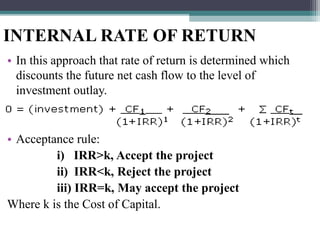
INTERNAL RATE OF RETURN
• In this approach that rate of return is determined which
discounts the future net cash flow to the level of
investment outlay.
• Acceptance rule:
i) IRR>k, Accept the project
ii) IRR<k, Reject the project
iii) IRR=k, May accept the project
Where k is the Cost of Capital.
PAYBACK
• Payback is the period of time required to recover the
original cash outlay invested in a project.
• If the project generates constant annual cash inflows, the
payback period is computed by dividing the initial cash
outlay by the annual cash inflow.
• In case of uneven cash inflows, the payback period can be
found out by adding up the cash inflows until the total is
equal to the initial cash outlay.
• Acceptance rule:
Payback Period<Standard Payback Period, Accept
the project and vice-versa
NPV.xlsx
SHORTCOMINGS OF CIT
CIT fails to take cognizance of the phases(first three) of
strategic decision making i.e.
1. Identification of the problem.
2. Formulation of alternate courses of action.
3. Evaluation of the alternatives.
4. Choice of one or more alternatives for implementation.
Requires accurate measurement of cash flows at different
interval of time.
THANK YOU!!
  

Capital investment theory

  • 1.
    CAPITAL INVESTMENT THEORY SUBMITTED TO: Dr.SUJIT Kr. DUBEY PROFESSOR FMS, BHU PREPARED BY: STUTI KOTHARI MBA III SEMESTER ROLL NO.: 46
  • 2.
    CIT • It isa foolproof approach of evaluating product- market proposals in terms of the incremental benefits and costs associated with them. • It involves three stages: a) determination of net investment outlay b) determination of net cash flows c) evaluation of cash flows in terms of their time value.
  • 3.
    WHY CIT? 1. Growth 2.Risk 3. Funding 4. Irreversibility 5. Complexity
  • 4.
    MAJOR TECHNIQUES 1. NetPresent Value 2. Internal Rate Of Return 3. Payback
  • 5.
    NET PRESENT VALUE •This method seeks to evaluate by comparing discounted net cash flows with net investment outlay to determine net present value of projects. • NPV=Net cash inflow-net investment outlay • Acceptance rule: i) NPV>0, Accept the project ii) NPV<0, Reject the project iii) NPV=0, May accept the project • Project with highest positive net present value is accorded the highest priority.
  • 6.
    INTERNAL RATE OFRETURN • In this approach that rate of return is determined which discounts the future net cash flow to the level of investment outlay. • Acceptance rule: i) IRR>k, Accept the project ii) IRR<k, Reject the project iii) IRR=k, May accept the project Where k is the Cost of Capital.
  • 7.
    PAYBACK • Payback isthe period of time required to recover the original cash outlay invested in a project. • If the project generates constant annual cash inflows, the payback period is computed by dividing the initial cash outlay by the annual cash inflow. • In case of uneven cash inflows, the payback period can be found out by adding up the cash inflows until the total is equal to the initial cash outlay. • Acceptance rule: Payback Period<Standard Payback Period, Accept the project and vice-versa NPV.xlsx
  • 8.
    SHORTCOMINGS OF CIT CITfails to take cognizance of the phases(first three) of strategic decision making i.e. 1. Identification of the problem. 2. Formulation of alternate courses of action. 3. Evaluation of the alternatives. 4. Choice of one or more alternatives for implementation. Requires accurate measurement of cash flows at different interval of time.
  • 9.