A
STUDY ON
CAPITAL BUDGETING
Submitted To
In partial fulfillment of the requirements for the award of the
Degree of
POST GRADUATE DIPLOMA IN BUSINESS MANAGEMENT
Submitted by
LADE.VARSHA NIHANTH
Roll no. 2013150045
Under the Guidance of
C.A.SUDHAKAR REDDY
Manager (F & A)
RINL, VISAKHAPATNAM STEEL PLANT
2014-15
CMT BUSINESS SCHOOL
(Affiliated to AICTE, DELHI)
DEPARTMENT OF MANAGEMENT STUDIES
MANAGEMENT DEVELOPMENT
RASTRIYA ISPAT NIGAM LIMITED
1
CERTIFICATE
This is to certify that Mr. L.VARSHA NIHANTH of PGDM 2013-15 year
bearing registration no: 2013150045 in the CMT BUSINESS SCHOOL CAPITAL
BUDGETING” under the guidance & supervision of Mr. C.A.Sudhakar Reddy of
finance department, RINL-Visakhapatnam steel plant. The project has been
approved by the management development, RINL-VSP and further certificate of the
successful completion of the project has been provided for the same.
Date: 15-09-2014 Shri.O.R.M.Rao
Place: Visakhapatnam AGM (MD)
RINL-VISAKHAPATNAM STEEL PLANT
2
EXTERNAL GUIDE CERTIFICATE
This is to certify that the project work entitled “CAPITAL
BUDGETING” at RASHTRIYA ISPAT NIGAM LIMITED,
VISAKHAPATNAMSTEELPLANT is a bonfire work done and submitted in
partial fulfillment for the award of the Post-Graduation Diploma And
Management by L.VARSHA NIHANTH bearing Registration No. 2013150015 of
CENTER FOR MANAGEMENT AND TECHNOLOGY, Affiliated by
A.I.C.T.E, Approved by Ministry of HRD, New Delhi under my guidance and
supervision during the period from 19-05-2014 to 12-07-2014 at Management
Development (MD), RINL-Visakhapatnam Steel Plant.
Sri C.A.Sudhakar Reddy
Manager [F&A]
Place: Visakhapatnam
Date:
3
DECLARATION
I hereby declare that the project entitled A STUDY ON “CAPITAL
BUDGETING “ is an original and independent work done by me and has been
submitted to the Department of Management Studies, CMT BUSINESS SCHOOL
affiliated to AICTE,DELHI in partial fulfillment for the award of degree of
“POST GRADUATE DIPLOMA IN MANAGEMENT”.
I also declare that this project is the result of my own effort and is not
submitted to any University for the award of any Degree or Diploma.
Place: Visakhapatnam
Date:
ACKNOWLEDGEMENT
4
I take this opportunity to acknowledge, all the people who rendered their
valuable advice in bringing the project to function.
I would like to take this opportunity to express my heartful thanks to Mr.
Satish, Placement Incharge of CMT Business School Visakhapatnam, for giving me
this opportunity to do my project on “capital budgeting” in the esteemed
organization.
I also express my sincere thanks to my faculty members without whose
cooperation I would not have been able to complete the project successfully.
As a part of the curriculum at CMT BUSINESS SCHOOL the project enables
us to enhance our skills, expand our knowledge by applying various theories,
concepts and laws to real life scenario which would further prepare us to face the
extremely ‘competitive corporate world’.
ABBREVIATIONS FOR DEPARTMENTS
• ACS Air Conditioning System
• BF Blast furnace
• CO&CCP Coke oven & Coal Chemical Plant
5
• CM(E) Central Maintenance Mechanical
• CMM central Maintenance department
• DNW distribution network
• EMID environment management department
• ERS electrical repair shop
• ES&F engineering shop & foundry
• ETL electro technical laboratory
• MMSM medium merchant & structural mill
• RED refectory engineering department
• SMS steel melt shop
• TTI Technical Training Institute
• RED Refractory Engineering Maintenance
• RMD Raw Material Department
• IT Information Technology
• F&A Finance & Accounts
• HRD Human Resources Department
• D&E Designs & Engineering Department
• MKTG Marketing
• ERP Entrepreneur Retail Price
CONTENTS
TITLE PAGE
NO.
CHAPTER-I
6
INTRODUCTION
NEED FOR THE STUDY
OBJECTIVES OF THE STUDY
SCOPE OF THE STUDY
METHODOLOGY
LIMITATIONS
CHAPTER-II
INDUSTRY PROFILE
CHAPTER-III 3C’S
COMPANY PROFILE
CUSTOMER
COMPETITOR
CHAPTER – IV ETT
ENVIRONMENT
TECHNOLOGY
CHAPTER – V
THEORETICAL FRAME WORK
CHAPTER – VI OJT
TASK ASSIGNED
FINDINGS AND SKILLS REQUIRED
BIBLIOGRAPHY
CHAPTER – I
7
INTRODUCTION
 Need of the study
 Objective of the study
 Scope of the study
 Methodology
 Limitations
8
INTRODUCTION
A project is an activity sufficiently self- contained to permit financial and commercial
analysis. In most cases projects represent expenditure of capital funds by pre- existing entities
which want to expand or improve their operation.
In general a project is an activity in which, we will spend money in expectation of returns
and which logically seems to lead itself to planning. Financing and implementation as a unit, is a
specific activity with a specific point and a specific ending point intended to accomplish a specific
objective.
To take up a new project, involves a capital investment decision and it is the top
management’s duty to make a situation and feasibility analysis of that particular project and means
of financing and implementing it financing is a rapidly expanding field, which focuses not on the
credit status of a company, but on cash flows that will be generated by a specific project.
Capital budgeting has its origins in the natural resource and infrastructure sectors. The
current demand for infrastructure and capital investments is being fueled by deregulation in the
power, telecommunications, and transportation sectors, by the globalization of product markets and
the need for manufacturing scale, and by the privatization of government –owned entities in
developed and developing countries.
The capital budgeting decision procedure basically involves the evaluation of the desirability
of an investment proposal. It is obvious that the firm most have a systematic procedure for making
capital budgeting decisions. The procedure for making capital budgeting decisions.
The procedure must be consistent with the objective of wealth maximization. In view of the
significance of capital budgeting decisions, the procedure must consist of step by step analysis.
9
NEED OF THE STUDY
Capital investments, representing the growing edge of a business, are deemed to be very
important for three inter- related reasons.
1. The influence firm growth in the long term consequences capital investment
decisions have considerable impact on what the firm can do in future.
2. They affect the risk of the firm; it is difficult to reverse capital investment decisions
because the market for used capital investments is ill organized and /or most of the capital
equipments bought by a firm to meet its specific requirements.
3. Capital investment decisions involve substantial out lays.
Visakhapatnam Steel Plant is a growing concern, capital budgeting is more or less a
continuous process and it is carried out by different functional areas of management such a
production, marketing, engineering, financial management etc. All the relevant functional
departments play a crucial role in the capital budgeting decision process.
10
OBJECTIVES OF THE STUDY
1. To describe the organizational profile of Visakhapatnam Steel Plant.
2. To discuss the importance of the management of capital budgeting.
3. Determination of proposal and investments, inflows and out flows.
4. To evaluate the investment proposal by using capital budgeting techniques.
5. To summarize and to suggest for the better investment proposal.
11
SCOPE OF THE STUDY
The study has been conducted to understand the position of the industry and various
functional areas of the company and their operations. The study mainly focuses on Capital
Budgeting of the company.
Keep in view the accessibility and availability of the data sources 10% has been choosen for
the purpose of study. This study causes 2003-2009 and it is limited only to the perception of the
personal belonging to “RASTRIYA ISPAT NIGAM LIMITED”.
METHODOLOGY
12
The information for the study is obtained from two sources namely.
1. Primary Sources
2. Secondary Sources
Primary Sources:
It is the information collected directly without any references. It is mainly through
interactions with concerned officers & staff, either individually or collectively; some of the
information has been verified or supplemented with personal observation. These sources include.
1. Thorough interactions with the various department Managers of VSP.
2. Guidelines given by the Project Guide, Sri C.A.Sudhakar Reddy, Manager (Staff),
Budget Section, F & A.
Secondary Sources:
This data is from the number of books and records of the company, the annual reports
published by the company and other magazines. The secondary data is obtained from the
following.
a) Collection of required data from annual records, monthly records, internal
Published book or profile of Visakhapatnam Steel Plant.
b) Other books and Journals and magazines
c) Annual Reports of the company.
LIMITATIONS
13
Though the project is completed successfully a few limitations may be there.
a) Since the procedure and polices of the company will not allow to disclose
confidential financial information, the project has to be completed with the available data given to
us.
b) The period of study that is 6 weeks is not enough to conduct detailed study of the
project.
c) The study is carried basing on the information and documents provided by the
organization and based on the interaction with the various employees of the respective
departments.
d) Lack of knowledge. Some of the lack full-fledged knowledge of the concept and its
difficult to collect a specific opinion from them.
e) Time limitation. The duration of the project is short to collect the required
information accurately.
14
CHAPTER-II
INDUSTRY PROFILE
15
Steel is an alloy of iron usually containing less than 1% carbon is a versatile material
with multitude of useful properties used most frequently in the automotive and construction
industries. Steel can be cast into bars strips, sheets, nails, spikes, wire, rods or pipes as needed by
the intended user. The consumption of steel is regarded as the index of industrialization and the
economic maturity any country has attained.
The development of steel industry in India should be viewed in conjunction with the type and
system of government that had been ruling the country. The production of steel in significant
quantity started after 1990 .The growth of steel industry can be conveniently started by dividing the
period in to pre and post independence era. In the period of pre independence, steel production was
1.5 million tones per year, which was raised to 9 million tones of target. This is the result of the
bold steps taken by the government to develop this sector.
Growth of Steel Industry:
Pre-independence
1830 - Josiah, Marshall Health constructed the first manufacturing
Plant at port Move in Madras presidency.
1874 - James Erskin founded the Bengal iron works.
1899 - Jamshedji Tata initiated the scheme for an integrated steel plant.
1906 - Formation of TISCO.
1911 - Tata iron & steel company started production.
1916 - TISICO was founded.
Post-independence
1951-56 - First Five Year Plan.
 No new steel plant came up .The Hindustan steel Ltd. was born on 19th
January,
1954 with the decision of setting up three steel plants each with one million tone input steel per
year in at Rourkela, Bhilai and Durgapur; TISCO stated its expansion program.
1956.61 - Second Five Year Plan
16
 A bold decision was taken up to increase the ingot steel output India to 6 Million
tons per year & production at Rourkela, Bhilai and Durgapur steel plant started.
1961.66 - Third Five Year Plan
 During the third five year plan the three steel plants under HSL; TISCO &
HSCO were expanded as show. In January 1964 Bokaro steel plant came into existence.
1966.69 - Recession Period
 The entire expansion program was actively executed during this period.
1969-74 -Fourth Five Year Plan
 Licenses were given for setting up of many mini steel plants and re-rolling mills.
 Govt. Of. India accepted setting up two more steel plants in south. One each at
Visakhapatnam and Hospet (Karnataka).
 SAIL was formed during this period on 24th
January, 1973. The total installed
capacity from 6 integrated plants was 106 Mt.
1979 - Annual Plan
 The erstwhile Soviet Union agreed to help in setting up the Visakhapatnam steel
plant.
1980.85 - Sixth Five Year Plan
 Work on Visakhapatnam steel plant was started with a big bang and top priority was
accorded to start the plant.
 Scheme for modernization of Bhilai steel plant, Rourkela, Durgapur, TISCO were
initiated.
1985-91 - Seventh Five Year Plan
 Expansion work of Bhilai and Bokaro steel plants completed.
 Progress on Visakhapatnam steel plant picked up and rationalized concept has been
introduced to commission the plant with 3.0Mt liquid steel capacity by 1990.
1991-96 - Eight Five Year plan
17
 Vishakhapatnam steel plant started its production modernization of other steel
plants is also duly envisaged.
1997-2002 - Ninth Five Year Plan
 Visakhapatnam steel plant had foreseen a 7% growth during the entire plan period.
2002-2007 - Tenth Five Year Plan
 Steel industry registers the growth of 9.9 % Visakhapatnam steel plant high regime
targets achieved the best of them.
2007-2012 - Eleventh Five Year Plan
 Cost of schemes/project original approved by Government of India is Rs.9,569.18
crores
The major steel and related companies in India
1. Bharat Refectories Ltd.
2. Hindustan Steel Works Construction Ltd.
3. Jindal Steel and Power Ltd.
4. Tata Iron Steel Company Metal Scrap Trade Corporation Ltd.
5. Metallurgical and Engineering Consultants India Ltd.
6. National Mineral Development Corporation Ltd.
7. Rashtriya Ispat Nigam Ltd.
8. Sponge Iron India Ltd.
9. Steel Authority India ltd.
The global steel industry has witnessed several revolutionary changes during the last century.
The changes have been in the realms of both technology & business strategy. The ultimate object
of all these changes is to remain competitive and open global market.
The Indian steel industry is growing very rigorously with the major producers like SAIL,
RINL, TISCO, JVL and many others. Our steel industry has amply demonstrated its ability of
adopt to the changing scenario and to survive in the global market that is becoming increasingly
18
competitive. This has been possible to a large extent due to the adoption of innovative operating
practices and modern technologies.
Industrial Development in India has reached a high degree of self-reliance, and the steel
industry occupies a primary place in the strategy for future development. At present the production
of steel industry country is 34Mt. the public sector steel industry has been restructured to meet
challenges and a separate fund has been established for modernization and future development of
the industry. It is now being proposed that Indian steel industry should Gear up to achieve a
production level of about 100 Mt by the year 2000.
Global scenarios
As per IISI
 In March’ 2005 world Crude steel output was 928Mt when compared to march 2004
(872Mt), ∙The change in percentage was 6.5%.
 China remained the world largest crude steel producer in 2005 also (275Mt)
followed by Japan (96Mt) and USA (81Mt). India occupied 8th
position (42Mt).
 USA remained the largest importer of semi finished and finished products in 2002
followed by China and Germany.
 Japan remained the largest exporter of semi finished and finished steel products in
2002 followed by Russia and Ukraine.
 Other significant recent developments in the global steel scenario have been: Under
the auspices of the OECD (Organization for Economic Co-operation & Development) the
negotiations among the major steel producing countries for a steel subsidy agreement (SSA) held
in 2003 with the objective to agree on a complete negotiating test for the SSA by the Middle of
2004. It also set subsidies for the steel industry of a ceiling of 0.5% of the value of production to be
used exclusively for Research & Development
Market scenarios
The year 2004-05 was a remarkable one for the steel industry with the world crude steel
production crossing the one billion mark for the first time in the history of the steel industry. The
19
world GDP growth about 4% lends supports to the expectations the steel market is all set for strong
revival after prolonged period of depression .The Indian economy also become robust with annual
growth rates of 7-8 % this will provide a major boost the steel industry. With the nations focus on
infrastructure development coupled with the growth in the manufacturing sector, the Indian steel
industry all set for north ward movement. The draft national steel police envisage production of 60
Mt by 2012 and 110Mt by2020, and annual growth rate of 6-7%. All this should therefore augur
well for the Indian steel industry.
Production scenarios
 Steel industry was de-licensed and decontrolled in 1991&1992
respectively.
 India is the 8th
largest producer of steel in the world.
 In 2003-04 finished steel production was 36.193Mt.
 Pig iron production in 2003-04 was 5.221Mt.
 Sponge iron production was 80.85 Mt during the year 2003-04
 The annual growth rate of crude steel production in 2002-03was 8% and in
2003-04 was 6%.
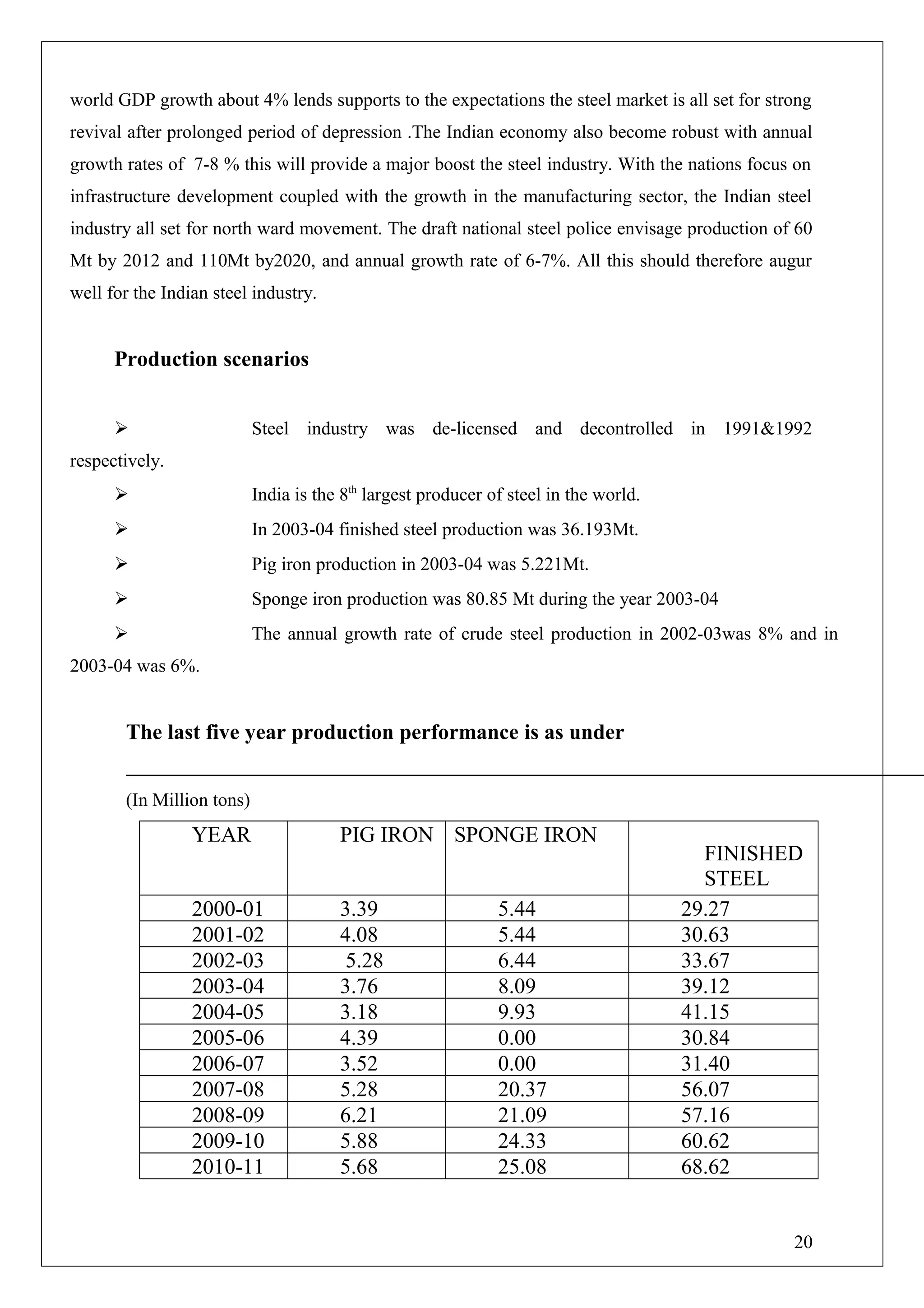
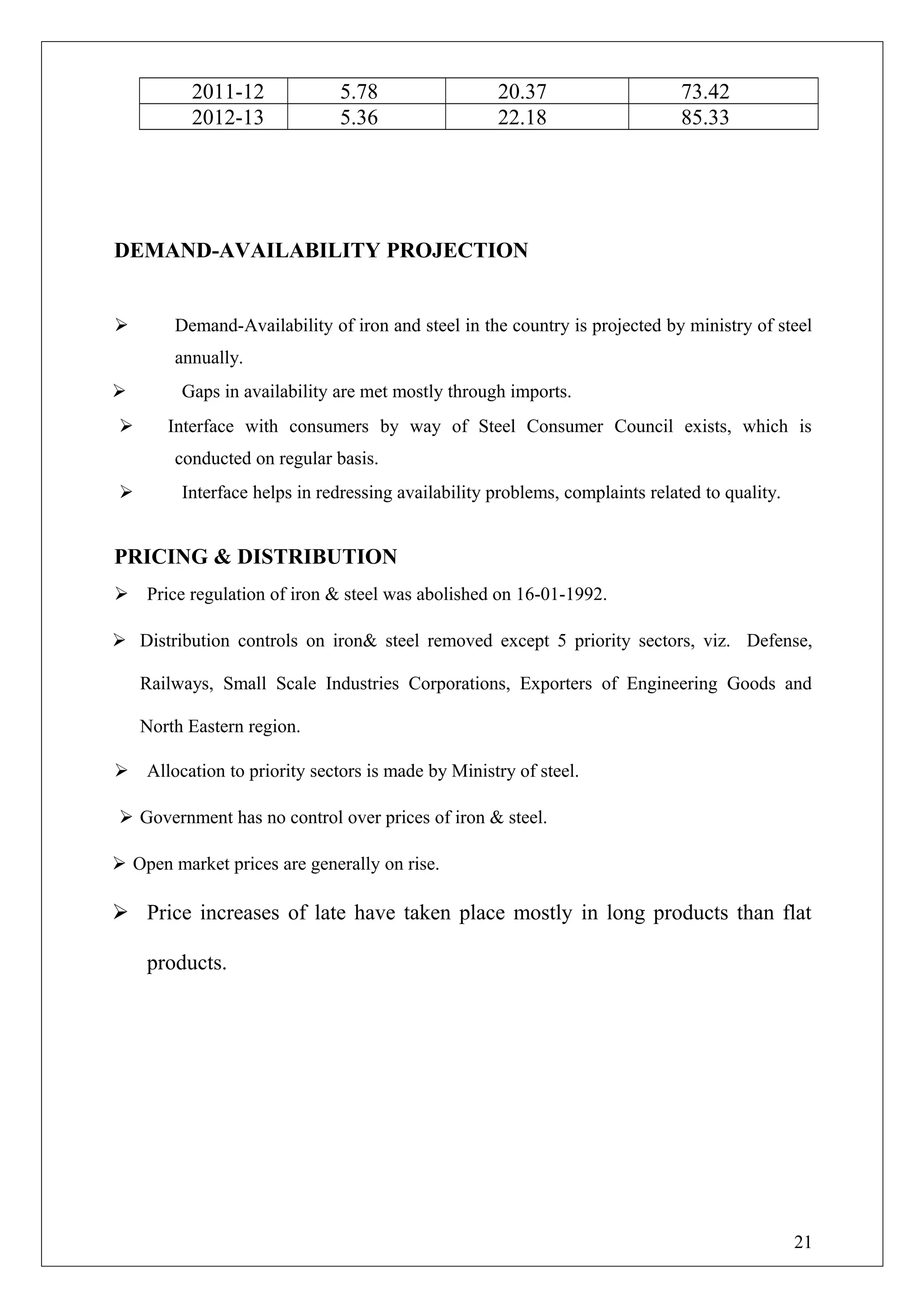
The last five year production performance is as under
(In Million tons)
YEAR PIG IRON SPONGE IRON
FINISHED
STEEL
2000-01 3.39 5.44 29.27
2001-02 4.08 5.44 30.63
2002-03 5.28 6.44 33.67
2003-04 3.76 8.09 39.12
2004-05 3.18 9.93 41.15
2005-06 4.39 0.00 30.84
2006-07 3.52 0.00 31.40
2007-08 5.28 20.37 56.07
2008-09 6.21 21.09 57.16
2009-10 5.88 24.33 60.62
2010-11 5.68 25.08 68.62
20
2011-12 5.78 20.37 73.42
2012-13 5.36 22.18 85.33
DEMAND-AVAILABILITY PROJECTION
 Demand-Availability of iron and steel in the country is projected by ministry of steel
annually.
 Gaps in availability are met mostly through imports.
 Interface with consumers by way of Steel Consumer Council exists, which is
conducted on regular basis.
 Interface helps in redressing availability problems, complaints related to quality.
PRICING & DISTRIBUTION
 Price regulation of iron & steel was abolished on 16-01-1992.
 Distribution controls on iron& steel removed except 5 priority sectors, viz. Defense,
Railways, Small Scale Industries Corporations, Exporters of Engineering Goods and
North Eastern region.
 Allocation to priority sectors is made by Ministry of steel.
 Government has no control over prices of iron & steel.
 Open market prices are generally on rise.
 Price increases of late have taken place mostly in long products than flat
products.
21
CHAPTER –III
COMPANY PROFILE
22
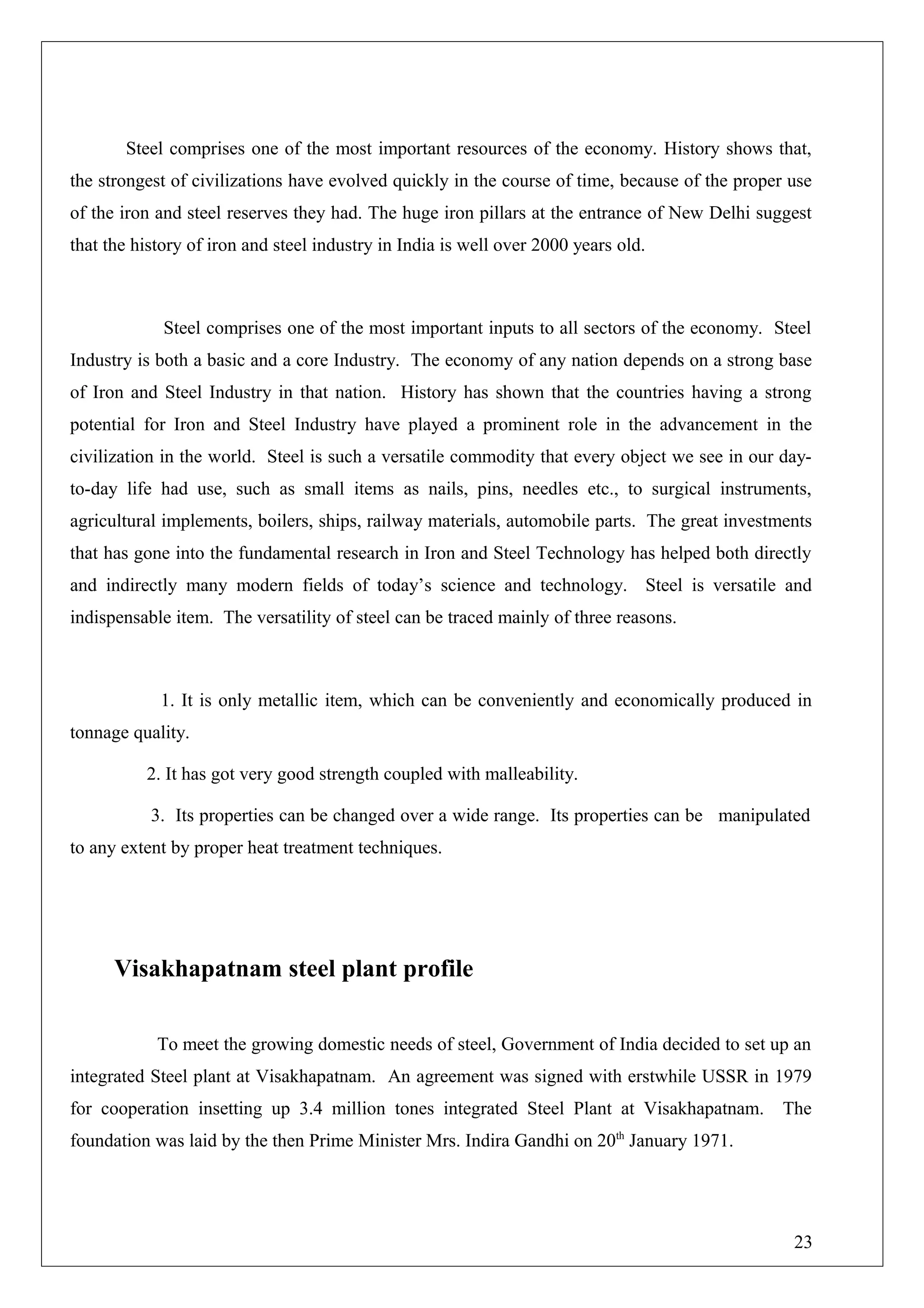
Steel comprises one of the most important resources of the economy. History shows that,
the strongest of civilizations have evolved quickly in the course of time, because of the proper use
of the iron and steel reserves they had. The huge iron pillars at the entrance of New Delhi suggest
that the history of iron and steel industry in India is well over 2000 years old.
Steel comprises one of the most important inputs to all sectors of the economy. Steel
Industry is both a basic and a core Industry. The economy of any nation depends on a strong base
of Iron and Steel Industry in that nation. History has shown that the countries having a strong
potential for Iron and Steel Industry have played a prominent role in the advancement in the
civilization in the world. Steel is such a versatile commodity that every object we see in our day-
to-day life had use, such as small items as nails, pins, needles etc., to surgical instruments,
agricultural implements, boilers, ships, railway materials, automobile parts. The great investments
that has gone into the fundamental research in Iron and Steel Technology has helped both directly
and indirectly many modern fields of today’s science and technology. Steel is versatile and
indispensable item. The versatility of steel can be traced mainly of three reasons.
1. It is only metallic item, which can be conveniently and economically produced in
tonnage quality.
2. It has got very good strength coupled with malleability.
3. Its properties can be changed over a wide range. Its properties can be manipulated
to any extent by proper heat treatment techniques.
Visakhapatnam steel plant profile
To meet the growing domestic needs of steel, Government of India decided to set up an
integrated Steel plant at Visakhapatnam. An agreement was signed with erstwhile USSR in 1979
for cooperation insetting up 3.4 million tones integrated Steel Plant at Visakhapatnam. The
foundation was laid by the then Prime Minister Mrs. Indira Gandhi on 20th
January 1971.
23
The Project was estimated to cost Rs.3, 897.28 cores based on prices as on 4th
Quarter
of 1981. However, on completion of Construction of the whole Plant in 1992, the cost escalated to
around 8500 Cr. Unlike other integrated Steel Plants in India, Visakhapatnam Steel Plant is one of
the most modern Steel Plants in the country. The plant was dedicated to the nation on 1st
August
1992 by the then Prime Minister, P.V.Narasimha Rao.
New Technology, large-scale computerization and automation etc., are incorporated in
the Plant. To operate the plant at international levels and attain such lab our productivity, the
organizational manpower has been rationalized. The plant has a capacity of producing 3.0 MT of
liquid steel and 2,656Mt of saleable steel.
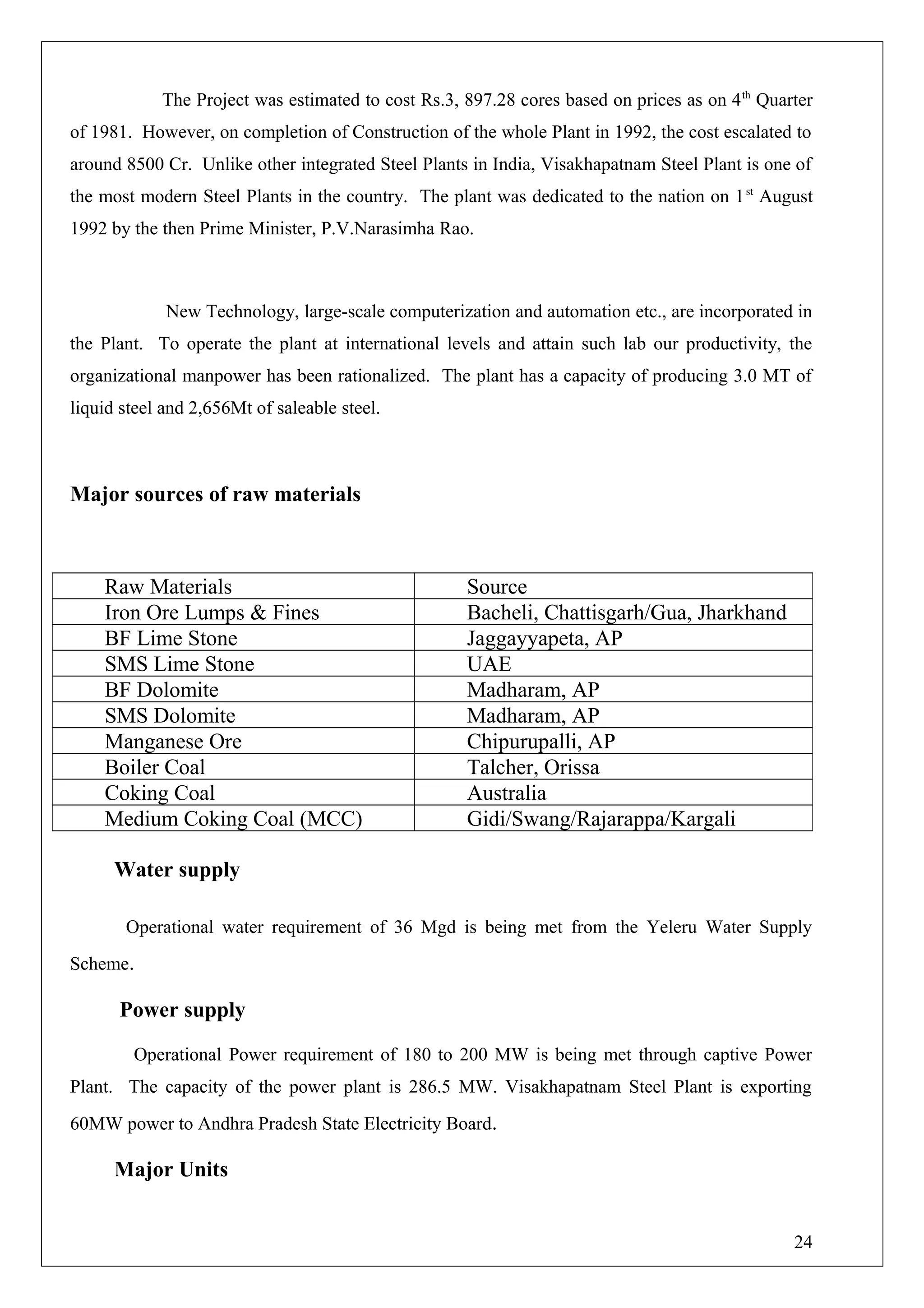
Major sources of raw materials
Water supply
Operational water requirement of 36 Mgd is being met from the Yeleru Water Supply
Scheme.
Power supply
Operational Power requirement of 180 to 200 MW is being met through captive Power
Plant. The capacity of the power plant is 286.5 MW. Visakhapatnam Steel Plant is exporting
60MW power to Andhra Pradesh State Electricity Board.
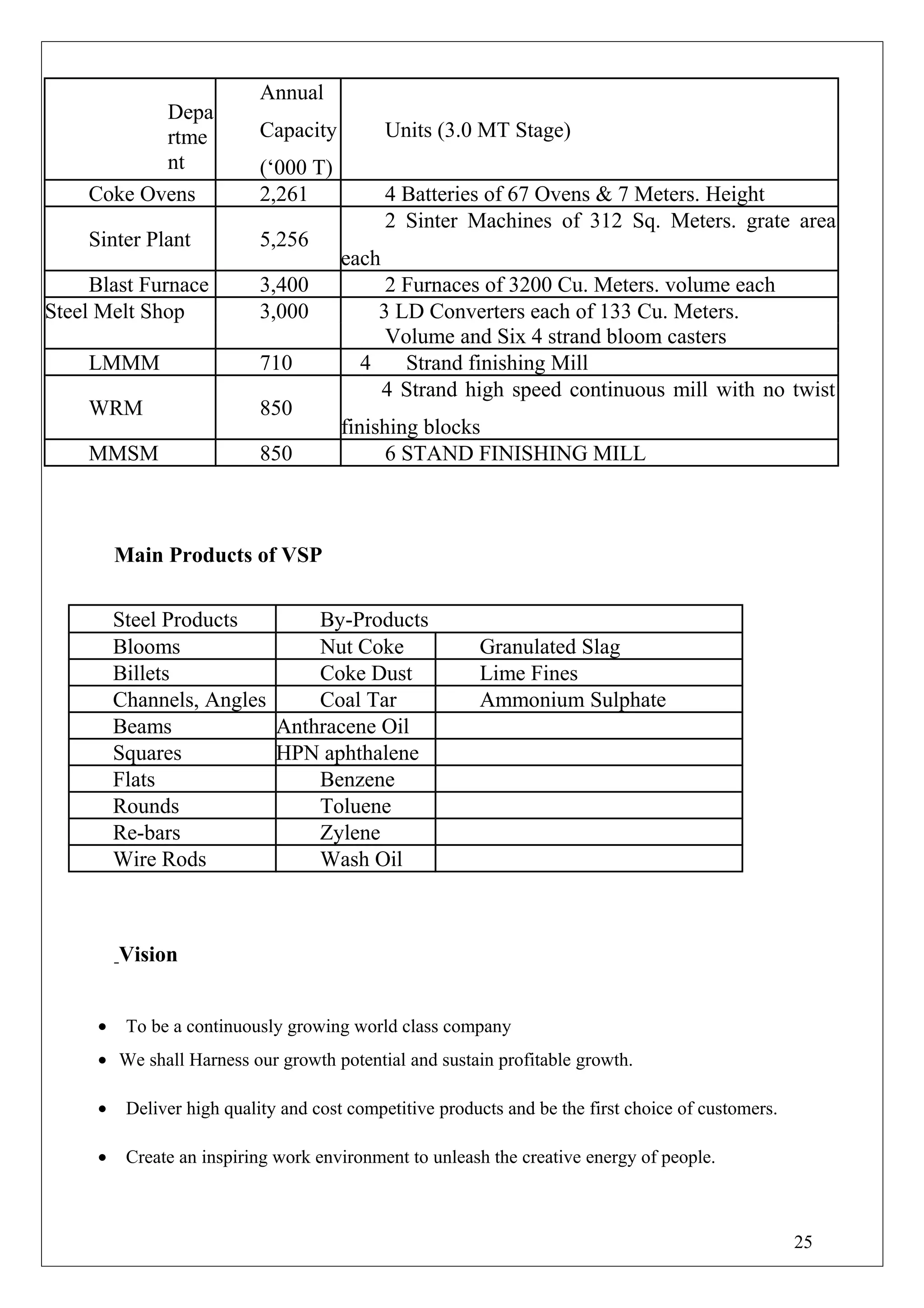
Major Units
Raw Materials Source
Iron Ore Lumps & Fines Bacheli, Chattisgarh/Gua, Jharkhand
BF Lime Stone Jaggayyapeta, AP
SMS Lime Stone UAE
BF Dolomite Madharam, AP
SMS Dolomite Madharam, AP
Manganese Ore Chipurupalli, AP
Boiler Coal Talcher, Orissa
Coking Coal Australia
Medium Coking Coal (MCC) Gidi/Swang/Rajarappa/Kargali
24
Depa
rtme
nt
Annual
Capacity
(‘000 T)
Units (3.0 MT Stage)
Coke Ovens 2,261 4 Batteries of 67 Ovens & 7 Meters. Height
Sinter Plant 5,256
2 Sinter Machines of 312 Sq. Meters. grate area
each
Blast Furnace 3,400 2 Furnaces of 3200 Cu. Meters. volume each
Steel Melt Shop 3,000 3 LD Converters each of 133 Cu. Meters.
Volume and Six 4 strand bloom casters
LMMM 710 4 Strand finishing Mill
WRM 850
4 Strand high speed continuous mill with no twist
finishing blocks
MMSM 850 6 STAND FINISHING MILL
Main Products of VSP
Steel Products By-Products
Blooms Nut Coke Granulated Slag
Billets Coke Dust Lime Fines
Channels, Angles Coal Tar Ammonium Sulphate
Beams Anthracene Oil
Squares HPN aphthalene
Flats Benzene
Rounds Toluene
Re-bars Zylene
Wire Rods Wash Oil
Vision
• To be a continuously growing world class company
• We shall Harness our growth potential and sustain profitable growth.
• Deliver high quality and cost competitive products and be the first choice of customers.
• Create an inspiring work environment to unleash the creative energy of people.
25
• Achieve excellence in enterprise management.
• Be a respected corporate citizen, ensure clean and green environment and develop vibrant
communities around us.
Mission
To attain 16 Mt liquid steel capacity through technological up-gradation,
operational efficiency and expansion; augmentation of assured supply of raw materials; to produce
steel at international Standards of Cost & Quality; and to meet the aspirations of stakeholders.
Objectives
● Expand plant capacity to 6.3 million ton by 2011-12 with the Mission to expand further in
subsequent phases as per the corporate plan.
• Revamping existing Blast Furnaces to make them energy efficient to contemporary
levels and in the process increase their capacity by 1 Mt, thus total hot metal
capacity to 7.5 Mt
● be amongst top five lowest cost steel producers in world by 2009-10.
● Achieve higher levels of customer satisfaction.
● Vibrant work culture in the organization.
● be proactive in conserving environment, maintaining high levels of safety and
addressing social concerns.
Core values
 Commitment.
 Customer Satisfaction.
 Continuous Improvement.
 Concern for Environment.
 Creativity & Innovation.
26
Quality Policy
Visakhapatnam Steel Plant Employees are committed to meet the needs and
expectations of our customers and other interested parties. To accomplish this, they will
 Supply quality goods and services to customers delight.
 Achieve quality of the products by following systematic approach through planning,
documented procedure and timely review of quality objectives.
 Continuously improve the quality of all materials, processes and products.
 Maintain an enabling environment, which encourages teamwork and active
involvement of all employees with their involvement.
Environment Policy
Visakhapatnam Steel Plant carrying out its operations without harming to the
environment. To accomplish this, they will
 Document, implement, maintain and continuously review the environmental
management system.
 Comply with all the relevant environmental legislations, regulations and other
requirements.
 Ensure continual improvement in the environmental performance and prevention of
pollution by minimizing the emissions and discharges.
 Maintain a high level of environmental consciousness amongst employees.
 Review the environmental objectives and targets on a continuous basis.
Energy Policy
Visakhapatnam Steel Plant is committed to optimally utilize various forms of energy in
a cost-effective manner to effect conservation of energy resources.
To accomplish this, they will:
 Monitor closely and control the consumption of various forms of energy through
an effective Energy Management System.
27
 Adopt appropriate energy conservation technologies.
 Maximize the use of cheaper and easily available forms of energy.
Oshas Policy
Visakhapatnam Steel Plant is committed to occupational health and safety of employees
and contract workers. To accomplish this, the will,
 Document, implement, maintain and periodically review the occupational health and
safety management system including the policy.
 Comply with the relevant occupational health and safety legislations, regulations
and other requirements.
 Ensure continual improvement in the environment performance and prevention of
pollution by minimizing the emissions and discharges.
 Maintain a high level of environmental consciousness amongst employees.
 Review the environmental objectives and targets on a continuous basis.
Human Resource Policy
Visakhapatnam Steel Plant is committed to create an organizational culture, which
nurtures employee’s potential for the prosperity of the organization. To accomplish this, they will,
 Identify development needs of the employees on a regular basis, provide the
necessary training and continually evaluate and monitor the effectiveness of the training so that the
quality of the training also gets updated.
 Provide inputs to the employees for developing their attitude towards work and for
matching their competencies with organizational requirements.
28
 Create an environment of learning and knowledge sharing by providing the means
and facilities and also access to the relevant information and literature.
 Facilitate the employees for continuous development of their knowledge base,
skills, efficiency, innovativeness, self-expression and behavior so that they contribute positively
with commitment for the growth and prosperity of the organization while maintaining a high level
of motivation and satisfaction.
 Prepare employees through appropriate development programs for taking up higher
responsibilities in the organization.
Customer Policy
 VSP will endeavor to adopt a customer-focused approach At all times with transparency.
 VSP will strive to meet more than the customer needs and expectations pertaining to
products, quality, and Value for money and satisfaction.
 VSP greatly values its relationship with customers and would make efforts at strengthening
these relations for Mutual benefit.
I.T. Policy
 RINL/VSP is committed to leverage Information Technology as the vital enabler in
improving the customer-satisfaction, organizational efficiency, productivity, decision-
making, transparency and cost-effectiveness, and thus adding value to the business of steel
making. Towards this, RINL shall:
 Follow best practices in process Automation & Business Processes through IT by in-house
efforts / outsourcing and collaborative efforts with other organization / expert groups /
institutions of higher learning, etc., thus ensuring the quality of product and services at least
cost.
29
 Install, maintain and upgrade suitable cost-effective IT hardware, software and other IT
infrastructure and ensure high levels of data and information security
 Strive to spread IT-culture amongst employees based on organizational need, role and
responsibilities of the personnel and facilitate the objective of becoming a World-Class
business organization.
 Enrich the skill-set and knowledge based of all related personnel at regular intervals to
make employees knowledge-employees.
 Periodically monitor the IT investments made and achievements accrued to review their
cost effectiveness.
Major Departments
Raw Material Handling Plant
VSP annually requires quality raw materials viz. Iron Ore fluxes (Lime stone, Dolomite);
coking and none coking coals etc. to the tune of 12-13 Million Tones for producing 3 Million
Tones of Liquid Steel. To handle such a large volume of incoming raw materials received from
different sources and to ensure timely supply of consistent quality of feed materials to different
30
VSP consumers, Raw Material Handling Plant serves a vital function. This unit is provided with
elaborate unloading, blending, stacking & reclaiming facilities viz. Wagon Tipplers, Ground &
Track Hoppers, Stock yards Crushing plants, Vibrating screens, Single/ twin boom stickers, wheel
on boom and Blender reclaimers. In VSP peripheral unloading has been adopted for the first time
in the country.
The Raw Material Handling Plant (RMHP) Department procures the different raw materials
from various sources. The following are the important raw material handled by the RMHP
Department.
Iron Ore
Coal
Dolomite
Limestone
Manganese
Sand
The RMHP department dispatches the raw material to other departments only after screening
the material.
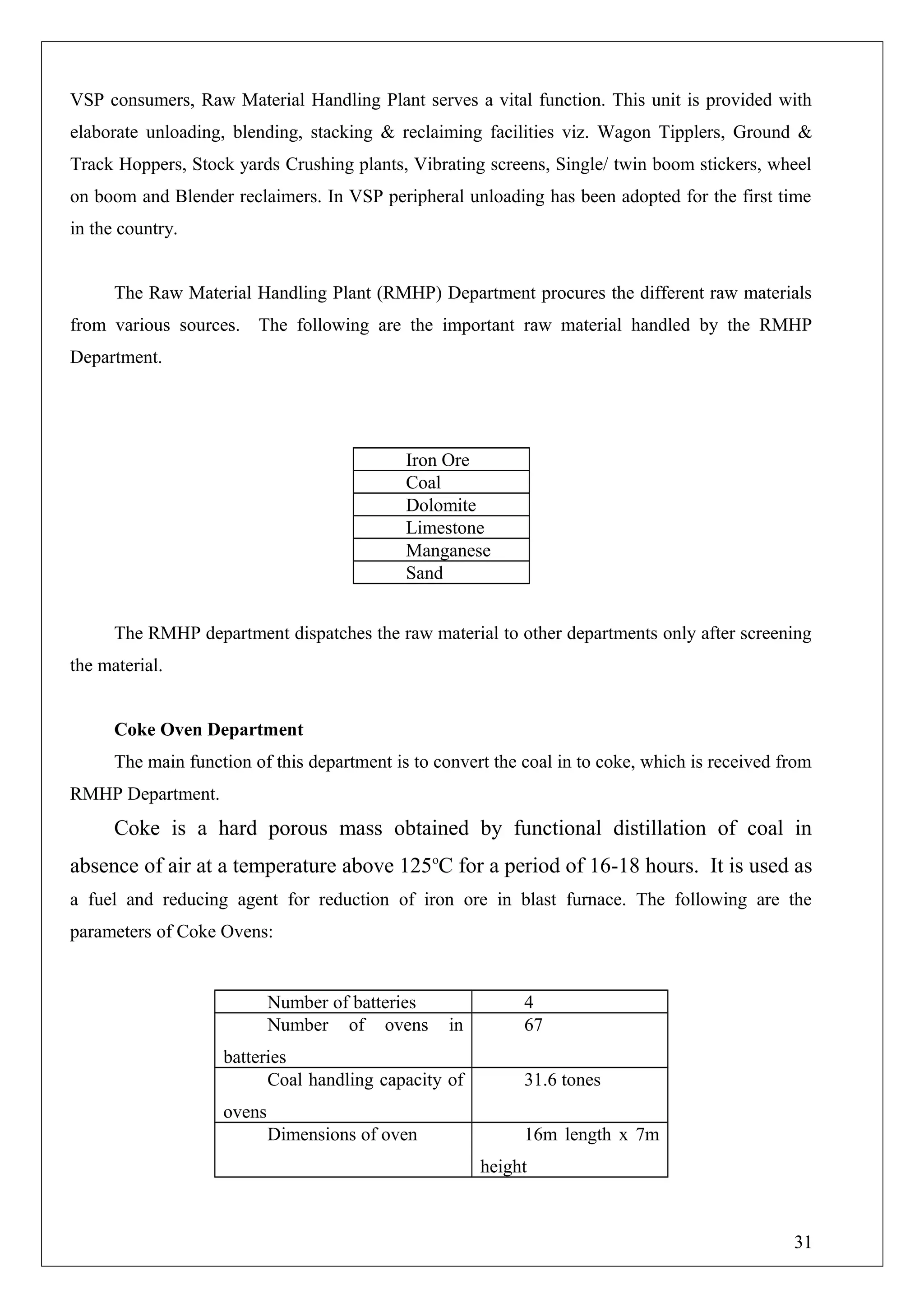
Coke Oven Department
The main function of this department is to convert the coal in to coke, which is received from
RMHP Department.
Coke is a hard porous mass obtained by functional distillation of coal in
absence of air at a temperature above 125o
C for a period of 16-18 hours. It is used as
a fuel and reducing agent for reduction of iron ore in blast furnace. The following are the
parameters of Coke Ovens:
Number of batteries 4
Number of ovens in
batteries
67
Coal handling capacity of
ovens
31.6 tones
Dimensions of oven 16m length x 7m
height
31
Besides coke production, a number of coal chemicals are being extracted in coal chemical
plants. The coal chemicals are tar, benzyl and ammonia based products. The coal is not consumed
directly because coke helps in reducing the pollution.
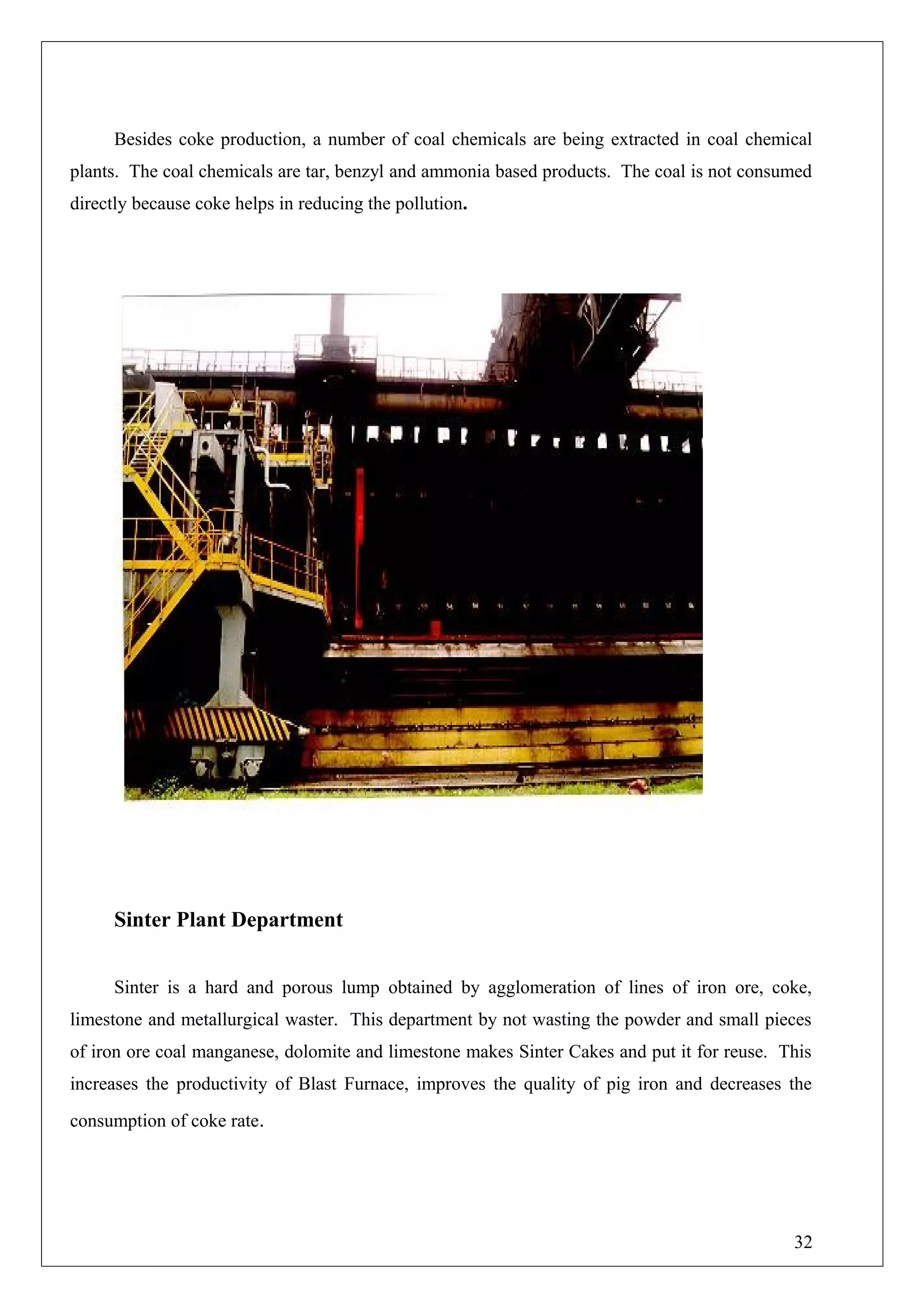
Sinter Plant Department
Sinter is a hard and porous lump obtained by agglomeration of lines of iron ore, coke,
limestone and metallurgical waster. This department by not wasting the powder and small pieces
of iron ore coal manganese, dolomite and limestone makes Sinter Cakes and put it for reuse. This
increases the productivity of Blast Furnace, improves the quality of pig iron and decreases the
consumption of coke rate.
32
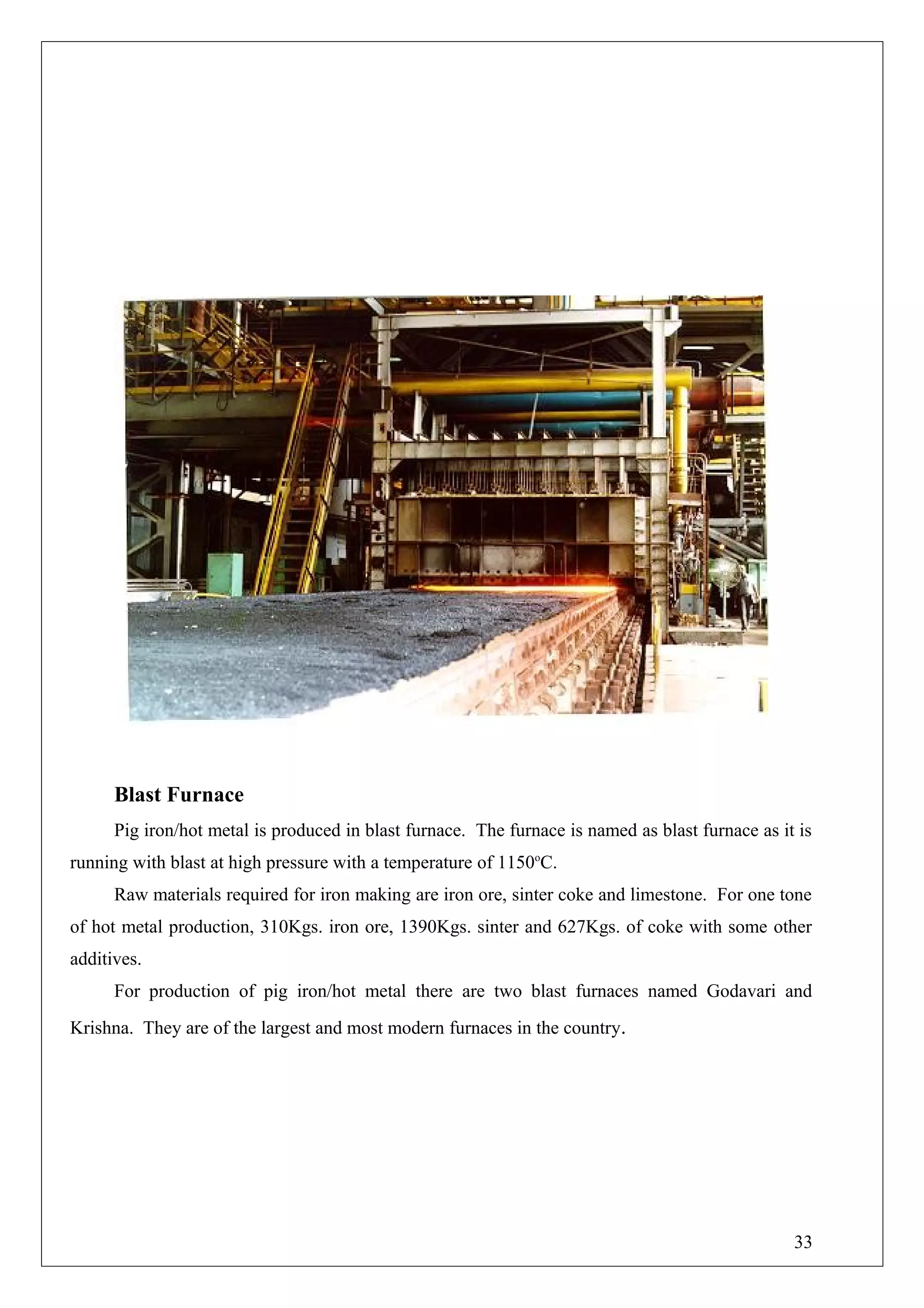
Blast Furnace
Pig iron/hot metal is produced in blast furnace. The furnace is named as blast furnace as it is
running with blast at high pressure with a temperature of 1150o
C.
Raw materials required for iron making are iron ore, sinter coke and limestone. For one tone
of hot metal production, 310Kgs. iron ore, 1390Kgs. sinter and 627Kgs. of coke with some other
additives.
For production of pig iron/hot metal there are two blast furnaces named Godavari and
Krishna. They are of the largest and most modern furnaces in the country.
33
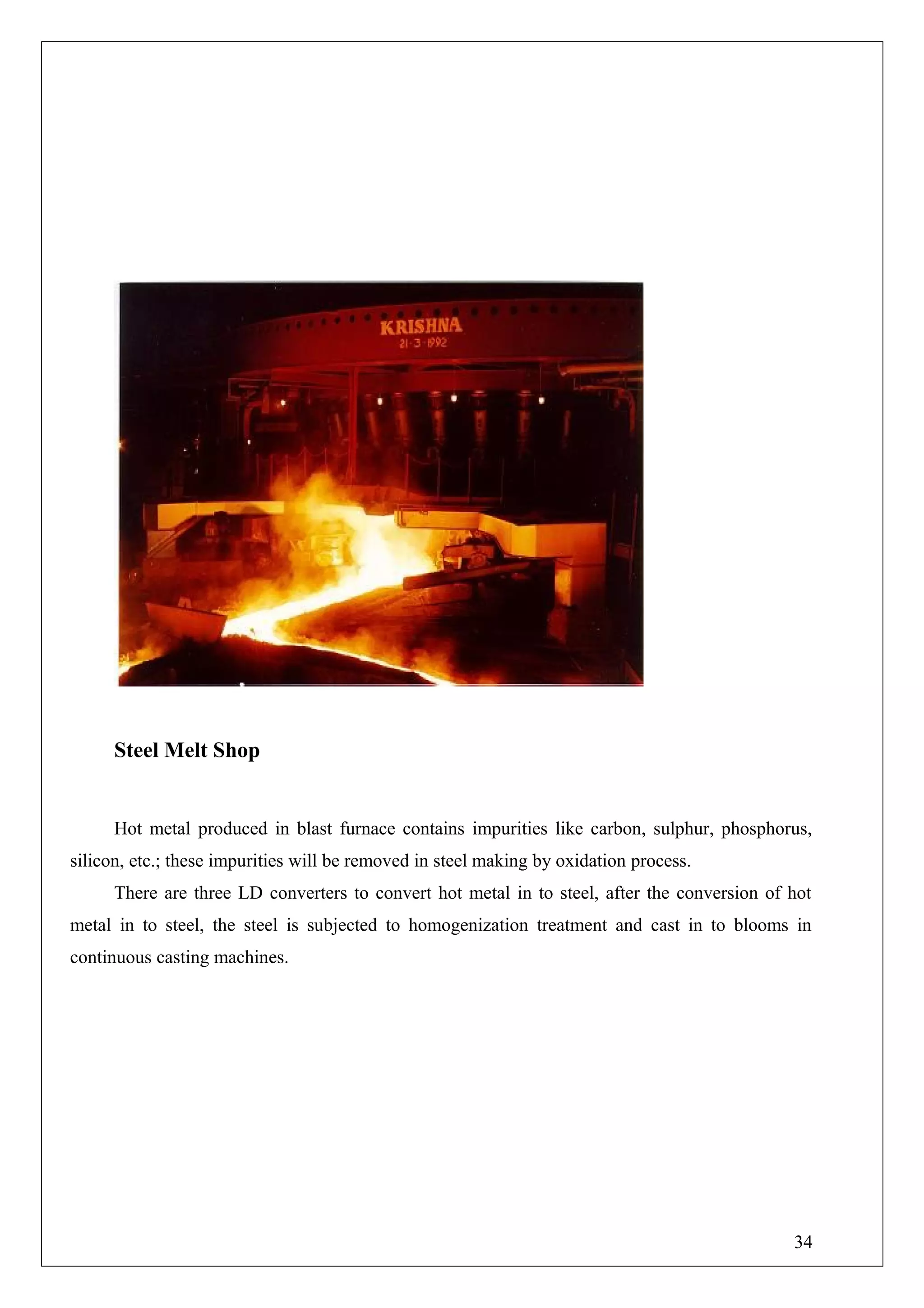
Steel Melt Shop
Hot metal produced in blast furnace contains impurities like carbon, sulphur, phosphorus,
silicon, etc.; these impurities will be removed in steel making by oxidation process.
There are three LD converters to convert hot metal in to steel, after the conversion of hot
metal in to steel, the steel is subjected to homogenization treatment and cast in to blooms in
continuous casting machines.
34
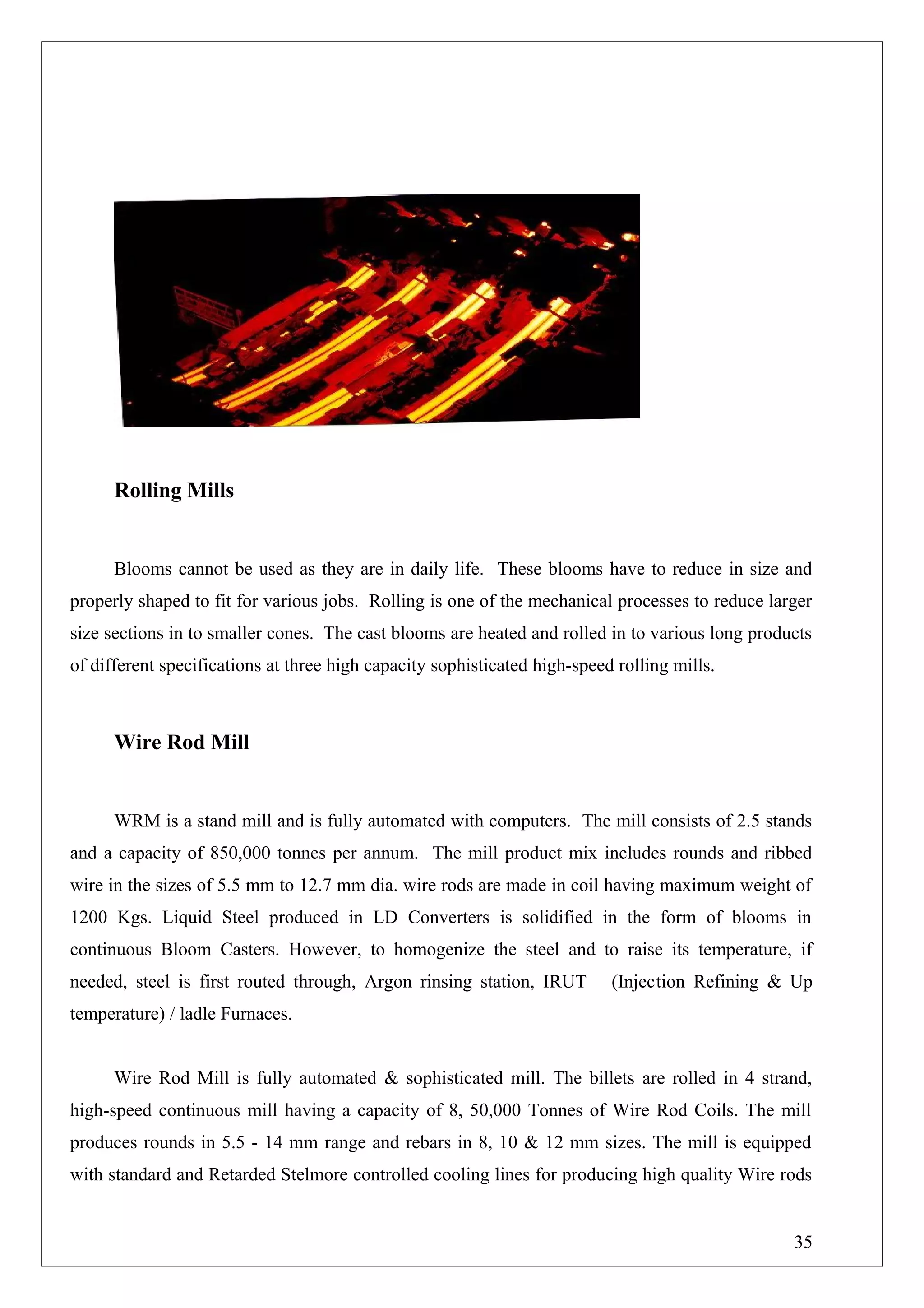
Rolling Mills
Blooms cannot be used as they are in daily life. These blooms have to reduce in size and
properly shaped to fit for various jobs. Rolling is one of the mechanical processes to reduce larger
size sections in to smaller cones. The cast blooms are heated and rolled in to various long products
of different specifications at three high capacity sophisticated high-speed rolling mills.
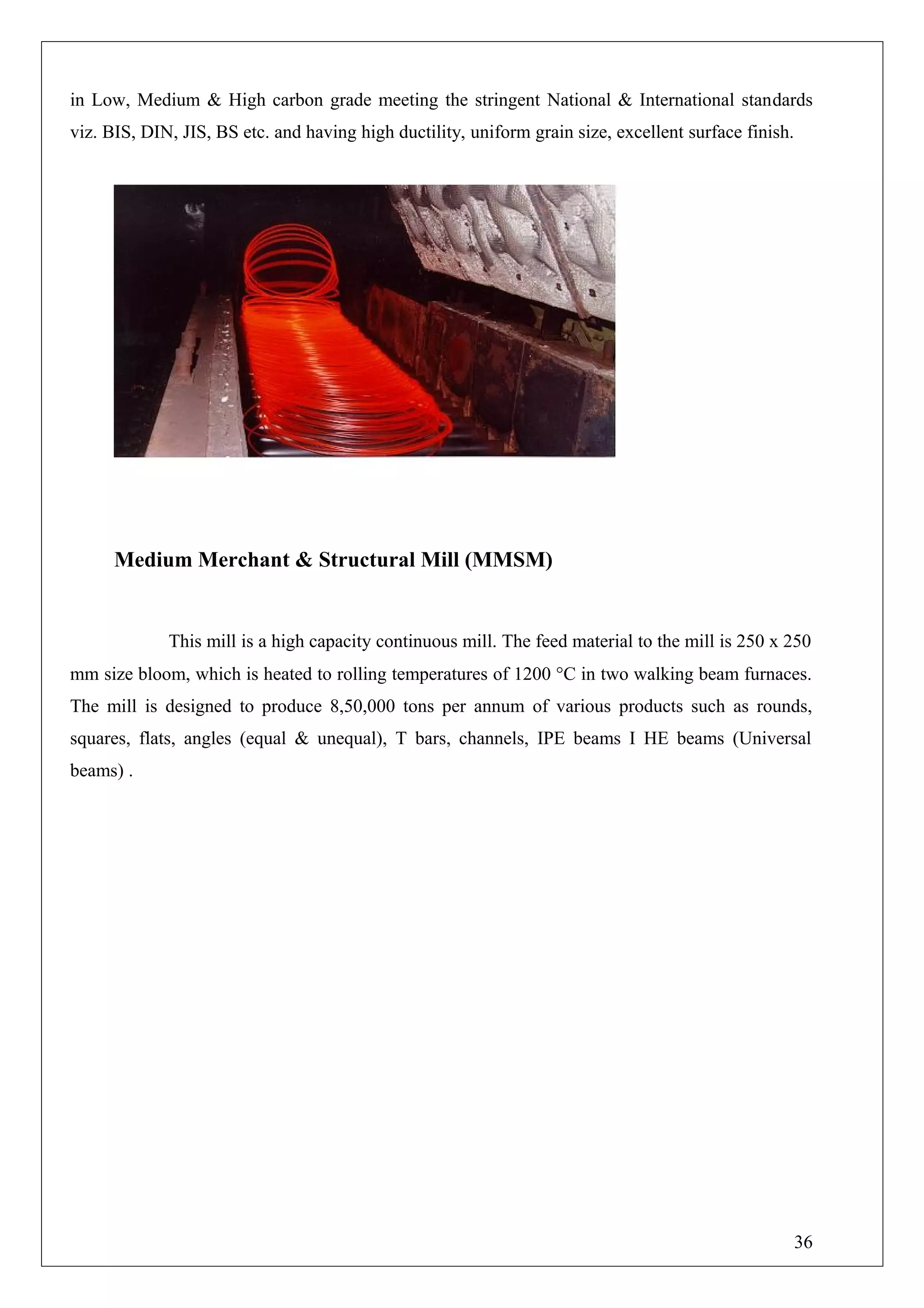
Wire Rod Mill
WRM is a stand mill and is fully automated with computers. The mill consists of 2.5 stands
and a capacity of 850,000 tonnes per annum. The mill product mix includes rounds and ribbed
wire in the sizes of 5.5 mm to 12.7 mm dia. wire rods are made in coil having maximum weight of
1200 Kgs. Liquid Steel produced in LD Converters is solidified in the form of blooms in
continuous Bloom Casters. However, to homogenize the steel and to raise its temperature, if
needed, steel is first routed through, Argon rinsing station, IRUT (Injection Refining & Up
temperature) / ladle Furnaces.
Wire Rod Mill is fully automated & sophisticated mill. The billets are rolled in 4 strand,
high-speed continuous mill having a capacity of 8, 50,000 Tonnes of Wire Rod Coils. The mill
produces rounds in 5.5 - 14 mm range and rebars in 8, 10 & 12 mm sizes. The mill is equipped
with standard and Retarded Stelmore controlled cooling lines for producing high quality Wire rods
35
in Low, Medium & High carbon grade meeting the stringent National & International standards
viz. BIS, DIN, JIS, BS etc. and having high ductility, uniform grain size, excellent surface finish.
Medium Merchant & Structural Mill (MMSM)
This mill is a high capacity continuous mill. The feed material to the mill is 250 x 250
mm size bloom, which is heated to rolling temperatures of 1200 °C in two walking beam furnaces.
The mill is designed to produce 8,50,000 tons per annum of various products such as rounds,
squares, flats, angles (equal & unequal), T bars, channels, IPE beams I HE beams (Universal
beams) .
36
AUXILIARY FACILITIES
Power Generation & Distribution
The average power demands at all units of VSP when operating the full capacity will be 221
MW. The captive generation capacity of 270 MW is sufficient to meet all the plant needs in normal
operation time. In case of partial outage of captive generation capacity due to break down,
shutdown or other reasons. The short fall of power is availed from APSEB grid. The agreement
with APSEB provides for exporting of surplus power to APSEB. The captive generating capacity
comprises of
- TPP -247.5 MW (3x60 MW + 1 X 67.5 MW)
- Back pressure Turbines (C&CCD)* - 2 x 7.5 MW
- Gas Expansion Turbines (BF / ces)* - 2x12 MW
(*Power availability from BPT & GET is around 22MW)
Power plant also meets the Air Blast requirements of Blast Furnaces thro' 3 Turbo blowers
each of 6067 NM 3 / hr capacity.
Power from APSEB is received at Main Receiving Station thro' 220KV overhead
distribution lines. The entire plant is configured as 5 electrical load blocks (LBSS 1 to 5) and step-
down substations are provided in each block with 220 KV transformers to step down to 33/11/6.6
KV for further distribution.
Traffic Department
A steel plant of the size of VSP has to handle around 60 to 65 MT traffic comprising of
incoming traffic in the form of raw materials and outgoing traffic in the form of finished or
saleable steel, and also the in process traffic such as cast pig iron, mill scrap, hot metal.
Of this 50% is transported by belt conveyors, 45% by Rail Transport and 5% by Road. VSP
has the distinction of having peripheral unloading system for the 1st time in Steel Industry.
To handle this huge quantities of traffic, VSP has a fleet of 31 locomotives, Hot Metal ladle
cars, Torpedo ladle cars, Captive wagons of different types, 5 internal Railway stations, loco and
wagon repair shop, number of weigh bridges.
Engineering shops & Foundry (ES & F)
37
Engineering Shops are set up to meet the requirements of Ferrous & Non Ferrous spares of
different departments. This complex is divided into 1. Forge Shop 2. Structural shop 3. Foundry 4.
Central machine shop 5. Wood Working Shop and 6. Utility Equipment Repair Shop (UERS).
The Forge shop is designed for production of shafts, coupling flanges etc. and also of forge
shapes such as crusher hammer heads, special bolts, nuts etc. In the Structural shops the fabricated
structural of about 4500 Tonnes are produced annually and the input consisting of sheets, plates,
channels, angles beams etc. In Foundry Iron castings up to a weight of 5 tons and non-ferrous
casting up to a weight of 1 ton are produced. 2600 Tonnes of iron castings and 200 tones of non-
ferrous castings are produced annually. In steel foundry, steel casting up to maximum piece weight
of 10T is produced. Steel ingots up to 1.3 Tonnes for forging are also produced.
In the Central Machine Shop, various spares are made. The machining section has over 100
major machine tools including lathes, milling, boring, planning, slotting, shaping, grinding and
other machines. The Wood working Shop manufactures patterns for foundries. The shop will
require 300 Cu.m. Per year of wooden patterns.
Central Maintenance Electrical
Maintenance of all H.T motors, L.T motors and DC motors of above 200KW. There are 810
such large rotating electrical machines spread throughout the plant including 3 Nos. of 60 MW
Turbo-Generators, 1 No of 67.5M TG in TPP, 2 no's of Back Pressure Turbo Generators of 7.5
MW each and 2 Nos. of Gas Expansion Turbo- Generator of 12 MW each. The services provided
are as mentioned below.
a) Repairs, Maintenance and condition monitoring of all rotating Electrical machines of the
plant. The job includes transportation, Overhauling and re-erection with precision alignment.
b) Maintenance of Electrics of all streetlights, Tower lights and Weigh Bridges throughout
the plant.
Electro Technical Laboratory
1) Repairs all the defective electronic PCB’s, which are taken out from the equipment
during their functioning.
2) Procures and arranges spare PCB’s for the equipment of PLC’s and drive controls for
motors in the plant and also for UPS systems.
3) Involves in the plant modernization activities and up gradation of equipment.
38
Electrical Repair Shop (ERS)
ERS is a central repair shop to carry out repair activities like overhauling, rewinding, testing
etc., of various types of AC Motors, DC Motors, HT Motors, Submersible pumps, Distribution
transformers, Welding Machines, Control Transformers, Lifting magnets, Coils etc., of the plant.
The Main Functions of ERS are:
a) Overhauling of motors
b) Rewinding of motors, magnets, transformers, pumps, coils etc.
c) Testing of Electrical equipment
d) Emergency Site Repairs
e) Performance assessment of electrical motors
Utilities Department
Utilities dept. Consists of 1. Air Separation Plant 2. Compressor Houses 3. Chilled
water plants and Acetylene plants. The ASP is designed to meet the maximum daily demand of
gaseous oxygen, gaseous nitrogen and gaseous argon. Compressor Houses produce Compressed
Air required for the operation of pneumatic devices, for instruments and controls, pneumatic tools
and for general purpose in the various production units of Steel Plants. Chilled Water plants ( 2
No's ) produce chilled water required for use in the ventilation and air conditioning system in areas
such as office rooms, electrical control room etc. Acetylene plant produces Acetylene gas required
for general purpose cutting and welding.
Quality Assurance and Technological Development (QA &TD)
The QA & TD dept. has been set up to take care of activities pertaining to Quality Control of
Raw Materials, Semi finished products and finished products. The QA & TD labs are provided at
major department like CO&CCP, SP, BF, SMS, and Rolling Mills etc., in addition to Central
Laboratory. The department monitors the process parameters for production of quality products.
QA & TD carries out analysis, testing and final inspection including spark testing of finished prod-
ucts and assigns grades to them.
Calcining & Refractory Material Plant:
39
CRMP consists of two units - Calcining Plant & Brick Plant. In Calcining plant
limestone & dolomite are calcined for producing lime & calcined dolomite, which are used for
refining of steel in the converters.
Roll shop & Repair shop:
Roll shop & Repair shop is in the complex of Rolling Mills catering to the needs of mills in
respect of roll assemblies, guides few Maintenance spares and roll pass design. Geographically this
dept. is in three areas as roll shop-1, Roll shop-II and Area Repair Shop. The main activities of this
shop is Roll pass Design, grooving of rolls, assembly of rolls with bearings, preparation of guides
and their service and manufacture / repair of mill maintenance spares.
For the first time in the country, VSP has adopted CNC technology for grooving of steel
rolling mill rolls. High constant respective accuracy, higher productivity, use of standard tool for
any groove turning, elimination of the use of different templates, easier to incorporate groove
modification etc., are some of the advantages of CNC lathes over the conventional one.
Plant Design
Major functions of this unit are
• Development of detailed Manufacturing Drawing and Replacement Specification drawings
• Suggesting New Designs and detailing by doing elaborate engineering study and Analysis
• Standardization
Works Contracts Department
• Obtaining administrative approval on receipt of proposal from indenting departments,
tendering and awarding of work
• Converting tender committee meetings and preparing recommendations forwarding work.
• Preparing COM/Board Note for decisions at those forum Participating in claims and
arbitration proceedings and legal cases pertaining to contracts
• Registration for agencies under various categories & classes of works periodically.
40
FUNCTIONS OF VARIOUS DEPARTMENTS OF RINL/VSP:
Directorate of Operations
Production Planning and Control
 Formulation of long term production plans and infrastructure support.
 Formulation of Annual and Monthly production plan. This involves detailed
planning for product mix and value added steel along with Marketing Dept.
 Analyzing Plant performance against targets on a periodic basis and taking
necessary corrective actions.
Techno-economic and Quality
Formulation of techno-economic norms and energy management parameters and reviewing
the same against targets periodically.
Inputs and Basic Infrastructure
 Long term and short term planning for procurement of raw materials like Imported
Coking Coal (ICC), Medium Coking Coal (MCC), Boiler Coal, Iron Ore Fines and Iron Ore
Lumps etc.,
 Formulation of Annual Inward and Outward traffic movement plan for raw
materials and finished products in consultation with Marketing and Material Management Depts.
Repairs and Maintenance Planning
 Planning of major Capital Repairs, Shutdowns, Spares requirement and ensuring
preparedness before taking up the repairs.
Mines planning
 Formulation of annual and monthly production plans for BF limestone, BF grade
dolomite, Mn Ore and Sand at VSP Captive Mines.
41
 Monitoring of production and dispatch of Limestone, Dolomite, Mn Ore and Sand
from Captive Mines.
Projects planning
 Long and short term planning for all developmental schemes of capital nature
comprising modernization and technology up-gradation.
 Planning and implementation of Additions, Modifications and Replacement (AMR)
schemes.
 Expansion of Plant Capacity from 3.0 Mt liquid steel to 6.3Mt.
Research and Development
 Identification of Technological Improvement scopes for various processes and plan
for adoption of them by acquiring design and know-how capability.
 Indigenous development of technology involving laboratory investigation.
 Development of new grades and products in coordination with marketing dept.
Information Technology
 Formulation of Organizational IT-Policy, IT-Security Policy and IT-Vision.
 Identification of IT enabled projects for various processes and implements them.
Budget plan and control
 Identification of Budget requirement under various heads.
 Control of the Budget and Spares, Consumables & Raw Materials Inventory.
Systems and Procedures
 Streamlining the contract management system to ensure consistency of approach
and adoption of sound principles of contract management.
 Ensuring the implementation and maintenance of quality management system
requirements for ISO 9001:2000 Certificate.
42
 Monitoring pollution control activities of the Plant and interaction with the State
and Central Pollution Control Board.
Project Division
Design & Engineering Department
♦ Liaisoning with Consultants and Government Authorities in connection with
designs, specifications, approval of drawings and Liaisoning work for various types of clearances.
♦ Preparation of drawings, design and specification for AMR and Non-AMR jobs.
♦ Assisting indenting departments in technical discussion with parties and preparation
of technical recommendation.
♦ Layout clearances of various facilities coming in the Plant and Township.
♦ Operation of Consultancy contracts.
Construction Department
♦ Exercising supervision of work at sites both for quality and quantity checks.
♦ Preparation of contractor’s bills, processing of extra items and closure of contracts.
♦ Liaisoning with suppliers, MM department, Design & Engineering Department and
Stores in connection with progress of work at site.
♦ Arranging PAT/FAT will all concerned departments like works, design, consultants
and suppliers in terms of contract and handing over the unit to works department for operation.
Contracts Department
♦ Awarding of contract from the point on receipt of administrative approval from
indenting departments.
♦ Conducting commercial discussions with parties.
♦ Arranging Tender Committee meetings and preparing recommendations for
awarding work.
♦ Preparing COM/Board Note for decisions at those forms.
♦ Participating in claims and arbitration proceedings.
43
Project Monitoring Department
♦ To monitor the physical and financial progress of all the works executed by
Construction department.
♦ To monitor the progress of works executed by D&E as well as Contracts
department.
♦ Preparation of various types of reports for information of Government and different
levels of Management.
♦ Interaction with departments and consultant for updating the schedules and
networks for Project Monitoring.
Directorate of Finance & Accounts
• Making arrangement for long-term fund requirements.
• Accounting of all minority transactions and preparation of financial statement of the
company and getting the same audited as required under law.
• Maintaining records with regard to the cost of products produced by the company.
• Release of payments to suppliers/providers of goods and services.
• Release of salaries to the employees.
• According concurrence to proposals for investments & expenditure as per the policies,
procedures and the Delegation of Powers.
• Conduct Internal Audits, Stock Verification and Statutory compliance.
• Making working capital arrangements.
• Submission of periodical reports to banks as per their sanctioned terms.
• Organizing for payment of Central Excise, Sales Tax, Income Tax and other statutory
payments.
• Co-ordination with statutory Auditors and Government Audit.
44
• Generation of various MIS reports pertaining to F&A department for Management
Information and Control.
Directorate of Personnel
Personnel Department
 Manpower Planning,
 Employees’ induction,
 Service matters, policy & rules
 Industrial relations,
 Employees’ welfare
 Corporate Social Responsibility (CSR),
 Replies to parliamentary questions,
 Official Language implementation
Legal Affairs
 Legal Affairs deals with all legal matters including arbitration, coordination with
Standing Councils, Legal Advices etc.
Management Services
 Quality Circle,
 Suggestion Scheme,
 Incentive Scheme,
 Reward Scheme,
 Procedural Orders etc.
Training & HRD
 Leadership Training,
 Training on Motivation and Attitude,
45
 Team Building
 Skill Training.
 Induction and Orientation,
 Plant Practice Lectures,
 Basic Engineering Lectures,
 Plant Specialized Training,
 Management Development,
 On the Job Training,
 Multi Skilling/SUPW and Mentoring.
Corporate Strategic Management (CSM):-
CSM is a “think tank” of the organization. The Department is engaged in formulation of
VMO (Vision, Mission & Objectives) of the organization and developing the strategy to achieve
VMO. It has various wings which inter-alia includes Knowledge Management Cell (KM Cell). It
has also developed the Corporate Plan of RINL. It takes up strategic tasks of the organization.
Town Administration & Administration
 Matters relating to Land & State,
 Civil Maintenance,
 Electrical Maintenance,
 Water Supply,
 Roads and Drain Maintenance,
 Horticulture and Afforestation,
 Peripheral Development and
Medical & Health Services
The Medical & Health Services Division of RINL consists of Visakha Steel General Hospital
(VSGH) & Peripheral Units viz. Pedagantyada Health Center (PGHC), Health Center – II,
46
Occupational Health Services & Research Center (OHSRC), Emergency Unit – I & II and
Hospitals in Mines – Jaggayyapeta Limestone Mines and Madharam Mines. The special features
of Visakha Steel General Hospital are:
 Full fledged Modern American Designed ICU and MBU capable of
treating 6 patients at a time.
 Full fledged Modern Radiology with Central A/c systems
 Well equipped Path. Lab with Blood bank facility
 Cluster type Wards & Casualty with Central Nursing Station
 Modern Operation Theatre couples with Shadow less cold lights and
100% bacterial free A/c system
Directorate of Commercial
Marketing Department
 It has 24 no. of Branch Sales Offices all over India and four Regional Offices
viz. North Delhi, South – Chennai, West – Mumbai, East – Kolkata and Headquarter Sales. Main
Activities of Marketing are as follows:
 Collecting Market feedback and Customers requirements for the preparation of
Annual Plan in coordination with Works Department, for the sale of Pig Iron Steel and Byproducts
 Preparation of Marketing Policies
 Finalization of Long Term Contracts, MOUs, Spot sale agreements etc., in
Domestic and Export Markets
 Preparation of Monthly Rolling Plans in coordination with Works Department
for meeting the sale commitments
 Processing of Materials like straightening of coils, cutting, bending, bundling,
packaging etc., at the plant premises and in branches to meet customers as well as transportation
requirements
 Dispatch of products to various stockyards by road or rail or to customers from
the plant on direct dispatch basis
47
 Operation of the contracts for transportation of products by road and stockyard
handling/ consignment agency contracts for domestic sales, stevedoring contracts and third party
inspection agency for exports
 Sale of products at branches, Headquarters and on direct dispatch basis to the
customers in domestic markets and on Ex-works and fob Visakhapatnam basis in exports
subject to tying up of commercial and financial terms and conditions. Ensure
documentation as per the procedures and as per the statutory requirements
 Rendering after sales services, obtaining customer feedback and Customer
Relations Management.
Materials Management Department
 Procurement of all materials such as Raw materials, Spares and consumables required for
the entire Plant Operations.
 To enter into long term agreements for supply of major & minor raw materials with
indigenous and imported suppliers.
 To effect economy in the cost of materials by purchasing materials of the right quality, in
the right quantity at the right time from the right source at the right place.
 To arrange inspection of materials prior to handing over to Production Units to ensure
quality materials only are issued to Production Units.
 Storage of materials & issue the same to the Production Units as per their requirement.
 To develop and encourage ancillary industries so that the availability of the materials at
right time is ensured.
MILE STONES OF THE ORGANIZATION
Sl.
No.
Date Milestone
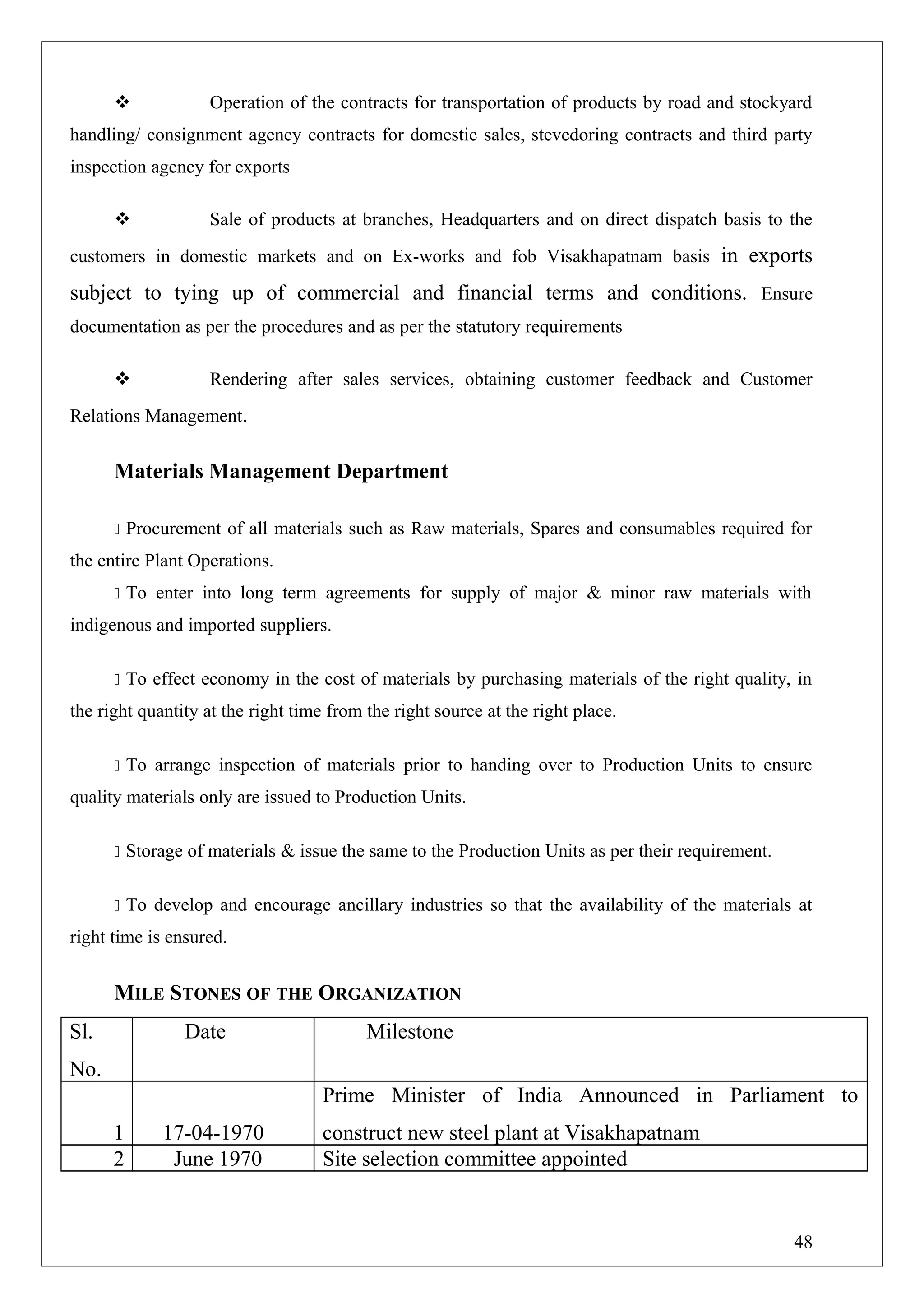
1 17-04-1970
Prime Minister of India Announced in Parliament to
construct new steel plant at Visakhapatnam
2 June 1970 Site selection committee appointed
48
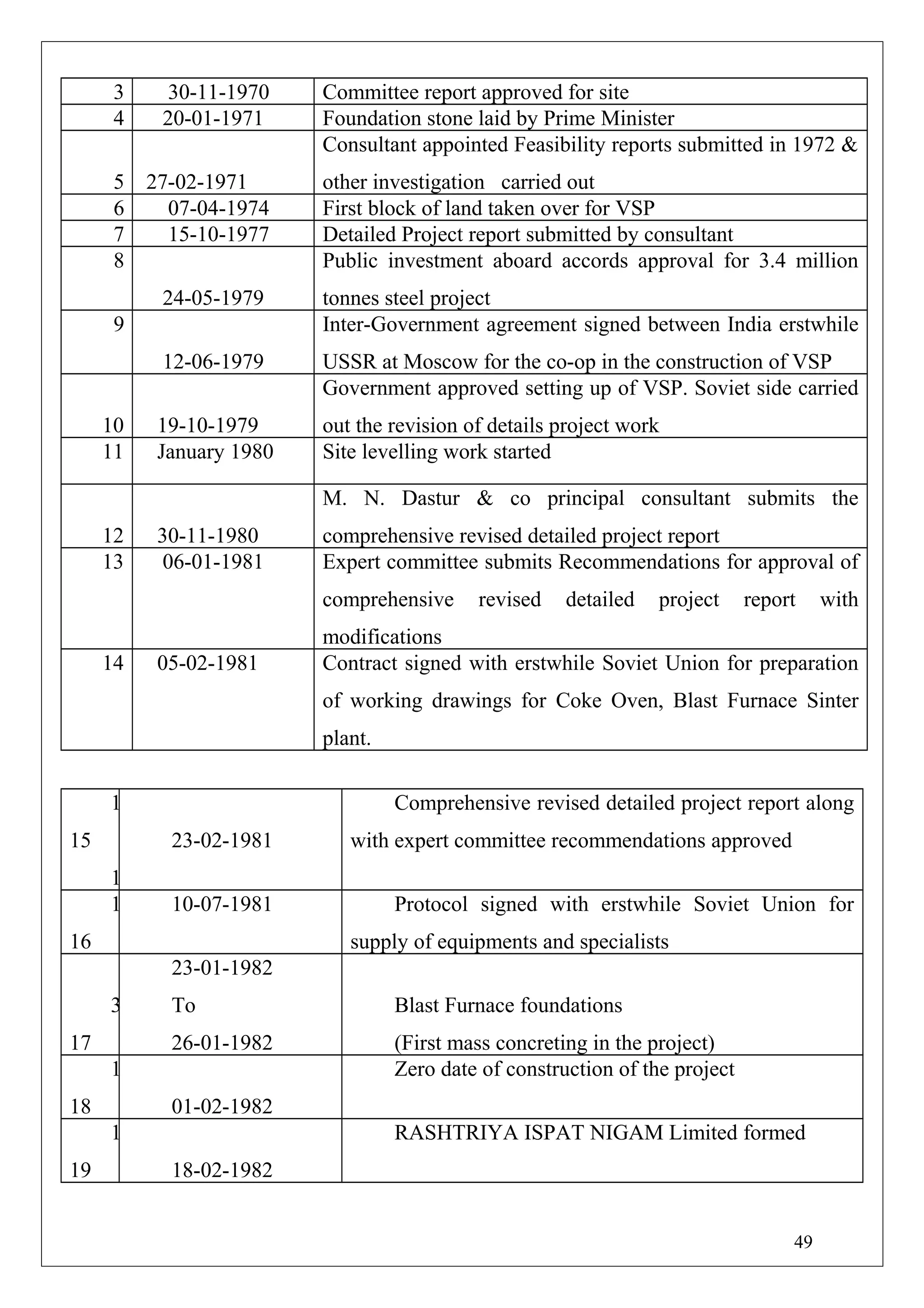
3 30-11-1970 Committee report approved for site
4 20-01-1971 Foundation stone laid by Prime Minister
5 27-02-1971
Consultant appointed Feasibility reports submitted in 1972 &
other investigation carried out
6 07-04-1974 First block of land taken over for VSP
7 15-10-1977 Detailed Project report submitted by consultant
8
24-05-1979
Public investment aboard accords approval for 3.4 million
tonnes steel project
9
12-06-1979
Inter-Government agreement signed between India erstwhile
USSR at Moscow for the co-op in the construction of VSP
10 19-10-1979
Government approved setting up of VSP. Soviet side carried
out the revision of details project work
11 January 1980 Site levelling work started
12 30-11-1980
M. N. Dastur & co principal consultant submits the
comprehensive revised detailed project report
13 06-01-1981 Expert committee submits Recommendations for approval of
comprehensive revised detailed project report with
modifications
14 05-02-1981 Contract signed with erstwhile Soviet Union for preparation
of working drawings for Coke Oven, Blast Furnace Sinter
plant.
1
15
1
23-02-1981
Comprehensive revised detailed project report along
with expert committee recommendations approved
1
16
10-07-1981 Protocol signed with erstwhile Soviet Union for
supply of equipments and specialists
3
17
23-01-1982
To
26-01-1982
Blast Furnace foundations
(First mass concreting in the project)
1
18 01-02-1982
Zero date of construction of the project
1
19 18-02-1982
RASHTRIYA ISPAT NIGAM Limited formed
49
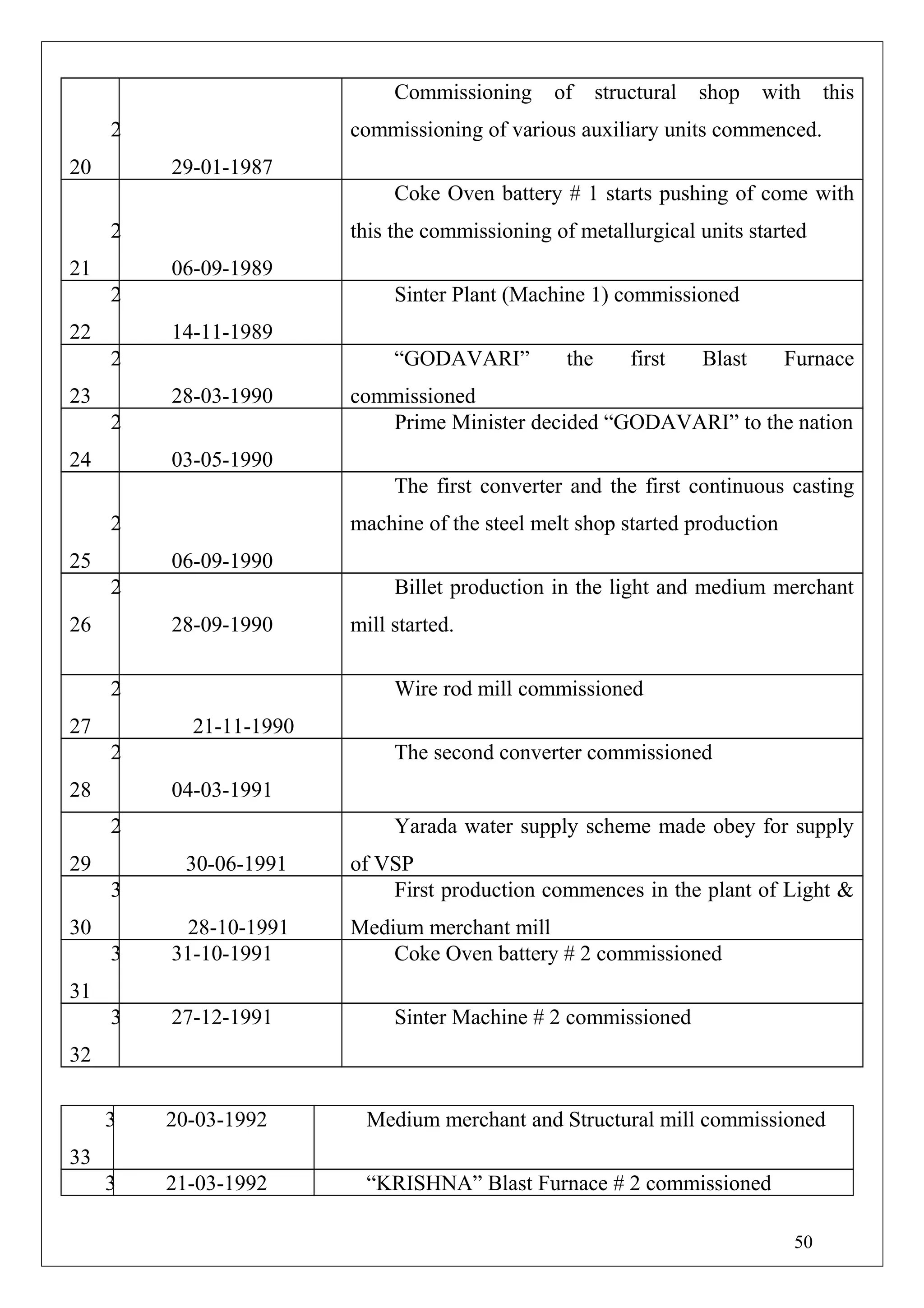
2
20 29-01-1987
Commissioning of structural shop with this
commissioning of various auxiliary units commenced.
2
21 06-09-1989
Coke Oven battery # 1 starts pushing of come with
this the commissioning of metallurgical units started
2
22 14-11-1989
Sinter Plant (Machine 1) commissioned
2
23 28-03-1990
“GODAVARI” the first Blast Furnace
commissioned
2
24 03-05-1990
Prime Minister decided “GODAVARI” to the nation
2
25 06-09-1990
The first converter and the first continuous casting
machine of the steel melt shop started production
2
26 28-09-1990
Billet production in the light and medium merchant
mill started.
2
27 21-11-1990
Wire rod mill commissioned
2
28 04-03-1991
The second converter commissioned
2
29 30-06-1991
Yarada water supply scheme made obey for supply
of VSP
3
30 28-10-1991
First production commences in the plant of Light &
Medium merchant mill
3
31
31-10-1991 Coke Oven battery # 2 commissioned
3
32
27-12-1991 Sinter Machine # 2 commissioned
3
33
20-03-1992 Medium merchant and Structural mill commissioned
3 21-03-1992 “KRISHNA” Blast Furnace # 2 commissioned
50
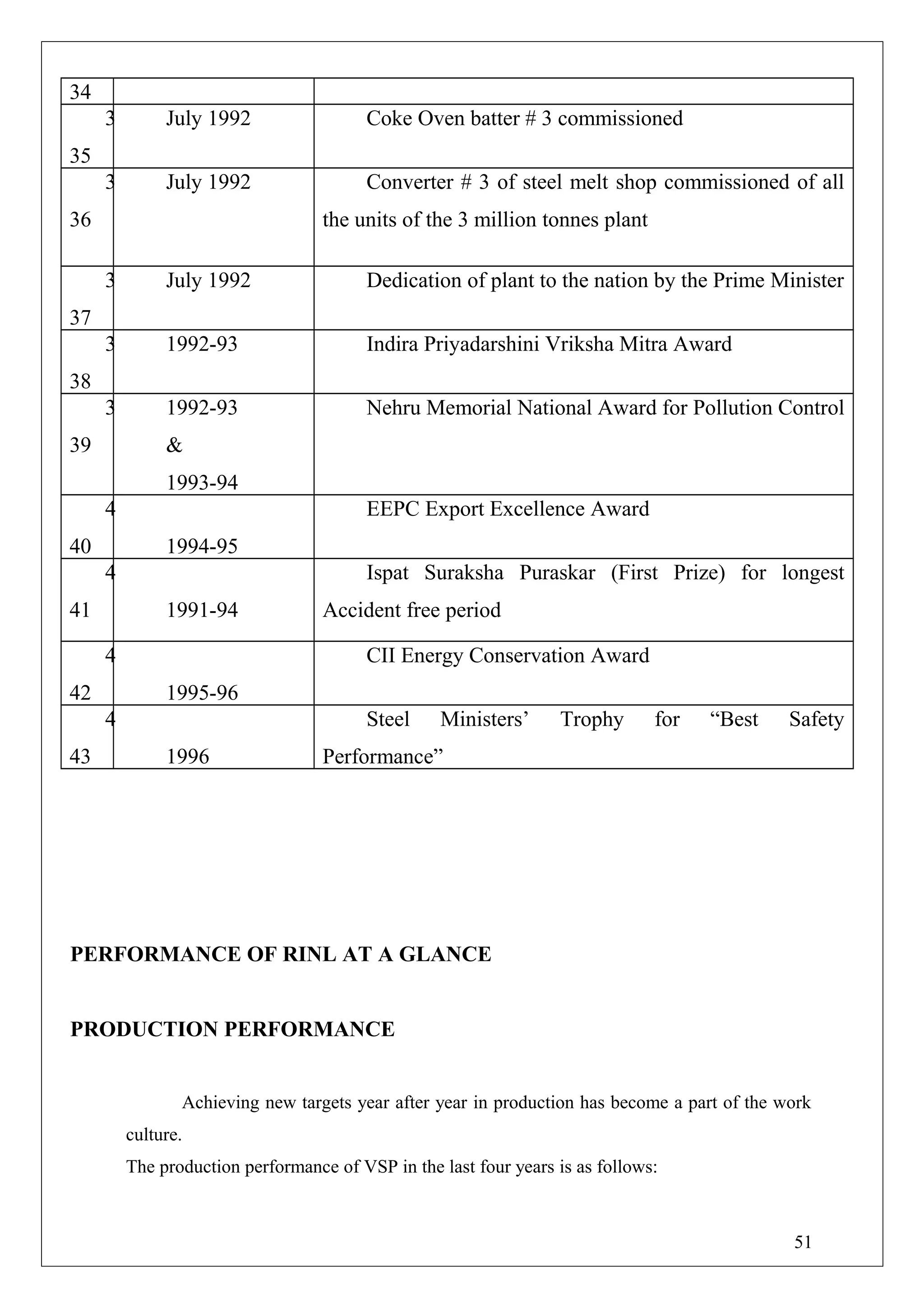
34
3
35
July 1992 Coke Oven batter # 3 commissioned
3
36
July 1992 Converter # 3 of steel melt shop commissioned of all
the units of the 3 million tonnes plant
3
37
July 1992 Dedication of plant to the nation by the Prime Minister
3
38
1992-93 Indira Priyadarshini Vriksha Mitra Award
3
39
1992-93
&
1993-94
Nehru Memorial National Award for Pollution Control
4
40 1994-95
EEPC Export Excellence Award
4
41 1991-94
Ispat Suraksha Puraskar (First Prize) for longest
Accident free period
4
42 1995-96
CII Energy Conservation Award
4
43 1996
Steel Ministers’ Trophy for “Best Safety
Performance”
PERFORMANCE OF RINL AT A GLANCE
PRODUCTION PERFORMANCE
Achieving new targets year after year in production has become a part of the work
culture.
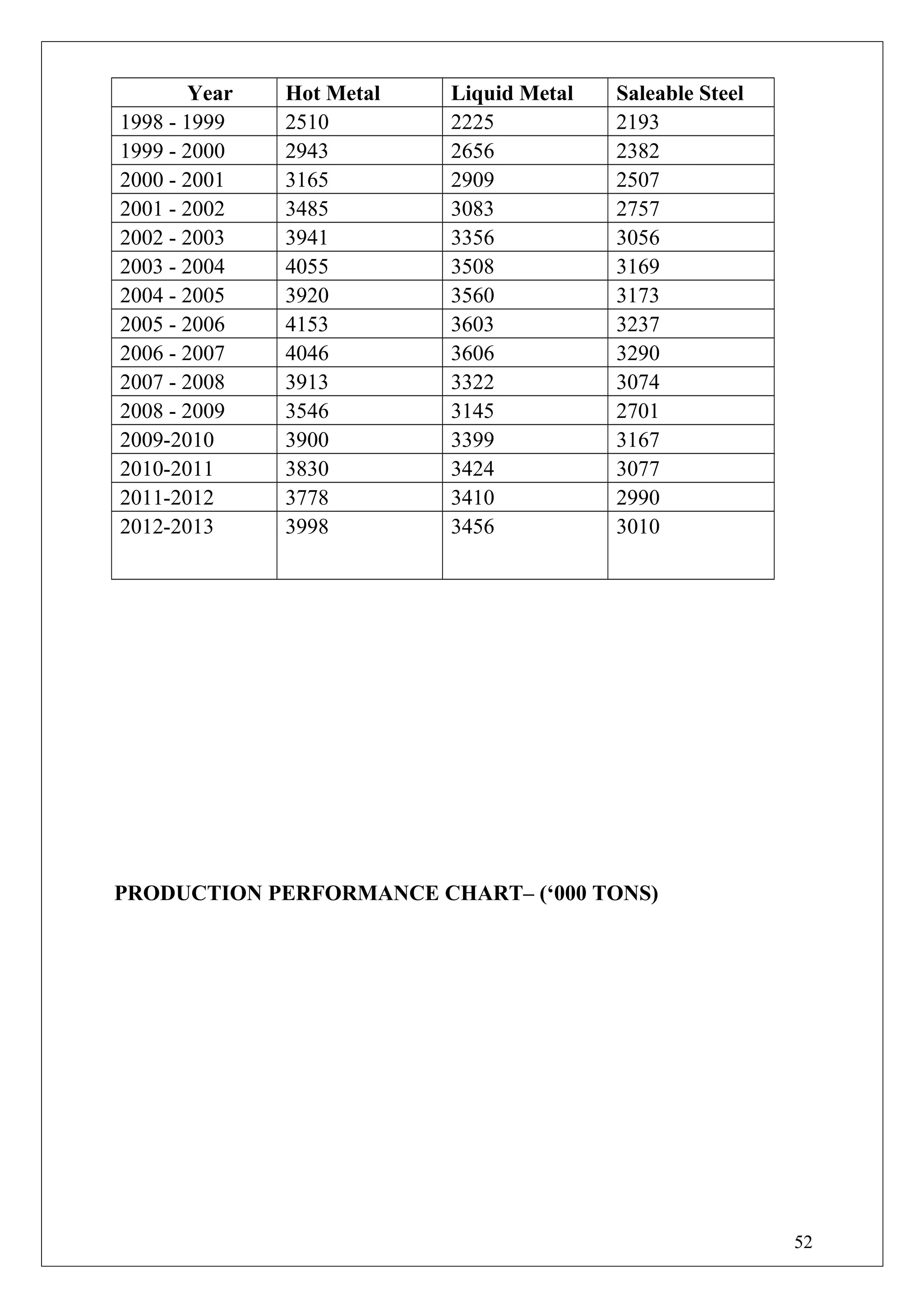
The production performance of VSP in the last four years is as follows:
51
Year Hot Metal Liquid Metal Saleable Steel
1998 - 1999 2510 2225 2193
1999 - 2000 2943 2656 2382
2000 - 2001 3165 2909 2507
2001 - 2002 3485 3083 2757
2002 - 2003 3941 3356 3056
2003 - 2004 4055 3508 3169
2004 - 2005 3920 3560 3173
2005 - 2006 4153 3603 3237
2006 - 2007 4046 3606 3290
2007 - 2008 3913 3322 3074
2008 - 2009 3546 3145 2701
2009-2010 3900 3399 3167
2010-2011 3830 3424 3077
2011-2012 3778 3410 2990
2012-2013 3998 3456 3010
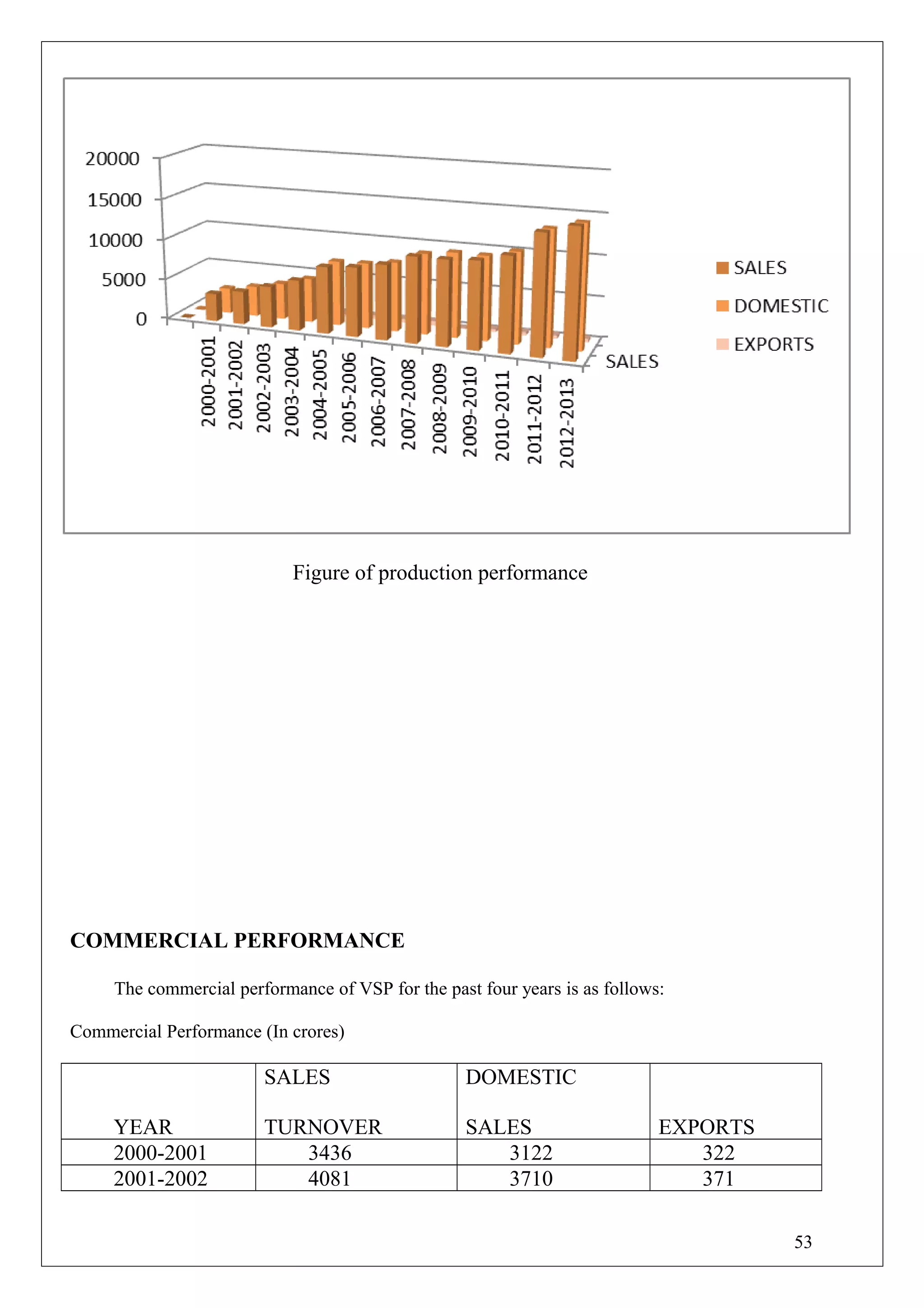
PRODUCTION PERFORMANCE CHART– (‘000 TONS)
52
Figure of production performance
COMMERCIAL PERFORMANCE
The commercial performance of VSP for the past four years is as follows:
Commercial Performance (In crores)
YEAR
SALES
TURNOVER
DOMESTIC
SALES EXPORTS
2000-2001 3436 3122 322
2001-2002 4081 3710 371
53
2002-2003 5059 4433 626
2003-2004 6174 5406 768
2004-2005 8181 7933 248
2005-2006 8469 8026 443
2006-2007 9131 8487 424
2007-2008 10433 9878 555
2008-2009 10411 10332 78
2009-2010 10635 10284 351
2010-2011 11517 11095 422
2011-2012 14462 14047 416
2012-2013 15451 15041 410
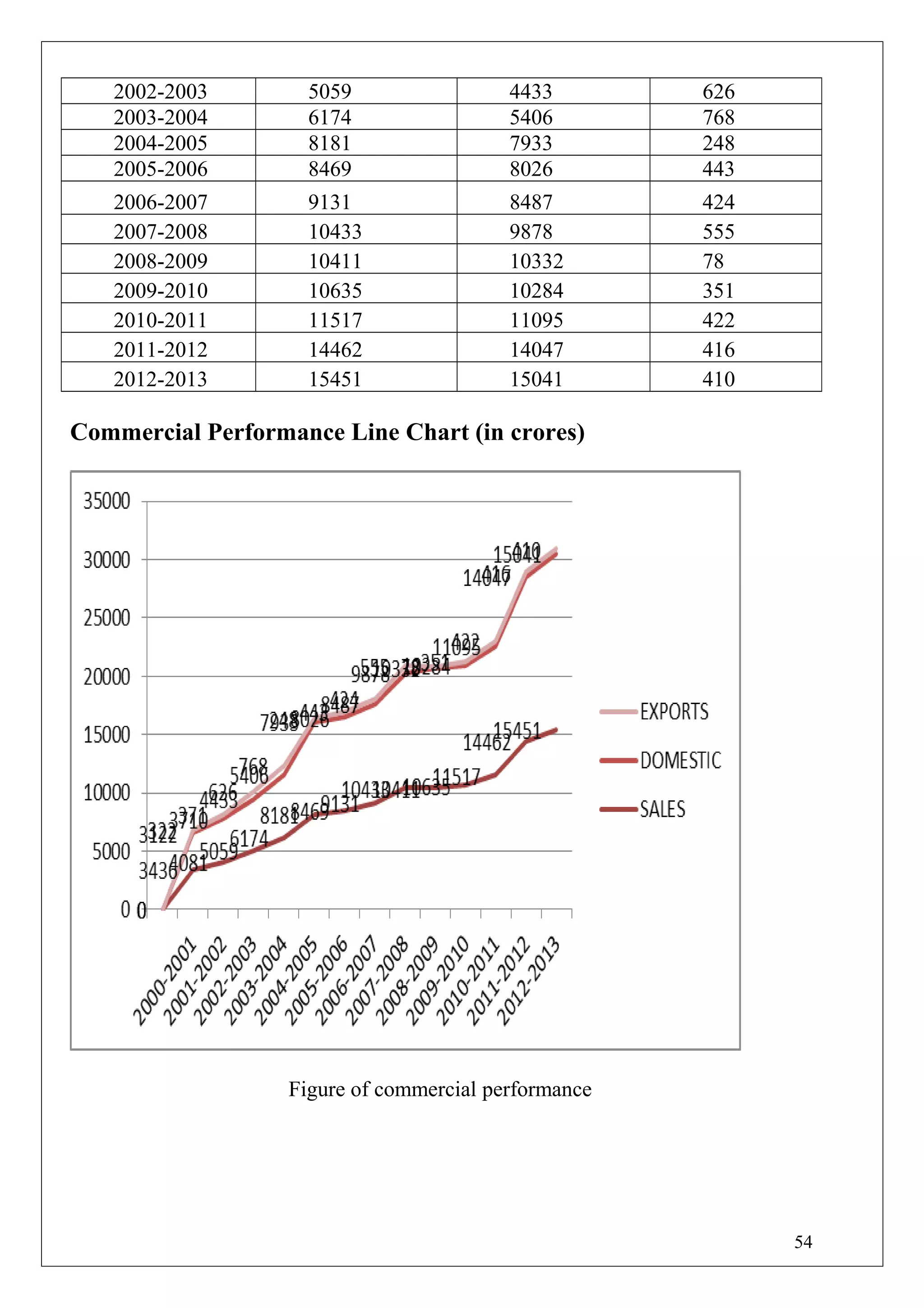
Commercial Performance Line Chart (in crores)
Figure of commercial performance
54
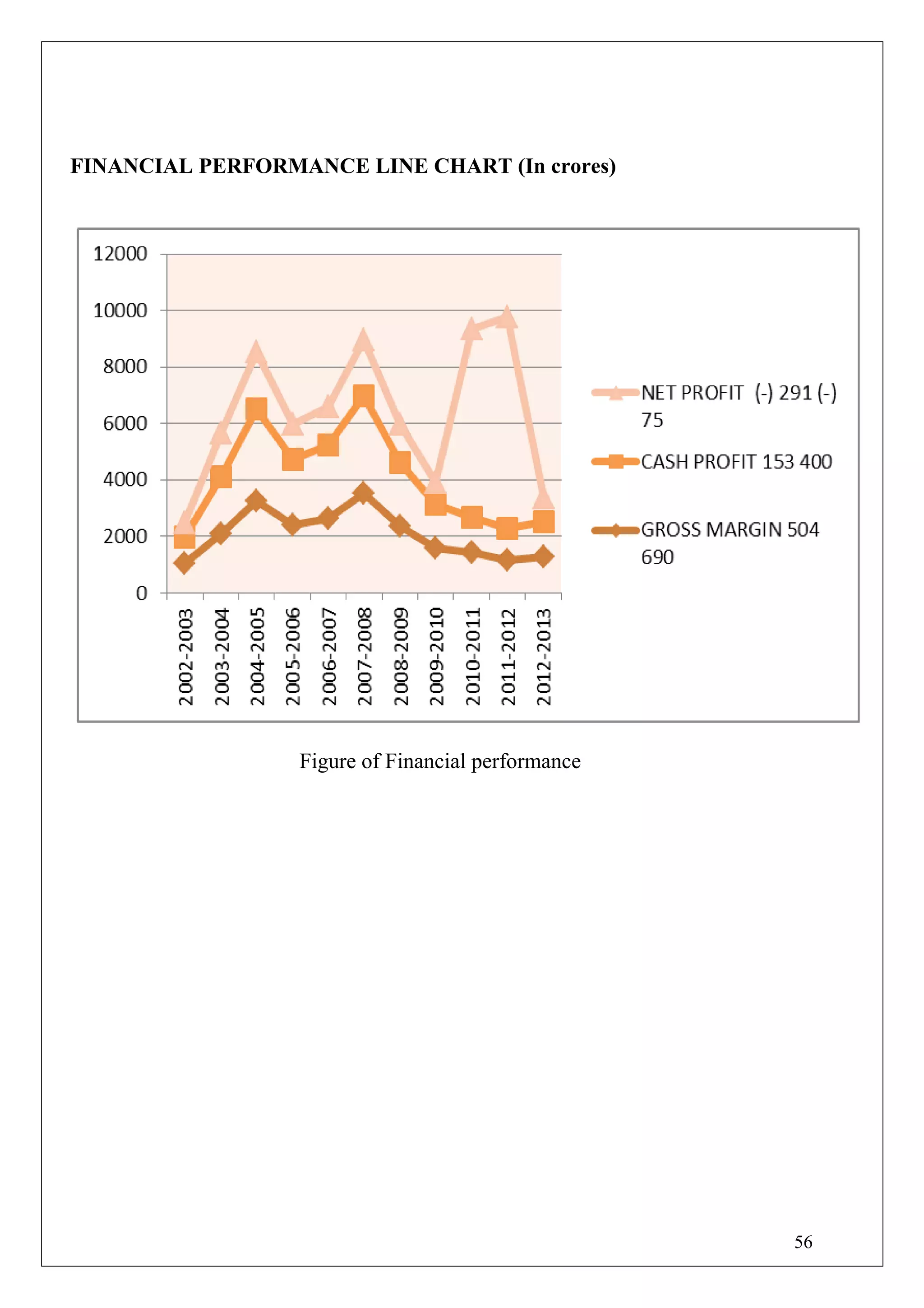
FINANCIAL PERFORMANCE
VSP had to bear the burnt of huge project cost right from the day of its inception. This has
affected the company’s balance sheet due to very high interest burden. The company, in spite of
making operating profit every year had to report net loss during all financial years. This on the
other hand had resulted in making VSP to take great care in planning the financial resources.
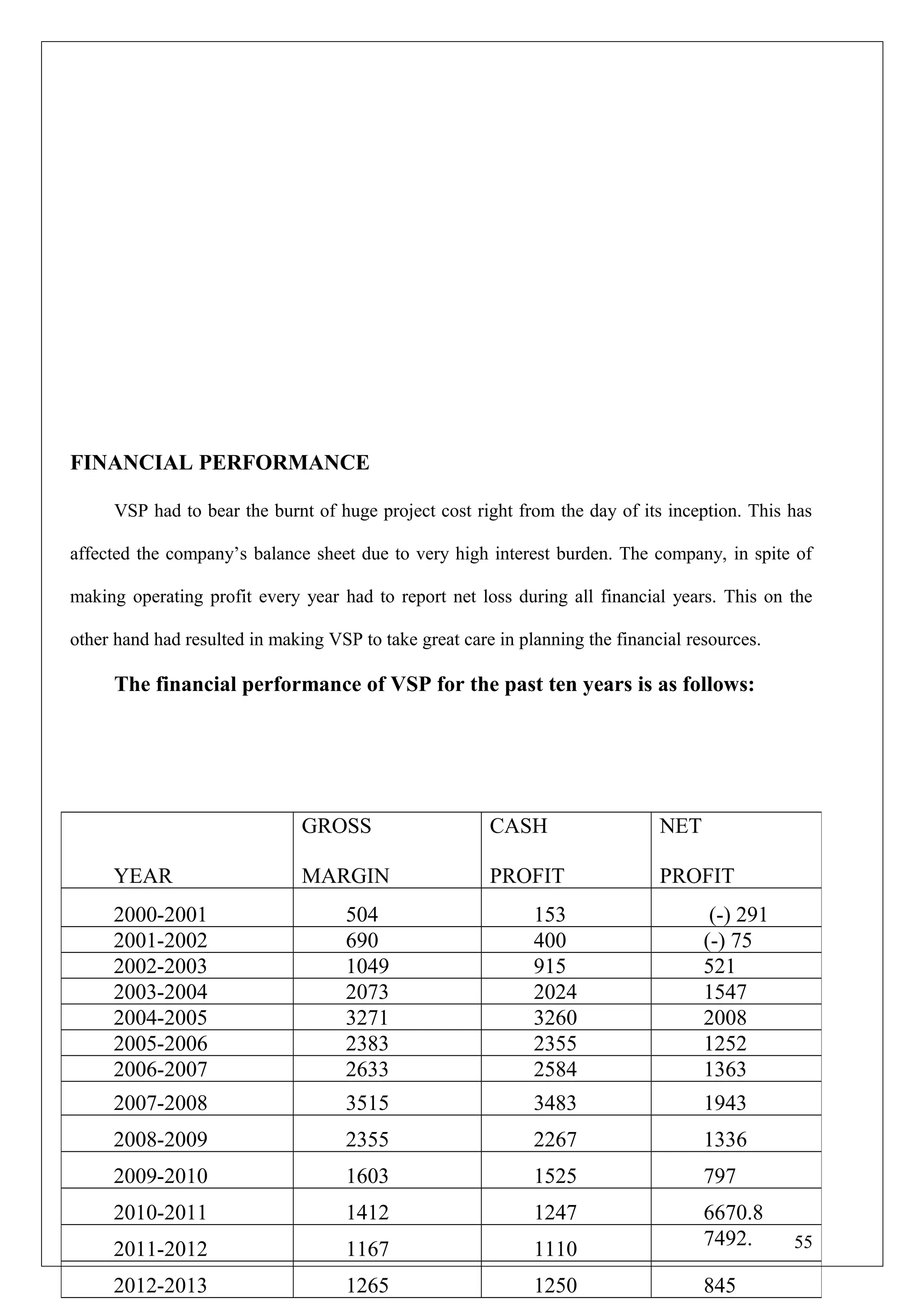
The financial performance of VSP for the past ten years is as follows:
YEAR
GROSS
MARGIN
CASH
PROFIT
NET
PROFIT
2000-2001 504 153 (-) 291
2001-2002 690 400 (-) 75
2002-2003 1049 915 521
2003-2004 2073 2024 1547
2004-2005 3271 3260 2008
2005-2006 2383 2355 1252
2006-2007 2633 2584 1363
2007-2008 3515 3483 1943
2008-2009 2355 2267 1336
2009-2010 1603 1525 797
2010-2011 1412 1247 6670.8
2011-2012 1167 1110 7492.
2012-2013 1265 1250 845
55
FINANCIAL PERFORMANCE LINE CHART (In crores)
Figure of Financial performance
56
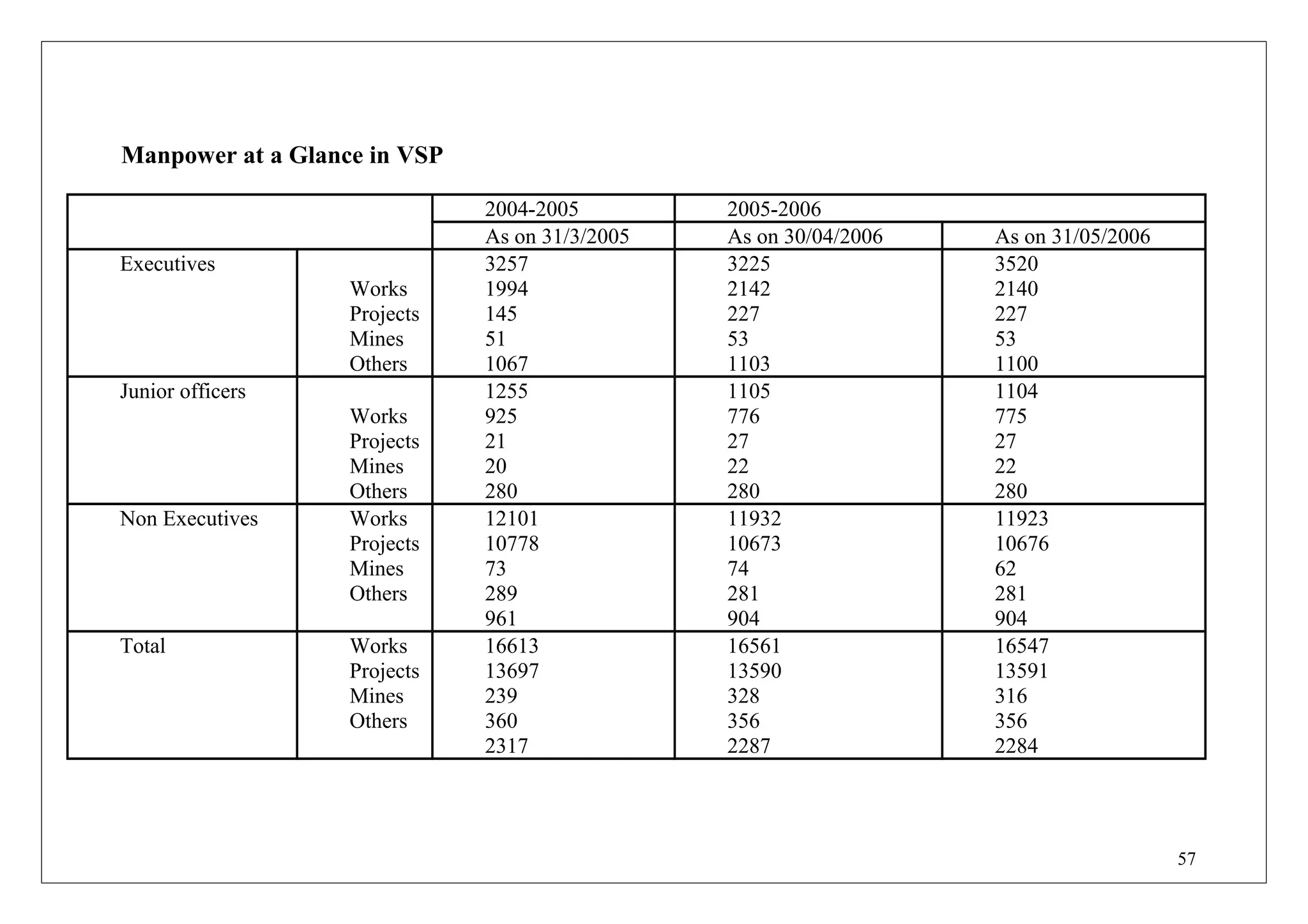
Manpower at a Glance in VSP
2004-2005 2005-2006
As on 31/3/2005 As on 30/04/2006 As on 31/05/2006
Executives
Works
Projects
Mines
Others
3257
1994
145
51
1067
3225
2142
227
53
1103
3520
2140
227
53
1100
Junior officers
Works
Projects
Mines
Others
1255
925
21
20
280
1105
776
27
22
280
1104
775
27
22
280
Non Executives Works
Projects
Mines
Others
12101
10778
73
289
961
11932
10673
74
281
904
11923
10676
62
281
904
Total Works
Projects
Mines
Others
16613
13697
239
360
2317
16561
13590
328
356
2287
16547
13591
316
356
2284
57
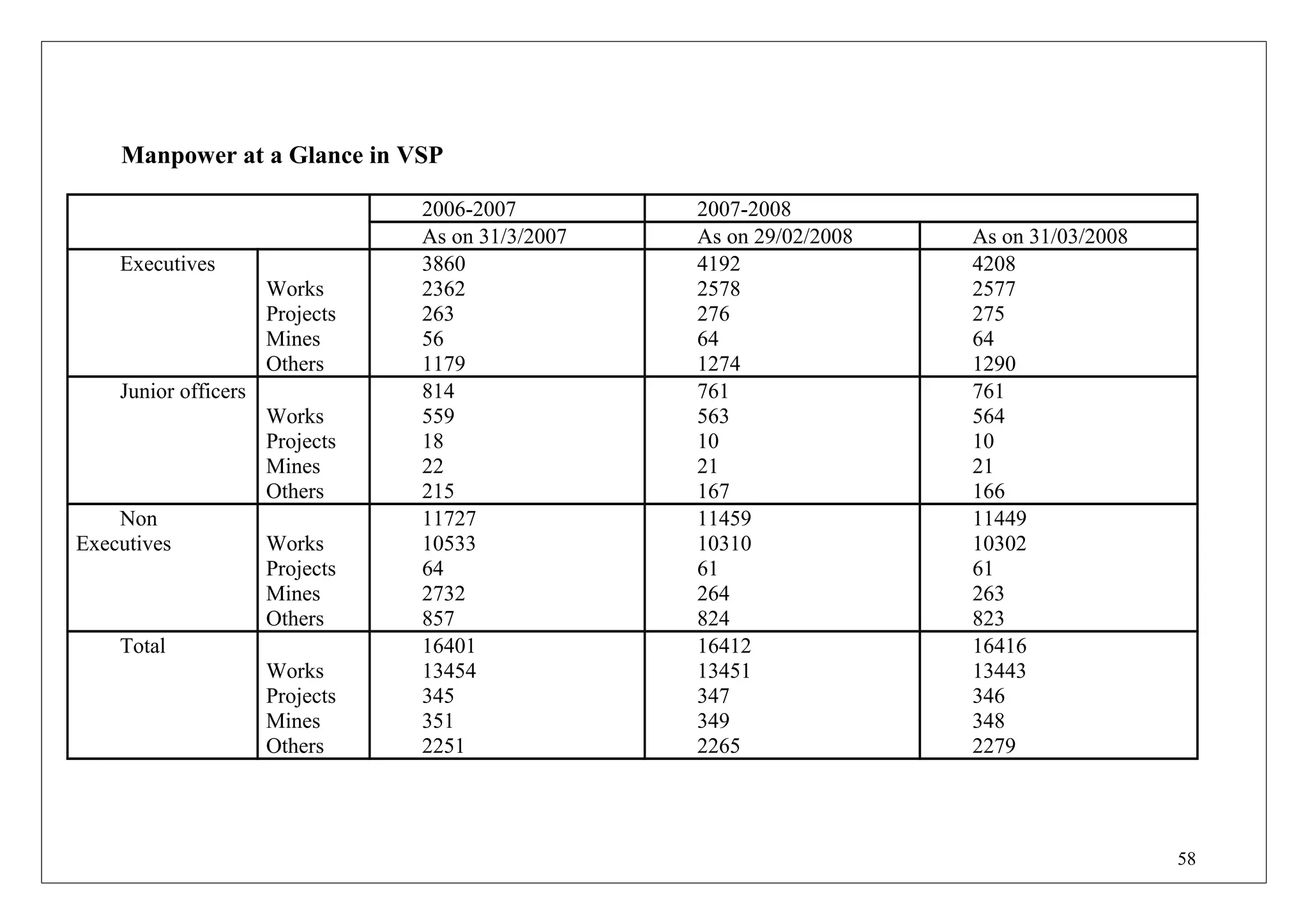
Manpower at a Glance in VSP
2006-2007 2007-2008
As on 31/3/2007 As on 29/02/2008 As on 31/03/2008
Executives
Works
Projects
Mines
Others
3860
2362
263
56
1179
4192
2578
276
64
1274
4208
2577
275
64
1290
Junior officers
Works
Projects
Mines
Others
814
559
18
22
215
761
563
10
21
167
761
564
10
21
166
Non
Executives Works
Projects
Mines
Others
11727
10533
64
2732
857
11459
10310
61
264
824
11449
10302
61
263
823
Total
Works
Projects
Mines
Others
16401
13454
345
351
2251
16412
13451
347
349
2265
16416
13443
346
348
2279
58
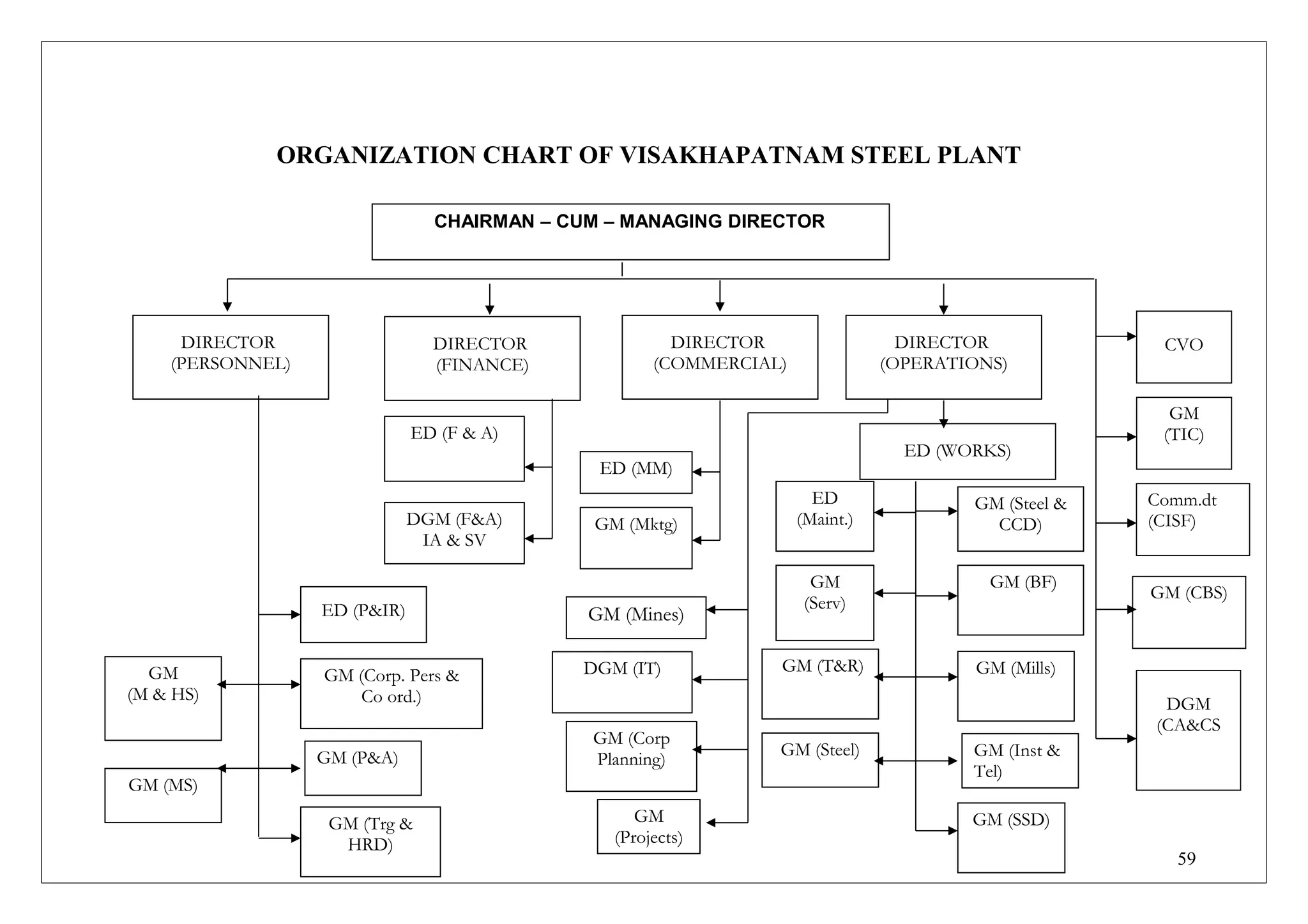
ORGANIZATION CHART OF VISAKHAPATNAM STEEL PLANT
CHAIRMAN – CUM – MANAGING DIRECTOR
DIRECTOR
(PERSONNEL)
DIRECTOR
(OPERATIONS)
DIRECTOR
(COMMERCIAL)
DIRECTOR
(FINANCE)
ED (WORKS)
CVO
GM
(TIC)
Comm.dt
(CISF)
GM (CBS)
DGM
(CA&CS
GM (Steel &
CCD)
GM (BF)
GM (Mills)
GM (Inst &
Tel)
GM (SSD)
ED
(Maint.)
GM
(Serv)
GM (T&R)
GM (Steel)
GM (Mines)
DGM (IT)
GM (Corp
Planning)
GM
(Projects)
ED (MM)
GM (Mktg)
ED (F & A)
DGM (F&A)
IA & SV
ED (P&IR)
GM (Corp. Pers &
Co ord.)
GM (P&A)
GM (Trg &
HRD)
GM
(M & HS)
GM (MS)
59
CUSTOMERS OF STEEL PLANT
THE MAIN CUSTOMERS OF THE STEEL PLANT ARE:
• BUILDERS
• CONSTRUCTION COMPANIES.
• INDIAN RAILWAYS.
• STATE GOVERNMENTS.
• VISAKHA STEEL PRODUCTS ARE ALSO BEING EXPORTED TO OTHER
COUNTRIES
60
COMPETITORS OF STEEL PLANT
• Bharat Refectories Ltd.
• Hindustan Steel Works Construction Ltd.
• Jindal Steel and Power Ltd.
• Tata Iron Steel Company Metal Scrap Trade Corporation Ltd.
• Metallurgical and Engineering Consultants India Ltd.
• National Mineral Development Corporation Ltd.
• Sponge Iron India Ltd.
61
CHAPTER - IV
ETT
4.1 Environment
4.2 Technology
62
Visakhapatnam steel plant technology: state-of-the-art
 7m tall Coke Oven Batteries with coke dry quenching.
 Biggest Blast Furnaces in the country.
 Bell less top changing system in Blast Furnace.
 100% slag granulation at the Blast Furnace cast house.
 Suppressed combustion—LD gas recovery system.
 100% continuous casting of liquid steel.
 ‘Tempcore’ and ‘Stelmor’ cooling process in LMMM & WRM.
 Extensive waste heat recovery systems.
 Comprehensive pollution control measure.
63
ENVIRONMENT
Iron and Steel making as a craft as been known to India for a long time. However,
its production is significant quantities only after 1900.
VSP by successfully installing & operating efficiently Rs. 460 cores worth of Pollution
Control and Environment Control Equipments and converting the barren landscape by planting
more than 3 million plants has made the Steel Plant, Steel Township and surrounding areas into
a heaven of lush greenery. This has made Steel Township a greener, cleaner and cooler place,
which can boast of 3 to 4° C lesser temperature even in the peak summer compared to
Visakhapatnam City.
VSP exports Quality Pig Iron & Steel products' to Sri Lanka, Myanmar, Nepal, Middle
East, USA, China and South East Asia. RINL-VSP was awarded "Star Trading House" status
during 1997-2000. Having established a fairly dependable export market, VSP plans to make a
continuous presence in the export market.
The govt. of India has recognized the importance of steel in Indian industry and
established the following steel plants, before it actually set up VSP/RINL. The details of those
are tabulated below.
64
CHAPTER- IV
THEORETICAL FRAME WORK
65
THEORETICAL FRAMEWORK OF CAPITAL BUDGETING
An efficient allocation of capital is the most important finance function in the modern
times. It involves decisions to commit the firm’s funds to the long - term assets. Capital
budgeting for investment decisions is of considerable importance to the firm since they tend to
determine its value by influencing its growth, evaluation of capital budgeting decisions.
NATURE OF INVESTMENT DECISIONS
The investment decisions of a firm are generally known as the capital budgeting, or
capital expenditure decisions. A capital budgeting decision may be defined as the firm’s
decision to invest its current funds most effectively in the long- term assets in anticipation of an
expended flow of benefits over a series of years. The long-term assets are those that affect the
firm’s operational beyond the one year period.
Investment decisions generally include expansion, acquisition modernization and
replacement of the long-term assets. Sale of a division or business (Divestment) is also an
investment decision. Decision like the change in the methods of sales distribution, or an
advertisement campaign or a research and development program have long-term implications
for the firm’s expenditures and benefit, and therefore, they should also be evaluated as
investment decisions.
The following are the features of investment decisions.
 The exchange of current funds for future benefits.
 The funds are invested in long-term assets.
 The feature benefits will occur to the firm over a series of years.
OBJECTIVES OF INVESTMENT DECISIONS
 Understand the nature and importance of investment decisions.
 Explain the methods of calculating Net present value (NPV) and
Internal rate of return (IRR)
66
 Show the implicated of Net present value (NPV) and internal rate of
Return (IRR)
 Describe the Non- DCF evaluation Criteria. Payback period and
Accounting rate of return (ARR).
 Institute the competition of the discounted payback.
 Compare and contract NPV and IRR and emphasize the superiority of NPV
rule.
PROCESS OF INVESTMENT DECISIONS
Capital Budgeting is a complex process which may be divided into the following phases.
Capital Budgeting Process
1. Identification of investment proposal.
2. Screening the proposal.
3. Evaluation of various proposals.
4. Fixing priorities.
5. Final approval & preparation of capital expenditure budget.
6. Implementing proposal.
7. Performance review.
Identification of investment proposal
The capital budgeting process begins with the identification of investment proposal. The
proposal or idea about potential investment opportunities may originate from the top of
management or may come from the rank and file workers of any department or from any
officers of the organization. The departmental head analyses the various proposals in the light of
the corporate strategies and submits the suitable proposals to the capital expenditures planning
committee in case of large organization or to the officers a concerned with the corporate
strategies and submits the suitable proposals to the capital expenditures. Capital expenditures
67
planning committee in the case of large organization or the officers concerned with the process
of long-term investment decision.
Screening the proposal
The expenditures planning committee screens the various proposals received from
different departments. The committee view these proposals form various angles to ensure that
these are in accordance with the corporate strategies or selection criterion of the firm and also
do not lead to the department imbalances.
Evaluation of various proposals
The next step in the capital budgeting process is to evaluate the profitability of various
proposals. There are many method which may be used for this purpose such as pay back period
method, rate of return method, net present value method, internal rate of return, etc.
All these method of evaluating profitability of capital investment proposals have been
discussed in detail separately in the page of this chapter. It should be classified as below.
i. Independent proposals.
ii. Contingent or dependent proposals and
iii. Mutually exclusive proposals.
Fixing priorities
After evaluating various proposals, the unprofitable proposals may be
rejected straight away. But it may not be possible for the firm to invest
immediately in the all the acceptable proposals due to limitation of funds. Hence,
it is very essentials to rank the various proposals and to establish priorities after
considering urgency, risk and profitability involved there in.
Final approval & preparation of capital expenditure budget
Proposals meeting the evaluation and other criteria are finally approved to be included in
the capital expenditure budget. However, a proposal involving smaller investment may be
68
decides at the lower levels for expenditure action. The capital expenditures a budget lays down
the amount of the estimation expenditures to be incurred on fixed assets during the budget
period.
Implementing proposals
Translating an investment proposal into a concrete project is a complex, time
consuming, and risk- fraught task.
1. Adequate formulation of projects the major reason for delay is insinuate
formulation of projects put differently, if necessary homework in terms of preliminary
comprehensive and detailed formulation of the project.
2. Use of the principle of responsibility accounting Assigning specific
responsibility to project managers for completing the project within the defined time-frame
and cost limits is helpful for expeditious execution and cost control.
3. Use of Network Techniques for project planning and control several network
techniques like PERT (Programme Evaluation Review Techniques) and CPM (Critical Path
Method) are available.
Performance Review
Performance review, or post – completion audit, is a feedback device. It is a means for
comparing actual performance with projected performance. It may be conducted, most
appropriately. When the operations of the project have stabilized.
It is useful several ways.
I. It throws light on how realistic were the assumptions underlying the
project.
II. It provided a documented log of experience that is highly valuable for
decision making.
Importance of Investment Decisions
Investment decisions require special attention because of the following reasons.
 They influence the firm’s growth in the long term.
 They affect the risk of the firm.
 They involve commitment of large amount of funds.
69
 They are irreversible, or reversible at substantial loss.
 They are among the most difficult decisions to make.
Types of investment decisions
There are many ways to classify investments one classification is as follows;
 Expansion of existing business.
 Expansion of new business.
 Replacement and modernization.
Expansion and diversifications
A company may add capacity to its existing product lines to expand existing operations.
For example, the Visakhapatnam Steel Plant (VSP) may increase its plant capacity to
manufactures more liquid steel. It is an example of related diversification.
A firm mat expand is activities in a new business expansion of a new business requires
investment in new products and new kind of production activating within the firm. If packing
manufacturing company invests in a new plant and machinery to produce ball bearings, which
the firm has not manufactured before, this represents expansion of new business or unrelated
diversification. Sometimes a company acquires existing firms to expand its business.
Replacement and modernization
The main objective of modernization and replacement is to improve operating efficiency
reduce costs. Cost savings will reflect in the increased profits, but the firm’s revenue may
remain unchanged. Assets become outdated and absolute with technological changes. The firm
must decide to replace those assets with new assets that operate more economically.
Replacement decisions help to introduce more efficient and economical assets and therefore, are
also called cost- reduction investments.
How ever replacement decisions that involve substantial modernization and
technological improvements expand revenues as well as reduce costs.
Yet another useful way to classify investments is as follows;
 Mutually exclusive investments
 Independent investments
70
 Contingent investments
Mutually exclusive investments
Mutually exclusive investments serve the same purpose and compete with each other. If
one investment understands others will have to be excluded. Accompany May, for example,
either use a more labour- intensive, semi- automatic machine, or employ a more capital
intensive, highly automatic machine for production.
Independent investments
Independent investments serve different purposes and do not compete with each other.
For example, a heavy engineering company may have been considering expansion of its plant
capacity to manufacture additional excavators and addition of new production facilities to
manufacture a new product.
Contingent Investments
Contingent investments are dependent projects; the choice of one investment
necessitates understanding one or more other investments for example, if a company decides to
build a factory in a remote, backward area, it may have to invest in houses, roads, hospitals,
schools, etc., and the total expenditure will be treated as one single investment.
Investment Evaluation Criteria
Three steps are involved in the evaluation of investment.
• Estimation of cash flows
• Estimation of the required rate of return
• (the opportunity cost of capital )
• Application of a decision rule for making the choice.
Evaluation Criteria
A number of investment criteria (or capital budgeting techniques) are in use in practice.
They may be grouped in the following two categories.
71
Capital budgeting techniques
Non DCF Criteria
Payback period (PB)
The payback period (PB) is one of the most popular and widely recognized traditional
methods of evaluating investment proposals. Pay back is the number of years required to
recover the original cash outlay invested in a project.
If the project generates constant annual cash inflows, the payback period can be
computed by dividing cash outlay by the annual cash inflow.
Co : Initial Investment
Payback = Initial Investment Co
Annual cash flow C
Capital Budgeting Techniques
DCF Criteria Non – DCF Criteria
NPV I.R.R. P. I
Payback
period
Accounting
Rate of Return
72
C : Annual Cash in flow
In case of UN equal cash inflows, the payback period can be found out by adding up the
cash inflows until the total is equal to the initial cash outlay.
Accounting Rate of Return (ARR)
The accounting rate of return (ARR) also known as the return on investment (ROI) uses
accounting information, as revealed by financial statements, to measure the profitability of an
investment. The Accounting rate of return is the ratio of the average after fax profit divided by
the average investment. The average investment would be equal to half of the original
investment if it were depreciated constantly.
ARR =
DCF Criteria
Net Present Valued Method (NPV)
The NPV present value (NPV) method is the classic economic method of evaluating the
investment proposals. If is a DCF technique that explicitly recognizes the time value at
different time periods differ in value and are comparable only when their equipment present
values- are found out.
- Co
N P V = Σ - Co
Average income
Average investment
C1 + C2 + C3 + … … … + Cn
(1+k) (1+k)2
(1+k)3
(1+k)n
Ci
(1+k)i
n
i = 0
× 100
NPV =
73
Where
N P V = Net present value
Cfi = Cash flows occurring at time
k = the discount rate
n = life of the project in years
Co = Cash out lay
Internal Rate of Return (IRR)
The internal rate of return (IRR) method is another discounted cash flow technique
which takes account of the magnitude and thing of cash flows, other terms used to describe the
IRR method are yield on an investment, marginal efficiency of capital, rate of return over cost,
time- adjusted rate of internal return and soon.
N P V = Σ +
Where
Cfi = Cash flows occurring at different point of time
k = the discount rate
n = life of the project in years
Co = Cash out lay
SV & WC = Salvage value and Working Capital at the end of the n years.
I R R = A L + (H – L)
B-A
Where
L : Lower discount rate at which NPV is positive
H : Higher discount rate at which NPV is negative
A : NPV at lower discount rate, L
B : NPV at higher discount rate.
Cfi SV+WC
(1+k)i
(1+k)n
n
i = 0
74
Profitability Index (PI)
Yet another time- adjusted method of evaluating the investment proposals is the benefit-
cost (B/C.) ratio or profitability index (PI) Profitability Index is the ratio of the present valued
of cash inflows, at the required rate of return, to the initial cash out flow of the investment.
PI =
Where
PV: Present Value
Cost Effective Analysis
In the cost effectiveness analysis the project selection or technological choice, only the
costs of two or more alternative choices are considered treating the benefits as identical. This
approach is used when the acquisition of how to minimize the costs for undertaking an activity
at a given discount rates in case the benefits and operating costs are given, one can minimize the
capital cost to obtain given discount.
Project Planning
The planning of a project is a technically pre- determined set of inter related activities
involving the effective use of given material, human, technological and financial resources over
a given period of time. Which in association with other development projects result in the
achievement of certain predetermined objectives such as the production of specified goods &
services?
PV of cash inflow
Initial Cash outlay
75
Project planning is spread over a period of time and is not a one shot activity. The
important stages in the life of a project are:
 It’s Identification
 It’s initial formulation
 It’s evaluation (Whether to select or to project)
 It’s final formulation
 It’s implementation
 It’s completion and operation
The time taken for the entire process is the gestation period of the project. The period of
the project. The process of identification of a project begins when we are seriously trying to
overcome certain problems. They may be non- utilization to overcome available funds. Plant
capacity, expansion etc
Contents of the project report
1. Market and marketing
2. Site of the project
3. Project engineering dealing with technical aspects of the project.
4. Location and layout of the project building
5. Building
6. Production capacity.
7. Work Schedule
Details of the cost of the Project
1. Cost of land
2. Cost of Building
3. Cost of plant and machinery
4. Engineering know how fee
5. Expenses on training Erection supervision
6. Miscellaneous fixed assets
76
7. Preliminary expenses
8. Pre-operative expenses
9. Provision for contingencies
Project financing is considered right from the time of the conception of the project. The
proposal of the project progress working capital, so, in general a project is considered as a ‘mini
firm’ is a part and parcel of the organization.
Sources of Finance:
 Loan Financing
 Security Financing
 Internal Financing
Loan Financing
(a) Short- Term Loans & Credits
Short – Term Loans & Credits are raised by a firm for meeting its working capital
requirements. These are generally for a short period not exceeding the accounting period i.e.,
one – year.
Types of Short Term Loans & Credits:
1. Trade Credit.
2. Installment Credit.
3. Advances.
4. Commercial papers
5. Commercial banks
6. Cash Credits
7. Over Drafts
8. Public Deposits.
(b) Term Loans
77
Term loans are given by the financial institutions and banks, which form the primary
source of long term debt for both private as well as the Government organizations. Term loans
are generally employed to finance the acquisition of fixed assets that are generally repayable in
less than 10 years. In addition to short- term loans, company will raise medium term and long
term loans.
Security Financing
Corporate Securities can be classified into two categories.
(a) Ownership Securities or capital stock.
(b) Creditor ship Securities or debt Capital.
(a) Ownership Securities or capital Stock
Types of Ownership Securities or Capital Stock
i) Equity Capital:
Equity Capital is also known as owner’s capital in a firm. The holders of these shares are
the real owners of the company. They have a control over the working of the company.
Different ways to raise the equity capital.
oInitial public offering.
oSeasoned offering
oRights issue.
oPrivate placement
oPreferential allotment.
ii) Preference Capital
These shares have certain preferences as compared to other type of shares.
1. Payment of Divided
2. Repayment of the capital at the time of liquidation of the company.
b) Types of Creditor ship Securities
i) Debentures
Debentures are an alternative to the term loans and are instruments for raising the debt
finance. Debenture holders are the creditors of a company and the company and the company
78
have the obligations to pay the interest and principal at specified times. Debentures provide
more flexibility, with respect to maturity, interest rate, security and repayment Debentures may
be fixed rate of interest or floating rate or may be zero rates. Debentures & Ownership
Securities help the management of the company to reduce the cost of capital.
Internal Financing
A new company can raise finance only through external sources such as shares,
debentures, loans and public deposits. For existing company they need to raise funds through
internal source. Such as retained earnings depreciation as a source of funds. Some other
innovative source of finance.
♦ Venture Capital
♦ Seed Capital
♦ Bridge Finance
♦ Lease Financing
♦ Euro- Issues
a) Equity Capital
1. Infusion of Government equity either from budgetary resources or from Steel
Development Funds (SDF).
2. Induction of equity by agencies/ companies who are setting up separate stand alone
blast furnaces or blast furnace based steel plant complexes without captive coke oven plant.
3. Equity by overseas buyer suppliers of coking coal.
4. Equity by overseas buyer of coke, whom may hedge initial capital invested and
assured by buy – back arrangement for limited number of years.
b) Loan Capital
1. Loan capital from financial installations like TDBI, IFCI, ICICI etc., guaranteed by
the central Government who is the owner of RINI.
2. Surplus credit by major supplier of plant & equipment.
3. Providing loan by agencies that enter into an assured buy- back arrangement at the
terms and condition mutually agreed upon.
79
CHAPTER- VI
ON JOB TRAINING (OJT)
80
TASK ASSIGNED IN VSP
Project Expansion Of VSP:-
VSP is operating at 3.00 M.T. of liquid steel at present. It is framed to
Enhance its capacity to produce 6.3M.T of liquid steel by expansion.
The estimated cost of expansion is:
Approved cost: 11,999 Crs (Base Jun, 2005)
Debt component: 2399.8 Crs.
Assumed in calculation as per rate as 5.5%.
How expansion will affect the capacity in positive way:
81
Year Construction
year
Operation
Year
Capital
cost
Expected
Cash
inflow
Year
no.
Cash
flow
Net cash
2011-12 1 0 10133 0 1 -10133 -10133
2012-13 2 0 933 0 2 -933 -11066
2013-14 3 0 933 0 3 -933 -11999
2014-15 4 1 0 1154.54 4 1154.54 -10844.5
2015-16 5 2 0 2187.04 5 2187.04 -8657.42
2016-17 6 3 0 2718.78 6 2718.78 -5938.64
2017-18 7 4 0 2684.85 7 2684.85 -3253.79
2018-19 8 5 0 2798.69 8 2798.69 -455.1
2019-20 9 6 0 2657.31 9 2657.31 2202.21
2020-21 10 7 0 2298.82 10 2298.82 4501.03
2021-22 11 8 0 2210.36 11 2210.36 6711.39
2022-23 12 9 0 2159.06 12 2159.06 8870.45
2023-24 13 10 0 2140.15 13 2140.15 11010.6
2024-25 14 11 0 2123.82 14 2123.82 13134.42
2025-26 15 12 0 3755.22 15 3755.22 16889.64
82
PAY BACK PERIOD
(a) Cash Outlay: 8692
(c) Payback period: FLOWCASHANNUAL
INVESTMENTINITIAL
= 5 + 11999-11543.9
2657.31
= 5 + 455.1
2657.31
= 5 + 0.171
= 5.171
S.No Years Cash flows
Cumulative Cash
Flows
1 2014-15 1154.54 1154.54
2 2015-16 2187.04 3341.58
3 2016-17 2718.78 6060.36
4 2017-18 2684.85 8745.21
5 2018-19 2798.69 11543.9
6 2019-20 2657.31 14201.21
7 2020-21 2298.82 16500.03
8 2021-22 2210.36 18710.39
9 2022-23 2159.06 20869.45
10 2023-24 2140.15 23009.6
11 2024-25 2123.82 25133.42
12 2025-26 3755.22 28888.64
TOTAL 28888.64
83
PAY BACK PERIOD
Interpretation:
It is assumed that the cash flows from the project would start from 2014-15.Taken
consideration of (incremental adjusted cash flow) i.e. expansion base year, for calculating Pay
Back Period.
• Estimated cash flows are taken from the data provided by the Company.
The calculated payback period of the project is 5.17 years.
Though there is uncertainty of commencement of production from the expansion project
to an extent of 6 months to one year or reduction of cash flows of 5%, the company would
achieve pay back at the year end of 2019-20.
AVERAGE RATE OF RETURN
S.No Years
Cash flow Dep. Cash Inflows after
depreciation
1 2014-15 1154.54 329.972 824.568
2 2015-16 2187.04 659.945 1527.095
3 2016-17 2718.78 659.945 2058.835
4 2017-18 2684.85 659.945 2024.905
5 2018-19 2798.69 659.945 2138.745
6 2019-20 2657.31 659.945 1997.365
7 2020-21 2298.82 659.945 1638.875
8 2021-22 2210.36 659.945 1550.415
9 2022-23 2159.06 659.945 1499.115
10 2023-24 2140.15 659.945 1480.205
11 2024-25 2123.82 659.945 1463.875
12 2025-26 3755.22 659.945 3095.275
TOTAL 28888.64 21299.273
84
ARR =
AVERAGE PROFIT
AVERAGE INVESTMENT
Average Profit =
Total cash inflows
No. of years
= 21299.273
12
= 1774.939
Average investment :
here the additional working capital is also taken the consideration while calculating the
ARR.
Average investment =
investment
2
= 11999
2
= 5999.5
A R R =
= 1774.939
5999.5
0.295
R O I = Average Annual profit
85
Total initial investment
R O I
= 1774.939
11999 X 100
= 0.147 X 100
= 14.7
It is more calculation taking total profit and taking average of it.
It Show the return on an average as what an average income of the firm on
Long run basis with certain assumption 61.14% for any firm at long run is
Good but there must be some decrease as future is not certain.
NET PRESENT VALUE
s.no Years Cash flows 8% Dis flows @ 8%
1 2014-15 1154.54 0.926 1069.104
2 2015-16 2187.04 0.857 1874.293
3 2016-17 2718.78 0.794 2158.711
4 2017-18 2684.85 0.735 1973.365
5 2018-19 2798.69 0.681 1905.908
6 2019-20 2657.31 0.630 1674.105
7 2020-21 2298.82 0.583 1340.212
8 2021-22 2210.36 0.540 1193.594
9 2022-23 2159.06 0.500 1079.530
10 2023-24 2140.15 0.463 990.889
11 2024-25 2123.82 0.429 911.118
12 2025-26 3755.22 0.397 1490.822
TOTAL 17661.651
86
N P V = Total Present Value of Cash inflows – Total Outlay
=17661.651 – 11999
= 5662.651
The NPV method is a modern method of evaluating investment proposals. The method
takes into consideration the time value of money and attempts to calculate the return on
investments by introducing the factor of time element. It recognizes the fact that a rupee earned
today is worth more than the same rupee earned tomorrow.
INTERNAL RATE OF RETURN
Discount rate taken as 18% (in crores)
I R R = 15 + 410.230 X 1
410.23+145.760
= 15 + 410.230 X 1
555.990
= 15 + 0.737 X 1
S.No
Years
Cash flows 15% Dis. flow @
15%
16% Di. flow @ 16%
1 2014-15 1154.54 0.870 1004.450 0.862 995.213
2 2015-16 2187.04 0.756 1653.402 0.743 1624.971
3 2016-17 2718.78 0.658 1788.957 0.641 1742.738
4 2017-18 2684.85 0.572 1535.734 0.552 1482.037
5 2018-19 2798.69 0.497 1390.949 0.476 1332.176
6 2019-20 2657.31 0.432 1147.958 0.410 1089.497
7 2020-21 2298.82 0.376 864.356 0.354 813.782
8 2021-22 2210.36 0.327 722.787 0.305 674.159
9 2022-23 2159.06 0.284 613.173 0.263 567.832
10 2023-24 2140.15 0.247 528.617 0.227 485.814
11 2024-25 2123.82 0.215 456.621 0.195 414.144
12 2025-26 3755.22 0.187 702.226 0.168 630.877
total 28888.64 12409.230 11853.240
Invst.(less) 11999.000 11999.000
NPV 410.230 -145.760
87
= 15.733%
Probability index:
(in crores)
s.no Years Cash flows 8% Dis flows @ 8%
1 2014-15 1154.54 0.926 1069.104
2 2015-16 2187.04 0.857 1874.293
3 2016-17 2718.78 0.794 2158.711
4 2017-18 2684.85 0.735 1973.365
5 2018-19 2798.69 0.681 1905.908
6 2019-20 2657.31 0.630 1674.105
7 2020-21 2298.82 0.583 1340.212
8 2021-22 2210.36 0.540 1193.594
9 2022-23 2159.06 0.500 1079.530
10 2023-24 2140.15 0.463 990.889
11 2024-25 2123.82 0.429 911.118
12 2025-26 3755.22 0.397 1490.822
TOTAL 17661.650
Probability index :-
= Total PV cash flow
Initial investment
=17661.650
11999.000
=1.471
FINDINGS:
88
 The project completion cost is estimated to be Rs.11999. Cr.
 The payback period of the project in VSP is 5 years and 2 months. The payback period is
nearly 1/3 of the 15 years, the economic life project so the project is viable.
 The NPV of the project is positive and higher than the cost of the capital.
 The Internal rate of return is Internal rate of 15.73% it is greater than the cost of capital.
So the project is accepted.
 The estimated cash flows of the project are after payment of interest and tax.
 Expansion from 3.0MT capacity to 6.3MT capacity undertaken is profitable.
 Increase in Debt component is decreasing the Profitability due to the tax on debt as
dividend on equity is not considered as entire equity is held by GOI. Had dividend on
equity is considered, the evaluation will change.
 The completion cost may further increase if any delay in construction process.
SUGGESTIONS
 The project completion cost is estimated to be Rs. 11999. Cr.
89
 The payback period of the project in VSP is 5 years and 2 months. The payback
period is less than the target period so the project may be accepted.
 The NPV of the project is positive than the value of the capital.
 The Internal rate of return is Internal rate of 15.73% it is greater than the cost of
capital i.e., 18% so the project accepted.
 The company has to maintain at 7: 3 (debt: equity), that is better for company.
 It also maintains 60: 40, but equity to be raised.
.
SKILLS REQUIRED
90
• THE SKILLS REQUIRED FOR PERFORMING THIS TASK ARE
OBSERVATION SKILLS.
• THOROUGH VERIFICATION OF THE COMPANY’S FINANCIAL
DATA.
• AS CAPITAL BUDGETING INVOLVES ALL THE ASPECTS OF
FINANCE THERE SHOULD BE THE BASIC KNOWLEDGE OF
FINANCE.
• GOOD COMMUNICATION SKILLS.
91
BIBLIOGRAPHY
♦ ‘The Financial Management’ by I.M.Pandey
♦ ‘Projects’ (preparation, appraisal, implementation) by Prasanna
Chandra.
♦ Source of finance sharma&guptha
♦ Total project management by P.K.Joy.
♦ Successful projects by O.P Kharbanda &E.A Stall worthy.
♦ Project management by Harey maylor.
♦ Project planning and management by M.Shaghil & M.M.M
musterque.
♦ Project management (techniques appraisal managerial issues) by
E.W.Davis.
The journals
 Steel times
 SAILS news.
 Iron & steel technology.
 Steel & materiality.
92

Varsha project

  • 1.
    A STUDY ON CAPITAL BUDGETING SubmittedTo In partial fulfillment of the requirements for the award of the Degree of POST GRADUATE DIPLOMA IN BUSINESS MANAGEMENT Submitted by LADE.VARSHA NIHANTH Roll no. 2013150045 Under the Guidance of C.A.SUDHAKAR REDDY Manager (F & A) RINL, VISAKHAPATNAM STEEL PLANT 2014-15 CMT BUSINESS SCHOOL (Affiliated to AICTE, DELHI) DEPARTMENT OF MANAGEMENT STUDIES MANAGEMENT DEVELOPMENT RASTRIYA ISPAT NIGAM LIMITED 1
  • 2.
    CERTIFICATE This is tocertify that Mr. L.VARSHA NIHANTH of PGDM 2013-15 year bearing registration no: 2013150045 in the CMT BUSINESS SCHOOL CAPITAL BUDGETING” under the guidance & supervision of Mr. C.A.Sudhakar Reddy of finance department, RINL-Visakhapatnam steel plant. The project has been approved by the management development, RINL-VSP and further certificate of the successful completion of the project has been provided for the same. Date: 15-09-2014 Shri.O.R.M.Rao Place: Visakhapatnam AGM (MD) RINL-VISAKHAPATNAM STEEL PLANT 2
  • 3.
    EXTERNAL GUIDE CERTIFICATE Thisis to certify that the project work entitled “CAPITAL BUDGETING” at RASHTRIYA ISPAT NIGAM LIMITED, VISAKHAPATNAMSTEELPLANT is a bonfire work done and submitted in partial fulfillment for the award of the Post-Graduation Diploma And Management by L.VARSHA NIHANTH bearing Registration No. 2013150015 of CENTER FOR MANAGEMENT AND TECHNOLOGY, Affiliated by A.I.C.T.E, Approved by Ministry of HRD, New Delhi under my guidance and supervision during the period from 19-05-2014 to 12-07-2014 at Management Development (MD), RINL-Visakhapatnam Steel Plant. Sri C.A.Sudhakar Reddy Manager [F&A] Place: Visakhapatnam Date: 3
  • 4.
    DECLARATION I hereby declarethat the project entitled A STUDY ON “CAPITAL BUDGETING “ is an original and independent work done by me and has been submitted to the Department of Management Studies, CMT BUSINESS SCHOOL affiliated to AICTE,DELHI in partial fulfillment for the award of degree of “POST GRADUATE DIPLOMA IN MANAGEMENT”. I also declare that this project is the result of my own effort and is not submitted to any University for the award of any Degree or Diploma. Place: Visakhapatnam Date: ACKNOWLEDGEMENT 4
  • 5.
    I take thisopportunity to acknowledge, all the people who rendered their valuable advice in bringing the project to function. I would like to take this opportunity to express my heartful thanks to Mr. Satish, Placement Incharge of CMT Business School Visakhapatnam, for giving me this opportunity to do my project on “capital budgeting” in the esteemed organization. I also express my sincere thanks to my faculty members without whose cooperation I would not have been able to complete the project successfully. As a part of the curriculum at CMT BUSINESS SCHOOL the project enables us to enhance our skills, expand our knowledge by applying various theories, concepts and laws to real life scenario which would further prepare us to face the extremely ‘competitive corporate world’. ABBREVIATIONS FOR DEPARTMENTS • ACS Air Conditioning System • BF Blast furnace • CO&CCP Coke oven & Coal Chemical Plant 5
  • 6.
    • CM(E) CentralMaintenance Mechanical • CMM central Maintenance department • DNW distribution network • EMID environment management department • ERS electrical repair shop • ES&F engineering shop & foundry • ETL electro technical laboratory • MMSM medium merchant & structural mill • RED refectory engineering department • SMS steel melt shop • TTI Technical Training Institute • RED Refractory Engineering Maintenance • RMD Raw Material Department • IT Information Technology • F&A Finance & Accounts • HRD Human Resources Department • D&E Designs & Engineering Department • MKTG Marketing • ERP Entrepreneur Retail Price CONTENTS TITLE PAGE NO. CHAPTER-I 6
  • 7.
    INTRODUCTION NEED FOR THESTUDY OBJECTIVES OF THE STUDY SCOPE OF THE STUDY METHODOLOGY LIMITATIONS CHAPTER-II INDUSTRY PROFILE CHAPTER-III 3C’S COMPANY PROFILE CUSTOMER COMPETITOR CHAPTER – IV ETT ENVIRONMENT TECHNOLOGY CHAPTER – V THEORETICAL FRAME WORK CHAPTER – VI OJT TASK ASSIGNED FINDINGS AND SKILLS REQUIRED BIBLIOGRAPHY CHAPTER – I 7
  • 8.
    INTRODUCTION  Need ofthe study  Objective of the study  Scope of the study  Methodology  Limitations 8
  • 9.
    INTRODUCTION A project isan activity sufficiently self- contained to permit financial and commercial analysis. In most cases projects represent expenditure of capital funds by pre- existing entities which want to expand or improve their operation. In general a project is an activity in which, we will spend money in expectation of returns and which logically seems to lead itself to planning. Financing and implementation as a unit, is a specific activity with a specific point and a specific ending point intended to accomplish a specific objective. To take up a new project, involves a capital investment decision and it is the top management’s duty to make a situation and feasibility analysis of that particular project and means of financing and implementing it financing is a rapidly expanding field, which focuses not on the credit status of a company, but on cash flows that will be generated by a specific project. Capital budgeting has its origins in the natural resource and infrastructure sectors. The current demand for infrastructure and capital investments is being fueled by deregulation in the power, telecommunications, and transportation sectors, by the globalization of product markets and the need for manufacturing scale, and by the privatization of government –owned entities in developed and developing countries. The capital budgeting decision procedure basically involves the evaluation of the desirability of an investment proposal. It is obvious that the firm most have a systematic procedure for making capital budgeting decisions. The procedure for making capital budgeting decisions. The procedure must be consistent with the objective of wealth maximization. In view of the significance of capital budgeting decisions, the procedure must consist of step by step analysis. 9
  • 10.
    NEED OF THESTUDY Capital investments, representing the growing edge of a business, are deemed to be very important for three inter- related reasons. 1. The influence firm growth in the long term consequences capital investment decisions have considerable impact on what the firm can do in future. 2. They affect the risk of the firm; it is difficult to reverse capital investment decisions because the market for used capital investments is ill organized and /or most of the capital equipments bought by a firm to meet its specific requirements. 3. Capital investment decisions involve substantial out lays. Visakhapatnam Steel Plant is a growing concern, capital budgeting is more or less a continuous process and it is carried out by different functional areas of management such a production, marketing, engineering, financial management etc. All the relevant functional departments play a crucial role in the capital budgeting decision process. 10
  • 11.
    OBJECTIVES OF THESTUDY 1. To describe the organizational profile of Visakhapatnam Steel Plant. 2. To discuss the importance of the management of capital budgeting. 3. Determination of proposal and investments, inflows and out flows. 4. To evaluate the investment proposal by using capital budgeting techniques. 5. To summarize and to suggest for the better investment proposal. 11
  • 12.
    SCOPE OF THESTUDY The study has been conducted to understand the position of the industry and various functional areas of the company and their operations. The study mainly focuses on Capital Budgeting of the company. Keep in view the accessibility and availability of the data sources 10% has been choosen for the purpose of study. This study causes 2003-2009 and it is limited only to the perception of the personal belonging to “RASTRIYA ISPAT NIGAM LIMITED”. METHODOLOGY 12
  • 13.
    The information forthe study is obtained from two sources namely. 1. Primary Sources 2. Secondary Sources Primary Sources: It is the information collected directly without any references. It is mainly through interactions with concerned officers & staff, either individually or collectively; some of the information has been verified or supplemented with personal observation. These sources include. 1. Thorough interactions with the various department Managers of VSP. 2. Guidelines given by the Project Guide, Sri C.A.Sudhakar Reddy, Manager (Staff), Budget Section, F & A. Secondary Sources: This data is from the number of books and records of the company, the annual reports published by the company and other magazines. The secondary data is obtained from the following. a) Collection of required data from annual records, monthly records, internal Published book or profile of Visakhapatnam Steel Plant. b) Other books and Journals and magazines c) Annual Reports of the company. LIMITATIONS 13
  • 14.
    Though the projectis completed successfully a few limitations may be there. a) Since the procedure and polices of the company will not allow to disclose confidential financial information, the project has to be completed with the available data given to us. b) The period of study that is 6 weeks is not enough to conduct detailed study of the project. c) The study is carried basing on the information and documents provided by the organization and based on the interaction with the various employees of the respective departments. d) Lack of knowledge. Some of the lack full-fledged knowledge of the concept and its difficult to collect a specific opinion from them. e) Time limitation. The duration of the project is short to collect the required information accurately. 14
  • 15.
  • 16.
    Steel is analloy of iron usually containing less than 1% carbon is a versatile material with multitude of useful properties used most frequently in the automotive and construction industries. Steel can be cast into bars strips, sheets, nails, spikes, wire, rods or pipes as needed by the intended user. The consumption of steel is regarded as the index of industrialization and the economic maturity any country has attained. The development of steel industry in India should be viewed in conjunction with the type and system of government that had been ruling the country. The production of steel in significant quantity started after 1990 .The growth of steel industry can be conveniently started by dividing the period in to pre and post independence era. In the period of pre independence, steel production was 1.5 million tones per year, which was raised to 9 million tones of target. This is the result of the bold steps taken by the government to develop this sector. Growth of Steel Industry: Pre-independence 1830 - Josiah, Marshall Health constructed the first manufacturing Plant at port Move in Madras presidency. 1874 - James Erskin founded the Bengal iron works. 1899 - Jamshedji Tata initiated the scheme for an integrated steel plant. 1906 - Formation of TISCO. 1911 - Tata iron & steel company started production. 1916 - TISICO was founded. Post-independence 1951-56 - First Five Year Plan.  No new steel plant came up .The Hindustan steel Ltd. was born on 19th January, 1954 with the decision of setting up three steel plants each with one million tone input steel per year in at Rourkela, Bhilai and Durgapur; TISCO stated its expansion program. 1956.61 - Second Five Year Plan 16
  • 17.
     A bolddecision was taken up to increase the ingot steel output India to 6 Million tons per year & production at Rourkela, Bhilai and Durgapur steel plant started. 1961.66 - Third Five Year Plan  During the third five year plan the three steel plants under HSL; TISCO & HSCO were expanded as show. In January 1964 Bokaro steel plant came into existence. 1966.69 - Recession Period  The entire expansion program was actively executed during this period. 1969-74 -Fourth Five Year Plan  Licenses were given for setting up of many mini steel plants and re-rolling mills.  Govt. Of. India accepted setting up two more steel plants in south. One each at Visakhapatnam and Hospet (Karnataka).  SAIL was formed during this period on 24th January, 1973. The total installed capacity from 6 integrated plants was 106 Mt. 1979 - Annual Plan  The erstwhile Soviet Union agreed to help in setting up the Visakhapatnam steel plant. 1980.85 - Sixth Five Year Plan  Work on Visakhapatnam steel plant was started with a big bang and top priority was accorded to start the plant.  Scheme for modernization of Bhilai steel plant, Rourkela, Durgapur, TISCO were initiated. 1985-91 - Seventh Five Year Plan  Expansion work of Bhilai and Bokaro steel plants completed.  Progress on Visakhapatnam steel plant picked up and rationalized concept has been introduced to commission the plant with 3.0Mt liquid steel capacity by 1990. 1991-96 - Eight Five Year plan 17
  • 18.
     Vishakhapatnam steelplant started its production modernization of other steel plants is also duly envisaged. 1997-2002 - Ninth Five Year Plan  Visakhapatnam steel plant had foreseen a 7% growth during the entire plan period. 2002-2007 - Tenth Five Year Plan  Steel industry registers the growth of 9.9 % Visakhapatnam steel plant high regime targets achieved the best of them. 2007-2012 - Eleventh Five Year Plan  Cost of schemes/project original approved by Government of India is Rs.9,569.18 crores The major steel and related companies in India 1. Bharat Refectories Ltd. 2. Hindustan Steel Works Construction Ltd. 3. Jindal Steel and Power Ltd. 4. Tata Iron Steel Company Metal Scrap Trade Corporation Ltd. 5. Metallurgical and Engineering Consultants India Ltd. 6. National Mineral Development Corporation Ltd. 7. Rashtriya Ispat Nigam Ltd. 8. Sponge Iron India Ltd. 9. Steel Authority India ltd. The global steel industry has witnessed several revolutionary changes during the last century. The changes have been in the realms of both technology & business strategy. The ultimate object of all these changes is to remain competitive and open global market. The Indian steel industry is growing very rigorously with the major producers like SAIL, RINL, TISCO, JVL and many others. Our steel industry has amply demonstrated its ability of adopt to the changing scenario and to survive in the global market that is becoming increasingly 18
  • 19.
    competitive. This hasbeen possible to a large extent due to the adoption of innovative operating practices and modern technologies. Industrial Development in India has reached a high degree of self-reliance, and the steel industry occupies a primary place in the strategy for future development. At present the production of steel industry country is 34Mt. the public sector steel industry has been restructured to meet challenges and a separate fund has been established for modernization and future development of the industry. It is now being proposed that Indian steel industry should Gear up to achieve a production level of about 100 Mt by the year 2000. Global scenarios As per IISI  In March’ 2005 world Crude steel output was 928Mt when compared to march 2004 (872Mt), ∙The change in percentage was 6.5%.  China remained the world largest crude steel producer in 2005 also (275Mt) followed by Japan (96Mt) and USA (81Mt). India occupied 8th position (42Mt).  USA remained the largest importer of semi finished and finished products in 2002 followed by China and Germany.  Japan remained the largest exporter of semi finished and finished steel products in 2002 followed by Russia and Ukraine.  Other significant recent developments in the global steel scenario have been: Under the auspices of the OECD (Organization for Economic Co-operation & Development) the negotiations among the major steel producing countries for a steel subsidy agreement (SSA) held in 2003 with the objective to agree on a complete negotiating test for the SSA by the Middle of 2004. It also set subsidies for the steel industry of a ceiling of 0.5% of the value of production to be used exclusively for Research & Development Market scenarios The year 2004-05 was a remarkable one for the steel industry with the world crude steel production crossing the one billion mark for the first time in the history of the steel industry. The 19
  • 20.
    world GDP growthabout 4% lends supports to the expectations the steel market is all set for strong revival after prolonged period of depression .The Indian economy also become robust with annual growth rates of 7-8 % this will provide a major boost the steel industry. With the nations focus on infrastructure development coupled with the growth in the manufacturing sector, the Indian steel industry all set for north ward movement. The draft national steel police envisage production of 60 Mt by 2012 and 110Mt by2020, and annual growth rate of 6-7%. All this should therefore augur well for the Indian steel industry. Production scenarios  Steel industry was de-licensed and decontrolled in 1991&1992 respectively.  India is the 8th largest producer of steel in the world.  In 2003-04 finished steel production was 36.193Mt.  Pig iron production in 2003-04 was 5.221Mt.  Sponge iron production was 80.85 Mt during the year 2003-04  The annual growth rate of crude steel production in 2002-03was 8% and in 2003-04 was 6%. The last five year production performance is as under (In Million tons) YEAR PIG IRON SPONGE IRON FINISHED STEEL 2000-01 3.39 5.44 29.27 2001-02 4.08 5.44 30.63 2002-03 5.28 6.44 33.67 2003-04 3.76 8.09 39.12 2004-05 3.18 9.93 41.15 2005-06 4.39 0.00 30.84 2006-07 3.52 0.00 31.40 2007-08 5.28 20.37 56.07 2008-09 6.21 21.09 57.16 2009-10 5.88 24.33 60.62 2010-11 5.68 25.08 68.62 20
  • 21.
    2011-12 5.78 20.3773.42 2012-13 5.36 22.18 85.33 DEMAND-AVAILABILITY PROJECTION  Demand-Availability of iron and steel in the country is projected by ministry of steel annually.  Gaps in availability are met mostly through imports.  Interface with consumers by way of Steel Consumer Council exists, which is conducted on regular basis.  Interface helps in redressing availability problems, complaints related to quality. PRICING & DISTRIBUTION  Price regulation of iron & steel was abolished on 16-01-1992.  Distribution controls on iron& steel removed except 5 priority sectors, viz. Defense, Railways, Small Scale Industries Corporations, Exporters of Engineering Goods and North Eastern region.  Allocation to priority sectors is made by Ministry of steel.  Government has no control over prices of iron & steel.  Open market prices are generally on rise.  Price increases of late have taken place mostly in long products than flat products. 21
  • 22.
  • 23.
    Steel comprises oneof the most important resources of the economy. History shows that, the strongest of civilizations have evolved quickly in the course of time, because of the proper use of the iron and steel reserves they had. The huge iron pillars at the entrance of New Delhi suggest that the history of iron and steel industry in India is well over 2000 years old. Steel comprises one of the most important inputs to all sectors of the economy. Steel Industry is both a basic and a core Industry. The economy of any nation depends on a strong base of Iron and Steel Industry in that nation. History has shown that the countries having a strong potential for Iron and Steel Industry have played a prominent role in the advancement in the civilization in the world. Steel is such a versatile commodity that every object we see in our day- to-day life had use, such as small items as nails, pins, needles etc., to surgical instruments, agricultural implements, boilers, ships, railway materials, automobile parts. The great investments that has gone into the fundamental research in Iron and Steel Technology has helped both directly and indirectly many modern fields of today’s science and technology. Steel is versatile and indispensable item. The versatility of steel can be traced mainly of three reasons. 1. It is only metallic item, which can be conveniently and economically produced in tonnage quality. 2. It has got very good strength coupled with malleability. 3. Its properties can be changed over a wide range. Its properties can be manipulated to any extent by proper heat treatment techniques. Visakhapatnam steel plant profile To meet the growing domestic needs of steel, Government of India decided to set up an integrated Steel plant at Visakhapatnam. An agreement was signed with erstwhile USSR in 1979 for cooperation insetting up 3.4 million tones integrated Steel Plant at Visakhapatnam. The foundation was laid by the then Prime Minister Mrs. Indira Gandhi on 20th January 1971. 23
  • 24.
    The Project wasestimated to cost Rs.3, 897.28 cores based on prices as on 4th Quarter of 1981. However, on completion of Construction of the whole Plant in 1992, the cost escalated to around 8500 Cr. Unlike other integrated Steel Plants in India, Visakhapatnam Steel Plant is one of the most modern Steel Plants in the country. The plant was dedicated to the nation on 1st August 1992 by the then Prime Minister, P.V.Narasimha Rao. New Technology, large-scale computerization and automation etc., are incorporated in the Plant. To operate the plant at international levels and attain such lab our productivity, the organizational manpower has been rationalized. The plant has a capacity of producing 3.0 MT of liquid steel and 2,656Mt of saleable steel. Major sources of raw materials Water supply Operational water requirement of 36 Mgd is being met from the Yeleru Water Supply Scheme. Power supply Operational Power requirement of 180 to 200 MW is being met through captive Power Plant. The capacity of the power plant is 286.5 MW. Visakhapatnam Steel Plant is exporting 60MW power to Andhra Pradesh State Electricity Board. Major Units Raw Materials Source Iron Ore Lumps & Fines Bacheli, Chattisgarh/Gua, Jharkhand BF Lime Stone Jaggayyapeta, AP SMS Lime Stone UAE BF Dolomite Madharam, AP SMS Dolomite Madharam, AP Manganese Ore Chipurupalli, AP Boiler Coal Talcher, Orissa Coking Coal Australia Medium Coking Coal (MCC) Gidi/Swang/Rajarappa/Kargali 24
  • 25.
    Depa rtme nt Annual Capacity (‘000 T) Units (3.0MT Stage) Coke Ovens 2,261 4 Batteries of 67 Ovens & 7 Meters. Height Sinter Plant 5,256 2 Sinter Machines of 312 Sq. Meters. grate area each Blast Furnace 3,400 2 Furnaces of 3200 Cu. Meters. volume each Steel Melt Shop 3,000 3 LD Converters each of 133 Cu. Meters. Volume and Six 4 strand bloom casters LMMM 710 4 Strand finishing Mill WRM 850 4 Strand high speed continuous mill with no twist finishing blocks MMSM 850 6 STAND FINISHING MILL Main Products of VSP Steel Products By-Products Blooms Nut Coke Granulated Slag Billets Coke Dust Lime Fines Channels, Angles Coal Tar Ammonium Sulphate Beams Anthracene Oil Squares HPN aphthalene Flats Benzene Rounds Toluene Re-bars Zylene Wire Rods Wash Oil Vision • To be a continuously growing world class company • We shall Harness our growth potential and sustain profitable growth. • Deliver high quality and cost competitive products and be the first choice of customers. • Create an inspiring work environment to unleash the creative energy of people. 25
  • 26.
    • Achieve excellencein enterprise management. • Be a respected corporate citizen, ensure clean and green environment and develop vibrant communities around us. Mission To attain 16 Mt liquid steel capacity through technological up-gradation, operational efficiency and expansion; augmentation of assured supply of raw materials; to produce steel at international Standards of Cost & Quality; and to meet the aspirations of stakeholders. Objectives ● Expand plant capacity to 6.3 million ton by 2011-12 with the Mission to expand further in subsequent phases as per the corporate plan. • Revamping existing Blast Furnaces to make them energy efficient to contemporary levels and in the process increase their capacity by 1 Mt, thus total hot metal capacity to 7.5 Mt ● be amongst top five lowest cost steel producers in world by 2009-10. ● Achieve higher levels of customer satisfaction. ● Vibrant work culture in the organization. ● be proactive in conserving environment, maintaining high levels of safety and addressing social concerns. Core values  Commitment.  Customer Satisfaction.  Continuous Improvement.  Concern for Environment.  Creativity & Innovation. 26
  • 27.
    Quality Policy Visakhapatnam SteelPlant Employees are committed to meet the needs and expectations of our customers and other interested parties. To accomplish this, they will  Supply quality goods and services to customers delight.  Achieve quality of the products by following systematic approach through planning, documented procedure and timely review of quality objectives.  Continuously improve the quality of all materials, processes and products.  Maintain an enabling environment, which encourages teamwork and active involvement of all employees with their involvement. Environment Policy Visakhapatnam Steel Plant carrying out its operations without harming to the environment. To accomplish this, they will  Document, implement, maintain and continuously review the environmental management system.  Comply with all the relevant environmental legislations, regulations and other requirements.  Ensure continual improvement in the environmental performance and prevention of pollution by minimizing the emissions and discharges.  Maintain a high level of environmental consciousness amongst employees.  Review the environmental objectives and targets on a continuous basis. Energy Policy Visakhapatnam Steel Plant is committed to optimally utilize various forms of energy in a cost-effective manner to effect conservation of energy resources. To accomplish this, they will:  Monitor closely and control the consumption of various forms of energy through an effective Energy Management System. 27
  • 28.
     Adopt appropriateenergy conservation technologies.  Maximize the use of cheaper and easily available forms of energy. Oshas Policy Visakhapatnam Steel Plant is committed to occupational health and safety of employees and contract workers. To accomplish this, the will,  Document, implement, maintain and periodically review the occupational health and safety management system including the policy.  Comply with the relevant occupational health and safety legislations, regulations and other requirements.  Ensure continual improvement in the environment performance and prevention of pollution by minimizing the emissions and discharges.  Maintain a high level of environmental consciousness amongst employees.  Review the environmental objectives and targets on a continuous basis. Human Resource Policy Visakhapatnam Steel Plant is committed to create an organizational culture, which nurtures employee’s potential for the prosperity of the organization. To accomplish this, they will,  Identify development needs of the employees on a regular basis, provide the necessary training and continually evaluate and monitor the effectiveness of the training so that the quality of the training also gets updated.  Provide inputs to the employees for developing their attitude towards work and for matching their competencies with organizational requirements. 28
  • 29.
     Create anenvironment of learning and knowledge sharing by providing the means and facilities and also access to the relevant information and literature.  Facilitate the employees for continuous development of their knowledge base, skills, efficiency, innovativeness, self-expression and behavior so that they contribute positively with commitment for the growth and prosperity of the organization while maintaining a high level of motivation and satisfaction.  Prepare employees through appropriate development programs for taking up higher responsibilities in the organization. Customer Policy  VSP will endeavor to adopt a customer-focused approach At all times with transparency.  VSP will strive to meet more than the customer needs and expectations pertaining to products, quality, and Value for money and satisfaction.  VSP greatly values its relationship with customers and would make efforts at strengthening these relations for Mutual benefit. I.T. Policy  RINL/VSP is committed to leverage Information Technology as the vital enabler in improving the customer-satisfaction, organizational efficiency, productivity, decision- making, transparency and cost-effectiveness, and thus adding value to the business of steel making. Towards this, RINL shall:  Follow best practices in process Automation & Business Processes through IT by in-house efforts / outsourcing and collaborative efforts with other organization / expert groups / institutions of higher learning, etc., thus ensuring the quality of product and services at least cost. 29
  • 30.
     Install, maintainand upgrade suitable cost-effective IT hardware, software and other IT infrastructure and ensure high levels of data and information security  Strive to spread IT-culture amongst employees based on organizational need, role and responsibilities of the personnel and facilitate the objective of becoming a World-Class business organization.  Enrich the skill-set and knowledge based of all related personnel at regular intervals to make employees knowledge-employees.  Periodically monitor the IT investments made and achievements accrued to review their cost effectiveness. Major Departments Raw Material Handling Plant VSP annually requires quality raw materials viz. Iron Ore fluxes (Lime stone, Dolomite); coking and none coking coals etc. to the tune of 12-13 Million Tones for producing 3 Million Tones of Liquid Steel. To handle such a large volume of incoming raw materials received from different sources and to ensure timely supply of consistent quality of feed materials to different 30
  • 31.
    VSP consumers, RawMaterial Handling Plant serves a vital function. This unit is provided with elaborate unloading, blending, stacking & reclaiming facilities viz. Wagon Tipplers, Ground & Track Hoppers, Stock yards Crushing plants, Vibrating screens, Single/ twin boom stickers, wheel on boom and Blender reclaimers. In VSP peripheral unloading has been adopted for the first time in the country. The Raw Material Handling Plant (RMHP) Department procures the different raw materials from various sources. The following are the important raw material handled by the RMHP Department. Iron Ore Coal Dolomite Limestone Manganese Sand The RMHP department dispatches the raw material to other departments only after screening the material. Coke Oven Department The main function of this department is to convert the coal in to coke, which is received from RMHP Department. Coke is a hard porous mass obtained by functional distillation of coal in absence of air at a temperature above 125o C for a period of 16-18 hours. It is used as a fuel and reducing agent for reduction of iron ore in blast furnace. The following are the parameters of Coke Ovens: Number of batteries 4 Number of ovens in batteries 67 Coal handling capacity of ovens 31.6 tones Dimensions of oven 16m length x 7m height 31
  • 32.
    Besides coke production,a number of coal chemicals are being extracted in coal chemical plants. The coal chemicals are tar, benzyl and ammonia based products. The coal is not consumed directly because coke helps in reducing the pollution. Sinter Plant Department Sinter is a hard and porous lump obtained by agglomeration of lines of iron ore, coke, limestone and metallurgical waster. This department by not wasting the powder and small pieces of iron ore coal manganese, dolomite and limestone makes Sinter Cakes and put it for reuse. This increases the productivity of Blast Furnace, improves the quality of pig iron and decreases the consumption of coke rate. 32
  • 33.
    Blast Furnace Pig iron/hotmetal is produced in blast furnace. The furnace is named as blast furnace as it is running with blast at high pressure with a temperature of 1150o C. Raw materials required for iron making are iron ore, sinter coke and limestone. For one tone of hot metal production, 310Kgs. iron ore, 1390Kgs. sinter and 627Kgs. of coke with some other additives. For production of pig iron/hot metal there are two blast furnaces named Godavari and Krishna. They are of the largest and most modern furnaces in the country. 33
  • 34.
    Steel Melt Shop Hotmetal produced in blast furnace contains impurities like carbon, sulphur, phosphorus, silicon, etc.; these impurities will be removed in steel making by oxidation process. There are three LD converters to convert hot metal in to steel, after the conversion of hot metal in to steel, the steel is subjected to homogenization treatment and cast in to blooms in continuous casting machines. 34
  • 35.
    Rolling Mills Blooms cannotbe used as they are in daily life. These blooms have to reduce in size and properly shaped to fit for various jobs. Rolling is one of the mechanical processes to reduce larger size sections in to smaller cones. The cast blooms are heated and rolled in to various long products of different specifications at three high capacity sophisticated high-speed rolling mills. Wire Rod Mill WRM is a stand mill and is fully automated with computers. The mill consists of 2.5 stands and a capacity of 850,000 tonnes per annum. The mill product mix includes rounds and ribbed wire in the sizes of 5.5 mm to 12.7 mm dia. wire rods are made in coil having maximum weight of 1200 Kgs. Liquid Steel produced in LD Converters is solidified in the form of blooms in continuous Bloom Casters. However, to homogenize the steel and to raise its temperature, if needed, steel is first routed through, Argon rinsing station, IRUT (Injection Refining & Up temperature) / ladle Furnaces. Wire Rod Mill is fully automated & sophisticated mill. The billets are rolled in 4 strand, high-speed continuous mill having a capacity of 8, 50,000 Tonnes of Wire Rod Coils. The mill produces rounds in 5.5 - 14 mm range and rebars in 8, 10 & 12 mm sizes. The mill is equipped with standard and Retarded Stelmore controlled cooling lines for producing high quality Wire rods 35
  • 36.
    in Low, Medium& High carbon grade meeting the stringent National & International standards viz. BIS, DIN, JIS, BS etc. and having high ductility, uniform grain size, excellent surface finish. Medium Merchant & Structural Mill (MMSM) This mill is a high capacity continuous mill. The feed material to the mill is 250 x 250 mm size bloom, which is heated to rolling temperatures of 1200 °C in two walking beam furnaces. The mill is designed to produce 8,50,000 tons per annum of various products such as rounds, squares, flats, angles (equal & unequal), T bars, channels, IPE beams I HE beams (Universal beams) . 36
  • 37.
    AUXILIARY FACILITIES Power Generation& Distribution The average power demands at all units of VSP when operating the full capacity will be 221 MW. The captive generation capacity of 270 MW is sufficient to meet all the plant needs in normal operation time. In case of partial outage of captive generation capacity due to break down, shutdown or other reasons. The short fall of power is availed from APSEB grid. The agreement with APSEB provides for exporting of surplus power to APSEB. The captive generating capacity comprises of - TPP -247.5 MW (3x60 MW + 1 X 67.5 MW) - Back pressure Turbines (C&CCD)* - 2 x 7.5 MW - Gas Expansion Turbines (BF / ces)* - 2x12 MW (*Power availability from BPT & GET is around 22MW) Power plant also meets the Air Blast requirements of Blast Furnaces thro' 3 Turbo blowers each of 6067 NM 3 / hr capacity. Power from APSEB is received at Main Receiving Station thro' 220KV overhead distribution lines. The entire plant is configured as 5 electrical load blocks (LBSS 1 to 5) and step- down substations are provided in each block with 220 KV transformers to step down to 33/11/6.6 KV for further distribution. Traffic Department A steel plant of the size of VSP has to handle around 60 to 65 MT traffic comprising of incoming traffic in the form of raw materials and outgoing traffic in the form of finished or saleable steel, and also the in process traffic such as cast pig iron, mill scrap, hot metal. Of this 50% is transported by belt conveyors, 45% by Rail Transport and 5% by Road. VSP has the distinction of having peripheral unloading system for the 1st time in Steel Industry. To handle this huge quantities of traffic, VSP has a fleet of 31 locomotives, Hot Metal ladle cars, Torpedo ladle cars, Captive wagons of different types, 5 internal Railway stations, loco and wagon repair shop, number of weigh bridges. Engineering shops & Foundry (ES & F) 37
  • 38.
    Engineering Shops areset up to meet the requirements of Ferrous & Non Ferrous spares of different departments. This complex is divided into 1. Forge Shop 2. Structural shop 3. Foundry 4. Central machine shop 5. Wood Working Shop and 6. Utility Equipment Repair Shop (UERS). The Forge shop is designed for production of shafts, coupling flanges etc. and also of forge shapes such as crusher hammer heads, special bolts, nuts etc. In the Structural shops the fabricated structural of about 4500 Tonnes are produced annually and the input consisting of sheets, plates, channels, angles beams etc. In Foundry Iron castings up to a weight of 5 tons and non-ferrous casting up to a weight of 1 ton are produced. 2600 Tonnes of iron castings and 200 tones of non- ferrous castings are produced annually. In steel foundry, steel casting up to maximum piece weight of 10T is produced. Steel ingots up to 1.3 Tonnes for forging are also produced. In the Central Machine Shop, various spares are made. The machining section has over 100 major machine tools including lathes, milling, boring, planning, slotting, shaping, grinding and other machines. The Wood working Shop manufactures patterns for foundries. The shop will require 300 Cu.m. Per year of wooden patterns. Central Maintenance Electrical Maintenance of all H.T motors, L.T motors and DC motors of above 200KW. There are 810 such large rotating electrical machines spread throughout the plant including 3 Nos. of 60 MW Turbo-Generators, 1 No of 67.5M TG in TPP, 2 no's of Back Pressure Turbo Generators of 7.5 MW each and 2 Nos. of Gas Expansion Turbo- Generator of 12 MW each. The services provided are as mentioned below. a) Repairs, Maintenance and condition monitoring of all rotating Electrical machines of the plant. The job includes transportation, Overhauling and re-erection with precision alignment. b) Maintenance of Electrics of all streetlights, Tower lights and Weigh Bridges throughout the plant. Electro Technical Laboratory 1) Repairs all the defective electronic PCB’s, which are taken out from the equipment during their functioning. 2) Procures and arranges spare PCB’s for the equipment of PLC’s and drive controls for motors in the plant and also for UPS systems. 3) Involves in the plant modernization activities and up gradation of equipment. 38
  • 39.
    Electrical Repair Shop(ERS) ERS is a central repair shop to carry out repair activities like overhauling, rewinding, testing etc., of various types of AC Motors, DC Motors, HT Motors, Submersible pumps, Distribution transformers, Welding Machines, Control Transformers, Lifting magnets, Coils etc., of the plant. The Main Functions of ERS are: a) Overhauling of motors b) Rewinding of motors, magnets, transformers, pumps, coils etc. c) Testing of Electrical equipment d) Emergency Site Repairs e) Performance assessment of electrical motors Utilities Department Utilities dept. Consists of 1. Air Separation Plant 2. Compressor Houses 3. Chilled water plants and Acetylene plants. The ASP is designed to meet the maximum daily demand of gaseous oxygen, gaseous nitrogen and gaseous argon. Compressor Houses produce Compressed Air required for the operation of pneumatic devices, for instruments and controls, pneumatic tools and for general purpose in the various production units of Steel Plants. Chilled Water plants ( 2 No's ) produce chilled water required for use in the ventilation and air conditioning system in areas such as office rooms, electrical control room etc. Acetylene plant produces Acetylene gas required for general purpose cutting and welding. Quality Assurance and Technological Development (QA &TD) The QA & TD dept. has been set up to take care of activities pertaining to Quality Control of Raw Materials, Semi finished products and finished products. The QA & TD labs are provided at major department like CO&CCP, SP, BF, SMS, and Rolling Mills etc., in addition to Central Laboratory. The department monitors the process parameters for production of quality products. QA & TD carries out analysis, testing and final inspection including spark testing of finished prod- ucts and assigns grades to them. Calcining & Refractory Material Plant: 39
  • 40.
    CRMP consists oftwo units - Calcining Plant & Brick Plant. In Calcining plant limestone & dolomite are calcined for producing lime & calcined dolomite, which are used for refining of steel in the converters. Roll shop & Repair shop: Roll shop & Repair shop is in the complex of Rolling Mills catering to the needs of mills in respect of roll assemblies, guides few Maintenance spares and roll pass design. Geographically this dept. is in three areas as roll shop-1, Roll shop-II and Area Repair Shop. The main activities of this shop is Roll pass Design, grooving of rolls, assembly of rolls with bearings, preparation of guides and their service and manufacture / repair of mill maintenance spares. For the first time in the country, VSP has adopted CNC technology for grooving of steel rolling mill rolls. High constant respective accuracy, higher productivity, use of standard tool for any groove turning, elimination of the use of different templates, easier to incorporate groove modification etc., are some of the advantages of CNC lathes over the conventional one. Plant Design Major functions of this unit are • Development of detailed Manufacturing Drawing and Replacement Specification drawings • Suggesting New Designs and detailing by doing elaborate engineering study and Analysis • Standardization Works Contracts Department • Obtaining administrative approval on receipt of proposal from indenting departments, tendering and awarding of work • Converting tender committee meetings and preparing recommendations forwarding work. • Preparing COM/Board Note for decisions at those forum Participating in claims and arbitration proceedings and legal cases pertaining to contracts • Registration for agencies under various categories & classes of works periodically. 40
  • 41.
    FUNCTIONS OF VARIOUSDEPARTMENTS OF RINL/VSP: Directorate of Operations Production Planning and Control  Formulation of long term production plans and infrastructure support.  Formulation of Annual and Monthly production plan. This involves detailed planning for product mix and value added steel along with Marketing Dept.  Analyzing Plant performance against targets on a periodic basis and taking necessary corrective actions. Techno-economic and Quality Formulation of techno-economic norms and energy management parameters and reviewing the same against targets periodically. Inputs and Basic Infrastructure  Long term and short term planning for procurement of raw materials like Imported Coking Coal (ICC), Medium Coking Coal (MCC), Boiler Coal, Iron Ore Fines and Iron Ore Lumps etc.,  Formulation of Annual Inward and Outward traffic movement plan for raw materials and finished products in consultation with Marketing and Material Management Depts. Repairs and Maintenance Planning  Planning of major Capital Repairs, Shutdowns, Spares requirement and ensuring preparedness before taking up the repairs. Mines planning  Formulation of annual and monthly production plans for BF limestone, BF grade dolomite, Mn Ore and Sand at VSP Captive Mines. 41
  • 42.
     Monitoring ofproduction and dispatch of Limestone, Dolomite, Mn Ore and Sand from Captive Mines. Projects planning  Long and short term planning for all developmental schemes of capital nature comprising modernization and technology up-gradation.  Planning and implementation of Additions, Modifications and Replacement (AMR) schemes.  Expansion of Plant Capacity from 3.0 Mt liquid steel to 6.3Mt. Research and Development  Identification of Technological Improvement scopes for various processes and plan for adoption of them by acquiring design and know-how capability.  Indigenous development of technology involving laboratory investigation.  Development of new grades and products in coordination with marketing dept. Information Technology  Formulation of Organizational IT-Policy, IT-Security Policy and IT-Vision.  Identification of IT enabled projects for various processes and implements them. Budget plan and control  Identification of Budget requirement under various heads.  Control of the Budget and Spares, Consumables & Raw Materials Inventory. Systems and Procedures  Streamlining the contract management system to ensure consistency of approach and adoption of sound principles of contract management.  Ensuring the implementation and maintenance of quality management system requirements for ISO 9001:2000 Certificate. 42
  • 43.
     Monitoring pollutioncontrol activities of the Plant and interaction with the State and Central Pollution Control Board. Project Division Design & Engineering Department ♦ Liaisoning with Consultants and Government Authorities in connection with designs, specifications, approval of drawings and Liaisoning work for various types of clearances. ♦ Preparation of drawings, design and specification for AMR and Non-AMR jobs. ♦ Assisting indenting departments in technical discussion with parties and preparation of technical recommendation. ♦ Layout clearances of various facilities coming in the Plant and Township. ♦ Operation of Consultancy contracts. Construction Department ♦ Exercising supervision of work at sites both for quality and quantity checks. ♦ Preparation of contractor’s bills, processing of extra items and closure of contracts. ♦ Liaisoning with suppliers, MM department, Design & Engineering Department and Stores in connection with progress of work at site. ♦ Arranging PAT/FAT will all concerned departments like works, design, consultants and suppliers in terms of contract and handing over the unit to works department for operation. Contracts Department ♦ Awarding of contract from the point on receipt of administrative approval from indenting departments. ♦ Conducting commercial discussions with parties. ♦ Arranging Tender Committee meetings and preparing recommendations for awarding work. ♦ Preparing COM/Board Note for decisions at those forms. ♦ Participating in claims and arbitration proceedings. 43
  • 44.
    Project Monitoring Department ♦To monitor the physical and financial progress of all the works executed by Construction department. ♦ To monitor the progress of works executed by D&E as well as Contracts department. ♦ Preparation of various types of reports for information of Government and different levels of Management. ♦ Interaction with departments and consultant for updating the schedules and networks for Project Monitoring. Directorate of Finance & Accounts • Making arrangement for long-term fund requirements. • Accounting of all minority transactions and preparation of financial statement of the company and getting the same audited as required under law. • Maintaining records with regard to the cost of products produced by the company. • Release of payments to suppliers/providers of goods and services. • Release of salaries to the employees. • According concurrence to proposals for investments & expenditure as per the policies, procedures and the Delegation of Powers. • Conduct Internal Audits, Stock Verification and Statutory compliance. • Making working capital arrangements. • Submission of periodical reports to banks as per their sanctioned terms. • Organizing for payment of Central Excise, Sales Tax, Income Tax and other statutory payments. • Co-ordination with statutory Auditors and Government Audit. 44
  • 45.
    • Generation ofvarious MIS reports pertaining to F&A department for Management Information and Control. Directorate of Personnel Personnel Department  Manpower Planning,  Employees’ induction,  Service matters, policy & rules  Industrial relations,  Employees’ welfare  Corporate Social Responsibility (CSR),  Replies to parliamentary questions,  Official Language implementation Legal Affairs  Legal Affairs deals with all legal matters including arbitration, coordination with Standing Councils, Legal Advices etc. Management Services  Quality Circle,  Suggestion Scheme,  Incentive Scheme,  Reward Scheme,  Procedural Orders etc. Training & HRD  Leadership Training,  Training on Motivation and Attitude, 45
  • 46.
     Team Building Skill Training.  Induction and Orientation,  Plant Practice Lectures,  Basic Engineering Lectures,  Plant Specialized Training,  Management Development,  On the Job Training,  Multi Skilling/SUPW and Mentoring. Corporate Strategic Management (CSM):- CSM is a “think tank” of the organization. The Department is engaged in formulation of VMO (Vision, Mission & Objectives) of the organization and developing the strategy to achieve VMO. It has various wings which inter-alia includes Knowledge Management Cell (KM Cell). It has also developed the Corporate Plan of RINL. It takes up strategic tasks of the organization. Town Administration & Administration  Matters relating to Land & State,  Civil Maintenance,  Electrical Maintenance,  Water Supply,  Roads and Drain Maintenance,  Horticulture and Afforestation,  Peripheral Development and Medical & Health Services The Medical & Health Services Division of RINL consists of Visakha Steel General Hospital (VSGH) & Peripheral Units viz. Pedagantyada Health Center (PGHC), Health Center – II, 46
  • 47.
    Occupational Health Services& Research Center (OHSRC), Emergency Unit – I & II and Hospitals in Mines – Jaggayyapeta Limestone Mines and Madharam Mines. The special features of Visakha Steel General Hospital are:  Full fledged Modern American Designed ICU and MBU capable of treating 6 patients at a time.  Full fledged Modern Radiology with Central A/c systems  Well equipped Path. Lab with Blood bank facility  Cluster type Wards & Casualty with Central Nursing Station  Modern Operation Theatre couples with Shadow less cold lights and 100% bacterial free A/c system Directorate of Commercial Marketing Department  It has 24 no. of Branch Sales Offices all over India and four Regional Offices viz. North Delhi, South – Chennai, West – Mumbai, East – Kolkata and Headquarter Sales. Main Activities of Marketing are as follows:  Collecting Market feedback and Customers requirements for the preparation of Annual Plan in coordination with Works Department, for the sale of Pig Iron Steel and Byproducts  Preparation of Marketing Policies  Finalization of Long Term Contracts, MOUs, Spot sale agreements etc., in Domestic and Export Markets  Preparation of Monthly Rolling Plans in coordination with Works Department for meeting the sale commitments  Processing of Materials like straightening of coils, cutting, bending, bundling, packaging etc., at the plant premises and in branches to meet customers as well as transportation requirements  Dispatch of products to various stockyards by road or rail or to customers from the plant on direct dispatch basis 47
  • 48.
     Operation ofthe contracts for transportation of products by road and stockyard handling/ consignment agency contracts for domestic sales, stevedoring contracts and third party inspection agency for exports  Sale of products at branches, Headquarters and on direct dispatch basis to the customers in domestic markets and on Ex-works and fob Visakhapatnam basis in exports subject to tying up of commercial and financial terms and conditions. Ensure documentation as per the procedures and as per the statutory requirements  Rendering after sales services, obtaining customer feedback and Customer Relations Management. Materials Management Department  Procurement of all materials such as Raw materials, Spares and consumables required for the entire Plant Operations.  To enter into long term agreements for supply of major & minor raw materials with indigenous and imported suppliers.  To effect economy in the cost of materials by purchasing materials of the right quality, in the right quantity at the right time from the right source at the right place.  To arrange inspection of materials prior to handing over to Production Units to ensure quality materials only are issued to Production Units.  Storage of materials & issue the same to the Production Units as per their requirement.  To develop and encourage ancillary industries so that the availability of the materials at right time is ensured. MILE STONES OF THE ORGANIZATION Sl. No. Date Milestone 1 17-04-1970 Prime Minister of India Announced in Parliament to construct new steel plant at Visakhapatnam 2 June 1970 Site selection committee appointed 48
  • 49.
    3 30-11-1970 Committeereport approved for site 4 20-01-1971 Foundation stone laid by Prime Minister 5 27-02-1971 Consultant appointed Feasibility reports submitted in 1972 & other investigation carried out 6 07-04-1974 First block of land taken over for VSP 7 15-10-1977 Detailed Project report submitted by consultant 8 24-05-1979 Public investment aboard accords approval for 3.4 million tonnes steel project 9 12-06-1979 Inter-Government agreement signed between India erstwhile USSR at Moscow for the co-op in the construction of VSP 10 19-10-1979 Government approved setting up of VSP. Soviet side carried out the revision of details project work 11 January 1980 Site levelling work started 12 30-11-1980 M. N. Dastur & co principal consultant submits the comprehensive revised detailed project report 13 06-01-1981 Expert committee submits Recommendations for approval of comprehensive revised detailed project report with modifications 14 05-02-1981 Contract signed with erstwhile Soviet Union for preparation of working drawings for Coke Oven, Blast Furnace Sinter plant. 1 15 1 23-02-1981 Comprehensive revised detailed project report along with expert committee recommendations approved 1 16 10-07-1981 Protocol signed with erstwhile Soviet Union for supply of equipments and specialists 3 17 23-01-1982 To 26-01-1982 Blast Furnace foundations (First mass concreting in the project) 1 18 01-02-1982 Zero date of construction of the project 1 19 18-02-1982 RASHTRIYA ISPAT NIGAM Limited formed 49
  • 50.
    2 20 29-01-1987 Commissioning ofstructural shop with this commissioning of various auxiliary units commenced. 2 21 06-09-1989 Coke Oven battery # 1 starts pushing of come with this the commissioning of metallurgical units started 2 22 14-11-1989 Sinter Plant (Machine 1) commissioned 2 23 28-03-1990 “GODAVARI” the first Blast Furnace commissioned 2 24 03-05-1990 Prime Minister decided “GODAVARI” to the nation 2 25 06-09-1990 The first converter and the first continuous casting machine of the steel melt shop started production 2 26 28-09-1990 Billet production in the light and medium merchant mill started. 2 27 21-11-1990 Wire rod mill commissioned 2 28 04-03-1991 The second converter commissioned 2 29 30-06-1991 Yarada water supply scheme made obey for supply of VSP 3 30 28-10-1991 First production commences in the plant of Light & Medium merchant mill 3 31 31-10-1991 Coke Oven battery # 2 commissioned 3 32 27-12-1991 Sinter Machine # 2 commissioned 3 33 20-03-1992 Medium merchant and Structural mill commissioned 3 21-03-1992 “KRISHNA” Blast Furnace # 2 commissioned 50
  • 51.
    34 3 35 July 1992 CokeOven batter # 3 commissioned 3 36 July 1992 Converter # 3 of steel melt shop commissioned of all the units of the 3 million tonnes plant 3 37 July 1992 Dedication of plant to the nation by the Prime Minister 3 38 1992-93 Indira Priyadarshini Vriksha Mitra Award 3 39 1992-93 & 1993-94 Nehru Memorial National Award for Pollution Control 4 40 1994-95 EEPC Export Excellence Award 4 41 1991-94 Ispat Suraksha Puraskar (First Prize) for longest Accident free period 4 42 1995-96 CII Energy Conservation Award 4 43 1996 Steel Ministers’ Trophy for “Best Safety Performance” PERFORMANCE OF RINL AT A GLANCE PRODUCTION PERFORMANCE Achieving new targets year after year in production has become a part of the work culture. The production performance of VSP in the last four years is as follows: 51
  • 52.
    Year Hot MetalLiquid Metal Saleable Steel 1998 - 1999 2510 2225 2193 1999 - 2000 2943 2656 2382 2000 - 2001 3165 2909 2507 2001 - 2002 3485 3083 2757 2002 - 2003 3941 3356 3056 2003 - 2004 4055 3508 3169 2004 - 2005 3920 3560 3173 2005 - 2006 4153 3603 3237 2006 - 2007 4046 3606 3290 2007 - 2008 3913 3322 3074 2008 - 2009 3546 3145 2701 2009-2010 3900 3399 3167 2010-2011 3830 3424 3077 2011-2012 3778 3410 2990 2012-2013 3998 3456 3010 PRODUCTION PERFORMANCE CHART– (‘000 TONS) 52
  • 53.
    Figure of productionperformance COMMERCIAL PERFORMANCE The commercial performance of VSP for the past four years is as follows: Commercial Performance (In crores) YEAR SALES TURNOVER DOMESTIC SALES EXPORTS 2000-2001 3436 3122 322 2001-2002 4081 3710 371 53
  • 54.
    2002-2003 5059 4433626 2003-2004 6174 5406 768 2004-2005 8181 7933 248 2005-2006 8469 8026 443 2006-2007 9131 8487 424 2007-2008 10433 9878 555 2008-2009 10411 10332 78 2009-2010 10635 10284 351 2010-2011 11517 11095 422 2011-2012 14462 14047 416 2012-2013 15451 15041 410 Commercial Performance Line Chart (in crores) Figure of commercial performance 54
  • 55.
    FINANCIAL PERFORMANCE VSP hadto bear the burnt of huge project cost right from the day of its inception. This has affected the company’s balance sheet due to very high interest burden. The company, in spite of making operating profit every year had to report net loss during all financial years. This on the other hand had resulted in making VSP to take great care in planning the financial resources. The financial performance of VSP for the past ten years is as follows: YEAR GROSS MARGIN CASH PROFIT NET PROFIT 2000-2001 504 153 (-) 291 2001-2002 690 400 (-) 75 2002-2003 1049 915 521 2003-2004 2073 2024 1547 2004-2005 3271 3260 2008 2005-2006 2383 2355 1252 2006-2007 2633 2584 1363 2007-2008 3515 3483 1943 2008-2009 2355 2267 1336 2009-2010 1603 1525 797 2010-2011 1412 1247 6670.8 2011-2012 1167 1110 7492. 2012-2013 1265 1250 845 55
  • 56.
    FINANCIAL PERFORMANCE LINECHART (In crores) Figure of Financial performance 56
  • 57.
    Manpower at aGlance in VSP 2004-2005 2005-2006 As on 31/3/2005 As on 30/04/2006 As on 31/05/2006 Executives Works Projects Mines Others 3257 1994 145 51 1067 3225 2142 227 53 1103 3520 2140 227 53 1100 Junior officers Works Projects Mines Others 1255 925 21 20 280 1105 776 27 22 280 1104 775 27 22 280 Non Executives Works Projects Mines Others 12101 10778 73 289 961 11932 10673 74 281 904 11923 10676 62 281 904 Total Works Projects Mines Others 16613 13697 239 360 2317 16561 13590 328 356 2287 16547 13591 316 356 2284 57
  • 58.
    Manpower at aGlance in VSP 2006-2007 2007-2008 As on 31/3/2007 As on 29/02/2008 As on 31/03/2008 Executives Works Projects Mines Others 3860 2362 263 56 1179 4192 2578 276 64 1274 4208 2577 275 64 1290 Junior officers Works Projects Mines Others 814 559 18 22 215 761 563 10 21 167 761 564 10 21 166 Non Executives Works Projects Mines Others 11727 10533 64 2732 857 11459 10310 61 264 824 11449 10302 61 263 823 Total Works Projects Mines Others 16401 13454 345 351 2251 16412 13451 347 349 2265 16416 13443 346 348 2279 58
  • 59.
    ORGANIZATION CHART OFVISAKHAPATNAM STEEL PLANT CHAIRMAN – CUM – MANAGING DIRECTOR DIRECTOR (PERSONNEL) DIRECTOR (OPERATIONS) DIRECTOR (COMMERCIAL) DIRECTOR (FINANCE) ED (WORKS) CVO GM (TIC) Comm.dt (CISF) GM (CBS) DGM (CA&CS GM (Steel & CCD) GM (BF) GM (Mills) GM (Inst & Tel) GM (SSD) ED (Maint.) GM (Serv) GM (T&R) GM (Steel) GM (Mines) DGM (IT) GM (Corp Planning) GM (Projects) ED (MM) GM (Mktg) ED (F & A) DGM (F&A) IA & SV ED (P&IR) GM (Corp. Pers & Co ord.) GM (P&A) GM (Trg & HRD) GM (M & HS) GM (MS) 59
  • 60.
    CUSTOMERS OF STEELPLANT THE MAIN CUSTOMERS OF THE STEEL PLANT ARE: • BUILDERS • CONSTRUCTION COMPANIES. • INDIAN RAILWAYS. • STATE GOVERNMENTS. • VISAKHA STEEL PRODUCTS ARE ALSO BEING EXPORTED TO OTHER COUNTRIES 60
  • 61.
    COMPETITORS OF STEELPLANT • Bharat Refectories Ltd. • Hindustan Steel Works Construction Ltd. • Jindal Steel and Power Ltd. • Tata Iron Steel Company Metal Scrap Trade Corporation Ltd. • Metallurgical and Engineering Consultants India Ltd. • National Mineral Development Corporation Ltd. • Sponge Iron India Ltd. 61
  • 62.
    CHAPTER - IV ETT 4.1Environment 4.2 Technology 62
  • 63.
    Visakhapatnam steel planttechnology: state-of-the-art  7m tall Coke Oven Batteries with coke dry quenching.  Biggest Blast Furnaces in the country.  Bell less top changing system in Blast Furnace.  100% slag granulation at the Blast Furnace cast house.  Suppressed combustion—LD gas recovery system.  100% continuous casting of liquid steel.  ‘Tempcore’ and ‘Stelmor’ cooling process in LMMM & WRM.  Extensive waste heat recovery systems.  Comprehensive pollution control measure. 63
  • 64.
    ENVIRONMENT Iron and Steelmaking as a craft as been known to India for a long time. However, its production is significant quantities only after 1900. VSP by successfully installing & operating efficiently Rs. 460 cores worth of Pollution Control and Environment Control Equipments and converting the barren landscape by planting more than 3 million plants has made the Steel Plant, Steel Township and surrounding areas into a heaven of lush greenery. This has made Steel Township a greener, cleaner and cooler place, which can boast of 3 to 4° C lesser temperature even in the peak summer compared to Visakhapatnam City. VSP exports Quality Pig Iron & Steel products' to Sri Lanka, Myanmar, Nepal, Middle East, USA, China and South East Asia. RINL-VSP was awarded "Star Trading House" status during 1997-2000. Having established a fairly dependable export market, VSP plans to make a continuous presence in the export market. The govt. of India has recognized the importance of steel in Indian industry and established the following steel plants, before it actually set up VSP/RINL. The details of those are tabulated below. 64
  • 65.
  • 66.
    THEORETICAL FRAMEWORK OFCAPITAL BUDGETING An efficient allocation of capital is the most important finance function in the modern times. It involves decisions to commit the firm’s funds to the long - term assets. Capital budgeting for investment decisions is of considerable importance to the firm since they tend to determine its value by influencing its growth, evaluation of capital budgeting decisions. NATURE OF INVESTMENT DECISIONS The investment decisions of a firm are generally known as the capital budgeting, or capital expenditure decisions. A capital budgeting decision may be defined as the firm’s decision to invest its current funds most effectively in the long- term assets in anticipation of an expended flow of benefits over a series of years. The long-term assets are those that affect the firm’s operational beyond the one year period. Investment decisions generally include expansion, acquisition modernization and replacement of the long-term assets. Sale of a division or business (Divestment) is also an investment decision. Decision like the change in the methods of sales distribution, or an advertisement campaign or a research and development program have long-term implications for the firm’s expenditures and benefit, and therefore, they should also be evaluated as investment decisions. The following are the features of investment decisions.  The exchange of current funds for future benefits.  The funds are invested in long-term assets.  The feature benefits will occur to the firm over a series of years. OBJECTIVES OF INVESTMENT DECISIONS  Understand the nature and importance of investment decisions.  Explain the methods of calculating Net present value (NPV) and Internal rate of return (IRR) 66
  • 67.
     Show theimplicated of Net present value (NPV) and internal rate of Return (IRR)  Describe the Non- DCF evaluation Criteria. Payback period and Accounting rate of return (ARR).  Institute the competition of the discounted payback.  Compare and contract NPV and IRR and emphasize the superiority of NPV rule. PROCESS OF INVESTMENT DECISIONS Capital Budgeting is a complex process which may be divided into the following phases. Capital Budgeting Process 1. Identification of investment proposal. 2. Screening the proposal. 3. Evaluation of various proposals. 4. Fixing priorities. 5. Final approval & preparation of capital expenditure budget. 6. Implementing proposal. 7. Performance review. Identification of investment proposal The capital budgeting process begins with the identification of investment proposal. The proposal or idea about potential investment opportunities may originate from the top of management or may come from the rank and file workers of any department or from any officers of the organization. The departmental head analyses the various proposals in the light of the corporate strategies and submits the suitable proposals to the capital expenditures planning committee in case of large organization or to the officers a concerned with the corporate strategies and submits the suitable proposals to the capital expenditures. Capital expenditures 67
  • 68.
    planning committee inthe case of large organization or the officers concerned with the process of long-term investment decision. Screening the proposal The expenditures planning committee screens the various proposals received from different departments. The committee view these proposals form various angles to ensure that these are in accordance with the corporate strategies or selection criterion of the firm and also do not lead to the department imbalances. Evaluation of various proposals The next step in the capital budgeting process is to evaluate the profitability of various proposals. There are many method which may be used for this purpose such as pay back period method, rate of return method, net present value method, internal rate of return, etc. All these method of evaluating profitability of capital investment proposals have been discussed in detail separately in the page of this chapter. It should be classified as below. i. Independent proposals. ii. Contingent or dependent proposals and iii. Mutually exclusive proposals. Fixing priorities After evaluating various proposals, the unprofitable proposals may be rejected straight away. But it may not be possible for the firm to invest immediately in the all the acceptable proposals due to limitation of funds. Hence, it is very essentials to rank the various proposals and to establish priorities after considering urgency, risk and profitability involved there in. Final approval & preparation of capital expenditure budget Proposals meeting the evaluation and other criteria are finally approved to be included in the capital expenditure budget. However, a proposal involving smaller investment may be 68
  • 69.
    decides at thelower levels for expenditure action. The capital expenditures a budget lays down the amount of the estimation expenditures to be incurred on fixed assets during the budget period. Implementing proposals Translating an investment proposal into a concrete project is a complex, time consuming, and risk- fraught task. 1. Adequate formulation of projects the major reason for delay is insinuate formulation of projects put differently, if necessary homework in terms of preliminary comprehensive and detailed formulation of the project. 2. Use of the principle of responsibility accounting Assigning specific responsibility to project managers for completing the project within the defined time-frame and cost limits is helpful for expeditious execution and cost control. 3. Use of Network Techniques for project planning and control several network techniques like PERT (Programme Evaluation Review Techniques) and CPM (Critical Path Method) are available. Performance Review Performance review, or post – completion audit, is a feedback device. It is a means for comparing actual performance with projected performance. It may be conducted, most appropriately. When the operations of the project have stabilized. It is useful several ways. I. It throws light on how realistic were the assumptions underlying the project. II. It provided a documented log of experience that is highly valuable for decision making. Importance of Investment Decisions Investment decisions require special attention because of the following reasons.  They influence the firm’s growth in the long term.  They affect the risk of the firm.  They involve commitment of large amount of funds. 69
  • 70.
     They areirreversible, or reversible at substantial loss.  They are among the most difficult decisions to make. Types of investment decisions There are many ways to classify investments one classification is as follows;  Expansion of existing business.  Expansion of new business.  Replacement and modernization. Expansion and diversifications A company may add capacity to its existing product lines to expand existing operations. For example, the Visakhapatnam Steel Plant (VSP) may increase its plant capacity to manufactures more liquid steel. It is an example of related diversification. A firm mat expand is activities in a new business expansion of a new business requires investment in new products and new kind of production activating within the firm. If packing manufacturing company invests in a new plant and machinery to produce ball bearings, which the firm has not manufactured before, this represents expansion of new business or unrelated diversification. Sometimes a company acquires existing firms to expand its business. Replacement and modernization The main objective of modernization and replacement is to improve operating efficiency reduce costs. Cost savings will reflect in the increased profits, but the firm’s revenue may remain unchanged. Assets become outdated and absolute with technological changes. The firm must decide to replace those assets with new assets that operate more economically. Replacement decisions help to introduce more efficient and economical assets and therefore, are also called cost- reduction investments. How ever replacement decisions that involve substantial modernization and technological improvements expand revenues as well as reduce costs. Yet another useful way to classify investments is as follows;  Mutually exclusive investments  Independent investments 70
  • 71.
     Contingent investments Mutuallyexclusive investments Mutually exclusive investments serve the same purpose and compete with each other. If one investment understands others will have to be excluded. Accompany May, for example, either use a more labour- intensive, semi- automatic machine, or employ a more capital intensive, highly automatic machine for production. Independent investments Independent investments serve different purposes and do not compete with each other. For example, a heavy engineering company may have been considering expansion of its plant capacity to manufacture additional excavators and addition of new production facilities to manufacture a new product. Contingent Investments Contingent investments are dependent projects; the choice of one investment necessitates understanding one or more other investments for example, if a company decides to build a factory in a remote, backward area, it may have to invest in houses, roads, hospitals, schools, etc., and the total expenditure will be treated as one single investment. Investment Evaluation Criteria Three steps are involved in the evaluation of investment. • Estimation of cash flows • Estimation of the required rate of return • (the opportunity cost of capital ) • Application of a decision rule for making the choice. Evaluation Criteria A number of investment criteria (or capital budgeting techniques) are in use in practice. They may be grouped in the following two categories. 71
  • 72.
    Capital budgeting techniques NonDCF Criteria Payback period (PB) The payback period (PB) is one of the most popular and widely recognized traditional methods of evaluating investment proposals. Pay back is the number of years required to recover the original cash outlay invested in a project. If the project generates constant annual cash inflows, the payback period can be computed by dividing cash outlay by the annual cash inflow. Co : Initial Investment Payback = Initial Investment Co Annual cash flow C Capital Budgeting Techniques DCF Criteria Non – DCF Criteria NPV I.R.R. P. I Payback period Accounting Rate of Return 72
  • 73.
    C : AnnualCash in flow In case of UN equal cash inflows, the payback period can be found out by adding up the cash inflows until the total is equal to the initial cash outlay. Accounting Rate of Return (ARR) The accounting rate of return (ARR) also known as the return on investment (ROI) uses accounting information, as revealed by financial statements, to measure the profitability of an investment. The Accounting rate of return is the ratio of the average after fax profit divided by the average investment. The average investment would be equal to half of the original investment if it were depreciated constantly. ARR = DCF Criteria Net Present Valued Method (NPV) The NPV present value (NPV) method is the classic economic method of evaluating the investment proposals. If is a DCF technique that explicitly recognizes the time value at different time periods differ in value and are comparable only when their equipment present values- are found out. - Co N P V = Σ - Co Average income Average investment C1 + C2 + C3 + … … … + Cn (1+k) (1+k)2 (1+k)3 (1+k)n Ci (1+k)i n i = 0 × 100 NPV = 73
  • 74.
    Where N P V= Net present value Cfi = Cash flows occurring at time k = the discount rate n = life of the project in years Co = Cash out lay Internal Rate of Return (IRR) The internal rate of return (IRR) method is another discounted cash flow technique which takes account of the magnitude and thing of cash flows, other terms used to describe the IRR method are yield on an investment, marginal efficiency of capital, rate of return over cost, time- adjusted rate of internal return and soon. N P V = Σ + Where Cfi = Cash flows occurring at different point of time k = the discount rate n = life of the project in years Co = Cash out lay SV & WC = Salvage value and Working Capital at the end of the n years. I R R = A L + (H – L) B-A Where L : Lower discount rate at which NPV is positive H : Higher discount rate at which NPV is negative A : NPV at lower discount rate, L B : NPV at higher discount rate. Cfi SV+WC (1+k)i (1+k)n n i = 0 74
  • 75.
    Profitability Index (PI) Yetanother time- adjusted method of evaluating the investment proposals is the benefit- cost (B/C.) ratio or profitability index (PI) Profitability Index is the ratio of the present valued of cash inflows, at the required rate of return, to the initial cash out flow of the investment. PI = Where PV: Present Value Cost Effective Analysis In the cost effectiveness analysis the project selection or technological choice, only the costs of two or more alternative choices are considered treating the benefits as identical. This approach is used when the acquisition of how to minimize the costs for undertaking an activity at a given discount rates in case the benefits and operating costs are given, one can minimize the capital cost to obtain given discount. Project Planning The planning of a project is a technically pre- determined set of inter related activities involving the effective use of given material, human, technological and financial resources over a given period of time. Which in association with other development projects result in the achievement of certain predetermined objectives such as the production of specified goods & services? PV of cash inflow Initial Cash outlay 75
  • 76.
    Project planning isspread over a period of time and is not a one shot activity. The important stages in the life of a project are:  It’s Identification  It’s initial formulation  It’s evaluation (Whether to select or to project)  It’s final formulation  It’s implementation  It’s completion and operation The time taken for the entire process is the gestation period of the project. The period of the project. The process of identification of a project begins when we are seriously trying to overcome certain problems. They may be non- utilization to overcome available funds. Plant capacity, expansion etc Contents of the project report 1. Market and marketing 2. Site of the project 3. Project engineering dealing with technical aspects of the project. 4. Location and layout of the project building 5. Building 6. Production capacity. 7. Work Schedule Details of the cost of the Project 1. Cost of land 2. Cost of Building 3. Cost of plant and machinery 4. Engineering know how fee 5. Expenses on training Erection supervision 6. Miscellaneous fixed assets 76
  • 77.
    7. Preliminary expenses 8.Pre-operative expenses 9. Provision for contingencies Project financing is considered right from the time of the conception of the project. The proposal of the project progress working capital, so, in general a project is considered as a ‘mini firm’ is a part and parcel of the organization. Sources of Finance:  Loan Financing  Security Financing  Internal Financing Loan Financing (a) Short- Term Loans & Credits Short – Term Loans & Credits are raised by a firm for meeting its working capital requirements. These are generally for a short period not exceeding the accounting period i.e., one – year. Types of Short Term Loans & Credits: 1. Trade Credit. 2. Installment Credit. 3. Advances. 4. Commercial papers 5. Commercial banks 6. Cash Credits 7. Over Drafts 8. Public Deposits. (b) Term Loans 77
  • 78.
    Term loans aregiven by the financial institutions and banks, which form the primary source of long term debt for both private as well as the Government organizations. Term loans are generally employed to finance the acquisition of fixed assets that are generally repayable in less than 10 years. In addition to short- term loans, company will raise medium term and long term loans. Security Financing Corporate Securities can be classified into two categories. (a) Ownership Securities or capital stock. (b) Creditor ship Securities or debt Capital. (a) Ownership Securities or capital Stock Types of Ownership Securities or Capital Stock i) Equity Capital: Equity Capital is also known as owner’s capital in a firm. The holders of these shares are the real owners of the company. They have a control over the working of the company. Different ways to raise the equity capital. oInitial public offering. oSeasoned offering oRights issue. oPrivate placement oPreferential allotment. ii) Preference Capital These shares have certain preferences as compared to other type of shares. 1. Payment of Divided 2. Repayment of the capital at the time of liquidation of the company. b) Types of Creditor ship Securities i) Debentures Debentures are an alternative to the term loans and are instruments for raising the debt finance. Debenture holders are the creditors of a company and the company and the company 78
  • 79.
    have the obligationsto pay the interest and principal at specified times. Debentures provide more flexibility, with respect to maturity, interest rate, security and repayment Debentures may be fixed rate of interest or floating rate or may be zero rates. Debentures & Ownership Securities help the management of the company to reduce the cost of capital. Internal Financing A new company can raise finance only through external sources such as shares, debentures, loans and public deposits. For existing company they need to raise funds through internal source. Such as retained earnings depreciation as a source of funds. Some other innovative source of finance. ♦ Venture Capital ♦ Seed Capital ♦ Bridge Finance ♦ Lease Financing ♦ Euro- Issues a) Equity Capital 1. Infusion of Government equity either from budgetary resources or from Steel Development Funds (SDF). 2. Induction of equity by agencies/ companies who are setting up separate stand alone blast furnaces or blast furnace based steel plant complexes without captive coke oven plant. 3. Equity by overseas buyer suppliers of coking coal. 4. Equity by overseas buyer of coke, whom may hedge initial capital invested and assured by buy – back arrangement for limited number of years. b) Loan Capital 1. Loan capital from financial installations like TDBI, IFCI, ICICI etc., guaranteed by the central Government who is the owner of RINI. 2. Surplus credit by major supplier of plant & equipment. 3. Providing loan by agencies that enter into an assured buy- back arrangement at the terms and condition mutually agreed upon. 79
  • 80.
    CHAPTER- VI ON JOBTRAINING (OJT) 80
  • 81.
    TASK ASSIGNED INVSP Project Expansion Of VSP:- VSP is operating at 3.00 M.T. of liquid steel at present. It is framed to Enhance its capacity to produce 6.3M.T of liquid steel by expansion. The estimated cost of expansion is: Approved cost: 11,999 Crs (Base Jun, 2005) Debt component: 2399.8 Crs. Assumed in calculation as per rate as 5.5%. How expansion will affect the capacity in positive way: 81
  • 82.
    Year Construction year Operation Year Capital cost Expected Cash inflow Year no. Cash flow Net cash 2011-121 0 10133 0 1 -10133 -10133 2012-13 2 0 933 0 2 -933 -11066 2013-14 3 0 933 0 3 -933 -11999 2014-15 4 1 0 1154.54 4 1154.54 -10844.5 2015-16 5 2 0 2187.04 5 2187.04 -8657.42 2016-17 6 3 0 2718.78 6 2718.78 -5938.64 2017-18 7 4 0 2684.85 7 2684.85 -3253.79 2018-19 8 5 0 2798.69 8 2798.69 -455.1 2019-20 9 6 0 2657.31 9 2657.31 2202.21 2020-21 10 7 0 2298.82 10 2298.82 4501.03 2021-22 11 8 0 2210.36 11 2210.36 6711.39 2022-23 12 9 0 2159.06 12 2159.06 8870.45 2023-24 13 10 0 2140.15 13 2140.15 11010.6 2024-25 14 11 0 2123.82 14 2123.82 13134.42 2025-26 15 12 0 3755.22 15 3755.22 16889.64 82
  • 83.
    PAY BACK PERIOD (a)Cash Outlay: 8692 (c) Payback period: FLOWCASHANNUAL INVESTMENTINITIAL = 5 + 11999-11543.9 2657.31 = 5 + 455.1 2657.31 = 5 + 0.171 = 5.171 S.No Years Cash flows Cumulative Cash Flows 1 2014-15 1154.54 1154.54 2 2015-16 2187.04 3341.58 3 2016-17 2718.78 6060.36 4 2017-18 2684.85 8745.21 5 2018-19 2798.69 11543.9 6 2019-20 2657.31 14201.21 7 2020-21 2298.82 16500.03 8 2021-22 2210.36 18710.39 9 2022-23 2159.06 20869.45 10 2023-24 2140.15 23009.6 11 2024-25 2123.82 25133.42 12 2025-26 3755.22 28888.64 TOTAL 28888.64 83
  • 84.
    PAY BACK PERIOD Interpretation: Itis assumed that the cash flows from the project would start from 2014-15.Taken consideration of (incremental adjusted cash flow) i.e. expansion base year, for calculating Pay Back Period. • Estimated cash flows are taken from the data provided by the Company. The calculated payback period of the project is 5.17 years. Though there is uncertainty of commencement of production from the expansion project to an extent of 6 months to one year or reduction of cash flows of 5%, the company would achieve pay back at the year end of 2019-20. AVERAGE RATE OF RETURN S.No Years Cash flow Dep. Cash Inflows after depreciation 1 2014-15 1154.54 329.972 824.568 2 2015-16 2187.04 659.945 1527.095 3 2016-17 2718.78 659.945 2058.835 4 2017-18 2684.85 659.945 2024.905 5 2018-19 2798.69 659.945 2138.745 6 2019-20 2657.31 659.945 1997.365 7 2020-21 2298.82 659.945 1638.875 8 2021-22 2210.36 659.945 1550.415 9 2022-23 2159.06 659.945 1499.115 10 2023-24 2140.15 659.945 1480.205 11 2024-25 2123.82 659.945 1463.875 12 2025-26 3755.22 659.945 3095.275 TOTAL 28888.64 21299.273 84
  • 85.
    ARR = AVERAGE PROFIT AVERAGEINVESTMENT Average Profit = Total cash inflows No. of years = 21299.273 12 = 1774.939 Average investment : here the additional working capital is also taken the consideration while calculating the ARR. Average investment = investment 2 = 11999 2 = 5999.5 A R R = = 1774.939 5999.5 0.295 R O I = Average Annual profit 85
  • 86.
    Total initial investment RO I = 1774.939 11999 X 100 = 0.147 X 100 = 14.7 It is more calculation taking total profit and taking average of it. It Show the return on an average as what an average income of the firm on Long run basis with certain assumption 61.14% for any firm at long run is Good but there must be some decrease as future is not certain. NET PRESENT VALUE s.no Years Cash flows 8% Dis flows @ 8% 1 2014-15 1154.54 0.926 1069.104 2 2015-16 2187.04 0.857 1874.293 3 2016-17 2718.78 0.794 2158.711 4 2017-18 2684.85 0.735 1973.365 5 2018-19 2798.69 0.681 1905.908 6 2019-20 2657.31 0.630 1674.105 7 2020-21 2298.82 0.583 1340.212 8 2021-22 2210.36 0.540 1193.594 9 2022-23 2159.06 0.500 1079.530 10 2023-24 2140.15 0.463 990.889 11 2024-25 2123.82 0.429 911.118 12 2025-26 3755.22 0.397 1490.822 TOTAL 17661.651 86
  • 87.
    N P V= Total Present Value of Cash inflows – Total Outlay =17661.651 – 11999 = 5662.651 The NPV method is a modern method of evaluating investment proposals. The method takes into consideration the time value of money and attempts to calculate the return on investments by introducing the factor of time element. It recognizes the fact that a rupee earned today is worth more than the same rupee earned tomorrow. INTERNAL RATE OF RETURN Discount rate taken as 18% (in crores) I R R = 15 + 410.230 X 1 410.23+145.760 = 15 + 410.230 X 1 555.990 = 15 + 0.737 X 1 S.No Years Cash flows 15% Dis. flow @ 15% 16% Di. flow @ 16% 1 2014-15 1154.54 0.870 1004.450 0.862 995.213 2 2015-16 2187.04 0.756 1653.402 0.743 1624.971 3 2016-17 2718.78 0.658 1788.957 0.641 1742.738 4 2017-18 2684.85 0.572 1535.734 0.552 1482.037 5 2018-19 2798.69 0.497 1390.949 0.476 1332.176 6 2019-20 2657.31 0.432 1147.958 0.410 1089.497 7 2020-21 2298.82 0.376 864.356 0.354 813.782 8 2021-22 2210.36 0.327 722.787 0.305 674.159 9 2022-23 2159.06 0.284 613.173 0.263 567.832 10 2023-24 2140.15 0.247 528.617 0.227 485.814 11 2024-25 2123.82 0.215 456.621 0.195 414.144 12 2025-26 3755.22 0.187 702.226 0.168 630.877 total 28888.64 12409.230 11853.240 Invst.(less) 11999.000 11999.000 NPV 410.230 -145.760 87
  • 88.
    = 15.733% Probability index: (incrores) s.no Years Cash flows 8% Dis flows @ 8% 1 2014-15 1154.54 0.926 1069.104 2 2015-16 2187.04 0.857 1874.293 3 2016-17 2718.78 0.794 2158.711 4 2017-18 2684.85 0.735 1973.365 5 2018-19 2798.69 0.681 1905.908 6 2019-20 2657.31 0.630 1674.105 7 2020-21 2298.82 0.583 1340.212 8 2021-22 2210.36 0.540 1193.594 9 2022-23 2159.06 0.500 1079.530 10 2023-24 2140.15 0.463 990.889 11 2024-25 2123.82 0.429 911.118 12 2025-26 3755.22 0.397 1490.822 TOTAL 17661.650 Probability index :- = Total PV cash flow Initial investment =17661.650 11999.000 =1.471 FINDINGS: 88
  • 89.
     The projectcompletion cost is estimated to be Rs.11999. Cr.  The payback period of the project in VSP is 5 years and 2 months. The payback period is nearly 1/3 of the 15 years, the economic life project so the project is viable.  The NPV of the project is positive and higher than the cost of the capital.  The Internal rate of return is Internal rate of 15.73% it is greater than the cost of capital. So the project is accepted.  The estimated cash flows of the project are after payment of interest and tax.  Expansion from 3.0MT capacity to 6.3MT capacity undertaken is profitable.  Increase in Debt component is decreasing the Profitability due to the tax on debt as dividend on equity is not considered as entire equity is held by GOI. Had dividend on equity is considered, the evaluation will change.  The completion cost may further increase if any delay in construction process. SUGGESTIONS  The project completion cost is estimated to be Rs. 11999. Cr. 89
  • 90.
     The paybackperiod of the project in VSP is 5 years and 2 months. The payback period is less than the target period so the project may be accepted.  The NPV of the project is positive than the value of the capital.  The Internal rate of return is Internal rate of 15.73% it is greater than the cost of capital i.e., 18% so the project accepted.  The company has to maintain at 7: 3 (debt: equity), that is better for company.  It also maintains 60: 40, but equity to be raised. . SKILLS REQUIRED 90
  • 91.
    • THE SKILLSREQUIRED FOR PERFORMING THIS TASK ARE OBSERVATION SKILLS. • THOROUGH VERIFICATION OF THE COMPANY’S FINANCIAL DATA. • AS CAPITAL BUDGETING INVOLVES ALL THE ASPECTS OF FINANCE THERE SHOULD BE THE BASIC KNOWLEDGE OF FINANCE. • GOOD COMMUNICATION SKILLS. 91
  • 92.
    BIBLIOGRAPHY ♦ ‘The FinancialManagement’ by I.M.Pandey ♦ ‘Projects’ (preparation, appraisal, implementation) by Prasanna Chandra. ♦ Source of finance sharma&guptha ♦ Total project management by P.K.Joy. ♦ Successful projects by O.P Kharbanda &E.A Stall worthy. ♦ Project management by Harey maylor. ♦ Project planning and management by M.Shaghil & M.M.M musterque. ♦ Project management (techniques appraisal managerial issues) by E.W.Davis. The journals  Steel times  SAILS news.  Iron & steel technology.  Steel & materiality. 92