For Information contact us at contact@wallsofindia.con or call us at 96504 59955
K2/1, FF, DLF Phase – II, Gurgaon – 122008, Haryana, India
Investment Portfolio - Rebalancing
Management is all about planning, organizing, executing, directing & controlling which leads to achievement of the desired
goal. On the same lines, Portfolio Management requires you to Plan – where, how & when to invest. Investment process is
dynamic process where one needs to constantly monitor the progress of asset class basis his risk profile & make suitable
changes as & when required. Making suitable changes in investment portfolio with respect to risk profile is called rebalancing.
Why Rebalancing is Important? – Lets start with an example
Mr. Gupta (aggressive risk profile) had an investible corpus of Rs.1 crore which was invested 70% in equity – Nifty (Rs.70 lakhs)
& 30% in debt (Rs.30 lakhs) on 1.1.2007 as advised by the advisor looking at the economic conditions & his risk profile
(aggressive, moderate & conservative). Investment portfolio doesn’t move in tandem with the risk profile of the investor &
after a while differs from the basic profiler. Hence, it is prudent to take rational call & rebalance the portfolio whenever the
allocation changes significantly at intervals decided from the recommended allocation. Let’s look at how Mr. Gupta’s portfolio
behaved in future in two scenarios (for simplicity we’ve rebalanced the portfolio at the end of the year whereas it is a
continuous process).
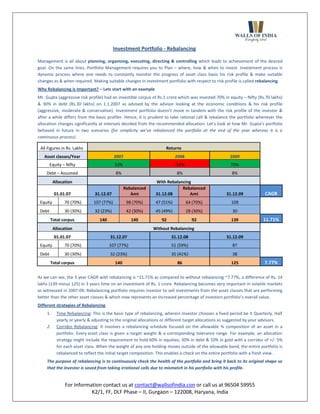
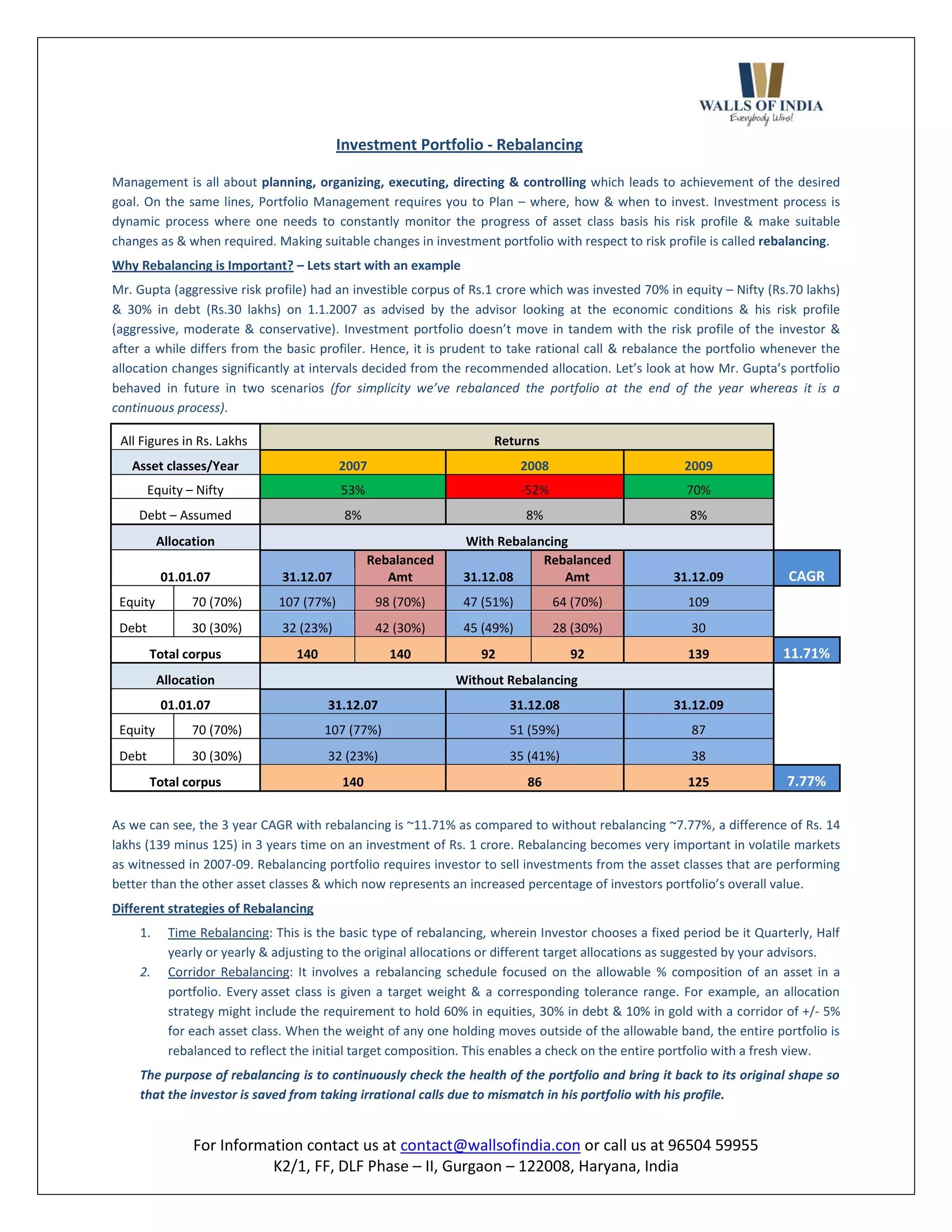
All Figures in Rs. Lakhs Returns
Asset classes/Year 2007 2008 2009
Equity – Nifty 53% -52% 70%
Debt – Assumed 8% 8% 8%
Allocation With Rebalancing
01.01.07 31.12.07
Rebalanced
Amt 31.12.08
Rebalanced
Amt 31.12.09 CAGR
Equity 70 (70%) 107 (77%) 98 (70%) 47 (51%) 64 (70%) 109
Debt 30 (30%) 32 (23%) 42 (30%) 45 (49%) 28 (30%) 30
Total corpus 140 140 92 92 139 11.71%
Allocation Without Rebalancing
01.01.07 31.12.07 31.12.08 31.12.09
Equity 70 (70%) 107 (77%) 51 (59%) 87
Debt 30 (30%) 32 (23%) 35 (41%) 38
Total corpus 140 86 125 7.77%
As we can see, the 3 year CAGR with rebalancing is ~11.71% as compared to without rebalancing ~7.77%, a difference of Rs. 14
lakhs (139 minus 125) in 3 years time on an investment of Rs. 1 crore. Rebalancing becomes very important in volatile markets
as witnessed in 2007-09. Rebalancing portfolio requires investor to sell investments from the asset classes that are performing
better than the other asset classes & which now represents an increased percentage of investors portfolio’s overall value.
Different strategies of Rebalancing
1. Time Rebalancing: This is the basic type of rebalancing, wherein Investor chooses a fixed period be it Quarterly, Half
yearly or yearly & adjusting to the original allocations or different target allocations as suggested by your advisors.
2. Corridor Rebalancing: It involves a rebalancing schedule focused on the allowable % composition of an asset in a
portfolio. Every asset class is given a target weight & a corresponding tolerance range. For example, an allocation
strategy might include the requirement to hold 60% in equities, 30% in debt & 10% in gold with a corridor of +/- 5%
for each asset class. When the weight of any one holding moves outside of the allowable band, the entire portfolio is
rebalanced to reflect the initial target composition. This enables a check on the entire portfolio with a fresh view.
The purpose of rebalancing is to continuously check the health of the portfolio and bring it back to its original shape so
that the investor is saved from taking irrational calls due to mismatch in his portfolio with his profile.

Investment portfolio - Rebalancing

  • 1.
    For Information contactus at contact@wallsofindia.con or call us at 96504 59955 K2/1, FF, DLF Phase – II, Gurgaon – 122008, Haryana, India Investment Portfolio - Rebalancing Management is all about planning, organizing, executing, directing & controlling which leads to achievement of the desired goal. On the same lines, Portfolio Management requires you to Plan – where, how & when to invest. Investment process is dynamic process where one needs to constantly monitor the progress of asset class basis his risk profile & make suitable changes as & when required. Making suitable changes in investment portfolio with respect to risk profile is called rebalancing. Why Rebalancing is Important? – Lets start with an example Mr. Gupta (aggressive risk profile) had an investible corpus of Rs.1 crore which was invested 70% in equity – Nifty (Rs.70 lakhs) & 30% in debt (Rs.30 lakhs) on 1.1.2007 as advised by the advisor looking at the economic conditions & his risk profile (aggressive, moderate & conservative). Investment portfolio doesn’t move in tandem with the risk profile of the investor & after a while differs from the basic profiler. Hence, it is prudent to take rational call & rebalance the portfolio whenever the allocation changes significantly at intervals decided from the recommended allocation. Let’s look at how Mr. Gupta’s portfolio behaved in future in two scenarios (for simplicity we’ve rebalanced the portfolio at the end of the year whereas it is a continuous process). All Figures in Rs. Lakhs Returns Asset classes/Year 2007 2008 2009 Equity – Nifty 53% -52% 70% Debt – Assumed 8% 8% 8% Allocation With Rebalancing 01.01.07 31.12.07 Rebalanced Amt 31.12.08 Rebalanced Amt 31.12.09 CAGR Equity 70 (70%) 107 (77%) 98 (70%) 47 (51%) 64 (70%) 109 Debt 30 (30%) 32 (23%) 42 (30%) 45 (49%) 28 (30%) 30 Total corpus 140 140 92 92 139 11.71% Allocation Without Rebalancing 01.01.07 31.12.07 31.12.08 31.12.09 Equity 70 (70%) 107 (77%) 51 (59%) 87 Debt 30 (30%) 32 (23%) 35 (41%) 38 Total corpus 140 86 125 7.77% As we can see, the 3 year CAGR with rebalancing is ~11.71% as compared to without rebalancing ~7.77%, a difference of Rs. 14 lakhs (139 minus 125) in 3 years time on an investment of Rs. 1 crore. Rebalancing becomes very important in volatile markets as witnessed in 2007-09. Rebalancing portfolio requires investor to sell investments from the asset classes that are performing better than the other asset classes & which now represents an increased percentage of investors portfolio’s overall value. Different strategies of Rebalancing 1. Time Rebalancing: This is the basic type of rebalancing, wherein Investor chooses a fixed period be it Quarterly, Half yearly or yearly & adjusting to the original allocations or different target allocations as suggested by your advisors. 2. Corridor Rebalancing: It involves a rebalancing schedule focused on the allowable % composition of an asset in a portfolio. Every asset class is given a target weight & a corresponding tolerance range. For example, an allocation strategy might include the requirement to hold 60% in equities, 30% in debt & 10% in gold with a corridor of +/- 5% for each asset class. When the weight of any one holding moves outside of the allowable band, the entire portfolio is rebalanced to reflect the initial target composition. This enables a check on the entire portfolio with a fresh view. The purpose of rebalancing is to continuously check the health of the portfolio and bring it back to its original shape so that the investor is saved from taking irrational calls due to mismatch in his portfolio with his profile.