American International Journal of Business Management (AIJBM)
ISSN- 2379-106X, www.aijbm.com Volume 4, Issue 08 (August-2021), PP 01-10
*Corresponding Author: Godwin Poi 1
www.aijbm.com 1 | Page
Importance of Capacity Building and Infrastructure Development
in Entrepreneurship Practices of University Graduates in Bayelsa
State, Nigeria
Godwin Poi (Ph.D, FCA)
Centre for Entrepreneurship and Department of Business Administration, Faculty of Social and Management
Sciences, University of Africa, Toru-Orua, Bayelsa State, Nigeria
ABSTRACT : This study investigated the importance of capacity building and infrastructure development in
the entrepreneurial practices of university graduates in Bayelsa State, Nigeria. It adopted a survey design
research methodology with two research questions and two hypotheses. The population consisted of 690
graduate entrepreneurs from two universities in Bayelsa State. A sample of 207 was drawn using stratified
random sampling technique. Primary data was gathered using structured survey questionnaire. The Cronbach
Alpha method was used to test and validate the reliability of thequestionnaire instrument which yielded 0.85.
Descriptive statistics of percentages, mean and standard deviation were used to analyse the research questions
while z-test was used to test the hypotheses at 0.05 level of significance. The findings revealed that 60% of male
and 70% of femalerespondents agreed that capacity building and infrastructure development were important for
entrepreneurial practices in Bayelsa State. Therefore, it is important to build the capacity of university graduate
entrepreneurs as well as develop infrastructure in order to enhance the entrepreneurialpractices in Bayelsa
State of Nigeria. There was also no significant difference between male and female respondents as to the
importance of capacity building and infrastructuredevelopment in the entrepreneurial practices in Bayelsa
State, Nigeria.
KEYWORDS -Entrepreneurship, Capacity Building, Infrastructure Development, Entrepreneurial Practices,
Graduate unemployment
I. INTRODUCTION
It is recognised worldwide that there are less opportunities in the job market than there are graduates
from universities. This situation is more severe in some countries than others, especially in developing
countries, including Nigeria. In fact, due to its teeming population, the situation in Nigeria is worse than many
other developing countries. This assertion is buttressed in the Suttern (2016) report which showedthe 2016
national graduate unemployment rate in Nigeria to be a staggering 36.26%. The Nigerian government has long
recognised this as a problem in the country. Indeed, as part of its efforts to tackle this high rate of graduate
unemployment, the government introduced entrepreneurship education in 2006 to start from the 2007/8
academic session. The government then made entrepreneurship educationcompulsory in all its higher education
(HE) sector from 2014 (Vanguard, 2014). University students through this programme are expected to acquire
entrepreneurial skills that will help them to set up their own businesses after graduation from the university. The
goal is to ensure that students acquire sufficient skills that will help them to become self-reliant, job and wealth
creators rather than job seekers after graduation. In other words, university graduates are encouraged to go into
entrepreneurial practices to setup and grow their own businesses and take the risks involved in managing their
own ventures. Thus, students should engage in entrepreneurial practices before they even graduate because it
will help them to channel their resources into building up their businesses. It will enhance their productivity,
competitiveness and contribute to the gross domestic product (GDP) of Nigeria (Poi, 2020).
These young graduate entrepreneurs need encouragement for them to start and sustain their businesses
and become successful entrepreneurs. They need various capacity building training programmes and
infrastructure development to assist and support them along the way. Capacity building training programmes
can be described as the various learning activities organized to improve knowledge, skills, attitudes and business
ability of young entrepreneurs to enhance their entrepreneurial abilities, skills and competencies to achieve
business successes (Boldureanu et al, 2020). Business activities demand a lot of skill-sets. The survival of any
business depends on information, knowledge, skills and experience possessed by the business proprietor.
Building the capacity of university graduates would be a recognition that various government agencies and
institutions are aware of the importance of empowering them and enhancing their knowledge, skills and the
business transaction ability of young entrepreneurs and therefore the need to properly equip them for success in
business.
Importance of Capacity Building and Infrastructure Development....
*Corresponding Author: Godwin Poi 1
www.aijbm.com 2 | Page
In addition to capacity building, infrastructure development is also very important in human and
business development. For example, there is need for constant supply of power, proper building and
maintenance of good roads, suitable market places to transact business, adequate internet services and networks,
water supply and transportation systems. Good infrastructure development will attract business investment
because it will reduce the cost of doing business by providing an enabling environment for businesses to thrive.
Adequate infrastructure development will enhance the productivity of business entities and it will enhance
sustainable growth and development. The provision of capacity building training programmes and adequate
infrastructure development are therefore imperative in enhancing the entrepreneurial practices of university
graduates in Bayelsa State. It would be a key factor indicator that they have been equipped with appropriate
knowledge skills and environment for business growth and development.
University graduates make up a large percentage of Nigerian workforce. They are full of energy,
ambition and zeal to achieve their dreams in life. Their future progress is very important and should be of major
concern to all stakeholders for the survival and sustainable development of any society. Encouraging them to
become self-reliant, job and wealth creators and entrepreneurs would be a welcome development. But in order
to achieve this, government and other stakeholders should organize capacity building training programmes in
the various business skills-sets as well as provide adequate infrastructure facilities required for business growth
and development.
There are presently insufficient and inadequate capacity building training programmes to support
university graduates in the country. Where they exist, they are not properly structured, effective or efficient for
enhancing the entrepreneurial practices of university graduates in Nigeria. The epileptic power supply, unstable
fuel supply and prices, bad road networks, inadequate information communication technology (ICT) facilities
and so on are some of the major challenges facing the entrepreneurial practices of university graduates in
Nigeria. These factors are critical to business survival and growth anywhere in the world. It is against this
background that this researcher is motivated to examine the importance of capacity building and infrastructure
development in entrepreneurial practices of university graduates in Bayelsa State, Nigeria. It was also of study
interest to observe whether there were any differences between the responses of male and female graduate
entrepreneurs in Bayelsa State, Nigeria.
II. STATEMENT OF THE PROBLEM
All the universities in Nigeria now teach entrepreneurship to their students in order equip them and to
change their mindset and behaviour from that of job seekers to job and wealth creators and to become
entrepreneurs after graduation from the university. This is seen as a strategy to reduce graduate unemployment
in Nigeria as well as boosting the economy. This programme deserves adequate attention for it to be functional
and effective. However, after over a decade of implementation of entrepreneurship education in universities in
Nigeria, too many university graduates are still roaming the streets with their certificates looking for scarce
white-collar jobs. Those that have the courage to go into entrepreneurial practices have numerous challenges
and hurdles in the way in order to be successful.
This raises the question of how far these young entrepreneurs can progress if they are not well
motivated and equipped with relevant business skills and infrastructure facilities necessary for successful
entrepreneurial practices. This problem is at the core of this research and thus informed the need to investigate
the importance of capacity building and infrastructure development in entrepreneurial practices of university
graduates in Bayelsa State, Nigeria.
III. AIM AND OBJECTIVES OF THE STUDY
The aim of the study was to investigate the importance of capacity building and infrastructure
development in the entrepreneurial practices of university graduates in Bayelsa State, Nigeria with the following
specific objectives:
1. To determine the importance of capacity building in the entrepreneurial practices of university graduates in
Bayelsa State, Nigeria.
2. To examine the importance of infrastructure development in the entrepreneurial practices of university
graduates in Bayelsa State, Nigeria.
Importance of Capacity Building and Infrastructure Development....
*Corresponding Author: Godwin Poi 1
www.aijbm.com 3 | Page
IV. RESEARCH QUESTIONS
The following were the research questions:
1. What is the importance of capacity building in the entrepreneurial practices of university graduates in
Bayelsa State, Nigeria?
2. What is the importance of infrastructure development in the entrepreneurial practices of university
graduates in Bayelsa State, Nigeria?
V. RESEARCH HYPOTHESES
The following null hypotheses were formulated and tested at 0.05 level of significance.
1. There is no significant difference between the responses of male and female university graduate
entrepreneurs on the importance of capacity building in the entrepreneurial practices of university
graduates in Bayelsa State, Nigeria.
2. There is no significant difference between the responses of male and female university graduate
entrepreneurs on the importance of infrastructure development in the entrepreneurial practices of
university graduates in Bayelsa State, Nigeria.
VI. LITERATURE REVIEW
Building a strong entrepreneurial capacity of entrepreneurs significantly strengthens the chances of
survival and success of their businesses. Having a suitable enabling environment with adequate infrastructure
further increases the productivity and performance of the business. Capacity building can mean different things
to different scholars. However, despite the absence of a single universally agreed definition of capacity building,
a reasonable working definition is given in the Wikipedia, the free encyclopaedia, as “the process by which
individuals and organizations obtain, improve, and retain the skills, knowledge, tools, equipment, and other
resources needed to do their jobs competently. It allows individuals and organizations to perform at a greater
capacity (larger scale, larger audience, larger impact, etc).”
This review of the extant literature covers studies that have been undertaken to support or repudiate the
arguments for or against the importance of capacity building and infrastructure development in entrepreneurial
practices. In broad terms, there are various descriptions or meaning (what it can be) rather than what specifically
capacity building is or is not. UNDP (2006) described capacity building to cover human resource development
and the strengthening of managerial systems, institutional development that involves community participation
and creation of an enabling environment. Azikiwe (2008) and Nwarie and Nwakudu (2019) postulated that
capacity building is the conceptual step or strategy towards development and goal achievement in every
organization with special focus on impediments that inhibit organizations and individuals from actualizing their
dreams while improving the abilities that will enable them realize measurable sustainable results. Azikiwe
(2008) also described capacity building as the process by which an individual is equipped with skills and
knowledge they need to perform effectively and efficiently in their different fields. This was irrespective of
gender. Thus, it does not matter whether the individual is male or female with respect to imparting skills and
knowledge to perform effectively and efficiently. In other words, the study found that it made no difference as
to whether they were male or female entrepreneurs to be able to benefit from capacity building. In their studies,
Orji, Oyebamiji & Aruma (2019) observed capacity building as planning for people to acquire knowledge and
advanced skills that are critical for their country’s economic growth, its standard of living and individual
empowerment.
Capacity building is a very important aspect of human resource development. The need for capacity
building emanates from the concept that things are not static. Technology,knowledge and skills are dynamic and
human beingsarerational and therefore always seeking ways of improving their wellbeing through the search for
and adoption of the most efficient and effective ways of doing things. Capacity building is a deliberately
structured training directed towards imparting knowledge and skills to the beneficiaries to enable them enhance
their productivity and solve various personal and societal problems. Capacity building from the human capital
perspective is seen as the process by which individuals acquire needed knowledge and advanced skills that are
relevant to their career advancement or success of their businesses as well as the country’s growth and
development(Wong & Aspinwall, 2004).
It follows therefore that for an entrepreneur to be successful, the human components (capacity) of these
business entities must be adequately prepared (acquired, obtained and improved) to meet up with the demands
of the organization. Also, adequate infrastructure facilities should be provided to enhance the efforts of the
individuals in realizing their business dreams.This implies that as business entrepreneurs improve on their
business practices through the acquisition of new skills and knowledge, adequate infrastructure facilities should
be built or provided for smooth and effective operation of business entities as a way of encouraging them to
grow and sustain their business enterprises.
Importance of Capacity Building and Infrastructure Development....
*Corresponding Author: Godwin Poi 1
www.aijbm.com 4 | Page
In a marketing capacity building study, Orji, Oyebamiji & Aruma (2019), observed that capacity
building equips marketers, distributors, marketing/sales executives and other key players in multi-level
marketing with skills and technical know-how which are paramount to business success. Grayson (2017) opined
that businessmen and key players in the business industries acquire experiences and qualifications through
trainings and business workshops. Iloabuchi (2014) explained that capacity building has become necessity due
to the growing complexity of the work environment, fast and constant change in organizational and
technological advancement. Thus, quality customer satisfaction, productivity, staff morale, efficient
management, business development and profitability are increased through adequate capacity building training
programmes.
Iloabuchi (2014) identified the following as the relevance of capacity building training programmes in
business organizations:
i. It helps people to become more productive
ii. It boosts the significance and morale of people in their task performance.
iii. It exposes beneficiaries to new methods and skills relevant to their jobs and business activities.
iv. It eliminates obsolescence in skills.
v. It exposes beneficiaries to current issues.
vi. It helps participants to adapt easily to reforms and innovations in their fields of study or business
operations.
It is necessary to build the capacities of entrepreneurs to enable them make the necessary contributions
to the growth and development of the economy of the nation (Bamifo, Asiedu-Appiah&Oppong-Boakye, 2015).
According to Aladejebi (2018), capacity building is important because the performance of entrepreneurs is a
major driver and indicator for assessing economic activities, industrialization, modernization etc. Capacity
building increases the output of an employee and also enhances the profitability of business activities (Bacon, et
al 1996; Afande, 2015). According to Lee (2001) and Batra & Tan (2003) inadequate human resource
capabilities provide significant impediments and hindrances to the growth and development of business
enterprises.
In addition to capacity building, infrastructure development has also been found to be very important
too in the success of business entities all over the world. OECD (2006) states that infrastructure affects the
ability of an area to retain and attract people as well as businesses. Provision of adequate and quality
infrastructure is a pre-requisite for the growth and development of businesses and sustainable improvement of
socio-economic well-being of the people (North & Smallbone, 1996). Mutsuddi (2016) observed that
infrastructures support operational standards and quality; uninterrupted supply chain; customer needs; and
business needs. The adequacy or inadequacy of infrastructure significantly influences entrepreneurial growth
and development in a region.
Infrastructure developments such as good roads, constant supply of power, adequate provision of
information and communication technology (ICT) facilities and markets are necessary for business growth and
development. Fiscal policies and other relevant policies are necessary in creating a business-friendly
environment. In Nigeria, infrastructure development is grossly inadequate. Power supply is neither assured,
reliable nor guaranteed. There are not many roads in rural areas and even those in the urban areas are in poor
condition and disrepair. The telecommunication networks fail frequently and are epileptic and unreliable.
Okebukola (2011) found that the environment which can permit easy start-up of small businesses does not really
exist here. University graduates who have just acquired entrepreneurial skills could be easily put off and
discouraged by the state of infrastructure facilities in Nigeria. This hinders the enthusiasm to start and successful
grow entrepreneurial practices in the country.
The provision of good roads and communications network would enhance the safe distribution of
goods and services from one place to another. Poor and deplorable roads and communications networks add to
the rising cost of doing business due to delays in the delivery of goods and services. For example, road
accidents such as falling of trucks, oil tankersand trailers on bad spots along the road and insecurity on our
highways further complicate the conditions. Inadequate power supply remains a critical issue that increases the
cost of doing business because constant and stable power supply is necessaryfor many businesses. Power,
sometimes very high voltage power, is needed to operate certain machinery and equipment and other facilities.
Alternative sources of power such generators are risky and have very high operational and maintenance costs.
This is a major hindrance to the survival and success of many businesses in Nigeria. Many young entrepreneurs
are not able to start or continue in their entrepreneurial practices because they were unable to overcome these
challenges. Elechi (2014) found that 30% of the reasons for Nigeria not being competitive in the international
market is because of deficits in infrastructure, especially electricity, public supply of portable water and
transport. Significant infrastructure deficienciescontribute to the difficulties in the agricultural sector especially
in the rural communities in regard to transporting harvested produce from farms to processing factories or
markets (Agommouh, 2014).
Importance of Capacity Building and Infrastructure Development....
*Corresponding Author: Godwin Poi 1
www.aijbm.com 5 | Page
Thisreview of extant literature has highlighted the relevance and importance of both capacity building
and infrastructure development in entrepreneurial practices. However, there were no studies that localised these
findings to the entrepreneurship practices of university graduates in Bayelsa State, Nigeria. This study seeks to
fill this gap which has been identified and add this to the literature in this field.
VII. RESEARCH METHODOLOGY
Descriptive survey research design was adopted for the study to investigate the importance of capacity
building and infrastructure development in entrepreneurial practices of university graduates in Bayelsa State.
The population of the study consisted of all the 690 (457 males and 233 females) self-employed university
graduates from Federal University, Otuoke and Niger Delta University, the only two universities to have
graduated students in Bayelsa State (Source: Universities Alumni Offices). A sample of 207 (137 male and 70
female) representing 30% of the population was drawn using stratified random sampling technique. A structured
questionnaire was used in the survey for the collection of primary data. The questionnaire instrument had 18
items and was structured based on a 4-point Likert scale - Strongly Agree (SA – 4 points), Agree (A – 3 points),
Disagree (D – 2 points) and Strongly Disagree (SD – 1 point). The instrument was properly tested and validated
yielding a reliability index of 0.85 using the Cronbach Alpha method. Simple percentages, mean and standard
deviation were used to answer the two research questions while z-test at 0.05 level of significance was used to
test the two hypotheses.
VIII. RESULTS
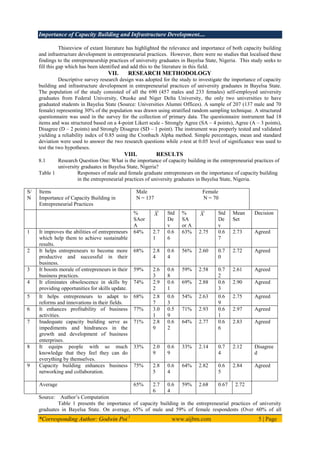
8.1 Research Question One: What is the importance of capacity building in the entrepreneurial practices of
university graduates in Bayelsa State, Nigeria?
Table 1 Responses of male and female graduate entrepreneurs on the importance of capacity building
in the entrepreneurial practices of university graduates in Bayelsa State, Nigeria.
S/
N
Items
Importance of Capacity Building in
Entrepreneurial Practices
Male Female
N = 137 N = 70
%
SAor
A
X Std
De
v
%
SA
or A
X Std
De
v
Mean
Set
Decision
1 It improves the abilities of entrepreneurs
which help them to achieve sustainable
results.
64% 2.7
1
0.6
6
63% 2.75 0.6
7
2.73 Agreed
2 It helps entrepreneurs to become more
productive and successful in their
business.
68% 2.8
4
0.6
4
56% 2.60 0.7
0
2.72 Agreed
3 It boosts morale of entrepreneurs in their
business practices.
59% 2.6
3
0.6
8
59% 2.58 0.7
2
2.61 Agreed
4 It eliminates obsolescence in skills by
providing opportunities for skills update.
74% 2.9
2
0.6
1
69% 2.88 0.6
3
2.90 Agreed
5 It helps entrepreneurs to adapt to
reforms and innovations in their fields.
68% 2.8
7
0.6
3
54% 2.63 0.6
9
2.75 Agreed
6 It enhances profitability of business
activities.
77% 3.0
1
0.5
9
71% 2.93 0.6
1
2.97 Agreed
7 Inadequate capacity building serve as
impediments and hindrances in the
growth and development of business
enterprises.
71% 2.8
9
0.6
2
64% 2.77 0.6
6
2.83 Agreed
8 It equips people with so much
knowledge that they feel they can do
everything by themselves.
33% 2.0
9
0.6
9
33% 2.14 0.7
4
2.12 Disagree
d
9 Capacity building enhances business
networking and collaboration.
75% 2.8
5
0.6
4
64% 2.82 0.6
5
2.84 Agreed
Average 65% 2.7
6
0.6
4
59% 2.68 0.67 2.72
Source: Author’s Computation
Table 1 presents the importance of capacity building in the entrepreneurial practices of university
graduates in Bayelsa State. On average, 65% of male and 59% of female respondents (Over 60% of all
Importance of Capacity Building and Infrastructure Development....
*Corresponding Author: Godwin Poi 1
www.aijbm.com 6 | Page
respondents) agreed that capacity building is important for entrepreneurial practices of university graduate
entrepreneurs in Bayelsa State, Nigeria. Also, items 1,2,3,4,5,6,7 and 9 had weighted mean scores that were
greater than the criterion mean of 2.50. Thus, respondents agreed that capacity building is important for the
entrepreneurial practices of university graduates in Bayelsa State. Item 8 had weighted mean score of 2.14
which is less than the criterion mean of 2.50. They disagreed that capacity building equipped respondents with
too much knowledge. The average weighted mean scores of 2.76 for male respondents and 2.68 for female
respondents were also all above the criterion mean indicating that both male and female respondents agreed that
capacity building was important in the entrepreneurial practices of university graduates in Bayelsa State.
Therefore, capacity building is important in the entrepreneurial practices of university graduates in
Bayelsa State because, amongst other things, capacity building improves the abilities of entrepreneurs which
help them to achieve sustainable results, helps entrepreneurs to become more productive and successful in their
businesses, boostsmorale of entrepreneurs in their business practices, eliminates obsolescence in skills by
providing opportunities for skills updates, helps entrepreneurs to adapt to reforms and innovations in their fields,
enhances profitability of business activities, inadequate capacity building serves as impediment and hindrance in
the growth and development of business enterprises and, finally capacity building enhances business networking
and collaboration.
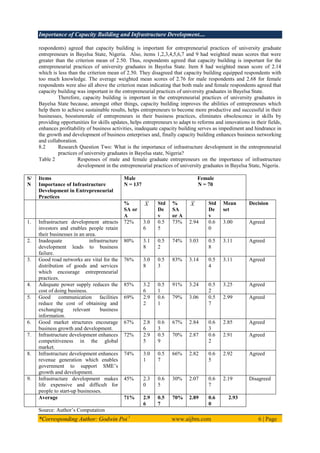
8.2 Research Question Two: What is the importance of infrastructure development in the entrepreneurial
practices of university graduates in Bayelsa state, Nigeria?
Table 2 Responses of male and female graduate entrepreneurs on the importance of infrastructure
development in the entrepreneurial practices of university graduates in Bayelsa State, Nigeria.
S/
N
Items
Importance of Infrastructure
Development in Entrepreneurial
Practices
Male Female
N = 137 N = 70
%
SA or
A
X Std
De
v
%
SA
or A
X Std
De
v
Mean
set
Decision
1. Infrastructure development attracts
investors and enables people retain
their businesses in an area.
72% 3.0
6
0.5
5
73% 2.94 0.6
0
3.00 Agreed
2. Inadequate infrastructure
development leads to business
failure.
80% 3.1
8
0.5
2
74% 3.03 0.5
8
3.11 Agreed
3. Good road networks are vital for the
distribution of goods and services
which encourage entrepreneurial
practices.
76% 3.0
8
0.5
3
83% 3.14 0.5
4
3.11 Agreed
4. Adequate power supply reduces the
cost of doing business.
85% 3.2
6
0.5
1
91% 3.24 0.5
2
3.25 Agreed
5. Good communication facilities
reduce the cost of obtaining and
exchanging relevant business
information.
69% 2.9
2
0.6
1
79% 3.06 0.5
7
2.99 Agreed
6. Good market structures encourage
business growth and development.
67% 2.8
6
0.6
3
67% 2.84 0.6
3
2.85 Agreed
7. Infrastructure development enhances
competitiveness in the global
market.
72% 2.9
5
0.5
9
70% 2.87 0.6
2
2.91 Agreed
8. Infrastructure development enhances
revenue generation which enables
government to support SME’s
growth and development.
74% 3.0
1
0.5
7
66% 2.82 0.6
5
2.92 Agreed
9. Infrastructure development makes
life expensive and difficult for
people to start-up businesses.
45% 2.3
0
0.6
5
30% 2.07 0.6
7
2.19 Disagreed
Average 71% 2.9
6
0.5
7
70% 2.89 0.6
0
2.93
Source: Author’s Computation
Importance of Capacity Building and Infrastructure Development....
*Corresponding Author: Godwin Poi 1
www.aijbm.com 7 | Page
Table 2 shows the mean responses of male and female entrepreneurs on the importance of
infrastructure development in the entrepreneurial practices of university graduates in Bayelsa State. An
overwhelming majority of both male (71%) and female (70%) respondents agreed that infrastructure
development was important in the entrepreneurial practices of university graduates in Bayelsa State, Nigeria.
Indeed, items 1 to 8 had weighted mean scores that were greater than the criterion mean 2.50. They were agreed
that infrastructure development was important in the entrepreneurial practices of university graduates in Bayelsa
State, Nigeria. Item 9 had weighted mean score of 2.19 which was below the criterion mean of 2.50 meaning
that they disagreedthat infrastructure development made life expensive and difficult in entrepreneurial practices
of university graduates in Bayelsa State, Nigeria. Furthermore, the average weighted mean score of 2.96 for
male and 2.89 for female respondents were also higher than the criterion mean score of 2.50 indicating that both
male and female respondents agreed on the importance of infrastructure development in the entrepreneurial
practices of university graduates in Bayelsa State.
Therefore, infrastructure development is important in the entrepreneurial practices of university
graduates in Bayelsa State and the benefits include: good infrastructure development attracts investors and
enables people retain their businesses in an area; inadequate infrastructure development leads to business
failure; good road networks are vital in the distribution of goods and services which encourage entrepreneurial
practices; adequate power supply reduces cost of doing business; good communication facilities reduce the cost
of obtaining and exchanging relevant business information; good market structures and facilities encourage
business growth and development; infrastructure development enhances competitiveness in the global market;
and infrastructure development enhances revenue generation which enables government to support SME’s
growth and development.
8.3 Test of Hypotheses
8.3.1 Ho1: There is no significant difference between the responses of male and female university graduate
entrepreneurs on the importance of capacity building in the entrepreneurial practices of university
graduates in Bayelsa State, Nigeria.
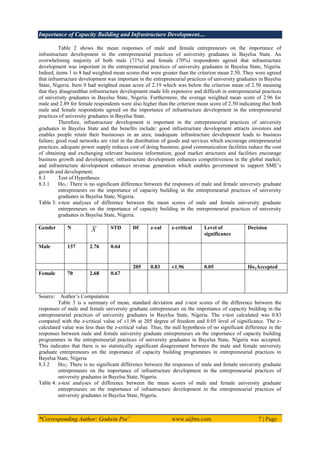
Table 3: z-test analyses of difference between the mean scores of male and female university graduate
entrepreneurs on the importance of capacity building in the entrepreneurial practices of university
graduates in Bayelsa State, Nigeria.
Gender N X STD Df z-cal z-critical Level of
significance
Decision
Male 137 2.76 0.64
205 0.83 ±1.96 0.05 Ho1Accepted
Female 70 2.68 0.67
Source: Author’s Computation
Table 3 is a summary of mean, standard deviation and z-test scores of the difference between the
responses of male and female university graduate entrepreneurs on the importance of capacity building in the
entrepreneurial practices of university graduates in Bayelsa State, Nigeria. The z-test calculated was 0.83
compared with the z-critical value of ±1.96 at 205 degree of freedom and 0.05 level of significance. The z-
calculated value was less than the z-critical value. Thus, the null hypothesis of no significant difference in the
responses between male and female university graduate entrepreneurs on the importance of capacity building
programmes in the entrepreneurial practices of university graduates in Bayelsa State, Nigeria was accepted.
This indicates that there is no statistically significant disagreement between the male and female university
graduate entrepreneurs on the importance of capacity building programmes in entrepreneurial practices in
Bayelsa State, Nigeria
8.3.2 Ho2: There is no significant difference between the responses of male and female university graduate
entrepreneurs on the importance of infrastructure development in the entrepreneurial practices of
university graduates in Bayelsa State, Nigeria.
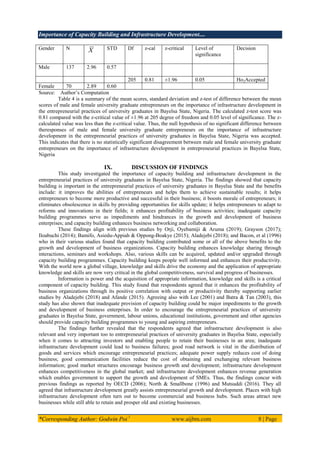
Table 4: z-test analyses of difference between the mean scores of male and female university graduate
entrepreneurs on the importance of infrastructure development in the entrepreneurial practices of
university graduates in Bayelsa State, Nigeria.
Importance of Capacity Building and Infrastructure Development....
*Corresponding Author: Godwin Poi 1
www.aijbm.com 8 | Page
Gender N X STD Df z-cal z-critical Level of
significance
Decision
Male 137 2.96 0.57
205 0.81 ±1.96 0.05 Ho2Accepted
Female 70 2.89 0.60
Source: Author’s Computation
Table 4 is a summary of the mean scores, standard deviation and z-test of difference between the mean
scores of male and female university graduate entrepreneurs on the importance of infrastructure development in
the entrepreneurial practices of university graduates in Bayelsa State, Nigeria. The calculated z-test score was
0.81 compared with the z-critical value of ±1.96 at 205 degree of freedom and 0.05 level of significance. The z-
calculated value was less than the z-critical value. Thus, the null hypothesis of no significant difference between
theresponses of male and female university graduate entrepreneurs on the importance of infrastructure
development in the entrepreneurial practices of university graduates in Bayelsa State, Nigeria was accepted.
This indicates that there is no statistically significant disagreement between male and female university graduate
entrepreneurs on the importance of infrastructure development in entrepreneurial practices in Bayelsa State,
Nigeria
IX. DISCUSSION OF FINDINGS
This study investigated the importance of capacity building and infrastructure development in the
entrepreneurial practices of university graduates in Bayelsa State, Nigeria. The findings showed that capacity
building is important in the entrepreneurial practices of university graduates in Bayelsa State and the benefits
include: it improves the abilities of entrepreneurs and helps them to achieve sustainable results; it helps
entrepreneurs to become more productive and successful in their business; it boosts morale of entrepreneurs; it
eliminates obsolescence in skills by providing opportunities for skills update; it helps entrepreneurs to adapt to
reforms and innovations in their fields; it enhances profitability of business activities; inadequate capacity
building programmes serve as impediments and hindrances in the growth and development of business
enterprises; and capacity building enhances business networking and collaboration.
These findings align with previous studies by Orji, Oyebamiji & Aruma (2019); Grayson (2017);
Iloabuchi (2014); Bamifo, Asiedu-Appiah & Oppong-Boakye (2015); Aladejebi (2018); and Bacon, et al (1996)
who in their various studies found that capacity building contributed some or all of the above benefits to the
growth and development of business organizations. Capacity building enhances knowledge sharing through
interactions, seminars and workshops. Also, various skills can be acquired, updated and/or upgraded through
capacity building programmes. Capacity building keeps people well informed and enhances their productivity.
With the world now a global village, knowledge and skills drive the economy and the application of appropriate
knowledge and skills are now very critical in the global competitiveness, survival and progress of businesses.
Information is power and the acquisition of appropriate information, knowledge and skills is a critical
component of capacity building. This study found that respondents agreed that it enhances the profitability of
business organizations through its positive correlation with output or productivity thereby supporting earlier
studies by Aladejebi (2018) and Afande (2015). Agreeing also with Lee (2001) and Batra & Tan (2003), this
study has also shown that inadequate provision of capacity building could be major impediments to the growth
and development of business enterprises. In order to encourage the entrepreneurial practices of university
graduates in Bayelsa State, government, labour unions, educational institutions, government and other agencies
should provide capacity building programmes to young and aspiring entrepreneurs.
The findings further revealed that the respondents agreed that infrastructure development is also
relevant and very important too to entrepreneurial practices of university graduates in Bayelsa State, especially
when it comes to attracting investors and enabling people to retain their businesses in an area; inadequate
infrastructure development could lead to business failures; good road network is vital in the distribution of
goods and services which encourage entrepreneurial practices; adequate power supply reduces cost of doing
business; good communication facilities reduce the cost of obtaining and exchanging relevant business
information; good market structures encourage business growth and development; infrastructure development
enhances competitiveness in the global market; and infrastructure development enhances revenue generation
which enables government to support the growth and development of SMEs. Thus, the findings concur with
previous findings as reported by OECD (2006); North & Smallbone (1996) and Mutsuddi (2016). They all
agreed that infrastructure development greatly assists entrepreneurial growth and development. Places with high
infrastructure development often turn out to become commercial and business hubs. Such areas attract new
businesses while still able to retain and prosper old and existing businesses.
Importance of Capacity Building and Infrastructure Development....
*Corresponding Author: Godwin Poi 1
www.aijbm.com 9 | Page
Infrastructure development such as good road networks, constant power supply, portable water and
good communication facilities and networks act as spurs for business growth and development. Adequate
infrastructure development in both urban and rural areas would stem the tide of rural-urban migration. With
adequate infrastructure development, people can site their business anywhere and connect with the rest of the
world. It creates enabling environment for business survival and growth. Most parts of Nigeria, including
Bayelsa State, still suffer from very poor state of infrastructure development as espoused by Okebukola (2011)
and supported by the results in this study. Infrastructure development is very relevant in the even distribution of
goods and service. It can also help in income distribution as activities and income earning opportunities will be
more widely distributed. It helps in curbing wastage of goods especially agricultural products as well as reduces
financial losses that are caused by the extra expenditure in buying fuel in order to generate power and in
replacing goods that are destroyed on the road through road accidents.
Infrastructure development is one bedrock for global competitiveness. A country that is not productive
cannot compete favourably with the ones that are productive. This is because for a country to be productive,
adequate infrastructure development is key. As noted by Elechi (2014) and also agreed by the respondents in
this study, one of the major reasons for Nigeria’s lack of globally competitiveness is the poor level of
infrastructure development. The importance of infrastructure development in the entrepreneurial practices of
people cannot therefore be over-emphasized. It is often a major consideration in the location of businesses
because it has significant relationship with productivity, profitability and sustainability of any business.
X. CONCLUSION
This study has shown that capacity building and infrastructure development are important and relevant in
the entrepreneurial practices of university graduates in Bayelsa State, Nigeria. They are necessary factors that
encourage business development, growth and success. Withoutcapacity building and adequate infrastructure
facilities, entrepreneurs and businesses in general will be disadvantaged. In a changing world wheretechnology
continues to evolve and knowledge and skills drive development and advancement, it is necessary for people to
build their capacity in their fields of enterprises. Developing and upgrading infrastructures in line with the
dynamics of today’s world is also not negotiable. This is because infrastructure development allows the
organized private sector (entrepreneurs) to invest and drive the economy of any nation in order to achieve
sustainable socio-economic growth and development.
Finally, the findings of this study now add the importance of capacity building and infrastructure
development to the literature in the field.
XI. RECOMMENDATIONS
In line with the findings of the study, the following recommendations were made:
1. Government of Bayelsa State, in collaboration with other stakeholders (educational institutions, trade
unions, chambers of commerce and industries etc.), should organise regular capacity building
programmes to build and enhance the entrepreneurial practices of university graduate entrepreneurs in
Bayelsa State.
2. Government should embark on extensive infrastructure development such asthe provision of good road
networks, reliable electricity power supply, provisionof communication facilities and markets which
arecritical factors in the establishment and survival of business enterprises.
3. Government should also create enabling environment that supports the entrepreneurial practices of
university graduates in Bayelsa State.
REFERENCES
[1] Suttern (2016). Nigeria Graduate Report. Covenant university Repository. Retrieved from
http://eprints.covenantuniversity.edu.ng/8124/1/Nigeria%2BGraduate%2BReport.pdf
[2] Vanguard Newspaper (2014). Govt makes entrepreneurship course compulsory in universities.
https://www.vanguardngr.com/2014/11/govt-makes-entrepreneurship-course-compulsory-universities/
[3] Poi, G (2020). Analysis of Entrepreneurial Skills Necessary for Economic Growth Perspectives from
Selected Universities in Rivers State of Nigeria. Journal of Business and Management. International
Organization of Scientific Research. e-ISSN: 2278-487X, p-ISSN: 2319-7668. Volume 22, Issue 8.
Ser. II, pp25-33
[4] Boldureanu, G., Ionescu, A. M., Bercu, A. M., Bedrule-Grigoruță, M. V., & Boldureanu, D. (2020).
Entrepreneurship education through successful entrepreneurial models in higher education
institutions. Sustainability, 12(3), 1267. doi:10.3390/su12031267
[5] United Nations Development Programme (UNDP), (2006). Capacity building development. Retrieved
from http://www.undp.org
Importance of Capacity Building and Infrastructure Development....
*Corresponding Author: Godwin Poi 1
www.aijbm.com 10 | Page
[6] Azikiwe, U. (2008). Standard in tertiary education: Capacity building and sustainable development in
Nigeria. A lead paper presented at the annual conference of the Faculty of Education, Nnamdi Azikiwe
University, Awka, Anambra State.
[7] Nwarie, U. N. & Nwakudu, G. N. (2019). Availability and constraints of capacity building programmes
for teachers’ productivity in secondary schools in Abia State, Nigeria. Journal of Education in
Developing Areas, Vol. 27(2), 296-304.
[8] Nwakudu, G. N. & Nwarie, U. N. (2019). Roles of capacity building and knowledge management in
the service delivery of secondary school teachers in Abia State, Nigeria. Port Harcourt Journal of
Educational Studies, Vol. 4(1), 189-197.
[9] Orji, P.; Oyebamiji, M. A. & Aruma, E. O. (2019). Potency of human capacity building on multi-level
marketing among urban dwellers in Rivers and Cross River States. Journal of Education in Developing
Areas, Vol. 27(2), 54-68.
[10] Wong, K. Y. & Aspinwall, E. (2004). Characterizing knowledge management in the small business
environment, Journal of Knowledge Management, Vol. 8 No. 3, pp. 44-61.
https://doi.org/10.1108/13673270410541033
[11] Grayson, K. (2017). Examining the embedded markets of network marketing organizations. Networks
in marketing, Vol. 18(1), 69-78.
[12] Iloabuchi, E. N. (2014). Staff development. In F. N. Obasi & J. D. Asodike (eds), Educational resource
management (pp 61-83). Port Harcourt: Pearl Publishers Int’l.
[13] Bamifo, B. A., Asiedu-Appiah, F., & Oppong-Boakye, P. K. (2015). Capacity building for
entrepreneurship development in Ghana: The perspectives of owner managers. International Journal of
Arts and Sciences, Vol. 8(5), pp 481-498.
[14] Aladejebi, O. (2018). Impact of human capacity building on small and medium enterprises in Lagos,
Nigeria. Journal of Small Business and Entrepreneurship Development, Vol. 6(2), pp 15-27.
[15] Bacon, N.; Ackers, P.; Storey, I. & Coates, D. (1996). It’s a small world: managing human resources in
small businesses. International Journal of Human Resource Management, Vol. 7(1), pp 82 – 94.
[16] Afande, F. O. (2015). Effect of human capacity building on the performance of small and micro
enterprises in Kisumu City, Kenya. Journal of Poverty, Investment and Development, Vol. 9(1), pp 78-
108. Retrieved from http://www.iiste.org
[17] Lee, I. (2001). Education for technology readiness: Prospects for developing countries. Journal of
Human Development, Vol. 2. Pp 115-131.
[18] Batra, G. & Tan, H. (2003). SME’s technical efficiency and its correlates: Cross-national evidence and
policy implications. World Bank Institute Working Paper. Retrieved from http://www.worldbank.org
[19] OECD (2006). reinventing rural policy. Policy brief, OECD observes, October. Paris.
[20] North, D. & Smallbone, D. (1996). Small business development in remote rural areas: The example of
mature manufacturing firms in Northern England. Journal of Rural Studies, Vol. 12(2), pp 151-167.
[21] Mutsuddi, I. (2016). Role of infrastructure growth for entrepreneurial development: A study in
Durgapur. XVII Annual International Seminar Proceeding. Retrieved from
http://www.internationalseminarinXVIIAISINDEXHTM
[22] Okebukola, P. (2011). Entrepreneurship in university education: Beyond talk. 27th Convocation
Lecture University of Port Harcourt. Thursday, June 16.
[23] Elechi, C. N. (2014). De-Emphasizing paper qualification: Entrepreneurship education as an
alternative. In J. E. Tabotndip, I. O. Enukoha & J. C. Obunadike (eds), issues and challenges in
entrepreneurial education in Nigeria (pp 86-101). Onitsha: West and Solomon Publishing Company.
[24] Agommouh, P. C. (2014). Entrepreneurship education in Nigeria: Issues, challenges and the way
forward. In J. E. Tabotndip, I. O. Enukoha & J. C. Obunadike (eds), issues and challenges in
entrepreneurial education in Nigeria (pp 103-126). Onitsha: West and Solomon Publishing Company
Corresponding Author: Godwin Poi (PhD, FCA)
Centre for Entrepreneurship and Department of Business Administration, Faculty of Social and Management
Sciences, University of Africa, Toru-Orua, Bayelsa State, Nigeria.

A480110.pdf

  • 1.
    American International Journalof Business Management (AIJBM) ISSN- 2379-106X, www.aijbm.com Volume 4, Issue 08 (August-2021), PP 01-10 *Corresponding Author: Godwin Poi 1 www.aijbm.com 1 | Page Importance of Capacity Building and Infrastructure Development in Entrepreneurship Practices of University Graduates in Bayelsa State, Nigeria Godwin Poi (Ph.D, FCA) Centre for Entrepreneurship and Department of Business Administration, Faculty of Social and Management Sciences, University of Africa, Toru-Orua, Bayelsa State, Nigeria ABSTRACT : This study investigated the importance of capacity building and infrastructure development in the entrepreneurial practices of university graduates in Bayelsa State, Nigeria. It adopted a survey design research methodology with two research questions and two hypotheses. The population consisted of 690 graduate entrepreneurs from two universities in Bayelsa State. A sample of 207 was drawn using stratified random sampling technique. Primary data was gathered using structured survey questionnaire. The Cronbach Alpha method was used to test and validate the reliability of thequestionnaire instrument which yielded 0.85. Descriptive statistics of percentages, mean and standard deviation were used to analyse the research questions while z-test was used to test the hypotheses at 0.05 level of significance. The findings revealed that 60% of male and 70% of femalerespondents agreed that capacity building and infrastructure development were important for entrepreneurial practices in Bayelsa State. Therefore, it is important to build the capacity of university graduate entrepreneurs as well as develop infrastructure in order to enhance the entrepreneurialpractices in Bayelsa State of Nigeria. There was also no significant difference between male and female respondents as to the importance of capacity building and infrastructuredevelopment in the entrepreneurial practices in Bayelsa State, Nigeria. KEYWORDS -Entrepreneurship, Capacity Building, Infrastructure Development, Entrepreneurial Practices, Graduate unemployment I. INTRODUCTION It is recognised worldwide that there are less opportunities in the job market than there are graduates from universities. This situation is more severe in some countries than others, especially in developing countries, including Nigeria. In fact, due to its teeming population, the situation in Nigeria is worse than many other developing countries. This assertion is buttressed in the Suttern (2016) report which showedthe 2016 national graduate unemployment rate in Nigeria to be a staggering 36.26%. The Nigerian government has long recognised this as a problem in the country. Indeed, as part of its efforts to tackle this high rate of graduate unemployment, the government introduced entrepreneurship education in 2006 to start from the 2007/8 academic session. The government then made entrepreneurship educationcompulsory in all its higher education (HE) sector from 2014 (Vanguard, 2014). University students through this programme are expected to acquire entrepreneurial skills that will help them to set up their own businesses after graduation from the university. The goal is to ensure that students acquire sufficient skills that will help them to become self-reliant, job and wealth creators rather than job seekers after graduation. In other words, university graduates are encouraged to go into entrepreneurial practices to setup and grow their own businesses and take the risks involved in managing their own ventures. Thus, students should engage in entrepreneurial practices before they even graduate because it will help them to channel their resources into building up their businesses. It will enhance their productivity, competitiveness and contribute to the gross domestic product (GDP) of Nigeria (Poi, 2020). These young graduate entrepreneurs need encouragement for them to start and sustain their businesses and become successful entrepreneurs. They need various capacity building training programmes and infrastructure development to assist and support them along the way. Capacity building training programmes can be described as the various learning activities organized to improve knowledge, skills, attitudes and business ability of young entrepreneurs to enhance their entrepreneurial abilities, skills and competencies to achieve business successes (Boldureanu et al, 2020). Business activities demand a lot of skill-sets. The survival of any business depends on information, knowledge, skills and experience possessed by the business proprietor. Building the capacity of university graduates would be a recognition that various government agencies and institutions are aware of the importance of empowering them and enhancing their knowledge, skills and the business transaction ability of young entrepreneurs and therefore the need to properly equip them for success in business.
  • 2.
    Importance of CapacityBuilding and Infrastructure Development.... *Corresponding Author: Godwin Poi 1 www.aijbm.com 2 | Page In addition to capacity building, infrastructure development is also very important in human and business development. For example, there is need for constant supply of power, proper building and maintenance of good roads, suitable market places to transact business, adequate internet services and networks, water supply and transportation systems. Good infrastructure development will attract business investment because it will reduce the cost of doing business by providing an enabling environment for businesses to thrive. Adequate infrastructure development will enhance the productivity of business entities and it will enhance sustainable growth and development. The provision of capacity building training programmes and adequate infrastructure development are therefore imperative in enhancing the entrepreneurial practices of university graduates in Bayelsa State. It would be a key factor indicator that they have been equipped with appropriate knowledge skills and environment for business growth and development. University graduates make up a large percentage of Nigerian workforce. They are full of energy, ambition and zeal to achieve their dreams in life. Their future progress is very important and should be of major concern to all stakeholders for the survival and sustainable development of any society. Encouraging them to become self-reliant, job and wealth creators and entrepreneurs would be a welcome development. But in order to achieve this, government and other stakeholders should organize capacity building training programmes in the various business skills-sets as well as provide adequate infrastructure facilities required for business growth and development. There are presently insufficient and inadequate capacity building training programmes to support university graduates in the country. Where they exist, they are not properly structured, effective or efficient for enhancing the entrepreneurial practices of university graduates in Nigeria. The epileptic power supply, unstable fuel supply and prices, bad road networks, inadequate information communication technology (ICT) facilities and so on are some of the major challenges facing the entrepreneurial practices of university graduates in Nigeria. These factors are critical to business survival and growth anywhere in the world. It is against this background that this researcher is motivated to examine the importance of capacity building and infrastructure development in entrepreneurial practices of university graduates in Bayelsa State, Nigeria. It was also of study interest to observe whether there were any differences between the responses of male and female graduate entrepreneurs in Bayelsa State, Nigeria. II. STATEMENT OF THE PROBLEM All the universities in Nigeria now teach entrepreneurship to their students in order equip them and to change their mindset and behaviour from that of job seekers to job and wealth creators and to become entrepreneurs after graduation from the university. This is seen as a strategy to reduce graduate unemployment in Nigeria as well as boosting the economy. This programme deserves adequate attention for it to be functional and effective. However, after over a decade of implementation of entrepreneurship education in universities in Nigeria, too many university graduates are still roaming the streets with their certificates looking for scarce white-collar jobs. Those that have the courage to go into entrepreneurial practices have numerous challenges and hurdles in the way in order to be successful. This raises the question of how far these young entrepreneurs can progress if they are not well motivated and equipped with relevant business skills and infrastructure facilities necessary for successful entrepreneurial practices. This problem is at the core of this research and thus informed the need to investigate the importance of capacity building and infrastructure development in entrepreneurial practices of university graduates in Bayelsa State, Nigeria. III. AIM AND OBJECTIVES OF THE STUDY The aim of the study was to investigate the importance of capacity building and infrastructure development in the entrepreneurial practices of university graduates in Bayelsa State, Nigeria with the following specific objectives: 1. To determine the importance of capacity building in the entrepreneurial practices of university graduates in Bayelsa State, Nigeria. 2. To examine the importance of infrastructure development in the entrepreneurial practices of university graduates in Bayelsa State, Nigeria.
  • 3.
    Importance of CapacityBuilding and Infrastructure Development.... *Corresponding Author: Godwin Poi 1 www.aijbm.com 3 | Page IV. RESEARCH QUESTIONS The following were the research questions: 1. What is the importance of capacity building in the entrepreneurial practices of university graduates in Bayelsa State, Nigeria? 2. What is the importance of infrastructure development in the entrepreneurial practices of university graduates in Bayelsa State, Nigeria? V. RESEARCH HYPOTHESES The following null hypotheses were formulated and tested at 0.05 level of significance. 1. There is no significant difference between the responses of male and female university graduate entrepreneurs on the importance of capacity building in the entrepreneurial practices of university graduates in Bayelsa State, Nigeria. 2. There is no significant difference between the responses of male and female university graduate entrepreneurs on the importance of infrastructure development in the entrepreneurial practices of university graduates in Bayelsa State, Nigeria. VI. LITERATURE REVIEW Building a strong entrepreneurial capacity of entrepreneurs significantly strengthens the chances of survival and success of their businesses. Having a suitable enabling environment with adequate infrastructure further increases the productivity and performance of the business. Capacity building can mean different things to different scholars. However, despite the absence of a single universally agreed definition of capacity building, a reasonable working definition is given in the Wikipedia, the free encyclopaedia, as “the process by which individuals and organizations obtain, improve, and retain the skills, knowledge, tools, equipment, and other resources needed to do their jobs competently. It allows individuals and organizations to perform at a greater capacity (larger scale, larger audience, larger impact, etc).” This review of the extant literature covers studies that have been undertaken to support or repudiate the arguments for or against the importance of capacity building and infrastructure development in entrepreneurial practices. In broad terms, there are various descriptions or meaning (what it can be) rather than what specifically capacity building is or is not. UNDP (2006) described capacity building to cover human resource development and the strengthening of managerial systems, institutional development that involves community participation and creation of an enabling environment. Azikiwe (2008) and Nwarie and Nwakudu (2019) postulated that capacity building is the conceptual step or strategy towards development and goal achievement in every organization with special focus on impediments that inhibit organizations and individuals from actualizing their dreams while improving the abilities that will enable them realize measurable sustainable results. Azikiwe (2008) also described capacity building as the process by which an individual is equipped with skills and knowledge they need to perform effectively and efficiently in their different fields. This was irrespective of gender. Thus, it does not matter whether the individual is male or female with respect to imparting skills and knowledge to perform effectively and efficiently. In other words, the study found that it made no difference as to whether they were male or female entrepreneurs to be able to benefit from capacity building. In their studies, Orji, Oyebamiji & Aruma (2019) observed capacity building as planning for people to acquire knowledge and advanced skills that are critical for their country’s economic growth, its standard of living and individual empowerment. Capacity building is a very important aspect of human resource development. The need for capacity building emanates from the concept that things are not static. Technology,knowledge and skills are dynamic and human beingsarerational and therefore always seeking ways of improving their wellbeing through the search for and adoption of the most efficient and effective ways of doing things. Capacity building is a deliberately structured training directed towards imparting knowledge and skills to the beneficiaries to enable them enhance their productivity and solve various personal and societal problems. Capacity building from the human capital perspective is seen as the process by which individuals acquire needed knowledge and advanced skills that are relevant to their career advancement or success of their businesses as well as the country’s growth and development(Wong & Aspinwall, 2004). It follows therefore that for an entrepreneur to be successful, the human components (capacity) of these business entities must be adequately prepared (acquired, obtained and improved) to meet up with the demands of the organization. Also, adequate infrastructure facilities should be provided to enhance the efforts of the individuals in realizing their business dreams.This implies that as business entrepreneurs improve on their business practices through the acquisition of new skills and knowledge, adequate infrastructure facilities should be built or provided for smooth and effective operation of business entities as a way of encouraging them to grow and sustain their business enterprises.
  • 4.
    Importance of CapacityBuilding and Infrastructure Development.... *Corresponding Author: Godwin Poi 1 www.aijbm.com 4 | Page In a marketing capacity building study, Orji, Oyebamiji & Aruma (2019), observed that capacity building equips marketers, distributors, marketing/sales executives and other key players in multi-level marketing with skills and technical know-how which are paramount to business success. Grayson (2017) opined that businessmen and key players in the business industries acquire experiences and qualifications through trainings and business workshops. Iloabuchi (2014) explained that capacity building has become necessity due to the growing complexity of the work environment, fast and constant change in organizational and technological advancement. Thus, quality customer satisfaction, productivity, staff morale, efficient management, business development and profitability are increased through adequate capacity building training programmes. Iloabuchi (2014) identified the following as the relevance of capacity building training programmes in business organizations: i. It helps people to become more productive ii. It boosts the significance and morale of people in their task performance. iii. It exposes beneficiaries to new methods and skills relevant to their jobs and business activities. iv. It eliminates obsolescence in skills. v. It exposes beneficiaries to current issues. vi. It helps participants to adapt easily to reforms and innovations in their fields of study or business operations. It is necessary to build the capacities of entrepreneurs to enable them make the necessary contributions to the growth and development of the economy of the nation (Bamifo, Asiedu-Appiah&Oppong-Boakye, 2015). According to Aladejebi (2018), capacity building is important because the performance of entrepreneurs is a major driver and indicator for assessing economic activities, industrialization, modernization etc. Capacity building increases the output of an employee and also enhances the profitability of business activities (Bacon, et al 1996; Afande, 2015). According to Lee (2001) and Batra & Tan (2003) inadequate human resource capabilities provide significant impediments and hindrances to the growth and development of business enterprises. In addition to capacity building, infrastructure development has also been found to be very important too in the success of business entities all over the world. OECD (2006) states that infrastructure affects the ability of an area to retain and attract people as well as businesses. Provision of adequate and quality infrastructure is a pre-requisite for the growth and development of businesses and sustainable improvement of socio-economic well-being of the people (North & Smallbone, 1996). Mutsuddi (2016) observed that infrastructures support operational standards and quality; uninterrupted supply chain; customer needs; and business needs. The adequacy or inadequacy of infrastructure significantly influences entrepreneurial growth and development in a region. Infrastructure developments such as good roads, constant supply of power, adequate provision of information and communication technology (ICT) facilities and markets are necessary for business growth and development. Fiscal policies and other relevant policies are necessary in creating a business-friendly environment. In Nigeria, infrastructure development is grossly inadequate. Power supply is neither assured, reliable nor guaranteed. There are not many roads in rural areas and even those in the urban areas are in poor condition and disrepair. The telecommunication networks fail frequently and are epileptic and unreliable. Okebukola (2011) found that the environment which can permit easy start-up of small businesses does not really exist here. University graduates who have just acquired entrepreneurial skills could be easily put off and discouraged by the state of infrastructure facilities in Nigeria. This hinders the enthusiasm to start and successful grow entrepreneurial practices in the country. The provision of good roads and communications network would enhance the safe distribution of goods and services from one place to another. Poor and deplorable roads and communications networks add to the rising cost of doing business due to delays in the delivery of goods and services. For example, road accidents such as falling of trucks, oil tankersand trailers on bad spots along the road and insecurity on our highways further complicate the conditions. Inadequate power supply remains a critical issue that increases the cost of doing business because constant and stable power supply is necessaryfor many businesses. Power, sometimes very high voltage power, is needed to operate certain machinery and equipment and other facilities. Alternative sources of power such generators are risky and have very high operational and maintenance costs. This is a major hindrance to the survival and success of many businesses in Nigeria. Many young entrepreneurs are not able to start or continue in their entrepreneurial practices because they were unable to overcome these challenges. Elechi (2014) found that 30% of the reasons for Nigeria not being competitive in the international market is because of deficits in infrastructure, especially electricity, public supply of portable water and transport. Significant infrastructure deficienciescontribute to the difficulties in the agricultural sector especially in the rural communities in regard to transporting harvested produce from farms to processing factories or markets (Agommouh, 2014).
  • 5.
    Importance of CapacityBuilding and Infrastructure Development.... *Corresponding Author: Godwin Poi 1 www.aijbm.com 5 | Page Thisreview of extant literature has highlighted the relevance and importance of both capacity building and infrastructure development in entrepreneurial practices. However, there were no studies that localised these findings to the entrepreneurship practices of university graduates in Bayelsa State, Nigeria. This study seeks to fill this gap which has been identified and add this to the literature in this field. VII. RESEARCH METHODOLOGY Descriptive survey research design was adopted for the study to investigate the importance of capacity building and infrastructure development in entrepreneurial practices of university graduates in Bayelsa State. The population of the study consisted of all the 690 (457 males and 233 females) self-employed university graduates from Federal University, Otuoke and Niger Delta University, the only two universities to have graduated students in Bayelsa State (Source: Universities Alumni Offices). A sample of 207 (137 male and 70 female) representing 30% of the population was drawn using stratified random sampling technique. A structured questionnaire was used in the survey for the collection of primary data. The questionnaire instrument had 18 items and was structured based on a 4-point Likert scale - Strongly Agree (SA – 4 points), Agree (A – 3 points), Disagree (D – 2 points) and Strongly Disagree (SD – 1 point). The instrument was properly tested and validated yielding a reliability index of 0.85 using the Cronbach Alpha method. Simple percentages, mean and standard deviation were used to answer the two research questions while z-test at 0.05 level of significance was used to test the two hypotheses. VIII. RESULTS 8.1 Research Question One: What is the importance of capacity building in the entrepreneurial practices of university graduates in Bayelsa State, Nigeria? Table 1 Responses of male and female graduate entrepreneurs on the importance of capacity building in the entrepreneurial practices of university graduates in Bayelsa State, Nigeria. S/ N Items Importance of Capacity Building in Entrepreneurial Practices Male Female N = 137 N = 70 % SAor A X Std De v % SA or A X Std De v Mean Set Decision 1 It improves the abilities of entrepreneurs which help them to achieve sustainable results. 64% 2.7 1 0.6 6 63% 2.75 0.6 7 2.73 Agreed 2 It helps entrepreneurs to become more productive and successful in their business. 68% 2.8 4 0.6 4 56% 2.60 0.7 0 2.72 Agreed 3 It boosts morale of entrepreneurs in their business practices. 59% 2.6 3 0.6 8 59% 2.58 0.7 2 2.61 Agreed 4 It eliminates obsolescence in skills by providing opportunities for skills update. 74% 2.9 2 0.6 1 69% 2.88 0.6 3 2.90 Agreed 5 It helps entrepreneurs to adapt to reforms and innovations in their fields. 68% 2.8 7 0.6 3 54% 2.63 0.6 9 2.75 Agreed 6 It enhances profitability of business activities. 77% 3.0 1 0.5 9 71% 2.93 0.6 1 2.97 Agreed 7 Inadequate capacity building serve as impediments and hindrances in the growth and development of business enterprises. 71% 2.8 9 0.6 2 64% 2.77 0.6 6 2.83 Agreed 8 It equips people with so much knowledge that they feel they can do everything by themselves. 33% 2.0 9 0.6 9 33% 2.14 0.7 4 2.12 Disagree d 9 Capacity building enhances business networking and collaboration. 75% 2.8 5 0.6 4 64% 2.82 0.6 5 2.84 Agreed Average 65% 2.7 6 0.6 4 59% 2.68 0.67 2.72 Source: Author’s Computation Table 1 presents the importance of capacity building in the entrepreneurial practices of university graduates in Bayelsa State. On average, 65% of male and 59% of female respondents (Over 60% of all
  • 6.
    Importance of CapacityBuilding and Infrastructure Development.... *Corresponding Author: Godwin Poi 1 www.aijbm.com 6 | Page respondents) agreed that capacity building is important for entrepreneurial practices of university graduate entrepreneurs in Bayelsa State, Nigeria. Also, items 1,2,3,4,5,6,7 and 9 had weighted mean scores that were greater than the criterion mean of 2.50. Thus, respondents agreed that capacity building is important for the entrepreneurial practices of university graduates in Bayelsa State. Item 8 had weighted mean score of 2.14 which is less than the criterion mean of 2.50. They disagreed that capacity building equipped respondents with too much knowledge. The average weighted mean scores of 2.76 for male respondents and 2.68 for female respondents were also all above the criterion mean indicating that both male and female respondents agreed that capacity building was important in the entrepreneurial practices of university graduates in Bayelsa State. Therefore, capacity building is important in the entrepreneurial practices of university graduates in Bayelsa State because, amongst other things, capacity building improves the abilities of entrepreneurs which help them to achieve sustainable results, helps entrepreneurs to become more productive and successful in their businesses, boostsmorale of entrepreneurs in their business practices, eliminates obsolescence in skills by providing opportunities for skills updates, helps entrepreneurs to adapt to reforms and innovations in their fields, enhances profitability of business activities, inadequate capacity building serves as impediment and hindrance in the growth and development of business enterprises and, finally capacity building enhances business networking and collaboration. 8.2 Research Question Two: What is the importance of infrastructure development in the entrepreneurial practices of university graduates in Bayelsa state, Nigeria? Table 2 Responses of male and female graduate entrepreneurs on the importance of infrastructure development in the entrepreneurial practices of university graduates in Bayelsa State, Nigeria. S/ N Items Importance of Infrastructure Development in Entrepreneurial Practices Male Female N = 137 N = 70 % SA or A X Std De v % SA or A X Std De v Mean set Decision 1. Infrastructure development attracts investors and enables people retain their businesses in an area. 72% 3.0 6 0.5 5 73% 2.94 0.6 0 3.00 Agreed 2. Inadequate infrastructure development leads to business failure. 80% 3.1 8 0.5 2 74% 3.03 0.5 8 3.11 Agreed 3. Good road networks are vital for the distribution of goods and services which encourage entrepreneurial practices. 76% 3.0 8 0.5 3 83% 3.14 0.5 4 3.11 Agreed 4. Adequate power supply reduces the cost of doing business. 85% 3.2 6 0.5 1 91% 3.24 0.5 2 3.25 Agreed 5. Good communication facilities reduce the cost of obtaining and exchanging relevant business information. 69% 2.9 2 0.6 1 79% 3.06 0.5 7 2.99 Agreed 6. Good market structures encourage business growth and development. 67% 2.8 6 0.6 3 67% 2.84 0.6 3 2.85 Agreed 7. Infrastructure development enhances competitiveness in the global market. 72% 2.9 5 0.5 9 70% 2.87 0.6 2 2.91 Agreed 8. Infrastructure development enhances revenue generation which enables government to support SME’s growth and development. 74% 3.0 1 0.5 7 66% 2.82 0.6 5 2.92 Agreed 9. Infrastructure development makes life expensive and difficult for people to start-up businesses. 45% 2.3 0 0.6 5 30% 2.07 0.6 7 2.19 Disagreed Average 71% 2.9 6 0.5 7 70% 2.89 0.6 0 2.93 Source: Author’s Computation
  • 7.
    Importance of CapacityBuilding and Infrastructure Development.... *Corresponding Author: Godwin Poi 1 www.aijbm.com 7 | Page Table 2 shows the mean responses of male and female entrepreneurs on the importance of infrastructure development in the entrepreneurial practices of university graduates in Bayelsa State. An overwhelming majority of both male (71%) and female (70%) respondents agreed that infrastructure development was important in the entrepreneurial practices of university graduates in Bayelsa State, Nigeria. Indeed, items 1 to 8 had weighted mean scores that were greater than the criterion mean 2.50. They were agreed that infrastructure development was important in the entrepreneurial practices of university graduates in Bayelsa State, Nigeria. Item 9 had weighted mean score of 2.19 which was below the criterion mean of 2.50 meaning that they disagreedthat infrastructure development made life expensive and difficult in entrepreneurial practices of university graduates in Bayelsa State, Nigeria. Furthermore, the average weighted mean score of 2.96 for male and 2.89 for female respondents were also higher than the criterion mean score of 2.50 indicating that both male and female respondents agreed on the importance of infrastructure development in the entrepreneurial practices of university graduates in Bayelsa State. Therefore, infrastructure development is important in the entrepreneurial practices of university graduates in Bayelsa State and the benefits include: good infrastructure development attracts investors and enables people retain their businesses in an area; inadequate infrastructure development leads to business failure; good road networks are vital in the distribution of goods and services which encourage entrepreneurial practices; adequate power supply reduces cost of doing business; good communication facilities reduce the cost of obtaining and exchanging relevant business information; good market structures and facilities encourage business growth and development; infrastructure development enhances competitiveness in the global market; and infrastructure development enhances revenue generation which enables government to support SME’s growth and development. 8.3 Test of Hypotheses 8.3.1 Ho1: There is no significant difference between the responses of male and female university graduate entrepreneurs on the importance of capacity building in the entrepreneurial practices of university graduates in Bayelsa State, Nigeria. Table 3: z-test analyses of difference between the mean scores of male and female university graduate entrepreneurs on the importance of capacity building in the entrepreneurial practices of university graduates in Bayelsa State, Nigeria. Gender N X STD Df z-cal z-critical Level of significance Decision Male 137 2.76 0.64 205 0.83 ±1.96 0.05 Ho1Accepted Female 70 2.68 0.67 Source: Author’s Computation Table 3 is a summary of mean, standard deviation and z-test scores of the difference between the responses of male and female university graduate entrepreneurs on the importance of capacity building in the entrepreneurial practices of university graduates in Bayelsa State, Nigeria. The z-test calculated was 0.83 compared with the z-critical value of ±1.96 at 205 degree of freedom and 0.05 level of significance. The z- calculated value was less than the z-critical value. Thus, the null hypothesis of no significant difference in the responses between male and female university graduate entrepreneurs on the importance of capacity building programmes in the entrepreneurial practices of university graduates in Bayelsa State, Nigeria was accepted. This indicates that there is no statistically significant disagreement between the male and female university graduate entrepreneurs on the importance of capacity building programmes in entrepreneurial practices in Bayelsa State, Nigeria 8.3.2 Ho2: There is no significant difference between the responses of male and female university graduate entrepreneurs on the importance of infrastructure development in the entrepreneurial practices of university graduates in Bayelsa State, Nigeria. Table 4: z-test analyses of difference between the mean scores of male and female university graduate entrepreneurs on the importance of infrastructure development in the entrepreneurial practices of university graduates in Bayelsa State, Nigeria.
  • 8.
    Importance of CapacityBuilding and Infrastructure Development.... *Corresponding Author: Godwin Poi 1 www.aijbm.com 8 | Page Gender N X STD Df z-cal z-critical Level of significance Decision Male 137 2.96 0.57 205 0.81 ±1.96 0.05 Ho2Accepted Female 70 2.89 0.60 Source: Author’s Computation Table 4 is a summary of the mean scores, standard deviation and z-test of difference between the mean scores of male and female university graduate entrepreneurs on the importance of infrastructure development in the entrepreneurial practices of university graduates in Bayelsa State, Nigeria. The calculated z-test score was 0.81 compared with the z-critical value of ±1.96 at 205 degree of freedom and 0.05 level of significance. The z- calculated value was less than the z-critical value. Thus, the null hypothesis of no significant difference between theresponses of male and female university graduate entrepreneurs on the importance of infrastructure development in the entrepreneurial practices of university graduates in Bayelsa State, Nigeria was accepted. This indicates that there is no statistically significant disagreement between male and female university graduate entrepreneurs on the importance of infrastructure development in entrepreneurial practices in Bayelsa State, Nigeria IX. DISCUSSION OF FINDINGS This study investigated the importance of capacity building and infrastructure development in the entrepreneurial practices of university graduates in Bayelsa State, Nigeria. The findings showed that capacity building is important in the entrepreneurial practices of university graduates in Bayelsa State and the benefits include: it improves the abilities of entrepreneurs and helps them to achieve sustainable results; it helps entrepreneurs to become more productive and successful in their business; it boosts morale of entrepreneurs; it eliminates obsolescence in skills by providing opportunities for skills update; it helps entrepreneurs to adapt to reforms and innovations in their fields; it enhances profitability of business activities; inadequate capacity building programmes serve as impediments and hindrances in the growth and development of business enterprises; and capacity building enhances business networking and collaboration. These findings align with previous studies by Orji, Oyebamiji & Aruma (2019); Grayson (2017); Iloabuchi (2014); Bamifo, Asiedu-Appiah & Oppong-Boakye (2015); Aladejebi (2018); and Bacon, et al (1996) who in their various studies found that capacity building contributed some or all of the above benefits to the growth and development of business organizations. Capacity building enhances knowledge sharing through interactions, seminars and workshops. Also, various skills can be acquired, updated and/or upgraded through capacity building programmes. Capacity building keeps people well informed and enhances their productivity. With the world now a global village, knowledge and skills drive the economy and the application of appropriate knowledge and skills are now very critical in the global competitiveness, survival and progress of businesses. Information is power and the acquisition of appropriate information, knowledge and skills is a critical component of capacity building. This study found that respondents agreed that it enhances the profitability of business organizations through its positive correlation with output or productivity thereby supporting earlier studies by Aladejebi (2018) and Afande (2015). Agreeing also with Lee (2001) and Batra & Tan (2003), this study has also shown that inadequate provision of capacity building could be major impediments to the growth and development of business enterprises. In order to encourage the entrepreneurial practices of university graduates in Bayelsa State, government, labour unions, educational institutions, government and other agencies should provide capacity building programmes to young and aspiring entrepreneurs. The findings further revealed that the respondents agreed that infrastructure development is also relevant and very important too to entrepreneurial practices of university graduates in Bayelsa State, especially when it comes to attracting investors and enabling people to retain their businesses in an area; inadequate infrastructure development could lead to business failures; good road network is vital in the distribution of goods and services which encourage entrepreneurial practices; adequate power supply reduces cost of doing business; good communication facilities reduce the cost of obtaining and exchanging relevant business information; good market structures encourage business growth and development; infrastructure development enhances competitiveness in the global market; and infrastructure development enhances revenue generation which enables government to support the growth and development of SMEs. Thus, the findings concur with previous findings as reported by OECD (2006); North & Smallbone (1996) and Mutsuddi (2016). They all agreed that infrastructure development greatly assists entrepreneurial growth and development. Places with high infrastructure development often turn out to become commercial and business hubs. Such areas attract new businesses while still able to retain and prosper old and existing businesses.
  • 9.
    Importance of CapacityBuilding and Infrastructure Development.... *Corresponding Author: Godwin Poi 1 www.aijbm.com 9 | Page Infrastructure development such as good road networks, constant power supply, portable water and good communication facilities and networks act as spurs for business growth and development. Adequate infrastructure development in both urban and rural areas would stem the tide of rural-urban migration. With adequate infrastructure development, people can site their business anywhere and connect with the rest of the world. It creates enabling environment for business survival and growth. Most parts of Nigeria, including Bayelsa State, still suffer from very poor state of infrastructure development as espoused by Okebukola (2011) and supported by the results in this study. Infrastructure development is very relevant in the even distribution of goods and service. It can also help in income distribution as activities and income earning opportunities will be more widely distributed. It helps in curbing wastage of goods especially agricultural products as well as reduces financial losses that are caused by the extra expenditure in buying fuel in order to generate power and in replacing goods that are destroyed on the road through road accidents. Infrastructure development is one bedrock for global competitiveness. A country that is not productive cannot compete favourably with the ones that are productive. This is because for a country to be productive, adequate infrastructure development is key. As noted by Elechi (2014) and also agreed by the respondents in this study, one of the major reasons for Nigeria’s lack of globally competitiveness is the poor level of infrastructure development. The importance of infrastructure development in the entrepreneurial practices of people cannot therefore be over-emphasized. It is often a major consideration in the location of businesses because it has significant relationship with productivity, profitability and sustainability of any business. X. CONCLUSION This study has shown that capacity building and infrastructure development are important and relevant in the entrepreneurial practices of university graduates in Bayelsa State, Nigeria. They are necessary factors that encourage business development, growth and success. Withoutcapacity building and adequate infrastructure facilities, entrepreneurs and businesses in general will be disadvantaged. In a changing world wheretechnology continues to evolve and knowledge and skills drive development and advancement, it is necessary for people to build their capacity in their fields of enterprises. Developing and upgrading infrastructures in line with the dynamics of today’s world is also not negotiable. This is because infrastructure development allows the organized private sector (entrepreneurs) to invest and drive the economy of any nation in order to achieve sustainable socio-economic growth and development. Finally, the findings of this study now add the importance of capacity building and infrastructure development to the literature in the field. XI. RECOMMENDATIONS In line with the findings of the study, the following recommendations were made: 1. Government of Bayelsa State, in collaboration with other stakeholders (educational institutions, trade unions, chambers of commerce and industries etc.), should organise regular capacity building programmes to build and enhance the entrepreneurial practices of university graduate entrepreneurs in Bayelsa State. 2. Government should embark on extensive infrastructure development such asthe provision of good road networks, reliable electricity power supply, provisionof communication facilities and markets which arecritical factors in the establishment and survival of business enterprises. 3. Government should also create enabling environment that supports the entrepreneurial practices of university graduates in Bayelsa State. REFERENCES [1] Suttern (2016). Nigeria Graduate Report. Covenant university Repository. Retrieved from http://eprints.covenantuniversity.edu.ng/8124/1/Nigeria%2BGraduate%2BReport.pdf [2] Vanguard Newspaper (2014). Govt makes entrepreneurship course compulsory in universities. https://www.vanguardngr.com/2014/11/govt-makes-entrepreneurship-course-compulsory-universities/ [3] Poi, G (2020). Analysis of Entrepreneurial Skills Necessary for Economic Growth Perspectives from Selected Universities in Rivers State of Nigeria. Journal of Business and Management. International Organization of Scientific Research. e-ISSN: 2278-487X, p-ISSN: 2319-7668. Volume 22, Issue 8. Ser. II, pp25-33 [4] Boldureanu, G., Ionescu, A. M., Bercu, A. M., Bedrule-Grigoruță, M. V., & Boldureanu, D. (2020). Entrepreneurship education through successful entrepreneurial models in higher education institutions. Sustainability, 12(3), 1267. doi:10.3390/su12031267 [5] United Nations Development Programme (UNDP), (2006). Capacity building development. Retrieved from http://www.undp.org
  • 10.
    Importance of CapacityBuilding and Infrastructure Development.... *Corresponding Author: Godwin Poi 1 www.aijbm.com 10 | Page [6] Azikiwe, U. (2008). Standard in tertiary education: Capacity building and sustainable development in Nigeria. A lead paper presented at the annual conference of the Faculty of Education, Nnamdi Azikiwe University, Awka, Anambra State. [7] Nwarie, U. N. & Nwakudu, G. N. (2019). Availability and constraints of capacity building programmes for teachers’ productivity in secondary schools in Abia State, Nigeria. Journal of Education in Developing Areas, Vol. 27(2), 296-304. [8] Nwakudu, G. N. & Nwarie, U. N. (2019). Roles of capacity building and knowledge management in the service delivery of secondary school teachers in Abia State, Nigeria. Port Harcourt Journal of Educational Studies, Vol. 4(1), 189-197. [9] Orji, P.; Oyebamiji, M. A. & Aruma, E. O. (2019). Potency of human capacity building on multi-level marketing among urban dwellers in Rivers and Cross River States. Journal of Education in Developing Areas, Vol. 27(2), 54-68. [10] Wong, K. Y. & Aspinwall, E. (2004). Characterizing knowledge management in the small business environment, Journal of Knowledge Management, Vol. 8 No. 3, pp. 44-61. https://doi.org/10.1108/13673270410541033 [11] Grayson, K. (2017). Examining the embedded markets of network marketing organizations. Networks in marketing, Vol. 18(1), 69-78. [12] Iloabuchi, E. N. (2014). Staff development. In F. N. Obasi & J. D. Asodike (eds), Educational resource management (pp 61-83). Port Harcourt: Pearl Publishers Int’l. [13] Bamifo, B. A., Asiedu-Appiah, F., & Oppong-Boakye, P. K. (2015). Capacity building for entrepreneurship development in Ghana: The perspectives of owner managers. International Journal of Arts and Sciences, Vol. 8(5), pp 481-498. [14] Aladejebi, O. (2018). Impact of human capacity building on small and medium enterprises in Lagos, Nigeria. Journal of Small Business and Entrepreneurship Development, Vol. 6(2), pp 15-27. [15] Bacon, N.; Ackers, P.; Storey, I. & Coates, D. (1996). It’s a small world: managing human resources in small businesses. International Journal of Human Resource Management, Vol. 7(1), pp 82 – 94. [16] Afande, F. O. (2015). Effect of human capacity building on the performance of small and micro enterprises in Kisumu City, Kenya. Journal of Poverty, Investment and Development, Vol. 9(1), pp 78- 108. Retrieved from http://www.iiste.org [17] Lee, I. (2001). Education for technology readiness: Prospects for developing countries. Journal of Human Development, Vol. 2. Pp 115-131. [18] Batra, G. & Tan, H. (2003). SME’s technical efficiency and its correlates: Cross-national evidence and policy implications. World Bank Institute Working Paper. Retrieved from http://www.worldbank.org [19] OECD (2006). reinventing rural policy. Policy brief, OECD observes, October. Paris. [20] North, D. & Smallbone, D. (1996). Small business development in remote rural areas: The example of mature manufacturing firms in Northern England. Journal of Rural Studies, Vol. 12(2), pp 151-167. [21] Mutsuddi, I. (2016). Role of infrastructure growth for entrepreneurial development: A study in Durgapur. XVII Annual International Seminar Proceeding. Retrieved from http://www.internationalseminarinXVIIAISINDEXHTM [22] Okebukola, P. (2011). Entrepreneurship in university education: Beyond talk. 27th Convocation Lecture University of Port Harcourt. Thursday, June 16. [23] Elechi, C. N. (2014). De-Emphasizing paper qualification: Entrepreneurship education as an alternative. In J. E. Tabotndip, I. O. Enukoha & J. C. Obunadike (eds), issues and challenges in entrepreneurial education in Nigeria (pp 86-101). Onitsha: West and Solomon Publishing Company. [24] Agommouh, P. C. (2014). Entrepreneurship education in Nigeria: Issues, challenges and the way forward. In J. E. Tabotndip, I. O. Enukoha & J. C. Obunadike (eds), issues and challenges in entrepreneurial education in Nigeria (pp 103-126). Onitsha: West and Solomon Publishing Company Corresponding Author: Godwin Poi (PhD, FCA) Centre for Entrepreneurship and Department of Business Administration, Faculty of Social and Management Sciences, University of Africa, Toru-Orua, Bayelsa State, Nigeria.