SUBJECT : ELECTRICAL MACHINES II DATE :
COURSE : DEEE/IInd YEAR/IVth SEM
TITLE : CONDUCTORS & INSULATORS
NAME
RAMADAS.K
SACHIN.P
SHEHAL.P.S
SREENATH.S
AKSHAY JAIKUMAR
ROLL NO
216LEE12
216LEE13
216LEE14
216LEE15
216TEE01
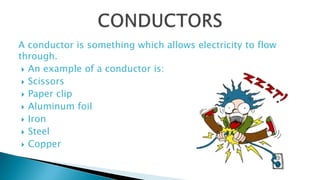
A conductor is something which allows electricity to flow
through.
 An example of a conductor is:
 Scissors
 Paper clip
 Aluminum foil
 Iron
 Steel
 Copper
 In physics and electrical engineering, a conductor is an
object or type of material that allows the flow of an
electrical current in one or more directions..
 A metal wire is a common electrical conductor.
 Electrical current is generated by the flow of negatively
charged electrons, positively charged holes, and positive or
negative ions in some cases.
 Conduction materials include metals, electrolytes , superconductors ,
semiconductors, plasmas and some nonmetallic conductors such as graphite
and conductive polymers
 Silver is more ‘conductive’ than copper, but due to cost it is not practical in
most cases. However, it is used in specialized equipment, such as satellites, and
as a thin plating to mitigate skin effect losses at high frequencies.
 Copper has a high conductivity. Annealed copper is the international standard to
which all other electrical conductors are compared.
 Aluminum wire, which has 61% of the conductivity of copper, has been used in
building wiring for its lower cost. By weight, aluminum has higher conductivity
than copper, but it has properties that cause problems when used for building
wiring. It can form a resistive oxide within connections that makes wiring
terminals heat. Aluminum can "creep", slowly deforming under load, eventually
causing
 An electrical insulator is a material whose internal electric charges do not flow
freely, and therefore make it nearly impossible to conduct an electric current under
the influence of an electric field.
 The property that distinguishes an insulator is its resistivity insulators have higher
resistivity than semiconductors or conductors.
 All insulators become electrically conductive when a sufficiently large voltage is
applied that the electric field tears electrons away from the atoms.
 This is known as the breakdown voltage of an insulator.
 Some materials such as glass, paper and Teflon which have high resistivity are very
good electrical insulators.
 Insulators are used in electrical equipment to support and separate
electrical conductors without allowing current through themselves.
 Insulators used for high-voltage power transmission are made
from glass , porcelain or composite polymer materials
 Porcelain insulators are made from clay
, quartz or alumina and feldspar , and are covered with a
smooth glaze to shed water.
 Insulators made from porcelain rich in alumina are used where
high mechanical strength is a criterion.
 Porcelain has a dielectric strength of about 4–10 kV/mm.
 Glass has a higher dielectric strength, but it attracts
condensation and the thick irregular shapes needed for
insulators are difficult to cast without internal strains.
 Some insulator manufacturers stopped making glass insulators
in the late 1960s, switching to ceramic materials.
 PIN TYPE INSULATOR
 POST INSULATOR
 SUSPENSION INSULATOR
 STRAIN INSULATOR
 SHACKLE INSULATOR
 As the name suggests, the pin type insulator is mounted on a pin on
the cross-arm on the pole.
 There is a groove on the upper end of the insulator.
 The conductor passes through this groove and is tied to the insulator
with annealed wire of the same material as the conductor.
 Pin type insulators are used for transmission and distribution of
communications, and electric power at voltages up to 33 kV.
 Insulators made for operating voltages between 33kV and 69kV tend
to be very bulky and have become uneconomical in recent years.
 For voltages greater than 33 kV, it is a usual
practice to use suspension type insulators,
consisting of a number of glass or porcelain discs
connected in series by metal links in the form of a
string.
 The conductor is suspended at the bottom end of
this string while the top end is secured to the cross-
arm of the tower.
 The number of disc units used depends on the
voltage.
 A dead end or anchor pole or tower is used where a straight section
of line ends, or angles off in another direction. These poles must
withstand the lateral (horizontal) tension of the long straight section
of wire. In order to support this lateral load, strain insulators are
used. For low voltage lines (less than 11 kV), shackle insulators are
used as strain insulators. However, for high voltage transmission
lines, strings of cap-and-pin (suspension) insulators are used,
attached to the cross arm in a horizontal direction. When the tension
load in lines is exceedingly high, such as at long river spans, two or
more strings are used in parallel.
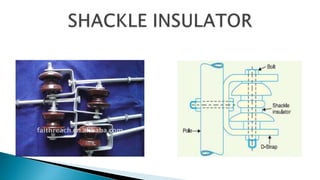
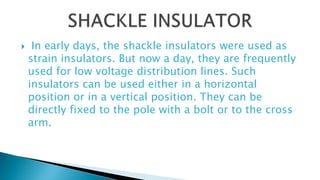
 In early days, the shackle insulators were used as
strain insulators. But now a day, they are frequently
used for low voltage distribution lines. Such
insulators can be used either in a horizontal
position or in a vertical position. They can be
directly fixed to the pole with a bolt or to the cross
arm.
 Here we discussed about conductors and insulators
 Studied about different types conductors
◦ Silver
◦ Copper
◦ Aluminum
 Studied about different types of insulators
◦ Pin type insulator
◦ Post insulator
◦ Suspension insulator
◦ Strain insulator
◦ Shackle insulator
THANK YOU

Study about Conductors & Insulators

  • 1.
    SUBJECT : ELECTRICALMACHINES II DATE : COURSE : DEEE/IInd YEAR/IVth SEM TITLE : CONDUCTORS & INSULATORS
  • 2.
  • 4.
    A conductor issomething which allows electricity to flow through.  An example of a conductor is:  Scissors  Paper clip  Aluminum foil  Iron  Steel  Copper
  • 5.
     In physicsand electrical engineering, a conductor is an object or type of material that allows the flow of an electrical current in one or more directions..  A metal wire is a common electrical conductor.  Electrical current is generated by the flow of negatively charged electrons, positively charged holes, and positive or negative ions in some cases.
  • 6.
     Conduction materialsinclude metals, electrolytes , superconductors , semiconductors, plasmas and some nonmetallic conductors such as graphite and conductive polymers  Silver is more ‘conductive’ than copper, but due to cost it is not practical in most cases. However, it is used in specialized equipment, such as satellites, and as a thin plating to mitigate skin effect losses at high frequencies.  Copper has a high conductivity. Annealed copper is the international standard to which all other electrical conductors are compared.  Aluminum wire, which has 61% of the conductivity of copper, has been used in building wiring for its lower cost. By weight, aluminum has higher conductivity than copper, but it has properties that cause problems when used for building wiring. It can form a resistive oxide within connections that makes wiring terminals heat. Aluminum can "creep", slowly deforming under load, eventually causing
  • 10.
     An electricalinsulator is a material whose internal electric charges do not flow freely, and therefore make it nearly impossible to conduct an electric current under the influence of an electric field.  The property that distinguishes an insulator is its resistivity insulators have higher resistivity than semiconductors or conductors.  All insulators become electrically conductive when a sufficiently large voltage is applied that the electric field tears electrons away from the atoms.  This is known as the breakdown voltage of an insulator.  Some materials such as glass, paper and Teflon which have high resistivity are very good electrical insulators.  Insulators are used in electrical equipment to support and separate electrical conductors without allowing current through themselves.
  • 11.
     Insulators usedfor high-voltage power transmission are made from glass , porcelain or composite polymer materials  Porcelain insulators are made from clay , quartz or alumina and feldspar , and are covered with a smooth glaze to shed water.  Insulators made from porcelain rich in alumina are used where high mechanical strength is a criterion.  Porcelain has a dielectric strength of about 4–10 kV/mm.  Glass has a higher dielectric strength, but it attracts condensation and the thick irregular shapes needed for insulators are difficult to cast without internal strains.  Some insulator manufacturers stopped making glass insulators in the late 1960s, switching to ceramic materials.
  • 12.
     PIN TYPEINSULATOR  POST INSULATOR  SUSPENSION INSULATOR  STRAIN INSULATOR  SHACKLE INSULATOR
  • 14.
     As thename suggests, the pin type insulator is mounted on a pin on the cross-arm on the pole.  There is a groove on the upper end of the insulator.  The conductor passes through this groove and is tied to the insulator with annealed wire of the same material as the conductor.  Pin type insulators are used for transmission and distribution of communications, and electric power at voltages up to 33 kV.  Insulators made for operating voltages between 33kV and 69kV tend to be very bulky and have become uneconomical in recent years.
  • 17.
     For voltagesgreater than 33 kV, it is a usual practice to use suspension type insulators, consisting of a number of glass or porcelain discs connected in series by metal links in the form of a string.  The conductor is suspended at the bottom end of this string while the top end is secured to the cross- arm of the tower.  The number of disc units used depends on the voltage.
  • 19.
     A deadend or anchor pole or tower is used where a straight section of line ends, or angles off in another direction. These poles must withstand the lateral (horizontal) tension of the long straight section of wire. In order to support this lateral load, strain insulators are used. For low voltage lines (less than 11 kV), shackle insulators are used as strain insulators. However, for high voltage transmission lines, strings of cap-and-pin (suspension) insulators are used, attached to the cross arm in a horizontal direction. When the tension load in lines is exceedingly high, such as at long river spans, two or more strings are used in parallel.
  • 21.
     In earlydays, the shackle insulators were used as strain insulators. But now a day, they are frequently used for low voltage distribution lines. Such insulators can be used either in a horizontal position or in a vertical position. They can be directly fixed to the pole with a bolt or to the cross arm.
  • 22.
     Here wediscussed about conductors and insulators  Studied about different types conductors ◦ Silver ◦ Copper ◦ Aluminum  Studied about different types of insulators ◦ Pin type insulator ◦ Post insulator ◦ Suspension insulator ◦ Strain insulator ◦ Shackle insulator
  • 23.