Change Management:
“Failing to Prepare is Preparing to Fail”,
so don’t be one of the guilty 75%,
and avail of the latest methodologies
Myles Sweeney BA (Psychol.), Dip. (Mgt.), MBS (Finance), Ph.D
(Business/Economic Psychol.)
• What we mean by Change/Transformation?
• Change initiative failure rates
• Maturity of Organisation system (Linear v Agile)
• The Agility Premium
• Root cause of failure rates
• The critical dimension of Trust
• Why Capability Maturity Management is important
• Dynamic Systems Maturity Theory
• A Practical Maturity Framework (OrgCMF)
• How OrgCMF complements lean
• Conclusions
Agenda
What we mean by Change?
Value PyramidLevers Outcome
• Performance
• Growth
• Satisfaction
• Advantage
• Compliance
• Survival
• etc
DeliveringApplied to
• Lean, Continuous Improvement, Productivity all relate to
Change/Development initiatives
• Research on high level of failures for transformation & change
initiatives:
• Failure Rates – Ec. Dev. (100%), CM (75%), M&A (50%), Mental Health (50%),
Criminal Rehab. (50%), Education (??), etc.
• Productivity Levels – Historically low across the world, especially Linear
Cultures
• Boom-and-Bust Cyclicality, etc.
• Calls for better modelling based on Human Nature across the
Economics Paradigm (e.g., Sachs, Merkel, etc.)
Background
• 25% Success rates in OD/CM is related to Preparedness in terms of the
existing Agility/Maturity of Organizations (McKinsey, 2017);
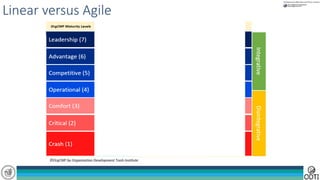
• 22% are operating at Agile, 88% at Disintegrative, Linear Levels (2019)
• 300% Premium for Returns from Agile Levels of Organization (Hamel)
• 500% Discount for Organizations under Linear-Leadership Style (Kiel)
• All Lean, CI and Productivity Interventions are affected
• What is needed is modelling that diagnoses re. the divide and builds
Capacity for Complexity on top of the foundations of controlled Process
and Procedure
• Summary NB. – 75% of organizations Fail in Change and same 75% miss
Premium Returns through lacking Capability Maturity
The Outcome Divide – Linearity/Agility
Real cause of failure rates
Presented causes (Symptoms)
• Lack of shared Vision & realistic plan
• Lack of Talent, Understanding & Skill
• Legacy Systems inertia
• Poor Investment and success
measurement
• Lack of Customer focus,
understanding and data leverage
• Resistance to Change and poor
Change Management
• Inappropriate Culture & insufficient
Collaboration
Real causes (Researched)
• The Organisation’s
change/transformation ambition(s) were
beyond its capability maturity level
overall (System) or in key Dynamics (Sub-
systems). They must be in alignment.
• Building/Improving Capability is a
sequential and cumulative process as it’s
a learning process.
• Integrative Maturity level has learning
capacity and development actions can
start as guided for that level
• Disintegrative Maturity levels lack
system foundations and development
sequence must star as guided from
maturity level 1
NB Level of Critical Dimension
TRUST
“The ability to mobilise resources to achieve an aim”
Why Capability Maturity Management is important?
A means;
to measure and improve Ability
to simplify the complexity of
organisation systems
to address interdependencies e.g.
Process, Skills, Tools, Management,
explain what is happening, practices
and performance.
to identify and set priorities to achieve
aims for any change.
To calibrate actions to the
organisations learning level.
Current Capability maturities determine
Current
Performance
Rate of Change
Improve Capability maturity
Add New Capabilities
Improves Performance
Improves Agility (Rate)
Enables greater ambition
The key is knowing which
capabilities to focus/invest on/in
to achieve target aims (Ambition)
• Integrating from across Psychology, Org. Science, Economics, etc.:
• 7 Levels of Maturity for all types of human systems as and activities with 15
discrete Stages based mostly on existing research and practice
• People, Organizations and Economies as Micro, Meso and Macro Socio-Economic
Systems
• Diagnose Capabilities against Maturity to gain Starting-Point TRACTION and avoid
Overshooting
• Develop along Stages to maximise SUSTAINABILITY
• Newly defined Levels of both Inverted and Agile Organization so we always know
what exactly we are dealing with unlike Greiner (?), CMMI (Initial), etc.
• “Management through Human Nature” to benefit everyone
• Operationalizable online for involved diagnostics and automated prescriptive
reporting with Graphic
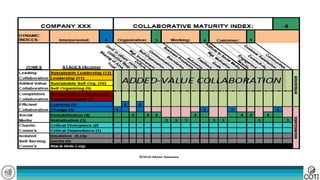
New Modelling re. Added-Value Capability:
Dynamic Systems Maturity Theory
Body of Knowledge
Scientific Maturity
Model
Assessment Tool
www.orgcmf.com
Models
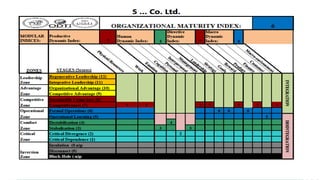
• Full OMI (Image)
• Selected Dynamics
• Collaboration Index
• M & A Index
• Culture Index
Linear versus Agile
https://www.mckinsey.com/featured-insights/leadership/five-fifty-agility-at-the-top?cid=fivefifty-eml-alt-mkq-
mck&hlkid=b0c3dd1a989e4d839a59a17ab51e7055&hctky=1649573&hdpid=653743b8-37e8-431c-b190-bb7cba5309df
76% said that
the most
difficult part of
transformation
was changing
culture; next on
46% was
Leadership and
Talent; on 34%,
Establishing a
clear Vision &
Implementation
Plan.
Lean, like TQM, etc., benefits organizations to the degree it changes behavior
• Facilitating Organization-Development beyond the Operational Level and avoiding
Habituation in the Procedural Stage
• Avoiding the Chaotic Level of Critical Singularities – Cases of Toyota, Schweinfurt
• Avoiding Negative Hysteresis that can lead to Corporate Anorexia
• Facilitating Dynamic Structures
• Facilitating Value Network > Hierarchy or Lean as abused in top-down “Lean &
Mean”
• Enables Multiple Workflows > “Value Stream” and “Value Chains” more inclusive
of multiple stakeholders in added-value activities e.g., Collaboration
• Raise Kaizen from gradual linear process improvement that can Habituate
• Addresses recognised Social-Complexity issues with Lean
1) Complementing Lean
• Integrating Psychology, Organizational Science, Economics, etc. for
comprehensive modelling of Development in Socio-Economic Systems
• Target preparedness of specific Capabilities for specific interventions
• Full-System Capability Maturity Development for Agile Organizations
• Continuous Improvement as natural Learning process rather than
disjunctive interventions, and Inversion-proof
• Productivity enabler through prescriptive normative process to
achieve 300% premium Agility
• Operationalised for fullest participation and normative guidance
across all types of sub-system and activities
Summary
Thanks for your attention! Any Questions?
myless@orgcmf.com
Boddy, C. (2011). Corporate Psychopaths: Organizational Destroyers. NY: Palgrave.
Kiel, F. (2015). Return on Character: The Real Reason Leaders and their Companies
Win. Harvard Business Review Press.
Hamel, G. and Zanini, M. (2016). The $3 Trillion Prize for Busting Bureaucracy.
MLab. http://www.managementexchange.com/blog/bureaucracy%E2%80%99s-3-trillion-price-
tag?utm_source=MIX+Fix&utm_campaign=528f0fc28e-EMAIL_CAMPAIGN_2016_12_08&utm_medium=email&utm_term=0_f438b7f975-
528f0fc28e-16732637
Spain, S., Harms, P., and Wood, D. (2016). Stress, Well-Being, and the Dark Side of
Leadership. Research in Occupational Stress and Well-being, 14, 33-59.
Womack, J. (2010). Toyota’s overstretched supply chain – The machine that ran too
hot: The woes of the world’s biggest carmaker are a warning for rivals. The
Economist, Feb 25th https://www.economist.com/business/2010/02/25/the-
machine-that-ran-too-hot
References

Capability - Productivity - Lean

  • 1.
    Change Management: “Failing toPrepare is Preparing to Fail”, so don’t be one of the guilty 75%, and avail of the latest methodologies Myles Sweeney BA (Psychol.), Dip. (Mgt.), MBS (Finance), Ph.D (Business/Economic Psychol.)
  • 2.
    • What wemean by Change/Transformation? • Change initiative failure rates • Maturity of Organisation system (Linear v Agile) • The Agility Premium • Root cause of failure rates • The critical dimension of Trust • Why Capability Maturity Management is important • Dynamic Systems Maturity Theory • A Practical Maturity Framework (OrgCMF) • How OrgCMF complements lean • Conclusions Agenda
  • 3.
    What we meanby Change? Value PyramidLevers Outcome • Performance • Growth • Satisfaction • Advantage • Compliance • Survival • etc DeliveringApplied to
  • 4.
    • Lean, ContinuousImprovement, Productivity all relate to Change/Development initiatives • Research on high level of failures for transformation & change initiatives: • Failure Rates – Ec. Dev. (100%), CM (75%), M&A (50%), Mental Health (50%), Criminal Rehab. (50%), Education (??), etc. • Productivity Levels – Historically low across the world, especially Linear Cultures • Boom-and-Bust Cyclicality, etc. • Calls for better modelling based on Human Nature across the Economics Paradigm (e.g., Sachs, Merkel, etc.) Background
  • 5.
    • 25% Successrates in OD/CM is related to Preparedness in terms of the existing Agility/Maturity of Organizations (McKinsey, 2017); • 22% are operating at Agile, 88% at Disintegrative, Linear Levels (2019) • 300% Premium for Returns from Agile Levels of Organization (Hamel) • 500% Discount for Organizations under Linear-Leadership Style (Kiel) • All Lean, CI and Productivity Interventions are affected • What is needed is modelling that diagnoses re. the divide and builds Capacity for Complexity on top of the foundations of controlled Process and Procedure • Summary NB. – 75% of organizations Fail in Change and same 75% miss Premium Returns through lacking Capability Maturity The Outcome Divide – Linearity/Agility
  • 6.
    Real cause offailure rates Presented causes (Symptoms) • Lack of shared Vision & realistic plan • Lack of Talent, Understanding & Skill • Legacy Systems inertia • Poor Investment and success measurement • Lack of Customer focus, understanding and data leverage • Resistance to Change and poor Change Management • Inappropriate Culture & insufficient Collaboration Real causes (Researched) • The Organisation’s change/transformation ambition(s) were beyond its capability maturity level overall (System) or in key Dynamics (Sub- systems). They must be in alignment. • Building/Improving Capability is a sequential and cumulative process as it’s a learning process. • Integrative Maturity level has learning capacity and development actions can start as guided for that level • Disintegrative Maturity levels lack system foundations and development sequence must star as guided from maturity level 1
  • 7.
    NB Level ofCritical Dimension TRUST
  • 8.
    “The ability tomobilise resources to achieve an aim” Why Capability Maturity Management is important? A means; to measure and improve Ability to simplify the complexity of organisation systems to address interdependencies e.g. Process, Skills, Tools, Management, explain what is happening, practices and performance. to identify and set priorities to achieve aims for any change. To calibrate actions to the organisations learning level. Current Capability maturities determine Current Performance Rate of Change Improve Capability maturity Add New Capabilities Improves Performance Improves Agility (Rate) Enables greater ambition The key is knowing which capabilities to focus/invest on/in to achieve target aims (Ambition)
  • 9.
    • Integrating fromacross Psychology, Org. Science, Economics, etc.: • 7 Levels of Maturity for all types of human systems as and activities with 15 discrete Stages based mostly on existing research and practice • People, Organizations and Economies as Micro, Meso and Macro Socio-Economic Systems • Diagnose Capabilities against Maturity to gain Starting-Point TRACTION and avoid Overshooting • Develop along Stages to maximise SUSTAINABILITY • Newly defined Levels of both Inverted and Agile Organization so we always know what exactly we are dealing with unlike Greiner (?), CMMI (Initial), etc. • “Management through Human Nature” to benefit everyone • Operationalizable online for involved diagnostics and automated prescriptive reporting with Graphic New Modelling re. Added-Value Capability: Dynamic Systems Maturity Theory
  • 10.
    Body of Knowledge ScientificMaturity Model Assessment Tool www.orgcmf.com Models • Full OMI (Image) • Selected Dynamics • Collaboration Index • M & A Index • Culture Index
  • 13.
  • 14.
    https://www.mckinsey.com/featured-insights/leadership/five-fifty-agility-at-the-top?cid=fivefifty-eml-alt-mkq- mck&hlkid=b0c3dd1a989e4d839a59a17ab51e7055&hctky=1649573&hdpid=653743b8-37e8-431c-b190-bb7cba5309df 76% said that themost difficult part of transformation was changing culture; next on 46% was Leadership and Talent; on 34%, Establishing a clear Vision & Implementation Plan.
  • 15.
    Lean, like TQM,etc., benefits organizations to the degree it changes behavior • Facilitating Organization-Development beyond the Operational Level and avoiding Habituation in the Procedural Stage • Avoiding the Chaotic Level of Critical Singularities – Cases of Toyota, Schweinfurt • Avoiding Negative Hysteresis that can lead to Corporate Anorexia • Facilitating Dynamic Structures • Facilitating Value Network > Hierarchy or Lean as abused in top-down “Lean & Mean” • Enables Multiple Workflows > “Value Stream” and “Value Chains” more inclusive of multiple stakeholders in added-value activities e.g., Collaboration • Raise Kaizen from gradual linear process improvement that can Habituate • Addresses recognised Social-Complexity issues with Lean 1) Complementing Lean
  • 16.
    • Integrating Psychology,Organizational Science, Economics, etc. for comprehensive modelling of Development in Socio-Economic Systems • Target preparedness of specific Capabilities for specific interventions • Full-System Capability Maturity Development for Agile Organizations • Continuous Improvement as natural Learning process rather than disjunctive interventions, and Inversion-proof • Productivity enabler through prescriptive normative process to achieve 300% premium Agility • Operationalised for fullest participation and normative guidance across all types of sub-system and activities Summary
  • 17.
    Thanks for yourattention! Any Questions? myless@orgcmf.com
  • 18.
    Boddy, C. (2011).Corporate Psychopaths: Organizational Destroyers. NY: Palgrave. Kiel, F. (2015). Return on Character: The Real Reason Leaders and their Companies Win. Harvard Business Review Press. Hamel, G. and Zanini, M. (2016). The $3 Trillion Prize for Busting Bureaucracy. MLab. http://www.managementexchange.com/blog/bureaucracy%E2%80%99s-3-trillion-price- tag?utm_source=MIX+Fix&utm_campaign=528f0fc28e-EMAIL_CAMPAIGN_2016_12_08&utm_medium=email&utm_term=0_f438b7f975- 528f0fc28e-16732637 Spain, S., Harms, P., and Wood, D. (2016). Stress, Well-Being, and the Dark Side of Leadership. Research in Occupational Stress and Well-being, 14, 33-59. Womack, J. (2010). Toyota’s overstretched supply chain – The machine that ran too hot: The woes of the world’s biggest carmaker are a warning for rivals. The Economist, Feb 25th https://www.economist.com/business/2010/02/25/the- machine-that-ran-too-hot References

Editor's Notes

  • #4 Key message here is there are many interdependent items you can change and where you focus has many options. We are dealing with sophistication and complexity when it comes to organisation change.
  • #5 Main message here is existing approaches to change and transformation in organisations has not delivered a reduction in failure rates over the last 40 years. Our focus is organisation change so concentrate on that message. TQM, Lean, JIT, Kotter etc are all valuable , but the value is around the management approach and process rather than the root causes in a complex environment.
  • #6 Here draw out the point about the narrow but useful value of Lean, TQM etc while signalling that a more system view of capability management and improvement are important. McKinsey 2019 – Agile (22%), Trapped (23%), Bureaucratic (27%), Start-Up Mode (28%).
  • #7 The Organisation’s change/transformation ambition(s) were beyond its capability maturity level overall (System) or in key Dynamics (Sub-systems). They must be in alignment. Building/Improving Capability is a sequential and cumulative process as it’s a learning process. Think of it like academic learning you do home learning and kindergarten, primary school, secondary school, third level, post graduate. You don’t jump levels. Specific change actions or initiatives that are beyond the existing capability maturity level (Level of ability and functioning) rarely gain traction and stick and may cause maturity level to regress, while change actions below existing capability maturity level are as a minimum suboptimal with potential also to cause regression. When building and improving capabilities if the existing measured capability maturity level for the Organisation, Dynamic or underlying building blocks (Constructs) is at the lower levels of maturity they generally lack the foundations for building/improving from the measured level of maturity and the point to start building and improving (starting the sequence referenced in 2 above) is at Maturity level 1 out of 7. Whereas if the measured level of capability maturity is at the higher levels then the development/improvement actions can start using the guidance for that measured level, because for these functioning levels the organisation has the learning capacity to assimilate these actions.
  • #14 Here make the point about relationship between linear management and agile distributed leadership and management