The Absolute
Must-Do’s
to build an agile organization
What do we mean by agility? It’s how powerfully your organization can
react to changes in the marketplace, recognize and close employee
skill gaps, and align the right people in the right places to handle any
pivots in business strategy. How can you make your organization
more agile? There are several critical things you must do.
A company’s
agility trumps
efficiency as today’s predictor of success.
High-impact learning transcends the traditional model of
development—learn, take a test, determine competency—
and incorporates: knowledge sharing, building trust, and
learning from failure.
Build a high-impact
learning culture
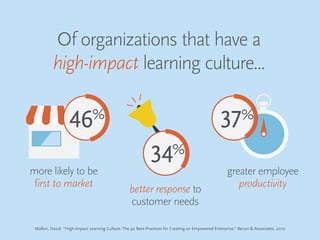
more likely to be
first to market better response to
customer needs
greater employee
productivity
Of organizations that have a
high-impact learning culture...
34%
37%
46%
Mallon, David. “High-Impact Learning Culture: The 40 Best Practices for Creating an Empowered Enterprise,” Bersin & Associates, 2010
Organizations must begin to actively capture and retain
the expertise and institutional knowledge of retiring
Boomers. Make the connection between knowledge
sharing and business continuity to ensure success amid
talent losses.
Develop a culture of
knowledge sharing
Searchable Knowlege
for every employee
When the majority of a federal reserve bank’s examiners
were nearing retirement, the organization hosted frequent
chat sessions with older employees. These chat sessions
were then recorded, parsed into video vignettes, and
loaded into a searchable knowledge base available online
to new employees. As result of this knowledge sharing,
the bank was able to both develop a new generation of
leaders and proactively address business continuity.
Development makes more sense when it’s relevant to day-
to-day activities. Use embedded learning—after-action
reviews, customer feedback cycles, job rotations—to
maximize experiential and reflective learning.
Expand learning beyond
the classroom
Effective learning is targeted, relevant, and personalized.
Use learning technology to move toward creating
employee specific development experiences more
efficiently and at lower cost.
Move away from
one-size-fits-all training
Providing individualized
employee development
When a global provider of childcare services
realized employees had a broad interest in learning
opportunities, the organization turned to an integrated
talent management system to provide individualized
development plans. This not only accommodated diverse
employee training needs but improved engagement,
strengthened the employee brand in the marketplace,
and built a stronger work community.
Agility is the result of an organization’s transition from
a static performance management model to one that
supports a continuous loop of feedback and actual
employee development.
Transition to ongoing
performance management
Develop a common
competency language
High-impact performance depends on a common
vocabulary of skills. Clearly define competencies and
profiles to increase the ability to affect real change through
performance management and learning.
Specific, manageable goals are much more likely to lead
to business progress and employee success. Transform
big, once-a-year goals into short-term, measurable, and
precise objectives.
Make employee goals
crystal clear
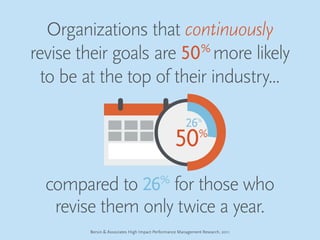
Organizations that continuously
revise their goals are 50%
more likely
to be at the top of their industry...
compared to 26%
for those who
revise them only twice a year.
50%
26%
Bersin & Associates High Impact Performance Management Research, 2011
A global travel company switched from an annual
performance review process to one that was monthly.
Goals were simplified and technology was employed to
track ongoing progress and goal refinement. As a result,
employees and supervisors now have deeper, more
meaningful conversations around performance, and their
leadership team is much more aware of which people
possess the right abilities to help them course-correct in
the marketplace even faster.
Goal Refinement
for increased clarity
Laborious, manual paper processes are the enemy of agility.
It’s difficult to make accurate people decisions based on
complex spreadsheets and binders. Instead, use technology
designed to track, manage, and report on all aspects of
your employees’ performance and development.
Reduce paperwork &
documentation
More than 1,500 companies around the globe have increased
their agility through Cornerstone OnDemand’s integrated
talent management suite which they use to recruit top talent,
manage performance, plan for succession, and develop
employees. Find out more by visiting csod.com.
©2014 Cornerstone OnDemand, Inc. All Rights Reserved. csod-cp-agilebiz-012014

The absolute must do's to build an Agile Organization

  • 1.
    The Absolute Must-Do’s to buildan agile organization
  • 2.
    What do wemean by agility? It’s how powerfully your organization can react to changes in the marketplace, recognize and close employee skill gaps, and align the right people in the right places to handle any pivots in business strategy. How can you make your organization more agile? There are several critical things you must do. A company’s agility trumps efficiency as today’s predictor of success.
  • 3.
    High-impact learning transcendsthe traditional model of development—learn, take a test, determine competency— and incorporates: knowledge sharing, building trust, and learning from failure. Build a high-impact learning culture
  • 4.
    more likely tobe first to market better response to customer needs greater employee productivity Of organizations that have a high-impact learning culture... 34% 37% 46% Mallon, David. “High-Impact Learning Culture: The 40 Best Practices for Creating an Empowered Enterprise,” Bersin & Associates, 2010
  • 5.
    Organizations must beginto actively capture and retain the expertise and institutional knowledge of retiring Boomers. Make the connection between knowledge sharing and business continuity to ensure success amid talent losses. Develop a culture of knowledge sharing
  • 6.
    Searchable Knowlege for everyemployee When the majority of a federal reserve bank’s examiners were nearing retirement, the organization hosted frequent chat sessions with older employees. These chat sessions were then recorded, parsed into video vignettes, and loaded into a searchable knowledge base available online to new employees. As result of this knowledge sharing, the bank was able to both develop a new generation of leaders and proactively address business continuity.
  • 7.
    Development makes moresense when it’s relevant to day- to-day activities. Use embedded learning—after-action reviews, customer feedback cycles, job rotations—to maximize experiential and reflective learning. Expand learning beyond the classroom
  • 8.
    Effective learning istargeted, relevant, and personalized. Use learning technology to move toward creating employee specific development experiences more efficiently and at lower cost. Move away from one-size-fits-all training
  • 9.
    Providing individualized employee development Whena global provider of childcare services realized employees had a broad interest in learning opportunities, the organization turned to an integrated talent management system to provide individualized development plans. This not only accommodated diverse employee training needs but improved engagement, strengthened the employee brand in the marketplace, and built a stronger work community.
  • 10.
    Agility is theresult of an organization’s transition from a static performance management model to one that supports a continuous loop of feedback and actual employee development. Transition to ongoing performance management
  • 11.
    Develop a common competencylanguage High-impact performance depends on a common vocabulary of skills. Clearly define competencies and profiles to increase the ability to affect real change through performance management and learning.
  • 12.
    Specific, manageable goalsare much more likely to lead to business progress and employee success. Transform big, once-a-year goals into short-term, measurable, and precise objectives. Make employee goals crystal clear
  • 13.
    Organizations that continuously revisetheir goals are 50% more likely to be at the top of their industry... compared to 26% for those who revise them only twice a year. 50% 26% Bersin & Associates High Impact Performance Management Research, 2011
  • 14.
    A global travelcompany switched from an annual performance review process to one that was monthly. Goals were simplified and technology was employed to track ongoing progress and goal refinement. As a result, employees and supervisors now have deeper, more meaningful conversations around performance, and their leadership team is much more aware of which people possess the right abilities to help them course-correct in the marketplace even faster. Goal Refinement for increased clarity
  • 15.
    Laborious, manual paperprocesses are the enemy of agility. It’s difficult to make accurate people decisions based on complex spreadsheets and binders. Instead, use technology designed to track, manage, and report on all aspects of your employees’ performance and development. Reduce paperwork & documentation
  • 16.
    More than 1,500companies around the globe have increased their agility through Cornerstone OnDemand’s integrated talent management suite which they use to recruit top talent, manage performance, plan for succession, and develop employees. Find out more by visiting csod.com. ©2014 Cornerstone OnDemand, Inc. All Rights Reserved. csod-cp-agilebiz-012014