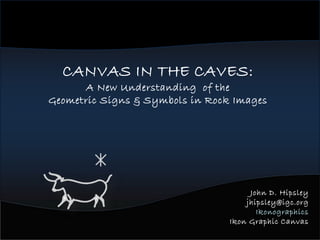
CANVAS IN THE CAVES:
A New Understanding of the
Geometric Signs & Symbols in Rock Images
John D. Hipsley
jhipsley@igc.org
Ikonographics
Ikon Graphic Canvas
Imagine yourself as a cave dweller
Where: Europe
When: 25,000 years ago,
Millennia before the last ice age
You live in an open-air tent or
a transient hut.
Life is short, brutal and then
you die…
But you also belong to a rich culture
that creates images. From one third
to half a mile underground are
subterranean cave paintings
of animals…
But not only animals but
handprints and dots,
x’s and triangles,
parallel lines and
spirals.
Your people know what they mean.
You use them on tools and jewelry.
And then you vanish—
and with you, their meanings.
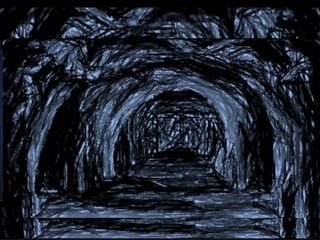
Let us explore these caves to
rediscover what we can of
these signs…
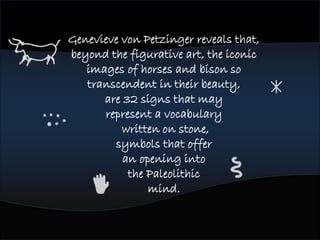
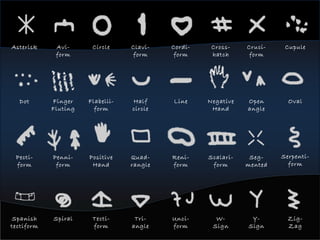
Genevieve von Petzinger reveals that,
beyond the figurative art, the iconic
images of horses and bison so
transcendent in their beauty,
are 32 signs that may
represent a vocabulary
written on stone,
symbols that offer
an opening into
the Paleolithic
mind.
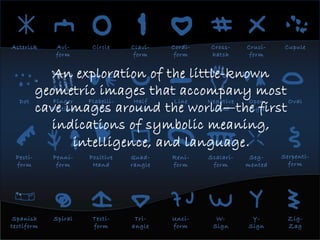
Asterisk Avi-
form
Circle Clavi-
form
Cordi-
form
Cross-
hatch
Cruci-
form
Cupule
Finger
Fluting
Flabelli-
form
Half
circle
Line Negative
Hand
Open
angle
Oval
Positive
Hand
Quad-
rangle
Reni-
form
Scalari-
form
Seg-
mented
Spanish
tectiform
Spiral Tecti-
form
Tri-
angle
Unci-
form
W-
Sign
Y-
Sign
Zig-
Zag
Dot
Pecti-
form
Penni-
form
Serpenti-
form
An exploration of the little-known
geometric images that accompany most
cave images around the world—the first
indications of symbolic meaning,
intelligence, and language.
Asterisk Avi-
form
Circle Clavi-
form
Cordi-
form
Cross-
hatch
Cruci-
form
Cupule
Finger
Fluting
Flabelli-
form
Half
circle
Line Negative
Hand
Open
angle
Oval
Positive
Hand
Quad-
rangle
Reni-
form
Scalari-
form
Seg-
mented
Spanish
tectiform
Spiral Tecti-
form
Tri-
angle
Unci-
form
W-
Sign
Y-
Sign
Zig-
Zag
Dot
Pecti-
form
Penni-
form
Serpenti-
form
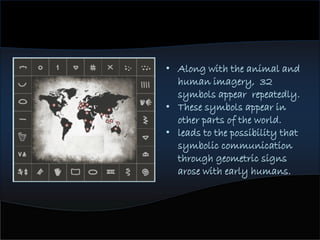
• Along with the animal and
human imagery, 32
symbols appear repeatedly.
• These symbols appear in
other parts of the world.
• leads to the possibility that
symbolic communication
through geometric signs
arose with early humans.
• 32 recognizable Signs
• Cover entire continent of
Europe
• 32 recognizable Signs
• Cover entire continent of
Europe
• Consistent over 30,000 to
40,000 years
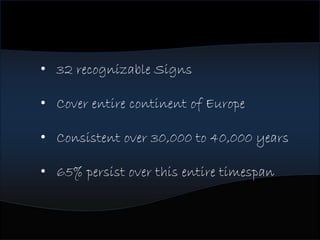
• 32 recognizable Signs
• Cover entire continent of
Europe
• Consistent over 30,000 to
40,000 years
• 65% persist over this entire
timespan
“This may represent one
of the most extraordinary
scientific insights of our time."
Wade Davis, author of The Serpent and the Rainbow Professor of
Anthropology Faculty Associate, University of British Columbia
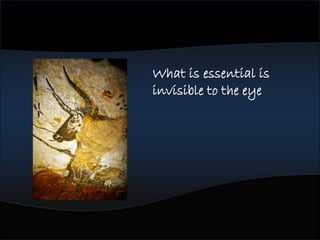
What is essential is
invisible to the eye
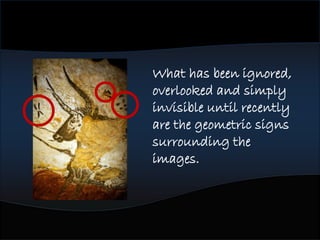
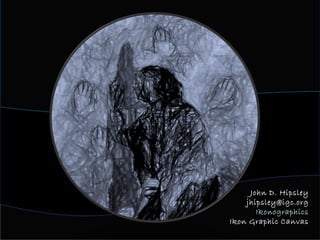
What has been ignored,
overlooked and simply
invisible until recently
are the geometric signs
surrounding the
images.
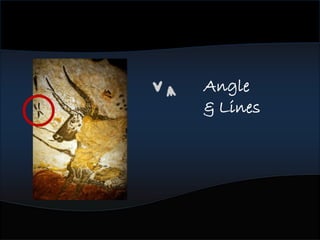
Angle
& Lines
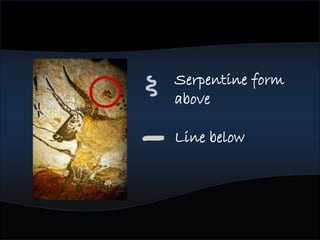
Serpentine form
above
Line below
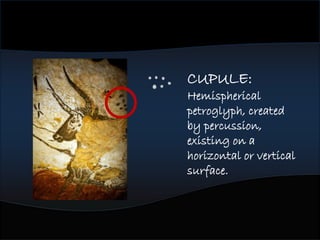
CUPULE:
Hemispherical
petroglyph, created
by percussion,
existing on a
horizontal or vertical
surface.
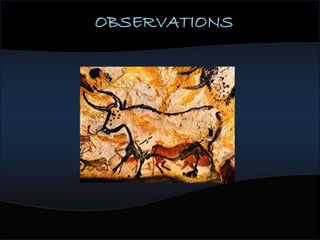
OBSERVATIONS
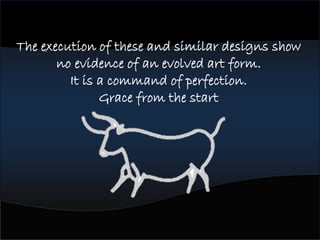
The execution of these and similar designs show
no evidence of an evolved art form.
It is a command of perfection.
Grace from the start
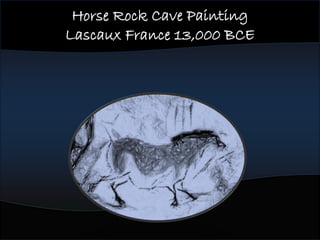
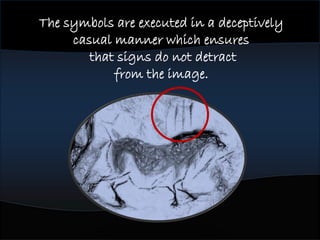
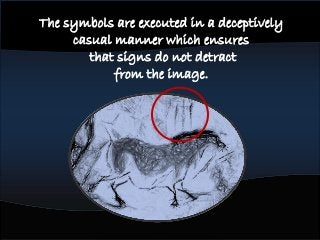
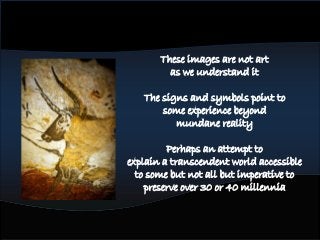
Horse Rock Cave Painting
Lascaux France 13,000 BCE
The symbols are executed in a deceptively
casual manner which ensures
that signs do not detract
from the image.
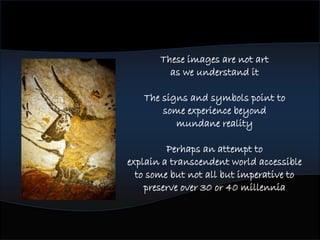
These images are not art
as we understand it
The signs and symbols point to
some experience beyond
mundane reality
Perhaps an attempt to
explain a transcendent world accessible
to some but not all but imperative to
preserve over 30 or 40 millennia
Acknowledgement
THE FIRST SIGNS: Unlocking the
Mysteries of the World’s Oldest
Symbols
by Genevieve von Petzinger
One of the most significant works on our evolutionary ancestry since
Richard Leakey’s paradigm-shattering Origins,
The First Signs is the first-ever exploration of the little-known
geometric images that accompany most cave art around the world—the
first indications of symbolic meaning, intelligence, and language.
The Mind in the Cave: Consciousness and the Origins of Art
David Lewis-Williams (Thames & Hudson, 2004)
Lone Survivors: How We Came to Be the Only Humans on Earth
Chris Stringer (St. Martin's Griffin, 2013)
Masters of the Planet: The Search for Our Human Origins
Ian Tattersall (St. Martin's Griffin, 2013)
The Bradshaw Foundation
This is one of the largest rock art foundations in the world, and
their website is an excellent resource on ancient rock art and other
symbolic artifacts from around the world.
Further Reading
John D. Hipsley
jhipsley@igc.org
Ikonographics
Ikon Graphic Canvas

Canvas in the caves

  • 1.
    CANVAS IN THECAVES: A New Understanding of the Geometric Signs & Symbols in Rock Images John D. Hipsley jhipsley@igc.org Ikonographics Ikon Graphic Canvas
  • 2.
    Imagine yourself asa cave dweller Where: Europe When: 25,000 years ago, Millennia before the last ice age
  • 3.
    You live inan open-air tent or a transient hut. Life is short, brutal and then you die…
  • 4.
    But you alsobelong to a rich culture that creates images. From one third to half a mile underground are subterranean cave paintings of animals…
  • 5.
    But not onlyanimals but handprints and dots, x’s and triangles, parallel lines and spirals.
  • 6.
    Your people knowwhat they mean. You use them on tools and jewelry.
  • 7.
    And then youvanish— and with you, their meanings.
  • 8.
    Let us explorethese caves to rediscover what we can of these signs…
  • 10.
    Genevieve von Petzingerreveals that, beyond the figurative art, the iconic images of horses and bison so transcendent in their beauty, are 32 signs that may represent a vocabulary written on stone, symbols that offer an opening into the Paleolithic mind.
  • 11.
    Asterisk Avi- form Circle Clavi- form Cordi- form Cross- hatch Cruci- form Cupule Finger Fluting Flabelli- form Half circle LineNegative Hand Open angle Oval Positive Hand Quad- rangle Reni- form Scalari- form Seg- mented Spanish tectiform Spiral Tecti- form Tri- angle Unci- form W- Sign Y- Sign Zig- Zag Dot Pecti- form Penni- form Serpenti- form An exploration of the little-known geometric images that accompany most cave images around the world—the first indications of symbolic meaning, intelligence, and language.
  • 12.
    Asterisk Avi- form Circle Clavi- form Cordi- form Cross- hatch Cruci- form Cupule Finger Fluting Flabelli- form Half circle LineNegative Hand Open angle Oval Positive Hand Quad- rangle Reni- form Scalari- form Seg- mented Spanish tectiform Spiral Tecti- form Tri- angle Unci- form W- Sign Y- Sign Zig- Zag Dot Pecti- form Penni- form Serpenti- form
  • 13.
    • Along withthe animal and human imagery, 32 symbols appear repeatedly. • These symbols appear in other parts of the world. • leads to the possibility that symbolic communication through geometric signs arose with early humans.
  • 14.
  • 15.
    • 32 recognizableSigns • Cover entire continent of Europe
  • 16.
    • 32 recognizableSigns • Cover entire continent of Europe • Consistent over 30,000 to 40,000 years
  • 17.
    • 32 recognizableSigns • Cover entire continent of Europe • Consistent over 30,000 to 40,000 years • 65% persist over this entire timespan
  • 18.
    “This may representone of the most extraordinary scientific insights of our time." Wade Davis, author of The Serpent and the Rainbow Professor of Anthropology Faculty Associate, University of British Columbia
  • 19.
    What is essentialis invisible to the eye
  • 20.
    What has beenignored, overlooked and simply invisible until recently are the geometric signs surrounding the images.
  • 21.
  • 22.
  • 23.
  • 24.
  • 25.
    The execution ofthese and similar designs show no evidence of an evolved art form. It is a command of perfection. Grace from the start
  • 26.
    Horse Rock CavePainting Lascaux France 13,000 BCE
  • 27.
    The symbols areexecuted in a deceptively casual manner which ensures that signs do not detract from the image.
  • 28.
    These images arenot art as we understand it The signs and symbols point to some experience beyond mundane reality Perhaps an attempt to explain a transcendent world accessible to some but not all but imperative to preserve over 30 or 40 millennia
  • 29.
    Acknowledgement THE FIRST SIGNS:Unlocking the Mysteries of the World’s Oldest Symbols by Genevieve von Petzinger One of the most significant works on our evolutionary ancestry since Richard Leakey’s paradigm-shattering Origins, The First Signs is the first-ever exploration of the little-known geometric images that accompany most cave art around the world—the first indications of symbolic meaning, intelligence, and language.
  • 30.
    The Mind inthe Cave: Consciousness and the Origins of Art David Lewis-Williams (Thames & Hudson, 2004) Lone Survivors: How We Came to Be the Only Humans on Earth Chris Stringer (St. Martin's Griffin, 2013) Masters of the Planet: The Search for Our Human Origins Ian Tattersall (St. Martin's Griffin, 2013) The Bradshaw Foundation This is one of the largest rock art foundations in the world, and their website is an excellent resource on ancient rock art and other symbolic artifacts from around the world. Further Reading
  • 31.