Case study: Pyometra in bitch
Case history:
Date: 2075/10/06
Location: Central Referral Veterinary Hospital; Tripureswor.
Owner’s name: Mrs. Ranju Shrestha
Address: Jadibuti, Kathmandu
Dog’s name: Sweetie
Species: Canine
Breed: Japanese splitz
Sex: Female
Age: 4 years.
Weight: 15 kg
Vaccination status: Regular vaccines of Rabies, DHPPL, Corona.
Use of contraceptive injection(sangini sui)
15/4/2019 1
Clinical findings:
ď‚— Anorexia
ď‚— Dull and depressed appearance
ď‚— Enlarged belly ; hard on palpation
ď‚— Temperature: 102.1 oF
ď‚— Respiration rate: 28per minute.
ď‚— Heart rate: 95 beats per minute.
ď‚— Mucous membrane: pink
ď‚— Pus discharge from vagina
15/4/2019 2
Diagnosis
15/4/2019 3
Fig: Ultrasound
Pyometra
Uterus filled with anechoic fluid.
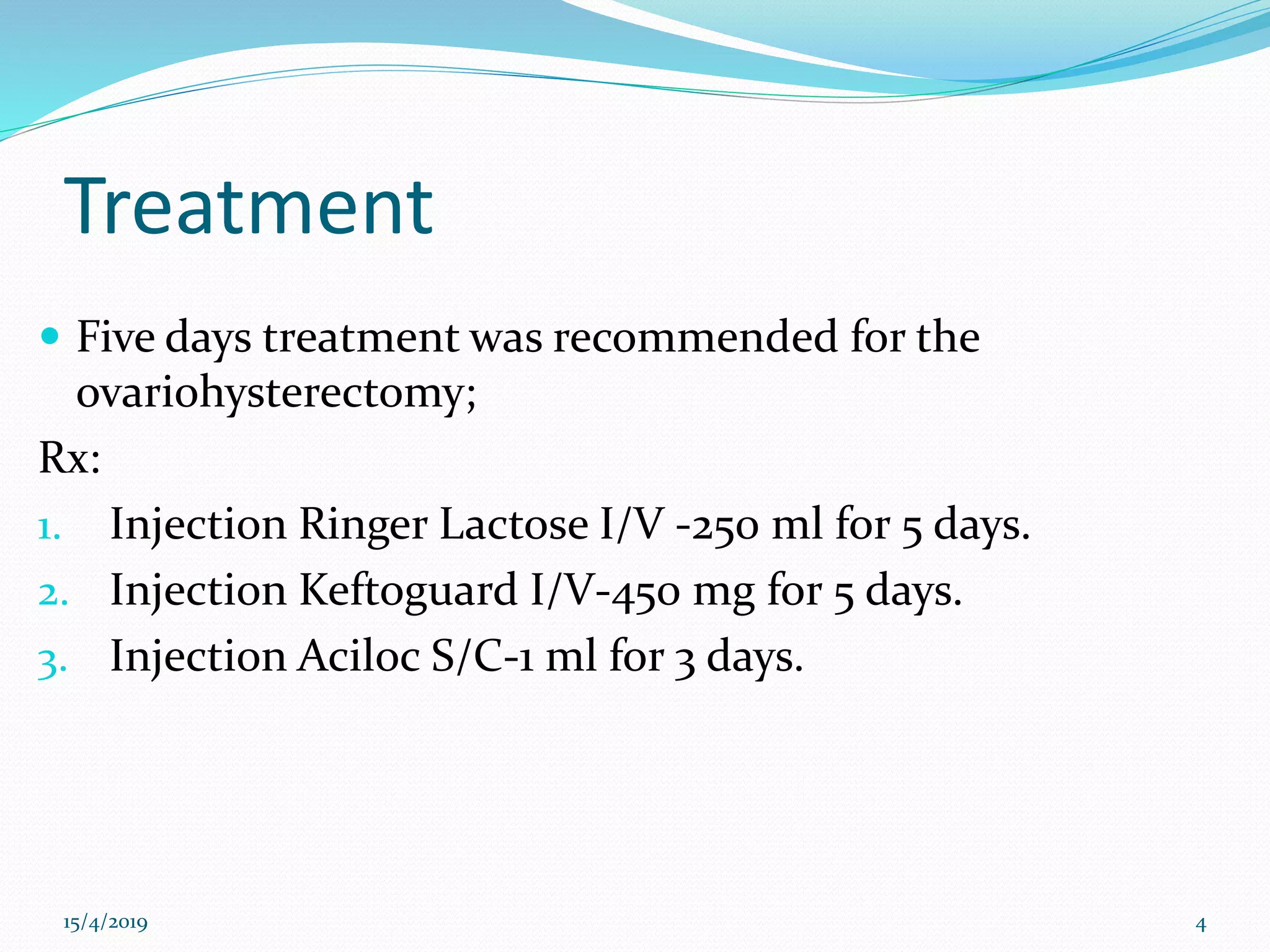
Treatment
ď‚— Five days treatment was recommended for the
ovariohysterectomy;
Rx:
1. Injection Ringer Lactose I/V -250 ml for 5 days.
2. Injection Keftoguard I/V-450 mg for 5 days.
3. Injection Aciloc S/C-1 ml for 3 days.
15/4/2019 4
Follow up
ď‚— Rx:
1. Tab Super CV 275 mg BID for 5 days.
ď‚— Follow up for wound dressing after 5 days.
ď‚— Prognosis: wound was healed and the dog was in good
health.
15/4/2019 5
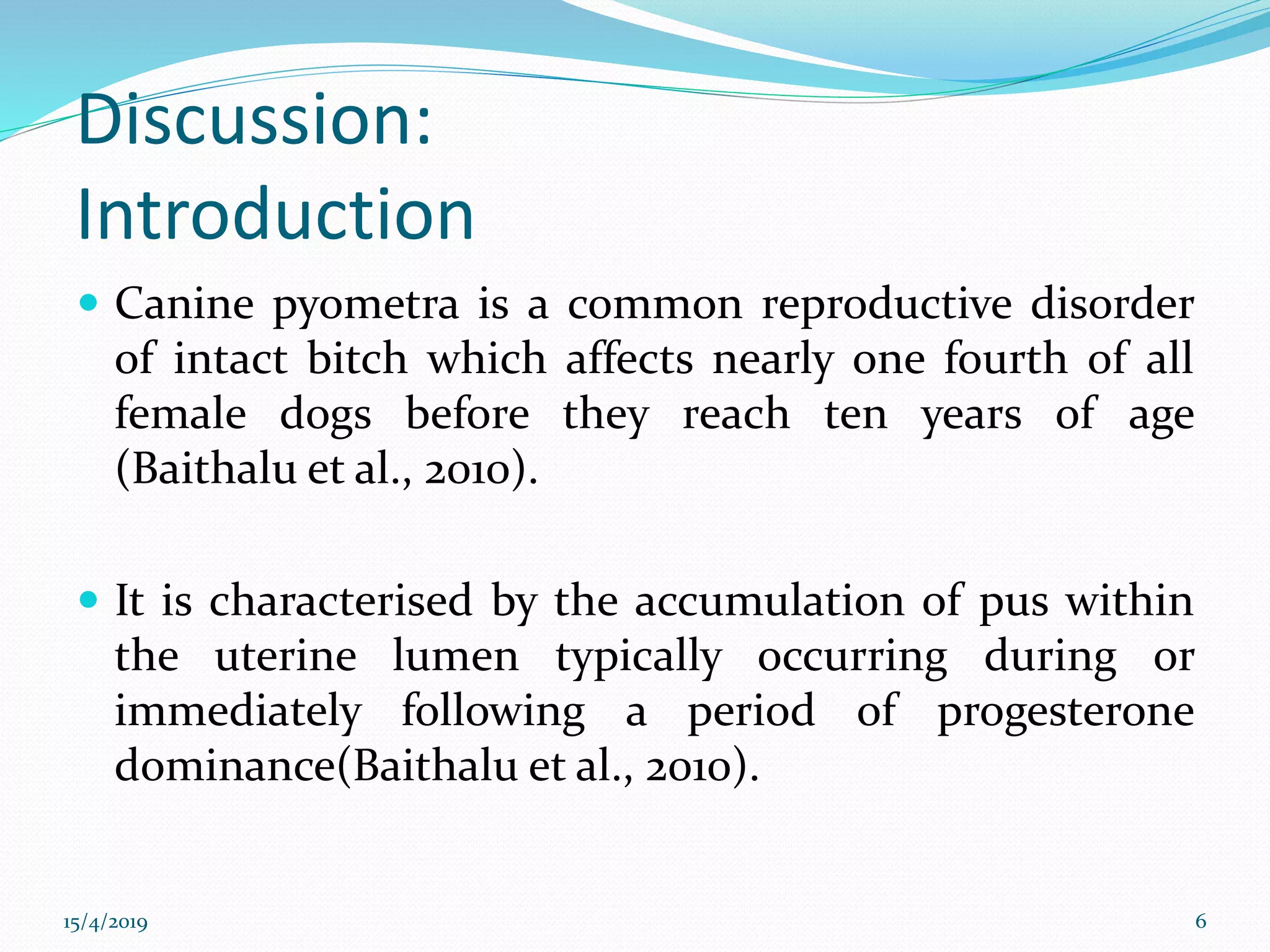
Discussion:
Introduction
ď‚— Canine pyometra is a common reproductive disorder
of intact bitch which affects nearly one fourth of all
female dogs before they reach ten years of age
(Baithalu et al., 2010).
ď‚— It is characterised by the accumulation of pus within
the uterine lumen typically occurring during or
immediately following a period of progesterone
dominance(Baithalu et al., 2010).
15/4/2019 6
Introduction contd…
ď‚— It is hormonally mediated disorder characterized by
Cystic Endometrial Hyperplasia (CEH) with secondary
bacterial infection(The Mercks Veterinary Manual, 10th
edition).
ď‚— Escherichia coli is the pathogen most commonly
isolated from bitches with pyometra(Fieni et al.,2014).
ď‚— Pyometra is classified as open or closed depending on
the functional patency of the cervix i.e. presence or
absence of vaginal discharge(Jitepan et al.,2017).
15/4/2019 7
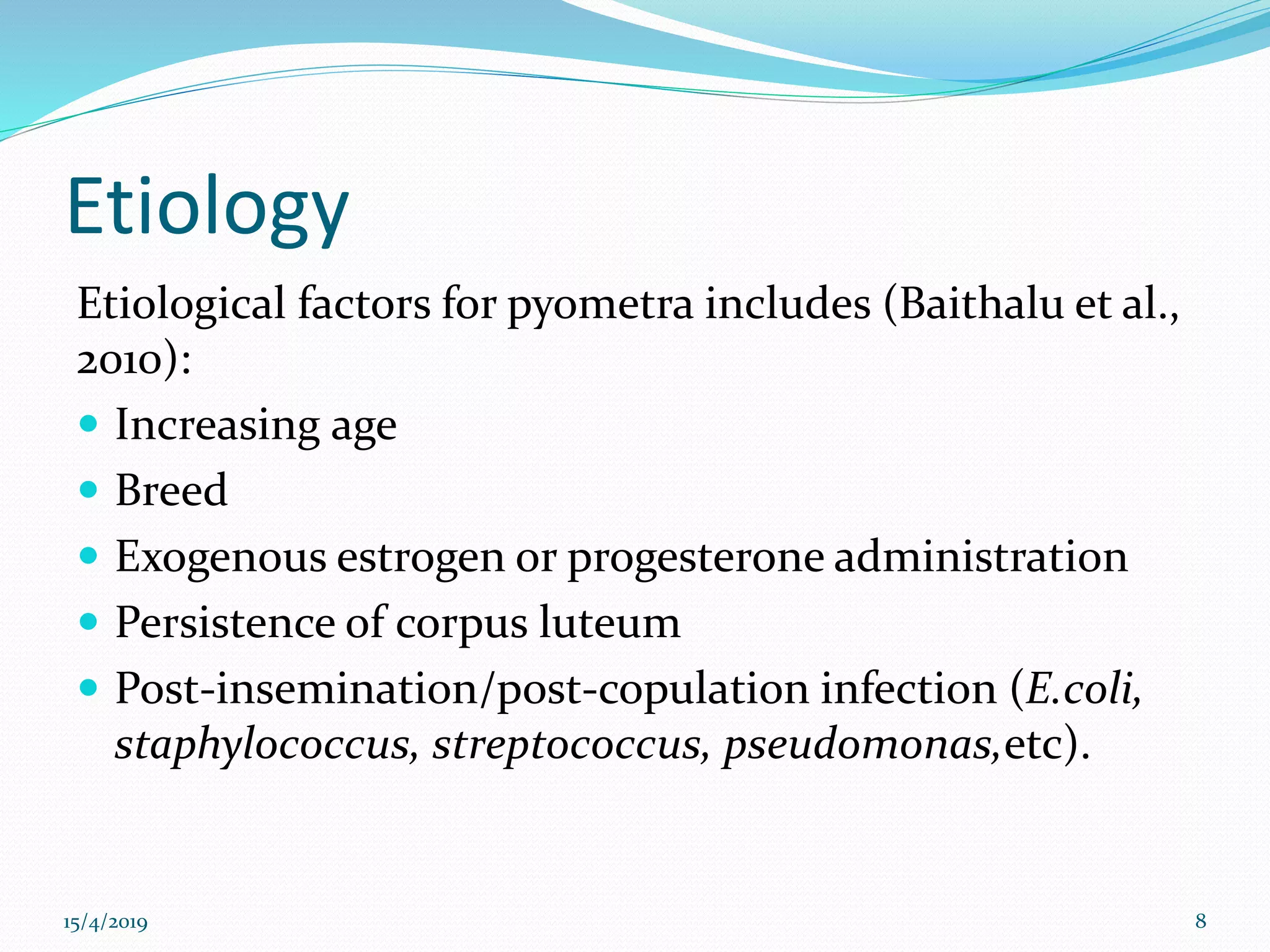
Etiology
Etiological factors for pyometra includes (Baithalu et al.,
2010):
ď‚— Increasing age
ď‚— Breed
ď‚— Exogenous estrogen or progesterone administration
ď‚— Persistence of corpus luteum
ď‚— Post-insemination/post-copulation infection (E.coli,
staphylococcus, streptococcus, pseudomonas,etc).
15/4/2019 8
Pathophysiology:
Progesterone stimulates endometrial growth and glandular
secretion that provides excellent media for bacteria(Baithalu et
al., 2010)
Progesterone reduces myometrium contractility and maintain
cervical closure(Baithalu et al., 2010)
Glands fail to empty due to scarring around opening of gland
or due to reduce myometrial contraction(Lopatec, 2016)
15/4/2019 9
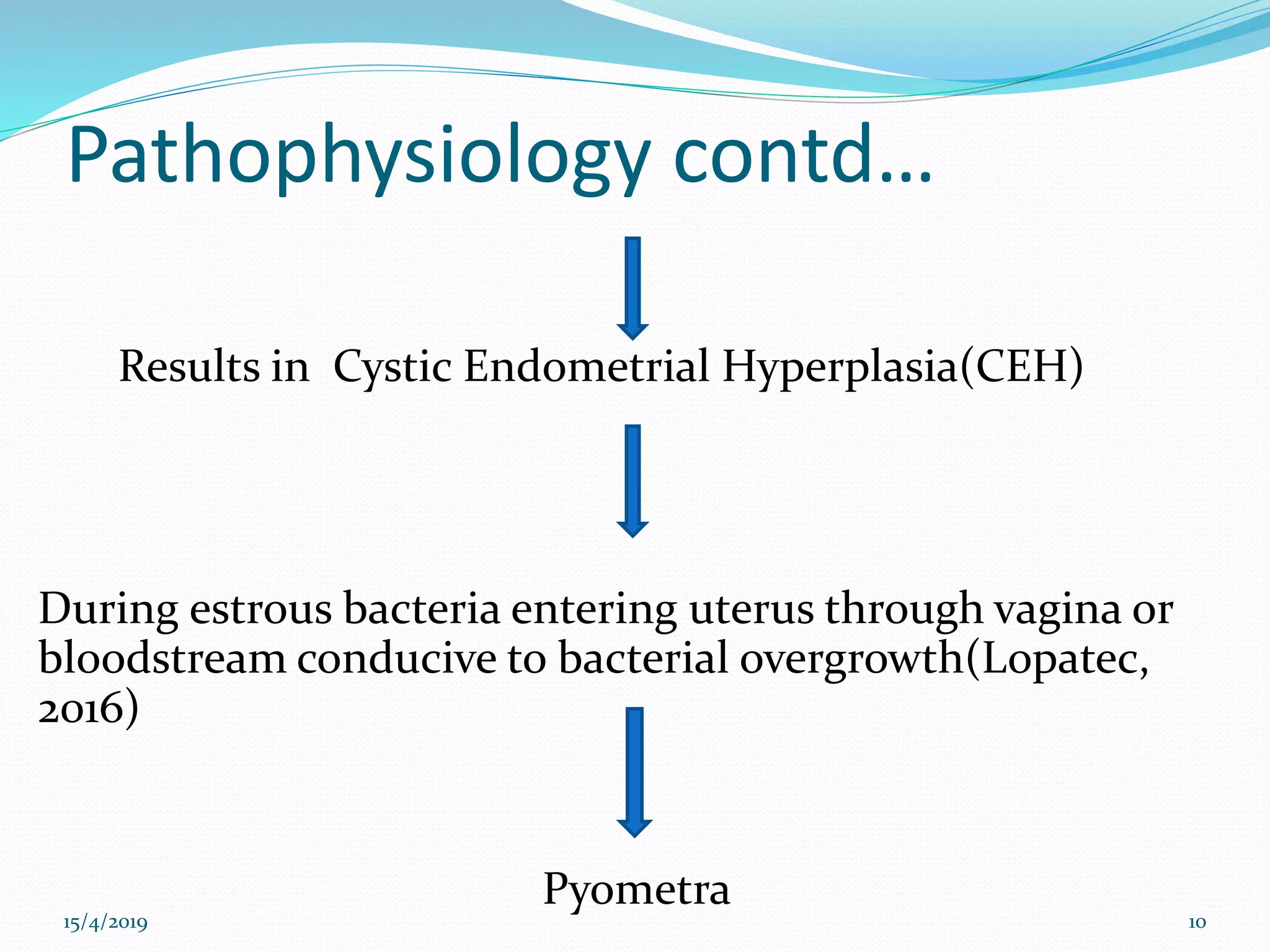
Pathophysiology contd…
Results in Cystic Endometrial Hyperplasia(CEH)
During estrous bacteria entering uterus through vagina or
bloodstream conducive to bacterial overgrowth(Lopatec,
2016)
Pyometra
15/4/2019 10
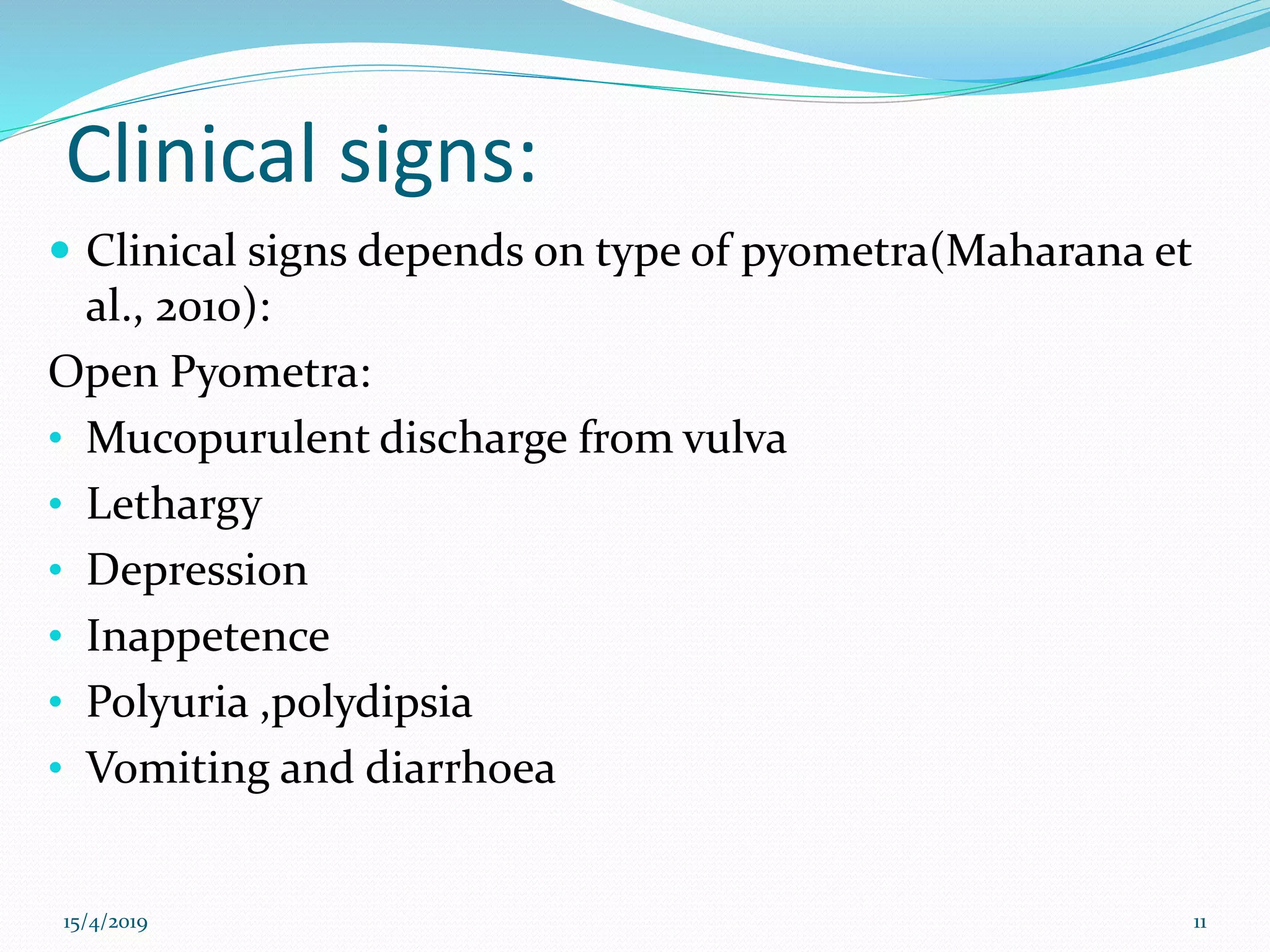
Clinical signs:
ď‚— Clinical signs depends on type of pyometra(Maharana et
al., 2010):
Open Pyometra:
• Mucopurulent discharge from vulva
• Lethargy
• Depression
• Inappetence
• Polyuria ,polydipsia
• Vomiting and diarrhoea
15/4/2019 11
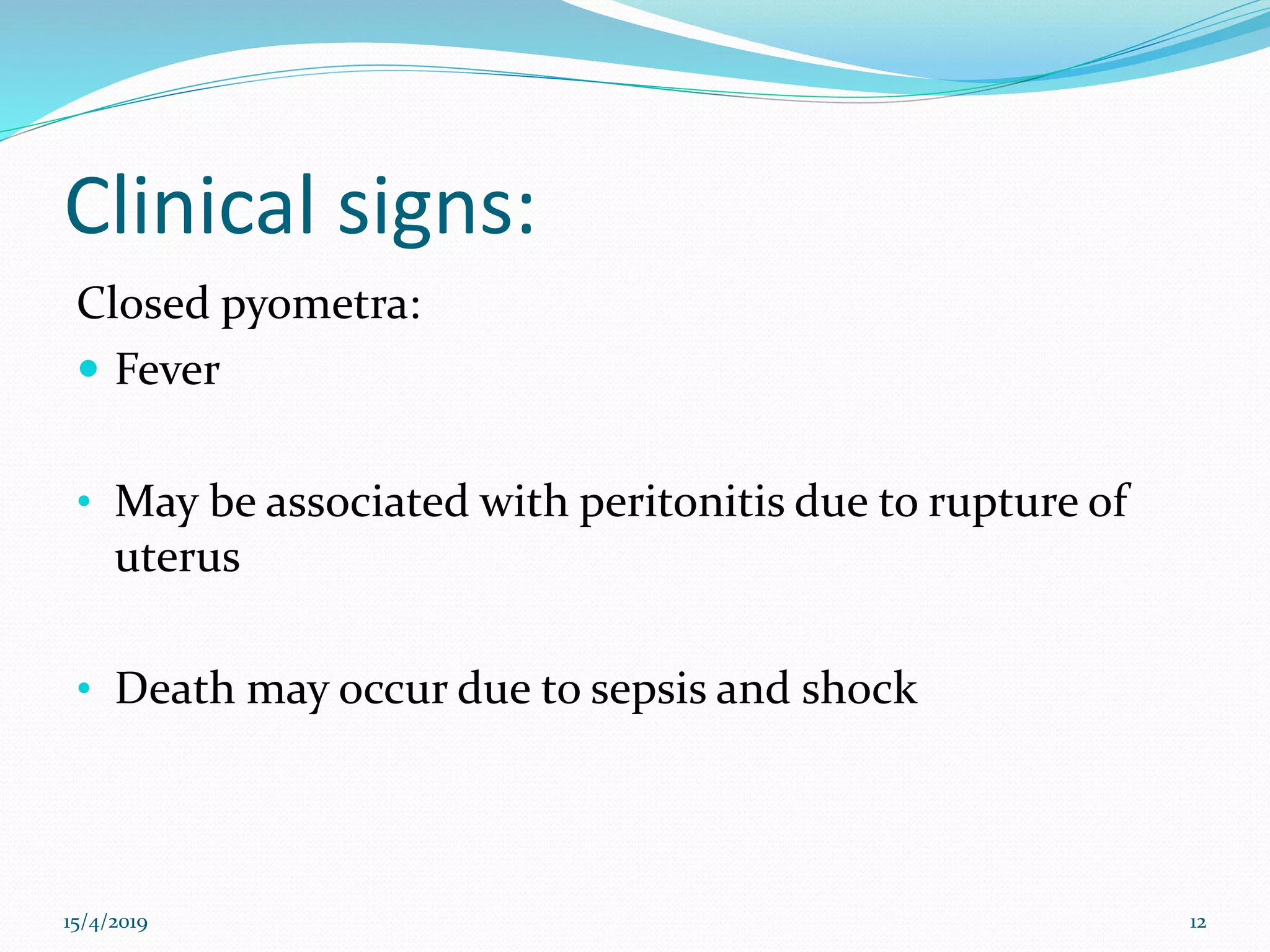
Clinical signs:
Closed pyometra:
ď‚— Fever
• May be associated with peritonitis due to rupture of
uterus
• Death may occur due to sepsis and shock
15/4/2019 12
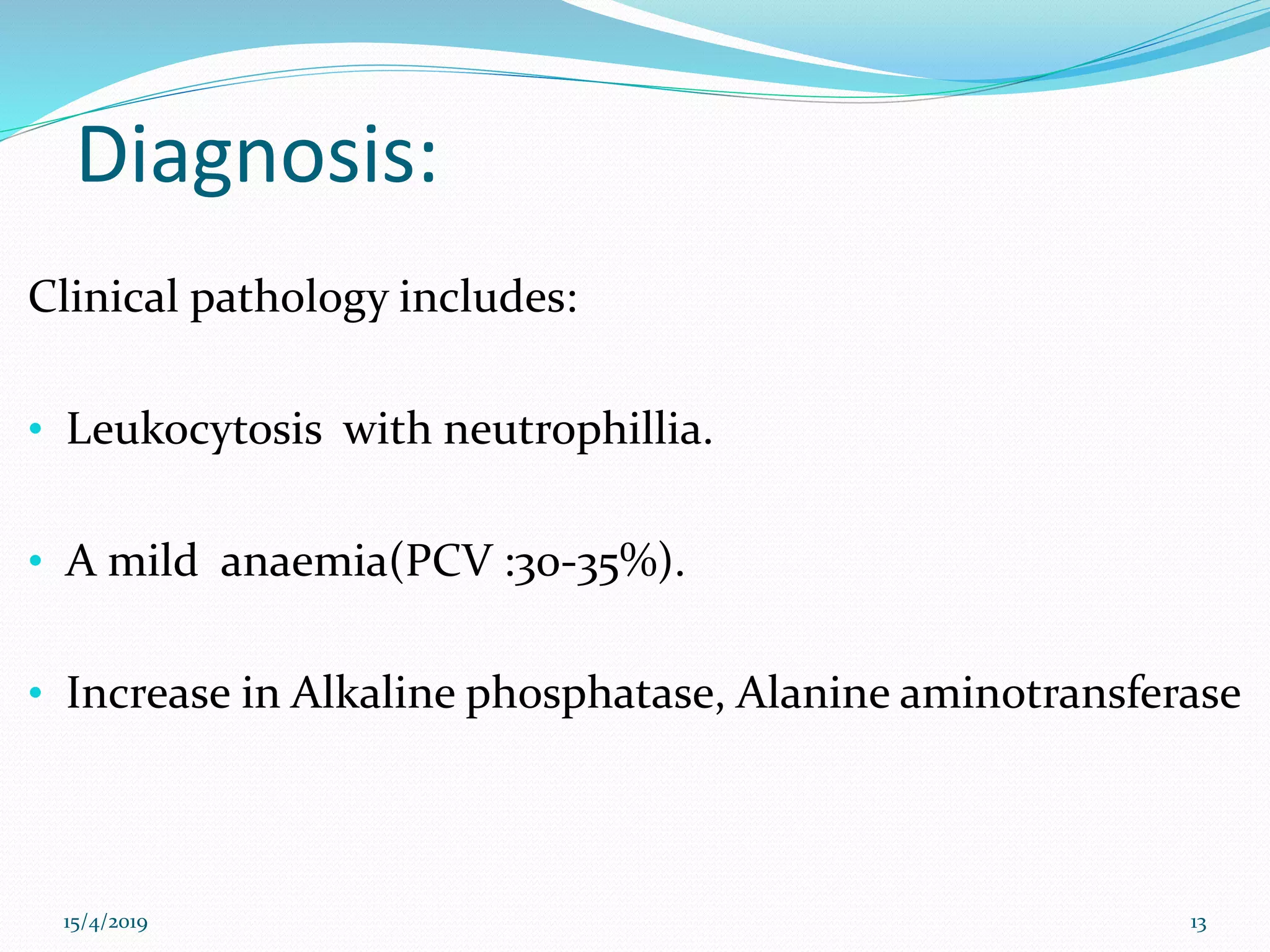
Diagnosis:
Clinical pathology includes:
• Leukocytosis with neutrophillia.
• A mild anaemia(PCV :30-35%).
• Increase in Alkaline phosphatase, Alanine aminotransferase
15/4/2019 13
Treatment:
ď‚— Treatment choice for any pyometra is ovariohysterectomy.
ď‚— If the bitch is valuable breeding animal medical therapy is
carried out.
ď‚— Medical treatment involves :
I. Fluid therapy
II. Antibiotic administration (Amoxicillin-clavulanic acid)
III. Uterine evacuation
15/4/2019 14
Treatment contd…
Prostaglandin :
ď‚— Indicated in the treatment for open pyometra in healthy
young bitches with normal kidney and liver
function(Fieni et al., 2014).
ď‚— It results in smooth muscle contraction , cervical
relaxation and regression of corpus luteum.
ď‚— Drug is given 2-3 times daily for 5-10 days.
15/4/2019 15
Treatment contd…
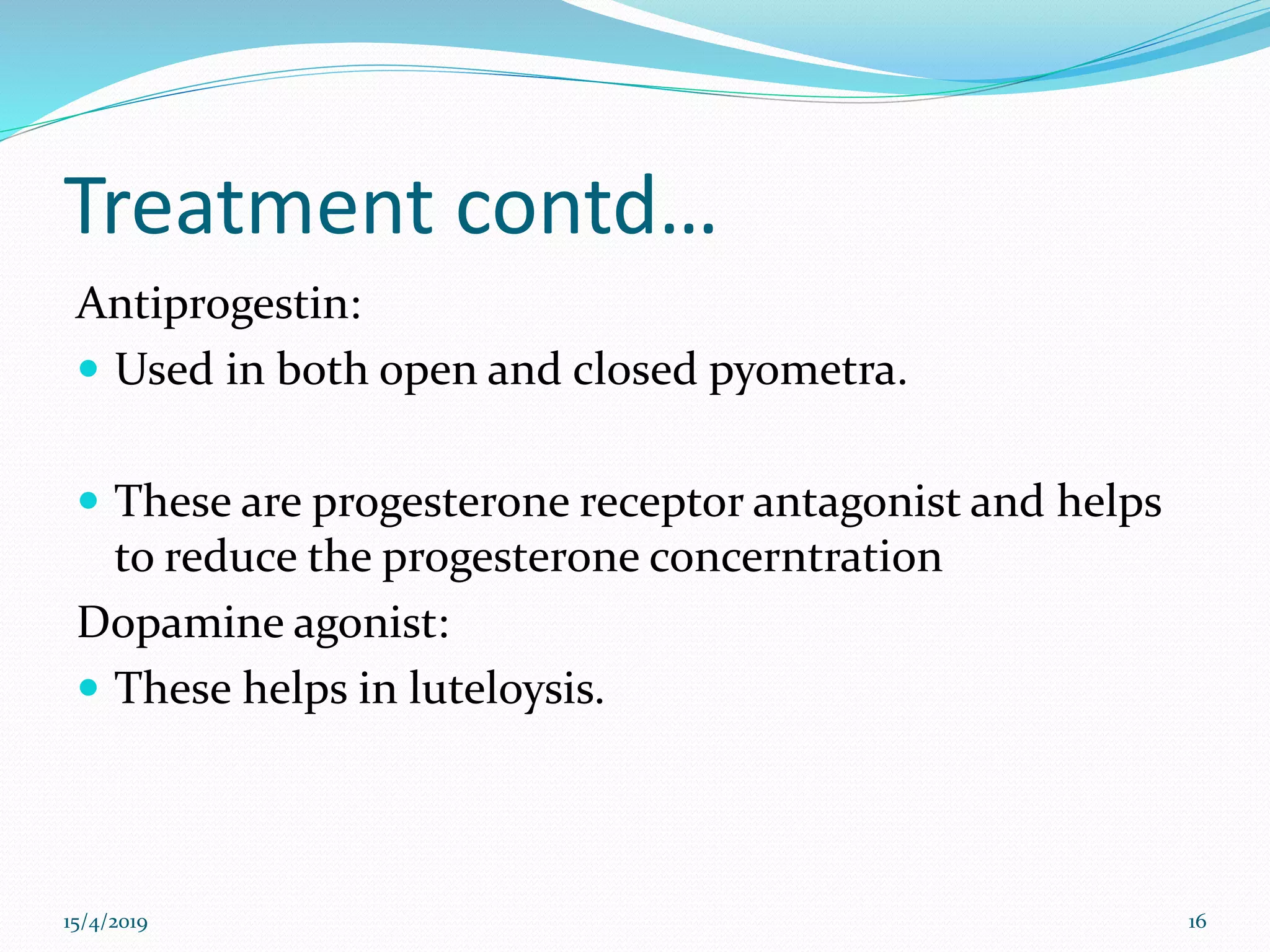
Antiprogestin:
ď‚— Used in both open and closed pyometra.
ď‚— These are progesterone receptor antagonist and helps
to reduce the progesterone concerntration
Dopamine agonist:
ď‚— These helps in luteloysis.
15/4/2019 16
Literature Review
ď‚— When medroxy-progesterone acetate was used for
population control ,the prevalence of pyometra increased
to treated bitches to 45 % over a prevalence of only 5% of
untreated bitches(Crane,M.B.,2015).
ď‚— Acharya Mohan and Dhakal Santosh studied prevalence
of major health problems among 171 street dogs in
Pokhara Valley from January to December 2011 reported
1.75% prevalence of Pyometra.
15/4/2019 17
Literature review:
ď‚— Ros et al.,(2014) performed a retrospective study of
bitches with pyometra, medically treated with
aglepristone from 2004 to 2013 admitted to Swedish
University Hospital concluded medical treatment with
aglepristone in combination with antimicrobial therapy
was successful in 75% of the bitches and recurrence rate
was 48%.
ď‚— Jitepan et al., (2016) Prospectively collected data from 111
female dogs diagnosed with pyometra at the University
Animal Hospital during 2005-2012 reported 65% with
open cervix and 35% with closed cervix.
15/4/2019 18
References:
ď‚— Crane,M.B.,(2015).Small Animal Critical Care Medicine.2nd edition .W.B.
Saunders.pp667-671.
ď‚— F. Fieni, E. Topie and A. Gogny,(2014).Medical Treatment for Pyometra in
Dogs. Reprod Dom Anim 49(2),28-32.[online].[Retrieved from
https://www.ncbi.nlm.nih.gov/pubmed/24947858].
ď‚— M. Acharya and S. Dhakal (2016) Int J Appl Sci Biotechnol, Vol 4(1): 53-56
[Retrieved fromhttps://www.researchgate.net/publication/29954487].
 Linnea Ros, Bodil Ström Holst, Ragnvi Hagman,(2014).A retrospective
study of bitches with pyometra, medically treated with
aglepristone,Theriogenology, 82(9), 1281-1286,[Retrieved from
http://www.sciencedirect.com/science/article/pii/S0093691X14004580]
ď‚— Jitpean, S., Ambrosen, A., Emanuelson, U., & Hagman, R. (2017). Closed
cervix is associated with more severe illness in dogs with pyometra. BMC
veterinary research, 13(1), 11.[Retrieved from
https://www.ncbi.nlm.nih.gov/pmc/articles/PMC5217653/]
15/4/2019 19

Pyometra in bitch

  • 1.
    Case study: Pyometrain bitch Case history: Date: 2075/10/06 Location: Central Referral Veterinary Hospital; Tripureswor. Owner’s name: Mrs. Ranju Shrestha Address: Jadibuti, Kathmandu Dog’s name: Sweetie Species: Canine Breed: Japanese splitz Sex: Female Age: 4 years. Weight: 15 kg Vaccination status: Regular vaccines of Rabies, DHPPL, Corona. Use of contraceptive injection(sangini sui) 15/4/2019 1
  • 2.
    Clinical findings: ď‚— Anorexia ď‚—Dull and depressed appearance ď‚— Enlarged belly ; hard on palpation ď‚— Temperature: 102.1 oF ď‚— Respiration rate: 28per minute. ď‚— Heart rate: 95 beats per minute. ď‚— Mucous membrane: pink ď‚— Pus discharge from vagina 15/4/2019 2
  • 3.
  • 4.
    Treatment ď‚— Five daystreatment was recommended for the ovariohysterectomy; Rx: 1. Injection Ringer Lactose I/V -250 ml for 5 days. 2. Injection Keftoguard I/V-450 mg for 5 days. 3. Injection Aciloc S/C-1 ml for 3 days. 15/4/2019 4
  • 5.
    Follow up ď‚— Rx: 1.Tab Super CV 275 mg BID for 5 days. ď‚— Follow up for wound dressing after 5 days. ď‚— Prognosis: wound was healed and the dog was in good health. 15/4/2019 5
  • 6.
    Discussion: Introduction ď‚— Canine pyometrais a common reproductive disorder of intact bitch which affects nearly one fourth of all female dogs before they reach ten years of age (Baithalu et al., 2010). ď‚— It is characterised by the accumulation of pus within the uterine lumen typically occurring during or immediately following a period of progesterone dominance(Baithalu et al., 2010). 15/4/2019 6
  • 7.
    Introduction contd…  Itis hormonally mediated disorder characterized by Cystic Endometrial Hyperplasia (CEH) with secondary bacterial infection(The Mercks Veterinary Manual, 10th edition).  Escherichia coli is the pathogen most commonly isolated from bitches with pyometra(Fieni et al.,2014).  Pyometra is classified as open or closed depending on the functional patency of the cervix i.e. presence or absence of vaginal discharge(Jitepan et al.,2017). 15/4/2019 7
  • 8.
    Etiology Etiological factors forpyometra includes (Baithalu et al., 2010): ď‚— Increasing age ď‚— Breed ď‚— Exogenous estrogen or progesterone administration ď‚— Persistence of corpus luteum ď‚— Post-insemination/post-copulation infection (E.coli, staphylococcus, streptococcus, pseudomonas,etc). 15/4/2019 8
  • 9.
    Pathophysiology: Progesterone stimulates endometrialgrowth and glandular secretion that provides excellent media for bacteria(Baithalu et al., 2010) Progesterone reduces myometrium contractility and maintain cervical closure(Baithalu et al., 2010) Glands fail to empty due to scarring around opening of gland or due to reduce myometrial contraction(Lopatec, 2016) 15/4/2019 9
  • 10.
    Pathophysiology contd… Results inCystic Endometrial Hyperplasia(CEH) During estrous bacteria entering uterus through vagina or bloodstream conducive to bacterial overgrowth(Lopatec, 2016) Pyometra 15/4/2019 10
  • 11.
    Clinical signs:  Clinicalsigns depends on type of pyometra(Maharana et al., 2010): Open Pyometra: • Mucopurulent discharge from vulva • Lethargy • Depression • Inappetence • Polyuria ,polydipsia • Vomiting and diarrhoea 15/4/2019 11
  • 12.
    Clinical signs: Closed pyometra: Fever • May be associated with peritonitis due to rupture of uterus • Death may occur due to sepsis and shock 15/4/2019 12
  • 13.
    Diagnosis: Clinical pathology includes: •Leukocytosis with neutrophillia. • A mild anaemia(PCV :30-35%). • Increase in Alkaline phosphatase, Alanine aminotransferase 15/4/2019 13
  • 14.
    Treatment: ď‚— Treatment choicefor any pyometra is ovariohysterectomy. ď‚— If the bitch is valuable breeding animal medical therapy is carried out. ď‚— Medical treatment involves : I. Fluid therapy II. Antibiotic administration (Amoxicillin-clavulanic acid) III. Uterine evacuation 15/4/2019 14
  • 15.
    Treatment contd… Prostaglandin : Indicated in the treatment for open pyometra in healthy young bitches with normal kidney and liver function(Fieni et al., 2014).  It results in smooth muscle contraction , cervical relaxation and regression of corpus luteum.  Drug is given 2-3 times daily for 5-10 days. 15/4/2019 15
  • 16.
    Treatment contd… Antiprogestin:  Usedin both open and closed pyometra.  These are progesterone receptor antagonist and helps to reduce the progesterone concerntration Dopamine agonist:  These helps in luteloysis. 15/4/2019 16
  • 17.
    Literature Review ď‚— Whenmedroxy-progesterone acetate was used for population control ,the prevalence of pyometra increased to treated bitches to 45 % over a prevalence of only 5% of untreated bitches(Crane,M.B.,2015). ď‚— Acharya Mohan and Dhakal Santosh studied prevalence of major health problems among 171 street dogs in Pokhara Valley from January to December 2011 reported 1.75% prevalence of Pyometra. 15/4/2019 17
  • 18.
    Literature review: ď‚— Roset al.,(2014) performed a retrospective study of bitches with pyometra, medically treated with aglepristone from 2004 to 2013 admitted to Swedish University Hospital concluded medical treatment with aglepristone in combination with antimicrobial therapy was successful in 75% of the bitches and recurrence rate was 48%. ď‚— Jitepan et al., (2016) Prospectively collected data from 111 female dogs diagnosed with pyometra at the University Animal Hospital during 2005-2012 reported 65% with open cervix and 35% with closed cervix. 15/4/2019 18
  • 19.
    References:  Crane,M.B.,(2015).Small AnimalCritical Care Medicine.2nd edition .W.B. Saunders.pp667-671.  F. Fieni, E. Topie and A. Gogny,(2014).Medical Treatment for Pyometra in Dogs. Reprod Dom Anim 49(2),28-32.[online].[Retrieved from https://www.ncbi.nlm.nih.gov/pubmed/24947858].  M. Acharya and S. Dhakal (2016) Int J Appl Sci Biotechnol, Vol 4(1): 53-56 [Retrieved fromhttps://www.researchgate.net/publication/29954487].  Linnea Ros, Bodil Ström Holst, Ragnvi Hagman,(2014).A retrospective study of bitches with pyometra, medically treated with aglepristone,Theriogenology, 82(9), 1281-1286,[Retrieved from http://www.sciencedirect.com/science/article/pii/S0093691X14004580]  Jitpean, S., Ambrosen, A., Emanuelson, U., & Hagman, R. (2017). Closed cervix is associated with more severe illness in dogs with pyometra. BMC veterinary research, 13(1), 11.[Retrieved from https://www.ncbi.nlm.nih.gov/pmc/articles/PMC5217653/] 15/4/2019 19