

Reproductive Concerns inReproductive Concerns in
Small AnimalsSmall Animals
If only they were
all neutered!
IWantToBecomeAVet.com
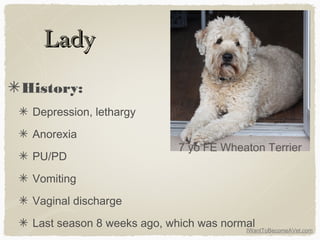
LadyLady
History:
Depression, lethargy
Anorexia
PU/PD
Vomiting
Vaginal discharge
Last season 8 weeks ago, which was normal
7 yo FE Wheaton Terrier
IWantToBecomeAVet.com
Physical ExaminationPhysical Examination
Mucopurulent vaginal discharge
Enlarged uterus on abdominal palpation
Temperature 39.8 C
Depressed mentation
IWantToBecomeAVet.com
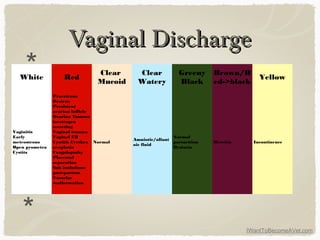
Vaginal DischargeVaginal Discharge
White Red
Clear
Mucoid
Clear
Watery
Greeny
Black
Brown/R
ed->black
Yellow
Vaginitis
Early
meteostrous
Open pyometra
Cystits
Proestrous
Oestrus
Persistent
ovarian follicle
Ovarian Tumour
(oestrogen
secreting
Vaginal trauma
Vaginal FB
Cystitis Urethra
neoplasia
Coagulopathy
Placental
separation
Sub inolutions
post-partum
Vasuclar
malformation
Normal
Amniotic/allant
oic fluid
Normal
parturition
Dystocia
Metritis Incontinence
*
*
IWantToBecomeAVet.com
DDxDDx
PU/PD- Diabetes Mellitus, HAC, renal Dz
Pregnancy
Severe vaginal Dz
Mucometra
IWantToBecomeAVet.com
DiagnosticsDiagnostics
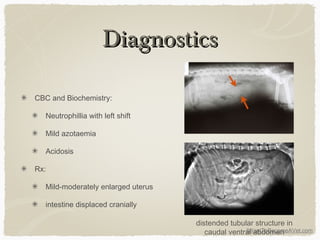
CBC and Biochemistry:
Neutrophillia with left shift
Mild azotaemia
Acidosis
Rx:
Mild-moderately enlarged uterus
intestine displaced cranially
distended tubular structure in
caudal ventral abdomen
IWantToBecomeAVet.com
PyometraPyometra
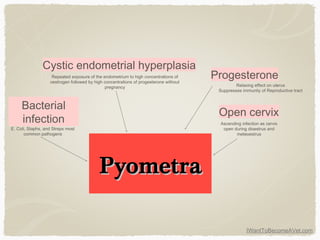
Cystic endometrial hyperplasia
Progesterone
Open cervix
Bacterial
infection
E. Coli, Staphs, and Streps most
common pathogens
Relaxing effect on uterus
Suppresses immunity of Reproductive tract
Ascending infection as cervix
open during dioestrus and
meteoestrus
Repeated exposure of the endometrium to high concentrations of
oestrogen followed by high concentrations of progesterone without
pregnancy
IWantToBecomeAVet.com
TreatmentTreatment
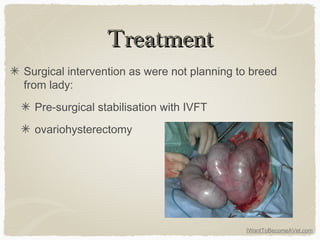
Surgical intervention as were not planning to breed
from lady:
Pre-surgical stabilisation with IVFT
ovariohysterectomy
IWantToBecomeAVet.com
Lets remind ourselvesLets remind ourselves
how to do a spay ...how to do a spay ...
againagain
IWantToBecomeAVet.com
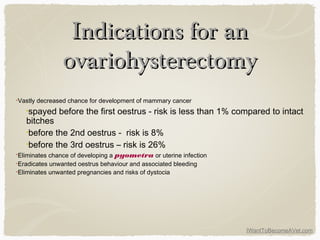
Indications for anIndications for an
ovariohysterectomyovariohysterectomy
•Vastly decreased chance for development of mammary cancer
•spayed before the first oestrus - risk is less than 1% compared to intact
bitches
•before the 2nd oestrus - risk is 8%
•before the 3rd oestrus – risk is 26%
•Eliminates chance of developing a pyometra or uterine infection
•Eradicates unwanted oestrus behaviour and associated bleeding
•Eliminates unwanted pregnancies and risks of dystocia
IWantToBecomeAVet.com
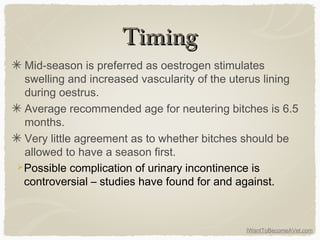
TimingTiming
Mid-season is preferred as oestrogen stimulates
swelling and increased vascularity of the uterus lining
during oestrus.
Average recommended age for neutering bitches is 6.5
months.
Very little agreement as to whether bitches should be
allowed to have a season first.
Possible complication of urinary incontinence is
controversial – studies have found for and against.
IWantToBecomeAVet.com
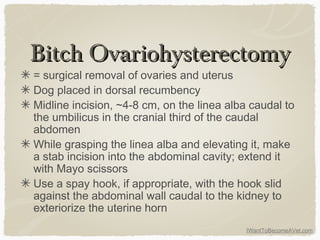
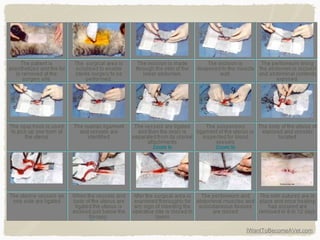
Bitch OvariohysterectomyBitch Ovariohysterectomy
= surgical removal of ovaries and uterus
Dog placed in dorsal recumbency
Midline incision, ~4-8 cm, on the linea alba caudal to
the umbilicus in the cranial third of the caudal
abdomen
While grasping the linea alba and elevating it, make
a stab incision into the abdominal cavity; extend it
with Mayo scissors
Use a spay hook, if appropriate, with the hook slid
against the abdominal wall caudal to the kidney to
exteriorize the uterine horn
IWantToBecomeAVet.com
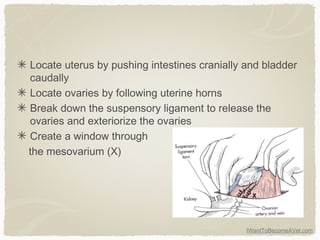
Locate uterus by pushing intestines cranially and bladder
caudally
Locate ovaries by following uterine horns
Break down the suspensory ligament to release the
ovaries and exteriorize the ovaries
Create a window through
the mesovarium (X)
IWantToBecomeAVet.com
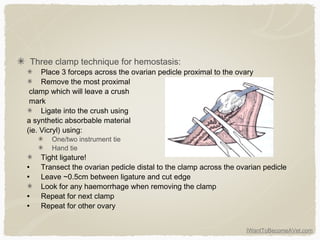
Three clamp technique for hemostasis:
Place 3 forceps across the ovarian pedicle proximal to the ovary
Remove the most proximal
clamp which will leave a crush
mark
Ligate into the crush using
a synthetic absorbable material
(ie. Vicryl) using:
One/two instrument tie
Hand tie
Tight ligature!
• Transect the ovarian pedicle distal to the clamp across the ovarian pedicle
• Leave ~0.5cm between ligature and cut edge
Look for any haemorrhage when removing the clamp
• Repeat for next clamp
• Repeat for other ovary
IWantToBecomeAVet.com
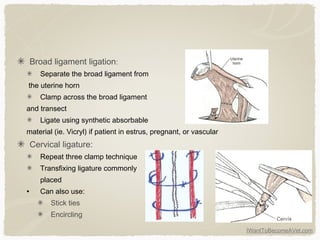
Broad ligament ligation:
Separate the broad ligament from
the uterine horn
Clamp across the broad ligament
and transect
Ligate using synthetic absorbable
material (ie. Vicryl) if patient in estrus, pregnant, or vascular
Cervical ligature:
Repeat three clamp technique
Transfixing ligature commonly
placed
• Can also use:
Stick ties
Encircling
IWantToBecomeAVet.com
Closure:
Done in 3 layers:
Fascia/linea alba: simple continuous pattern
(PDS)
Subcutaneous tissue: simple continuous pattern
(Monocryl)
Skin: often intradermal (Monocryl)
IWantToBecomeAVet.com
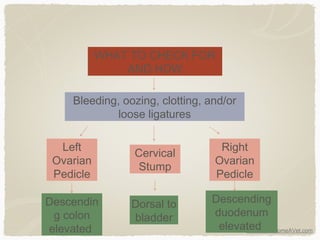
WHAT TO CHECK FOR
AND HOW
Left
Ovarian
Pedicle
Right
Ovarian
Pedicle
Descendin
g colon
elevated
Descending
duodenum
elevated
Dorsal to
bladder
Cervical
Stump
Bleeding, oozing, clotting, and/or
loose ligatures
IWantToBecomeAVet.com
Back to Lady andBack to Lady and
her pyometraher pyometra
IWantToBecomeAVet.com
Medical ManagementMedical Management
ALL pyometra cases will receive empirical Abi (while
waiting for culture and sensitivity)
Ampicillin or enrofloxacin
Open pyometra can be treated without Sx:
Prostaglandin F2alpha-
2-7 days, until uterus appears normal size on
palpation, Rx, or US
May need ovariohysterectomy if Tx fails
IWantToBecomeAVet.com
PrognosisPrognosis
Excellent but none of these
Re-evaluate in 2-4 weeks
Medical management only:
After medical therapy, the prognosis for initial resolution of the pyometra is good if the cervix is open,
but guarded to poor if closed.
Of those animals that respond, as many as 90% of bitches and 70% of queens with open-cervix
pyometra may be fertile.
Recurrence is likely; of bitches treated medically for pyometra, 70% had recurrence within 2 yr.
Therefore, the animal should be bred on the next and each subsequent cycle until the desired number
of puppies or kittens has been produced, and then spayed.
Ok. Thank you.
THE ENDTHE END

Reproductive Concerns in Small Animals

  • 1.
    Reproductive Concerns inReproductiveConcerns in Small AnimalsSmall Animals If only they were all neutered!
  • 2.
  • 3.
    IWantToBecomeAVet.com Physical ExaminationPhysical Examination Mucopurulentvaginal discharge Enlarged uterus on abdominal palpation Temperature 39.8 C Depressed mentation
  • 4.
    IWantToBecomeAVet.com Vaginal DischargeVaginal Discharge WhiteRed Clear Mucoid Clear Watery Greeny Black Brown/R ed->black Yellow Vaginitis Early meteostrous Open pyometra Cystits Proestrous Oestrus Persistent ovarian follicle Ovarian Tumour (oestrogen secreting Vaginal trauma Vaginal FB Cystitis Urethra neoplasia Coagulopathy Placental separation Sub inolutions post-partum Vasuclar malformation Normal Amniotic/allant oic fluid Normal parturition Dystocia Metritis Incontinence * *
  • 5.
    IWantToBecomeAVet.com DDxDDx PU/PD- Diabetes Mellitus,HAC, renal Dz Pregnancy Severe vaginal Dz Mucometra
  • 6.
    IWantToBecomeAVet.com DiagnosticsDiagnostics CBC and Biochemistry: Neutrophilliawith left shift Mild azotaemia Acidosis Rx: Mild-moderately enlarged uterus intestine displaced cranially distended tubular structure in caudal ventral abdomen
  • 7.
    IWantToBecomeAVet.com PyometraPyometra Cystic endometrial hyperplasia Progesterone Opencervix Bacterial infection E. Coli, Staphs, and Streps most common pathogens Relaxing effect on uterus Suppresses immunity of Reproductive tract Ascending infection as cervix open during dioestrus and meteoestrus Repeated exposure of the endometrium to high concentrations of oestrogen followed by high concentrations of progesterone without pregnancy
  • 8.
    IWantToBecomeAVet.com TreatmentTreatment Surgical intervention aswere not planning to breed from lady: Pre-surgical stabilisation with IVFT ovariohysterectomy
  • 9.
    IWantToBecomeAVet.com Lets remind ourselvesLetsremind ourselves how to do a spay ...how to do a spay ... againagain
  • 10.
    IWantToBecomeAVet.com Indications for anIndicationsfor an ovariohysterectomyovariohysterectomy •Vastly decreased chance for development of mammary cancer •spayed before the first oestrus - risk is less than 1% compared to intact bitches •before the 2nd oestrus - risk is 8% •before the 3rd oestrus – risk is 26% •Eliminates chance of developing a pyometra or uterine infection •Eradicates unwanted oestrus behaviour and associated bleeding •Eliminates unwanted pregnancies and risks of dystocia
  • 11.
    IWantToBecomeAVet.com TimingTiming Mid-season is preferredas oestrogen stimulates swelling and increased vascularity of the uterus lining during oestrus. Average recommended age for neutering bitches is 6.5 months. Very little agreement as to whether bitches should be allowed to have a season first. Possible complication of urinary incontinence is controversial – studies have found for and against.
  • 12.
    IWantToBecomeAVet.com Bitch OvariohysterectomyBitch Ovariohysterectomy =surgical removal of ovaries and uterus Dog placed in dorsal recumbency Midline incision, ~4-8 cm, on the linea alba caudal to the umbilicus in the cranial third of the caudal abdomen While grasping the linea alba and elevating it, make a stab incision into the abdominal cavity; extend it with Mayo scissors Use a spay hook, if appropriate, with the hook slid against the abdominal wall caudal to the kidney to exteriorize the uterine horn
  • 13.
    IWantToBecomeAVet.com Locate uterus bypushing intestines cranially and bladder caudally Locate ovaries by following uterine horns Break down the suspensory ligament to release the ovaries and exteriorize the ovaries Create a window through the mesovarium (X)
  • 14.
    IWantToBecomeAVet.com Three clamp techniquefor hemostasis: Place 3 forceps across the ovarian pedicle proximal to the ovary Remove the most proximal clamp which will leave a crush mark Ligate into the crush using a synthetic absorbable material (ie. Vicryl) using: One/two instrument tie Hand tie Tight ligature! • Transect the ovarian pedicle distal to the clamp across the ovarian pedicle • Leave ~0.5cm between ligature and cut edge Look for any haemorrhage when removing the clamp • Repeat for next clamp • Repeat for other ovary
  • 15.
    IWantToBecomeAVet.com Broad ligament ligation: Separatethe broad ligament from the uterine horn Clamp across the broad ligament and transect Ligate using synthetic absorbable material (ie. Vicryl) if patient in estrus, pregnant, or vascular Cervical ligature: Repeat three clamp technique Transfixing ligature commonly placed • Can also use: Stick ties Encircling
  • 16.
    IWantToBecomeAVet.com Closure: Done in 3layers: Fascia/linea alba: simple continuous pattern (PDS) Subcutaneous tissue: simple continuous pattern (Monocryl) Skin: often intradermal (Monocryl)
  • 17.
  • 18.
    IWantToBecomeAVet.com WHAT TO CHECKFOR AND HOW Left Ovarian Pedicle Right Ovarian Pedicle Descendin g colon elevated Descending duodenum elevated Dorsal to bladder Cervical Stump Bleeding, oozing, clotting, and/or loose ligatures
  • 19.
    IWantToBecomeAVet.com Back to LadyandBack to Lady and her pyometraher pyometra
  • 20.
    IWantToBecomeAVet.com Medical ManagementMedical Management ALLpyometra cases will receive empirical Abi (while waiting for culture and sensitivity) Ampicillin or enrofloxacin Open pyometra can be treated without Sx: Prostaglandin F2alpha- 2-7 days, until uterus appears normal size on palpation, Rx, or US May need ovariohysterectomy if Tx fails
  • 21.
    IWantToBecomeAVet.com PrognosisPrognosis Excellent but noneof these Re-evaluate in 2-4 weeks Medical management only: After medical therapy, the prognosis for initial resolution of the pyometra is good if the cervix is open, but guarded to poor if closed. Of those animals that respond, as many as 90% of bitches and 70% of queens with open-cervix pyometra may be fertile. Recurrence is likely; of bitches treated medically for pyometra, 70% had recurrence within 2 yr. Therefore, the animal should be bred on the next and each subsequent cycle until the desired number of puppies or kittens has been produced, and then spayed.
  • 22.