Mission:  We connect to fight cancer!   As a world-leading expert Dako continuously challenges and raises the  global standards for fast and accurate  answers for cancer patients and doctors  making vital decisions for treatment CONNECTING REAGENTS,INSTRUMENTS AND SOFTWARE Shaping the future of cancer diagnosis                                      
Diagnosis of Cancer  using Algorithms Lawrence T. Richards M.S.,H.T(ASCP).,QIHC(ASCP).
This presentation is by no means intended as a replacement of the professional judgment of a certified pathologist. The contents of the algorithm are provided as informative only, and should not be regarded as indicative of standard procedure for diagnosis or treatment.
Diagnosis of Cancer using Algorithms A diagnostic algorithm is a method which utilizes a panel of antibodies intended to solve a diagnostic problem Many different diagnostic algorithms exist and are available in journals and text books A diagnostic algorithm is followed by a selective markers for tumor sub classification. The panel of antibodies selected should be based on the morphological appearance of the tissue (H & E) and the patient’s clinical history provided by the physician.
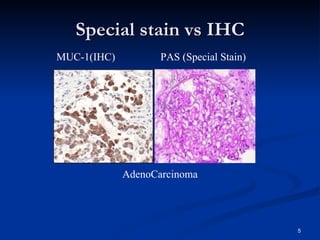
Special stain vs IHC MUC-1 PAS MUC-1(IHC)  PAS (Special Stain) AdenoCarcinoma
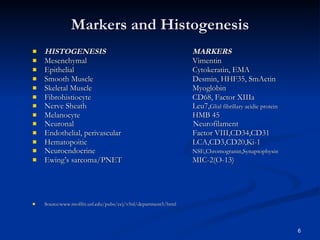
Markers and Histogenesis HISTOGENESIS MARKERS Mesenchymal Vimentin Epithelial Cytokeratin, EMA Smooth Muscle Desmin, HHF35, SmActin Skeletal Muscle Myoglobin Fibrohistiocyte CD68, Factor XIIIa Nerve Sheath Leu7, Glial fibrillary acidic protein Melanocyte HMB 45 Neuronal    Neurofilament Endothelial, perivascular Factor VIII,CD34,CD31 Hematopoitic LCA,CD3,CD20,Ki-1 Neuroendocrine NSE,Chromogranin,Synaptophysin Ewing’s sarcoma/PNET MIC-2(O-13) Source:www.moffitt.usf.edu/pubs/ccj/v5nl/department5/html
Basic Flow Chart Sequential First Round (+) ( - ) (+) (+) (+) ( - ) ( - ) ( - ) Second round
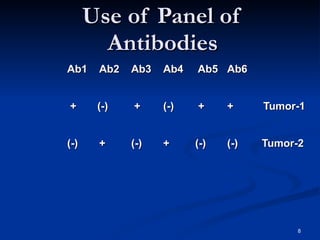
Use of Panel of Antibodies Ab1  Ab2 Ab3 Ab4  Ab5 Ab6 +  (-)  + (-)  + +  Tumor-1 (-) + (-) + (-) (-)  Tumor-2
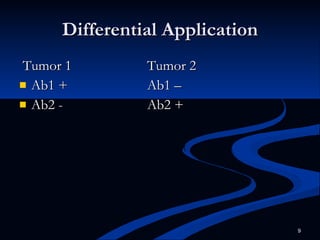
Differential Application Tumor 1 Tumor 2 Ab1 + Ab1 – Ab2 - Ab2 +
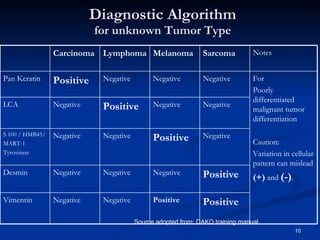
Diagnostic Algorithm for unknown Tumor Type Source adopted from: DAKO training manual Positive Positive Negative Negative Vimentin Positive Negative Negative Negative Desmin Negative Positive Negative Negative S 100 / HMB45/ MART-1 Tyrosinase Negative Negative Positive Negative LCA For Poorly differentiated malignant tumor differentiation Caution: Variation in cellular pattern can mislead (+)  and  (-) . Negative Negative Negative Positive Pan Keratin Notes Sarcoma Melanoma Lymphoma Carcinoma
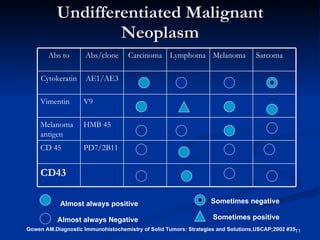
Undifferentiated Malignant Neoplasm Almost always positive Almost always Negative Sometimes positive Sometimes negative Gowen AM.Diagnostic Immunohistochemistry of Solid Tumors: Strategies and Solutions,USCAP;2002 #35 CD43 PD7/2B11 CD 45 HMB 45 Melanoma antigen V9 Vimentin AE1/AE3 Cytokeratin Sarcoma Melanoma Lymphoma Carcinoma Abs/clone Abs to
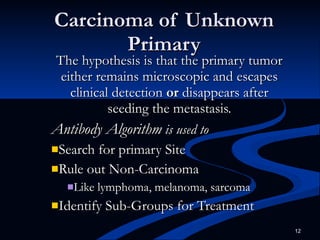
Carcinoma of Unknown Primary The hypothesis is that the primary tumor either remains microscopic and escapes clinical detection  or  disappears after seeding the metastasis. Antibody Algorithm  is used to Search for primary Site Rule out Non-Carcinoma  Like lymphoma, melanoma, sarcoma Identify Sub-Groups for Treatment
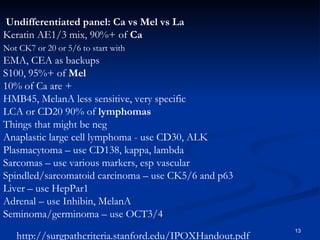
Undifferentiated panel: Ca vs Mel vs La  Keratin AE1/3 mix, 90%+ of  Ca  Not CK7 or 20 or 5/6 to start with   EMA, CEA as backups  S100, 95%+ of  Mel  10% of Ca are +  HMB45, MelanA less sensitive, very specific  LCA or CD20 90% of  lymphomas  Things that might be neg  Anaplastic large cell lymphoma - use CD30, ALK  Plasmacytoma – use CD138, kappa, lambda  Sarcomas – use various markers, esp vascular  Spindled/sarcomatoid carcinoma – use CK5/6 and p63  Liver – use HepPar1  Adrenal – use Inhibin, MelanA  Seminoma/germinoma – use OCT3/4  http://surgpathcriteria.stanford.edu/IPOXHandout.pdf
Threshold for Positivity *  Positive   Generally : unequivocal staining of =10% of tumor cells   +/- + -/+ (-) Source: Dako antibody algorithm : >90% of tumors positive* : 50-90% of tumors positive* : 10-50% of tumors positive* : <10% of tumors positive* ? : Insufficient evidence [ ] : Staining of secondary (non-neoplastic) cell type ( ) : Staining dependant on antibody
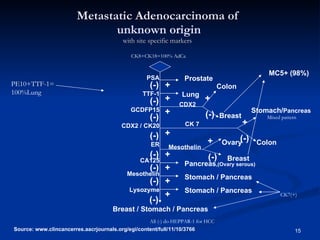
Metastatic Adenocarcinoma of   unknown origin with site specific markers PSA + (-) (-) (-) (-) (-) (-) (-) (-) + + + + + + + Prostate Lung Stomach/ Pancreas Breast Colon Colon Stomach / Pancreas Breast Ovary Pancreas ,(Ovary serous) Stomach / Pancreas Breast / Stomach / Pancreas  Source: www.clincancerres.aacrjournals.org/egi/content/full/11/10/3766 TTF-1 GCDFP15 CDX2 / CK20 ER CA125 Mesothelin Lysozyme + + + (-) (-) (-) CDX2 CK 7 Mesothelin MC5+ (98%) PE10+TTF-1=100%Lung CK8+CK18=100% AdCa CK7(+) All (-) do HEPPAR-1 for HCC Mixed pattern
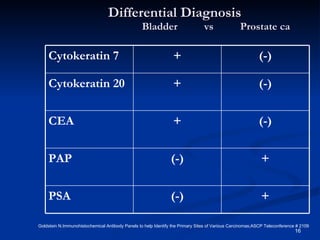
Differential Diagnosis   Bladder  vs  Prostate ca  Goldstein N.Immunohistochemical Antibody Panels to help Identify the Primary Sites of Various Carcinomas;ASCP Teleconference # 2109 + (-) PSA + (-) PAP (-) + CEA (-) + Cytokeratin 20 (-) + Cytokeratin 7
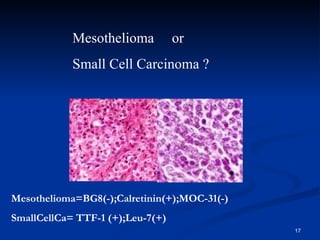
Mesothelioma  or  Small Cell Carcinoma ? Mesothelioma=BG8(-);Calretinin(+);MOC-31(-) SmallCellCa= TTF-1 (+);Leu-7(+)
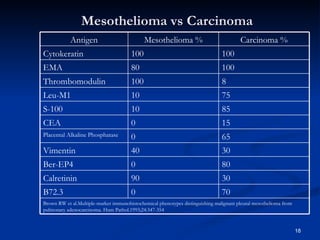
Mesothelioma vs Carcinoma Brown RW et al.Multiple-marker immunohistochemical phenotypes distinguishing malignant pleural mesothelioma from pulmonary adenocarcinoma. Hum Pathol.1993;24:347-354 70 0 B72.3 30 90 Calretinin 80 0 Ber-EP4 30 40 Vimentin 65 0 Placental Alkaline Phosphatase 15 0 CEA 85 10 S-100 75 10 Leu-M1 8 100 Thrombomodulin 100 80 EMA 100 100 Cytokeratin Carcinoma % Mesothelioma % Antigen
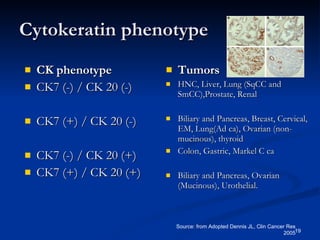
Cytokeratin phenotype CK phenotype CK7 (-) / CK 20 (-) CK7 (+) / CK 20 (-) CK7 (-) / CK 20 (+) CK7 (+) / CK 20 (+) Tumors HNC, Liver, Lung (SqCC and SmCC),Prostate, Renal Biliary and Pancreas, Breast, Cervical, EM, Lung(Ad ca), Ovarian (non-mucinous), thyroid Colon, Gastric, Markel C ca Biliary and Pancreas, Ovarian (Mucinous), Urothelial. Source: from Adopted Dennis JL, Clin Cancer Res 2005
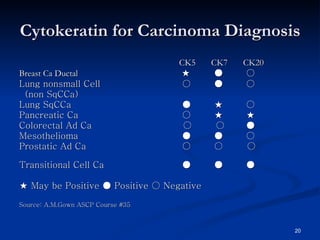
Cytokeratin for Carcinoma Diagnosis CK5 CK7 CK20 Breast Ca Ductal   ★  ●  ○ Lung nonsmall Cell      ○  ●   ○ (non SqCCa)    Lung SqCCa  ●   ★   ○ Pancreatic Ca     ○   ★   ★  Colorectal Ad Ca    ○  ○  ● Mesothelioma   ●   ●   ○ Prostatic Ad Ca  ○   ○  ○  Transitional Cell Ca  ●   ●   ●  ★  May be Positive ● Positive ○ Negative Source: A.M.Gown ASCP Course #35
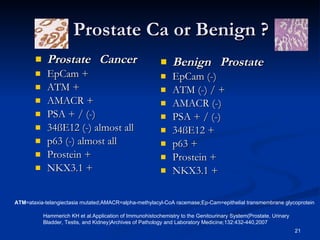
Prostate Ca or Benign ? Prostate  Cancer EpCam + ATM + AMACR + PSA + / (-) 34 ßE12 (-) almost all p63 (-) almost all Prostein + NKX3.1 +  Benign  Prostate EpCam (-) ATM (-) / + AMACR (-) PSA + / (-) 34 ßE12 + p63 + Prostein + NKX3.1 +  Hammerich KH et al.Application of Immunohistochemistry to the Genitourinary System(Prostate, Urinary Bladder, Testis, and Kidney)Archives of Pathology and Laboratory Medicine;132:432-440,2007 ATM =ataxia-telangiectasia mutated;AMACR=alpha-methylacyl-CoA racemase;Ep-Cam=epithelial transmembrane glycoprotein
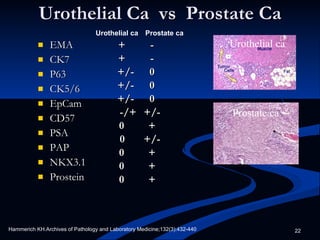
Urothelial Ca  vs  Prostate Ca EMA CK7 P63 CK5/6 EpCam CD57 PSA PAP NKX3.1 Prostein + - + - +/- 0 +/- 0 +/- 0 -/+ +/- 0 + 0 +/- 0 + 0 + 0 + Urothelial ca Prostate ca Hammerich KH.Archives of Pathology and Laboratory Medicine;132(3):432-440 Urothelial ca Prostate ca
Ab Cocktails Breast Ca :  ER + GCDFP-15 Melanoma :  MART-1+Melan A+Tyrosine + PNL2 Basal Cell Marker :  p63 + 34betaE12 +  CK5/6 Endocrine Ca:   Chrom A+NSE + Synaptophysin Pan Sarcoma : Vim + Coll IV + CD 99
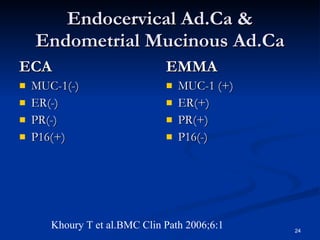
Endocervical Ad.Ca & Endometrial Mucinous Ad.Ca ECA MUC-1(-) ER(-) PR(-) P16(+) EMMA MUC-1 (+) ER(+) PR(+) P16(-) Khoury T et al.BMC Clin Path 2006;6:1
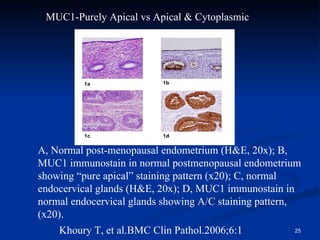
A, Normal post-menopausal endometrium (H&E, 20x); B, MUC1 immunostain in normal postmenopausal endometrium showing “pure apical” staining pattern (x20); C, normal endocervical glands (H&E, 20x); D, MUC1 immunostain in normal endocervical glands showing A/C staining pattern, (x20).  MUC1-Purely Apical vs Apical & Cytoplasmic Khoury T, et al.BMC Clin Pathol.2006;6:1
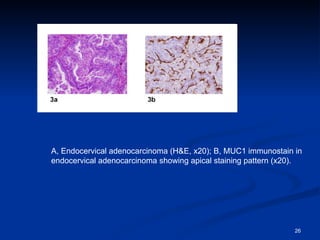
A, Endocervical adenocarcinoma (H&E, x20); B, MUC1 immunostain in endocervical adenocarcinoma showing apical staining pattern (x20).
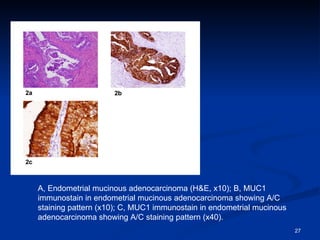
A, Endometrial mucinous adenocarcinoma (H&E, x10); B, MUC1 immunostain in endometrial mucinous adenocarcinoma showing A/C staining pattern (x10); C, MUC1 immunostain in endometrial mucinous adenocarcinoma showing A/C staining pattern (x40).
The Cost-Effectiveness of IHC Why do IHC assay? To increase patient life expectancy by correct diagnosis and treatment plan. To increase diagnostic certainty To predict patient prognosis eg., 35yr old female, history of Br ca, radical mastectomy performed earlier. Now diagnosed with cirrhosis and liver mass. Meatastatic Ad Ca ? Hepato Cellular Ca ?
http://www.dako.com/asp/algo/default.asp?get=disclaimer&type=no DAKO  Cancer Diagnostic Algorithms Contact: Gitte Sjorslev Mail:  gitte.sjorslev@dakocytomation.dk  DAKO  Cancer Diagnostic Algorithms
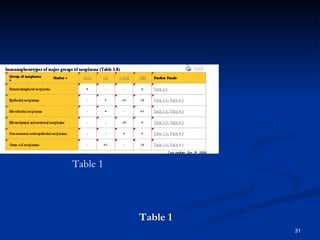
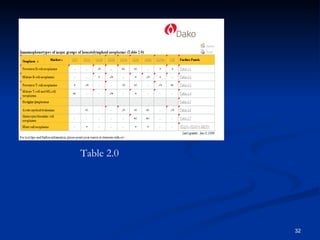
Navigating DAKO Cancer Diagnostic Algorithm. Terms and Conditions for use - Dako Antibody Algorithm   Antibody Algorithm - Contents  Antibody Algorithm - Search  eg., ChooseSearchTumor  Antibody
Table 1 Table 1
Table 2.0
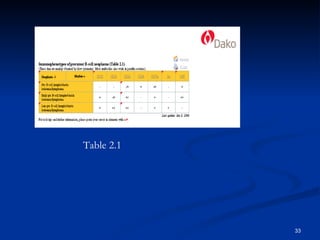
Table 2.1
Lastly “ The Diagnostic Power of any Immunohistochemical Procedure is no Greater than the wisdom of the Pathologist interpreting it.”  Dr.Allen Gown
http://www.ascp.org/pdf/5604TableofContents.aspx Efficient Tumor Immunohistochemistry A Differential Diagnosis-Driven Approach M. Nadji, MD, M. Nassiri, MD, and A.R. Morales, MD http://www.nordiqc.com / http://appliedimmuno.org/ http://surgpathcriteria.stanford.edu/IPOXHandout.pdf http://www.immunoportal.com/index.php http://web.ncifcrf.gov/rtp/lasp/phl/immuno/ http://www.phenopath.com/diagnostic/teaching.htm Web Sites
Thanks to DAKO  & MMJ Biosystems Philippines, Inc . Address: Unit 206 CYA Land Bldg. (formerly LTC Corporate Center Bldg.) #282 EDSA Extension Cor. P. Celle Street, Pasay City, Manila Tel. nos.: (632) 851-0192 to 93/489-1008 Telefax: (632) 853-3665 email:  [email_address]
 
www.markwickmd.com/documents/UNDIFF_TMRS2.ppt


www.biomedcentral.com/1472-6890/6/1/figure/F3?highres=y www.moffitt.usf.edu/pubs/ccj/v5nl/department5/html Gowen AM.Diagnostic Immunohistochemistry of Solid Tumors: Strategies and Solutions,USCAP;2002 #35 Source: www.clincancerres.aacrjournals.org/egi/content/full/11/10/3766 Goldstein N.Immunohistochemical Antibody Panels to help Identify the Primary Sites of Various Carcinomas;ASCP Teleconference  Brown RW et al.Multiple-marker immunohistochemical phenotypes distinguishing malignant pleural mesothelioma from pulmonary adenocarcinoma. Hum Pathol.1993;24:347-354 Dennis JL, Clin Cancer Res 2005 Source: A.M.Gown ASCP Course #35 Hammerich KH et al.Application of Immunohistochemistry to the Genitourinary System(Prostate, Urinary Bladder, Testis, and Kidney)Archives of Pathology and Laboratory Medicine;132:432-440,2007 Hammerich KH.Archives of Pathology and Laboratory Medicine;132(3):432-440 Khoury T et al.BMC Clin Path 2006;6:1 www.markwickmd.com/documents/UNDIFF_TMRS2.ppt
ER by Nadji M Appl Immunohistochem Mol Morphol. 2008 Mar;16(2):105-7  “ Seasoned immunohistochemists, nevertheless, know that IHC of routinely fixed and processed tissue does not yield itself to accurate quantitation of results, even when performed by well-qualified laboratories. Furthermore, in the case of ER, immunohistochemical methods only identify a segment or epitope of ER protein that is immunologically reactive with the used antibody. Hence, as it is, an immunohistochemical technique gives no information about the functional status of ER molecule, and/or that of the complex downstream ER pathways. This may be one of the reasons why one-third of patients with ER-positive breast cancers initially, and another one-third eventually, do not respond to endocrine treatment modalities. In this review, I attempt to present an argument that is based on our current information; quantitation of ER-IHC is neither”

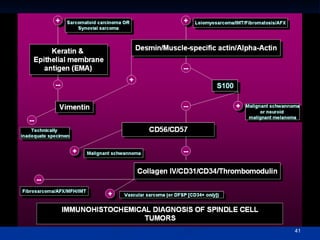
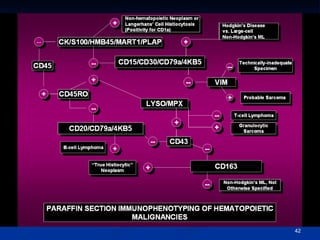
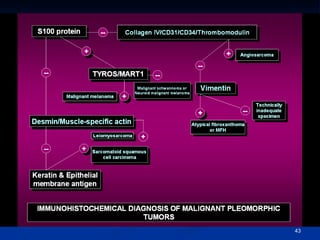
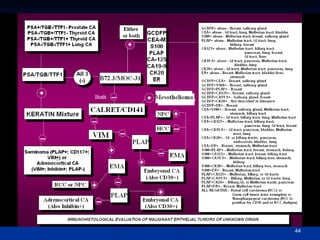
Cancer Dx Algorithm

  • 1.
    Mission: Weconnect to fight cancer! As a world-leading expert Dako continuously challenges and raises the global standards for fast and accurate answers for cancer patients and doctors making vital decisions for treatment CONNECTING REAGENTS,INSTRUMENTS AND SOFTWARE Shaping the future of cancer diagnosis                                
  • 2.
    Diagnosis of Cancer using Algorithms Lawrence T. Richards M.S.,H.T(ASCP).,QIHC(ASCP).
  • 3.
    This presentation isby no means intended as a replacement of the professional judgment of a certified pathologist. The contents of the algorithm are provided as informative only, and should not be regarded as indicative of standard procedure for diagnosis or treatment.
  • 4.
    Diagnosis of Cancerusing Algorithms A diagnostic algorithm is a method which utilizes a panel of antibodies intended to solve a diagnostic problem Many different diagnostic algorithms exist and are available in journals and text books A diagnostic algorithm is followed by a selective markers for tumor sub classification. The panel of antibodies selected should be based on the morphological appearance of the tissue (H & E) and the patient’s clinical history provided by the physician.
  • 5.
    Special stain vsIHC MUC-1 PAS MUC-1(IHC) PAS (Special Stain) AdenoCarcinoma
  • 6.
    Markers and HistogenesisHISTOGENESIS MARKERS Mesenchymal Vimentin Epithelial Cytokeratin, EMA Smooth Muscle Desmin, HHF35, SmActin Skeletal Muscle Myoglobin Fibrohistiocyte CD68, Factor XIIIa Nerve Sheath Leu7, Glial fibrillary acidic protein Melanocyte HMB 45 Neuronal Neurofilament Endothelial, perivascular Factor VIII,CD34,CD31 Hematopoitic LCA,CD3,CD20,Ki-1 Neuroendocrine NSE,Chromogranin,Synaptophysin Ewing’s sarcoma/PNET MIC-2(O-13) Source:www.moffitt.usf.edu/pubs/ccj/v5nl/department5/html
  • 7.
    Basic Flow ChartSequential First Round (+) ( - ) (+) (+) (+) ( - ) ( - ) ( - ) Second round
  • 8.
    Use of Panelof Antibodies Ab1 Ab2 Ab3 Ab4 Ab5 Ab6 + (-) + (-) + + Tumor-1 (-) + (-) + (-) (-) Tumor-2
  • 9.
    Differential Application Tumor1 Tumor 2 Ab1 + Ab1 – Ab2 - Ab2 +
  • 10.
    Diagnostic Algorithm forunknown Tumor Type Source adopted from: DAKO training manual Positive Positive Negative Negative Vimentin Positive Negative Negative Negative Desmin Negative Positive Negative Negative S 100 / HMB45/ MART-1 Tyrosinase Negative Negative Positive Negative LCA For Poorly differentiated malignant tumor differentiation Caution: Variation in cellular pattern can mislead (+) and (-) . Negative Negative Negative Positive Pan Keratin Notes Sarcoma Melanoma Lymphoma Carcinoma
  • 11.
    Undifferentiated Malignant NeoplasmAlmost always positive Almost always Negative Sometimes positive Sometimes negative Gowen AM.Diagnostic Immunohistochemistry of Solid Tumors: Strategies and Solutions,USCAP;2002 #35 CD43 PD7/2B11 CD 45 HMB 45 Melanoma antigen V9 Vimentin AE1/AE3 Cytokeratin Sarcoma Melanoma Lymphoma Carcinoma Abs/clone Abs to
  • 12.
    Carcinoma of UnknownPrimary The hypothesis is that the primary tumor either remains microscopic and escapes clinical detection or disappears after seeding the metastasis. Antibody Algorithm is used to Search for primary Site Rule out Non-Carcinoma Like lymphoma, melanoma, sarcoma Identify Sub-Groups for Treatment
  • 13.
    Undifferentiated panel: Cavs Mel vs La Keratin AE1/3 mix, 90%+ of Ca Not CK7 or 20 or 5/6 to start with EMA, CEA as backups S100, 95%+ of Mel 10% of Ca are + HMB45, MelanA less sensitive, very specific LCA or CD20 90% of lymphomas Things that might be neg Anaplastic large cell lymphoma - use CD30, ALK Plasmacytoma – use CD138, kappa, lambda Sarcomas – use various markers, esp vascular Spindled/sarcomatoid carcinoma – use CK5/6 and p63 Liver – use HepPar1 Adrenal – use Inhibin, MelanA Seminoma/germinoma – use OCT3/4 http://surgpathcriteria.stanford.edu/IPOXHandout.pdf
  • 14.
    Threshold for Positivity* Positive Generally : unequivocal staining of =10% of tumor cells   +/- + -/+ (-) Source: Dako antibody algorithm : >90% of tumors positive* : 50-90% of tumors positive* : 10-50% of tumors positive* : <10% of tumors positive* ? : Insufficient evidence [ ] : Staining of secondary (non-neoplastic) cell type ( ) : Staining dependant on antibody
  • 15.
    Metastatic Adenocarcinoma of unknown origin with site specific markers PSA + (-) (-) (-) (-) (-) (-) (-) (-) + + + + + + + Prostate Lung Stomach/ Pancreas Breast Colon Colon Stomach / Pancreas Breast Ovary Pancreas ,(Ovary serous) Stomach / Pancreas Breast / Stomach / Pancreas Source: www.clincancerres.aacrjournals.org/egi/content/full/11/10/3766 TTF-1 GCDFP15 CDX2 / CK20 ER CA125 Mesothelin Lysozyme + + + (-) (-) (-) CDX2 CK 7 Mesothelin MC5+ (98%) PE10+TTF-1=100%Lung CK8+CK18=100% AdCa CK7(+) All (-) do HEPPAR-1 for HCC Mixed pattern
  • 16.
    Differential Diagnosis Bladder vs Prostate ca Goldstein N.Immunohistochemical Antibody Panels to help Identify the Primary Sites of Various Carcinomas;ASCP Teleconference # 2109 + (-) PSA + (-) PAP (-) + CEA (-) + Cytokeratin 20 (-) + Cytokeratin 7
  • 17.
    Mesothelioma or Small Cell Carcinoma ? Mesothelioma=BG8(-);Calretinin(+);MOC-31(-) SmallCellCa= TTF-1 (+);Leu-7(+)
  • 18.
    Mesothelioma vs CarcinomaBrown RW et al.Multiple-marker immunohistochemical phenotypes distinguishing malignant pleural mesothelioma from pulmonary adenocarcinoma. Hum Pathol.1993;24:347-354 70 0 B72.3 30 90 Calretinin 80 0 Ber-EP4 30 40 Vimentin 65 0 Placental Alkaline Phosphatase 15 0 CEA 85 10 S-100 75 10 Leu-M1 8 100 Thrombomodulin 100 80 EMA 100 100 Cytokeratin Carcinoma % Mesothelioma % Antigen
  • 19.
    Cytokeratin phenotype CKphenotype CK7 (-) / CK 20 (-) CK7 (+) / CK 20 (-) CK7 (-) / CK 20 (+) CK7 (+) / CK 20 (+) Tumors HNC, Liver, Lung (SqCC and SmCC),Prostate, Renal Biliary and Pancreas, Breast, Cervical, EM, Lung(Ad ca), Ovarian (non-mucinous), thyroid Colon, Gastric, Markel C ca Biliary and Pancreas, Ovarian (Mucinous), Urothelial. Source: from Adopted Dennis JL, Clin Cancer Res 2005
  • 20.
    Cytokeratin for CarcinomaDiagnosis CK5 CK7 CK20 Breast Ca Ductal ★ ● ○ Lung nonsmall Cell ○ ● ○ (non SqCCa) Lung SqCCa ● ★ ○ Pancreatic Ca ○ ★ ★ Colorectal Ad Ca ○ ○ ● Mesothelioma ● ● ○ Prostatic Ad Ca ○ ○ ○ Transitional Cell Ca ● ● ● ★ May be Positive ● Positive ○ Negative Source: A.M.Gown ASCP Course #35
  • 21.
    Prostate Ca orBenign ? Prostate Cancer EpCam + ATM + AMACR + PSA + / (-) 34 ßE12 (-) almost all p63 (-) almost all Prostein + NKX3.1 + Benign Prostate EpCam (-) ATM (-) / + AMACR (-) PSA + / (-) 34 ßE12 + p63 + Prostein + NKX3.1 + Hammerich KH et al.Application of Immunohistochemistry to the Genitourinary System(Prostate, Urinary Bladder, Testis, and Kidney)Archives of Pathology and Laboratory Medicine;132:432-440,2007 ATM =ataxia-telangiectasia mutated;AMACR=alpha-methylacyl-CoA racemase;Ep-Cam=epithelial transmembrane glycoprotein
  • 22.
    Urothelial Ca vs Prostate Ca EMA CK7 P63 CK5/6 EpCam CD57 PSA PAP NKX3.1 Prostein + - + - +/- 0 +/- 0 +/- 0 -/+ +/- 0 + 0 +/- 0 + 0 + 0 + Urothelial ca Prostate ca Hammerich KH.Archives of Pathology and Laboratory Medicine;132(3):432-440 Urothelial ca Prostate ca
  • 23.
    Ab Cocktails BreastCa : ER + GCDFP-15 Melanoma : MART-1+Melan A+Tyrosine + PNL2 Basal Cell Marker : p63 + 34betaE12 + CK5/6 Endocrine Ca: Chrom A+NSE + Synaptophysin Pan Sarcoma : Vim + Coll IV + CD 99
  • 24.
    Endocervical Ad.Ca &Endometrial Mucinous Ad.Ca ECA MUC-1(-) ER(-) PR(-) P16(+) EMMA MUC-1 (+) ER(+) PR(+) P16(-) Khoury T et al.BMC Clin Path 2006;6:1
  • 25.
    A, Normal post-menopausalendometrium (H&E, 20x); B, MUC1 immunostain in normal postmenopausal endometrium showing “pure apical” staining pattern (x20); C, normal endocervical glands (H&E, 20x); D, MUC1 immunostain in normal endocervical glands showing A/C staining pattern, (x20). MUC1-Purely Apical vs Apical & Cytoplasmic Khoury T, et al.BMC Clin Pathol.2006;6:1
  • 26.
    A, Endocervical adenocarcinoma(H&E, x20); B, MUC1 immunostain in endocervical adenocarcinoma showing apical staining pattern (x20).
  • 27.
    A, Endometrial mucinousadenocarcinoma (H&E, x10); B, MUC1 immunostain in endometrial mucinous adenocarcinoma showing A/C staining pattern (x10); C, MUC1 immunostain in endometrial mucinous adenocarcinoma showing A/C staining pattern (x40).
  • 28.
    The Cost-Effectiveness ofIHC Why do IHC assay? To increase patient life expectancy by correct diagnosis and treatment plan. To increase diagnostic certainty To predict patient prognosis eg., 35yr old female, history of Br ca, radical mastectomy performed earlier. Now diagnosed with cirrhosis and liver mass. Meatastatic Ad Ca ? Hepato Cellular Ca ?
  • 29.
    http://www.dako.com/asp/algo/default.asp?get=disclaimer&type=no DAKO Cancer Diagnostic Algorithms Contact: Gitte Sjorslev Mail: gitte.sjorslev@dakocytomation.dk DAKO Cancer Diagnostic Algorithms
  • 30.
    Navigating DAKO CancerDiagnostic Algorithm. Terms and Conditions for use - Dako Antibody Algorithm Antibody Algorithm - Contents Antibody Algorithm - Search eg., ChooseSearchTumor Antibody
  • 31.
  • 32.
  • 33.
  • 34.
    Lastly “ TheDiagnostic Power of any Immunohistochemical Procedure is no Greater than the wisdom of the Pathologist interpreting it.” Dr.Allen Gown
  • 35.
    http://www.ascp.org/pdf/5604TableofContents.aspx Efficient TumorImmunohistochemistry A Differential Diagnosis-Driven Approach M. Nadji, MD, M. Nassiri, MD, and A.R. Morales, MD http://www.nordiqc.com / http://appliedimmuno.org/ http://surgpathcriteria.stanford.edu/IPOXHandout.pdf http://www.immunoportal.com/index.php http://web.ncifcrf.gov/rtp/lasp/phl/immuno/ http://www.phenopath.com/diagnostic/teaching.htm Web Sites
  • 36.
    Thanks to DAKO & MMJ Biosystems Philippines, Inc . Address: Unit 206 CYA Land Bldg. (formerly LTC Corporate Center Bldg.) #282 EDSA Extension Cor. P. Celle Street, Pasay City, Manila Tel. nos.: (632) 851-0192 to 93/489-1008 Telefax: (632) 853-3665 email: [email_address]
  • 37.
  • 38.
  • 39.
  • 40.
  • 41.
  • 42.
  • 43.
  • 44.
  • 45.
    www.biomedcentral.com/1472-6890/6/1/figure/F3?highres=y www.moffitt.usf.edu/pubs/ccj/v5nl/department5/html GowenAM.Diagnostic Immunohistochemistry of Solid Tumors: Strategies and Solutions,USCAP;2002 #35 Source: www.clincancerres.aacrjournals.org/egi/content/full/11/10/3766 Goldstein N.Immunohistochemical Antibody Panels to help Identify the Primary Sites of Various Carcinomas;ASCP Teleconference Brown RW et al.Multiple-marker immunohistochemical phenotypes distinguishing malignant pleural mesothelioma from pulmonary adenocarcinoma. Hum Pathol.1993;24:347-354 Dennis JL, Clin Cancer Res 2005 Source: A.M.Gown ASCP Course #35 Hammerich KH et al.Application of Immunohistochemistry to the Genitourinary System(Prostate, Urinary Bladder, Testis, and Kidney)Archives of Pathology and Laboratory Medicine;132:432-440,2007 Hammerich KH.Archives of Pathology and Laboratory Medicine;132(3):432-440 Khoury T et al.BMC Clin Path 2006;6:1 www.markwickmd.com/documents/UNDIFF_TMRS2.ppt
  • 46.
    ER by NadjiM Appl Immunohistochem Mol Morphol. 2008 Mar;16(2):105-7 “ Seasoned immunohistochemists, nevertheless, know that IHC of routinely fixed and processed tissue does not yield itself to accurate quantitation of results, even when performed by well-qualified laboratories. Furthermore, in the case of ER, immunohistochemical methods only identify a segment or epitope of ER protein that is immunologically reactive with the used antibody. Hence, as it is, an immunohistochemical technique gives no information about the functional status of ER molecule, and/or that of the complex downstream ER pathways. This may be one of the reasons why one-third of patients with ER-positive breast cancers initially, and another one-third eventually, do not respond to endocrine treatment modalities. In this review, I attempt to present an argument that is based on our current information; quantitation of ER-IHC is neither”

Editor's Notes

  • #4 “ IHC guides and does not dictate the Dx”Dr.MB.Amin Not every case requires IHC staining for diagnosis.Only 15% of all cancer Dx needs IHC. There are more IHC assays ordered than spl stains in most of the labs in US because it is more reliable and takes most of the guess work away in decision making. Potentially for every gene, there can be several antibodies that can be developed. After the completion of Human Genome Project we have seen a tremendous increase in number of Ab available. When I started doing IHC in 1983 there were only 17 Ab and Dako was the only company that had Ab and a detection system. Now, there are 30,000 Ab in development. As we progress in this field we are also finding new Ab that are more specific to the type of cancer. Phosphorelated Ab are more specific than other types. Synthesized Peptides are very specific. We are also seeing more sensitive Ab with Rabbit Monoclonals and they are cheaper also. I worked for developing assays of BM for Drug companies so that they can discover drug sites, assess toxicity, use them in clinical trials as surrogate end points. In clinical setting BM are used for Dx,pt screening for specific drug, Dose modulation, prognosis, and alternate treatment decisions based on disease progression. The dawn of personalized medicine is here already.
  • #5 Algorithm is particularly useful when a tumor defies classification on a morphological basis, either of poor differentiation or an appearance compatible with more than one tumor type. Secondly no single marker is entirely specific or sensitive for diagnosis of a cancer. A panel of antibody is needed in most cases. That being said it is not possible to recommend a single screening panel of antibodies. Selection of panel of Abs depends on the morphology from H&amp;E slides and clinical history of the patient. As I said earlier only 15% of all diagnosis need IHC beside H&amp;E. But a mis Dx can cause valuable time and cost and too late for treatment in some cases. As we know early detection improves survival rate for many cancers. By using the algorithm the rate of false-negative and false-positive diagnoses can be reduced, and some patients are afforded the opportunity to get more specific or effective therapy as a result.
  • #6 If you suspect an Ad Ca we used to do PAS-D / AB-PAS / Mucicarmine,bothA/N, Trichrome, Because we know mucinous Ad Ca has worse prognosis.(production of neutral mucin signifies AdCa. But now we can do MUC-1(B72.3,CD-15,Leu M1,CEA all stain AdCa) and be certain that it is Ad Ca. Same way we use verhoef Van gieson Elastic stain for vasculature of the tumor With IHC we do VEGF vascular endothelial growth factor to see the same.Vim,FacorVIII Both can be misleading sometime, But with IHC you are more correct than wrong. .
  • #7 A few examples of Biomarkers that are associated with tissue type. However we still do not have a marker that is 100% specific for tissue type. Besides the level of expression of these Ab are proportional to the differentiation of the tumor. A poorly differentiated tumor stains weaker than a well differentiated tumor. Ironically we need help only with poorly differentiated tumor. Caution False positive: entrapped cells found in soft tissue tumors = skeletal muscleMis Dx as Rhabdomyosarcoma;,malignant lymphoma=follicular endothelium Mis Dx Carcinoma;Hodgkins=thymic epithelium (pos for keratin)misDxMalignant Thymoma PNET=primitive neuro ectodermal tumor. If you want to confirm the origin of a tumor from the morphology of tissue type, here are the Abs that you can use. Example: if you suspect the tumor is a neuroendocrine origin, then you stain for NSE,Chrom A and or Synaptophysin. I am going to outline three types of Algorithm construction, then I will show examples for each type. 1.Sequential=flow chart 2.Panel of Ab 3.Differential Dx
  • #8 A decision tree as some people call them. I am going to show how the algorithm is constructed. Generate a logical flow chart based on the clinical and morphological findings , and use panels of Ab to narrow it and then do a differential panel to finalize it . In this sequential pattern, one Abs at a time is stained and depending on the results, another Abs is used and so on and so on until we reach a positive identification .This is cost effective , since we stain Abs one at a time . But time consuming . if we have a good guess based on the morphology, then we can by pass steps and go straight to the differential diagnostic method. This model is useful for tumors of unknown origin, we know what type of tumor, but can not decide where from it is metastisized.
  • #9 This method is referred to as the panel algorithm. Here a group of Abs are stained at the same time and the results are analyzed based on the + and - pattern specific to the tumor type. This is time effective but not cost effective . Again if we have an educated guess then we can leave out some of the markers. Mostly done to subtype tumor. Design this with likely possible diagnosis in mind. This type of chart is used for identification of tumor type when the tumor is very poorly differentiated.
  • #10 This is the differential analysis. If we can narrowed it to be between two Cancers then, we can do just the Abs necessary to differentiate between them. Sometimes the tumor involves two adjacent organs and the morphology is mixed. This is also used to identify subsets of the tumors. If the list of differential Dx possibilities does not include the correct one, it may never be rendered, regardless of the number of immunostains performed on these. Usually this type is used to identify subtype or classification of tumors. Let us see some examples.
  • #11 If the tumor is very poorly differentiated and it is a challenge to classify based on the morphology then this panel is useful. Antibodies used in this example is only a guide and can be substituted with more recent and more specific or some deleted based on case history and morphology. Here is a panel of Abs to differentiate major groups of cancers. Always bear in mind that there are variations in cellular patterns which can affect the sensitivity of staining. Also, not all tumors are positive for each of these Abs. For example not all Carcinomas are negative for S 100. And all Carcinoma stains positive for Pan Keratin. HCC is negative for AE1/AE3 BUT a non epithelioid tumor like a glial tumor stains positive, so does Schwanoma. Histiocytic Sarcoma may be positive for S 100. Prostate cancer may be negative for Cytokeratins, even though it is a carcinoma. So caution should be excercised when reading the results and in selecting Ab for the panel. As I said earlier there is no single Ab 100% specific or sensitive for each tumor.NOT YET. If you test for an additional Ab, like adding CK 34betaE12 will increase the possibility to 95% .
  • #12 Neuroendocrine markers are generally not included in the initial panel. If you suspect so, then NSE,Chrom A and Synaptophysin are included. Lymphoma panel: LCA,CD20,CD3,Bcl2,CD30,CD5,CD23,ALK-1 Carcinoma panel: CK,EMA,CEA Metastatic Ca: CK7,CK20,CK5 Malignant round cell tumor: CD99(MIC2),Desmin,Myoglobulin Melanoma: S100,HMB45 Germ cell tumors: AFB, B-HCB, MIB-1,S100 Mesothelioma: HBME,Calretinin. AE1/AE3 Pan Cytokeratin: AE1=HiMolWt-10,14,15,16 and 19 low mol wt. AE3=1,2,3,4,5,7,8 CK AE1/AE3 positive for Schwanoma, mesonchymal neoplasm, and positive for glial tumors like non epithelioid. Be careful in brain metastatic. Include 34betaE12 for 95% accuracy. CK17 and 18 absent * Some include CD43 because CD 45 does not pick up a subsect of lymphoma affecting pediatric patients (large cell lymphoma). And it is reported that CD43 also picks up anaplastic large cell lymphoma, lymphoblastic lymphoma and luekemia infiltrates.
  • #13 CUP –Cancer of Unknown Primary: Of all total cancers 10-15% are CUP Of which 90% is Ad Ca, 5% Sq Ca and 5% NeuroEndocrine tumors.
  • #14 This algorithm is from Stanford Univ. Basically the same as DAKO.
  • #15 We need commonality of reporting results, so that others can compare results from different sources and get a consensus . This is now used by most of the investigators to standardize what constitute a positive or Negative. We need a uniform common acceptable terminology so that different reported results can be compared. The cut off scoring is 10% of the known tumor cells if positive then the Abs stained positive for the tumor type. also remember that sensitivity depends on pre analytical and analytical variables, like fixation duration and lapsed time before fixation, antigen retrieval method and titre of the Abs. This is not quantitative, that I will explain later.
  • #16 Most common problem-90% of CUP is AdCa.5%SqCa;5%neuroendocrine. Applying this panel and the algorithm correctly classified 88% of the original known tumors.(352 known Ad ca were used)However,HCC expressed none of these markers. If you do TTF-1 first then remember that TTF-1 will show cytoplasmic reactivity in a granualr pattern in most of Prostate Ad Ca. True staining should be Nuclear. Some tumors had similar profiles that were difficult to separate: pancreas and stomach (but we can say with some degree of confident that if CK7 is negative ca of pan unlikely, CA 125 pos and mesothelin pos then more likely pan. ER,mesothelin and CA125 together indicate ovary.Cocktails: Mammaglobin + ER is good cocktail for br ca. MC5 + will increase the specificity upto 98% Explanation: GCDFP 15 +, CDX2 (-), at this stage if we do MC5 and if that is positive then we can say with 98% certainity that the primary tumor is breast. Here is another scenario: GCDFP15(-), CDX2(-),ER + BUT Mesothelin (-) = Breast. PSA/PSAP=Prostate, but Salivary gland and other neoplasm occationally + Nothing positive=HCC HEPPAR-1(+) When you select an Ab for use the best way is to look for one that is high in specificity and sensitivity. Caudal-type homeobox transcription factor 2 (a specific transcription factor of intestinal differentiation in GI tumors or adenocarcinomas from other sites with intestinal differentiation), Wilms&apos; tumor 1 (useful in differential diagnosis between adenocarcinoma and mesothelioma, and relatively specific for gynecologic adenocarcinomas), and calretinin (positive in mesothelioma and adrenal carcinoma, but not in adenocarcinomas that often occur with mesothelioma in differential diagnosis). CK7 (+) Pancreas?
  • #17 CK7 and CK20 + for most bladder ca and + for CEA, Prostate ca may show no or focal, few individual cells +, However, some large ca which involve the bladder trigone and prostate base may have immunophenotyping feature of both ca.
  • #18 If it is well differentiated there is no problem. Very poorly differentiated We have Mesothelioma dilemma! On our hands. Mesothelioma=BG8(-);Calretinin(+);MOC-31(-) Small Cell Ca=TTF-1 (+) (98%)NordicQC TTF-1 – MM and + SCLC CK20 - MM and + SCLC Calretinin and CK5/6 + MM EM=long narrow microvilli L to W = 15:1 AdCa + for B72.3,CD15,Leu-M1,CEA clone(rich in acid mucin MM will also stain)
  • #19 Mesotheliomas often present a variety of histological patterns(epithelial, fibrous, biphasic) and therefore often present diagnostic problems, particularly with sarcoma and adenocarcinomas. the ? is some of the Abs &lt; 100 positivity. If we only use thrombomodulin we can not assume if + it is mesothelioma because 8% of carcinoma are + too.But if Ber-EP4,B72.3,PAP are negative then it is not mesothelioma. Even then a % that can slip thru since all are not 100% + for Carcinoma. (Epithelioid mesothelioma is uniformly cuboidal and less crowded. Ad ca is pleomorphic, columnar and crowded nuclear molding. MOC-31+ Ber-EP4+=Ca HBME-1 + Vim + = MM E Cadherin + AdCa ; - MM N Cadherin – AdCa;+ MM
  • #20 This shows that proper use of just two Abs can differentiate between a quite a number of problematic cases. You can add CK 5 also
  • #21 When it is a Carcinoma of unknown origin a Cytokeratin panel will be much useful to differentiate between major types.
  • #22 Panel of Abs is very useful when you have a dilemma to treat or not decision to make in a not so sure diagnosis. Is it BPH (Benign Prostatic Hyperplasia? Or PIN Prostate Intra epithelial Neoplsm - a precursor to Prostate cancer? 34bE12 (+) most important for confirming Benign Serum PSA is the best (low level elevation may be miss Dx)
  • #23 In most cases of a poorly differentiated carcinoma within the area of prostate/urinary bladder, morphological features on the H &amp; E alone is sufficient. However if overlapping morphologic features of both neoplsms are present, making determination of site of origin is very difficult and may necessitate IHC confirmation. New Ab AMACR with p63 + = Pca Thrombomodulin + = UC CD57 is Leu-7
  • #24 Increases the percentage of Specificity to almost 100% with these cocktails of two or more Abs.
  • #25 Dx difficult when tumor involves the lower uterine segmnt or upper endocx.It becomes more difficult in the mucinous subtype in which stroma is absent, one of the feature that suggests an EM origin. This differentiation is very important due to its clinical significance,that is their differences in management and prognosis. While the treatment of EM ca starts with surgical staging and intraoperative assessment of the grade and extent of tumor in the uterus, primary ECA is treated by an initial radical hysterectomy and pelvic lymph adenectomy with or without adjuvant radiation. All four ab as a panel gives 100% differential Dx. However any two markers MUC1 and p16, MUC1 with ER/PR also gives best results. You can include Vim also EMMA(70%) and ECA(7%) we found that a panel of immunohistochemical markers consisting of ER, PR, p16, and MUC1 reliably distinguishes between primary ECA and primary EMMA. Vimentin could be added to this panel when relatively larger specimen is represented. Because surgical modalities may differ, such a panel should be routinely used before definitive surgery when there is morphological and clinical doubt as to the primary site of endocervical or endometrial adenocarcinoma origin.
  • #26 Different expression patterns of same Antibody: Apical (EM)and Apical and Cytoplasmic(EndoCx glands) http://www.biomedcentral.com/1472-6890/6/1
  • #29 I want to talk a little about the cost of care. Is IHC really cost-effective? In US, IHC is considered mandatory in some cases. In other cases to avoid malpractice claim due to misdiagnosis. The average is 5 Ab per case. Roughly, depending upon the case, it is 5% of total patient billing and 2% if followed by chemo and/or radiation. A FNA done on the patient shows a cluster of malignant cells. In the above case the probability can be increased from 75% to 100% by using IHC assay. The results from the assay will help decide the treatment plan. So what is the optimal cost-effectiveness threshold?. This threshold should be decided by the physician, patient and family before a an IHC assay is ordered.. But that is the case with any diagnostic tool. One may pose a question why all these 10 antibodies and raise the cost for patient. HCC if canalicular staining + HepPar1 = Hepatocytic specific 95% (granular cytoplasmic staining overlaps endogenous biotin activity) (-) MOC-31x a cell surface antigen Ad Ca MOC 31 + monoclonalCEA (-)Non reactive to HCC Glycopin-3+ = HCC (sometimes in gastric,esophageal,lung ad ca gives diffused staining) Usually for ER as predictive and prognostic biomarker LBA (ligand binding assay) is performed. It is expensive and time consuming and radioactive. . With IHC it is less expensive easy and safe. Br AdCa=ER,PR,MC5,GCDFP-15 all +, and CK+,CK20-
  • #30 Now I am going to walk you thru an Algorithm developed by DAKO and is being used all over the world. Pathologist refer to this algorithm when they have a doubt which Ab to use and how to R/O suspected cancer types. It is very elaborate and the tables are full of information. Let me walk you thru the website. Table 1 Table 2 Table 2.1
  • #35 I want to add that IHC is not perfect and all tumors will not necessarily react as they are supposed to. If it does not make any sense, seek addlitional opinion. LASTLY I close with the words of Dr.Allen Gown of Univ. of British columbia, Seattle, WA.
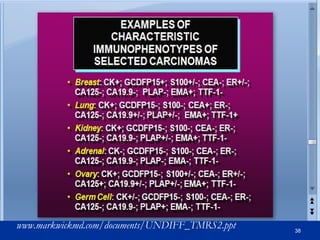
  • #39 Take GCDFP if + it is Breast primary Adrenal primary is negative for CK , may be Germ cell also TTF-1 is pos for lung only CA125 is pos for ovary only CA19-9 pos for ovary or Lung