Can student peer
assessment work
in my teaching?
Drs. Catherine Rawn, Katja Thieme, Andrew Owen & Isabeau Iqbal
Congress of Humanities and Social Sciences, 2019
Student peer assessment
“the quantitative or qualitative evaluation
of a learner’s performance by another
learner of the same status” (Patchan & Schunn, 2015,
p.592)
2
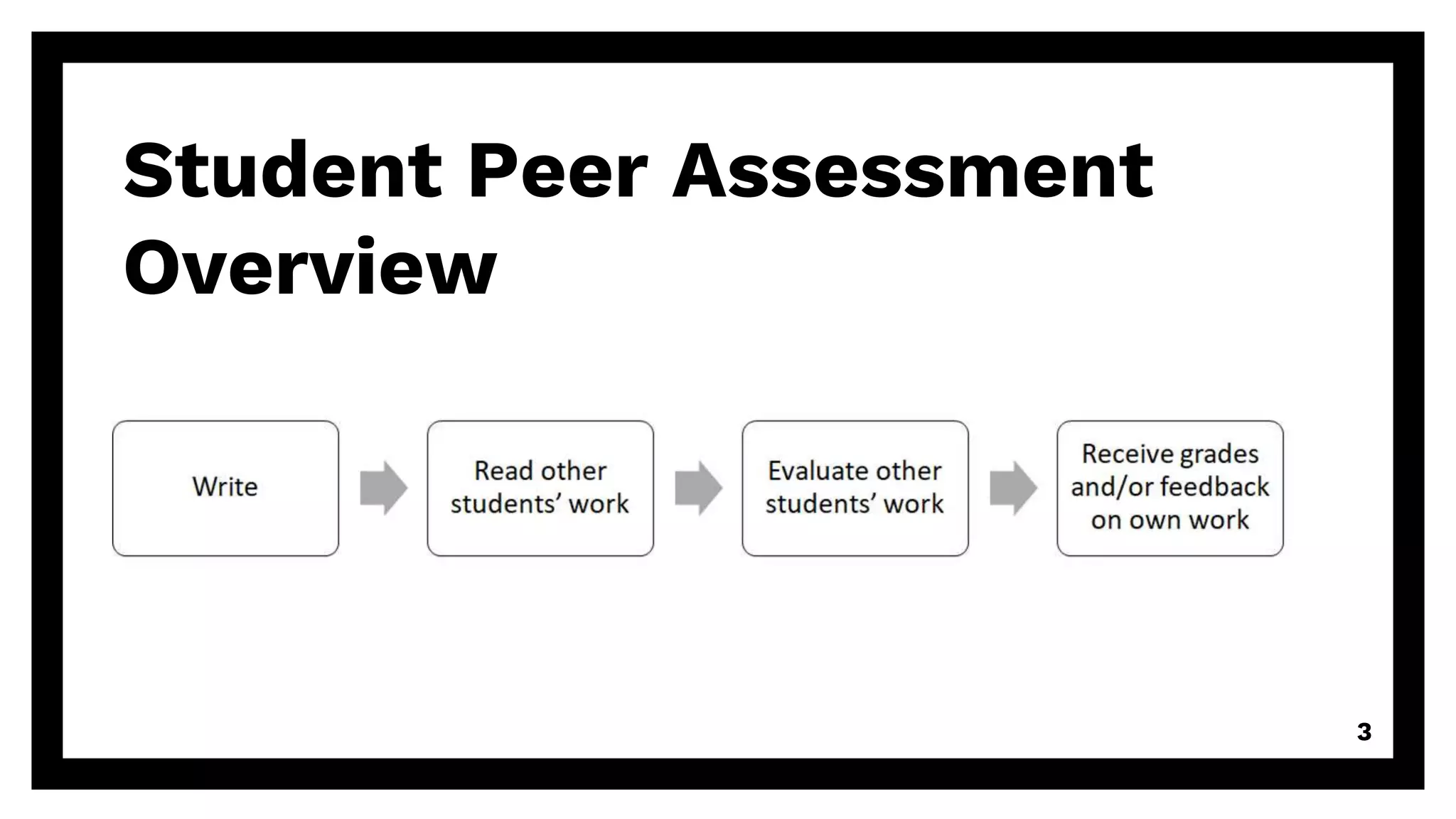
Student Peer Assessment
Overview
3
Raise your hand if...
You have used SPA extensively in your
teaching
You have tried SPA out in your teaching
Isn’t SPA where I can get a facial?
4
Image by Freepix from Flaticon
Benefits and Challenges
5
▪ Plenty of both!
▪ Specifics depends on how they’re implemented
▪ See https://wiki.ubc.ca/images/a/ad/Student-peer-assessment.pdf
Large Classes,
Small Assignments
Dr. Catherine Rawn
Professor of Teaching
Psychology
cdrawn@psych.ubc.ca @cdrawn
blogs.ubc.ca/catherinerawn/
peerassessment.arts.ubc.ca/
Why I started
7Image by Dinosoftlabs from Flaticon
▪ To be able to incorporate short written assignments in
classes of 250-400 students (Intro Psychology), and
help students understand their skill in relation to others
▪ Learned of a tool that would help me facilitate this:
peerScholar
SPA in my teaching
8
▪ Peer Assessment Training Workshop for practice (1%)
▪ Before each test (x4) take a concept and apply it (~400
words)
▪ Evaluate 4-6 peers’ submissions using short rubric and
constructive comment box
□ Receive average of peers’ evaluations (1% x 4)
▪ Rate quality of feedback you have received
□ Receive average quality rating (2%)
▪ Total all steps: 10% of course grade
Implementation: Takeaways
9
▪ Practice data export before commit to a software. Make
sure you can get the values you need/want.
▪ Assign students to review 6, to ensure most receive 5-6
(crucial for reliability)
▪ Consider using median or arithmetic mean
▪ Have an appeals process (e.g., form)
▪ Manually check any assessment grade with 3 or fewer
reviewers
▪ Adding training workshop helped increase student trust in
each other
Teaching Students to Provide Quality
Peer Review to Each Other’s
Assignments
Dr. Katja Thieme
Instructor
English Language & Literatures
Katja.Thieme@ubc.ca
@Katja_Thieme
Why I started
★ Teaching writing intensive courses—including peer
review and scaffolding assignments are best practices
★ Student benefit from receiving more than one set of
feedback comments
★ Students benefit from reviewing other students’ work
while figuring out strengths & weaknesses of their own
11Image by Dinosoftlabs from Flaticon
SPA in my teaching
★ ComPAIR: a learning technology for peer review &
feedback developed by UBC
★ Key feature: Students first rank, then review 2 pieces of
peer work side by side
★ Integrating the law of comparative judgement
(Thurstone, 1927) into peer review:
○ People are more reliable in assessing quality when comparing
one thing with another than when making judgements in
isolation.
12
ComPAIR
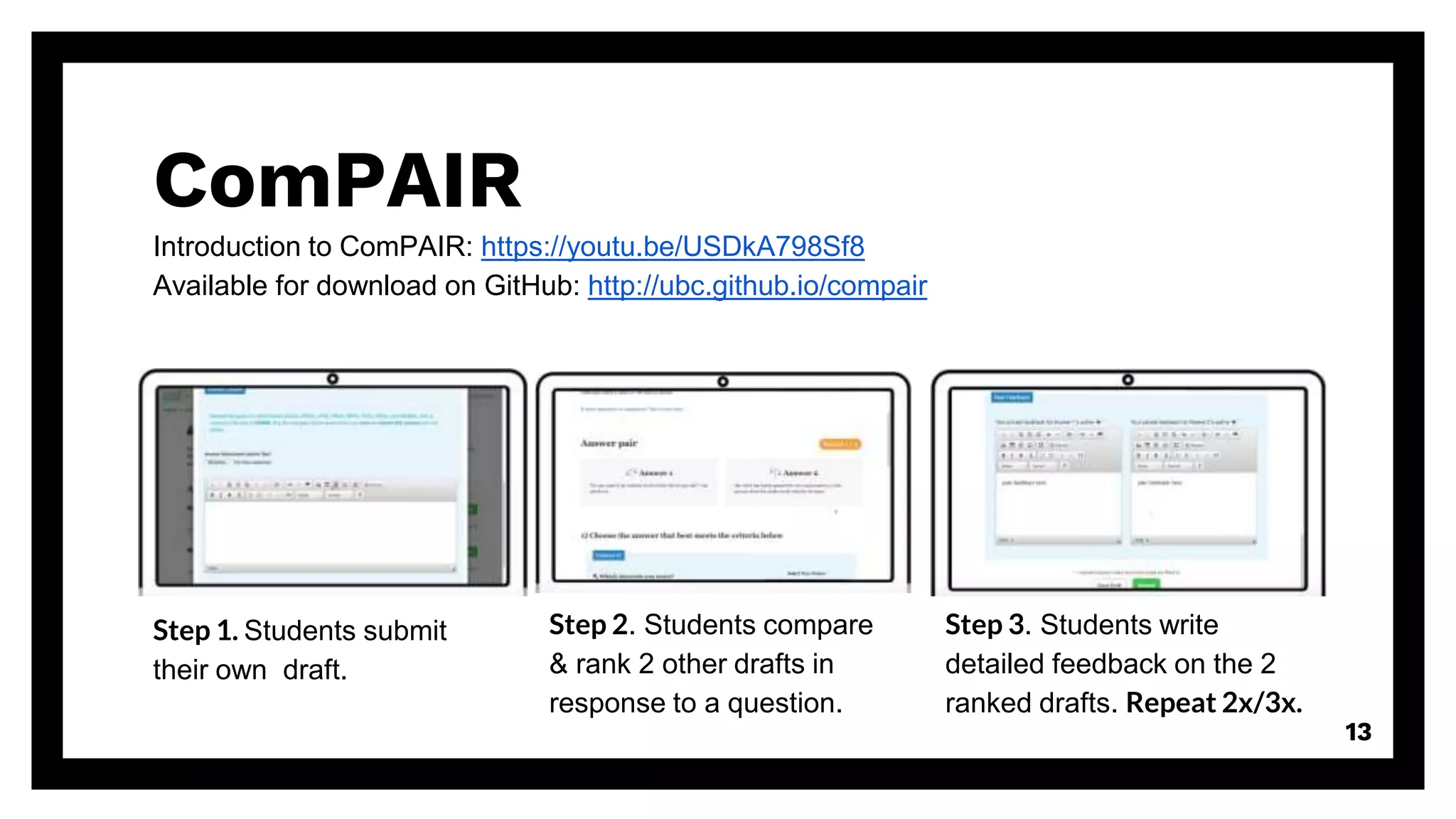
Introduction to ComPAIR: https://youtu.be/USDkA798Sf8
Available for download on GitHub: http://ubc.github.io/compair
Step 1. Students submit
their own draft.
Step 2. Students compare
& rank 2 other drafts in
response to a question.
Step 3. Students write
detailed feedback on the 2
ranked drafts. Repeat 2x/3x.
13
Successes
★ Comparisons give a reference point for learning
★ In ComPAIR:
○ Students use each piece of work in a pair as a reference point for the other
○ Comparing helps identify strengths or weaknesses that might not be as
evident when reviewing a single isolated piece of work
○ Especially useful for writing formative feedback
14Image by Freepik from Flaticon
Successes
★ Students’ learning benefits depend on good integration—use
relevant language (metalanguage) throughout the term
★ Generally, more positive experiences when:
○ Students understand what they are practicing before providing
feedback (model crucial parts of assignments!)
○ Assignments tie into a larger process or goal in the course
○ Students receive guidance (multiple/detailed criteria) in what to look for
○ Assignments require multiple comparisons (repetition with the same
work helps build confidence in writing peer feedback)
15
Samples of Peer Feedback
Metalanguage Project with Dr. Laila Ferreira
Most Detailed
“As I understand, your key
concepts are nationalism
and the propaganda,
however, I cannot see those
in your second paragraph.
You should mention about
those and also I do not
understand your argument,
you need to be more clear
about it.”
Somewhat Detailed
“As I understand, your key
concepts are nationalism
and the propaganda,
however, I cannot see those
in your second paragraph.
You should mention about
those and also I do not
understand your argument,
you need to be more clear
about it.”
Least Detailed
“There is no title for the
essay, and there are a lot
grammatical errors in your
writing.”
“The second paragraph was
not completed, some words
were insufficient.”
16
Pitfalls
When you haven’t
→ provided enough precise language for necessary elements
of the assignment,
→ shown and discussed models for assignment & feedback,
the feedback will not be as successful and the students’ peer
review experience will suffer.
17Image by Smashicons from Flaticon
Implementation: Takeaways
★ Use and repeat precise terms for necessary assignment
elements
★ Integrate those terms in multiple ways
★ Model assignment elements and feedback practices
18
Assorted attempts
Dr. Andrew Owen
Instructor
Political Science
andrew.owen@ubc.ca
Why I started
▪ Encourage active reflection on submitted work (and
feedback)
▪ Help students understand what makes for a good
‘answer’.
20Image by Dinosoftlabs from Flaticon
SPA in my teaching
▪ 1 page of comments on research paper prospectuses in
a 400 level seminar.
▪ 200 word comments on draft 500 word papers in 300
level lecture.
▪ 1-2 sentence comments on multiple short answers
submitted in 300 level stats course.
▪ Using multiple technologies.
21
Successes
Student feedback, via surveys, consistently positive.
Evidence of thoughtful incorporation of peer’s ideas in final
submissions
22
Pitfalls
▪ Takes time - grading the peer assessments
▪ Technological hiccups
▪ Additional deadlines
23
Implementation: Takeaways
▪ Rubrics
▪ Practice
▪ Communication (deadlines, motivation)
▪ Workload tradeoffs (yours and theirs)
▪ Start small?
24
Questions
25
References
Patchan, M. M., & Schunn, C. D. (2015). Understanding the benefits of providing peer feedback: how students respond to peers’
texts of varying quality. Instructional Science, 43(5), 591-614.
Thurstone, L. L. (1927). A law of comparative judgment. Psychological Review, 34(4), 273-286.
http://dx.doi.org/10.1037/h0070288
26
Thank-you!
Faculty of Arts
Catherine Rawn cdrawn@psych.ubc.ca
Katja Thieme katja.thieme@ubc.ca
Andrew Owen andrew.owen@ubc.ca
Centre for Teaching, Learning and Technology
Isabeau Iqbal isabeau.iqbal@ubc.ca
27
Jacquenetta presentation template from Slide Carnival. https://www.slidescarnival.com/jacquenetta-free-presentation-template/1929
28
Please attribute to Drs. Catherine Rawn, Katja Thieme, Andrew Owen & Isabeau
Iqbal, University of British Columbia
For more information about this license, see https://creativecommons.org/licenses/by-nc-
sa/4.0/

Can student peer assessment work in my teaching?

  • 1.
    Can student peer assessmentwork in my teaching? Drs. Catherine Rawn, Katja Thieme, Andrew Owen & Isabeau Iqbal Congress of Humanities and Social Sciences, 2019
  • 2.
    Student peer assessment “thequantitative or qualitative evaluation of a learner’s performance by another learner of the same status” (Patchan & Schunn, 2015, p.592) 2
  • 3.
  • 4.
    Raise your handif... You have used SPA extensively in your teaching You have tried SPA out in your teaching Isn’t SPA where I can get a facial? 4 Image by Freepix from Flaticon
  • 5.
    Benefits and Challenges 5 ▪Plenty of both! ▪ Specifics depends on how they’re implemented ▪ See https://wiki.ubc.ca/images/a/ad/Student-peer-assessment.pdf
  • 6.
    Large Classes, Small Assignments Dr.Catherine Rawn Professor of Teaching Psychology cdrawn@psych.ubc.ca @cdrawn blogs.ubc.ca/catherinerawn/ peerassessment.arts.ubc.ca/
  • 7.
    Why I started 7Imageby Dinosoftlabs from Flaticon ▪ To be able to incorporate short written assignments in classes of 250-400 students (Intro Psychology), and help students understand their skill in relation to others ▪ Learned of a tool that would help me facilitate this: peerScholar
  • 8.
    SPA in myteaching 8 ▪ Peer Assessment Training Workshop for practice (1%) ▪ Before each test (x4) take a concept and apply it (~400 words) ▪ Evaluate 4-6 peers’ submissions using short rubric and constructive comment box □ Receive average of peers’ evaluations (1% x 4) ▪ Rate quality of feedback you have received □ Receive average quality rating (2%) ▪ Total all steps: 10% of course grade
  • 9.
    Implementation: Takeaways 9 ▪ Practicedata export before commit to a software. Make sure you can get the values you need/want. ▪ Assign students to review 6, to ensure most receive 5-6 (crucial for reliability) ▪ Consider using median or arithmetic mean ▪ Have an appeals process (e.g., form) ▪ Manually check any assessment grade with 3 or fewer reviewers ▪ Adding training workshop helped increase student trust in each other
  • 10.
    Teaching Students toProvide Quality Peer Review to Each Other’s Assignments Dr. Katja Thieme Instructor English Language & Literatures Katja.Thieme@ubc.ca @Katja_Thieme
  • 11.
    Why I started ★Teaching writing intensive courses—including peer review and scaffolding assignments are best practices ★ Student benefit from receiving more than one set of feedback comments ★ Students benefit from reviewing other students’ work while figuring out strengths & weaknesses of their own 11Image by Dinosoftlabs from Flaticon
  • 12.
    SPA in myteaching ★ ComPAIR: a learning technology for peer review & feedback developed by UBC ★ Key feature: Students first rank, then review 2 pieces of peer work side by side ★ Integrating the law of comparative judgement (Thurstone, 1927) into peer review: ○ People are more reliable in assessing quality when comparing one thing with another than when making judgements in isolation. 12
  • 13.
    ComPAIR Introduction to ComPAIR:https://youtu.be/USDkA798Sf8 Available for download on GitHub: http://ubc.github.io/compair Step 1. Students submit their own draft. Step 2. Students compare & rank 2 other drafts in response to a question. Step 3. Students write detailed feedback on the 2 ranked drafts. Repeat 2x/3x. 13
  • 14.
    Successes ★ Comparisons givea reference point for learning ★ In ComPAIR: ○ Students use each piece of work in a pair as a reference point for the other ○ Comparing helps identify strengths or weaknesses that might not be as evident when reviewing a single isolated piece of work ○ Especially useful for writing formative feedback 14Image by Freepik from Flaticon
  • 15.
    Successes ★ Students’ learningbenefits depend on good integration—use relevant language (metalanguage) throughout the term ★ Generally, more positive experiences when: ○ Students understand what they are practicing before providing feedback (model crucial parts of assignments!) ○ Assignments tie into a larger process or goal in the course ○ Students receive guidance (multiple/detailed criteria) in what to look for ○ Assignments require multiple comparisons (repetition with the same work helps build confidence in writing peer feedback) 15
  • 16.
    Samples of PeerFeedback Metalanguage Project with Dr. Laila Ferreira Most Detailed “As I understand, your key concepts are nationalism and the propaganda, however, I cannot see those in your second paragraph. You should mention about those and also I do not understand your argument, you need to be more clear about it.” Somewhat Detailed “As I understand, your key concepts are nationalism and the propaganda, however, I cannot see those in your second paragraph. You should mention about those and also I do not understand your argument, you need to be more clear about it.” Least Detailed “There is no title for the essay, and there are a lot grammatical errors in your writing.” “The second paragraph was not completed, some words were insufficient.” 16
  • 17.
    Pitfalls When you haven’t →provided enough precise language for necessary elements of the assignment, → shown and discussed models for assignment & feedback, the feedback will not be as successful and the students’ peer review experience will suffer. 17Image by Smashicons from Flaticon
  • 18.
    Implementation: Takeaways ★ Useand repeat precise terms for necessary assignment elements ★ Integrate those terms in multiple ways ★ Model assignment elements and feedback practices 18
  • 19.
    Assorted attempts Dr. AndrewOwen Instructor Political Science andrew.owen@ubc.ca
  • 20.
    Why I started ▪Encourage active reflection on submitted work (and feedback) ▪ Help students understand what makes for a good ‘answer’. 20Image by Dinosoftlabs from Flaticon
  • 21.
    SPA in myteaching ▪ 1 page of comments on research paper prospectuses in a 400 level seminar. ▪ 200 word comments on draft 500 word papers in 300 level lecture. ▪ 1-2 sentence comments on multiple short answers submitted in 300 level stats course. ▪ Using multiple technologies. 21
  • 22.
    Successes Student feedback, viasurveys, consistently positive. Evidence of thoughtful incorporation of peer’s ideas in final submissions 22
  • 23.
    Pitfalls ▪ Takes time- grading the peer assessments ▪ Technological hiccups ▪ Additional deadlines 23
  • 24.
    Implementation: Takeaways ▪ Rubrics ▪Practice ▪ Communication (deadlines, motivation) ▪ Workload tradeoffs (yours and theirs) ▪ Start small? 24
  • 25.
  • 26.
    References Patchan, M. M.,& Schunn, C. D. (2015). Understanding the benefits of providing peer feedback: how students respond to peers’ texts of varying quality. Instructional Science, 43(5), 591-614. Thurstone, L. L. (1927). A law of comparative judgment. Psychological Review, 34(4), 273-286. http://dx.doi.org/10.1037/h0070288 26
  • 27.
    Thank-you! Faculty of Arts CatherineRawn cdrawn@psych.ubc.ca Katja Thieme katja.thieme@ubc.ca Andrew Owen andrew.owen@ubc.ca Centre for Teaching, Learning and Technology Isabeau Iqbal isabeau.iqbal@ubc.ca 27
  • 28.
    Jacquenetta presentation templatefrom Slide Carnival. https://www.slidescarnival.com/jacquenetta-free-presentation-template/1929 28 Please attribute to Drs. Catherine Rawn, Katja Thieme, Andrew Owen & Isabeau Iqbal, University of British Columbia For more information about this license, see https://creativecommons.org/licenses/by-nc- sa/4.0/

Editor's Notes

  • #3 the quantitative or qualitative evaluation of a learner’s performance by another learner of the same status” (Patchan & Schunn, 2015, p.592). In the context of this session, peer assessment/feedback on students’ assignments is different from evaluating peer contributions to group work. Our focus is the former.
  • #6 You can spell these out...or just refer people to the handout https://wiki.ubc.ca/images/a/ad/Student-peer-assessment.pdf or ?? Up to you. I think you could simply say something like “there are benefits and challenges to using SPA and some of these are listed in the handout. Each of us will be addressing this in the individual case studies that we’ll be presenting and you will have a chance to ask us questions…(or something like that)