
@atseitlin
Accelerating Innovation and
Time-to-Market
October 28, 2014
2@atseitlin
Who cares
about DevOps?
3@atseitlin
4@atseitlin
Everything-as-a-Service
Alphabet soup
• IaaS
• PaaS
• DaaS
• mBaaS
• SBS
• …
All started with SaaS
With great power comes great responsibility
(Consumer web companies figured this out long ago)
5@atseitlin
Competition
Software is a at the core of every business, not just
software companies
Ability to deliver software to market quickly is a competitive
advantage
6@atseitlin
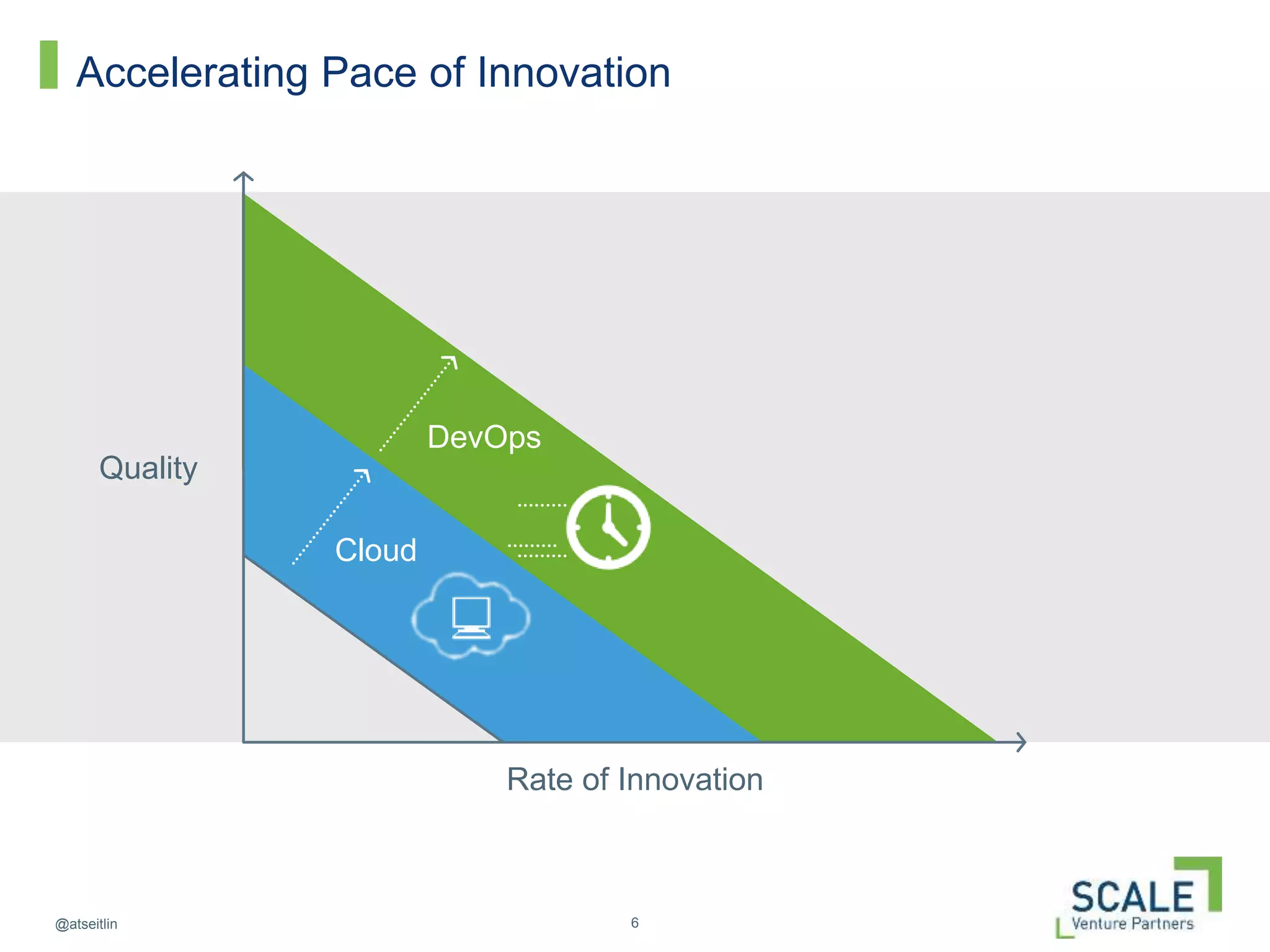
DevOps
Accelerating Pace of Innovation
Rate of Innovation
Quality
Cloud
7@atseitlin
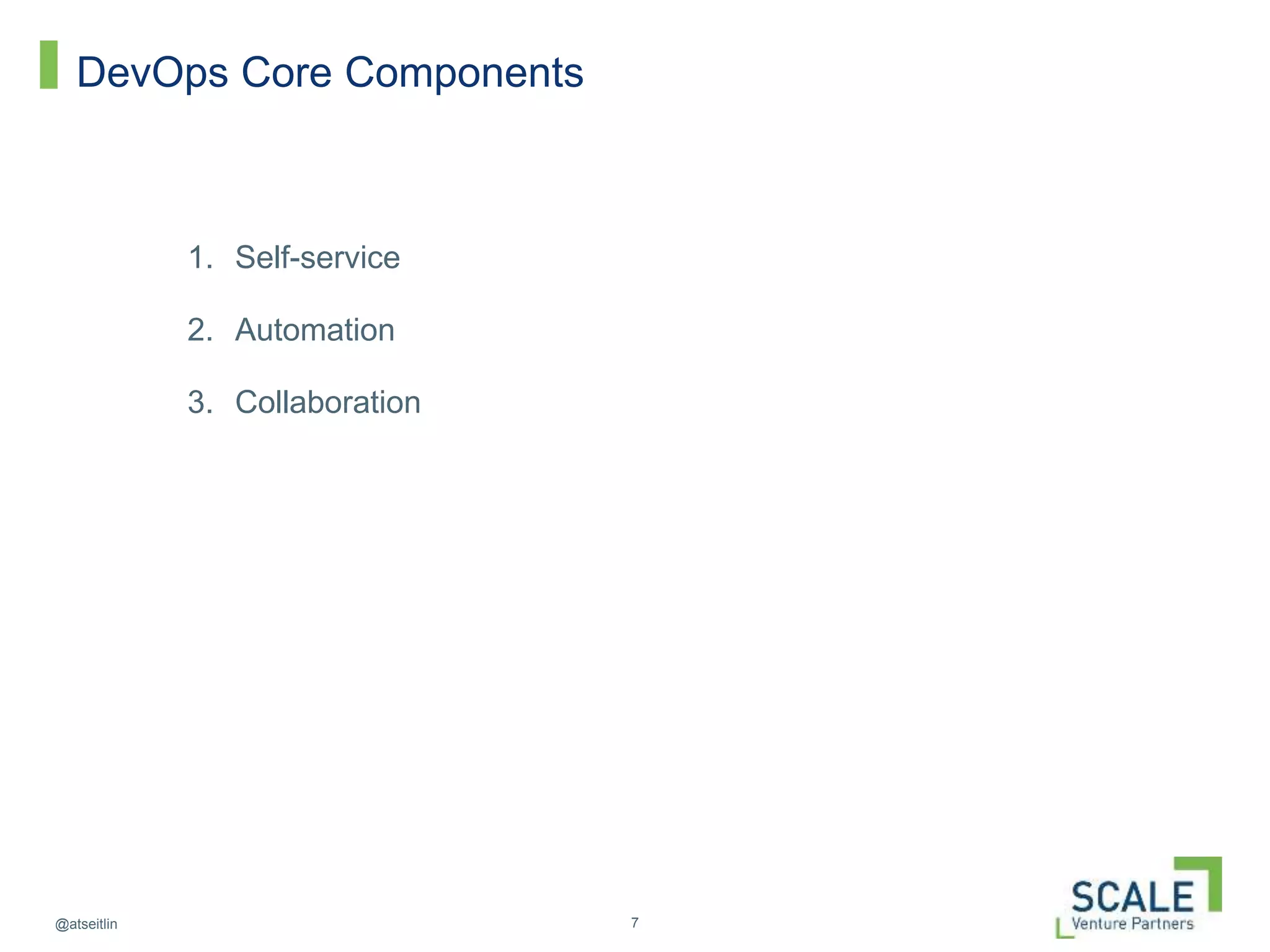
DevOps Core Components
1. Self-service
2. Automation
3. Collaboration
8@atseitlin
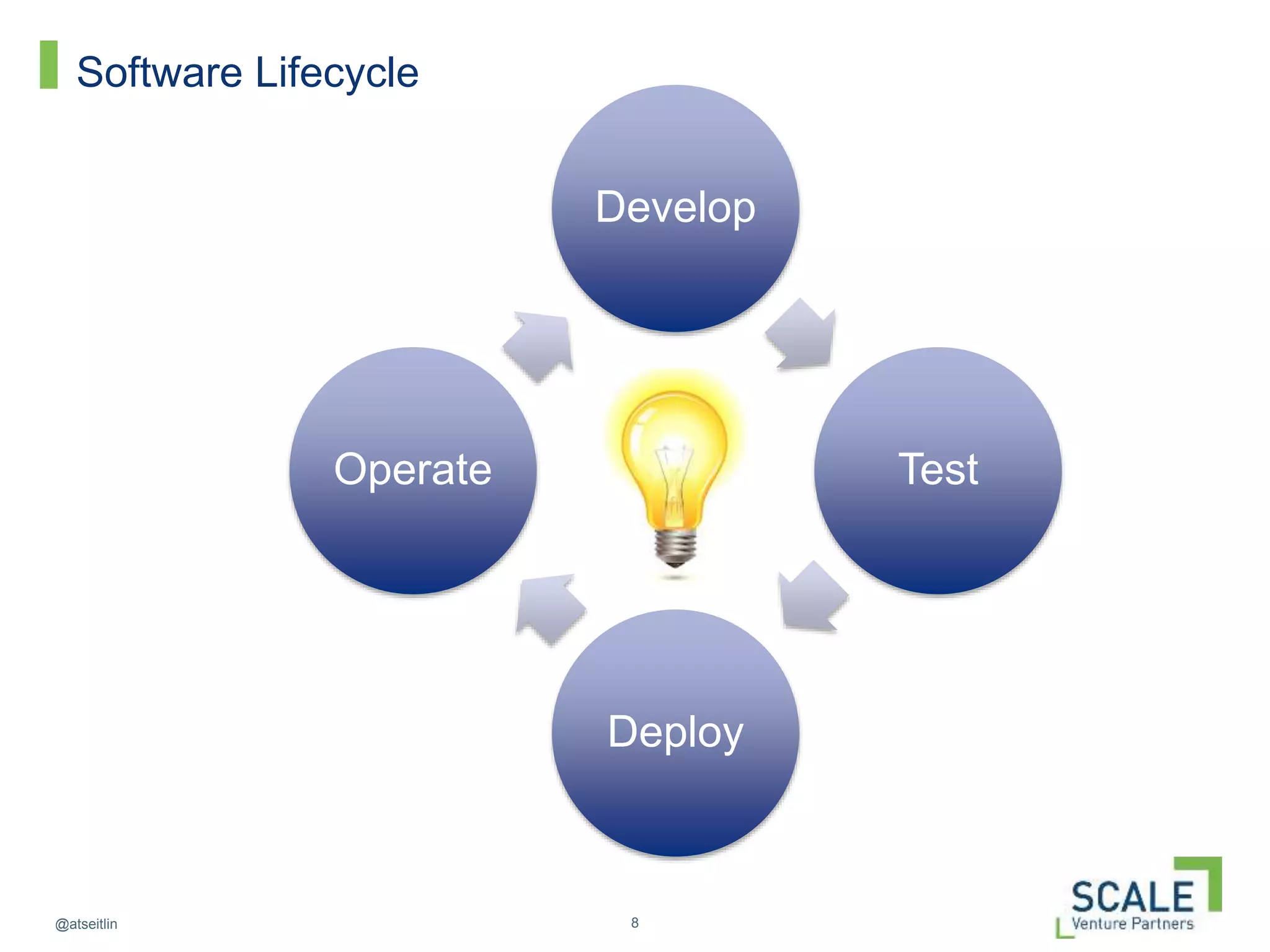
Software Lifecycle
Develop
Test
Deploy
Operate
9@atseitlin
Develop
Self-provisioning & self-service
Operational platform that provides
- Load balancing
- Service discovery
- Logging, metrics, alerting, and notifications
- Resiliency design patterns (bulk heads & fallbacks)
- Security
- Data access (caching, persistence)
10@atseitlin
Test
Unit / functional / regression / integration
Chaos (failure injection / simulation)
Performance / Squeeze
Security
Automate as much as possible (all!)
11@atseitlin
Deploy
Continuous Delivery
Automated configuration
Zero-downtime (red/black or rolling)
Canary Analysis
Redundancy
12@atseitlin
Deploy: Continuous Delivery
Replace manual release process with automation
Assembly line
13@atseitlin
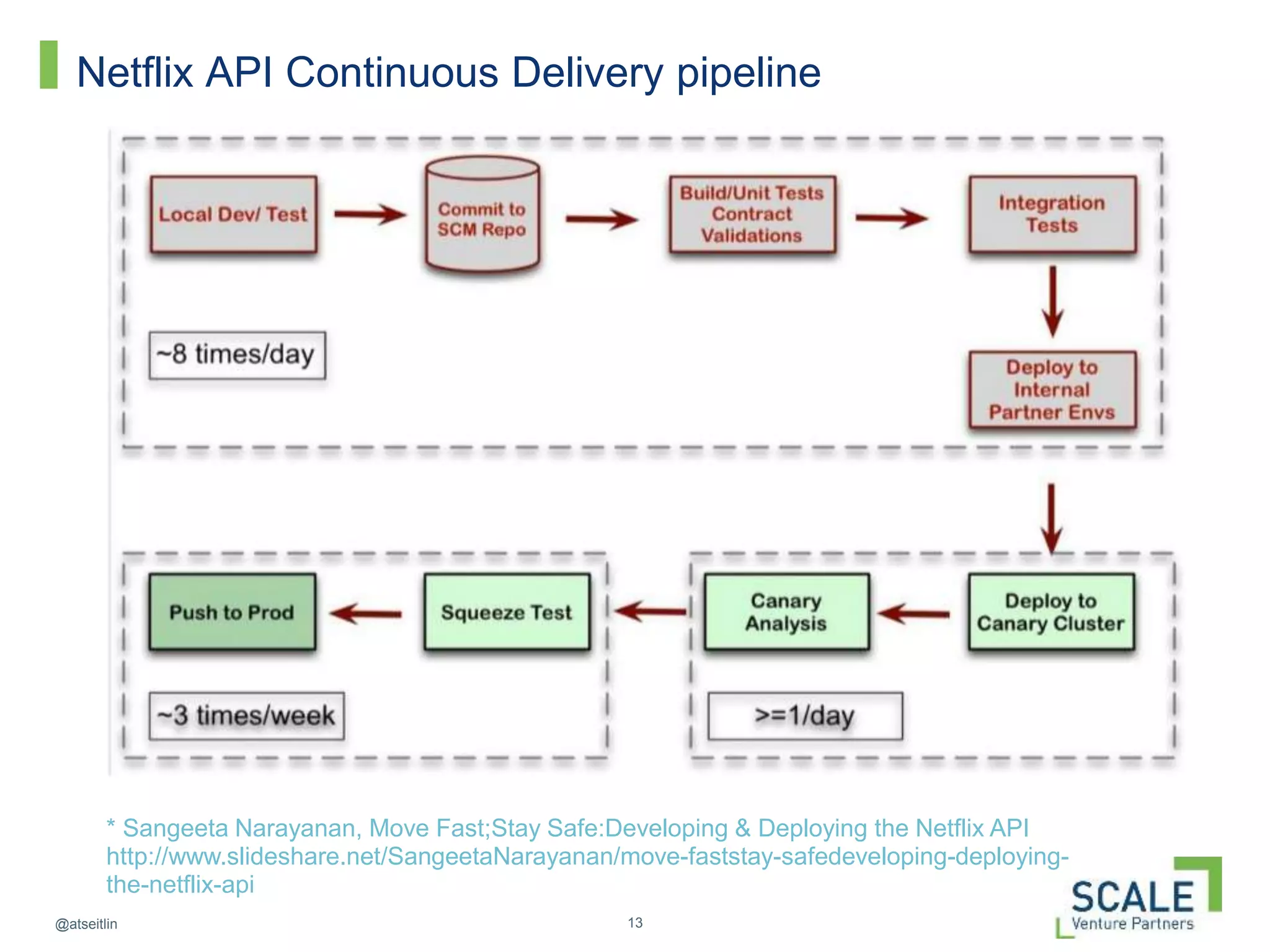
Netflix API Continuous Delivery pipeline
* Sangeeta Narayanan, Move Fast;Stay Safe:Developing & Deploying the Netflix API
http://www.slideshare.net/SangeetaNarayanan/move-faststay-safedeveloping-deploying-
the-netflix-api
14@atseitlin
Deploy: Automated Configuration
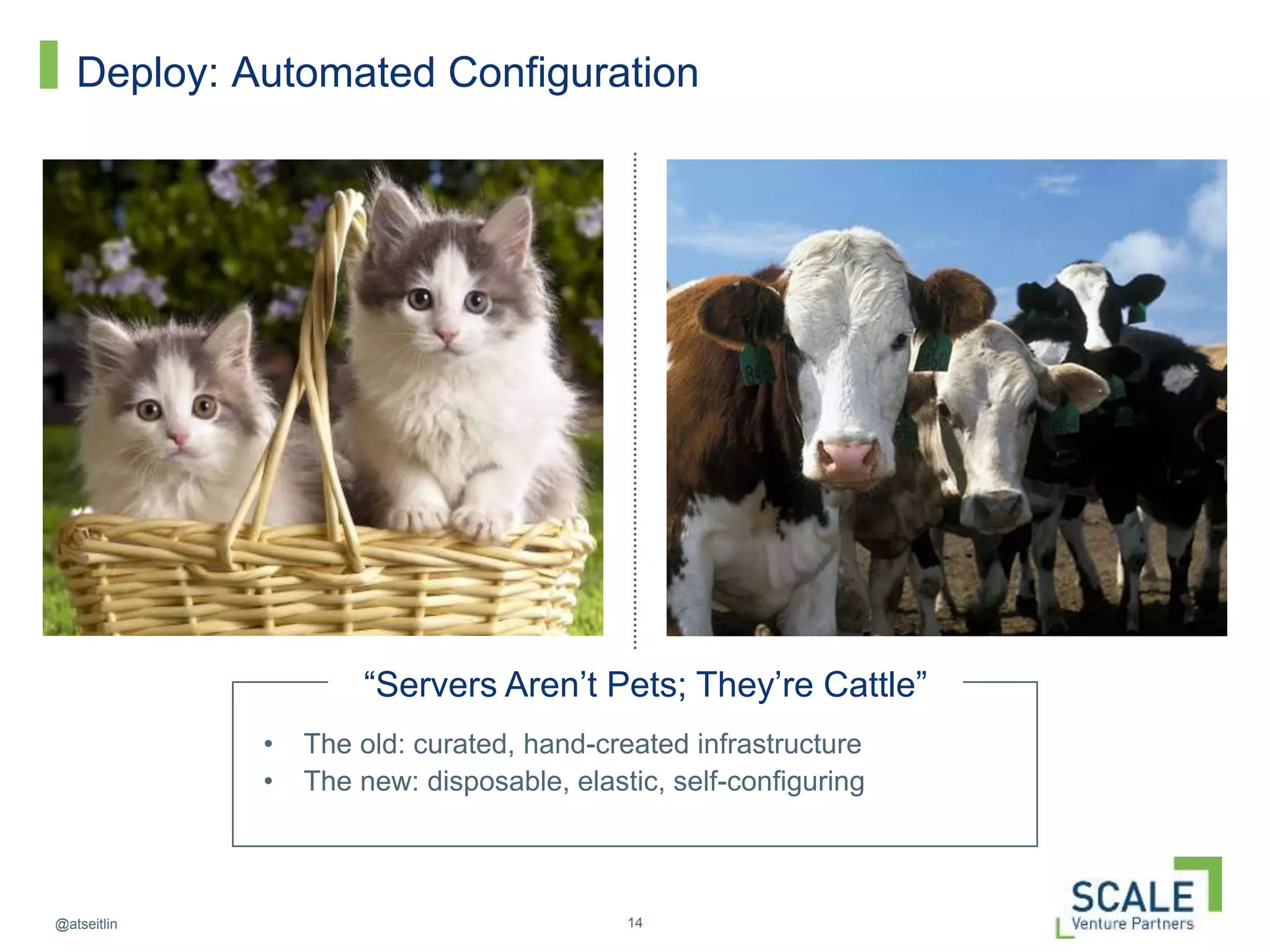
“Servers Aren’t Pets; They’re Cattle”
• The old: curated, hand-created infrastructure
• The new: disposable, elastic, self-configuring
15@atseitlin
Deploy: Automated Configuration
Two approaches
1. Bake virtual images or containers
2. Bootstrap at launch
16@atseitlin
Deploy: Zero downtime
Two options
1. Rolling upgrade
2. Red/black deployment
Must be able to rollback quickly!
17@atseitlin
Deploy: Canary Analysis
Always, always stage deployments and compare them to
baseline before fully deploying
Launch 2 instances, one with new code one with old.
Compare them. If good, continue deploying new
Lots (183 slides!) of detailed tips & tricks from QConNY at:
http://www.slideshare.net/royrapoport/20140612-q-con-
canary-analysis
18@atseitlin
Deploy: Redundancy
Think in 3s
Multiple data centers (AZs)
Multiple regions
Active-active
19@atseitlin
Operate
Monitoring
Alerting
Notifications
Dynamic auto-scaling
Failure
20@atseitlin
Operate: Monitoring
Collect everything
Prefer structured time series over log data
Build base health metrics into the platform (e.g. 2xx, 3xx,
4xx, 5xx counts, latency percentiles)
21@atseitlin
Operate: Alerting
Self-service, based on meaningful service metrics
Error rates often a better metric than success
22@atseitlin
Operate: Notifications
Don’t rely on people to watch screens. Alerts should trigger
notifications
On-call rotations should include engineers that built the
service
Alerts should be granular down to service
23@atseitlin
Operate: Dynamic auto-scaling
Save costs
Increase availability
24@atseitlin
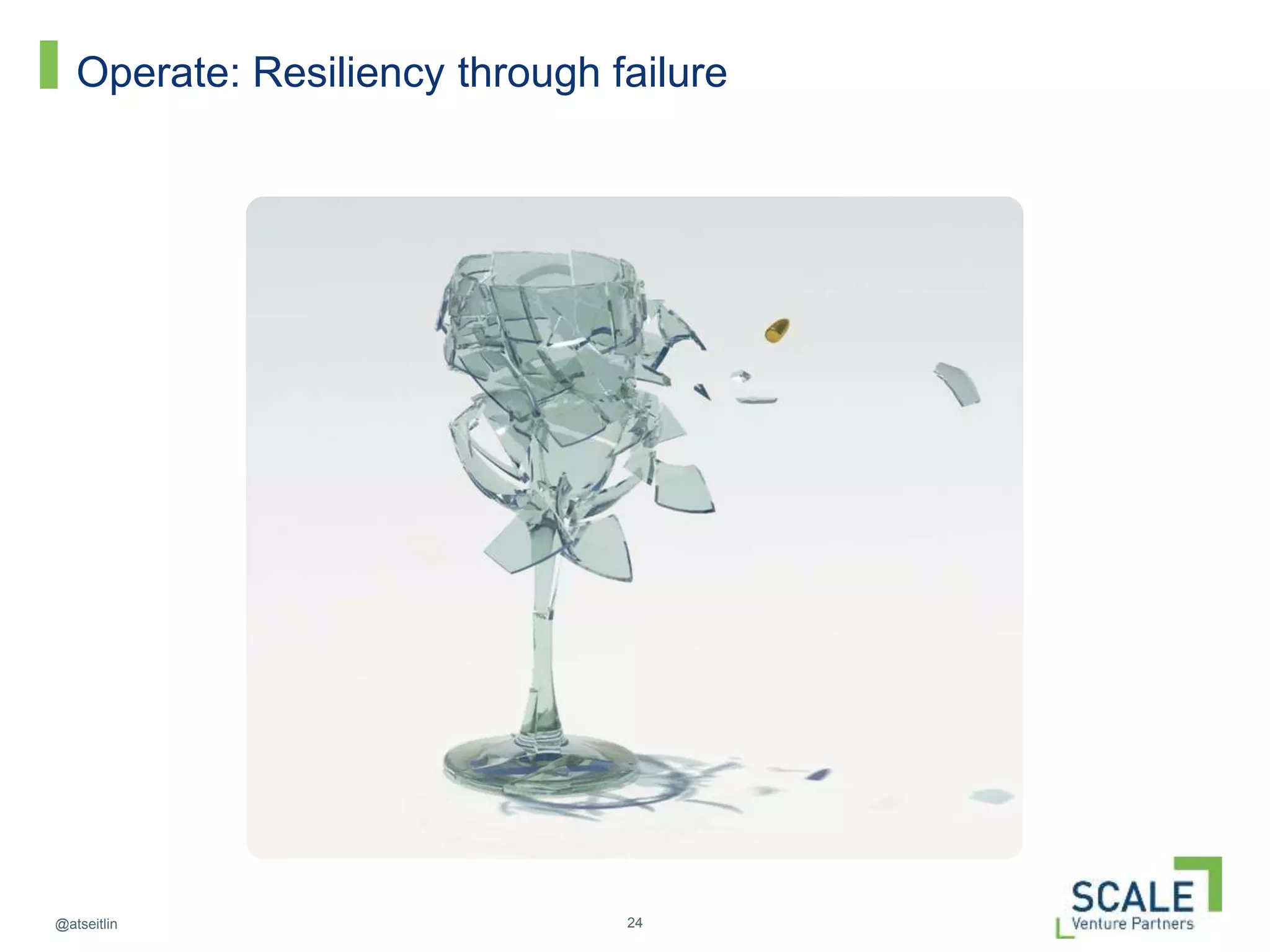
Operate: Resiliency through failure
25@atseitlin
Failure is all around us
• Disks fail
• Power goes out. And your generator fails
• Software bugs introduced
• People make mistakes
Failure is unavoidable
26@atseitlin
We design around failure
• Exception handling
• Clusters
• Redundancy
• Fault tolerance
• Fall-back or degraded experience
• All to insulate our users from failure
Is that enough?
27@atseitlin
It’s not enough
• How do we know if we’ve succeeded?
• Does the system work as designed?
• Is it as resilient as we believe?
• How do we prevent drifting into failure?
The typical answer is…
28@atseitlin
More testing!
• Unit testing
• Integration testing
• Stress testing
• Exhaustive test suites to simulate and test all failure mode
Can we effectively simulate a
large-scale distributed system?
29@atseitlin
Building distributed systems is hard
Testing them exhaustively is even harder
• Massive data sets and changing shape
• Internet-scale traffic
• Complex interaction and information flow
• Asynchronous nature
• 3rd party services
• All while innovating and building features
Prohibitively expensive, if not
impossible, for most large-scale
systems
30@atseitlin
What if we could reduce variability of
failures?
31@atseitlin
There is another way
• Cause failure to validate resiliency
• Test design assumption by stressing them
• Don’t wait for random failure. Remove its uncertainty by forcing it periodically
32@atseitlin
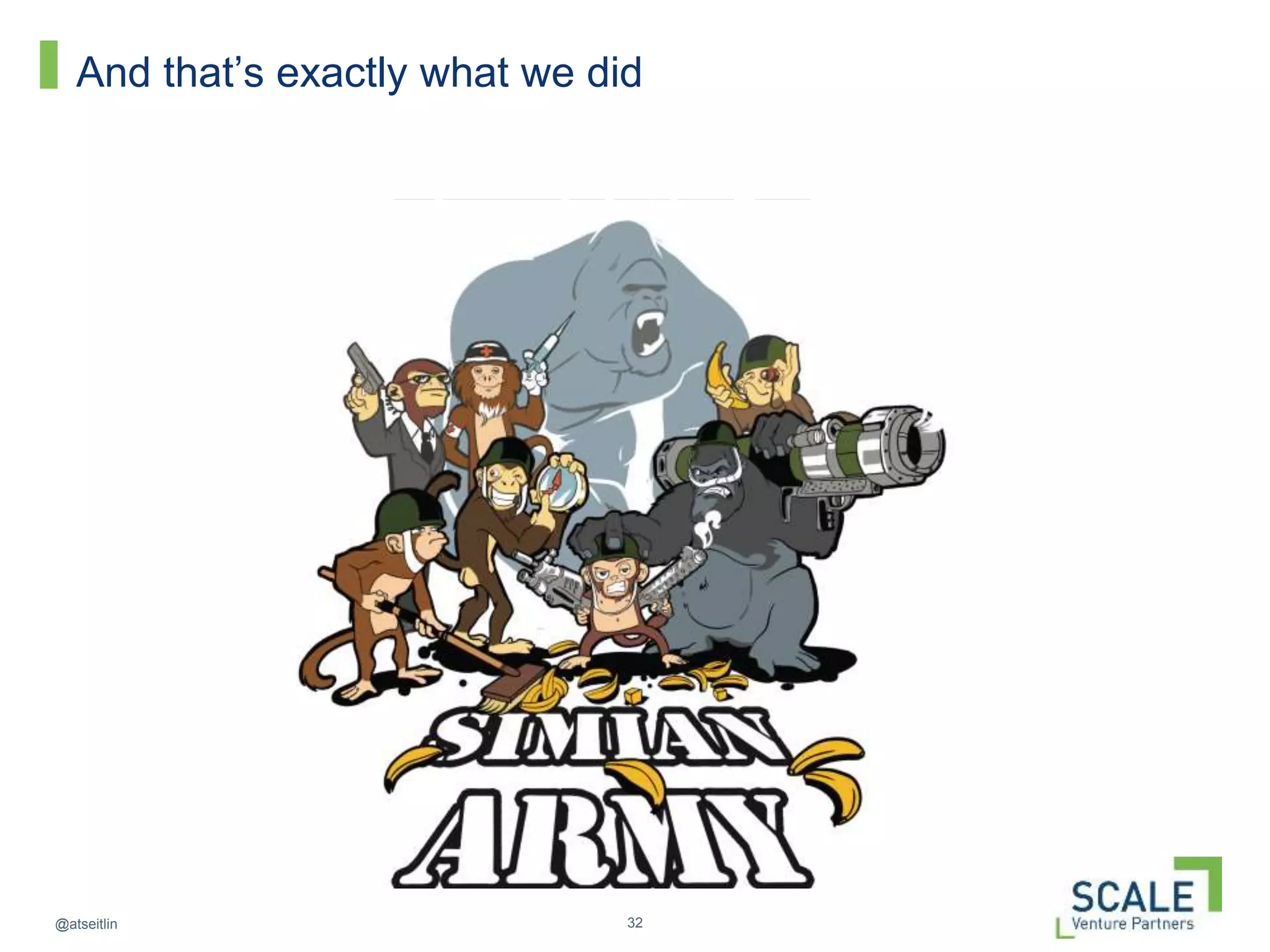
And that’s exactly what we did
33@atseitlin
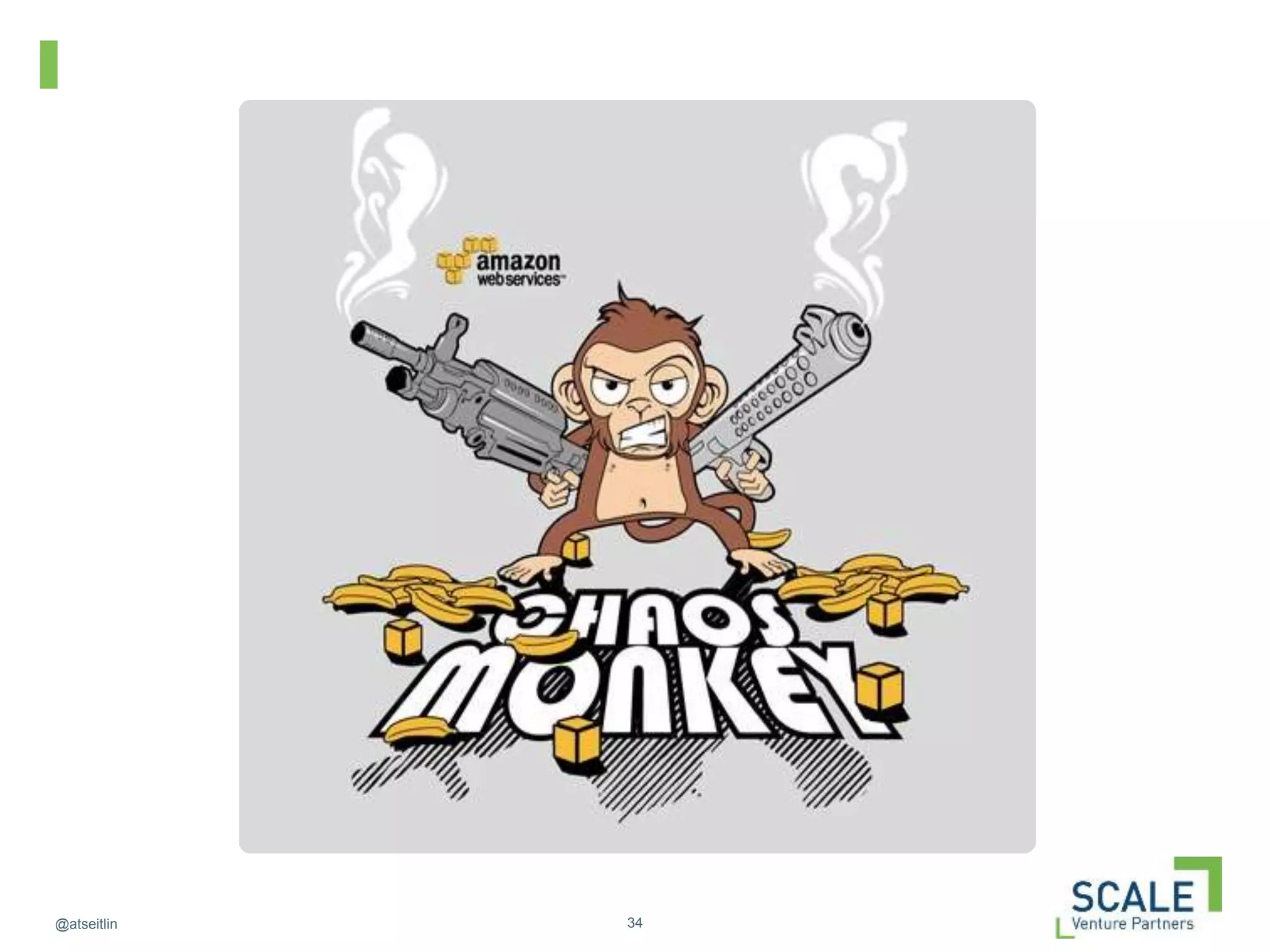
Instances fail
34@atseitlin
35@atseitlin
Chaos Monkey taught us…
• State is bad
• Clusters are good
• Surviving single instance failure is not enough
36@atseitlin
Lots of instances fail
37@atseitlin
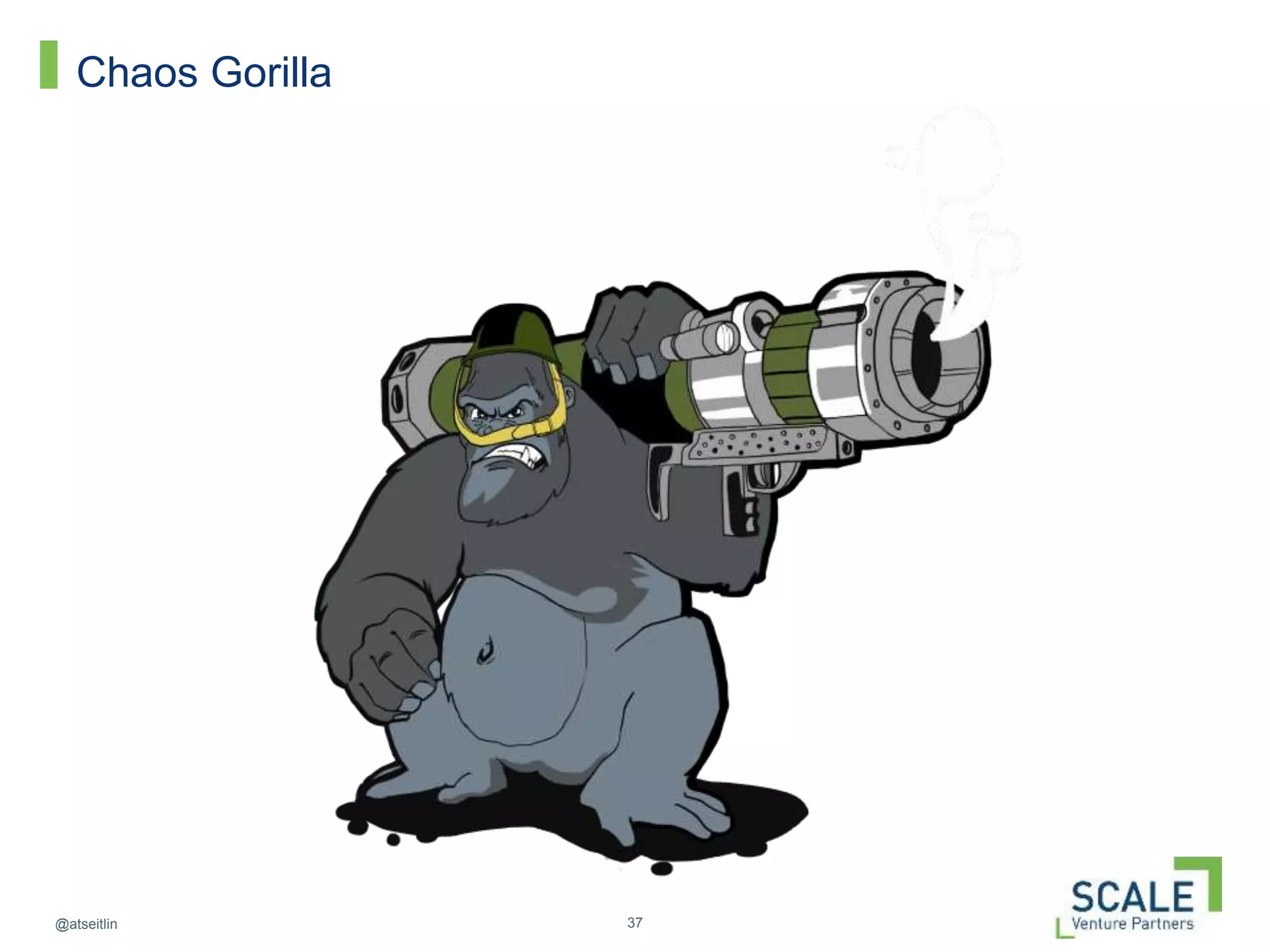
Chaos Gorilla
38@atseitlin
Chaos Gorilla taught us…
• Hidden assumptions on deployment topology
• Infrastructure control plane can be a bottleneck
• Large scale events are hard to simulate
• Rapidly shifting traffic is error prone
• Smooth recovery is a challenge
• Cassandra works as expected
39@atseitlin
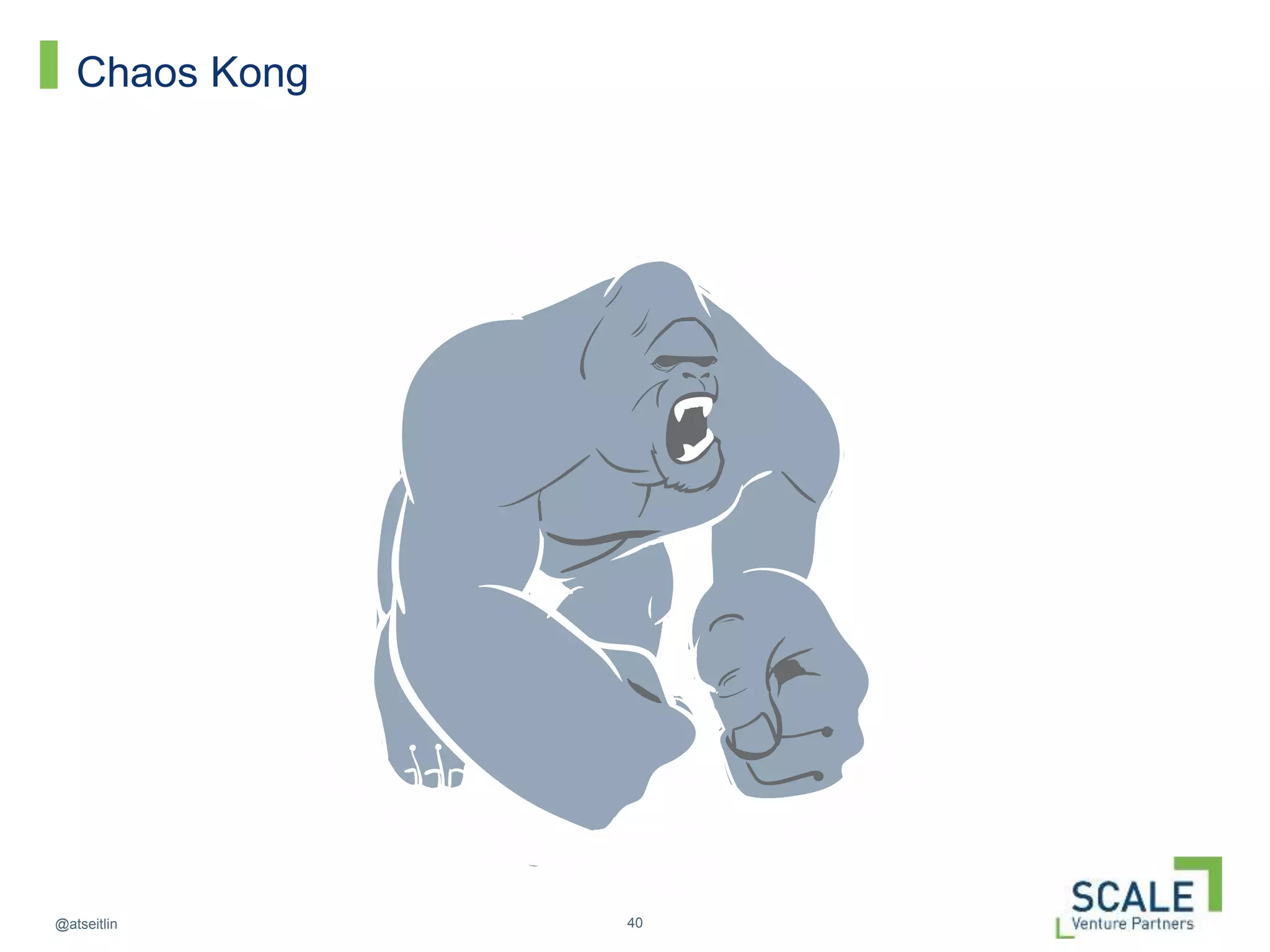
What about larger catastrophes?
Anyone remember Sandy?
40@atseitlin
Chaos Kong
41@atseitlin
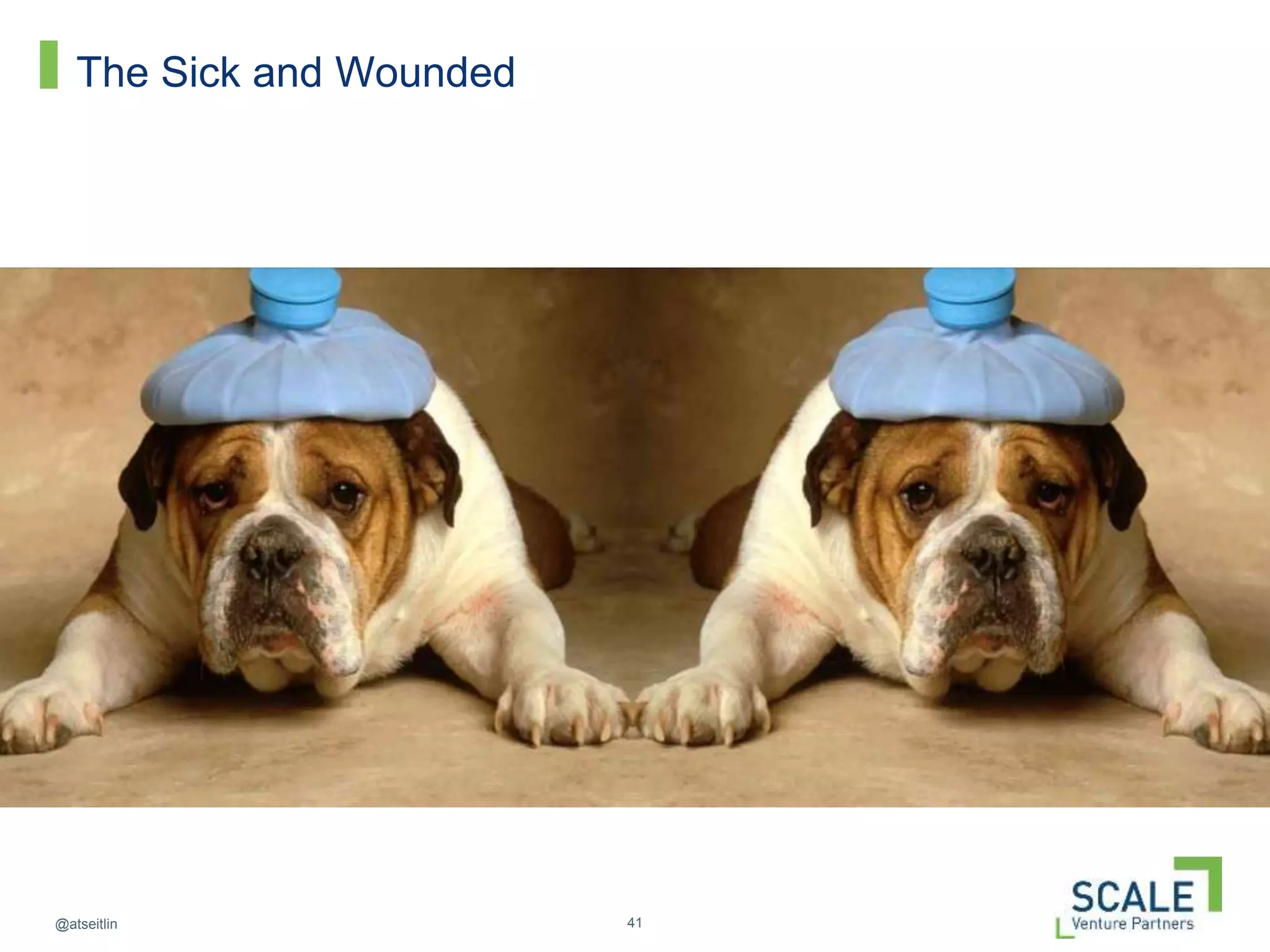
The Sick and Wounded
42@atseitlin
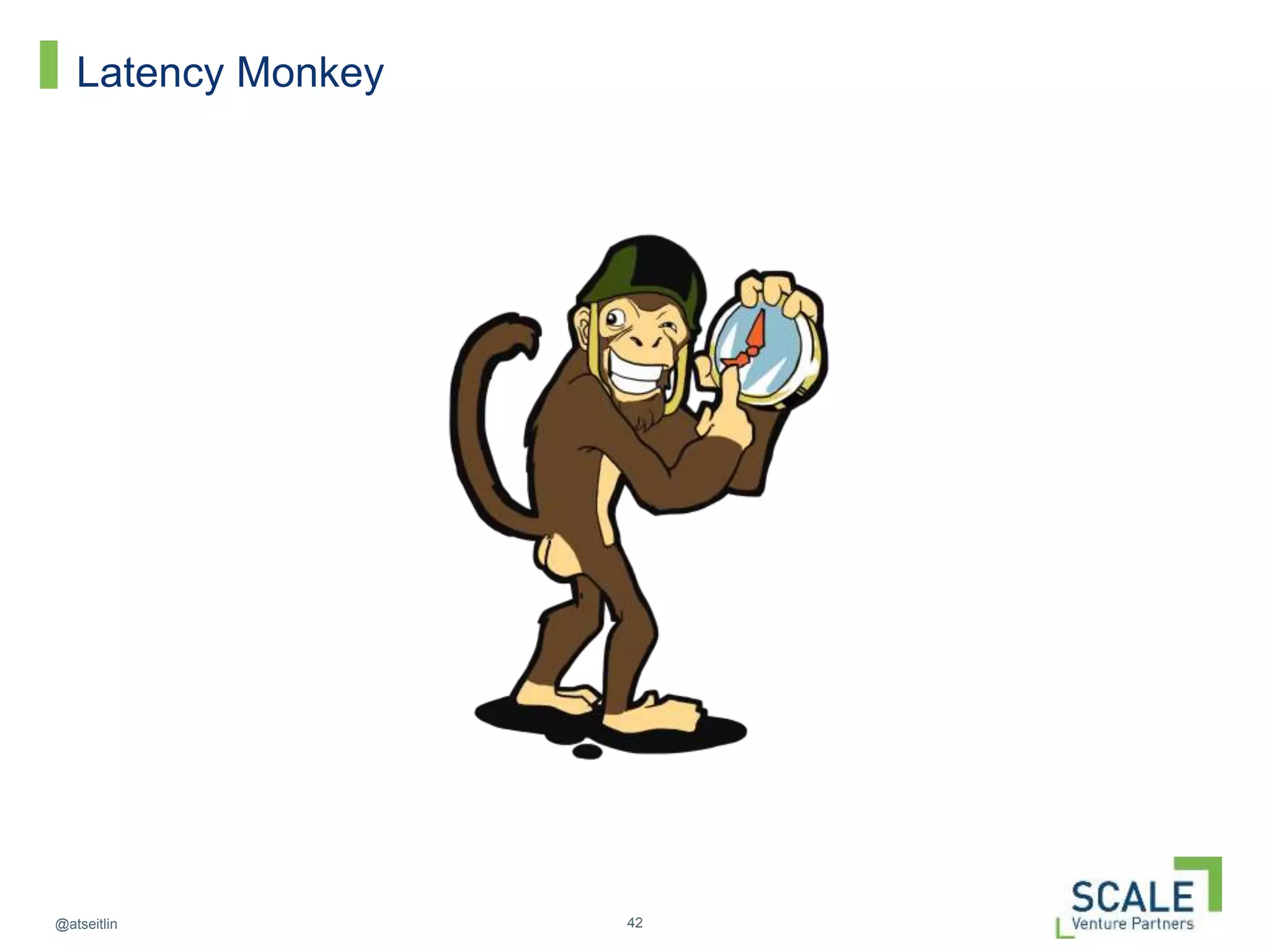
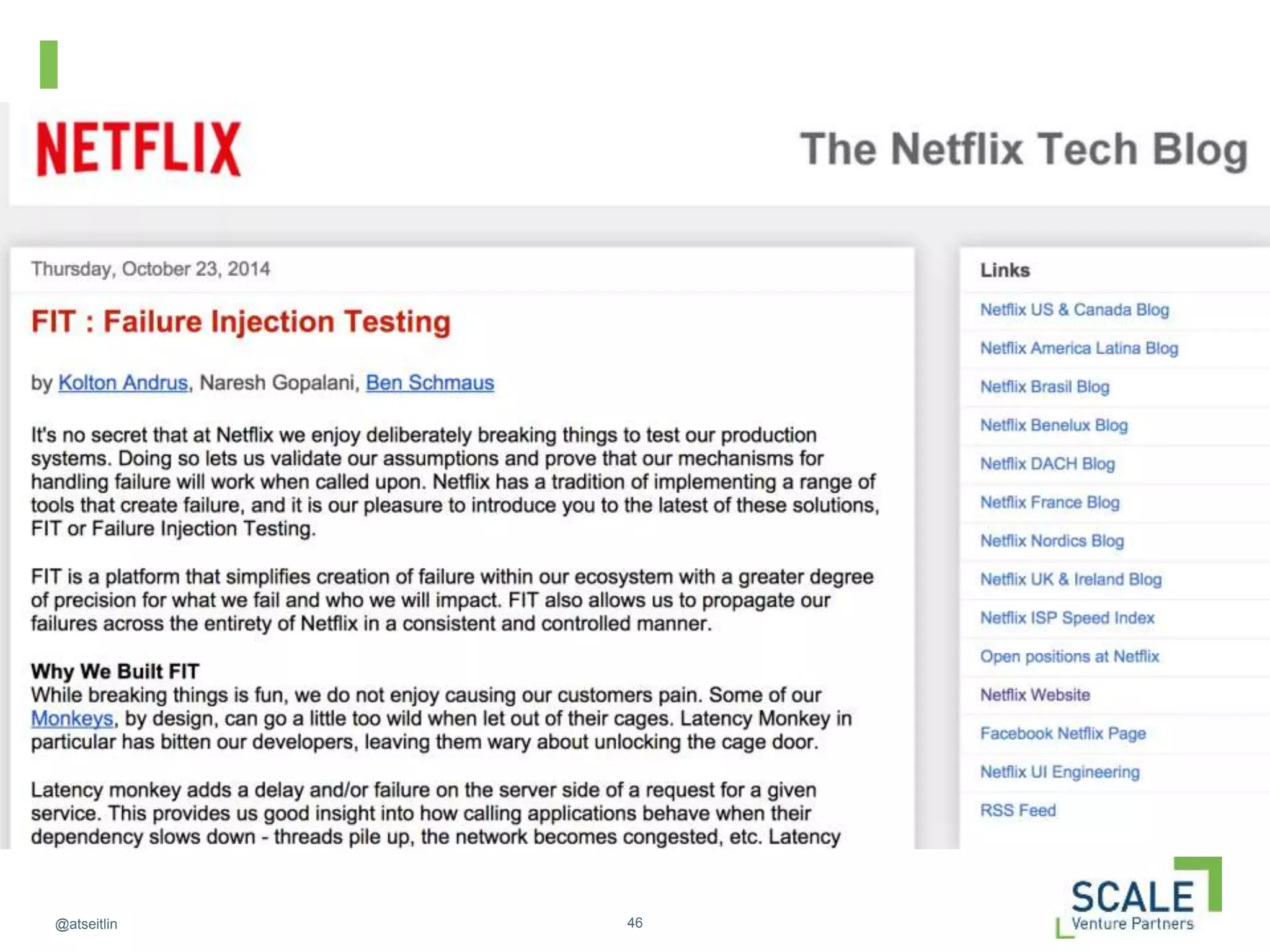
Latency Monkey
43@atseitlin
44@atseitlin
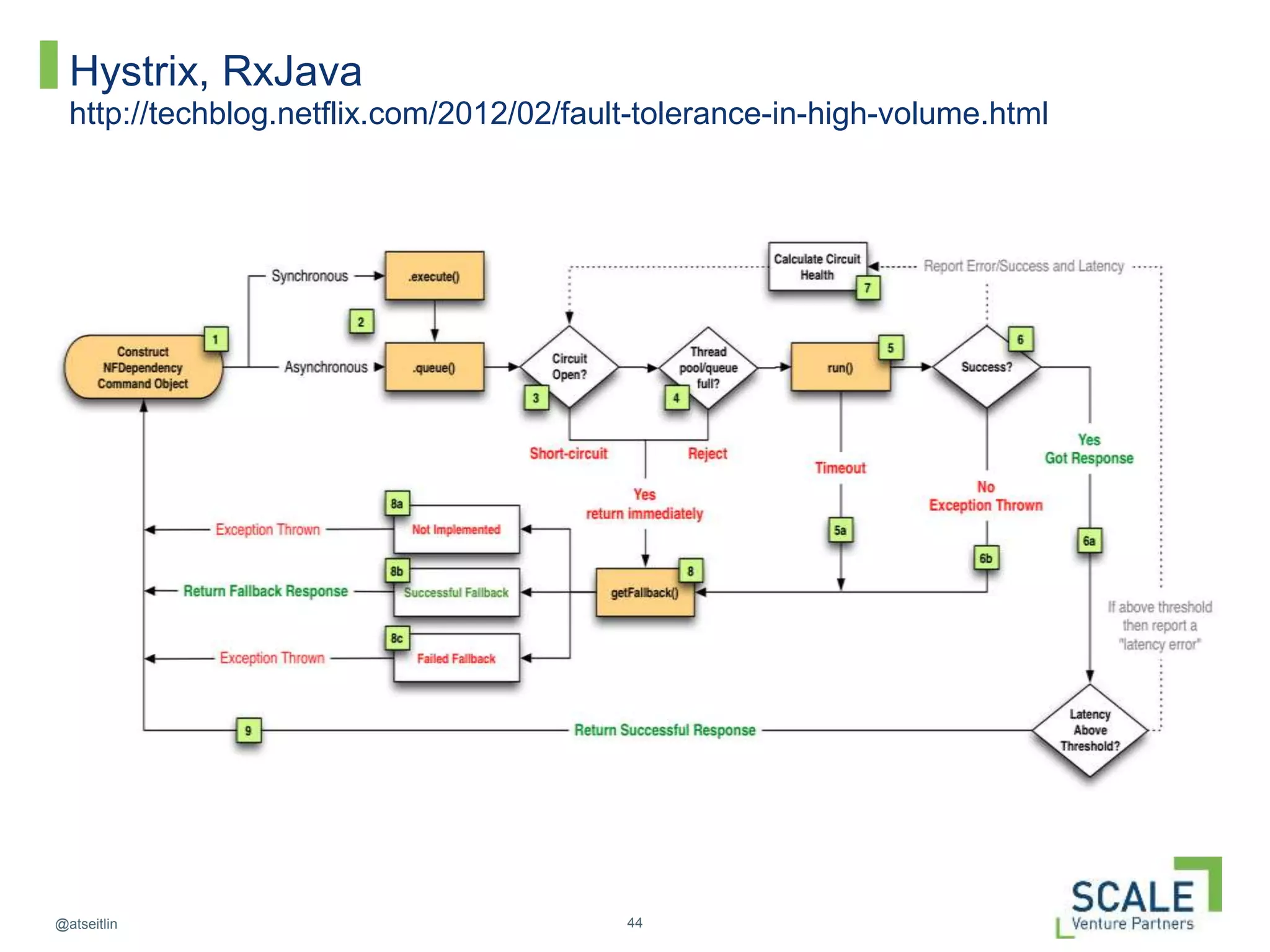
Hystrix, RxJava
http://techblog.netflix.com/2012/02/fault-tolerance-in-high-volume.html
45@atseitlin
Latency Monkey taught us
• Startup resiliency is often missed
• An ongoing unified approach to runtime dependency management is
important (visibility & transparency gets missed otherwise)
• Know thy neighbor (unknown dependencies)
• Fallbacks can fail too
• It’s hard to be ready for Latency Monkey, especially with no customer impact
46@atseitlin
47@atseitlin
Entropy
48@atseitlin
Clutter accumulates
• Complexity
• Cruft
• Vulnerabilities
• Cost
49@atseitlin
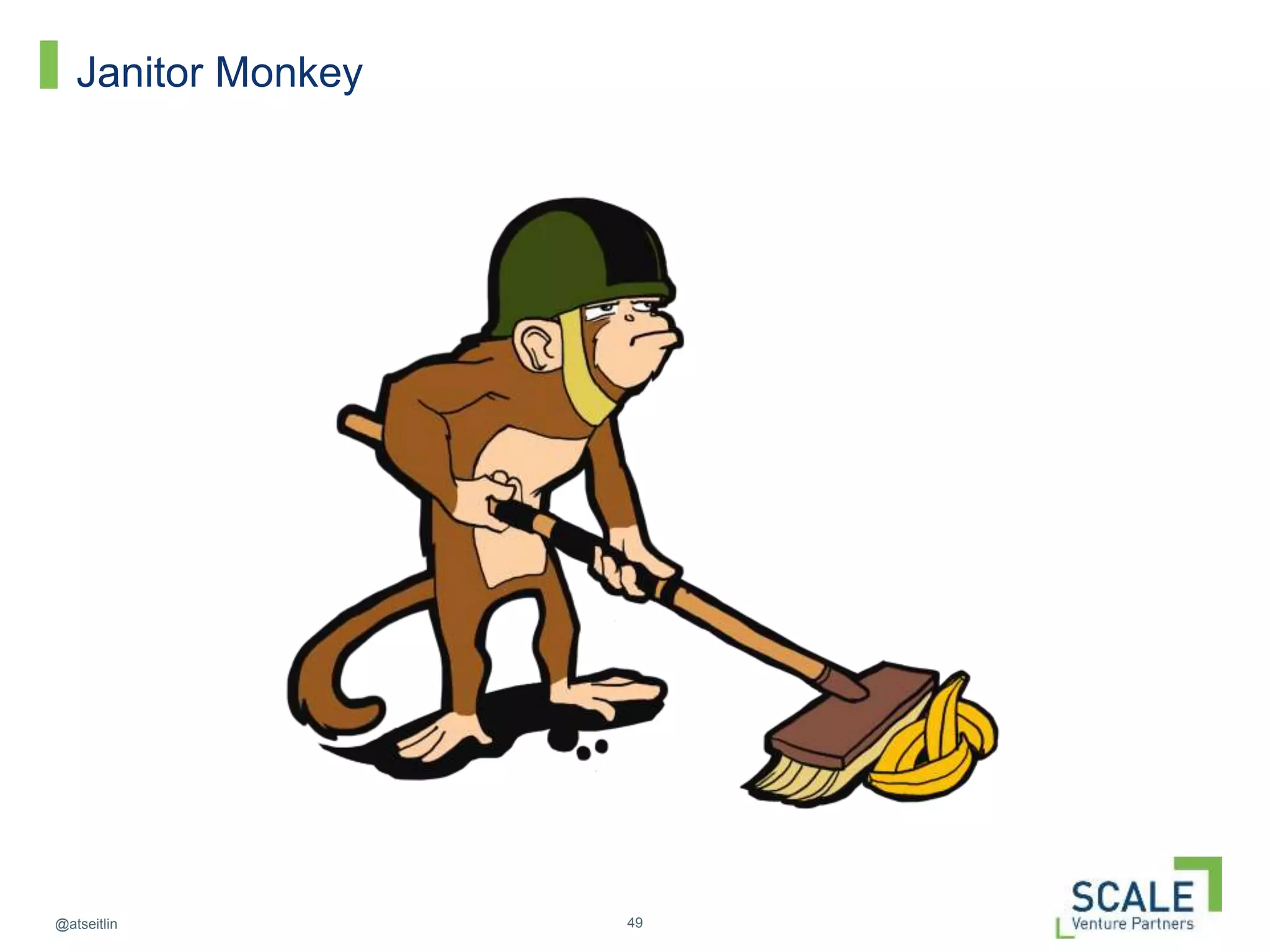
Janitor Monkey
50@atseitlin
Janitor Monkey taught us…
• Label everything
• Clutter builds up
51@atseitlin
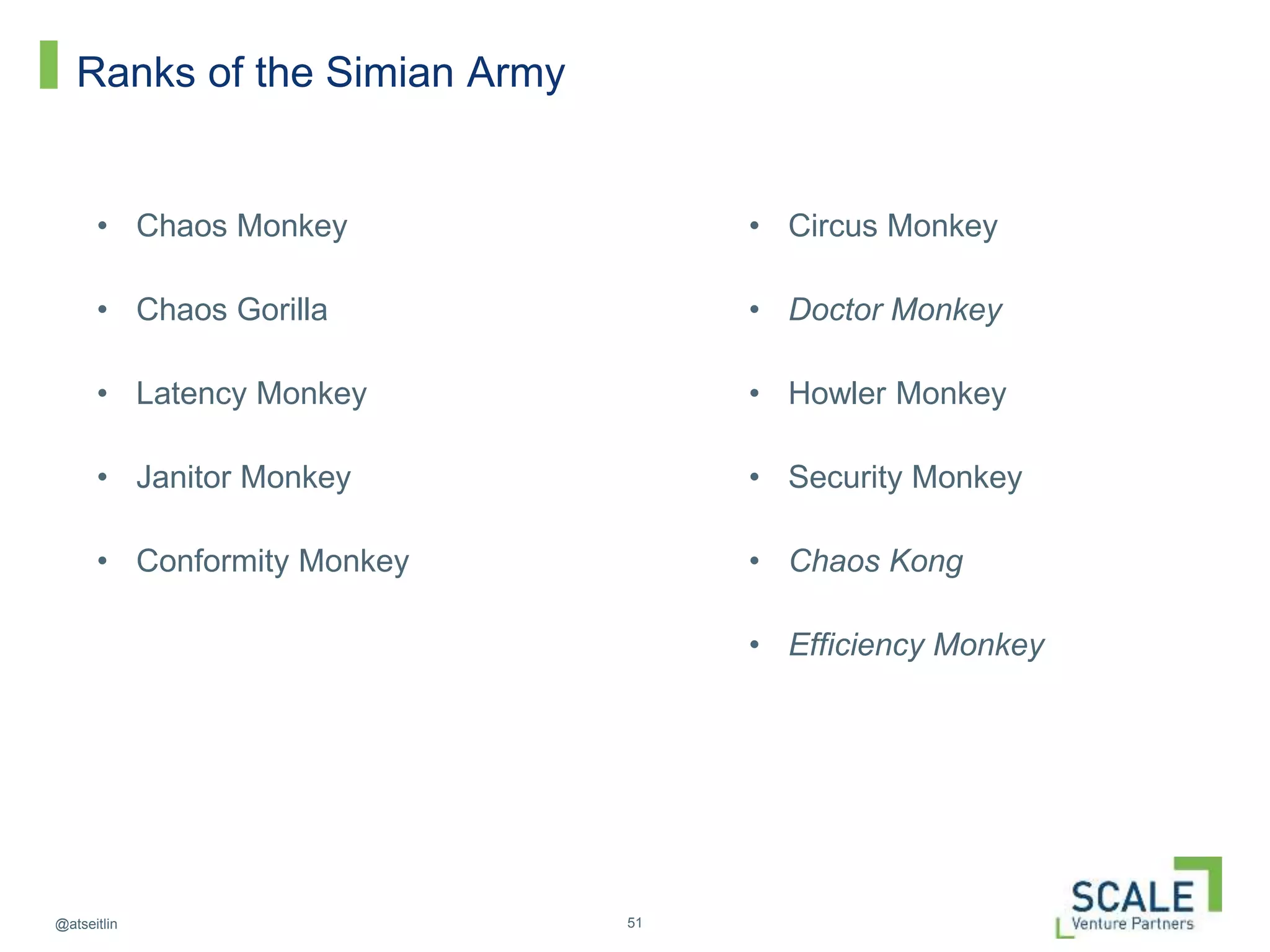
Ranks of the Simian Army
• Chaos Monkey
• Chaos Gorilla
• Latency Monkey
• Janitor Monkey
• Conformity Monkey
• Circus Monkey
• Doctor Monkey
• Howler Monkey
• Security Monkey
• Chaos Kong
• Efficiency Monkey
52@atseitlin
Observability is key
• Don’t exacerbate real customer issues with failure exercises
• Deep system visibility is key to root-cause failures and understand the
system
53@atseitlin
Organizational elements
• Every engineer is an operator of the service
• Each failure is an opportunity to learn
• Blameless culture
Goal is to create a learning organization
54@atseitlin
Summary
Software is becoming ubiquitous,
is delivered as an always-on service,
and is at the heart of enabling business innovation.
Every organizations is looking for ways to accelerate innovation.
DevOps accelerates innovation.
55@atseitlin
Q & A
Questions?
You can reach me at
 ariel@scalevp.com
 www.linkedin.com/in/atseitlin
 @atseitlin

Accelerating Innovation and Time-to-Market @ Camp Devops Houston 2015