1
Exploring Ins and Outs of Camera
2
BODY
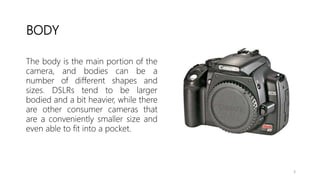
The body is the main portion of the
camera, and bodies can be a
number of different shapes and
sizes. DSLRs tend to be larger
bodied and a bit heavier, while there
are other consumer cameras that
are a conveniently smaller size and
even able to fit into a pocket.
3
LENS
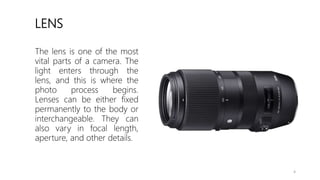
The lens is one of the most
vital parts of a camera. The
light enters through the
lens, and this is where the
photo process begins.
Lenses can be either fixed
permanently to the body or
interchangeable. They can
also vary in focal length,
aperture, and other details.
4
Types of Lens
Lens mount
Lens replace button
1. Fixed lens
2. Changeable lens
5
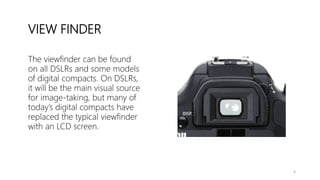
VIEW FINDER
The viewfinder can be found
on all DSLRs and some models
of digital compacts. On DSLRs,
it will be the main visual source
for image-taking, but many of
today’s digital compacts have
replaced the typical viewfinder
with an LCD screen.
6
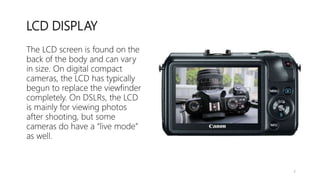
LCD DISPLAY
The LCD screen is found on the
back of the body and can vary
in size. On digital compact
cameras, the LCD has typically
begun to replace the viewfinder
completely. On DSLRs, the LCD
is mainly for viewing photos
after shooting, but some
cameras do have a “live mode”
as well.
7
SHUTTER RELEASE BUTTON
The shutter release button is the
mechanism that “releases” the shutter
and therefore enables the ability to
capture the image. The shutter
release button works in two ways.
1. For half press, image sensor takes
focus.
2. For full press, picture is captured.
8
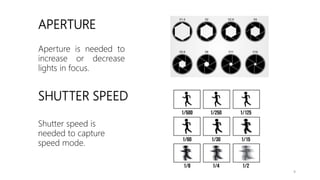
APERTURE
SHUTTER SPEED
Aperture is needed to
increase or decrease
lights in focus.
Shutter speed is
needed to capture
speed mode.
9
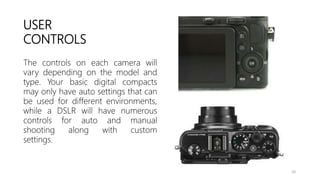
USER
CONTROLS
The controls on each camera will
vary depending on the model and
type. Your basic digital compacts
may only have auto settings that can
be used for different environments,
while a DSLR will have numerous
controls for auto and manual
shooting along with custom
settings.
10
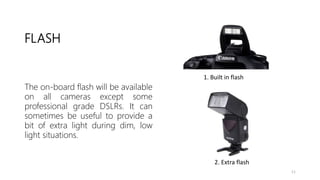
FLASH
1. Built in flash
2. Extra flash
The on-board flash will be available
on all cameras except some
professional grade DSLRs. It can
sometimes be useful to provide a
bit of extra light during dim, low
light situations.
11
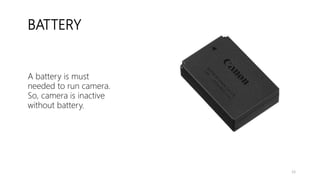
BATTERY
A battery is must
needed to run camera.
So, camera is inactive
without battery.
12
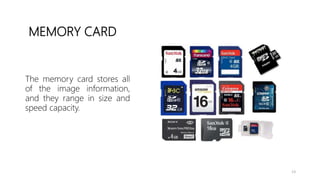
MEMORY CARD
The memory card stores all
of the image information,
and they range in size and
speed capacity.
13
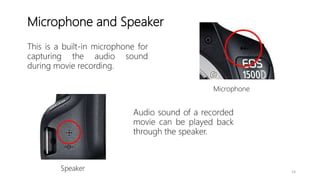
Microphone and Speaker
This is a built-in microphone for
capturing the audio sound
during movie recording.
Audio sound of a recorded
movie can be played back
through the speaker.
Microphone
Speaker 14
15
Thank You

camera parts

  • 1.
    1 Exploring Ins andOuts of Camera
  • 2.
  • 3.
    BODY The body isthe main portion of the camera, and bodies can be a number of different shapes and sizes. DSLRs tend to be larger bodied and a bit heavier, while there are other consumer cameras that are a conveniently smaller size and even able to fit into a pocket. 3
  • 4.
    LENS The lens isone of the most vital parts of a camera. The light enters through the lens, and this is where the photo process begins. Lenses can be either fixed permanently to the body or interchangeable. They can also vary in focal length, aperture, and other details. 4
  • 5.
    Types of Lens Lensmount Lens replace button 1. Fixed lens 2. Changeable lens 5
  • 6.
    VIEW FINDER The viewfindercan be found on all DSLRs and some models of digital compacts. On DSLRs, it will be the main visual source for image-taking, but many of today’s digital compacts have replaced the typical viewfinder with an LCD screen. 6
  • 7.
    LCD DISPLAY The LCDscreen is found on the back of the body and can vary in size. On digital compact cameras, the LCD has typically begun to replace the viewfinder completely. On DSLRs, the LCD is mainly for viewing photos after shooting, but some cameras do have a “live mode” as well. 7
  • 8.
    SHUTTER RELEASE BUTTON Theshutter release button is the mechanism that “releases” the shutter and therefore enables the ability to capture the image. The shutter release button works in two ways. 1. For half press, image sensor takes focus. 2. For full press, picture is captured. 8
  • 9.
    APERTURE SHUTTER SPEED Aperture isneeded to increase or decrease lights in focus. Shutter speed is needed to capture speed mode. 9
  • 10.
    USER CONTROLS The controls oneach camera will vary depending on the model and type. Your basic digital compacts may only have auto settings that can be used for different environments, while a DSLR will have numerous controls for auto and manual shooting along with custom settings. 10
  • 11.
    FLASH 1. Built inflash 2. Extra flash The on-board flash will be available on all cameras except some professional grade DSLRs. It can sometimes be useful to provide a bit of extra light during dim, low light situations. 11
  • 12.
    BATTERY A battery ismust needed to run camera. So, camera is inactive without battery. 12
  • 13.
    MEMORY CARD The memorycard stores all of the image information, and they range in size and speed capacity. 13
  • 14.
    Microphone and Speaker Thisis a built-in microphone for capturing the audio sound during movie recording. Audio sound of a recorded movie can be played back through the speaker. Microphone Speaker 14
  • 15.