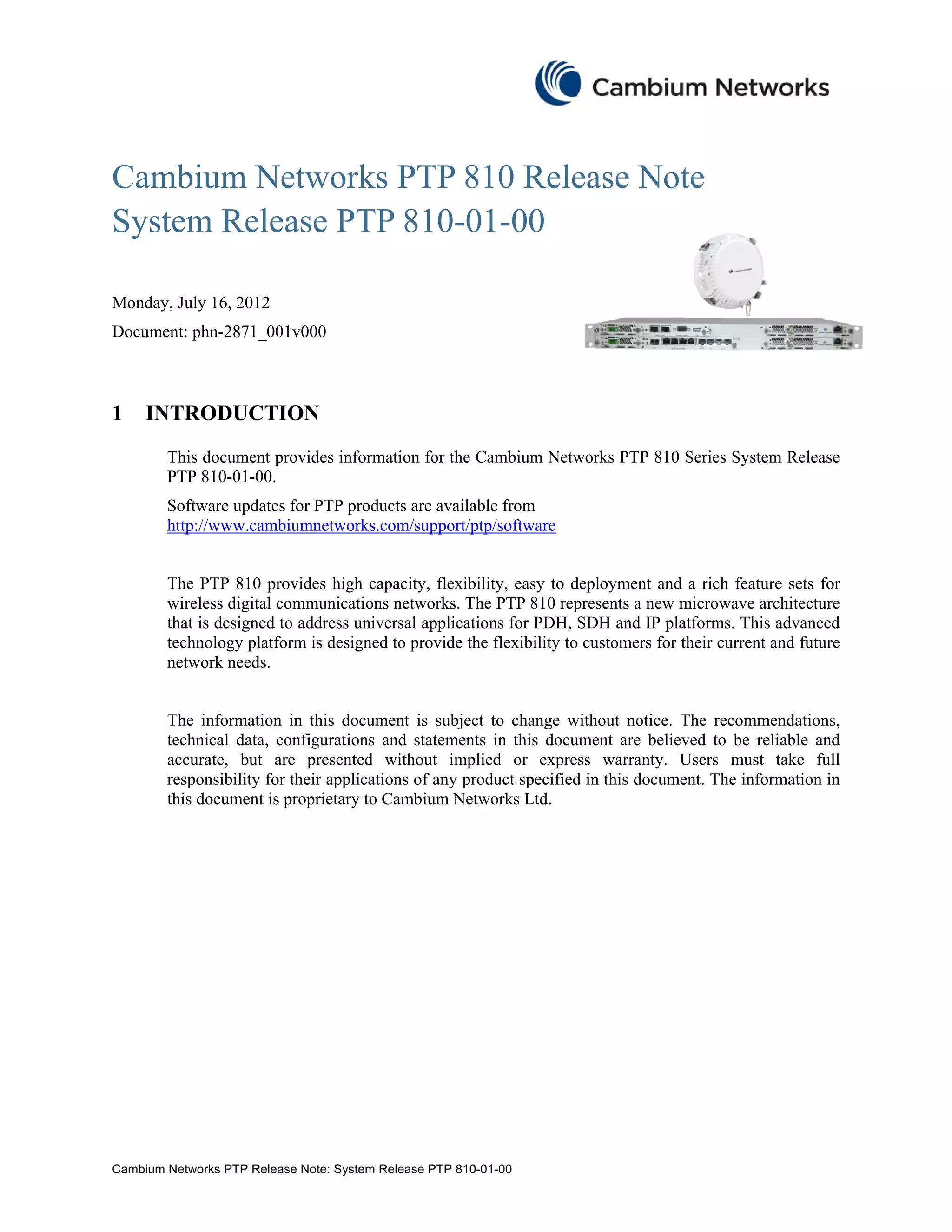
Cambium Networks PTP 810 Release Note
System Release PTP 810-01-00

Monday, July 16, 2012
Document: phn-2871_001v000


1    INTRODUCTION
        This document provides information for the Cambium Networks PTP 810 Series System Release
        PTP 810-01-00.
        Software updates for PTP products are available from
        http://www.cambiumnetworks.com/support/ptp/software


        The PTP 810 provides high capacity, flexibility, easy to deployment and a rich feature sets for
        wireless digital communications networks. The PTP 810 represents a new microwave architecture
        that is designed to address universal applications for PDH, SDH and IP platforms. This advanced
        technology platform is designed to provide the flexibility to customers for their current and future
        network needs.


        The information in this document is subject to change without notice. The recommendations,
        technical data, configurations and statements in this document are believed to be reliable and
        accurate, but are presented without implied or express warranty. Users must take full
        responsibility for their applications of any product specified in this document. The information in
        this document is proprietary to Cambium Networks Ltd.


Cambium Networks PTP Release Note: System Release PTP 810-01-00


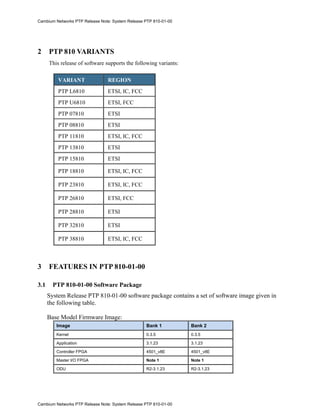
2     PTP 810 VARIANTS
      This release of software supports the following variants:

          VARIANT               REGION
          PTP L6810             ETSI, IC, FCC
          PTP U6810             ETSI, FCC
          PTP 07810             ETSI
          PTP 08810             ETSI
          PTP 11810             ETSI, IC, FCC
          PTP 13810             ETSI
          PTP 15810             ETSI

          PTP 18810             ETSI, IC, FCC

          PTP 23810             ETSI, IC, FCC

          PTP 26810             ETSI, FCC

          PTP 28810             ETSI

          PTP 32810             ETSI

          PTP 38810             ETSI, IC, FCC


3     FEATURES IN PTP 810-01-00

3.1     PTP 810-01-00 Software Package
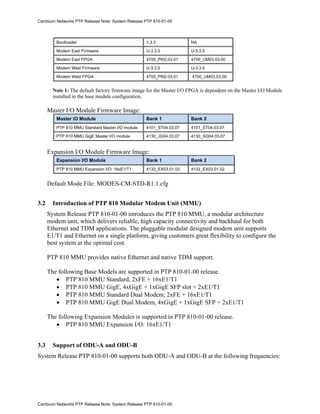
      System Release PTP 810-01-00 software package contains a set of software image given in
      the following table.

      Base Model Firmware Image:
         Image                                    Bank 1          Bank 2
         Kernel                                   0.3.5           0.3.5

         Application                              3.1.23          3.1.23

         Controller FPGA                          4501_v8E        4501_v8E

         Master I/O FPGA                          Note 1          Note 1

         ODU                                      R2-3.1.23       R2-3.1.23


Cambium Networks PTP Release Note: System Release PTP 810-01-00


         Bootloader                               1.3.3               NA

         Modem East Firmware                      U-3.3.5             U-3.3.5

         Modem East FPGA                          4700_PI02.03.01     4700_UM03.03.00

         Modem West Firmware                      U-3.3.5             U-3.3.5

         Modem West FPGA                          4700_PI02.03.01      4700_UM03.03.00


        Note 1: The default factory firmware image for the Master I/O FPGA is dependent on the Master I/O Module
        installed in the base module configuration.

      Master I/O Module Firmware Image:
         Master IO Module                         Bank 1              Bank 2
         PTP 810 MMU Standard Master I/O module   4101_ST04.03.07     4101_ST04.03.07

         PTP 810 MMU GigE Master I/O module       4130_JG04.03.07     4130_SG04.03.07


      Expansion I/O Module Firmware Image:
         Expansion I/O Module                     Bank 1              Bank 2
         PTP 810 MMU Expansion I/O: 16xE1/T1      4132_EX03.01.02     4132_EX03.01.02


      Default Mode File: MODES-CM-STD-R1.1.cfg


3.2     Introduction of PTP 810 Modular Modem Unit (MMU)
      System Release PTP 810-01-00 introduces the PTP 810 MMU, a modular architecture
      modem unit, which delivers reliable, high capacity connectivity and backhaul for both
      Ethernet and TDM applications. The pluggable modular designed modem unit supports
      E1/T1 and Ethernet on a single platform, giving customers great flexibility to configure the
      best system at the optimal cost.

      PTP 810 MMU provides native Ethernet and native TDM support.

      The following Base Models are supported in PTP 810-01-00 release.
         • PTP 810 MMU Standard, 2xFE + 16xE1/T1
         • PTP 810 MMU GigE, 4xGigE + 1xGigE SFP slot + 2xE1/T1
         • PTP 810 MMU Standard Dual Modem, 2xFE + 16xE1/T1
         • PTP 810 MMU GigE Dual Modem, 4xGigE + 1xGigE SFP + 2xE1/T1

      The following Expansion Modules is supported in PTP 810-01-00 release.
         • PTP 810 MMU Expansion I/O: 16xE1/T1


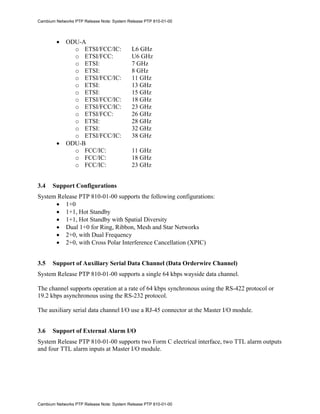
3.3     Support of ODU-A and ODU-B
System Release PTP 810-01-00 supports both ODU-A and ODU-B at the following frequencies:


Cambium Networks PTP Release Note: System Release PTP 810-01-00


        •    ODU-A
               o ETSI/FCC/IC:               L6 GHz
               o ETSI/FCC:                  U6 GHz
               o ETSI:                      7 GHz
               o ETSI:                      8 GHz
               o ETSI/FCC/IC:               11 GHz
               o ETSI:                      13 GHz
               o ETSI:                      15 GHz
               o ETSI/FCC/IC:               18 GHz
               o ETSI/FCC/IC:               23 GHz
               o ETSI/FCC:                  26 GHz
               o ETSI:                      28 GHz
               o ETSI:                      32 GHz
               o ETSI/FCC/IC:               38 GHz
        •    ODU-B
               o FCC/IC:                    11 GHz
               o FCC/IC:                    18 GHz
               o FCC/IC:                    23 GHz


3.4    Support Configurations
System Release PTP 810-01-00 supports the following configurations:
      • 1+0
      • 1+1, Hot Standby
      • 1+1, Hot Standby with Spatial Diversity
      • Dual 1+0 for Ring, Ribbon, Mesh and Star Networks
      • 2+0, with Dual Frequency
      • 2+0, with Cross Polar Interference Cancellation (XPIC)


3.5    Support of Auxiliary Serial Data Channel (Data Orderwire Channel)
System Release PTP 810-01-00 supports a single 64 kbps wayside data channel.

The channel supports operation at a rate of 64 kbps synchronous using the RS-422 protocol or
19.2 kbps asynchronous using the RS-232 protocol.

The auxiliary serial data channel I/O use a RJ-45 connector at the Master I/O module.


3.6    Support of External Alarm I/O
System Release PTP 810-01-00 supports two Form C electrical interface, two TTL alarm outputs
and four TTL alarm inputs at Master I/O module.


Cambium Networks PTP Release Note: System Release PTP 810-01-00


3.7    Support of XPIC
System Release PTP 810-01-00 supports 2+0 XPIC operation.

2+0 XPIC is supported for channel bandwidths of 28MHz or greater along with 64-QAM, 128-
QAM or 256-QAM modulations.

In a 2+0 XPIC configuration, both links are required to have the same configuration. Each link
carries independent payloads based on channel mapping and Ethernet Link Aggregation. An
XPIC cable is required to connect the two modem modules together.


3.8    Support of Automatic Transmit Power Control (ATPC)
System Release PTP 810-01-00 supports ATPC using Adaptive Power Control (APC), which
enables the MMU to dynamically adjust the output transmit power based on actual strength and
quality of the signal.

ATPC provides a capability to reduce interference in densely deployed networks. It enables the
PTP 810 to transmit at the minimum power level necessary to maintain a link regardless of the
prevailing weather and interference conditions.


3.9    Support of E1/T1 TDM Circuit
System Release PTP 810-01-00 supports E1/T1 circuit termination and switching via a build-in
TDM switch.

The PTP 810 MMU TDM switch provides any-to-any E1/T1 routing between front panel ports
and RF links. The flexible channel mapping allows selection from predefined routings or custom
routing.


3.10 Support of TDM Protection
System Release PTP 810-01-00 supports SNCP-like protection for E1/T1 circuits deployed in a
ring topology.

When configuring SNCP-like protection, the operator specifies a working path and a protection
path for each E1/T1 circuit. The PTP 810 MMU transmits an ingressing E1/T1 circuit onto both
the working and protection paths. In the event an AIS condition is detected on the working path
of an egressing E1/T1 circuit, the PTP 810 MMU switches to receiving the E1/T1 circuit from
the protection path.

Traffic outage during the protection switch is 50 ms or less.

SNCP-like switching is non-revertive. Once a switch has occurred, the protection path becomes
the working path and the working path becomes the protection path.


Cambium Networks PTP Release Note: System Release PTP 810-01-00


3.11 Support of Ethernet Link Aggregation
System Release PTP 810-01-00 supports aggregation of bandwidth for gigabit Ethernet up to 700
Mbps total throughput with 2+0 configuration. The operation of a 2+0 link with Ethernet payload
depends on the Master I/O module that is deployed.

When a GigE Master I/O module is deployed, the PTP 810 MMU can be configured to support
either Segregation or Transparent Link Aggregation of the Ethernet payload.
    1. Segregation - The PTP 810 MMU’s front-panel GigE ports can be grouped into two
        groups. Traffic from group 1 is sent across one radio link and traffic from group 2 is sent
        across the other radio link.
    2. Transparent Link Aggregation – The PTP 810 MMU’s front-panel GigE ports share the
        aggregate bandwidth. The PTP 810 MMU load balances the Ethernet traffic between the
        two radio links.

The Standard Master I/O module does not support Transparent Link Aggregation as described
above. The Standard Master I/O module includes two front panel Ethernet ports. Using
Segregation, the traffic from one port is sent across one radio link and the traffic from the other
port is sent across the other radio link.


3.12 Support of Ethernet Flow Control
System Release PTP 810-01-00 supports Ethernet flow control defined by IEEE 802.3 2005.

Flow control is supported in both full duplex and half duplex mode. Full-duplex is implemented
with respect for PAUSE packets as well as generation of PAUSE packets. Half-duplex is
implemented with back-pressure.

Four options of Flow control are supported:
   • Disable
   • Symmetric
   • Receive Only
   • Send Only


3.13 Support of Link Aggregation Control Protocol (LACP)
System Release PTP 810-01-00 supports LACP defined by IEEE 802.3ad.

The LACP feature bundles individual Ethernet links into a single logical link that provides the
aggregate bandwidth.

LACP is only available with the GigE Master I/O module.


Cambium Networks PTP Release Note: System Release PTP 810-01-00


3.14 Support of Rapid Spanning Tree Protocol (RSTP) Ethernet Protection
System Release PTP 810-01-00 supports RSTP defined by IEEE 802.1D-2004 for Ethernet
payload and Ethernet Network Management traffic.

In a ring topology, RSTP forces a break in the ring. If a radio link goes down, the RSTP will re-
enable the broken link to establish connectivity with all radios within the ring.


3.15 Support of Quality of Service (QoS)
System Release PTP 810-01-00 provides QoS processing for Ethernet traffic served by 4 level
priority queues.

PTP 810 implements the QoS using weighted priority queues and strict priority queues.

PTP 810 supports mapping traffic to specific priority queues based on the priority assigned to the
Ethernet ports, the priority tag field in VLAN Tagged packets, or the value of the DSCP field of
IPv4 packets.


3.16 Support of VLAN
System Release PTP 810-01-00 supports Port based VLAN and Static Tag based VLAN.

For Port based VLAN, customer can configure which ports are connected to each other.

Static Tag based VLAN supports Single Tag mode, Double Tag (S Tag + C Tag) mode and
Double Tag (C Tag + C Tag) mode.


3.17 Support of Web Enabled Browser
System Release PTP 810-01-00 supports a Web browser based GUI using HTTP or HTTPS for
control, status and provisioning.

Access to the Web GUI is password protected.


3.18 Support of Out-of-Band Management
System Release PTP 810-01-00 supports Out-of-Band Management.


3.19 Support of Command Line Interface (CLI)
System Release PTP 810-01-00 supports a menu driven CLI interface. Access to CLI is
password protected.

The CLI interface can be accessed via Telnet, SSH or Serial line based console connection.


Cambium Networks PTP Release Note: System Release PTP 810-01-00


3.20 Support of Network Management via SNMP Protocol
System Release PTP 810-01-00 supports SNMP v1, v2 and v3, with following MIB supported:
   • MIB-II (RFC 1213)
   • MIB (RFC3625, RFC 2558, RFC3895 and RFC 2863)
   • Custom MIB

4     KNOWN RESTRICTIONS AND LIMITATIONS IN PTP 810-01-00

4.1    Use of MMU SMTP Mail Service may cause loss of management services and
       Ethernet bridging
Use of the MMU SMTP (Simple Mail Transfer Protocol) service may cause the MMU to lose
management services (SNMP, web browser, and telnet/SSH access) and possibly lead to failure
of Ethernet bridging.

SMTP is disabled by default.

SMTP is an unsupported feature and should NOT be enabled within the MMU.
  • Should SMTP be inadvertently enabled and management services be lost, a reboot of the
     Controller module will restore services. This can be performed via the management
     interface, if accessible, or by removal and reinsertion of the module within the chassis.
     This action will not affect data services.
  • Should SMTP be inadvertently enabled and Ethernet bridging is lost, a full reboot of the
     MMU will restore services.


5     TECHNICAL SUPPORT
To Contact Cambium Technical Support, please visit our support pages at:
http://www.cambiumnetworks.com/support/technical.php


Cambium Networks PTP Release Note: System Release PTP 810-01-00


Cambium Networks

Cambium Networks provide professional grade fixed wireless broadband and microwave
solutions for customers around the world. Our solutions are deployed in thousands of networks
in over 153 countries, with our innovative technologies providing reliable, secure, cost-effective
connectivity that’s easy to deploy and proven to deliver outstanding metrics.

Our award-winning Orthogon Point to Point (PTP) radio solutions operate in licensed,
unlicensed and defined use frequency bands including specific FIPS 140-2 solutions for the U.S.
Federal market. Ruggedized for 99.999% availability, our Orthogon solutions have an
impeccable track record for delivering reliable high-speed backhaul connectivity even in the
most challenging non-line-of-sight RF environments.

Our flexible Canopy Point-to-Multipoint (PMP) solutions operate in the licensed, unlicensed and
federal frequency bands, providing reliable, secure, cost effective access networks. With more
than three million modules deployed in networks around the world, our Canopy access network
solutions prove themselves day-in and day-out in residential access, leased line replacement,
video surveillance and smart grid infrastructure applications.

Cambium Networks’ Orthogon and Canopy solutions are proven, respected leaders in the
wireless broadband industry. We design, deploy and deliver innovative data, voice and video
connectivity solutions that enable and ensure the communications of life, empowering personal,
commercial and community growth virtually everywhere in the world.


www.cambiumnetworks.com
All product or service names are the property of their respective owners. ©Cambium Networks, Ltd.. 2012. All rights reserved. For system, product or services availability and
specific information within your country, please contact your local Cambium office or Business Partner. Specifications are subject to change without notice.

Cambium network ptp 810 series 01 00 system release note

  • 1.
    Cambium Networks PTP810 Release Note System Release PTP 810-01-00 Monday, July 16, 2012 Document: phn-2871_001v000 1 INTRODUCTION This document provides information for the Cambium Networks PTP 810 Series System Release PTP 810-01-00. Software updates for PTP products are available from http://www.cambiumnetworks.com/support/ptp/software The PTP 810 provides high capacity, flexibility, easy to deployment and a rich feature sets for wireless digital communications networks. The PTP 810 represents a new microwave architecture that is designed to address universal applications for PDH, SDH and IP platforms. This advanced technology platform is designed to provide the flexibility to customers for their current and future network needs. The information in this document is subject to change without notice. The recommendations, technical data, configurations and statements in this document are believed to be reliable and accurate, but are presented without implied or express warranty. Users must take full responsibility for their applications of any product specified in this document. The information in this document is proprietary to Cambium Networks Ltd. Cambium Networks PTP Release Note: System Release PTP 810-01-00
  • 2.
    Cambium Networks PTPRelease Note: System Release PTP 810-01-00 2 PTP 810 VARIANTS This release of software supports the following variants: VARIANT REGION PTP L6810 ETSI, IC, FCC PTP U6810 ETSI, FCC PTP 07810 ETSI PTP 08810 ETSI PTP 11810 ETSI, IC, FCC PTP 13810 ETSI PTP 15810 ETSI PTP 18810 ETSI, IC, FCC PTP 23810 ETSI, IC, FCC PTP 26810 ETSI, FCC PTP 28810 ETSI PTP 32810 ETSI PTP 38810 ETSI, IC, FCC 3 FEATURES IN PTP 810-01-00 3.1 PTP 810-01-00 Software Package System Release PTP 810-01-00 software package contains a set of software image given in the following table. Base Model Firmware Image: Image Bank 1 Bank 2 Kernel 0.3.5 0.3.5 Application 3.1.23 3.1.23 Controller FPGA 4501_v8E 4501_v8E Master I/O FPGA Note 1 Note 1 ODU R2-3.1.23 R2-3.1.23 Cambium Networks PTP Release Note: System Release PTP 810-01-00
  • 3.
    Cambium Networks PTPRelease Note: System Release PTP 810-01-00 Bootloader 1.3.3 NA Modem East Firmware U-3.3.5 U-3.3.5 Modem East FPGA 4700_PI02.03.01 4700_UM03.03.00 Modem West Firmware U-3.3.5 U-3.3.5 Modem West FPGA 4700_PI02.03.01 4700_UM03.03.00 Note 1: The default factory firmware image for the Master I/O FPGA is dependent on the Master I/O Module installed in the base module configuration. Master I/O Module Firmware Image: Master IO Module Bank 1 Bank 2 PTP 810 MMU Standard Master I/O module 4101_ST04.03.07 4101_ST04.03.07 PTP 810 MMU GigE Master I/O module 4130_JG04.03.07 4130_SG04.03.07 Expansion I/O Module Firmware Image: Expansion I/O Module Bank 1 Bank 2 PTP 810 MMU Expansion I/O: 16xE1/T1 4132_EX03.01.02 4132_EX03.01.02 Default Mode File: MODES-CM-STD-R1.1.cfg 3.2 Introduction of PTP 810 Modular Modem Unit (MMU) System Release PTP 810-01-00 introduces the PTP 810 MMU, a modular architecture modem unit, which delivers reliable, high capacity connectivity and backhaul for both Ethernet and TDM applications. The pluggable modular designed modem unit supports E1/T1 and Ethernet on a single platform, giving customers great flexibility to configure the best system at the optimal cost. PTP 810 MMU provides native Ethernet and native TDM support. The following Base Models are supported in PTP 810-01-00 release. • PTP 810 MMU Standard, 2xFE + 16xE1/T1 • PTP 810 MMU GigE, 4xGigE + 1xGigE SFP slot + 2xE1/T1 • PTP 810 MMU Standard Dual Modem, 2xFE + 16xE1/T1 • PTP 810 MMU GigE Dual Modem, 4xGigE + 1xGigE SFP + 2xE1/T1 The following Expansion Modules is supported in PTP 810-01-00 release. • PTP 810 MMU Expansion I/O: 16xE1/T1 3.3 Support of ODU-A and ODU-B System Release PTP 810-01-00 supports both ODU-A and ODU-B at the following frequencies: Cambium Networks PTP Release Note: System Release PTP 810-01-00
  • 4.
    Cambium Networks PTPRelease Note: System Release PTP 810-01-00 • ODU-A o ETSI/FCC/IC: L6 GHz o ETSI/FCC: U6 GHz o ETSI: 7 GHz o ETSI: 8 GHz o ETSI/FCC/IC: 11 GHz o ETSI: 13 GHz o ETSI: 15 GHz o ETSI/FCC/IC: 18 GHz o ETSI/FCC/IC: 23 GHz o ETSI/FCC: 26 GHz o ETSI: 28 GHz o ETSI: 32 GHz o ETSI/FCC/IC: 38 GHz • ODU-B o FCC/IC: 11 GHz o FCC/IC: 18 GHz o FCC/IC: 23 GHz 3.4 Support Configurations System Release PTP 810-01-00 supports the following configurations: • 1+0 • 1+1, Hot Standby • 1+1, Hot Standby with Spatial Diversity • Dual 1+0 for Ring, Ribbon, Mesh and Star Networks • 2+0, with Dual Frequency • 2+0, with Cross Polar Interference Cancellation (XPIC) 3.5 Support of Auxiliary Serial Data Channel (Data Orderwire Channel) System Release PTP 810-01-00 supports a single 64 kbps wayside data channel. The channel supports operation at a rate of 64 kbps synchronous using the RS-422 protocol or 19.2 kbps asynchronous using the RS-232 protocol. The auxiliary serial data channel I/O use a RJ-45 connector at the Master I/O module. 3.6 Support of External Alarm I/O System Release PTP 810-01-00 supports two Form C electrical interface, two TTL alarm outputs and four TTL alarm inputs at Master I/O module. Cambium Networks PTP Release Note: System Release PTP 810-01-00
  • 5.
    Cambium Networks PTPRelease Note: System Release PTP 810-01-00 3.7 Support of XPIC System Release PTP 810-01-00 supports 2+0 XPIC operation. 2+0 XPIC is supported for channel bandwidths of 28MHz or greater along with 64-QAM, 128- QAM or 256-QAM modulations. In a 2+0 XPIC configuration, both links are required to have the same configuration. Each link carries independent payloads based on channel mapping and Ethernet Link Aggregation. An XPIC cable is required to connect the two modem modules together. 3.8 Support of Automatic Transmit Power Control (ATPC) System Release PTP 810-01-00 supports ATPC using Adaptive Power Control (APC), which enables the MMU to dynamically adjust the output transmit power based on actual strength and quality of the signal. ATPC provides a capability to reduce interference in densely deployed networks. It enables the PTP 810 to transmit at the minimum power level necessary to maintain a link regardless of the prevailing weather and interference conditions. 3.9 Support of E1/T1 TDM Circuit System Release PTP 810-01-00 supports E1/T1 circuit termination and switching via a build-in TDM switch. The PTP 810 MMU TDM switch provides any-to-any E1/T1 routing between front panel ports and RF links. The flexible channel mapping allows selection from predefined routings or custom routing. 3.10 Support of TDM Protection System Release PTP 810-01-00 supports SNCP-like protection for E1/T1 circuits deployed in a ring topology. When configuring SNCP-like protection, the operator specifies a working path and a protection path for each E1/T1 circuit. The PTP 810 MMU transmits an ingressing E1/T1 circuit onto both the working and protection paths. In the event an AIS condition is detected on the working path of an egressing E1/T1 circuit, the PTP 810 MMU switches to receiving the E1/T1 circuit from the protection path. Traffic outage during the protection switch is 50 ms or less. SNCP-like switching is non-revertive. Once a switch has occurred, the protection path becomes the working path and the working path becomes the protection path. Cambium Networks PTP Release Note: System Release PTP 810-01-00
  • 6.
    Cambium Networks PTPRelease Note: System Release PTP 810-01-00 3.11 Support of Ethernet Link Aggregation System Release PTP 810-01-00 supports aggregation of bandwidth for gigabit Ethernet up to 700 Mbps total throughput with 2+0 configuration. The operation of a 2+0 link with Ethernet payload depends on the Master I/O module that is deployed. When a GigE Master I/O module is deployed, the PTP 810 MMU can be configured to support either Segregation or Transparent Link Aggregation of the Ethernet payload. 1. Segregation - The PTP 810 MMU’s front-panel GigE ports can be grouped into two groups. Traffic from group 1 is sent across one radio link and traffic from group 2 is sent across the other radio link. 2. Transparent Link Aggregation – The PTP 810 MMU’s front-panel GigE ports share the aggregate bandwidth. The PTP 810 MMU load balances the Ethernet traffic between the two radio links. The Standard Master I/O module does not support Transparent Link Aggregation as described above. The Standard Master I/O module includes two front panel Ethernet ports. Using Segregation, the traffic from one port is sent across one radio link and the traffic from the other port is sent across the other radio link. 3.12 Support of Ethernet Flow Control System Release PTP 810-01-00 supports Ethernet flow control defined by IEEE 802.3 2005. Flow control is supported in both full duplex and half duplex mode. Full-duplex is implemented with respect for PAUSE packets as well as generation of PAUSE packets. Half-duplex is implemented with back-pressure. Four options of Flow control are supported: • Disable • Symmetric • Receive Only • Send Only 3.13 Support of Link Aggregation Control Protocol (LACP) System Release PTP 810-01-00 supports LACP defined by IEEE 802.3ad. The LACP feature bundles individual Ethernet links into a single logical link that provides the aggregate bandwidth. LACP is only available with the GigE Master I/O module. Cambium Networks PTP Release Note: System Release PTP 810-01-00
  • 7.
    Cambium Networks PTPRelease Note: System Release PTP 810-01-00 3.14 Support of Rapid Spanning Tree Protocol (RSTP) Ethernet Protection System Release PTP 810-01-00 supports RSTP defined by IEEE 802.1D-2004 for Ethernet payload and Ethernet Network Management traffic. In a ring topology, RSTP forces a break in the ring. If a radio link goes down, the RSTP will re- enable the broken link to establish connectivity with all radios within the ring. 3.15 Support of Quality of Service (QoS) System Release PTP 810-01-00 provides QoS processing for Ethernet traffic served by 4 level priority queues. PTP 810 implements the QoS using weighted priority queues and strict priority queues. PTP 810 supports mapping traffic to specific priority queues based on the priority assigned to the Ethernet ports, the priority tag field in VLAN Tagged packets, or the value of the DSCP field of IPv4 packets. 3.16 Support of VLAN System Release PTP 810-01-00 supports Port based VLAN and Static Tag based VLAN. For Port based VLAN, customer can configure which ports are connected to each other. Static Tag based VLAN supports Single Tag mode, Double Tag (S Tag + C Tag) mode and Double Tag (C Tag + C Tag) mode. 3.17 Support of Web Enabled Browser System Release PTP 810-01-00 supports a Web browser based GUI using HTTP or HTTPS for control, status and provisioning. Access to the Web GUI is password protected. 3.18 Support of Out-of-Band Management System Release PTP 810-01-00 supports Out-of-Band Management. 3.19 Support of Command Line Interface (CLI) System Release PTP 810-01-00 supports a menu driven CLI interface. Access to CLI is password protected. The CLI interface can be accessed via Telnet, SSH or Serial line based console connection. Cambium Networks PTP Release Note: System Release PTP 810-01-00
  • 8.
    Cambium Networks PTPRelease Note: System Release PTP 810-01-00 3.20 Support of Network Management via SNMP Protocol System Release PTP 810-01-00 supports SNMP v1, v2 and v3, with following MIB supported: • MIB-II (RFC 1213) • MIB (RFC3625, RFC 2558, RFC3895 and RFC 2863) • Custom MIB 4 KNOWN RESTRICTIONS AND LIMITATIONS IN PTP 810-01-00 4.1 Use of MMU SMTP Mail Service may cause loss of management services and Ethernet bridging Use of the MMU SMTP (Simple Mail Transfer Protocol) service may cause the MMU to lose management services (SNMP, web browser, and telnet/SSH access) and possibly lead to failure of Ethernet bridging. SMTP is disabled by default. SMTP is an unsupported feature and should NOT be enabled within the MMU. • Should SMTP be inadvertently enabled and management services be lost, a reboot of the Controller module will restore services. This can be performed via the management interface, if accessible, or by removal and reinsertion of the module within the chassis. This action will not affect data services. • Should SMTP be inadvertently enabled and Ethernet bridging is lost, a full reboot of the MMU will restore services. 5 TECHNICAL SUPPORT To Contact Cambium Technical Support, please visit our support pages at: http://www.cambiumnetworks.com/support/technical.php Cambium Networks PTP Release Note: System Release PTP 810-01-00
  • 9.
    Cambium Networks PTPRelease Note: System Release PTP 810-01-00 Cambium Networks Cambium Networks provide professional grade fixed wireless broadband and microwave solutions for customers around the world. Our solutions are deployed in thousands of networks in over 153 countries, with our innovative technologies providing reliable, secure, cost-effective connectivity that’s easy to deploy and proven to deliver outstanding metrics. Our award-winning Orthogon Point to Point (PTP) radio solutions operate in licensed, unlicensed and defined use frequency bands including specific FIPS 140-2 solutions for the U.S. Federal market. Ruggedized for 99.999% availability, our Orthogon solutions have an impeccable track record for delivering reliable high-speed backhaul connectivity even in the most challenging non-line-of-sight RF environments. Our flexible Canopy Point-to-Multipoint (PMP) solutions operate in the licensed, unlicensed and federal frequency bands, providing reliable, secure, cost effective access networks. With more than three million modules deployed in networks around the world, our Canopy access network solutions prove themselves day-in and day-out in residential access, leased line replacement, video surveillance and smart grid infrastructure applications. Cambium Networks’ Orthogon and Canopy solutions are proven, respected leaders in the wireless broadband industry. We design, deploy and deliver innovative data, voice and video connectivity solutions that enable and ensure the communications of life, empowering personal, commercial and community growth virtually everywhere in the world. www.cambiumnetworks.com All product or service names are the property of their respective owners. ©Cambium Networks, Ltd.. 2012. All rights reserved. For system, product or services availability and specific information within your country, please contact your local Cambium office or Business Partner. Specifications are subject to change without notice.