10 Call Set-up

    Objectives
    After this chapter the student will:
    • be able to describe the activities in the network during a call set-up.


     10.1 INTRODUCTION .......................................................................... 2

     10.2 CALL TO MS (MT) .................................................................... 3

     10.3 CALL FROM MS (MO) ............................................................... 5


Michael Quek                                                                                          1
10.1 Introduction
          When the call set-up procedure starts and during the actual call the MS is
          said to be busy. More specifically the MS is in busy mode when using an
          SDCCH or a TCH. This means that the MS inhibits the idle mode
          procedures, i.e. listening to the paging channel, making decisions about
          cells, etc. Instead the network will be in charge of the cell change, assisted
          by the MS which will provide measurements.

          There exist two different types of call set-up; Mobile Terminated (MT) i.e.
          calls to MS and Mobile Originated (MO) i.e. calls from MS. Both these
          types will be covered here. A MT call set-up is somewhat more
          complicated than a MO call set-up, due to the MS mobility. This implies
          that the MSC/VLR, where the MS has registered, must be located and
          found before a radio connection can be established.

          Before the call can be connected, i.e. service is accepted, security
          procedures will be carried out. Which of these procedures, e.g.
          authentication and ciphering, to carry out is operator dependent. All the
          procedures are carried out on a dedicated signalling channel. The last thing
          before the call can start is for the system to assign a traffic channel for the
          call.


Michael Quek                                                                                2
10.2 Call to MS (MT)
          A mobile terminating (MT) call is initiated when the originating
          subscriber, named A-subscriber, dials a telephone number (MSISDN) to a
          B-subscriber (MS) where the call shall terminate. Retrieval of routing
          information to reach the correct MSC/VLR is described in step 1-4.


                                                              HLR
                                                          3                  2

                                                                  4


                                      6
                                  9                MSC/       5       GMSC       1
                              8                    VLR

                          7
                                          BSC


          Call to MS


          1. By dialling the MSISDN, the call will be routed to a GSM gateway,
             GMSC. This is as far as the call can be set-up using the MSISDN. New
             routing information is now needed to set-up the call to the correct
             MSC/VLR.

          2. The MSISDN will be used by the GMSC to address the HLR where the
             MS is registered. The GMSC sends a request to the HLR asking for new
             routing information. This request contains the MSISDN. The HLR will
             translate the MSISDN into IMSI to find the correct file in the database.
             The HLR checks the subscription and the attached supplementary
             services. If subscription is not valid or if incoming calls are barred the
             request from the GMSC will be rejected. In the case of a call forwarding
             active a C-number will be sent back to the GMSC. The C-number could
             be a mailbox number or any choice of the subscriber.

          3. If there are no restrictions e.g. blocked subscription the HLR reads the
             address to the MSC/VLR where the MS is presently registered. It sends
             a request to the MSC/VLR asking for an MSRN (Mobile Station
             Roaming Number) that is the new routing information needed by the
             GMSC. This request contains the IMSI.


Michael Quek                                                                              3
4. The MSC/VLR will allocate an MSRN and send it to the GMSC via the
             HLR. The relation between the allocated MSRN and the IMSI will be
             temporarily stored in the MSC/VLR during the call set-up procedure.

          5. With the MSRN the GMSC can route the call to the correct MSC/VLR
             which will use the MSRN - IMSI relation to find the correct file in the
             database. MSC/VLR will check if the MS is attached and if the MS is
             already busy. If busy, call forwarding is applicable.

          6. If there are no restrictions, the MSC/VLR will read in which location
             area the MS is located. Then it sends a paging message to the BSCs that
             handles the cells in that location area. The BSC will distribute the
             message to the concerned BTSs, which will send it on PCH. The paging
             message contains the identity of the MS, either TMSI or IMSI.

          7. The MS, in idle mode, is monitoring the PCH. When the MS detects the
             paging message, it tries to establish a radio resource (RR) connection by
             sending an access burst on RACH. The BSC, in charge of RR, allocates
             a signalling channel (SDCCH) and grants the access on the AGCH.

          8. All the required signalling to perform a call set-up will be sent on the
             SDCCH and will be addressed to the MSC/VLR The authentication
             procedure, equipment identification, and ciphering start will take place
             next. MS is also informed about the required service, (speech, different
             data services or SMS) which can be accepted or rejected if the service
             cannot be handled.

          9. MSC/VLR will then send an assignment message to the BSC, which
             will allocate a TCH suited for the accepted service, and activate it at the
             serving BTS, or another BTS. The channel is then assigned to the MS,
             which will move to the indicated carrier and time slot. There the call
             will be connected and traffic started.


Michael Quek                                                                               4
10.3 Call from MS (MO)
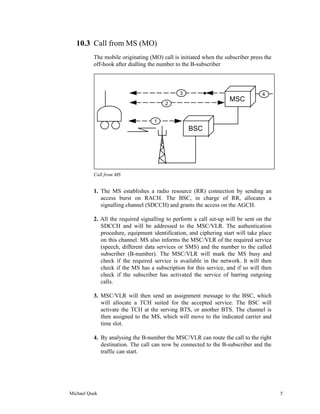
          The mobile originating (MO) call is initiated when the subscriber press the
          off-hook after dialling the number to the B-subscriber


                                              3                                  4
                                                                   MSC
                                        2


                                   1
                                                  BSC


          Call from MS


          1. The MS establishes a radio resource (RR) connection by sending an
             access burst on RACH. The BSC, in charge of RR, allocates a
             signalling channel (SDCCH) and grants the access on the AGCH.

          2. All the required signalling to perform a call set-up will be sent on the
             SDCCH and will be addressed to the MSC/VLR. The authentication
             procedure, equipment identification, and ciphering start will take place
             on this channel. MS also informs the MSC/VLR of the required service
             (speech, different data services or SMS) and the number to the called
             subscriber (B-number). The MSC/VLR will mark the MS busy and
             check if the required service is available in the network. It will then
             check if the MS has a subscription for this service, and if so will then
             check if the subscriber has activated the service of barring outgoing
             calls.

          3. MSC/VLR will then send an assignment message to the BSC, which
             will allocate a TCH suited for the accepted service. The BSC will
             activate the TCH at the serving BTS, or another BTS. The channel is
             then assigned to the MS, which will move to the indicated carrier and
             time slot.

          4. By analysing the B-number the MSC/VLR can route the call to the right
             destination. The call can now be connected to the B-subscriber and the
             traffic can start.


Michael Quek                                                                            5
Call Setup

Call Setup

  • 1.
    10 Call Set-up Objectives After this chapter the student will: • be able to describe the activities in the network during a call set-up. 10.1 INTRODUCTION .......................................................................... 2 10.2 CALL TO MS (MT) .................................................................... 3 10.3 CALL FROM MS (MO) ............................................................... 5 Michael Quek 1
  • 2.
    10.1 Introduction When the call set-up procedure starts and during the actual call the MS is said to be busy. More specifically the MS is in busy mode when using an SDCCH or a TCH. This means that the MS inhibits the idle mode procedures, i.e. listening to the paging channel, making decisions about cells, etc. Instead the network will be in charge of the cell change, assisted by the MS which will provide measurements. There exist two different types of call set-up; Mobile Terminated (MT) i.e. calls to MS and Mobile Originated (MO) i.e. calls from MS. Both these types will be covered here. A MT call set-up is somewhat more complicated than a MO call set-up, due to the MS mobility. This implies that the MSC/VLR, where the MS has registered, must be located and found before a radio connection can be established. Before the call can be connected, i.e. service is accepted, security procedures will be carried out. Which of these procedures, e.g. authentication and ciphering, to carry out is operator dependent. All the procedures are carried out on a dedicated signalling channel. The last thing before the call can start is for the system to assign a traffic channel for the call. Michael Quek 2
  • 3.
    10.2 Call toMS (MT) A mobile terminating (MT) call is initiated when the originating subscriber, named A-subscriber, dials a telephone number (MSISDN) to a B-subscriber (MS) where the call shall terminate. Retrieval of routing information to reach the correct MSC/VLR is described in step 1-4. HLR 3 2 4 6 9 MSC/ 5 GMSC 1 8 VLR 7 BSC Call to MS 1. By dialling the MSISDN, the call will be routed to a GSM gateway, GMSC. This is as far as the call can be set-up using the MSISDN. New routing information is now needed to set-up the call to the correct MSC/VLR. 2. The MSISDN will be used by the GMSC to address the HLR where the MS is registered. The GMSC sends a request to the HLR asking for new routing information. This request contains the MSISDN. The HLR will translate the MSISDN into IMSI to find the correct file in the database. The HLR checks the subscription and the attached supplementary services. If subscription is not valid or if incoming calls are barred the request from the GMSC will be rejected. In the case of a call forwarding active a C-number will be sent back to the GMSC. The C-number could be a mailbox number or any choice of the subscriber. 3. If there are no restrictions e.g. blocked subscription the HLR reads the address to the MSC/VLR where the MS is presently registered. It sends a request to the MSC/VLR asking for an MSRN (Mobile Station Roaming Number) that is the new routing information needed by the GMSC. This request contains the IMSI. Michael Quek 3
  • 4.
    4. The MSC/VLRwill allocate an MSRN and send it to the GMSC via the HLR. The relation between the allocated MSRN and the IMSI will be temporarily stored in the MSC/VLR during the call set-up procedure. 5. With the MSRN the GMSC can route the call to the correct MSC/VLR which will use the MSRN - IMSI relation to find the correct file in the database. MSC/VLR will check if the MS is attached and if the MS is already busy. If busy, call forwarding is applicable. 6. If there are no restrictions, the MSC/VLR will read in which location area the MS is located. Then it sends a paging message to the BSCs that handles the cells in that location area. The BSC will distribute the message to the concerned BTSs, which will send it on PCH. The paging message contains the identity of the MS, either TMSI or IMSI. 7. The MS, in idle mode, is monitoring the PCH. When the MS detects the paging message, it tries to establish a radio resource (RR) connection by sending an access burst on RACH. The BSC, in charge of RR, allocates a signalling channel (SDCCH) and grants the access on the AGCH. 8. All the required signalling to perform a call set-up will be sent on the SDCCH and will be addressed to the MSC/VLR The authentication procedure, equipment identification, and ciphering start will take place next. MS is also informed about the required service, (speech, different data services or SMS) which can be accepted or rejected if the service cannot be handled. 9. MSC/VLR will then send an assignment message to the BSC, which will allocate a TCH suited for the accepted service, and activate it at the serving BTS, or another BTS. The channel is then assigned to the MS, which will move to the indicated carrier and time slot. There the call will be connected and traffic started. Michael Quek 4
  • 5.
    10.3 Call fromMS (MO) The mobile originating (MO) call is initiated when the subscriber press the off-hook after dialling the number to the B-subscriber 3 4 MSC 2 1 BSC Call from MS 1. The MS establishes a radio resource (RR) connection by sending an access burst on RACH. The BSC, in charge of RR, allocates a signalling channel (SDCCH) and grants the access on the AGCH. 2. All the required signalling to perform a call set-up will be sent on the SDCCH and will be addressed to the MSC/VLR. The authentication procedure, equipment identification, and ciphering start will take place on this channel. MS also informs the MSC/VLR of the required service (speech, different data services or SMS) and the number to the called subscriber (B-number). The MSC/VLR will mark the MS busy and check if the required service is available in the network. It will then check if the MS has a subscription for this service, and if so will then check if the subscriber has activated the service of barring outgoing calls. 3. MSC/VLR will then send an assignment message to the BSC, which will allocate a TCH suited for the accepted service. The BSC will activate the TCH at the serving BTS, or another BTS. The channel is then assigned to the MS, which will move to the indicated carrier and time slot. 4. By analysing the B-number the MSC/VLR can route the call to the right destination. The call can now be connected to the B-subscriber and the traffic can start. Michael Quek 5