The effect of medium of learning
and levels of processing on test
performance
Flying Circus
Topic and
Rationale
•Technology is
common place
•Computers and tablets
commonly used to
study
•Exams still done on
paper
Topic and
Rationale
•Students are studying
using on screen learning
(OSL) but taking exams
on paper
•Exam scores are lower
for OSL versus on paper
learning (OPL)
•The difference is due to
metacognitive learning
regulation (MLR)
Previous
Research
•Ackerman and
Lauterman (2012)
•OSL promotes
shallow processing
•Lower retention
rates
Previous
Research
• Ackerman and
Goldsmith (2011)
• screen use cues us
to shallow
processing
Previous
Research
• Craik and Lockhart
(1972)
• Levels Of Processing
Theory
• How one processes
information is what
matters
• Retention depends
on depth of
processing
Research
Question
•Are the negative
effects of OSL on test
performance due to
the nature of screen
devices, or is it the
learning behaviors that
are commonly
employed when using
screen devices?
Design
• Independent Variables
• Level of Processing
• Shallow or Deep
• Medium of Word List
• Computer or Paper
• Dependent Variable
• Performance on a free recall task
Predictions
• Main effect of level of
processing
• deep = higher
retention
• shallow = lower
retention
• No main effect of
medium of word list
• There will be no
interaction
Method
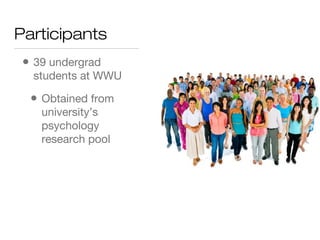
Participants
• 39 undergrad
students at WWU
• Obtained from
university’s
psychology
research pool
Materials
• 20 words
• Nouns
• Priming questions
• 20 2-digit math
problems
• Less words recalled
equals shallow
processing
In what instance would this
be most useful?
How many vowels are in
this word?
Soun
d
Procedure
• Assigned to one of four
conditions
• Computer & shallow
processing
• Computer & deep
processing
• Paper & shallow
processing
• Paper & deep
processing
Procedure
• Signed consent form
• Given 15 minutes to:
• study flash cards
• Solve math problems
• Free recall task
• Demographic
questionnaire
• Debriefed and dismissed
Results
Results
• 2x2 ANOVA
• Between subjects
design
• Alpha level of .05
Results
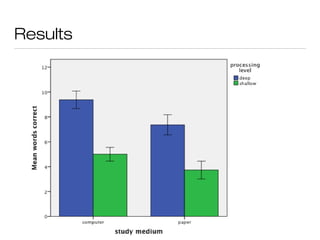
• Main effect of level of
processing
• F(1, 35) = 30.095, p < .001,
2 = .43η
• Main effect of medium of study
• F(1, 35) = 5.06, p = .03, 2η
= .07
• No interaction
• F(1, 35) = .256, p = .616, 2η
= .004
Results
Discussion
Research
Question
•Are the negative
effects of OSL on test
performance due to
the nature of screen
devices, or is it the
learning behaviors that
are commonly
employed when using
screen devices?
Predictions
• main effects of level of
processing
• Results DID support this
hypothesis
• No main effects of medium of
study
• Results DID NOT support
this hypothesis
• No interaction
• Results DID support this
hypothesis
Limitations
• Sample population may have consisted of particularly
tech-savvy students
• Generational
• Canvas
• Eco-friendly
• If students were not equally tech-savvy, there may
not have been a main effect of medium of study
(consistent with our predictions)
Limitations
• Nature of paper conditions
• More material
• Greater cognitive load, decreases working memory
• Less room for learning and memorizing material
• If the tasks were equally difficult, there may not
have been a main effect of medium of study
(consistent with our predictions)
Future
Directions
• Are there different effects of
medium of study on test
performance between
individuals of different levels of
technological skill?
• Low skill vs. High skill
• Do individuals of different
populations have varying
effects of medium of study on
test performance?
• Age
• Socio-economic status
• Culture
Any questions?
Thank you!

psy 303 presentation

  • 1.
    The effect ofmedium of learning and levels of processing on test performance Flying Circus
  • 2.
    Topic and Rationale •Technology is commonplace •Computers and tablets commonly used to study •Exams still done on paper
  • 3.
    Topic and Rationale •Students arestudying using on screen learning (OSL) but taking exams on paper •Exam scores are lower for OSL versus on paper learning (OPL) •The difference is due to metacognitive learning regulation (MLR)
  • 4.
    Previous Research •Ackerman and Lauterman (2012) •OSLpromotes shallow processing •Lower retention rates
  • 5.
    Previous Research • Ackerman and Goldsmith(2011) • screen use cues us to shallow processing
  • 6.
    Previous Research • Craik andLockhart (1972) • Levels Of Processing Theory • How one processes information is what matters • Retention depends on depth of processing
  • 7.
    Research Question •Are the negative effectsof OSL on test performance due to the nature of screen devices, or is it the learning behaviors that are commonly employed when using screen devices?
  • 8.
    Design • Independent Variables •Level of Processing • Shallow or Deep • Medium of Word List • Computer or Paper • Dependent Variable • Performance on a free recall task
  • 9.
    Predictions • Main effectof level of processing • deep = higher retention • shallow = lower retention • No main effect of medium of word list • There will be no interaction
  • 10.
  • 11.
    Participants • 39 undergrad studentsat WWU • Obtained from university’s psychology research pool
  • 12.
    Materials • 20 words •Nouns • Priming questions • 20 2-digit math problems • Less words recalled equals shallow processing In what instance would this be most useful? How many vowels are in this word? Soun d
  • 13.
    Procedure • Assigned toone of four conditions • Computer & shallow processing • Computer & deep processing • Paper & shallow processing • Paper & deep processing
  • 14.
    Procedure • Signed consentform • Given 15 minutes to: • study flash cards • Solve math problems • Free recall task • Demographic questionnaire • Debriefed and dismissed
  • 15.
  • 16.
    Results • 2x2 ANOVA •Between subjects design • Alpha level of .05
  • 17.
    Results • Main effectof level of processing • F(1, 35) = 30.095, p < .001, 2 = .43η • Main effect of medium of study • F(1, 35) = 5.06, p = .03, 2η = .07 • No interaction • F(1, 35) = .256, p = .616, 2η = .004
  • 18.
  • 19.
  • 20.
    Research Question •Are the negative effectsof OSL on test performance due to the nature of screen devices, or is it the learning behaviors that are commonly employed when using screen devices?
  • 21.
    Predictions • main effectsof level of processing • Results DID support this hypothesis • No main effects of medium of study • Results DID NOT support this hypothesis • No interaction • Results DID support this hypothesis
  • 22.
    Limitations • Sample populationmay have consisted of particularly tech-savvy students • Generational • Canvas • Eco-friendly • If students were not equally tech-savvy, there may not have been a main effect of medium of study (consistent with our predictions)
  • 23.
    Limitations • Nature ofpaper conditions • More material • Greater cognitive load, decreases working memory • Less room for learning and memorizing material • If the tasks were equally difficult, there may not have been a main effect of medium of study (consistent with our predictions)
  • 24.
    Future Directions • Are theredifferent effects of medium of study on test performance between individuals of different levels of technological skill? • Low skill vs. High skill • Do individuals of different populations have varying effects of medium of study on test performance? • Age • Socio-economic status • Culture
  • 25.

Editor's Notes

  • #10 We hypothesize that there will be a main effect for the level of processing, such that deeper processing will result in greater performance than shallow processing. We do not predict a main effect of the type of physical device the participants study with. We also predict there will be no interaction between the type of physical device and the level of processing.