ANTI-DERIVATIVE TIME
CALCULUS
YEP ITS THAT TIME AGAIN!
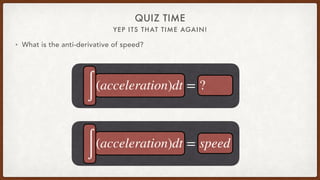
QUIZ TIME
• What is the anti-derivative of speed?
∫
(acceleration)dt = ?
∫
(acceleration)dt = speed
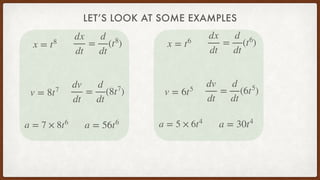
LET’S LOOK AT SOME EXAMPLES
x = t8
dx
dt
=
d
dt
(t8
)
v = 8t7
dv
dt
=
d
dt
(8t7
)
a = 7 × 8t6
a = 56t6
x = t6
dx
dt
=
d
dt
(t6
)
v = 6t5
dv
dt
=
d
dt
(6t5
)
a = 5 × 6t4
a = 30t4
LET’S LOOK AT SOME EXAMPLES
x = t3
dx
dt
=
d
dt
(t3
)
v = 3t2
dv
dt
=
d
dt
(3t2
)
a = 2 × 3t a = 6t
x = t5
dx
dt
=
d
dt
(t5
)
v = 5t4
dv
dt
=
d
dt
(5t4
)
a = 4 × 5t3
a = 20t3
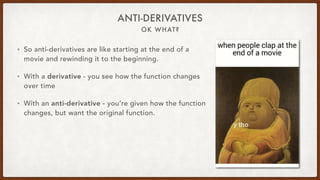
ANTI-DERIVATIVES
OK WHAT?
ANTI-DERIVATIVES
• So anti-derivatives are like starting at the end of a
movie and rewinding it to the beginning.
• With a derivative - you see how the function changes
over time
• With an anti-derivative - you’re given how the function
changes, but want the original function.
ANTI-DERIVATIVES
• So let’s look back at our position, velocity, acceleration examples.
• If I know the position, then, I can take the derivative to get _________?
• If I know the speed, then, I can take the derivative to get ___________?
ANTI-DERIVATIVES
• What if you only knew velocity?
• What if you only knew
acceleration?
• Well, that’s where anti-derivatives
come into help.
• We have to learn a few more
symbols and what they mean:)
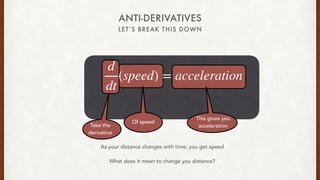
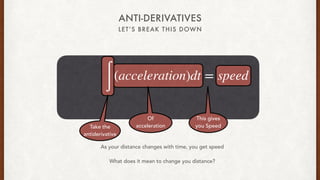
LET’S BREAK THIS DOWN
ANTI-DERIVATIVES
Take the
derivative
Of speed
This gives you
acceleration
As your distance changes with time, you get speed
What does it mean to change you distance?
d
dt
(speed) = acceleration
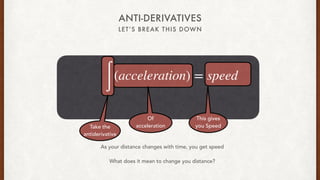
LET’S BREAK THIS DOWN
ANTI-DERIVATIVES
Take the
antiderivative
Of
acceleration
This gives
you Speed
As your distance changes with time, you get speed
What does it mean to change you distance?
∫
(acceleration) = speed
LET’S BREAK THIS DOWN
ANTI-DERIVATIVES
Take the
antiderivative
Of
acceleration
This gives
you Speed
As your distance changes with time, you get speed
What does it mean to change you distance?
∫
(acceleration)dt = speed
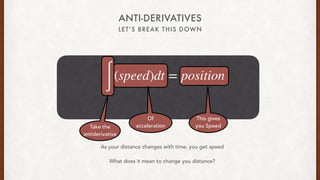
LET’S BREAK THIS DOWN
ANTI-DERIVATIVES
Take the
antiderivative
Of
acceleration
This gives
you Speed
As your distance changes with time, you get speed
What does it mean to change you distance?
∫
(speed)dt = position
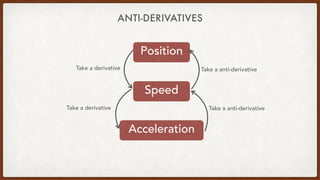
Acceleration
ANTI-DERIVATIVES
Position
Speed
Take a derivative
Take a derivative Take a anti-derivative
Take a anti-derivative
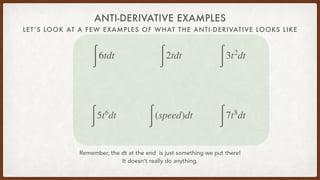
LET’S LOOK AT A FEW EXAMPLES OF WHAT THE ANTI-DERIVATIVE LOOKS LIKE
ANTI-DERIVATIVE EXAMPLES
∫
6tdt
∫
2tdt
∫
3t2
dt
∫
(speed)dt
∫
5t6
dt
∫
7t8
dt
Remember, the dt at the end is just something we put there!
It doesn’t really do anything.
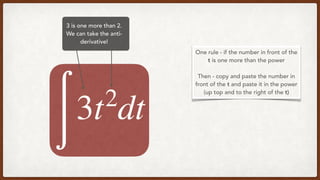
3 is one more than 2.
We can take the anti-
derivative!
∫
3t2
dt
One rule - if the number in front of the
t is one more than the power
Then - copy and paste the number in
front of the t and paste it in the power
(up top and to the right of the t)
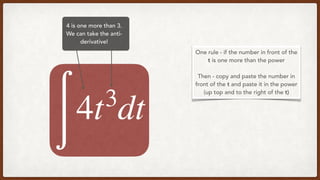
4 is one more than 3.
We can take the anti-
derivative!
∫
4t3
dt
One rule - if the number in front of the
t is one more than the power
Then - copy and paste the number in
front of the t and paste it in the power
(up top and to the right of the t)
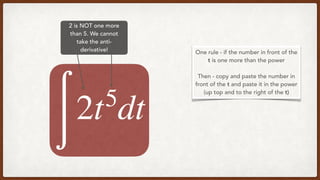
2 is NOT one more
than 5. We cannot
take the anti-
derivative!
∫
2t5
dt
One rule - if the number in front of the
t is one more than the power
Then - copy and paste the number in
front of the t and paste it in the power
(up top and to the right of the t)
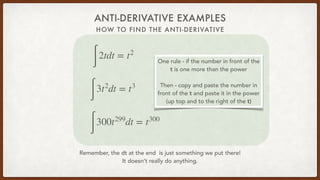
HOW TO FIND THE ANTI-DERIVATIVE
ANTI-DERIVATIVE EXAMPLES
∫
2tdt = t2
Remember, the dt at the end is just something we put there!
It doesn’t really do anything.
∫
3t2
dt = t3
∫
300t299
dt = t300
One rule - if the number in front of the
t is one more than the power
Then - copy and paste the number in
front of the t and paste it in the power
(up top and to the right of the t)
HOW TO FIND THE ANTI-DERIVATIVE
ANTI-DERIVATIVE EXAMPLES
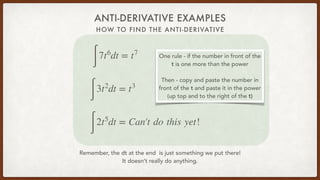
∫
7t6
dt = t7
Remember, the dt at the end is just something we put there!
It doesn’t really do anything.
∫
3t2
dt = t3
∫
2t5
dt = Can′t do this yet!
One rule - if the number in front of the
t is one more than the power
Then - copy and paste the number in
front of the t and paste it in the power
(up top and to the right of the t)
LET’S CHANGE GEARS HEAR
• What does it mean when someone says “Theoretical”
• Yes, it just means the idea is all based in math!
• What does it mean when someone what’s to create a
scientific model?
• In science, a model is a representation of an idea, an even
a process that is used to describe and explain phenomena
that cannot be experienced directly.
• Models are central to what scientists do, both in their
research as well as when communicating their
explanations.
• Models have a variety of uses – from providing a way of
explaining complex data to presenting as a hypothesis.
LET’S BUILD A MODEL
• Well, you guys and girls have
been doing this all along.
• Let’s say we want to model the
speed of a drag car.
• Let’s go!
• What do we need to build the
model?
• We will start with an equation
MODEL BUILDING
•
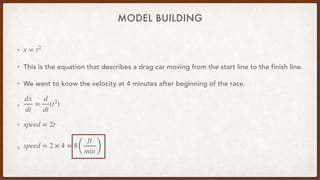
• This is the equation that describes a drag car moving from the start line to the finish line.
• We want to know the velocity at 4 minutes after beginning of the race.
•
•
•
x = t2
dx
dt
=
d
dt
(t2
)
speed = 2t
speed = 2 × 4 = 8
(
ft
min)
WHAT’S WRONG WITH OUR MODEL?
• Whats missing from our model of a real world drag race car speed?
• What about the wind?
• Little bitty accelerations?
• The weight of the car?
• The friction made with the ground and tires?
• The drag race car is not going in a perfectly straight line?
SO WHY DO WE EVEN MAKE MODELS
• We can create scientific models from
calculus
• The models are a simple explanation
of something very complicated
• However, it is close to the real thing
to be “good enough”
• Then, we can use calculus and
something called statistics to see
“how good” a model is?

Calculus for Kids - Lesson 8

  • 1.
  • 2.
    YEP ITS THATTIME AGAIN! QUIZ TIME • What is the anti-derivative of speed? ∫ (acceleration)dt = ? ∫ (acceleration)dt = speed
  • 3.
    LET’S LOOK ATSOME EXAMPLES x = t8 dx dt = d dt (t8 ) v = 8t7 dv dt = d dt (8t7 ) a = 7 × 8t6 a = 56t6 x = t6 dx dt = d dt (t6 ) v = 6t5 dv dt = d dt (6t5 ) a = 5 × 6t4 a = 30t4
  • 4.
    LET’S LOOK ATSOME EXAMPLES x = t3 dx dt = d dt (t3 ) v = 3t2 dv dt = d dt (3t2 ) a = 2 × 3t a = 6t x = t5 dx dt = d dt (t5 ) v = 5t4 dv dt = d dt (5t4 ) a = 4 × 5t3 a = 20t3
  • 5.
  • 6.
    OK WHAT? ANTI-DERIVATIVES • Soanti-derivatives are like starting at the end of a movie and rewinding it to the beginning. • With a derivative - you see how the function changes over time • With an anti-derivative - you’re given how the function changes, but want the original function.
  • 7.
    ANTI-DERIVATIVES • So let’slook back at our position, velocity, acceleration examples. • If I know the position, then, I can take the derivative to get _________? • If I know the speed, then, I can take the derivative to get ___________?
  • 8.
    ANTI-DERIVATIVES • What ifyou only knew velocity? • What if you only knew acceleration? • Well, that’s where anti-derivatives come into help. • We have to learn a few more symbols and what they mean:)
  • 9.
    LET’S BREAK THISDOWN ANTI-DERIVATIVES Take the derivative Of speed This gives you acceleration As your distance changes with time, you get speed What does it mean to change you distance? d dt (speed) = acceleration
  • 10.
    LET’S BREAK THISDOWN ANTI-DERIVATIVES Take the antiderivative Of acceleration This gives you Speed As your distance changes with time, you get speed What does it mean to change you distance? ∫ (acceleration) = speed
  • 11.
    LET’S BREAK THISDOWN ANTI-DERIVATIVES Take the antiderivative Of acceleration This gives you Speed As your distance changes with time, you get speed What does it mean to change you distance? ∫ (acceleration)dt = speed
  • 12.
    LET’S BREAK THISDOWN ANTI-DERIVATIVES Take the antiderivative Of acceleration This gives you Speed As your distance changes with time, you get speed What does it mean to change you distance? ∫ (speed)dt = position
  • 13.
    Acceleration ANTI-DERIVATIVES Position Speed Take a derivative Takea derivative Take a anti-derivative Take a anti-derivative
  • 14.
    LET’S LOOK ATA FEW EXAMPLES OF WHAT THE ANTI-DERIVATIVE LOOKS LIKE ANTI-DERIVATIVE EXAMPLES ∫ 6tdt ∫ 2tdt ∫ 3t2 dt ∫ (speed)dt ∫ 5t6 dt ∫ 7t8 dt Remember, the dt at the end is just something we put there! It doesn’t really do anything.
  • 15.
    3 is onemore than 2. We can take the anti- derivative! ∫ 3t2 dt One rule - if the number in front of the t is one more than the power Then - copy and paste the number in front of the t and paste it in the power (up top and to the right of the t)
  • 16.
    4 is onemore than 3. We can take the anti- derivative! ∫ 4t3 dt One rule - if the number in front of the t is one more than the power Then - copy and paste the number in front of the t and paste it in the power (up top and to the right of the t)
  • 17.
    2 is NOTone more than 5. We cannot take the anti- derivative! ∫ 2t5 dt One rule - if the number in front of the t is one more than the power Then - copy and paste the number in front of the t and paste it in the power (up top and to the right of the t)
  • 18.
    HOW TO FINDTHE ANTI-DERIVATIVE ANTI-DERIVATIVE EXAMPLES ∫ 2tdt = t2 Remember, the dt at the end is just something we put there! It doesn’t really do anything. ∫ 3t2 dt = t3 ∫ 300t299 dt = t300 One rule - if the number in front of the t is one more than the power Then - copy and paste the number in front of the t and paste it in the power (up top and to the right of the t)
  • 19.
    HOW TO FINDTHE ANTI-DERIVATIVE ANTI-DERIVATIVE EXAMPLES ∫ 7t6 dt = t7 Remember, the dt at the end is just something we put there! It doesn’t really do anything. ∫ 3t2 dt = t3 ∫ 2t5 dt = Can′t do this yet! One rule - if the number in front of the t is one more than the power Then - copy and paste the number in front of the t and paste it in the power (up top and to the right of the t)
  • 20.
    LET’S CHANGE GEARSHEAR • What does it mean when someone says “Theoretical” • Yes, it just means the idea is all based in math! • What does it mean when someone what’s to create a scientific model? • In science, a model is a representation of an idea, an even a process that is used to describe and explain phenomena that cannot be experienced directly. • Models are central to what scientists do, both in their research as well as when communicating their explanations. • Models have a variety of uses – from providing a way of explaining complex data to presenting as a hypothesis.
  • 21.
    LET’S BUILD AMODEL • Well, you guys and girls have been doing this all along. • Let’s say we want to model the speed of a drag car. • Let’s go! • What do we need to build the model? • We will start with an equation
  • 22.
    MODEL BUILDING • • Thisis the equation that describes a drag car moving from the start line to the finish line. • We want to know the velocity at 4 minutes after beginning of the race. • • • x = t2 dx dt = d dt (t2 ) speed = 2t speed = 2 × 4 = 8 ( ft min)
  • 23.
    WHAT’S WRONG WITHOUR MODEL? • Whats missing from our model of a real world drag race car speed? • What about the wind? • Little bitty accelerations? • The weight of the car? • The friction made with the ground and tires? • The drag race car is not going in a perfectly straight line?
  • 24.
    SO WHY DOWE EVEN MAKE MODELS • We can create scientific models from calculus • The models are a simple explanation of something very complicated • However, it is close to the real thing to be “good enough” • Then, we can use calculus and something called statistics to see “how good” a model is?