This document contains a chapter on functions with 30 math exercises. The exercises involve evaluating functions, determining domains and ranges, analyzing graphs of functions, and solving word problems involving functions.
1
CHAPTER 1
Functions
EXERCISE SET1.1
1. (a) −2.9, −2.0, 2.35, 2.9 (b) none (c) y = 0
(d) −1.75 ≤ x ≤ 2.15 (e) ymax = 2.8 at x = −2.6; ymin = −2.2 at x = 1.2
2. (a) x = −1, 4 (b) none (c) y = −1
(d) x = 0, 3, 5 (e) ymax = 9 at x = 6; ymin = −2 at x = 0
3. (a) yes (b) yes
(c) no (vertical line test fails) (d) no (vertical line test fails)
4. (a) The natural domain of f is x = −1, and for g it is the set of all x. Whenever x = −1,
f(x) = g(x), but they have different domains.
(b) The domain of f is the set of all x ≥ 0; the domain of g is the same.
5. (a) around 1943 (b) 1960; 4200
(c) no; you need the year’s population (d) war; marketing techniques
(e) news of health risk; social pressure, antismoking campaigns, increased taxation
6. (a) around 1983 (b) 1966
(c) the former (d) no, it appears to be levelling out
7. (a) 1999, $34,400 (b) 1985, $37,000
(c) second year; graph has a larger (negative) slope
8. (a) In thousands, approximately
43.2 − 37.8
6
=
5.4
6
per yr, or $900/yr
(b) The median income during 1993 increased from $37.8K to $38K (K for ’kilodollars’; all figures
approximate). During 1996 it increased from $40K to $42K, and during 1999 it decreased
slightly from $43.2K to $43.1K. Thus the average rate of change measured on January 1 was
(40 - 37.8)/3 for the first three-yr period and (43.2 - 40)/3 for the second-year period, and
hence the median income as measured on January 1 increased more rapidly in the second
three-year period. Measured on December 31, however, the numbers are (42 - 38)/3 and (43.1
- 42)/3, and the former is the greater number. Thus the answer to the question depends on
where in the year the median income is measured.
(c) 1993
9. (a) f(0) = 3(0)2
−2 = −2; f(2) = 3(2)2
−2 = 10; f(−2) = 3(−2)2
−2 = 10; f(3) = 3(3)2
−2 = 25;
f(
√
2) = 3(
√
2)2
− 2 = 4; f(3t) = 3(3t)2
− 2 = 27t2
− 2
(b) f(0) = 2(0) = 0; f(2) = 2(2) = 4; f(−2) = 2(−2) = −4; f(3) = 2(3) = 6; f(
√
2) = 2
√
2;
f(3t) = 1/3t for t > 1 and f(3t) = 6t for t ≤ 1.
10. (a) g(3) =
3 + 1
3 − 1
= 2; g(−1) =
−1 + 1
−1 − 1
= 0; g(π) =
π + 1
π − 1
; g(−1.1) =
−1.1 + 1
−1.1 − 1
=
−0.1
−2.1
=
1
21
;
g(t2
− 1) =
t2
− 1 + 1
t2 − 1 − 1
=
t2
t2 − 2
(b) g(3) =
√
3 + 1 = 2; g(−1) = 3; g(π) =
√
π + 1; g(−1.1) = 3; g(t2
− 1) = 3 if t2
< 2 and
g(t2
− 1) =
√
t2 − 1 + 1 = |t| if t2
≥ 2.
2.
2 Chapter 1
11.(a) x = 3 (b) x ≤ −
√
3 or x ≥
√
3
(c) x2
− 2x + 5 = 0 has no real solutions so x2
− 2x + 5 is always positive or always negative. If
x = 0, then x2
− 2x + 5 = 5 > 0; domain: (−∞, +∞).
(d) x = 0 (e) sin x = 1, so x = (2n + 1
2 )π, n = 0, ±1, ±2, . . .
12. (a) x = −7
5
(b) x − 3x2
must be nonnegative; y = x − 3x2
is a parabola that crosses the x-axis at x = 0, 1
3
and opens downward, thus 0 ≤ x ≤ 1
3
(c)
x2
− 4
x − 4
> 0, so x2
− 4 > 0 and x − 4 > 0, thus x > 4; or x2
− 4 < 0 and x − 4 < 0, thus
−2 < x < 2
(d) x = −1 (e) cos x ≤ 1 < 2, 2 − cos x > 0, all x
13. (a) x ≤ 3 (b) −2 ≤ x ≤ 2 (c) x ≥ 0 (d) all x (e) all x
14. (a) x ≥ 2
3 (b) −3
2 ≤ x ≤ 3
2 (c) x ≥ 0 (d) x = 0 (e) x ≥ 0
15. (a) Breaks could be caused by war, pestilence, flood, earthquakes, for example.
(b) C decreases for eight hours, takes a jump upwards, and then repeats.
16. (a) Yes, if the thermometer is not near a window or door or other source of sudden temperature
change.
(b) No; the number is always an integer, so the changes are in movements (jumps) of at least
one unit.
17.
t
h 18. T
t
19. (a) x = 2, 4 (b) none (c) x ≤ 2; 4 ≤ x (d) ymin = −1; no maximum value
20. (a) x = 9 (b) none (c) x ≥ 25 (d) ymin = 1; no maximum value
21. The cosine of θ is (L − h)/L (side adjacent over hypotenuse), so h = L(1 − cos θ).
22. The sine of θ/2 is (L/2)/10 (side opposite over hypotenuse), so that L = 20 sin(θ/2).
23. (a) If x < 0, then |x| = −x so f(x) = −x + 3x + 1 = 2x + 1. If x ≥ 0, then |x| = x so
f(x) = x + 3x + 1 = 4x + 1;
f(x) =
2x + 1, x < 0
4x + 1, x ≥ 0
(b) If x < 0, then |x| = −x and |x − 1| = 1 − x so g(x) = −x + 1 − x = 1 − 2x. If 0 ≤ x < 1, then
|x| = x and |x − 1| = 1 − x so g(x) = x + 1 − x = 1. If x ≥ 1, then |x| = x and |x − 1| = x − 1
so g(x) = x + x − 1 = 2x − 1;
g(x) =
1 − 2x, x < 0
1, 0 ≤ x < 1
2x − 1, x ≥ 1
3.
Exercise Set 1.13
24. (a) If x < 5/2, then |2x − 5| = 5 − 2x so f(x) = 3 + (5 − 2x) = 8 − 2x. If x ≥ 5/2, then
|2x − 5| = 2x − 5 so f(x) = 3 + (2x − 5) = 2x − 2;
f(x) =
8 − 2x, x < 5/2
2x − 2, x ≥ 5/2
(b) If x < −1, then |x − 2| = 2 − x and |x + 1| = −x − 1 so g(x) = 3(2 − x) − (−x − 1) = 7 − 2x.
If −1 ≤ x < 2, then |x − 2| = 2 − x and |x + 1| = x + 1 so g(x) = 3(2 − x) − (x + 1) = 5 − 4x.
If x ≥ 2, then |x − 2| = x − 2 and |x + 1| = x + 1 so g(x) = 3(x − 2) − (x + 1) = 2x − 7;
g(x) =
7 − 2x, x < −1
5 − 4x, −1 ≤ x < 2
2x − 7, x ≥ 2
25. (a) V = (8 − 2x)(15 − 2x)x
(b) 0 ≤ x ≤ 4
(c) 0 ≤ V ≤ 91
(d) As x increases, V increases and then decreases; the
maximum value could be approximated by zooming in
on the graph.
100
0
0 4
26. (a) V = (6 − 2x)2
x
(b) 0 < x < 3
(c) 0 < V < 16
(d) A x increases, V increases and then decreases; the
maximum value occurs somewhere on 0 < x < 3,
and can be approximated by zooming with a graphing
calculator.
20
0
0 3
27. (a) The side adjacent to the building
has length x, so L = x + 2y.
(b) A = xy = 1000, so L = x + 2000/x.
(c) all x = 0
120
80
20 80
(d) L ≈ 89.44 ft
28. (a) x = 3000 tan θ
(b) θ = nπ + π/2 for any integer n,
−∞ < n < ∞
(c) 3000 ft
6000
0
0 6
29. (a) V = 500 = πr2
h so h =
500
πr2
. Then
C = (0.02)(2)πr2
+ (0.01)2πrh = 0.04πr2
+ 0.02πr
500
πr2
= 0.04πr2
+
10
r
; Cmin ≈ 4.39 cents at r ≈ 3.4 cm,
h ≈ 13.8 cm
7
4
1.5 6
4.
4 Chapter 1
(b)C = (0.02)(2)(2r)2
+ (0.01)2πrh = 0.16r2
+
10
r
. Since
0.04π < 0.16, the top and bottom now get more weight.
Since they cost more, we diminish their sizes in the
solution, and the cans become taller.
7
4
1.5 5.5
(c) r ≈ 3.1 cm, h ≈ 16.0 cm, C ≈ 4.76 cents
30. (a) The length of a track with straightaways of length L and semicircles of radius r is
P = (2)L + (2)(πr) ft. Let L = 360 and r = 80 to get P = 720 + 160π = 1222.65 ft.
Since this is less than 1320 ft (a quarter-mile), a solution is possible.
(b) P = 2L + 2πr = 1320 and 2r = 2x + 160, so
L = 1
2 (1320 − 2πr) = 1
2 (1320 − 2π(80 + x))
= 660 − 80π − πx.
450
0
0 100
(c) The shortest straightaway is L = 360, so x = 15.49 ft.
(d) The longest straightaway occurs when x = 0,
so L = 660 − 80π = 408.67 ft.
31. (i) x = 1, −2 causes division by zero (ii) g(x) = x + 1, all x
32. (i) x = 0 causes division by zero (ii) g(x) =
√
x + 1 for x ≥ 0
33. (a) 25◦
F (b) 13◦
F (c) 5◦
F
34. If v = 48 then −60 = WCT ≈ 1.4157T − 30.6763; thus T ≈ −21◦
F when WCT = −60.
35. As in the previous exercise, WCT≈ 1.4157T − 30.6763; thus T ≈ 15◦
F when WCT = −10.
36. The WCT is given by two formulae, but the first doesn’t work with the data. Hence
−5 = WCT = −27.2v0.16
+ 48.17 and v ≈ 66◦
F.
EXERCISE SET 1.2
1. (e) seems best,
though only (a) is bad.
–0.5
0.5
y
–1 1
x
2. (e) seems best, though
only (a) is bad and (b)
is not good.
–0.5
0.5
y
–1 1
x
3. (b) and (c) are good;
(a) is very bad.
12
13
14
y
–1 1
x
5.
Exercise Set 1.25
4. (b) and (c) are good;
(a) is very bad.
–14
–13
–12
–11
y
–2 –1 0 1 2
x
5. [−3, 3] × [0, 5]
2
y
x
6. [−4, 2] × [0, 3]
–2
y
x
7. (a) window too narrow, too short
(b) window wide enough, but too short
(c) good window, good spacing
–400
–200
y
–5 5 10 20
x
(d) window too narrow, too short
(e) window too narrow, too short
8. (a) window too narrow
(b) window too short
(c) good window, good tick spacing
–250
–100
50
y
–16 –8 –4 4
x
(d) window too narrow, too short
(e) shows one local minimum only,
window too narrow, too short
9. [−5, 14] × [−60, 40]
–60
20
40
y
–5 5 10
x
10. [6, 12] × [−100, 100]
–50
100
y
10 12
x
11. [−0.1, 0.1] × [−3, 3]
–2
2
3
y
–0.1
x
0.1
12. [−1000, 1000] × [−13, 13]
–5
5
10
y
–1000
x
1000
13. [−250, 1050] × [−1500000, 600000]
–500000
y
–1000 1000
x
6.
6 Chapter 1
14.[−3, 20] × [−3500, 3000]
–2000
–1000
1000
5 10 15
x
y
15. [−2, 2] × [−20, 20]
–20
–10
10
20
y
x
–2 –1 1 2
16. [1.6, 2] × [0, 2]
0.5
1
2
y
1.6 1.7 1.8 2
x
17. depends on graphing utility
–2
2
4
6
y
–4 2 4
x
18. depends on graphing utility
–2
2
4
6
y
–4 –2 2 4
x
19. (a) f(x) =
√
16 − x2
1
3
–2 2 4
x
y
(b) f(x) = −
√
16 − x2
–3
–1
x
y
–4 –2 2 4
(c)
–2
2
x
y
–2 2
(d)
1
4
1 4
y
x
(e) No; the vertical line
test fails.
20. (a) y = ±3 1 − x2/4
–3
3
–2 2
x
y
(b) y = ±
√
x2 + 1
–4
–2
2
4
–4 –2 2 4
x
y
7.
Exercise Set 1.27
21. (a)
–1 1
x
y
1
(b)
1
x
1
2
y
(c)
–1 1
x
–1
y (d)
2cc
1
y
x
(e)
c
1
y
x
C
–1
(f)
1
x
1
–1
y
–1
22.
1
x
y
–1 1
23. The portions of the graph of y = f(x) which lie below the x-axis are reflected over the x-axis to
give the graph of y = |f(x)|.
24. Erase the portion of the graph of y = f(x) which lies in the left-half plane and replace it with the
reflection over the y-axis of the portion in the right-half plane (symmetry over the y-axis) and you
obtain the graph of y = f(|x|).
25. (a) for example, let a = 1.1
a
y
x
(b)
1
2
3
y
1 2 3
x
26. They are identical.
x
y
27.
5
10
15
y
–1 1 2 3
x
8.
8 Chapter 1
28.This graph is very complex. We show three views, small (near the origin), medium and large:
(a) y
x
–1
–1 2
(b)
–50
y x
10
(c)
1000
y
40
x
29. (a)
1
y
–3 –1 1 3
x
(b)
–0.5
0.5
1
–3 –1 1 3
x
y
(c)
0.5
1.5
y
–1 1 2 3
x
(d)
0.5
1
–2 –1 1
x
y
30. y
1
2
x
31. (a) stretches or shrinks the
graph in the y-direction;
reflects it over the x-axis
if c changes sign
–2
2
4
c = 2
c = 1
c = –1.5
–1 1
x
y
(b) As c increases, the lower
part of the parabola
moves down and to the
left; as c decreases, the
motion is down and to
the right.
2
8
–1 2
x
c = 2
c = 1
c = –1.5
y
(c) The graph rises or falls
in the y-direction with
changes in c.
4
2
6
8
–2 1 2
x
c = 2
c = 0.5
c = –1
y
As c increases, the lower part of the parabola moves down and to the left; as c decreases, the
motion is down and to the right
9.
Exercise Set 1.39
32. (a) y
–2
2
1 2
x
(b) x-intercepts at x = 0, a, b. Assume a < b and let a approach b. The two branches of the
curve come together. If a moves past b then a and b switch roles.
–3
–1
1
3
1 2 3
x
a = 0.5
b = 1.5
y
–3
–1
1
3
1 2 3
x
a = 1
b = 1.5
y
–3
–1
1
3
2 3
x
a = 1.5
b = 1.6
y
33. The curve oscillates between
the lines y = x and y = −x with
increasing rapidity as |x| increases.
–30
–10
10
30
y
–30 –10 10 30
x
34. The curve oscillates between the lines
y = +1 and y = −1, infinitely many
times in any neighborhood of x = 0.
y
–1
4–2
x
EXERCISE SET 1.3
1. (a)
–1
0
1
y
–1 1 2
x
(b)
2
1
y
1 2 3
x
(c) 1
y
–1 1 2
x
(d)
2
y
–4 –2 2
x
10.
10 Chapter 1
2.(a) x
y
1–2
(b)
x
1
y
1
(c)
x
1 3
y
1
(d)
x
1
y
1
–1
3. (a)
–1
1
y
x
–2 –1 1 2
(b)
–1
1
y
1
x
(c)
–1
1 y
–1 1 2 3
x
(d)
–1
1
y
–1 1 2 3
x
4.
–1
1 y
–1 1 2 3
x
5. Translate left 1 unit, stretch vertically by
a factor of 2, reflect over x-axis, translate
down 3 units.
–60
–20
–6 –2 2 6
xy
6. Translate right 3 units,
compress vertically by
a factor of 1
2 , and
translate up 2 units.
y
x
2
4
7. y = (x + 3)2
− 9;
translate left 3 units
and down 9 units.
–5
10
15
–8 –4 –2 2
x
y
8. y = (x + 3)2
− 19;
translate left 3 units
and down 19 units.
y
x
–5
–4
11.
Exercise Set 1.311
9. y = −(x − 1)2
+ 2;
translate right 1 unit,
reflect over x-axis,
translate up 2 units.
–6
–2
2
–2 –1 1 3
x
y
10. y = 1
2 [(x − 1)2
+ 2];
translate right 1 unit
and up 2 units,
compress vertically
by a factor of 1
2 .
y
x
1
2
1
11. Translate left 1 unit,
reflect over x-axis,
translate up 3 units.
1
2
2 8
x
y
12. Translate right 4 units
and up 1 unit.
y
x
1
4
4 10
13. Compress vertically
by a factor of 1
2 ,
translate up 1 unit.
2
y
1 2 3
x
14. Stretch vertically by
a factor of
√
3 and
reflect over x-axis.
y x
–1
2
15. Translate right 3 units.
–10
10
y
4 6
x
16. Translate right 1 unit
and reflect over x-axis.
y
x
–4
2
–2 4
17. Translate left 1 unit,
reflect over x-axis,
translate up 2 units.
–6
–2
6
y
–3 1 2
x
18. y = 1 − 1/x;
reflect over x-axis,
translate up 1 unit.
y
x
–5
5
2
19. Translate left 2 units
and down 2 units.
–2
–4 –2
x
y
12.
12 Chapter 1
20.Translate right 3 units, reflect
over x-axis, translate up 1 unit.
y
x
–1
1
5
21. Stretch vertically by a factor of 2,
translate right 1/2 unit and up 1 unit.
y
x
2
4
2
22. y = |x − 2|; translate right 2 units.
y
x
1
2
2 4
23. Stretch vertically by a factor of 2,
reflect over x-axis, translate up 1 unit.
–1
1
3
–2 2
x
y
24. Translate right 2 units
and down 3 units.
y x
–2
2
25. Translate left 1 unit
and up 2 units.
1
3
y
–3 –1 1
x
26. Translate right 2 units,
reflect over x-axis.
y
x
–1
1
4
27. (a) 2
y
–1 1
x
(b) y =
0 if x ≤ 0
2x if 0 < x
28. y
x
–5
2
29. (f + g)(x) = 3
√
x − 1, x ≥ 1; (f − g)(x) =
√
x − 1, x ≥ 1; (fg)(x) = 2x − 2, x ≥ 1;
(f/g)(x) = 2, x > 1
30. (f + g)(x) = (2x2
+ 1)/[x(x2
+ 1)], all x = 0; (f − g)(x) = −1/[x(x2
+ 1)], all x = 0; (fg)(x) =
1/(x2
+ 1), all x = 0; (f/g)(x) = x2
/(x2
+ 1), all x = 0
31. (a) 3 (b) 9 (c) 2 (d) 2
32. (a) π − 1 (b) 0 (c) −π2
+ 3π − 1 (d) 1
13.
Exercise Set 1.313
33. (a) t4
+ 1 (b) t2
+ 4t + 5 (c) x2
+ 4x + 5 (d)
1
x2
+ 1
(e) x2
+ 2xh + h2
+ 1 (f) x2
+ 1 (g) x + 1 (h) 9x2
+ 1
34. (a)
√
5s + 2 (b)
√
x + 2 (c) 3
√
5x (d) 1/
√
x
(e) 4
√
x (f) 0 (g) 1/ 4
√
x (h) |x − 1|
35. (f ◦ g)(x) = 1 − x, x ≤ 1; (g ◦ f)(x) =
√
1 − x2, |x| ≤ 1
36. (f ◦ g)(x) =
√
x2 + 3 − 3, |x| ≥
√
6; (g ◦ f)(x) =
√
x, x ≥ 3
37. (f ◦ g)(x) =
1
1 − 2x
, x =
1
2
, 1; (g ◦ f)(x) = −
1
2x
−
1
2
, x = 0, 1
38. (f ◦ g)(x) =
x
x2 + 1
, x = 0; (g ◦ f)(x) =
1
x
+ x, x = 0
39. x−6
+ 1 40.
x
x + 1
41. (a) g(x) =
√
x, h(x) = x + 2 (b) g(x) = |x|, h(x) = x2
− 3x + 5
42. (a) g(x) = x + 1, h(x) = x2
(b) g(x) = 1/x, h(x) = x − 3
43. (a) g(x) = x2
, h(x) = sin x (b) g(x) = 3/x, h(x) = 5 + cos x
44. (a) g(x) = 3 sin x, h(x) = x2
(b) g(x) = 3x2
+ 4x, h(x) = sin x
45. (a) f(x) = x3
, g(x) = 1 + sin x, h(x) = x2
(b) f(x) =
√
x, g(x) = 1 − x, h(x) = 3
√
x
46. (a) f(x) = 1/x, g(x) = 1 − x, h(x) = x2
(b) f(x) = |x|, g(x) = 5 + x, h(x) = 2x
47. y
x
–4
–2
2
–2 2
48. {−2, −1, 0, 1, 2, 3}
49. Note that
f(g(−x)) = f(−g(x)) = f(g(x)),
so f(g(x)) is even.
f (g(x))
x
y
1–3 –1
–1
–3
1
50. Note that g(f(−x)) = g(f(x)),
so g(f(x)) is even.
x
y
–1
–2
1
3
–1
1
3
–3
g( f(x))
14.
14 Chapter 1
51.f(g(x)) = 0 when g(x) = ±2, so x = ±1.4; g(f(x)) = 0 when f(x) = 0, so x = ±2.
52. f(g(x)) = 0 at x = −1 and g(f(x)) = 0 at x = −1
53.
3w2
− 5 − (3x2
− 5)
w − x
=
3(w − x)(w + x)
w − x
= 3w + 3x
3(x + h)2
− 5 − (3x2
− 5)
h
=
6xh + 3h2
h
= 6x + 3h;
54.
w2
+ 6w − (x2
+ 6x)
w − x
= w + x + 6
(x + h)2
+ 6(x + h) − (x2
+ 6x)
h
=
2xh + h2
+ 6h
h
= 2x + h + 6;
55.
1/w − 1/x
w − x
=
x − w
wx(w − x)
= −
1
xw
;
1/(x + h) − 1/x
h
=
x − (x + h)
xh(x + h)
=
−1
x(x + h)
56.
1/w2
− 1/x2
w − x
=
x2
− w2
x2w2(w − x)
= −
x + w
x2w2
;
1/(x + h)2
− 1/x2
h
=
x2
− (x + h)2
x2h(x + h)2
= −
2x + h
x2(x + h)2
57. neither; odd; even
58. (a) x −3 −2 −1 0 1 2 3
f(x) 1 −5 −1 0 −1 −5 1
(b) x −3 −2 −1 0 1 2 3
f(x) 1 5 −1 0 1 −5 −1
59. (a)
x
y (b)
x
y
(c)
x
y
60. (a)
x
y (b)
x
y
61. (a) even (b) odd (c) odd (d) neither
62. (a) the origin (b) the x-axis (c) the y-axis (d) none
15.
Exercise Set 1.315
63. (a) f(−x) = (−x)2
= x2
= f(x), even (b) f(−x) = (−x)3
= −x3
= −f(x), odd
(c) f(−x) = | − x| = |x| = f(x), even (d) f(−x) = −x + 1, neither
(e) f(−x) =
(−x)5
− (−x)
1 + (−x)2
= −
x5
− x
1 + x2
= −f(x), odd
(f) f(−x) = 2 = f(x), even
64. (a) x-axis, because x = 5(−y)2
+ 9 gives x = 5y2
+ 9
(b) x-axis, y-axis, and origin, because x2
− 2(−y)2
= 3, (−x)2
− 2y2
= 3, and
(−x)2
− 2(−y)2
= 3 all give x2
− 2y2
= 3
(c) origin, because (−x)(−y) = 5 gives xy = 5
65. (a) y-axis, because (−x)4
= 2y3
+ y gives x4
= 2y3
+ y
(b) origin, because (−y) =
(−x)
3 + (−x)2
gives y =
x
3 + x2
(c) x-axis, y-axis, and origin because (−y)2
= |x| − 5, y2
= | − x| − 5, and (−y)2
= | − x| − 5 all
give y2
= |x| − 5
66. (a) x-axis
(b) origin, both axes
(c) origin
67. (a) y-axis
(b) none
(c) origin, both axes
68. 3
–3
–4 4
69. 2
–2
–3 3
70. (a) Whether we replace x with −x, y with −y, or both, we obtain the same equation, so by
Theorem 1.3.3 the graph is symmetric about the x-axis, the y-axis and the origin.
(b) y = (1 − x2/3
)3/2
(c) For quadrant II, the same; for III and IV use y = −(1 − x2/3
)3/2
. (For graphing it may be
helpful to use the tricks that precede Exercise 29 in Section 1.2.)
71.
2
5
y
1 2
x
72. y
x
2
2
73. (a)
1
y
C
x
O c o
(b)
2
y
O
x
C c o
16.
16 Chapter 1
74.(a)
x
1
y
1
–1
(b)
x
1
y
1
–1 ‚2–‚2 ‚3
(c)
x
1
y
–1
3
(d)
x
y
1
c/2C
75. Yes, e.g. f(x) = xk
and g(x) = xn
where k and n are integers.
76. If x ≥ 0 then |x| = x and f(x) = g(x). If x < 0 then f(x) = |x|p/q
if p is even and f(x) = −|x|p/q
if p is odd; in both cases f(x) agrees with g(x).
EXERCISE SET 1.4
1. (a) y = 3x + b (b) y = 3x + 6 (c)
–10
10
y
–2 2
x
y = 3x + 6
y = 3x + 2
y = 3x – 4
2. Since the slopes are negative reciprocals, y = −1
3 x + b.
3. (a) y = mx + 2
(b) m = tan φ = tan 135◦
= −1, so y = −x + 2 (c)
1
3
4
5
–2 1 2
x
y
m = –1 m = 1
m = 1.5
4. (a) y = mx (b) y = m(x − 1)
(c) y = −2 + m(x − 1) (d) 2x + 4y = C
5. Let the line be tangent to the circle at the point (x0, y0) where x2
0 + y2
0 = 9. The slope of the
tangent line is the negative reciprocal of y0/x0 (why?), so m = −x0/y0 and y = −(x0/y0)x + b.
Substituting the point (x0, y0) as well as y0 = ± 9 − x2
0 we get y = ±
9 − x0x
9 − x2
0
.
17.
Exercise Set 1.417
6. Solve the simultaneous equations to get the point (−2, 1/3) of intersection. Then y = 1
3 +m(x+2).
7. The x-intercept is x = 10 so that with depreciation at 10% per year the final value is always zero,
and hence y = m(x − 10). The y-intercept is the original value.
y
2 6 10
x
8. A line through (6, −1) has the form y + 1 = m(x − 6). The intercepts are x = 6 + 1/m and
y = −6m − 1. Set −(6 + 1/m)(6m + 1) = 3, or 36m2
+ 15m + 1 = (12m + 1)(3m + 1) = 0 with
roots m = −1/12, −1/3; thus y + 1 = −(1/3)(x − 6) and y + 1 = −(1/12)(x − 6).
9. (a) The slope is −1.
–3
–2
5
–1 1 2
x
y
(b) The y-intercept is y = −1.
–4
2
4
–1 1
x
y
(c) They pass through the point (−4, 2).
y
x
–2
2
6
–6 –4
(d) The x-intercept is x = 1.
–3
–1
1
3
1 2
x
y
10. (a) horizontal lines
x
y
(b) The y-intercept is y = −1/2.
x
y
– 2
2
2
18.
18 Chapter 1
(c)The x-intercept is x = −1/2.
x
y
1
1
(d) They pass through (−1, 1).
x
y
–2
1
1
(–1, 1)
11. (a) VI (b) IV (c) III (d) V (e) I (f) II
12. In all cases k must be positive, or negative values would appear in the chart. Only kx−3
decreases,
so that must be f(x). Next, kx2
grows faster than kx3/2
, so that would be g(x), which grows faster
than h(x) (to see this, consider ratios of successive values of the functions). Finally, experimenta-
tion (a spreadsheet is handy) for values of k yields (approximately) f(x) = 10x−3
, g(x) = x2
/2,
h(x) = 2x1.5
.
13. (a)
–30
–10
10
30
–2 1 2
x
y
–40
–10
–2 1 2
xy
(b)
–2
2
4
y
–4
2 4
x
6
10
y
–4 2 4
x
(c)
–2
1
2
–1 2 3
x
y
1
y
1 2 3
x
19.
Exercise Set 1.419
14. (a)
x
y
2
40
–40
x
y
2
40
–2
80
(b)
x
y
2
4
–2
–4
x
y
2
–2
–2
–4
(c)
x
y
–1
–2
4
–3
–2 2 4
–2
xy
15. (a)
–10
–5
5
10
y
–2 2
x
(b)
–2
4
6
y
–2 1 2
x
(c)
–10
–5
5
10
y
–2 2
x
20.
20 Chapter 1
16.(a)
x
y
2
3
(b)
x
y
2
2
(c)
x
y
2
2
17. (a)
2
6
y
–3 –1 1
x
(b)
–80
–20
20
80
y
1 2 3 4 5
x
(c)
–40
–10
y
–3
x
(d)
–40
–20
20
40
y
21 3 4 5
x
18. (a)
x
y
1
1
(b)
–2–6 2
–2
–1
1
2
x
y
(c)
x
y
2
4
–2
–4
(d)
x
y
–2
4
–6
19. (a)
–1
0.5
1.5
y
–3 –2 1
x
(b)
–1
–0.5
0.5
1
y
1 3
x
21.
Exercise Set 1.421
(c)
–20
10
30
y
–1 1 3
x
(d)
–20
10
30
y
–2 1 2
x
20. (a)
–10
10
y
1 3 4
x
(b)
4
8
y
–5 3
x
(c)
–106
106
y
–1 1
x
(d)
5
10
y
–2 2
x
21. y = x2
+ 2x = (x + 1)2
− 1
5
10
y
–2 2
x
22. (a)
1
y
–2 2
x
(b)
1
y
–2 2
x
23. (a) N·m (b) k = 20 N·m
(c) V (L) 0.25 0.5 1.0 1.5 2.0
P (N/m
2
) 80 × 103
40 × 103
20 × 103
13.3 × 10³
10 × 103
(d)
10
20
30
P(N/m2
)
10 20
V(m3
)
22.
22 Chapter 1
24.If the side of the square base is x and the height of the container is y then V = x2
y = 100; minimize
A = 2x2
+ 4xy = 2x2
+ 400/x. A graphing utility with a zoom feature suggests that the solution
is a cube of side 100
1
3 cm.
25. (a) F = k/x2
so 0.0005 = k/(0.3)2
and k = 0.000045 N·m2
.
(b) F = 0.000005 N
(c)
t
5 10
F
10–5
(d) When they approach one another, the force becomes infinite; when they get far apart it tends
to zero.
26. (a) 2000 = C/(4000)2
, so C = 3.2 × 10¹⁰
lb·mi2
(b) W = C/50002
= (3.2 × 10¹⁰
)/(25 × 106
) = 1280 lb.
(c)
5000
15000
W
2000 8000
x
(d) No, but W is very small when x is large.
27. (a) II; y = 1, x = −1, 2 (b) I; y = 0, x = −2, 3
(c) IV; y = 2 (d) III; y = 0, x = −2
28. The denominator has roots x = ±1, so x2
− 1 is the denominator. To determine k use the point
(0, −1) to get k = 1, y = 1/(x2
− 1).
29. (a) y = 3 sin(x/2)
(b) y = 4 cos 2x
(c) y = −5 sin 4x
30. (a) y = 1 + cos πx
(b) y = 1 + 2 sin x
(c) y = −5 cos 4x
31. (a) y = sin(x + π/2)
(b) y = 3 + 3 sin(2x/9)
(c) y = 1 + 2 sin(2(x − π/4))
32. V = 120
√
2 sin(120πt)
33. (a) 3, π/2
y
x
–2
1
3
6
(b) 2, 2
–2
2
2 4
x
y
(c) 1, 4π
y
x
1
2
3
2c 4c 6c
23.
Exercise Set 1.523
34. (a) 4, π
y
x
–4
–2
2
3 9 f l
(b) 1/2, 2π/3
y
x
–0.2
0.4
8
c
(c) 4, 6π
y
x
–4
–2
2
4
i
15c
2
21c
2
35. (a) A sin(ωt + θ) = A sin(ωt) cos θ + A cos(ωt) sin θ = A1 sin(ωt) + A2 cos(ωt)
(b) A1 = A cos θ, A2 = A sin θ, so A = A2
1 + A2
2 and θ = tan−1
(A2/A1).
(c) A = 5
√
13/2, θ = tan−1 1
2
√
3
;
x =
5
√
13
2
sin 2πt + tan−1 1
2
√
3
10
–10
^ 6
36. three; x = 0, x = ±1.8955
3
–3
–3 3
EXERCISE SET 1.5
1. (a) f(g(x)) = 4(x/4) = x, g(f(x)) = (4x)/4 = x, f and g are inverse functions
(b) f(g(x)) = 3(3x − 1) + 1 = 9x − 2 = x so f and g are not inverse functions
(c) f(g(x)) = 3
(x3 + 2) − 2 = x, g(f(x)) = (x − 2) + 2 = x, f and g are inverse functions
(d) f(g(x)) = (x1/4
)4
= x, g(f(x)) = (x4
)1/4
= |x| = x, f and g are not inverse functions
2. (a) They are inverse functions.
2
–2
–2 2
(b) The graphs are not reflections of
each other about the line y = x.
2
–2
–2 2
24.
24 Chapter 1
(c)They are inverse functions provided
the domain of g is restricted to [0, +∞)
5
0
0 5
(d) They are inverse functions provided
the domain of f(x) is restricted
to [0, +∞)
2
0
0 2
3. (a) yes (b) yes (c) no (d) yes (e) no (f) no
4. (a) no, the horizontal line test fails
6
–2
–3 3
(b) yes, by the horizontal line test
10
–10
–1 3
5. (a) yes; all outputs (the elements of row two) are distinct
(b) no; f(1) = f(6)
6. (a) Since the point (0, 0) lies on the graph, no other point on the line x = 0 can lie on the graph,
by the vertical line test. Thus the hour hand cannot point straight up or straight down. Thus
noon, midnight, 6AM and 6PM are impossible. To show other times are possible, suppose
(a, b) lies on the graph with a = 0. Then the function y = Ax1/3
passes through (0, 0) and
(a, b) provided A = b/a1/3
.
(b) same as (a)
(c) Then the minute hand cannot point to 6 or 12, so in addition to (a), times of the form 1:00,
1:30, 2:00, 2:30, , 12:30 are also impossible.
7. (a) f has an inverse because the graph passes the horizontal line test. To compute f−1
(2) start
at 2 on the y-axis and go to the curve and then down, so f−1
(2) = 8; similarly, f−1
(−1) = −1
and f−1
(0) = 0.
(b) domain of f−1
is [−2, 2], range is [−8, 8] (c)
–2 1 2
–8
–4
4
8
y
x
8. (a) the horizontal line test fails
(b) −3 < x ≤ −1; −1 ≤ x ≤ 2; and 2 ≤ x < 4.
9. y = f−1
(x), x = f(y) = 7y − 6, y =
1
7
(x + 6) = f−1
(x)
25.
Exercise Set 1.525
10. y = f−1
(x), x = f(y) =
y + 1
y − 1
, xy − x = y + 1, (x − 1)y = x + 1, y =
x + 1
x − 1
= f−1
(x)
11. y = f−1
(x), x = f(y) = 3y3
− 5, y = 3
(x + 5)/3 = f−1
(x)
12. y = f−1
(x), x = f(y) = 5
√
4y + 2, y =
1
4
(x5
− 2) = f−1
(x)
13. y = f−1
(x), x = f(y) = 3
√
2y − 1, y = (x3
+ 1)/2 = f−1
(x)
14. y = f−1
(x), x = f(y) =
5
y2 + 1
, y =
5 − x
x
= f−1
(x)
15. y = f−1
(x), x = f(y) = 3/y2
, y = − 3/x = f−1
(x)
16. y = f−1
(x), x = f(y) =
2y, y ≤ 0
y2
, y > 0
, y = f−1
(x) =
x/2, x ≤ 0
√
x, x > 0
17. y = f−1
(x), x = f(y) =
5/2 − y, y < 2
1/y, y ≥ 2
, y = f−1
(x) =
5/2 − x, x > 1/2
1/x, 0 < x ≤ 1/2
18. y = p−1
(x), x = p(y) = y3
− 3y2
+ 3y − 1 = (y − 1)3
, y = x1/3
+ 1 = p−1
(x)
19. y = f−1
(x), x = f(y) = (y + 2)4
for y ≥ 0, y = f−1
(x) = x1/4
− 2 for x ≥ 16
20. y = f−1
(x), x = f(y) =
√
y + 3 for y ≥ −3, y = f−1
(x) = x2
− 3 for x ≥ 0
21. y = f−1
(x), x = f(y) = −
√
3 − 2y for y ≤ 3/2, y = f−1
(x) = (3 − x2
)/2 for x ≤ 0
22. y = f−1
(x), x = f(y) = 3y2
+ 5y − 2 for y ≥ 0, 3y2
+ 5y − 2 − x = 0 for y ≥ 0,
y = f−1
(x) = (−5 +
√
12x + 49)/6 for x ≥ −2
23. y = f−1
(x), x = f(y) = y − 5y2
for y ≥ 1, 5y2
− y + x = 0 for y ≥ 1,
y = f−1
(x) = (1 +
√
1 − 20x)/10 for x ≤ −4
24. (a) C =
5
9
(F − 32)
(b) how many degrees Celsius given the Fahrenheit temperature
(c) C = −273.15◦
C is equivalent to F = −459.67◦
F, so the domain is F ≥ −459.67, the range
is C ≥ −273.15
25. (a) y = f(x) = (6.214 × 10⁻⁴
)x (b) x = f−1
(y) =
104
6.214
y
(c) how many meters in y miles
26. (a) f(g(x)) = f(
√
x)
= (
√
x)2
= x, x > 1;
g(f(x)) = g(x2
)
=
√
x2 = x, x > 1
(b)
x
y
y = f(x)
y = g(x)
(c) no, because f(g(x)) = x for every x in the domain of g is not satisfied
(the domain of g is x ≥ 0)
26.
26 Chapter 1
27.(a) f(f(x)) =
3 −
3 − x
1 − x
1 −
3 − x
1 − x
=
3 − 3x − 3 + x
1 − x − 3 + x
= x so f = f−1
(b) symmetric about the line y = x
28. y = f−1
(x), x = f(y) = ay2
+ by + c, ay2
+ by + c − x = 0, use the quadratic formula to get
y =
−b ± b2 − 4a(c − x)
2a
;
(a) f−1
(x) =
−b + b2 − 4a(c − x)
2a
(b) f−1
(x) =
−b − b2 − 4a(c − x)
2a
29. if f−1
(x) = 1, then x = f(1) = 2(1)3
+ 5(1) + 3 = 10
30. if f−1
(x) = 2, then x = f(2) = (2)3
/[(2)2
+ 1] = 8/5
31. f(f(x)) = x thus f = f−1
so the graph is symmetric about y = x.
32. (a) Suppose x1 = x2 where x1 and x2 are in the domain of g and g(x1), g(x2) are in the domain of
f then g(x1) = g(x2) because g is one-to-one so f(g(x1)) = f(g(x2)) because f is one-to-one
thus f ◦ g is one-to-one because (f ◦ g)(x1) = (f ◦ g)(x2) if x1 = x2.
(b) f, g, and f ◦ g all have inverses because they are all one-to-one. Let h = (f ◦ g)−1
then
(f ◦ g)(h(x)) = f[g(h(x))] = x, apply f−1
to both sides to get g(h(x)) = f−1
(x), then apply
g−1
to get h(x) = g−1
(f−1
(x)) = (g−1
◦ f−1
)(x), so h = g−1
◦ f−1
.
33.
x
y
34. Suppose that g and h are both inverses of f then f(g(x)) = x, h[f(g(x))] = h(x), but
h[f(g(x))] = g(x) because h is an inverse of f so g(x) = h(x).
3
45
35. tan θ = 4/3, 0 < θ < π/2; use the triangle shown to
get sin θ = 4/5, cos θ = 3/5, cot θ = 3/4, sec θ = 5/3,
csc θ = 5/4
2.6
1
2.4
36. sec θ = 2.6, 0 < θ < π/2; use the triangle shown to get
sin θ = 2.4/2.6 = 12/13, cos θ = 1/2.6 = 5/13,
tan θ = 2.4 = 12/5, cot θ = 5/12, csc θ = 13/12
37. (a) 0 ≤ x ≤ π (b) −1 ≤ x ≤ 1
(c) −π/2 < x < π/2 (d) −∞ < x < +∞
27.
Exercise Set 1.527
38. Let θ = sin−1
(−3/4) then
sin θ = −3/4, −π/2 < θ < 0
and (see figure) sec θ = 4/
√
7
–3
4
√7
39. Let θ = cos−1
(3/5),
sin 2θ = 2 sin θ cos θ = 2(4/5)(3/5) = 24/25
3
45
40. (a) sin(cos−1
x) =
√
1 − x2
1
x
√1 – x2
cos–1 x
(b) tan(cos−1
x) =
√
1 − x2
x
1
x
cos–1 x
√1 – x2
(c) csc(tan−1
x) =
√
1 + x2
x
1
x
tan–1 x
√1 + x2
(d) sin(tan−1
x) =
x
√
1 + x2
1
x
tan–1 x
1 + x2
41. (a) cos(tan−1
x) =
1
√
1 + x2
1
x
tan–1 x
1 + x2
(b) tan(cos−1
x) =
√
1 − x2
x
x
1
cos–1 x
1 – x2
(c) sin(sec−1
x) =
√
x2 − 1
x
1
x
sec–1 x
x2 – 1
(d) cot(sec−1
x) =
1
√
x2 − 1
1
x
x2 – 1
sec–1 x
28.
28 Chapter 1
42.(a) x −1.00 −0.80 −0.6 −0.40 −0.20 0.00 0.20 0.40 0.60 0.80 1.00
sin−1
x −1.57 −0.93 −0.64 −0.41 −0.20 0.00 0.20 0.41 0.64 0.93 1.57
cos−1
x 3.14 2.50 2.21 1.98 1.77 1.57 1.37 1.16 0.93 0.64 0.00
(b) y
x
1
1
(c) y
x
–1
1
2
3
0.5 1
43. (a)
–0.5 0.5
x
y
c/2–
c/2
(b)
x
y
c/2–
c/2
44. (a) x = π − sin−1
(0.37) ≈ 2.7626 rad (b) θ = 180◦
+ sin−1
(0.61) ≈ 217.6◦
45. (a) x = π + cos−1
(0.85) ≈ 3.6964 rad (b) θ = − cos−1
(0.23) ≈ −76.7◦
46. (a) x = tan−1
(3.16) − π ≈ −1.8773 (b) θ = 180◦
− tan−1
(0.45) ≈ 155.8◦
47. (a) sin−1
0.9 > 1, so it is not in the domain of sin−1
x
(b) −1 ≤ sin−1
x ≤ 1 is necessary, or −0.841471 ≤ x ≤ 0.841471
48. sin 2θ = gR/v2
= (9.8)(18)/(14)2
= 0.9, 2θ = sin−1
(0.9) or 2θ = 180◦
− sin−1
(0.9) so
θ = 1
2 sin−1
(0.9) ≈ 32◦
or θ = 90◦
− 1
2 sin−1
(0.9) ≈ 58◦
. The ball will have a lower
parabolic trajectory for θ = 32◦
and hence will result in the shorter time of flight.
49. (a) y
x
–10 10
c/2
c
y
x
c/2
5
(b) The domain of cot−1
x is (−∞, +∞), the range is (0, π); the domain of csc−1
x is (−∞, −1]∪
[1, +∞), the range is [−π/2, 0) ∪ (0, π/2].
50. (a) y = cot−1
x; if x > 0 then 0 < y < π/2 and x = cot y, tan y = 1/x, y = tan−1
(1/x);
if x < 0 then π/2 < y < π and x = cot y = cot(y − π), tan(y − π) = 1/x, y = π + tan−1 1
x
(b) y = sec−1
x, x = sec y, cos y = 1/x, y = cos−1
(1/x)
(c) y = csc−1
x, x = csc y, sin y = 1/x, y = sin−1
(1/x)
51. (a) 55.0◦
(b) 33.6◦
(c) 25.8◦
52. (b) θ = sin−1 R
R + h
= sin−1 6378
16, 378
≈ 23◦
29.
Exercise Set 1.529
53. (a) If γ = 90◦
, then sin γ = 1, 1 − sin2
φ sin2
γ = 1 − sin2
φ = cos φ,
D = tan φ tan λ = (tan 23.45◦
)(tan 65◦
) ≈ 0.93023374 so h ≈ 21.1 hours.
(b) If γ = 270◦
, then sin γ = −1, D = − tan φ tan λ ≈ −0.93023374 so h ≈ 2.9 hours.
54. 42
= 22
+ 32
− 2(2)(3) cos θ, cos θ = −1/4, θ = cos−1
(−1/4) ≈ 104◦
55. y = 0 when x2
= 6000v2
/g, x = 10v 60/g = 1000
√
30 for v = 400 and g = 32;
tan θ = 3000/x = 3/
√
30, θ = tan−1
(3/
√
30) ≈ 29◦
.
a
␣

b
x
56. θ = α − β, cot α =
x
a + b
and cot β =
x
b
so
θ = cot−1 x
a + b
− cot−1 x
b
57. (a) Let θ = sin−1
(−x) then sin θ = −x, −π/2 ≤ θ ≤ π/2. But sin(−θ) = − sin θ and
−π/2 ≤ −θ ≤ π/2 so sin(−θ) = −(−x) = x, −θ = sin−1
x, θ = − sin−1
x.
(b) proof is similar to that in Part (a)
58. (a) Let θ = cos−1
(−x) then cos θ = −x, 0 ≤ θ ≤ π. But cos(π − θ) = − cos θ and
0 ≤ π − θ ≤ π so cos(π − θ) = x, π − θ = cos−1
x, θ = π − cos−1
x
(b) Let θ = sec−1
(−x) for x ≥ 1; then sec θ = −x and π/2 < θ ≤ π. So 0 ≤ π − θ < π/2 and
π − θ = sec−1
sec(π − θ) = sec−1
(− sec θ) = sec−1
x, or sec−1
(−x) = π − sec−1
x.
1 x
sin–1 x
√1 – x2
59. (a) sin−1
x = tan−1 x
√
1 − x2
(see figure)
(b) sin−1
x + cos−1
x = π/2; cos−1
x = π/2 − sin−1
x = π/2 − tan−1 x
√
1 − x2
60. tan(α + β) =
tan α + tan β
1 − tan α tan β
,
tan(tan−1
x + tan−1
y) =
tan(tan−1
x) + tan(tan−1
y)
1 − tan(tan−1
x) tan(tan−1
y)
=
x + y
1 − xy
so tan−1
x + tan−1
y = tan−1 x + y
1 − xy
61. (a) tan−1 1
2
+ tan−1 1
3
= tan−1 1/2 + 1/3
1 − (1/2) (1/3)
= tan−1
1 = π/4
(b) 2 tan−1 1
3
= tan−1 1
3
+ tan−1 1
3
= tan−1 1/3 + 1/3
1 − (1/3) (1/3)
= tan−1 3
4
,
2 tan−1 1
3
+ tan−1 1
7
= tan−1 3
4
+ tan−1 1
7
= tan−1 3/4 + 1/7
1 − (3/4) (1/7)
= tan−1
1 = π/4
62. sin(sec−1
x) = sin(cos−1
(1/x)) = 1 −
1
x
2
=
√
x2 − 1
|x|
30.
30 Chapter 1
EXERCISESET 1.6
1. (a) −4 (b) 4 (c) 1/4
2. (a) 1/16 (b) 8 (c) 1/3
3. (a) 2.9690 (b) 0.0341
4. (a) 1.8882 (b) 0.9381
5. (a) log2 16 = log2(24
) = 4 (b) log2
1
32
= log2(2−5
) = −5
(c) log4 4 = 1 (d) log9 3 = log9(91/2
) = 1/2
6. (a) log10(0.001) = log10(10−3
) = −3 (b) log10(104
) = 4
(c) ln(e3
) = 3 (d) ln(
√
e) = ln(e1/2
) = 1/2
7. (a) 1.3655 (b) −0.3011
8. (a) −0.5229 (b) 1.1447
9. (a) 2 ln a +
1
2
ln b +
1
2
ln c = 2r + s/2 + t/2 (b) ln b − 3 ln a − ln c = s − 3r − t
10. (a)
1
3
ln c − ln a − ln b = t/3 − r − s (b)
1
2
(ln a + 3 ln b − 2 ln c) = r/2 + 3s/2 − t
11. (a) 1 + log x +
1
2
log(x − 3) (b) 2 ln |x| + 3 ln sin x −
1
2
ln(x2
+ 1)
12. (a)
1
3
log(x + 2) − log cos 5x (b)
1
2
ln(x2
+ 1) −
1
2
ln(x3
+ 5)
13. log
24
(16)
3
= log(256/3) 14. log
√
x − log(sin3
2x) + log 100 = log
100
√
x
sin3
2x
15. ln
3
√
x(x + 1)2
cos x
16. 1 + x = 103
= 1000, x = 999
17.
√
x = 10−1
= 0.1, x = 0.01 18. x2
= e4
, x = ±e2
19. 1/x = e−2
, x = e2
20. x = 7 21. 2x = 8, x = 4
22. log10 x3
= 30, x3
= 1030
, x = 1010
23. log10 x = 5, x = 105
24. ln 4x − ln x6
= ln 2, ln
4
x5
= ln 2,
4
x5
= 2, x5
= 2, x = 5
√
2
25. ln 2x2
= ln 3, 2x2
= 3, x2
= 3/2, x = 3/2 (we discard − 3/2 because it does not satisfy the
original equation)
26. ln 3x
= ln 2, x ln 3 = ln 2, x =
ln 2
ln 3
27. ln 5−2x
= ln 3, −2x ln 5 = ln 3, x = −
ln 3
2 ln 5
28. e−2x
= 5/3, −2x = ln(5/3), x = −1
2 ln(5/3)
31.
Exercise Set 1.631
29. e3x
= 7/2, 3x = ln(7/2), x =
1
3
ln(7/2)
30. ex
(1 − 2x) = 0 so ex
= 0 (impossible) or 1 − 2x = 0, x = 1/2
31. e−x
(x + 2) = 0 so e−x
= 0 (impossible) or x + 2 = 0, x = −2
32. e2x
− ex
− 6 = (ex
− 3)(ex
+ 2) = 0 so ex
= −2 (impossible) or ex
= 3, x = ln 3
33. e−2x
− 3e−x
+ 2 = (e−x
− 2)(e−x
− 1) = 0 so e−x
= 2, x = − ln 2 or e−x
= 1, x = 0
34. (a) y
x
–2
2
2 6
(b) y
x
2
–2 2
35. (a) y
x
2
4
6
–2 4
(b) y
x
–4
2
–4 2
36. (a) y
x
–10
–1
(b) y
x
–1
3
37. log2 7.35 = (log 7.35)/(log 2) = (ln 7.35)/(ln 2) ≈ 2.8777;
log5 0.6 = (log 0.6)/(log 5) = (ln 0.6)/(ln 5) ≈ −0.3174
38. 10
–5
0 2
39. 2
–3
0 3
40. (a) Let X = logb x and Y = loga x. Then bX
= x and aY
= x so aY
= bX
, or aY/X
= b, which
means loga b = Y/X. Substituting for Y and X yields
loga x
logb x
= loga b, logb x =
loga x
loga b
.
(b) Let x = a to get logb a = (loga a)/(loga b) = 1/(loga b) so (loga b)(logb a) = 1.
(log2 81)(log3 32) = (log2[34
])(log3[25
]) = (4 log2 3)(5 log3 2) = 20(log2 3)(log3 2) = 20
32.
32 Chapter 1
41.x = y ≈ 1.4710, x = y ≈ 7.8571
8
0
1 8
42. Since the units are billions, one trillion is 1,000 units. Solve 1000 = 0.051517(1.1306727)x
for x by
taking common logarithms, resulting in 3 = log 0.051517 + x log 1.1306727, which yields x ≈ 80.4,
so the debt first reached one trillion dollars around 1980.
43. (a) no, the curve passes through the origin (b) y = 2x/4
(c) y = 2−x
(d) y = (
√
5)x
5
0
–1 2
44. (a) As x → +∞ the function grows very slowly, but it is always increasing and tends to +∞. As
x → 1+
the function tends to −∞.
(b)
1 2
–5
5
x
y
45. log(1/2) < 0 so 3 log(1/2) < 2 log(1/2)
46. Let x = logb a and y = logb c, so a = bx
and c = by
.
First, ac = bx
by
= bx+y
or equivalently, logb(ac) = x + y = logb a + logb c.
Secondly, a/c = bx
/by
= bx−y
or equivalently, logb(a/c) = x − y = logb a − logb c.
Next, ar
= (bx
)r
= brx
or equivalently, logb ar
= rx = r logb a.
Finally, 1/c = 1/by
= b−y
or equivalently, logb(1/c) = −y = − logb c.
47. 75e−t/125
= 15, t = −125 ln(1/5) = 125 ln 5 ≈ 201 days.
48. (a) If t = 0, then Q = 12 grams
(b) Q = 12e−0.055(4)
= 12e−0.22
≈ 9.63 grams
(c) 12e−0.055t
= 6, e−0.055t
= 0.5, t = −(ln 0.5)/(0.055) ≈ 12.6 hours
33.
Exercise Set 1.733
49. (a) 7.4; basic (b) 4.2; acidic (c) 6.4; acidic (d) 5.9; acidic
50. (a) log[H+
] = −2.44, [H+
] = 10−2.44
≈ 3.6 × 10⁻³
mol/L
(b) log[H+
] = −8.06, [H+
] = 10−8.06
≈ 8.7 × 10⁻⁹
mol/L
51. (a) 140 dB; damage (b) 120 dB; damage
(c) 80 dB; no damage (d) 75 dB; no damage
52. Suppose that I1 = 3I2 and β1 = 10 log10 I1/I0, β2 = 10 log10 I2/I0. Then
I1/I0 = 3I2/I0, log10 I1/I0 = log10 3I2/I0 = log10 3 + log10 I2/I0, β1 = 10 log10 3 + β2,
β1 − β2 = 10 log10 3 ≈ 4.8 decibels.
53. Let IA and IB be the intensities of the automobile and blender, respectively. Then
log10 IA/I0 = 7 and log10 IB/I0 = 9.3, IA = 107
I0 and IB = 109.3
I0, so IB/IA = 102.3
≈ 200.
54. The decibel level of the nth echo is 120(2/3)n
;
120(2/3)n
< 10 if (2/3)n
< 1/12, n <
log(1/12)
log(2/3)
=
log 12
log 1.5
≈ 6.13 so 6 echoes can be heard.
55. (a) log E = 4.4 + 1.5(8.2) = 16.7, E = 1016.7
≈ 5 × 10¹⁶
J
(b) Let M1 and M2 be the magnitudes of earthquakes with energies of E and 10E,
respectively. Then 1.5(M2 − M1) = log(10E) − log E = log 10 = 1,
M2 − M1 = 1/1.5 = 2/3 ≈ 0.67.
56. Let E1 and E2 be the energies of earthquakes with magnitudes M and M + 1, respectively. Then
log E2 − log E1 = log(E2/E1) = 1.5, E2/E1 = 101.5
≈ 31.6.
EXERCISE SET 1.7
1. The sum of the squares for the residuals for line I is approximately
12
+ 12
+ 12
+ 02
+ 22
+ 12
+ 12
+ 12
= 10, and the same for line II is approximately
02
+ (0.4)2
+ (1.2)2
+ 02
+ (2.2)2
+ (0.6)2
+ (0.2)2
+ 02
= 6.84; line II is the regression line.
2. (a) The data appear to be periodic, so a trigonometric model may be appropriate.
(b) The data appear to lie near a parabola, so a quadratic model may be appropriate.
(c) The data appear to lie near a line, so a linear model may be appropriate.
(d) The data appear to be randomly distributed, so no model seems to be appropriate.
3. Least squares line S = 0.6414t − 1054.517, correlation coefficient 0.5754
1989 1992 1995 1998 2001 2004
220
230
240
t
S
4. (a) p = 0.0154T + 4.19 (b) 3.42 atm
5. (a) Least squares line p = 0.0146T + 3.98, correlation coefficient 0.9999
(b) p = 3.25 atm (c) T = −272◦
C
34.
34 Chapter 1
6.(a) p = 0.0203 T + 5.54, r = 0.9999 (b) T = −273
(c) 1.05 p = 0.0203(T)(1.1) + 5.54 and p = 0.0203T + 5.54, subtract to get
.05p = 0.1(0.0203T), p = 2(0.0203T). But p = 0.0203T + 5.54,
equate the right hand sides, get T = 5.54/0.0203 ≈ 273◦
C
7. (a) R = 0.00723T + 1.55 (b) T = −214◦
C
8. (a) y = 0.0236x + 4.79 (b) T = −203◦
C
9. (a) S = 0.50179w − 0.00643 (b) S = 8, w = 16 lb
10. (a) S = 0.756w − 0.0133
(b) 2S = 0.756(w + 5) − 0.0133, subtract one equation from the other to get S = 5(0.756) = 3.78
11. (a) Let h denote the height in inches and y the number of rebounds per minute. Then
y = 0.0174h − 1.0549, r = 0.7095
(b)
65 75
0.1
0.2
0.3
h
y (c) The least squares line is a fair model for these data,
since the correlation coefficient is 0.7095.
12. (a) Let h denote the height in inches and y the weight in pounds.
Then y = 5.45h − 218; r = 0.8074
(b)
70 80
175
200
225
250
h
y (c) 223 lb
13. (a) (0 + b − 0)2
+ (1 + b − 0)2
+ (1 + b − 1)2
= 3b2
+ 2b + 1
(b) The function of Part (a) is a parabola in the variable b, and has its minimum when b = −1
3 ,
hence the desired line is y = x − 1
3 .
14. Let the points be (A, B) and (A, C). Let the regression line pass through the point (A, b) and have
slope m.The line y = m(x − A) + b is such a line.
The sum of the squares of the residues is (b − B)2
+ (b − C)2
which is easily seen to be minimized
at b = (B +C)/2, which means the line passes through the point midway between the two original
given data points.
Since the slope of the line is arbitary, and since the residual errors are independent of the slope,
it follows that there are infinitely many such lines of regression, and they all pass through the
midpoint.
35.
Exercise Set 1.735
15. Let the points be (A, B), (A, C) and (A , B ) and let the line of regression have the form
y = m(x − A) + b. Then the sum of the squares of the residues is
(B − b)2
+ (C − b)2
+ (m(x − A ) + b − B )2
.
Choose m and b so that the line passes through the point (A , B ), which makes the third term
zero, and passes through the midpoint between (A, B) and (A, C), which minimizes the sum
(B − b)2
+ (C − b)2
(see Exercise 15). These two conditions together minimize the sum of the
squares of the residuals, and they determine the slope and one point, and thus they determine the
line of regression.
16. Let the four vertices of the trapezoid be (A, B), (A, B ), (A , C) and (A , C ). From Exercise 14 it
follows that the sum of the squares of residuals at the two points (A, B) and (A, B ) is minimized if
the line of regression passes through the midpoint between (A, B) and (A, B ). Similarly the sum
of the sum of the squares of the residuals at the two points (A , B ) and (A , C ) is minimized by
having the line of regression pass through the midpoint between these two points. Altogether we
have determined two points through which the line of regression must pass, and hence determined
the line.
17. (a) H ≈ 20000/110 ≈ 182 km/s/Mly
(b) One light year is 9.408 × 10¹²
km and
t =
d
v
=
1
H
=
1
20km/s/Mly
=
9.408 × 10¹⁸
km
20km/s
= 4.704 × 10¹⁷
s = 1.492 × 10¹⁰
years.
(c) The Universe would be even older.
18. The population is modeled by P = 0.0045833t2
− 16.378t + 14635; in the year 2000 the popula-
tion would be P(2000) = 212, 200, 000. This is far short; in 1990 the population of the US was
approximately 250,000,000.
19. As in Example 4, a possible model is of the form T = D + A sin B t −
C
B
. Since the longest
day has 993 minutes and the shortest has 706, take 2A = 993 − 706 = 287 or A = 143.5. The
midpoint between the longest and shortest days is 849.5 minutes, so there is a vertical shift of
D = 849.5. The period is about 365.25 days, so 2π/B = 365.25 or B = π/183. Note that the sine
function takes the value −1 when t −
C
B
= −91.8125, and T is a minimum at about t = 0. Thus
the phase shift
C
B
≈ 91.5. Hence T = 849.5+143.5 sin
π
183
t −
π
2
is a model for the temperature.
20. As in Example 4, a possible model for the fraction f of illumination is of the form
f = D + A sin B t −
C
B
. Since the greatest fraction of illumination is 1 and the least is 0,
2A = 1, A = 1/2. The midpoint of the fraction of illumination is 1/2, so there is a vertical shift
of D = 1/2. The period is approximately 30 days, so 2π/B = 30 or B = π/15. The phase shift is
approximately 49/2, so C/B = 49/2, and f = 1/2 + 1/2 sin
π
15
t −
49
2
21. t = 0.445
√
d
2.3
0
0 25
22. (a) t = 0.373 r1.5
(b) 238,000 km
(c) 1.89 days
36.
36 Chapter 1
EXERCISESET 1.8
1. (a) x + 1 = t = y − 1, y = x + 2
2
4
6
y
2 4
t = 0
t = 1
t = 2
t = 3
t = 4
t = 5
x
(c) t 0 1 2 3 4 5
x −1 0 1 2 3 4
y 1 2 3 4 5 6
2. (a) x2
+ y2
= 1
1
y
–1 1
xt = 1
t = 0.5
t = 0.75 t = 0.25
t = 0
(c) t 0 0.2500 0.50 0.7500 1
x 1 0.7071 0.00 −0.7071 −1
y 0 0.7071 1.00 0.7071 0
3. t = (x + 4)/3; y = 2x + 10
–8 6
12
x
y
4. t = x + 3; y = 3x + 2, −3 ≤ x ≤ 0
x
y
(0, 2)
(–3, –7)
5. cos t = x/2, sin t = y/5;
x2
/4 + y2
/25 = 1
–5 5
–5
5
x
y
6. t = x2
; y = 2x2
+ 4,
x ≥ 0
1
4
8
x
y
7. cos t = (x − 3)/2,
sin t = (y − 2)/4;
(x − 3)2
/4 + (y − 2)2
/16 = 1
7
–2
6
x
y
8. sec2
t − tan2
t = 1;
x2
− y2
= 1, x ≤ −1
and y ≥ 0
–1
x
y
9. cos 2t = 1 − 2 sin2
t;
x = 1 − 2y2
,
−1 ≤ y ≤ 1
–1 1
–1
1
x
y
10. t = (x − 3)/4;
y = (x − 3)2
− 9
x
y
(3, –9)
37.
Exercise Set 1.837
11. x/2 + y/3 = 1, 0 ≤ x ≤ 2, 0 ≤ y ≤ 3
x
y
2
3
12. y = x − 1, x ≥ 1, y ≥ 0
1
1
x
y
13. x = 5 cos t, y = −5 sin t, 0 ≤ t ≤ 2π
5
–5
–7.5 7.5
14. x = cos t, y = sin t, π ≤ t ≤ 3π/2
1
–1
–1 1
15. x = 2, y = t
2
–1
0 3
16. x = 2 cos t, y = 3 sin t, 0 ≤ t ≤ 2π
3
–3
–2 2
17. x = t2
, y = t, −1 ≤ t ≤ 1
1
–1
0 1
18. x = 1 + 4 cos t, y = −3 + 4 sin t, 0 ≤ t ≤ 2π
2
–8
–7 8
19. (a) 14
0
–35 8
(b) t 0 1 2 3 4 5
x 0 5.5 8 4.5 −8 −32.5
y 1 1.5 3 5.5 9 13.5
(c) x = 0 when t = 0, 2
√
3.
(d) for 0 < t < 2
√
2
(e) at t = 2
38.
38 Chapter 1
20.(a) 5
0
–2 14
(b) y is always ≥ 1 since cos t ≤ 1
(c) greater than 5, since cos t ≥ −1
21. (a) 3
–5
0 20
(b) o
O
–1 1
22. (a) 1.7
–1.7
–2.3 2.3
(b)
–10 10
^
6
23. (a) Eliminate t to get
x − x0
x1 − x0
=
y − y0
y1 − y0
(b) Set t = 0 to get (x0, y0); t = 1 for (x1, y1).
(c) x = 1 + t, y = −2 + 6t (d) x = 2 − t, y = 4 − 6t
24. (a) x = −3 − 2t, y = −4 + 5t, 0 ≤ t ≤ 1 (b) x = at, y = b(1 − t), 0 ≤ t ≤ 1
25. (a) |R−P|2
= (x−x0)2
+(y−y0)2
= t2
[(x1−x0)2
+(y1−y0)2
] and |Q−P|2
= (x1−x0)2
+(y1−y0)2
,
so r = |R − P| = |Q − P|t = qt.
(b) t = 1/2 (c) t = 3/4
26. x = 2 + t, y = −1 + 2t
(a) (5/2, 0) (b) (9/4, −1/2) (c) (11/4, 1/2)
27. (a) IV, because x always increases whereas y oscillates.
(b) II, because (x/2)2
+ (y/3)2
= 1, an ellipse.
(c) V, because x2
+ y2
= t2
increases in magnitude while x and y keep changing sign.
(d) VI; examine the cases t < −1 and t > −1 and you see the curve lies in the first, second and
fourth quadrants only.
(e) III because y > 0.
(f) I; since x and y are bounded, the answer must be I or II; but as t runs, say, from 0 to π, x
goes directly from 2 to −2, but y goes from 0 to 1 to 0 to −1 and back to 0, which describes
I but not II.
39.
Exercise Set 1.839
28. (a) from left to right (b) counterclockwise (c) counterclockwise
(d) As t travels from −∞ to −1, the curve goes from (near) the origin in the third quadrant
and travels up and left. As t travels from −1 to +∞ the curve comes from way down in
the second quadrant, hits the origin at t = 0, and then makes the loop clockwise and finally
approaches the origin again as t → +∞.
(e) from left to right
(f) Starting, say, at (1, 0), the curve goes up into the first quadrant, loops back through the
origin and into the third quadrant, and then continues the figure-eight.
29. The two branches corresponding to −1 ≤ t ≤ 0 and 0 ≤ t ≤ 1 coincide.
30. (a) Eliminate
t − t0
t1 − t0
to obtain
y − y0
x − x0
=
y1 − y0
x1 − x0
.
(b) from (x0, y0) to (x1, y1)
(c) x = 3 − 2(t − 1), y = −1 + 5(t − 1)
5
–2
0 5
31. (a)
x − b
a
=
y − d
c
(b)
1
2
3
y
1 2 3
x
32. (a) If a = 0 the line segment is vertical; if c = 0 it is horizontal.
(b) The curve degenerates to the point (b, d).
33. 6
–2
–2 6
34. 10
–5
–5 10
35. 3
0
0 3
36. 6
0
0 6
37.
1
2
y
0.5 1
x
38. x = 1/2 − 4t, y = 1/2 for 0 ≤ t ≤ 1/4
x = −1/2, y = 1/2 − 4(t − 1/4) for 1/4 ≤ t ≤ 1/2
x = −1/2 + 4(t − 1/2), y = −1/2 for 1/2 ≤ t ≤ 3/4
x = 1/2, y = −1/2 + 4(t − 3/4) for 3/4 ≤ t ≤ 1
40.
40 Chapter 1
39.(a) x = 4 cos t, y = 3 sin t (b) x = −1 + 4 cos t, y = 2 + 3 sin t
(c) 3
–3
–4 4
5
–1
–5 3
40. (a) t = x/(v0 cos α),
so y = x tan α − gx2
/(2v2
0 cos2
α).
(b)
2000
6000
10000
40000 80000
x
y
41. (a) From Exercise 40, x = 400
√
2t,
y = 400
√
2t − 4.9t2
.
(b) 16,326.53 m
(c) 65,306.12 m
42. (a) 15
–15
–25 25
(b) 15
–15
–25 25
(c) 15
–15
–25 25
a = 3, b = 2
15
–15
–25 25
a = 2, b = 3
15
–15
–25 25
a = 2, b = 7
41.
Exercise Set 1.841
43. Assume that a = 0 and b = 0; eliminate the parameter to get (x − h)2
/a2
+ (y − k)2
/b2
= 1. If
|a| = |b| the curve is a circle with center (h, k) and radius |a|; if |a| = |b| the curve is an ellipse
with center (h, k) and major axis parallel to the x-axis when |a| > |b|, or major axis parallel to the
y-axis when |a| < |b|.
(a) ellipses with a fixed center and varying axes of symmetry
(b) (assume a = 0 and b = 0) ellipses with varying center and fixed axes of symmetry
(c) circles of radius 1 with centers on the line y = x − 1
44. Refer to the diagram to get bθ = aφ, θ = aφ/b but
θ − α = φ + π/2 so α = θ − φ − π/2 = (a/b − 1)φ − π/2
x = (a − b) cos φ − b sin α
= (a − b) cos φ + b cos
a − b
b
φ,
y = (a − b) sin φ − b cos α
= (a − b) sin φ − b sin
a − b
b
φ.
x
y
␣
a
b
a − b
45. (a)
–a
a
–a a
y
x
(b) Use b = a/4 in the equations of Exercise 44 to get
x = 3
4 a cos φ + 1
4 a cos 3φ, y = 3
4 a sin φ − 1
4 a sin 3φ;
but trigonometric identities yield cos 3φ = 4 cos3
φ − 3 cos φ, sin 3φ = 3 sin φ − 4 sin3
φ,
so x = a cos3
φ, y = a sin3
φ.
(c) x2/3
+ y2/3
= a2/3
(cos2
φ + sin2
φ) = a2/3
46. (a)
1
–1
1
x
y
a = 1/2
3
–3
–1
1
3
x
y
a = 3
5
–5
–1
1
5
x
y
a = 5
(b) (x − a)2
+ y2
= (2a cos2
t − a)2
+ (2a cos t sin t)2
= 4a2
cos4
t − 4a2
cos2
t + a2
+ 4a2
cos2
t sin2
t
= 4a2
cos4
t − 4a2
cos2
t + a2
+ 4a2
cos2
t(1 − cos2
t) = a2
,
a circle about (a, 0) of radius a
42.
42 Chapter 1
REVIEWEXERCISES CHAPTER 1
1. y
x
–1
5
–5 5
2. (a) f(−2) = 2, g(3) = 2 (b) x = −3, 3 (c) x < −2, x > 3
(d) the domain is −5 ≤ x ≤ 5 and the range is −5 ≤ y ≤ 4
(e) the domain is −4 ≤ x ≤ 4.1, the range is −3 ≤ y ≤ 5
(f) f(x) = 0 at x = −3, 5; g(x) = 0 at x = −3, 2
3.
40
50
70
0 2 4 6
t
T
4. Assume that the paint is applied in a thin veneer of uniform thickness, so that the quantity of paint
to be used is proportional to the area covered. If P is the amount of paint to be used, P = kπr2
.
The constant k depends on physical factors, such as the thickness of the paint, absorption of the
wood, etc.
5. (a) If the side has length x and height h, then V = 8 = x2
h, so h = 8/x2
. Then the cost
C = 5x2
+ 2(4)(xh) = 5x2
+ 64/x.
(b) The domain of C is (0, +∞) because x can be very large (just take h very small).
6. (a) Suppose the radius of the uncoated ball is r and that of the coated ball is r + h. Then the
plastic has volume equal to the difference of the volumes, i.e.
V = 4
3 π(r+h)3
− 4
3 πr3
= 4
3 πh[3r2
+3rh+h2
] in3
. But r = 3 and hence V = 4
3 πh[27+9h+h2
].
(b) 0 < h < ∞
7. (a) The base has sides (10 − 2x)/2 and 6 − 2x, and the height is x, so V = (6 − 2x)(5 − x)x ft3
.
(b) From the picture we see that x < 5 and 2x < 6, so 0 < x < 3.
(c) 3.57 ft ×3.79 ft ×1.21 ft
8. (a) d = (x − 1)2 + 1/x2;
(b) −∞ < x < 0, 0 < x < +∞
(c) d ≈ 0.82 at x ≈ 1.38
0.8
1
1.2
1.6
2
0.5 1 2 3
y
x
9.
–2
1
y
–2 1 2
x
43.
Review Exercises Chapter1 43
10. (a) On the interval [−20, 30]
the curve seems tame,
–10 20 30
200000
300000
x
y
(b) but seen close up on the interval
[−1/1000, +1/1000] we see that there
is some wiggling near the origin.
–0.0005 0.001
x
y
–0.00002
–0.00001
11. x −4 −3 −2 −1 0 1 2 3 4
f(x) 0 −1 2 1 3 −2 −3 4 −4
g(x) 3 2 1 −3 −1 −4 4 −2 0
(f ◦ g)(x) 4 −3 −2 −1 1 0 −4 2 3
(g ◦ f)(x) −1 −3 4 −4 −2 1 2 0 3
12. f ◦ g(x) = −1/|x| with domain x = 0, and g ◦ f(x) is nowhere defined, with domain ∅.
13. f(g(x)) = (3x+2)2
+1, g(f(x)) = 3(x2
+1)+2, so 9x2
+12x+5 = 3x2
+5, 6x2
+12x = 0, x = 0, −2
14. (a) (3 − x)/x
(b) no; the definition of f(g(x)) requires g(x) to be defined, so x = 1, and f(g(x)) requires
g(x) = −1, so we must have g(x) = −1, i.e. x = 0; whereas h(x) only requires x = 0
15. When f(g(h(x))) is defined, we require g(h(x)) = 1 and h(x) = 0. The first requirement is
equivalent to x = ±1, the second is equivalent to x = ± (2). For all other x, f · g · h = 1/(2 − x2
).
16. g(x) = x2
+ 2x
17. (a) even × odd = odd (b) a square is even
(c) even + odd is neither (d) odd × odd = even
18. (a) y = |x − 1|, y = |(−x) − 1| = |x + 1|,
y = 2|x + 1|, y = 2|x + 1| − 3,
y = −2|x + 1| + 3
(b) y
x
–1
3
–3 –1 2
19. (a) The circle of radius 1 centered at (a, a2
); therefore, the family of all circles of radius 1 with
centers on the parabola y = x2
.
(b) All parabolas which open up, have latus rectum equal to 1 and vertex on the line y = x/2.
44.
44 Chapter 1
20.Let y = ax2
+ bx + c. Then 4a + 2b + c = 0, 64a + 8b + c = 18, 64a − 8b + c = 18, from which b = 0
and 60a = 18, or finally y = 3
10 x2
− 6
5 .
21. (a)
–20
20
60
y
100 300
t
(b) when
2π
365
(t − 101) =
3π
2
, or t = 374.75, which is the same date as t = 9.75, so during the
night of January 10th-11th
(c) from t = 0 to t = 70.58 and from t = 313.92 to t = 365 (the same date as t = 0) , for a total
of about 122 days
22. Let y = A + B sin(at + b). Since the maximum and minimum values of y are 35 and 5, A + B = 35
and A−B = 5, A = 20, B = 15. The period is 12 hours, so 12a = 2π and a = π/6. The maximum
occurs at t = 2, so 1 = sin(2a + b) = sin(π/3 + b), π/3 + b = π/2, b = π/2 − π/3 = π/6 and
y = 20 + 15 sin(πt/6 + π/6).
23. When x = 0 the value of the green curve is higher than that of the blue curve, therefore the blue
curve is given by y = 1 + 2 sin x.
The points A, B, C, D are the points of intersection of the two curves, i.e. where
1+2 sin x = 2 sin(x/2)+2 cos(x/2). Let sin(x/2) = p, cos(x/2) = q. Then 2 sin x = 4 sin(x/2) cos(x/2)
(basic trigonometric identity, so the equation which yields the points of intersection becomes
1+4pq = 2p+2q, 4pq−2p−2q+1 = 0, (2p−1)(2q−1) = 0; thus whenever either sin(x/2) = 1/2 or
cos(x/2) = 1/2, i.e. when x/2 = π/6, 5π/6, ±π/3. Thus A has coordinates (−2π/3, 1−
√
3), B has
coordinates (π/3, 1+
√
3), C has coordinates (2π/3, 1+
√
3), and D has coordinates (5π/3, 1−
√
3).
24. (a) R = R0 is the R-intercept, R0k is the slope, and T = −1/k is the T-intercept
(b) −1/k = −273, or k = 1/273
(c) 1.1 = R0(1 + 20/273), or R0 = 1.025
(d) T = 126.55◦
C
25. (a) f(g(x)) = x for all x in the domain of g, and g(f(x)) = x for all x in the domain of f.
(b) They are reflections of each other through the line y = x.
(c) The domain of one is the range of the other and vice versa.
(d) The equation y = f(x) can always be solved for x as a function of y. Functions with no
inverses include y = x2
, y = sin x.
26. (a) For sin x, −π/2 ≤ x ≤ π/2; for cos x, 0 ≤ x ≤ π; for tan x, −π/2 < x < π/2; for sec x,
0 ≤ x < π/2 or π/2 < x ≤ π.
45.
Review Exercises Chapter1 45
(b) y
x
–1
1
c/2
y = sin–1 x
y = sin x
y
x
–1
c
y = cos–1 x
y = cos x
y
x
–2
2
c/2–c/2
y = tan–1 x
y = tanx
y
x
–1
2
c/2
y = sec–1 x y = sec x
y = sec–1 x
y = sec x
27. (a) x = f(y) = 8y3
− 1; y = f−1
(x) =
x + 1
8
1/3
=
1
2
(x + 1)1/3
(b) f(x) = (x − 1)2
; f does not have an inverse because f is not one-to-one, for example
f(0) = f(2) = 1.
(c) x = f(y) = (ey
)2
+ 1; y = f−1
(x) = ln
√
x − 1 = 1
2 ln(x − 1)
(d) x = f(y) =
y + 2
y − 1
; y = f−1
(x) =
x + 2
x − 1
(e) x = f(y) = sin
1 − 2y
y
; y =
1
2 + sin−1
x
(f) x =
1
1 + 3 tan−1
y
; y = tan
1 − x
3x
28. It is necessary and sufficient that the graph of f pass the horizontal line test. Suppose to the con-
trary that
ah + b
ch + d
=
ak + b
ck + d
for h = k. Then achk+bck+adh+bd = achk+adk+bch+bd, bc(h−k) =
ad(h − k). It follows from h = k that ad − bc = 0. These steps are reversible, hence f−1
exists if
and only if ad − bc = 0, and if so, then
x =
ay + b
cy + d
, xcy + xd = ay + b, y(cx − a) = b − xd, y =
b − xd
cx − a
= f−1
(x)
29. Draw equilateral triangles of sides 5, 12, 13, and 3, 4, 5. Then sin[cos−1
(4/5)] = 3/5,
sin[cos−1
(5/13)] = 12/13, cos[sin−1
(4/5)] = 3/5, cos[sin−1
(5/13)] = 12/13
(a) cos[cos−1
(4/5) + sin−1
(5/13)] = cos(cos−1
(4/5)) cos(sin−1
(5/13))
− sin(cos−1
(4/5)) sin(sin−1
(5/13))
=
4
5
12
13
−
3
5
5
13
=
33
65
.
(b) sin[sin−1
(4/5) + cos−1
(5/13)] = sin(sin−1
(4/5)) cos(cos−1
(5/13))
+ cos(sin−1
(4/5)) sin(cos−1
(5/13))
=
4
5
5
13
+
3
5
12
13
=
56
65
.
46.
46 Chapter 1
30.(a) y
x
c/2
1
(b) y
x
c/2
1
(c) y
x
–c/2
5
(d) y
x
c/2
1
31. y = 5 ft = 60 in, so 60 = log x, x = 1060
in ≈ 1.58 × 1055
mi.
32. y = 100 mi = 12 × 5280 × 100 in, so x = log y = log 12 + log 5280 + log 100 ≈ 6.8018 in
33. 3 ln e2x
(ex
)3
+ 2 exp(ln 1) = 3 ln e2x
+ 3 ln(ex
)3
+ 2 · 1 = 3(2x) + (3 · 3)x + 2 = 15x + 2
34. Y = ln(Cekt
) = ln C + ln ekt
= ln C + kt, a line with slope k and Y -intercept ln C
35. (a) y
x
–2
2
4
(b) The curve y = e−x/2
sin 2x has x−intercepts at x = −π/2, 0, π/2, π, 3π/2. It intersects the
curve y = e−x/2
at x = π/4, 5π/4 and it intersects the curve y = −e−x/2
at x = −π/4, 3π/4.
36. (a)
5
20
v
1 2 3 4 5
t
(b) limt→∞(1 − e−1.3t
) = 1,
and thus as t → 0, v → 24.61 ft/s.
(c) For large t the velocity approaches c = 24.61.
(d) No; but it comes very close (arbitrarily close).
(e) 3.009 s
37. (a)
100
200
N
10 30 50
t
(b) N = 80 when t = 9.35 yrs
(c) 220 sheep
47.
Review Exercises Chapter1 47
38. (a) The potato is done in the interval 27.65 < t < 32.71.
(b) 91.54 min. The oven temperature is always 400·
F, so the difference between the oven
temperature and the potato temperature is D = 400 − T. Initially D = 325, so solve
D = 75 + 325/2 = 237.5 for t, t ≈ 22.76.
39. (a) The function ln x − x0.2
is negative at x = 1 and positive at x = 4, so it is reasonable to
expect it to be zero somewhere in between. (This will be established later in this book.)
(b) x = 3.654 and 3.32105 × 10⁵
–1 1 3 5
–5
–3
–1
1
x
y
40. (a) If xk
= ex
then k ln x = x, or
ln x
x
=
1
k
. The steps are reversible.
(b) By zooming it is seen that the maximum value of y is
approximately 0.368 (actually, 1/e), so there are two distinct
solutions of xk
= ex
whenever k > 1/0.368 ≈ 2.717.
(c) x ≈ 1.155
41. (a) 1.90 1.92 1.94 1.96 1.98 2.00 2.02 2.04 2.06 2.08 2.10
3.4161 3.4639 3.5100 3.5543 3.5967 3.6372 3.6756 3.7119 3.7459 3.7775 3.8068
(b) y = 1.9589x − 0.2910
(c) y − 3.6372 = 1.9589(x − 2), or y = 1.9589x − 0.2806
(d) As one zooms in on the point (2, f(2))
the two curves seem to converge to one line.
3.8
3.4
1.9 2.2
42. (a) −0.10 −0.08 −0.06 −0.04 −0.02 0.00 0.02 0.04 0.06 0.08 0.10
0.9950 0.9968 0.9982 0.9992 0.9998 1.0000 0.9998 0.9992 0.9982 0.9968 0.9950
(b) y = 13.669x2
+ 2.865x + 0.733
(c) y = −1
2 x2
+ 1
(d) As one zooms in on the point (0, f(0)) the
two curves seem to converge to one curve. 1.2
–0.8
–1.7 1.7
48.
48 Chapter 1
43.The data are periodic, so it is reasonable that a trigonometric function might approximate them.
A possible model is of the form T = D + A sin B t −
C
B
. Since the highest level is 1.032
meters and the lowest is 0.045, take 2A = 1.032 − 0.042 = 0.990 or A = 0.495. The midpoint
between the lowest and highest levels is 0.537 meters, so there is a vertical shift of D = 0.537.
The period is about 12 hours, so 2π/B = 12 or B = π/6. The phase shift
C
B
≈ 6.5. Hence
T = 0.537 + 0.495 sin
π
6
(t − 6.5) is a model for the temperature.
10 20 30 40 50 60 70
0.2
0.4
0.6
0.8
1
t
T
44. (a) y = (415/458)x + 9508/1603 ≈ 0.906x + 5.931
(b) 85.67
45. x(t) =
√
2 cos t, y(t) = −
√
2 sin t, 0 ≤ t ≤ 3π/2
46. x = f(1 − t), y = g(1 − t) 47.
–2
–1
1
2
y
–1 1 2
x
48. (a) The three functions x2
, tan(x) and ln(x) are all increasing on the indicated interval, and thus
so is f(x) and it has an inverse.
(b) The asymptotes for f(x) are x = 0, x = π/2. The asymptotes for f−1
(x) are y = 0, y = π/2.
3
#
x = 6
3
x
y
y = x
y = f(x)
x = f(y)
Exercise Set 2.151
(b) 0 −0.5 −0.9 −0.99 −0.999 −1.5 −1.1 −1.01 −1.001
1 1.7552 6.2161 54.87 541.1 −0.1415 −4.536 −53.19 −539.5
60
–60
–1.5 0
The limit does not exist.
16. (a) 0 −0.5 −0.9 −0.99 −0.999 −1.5 −1.1 −1.01 −1.001
1.5574 1.0926 1.0033 1.0000 1.0000 1.0926 1.0033 1.0000 1.0000
1.5
1
–1.5 0
The limit is 1.
(b) −0.25 −0.1 −0.001 −0.0001 0.0001 0.001 0.1 0.25
1.9794 2.4132 2.5000 2.5000 2.5000 2.5000 2.4132 1.9794
2.5
2
–0.25 0.25
The limit is 5/2.
17. msec =
x2
− 1
x + 1
= x − 1 which gets close to −2 as x gets close to −1, thus y − 1 = −2(x + 1) or
y = −2x − 1
18. msec =
x2
x
= x which gets close to 0 as x gets close to 0 (doh!), thus y = 0
19. msec =
x4
− 1
x − 1
= x3
+ x2
+ x + 1 which gets close to 4 as x gets close to 1, thus y − 1 = 4(x − 1)
or y = 4x − 3
20. msec =
x4
− 1
x + 1
= x3
−x2
+x−1 which gets close to −4 as x gets close to −1, thus y−1 = −4(x+1)
or y = −4x − 3
52.
52 Chapter 2
21.(a) The limit appears to be 3.
3.5
2.5
–1 1
(b) The limit appears to be 3.
3.5
2.5
–0.001 0.001
(c) The limit does not exist.
3.5
2.5
–0.000001 0.000001
22. (a) 0.01 0.001 0.0001 0.00001
1.666 0.1667 0.1667 0.17
(b) 0.000001 0.0000001 0.00000001 0.000000001 0.0000000001
0 0 0 0 0
(c) it can be misleading
23. (a) The plot over the interval [−a, a] becomes subject to catastrophic subtraction if a is small
enough (the size depending on the machine).
(c) It does not.
24. (a) the mass of the object while at rest
(b) the limiting mass as the velocity approaches the speed of light; the mass is unbounded
25. (a) The length of the rod while at rest
(b) The limit is zero. The length of the rod approaches zero
EXERCISE SET 2.2
1. (a) −6 (b) 13 (c) −8 (d) 16 (e) 2 (f) −1/2
(g) The limit doesn’t exist because the denominator tends to zero but the numerator doesn’t.
(h) The limit doesn’t exist because the denominator tends to zero but the numerator doesn’t.
2. (a) 0
(b) The limit doesn’t exist because lim f doesn’t exist and lim g does.
(c) 0 (d) 3 (e) 0
(f) The limit doesn’t exist because the denominator tends to zero but the numerator doesn’t.
(g) The limit doesn’t exist because f(x) is not defined for 0 ≤ x < 2.
(h) 1
53.
Exercise Set 2.353
3. 6 4. 27 5. 3/4 6. -3 7. 4 8. 12
9. -4/5 10. 0 11. −3 12. 1 13. 3/2 14. 4/3
15. +∞ 16. −∞ 17. does not exist 18. +∞
19. −∞ 20. does not exist 21. +∞ 22. −∞
23. does not exist 24. −∞ 25. +∞ 26. does not exist
27. +∞ 28. +∞ 29. 6 30. 4
31. (a) 2
(b) 2
(c) 2
32. (a) -2
(b) 0
(c) does not exist
33. (a) 3
(b) y
x
4
1
34. (a) −6
(b) F(x) = x − 3
35. (a) Theorem 2.2.2(a) doesn’t apply; moreover one cannot add/subtract infinities.
(b) lim
x→0+
1
x
−
1
x2
= lim
x→0+
x − 1
x2
= −∞
36. lim
x→0−
1
x
+
1
x2
= lim
x→0−
x + 1
x2
= +∞ 37. lim
x→0
x
x
√
x + 4 + 2
=
1
4
38. lim
x→0
x2
x
√
x + 4 + 2
= 0
39. The left and/or right limits could be plus or minus infinity; or the limit could exist, or equal any
preassigned real number. For example, let q(x) = x − x0 and let p(x) = a(x − x0)n
where n takes
on the values 0, 1, 2.
40. (a) If x < 0 then f(x) =
ax + bx − ax + bx
2x
= b, so the limit is b.
(b) Similarly if x > 0 then f(x) = a, so the limit is a.
(c) Since the left limit is a and the right limit is b, the limit can only exist if a = b, in which case
f(x) = a for all x = 0 and the limit is a.
EXERCISE SET 2.3
1. (a) −∞
(b) +∞
2. (a) 2
(b) 0
3. (a) 0
(b) −1
4. (a) does not exist
(b) 0
54.
54 Chapter 2
5.(a) −12 (b) 21 (c) −15 (d) 25
(e) 2 (f) −3/5 (g) 0
(h) The limit doesn’t exist because the denominator tends to zero but the numerator doesn’t.
6. (a) 20 (b) 0 (c) +∞ (d) −∞
(e) (−42)1/3
(f) −6/7 (g) 7 (h) −7/12
7. −∞ 8. +∞ 9. +∞ 10. +∞ 11. 3/2
12. 5/2 13. 0 14. 0 15. 0 16. 5/3
17. −51/3
/2 18. 3
3/2 19. −
√
5 20.
√
5 21. 1/
√
6
22. −1/
√
6 23.
√
3 24.
√
3 25. −∞ 26. +∞
27. −1/7 28. 4/7
29. It appears that lim
t→+∞
n(t) = +∞, and lim
t→+∞
e(t) = c.
30. (a) It is the initial temperature of the potato (400◦
F).
(b) It is the ambient temperature, i.e. the temperature of the room.
31. (a) +∞ (b) −5 32. (a) 0 (b) −6
33. lim
x→+∞
( x2 + 3 − x)
√
x2 + 3 + x
√
x2 + 3 + x
= lim
x→+∞
3
√
x2 + 3 + x
= 0
34. lim
x→+∞
( x2 − 3x − x)
√
x2 − 3x + x
√
x2 − 3x + x
= lim
x→+∞
−3x
√
x2 − 3x + x
= −3/2
35. lim
x→+∞
x2 + ax − x
√
x2 + ax + x
√
x2 + ax + x
= lim
x→+∞
ax
√
x2 + ax + x
= a/2
36. lim
x→+∞
x2 + ax − x2 + bx
√
x2 + ax +
√
x2 + bx
√
x2 + ax +
√
x2 + bx
= lim
x→+∞
(a − b)x
√
x2 + ax +
√
x2 + bx
=
a − b
2
37. lim
x→+∞
p(x) = (−1)n
∞ and lim
x→−∞
p(x) = +∞
38. If m > n the limits are both zero. If m = n the limits are both 1. If n > m the limits are
(−1)n+m
∞ and +∞, respectively.
39. If m > n the limits are both zero. If m = n the limits are both equal to am, the leading coefficient
of p. If n > m the limits are ±∞ where the sign depends on the sign of am and whether n is even
or odd.
40. (a) p(x) = q(x) = x (b) p(x) = x, q(x) = x2
(c) p(x) = x2
, q(x) = x (d) p(x) = x + 3, q(x) = x
41. If m > n the limit is 0. If m = n the limit is −3. If m < n and n − m is odd, then the limit is
+∞; if m < n and n − m is even, then the limit is −∞.
42. If m > n the limit is zero. If m = n the limit is cm/dm. If n > m the limit is +∞ if cmdm > 0
and −∞ if cmdm < 0.
55.
Exercise Set 2.355
43. +∞ 44. 0 45. +∞ 46. 0
47. 1 48. −1 49. 1 50. −1
51. −∞ 52. −∞ 53. −∞ 54. +∞
55. 1 56. −1 57. +∞ 58. −∞
59. (a)
4 8 12 16 20
40
80
120
160
200
t
v
(b) lim
t→∞
v = 190 1 − lim
t→∞
e−0.168t
= 190, so the asymptote is v = c = 190 ft/sec.
(c) Due to air resistance (and other factors) this is the maximum speed that a sky diver can
attain.
60. (a) 50371.7/(151.3 + 181.626) ≈ 151.3 million
(b)
2000 2050 2100 2150
200
250
300
350
t
P
(c) lim
t→∞
p(t) =
50371.7
151.33 + 181.626 limt→∞ e−0.031636(t−1950)
=
50371.7
151.33
≈ 333 million
(d) The population becomes stable at this number.
61. lim
x→+∞
f(x) = lim
x→−∞
f(x) = L
62. (a) Make the substitution t = 1/x to see that they are equal.
(b) Make the substitution t = 1/x to see that they are equal.
63.
x + 1
x
= 1 +
1
x
, so lim
x→+∞
(x + 1)x
xx
= e from Figure 1.6.6.
64. If x is large enough, then 1 +
1
x
> 0, and so
|x + 1|x
|x|x
= 1 +
1
x
x
, hence
lim
x→−∞
|x + 1|x
|x|x
= lim
x→−∞
1 +
1
x
x
= e by Figure 1.6.6.
65. Set t = −x, then get lim
t→−∞
1 +
1
t
t
= e by Figure 1.6.6.
56.
56 Chapter 2
66.Set t = −x then lim
t→+∞
1 +
1
t
t
= e
67. Same as lim
x→+∞
1 −
1
x
x
=
1
e
by Exercise 65.
68. Same as lim
t→+∞
|t − 1|−t
|t|−t
=
1
e
by Exercise 64.
69. lim
x→+∞
x +
2
x
3x
≥ lim
x→+∞
x3x
which is clearly +∞.
70. If x ≤ −1 then
2
x
≥ −2, consequently |x|+
2
x
≥ |x|−2. But |x|−2 gets arbitrarily large, and hence
|x| −
2
x
3x
gets arbitrarily small, since the exponent is negative. Thus lim
x→−∞
|x| +
2
x
3x
= 0.
71. Set t = 1/x, then lim
t→−∞
1 +
1
t
t
= e 72. Set t = 1/x then lim
t→+∞
1 +
1
t
t
= e
73. Set t = −1/x, then lim
t→+∞
1 +
1
t
−t
=
1
e
74. Set x = −1/t, then lim
t→−∞
1 +
1
t
−t
=
1
e
.
75. Set t = −1/(2x), then lim
t→+∞
1 −
1
t
−6t
= e6
76. Set t = 1/(2x), then lim
t→+∞
1 +
1
t
6t
= e6
77. Set t = 1/(2x), then lim
t→−∞
1 −
1
t
6t
=
1
e6
78. Set t = 1/(2x), then lim
t→+∞
1 −
1
t
6t
=
1
e6
79. f(x) = x + 2 +
2
x − 2
,
so lim
x→±∞
(f(x) − (x + 2)) = 0
and f(x) is asymptotic to y = x + 2.
–12 –6 3 9 15
–15
–9
–3
3
9
15
x
x = 2
y
y = x + 2
80. f(x) = x2
− 1 + 3/x,
so lim
x→±∞
[f(x) − (x2
− 1) = 0]
and f(x) is asymptotic to y = x2
− 1.
–4 –2 2 4
–2
1
3
5
x
y
y = x2 – 1
57.
Exercise Set 2.457
81. f(x) = −x2
+ 1 + 2/(x − 3)
so lim
x→±∞
[f(x) − (−x2
+ 1)] = 0
and f(x) is asymptotic to y = −x2
+ 1.
–4 –2 2 4
–12
–6
6
12
x
x = 3
y
y = –x2 + 1
82. f(x) = x3
+
3
2(x − 1)
−
3
2(x + 1)
so lim
x→±∞
[f(x) − x3
] = 0
and f(x) is asymptotic to y = x3
.
–2 2
–15
5
15
x
y
y = x3
x = 1
x = –1
83. f(x) − sin x = 0 and f(x) is asymptotic to y = sin x.
–4 2 8
–4
3
5
x
y
y = sin x
x = 1
84. Note that the function is not defined for −1 < x ≤ 1. For
x outside this interval we have f(x) = x2 +
2
x − 1
which
suggests that lim
x→±∞
[f(x)−|x| ] = 0 (this can be checked with
a CAS) and hence f(x) is asymptotic to y = |x| . –4 –2 2 4
–4
–2
2
4
x
y
y = |x|
x = 1
EXERCISE SET 2.4
1. (a) |f(x) − f(0)| = |x + 2 − 2| = |x| < 0.1 if and only if |x| < 0.1
(b) |f(x) − f(3)| = |(4x − 5) − 7| = 4|x − 3| < 0.1 if and only if |x − 3| < (0.1)/4 = 0.0025
(c) |f(x)−f(4)| = |x2
−16| < if |x−4| < δ. We get f(x) = 16+ = 16.001 at x = 4.000124998,
which corresponds to δ = 0.000124998; and f(x) = 16 − = 15.999 at x = 3.999874998, for
which δ = 0.000125002. Use the smaller δ: thus |f(x) − 16| < provided |x − 4| < 0.000125
(to six decimals).
2. (a) |f(x) − f(0)| = |2x + 3 − 3| = 2|x| < 0.1 if and only if |x| < 0.05
(b) |f(x) − f(0)| = |2x + 3 − 3| = 2|x| < 0.01 if and only if |x| < 0.005
(c) |f(x) − f(0)| = |2x + 3 − 3| = 2|x| < 0.0012 if and only if |x| < 0.0006
3. (a) x1 = (1.95)2
= 3.8025, x2 = (2.05)2
= 4.2025
(b) δ = min ( |4 − 3.8025|, |4 − 4.2025| ) = 0.1975
58.
58 Chapter 2
4.(a) x1 = 1/(1.1) = 0.909090 . . . , x2 = 1/(0.9) = 1.111111 . . .
(b) δ = min( |1 − 0.909090|, |1 − 1.111111| ) = 0.0909090 . . .
5. |(x3
− 4x + 5) − 2| < 0.05, −0.05 < (x3
− 4x + 5) − 2 < 0.05,
1.95 < x3
− 4x + 5 < 2.05; x3
− 4x + 5 = 1.95 at
x = 1.0616, x3
− 4x + 5 = 2.05 at x = 0.9558; δ =
min (1.0616 − 1, 1 − 0.9558) = 0.0442
2.2
1.9
0.9 1.1
6.
√
5x + 1 = 3.5 at x = 2.25,
√
5x + 1 = 4.5 at x = 3.85, so
δ = min(3 − 2.25, 3.85 − 3) = 0.75
5
0
2 4
7. With the TRACE feature of a calculator we discover that (to five decimal places) (0.87000, 1.80274)
and (1.13000, 2.19301) belong to the graph. Set x0 = 0.87 and x1 = 1.13. Since the graph of f(x)
rises from left to right, we see that if x0 < x < x1 then 1.80274 < f(x) < 2.19301, and therefore
1.8 < f(x) < 2.2. So we can take δ = 0.13.
8. From a calculator plot we conjecture that lim
x→0
f(x) = 2. Using the TRACE feature we see that
the points (±0.2, 1.94709) belong to the graph. Thus if −0.2 < x < 0.2 then 1.95 < f(x) ≤ 2 and
hence |f(x) − L| < 0.05 < 0.1 = .
9. |2x − 8| = 2|x − 4| < 0.1 if |x − 4| < 0.05, δ = 0.05
10. |5x − 2 − 13| = 5|x − 3| < 0.01 if |x − 3| < 0.002, δ = 0.002
11.
x2
− 9
x − 3
− 6 = |x + 3 − 6| = |x − 3| < 0.05 if |x − 3| < 0.05, δ = 0.05
12.
4x2
− 1
2x + 1
+ 2 = |2x − 1 + 2| = |2x + 1| < 0.05 if x +
1
2
< 0.025, δ = 0.025
13. On the interval [1, 3] we have |x2
+ x + 2| ≤ 14, so |x3
− 8| = |x − 2||x2
+ x + 2| ≤ 14|x − 2| < 0.001
provided |x − 2| < 0.001 ·
1
14
; but 0.00005 <
0.001
14
, so for convenience we take δ = 0.00005 (there
is no need to choose an ’optimal’ δ).
14. Since
√
x > 0, |
√
x − 2| =
|x − 4|
|
√
x + 2|
<
|x − 4|
2
< 0.001 if |x − 4| < 0.002, δ = 0.002
15. if δ ≤ 1 then |x| > 3, so
1
x
−
1
5
=
|x − 5|
5|x|
≤
|x − 5|
15
< 0.05 if |x − 5| < 0.75, δ = 3/4
16. |x − 0| = |x| < 0.05 if |x| < 0.05, δ = 0.05
59.
Exercise Set 2.459
17. (a) lim
x→4
f(x) = 3
(b) |10f(x) − 30| = 10|f(x) − 3| < 0.005 provided |f(x) − 3| < 0.0005, which is true for
|x − 3| < 0.0001, δ = 0.0001
18. (a) lim
x→3
f(x) = 7; lim
x→3
g(x) = 5
(b) |7f(x) − 21| < 0.03 is equivalent to |f(x) − 7| < 0.01, so let = 0.01 in condition (i): then
when |x − 3| < δ = 0.012
= 0.0001, it follows that |f(x) − 7| < 0.01, or |3f(x) − 21| < 0.03.
19. It suffices to have |10f(x)+2x−38| ≤ |10f(x)−30|+2|x−4| < 0.01, by the triangle inequality. To
ensure |10f(x) − 30| < 0.005 use Exercise 17 (with = 0.0005) to get δ = 0.0001. Then |x − 4| < δ
yields |10f(x)+2x−38| ≤ 10|f(x)−3|+2|x−4| ≤ (10)˙0.0005+(2)˙0.0001 ≤ 0.005+0.0002 < 0.01
20. Let δ = 0.0009. By the triangle inequality |3f(x) + g(x) − 26| ≤ 3|f(x) − 7| + |g(x) − 5| ≤
3 ·
√
0.0009 + 0.0072 = 0.03 + 0.0072 < 0.06.
21. |3x − 15| = 3|x − 5| < if |x − 5| < 1
3 , δ = 1
3
22. |7x + 5 + 2| = 7|x + 1| < if |x + 1| < 1
7 , δ = 1
7
23.
2x2
+ x
x
− 1 = |2x| < if |x| < 1
2 , δ = 1
2
24.
x2
− 9
x + 3
− (−6) = |x + 3| < if |x + 3| < , δ =
25. |f(x) − 3| = |x + 2 − 3| = |x − 1| < if 0 < |x − 1| < , δ =
26. |9 − 2x − 5| = 2|x − 2| < if 0 < |x − 2| < 1
2 , δ = 1
2
27. (a) |(3x2
+ 2x − 20 − 300| = |3x2
+ 2x − 320| = |(3x + 32)(x − 10)| = |3x + 32| · |x − 10|
(b) If |x − 10| < 1 then |3x + 32| < 65, since clearly x < 11
(c) δ = min(1, /65); |3x + 32| · |x − 10| < 65 · |x − 10| < 65 · /65 =
28. (a)
28
3x + 1
− 4 =
28 − 12x − 4
3x + 1
=
−12x + 24
3x + 1
=
12
3x + 1
· |x − 2|
(b) If |x−2| < 4 then −2 < x < 6, so x can be very close to −1/3, hence
12
3x + 1
is not bounded.
(c) If |x − 2| < 1 then 1 < x < 3 and 3x + 1 > 4, so
12
3x + 1
<
12
4
= 3
(d) δ = min(1, /3);
12
3x + 1
· |x − 2| < 3 · |x − 2| < 3 · /3 =
29. if δ < 1 then |2x2
− 2| = 2|x − 1||x + 1| < 6|x − 1| < if |x − 1| < 1
6 , δ = min(1, 1
6 )
30. If δ < 1 then |x2
+ x − 12| = |x + 4| · |x − 3| < 5|x − 3| < if |x − 3| < /5, δ = min(1, 1
5 )
31. If δ < 1
2 and |x − (−2)| < δ then −5
2 < x < −3
2 , x + 1 < −1
2 , |x + 1| > 1
2 ; then
1
x + 1
− (−1) =
|x + 2|
|x + 1|
< 2|x + 2| < if |x + 2| <
1
2
, δ = min
1
2
,
1
2
32. If δ < 1
4 then
2x + 3
x
− 8 =
|6x − 3|
|x|
<
6|x − 1
2 |
1
4
= 24|x −
1
2
| < if |x − 1
2 | < /24, δ = min(1
4 , 24 )
60.
60 Chapter 2
33.|
√
x − 2| = (
√
x − 2)
√
x + 2
√
x + 2
=
x − 4
√
x + 2
<
1
2
|x − 4| < if |x − 4| < 2 , δ = 2
34. If x < 2 then |f(x) − 5| = |9 − 2x − 5| = 2|x − 2| < if |x − 2| < 1
2 , δ1 = 1
2 . If x > 2 then
|f(x) − 5| = |3x − 1 − 5| = 3|x − 2| < if |x − 2| < 1
3 , δ2 = 1
3 Now let δ = min(δ1, δ2) then for
any x with |x − 2| < δ, |f(x) − 5| <
35. (a) |f(x) − L| =
1
x2
< 0.1 if x >
√
10, N =
√
10
(b) |f(x) − L| =
x
x + 1
− 1 =
1
x + 1
< 0.01 if x + 1 > 100, N = 99
(c) |f(x) − L| =
1
x3
<
1
1000
if |x| > 10, x < −10, N = −10
(d) |f(x) − L| =
x
x + 1
− 1 =
1
x + 1
< 0.01 if |x + 1| > 100, −x − 1 > 100, x < −101,
N = −101
36. (a)
1
x3
< 0.1, x > 101/3
, N = 101/3
(b)
1
x3
< 0.01, x > 1001/3
, N = 1001/3
(c)
1
x3
< 0.001, x > 10, N = 10
37. (a)
x2
1
1 + x2
1
= 1 − , x1 = −
1 −
;
x2
2
1 + x2
2
= 1 − , x2 =
1 −
(b) N =
1 −
(c) N = −
1 −
38. (a) x1 = −1/ 3
; x2 = 1/ 3
(b) N = 1/ 3
(c) N = −1/ 3
39.
1
x2
< 0.01 if |x| > 10, N = 10
40.
1
x + 2
< 0.005 if |x + 2| > 200, x > 198, N = 198
41.
x
x + 1
− 1 =
1
x + 1
< 0.001 if |x + 1| > 1000, x > 999, N = 999
42.
4x − 1
2x + 5
− 2 =
11
2x + 5
< 0.1 if |2x + 5| > 110, 2x > 105, N = 52.5
43.
1
x + 2
− 0 < 0.005 if |x + 2| > 200, −x − 2 > 200, x < −202, N = −202
44.
1
x2
< 0.01 if |x| > 10, −x > 10, x < −10, N = −10
45.
4x − 1
2x + 5
− 2 =
11
2x + 5
< 0.1 if |2x+5| > 110, −2x−5 > 110, 2x < −115, x < −57.5, N = −57.5
46.
x
x + 1
− 1 =
1
x + 1
< 0.001 if |x + 1| > 1000, −x − 1 > 1000, x < −1001, N = −1001
61.
Exercise Set 2.461
47.
1
x2
< if |x| >
1
√ , N =
1
√
48.
1
x + 2
< if |x + 2| >
1
, x + 2 >
1
, x >
1
− 2, N =
1
− 2
49.
4x − 1
2x + 5
− 2 =
11
2x + 5
< if |2x + 5| >
11
, −2x − 5 >
11
, 2x < −
11
− 5, x < −
11
2
−
5
2
,
N = −
5
2
−
11
2
50.
x
x + 1
− 1 =
1
x + 1
< if |x + 1| >
1
, −x − 1 >
1
, x < −1 −
1
, N = −1 −
1
51.
2
√
x
√
x − 1
− 2 =
2
√
x − 1
< if
√
x − 1 >
2
,
√
x > 1 +
2
, x > 1 +
2
2
, N > 1 +
2
2
52. 2x
< if x < log2 , N < log2
53. (a)
1
x2
> 100 if |x| <
1
10
(b)
1
|x − 1|
> 1000 if |x − 1| <
1
1000
(c)
−1
(x − 3)2
< −1000 if |x − 3| <
1
10
√
10
(d) −
1
x4
< −10000 if x4
<
1
10000
, |x| <
1
10
54. (a)
1
(x − 1)2
> 10 if and only if |x − 1| <
1
√
10
(b)
1
(x − 1)2
> 1000 if and only if |x − 1| <
1
10
√
10
(c)
1
(x − 1)2
> 100000 if and only if |x − 1| <
1
100
√
10
55. if M > 0 then
1
(x − 3)2
> M, 0 < (x − 3)2
<
1
M
, 0 < |x − 3| <
1
√
M
, δ =
1
√
M
56. if M < 0 then
−1
(x − 3)2
< M, 0 < (x − 3)2
< −
1
M
, 0 < |x − 3| <
1
√
−M
, δ =
1
√
−M
57. if M > 0 then
1
|x|
> M, 0 < |x| <
1
M
, δ =
1
M
58. if M > 0 then
1
|x − 1|
> M, 0 < |x − 1| <
1
M
, δ =
1
M
59. if M < 0 then −
1
x4
< M, 0 < x4
< −
1
M
, |x| <
1
(−M)1/4
, δ =
1
(−M)1/4
60. if M > 0 then
1
x4
> M, 0 < x4
<
1
M
, x <
1
M1/4
, δ =
1
M1/4
61. if x > 2 then |x + 1 − 3| = |x − 2| = x − 2 < if 2 < x < 2 + , δ =
62. if x < 1 then |3x + 2 − 5| = |3x − 3| = 3|x − 1| = 3(1 − x) < if 1 − x < 1
3 , 1 − 1
3 < x < 1, δ = 1
3
62.
62 Chapter 2
63.if x > 4 then
√
x − 4 < if x − 4 < 2
, 4 < x < 4 + 2
, δ = 2
64. if x < 0 then
√
−x < if −x < 2
, − 2
< x < 0, δ = 2
65. if x > 2 then |f(x) − 2| = |x − 2| = x − 2 < if 2 < x < 2 + , δ =
66. if x < 2 then |f(x) − 6| = |3x − 6| = 3|x − 2| = 3(2 − x) < if 2 − x < 1
3 , 2 − 1
3 < x < 2, δ = 1
3
67. (a) if M < 0 and x > 1 then
1
1 − x
< M, x − 1 < −
1
M
, 1 < x < 1 −
1
M
, δ = −
1
M
(b) if M > 0 and x < 1 then
1
1 − x
> M, 1 − x <
1
M
, 1 −
1
M
< x < 1, δ =
1
M
68. (a) if M > 0 and x > 0 then
1
x
> M, x <
1
M
, 0 < x <
1
M
, δ =
1
M
(b) if M < 0 and x < 0 then
1
x
< M, −x < −
1
M
,
1
M
< x < 0, δ = −
1
M
69. (a) Given any M > 0 there corresponds N > 0 such that if x > N then f(x) > M, x + 1 > M,
x > M − 1, N = M − 1.
(b) Given any M < 0 there corresponds N < 0 such that if x < N then f(x) < M, x + 1 < M,
x < M − 1, N = M − 1.
70. (a) Given any M > 0 there corresponds N > 0 such that if x > N then f(x) > M, x2
− 3 > M,
x >
√
M + 3, N =
√
M + 3.
(b) Given any M < 0 there corresponds N < 0 such that if x < N then f(x) < M, x3
+ 5 < M,
x < (M − 5)1/3
, N = (M − 5)1/3
.
71. if δ ≤ 2 then |x − 3| < 2, −2 < x − 3 < 2, 1 < x < 5, and |x2
− 9| = |x + 3||x − 3| < 8|x − 3| < if
|x − 3| < 1
8 , δ = min 2, 1
8
72. (a) We don’t care about the value of f at x = a, because the limit is only concerned with values
of x near a. The condition that f be defined for all x (except possibly x = a) is necessary,
because if some points were excluded then the limit may not exist; for example, let f(x) = x
if 1/x is not an integer and f(1/n) = 6. Then lim
x→0
f(x) does not exist but it would if the
points 1/n were excluded.
(b) if x < 0 then
√
x is not defined (c) yes; if δ ≤ 0.01 then x > 0, so
√
x is defined
73. (a) 0.4 amperes (b) [0.3947, 0.4054] (c)
3
7.5 + δ
,
3
7.5 − δ
(d) 0.0187 (e) It becomes infinite.
EXERCISE SET 2.5
1. (a) no, x = 2 (b) no, x = 2 (c) no, x = 2 (d) yes
(e) yes (f) yes
2. (a) no, x = 2 (b) no, x = 2 (c) no, x = 2 (d) yes
(e) no, x = 2 (f) yes
3. (a) no, x = 1, 3 (b) yes (c) no, x = 1 (d) yes
(e) no, x = 3 (f) yes
63.
Exercise Set 2.563
4. (a) no, x = 3 (b) yes (c) yes (d) yes
(e) no, x = 3 (f) yes
5. (a) 3 (b) 3 6. −2/5
7. (a) y
x
3
(b) y
x
1
1 3
(c) y
x
–1
1
1
(d) y
x
2 3
8. f(x) = 1/x, g(x) =
0 if x = 0
sin
1
x
if x = 0
9. (a) C
t
1
$4
2
(b) One second could cost you one dollar.
10. (a) no; disasters (war, flood, famine, pestilence, for example) can cause discontinuities
(b) continuous
(c) not usually continuous; see Exercise 9
(d) continuous
11. none 12. none 13. none 14. x = −2, 2 15. x = 0, −1/2
16. none 17. x = −1, 0, 1 18. x = −4, 0 19. none 20. x = −1, 0
21. none; f(x) = 2x + 3 is continuous on x < 4 and f(x) = 7 +
16
x
is continuous on 4 < x;
lim
x→4−
f(x) = lim
x→4+
f(x) = f(4) = 11 so f is continuous at x = 4
22. lim
x→1
f(x) does not exist so f is discontinuous at x = 1
23. (a) f is continuous for x < 1, and for x > 1; lim
x→1−
f(x) = 5, lim
x→1+
f(x) = k, so if k = 5 then f is
continuous for all x
(b) f is continuous for x < 2, and for x > 2; lim
x→2−
f(x) = 4k, lim
x→2+
f(x) = 4+k, so if 4k = 4+k,
k = 4/3 then f is continuous for all x
64.
64 Chapter 2
24.(a) f is continuous for x < 3, and for x > 3; lim
x→3−
f(x) = k/9, lim
x→3+
f(x) = 0, so if k = 0 then f
is continuous for all x
(b) f is continuous for x < 0, and for x > 0; lim
x→0−
f(x) doesn’t exist unless k = 0, and if so then
lim
x→0−
f(x) = +∞; lim
x→0+
f(x) = 9, so no value of k
25. f is continuous for x < −1, −1 < x < 2 and x > 2; lim
x→−1−
f(x) = 4, lim
x→−1+
f(x) = k, so k = 4 is
required. Next, lim
x→2−
f(x) = 3m + k = 3m + 4, lim
x→2+
f(x) = 9, so 3m + 4 = 9, m = 5/3 and f is
continuous everywhere if k = 4, m = 5/3
26. (a) no, f is not defined at x = 2 (b) no, f is not defined for x ≤ 2
(c) yes (d) no, f is not defined for x ≤ 2
27. (a) y
x
c
(b) y
x
c
28. (a) f(c) = lim
x→c
f(x)
(b) lim
x→1
f(x) = 2 lim
x→1
g(x) = 1
y
x
1
1–1
y
x
1
1
(c) Define f(1) = 2 and redefine g(1) = 1.
29. (a) x = 0, lim
x→0−
f(x) = −1 = +1 = lim
x→0+
f(x) so the discontinuity is not removable
(b) x = −3; define f(−3) = −3 = lim
x→−3
f(x), then the discontinuity is removable
(c) f is undefined at x = ±2; at x = 2, lim
x→2
f(x) = 1, so define f(2) = 1 and f becomes
continuous there; at x = −2, lim
x→−2
does not exist, so the discontinuity is not removable
30. (a) f is not defined at x = 2; lim
x→2
f(x) = lim
x→2
x + 2
x2 + 2x + 4
=
1
3
, so define f(2) =
1
3
and f
becomes continuous there
(b) lim
x→2−
f(x) = 1 = 4 = lim
x→2+
f(x), so f has a nonremovable discontinuity at x = 2
(c) lim
x→1
f(x) = 8 = f(1), so f has a removable discontinuity at x = 1
65.
Exercise Set 2.565
31. (a) discontinuity at x = 1/2, not removable;
at x = −3, removable
y
x
–5
5
5
(b) 2x2
+ 5x − 3 = (2x − 1)(x + 3)
32. (a) there appears to be one discontinuity
near x = −1.52
4
–4
–3 3
(b) one discontinuity at x ≈ −1.52
33. For x > 0, f(x) = x3/5
= (x3
)1/5
is the composition (Theorem 2.5.6) of the two continuous
functions g(x) = x3
and h(x) = x1/5
and is thus continuous. For x < 0, f(x) = f(−x) which is the
composition of the continuous functions f(x) (for positive x) and the continuous function y = −x.
Hence f(−x) is continuous for all x > 0. At x = 0, f(0) = lim
x→0
f(x) = 0.
34. x4
+ 7x2
+ 1 ≥ 1 > 0, thus f(x) is the composition of the polynomial x4
+ 7x2
+ 1, the square root√
x, and the function 1/x and is therefore continuous by Theorem 2.5.6.
35. (a) Let f(x) = k for x = c and f(c) = 0; g(x) = l for x = c and g(c) = 0. If k = −l then f + g is
continuous; otherwise it’s not.
(b) f(x) = k for x = c, f(c) = 1; g(x) = l = 0 for x = c, g(c) = 1. If kl = 1, then fg is
continuous; otherwise it’s not.
36. A rational function is the quotient f(x)/g(x) of two polynomials f(x) and g(x). By Theorem 2.5.2
f and g are continuous everywhere; by Theorem 2.5.3 f/g is continuous except when g(x) = 0.
37. Since f and g are continuous at x = c we know that lim
x→c
f(x) = f(c) and lim
x→c
g(x) = g(c). In the
following we use Theorem 2.2.2.
(a) f(c) + g(c) = lim
x→c
f(x) + lim
x→c
g(x) = lim
x→c
(f(x) + g(x)) so f + g is continuous at x = c.
(b) same as (a) except the + sign becomes a − sign
(c) f(c) · g(c) = lim
x→c
f(x) lim
x→c
g(x) = lim
x→c
f(x) · g(x) so f · g is continuous at x = c
38. h(x) = f(x) − g(x) satisfies h(a) > 0, h(b) < 0. Use the Intermediate Value Theorem or Theorem
2.5.8.
39. Of course such a function must be discontinuous. Let f(x) = 1 on 0 ≤ x < 1, and f(x) = −1 on
1 ≤ x ≤ 2.
66.
66 Chapter 2
40.(a) (i) no (ii) yes (b) (i) no (ii) no (c) (i) no (ii) no
41. The cone has volume πr2
h/3. The function V (r) = πr2
h (for variable r and fixed h) gives the
volume of a right circular cylinder of height h and radius r, and satisfies V (0) < πr2
h/3 < V (r).
By the Intermediate Value Theorem there is a value c between 0 and r such that V (c) = πr2
h/3,
so the cylinder of radius c (and height h) has volume equal to that of the cone.
42. A square whose diagonal has length r has area f(r) = r2
/2. Note that
f(r) = r2
/2 < πr2
/2 < 2r2
= f(2r). By the Intermediate Value Theorem there must be a value
c between r and 2r such that f(c) = πr2
/2, i.e. a square of diagonal c whose area is πr2
/2.
43. If f(x) = x3
+ x2
− 2x then f(−1) = 2, f(1) = 0. Use the Intermediate Value Theorem.
44. Since lim
x→−∞
p(x) = −∞ and lim
x→+∞
p(x) = +∞ (or vice versa, if the leading coefficient of p is
negative), it follows that for M = −1 there corresponds N1 < 0, and for M = 1 there is N2 > 0,
such that p(x) < −1 for x < N1 and p(x) > 1 for x > N2. Choose x1 < N1 and x2 > N2 and use
Theorem 2.5.8 on the interval [x1, x2] to find a solution of p(x) = 0.
45. For the negative root, use intervals on the x-axis as follows: [−2, −1]; since f(−1.3) < 0 and
f(−1.2) > 0, the midpoint x = −1.25 of [−1.3, −1.2] is the required approximation of the root.
For the positive root use the interval [0, 1]; since f(0.7) < 0 and f(0.8) > 0, the midpoint x = 0.75
of [0.7, 0.8] is the required approximation.
46. x = −1.22 and x = 0.72.
10
–5
–2 –1
1
–1
0.7 0.8
47. For the negative root, use intervals on the x-axis as follows: [−2, −1]; since f(−1.7) < 0 and
f(−1.6) > 0, use the interval [−1.7, −1.6]. Since f(−1.61) < 0 and f(−1.60) > 0 the midpoint
x = −1.605 of [−1.61, −1.60] is the required approximation of the root. For the positive root use
the interval [1, 2]; since f(1.3) > 0 and f(1.4) < 0, use the interval [1.3, 1.4]. Since f(1.37) > 0
and f(1.38) < 0, the midpoint x = 1.375 of [1.37, 1.38] is the required approximation.
48. x = −1.603 and x = 1.3799.
1
–2
–1.7 –1.6
1
–0.5
1.3 1.4
49. x = 2.24
67.
Exercise Set 2.667
50. Set f(x) =
a
x − 1
+
b
x − 3
. Since lim
x→1+
f(x) = +∞ and lim
x→3−
f(x) = −∞ there exist x1 > 1 and
x2 < 3 (with x2 > x1) such that f(x) > 1 for 1 < x < x1 and f(x) < −1 for x2 < x < 3. Choose
x3 in (1, x1) and x4 in (x2, 3) and apply Theorem 2.5.8 on [x3, x4].
51. The uncoated sphere has volume 4π(x − 1)3
/3 and the coated sphere has volume 4πx3
/3. If the
volume of the uncoated sphere and of the coating itself are the same, then the coated sphere has
twice the volume of the uncoated sphere. Thus 2(4π(x−1)3
/3) = 4πx3
/3, or x3
−6x2
+6x−2 = 0,
with the solution x = 4.847 cm.
52. Let g(t) denote the altitude of the monk at time t measured in hours from noon of day one, and
let f(t) denote the altitude of the monk at time t measured in hours from noon of day two. Then
g(0) < f(0) and g(12) > f(12). Use Exercise 38.
53. We must show lim
x→c
f(x) = f(c). Let > 0; then there exists δ > 0 such that if |x − c| < δ then
|f(x) − f(c)| < . But this certainly satisfies Definition 2.4.1.
54. (a) y
x
0.4
1
0.2 0.8
(b) Let g(x) = x − f(x). Then g(1) ≥ 0 and g(0) ≤ 0; by the Intermediate Value Theorem there
is a solution c in [0, 1] of g(c) = 0.
EXERCISE SET 2.6
1. none 2. x = π 3. nπ, n = 0, ±1, ±2, . . .
4. x = nπ + π/2, n = 0, ±1, ±2, . . . 5. x = nπ, n = 0, ±1, ±2, . . .
6. none 7. 2nπ + π/6, 2nπ + 5π/6, n = 0, ±1, ±2, . . .
8. x = nπ + π/2, n = 0, ±1, ±2, . . . 9. [−1, 1]
10. (−∞, −1] ∪ [1, ∞) 11. (0, 3) ∪ (3, +∞)
12. (−∞, 0) ∪ (0, +∞), and if f is defined to be e at x = 0, then continuous for all x
13. (−∞, −1] ∪ [1, ∞) 14. (−3, 0) ∪ (0, ∞)
15. (a) sin x, x3
+ 7x + 1 (b) |x|, sin x (c) x3
, cos x, x + 1
(d)
√
x, 3 + x, sin x, 2x (e) sin x, sin x (f) x5
− 2x3
+ 1, cos x
16. (a) Use Theorem 2.5.6. (b) g(x) = cos x, g(x) =
1
x2 + 1
, g(x) = x2
+ 1
17. cos lim
x→+∞
1
x
= cos 0 = 1 18. sin lim
x→+∞
πx
2 − 3x
= sin −
π
3
= −
√
3
2
19. sin−1
lim
x→+∞
x
1 − 2x
= sin−1
−
1
2
= −
π
6
68.
68 Chapter 2
20.ln lim
x→+∞
x + 1
x
= ln(1) = 0
21. 3 lim
θ→0
sin 3θ
3θ
= 3 22.
1
2
lim
h→0
sin h
h
=
1
2
23. lim
θ→0+
1
θ
lim
θ→0+
sin θ
θ
= +∞ 24. lim
θ→0
sin θ lim
θ→0
sin θ
θ
= 0
25.
tan 7x
sin 3x
=
7
3 cos 7x
sin 7x
7x
3x
sin 3x
so lim
x→0
tan 7x
sin 3x
=
7
3(1)
(1)(1) =
7
3
26.
sin 6x
sin 8x
=
6
8
sin 6x
6x
8x
sin 8x
, so lim
x→0
sin 6x
sin 8x
=
6
8
=
3
4
27.
1
5
lim
x→0+
√
x lim
x→0+
sin x
x
= 0 28.
1
3
lim
x→0
sin x
x
2
=
1
3
29. lim
x→0
x lim
x→0
sin x2
x2
= 0
30.
sin h
1 − cos h
=
sin h
1 − cos h
1 + cos h
1 + cos h
=
sin h(1 + cos h)
1 − cos2 h
=
1 + cos h
sin h
; no limit
31.
t2
1 − cos2 t
=
t
sin t
2
, so lim
t→0
t2
1 − cos2 t
= 1
32. cos(1
2 π − x) = sin(1
2 π) sin x = sin x, so lim
x→0
x
cos 1
2 π − x
= 1
33.
θ2
1 − cos θ
1 + cos θ
1 + cos θ
=
θ2
(1 + cos θ)
1 − cos2 θ
=
θ
sin θ
2
(1 + cos θ) so lim
θ→0
θ2
1 − cos θ
= (1)2
2 = 2
34.
1 − cos 3h
cos2 5h − 1
1 + cos 3h
1 + cos 3h
=
sin2
3h
− sin2
5h
1
1 + cos 3h
, so
lim
x→0
1 − cos 3h
cos2 5h − 1
= lim
x→0
sin2
3h
− sin2
5h
1
1 + cos 3h
= −
3
5
2
1
2
= −
9
50
35. lim
x→0+
sin
1
x
= lim
t→+∞
sin t; limit does not exist
36. lim
x→0
x − 3 lim
x→0
sin x
x
= −3
37.
2 − cos 3x − cos 4x
x
=
1 − cos 3x
x
+
1 − cos 4x
x
. Note that
1 − cos 3x
x
=
1 − cos 3x
x
1 + cos 3x
1 + cos 3x
=
sin2
3x
x(1 + cos 3x)
=
sin 3x
x
sin 3x
1 + cos 3x
. Thus
lim
x→0
2 − cos 3x − cos 4x
x
= lim
x→0
sin 3x
x
sin 3x
1 + cos 3x
+ lim
x→0
sin 4x
x
sin 4x
1 + cos 4x
= 0 + 0 = 0
69.
Exercise Set 2.669
38.
tan 3x2
+ sin2
5x
x2
=
3
cos 3x2
sin 3x2
3x2
+ 52 sin2
5x
(5x)2
, so
limit = lim
x→0
3
cos 3x2
lim
x→0
sin 3x2
3x2
+ 25 lim
x→0
sin 5x
5x
2
= 3 + 25 = 28
39. a/b 40. k2
s
41. 5.1 5.01 5.001 5.0001 5.00001 4.9 4.99 4.999 4.9999 4.99999
0.098845 0.099898 0.99990 0.099999 0.100000 0.10084 0.10010 0.10001 0.10000 0.10000
The limit is 0.1.
42. 2.1 2.01 2.001 2.0001 2.00001 1.9 1.99 1.999 1.9999 1.99999
0.484559 0.498720 0.499875 0.499987 0.499999 0.509409 0.501220 0.500125 0.500012 0.500001
The limit is 0.5.
43. −1.9 −1.99 −1.999 −1.9999 −1.99999 −2.1 −2.01 −2.001 −2.0001 −2.00001
−0.898785 −0.989984 −0.999000 −0.999900 −0.999990 −1.097783 −1.009983 −1.001000 −1.000100 −1.000010
The limit is −1.
44. −0.9 −0.99 −0.999 −0.9999 −0.99999 −1.1 −1.01 −1.001 −1.0001 −1.00001
0.405086 0.340050 0.334001 0.333400 0.333340 0.271536 0.326717 0.332667 0.333267 0.333327
The limit is 1/3.
45. Since lim
x→0
sin(1/x) does not exist, no conclusions can be drawn.
46. k = f(0) = lim
x→0
sin 3x
x
= 3 lim
x→0
sin 3x
3x
= 3, so k = 3
47. lim
x→0−
f(x) = k lim
x→0
sin kx
kx cos kx
= k, lim
x→0+
f(x) = 2k2
, so k = 2k2
, k =
1
2
48. No; sin x/|x| has unequal one-sided limits.
49. (a) lim
t→0+
sin t
t
= 1 (b) lim
t→0−
1 − cos t
t
= 0 (Theorem 2.6.4)
(c) sin(π − t) = sin t, so lim
x→π
π − x
sin x
= lim
t→0
t
sin t
= 1
50. cos
π
2
− t = sin t, so lim
x→2
cos(π/x)
x − 2
= lim
t→0
(π − 2t) sin t
4t
= lim
t→0
π − 2t
4
lim
t→0
sin t
t
=
π
4
51. t = x − 1; sin(πx) = sin(πt + π) = − sin πt; and lim
x→1
sin(πx)
x − 1
= − lim
t→0
sin πt
t
= −π
52. t = x − π/4; tan x − 1 =
2 sin t
cos t − sin t
; lim
x→π/4
tan x − 1
x − π/4
= lim
t→0
2 sin t
t(cos t − sin t)
= 2
53. t = x − π/4,
cos x − sin x
x − π/4
= −
√
2 sin t
t
; lim
x→π/4
cos x − sin x
x − π/4
= −
√
2 lim
t→0
sin t
t
= −
√
2
70.
70 Chapter 2
54.lim
x→0
h(x) = L = h(0) so h is continuous at x = 0.
Apply the Theorem to h ◦ g to obtain on the one hand h(g(0)) = L, and on the other
h(g(x)) =
f(g(x))
g(x)
, x = 0
L, x = 0
Since f(g(x)) = x and g = f−1
this shows that lim
t→0
x
f−1(x)
= L
55. lim
x→0
x
sin−1
x
= lim
x→0
sin x
x
= 1
56. tan(tan−1
x) = x, so lim
x→0
tan−1
x
x
= lim
x→0
x
tan x
= (lim
x→0
cos x) lim
x→0
x
sin x
= 1
57. 5 lim
x→0
sin−1
x
5x
= 5 lim
x→0
5x
sin 5x
= 5
58. lim
x→1
1
x + 1
lim
x→1
sin−1
(x − 1)
x − 1
=
1
2
lim
x→1
x − 1
sin(x − 1)
=
1
2
59. 3 lim
x→0
e3x
− 1
3x
= 3
60. With y = ln(1 + x), eln(1+x)
= 1 + x, x = ey
− 1, so lim
x→0
ln(1 + x)
x
= lim
x→0
x
ex − 1
= 1
61. (lim
x→0
x) lim
x→0
ex2
− 1
x2
= 0 · 1 = 0 62. 5 lim
x→0
ln(1 + 5x)
5x
= 5 · 1 = 5 (Exercise 60)
63. −|x| ≤ x cos
50π
x
≤ |x| 64. −x2
≤ x2
sin
50π
3
√
x
≤ x2
65. lim
x→0
f(x) = 1 by the Squeezing Theorem
–1
0
1
–1 1
x
y
y = cos x
y = 1 – x2
y = f (x)
66. lim
x→+∞
f(x) = 0 by the Squeezing Theorem
y
x
–1
4
67. Let g(x) = −
1
x
and h(x) =
1
x
; thus lim
x→+∞
sin x
x
= 0 by the Squeezing Theorem.
68. y
x
y
x
71.
Exercise Set 2.671
69. (a) sin x = sin t where x is measured in degrees, t is measured in radians and t =
πx
180
. Thus
lim
x→0
sin x
x
= lim
t→0
sin t
(180t/π)
=
π
180
.
70. cos x = cos t where x is measured in degrees, t in radians, and t =
πx
180
. Thus
lim
x→0
1 − cos x
x
= lim
t→0
1 − cos t
(180t/π)
= 0.
71. (a) sin 10◦
= 0.17365 (b) sin 10◦
= sin
π
18
≈
π
18
= 0.17453
72. (a) cos θ = cos 2α = 1 − 2 sin2
(θ/2)
≈ 1 − 2(θ/2)2
= 1 − 1
2 θ2
(b) cos 10◦
= 0.98481
(c) cos 10◦
= 1 −
1
2
π
18
2
≈ 0.98477
73. (a) 0.08749 (b) tan 5◦
≈
π
36
= 0.08727
74. (a) h = 52.55 ft
(b) Since α is small, tan α◦
≈
πα
180
is a good approximation.
(c) h ≈ 52.36 ft
75. (a) Let f(x) = x − cos x; f(0) = −1, f (π/2) = π/2. By the IVT there must be a solution of
f(x) = 0.
(b) y
x
0
0.5
1
1.5
y = cos x
c/2
y = x
(c) 0.739
76. (a) f(x) = x + sin x − 1; f(0) = −1, f (π/6) = π/6 − 1/2 > 0. By the IVT there must be a
solution of f(x) = 0 in the interval.
(b) y
x
0
0.5
c/6
y = x
y = 1 – sin x
(c) x = 0.511
72.
72 Chapter 2
77.(a) Gravity is stronger at the poles than at the equator.
30 60 90
9.80
9.82
9.84
f
g
(b) Let g(φ) be the given function. Then g(38) < 9.8 and g(39) > 9.8, so by the Intermediate
Value Theorem there is a value c between 38 and 39 for which g(c) = 9.8 exactly.
78. (a) does not exist (b) the limit is zero
(c) For part (a) consider the fact that given any δ > 0 there are infinitely many rational numbers
x satisfying |x| < δ and there are infinitely many irrational numbers satisfying the same
condition. Thus if the limit were to exist, it could not be zero because of the rational numbers,
and it could not be 1 because of the irrational numbers, and it could not be anything else
because of all the numbers. Hence the limit cannot exist. For part (b) use the Squeezing
Theorem with +x and −x as the ‘squeezers’.
REVIEW EXERCISES CHAPTER 2
1. (a) 1 (b) no limit (c) no limit
(d) 1 (e) 3 (f) 0
(g) 0 (h) 2 (i) 1/2
2. (a) 0.222 . . . , 0.24390, 0.24938, 0.24994, 0.24999, 0.25000; for x = 2, f(x) =
1
x + 2
,
so the limit is 1/4.
(b) 1.15782, 4.22793, 4.00213, 4.00002, 4.00000, 4.00000; to prove,
use
tan 4x
x
=
sin 4x
x cos 4x
=
4
cos 4x
sin 4x
4x
, the limit is 4.
3. (a) x 1 0.1 0.01 0.001 0.0001 0.00001 0.000001
f(x) 1.000 0.443 0.409 0.406 0.406 0.405 0.405
(b) y
x
0.5
–1 1
4. x 3.1 3.01 3.001 3.0001 3.00001 3.000001
f(x) 5.74 5.56 5.547 5.545 5.5452 5.54518
A CAS yields 5.545177445
73.
Review Exercises Chapter2 73
5. 1 6. For x = 1,
x3
− x2
x − 1
= x2
, so lim
x→−1
x3
− x2
x − 1
= 1
7. If x = −3 then
3x + 9
x2 + 4x + 3
=
3
x + 1
with limit −
3
2
8. −∞ 9.
25
3
=
32
3
10.
√
x2 + 4 − 2
x2
√
x2 + 4 + 2
√
x2 + 4 + 2
=
x2
x2(
√
x2 + 4 + 2)
=
1
√
x2 + 4 + 2
, so
lim
x→0
√
x2 + 4 − 2
x2
= lim
x→0
1
√
x2 + 4 + 2
=
1
4
11. (a) y = 0 (b) none (c) y = 2
12. (a)
√
5, no limit,
√
10,
√
10, no limit, +∞, no limit
(b) −1, +1, −1, −1, no limit, −1, +1
13. 1 14. 2 15. 3 − k
16. lim
θ→0
tan
1 − cos θ
θ
= tan lim
θ→0
1 − cos θ
θ
= tan lim
θ→0
1 − cos2
θ
θ(1 + cos θ)
= tan 0 = 0
17. +∞ 18. ln(2 sin θ cos θ) − ln tan θ = ln 2 + 2 ln cos θ so the limit is ln 2.
19. 1 +
3
x
−x
= 1 +
3
x
x/3 (−3)
so the limit is e−3
20. 1 +
a
x
bx
= 1 +
a
x
x/a (ab)
so the limit is eab
21. $2,001.60, $2,009.66, $2,013.62, $2013.75
23. (a) f(x) = 2x/(x − 1) (b) y
x
10
10
24. Given any window of height 2 centered at the point x = a, y = L there exists a width 2δ such
that the window of width 2δ and height 2 contains all points of the graph of the function for x in
that interval.
25. (a) lim
x→2
f(x) = 5 (b) 0.0045
26. δ ≈ 0.07747 (use a graphing utility)
74.
74 Chapter 2
27.(a) |4x − 7 − 1| < 0.01, 4|x − 2| < 0.01, |x − 2| < 0.0025, let δ = 0.0025
(b)
4x2
− 9
2x − 3
− 6 < 0.05, |2x + 3 − 6| < 0.05, |x − 1.5| < 0.025, take δ = 0.025
(c) |x2
− 16| < 0.001; if δ < 1 then |x + 4| < 9 if |x − 4| < 1; then |x2
− 16| = |x − 4||x + 4| ≤
9|x − 4| < 0.001 provided |x − 4| < 0.001/9, take δ = 0.0001, then |x2
− 16| < 9|x − 4| <
9(0.0001) = 0.0009 < 0.001
28. (a) Given > 0 then |4x − 7 − 1| < provided |x − 2| < /4, take δ = /4
(b) Given > 0 the inequality
4x2
− 9
2x − 3
− 6 < holds if |2x + 3 − 6| < , |x − 1.5| < /2, take
δ = /2
29. Let = f(x0)/2 > 0; then there corresponds δ > 0 such that if |x−x0| < δ then |f(x)−f(x0)| < ,
− < f(x) − f(x0) < , f(x) > f(x0) − = f(x0)/2 > 0 for x0 − δ < x < x0 + δ.
30. (a) x 1.1 1.01 1.001 1.0001 1.00001 1.000001
f(x) 0.49 0.54 0.540 0.5403 0.54030 0.54030
(b) cos 1
31. (a) f is not defined at x = ±1, continuous elsewhere
(b) none
(c) f is not defined at x = 0, −3
32. (a) continuous everywhere except x = ±3
(b) defined and continuous for x ≤ −1, x ≥ 1
(c) continuous for x > 0
33. For x < 2 f is a polynomial and is continuous; for x > 2 f is a polynomial and is continuous. At
x = 2, f(2) = −13 = 13 = lim
x→2+
f(x) so f is not continuous there.
35. f(x) = −1 for a ≤ x <
a + b
2
and f(x) = 1 for
a + b
2
≤ x ≤ b
36. If, on the contrary, f(x0) < 0 for some x0 in [0, 1], then by the Intermediate Value Theorem we
would have a solution of f(x) = 0 in [0, x0], contrary to the hypothesis.
37. f(−6) = 185, f(0) = −1, f(2) = 65; apply Theorem 2.4.8 twice, once on [−6, 0] and once on [0, 2]
75.
75
CHAPTER 3
The Derivative
EXERCISESET 3.1
1. (a) mtan = (50 − 10)/(15 − 5)
= 40/10
= 4 m/s
(b)
t (s)
4
10 20
v (m/s)
2. (a) mtan ≈ (90 − 0)/(10 − 2)
= 90/8
= 11.25 m/s
(b) mtan ≈ (140 − 0)/(10 − 4)
= 140/6
≈ 23.33 m/s
3. (a) mtan = (600 − 0)/(20 − 2.2)
= 600/17.8
≈ 33.71 m/s
(b) mtan ≈ (820 − 600)/(20 − 16)
= 220/4
= 55 m/s
The speed is increasing with time.
4. (a) (10 − 10)/(3 − 0) = 0 cm/s
(b) t = 0, t = 2, and t = 4.2 (horizontal tangent line)
(c) maximum: t = 1 (slope > 0) minimum: t = 3 (slope < 0)
(d) (3 − 18)/(4 − 2) = −7.5 cm/s (slope of estimated tangent line to curve at t = 3)
5. From the figure:
t
s
t0 t1 t2
(a) The particle is moving faster at time t0 because the slope of the tangent to the curve at t0 is
greater than that at t2.
(b) The initial velocity is 0 because the slope of a horizontal line is 0.
(c) The particle is speeding up because the slope increases as t increases from t0 to t1.
(d) The particle is slowing down because the slope decreases as t increases from t1 to t2.
6.
t
s
t0 t1
7. It is a straight line with slope equal to the velocity.
8. (a) decreasing (slope of tangent line decreases with increasing time)
(b) increasing (slope of tangent line increases with increasing time)
(c) increasing (slope of tangent line increases with increasing time)
(d) decreasing (slope of tangent line decreases with increasing time)
78 Chapter 3
18.For V = 10 the slope of the tangent line is about −0.25 atm/L, for V = 25 the slope is
about −0.04 atm/L.
19. (a) during the first year after birth
(b) about 6 cm/year (slope of estimated tangent line at age 5)
(c) the growth rate is greatest at about age 14; about 10 cm/year
(d)
t (yrs)
Growth rate
(cm/year)
5 10 15 20
10
20
30
40
20. (a) The rock will hit the ground when 16t2
= 576, t2
= 36, t = 6 s (only t ≥ 0 is meaningful)
(b) vave =
16(6)2
− 16(0)2
6 − 0
= 96 ft/s
(c) vave =
16(3)2
− 16(0)2
3 − 0
= 48 ft/s
(d) vinst = lim
t1→6
16t2
1 − 16(6)2
t1 − 6
= lim
t1→6
16(t2
1 − 36)
t1 − 6
= lim
t1→6
16(t1 + 6) = 192 ft/s
21. (a) (40)3
/
√
10 = 20,238.6 ft (b) vave = 20,238.6/40 = 505.96 ft/s
(c) Solve s = t3
/
√
10 = 135, t ≈ 7.53 so vave = 135/7.53 = 17.93 ft/s.
(d) vinst = lim
t1→40
t3
1/
√
10 − (40)3
/
√
10
t1 − 40
= lim
t1→40
(t3
1 − 403
)
(t1 − 40)
√
10
= lim
t1→40
1
√
10
(t2
1 + 40t1 + 1600) = 1517.89 ft/s
22. (a) vave =
4.5(12)2
− 4.5(0)2
12 − 0
= 54 ft/s
(b) vinst = lim
t1→6
4.5t2
1 − 4.5(6)2
t1 − 6
= lim
t1→6
4.5(t2
1 − 36)
t1 − 6
= lim
t1→6
4.5(t1 + 6)(t1 − 6)
t1 − 6
= lim
t1→6
4.5(t1 + 6) = 54 ft/s
23. (a) vave =
6(4)4
− 6(2)4
4 − 2
= 720 ft/min
(b) vinst = lim
t1→2
6t4
1 − 6(2)4
t1 − 2
= lim
t1→2
6(t4
1 − 16)
t1 − 2
= lim
t1→2
6(t2
1 + 4)(t2
1 − 4)
t1 − 2
= lim
t1→2
6(t2
1 + 4)(t1 + 2) = 192 ft/min
79.
Exercise Set 3.279
EXERCISE SET 3.2
1. f (1) = 2, f (3) = 0, f (5) = −2, f (6) = −1
2. f (4) < f (0) < f (2) < 0 < f (−3)
3. (b) m = f (2) = 3 (c) the same, f (2) = 3
4. m =
2 − (−1)
1 − (−1)
=
3
2
, y − 2 = m(x − 1), y =
3
2
x +
1
2
5.
x
y
–1
6.
x
y
7. y − (−1) = 5(x − 3), y = 5x − 16 8. y − 3 = −4(x + 2), y = −4x − 5
9. f (1) = lim
h→0
f(1 + h) − f(1)
h
= lim
h→0
2(1 + h)2
− 2 · 12
h
= lim
h→0
4h + 2h2
h
= 4;
y − 2 = 4(x − 1), y = 4x − 2
10. f (−1) = lim
h→0
f((−1) + h) − f(−1)
h
= lim
h→0
1/(h − 1)2
− 1
h
= lim
h→0
1 − (h − 1)2
h(h − 1)2
= lim
h→0
2h − h2
h(h − 1)2
= lim
h→0
2 − h
(h − 1)2
= 2;
y − 1 = 2(x + 1), y = 2x + 3
11. f (0) = lim
h→0
f(0 + h) − f(0)
h
= lim
h→0
h3
− 03
h
= lim
h→0
h2
= 0;
f (0) = 0 so y − 0 = (0)(x − 0), y = 0
12. f (−1) = lim
h→0
f(−1 + h) − f(−1)
h
= lim
h→0
2(−1 + h)3
+ 1 − (2(−1)3
+ 1)
h
= lim
h→0
(6 − 6h + 2h2
) = 6;
f(−1) = 2(−1)3
+ 1 = −1, f (−1) = 6 so y + 1 = 6(x + 1), y = 6x + 5
13. f (8) = lim
h→0
f(8 + h) − f(8)
h
= lim
h→0
√
9 + h − 3
h
= lim
h→0
√
9 + h − 3
h
√
9 + h + 3
√
9 + h + 3
= lim
h→0
h
h(
√
9 + h + 3)
=
1
6
;
f(8) =
√
8 + 1 = 3, f (8) =
1
6
so y − 3 =
1
6
(x − 8), y =
1
6
x +
5
3
80.
80 Chapter 3
14.f (4) = lim
h→0
f(4 + h) − f(4)
h
= lim
h→0
2(4 + h) + 1 −
√
2 · 4 + 1
h
√
9 + 2h + 3
√
9 + 2h + 3
= lim
h→0
2h
h(
√
9 + 2h + 3)
= lim
h→0
2
√
9 + 2h + 3
=
1
3
f(4) = 2(4) + 1 =
√
9 = 3, f (4) = 1/3 so y − 3 =
1
3
(x − 4), y =
1
3
x +
5
3
15. f (x) = lim
∆x→0
1
x + ∆x
−
1
x
∆x
= lim
∆x→0
x − (x + ∆x)
x(x + ∆x)
∆x
= lim
∆x→0
−∆x
x∆x(x + ∆x)
= lim
∆x→0
−
1
x(x + ∆x)
= −
1
x2
16. f (x) = lim
∆x→0
1
(x + ∆x) + 1
−
1
x + 1
∆x
= lim
∆x→0
(x + 1) − (x + ∆x + 1)
(x + 1)(x + ∆x + 1)
∆x
= lim
∆x→0
x + 1 − x − ∆x − 1
∆x(x + 1)(x + ∆x + 1)
= lim
∆x→0
−∆x
∆x(x + 1)(x + ∆x + 1)
= lim
∆x→0
−1
(x + 1)(x + ∆x + 1)
= −
1
(x + 1)2
17. f (x) = lim
∆x→0
(x + ∆x)2
− (x + ∆x) − (x2
− x)
∆x
= lim
∆x→0
2x∆x + ∆x2
− ∆x
∆x
= lim
∆x→0
(2x − 1 + ∆x) = 2x − 1
18. f (x) = lim
∆x→0
(x + ∆x)4
− x4
∆x
= lim
∆x→0
4x3
∆x + 6x2
(∆x)2
+ 4x(∆x)3
+ (∆x)4
∆x
= lim
∆x→0
(4x3
+ 6x2
∆x + 4x(∆x)2
+ (∆x)3
) = 4x3
19. f (x) = lim
∆x→0
1
√
x + ∆x
−
1
√
x
∆x
= lim
∆x→0
√
x −
√
x + ∆x
∆x
√
x
√
x + ∆x
= lim
∆x→0
x − (x + ∆x)
∆x
√
x
√
x + ∆x(
√
x +
√
x + ∆x)
= lim
∆x→0
−1
√
x
√
x + ∆x(
√
x +
√
x + ∆x)
= −
1
2x3/2
20. f (x) = lim
∆x→0
1
√
x + ∆x − 1
−
1
√
x − 1
∆x
= lim
∆x→0
√
x − 1 −
√
x + ∆x − 1
∆x
√
x − 1
√
x + ∆x − 1
√
x − 1 +
√
x + ∆x − 1
√
x − 1 +
√
x + ∆x − 1
= lim
∆x→0
−∆x
∆x
√
x − 1
√
x + ∆x − 1(
√
x − 1 +
√
x + ∆x − 1)
= lim
∆x→0
−1
√
x − 1
√
x + ∆x − 1(
√
x − 1 +
√
x + ∆x − 1)
= −
1
2(x − 1)3/2
81.
Exercise Set 3.281
21. f (t) = lim
h→0
f(t + h) − f(t)
h
= lim
h→0
[4(t + h)2
+ (t + h)] − [4t2
+ t]
h
= lim
h→0
4t2
+ 8th + 4h2
+ t + h − 4t2
− t
h
= lim
h→0
8th + 4h2
+ h
h
= lim
h→0
(8t + 4h + 1) = 8t + 1
22.
dV
dr
= lim
h→0
4
3
π(r + h)3
−
4
3
πr3
h
= lim
h→0
4
3
π(r3
+ 3r2
h + 3rh2
+ h3
− r3
)
h
= lim
h→0
4
3
π(3r2
+ 3rh + h2
) = 4πr2
23. (a) D (b) F (c) B (d) C (e) A (f) E
24. The point (
√
2/2,
√
2/2) lies on the line y = x.
x
m = –1
y
1
25. (a)
x
y (b)
x
y
–1
(c)
x
y
1 2
26. (a)
x
y (b)
x
y (c)
x
y
27. (a) f(x) =
√
x and a = 1 (b) f(x) = x2
and a = 3
28. (a) f(x) = cos x and a = π (b) f(x) = x7
and a = 1
29.
dy
dx
= lim
h→0
(1 − (x + h)2
) − (1 − x2
)
h
= lim
h→0
−2xh − h2
h
= lim
h→0
−2(x + h) = −2x,
and
dy
dx x=1
= −2
82.
82 Chapter 3
30.
dy
dx
=lim
h→0
x + 2 + h
x + h
−
x + 2
x
h
= lim
h→0
x(x + 2 + h) − (x + 2)(x + h)
hx(x + h)
= lim
h→0
−2
x(x + h)
=
−2
x2
,
and thus
dy
dx x=−2
= −
1
2
31. y = −2x + 1
5
–2 2
–3
32. 1.5
0
0 2.5
33. (b) h 0.5 0.1 0.01 0.001 0.0001 0.00001
(f(1 + h) − f(1))/h 1.6569 1.4355 1.3911 1.3868 1.3863 1.3863
34. (b) h 0.5 0.1 0.01 0.001 0.0001 0.00001
(f(1 + h) − f(1))/h 0.50489 0.67060 0.70356 0.70675 0.70707 0.70710
35. (a) dollars/ft
(b) As you go deeper the price per foot may increase dramatically, so f (x) is roughly the price
per additional foot.
(c) If each additional foot costs extra money (this is to be expected) then f (x) remains positive.
(d) From the approximation 1000 = f (300) ≈
f(301) − f(300)
301 − 300
we see that f(301) ≈ f(300) + 1000, so the extra foot will cost around $1000.
36. (a) gallons/dollar
(b) The increase in the amount of paint that would be sold for one extra dollar.
(c) It should be negative since an increase in the price of paint would decrease the amount of
paint sold.
(d) From −100 = f (10) ≈
f(11) − f(10)
11 − 10
we see that f(11) ≈ f(10) − 100, so an increase of one
dollar would decrease the amount of paint sold by around 100 gallons.
37. (a) F ≈ 200 lb, dF/dθ ≈ 50 lb/rad (b) µ = (dF/dθ)/F ≈ 50/200 = 0.25
38. The derivative at time t = 100 of the velocity with respect to time is equal to the slope of the
tangent line, which is approximately m ≈
10272 − 0
120 − 40
= 128.4 ft/s2
. Thus the mass is approximately
M(100) ≈
T
dv/dt
=
7680982
128.4
≈ 59820.73 lb/ft/s2
.
39. (a) T ≈ 115◦
F, dT/dt ≈ −3.35◦
F/min
(b) k = (dT/dt)/(T − T0) ≈ (−3.35)/(115 − 75) = −0.084
83.
Exercise Set 3.283
41. lim
x→0
f(x) = lim
x→0
3
√
x = 0 = f(0), so f is continuous at x = 0.
lim
h→0
f(0 + h) − f(0)
h
= lim
h→0
3
√
h − 0
h
= lim
h→0
1
h2/3
= +∞, so
f (0) does not exist.
x
y
2–2
2
42. lim
x→2
f(x) = lim
x→2
(x − 2)2/3
= 0 = f(2) so f is continuous at
x = 2. lim
h→0
f(2 + h) − f(2)
h
= lim
h→0
h2/3
− 0
h
= lim
h→0
1
h1/3
which does not exist so f (2) does not exist.
x
y
2
5
43. lim
x→1−
f(x) = lim
x→1+
f(x) = f(1), so f is continuous at x = 1.
lim
h→0−
f(1 + h) − f(1)
h
= lim
h→0−
[(1 + h)2
+ 1] − 2
h
= lim
h→0−
(2 + h) = 2;
lim
h→0+
f(1 + h) − f(1)
h
= lim
h→0+
2(1 + h) − 2
h
= lim
h→0+
2 = 2, so f (1) = 2.
x
y
3–3
5
44. lim
x→1−
f(x) = lim
x→1+
f(x) = f(1) so f is continuous at x = 1.
lim
h→0−
f(1 + h) − f(1)
h
= lim
h→0−
[(1 + h)2
+ 2] − 3
h
= lim
h→0−
(2 + h) = 2;
lim
h→0+
f(1 + h) − f(1)
h
= lim
h→0+
[(1 + h) + 2] − 3
h
= lim
h→0+
1 = 1,
so f (1) does not exist.
x
y
3–3
5
45. Since −|x| ≤ x sin(1/x) ≤ |x| it follows by the Squeezing Theorem
(Theorem 2.6.3) that lim
x→0
x sin(1/x) = 0. The derivative cannot
exist: consider
f(x) − f(0)
x
= sin(1/x). This function oscillates
between −1 and +1 and does not tend to zero as x tends to zero.
x
y
46. For continuity, compare with ±x2
to establish that the limit is zero. The differential quotient is
x sin(1/x) and (see Exercise 45) this has a limit of zero at the origin.
84.
84 Chapter 3
47.Let = |f (x0)/2|. Then there exists δ > 0 such that if 0 < |x − x0| < δ, then
f(x) − f(x0)
x − x0
− f (x0) < . Since f (x0) > 0 and = f (x0)/2 it follows that
f(x) − f(x0)
x − x0
> > 0. If x = x1 < x0 then f(x1) < f(x0) and if x = x2 > x0 then f(x2) > f(x0).
48. g (x1) = lim
h→0
g(x1 + h) − g(x1)
h
= lim
h→0
f(m(x1 + h) + b) − f(mx1 + b)
h
= m lim
h→0
f(x0 + mh) − f(x0)
mh
= mf (x0)
49. (a) Let = |m|/2. Since m = 0, > 0. Since f(0) = f (0) = 0 we know there exists δ > 0
such that
f(0 + h) − f(0)
h
< whenever |h| < δ. It follows that |f(h)| < 1
2 |hm| for |h| < δ.
Replace h with x to get the result.
(b) For |x| < δ, |f(x)| < 1
2 |mx|. Moreover |mx| = |mx − f(x) + f(x)| ≤ |f(x) − mx| + |f(x)|,
which yields |f(x) − mx| ≥ |mx| − |f(x)| > 1
2 |mx| > |f(x)|, i.e. |f(x) − mx| > |f(x)|.
(c) If any straight line y = mx + b is to approximate the curve y = f(x) for small values of x,
then b = 0 since f(0) = 0. The inequality |f(x) − mx| > |f(x)| can also be interpreted as
|f(x) − mx| > |f(x) − 0|, i.e. the line y = 0 is a better approximation than is y = mx.
50. If m = f (x0) then let = 1
2 |f (x0) − m|. Then there exists δ > 0 such that if |x − x0| < δ then
f(x) − f(x0)
x − x0
− f (x0) <
1
2
|f (x0) − m|. Then |mx| ≤ |f(x) − mx| + |f(x)|,so |f(x) − mx| >
|mx| − |f(x)| ≥ 1
2 |mx| > |f(x)|, i.e. |f(x) − mx| > |f(x)|, which shows that the straight line y = 0
is a better approximating straight line than any other choice y = mx + b.
EXERCISE SET 3.3
1. 28x6
2. −36x11
3. 24x7
+ 2 4. 2x3
5. 0 6.
√
2 7. −
1
3
(7x6
+ 2) 8.
2
5
x
9. −3x−4
− 7x−8
10.
1
2
√
x
−
1
x2
11. 24x−9
+ 1/
√
x 12. −42x−7
−
5
2
√
x
13. 12x(3x2
+ 1) 14. f(x) = x10
+ 4x6
+ 4x2
, f (x) = 10x9
+ 24x5
+ 8x
15. 3ax2
+ 2bx + c 16.
1
a
2x +
1
b
17. y = 10x − 3, y (1) = 7
18. y =
1
2
√
x
−
2
x2
, y (1) = −3/2 19. 2t − 1 20.
1
3
−
1
3t2
21. dy/dx = 1 + 2x + 3x2
+ 4x3
+ 5x4
, dy/dx|x=1 = 15
22.
dy
dx
=
−3
x4
−
2
x3
−
1
x2
+ 1 + 2x + 3x2
,
dy
dx x=1
= 0
85.
Exercise Set 3.385
23. y = (1 − x2
)(1 + x2
)(1 + x4
) = (1 − x4
)(1 + x4
) = 1 − x8
dy
dx
= −8x7
, dy/dx|x=1 = −8
24. dy/dx = 24x23
+ 24x11
+ 24x7
+ 24x5
, dy/dx|x=1 = 96
25. f (1) ≈
f(1.01) − f(1)
0.01
=
−0.999699 − (−1)
0.01
= 0.0301, and by differentiation, f (1) = 3(1)2
−3 = 0
26. f (1) ≈
f(1.01) − f(1)
0.01
≈
0.980296 − 1
0.01
≈ −1.9704, and by differentiation, f (1) = −2/13
= −2
2.1
0.9 1.1
1.9
27. From the graph, f (1) ≈
2.0088 − 2.0111
1.0981 − 0.9000
≈ −0.0116,
and by differentiation, f (1) = 0
3.3
0 1.1
0
28. f(x) =
√
x + 2x, f (1) ≈
3.2488 − 2.7487
1.1 − 0.9
≈ 2.5006,
f (x) =
1
2
√
x
+ 2, f (1) =
5
2
29. 32t 30. 2π 31. 3πr2
32. −2α−2
+ 1
33. (a)
dV
dr
= 4πr2
(b)
dV
dr r=5
= 4π(5)2
= 100π
34.
d
dλ
λλ0 + λ6
2 − λ0
=
1
2 − λ0
d
dλ
(λλ0 + λ6
) =
1
2 − λ0
(λ0 + 6λ5
) =
λ0 + 6λ5
2 − λ0
35. y − 2 = 5(x + 3), y = 5x + 17 36. y + 2 = −(x − 2), y = −x
37. (a) dy/dx = 21x2
− 10x + 1, d2
y/dx2
= 42x − 10
(b) dy/dx = 24x − 2, d2
y/dx2
= 24
(c) dy/dx = −1/x2
, d2
y/dx2
= 2/x3
(d) y = 35x5
− 16x3
− 3x, dy/dx = 175x4
− 48x2
− 3, d2
y/dx2
= 700x3
− 96x
38. (a) y = 28x6
− 15x2
+ 2, y = 168x5
− 30x
(b) y = 3, y = 0
(c) y =
2
5x2
, y = −
4
5x3
(d) y = 2x4
+ 3x3
− 10x − 15, y = 8x3
+ 9x2
− 10, y = 24x2
+ 18x
86.
86 Chapter 3
39.(a) y = −5x−6
+ 5x4
, y = 30x−7
+ 20x3
, y = −210x−8
+ 60x2
(b) y = x−1
, y = −x−2
, y = 2x−3
, y = −6x−4
(c) y = 3ax2
+ b, y = 6ax, y = 6a
40. (a) dy/dx = 10x − 4, d2
y/dx2
= 10, d3
y/dx3
= 0
(b) dy/dx = −6x−3
− 4x−2
+ 1, d2
y/dx2
= 18x−4
+ 8x−3
, d3
y/dx3
= −72x−5
− 24x−4
(c) dy/dx = 4ax3
+ 2bx, d2
y/dx2
= 12ax2
+ 2b, d3
y/dx3
= 24ax
41. (a) f (x) = 6x, f (x) = 6, f (x) = 0, f (2) = 0
(b)
dy
dx
= 30x4
− 8x,
d2
y
dx2
= 120x3
− 8,
d2
y
dx2
x=1
= 112
(c)
d
dx
x−3
= −3x−4
,
d2
dx2
x−3
= 12x−5
,
d3
dx3
x−3
= −60x−6
,
d4
dx4
x−3
= 360x−7
,
d4
dx4
x−3
x=1
= 360
42. (a) y = 16x3
+ 6x2
, y = 48x2
+ 12x, y = 96x + 12, y (0) = 12
(b) y = 6x−4
,
dy
dx
= −24x−5
,
d2
y
dx2
= 120x−6
,
d3
y
dx3
= −720x−7
,
d4
y
dx4
= 5040x−8
,
d4
y
dx4
x=1
= 5040
43. y = 3x2
+ 3, y = 6x, and y = 6 so
y + xy − 2y = 6 + x(6x) − 2(3x2
+ 3) = 6 + 6x2
− 6x2
− 6 = 0
44. y = x−1
, y = −x−2
, y = 2x−3
so
x3
y + x2
y − xy = x3
(2x−3
) + x2
(−x−2
) − x(x−1
) = 2 − 1 − 1 = 0
45. The graph has a horizontal tangent at points where
dy
dx
= 0,
but
dy
dx
= x2
− 3x + 2 = (x − 1)(x − 2) = 0 if x = 1, 2. The
corresponding values of y are 5/6 and 2/3 so the tangent
line is horizontal at (1, 5/6) and (2, 2/3).
1.5
0
0 3
46. Find where f (x) = 0; f (x) = 1 − 9/x2
= 0, x2
= 9, x = ±3. 14
–7 7
–14
87.
Exercise Set 3.387
47. The y-intercept is −2 so the point (0, −2) is on the graph; −2 = a(0)2
+ b(0) + c, c = −2. The
x-intercept is 1 so the point (1,0) is on the graph; 0 = a + b − 2. The slope is dy/dx = 2ax + b; at
x = 0 the slope is b so b = −1, thus a = 3. The function is y = 3x2
− x − 2.
48. Let P(x0, y0) be the point where y = x2
+k is tangent to y = 2x. The slope of the curve is
dy
dx
= 2x
and the slope of the line is 2 thus at P, 2x0 = 2 so x0 = 1. But P is on the line, so y0 = 2x0 = 2.
Because P is also on the curve we get y0 = x2
0 + k so k = y0 − x2
0 = 2 − (1)2
= 1.
49. The points (−1, 1) and (2, 4) are on the secant line so its slope is (4 − 1)/(2 + 1) = 1. The slope
of the tangent line to y = x2
is y = 2x so 2x = 1, x = 1/2.
50. The points (1, 1) and (4, 2) are on the secant line so its slope is 1/3. The slope of the tangent line
to y =
√
x is y = 1/(2
√
x) so 1/(2
√
x) = 1/3, 2
√
x = 3, x = 9/4.
51. y = −2x, so at any point (x0, y0) on y = 1 − x2
the tangent line is y − y0 = −2x0(x − x0), or
y = −2x0x + x2
0 + 1. The point (2, 0) is to be on the line, so 0 = −4x0 + x2
0 + 1, x2
0 − 4x0 + 1 = 0.
Use the quadratic formula to get x0 =
4 ±
√
16 − 4
2
= 2 ±
√
3.
52. Let P1(x1, ax2
1) and P2(x2, ax2
2) be the points of tangency. y = 2ax so the tangent lines at P1 and
P2 are y − ax2
1 = 2ax1(x − x1) and y − ax2
2 = 2ax2(x − x2). Solve for x to get x = 1
2 (x1 + x2)
which is the x-coordinate of a point on the vertical line halfway between P1 and P2.
53. y = 3ax2
+ b; the tangent line at x = x0 is y − y0 = (3ax2
0 + b)(x − x0) where y0 = ax3
0 + bx0.
Solve with y = ax3
+ bx to get
(ax3
+ bx) − (ax3
0 + bx0) = (3ax2
0 + b)(x − x0)
ax3
+ bx − ax3
0 − bx0 = 3ax2
0x − 3ax3
0 + bx − bx0
x3
− 3x2
0x + 2x3
0 = 0
(x − x0)(x2
+ xx0 − 2x2
0) = 0
(x − x0)2
(x + 2x0) = 0, so x = −2x0.
54. Let (x0, y0) be the point of tangency. Note that y0 = 1/x0. Since y = −1/x2
, the tangent line
has the form y − y0 = (−1/x2
0)(x − x0), or y −
1
x0
= −
1
x2
0
x +
1
x0
or y = −
1
x2
0
x +
2
x0
, with
intercepts at 0,
2
x0
and (2x0, 0). The distance from the y-intercept to the point of tangency
is (0 − x0)2 + (y0 − 2y0)2, and the distance from the x-intercept to the point of tangency is
(x0 − 2x0)2 + y2
0 so that they are equal (and equal the distance from the point of tangency to
the origin).
55. y = −
1
x2
; the tangent line at x = x0 is y − y0 = −
1
x2
0
(x − x0), or y = −
x
x2
0
+
2
x0
. The tangent line
crosses the x-axis at 2x0, the y-axis at 2/x0, so that the area of the triangle is
1
2
(2/x0)(2x0) = 2.
56. f (x) = 3ax2
+ 2bx + c; there is a horizontal tangent where f (x) = 0. Use the quadratic formula
on 3ax2
+ 2bx + c = 0 to get x = (−b ±
√
b2 − 3ac)/(3a) which gives two real solutions, one real
solution, or none if
(a) b2
− 3ac > 0 (b) b2
− 3ac = 0 (c) b2
− 3ac < 0
57. F = GmMr−2
,
dF
dr
= −2GmMr−3
= −
2GmM
r3
88.
88 Chapter 3
58.dR/dT = 0.04124 − 3.558 × 10⁻⁵
T which decreases as T increases from 0 to 700. When T = 0,
dR/dT = 0.04124 Ω/◦
C; when T = 700, dR/dT = 0.01633 Ω/◦
C. The resistance is most sensitive
to temperature changes at T = 0◦
C, least sensitive at T = 700◦
C.
59. f (x) = 1 + 1/x2
> 0 for all x = 0
6
–6 6
–6
60. f (x) = 3x2
− 3 = 0 when x = ±1;
increasing for −∞ < x < −1
and 1 < x < +∞
–2 –1 1 2
–2
2
x
y
(1, –2)
(–1, 2)
61. f is continuous at 1 because lim
x→1−
f(x) = lim
x→1+
f(x) = f(1); also lim
x→1−
f (x) = lim
x→1−
(2x + 1) = 3
and lim
x→1+
f (x) = lim
x→1+
3 = 3 so f is differentiable at 1.
62. f is not continuous at x = 9 because lim
x→9−
f(x) = −63 and lim
x→9+
f(x) = 36.
f cannot be differentiable at x = 9, for if it were, then f would also be continuous, which it is not.
63. f is continuous at 1 because lim
x→1−
f(x) = lim
x→1+
f(x) = f(1), also lim
x→1−
f (x) = lim
x→1−
2x = 2 and
lim
x→1+
f (x) = lim
x→1+
1
2
√
x
=
1
2
so f is not differentiable at 1.
64. f is continuous at 1/2 because lim
x→1/2−
f(x) = lim
x→1/2+
f(x) = f(1/2), also
lim
x→1/2−
f (x) = lim
x→1/2−
3x2
= 3/4 and lim
x→1/2+
f (x) = lim
x→1/2+
3x/2 = 3/4 so f (1/2) = 3/4, and
f is differentiable at x = 1/2.
65. (a) f(x) = 3x − 2 if x ≥ 2/3, f(x) = −3x + 2 if x < 2/3 so f is differentiable everywhere
except perhaps at 2/3. f is continuous at 2/3, also lim
x→2/3−
f (x) = lim
x→2/3−
(−3) = −3 and
lim
x→2/3+
f (x) = lim
x→2/3+
(3) = 3 so f is not differentiable at x = 2/3.
(b) f(x) = x2
− 4 if |x| ≥ 2, f(x) = −x2
+ 4 if |x| < 2 so f is differentiable everywhere
except perhaps at ±2. f is continuous at −2 and 2, also lim
x→2−
f (x) = lim
x→2−
(−2x) = −4
and lim
x→2+
f (x) = lim
x→2+
(2x) = 4 so f is not differentiable at x = 2. Similarly, f is not
differentiable at x = −2.
66. (a) f (x) = −(1)x−2
, f (x) = (2 · 1)x−3
, f (x) = −(3 · 2 · 1)x−4
f(n)
(x) = (−1)n n(n − 1)(n − 2) · · · 1
xn+1
(b) f (x) = −2x−3
, f (x) = (3 · 2)x−4
, f (x) = −(4 · 3 · 2)x−5
f(n)
(x) = (−1)n (n + 1)(n)(n − 1) · · · 2
xn+2
89.
Exercise Set 3.489
67. (a)
d2
dx2
[cf(x)] =
d
dx
d
dx
[cf(x)] =
d
dx
c
d
dx
[f(x)] = c
d
dx
d
dx
[f(x)] = c
d2
dx2
[f(x)]
d2
dx2
[f(x) + g(x)] =
d
dx
d
dx
[f(x) + g(x)] =
d
dx
d
dx
[f(x)] +
d
dx
[g(x)]
=
d2
dx2
[f(x)] +
d2
dx2
[g(x)]
(b) yes, by repeated application of the procedure illustrated in Part (a)
68. lim
h→0
f (2 + h) − f (2)
h
= f (2); f (x) = 8x7
− 2, f (x) = 56x6
, so f (2) = 56(26
) = 3584.
69. (a) f (x) = nxn−1
, f (x) = n(n − 1)xn−2
, f (x) = n(n − 1)(n − 2)xn−3
, . . .,
f(n)
(x) = n(n − 1)(n − 2) · · · 1
(b) from Part (a), f(k)
(x) = k(k − 1)(k − 2) · · · 1 so f(k+1)
(x) = 0 thus f(n)
(x) = 0 if n > k
(c) from Parts (a) and (b), f(n)
(x) = ann(n − 1)(n − 2) · · · 1
70. (a) If a function is differentiable at a point then it is continuous at that point, thus f is continuous
on (a, b) and consequently so is f.
(b) f and all its derivatives up to f(n−1)
(x) are continuous on (a, b)
71. Let g(x) = xn
, f(x) = (mx + b)n
. Use Exercise 48 in Section 3.2, but with f and g permuted. If
x0 = mx1 + b then Exercise 48 says that f is differentiable at x1 and f (x1) = mg (x0). Since
g (x0) = nxn−1
0 , the result follows.
72. f (x) = 2 · 2(2x + 3) = 8x + 12 73. f (x) = 3 · 3(3x − 1)2
= 81x2
− 54x + 9
74. f (x) = 1 · (−1)(x − 1)−2
= −1/(x − 1)2
75. f (x) = 2 · 3 · (−2)(2x + 1)−3
= −12/(2x + 1)3
76. f(x) =
x + 1 − 1
x + 1
= 1 −
1
x + 1
, and f (x) = −1(x + 1)−2
= −1/(x + 1)2
77. f(x) =
2x2
+ 4x + 2 + 1
(x + 1)2
= 2 +
1
(x + 1)2
, so f (x) = −2(x + 1)−3
= −2/(x + 1)3
EXERCISE SET 3.4
1. (a) f(x) = 2x2
+ x − 1, f (x) = 4x + 1
(b) f (x) = (x + 1) · (2) + (2x − 1) · (1) = 4x + 1
2. (a) f(x) = 3x4
+ 5x2
− 2, f (x) = 12x3
+ 10x
(b) f (x) = (3x2
− 1) · (2x) + (x2
+ 2) · (6x) = 12x3
+ 10x
3. (a) f(x) = x4
− 1, f (x) = 4x3
(b) f (x) = (x2
+ 1) · (2x) + (x2
− 1) · (2x) = 4x3
4. (a) f(x) = x3
+ 1, f (x) = 3x2
(b) f (x) = (x + 1)(2x − 1) + (x2
− x + 1) · (1) = 3x2
Exercise Set 3.491
16.
dy
dx
= (2x7
− x2
)
d
dx
x − 1
x + 1
+
x − 1
x + 1
d
dx
(2x7
− x2
)
= (2x7
− x2
)
(x + 1)(1) − (x − 1)(1)
(x + 1)2
+
x − 1
x + 1
(14x6
− 2x)
= (2x7
− x2
) ·
2
(x + 1)2
+
x − 1
x + 1
(14x6
− 2x);
dy
dx x=1
= (2 − 1)
2
4
+ 0(14 − 2) =
1
2
17. f (1) = 0 18. f (1) = 1
19. (a) g (x) =
√
xf (x) +
1
2
√
x
f(x), g (4) = (2)(−5) +
1
4
(3) = −37/4
(b) g (x) =
xf (x) − f(x)
x2
, g (4) =
(4)(−5) − 3
16
= −23/16
20. (a) g (x) = 6x − 5f (x), g (3) = 6(3) − 5(4) = −2
(b) g (x) =
2f(x) − (2x + 1)f (x)
f2(x)
, g (3) =
2(−2) − 7(4)
(−2)2
= −8
21. (a) F (x) = 5f (x) + 2g (x), F (2) = 5(4) + 2(−5) = 10
(b) F (x) = f (x) − 3g (x), F (2) = 4 − 3(−5) = 19
(c) F (x) = f(x)g (x) + g(x)f (x), F (2) = (−1)(−5) + (1)(4) = 9
(d) F (x) = [g(x)f (x) − f(x)g (x)]/g2
(x), F (2) = [(1)(4) − (−1)(−5)]/(1)2
= −1
22. (a) F (x) = 6f (x) − 5g (x), F (π) = 6(−1) − 5(2) = −16
(b) F (x) = f(x) + g(x) + x(f (x) + g (x)), F (π) = 10 − 3 + π(−1 + 2) = 7 + π
(c) F (x) = 2f(x)g (x) + 2f (x)g(x) = 2(20) + 2(3) = 46
(d) F (x) =
(4 + g(x))f (x) − f(x)g (x)
(4 + g(x))2
=
(4 − 3)(−1) − 10(2)
(4 − 3)2
= −21
23.
dy
dx
=
2x(x + 2) − (x2
− 1)
(x + 2)2
,
dy
dx
= 0 if x2
+ 4x + 1 = 0. By the quadratic formula,
x =
−4 ±
√
16 − 4
2
= −2 ±
√
3. The tangent line is horizontal at x = −2 ±
√
3.
24.
dy
dx
=
2x(x − 1) − (x2
+ 1)
(x − 1)2
=
x2
− 2x − 1
(x − 1)2
. The tangent line is horizontal when it has slope 0, i.e.
x2
− 2x − 1 = 0 which, by the quadratic formula, has solutions x =
2 ±
√
4 + 4
2
= 1 ±
√
2, the
tangent line is horizontal when x = 1 ±
√
2.
25. The tangent line is parallel to the line y = x when it has slope 1.
dy
dx
=
2x(x + 1) − (x2
+ 1)
(x + 1)2
=
x2
+ 2x − 1
(x + 1)2
= 1 if x2
+2x−1 = (x+1)2
, which reduces to −1 = +1,
impossible. Thus the tangent line is never parallel to the line y = x.
92.
92 Chapter 3
26.The tangent line is perpendicular to the line y = x when the tangent line has slope −1.
y =
x + 2 + 1
x + 2
= 1 +
1
x + 2
, hence
dy
dx
= −
1
(x + 2)2
= −1 when (x + 2)2
= 1, x2
+ 4x + 3 = 0,
(x + 1)(x + 3) = 0, x = −1, −3. Thus the tangent line is perpendicular to the line y = x at the
points (−1, 2), (−3, 0).
27. Fix x0. The slope of the tangent line to the curve y =
1
x + 4
at the point (x0, 1/(x0 + 4)) is
given by
dy
dx
=
−1
(x + 4)2
x=x0
=
−1
(x0 + 4)2
. The tangent line to the curve at (x0, y0) thus has the
equation y − y0 =
−1
(x0 + 4)2
(x − x0), and this line passes through the origin if its constant term
y0 − x0
−1
(x0 + 4)2
is zero. Then
1
x0 + 4
=
−x0
(x0 + 4)2
, x0 + 4 = −x0, x0 = −2.
28. y =
2x + 5
x + 2
=
2x + 4 + 1
x + 2
= 2 +
1
x + 2
, and hence
dy
dx
=
−1
(x + 2)2
, thus the tangent line at the
point (x0, y0) is given by y − y0 =
−1
(x0 + 2)2
(x − x0) , where y0 = 2 +
1
x0 + 2
.
If this line is to pass through (0, 2), then
2 − y0 =
−1
(x0 + 2)2
(−x0),
−1
x0 + 2
=
x0
(x0 + 2)2
, −x0 − 2 = x0, x0 = −1
29. (b) They intersect when
1
x
=
1
2 − x
, x = 2 − x, x = 1, y = 1. The first curve has derivative
y = −
1
x2
, so the slope when x = 1 is m = −1. Second curve has derivative y =
1
(2 − x)2
so
the slope when x = 1 is m = 1. Since the two slopes are negative reciprocals of each other,
the tangent lines are perpendicular at the point (1, 1).
30. The curves intersect when a/(x − 1) = x2
− 2x + 1, or (x − 1)3
= a, x = 1 + a1/3
. They are
perpendicular when their slopes are negative reciprocals of each other, i.e.
−a
(x − 1)2
(2x − 2) = −1,
which has the solution x = 2a + 1. Solve x = 1 + a1/3
= 2a + 1, 2a2/3
= 1, a = 2−3/2
. Thus the
curves intersect and are perpendicular at the point (2a + 1, 1/2) provided a = 2−3/2
.
31. F (x) = xf (x) + f(x), F (x) = xf (x) + f (x) + f (x) = xf (x) + 2f (x)
32. (a) F (x) = xf (x) + 3f (x)
(b) Assume that Fn)
(x) = xf(n)
(x) + nf(n−1)
(x) for some n (for instance n = 3, as in part (a)).
Then F(n+1)
(x) = xf(n+1)
(x) + (1 + n)f(n)
(x) = xf(n+1)
(x) + (n + 1)f(n)
(x), which is an
inductive proof.
33. (f · g · h) = [(f · g) · h] = (f · g)h + h(f · g) = (f · g)h + h[fg + f g] = fgh + fg h + f gh
34. (f1f2 · · · fn) = (f1f2 · · · fn) + (f1f2 · · · fn) + · · · + (f1f2 · · · fn)
93.
Exercise Set 3.593
35. (a) 2(1 + x−1
)(x−3
+ 7) + (2x + 1)(−x−2
)(x−3
+ 7) + (2x + 1)(1 + x−1
)(−3x−4
)
(b) (x7
+ 2x − 3)3
= (x7
+ 2x − 3)(x7
+ 2x − 3)(x7
+ 2x − 3) so
d
dx
(x7
+ 2x − 3)3
= (7x6
+ 2)(x7
+ 2x − 3)(x7
+ 2x − 3)
+(x7
+ 2x − 3)(7x6
+ 2)(x7
+ 2x − 3)
+(x7
+ 2x − 3)(x7
+ 2x − 3)(7x6
+ 2)
= 3(7x6
+ 2)(x7
+ 2x − 3)2
36. (a) −5x−6
(x2
+ 2x)(4 − 3x)(2x9
+ 1) + x−5
(2x + 2)(4 − 3x)(2x9
+ 1)
+x−5
(x2
+ 2x)(−3)(2x9
+ 1) + x−5
(x2
+ 2x)(4 − 3x)(18x8
)
(b) (x2
+ 1)50
= (x2
+ 1)(x2
+ 1) · · · (x2
+ 1), where (x2
+ 1) occurs 50 times so
d
dx
(x2
+ 1)50
= [(2x)(x2
+ 1) · · · (x2
+ 1)] + [(x2
+ 1)(2x) · · · (x2
+ 1)]
+ · · · + [(x2
+ 1)(x2
+ 1) · · · (2x)]
= 2x(x2
+ 1)49
+ 2x(x2
+ 1)49
+ · · · + 2x(x2
+ 1)49
= 100x(x2
+ 1)49
because 2x(x2
+ 1)49
occurs 50 times.
37. By the product rule, g (x) is the sum of n terms, each containing n factors of the form
f (x)f(x)f(x) . . . f(x); the function f(x) occurs n − 1 times, and f (x) occurs once. Each of these
n terms is equal to f (x)(f(x))n−1
, and so g (x) = n(f(x))n−1
f (x).
38. g (x) = 10(x2
− 1)9
(2x) = 20x(x2
− 1)9
39. f(x) =
1
xn
so f (x) =
xn
· (0) − 1 · (nxn−1)
x2n
= −
n
xn+1
40. f(x) = g(x)h(x), f (x) = g (x)h(x) + g(x)h (x), solve for h : h (x) =
f (x) − g (x)h(x)
g(x)
, but
h = f/g so
d
dx
f(x)
g(x)
=
f (x)
g(x)
−
f(x)g (x)
g(x)2
=
f (x)g(x) − f(x)g (x)
g(x)2
EXERCISE SET 3.5
1. f (x) = −4 sin x + 2 cos x 2. f (x) =
−10
x3
+ cos x
3. f (x) = 4x2
sin x − 8x cos x 4. f (x) = 4 sin x cos x
5. f (x) =
sin x(5 + sin x) − cos x(5 − cos x)
(5 + sin x)2
=
1 + 5(sin x − cos x)
(5 + sin x)2
6. f (x) =
(x2
+ sin x) cos x − sin x(2x + cos x)
(x2 + sin x)2
=
x2
cos x − 2x sin x
(x2 + sin x)2
7. f (x) = sec x tan x −
√
2 sec2
x
8. f (x) = (x2
+ 1) sec x tan x + (sec x)(2x) = (x2
+ 1) sec x tan x + 2x sec x
94.
94 Chapter 3
9.f (x) = −4 csc x cot x + csc2
x 10. f (x) = − sin x − csc x + x csc x cot x
11. f (x) = sec x(sec2
x) + (tan x)(sec x tan x) = sec3
x + sec x tan2
x
12. f (x) = (csc x)(− csc2
x) + (cot x)(− csc x cot x) = − csc3
x − csc x cot2
x
13. f (x) =
(1 + csc x)(− csc2
x) − cot x(0 − csc x cot x)
(1 + csc x)2
=
csc x(− csc x − csc2
x + cot2
x)
(1 + csc x)2
but
1 + cot2
x = csc2
x (identity) thus cot2
x − csc2
x = −1 so
f (x) =
csc x(− csc x − 1)
(1 + csc x)2
= −
csc x
1 + csc x
14. f (x) =
(1 + tan x)(sec x tan x) − (sec x)(sec2
x)
(1 + tan x)2
=
sec x tan x + sec x tan2
x − sec3
x
(1 + tan x)2
=
sec x(tan x + tan2
x − sec2
x)
(1 + tan x)2
=
sec x(tan x − 1)
(1 + tan x)2
15. f(x) = sin2
x + cos2
x = 1 (identity) so f (x) = 0
16. f (x) = 2 sec x tan x sec x − 2 tan x sec2
x =
2 sin x
cos3 x
− 2
sin x
cos3 x
= 0
OR f(x) = sec2
x − tan2
x = 1 (identity), f (x) = 0
17. f(x) =
tan x
1 + x tan x
(because sin x sec x = (sin x)(1/ cos x) = tan x),
f (x) =
(1 + x tan x)(sec2
x) − tan x[x(sec2
x) + (tan x)(1)]
(1 + x tan x)2
=
sec2
x − tan2
x
(1 + x tan x)2
=
1
(1 + x tan x)2
(because sec2
x − tan2
x = 1)
18. f(x) =
(x2
+ 1) cot x
3 − cot x
(because cos x csc x = (cos x)(1/ sin x) = cot x),
f (x) =
(3 − cot x)[2x cot x − (x2
+ 1) csc2
x] − (x2
+ 1) cot x csc2
x
(3 − cot x)2
=
6x cot x − 2x cot2
x − 3(x2
+ 1) csc2
x
(3 − cot x)2
19. dy/dx = −x sin x + cos x, d2
y/dx2
= −x cos x − sin x − sin x = −x cos x − 2 sin x
20. dy/dx = − csc x cot x, d2
y/dx2
= −[(csc x)(− csc2
x) + (cot x)(− csc x cot x)] = csc3
x + csc x cot2
x
21. dy/dx = x(cos x) + (sin x)(1) − 3(− sin x) = x cos x + 4 sin x,
d2
y/dx2
= x(− sin x) + (cos x)(1) + 4 cos x = −x sin x + 5 cos x
22. dy/dx = x2
(− sin x) + (cos x)(2x) + 4 cos x = −x2
sin x + 2x cos x + 4 cos x,
d2
y/dx2
= −[x2
(cos x) + (sin x)(2x)] + 2[x(− sin x) + cos x] − 4 sin x = (2 − x2
) cos x − 4(x + 1) sin x
23. dy/dx = (sin x)(− sin x) + (cos x)(cos x) = cos2
x − sin2
x,
d2
y/dx2
= (cos x)(− sin x) + (cos x)(− sin x) − [(sin x)(cos x) + (sin x)(cos x)] = −4 sin x cos x
95.
Exercise Set 3.595
24. dy/dx = sec2
x; d2
y/dx2
= 2 sec2
x tan x
25. Let f(x) = tan x, then f (x) = sec2
x.
(a) f(0) = 0 and f (0) = 1 so y − 0 = (1)(x − 0), y = x.
(b) f
π
4
= 1 and f
π
4
= 2 so y − 1 = 2 x −
π
4
, y = 2x −
π
2
+ 1.
(c) f −
π
4
= −1 and f −
π
4
= 2 so y + 1 = 2 x +
π
4
, y = 2x +
π
2
− 1.
26. Let f(x) = sin x, then f (x) = cos x.
(a) f(0) = 0 and f (0) = 1 so y − 0 = (1)(x − 0), y = x
(b) f(π) = 0 and f (π) = −1 so y − 0 = (−1)(x − π), y = −x + π
(c) f
π
4
=
1
√
2
and f
π
4
=
1
√
2
so y −
1
√
2
=
1
√
2
x −
π
4
, y =
1
√
2
x −
π
4
√
2
+
1
√
2
27. (a) If y = x sin x then y = sin x + x cos x and y = 2 cos x − x sin x so y + y = 2 cos x.
(b) If y = x sin x then y = sin x+x cos x and y = 2 cos x−x sin x so y +y = 2 cos x; differentiate
twice more to get y(4)
+ y = −2 cos x.
28. (a) If y = cos x then y = − sin x and y = − cos x so y + y = (− cos x) + (cos x) = 0;
if y = sin x then y = cos x and y = − sin x so y + y = (− sin x) + (sin x) = 0.
(b) y = A cos x − B sin x, y = −A sin x − B cos x so
y + y = (−A sin x − B cos x) + (A sin x + B cos x) = 0.
29. (a) f (x) = cos x = 0 at x = ±π/2, ±3π/2.
(b) f (x) = 1 − sin x = 0 at x = −3π/2, π/2.
(c) f (x) = sec2
x ≥ 1 always, so no horizontal tangent line.
(d) f (x) = sec x tan x = 0 when sin x = 0, x = ±2π, ±π, 0
30. (a) 0.5
-0.5
0 2c
(b) y = sin x cos x = (1/2) sin 2x and y = cos 2x. So y = 0 when 2x = (2n + 1)π/2 for
n = 0, 1, 2, 3 or x = π/4, 3π/4, 5π/4, 7π/4
31. x = 10 sin θ, dx/dθ = 10 cos θ; if θ = 60◦
, then
dx/dθ = 10(1/2) = 5 ft/rad = π/36 ft/deg ≈ 0.087 ft/deg
32. s = 3800 csc θ, ds/dθ = −3800 csc θ cot θ; if θ = 30◦
, then
ds/dθ = −3800(2)(
√
3) = −7600
√
3 ft/rad = −380
√
3π/9 ft/deg ≈ −230 ft/deg
33. D = 50 tan θ, dD/dθ = 50 sec2
θ; if θ = 45◦
, then
dD/dθ = 50(
√
2)2
= 100 m/rad = 5π/9 m/deg ≈ 1.75 m/deg
34. (a) From the right triangle shown, sin θ = r/(r + h) so r + h = r csc θ, h = r(csc θ − 1).
(b) dh/dθ = −r csc θ cot θ; if θ = 30◦
, then
dh/dθ = −6378(2)(
√
3) ≈ −22, 094 km/rad ≈ −386 km/deg
96.
96 Chapter 3
35.(a)
d4
dx4
sin x = sin x, so
d4k
dx4k
sin x = sin x;
d87
dx87
sin x =
d3
dx3
d4·21
dx4·21
sin x =
d3
dx3
sin x = − cos x
(b)
d100
dx100
cos x =
d4k
dx4k
cos x = cos x
36.
d
dx
[x sin x] = x cos x + sin x
d2
dx2
[x sin x] = −x sin x + 2 cos x
d3
dx3
[x sin x] = −x cos x − 3 sin x
d4
dx4
[x sin x] = x sin x − 4 cos x
By mathematical induction one can show
d4k
dx4k
[x sin x] = x sin x − (4k) cos x;
d4k+1
dx4k+1
[x sin x] = x cos x + (4k + 1) sin x;
d4k+2
dx4k+2
[x sin x] = −x sin x + (4k + 2) cos x;
d4k+3
dx4k+3
[x sin x] = −x cos x − (4k + 3) sin x;
Since 17 = 4 · 4 + 1,
d17
dx17
[x sin x] = x cos x + 17 sin x
37. f (x) = − sin x, f (x) = − cos x, f (x) = sin x, and f(4)
(x) = cos x with higher order derivatives
repeating this pattern, so f(n)
(x) = sin x for n = 3, 7, 11, . . .
38. f(x) = sin x, f (x) = cos x, f (x) = − sin x, f(4)
(x) = − cos x, f(5)
(x) = sin x, and the right-hand
sides continue with a period of 4, so that f(n)
(x) = sin x when n = 4k for some k > 0.
39. (a) all x (b) all x
(c) x = π/2 + nπ, n = 0, ±1, ±2, . . . (d) x = nπ, n = 0, ±1, ±2, . . .
(e) x = π/2 + nπ, n = 0, ±1, ±2, . . . (f) x = nπ, n = 0, ±1, ±2, . . .
(g) x = (2n + 1)π, n = 0, ±1, ±2, . . . (h) x = nπ/2, n = 0, ±1, ±2, . . .
(i) all x
40. (a)
d
dx
[cos x] = lim
h→0
cos(x + h) − cos x
h
= lim
h→0
cos x cos h − sin x sin h − cos x
h
= lim
h→0
cos x
cos h − 1
h
− sin x
sin h
h
= (cos x)(0) − (sin x)(1) = − sin x
(b)
d
dx
[cot x] =
d
dx
cos x
sin x
=
sin x(− sin x) − cos x(cos x)
sin2
x
=
− sin2
x − cos2
x
sin2
x
=
−1
sin2
x
= − csc2
x
(c)
d
dx
[sec x] =
d
dx
1
cos x
=
0 · cos x − (1)(− sin x)
cos2 x
=
sin x
cos2 x
= sec x tan x
(d)
d
dx
[csc x] =
d
dx
1
sin x
=
(sin x)(0) − (1)(cos x)
sin2
x
= −
cos x
sin2
x
= − csc x cot x
97.
Exercise Set 3.597
41.
d
dx
sin x = lim
w→x
sin w − sin x
w − x
= lim
w→x
2 sin w−x
2 cos w+x
2
w − x
= lim
w→x
sin w−x
2
w−x
2
cos
w + x
2
= 1 · cos x = cos x
42.
d
dx
[cos x] = lim
w→x
cos w − cos x
w − x
= lim
w→x
−2 sin(w−x
2 ) sin(w+x
2 )
w − x
= − lim
w→x
sin
w + x
2
lim
w→x
sin(w−x
2 )
w−x
2
= − sin x
43. (a) lim
h→0
tan h
h
= lim
h→0
sin h
cos h
h
= lim
h→0
sin h
h
cos h
=
1
1
= 1
(b)
d
dx
[tan x] = lim
h→0
tan(x + h) − tan x
h
= lim
h→0
tan x + tan h
1 − tan x tan h
− tan x
h
= lim
h→0
tan x + tan h − tan x + tan2
x tan h
h(1 − tan x tan h)
= lim
h→0
tan h(1 + tan2
x)
h(1 − tan x tan h)
= lim
h→0
tan h sec2
x
h(1 − tan x tan h)
= sec2
x lim
h→0
tan h
h
1 − tan x tan h
= sec2
x
lim
h→0
tan h
h
lim
h→0
(1 − tan x tan h)
= sec2
x
44. lim
x→0
tan(x + y) − tan y
x
= lim
h→0
tan(y + h) − tan y
h
=
d
dy
(tan y) = sec2
y
45.
d
dx
[cos kx] = lim
h→0
cos k(x + h) − cos kx
h
= k lim
kh→0
cos(kx + kh) − cos kx
kh
= −k sin kx
46. The position function is given by s = −4 cos πt, so by Exercise 45 the velocity is the derivative
ds
dt
= 4π sin πt. The position function shows that the top of the mass moves from a low point of
s = −4π to a high point of s = 4π, and passes through the origin when t = π/2, 3π/2, . . .. On the
first pass through the origin the velocity is v = 4π sin(π/2) = 4π.
47. Let t be the radian measure, then h =
180
π
t and cos h = cos t, sin h = sin t. Then
lim
h→0
cos h − 1
h
= lim
t→0
cos t − 1
180t/π
=
π
180
lim
t→0
cos t − 1
t
= 0
lim
h→0
sin h
h
= lim
t→0
sin t
180t/π
=
π
180
lim
t→0
sin t
t
=
π
180
(a)
d
dx
[sin x] = sin x lim
h→0
cos h − 1
h
+ cos x lim
h→0
sin h
h
= (sin x)(0) + (cos x)(π/180) =
π
180
cos x
(b)
d
dx
[cos x] = lim
h→0
cos(x + h) + cos x
h
= lim
h→0
cos(x) cos h − sin x sin h − cos x
h
= cos x lim
cos h − 1
h
− sin x × lim
sin h
h
= 0 − 1 · sin x = − sin x
98.
98 Chapter 3
EXERCISESET 3.6
1. (f ◦ g) (x) = f (g(x))g (x) so (f ◦ g) (0) = f (g(0))g (0) = f (0)(3) = (2)(3) = 6
2. (f ◦ g) (2) = f (g(2))g (2) = 5(−3) = −15
3. (a) (f ◦g)(x) = f(g(x)) = (2x−3)5
and (f ◦g) (x) = f (g(x))g (x) = 5(2x−3)4
(2) = 10(2x−3)4
(b) (g ◦ f)(x) = g(f(x)) = 2x5
− 3 and (g ◦ f) (x) = g (f(x))f (x) = 2(5x4
) = 10x4
4. (a) (f ◦ g)(x) = 5
√
4 + cos x and (f ◦ g) (x) = f (g(x))g (x) =
5
2
√
4 + cos x
(− sin x)
(b) (g ◦ f)(x) = 4 + cos(5
√
x) and (g ◦ f) (x) = g (f(x))f (x) = − sin(5
√
x)
5
2
√
x
5. (a) F (x) = f (g(x))g (x) = f (g(3))g (3) = −1(7) = −7
(b) G (x) = g (f(x))f (x) = g (f(3))f (3) = 4(−2) = −8
6. (a) F (x) = f (g(x))g (x), F (−1) = f (g(−1))g (−1) = f (2)(−3) = (4)(−3) = −12
(b) G (x) = g (f(x))f (x), G (−1) = g (f(−1))f (−1) = −5(3) = −15
7. f (x) = 37(x3
+ 2x)36 d
dx
(x3
+ 2x) = 37(x3
+ 2x)36
(3x2
+ 2)
8. f (x) = 6(3x2
+ 2x − 1)5 d
dx
(3x2
+ 2x − 1) = 6(3x2
+ 2x − 1)5
(6x + 2) = 12(3x2
+ 2x − 1)5
(3x + 1)
9. f (x) = −2 x3
−
7
x
−3
d
dx
x3
−
7
x
= −2 x3
−
7
x
−3
3x2
+
7
x2
10. f(x) = (x5
− x + 1)−9
,
f (x) = −9(x5
− x + 1)−10 d
dx
(x5
− x + 1) = −9(x5
− x + 1)−10
(5x4
− 1) = −
9(5x4
− 1)
(x5 − x + 1)10
11. f(x) = 4(3x2
− 2x + 1)−3
,
f (x) = −12(3x2
− 2x + 1)−4 d
dx
(3x2
− 2x + 1) = −12(3x2
− 2x + 1)−4
(6x − 2) =
24(1 − 3x)
(3x2 − 2x + 1)4
12. f (x) =
1
2
√
x3 − 2x + 5
d
dx
(x3
− 2x + 5) =
3x2
− 2
2
√
x3 − 2x + 5
13. f (x) =
1
2 4 + 3
√
x
d
dx
(4 + 3
√
x) =
3
4
√
x 4 + 3
√
x
14. f (x) =
1
2
√
x
d
dx
(
√
x) =
1
2x1/4
1
2
√
x
=
1
4x3/4
15. f (x) = cos(1/x2
)
d
dx
(1/x2
) = −
2
x3
cos(1/x2
)
16. f (x) = sec2
√
x
d
dx
√
x = sec2
√
x
1
2
√
x
17. f (x) = 20 cos4
x
d
dx
(cos x) = 20 cos4
x(− sin x) = −20 cos4
x sin x
99.
Exercise Set 3.699
18. f (x) = 4 + 20(sin3
x)
d
dx
(sin x) = 4 + 20 sin3
x cos x
19. f (x) = 2 cos(3
√
x)
d
dx
[cos(3
√
x)] = −2 cos(3
√
x) sin(3
√
x)
d
dx
(3
√
x) = −
3 cos(3
√
x) sin(3
√
x)
√
x
20. f (x) = 4 tan3
(x3
)
d
dx
[tan(x3
)] = 4 tan3
(x3
) sec2
(x3
)
d
dx
(x3
) = 12x2
tan3
(x3
) sec2
(x3
)
21. f (x) = 4 sec(x7
)
d
dx
[sec(x7
)] = 4 sec(x7
) sec(x7
) tan(x7
)
d
dx
(x7
) = 28x6
sec2
(x7
) tan(x7
)
22. f (x) = 3 cos2 x
x + 1
d
dx
cos
x
x + 1
= 3 cos2 x
x + 1
− sin
x
x + 1
(x + 1)(1) − x(1)
(x + 1)2
= −
3
(x + 1)2
cos2 x
x + 1
sin
x
x + 1
23. f (x) =
1
2 cos(5x)
d
dx
[cos(5x)] = −
5 sin(5x)
2 cos(5x)
24. f (x) =
1
2 3x − sin2
(4x)
d
dx
[3x − sin2
(4x)] =
3 − 8 sin(4x) cos(4x)
2 3x − sin2
(4x)
25. f (x) = −3 x + csc(x3
+ 3)
−4 d
dx
x + csc(x3
+ 3)
= −3 x + csc(x3
+ 3)
−4
1 − csc(x3
+ 3) cot(x3
+ 3)
d
dx
(x3
+ 3)
= −3 x + csc(x3
+ 3)
−4
1 − 3x2
csc(x3
+ 3) cot(x3
+ 3)
26. f (x) = −4 x4
− sec(4x2
− 2)
−5 d
dx
x4
− sec(4x2
− 2)
= −4 x4
− sec(4x2
− 2)
−5
4x3
− sec(4x2
− 2) tan(4x2
− 2)
d
dx
(4x2
− 2)
= −16x x4
− sec(4x2
− 2)
−5
x2
− 2 sec(4x2
− 2) tan(4x2
− 2)
27.
dy
dx
= x3
(2 sin 5x)
d
dx
(sin 5x) + 3x2
sin2
5x = 10x3
sin 5x cos 5x + 3x2
sin2
5x
28.
dy
dx
=
√
x 3 tan2
(
√
x) sec2
(
√
x)
1
2
√
x
+
1
2
√
x
tan3
(
√
x) =
3
2
tan2
(
√
x) sec2
(
√
x) +
1
2
√
x
tan3
(
√
x)
29.
dy
dx
= x5
sec
1
x
tan
1
x
d
dx
1
x
+ sec
1
x
(5x4
)
= x5
sec
1
x
tan
1
x
−
1
x2
+ 5x4
sec
1
x
= −x3
sec
1
x
tan
1
x
+ 5x4
sec
1
x
100.
100 Chapter 3
30.
dy
dx
=
sec(3x+ 1) cos x − 3 sin x sec(3x + 1) tan(3x + 1)
sec2(3x + 1)
= cos x cos(3x + 1) − 3 sin x sin(3x + 1)
31.
dy
dx
= − sin(cos x)
d
dx
(cos x) = − sin(cos x)(− sin x) = sin(cos x) sin x
32.
dy
dx
= cos(tan 3x)
d
dx
(tan 3x) = 3 sec2
3x cos(tan 3x)
33.
dy
dx
= 3 cos2
(sin 2x)
d
dx
[cos(sin 2x)] = 3 cos2
(sin 2x)[− sin(sin 2x)]
d
dx
(sin 2x)
= −6 cos2
(sin 2x) sin(sin 2x) cos 2x
34.
dy
dx
=
(1 − cot x2
)(−2x csc x2
cot x2
) − (1 + csc x2
)(2x csc2
x2
)
(1 − cot x2)2
= −2x csc x2 1 + cot x2
+ csc x2
(1 − cot x2)2
35.
dy
dx
= (5x + 8)7 d
dx
(1 −
√
x)6
+ (1 −
√
x)6 d
dx
(5x + 8)7
= 6(5x + 8)7
(1 −
√
x)5 −1
2
√
x
+ 7 · 5(1 −
√
x)6
(5x + 8)6
=
−3
√
x
(5x + 8)7
(1 −
√
x)5
+ 35(1 −
√
x)6
(5x + 8)6
36.
dy
dx
= (x2
+ x)5 d
dx
sin8
x + (sin8
x)
d
dx
(x2
+ x)5
= 8(x2
+ x)5
sin7
x cos x + 5(sin8
x)(x2
+ x)4
(2x + 1)
37.
dy
dx
= 3
x − 5
2x + 1
2
d
dx
x − 5
2x + 1
= 3
x − 5
2x + 1
2
·
11
(2x + 1)2
=
33(x − 5)2
(2x + 1)4
38.
dy
dx
= 17
1 + x2
1 − x2
16
d
dx
1 + x2
1 − x2
= 17
1 + x2
1 − x2
16
(1 − x2
)(2x) − (1 + x2
)(−2x)
(1 − x2)2
= 17
1 + x2
1 − x2
16
4x
(1 − x2)2
=
68x(1 + x2
)16
(1 − x2)18
39.
dy
dx
=
(4x2
− 1)8
(3)(2x + 3)2
(2) − (2x + 3)3
(8)(4x2
− 1)7
(8x)
(4x2 − 1)16
=
2(2x + 3)2
(4x2
− 1)7
[3(4x2
− 1) − 32x(2x + 3)]
(4x2 − 1)16
= −
2(2x + 3)2
(52x2
+ 96x + 3)
(4x2 − 1)9
40.
dy
dx
= 12[1 + sin3
(x5
)]11 d
dx
[1 + sin3
(x5
)]
= 12[1 + sin3
(x5
)]11
3 sin2
(x5
)
d
dx
sin(x5
) = 180x4
[1 + sin3
(x5
)]11
sin2
(x5
) cos(x5
)
41.
dy
dx
= 5 x sin 2x + tan4
(x7
)
4 d
dx
x sin 2x tan4
(x7
)
= 5 x sin 2x + tan4
(x7
)
4
x cos 2x
d
dx
(2x) + sin 2x + 4 tan3
(x7
)
d
dx
tan(x7
)
= 5 x sin 2x + tan4
(x7
)
4
2x cos 2x + sin 2x + 28x6
tan3
(x7
) sec2
(x7
)
101.
Exercise Set 3.6101
42.
dy
dx
= 4 tan3
2 +
(7 − x)
√
3x2 + 5
x3 + sin x
sec2
2 +
(7 − x)
√
3x2 + 5
x3 + sin x
× −
√
3x2 + 5
x3 + sin x
+ 3
(7 − x)x
√
3x2 + 5 (x3 + sin x)
−
(7 − x)
√
3x2 + 5 (3x2
+ cos x)
(x3 + sin x)2
43.
dy
dx
= cos 3x − 3x sin 3x; if x = π then
dy
dx
= −1 and y = −π, so the equation of the tangent line
is y + π = −(x − π), y = −x
44.
dy
dx
= 3x2
cos(1 + x3
); if x = −3 then y = − sin 26,
dy
dx
= −27 cos 26, so the equation of the tangent
line is y + sin 26 = −27(cos 26)(x + 3), y = −27(cos 26)x − 81 cos 26 − sin 26
45.
dy
dx
= −3 sec3
(π/2 − x) tan(π/2 − x); if x = −π/2 then
dy
dx
= 0, y = −1 so the equation of the
tangent line is y + 1 = 0, y = −1
46.
dy
dx
= 3 x −
1
x
2
1 +
1
x2
; if x = 2 then y =
27
8
,
dy
dx
= 3
9
4
5
4
=
135
16
so the equation of the
tangent line is y − 27/8 = (135/16)(x − 2), y =
135
16
x −
27
2
47.
dy
dx
= sec2
(4x2
)
d
dx
(4x2
) = 8x sec2
(4x2
),
dy
dx x=
√
π
= 8
√
π sec2
(4π) = 8
√
π. When x =
√
π,
y = tan(4π) = 0, so the equation of the tangent line is y = 8
√
π(x −
√
π) = 8
√
πx − 8π.
48.
dy
dx
= 12 cot3
x
d
dx
cot x = −12 cot3
x csc2
x,
dy
dx x=π/4
= −24. When x = π/4, y = 3, so the
equation of the tangent line is y − 3 = −24(x − π/4), or y = −24x + 3 + 6π.
49.
dy
dx
= 2x 5 − x2 +
x2
2
√
5 − x2
(−2x),
dy
dx x=1
= 4−1/2 = 7/2. When x = 1, y = 2, so the equation
of the tangent line is y − 2 = (7/2)(x − 1), or y =
7
2
x −
3
2
.
50.
dy
dx
=
1
√
1 − x2
−
x
2
(1 − x2
)3/2
(−2x),
dy
dx x=0
= 1. When x = 0, y = 0, so the equation of the
tangent line is y = x.
51.
dy
dx
= x(− sin(5x))
d
dx
(5x) + cos(5x) − 2 sin x
d
dx
(sin x)
= −5x sin(5x) + cos(5x) − 2 sin x cos x = −5x sin(5x) + cos(5x) − sin(2x),
d2
y
dx2
= −5x cos(5x)
d
dx
(5x) − 5 sin(5x) − sin(5x)
d
dx
(5x) − cos(2x)
d
dx
(2x)
= −25x cos(5x) − 10 sin(5x) − 2 cos(2x)
52.
dy
dx
= cos(3x2
)
d
dx
(3x2
) = 6x cos(3x2
),
d2
y
dx2
= 6x(− sin(3x2
))
d
dx
(3x2
) + 6 cos(3x2
) = −36x2
sin(3x2
) + 6 cos(3x2
)
102.
102 Chapter 3
53.
dy
dx
=
(1− x) + (1 + x)
(1 − x)2
=
2
(1 − x)2
= 2(1 − x)−2
and
d2
y
dx2
= −2(2)(−1)(1 − x)−3
= 4(1 − x)−3
54.
dy
dx
= x sec2 1
x
d
dx
1
x
+ tan
1
x
= −
1
x
sec2 1
x
+ tan
1
x
,
d2
y
dx2
= −
2
x
sec
1
x
d
dx
sec
1
x
+
1
x2
sec2 1
x
+ sec2 1
x
d
dx
1
x
=
2
x3
sec2 1
x
tan
1
x
55. y = cot3
(π − θ) = − cot3
θ so dy/dx = 3 cot2
θ csc2
θ
56. 6
au + b
cu + d
5
ad − bc
(cu + d)2
57.
d
dω
[a cos2
πω + b sin2
πω] = −2πa cos πω sin πω + 2πb sin πω cos πω
= π(b − a)(2 sin πω cos πω) = π(b − a) sin 2πω
58. 2 csc2
(π/3 − y) cot(π/3 − y)
59. (a) 2
–2 2
–2
(c) f (x) = x
−x
√
4 − x2
+ 4 − x2 =
4 − 2x2
√
4 − x2
2
–2 2
–6
(d) f(1) =
√
3 and f (1) =
2
√
3
so the tangent line has the equation y −
√
3 =
2
√
3
(x − 1).
3
0
0 2
60. (a) 0.5
0
^ 6
(c) f (x) = 2x cos(x2
) cos x − sin x sin(x2
)
1.2
–1.2
^ 6
103.
Exercise Set 3.6103
(d) f(1) = sin 1 cos 1 and f (1) = 2 cos2
1 − sin2
1, so the tangent line has the equation
y − sin 1 cos 1 = (2 cos2
1 − sin2
1)(x − 1).
0.8
0
^ 6
61. (a) dy/dt = −Aω sin ωt, d2
y/dt2
= −Aω2
cos ωt = −ω2
y
(b) one complete oscillation occurs when ωt increases over an interval of length 2π, or if t increases
over an interval of length 2π/ω
(c) f = 1/T
(d) amplitude = 0.6 cm, T = 2π/15 s/oscillation, f = 15/(2π) oscillations/s
62. dy/dt = 3A cos 3t, d2
y/dt2
= −9A sin 3t, so −9A sin 3t + 2A sin 3t = 4 sin 3t,
−7A sin 3t = 4 sin 3t, −7A = 4, A = −4/7
63. f(x) =
4
3 x + 5, x < 0
−5
2 x + 5, x > 0
d
dx
x + f(x) =
7
2]
√
21x+45
, x < 0
− 3
2
√
−6x+20
, x > 0
=
7
√
6
24
when x = −1
64. 2 sin(π/6) = 1, so we can assume f(x) = −5
2 x + 5. Thus for sufficiently small values of |x − π/6|
we have
d
dx
[f(2 sin x)]
x=π/6
= f (2 sin x)
d
dx
2 sin x
x=π/6
= −
5
2
2 cos x
x=π/6
= −
5
2
2
√
3
2
= −
5
2
√
3
65. (a) p ≈ 10 lb/in2
, dp/dh ≈ −2 lb/in2
/mi
(b)
dp
dt
=
dp
dh
dh
dt
≈ (−2)(0.3) = −0.6 lb/in2
/s
66. (a) F =
45
cos θ + 0.3 sin θ
,
dF
dθ
= −
45(− sin θ + 0.3 cos θ)
(cos θ + 0.3 sin θ)2
;
if θ = 30◦
, then dF/dθ ≈ 10.5 lb/rad ≈ 0.18 lb/deg
(b)
dF
dt
=
dF
dθ
dθ
dt
≈ (0.18)(−0.5) = −0.09 lb/s
67. With u = sin x,
d
dx
(| sin x|) =
d
dx
(|u|) =
d
du
(|u|)
du
dx
=
d
du
(|u|) cos x =
cos x, u > 0
− cos x, u < 0
=
cos x, sin x > 0
− cos x, sin x < 0
=
cos x, 0 < x < π
− cos x, −π < x < 0
68.
d
dx
(cos x) =
d
dx
[sin(π/2 − x)] = − cos(π/2 − x) = − sin x
104.
104 Chapter 3
69.(a) For x = 0, |f(x)| ≤ |x|, and lim
x→0
|x| = 0, so by the Squeezing Theorem, lim
x→0
f(x) = 0.
(b) If f (0) were to exist, then the limit
f(x) − f(0)
x − 0
= sin(1/x) would have to exist, but it
doesn’t.
(c) For x = 0, f (x) = x cos
1
x
−
1
x2
+ sin
1
x
= −
1
x
cos
1
x
+ sin
1
x
(d) lim
x→0
f(x) − f(0)
x − 0
= lim
x→0
sin(1/x), which does not exist, thus f (0) does not exist.
70. (a) −x2
≤ x2
sin(1/x) ≤ x2
, so by the Squeezing Theorem lim
x→0
f(x) = 0.
(b) f (0) = lim
x→0
f(x) − f(0)
x − 0
= lim
x→0
x sin(1/x) = 0 by Exercise 69, Part a.
(c) For x = 0, f (x) = 2x sin(1/x) + x2
cos(1/x)(−1/x2
) = 2x sin(1/x) − cos(1/x)
(d) If f (x) were continuous at x = 0 then so would cos(1/x) = f (x) − 2x sin(1/x) be, since
2x sin(1/x) is continuous there. But cos(1/x) oscillates at x = 0.
71. (a) g (x) = 3[f(x)]2
f (x), g (2) = 3[f(2)]2
f (2) = 3(1)2
(7) = 21
(b) h (x) = f (x3
)(3x2
), h (2) = f (8)(12) = (−3)(12) = −36
72. F (x) = f (g(x))g (x) = 3(x2 − 1) + 4(2x) = 2x
√
3x2 + 1
73. F (x) = f (g(x))g (x) = f (
√
3x − 1)
3
2
√
3x − 1
=
√
3x − 1
(3x − 1) + 1
3
2
√
3x − 1
=
1
2x
74.
d
dx
[f(x2
)] = f (x2
)(2x), thus f (x2
)(2x) = x2
so f (x2
) = x/2 if x = 0
75.
d
dx
[f(3x)] = f (3x)
d
dx
(3x) = 3f (3x) = 6x, so f (3x) = 2x. Let u = 3x to get f (u) =
2
3
u;
d
dx
[f(x)] = f (x) =
2
3
x.
76. (a) If f(−x) = f(x), then
d
dx
[f(−x)] =
d
dx
[f(x)], f (−x)(−1) = f (x), f (−x) = −f (x) so
f is odd.
(b) If f(−x) = −f(x), then
d
dx
[f(−x)] = −
d
dx
[f(x)], f (−x)(−1) = −f (x), f (−x) = f (x) so
f is even.
77. For an even function, the graph is symmetric about the y-axis; the slope of the tangent line at
(a, f(a)) is the negative of the slope of the tangent line at (−a, f(−a)). For an odd function, the
graph is symmetric about the origin; the slope of the tangent line at (a, f(a)) is the same as the
slope of the tangent line at (−a, f(−a)).
y
x
f(x)
f'(x)
y
x
f(x)
f'(x)
105.
Exercise Set 3.7105
78.
dy
dx
=
dy
du
du
dv
dv
dw
dw
dx
79.
d
dx
[f(g(h(x)))] =
d
dx
[f(g(u))], u = h(x)
=
d
du
[f(g(u))]
du
dx
= f (g(u))g (u)
du
dx
= f (g(h(x)))g (h(x))h (x)
EXERCISE SET 3.7
1.
dy
dt
= 3
dx
dt
(a)
dy
dt
= 3(2) = 6 (b) −1 = 3
dx
dt
,
dx
dt
= −
1
3
2.
dx
dt
+ 4
dy
dt
= 0
(a) 1 + 4
dy
dt
= 0 so
dy
dt
= −
1
4
when x = 2. (b)
dx
dt
+ 4(4) = 0 so
dx
dt
= −16 when x = 3.
3. 8x
dx
dt
+ 18y
dy
dt
= 0
(a) 8
1
2
√
2
· 3 + 18
1
3
√
2
dy
dt
= 0,
dy
dt
= −2 (b) 8
1
3
dx
dt
− 18
√
5
9
· 8 = 0,
dx
dt
= 6
√
5
4. 2x
dx
dt
+ 2y
dy
dt
= 2
dx
dt
+ 4
dy
dt
(a) 2 · 3(−5) + 2 · 1
dy
dt
= 2(−5) + 4
dy
dt
,
dy
dt
= −10
(b) 2(1 +
√
2)
dx
dt
+ 2(2 +
√
3) · 6 = 2
dx
dt
+ 4 · 6,
dx
dt
= −12
√
3
2
√
2
= −3
√
3
√
2
5. (b) A = x2
(c)
dA
dt
= 2x
dx
dt
(d) Find
dA
dt x=3
given that
dx
dt x=3
= 2. From Part (c),
dA
dt x=3
= 2(3)(2) = 12 ft2
/min.
6. (b) A = πr2
(c)
dA
dt
= 2πr
dr
dt
(d) Find
dA
dt r=5
given that
dr
dt r=5
= 2. From Part (c),
dA
dt r=5
= 2π(5)(2) = 20π cm2
/s.
7. (a) V = πr2
h, so
dV
dt
= π r2 dh
dt
+ 2rh
dr
dt
.
(b) Find
dV
dt h=6,
r=10
given that
dh
dt h=6,
r=10
= 1 and
dr
dt h=6,
r=10
= −1. From Part (a),
dV
dt h=6,
r=10
= π[102
(1) + 2(10)(6)(−1)] = −20π in3
/s; the volume is decreasing.
106.
106 Chapter 3
8.(a) 2
= x2
+ y2
, so
d
dt
=
1
x
dx
dt
+ y
dy
dt
.
(b) Find
d
dt x=3,
y=4
given that
dx
dt
=
1
2
and
dy
dt
= −
1
4
.
From Part (a) and the fact that = 5 when x = 3 and y = 4,
d
dt x=3,
y=4
=
1
5
3
1
2
+ 4 −
1
4
=
1
10
ft/s; the diagonal is increasing.
9. (a) tan θ =
y
x
, so sec2
θ
dθ
dt
=
x
dy
dt
− y
dx
dt
x2
,
dθ
dt
=
cos2
θ
x2
x
dy
dt
− y
dx
dt
(b) Find
dθ
dt x=2,
y=2
given that
dx
dt x=2,
y=2
= 1 and
dy
dt x=2,
y=2
= −
1
4
.
When x = 2 and y = 2, tan θ = 2/2 = 1 so θ =
π
4
and cos θ = cos
π
4
=
1
√
2
. Thus
from Part (a),
dθ
dt x=2,
y=2
=
(1/
√
2)2
22
2 −
1
4
− 2(1) = −
5
16
rad/s; θ is decreasing.
10. Find
dz
dt x=1,
y=2
given that
dx
dt x=1,
y=2
= −2 and
dy
dt x=1,
y=2
= 3.
dz
dt
= 2x3
y
dy
dt
+ 3x2
y2 dx
dt
,
dz
dt x=1,
y=2
= (4)(3) + (12)(−2) = −12 units/s; z is decreasing.
11. Let A be the area swept out, and θ the angle through which the minute hand has rotated.
Find
dA
dt
given that
dθ
dt
=
π
30
rad/min; A =
1
2
r2
θ = 8θ, so
dA
dt
= 8
dθ
dt
=
4π
15
in2
/min.
12. Let r be the radius and A the area enclosed by the ripple. We want
dA
dt t=10
given that
dr
dt
= 3.
We know that A = πr2
, so
dA
dt
= 2πr
dr
dt
. Because r is increasing at the constant rate of 3 ft/s, it
follows that r = 30 ft after 10 seconds so
dA
dt t=10
= 2π(30)(3) = 180π ft2
/s.
13. Find
dr
dt A=9
given that
dA
dt
= 6. From A = πr2
we get
dA
dt
= 2πr
dr
dt
so
dr
dt
=
1
2πr
dA
dt
. If A = 9
then πr2
= 9, r = 3/
√
π so
dr
dt A=9
=
1
2π(3/
√
π)
(6) = 1/
√
π mi/h.
14. The volume V of a sphere of radius r is given by V =
4
3
πr3
or, because r =
D
2
where D
is the diameter, V =
4
3
π
D
2
3
=
1
6
πD3
. We want
dD
dt r=1
given that
dV
dt
= 3. From V =
1
6
πD3
we get
dV
dt
=
1
2
πD2 dD
dt
,
dD
dt
=
2
πD2
dV
dt
, so
dD
dt r=1
=
2
π(2)2
(3) =
3
2π
ft/min.
107.
Exercise Set 3.7107
15. Find
dV
dt r=9
given that
dr
dt
= −15. From V =
4
3
πr3
we get
dV
dt
= 4πr2 dr
dt
so
dV
dt r=9
= 4π(9)2
(−15) = −4860π. Air must be removed at the rate of 4860π cm3
/min.
16. Let x and y be the distances shown in the diagram.
We want to find
dy
dt y=8
given that
dx
dt
= 5. From
x2
+y2
= 172
we get 2x
dx
dt
+2y
dy
dt
= 0, so
dy
dt
= −
x
y
dx
dt
.
When y = 8, x2
+82
= 172
, x2
= 289−64 = 225, x = 15
so
dy
dt y=8
= −
15
8
(5) = −
75
8
ft/s; the top of the ladder
is moving down the wall at a rate of 75/8 ft/s.
17
x
y
17. Find
dx
dt y=5
given that
dy
dt
= −2. From x2
+ y2
= 132
we get 2x
dx
dt
+ 2y
dy
dt
= 0 so
dx
dt
= −
y
x
dy
dt
. Use
x2
+ y2
= 169 to find that x = 12 when y = 5 so
dx
dt y=5
= −
5
12
(−2) =
5
6
ft/s.
13
x
y
18. Let θ be the acute angle, and x the distance of the bottom of the plank from the wall. Find
dθ
dt x=2
given that
dx
dt x=2
= −
1
2
ft/s. The variables θ and x are related by the equation cos θ =
x
10
so
− sin θ
dθ
dt
=
1
10
dx
dt
,
dθ
dt
= −
1
10 sin θ
dx
dt
. When x = 2, the top of the plank is
√
102 − 22 =
√
96 ft
above the ground so sin θ =
√
96/10 and
dθ
dt x=2
= −
1
√
96
−
1
2
=
1
2
√
96
≈ 0.051 rad/s.
19. Let x denote the distance from first base and y the
distance from home plate. Then x2
+ 602
= y2
and
2x
dx
dt
= 2y
dy
dt
. When x = 50 then y = 10
√
61 so
dy
dt
=
x
y
dx
dt
=
50
10
√
61
(25) =
125
√
61
ft/s.
60
ft
y
x
Home
First
108.
108 Chapter 3
20.Find
dx
dt x=4
given that
dy
dt x=4
= 2000. From
x2
+ 52
= y2
we get 2x
dx
dt
= 2y
dy
dt
so
dx
dt
=
y
x
dy
dt
.
Use x2
+ 25 = y2
to find that y =
√
41 when x = 4 so
dx
dt x=4
=
√
41
4
(2000) = 500
√
41 mi/h.
Rocket
y
x
5 mi
Radar
station
21. Find
dy
dt x=4000
given that
dx
dt x=4000
= 880. From
y2
= x2
+ 30002
we get 2y
dy
dt
= 2x
dx
dt
so
dy
dt
=
x
y
dx
dt
.
If x = 4000, then y = 5000 so
dy
dt x=4000
=
4000
5000
(880) = 704 ft/s.
Rocket
Camera
3000 ft
y
x
22. Find
dx
dt φ=π/4
given that
dφ
dt φ=π/4
= 0.2. But x = 3000 tan φ so
dx
dt
= 3000(sec2
φ)
dφ
dt
,
dx
dt φ=π/4
= 3000 sec2 π
4
(0.2) = 1200 ft/s.
23. (a) If x denotes the altitude, then r − x = 3960, the radius of the Earth. θ = 0 at perigee, so
r = 4995/1.12 ≈ 4460; the altitude is x = 4460 − 3960 = 500 miles. θ = π at apogee, so
r = 4995/0.88 ≈ 5676; the altitude is x = 5676 − 3960 = 1716 miles.
(b) If θ = 120◦
, then r = 4995/0.94 ≈ 5314; the altitude is 5314 − 3960 = 1354 miles. The rate
of change of the altitude is given by
dx
dt
=
dr
dt
=
dr
dθ
dθ
dt
=
4995(0.12 sin θ)
(1 + 0.12 cos θ)2
dθ
dt
.
Use θ = 120◦
and dθ/dt = 2.7◦
/min = (2.7)(π/180) rad/min to get dr/dt ≈ 27.7 mi/min.
24. (a) Let x be the horizontal distance shown in the figure. Then x = 4000 cot θ and
dx
dt
= −4000 csc2
θ
dθ
dt
, so
dθ
dt
= −
sin2
θ
4000
dx
dt
. Use θ = 30◦
and
dx/dt = 300 mi/h = 300(5280/3600) ft/s = 440 ft/s to get
dθ/dt = −0.0275 rad/s ≈ −1.6◦
/s; θ is decreasing at the rate of 1.6◦
/s.
(b) Let y be the distance between the observation point and the aircraft. Then y = 4000 csc θ
so dy/dt = −4000(csc θ cot θ)(dθ/dt). Use θ = 30◦
and dθ/dt = −0.0275 rad/s to get
dy/dt ≈ 381 ft/s.
109.
Exercise Set 3.7109
25. Find
dh
dt h=16
given that
dV
dt
= 20. The volume of
water in the tank at a depth h is V =
1
3
πr2
h. Use
similar triangles (see figure) to get
r
h
=
10
24
so r =
5
12
h
thus V =
1
3
π
5
12
h
2
h =
25
432
πh3
,
dV
dt
=
25
144
πh2 dh
dt
;
dh
dt
=
144
25πh2
dV
dt
,
dh
dt h=16
=
144
25π(16)2
(20) =
9
20π
ft/min.
h
r
24
10
26. Find
dh
dt h=6
given that
dV
dt
= 8. V =
1
3
πr2
h,
but r =
1
2
h so V =
1
3
π
h
2
2
h =
1
12
πh3
,
dV
dt
=
1
4
πh2 dh
dt
,
dh
dt
=
4
πh2
dV
dt
,
dh
dt h=6
=
4
π(6)2
(8) =
8
9π
ft/min.
h
r
27. Find
dV
dt h=10
given that
dh
dt
= 5. V =
1
3
πr2
h, but
r =
1
2
h so V =
1
3
π
h
2
2
h =
1
12
πh3
,
dV
dt
=
1
4
πh2 dh
dt
,
dV
dt h=10
=
1
4
π(10)2
(5) = 125π ft3
/min.
h
r
h
r
28. Let r and h be as shown in the figure. If C is the circumference
of the base, then we want to find
dC
dt h=8
given that
dV
dt
= 10.
It is given that r =
1
2
h, thus C = 2πr = πh so
dC
dt
= π
dh
dt
(1)
Use V =
1
3
πr2
h =
1
12
πh3
to get
dV
dt
=
1
4
πh2 dh
dt
, so
dh
dt
=
4
πh2
dV
dt
(2)
Substitution of (2) into (1) gives
dC
dt
=
4
h2
dV
dt
so
dC
dt h=8
=
4
64
(10) =
5
8
ft/min.
110.
110 Chapter 3
29.With s and h as shown in the figure, we want to find
dh
dt
given that
ds
dt
= 500. From the figure, h = s sin 30◦
=
1
2
s
so
dh
dt
=
1
2
ds
dt
=
1
2
(500) = 250 mi/h.
s
h
Ground
30°
30. Find
dx
dt y=125
given that
dy
dt
= −20. From x2
+ 102
= y2
we get 2x
dx
dt
= 2y
dy
dt
so
dx
dt
=
y
x
dy
dt
. Use x2
+ 100 = y2
to find that x =
√
15, 525 = 15
√
69 when y = 125 so
dx
dt y=125
=
125
15
√
69
(−20) = −
500
3
√
69
.
The boat is approaching the dock at the rate of
500
3
√
69
ft/min.
y
x Boat
Pulley
10
31. Find
dy
dt
given that
dx
dt y=125
= −12. From x2
+ 102
= y2
we get 2x
dx
dt
= 2y
dy
dt
so
dy
dt
=
x
y
dx
dt
. Use x2
+ 100 = y2
to find that x = 15, 525 = 15
√
69 when y = 125 so
dy
dt
=
15
√
69
125
(−12) = −
36
√
69
25
. The rope must be pulled
at the rate of
36
√
69
25
ft/min.
y
x
Boat
Pulley
10
32. (a) Let x and y be as shown in the figure. It is required to
find
dx
dt
, given that
dy
dt
= −3. By similar triangles,
x
6
=
x + y
18
, 18x = 6x + 6y, 12x = 6y, x =
1
2
y, so
dx
dt
=
1
2
dy
dt
=
1
2
(−3) = −
3
2
ft/s. 6
18
Man
Shadow
Light
yx
(b) The tip of the shadow is z = x + y feet from the street light, thus the rate at which it is
moving is given by
dz
dt
=
dx
dt
+
dy
dt
. In part (a) we found that
dx
dt
= −
3
2
when
dy
dt
= −3 so
dz
dt
= (−3/2) + (−3) = −9/2 ft/s; the tip of the shadow is moving at the rate of 9/2 ft/s
toward the street light.
111.
Exercise Set 3.7111
33. Find
dx
dt θ=π/4
given that
dθ
dt
=
2π
10
=
π
5
rad/s.
Then x = 4 tan θ (see figure) so
dx
dt
= 4 sec2
θ
dθ
dt
,
dx
dt θ=π/4
= 4 sec2 π
4
π
5
= 8π/5 km/s.
x
4
Ship
θ
34. If x, y, and z are as shown in the figure, then we want
dz
dt x=2,
y=4
given that
dx
dt
= −600 and
dy
dt x=2,
y=4
= −1200. But
z2
= x2
+ y2
so 2z
dz
dt
= 2x
dx
dt
+ 2y
dy
dt
,
dz
dt
=
1
z
x
dx
dt
+ y
dy
dt
.
When x = 2 and y = 4, z2
= 22
+ 42
= 20, z =
√
20 = 2
√
5 so
dz
dt x=2,
y=4
=
1
2
√
5
[2(−600) + 4(−1200)] = −
3000
√
5
= −600
√
5 mi/h;
the distance between missile and aircraft is decreasing at the rate of 600
√
5 mi/h.
AircraftP
Missile
x
y
z
35. We wish to find
dz
dt x=2,
y=4
given
dx
dt
= −600 and
dy
dt x=2,
y=4
= −1200 (see figure). From the law of cosines,
z2
= x2
+ y2
− 2xy cos 120◦
= x2
+ y2
− 2xy(−1/2)
= x2
+y2
+xy, so 2z
dz
dt
= 2x
dx
dt
+2y
dy
dt
+x
dy
dt
+y
dx
dt
,
dz
dt
=
1
2z
(2x + y)
dx
dt
+ (2y + x)
dy
dt
.
AircraftP
Missile
x
y
z
120º
When x = 2 and y = 4, z2
= 22
+ 42
+ (2)(4) = 28, so z =
√
28 = 2
√
7, thus
dz
dt x=2,
y=4
=
1
2(2
√
7)
[(2(2) + 4)(−600) + (2(4) + 2)(−1200)] = −
4200
√
7
= −600
√
7 mi/h;
the distance between missile and aircraft is decreasing at the rate of 600
√
7 mi/h.
36. (a) Let P be the point on the helicopter’s path that lies directly above the car’s path. Let x,
y, and z be the distances shown in the first figure. Find
dz
dt x=2,
y=0
given that
dx
dt
= −75 and
dy
dt
= 100. In order to find an equation relating x, y, and z, first draw the line segment
that joins the point P to the car, as shown in the second figure. Because triangle OPC is a
right triangle, it follows that PC has length x2 + (1/2)2; but triangle HPC is also a right
triangle so z2
= x2 + (1/2)2
2
+ y2
= x2
+ y2
+ 1/4 and 2z
dz
dt
= 2x
dx
dt
+ 2y
dy
dt
+ 0,
112.
112 Chapter 3
dz
dt
=
1
z
x
dx
dt
+y
dy
dt
. Now, when x = 2 and y = 0, z2
= (2)2
+ (0)2
+ 1/4 = 17/4,
z =
√
17/2 so
dz
dt x=2,
y=0
=
1
(
√
17/2)
[2(−75) + 0(100)] = −300/
√
17 mi/h
West East
North
Car
Helicopter
x
z
y
Pmi1
2 C
H
x
O
z
y
Pmi1
2
(b) decreasing, because
dz
dt
< 0.
37. (a) We want
dy
dt x=1,
y=2
given that
dx
dt x=1,
y=2
= 6. For convenience, first rewrite the equation as
xy3
=
8
5
+
8
5
y2
then 3xy2 dy
dt
+ y3 dx
dt
=
16
5
y
dy
dt
,
dy
dt
=
y3
16
5
y − 3xy2
dx
dt
so
dy
dt x=1,
y=2
=
23
16
5
(2) − 3(1)22
(6) = −60/7 units/s.
(b) falling, because
dy
dt
< 0
38. Find
dx
dt (2,5)
given that
dy
dt (2,5)
= 2. Square and rearrange to get x3
= y2
− 17
so 3x2 dx
dt
= 2y
dy
dt
,
dx
dt
=
2y
3x2
dy
dt
,
dx
dt (2,5)
=
5
6
(2) =
5
3
units/s.
39. The coordinates of P are (x, 2x), so the distance between P and the point (3, 0) is
D = (x − 3)2 + (2x − 0)2 =
√
5x2 − 6x + 9. Find
dD
dt x=3
given that
dx
dt x=3
= −2.
dD
dt
=
5x − 3
√
5x2 − 6x + 9
dx
dt
, so
dD
dt x=3
=
12
√
36
(−2) = −4 units/s.
40. (a) Let D be the distance between P and (2, 0). Find
dD
dt x=3
given that
dx
dt x=3
= 4.
D = (x − 2)2 + y2 = (x − 2)2 + x =
√
x2 − 3x + 4 so
dD
dt
=
2x − 3
2
√
x2 − 3x + 4
;
dD
dt x=3
=
3
2
√
4
=
3
4
units/s.
113.
Exercise Set 3.7113
(b) Let θ be the angle of inclination. Find
dθ
dt x=3
given that
dx
dt x=3
= 4.
tan θ =
y
x − 2
=
√
x
x − 2
so sec2
θ
dθ
dt
= −
x + 2
2
√
x(x − 2)2
dx
dt
,
dθ
dt
= − cos2
θ
x + 2
2
√
x(x − 2)2
dx
dt
.
When x = 3, D = 2 so cos θ =
1
2
and
dθ
dt x=3
= −
1
4
5
2
√
3
(4) = −
5
2
√
3
rad/s.
41. Solve
dx
dt
= 3
dy
dt
given y = x/(x2
+ 1). Then y(x2
+ 1) = x. Differentiating with respect to x,
(x2
+ 1)
dy
dx
+ y(2x) = 1. But
dy
dx
=
dy/dt
dx/dt
=
1
3
so (x2
+ 1)
1
3
+ 2xy = 1, x2
+ 1 + 6xy = 3,
x2
+1+6x2
/(x2
+1) = 3, (x2
+1)2
+6x2
−3x2
−3 = 0, x4
+5x2
−3 = 0. By the binomial theorem
applied to x2
we obtain x2
= (−5 ±
√
25 + 12)/2. The minus sign is spurious since x2
cannot be
negative, so x2
= (
√
37 − 5)/2, x ≈ ±0.7357861545, y = ±0.4773550654.
42. 32x
dx
dt
+ 18y
dy
dt
= 0; if
dy
dt
=
dx
dt
= 0, then (32x + 18y)
dx
dt
= 0, 32x + 18y = 0, y = −
16
9
x so
16x2
+ 9
256
81
x2
= 144,
400
9
x2
= 144, x2
=
81
25
, x = ±
9
5
. If x =
9
5
, then y = −
16
9
9
5
= −
16
5
.
Similarly, if x = −
9
5
, then y =
16
5
. The points are
9
5
, −
16
5
and −
9
5
,
16
5
.
43. Find
dS
dt s=10
given that
ds
dt s=10
= −2. From
1
s
+
1
S
=
1
6
we get −
1
s2
ds
dt
−
1
S2
dS
dt
= 0, so
dS
dt
= −
S2
s2
ds
dt
. If s = 10, then
1
10
+
1
S
=
1
6
which gives S = 15. So
dS
dt s=10
= −
225
100
(−2) = 4.5
cm/s. The image is moving away from the lens.
44. Suppose that the reservoir has height H and that the radius at the top is R. At any instant of time
let h and r be the corresponding dimensions of the cone of water (see figure). We want to show
that
dh
dt
is constant and independent of H and R, given that
dV
dt
= −kA where V is the volume
of water, A is the area of a circle of radius r, and k is a positive constant. The volume of a cone of
radius r and height h is V =
1
3
πr2
h. By similar triangles
r
h
=
R
H
, r =
R
H
h thus V =
1
3
π
R
H
2
h3
so
dV
dt
= π
R
H
2
h2 dh
dt
(1)
But it is given that
dV
dt
= −kA or, because
A = πr2
= π
R
H
2
h2
,
dV
dt
= −kπ
R
H
2
h2
,
which when substituted into equation (1) gives
−kπ
R
H
2
h2
= π
R
H
2
h2 dh
dt
,
dh
dt
= −k.
h
r
H
R
114.
114 Chapter 3
45.Let r be the radius, V the volume, and A the surface area of a sphere. Show that
dr
dt
is a constant
given that
dV
dt
= −kA, where k is a positive constant. Because V =
4
3
πr3
,
dV
dt
= 4πr2 dr
dt
(1)
But it is given that
dV
dt
= −kA or, because A = 4πr2
,
dV
dt
= −4πr2
k which when substituted into
equation (1) gives −4πr2
k = 4πr2 dr
dt
,
dr
dt
= −k.
46. Let x be the distance between the tips of the minute and hour hands, and α and β the angles
shown in the figure. Because the minute hand makes one revolution in 60 minutes,
dα
dt
=
2π
60
= π/30 rad/min; the hour hand makes one revolution in 12 hours (720 minutes), thus
dβ
dt
=
2π
720
= π/360 rad/min. We want to find
dx
dt α=2π,
β=3π/2
given that
dα
dt
= π/30 and
dβ
dt
= π/360.
Using the law of cosines on the triangle shown in the figure,
x2
= 32
+ 42
− 2(3)(4) cos(α − β) = 25 − 24 cos(α − β), so
2x
dx
dt
= 0 + 24 sin(α − β)
dα
dt
−
dβ
dt
,
dx
dt
=
12
x
dα
dt
−
dβ
dt
sin(α − β). When α = 2π and β = 3π/2,
x2
= 25 − 24 cos(2π − 3π/2) = 25, x = 5; so
dx
dt α=2π,
β=3π/2
=
12
5
(π/30 − π/360) sin(2π − 3π/2) =
11π
150
in/min.
3
4
␣
x

47. Extend sides of cup to complete the cone and let V0
be the volume of the portion added, then (see figure)
V =
1
3
πr2
h − V0 where
r
h
=
4
12
=
1
3
so r =
1
3
h and
V =
1
3
π
h
3
2
h − V0 =
1
27
πh3
− V0,
dV
dt
=
1
9
πh2 dh
dt
,
dh
dt
=
9
πh2
dV
dt
,
dh
dt h=9
=
9
π(9)2
(20) =
20
9π
cm/s.
r
4
2
h
6
6
EXERCISE SET 3.8
1. (a) f(x) ≈ f(1) + f (1)(x − 1) = 1 + 3(x − 1)
(b) f(1 + ∆x) ≈ f(1) + f (1)∆x = 1 + 3∆x
(c) From Part (a), (1.02)3
≈ 1 + 3(0.02) = 1.06. From Part (b), (1.02)3
≈ 1 + 3(0.02) = 1.06.
2. (a) f(x) ≈ f(2) + f (2)(x − 2) = 1/2 + (−1/22
)(x − 2) = (1/2) − (1/4)(x − 2)
(b) f(2 + ∆x) ≈ f(2) + f (2)∆x = 1/2 − (1/4)∆x
(c) From Part (a), 1/2.05 ≈ 0.5 − 0.25(0.05) = 0.4875, and from Part (b),
1/2.05 ≈ 0.5 − 0.25(0.05) = 0.4875.
115.
Exercise Set 3.8115
3. (a) f(x) ≈ f(x0) + f (x0)(x − x0) = 1 + (1/(2
√
1)(x − 0) = 1 + (1/2)x, so with x0 = 0 and
x = −0.1, we have
√
0.9 = f(−0.1) ≈ 1 + (1/2)(−0.1) = 1 − 0.05 = 0.95. With x = 0.1 we
have
√
1.1 = f(0.1) ≈ 1 + (1/2)(0.1) = 1.05.
(b) y
x
dy
0.1–0.1
∆y ∆y
dy
4. (a) f(x) ≈ f(x0)+f (x0)(x−x0) = 1/2− 1/(2 · 43/2
) (x−4) = 1/2−(x−4)/16, so with x0 = 4
and x = 3.9 we have 1/
√
3.9 = f(3.9) ≈ 0.5 − (−0.1)/16 = 0.50625. If x0 = 4 and x = 4.1
then 1/
√
4.1 = f(4.1) ≈ 0.5 − (0.1)/16 = 0.49375
(b)
x
y
43.9 4.1
∆y
∆y
dy
dy
5. f(x) = (1+x)15
and x0 = 0. Thus (1+x)15
≈ f(x0)+f (x0)(x−x0) = 1+15(1)14
(x−0) = 1+15x.
6. f(x) =
1
√
1 − x
and x0 = 0, so
1
√
1 − x
≈ f(x0)+f (x0)(x−x0) = 1+
1
2(1 − 0)3/2
(x−0) = 1+x/2
7. tan x ≈ tan(0) + sec2
(0)(x − 0) = x 8.
1
1 + x
≈ 1 +
−1
(1 + 0)2
(x − 0) = 1 − x
9. x4
≈ (1)4
+ 4(1)3
(x − 1). Set ∆x = x − 1; then x = ∆x + 1 and (1 + ∆x)4
= 1 + 4∆x.
10.
√
x ≈
√
1 +
1
2
√
1
(x − 1), and x = 1 + ∆x, so
√
1 + ∆x ≈ 1 + ∆x/2
11.
1
2 + x
≈
1
2 + 1
−
1
(2 + 1)2
(x − 1), and 2 + x = 3 + ∆x, so
1
3 + ∆x
≈
1
3
−
1
9
∆x
12. (4 + x)3
≈ (4 + 1)3
+ 3(4 + 1)2
(x − 1) so, with 4 + x = 5 + ∆x we get (5 + ∆x)3
≈ 125 + 75∆x
13. f(x) =
√
x + 3 and x0 = 0, so
√
x + 3 ≈
√
3 +
1
2
√
3
(x − 0) =
√
3 +
1
2
√
3
x, and
f(x) −
√
3 +
1
2
√
3
x < 0.1 if |x| < 1.692.
0
–0.1
–2 2
|f(x) – ( 3 + x)|1
2 3
116.
116 Chapter 3
14.f(x) =
1
√
9 − x
so
1
√
9 − x
≈
1
√
9
+
1
2(9 − 0)3/2
(x − 0) =
1
3
+
1
54
x,
and f(x) −
1
3
+
1
54
x < 0.1 if |x| < 5.5114
0.06
0
–6 6
|f (x) – ( +1
3
1
54
x)|
15. tan 2x ≈ tan 0 + (sec2
0)(2x − 0) = 2x,
and | tan 2x − 2x| < 0.1 if |x| < 0.3158
0.06
0
–0.8 0.8
|f(x) – 2x|
16.
1
(1 + 2x)5
≈
1
(1 + 2 · 0)5
+
−5(2)
(1 + 2 · 0)6
(x − 0) = 1 − 10x,
and |f(x) − (1 − 10x)| < 0.1 if |x| < 0.0372
0.12
0
–0.04 0.04
| f(x) – (1 – 10x)|
17. (a) The local linear approximation sin x ≈ x gives sin 1◦
= sin(π/180) ≈ π/180 = 0.0174533 and
a calculator gives sin 1◦
= 0.0174524. The relative error | sin(π/180)−(π/180)|/(sin π/180) =
0.000051 is very small, so for such a small value of x the approximation is very good.
(b) Use x0 = 45◦
(this assumes you know, or can approximate,
√
2/2).
(c) 44◦
=
44π
180
radians, and 45◦
=
45π
180
=
π
4
radians. With x =
44π
180
and x0 =
π
4
we obtain
sin 44◦
= sin
44π
180
≈ sin
π
4
+ cos
π
4
44π
180
−
π
4
=
√
2
2
+
√
2
2
−π
180
= 0.694765. With a
calculator, sin 44◦
= 0.694658.
18. (a) tan x ≈ tan 0 + sec2
0(x − 0) = x, so tan 2◦
= tan(2π/180) ≈ 2π/180 = 0.034907, and with a
calculator tan 2◦
= 0.034921
(b) use x0 = π/3 because we know tan 60◦
= tan(π/3) =
√
3
(c) with x0 =
π
3
=
60π
180
and x =
61π
180
we have
tan 61◦
= tan
61π
180
≈ tan
π
3
+ sec2 π
3
61π
180
−
π
3
=
√
3 + 4
π
180
= 1.8019,
and with a calculator tan 61◦
= 1.8040
117.
Exercise Set 3.8117
19. f(x) = x4
, f (x) = 4x3
, x0 = 3, ∆x = 0.02; (3.02)4
≈ 34
+ (108)(0.02) = 81 + 2.16 = 83.16
20. f(x) = x3
, f (x) = 3x2
, x0 = 2, ∆x = −0.03; (1.97)3
≈ 23
+ (12)(−0.03) = 8 − 0.36 = 7.64
21. f(x) =
√
x, f (x) =
1
2
√
x
, x0 = 64, ∆x = 1;
√
65 ≈
√
64 +
1
16
(1) = 8 +
1
16
= 8.0625
22. f(x) =
√
x, f (x) =
1
2
√
x
, x0 = 25, ∆x = −1;
√
24 ≈
√
25 +
1
10
(−1) = 5 − 0.1 = 4.9
23. f(x) =
√
x, f (x) =
1
2
√
x
, x0 = 81, ∆x = −0.1;
√
80.9 ≈
√
81 +
1
18
(−0.1) ≈ 8.9944
24. f(x) =
√
x, f (x) =
1
2
√
x
, x0 = 36, ∆x = 0.03;
√
36.03 ≈
√
36 +
1
12
(0.03) = 6 + 0.0025 = 6.0025
25. f(x) = sin x, f (x) = cos x, x0 = 0, ∆x = 0.1; sin 0.1 ≈ sin 0 + (cos 0)(0.1) = 0.1
26. f(x) = tan x, f (x) = sec2
x, x0 = 0, ∆x = 0.2; tan 0.2 ≈ tan 0 + (sec2
0)(0.2) = 0.2
27. f(x) = cos x, f (x) = − sin x, x0 = π/6, ∆x = π/180;
cos 31◦
≈ cos 30◦
+ −
1
2
π
180
=
√
3
2
−
π
360
≈ 0.8573
28. (a) Let f(x) = (1 + x)k
and x0 = 0. Then (1 + x)k
≈ 1k
+ k(1)k−1
(x − 0) = 1 + kx. Set k = 37
and x = 0.001 to obtain (1.001)37
≈ 1.037.
(b) With a calculator (1.001)37
= 1.03767.
(c) The approximation is (1.1)37
≈ 1 + 37(0.1) = 4.7, and the calculator value is 34.004. The
error is due to the relative largeness of f (1)∆x = 37(0.1) = 3.7.
29. (a) dy = f (x)dx = 2xdx = 4(1) = 4 and
∆y = (x + ∆x)2
− x2
= (2 + 1)2
− 22
= 5
(b)
x
y
dy
∆y
4
2 3
30. (a) dy = 3x2
dx = 3(1)2
(1) = 3 and
∆y = (x + ∆x)3
− x3
= (1 + 1)3
− 13
= 7
(b)
1
y
x
8
1 2
(1,1)
dx
∆y
dy
118.
118 Chapter 3
31.(a) dy = (−1/x2
)dx = (−1)(−0.5) = 0.5 and
∆y = 1/(x + ∆x) − 1/x
= 1/(1 − 0.5) − 1/1 = 2 − 1 = 1
(b) y
x
1
2
0.5 1
dy=0.5
y∆ =1
32. (a) dy = (1/2
√
x)dx = (1/(2 · 3))(−1) = −1/6 ≈ −0.167 and
∆y =
√
x + ∆x −
√
x = 9 + (−1) −
√
9 =
√
8 − 3 ≈ −0.172
(b) y
x
3
8 9
dy = –0.167
∆y = –0.171
33. dy = 3x2
dx;
∆y = (x + ∆x)3
− x3
= x3
+ 3x2
∆x + 3x(∆x)2
+ (∆x)3
− x3
= 3x2
∆x + 3x(∆x)2
+ (∆x)3
34. dy = 8dx; ∆y = [8(x + ∆x) − 4] − [8x − 4] = 8∆x
35. dy = (2x − 2)dx;
∆y = [(x + ∆x)2
− 2(x + ∆x) + 1] − [x2
− 2x + 1]
= x2
+ 2x ∆x + (∆x)2
− 2x − 2∆x + 1 − x2
+ 2x − 1 = 2x ∆x + (∆x)2
− 2∆x
36. dy = cos x dx; ∆y = sin(x + ∆x) − sin x
37. (a) dy = (12x2
− 14x)dx
(b) dy = x d(cos x) + cos x dx = x(− sin x)dx + cos xdx = (−x sin x + cos x)dx
38. (a) dy = (−1/x2
)dx (b) dy = 5 sec2
x dx
39. (a) dy =
√
1 − x −
x
2
√
1 − x
dx =
2 − 3x
2
√
1 − x
dx
(b) dy = −17(1 + x)−18
dx
40. (a) dy =
(x3
− 1)d(1) − (1)d(x3
− 1)
(x3 − 1)2
=
(x3
− 1)(0) − (1)3x2
dx
(x3 − 1)2
= −
3x2
(x3 − 1)2
dx
(b) dy =
(2 − x)(−3x2
)dx − (1 − x3
)(−1)dx
(2 − x)2
=
2x3
− 6x2
+ 1
(2 − x)2
dx
41. dy =
3
2
√
3x − 2
dx, x = 2, dx = 0.03; ∆y ≈ dy =
3
4
(0.03) = 0.0225
42. dy =
x
√
x2 + 8
dx, x = 1, dx = −0.03; ∆y ≈ dy = (1/3)(−0.03) = −0.01
119.
Exercise Set 3.8119
43. dy =
1 − x2
(x2 + 1)2
dx, x = 2, dx = −0.04; ∆y ≈ dy = −
3
25
(−0.04) = 0.0048
44. dy =
4x
√
8x + 1
+
√
8x + 1 dx, x = 3, dx = 0.05; ∆y ≈ dy = (37/5)(0.05) = 0.37
45. (a) A = x2
where x is the length of a side; dA = 2x dx = 2(10)(±0.1) = ±2 ft2
.
(b) relative error in x is ≈
dx
x
=
±0.1
10
= ±0.01 so percentage error in x is ≈ ±1%; relative error
in A is ≈
dA
A
=
2x dx
x2
= 2
dx
x
= 2(±0.01) = ±0.02 so percentage error in A is ≈ ±2%
46. (a) V = x3
where x is the length of a side; dV = 3x2
dx = 3(25)2
(±1) = ±1875 cm3
.
(b) relative error in x is ≈
dx
x
=
±1
25
= ±0.04 so percentage error in x is ≈ ±4%; relative error
in V is ≈
dV
V
=
3x2
dx
x3
= 3
dx
x
= 3(±0.04) = ±0.12 so percentage error in V is ≈ ±12%
47. (a) x = 10 sin θ, y = 10 cos θ (see figure),
dx = 10 cos θdθ = 10 cos
π
6
±
π
180
= 10
√
3
2
±
π
180
≈ ±0.151 in,
dy = −10(sin θ)dθ = −10 sin
π
6
±
π
180
= −10
1
2
±
π
180
≈ ±0.087 in
10″
x
y
θ
(b) relative error in x is ≈
dx
x
= (cot θ)dθ = cot
π
6
±
π
180
=
√
3 ±
π
180
≈ ±0.030
so percentage error in x is ≈ ±3.0%;
relative error in y is ≈
dy
y
= − tan θdθ = − tan
π
6
±
π
180
= −
1
√
3
±
π
180
≈ ±0.010
so percentage error in y is ≈ ±1.0%
48. (a) x = 25 cot θ, y = 25 csc θ (see figure);
dx = −25 csc2
θdθ = −25 csc2 π
3
±
π
360
= −25
4
3
±
π
360
≈ ±0.291 cm,
dy = −25 csc θ cot θdθ = −25 csc
π
3
cot
π
3
±
π
360
= −25
2
√
3
1
√
3
±
π
360
≈ ±0.145 cm
25 cm
x
y
θ
(b) relative error in x is ≈
dx
x
= −
csc2
θ
cot θ
dθ = −
4/3
1/
√
3
±
π
360
≈ ±0.020 so percentage
error in x is ≈ ±2.0%; relative error in y is ≈
dy
y
= − cot θdθ = −
1
√
3
±
π
360
≈ ±0.005
so percentage error in y is ≈ ±0.5%
120.
120 Chapter 3
49.
dR
R
=
(−2k/r3
)dr
(k/r2)
=−2
dr
r
, but
dr
r
≈ ±0.05 so
dR
R
≈ −2(±0.05) = ±0.10; percentage error in R
is ≈ ±10%
50. h = 12 sin θ thus dh = 12 cos θdθ so, with θ = 60◦
= π/3 radians and dθ = −1◦
= −π/180 radians,
dh = 12 cos(π/3)(−π/180) = −π/30 ≈ −0.105 ft
51. A =
1
4
(4)2
sin 2θ = 4 sin 2θ thus dA = 8 cos 2θdθ so, with θ = 30◦
= π/6 radians and
dθ = ±15 = ±1/4◦
= ±π/720 radians, dA = 8 cos(π/3)(±π/720) = ±π/180 ≈ ±0.017 cm2
52. A = x2
where x is the length of a side;
dA
A
=
2x dx
x2
= 2
dx
x
, but
dx
x
≈ ±0.01 so
dA
A
≈ 2(±0.01) = ±0.02; percentage error in A is ≈ ±2%
53. V = x3
where x is the length of a side;
dV
V
=
3x2
dx
x3
= 3
dx
x
, but
dx
x
≈ ±0.02
so
dV
V
≈ 3(±0.02) = ±0.06; percentage error in V is ≈ ±6%.
54.
dV
V
=
4πr2
dr
4πr3/3
= 3
dr
r
, but
dV
V
≈ ±0.03 so 3
dr
r
≈ ±0.03,
dr
r
≈ ±0.01; maximum permissible
percentage error in r is ≈ ±1%.
55. A =
1
4
πD2
where D is the diameter of the circle;
dA
A
=
(πD/2)dD
πD2/4
= 2
dD
D
, but
dA
A
≈ ±0.01 so
2
dD
D
≈ ±0.01,
dD
D
≈ ±0.005; maximum permissible percentage error in D is ≈ ±0.5%.
56. V = x3
where x is the length of a side; approximate ∆V by dV if x = 1 and dx = ∆x = 0.02,
dV = 3x2
dx = 3(1)2
(0.02) = 0.06 in3
.
57. V = volume of cylindrical rod = πr2
h = πr2
(15) = 15πr2
; approximate ∆V by dV if r = 2.5 and
dr = ∆r = 0.001. dV = 30πr dr = 30π(2.5)(0.001) ≈ 235.62 cm3
.
58. P =
2π
√
g
√
L, dP =
2π
√
g
1
2
√
L
dL =
π
√
g
√
L
dL,
dP
P
=
1
2
dL
L
so the relative error in P ≈
1
2
the
relative error in L. Thus the percentage error in P is ≈
1
2
the percentage error in L.
59. (a) α = ∆L/(L∆T) = 0.006/(40 × 10) = 1.5 × 10⁻⁵
/◦
C
(b) ∆L = 2.3 × 10⁻⁵
(180)(25) ≈ 0.1 cm, so the pole is about 180.1 cm long.
60. ∆V = 7.5 × 10⁻⁴
(4000)(−20) = −60 gallons; the truck delivers 4000 − 60 = 3940 gallons.
122 Chapter 3
9.(a)
dy
dx
= lim
h→0
9 − 4(x + h) −
√
9 − 4x
h
= lim
h→0
9 − 4(x + h) − (9 − 4x)
h( 9 − 4(x + h) +
√
9 − 4x)
= lim
h→0
−4h
h( 9 − 4(x + h) +
√
9 − 4x)
=
−4
2
√
9 − 4x
=
−2
√
9 − 4x
(b)
dy
dx
= lim
h→0
x + h
x + h + 1
−
x
x + 1
h
= lim
h→0
(x + h)(x + 1) − x(x + h + 1)
h(x + h + 1)(x + 1)
= lim
h→0
h
h(x + h + 1)(x + 1)
=
1
(x + 1)2
10. f(x) is continuous and differentiable at any x = 1, so we consider x = 1.
(a) lim
x→1−
(x2
− 1) = lim
x→1+
k(x − 1) = 0 = f(1), so any value of k gives continuity at x = 1.
(b) lim
x→1−
f (x) = lim
x→1−
2x = 2, and lim
x→1+
f (x) = lim
x→1+
k = k, so only if k = 2 is f(x) differen-
tiable at x = 1.
11. (a) x = −2, −1, 1, 3
(b) (−∞, −2), (−1, 1), (3, +∞)
(c) (−2, −1), (1, 3)
(d) g (x) = f (x) sin x + 2f (x) cos x − f(x) sin x; g (0) = 2f (0) cos 0 = 2(2)(1) = 4
12. y
x
1
13. (a) The slope of the tangent line ≈
10 − 2.2
2050 − 1950
= 0.078 billion, or in 2050 the world population
was increasing at the rate of about 78 million per year.
(b)
dN/dt
N
≈
0.078
6
= 0.013 = 1.3 %/year
14. When x4
− x − 1 > 0, f(x) = x4
− 2x − 1; when
x4
− x − 1 < 0, f(x) = −x4
+ 1, and f is differen-
tiable in both cases. The roots of x4
− x − 1 = 0 are
x1 = −0.724492, x2 = 1.220744. So x4
− x − 1 > 0 on
(−∞, x1) and (x2, +∞), and x4
− x − 1 < 0 on (x1, x2).
Then lim
x→x−
1
f (x) = lim
x→x−
1
(4x3
− 2) = 4x3
1 − 2 and
lim
x→x+
1
f (x) = lim
x→x+
1
−4x3
= −4x3
1 which is not equal to
4x3
1 − 2, so f is not differentiable at x = x1; similarly f
is not differentiable at x = x2.
1.5
–1.5
–1.5 2
15. f (x) = 2x sin x + x2
cos x 16. f (x) =
1 − 2
√
x sin 2x
2
√
x
123.
Review Exercises Chapter3 123
17. f (x) =
6x2
+ 8x − 17
(3x + 2)2
18. f (x) =
(1 + x2
) sec2
x − 2x tan x
(1 + x2)2
19. (a)
dW
dt
= 200(t − 15); at t = 5,
dW
dt
= −2000; the water is running out at the rate of 2000
gal/min.
(b)
W(5) − W(0)
5 − 0
=
10000 − 22500
5
= −2500; the average rate of flow out is 2500 gal/min.
20. (a)
43
− 23
4 − 2
=
56
2
= 28 (b) (dV/d )| =5 = 3 2
=5
= 3(5)2
= 75
21. (a) f (x) = 2x, f (1.8) = 3.6
(b) f (x) = (x2
− 4x)/(x − 2)2
, f (3.5) ≈ −0.7777778
22. (a) f (x) = 3x2
− 2x, f (2.3) = 11.27
(b) f (x) = (1 − x2
)/(x2
+ 1)2
, f (−0.5) = 0.48
23. f is continuous at x = 1 because it is differentiable there, thus lim
h→0
f(1+h) = f(1) and so f(1) = 0
because lim
h→0
f(1 + h)
h
exists; f (1) = lim
h→0
f(1 + h) − f(1)
h
= lim
h→0
f(1 + h)
h
= 5.
24. f (x) = lim
h→0
f(x + h) − f(x)
h
= lim
h→0
f(x)f(h) − f(x)
h
= lim
h→0
f(x)[f(h) − 1]
h
= f(x) lim
h→0
f(h) − f(0)
h
= f(x)f (0) = f(x)
25. The equation of such a line has the form y = mx. The points (x0, y0) which lie on both the line and
the parabola and for which the slopes of both curves are equal satisfy y0 = mx0 = x3
0 −9x2
0 −16x0,
so that m = x2
0 − 9x0 − 16. By differentiating, the slope is also given by m = 3x2
0 − 18x0 − 16.
Equating, we have x2
0 −9x0 −16 = 3x2
0 −18x0 −16, or 2x2
0 −9x0 = 0. The root x0 = 0 corresponds
to m = −16, y0 = 0 and the root x0 = 9/2 corresponds to m = −145/4, y0 = −1305/8. So the line
y = −16x is tangent to the curve at the point (0, 0), and the line y = −145x/4 is tangent to the
curve at the point (9/2, −1305/8).
26. The slope of the line x + 4y = 10 is m1 = −1/4, so we set the negative reciprocal
4 = m2 =
d
dx
(2x3
− x2
) = 6x2
− 2x and obtain 6x2
− 2x − 4 = 0 with roots
x =
1 ±
√
1 + 24
6
= 1, −2/3.
27. The slope of the tangent line is the derivative
y = 2x
x= 1
2 (a+b)
= a + b. The slope of the secant is
a2
− b2
a − b
= a + b, so they are equal.
y
x
a ba+b
2
(a, a2)
(b, b2)
124.
124 Chapter 3
28.(a) f (1)g(1) + f(1)g (1) = 3(−2) + 1(−1) = −7
(b)
g(1)f (1) − f(1)g (1)
g(1)2
=
−2(3) − 1(−1)
(−2)2
= −
5
4
(c)
1
2 f(1)
f (1) =
1
2
√
1
(3) =
3
2
(d) 0 (because f(1)g (1) is constant)
29. (a) 8x7
−
3
2
√
x
− 15x−4
(b) 2 · 101(2x + 1)100
(5x2
− 7) + 10x(2x + 1)101
(c) 2(x − 1)
√
3x + 1 +
3
2
√
3x + 1
(x − 1)2
(d) 3
3x + 1
x2
2
x2
(3) − (3x + 1)(2x)
x4
= −
3(3x + 1)2
(3x + 2)
x7
30. (a) cos x − 6 cos2
x sin x
(b) (1 + sec x)(2x − sec2
x) + (x2
− tan x) sec x tan x
(c) − csc2 csc 2x
x3 + 5
−2(x3
+ 5) csc 2x cot 2x − 3x2
csc 2x
(x3 + 5)2
(d) −
2 + 3 sin2
x cos x
(2x + sin3
x)2
31. Set f (x) = 0: f (x) = 6(2)(2x + 7)5
(x − 2)5
+ 5(2x + 7)6
(x − 2)4
= 0, so 2x + 7 = 0 or x − 2 = 0
or, factoring out (2x + 7)5
(x − 2)4
, 12(x − 2) + 5(2x + 7) = 0. This reduces to x = −7/2, x = 2,
or 22x + 11 = 0, so the tangent line is horizontal at x = −7/2, 2, −1/2.
32. Set f (x) = 0: f (x) =
4(x2
+ 2x)(x − 3)3
− (2x + 2)(x − 3)4
(x2 + 2x)2
, and a fraction can equal zero
only if its numerator equals zero. So either x − 3 = 0 or, after factoring out (x − 3)3
,
4(x2
+ 2x) − (2x + 2)(x − 3) = 0, 2x2
+ 12x + 6 = 0, whose roots are (by the quadratic formula)
x =
−6 ±
√
36 − 4 · 3
2
= −3 ±
√
6. So the tangent line is horizontal at x = 3, −3 ±
√
6.
33. Let y = mx + b be a line tangent to y = x2
+ 1 at the point (x0, x2
0 + 1) with slope m = 2x0.
By inspection if x1 = −x0 then the same line is also tangent to the curve y = −x2
−1 at (−x1, −y1),
since y1 = −y0 = −x2
0 − 1 = −(x2
0 + 1) = −x2
1 − 1.
Thus the tangent line passes through the points (x0, y0) and (x1, y1) = (−x0, −y0), so its slope
m =
y0 − y1
x0 − x1
=
2y0
2x0
=
x2
0 + 1
x0
. But, from the above, m = 2x0; equate and get
x2
0 + 1
x0
= 2x0, with
solution x0 = ±1. Thus the only possible such tangent lines are y = 2x and y = −2x.
34. (a) Suppose y = mx+b is tangent to y = xn
+n−1 at (x0, y0) and to y = −xn
−n+1 at (x1, y1).
Then m = nxn−1
0 = −nxn−1
1 , and hence x1 = −x0. Since n is even, y1 = −xn
1 − n + 1 =
−xn
0 − n + 1 = −(xn
0 + n − 1) = −y0. Thus the points (x0, y0) and (x1, y1) are symmetric
with respect to the origin and both lie on the tangent line and thus b = 0.
The slope m is given by m = nxn−1
0 and by m = y0/x0 = (xn
0 + n − 1)/x0, hence nxn
0 =
xn
0 + n − 1, (n − 1)xn
0 = n − 1, xn
0 = 1. Since n is even, x0 = ±1. One easily checks that
y = nx is tangent to y = xn
+ n − 1 at (1, n) and to y = −xn
− n + 1 at (−1, −n).
125.
Review Exercises Chapter3 125
(b) Suppose there is such a common tangent line with slope m. The function y = xn
+ n − 1 is
always increasing, so m ≥ 0. Moreover the function y = −xn
− n + 1 is always decreasing, so
m ≤ 0. Thus the tangent line has slope 0, which only occurs on the curves for x = 0. This
would require the common tangent line to pass through (0, n − 1) and (0, −n + 1) and do so
with slope m = 0, which is impossible.
35. The line y −x = 2 has slope m1 = 1 so we set m2 =
d
dx
(3x−tan x) = 3−sec2
x = 1, or sec2
x = 2,
sec x = ±
√
2 so x = nπ ± π/4 where n = 0, ±1, ±2, . . . .
36. Solve 3x2
− cos x = 0 to get x = ±0.535428.
37. 3 = f(π/4) = (M + N)
√
2/2 and 1 = f (π/4) = (M − N)
√
2/2. Add these two equations to get
4 =
√
2M, M = 23/2
. Subtract to obtain 2 =
√
2N, N =
√
2. Thus f(x) = 2
√
2 sin x +
√
2 cos x.
f
3π
4
= −3 so tangent line is y − 1 = −3 x −
3π
4
.
38. f(x) = M tan x+N sec x, f (x) = M sec2
x+N sec x tan x. At x = π/4, 2M+
√
2N, 0 = 2M+
√
2N.
Add to get M = −2, subtract to get N =
√
2 + M/
√
2 = 2
√
2, f(x) = −2 tan x + 2
√
2 sec x.
f (0) = −2 so tangent line is y − 2
√
2 = −2x.
39. f (x) = 2xf(x), f(2) = 5
(a) g(x) = f(sec x), g (x) = f (sec x) sec x tan x = 2 · 2f(2) · 2 ·
√
3 = 40
√
3.
(b) h (x) = 4
f(x)
x − 1
3
(x − 1)f (x) − f(x)
(x − 1)2
,
h (2) = 4
53
1
f (2) − f(2)
1
= 4 · 53 2 · 2f(2) − f(2)
1
= 4 · 53
· 3 · 5 = 7500
40. (a)
dT
dL
=
2
√
g
1
2
√
L
=
1
√
gL
(b) s/m
(c) Since
dT
dL
> 0 an increase in L gives an increase in T, which is the period. To speed up a
clock, decrease the period; to decrease T, decrease L.
(d)
dT
dg
= −
√
L
g3/2
< 0; a decrease in g will increase T and the clock runs slower
(e)
dT
dg
= 2
√
L
−1
2
g−3/2
= −
√
L
g3/2
(f) s3
/m
41. A = πr2
and
dr
dt
= −5, so
dA
dt
=
dA
dr
dr
dt
= 2πr(−5) = −500π, so the area is shrinking at a rate of
500π m2
/min.
42. Find
dθ
dt x=1
y=1
given
dz
dt
= a and
dy
dt
= −b. From the figure
sin θ = y/z; when x = y = 1, z =
√
2. So θ = sin−1
(y/z)
and
dθ
dt
=
1
1 − y2/z2
1
z
dy
dt
−
y
z2
dz
dt
= −b −
a
√
2
when x = y = 1.
y
x
z
θ
126.
126 Chapter 3
43.(a) ∆x = 1.5 − 2 = −0.5; dy =
−1
(x − 1)2
∆x =
−1
(2 − 1)2
(−0.5) = 0.5; and
∆y =
1
(1.5 − 1)
−
1
(2 − 1)
= 2 − 1 = 1.
(b) ∆x = 0 − (−π/4) = π/4; dy = sec2
(−π/4) (π/4) = π/2; and ∆y = tan 0 − tan(−π/4) = 1.
(c) ∆x = 3 − 0 = 3; dy =
−x
√
25 − x2
=
−0
25 − (0)2
(3) = 0; and
∆y =
√
25 − 32 −
√
25 − 02 = 4 − 5 = −1.
44. cot 46◦
= cot
46π
180
; let x0 =
π
4
and x =
46π
180
. Then
cot 46◦
= cot x ≈ cot
π
4
− csc2 π
4
x −
π
4
= 1 − 2
46π
180
−
π
4
= 0.9651;
with a calculator, cot 46◦
= 0.9657.
45. (a) h = 115 tan φ, dh = 115 sec2
φ dφ; with φ = 51◦
=
51
180
π radians and
dφ = ±0.5◦
= ±0.5
π
180
radians, h ± dh = 115(1.2349) ± 2.5340 = 142.0135 ± 2.5340, so
the height lies between 139.48 m and 144.55 m.
(b) If |dh| ≤ 5 then |dφ| ≤
5
115
cos2 51
180
π ≈ 0.017 radians, or |dφ| ≤ 0.98◦
.
127.
127
CHAPTER 4
Derivatives ofLogarithmic, Exponential, and
Inverse Trigonometric Functions
EXERCISE SET 4.1
1. y = (2x − 5)1/3
; dy/dx =
2
3
(2x − 5)−2/3
2. dy/dx =
1
3
2 + tan(x2
)
−2/3
sec2
(x2
)(2x) =
2
3
x sec2
(x2
) 2 + tan(x2
)
−2/3
3. dy/dx =
2
3
x + 1
x − 2
−1/3
x − 2 − (x + 1)
(x − 2)2
= −
2
(x + 1)1/3(x − 2)5/3
4. dy/dx =
1
2
x2
+ 1
x2 − 5
−1/2
d
dx
x2
+ 1
x2 − 5
=
1
2
x2
+ 1
x2 − 5
−1/2
−12x
(x2 − 5)2
= −
6x
(x2 − 5)3/2
√
x2 + 1
5. dy/dx = x3
−
2
3
(5x2
+ 1)−5/3
(10x) + 3x2
(5x2
+ 1)−2/3
=
1
3
x2
(5x2
+ 1)−5/3
(25x2
+ 9)
6. dy/dx = −
3
√
2x − 1
x2
+
1
x
2
3(2x − 1)2/3
=
−4x + 3
3x2(2x − 1)2/3
7. dy/dx =
5
2
[sin(3/x)]3/2
[cos(3/x)](−3/x2
) = −
15[sin(3/x)]3/2
cos(3/x)
2x2
8. dy/dx = −
1
2
cos(x3
)
−3/2
− sin(x3
) (3x2
) =
3
2
x2
sin(x3
) cos(x3
)
−3/2
9. (a) 1 + y + x
dy
dx
− 6x2
= 0,
dy
dx
=
6x2
− y − 1
x
(b) y =
2 + 2x3
− x
x
=
2
x
+ 2x2
− 1,
dy
dx
= −
2
x2
+ 4x
(c) From Part (a),
dy
dx
= 6x −
1
x
−
1
x
y = 6x −
1
x
−
1
x
2
x
+ 2x2
− 1 = 4x −
2
x2
10. (a)
1
2
y−1/2 dy
dx
− cos x = 0 or
dy
dx
= 2
√
y cos x
(b) y = (2 + sin x)2
= 4 + 4 sin x + sin2
x so
dy
dx
= 4 cos x + 2 sin x cos x
(c) from Part (a),
dy
dx
= 2
√
y cos x = 2 cos x(2 + sin x) = 4 cos x + 2 sin x cos x
11. 2x + 2y
dy
dx
= 0 so
dy
dx
= −
x
y
12. 3x2
+ 3y2 dy
dx
= 3y2
+ 6xy
dy
dx
,
dy
dx
=
3y2
− 3x
3y2 − 6xy
=
y2
− x2
y2 − 2xy
13. x2 dy
dx
+ 2xy + 3x(3y2
)
dy
dx
+ 3y3
− 1 = 0
(x2
+ 9xy2
)
dy
dx
= 1 − 2xy − 3y3
so
dy
dx
=
1 − 2xy − 3y3
x2 + 9xy2
128.
128 Chapter 4
14.x3
(2y)
dy
dx
+ 3x2
y2
− 5x2 dy
dx
− 10xy + 1 = 0
(2x3
y − 5x2
)
dy
dx
= 10xy − 3x2
y2
− 1 so
dy
dx
=
10xy − 3x2
y2
− 1
2x3y − 5x2
15. −
1
2x3/2
−
dy
dx
2y3/2
= 0,
dy
dx
= −
y3/2
x3/2
16. 2x =
(x − y)(1 + dy/dx) − (x + y)(1 − dy/dx)
(x − y)2
,
2x(x − y)2
= −2y + 2x
dy
dx
so
dy
dx
=
x(x − y)2
+ y
x
17. cos(x2
y2
) x2
(2y)
dy
dx
+ 2xy2
= 1,
dy
dx
=
1 − 2xy2
cos(x2
y2
)
2x2y cos(x2y2)
18. − sin(xy2
) y2
+ 2xy
dy
dx
=
dy
dx
,
dy
dx
= −
y2
sin(xy2
)
2xy sin(xy2) + 1
19. 3 tan2
(xy2
+ y) sec2
(xy2
+ y) 2xy
dy
dx
+ y2
+
dy
dx
= 1
so
dy
dx
=
1 − 3y2
tan2
(xy2
+ y) sec2
(xy2
+ y)
3(2xy + 1) tan2
(xy2 + y) sec2(xy2 + y)
20.
(1 + sec y)[3xy2
(dy/dx) + y3
] − xy3
(sec y tan y)(dy/dx)
(1 + sec y)2
= 4y3 dy
dx
,
multiply through by (1 + sec y)2
and solve for
dy
dx
to get
dy
dx
=
y(1 + sec y)
4y(1 + sec y)2 − 3x(1 + sec y) + xy sec y tan y
21. 4x − 6y
dy
dx
= 0,
dy
dx
=
2x
3y
, 4 − 6
dy
dx
2
− 6y
d2
y
dx2
= 0,
d2
y
dx2
= −
3 dy
dx
2
− 2
3y
=
2(3y2
− 2x2
)
9y3
= −
8
9y3
22.
dy
dx
= −
x2
y2
,
d2
y
dx2
= −
y2
(2x) − x2
(2ydy/dx)
y4
= −
2xy2
− 2x2
y(−x2
/y2
)
y4
= −
2x(y3
+ x3
)
y5
,
but x3
+ y3
= 1 so
d2
y
dx2
= −
2x
y5
23.
dy
dx
= −
y
x
,
d2
y
dx2
= −
x(dy/dx) − y(1)
x2
= −
x(−y/x) − y
x2
=
2y
x2
24. y + x
dy
dx
+ 2y
dy
dx
= 0,
dy
dx
= −
y
x + 2y
, 2
dy
dx
+ x
d2
y
dx2
+ 2
dy
dx
2
+ 2y
d2
y
dx2
= 0,
d2
y
dx2
=
2y(x + y)
(x + 2y)3
25.
dy
dx
= (1 + cos y)−1
,
d2
y
dx2
= −(1 + cos y)−2
(− sin y)
dy
dx
=
sin y
(1 + cos y)3
129.
Exercise Set 4.1129
26.
dy
dx
=
cos y
1 + x sin y
,
d2
y
dx2
=
(1 + x sin y)(− sin y)(dy/dx) − (cos y)[(x cos y)(dy/dx) + sin y]
(1 + x sin y)2
= −
2 sin y cos y + (x cos y)(2 sin2
y + cos2
y)
(1 + x sin y)3
,
but x cos y = y, 2 sin y cos y = sin 2y, and sin2
y + cos2
y = 1 so
d2
y
dx2
= −
sin 2y + y(sin2
y + 1)
(1 + x sin y)3
27. By implicit differentiation, 2x + 2y(dy/dx) = 0,
dy
dx
= −
x
y
; at (1/2,
√
3/2),
dy
dx
= −
√
3/3; at
(1/2, −
√
3/2),
dy
dx
= +
√
3/3. Directly, at the upper point y =
√
1 − x2,
dy
dx
=
−x
√
1 − x2
=
−
1/2
3/4
= −1/
√
3 and at the lower point y = −
√
1 − x2,
dy
dx
=
x
√
1 − x2
= +1/
√
3.
28. If y2
− x + 1 = 0, then y =
√
x − 1 goes through the point (10, 3) so dy/dx = 1/(2
√
x − 1). By
implicit differentiation dy/dx = 1/(2y). In both cases, dy/dx|(10,3) = 1/6. Similarly y = −
√
x − 1
goes through (10, −3) so dy/dx = −1/(2
√
x − 1) = −1/6 which yields dy/dx = 1/(2y) = −1/6.
29. 4x3
+ 4y3 dy
dx
= 0, so
dy
dx
= −
x3
y3
= −
1
153/4
≈ −0.1312.
30. 3y2 dy
dx
+ x2 dy
dx
+ 2xy + 2x − 6y
dy
dx
= 0, so
dy
dx
= −2x
y + 1
3y2 + x2 − 6y
= 0 at x = 0
31. 4(x2
+ y2
) 2x + 2y
dy
dx
= 25 2x − 2y
dy
dx
,
dy
dx
=
x[25 − 4(x2
+ y2
)]
y[25 + 4(x2 + y2)]
; at (3, 1)
dy
dx
= −9/13
32.
2
3
x−1/3
+ y−1/3 dy
dx
= 0,
dy
dx
= −
y1/3
x1/3
=
√
3 at (−1, 3
√
3)
33. 4a3 da
dt
− 4t3
= 6 a2
+ 2at
da
dt
, solve for
da
dt
to get
da
dt
=
2t3
+ 3a2
2a3 − 6at
34.
1
2
u−1/2 du
dv
+
1
2
v−1/2
= 0 so
du
dv
= −
√
u
√
v
35. 2a2
ω
dω
dλ
+ 2b2
λ = 0 so
dω
dλ
= −
b2
λ
a2ω
36. 1 = (cos x)
dx
dy
so
dx
dy
=
1
cos x
= sec x
130.
130 Chapter 4
37.(a)
–4 4
–2
2
x
y
(b) Implicit differentiation of the equation of the curve yields (4y3
+ 2y)
dy
dx
= 2x − 1 so
dy
dx
= 0
only if x = 1/2 but y4
+ y2
≥ 0, so x = 1/2 is impossible.
(c) x2
− x − (y4
+ y2
) = 0, so by the Quadratic Formula x =
1 ± 1 + 4y2 + 4y4
2
= 1 + y2
, −y2
which gives the parabolas x = 1 + y2
, x = −y2
.
38. (a) y
–2
0
2
1 2
x
(b) 2y
dy
dx
= (x − a)(x − b) + x(x − b) + x(x − a) = 3x2
− 2(a + b)x + ab. If
dy
dx
= 0 then
3x2
− 2(a + b)x + ab = 0. By the Quadratic Formula
x =
2(a + b) ± 4(a + b)2 − 4 · 3ab
6
=
1
3
a + b ± (a2
+ b2
− ab)1/2
.
(c) y = ± x(x − a)(x − b). The square root is only defined for nonnegative arguments, so it is
necessary that all three of the factors x, x − a, x − b be nonnegative, or that two of them be
nonpositive. If, for example, 0 < a < b then the function is defined on the disjoint intervals
0 < x < a and b < x < +∞, so there are two parts.
39. (a) y
x
2
–2 2
–2
(b) x ≈ ±1.1547
(c) Implicit differentiation yields 2x − x
dy
dx
− y + 2y
dy
dx
= 0. Solve for
dy
dx
=
y − 2x
2y − x
. If
dy
dx
= 0
then y − 2x = 0 or y = 2x. Thus 4 = x2
− xy + y2
= x2
− 2x2
+ 4x2
= 3x2
, x = ±
2
√
3
.
40. (a) See Exercise 39 (a)
(b) Since the equation is symmetric in x and y, we obtain, as in Exercise 39, x ≈ ±1.1547.
131.
Exercise Set 4.1131
(c) Implicit differentiation yields 2x − x
dy
dx
− y + 2y
dy
dx
= 0. Solve for
dx
dy
=
2y − x
y − 2x
. If
dx
dy
= 0
then 2y − x = 0 or x = 2y. Thus 4 = 4y2
− 2y2
+ y2
= 3y2
, y = ±
2
√
3
, x = 2y = ±
4
√
3
.
41. Solve the simultaneous equations y = x, x2
−xy+y2
= 4 to get x2
−x2
+x2
= 4, x = ±2, y = x = ±2,
so the points of intersection are (2, 2) and (−2, −2).
From Exercise 39 part (c),
dy
dx
=
y − 2x
2y − x
. When x = y = 2,
dy
dx
= −1; when x = y = −2,
dy
dx
= −1;
the slopes are equal.
42. Suppose a2
− 2ab + b2
= 4. Then (−a)2
− 2(−a)(−b) + (−b)2
= a2
− 2ab + b2
= 4 so if P(a, b) lies
on C then so does Q(−a, −b).
From Exercise 39 part (c),
dy
dx
=
y − 2x
2y − x
. When x = a, y = b then
dy
dx
=
b − 2a
2b − a
, and when
x = −a, y = −b, then
dy
dx
=
b − 2a
2b − a
, so the slopes at P and Q are equal.
43. The point (1,1) is on the graph, so 1 + a = b. The slope of the tangent line at (1,1) is −4/3; use
implicit differentiation to get
dy
dx
= −
2xy
x2 + 2ay
so at (1,1), −
2
1 + 2a
= −
4
3
, 1 + 2a = 3/2, a = 1/4
and hence b = 1 + 1/4 = 5/4.
44. The slope of the line x + 2y − 2 = 0 is m1 = −1/2, so the line perpendicular has slope m = 2
(negative reciprocal). The slope of the curve y3
= 2x2
can be obtained by implicit differentiation:
3y2 dy
dx
= 4x,
dy
dx
=
4x
3y2
. Set
dy
dx
= 2;
4x
3y2
= 2, x = (3/2)y2
. Use this in the equation of the curve:
y3
= 2x2
= 2((3/2)y2
)2
= (9/2)y4
, y = 2/9, x =
3
2
2
9
2
=
2
27
.
45. (a)
–3 –1 2
–3
–1
2
x
y (b) x ≈ 0.84
(c) Use implicit differentiation to get dy/dx = (2y−3x2
)/(3y2
−2x), so dy/dx = 0 if y = (3/2)x2
.
Substitute this into x3
− 2xy + y3
= 0 to obtain 27x6
− 16x3
= 0, x3
= 16/27, x = 24/3
/3
and hence y = 25/3
/3.
46. (a)
–3 –1 2
–3
–1
2
x
y (b) Evidently the tangent line at the point
x = 1, y = 1 has slope −1.
132.
132 Chapter 4
(c)Use implicit differentiation to get dy/dx = (2y−3x2
)/(3y2
−2x), so dy/dx = −1 if 2y−3x2
=
−3y2
+2x, 2(y−x)+3(y−x)(y+x) = 0. One solution is y = x; this together with x3
+y3
= 2xy
yields x = y = 1. For these values dy/dx = −1, so that (1, 1) is a solution.
To prove that there is no other solution, suppose y = x. From dy/dx = −1 it follows
that 2(y − x) + 3(y − x)(y + x) = 0. But y = x, so x + y = −2/3. Then x3
+ y3
=
(x + y)(x2
− xy + y2
) = 2xy, so replacing x + y with −2/3 we get x2
+ 2xy + y2
= 0, or
(x+y)2
= 0, so y = −x. Substitute that into x3
+y3
= 2xy to obtain x3
−x3
= −2x2
, x = 0.
But at x = y = 0 the derivative is not defined.
47. (a) The curve is the circle (x − 2)2
+ y2
= 1 about the point (2, 0) of radius 1. One tangent
line is tangent at a point P(x,y) in the first quadrant. Let Q(2, 0) be the center of the
circle. Then OPQ is a right angle, with sides |PQ| = r = 1 and |OP| = x2 + y2. By
the Pythagorean Theorem x2
+ y2
+ 12
= 22
. Substitute this into (x − 2)2
+ y2
= 1 to
obtain 3 − 4x + 4 = 1, x = 3/2, y =
√
3 − x2 =
√
3/2. So the required tangent lines are
y = ±(
√
3/3)x.
(b) Let P(x0, y0) be a point where a line through the origin is tangent to the curve
x2
− 4x + y2
+ 3 = 0. Implicit differentiation applied to the equation of the curve gives
dy/dx = (2 − x)/y. At P the slope of the curve must equal the slope of the line so
(2 − x0)/y0 = y0/x0, or y2
0 = 2x0 − x2
0. But x2
0 − 4x0 + y2
0 + 3 = 0 because (x0, y0) is on the
curve, and elimination of y2
0 in the latter two equations gives x2
0 − 4x0 + (2x0 − x2
0) + 3 = 0,
x0 = 3/2 which when substituted into y2
0 = 2x0 − x2
0 yields y2
0 = 3/4, so y0 = ±
√
3/2. The
slopes of the lines are (±
√
3/2)/(3/2) = ±
√
3/3 and their equations are y = (
√
3/3)x and
y = −(
√
3/3)x.
48. Let P(x0, y0) be a point where a line through the origin is tangent to the curve
2x2
− 4x + y2
+ 1 = 0. Implicit differentiation applied to the equation of the curve gives
dy/dx = (2 − 2x)/y. At P the slope of the curve must equal the slope of the line so
(2 − 2x0)/y0 = y0/x0, or y2
0 = 2x0(1 − x0). But 2x2
0 − 4x0 + y2
0 + 1 = 0 because (x0, y0) is on the
curve, and elimination of y2
0 in the latter two equations gives 2x0 = 4x0 − 1, x0 = 1/2 which when
substituted into y2
0 = 2x0(1 − x0) yields y2
0 = 1/2, so y0 = ±
√
2/2. The slopes of the lines are
(±
√
2/2)/(1/2) = ±
√
2 and their equations are y =
√
2x and y = −
√
2x.
49. The linear equation axr−1
0 x + byr−1
0 y = c is the equation of a line . Implicit differentiation of the
equation of the curve yields raxr−1
+rbyr−1 dy
dx
= 0,
dy
dx
= −
axr−1
byr−1
. At the point (x0, y0) the slope
of the line must be −
axr−1
0
byr−1
0
, which is the slope of . Moreover, the equation of is satisfied by
the point (x0, y0), so this point lies on . By the point-slope formula, must be the line tangent
to the curve at (x0, y0).
50. Implicit differentiation of the equation of the curve yields rxr−1
+ryr−1 dy
dx
= 0. At the point (1, 1)
this becomes r + r
dy
dx
= 0,
dy
dx
= −1.
51. By the chain rule,
dy
dx
=
dy
dt
dt
dx
. Use implicit differentiation on 2y3
t + t3
y = 1 to get
dy
dt
= −
2y3
+ 3t2
y
6ty2 + t3
, but
dt
dx
=
1
cos t
so
dy
dx
= −
2y3
+ 3t2
y
(6ty2 + t3) cos t
.
52. (a) f (x) =
4
3
x1/3
, f (x) =
4
9
x−2/3
(b) f (x) =
7
3
x4/3
, f (x) =
28
9
x1/3
, f (x) =
28
27
x−2/3
(c) generalize parts (a) and (b) with k = (n − 1) + 1/3 = n − 2/3
133.
Exercise Set 4.2133
53. y = rxr−1
, y = r(r − 1)xr−2
so 3x2
r(r − 1)xr−2
+ 4x rxr−1
− 2xr
= 0,
3r(r − 1)xr
+ 4rxr
− 2xr
= 0, (3r2
+ r − 2)xr
= 0,
3r2
+ r − 2 = 0, (3r − 2)(r + 1) = 0; r = −1, 2/3
54. y = rxr−1
, y = r(r − 1)xr−2
so 16x2
r(r − 1)xr−2
+ 24x rxr−1
+ xr
= 0,
16r(r − 1)xr
+ 24rxr
+ xr
= 0, (16r2
+ 8r + 1)xr
= 0,
16r2
+ 8r + 1 = 0, (4r + 1)2
= 0; r = −1/4
55. We shall find when the curves intersect and check that the slopes are negative reciprocals. For the
intersection solve the simultaneous equations x2
+ (y − c)2
= c2
and (x − k)2
+ y2
= k2
to obtain
cy = kx =
1
2
(x2
+ y2
). Thus x2
+ y2
= cy + kx, or y2
− cy = −x2
+ kx, and
y − c
x
= −
x − k
y
.
Differentiating the two families yields (black)
dy
dx
= −
x
y − c
, and (gray)
dy
dx
= −
x − k
y
. But it was
proven that these quantities are negative reciprocals of each other.
56. Differentiating, we get the equations (black) x
dy
dx
+ y = 0 and (gray) 2x − 2y
dy
dx
= 0. The first
says the (black) slope is = −
y
x
and the second says the (gray) slope is
x
y
, and these are negative
reciprocals of each other.
EXERCISE SET 4.2
1.
1
5x
(5) =
1
x
2.
1
x/3
1
3
=
1
x
3.
1
1 + x
4.
1
2 +
√
x
1
2
√
x
=
1
2
√
x(2 +
√
x)
5.
1
x2 − 1
(2x) =
2x
x2 − 1
6.
3x2
− 14x
x3 − 7x2 − 3
7.
1
x/(1 + x2)
(1 + x2
)(1) − x(2x)
(1 + x2)2
=
1 − x2
x(1 + x2)
8.
1
(1 + x)/(1 − x)
1 − x + 1 + x
(1 − x)2
=
2
1 − x2
9.
d
dx
(2 ln x) = 2
d
dx
ln x =
2
x
10. 3 (ln x)
2 1
x
11.
1
2
(ln x)−1/2 1
x
=
1
2x
√
ln x
12.
1
√
x
1
2
√
x
=
1
2x
13. ln x + x
1
x
= 1 + ln x
14. x3 1
x
+ (3x2
) ln x = x2
(1 + 3 ln x) 15. 2x log2(3 − 2x) −
2x2
(3 − 2x) ln 2
16. log2(x2
− 2x)
3
+ 3x log2(x2
− 2x)
2 2x − 2
(x2 − 2x) ln 2
134.
134 Chapter 4
17.
2x(1+ log x) − x/(ln 10)
(1 + log x)2
18. 1/[x(ln 10)(1 + log x)2
]
19.
1
ln x
1
x
=
1
x ln x
20.
1
ln(ln(x))
1
ln x
1
x
21.
1
tan x
(sec2
x) = sec x csc x 22.
1
cos x
(− sin x) = − tan x
23. −
1
x
sin(ln x) 24. 2 sin(ln x) cos(ln x)
1
x
=
sin(2 ln x)
x
=
sin(ln x2
)
x
25.
1
ln 10 sin2
x
(2 sin x cos x) = 2
cot x
ln 10
26.
1
(ln 10)(1 − sin2
x)
(−2 sin x cos x) = −
2 sin x cos x
(ln 10) cos2 x
= −
2 tan x
ln 10
27.
d
dx
3 ln(x − 1) + 4 ln(x2
+ 1) =
3
x − 1
+
8x
x2 + 1
=
11x2
− 8x + 3
(x − 1)(x2 + 1)
28.
d
dx
[2 ln cos x +
1
2
ln(1 + x4
)] = −2 tan x +
2x3
1 + x4
29.
d
dx
ln cos x −
1
2
ln(4 − 3x2
) = − tan x +
3x
4 − 3x2
30.
d
dx
1
2
[ln(x − 1) − ln(x + 1)] =
1
2
1
x − 1
−
1
x + 1
31. ln |y| = ln |x| +
1
3
ln |1 + x2
|,
dy
dx
= x
3
1 + x2
1
x
+
2x
3(1 + x2)
32. ln |y| =
1
5
[ln |x − 1| − ln |x + 1|],
dy
dx
=
1
5
5 x − 1
x + 1
1
x − 1
−
1
x + 1
33. ln |y| =
1
3
ln |x2
− 8| +
1
2
ln |x3
+ 1| − ln |x6
− 7x + 5|
dy
dx
=
(x2
− 8)1/3
√
x3 + 1
x6 − 7x + 5
2x
3(x2 − 8)
+
3x2
2(x3 + 1)
−
6x5
− 7
x6 − 7x + 5
34. ln |y| = ln | sin x| + ln | cos x| + 3 ln | tan x| −
1
2
ln |x|
dy
dx
=
sin x cos x tan3
x
√
x
cot x − tan x +
3 sec2
x
tan x
−
1
2x
35. f (x) = exe−1
36. ln y = −
√
10 ln x,
1
y
dy
dx
= −
√
10
x
,
dy
dx
= −
√
10
x1+
√
10
37. (a) logx e =
ln e
ln x
=
1
ln x
,
d
dx
[logx e] = −
1
x(ln x)2
(b) logx 2 =
ln 2
ln x
,
d
dx
[logx 2] = −
ln 2
x(ln x)2
135.
Exercise Set 4.2135
38. (a) From loga b =
ln b
ln a
for a, b > 0 it follows that log(1/x) e =
ln e
ln(1/x)
= −
1
ln x
, hence
d
dx
log(1/x) e =
1
x(ln x)2
(b) log(ln x) e =
ln e
ln(ln x)
=
1
ln(ln x)
, so
d
dx
log(ln x) e = −
1
(ln(ln x))2
1
x ln x
= −
1
x(ln x)(ln(ln x))2
39. f(x0) = f(e−1
) = −1, f (x) =
1
x
, f (x0) = e, y − (−1) = e(x − 1/e) = ex − 1, y = ex − 2
40. y0 = log 10 = 1, y = log x = (log e) ln x,
dy
dx x=10
= log e
1
10
,
y − 1 =
log e
10
(x − 10), y =
log e
10
x + 1 − log e
41. f(x0) = f(−e) = 1, f (x)
x=−e
= −
1
e
,
y − 1 = −
1
e
(x + e), y = −
1
e
x
42. y − ln 2 = −
1
2
(x + 2), y = −
1
2
x + ln 2 − 1
43. Let the equation of the tangent line be y = mx and suppose that it meets the curve at (x0, y0).
Then m =
1
x x=x0
=
1
x0
and y0 = mx0 = ln x0. So m =
1
x0
=
ln x0
x0
and ln x0 = 1, x0 = e, m =
1
e
and the equation of the tangent line is y =
1
e
x.
44. Let y = mx + b be a line tangent to the curve at (x0, y0). Then b is the y-intercept and the
slope of the tangent line is m =
1
x0
. Moreover, at the point of tangency, mx0 + b = ln x0 or
1
x0
x0 + b = ln x0, b = ln x0 − 1, as required.
45. The area of the triangle PQR, given by |PQ||QR|/2 is
required. |PQ| = w, and, by Exercise 44, |QR| = 1, so
area = w/2.
2
–2
1
x
y
P (w, ln w)
Q
R
w
46. Since y = 2 ln x, let y = 2z; then z = ln x and we apply the result of Exercise 45 to find that the
area is, in the x-z plane, w/2. In the x-y plane, since y = 2z, the vertical dimension gets doubled,
so the area is w.
47. If x = 0 then y = ln e = 1, and
dy
dx
=
1
x + e
. But ey
= x + e, so
dy
dx
=
1
ey
= e−y
.
48. When x = 0, y = − ln(e2
) = −2. Next,
dy
dx
=
1
e2 − x
. But ey
= e− ln(e2
−x)
= (e2
− x)−1
, so
dy
dx
= ey
.
136.
136 Chapter 4
49.Let y = ln(x+a). Following Exercise 47 we get
dy
dx
=
1
x + a
= e−y
, and when x = 0, y = ln(a) = 0
if a = 1, so let a = 1, then y = ln(x + 1).
50. Let y = − ln(a − x), then
dy
dx
=
1
a − x
. But ey
=
1
a − x
, so
dy
dx
= ey
.
If x = 0 then y = − ln(a) = − ln 2 provided a = 2, so y = − ln(2 − x).
51. (a) f(x) = ln x; f (e2
) = lim
∆x→0
ln(e2
+ ∆x) − 2
∆x
=
d
dx
(ln x)
x=e2
=
1
x x=e2
= e−2
(b) f(w) = ln w; f (1) = lim
h→0
ln(1 + h) − ln 1
h
= lim
h→0
ln(1 + h)
h
=
1
w w=1
= 1
52. (a) Let f(x) = ln(cos x), then f(0) = ln(cos 0) = ln 1 = 0, so f (0) = lim
x→0
f(x) − f(0)
x
=
lim
x→0
ln(cos x)
x
, and f (0) = − tan 0 = 0.
(b) Let f(x) = x
√
2
, then f(1) = 1, so f (1) = lim
h→0
f(1 + h) − f(1)
h
= lim
h→0
(1 + h)
√
2
− 1
h
, and
f (x) =
√
2x
√
2−1
, f (1) =
√
2.
53.
d
dx
[logb x] = lim
h→0
logb(x + h) − logb(x)
h
= lim
h→0
1
h
logb
x + h
x
Theorem 1.6.2(b)
= lim
h→0
1
h
logb 1 +
h
x
= lim
v→0
1
vx
logb(1 + v) Let v = h/x and note that v → 0 as h → 0
=
1
x
lim
v→0
1
v
logb(1 + v) h and v are variable, whereas x is constant
=
1
x
lim
v→0
logb(1 + v)1/v
Theorem 1.6.2.(c)
=
1
x
logb lim
v→0
(1 + v)1/v
Theorem 2.5.5
=
1
x
logb e Formula 7 of Section 7.1
EXERCISE SET 4.3
1. (a) f (x) = 5x4
+ 3x2
+ 1 ≥ 1 so f is one-to-one on −∞ < x < +∞.
(b) f(1) = 3 so 1 = f−1
(3);
d
dx
f−1
(x) =
1
f (f−1(x))
, (f−1
) (3) =
1
f (1)
=
1
9
2. (a) f (x) = 3x2
+ 2ex
; for −1 < x < 1, f (x) ≥ 2e−1
= 2/e, and for |x| > 1, f (x) ≥ 3x2
≥ 3, so
f is increasing and one-to-one
(b) f(0) = 2 so 0 = f−1
(2);
d
dx
f−1
(x) =
1
f (f−1(x))
, (f−1
) (2) =
1
f (0)
=
1
2
137.
Exercise Set 4.3137
3. f−1
(x) =
2
x
− 3, so directly
d
dx
f−1
(x) = −
2
x2
. Using Formula (1),
f (x) =
−2
(x + 3)2
, so
1
f (f−1(x))
= −(1/2)(f−1
(x) + 3)2
,
d
dx
f−1
(x) = −(1/2)
2
x
2
= −
2
x2
4. f−1
(x) =
ex
− 1
2
, so directly,
d
dx
f−1
(x) =
ex
2
. Next, f (x) =
2
2x + 1
, and using Formula (1),
d
dx
f−1
(x) =
2f−1
(x) + 1
2
=
ex
2
5. (a) f (x) = 2x + 8; f < 0 on (−∞, −4) and f > 0 on (−4, +∞); not enough information. By
inspection, f(1) = 10 = f(−9), so not one-to-one
(b) f (x) = 10x4
+ 3x2
+ 3 ≥ 3 > 0; f (x) is positive for all x, so f is one-to-one
(c) f (x) = 2 + cos x ≥ 1 > 0 for all x, so f is one-to-one
(d) f (x) = −(ln 2) 1
2
x
< 0 because ln 2 > 0, so f is one-to-one for all x.
6. (a) f (x) = 3x2
+ 6x = x(3x + 6) changes sign at x = −2, 0, so not enough information; by
observation (of the graph, and using some guesswork), f(−1 +
√
3) = −6 = f(−1 −
√
3), so
f is not one-to-one.
(b) f (x) = 5x4
+ 24x2
+ 2 ≥ 2 > 0; f is positive for all x, so f is one-to-one
(c) f (x) =
1
(x + 1)2
; f is one-to-one because:
if x1 < x2 < −1 then f > 0 on [x1, x2], so f(x1) = f(x2)
if −1 < x1 < x2 then f > 0 on [x1, x2], so f(x1) = f(x2)
if x1 < −1 < x2 then f(x1) > 1 > f(x2) since f(x) > 1 on (−∞, −1) and f(x) < 1 on
(−1, +∞)
(d) Note that f(x) is only defined for x > 0.
d
dx
logb x =
1
x ln b
, which is always negative
(0 < b < 1), so f is one-to-one.
7. y = f−1
(x), x = f(y) = 5y3
+ y − 7,
dx
dy
= 15y2
+ 1,
dy
dx
=
1
15y2 + 1
;
check: 1 = 15y2 dy
dx
+
dy
dx
,
dy
dx
=
1
15y2 + 1
8. y = f−1
(x), x = f(y) = 1/y2
,
dx
dy
= −2y−3
,
dy
dx
= −y3
/2;
check: 1 = −2y−3 dy
dx
,
dy
dx
= −y3
/2
9. y = f−1
(x), x = f(y) = 2y5
+ y3
+ 1,
dx
dy
= 10y4
+ 3y2
,
dy
dx
=
1
10y4 + 3y2
;
check: 1 = 10y4 dy
dx
+ 3y2 dy
dx
,
dy
dx
=
1
10y4 + 3y2
10. y = f−1
(x), x = f(y) = 5y − sin 2y,
dx
dy
= 5 − 2 cos 2y,
dy
dx
=
1
5 − 2 cos 2y
;
check: 1 = (5 − 2 cos 2y)
dy
dx
,
dy
dx
=
1
5 − 2 cos 2y
138.
138 Chapter 4
11.7e7x
12. −10xe−5x2
13. x3
ex
+ 3x2
ex
= x2
ex
(x + 3) 14. −
1
x2
e1/x
15.
dy
dx
=
(ex
+ e−x
)(ex
+ e−x
) − (ex
− e−x
)(ex
− e−x
)
(ex + e−x)2
=
(e2x
+ 2 + e−2x
) − (e2x
− 2 + e−2x
)
(ex + e−x)2
= 4/(ex
+ e−x
)2
16. ex
cos(ex
)
17. (x sec2
x + tan x)ex tan x
18.
dy
dx
=
(ln x)ex
− ex
(1/x)
(ln x)2
=
ex
(x ln x − 1)
x(ln x)2
19. (1 − 3e3x
)e(x−e3x
)
20.
15
2
x2
(1 + 5x3
)−1/2
exp( 1 + 5x3)
21.
(x − 1)e−x
1 − xe−x
=
x − 1
ex − x
22.
1
cos(ex)
[− sin(ex
)]ex
= −ex
tan(ex
)
23. f (x) = 2x
ln 2; y = 2x
, ln y = x ln 2,
1
y
y = ln 2, y = y ln 2 = 2x
ln 2
24. f (x) = −3−x
ln 3; y = 3−x
, ln y = −x ln 3,
1
y
y = − ln 3, y = −y ln 3 = −3−x
ln 3
25. f (x) = πsin x
(ln π) cos x;
y = πsin x
, ln y = (sin x) ln π,
1
y
y = (ln π) cos x, y = πsin x
(ln π) cos x
26. f (x) = πx tan x
(ln π)(x sec2
x + tan x);
y = πx tan x
, ln y = (x tan x) ln π,
1
y
y = (ln π)(x sec2
x + tan x)
y = πx tan x
(ln π)(x sec2
x + tan x)
27. ln y = (ln x) ln(x3
− 2x),
1
y
dy
dx
=
3x2
− 2
x3 − 2x
ln x +
1
x
ln(x3
− 2x),
dy
dx
= (x3
− 2x)ln x 3x2
− 2
x3 − 2x
ln x +
1
x
ln(x3
− 2x)
28. ln y = (sin x) ln x,
1
y
dy
dx
=
sin x
x
+ (cos x) ln x,
dy
dx
= xsin x sin x
x
+ (cos x) ln x
29. ln y = (tan x) ln(ln x),
1
y
dy
dx
=
1
x ln x
tan x + (sec2
x) ln(ln x),
dy
dx
= (ln x)tan x tan x
x ln x
+ (sec2
x) ln(ln x)
139.
Exercise Set 4.3139
30. ln y = (ln x) ln(x2
+ 3),
1
y
dy
dx
=
2x
x2 + 3
ln x +
1
x
ln(x2
+ 3),
dy
dx
= (x2
+ 3)ln x 2x
x2 + 3
ln x +
1
x
ln(x2
+ 3)
31. f (x) = exe−1
32. (a) because xx
is not of the form ax
where a is constant
(b) y = xx
, ln y = x ln x,
1
y
y = 1 + ln x, y = xx
(1 + ln x)
33.
3
1 − (3x)2
=
3
√
1 − 9x2
34. −
1/2
1 − x+1
2
2
= −
1
4 − (x + 1)2
35.
1
1 − 1/x2
(−1/x2
) = −
1
|x|
√
x2 − 1
36.
sin x
√
1 − cos2 x
=
sin x
| sin x|
=
1, sin x > 0
−1, sin x < 0
37.
3x2
1 + (x3)2
=
3x2
1 + x6
38.
5x4
|x5| (x5)2 − 1
=
5
|x|
√
x10 − 1
39. y = 1/ tan x = cot x, dy/dx = − csc2
x
40. y = (tan−1
x)−1
, dy/dx = −(tan−1
x)−2 1
1 + x2
41.
ex
|x|
√
x2 − 1
+ ex
sec−1
x 42. −
1
(cos−1 x)
√
1 − x2
43. 0 44.
3x2
(sin−1
x)2
√
1 − x2
+ 2x(sin−1
x)3
45. 0 46. −1/
√
e2x − 1
47. −
1
1 + x
1
2
x−1/2
= −
1
2(1 + x)
√
x
48. −
1
2
√
cot−1
x(1 + x2)
49. (a) Let x = f(y) = cot y, 0 < y < π, −∞ < x < +∞. Then f is differentiable and one-to-one
and f (f−1
(x)) = − csc2
(cot−1
x) = −x2
− 1 = 0, and
d
dx
[cot−1
x]
x=0
= lim
x→0
1
f (f−1(x))
= − lim
x→0
1
x2 + 1
= −1.
(b) If x = 0 then, from Exercise 50(a) of Section 1.5,
d
dx
cot−1
x =
d
dx
tan−1 1
x
= −
1
x2
1
1 + (1/x)2
= −
1
x2 + 1
. For x = 0, Part (a) shows the same;
thus for −∞ < x < +∞,
d
dx
[cot−1
x] = −
1
x2 + 1
.
(c) For −∞ < u < +∞, by the chain rule it follows that
d
dx
[cot−1
u] = −
1
u2 + 1
du
dx
.
140.
140 Chapter 4
50.(a) By the chain rule,
d
dx
[csc−1
x] =
d
dx
sin−1 1
x
= −
1
x2
1
1 − (1/x)2
=
−1
|x|
√
x2 − 1
(b) By the chain rule,
d
dx
[csc−1
u] =
du
dx
d
du
[csc−1
u] =
−1
|u|
√
u2 − 1
du
dx
51. x3
+ x tan−1
y = ey
, 3x2
+
x
1 + y2
y + tan−1
y = ey
y , y =
(3x2
+ tan−1
y)(1 + y2
)
(1 + y2)ey − x
52. sin−1
(xy) = cos−1
(x − y),
1
1 − x2y2
(xy + y) = −
1
1 − (x − y)2
(1 − y ),
y =
y 1 − (x − y)2 + 1 − x2y2
1 − x2y2 − x 1 − (x − y)2
53. (a) f(x) = x3
− 3x2
+ 2x = x(x − 1)(x − 2) so f(0) = f(1) = f(2) = 0 thus f is not one-to-one.
(b) f (x) = 3x2
− 6x + 2, f (x) = 0 when x =
6 ±
√
36 − 24
6
= 1 ±
√
3/3. f (x) > 0 (f is
increasing) if x < 1 −
√
3/3, f (x) < 0 (f is decreasing) if 1 −
√
3/3 < x < 1 +
√
3/3, so f(x)
takes on values less than f(1 −
√
3/3) on both sides of 1 −
√
3/3 thus 1 −
√
3/3 is the largest
value of k.
54. (a) f(x) = x3
(x − 2) so f(0) = f(2) = 0 thus f is not one to one.
(b) f (x) = 4x3
− 6x2
= 4x2
(x − 3/2), f (x) = 0 when x = 0 or 3/2; f is decreasing on (−∞, 3/2]
and increasing on [3/2, +∞) so 3/2 is the smallest value of k.
55. (a) f (x) = 4x3
+ 3x2
= (4x + 3)x2
= 0 only at x = 0. But on [0, 2], f has no sign change, so f
is one-to-one.
(b) F (x) = 2f (2g(x))g (x) so F (3) = 2f (2g(3))g (3). By inspection f(1) = 3, so
g(3) = f−1
(3) = 1 and g (3) = (f−1
) (3) = 1/f (f−1
(3)) = 1/f (1) = 1/7 because
f (x) = 4x3
+ 3x2
. Thus F (3) = 2f (2)(1/7) = 2(44)(1/7) = 88/7.
F(3) = f(2g(3)) = f(2·1) = f(2) = 24, so the line tangent to F(x) at (3, 25) has the equation
y − 25 = (88/7)(x − 3), y = (88/7)x − 89/7.
56. (a) f (x) = −e4−x2
2 +
1
x2
< 0 for all x > 0, so f is one-to-one.
(b) By inspection, f(2) = 1/2, so 2 = f−1
(1/2) = g(1/2). By inspection,
f (2) = − 2 +
1
4
= −
9
4
, and
F (1/2) = f ([g(x)]2
)
d
dx
[g(x)2
]
x=1/2
= f ([g(x)]2
)2g(x)g (x)
x=1/2
= f (22
)2 · 2
1
f (g(x)) x=1/2
= 4
f (4)
f (2)
= 4
e−12
(2 + 1
16 )
(2 + 1
4 )
=
33
9e12
=
11
3e12
57. (a) f (x) = kekx
, f (x) = k2
ekx
, f (x) = k3
ekx
, . . . , f(n)
(x) = kn
ekx
(b) g (x) = −ke−kx
, g (x) = k2
e−kx
, g (x) = −k3
e−kx
, . . . , g(n)
(x) = (−1)n
kn
e−kx
58.
dy
dt
= e−λt
(ωA cos ωt − ωB sin ωt) + (−λ)e−λt
(A sin ωt + B cos ωt)
= e−λt
[(ωA − λB) cos ωt − (ωB + λA) sin ωt]
141.
Exercise Set 4.3141
59. f (x) =
1
√
2πσ
exp −
1
2
x − µ
σ
2
d
dx
−
1
2
x − µ
σ
2
=
1
√
2πσ
exp −
1
2
x − µ
σ
2
−
x − µ
σ
1
σ
= −
1
√
2πσ3
(x − µ) exp −
1
2
x − µ
σ
2
60. y = Aekt
, dy/dt = kAekt
= k(Aekt
) = ky
61. y = Ae2x
+ Be−4x
, y = 2Ae2x
− 4Be−4x
, y = 4Ae2x
+ 16Be−4x
so
y + 2y − 8y = (4Ae2x
+ 16Be−4x
) + 2(2Ae2x
− 4Be−4x
) − 8(Ae2x
+ Be−4x
) = 0
62. (a) y = −xe−x
+ e−x
= e−x
(1 − x), xy = xe−x
(1 − x) = y(1 − x)
(b) y = −x2
e−x2
/2
+ e−x2
/2
= e−x2
/2
(1 − x2
), xy = xe−x2
/2
(1 − x2
) = y(1 − x2
)
63.
dy
dx
= 100(−0.2)e−0.2x
= −20y, k = −0.2
64. ln y = (5x + 1) ln 3 − (x/2) ln 4, so
y /y = 5 ln 3 − (1/2) ln 4 = 5 ln 3 − ln 2, and
y = (5 ln 3 − ln 2)y
65. ln y = ln 60 − ln(5 + 7e−t
),
y
y
=
7e−t
5 + 7e−t
=
7e−t
+ 5 − 5
5 + 7e−t
= 1 −
1
12
y, so
dy
dt
= r 1 −
y
K
y, with r = 1, K = 12.
66. (a) 12
0
0 9
(b) P tends to 12 as t gets large; lim
t→+∞
P(t) = lim
t→+∞
60
5 + 7e−t
=
60
5 + 7 lim
t→+∞
e−t =
60
5
= 12
(c) the rate of population growth tends to zero
3.2
0
0 9
67. lim
h→0
10h
− 1
h
=
d
dx
10x
x=0
=
d
dx
ex ln 10
x=0
= ln 10
142.
142 Chapter 4
68.lim
h→0
tan−1
(1 + h) − π/4
h
=
d
dx
tan−1
x
x=1
=
1
1 + x2
x=1
=
1
2
69. lim
∆x→0
9[sin−1
(
√
3
2 + ∆x)]2
− π2
∆x
=
d
dx
(3 sin−1
x)2
x=
√
3/2
= 2(3 sin−1
x)
3
√
1 − x2
x=
√
3/2
= 2(3
π
3
)
3
1 − (3/4)
= 12π
70. lim
∆x→0
(2 + ∆x)(2+∆x)
− 4
∆x
=
d
dx
xx
x=2
=
d
dx
ex ln x
x=2
= (1 + ln x)ex ln x
x=2
= (1 + ln 2)22
= 4(1 + ln 2)
71. lim
w→2
3 sec−1
w − π
w − 2
=
d
dx
3 sec−1
x
x=2
=
3
|2|
√
22 − 1
=
√
3
2
72. lim
w→1
4(tan−1
w)w
− π
w − 1
=
d
dx
4(tan−1
x)x
x=1
=
d
dx
4ex ln tan−1
x
x=1
= 4(tan−1
x)x
ln tan−1
x + x
1/(1 + x2
)
tan−1
x x=1
= π ln(π/4) +
1
2
4
π
== 2 + π ln(π/4)
EXERCISE SET 4.4
1. (a) lim
x→2
x2
− 4
x2 + 2x − 8
= lim
x→2
(x − 2)(x + 2)
(x + 4)(x − 2)
= lim
x→2
x + 2
x + 4
=
2
3
(b) lim
x→+∞
2x − 5
3x + 7
=
2 − lim
x→+∞
5
x
3 + lim
x→+∞
7
x
=
2
3
2. (a)
sin x
tan x
= sin x
cos x
sin x
= cos x so lim
x→0
sin x
tan x
= lim
x→0
cos x = 1
(b)
x2
− 1
x3 − 1
=
(x − 1)(x + 1)
(x − 1)(x2 + x + 1)
=
x + 1
x2 + x + 1
so lim
x→1
x2
− 1
x3 − 1
=
2
3
3. Tf (x) = −2(x + 1), Tg(x) = −3(x + 1),
limit = 2/3
4. Tf (x) = − x −
π
2
, Tg(x) = − x −
π
2
limit = 1
5. lim
x→0
ex
cos x
= 1 6. lim
x→3
1
6x − 13
= 1/5
7. lim
θ→0
sec2
θ
1
= 1 8. lim
t→0
tet
+ et
−et
= −1
9. lim
x→π+
cos x
1
= −1 10. lim
x→0+
cos x
2x
= +∞
11. lim
x→+∞
1/x
1
= 0 12. lim
x→+∞
3e3x
2x
= lim
x→+∞
9e3x
2
= +∞
143.
Exercise Set 4.4143
13. lim
x→0+
− csc2
x
1/x
= lim
x→0+
−x
sin2
x
= lim
x→0+
−1
2 sin x cos x
= −∞
14. lim
x→0+
−1/x
(−1/x2)e1/x
= lim
x→0+
x
e1/x
= 0
15. lim
x→+∞
100x99
ex
= lim
x→+∞
(100)(99)x98
ex
= · · · = lim
x→+∞
(100)(99)(98) · · · (1)
ex
= 0
16. lim
x→0+
cos x/ sin x
sec2 x/ tan x
= lim
x→0+
cos2
x = 1 17. lim
x→0
2/
√
1 − 4x2
1
= 2
18. lim
x→0
1 −
1
1 + x2
3x2
= lim
x→0
1
3(1 + x2)
=
1
3
19. lim
x→+∞
xe−x
= lim
x→+∞
x
ex
= lim
x→+∞
1
ex
= 0
20. lim
x→π
(x − π) tan(x/2) = lim
x→π
x − π
cot(x/2)
= lim
x→π
1
−(1/2) csc2(x/2)
= −2
21. lim
x→+∞
x sin(π/x) = lim
x→+∞
sin(π/x)
1/x
= lim
x→+∞
(−π/x2
) cos(π/x)
−1/x2
= lim
x→+∞
π cos(π/x) = π
22. lim
x→0+
tan x ln x = lim
x→0+
ln x
cot x
= lim
x→0+
1/x
− csc2 x
= lim
x→0+
− sin2
x
x
= lim
x→0+
−2 sin x cos x
1
= 0
23. lim
x→(π/2)−
sec 3x cos 5x = lim
x→(π/2)−
cos 5x
cos 3x
= lim
x→(π/2)−
−5 sin 5x
−3 sin 3x
=
−5(+1)
(−3)(−1)
= −
5
3
24. lim
x→π
(x − π) cot x = lim
x→π
x − π
tan x
= lim
x→π
1
sec2 x
= 1
25. y = (1 − 3/x)x
, lim
x→+∞
ln y = lim
x→+∞
ln(1 − 3/x)
1/x
= lim
x→+∞
−3
1 − 3/x
= −3, lim
x→+∞
y = e−3
26. y = (1 + 2x)−3/x
, lim
x→0
ln y = lim
x→0
−
3 ln(1 + 2x)
x
= lim
x→0
−
6
1 + 2x
= −6, lim
x→0
y = e−6
27. y = (ex
+ x)1/x
, lim
x→0
ln y = lim
x→0
ln(ex
+ x)
x
= lim
x→0
ex
+ 1
ex + x
= 2, lim
x→0
y = e2
28. y = (1 + a/x)bx
, lim
x→+∞
ln y = lim
x→+∞
b ln(1 + a/x)
1/x
= lim
x→+∞
ab
1 + a/x
= ab, lim
x→+∞
y = eab
29. y = (2 − x)tan(πx/2)
, lim
x→1
ln y = lim
x→1
ln(2 − x)
cot(πx/2)
= lim
x→1
2 sin2
(πx/2)
π(2 − x)
= 2/π, lim
x→1
y = e2/π
30. y = [cos(2/x)]x2
, lim
x→+∞
ln y = lim
x→+∞
ln cos(2/x)
1/x2
= lim
x→+∞
(−2/x2
)(− tan(2/x))
−2/x3
= lim
x→+∞
− tan(2/x)
1/x
= lim
x→+∞
(2/x2
) sec2
(2/x)
−1/x2
= −2, lim
x→+∞
y = e−2
31. lim
x→0
1
sin x
−
1
x
= lim
x→0
x − sin x
x sin x
= lim
x→0
1 − cos x
x cos x + sin x
= lim
x→0
sin x
2 cos x − x sin x
= 0
144.
144 Chapter 4
32.lim
x→0
1 − cos 3x
x2
= lim
x→0
3 sin 3x
2x
= lim
x→0
9
2
cos 3x =
9
2
33. lim
x→+∞
(x2
+ x) − x2
√
x2 + x + x
= lim
x→+∞
x
√
x2 + x + x
= lim
x→+∞
1
1 + 1/x + 1
= 1/2
34. lim
x→0
ex
− 1 − x
xex − x
= lim
x→0
ex
− 1
xex + ex − 1
= lim
x→0
ex
xex + 2ex
= 1/2
35. lim
x→+∞
[x − ln(x2
+ 1)] = lim
x→+∞
[ln ex
− ln(x2
+ 1)] = lim
x→+∞
ln
ex
x2 + 1
,
lim
x→+∞
ex
x2 + 1
= lim
x→+∞
ex
2x
= lim
x→+∞
ex
2
= +∞ so lim
x→+∞
[x − ln(x2
+ 1)] = +∞
36. lim
x→+∞
ln
x
1 + x
= lim
x→+∞
ln
1
1/x + 1
= ln(1) = 0
38. (a) lim
x→+∞
ln x
xn
= lim
x→+∞
1/x
nxn−1
= lim
x→+∞
1
nxn
= 0
(b) lim
x→+∞
xn
ln x
= lim
x→+∞
nxn−1
1/x
= lim
x→+∞
nxn
= +∞
39. (a) L’Hˆopital’s Rule does not apply to the problem lim
x→1
3x2
− 2x + 1
3x2 − 2x
because it is not a
0
0
form.
(b) lim
x→1
3x2
− 2x + 1
3x2 − 2x
= 2
40. L’Hˆopital’s Rule does not apply to the problem
e3x2
−12x+12
x4 − 16
, which is of the form
e0
0
, and from
which it follows that lim
x→2−
and lim
x→2+
exist, with values −∞ if x approaches 2 from the left and
+∞ if from the right. The general limit lim
x→2
does not exist.
41. lim
x→+∞
1/(x ln x)
1/(2
√
x)
= lim
x→+∞
2
√
x ln x
= 0 0.15
0
100 10000
42. y = xx
, lim
x→0+
ln y = lim
x→0+
ln x
1/x
= lim
x→0+
−x = 0, lim
x→0+
y = 1 1
0
0 0.5
145.
Exercise Set 4.4145
25
19
0 0.5
43. y = (sin x)3/ ln x
,
lim
x→0+
ln y = lim
x→0+
3 ln sin x
ln x
= lim
x→0+
(3 cos x)
x
sin x
= 3,
lim
x→0+
y = e3
4.1
3.3
1.4 1.6
44. lim
x→π/2−
4 sec2
x
sec x tan x
= lim
x→π/2−
4
sin x
= 4
0
–16
0 3
45. ln x − ex
= ln x −
1
e−x
=
e−x
ln x − 1
e−x
;
lim
x→+∞
e−x
ln x = lim
x→+∞
ln x
ex
= lim
x→+∞
1/x
ex
= 0 by L’Hˆopital’s Rule,
so lim
x→+∞
[ln x − ex
] = lim
x→+∞
e−x
ln x − 1
e−x
= −∞
–0.6
–1.2
0 12
46. lim
x→+∞
[ln ex
− ln(1 + 2ex
)] = lim
x→+∞
ln
ex
1 + 2ex
= lim
x→+∞
ln
1
e−x + 2
= ln
1
2
;
horizontal asymptote y = − ln 2
1.02
1
100 10000
47. y = (ln x)1/x
,
lim
x→+∞
ln y = lim
x→+∞
ln(ln x)
x
= lim
x→+∞
1
x ln x
= 0;
lim
x→+∞
y = 1, y = 1 is the horizontal asymptote
146.
146 Chapter 4
48.y =
x + 1
x + 2
x
, lim
x→+∞
ln y = lim
x→+∞
ln
x + 1
x + 2
1/x
= lim
x→+∞
−x2
(x + 1)(x + 2)
= −1;
lim
x→+∞
y = e−1
is the horizontal asymptote
1
0
0 50
49. (a) 0 (b) +∞ (c) 0 (d) −∞ (e) +∞ (f) −∞
50. (a) Type 00
; y = x(ln a)/(1+ln x)
; lim
x→0+
ln y = lim
x→0+
(ln a) ln x
1 + ln x
= lim
x→0+
(ln a)/x
1/x
= lim
x→0+
ln a = ln a,
lim
x→0+
y = eln a
= a
(b) Type ∞0
; same calculation as Part (a) with x → +∞
(c) Type 1∞
; y = (x + 1)(ln a)/x
, lim
x→0
ln y = lim
x→0
(ln a) ln(x + 1)
x
= lim
x→0
ln a
x + 1
= ln a,
lim
x→0
y = eln a
= a
51. lim
x→+∞
1 + 2 cos 2x
1
does not exist, nor is it ±∞; lim
x→+∞
x + sin 2x
x
= lim
x→+∞
1 +
sin 2x
x
= 1
52. lim
x→+∞
2 − cos x
3 + cos x
does not exist, nor is it ±∞; lim
x→+∞
2x − sin x
3x + sin x
= lim
x→+∞
2 − (sin x)/x
3 + (sin x)/x
=
2
3
53. lim
x→+∞
(2 + x cos 2x + sin 2x) does not exist, nor is it ±∞; lim
x→+∞
x(2 + sin 2x)
x + 1
= lim
x→+∞
2 + sin 2x
1 + 1/x
,
which does not exist because sin 2x oscillates between −1 and 1 as x → +∞
54. lim
x→+∞
1
x
+
1
2
cos x +
sin x
2x
does not exist, nor is it ±∞;
lim
x→+∞
x(2 + sin x)
x2 + 1
= lim
x→+∞
2 + sin x
x + 1/x
= 0
55. lim
R→0+
V t
L e−Rt/L
1
=
V t
L
56. (a) lim
x→π/2
(π/2 − x) tan x = lim
x→π/2
π/2 − x
cot x
= lim
x→π/2
−1
− csc2 x
= lim
x→π/2
sin2
x = 1
(b) lim
x→π/2
1
π/2 − x
− tan x = lim
x→π/2
1
π/2 − x
−
sin x
cos x
= lim
x→π/2
cos x − (π/2 − x) sin x
(π/2 − x) cos x
= lim
x→π/2
−(π/2 − x) cos x
−(π/2 − x) sin x − cos x
= lim
x→π/2
(π/2 − x) sin x + cos x
−(π/2 − x) cos x + 2 sin x
= 0
(c) 1/(π/2 − 1.57) ≈ 1255.765534, tan 1.57 ≈ 1255.765592;
1/(π/2 − 1.57) − tan 1.57 ≈ 0.000058
147.
Review Exercises Chapter4 147
57. (b) lim
x→+∞
x(k1/x
− 1) = lim
t→0+
kt
− 1
t
= lim
t→0+
(ln k)kt
1
= ln k
(c) ln 0.3 = −1.20397, 1024 1024
√
0.3 − 1 = −1.20327;
ln 2 = 0.69315, 1024 1024
√
2 − 1 = 0.69338
58. If k = −1 then lim
x→0
(k + cos x) = k + 1 = 0, so lim
x→0
k + cos x
x2
= ±∞. Hence k = −1, and by the
rule lim
x→0
−1 + cos x
x2
= lim
x→0
− sin x
2x
= lim
x→0
− 2
cos x
2
= −
2
2
= −4 if = ±2
√
2.
59. (a) No; sin(1/x) oscillates as x → 0. (b) 0.05
–0.05
–0.35 0.35
(c) For the limit as x → 0+
use the Squeezing Theorem together with the inequalities
−x2
≤ x2
sin(1/x) ≤ x2
. For x → 0−
do the same; thus lim
x→0
f(x) = 0.
60. (a) Apply the rule to get lim
x→0
− cos(1/x) + 2x sin(1/x)
cos x
which does not exist (nor is it ±∞).
(b) Rewrite as lim
x→0
x
sin x
[x sin(1/x)], but lim
x→0
x
sin x
= lim
x→0
1
cos x
= 1 and lim
x→0
x sin(1/x) = 0,
thus lim
x→0
x
sin x
[x sin(1/x)] = (1)(0) = 0
61. lim
x→0+
sin(1/x)
(sin x)/x
, lim
x→0+
sin x
x
= 1 but lim
x→0+
sin(1/x) does not exist because sin(1/x) oscillates between
−1 and 1 as x → +∞, so lim
x→0+
x sin(1/x)
sin x
does not exist.
62. Since f(0) = g(0) = 0, then for x = a,
f(x)
g(x)
=
(f(x) − f(0)/(x − a)
(g(x) − g(0))/(x − a)
. Now take the limit:
lim
x→a
f(x)
g(x)
= lim
x→a
(f(x) − f(0)/(x − a)
(g(x) − g(0))/(x − a)
=
f (a)
g (a)
REVIEW EXERCISES CHAPTER 4
1.
1
4(6x − 5)3/4
(6) =
3
2(6x − 5)3/4
2.
1
3(x2 + x)2/3
(2x + 1) =
2x + 1
3(x2 + x)2/3
3. dy/dx =
3
2
x − 1
x + 2
1/2
d
dx
x − 1
x + 2
=
9
2(x + 2)2
x − 1
x + 2
1/2
4. dy/dx =
x2 4
3
(3 − 2x)1/3
(−2) − (3 − 2x)4/3
(2x)
x4
=
2(3 − 2x)1/3
(2x − 9)
3x3
148.
148 Chapter 4
5.(a) 3x2
+ x
dy
dx
+ y − 2 = 0,
dy
dx
=
2 − y − 3x2
x
(b) y = (1 + 2x − x3
)/x = 1/x + 2 − x2
, dy/dx = −1/x2
− 2x
(c)
dy
dx
=
2 − (1/x + 2 − x2
) − 3x2
x
= −1/x2
− 2x
6. (a) xy = x − y, x
dy
dx
+ y = 1 −
dy
dx
,
dy
dx
=
1 − y
x + 1
(b) y(x + 1) = x, y =
x
x + 1
, y =
1
(x + 1)2
(c)
dy
dx
=
1 − y
x + 1
=
1 − x
x+1
1 + x
=
1
x2 + 1
7. −
1
y2
dy
dx
−
1
x2
= 0 so
dy
dx
= −
y2
x2
8. 3x2
− 3y2 dy
dx
= 6(x
dy
dx
+ y), −(3y2
+ 6x)
dy
dx
= 6y − 3x2
so
dy
dx
=
x2
− 2y
y2 + 2x
9. x
dy
dx
+ y sec(xy) tan(xy) =
dy
dx
,
dy
dx
=
y sec(xy) tan(xy)
1 − x sec(xy) tan(xy)
10. 2x =
(1 + csc y)(− csc2
y)(dy/dx) − (cot y)(− csc y cot y)(dy/dx)
(1 + csc y)2
,
2x(1 + csc y)2
= − csc y(csc y + csc2
y − cot2
y)
dy
dx
,
but csc2
y − cot2
y = 1, so
dy
dx
= −
2x(1 + csc y)
csc y
11.
dy
dx
=
3x
4y
,
d2
y
dx2
=
(4y)(3) − (3x)(4dy/dx)
16y2
=
12y − 12x(3x/(4y))
16y2
=
12y2
− 9x2
16y3
=
−3(3x2
− 4y2
)
16y3
,
but 3x2
− 4y2
= 7 so
d2
y
dx2
=
−3(7)
16y3
= −
21
16y3
12.
dy
dx
=
y
y − x
,
d2
y
dx2
=
(y − x)(dy/dx) − y(dy/dx − 1)
(y − x)2
=
(y − x)
y
y − x
− y
y
y − x
− 1
(y − x)2
=
y2
− 2xy
(y − x)3
but y2
− 2xy = −3, so
d2
y
dx2
= −
3
(y − x)3
13.
dy
dx
= tan(πy/2) + x(π/2)
dy
dx
sec2
(πy/2),
dy
dx
= 1 + (π/4)
dy
dx
(2),
dy
dx
=
2
π − 2
14. Let P(x0, y0) be the required point. The slope of the line 4x − 3y + 1 = 0 is 4/3 so the slope of
the tangent to y2
= 2x3
at P must be −3/4. By implicit differentiation dy/dx = 3x2
/y, so at P,
3x2
0/y0 = −3/4, or y0 = −4x2
0. But y2
0 = 2x3
0 because P is on the curve y2
= 2x3
. Elimination of
y0 gives 16x4
0 = 2x3
0, x3
0(8x0 − 1) = 0, so x0 = 0 or 1/8. From y0 = −4x2
0 it follows that y0 = 0
when x0 = 0, and y0 = −1/16 when x0 = 1/8. It does not follow, however, that (0, 0) is a solution
because dy/dx = 3x2
/y (the slope of the curve as determined by implicit differentiation) is valid
only if y = 0. Further analysis shows that the curve is tangent to the x-axis at (0, 0), so the point
(1/8, −1/16) is the only solution.
149.
Review Exercises Chapter4 149
15. Substitute y = mx into x2
+ xy + y2
= 4 to get x2
+ mx2
+ m2
x2
= 4, which has distinct solutions
x = ±2/
√
m2 + m + 1. They are distinct because m2
+ m + 1 = (m + 1/2)2
+ 3/4 ≥ 3/4, so
m2
+ m + 1 is never zero.
Note that the points of intersection occur in pairs (x0, y0) and (−x0, y0). By implicit differentiation,
the slope of the tangent line to the ellipse is given by dy/dx = −(2x + y)/(x + 2y). Since the slope
is unchanged if we replace (x, y) with (−x, −y), it follows that the slopes are equal at the two point
of intersection.
Finally we must examine the special case x = 0 which cannot be written in the form y = mx. If
x = 0 then y = ±2, and the formula for dy/dx gives dy/dx = −1/2, so the slopes are equal.
16. Use implicit differentiation to get dy/dx = (y−3x2
)/(3y2
−x), so dy/dx = 0 if y = 3x2
. Substitute
this into x3
− xy + y3
= 0 to obtain 27x6
− 2x3
= 0, x3
= 2/27, x = 3
√
2/3 and hence y = 3
√
4/3.
17. By implicit differentiation, 3x2
− y − xy + 3y2
y = 0, so y = (3x2
− y)/(x − 3y2
). This derivative
exists except when x = 3y2
. Substituting this into the original equation x3
− xy + y3
= 0, one has
27y6
− 3y3
+ y3
= 0, y3
(27y3
− 2) = 0. The unique solution in the first quadrant is
y = 21/3
/3, x = 3y2
= 22/3
/3
18. By implicit differentiation, dy/dx = k/(2y) so the slope of the tangent to y2
= kx at (x0, y0) is
k/(2y0) if y0 = 0. The tangent line in this case is y − y0 =
k
2y0
(x − x0), or 2y0y − 2y2
0 = kx − kx0.
But y2
0 = kx0 because (x0, y0) is on the curve y2
= kx, so the equation of the tangent line becomes
2y0y − 2kx0 = kx − kx0 which gives y0y = k(x + x0)/2. If y0 = 0, then x0 = 0; the graph of
y2
= kx has a vertical tangent at (0, 0) so its equation is x = 0, but y0y = k(x + x0)/2 gives the
same result when x0 = y0 = 0.
19. y = ln(x + 1) + 2 ln(x + 2) − 3 ln(x + 3) − 4 ln(x + 4), dy/dx =
1
x + 1
+
2
x + 2
−
3
x + 3
−
4
x + 4
20. y =
1
2
ln x +
1
3
ln(x + 1) − ln sin x + ln cos x, so
dy
dx
=
1
2x
+
1
3(x + 1)
−
cos x
sin x
−
sin x
cos x
=
5x + 3
6x(x + 1)
− cot x − tan x
21.
1
2x
(2) = 1/x 22. 2(ln x)
1
x
=
2 ln x
x
23.
1
3x(ln x + 1)2/3
24. y = 1
3 ln(x + 1), y =
1
3(x + 1)
25. log10 ln x =
ln ln x
ln 10
, y =
1
(ln 10)(x ln x)
26. y =
1 + ln x/ ln 10
1 − ln x/ ln 10
=
ln 10 + ln x
ln 10 − ln x
, y =
(ln 10 − ln x)/x + (ln 10 + ln x)/x
(ln 10 − ln x)2
=
2 ln 10
x(ln 10 − ln x)2
27. y =
3
2
ln x +
1
2
ln(1 + x4
), y =
3
2x
+
2x3
(1 + x4)
28. y =
1
2
ln x + ln cos x − ln(1 + x2
), y =
1
2x
−
sin x
cos x
−
2x
1 + x2
=
1 − 3x2
2x(1 + x2)
− tan x
29. y = x2
+ 1 so y = 2x.
150.
150 Chapter 4
30.y = ln
(1 + ex
+ e2x
)
(1 − ex)(1 + ex + e2x)
= − ln(1 − ex
),
dy
dx
=
ex
1 − ex
31. y = 2e
√
x
+ 2xe
√
x d
dx
√
x = 2e
√
x
+
√
xe
√
x
32. y =
abe−x
(1 + be−x)2
33. y =
2
π(1 + 4x2)
34. y = e(sin−1
x) ln 2
, y =
ln 2
√
1 − x2
2sin−1
x
35. ln y = ex
ln x,
y
y
= ex 1
x
+ ln x ,
dy
dx
= xex
ex 1
x
+ ln x = ex
xex
−1
+ xex
ln x
36. ln y =
ln(1 + x)
x
,
y
y
=
x/(1 + x) − ln(1 + x)
x2
=
1
x(1 + x)
−
ln(1 + x)
x2
,
dy
dx
=
1
x
(1 + x)(1/x)−1
−
(1 + x)(1/x)
x2
ln(1 + x)
37. y =
2
|2x + 1| (2x + 1)2 − 1
38. y =
1
2
√
cos−1 x2
d
dx
cos−1
x2
= −
1
√
cos−1 x2
x
√
1 − x4
39. ln y = 3 ln x −
1
2
ln(x2
+ 1), y /y =
3
x
−
x
x2 + 1
, y =
3x2
√
x2 + 1
−
x4
(x2 + 1)3/2
40. ln y =
1
3
(ln(x2
−1)−ln(x2
+1)),
y
y
=
1
3
2x
x2 − 1
−
2x
x2 + 1
=
4x
3(x4 − 1)
so y =
4x
3(x4 − 1)
3 x2 − 1
x2 + 1
41. (b) y
x
2
4
6
1 2 3 4
(c)
dy
dx
=
1
2
−
1
x
so
dy
dx
< 0 at x = 1 and
dy
dx
> 0 at x = e
(d) The slope is a continuous function which goes from a negative value at x = 1 to a positive
value at x = e; therefore it must take the value zero between, by the Intermediate Value
Theorem.
(e)
dy
dx
= 0 when x = 2
42. β = 10 log I − 10 log I0,
dβ
dI
=
10
I ln 10
(a)
dβ
dI I=10I0
=
1
I0 ln 10
db/W/m2
(b)
dβ
dI I=100I0
=
1
10I0 ln 10
db/W/m2
(c)
dβ
dI I=100I0
=
1
100I0 ln 10
db/W/m2
43. Solve
dy
dt
= 3
dx
dt
given y = x ln x. Then
dy
dt
=
dy
dx
dx
dt
= (1 + ln x)
dx
dt
, so 1 + ln x = 3, ln x = 2,
x = e2
.
151.
Review Exercises Chapter4 151
44. x = 2, y = 0; y = −2x/(5 − x2
) = −4 at x = 2, so y − 0 = −4(x − 2) or y = −4x + 8
y
x
2
2
45. Set y = logb x and solve y = 1: y =
1
x ln b
= 1 so
x =
1
ln b
. The curves intersect when (x, x) lies on the
graph of y = logb x, so x = logb x. From Formula (8),
Section 1.6, logb x =
ln x
ln b
from which ln x = 1, x = e,
ln b = 1/e, b = e1/e
≈ 1.4447.
46. (a) Find the point of intersection: f(x) =
√
x + k = ln x. The
slopes are equal, so m1 =
1
x
= m2 =
1
2
√
x
,
√
x = 2, x = 4.
Then ln 4 =
√
4 + k, k = ln 4 − 2.
y
x
2
2
(b) Since the slopes are equal m1 =
k
2
√
x
= m2 =
1
x
, so
k
√
x = 2. At the point of intersection k
√
x = ln x, 2 = ln x,
x = e2
, k = 2/e.
y
x
0
2
5
47. Where f is differentiable and f = 0, g must be differentiable; this can be inferred from the graphs.
In general, however, g need not be differentiable: consider f(x) = x3
, g(x) = x1/3
.
48. (a) f (x) = −3/(x + 1)2
. If x = f(y) = 3/(y + 1) then y = f−1
(x) = (3/x) − 1, so
d
dx
f−1
(x) = −
3
x2
; and
1
f (f−1(x))
= −
(f−1
(x) + 1)2
3
= −
(3/x)2
3
= −
3
x2
.
(b) f(x) = ex/2
, f (x) = 1
2 ex/2
. If x = f(y) = ey/2
then y = f−1
(x) = 2 ln x, so
d
dx
f−1
(x) =
2
x
;
and
1
f (f−1(x))
= 2e−f−1
(x)/2
= 2e− ln x
= 2x−1
=
2
x
49. Let P(x0, y0) be a point on y = e3x
then y0 = e3x0
. dy/dx = 3e3x
so mtan = 3e3x0
at P and an
equation of the tangent line at P is y − y0 = 3e3x0
(x − x0), y − e3x0
= 3e3x0
(x − x0). If the line
passes through the origin then (0, 0) must satisfy the equation so −e3x0
= −3x0e3x0
which gives
x0 = 1/3 and thus y0 = e. The point is (1/3, e).
50. ln y = ln 5000 + 1.07x;
dy/dx
y
= 1.07, or
dy
dx
= 1.07y
51. ln y = 2x ln 3 + 7x ln 5;
dy/dx
y
= 2 ln 3 + 7 ln 5, or
dy
dx
= (2 ln 3 + 7 ln 5)y
52.
dk
dT
= k0 exp −
q(T − T0)
2T0T
−
q
2T2
= −
qk0
2T2
exp −
q(T − T0)
2T0T
53. y = aeax
sin bx + beax
cos bx and y = (a2
− b2
)eax
sin bx + 2abeax
cos bx, so y − 2ay + (a2
+ b2
)y
= (a2
− b2
)eax
sin bx + 2abeax
cos bx − 2a(aeax
sin bx + beax
cos bx) + (a2
+ b2
)eax
sin bx = 0.
152.
152 Chapter 4
54.sin(tan−1
x) = x/
√
1 + x2 and cos(tan−1
x) = 1/
√
1 + x2, and y =
1
1 + x2
, y =
−2x
(1 + x2)2
, hence
y + 2 sin y cos3
y =
−2x
(1 + x2)2
+ 2
x
√
1 + x2
1
(1 + x2)3/2
= 0.
55. (a) 100
20
0 8
(b) as t tends to +∞, the population tends to 19
lim
t→+∞
P(t) = lim
t→+∞
95
5 − 4e−t/4
=
95
5 − 4 lim
t→+∞
e−t/4
=
95
5
= 19
(c) the rate of population growth tends to zero 0
–80
0 8
56. (a) y = (1 + x)π
, lim
h→0
(1 + h)π
− 1
h
=
d
dx
(1 + x)π
x=0
= π(1 + x)π−1
x=0
= π
(b) Let y =
1 − ln x
ln x
. Then y(e) = 0, and lim
x→e
1 − ln x
(x − e) ln x
=
dy
dx x=e
= −
1/x
(ln x)2
= −
1
e
57. In the case +∞ − (−∞) the limit is +∞; in the case −∞ − (+∞) the limit is −∞, because
large positive (negative) quantities are added to large positive (negative) quantities. The cases
+∞ − (+∞) and −∞ − (−∞) are indeterminate; large numbers of opposite sign are subtracted,
and more information about the sizes is needed.
58. (a) when the limit takes the form 0/0 or ∞/∞
(b) Not necessarily; only if lim
x→a
f(x) = 0. Consider g(x) = x; lim
x→0
g(x) = 0. For f(x) choose
cos x, x2
, and |x|1/2
. Then: lim
x→0
cos x
x
does not exist, lim
x→0
x2
x
= 0, and lim
x→0
|x|1/2
x2
= +∞.
59. lim
x→+∞
(ex
− x2
) = lim
x→+∞
x2
(ex
/x2
− 1), but lim
x→+∞
ex
x2
= lim
x→+∞
ex
2x
= lim
x→+∞
ex
2
= +∞
so lim
x→+∞
(ex
/x2
− 1) = +∞ and thus lim
x→+∞
x2
(ex
/x2
− 1) = +∞
60. lim
x→1
ln x
x4 − 1
= lim
x→1
1/x
4x3
=
1
4
; lim
x→1
ln x
x4 − 1
= lim
x→1
ln x
x4 − 1
=
1
2
61. = lim
x→0
(x2
+ 2x)ex
6 sin 3x cos 3x
= lim
x→0
(x2
+ 2x)ex
3 sin 6x
= lim
x→0
(x2
+ 4x + 2)ex
18 cos 6x
=
1
9
62. lim
x→0
ax
ln a = ln a
153.
153
CHAPTER 5
The Derivativein Graphing and Applications
EXERCISE SET 5.1
1. (a) f > 0 and f > 0
y
x
(b) f > 0 and f < 0
y
x
(c) f < 0 and f > 0
y
x
(d) f < 0 and f < 0
y
x
2. (a) y
x
(b) y
x
(c) y
x
(d) y
x
3. A: dy/dx < 0, d2
y/dx2
> 0
B: dy/dx > 0, d2
y/dx2
< 0
C: dy/dx < 0, d2
y/dx2
< 0
4. A: dy/dx < 0, d2
y/dx2
< 0
B: dy/dx < 0, d2
y/dx2
> 0
C: dy/dx > 0, d2
y/dx2
< 0
5. An inflection point occurs when f changes sign: at x = −1, 0, 1 and 2.
6. (a) f(0) < f(1) since f > 0 on (0, 1). (b) f(1) > f(2) since f < 0 on (1, 2).
(c) f (0) > 0 by inspection. (d) f (1) = 0 by inspection.
(e) f (0) < 0 since f is decreasing there. (f) f (2) = 0 since f has a minimum there.
7. (a) [4, 6] (b) [1, 4] and [6, 7] (c) (1, 2) and (3, 5)
(d) (2, 3) and (5, 7) (e) x = 2, 3, 5
154.
154 Chapter 5
8.(1, 2) (2, 3) (3, 4) (4, 5) (5, 6) (6, 7)
f − − − + + −
f + − + + − −
9. (a) f is increasing on [1, 3] (b) f is decreasing on (−∞, 1], [3, +∞]
(c) f is concave up on (−∞, 2), (4, +∞) (d) f is concave down on (2, 4)
(e) points of inflection at x = 2, 4
10. (a) f is increasing on (−∞, +∞) (b) f is nowhere decreasing
(c) f is concave up on (−∞, 1), (3, +∞) (d) f is concave down on (1, 3)
(e) f has points of inflection at x = 1, 3
11. f (x) = 2(x − 3/2)
f (x) = 2
(a) [3/2, +∞) (b) (−∞, 3/2]
(c) (−∞, +∞) (d) nowhere
(e) none
12. f (x) = −2(2 + x)
f (x) = −2
(a) (−∞, −2] (b) [−2, +∞)
(c) nowhere (d) (−∞, +∞)
(e) none
13. f (x) = 6(2x + 1)2
f (x) = 24(2x + 1)
(a) (−∞, +∞) (b) nowhere
(c) (−1/2, +∞) (d) (−∞, −1/2)
(e) −1/2
14. f (x) = 3(4 − x2
)
f (x) = −6x
(a) [−2, 2] (b) (−∞, −2], [2, +∞)
(c) (−∞, 0) (d) (0, +∞)
(e) 0
15. f (x) = 12x2
(x − 1)
f (x) = 36x(x − 2/3)
(a) [1, +∞) (b) (−∞, 1]
(c) (−∞, 0), (2/3, +∞) (d) (0, 2/3)
(e) 0, 2/3
16. f (x) = x(4x2
− 15x + 18)
f (x) = 6(x − 1)(2x − 3)
(a) [0, +∞), (b) (−∞, 0]
(c) (−∞, 1), (3/2, +∞) (d) (1, 3/2)
(e) 1, 3/2
17. f (x) = −
3(x2
− 3x + 1)
(x2 − x + 1)3
f (x) =
6x(2x2
− 8x + 5)
(x2 − x + 1)4
(a) [3−
√
5
2 , 3+
√
5
2 ] (b) (−∞, 3−
√
5
2 ], [3+
√
5
2 , +∞)
(c) (0, 2 −
√
6
2 ), (2 +
√
6
2 , +∞) (d) (−∞, 0), (2 −
√
6
2 , 2 +
√
6
2 )
(e) 0, 2 −
√
6/2, 2 +
√
6/2
18. f (x) = −
x2
− 2
(x + 2)2
f (x) =
2x(x2
− 6)
(x + 2)3
(a) (−∞, −
√
2), (
√
2, +∞) (b) (−
√
2,
√
2)
(c) (−∞, −
√
6), (0,
√
6) (d) (−
√
6, 0), (
√
6, +∞)
(e) none
19. f (x) =
2x + 1
3(x2 + x + 1)2/3
f (x) = −
2(x + 2)(x − 1)
9(x2 + x + 1)5/3
(a) [−1/2, +∞) (b) (−∞, −1/2]
(c) (−2, 1) (d) (−∞, −2), (1, +∞)
(e) −2, 1
156 Chapter 5
29.f (x) = cos x + sin x
f (x) = − sin x + cos x
(a) [−π/4, 3π/4] (b) (−π, −π/4], [3π/4, π)
(c) (−3π/4, π/4) (d) (−π, −3π/4), (π/4, π)
(e) −3π/4, π/4
1.5
–1.5
^ 6
30. f (x) = (2 tan2
x + 1) sec x
f (x) = sec x tan x(6 tan2
x + 5)
(a) [−π/2, π/2] (b) nowhere
(c) (0, π/2) (d) (−π/2, 0)
(e) 0
10
–10
^ 6
31. f (x) = −
1
2
sec2
(x/2)
f (x) = −
1
2
tan(x/2) sec2
(x/2))
(a) nowhere (b) (−π, π)
(c) (−π, 0) (d) (0, π)
(e) 0
10
–10
C c
32. f (x) = 2 − csc2
x
f (x) = 2 csc2
x cot x = 2
cos x
sin3
x
(a) [π/4, 3π/4] (b) (0, π/4], [3π/4, π)
(c) (0, π/2) (d) (π/2, π)
(e) π/2
8
–2
0 p
33. f(x) = 1 + sin 2x
f (x) = 2 cos 2x
f (x) = −4 sin 2x
(a) [−π, −3π/4], [−π/4, π/4], [3π/4, π]
(b) [−3π/4, −π/4], [π/4, 3π/4]
(c) (−π/2, 0), (π/2, π)
(d) (−π, −π/2), (0, π/2)
(e) −π/2, 0, π/2
2
0
C c
34. f (x) = 2 sin 4x
f (x) = 8 cos 4x
(a) (0, π/4], [π/2, 3π/4]
(b) [π/4, π/2], [3π/4, π]
(c) (0, π/8), (3π/8, 5π/8), (7π/8, π)
(d) (π/8, 3π/8), (5π/8, 7π/8)
(e) π/8, 3π/8, 5π/8, 7π/8
1
0
0 p
157.
Exercise Set 5.1157
35. (a)
2
4
x
y (b)
2
4
x
y (c)
2
4
x
y
36. (a)
2
4
x
y (b)
2
4
x
y (c)
2
4
x
y
37. (a) g(x) has no zeros:
There can be no zero of g(x) on the interval −∞ < x < 0 because if there were, say
g(x0) = 0 where x0 < 0, then g (x) would have to be positive between x = x0 and x = 0, say
g (x1) > 0 where x0 < x1 < 0. But then g (x) cannot be concave up on the interval (x1, 0),
a contradiction.
There can be no zero of g(x) on 0 < x < 4 because g(x) is concave up for 0 < x < 4 and thus
the graph of g(x), for 0 < x < 4, must lie above the line y = −
2
3
x + 2, which is the tangent
line to the curve at (0, 2), and above the line y = 3(x − 4) + 3 = 3x − 9 also for 0 < x < 4
(see figure). The first condition says that g(x) could only be zero for x > 3 and the second
condition says that g(x) could only be zero for x < 3, thus g(x) has no zeros for 0 < x < 4.
Finally, if 4 < x < +∞, g(x) could only have a zero if g (x) were negative somewhere
for x > 4, and since g (x) is decreasing there we would ultimately have g(x) < −10, a
contradiction.
(b) one, between 0 and 4
(c) We must have lim
x→+∞
g (x) = 0; if the limit were −5
then g(x) would at some time cross the line g(x) =
−10; if the limit were 5 then, since g is concave down
for x > 4 and g (4) = 3, g must decrease for x > 4
and thus the limit would be ≤ 4.
x1
4
4
y
slope 4
slope –2/3
38. (a) f (x) = 3(x − a)2
, f (x) = 6(x − a); inflection point is (a, 0)
(b) f (x) = 4(x − a)3
, f (x) = 12(x − a)2
; no inflection points
39. For n ≥ 2, f (x) = n(n − 1)(x − a)n−2
; there is a sign change of f (point of inflection) at (a, 0)
if and only if n is odd. For n = 1, y = x − a, so there is no point of inflection.
40. If t is in the interval (a, b) and t < x0 then, because f is increasing,
f(t) − f(x)
t − x
≥ 0. If x0 < t
then
f(t) − f(x)
t − x
≥ 0. Thus f (x0) = lim
t→x
f(t) − f(x)
t − x
≥ 0.
158.
158 Chapter 5
41.f (x) = 1/3 − 1/[3(1 + x)2/3
] so f is increasing on [0, +∞)
thus if x > 0, then f(x) > f(0) = 0, 1 + x/3 − 3
√
1 + x > 0,
3
√
1 + x < 1 + x/3.
2.5
0
0 10
42. f (x) = sec2
x − 1 so f is increasing on [0, π/2)
thus if 0 < x < π/2, then f(x) > f(0) = 0,
tan x − x > 0, x < tan x.
10
0
0 6
43. x ≥ sin x on [0, +∞): let f(x) = x − sin x.
Then f(0) = 0 and f (x) = 1 − cos x ≥ 0,
so f(x) is increasing on [0, +∞).
4
–1
0 4
44. Let f(x) = 1 − x2
/2 − cos x for x ≥ 0. Then f(0) = 0 and f (x) = −x + sin x. By Exercise 43,
f (x) ≤ 0 for x ≥ 0, so f(x) ≤ 0 for all x ≥ 0, that is, cos x ≥ 1 − x2
/2.
45. (a) Let f(x) = x − ln(x + 1) for x ≥ 0. Then f(0) = 0 and f (x) = 1 − 1/(x + 1) ≥ 0 for x ≥ 0,
so f is increasing for x ≥ 0 and thus ln(x + 1) ≤ x for x ≥ 0.
(b) Let g(x) = x − 1
2 x2
− ln(x + 1). Then g(0) = 0 and g (x) = 1 − x − 1/(x + 1) ≤ 0 for x ≥ 0
since 1 − x2
≤ 1. Thus g is decreasing and thus ln(x + 1) ≥ x − 1
2 x2
for x ≥ 0.
(c) 2
0
0 2
1.2
0
0 2
46. (a) Let h(x) = ex
− 1 − x for x ≥ 0. Then h(0) = 0 and h (x) = ex
− 1 ≥ 0 for x ≥ 0, so h(x) is
increasing.
(b) Let h(x) = ex
−1−x− 1
2 x2
. Then h(0) = 0 and h (x) = ex
−1−x. By Part (a), ex
−1−x ≥ 0
for x ≥ 0, so h(x) is increasing.
159.
Exercise Set 5.1159
(c) 6
0
0 2
6
0
0 2
47. Points of inflection at x = −2, +2. Concave up
on (−5, −2) and (2, 5); concave down on (−2, 2).
Increasing on [−3.5829, 0.2513] and [3.3316, 5],
and decreasing on [−5, −3.5829] and [0.2513, 3.3316].
250
–250
–5 5
48. Points of inflection at x = ±1/
√
3. Concave up
on [−5, −1/
√
3] and [1/
√
3, 5], and concave down
on [−1/
√
3, 1/
√
3]. Increasing on [−5, 0]
and decreasing on [0, 5].
1
–2
–5 5
49. f (x) = 2
90x3
− 81x2
− 585x + 397
(3x2 − 5x + 8)3
. The denominator has complex roots, so is always positive;
hence the x-coordinates of the points of inflection of f(x) are the roots of the numerator (if it
changes sign). A plot of the numerator over [−5, 5] shows roots lying in [−3, −2], [0, 1], and [2, 3].
To six decimal places the roots are x = −2.464202, 0.662597, 2.701605.
50. f (x) =
2x5
+ 5x3
+ 14x2
+ 30x − 7
(x2 + 1)5/2
. Points of inflection will occur when the numerator changes
sign, since the denominator is always positive. A plot of y = 2x5
+5x3
+14x2
+30x−7 shows that
there is only one root and it lies in [0, 1]. To six decimal place the point of inflection is located at
x = 0.210970.
51. f(x1)−f(x2) = x2
1 −x2
2 = (x1 +x2)(x1 −x2) < 0 if x1 < x2 for x1, x2 in [0, +∞), so f(x1) < f(x2)
and f is thus increasing.
52. f(x1) − f(x2) =
1
x1
−
1
x2
=
x2 − x1
x1x2
> 0 if x1 < x2 for x1, x2 in (0, +∞), so f(x1) > f(x2) and
thus f is decreasing.
53. (a) If x1 < x2 where x1 and x2 are in I, then f(x1) < f(x2) and g(x1) < g(x2), so
f(x1) + g(x1) < f(x2) + g(x2), (f + g)(x1) < (f + g)(x2). Thus f + g is increasing on I.
(b) Case I: If f and g are ≥ 0 on I, and if x1 < x2 where x1 and x2 are in I, then
0 < f(x1) < f(x2) and 0 < g(x1) < g(x2), so f(x1)g(x1) < f(x2)g(x2),
(f · g)(x1) < (f · g)(x2). Thus f · g is increasing on I.
Case II: If f and g are not necessarily positive on I then no conclusion can be drawn: for
example, f(x) = g(x) = x are both increasing on (−∞, 0), but (f · g)(x) = x2
is
decreasing there.
160.
160 Chapter 5
54.(a) f and g are increasing functions on the interval. By Exercise 53, f + g is increasing.
(b) f and g are increasing functions on the interval. If f ≥ 0 and g ≥ 0 on the interval then
by Exercise 53, f · g is concave up on the interval.
If the requirement of nonnegativity is removed, then the conclusion may not be true: let
f(x) = g(x) = x2
on (−∞, 0). Each is concave up,
55. (a) f(x) = x, g(x) = 2x (b) f(x) = x, g(x) = x + 6 (c) f(x) = 2x, g(x) = x
56. (a) f(x) = ex
, g(x) = e2x
(b) f(x) = g(x) = x (c) f(x) = e2x
, g(x) = ex
57. (a) f (x) = 6ax + 2b = 6a x +
b
3a
, f (x) = 0 when x = −
b
3a
. f changes its direction of
concavity at x = −
b
3a
so −
b
3a
is an inflection point.
(b) If f(x) = ax3
+ bx2
+ cx + d has three x-intercepts, then it has three roots, say x1, x2 and
x3, so we can write f(x) = a(x − x1)(x − x2)(x − x3) = ax3
+ bx2
+ cx + d, from which it
follows that b = −a(x1 + x2 + x3). Thus −
b
3a
=
1
3
(x1 + x2 + x3), which is the average.
(c) f(x) = x(x2
− 3x + 2) = x(x − 1)(x − 2) so the intercepts are 0, 1, and 2 and the average is
1. f (x) = 6x − 6 = 6(x − 1) changes sign at x = 1.
58. f (x) = 6x + 2b, so the point of inflection is at x = −
b
3
. Thus an increase in b moves the point of
inflection to the left.
59. (a) Let x1 < x2 belong to (a, b). If both belong to (a, c] or both belong to [c, b) then we have
f(x1) < f(x2) by hypothesis. So assume x1 < c < x2. We know by hypothesis that
f(x1) < f(c), and f(c) < f(x2). We conclude that f(x1) < f(x2).
(b) Use the same argument as in Part (a), but with inequalities reversed.
60. By Theorem 5.1.2, f is increasing on any interval [(2n−1)π, 2(n+1)π] (n = 0, ±1, ±2, · · ·), because
f (x) = 1 + cos x > 0 on ((2n − 1)π, (2n + 1)π). By Exercise 59 (a) we can piece these intervals
together to show that f(x) is increasing on (−∞, +∞).
61. By Theorem 5.1.2, fis decreasing on any interval [(2nπ +π/2, 2(n+1)π +π/2] (n = 0, ±1, ±2, · · ·),
because f (x) = − sin x + 1 < 0 on (2nπ + π/2, 2(n + 1)π + π/2). By Exercise 59 (b) we can piece
these intervals together to show that f(x) is decreasing on (−∞, +∞).
62. By zooming on the graph of y (t), maximum increase is at x = −0.577 and maximum decrease is
at x = 0.577.
63.
t
1
2
y
infl pt
64.
t
1
2
y
no infl pts
161.
Exercise Set 5.2161
65. y
x
infl pts
1
2
3
4
66. y
x
infl pts
1
2
3
4
67. (a) y (t) =
LAke−kt
(1 + Ae−kt)2
S, so y (0) =
LAk
(1 + A)2
(b) The rate of growth increases to its maximum, which occurs when y is halfway between 0 and
L, or when t =
1
k
ln A; it then decreases back towards zero.
(c) From (2) one sees that
dy
dt
is maximized when y lies half way between 0 and L, i.e. y = L/2.
This follows since the right side of (2) is a parabola (with y as independent variable) with
y-intercepts y = 0, L. The value y = L/2 corresponds to t =
1
k
ln A, from (4).
68. Find t so that N (t) is maximum. The size of the population is increasing most rapidly when
t = 8.4 years.
69. t = 7.67 1000
0
0 15
70. Since 0 < y < L the right-hand side of (3) of Example 9 can change sign only if the factor L − 2y
changes sign, which it does when y = L/2, at which point we have
L
2
=
L
1 + Ae−kt
, 1 = Ae−kt
,
t =
1
k
ln A.
EXERCISE SET 5.2
1. (a)
f (x)
x
y (b)
f (x)
x
y
162.
162 Chapter 5
(c)
f(x)
x
y (d)
f (x)
x
y
2. (a) y
x
(b) y
x
(c) y
x
(d) y
x
3. (a) f (x) = 6x − 6 and f (x) = 6, with f (1) = 0. For the first derivative test, f < 0 for x < 1
and f > 0 for x > 1. For the second derivative test, f (1) > 0.
(b) f (x) = 3x2
− 3 and f (x) = 6x. f (x) = 0 at x = ±1. First derivative test: f > 0 for
x < −1 and x > 1, and f < 0 for −1 < x < 1, so there is a relative maximum at x = −1,
and a relative minimum at x = 1. Second derivative test: f < 0 at x = −1, a relative
maximum; and f > 0 at x = 1, a relative minimum.
4. (a) f (x) = 2 sin x cos x = sin 2x (so f (0) = 0) and f (x) = 2 cos 2x. First derivative test: if x is
near 0 then f < 0 for x < 0 and f > 0 for x > 0, so a relative minimum at x = 0. Second
derivative test: f (0) = 2 > 0, so relative minimum at x = 0.
(b) g (x) = 2 tan x sec2
x (so g (0) = 0) and g (x) = 2 sec2
x(sec2
x + 2 tan2
x). First derivative
test: g < 0 for x < 0 and g > 0 for x > 0, so a relative minimum at x = 0. Second derivative
test: g (0) = 2 > 0, relative minimum at x = 0.
(c) Both functions are squares, and so are positive for values of x near zero; both functions are
zero at x = 0, so that must be a relative minimum.
5. (a) f (x) = 4(x − 1)3
, g (x) = 3x2
− 6x + 3 so f (1) = g (1) = 0.
(b) f (x) = 12(x − 1)2
, g (x) = 6x − 6, so f (1) = g (1) = 0, which yields no information.
(c) f < 0 for x < 1 and f > 0 for x > 1, so there is a relative minimum at x = 1;
g (x) = 3(x − 1)2
> 0 on both sides of x = 1, so there is no relative extremum at x = 1.
6. (a) f (x) = −5x4
, g (x) = 12x3
− 24x2
so f (0) = g (0) = 0.
(b) f (x) = −20x3
, g (x) = 36x2
− 48x, so f (0) = g (0) = 0, which yields no information.
(c) f < 0 on both sides of x = 0, so there is no relative extremum there; g (x) = 12x2
(x−2) < 0
on both sides of x = 0 (for x near 0), so again there is no relative extremum there.
7. f (x) = 16x3
− 32x = 16x(x2
− 2), so x = 0, ±
√
2 are stationary points.
8. f (x) = 12x3
+ 12 = 12(x + 1)(x2
− x + 1), so x = −1 is the stationary point.
9. f (x) =
−x2
− 2x + 3
(x2 + 3)2
, so x = −3, 1 are the stationary points.
163.
Exercise Set 5.2163
10. f (x) = −
x(x3
− 16)
(x3 + 8)2
, so stationary points at x = 0, 24/3
.
11. f (x) =
2x
3(x2 − 25)2/3
; so x = 0 is the stationary point.
12. f (x) =
2x(4x − 3)
3(x − 1)1/3
, so x = 0, 3/4 are the stationary points.
13. f(x) = | sin x| =
sin x, sin x ≥ 0
− sin x, sin x < 0
so f (x) =
cos x, sin x > 0
− cos x, sin x < 0
and f (x) does not exist
when x = nπ, n = 0, ±1, ±2, · · · (the points where sin x = 0) because
lim
x→nπ−
f (x) = lim
x→nπ+
f (x) (see Theorem preceding Exercise 61, Section 3.3). Now f (x) = 0 when
± cos x = 0 provided sin x = 0 so x = π/2 + nπ, n = 0, ±1, ±2, · · · are stationary points.
14. When x > 0, f (x) = cos x, so x = (n + 1
2 )π, n = 0, 1, 2, . . . are stationary points.
When x < 0, f (x) = − cos x, so x = (n + 1
2 )π, n = −1, −2, −3, . . . are stationary points.
f is not differentiable at x = 0, so the latter is a critical point but not a stationary point.
15. (a) none
(b) x = 1 because f changes sign from + to − there
(c) none because f = 0 (never changes sign)
16. (a) x = 1 because f (x) changes sign from − to + there
(b) x = 3 because f (x) changes sign from + to − there
(c) x = 2 because f (x) changes sign there
17. (a) x = 2 because f (x) changes sign from − to + there.
(b) x = 0 because f (x) changes sign from + to − there.
(c) x = 1, 3 because f (x) changes sign at these points.
18. (a) x = 1 (b) x = 5 (c) x = −1, 0, 3
19. critical points x = 0, 51/3
:f : 00
51/3
0
– –– –– ++ +–
x = 0: neither
x = 51/3
: relative minimum
20. critical points x = −3/2, 0, 3/2: f : 00 0
0 3/2–3/2
+ –+ –+– –– – + ++
x = −3/2: relative minimum;
x = 0: relative maximum;
x = 3/2: relative minimum
21. critical points x = 2/3: f : 0
2/3
+ –+ –+ –
x = 2/3: relative maximum;
22. critical points x = ±
√
7: f : 00+ –+ –+ ++ +–
– 7 7x = −
√
7: relative maximum;
x =
√
7: relative minimum
23. critical points x = 0: f : 0
0
– +– +– +
x = 0: relative minimum;
164.
164 Chapter 5
24.critical points x = 0, ln 3: f : 00
ln 30
– –– –– ++ +–
x = 0: neither;
x = ln 3: relative minimum
25. critical points x = −1, 1:f : 00
1–1
– +– +– –– –+
x = −1: relative minimum;
x = 1: relative maximum
26. critical points x = ln 2, ln 3: f : 00
ln 3ln 2
+ –+ –+ ++ +–
x = ln 2: relative maximum;
x = ln 3: relative minimum
27. f (x) = 8 − 6x: critical point x = 4/3
f (4/3) = −6 : f has a maximum of 19/3 at x = 4/3
28. f (x) = 4x3
− 36x2
: critical points at x = 0, 9
f (0) = 0: Theorem 5.2.5 with m = 3: f has an inflection point at x = 0
f (9) > 0: f has a minimum of −2187 at x = 9
29. f (x) = 2 cos 2x: critical points at x = π/4, 3π/4
f (π/4) = −4: f has a maximum of 1 at x = π/4
f (3π/4) = 4 : f has a minimum of 1 at x = 3π/4
30. f (x) = (x − 2)ex
: critical point at x = 2
f (2) = e2
: f has a minimum of −e2
at x = 2
31. f (x) = 4x3
− 12x2
+ 8x: critical points at x = 0, 1, 2
00 0
1 20
+ –+ –+– –– – + ++relative minimum of 0 at x = 0
relative maximum of 1 at x = 1
relative minimum of 0 at x = 2
32. f (x) = 4x3
− 36x2
+ 96x − 64; critical points at x = 1, 4
f (1) = 36: f has a relative minimum of −27 at x = 1
f (4) = 0: Theorem 5.2.5 with m = 3: f has an inflection point at x = 4
33. f (x) = 5x4
+ 8x3
+ 3x2
: critical points at x = −3/5, −1, 0
f (−3/5) = 18/25 : f has a relative minimum of −108/3125 at x = −3/5
f (−1) = −2 : f has a relative maximum of 0 at x = −1
f (0) = 0: Theorem 5.2.5 with m = 3: f has an inflection point at x = 0
34. f (x) = 5x4
+ 12x3
+ 9x2
+ 2x: critical points at x = −2/5, −1, 0
f (−2/5) = −18/25 : f has a relative maximum of 108/3125 at x = −2/5
f (−1) = 0: Theorem 5.2.5 with m = 3: f has an inflection point at x = −1
f (0) = 2 : f has a relative maximum of 0 at x = 0
35. f (x) =
2(x1/3
+ 1)
x1/3
: critical point at x = −1, 0
f (−1) = −
2
3
: f has a relative maximum of 1 at x = −1
f does not exist at x = 0. By inspection it is a relative minimum of 0.
36. f (x) =
2x2/3
+ 1
x2/3
: no critical point except x = 0; since f is an odd function, x = 0 is an inflection
point for f.
165.
Exercise Set 5.2165
37. f (x) = −
5
(x − 2)2
; no extrema
38. f (x) = −
2x(x4
− 16)
(x4 + 16)2
; critical points x = −2, 0, 2
f (−2) = −
1
8
; f has a relative maximum of
1
8
at x = −2
f (0) =
1
8
; f has a relative minimum of 0 at x = 0
f (2) = −
1
8
; f has a relative maximum of
1
8
at x = 2
39. f (x) =
2x
2 + x2
; critical point at x = 0
f (0) = 1; f has a relative minimum of ln 2 at x = 0
40. f (x) =
3x2
2 + x2
; critical points at x = 0, −21/3
: f :
f (0) = 0 no relative extrema; f has no limit at x = −21/3
00
0
– +– +– ++ ++
– 2
3
41. f (x) = 2e2x
− ex
; critical point x = − ln 2
f (− ln 2) = 1/2; relative minimum of −1/4 at x = − ln 2
42. f (x) = 2x(1 + x)e2x
: critical point x = −1, 0
f (−1) = −2/e2
; relative maximum of 1/e2
at x = −1
f (0) = 2: relative minimum of 0 at x = 0
43. f (x) = ±(3 − 2x) : critical points at x = 3/2, 0, 3
f (3/2) = −2, relative maximum of 9/4 at x = 3/2
x = 0, 3 are not stationary points:
by first derivative test, x = 0 and x = 3 are each a minimum of 0
44. On each of the intervals (−∞, −1), (−1, +∞) the derivative is of the form y = ±
1
3x2/3
hence it is
clear that the only critical points are possibly −1 or 0. Near x = 0, x = 0, y =
1
3x2/3
> 0 so y
has an inflection point at x = 0. At x = −1, y changes sign, thus the only extremum is a relative
minimum of 0 at x = −1.
45.
–2 1 3 5
–6
–4
2
x
y
( , – )3
2
25
4
46.
2 4 6 8
10
20
x
y
(4 – √17, 0)
(4 + √17, 0)
(4, 17)
(0, 1)
Exercise Set 5.2167
55. (a) lim
x→−∞
y = −∞, lim
x→+∞
y = +∞;
curve crosses x-axis at x = 0, 1, −1
y
x
–6
–4
–2
2
4
–2 –1 1
(b) lim
x→±∞
y = +∞;
curve never crosses x-axis
y
x
0.2
–1 1
(c) lim
x→−∞
y = −∞, lim
x→+∞
y = +∞;
curve crosses x-axis at x = −1
y
x
–0.2
0.2
0.4
–1 1
(d) lim
x→±∞
y = +∞;
curve crosses x-axis at x = 0, 1
y
x
0.4
–1 1
56. (a) y
xa b
y
x
a b
y
xa b
(b) y
x
a b
y
x
a b
(c) y
x
a b
57. f (x) = 2 cos 2x if sin 2x > 0,
f (x) = −2 cos 2x if sin 2x < 0,
f (x) does not exist when x = π/2, π, 3π/2;
critical numbers x = π/4, 3π/4, 5π/4, 7π/4, π/2, π, 3π/2
relative minimum of 0 at x = π/2, π, 3π/2;
relative maximum of 1 at x = π/4, 3π/4, 5π/4, 7π/4
1
0
0 o
168.
168 Chapter 5
58.f (x) =
√
3 + 2 cos x;
critical numbers x = 5π/6, 7π/6
relative minimum of 7
√
3π/6 − 1 at x = 7π/6;
relative maximum of 5
√
3π/6 + 1 at x = 5π/6
12
0
0 o
59. f (x) = − sin 2x;
critical numbers x = π/2, π, 3π/2
relative minimum of 0 at x = π/2, 3π/2;
relative maximum of 1 at x = π
1
0
0 o
60. f (x) = (2 cos x − 1)/(2 − cos x)2
;
critical numbers x = π/3, 5π/3
relative maximum of
√
3/3 at x = π/3,
relative minimum of −
√
3/3 at x = 5π/3
0.8
0 o
–0.8
61. f (x) = ln x + 1, f (x) = 1/x; f (1/e) = 0, f (1/e) > 0;
relative minimum of −1/e at x = 1/e
2.5
–0.5
0 2.5
62. f (x) = −2
ex
− e−x
(ex + e−x)2
= 0 when x = 0.
By the first derivative test f (x) > 0 for x < 0
and f (x) < 0 for x > 0; relative maximum of 1 at x = 0
1
0
–2 2
63. f (x) = 2x(1 − x)e−2x
= 0 at x = 0, 1.
f (x) = (4x2
− 8x + 2)e−2x
;
f (0) > 0 and f (1) < 0, so a relative minimum of 0 at x = 0
and a relative maximum of 1/e2
at x = 1.
0.14
0
–0.3 4
169.
Exercise Set 5.2169
64. f (x) = 10/x − 1 = 0 at x = 10; f (x) = −10/x2
< 0;
relative maximum of 10(ln(10) − 1) ≈ 13.03 at x = 10
14
–4
0 20
65. Relative minima at x = −3.58, 3.33;
relative maximum at x = 0.25
250
–250
–5 5
66. Relative minimum at x = −0.84;
relative maximum at x = 0.84
1.2
–1.2
-6 6
67. Relative maximum at x = −0.27,
relative minimum at x = 0.22
–4 2
2
4
6
8
x
f'(x)
f"(x)
y
68. Relative maximum at x = −1.11,
relative minimum at x = 0.47
relative maximum at x = 2.04
–5 –3 1 5
0.2
0.4
y
x
f'(x)
f"(x)
69. f (x) =
4x3
− sin 2x
2
√
x4 + cos2 x
,
f (x) =
6x2
− cos 2x
√
x4 + cos2 x
−
(4x3
− sin 2x)(4x3
− sin 2x)
4(x4 + cos2 x)3/2
Relative minima at x ≈ ±0.62, relative maximum at x = 0
2
–2
–2 1
x
y
f''(x)
f'(x)
70. Point of inflection at x = 0
–0.1 0.1
–0.2
0.1
0.2
x
y
f'(x)
f"(x)
170.
170 Chapter 5
71.(a) Let f(x) = x2
+
k
x
, then f (x) = 2x −
k
x2
=
2x3
− k
x2
. f has a relative extremum when
2x3
− k = 0, so k = 2x3
= 2(3)3
= 54.
(b) Let f(x) =
x
x2 + k
, then f (x) =
k − x2
(x2 + k)2
. f has a relative extremum when k − x2
= 0, so
k = x2
= 32
= 9.
72. (a) relative minima at x ≈ ±0.6436,
relative maximum at x = 0
y
x
1
1.2
1.4
1.6
1.8
2
–1.5 –0.5 0.5 1.5
(b) x ≈ ±0.6436, 0
73. (a) (−2.2, 4), (2, 1.2), (4.2, 3)
(b) f exists everywhere, so the critical numbers are when f = 0, i.e. when x = ±2 or r(x) = 0,
so x ≈ −5.1, −2, 0.2, 2. At x = −5.1 f changes sign from − to +, so minimum; at x = −2
f changes sign from + to −, so maximum; at x = 0.2 f doesn’t change sign, so neither; at
x = 2 f changes sign from − to +, so minimum.
Finally, f (1) = (12
− 4)r (1) + 2r(1) ≈ −3(0.6) + 2(0.3) = −1.2.
74. g (x) exists everywhere, so the critical points are the points when g (x) = 0, or r(x) = x, so r(x)
crosses the line y = x. From the graph it appears that this happens precisely when x = 0.
75. f (x) = 3ax2
+ 2bx + c and f (x) has roots at x = 0, 1, so f (x) must be of the form
f (x) = 3ax(x − 1); thus c = 0 and 2b = −3a, b = −3a/2. f (x) = 6ax + 2b = 6ax − 3a, so
f (0) > 0 and f (1) < 0 provided a < 0. Finally f(0) = d, so d = 0; and
f(1) = a + b + c + d = a + b = −a/2 so a = −2. Thus f(x) = −2x3
+ 3x2
.
76. (a) one relative maximum, located at x = n 0.3
0
0 14
(b) f (x) = cxn−1
(−x + n)e−x
= 0 at x = n.
Since f (x) > 0 for x < n and f (x) < 0 for
x > n it’s a maximum.
77. (a) f (x) = −xf(x). Since f(x) is always
positive, f (x) = 0 at x = 0,
f (x) > 0 for x < 0 and
f (x) < 0 for x > 0,
so x = 0 is a maximum.
(b)
µ
y
x
2c
1 µ,( )2c
1
171.
Exercise Set 5.3171
78. (a) Because h and g have relative maxima at x0, h(x) ≤ h(x0) for all x in I1 and g(x) ≤ g(x0)
for all x in I2, where I1 and I2 are open intervals containing x0. If x is in both I1 and I2
then both inequalities are true and by addition so is h(x)+g(x) ≤ h(x0)+g(x0) which shows
that h + g has a relative maximum at x0.
(b) By counterexample; both h(x) = −x2
and g(x) = −2x2
have relative maxima at x = 0 but
h(x) − g(x) = x2
has a relative minimum at x = 0 so in general h − g does not necessarily
have a relative maximum at x0.
79. (a)
x
y
x0
( )
f(x0) is not an
extreme value.
(b)
x
y
x0
( )
f(x0) is a relative
maximum.
(c)
x
y
x0
( )
f(x0) is a relative
minimum.
EXERCISE SET 5.3
1. Vertical asymptote x = 4
horizontal asymptote y = −2
6 8
–6
–4
2
x
x = 4
y = –2
y
2. Vertical asymptotes x = ±2
horizontal asymptote y = 0
–4 4
–8
–6
–4
2
4
6
8
x
x = 2x = –2
y
3. Vertical asymptotes x = ±2
horizontal asymptote y = 0
–4
4
–4
–2
2
4
x
x = 2
x = –2
y
4. Vertical asymptotes x = ±2
horizontal asymptote y = 1
–4 4
–6
–2
4
8
x
y
y = 1
x = 2x = –2
172.
172 Chapter 5
5.No vertical asymptotes
horizontal asymptote y = 1
–4
0.75
1.25
x
y
y = 1
(– , )2
√3
1
4 ( , )2
√3
1
4
6. No vertical asymptotes
horizontal asymptote y = 1
–4 –2 2 4
0.8
x
y
y = 1
(1, 0)(–1, 0)
(0, 1)
(( ) )
√ √18 – 3√33
3 – √33/3
1
3
√18 – 3√33 – 1
21
3
( ,
)
( ,
)(( ) )
√ √18 + 3√33
3 + √33/3
1
3
√18 – 3√33 – 1
21
3
7. Vertical asymptote x = 1
horizontal asymptote y = 1
2 4
–2
2
4
x
y
x = 1
y = 1
(– , – )1
√2
1
33
8. Vertical asymptote x = 0, −3
horizontal asymptote y = 2
–6 –4 –2 2
–6
–2
8
x
x = –3
y
y = 2(–2, )7
4
9. Vertical asymptote x = 0
horizontal asymptote y = 3
–5 5
4
8
x
y = 3
y
(6, )25
9
(4, )11
4
(2, 3)
10. Vertical asymptote x = 1
horizontal asymptote y = 3
3 6
6
12
18
x
x = 1
y
y = 3
(–2, )1
3
(–1, 0)
173.
Exercise Set 5.3173
11. Vertical asymptote x = 1
horizontal asymptote y = 9
–10 10
20
30
x
y
y = 10
x = 1
( , 9)1
3
(– , 0)1
3
(–1, 1)
12. Vertical asymptote x = 1
horizontal asymptote y = 3
–10 –6 –2 4 8 12
6
9
12
15
xx = 1
y
y = 3
(– , )5
3
6117
2048(– , )7
3
7473
2500
13. Vertical asymptote x = 1
horizontal asymptote y = −1
2 4
–4
–2
x
x = 1
y = –1
y
(–1, – )1
2
14. Vertical asymptote x = 1
horizontal asymptote y = 0
–4 –2 4 6
–4
–2
3
5
x
x = 1
y
(–21/3
, )22/3
3
( , )(28 + 12√5)1/3
2
(28 + 12√5)2/3
18 + 6√5
15. (a) horizontal asymptote y = 3 as
x → ±∞, vertical asymptotes of x = ±2
y
x
–5
5
10
–5 5
(b) horizontal asymptote of y = 1 as
x → ±∞, vertical asymptotes at x = ±1
y
x
–10
10
–5 5
174.
174 Chapter 5
(c)horizontal asymptote of y = −1 as
x → ±∞, vertical asymptotes at x = −2, 1
y
x
–10
10
–5 5
(d) horizontal asymptote of y = 1 as
x → ±∞, vertical asymptote at x = −1, 2
y
x
–10
10
–5 5
16. (a) y
x
a b
(b) Symmetric about the line x =
a + b
2
means f
a + b
2
+ x = f
a + b
2
− x for any x.
Note that
a + b
2
+ x − a = x −
a − b
2
and
a + b
2
+ x − b = x +
a − b
2
, and the same equations
are true with x replaced by −x. Hence
a + b
2
+ x − a
a + b
2
+ x − b = x −
a − b
2
x +
a − b
2
= x2
−
a − b
2
2
The right hand side remains the same if we replace x with −x, and so the same is true of
the left hand side, and the same is therefore true of the reciprocal of the left hand side. But
the reciprocal of the left hand side is equal to f
a + b
2
+ x . Since this quantity remains
unchanged if we replace x with −x, the condition of symmetry about the line x =
a + b
2
has
been met.
17. lim
x→±∞
x2
x − 3
− (x + 3) = lim
x→±∞
9
x − 3
= 0
10
–5
10
x
x = 3
y = x + 3
y
175.
Exercise Set 5.3175
18.
2 + 3x − x3
x
− (3 − x2
) =
2
x
→ 0 as x → ±∞
–5 –3 –1 1 3 5
–20
–10
5
15
25
x
y
y = 3 – x2
19. y = x2
−
1
x
=
x3
− 1
x
;
y =
2x3
+ 1
x2
,
y = 0 when
x = −
3 1
2
≈ −0.8;
y =
2(x3
− 1)
x3
x
y
≈(–0.8, 1.9)
(1, 0)
20. y =
x2
− 2
x
= x −
2
x
so
y = x is an oblique asymptote;
y =
x2
+ 2
x2
,
y = −
4
x3
x
y
y = x
4
4
21. y =
(x − 2)3
x2
= x − 6 +
12x − 8
x2
so
y = x − 6 is an oblique asymptote;
y =
(x − 2)2
(x + 4)
x3
,
y =
24(x − 2)
x4
x
y
–10
(–4, –13.5)
y = x – 6
(2, 0)
10
22. y = x −
1
x
−
1
x2
= x −
1
x
+
1
x2
so
y = x is an oblique asymptote;
y = 1 +
1
x2
+
1
x3
,
y = −2
1
x3
− 6
1
x4
–6 –4 –2 2 4 6
4
6
x
y
y = x
(–3, – )25
9
(–1, 1)
176.
176 Chapter 5
23.y =
x3
− 4x − 8
x + 2
= x2
− 2x −
8
x + 2
so
y = x2
− 2x is a curvilinear asymptote as x → ±∞
–4 4
10
30
x
y
y = x2 – 2x
(–3, 23)
(0, –4)
x = –2
24. y =
x5
x2 + 1
= x3
− x +
x
x2 + 1
so
y = x3
− x is a curvilinear asymptote
–2 –1 1 2
–10
–5
5
10
x
y
y = x3 – x
25. (a) VI (b) I (c) III (d) V (e) IV (f) II
26. (a) When n is even the function is defined only for x ≥ 0; as n increases the graph approaches
the line y = 1 for x > 0.
y
x
(b) When n is odd the graph is symmetric with respect to the origin; as n increases the graph
approaches the line y = 1 for x > 0 and the line y = −1 for x < 0.
y
x
177.
Exercise Set 5.3177
27. y = 4x2 − 1
y =
4x
√
4x2 − 1
y = −
4
(4x2 − 1)3/2
so
extrema when x = ±
1
2
,
no inflection points
–1 1
1
2
3
4
x
y
28. y =
3
x2 − 4;
y =
2x
3(x2 − 4)2/3
;
y = −
2(3x2
+ 4)
9(x2 − 4)5/3
–2
(–2, 0) (2, 0)
(0, –2)
2
x
y
3
29. y = 2x + 3x2/3
;
y = 2 + 2x−1/3
;
y = −
2
3
x−4/3
x
y
4
5
(0, 0)
30. y = 2x2
− 3x4/3
y = 4x − 4x1/3
y = 4 −
4
3
x−2/3
–4 –2 2 4
2
4
6
8
x
y
(–1, –1) (1, –1)
31. y = x1/3
(4 − x);
y =
4(1 − x)
3x2/3
;
y = −
4(x + 2)
9x5/3
–10
10
x
y
(1, 3)
(–2, –6 )2
3
32. y = 5x2/3
+ x5/3
y =
5(x + 2)
3x1/3
y =
10(x − 1)
9x4/3
–6 –4 –2 2 4
–2
4
6
8
x
y
(1, 6)
(–2, 3 × 22/3
)
178.
178 Chapter 5
33.y = x2/3
− 2x1/3
+ 4
y =
2(x1/3
− 1)
3x2/3
y = −
2(x1/3
− 2)
9x5/3
10 30–10
2
6
x
y
(–8, 12)
(0, 4)
(1, 3) (8, 4)
34. y =
8(
√
x − 1)
x
;
y =
4(2 −
√
x)
x2
;
y =
2(3
√
x − 8)
x3
15
x
y
(4, 2)
64
9
15
8
,
4
( )
35. y = x + sin x;
y = 1 + cos x, y = 0 when x = π + 2nπ;
y = − sin x; y = 0 when x = nπ
n = 0, ±1, ±2, . . .
c
c
x
y
36. y = x − tan x;
y = 1 − sec2
x; y = 0 when x = 2nπ
y = −2 sec2
x tan x = 0 when x = nπ
n = 0, ±1, ±2, . . .
–5 –3 3 5
–8
–4
2
6
10
x
x = –1.5 x = 1.5
x = –4.5 x = 4.5y
37. y =
√
3 cos x + sin x;
y = −
√
3 sin x + cos x;
y = 0 when x = π/6 + nπ;
y = −
√
3 cos x − sin x;
y = 0 when x = 2π/3 + nπ
o
–2
2
x
y
38. y = sin x + cos x;
y = cos x − sin x;
y = 0 when x = π/4 + nπ;
y = − sin x − cos x;
y = 0 when x = 3π/4 + nπ
–o o
–2
2
x
y
179.
Exercise Set 5.3179
39. y = sin2
x − cos x;
y = sin x(2 cos x + 1);
y = 0 when x = ±π, 2π, 3π and when
x = −
2
3
π,
2
3
π,
4
3
π,
8
3
π;
y = 4 cos2
x + cos x − 2; y = 0 when
x ≈ ±2.57, ±0.94, 3.71, 5.35, 7.22, 8.86
–4 6 10
–1
1.5
x
y
(5.35, 0.06)
(–2.57, 1.13)
(2.57, 1.13) (3.71, 1.13)
(8.86, 1.13)
(7.22, 0.06)(–0.94, 0.06) (0.94, 0.06)
(o, –1)
(å, 1)(C, 1) (c, 1)
(8, )5
4(*, )5
4
5
4(g, ) 5
4(w, )
40. y =
√
tan x;
y =
sec2
x
2
√
tan x
; so y > 0 always;
y = sec2
x
3 tan2
x − 1
4(tan x)3/2
,
y = 0 when x =
π
6
2
4
6
8
10
x
x = 6
y
3
41. (a) lim
x→+∞
xex
= +∞, lim
x→−∞
xex
= 0
–1
–3–5
1
x
y
(–2, –0.27)
(–1, –0.37)
(b) y = xex
;
y = (x + 1)ex
;
y = (x + 2)ex
y
x
–0.8
0.2
1 2
(1, )1
e
(2, )2
e2
42. lim
x→+∞
f(x) = 0, lim
x→−∞
f(x) = −∞
f (x) = (1 − x)e−x
, f (x) = (x − 2)e−x
critical point at x = 1;
relative maximum at x = 1
point of inflection at x = 2
horizontal asymptote y = 0 as x → +∞
43. (a) lim
x→+∞
x2
e2x
= 0, lim
x→−∞
x2
e2x
= +∞
1 2 3
0.3
x
y
(0, 0)
(0.29, 0.05)
(1, 0.14)
(1.71, 0.10)
(b) y = x2
/e2x
= x2
e−2x
;
y = 2x(1 − x)e−2x
;
y = 2(2x2
− 4x + 1)e−2x
;
y = 0 if 2x2
− 4x + 1 = 0, when
x =
4 ±
√
16 − 8
4
= 1 ±
√
2/2 ≈ 0.29, 1.71
180.
180 Chapter 5
44.(a) lim
x→+∞
x2
e2x
= +∞, lim
x→−∞
x2
e2x
= 0.
–3 –2 –1
y
x
0.2
0.3
(–1.71, 0.10)
(–1, 0.14)
(0, 0)
(–0.29, 0.05)
(b) y = x2
e2x
;
y = 2x(x + 1)e2x
;
y = 2(2x2
+ 4x + 1)e2x
;
y = 0 if 2x2
+ 4x + 1 = 0, when
x =
−4 ±
√
16 − 8
4
= −1 ±
√
2/2 ≈ −0.29, −1.71
45. (a) lim
x→±∞
x2
e−x2
= 0
(b)
–1–3 1 3
0.1
x
y
1
e(–1, ) 1
e(1, )
(–1.51, 0.23) (1.51, 0.23)
(–0.47, 0.18) (0.47, 0.18)
y = x2
e−x2
;
y = 2x(1 − x2
)e−x2
;
y = 0 if x = 0, ±1;
y = 2(1 − 5x2
+ 2x4
)e−x2
y = 0 if 2x4
− 5x2
+ 1 = 0,
x2
=
5 ±
√
17
4
,
x = ±1
2 5 +
√
17 ≈ ±1.51,
x = ±1
2 5 −
√
17 ≈ ±0.47
46. (a) lim
x→±∞
f(x) = 1 y
x
0.4
1
–10 –5 5 10
(0, 0)
(–√2/3, e–3/2) (√2/3, e–3/2)
(b) f (x) = 2x−3
e−1/x2
so f (x) < 0 for x < 0 and f (x) > 0
for x > 0. Set u = x2
and use the given result to find
lim
x→0
f (x) = 0, so (by the First Derivative Test) f(x)
has a minimum at x = 0. f (x) = (−6x−4
+ 4x−6
)e−1/x2
,
so f(x) has points of inflection at x = ± 2/3.
47. (a) lim
x→−∞
f(x) = 0, lim
x→+∞
f(x) = −∞
–1 2 3 4
–20
–10
10
x
x = 1
y
(2, –e2
)
(b) f (x) = −
ex
(x − 2)
(x − 1)2
so
f (x) = 0 when x = 2
f (x) = −
ex
(x2
− 4x + 5)
(x − 1)3
so
f (x) = 0 always
relative maximum when x = 2, no point of inflection
asymptote x = 1
181.
Exercise Set 5.3181
48. (a) lim
x→−∞
f(x) = 0, lim
x→+∞
f(x) = +∞
–2 –1 1
1
2
3
x
y
(–2/3, –2/32/3e2/3)
(–1.48, 0.30) (0.15, 0.33)
(b) f (x) =
ex
(3x + 2)
3x1/3
so
f (x) = 0 when x = −
2
3
f (x) =
ex
(9x2
+ 12x − 2)
9x4/3
so
points of inflection when f (x) = 0 at
x = −
2 −
√
6
3
, −
2 +
√
6
3
,
relative maximum at −
2
3
, e−2/3
−
2
3
2/3
absolute minimum at (0, 0)
y
x
0.6
1
1.8
1 2 3 4
(2, )
(3.41, 1.04)
(0.59, 0.52)
(0, 0)
4
e
49. lim
x→+∞
f(x) = 0,
lim
x→−∞
f(x) = +∞
f (x) = x(2 − x)e1−x
, f (x) = (x2
− 4x + 2)e1−x
critical points at x = 0, 2;
relative minimum at x = 0,
relative maximum at x = 2
points of inflection at x = 2 ±
√
2
horizontal asymptote y = 0 as x → +∞
50. lim
x→+∞
f(x) = +∞, lim
x→−∞
f(x) = 0
f (x) = x2
(3 + x)ex−1
, f (x) = x(x2
+ 6x + 6)ex−1
critical points at x = −3, 0;
relative minimum at x = −3
points of inflection at x = 0, −3 ±
√
3 ≈ 0, −4.7, −1.27
horizontal asymptote y = 0 as x → −∞
y
x
–0.4
0.4
0.8
–4 –2
(–4.7, –0.35)
(0, 0)
(–1.27, –0.21)
(–3, –0.49)
1
1
x
y
(e–1, –e–1)
51. (a) lim
x→0+
y = lim
x→0+
x ln x = lim
x→0+
ln x
1/x
= lim
x→0+
1/x
−1/x2
= 0;
lim
x→+∞
y = +∞
(b) y = x ln x,
y = 1 + ln x,
y = 1/x,
y = 0 when x = e−1
182.
182 Chapter 5
52.(a) lim
x→0+
y = lim
x→0+
ln x
1/x2
= lim
x→0+
1/x
−2/x3
= 0,
lim
x→+∞
y = +∞
1
–0.2
–0.1
0.1
0.2
x
y
(e–1/2, – e–1)1
2
(e–3/2, – e–3)3
2
(b) y = x2
ln x, y = x(1 + 2 ln x),
y = 3 + 2 ln x,
y = 0 if x = e−1/2
,
y = 0 if x = e−3/2
,
lim
x→0+
y = 0
53. (a) lim
x→0+
x2
ln x = 0 by the rule given, lim
x→+∞
x2
ln x = +∞ by inspection, and f(x) not defined
for x < 0
y
x
3
8e3
1
2e3/2( ), –
( )1
8e
1
2
, –1
2√e
(b) y = x2
ln 2x, y = 2x ln 2x + x
y = 2 ln 2x + 3
y = 0 if x = 1/(2
√
e),
y = 0 if x = 1/(2e3/2
)
y
x
1
2
–2 2(0, 0)
(1, ln 2)(–1, ln 2)
54. (a) lim
x→+∞
f(x) = +∞; lim
x→0
f(x) = 0
(b) y = ln(x2
+ 1), y = 2x/(x2
+ 1)
y = −2
x2
− 1
(x2 + 1)2
y = 0 if x = 0
y = 0 if x = ±1
4 5
–1
1
3
5
x
(e3/2
, )3e
2
(e–3/2
, – )3
2e
y55. (a) lim
x→+∞
f(x) = +∞, lim
x→0+
f(x) = 0
(b) y = x2/3
ln x
y =
2 ln x + 3
3x1/3
y = 0 when ln x = −
3
2
, x = e−3/2
y =
−3 + 2 ln x
9x4/3
,
y = 0 when ln x =
3
2
, x = e3/2
8 16 24 32 40
0.5
1
x
y
(e15/4, )15
4e5/4
(e3, )3
e
56. (a) lim
x→0+
f(x) = −∞, lim
x→+∞
f(x) = 0
(b) y = x−1/3
ln x
y =
3 − ln x
3x4/3
y = 0 when x = e3
;
y =
4 ln x − 15
9x7/3
y = 0 when x = e15/4
183.
Exercise Set 5.3183
57. (a) 0.4
–0.2
–0.5 3
(b) y = (1 − bx)e−bx
, y = b2
(x − 2/b)e−bx
;
relative maximum at x = 1/b, y = 1/be;
point of inflection at x = 2/b, y = 2/be2
.
Increasing b moves the relative maximum
and the point of inflection to the left and
down, i.e. towards the origin.
58. (a) 1
0
–2 2
(b) y = −2bxe−bx2
,
y = 2b(−1 + 2bx2
)e−bx2
;
relative maximum at x = 0, y = 1; points
of inflection at x = ± 1/2b, y = 1/
√
e.
Increasing b moves the points of inflection
towards the y-axis; the relative maximum
doesn’t move.
59. (a) The oscillations of ex
cos x about zero in-
crease as x → +∞ so the limit does not
exist, and lim
x→−∞
ex
cos x = 0.
(b) y
x
–2
4
6
–2 –1 1 2
(0,1)
(1.52, 0.22)
(c) The curve y = eax
cos bx oscillates between y = eax
and y = −eax
. The frequency of
oscillation increases when b increases.
y
x
–5
5
–1 2
a = 1
b = 1
b = 2
b = 3
y
x
5
10
–1 0.5 1
b = 1
a = 1
a = 2
a = 3
60. (a) 10
0
0 6
(b) y =
n2
− 2x2
n
xn−1
e−x2
/n
,
y =
n4
− n3
− 4x2
n2
− 2x2
n + 4x4
n2
xn−2
e−x2
/n
,
relative maximum when x =
n
√
2
, y =
3
e
;
point of inflection when
x =
2n + 1 ±
√
8n + 1
4
n.
As n increases the maxima move up and
to the right; the points of inflection move
to the right.
61. (a) x = 1, 2.5, 4 and x = 3, the latter being a cusp
(b) (−∞, 1], [2.5, 3)
(c) relative maxima for x = 1, 3; relative minima for x = 2.5
(d) x = 0.8, 1.9, 4
184.
184 Chapter 5
62.(a) f (x) = −2h(x) + (1 − 2x)h (x), f (5) = −2h(5) − 9h (5). But from the graph
h (5) ≈ −0.2 and f (5) = 0, so h(5) = −(9/2)h (5) ≈ 0.9
(b) f (x) = −4h (x) + (1 − 2x)h (x), f (5) ≈ 0.8 − 9h (5) and since h (5) is clearly negative,
f (5) > 0 and thus f has a minimum at x = 5.
63. Let y be the length of the other side of the rectangle,
then L = 2x+2y and xy = 400 so y = 400/x and hence
L = 2x + 800/x. L = 2x is an oblique asymptote
L = 2x +
800
x
=
2(x2
+ 400)
x
,
L = 2 −
800
x2
=
2(x2
− 400)
x2
,
L =
1600
x3
,
L = 0 when x = 20, L = 80
20
100
x
L
64. Let y be the height of the box, then S = x2
+ 4xy and
x2
y = 500 so y = 500/x2
and hence S = x2
+ 2000/x.
The graph approaches the curve S = x2
asymptotically
S = x2
+
2000
x
=
x3
+ 2000
x
,
S = 2x −
2000
x2
=
2(x3
− 1000)
x2
,
S = 2 +
4000
x3
=
2(x3
+ 2000)
x3
,
S = 0 when x = 10, S = 300
30
1000
x
S
65. y = 0.1x4
(6x − 5);
critical numbers: x = 0, x = 5/6;
relative minimum at x = 5/6,
y ≈ −6.7 × 10⁻³
–1 1
0.01
x
y
66. y = 0.1x4
(x + 1)(7x + 5);
critical numbers: x = 0, x = −1, x = −5/7,
relative maximum at x = −1, y = 0;
relative minimum at x = −5/7, y ≈ −1.5 × 10⁻³
1
0.001 x
y
185.
Exercise Set 5.4185
EXERCISE SET 5.4
1. relative maxima at x = 2, 6; absolute maximum at x = 6; relative and absolute minima at x = 0, 4
2. relative maximum at x = 3; absolute maximum at x = 7; relative minima at x = 1, 5; absolute
minima at x = 1, 5
3. (a) y
x
10
(b) y
x
2 7
(c) y
x
53 7
4. (a) y
x
(b) y
x
(c) y
x
–5 5
5. x = 1 is a point of discontinuity of f.
6. Since f is monotonically increasing on (0, 1), one might expect a minimum at x = 0 and a maximum
at x = 1. But both points are discontinuities of f.
7. f (x) = 8x − 12, f (x) = 0 when x = 3/2; f(1) = 2, f(3/2) = 1, f(2) = 2 so the maximum value
is 2 at x = 1, 2 and the minimum value is 1 at x = 3/2.
8. f (x) = 8 − 2x, f (x) = 0 when x = 4; f(0) = 0, f(4) = 16, f(6) = 12 so the maximum value is 16
at x = 4 and the minimum value is 0 at x = 0.
9. f (x) = 3(x − 2)2
, f (x) = 0 when x = 2; f(1) = −1, f(2) = 0, f(4) = 8 so the minimum is −1 at
x = 1 and the maximum is 8 at x = 4.
186.
186 Chapter 5
10.f (x) = 6x2
+ 6x − 12, f (x) = 0 when x = −2, 1; f(−3) = 9, f(−2) = 20, f(1) = −7, f(2) = 4, so
the minimum is −7 at x = 1 and the maximum is 20 at x = −2.
11. f (x) = 3/(4x2
+ 1)3/2
, no critical points; f(−1) = −3/
√
5, f(1) = 3/
√
5 so the maximum value is
3/
√
5 at x = 1 and the minimum value is −3/
√
5 at x = −1.
12. f (x) =
2(2x + 1)
3(x2 + x)1/3
, f (x) = 0 when x = −1/2 and f (x) does not exist when x = −1, 0;
f(−2) = 22/3
, f(−1) = 0, f(−1/2) = 4−2/3
, f(0) = 0, f(3) = 122/3
so the maximum value is 122/3
at x = 3 and the minimum value is 0 at x = −1, 0.
13. f (x) = 1 − 2 cos x, f (x) = 0 when x = π/3; then f(−π/4) = −π/4 +
√
2; f(π/3) = π/3 −√
3; f(π/2) = π/2−2, so f has a minimum of π/3−
√
3 at x = π/3 and a maximum of −π/4+
√
2
at x = −π/4.
14. f (x) = cos x + sin x, f (x) = 0 for x in (0, π) when x = 3π/4; f(0) = −1, f(3π/4) =
√
2, f(π) = 1
so the maximum value is
√
2 at x = 3π/4 and the minimum value is −1 at x = 0.
15. f(x) = 1 + |9 − x2
| =
10 − x2
, |x| ≤ 3
−8 + x2
, |x| > 3
, f (x) =
−2x, |x| < 3
2x, |x| > 3
thus f (x) = 0 when
x = 0, f (x) does not exist for x in (−5, 1) when x = −3 because lim
x→−3−
f (x) = lim
x→−3+
f (x) (see
Theorem preceding Exercise 61, Section 3.3); f(−5) = 17, f(−3) = 1, f(0) = 10, f(1) = 9 so the
maximum value is 17 at x = −5 and the minimum value is 1 at x = −3.
16. f(x) = |6 − 4x| =
6 − 4x, x ≤ 3/2
−6 + 4x, x > 3/2
, f (x) =
−4, x < 3/2
4, x > 3/2
, f (x) does not exist when
x = 3/2 thus 3/2 is the only critical point in (−3, 3); f(−3) = 18, f(3/2) = 0, f(3) = 6 so the
maximum value is 18 at x = −3 and the minimum value is 0 at x = 3/2.
17. f (x) = 2x − 1, f (x) = 0 when x = 1/2; f(1/2) = −9/4 and lim
x→±∞
f(x) = +∞. Thus f has a
minimum of −9/4 at x = 1/2 and no maximum.
18. f (x) = −4(x + 1); critical point x = −1. Maximum value f(−1) = 5, no minimum.
19. f (x) = 12x2
(1 − x); critical points x = 0, 1. Maximum value f(1) = 1, no minimum because
lim
x→+∞
f(x) = −∞.
20. f (x) = 4(x3
+ 1); critical point x = −1. Minimum value f(−1) = −3, no maximum.
21. No maximum or minimum because lim
x→+∞
f(x) = +∞ and lim
x→−∞
f(x) = −∞.
22. No maximum or minimum because lim
x→+∞
f(x) = +∞ and lim
x→−∞
f(x) = −∞.
23. lim
x→−1−
f(x) = −∞, so there is no absolute minimum on the interval;
f (x) = 0 at x ≈ −2.414213562, for which y ≈ −4.828427125. Also f(−5) = −13/2, so the
absolute maximum of f on the interval is y ≈ −4.828427125 taken at x ≈ −2.414213562.
24. lim
x→−1+
f(x) = −∞, so there is no absolute minimum on the interval.
f (x) = 3/(x + 1)2
> 0, so f is increasing on the interval (−1, 5] and the maximum must occur at
the endpoint x = 5 where f(5) = 1/2.
187.
Exercise Set 5.4187
25. lim
x→±∞
= +∞ so there is no absolute maximum.
f (x) = 4x(x − 2)(x − 1), f (x) = 0 when x = 0, 1, 2,
and f(0) = 0, f(1) = 1, f(2) = 0 so f has an absolute
minimum of 0 at x = 0, 2.
8
0
–2 4
26. (x−1)2
(x+2)2
can never be less than zero because it is
the product of two squares; the minimum value is 0 for
x = 1 or −2, no maximum because lim
x→+∞
f(x) = +∞.
15
0
–3 2
27. f (x) =
5(8 − x)
3x1/3
, f (x) = 0 when x = 8 and f (x)
does not exist when x = 0; f(−1) = 21, f(0) = 0,
f(8) = 48, f(20) = 0 so the maximum value is 48 at
x = 8 and the minimum value is 0 at x = 0, 20.
50
0
–1 20
28. f (x) = (2 − x2
)/(x2
+ 2)2
, f (x) = 0 for x in the
interval (−1, 4) when x =
√
2; f(−1) = −1/3,
f(
√
2) =
√
2/4, f(4) = 2/9 so the maximum value is√
2/4 at x =
√
2 and the minimum value is −1/3 at
x = −1.
0.4
–0.4
–1 4
29. f (x) = −1/x2
; no maximum or minimum because
there are no critical points in (0, +∞).
25
0
0 10
188.
188 Chapter 5
30.f (x) = −
x(x − 2)
(x2 − 2x + 2)2
, and for 1 ≤ x < +∞, f (x) = 0
when x = 2. Also lim
x→+∞
f(x) = 2 and f(2) = 5/2 and
f(1) = 2, hence f has an absolute minimum value of 2 at
x = 1 and an absolute maximum value of 5/2 at x = 2.
3
0
1 8
31. f (x) =
1 − 2 cos x
sin2
x
; f (x) = 0 on [π/4, 3π/4] only when
x = π/3. Then f(π/4) = 2
√
2 − 1, f(π/3) =
√
3 and
f(3π/4) = 2
√
2 + 1, so f has an absolute maximum value
of 2
√
2 + 1 at x = 3π/4 and an absolute minimum value of√
3 at x = π/3.
3
0
3 9
32. f (x) = 2 sin x cos x−sin x = sin x(2 cos x−1), f (x) = 0 for
x in (−π, π) when x = 0, ±π/3; f(−π) = −1, f(−π/3) =
5/4, f(0) = 1, f(π/3) = 5/4, f(π) = −1 so the maximum
value is 5/4 at x = ±π/3 and the minimum value is −1 at
x = ±π.
1.5
–1.5
C c
0.2
0
1 4
33. f (x) = x2
(3 − 2x)e−2x
, f (x) = 0 for x in [1, 4] when
x = 3/2; if x = 1, 3/2, 4, then f(x) = e−2
,
27
8
e−3
, 64e−8
;
critical point at x = 3/2; absolute maximum of
27
8
e−3
at
x = 3/2, absolute minimum of 64e−8
at x = 4
0.76
0.64
1 2.7
34. f (x) = (1 − ln 2x)/x2
, f (x) = 0 on [1, e] for x = e/2;
if x = 1, e/2, e then f(x) = ln 2, 2/e, (ln 2 + 1)/e;
absolute minimum of
1 + ln 2
e
at x = e,
absolute maximum of 2/e at x = e/2
189.
Exercise Set 5.4189
3.0
–2.5
0 4
35. f (x) = −
3x2
− 10x + 3
x2 + 1
, f (x) = 0 when x =
1
3
, 3.
Then f(0) = 0, f
1
3
= 5 ln
10
9
− 1,
f(3) = 5 ln 10 − 9, f(4) = 5 ln 17 − 12 and thus f has an
absolute minimum of 5(ln 10 − ln 9) − 1 at x = 1/3 and an
absolute maximum of 5 ln 10 − 9 at x = 3.
20
–20
–2 2
36. f (x) = (x2
+ 2x − 1)ex
, f (x) = 0 at x = −2 +
√
2 and
x = −1−
√
2 (discard), f(−1+
√
2) = (2−2
√
2)e(−1+
√
2)
≈
−1.25, absolute maximum at x = 2, f(2) = 3e2
≈ 22.17,
absolute minimum at x = −1 +
√
2
37. f (x) = −[cos(cos x)] sin x; f (x) = 0 if sin x = 0 or if
cos(cos x) = 0. If sin x = 0, then x = π is the criti-
cal point in (0, 2π); cos(cos x) = 0 has no solutions be-
cause −1 ≤ cos x ≤ 1. Thus f(0) = sin(1), f(π) =
sin(−1) = − sin(1), and f(2π) = sin(1) so the maxi-
mum value is sin(1) ≈ 0.84147 and the minimum value
is − sin(1) ≈ −0.84147.
1
–1
0 o
38. f (x) = −[sin(sin x)] cos x; f (x) = 0 if cos x = 0 or if
sin(sin x) = 0. If cos x = 0, then x = π/2 is the critical
point in (0, π); sin(sin x) = 0 if sin x = 0, which gives no
critical points in (0, π). Thus f(0) = 1, f(π/2) = cos(1),
and f(π) = 1 so the maximum value is 1 and the minimum
value is cos(1) ≈ 0.54030.
1.5
0
0 c
39. f (x) =
4, x < 1
2x − 5, x > 1
so f (x) = 0 when x = 5/2, and f (x) does not exist when x = 1
because lim
x→1−
f (x) = lim
x→1+
f (x) (see Theorem preceding Exercise 61, Section 3.3); f(1/2) = 0,
f(1) = 2, f(5/2) = −1/4, f(7/2) = 3/4 so the maximum value is 2 and the minimum value is
−1/4.
40. f (x) = 2x + p which exists throughout the interval (0, 2) for all values of p so f (1) = 0 because
f(1) is an extreme value, thus 2 + p = 0, p = −2. f(1) = 3 so 12
+ (−2)(1) + q = 3, q = 4 thus
f(x) = x2
− 2x + 4 and f(0) = 4, f(2) = 4 so f(1) is the minimum value.
41. The period of f(x) is 2π, so check f(0) = 3, f(2π) = 3 and the critical points.
f (x) = −2 sin x − 2 sin 2x = −2 sin x(1 + 2 cos x) = 0 on [0, 2π] at x = 0, π, 2π and
x = 2π/3, 4π/3. Check f(π) = −1, f(2π/3) = −3/2, f(4π/3) = −3/2.
Thus f has an absolute maximum on (−∞, +∞) of 3 at x = 2kπ, k = 0, ±1, ±2, . . .
and an absolute minimum of −3/2 at x = 2kπ ± 2π/3, k = 0, ±1, ±2, . . ..
190.
190 Chapter 5
42.cos
x
3
has a period of 6π, and cos
x
2
a period of 4π, so f(x) has a period of 12π. Consider the
interval [0, 12π]. f (x) = − sin
x
3
− sin
x
2
, f (x) = 0 when sin
x
3
+ sin
x
2
= 0 thus, by use of
the trig identity sin a + sin b = 2 sin
a + b
2
cos
a − b
2
, 2 sin
5x
12
cos −
x
12
= 0 so sin
5x
12
= 0 or
cos
x
12
= 0. Solve sin
5x
12
= 0 to get x = 12π/5, 24π/5, 36π/5, 48π/5 and then solve cos
x
12
= 0
to get x = 6π. The corresponding values of f(x) are −4.0450, 1.5450, 1.5450, −4.0450, 1, 5, 5 so the
maximum value is 5 and the minimum value is −4.0450 (approximately).
43. Let f(x) = x − sin x, then f (x) = 1 − cos x and so f (x) = 0 when cos x = 1 which has no solution
for 0 < x < 2π thus the minimum value of f must occur at 0 or 2π. f(0) = 0, f(2π) = 2π so 0 is
the minimum value on [0, 2π] thus x − sin x ≥ 0, sin x ≤ x for all x in [0, 2π].
44. Let h(x) = cos x − 1 + x2
/2. Then h(0) = 0, and it is sufficient to show that h (x) ≥ 0 for
0 < x < 2π. But h (x) = − sin x + x ≥ 0 by Exercise 43.
45. Let m = slope at x, then m = f (x) = 3x2
− 6x + 5, dm/dx = 6x − 6; critical point for m is x = 1,
minimum value of m is f (1) = 2
46. (a) lim
x→0+
f(x) = +∞, lim
x→(π/2)−
f(x) = +∞, so f has no maximum value on the interval. By
table 5.4.3 f must have a minimum value.
(b) According to table 5.4.3, there is an absolute minimum value of f on (0, π/2). To find the
absolute minimum value, we examine the critical points (Theorem 5.4.3).
f (x) = sec x tan x − csc x cot x = 0 at x = π/4, where f(π/4) = 2
√
2, which must be the
absolute minimum value of f on the interval (0, π/2).
47. lim
x→+∞
f(x) = +∞, lim
x→8−
f(x) = +∞, so there is no absolute maximum value of f for x > 8. By
table 5.4.3 there must be a minimum. Since f (x) =
2x(−520 + 192x − 24x2
+ x3
)
(x − 8)3
, we must solve
a quartic equation to find the critical points. But it is easy to see that x = 0 and x = 10 are real
roots, and the other two are complex. Since x = 0 is not in the interval in question, we must have
an absolute minimum of f on (8, +∞) of 125 at x = 10.
48. (a)
dC
dt
=
K
a − b
ae−at
− be−bt
so
dC
dt
= 0 at t =
ln(a/b)
a − b
. This is the only stationary point and
C(0) = 0, lim
t→+∞
C(t) = 0, C(t) > 0 for 0 < t < +∞, so it is an absolute maximum.
(b) 0.7
0
0 10
49. The slope of the line is −1, and the slope of the tangent to y = −x2
is −2x so −2x = −1, x = 1/2.
The line lies above the curve so the vertical distance is given by F(x) = 2 − x + x2
; F(−1) = 4,
F(1/2) = 7/4, F(3/2) = 11/4. The point (1/2, −1/4) is closest, the point (−1, −1) farthest.
191.
Exercise Set 5.5191
50. The slope of the line is 4/3; and the slope of the tangent to y = x3
is 3x2
so 3x2
= 4/3, x2
= 4/9,
x = ±2/3. The line lies below the curve so the vertical distance is given by F(x) = x3
− 4x/3 + 1;
F(−1) = 4/3, F(−2/3) = 43/27, F(2/3) = 11/27, F(1) = 2/3. The closest point is (2/3, 8/27),
the farthest is (−2/3, −8/27).
51. The absolute extrema of y(t) can occur at the endpoints t = 0, 12 or when dy/dt = 2 sin t = 0, i.e.
t = 0, 12, kπ, k = 1, 2, 3; the absolute maximum is y = 4 at t = π, 3π; the absolute minimum is
y = 0 at t = 0, 2π.
52. (a) The absolute extrema of y(t) can occur at the endpoints t = 0, 2π or when
dy/dt = 2 cos 2t − 4 sin t cos t = 2 cos 2t − 2 sin 2t = 0, t = 0, 2π, π/8, 5π/8, 9π/8, 13π/8;
the absolute maximum is y = 3.4142 at t = π/8, 9π/8; the absolute minimum is y = 0.5859
at t = 5π/8, 13π/8.
(b) The absolute extrema of x(t) occur at the endpoints t = 0, 2π or when
dx
dt
= −
2 sin t + 1
(2 + sin t)2
= 0, t = 7π/6, 11π/6. The absolute maximum is x = 0.5774 at t = 11π/6
and the absolute minimum is x = −0.5774 at t = 7π/6.
53. f (x) = 2ax + b; critical point is x = −
b
2a
f (x) = 2a > 0 so f −
b
2a
is the minimum value of f, but
f −
b
2a
= a −
b
2a
2
+ b −
b
2a
+ c =
−b2
+ 4ac
4a
thus f(x) ≥ 0 if and only if
f −
b
2a
≥ 0,
−b2
+ 4ac
4a
≥ 0, −b2
+ 4ac ≥ 0, b2
− 4ac ≤ 0
54. Use the proof given in the text, replacing “maximum” by “minimum” and “largest” by “smallest”
and reversing the order of all inequality symbols.
EXERCISE SET 5.5
1. If y = x + 1/x for 1/2 ≤ x ≤ 3/2 then dy/dx = 1 − 1/x2
= (x2
− 1)/x2
, dy/dx = 0 when x = 1. If
x = 1/2, 1, 3/2 then y = 5/2, 2, 13/6 so
(a) y is as small as possible when x = 1.
(b) y is as large as possible when x = 1/2.
2. Let x and y be nonnegative numbers and z the sum of their squares, then z = x2
+ y2
. But
x + y = 1, y = 1 − x so z = x2
+ (1 − x)2
= 2x2
− 2x + 1 for 0 ≤ x ≤ 1. dz/dx = 4x − 2, dz/dx = 0
when x = 1/2. If x = 0, 1/2, 1 then z = 1, 1/2, 1 so
(a) z is as large as possible when one number is 0 and the other is 1.
(b) z is as small as possible when both numbers are 1/2.
3. A = xy where x + 2y = 1000 so y = 500 − x/2 and
A = 500x − x2
/2 for x in [0, 1000]; dA/dx = 500 − x,
dA/dx = 0 when x = 500. If x = 0 or 1000 then A = 0,
if x = 500 then A = 125, 000 so the area is maximum
when x = 500 ft and y = 500 − 500/2 = 250 ft.
x
y
Stream
192.
192 Chapter 5
4.The triangle in the figure is determined by the two sides of
length a and b and the angle θ. Suppose that a + b = 1000.
Then h = a sin θ and area = Q = hb/2 = ab(sin θ)/2. This
expression is maximized by choosing θ = π/2 and thus Q =
ab/2 = a(1000 − a)/2, which is maximized by a = 500. Thus
the maximal area is obtained by a right isosceles triangle, where
the angle between two sides of 500 is the right angle.
A B
C
h
a
b
c
θ
5. Let x and y be the dimensions shown in the figure and A the
area, then A = xy subject to the cost condition 3(2x)+2(2y) =
6000, or y = 1500 − 3x/2. Thus A = x(1500 − 3x/2) = 1500x −
3x2
/2 for x in [0, 1000]. dA/dx = 1500 − 3x, dA/dx = 0 when
x = 500. If x = 0 or 1000 then A = 0, if x = 500 then
A = 375, 000 so the area is greatest when x = 500 ft and (from
y = 1500 − 3x/2) when y = 750 ft.
Heavy-duty
Standard
x
y
6. Let x and y be the dimensions shown in the figure and A the
area of the rectangle, then A = xy and, by similar triangles,
x/6 = (8 − y)/8, y = 8 − 4x/3 so A = x(8 − 4x/3) = 8x − 4x2
/3
for x in [0, 6]. dA/dx = 8 − 8x/3, dA/dx = 0 when x = 3. If
x = 0, 3, 6 then A = 0, 12, 0 so the area is greatest when x = 3
in and (from y = 8 − 4x/3) y = 4 in.
8
y
x
6
10
7. Let x, y, and z be as shown in the figure and A the area of the
rectangle, then A = xy and, by similar triangles, z/10 = y/6,
z = 5y/3; also x/10 = (8 − z)/8 = (8 − 5y/3)/8 thus y =
24/5 − 12x/25 so A = x(24/5 − 12x/25) = 24x/5 − 12x2
/25 for
x in [0, 10]. dA/dx = 24/5 − 24x/25, dA/dx = 0 when x = 5. If
x = 0, 5, 10 then A = 0, 12, 0 so the area is greatest when x = 5
in. and y = 12/5 in.
8
z
x
y
6
10
8. A = (2x)y = 2xy where y = 16 − x2
so A = 32x − 2x3
for
0 ≤ x ≤ 4; dA/dx = 32 − 6x2
, dA/dx = 0 when x = 4/
√
3. If
x = 0, 4/
√
3, 4 then A = 0, 256/(3
√
3), 0 so the area is largest
when x = 4/
√
3 and y = 32/3. The dimensions of the rectangle
with largest area are 8/
√
3 by 32/3.
–4 4
16
x
y
y
x
9. A = xy where x2
+ y2
= 202
= 400 so y =
√
400 − x2 and
A = x
√
400 − x2 for 0 ≤ x ≤ 20;
dA/dx = 2(200 − x2
)/
√
400 − x2, dA/dx = 0 when
x =
√
200 = 10
√
2. If x = 0, 10
√
2, 20 then A = 0, 200, 0 so the
area is maximum when x = 10
√
2 and y =
√
400 − 200 = 10
√
2.
x
y10
193.
Exercise Set 5.5193
10. Let R denote the rectangle with corners (±8, ±10). Sup-
pose the lower left corner of the square S is at the point
(x0, y0) = (x0, −4x0). Let Q denote the desired region.
It is clear that Q will be a rectangle, and that its left and
bottom sides are subsets of the left and bottom sides of S. The
right and top edges of S will be subsets of the sides of R (if S
is big enough).
From the drawing it is evident that the area of Q is (8−x0)(10+
4x0) = −4x2
0 + 22x0 + 80. This function is maximized when
x0 = 11/4, for which the area of Q is 441/4.
The maximum possible area for Q is 441/4, taken when x0 = 11/4.
–6 2
–6
y = –4x
y = –4x
(x0, y0)
R
S
11. Let x = length of each side that uses the $1 per foot fencing,
y = length of each side that uses the $2 per foot fencing.
The cost is C = (1)(2x) + (2)(2y) = 2x + 4y, but A = xy = 3200 thus y = 3200/x so
C = 2x + 12800/x for x > 0,
dC/dx = 2 − 12800/x2
, dC/dx = 0 when x = 80, d2
C/dx2
> 0 so
C is least when x = 80, y = 40.
12. A = xy where 2x+2y = p so y = p/2−x and A = px/2−x2
for
x in [0, p/2]; dA/dx = p/2 − 2x, dA/dx = 0 when x = p/4. If
x = 0 or p/2 then A = 0, if x = p/4 then A = p2
/16 so the area
is maximum when x = p/4 and y = p/2 − p/4 = p/4, which is a
square. x
y
13. Let x and y be the dimensions of a rectangle; the perimeter is p = 2x + 2y. But A = xy thus
y = A/x so p = 2x + 2A/x for x > 0, dp/dx = 2 − 2A/x2
= 2(x2
− A)/x2
, dp/dx = 0 when
x =
√
A, d2
p/dx2
= 4A/x3
> 0 if x > 0 so p is a minimum when x =
√
A and y =
√
A and thus
the rectangle is a square.
14. With x, y, r, and s as shown in the figure, the sum of the
enclosed areas is A = πr2
+s2
where r =
x
2π
and s =
y
4
because
x is the circumference of the circle and y is the perimeter of the
square, thus A =
x2
4π
+
y2
16
. But x + y = 12, so y = 12 − x and
A =
x2
4π
+
(12 − x)2
16
=
π + 4
16π
x2
−
3
2
x + 9 for 0 ≤ x ≤ 12.
dA
dx
=
π + 4
8π
x −
3
2
,
dA
dx
= 0 when x =
12π
π + 4
. If x = 0,
12π
π + 4
, 12
then A = 9,
36
π + 4
,
36
π
so the sum of the enclosed areas is
x y
12
r s
cut
(a) a maximum when x = 12 in. (when all of the wire is used for the circle)
(b) a minimum when x = 12π/(π + 4) in.
194.
194 Chapter 5
15.(a)
dN
dt
= 250(20 − t)e−t/20
= 0 at t = 20, N(0) = 125,000, N(20) ≈ 161,788, and
N(100) ≈ 128,369; the absolute maximum is N = 161788 at t = 20, the absolute
minimum is N = 125,000 at t = 0.
(b) The absolute minimum of
dN
dt
occurs when
d2
N
dt2
= 12.5(t − 40)e−t/20
= 0, t = 40.
16. The area of the window is A = 2rh + πr2
/2, the perimeter
is p = 2r + 2h + πr thus h =
1
2
[p − (2 + π)r] so
A = r[p − (2 + π)r] + πr2
/2
= pr − (2 + π/2)r2
for 0 ≤ r ≤ p/(2 + π),
dA/dr = p − (4 + π)r, dA/dr = 0 when r = p/(4 + π) and
d2
A/dr2
< 0, so A is maximum when r = p/(4 + π). 2r
r
h
17. Let the box have dimensions x, x, y, with y ≥ x. The constraint is 4x + y ≤ 108, and the volume
V = x2
y. If we take y = 108 − 4x then V = x2
(108 − 4x) and dV/dx = 12x(−x + 18) with roots
x = 0, 18. The maximum value of V occurs at x = 18, y = 36 with V = 11, 664 in2
.
18. Let the box have dimensions x, x, y with x ≥ y. The constraint is x+2(x+y) ≤ 108, and the volume
V = x2
y. Take x = (108 − 2y)/3 = 36 − 2y/3, V = y(36 − 2y/3)2
, dV/dy = (4/3)y2
− 96y + 1296
with roots y = 18, 54. Then d2
V/dy2
= (8/3)y − 96 is negative for y = 18, so by the second
derivative test, V has a maximum of 10, 368 in2
at y = 18, x = 24.
19. Let x be the length of each side of a square, then V = x(3 − 2x)(8 − 2x) = 4x3
− 22x2
+ 24x
for 0 ≤ x ≤ 3/2; dV/dx = 12x2
− 44x + 24 = 4(3x − 2)(x − 3), dV/dx = 0 when x = 2/3 for
0 < x < 3/2. If x = 0, 2/3, 3/2 then V = 0, 200/27, 0 so the maximum volume is 200/27 ft3
.
20. Let x = length of each edge of base, y = height. The cost is
C = (cost of top and bottom) + (cost of sides) = (2)(2x2
) + (3)(4xy) = 4x2
+ 12xy, but
V = x2
y = 2250 thus y = 2250/x2
so C = 4x2
+ 27000/x for x > 0, dC/dx = 8x − 27000/x2
,
dC/dx = 0 when x = 3
√
3375 = 15, d2
C/dx2
> 0 so C is least when x = 15, y = 10.
21. Let x = length of each edge of base, y = height, k = $/cm2
for the sides. The cost is
C = (2k)(2x2
) + (k)(4xy) = 4k(x2
+ xy), but V = x2
y = 2000 thus y = 2000/x2
so
C = 4k(x2
+ 2000/x) for x > 0, dC/dx = 4k(2x − 2000/x2
), dC/dx = 0 when
x = 3
√
1000 = 10, d2
C/dx2
> 0 so C is least when x = 10, y = 20.
22. Let x and y be the dimensions shown in the figure and V the vol-
ume, then V = x2
y. The amount of material is to be 1000 ft2
,
thus (area of base) + (area of sides) = 1000, x2
+ 4xy = 1000,
y =
1000 − x2
4x
so V = x2 1000 − x2
4x
=
1
4
(1000x − x3
) for
0 < x ≤ 10
√
10.
dV
dx
=
1
4
(1000 − 3x2
),
dV
dx
= 0
when x = 1000/3 = 10 10/3.
If x = 0, 10 10/3, 10
√
10 then V = 0,
5000
3
10/3, 0;
the volume is greatest for x = 10 10/3 ft and y = 5 10/3 ft.
x
x
y
195.
Exercise Set 5.5195
23. Let x = height and width, y = length. The surface area is S = 2x2
+ 3xy where x2
y = V , so
y = V/x2
and S = 2x2
+ 3V/x for x > 0; dS/dx = 4x − 3V/x2
, dS/dx = 0 when x = 3
3V/4,
d2
S/dx2
> 0 so S is minimum when x =
3 3V
4
, y =
4
3
3 3V
4
.
24. Let r and h be the dimensions shown in the figure, then
the volume of the inscribed cylinder is V = πr2
h. But
r2
+
h
2
2
= R2
thus r2
= R2
−
h2
4
so V = π R2
−
h2
4
h = π R2
h −
h3
4
for 0 ≤ h ≤ 2R.
dV
dh
= π R2
−
3
4
h2
,
dV
dh
= 0 h
2
h
r
R
when h = 2R/
√
3. If h = 0, 2R/
√
3, 2R
then V = 0,
4π
3
√
3
R3
, 0 so the volume is largest
when h = 2R/
√
3 and r = 2/3R.
25. Let r and h be the dimensions shown in the figure,
then the surface area is S = 2πrh + 2πr2
.
But r2
+
h
2
2
= R2
thus h = 2
√
R2 − r2 so
S = 4πr
√
R2 − r2 + 2πr2
for 0 ≤ r ≤ R,
dS
dr
=
4π(R2
− 2r2
)
√
R2 − r2
+ 4πr;
dS
dr
= 0 when
R2
− 2r2
√
R2 − r2
= −r (1)
R2
− 2r2
= −r
√
R2 − r2
R4
− 4R2
r2
+ 4r4
= r2
(R2
− r2
)
5r4
− 5R2
r2
+ R4
= 0
h
2
h
r
R
and using the quadratic formula r2
=
5R2
±
√
25R4 − 20R4
10
=
5 ±
√
5
10
R2
, r =
5 ±
√
5
10
R, of
which only r =
5 +
√
5
10
R satisfies (1). If r = 0,
5 +
√
5
10
R, 0 then S = 0, (5 +
√
5)πR2
, 2πR2
so
the surface area is greatest when r =
5 +
√
5
10
R and, from h = 2 R2 − r2, h = 2
5 −
√
5
10
R.
196.
196 Chapter 5
26.Let R and H be the radius and height of the cone, and
r and h the radius and height of the cylinder (see fig-
ure), then the volume of the cylinder is V = πr2
h.
By similar triangles (see figure)
H − h
H
=
r
R
thus
h =
H
R
(R − r) so V = π
H
R
(R − r)r2
= π
H
R
(Rr2
− r3
)
for 0 ≤ r ≤ R.
dV
dr
= π
H
R
(2Rr−3r2
) = π
H
R
r(2R−3r),
dV
dr
= 0 for 0 < r < R when r = 2R/3. If
r = 0, 2R/3, R then V = 0, 4πR2
H/27, 0 so the maxi-
mum volume is
4πR2
H
27
=
4
9
1
3
πR2
H =
4
9
· (volume of
cone).
R
r
H
h
27. From (13), S = 2πr2
+ 2πrh. But V = πr2
h thus h = V/(πr2
) and so S = 2πr2
+ 2V/r for r > 0.
dS/dr = 4πr − 2V/r2
, dS/dr = 0 if r = 3
V/(2π). Since d2
S/dr2
= 4π + 4V/r3
> 0, the minimum
surface area is achieved when r = 3
V/2π and so h = V/(πr2
) = [V/(πr3
)]r = 2r.
28. V = πr2
h where S = 2πr2
+ 2πrh so h =
S − 2πr2
2πr
, V =
1
2
(Sr − 2πr3
) for r > 0.
dV
dr
=
1
2
(S − 6πr2
) = 0 if r = S/(6π),
d2
V
dr2
= −6πr < 0 so V is maximum when
r = S/(6π) and h =
S − 2πr2
2πr
=
S − 2πr2
2πr2
r =
S − S/3
S/3
r = 2r, thus the height is equal to the
diameter of the base.
29. The surface area is S = πr2
+ 2πrh
where V = πr2
h = 500 so h = 500/(πr2
)
and S = πr2
+ 1000/r for r > 0;
dS/dr = 2πr − 1000/r2
= (2πr3
− 1000)/r2
,
dS/dr = 0 when r = 3
500/π, d2
S/dr2
> 0
for r > 0 so S is minimum when r = 3
500/π cm and
h =
500
πr2
=
500
π
π
500
2/3
= 3
500/π cm
r
h
30. The total area of material used is
A = Atop + Abottom + Aside = (2r)2
+ (2r)2
+ 2πrh = 8r2
+ 2πrh.
The volume is V = πr2
h thus h = V/(πr2
) so A = 8r2
+ 2V/r for r > 0,
dA/dr = 16r −2V/r2
= 2(8r3
−V )/r2
, dA/dr = 0 when r = 3
√
V /2. This is the only critical point,
d2
A/dr2
> 0 there so the least material is used when r = 3
√
V /2,
r
h
=
r
V/(πr2)
=
π
V
r3
and, for
r =
3
√
V /2,
r
h
=
π
V
V
8
=
π
8
.
31. Let x be the length of each side of the squares and y the height of the frame, then the volume is
V = x2
y. The total length of the wire is L thus 8x + 4y = L, y = (L − 8x)/4 so
V = x2
(L − 8x)/4 = (Lx2
− 8x3
)/4 for 0 ≤ x ≤ L/8. dV/dx = (2Lx − 24x2
)/4, dV/dx = 0 for
0 < x < L/8 when x = L/12. If x = 0, L/12, L/8 then V = 0, L3
/1728, 0 so the volume is greatest
when x = L/12 and y = L/12.
197.
Exercise Set 5.5197
32. (a) Let x = diameter of the sphere, y = length of an edge of the cube. The combined volume is
V =
1
6
πx3
+ y3
and the surface area is S = πx2
+ 6y2
= constant. Thus y =
(S − πx2
)1/2
61/2
and V =
π
6
x3
+
(S − πx2
)3/2
63/2
for 0 ≤ x ≤
S
π
;
dV
dx
=
π
2
x2
−
3π
63/2
x(S − πx2
)1/2
=
π
2
√
6
x(
√
6x − S − πx2).
dV
dx
= 0 when x = 0, or when
√
6x =
√
S − πx2, 6x2
= S − πx2
, x2
=
S
6 + π
, x =
S
6 + π
. If x = 0,
S
6 + π
,
S
π
,
then V =
S3/2
63/2
,
S3/2
6
√
6 + π
,
S3/2
6
√
π
so that V is smallest when x =
S
6 + π
, and hence when
y =
S
6 + π
, thus x = y.
(b) From Part (a), the sum of the volumes is greatest when there is no cube.
33. Let h and r be the dimensions shown in the figure, then the
volume is V =
1
3
πr2
h. But r2
+ h2
= L2
thus r2
= L2
− h2
so V =
1
3
π(L2
−h2
)h =
1
3
π(L2
h−h3
) for 0 ≤ h ≤ L.
dV
dh
=
1
3
π(L2
− 3h2
).
dV
dh
= 0 when h = L/
√
3. If h = 0, L/
√
3, 0
then V = 0,
2π
9
√
3
L3
, 0 so the volume is as large as possible
when h = L/
√
3 and r = 2/3L.
h
L
r
34. Let r and h be the radius and height of the cone (see figure).
The slant height of any such cone will be R, the radius of
the circular sheet. Refer to the solution of Exercise 33 to
find that the largest volume is
2π
9
√
3
R3
. h R
r
35. The area of the paper is A = πrL = πr
√
r2 + h2, but
V =
1
3
πr2
h = 10 thus h = 30/(πr2
)
so A = πr r2 + 900/(π2r4).
To simplify the computations let S = A2
,
S = π2
r2
r2
+
900
π2r4
= π2
r4
+
900
r2
for r > 0,
dS
dr
= 4π2
r3
−
1800
r3
=
4(π2
r6
− 450)
r3
, dS/dr = 0 when
r = 6
450/π2, d2
S/dr2
> 0, so S and hence A is least
when r = 6
450/π2 cm, h =
30
π
3
π2/450 cm.
h L
r
198.
198 Chapter 5
36.The area of the triangle is A =
1
2
hb. By similar trian-
gles (see figure)
b/2
h
=
R
√
h2 − 2Rh
, b =
2Rh
√
h2 − 2Rh
so A =
Rh2
√
h2 − 2Rh
for h > 2R,
dA
dh
=
Rh2
(h − 3R)
(h2 − 2Rh)3/2
,
dA
dh
= 0 for h > 2R when h = 3R, by the first deriva-
tive test A is minimum when h = 3R. If h = 3R then
b = 2
√
3R (the triangle is equilateral).
R
h − R
R
h
b
b/2
h2 − 2Rh
37. The volume of the cone is V =
1
3
πr2
h. By similar tri-
angles (see figure)
r
h
=
R
√
h2 − 2Rh
, r =
Rh
√
h2 − 2Rh
so V =
1
3
πR2 h3
h2 − 2Rh
=
1
3
πR2 h2
h − 2R
for h > 2R,
dV
dh
=
1
3
πR2 h(h − 4R)
(h − 2R)2
,
dV
dh
= 0 for h > 2R when
h = 4R, by the first derivative test V is minimum
when h = 4R. If h = 4R then r =
√
2R.
r
R
h − R
R
h
h2 − 2Rh
38. The area is (see figure)
A =
1
2
(2 sin θ)(4 + 4 cos θ)
= 4(sin θ + sin θ cos θ)
for 0 ≤ θ ≤ π/2;
dA/dθ = 4(cos θ − sin2
θ + cos2
θ)
= 4(cos θ − [1 − cos2
θ] + cos2
θ)
= 4(2 cos2
θ + cos θ − 1)
= 4(2 cos θ − 1)(cos θ + 1)
dA/dθ = 0 when θ = π/3 for 0 < θ < π/2. If θ = 0, π/3, π/2 then
A = 0, 3
√
3, 4 so the maximum area is 3
√
3.
4
2 cos θ
θ
4 cos θ
2 sin θ2
39. Let b and h be the dimensions shown in the figure,
then the cross-sectional area is A =
1
2
h(5 + b). But
h = 5 sin θ and b = 5 + 2(5 cos θ) = 5 + 10 cos θ so
A =
5
2
sin θ(10 + 10 cos θ) = 25 sin θ(1 + cos θ) for
0 ≤ θ ≤ π/2.
dA/dθ = −25 sin2
θ + 25 cos θ(1 + cos θ)
= 25(− sin2
θ + cos θ + cos2
θ)
= 25(−1 + cos2
θ + cos θ + cos2
θ)
= 25(2 cos2
θ + cos θ − 1) = 25(2 cos θ − 1)(cos θ + 1).
dA/dθ = 0 for 0 < θ < π/2 when cos θ = 1/2, θ = π/3.
If θ = 0, π/3, π/2 then A = 0, 75
√
3/4, 25 so the cross-
sectional area is greatest when θ = π/3.
b
5 cos θ
θ
55
5
h = 5 sin θ
199.
Exercise Set 5.5199
40. I = k
cos φ
2
, k the constant of proportionality. If h is the height of the lamp above the table then
cos φ = h/ and =
√
h2 + r2 so I = k
h
3
= k
h
(h2 + r2)3/2
for h > 0,
dI
dh
= k
r2
− 2h2
(h2 + r2)5/2
,
dI
dh
= 0
when h = r/
√
2, by the first derivative test I is maximum when h = r/
√
2.
41. Let L, L1, and L2 be as shown in the figure, then
L = L1 + L2 = 8 csc θ + sec θ,
dL
dθ
= −8 csc θ cot θ + sec θ tan θ, 0 < θ < π/2
= −
8 cos θ
sin2
θ
+
sin θ
cos2 θ
=
−8 cos3
θ + sin3
θ
sin2
θ cos2 θ
;
dL
dθ
= 0 if sin3
θ = 8 cos3
θ, tan3
θ = 8, tan θ = 2 which gives
the absolute minimum for L because lim
θ→0+
L = lim
θ→π/2−
L = +∞.
If tan θ = 2, then csc θ =
√
5/2 and sec θ =
√
5 so L = 8(
√
5/2) +
√
5 = 5
√
5 ft.
1
8
θ
L2
L1
L
42. Let x = number of steers per acre
w = average market weight per steer
T = total market weight per acre
then T = xw where w = 2000 − 50(x − 20) = 3000 − 50x
so T = x(3000 − 50x) = 3000x − 50x2
for 0 ≤ x ≤ 60,
dT/dx = 3000 − 100x and dT/dx = 0 when x = 30. If x = 0, 30, 60 then T = 0, 45000, 0 so the
total market weight per acre is largest when 30 steers per acre are allowed.
43. (a) The daily profit is
P = (revenue) − (production cost) = 100x − (100, 000 + 50x + 0.0025x2
)
= −100, 000 + 50x − 0.0025x2
for 0 ≤ x ≤ 7000, so dP/dx = 50 − 0.005x and dP/dx = 0 when x = 10, 000. Because 10,000
is not in the interval [0, 7000], the maximum profit must occur at an endpoint. When x = 0,
P = −100, 000; when x = 7000, P = 127, 500 so 7000 units should be manufactured and sold
daily.
(b) Yes, because dP/dx > 0 when x = 7000 so profit is increasing at this production level.
(c) dP/dx = 15 when x = 7000, so P(7001) − P(7000) ≈ 15, and the marginal profit is $15.
44. (a) R(x) = px but p = 1000 − x so R(x) = (1000 − x)x
(b) P(x) = R(x) − C(x) = (1000 − x)x − (3000 + 20x) = −3000 + 980x − x2
(c) P (x) = 980 − 2x, P (x) = 0 for 0 < x < 500 when x = 490; test the points 0, 490, 500 to find
that the profit is a maximum when x = 490.
(d) P(490) = 237,100
(e) p = 1000 − x = 1000 − 490 = 510.
45. The profit is
P = (profit on nondefective) − (loss on defective) = 100(x − y) − 20y = 100x − 120y
but y = 0.01x + 0.00003x2
so P = 100x − 120(0.01x + 0.00003x2
) = 98.8x − 0.0036x2
for x > 0,
dP/dx = 98.8 − 0.0072x, dP/dx = 0 when x = 98.8/0.0072 ≈ 13, 722, d2
P/dx2
< 0 so the profit is
maximum at a production level of about 13,722 pounds.
200.
200 Chapter 5
46.To cover 1 mile requires 1/v hours, and 1/(10 − 0.07v) gallons of diesel fuel, so the total cost to
the client is C =
15
v
+
1.50
10 − 0.07v
,
dC
dv
=
0.0315v2
+ 21v − 1500
v2(0.07v − 10)2
. By the second derivative test, C
has a minimum of 50.6 cents/mile at v = 65.08 miles per hour.
47. The distance between the particles is D = (1 − t − t)2 + (t − 2t)2 =
√
5t2 − 4t + 1 for t ≥ 0. For
convenience, we minimize D2
instead, so D2
= 5t2
− 4t + 1, dD2
/dt = 10t − 4, which is 0 when
t = 2/5. d2
D2
/dt2
> 0 so D2
and hence D is minimum when t = 2/5. The minimum distance is
D = 1/
√
5.
48. The distance between the particles is D = (2t − t)2 + (2 − t2)2 =
√
t4 − 3t2 + 4 for t ≥ 0. For
convenience we minimize D2
instead so D2
= t4
− 3t2
+ 4, dD2
/dt = 4t3
− 6t = 4t(t2
− 3/2), which
is 0 for t > 0 when t = 3/2. d2
D2
/dt2
= 12t2
− 6 > 0 when t = 3/2 so D2
and hence D is
minimum there. The minimum distance is D =
√
7/2.
49. Let P(x, y) be a point on the curve x2
+ y2
= 1. The distance between P(x, y) and P0(2, 0) is
D = (x − 2)2 + y2, but y2
= 1 − x2
so D = (x − 2)2 + 1 − x2 =
√
5 − 4x for −1 ≤ x ≤ 1,
dD
dx
= −
2
√
5 − 4x
which has no critical points for −1 < x < 1. If x = −1, 1 then D = 3, 1 so the
closest point occurs when x = 1 and y = 0.
50. Let P(x, y) be a point on y =
√
x, then the distance D between P and (2, 0) is
D = (x − 2)2 + y2 = (x − 2)2 + x =
√
x2 − 3x + 4, for 0 ≤ x ≤ 3. For convenience we find the
extrema for D2
instead, so D2
= x2
− 3x + 4, dD2
/dx = 2x − 3 = 0 when x = 3/2. If x = 0, 3/2, 3
then D2
= 4, 7/4, 4 so D = 2,
√
7/2, 2. The points (0, 0) and (3,
√
3) are at the greatest distance,
and (3/2, 3/2) the shortest distance from (2, 0).
51. (a) Draw the line perpendicular to the given line that passes through Q.
(b) Let Q : (x0, y0). If (x, mx + b) is the point on the graph closest to Q, then the distance
squared d2
= D = (x − x0)2
+ (mx + b − y0)2
is minimized. Then
dD/dx = 2(x − x0) + 2m(mx + b − y0) = 0
at the point (x, mx + b) which minimizes the distance.
On the other hand, the line connecting the point Q with the line y = mx+b is perpendicular to
this line provided the connecting line has slope −1/m. But this condition is (y−y0)/(x−x0) =
−1/m, or m(y −y0) = −(x−x0). Since y = mx+b the condition becomes m(mx+b−y0) =
−(x − x0), which is the equivalent to the expression above which minimizes the distance.
52. (a) Draw the line from the point Q through the center P of the circle. The nearer and farther
points are the points on C that are, respectively closest to and farthest from Q.
(b) Let Q : (xQ, yQ) and P : (xP , yP ), and let the equation of the circle be (x − xP )2
+ (y −
yP )2
= c2
where c is constant. Let T be the square of the distance from (x, y) to Q:
T = (x − xQ)2
+ (y − yQ)2
. It is desired to find the minimum (and maximum) value of T
when (x, y) lies on the circle.
This occurs when the derivative of T is zero, i.e. 2(x − xQ) + 2(y − yQ)(dy/dx) = 0. Note
that dy/dx here expresses the slope of the line tangent to the circle at the point (x, y). An
equivalent expression is dy/dx = −(x − xQ)/(y − yQ), which is the negative reciprocal of the
slope of the line connecting (x, y) with Q. Thus the minimum and maximum distances are
achieved on this line.
201.
Exercise Set 5.5201
53. (a) The line through (x, y) and the origin has slope y/x, and the negative reciprocal is −x/y. If
(x, y) is a point on the ellipse, then x2
− xy + y2
= 4 and, differentiating,
2x − x(dy/dx) − y + 2y(dy/dx) = 0.
For the desired points we have dy/dx = −x/y, and inserting that into the previous equation
results in 2x + x2
/y − y − 2x = 0, 2xy + x2
− y2
− 2xy = 0, x2
− y2
= 0, y = ±x. Inserting
this into the equation of the ellipse we have x2
∓ x2
+ x2
= 4 with solutions y = x = ±2
or y = −x = ±2/
√
3. Thus there are four solutions, (2, 2), (−2, −2), (2/
√
3, −2/
√
3) and
(−2/
√
3, 2/
√
3).
(b) In general, the shortest/longest distance from a point to a curve is taken on the line connecting
the point to the curve which is perpendicular to the tangent line at the point in question.
54. The tangent line to the ellipse at (x, y) has slope dy/dx,
where x2
− xy + y2
= 4. This yields
2x−y −xdy/dx+2ydy/dx = 0, dy/dx = (2x−y)/(x−
2y). The line through (x, y) that also passes through
the origin has slope y/x. Check to see if the two
slopes are negative reciprocals: (2x − y)/(x − 2y) =
−x/y; y(2x − y) = −x(x − 2y); x = ±y, so the
points lie on the line y = x or on y = −x.
y
x
–2 –1 1 2
–2
–1
1
2
55. If P(x0, y0) is on the curve y = 1/x2
, then y0 = 1/x2
0. At P the slope of the tangent line is −2/x3
0
so its equation is y −
1
x2
0
= −
2
x3
0
(x − x0), or y = −
2
x3
0
x +
3
x2
0
. The tangent line crosses the y-axis
at
3
x2
0
, and the x-axis at
3
2
x0. The length of the segment then is L =
9
x4
0
+
9
4
x2
0 for x0 > 0. For
convenience, we minimize L2
instead, so L2
=
9
x4
0
+
9
4
x2
0,
dL2
dx0
= −
36
x5
0
+
9
2
x0 =
9(x6
0 − 8)
2x5
0
, which
is 0 when x6
0 = 8, x0 =
√
2.
d2
L2
dx2
0
> 0 so L2
and hence L is minimum when x0 =
√
2, y0 = 1/2.
56. If P(x0, y0) is on the curve y = 1 − x2
, then y0 = 1 − x2
0. At P the slope of the tangent line is
−2x0 so its equation is y − (1 − x2
0) = −2x0(x − x0), or y = −2x0x + x2
0 + 1. The y-intercept is
x2
0 + 1 and the x-intercept is
1
2
(x0 + 1/x0) so the area A of the triangle is
A =
1
4
(x2
0 + 1)(x0 + 1/x0) =
1
4
(x3
0 + 2x0 + 1/x0) for 0 ≤ x0 ≤ 1.
dA/dx0 =
1
4
(3x2
0 + 2 − 1/x2
0) =
1
4
(3x4
0 + 2x2
0 − 1)/x2
0 which is 0 when x2
0 = −1 (reject), or when
x2
0 = 1/3 so x0 = 1/
√
3. d2
A/dx2
0 =
1
4
(6x0 + 2/x3
0) > 0 at x0 = 1/
√
3 so a relative minimum and
hence the absolute minimum occurs there.
57. At each point (x, y) on the curve the slope of the tangent line is m =
dy
dx
= −
2x
(1 + x2)2
for any
x,
dm
dx
=
2(3x2
− 1)
(1 + x2)3
,
dm
dx
= 0 when x = ±1/
√
3, by the first derivative test the only relative
maximum occurs at x = −1/
√
3, which is the absolute maximum because lim
x→±∞
m = 0. The
tangent line has greatest slope at the point (−1/
√
3, 3/4).
202.
202 Chapter 5
58.Let x be how far P is upstream from where the man
starts (see figure), then the total time to reach T is
t = (time from M to P) + (time from P to T)
=
√
x2 + 1
rR
+
1 − x
rW
for 0 ≤ x ≤ 1,
where rR and rW are the rates at which he can row
and walk, respectively.
M
TP
1
1
x
(a) t =
√
x2 + 1
3
+
1 − x
5
,
dt
dx
=
x
3
√
x2 + 1
−
1
5
so
dt
dx
= 0 when 5x = 3 x2 + 1,
25x2
= 9(x2
+ 1), x2
= 9/16, x = 3/4. If x = 0, 3/4, 1 then t = 8/15, 7/15,
√
2/3 so the time
is a minimum when x = 3/4 mile.
(b) t =
√
x2 + 1
4
+
1 − x
5
,
dt
dx
=
x
4
√
x2 + 1
−
1
5
so
dt
dx
= 0 when x = 4/3 which is not in the
interval [0, 1]. Check the endpoints to find that the time is a minimum when x = 1 (he should
row directly to the town).
59. With x and y as shown in the figure, the maximum
length of pipe will be the smallest value of L = x + y.
By similar triangles
y
8
=
x
√
x2 − 16
, y =
8x
√
x2 − 16
so
L = x +
8x
√
x2 − 16
for x > 4,
dL
dx
= 1 −
128
(x2 − 16)3/2
,
dL
dx
= 0 when
(x2
− 16)3/2
= 128
x2
− 16 = 1282/3
= 16(22/3
)
x2
= 16(1 + 22/3
)
x = 4(1 + 22/3
)1/2
,
d2
L/dx2
= 384x/(x2
− 16)5/2
> 0 if x > 4 so L is smallest when x = 4(1 + 22/3
)1/2
.
For this value of x, L = 4(1 + 22/3
)3/2
ft.
8
4
x
y
x2 – 16
60. s = (x1 − ¯x)2
+ (x2 − ¯x)2
+ · · · + (xn − ¯x)2
,
ds/d¯x = −2(x1 − ¯x) − 2(x2 − ¯x) − · · · − 2(xn − ¯x),
ds/d¯x = 0 when
(x1 − ¯x) + (x2 − ¯x) + · · · + (xn − ¯x) = 0
(x1 + x2 + · · · xn) − (¯x + ¯x + · · · + ¯x) = 0
(x1 + x2 + · · · + xn) − n¯x = 0
¯x =
1
n
(x1 + x2 + · · · + xn),
d2
s/d¯x2
= 2 + 2 + · · · + 2 = 2n > 0, so s is minimum when ¯x =
1
n
(x1 + x2 + · · · + xn).
203.
Exercise Set 5.5203
61. Let x = distance from the weaker light source, I = the intensity at that point, and k the constant
of proportionality. Then
I =
kS
x2
+
8kS
(90 − x)2
if 0 < x < 90;
dI
dx
= −
2kS
x3
+
16kS
(90 − x)3
=
2kS[8x3
− (90 − x)3
]
x3(90 − x)3
= 18
kS(x − 30)(x2
+ 2700)
x3(x − 90)3
,
which is 0 when x = 30;
dI
dx
< 0 if x < 30, and
dI
dx
> 0 if x > 30, so the intensity is minimum at a
distance of 30 cm from the weaker source.
62. If f(x0) is a maximum then f(x) ≤ f(x0) for all x in some open interval containing x0 thus
f(x) ≤ f(x0) because
√
x is an increasing function, so f(x0) is a maximum of f(x) at x0.
The proof is similar for a minimum value, simply replace ≤ by ≥.
x
y
A(2, 1)
B(5, 4)
P(x, 0)
52
x – 2 5 – x
␣ 
63. θ = π − (α + β)
= π − cot−1
(x − 2) − cot−1 5 − x
4
,
dθ
dx
=
1
1 + (x − 2)2
+
−1/4
1 + (5 − x)2/16
= −
3(x2
− 2x − 7)
[1 + (x − 2)2][16 + (5 − x)2]
dθ/dx = 0 when x =
2 ±
√
4 + 28
2
= 1 ± 2
√
2,
only 1 + 2
√
2 is in [2, 5]; dθ/dx > 0 for x in [2, 1 + 2
√
2),
dθ/dx < 0 for x in (1 + 2
√
2, 5], θ is maximum when x = 1 + 2
√
2.
␣

x
10
2
64. θ = α − β
= cot−1
(x/12) − cot−1
(x/2)
dθ
dx
= −
12
144 + x2
+
2
4 + x2
=
10(24 − x2
)
(144 + x2)(4 + x2)
dθ/dx = 0 when x =
√
24 = 2
√
6, by
the first derivative test θ is
maximum there.
65. Let v = speed of light in the medium. The total time required for the light to travel from A to P
to B is
t = (total distance from A to P to B)/v =
1
v
( (c − x)2 + a2 + x2 + b2),
dt
dx
=
1
v
−
c − x
(c − x)2 + a2
+
x
√
x2 + b2
and
dt
dx
= 0 when
x
√
x2 + b2
=
c − x
(c − x)2 + a2
. But x/
√
x2 + b2 = sin θ2 and
(c − x)/ (c − x)2 + a2 = sin θ1 thus dt/dx = 0 when sin θ2 = sin θ1 so θ2 = θ1.
204.
204 Chapter 5
66.The total time required for the light to travel from A to P to B is
t = (time from A to P) + (time from P to B) =
√
x2 + a2
v1
+
(c − x)2 + b2
v2
,
dt
dx
=
x
v1
√
x2 + a2
−
c − x
v2 (c − x)2 + b2
but x/
√
x2 + a2 = sin θ1 and
(c − x)/ (c − x)2 + b2 = sin θ2 thus
dt
dx
=
sin θ1
v1
−
sin θ2
v2
so
dt
dx
= 0 when
sin θ1
v1
=
sin θ2
v2
.
67. (a) The rate at which the farmer walks is analogous to the speed of light in Fermat’s principle.
(b) the best path occurs when θ1 = θ2
(see figure).
x 1 − x
3
4
1
4
θ2
θ1
House
Barn
(c) by similar triangles,
x/(1/4) = (1 − x)/(3/4)
3x = 1 − x
4x = 1
x = 1/4 mi.
EXERCISE SET 5.6
1. f(x) = x2
− 2, f (x) = 2x, xn+1 = xn −
x2
n − 2
2xn
x1 = 1, x2 = 1.5, x3 = 1.416666667, . . . , x5 = x6 = 1.414213562
2. f(x) = x2
− 5, f (x) = 2x, xn+1 = xn −
x2
n − 5
2xn
x1 = 2, x2 = 2.25, x3 = 2.236111111, x4 = 2.2360679779, x4 = x5 = 2.2360679775
3. f(x) = x3
− 6, f (x) = 3x2
, xn+1 = xn −
x3
n − 6
3x2
n
x1 = 2, x2 = 1.833333333, x3 = 1.817263545, . . . , x5 = x6 = 1.817120593
4. xn
− a = 0
5. f(x) = x3
− 2x − 2, f (x) = 3x2
− 2, xn+1 = xn −
x3
n − 2xn − 2
3x2
n − 2
x1 = 2, x2 = 1.8, x3 = 1.7699481865, x4 = 1.7692926629, x5 = x6 = 1.7692923542
6. f(x) = x3
+ x − 1, f (x) = 3x2
+ 1, xn+1 = xn −
x3
n + xn − 1
3x2
n + 1
x1 = 1, x2 = 0.75, x3 = 0.686046512, . . . , x5 = x6 = 0.682327804
7. f(x) = x5
+ x4
− 5, f (x) = 5x4
+ 4x3
, xn+1 = xn −
x5
n + x4
n − 5
5x4
n + 4x3
n
x1 = 1, x2 = 1.333333333, x3 = 1.239420573, . . . , x6 = x7 = 1.224439550
205.
Exercise Set 5.6205
8. f(x) = x5
− 3x + 3, f (x) = 5x4
− 3, xn+1 = xn −
x5
n − 3xn + 3
5x4
n − 3
x1 = −1.5, x2 = −1.49579832, x3 = −1.49577135 = x4 = x5
9. f(x) = x4
+ x2
− 4, f (x) = 4x3
+ 2x,
xn+1 = xn −
x4
n + x2
n − 4
4x3
n + 2xn
x1 = 1, x2 = 1.3333, x3 = 1.2561, x4 = 1.24966, . . . ,
x7 = x8 = 1.249621068;
by symmetry, x = −1.249621068 is the other solution.
16
–5
–2.2 2.2
10. f(x) = x5
− 5x3
− 2, f (x) = 5x4
− 15x2
,
xn+1 = xn −
x5
n − 5x3
n − 2
5x4
n − 15x2
n
x1 = 2, x2 = 2.5,
x3 = 2.327384615, . . . , x7 = x8 = 2.273791732
10
–20
–2.5 2.5
11. f(x) = 2 cos x − x, f (x) = −2 sin x − 1
xn+1 = xn −
2 cos x − x
−2 sin x − 1
x1 = 1, x2 = 1.03004337, x3 = 1.02986654,
x4 = x5 = 1.02986653
8
–6
O o
12. f(x) = sin x − x2
,
f (x) = cos x − 2x,
xn+1 = xn −
sin xn − x2
n
cos xn − 2xn
x1 = 1, x2 = 0.891395995,
x3 = 0.876984845, . . . , x5 = x6 = 0.876726215
0.3
–1.3
0 1.5
13. f(x) = x − tan x,
f (x) = 1 − sec2
x = − tan2
x, xn+1 = xn +
xn − tan xn
tan2
xn
x1 = 4.5, x2 = 4.493613903, x3 = 4.493409655,
x4 = x5 = 4.493409458
100
–100
6 i
206.
206 Chapter 5
14.f(x) = 1 + ex
sin x, f (x) = ex
(cos x + sin x)
xn+1 = xn −
1 + exn
sin xn
exn (cos xn + sin xn)
x1 = 3, x2 = 3.2249, x3 = 3.1847,. . . ,
x10 = x11 = 3.183063012
3
–22
0 c
15. The graphs of y = x3
and y = 1 − x intersect near
the point x = 0.7. Let f(x) = x3
+ x − 1, so that
f (x) = 3x2
+ 1, and
xn+1 = xn −
x3
+ x − 1
3x2 + 1
.
If x1 = 0.7 then x2 = 0.68259109,
x3 = 0.68232786, x4 = x5 = 0.68232780.
4
–1
–1 2
16. The graphs of y = sin x and y = x3
− 2x2
+ 1 intersect
at points near x = −0.8 and x = 0.6 and x = 2. Let
f(x) = sin x−x3
+2x2
−1, then f (x) = cos x−3x2
+4x,
so
xn+1 = xn −
cos x − 3x2
+ 4x
sin x − x3 + 2x2 + 1
.
If x1 = −0.8, then x2 = −0.783124811,
x3 = −0.782808234,
x4 = x5 = −0.782808123; if x1 = 0.6, then
x2 = 0.568003853, x3 = x4 = 0.568025739 ; if x1 = 2, then
x2 = 1.979461151, x3 = 1.979019264, x4 = x5 = 1.979019061
–1.5 2.5
–1
2
17. The graphs of y = x2
and y =
√
2x + 1 intersect at
points near x = −0.5 and x = 1; x2
=
√
2x + 1,
x4
− 2x − 1 = 0. Let f(x) = x4
− 2x − 1, then
f (x) = 4x3
− 2 so
xn+1 = xn −
x4
n − 2xn − 1
4x3
n − 2
.
If x1 = −0.5, then x2 = −0.475,
x3 = −0.474626695,
x4 = x5 = −0.474626618; if
x1 = 1, then x2 = 2,
x3 = 1.633333333, . . . , x8 = x9 = 1.395336994.
4
0
–0.5 2
18. The graphs of y = 1
8 x3
− 1 and y = cos x − 2 intersect
when x = 0 and near the point x = −2. Let f(x) =
1
8 x3
+ 1 − cos x so that f (x) = 3
8 x2
+ sin x. Then
xn+1 = xn −
x3
/8 + 1 − cos x
3x2/8 + sin x
.
If x1 = −2 then x2 = −2.70449471,
x3 = −2.46018026, . . . , x6 = x7 = −2.40629382
0
–3
–3 2
207.
Exercise Set 5.6207
19. The graphs of y = 1 and y = ex
sin x intersect near the
points x = 1 and x = 3. Let f(x) = 1−ex
sin x, f (x) =
−ex
(cos x + sin x), and
xn+1 = xn +
1 − ex
sin x
ex(cos x + sin x)
. If x1 = 1 then
x2 = 0.65725814, x3 = 0.59118311, . . . , x5 = x6 =
0.58853274, and if x1 = 3 then x2 = 3.10759324, x3 =
3.09649396, . . . , x5 = x6 = 3.09636393.
8
0
0 3.2
20. The graphs of y = e−x
and y = ln x intersect near x = 1.3; let
f(x) = e−x
− ln x, f (x) = −e−x
− 1/x, x1 = 1.3,
xn+1 = xn +
e−xn
− ln xn
e−xn + 1/xn
, x2 = 1.309759929,
x4 = x5 = 1.309799586
1
–4
0 2
21. (a) f(x) = x2
− a, f (x) = 2x, xn+1 = xn −
x2
n − a
2xn
=
1
2
xn +
a
xn
(b) a = 10; x1 = 3, x2 = 3.166666667, x3 = 3.162280702, x4 = x5 = 3.162277660
22. (a) f(x) =
1
x
− a, f (x) = −
1
x2
, xn+1 = xn(2 − axn)
(b) a = 17; x1 = 0.05, x2 = 0.0575, x3 = 0.058793750, x5 = x6 = 0.058823529
23. f (x) = x3
+ 2x − 5; solve f (x) = 0 to find the critical points. Graph y = x3
and y = −2x + 5 to
see that they intersect at a point near x = 1.25; f (x) = 3x2
+ 2 so xn+1 = xn −
x3
n + 2xn − 5
3x2
n + 2
.
x1 = 1.25, x2 = 1.3317757009, x3 = 1.3282755613, x4 = 1.3282688557, x5 = 1.3282688557 so the
minimum value of f(x) occurs at x ≈ 1.3282688557 because f (x) > 0; its value is approximately
−4.098859123.
24. From a rough sketch of y = x sin x we see that the maximum occurs at a point near x = 2, which
will be a point where f (x) = x cos x + sin x = 0. f (x) = 2 cos x − x sin x so
xn+1 = xn −
xn cos xn + sin xn
2 cos xn − xn sin xn
= xn −
xn + tan xn
2 − xn tan xn
.
x1 = 2, x2 = 2.029048281, x3 = 2.028757866, x4 = x5 = 2.028757838; the maximum value is
approximately 1.819705741.
25. A graphing utility shows that there are two inflection points at x ≈ 0.25, −1.25. These points
are the zeros of f (x) = (x4
+ 4x3
+ 8x2
+ 4x − 1)
e−x
(x2 + 1)3
. It is equivalent to find the zeros of
g(x) = x4
+4x3
+8x2
+4x−1. One root is x = −1 by inspection. Since g (x) = 4x3
+12x2
+16x+4,
Newton’s Method becomes
xn+1 = xn −
x4
n + 4x3
n + 8x2
n + 4xn − 1
4x3
n + 12x2
n + 16xn + 4
With x0 = 0.25, x1 = 0.18572695, x2 = 0.179563312, x3 = 0.179509029,
x4 = x5 = 0.179509025. So the points of inflection are at x ≈ 0.18, x = −1.
208.
208 Chapter 5
26.f (x) = −2 tan−1
x +
1 − 2x
x2 + 1
= 0 for x = x1 ≈ 0.2451467013, f(x1) ≈ 0.1225363521
27. Let f(x) be the square of the distance between (1, 0) and any point (x, x2
) on the parabola, then
f(x) = (x − 1)2
+ (x2
− 0)2
= x4
+ x2
− 2x + 1 and f (x) = 4x3
+ 2x − 2. Solve f (x) = 0 to find
the critical points; f (x) = 12x2
+ 2 so xn+1 = xn −
4x3
n + 2xn − 2
12x2
n + 2
= xn −
2x3
n + xn − 1
6x2
n + 1
.
x1 = 1, x2 = 0.714285714, x3 = 0.605168701, . . . , x6 = x7 = 0.589754512; the coordinates are
approximately (0.589754512, 0.347810385).
28. The area is A = xy = x cos x so dA/dx = cos x − x sin x. Find x so that dA/dx = 0;
d2
A/dx2
= −2 sin x − x cos x so xn+1 = xn +
cos xn − xn sin xn
2 sin xn + xn cos xn
= xn +
1 − xn tan xn
2 tan xn + xn
.
x1 = 1, x2 = 0.864536397, x3 = 0.860339078, x4 = x5 = 0.860333589; y ≈ 0.652184624.
29. (a) Let s be the arc length, and L the length of the chord, then s = 1.5L. But s = rθ and
L = 2r sin(θ/2) so rθ = 3r sin(θ/2), θ − 3 sin(θ/2) = 0.
(b) Let f(θ) = θ − 3 sin(θ/2), then f (θ) = 1 − 1.5 cos(θ/2) so θn+1 = θn −
θn − 3 sin(θn/2)
1 − 1.5 cos(θn/2)
.
θ1 = 3, θ2 = 2.991592920, θ3 = 2.991563137, θ4 = θ5 = 2.991563136 rad so θ ≈ 171◦
.
30. r2
(θ − sin θ)/2 = πr2
/4 so θ − sin θ − π/2 = 0. Let f(θ) = θ − sin θ − π/2, then f (θ) = 1 − cos θ
so θn+1 =
θn − sin θn − π/2
1 − cos θn
.
θ1 = 2, θ2 = 2.339014106, θ3 = 2.310063197, . . . , θ5 = θ6 = 2.309881460 rad; θ ≈ 132◦
.
31. If x = 1, then y4
+ y = 1, y4
+ y − 1 = 0. Graph z = y4
and z = 1 − y to see that they intersect
near y = −1 and y = 1. Let f(y) = y4
+ y − 1, then f (y) = 4y3
+ 1 so yn+1 = yn −
y4
n + yn − 1
4y3
n + 1
.
If y1 = −1, then y2 = −1.333333333, y3 = −1.235807860, . . . , y6 = y7 = −1.220744085;
if y1 = 1, then y2 = 0.8, y3 = 0.731233596, . . . , y6 = y7 = 0.724491959.
32. If x = 1, then 2y − cos y = 0. Graph z = 2y and z = cos y to see that they intersect near y = 0.5.
Let f(y) = 2y − cos y, then f (y) = 2 + sin y so yn+1 = yn −
2yn − cos yn
2 + sin yn
.
y1 = 0.5, y2 = 0.450626693, y3 = 0.450183648, y4 = y5 = 0.450183611.
33. S(25) = 250,000 =
5000
i
(1 + i)25
− 1 ; set f(i) = 50i−(1+i)25
+1, f (i) = 50−25(1+i)24
; solve
f(i) = 0. Set i0 = .06 and ik+1 = ik − 50i − (1 + i)25
+ 1 / 50 − 25(1 + i)24
. Then i1 = 0.05430,
i2 = 0.05338, i3 = 0.05336, . . . , i = 0.053362.
34. (a) x1 = 2, x2 = 5.3333,
x3 = 11.055, x4 = 22.293,
x5 = 44.676
0.5
0
0 15
(b) x1 = 0.5, x2 = −0.3333, x3 = 0.0833, x4 = −0.0012, x5 = 0.0000 (and xn = 0 for n ≥ 6)
209.
Exercise Set 5.7209
35. (a) x1 x2 x3 x4 x5 x6 x7 x8 x9 x10
0.5000 −0.7500 0.2917 −1.5685 −0.4654 0.8415 −0.1734 2.7970 1.2197 0.1999
(b) The sequence xn must diverge, since if it did converge then f(x) = x2
+ 1 = 0 would have a
solution. It seems the xn are oscillating back and forth in a quasi-cyclical fashion.
36. (a) xn+1 = xn, i.e. the constant sequence xn is generated.
(b) This is equivalent to f(xn) = 0 as in part (a).
(c) xn = xn+2 = xn+1 −
f(xn+1)
f (xn+1)
= xn −
f(xn)
f (xn)
−
f(xn+1)
f (xn+1)
, so f(xn+1) = −
f (xn+1)
f (xn)
f(xn)
37. (a) |xn+1 − xn| ≤ |xn+1 − c| + |c − xn| < 1/n + 1/n = 2/n
(b) The closed interval [c − 1, c + 1] contains all of the xn, since |xn − c| < 1/n. Let M be an
upper bound for |f (x)| on [c − 1, c + 1]. Since xn+1 = xn − f(xn)/f (xn) it follows that
|f(xn)| ≤ |f (xn)||xn+1 − xn| < M|xn+1 − xn| < 2M/n.
(c) Assume that f(c) = 0. The sequence xn converges to c, since |xn − c| < 1/n. By the
continuity of f, f(c) = f( lim
n→+∞
xn) = lim
n→+∞
f(xn).
Let = |f(c)|/2. Choose N such that |f(xn) − f(c)| < /2 for n > N. Then
|f(xn) − f(c)| < |f(c)|/2 for n > N, so −|f(c)|/2 < f(xn) − f(c) < |f(c)/2|.
If f(c) > 0 then f(xn) > f(c) − |f(c)|/2 = f(c)/2.
If f(c) < 0, then f(xn) < f(c) + |f(c)|/2 = −|f(c)|/2, or |f(xn)| > |f(c)|/2.
(d) From (b) it follows that lim
n→+∞
f(xn) = 0. From (c) it follows that if f(c) = 0 then
lim
n→+∞
f(xn) = 0, a contradiction. The conclusion, then, is that f(c) = 0.
EXERCISE SET 5.7
1. f(3) = f(5) = 0; f (x) = 2x − 8, 2c − 8 = 0, c = 4, f (4) = 0
2. f(0) = f(2) = 0, f (x) = 3x2
− 6x + 2, 3c2
− 6c + 2 = 0; c =
6 ±
√
36 − 24
6
= 1 ±
√
3/3
3. f(π/2) = f(3π/2) = 0, f (x) = − sin x, − sin c = 0, c = π
4. f(−1) = f(3) = 0; f (1) = 0; f (x) = 2(1 − x)/(4 + 2x − x2
); 2(1 − c) = 0, c = 1
5. f(0) = f(4) = 0, f (x) =
1
2
−
1
2
√
x
,
1
2
−
1
2
√
c
= 0, c = 1
6. f(1) = f(3) = 0, f (x) = −
2
x3
+
4
3x2
, −
2
c3
+
4
3c2
= 0, −6 + 4c = 0, c = 3/2
7. (f(5) − f(−3))/(5 − (−3)) = 1; f (x) = 2x − 1; 2c − 1 = 1, c = 1
8. f(−1) = −6, f(2) = 6, f (x) = 3x2
+ 1, 3c2
+ 1 =
6 − (−6)
2 − (−1)
= 4, c2
= 1, c = ±1 of which only
c = 1 is in (−1, 2)
9. f(0) = 1, f(3) = 2, f (x) =
1
2
√
x + 1
,
1
2
√
c + 1
=
2 − 1
3 − 0
=
1
3
,
√
c + 1 = 3/2, c + 1 = 9/4, c = 5/4
10. f(4) = 15/4, f(3) = 8/3, solve f (c) = (15/4−8/3)/1 = 13/12; f (x) = 1+1/x2
, f (c) = 1+1/c2
=
13/12, c2
= 12, c = ±2
√
3, but −2
√
3 is not in the interval, so c = 2
√
3.
210.
210 Chapter 5
11.f(−5) = 0, f(3) = 4, f (x) = −
x
√
25 − x2
, −
c
√
25 − c2
=
4 − 0
3 − (−5)
=
1
2
, −2c =
√
25 − c2,
4c2
= 25 − c2
, c2
= 5, c = −
√
5
(we reject c =
√
5 because it does not satisfy the equation −2c =
√
25 − c2)
12. f(2) = 1, f(5) = 1/4, f (x) = −1/(x − 1)2
, −
1
(c − 1)2
=
1/4 − 1
5 − 2
= −
1
4
, (c − 1)2
= 4, c − 1 = ±2,
c = −1 (reject), or c = 3
13. (a) f(−2) = f(1) = 0
The interval is [−2, 1]
(b) c = −1.29
6
–2
–2 1
(c) x0 = −1, x1 = −1.5, x2 = −1.32, x3 = −1.290, x4 = −1.2885843
14. (a) m =
f(−2) − f(1)
−2 − 1
=
0 + 3
−3
= −1 so y + 3 = −(x − 1), y = −x − 2
(b) f (x) = 3x2
− 4 = −1 has solutions x = ±1; discard x = 1, so c = −1
(c) y − (3) = −(x − (−1)) or y = −x + 2
(d) 4
–4
–3 2
15. (a) f (x) = sec2
x, sec2
c = 0 has no solution (b) tan x is not continuous on [0, π]
16. (a) f(−1) = 1, f(8) = 4, f (x) =
2
3
x−1/3
2
3
c−1/3
=
4 − 1
8 − (−1)
=
1
3
, c1/3
= 2, c = 8 which is not in (−1, 8).
(b) x2/3
is not differentiable at x = 0, which is in (−1, 8).
17. (a) Two x-intercepts of f determine two solutions a and b of f(x) = 0; by Rolle’s Theorem there
exists a point c between a and b such that f (c) = 0, i.e. c is an x-intercept for f .
(b) f(x) = sin x = 0 at x = nπ, and f (x) = cos x = 0 at x = nπ + π/2, which lies between nπ
and (n + 1)π, (n = 0, ±1, ±2, . . .)
18.
f(x1) − f(x0)
x1 − x0
is the average rate of change of y with respect to x on the interval [x0, x1]. By
the Mean-Value Theorem there is a value c in (x0, x1) such that the instantaneous rate of change
f (c) =
f(x1) − f(x0)
x1 − x0
.
211.
Exercise Set 5.7211
19. Let s(t) be the position function of the automobile for 0 ≤ t ≤ 5, then by the Mean-Value Theorem
there is at least one point c in (0, 5) where
s (c) = v(c) = [s(5) − s(0)]/(5 − 0) = 4/5 = 0.8 mi/min = 48 mi/h.
20. Let T(t) denote the temperature at time with t = 0 denoting 11 AM, then T(0) = 76 and
T(12) = 52.
(a) By the Mean-Value Theorem there is a value c between 0 and 12 such that
T (c) = [T(12) − T(0)]/(12 − 0) = (52 − 76)/(12) = −2◦
F/h.
(b) Assume that T(t1) = 88◦
F where 0 < t1 < 12, then there is at least one point c in (t1, 12)
where T (c) = [T(12)−T(t1)]/(12−t1) = (52−88)/(12−t1) = −36/(12−t1). But 12−t1 < 12
so T (c) < −3◦
F.
21. Let f(t) and g(t) denote the distances from the first and second runners to the starting point,
and let h(t) = f(t) − g(t). Since they start (at t = 0) and finish (at t = t1) at the same time,
h(0) = h(t1) = 0, so by Rolle’s Theorem there is a time t2 for which h (t2) = 0, i.e. f (t2) = g (t2);
so they have the same velocity at time t2.
22. f(x) = x − (2 − x) ln(2 − x); solve f(x) = 0 in (0, 1). f(0) = −2 ln 2 < 0; f(1) = 1 > 0. By the
Intermediate-Value Theorem (Theorem 2.5.7) there exists x in (0, 1) such that f(x) = 0.
23. (a) By the Constant Difference Theorem f(x) − g(x) = k for some k; since f(x0) = g(x0), k = 0,
so f(x) = g(x) for all x.
(b) Set f(x) = sin2
x + cos2
x, g(x) = 1; then f (x) = 2 sin x cos x − 2 cos x sin x = 0 = g (x).
Since f(0) = 1 = g(0), f(x) = g(x) for all x.
24. (a) By the Constant Difference Theorem f(x) − g(x) = k for some k; since f(x0) − g(x0) = c,
k = c, so f(x) − g(x) = c for all x.
(b) Set f(x) = (x − 1)3
, g(x) = (x2
+ 3)(x − 3). Then
f (x) = 3(x − 1)2
, g (x) = (x2
+ 3) + 2x(x − 3) = 3x2
− 6x + 3 = 3(x2
− 2x + 1) = 3(x − 1)2
,
so f (x) = g (x) and hence f(x) − g(x) = k. Expand f(x) and g(x) to get
h(x) = f(x) − g(x) = (x3
− 3x2
+ 3x − 1) − (x3
− 3x2
+ 3x − 9) = 8.
(c) h(x) = x3
− 3x2
+ 3x − 1 − (x3
− 3x2
+ 3x − 9) = 8
25. By the Constant Difference Theorem it follows that f(x) = g(x) + c; since g(1) = 0 and f(1) = 2
we get c = 2; f(x) = xex
− ex
+ 2.
26. By the Constant Difference Theorem f(x) = tan−1
x + C and
2 = f(1) = tan−1
(1) + C = π/4 + C, C = 2 − π/4, f(x) = tan−1
x + 2 − π/4.
27. (a) If x, y belong to I and x < y then for some c in I,
f(y) − f(x)
y − x
= f (c),
so |f(x)−f(y)| = |f (c)||x−y| ≤ M|x−y|; if x > y exchange x and y; if x = y the inequality
also holds.
(b) f(x) = sin x, f (x) = cos x, |f (x)| ≤ 1 = M, so |f(x) − f(y)| ≤ |x − y| or
| sin x − sin y| ≤ |x − y|.
28. (a) If x, y belong to I and x < y then for some c in I,
f(y) − f(x)
y − x
= f (c),
so |f(x) − f(y)| = |f (c)||x − y| ≥ M|x − y|; if x > y exchange x and y; if
x = y the inequality also holds.
(b) If x and y belong to (−π/2, π/2) and f(x) = tan x, then |f (x)| = sec2
x ≥ 1 and
| tan x − tan y| ≥ |x − y|
(c) y lies in (−π/2, π/2) if and only if −y does; use Part (b) and replace y with −y
212.
212 Chapter 5
29.(a) Let f(x) =
√
x. By the Mean-Value Theorem there is a number c between x and y such that
√
y −
√
x
y − x
=
1
2
√
c
<
1
2
√
x
for c in (x, y), thus
√
y −
√
x <
y − x
2
√
x
(b) multiply through and rearrange to get
√
xy <
1
2
(x + y).
30. Suppose that f(x) has at least two distinct real solutions r1 and r2 in I. Then
f(r1) = f(r2) = 0 so by Rolle’s Theorem there is at least one number between r1 and r2 where
f (x) = 0, but this contradicts the assumption that f (x) = 0, so f(x) = 0 must have fewer than
two distinct solutions in I.
31. (a) If f(x) = x3
+ 4x − 1 then f (x) = 3x2
+ 4 is never zero, so by Exercise 30 f has at most one
real root; since f is a cubic polynomial it has at least one real root, so it has exactly one real
root.
(b) Let f(x) = ax3
+ bx2
+ cx + d. If f(x) = 0 has at least two distinct real solutions r1 and r2,
then f(r1) = f(r2) = 0 and by Rolle’s Theorem there is at least one number between r1 and
r2 where f (x) = 0. But f (x) = 3ax2
+ 2bx + c = 0 for
x = (−2b ±
√
4b2 − 12ac)/(6a) = (−b ±
√
b2 − 3ac)/(3a), which are not real if b2
− 3ac < 0
so f(x) = 0 must have fewer than two distinct real solutions.
32. f (x) =
1
2
√
x
,
1
2
√
c
=
√
4 −
√
3
4 − 3
= 2 −
√
3. But
1
4
<
1
2
√
c
<
1
2
√
3
for c in (3, 4) so
1
4
< 2 −
√
3 <
1
2
√
3
, 0.25 < 2 −
√
3 < 0.29, −1.75 < −
√
3 < −1.71, 1.71 <
√
3 < 1.75.
33. By the Mean-Value Theorem on the interval [0, x],
tan−1
x − tan−1
0
x − 0
=
tan−1
x
x
=
1
1 + c2
for c in (0, x), but
1
1 + x2
<
1
1 + c2
< 1 for c in (0, x) so
1
1 + x2
<
tan−1
x
x
< 1,
x
1 + x2
< tan−1
x < x.
34. (a)
d
dx
[f2
(x) − g2
(x)] = 2f(x)f (x) − 2g(x)g (x) = 2f(x)g(x) − 2g(x)f(x) = 0, so f2
− g2
is
constant.
(b) f (x) = 1
2 (ex
− e−x
) = g(x), g (x) = 1
2 (ex
+ e−x
) = f(x)
35. (a)
d
dx
[f2
(x) + g2
(x)] = 2f(x)f (x) + 2g(x)g (x) = 2f(x)g(x) + 2g(x)[−f(x)] = 0,
so f2
(x) + g2
(x) is constant.
(b) f(x) = sin x and g(x) = cos x
36. Let h = f − g, then h is continuous on [a, b], differentiable on (a, b), and h(a) = f(a) − g(a) = 0,
h(b) = f(b) − g(b) = 0. By Rolle’s Theorem there is some c in (a, b) where h (c) = 0. But
h (c) = f (c) − g (c) so f (c) − g (c) = 0, f (c) = g (c).
37. y
x
c
]
213.
Exercise Set 5.8213
38. (a) Suppose f (x) = 0 more than once in (a, b), say at c1 and c2. Then f (c1) = f (c2) = 0 and
by using Rolle’s Theorem on f , there is some c between c1 and c2 where f (c) = 0, which
contradicts the fact that f (x) > 0 so f (x) = 0 at most once in (a, b).
(b) If f (x) > 0 for all x in (a, b), then f is concave up on (a, b) and has at most one relative
extremum, which would be a relative minimum, on (a, b).
39. (a) similar to the proof of Part (a) with f (c) < 0
(b) similar to the proof of Part (a) with f (c) = 0
40. Let x = x0 be sufficiently near x0 so that there exists (by the Mean-Value Theorem) a number c
(which depends on x) between x and x0, such that
f(x) − f(x0
x − x0
= f (c).
Since c is between x and x0 it follows that
f (x0) = lim
x→x0
f(x) − f(x0)
x − x0
(by definition of derivative)
= lim
x→x0
f (c) (by the Mean-Value Theorem)
= lim
x→x0
f (x) (since lim f (x) exists and c is between x and x0).
41. If f is differentiable at x = 1, then f is continuous there;
lim
x→1+
f(x) = lim
x→1−
f(x) = f(1) = 3, a + b = 3; lim
x→1+
f (x) = a and
lim
x→1−
f (x) = 6 so a = 6 and b = 3 − 6 = −3.
42. (a) lim
x→0−
f (x) = lim
x→0−
2x = 0 and lim
x→0+
f (x) = lim
x→0+
2x = 0; f (0) does not exist because f is
not continuous at x = 0.
(b) lim
x→0−
f (x) = lim
x→0+
f (x) = 0 and f is continuous at x = 0, so f (0) = 0;
lim
x→0−
f (x) = lim
x→0−
(2) = 2 and lim
x→0+
f (x) = lim
x→0+
6x = 0, so f (0) does not exist.
43. From Section 3.2 a function has a vertical tangent line at a point of its graph if the slopes of
secant lines through the point approach +∞ or −∞. Suppose f is continuous at x = x0 and
lim
x→x+
0
f(x) = +∞. Then a secant line through (x1, f(x1)) and (x0, f(x0)), assuming x1 > x0, will
have slope
f(x1) − f(x0)
x1 − x0
. By the Mean Value Theorem, this quotient is equal to f (c) for some
c between x0 and x1. But as x1 approaches x0, c must also approach x0, and it is given that
lim
c→x+
0
f (c) = +∞, so the slope of the secant line approaches +∞. The argument can be altered
appropriately for x1 < x0, and/or for f (c) approaching −∞.
EXERCISE SET 5.8
1. (a) positive, negative, slowing down (b) positive, positive, speeding up
(c) negative, positive, slowing down
2. (a) positive, slowing down (b) negative, slowing down
(c) positive, speeding up
214.
214 Chapter 5
3.(a) left because v = ds/dt < 0 at t0
(b) negative because a = d2
s/dt2
and the curve is concave down at t0(d2
s/dt2
< 0)
(c) speeding up because v and a have the same sign
(d) v < 0 and a > 0 at t1 so the particle is slowing down because v and a have opposite signs.
4. (a) III
(b) I
(c) II
5.
t (s)
s (m)
6. (a) when s ≥ 0, so 0 < t < 2 and 4 < t ≤ 8 (b) when the slope is zero, at t = 3
(c) when s is decreasing, so 0 ≤ t < 3
7.
1 2 3 4 5 6
–10
–5
0
5
10
15
t
|v|
6
t
a
–15
15
8. (a) v ≈ (30 − 10)/(15 − 10) = 20/5 = 4 m/s
(b)
t
v
t
a
2525
(1) (2)
9. (a) At 60 mi/h the tangent line seems to pass through the points (0, 20) and (16, 100). Thus the
acceleration would be
v1 − v0
t1 − t0
88
60
=
100 − 20
16 − 0
88
60
≈ 7.3 ft/s2
.
(b) The maximum acceleration occurs at maximum slope, so when t = 0.
10. (a) At 60 mi/h the tangent line seems to pass through the points (0, 20) and (17.75, 100). Thus
the acceleration would be (recalling that 60 mi/h is the same as 88 ft/s)
v1 − v0
t1 − t0
88
60
=
100 − 20
17.75 − 0
88
60
≈ 6.6 ft/s2
.
(b) The maximum acceleration occurs at maximum slope, so when t = 0.
215.
Exercise Set 5.8215
11. (a) t 1 2 3 4 5
s 0.71 1.00 0.71 0.00 −0.71
v 0.56 0.00 −0.56 −0.79 −0.56
a −0.44 −0.62 −0.44 0.00 0.44
(b) to the right at t = 1, stopped at t = 2, otherwise to the left
(c) speeding up at t = 3; slowing down at t = 1, 5; neither at t = 2, 4
12. (a) t 1 2 3 4 5
s 0.37 2.16 4.03 4.68 4.21
v 1.10 2.16 1.34 0 −0.84
a 1.84 0 −1.34 −1.17 −0.51
(b) to the right at t = 1, 2, 3, stopped at t = 4, to the left at t = 5
(c) speeding up at t = 1, 5; slowing down at t = 3; stopped at t = 4, neither at t = 2
13. (a) v(t) = 3t2
− 6t, a(t) = 6t − 6
(b) s(1) = −2 ft, v(1) = −3 ft/s, speed = 3 ft/s, a(1) = 0 ft/s2
(c) v = 0 at t = 0, 2
(d) for t ≥ 0, v(t) changes sign at t = 2, and a(t) changes sign at t = 1; so the particle is speeding
up for 0 < t < 1 and 2 < t and is slowing down for 1 < t < 2
(e) total distance = |s(2) − s(0)| + |s(5) − s(2)| = | − 4 − 0| + |50 − (−4)| = 58 ft
14. (a) v(t) = 4t3
− 8t, a(t) = 12t2
− 8
(b) s(1) = 1 ft, v(1) = −4 ft/s, speed = 4 ft/s, a(1) = 0 ft/s
2
(c) v = 0 at t = 0,
√
2
(d) for t ≥ 0, v(t) changes sign at t =
√
2, and a(t) changes sign at t =
√
6/3. The particle is
speeding up for 0 < t <
√
6/3 and
√
2 < t and slowing down for
√
6/3 < t <
√
2.
(e) total distance = |s(
√
2) − s(0)| + |s(5) − s(
√
2)| = |0 − 4| + |529 − 0| = 533 ft
15. (a) s(t) = 9 − 9 cos(πt/3), v(t) = 3π sin(πt/3), a(t) = π2
cos(πt/3)
(b) s(1) = 9/2 ft, v(1) = 3π
√
3/2 ft/s, speed = 3π
√
3/2 ft/s, a(1) = π2
/2 ft/s
2
(c) v = 0 at t = 0, 3
(d) for 0 < t < 5, v(t) changes sign at t = 3 and a(t) changes sign at t = 3/2, 9/2; so the particle
is speeding up for 0 < t < 3/2 and 3 < t < 9/2 and slowing down for 3/2 < t < 3 and
9/2 < t < 5
(e) total distance = |s(3) − s(0)| + |s(5) − s(3)| = |18 − 0| + |9/2 − 18| = 18 + 27/2 = 63/2 ft
16. (a) v(t) =
4 − t2
(t2 + 4)2
, a(t) =
2t(t2
− 12)
(t2 + 4)3
(b) s(1) = 1/5 ft, v(1) = 3/25 ft/s, speed = 3/25 ft/s, a(1) = −22/125 ft/s2
(c) v = 0 at t = 2
(d) a changes sign at t = 2
√
3, so the particle is speeding up for 2 < t < 2
√
3 and it is slowing
down for 0 < t < 2 and for 2
√
3 < t
(e) total distance = |s(2) − s(0)| + |s(5) − s(2)| =
1
4
− 0 +
5
29
−
1
4
=
19
58
ft
216.
216 Chapter 5
17.(a) s(t) = (t2
+ 8)e−t/3
ft, v(t) = −1
3 t2
+ 2t − 8
3 e−t/3
ft/s, a(t) = 1
9 t2
− 4
3 t + 26
9 e−t/3
ft/s
2
(b) s(1) = 9e−1/3
, v(1) = −e−1/3
, a(1) = 5
3 e−1/3
(c) v = 0 for t = 2, 4
(d) v changes sign at t = 2, 4 and a changes sign at t = 6 ±
√
10, so the particle is speeding up
for 2 < t < 6 −
√
10 and 4 < t < 6 +
√
10, and slowing down for 0 < t < 2, 6 −
√
10 < t < 4
and t > 6 +
√
10
(e) total distance = |s(2) − s(0)| + |s(4) − s(2)| + |s(4)|
= |12e−2/3
− 8e−1/3
| + |24e−4/3
− 12e−2/3
| + |33e−5/3
− 24e−4/3
| ≈ 8.33 ft
18. (a) s(t) = 1
4 t2
− ln(t + 1), v(t) =
t2
+ t − 2
2(t + 1)
, a(t) =
t2
+ 2t + 3
2(t + 1)2
(b) s(1) = 1
4 − ln 2 ft, v(1) = 0 ft/s, speed = 0 ft/s, a(1) = 3
4 ft/s
2
(c) v = 0 for t = 1
(d) v changes sign at t = 1 and a does not change sign, so the particle is slowing down for
0 < t < 1 and speeding up for t > 1
(e) total distance = |s(5) − s(1)| + |s(1) − s(0)| = |25/4 − ln 6 − (1/4 − ln 2)| + |1/4 − ln 2| =
23/4 + ln(2/3) ≈ 5.345 ft
19. v(t) =
5 − t2
(t2 + 5)2
, a(t) =
2t(t2
− 15)
(t2 + 5)3
0.25
0
0 20
s(t)
0.2
–0.05
0 20
v(t)
0.01
–0.15
0 10
a(t)
(a) v = 0 at t =
√
5 (b) s =
√
5/10 at t =
√
5
(c) a changes sign at t =
√
15, so the particle is speeding up for
√
5 < t <
√
15 and slowing down
for 0 < t <
√
5 and
√
15 < t
20. v(t) = (1 − t)e−t
, a(t) = (t − 2)e−t
2
0
0 2
s(t)
1
–0.2
0 2
v(t)
0.5
–2
0 3
a(t)
(a) v = 0 at t = 1 (b) s = 1/e at t = 1
(c) a changes sign at t = 2, so the particle is speeding up for 1 < t < 2 and slowing down for
0 < t < 1 and 2 < t
21. s = −4t + 3
v = −4
a = 0
30
Not speeding up,
not slowing down
t = 3/4
–3
t = 3/2 t = 0 s
217.
Exercise Set 5.8217
22. s = 5t2
− 20
v = 10t
a = 10
200
Speeding up
–20
t = 0 s
23. s = t3
− 9t2
+ 24t
v = 3(t − 2)(t − 4)
a = 6(t − 3)
2018160
t = 2 (Stopped)t = 0
(Stopped) t = 4
t = 3
s
Speeding up
Slowing down
Slowing down
24. s = t3
− 6t2
+ 9t + 1
v = 3(t − 1)(t − 3)
a = 6(t − 2)
531
t = 1 (Stopped)
t = 0
(Stopped) t = 3 t = 2
s
Speeding up
Slowing down
25. s = 16te−t2
/8
v = (−4t2
+ 16)e−t2
/8
a = t(−12 + t2
)e−t2
/8
t = 2√3
0 10 20
Speeding up
Slowing down
t = +∞
t = 0
t = 2 (Stopped)
s
26. s = t + 25/(t + 2);
v = (t − 3)(t + 7)/(t + 2)2
a = 50/(t + 2)3
12.5108
s
Slowing down
t = 3
t = 0
Speeding up
27. s =
cos t, 0 ≤ t ≤ 2π
1, t > 2π
v =
− sin t, 0 ≤ t ≤ 2π
0, t > 2π
a =
− cos t, 0 ≤ t < 2π
0, t > 2π
10-1
s
Speeding up
t = c
t = c/2
t = 3c/2
t = 2c
t = 0
(Stopped
permanently)
Slowing down
28. s =
2t(t − 2)2
, 0 ≤ t ≤ 3
13 − 7(t − 4)2
, t > 3
v =
6t2
− 16t + 8, 0 ≤ t ≤ 3
−14t + 56, t > 3
a =
12t − 16, 0 ≤ t < 3
−14, t > 3 1364/27 60
t = 4 (Stopped)
t = 2/3 (Stopped)
t = 0
t = 2
(Stopped)
t = 3
t = 4/3
s
Speeding up
Slowing down
29. (a) v = 10t − 22, speed = |v| = |10t − 22|. d|v|/dt does not exist at t = 2.2 which is the only
critical point. If t = 1, 2.2, 3 then |v| = 12, 0, 8. The maximum speed is 12 ft/s.
(b) the distance from the origin is |s| = |5t2
− 22t| = |t(5t − 22)|, but t(5t − 22) < 0 for
1 ≤ t ≤ 3 so |s| = −(5t2
− 22t) = 22t − 5t2
, d|s|/dt = 22 − 10t, thus the only critical point is
t = 2.2. d2
|s|/dt2
< 0 so the particle is farthest from the origin when t = 2.2. Its position is
s = 5(2.2)2
− 22(2.2) = −24.2.
218.
218 Chapter 5
30.v = −
200t
(t2 + 12)2
, speed = |v| =
200t
(t2 + 12)2
for t ≥ 0.
d|v|
dt
=
600(4 − t2
)
(t2 + 12)3
= 0 when t = 2, which
is the only critical point in (0, +∞). By the first derivative test there is a relative maximum, and
hence an absolute maximum, at t = 2. The maximum speed is 25/16 ft/s to the left.
31. s = ln(3t2
− 12t + 13)
v =
6t − 12
3t2 − 12t + 13
a = −
6(3t2
− 12t + 11)
(3t2 − 12t + 13)2
(a) a = 0 when t = 2 ±
√
3/3;
s(2 −
√
3/3) = ln 2; s(2 +
√
3/3) = ln 2;
v(2 −
√
3/3 = −
√
3; v(2 +
√
3) =
√
3
(b) v = 0 when t = 2
s(2) = 0; a(2) = 6
32. s = t3
− 6t2
+ 1, v = 3t2
− 12t, a = 6t − 12.
(a) a = 0 when t = 2; s = −15, v = −12.
(b) v = 0 when 3t2
− 12t = 3t(t − 4) = 0, t = 0 or t = 4. If t = 0, then s = 1 and a = −12; if
t = 4, then s = −31 and a = 12.
33. (a) 1.5
0
0 5
(b) v =
2t
√
2t2 + 1
, lim
t→+∞
v =
2
√
2
=
√
2
34. (a) a =
dv
dt
=
dv
ds
ds
dt
= v
dv
ds
because v =
ds
dt
(b) v =
3
2
√
3t + 7
=
3
2s
;
dv
ds
= −
3
2s2
; a = −
9
4s3
= −9/500
35. (a) s1 = s2 if they collide, so 1
2 t2
− t + 3 = −1
4 t2
+ t + 1, 3
4 t2
− 2t + 2 = 0 which has no real
solution.
(b) Find the minimum value of D = |s1 − s2| = 3
4 t2
− 2t + 2 . From Part (a), 3
4 t2
− 2t + 2
is never zero, and for t = 0 it is positive, hence it is always positive, so D = 3
4 t2
− 2t + 2.
dD
dt
= 3
2 t − 2 = 0 when t = 4
3 .
d2
D
dt2
> 0 so D is minimum when t = 4
3 , D = 2
3 .
(c) v1 = t − 1, v2 = −
1
2
t + 1. v1 < 0 if 0 ≤ t < 1, v1 > 0 if t > 1; v2 < 0 if t > 2, v2 > 0 if
0 ≤ t < 2. They are moving in opposite directions during the intervals 0 ≤ t < 1 and t > 2.
36. (a) sA − sB = 20 − 0 = 20 ft
(b) sA = sB, 15t2
+ 10t + 20 = 5t2
+ 40t, 10t2
− 30t + 20 = 0, (t − 2)(t − 1) = 0, t = 1 or t = 2 s.
(c) vA = vB, 30t+10 = 10t+40, 20t = 30, t = 3/2 s. When t = 3/2, sA = 275/4 and sB = 285/4
so car B is ahead of car A.
37. r(t) = v2(t), r (t) = 2v(t)v (t)/[2 v(t)] = v(t)a(t)/|v(t)| so r (t) > 0 (speed is increasing) if v
and a have the same sign, and r (t) < 0 (speed is decreasing) if v and a have opposite signs.
If v(t) > 0 then r(t) = v(t) and r (t) = a(t), so if a(t) > 0 then the particle is speeding up and a
and v have the same sign; if a(t) < 0, then the particle is slowing down, and a and v have opposite
signs.
219.
Review Exercises 219
Ifv(t) < 0 then r(t) = −v(t), r (t) = −a(t), and if a(t) > 0 then the particle is speeding up and a
and v have opposite signs; if a(t) < 0 then the particle is slowing down and a and v have the same
sign.
REVIEW EXERCISES
3. f (x) = 2x − 5
f (x) = 2
(a) [5/2, +∞) (b) (−∞, 5/2]
(c) (−∞, +∞) (d) none
(e) none
4. f (x) = 4x(x2
− 4)
f (x) = 12(x2
− 4/3)
(a) [−2, 0], [2, +∞) (b) (−∞, −2], [0, 2]
(c) (−∞, −2/
√
3), (2/
√
3, +∞) (d) (−2/
√
3, 2/
√
3)
(e) −2/
√
3, 2/
√
3
5. f (x) =
4x
(x2 + 2)2
f (x) = −4
3x2
− 2
(x2 + 2)3
(a) [0, +∞) (b) (−∞, 0]
(c) (− 2/3, 2/3) (d) (−∞, − 2/3), ( 2/3, +∞)
(e) − 2/3, 2/3
6. f (x) = 1
3 (x + 2)−2/3
f (x) = −2
9 (x + 2)−5/3
(a) (−∞, +∞) (b) none
(c) (−∞, −2) (d) (−2, +∞)
(e) −2
7. f (x) =
4(x + 1)
3x2/3
f (x) =
4(x − 2)
9x5/3
(a) [−1, +∞) (b) (−∞, −1]
(c) (−∞, 0), (2, +∞) (d) (0, 2)
(e) 0, 2
8. f (x) =
4(x − 1/4)
3x2/3
f (x) =
4(x + 1/2)
9x5/3
(a) [1/4, +∞) (b) (−∞, 1/4]
(c) (−∞, −1/2), (0, +∞) (d) (−1/2, 0)
(e) −1/2, 0
9. f (x) = −
2x
ex2
f (x) =
2(2x2
− 1)
ex2
(a) (−∞, 0] (b) [0, +∞)
(c) (−∞, −
√
2/2), (
√
2/2, +∞) (d) (−
√
2/2,
√
2/2)
(e) −
√
2/2,
√
2/2
10. f (x) =
2x
1 + x4
f (x) = −
2(−1 + 3x4
)
(1 + x4)2
(a) [0, +∞) (b) (−∞, 0]
(c)(−1/31/4
, 1/31/4
) (d)(−∞, −1/31/4
), (1/31/4
, +∞)
(e)−1/31/4
, 1/31/4
220.
220 Chapter 5
11.f (x) = − sin x
f (x) = − cos x
(a) [π, 2π] (b) [0, π]
(c) (π/2, 3π/2) (d) (0, π/2), (3π/2, 2π)
(e) π/2, 3π/2
1
–1
0 o
12. f (x) = sec2
x
f (x) = 2 sec2
x tan x
(a) (−π/2, π/2) (b) none
(c) (0, π/2) (d) (−π/2, 0)
(e) 0
10
–10
^ 6
13. f (x) = cos 2x
f (x) = −2 sin 2x
(a) [0, π/4], [3π/4, π] (b) [π/4, 3π/4]
(c) (π/2, π) (d) (0, π/2)
(e) π/2
0.5
–0.5
0 p
14. f (x) = −2 cos x sin x − 2 cos x = −2 cos x(1 + sin x)
f (x) = 2 sin x (sin x + 1) − 2 cos2
x = 2 sin x(sin x + 1) − 2 + 2 sin2
x = 4(1 + sin x)(sin x − 1/2)
Note: 1 + sin x ≥ 0
(a) [π/2, 3π/2] (b) [0, π/2], [3π/2, 2π]
(c) (π/6, 5π/6) (d) (0, π/6), (5π/6, 2π)
(e) π/6, 5π/6
2
–2
0 o
15. (a)
2
4
x
y (b)
2
4
x
y (c)
2
4
x
y
16. (a) p(x) = x3
− x (b) p(x) = x4
− x2
(c) p(x) = x5
− x4
− x3
+ x2
(d) p(x) = x5
− x3
17. f (x) = 2ax + b; f (x) > 0 or f (x) < 0 on [0, +∞) if f (x) = 0 has no positive solution, so the
polynomial is always increasing or always decreasing on [0, +∞) provided −b/2a ≤ 0.
221.
Review Exercises 221
18.f (x) = 3ax2
+ 2bx + c; f (x) > 0 or f (x) < 0 on (−∞, +∞) if f (x) = 0 has no real solutions so
from the quadratic formula (2b)2
− 4(3a)c < 0, 4b2
− 12ac < 0, b2
− 3ac < 0. If b2
− 3ac = 0, then
f (x) = 0 has only one real solution at, say, x = c so f is always increasing or always decreasing
on both (−∞, c] and [c, +∞), and hence on (−∞, +∞) because f is continuous everywhere. Thus
f is always increasing or decreasing if b2
− 3ac ≤ 0.
19. The maximum increase in y
seems to occur near x = −1, y = 1/4.
–2 –1 1 2
0.25
0.5
x
y
20. y =
ax
1 + ax+k
y =
ax
ln a
(1 + ax+k)2
y = −
ax
(ln a)2
(ax+k
− 1)
(1 + ax+k)3
y = 0 when x = −k and y changes sign there
22. (a) False; an example is y =
x3
3
−
x2
2
on [−2, 2]; x = 0 is a relative maximum and x = 1 is a
relative minimum, but y = 0 is not the largest value of y on the interval, nor is y = −
1
6
the
smallest.
(b) true
(c) False; for example y = x3
on (−1, 1) which has a critical number but no relative extrema
24. (a) f (x) = 3x2
+ 6x − 9 = 3(x + 3)(x − 1), f (x) = 0 when x = −3, 1 (stationary points).
(b) f (x) = 4x(x2
− 3), f (x) = 0 when x = 0, ±
√
3 (stationary points).
25. (a) f (x) = (2 − x2
)/(x2
+ 2)2
, f (x) = 0 when x = ±
√
2 (stationary points).
(b) f (x) = 8x/(x2
+ 1)2
, f (x) = 0 when x = 0 (stationary point).
26. (a) f (x) =
4(x + 1)
3x2/3
, f (x) = 0 when x = −1 (stationary point), f (x) does not exist when
x = 0.
(b) f (x) =
4(x − 3/2)
3x2/3
, f (x) = 0 when x = 3/2 (stationary point), f (x) does not exist when
x = 0.
27. (a) f (x) =
7(x − 7)(x − 1)
3x2/3
; critical numbers at x = 0, 1, 7;
neither at x = 0, relative maximum at x = 1, relative minimum at x = 7 (First Derivative
Test)
(b) f (x) = 2 cos x(1 + 2 sin x); critical numbers at x = π/2, 3π/2, 7π/6, 11π/6;
relative maximum at x = π/2, 3π/2, relative minimum at x = 7π/6, 11π/6
(c) f (x) = 3 −
3
√
x − 1
2
; critical numbers at x = 5; relative maximum at x = 5
28. (a) f (x) =
x − 9
18x3/2
, f (x) =
27 − x
36x5/2
; critical number at x = 9;
f (9) > 0, relative minimum at x = 9
222.
222 Chapter 5
(b)f (x) = 2
x3
− 4
x2
, f (x) = 2
x3
+ 8
x3
;
critical number at x = 41/3
, f (41/3
) > 0, relative minimum at x = 41/3
(c) f (x) = sin x(2 cos x + 1), f (x) = 2 cos2
x − 2 sin2
x + cos x; critical numbers at
x = 2π/3, π, 4π/3; f (2π/3) < 0, relative maximum at x = 2π/3; f (π) > 0, relative
minimum at x = π; f (4π/3) < 0, relative maximum at x = 4π/3
29. lim
x→−∞
f(x) = +∞, lim
x→+∞
f(x) = +∞
f (x) = x(4x2
− 9x + 6), f (x) = 6(2x − 1)(x − 1)
relative minimum at x = 0,
points of inflection when x = 1/2, 1,
no asymptotes
y
x
1
2
3
4
1 2
(0,1)
)(
(1,2)
1
2 ,23
16
30. lim
x→−∞
f(x) = −∞, lim
x→+∞
f(x) = +∞
f(x) = x3
(x − 2)2
, f (x) = x2
(5x − 6)(x − 2),
f (x) = 4x(5x2
− 12x + 6)
critical numbers at x = 0,
8 ± 2
√
31
5
relative maximum at x =
8 − 2
√
31
5
≈ −0.63
relative minimum at x =
8 + 2
√
31
5
≈ 3.83
points of inflection at x = 0,
6 ±
√
66
5
≈ 0, −0.42, 2.82
no asymptotes
y
x
–200
–100
–1 1 2 3 4
(0,0)
(–0.42, 0.16)
(2.82, –165.00)
(3.83, –261.31)
(–0.63, 0.27)
31. lim
x→±∞
f(x) doesn’t exist
f (x) = 2x sec2
(x2
+ 1),
f (x) = 2 sec2
(x2
+ 1) 1 + 4x2
tan(x2
+ 1)
critical number at x = 0; relative minimum at x = 0
point of inflection when 1 + 4x2
tan(x2
+ 1) = 0
vertical asymptotes at x = ± π(n + 1
2 ) − 1, n = 0, 1, 2, . . .
y
x
–4
–2
2
4
–2 –1 1 2
32. lim
x→−∞
f(x) = −∞, lim
x→+∞
f(x) = +∞
f (x) = 1 + sin x, f (x) = cos x
critical numbers at x = 2nπ + π/2, n = 0, ±1, ±2, . . .,
no extrema because f ≥ 0 and by Exercise 59 of Section 5.1,
f is increasing on (−∞, +∞)
inflections points at x = nπ + π/2, n = 0, ±1, ±2, . . .
no asymptotes
y
x
–6
–4
–2
2
4
-c c
223.
Review Exercises 223
33.f (x) = 2
x(x + 5)
(x2 + 2x + 5)2
, f (x) = −2
2x3
+ 15x2
− 25
(x2 + 2x + 5)3
critical numbers at x = −5, 0;
relative maximum at x = −5,
relative minimum at x = 0
points of inflection at x = −7.26, −1.44, 1.20
horizontal asymptote y = 1 as x → ±∞
y
x
0.2
0.4
0.6
0.8
1
–20 –10 10 20
34. f (x) = 3
3x2
− 25
x4
, f (x) = −6
3x2
− 50
x5
critical numbers at x = ±5
√
3/3;
relative maximum at x = −5
√
3/3,
relative minimum at x = +5
√
3/3
inflection points at x = ±5 2/3
horizontal asymptote of y = 0 as x → ±∞,
vertical asymptote x = 0
y
x
–5
5
–4
35. lim
x→−∞
f(x) = +∞, lim
x→+∞
f(x) = −∞
f (x) =
x
−2x
if
x ≤ 0
x > 0
critical number at x = 0, no extrema
inflection point at x = 0 (f changes concavity)
no asymptotes
x
y
–2
1
2
–2 1
36. f (x) =
5 − 3x
3(1 + x)1/3(3 − x)2/3
,
f (x) =
−32
9(1 + x)4/3(3 − x)5/3
critical number at x = 5/3;
relative maximum at x = 5/3
cusp at x = −1;
point of inflection at x = 3
oblique asymptote y = −x as x → ±∞
y
x
–3
–1
2
4
–4 –2 2
37. f (x) = 3x2
+ 5; no relative extrema because there are no critical numbers.
38. f (x) = 4x(x2
− 1); critical numbers x = 0, 1, −1
f (x) = 12x2
− 4; f (0) < 0, f (1) > 0, f (−1) > 0
relative minimum of 6 at x = 1, −1, relative maximum of 7 at x = 0
39. f (x) = 4
5 x−1/5
; critical number x = 0; relative minimum of 0 at x = 0 (first derivative test)
40. f (x) = 2 + 2
3 x−1/3
; critical numbers x = 0, −1/27
relative minimum of 0 at x = 0, relative maximum of 1/27 at x = −1/27
224.
224 Chapter 5
41.f (x) = 2x/(x2
+ 1)2
; critical number x = 0; relative minimum of 0 at x = 0
42. f (x) = 2/(x + 2)2
; no critical numbers (x = −2 is not in the domain of f) no relative extrema
43. f (x) = 2x/(1 + x2
); critical point at x = 0; relative minimum of 0 at x = 0 (first derivative test)
44. f (x) = x(2 + x)ex
; critical points at x = 0, −2; relative minimum of 0 at x = 0 and relative
maximum of 4/e2
at x = −2 (first derivative test)
45. (a) 40
–40
–5 5
(b) f (x) = x2
−
1
400
, f (x) = 2x
critical points at x = ±
1
20
;
relative maximum at x = −
1
20
,
relative minimum at x =
1
20
(c) The finer details can be seen when
graphing over a much smaller x-window.
0.0001
–0.0001
–0.1 0.1
46. (a) 200
–200
–5 5
(b) critical points at x = ±
√
2, 3
2 , 2;
relative maximum at x = −
√
2,
relative minimum at x =
√
2,
relative maximum at x = 3
2 ,
relative minimum at x = 2
(c) 10
–4
–2.2 3.5
–2.909
–2.912
1.3 1.6
47. (a) 6
–6
–5 5
(b) Divide y = x2
+ 1 into y = x3
− 8
to get the asymptote ax + b = x
225.
Review Exercises 225
48.cos x − (sin y)
dy
dx
= 2
dy
dx
;
dy
dx
= 0 when cos x = 0. Use the first derivative test:
dy
dx
=
cos x
2 + sin y
and 2 + sin y > 0, so critical points when cos x = 0, relative maxima when x = 2nπ + π/2, relative
minima when x = 2nπ − π/2, n = 0, ±1, ±2, . . .
49. f(x) =
(2x − 1)(x2
+ x − 7)
(2x − 1)(3x2 + x − 1)
=
x2
+ x − 7
3x2 + x − 1
, x = 1/2
horizontal asymptote: y = 1/3,
vertical asymptotes: x = (−1 ±
√
13)/6
y
x
–5
5
–4 2 4
50. (a) f(x) =
(x − 2)(x2
+ x + 1)(x2
− 2)
(x − 2)(x2 − 2)2(x2 + 1)
=
x2
+ x + 1
(x2 − 2)(x2 + 1)
(b)
–1 1
5
x
y
x = ¤x = –¤
53. (a) If f has an absolute extremum at a point of (a, b) then it must, by Theorem 5.4.3, be at a
critical point of f; since f is differentiable on (a, b) the critical point is a stationary point.
(b) It could occur at a critical point which is not a stationary point: for example, f(x) = |x| on
[−1, 1] has an absolute minimum at x = 0 but is not differentiable there.
54. (a) f (x) = −1/x2
= 0, no critical points; by inspection M = −1/2 at x = −2; m = −1 at
x = −1
(b) f (x) = 3x2
− 4x3
= 0 at x = 0, 3/4; f(−1) = −2, f(0) = 0, f(3/4) = 27/256,
f(3/2) = −27/16, so m = −2 at x = −1, M = 27/256 at x = 3/4
(c) f (x) = 1 − sec2
x, f (x) = 0 for x in (−π/4, π/4) when x = 0; f(−π/4) = 1 − π/4, f(0) = 0,
f(π/4) = π/4 − 1 so the maximum value is 1 − π/4 at x = −π/4 and the minimum value is
π/4 − 1 at x = π/4.
(d) critical point at x = 2; m = −3 at x = 3, M = 0 at x = 2
55. (a) f (x) = 2x − 3; critical point x = 3/2. Minimum value f(3/2) = −13/4, no maximum.
(b) No maximum or minimum because lim
x→+∞
f(x) = +∞ and lim
x→−∞
f(x) = −∞.
(c) lim
x→0+
f(x) = lim
x→+∞
f(x) = +∞ and f (x) =
ex
(x − 2)
x3
, stationary point at x = 2; by
Theorem 5.4.4 f(x) has an absolute minimum at x = 2, and m = e2
/4.
(d) f (x) = (1 + ln x)xx
, critical point at x = 1/e; lim
x→0+
f(x) = lim
x→0+
ex ln x
= 1,
lim
x→+∞
f(x) = +∞; no absolute maximum, absolute minimum m = e−1/e
at x = 1/e
56. (a) f (x) = 10x3
(x − 2), critical points at x = 0, 2; lim
x→3−
f(x) = 88, so f(x) has no maximum;
m = −9 at x = 2
(b) lim
x→2−
f(x) = +∞ so no maximum; f (x) = 1/(x−2)2
, so f (x) is never zero, thus no minimum
226.
226 Chapter 5
(c)f (x) = 2
3 − x2
(x2 + 3)2
, critical point at x =
√
3. Since lim
x→0+
f(x) = 0, f(x) has no minimum,
and M =
√
3/3 at x =
√
3.
(d) f (x) =
x(7x − 12)
3(x − 2)2/3
, critical points at x = 12/7, 2; m = f(12/7) =
144
49
−
2
7
1/3
≈ −1.9356
at x = 12/7, M = 9 at x = 3
57. (a) (x2
− 1)2
can never be less than zero because it is the
square of x2
− 1; the minimum value is 0 for x = ±1,
no maximum because lim
x→+∞
f(x) = +∞.
10
0
–2 2
(b) f (x) = (1 − x2
)/(x2
+ 1)2
; critical point x = 1. Maxi-
mum value f(1) = 1/2, minimum value 0 because f(x)
is never less than zero on [0, +∞) and f(0) = 0.
0.5
0
0 20
(c) f (x) = 2 sec x tan x − sec2
x = (2 sin x − 1)/ cos2
x,
f (x) = 0 for x in (0, π/4) when x = π/6; f(0) = 2,
f(π/6) =
√
3, f(π/4) = 2
√
2−1 so the maximum value
is 2 at x = 0 and the minimum value is
√
3 at x = π/6.
2
1.5
0 3
(d) f (x) = 1/2 + 2x/(x2
+ 1),
f (x) = 0 on [−4, 0] for x = −2 ±
√
3
if x = −2 −
√
3, −2 +
√
3 then
f(x) = −1 −
√
3/2 + ln 4 + ln(2 +
√
3) ≈ 0.84,
−1 +
√
3/2 + ln 4 + ln(2 −
√
3) ≈ −0.06,
absolute maximum at x = −2 −
√
3,
absolute minimum at x = −2 +
√
3
1
–0.5
–4 0
58. Let f(x) = sin−1
x − x for 0 ≤ x ≤ 1. f(0) = 0 and f (x) =
1
√
1 − x2
− 1 =
1 −
√
1 − x2
√
1 − x2
. Note
that
√
1 − x2 ≤ 1, so f (x) ≥ 0. Thus we know that f is increasing. Since f(0) = 0, it follows that
f(x) ≥ 0 for 0 ≤ x ≤ 1.
227.
Review Exercises 227
59.(a) 2.1
–0.5
–10 10
(b) minimum: (−2.111985, −0.355116)
maximum: (0.372591, 2.012931)
.
60. Let k be the amount of light admitted per unit area of clear glass. The total amount of light
admitted by the entire window is
T = k · (area of clear glass) +
1
2
k · (area of blue glass) = 2krh +
1
4
πkr2
.
But P = 2h + 2r + πr which gives 2h = P − 2r − πr so
T = kr(P − 2r − πr) +
1
4
πkr2
= k Pr − 2 + π −
π
4
r2
= k Pr −
8 + 3π
4
r2
for 0 < r <
P
2 + π
,
dT
dr
= k P −
8 + 3π
2
r ,
dT
dr
= 0 when r =
2P
8 + 3π
.
This is the only critical point and d2
T/dr2
< 0 there so the most light is admitted when
r = 2P/(8 + 3π) ft.
61. If one corner of the rectangle is at (x, y) with x > 0, y > 0, then A = 4xy, y = 3 1 − (x/4)2,
A = 12x 1 − (x/4)2 = 3x
√
16 − x2,
dA
dx
= 6
8 − x2
√
16 − x2
, critical point at x = 2
√
2. Since A = 0
when x = 0, 4 and A > 0 otherwise, there is an absolute maximum A = 24 at x = 2
√
2.
62. (a) y x
–2
–1.5
–1
–0.5
0.2 0.6 1
(b) The distance between the boat and the origin is x2 + y2, where y = (x10/3
− 1)/(2x2/3
).
The minimum distance is 0.8247 mi when x = 0.6598 mi. The boat gets swept downstream.
63. V = x(12 − 2x)2
for 0 ≤ x ≤ 6;
dV/dx = 12(x − 2)(x − 6), dV/dx = 0
when x = 2 for 0 < x < 6. If x = 0, 2, 6
then V = 0, 128, 0 so the volume is largest
when x = 2 in.
x
xx
x
x
x
x
x
12
12
12 – 2x
12 – 2x
228.
228 Chapter 5
65.x = −2.11491, 0.25410, 1.86081 66. x = 2.3561945
67. At the point of intersection, x3
= 0.5x − 1,
x3
− 0.5x + 1 = 0. Let f(x) = x3
− 0.5x + 1. By
graphing y = x3
and y = 0.5x − 1 it is evident that
there is only one point of intersection and it occurs
in the interval [−2, −1]; note that f(−2) < 0 and
f(−1) > 0. f (x) = 3x2
− 0.5 so
xn+1 = xn −
x3
n − 0.5x + 1
3x2
n − 0.5
;
x1 = −1, x2 = −1.2,
x3 = −1.166492147, . . . ,
x5 = x6 = −1.165373043
2
–2
–2 2
68. Solve φ − 0.0167 sin φ = 2π(90)/365 to get φ = 1.565978 so
r = 150 × 106
(1 − 0.0167 cos φ) = 149.988 × 10⁶
km.
69. Solve φ − 0.0934 sin φ = 2π(1)/1.88 to get φ = 3.325078 so
r = 228 × 106
(1 − 0.0934 cos φ) = 248.938 × 10⁶
km.
70. Yes; by the Mean-Value Theorem there is a point c in (a, b) such that f (c) =
f(b) − f(a)
b − a
= 0.
71. (a) yes; f (0) = 0
(b) no, f is not differentiable on (−1, 1)
(c) yes, f ( π/2) = 0
72. (a) no, f is not differentiable on (−2, 2)
(b) yes,
f(3) − f(2)
3 − 2
= −1 = f (1 +
√
2)
(c) lim
x→1−
f(x) = 2, lim
x→1+
f(x) = 2 so f is continuous on [0, 2]; lim
x→1−
f (x) = lim
x→1−
−2x = −2 and
lim
x→1+
f (x) = lim
x→1+
(−2/x2
) = −2, so f is differentiable on (0, 2);
and
f(2) − f(0)
2 − 0
= −1 = f (
√
2).
73. f(x) = x6
− 2x2
+ x satisfies f(0) = f(1) = 0, so by Rolle’s Theorem f (c) = 0 for some c in (0, 1).
74. If f (x) = g (x), then f(x) = g(x) + k. Let x = 1,
f(1) = g(1) + k = (1)3
− 4(1) + 6 + k = 3 + k = 2, so k = −1. f(x) = x3
− 4x + 5.
75. (a) If a = k, a constant, then v = kt + b where b is constant;
so the velocity changes sign at t = −b/k.
v
t
b
– b/ k
229.
Review Exercises 229
(b)Consider the equation s = 5 − t3
/6, v = −t2
/2, a = −t.
Then for t > 0, a is decreasing and av > 0, so the
particle is speeding up.
v
t
76. s(t) = t/(2t2
+ 8), v(t) = (4 − t2
)/2(t2
+ 4)2
, a(t) = t(t2
− 12)/(t2
+ 4)3
(a) 0.20
–0.05
0
0.15
–0.10
0
0.25
0
0 20
20
20
s(t) v(t) a(t)
(b) v changes sign at t = 2
(c) s = 1/8, v = 0, a = −1/32
(d) a changes sign at t = 2
√
3, so the particle is speeding up for 2 < t < 2
√
3, and it is slowing
down for 0 < t < 2 and 2
√
3 < t
(e) v(0) = 1/5, lim
t→+∞
v(t) = 0, v(t) has one t-intercept at t =
√
5 and v(t) has one critical
point at t =
√
15. Consequently the maximum velocity occurs when t = 0 and the minimum
velocity occurs when t =
√
15.
77. (a) v = −2
t(t4
+ 2t2
− 1)
(t4 + 1)2
, a = 2
3t8
+ 10t6
− 12t4
− 6t2
+ 1
(t4 + 1)3
(b) s
t
1
2
v
t
–0.2
0.2
2
a
t
1
2
(c) It is farthest from the origin at approximately t = 0.64 (when v = 0) and s = 1.2
(d) Find t so that the velocity v = ds/dt > 0. The particle is moving in the positive direction
for 0 ≤ t ≤ 0.64 s.
(e) It is speeding up when a, v > 0 or a, v < 0, so for 0 ≤ t < 0.36 and 0.64 < t < 1.1, otherwise
it is slowing down.
(f) Find the maximum value of |v| to obtain: maximum speed = 1.05 m/s when t = 1.10 s.
78. No; speeding up means the velocity and acceleration have the same sign, i.e. av > 0; the velocity is
increasing when the acceleration is positive, i.e. a > 0. These are not the same thing. An example
is s = t − t2
at t = 1, where v = −1 and a = −2, so av > 0 but a < 0.
230.
230
CHAPTER 6
Integration
EXERCISE SET6.1
1. Endpoints 0,
1
n
,
2
n
, . . . ,
n − 1
n
, 1; using right endpoints,
An =
1
n
+
2
n
+ · · · +
n − 1
n
+ 1
1
n
n 2 5 10 50 100
An 0.853553 0.749739 0.710509 0.676095 0.671463
2. Endpoints 0,
1
n
,
2
n
, . . . ,
n − 1
n
, 1; using right endpoints,
An =
n
n + 1
+
n
n + 2
+
n
n + 3
+ · · · +
n
2n − 1
+
1
2
1
n
n 2 5 10 50 100
An 0.583333 0.645635 0.668771 0.688172 0.690653
3. Endpoints 0,
π
n
,
2π
n
, . . . ,
(n − 1)π
n
, π; using right endpoints,
An = [sin(π/n) + sin(2π/n) + · · · + sin(π(n − 1)/n) + sin π]
π
n
n 2 5 10 50 100
An 1.57080 1.93376 1.98352 1.99935 1.99984
4. Endpoints 0,
π
2n
,
2π
2n
, . . . ,
(n − 1)π
2n
,
π
2
; using right endpoints,
An = [cos(π/2n) + cos(2π/2n) + · · · + cos((n − 1)π/2n) + cos(π/2)]
π
2n
n 2 5 10 50 100
An 0.555359 0.834683 0.919400 0.984204 0.992120
5. Endpoints 1,
n + 1
n
,
n + 2
n
, . . . ,
2n − 1
n
, 2; using right endpoints,
An =
n
n + 1
+
n
n + 2
+ · · · +
n
2n − 1
+
1
2
1
n
n 2 5 10 50 100
An 0.583333 0.645635 0.668771 0.688172 0.690653
6. Endpoints −
π
2
, −
π
2
+
π
n
, −
π
2
+
2π
n
, . . . , −
π
2
+
(n − 1)π
n
,
π
2
; using right endpoints,
An = cos −
π
2
+
π
n
+ cos −
π
2
+
2π
n
+ · · · + cos −
π
2
+
(n − 1)π
n
+ cos
π
2
π
n
n 2 5 10 50 100
An 1.57080 1.93376 1.98352 1.99936 1.99985
231.
Exercise Set 6.1231
7. Endpoints 0,
1
n
,
2
n
, . . . ,
n − 1
n
, 1; using right endpoints,
An =
1 −
1
n
2
+ 1 −
2
n
2
+ · · · + 1 −
n − 1
n
2
+ 0
1
n
n 2 5 10 50 100
An 0.433013 0.659262 0.726130 0.774567 0.780106
8. Endpoints −1, −1 +
2
n
, −1 +
4
n
, . . . , −1 +
2(n − 1)
n
, 1; using right endpoints,
An =
1 −
n − 2
n
2
+ 1 −
n − 4
n
2
+ · · · + 1 −
n − 2
n
2
+ 0
2
n
n 2 5 10 50 100
An 1 1.423837 1.518524 1.566097 1.569136
9. Endpoints −1, −1 +
2
n
, −1 +
4
n
, . . . , 1 −
2
n
, 1; using right endpoints,
An = e−1+ 2
n + e−1+ 4
n + e−1+ 6
n + . . . + e1− 2
n + e1 2
n
n 2 5 10 50 100
An 3.718281 2.851738 2.59327 2.39772 2.35040
10. Endpoints 1, 1 +
1
n
, 1 +
2
n
, . . . , 2 −
1
n
, 2; using right endpoints,
An = ln 1 +
1
n
+ ln 1 +
2
n
+ . . . + ln 2 −
1
n
+ ln 2
1
n
n 2 5 10 50 100
An 0.549 0.454 0.421 0.393 0.390
11. Endpoints 0,
1
n
,
2
n
, . . . ,
n − 1
n
, 1; using right endpoints,
An = sin−1 1
n
+ sin−1 2
n
+ . . . + sin−1 n − 1
n
+ sin−1
(1)
1
n
n 2 5 10 50 100
An 1.04729 0.75089 0.65781 0.58730 0.57894
12. Endpoints 0,
1
n
,
2
n
, . . . ,
n − 1
n
, 1; using right endpoints,
An = tan−1 1
n
+ tan−1 2
n
+ . . . + tan−1 n − 1
n
+ tan−1
(1)
1
n
n 2 5 10 50 100
An 0.62452 0.51569 0.47768 0.44666 0.44274
13. 3(x − 1) 14. 5(x − 2) 15. x(x + 2) 16.
3
2
(x − 1)2
232.
232 Chapter 6
17.(x + 3)(x − 1) 18.
3
2
x(x − 2)
19. The area in Exercise 17 is always 3 less than the area in Exercise 15. The regions are identical
except that the area in Exercise 15 has the extra trapezoid with vertices at (0, 0), (1, 0), (0, 2), (1, 4)
(with area 3).
20. (a) The region in question is a trapezoid, and the area of a trapezoid is
1
2
(h1 + h2)w.
(b) From Part (a), A (x) =
1
2
[f(a) + f(x)] + (x − a)
1
2
f (x)
=
1
2
[f(a) + f(x)] + (x − a)
1
2
f(x) − f(a)
x − a
= f(x)
21. A(6) represents the area between x = 0 and x = 6; A(3) represents the area between x = 0
and x = 3; their difference A(6) − A(3) represents the area between x = 3 and x = 6, and
A(6) − A(3) =
1
3
(63
− 33
) = 63.
22. A(9) = 93
/3, A(−3) = (−3)3
/3, and the area between x = −3 and x = 9 is given by A(9)−A(−3) =
(93
− (−3)3
)/3 = 252.
23. f(x) = A (x) = 2x; 0 = A(a) = a2
− 4, so take a = 2 (or a = −2), A(x) = x2
− 4,
A (x) = 2x = f(x), so a = ±2, f(x) = 2x
24. f(x) = A (x) = 2x − 1, 0 = A(a) = a2
− a, so take a = 0 (or a = 1).
25. B is also the area between the graph of f(x) =
√
x and the interval [0, 1] on the y−axis, so A + B
is the area of the square.
26. If the plane is rotated about the line y = x then A becomes B and vice versa.
EXERCISE SET 6.2
1. (a)
x
√
1 + x2
dx = 1 + x2 + C (b) (x + 1)ex
dx = xex
+ C
2. (a)
d
dx
(sin x − x cos x + C) = cos x − cos x + x sin x = x sin x
(b)
d
dx
x
√
1 − x2
+ C =
√
1 − x2 + x2
/
√
1 − x2
1 − x2
=
1
(1 − x2)3/2
5.
d
dx
x3 + 5 =
3x2
2
√
x3 + 5
so
3x2
2
√
x3 + 5
dx = x3 + 5 + C
6.
d
dx
x
x2 + 3
=
3 − x2
(x2 + 3)2
so
3 − x2
(x2 + 3)2
dx =
x
x2 + 3
+ C
7.
d
dx
sin 2
√
x =
cos (2
√
x)
√
x
so
cos (2
√
x)
√
x
dx = sin 2
√
x + C
8.
d
dx
[sin x − x cos x] = x sin x so x sin x dx = sin x − x cos x + C
233.
Exercise Set 6.2233
9. (a) x9
/9 + C (b)
7
12
x12/7
+ C (c)
2
9
x9/2
+ C
10. (a)
3
5
x5/3
+ C (b) −
1
5
x−5
+ C = −
1
5x5
+ C (c) 8x1/8
+ C
11. 5x +
2
3x5
dx = 5x dx +
2
3
1
x5
dx =
5
2
x2
+
2
3
−1
4
1
x4
C =
5
2
x2
−
1
6x4
+ C
12. x−1/2
− 3x7/5
+
1
9
dx = x−1/2
dx − 3 x7/5
dx +
1
9
dx = 2x1/2
− 3
5
12
x12/5
+
1
9
x + C
13. x−3
− 3x1/4
+ 8x2
dx = x−3
dx − 3 x1/4
dx + 8 x2
dx = −
1
2
x−2
−
12
5
x5/4
+
8
3
x3
+ C
14.
10
y3/4
− 3
√
y +
4
√
y
dy = 10
1
y3/4
dy − 3
√
y dy + 4
1
√
y
dy
= 10(4)y1/4
−
3
4
y4/3
+ 4(2)y1/2
+ C = 40y1/4
−
3
4
y4/3
+ 8
√
y + C
15. (x + x4
)dx = x2
/2 + x5
/5 + C 16. (4 + 4y2
+ y4
)dy = 4y +
4
3
y3
+
1
5
y5
+ C
17. x1/3
(4 − 4x + x2
)dx = (4x1/3
− 4x4/3
+ x7/3
)dx = 3x4/3
−
12
7
x7/3
+
3
10
x10/3
+ C
18. (2 − x + 2x2
− x3
)dx = 2x −
1
2
x2
+
2
3
x3
−
1
4
x4
+ C
19. (x + 2x−2
− x−4
)dx = x2
/2 − 2/x + 1/(3x3
) + C
20. (t−3
− 2)dt = −
1
2
t−2
− 2t + C 21.
2
x
+ 3ex
dx = 2 ln |x| + 3ex
+ C
22.
1
2
t−1
−
√
2et
dt =
1
2
ln |t| −
√
2et
+ C
23. [3 sin x − 2 sec2
x] dx = −3 cos x − 2 tan x + C
24. [csc2
t − sec t tan t] dt = − cot t − sec t + C
25. (sec2
x + sec x tan x)dx = tan x + sec x + C
26. csc x(sin x + cot x) dx = (1 + csc x cot x) dx = x − csc x + C
27.
sec θ
cos θ
dθ = sec2
θ dθ = tan θ + C 28. sin y dy = − cos y + C
29. sec x tan x dx = sec x + C 30. (φ + 2 csc2
φ)dφ = φ2
/2 − 2 cot φ + C
234.
234 Chapter 6
31.(1 + sin θ)dθ = θ − cos θ + C 32.
1
2
sec2
x +
1
2
dx =
1
2
tan x +
1
2
x + C
33.
1
2
√
1 − x2
−
3
1 + x2
dx =
1
2
sin−1
x − 3 tan−1
x + C
34.
4
x
√
x2 − 1
+
1 + x + x3
1 + x2
dx = 4 sec−1
x+ x +
1
x2 + 1
dx = 4 sec−1
x+
1
2
x2
+tan−1
x+C
35.
1 − sin x
1 − sin2
x
dx =
1 − sin x
cos2 x
dx = sec2
x − sec x tan x dx = tan x − sec x + C
36.
1
1 + cos 2x
dx =
1
2 cos2 x
dx =
1
2
sec2
x dx =
1
2
tan x + C
37. y
x
–5
5
c/4 c/2
38.
–4
2
y
x
1 2
39. f (x) = m = − sin x so f(x) = (− sin x)dx = cos x + C; f(0) = 2 = 1 + C
so C = 1, f(x) = cos x + 1
40. f (x) = m = (x + 1)2
, so f(x) = (x + 1)2
dx =
1
3
(x + 1)3
+ C;
f(−2) = 8 =
1
3
(−2 + 1)3
+ C = −
1
3
+ C, = 8 +
1
3
=
25
3
, f(x) =
1
3
(x + 1)3
+
25
3
41. (a) y(x) = x1/3
dx =
3
4
x4/3
+ C, y(1) =
3
4
+ C = 2, C =
5
4
; y(x) =
3
4
x4/3
+
5
4
(b) y(t) = (sin t + 1) dt = − cos t + t + C, y
π
3
= −
1
2
+
π
3
+ C = 1/2, C = 1 −
π
3
;
y(t) = − cos t + t + 1 −
π
3
(c) y(x) = (x1/2
+ x−1/2
)dx =
2
3
x3/2
+ 2x1/2
+ C, y(1) = 0 =
8
3
+ C, C = −
8
3
,
y(x) =
2
3
x3/2
+ 2x1/2
−
8
3
42. (a) y(x) =
1
8
x−3
dx = −
1
16
x−2
+ C, y(1) = 0 = −
1
16
+ C, C =
1
16
; y(x) = −
1
16
x−2
+
1
16
(b) y(t) = (sec2
t − sin t) dt = tan t + cos t + C, y(
π
4
) = 1 = 1 +
√
2
2
+ C, C = −
√
2
2
;
y(t) = tan t + cos t −
√
2
2
(c) y(x) = x7/2
dx =
2
9
x9/2
+ C, y(0) = 0 = C, C = 0; y(x) =
2
9
x9/2
235.
Exercise Set 6.2235
43. (a) y = 4ex
dx = 4ex
+ C, 1 = y(0) = 4 + C, C = −3, y = 4ex
− 3
(b) y(t) = t−1
dt = ln |t| + C, y(−1) = C = 5, C = 5; y(t) = ln |t| + 5
44. (a) y =
3
√
1 − t2
dt = 3 sin−1
t + C, y
√
3
2
= 0 = π + C, C = −π, y = 3 sin−1
t − π
(b)
dy
dx
= 1 −
2
x2 + 1
, y = 1 −
2
x2 + 1
dx = x − 2 tan−1
x + C,
y(1) =
π
2
= 1 − 2
π
4
+ C, C = π − 1, y = x − 2 tan−1
x + π − 1
45. f (x) =
2
3
x3/2
+ C1; f(x) =
4
15
x5/2
+ C1x + C2
46. f (x) = x2
/2 + sin x + C1, use f (0) = 2 to get C1 = 2 so f (x) = x2
/2 + sin x + 2,
f(x) = x3
/6 − cos x + 2x + C2, use f(0) = 1 to get C2 = 2 so f(x) = x3
/6 − cos x + 2x + 2
47. dy/dx = 2x + 1, y = (2x + 1)dx = x2
+ x + C; y = 0 when x = −3
so (−3)2
+ (−3) + C = 0, C = −6 thus y = x2
+ x − 6
48. dy/dx = x2
, y = x2
dx = x3
/3 + C; y = 2 when x = −1 so (−1)3
/3 + C = 2, C = 7/3
thus y = x3
/3 + 7/3
49. dy/dx = 6xdx = 3x2
+ C1. The slope of the tangent line is −3 so dy/dx = −3 when x = 1.
Thus 3(1)2
+ C1 = −3, C1 = −6 so dy/dx = 3x2
− 6, y = (3x2
− 6)dx = x3
− 6x + C2. If x = 1,
then y = 5 − 3(1) = 2 so (1)2
− 6(1) + C2 = 2, C2 = 7 thus y = x3
− 6x + 7.
50. (a) f(x) =
1
3
x2
sin 3x −
2
27
sin 3x +
2
9
x cos 3x − 0.251607
(b) f(x) = 4 + x2 +
4
√
4 + x2
− 6
51. (a)
2
y
–2 2
x
(b) y
x
4
–1 1
(c) f(x) = x2
/2 − 1
52. (a)
5
6
x
y (b)
1
y
x
1
(c) y = (ex
+ 1)/2
236.
236 Chapter 6
53.This slope field is zero along the y-axis,
and so corresponds to (b).
–3 –1 1 3
–10
–5
5
10
x
y
54. This slope field is independent of y, is near zero
for large negative values of x, and is very large
for large positive x. It must correspond to (d).
–4 –2 2 4
–10
–5
5
10
x
y
55. This slope field has a negative value
along the y-axis, and thus corresponds
to (c).
–2 1 3
–9
–3
3
9
x
y
56. This slope field appears to be constant
(approximately 2), and thus corresponds
to differential equation (a).
–3 –1 2 4
–10
5
10
x
y
57. (a) F (x) = G (x) = 3x + 4
(b) F(0) = 16/6 = 8/3, G(0) = 0, so F(0) − G(0) = 8/3
(c) F(x) = (9x2
+ 24x + 16)/6 = 3x2
/2 + 4x + 8/3 = G(x) + 8/3
58. (a) F (x) = G (x) = 10x/(x2
+ 5)2
(b) F(0) = 0, G(0) = −1, so F(0) − G(0) = 1
(c) F(x) =
x2
x2 + 5
=
(x2
+ 5) − 5
x2 + 5
= 1 −
5
x2 + 5
= G(x) + 1
59. (a) For x = 0, F (x) = G (x) = 1. But if I is an interval containing 0 then neither F nor G has
a derivative at 0, so neither F nor G is an antiderivative on I.
(b) Suppose G(x) = F(x) + C for some C. Then F(1) = 4 and G(1) = 4 + C, so C = 0, but
F(−1) = −2 and G(−1) = −1, a contradiction.
(c) No, because neither F nor G is an antiderivative on (−∞, +∞).
60. (a) Neither F nor G is differentiable at x = 0. For x > 0, F (x) = 1/x, G (x) = 1/x, and for
x < 0, F (x) = 1/x, G (x) = 1/x.
(b) F(1) = 0, G(1) = 2; F(−1) = 0, G(−1) = 1, so F(x) = G(x) + C is impossible.
(c) The hypotheses of the Theorem are violated by any interval containing 0.
61. (sec2
x − 1)dx = tan x − x + C 62. (csc2
x − 1)dx = − cot x − x + C
63. (a)
1
2
(1 − cos x)dx =
1
2
(x − sin x) + C (b)
1
2
(1 + cos x) dx =
1
2
(x + sin x) + C
237.
Exercise Set 6.3237
64. For x > 0,
d
dx
[sec−1
x] =
1
|x|
√
x2 − 1
, and for x < 0,
d
dx
[sec−1
|x|] =
d
dx
[sec−1
(−x)] = (−1)
1
|x|
√
x2 − 1
=
1
x
√
x2 − 1
which yields formula (14) in both cases.
65. v =
1087
2
√
273
T−1/2
dT =
1087
√
273
T1/2
+C, v(273) = 1087 = 1087+C so C = 0, v =
1087
√
273
T1/2
ft/s
66. dT/dx = C1, T = C1x + C2; T = 25 when x = 0 so C2 = 25, T = C1x + 25. T = 85 when x = 50
so 50C1 + 25 = 85, C1 = 1.2, T = 1.2x + 25
EXERCISE SET 6.3
1. (a) u23
du = u24
/24 + C = (x2
+ 1)24
/24 + C
(b) − u3
du = −u4
/4 + C = −(cos4
x)/4 + C
(c) 2 sin u du = −2 cos u + C = −2 cos
√
x + C
(d)
3
8
u−1/2
du =
3
4
u1/2
+ C =
3
4
4x2 + 5 + C
2. (a)
1
4
sec2
u du =
1
4
tan u + C =
1
4
tan(4x + 1) + C
(b)
1
4
u1/2
du =
1
6
u3/2
+ C =
1
6
(1 + 2y2
)3/2
+ C
(c)
1
π
u1/2
du =
2
3π
u3/2
+ C =
2
3π
sin3/2
(πθ) + C
(d) u4/5
du =
5
9
u9/5
+ C =
5
9
(x2
+ 7x + 3)9/5
+ C
3. (a) − u du = −
1
2
u2
+ C = −
1
2
cot2
x + C
(b) u9
du =
1
10
u10
+ C =
1
10
(1 + sin t)10
+ C
(c)
1
2
cos u du =
1
2
sin u + C =
1
2
sin 2x + C
(d)
1
2
sec2
u du =
1
2
tan u + C =
1
2
tan x2
+ C
4. (a) (u − 1)2
u1/2
du = (u5/2
− 2u3/2
+ u1/2
)du =
2
7
u7/2
−
4
5
u5/2
+
2
3
u3/2
+ C
=
2
7
(1 + x)7/2
−
4
5
(1 + x)5/2
+
2
3
(1 + x)3/2
+ C
(b) csc2
u du = − cot u + C = − cot(sin x) + C
238.
238 Chapter 6
(c)sin u du = − cos u + C = − cos(x − π) + C
(d)
du
u2
= −
1
u
+ C = −
1
x5 + 1
+ C
5. (a)
1
u
du = ln |u| + C = ln | ln x| + C
(b) −
1
5
eu
du = −
1
5
eu
+ C = −
1
5
e−5x
+ C
(c) −
1
3
1
u
du = −
1
3
ln |u| + C = −
1
3
ln |1 + cos 3θ| + C
(d)
du
u
= ln u + C = ln(1 + ex
) + C
6. (a) u = x3
,
1
3
du
1 + u2
=
1
3
tan−1
(x3
) + C
(b) u = ln x,
1
√
1 − u2
du = sin−1
(ln x) + C
(c) u = 3x,
1
u
√
u2 − 1
du = sec−1
(3x) + C
(d) u =
√
x, 2
du
1 + u2
= 2 tan−1
u + C = 2 tan−1
(
√
x) + C
9. u = 4x − 3,
1
4
u9
du =
1
40
u10
+ C =
1
40
(4x − 3)10
+ C
10. u = 5 + x4
,
1
4
√
u du =
1
6
u3/2
+ C =
1
6
(5 + x4
)3/2
+ C
11. u = 7x,
1
7
sin u du = −
1
7
cos u + C = −
1
7
cos 7x + C
12. u = x/3, 3 cos u du = 3 sin u + C = 3 sin(x/3) + C
13. u = 4x, du = 4dx;
1
4
sec u tan u du =
1
4
sec u + C =
1
4
sec 4x + C
14. u = 5x, du = 5dx;
1
5
sec2
u du =
1
5
tan u + C =
1
5
tan 5x + C
15. u = 2x, du = 2dx;
1
2
eu
du =
1
2
eu
+ C =
1
2
e2x
+ C
16. u = 2x, du = 2dx;
1
2
1
u
du =
1
2
ln |u| + C =
1
2
ln |2x| + C
17. u = 2x,
1
2
1
√
1 − u2
du =
1
2
sin−1
(2x) + C
18. u = 4x,
1
4
1
1 + u2
du =
1
4
tan−1
(4x) + C
239.
Exercise Set 6.3239
19. u = 7t2
+ 12, du = 14t dt;
1
14
u1/2
du =
1
21
u3/2
+ C =
1
21
(7t2
+ 12)3/2
+ C
20. u = 4 − 5x2
, du = −10x dx; −
1
10
u−1/2
du = −
1
5
u1/2
+ C = −
1
5
4 − 5x2 + C
21. u = 1 − 2x, du = −2dx, −3
1
u3
du = (−3) −
1
2
1
u2
+ C =
3
2
1
(1 − 2x)2
+ C
22. u = x3
+ 3x, du = (3x2
+ 3) dx,
1
3
1
√
u
du =
2
3
x3 + 3x + C
23. u = 5x4
+ 2, du = 20x3
dx,
1
20
du
u3
du = −
1
40
1
u2
+ C = −
1
40(5x4 + 2)2
+ C
24. u =
1
x
, du = −
1
x2
dx, −
1
3
sin u du =
1
3
cos u + C =
1
3
cos
1
x
+ C
25. u = sin x, du = cos x dx; eu
du = eu
+ C = esin x
+ C
26. u = x4
, du = 4x3
dx;
1
4
eu
du =
1
4
eu
+ C =
1
4
ex4
+ C
27. u = −2x3
, du = −6x2
, −
1
6
eu
du = −
1
6
eu
+ C = −
1
6
e−2x3
+ C
28. u = ex
− e−x
, du = (ex
+ e−x
)dx,
1
u
du = ln |u| + C = ln ex
− e−x
+ C
29. u = ex
,
1
1 + u2
du = tan−1
(ex
) + C 30. u = t2
,
1
2
1
u2 + 1
du =
1
2
tan−1
(t2
) + C
31. u = 5/x, du = −(5/x2
)dx; −
1
5
sin u du =
1
5
cos u + C =
1
5
cos(5/x) + C
32. u =
√
x, du =
1
2
√
x
dx; 2 sec2
u du = 2 tan u + C = 2 tan
√
x + C
33. u = cos 3t, du = −3 sin 3t dt, −
1
3
u4
du = −
1
15
u5
+ C = −
1
15
cos5
3t + C
34. u = sin 2t, du = 2 cos 2t dt;
1
2
u5
du =
1
12
u6
+ C =
1
12
sin6
2t + C
35. u = x2
, du = 2x dx;
1
2
sec2
u du =
1
2
tan u + C =
1
2
tan x2
+ C
36. u = 1 + 2 sin 4θ, du = 8 cos 4θ dθ;
1
8
1
u4
du = −
1
24
1
u3
+ C = −
1
24
1
(1 + 2 sin 4θ)3
+ C
37. u = 2 − sin 4θ, du = −4 cos 4θ dθ; −
1
4
u1/2
du = −
1
6
u3/2
+ C = −
1
6
(2 − sin 4θ)3/2
+ C
38. u = tan 5x, du = 5 sec2
5x dx;
1
5
u3
du =
1
20
u4
+ C =
1
20
tan4
5x + C
240.
240 Chapter 6
39.u = tan x,
1
√
1 − u2
du = sin−1
(tan x) + C
40. u = cos θ, −
1
u2 + 1
du = − tan−1
(cos θ) + C
41. u = sec 2x, du = 2 sec 2x tan 2x dx;
1
2
u2
du =
1
6
u3
+ C =
1
6
sec3
2x + C
42. u = sin θ, du = cos θ dθ; sin u du = − cos u + C = − cos(sin θ) + C
43. e−x
dx; u = −x, du = −dx; − eu
du = −eu
+ C = −e−x
+ C
44. ex/2
dx; u = x/2, du = dx/2; 2 eu
du = 2eu
+ C = 2ex/2
+ C = 2
√
ex + C
45. u = 2
√
x, du =
1
√
x
dx; ,
1
eu
du = −e−u
+ C = −e−2
√
x
+ C
46. u = 2y + 1, du =
1
√
2y + 1
dy; eu
du = eu
+ C = e
√
2y+1
+ C
47. u = 2y + 1, du = 2dy;
1
4
(u − 1)
1
√
u
du =
1
6
u3/2
−
1
2
√
u + C =
1
6
(2y + 1)3/2
−
1
2
2y + 1 + C
48. u = 4 − x, du = −dx;
− (4 − u)
√
u du = −
8
3
u3/2
+
2
5
u5/2
+ C =
2
5
(4 − x)5/2
−
8
3
(4 − x)3/2
+ C
49. sin2
2θ sin 2θ dθ = (1 − cos2
2θ) sin 2θ dθ; u = cos 2θ, du = −2 sin 2θ dθ,
−
1
2
(1 − u2
)du = −
1
2
u +
1
6
u3
+ C = −
1
2
cos 2θ +
1
6
cos3
2θ + C
50. sec2
3θ = tan2
3θ + 1, u = 3θ, du = 3dθ
sec4
3θ dθ =
1
3
(tan2
u + 1) sec2
u du =
1
9
tan3
u +
1
3
tan u + C =
1
9
tan3
3θ +
1
3
tan 3θ + C
51. 1 +
1
t
dt = t + ln |t| + C
52. e2 ln x
= eln x2
= x2
, x > 0, so e2 ln x
dx = x2
dx =
1
3
x3
+ C
53. ln(ex
) + ln(e−x
) = ln(ex
e−x
) = ln 1 = 0 so [ln(ex
) + ln(e−x
)]dx = C
54.
cos x
sin x
dx; u = sin x, du = cos xdx;
1
u
du = ln |u| + C = ln | sin x| + C
55. (a) sin−1
(x/3) + C (b) (1/
√
5) tan−1
(x/
√
5) + C (c) (1/
√
π) sec−1
(x/
√
π) + C
241.
Exercise Set 6.3241
56. (a) u = ex
,
1
4 + u2
du =
1
2
tan−1
(ex
/2) + C
(b) u = 2x,
1
2
1
√
9 − u2
du =
1
2
sin−1
(2x/3) + C,
(c) u =
√
5y,
1
u
√
u2 − 3
du =
1
√
3
sec−1
(
√
5y/
√
3) + C
57. u = a + bx, du = b dx,
(a + bx)n
dx =
1
b
un
du =
(a + bx)n+1
b(n + 1)
+ C
58. u = a + bx, du = b dx, dx =
1
b
du
1
b
u1/n
du =
n
b(n + 1)
u(n+1)/n
+ C =
n
b(n + 1)
(a + bx)(n+1)/n
+ C
59. u = sin(a + bx), du = b cos(a + bx)dx
1
b
un
du =
1
b(n + 1)
un+1
+ C =
1
b(n + 1)
sinn+1
(a + bx) + C
61. (a) with u = sin x, du = cos x dx; u du =
1
2
u2
+ C1 =
1
2
sin2
x + C1;
with u = cos x, du = − sin x dx; − u du = −
1
2
u2
+ C2 = −
1
2
cos2
x + C2
(b) because they differ by a constant:
1
2
sin2
x + C1 − −
1
2
cos2
x + C2 =
1
2
(sin2
x + cos2
x) + C1 − C2 = 1/2 + C1 − C2
62. (a) First method: (25x2
− 10x + 1)dx =
25
3
x3
− 5x2
+ x + C1;
second method:
1
5
u2
du =
1
15
u3
+ C2 =
1
15
(5x − 1)3
+ C2
(b)
1
15
(5x − 1)3
+ C2 =
1
15
(125x3
− 75x2
+ 15x − 1) + C2 =
25
3
x3
− 5x2
+ x −
1
15
+ C2;
the answers differ by a constant.
63. y =
√
5x + 1 dx =
2
15
(5x + 1)3/2
+ C; −2 = y(3) =
2
15
64 + C,
so C = −2 −
2
15
64 = −
158
15
, and y =
2
15
(5x + 1)3/2
−
158
15
64. y = (2 + sin 3x) dx = 2x −
1
3
cos 3x + C and
0 = y
π
3
=
2π
3
+
1
3
+ C, C = −
2π + 1
3
, y = 2x −
1
3
cos 3x −
2π + 1
3
65. y = − e2t
dt = −
1
2
e2t
+ C, 6 = y(0) = −
1
2
+ C, y = −
1
2
e2t
+
13
2
66. y =
1
25 + 9t2
dt =
1
15
tan−1 3
5
t + C,
π
30
= y −
5
3
= −
1
15
π
4
+ C,
C =
π
60
, y =
1
15
tan−1 3
5
t +
π
60
242.
242 Chapter 6
67.(a) u = x2
+ 1, du = 2x dx;
1
2
1
√
u
du =
√
u + C = x2 + 1 + C
(b) 5
0
–5 5
68. (a) u = x2
+ 1, du = 2x dx;
1
2
1
u
du =
1
2
ln u + C =
1
2
ln(x2
+ 1) + C
(b) y
x
4
–4 4
69. f (x) = m =
√
3x + 1, f(x) = (3x + 1)1/2
dx =
2
9
(3x + 1)3/2
+ C
f(0) = 1 =
2
9
+ C, C =
7
9
, so f(x) =
2
9
(3x + 1)3/2
+
7
9
70. p(t) = (3 + 0.12t)3/2
dt =
10
3
(3 + 0.12t)5/2
+ C;
100 = p(0) =
10
3
35/2
+ C, C = 100 − 10 · 33/2
≈ 48.038 so that
p(5) =
10
3
(3 + 5 · (0.12))5/2
+ 100 − 10 ∗ 33/2
≈ 130.005 so that the population at the beginning of
the year 2010 is approximately 130,005.
71. u = a sin θ, du = a cos θ dθ;
du
√
a2 − u2
= aθ + C = sin−1 u
a
+ C
72. If u > 0 then u = a sec θ, du = a sec θ tan θ dθ,
du
u
√
u2 − a2
=
1
a
θ =
1
a
sec−1 u
a
+ C
EXERCISE SET 6.4
1. (a) 1 + 8 + 27 = 36 (b) 5 + 8 + 11 + 14 + 17 = 55
(c) 20 + 12 + 6 + 2 + 0 + 0 = 40 (d) 1 + 1 + 1 + 1 + 1 + 1 = 6
(e) 1 − 2 + 4 − 8 + 16 = 11 (f) 0 + 0 + 0 + 0 + 0 + 0 = 0
2. (a) 1 + 0 − 3 + 0 = −2 (b) 1 − 1 + 1 − 1 + 1 − 1 = 0
(c) π2
+ π2
+ · · · + π2
= 14π2
(14 terms)
(d) 24
+ 25
+ 26
= 112
(e)
√
1 +
√
2 +
√
3 +
√
4 +
√
5 +
√
6
(f) 1 − 1 + 1 − 1 + 1 − 1 + 1 − 1 + 1 − 1 + 1 = 1
244 Chapter 6
26.
n−1
k=1
2k2
n3
=
2
n3
n−1
k=1
k2
=
2
n3
·
1
6
(n− 1)(n)(2n − 1) =
(n − 1)(2n − 1)
3n2
;
lim
n→+∞
(n − 1)(2n − 1)
3n2
= lim
n→+∞
1
3
(1 − 1/n)(2 − 1/n) =
2
3
27. (a)
5
j=0
2j
(b)
6
j=1
2j−1
(c)
7
j=2
2j−2
28. (a)
5
k=1
(k + 4)2k+8
(b)
13
k=9
(k − 4)2k
29. (a) 2 +
3
n
4
3
n
, 2 +
6
n
4
3
n
, 2 +
9
n
4
3
n
, . . . , 2 +
3(n − 1)
n
4
3
n
, (2 + 3)4 3
n
When [2, 5] is subdivided into n equal intervals, the endpoints are 2, 2 +
3
n
, 2 + 2 ·
3
n
, 2 + 3 ·
3
n
, . . . , 2 + (n − 1)
3
n
, 2 + 3 = 5, and the right endpoint approximation to the area under the
curve y = x4
is given by the summands above.
(b)
n−1
k=0
2 + k ·
3
n
4
3
n
gives the left endpoint approximation.
30. n is the number of elements of the partition, x∗
k is an arbitrary point in the k-th interval,
k = 0, 1, 2, . . . , n − 1, n, and ∆x is the width of an interval in the partition.
In the usual definition of area, the parts above the curve are given a + sign, and the parts below
the curve are given a − sign. These numbers are then replaced with their absolute values and
summed.
In the definition of net signed area, the parts given above are summed without considering absolute
values. In this case there could be lots of cancellation of ’positive’ areas with ’negative’ areas.
31. Endpoints 2, 3, 4, 5, 6; ∆x = 1;
(a) Left endpoints:
4
k=1
f(x∗
k)∆x = 7 + 10 + 13 + 16 = 46
(b) Midpoints:
4
k=1
f(x∗
k)∆x = 8.5 + 11.5 + 14.5 + 17.5 = 52
(c) Right endpoints:
4
k=1
f(x∗
k)∆x = 10 + 13 + 16 + 19 = 58
32. Endpoints 1, 3, 5, 7, 9, ∆x = 2;
(a) Left endpoints:
4
k=1
f(x∗
k)∆x = 1 +
1
3
+
1
5
+
1
7
2 =
352
105
(b) Midpoints:
4
k=1
f(x∗
k)∆x =
1
2
+
1
4
+
1
6
+
1
8
2 =
25
12
(c) Right endpoints:
4
k=1
f(x∗
k)∆x =
1
3
+
1
5
+
1
7
+
1
9
2 =
496
315
246 Chapter 6
41.∆x =
3
n
, x∗
k = 0 + k
3
n
; f(x∗
k)∆x = 9 − 9
k2
n2
3
n
n
k=1
f(x∗
k)∆x =
n
k=1
9 − 9
k2
n2
3
n
=
27
n
n
k=1
1 −
k2
n2
= 27 −
27
n3
n
k=1
k2
A = lim
n→+∞
27 −
27
n3
n
k=1
k2
= 27 − 27
1
3
= 18
42. ∆x =
3
n
, x∗
k = k
3
n
f(x∗
k)∆x = 4 −
1
4
(x∗
k)2
∆x = 4 −
1
4
9k2
n2
3
n
=
12
n
−
27k2
4n3
n
k=1
f(x∗
k)∆x =
n
k=1
12
n
−
27
4n3
n
k=1
k2
= 12 −
27
4n3
·
1
6
n(n + 1)(2n + 1) = 12 −
9
8
(n + 1)(2n + 1)
n2
A = lim
n→+∞
12 −
9
8
1 +
1
n
2 +
1
n
= 12 −
9
8
(1)(2) = 39/4
43. ∆x =
4
n
, x∗
k = 2 + k
4
n
f(x∗
k)∆x = (x∗
k)3
∆x = 2 +
4
n
k
3
4
n
=
32
n
1 +
2
n
k
3
=
32
n
1 +
6
n
k +
12
n2
k2
+
8
n3
k3
n
k=1
f(x∗
k)∆x =
32
n
n
k=1
1 +
6
n
n
k=1
k +
12
n2
n
k=1
k2
+
8
n3
n
k=1
k3
=
32
n
n +
6
n
·
1
2
n(n + 1) +
12
n2
·
1
6
n(n + 1)(2n + 1) +
8
n3
·
1
4
n2
(n + 1)2
= 32 1 + 3
n + 1
n
+ 2
(n + 1)(2n + 1)
n2
+ 2
(n + 1)2
n2
A = lim
n→+∞
32 1 + 3 1 +
1
n
+ 2 1 +
1
n
2 +
1
n
+ 2 1 +
1
n
2
= 32[1 + 3(1) + 2(1)(2) + 2(1)2
] = 320
44. ∆x =
2
n
, x∗
k = −3 + k
2
n
; f(x∗
k)∆x = [1 − (x∗
k)3
]∆x = 1 − −3 +
2
n
k
3
2
n
=
2
n
28 −
54
n
k +
36
n2
k2
−
8
n3
k3
n
k=1
f(x∗
k)∆x =
2
n
28n − 27(n + 1) + 6
(n + 1)(2n + 1)
n
− 2
(n + 1)2
n
A = lim
n→+∞
2 28 − 27 1 +
1
n
+ 6 1 +
1
n
2 +
1
n
− 2 1 +
1
n
2
= 2(28 − 27 + 12 − 2) = 22
247.
Exercise Set 6.4247
45. ∆x =
3
n
, x∗
k = 1 + (k − 1)
3
n
f(x∗
k)∆x =
1
2
x∗
k∆x =
1
2
1 + (k − 1)
3
n
3
n
=
1
2
3
n
+ (k − 1)
9
n2
n
k=1
f(x∗
k)∆x =
1
2
n
k=1
3
n
+
9
n2
n
k=1
(k − 1) =
1
2
3 +
9
n2
·
1
2
(n − 1)n =
3
2
+
9
4
n − 1
n
A = lim
n→+∞
3
2
+
9
4
1 −
1
n
=
3
2
+
9
4
=
15
4
46. ∆x =
5
n
, x∗
k =
5
n
(k − 1)
f(x∗
k)∆x = (5 − x∗
k)∆x = 5 −
5
n
(k − 1)
5
n
=
25
n
−
25
n2
(k − 1)
n
k=1
f(x∗
k)∆x =
25
n
n
k=1
1 −
25
n2
n
k=1
(k − 1) = 25 −
25
2
n − 1
n
A = lim
n→+∞
25 −
25
2
1 −
1
n
= 25 −
25
2
=
25
2
47. ∆x =
3
n
, x∗
k = 0 + (k − 1)
3
n
; f(x∗
k)∆x = (9 − 9
(k − 1)2
n2
)
3
n
n
k=1
f(x∗
k)∆x =
n
k=1
9 − 9
(k − 1)2
n2
3
n
=
27
n
n
k=1
1 −
(k − 1)2
n2
= 27 −
27
n3
n
k=1
k2
+
54
n3
n
k=1
k −
27
n2
A = lim
n→+∞
= 27 − 27
1
3
+ 0 + 0 = 18
48. ∆x =
3
n
, x∗
k = (k − 1)
3
n
f(x∗
k)∆x = 4 −
1
4
(x∗
k)2
∆x = 4 −
1
4
9(k − 1)2
n2
3
n
=
12
n
−
27k2
4n3
+
27k
2n3
−
27
4n3
n
k=1
f(x∗
k)∆x =
n
k=1
12
n
−
27
4n3
n
k=1
k2
+
27
2n3
n
k=1
k −
27
4n3
n
k=1
1
= 12 −
27
4n3
·
1
6
n(n + 1)(2n + 1) +
27
2n3
n(n + 1)
2
−
27
4n2
= 12 −
9
8
(n + 1)(2n + 1)
n2
+
27
4n
+
27
4n2
−
27
4n2
A = lim
n→+∞
12 −
9
8
1 +
1
n
2 +
1
n
+ 0 + 0 − 0 = 12 −
9
8
(1)(2) = 39/4
49. Endpoints 0,
4
n
,
8
n
, . . . ,
4(n − 1)
n
,
4n
n
= 4, and midpoints
2
n
,
6
n
,
10
n
, . . . ,
4n − 6
n
,
4n − 2
n
. Approxi-
mate the area with the sum
n
k=1
2
4k − 2
n
4
n
=
16
n2
2
n(n + 1)
2
− n → 16 as n → +∞.
248.
248 Chapter 6
50.Endpoints 1, 1 +
4
n
, 1 +
8
n
, . . . , 1 +
4(n − 1)
n
, 1 + 4 = 5, and midpoints
1 +
2
n
, 1 +
6
n
, 1 +
10
n
, . . . , 1 +
4(n − 1) − 2
n
,
4n − 2
n
. Approximate the area with the sum
n
k=1
6 − 1 +
4k − 2
n
4
n
=
n
k=1
5
4
n
−
16
n2
k +
8
n2
= 20 −
16
n2
n(n + 1)
2
+
8
n
= 20 − 8 = 12,
which happens to be exact.
51. ∆x =
1
n
, x∗
k =
2k − 1
2n
f(x∗
k)∆x =
(2k − 1)2
(2n)2
1
n
=
k2
n3
−
k
n3
+
1
4n3
n
k=1
f(x∗
k)∆x =
1
n3
n
k=1
k2
−
1
n3
n
k=1
k +
1
4n3
n
k=1
1
Using Theorem 6.4.4,
A = lim
n→+∞
n
k=1
f(x∗
k)∆x =
1
3
+ 0 + 0 =
1
3
52. ∆x =
2
n
, x∗
k = −1 +
2k − 1
n
f(x∗
k)∆x = −1 +
2k − 1
n
2
2
n
=
8k2
n3
−
8k
n3
+
2
n3
−
2
n
n
k=1
f(x∗
k)∆x =
8
n3
n
k=1
k2
−
8
n3
n
k=1
k +
2
n2
− 2
A = lim
n→+∞
n
k=1
f(x∗
k)∆x =
8
3
+ 0 + 0 − 2 =
2
3
53. ∆x =
2
n
, x∗
k = −1 +
2k
n
f(x∗
k)∆x = −1 +
2k
n
2
n
= −
2
n
+ 4
k
n2
n
k=1
f(x∗
k)∆x = −2 +
4
n2
n
k=1
k = −2 +
4
n2
n(n + 1)
2
= −2 + 2 +
2
n
A = lim
n→+∞
n
k=1
f(x∗
k)∆x = 0
The area below the x-axis cancels the area above the x-axis.
54. ∆x =
3
n
, x∗
k = −1 +
3k
n
f(x∗
k)∆x = −1 +
3k
n
3
n
= −
3
n
+
9
n2
k
n
k=1
f(x∗
k)∆x = −3 +
9
n2
n(n + 1)
2
249.
Exercise Set 6.4249
A = lim
n→+∞
n
k=1
f(x∗
k)∆x = −3 +
9
2
+ 0 =
3
2
The area below the x-axis cancels the area above the x-axis that lies to the right of the line x = 1;
the remaining area is a trapezoid of width 1 and heights 1, 2, hence its area is
1 + 2
2
=
3
2
.
55. ∆x =
2
n
, x∗
k =
2k
n
f(x∗
k) =
2k
n
2
− 1
2
n
=
8k2
n3
−
2
n
n
k=1
f(x∗
k)∆x =
8
n3
n
k=1
k2
−
2
n
n
k=1
1 =
8
n3
n(n + 1)(2n + 1)
6
− 2
A = lim
n→+∞
n
k=1
f(x∗
k)∆x =
16
6
− 2 =
2
3
56. ∆x =
2
n
, x∗
k = −1 +
2k
n
f(x∗
k)∆x = −1 +
2k
n
3
2
n
= −
2
n
+ 12
k
n2
− 24
k2
n3
+ 16
k3
n4
n
k=1
f(x∗
k)∆x = −2 +
12
n2
n(n + 1)
2
−
24
n3
n(n + 1)(2n + 1)
6
+
16
n4
n(n + 1)
2
2
A = lim
n→+∞
n
k=1
f(x∗
k) = −2 +
12
2
−
48
6
+
16
22
= 0
57. ∆x =
b − a
n
, x∗
k = a +
b − a
n
(k − 1)
f(x∗
k)∆x = mx∗
k∆x = m a +
b − a
n
(k − 1)
b − a
n
= m(b − a)
a
n
+
b − a
n2
(k − 1)
n
k=1
f(x∗
k)∆x = m(b − a) a +
b − a
2
·
n − 1
n
A = lim
n→+∞
m(b − a) a +
b − a
2
1 −
1
n
= m(b − a)
b + a
2
=
1
2
m(b2
− a2
)
58. ∆x =
b − a
n
, x∗
k = a +
k
n
(b − a)
f(x∗
k)∆x =
ma
n
(b − a) +
mk
n2
(b − a)2
n
k=1
f(x∗
k)∆x = ma(b − a) +
m
n2
(b − a)2 n(n + 1)
2
A = lim
n→+∞
n
k=1
f(x∗
k)∆x = ma(b − a) +
m
2
(b − a)2
= m(b − a)
a + b
2
250.
250 Chapter 6
59.(a) With x∗
k as the right endpoint, ∆x =
b
n
, x∗
k =
b
n
k
f(x∗
k)∆x = (x∗
k)3
∆x =
b4
n4
k3
,
n
k=1
f(x∗
k)∆x =
b4
n4
n
k=1
k3
=
b4
4
(n + 1)2
n2
A = lim
n→+∞
b4
4
1 +
1
n
2
= b4
/4
(b) ∆x =
b − a
n
, x∗
k = a +
b − a
n
k
f(x∗
k)∆x = (x∗
k)3
∆x = a +
b − a
n
k
3
b − a
n
=
b − a
n
a3
+
3a2
(b − a)
n
k +
3a(b − a)2
n2
k2
+
(b − a)3
n3
k3
n
k=1
f(x∗
k)∆x = (b − a) a3
+
3
2
a2
(b − a)
n + 1
n
+
1
2
a(b − a)2 (n + 1)(2n + 1)
n2
+
1
4
(b − a)3 (n + 1)2
n2
A = lim
n→+∞
n
k=1
f(x∗
k)∆x
= (b − a) a3
+
3
2
a2
(b − a) + a(b − a)2
+
1
4
(b − a)3
=
1
4
(b4
− a4
)
60. Let A be the area of the region under the curve and above the interval 0 ≤ x ≤ 1 on the x-axis,
and let B be the area of the region between the curve and the interval 0 ≤ y ≤ 1 on the y-axis.
Together A and B form the square of side 1, so A + B = 1.
But B can also be considered as the area between the curve x = y2
and the interval 0 ≤ y ≤ 1 on
the y-axis. By Exercise 51 above, B =
1
3
, so A = 1 −
1
3
=
2
3
.
61. If n = 2m then 2m + 2(m − 1) + · · · + 2 · 2 + 2 = 2
m
k=1
k = 2 ·
m(m + 1)
2
= m(m + 1) =
n2
+ 2n
4
;
if n = 2m + 1 then (2m + 1) + (2m − 1) + · · · + 5 + 3 + 1 =
m+1
k=1
(2k − 1)
= 2
m+1
k=1
k −
m+1
k=1
1 = 2 ·
(m + 1)(m + 2)
2
− (m + 1) = (m + 1)2
=
n2
+ 2n + 1
4
62. 50·30+49·29+· · ·+22·2+21·1 =
30
k=1
k(k+20) =
30
k=1
k2
+20
30
k=1
k =
30 · 31 · 61
6
+20
30 · 31
2
= 18,755
63. (35
− 34
) + (36
− 35
) + · · · + (317
− 316
) = 317
− 34
64. 1 −
1
2
+
1
2
−
1
3
+ · · · +
1
50
−
1
51
=
50
51
65.
1
22
−
1
12
+
1
32
−
1
22
+ · · · +
1
202
−
1
192
=
1
202
− 1 = −
399
400
66. (22
− 2) + (23
− 22
) + · · · + (2101
− 2100
) = 2101
− 2
251.
Exercise Set 6.4251
67. (a)
n
k=1
1
(2k − 1)(2k + 1)
=
1
2
n
k=1
1
2k − 1
−
1
2k + 1
=
1
2
1 −
1
3
+
1
3
−
1
5
+
1
5
−
1
7
+ · · · +
1
2n − 1
−
1
2n + 1
=
1
2
1 −
1
2n + 1
=
n
2n + 1
(b) lim
n→+∞
n
2n + 1
=
1
2
68. (a)
n
k=1
1
k(k + 1)
=
n
k=1
1
k
−
1
k + 1
= 1 −
1
2
+
1
2
−
1
3
+
1
3
−
1
4
+ · · · +
1
n
−
1
n + 1
= 1 −
1
n + 1
=
n
n + 1
(b) lim
n→+∞
n
n + 1
= 1
69.
n
i=1
(xi − ¯x) =
n
i=1
xi −
n
i=1
¯x =
n
i=1
xi − n¯x but ¯x =
1
n
n
i=1
xi thus
n
i=1
xi = n¯x so
n
i=1
(xi − ¯x) = n¯x − n¯x = 0
70. S − rS =
n
k=0
ark
−
n
k=0
ark+1
= (a + ar + ar2
+ · · · + arn
) − (ar + ar2
+ ar3
+ · · · + arn+1
)
= a − arn+1
= a(1 − rn+1
)
so (1 − r)S = a(1 − rn+1
), hence S = a(1 − rn+1
)/(1 − r)
71. (a)
19
k=0
3k+1
=
19
k=0
3(3k
) =
3(1 − 320
)
1 − 3
=
3
2
(320
− 1)
(b)
25
k=0
2k+5
=
25
k=0
25
2k
=
25
(1 − 226
)
1 − 2
= 231
− 25
(c)
100
k=0
(−1)
−1
2
k
=
(−1)(1 − (−1/2)101
)
1 − (−1/2)
= −
2
3
(1 + 1/2101
)
72. (a) 1.999023438, 1.999999046, 2.000000000; 2 (b) 2.831059456, 2.990486364, 2.999998301; 3
73. both are valid 74. none is valid
75.
n
k=1
(ak − bk) = (a1 − b1) + (a2 − b2) + · · · + (an − bn)
= (a1 + a2 + · · · + an) − (b1 + b2 + · · · + bn) =
n
k=1
ak −
n
k=1
bk
252.
252 Chapter 6
76.(a)
n
k=1
1 means add 1 to itself n times, which gives the result.
(b)
1
n2
n
k=1
k =
1
n2
n(n + 1)
2
=
1
2
+
1
2n
, so lim
n→+∞
1
n2
n
k=1
k =
1
2
(c)
1
n3
n
k=1
k2
=
1
n3
n(n + 1)(2n + 1)
6
=
2
6
+
3
6n
+
1
6n2
, so lim
n→+∞
1
n3
n
k=1
k2
=
1
3
(d)
1
n4
n
k=1
k3
=
1
n4
n(n + 1)
2
2
=
1
4
+
1
2n
+
1
4n2
, so lim
n→+∞
1
n4
n
k=1
k3
=
1
4
EXERCISE SET 6.5
1. (a) (4/3)(1) + (5/2)(1) + (4)(2) = 71/6 (b) 2
2. (a) (
√
2/2)(π/2) + (−1)(3π/4) + (0)(π/2) + (
√
2/2)(π/4) = 3(
√
2 − 2)π/8
(b) 3π/4
3. (a) (−9/4)(1) + (3)(2) + (63/16)(1) + (−5)(3) = −117/16
(b) 3
4. (a) (−8)(2) + (0)(1) + (0)(1) + (8)(2) = 0 (b) 2
5.
2
−1
x2
dx 6.
2
1
x3
dx
7.
3
−3
4x(1 − 3x)dx 8.
π/2
0
sin2
x dx
9. (a) lim
max ∆xk→0
n
k=1
2x∗
k∆xk; a = 1, b = 2 (b) lim
max ∆xk→0
n
k=1
x∗
k
x∗
k + 1
∆xk; a = 0, b = 1
10. (a) lim
max ∆xk→0
n
k=1
x∗
k ∆xk, a = 1, b = 2
(b) lim
max ∆xk→0
n
k=1
(1 + cos x∗
k) ∆xk, a = −π/2, b = π/2
11. (a) A =
1
2
(3)(3) = 9/2
3
x
y
A
(b) −A = −
1
2
(1)(1 + 2) = −3/2
–2 –1 x
y
A
253.
Exercise Set 6.5253
(c) −A1 + A2 = −
1
2
+ 8 = 15/2
–1
4
x
y
A1
A2
(d) −A1 + A2 = 0
–5
5
x
y
A1
A2
12. (a) A =
1
2
(1)(2) = 1
2
1
x
y
A
(b) A =
1
2
(2)(3/2 + 1/2) = 2
–1 1
1
x
y
A
(c) −A = −
1
2
(1/2)(1) = −1/4
2
1
x
y
A
(d) A1 − A2 = 1 − 1/4 = 3/4
2
1
x
y
A2
A1
13. (a) A = 2(5) = 10
y
x
1
2
5
A
(b) 0; A1 = A2 by symmetry
6
c x
y
A1
A2
(c) A1 + A2 =
1
2
(5)(5/2) +
1
2
(1)(1/2)
= 13/2
–1
5
2
x
y
3
2
A1
A2
(d)
1
2
[π(1)2
] = π/2
y
x
1
–1 1
A
14. (a) A = (6)(5) = 30
–10 –5
6
x
y
A
(b) −A1 + A2 = 0 because
A1 = A2 by symmetry
$
4
x
y
A1
A2
254.
254 Chapter 6
(c)A1 + A2 =
1
2
(2)(2) +
1
2
(1)(1) = 5/2
2
2
x
y
A1
A2
(d)
1
4
π(2)2
= π
y
x
2
2
A
15. (a)
0
−2
f(x) dx =
0
−2
(x + 2) dx
Triangle of height 2 and width 2, above x-axis, so answer is 2.
(b)
2
−2
f(x) dx =
0
−2
(x + 2) dx +
0
2
(2 − x) dx
Two triangles of height 2 and base 2; answer is 4.
(c)
6
0
|x − 2| dx =
2
0
(2 − x) dx +
6
2
(x − 2) dx
Triangle of height 2 and base 2 together with a triangle with height 4 and base 4, so 2+8 = 10.
(d)
6
−4
f(x) dx =
−2
−4
(x + 2) dx +
0
−2
(x + 2) dx +
2
0
(2 − x) dx +
6
2
(x − 2) dx
Triangle of height 2 and base 2, below axis, plus a triangle of height 2, base 2 above axis,
another of height 2 and base 2 above axis, and a triangle of height 4 and base 4, above axis.
Thus f(x) = −2 + 2 + 2 + 8 = 10.
16. (a)
1
0
2x dx =area of a triangle with height 2 and base 1, so 1.
(b)
1
−1
2x dx =
0
−1
2x dx +
1
0
2x dx
Two triangles of height 2 and base 1 on opposite sides of the x-axis, so they cancel to yield 0.
(c)
10
1
2 dx
Rectangle of height 2 and base 9, area = 18
(d)
1
1/2
2x dx +
5
1
2 dx
Trapezoid of width 1/2 and heights 1 and 2, together with a rectangle of height 2 and base
4, so 1/2
1 + 2
2
+ 2 · 4 = 3/4 + 8 = 35/4
17. (a) 0.8 (b) −2.6 (c) −1.8 (d) −0.3
18. (a) 10 (b) −94 (c) −84 (d) −75
19.
2
−1
f(x)dx + 2
2
−1
g(x)dx = 5 + 2(−3) = −1
20. 3
4
1
f(x)dx −
4
1
g(x)dx = 3(2) − 10 = −4
255.
Exercise Set 6.5255
21.
5
1
f(x)dx =
5
0
f(x)dx −
1
0
f(x)dx = 1 − (−2) = 3
22.
−2
3
f(x)dx = −
3
−2
f(x)dx = −
1
−2
f(x)dx +
3
1
f(x)dx = −(2 − 6) = 4
23. 4
3
−1
dx − 5
3
−1
xdx = 4 · 4 − 5(−1/2 + (3 · 3)/2) = −4
24.
2
−2
dx − 3
2
−2
|x|dx = 4 · 1 − 3(2)(2 · 2)/2 = −8
25.
1
0
xdx + 2
1
0
1 − x2dx = 1/2 + 2(π/4) = (1 + π)/2
26.
0
−3
2dx +
0
−3
9 − x2dx = 2 · 3 + (π(3)2
)/4 = 6 + 9π/4
27. (a)
√
x > 0, 1 − x < 0 on [2, 3] so the integral is negative
(b) x2
> 0, 3 − cos x > 0 for all x so the integral is positive
28. (a) x4
> 0,
√
3 − x > 0 on [−3, −1] so the integral is positive
(b) x3
− 9 < 0, |x| + 1 > 0 on [−2, 2] so the integral is negative
29.
10
0
25 − (x − 5)2dx = π(5)2
/2 = 25π/2 30.
3
0
9 − (x − 3)2dx = π(3)2
/4 = 9π/4
31.
1
0
(3x + 1)dx = 5/2 32.
2
−2
4 − x2dx = π(2)2
/2 = 2π
33. (a) The graph of the integrand is the horizontal line y = C. At first, assume that C > 0. Then
the region is a rectangle of height C whose base extends from x = a to x = b. Thus
b
a
C dx = (area of rectangle) = C(b − a).
If C ≤ 0 then the rectangle lies below the axis and its integral is the negative area, i.e.
−|C|(b − a) = C(b − a).
(b) Since f(x) = C, the Riemann sum becomes
lim
max ∆xk→0
n
k=1
f(x∗
k)∆xk = lim
max ∆xk→0
n
k=1
C = lim
max ∆xk→0
C(b − a) = C(b − a).
By Definition 6.5.1,
b
a
f(x) dx = C(b − a).
34. (a) f is continuous on [−1, 1] so f is integrable there by Part (a) of Theorem 6.5.8
(b) |f(x)| ≤ 1 so f is bounded on [−1, 1], and f has one point of discontinuity, so by Part (b) of
Theorem 6.5.8 f is integrable on [−1, 1]
(c) f is not bounded on [-1,1] because lim
x→0
f(x) = +∞, so f is not integrable on [0,1]
(d) f(x) is discontinuous at the point x = 0 because lim
x→0
sin
1
x
does not exist. f is continuous
elsewhere. −1 ≤ f(x) ≤ 1 for x in [−1, 1] so f is bounded there. By Part (b), Theorem 6.5.8,
f is integrable on [−1, 1].
256.
256 Chapter 6
35.For any partition of [0, 1] we have
n
k=1
f(x∗
k)∆xk =
n
k=2
∆xk = 1 − ∆x1 or we have
n
k=1
f(x∗
k)∆xk =
n
k=1
∆xk = 1.
This is because f(x) = 1 for all x except possibly x∗
1, which lies in the interval [0, x1] and could be
0. In any event, since in the limit the maximum size of the ∆xk goes to zero, the two possibilities
are 1 in the limit, and thus
1
0
f(x) dx = 1.
36. Each subinterval of a partition of [a, b] contains both rational and irrational numbers. If all x∗
k are
chosen to be rational then
n
k=1
f(x∗
k)∆xk =
n
k=1
(1)∆xk =
n
k=1
∆xk = b − a so lim
max ∆xk→0
n
k=1
f(x∗
k)∆xk = b − a.
If all x∗
k are irrational then lim
max ∆xk→0
n
k=1
f(x∗
k)∆xk = 0. Thus f is not integrable on [a, b] because
the preceding limits are not equal.
37. On [0,
π
4
] the minimum value of the integrand is 0 and the maximum is sin
π
4
=
√
2
2
. On
π
4
,
5π
6
the minimum value is sin
5π
6
=
1
2
and the maximum is sin
π
2
= 1. On
5π
6
, π the
minimum value is 0 and the maximum value is
1
2
. Thus the minimum value of the Riemann sums
is 0 ·
π
4
+
1
2
·
7π
12
+ 0 ·
π
6
=
7π
24
, and the maximum is
√
2
2
·
π
4
+ 1 ·
7π
12
+
1
2
·
π
6
=
√
2
8
+
2
3
π.
38. For the smallest, find x∗
k so that f(x∗
k) is minimum on each subinterval: x∗
1 = 1, x∗
2 = 3/2, x∗
3 = 3
so (2)(1) + (7/4)(2) + (4)(1) = 9.5. For the largest, find x∗
k so that f(x∗
k) is maximum on each
subinterval: x∗
1 = 0, x∗
2 = 3, x∗
3 = 4 so (4)(1) + (4)(2) + (8)(1) = 20.
39. ∆xk =
4k2
n2
−
4(k − 1)2
n2
=
4
n2
(2k − 1), x∗
k =
4k2
n2
,
f(x∗
k) =
2k
n
, f(x∗
k)∆xk =
8k
n3
(2k − 1) =
8
n3
(2k2
− k),
n
k=1
f(x∗
k)∆xk =
8
n3
n
k=1
(2k2
− k) =
8
n3
1
3
n(n + 1)(2n + 1) −
1
2
n(n + 1) =
4
3
(n + 1)(4n − 1)
n2
,
lim
n→+∞
n
k=1
f(x∗
k)∆xk = lim
n→+∞
4
3
1 +
1
n
4 −
1
n
=
16
3
.
40. For any partition of [a, b] use the right endpoints to form the sum
n
k=1
f(x∗
k)∆xk. Since f(x∗
k) = 0
for each k, the sum is zero and so is
b
a
f(x) dx = lim
n→+∞
n
k=1
f(x∗
k)∆xk.
257.
Exercise Set 6.6257
41. With f(x) = g(x) then f(x) − g(x) = 0 for a < x ≤ b. By Theorem 6.5.4(b)
b
a
f(x) dx =
b
a
[(f(x) − g(x) + g(x)]dx =
b
a
[f(x) − g(x)]dx +
b
a
g(x)dx.
But the first term on the right hand side is zero (from Exercise 40), so
b
a
f(x) dx =
b
a
g(x) dx
42. Choose any large positive integer N and any partition of [0, a]. Then choose x∗
1 in the first interval
so small that f(x∗
1)∆x1 > N. For example choose x∗
1 < ∆x1/N. Then with this partition and
choice of x∗
1,
n
k=1
f(x∗
k)∆xk > f(x∗
1)∆x1 > N. This shows that the sum is dependent on partition
and/or points, so Definition 6.5.1 is not satisfied.
EXERCISE SET 6.6
1. (a)
2
0
(2 − x)dx = (2x − x2
/2)
2
0
= 4 − 4/2 = 2
(b)
1
−1
2dx = 2x
1
−1
= 2(1) − 2(−1) = 4
(c)
3
1
(x + 1)dx = (x2
/2 + x)
3
1
= 9/2 + 3 − (1/2 + 1) = 6
2. (a)
5
0
xdx = x2
/2
5
0
= 25/2 (b)
9
3
5dx = 5x
9
3
= 5(9) − 5(3) = 30
(c)
2
−1
(x + 3)dx = (x2
/2 + 3x)
2
−1
= 4/2 + 6 − (1/2 − 3) = 21/2
3.
3
2
x3
dx = x4
/4
3
2
= 81/4 − 16/4 = 65/4 4.
1
−1
x4
dx = x5
/5
1
−1
= 1/5 − (−1)/5 = 2/5
5.
4
1
3
√
x dx = 2x3/2
4
1
= 16 − 2 = 14 6.
27
1
x−2/3
dx = 3x1/3
27
1
= 3(3 − 1) = 6
7.
ln 2
0
e2x
dx =
1
2
e2x
ln 2
0
=
1
2
(4 − 1) =
3
2
8.
5
1
1
x
dx = ln x
5
1
= ln 5 − ln 1 = ln 5
9.
1
−2
(x2
− 6x + 12) dx =
1
3
x3
− 3x2
+ 12x
1
−2
=
1
3
− 3 + 12 − −
8
3
− 12 − 24 = 48
10.
2
−1
4x(1 − x2
) dx = (2x2
− x4
)
2
−1
= 8 − 16 − (2 − 1) = −9
11.
4
1
1
x2
dx = −x−1
4
1
= −
1
4
+ 1 =
3
4
12.
2
1
x−6
dx = −
1
5x5
2
1
= 31/160
13.
4
5
x5/2
9
4
= 844/5 14.
4
1
1
x
√
x
dx = −
2
√
x
4
1
= −
2
2
+
2
1
= 1
260 Chapter 6
43.Area = −
1
0
(x2
− x) dx +
2
1
(x2
− x) dx = 5/6 + 1/6 = 1
2
1
2
x
y
A1 A2
44. Area =
π
0
sin x dx −
3π/2
π
sin x dx = 2 + 1 = 3
–1
1
6
i x
y
A1
A2
45. Area = −
5/4
0
(2
√
x + 1 − 3) dx +
3
5/4
(2
√
x + 1 − 3) dx
= 7/12 + 11/12 = 3/2
2 3
–1
1
x
y
A1
A2
46. Area =
1
1/2
(x2
− 1)/x2
dx +
2
1
(x2
− 1)/x2
dx = 1/2 + 1/2 = 1
2
–3
–1
1
x
y
A1
A2
47. Area = −
0
−1
(ex
− 1) dx +
1
0
(ex
− 1) dx = 1/e + e − 2
A1
A2–1
1
–1
1
2
x
y
261.
Exercise Set 6.6261
48. Area = −
2
1
x − 2
x
dx +
1
0
x − 2
x
dx = 2 ln 2 − 1 + 2 ln 2 − 2 ln 3 + 1 = 4 ln 2 − 2 ln 3
1 3
–3
–2
–1
x
y
A2
A1
49. (a) A =
0.8
0
1
√
1 − x2
dx = sin−1
x
0.8
0
= sin−1
(0.8)
(b) The calculator was in degree mode instead of radian mode; the correct answer is 0.93.
50. (a) the area is positive
(b)
5
−2
1
100
x3
−
1
20
x2
−
1
25
x +
1
5
dx =
1
400
x4
−
1
60
x3
−
1
50
x2
+
1
5
x
5
−2
=
343
1200
51. (a) the area between the curve and the x-axis breaks into equal parts, one above and one below
the x-axis, so the integral is zero
(b)
1
−1
x3
dx =
1
4
x4
1
−1
=
1
4
(14
− (−1)4
) = 0;
π/2
−π/2
sin xdx = − cos x
π/2
−π/2
= − cos(π/2) + cos(−π/2) = 0 + 0 = 0
(c) The area on the left side of the y-axis is equal to the area on the right side, so
a
−a
f(x)dx = 2
a
0
f(x)dx
(d)
1
−1
x2
dx =
1
3
x3
1
−1
=
1
3
(13
− (−1)3
) =
2
3
= 2
1
0
x2
dx;
π/2
−π/2
cos xdx = sin x
π/2
−π/2
= sin(π/2) − sin(−π/2) = 1 + 1 = 2 = 2
π/2
0
cos xdx
52. The numerator is an odd function and the denominator is an even function, so the integrand is an
odd function and the integral is zero.
53. (a) F (x) = 3x2
− 3
(b)
x
1
(3t2
− 3) dt = (t3
− 3t)
x
1
= x3
− 3x + 2, and
d
dx
(x3
− 3x + 2) = 3x2
− 3
54. (a) cos 2x (b) F(x) =
1
2
sin 2t
x
π/4
=
1
2
sin 2x −
1
2
, F (x) = cos 2x
55. (a) sin x2
(b) e
√
x
56. (a)
1
1 +
√
x
(b) ln x
262.
262 Chapter 6
57.−
x
cos x
58. |u|
59. F (x) =
√
x2 + 9, F (x) =
x
√
x2 + 9
(a) 0 (b) 5 (c)
4
5
60. F (x) = tan−1
x, F (x) =
1
1 + x2
(a) 0 (b) π/3 (c) 1/4
61. (a) F (x) =
x − 3
x2 + 7
= 0 when x = 3, which is a relative minimum, and hence the absolute
minimum, by the first derivative test.
(b) increasing on [3, +∞), decreasing on (−∞, 3]
(c) F (x) =
7 + 6x − x2
(x2 + 7)2
=
(7 − x)(1 + x)
(x2 + 7)2
; concave up on (−1, 7), concave down on (−∞, −1)
and on (7, +∞)
62. F
t
2
3
–20 –10 20
63. (a) (0, +∞) because f is continuous there and 1 is in (0, +∞)
(b) at x = 1 because F(1) = 0
64. (a) (−3, 3) because f is continuous there and 1 is in (−3, 3)
(b) at x = 1 because F(1) = 0
65. (a)
3
0
√
x dx =
2
3
x3/2
3
0
= 2
√
3 = f(x∗
)(3 − 0), so f(x∗
) =
2
√
3
, x∗
=
4
3
(b)
0
−12
(x2
+ x) dx =
1
3
x3
+
1
2
x2
0
−12
= 504, so f(x∗
)(0 − (−12)) = 504, x2
+ x = 42, x∗
= 6
66. (a) fave =
1
2π
π
−π
sin x dx = 0; sin x∗
= 0, x∗
= −π, 0, π
(b) fave =
1
2
3
1
1
x2
dx =
1
3
;
1
(x∗)2
=
1
3
, x∗
=
√
3
67.
√
2 ≤
√
x3 + 2 ≤
√
29, so 3
√
2 ≤
3
0
x3 + 2dx ≤ 3
√
29
68. Let f(x) = x sin x, f(0) = f(1) = 0, f (x) = sin x + x cos x = 0 when x = − tan x, x ≈ 2.0288,
so f has an absolute maximum at x ≈ 2.0288; f(2.0288) ≈ 1.8197, so 0 ≤ x sin x ≤ 1.82 and
0 ≤
π
0
x sin xdx ≤ 1.82π = 5.72
263.
Exercise Set 6.6263
69. (a) cF(x)
b
a
= cF(b) − cF(a) = c[F(b) − F(a)] = c F(x)
b
a
(b) F(x) + G(x)
b
a
= [F(b) + G(b)] − [F(a) + G(a)]
= [F(b) − F(a)] + [G(b) − G(a)] = F(x)
b
a
+ G(x)
b
a
(c) F(x) − G(x)
b
a
= [F(b) − G(b)] − [F(a) − G(a)]
= [F(b) − F(a)] − [G(b) − G(a)] = F(x)
b
a
− G(x)
b
a
71. (a) the increase in height in inches, during the first ten years
(b) the change in the radius in centimeters, during the time interval t = 1 to t = 2 seconds
(c) the change in the speed of sound in ft/s, during an increase in temperature from t = 32◦
F
to t = 100◦
F
(d) the displacement of the particle in cm, during the time interval t = t1 to t = t2 seconds
72. (a)
1
0
V (t)dt gal
(b) the change f(x1) − f(x2) in the values of f over the interval
73. (a) amount of water = (rate of flow)(time) = 4t gal, total amount = 4(30) = 120 gal
(b) amount of water =
60
0
(4 + t/10)dt = 420 gal
(c) amount of water =
120
0
(10 +
√
t)dt = 1200 + 160
√
30 ≈ 2076.36 gal
74. (a) The maximum value of R occurs at 4:30 P.M. when t = 0.
(b)
60
0
100(1 − 0.0001t2
)dt = 5280 cars
75.
n
k=1
π
4n
sec2 πk
4n
=
n
k=1
f(x∗
k)∆x where f(x) = sec2
x, x∗
k =
πk
4n
and ∆x =
π
4n
for 0 ≤ x ≤
π
4
.
Thus lim
n→+∞
n
k=1
π
4n
sec2 πk
4n
= lim
n→+∞
n
k=1
f(x∗
k)∆x =
π/4
0
sec2
x dx = tan x
π/4
0
= 1
76.
n
n2 + k2
=
1
1 + k2/n2
1
n
so
n
k=1
n
n2 + k2
=
n
k=1
f(x∗
k)∆x where f(x) =
1
1 + x2
, x∗
k =
k
n
, and ∆x =
1
n
for 0 ≤ x ≤ 1. Thus lim
n→+∞
n
k=1
n
n2 + k2
= lim
n→+∞
n
k=1
f(x∗
k)∆x =
1
0
1
1 + x2
dx =
π
4
.
77. Let f be continuous on a closed interval [a, b] and let F be an antiderivative of f on [a, b]. By
Theorem 5.7.2,
F(b) − F(a)
b − a
= F (x∗
) for some x∗
in (a, b). By Theorem 6.6.1,
b
a
f(x) dx = F(b) − F(a), i.e.
b
a
f(x) dx = F (x∗
)(b − a) = f(x∗
)(b − a).
264.
264 Chapter 6
EXERCISESET 6.7
1. (a) displ = s(3) − s(0)
=
3
0
v(t)dt =
2
0
(1 − t)dt +
3
2
(t − 3)dt = (t − t2
/2)
2
0
+ (t2
/2 − 3t)
3
2
= −1/2;
dist =
3
0
|v(t)|dt = (t − t2
/2)
1
0
+ (t2
/2 − t)
2
1
− (t2
/2 − 3t)
3
2
= 3/2
(b) displ = s(3) − s(0)
=
3
0
v(t)dt =
1
0
tdt +
2
1
dt +
3
2
(5 − 2t)dt = t2
/2
1
0
+ t
2
1
+ (5t − t2
)
3
2
= 3/2;
dist =
1
0
tdt +
2
1
dt +
5/2
2
(5 − 2t)dt +
3
5/2
(2t − 5)dt
= t2
/2
1
0
+ t
2
1
+ (5t − t2
)
5/2
2
+ (t2
− 5t)
3
5/2
= 2
2. v
t
–1
1
2 4 8 10
3. (a) v(t) = 20 +
t
0
a(u)du; add areas of the small blocks to get
v(4) ≈ 20 + 1.4 + 3.0 + 4.7 + 6.2 = 35.3 m/s
(b) v(6) = v(4) +
6
4
a(u)du ≈ 35.3 + 7.5 + 8.6 = 51.4 m/s
4. (a) negative, because v is decreasing
(b) speeding up when av > 0, so 2 < t < 5; slowing down when 1 < t < 2
(c) negative, because the area between the graph of v(t) and the t-axis appears to be greater
where v < 0 compared to where v > 0
5. (a) s(t) = t3
− t2
+ C; 1 = s(0) = C, so s(t) = t3
− t2
+ 1
(b) v(t) = − cos 3t + C1; 3 = v(0) = −1 + C1, C1 = 4, so v(t) = − cos 3t + 4. Then
s(t) = −
1
3
sin 3t + 4t + C2; 3 = s(0) = C2, so s(t) = −
1
3
sin 3t + 4t + 3
6. (a) s(t) = t − cos t + C1; −3 = s(0) = −1 + C1, C1 = −2, so s(t) = t − cos t − 2
(b) v(t) =
1
3
t3
−
3
2
t2
+ t + C1; 0 = v(0) = C1, so C1 = 0, v(t) =
1
3
t3
−
3
2
t2
+ t.
Then s(t) =
1
12
t4
−
1
2
t3
+
1
2
t2
+ C2; 0 = s(0) = +C2,,
so C2 = 0, s(t) = 1
12 t4
− 1
2 t3
− 1
2 t2
− 1
12
266 Chapter 6
12.(a) displacement =
4
0
(t −
√
t) dt =
8
3
m
distance =
4
0
|t −
√
t| dt = 3 m
(b) displacement =
3
0
1
√
t + 1
dt = 2 m
distance =
3
0
1
√
t + 1
dt = 2 m
13. v = 3t − 1
displacement =
2
0
(3t − 1) dt = 4 m
distance =
2
0
|3t − 1| dt =
13
3
m
14. v(t) =
1
2
t2
− 2t
displacement =
5
1
1
2
t2
− 2t dt = −10/3 m
distance =
5
1
1
2
t2
− 2t dt =
4
1
−
1
2
t2
− 2t dt +
5
4
1
2
t2
− 2t dt = 17/3 m
15. v = (1/
√
3t + 1 dt =
2
3
√
3t + 1 + C; v(0) = 4/3 so C = 2/3, v = 2
3
√
3t + 1 + 2/3
displacement =
5
1
2
3
√
3t + 1 dt =
296
27
m
distance =
5
1
2
3
√
3t + 1 dt =
296
27
m
16. v(t) = − cos t + 2
displacement =
π/2
π/4
(− cos t + 2)dt = (π +
√
2 − 2)/2 m
distance =
π/2
π/4
| − cos t + 2|dt =
π/2
π/4
(− cos t + 2)dt = (π +
√
2 − 2)/2 m
17. (a) s = sin
1
2
πt dt = −
2
π
cos
1
2
πt + C
s = 0 when t = 0 which gives C =
2
π
so s = −
2
π
cos
1
2
πt +
2
π
.
a =
dv
dt
=
π
2
cos
1
2
πt. When t = 1 : s = 2/π, v = 1, |v| = 1, a = 0.
(b) v = −3 t dt = −
3
2
t2
+ C1, v = 0 when t = 0 which gives C1 = 0 so v = −
3
2
t2
s = −
3
2
t2
dt = −
1
2
t3
+ C2, s = 1 when t = 0 which gives C2 = 1 so s = −
1
2
t3
+ 1.
When t = 1 : s = 1/2, v = −3/2, |v| = 3/2, a = −3.
267.
Exercise Set 6.7267
18. (a) s = cos
πt
3
dt =
3
π
sin
πt
3
+ C
s = 0 when t =
3
2
which gives C = −
3
π
so s =
3
π
sin
πt
3
−
3
π
a =
dv
dt
= −
π
3
sin
πt
3
; when t = 1 : s =
3
π
√
3
2
−
3
π
, v =
1
2
, a = −
π
3
√
3
2
(b) v = 4e2t−2
dt = 2e2t−2
+ C, v =
2
e2
− 3 when t = 0, hence C = −3 so v = 2e2t−2
− 3. Then
s(t) = v(t) dt = e2t−2
− 3t + C , s = e−2
when t = 0, so C = 0 and s(t) = e2t−2
− 3t.
When t = 1, s(1) = −2, v(1) = −1, a(1) = 4.
19. By inspection the velocity is positive for t > 0, and during the first second the particle is at most
5/2 cm from the starting position. For T > 1 the displacement of the particle during the time
interval [0, T] is given by
T
0
v(t) dt = 5/2 +
T
1
(6
√
t − 1/t) dt = 5/2 + (4t3/2
− ln t)
T
1
= −3/2 + 4T3/2
− ln T,
and the displacement equals 4 cm if 4T3/2
− ln T = 11/2, T ≈ 1.272 s
20. The displacement of the particle during the time interval [0, T] is given by
T
0
v(t)dt = 3 tan−1
T − 0.25T2
. The particle is 2 cm from its starting position when
3 tan−1
T − 0.25T2
= 2 or when 3 tan−1
T − 0.25T2
= −2; solve for T to get
T = 0.90, 2.51, and 4.95 s.
21. s(t) = (20t2
− 110t + 120) dt =
20
3
t3
− 55t2
+ 120t + C. But s = 0 when t = 0, so C = 0 and
s =
20
3
t3
− 55t2
+ 120t. Moreover, a(t) =
d
dt
v(t) = 40t − 110.
180
–40
0
130
–130
0
180
0
0 6
6
6
s(t) v(t) a(t)
22. a(t) = 4t − 30, v(t) = 2t2
− 30t + 3, s(t) =
2
3
t3
− 15t2
+ 3t − 5;
500
–110
1100
–1100
0
70
–30
0
0 25
25
25
s(t) v(t) a(t)
268.
268 Chapter 6
5.5
–1.5
05
23. (a) positive on (0, 0.74) and (2.97, 5), negative on (0.75, 2.97)
(b) For 0 < T < 5 the displacement is
disp = T/2 − sin(T) + T cos(T)
1.5
0
0 1
24. (a) the displacement is positive on (0, 1)
(b) For 0 < T < 1 the displacement is
disp =
1
π2
+
1
2
T −
1
π2
cos πT −
1
π
T sin πT
0.5
0
0 5
25. (a) the displacement is positive on (0, 5)
(b) For 0 < T < 5 the displacement is
disp =
1
2
T + (T + 1)e−T
− 1
0.1
–0.3
0 1
26. (a) the displacement is negative on (0, 1)
(b) For 0 < T < 1 the displacement is
disp = −
1
200
ln
2
5
+
1
2
T2
−
1
200
ln T +
1
10
−
1
4
T2
+
1
20
T
27. (a) a(t) =
0, t < 4
−10, t > 4
a t
–10
–5
2 4 12
(b) v(t) =
25, t < 4
65 − 10t, t > 4
v
t
–40
–20
20
2 4 6 8 10 12
(c) x(t) =
25t, t < 4
65t − 5t2
− 80, t > 4
, so x(8) = 120, x(12) = −20
(d) x(6.5) = 131.25
269.
Exercise Set 6.7269
28. (a) From (11) t =
v − v0
a
; from that and (10)
s − s0 = v0
v − v0
a
+
1
2
a
(v − v0)2
a2
; multiply through by a to get
a(s − s0) = v0(v − v0) +
1
2
(v − v0)2
= (v − v0) v0 +
1
2
(v − v0) =
1
2
(v2
− v2
0). Thus
a =
v2
− v2
0
2(s − s0)
.
(b) Put the last result of Part (a) into the first equation of Part (a) to obtain
t =
v − v0
a
= (v − v0)
2(s − s0)
v2 − v2
0
=
2(s − s0)
v + v0
.
(c) From (11) v0 = v − at; use this in (10) to get
s − s0 = (v − at)t +
1
2
at2
= vt −
1
2
at2
This expression contains no v0 terms and so differs from (10).
29. (a) a = −1.5 mi/h/s = −33/15 ft/s2
(b) a = 30 km/h/min = 1/7200 km/s2
30. Take t = 0 when deceleration begins, then a = −11 so v = −11t + C1, but v = 88 when t = 0
which gives C1 = 88 thus v = −11t + 88, t ≥ 0
(a) v = 45 mi/h = 66 ft/s, 66 = −11t + 88, t = 2 s
(b) v = 0 (the car is stopped) when t = 8 s
s = v dt = (−11t + 88)dt = −
11
2
t2
+ 88t + C2, and taking s = 0 when t = 0, C2 = 0 so
s = −
11
2
t2
+ 88t. At t = 8, s = 352. The car travels 352 ft before coming to a stop.
31. a = a0 ft/s2
, v = a0t + v0 = a0t + 132 ft/s, s = a0t2
/2 + 132t + s0 = a0t2
/2 + 132t ft; s = 200 ft
when v = 88 ft/s. Solve 88 = a0t + 132 and 200 = a0t2
/2 + 132t to get a0 = −
121
5
when t =
20
11
,
so s = −12.1t2
+ 132t, v = −
121
5
t + 132.
(a) a0 = −
121
5
ft/s2
(b) v = 55 mi/h =
242
3
ft/s when t =
70
33
s
(c) v = 0 w hen t =
60
11
s
32. dv/dt = 5, v = 5t + C1, but v = v0 when t = 0 so C1 = v0, v = 5t + v0. From ds/dt = v = 5t + v0
we get s = 5t2
/2 + v0t + C2 and, with s = 0 when t = 0, C2 = 0 so s = 5t2
/2 + v0t. s = 60 when
t = 4 thus 60 = 5(4)2
/2 + v0(4), v0 = 5 m/s
33. Suppose s = s0 = 0, v = v0 = 0 at t = t0 = 0; s = s1 = 120, v = v1 at t = t1; and s = s2,
v = v2 = 12 at t = t2. From Exercise 28(a),
2.6 = a =
v2
1 − v2
0
2(s1 − s0)
, v2
1 = 2as1 = 5.2(120) = 624. Applying the formula again,
−1.5 = a =
v2
2 − v2
1
2(s2 − s1)
, v2
2 = v2
1 − 3(s2 − s1), so
s2 = s1 − (v2
2 − v2
1)/3 = 120 − (144 − 624)/3 = 280 m.
270.
270 Chapter 6
34.a(t) =
4, t < 2
0, t > 2
, so, with v0 = 0, v(t) =
4t, t < 2
8, t > 2
and,
since s0 = 0, s(t) =
2t2
, t < 2
8t − 8, t > 2
s = 100 when 8t − 8 = 100, t = 108/8 = 13.5 s
35. The truck’s velocity is vT = 50 and its position is sT = 50t + 2500. The car’s acceleration is
aC = 4 ft/s2
, so vC = 4t, sC = 2t2
(initial position and initial velocity of the car are both
zero). sT = sC when 50t + 2500 = 2t2
, 2t2
− 50t − 2500 = 2(t + 25)(t − 50) = 0, t = 50 s and
sC = sT = 2t2
= 5000 ft.
36. Let t = 0 correspond to the time when the leader is 100 m from the finish line; let s = 0 cor-
respond to the finish line. Then vC = 12, sC = 12t − 115; aL = 0.5 for t > 0, vL = 0.5t + 8,
sL = 0.25t2
+ 8t − 100. sC = 0 at t = 115/12 ≈ 9.58 s, and sL = 0 at t = −16 + 4
√
41 ≈ 9.61,
so the challenger wins.
37. s = 0 and v = 112 when t = 0 so v(t) = −32t + 112, s(t) = −16t2
+ 112t
(a) v(3) = 16 ft/s, v(5) = −48 ft/s
(b) v = 0 when the projectile is at its maximum height so −32t + 112 = 0, t = 7/2 s,
s(7/2) = −16(7/2)2
+ 112(7/2) = 196 ft.
(c) s = 0 when it reaches the ground so −16t2
+ 112t = 0, −16t(t − 7) = 0, t = 0, 7 of which
t = 7 is when it is at ground level on its way down. v(7) = −112, |v| = 112 ft/s.
38. s = 112 when t = 0 so s(t) = −16t2
+ v0t + 112. But s = 0 when t = 2 thus
−16(2)2
+ v0(2) + 112 = 0, v0 = −24 ft/s.
39. (a) s(t) = 0 when it hits the ground, s(t) = −16t2
+ 16t = −16t(t − 1) = 0 when t = 1 s.
(b) The projectile moves upward until it gets to its highest point where v(t) = 0,
v(t) = −32t + 16 = 0 when t = 1/2 s.
40. (a) s(t) = s0 − 1
2 gt2
= 800 − 16t2
ft, s(t) = 0 when t =
800
16
= 5
√
2
(b) v(t) = −32t and v(5
√
2) = −160
√
2 ≈ 226.27 ft/s = 154.28 mi/h
41. s(t) = s0 + v0t − 1
2 gt2
= 60t − 4.9t2
m and v(t) = v0 − gt = 60 − 9.8t m/s
(a) v(t) = 0 when t = 60/9.8 ≈ 6.12 s
(b) s(60/9.8) ≈ 183.67 m
(c) another 6.12 s; solve for t in s(t) = 0 to get this result, or use the symmetry of the parabola
s = 60t − 4.9t2
about the line t = 6.12 in the t-s plane
(d) also 60 m/s, as seen from the symmetry of the parabola (or compute v(6.12))
42. (a) they are the same
(b) s(t) = v0t − 1
2 gt2
and v(t) = v0 − gt; s(t) = 0 when t = 0, 2v0/g;
v(0) = v0 and v(2v0/g) = v0 − g(2v0/g) = −v0 so the speed is the same
at launch (t = 0) and at return (t = 2v0/g).
43. s(t) = −4.9t2
+ 49t + 150 and v(t) = −9.8t + 49
(a) the projectile reaches its maximum height when v(t) = 0, −9.8t + 49 = 0, t = 5 s
(b) s(5) = −4.9(5)2
+ 49(5) + 150 = 272.5 m
(c) the projectile reaches its starting point when s(t) = 150, −4.9t2
+ 49t + 150 = 150,
−4.9t(t − 10) = 0, t = 10 s
271.
Exercise Set 6.8271
(d) v(10) = −9.8(10) + 49 = −49 m/s
(e) s(t) = 0 when the projectile hits the ground, −4.9t2
+ 49t + 150 = 0 when (use the quadratic
formula) t ≈ 12.46 s
(f) v(12.46) = −9.8(12.46) + 49 ≈ −73.1, the speed at impact is about 73.1 m/s
44. take s = 0 at the water level and let h be the height of the bridge, then s = h and v = 0 when
t = 0 so s(t) = −16t2
+ h
(a) s = 0 when t = 4 thus −16(4)2
+ h = 0, h = 256 ft
(b) First, find how long it takes for the stone to hit the water (find t for s = 0) : −16t2
+ h = 0,
t =
√
h/4. Next, find how long it takes the sound to travel to the bridge: this time is h/1080
because the speed is constant at 1080 ft/s. Finally, use the fact that the total of these two
times must be 4 s:
h
1080
+
√
h
4
= 4, h + 270
√
h = 4320, h + 270
√
h − 4320 = 0, and by
the quadratic formula
√
h =
−270 ± (270)2 + 4(4320)
2
, reject the negative value to get
√
h ≈ 15.15, h ≈ 229.5 ft.
45. If g = 32 ft/s2
, s0 = 7 and v0 is unknown, then s(t) = 7 + v0t − 16t2
and v(t) = v0 − 32t; s = smax
when v = 0, or t = v0/32; and smax = 208 yields
208 = s(v0/32) = 7 + v0(v0/32) − 16(v0/32)2
= 7 + v2
0/64, so v0 = 8
√
201 ≈ 113.42 ft/s.
46. s = 1000+v0t− 1
2 (32)t2
= 1000+v0t−16t2
; s = 0 when t = 5, so v0 = −(1000+16·52
)/5 = −280
ft/s.
EXERCISE SET 6.8
1. (a)
1
2
5
1
u3
du (b)
3
2
25
9
√
u du
(c)
1
π
π/2
−π/2
cos u du (d)
2
1
(u + 1)u5
du
2. (a)
1
2
7
−3
u8
du (b)
5/2
3/2
1
√
u
du
(c)
1
0
u2
du (d)
1
2
4
3
(u − 3)u1/2
du
3. (a)
1
2
1
−1
eu
du (b)
2
1
u du
4. (a)
π/3
π/4
√
u du (b)
1/2
0
du
√
1 − u2
5. u = 2x + 1,
1
2
3
1
u3
du =
1
8
u4
3
1
= 10 or
1
8
(2x + 1)4
1
0
= 10
6. u = 4x − 2,
1
4
6
2
u3
du =
1
16
u4
6
2
= 80, or
1
16
(4x − 2)4
2
1
= 80
272.
272 Chapter 6
7.u = 2x − 1,
1
2
1
−1
u3
du = 0, because u3
is odd on [−1, 1].
8. u = 4 − 3x, −
1
3
−2
1
u8
du = −
1
27
u9
−2
1
= 19, or −
1
27
(4 − 3x)9
2
1
= 19
9. u = 1 + x,
9
1
(u − 1)u1/2
du =
9
1
(u3/2
− u1/2
)du =
2
5
u5/2
−
2
3
u3/2
9
1
= 1192/15,
or
2
5
(1 + x)5/2
−
2
3
(1 + x)3/2
8
0
= 1192/15
10. u = 1 − x,
4
1
(1 − u)
√
u du =
2
3
u3/2
−
2
5
u5/2
4
1
= −116/15 or
2
3
(1 − x)3/2
−
2
5
(1 − x)5/2
0
−3
= −116/15
11. u = x/2, 8
π/4
0
sin u du = −8 cos u
π/4
0
= 8 − 4
√
2, or − 8 cos(x/2)
π/2
0
= 8 − 4
√
2
12. u = 3x,
2
3
π/2
0
cos u du =
2
3
sin u
π/2
0
= 2/3, or
2
3
sin 3x
π/6
0
= 2/3
13. u = x2
+ 2,
1
2
3
6
u−3
du = −
1
4u2
3
6
= −1/48, or −
1
4
1
(x2 + 2)2
−1
−2
= −1/48
14. u =
1
4
x −
1
4
, 4
π/4
−π/4
sec2
u du = 4 tan u
π/4
−π/4
= 8, or 4 tan
1
4
x −
1
4
1+π
1−π
= 8
15. u = ex
+ 4, du = ex
dx, u = e− ln 3
+ 4 =
1
3
+ 4 =
13
3
when x = − ln 3
u = eln 3
+ 4 = 3 + 4 = 7 when x = ln 3,
7
13/3
1
u
du = ln u
7
13/3
= ln(7) − ln(13/3) = ln(21/13), or
ln(ex
+ 4)
ln 3
− ln 3
= ln 7 − ln(13/3) = ln 21/13
16. u = 3 − 4ex
, du = −4ex
dx, u = −1 when x = 0, u = −17 when x = ln 5
−
1
4
−17
−1
u du = −
1
8
u2
−17
−1
= −36, or −
1
8
(3 − 4ex
)2
ln 5
0
= −36
17. u =
√
x, 2
√
3
1
1
u2 + 1
du = 2 tan−1
u
√
3
1
= 2(tan−1
√
3 − tan−1
1) = 2(π/3 − π/4) = π/6 or
2 tan−1
√
x
3
1
= π/6
273.
Exercise Set 6.8273
18. u = e−x
, −
√
3/2
1/2
1
√
1 − u2
du = − sin−1
u
√
3/2
1/2
= − sin−1
√
3
2
+ sin−1 1
2
= −
π
3
+
π
6
= −
π
6
or
− sin−1
e−x
ln(2/
√
3)
ln 2
= −
π
3
+
π
6
= −π/6
19.
1
3
5
−5
25 − u2 du =
1
3
1
2
π(5)2
=
25
6
π 20.
1
2
4
0
16 − u2 du =
1
2
1
4
π(4)2
= 2π
21. −
1
2
0
1
1 − u2 du =
1
2
1
0
1 − u2 du =
1
2
·
1
4
[π(1)2
] = π/8
22.
3
−3
9 − u2du = π(3)2
/2 =
9
2
π
23.
1
0
sin πxdx = −
1
π
cos πx
1
0
= −
1
π
(−1 − 1) = 2/π
24. A =
π/8
0
3 cos 2x dx =
3
2
sin 2x
π/8
0
= 3
√
2/4
25.
1
−1
9
(x + 2)2
dx = −9(x + 2)−1
1
−1
= −9
1
3
− 1 = 6
26. A =
1
0
dx
(3x + 1)2
= −
1
3(3x + 1)
1
0
=
1
4
27. A =
1/6
0
1
√
1 − 9x2
dx =
1
3
1/2
0
1
√
1 − u2
du =
1
3
sin−1
u
1/2
0
= π/18
28. x = sin y, A =
π/2
0
sin y dy = − cos y
π/2
0
= 1
29. u = 2x − 1,
1
2
9
1
1
√
u
du =
√
u
9
1
= 2 30.
2
15
(5x − 1)3/2
2
1
= 38/15
31.
2
3
(x3
+ 9)1/2
1
−1
=
2
3
(
√
10 − 2
√
2) 32. u = cos x + 1, b
1
0
u5
du =
b
6
33. u = x2
+ 4x + 7,
1
2
28
12
u−1/2
du = u1/2
28
12
=
√
28 −
√
12 = 2(
√
7 −
√
3)
34.
2
1
1
(x − 3)2
dx = −
1
x − 3
2
1
= 1/2
35. 2 sin2
x
π/4
0
= 1 36.
2
3
(tan x)3/2
π/4
0
= 2/3 37.
5
2
sin(x2
)
√
π
0
= 0
274.
274 Chapter 6
38.u =
√
x, 2
2π
π
sin u du = −2 cos u
2π
π
= −4
39. u = 3θ,
1
3
π/3
π/4
sec2
u du =
1
3
tan u
π/3
π/4
= (
√
3 − 1)/3
40. u = cos 2θ, −
1
2
1/2
1
1
u
du =
1
2
ln u
1
1/2
= ln
√
2
41. u = 4 − 3y, y =
1
3
(4 − u), dy = −
1
3
du
−
1
27
1
4
16 − 8u + u2
u1/2
du =
1
27
4
1
(16u−1/2
− 8u1/2
+ u3/2
)du
=
1
27
32u1/2
−
16
3
u3/2
+
2
5
u5/2
4
1
= 106/405
42. u = 5 + x,
9
4
u − 5
√
u
du =
9
4
(u1/2
− 5u−1/2
)du =
2
3
u3/2
− 10u1/2
9
4
= 8/3
43.
1
2
ln(2x + e)
e
0
=
1
2
(ln(3e) − ln e) =
ln 3
2
44. −
1
2
e−x2
√
2
1
= (e−1
− e−2
)/2
45. u =
√
3x2
,
1
2
√
3
√
3
0
1
√
4 − u2
du =
1
2
√
3
sin−1 u
2
√
3
0
=
1
2
√
3
π
3
=
π
6
√
3
46. u =
√
x, 2
√
2
1
1
√
4 − u2
du = 2 sin−1 u
2
√
2
1
= 2(π/4 − π/6) = π/6
47. u = 3x,
1
3
√
3
0
1
1 + u2
du =
1
3
tan−1
u
√
3
0
=
1
3
π
3
=
π
9
48. u = x2
,
1
2
3
1
1
3 + u2
du =
1
2
√
3
tan−1 u
√
3
3
1
=
1
2
√
3
(π/3 − π/6) =
π
12
√
3
49. (b)
π/6
0
sin4
x(1 − sin2
x) cos x dx =
1
5
sin5
x −
1
7
sin7
x
π/6
0
=
1
160
−
1
896
=
23
4480
50. (b)
π/4
−π/4
tan2
x(sec2
x − 1) dx =
1
3
tan3
x
π/4
−π/4
−
π/4
−π/4
(sec2
x − 1) dx
=
2
3
+ (− tan x + x)
π/4
−π/4
=
2
3
− 2 +
π
2
= −
4
3
+
π
2
51. (a) u = 3x + 1,
1
3
4
1
f(u)du = 5/3 (b) u = 3x,
1
3
9
0
f(u)du = 5/3
(c) u = x2
, 1/2
0
4
f(u)du = −1/2
4
0
f(u)du = −1/2
275.
Exercise Set 6.8275
52. u = 1 − x,
1
0
xm
(1 − x)n
dx = −
0
1
(1 − u)m
un
du =
1
0
un
(1 − u)m
du =
1
0
xn
(1 − x)m
dx
53. sin x = cos(π/2 − x),
π/2
0
sinn
x dx =
π/2
0
cosn
(π/2 − x)dx = −
0
π/2
cosn
u du (u = π/2 − x)
=
π/2
0
cosn
u du =
π/2
0
cosn
x dx (by replacing u by x)
54. u = 1 − x, −
0
1
(1 − u)un
du =
1
0
(1 − u)un
du =
1
0
(un
− un+1
)du =
1
n + 1
−
1
n + 2
=
1
(n + 1)(n + 2)
55. y(t) = (802.137) e1.528t
dt = 524.959e1.528t
+ C; y(0) = 750 = 524.959 + C, C = 225.041,
y(t) = 524.959e1.528t
+ 225.041, y(12) = 48,233,500,000
56. s(t) = (25 + 10e−0.05t
)dt = 25t − 200e−0.05t
+ C
(a) s(10) − s(0) = 250 − 200(e−0.5
− 1) = 450 − 200/
√
e ≈ 328.69 ft
(b) yes; without it the distance would have been 250 ft
57.
k
0
e2x
dx = 3,
1
2
e2x
k
0
= 3,
1
2
(e2k
− 1) = 3, e2k
= 7, k =
1
2
ln 7
58. The area is given by
2
0
1/(1 + kx2
)dx = (1/
√
k) tan−1
(2
√
k) = 0.6; solve for k to get
k = 5.081435.
59. (a)
1
0
sin πxdx = 2/π
60. Let u = t − x, then du = −dx and
t
0
f(t − x)g(x)dx = −
0
t
f(u)g(t − u)du =
t
0
f(u)g(t − u)du;
the result follows by replacing u by x in the last integral.
61. (a) I = −
0
a
f(a − u)
f(a − u) + f(u)
du =
a
0
f(a − u) + f(u) − f(u)
f(a − u) + f(u)
du
=
a
0
du −
a
0
f(u)
f(a − u) + f(u)
du, I = a − I so 2I = a, I = a/2
(b) 3/2 (c) π/4
62. x =
1
u
, dx = −
1
u2
du, I =
1
−1
1
1 + 1/u2
(−1/u2
)du = −
1
−1
1
u2 + 1
du = −I so I = 0 which is
impossible because
1
1 + x2
is positive on [−1, 1]. The substitution u = 1/x is not valid because u
is not continuous for all x in [−1, 1].
276.
276 Chapter 6
63.(a) Let u = −x then
a
−a
f(x)dx = −
−a
a
f(−u)du =
a
−a
f(−u)du = −
a
−a
f(u)du
so, replacing u by x in the latter integral,
a
−a
f(x)dx = −
a
−a
f(x)dx, 2
a
−a
f(x)dx = 0,
a
−a
f(x)dx = 0
The graph of f is symmetric about the origin so
0
−a
f(x)dx is the negative of
a
0
f(x)dx
thus
a
−a
f(x)dx =
0
−a
f(x) dx +
a
0
f(x)dx = 0
(b)
a
−a
f(x)dx =
0
−a
f(x)dx +
a
0
f(x)dx, let u = −x in
0
−a
f(x)dx to get
0
−a
f(x)dx = −
0
a
f(−u)du =
a
0
f(−u)du =
a
0
f(u)du =
a
0
f(x)dx
so
a
−a
f(x)dx =
a
0
f(x)dx +
a
0
f(x)dx = 2
a
0
f(x)dx
The graph of f(x) is symmetric about the y-axis so there is as much signed area to the left
of the y-axis as there is to the right.
64. (a) By Exercise 63(a),
1
−1
x cos(x2) dx = 0
(b) u = x − π/2, du = dx, sin(u + π/2) = sin u, cos(u + π/2) = − sin u
π
0
sin8
x cos5
x dx =
π/2
−π/2
sin8
u(− sin5
u) du = −
π/2
−π/2
sin13
u du = 0 by Exercise 63(a).
EXERCISE SET 6.9
1. (a) y
t
1
2
3
1 2 3
(b) y
t
1
2
3
0.5 1
(c) y
t
1
2
3
1 e2
2. y
t
1
2
3
12
3
3
2
277.
Exercise Set 6.9277
3. (a) ln t
ac
1
= ln(ac) = ln a + ln c = 7 (b) ln t
1/c
1
= ln(1/c) = −5
(c) ln t
a/c
1
= ln(a/c) = 2 − 5 = −3 (d) ln t
a3
1
= ln a3
= 3 ln a = 6
4. (a) ln t
√
a
1
= ln a1/2
=
1
2
ln a = 9/2 (b) ln t
2a
1
= ln 2 + 9
(c) ln t
2/a
1
= ln 2 − 9 (d) ln t
a
2
= 9 − ln 2
5. ln 5 ≈ 1.603210678; ln 5 = 1.609437912; magnitude of error is < 0.0063
6. ln 3 ≈ 1.098242635; ln 3 = 1.098612289; magnitude of error is < 0.0004
7. (a) x−1
, x > 0 (b) x2
, x = 0
(c) −x2
, −∞ < x < +∞ (d) −x, −∞ < x < +∞
(e) x3
, x > 0 (f) ln x + x, x > 0
(g) x − 3
√
x, −∞ < x < +∞ (h)
ex
x
, x > 0
8. (a) f(ln 3) = e−2 ln 3
= eln(1/9)
= 1/9
(b) f(ln 2) = eln 2
+ 3e− ln 2
= 2 + 3eln(1/2)
= 2 + 3/2 = 7/2
9. (a) 3π
= eπ ln 3
(b) 2
√
2
= e
√
2 ln 2
10. (a) π−x
= e−x ln π
(b) x2x
= e2x ln x
11. (a) y = 2x, lim
x→+∞
1 +
1
2x
x
= lim
x→+∞
1 +
1
2x
2x 1/2
= lim
y→+∞
1 +
1
y
y 1/2
= e1/2
(b) y = 2x, lim
y→0
(1 + y)
2/y
= lim
y→0
(1 + y)
1/y
2
= e2
12. (a) y = x/3, lim
y→+∞
1 +
1
y
y 3
= lim
y→+∞
1 +
1
y
y 3
= e3
(b) lim
x→0
(1 + x)
1/3x
= lim
x→0
(1 + x)
1/x
1/3
= e1/3
13. g (x) = x2
− x 14. g (x) = 1 − cos x
15. (a)
1
x3
(3x2
) =
3
x
(b) eln x 1
x
= 1
16. (a) 2x
√
x2 + 1 (b) −
1
x2
sin
1
x
17. F (x) =
sin x
x2 + 1
, F (x) =
(x2
+ 1) cos x − 2x sin x
(x2 + 1)2
(a) 0 (b) 0 (c) 1
278.
278 Chapter 6
18.F (x) =
√
3x2 + 1, F (x) =
3x
√
3x2 + 1
(a) 0 (b)
√
13 (c) 6/
√
13
19. (a)
d
dx
x2
1
t
√
1 + tdt = x2
1 + x2(2x) = 2x3
1 + x2
(b)
x2
1
t
√
1 + tdt = −
2
3
(x2
+ 1)3/2
+
2
5
(x2
+ 1)5/2
−
4
√
2
15
20. (a)
d
dx
a
x
f(t)dt = −
d
dx
x
a
f(t)dt = −f(x)
(b)
d
dx
a
g(x)
f(t)dt = −
d
dx
g(x)
a
f(t)dt = −f(g(x))g (x)
21. (a) − cos x3
(b) −
tan2
x
1 + tan2
x
sec2
x = − tan2
x
22. (a) −
1
(x2 + 1)2
(b) − cos3 1
x
−
1
x2
=
cos3
(1/x)
x2
23. −3
3x − 1
9x2 + 1
+ 2x
x2
− 1
x4 + 1
24. If f is continuous on an open interval I and g(x), h(x), and a are in I then
g(x)
h(x)
f(t)dt =
a
h(x)
f(t)dt +
g(x)
a
f(t)dt = −
h(x)
a
f(t)dt +
g(x)
a
f(t)dt
so
d
dx
g(x)
h(x)
f(t)dt = −f(h(x))h (x) + f(g(x))g (x)
25. (a) sin2
(x3
)(3x2
) − sin2
(x2
)(2x) = 3x2
sin2
(x3
) − 2x sin2
(x2
)
(b)
1
1 + x
(1) −
1
1 − x
(−1) =
2
1 − x2
26. F (x) =
1
5x
(5)−
1
x
(1) = 0 so F(x) is constant on (0, +∞). F(1) = ln 5 so F(x) = ln 5 for all x > 0.
27. from geometry,
3
0
f(t)dt = 0,
5
3
f(t)dt = 6,
7
5
f(t)dt = 0; and
10
7
f(t)dt
=
10
7
(4t − 37)/3dt = −3
(a) F(0) = 0, F(3) = 0, F(5) = 6, F(7) = 6, F(10) = 3
(b) F is increasing where F = f is positive, so on [3/2, 6] and [37/4, 10], decreasing on [0, 3/2]
and [6, 37/4]
(c) critical points when F (x) = f(x) = 0, so x = 3/2, 6, 37/4; maximum 15/2 at x = 6, minimum
−9/4 at x = 3/2
279.
Exercise Set 6.9279
(d) F(x)
x
–2
2
4
6
2 4 6 8 10
28. fave =
1
10 − 0
10
0
f(t)dt =
1
10
F(10) = 0.3
29. x < 0 : F(x) =
x
−1
(−t)dt = −
1
2
t2
x
−1
=
1
2
(1 − x2
),
x ≥ 0 : F(x) =
0
−1
(−t)dt +
x
0
t dt =
1
2
+
1
2
x2
; F(x) =
(1 − x2
)/2, x < 0
(1 + x2
)/2, x ≥ 0
30. 0 ≤ x ≤ 2 : F(x) =
x
0
t dt =
1
2
x2
,
x > 2 : F(x) =
2
0
t dt +
x
2
2 dt = 2 + 2(x − 2) = 2x − 2; F(x) =
x2
/2, 0 ≤ x ≤ 2
2x − 2, x > 2
31. y(x) = 2 +
x
1
2t2
+ 1
t
dt = 2 + (t2
+ ln t)
x
1
= x2
+ ln x + 1
32. y(x) =
x
1
(t1/2
+ t−1/2
)dt =
2
3
x3/2
−
2
3
+ 2x1/2
− 2 =
2
3
x3/2
+ 2x1/2
−
8
3
33. y(x) = 1 +
x
π/4
(sec2
t − sin t)dt = tan x + cos x −
√
2/2
34. y(x) = 1 +
x
e
1
x ln x
dx = 1 + ln ln t
x
e
= 1 + ln ln x
35. P(x) = P0 +
x
0
r(t)dt individuals 36. s(T) = s1 +
T
1
v(t)dt
37. II has a minimum at x = 12, and I has a zero there, so I could be the derivative of II; on the other
hand I has a minimum near x = 1/3, but II is not zero there, so II could not be the derivative of
I, so I is the graph of f(x) and II is the graph of
x
0
f(t) dt.
38. (b) lim
k→0
1
k
(xk
− 1) =
d
dt
xt
t=0
= ln x
39. (a) where f(t) = 0; by the First Derivative Test, at t = 3
(b) where f(t) = 0; by the First Derivative Test, at t = 1, 5
(c) at t = 0, 1 or 5; from the graph it is evident that it is at t = 5
(d) at t = 0, 3 or 5; from the graph it is evident that it is at t = 3
280.
280 Chapter 6
(e)F is concave up when F = f is positive, i.e. where f is increasing, so on (0, 1/2) and (2, 4);
it is concave down on (1/2, 2) and (4, 5)
(f) F(x)
x
–1
–0.5
0.5
1
1 2 3 5
40. (a)
x
–1
1
–4 –2 2 4
erf(x)
(c) erf (x) > 0 for all x, so there are no relative extrema
(e) erf (x) = −4xe−x2
/
√
π changes sign only at x = 0 so that is the only point of inflection
(g) lim
x→+∞
erf(x) = +1, lim
x→−∞
erf(x) = −1
41. C (x) = cos(πx2
/2), C (x) = −πx sin(πx2
/2)
(a) cos t goes from negative to positive at 2kπ − π/2, and from positive to negative at
t = 2kπ + π/2, so C(x) has relative minima when πx2
/2 = 2kπ − π/2, x = ±
√
4k − 1,
k = 1, 2, . . ., and C(x) has relative maxima when πx2
/2 = (4k + 1)π/2, x = ±
√
4k + 1,
k = 0, 1, . . ..
(b) sin t changes sign at t = kπ, so C(x) has inflection points at πx2
/2 = kπ, x = ±
√
2k,
k = 1, 2, . . .; the case k = 0 is distinct due to the factor of x in C (x), but x changes sign at
x = 0 and sin(πx2
/2) does not, so there is also a point of inflection at x = 0
42. Let F(x) =
x
1
ln tdt, F (x) = lim
h→0
F(x + h) − F(x)
h
= lim
h→0
1
h
x+h
x
ln tdt; but F (x) = ln x so
lim
h→0
1
h
x+h
x
ln tdt = ln x
43. Differentiate: f(x) = 2e2x
, so 4 +
x
a
f(t)dt = 4 +
x
a
2e2t
dt = 4 + e2t
x
a
= 4 + e2x
− e2a
= e2x
provided e2a
= 4, a = (ln 4)/2.
44. (a) The area under 1/t for x ≤ t ≤ x + 1 is less than the area of the rectangle with altitude 1/x
and base 1, but greater than the area of the rectangle with altitude 1/(x + 1) and base 1.
(b)
x+1
x
1
t
dt = ln t
x+1
x
= ln(x + 1) − ln x = ln(1 + 1/x), so
1/(x + 1) < ln(1 + 1/x) < 1/x for x > 0.
(c) from Part (b), e1/(x+1)
< eln(1+1/x)
< e1/x
, e1/(x+1)
< 1 + 1/x < e1/x
,
ex/(x+1)
< (1 + 1/x)x
< e; by the Squeezing Theorem, lim
x→+∞
(1 + 1/x)x
= e.
281.
Review Exercise Set281
(d) Use the inequality ex/(x+1)
< (1 + 1/x)x
to get e < (1 + 1/x)x+1
so
(1 + 1/x)x
< e < (1 + 1/x)x+1
.
45. From Exercise 44(d) e − 1 +
1
50
50
< y(50), and from the graph y(50) < 0.06
0.2
0
0 100
46. F (x) = f(x), thus F (x) has a value at each x in I because f is continuous on I so F is continuous
on I because a function that is differentiable at a point is also continuous at that point
REVIEW EXERCISE SET
3. −
1
4x2
+
8
3
x3/2
+ C 4. u4
/4 − u2
+ 7u + C
5. −4 cos x + 2 sin x + C 6. (sec x tan x + 1)dx = sec x + x + C
7. 3x1/3
− 5ex
+ C 8.
3
4
ln x − tan x + C
9. tan−1
x + 2 sin−1
x + C 10. 12 sec−1
x + x − 1
3 x3
+ C
11. (a) y(x) = 2
√
x −
2
3
x3/2
+ C; y(1) = 0, so C = −
4
3
, y(x) = 2
√
x −
2
3
x3/2
−
4
3
(b) y(x) = sin x − 5ex
+ C, y(0) = 0 = −5 + C, C = 5, y(x) = sin x − 5ex
+ 5
12. The direction field is clearly an even function, which means that the solution is even, its derivative
is odd. Since sin x is periodic and the direction field is not, that eliminates all but x, the solution
of which is the family y = x2
/2 + C.
13. (a) If u = sec x, du = sec x tan xdx, sec2
x tan xdx = udu = u2
/2 + C1 = (sec2
x)/2 + C1;
if u = tan x, du = sec2
xdx, sec2
x tan xdx = udu = u2
/2 + C2 = (tan2
x)/2 + C2.
(b) They are equal only if sec2
x and tan2
x differ by a constant, which is true.
14.
1
2
sec2
x
π/4
0
=
1
2
(2 − 1) = 1/2 and 1
2 tan2
x
π/4
0
=
1
2
(1 − 0) = 1/2
15. u = x2
− 1, du = 2x dx,
1
2
du
u
√
u2 − 1
=
1
2
sec−1
u + C =
1
2
sec−1
(x2
− 1) + C
282.
282 Chapter 6
16.1 + x−2/3 dx = x−1/3
x2/3 + 1 dx; u = x2/3
+ 1, du =
2
3
x−1/3
dx
3
2
u1/2
du = u3/2
+ C = (x2/3
+ 1)3/2
+ C
17. u = 5 + 2 sin 3x, du = 6 cos 3xdx;
1
6
√
u
du =
1
3
u1/2
+ C =
1
3
√
5 + 2 sin 3x + C
18. u = 3 +
√
x, du =
1
2
√
x
dx; 2
√
udu =
4
3
u3/2
+ C =
4
3
(3 +
√
x)3/2
+ C
19. u = ax3
+ b, du = 3ax2
dx;
1
3au2
du = −
1
3au
+ C = −
1
3a2x3 + 3ab
+ C
20. u = ax2
, du = 2axdx;
1
2a
sec2
udu =
1
2a
tan u + C =
1
2a
tan(ax2
) + C
21. (a) 1 · 2 + 2 · 3 + · · · + n(n + 1) =
n
k=1
k(k + 1) =
n
k=1
k2
+
n
k=1
k
=
1
6
n(n + 1)(2n + 1) +
1
2
n(n + 1) =
1
3
n(n + 1)(n + 2)
(b)
n−1
k=1
9
n
−
k
n2
=
9
n
n−1
k=1
1 −
1
n2
n−1
k=1
k =
9
n
(n − 1) −
1
n2
·
1
2
(n − 1)(n) =
17
2
n − 1
n
;
lim
n→+∞
17
2
n − 1
n
=
17
2
(c)
3
i=1
2
j=1
i +
2
j=1
j
=
3
i=1
2i +
1
2
(2)(3) = 2
3
i=1
i +
3
i=1
3 = 2 ·
1
2
(3)(4) + (3)(3) = 21
22. (a)
14
k=0
(k + 4)(k + 1) (b)
19
k=5
(k − 1)(k − 4)
23. For 1 ≤ k ≤ n the k-th L-shaped strip consists of the corner square, a strip above and a strip to
the left for a combined area of 1 + (k − 1) + (k − 1) = 2k − 1, so the total area is
n
k=1
(2k − 1) = n2
.
24. 1 + 3 + 5 + · · · + (2n − 1) =
n
k=1
(2k − 1) = 2
n
k=1
k −
n
k=1
1 = 2 ·
1
2
n(n + 1) − n = n2
25. left endpoints: x∗
k = 1, 2, 3, 4;
4
k=1
f(x∗
k)∆x = (2 + 3 + 2 + 1)(1) = 8
right endpoints: x∗
k = 2, 3, 4, 5;
4
k=1
f(x∗
k)∆x = (3 + 2 + 1 + 2)(1) = 8
283.
Review Exercise Set283
26. (a) x∗
k = 0, 1, 2, 3, 4
4
k=1
f(x∗
k)∆x = e0
+ e1
+ e2
+ e3
+ e4
(1) = (1 − e5
)/(1 − e) = 85.791
(b) x∗
k = 1, 2, 3, 4, 5
4
k=1
f(x∗
k)∆x = e1
+ e2
+ e3
+ e4
+ e5
(1) = e(1 − e5
)/(1 − e) = 233.204
(c) x∗
k = 1/2, 3/2, 5/2, 7/2, 9/2
4
k=1
f(x∗
k)∆x = e1/2
+ e3/2
+ e5/2
+ e7/2
+ e9/2
(1) = e1/2
(1 − e5
)/(1 − e) = 141.446
27. lim
n→+∞
n
k=1
4
4k
n
−
4k
n
2
4
n
= lim
n→+∞
64
n3
n
k=1
(kn − k2
)
= lim
n→+∞
64
n3
n2
(n + 1)
2
−
n(n + 1)(2n + 1)
6
= lim
n→+∞
64
6n3
[n3
− n] =
32
3
28. lim
n→+∞
n
k=1
25(k − 1)
n
−
25(k − 1)2
n2
5
n
=
125
6
29. 0.351220577, 0.420535296, 0.386502483 30. 1.63379940, 1.805627583, 1.717566087
32. Since y = ex
and y = ln x are inverse functions, their graphs
are symmetric with respect to the line y = x; consequently the
areas A1 and A3 are equal (see figure). But A1 + A2 = e, so
e
1
ln xdx +
1
0
ex
dx = A2 + A3 = A2 + A1 = e
y
x
1
e
1 e
A3
A1
A2
33. (a)
1
2
+
1
4
=
3
4
(b) −1 −
1
2
= −
3
2
(c) 5 −1 −
3
4
= −
35
4
(d) −2
(e) not enough information (f) not enough information
34. (a)
1
2
+ 2 =
5
2
(b) not enough information
(c) not enough information (d) 4(2) − 3
1
2
=
13
2
35. (a)
1
−1
dx +
1
−1
1 − x2 dx = 2(1) + π(1)2
/2 = 2 + π/2
(b)
1
3
(x2
+ 1)3/2
3
0
− π(3)2
/4 =
1
3
(103/2
− 1) − 9π/4
(c) u = x2
, du = 2xdx;
1
2
1
0
1 − u2du =
1
2
π(1)2
/4 = π/8
284.
284 Chapter 6
36.
1
2
y
x
0.2
0.4
0.6
0.8
1
0.20.6 1
37. The rectangle with vertices (0, 0), (π, 0), (π, 1) and (0, 1) has area π and is much too large; so
is the triangle with vertices (0, 0), (π, 0) and (π, 1) which has area π/2; 1 − π is negative; so the
answer is 35π/128.
38. (a)
1
n
n
k=1
k
n
=
n
k=1
f(x∗
k)∆x where f(x) =
√
x, x∗
k = k/n, and ∆x = 1/n for 0 ≤ x ≤ 1. Thus
lim
n→+∞
1
n
n
k=1
k
n
=
1
0
x1/2
dx =
2
3
(b)
1
n
n
k=1
k
n
4
=
n
k=1
f(x∗
k)∆x where f(x) = x4
, x∗
k = k/n, and ∆x = 1/n for 0 ≤ x ≤ 1. Thus
lim
n→+∞
1
n
n
k=1
k
n
4
=
1
0
x4
dx =
1
5
(c)
n
k=1
ek/n
n
=
n
k=1
f(x∗
k)∆x where f(x) = ex
, x∗
k = k/n, and ∆x = 1/n for 0 ≤ x ≤ 1. Thus
lim
n→+∞
n
k=1
ek/n
n
= lim
n→+∞
n
k=1
f(x∗
k)∆x =
1
0
ex
dx = e − 1.
39. (a)
b
a
n
k=1
fk(x)dx =
n
k=1
b
a
fk(x)dx
(b) yes; substitute ckfk(x) for fk(x) in part (a), and then use
b
a
ckfk(x)dx = ck
b
a
fk(x)dx
from Theorem 6.5.4
40. f(x) = ex
, [a, b] = [0, 1], ∆x =
1
n
; lim
n→+∞
n
k=1
f(x∗
k)
1
n
=
1
0
ex
dx = e − 1
41. The left endpoint of the top boundary is ((b − a)/2, h) and the right endpoint of the top boundary
is ((b + a)/2, h) so
f(x) =
2hx/(b − a), x < (b − a)/2
h, (b − a)/2 < x < (b + a)/2
2h(x − b)/(a − b), x > (a + b)/2
The area of the trapezoid is given by
(b−a)/2
0
2hx
b − a
dx+
(b+a)/2
(b−a)/2
hdx+
b
(b+a)/2
2h(x − b)
a − b
dx = (b−a)h/4+ah+(b−a)h/4 = h(a+b)/2.
285.
Review Exercise Set285
42. Since f(x) =
1
x
is positive and increasing on the interval [1, 2], the left endpoint approximation
overestimates the integral of
1
x
and the right endpoint approximation underestimates it.
(a) For n = 5 this becomes
0.2
1
1.2
+
1
1.4
+
1
1.6
+
1
1.8
+
1
2.0
<
2
1
1
x
dx < 0.2
1
1.0
+
1
1.2
+
1
1.4
+
1
1.6
+
1
1.8
(b) For general n the left endpoint approximation to
2
1
1
x
dx = ln 2 is
1
n
n
k=1
1
1 + (k − 1)/n
=
n
k=1
1
n + k − 1
=
n−1
k=0
1
n + k
and the right endpoint approximation is
n
k=1
1
n + k
. This yields
n
k=1
1
n + k
<
2
1
1
x
dx <
n−1
k=0
1
n + k
which is the desired inequality.
(c) By telescoping, the difference is
1
n
−
1
2n
=
1
2n
so
1
2n
≤ 0.1, n ≥ 5
(d) n ≥ 1, 000
43.
9
1
√
xdx =
2
3
x3/2
9
1
=
2
3
(27 − 1) = 52/3 44.
4
1
x−3/5
dx =
5
2
x2/5
4
1
=
5
2
(42/5
− 1)
45.
3
1
ex
dx = ex
3
1
= e3
− e 46.
e3
1
1
x
dx = ln x
e3
1
= 3 − ln 1 = 3
47.
1
3
x3
− 2x2
+ 7x
0
−3
= 48 48.
1
2
x2
+
1
5
x5
2
−1
= 81/10
49.
3
1
x−2
dx = −
1
x
3
1
= 2/3 50. 3x5/3
+
4
x
8
1
= 179/2
51.
1
2
x2
− sec x
1
0
= 3/2 − sec(1) 52. 6
√
t −
10
3
t3/2
+
2
√
t
4
1
= −55/3
53.
3/2
0
(3 − 2x)dx +
2
3/2
(2x − 3)dx = (3x − x2
)
3/2
0
+ (x2
− 3x)
2
3/2
= 9/4 + 1/4 = 5/2
54.
π/6
0
(1/2 − sin x) dx +
π/2
π/6
(sin x − 1/2) dx
= (x/2 + cos x)
π/6
0
− (cos x + x/2)
π/2
π/6
= (π/12 +
√
3/2) − 1 − π/4 + (
√
3/2 + π/12) =
√
3 − π/12 − 1
55. A =
2
1
(−x2
+ 3x − 2)dx = −
1
3
x3
+
3
2
x2
− 2x
2
1
= 1/6
56. With b = 1.618034, area =
b
0
(x + x2
+ x3
) dx ≈ 1.007514.
57. (a) x3
+ 1 (b) F(x) =
1
4
t4
+ t
x
1
=
1
4
x4
+ x −
5
4
; F (x) = x3
+ 1
286.
286 Chapter 6
58.(a) F (x) =
1
√
x
(b) F(x) = 2
√
t
x
4
= 2
√
x − 2; F (x) =
1
√
x
59. ex2
60.
x
cos x2
61. |x − 1|
62. cos
√
x 63.
cos x
1 + sin3
x
64.
(ln
√
x)2
2
√
x
66. (a) F (x) =
x2
− 3
x2 + 7
; increasing on (−∞, −
√
3], [
√
3, +∞), decreasing on [−
√
3,
√
3]
(b) F (x) =
20x
(x2 + 7)2
; concave down on (−∞, 0), concave up on (0, +∞)
(c) lim
x→±∞
F(x) = ∓∞, so F has no absolute extrema.
(d)
–4 4
–0.5
0.5
x
y
F(x)
67. F (x) =
1
1 + x2
+
1
1 + (1/x)2
(−1/x2
) = 0 so F is constant on (0, +∞).
68. (−3, 3) because f is continuous there and 1 is in (−3, 3)
69. (a) The domain is (−∞, +∞); F(x) is 0 if x = 1, positive if x > 1, and negative if x < 1, because
the integrand is positive, so the sign of the integral depends on the orientation (forwards or
backwards).
(b) The domain is [−2, 2]; F(x) is 0 if x = −1, positive if −1 < x ≤ 2, and negative if
−2 ≤ x < −1; same reasons as in Part (a).
70. F(x) =
x
−1
t
√
2 + t3
dt, F (x) =
x
√
2 + x3
, so F is increasing on [1, 3]; Fmax = F(3) ≈ 1.152082854
and Fmin = F(1) ≈ −0.07649493141
71. (a) fave =
1
3
3
0
x1/2
dx = 2
√
3/3;
√
x∗ = 2
√
3/3, x∗
=
4
3
(b) fave =
1
e − 1
e
1
1
x
dx =
1
e − 1
ln x
e
1
=
1
e − 1
;
1
x∗
=
1
e − 1
, x∗
= e − 1
72. Mar 1 to Jun 7 is 14 weeks, so w(t) =
t
0
s
7
ds =
t2
14
, so the weight on June 7 will be 14 gm.
73. If the acceleration a = const, then v(t) = at + v0, s(t) = 1
2 at2
+ v0t + s0.
74. (a) no, since the velocity curve is not a straight line
(b) 25 < t < 40 (c) 141.5 ft (d) 3.54 ft/s
(e) no since the velocity is positive and the acceleration is never negative
(f) need the position at any one given time (e.g. s0)
287.
Review Exercise Set287
75. s(t) = (t3
− 2t2
+ 1)dt =
1
4
t4
−
2
3
t3
+ t + C,
s(0) =
1
4
(0)4
−
2
3
(0)3
+ 0 + C = 1, C = 1, s(t) =
1
4
t4
−
2
3
t3
+ t + 1
76. v(t) = 4 cos 2t dt = 2 sin 2t + C1, v(0) = 2 sin 0 + C1 = −1, C1 = −1,
v(t) = 2 sin 2t − 1, s(t) = (2 sin 2t − 1)dt = − cos 2t − t + C2,
s(0) = − cos 0 − 0 + C2 = −3, C2 = −2, s(t) = − cos 2t − t − 2
77. s(t) = (2t − 3)dt = t2
− 3t + C, s(1) = (1)2
− 3(1) + C = 5, C = 7, s(t) = t2
− 3t + 7
78. v(t) = (cos t − 2t) dt = sin t − t2
+ v0; but v0 = 0 so v(t) = sin t − t2
s(t) = v(t)dt = − cos t − t3
/3 + C : s(0) = 0 = −1 + C, C = 1, s(t) = − cos t − t3
/3 + 1
79. displacement = s(6) − s(0) =
6
0
(2t − 4)dt = (t2
− 4t)
6
0
= 12 m
distance =
6
0
|2t − 4|dt =
2
0
(4 − 2t)dt +
6
2
(2t − 4)dt = (4t − t2
)
2
0
+ (t2
− 4t)
6
2
= 20 m
80. displacement =
5
0
|t − 3|dt =
3
0
−(t − 3)dt +
5
3
(t − 3)dt = 13/2 m
distance =
5
0
|t − 3|dt = 13/2 m
81. displacement =
3
1
1
2
−
1
t2
dt = 1/3 m
distance =
3
1
|v(t)|dt = −
√
2
1
v(t)dt +
3
√
2
v(t)dt = 10/3 − 2
√
2 m
82. displacement =
9
4
3t−1/2
dt = 6 m
distance =
9
4
|v(t)|dt =
9
4
v(t)dt = 6 m
83. v(t) = −2t + 3
displacement =
4
1
(−2t + 3)dt = −6 m
distance =
4
1
| − 2t + 3|dt =
3/2
1
(−2t + 3)dt +
4
3/2
(2t − 3)dt = 13/2 m
84. v(t) =
2
5
√
5t + 1 +
8
5
displacement =
3
0
2
5
√
5t + 1 +
8
5
dt =
4
75
(5t + 1)3/2
+
8
5
t
3
0
= 204/25 m
distance =
3
0
|v(t)|dt =
3
0
v(t)dt = 204/25 m
288.
288 Chapter 6
85.A = A1 + A2 =
1
0
(1 − x2
)dx +
3
1
(x2
− 1)dx = 2/3 + 20/3 = 22/3
86. A = A1 + A2 =
0
−1
1 −
√
x + 1 dx +
1
0
[
√
x + 1 − 1] dx
= x −
2
3
(x + 1)3/2
0
−1
+
2
3
(x + 1)3/2
− x
1
0
= −
2
3
+ 1 +
4
√
2
3
− 1 −
2
3
= 4
√
2 − 1
3
87. A = A1 + A2 =
1
1/2
1 − x
x
dx +
2
1
x − 1
x
dx = −
1
2
− ln 2 + (1 − ln 2) = 1/2
88. s(t) =
20
3
t3
− 50t2
+ 50t + s0, s(0) = 0 gives s0 = 0, so s(t) =
20
3
t3
− 50t2
+ 50t, a(t) = 40t − 100
150
–100
0
150
–100
0
50
0
0 6
6 6
s(t) v(t) a(t)
89. Take t = 0 when deceleration begins, then a = −10 so v = −10t + C1, but v = 88 when t = 0
which gives C1 = 88 thus v = −10t + 88, t ≥ 0
(a) v = 45 mi/h = 66 ft/s, 66 = −10t + 88, t = 2.2 s
(b) v = 0 (the car is stopped) when t = 8.8 s
s = v dt = (−10t + 88)dt = −5t2
+ 88t + C2, and taking s = 0 when t = 0, C2 = 0 so
s = −5t2
+ 88t. At t = 8.8, s = 387.2. The car travels 387.2 ft before coming to a stop.
90. dv/dt = 3, v = 3t + C1, but v = v0 when t = 0 so C1 = v0, v = 3t + v0. From ds/dt = v = 3t + v0
we get s = 3t2
/2 + v0t + C2 and, with s = 0 when t = 0, C2 = 0 so s = 3t2
/2 + v0t. s = 40 when
t = 4 thus 40 = 3(4)2
/2 + v0(4), v0 = 4 m/s
91. (a) Use the second and then the first of the given formulae to get
v2
= v2
0 − 2v0gt + g2
t2
= v2
0 − 2g(v0t − 1
2 gt2
) = v2
0 − 2g(s − s0).
(b) Add v0 to both sides of the second formula: 2v0 − gt = v0 + v, v0 − 1
2 gt = 1
2 (v0 + v);
from the first formula s = s0 + t(v0 − 1
2 gt) = s0 + 1
2 (v0 + v)t
(c) Add v to both sides of the second formula: 2v + gt = v0 + v, v + 1
2 gt = 1
2 (v0 + v); from
Part (b), s = s0 + 1
2 (v0 + v)t = s0 + vt + 1
2 gt2
92. v0 = 0 and g = 9.8, so v2
= −19.6(s − s0) (see Exercise 91); since v = 24 when s = 0 it follows
that 19.6s0 = 242
or s0 = 29.39 m.
93. u = 2x + 1,
1
2
3
1
u4
du =
1
10
u5
3
1
= 121/5, or
1
10
(2x + 1)5
1
0
= 121/5
289.
Review Exercise Set289
94. u = 4 − x,
4
9
(u − 4)u1/2
du =
4
9
(u3/2
− 4u1/2
)du =
2
5
u5/2
−
8
3
u3/2
4
9
= −506/15
or
2
5
(4 − x)5/2
−
8
3
(4 − x)3/2
0
−5
= −506/15
95.
2
3
(3x + 1)1/2
1
0
= 2/3
96. u = x2
,
π
0
1
2
sin u du = −
1
2
cos u
π
0
= 1
97.
1
3π
sin3
πx
1
0
= 0
98. u = ln x, du = (1/x)dx;
2
1
1
u
du = ln u
2
1
= ln 2
99.
1
0
e−x/2
dx = 2(1 − 1/
√
e)
100. u = 3x/2, du = 3/2dx,
1
6
√
3
0
1
1 + u2
du =
1
6
tan−1
u
√
3
0
=
1
18
π
101. (a) lim
x→+∞
1 +
1
x
x 2
= lim
x→+∞
1 +
1
x
x 2
= e2
(b) y = 3x, lim
y→0
1 +
1
y
y/3
= lim
y→0
1 +
1
y
y 1/3
= e1/3
102. (a) y(x) = 2 +
x
1
t1/3
dt = 2 +
3
4
t4/3
x
1
=
5
4
+
3
4
x4/3
(b) y(x) =
x
0
tet2
dt =
1
2
ex2
−
1
2
103. Differentiate: f(x) = 3e3x
, so 2 +
x
a
f(t)dt = 2 +
x
a
3e3t
dt = 2 + e3t
x
a
= 2 + e3x
− e3a
= e3x
provided e3a
= 2, a = (ln 2)/3.
290.
290
CHAPTER 7
Applications ofthe Definite Integral in
Geometry, Science, and Engineering
EXERCISE SET 7.1
1. A =
2
−1
(x2
+ 1 − x)dx = (x3
/3 + x − x2
/2)
2
−1
= 9/2
2. A =
4
0
(
√
x + x/4)dx = (2x3/2
/3 + x2
/8)
4
0
= 22/3
3. A =
2
1
(y − 1/y2
)dy = (y2
/2 + 1/y)
2
1
= 1
4. A =
2
0
(2 − y2
+ y)dy = (2y − y3
/3 + y2
/2)
2
0
= 10/3
5. (a) A =
4
0
(4x − x2
)dx = 32/3 (b) A =
16
0
(
√
y − y/4)dy = 32/3
5
1
(4, 16)
y = 4x
y = x2
x
y
(4, 4)
(1, –2)
x
y
y2 = 4x
y = 2x – 4
6. Eliminate x to get y2
= 4(y + 4)/2, y2
− 2y − 8 = 0,
(y − 4)(y + 2) = 0; y = −2, 4 with corresponding
values of x = 1, 4.
(a) A =
1
0
[2
√
x − (−2
√
x)]dx +
4
1
[2
√
x − (2x − 4)]dx
=
1
0
4
√
xdx +
4
1
(2
√
x − 2x + 4)dx = 8/3 + 19/3 = 9
(b) A =
4
−2
[(y/2 + 2) − y2
/4]dy = 9
291.
Exercise Set 7.1291
7. A =
1
1/4
(
√
x − x2
)dx = 49/192
1
4
(1, 1)
x
y
y = x2
y = √x
8. A =
2
0
[0 − (x3
− 4x)]dx
=
2
0
(4x − x3
)dx = 4
2
x
y
y = 2x3 – 4x
9. A =
π/2
π/4
(0 − cos 2x)dx
= −
π/2
π/4
cos 2x dx = 1/2
3 6
–1
1
x
y
y = cos 2x
10. Equate sec2
x and 2 to get sec2
x = 2,
1
2
x
y
y = sec2 x
(#, 2) (3, 2)
sec x = ±
√
2, x = ±π/4
A =
π/4
−π/4
(2 − sec2
x)dx = π − 2
11. A =
3π/4
π/4
sin y dy =
√
2
3
9
x
y
x = sin y
12. A =
2
−1
[(x + 2) − x2
]dx = 9/2
(2, 4)
(–1, 1)
x
y
y = x2
x = y – 2
13. A =
ln 2
0
e2x
− ex
dx
=
1
2
e2x
− ex
ln 2
0
= 1/2
2
4
x
y
ln 2
y = e2x
y = ex
14. A =
e
1
dy
y
= ln y
e
1
= 1
1/e 1
1
e
x
y
292.
292 Chapter 7
15.A =
1
−1
2
1 + x2
− |x| dx
= 2
1
0
2
1 + x2
− x dx
= 4 tan−1
x − x2
1
0
= π − 1
–1 1
1
2
x
y
16.
1
√
1 − x2
= 2, x = ±
√
3
2
, so
A =
√
3/2
−
√
3/2
2 −
1
√
1 − x2
dx
= 2 − sin−1
x
√
3/2
−
√
3/2
= 2
√
3 − 2
3 π
0.5
1
1.5
2
x
y
2
3
– 2
3
1 – x2
1y =
y = 2
(–5, 8)
(5, 6)
y = 3 – x
y = 1 + x
y = – x + 71
5
x
y17. y = 2 + |x − 1| =
3 − x, x ≤ 1
1 + x, x ≥ 1
,
A =
1
−5
−
1
5
x + 7 − (3 − x) dx
+
5
1
−
1
5
x + 7 − (1 + x) dx
=
1
−5
4
5
x + 4 dx +
5
1
6 −
6
5
x dx
= 72/5 + 48/5 = 24
18. A =
2/5
0
(4x − x)dx
+
1
2/5
(−x + 2 − x)dx
=
2/5
0
3x dx +
1
2/5
(2 − 2x)dx = 3/5
(1, 1)
2
5
8
5( , )
x
y
y = 4x
y = x
y = –x + 2
19. A =
1
0
(x3
− 4x2
+ 3x)dx
+
3
1
[−(x3
− 4x2
+ 3x)]dx
= 5/12 + 32/12 = 37/12
4
–8
–1 4
293.
Exercise Set 7.1293
9
–2
–1 3
20. Equate y = x3
− 2x2
and y = 2x2
− 3x
to get x3
− 4x2
+ 3x = 0,
x(x − 1)(x − 3) = 0; x = 0, 1, 3
with corresponding values of y = 0, −1.9.
A =
1
0
[(x3
− 2x2
) − (2x2
− 3x)]dx
+
3
1
[(2x3
− 3x) − (x3
− 2x2
)]dx
=
1
0
(x3
− 4x2
+ 3x)dx +
3
1
(−x3
+ 4x2
− 3x)dx
=
5
12
+
8
3
=
37
12
21. From the symmetry of the region
A = 2
5π/4
π/4
(sin x − cos x)dx = 4
√
2
1
–1
0 o
22. The region is symmetric about the origin so
A = 2
2
0
|x3
− 4x|dx = 8
3.1
–3.1
–3 3
23. A =
0
−1
(y3
− y)dy +
1
0
−(y3
− y)dy
= 1/2
1
–1
–1 1
24. A =
1
0
y3
− 4y2
+ 3y − (y2
− y) dy
+
4
1
y2
− y − (y3
− 4y2
+ 3y) dy
= 7/12 + 45/4 = 71/6
4.1
0
–2.2 12.1
294.
294 Chapter 7
25.The curves meet when x =
√
ln 2, so
A =
√
ln 2
0
(2x − xex2
) dx = x2
−
1
2
ex2
√
ln 2
0
= ln 2 −
1
2
0.5 1
0.5
1
1.5
2
2.5
x
y
26. The curves meet for x = e−2
√
2/3
, e2
√
2/3
thus
A =
e2
√
2/3
e−2
√
2/3
3
x
−
1
x 1 − (ln x)2
dx
= 3 ln x − sin−1
(ln x)
e2
√
2/3
e−2
√
2/3
= 4
√
2 − 2 sin−1 2
√
2
3
1 2 3
5
10
15
20
x
y
27. The area is given by
k
0
(1/ 1 − x2 − x)dx = sin−1
k − k2
/2 = 1; solve for k to get
k = 0.997301.
28. The curves intersect at x = a = 0 and x = b = 0.838422 so the area is
b
a
(sin 2x − sin−1
x)dx ≈ 0.174192.
29. Solve 3−2x = x6
+2x5
−3x4
+x2
to find the real roots x = −3, 1; from a plot it is seen that the line
is above the polynomial when −3 < x < 1, so A =
1
−3
(3−2x−(x6
+2x5
−3x4
+x2
)) dx = 9152/105
30. Solve x5
− 2x3
− 3x = x3
to find the roots x = 0, ±
1
2
6 + 2
√
21. Thus, by symmetry,
A = 2
√
(6+2
√
21)/2
0
(x3
− (x5
− 2x3
− 3x)) dx =
27
4
+
7
4
√
21
31.
k
0
2
√
ydy =
9
k
2
√
ydy
k
0
y1/2
dy =
9
k
y1/2
dy
2
3
k3/2
=
2
3
(27 − k3/2
)
k3/2
= 27/2
k = (27/2)2/3
= 9/ 3
√
4
y = 9
y = k
x
y
295.
Exercise Set 7.1295
32.
k
0
x2
dx =
2
k
x2
dx
1
3
k3
=
1
3
(8 − k3
)
k3
= 4
k = 3
√
4
2
x
y
x = √y
x = k
33. (a) A =
2
0
(2x − x2
)dx = 4/3
(b) y = mx intersects y = 2x − x2
where mx = 2x − x2
, x2
+ (m − 2)x = 0, x(x + m − 2) = 0 so
x = 0 or x = 2 − m. The area below the curve and above the line is
2−m
0
(2x − x2
− mx)dx =
2−m
0
[(2 − m)x − x2
]dx =
1
2
(2 − m)x2
−
1
3
x3
2−m
0
=
1
6
(2 − m)3
so (2 − m)3
/6 = (1/2)(4/3) = 2/3, (2 − m)3
= 4, m = 2 − 3
√
4.
34. The line through (0, 0) and (5π/6, 1/2) is y =
3
5π
x;
A =
5π/6
0
sin x −
3
5π
x dx =
√
3
2
−
5
24
π + 1
c
1 1
2
c5
6( ),
x
y
y = sin x
35. The curves intersect at x = 0 and, by Newton’s Method, at x ≈ 2.595739080 = b, so
A ≈
b
0
(sin x − 0.2x)dx = − cos x + 0.1x2
b
0
≈ 1.180898334
36. By Newton’s Method, the points of intersection are at x ≈ ±0.824132312, so with
b = 0.824132312 we have A ≈ 2
b
0
(cos x − x2
)dx = 2(sin x − x3
/3)
b
0
≈ 1.094753609
37. By Newton’s Method the points of intersection are x = x1 ≈ 0.4814008713 and
x = x2 ≈ 2.363938870, and A ≈
x2
x1
ln x
x
− (x − 2) dx ≈ 1.189708441.
38. By Newton’s Method the points of intersection are x = ±x1 where x1 ≈ 0.6492556537, thus
A ≈ 2
x1
0
2
1 + x2
− 3 + 2 cos x dx ≈ 0.826247888
39. The x-coordinates of the points of intersection are a ≈ −0.423028 and b ≈ 1.725171; the area is
b
a
(2 sin x − x2
+ 1)dx ≈ 2.542696.
40. Let (a, k), where π/2 < a < π, be the coordinates of the point of intersection of y = k with
y = sin x. Thus k = sin a and if the shaded areas are equal,
a
0
(k − sin x)dx =
a
0
(sin a − sin x) dx = a sin a + cos a − 1 = 0
Solve for a to get a ≈ 2.331122, so k = sin a ≈ 0.724611.
296.
296 Chapter 7
41.
60
0
(v2(t)− v1(t)) dt = s2(60) − s2(0) − (s1(60) − s1(0)), but they are even at time t = 60, so
s2(60) = s1(60). Consequently the integral gives the difference s1(0)−s2(0) of their starting points
in meters.
42. Since a1(0) = a2(0) = 0, A =
T
0
(a2(t)−a1(t)) dt = v2(T)−v1(T) is the difference in the velocities
of the two cars at time T.
43. (a) It gives the area of the region that is between f and g when f(x) > g(x) minus the area of
the region between f and g when f(x) < g(x), for a ≤ x ≤ b.
(b) It gives the area of the region that is between f and g for a ≤ x ≤ b.
44. (b) lim
n→+∞
1
0
(x1/n
− x) dx = lim
n→+∞
n
n + 1
x(n+1)/n
−
x2
2
1
0
= lim
n→+∞
n
n + 1
−
1
2
= 1/2
a
a
x
y45. Solve x1/2
+ y1/2
= a1/2
for y to get
y = (a1/2
− x1/2
)2
= a − 2a1/2
x1/2
+ x
A =
a
0
(a − 2a1/2
x1/2
+ x)dx = a2
/6
46. Solve for y to get y = (b/a)
√
a2 − x2 for the upper half of the ellipse; make use of symmetry to
get A = 4
a
0
b
a
a2 − x2dx =
4b
a
a
0
a2 − x2dx =
4b
a
·
1
4
πa2
= πab.
47. Let A be the area between the curve and the x-axis and AR the area of the rectangle, then
A =
b
0
kxm
dx =
k
m + 1
xm+1
b
0
=
kbm+1
m + 1
, AR = b(kbm
) = kbm+1
, so A/AR = 1/(m + 1).
EXERCISE SET 7.2
1. V = π
3
−1
(3 − x)dx = 8π 2. V = π
1
0
[(2 − x2
)2
− x2
]dx
= π
1
0
(4 − 5x2
+ x4
)dx
= 38π/15
3. V = π
2
0
1
4
(3 − y)2
dy = 13π/6 4. V = π
2
1/2
(4 − 1/y2
)dy = 9π/2
5. V =
2
0
x4
dx = 32/5
2
x
y
y = x2
297.
Exercise Set 7.2297
6. V =
π/3
π/4
sec2
x dx =
√
3 − 1
3 4
-2
-1
1
2
x
y
y = sec x
7. V = π
π/2
π/4
cos x dx = (1 −
√
2/2)π
3 6
–1
1
x
y
y = √cos x
8. V = π
1
0
[(x2
)2
− (x3
)2
]dx
= π
1
0
(x4
− x6
)dx = 2π/35
1
1 (1, 1)
y = x2
y = x3
x
y
9. V = π
4
−4
[(25 − x2
) − 9]dx
= 2π
4
0
(16 − x2
)dx = 256π/3
5
x
y
y = √25 – x2
y = 3
10. V = π
3
−3
(9 − x2
)2
dx
= π
3
−3
(81 − 18x2
+ x4
)dx = 1296π/5
–3 3
9
x
y
y = 9 – x2
11. V = π
4
0
[(4x)2
− (x2
)2
]dx
= π
4
0
(16x2
− x4
)dx = 2048π/15
4
16 (4, 16)
x
y
y = x2
y = 4x
12. V = π
π/4
0
(cos2
x − sin2
x)dx
= π
π/4
0
cos 2x dx = π/2
3
–1
1
x
y
y = cos x
y = sin x
298.
298 Chapter 7
13.V = π
ln 3
0
e2x
dx =
π
2
e2x
ln 3
0
= 4π 14. V = π
1
0
e−4x
dx =
π
4
(1 − e−4
)
1
–1
1
x
y
15. V =
2
−2
π
1
4 + x2
dx =
π
2
tan−1
(x/2)
2
−2
= π2
/4
16. V =
1
0
π
e6x
1 + e6x
dx =
π
6
ln(1 + e6x
)
1
0
=
π
6
(ln(1 + e6
) − ln 2)
17. V =
1
0
y1/3
2
dy =
3
5
0.25
0.75
0.25
0.75
x
y
18. V =
1
0
(1 − y2
)2
dy = 1 −
2
3
+
1
5
=
8
15
0.25
0.75
0.25
0.75
x
y
19. V = π
3
−1
(1 + y)dy = 8π
3
2
x
y
x = √1 + y
20. V = π
3
0
[22
− (y + 1)]dy
= π
3
0
(3 − y)dy = 9π/2
3 (2, 3)
x
y y = x2 – 1
x = √y + 1
299.
Exercise Set 7.2299
21. V = π
3π/4
π/4
csc2
y dy = 2π
–2 –1 1 2
3
6
9
x
y
x = csc y
22. V = π
1
0
(y − y4
)dy = 3π/10
–1 1
–1
1
(1, 1)
x
y
x = √y
x = y2
23. V = π
2
−1
[(y + 2)2
− y4
]dy = 72π/5
(4, 2)
x
y
x = y2
x = y + 2
(1, –1)
24. V = π
1
−1
(2 + y2
)2
− (1 − y2
)2
dy
= π
1
−1
(3 + 6y2
)dy = 10π
1 2
–1
1
x
y x = 2 + y2
x = 1 – y2
25. V =
1
0
πe2y
dy =
π
2
e2
− 1 26. V =
2
0
π
1 + y2
dy = π tan−1
2
27. V = π
a
−a
b2
a2
(a2
− x2
)dx = 4πab2
/3
–a a
b
x
y
b
ay = √a2
– x2
28. V = π
2
b
1
x2
dx = π(1/b − 1/2);
π(1/b − 1/2) = 3, b = 2π/(π + 6)
29. V = π
0
−1
(x + 1)dx
+ π
1
0
[(x + 1) − 2x]dx
= π/2 + π/2 = π
–1 1
1
x
y
y = √2x
(1, √2)
y = √x + 1
300.
300 Chapter 7
30.V = π
4
0
x dx + π
6
4
(6 − x)2
dx
= 8π + 8π/3 = 32π/3
4 6
x
y
y = √x y = 6 – x
31. Partition the interval [a, b] with a = x0 < x1 < x2 < . . . < xn−1 < xn = b. Let x∗
k be an arbitrary
point of [xk−1, xk]. The disk in question is obtained by revolving about the line y = k the rectan-
gle for which xk−1 < x < xk, and y lies between y = k and y = f(x); the volume of this disk is
∆Vk = π(f(x∗
k) − k)2
∆xk, and the total volume is given by V = π
b
a
(f(x) − k)2
dx.
32. Assume for c < y < d that k ≤ v(y) ≤ w(y) (A similar proof holds for k ≥ v(y) ≥ w(y)). Partition
the interval [c, d] with
c = y0 < y1 < y2 < . . . < yn−1 < yn = d. Let y∗
k be an arbitrary point of [yk−1, yk]. The washer
in question is the region obtained by revolving the strip v(y∗
k) < x < w(y∗
k), yk−1 < y < yk about
the line x = k. The volume of this washer is ∆V = π[(v(y∗
k) − k)2
− (w(y∗
k) − k)2
]∆yk, and the
volume of the solid obtained by rotating R is
V = π
d
c
[(v(y) − k)2
− (w(y) − k)2
] dy
33. (a) Intuitively, it seems that a line segment which is revolved about a line which is perpendicular
to the line segment will generate a larger area, the farther it is from the line. This is because
the average point on the line segment will be revolved through a circle with a greater radius,
and thus sweeps out a larger circle.
Consider the line segment which connects a point (x, y) on the curve y =
√
3 − x to the point
(x, 0) beneath it. If this line segment is revolved around the x-axis we generate an area πy2
.
If on the other hand the segment is revolved around the line y = 2 then the area of the
resulting (infinitely thin) washer is π[22
−(2−y)2
]. So the question can be reduced to asking
whether y2
≥ [22
−(2−y)2
], y2
≥ 4y −y2
, or y ≥ 2. In the present case the curve y =
√
3 − x
always satisfies y ≤ 2, so V2 has the larger volume.
(b) The volume of the solid generated by revolving the area around the x-axis is
V1 = π
3
−1
(3 − x) dx = 8π, and the volume generated by revolving the area around the line
y = 2 is V2 = π
3
−1
[22
− (2 −
√
3 − x)2
] dx =
40
3
π
34. (a) In general, points in the region R are farther from the y-axis than they are from the line
x = 2.5, so by the reasoning in Exercise 33(a) the former should generate a larger volume
than the latter, i.e. the volume mentioned in Exercise 4 will be greater than that gotten by
revolving about the line x = 2.5.
(b) The original volume V1 of Exercise 4 is given by
V1 = π
2
1/2
(4 − 1/y2
) dy = 9π/2, and the other volume
V2 = π
2
1/2
1
y
− 2.5
2
− (2 − 2.5)2
dy =
21
2
− 10 ln 2 π ≈ 3.568528194π,
and thus V1 is the larger volume.
301.
Exercise Set 7.2301
35. V = π
3
0
(9 − y2
)2
dy
= π
3
0
(81 − 18y2
+ y4
)dy
= 648π/5
9
3
x
y
x = y2
36. V = π
9
0
[32
− (3 −
√
x)2
]dx
= π
9
0
(6
√
x − x)dx
= 135π/2
9
x
y
y = √x
y = 3
1
1
x
y
x = y2
x = y
y = –1
37. V = π
1
0
[(
√
x + 1)2
− (x + 1)2
]dx
= π
1
0
(2
√
x − x − x2
)dx = π/2
38. V = π
1
0
[(y + 1)2
− (y2
+ 1)2
]dy
= π
1
0
(2y − y2
− y4
)dy = 7π/15
1
1
x
y
x = y2
x = y
x = –1
39. A(x) = π(x2
/4)2
= πx4
/16,
V =
20
0
(πx4
/16)dx = 40, 000π ft3
40. V = π
1
0
(x − x4
)dx = 3π/10
41. V =
1
0
(x − x2
)2
dx
=
1
0
(x2
− 2x3
+ x4
)dx = 1/30
Square
(1, 1)
1
y = x
y = x2
x
y
42. A(x) =
1
2
π
1
2
√
x
2
=
1
8
πx,
V =
4
0
1
8
πx dx = π
4
x
y
y = √x
302.
302 Chapter 7
43.On the upper half of the circle, y =
√
1 − x2, so:
(a) A(x) is the area of a semicircle of radius y, so
A(x) = πy2
/2 = π(1 − x2
)/2; V =
π
2
1
−1
(1 − x2
) dx = π
1
0
(1 − x2
) dx = 2π/3
1
–1
y = √1 – x2 x
y
y
(b) A(x) is the area of a square of side 2y, so
A(x) = 4y2
= 4(1 − x2
); V = 4
1
−1
(1 − x2
) dx = 8
1
0
(1 − x2
) dx = 16/3
1
–1
y = √1 – x2
x
y
2y
(c) A(x) is the area of an equilateral triangle with sides 2y, so
A(x) =
√
3
4
(2y)2
=
√
3y2
=
√
3(1 − x2
);
V =
1
−1
√
3(1 − x2
) dx = 2
√
3
1
0
(1 − x2
) dx = 4
√
3/3
x
y
1
–1
y = √1 – x2
2y
2y2y
44. The base of the dome is a hexagon of side r. An equation of the circle of radius r that lies in a
vertical x-y plane and passes through two opposite vertices of the base hexagon is x2
+ y2
= r2
.
A horizontal, hexagonal cross section at height y above the base has area
A(y) =
3
√
3
2
x2
=
3
√
3
2
(r2
− y2
), hence the volume is V =
r
0
3
√
3
2
(r2
− y2
) dy =
√
3r3
.
45. The two curves cross at x = b ≈ 1.403288534, so
V = π
b
0
((2x/π)2
− sin16
x) dx + π
π/2
b
(sin16
x − (2x/π)2
) dx ≈ 0.710172176.
46. Note that π2
sin x cos3
x = 4x2
for x = π/4. From the graph it is apparent that this is the first
positive solution, thus the curves don’t cross on (0, π/4) and
V = π
π/4
0
[(π2
sin x cos3
x)2
− (4x2
)2
] dx =
1
48
π5
+
17
2560
π6
303.
Exercise Set 7.2303
47. V = π
e
1
(1 − (ln y)2
) dy = π
48. V =
tan 1
0
π[x2
− x2
tan−1
x] dx =
π
6
[tan2
1 − ln(1 + tan2
1)]
49. (a) V = π
r
r−h
(r2
− y2
) dy = π(rh2
− h3
/3) =
1
3
πh2
(3r − h)
r
h
r x
y
x2 + y2 = r2
(b) By the Pythagorean Theorem,
r2
= (r − h)2
+ ρ2
, 2hr = h2
+ ρ2
; from Part (a),
V =
πh
3
(3hr − h2
) =
πh
3
3
2
(h2
+ ρ2
) − h2
)
=
1
6
πh(h2
+ 3ρ2
)
50. Find the volume generated by revolving
the shaded region about the y-axis.
V = π
−10+h
−10
(100 − y2
)dy =
π
3
h2
(30 − h)
Find dh/dt when h = 5 given that dV/dt = 1/2.
V =
π
3
(30h2
− h3
),
dV
dt
=
π
3
(60h − 3h2
)
dh
dt
,
1
2
=
π
3
(300 − 75)
dh
dt
,
dh
dt
= 1/(150π) ft/min
10h – 10
–10
h
x
y
x = √100 – y2
51. (b) ∆x =
5
10
= 0.5; {y0, y1, · · · , y10} = {0, 2.00, 2.45, 2.45, 2.00, 1.46, 1.26, 1.25, 1.25, 1.25, 1.25};
left = π
9
i=0
yi
2
2
∆x ≈ 11.157;
right = π
10
i=1
yi
2
2
∆x ≈ 11.771; V ≈ average = 11.464 cm3
r
2
x
y
x = √r2 – y2
√3r
2
√3r
2
–
52. If x = r/2 then from y2
= r2
− x2
we get y = ±
√
3r/2
as limits of integration; for −
√
3 ≤ y ≤
√
3,
A(y) = π[(r2
− y2
) − r2
/4] = π(3r2
/4 − y2
), thus
V = π
√
3r/2
−
√
3r/2
(3r2
/4 − y2
)dy
= 2π
√
3r/2
0
(3r2
/4 − y2
)dy =
√
3πr3
/2
304.
304 Chapter 7
53.(a)
h
–4
x
y
0 ≤ h < 2
h – 4
(b)
–4
–2
h
2 ≤ h ≤ 4
h – 4
x
y
If the cherry is partially submerged then 0 ≤ h < 2 as shown in Figure (a); if it is totally sub-
merged then 2 ≤ h ≤ 4 as shown in Figure (b). The radius of the glass is 4 cm and that of the
cherry is 1 cm so points on the sections shown in the figures satisfy the equations x2
+ y2
= 16
and x2
+ (y + 3)2
= 1. We will find the volumes of the solids that are generated when the shaded
regions are revolved about the y-axis.
For 0 ≤ h < 2,
V = π
h−4
−4
[(16 − y2
) − (1 − (y + 3)2
)]dy = 6π
h−4
−4
(y + 4)dy = 3πh2
;
for 2 ≤ h ≤ 4,
V = π
−2
−4
[(16 − y2
) − (1 − (y + 3)2
)]dy + π
h−4
−2
(16 − y2
)dy
= 6π
−2
−4
(y + 4)dy + π
h−4
−2
(16 − y2
)dy = 12π +
1
3
π(12h2
− h3
− 40)
=
1
3
π(12h2
− h3
− 4)
so
V =
3πh2
if 0 ≤ h < 2
1
3
π(12h2
− h3
− 4) if 2 ≤ h ≤ 4
54. x = h ± r2 − y2,
V = π
r
−r
(h + r2 − y2)2
− (h − r2 − y2)2
dy
= 4πh
r
−r
r2 − y2dy
= 4πh
1
2
πr2
= 2π2
r2
h
x
y
(x – h2
) + y2
= r2
x
h
u
55. tan θ = h/x so h = x tan θ,
A(y) =
1
2
hx =
1
2
x2
tan θ =
1
2
(r2
− y2
) tan θ
because x2
= r2
− y2
,
V =
1
2
tan θ
r
−r
(r2
− y2
)dy
= tan θ
r
0
(r2
− y2
)dy =
2
3
r3
tan θ
305.
Exercise Set 7.3305
56. A(x) = (x tan θ)(2 r2 − x2)
= 2(tan θ)x r2 − x2,
V = 2 tan θ
r
0
x r2 − x2dx
=
2
3
r3
tan θ
y
x
√r2 – x2
x tan u
57. Each cross section perpendicular to the
y-axis is a square so
A(y) = x2
= r2
− y2
,
1
8
V =
r
0
(r2
− y2
)dy
V = 8(2r3
/3) = 16r3
/3
r
x = √r2 – y2
x
y
58. The regular cylinder of radius r and height h has the same circular cross sections as do those of
the oblique clinder, so by Cavalieri’s Principle, they have the same volume: πr2
h.
EXERCISE SET 7.3
1. V =
2
1
2πx(x2
)dx = 2π
2
1
x3
dx = 15π/2
2. V =
√
2
0
2πx( 4 − x2 − x)dx = 2π
√
2
0
(x 4 − x2 − x2
)dx =
8π
3
(2 −
√
2)
3. V =
1
0
2πy(2y − 2y2
)dy = 4π
1
0
(y2
− y3
)dy = π/3
4. V =
2
0
2πy[y − (y2
− 2)]dy = 2π
2
0
(y2
− y3
+ 2y)dy = 16π/3
5. V =
1
0
2π(x)(x3
)dx
= 2π
1
0
x4
dx = 2π/5
–1 1
–1
1
x
y
y = x3
6. V =
9
4
2πx(
√
x)dx
= 2π
9
4
x3/2
dx = 844π/5
–9 –4 4 9
1
2
3
x
y
y = √x
7. V =
3
1
2πx(1/x)dx = 2π
3
1
dx = 4π
–3 –1 1 3
y = x
1
x
y
306.
306 Chapter 7
8.V =
√
π/2
0
2πx cos(x2
)dx = π/
√
2
√p
2
x
y
y = cos (x2
)
9. V =
2
1
2πx[(2x − 1) − (−2x + 3)]dx
= 8π
2
1
(x2
− x)dx = 20π/3
(2, 3)
(2, –1)
(1, 1)
x
y
10. V =
2
0
2πx(2x − x2
)dx
= 2π
2
0
(2x2
− x3
)dx =
8
3
π
2
x
y
y = 2x – x2
11. V = 2π
1
0
x
x2 + 1
dx
= π ln(x2
+ 1)
1
0
= π ln 2
–1 1
1
x
y
y = 1
x2 + 1
12. V =
√
3
1
2πxex2
dx = πex2
√
3
1
= π(e3
− e)
-√3 -1 1 √3
10
20
x
y
y = ex2
13. V =
1
0
2πy3
dy = π/2
1
x
y
x = y2
14. V =
3
2
2πy(2y)dy = 4π
3
2
y2
dy = 76π/3
2
3
x
y
x = 2y
15. V =
1
0
2πy(1 −
√
y)dy
= 2π
1
0
(y − y3/2
)dy = π/5 1
x
y
y = √x
307.
Exercise Set 7.3307
16. V =
4
1
2πy(5 − y − 4/y)dy
= 2π
4
1
(5y − y2
− 4)dy = 9π
(1, 4)
(4, 1)
x
y
x = 5 – y
x = 4/y
17. V = 2π
2
1
xex
dx = 2π(x − 1)ex
2
1
= 2πe2
18. V = 2π
π/2
0
x cos xdx = π2
− 2π
19. The volume is given by 2π
k
0
x sin x dx = 2π(sin k − k cos k) = 8; solve for k to get
k = 1.736796.
20. (a)
b
a
2πx[f(x) − g(x)]dx (b)
d
c
2πy[f(y) − g(y)]dy
21. (a) V =
1
0
2πx(x3
− 3x2
+ 2x)dx = 7π/30
(b) much easier; the method of slicing would require that x be expressed in terms of y.
–1 1
x
y
y = x3
– 3x2
+ 2x
22. Let a = x0 < x1 < x2 < . . . < xn−1 < xn = b be a partition of [a, b]. Let x∗
k be the midpoint of
[xk−1, xk].Revolve the strip xk−1 < x < xk, 0 < y < f(x∗
k) about the line x = k. The result is a
cylindrical shell, a large coin with a very large hole through the center. The volume of the shell is
∆Vk = 2π(x−k)f(x∗
k)∆xk, just as the volume of a ring of average radius r, height y and thickness
h is 2πryh. Summing these volumes of cylindrical shells and taking the limit as max∆xk goes to
zero, we obtain V = 2π
b
a
(x − k)f(x) dx
23. V =
2
1
2π(x + 1)(1/x3
)dx
= 2π
2
1
(x−2
+ x−3
)dx = 7π/4
–1 x 21
x
y
y = 1/x3
x + 1
24. V =
1
0
2π(1 − y)y1/3
dy
= 2π
1
0
(y1/3
− y4/3
)dy = 9π/14
1
x
y
1 – y x = y1/3
308.
308 Chapter 7
25.x =
h
r
(r − y) is an equation of the line
through (0, r) and (h, 0) so
V =
r
0
2πy
h
r
(r − y) dy
=
2πh
r
r
0
(ry − y2
)dy = πr2
h/3
x
y
(0, r)
(h, 0)
26. V =
k/4
0
2π(k/2 − x)2
√
kxdx
= 2π
√
k
k/4
0
(kx1/2
− 2x3/2
)dx = 7πk3
/60
x
y
x = k/2
k/2 – x
x = k/4
y = √kx
y = –√kx
27. Let the sphere have radius R, the hole radius r. By the Pythagorean Theorem, r2
+ (L/2)2
= R2
.
Use cylindrical shells to calculate the volume of the solid obtained by rotating about the y-axis
the region r < x < R, −
√
R2 − x2 < y <
√
R2 − x2:
V =
R
r
(2πx)2 R2 − x2 dx = −
4
3
π(R2
− x2
)3/2
R
r
=
4
3
π(L/2)3
,
so the volume is independent of R.
28. V =
a
−a
2π(b − x)(2 a2 − x2)dx
= 4πb
a
−a
a2 − x2dx − 4π
a
−a
x a2 − x2dx
= 4πb · (area of a semicircle of radius a) − 4π(0)
= 2π2
a2
b
a–a
x
y
√a2 – x2
–√a2 – x2
b – x
x = b
29. Vx = π
b
1/2
1
x2
dx = π(2 − 1/b), Vy = 2π
b
1/2
dx = π(2b − 1);
Vx = Vy if 2 − 1/b = 2b − 1, 2b2
− 3b + 1 = 0, solve to get b = 1/2 (reject) or b = 1.
30. (a) V = 2π
b
1
x
1 + x4
dx = π tan−1
(x2
)
b
1
= π tan−1
(b2
) −
π
4
(b) lim
b→+∞
V = π
π
2
−
π
4
=
1
4
π2
310 Chapter 7
8.g (y) =
1
2
y3
−
1
2
y−3
, 1 + [g (y)]2
= 1 +
1
4
y6
−
1
2
+
1
4
y−6
=
1
2
y3
+
1
2
y−3
2
,
L =
4
1
1
2
y3
+
1
2
y−3
dy = 2055/64
9. (dx/dt)2
+ (dy/dt)2
= (t2
)2
+ (t)2
= t2
(t2
+ 1), L =
1
0
t(t2
+ 1)1/2
dt = (2
√
2 − 1)/3
10. (dx/dt)2
+ (dy/dt)2
= [2(1 + t)]2
+ [3(1 + t)2
]2
= (1 + t)2
[4 + 9(1 + t)2
],
L =
1
0
(1 + t)[4 + 9(1 + t)2
]1/2
dt = (80
√
10 − 13
√
13)/27
11. (dx/dt)2
+ (dy/dt)2
= (−2 sin 2t)2
+ (2 cos 2t)2
= 4, L =
π/2
0
2 dt = π
12. (dx/dt)2
+ (dy/dt)2
= (− sin t + sin t + t cos t)2
+ (cos t − cos t + t sin t)2
= t2
,
L =
π
0
t dt = π2
/2
13. (dx/dt)2
+ (dy/dt)2
= [et
(cos t − sin t)]2
+ [et
(cos t + sin t)]2
= 2e2t
,
L =
π/2
0
√
2et
dt =
√
2(eπ/2
− 1)
14. (dx/dt)2
+ (dy/dt)2
= (2et
cos t)2
+ (−2et
sin t)2
= 4e2t
, L =
4
1
2et
dt = 2(e4
− e)
15. dy/dx =
sec x tan x
sec x
= tan x, 1 + (y )2 =
√
1 + tan2
x = sec x when 0 < x < π/4, so
L =
π/4
0
sec x dx = ln(1 +
√
2)
16. dy/dx =
cos x
sin x
= cot x, 1 + (y )2 =
√
1 + cot2
x = csc x when π/4 < x < π/2, so
L =
π/2
π/4
csc x dx = − ln(
√
2 − 1) = − ln
√
2 − 1
√
2 + 1
(
√
2 + 1) = ln(1 +
√
2)
17. (a)
(–1, 1)
(8, 4)
x
y (b) dy/dx does not exist at x = 0.
(c) x = g(y) = y3/2
, g (y) =
3
2
y1/2
,
L =
1
0
1 + 9y/4 dy (portion for − 1 ≤ x ≤ 0)
+
4
0
1 + 9y/4 dy (portion for 0 ≤ x ≤ 8)
=
8
27
13
8
√
13 − 1 +
8
27
(10
√
10 − 1) = (13
√
13 + 80
√
10 − 16)/27
311.
Exercise Set 7.4311
18. For (4), express the curve y = f(x) in the parametric form x = t, y = f(t) so dx/dt = 1 and
dy/dt = f (t) = f (x) = dy/dx. For (5), express x = g(y) as x = g(t), y = t so
dx/dt = g (t) = g (y) = dx/dy and dy/dt = 1.
19. (a) The function y = f(x) = x2
is inverse to the function
x = g(y) =
√
y : f(g(y)) = y for 1/4 ≤ y ≤ 4, and
g(f(x)) = x for 1/2 ≤ x ≤ 2. Geometrically this
means that the graphs of y = f(x) and x = g(y) are
symmetric to each other with respect to the line y = x
and hence have the same arc length.
1 2 3 4
1
2
3
4
x
y
(b) L1 =
2
1/2
1 + (2x)2 dx and L2 =
4
1/4
1 +
1
2
√
x
2
dx
Make the change of variables x =
√
y in the first integral to obtain
L1 =
4
1/4
1 + (2
√
y)2
1
2
√
y
dy =
4
1/4
1
2
√
y
2
+ 1 dy = L2
(c) L1 =
2
1/2
1 + (2y)2 dy, L2 =
4
1/4
1 +
1
2
√
y
2
dy
(d) For L1, ∆x =
3
20
, xk =
1
2
+ k
3
20
=
3k + 10
20
, and thus
L1 ≈
10
k=1
(∆x)2 + [f(xk) − (f(xk−1)]2
=
10
k=1
3
20
2
+
(3k + 10)2 − (3k + 7)2
400
2
≈ 4.072396336
For L2, ∆x =
15
40
=
3
8
, xk =
1
4
+
3k
8
=
3k + 2
8
, and thus
L2 ≈
10
k=1
3
8
2
+
3k + 2
8
−
3k − 1
8
2
≈ 4.071626502
(e) The expression for L1 is better, perhaps because L1 has in general a smaller slope and so
approximations of the true slope are better.
(f) For L1, ∆x =
3
20
, the midpoint is x∗
k =
1
2
+ k −
1
2
3
20
=
6k + 17
40
, and thus
L1 ≈
10
k=1
3
20
1 + 2
6k + 17
40
2
≈ 4.072396336.
For L2, ∆x =
15
40
, and the midpoint is x∗
k =
1
4
+ k −
1
2
15
40
=
6k + 1
16
, and thus
L2 ≈
10
k=1
15
40
1 + 4
6k + 1
16
−1
≈ 4.066160149
(g) L1 =
2
1/2
1 + (2x)2 dx ≈ 4.0729, L2 =
4
1/4
1 +
1
2
√
x
2
dx ≈ 4.0729
312.
312 Chapter 7
20.(a) The function y = f(x) = x8/3
is inverse to the function
x = g(y) = y3/8
: f(g(y)) = y for 10−8
≤ y ≤ 1 and
g(f(x)) = x for 10−3
≤ x ≤ 1. Geometrically this
means that the graphs of y = f(x) and x = g(y) are
symmetric to each other with respect to the line y = x.
0.2 0.6 1
0.2
0.6
1
x
y
(b) L1 =
1
10−3
1 +
8
3
x5/3
2
dx,
L2 =
1
10−8
1 +
3
8
x−5/8
2
dx;
In the expression for L1 make the change of variable y = x8/3
. Then
L1 =
1
10−8
1 +
8
3
y5/8
2
3
8
y−5/8
dy =
1
10−8
3
8
y−5/8
2
+ 1 dy = L2
(c) L1 =
1
10−3
1 +
8
3
y5/3
2
dy, L2 =
1
10−8
1 +
3
8
y−5/8
2
dy;
(d) For L1, ∆x =
999
10000
, xk =
1
1000
+ k
999
10000
, and thus
L1 ≈
10
k=1
(∆x)2 + [f(xk) − f(xk−1)]2
=
10
k=1
999
10000
2
+
1
1000
+
999k
10000
8/3
−
1
1000
+
999(k − 1)
10000
8/3 2
≈ 1.524983407
For L2, ∆y =
99999999
1000000000
, yk = 10−8
+ k
99999999
1000000000
, and thus
L2 ≈
10
k=1
(∆y)2 + [g(yk) − g(yk−1)]
2
≈ 1.518667833
(e) The expression for L1 is better, perhaps because the second curve has a very steep slope for
small values of x, and approximations of such large numbers are less accurate.
(f) For L1, ∆x =
999
10000
, the midpoint is x∗
k = 10−3
+ k −
1
2
999
10000
, and thus
L1 ≈
10
k=1
999
10000
1 +
8
3
(x∗
k)5/3
2
≈ 1.524166463.
For L2, ∆y =
99999999
1000000000
, the midpoint is y∗
k = 10−8
+ k −
1
2
99999999
1000000000
and thus
L2 ≈
10
k=1
1 + (g (y∗
k)2 ∆y ≈ 1.347221106
(g) L1 =
1
10−3
1 +
8
3
x5/3
2
≈ 1.525898203, L2 =
1
10−8
1 +
3
8
y−5/8
2
dy ≈ 1.526898203
313.
Exercise Set 7.4313
21. (a) The function y = f(x) = tan x is inverse to the func-
tion x = g(y) = tan−1
x : f(g(y)) = y for 0 ≤ y ≤
√
3,
and g(f(x)) = x for 0 ≤ x ≤ π/3. Geometrically this
means that the graphs of y = f(x) and x = g(y) are
symmetric to each other with respect to the line y = x.
0.5 1 1.5 2
0.5
1
1.5
2
x
y
(b) L1 =
π/3
0
1 + sec4 x dx, L2 =
√
3
0
1 +
1
(1 + x2)2
dx;
In the expression for L1 make the change of variable
y = tan x to obtain
L1 =
√
3
0
1 + ( 1 + y2)4
1
1 + y2
dy =
√
3
0
1
(1 + y2)2
+ 1 dy = L2
(c) L1 =
π/3
0
1 + sec4 y dy, L2 =
√
3
0
1 +
1
(1 + y2)2
dy;
(d) For L1, ∆xk =
π
30
, xk = k
π
30
, and thus
L1 ≈
10
k=1
(∆xk)2 + [f(xk) − (f(xk−1)]2
=
10
k=1
π
30
2
+ [tan(kπ/30) − tan((k − 1)π/30)]2 ≈ 2.056603923
For L2, ∆xk =
√
3
10
, xk = k
√
3
10
, and thus
L2 ≈
10
k=1
√
3
10
2
+ tan−1
k
√
3
10
− tan−1
(k − 1)
√
3
10
2
≈ 2.056724591
(e) The expression for L2 is slightly more accurate. The slope of tan x is on average greater than
the slope of tan−1
x as indicated in the graph in Part (a).
(f) For L1, ∆xk =
π
30
, the midpoint is x∗
k = k −
1
2
π
30
, and thus
L1 ≈
10
k=1
π
30
1 + sec4 k −
1
2
π
30
≈ 2.050944217.
For L2, ∆xk =
√
3
10
, and the midpoint is x∗
k = k −
1
2
√
3
10
, and thus
L2 ≈
10
k=1
√
3
10
1 +
1
((x∗
k)2 + 1)2
≈ 2.057065139
(g) L1 =
π/3
0
1 + sec4 x dx ≈ 2.0570
L2 =
√
3
0
1 +
1
(12 + y2)2
dx ≈ 2.0570
314.
314 Chapter 7
22.0 ≤ m ≤ f (x) ≤ M, so m2
≤ [f (x)]2
≤ M2
, and 1 + m2
≤ 1 + [f (x)]2
≤ 1 + M2
; thus
√
1 + m2 ≤ 1 + [f (x)]2 ≤
√
1 + M2,
b
a
1 + m2dx ≤
b
a
1 + [f (x)]2dx ≤
b
a
1 + M2 dx, and
(b − a) 1 + m2 ≤ L ≤ (b − a) 1 + M2
23. f (x) = sec x tan x, 0 ≤ sec x tan x ≤ 2
√
3 for 0 ≤ x ≤ π/3 so
π
3
≤ L ≤
π
3
√
13.
24. The distance is
4.6
0
1 + (2.09 − 0.82x)2 dx ≈ 6.65 m
25. L =
π
0
1 + (k cos x)2 dx 1 2 1.84 1.83 1.832
3.8202 5.2704 5.0135 4.9977 5.0008
k
L
Experimentation yields the values in the table, which by the Intermediate-Value Theorem show
that the true solution k to L = 5 lies between k = 1.83 and k = 1.832, so k = 1.83 to two decimal
places.
26. (a)
100 200
–1.6
–1.2
–0.8
–0.4
x
y (b) The maximum deflection occurs at
x = 96 inches (the midpoint
of the beam) and is about 1.42 in.
(c) The length of the centerline is
192
0
1 + (dy/dx)2 dx = 192.026 in.
27. y = 0 at x = b = 30.585; distance =
b
0
1 + (12.54 − 0.82x)2 dx = 196.306 yd
28. (a) (dx/dθ)2
+ (dy/dθ)2
= (a(1 − cos θ))2
+ (a sin θ)2
= a2
(2 − 2 cos θ), so
L =
2π
0
(dx/dθ)2 + (dy/dθ)2 dθ = a
2π
0
2(1 − cos θ) dθ
29. (a) Use the interval 0 ≤ φ < 2π.
(b) (dx/dφ)2
+ (dy/dφ)2
= (−3a cos2
φ sin φ)2
+ (3a sin2
φ cos φ)2
= 9a2
cos2
φ sin2
φ(cos2
φ + sin2
φ) = (9a2
/4) sin2
2φ, so
L = (3a/2)
2π
0
| sin 2φ| dφ = 6a
π/2
0
sin 2φ dφ = −3a cos 2φ
π/2
0
= 6a
30. (dx/dt)2
+ (dy/dt)2
= (−a sin t)2
+ (b cos t)2
= a2
sin2
t + b2
cos2
t
= a2
(1 − cos2
t) + b2
cos2
t = a2
− (a2
− b2
) cos2
t
= a2
1 −
a2
− b2
a2
cos2
t = a2
[1 − k2
cos2
t],
L =
2π
0
a 1 − k2 cos2 t dt = 4a
π/2
0
1 − k2 cos2 t dt
315.
Exercise Set 7.5315
31. (a) (dx/dt)2
+ (dy/dt)2
= 4 sin2
t + cos2
t = 4 sin2
t + (1 − sin2
t) = 1 + 3 sin2
t,
L =
2π
0
1 + 3 sin2
t dt = 4
π/2
0
1 + 3 sin2
t dt
(b) 9.69
(c) distance traveled =
4.8
1.5
1 + 3 sin2
t dt ≈ 5.16 cm
EXERCISE SET 7.5
1. S =
1
0
2π(7x)
√
1 + 49dx = 70π
√
2
1
0
x dx = 35π
√
2
2. f (x) =
1
2
√
x
, 1 + [f (x)]2
= 1 +
1
4x
S =
4
1
2π
√
x 1 +
1
4x
dx = 2π
4
1
x + 1/4dx = π(17
√
17 − 5
√
5)/6
3. f (x) = −x/
√
4 − x2, 1 + [f (x)]2
= 1 +
x2
4 − x2
=
4
4 − x2
,
S =
1
−1
2π 4 − x2(2/ 4 − x2)dx = 4π
1
−1
dx = 8π
4. y = f(x) = x3
for 1 ≤ x ≤ 2, f (x) = 3x2
,
S =
2
1
2πx3
1 + 9x4dx =
π
27
(1 + 9x4
)3/2
2
1
= 5π(29
√
145 − 2
√
10)/27
5. S =
2
0
2π(9y + 1)
√
82dy = 2π
√
82
2
0
(9y + 1)dy = 40π
√
82
6. g (y) = 3y2
, S =
1
0
2πy3
1 + 9y4dy = π(10
√
10 − 1)/27
7. g (y) = −y/ 9 − y2, 1 + [g (y)]2
=
9
9 − y2
, S =
2
−2
2π 9 − y2 ·
3
9 − y2
dy = 6π
2
−2
dy = 24π
8. g (y) = −(1 − y)−1/2
, 1 + [g (y)]2
=
2 − y
1 − y
,
S =
0
−1
2π(2 1 − y)
√
2 − y
√
1 − y
dy = 4π
0
−1
2 − y dy = 8π(3
√
3 − 2
√
2)/3
9. f (x) =
1
2
x−1/2
−
1
2
x1/2
, 1 + [f (x)]2
= 1 +
1
4
x−1
−
1
2
+
1
4
x =
1
2
x−1/2
+
1
2
x1/2
2
,
S =
3
1
2π x1/2
−
1
3
x3/2 1
2
x−1/2
+
1
2
x1/2
dx =
π
3
3
1
(3 + 2x − x2
)dx = 16π/9
316.
316 Chapter 7
10.f (x) = x2
−
1
4
x−2
, 1 + [f (x)]2
= 1 + x4
−
1
2
+
1
16
x−4
= x2
+
1
4
x−2
2
,
S =
2
1
2π
1
3
x3
+
1
4
x−1
x2
+
1
4
x−2
dx = 2π
2
1
1
3
x5
+
1
3
x +
1
16
x−3
dx = 515π/64
11. x = g(y) =
1
4
y4
+
1
8
y−2
, g (y) = y3
−
1
4
y−3
,
1 + [g (y)]2
= 1 + y6
−
1
2
+
1
16
y−6
= y3
+
1
4
y−3
2
,
S =
2
1
2π
1
4
y4
+
1
8
y−2
y3
+
1
4
y−3
dy =
π
16
2
1
(8y7
+ 6y + y−5
)dy = 16,911π/1024
12. x = g(y) =
√
16 − y; g (y) = −
1
2
√
16 − y
, 1 + [g (y)]2
=
65 − 4y
4(16 − y)
,
S =
15
0
2π 16 − y
65 − 4y
4(16 − y)
dy = π
15
0
65 − 4y dy = (65
√
65 − 5
√
5)
π
6
13. f (x) = cos x, 1 + [f (x)]2
= 1 + cos2
x,
S =
π
0
2π sin x 1 + cos2 x dx = 2π(
√
2 + ln(
√
2 + 1)) ≈ 14.42
14. x = g(y) = tan y, g (y) = sec2
y, 1 + [g (y)]2
= 1 + sec4
y;
S =
π/4
0
2π tan y 1 + sec4 y dy ≈ 3.84
15. f (x) = ex
, 1 + [f (x)]2
= 1 + e2x
, S =
1
0
2πex
1 + e2x dx ≈ 22.94
16. x = g(y) = ln y, g (y) = 1/y, 1 + [g (y)]2
= 1 + 1/y2
; S =
e
1
2π 1 + 1/y2 ln y dy ≈ 7.054965608
17. n = 20, a = 0, b = π, ∆x = (b − a)/20 = π/20, xk = kπ/20,
S ≈ π
20
k=1
[sin(k − 1)π/20 + sin kπ/20] (π/20)2 + [sin(k − 1)π/20 − sin kπ/20]2 ≈ 14.39394496
18. n = 20, a = 0, b = e, ∆x = (b − a)/20 = (1 − e)/20, xk = k(1 − e)/20,
S = π
e
1
[ln yk−1 + ln yk] (∆yk)2 + [ln yk−1 − ln yk]2 ≈ 7.052846891
19. Revolve the line segment joining the points (0, 0) and (h, r) about the x-axis. An equation of the
line segment is y = (r/h)x for 0 ≤ x ≤ h so
S =
h
0
2π(r/h)x 1 + r2/h2dx =
2πr
h2
r2 + h2
h
0
x dx = πr r2 + h2
20. f(x) =
√
r2 − x2, f (x) = −x/
√
r2 − x2, 1 + [f (x)]2
= r2
/(r2
− x2
),
S =
r
−r
2π r2 − x2(r/ r2 − x2)dx = 2πr
r
−r
dx = 4πr2
317.
Exercise Set 7.5317
21. g(y) = r2 − y2, g (y) = −y/ r2 − y2, 1 + [g (y)]2
= r2
/(r2
− y2
),
(a) S =
r
r−h
2π r2 − y2 r2/(r2 − y2) dy = 2πr
r
r−h
dy = 2πrh
(b) From Part (a), the surface area common to two polar caps of height h1 > h2 is
2πrh1 − 2πrh2 = 2πr(h1 − h2).
22. (a) length of arc of sector = circumference of base of cone,
θ = 2πr, θ = 2πr/ ; S = area of sector =
1
2
2
(2πr/ ) = πr
(b) S = πr2 2 − πr1 1 = πr2( 1 + ) − πr1 1 = π[(r2 − r1) 1 + r2 ];
Using similar triangles 2/r2 = 1/r1, r1 2 = r2 1,
r1( 1 + ) = r2 1, (r2 − r1) 1 = r1
so S = π (r1 + r2 ) = π (r1 + r2) .
r1
r2
l2
l1
l
23. S =
b
a
2π[f(x) + k] 1 + [f (x)]2dx
24. 2πk 1 + [f (x)]2 ≤ 2πf(x) 1 + [f (x)]2 ≤ 2πK 1 + [f (x)]2, so
b
a
2πk 1 + [f (x)]2dx ≤
b
a
2πf(x) 1 + [f (x)]2dx ≤
b
a
2πK 1 + [f (x)]2dx,
2πk
b
a
1 + [f (x)]2dx ≤ S ≤ 2πK
b
a
1 + [f (x)]2dx, 2πkL ≤ S ≤ 2πKL
25. Note that 1 ≤ sec x ≤ 2 for 0 ≤ x ≤ π/3. Let L be the arc length of the curve y = tan x
for 0 < x < π/3. Then L =
π/3
0
1 + sec2 x dx, and by Exercise 24, and the inequaities above,
2πL ≤ S ≤ 4πL. But from the inequalities for sec x above, we can show that
√
2π/3 ≤ L ≤
√
5π/3.
Hence, combining the two sets of inequalities, 2π(
√
2π/3) ≤ 2πL ≤ S ≤ 4πL ≤ 4π
√
5π/3. To
obtain the inequalities in the text, observe that
2π2
3
< 2π
√
2π
3
≤ 2πL ≤ S ≤ 4πL ≤ 4π
√
5π
3
<
4π2
3
√
13.
26. (a) 1 ≤ 1 + [f (x)]2 so 2πf(x) ≤ 2πf(x) 1 + [f (x)]2,
b
a
2πf(x)dx ≤
b
a
2πf(x) 1 + [f (x)]2dx, 2π
b
a
f(x)dx ≤ S, 2πA ≤ S
(b) 2πA = S if f (x) = 0 for all x in [a, b] so f(x) is constant on [a, b].
27. Let a = t0 < t1 < . . . < tn−1 < tn = b be a partition of [a, b]. Then the lateral area of the frustum
of slant height = ∆x2
k + ∆y2
k and radii y(t1) and y(t2) is π(y(tk) + y(tk−1)) . Thus the area of
the frustum Sk is given by Sk = π(y(tk−1) + y(tk)) [(x(tk) − x(tk−1)]2 + [y(tk) − y(tk−1)]2 with
the limit as max ∆tk → 0 of S =
b
a
2πy(t) [x (t)2 + y (t)2 dt
318.
318 Chapter 7
28.Let a = t0 < t1 < . . . < tn−1 < tn = b be a partition of [a, b]. Then the lateral area of the frustum
of slant height = ∆x2
k + ∆y2
k and radii x(t1) and x(t2) is π(x(tk) + x(tk−1)) . Thus the area of
the frustum Sk is given by Sk = π(x(tk−1) + x(tk)) [(x(tk) − x(tk−1)]2 + [y(tk) − y(tk−1)]2 with
the limit as max ∆tk → 0 of S =
b
a
2πx(t) [x (t)2 + y (t)2 dt
29. x = 2t, y = 2, (x )2
+ (y )2
= 4t2
+ 4
S = 2π
4
0
(2t) 4t2 + 4dt = 8π
4
0
t t2 + 1dt =
8π
3
(17
√
17 − 1)
30. x = −2 cos t sin t, y = 5 cos t, (x )2
+ (y )2
= 4 cos2
t sin2
t + 25 cos2
t,
S = 2π
π/2
0
5 sin t 4 cos2 t sin2
t + 25 cos2 t dt =
π
6
(145
√
29 − 625)
31. x = 1, y = 4t, (x )2
+ (y )2
= 1 + 16t2
, S = 2π
1
0
t 1 + 16t2 dt =
π
24
(17
√
17 − 1)
32. x = −2 sin t cos t, y = 2 sin t cos t, (x )2
+ (y )2
= 8 sin2
t cos2
t
S = 2π
π/2
0
cos2
t 8 sin2
t cos2 t dt = 4
√
2π
π/2
0
cos3
t sin t dt =
√
2π
33. x = −r sin t, y = r cos t, (x )2
+ (y )2
= r2
,
S = 2π
π
0
r sin t
√
r2 dt = 2πr2
π
0
sin t dt = 4πr2
34.
dx
dφ
= a(1 − cos φ),
dy
dφ
= a sin φ,
dx
dφ
2
+
dy
dφ
2
= 2a2
(1 − cos φ)
S = 2π
2π
0
a(1 − cos φ) 2a2(1 − cos φ) dφ = 2
√
2πa2
2π
0
(1 − cos φ)3/2
dφ,
but 1 − cos φ = 2 sin2 φ
2
so (1 − cos φ)3/2
= 2
√
2 sin3 φ
2
for 0 ≤ φ ≤ π and, taking advantage of the
symmetry of the cycloid, S = 16πa2
π
0
sin3 φ
2
dφ = 64πa2
/3.
35. x = et
(cos t − sin t), y = et
(cos t + sin t), (x )2
+ (y )2
= 2e2t
S = 2π
π/2
0
(et
sin t)
√
2e2tdt = 2
√
2π
π/2
0
e2t
sin t dt
= 2
√
2π
1
5
e2t
(2 sin t − cos t)
π/2
0
=
2
√
2
5
π(2eπ
+ 1)
36. For (4), express the curve y = f(x) in the parametric form x = t, y = f(t) so dx/dt = 1 and
dy/dt = f (t) = f (x) = dy/dx. For (5), express x = g(y) as x = g(t), y = t so
dx/dt = g (t) = g (y) = dx/dy and dy/dt = 1.
320 Chapter 7
14.fave =
2
ln 3
1
1/
√
3
du
1 + u2
=
2
ln 3
tan−1
u
1
1/
√
3
=
2
ln 3
π
4
−
π
6
=
π
6 ln 3
15. (a) 1
5 [f(0.4) + f(0.8) + f(1.2) + f(1.6) + f(2.0)] = 1
5 [0.48 + 1.92 + 4.32 + 7.68 + 12.00] = 5.28
(b)
1
20
3[(0.1)2
+ (0.2)2
+ . . . + (1.9)2
+ (2.0)2
] =
861
200
= 4.305
(c) fave =
1
2
2
0
3x2
dx =
1
2
x3
2
0
= 4
(d) Parts (a) and (b) can be interpreted as being two Riemann sums (n = 5, n = 20) for the
average, using right endpoints. Since f is increasing, these sums overestimate the integral.
16. (a)
4147
2520
≈ 1.645634921 (b)
388477567
232792560
≈ 1.668771403
(c) fave =
2
1
1 +
1
x
dx = (x + ln x)
2
1
= 1 + ln 2 ≈ 1.693147181
(d) Parts (a) and (b) can be interpreted as being two Riemann sums (n = 5, n = 10) for the
average, using right endpoints. Since f is decreasing, these sums underestimate the integral.
17. (a)
3
0
v(t) dt =
2
0
(1 − t) dt +
3
2
(t − 3) dt = −
1
2
, so vave = −
1
6
(b)
3
0
v(t) dt =
1
0
t dt +
2
1
dt +
3
2
(−2t + 5) dt =
1
2
+ 1 + 0 =
3
2
, so vave =
1
2
18. Find v = f(t) such that
5
0
f(t) dt = 10, f(t) ≥ 0, f (5) = f (0) = 0. Let f(t) = ct(5 − t); then
5
0
ct(5−t) dt =
5
2
ct2
−
1
3
ct3
5
0
= c
125
2
−
125
3
=
125c
6
= 10, c =
12
25
, so v = f(t) =
12
25
t(5−t)
satisfies all the conditions.
19. Linear means f(αx1 + βx2) = αf(x1) + βf(x2), so f
a + b
2
=
1
2
f(a) +
1
2
f(b) =
f(a) + f(b)
2
.
20. Suppose a(t) represents acceleration, and that a(t) = a0 for a ≤ t ≤ b. Then the velocity is given
by v(t) = a0t + v0, and the average velocity =
1
b − a
b
a
(a0t + v0) dt =
a0
2
(b + a) + v0, and the
velocity at the midpoint is v
a + b
2
= a0
a + b
2
+ v0 which proves the result.
21. (a) vave =
1
4 − 1
4
1
(3t3
+ 2)dt =
1
3
789
4
=
263
4
(b) vave =
s(4) − s(1)
4 − 1
=
100 − 7
3
= 31
22. (a) aave =
1
5 − 0
5
0
(t + 1)dt = 7/2
(b) aave =
v(π/4) − v(0)
π/4 − 0
=
√
2/2 − 1
π/4
= (2
√
2 − 4)/π
321.
Exercise Set 7.6321
23. time to fill tank = (volume of tank)/(rate of filling) = [π(3)2
5]/(1) = 45π, weight of water in tank
at time t = (62.4) (rate of filling)(time) = 62.4t,
weightave =
1
45π
45π
0
62.4t dt = 1404π lb
24. (a) If x is the distance from the cooler end, then the temperature is T(x) = (15 + 1.5x)◦
C, and
Tave =
1
10 − 0
10
0
(15 + 1.5x)dx = 22.5◦
C
(b) By the Mean-Value Theorem for Integrals there exists x∗
in [0, 10] such that
f(x∗
) =
1
10 − 0
10
0
(15 + 1.5x)dx = 22.5, 15 + 1.5x∗
= 22.5, x∗
= 5
25.
30
0
100(1 − 0.0001t2
)dt = 2910 cars, so an average of
2910
30
= 97 cars/min.
26. Vave =
275000
10 − 0
10
0
e−0.17t
dt = −161764.7059e−0.17t
10
0
= $132, 212.96
27. (a)
1
7
[0.74 + 0.65 + 0.56 + 0.45 + 0.35 + 0.25 + 0.16] = 0.4514285714
(b)
1
7
7
0
[0.5 + 0.5 sin(0.213x + 2.481) dx = 0.4614
28. (a) J0(1) =
1
π
π
0
cos(sin t) dt (b) 0.7651976866
(c)
1 2 4 6 7 8
–0.5
0.5
1
y = J0(x)
x
y (d) J0(x) = 0 if x = 2.404826
29. Solve for k :
k
0
√
3x dx = 6k, so
√
3
2
3
x3/2
k
0
=
2
3
√
3k3/2
= 6k, k = (3
√
3)2
= 27
30. Solve for k :
1
2k
k
−k
dx
k2 + x2
= π, k =
1
2
31. (a) V 2
rms =
1
1/f − 0
1/f
0
V 2
p sin2
(2πft)dt =
1
2
fV 2
p
1/f
0
[1 − cos(4πft)]dt
=
1
2
fV 2
p t −
1
4πf
sin(4πft)
1/f
0
=
1
2
V 2
p , so Vrms = Vp/
√
2
(b) Vp/
√
2 = 120, Vp = 120
√
2 ≈ 169.7 V
32. w (t) = kt, w(t) = kt2
/2 + w0; wave =
1
26
52
26
(kt2
/2 + w0) dt =
1
26
k
6
t3
52
26
+ w0 =
2366
3
k + w0
Solve 2366k/3 + w0 = kt2
/2 + w0 for t, t = 2 · 2366/3, so t ≈ 39.716, so during the 40th week.
322.
322 Chapter 7
EXERCISESET 7.7
1. (a) W = F · d = 30(7) = 210 ft·lb
(b) W =
6
1
F(x) dx =
6
1
x−2
dx = −
1
x
6
1
= 5/6 ft·lb
2. W =
5
0
F(x) dx =
2
0
40 dx −
5
2
40
3
(x − 5) dx = 80 + 60 = 140 J
3. Since W =
b
a
F(x) dx = the area under the curve, it follows that d < 2.5 since the area increases
faster under the left part of the curve. In fact, Wd =
d
0
F(x) dx = 40d, and
W =
5
0
F(x) dx = 140, so d = 7/4.
4. W d =
d
0
F(x) dx, so total work =
b
a
F(x) dx whereas Fave =
1
b − a
b
a
F(x) dx, so that the
average is the work divided by the length of the interval.
5. The calculus book has displacement zero, so no work is done holding it.
6. One Newton is the same as 0.445 lb, so 40N is 17.8 lb.
distance traveled =
5
0
2t dt +
15
5
(15 − t) dt = 25 + 50 ft. The force is a constant 17.8 lb, so the
work done is 17.8 · 75 = 1335 ft·lb.
7. distance traveled =
5
0
v(t) dt =
5
0
4t
5
dt =
2
5
t2
5
0
= 10 ft. The force is a constant 10 lb, so the
work done is 10 · 10 = 100 ft·lb.
8. (a) F(x) = kx, F(0.05) = 0.05k = 45, k = 900 N/m
(b) W =
0.03
0
900x dx = 0.405 J (c) W =
0.10
0.05
900x dx = 3.375 J
9. F(x) = kx, F(0.2) = 0.2k = 100, k = 500 N/m, W =
0.8
0
500xdx = 160 J
10. F(x) = kx, F(1/2) = k/2 = 6, k = 12 N/m, W =
2
0
12x dx = 24 J
11. W =
1
0
kx dx = k/2 = 10, k = 20 lb/ft
12. W =
6
0
(9 − x)62.4(25π)dx
= 1560π
6
0
(9 − x)dx = 56,160π ft·lb 9 - x
x
0
6
95
323.
Exercise Set 7.7323
13. W =
6
0
(9 − x)ρ(25π)dx = 900πρ ft·lb
14. r/10 = x/15, r = 2x/3,
W =
10
0
(15 − x)62.4(4πx2
/9)dx
=
83.2
3
π
10
0
(15x2
− x3
)dx
= 208, 000π/3 ft·lb
15 – x
x
0
10
1510
r
3 – x
x
0
2
3
4
w(x)
15. w/4 = x/3, w = 4x/3,
W =
2
0
(3 − x)(9810)(4x/3)(6)dx
= 78480
2
0
(3x − x2
)dx
= 261, 600 J
3
2
0
–2
3 – x
x
w(x)
2
16. w = 2 4 − x2
W =
2
−2
(3 − x)(50)(2 4 − x2)(10)dx
= 3000
2
−2
4 − x2dx − 1000
2
−2
x 4 − x2dx
= 3000[π(2)2
/2] − 0 = 6000π ft·lb
0
10
9 10 – x
x
20 15
17. (a) W =
9
0
(10 − x)62.4(300)dx
= 18,720
9
0
(10 − x)dx
= 926,640 ft·lb
(b) to empty the pool in one hour would require
926,640/3600 = 257.4 ft·lb of work per second
so hp of motor = 257.4/550 = 0.468
18. W =
9
0
x(62.4)(300) dx = 18,720
9
0
x dx = (81/2)18,720 = 758,160 ft·lb
19. W =
100
0
15(100 − x)dx
= 75, 000 ft·lb
100
0
100 – x
x
Pulley
Chain
324.
324 Chapter 7
20.The total time of winding the rope is (20 ft)/(2 ft/s) = 10 s. During the time interval from time t
to time t + ∆t the work done is ∆W = F(t) · ∆x.
The distance ∆x = 2∆t, and the force F(t) is given by the weight w(t) of the bucket, rope and
water at time t. The bucket and its remaining water together weigh (3+20)−t/2 lb, and the rope
is 20 − 2t ft long and weighs 4(20 − 2t) oz or 5 − t/2 lb. Thus at time t the bucket, water and rope
together weigh w(t) = 23 − t/2 + 5 − t/2 = 28 − t lb.
The amount of work done in the time interval from time t to time t + ∆t is thus
∆W = (28 − t)2∆t, and the total work done is
W = lim
n→+∞
(28 − t)2∆t =
10
0
(28 − t)2 dt = 2(28t − t2
/2)
10
0
= 460 ft·lb.
3000
0
x
Rocket
21. When the rocket is x ft above the ground
total weight = weight of rocket + weight of fuel
= 3 + [40 − 2(x/1000)]
= 43 − x/500 tons,
W =
3000
0
(43 − x/500)dx = 120, 000 ft·tons
0–a ax
BA
22. Let F(x) be the force needed to hold
charge A at position x, then
F(x) =
c
(a − x)2
, F(−a) =
c
4a2
= k,
so c = 4a2
k.
W =
0
−a
4a2
k(a − x)−2
dx = 2ak J
23. (a) 150 = k/(4000)2
, k = 2.4 × 10⁹
, w(x) = k/x2
= 2,400,000,000/x2
lb
(b) 6000 = k/(4000)2
, k = 9.6 × 10¹⁰
, w(x) = 9.6 × 10¹⁰
/(x + 4000)2
lb
(c) W =
5000
4000
9.6(1010
)x−2
dx = 4,800,000 mi·lb = 2.5344 × 10¹⁰
ft·lb
24. (a) 20 = k/(1080)2
, k = 2.3328 × 10⁷
, weight = w(x + 1080) = 2.3328 · 107
/(x + 1080)2
lb
(b) W =
10.8
0
[2.3328 · 107
/(x + 1080)2
] dx = 213.86 mi·lb = 1,129,188 ft·lb
25. W =
1
2
mv2
f −
1
2
mv2
i =
1
2
4.00 × 10⁵
(v2
f − 202
). But W = F · d = (6.40 × 10⁵
) · (3.00 × 10³
), so
19.2 × 108
= 2.00 × 10⁵
v2
f − 8.00 × 10⁷
, 19200 = 2v2
f − 800, vf = 100 m/s.
26. W = F · d = (2.00 × 10⁵
)(2.00 × 10⁵
) = 4 × 10¹⁰
J; from the Work-Energy Relationship (5),
v2
f = 2W/m + v2
i = 8 · 1010
/(2 · 103
) + 108
≈ 11.832 m/s.
27. (a) The kinetic energy would have decreased by
1
2
mv2
=
1
2
4 · 106
(15000)2
= 4.5 × 10¹⁴
J
(b) (4.5 × 10¹⁴
)/(4.2 × 1015
) ≈ 0.107 (c)
1000
13
(0.107) ≈ 8.24 bombs
325.
Exercise Set 7.8325
EXERCISE SET 7.8
1. (a) F = ρhA = 62.4(5)(100) = 31,200 lb
P = ρh = 62.4(5) = 312 lb/ft
2
(b) F = ρhA = 9810(10)(25) = 2,452,500 N
P = ρh = 9810(10) = 98.1 kPa
2. (a) F = PA = 6 · 105
(160) = 9.6 × 10⁷
N (b) F = PA = 100(60) = 6000 lb
3. F =
2
0
62.4x(4)dx
= 249.6
2
0
x dx = 499.2 lb
2
0 4
x
4. F =
3
1
9810x(4)dx
= 39,240
3
1
x dx
= 156,960 N
3
1
0
4
x
5. F =
5
0
9810x(2 25 − x2)dx
= 19,620
5
0
x(25 − x2
)1/2
dx
= 8.175 × 10⁵
N
50
5
x y = √25 – x2
y
2√25 – x2
6. By similar triangles
w(x)
4
=
2
√
3 − x
2
√
3
, w(x) =
2
√
3
(2
√
3 − x),
F =
2
√
3
0
62.4x
2
√
3
(2
√
3 − x) dx
=
124.8
√
3
2
√
3
0
(2
√
3x − x2
)dx = 499.2 lb
2√3
0 4
4 4
x
w(x)
7. By similar triangles
w(x)
6
=
10 − x
8
w(x) =
3
4
(10 − x),
F =
10
2
9810x
3
4
(10 − x) dx
= 7357.5
10
2
(10x − x2
)dx = 1,098,720 N
10
2
0
x
w(x)
8
6
326.
326 Chapter 7
8.w(x) = 16 + 2u(x), but
u(x)
4
=
12 − x
8
so u(x) =
1
2
(12 − x),
w(x) = 16 + (12 − x) = 28 − x,
F =
12
4
62.4x(28 − x)dx
= 62.4
12
4
(28x − x2
)dx = 77,209.6 lb.
12
4
4
16
4
0
x
w(x)
u(x)
9. Yes: if ρ2 = 2ρ1 then F2 =
b
a
ρ2h(x)w(x) dx =
b
a
2ρ1h(x)w(x) dx = 2
b
a
ρ1h(x)w(x) dx = 2F1.
10. F =
2
0
50x(2 4 − x2)dx
= 100
2
0
x(4 − x2
)1/2
dx
= 800/3 lb
20
x
y
2√4 – x2
y = √4 – x2
0
x
x
√2a
√2a
√2a/2
w1(x)
w2(x)
aa
aa
11. Find the forces on the upper and lower halves and add them:
w1(x)
√
2a
=
x
√
2a/2
, w1(x) = 2x
F1 =
√
2a/2
0
ρx(2x)dx = 2ρ
√
2a/2
0
x2
dx =
√
2ρa3
/6,
w2(x)
√
2a
=
√
2a − x
√
2a/2
, w2(x) = 2(
√
2a − x)
F2 =
√
2a
√
2a/2
ρx[2(
√
2a − x)]dx = 2ρ
√
2a
√
2a/2
(
√
2ax − x2
)dx =
√
2ρa3
/3,
F = F1 + F2 =
√
2ρa3
/6 +
√
2ρa3
/3 = ρa3
/
√
2 lb
12. If a constant vertical force is applied to a flat plate which is horizontal and the magnitude of the
force is F, then, if the plate is tilted so as to form an angle θ with the vertical, the magnitude of
the force on the plate decreases to F cos θ.
Suppose that a flat surface is immersed, at an angle θ with the vertical, in a fluid of weight density
ρ, and that the submerged portion of the surface extends from x = a to x = b along an x-axis
whose positive diretion is not necessarily down, but is slanted.
Following the derivation of equation (8), we divide the interval [a, b] into n subintervals
a = x0 < x1 < . . . < xn−1 < xn = b. Then the magnitude Fk of the force on the plate satisfies the
inequalities ρh(xk−1)Ak cos θ ≤ Fk ≤ ρh(xk)Ak cos θ, or equivalently that
h(xk−1) ≤
Fk sec θ
ρAk
≤ h(xk). Following the argument in the text we arrive at the desired equation
F =
b
a
ρh(x)w(x) sec θ dx.
327.
Exercise Set 7.8327
16
10
4
4
0
4
4√17
x
h(x)
13.
√
162 + 42 =
√
272 = 4
√
17 is the
other dimension of the bottom.
(h(x) − 4)/4 = x/(4
√
17)
h(x) = x/
√
17 + 4,
sec θ = 4
√
17/16 =
√
17/4
F =
4
√
17
0
62.4(x/
√
17 + 4)10(
√
17/4) dx
= 156
√
17
4
√
17
0
(x/
√
17 + 4)dx
= 63,648 lb
14. If we lower the water level by y ft then the force F1 is computed as in Exercise 13, but with h(x)
replaced by h1(x) = x/
√
17 + 4 − y, and we obtain
F1 = F − y
4
√
17
0
62.4(10)
√
17/4 dx = F − 624(17)y = 63,648 − 10,608y.
If F1 = F/2 then 63,648/2 = 63,648 − 10,608y, y = 63,648/(2 · 10,608) = 3,
so the water level should be reduced by 3 ft.
15. h(x) = x sin 60◦
=
√
3x/2,
θ = 30◦
, sec θ = 2/
√
3,
F =
100
0
9810(
√
3x/2)(200)(2/
√
3) dx
= 200 · 9810
100
0
x dx
= 9810 · 1003
= 9.81 × 10⁹
N
x
h(x)
200
100
0
60°
16. F =
h+2
h
ρ0x(2)dx
= 2ρ0
h+2
h
x dx
= 4ρ0(h + 1)
h + 2
h
0
2
2x
h
17. (a) From Exercise 16, F = 4ρ0(h + 1) so (assuming that ρ0 is constant) dF/dt = 4ρ0(dh/dt)
which is a positive constant if dh/dt is a positive constant.
(b) If dh/dt = 20 then dF/dt = 80ρ0 lb/min from Part (a).
18. (a) Let h1 and h2 be the maximum and minimum depths of the disk Dr. The pressure P(r) on
one side of the disk satisfies inequality (5):
ρh1 ≤ P(r) ≤ ρh2. But
lim
r→0+
h1 = lim
r→0+
h2 = h, and hence
ρh = lim
r→0+
ρh1 ≤ lim
r→0+
P(r) ≤ lim
r→0+
ρh2 = ρh, so lim
r→0+
P(r) = ρh.
(b) The disks Dr in Part (a) have no particular direction (the axes of the disks have arbitrary
direction). Thus P, the limiting value of P(r), is independent of direction.
328.
328 Chapter 7
EXERCISESET 7.9
1. (a) sinh 3 ≈ 10.0179
(b) cosh(−2) ≈ 3.7622
(c) tanh(ln 4) = 15/17 ≈ 0.8824
(d) sinh−1
(−2) ≈ −1.4436
(e) cosh−1
3 ≈ 1.7627
(f) tanh−1 3
4
≈ 0.9730
2. (a) csch(−1) ≈ −0.8509
(b) sech(ln 2) = 0.8
(c) coth 1 ≈ 1.3130
(d) sech−1 1
2
≈ 1.3170
(e) coth−1
3 ≈ 0.3466
(f) csch−1
(−
√
3) ≈ −0.5493
3. (a) sinh(ln 3) =
1
2
(eln 3
− e− ln 3
) =
1
2
3 −
1
3
=
4
3
(b) cosh(− ln 2) =
1
2
(e− ln 2
+ eln 2
) =
1
2
1
2
+ 2 =
5
4
(c) tanh(2 ln 5) =
e2 ln 5
− e−2 ln 5
e2 ln 5 + e−2 ln 5
=
25 − 1/25
25 + 1/25
=
312
313
(d) sinh(−3 ln 2) =
1
2
(e−3 ln 2
− e3 ln 2
) =
1
2
1
8
− 8 = −
63
16
4. (a)
1
2
(eln x
+ e− ln x
) =
1
2
x +
1
x
=
x2
+ 1
2x
, x > 0
(b)
1
2
(eln x
− e− ln x
) =
1
2
x −
1
x
=
x2
− 1
2x
, x > 0
(c)
e2 ln x
− e−2 ln x
e2 ln x + e−2 ln x
=
x2
− 1/x2
x2 + 1/x2
=
x4
− 1
x4 + 1
, x > 0
(d)
1
2
(e− ln x
+ eln x
) =
1
2
1
x
+ x =
1 + x2
2x
, x > 0
5. sinh x0 cosh x0 tanh x0 coth x0 sech x0 csch x0
2 √5 2/√5 √5/2 1/√5 1/2
3/4 5/4 3/5 5/3 4/5 4/3
4/3
(a)
(b)
(c) 5/3 4/5 5/4 3/5 3/4
(a) cosh2
x0 = 1 + sinh2
x0 = 1 + (2)2
= 5, cosh x0 =
√
5
(b) sinh2
x0 = cosh2
x0 − 1 =
25
16
− 1 =
9
16
, sinh x0 =
3
4
(because x0 > 0)
(c) sech2
x0 = 1 − tanh2
x0 = 1 −
4
5
2
= 1 −
16
25
=
9
25
, sech x0 =
3
5
,
cosh x0 =
1
sech x0
=
5
3
, from
sinh x0
cosh x0
= tanh x0 we get sinh x0 =
5
3
4
5
=
4
3
6.
d
dx
cschx =
d
dx
1
sinh x
= −
cosh x
sinh2
x
= − coth x csch x for x = 0
d
dx
sech x =
d
dx
1
cosh x
= −
sinh x
cosh2
x
= − tanh x sech x for all x
d
dx
coth x =
d
dx
cosh x
sinh x
=
sinh2
x − cosh2
x
sinh2
x
= − csch2
x for x = 0
329.
Exercise Set 7.9329
7. (a) y = sinh−1
x if and only if x = sinh y; 1 =
dy
dx
dx
dy
=
dy
dx
cosh y; so
d
dx
[sinh−1
x] =
dy
dx
=
1
cosh y
=
1
1 + sinh2
y
=
1
√
1 + x2
for all x.
(b) Let x ≥ 1. Then y = cosh−1
x if and only if x = cosh y; 1 =
dy
dx
dx
dy
=
dy
dx
sinh y, so
d
dx
[cosh−1
x] =
dy
dx
=
1
sinh y
=
1
cosh2
y − 1
=
1
x2 − 1
for x ≥ 1.
(c) Let −1 < x < 1. Then y = tanh−1
x if and only if x = tanh y; thus
1 =
dy
dx
dx
dy
=
dy
dx
sech2
y =
dy
dx
(1 − tanh2
y) = 1 − x2
, so
d
dx
[tanh−1
x] =
dy
dx
=
1
1 − x2
.
9. 4 cosh(4x − 8) 10. 4x3
sinh(x4
) 11. −
1
x
csch2
(ln x)
12. 2
sech2
2x
tanh 2x
13.
1
x2
csch(1/x) coth(1/x) 14. −2e2x
sech(e2x
) tanh(e2x
)
15.
2 + 5 cosh(5x) sinh(5x)
4x + cosh2
(5x)
16. 6 sinh2
(2x) cosh(2x)
17. x5/2
tanh(
√
x) sech2
(
√
x) + 3x2
tanh2
(
√
x)
18. −3 cosh(cos 3x) sin 3x 19.
1
1 + x2/9
1
3
= 1/ 9 + x2
20.
1
1 + 1/x2
(−1/x2
) = −
1
|x|
√
x2 + 1
21. 1/ (cosh−1
x)
√
x2 − 1
22. 1/ (sinh−1
x)2 − 1
√
1 + x2 23. −(tanh−1
x)−2
/(1 − x2
)
24. 2(coth−1
x)/(1 − x2
) 25.
sinh x
cosh2
x − 1
=
sinh x
| sinh x|
=
1, x > 0
−1, x < 0
26. (sech2
x)/ 1 + tanh2
x 27. −
ex
2x
√
1 − x
+ ex
sech−1
x
28. 10(1 + x csch−1
x)9
−
x
|x|
√
1 + x2
+ csch−1
x
31.
1
7
sinh7
x + C 32.
1
2
sinh(2x − 3) + C 33.
2
3
(tanh x)3/2
+ C
34. −
1
3
coth(3x) + C 35. ln(cosh x) + C 36. −
1
3
coth3
x + C
37. −
1
3
sech3
x
ln 3
ln 2
= 37/375 38. ln(cosh x)
ln 3
0
= ln 5 − ln 3
39. u = 3x,
1
3
1
√
1 + u2
du =
1
3
sinh−1
3x + C
330.
330 Chapter 7
40.x =
√
2u,
√
2
√
2u2 − 2
du =
1
√
u2 − 1
du = cosh−1
(x/
√
2) + C
41. u = ex
,
1
u
√
1 − u2
du = − sech−1
(ex
) + C
42. u = cos θ, −
1
√
1 + u2
du = − sinh−1
(cos θ) + C
43. u = 2x,
du
u
√
1 + u2
= −csch−1
|u| + C = −csch−1
|2x| + C
44. x = 5u/3,
5/3
√
25u2 − 25
du =
1
3
1
√
u2 − 1
du =
1
3
cosh−1
(3x/5) + C
45. tanh−1
x
1/2
0
= tanh−1
(1/2) − tanh−1
(0) =
1
2
ln
1 + 1/2
1 − 1/2
=
1
2
ln 3
46. sinh−1
t
√
3
0
= sinh−1
√
3 − sinh−1
0 = ln(
√
3 + 2)
49. A =
ln 3
0
sinh 2x dx =
1
2
cosh 2x
ln 3
0
=
1
2
[cosh(2 ln 3) − 1],
but cosh(2 ln 3) = cosh(ln 9) =
1
2
(eln 9
+ e− ln 9
) =
1
2
(9 + 1/9) = 41/9 so A =
1
2
[41/9 − 1] = 16/9.
50. V = π
ln 2
0
sech2
x dx = π tanh x
ln 2
0
= π tanh(ln 2) = 3π/5
51. V = π
5
0
(cosh2
2x − sinh2
2x)dx = π
5
0
dx = 5π
52.
1
0
cosh ax dx = 2,
1
a
sinh ax
1
0
= 2,
1
a
sinh a = 2, sinh a = 2a;
let f(a) = sinh a − 2a, then an+1 = an −
sinh an − 2an
cosh an − 2
, a1 = 2.2, . . . , a4 = a5 = 2.177318985.
53. y = sinh x, 1 + (y )2
= 1 + sinh2
x = cosh2
x
L =
ln 2
0
cosh x dx = sinh x
ln 2
0
= sinh(ln 2) =
1
2
(eln 2
− e− ln 2
) =
1
2
2 −
1
2
=
3
4
54. y = sinh(x/a), 1 + (y )2
= 1 + sinh2
(x/a) = cosh2
(x/a)
L =
x1
0
cosh(x/a)dx = a sinh(x/a)
x1
0
= a sinh(x1/a)
55. (a) lim
x→+∞
sinh x = lim
x→+∞
1
2
(ex
− e−x
) = +∞ − 0 = +∞
(b) lim
x→−∞
sinh x = lim
x→−∞
1
2
(ex
− e−x
) = 0 − ∞ = −∞
(c) lim
x→+∞
tanh x = lim
x→+∞
ex
− e−x
ex + e−x
= 1
331.
Exercise Set 7.9331
(d) lim
x→−∞
tanh x = lim
x→−∞
ex
− e−x
ex + e−x
= −1
(e) lim
x→+∞
sinh−1
x = lim
x→+∞
ln(x + x2 + 1) = +∞
(f) lim
x→1−
tanh−1
x = lim
x→1−
1
2
[ln(1 + x) − ln(1 − x)] = +∞
56. lim
x→±∞
tanh x = lim
x→±∞
sinh x
cosh x
= lim
x→±∞
ex
− e−x
ex + e−x
= ±1
57. sinh(−x) =
1
2
(e−x
− ex
) = −
1
2
(ex
− e−x
) = − sinh x
cosh(−x) =
1
2
(e−x
+ ex
) =
1
2
(ex
+ e−x
) = cosh x
58. (a) cosh x + sinh x =
1
2
(ex
+ e−x
) +
1
2
(ex
− e−x
) = ex
(b) cosh x − sinh x =
1
2
(ex
+ e−x
) −
1
2
(ex
− e−x
) = e−x
(c) sinh x cosh y + cosh x sinh y =
1
4
(ex
− e−x
)(ey
+ e−y
) +
1
4
(ex
+ e−x
)(ey
− e−y
)
=
1
4
[(ex+y
− e−x+y
+ ex−y
− e−x−y
) + (ex+y
+ e−x+y
− ex−y
− e−x−y
)]
=
1
2
[e(x+y)
− e−(x+y)
] = sinh(x + y)
(d) Let y = x in Part (c).
(e) The proof is similar to Part (c), or: treat x as variable and y as constant, and differentiate
the result in Part (c) with respect to x.
(f) Let y = x in Part (e).
(g) Use cosh2
x = 1 + sinh2
x together with Part (f).
(h) Use sinh2
x = cosh2
x − 1 together with Part (f).
59. (a) Divide cosh2
x − sinh2
x = 1 by cosh2
x.
(b) tanh(x + y) =
sinh x cosh y + cosh x sinh y
cosh x cosh y + sinh x sinh y
=
sinh x
cosh x
+
sinh y
cosh y
1 +
sinh x sinh y
cosh x cosh y
=
tanh x + tanh y
1 + tanh x tanh y
(c) Let y = x in Part (b).
60. (a) Let y = cosh−1
x; then x = cosh y =
1
2
(ey
+ e−y
), ey
− 2x + e−y
= 0, e2y
− 2xey
+ 1 = 0,
ey
=
2x ±
√
4x2 − 4
2
= x ± x2 − 1. To determine which sign to take, note that y ≥ 0
so e−y
≤ ey
, x = (ey
+ e−y
)/2 ≤ (ey
+ ey
)/2 = ey
, hence ey
≥ x thus ey
= x +
√
x2 − 1,
y = cosh−1
x = ln(x +
√
x2 − 1).
(b) Let y = tanh−1
x; then x = tanh y =
ey
− e−y
ey + e−y
=
e2y
− 1
e2y + 1
, xe2y
+ x = e2y
− 1,
1 + x = e2y
(1 − x), e2y
= (1 + x)/(1 − x), 2y = ln
1 + x
1 − x
, y =
1
2
ln
1 + x
1 − x
.
332.
332 Chapter 7
61.(a)
d
dx
(cosh−1
x) =
1 + x/
√
x2 − 1
x +
√
x2 − 1
= 1/ x2 − 1
(b)
d
dx
(tanh−1
x) =
d
dx
1
2
(ln(1 + x) − ln(1 − x)) =
1
2
1
1 + x
+
1
1 − x
= 1/(1 − x2
)
62. Let y = sech−1
x then x = sech y = 1/ cosh y, cosh y = 1/x, y = cosh−1
(1/x); the proofs for the
remaining two are similar.
63. If |u| < 1 then, by Theorem 7.8.6,
du
1 − u2
= tanh−1
u + C.
For |u| > 1,
du
1 − u2
= coth−1
u + C = tanh−1
(1/u) + C.
64. (a)
d
dx
(sech−1
|x|) =
d
dx
(sech−1
√
x2) = −
1
√
x2
√
1 − x2
x
√
x2
= −
1
x
√
1 − x2
(b) Similar to solution of Part (a)
65. (a) lim
x→+∞
(cosh−1
x − ln x) = lim
x→+∞
[ln(x + x2 − 1) − ln x]
= lim
x→+∞
ln
x +
√
x2 − 1
x
= lim
x→+∞
ln(1 + 1 − 1/x2) = ln 2
(b) lim
x→+∞
cosh x
ex
= lim
x→+∞
ex
+ e−x
2ex
= lim
x→+∞
1
2
(1 + e−2x
) = 1/2
66. For |x| < 1, y = tanh−1
x is defined and dy/dx = 1/(1 − x2
) > 0; y = 2x/(1 − x2
)2
changes sign
at x = 0, so there is a point of inflection there.
67. Let x = −u/a,
1
√
u2 − a2
du = −
a
a
√
x2 − 1
dx = − cosh−1
x + C = − cosh−1
(−u/a) + C.
− cosh−1
(−u/a) = − ln(−u/a + u2/a2 − 1) = ln
a
−u +
√
u2 − a2
u +
√
u2 − a2
u +
√
u2 − a2
= ln u + u2 − a2 − ln a = ln |u + u2 − a2| + C1
so
1
√
u2 − a2
du = ln u + u2 − a2 + C2.
68. Using sinh x + cosh x = ex
(Exercise 58a), (sinh x + cosh x)n
= (ex
)n
= enx
= sinh nx + cosh nx.
69.
a
−a
etx
dx =
1
t
etx
a
−a
=
1
t
(eat
− e−at
) =
2 sinh at
t
for t = 0.
70. (a) y = sinh(x/a), 1 + (y )2
= 1 + sinh2
(x/a) = cosh2
(x/a)
L = 2
b
0
cosh(x/a) dx = 2a sinh(x/a)
b
0
= 2a sinh(b/a)
(b) The highest point is at x = b, the lowest at x = 0,
so S = a cosh(b/a) − a cosh(0) = a cosh(b/a) − a.
333.
Exercise Set 7.9333
71. From Part (b) of Exercise 70, S = a cosh(b/a) − a so 30 = a cosh(200/a) − a. Let u = 200/a,
then a = 200/u so 30 = (200/u)[cosh u − 1], cosh u − 1 = 0.15u. If f(u) = cosh u − 0.15u − 1,
then un+1 = un −
cosh un − 0.15un − 1
sinh un − 0.15
; u1 = 0.3, . . . , u4 = u5 = 0.297792782 ≈ 200/a so
a ≈ 671.6079505. From Part (a), L = 2a sinh(b/a) ≈ 2(671.6079505) sinh(0.297792782) ≈ 405.9 ft.
72. From Part (a) of Exercise 70, L = 2a sinh(b/a) so 120 = 2a sinh(50/a), a sinh(50/a) = 60. Let
u = 50/a, then a = 50/u so (50/u) sinh u = 60, sinh u = 1.2u. If f(u) = sinh u − 1.2u, then
un+1 = un −
sinh un − 1.2un
cosh un − 1.2
; u1 = 1, . . . , u5 = u6 = 1.064868548 ≈ 50/a so a ≈ 46.95415231.
From Part (b), S = a cosh(b/a) − a ≈ 46.95415231[cosh(1.064868548) − 1] ≈ 29.2 ft.
73. Set a = 68.7672, b = 0.0100333, c = 693.8597, d = 299.2239.
(a) 650
0
–300 300
(b) L = 2
d
0
1 + a2b2 sinh2
bx dx
= 1480.2798 ft
(c) x = 283.6249 ft (d) 82◦
74. (a)
1
1
2
t
r (b) r = 1 when t ≈ 0.673080 s.
(c) dr/dt = 4.48 m/s.
75. (a) When the bow of the boat is at the point (x, y) and the person has walked a distance D,
then the person is located at the point (0, D), the line segment connecting (0, D) and (x, y)
has length a; thus a2
= x2
+ (D − y)2
, D = y +
√
a2 − x2 = a sech−1
(x/a).
(b) Find D when a = 15, x = 10: D = 15 sech−1
(10/15) = 15 ln
1 + 5/9
2/3
≈ 14.44 m.
(c) dy/dx = −
a2
x
√
a2 − x2
+
x
√
a2 − x2
=
1
√
a2 − x2
−
a2
x
+ x = −
1
x
a2 − x2,
1 + [y ]2
= 1 +
a2
− x2
x2
=
a2
x2
; with a = 15 and x = 5, L =
15
5
225
x2
dx = −
225
x
15
5
= 30 m.
334.
334 Chapter 7
REVIEWEXERCISE SET
6. (a) A =
2
0
(2 + x − x2
) dx (b) A =
2
0
√
y dy +
4
2
[(
√
y − (y − 2)] dy
(c) V = π
2
0
[(2 + x)2
− x4
] dx
(d) V = 2π
2
0
y
√
y dy + 2π
4
2
y[
√
y − (y − 2)] dy
(e) V = 2π
2
0
x(2 + x − x2
) dx (f) V = π
2
0
y dy +
4
2
π(y − (y − 2)2
) dy
(g) V = π
2
0
[(2 + x + 3)2
− (x2
+ 3)2
] dx (h) V = 2π
2
0
[2 + x − x2
](5 − x) dx
7. (a) A =
b
a
(f(x) − g(x)) dx +
c
b
(g(x) − f(x)) dx +
d
c
(f(x) − g(x)) dx
(b) A =
0
−1
(x3
− x) dx +
1
0
(x − x3
) dx +
2
1
(x3
− x) dx =
1
4
+
1
4
+
9
4
=
11
4
8. distance = |v| dt, so
(a) distance =
60
0
(3t − t2
/20) dt = 1800 ft.
(b) If T ≤ 60 then distance =
T
0
(3t − t2
/20) dt =
3
2
T2
−
1
60
T3
ft.
9. Find where the curves cross: set x3
= 4x2
, by observation x = 2 is a solution. Then
V = π
2
0
[(x2
+ 4)2
− (x3
)2
] dx =
4352
105
π.
10. V = 2
L/2
0
π
16R2
L4
(x2
− L2
/4)2
=
4π
15
LR2
11. V =
4
1
√
x −
1
√
x
2
dx = 2 ln 2 +
3
2
12. (a) π
1
0
(sin−1
x)2
dx. (b) 2π
π/2
0
y(1 − sin y)dy.
13. By implicit differentiation
dy
dx
= −
y
x
1/3
, so 1 +
dy
dx
2
= 1 +
y
x
2/3
=
x2/3
+ y2/3
x2/3
=
4
x2/3
,
L =
−1
−8
2
(−x)1/3
dx = 9.
14. (a) L =
ln 10
0
1 + (ex)2 dx (b) L =
10
1
1 +
1
y2
dy
15. A = 2π
16
9
√
25 − x 4 +
1
25 − x
dx = 653/2
− 373/2 π
6
335.
Review Exercise Set335
16. (a) S =
8/27
0
2πx 1 + x−4/3 dx (b) S =
2
0
2π
y3
27
1 + y4/81 dy
(c) S =
2
0
π(y + 2) 1 + y4/81 dy
17. For 0 < x < 3 the area between the curve and the x-axis consists of two triangles of equal area
but of opposite signs, hence 0. For 3 < x < 5 the area is a rectangle of width 2 and height 3.
For 5 < x < 7 the area consists of two triangles of equal area but opposite sign, hence 0; and for
7 < x < 10 the curve is given by y = (4t − 37)/3 and
10
7
(4t − 37)/3 dt = −3. Thus the desired
average is
1
10
(0 + 6 + 0 − 3) = 0.3.
18. fave =
1
ln 2 − ln(1/2)
ln 2
ln(1/2)
(ex
+ e−x
) dx =
1
2 ln 2
ln 2
− ln 2
(ex
+ e−x
) dx =
3
2 ln 2
19. A cross section of the solid, perpendicular to the x-axis, has area equal to π(sec x)2
, and the average
of these cross sectional areas is given by A =
1
π/3
π/3
0
π(sec x)2
dx =
3
π
π tan x
π/3
0
= 3
√
3
20. The average rate of change of f over [a, b] is
1
b − a
b
a
f (x) dx; but this is precisely the same as
the average value of f over [a, b].
21. (a) F = kx,
1
2
= k
1
4
, k = 2, W =
1/4
0
kx dx = 1/16 J
(b) 25 =
L
0
kx dx = kL2
/2, L = 5 m
22. F = 30x + 2000, W =
150
0
(30x + 2000) dx = 15 · 1502
+ 2000 · 150 = 637,500 lb·ft
23. (a) F =
1
0
ρx3 dx N
0
4
2
h(x) = 1 + x
x
w(x)
(b) By similar triangles
w(x)
4
=
x
2
, w(x) = 2x, so
F =
4
1
ρ(1 + x)2x dx lb/ft2
.
(c) A formula for the parabola is y =
8
125
x2
− 10,
so F =
0
−10
9810|y|2
125
8
(y + 10) dy N.
24. y = a cosh ax, y = a2
sinh ax = a2
y
336.
336 Chapter 7
25.(a) cosh 3x = cosh(2x + x) = cosh 2x cosh x + sinh 2x sinh x
= (2 cosh2
x − 1) cosh x + (2 sinh x cosh x) sinh x
= 2 cosh3
x − cosh x + 2 sinh2
x cosh x
= 2 cosh3
x − cosh x + 2(cosh2
x − 1) cosh x = 4 cosh3
x − 3 cosh x
(b) from Theorem 7.8.2 with x replaced by
x
2
: cosh x = 2 cosh2 x
2
− 1,
2 cosh2 x
2
= cosh x + 1, cosh2 x
2
=
1
2
(cosh x + 1),
cosh
x
2
=
1
2
(cosh x + 1) (because cosh
x
2
> 0)
(c) from Theorem 7.8.2 with x replaced by
x
2
: cosh x = 2 sinh2 x
2
+ 1,
2 sinh2 x
2
= cosh x − 1, sinh2 x
2
=
1
2
(cosh x − 1), sinh
x
2
= ±
1
2
(cosh x − 1)
337.
337
CHAPTER 8
Principles ofIntegral Valuation
EXERCISE SET 8.1
1. u = 4 − 2x, du = −2dx, −
1
2
u3
du = −
1
8
u4
+ C = −
1
8
(4 − 2x)4
+ C
2. u = 4 + 2x, du = 2dx,
3
2
√
u du = u3/2
+ C = (4 + 2x)3/2
+ C
3. u = x2
, du = 2xdx,
1
2
sec2
u du =
1
2
tan u + C =
1
2
tan(x2
) + C
4. u = x2
, du = 2xdx, 2 tan u du = −2 ln | cos u | + C = −2 ln | cos(x2
)| + C
5. u = 2 + cos 3x, du = −3 sin 3xdx, −
1
3
du
u
= −
1
3
ln |u| + C = −
1
3
ln(2 + cos 3x) + C
6. u =
2
3
x, du =
2
3
dx,
1
6
du
1 + u2
=
1
6
tan−1
u + C =
1
6
tan−1 2
3
x + C
7. u = ex
, du = ex
dx, sinh u du = cosh u + C = cosh ex
+ C
8. u = ln x, du =
1
x
dx, sec u tan u du = sec u + C = sec(ln x) + C
9. u = tan x, du = sec2
xdx, eu
du = eu
+ C = etan x
+ C
10. u = x2
, du = 2xdx,
1
2
du
√
1 − u2
=
1
2
sin−1
u + C =
1
2
sin−1
(x2
) + C
11. u = cos 5x, du = −5 sin 5xdx, −
1
5
u5
du = −
1
30
u6
+ C = −
1
30
cos6
5x + C
12. u = sin x, du = cos x dx,
du
u
√
u2 + 1
= − ln
1 +
√
1 + u2
u
+ C = − ln
1 + 1 + sin2
x
sin x
+ C
13. u = ex
, du = ex
dx,
du
√
4 + u2
= ln u + u2 + 4 + C = ln ex
+ e2x + 4 + C
14. u = tan−1
x, du =
1
1 + x2
dx, eu
du = eu
+ C = etan−1
x
+ C
15. u =
√
x − 1, du =
1
2
√
x − 1
dx, 2 eu
du = 2eu
+ C = 2e
√
x−1
+ C
16. u = x2
+ 2x, du = (2x + 2)dx,
1
2
cot u du =
1
2
ln | sin u| + C =
1
2
ln sin |x2
+ 2x| + C
17. u =
√
x, du =
1
2
√
x
dx, 2 cosh u du = 2 sinh u + C = 2 sinh
√
x + C
338.
338 Chapter 8
18.u = ln x, du =
dx
x
,
du
u2
= −
1
u
+ C = −
1
ln x
+ C
19. u =
√
x, du =
1
2
√
x
dx,
2 du
3u
= 2 e−u ln 3
du = −
2
ln 3
e−u ln 3
+ C = −
2
ln 3
3−
√
x
+ C
20. u = sin θ, du = cos θdθ, sec u tan u du = sec u + C = sec(sin θ) + C
21. u =
2
x
, du = −
2
x2
dx, −
1
2
csch2
u du =
1
2
coth u + C =
1
2
coth
2
x
+ C
22.
dx
√
x2 − 4
= ln x + x2 − 4 + C
23. u = e−x
, du = −e−x
dx, −
du
4 − u2
= −
1
4
ln
2 + u
2 − u
+ C = −
1
4
ln
2 + e−x
2 − e−x
+ C
24. u = ln x, du =
1
x
dx, cos u du = sin u + C = sin(ln x) + C
25. u = ex
, du = ex
dx,
ex
dx
√
1 − e2x
=
du
√
1 − u2
= sin−1
u + C = sin−1
ex
+ C
26. u = x−1/2
, du = −
1
2x3/2
dx, − 2 sinh u du = −2 cosh u + C = −2 cosh(x−1/2
) + C
27. u = x2
, du = 2xdx,
1
2
du
csc u
=
1
2
sin u du = −
1
2
cos u + C = −
1
2
cos(x2
) + C
28. 2u = ex
, 2du = ex
dx,
2du
√
4 − 4u2
= sin−1
u + C = sin−1
(ex
/2) + C
29. 4−x2
= e−x2
ln 4
, u = −x2
ln 4, du = −2x ln 4 dx = −x ln 16 dx,
−
1
ln 16
eu
du = −
1
ln 16
eu
+ C = −
1
ln 16
e−x2
ln 4
+ C = −
1
ln 16
4−x2
+ C
30. 2πx
= eπx ln 2
, 2πx
dx =
1
π ln 2
eπx ln 2
+ C =
1
π ln 2
2πx
+ C
31. (a) u = sin x, du = cos x dx, u du =
1
2
u2
+ C =
1
2
sin2
x + C
(b) sin x cos x dx =
1
2
sin 2x dx = −
1
4
cos 2x + C = −
1
4
(cos2
x − sin2
x) + C
(c) −
1
4
(cos2
x − sin2
x) + C = −
1
4
(1 − sin2
x − sin2
x) + C = −
1
4
+
1
2
sin2
x + C,
and this is the same as the answer in part (a) except for the constants.
32. (a) sech 2x =
1
cosh 2x
=
1
cosh2
x + sinh2
x
(now multiply top and bottom by sech2
x)
=
sech2
x
1 + tanh2
x
339.
Exercise Set 8.2339
(b) sech2x dx =
sech2
x
1 + tanh2
x
dx = tan−1
(tanh x) + C, or, replacing 2x with x,
sechx dx = tan−1
(tanh(x/2)) + C
(c) sech x =
1
cosh x
=
2
ex + e−x
=
2ex
e2x + 1
(d) sech x dx = 2
ex
e2x + 1
dx = 2 tan−1
(ex
) + C
33. (a)
sec2
x
tan x
=
1
cos2 x tan x
=
1
cos x sin x
(b) csc 2x =
1
sin 2x
=
1
2 sin x cos x
=
1
2
sec2
x
tan x
, so csc 2x dx =
1
2
ln tan x + C
(c) sec x =
1
cos x
=
1
sin(π/2 − x)
= csc(π/2 − x), so
sec x dx = csc(π/2 − x) dx = −
1
2
ln tan(π/2 − x) + C
EXERCISE SET 8.2
1. u = x, dv = e−2x
dx, du = dx, v = −1
2 e−2x
;
xe−2x
dx = −
1
2
xe−2x
+
1
2
e−2x
dx = −
1
2
xe−2x
−
1
4
e−2x
+ C
2. u = x, dv = e3x
dx, du = dx, v =
1
3
e3x
; xe3x
dx =
1
3
xe3x
−
1
3
e3x
dx =
1
3
xe3x
−
1
9
e3x
+ C
3. u = x2
, dv = ex
dx, du = 2x dx, v = ex
; x2
ex
dx = x2
ex
− 2 xex
dx.
For xex
dx use u = x, dv = ex
dx, du = dx, v = ex
to get
xex
dx = xex
− ex
+ C1 so x2
ex
dx = x2
ex
− 2xex
+ 2ex
+ C
4. u = x2
, dv = e−2x
dx, du = 2x dx, v = −
1
2
e−2x
; x2
e−2x
dx = −
1
2
x2
e−2x
+ xe−2x
dx
For xe−2x
dx use u = x, dv = e−2x
dx to get
xe−2x
dx = −
1
2
xe−2x
+
1
2
e−2x
dx = −
1
2
xe−2x
−
1
4
e−2x
+ C
so x2
e−2x
dx = −
1
2
x2
e−2x
−
1
2
xe−2x
−
1
4
e−2x
+ C
5. u = x, dv = sin 3x dx, du = dx, v = −
1
3
cos 3x;
x sin 3x dx = −
1
3
x cos 3x +
1
3
cos 3x dx = −
1
3
x cos 3x +
1
9
sin 3x + C
340.
340 Chapter 8
6.u = x, dv = cos 2x dx, du = dx, v =
1
2
sin 2x;
x cos 2x dx =
1
2
x sin 2x −
1
2
sin 2x dx =
1
2
x sin 2x +
1
4
cos 2x + C
7. u = x2
, dv = cos x dx, du = 2x dx, v = sin x; x2
cos x dx = x2
sin x − 2 x sin x dx
For x sin x dx use u = x, dv = sin x dx to get
x sin x dx = −x cos x + sin x + C1 so x2
cos x dx = x2
sin x + 2x cos x − 2 sin x + C
8. u = x2
, dv = sin x dx, du = 2x dx, v = − cos x;
x2
sin x dx = −x2
cos x + 2 x cos x dx; for x cos x dx use u = x, dv = cos x dx to get
x cos x dx = x sin x + cos x + C1 so x2
sin x dx = −x2
cos x + 2x sin x + 2 cos x + C
9. u = ln x, dv = x dx, du =
1
x
dx, v =
1
2
x2
; x ln x dx =
1
2
x2
ln x −
1
2
x dx =
1
2
x2
ln x −
1
4
x2
+ C
10. u = ln x, dv =
√
x dx, du =
1
x
dx, v =
2
3
x3/2
;
√
x ln x dx =
2
3
x3/2
ln x −
2
3
x1/2
dx =
2
3
x3/2
ln x −
4
9
x3/2
+ C
11. u = (ln x)2
, dv = dx, du = 2
ln x
x
dx, v = x; (ln x)2
dx = x(ln x)2
− 2 ln x dx.
Use u = ln x, dv = dx to get ln x dx = x ln x − dx = x ln x − x + C1 so
(ln x)2
dx = x(ln x)2
− 2x ln x + 2x + C
12. u = ln x, dv =
1
√
x
dx, du =
1
x
dx, v = 2
√
x;
ln x
√
x
dx = 2
√
x ln x−2
1
√
x
dx = 2
√
x ln x−4
√
x+C
13. u = ln(3x − 2), dv = dx, du =
3
3x − 2
dx, v = x; ln(3x − 2)dx = x ln(3x − 2) −
3x
3x − 2
dx
but
3x
3x − 2
dx = 1 +
2
3x − 2
dx = x +
2
3
ln(3x − 2) + C1 so
ln(3x − 2)dx = x ln(3x − 2) − x −
2
3
ln(3x − 2) + C
14. u = ln(x2
+ 4), dv = dx, du =
2x
x2 + 4
dx, v = x; ln(x2
+ 4)dx = x ln(x2
+ 4) − 2
x2
x2 + 4
dx
but
x2
x2 + 4
dx = 1 −
4
x2 + 4
dx = x − 2 tan−1 x
2
+ C1 so
ln(x2
+ 4)dx = x ln(x2
+ 4) − 2x + 4 tan−1 x
2
+ C
341.
Exercise Set 8.2341
15. u = sin−1
x, dv = dx, du = 1/
√
1 − x2dx, v = x;
sin−1
x dx = x sin−1
x − x/ 1 − x2dx = x sin−1
x + 1 − x2 + C
16. u = cos−1
(2x), dv = dx, du = −
2
√
1 − 4x2
dx, v = x;
cos−1
(2x)dx = x cos−1
(2x) +
2x
√
1 − 4x2
dx = x cos−1
(2x) −
1
2
1 − 4x2 + C
17. u = tan−1
(3x), dv = dx, du =
3
1 + 9x2
dx, v = x;
tan−1
(3x)dx = x tan−1
(3x) −
3x
1 + 9x2
dx = x tan−1
(3x) −
1
6
ln(1 + 9x2
) + C
18. u = tan−1
x, dv = x dx, du =
1
1 + x2
dx, v =
1
2
x2
; x tan−1
x dx =
1
2
x2
tan−1
x −
1
2
x2
1 + x2
dx
but
x2
1 + x2
dx = 1 −
1
1 + x2
dx = x − tan−1
x + C1 so
x tan−1
x dx =
1
2
x2
tan−1
x −
1
2
x +
1
2
tan−1
x + C
19. u = ex
, dv = sin x dx, du = ex
dx, v = − cos x; ex
sin x dx = −ex
cos x + ex
cos x dx.
For ex
cos x dx use u = ex
, dv = cos x dx to get ex
cos x = ex
sin x − ex
sin x dx so
ex
sin x dx = −ex
cos x + ex
sin x − ex
sin x dx,
2 ex
sin x dx = ex
(sin x − cos x) + C1, ex
sin x dx =
1
2
ex
(sin x − cos x) + C
20. u = e3x
, dv = cos 2x dx, du = 3e3x
dx, v =
1
2
sin 2x;
e3x
cos 2x dx =
1
2
e3x
sin 2x −
3
2
e3x
sin 2x dx. Use u = e3x
, dv = sin 2x dx to get
e3x
sin 2x dx = −
1
2
e3x
cos 2x +
3
2
e3x
cos 2x dx, so
e3x
cos 2x dx =
1
2
e3x
sin 2x +
3
4
e3x
cos 2x −
9
4
e3x
cos 2x dx,
13
4
e3x
cos 2x dx =
1
4
e3x
(2 sin 2x+3 cos 2x)+C1, e3x
cos 2x dx =
1
13
e3x
(2 sin 2x+3 cos 2x)+C
21. u = eax
, dv = sin bx dx, du = aeax
dx, v = −
1
b
cos bx (b = 0);
eax
sin bx dx = −
1
b
eax
cos bx +
a
b
eax
cos bx dx. Use u = eax
, dv = cos bx dx to get
eax
cos bx dx =
1
b
eax
sin bx −
a
b
eax
sin bx dx so
eax
sin bx dx = −
1
b
eax
cos bx +
a
b2
eax
sin bx −
a2
b2
eax
sin bx dx,
eax
sin bx dx =
eax
a2 + b2
(a sin bx − b cos bx) + C
342.
342 Chapter 8
22.From Exercise 21 with a = −3, b = 5, x = θ, answer =
e−3θ
√
34
(−3 sin 5θ − 5 cos 5θ) + C
23. u = sin(ln x), dv = dx, du =
cos(ln x)
x
dx, v = x;
sin(ln x)dx = x sin(ln x) − cos(ln x)dx. Use u = cos(ln x), dv = dx to get
cos(ln x)dx = x cos(ln x) + sin(ln x)dx so
sin(ln x)dx = x sin(ln x) − x cos(ln x) − sin(ln x)dx,
sin(ln x)dx =
1
2
x[sin(ln x) − cos(ln x)] + C
24. u = cos(ln x), dv = dx, du = −
1
x
sin(ln x)dx, v = x;
cos(ln x)dx = x cos(ln x) + sin(ln x)dx. Use u = sin(ln x), dv = dx to get
sin(ln x)dx = x sin(ln x) − cos(ln x)dx so
cos(ln x)dx = x cos(ln x) + x sin(ln x) − cos(ln x)dx,
cos(ln x)dx =
1
2
x[cos(ln x) + sin(ln x)] + C
25. u = x, dv = sec2
x dx, du = dx, v = tan x;
x sec2
x dx = x tan x − tan x dx = x tan x −
sin x
cos x
dx = x tan x + ln | cos x| + C
26. u = x, dv = tan2
x dx = (sec2
x − 1)dx, du = dx, v = tan x − x;
x tan2
x dx = x tan x − x2
− (tan x − x)dx
= x tan x − x2
+ ln | cos x| +
1
2
x2
+ C = x tan x −
1
2
x2
+ ln | cos x| + C
27. u = x2
, dv = xex2
dx, du = 2x dx, v =
1
2
ex2
;
x3
ex2
dx =
1
2
x2
ex2
− xex2
dx =
1
2
x2
ex2
−
1
2
ex2
+ C
28. u = xex
, dv =
1
(x + 1)2
dx, du = (x + 1)ex
dx, v = −
1
x + 1
;
xex
(x + 1)2
dx = −
xex
x + 1
+ ex
dx = −
xex
x + 1
+ ex
+ C =
ex
x + 1
+ C
29. u = x, dv = e2x
dx, du = dx, v =
1
2
e2x
;
2
0
xe2x
dx =
1
2
xe2x
2
0
−
1
2
2
0
e2x
dx = e4
−
1
4
e2x
2
0
= e4
−
1
4
(e4
− 1) = (3e4
+ 1)/4
343.
Exercise Set 8.2343
30. u = x, dv = e−5x
dx, du = dx, v = −
1
5
e−5x
;
1
0
xe−5x
dx = −
1
5
xe−5x
1
0
+
1
5
1
0
e−5x
dx
= −
1
5
e−5
−
1
25
e−5x
1
0
= −
1
5
e−5
−
1
25
(e−5
− 1) = (1 − 6e−5
)/25
31. u = ln x, dv = x2
dx, du =
1
x
dx, v =
1
3
x3
;
e
1
x2
ln x dx =
1
3
x3
ln x
e
1
−
1
3
e
1
x2
dx =
1
3
e3
−
1
9
x3
e
1
=
1
3
e3
−
1
9
(e3
− 1) = (2e3
+ 1)/9
32. u = ln x, dv =
1
x2
dx, du =
1
x
dx, v = −
1
x
;
e
√
e
ln x
x2
dx = −
1
x
ln x
e
√
e
+
e
√
e
1
x2
dx
= −
1
e
+
1
√
e
ln
√
e −
1
x
e
√
e
= −
1
e
+
1
2
√
e
−
1
e
+
1
√
e
=
3
√
e − 4
2e
33. u = ln(x + 2), dv = dx, du =
1
x + 2
dx, v = x;
1
−1
ln(x + 2)dx = x ln(x + 2)
1
−1
−
1
−1
x
x + 2
dx = ln 3 + ln 1 −
1
−1
1 −
2
x + 2
dx
= ln 3 − [x − 2 ln(x + 2)]
1
−1
= ln 3 − (1 − 2 ln 3) + (−1 − 2 ln 1) = 3 ln 3 − 2
34. u = sin−1
x, dv = dx, du =
1
√
1 − x2
dx, v = x;
√
3/2
0
sin−1
x dx = x sin−1
x
√
3/2
0
−
√
3/2
0
x
√
1 − x2
dx =
√
3
2
sin−1
√
3
2
+ 1 − x2
√
3/2
0
=
√
3
2
π
3
+
1
2
− 1 =
π
√
3
6
−
1
2
35. u = sec−1
√
θ, dv = dθ, du =
1
2θ
√
θ − 1
dθ, v = θ;
4
2
sec−1
√
θdθ = θ sec−1
√
θ
4
2
−
1
2
4
2
1
√
θ − 1
dθ = 4 sec−1
2 − 2 sec−1
√
2 −
√
θ − 1
4
2
= 4
π
3
− 2
π
4
−
√
3 + 1 =
5π
6
−
√
3 + 1
36. u = sec−1
x, dv = x dx, du =
1
x
√
x2 − 1
dx, v =
1
2
x2
;
2
1
x sec−1
x dx =
1
2
x2
sec−1
x
2
1
−
1
2
2
1
x
√
x2 − 1
dx
=
1
2
[(4)(π/3) − (1)(0)] −
1
2
x2 − 1
2
1
= 2π/3 −
√
3/2
344.
344 Chapter 8
37.u = x, dv = sin 2x dx, du = dx, v = −
1
2
cos 2x;
π
0
x sin 2x dx = −
1
2
x cos 2x
π
0
+
1
2
π
0
cos 2x dx = −π/2 +
1
4
sin 2x
π
0
= −π/2
38.
π
0
(x + x cos x)dx =
1
2
x2
π
0
+
π
0
x cos x dx =
π2
2
+
π
0
x cos x dx;
u = x, dv = cos x dx, du = dx, v = sin x
π
0
x cos x dx = x sin x
π
0
−
π
0
sin x dx = cos x
π
0
= −2 so
π
0
(x + x cos x)dx = π2
/2 − 2
39. u = tan−1
√
x, dv =
√
xdx, du =
1
2
√
x(1 + x)
dx, v =
2
3
x3/2
;
3
1
√
x tan−1
√
xdx =
2
3
x3/2
tan−1
√
x
3
1
−
1
3
3
1
x
1 + x
dx
=
2
3
x3/2
tan−1
√
x
3
1
−
1
3
3
1
1 −
1
1 + x
dx
=
2
3
x3/2
tan−1
√
x −
1
3
x +
1
3
ln |1 + x|
3
1
= (2
√
3π − π/2 − 2 + ln 2)/3
40. u = ln(x2
+ 1), dv = dx, du =
2x
x2 + 1
dx, v = x;
2
0
ln(x2
+ 1)dx = x ln(x2
+ 1)
2
0
−
2
0
2x2
x2 + 1
dx = 2 ln 5 − 2
2
0
1 −
1
x2 + 1
dx
= 2 ln 5 − 2(x − tan−1
x)
2
0
= 2 ln 5 − 4 + 2 tan−1
2
41. t =
√
x, t2
= x, dx = 2t dt
(a) e
√
x
dx = 2 tet
dt; u = t, dv = et
dt, du = dt, v = et
,
e
√
x
dx = 2tet
− 2 et
dt = 2(t − 1)et
+ C = 2(
√
x − 1)e
√
x
+ C
(b) cos
√
x dx = 2 t cos t dt; u = t, dv = cos tdt, du = dt, v = sin t,
cos
√
x dx = 2t sin t − 2 sin tdt = 2t sin t + 2 cos t + C = 2
√
x sin
√
x + 2 cos
√
x + C
345.
Exercise Set 8.2345
42. Let q1(x), q2(x), q3(x) denote successive antiderivatives of q(x),
so that q3(x) = q2(x), q2(x) = q1(x), q1(x) = q(x). Let p(x) = ax2
+ bx + c.
Repeated Repeated
Differentiation Antidifferentiation
ax2
+ bx + c q(x)
+
2ax + b q1(x)
−
2a q2(x)
+
0 q3(x)
Then p(x)q(x) dx = (ax2
+ bx + c)q1(x) − (2ax + b)q2(x) + 2aq3(x) + C. Check:
d
dx
[(ax2
+bx + c)q1(x) − (2ax + b)q2(x) + 2aq3(x)]
= (2ax + b)q1(x) + (ax2
+ bx + c)q(x) − 2aq2(x) − (2ax + b)q1(x) + 2aq2(x) = p(x)q(x)
43. Repeated Repeated
Differentiation Antidifferentiation
3x2
− x + 2 e−x
+
6x − 1 −e−x
−
6 e−x
+
0 −e−x
(3x2
− x + 2)e−x
= −(3x2
− x + 2)e−x
− (6x − 1)e−x
− 6e−x
+ C = −e−x
[3x2
+ 5x + 7] + C
44. Repeated Repeated
Differentiation Antidifferentiation
x2
+ x + 1 sin x
+
2x + 1 − cos x
−
2 − sin x
+
0 cos x
(x2
+ x + 1) sin x dx = −(x2
+ x + 1) cos x + (2x + 1) sin x + 2 cos x + C
= −(x2
+ x − 1) cos x + (2x + 1) sin x + C
346.
346 Chapter 8
45.Repeated Repeated
Differentiation Antidifferentiation
4x4
sin 2x
+
16x3
−
1
2
cos 2x
−
48x2
−
1
4
sin 2x
+
96x
1
8
cos 2x
−
96
1
16
sin 2x
+
0 −
1
32
cos 2x
4x4
sin 2x dx = (−2x4
+ 6x2
− 3) cos 2x + −(4x3
+ 6x) sin 2x + C
46. Repeated Repeated
Differentiation Antidifferentiation
x3
√
2x + 1
+
3x2 1
3
(2x + 1)3/2
−
6x
1
15
(2x + 1)5/2
+
6
1
105
(2x + 1)7/2
−
0
1
945
(2x + 1)9/2
x3
√
2x + 1 dx =
1
3
x3
(2x + 1)3/2
−
1
5
x2
(2x + 1)5/2
+
2
35
x(2x + 1)7/2
−
2
315
(2x + 1)9/2
+ C
47. (a) We perform a single integration by parts:
u = cos x, dv = sin x dx, du = − sin x dx, v = − cos x,
sin x cos x dx = − cos2
x − sin x cos x dx. Thus
2 sin x cos x dx = − cos2
x + C, sin x cos x dx = −
1
2
cos2
x + C
(b) u = sin x, du = cos x dx, sin x cos x dx = u du =
1
2
u2
+ C =
1
2
sin2
x + C
48. (a) u = x2
, dv =
x
√
x2 + 1
, du = 2x dx, v = x2 + 1,
1
0
x3
√
x2 + 1
dx = x2
x2 + 1
1
0
−
1
0
2x x2 + 1 dx =
√
2 −
2
3
(x2
+ 1)3/2
1
0
= −
1
3
√
2 +
2
3
347.
Exercise Set 8.2347
(b) u = x2 + 1, du =
x
√
x2 + 1
dx,
√
2
1
(u2
− 1) du =
1
3
u3
− u
√
2
1
=
2
3
√
2 −
√
2 −
1
3
+ 1 = −
1
3
√
2 +
2
3
.
49. (a) A =
e
1
ln x dx = (x ln x − x)
e
1
= 1
(b) V = π
e
1
(ln x)2
dx = π (x(ln x)2
− 2x ln x + 2x)
e
1
= π(e − 2)
50. A =
π/2
0
(x − x sin x)dx =
1
2
x2
π/2
0
−
π/2
0
x sin x dx =
π2
8
− (−x cos x + sin x)
π/2
0
= π2
/8 − 1
51. V = 2π
π
0
x sin x dx = 2π(−x cos x + sin x)
π
0
= 2π2
52. V = 2π
π/2
0
x cos x dx = 2π(cos x + x sin x)
π/2
0
= π(π − 2)
53. distance =
π
0
t3
sin tdt;
Repeated Repeated
Differentiation Antidifferentiation
t3
sin t
+
3t2
− cos t
−
6t − sin t
+
6 cos t
−
0 sin t
π
0
t3
sin t dx = [(−t3
cos t + 3t2
sin t + 6t cos t − 6 sin t)]
π
0
= π3
− 6π
54. u = 2t, dv = sin(kωt)dt, du = 2dt, v = −
1
kω
cos(kωt); the integrand is an even function of t so
π/ω
−π/ω
t sin(kωt) dt = 2
π/ω
0
t sin(kωt) dt = −
2
kω
t cos(kωt)
π/ω
0
+ 2
π/ω
0
1
kω
cos(kωt) dt
=
2π(−1)k+1
kω2
+
2
k2ω2
sin(kωt)
π/ω
0
=
2π(−1)k+1
kω2
55. (a) sin4
x dx = −
1
4
sin3
x cos x +
3
4
sin2
x dx
= −
1
4
sin3
x cos x +
3
4
−
1
2
sin x cos x +
1
2
x + C
= −
1
4
sin3
x cos x −
3
8
sin x cos x +
3
8
x + C
348.
348 Chapter 8
(b)
π/2
0
sin5
xdx = −
1
5
sin4
x cos x
π/2
0
+
4
5
π/2
0
sin3
x dx
=
4
5
−
1
3
sin2
x cos x
π/2
0
+
2
3
π/2
0
sin x dx
= −
8
15
cos x
π/2
0
=
8
15
56. (a) cos5
x dx =
1
5
cos4
x sin x +
4
5
cos3
x dx =
1
5
cos4
x sin x +
4
5
1
3
cos2
x sin x +
2
3
sin x + C
=
1
5
cos4
x sin x +
4
15
cos2
x sin x +
8
15
sin x + C
(b) cos6
x dx =
1
6
cos5
x sin x +
5
6
cos4
x dx
=
1
6
cos5
x sin x +
5
6
1
4
cos3
x sin x +
3
4
cos2
x dx
=
1
6
cos5
x sin x +
5
24
cos3
x sin x +
5
8
1
2
cos x sin x +
1
2
x + C,
1
6
cos5
x sin x +
5
24
cos3
x sin x +
5
16
cos x sin x +
5
16
x
π/2
0
= 5π/32
57. u = sinn−1
x, dv = sin x dx, du = (n − 1) sinn−2
x cos x dx, v = − cos x;
sinn
x dx = − sinn−1
x cos x + (n − 1) sinn−2
x cos2
x dx
= − sinn−1
x cos x + (n − 1) sinn−2
x (1 − sin2
x)dx
= − sinn−1
x cos x + (n − 1) sinn−2
x dx − (n − 1) sinn
x dx,
n sinn
x dx = − sinn−1
x cos x + (n − 1) sinn−2
x dx,
sinn
x dx = −
1
n
sinn−1
x cos x +
n − 1
n
sinn−2
x dx
58. (a) u = secn−2
x, dv = sec2
x dx, du = (n − 2) secn−2
x tan x dx, v = tan x;
secn
x dx = secn−2
x tan x − (n − 2) secn−2
x tan2
x dx
= secn−2
x tan x − (n − 2) secn−2
x (sec2
x − 1)dx
= secn−2
x tan x − (n − 2) secn
x dx + (n − 2) secn−2
x dx,
(n − 1) secn
x dx = secn−2
x tan x + (n − 2) secn−2
x dx,
secn
x dx =
1
n − 1
secn−2
x tan x +
n − 2
n − 1
secn−2
x dx
349.
Exercise Set 8.2349
(b) tann
x dx = tann−2
x (sec2
x − 1) dx = tann−1
x sec2
x dx − tann−2
x dx
=
1
n − 1
tann−1
x − tann−2
x dx
(c) u = xn
, dv = ex
dx, du = nxn−1
dx, v = ex
; xn
ex
dx = xn
ex
− n xn−1
ex
dx
59. (a) tan4
x dx =
1
3
tan3
x − tan2
x dx =
1
3
tan3
x − tan x + dx =
1
3
tan3
x − tan x + x + C
(b) sec4
x dx =
1
3
sec2
x tan x +
2
3
sec2
x dx =
1
3
sec2
x tan x +
2
3
tan x + C
(c) x3
ex
dx = x3
ex
− 3 x2
ex
dx = x3
ex
− 3 x2
ex
− 2 xex
dx
= x3
ex
− 3x2
ex
+ 6 xex
− ex
dx = x3
ex
− 3x2
ex
+ 6xex
− 6ex
+ C
60. (a) u = 3x,
x2
e3x
dx =
1
27
u2
eu
du =
1
27
u2
eu
− 2 ueu
du =
1
27
u2
eu
−
2
27
ueu
− eu
du
=
1
27
u2
eu
−
2
27
ueu
+
2
27
eu
+ C =
1
3
x2
e3x
−
2
9
xe3x
+
2
27
e3x
+ C
(b) u = −
√
x,
1
0
xe−
√
x
dx = 2
−1
0
u3
eu
du,
u3
eu
du = u3
eu
− 3 u2
eu
du = u3
eu
− 3 u2
eu
− 2 ueu
du
= u3
eu
− 3u2
eu
+ 6 ueu
− eu
du = u3
eu
− 3u2
eu
+ 6ueu
− 6eu
+ C,
2
−1
0
u3
eu
du = 2(u3
− 3u2
+ 6u − 6)eu
−1
0
= 12 − 32e−1
61. u = x, dv = f (x)dx, du = dx, v = f (x);
1
−1
x f (x)dx = xf (x)
1
−1
−
1
−1
f (x)dx
= f (1) + f (−1) − f(x)
1
−1
= f (1) + f (−1) − f(1) + f(−1)
62. (a) u dv = uv − v du = x(sin x + C1) + cos x − C1x + C2 = x sin x + cos x + C2;
the constant C1 cancels out and hence plays no role in the answer.
(b) u(v + C1) − (v + C1)du = uv + C1u − v du − C1u = uv − v du
350.
350 Chapter 8
63.u = ln(x + 1), dv = dx, du =
dx
x + 1
, v = x + 1;
ln(x + 1) dx = u dv = uv − v du = (x + 1) ln(x + 1) − dx = (x + 1) ln(x + 1) − x + C
64. u = ln(3x − 2), dv = dx, du =
3dx
3x − 2
, v = x −
2
3
;
ln(3x − 2) dx = u dv = uv − v du = x −
2
3
ln(3x − 2) − x −
2
3
1
x − 2/3
dx
= x −
2
3
ln(3x − 2) − x −
2
3
+ C
65. u = tan−1
x, dv = x dx, du =
1
1 + x2
dx, v =
1
2
(x2
+ 1)
x tan−1
x dx = u dv = uv − v du =
1
2
(x2
+ 1) tan−1
x −
1
2
dx
=
1
2
(x2
+ 1) tan−1
x −
1
2
x + C
66. u =
1
ln x
, dv = 1
x dx, du = − 1
x(ln x)2 dx, v = ln x
1
x ln x
dx = 1 +
1
x ln x
dx.
This seems to imply that 1 = 0, but recall that both sides represent a function plus an arbitrary
constant; these two arbitrary constants will take care of the 1.
67. (a) u = f(x), dv = dx, du = f (x), v = x;
b
a
f(x) dx = xf(x)
b
a
−
b
a
xf (x) dx = bf(b) − af(a) −
b
a
xf (x) dx
(b) Substitute y = f(x), dy = f (x) dx, x = a when y = f(a), x = b when y = f(b),
b
a
xf (x) dx =
f(b)
f(a)
x dy =
f(b)
f(a)
f−1
(y) dy
(c) From a = f−1
(α) and b = f−1
(β) we get
bf(b) − af(a) = βf−1
(β) − αf−1
(α); then
β
α
f−1
(x) dx =
β
α
f−1
(y) dy =
f(b)
f(a)
f−1
(y) dy,
which, by Part (b), yields
a
b
a = f –1
(a) b = f –1
(b)
x
y
A1
A2
β
α
f−1
(x) dx = bf(b) − af(a) −
b
a
f(x) dx
= βf−1
(β) − αf−1
(α) −
f−1
(β)
f−1(α)
f(x) dx
Note from the figure that A1 =
β
α
f−1
(x) dx, A2 =
f−1
(β)
f−1(α)
f(x) dx, and
A1 + A2 = βf−1
(β) − αf−1
(α), a “picture proof”.
351.
Exercise Set 8.3351
68. (a) Use Exercise 67(c);
1/2
0
sin−1
x dx =
1
2
sin−1 1
2
−0·sin−1
0−
sin−1
(1/2)
sin−1(0)
sin x dx =
1
2
sin−1 1
2
−
π/6
0
sin x dx
(b) Use Exercise 67(b);
e2
e
ln x dx = e2
ln e2
− e ln e −
ln e2
ln e
f−1
(y) dy = 2e2
− e −
2
1
ey
dy = 2e2
− e −
2
1
ex
dx
EXERCISE SET 8.3
1. u = cos x, − u3
du = −
1
4
cos4
x + C
2. u = sin 3x,
1
3
u5
du =
1
18
sin6
3x + C
3. sin2
5θ =
1
2
(1 − cos 10θ) dθ =
1
2
θ −
1
20
sin 10θ + C
4. cos2
3x dx =
1
2
(1 + cos 6x)dx =
1
2
x +
1
12
sin 6x + C
5. sin3
aθ dθ = sin aθ(1 − cos2
aθ) dθ = −
1
a
cos aθ −
1
3a
cos3
aθ + C (a = 0)
6. cos3
at dt = (1 − sin2
at) cos at dt
= cos at dt − sin2
at cos at dt =
1
a
sin at −
1
3a
sin3
at + C (a = 0)
7. u = sin ax,
1
a
u du =
1
2a
sin2
ax + C, a = 0
8. sin3
x cos3
x dx = sin3
x(1 − sin2
x) cos x dx
= (sin3
x − sin5
x) cos x dx =
1
4
sin4
x −
1
6
sin6
x + C
9. sin2
t cos3
t dt = sin2
t(1 − sin2
t) cos t dt = (sin2
t − sin4
t) cos t dt
=
1
3
sin3
t −
1
5
sin5
t + C
10. sin3
x cos2
x dx = (1 − cos2
x) cos2
x sin x dx
= (cos2
x − cos4
x) sin x dx = −
1
3
cos3
x +
1
5
cos5
x + C
11. sin2
x cos2
x dx =
1
4
sin2
2x dx =
1
8
(1 − cos 4x)dx =
1
8
x −
1
32
sin 4x + C
352.
352 Chapter 8
12.sin2
x cos4
x dx =
1
8
(1 − cos 2x)(1 + cos 2x)2
dx =
1
8
(1 − cos2
2x)(1 + cos 2x)dx
=
1
8
sin2
2x dx +
1
8
sin2
2x cos 2x dx =
1
16
(1 − cos 4x)dx +
1
48
sin3
2x
=
1
16
x −
1
64
sin 4x +
1
48
sin3
2x + C
13. sin 2x cos 3x dx =
1
2
(sin 5x − sin x)dx = −
1
10
cos 5x +
1
2
cos x + C
14. sin 3θ cos 2θdθ =
1
2
(sin 5θ + sin θ)dθ = −
1
10
cos 5θ −
1
2
cos θ + C
15. sin x cos(x/2)dx =
1
2
[sin(3x/2) + sin(x/2)]dx = −
1
3
cos(3x/2) − cos(x/2) + C
16. u = cos x, − u1/3
du = −
3
4
cos4/3
x + C
17.
π/2
0
cos3
x dx =
π/2
0
(1 − sin2
x) cos x dx
= sin x −
1
3
sin3
x
π/2
0
=
2
3
18.
π/2
0
sin2
(x/2) cos2
(x/2)dx =
1
4
π/2
0
sin2
x dx =
1
8
π/2
0
(1 − cos 2x)dx
=
1
8
x −
1
2
sin 2x
π/2
0
= π/16
19.
π/3
0
sin4
3x cos3
3x dx =
π/3
0
sin4
3x(1 − sin2
3x) cos 3x dx =
1
15
sin5
3x −
1
21
sin7
3x
π/3
0
= 0
20.
π
−π
cos2
5θ dθ =
1
2
π
−π
(1 + cos 10θ)dθ =
1
2
θ +
1
10
sin 10θ
π
−π
= π
21.
π/6
0
sin 4x cos 2x dx =
1
2
π/6
0
(sin 2x + sin 6x)dx = −
1
4
cos 2x −
1
12
cos 6x
π/6
0
= [(−1/4)(1/2) − (1/12)(−1)] − [−1/4 − 1/12] = 7/24
22.
2π
0
sin2
kx dx =
1
2
2π
0
(1 − cos 2kx)dx =
1
2
x −
1
2k
sin 2kx
2π
0
= π −
1
4k
sin 4πk (k = 0)
23.
1
2
tan(2x − 1) + C 24. −
1
5
ln | cos 5x| + C
25. u = e−x
, du = −e−x
dx; − tan u du = ln | cos u| + C = ln | cos(e−x
)| + C
26.
1
3
ln | sin 3x| + C 27.
1
4
ln | sec 4x + tan 4x| + C
353.
Exercise Set 8.3353
28. u =
√
x, du =
1
2
√
x
dx; 2 sec u du = 2 ln | sec u + tan u| + C = 2 ln sec
√
x + tan
√
x + C
29. u = tan x, u2
du =
1
3
tan3
x + C
30. tan5
x(1 + tan2
x) sec2
x dx = (tan5
x + tan7
x) sec2
x dx =
1
6
tan6
x +
1
8
tan8
x + C
31. tan 4x(1 + tan2
4x) sec2
4x dx = (tan 4x + tan3
4x) sec2
4x dx =
1
8
tan2
4x +
1
16
tan4
4x + C
32. tan4
θ(1 + tan2
θ) sec2
θ dθ =
1
5
tan5
θ +
1
7
tan7
θ + C
33. sec4
x(sec2
x − 1) sec x tan x dx = (sec6
x − sec4
x) sec x tan x dx =
1
7
sec7
x −
1
5
sec5
x + C
34. (sec2
θ − 1)2
sec θ tan θdθ = (sec4
θ − 2 sec2
θ + 1) sec θ tan θdθ =
1
5
sec5
θ −
2
3
sec3
θ + sec θ + C
35. (sec2
x − 1)2
sec x dx = (sec5
x − 2 sec3
x + sec x)dx = sec5
x dx − 2 sec3
x dx + sec x dx
=
1
4
sec3
x tan x +
3
4
sec3
x dx − 2 sec3
x dx + ln | sec x + tan x|
=
1
4
sec3
x tan x −
5
4
1
2
sec x tan x +
1
2
ln | sec x + tan x| + ln | sec x + tan x| + C
=
1
4
sec3
x tan x −
5
8
sec x tan x +
3
8
ln | sec x + tan x| + C
36. [sec2
x − 1] sec3
x dx = [sec5
x − sec3
x]dx
=
1
4
sec3
x tan x +
3
4
sec3
x dx − sec3
x dx (equation (20))
=
1
4
sec3
x tan x −
1
4
sec3
x dx
=
1
4
sec3
x tan x −
1
8
sec x tan x −
1
8
ln | sec x + tan x| + C (equation (20), (22))
37. sec2
t(sec t tan t)dt =
1
3
sec3
t + C 38. sec4
x(sec x tan x)dx =
1
5
sec5
x + C
39. sec4
x dx = (1 + tan2
x) sec2
x dx = (sec2
x + tan2
x sec2
x)dx = tan x +
1
3
tan3
x + C
40. Using equation (20),
sec5
x dx =
1
4
sec3
x tan x +
3
4
sec3
x dx
=
1
4
sec3
x tan x +
3
8
sec x tan x +
3
8
ln | sec x + tan x| + C
354.
354 Chapter 8
41.u = 4x, use equation (19) to get
1
4
tan3
u du =
1
4
1
2
tan2
u + ln | cos u| + C =
1
8
tan2
4x +
1
4
ln | cos 4x| + C
42. Use equation (19) to get tan4
x dx =
1
3
tan3
x − tan x + x + C
43.
√
tan x(1 + tan2
x) sec2
x dx =
2
3
tan3/2
x +
2
7
tan7/2
x + C
44. sec1/2
x(sec x tan x)dx =
2
3
sec3/2
x + C
45.
π/8
0
(sec2
2x − 1)dx =
1
2
tan 2x − x
π/8
0
= 1/2 − π/8
46.
π/6
0
sec2
2θ(sec 2θ tan 2θ)dθ =
1
6
sec3
2θ
π/6
0
= (1/6)(2)3
− (1/6)(1) = 7/6
47. u = x/2,
2
π/4
0
tan5
u du =
1
2
tan4
u − tan2
u − 2 ln | cos u|
π/4
0
= 1/2 − 1 − 2 ln(1/
√
2) = −1/2 + ln 2
48. u = πx,
1
π
π/4
0
sec u tan u du =
1
π
sec u
π/4
0
= (
√
2 − 1)/π
49. (csc2
x − 1) csc2
x(csc x cot x)dx = (csc4
x − csc2
x)(csc x cot x)dx = −
1
5
csc5
x +
1
3
csc3
x + C
50.
cos2
3t
sin2
3t
·
1
cos 3t
dt = csc 3t cot 3t dt = −
1
3
csc 3t + C
51. (csc2
x − 1) cot x dx = csc x(csc x cot x)dx −
cos x
sin x
dx = −
1
2
csc2
x − ln | sin x| + C
52. (cot2
x + 1) csc2
x dx = −
1
3
cot3
x − cot x + C
53. (a)
2π
0
sin mx cos nx dx =
1
2
2π
0
[sin(m + n)x + sin(m − n)x]dx
= −
cos(m + n)x
2(m + n)
−
cos(m − n)x
2(m − n)
2π
0
but cos(m + n)x
2π
0
= 0, cos(m − n)x
2π
0
= 0.
(b)
2π
0
cos mx cos nx dx =
1
2
2π
0
[cos(m + n)x + cos(m − n)x]dx;
since m = n, evaluate sin at integer multiples of 2π to get 0.
(c)
2π
0
sin mx sin nx dx =
1
2
2π
0
[cos(m − n)x − cos(m + n)x] dx;
since m = n, evaluate sin at integer multiples of 2π to get 0.
355.
Exercise Set 8.3355
54. (a)
2π
0
sin mx cos mx dx =
1
2
2π
0
sin 2mx dx = −
1
4m
cos 2mx
2π
0
= 0
(b)
2π
0
cos2
mx dx =
1
2
2π
0
(1 + cos 2mx) dx =
1
2
x +
1
2m
sin 2mx
2π
0
= π
(c)
2π
0
sin2
mx dx =
1
2
2π
0
(1 − cos 2mx) dx =
1
2
x −
1
2m
sin 2mx
2π
0
= π
55. y = tan x, 1 + (y )2
= 1 + tan2
x = sec2
x,
L =
π/4
0
√
sec2 x dx =
π/4
0
sec x dx = ln | sec x + tan x|
π/4
0
= ln(
√
2 + 1)
56. V = π
π/4
0
(1 − tan2
x)dx = π
π/4
0
(2 − sec2
x)dx = π(2x − tan x)
π/4
0
=
1
2
π(π − 2)
57. V = π
π/4
0
(cos2
x − sin2
x)dx = π
π/4
0
cos 2x dx =
1
2
π sin 2x
π/4
0
= π/2
58. V = π
π
0
sin2
x dx =
π
2
π
0
(1 − cos 2x)dx =
π
2
x −
1
2
sin 2x
π
0
= π2
/2
59. With 0 < α < β, D = Dβ−Dα =
L
2π
β
α
sec x dx =
L
2π
ln | sec x + tan x|
β
α
=
L
2π
ln
sec β + tan β
sec α + tan α
60. (a) D =
100
2π
ln(sec 25◦
+ tan 25◦
) = 7.18 cm
(b) D =
100
2π
ln
sec 50◦
+ tan 50◦
sec 30◦ + tan 30◦
= 7.34 cm
61. (a) csc x dx = sec(π/2 − x)dx = − ln | sec(π/2 − x) + tan(π/2 − x)| + C
= − ln | csc x + cot x| + C
(b) − ln | csc x + cot x| = ln
1
| csc x + cot x|
= ln
| csc x − cot x|
| csc2 x − cot2
x|
= ln | csc x − cot x|,
− ln | csc x + cot x| = − ln
1
sin x
+
cos x
sin x
= ln
sin x
1 + cos x
= ln
2 sin(x/2) cos(x/2)
2 cos2(x/2)
= ln | tan(x/2)|
62. sin x + cos x =
√
2 (1/
√
2) sin x + (1/
√
2) cos x
=
√
2 [sin x cos(π/4) + cos x sin(π/4)] =
√
2 sin(x + π/4),
dx
sin x + cos x
=
1
√
2
csc(x + π/4)dx = −
1
√
2
ln | csc(x + π/4) + cot(x + π/4)| + C
= −
1
√
2
ln
√
2 + cos x − sin x
sin x + cos x
+ C
356.
356 Chapter 8
63.a sin x + b cos x = a2 + b2
a
√
a2 + b2
sin x +
b
√
a2 + b2
cos x = a2 + b2(sin x cos θ + cos x sin θ)
where cos θ = a/
√
a2 + b2 and sin θ = b/
√
a2 + b2 so a sin x + b cos x =
√
a2 + b2 sin(x + θ)
and
dx
a sin x + b cos x
=
1
√
a2 + b2
csc(x + θ)dx = −
1
√
a2 + b2
ln | csc(x + θ) + cot(x + θ)| + C
= −
1
√
a2 + b2
ln
√
a2 + b2 + a cos x − b sin x
a sin x + b cos x
+ C
64. (a)
π/2
0
sinn
x dx = −
1
n
sinn−1
x cos x
π/2
0
+
n − 1
n
π/2
0
sinn−2
x dx =
n − 1
n
π/2
0
sinn−2
x dx
(b) By repeated application of the formula in Part (a)
π/2
0
sinn
x dx =
n − 1
n
n − 3
n − 2
π/2
0
sinn−4
x dx
=
n − 1
n
n − 3
n − 2
n − 5
n − 4
· · ·
1
2
π/2
0
dx, n even
n − 1
n
n − 3
n − 2
n − 5
n − 4
· · ·
2
3
π/2
0
sin x dx, n odd
=
1 · 3 · 5 · · · (n − 1)
2 · 4 · 6 · · · n
·
π
2
, n even
2 · 4 · 6 · · · (n − 1)
3 · 5 · 7 · · · n
, n odd
65. (a)
π/2
0
sin3
x dx =
2
3
(b)
π/2
0
sin4
x dx =
1 · 3
2 · 4
·
π
2
= 3π/16
(c)
π/2
0
sin5
x dx =
2 · 4
3 · 5
= 8/15 (d)
π/2
0
sin6
x dx =
1 · 3 · 5
2 · 4 · 6
·
π
2
= 5π/32
66. Similar to proof in Exercise 64.
EXERCISE SET 8.4
1. x = 2 sin θ, dx = 2 cos θ dθ,
4 cos2
θ dθ = 2 (1 + cos 2θ)dθ = 2θ + sin 2θ + C
= 2θ + 2 sin θ cos θ + C = 2 sin−1
(x/2) +
1
2
x 4 − x2 + C
2. x =
1
2
sin θ, dx =
1
2
cos θ dθ,
1
2
cos2
θ dθ =
1
4
(1 + cos 2θ)dθ =
1
4
θ +
1
8
sin 2θ + C
=
1
4
θ +
1
4
sin θ cos θ + C =
1
4
sin−1
2x +
1
2
x 1 − 4x2 + C
357.
Exercise Set 8.4357
3. x = 4 sin θ, dx = 4 cos θ dθ,
16 sin2
θ dθ = 8 (1 − cos 2θ)dθ = 8θ − 4 sin 2θ + C = 8θ − 8 sin θ cos θ + C
= 8 sin−1
(x/4) −
1
2
x 16 − x2 + C
4. x = 3 sin θ, dx = 3 cos θ dθ,
1
9
1
sin2
θ
dθ =
1
9
csc2
θ dθ = −
1
9
cot θ + C = −
√
9 − x2
9x
+ C
5. x = 2 tan θ, dx = 2 sec2
θ dθ,
1
8
1
sec2 θ
dθ =
1
8
cos2
θ dθ =
1
16
(1 + cos 2θ)dθ =
1
16
θ +
1
32
sin 2θ + C
=
1
16
θ +
1
16
sin θ cos θ + C =
1
16
tan−1 x
2
+
x
8(4 + x2)
+ C
6. x =
√
5 tan θ, dx =
√
5 sec2
θ dθ,
5 tan2
θ sec θ dθ = 5 (sec3
θ − sec θ)dθ = 5
1
2
sec θ tan θ −
1
2
ln | sec θ + tan θ| + C1
=
1
2
x 5 + x2 −
5
2
ln
√
5 + x2 + x
√
5
+ C1 =
1
2
x 5 + x2 −
5
2
ln( 5 + x2 + x) + C
7. x = 3 sec θ, dx = 3 sec θ tan θ dθ,
3 tan2
θ dθ = 3 (sec2
θ − 1)dθ = 3 tan θ − 3θ + C = x2 − 9 − 3 sec−1 x
3
+ C
8. x = 4 sec θ, dx = 4 sec θ tan θ dθ,
1
16
1
sec θ
dθ =
1
16
cos θ dθ =
1
16
sin θ + C =
√
x2 − 16
16x
+ C
9. x = sin θ, dx = cos θ dθ,
3 sin3
θ dθ = 3 1 − cos2
θ sin θ dθ
= 3 − cos θ + cos3
θ + C = −3 1 − x2 + (1 − x2
)3/2
+ C
10. x =
√
5 sin θ, dx =
√
5 cos θ dθ,
25
√
5 sin3
θ cos2
θ dθ = 25
√
5 −
1
3
cos3
θ +
1
5
cos5
θ + C = −
5
3
(5 − x2
)3/2
+
1
5
(5 − x2
)5/2
+ C
11. x =
2
3
sec θ, dx =
2
3
sec θ tan θ dθ,
3
4
1
sec θ
dθ =
3
4
cos θ dθ =
3
4
sin θ + C =
1
4x
9x2 − 4 + C
12. t = tan θ, dt = sec2
θ dθ,
sec3
θ
tan θ
dθ =
tan2
θ + 1
tan θ
sec θ dθ = (sec θ tan θ + csc θ)dθ
= sec θ + ln | csc θ − cot θ| + C = 1 + t2 + ln
√
1 + t2 − 1
|t|
+ C
13. x = sin θ, dx = cos θ dθ,
1
cos2 θ
dθ = sec2
θ dθ = tan θ + C = x/ 1 − x2 + C
358.
358 Chapter 8
14.x = 5 tan θ, dx = 5 sec2
θ dθ,
1
25
sec θ
tan2
θ
dθ =
1
25
csc θ cot θ dθ = −
1
25
csc θ+C = −
√
x2 + 25
25x
+ C
15. x = 3 sec θ, dx = 3 sec θ tan θ dθ, sec θ dθ = ln | sec θ + tan θ| + C = ln
1
3
x +
1
3
x2 − 9 + C
16. 1 + 2x2
+ x4
= (1 + x2
)2
, x = tan θ, dx = sec2
θ dθ,
1
sec2 θ
dθ = cos2
θ dθ =
1
2
(1 + cos 2θ)dθ =
1
2
θ +
1
4
sin 2θ + C
=
1
2
θ +
1
2
sin θ cos θ + C =
1
2
tan−1
x +
x
2(1 + x2)
+ C
17. x =
3
2
sec θ, dx =
3
2
sec θ tan θ dθ,
3
2
sec θ tan θ dθ
27 tan3
θ
=
1
18
cos θ
sin2
θ
dθ = −
1
18
1
sin θ
+ C = −
1
18
csc θ + C = −
x
9
√
4x2 − 9
+ C
18. x = 5 sec θ, dx = 5 sec θ tan θ dθ,
= 375 sec4
θ dθ
= 125 sec2
θ tan θ + 250 sec2
θ dθ
= 125 sec2
θ tan θ + 250 tan θ + C
= x2
x2 − 25 + 50 x2 − 25 + C
19. ex
= sin θ, ex
dx = cos θ dθ,
cos2
θ dθ =
1
2
(1 + cos 2θ)dθ =
1
2
θ +
1
4
sin 2θ + C =
1
2
sin−1
(ex
) +
1
2
ex
1 − e2x + C
20. u = sin θ,
1
√
2 − u2
du = sin−1 sin θ
√
2
+ C
21. x = sin θ, dx = cos θ dθ,
5
1
0
sin3
θ cos2
θ dθ = 5 −
1
3
cos3
θ +
1
5
cos5
θ
π/2
0
= 5(1/3 − 1/5) = 2/3
22. x = sin θ, dx = cos θ dθ,
π/6
0
sec3
θ, dθ =
1
2
sec θ tan θ +
1
2
ln | sec θ + tan θ|
π/6
0
=
1
2
2
√
3
1
√
3
+
1
2
ln(
2
√
3
+
1
√
3
=
1
3
+
1
4
ln 3
23. x = sec θ, dx = sec θ tan θ dθ,
π/3
π/4
1
sec θ
dθ =
π/3
π/4
cos θ dθ = sin θ
π/3
π/4
= (
√
3 −
√
2)/2
24. x =
√
2 sec θ, dx =
√
2 sec θ tan θ dθ, 2
π/4
0
tan2
θ dθ = 2 tan θ − 2θ
π/4
0
= 2 − π/2
360 Chapter 8
31.y = 2x, 1 + (y )2
= 1 + 4x2
,
S = 2π
1
0
x2
1 + 4x2dx; x =
1
2
tan θ, dx =
1
2
sec2
θ dθ,
S =
π
4
tan−1
2
0
tan2
θ sec3
θ dθ =
π
4
tan−1
2
0
(sec2
θ − 1) sec3
θ dθ =
π
4
tan−1
2
0
(sec5
θ − sec3
θ)dθ
=
π
4
1
4
sec3
θ tan θ −
1
8
sec θ tan θ −
1
8
ln | sec θ + tan θ|
tan−1
2
0
=
π
32
[18
√
5 − ln(2 +
√
5)]
32. V = π
1
0
y2
1 − y2dy; y = sin θ, dy = cos θ dθ,
V = π
π/2
0
sin2
θ cos2
θ dθ =
π
4
π/2
0
sin2
2θ dθ =
π
8
π/2
0
(1 − cos 4θ)dθ =
π
8
θ −
1
4
sin 4θ
π/2
0
=
π2
16
33.
1
(x − 2)2 + 1
dx = tan−1
(x − 2) + C 34.
1
1 − (x − 1)2
dx = sin−1
(x − 1) + C
35.
1
4 − (x − 1)2
dx = sin−1 x − 1
2
+ C
36.
1
16(x + 1/2)2 + 1
dx =
1
4
1
(x + 2)2 + 1
dx =
1
4
tan−1
(4x + 2) + C
37.
1
(x − 3)2 + 1
dx = ln x − 3 + (x − 3)2 + 1 + C
38.
x
(x + 1)2 + 1
dx, let u = x + 1,
u − 1
u2 + 1
du =
u
u2 + 1
−
1
u2 + 1
du =
1
2
ln(u2
+ 1) − tan−1
u + C
=
1
2
ln(x2
+ 2x + 2) − tan−1
(x + 1) + C
39. 4 − (x + 1)2 dx, let x + 1 = 2 sin θ,
= 4 cos2
θ dθ = 2(1 + cos 2θ) dθ
= 2θ + sin 2θ + C = 2 sin−1 x + 1
2
+
1
2
(x + 1) 3 − 2x − x2 + C
40.
ex
(ex + 1/2)2 + 3/4
dx, let u = ex
+ 1/2,
1
u2 + 3/4
du = sinh−1
(2u/
√
3) + C = sinh−1 2ex
+ 1
√
3
+ C
Alternate solution: let ex
+ 1/2 =
√
3
2
tan θ,
sec θ dθ = ln | sec θ + tan θ| + C = ln
2
√
e2x + ex + 1
√
3
+
2ex
+ 1
√
3
+ C1
= ln(2 e2x + ex + 1 + 2ex
+ 1) + C
361.
Exercise Set 8.5361
41.
1
2(x + 1)2 + 5
dx =
1
2
1
(x + 1)2 + 5/2
dx =
1
√
10
tan−1
2/5(x + 1) + C
42.
2x + 3
4(x + 1/2)2 + 4
dx, let u = x + 1/2,
2u + 2
4u2 + 4
du =
1
2
u
u2 + 1
+
1
u2 + 1
du =
1
4
ln(u2
+ 1) +
1
2
tan−1
u + C
=
1
4
ln(x2
+ x + 5/4) +
1
2
tan−1
(x + 1/2) + C
43.
2
1
1
√
4x − x2
dx =
2
1
1
4 − (x − 2)2
dx = sin−1 x − 2
2
2
1
= π/6
44.
4
0
4x − x2dx =
4
0
4 − (x − 2)2dx, let x − 2 = 2 sin θ,
4
π/2
−π/2
cos2
θ dθ = 2θ + sin 2θ
π/2
−π/2
= 2π
45. u = sin2
x, du = 2 sin x cos x dx;
1
2
1 − u2 du =
1
4
u 1 − u2 + sin−1
u + C =
1
4
sin2
x 1 − sin4
x + sin−1
(sin2
x) + C
46. u = x sin x, du = (x cos x + sin x) dx;
1 + u2 du =
1
2
u 1 + u2 +
1
2
sinh−1
u + C =
1
2
x sin x 1 + x2 sin2
x +
1
2
sinh−1
(x sin x) + C
47. (a) x = 3 sinh u, dx = 3 cosh u du, du = u + C = sinh−1
(x/3) + C
(b) x = 3 tan θ, dx = 3 sec2
θ dθ,
sec θ dθ = ln | sec θ + tan θ| + C = ln x2 + 9/3 + x/3 + C
but sinh−1
(x/3) = ln x/3 + x2/9 + 1 = ln x/3 +
√
x2 + 9/3 so the results agree.
48. x = cosh u, dx = sinh u du,
sinh2
u du =
1
2
(cosh 2u − 1)du =
1
4
sinh 2u −
1
2
u + C
=
1
2
sinh u cosh u −
1
2
u + C =
1
2
x x2 − 1 −
1
2
cosh−1
x + C
because cosh u = x, and sinh u = cosh2
u − 1 =
√
x2 − 1
EXERCISE SET 8.5
1.
A
(x − 3)
+
B
(x + 4)
2.
5
x(x − 2)(x + 2)
=
A
x
+
B
x − 2
+
C
x + 2
3.
2x − 3
x2(x − 1)
=
A
x
+
B
x2
+
C
x − 1
4.
A
x + 2
+
B
(x + 2)2
+
C
(x + 2)3
5.
A
x
+
B
x2
+
C
x3
+
Dx + E
x2 + 2
6.
A
x − 1
+
Bx + C
x2 + 6
362.
362 Chapter 8
7.
Ax+ B
x2 + 5
+
Cx + D
(x2 + 5)2
8.
A
x − 2
+
Bx + C
x2 + 1
+
Dx + E
(x2 + 1)2
9.
1
(x − 4)(x + 1)
=
A
x − 4
+
B
x + 1
; A =
1
5
, B = −
1
5
so
1
5
1
x − 4
dx −
1
5
1
x + 1
dx =
1
5
ln |x − 4| −
1
5
ln |x + 1| + C =
1
5
ln
x − 4
x + 1
+ C
10.
1
(x + 1)(x − 7)
=
A
x + 1
+
B
x − 7
; A = −
1
8
, B =
1
8
so
−
1
8
1
x + 1
dx +
1
8
1
x − 7
dx = −
1
8
ln |x + 1| +
1
8
ln |x − 7| + C =
1
8
ln
x − 7
x + 1
+ C
11.
11x + 17
(2x − 1)(x + 4)
=
A
2x − 1
+
B
x + 4
; A = 5, B = 3 so
5
1
2x − 1
dx + 3
1
x + 4
dx =
5
2
ln |2x − 1| + 3 ln |x + 4| + C
12.
5x − 5
(x − 3)(3x + 1)
=
A
x − 3
+
B
3x + 1
; A = 1, B = 2 so
1
x − 3
dx + 2
1
3x + 1
dx = ln |x − 3| +
2
3
ln |3x + 1| + C
13.
2x2
− 9x − 9
x(x + 3)(x − 3)
=
A
x
+
B
x + 3
+
C
x − 3
; A = 1, B = 2, C = −1 so
1
x
dx + 2
1
x + 3
dx −
1
x − 3
dx = ln |x| + 2 ln |x + 3| − ln |x − 3| + C = ln
x(x + 3)2
x − 3
+ C
Note that the symbol C has been recycled; to save space this recycling is usually not mentioned.
14.
1
x(x + 1)(x − 1)
=
A
x
+
B
x + 1
+
C
x − 1
; A = −1, B =
1
2
, C =
1
2
so
−
1
x
dx +
1
2
1
x + 1
dx +
1
2
1
x − 1
dx = − ln |x| +
1
2
ln |x + 1| +
1
2
ln |x − 1| + C
=
1
2
ln
(x + 1)(x − 1)
x2
+ C =
1
2
ln
|x2
− 1|
x2
+ C
15.
x2
− 8
x + 3
= x − 3 +
1
x + 3
, x − 3 +
1
x + 3
dx =
1
2
x2
− 3x + ln |x + 3| + C
16.
x2
+ 1
x − 1
= x + 1 +
2
x − 1
, x + 1 +
2
x − 1
dx =
1
2
x2
+ x + 2 ln |x − 1| + C
17.
3x2
− 10
x2 − 4x + 4
= 3 +
12x − 22
x2 − 4x + 4
,
12x − 22
(x − 2)2
=
A
x − 2
+
B
(x − 2)2
; A = 12, B = 2 so
3dx + 12
1
x − 2
dx + 2
1
(x − 2)2
dx = 3x + 12 ln |x − 2| − 2/(x − 2) + C
18.
x2
x2 − 3x + 2
= 1 +
3x − 2
x2 − 3x + 2
,
3x − 2
(x − 1)(x − 2)
=
A
x − 1
+
B
x − 2
; A = −1, B = 4 so
dx −
1
x − 1
dx + 4
1
x − 2
dx = x − ln |x − 1| + 4 ln |x − 2| + C
363.
Exercise Set 8.5363
19.
x5
+ x2
+ 2
x3 − x
= x2
+ 1 +
x2
+ x + 2
x3 − x
,
x2
+ x + 2
x(x + 1)(x − 1)
=
A
x
+
B
x + 1
+
C
x − 1
; A = −2, B = 1, C = 2 so
(x2
+ 1)dx −
2
x
dx +
1
x + 1
dx +
2
x − 1
dx
=
1
3
x3
+ x − 2 ln |x| + ln |x + 1| + 2 ln |x − 1| + C =
1
3
x3
+ x + ln
(x + 1)(x − 1)2
x2
+ C
20.
x5
− 4x3
+ 1
x3 − 4x
= x2
+
1
x3 − 4x
,
1
x(x + 2)(x − 2)
=
A
x
+
B
x + 2
+
C
x − 2
; A = −
1
4
, B = +
1
8
, C = +
1
8
so
x2
dx −
1
4
1
x
dx +
1
8
1
x + 2
dx +
1
8
1
x − 2
dx
=
1
3
x3
−
1
4
ln |x| +
1
8
ln |x + 2| +
1
8
ln |x − 2| + C
21.
2x2
+ 3
x(x − 1)2
=
A
x
+
B
x − 1
+
C
(x − 1)2
; A = 3, B = −1, C = 5 so
3
1
x
dx −
1
x − 1
dx + 5
1
(x − 1)2
dx = 3 ln |x| − ln |x − 1| − 5/(x − 1) + C
22.
3x2
− x + 1
x2(x − 1)
=
A
x
+
B
x2
+
C
x − 1
; A = 0, B = −1, C = 3 so
−
1
x2
dx + 3
1
x − 1
dx = 1/x + 3 ln |x − 1| + C
23.
2x2
− 10x + 4
(x + 1)(x − 3)2
=
A
x + 1
+
B
x − 3
+
C
(x − 3)2
; A = 1, B = 1, C = −2 so
1
x + 1
dx +
1
x − 3
dx −
2
(x − 3)2
dx = ln |x + 1| + ln |x − 3| +
2
x − 3
+ C1
24.
2x2
− 2x − 1
x2(x − 1)
=
A
x
+
B
x2
+
C
x − 1
; A = 3, B = 1, C = −1 so
3
1
x
dx +
1
x2
dx −
1
x − 1
dx = 3 ln |x| −
1
x
− ln |x − 1| + C
25.
x2
(x + 1)3
=
A
x + 1
+
B
(x + 1)2
+
C
(x + 1)3
; A = 1, B = −2, C = 1 so
1
x + 1
dx −
2
(x + 1)2
dx +
1
(x + 1)3
dx = ln |x + 1| +
2
x + 1
−
1
2(x + 1)2
+ C
26.
2x2
+ 3x + 3
(x + 1)3
=
A
x + 1
+
B
(x + 1)2
+
C
(x + 1)3
; A = 2, B = −1, C = 2 so
2
1
x + 1
dx −
1
(x + 1)2
dx + 2
1
(x + 1)3
dx = 2 ln |x + 1| +
1
x + 1
−
1
(x + 1)2
+ C
364.
364 Chapter 8
27.
2x2
−1
(4x − 1)(x2 + 1)
=
A
4x − 1
+
Bx + C
x2 + 1
; A = −14/17, B = 12/17, C = 3/17 so
2x2
− 1
(4x − 1)(x2 + 1)
dx = −
7
34
ln |4x − 1| +
6
17
ln(x2
+ 1) +
3
17
tan−1
x + C
28.
1
x(x2 + 2)
=
A
x
+
Bx + C
x2 + 2
; A =
1
2
, B = −
1
2
, C = 0 so
1
x3 + 2x
dx =
1
2
ln |x| −
1
4
ln(x2
+ 2) + C =
1
4
ln
x2
x2 + 2
+ C
29.
x3
+ 3x2
+ x + 9
(x2 + 1)(x2 + 3)
=
Ax + B
x2 + 1
+
Cx + D
x2 + 3
; A = 0, B = 3, C = 1, D = 0 so
x3
+ 3x2
+ x + 9
(x2 + 1)(x2 + 3)
dx = 3 tan−1
x +
1
2
ln(x2
+ 3) + C
30.
x3
+ x2
+ x + 2
(x2 + 1)(x2 + 2)
=
Ax + B
x2 + 1
+
Cx + D
x2 + 2
; A = D = 0, B = C = 1 so
x3
+ x2
+ x + 2
(x2 + 1)(x2 + 2)
dx = tan−1
x +
1
2
ln(x2
+ 2) + C
31.
x3
− 2x2
+ 2x − 2
x2 + 1
= x − 2 +
x
x2 + 1
,
x3
− 3x2
+ 2x − 3
x2 + 1
dx =
1
2
x2
− 2x +
1
2
ln(x2
+ 1) + C
32.
x4
+ 6x3
+ 10x2
+ x
x2 + 6x + 10
= x2
+
x
x2 + 6x + 10
,
x
x2 + 6x + 10
dx =
x
(x + 3)2 + 1
dx =
u − 3
u2 + 1
du, u = x + 3
=
1
2
ln(u2
+ 1) − 3 tan−1
u + C1
so
x4
+ 6x3
+ 10x2
+ x
x2 + 6x + 10
dx =
1
3
x3
+
1
2
ln(x2
+ 6x + 10) − 3 tan−1
(x + 3) + C
33. Let x = sin θ to get
1
x2 + 4x − 5
dx, and
1
(x + 5)(x − 1)
=
A
x + 5
+
B
x − 1
; A = −1/6,
B = 1/6 so we get −
1
6
1
x + 5
dx +
1
6
1
x − 1
dx =
1
6
ln
x − 1
x + 5
+ C =
1
6
ln
1 − sin θ
5 + sin θ
+ C.
34. Let x = et
; then
et
e2t − 4
dt =
1
x2 − 4
dx,
1
(x + 2)(x − 2)
=
A
x + 2
+
B
x − 2
; A = −1/4, B = 1/4 so
−
1
4
1
x + 2
dx +
1
4
1
x − 2
dx =
1
4
ln
x − 2
x + 2
+ C =
1
4
ln
et
− 2
et + 2
+ C.
365.
Exercise Set 8.5365
35. V = π
2
0
x4
(9 − x2)2
dx,
x4
x4 − 18x2 + 81
= 1 +
18x2
− 81
x4 − 18x2 + 81
,
18x2
− 81
(9 − x2)2
=
18x2
− 81
(x + 3)2(x − 3)2
=
A
x + 3
+
B
(x + 3)2
+
C
x − 3
+
D
(x − 3)2
;
A = −
9
4
, B =
9
4
, C =
9
4
, D =
9
4
so
V = π x −
9
4
ln |x + 3| −
9/4
x + 3
+
9
4
ln |x − 3| −
9/4
x − 3
2
0
= π
19
5
−
9
4
ln 5
36. Let u = ex
to get
ln 5
− ln 5
dx
1 + ex
=
ln 5
− ln 5
ex
dx
ex(1 + ex)
=
5
1/5
du
u(1 + u)
,
1
u(1 + u)
=
A
u
+
B
1 + u
; A = 1, B = −1;
5
1/5
du
u(1 + u)
= (ln u − ln(1 + u))
5
1/5
= ln 5
37.
x2
+ 1
(x2 + 2x + 3)2
=
Ax + B
x2 + 2x + 3
+
Cx + D
(x2 + 2x + 3)2
; A = 0, B = 1, C = D = −2 so
x2
+ 1
(x2 + 2x + 3)2
dx =
1
(x + 1)2 + 2
dx −
2x + 2
(x2 + 2x + 3)2
dx
=
1
√
2
tan−1 x + 1
√
2
+ 1/(x2
+ 2x + 3) + C
38.
x5
+ x4
+ 4x3
+ 4x2
+ 4x + 4
(x2 + 2)3
=
Ax + B
x2 + 2
+
Cx + D
(x2 + 2)2
+
Ex + F
(x2 + 2)3
;
A = B = 1, C = D = E = F = 0 so
x + 1
x2 + 2
dx =
1
2
ln(x2
+ 2) +
1
√
2
tan−1
(x/
√
2) + C
39. x4
− 3x3
− 7x2
+ 27x − 18 = (x − 1)(x − 2)(x − 3)(x + 3),
1
(x − 1)(x − 2)(x − 3)(x + 3)
=
A
x − 1
+
B
x − 2
+
C
x − 3
+
D
x + 3
;
A = 1/8, B = −1/5, C = 1/12, D = −1/120 so
dx
x4 − 3x3 − 7x2 + 27x − 18
=
1
8
ln |x − 1| −
1
5
ln |x − 2| +
1
12
ln |x − 3| −
1
120
ln |x + 3| + C
40. 16x3
− 4x2
+ 4x − 1 = (4x − 1)(4x2
+ 1),
1
(4x − 1)(4x2 + 1)
=
A
4x − 1
+
Bx + C
4x2 + 1
; A = 4/5, B = −4/5, C = −1/5 so
dx
16x3 − 4x2 + 4x − 1
=
1
5
ln |4x − 1| −
1
10
ln(4x2
+ 1) −
1
10
tan−1
(2x) + C
41. Let u = x2
, du = 2x dx,
1
0
x
x4 + 1
dx =
1
2
1
0
1
1 + u2
du =
1
2
tan−1
u
1
0
=
1
2
π
4
=
π
8
.
42.
1
a2 − x2
=
A
a − x
+
B
a + x
; A =
1
2a
, B =
1
2a
so
1
2a
1
a − x
+
1
a + x
dx =
1
2a
(− ln |a − x| + ln |a + x| ) + C =
1
2a
ln
a + x
a − x
+ C
366.
366 Chapter 8
43.If the polynomial has distinct roots r1, r2, r1 = r2, then the partial fraction decomposition will
contain terms of the form
A
x − r1
,
B
x − r2
, and they will give logarithms and no inverse tangents. If
there are two roots not distinct, say x = r, then the terms
A
x − r
,
B
(x − r)2
will appear, and neither
will give an inverse tangent term. The only other possibility is no real roots, and the integrand
can be written in the form
1
a x + b
2a
2
+ c − b2
4a
, which will yield an inverse tangent, specifically
of the form tan−1
A x +
b
2a
for some constant A.
44. Since there are no inverse tangent terms, the roots are real. Since there are no logarithmic terms,
there are no terms of the form
1
x − r
, so the only terms that can arise in the partial fraction
decomposition form is one like
1
(x − a)2
. Therefore the original quadratic had a multiple root.
45. Yes, for instance the integrand
1
x2 + 1
, whose integral is precisely tan−1
x + C.
EXERCISE SET 8.6
1. Formula (60):
4
9
3x + ln |−1 + 3x| + C 2. Formula (62):
1
25
4
4 − 5x
+ ln |4 − 5x| + C
3. Formula (65):
1
5
ln
x
5 + 2x
+ C 4. Formula (66): −
1
x
− 5 ln
1 − 5x
x
+ C
5. Formula (102):
1
5
(x − 1)(2x + 3)3/2
+ C 6. Formula (105):
2
3
(−x − 4)
√
2 − x + C
7. Formula (108):
1
2
ln
√
4 − 3x − 2
√
4 − 3x + 2
+ C 8. Formula (108): tan−1
√
3x − 4
2
+ C
9. Formula (69):
1
8
ln
x + 4
x − 4
+ C 10. Formula (70):
1
6
ln
x − 3
x + 3
+ C
11. Formula (73):
x
2
x2 − 3 −
3
2
ln x + x2 − 3 + C
12. Formula (94): −
√
x2 − 5
x
+ ln(x + x2 − 5) + C
13. Formula (95):
x
2
x2 + 4 − 2 ln(x + x2 + 4) + C
14. Formula (90): −
√
x2 − 2
2x
+ C 15. Formula (74):
x
2
9 − x2 +
9
2
sin−1 x
3
+ C
16. Formula (80): −
√
4 − x2
x
− sin−1 x
2
+ C
367.
Exercise Set 8.6367
17. Formula (79):
√
4 − x2 − 2 ln
2 +
√
4 − x2
x
+ C
18. Formula (117): −
√
6x − x2
3x
+ C 19. Formula (38): −
1
14
sin(7x) +
1
2
sin x + C
20. Formula (40): −
1
14
cos(7x) +
1
6
cos(3x) + C
21. Formula (50):
x4
16
[4 ln x − 1] + C 22. Formula (50): −2
ln x + 2
√
x
23. Formula (42):
e−2x
13
(−2 sin(3x) − 3 cos(3x)) + C
24. Formula (43):
ex
5
(cos(2x) + 2 sin(2x)) + C
25. u = e2x
, du = 2e2x
dx, Formula (62):
1
2
u du
(4 − 3u)2
=
1
18
4
4 − 3e2x
+ ln 4 − 3e2x
+ C
26. u = cos 2x, du = −2 sin 2xdx, Formula (65): −
du
2u(3 − u)
= −
1
6
ln
cos 2x
3 − cos 2x
+ C
27. u = 3
√
x, du =
3
2
√
x
dx, Formula (68):
2
3
du
u2 + 4
=
1
3
tan−1 3
√
x
2
+ C
28. u = sin 4x, du = 4 cos 4xdx, Formula (68):
1
4
du
9 + u2
=
1
12
tan−1 sin 4x
3
+ C
29. u = 2x, du = 2dx, Formula (76):
1
2
du
√
u2 − 9
=
1
2
ln 2x + 4x2 − 9 + C
30. u =
√
2x2
, du = 2
√
2xdx, Formula (72):
1
2
√
2
u2 + 3 du =
x2
4
2x4 + 3 +
3
4
√
2
ln
√
2x2
+ 2x4 + 3 + C
31. u = 2x2
, du = 4xdx, u2
du = 16x5
dx, Formula (81):
1
4
u2
du
√
2 − u2
= −
x2
4
2 − 4x4 +
1
4
sin−1
(
√
2x2
) + C
32. u = 2x, du = 2dx, Formula (83): 2
du
u2
√
3 − u2
= −
1
3x
3 − 4x2 + C
33. u = ln x, du = dx/x, Formula (26): sin2
u du =
1
2
ln x +
1
4
sin(2 ln x) + C
34. u = e−2x
, du = −2e−2x
, Formula (27): −
1
2
cos2
u du = −
1
4
e−2x
−
1
8
sin 2e−2x
+ C
35. u = −2x, du = −2dx, Formula (51):
1
4
ueu
du =
1
4
(−2x − 1)e−2x
+ C
368.
368 Chapter 8
36.u = 3x+1, du = 3 dx, Formula (11):
1
3
ln u du =
1
3
(u ln u−u)+C =
1
3
(3x+1)[ln(3x+1)−1]+C
37. u = sin 3x, du = 3 cos 3x dx, Formula (67):
1
3
du
u(u + 1)2
=
1
3
1
1 + sin 3x
+ ln
sin 3x
1 + sin 3x
+ C
38. u = ln x, du =
1
x
dx, Formula (105):
u du
√
4u − 1
=
1
12
(2 ln x + 1)
√
4 ln x − 1 + C
39. u = 4x2
, du = 8xdx, Formula (70):
1
8
du
u2 − 1
=
1
16
ln
4x2
− 1
4x2 + 1
+ C
40. u = 2ex
, du = 2ex
dx, Formula (69):
1
2
du
3 − u2
=
1
4
√
3
ln
2ex
+
√
3
2ex −
√
3
+ C
41. u = 2ex
, du = 2ex
dx, Formula (74):
1
2
3 − u2 du =
1
4
u 3 − u2 +
3
4
sin−1
(u/
√
3) + C =
1
2
ex
3 − 4e2x +
3
4
sin−1
(2ex
/
√
3) + C
42. u = 3x, du = 3dx, Formula (80):
3
√
4 − u2du
u2
= −3
√
4 − u2
u
− 3 sin−1
(u/2) + C = −
√
4 − 9x2
x
− 3 sin−1
(3x/2) + C
43. u = 3x, du = 3dx, Formula (112):
1
3
5
3
u − u2 du =
1
6
u −
5
6
5
3
u − u2 +
25
216
sin−1 u − 5
5
+ C
=
18x − 5
36
5x − 9x2 +
25
216
sin−1 18x − 5
5
+ C
44. u =
√
5x, du =
√
5 dx, Formula (117):
du
u (u/
√
5) − u2
= −
(u/
√
5) − u2
u/(2
√
5)
+ C = −2
√
x − 5x2
x
+ C
45. u = 2x, du = 2dx, Formula (44):
u sin u du = (sin u − u cos u) + C = sin 2x − 2x cos 2x + C
46. u =
√
x, u2
= x, 2udu = dx, Formula (45): 2 u cos u du = 2 cos
√
x + 2
√
x sin
√
x + C
47. u = −
√
x, u2
= x, 2udu = dx, Formula (51): 2 ueu
du = −2(
√
x + 1)e−
√
x
+ C
48. u = 2 + x2
, du = 2x dx, Formula (11):
1
2
ln u du =
1
2
(u ln u − u) + C =
1
2
(2 + x2
) ln(2 + x2
) −
1
2
(2 + x2
) + C
49. x2
+ 6x − 7 = (x + 3)2
− 16; u = x + 3, du = dx, Formula (70):
du
u2 − 16
=
1
8
ln
u − 4
u + 4
+ C =
1
8
ln
x − 1
x + 7
+ C
369.
Exercise Set 8.6369
50. x2
+ 2x − 3 = (x + 1)2
− 4, u = x + 1, du = dx, Formula (77):
4 − u2 du =
1
2
u 4 − u2 + 2 sin−1
(u/2) + C
=
1
2
(x + 1) 3 − 2x − x2 + 2 sin−1
((x + 1)/2) + C
51. x2
− 4x − 5 = (x − 2)2
− 9, u = x − 2, du = dx, Formula (77):
u + 2
√
9 − u2
du =
u du
√
9 − u2
+ 2
du
√
9 − u2
= − 9 − u2 + 2 sin−1 u
3
+ C
= − 5 + 4x − x2 + 2 sin−1 x − 2
3
+ C
52. x2
+ 6x + 13 = (x + 3)2
+ 4, u = x + 3, du = dx, Formula (71):
(u − 3) du
u2 + 4
=
1
2
ln(u2
+ 4) −
3
2
tan−1
(u/2) + C =
1
2
ln(x2
+ 6x + 13) −
3
2
tan−1
((x + 3)/2) + C
53. u =
√
x − 2, x = u2
+ 2, dx = 2u du;
2u2
(u2
+ 2)du = 2 (u4
+ 2u2
)du =
2
5
u5
+
4
3
u3
+ C =
2
5
(x − 2)5/2
+
4
3
(x − 2)3/2
+ C
54. u =
√
x + 1, x = u2
− 1, dx = 2u du;
2 (u2
− 1)du =
2
3
u3
− 2u + C =
2
3
(x + 1)3/2
− 2
√
x + 1 + C
55. u =
√
x3 + 1, x3
= u2
− 1, 3x2
dx = 2u du;
2
3
u2
(u2
− 1)du =
2
3
(u4
− u2
)du =
2
15
u5
−
2
9
u3
+ C =
2
15
(x3
+ 1)5/2
−
2
9
(x3
+ 1)3/2
+ C
56. u =
√
x3 − 1, x3
= u2
+ 1, 3x2
dx = 2u du;
2
3
1
u2 + 1
du =
2
3
tan−1
u + C =
2
3
tan−1
x3 − 1 + C
57. u = x1/3
, x = u3
, dx = 3u2
du;
3u2
u3 − u
du = 3
u
u2 − 1
du = 3
1
2(u + 1)
+
1
2(u − 1)
du
=
3
2
ln |x1/3
+ 1| +
3
2
ln |x1/3
− 1| + C
58. u = x1/6
, x = u6
, dx = 6u5
du;
6u5
u3 + u2
du = 6
u3
u + 1
du = 6 u2
− u + 1 −
1
u + 1
du
= 2x1/2
− 3x1/3
+ 6x1/6
− 6 ln(x1/6
+ 1) + C
59. u = x1/4
, x = u4
, dx = 4u3
du; 4
1
u(1 − u)
du = 4
1
u
+
1
1 − u
du = 4 ln
x1/4
|1 − x1/4|
+ C
60. u = x1/2
, x = u2
, dx = 2u du;
2u2
u2 + 1
du = 2
u2
+ 1 − 1
u2 + 1
du = 2u − 2 tan−1
u + C = 2
√
x − 2 tan−1
√
x + C
370.
370 Chapter 8
61.u = x1/6
, x = u6
, dx = 6u5
du;
6
u3
u − 1
du = 6 u2
+ u + 1 +
1
u − 1
du = 2x1/2
+ 3x1/3
+ 6x1/6
+ 6 ln |x1/6
− 1| + C
62. u =
√
x, x = u2
, dx = 2u du;
−2
u2
+ u
u − 1
du = −2 u + 2 +
2
u − 1
du = −x − 4
√
x − 4 ln |
√
x − 1| + C
63. u =
√
1 + x2, x2
= u2
− 1, 2x dx = 2u du, x dx = u du;
(u2
− 1)du =
1
3
(1 + x2
)3/2
− (1 + x2
)1/2
+ C
64. u = (x + 3)1/5
, x = u5
− 3, dx = 5u4
du;
5 (u8
− 3u3
)du =
5
9
(x + 3)9/5
−
15
4
(x + 3)4/5
+ C
65.
1
1 +
2u
1 + u2
+
1 − u2
1 + u2
2
1 + u2
du =
1
u + 1
du = ln | tan(x/2) + 1| + C
66.
1
2 +
2u
1 + u2
2
1 + u2
du =
1
u2 + u + 1
du
=
1
(u + 1/2)2 + 3/4
du =
2
√
3
tan−1 2 tan(x/2) + 1
√
3
+ C
67. u = tan(θ/2),
dθ
1 − cos θ
=
1
u2
du = −
1
u
+ C = − cot(θ/2) + C
68. u = tan(x/2),
2
3u2 + 8u − 3
du =
2
3
1
(u + 4/3)2 − 25/9
du =
2
3
1
z2 − 25/9
dz (z = u + 4/3)
=
1
5
ln
z − 5/3
z + 5/3
+ C =
1
5
ln
tan(x/2) − 1/3
tan(x/2) + 3
+ C
69. u = tan(x/2),
1
2
1 − u2
u
du =
1
2
(1/u − u)du =
1
2
ln | tan(x/2)| −
1
4
tan2
(x/2) + C
70. u = tan(x/2),
1 − u2
1 + u2
du = −u + 2 tan−1
u + C = x − tan(x/2) + C
71.
x
2
1
t(4 − t)
dt =
1
4
ln
t
4 − t
x
2
(Formula (65), a = 4, b = −1)
=
1
4
ln
x
4 − x
− ln 1 =
1
4
ln
x
4 − x
,
1
4
ln
x
4 − x
= 0.5, ln
x
4 − x
= 2,
x
4 − x
= e2
, x = 4e2
− e2
x, x(1 + e2
) = 4e2
, x = 4e2
/(1 + e2
) ≈ 3.523188312
371.
Exercise Set 8.6371
72.
x
1
1
t
√
2t − 1
dt = 2 tan−1
√
2t − 1
x
1
(Formula (108), a = −1, b = 2)
= 2 tan−1
√
2x − 1 − tan−1
1 = 2 tan−1
√
2x − 1 − π/4 ,
2(tan−1
√
2x − 1 − π/4) = 1, tan−1
√
2x − 1 = 1/2 + π/4,
√
2x − 1 = tan(1/2 + π/4),
x = [1 + tan2
(1/2 + π/4)]/2 ≈ 6.307993516
73. A =
4
0
25 − x2 dx =
1
2
x 25 − x2 +
25
2
sin−1 x
5
4
0
(Formula (74), a = 5)
= 6 +
25
2
sin−1 4
5
≈ 17.59119023
74. A =
2
2/3
9x2 − 4 dx; u = 3x,
A =
1
3
6
2
u2 − 4 du =
1
3
1
2
u u2 − 4 − 2 ln u + u2 − 4
6
2
(Formula (73), a2
= 4)
=
1
3
3
√
32 − 2 ln(6 +
√
32) + 2 ln 2 = 4
√
2 −
2
3
ln(3 + 2
√
2) ≈ 4.481689467
75. A =
1
0
1
25 − 16x2
dx; u = 4x,
A =
1
4
4
0
1
25 − u2
du =
1
40
ln
u + 5
u − 5
4
0
=
1
40
ln 9 ≈ 0.054930614 (Formula (69), a = 5)
76. A =
4
1
√
x ln x dx =
4
9
x3/2 3
2
ln x − 1
4
1
(Formula (50), n = 1/2)
=
4
9
(12 ln 4 − 7) ≈ 4.282458815
77. V = 2π
π/2
0
x cos x dx = 2π(cos x + x sin x)
π/2
0
= π(π − 2) ≈ 3.586419094 (Formula (45))
78. V = 2π
8
4
x
√
x − 4 dx =
4π
15
(3x + 8)(x − 4)3/2
8
4
(Formula (102), a = −4, b = 1)
=
1024
15
π ≈ 214.4660585
79. V = 2π
3
0
xe−x
dx; u = −x,
V = 2π
−3
0
ueu
du = 2πeu
(u − 1)
−3
0
= 2π(1 − 4e−3
) ≈ 5.031899801 (Formula (51))
80. V = 2π
5
1
x ln x dx =
π
2
x2
(2 ln x − 1)
5
1
= π(25 ln 5 − 12) ≈ 88.70584621 (Formula (50), n = 1)
372.
372 Chapter 8
81.L =
2
0
1 + 16x2 dx; u = 4x,
L =
1
4
8
0
1 + u2 du =
1
4
u
2
1 + u2 +
1
2
ln u + 1 + u2
8
0
(Formula (72), a2
= 1)
=
√
65 +
1
8
ln(8 +
√
65) ≈ 8.409316783
82. L =
3
1
1 + 9/x2 dx =
3
1
√
x2 + 9
x
dx = x2 + 9 − 3 ln
3 +
√
x2 + 9
x
3
1
= 3
√
2 −
√
10 + 3 ln
3 +
√
10
1 +
√
2
≈ 3.891581644 (Formula (89), a = 3)
83. S = 2π
π
0
(sin x) 1 + cos2 x dx; u = cos x,
S = −2π
−1
1
1 + u2 du = 4π
1
0
1 + u2 du = 4π
u
2
1 + u2 +
1
2
ln u + 1 + u2
1
0
a2
= 1
= 2π
√
2 + ln(1 +
√
2) ≈ 14.42359945 (Formula (72))
84. S = 2π
4
1
1
x
1 + 1/x4 dx = 2π
4
1
√
x4 + 1
x3
dx; u = x2
,
S = π
16
1
√
u2 + 1
u2
du = π −
√
u2 + 1
u
+ ln u + u2 + 1
16
1
= π
√
2 −
√
257
16
+ ln
16 +
√
257
1 +
√
2
≈ 9.417237485 (Formula (93), a2
= 1)
85. (a) s(t) = 2 +
t
0
20 cos6
u sin3
u du
= −
20
9
sin2
t cos7
t −
40
63
cos7
t +
166
63
(b)
3 6 9 12 15
1
2
3
4
t
s(t)
86. (a) v(t) =
t
0
a(u) du = −
1
10
e−t
cos 2t +
1
5
e−t
sin 2t +
1
74
e−t
cos 6t −
3
37
e−t
sin 6t +
1
10
−
1
74
s(t) = 10 +
t
0
v(u) du
= −
3
50
e−t
cos 2t −
2
25
e−t
sin 2t +
35
2738
e−t
cos 6t +
6
1369
e−t
sin 6t +
16
185
t +
343866
34225
373.
Exercise Set 8.6373
(b)
3 6 9 12 15
1
2
3
4
t
s(t)
87. (a) sec x dx =
1
cos x
dx =
2
1 − u2
du = ln
1 + u
1 − u
+ C = ln
1 + tan(x/2)
1 − tan(x/2)
+ C
= ln
cos(x/2) + sin(x/2)
cos(x/2) − sin(x/2)
cos(x/2) + sin(x/2)
cos(x/2) + sin(x/2)
+ C = ln
1 + sin x
cos x
+ C
= ln |sec x + tan x| + C
(b) tan
π
4
+
x
2
=
tan
π
4
+ tan
x
2
1 − tan
π
4
tan
x
2
=
1 + tan
x
2
1 − tan
x
2
88. csc x dx =
1
sin x
dx = 1/u du = ln | tan(x/2)| + C but
ln | tan(x/2)| =
1
2
ln
sin2
(x/2)
cos2(x/2)
=
1
2
ln
(1 − cos x)/2
(1 + cos x)/2
=
1
2
ln
1 − cos x
1 + cos x
; also,
1 − cos x
1 + cos x
=
1 − cos2
x
(1 + cos x)2
=
1
(csc x + cot x)2
so
1
2
ln
1 − cos x
1 + cos x
= − ln | csc x + cot x|
89. Let u = tanh(x/2) then cosh(x/2) = 1/ sech(x/2) = 1/ 1 − tanh2
(x/2) = 1/
√
1 − u2,
sinh(x/2) = tanh(x/2) cosh(x/2) = u/
√
1 − u2, so sinh x = 2 sinh(x/2) cosh(x/2) = 2u/(1 − u2
),
cosh x = cosh2
(x/2) + sinh2
(x/2) = (1 + u2
)/(1 − u2
), x = 2 tanh−1
u, dx = [2/(1 − u2
)]du;
dx
2 cosh x + sinh x
=
1
u2 + u + 1
du =
2
√
3
tan−1 2u + 1
√
3
+ C =
2
√
3
tan−1 2 tanh(x/2) + 1
√
3
+ C.
90. Let u = x4
to get
1
4
1
√
1 − u2
du =
1
4
sin−1
u + C =
1
4
sin−1
(x4
) + C.
91. (cos32
x sin30
x − cos30
x sin32
x)dx = cos30
x sin30
x(cos2
x − sin2
x)dx
=
1
230
sin30
2x cos 2x dx =
sin31
2x
31(231)
+ C
92. x − x2 − 4dx =
1
√
2
(
√
x + 2 −
√
x − 2)dx =
√
2
3
[(x + 2)3/2
− (x − 2)3/2
] + C
93.
1
x10(1 + x−9)
dx = −
1
9
1
u
du = −
1
9
ln |u| + C = −
1
9
ln |1 + x−9
| + C
Exercise Set 8.7375
11. f(x) = e−x
, f (x) = f(4)
(x) = e−x
; K2 = K4 = e−1
(a) |EM | ≤
9
800
(e−1
) ≈ 0.001226265 (b) |ET | ≤
9
400
(e−1
) ≈ 0.002452530
(c) |ES| ≤
27
2 × 10⁵
(e−1
) ≈ 0.000049664
12. f(x) = 1/(2x + 1), f (x) = 8(2x + 1)−3
, f(4)
(x) = 384(2x + 1)−5
; K2 = 8, K4 = 384
(a) |EM | ≤
8
2400
(8) ≈ 0.026666667 (b) |ET | ≤
8
1200
(8) ≈ 0.053333333
(c) |ES| ≤
32
180 × 104
(384) ≈ 0.006826667
13. (a) n >
(27)(1/4)
(24)(5 × 10⁻⁴)
1/2
≈ 23.7; n = 24 (b) n >
(27)(1/4)
(12)(5 × 10⁻⁴)
1/2
≈ 33.5; n=34
(c) n >
(243)(15/16)
(180)(5 × 10⁻⁴)
1/4
≈ 7.1; n = 8
14. (a) n >
(27)(3/4)
(24)(5 × 10⁻⁴)
1/2
≈ 41.1; n = 42 (b) n >
(27)(3/4)
(12)(5 × 10⁻⁴)
1/2
≈ 58.1; n=59
(c) n >
(243)(105/16)
(180)(5 × 10⁻⁴)
1/4
≈ 11.5; n = 12
15. (a) n >
(π3
)(1)
(24)(10−3)
1/2
≈ 35.9; n = 36 (b) n >
(π3
)(1)
(12)(10−3)
1/2
≈ 50.8; n = 51
(c) n >
(π5
)(1)
(180)(10−3)
1/4
≈ 6.4; n = 8
16. (a) n >
(1)(1)
(24)(10−3)
1/2
≈ 6.5; n = 7 (b) n >
(1)(1)
(12)(10−3)
1/2
≈ 9.1; n = 10
(c) n >
(1)(1)
(180)(10−3)
1/4
≈ 1.5; n = 2
17. (a) n >
(8)(e−1
)
(24)(10−6)
1/2
≈ 350.2; n = 351 (b) n >
(8)(e−1
)
(12)(10−6)
1/2
≈ 495.2; n = 496
(c) n >
(32)(e−1
)
(180)(10−6)
1/4
≈ 15.99; n = 16
18. (a) n >
(8)(8)
(24)(10−6)
1/2
≈ 1632.99; n = 1633 (b) n >
(8)(8)
(12)(10−6)
1/2
≈ 2309.4; n = 2310
(c) n >
(32)(384)
(180)(10−6)
1/4
≈ 90.9; n = 91
376.
376 Chapter 8
19.g(X0) = aX2
0 + bX0 + c = 4a + 2b + c = f(X0) = 1/X0 = 1/2; similarly
9a + 3b + c = 1/3, 16a + 4b + c = 1/4. Three equations in three unknowns, with solution
a = 1/24, b = −3/8, c = 13/12, g(x) = x2
/24 − 3x/8 + 13/12.
4
2
g(x) dx =
4
2
x2
24
−
3x
8
+
13
12
dx =
25
36
∆x
3
[f(X0) + 4f(X1) + f(X2)] =
1
3
1
2
+
4
3
+
1
4
=
25
36
20. Suppose g(x) = ax2
+ bx + c passes through the points (0, f(0)) = (0, 0), (m, f(m)) = (1/6, 1/4),
and (1/3, f(2m)) = (1/3, 3/4). Then g(0) = c = 0, 1/4 = g(1/6) = a/36 + b/6, and
3/4 = g(1/3) = a/9 + b/3, with solution a = 9/2, b = 3/4 or g(x) = 9x2
/2 + 3x/4. Then
(∆x/3)(Y0 + 4Y1O + Y2) = (1/18)(0 + 4(1/4) + 3/4) = 7/72, and
1/3
0
g(x) dx = (3/2)x3
+ (3/8)x2
1/3
0
= 1/18 + 1/24 = 7/72
21. 0.746824948,
0.746824133
22. 1.236098366,
1.236067977
23. 1.511518747,
1.515927142
24. 2.418388347,
2.418399152
25. 0.805376152,
0.804776489
26. 1.536963087,
1.544294774
27. (a) 3.142425985, |EM | ≈ 0.000833331
(b) 3.139925989, |ET | ≈ 0.001666665
(c) 3.141592614, |ES| ≈ 0.000000040
28. (a) 3.152411433, |EM | ≈ 0.010818779
(b) 3.104518326, |ET | ≈ 0.037074328
(c) 3.127008159, |ES| ≈ 0.014584495
29. S14 = 0.693147984, |ES| ≈ 0.000000803 = 8.03 × 10⁻⁷
; the method used in Example 6 results
in a value of n which ensures that the magnitude of the error will be less than 10−6
, this is not
necessarily the smallest value of n.
30. (a) underestimates, because the graph of cos x2
is concave down on the interval (0, 1)
(b) overestimates, because the graph of cos x2
is concave up on the interval (3/2, 2)
31. f(x) = x sin x, f (x) = 2 cos x − x sin x, |f (x)| ≤ 2| cos x| + |x| | sin x| ≤ 2 + 2 = 4 so K2 ≤ 4,
n >
(8)(4)
(24)(10−4)
1/2
≈ 115.5; n = 116 (a smaller n might suffice)
32. f(x) = ecos x
, f (x) = (sin2
x)ecos x
− (cos x)ecos x
, |f (x)| ≤ ecos x
(sin2
x + | cos x|) ≤ 2e so
K2 ≤ 2e, n >
(1)(2e)
(24)(10−4)
1/2
≈ 47.6; n = 48 (a smaller n might suffice)
33. f(x) = x
√
x, f (x) =
3
4
√
x
, lim
x→0+
|f (x)| = +∞
34. f(x) = sin
√
x, f (x) = −
√
x sin
√
x + cos
√
x
4x3/2
, lim
x→0+
|f (x)| = +∞
35. L =
π/2
−π/2
1 + sin2
x dx ≈ 3.820187623 36. L =
3
1
1 + 1/x4 dx ≈ 2.146822803
377.
Exercise Set 8.7377
37.
20
0
v dt ≈
15
(3)(6)
[0 + 4(35.2) + 2(60.1) + 4(79.2) + 2(90.9) + 4(104.1) + 114.4] ≈ 1078 ft
38. 0
0
1
0.02
2
0.08
3
0.20
4
0.40
t
a
5
0.60
6
0.70
7
0.60
8
0
8
0
a dt ≈
8
(3)(8)
[0 + 4(0.02) + 2(0.08) + 4(0.20) + 2(0.40) + 4(0.60) + 2(0.70) + 4(0.60) + 0]
≈ 2.7 cm/s
39.
180
0
v dt ≈
180
(3)(6)
[0.00 + 4(0.03) + 2(0.08) + 4(0.16) + 2(0.27) + 4(0.42) + 0.65] = 37.9 mi
40.
1800
0
(1/v)dx ≈
1800
(3)(6)
1
3100
+
4
2908
+
2
2725
+
4
2549
+
2
2379
+
4
2216
+
1
2059
≈ 0.71 s
41. V =
16
0
πr2
dy = π
16
0
r2
dy ≈ π
16
(3)(4)
[(8.5)2
+ 4(11.5)2
+ 2(13.8)2
+ 4(15.4)2
+ (16.8)2
]
≈ 9270 cm3
≈ 9.3 L
42. A =
600
0
h dx ≈
600
(3)(6)
[0 + 4(7) + 2(16) + 4(24) + 2(25) + 4(16) + 0] = 9000 ft2
,
V = 75A ≈ 75(9000) = 675, 000 ft3
43. (a) The maximum value of |f (x)| is approximately 3.8442
(b) n = 18
(c) 0.9047406684
44. (a) The maximum value of |f (x)| is approximately 1.46789
(b) n = 8
(c) 1.112830350
45. (a) The maximum value of |f(4)
(x)| is approximately 42.5518.
(b) n = 4
(c) 0.9045241594
46. (a) The maximum value of |f(4)
(x)| is approximately 7.02267.
(b) n = 4
(c) 1.111442702
47. (a) Left endpoint approximation ≈
b − a
n
[y0 + y1 + . . . + yn−2 + yn−1]
Right endpoint approximation ≈
b − a
n
[y1 + y2 + . . . + yn−1 + yn]
Average of the two =
b − a
n
1
2
[y0 + 2y1 + 2y2 + . . . + 2yn−2 + 2yn−1 + yn]
378.
378 Chapter 8
(b)Area of trapezoid = (xk+1 − xk)
yk + yk+1
2
. If we sum from k = 0
to k = n − 1 then we get the right hand side of (2).
y
x
1
x xk
yk
k+1
yk+1
2
3
48. right endpoint, trapezoidal, midpoint, left endpoint
49. Given g(x) = Ax2
+ Bx + C, suppose ∆x = 1 and m = 0. Then set Y0 = g(−1), Y1 = g(0),
Y2 = g(1). Also Y0 = g(−1) = A − B + C, Y1 = g(0) = C, Y2 = g(1) = A + B + C, with solution
C = Y1, B = 1
2 (Y2 − Y0), and A = 1
2 (Y0 + Y2) − Y1.
Then
1
−1
g(x) dx = 2
1
0
(Ax2
+ C) dx =
2
3
A + 2C =
1
3
(Y0 + Y2) −
2
3
Y1 + 2Y1 =
1
3
(Y0 + 4Y1 + Y2),
which is exactly what one gets applying the Simpson’s Rule.
The general case with the interval (m − ∆x, m + ∆x) and values Y0, Y1, Y2, can be converted by
the change of variables z =
x − m
∆x
. Set g(x) = h(z) = h((x − m)/∆x) to get dx = ∆x dz and
∆x
m+∆x
m−∆x
h(z) dz =
1
−1
g(x) dx. Finally, Y0 = g(m − ∆x) = h(−1),
Y1 = g(m) = h(0), Y2 = g(m + ∆x) = h(1).
50. From Exercise 49 we know, for i = 0, 1, . . . , n − 1 that
x2i+2
x2i
gi(x) dx =
1
3
b − a
2n
[y2i + 4y2i+1 + y2i+2],
because
b − a
2n
is the width of the partition and acts as ∆x in Exercise 49.
Summing over all the subintervals note that y0 and y2n are only listed once; so
b
a
f(x) dx =
n−1
i=0
x2i+2
x2i
gi(x) dx
=
1
3
b − a
2n
[y0 + 4y1 + 2y2 + 4y3 + . . . + 4y2n−2 + 2y2n−1 + y2n]
EXERCISE SET 8.8
1. (a) improper; infinite discontinuity at x = 3
(b) continuous integrand, not improper
(c) improper; infinite discontinuity at x = 0
(d) improper; infinite interval of integration
(e) improper; infinite interval of integration and infinite discontinuity at x = 1
(f) continuous integrand, not improper
2. (a) improper if p > 0 (b) improper if 1 ≤ p ≤ 2
(c) integrand is continuous for all p, not improper
Exercise Set 8.8381
29. Define
+∞
0
1
x2
dx =
a
0
1
x2
dx +
+∞
a
1
x2
dx where a > 0; take a = 1 for convenience,
1
0
1
x2
dx = lim
→0+
(−1/x)
1
= lim
→0+
(1/ − 1) = +∞ so
+∞
0
1
x2
dx is divergent.
30. Define
+∞
1
dx
x
√
x2 − 1
=
a
1
dx
x
√
x2 − 1
+
+∞
a
dx
x
√
x2 − 1
where a > 1,
take a = 2 for convenience to get
2
1
dx
x
√
x2 − 1
= lim
→1+
sec−1
x
2
= lim
→1+
(π/3 − sec−1
) = π/3,
+∞
2
dx
x
√
x2 − 1
= lim
→+∞
sec−1
x
2
= π/2 − π/3 so
+∞
1
dx
x
√
x2 − 1
= π/2.
31.
+∞
0
e−
√
x
√
x
dx = 2
+∞
0
e−u
du = 2 lim
→+∞
−e−u
0
= 2 lim
→+∞
1 − e−
= 2
32.
+∞
12
dx
√
x(x + 4)
= 2
+∞
2
√
3
du
u2 + 4
= 2 lim
→+∞
1
2
tan−1 u
2 2
√
3
= lim
→+∞
tan−1
2
− tan−1
√
3 =
π
6
33.
+∞
0
e−x
√
1 − e−x
dx =
1
0
du
√
u
= lim
→0+
2
√
u
1
= lim
→0+
2(1 −
√
) = 2
34.
+∞
0
e−x
√
1 − e−2x
dx = −
0
1
du
√
1 − u2
=
1
0
du
√
1 − u2
= lim
→1
sin−1
u
0
= lim
→1
sin−1
=
π
2
35. lim
→+∞ 0
e−x
cos x dx = lim
→+∞
1
2
e−x
(sin x − cos x)
0
= 1/2
36. A =
+∞
0
xe−3x
dx = lim
→+∞
−
1
9
(3x + 1)e−3x
0
= 1/3
37. (a) 2.726585 (b) 2.804364 (c) 0.219384 (d) 0.504067
39. 1 +
dy
dx
2
= 1 +
4 − x2/3
x2/3
=
4
x2/3
; the arc length is
8
0
2
x1/3
dx = 3x2/3
8
0
= 12
40. 1 +
dy
dx
2
= 1 +
x2
4 − x2
=
4
4 − x2
; the arc length is
2
0
4
4 − x2
dx = lim
→2−
0
2
√
4 − x2
dx = lim
→2−
2 sin−1 x
2 0
= 2 sin−1
1 = π
41. ln x dx = x ln x − x + C,
1
0
ln x dx = lim
→0+
1
ln x dx = lim
→0+
(x ln x − x)
1
= lim
→0+
(−1 − ln + ),
but lim
→0+
ln = lim
→0+
ln
1/
= lim
→0+
(− ) = 0 so
1
0
ln x dx = −1
382.
382 Chapter 8
42.
lnx
x2
dx = −
ln x
x
−
1
x
+ C,
+∞
1
ln x
x2
dx = lim
→+∞ 1
ln x
x2
dx = lim
→+∞
−
ln x
x
−
1
x 1
= lim
→+∞
−
ln
−
1
+ 1 ,
but lim
→+∞
ln
= lim
→+∞
1
= 0 so
+∞
1
ln x
x2
= 1
43.
+∞
0
e−3x
dx = lim
→+∞ 0
e−3x
dx = lim
→+∞
−
1
3
e−3x
0
= lim
→+∞
−
1
3
e−3
+
1
9
=
1
3
44. A =
+∞
4
8
x2 − 4
dx = lim
→+∞
2 ln
x − 2
x + 2 4
= lim
→+∞
2 ln
− 2
+ 2
− ln
1
3
= 2 ln 3
45. (a) V = π
+∞
0
e−2x
dx = −
π
2
lim
→+∞
e−2x
0
= π/2
(b) S = 2π
+∞
0
e−x
1 + e−2xdx, let u = e−x
to get
S = −2π
0
1
1 + u2du = 2π
u
2
1 + u2 +
1
2
ln u + 1 + u2
1
0
= π
√
2 + ln(1 +
√
2)
47. (a) For x ≥ 1, x2
≥ x, e−x2
≤ e−x
(b)
+∞
1
e−x
dx = lim
→+∞ 1
e−x
dx = lim
→+∞
−e−x
1
= lim
→+∞
(e−1
− e−
) = 1/e
(c) By Parts (a) and (b) and Exercise 46(b),
+∞
1
e−x2
dx is convergent and is ≤ 1/e.
48. (a) If x ≥ 0 then ex
≥ 1,
1
2x + 1
≤
ex
2x + 1
(b) lim
→+∞ 0
dx
2x + 1
= lim
→+∞
1
2
ln(2x + 1)
0
= +∞
(c) By Parts (a) and (b) and Exercise 46(a),
+∞
0
ex
2x + 1
dx is divergent.
49. V = lim
→+∞ 1
(π/x2
) dx = lim
→+∞
−(π/x)
1
= lim
→+∞
(π − π/ ) = π
A = lim
→+∞ 1
2π(1/x) 1 + 1/x4 dx;
use Exercise 46(a) with f(x) = 2π/x, g(x) = (2π/x) 1 + 1/x4
and a = 1 to see that the area is infinite.
50. (a) 1 ≤
√
x3 + 1
x
for x ≥ 2,
+∞
2
1dx = +∞
(b)
+∞
2
x
x5 + 1
dx ≤
+∞
2
dx
x4
= lim
→+∞
−
1
3x3
2
= 1/24
(c)
∞
0
xex
2x + 1
dx ≥
+∞
1
xex
2x + 1
≥
+∞
1
dx
2x + 1
= +∞
383.
Exercise Set 8.8383
51. The area under the curve y =
1
1 + x2
, above the x-axis, and to the
right of the y-axis is given by
∞
0
1
1 + x2
. Solving for
y = 1−y
y , the area is also given by the improper integral
1
0
1 − y
y
dy.
0 4
2
x
52. (b) u =
√
x,
+∞
0
cos
√
x
√
x
dx = 2
+∞
0
cos u du;
+∞
0
cos u du diverges by Part (a).
53. Let x = r tan θ to get
dx
(r2 + x2)3/2
=
1
r2
cos θ dθ =
1
r2
sin θ + C =
x
r2
√
r2 + x2
+ C
so u =
2πNIr
k
lim
→+∞
x
r2
√
r2 + x2
a
=
2πNI
kr
lim
→+∞
( / r2 + 2 − a/ r2 + a2)
=
2πNI
kr
(1 − a/ r2 + a2).
54. Let a2
=
M
2RT
to get
(a) ¯v =
4
√
π
M
2RT
3/2
1
2
M
2RT
−2
=
2
√
π
2RT
M
=
8RT
πM
(b) v2
rms =
4
√
π
M
2RT
3/2
3
√
π
8
M
2RT
−5/2
=
3RT
M
so vrms =
3RT
M
55. (a) Satellite’s weight = w(x) = k/x2
lb when x = distance from center of Earth; w(4000) = 6000
so k = 9.6 × 10¹⁰
and W =
4000+
4000
9.6 × 10¹⁰
x−2
dx mi·lb.
(b)
+∞
4000
9.6 × 10¹⁰
x−2
dx = lim
→+∞
−9.6 × 10¹⁰
/x
4000
= 2.4 × 10⁷
mi·lb
56. (a) L{1} =
+∞
0
e−st
dt = lim
→+∞
−
1
s
e−st
0
=
1
s
(b) L{e2t
} =
+∞
0
e−st
e2t
dt =
+∞
0
e−(s−2)t
dt = lim
→+∞
−
1
s − 2
e−(s−2)t
0
=
1
s − 2
(c) L{sin t} =
+∞
0
e−st
sin t dt = lim
→+∞
e−st
s2 + 1
(−s sin t − cos t)
0
=
1
s2 + 1
(d) L{cos t} =
+∞
0
e−st
cos t dt = lim
→+∞
e−st
s2 + 1
(−s cos t + sin t)
0
=
s
s2 + 1
384.
384 Chapter 8
57.(a) L{f(t)} =
+∞
0
te−st
dt = lim
→+∞
−(t/s + 1/s2
)e−st
0
=
1
s2
(b) L{f(t)} =
+∞
0
t2
e−st
dt = lim
→+∞
−(t2
/s + 2t/s2
+ 2/s3
)e−st
0
=
2
s3
(c) L{f(t)} =
+∞
3
e−st
dt = lim
→+∞
−
1
s
e−st
3
=
e−3s
s
58. 10 100 1000 10,000
0.8862269 0.8862269 0.8862269 0.8862269
59. (a) u =
√
ax, du =
√
a dx, 2
+∞
0
e−ax2
dx =
2
√
a
+∞
0
e−u2
du = π/a
(b) x =
√
2σu, dx =
√
2σ du,
2
√
2πσ
+∞
0
e−x2
/2σ2
dx =
2
√
π
+∞
0
e−u2
du = 1
60. (a)
3
0
e−x2
dx ≈ 0.8862;
√
π/2 ≈ 0.8862
(b)
+∞
0
e−x2
dx =
3
0
e−x2
dx +
+∞
3
e−x2
dx so E =
+∞
3
e−x2
dx <
+∞
3
xe−x2
dx =
1
2
e−9
< 7 × 10⁻⁵
61. (a)
4
0
1
x6 + 1
dx ≈ 1.047; π/3 ≈ 1.047
(b)
+∞
0
1
x6 + 1
dx =
4
0
1
x6 + 1
dx +
+∞
4
1
x6 + 1
dx so
E =
+∞
4
1
x6 + 1
dx <
+∞
4
1
x6
dx =
1
5(4)5
< 2 × 10⁻⁴
62. If p = 0, then
+∞
0
(1)dx = lim
→+∞
x
0
= +∞,
if p = 0, then
+∞
0
epx
dx = lim
→+∞
1
p
epx
0
= lim
→+∞
1
p
(ep
− 1) =
−1/p, p < 0
+∞, p > 0
.
63. If p = 1, then
1
0
dx
x
= lim
→0+
ln x
1
= +∞;
if p = 1, then
1
0
dx
xp
= lim
→0+
x1−p
1 − p
1
= lim
→0+
[(1 − 1−p
)/(1 − p)] =
1/(1 − p), p < 1
+∞, p > 1
.
64. u =
√
1 − x, u2
= 1 − x, 2u du = −dx;
−2
0
1
2 − u2 du = 2
1
0
2 − u2 du = u 2 − u2 + 2 sin−1
(u/
√
2)
1
0
=
√
2 + π/2
65. 2
1
0
cos(u2
)du ≈ 1.809
66. −2
0
1
sin(1 − u2
)du = 2
1
0
sin(1 − u2
)du ≈ 1.187
385.
Review Exercise Set385
67. (a) Γ(1) =
+∞
0
e−t
dt = lim
→+∞
−e−t
0
= lim
→+∞
(−e−
+ 1) = 1
(b) Γ(x + 1) =
+∞
0
tx
e−t
dt; let u = tx
, dv = e−t
dt to get
Γ(x + 1) = −tx
e−t
+∞
0
+ x
+∞
0
tx−1
e−t
dt = −tx
e−t
+∞
0
+ xΓ(x)
lim
t→+∞
tx
e−t
= lim
t→+∞
tx
et
= 0 (by multiple applications of L’Hˆopital’s rule)
so Γ(x + 1) = xΓ(x)
(c) Γ(2) = (1)Γ(1) = (1)(1) = 1, Γ(3) = 2Γ(2) = (2)(1) = 2, Γ(4) = 3Γ(3) = (3)(2) = 6
It appears that Γ(n) = (n − 1)! if n is a positive integer.
(d) Γ
1
2
=
+∞
0
t−1/2
e−t
dt = 2
+∞
0
e−u2
du (with u =
√
t) = 2(
√
π/2) =
√
π
(e) Γ
3
2
=
1
2
Γ
1
2
=
1
2
√
π, Γ
5
2
=
3
2
Γ
3
2
=
3
4
√
π
68. (a) t = − ln x, x = e−t
, dx = −e−t
dt,
1
0
(ln x)n
dx = −
0
+∞
(−t)n
e−t
dt = (−1)n
+∞
0
tn
e−t
dt = (−1)n
Γ(n + 1)
(b) t = xn
, x = t1/n
, dx = (1/n)t1/n−1
dt,
+∞
0
e−xn
dx = (1/n)
+∞
0
t1/n−1
e−t
dt = (1/n)Γ(1/n) = Γ(1/n + 1)
69. (a) cos θ − cos θ0 = 2 sin2
(θ0/2) − sin2
(θ/2) = 2(k2 − k2 sin2
φ) = 2k2 cos2 φ
=
√
2 k cos φ; k sin φ = sin(θ/2) so k cos φ dφ =
1
2
cos(θ/2) dθ =
1
2
1 − sin2
(θ/2) dθ
=
1
2
1 − k2 sin2
φ dθ, thus dθ =
2k cos φ
1 − k2 sin2
φ
dφ and hence
T =
8L
g
π/2
0
1
√
2k cos φ
·
2k cos φ
1 − k2 sin2
φ
dφ = 4
L
g
π/2
0
1
1 − k2 sin2
φ
dφ
(b) If L = 1.5 ft and θ0 = (π/180)(20) = π/9, then
T =
√
3
2
π/2
0
dφ
1 − sin2
(π/18) sin2
φ
≈ 1.37 s.
REVIEW EXERCISE SET
1. u = 4 + 9x, du = 9 dx,
1
9
u1/2
du =
2
27
(4 + 9x)3/2
+ C
2. u = πx, du = π dx,
1
π
cos u du =
1
π
sin u + C =
1
π
sin πx + C
386.
386 Chapter 8
3.u = cos θ, − u1/2
du = −
2
3
cos3/2
θ + C
4. u = ln x, du =
dx
x
,
du
u
= ln |u| + C = ln |ln x| + C
5. u = tan(x2
),
1
2
u2
du =
1
6
tan3
(x2
) + C
6. u =
√
x, x = u2
, dx = 2u du,
2
3
0
u2
u2 + 9
du = 2
3
0
1 −
9
u2 + 9
du = 2u − 6 tan−1 u
3
3
0
= 6 −
3
2
π
7. (a) With u =
√
x:
1
√
x
√
2 − x
dx = 2
1
√
2 − u2
du = 2 sin−1
(u/
√
2) + C = 2 sin−1
( x/2) + C;
with u =
√
2 − x :
1
√
x
√
2 − x
dx = −2
1
√
2 − u2
du = −2 sin−1
(u/
√
2) + C = −2 sin−1
(
√
2 − x/
√
2) + C1;
completing the square:
1
1 − (x − 1)2
dx = sin−1
(x − 1) + C.
(b) In the three results in Part (a) the antiderivatives differ by a constant, in particular
2 sin−1
( x/2) = π − 2 sin−1
(
√
2 − x/
√
2) = π/2 + sin−1
(x − 1).
8. (a) u = x2
, dv =
x
√
x2 + 1
dx, du = 2x dx, v =
√
x2 + 1;
1
0
x3
√
x2 + 1
dx = x2
x2 + 1
1
0
− 2
1
0
x(x2
+ 1)1/2
dx
=
√
2 −
2
3
(x2
+ 1)3/2
1
0
=
√
2 −
2
3
[2
√
2 − 1] = (2 −
√
2)/3
(b) u2
= x2
+ 1, x2
= u2
− 1, 2x dx = 2u du, x dx = u du;
1
0
x3
√
x2 + 1
dx =
1
0
x2
√
x2 + 1
x dx =
√
2
1
u2
− 1
u
u du
=
√
2
1
(u2
− 1)du =
1
3
u3
− u
√
2
1
= (2 −
√
2)/3
9. u = x, dv = e−x
dx, du = dx, v = −e−x
;
xe−x
dx = −xe−x
+ e−x
dx = −xe−x
− e−x
+ C
10. u = x, dv = sin 2x dx, du = dx, v = −
1
2
cos 2x;
x sin 2x dx = −
1
2
x cos 2x +
1
2
cos 2x dx = −
1
2
x cos 2x +
1
4
sin 2x + C
387.
Review Exercise Set387
11. u = ln(2x + 3), dv = dx, du =
2
2x + 3
dx, v = x; ln(2x + 3)dx = x ln(2x + 3) −
2x
2x + 3
dx
but
2x
2x + 3
dx = 1 −
3
2x + 3
dx = x −
3
2
ln(2x + 3) + C1 so
ln(2x + 3)dx = x ln(2x + 3) − x +
3
2
ln(2x + 3) + C
12. u = tan−1
(2x), dv = dx, du =
2
1 + 4x2
dx, v = x;
tan−1
(2x)dx = x tan−1
(2x) −
2x
1 + 4x2
dx = x tan−1
(2x) −
1
4
ln(1 + 4x2
) + C
13. Repeated Repeated
Differentiation Antidifferentiation
8x4
cos 2x
+
32x3 1
2
sin 2x
−
96x2
−
1
4
cos 2x
+
192x −
1
8
sin 2x
−
192
1
16
cos 2x
+
0
1
32
sin 2x
8x4
cos 2x dx = (4x4
− 12x2
+ 6) sin 2x + (8x3
− 12x) cos 2x + C
14. distance =
5
0
t2
e−t
dt; u = t2
, dv = e−t
dt, du = 2tdt, v = −e−t
,
distance = −t2
e−t
5
0
+ 2
5
0
te−t
dt; u = 2t, dv = e−t
dt, du = 2dt, v = −e−t
,
distance = −25e−5
− 2te−t
5
0
+ 2
5
0
e−t
dt = −25e−5
− 10e−5
− 2e−t
5
0
= −25e−5
− 10e−5
− 2e−5
+ 2 = −37e−5
+ 2
15. sin2
5θ dθ =
1
2
(1 − cos 10θ)dθ =
1
2
θ −
1
20
sin 10θ + C
16. sin3
2x cos2
2x dx = (1 − cos2
2x) cos2
2x sin 2x dx
= (cos2
2x − cos4
2x) sin 2x dx = −
1
6
cos3
2x +
1
10
cos5
2x + C
17. sin x cos 2x dx =
1
2
(sin 3x − sin x)dx = −
1
6
cos 3x +
1
2
cos x + C
388.
388 Chapter 8
18.
π/6
0
sin2x cos 4x dx =
1
2
π/6
0
(sin 6x − sin 2x)dx = −
1
12
cos 6x +
1
4
cos 2x
π/6
0
= [(−1/12)(−1) + (1/4)(1/2)] − [−1/12 + 1/4] = 1/24
19. u = 2x,
sin4
2x dx =
1
2
sin4
u du =
1
2
−
1
4
sin3
u cos u +
3
4
sin2
u du
= −
1
8
sin3
u cos u +
3
8
−
1
2
sin u cos u +
1
2
du
= −
1
8
sin3
u cos u −
3
16
sin u cos u +
3
16
u + C
= −
1
8
sin3
2x cos 2x −
3
16
sin 2x cos 2x +
3
8
x + C
20. u = x2
,
x cos5
(x2
)dx =
1
2
cos5
u du =
1
2
(cos u)(1 − sin2
u)2
du
=
1
2
cos u du − cos u sin2
u du +
1
2
cos u sin4
u du
=
1
2
sin u −
1
3
sin3
u +
1
10
sin5
u + C
=
1
2
sin(x2
) −
1
3
sin3
(x2
) +
1
10
sin5
(x2
) + C
21. x = 3 sin θ, dx = 3 cos θ dθ,
9 sin2
θ dθ =
9
2
(1 − cos 2θ)dθ =
9
2
θ −
9
4
sin 2θ + C =
9
2
θ −
9
2
sin θ cos θ + C
=
9
2
sin−1
(x/3) −
1
2
x 9 − x2 + C
22. x = 4 sin θ, dx = 4 cos θ dθ,
1
16
1
sin2
θ
dθ =
1
16
csc2
θ dθ = −
1
16
cot θ + C = −
√
16 − x2
16x
+ C
23. x = sec θ, dx = sec θ tan θ dθ, sec θ dθ = ln | sec θ + tan θ| + C = ln x + x2 − 1 + C
24. x = 5 sec θ, dx = 5 sec θ tan θ dθ,
25 sec3
θ dθ =
25
2
sec θ tan θ +
25
2
ln | sec θ + tan θ| + C1
=
1
2
x x2 − 25 +
25
2
ln |x + x2 − 25| + C
389.
Review Exercise Set389
25. x = 3 tan θ, dx = 3 sec2
θ dθ,
9 tan2
θ sec θ dθ = 9 sec3
θ dθ − 9 sec θ dθ
=
9
2
sec θ tan θ −
9
2
ln | sec θ + tan θ| + C
=
1
2
x 9 + x2 −
9
2
ln |
1
3
9 + x2 +
1
3
x| + C
26. 2x = tan θ, 2 dx = sec2
θ dθ,
sec2
θ csc θ dθ = (sec θ tan θ + csc θ) dθ
= sec θ − ln | csc θ + cot θ| + C
= 1 + 4x2 − ln
√
1 + 4x2
2x
+
1
2x
+ C
27.
1
(x + 4)(x − 1)
=
A
x + 4
+
B
x − 1
; A = −
1
5
, B =
1
5
so
−
1
5
1
x + 4
dx +
1
5
1
x − 1
dx = −
1
5
ln |x + 4| +
1
5
ln |x − 1| + C =
1
5
ln
x − 1
x + 4
+ C
28.
1
(x + 1)(x + 7)
=
A
x + 1
+
B
x + 7
; A =
1
6
, B = −
1
6
so
1
6
1
x + 1
dx −
1
6
1
x + 7
dx =
1
6
ln |x + 1| −
1
6
ln |x + 7| + C =
1
6
ln
x + 1
x + 7
+ C
29.
x2
+ 2
x + 2
= x − 2 +
6
x + 2
, x − 2 +
6
x + 2
dx =
1
2
x2
− 2x + 6 ln |x + 2| + C
30.
x2
+ x − 16
(x + 1)(x − 3)2
=
A
x + 1
+
B
x − 3
+
C
(x − 3)2
; A = −1, B = 2, C = −1 so
−
1
x + 1
dx + 2
1
x − 3
dx −
1
(x − 3)2
dx
= − ln |x + 1| + 2 ln |x − 3| +
1
x − 3
+ C = ln
(x − 3)2
|x + 1|
+
1
x − 3
+ C
31.
x2
(x + 2)3
=
A
x + 2
+
B
(x + 2)2
+
C
(x + 2)3
; A = 1, B = −4, C = 4 so
1
x + 2
dx − 4
1
(x + 2)2
dx + 4
1
(x + 2)3
dx = ln |x + 2| +
4
x + 2
−
2
(x + 2)2
+ C
32.
1
x(x2 + 1)
=
A
x
+
Bx + C
x2 + 1
; A = 1, B = −1, C = 0 so
1
x3 + x
dx = ln |x| −
1
2
ln(x2
+ 1) + C =
1
2
ln
x2
x2 + 1
+ C
Review Exercise Set391
46. (a) n >
(8)(8)
(24)(10−6)
1/2
≈ 1632.99; n = 1633 (b) n >
(8)(8)
(12)(10−6)
1/2
≈ 2309.4; n = 2310
(c) n >
(32)(384)
(180)(10−6)
1/4
≈ 90.9; n = 92
47. lim
→+∞
(−e−x
)
0
= lim
→+∞
(−e−
+ 1) = 1
48. lim
→−∞
1
2
tan−1 x
2
2
= lim
→−∞
1
2
π
4
− tan−1
2
=
1
2
[π/4 − (−π/2)] = 3π/8
49. lim
→9−
−2
√
9 − x
0
= lim
→9−
2(−
√
9 − + 3) = 6
50.
1
0
1
2x − 1
dx =
1/2
0
1
2x − 1
dx +
1
1/2
1
2x − 1
dx = lim
→1/2−
1
2
ln(2x − 1) + lim
→1/2+
1
2
ln(2x − 1) + C
neither limit exists hence the integral diverges
51. A =
+∞
e
ln x − 1
x2
dx = lim
→+∞
c −
ln x
x e
= 1/e
52. V = 2π
+∞
0
xe−x
dx = 2π lim
→+∞
−e−x
(x + 1)
0
= 2π lim
→+∞
1 − e−
( + 1)
but lim
→+∞
e−
( + 1) = lim
→+∞
+ 1
e
= lim
→+∞
1
e
= 0 so V = 2π
53.
+∞
0
dx
x2 + a2
= lim
→+∞
1
a
tan−1
(x/a)
0
= lim
→+∞
1
a
tan−1
( /a) =
π
2a
= 1, a = π/2
54. (a) integration by parts, u = x, dv = sin x dx (b) u-substitution: u = sin x
(c) reduction formula (d) u-substitution: u = tan x
(e) u-substitution: u = x3
+ 1 (f) u-substitution: u = x + 1
(g) integration by parts: dv = dx, u = tan−1
x (h) trigonometric substitution: x = 2 sin θ
(i) u-substitution: u = 4 − x2
55. x =
√
3 tan θ, dx =
√
3 sec2
θ dθ,
1
3
1
sec θ
dθ =
1
3
cos θ dθ =
1
3
sin θ + C =
x
3
√
3 + x2
+ C
56. u = x, dv = cos 3x dx, du = dx, v =
1
3
sin 3x;
x cos 3x dx =
1
3
x sin 3x −
1
3
sin 3x dx =
1
3
x sin 3x +
1
9
cos 3x + C
57. Use Endpaper Formula (31) to get tan7
θ dθ =
1
6
tan6
θ −
1
4
tan4
θ +
1
2
tan2
θ + ln | cos θ| + C.
58.
cos θ
(sin θ − 3)2 + 3
dθ, let u = sin θ − 3,
1
u2 + 3
du =
1
√
3
f tan−1
[(sin θ − 3)/
√
3] + C
392.
392 Chapter 8
59.sin2
2t cos3
2t dt = sin2
2t(1 − sin2
2t) cos 2t dt = (sin2
2t − sin4
2t) cos 2t dt
=
1
6
sin3
2t −
1
10
sin5
2t + C
60.
3
0
1
(x − 3)2
dx = lim
→3−
0
1
(x − 3)2
dx = lim
→3−
−
1
x − 3 0
which is clearly divergent,
so the integral diverges.
61. u = e2x
, dv = cos 3x dx, du = 2e2x
dx, v =
1
3
sin 3x;
e2x
cos 3x dx =
1
3
e2x
sin 3x −
2
3
e2x
sin 3x dx. Use u = e2x
, dv = sin 3x dx to get
e2x
sin 3x dx = −
1
3
e2x
cos 3x +
2
3
e2x
cos 3x dx so
e2x
cos 3x dx =
1
3
e2x
sin 3x +
2
9
e2x
cos 3x −
4
9
e2x
cos 3x dx,
13
9
e2x
cos 3x dx =
1
9
e2x
(3 sin 3x+2 cos 3x)+C1, e2x
cos 3x dx =
1
13
e2x
(3 sin 3x+2 cos 3x)+C
62. x = (1/
√
2) sin θ, dx = (1/
√
2) cos θ dθ,
1
√
2
π/2
−π/2
cos4
θ dθ =
1
√
2
1
4
cos3
θ sin θ
π/2
−π/2
+
3
4
π/2
−π/2
cos2
θ dθ
=
3
4
√
2
1
2
cos θ sin θ
π/2
−π/2
+
1
2
π/2
−π/2
dθ =
3
4
√
2
1
2
π =
3π
8
√
2
63.
1
(x − 1)(x + 2)(x − 3)
=
A
x − 1
+
B
x + 2
+
C
x − 3
; A = −
1
6
, B =
1
15
, C =
1
10
so
−
1
6
1
x − 1
dx +
1
15
1
x + 2
dx +
1
10
1
x − 3
dx
= −
1
6
ln |x − 1| +
1
15
ln |x + 2| +
1
10
ln |x − 3| + C
64. x =
2
3
sin θ, dx =
2
3
cos θ dθ,
1
24
π/6
0
1
cos3 θ
dθ =
1
24
π/6
0
sec3
θ dθ =
1
48
sec θ tan θ +
1
48
ln | sec θ + tan θ|
π/6
0
=
1
48
[(2/
√
3)(1/
√
3) + ln |2/
√
3 + 1/
√
3|] =
1
48
2
3
+
1
2
ln 3
65. u =
√
x − 4, x = u2
+ 4, dx = 2u du,
2
0
2u2
u2 + 4
du = 2
2
0
1 −
4
u2 + 4
du = 2u − 4 tan−1
(u/2)
2
0
= 4 − π
393.
Review Exercise Set393
66. u =
√
ex − 1, ex
= u2
+ 1, x = ln(u2
+ 1), dx =
2u
u2 + 1
du,
1
0
2u2
u2 + 1
du = 2
1
0
1 −
1
u2 + 1
du = (2u − 2 tan−1
u)
1
0
= 2 −
π
2
67. u =
√
ex + 1, ex
= u2
− 1, x = ln(u2
− 1), dx =
2u
u2 − 1
du,
2
u2 − 1
du =
1
u − 1
−
1
u + 1
du = ln |u − 1| − ln |u + 1| + C = ln
√
ex + 1 − 1
√
ex + 1 + 1
+ C
68.
1
x(x2 + x + 1)
=
A
x
+
Bx + C
x2 + x + 1
; A = 1, B = C = −1 so
−x − 1
x2 + x + 1
dx = −
x + 1
(x + 1/2)2 + 3/4
dx = −
u + 1/2
u2 + 3/4
du, u = x + 1/2
= −
1
2
ln(u2
+ 3/4) −
1
√
3
tan−1
(2u/
√
3) + C1
so
dx
x(x2 + x + 1)
= ln |x| −
1
2
ln(x2
+ x + 1) −
1
√
3
tan−1 2x + 1
√
3
+ C
69. u = sin−1
x, dv = dx, du =
1
√
1 − x2
dx, v = x;
1/2
0
sin−1
x dx = x sin−1
x
1/2
0
−
1/2
0
x
√
1 − x2
dx =
1
2
sin−1 1
2
+ 1 − x2
1/2
0
=
1
2
π
6
+
3
4
− 1 =
π
12
+
√
3
2
− 1
70. tan3
4x(1 + tan2
4x) sec2
4x dx = (tan3
4x + tan5
4x) sec2
4x dx =
1
16
tan4
4x +
1
24
tan6
4x + C
71.
x + 3
(x + 1)2 + 1
dx, let u = x + 1,
u + 2
√
u2 + 1
du = u(u2
+ 1)−1/2
+
2
√
u2 + 1
du = u2 + 1 + 2 sinh−1
u + C
= x2 + 2x + 2 + 2 sinh−1
(x + 1) + C
Alternate solution: let x + 1 = tan θ,
(tan θ + 2) sec θ dθ = sec θ tan θ dθ + 2 sec θ dθ = sec θ + 2 ln | sec θ + tan θ| + C
= x2 + 2x + 2 + 2 ln( x2 + 2x + 2 + x + 1) + C.
394.
394 Chapter 8
72.Let x = tan θ to get
1
x3 − x2
dx.
1
x2(x − 1)
=
A
x
+
B
x2
+
C
x − 1
; A = −1, B = −1, C = 1 so
−
1
x
dx −
1
x2
dx +
1
x − 1
dx = − ln |x| +
1
x
+ ln |x − 1| + C
=
1
x
+ ln
x − 1
x
+ C = cot θ + ln
tan θ − 1
tan θ
+ C = cot θ + ln |1 − cot θ| + C
73. lim
→+∞
−
1
2(x2 + 1) a
= lim
→+∞
−
1
2( 2 + 1)
+
1
2(a2 + 1)
=
1
2(a2 + 1)
74. lim
→+∞
1
ab
tan−1 bx
a 0
= lim
→+∞
1
ab
tan−1 b
a
=
π
2ab


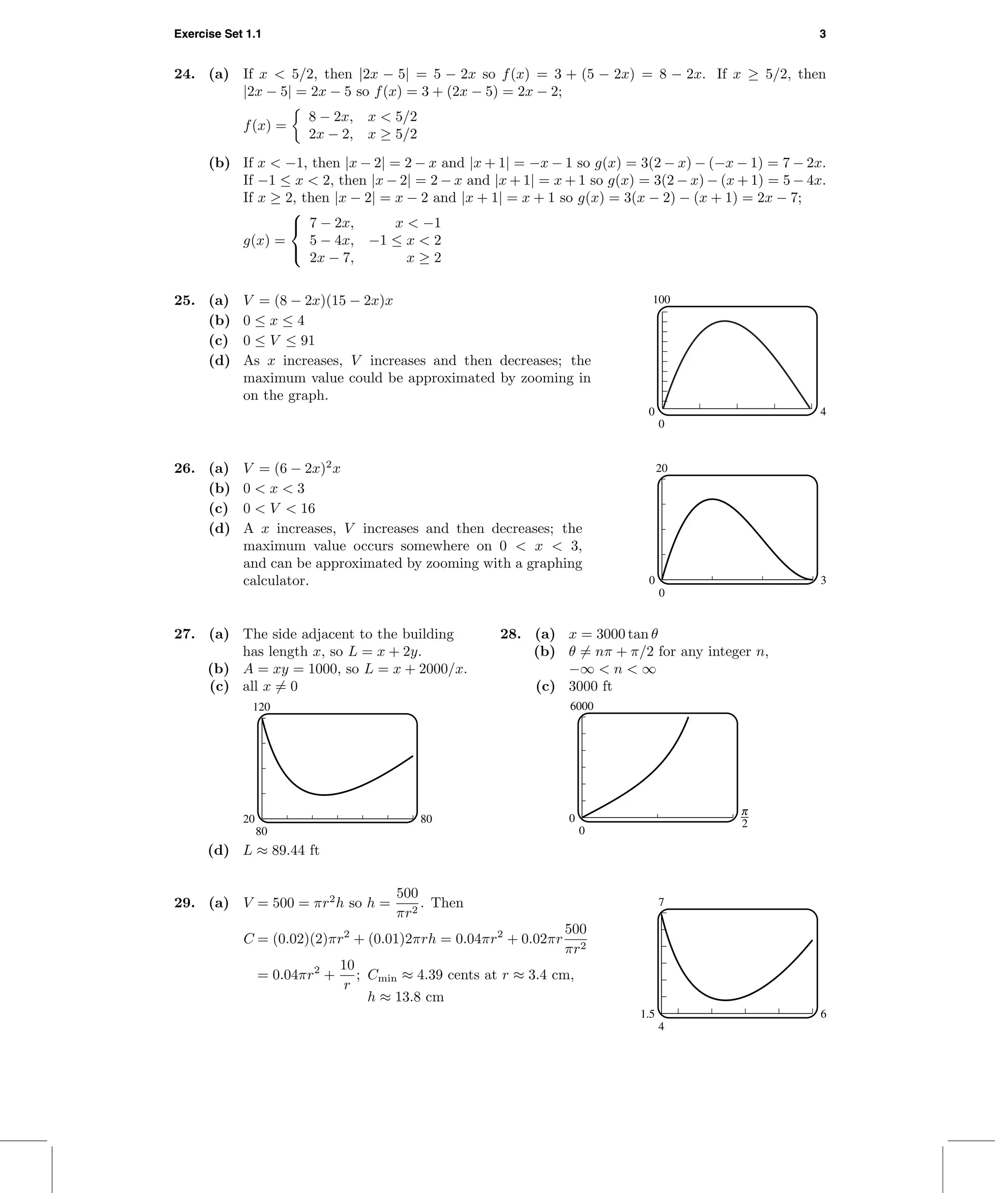

![Exercise Set 1.2 5
4. (b) and (c) are good;
(a) is very bad.
–14
–13
–12
–11
y
–2 –1 0 1 2
x
5. [−3, 3] × [0, 5]
2
y
x
6. [−4, 2] × [0, 3]
–2
y
x
7. (a) window too narrow, too short
(b) window wide enough, but too short
(c) good window, good spacing
–400
–200
y
–5 5 10 20
x
(d) window too narrow, too short
(e) window too narrow, too short
8. (a) window too narrow
(b) window too short
(c) good window, good tick spacing
–250
–100
50
y
–16 –8 –4 4
x
(d) window too narrow, too short
(e) shows one local minimum only,
window too narrow, too short
9. [−5, 14] × [−60, 40]
–60
20
40
y
–5 5 10
x
10. [6, 12] × [−100, 100]
–50
100
y
10 12
x
11. [−0.1, 0.1] × [−3, 3]
–2
2
3
y
–0.1
x
0.1
12. [−1000, 1000] × [−13, 13]
–5
5
10
y
–1000
x
1000
13. [−250, 1050] × [−1500000, 600000]
–500000
y
–1000 1000
x](https://image.slidesharecdn.com/gabaritocompletoantoncalculo8edcaps0108-130504215818-phpapp02/75/Gabarito-completo-anton_calculo_8ed_caps_01_08-5-2048.jpg)
![6 Chapter 1
14. [−3, 20] × [−3500, 3000]
–2000
–1000
1000
5 10 15
x
y
15. [−2, 2] × [−20, 20]
–20
–10
10
20
y
x
–2 –1 1 2
16. [1.6, 2] × [0, 2]
0.5
1
2
y
1.6 1.7 1.8 2
x
17. depends on graphing utility
–2
2
4
6
y
–4 2 4
x
18. depends on graphing utility
–2
2
4
6
y
–4 –2 2 4
x
19. (a) f(x) =
√
16 − x2
1
3
–2 2 4
x
y
(b) f(x) = −
√
16 − x2
–3
–1
x
y
–4 –2 2 4
(c)
–2
2
x
y
–2 2
(d)
1
4
1 4
y
x
(e) No; the vertical line
test fails.
20. (a) y = ±3 1 − x2/4
–3
3
–2 2
x
y
(b) y = ±
√
x2 + 1
–4
–2
2
4
–4 –2 2 4
x
y](https://image.slidesharecdn.com/gabaritocompletoantoncalculo8edcaps0108-130504215818-phpapp02/75/Gabarito-completo-anton_calculo_8ed_caps_01_08-6-2048.jpg)


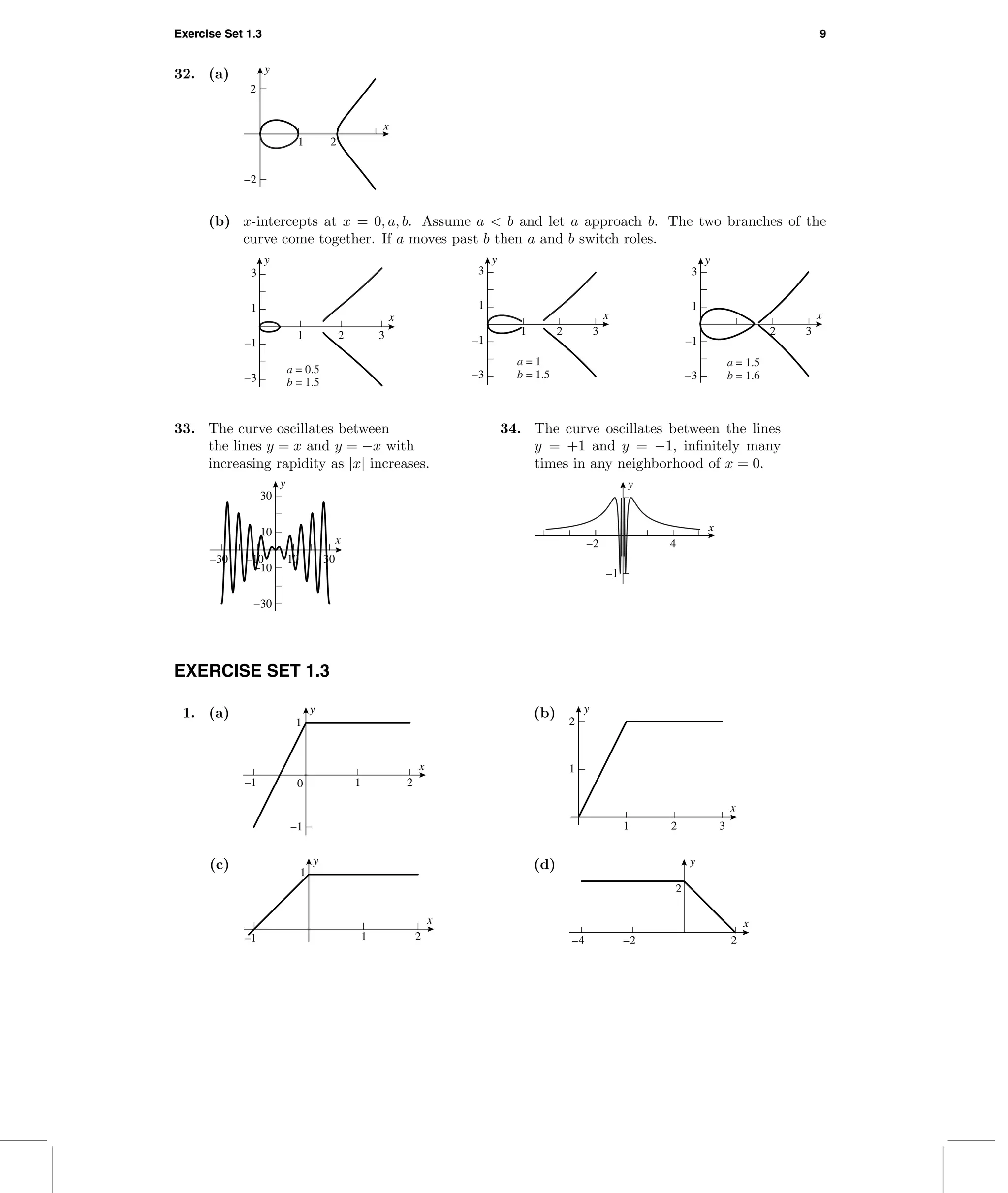
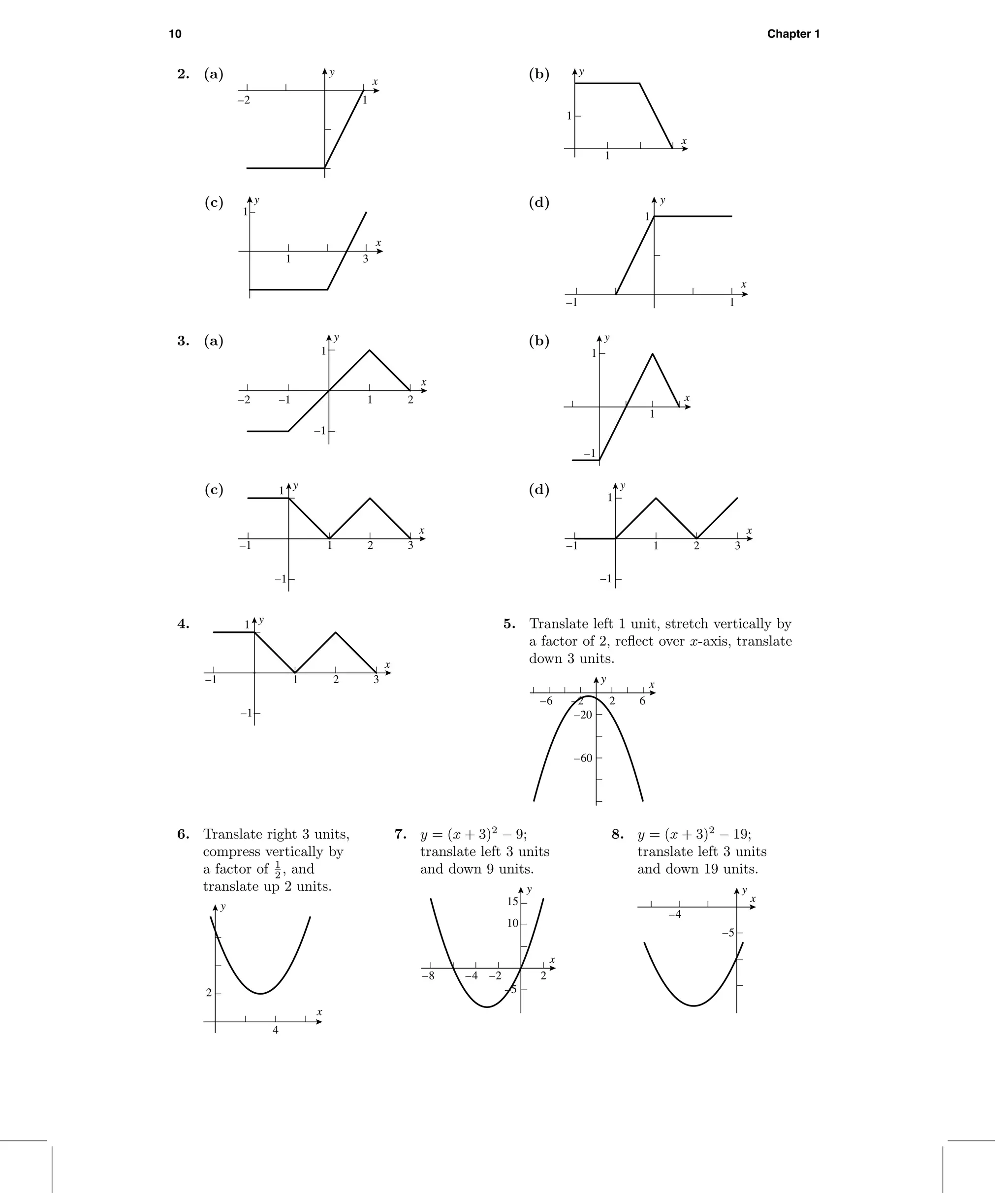
![Exercise Set 1.3 11
9. y = −(x − 1)2
+ 2;
translate right 1 unit,
reflect over x-axis,
translate up 2 units.
–6
–2
2
–2 –1 1 3
x
y
10. y = 1
2 [(x − 1)2
+ 2];
translate right 1 unit
and up 2 units,
compress vertically
by a factor of 1
2 .
y
x
1
2
1
11. Translate left 1 unit,
reflect over x-axis,
translate up 3 units.
1
2
2 8
x
y
12. Translate right 4 units
and up 1 unit.
y
x
1
4
4 10
13. Compress vertically
by a factor of 1
2 ,
translate up 1 unit.
2
y
1 2 3
x
14. Stretch vertically by
a factor of
√
3 and
reflect over x-axis.
y x
–1
2
15. Translate right 3 units.
–10
10
y
4 6
x
16. Translate right 1 unit
and reflect over x-axis.
y
x
–4
2
–2 4
17. Translate left 1 unit,
reflect over x-axis,
translate up 2 units.
–6
–2
6
y
–3 1 2
x
18. y = 1 − 1/x;
reflect over x-axis,
translate up 1 unit.
y
x
–5
5
2
19. Translate left 2 units
and down 2 units.
–2
–4 –2
x
y](https://image.slidesharecdn.com/gabaritocompletoantoncalculo8edcaps0108-130504215818-phpapp02/75/Gabarito-completo-anton_calculo_8ed_caps_01_08-11-2048.jpg)
![12 Chapter 1
20. Translate right 3 units, reflect
over x-axis, translate up 1 unit.
y
x
–1
1
5
21. Stretch vertically by a factor of 2,
translate right 1/2 unit and up 1 unit.
y
x
2
4
2
22. y = |x − 2|; translate right 2 units.
y
x
1
2
2 4
23. Stretch vertically by a factor of 2,
reflect over x-axis, translate up 1 unit.
–1
1
3
–2 2
x
y
24. Translate right 2 units
and down 3 units.
y x
–2
2
25. Translate left 1 unit
and up 2 units.
1
3
y
–3 –1 1
x
26. Translate right 2 units,
reflect over x-axis.
y
x
–1
1
4
27. (a) 2
y
–1 1
x
(b) y =
0 if x ≤ 0
2x if 0 < x
28. y
x
–5
2
29. (f + g)(x) = 3
√
x − 1, x ≥ 1; (f − g)(x) =
√
x − 1, x ≥ 1; (fg)(x) = 2x − 2, x ≥ 1;
(f/g)(x) = 2, x > 1
30. (f + g)(x) = (2x2
+ 1)/[x(x2
+ 1)], all x = 0; (f − g)(x) = −1/[x(x2
+ 1)], all x = 0; (fg)(x) =
1/(x2
+ 1), all x = 0; (f/g)(x) = x2
/(x2
+ 1), all x = 0
31. (a) 3 (b) 9 (c) 2 (d) 2
32. (a) π − 1 (b) 0 (c) −π2
+ 3π − 1 (d) 1](https://image.slidesharecdn.com/gabaritocompletoantoncalculo8edcaps0108-130504215818-phpapp02/75/Gabarito-completo-anton_calculo_8ed_caps_01_08-12-2048.jpg)

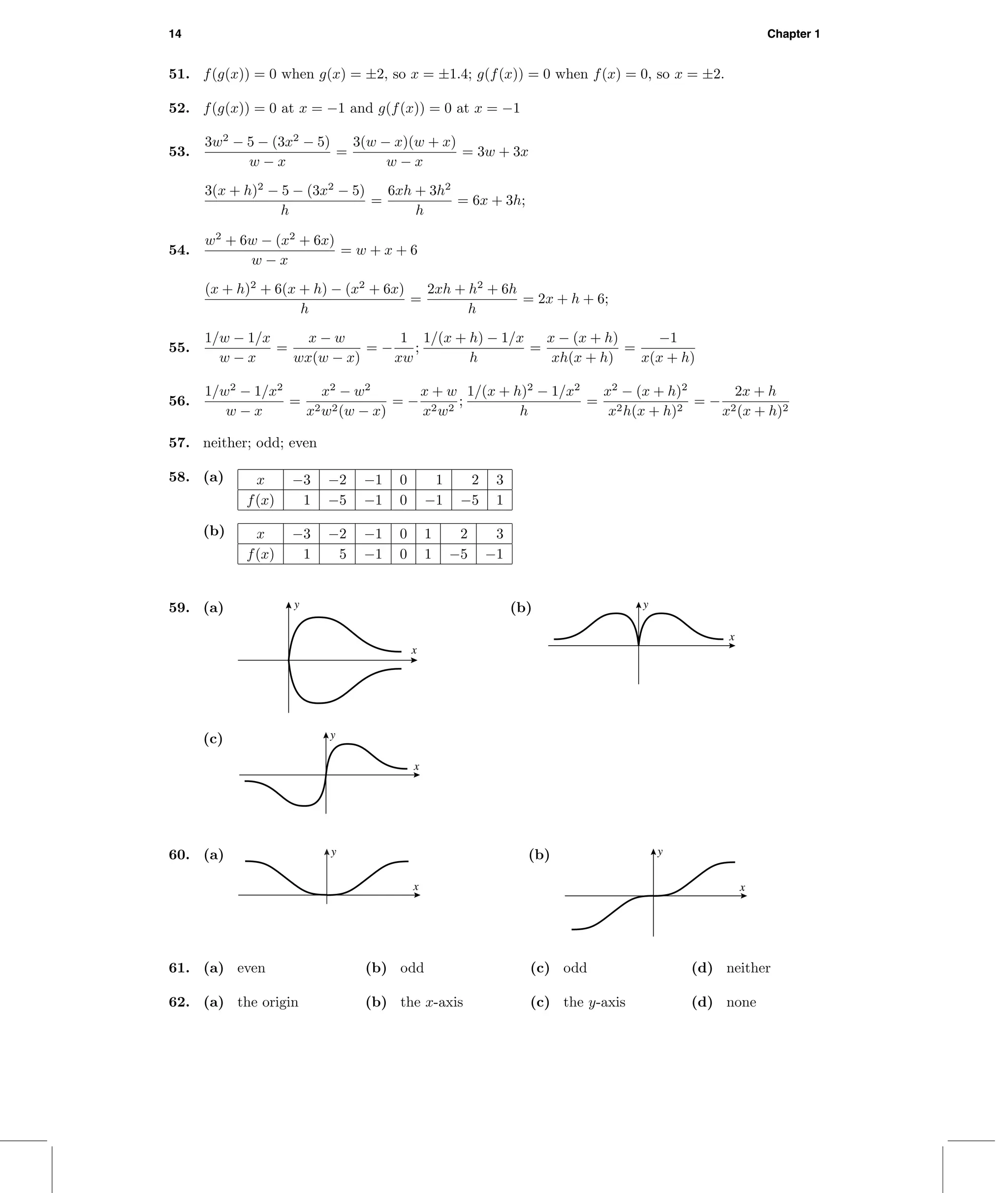


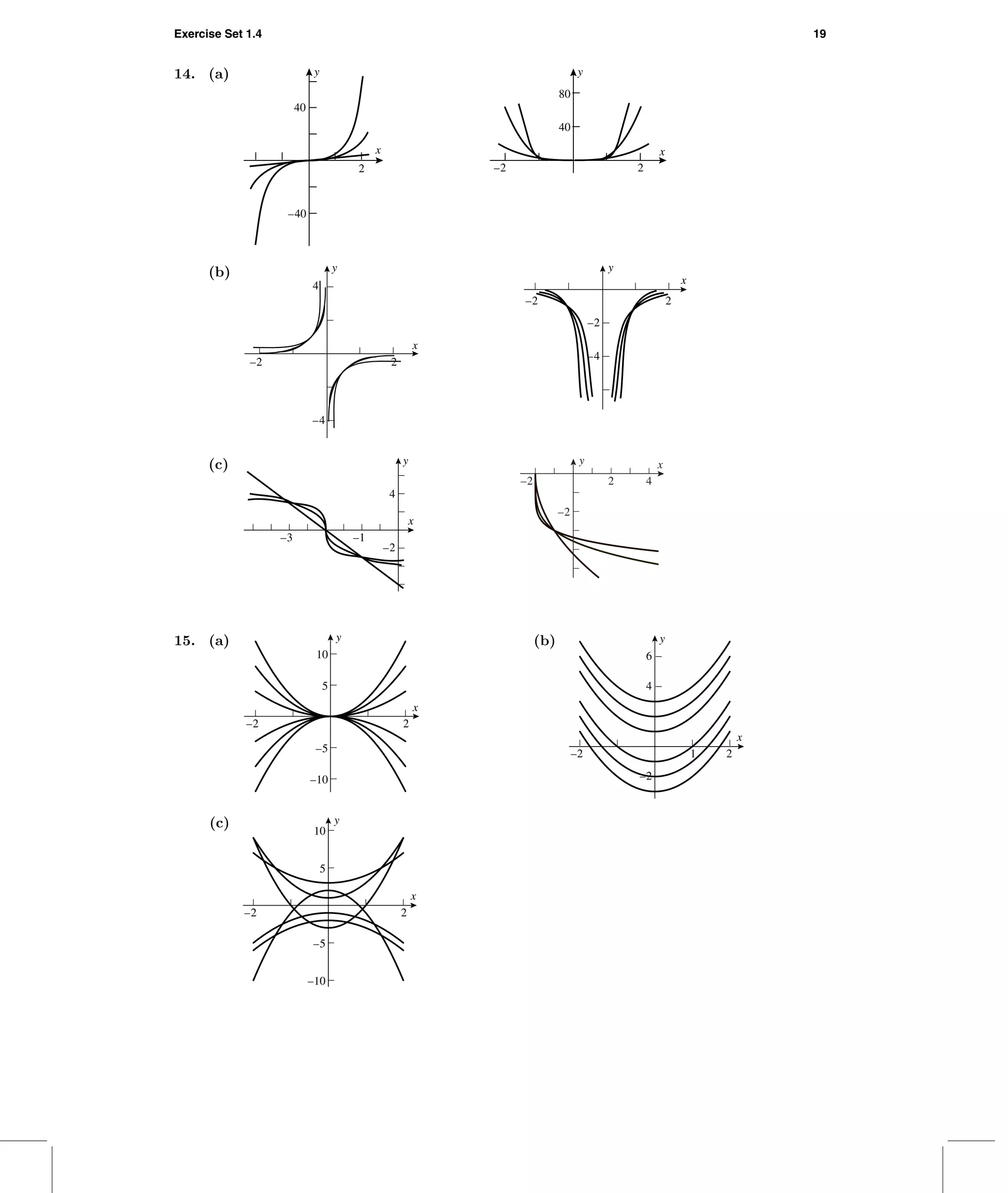
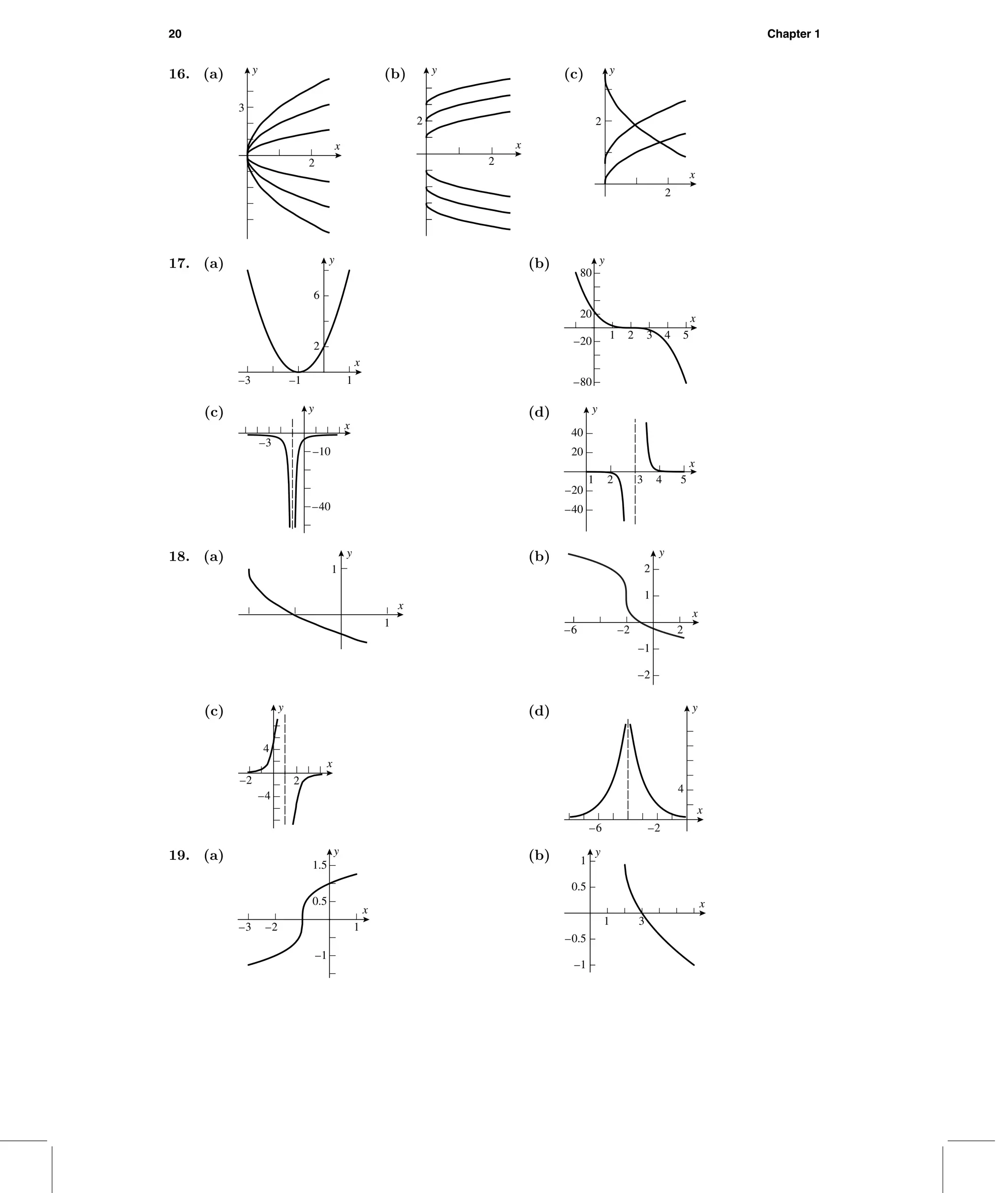


![24 Chapter 1
(c) They are inverse functions provided
the domain of g is restricted to [0, +∞)
5
0
0 5
(d) They are inverse functions provided
the domain of f(x) is restricted
to [0, +∞)
2
0
0 2
3. (a) yes (b) yes (c) no (d) yes (e) no (f) no
4. (a) no, the horizontal line test fails
6
–2
–3 3
(b) yes, by the horizontal line test
10
–10
–1 3
5. (a) yes; all outputs (the elements of row two) are distinct
(b) no; f(1) = f(6)
6. (a) Since the point (0, 0) lies on the graph, no other point on the line x = 0 can lie on the graph,
by the vertical line test. Thus the hour hand cannot point straight up or straight down. Thus
noon, midnight, 6AM and 6PM are impossible. To show other times are possible, suppose
(a, b) lies on the graph with a = 0. Then the function y = Ax1/3
passes through (0, 0) and
(a, b) provided A = b/a1/3
.
(b) same as (a)
(c) Then the minute hand cannot point to 6 or 12, so in addition to (a), times of the form 1:00,
1:30, 2:00, 2:30, , 12:30 are also impossible.
7. (a) f has an inverse because the graph passes the horizontal line test. To compute f−1
(2) start
at 2 on the y-axis and go to the curve and then down, so f−1
(2) = 8; similarly, f−1
(−1) = −1
and f−1
(0) = 0.
(b) domain of f−1
is [−2, 2], range is [−8, 8] (c)
–2 1 2
–8
–4
4
8
y
x
8. (a) the horizontal line test fails
(b) −3 < x ≤ −1; −1 ≤ x ≤ 2; and 2 ≤ x < 4.
9. y = f−1
(x), x = f(y) = 7y − 6, y =
1
7
(x + 6) = f−1
(x)](https://image.slidesharecdn.com/gabaritocompletoantoncalculo8edcaps0108-130504215818-phpapp02/75/Gabarito-completo-anton_calculo_8ed_caps_01_08-24-2048.jpg)

![26 Chapter 1
27. (a) f(f(x)) =
3 −
3 − x
1 − x
1 −
3 − x
1 − x
=
3 − 3x − 3 + x
1 − x − 3 + x
= x so f = f−1
(b) symmetric about the line y = x
28. y = f−1
(x), x = f(y) = ay2
+ by + c, ay2
+ by + c − x = 0, use the quadratic formula to get
y =
−b ± b2 − 4a(c − x)
2a
;
(a) f−1
(x) =
−b + b2 − 4a(c − x)
2a
(b) f−1
(x) =
−b − b2 − 4a(c − x)
2a
29. if f−1
(x) = 1, then x = f(1) = 2(1)3
+ 5(1) + 3 = 10
30. if f−1
(x) = 2, then x = f(2) = (2)3
/[(2)2
+ 1] = 8/5
31. f(f(x)) = x thus f = f−1
so the graph is symmetric about y = x.
32. (a) Suppose x1 = x2 where x1 and x2 are in the domain of g and g(x1), g(x2) are in the domain of
f then g(x1) = g(x2) because g is one-to-one so f(g(x1)) = f(g(x2)) because f is one-to-one
thus f ◦ g is one-to-one because (f ◦ g)(x1) = (f ◦ g)(x2) if x1 = x2.
(b) f, g, and f ◦ g all have inverses because they are all one-to-one. Let h = (f ◦ g)−1
then
(f ◦ g)(h(x)) = f[g(h(x))] = x, apply f−1
to both sides to get g(h(x)) = f−1
(x), then apply
g−1
to get h(x) = g−1
(f−1
(x)) = (g−1
◦ f−1
)(x), so h = g−1
◦ f−1
.
33.
x
y
34. Suppose that g and h are both inverses of f then f(g(x)) = x, h[f(g(x))] = h(x), but
h[f(g(x))] = g(x) because h is an inverse of f so g(x) = h(x).
3
45
35. tan θ = 4/3, 0 < θ < π/2; use the triangle shown to
get sin θ = 4/5, cos θ = 3/5, cot θ = 3/4, sec θ = 5/3,
csc θ = 5/4
2.6
1
2.4
36. sec θ = 2.6, 0 < θ < π/2; use the triangle shown to get
sin θ = 2.4/2.6 = 12/13, cos θ = 1/2.6 = 5/13,
tan θ = 2.4 = 12/5, cot θ = 5/12, csc θ = 13/12
37. (a) 0 ≤ x ≤ π (b) −1 ≤ x ≤ 1
(c) −π/2 < x < π/2 (d) −∞ < x < +∞](https://image.slidesharecdn.com/gabaritocompletoantoncalculo8edcaps0108-130504215818-phpapp02/75/Gabarito-completo-anton_calculo_8ed_caps_01_08-26-2048.jpg)
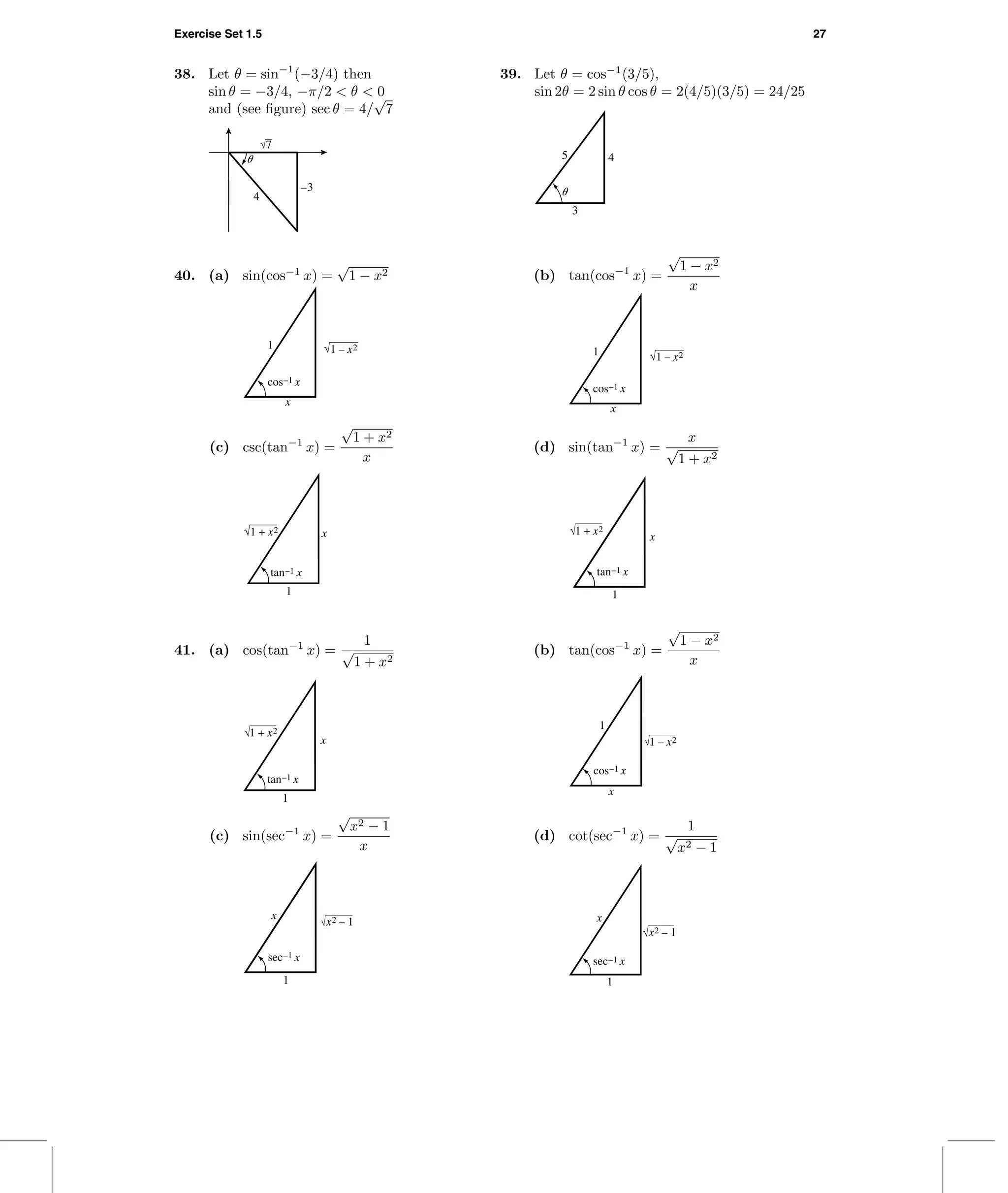
![28 Chapter 1
42. (a) x −1.00 −0.80 −0.6 −0.40 −0.20 0.00 0.20 0.40 0.60 0.80 1.00
sin−1
x −1.57 −0.93 −0.64 −0.41 −0.20 0.00 0.20 0.41 0.64 0.93 1.57
cos−1
x 3.14 2.50 2.21 1.98 1.77 1.57 1.37 1.16 0.93 0.64 0.00
(b) y
x
1
1
(c) y
x
–1
1
2
3
0.5 1
43. (a)
–0.5 0.5
x
y
c/2–
c/2
(b)
x
y
c/2–
c/2
44. (a) x = π − sin−1
(0.37) ≈ 2.7626 rad (b) θ = 180◦
+ sin−1
(0.61) ≈ 217.6◦
45. (a) x = π + cos−1
(0.85) ≈ 3.6964 rad (b) θ = − cos−1
(0.23) ≈ −76.7◦
46. (a) x = tan−1
(3.16) − π ≈ −1.8773 (b) θ = 180◦
− tan−1
(0.45) ≈ 155.8◦
47. (a) sin−1
0.9 > 1, so it is not in the domain of sin−1
x
(b) −1 ≤ sin−1
x ≤ 1 is necessary, or −0.841471 ≤ x ≤ 0.841471
48. sin 2θ = gR/v2
= (9.8)(18)/(14)2
= 0.9, 2θ = sin−1
(0.9) or 2θ = 180◦
− sin−1
(0.9) so
θ = 1
2 sin−1
(0.9) ≈ 32◦
or θ = 90◦
− 1
2 sin−1
(0.9) ≈ 58◦
. The ball will have a lower
parabolic trajectory for θ = 32◦
and hence will result in the shorter time of flight.
49. (a) y
x
–10 10
c/2
c
y
x
c/2
5
(b) The domain of cot−1
x is (−∞, +∞), the range is (0, π); the domain of csc−1
x is (−∞, −1]∪
[1, +∞), the range is [−π/2, 0) ∪ (0, π/2].
50. (a) y = cot−1
x; if x > 0 then 0 < y < π/2 and x = cot y, tan y = 1/x, y = tan−1
(1/x);
if x < 0 then π/2 < y < π and x = cot y = cot(y − π), tan(y − π) = 1/x, y = π + tan−1 1
x
(b) y = sec−1
x, x = sec y, cos y = 1/x, y = cos−1
(1/x)
(c) y = csc−1
x, x = csc y, sin y = 1/x, y = sin−1
(1/x)
51. (a) 55.0◦
(b) 33.6◦
(c) 25.8◦
52. (b) θ = sin−1 R
R + h
= sin−1 6378
16, 378
≈ 23◦](https://image.slidesharecdn.com/gabaritocompletoantoncalculo8edcaps0108-130504215818-phpapp02/75/Gabarito-completo-anton_calculo_8ed_caps_01_08-28-2048.jpg)


![Exercise Set 1.6 31
29. e3x
= 7/2, 3x = ln(7/2), x =
1
3
ln(7/2)
30. ex
(1 − 2x) = 0 so ex
= 0 (impossible) or 1 − 2x = 0, x = 1/2
31. e−x
(x + 2) = 0 so e−x
= 0 (impossible) or x + 2 = 0, x = −2
32. e2x
− ex
− 6 = (ex
− 3)(ex
+ 2) = 0 so ex
= −2 (impossible) or ex
= 3, x = ln 3
33. e−2x
− 3e−x
+ 2 = (e−x
− 2)(e−x
− 1) = 0 so e−x
= 2, x = − ln 2 or e−x
= 1, x = 0
34. (a) y
x
–2
2
2 6
(b) y
x
2
–2 2
35. (a) y
x
2
4
6
–2 4
(b) y
x
–4
2
–4 2
36. (a) y
x
–10
–1
(b) y
x
–1
3
37. log2 7.35 = (log 7.35)/(log 2) = (ln 7.35)/(ln 2) ≈ 2.8777;
log5 0.6 = (log 0.6)/(log 5) = (ln 0.6)/(ln 5) ≈ −0.3174
38. 10
–5
0 2
39. 2
–3
0 3
40. (a) Let X = logb x and Y = loga x. Then bX
= x and aY
= x so aY
= bX
, or aY/X
= b, which
means loga b = Y/X. Substituting for Y and X yields
loga x
logb x
= loga b, logb x =
loga x
loga b
.
(b) Let x = a to get logb a = (loga a)/(loga b) = 1/(loga b) so (loga b)(logb a) = 1.
(log2 81)(log3 32) = (log2[34
])(log3[25
]) = (4 log2 3)(5 log3 2) = 20(log2 3)(log3 2) = 20](https://image.slidesharecdn.com/gabaritocompletoantoncalculo8edcaps0108-130504215818-phpapp02/75/Gabarito-completo-anton_calculo_8ed_caps_01_08-31-2048.jpg)

![Exercise Set 1.7 33
49. (a) 7.4; basic (b) 4.2; acidic (c) 6.4; acidic (d) 5.9; acidic
50. (a) log[H+
] = −2.44, [H+
] = 10−2.44
≈ 3.6 × 10⁻³
mol/L
(b) log[H+
] = −8.06, [H+
] = 10−8.06
≈ 8.7 × 10⁻⁹
mol/L
51. (a) 140 dB; damage (b) 120 dB; damage
(c) 80 dB; no damage (d) 75 dB; no damage
52. Suppose that I1 = 3I2 and β1 = 10 log10 I1/I0, β2 = 10 log10 I2/I0. Then
I1/I0 = 3I2/I0, log10 I1/I0 = log10 3I2/I0 = log10 3 + log10 I2/I0, β1 = 10 log10 3 + β2,
β1 − β2 = 10 log10 3 ≈ 4.8 decibels.
53. Let IA and IB be the intensities of the automobile and blender, respectively. Then
log10 IA/I0 = 7 and log10 IB/I0 = 9.3, IA = 107
I0 and IB = 109.3
I0, so IB/IA = 102.3
≈ 200.
54. The decibel level of the nth echo is 120(2/3)n
;
120(2/3)n
< 10 if (2/3)n
< 1/12, n <
log(1/12)
log(2/3)
=
log 12
log 1.5
≈ 6.13 so 6 echoes can be heard.
55. (a) log E = 4.4 + 1.5(8.2) = 16.7, E = 1016.7
≈ 5 × 10¹⁶
J
(b) Let M1 and M2 be the magnitudes of earthquakes with energies of E and 10E,
respectively. Then 1.5(M2 − M1) = log(10E) − log E = log 10 = 1,
M2 − M1 = 1/1.5 = 2/3 ≈ 0.67.
56. Let E1 and E2 be the energies of earthquakes with magnitudes M and M + 1, respectively. Then
log E2 − log E1 = log(E2/E1) = 1.5, E2/E1 = 101.5
≈ 31.6.
EXERCISE SET 1.7
1. The sum of the squares for the residuals for line I is approximately
12
+ 12
+ 12
+ 02
+ 22
+ 12
+ 12
+ 12
= 10, and the same for line II is approximately
02
+ (0.4)2
+ (1.2)2
+ 02
+ (2.2)2
+ (0.6)2
+ (0.2)2
+ 02
= 6.84; line II is the regression line.
2. (a) The data appear to be periodic, so a trigonometric model may be appropriate.
(b) The data appear to lie near a parabola, so a quadratic model may be appropriate.
(c) The data appear to lie near a line, so a linear model may be appropriate.
(d) The data appear to be randomly distributed, so no model seems to be appropriate.
3. Least squares line S = 0.6414t − 1054.517, correlation coefficient 0.5754
1989 1992 1995 1998 2001 2004
220
230
240
t
S
4. (a) p = 0.0154T + 4.19 (b) 3.42 atm
5. (a) Least squares line p = 0.0146T + 3.98, correlation coefficient 0.9999
(b) p = 3.25 atm (c) T = −272◦
C](https://image.slidesharecdn.com/gabaritocompletoantoncalculo8edcaps0108-130504215818-phpapp02/75/Gabarito-completo-anton_calculo_8ed_caps_01_08-33-2048.jpg)

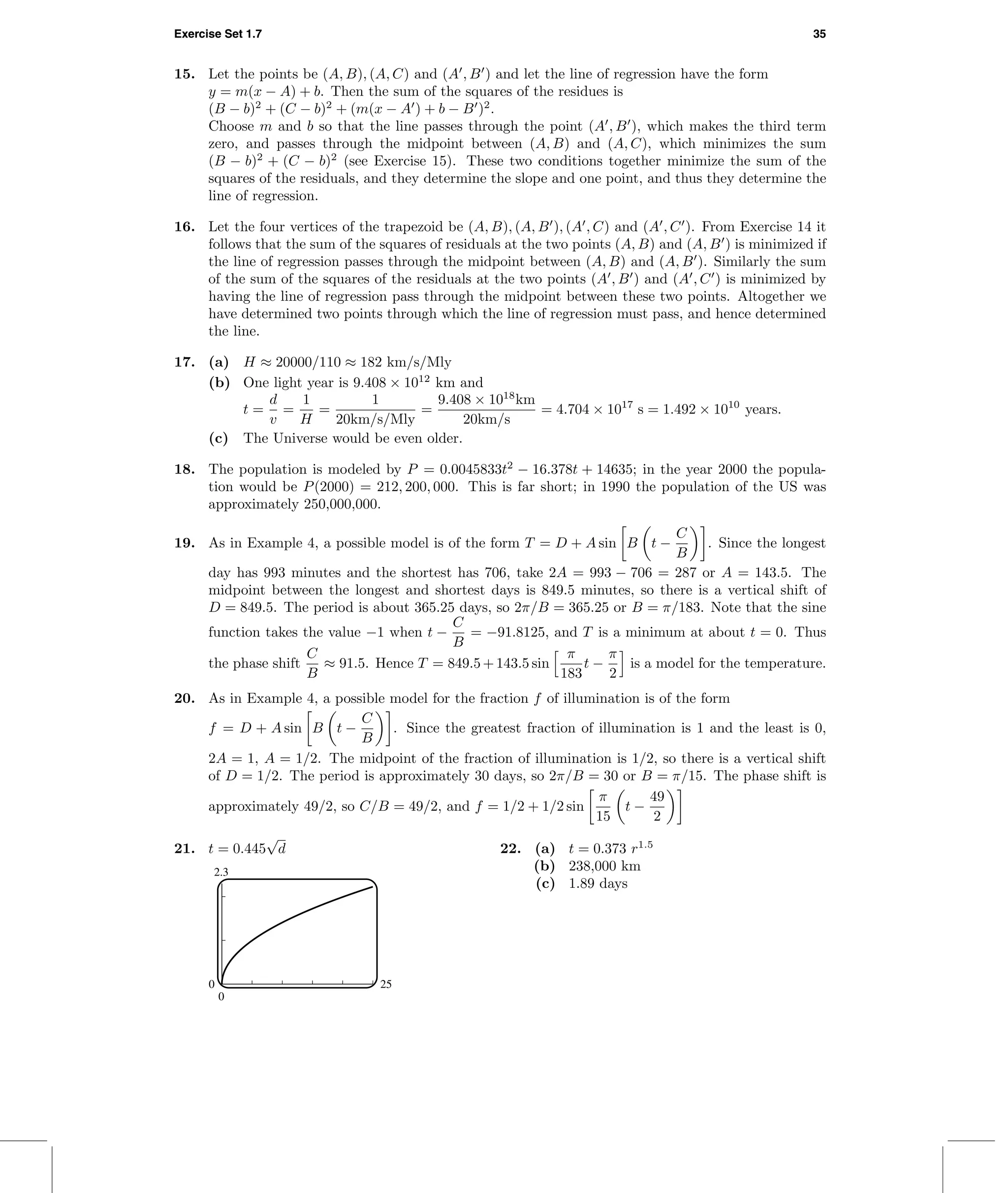


![38 Chapter 1
20. (a) 5
0
–2 14
(b) y is always ≥ 1 since cos t ≤ 1
(c) greater than 5, since cos t ≥ −1
21. (a) 3
–5
0 20
(b) o
O
–1 1
22. (a) 1.7
–1.7
–2.3 2.3
(b)
–10 10
^
6
23. (a) Eliminate t to get
x − x0
x1 − x0
=
y − y0
y1 − y0
(b) Set t = 0 to get (x0, y0); t = 1 for (x1, y1).
(c) x = 1 + t, y = −2 + 6t (d) x = 2 − t, y = 4 − 6t
24. (a) x = −3 − 2t, y = −4 + 5t, 0 ≤ t ≤ 1 (b) x = at, y = b(1 − t), 0 ≤ t ≤ 1
25. (a) |R−P|2
= (x−x0)2
+(y−y0)2
= t2
[(x1−x0)2
+(y1−y0)2
] and |Q−P|2
= (x1−x0)2
+(y1−y0)2
,
so r = |R − P| = |Q − P|t = qt.
(b) t = 1/2 (c) t = 3/4
26. x = 2 + t, y = −1 + 2t
(a) (5/2, 0) (b) (9/4, −1/2) (c) (11/4, 1/2)
27. (a) IV, because x always increases whereas y oscillates.
(b) II, because (x/2)2
+ (y/3)2
= 1, an ellipse.
(c) V, because x2
+ y2
= t2
increases in magnitude while x and y keep changing sign.
(d) VI; examine the cases t < −1 and t > −1 and you see the curve lies in the first, second and
fourth quadrants only.
(e) III because y > 0.
(f) I; since x and y are bounded, the answer must be I or II; but as t runs, say, from 0 to π, x
goes directly from 2 to −2, but y goes from 0 to 1 to 0 to −1 and back to 0, which describes
I but not II.](https://image.slidesharecdn.com/gabaritocompletoantoncalculo8edcaps0108-130504215818-phpapp02/75/Gabarito-completo-anton_calculo_8ed_caps_01_08-38-2048.jpg)

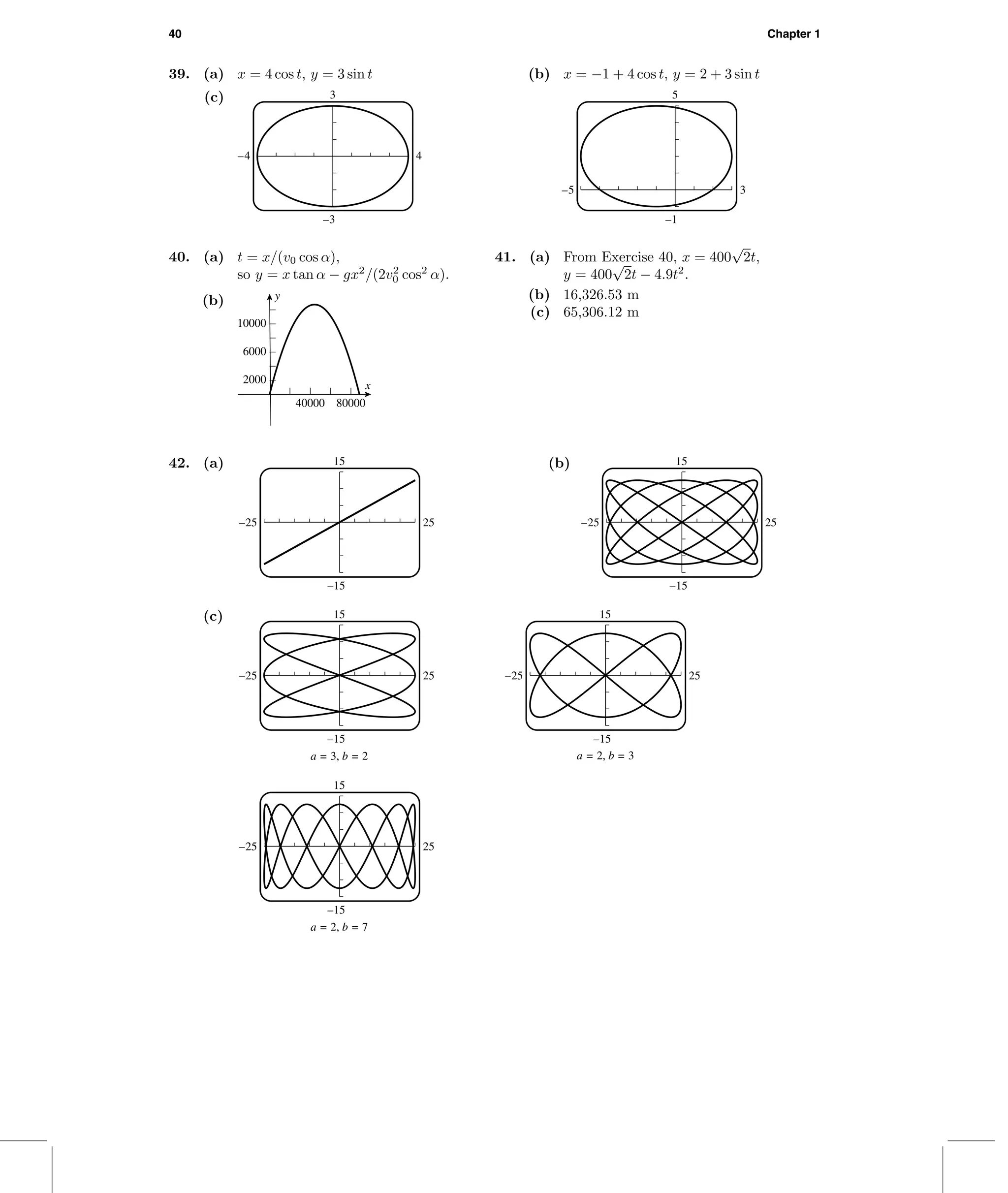

![42 Chapter 1
REVIEW EXERCISES CHAPTER 1
1. y
x
–1
5
–5 5
2. (a) f(−2) = 2, g(3) = 2 (b) x = −3, 3 (c) x < −2, x > 3
(d) the domain is −5 ≤ x ≤ 5 and the range is −5 ≤ y ≤ 4
(e) the domain is −4 ≤ x ≤ 4.1, the range is −3 ≤ y ≤ 5
(f) f(x) = 0 at x = −3, 5; g(x) = 0 at x = −3, 2
3.
40
50
70
0 2 4 6
t
T
4. Assume that the paint is applied in a thin veneer of uniform thickness, so that the quantity of paint
to be used is proportional to the area covered. If P is the amount of paint to be used, P = kπr2
.
The constant k depends on physical factors, such as the thickness of the paint, absorption of the
wood, etc.
5. (a) If the side has length x and height h, then V = 8 = x2
h, so h = 8/x2
. Then the cost
C = 5x2
+ 2(4)(xh) = 5x2
+ 64/x.
(b) The domain of C is (0, +∞) because x can be very large (just take h very small).
6. (a) Suppose the radius of the uncoated ball is r and that of the coated ball is r + h. Then the
plastic has volume equal to the difference of the volumes, i.e.
V = 4
3 π(r+h)3
− 4
3 πr3
= 4
3 πh[3r2
+3rh+h2
] in3
. But r = 3 and hence V = 4
3 πh[27+9h+h2
].
(b) 0 < h < ∞
7. (a) The base has sides (10 − 2x)/2 and 6 − 2x, and the height is x, so V = (6 − 2x)(5 − x)x ft3
.
(b) From the picture we see that x < 5 and 2x < 6, so 0 < x < 3.
(c) 3.57 ft ×3.79 ft ×1.21 ft
8. (a) d = (x − 1)2 + 1/x2;
(b) −∞ < x < 0, 0 < x < +∞
(c) d ≈ 0.82 at x ≈ 1.38
0.8
1
1.2
1.6
2
0.5 1 2 3
y
x
9.
–2
1
y
–2 1 2
x](https://image.slidesharecdn.com/gabaritocompletoantoncalculo8edcaps0108-130504215818-phpapp02/75/Gabarito-completo-anton_calculo_8ed_caps_01_08-42-2048.jpg)
![Review Exercises Chapter 1 43
10. (a) On the interval [−20, 30]
the curve seems tame,
–10 20 30
200000
300000
x
y
(b) but seen close up on the interval
[−1/1000, +1/1000] we see that there
is some wiggling near the origin.
–0.0005 0.001
x
y
–0.00002
–0.00001
11. x −4 −3 −2 −1 0 1 2 3 4
f(x) 0 −1 2 1 3 −2 −3 4 −4
g(x) 3 2 1 −3 −1 −4 4 −2 0
(f ◦ g)(x) 4 −3 −2 −1 1 0 −4 2 3
(g ◦ f)(x) −1 −3 4 −4 −2 1 2 0 3
12. f ◦ g(x) = −1/|x| with domain x = 0, and g ◦ f(x) is nowhere defined, with domain ∅.
13. f(g(x)) = (3x+2)2
+1, g(f(x)) = 3(x2
+1)+2, so 9x2
+12x+5 = 3x2
+5, 6x2
+12x = 0, x = 0, −2
14. (a) (3 − x)/x
(b) no; the definition of f(g(x)) requires g(x) to be defined, so x = 1, and f(g(x)) requires
g(x) = −1, so we must have g(x) = −1, i.e. x = 0; whereas h(x) only requires x = 0
15. When f(g(h(x))) is defined, we require g(h(x)) = 1 and h(x) = 0. The first requirement is
equivalent to x = ±1, the second is equivalent to x = ± (2). For all other x, f · g · h = 1/(2 − x2
).
16. g(x) = x2
+ 2x
17. (a) even × odd = odd (b) a square is even
(c) even + odd is neither (d) odd × odd = even
18. (a) y = |x − 1|, y = |(−x) − 1| = |x + 1|,
y = 2|x + 1|, y = 2|x + 1| − 3,
y = −2|x + 1| + 3
(b) y
x
–1
3
–3 –1 2
19. (a) The circle of radius 1 centered at (a, a2
); therefore, the family of all circles of radius 1 with
centers on the parabola y = x2
.
(b) All parabolas which open up, have latus rectum equal to 1 and vertex on the line y = x/2.](https://image.slidesharecdn.com/gabaritocompletoantoncalculo8edcaps0108-130504215818-phpapp02/75/Gabarito-completo-anton_calculo_8ed_caps_01_08-43-2048.jpg)

![Review Exercises Chapter 1 45
(b) y
x
–1
1
c/2
y = sin–1 x
y = sin x
y
x
–1
c
y = cos–1 x
y = cos x
y
x
–2
2
c/2–c/2
y = tan–1 x
y = tanx
y
x
–1
2
c/2
y = sec–1 x y = sec x
y = sec–1 x
y = sec x
27. (a) x = f(y) = 8y3
− 1; y = f−1
(x) =
x + 1
8
1/3
=
1
2
(x + 1)1/3
(b) f(x) = (x − 1)2
; f does not have an inverse because f is not one-to-one, for example
f(0) = f(2) = 1.
(c) x = f(y) = (ey
)2
+ 1; y = f−1
(x) = ln
√
x − 1 = 1
2 ln(x − 1)
(d) x = f(y) =
y + 2
y − 1
; y = f−1
(x) =
x + 2
x − 1
(e) x = f(y) = sin
1 − 2y
y
; y =
1
2 + sin−1
x
(f) x =
1
1 + 3 tan−1
y
; y = tan
1 − x
3x
28. It is necessary and sufficient that the graph of f pass the horizontal line test. Suppose to the con-
trary that
ah + b
ch + d
=
ak + b
ck + d
for h = k. Then achk+bck+adh+bd = achk+adk+bch+bd, bc(h−k) =
ad(h − k). It follows from h = k that ad − bc = 0. These steps are reversible, hence f−1
exists if
and only if ad − bc = 0, and if so, then
x =
ay + b
cy + d
, xcy + xd = ay + b, y(cx − a) = b − xd, y =
b − xd
cx − a
= f−1
(x)
29. Draw equilateral triangles of sides 5, 12, 13, and 3, 4, 5. Then sin[cos−1
(4/5)] = 3/5,
sin[cos−1
(5/13)] = 12/13, cos[sin−1
(4/5)] = 3/5, cos[sin−1
(5/13)] = 12/13
(a) cos[cos−1
(4/5) + sin−1
(5/13)] = cos(cos−1
(4/5)) cos(sin−1
(5/13))
− sin(cos−1
(4/5)) sin(sin−1
(5/13))
=
4
5
12
13
−
3
5
5
13
=
33
65
.
(b) sin[sin−1
(4/5) + cos−1
(5/13)] = sin(sin−1
(4/5)) cos(cos−1
(5/13))
+ cos(sin−1
(4/5)) sin(cos−1
(5/13))
=
4
5
5
13
+
3
5
12
13
=
56
65
.](https://image.slidesharecdn.com/gabaritocompletoantoncalculo8edcaps0108-130504215818-phpapp02/75/Gabarito-completo-anton_calculo_8ed_caps_01_08-45-2048.jpg)

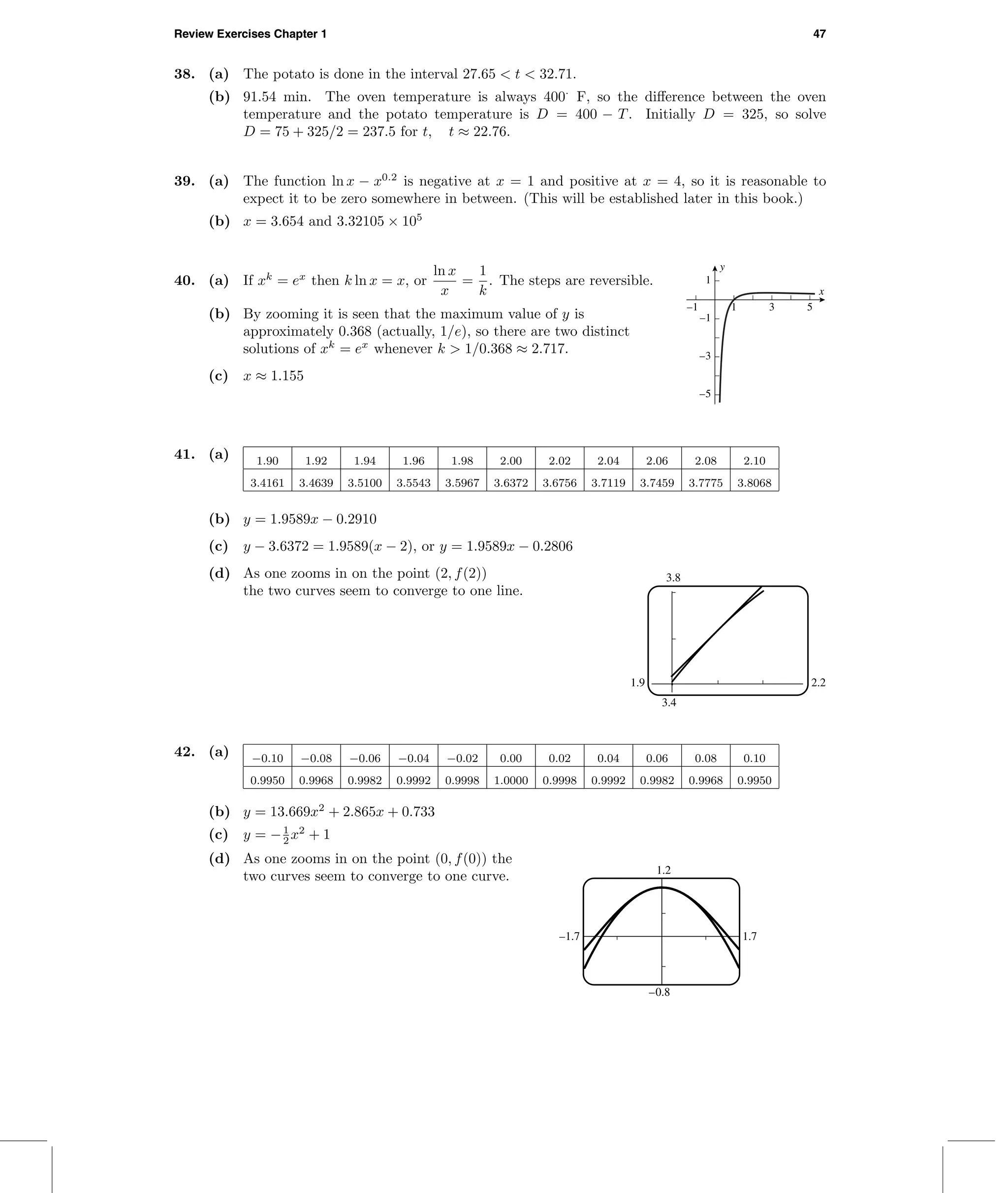
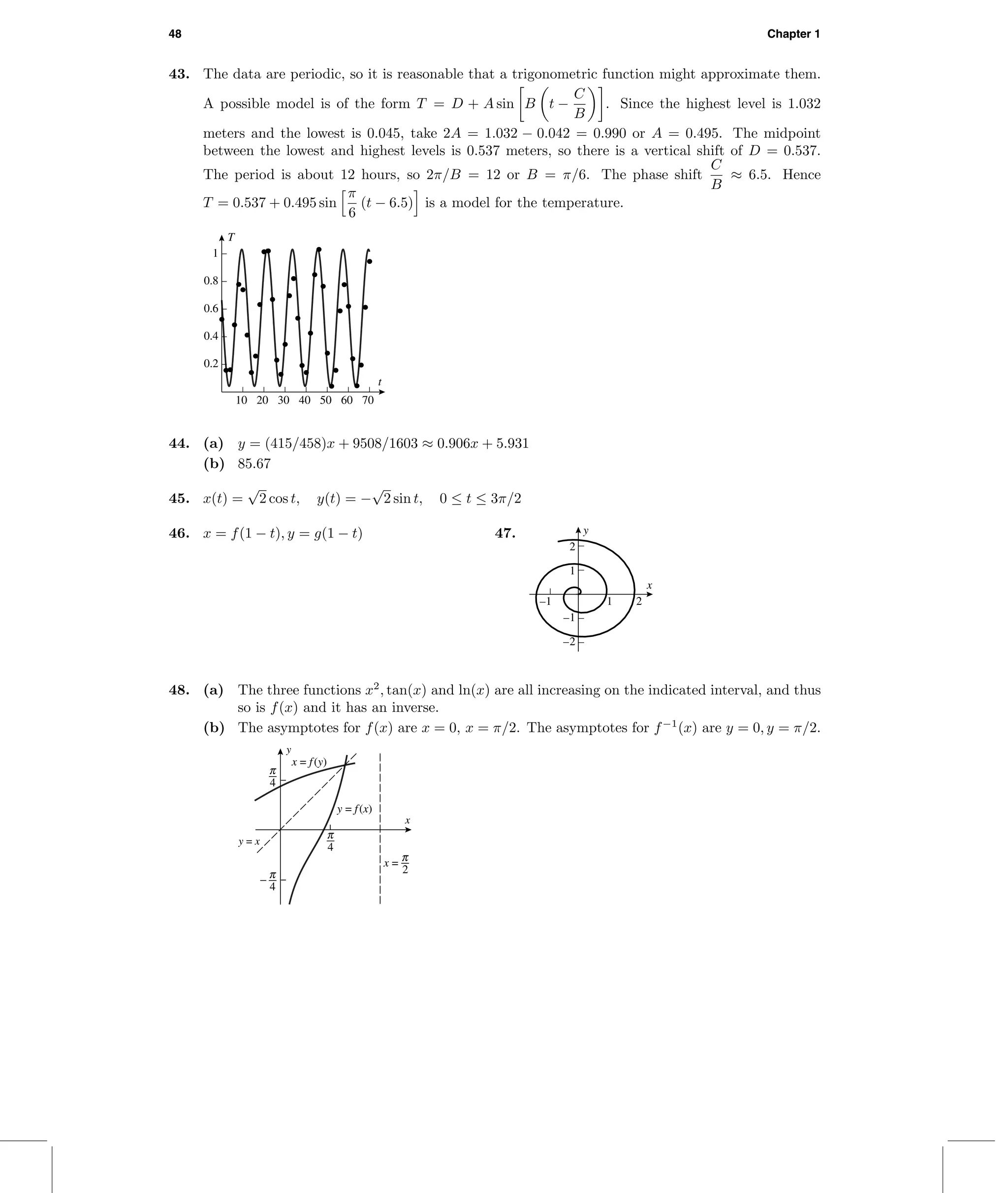


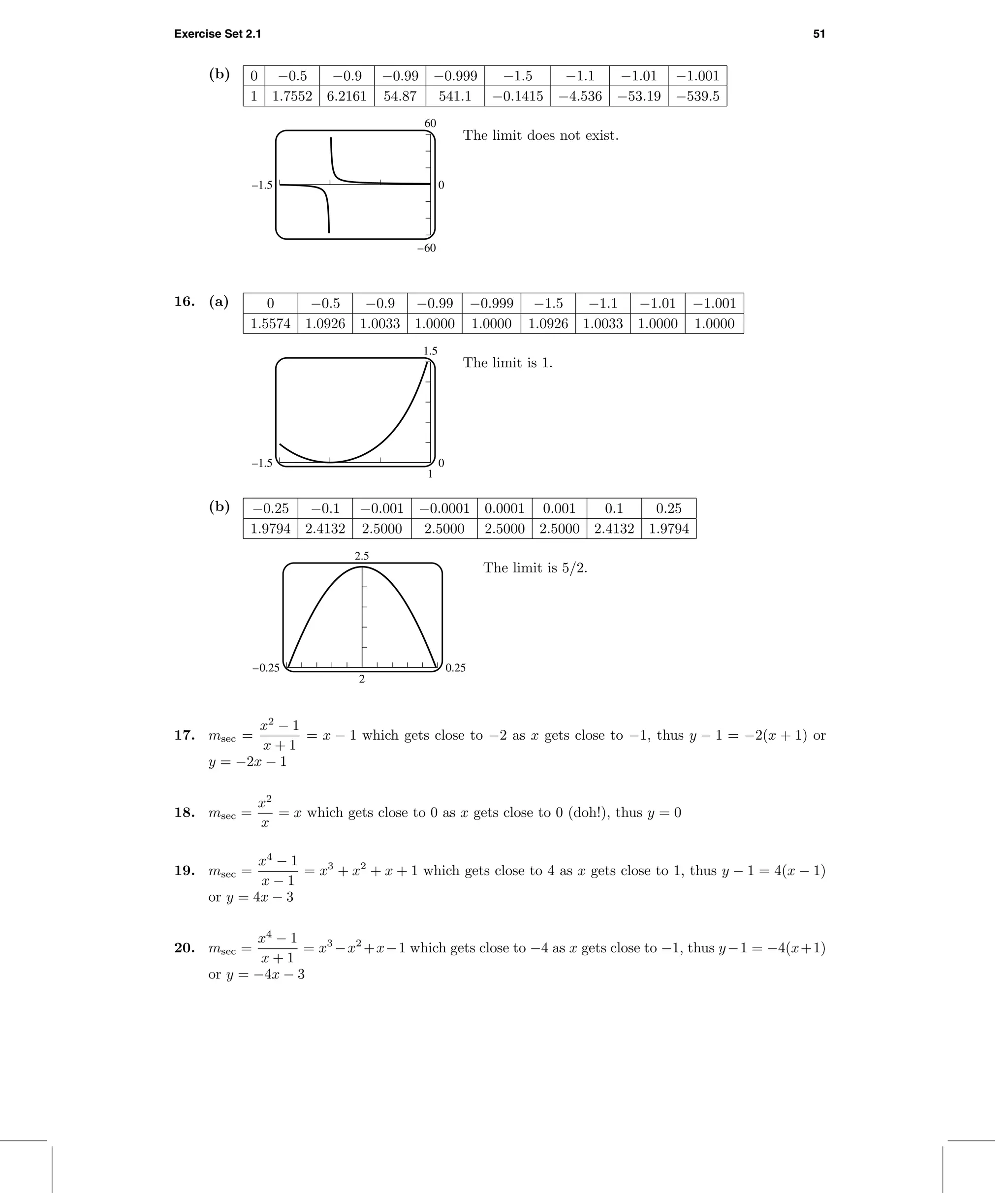
![52 Chapter 2
21. (a) The limit appears to be 3.
3.5
2.5
–1 1
(b) The limit appears to be 3.
3.5
2.5
–0.001 0.001
(c) The limit does not exist.
3.5
2.5
–0.000001 0.000001
22. (a) 0.01 0.001 0.0001 0.00001
1.666 0.1667 0.1667 0.17
(b) 0.000001 0.0000001 0.00000001 0.000000001 0.0000000001
0 0 0 0 0
(c) it can be misleading
23. (a) The plot over the interval [−a, a] becomes subject to catastrophic subtraction if a is small
enough (the size depending on the machine).
(c) It does not.
24. (a) the mass of the object while at rest
(b) the limiting mass as the velocity approaches the speed of light; the mass is unbounded
25. (a) The length of the rod while at rest
(b) The limit is zero. The length of the rod approaches zero
EXERCISE SET 2.2
1. (a) −6 (b) 13 (c) −8 (d) 16 (e) 2 (f) −1/2
(g) The limit doesn’t exist because the denominator tends to zero but the numerator doesn’t.
(h) The limit doesn’t exist because the denominator tends to zero but the numerator doesn’t.
2. (a) 0
(b) The limit doesn’t exist because lim f doesn’t exist and lim g does.
(c) 0 (d) 3 (e) 0
(f) The limit doesn’t exist because the denominator tends to zero but the numerator doesn’t.
(g) The limit doesn’t exist because f(x) is not defined for 0 ≤ x < 2.
(h) 1](https://image.slidesharecdn.com/gabaritocompletoantoncalculo8edcaps0108-130504215818-phpapp02/75/Gabarito-completo-anton_calculo_8ed_caps_01_08-52-2048.jpg)


![56 Chapter 2
66. Set t = −x then lim
t→+∞
1 +
1
t
t
= e
67. Same as lim
x→+∞
1 −
1
x
x
=
1
e
by Exercise 65.
68. Same as lim
t→+∞
|t − 1|−t
|t|−t
=
1
e
by Exercise 64.
69. lim
x→+∞
x +
2
x
3x
≥ lim
x→+∞
x3x
which is clearly +∞.
70. If x ≤ −1 then
2
x
≥ −2, consequently |x|+
2
x
≥ |x|−2. But |x|−2 gets arbitrarily large, and hence
|x| −
2
x
3x
gets arbitrarily small, since the exponent is negative. Thus lim
x→−∞
|x| +
2
x
3x
= 0.
71. Set t = 1/x, then lim
t→−∞
1 +
1
t
t
= e 72. Set t = 1/x then lim
t→+∞
1 +
1
t
t
= e
73. Set t = −1/x, then lim
t→+∞
1 +
1
t
−t
=
1
e
74. Set x = −1/t, then lim
t→−∞
1 +
1
t
−t
=
1
e
.
75. Set t = −1/(2x), then lim
t→+∞
1 −
1
t
−6t
= e6
76. Set t = 1/(2x), then lim
t→+∞
1 +
1
t
6t
= e6
77. Set t = 1/(2x), then lim
t→−∞
1 −
1
t
6t
=
1
e6
78. Set t = 1/(2x), then lim
t→+∞
1 −
1
t
6t
=
1
e6
79. f(x) = x + 2 +
2
x − 2
,
so lim
x→±∞
(f(x) − (x + 2)) = 0
and f(x) is asymptotic to y = x + 2.
–12 –6 3 9 15
–15
–9
–3
3
9
15
x
x = 2
y
y = x + 2
80. f(x) = x2
− 1 + 3/x,
so lim
x→±∞
[f(x) − (x2
− 1) = 0]
and f(x) is asymptotic to y = x2
− 1.
–4 –2 2 4
–2
1
3
5
x
y
y = x2 – 1](https://image.slidesharecdn.com/gabaritocompletoantoncalculo8edcaps0108-130504215818-phpapp02/75/Gabarito-completo-anton_calculo_8ed_caps_01_08-56-2048.jpg)
![Exercise Set 2.4 57
81. f(x) = −x2
+ 1 + 2/(x − 3)
so lim
x→±∞
[f(x) − (−x2
+ 1)] = 0
and f(x) is asymptotic to y = −x2
+ 1.
–4 –2 2 4
–12
–6
6
12
x
x = 3
y
y = –x2 + 1
82. f(x) = x3
+
3
2(x − 1)
−
3
2(x + 1)
so lim
x→±∞
[f(x) − x3
] = 0
and f(x) is asymptotic to y = x3
.
–2 2
–15
5
15
x
y
y = x3
x = 1
x = –1
83. f(x) − sin x = 0 and f(x) is asymptotic to y = sin x.
–4 2 8
–4
3
5
x
y
y = sin x
x = 1
84. Note that the function is not defined for −1 < x ≤ 1. For
x outside this interval we have f(x) = x2 +
2
x − 1
which
suggests that lim
x→±∞
[f(x)−|x| ] = 0 (this can be checked with
a CAS) and hence f(x) is asymptotic to y = |x| . –4 –2 2 4
–4
–2
2
4
x
y
y = |x|
x = 1
EXERCISE SET 2.4
1. (a) |f(x) − f(0)| = |x + 2 − 2| = |x| < 0.1 if and only if |x| < 0.1
(b) |f(x) − f(3)| = |(4x − 5) − 7| = 4|x − 3| < 0.1 if and only if |x − 3| < (0.1)/4 = 0.0025
(c) |f(x)−f(4)| = |x2
−16| < if |x−4| < δ. We get f(x) = 16+ = 16.001 at x = 4.000124998,
which corresponds to δ = 0.000124998; and f(x) = 16 − = 15.999 at x = 3.999874998, for
which δ = 0.000125002. Use the smaller δ: thus |f(x) − 16| < provided |x − 4| < 0.000125
(to six decimals).
2. (a) |f(x) − f(0)| = |2x + 3 − 3| = 2|x| < 0.1 if and only if |x| < 0.05
(b) |f(x) − f(0)| = |2x + 3 − 3| = 2|x| < 0.01 if and only if |x| < 0.005
(c) |f(x) − f(0)| = |2x + 3 − 3| = 2|x| < 0.0012 if and only if |x| < 0.0006
3. (a) x1 = (1.95)2
= 3.8025, x2 = (2.05)2
= 4.2025
(b) δ = min ( |4 − 3.8025|, |4 − 4.2025| ) = 0.1975](https://image.slidesharecdn.com/gabaritocompletoantoncalculo8edcaps0108-130504215818-phpapp02/75/Gabarito-completo-anton_calculo_8ed_caps_01_08-57-2048.jpg)
![58 Chapter 2
4. (a) x1 = 1/(1.1) = 0.909090 . . . , x2 = 1/(0.9) = 1.111111 . . .
(b) δ = min( |1 − 0.909090|, |1 − 1.111111| ) = 0.0909090 . . .
5. |(x3
− 4x + 5) − 2| < 0.05, −0.05 < (x3
− 4x + 5) − 2 < 0.05,
1.95 < x3
− 4x + 5 < 2.05; x3
− 4x + 5 = 1.95 at
x = 1.0616, x3
− 4x + 5 = 2.05 at x = 0.9558; δ =
min (1.0616 − 1, 1 − 0.9558) = 0.0442
2.2
1.9
0.9 1.1
6.
√
5x + 1 = 3.5 at x = 2.25,
√
5x + 1 = 4.5 at x = 3.85, so
δ = min(3 − 2.25, 3.85 − 3) = 0.75
5
0
2 4
7. With the TRACE feature of a calculator we discover that (to five decimal places) (0.87000, 1.80274)
and (1.13000, 2.19301) belong to the graph. Set x0 = 0.87 and x1 = 1.13. Since the graph of f(x)
rises from left to right, we see that if x0 < x < x1 then 1.80274 < f(x) < 2.19301, and therefore
1.8 < f(x) < 2.2. So we can take δ = 0.13.
8. From a calculator plot we conjecture that lim
x→0
f(x) = 2. Using the TRACE feature we see that
the points (±0.2, 1.94709) belong to the graph. Thus if −0.2 < x < 0.2 then 1.95 < f(x) ≤ 2 and
hence |f(x) − L| < 0.05 < 0.1 = .
9. |2x − 8| = 2|x − 4| < 0.1 if |x − 4| < 0.05, δ = 0.05
10. |5x − 2 − 13| = 5|x − 3| < 0.01 if |x − 3| < 0.002, δ = 0.002
11.
x2
− 9
x − 3
− 6 = |x + 3 − 6| = |x − 3| < 0.05 if |x − 3| < 0.05, δ = 0.05
12.
4x2
− 1
2x + 1
+ 2 = |2x − 1 + 2| = |2x + 1| < 0.05 if x +
1
2
< 0.025, δ = 0.025
13. On the interval [1, 3] we have |x2
+ x + 2| ≤ 14, so |x3
− 8| = |x − 2||x2
+ x + 2| ≤ 14|x − 2| < 0.001
provided |x − 2| < 0.001 ·
1
14
; but 0.00005 <
0.001
14
, so for convenience we take δ = 0.00005 (there
is no need to choose an ’optimal’ δ).
14. Since
√
x > 0, |
√
x − 2| =
|x − 4|
|
√
x + 2|
<
|x − 4|
2
< 0.001 if |x − 4| < 0.002, δ = 0.002
15. if δ ≤ 1 then |x| > 3, so
1
x
−
1
5
=
|x − 5|
5|x|
≤
|x − 5|
15
< 0.05 if |x − 5| < 0.75, δ = 3/4
16. |x − 0| = |x| < 0.05 if |x| < 0.05, δ = 0.05](https://image.slidesharecdn.com/gabaritocompletoantoncalculo8edcaps0108-130504215818-phpapp02/75/Gabarito-completo-anton_calculo_8ed_caps_01_08-58-2048.jpg)

![62 Chapter 2
63. if x > 4 then
√
x − 4 < if x − 4 < 2
, 4 < x < 4 + 2
, δ = 2
64. if x < 0 then
√
−x < if −x < 2
, − 2
< x < 0, δ = 2
65. if x > 2 then |f(x) − 2| = |x − 2| = x − 2 < if 2 < x < 2 + , δ =
66. if x < 2 then |f(x) − 6| = |3x − 6| = 3|x − 2| = 3(2 − x) < if 2 − x < 1
3 , 2 − 1
3 < x < 2, δ = 1
3
67. (a) if M < 0 and x > 1 then
1
1 − x
< M, x − 1 < −
1
M
, 1 < x < 1 −
1
M
, δ = −
1
M
(b) if M > 0 and x < 1 then
1
1 − x
> M, 1 − x <
1
M
, 1 −
1
M
< x < 1, δ =
1
M
68. (a) if M > 0 and x > 0 then
1
x
> M, x <
1
M
, 0 < x <
1
M
, δ =
1
M
(b) if M < 0 and x < 0 then
1
x
< M, −x < −
1
M
,
1
M
< x < 0, δ = −
1
M
69. (a) Given any M > 0 there corresponds N > 0 such that if x > N then f(x) > M, x + 1 > M,
x > M − 1, N = M − 1.
(b) Given any M < 0 there corresponds N < 0 such that if x < N then f(x) < M, x + 1 < M,
x < M − 1, N = M − 1.
70. (a) Given any M > 0 there corresponds N > 0 such that if x > N then f(x) > M, x2
− 3 > M,
x >
√
M + 3, N =
√
M + 3.
(b) Given any M < 0 there corresponds N < 0 such that if x < N then f(x) < M, x3
+ 5 < M,
x < (M − 5)1/3
, N = (M − 5)1/3
.
71. if δ ≤ 2 then |x − 3| < 2, −2 < x − 3 < 2, 1 < x < 5, and |x2
− 9| = |x + 3||x − 3| < 8|x − 3| < if
|x − 3| < 1
8 , δ = min 2, 1
8
72. (a) We don’t care about the value of f at x = a, because the limit is only concerned with values
of x near a. The condition that f be defined for all x (except possibly x = a) is necessary,
because if some points were excluded then the limit may not exist; for example, let f(x) = x
if 1/x is not an integer and f(1/n) = 6. Then lim
x→0
f(x) does not exist but it would if the
points 1/n were excluded.
(b) if x < 0 then
√
x is not defined (c) yes; if δ ≤ 0.01 then x > 0, so
√
x is defined
73. (a) 0.4 amperes (b) [0.3947, 0.4054] (c)
3
7.5 + δ
,
3
7.5 − δ
(d) 0.0187 (e) It becomes infinite.
EXERCISE SET 2.5
1. (a) no, x = 2 (b) no, x = 2 (c) no, x = 2 (d) yes
(e) yes (f) yes
2. (a) no, x = 2 (b) no, x = 2 (c) no, x = 2 (d) yes
(e) no, x = 2 (f) yes
3. (a) no, x = 1, 3 (b) yes (c) no, x = 1 (d) yes
(e) no, x = 3 (f) yes](https://image.slidesharecdn.com/gabaritocompletoantoncalculo8edcaps0108-130504215818-phpapp02/75/Gabarito-completo-anton_calculo_8ed_caps_01_08-62-2048.jpg)


![66 Chapter 2
40. (a) (i) no (ii) yes (b) (i) no (ii) no (c) (i) no (ii) no
41. The cone has volume πr2
h/3. The function V (r) = πr2
h (for variable r and fixed h) gives the
volume of a right circular cylinder of height h and radius r, and satisfies V (0) < πr2
h/3 < V (r).
By the Intermediate Value Theorem there is a value c between 0 and r such that V (c) = πr2
h/3,
so the cylinder of radius c (and height h) has volume equal to that of the cone.
42. A square whose diagonal has length r has area f(r) = r2
/2. Note that
f(r) = r2
/2 < πr2
/2 < 2r2
= f(2r). By the Intermediate Value Theorem there must be a value
c between r and 2r such that f(c) = πr2
/2, i.e. a square of diagonal c whose area is πr2
/2.
43. If f(x) = x3
+ x2
− 2x then f(−1) = 2, f(1) = 0. Use the Intermediate Value Theorem.
44. Since lim
x→−∞
p(x) = −∞ and lim
x→+∞
p(x) = +∞ (or vice versa, if the leading coefficient of p is
negative), it follows that for M = −1 there corresponds N1 < 0, and for M = 1 there is N2 > 0,
such that p(x) < −1 for x < N1 and p(x) > 1 for x > N2. Choose x1 < N1 and x2 > N2 and use
Theorem 2.5.8 on the interval [x1, x2] to find a solution of p(x) = 0.
45. For the negative root, use intervals on the x-axis as follows: [−2, −1]; since f(−1.3) < 0 and
f(−1.2) > 0, the midpoint x = −1.25 of [−1.3, −1.2] is the required approximation of the root.
For the positive root use the interval [0, 1]; since f(0.7) < 0 and f(0.8) > 0, the midpoint x = 0.75
of [0.7, 0.8] is the required approximation.
46. x = −1.22 and x = 0.72.
10
–5
–2 –1
1
–1
0.7 0.8
47. For the negative root, use intervals on the x-axis as follows: [−2, −1]; since f(−1.7) < 0 and
f(−1.6) > 0, use the interval [−1.7, −1.6]. Since f(−1.61) < 0 and f(−1.60) > 0 the midpoint
x = −1.605 of [−1.61, −1.60] is the required approximation of the root. For the positive root use
the interval [1, 2]; since f(1.3) > 0 and f(1.4) < 0, use the interval [1.3, 1.4]. Since f(1.37) > 0
and f(1.38) < 0, the midpoint x = 1.375 of [1.37, 1.38] is the required approximation.
48. x = −1.603 and x = 1.3799.
1
–2
–1.7 –1.6
1
–0.5
1.3 1.4
49. x = 2.24](https://image.slidesharecdn.com/gabaritocompletoantoncalculo8edcaps0108-130504215818-phpapp02/75/Gabarito-completo-anton_calculo_8ed_caps_01_08-66-2048.jpg)
![Exercise Set 2.6 67
50. Set f(x) =
a
x − 1
+
b
x − 3
. Since lim
x→1+
f(x) = +∞ and lim
x→3−
f(x) = −∞ there exist x1 > 1 and
x2 < 3 (with x2 > x1) such that f(x) > 1 for 1 < x < x1 and f(x) < −1 for x2 < x < 3. Choose
x3 in (1, x1) and x4 in (x2, 3) and apply Theorem 2.5.8 on [x3, x4].
51. The uncoated sphere has volume 4π(x − 1)3
/3 and the coated sphere has volume 4πx3
/3. If the
volume of the uncoated sphere and of the coating itself are the same, then the coated sphere has
twice the volume of the uncoated sphere. Thus 2(4π(x−1)3
/3) = 4πx3
/3, or x3
−6x2
+6x−2 = 0,
with the solution x = 4.847 cm.
52. Let g(t) denote the altitude of the monk at time t measured in hours from noon of day one, and
let f(t) denote the altitude of the monk at time t measured in hours from noon of day two. Then
g(0) < f(0) and g(12) > f(12). Use Exercise 38.
53. We must show lim
x→c
f(x) = f(c). Let > 0; then there exists δ > 0 such that if |x − c| < δ then
|f(x) − f(c)| < . But this certainly satisfies Definition 2.4.1.
54. (a) y
x
0.4
1
0.2 0.8
(b) Let g(x) = x − f(x). Then g(1) ≥ 0 and g(0) ≤ 0; by the Intermediate Value Theorem there
is a solution c in [0, 1] of g(c) = 0.
EXERCISE SET 2.6
1. none 2. x = π 3. nπ, n = 0, ±1, ±2, . . .
4. x = nπ + π/2, n = 0, ±1, ±2, . . . 5. x = nπ, n = 0, ±1, ±2, . . .
6. none 7. 2nπ + π/6, 2nπ + 5π/6, n = 0, ±1, ±2, . . .
8. x = nπ + π/2, n = 0, ±1, ±2, . . . 9. [−1, 1]
10. (−∞, −1] ∪ [1, ∞) 11. (0, 3) ∪ (3, +∞)
12. (−∞, 0) ∪ (0, +∞), and if f is defined to be e at x = 0, then continuous for all x
13. (−∞, −1] ∪ [1, ∞) 14. (−3, 0) ∪ (0, ∞)
15. (a) sin x, x3
+ 7x + 1 (b) |x|, sin x (c) x3
, cos x, x + 1
(d)
√
x, 3 + x, sin x, 2x (e) sin x, sin x (f) x5
− 2x3
+ 1, cos x
16. (a) Use Theorem 2.5.6. (b) g(x) = cos x, g(x) =
1
x2 + 1
, g(x) = x2
+ 1
17. cos lim
x→+∞
1
x
= cos 0 = 1 18. sin lim
x→+∞
πx
2 − 3x
= sin −
π
3
= −
√
3
2
19. sin−1
lim
x→+∞
x
1 − 2x
= sin−1
−
1
2
= −
π
6](https://image.slidesharecdn.com/gabaritocompletoantoncalculo8edcaps0108-130504215818-phpapp02/75/Gabarito-completo-anton_calculo_8ed_caps_01_08-67-2048.jpg)


![74 Chapter 2
27. (a) |4x − 7 − 1| < 0.01, 4|x − 2| < 0.01, |x − 2| < 0.0025, let δ = 0.0025
(b)
4x2
− 9
2x − 3
− 6 < 0.05, |2x + 3 − 6| < 0.05, |x − 1.5| < 0.025, take δ = 0.025
(c) |x2
− 16| < 0.001; if δ < 1 then |x + 4| < 9 if |x − 4| < 1; then |x2
− 16| = |x − 4||x + 4| ≤
9|x − 4| < 0.001 provided |x − 4| < 0.001/9, take δ = 0.0001, then |x2
− 16| < 9|x − 4| <
9(0.0001) = 0.0009 < 0.001
28. (a) Given > 0 then |4x − 7 − 1| < provided |x − 2| < /4, take δ = /4
(b) Given > 0 the inequality
4x2
− 9
2x − 3
− 6 < holds if |2x + 3 − 6| < , |x − 1.5| < /2, take
δ = /2
29. Let = f(x0)/2 > 0; then there corresponds δ > 0 such that if |x−x0| < δ then |f(x)−f(x0)| < ,
− < f(x) − f(x0) < , f(x) > f(x0) − = f(x0)/2 > 0 for x0 − δ < x < x0 + δ.
30. (a) x 1.1 1.01 1.001 1.0001 1.00001 1.000001
f(x) 0.49 0.54 0.540 0.5403 0.54030 0.54030
(b) cos 1
31. (a) f is not defined at x = ±1, continuous elsewhere
(b) none
(c) f is not defined at x = 0, −3
32. (a) continuous everywhere except x = ±3
(b) defined and continuous for x ≤ −1, x ≥ 1
(c) continuous for x > 0
33. For x < 2 f is a polynomial and is continuous; for x > 2 f is a polynomial and is continuous. At
x = 2, f(2) = −13 = 13 = lim
x→2+
f(x) so f is not continuous there.
35. f(x) = −1 for a ≤ x <
a + b
2
and f(x) = 1 for
a + b
2
≤ x ≤ b
36. If, on the contrary, f(x0) < 0 for some x0 in [0, 1], then by the Intermediate Value Theorem we
would have a solution of f(x) = 0 in [0, x0], contrary to the hypothesis.
37. f(−6) = 185, f(0) = −1, f(2) = 65; apply Theorem 2.4.8 twice, once on [−6, 0] and once on [0, 2]](https://image.slidesharecdn.com/gabaritocompletoantoncalculo8edcaps0108-130504215818-phpapp02/75/Gabarito-completo-anton_calculo_8ed_caps_01_08-74-2048.jpg)


![Exercise Set 3.2 81
21. f (t) = lim
h→0
f(t + h) − f(t)
h
= lim
h→0
[4(t + h)2
+ (t + h)] − [4t2
+ t]
h
= lim
h→0
4t2
+ 8th + 4h2
+ t + h − 4t2
− t
h
= lim
h→0
8th + 4h2
+ h
h
= lim
h→0
(8t + 4h + 1) = 8t + 1
22.
dV
dr
= lim
h→0
4
3
π(r + h)3
−
4
3
πr3
h
= lim
h→0
4
3
π(r3
+ 3r2
h + 3rh2
+ h3
− r3
)
h
= lim
h→0
4
3
π(3r2
+ 3rh + h2
) = 4πr2
23. (a) D (b) F (c) B (d) C (e) A (f) E
24. The point (
√
2/2,
√
2/2) lies on the line y = x.
x
m = –1
y
1
25. (a)
x
y (b)
x
y
–1
(c)
x
y
1 2
26. (a)
x
y (b)
x
y (c)
x
y
27. (a) f(x) =
√
x and a = 1 (b) f(x) = x2
and a = 3
28. (a) f(x) = cos x and a = π (b) f(x) = x7
and a = 1
29.
dy
dx
= lim
h→0
(1 − (x + h)2
) − (1 − x2
)
h
= lim
h→0
−2xh − h2
h
= lim
h→0
−2(x + h) = −2x,
and
dy
dx x=1
= −2](https://image.slidesharecdn.com/gabaritocompletoantoncalculo8edcaps0108-130504215818-phpapp02/75/Gabarito-completo-anton_calculo_8ed_caps_01_08-81-2048.jpg)

![Exercise Set 3.2 83
41. lim
x→0
f(x) = lim
x→0
3
√
x = 0 = f(0), so f is continuous at x = 0.
lim
h→0
f(0 + h) − f(0)
h
= lim
h→0
3
√
h − 0
h
= lim
h→0
1
h2/3
= +∞, so
f (0) does not exist.
x
y
2–2
2
42. lim
x→2
f(x) = lim
x→2
(x − 2)2/3
= 0 = f(2) so f is continuous at
x = 2. lim
h→0
f(2 + h) − f(2)
h
= lim
h→0
h2/3
− 0
h
= lim
h→0
1
h1/3
which does not exist so f (2) does not exist.
x
y
2
5
43. lim
x→1−
f(x) = lim
x→1+
f(x) = f(1), so f is continuous at x = 1.
lim
h→0−
f(1 + h) − f(1)
h
= lim
h→0−
[(1 + h)2
+ 1] − 2
h
= lim
h→0−
(2 + h) = 2;
lim
h→0+
f(1 + h) − f(1)
h
= lim
h→0+
2(1 + h) − 2
h
= lim
h→0+
2 = 2, so f (1) = 2.
x
y
3–3
5
44. lim
x→1−
f(x) = lim
x→1+
f(x) = f(1) so f is continuous at x = 1.
lim
h→0−
f(1 + h) − f(1)
h
= lim
h→0−
[(1 + h)2
+ 2] − 3
h
= lim
h→0−
(2 + h) = 2;
lim
h→0+
f(1 + h) − f(1)
h
= lim
h→0+
[(1 + h) + 2] − 3
h
= lim
h→0+
1 = 1,
so f (1) does not exist.
x
y
3–3
5
45. Since −|x| ≤ x sin(1/x) ≤ |x| it follows by the Squeezing Theorem
(Theorem 2.6.3) that lim
x→0
x sin(1/x) = 0. The derivative cannot
exist: consider
f(x) − f(0)
x
= sin(1/x). This function oscillates
between −1 and +1 and does not tend to zero as x tends to zero.
x
y
46. For continuity, compare with ±x2
to establish that the limit is zero. The differential quotient is
x sin(1/x) and (see Exercise 45) this has a limit of zero at the origin.](https://image.slidesharecdn.com/gabaritocompletoantoncalculo8edcaps0108-130504215818-phpapp02/75/Gabarito-completo-anton_calculo_8ed_caps_01_08-83-2048.jpg)
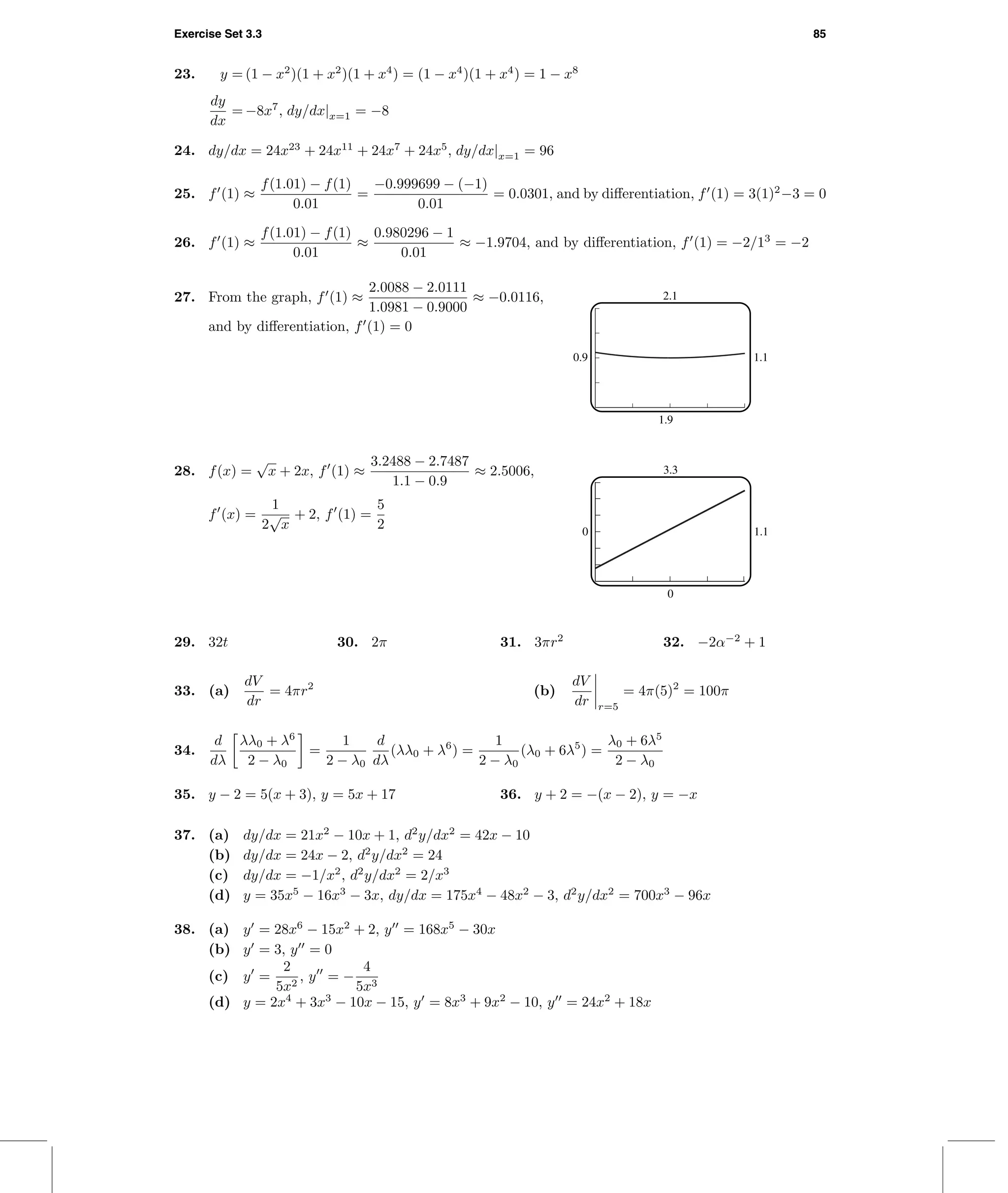
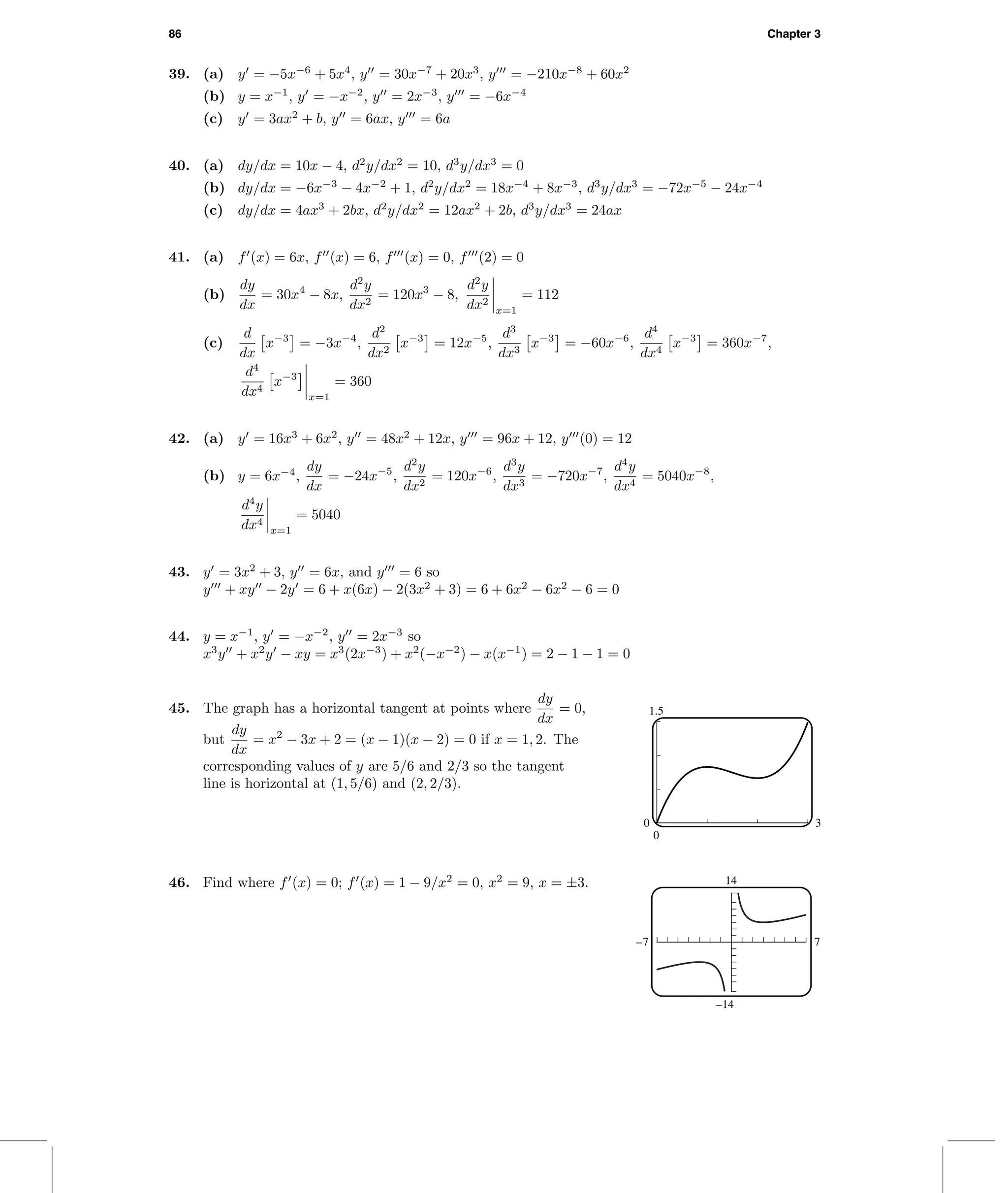

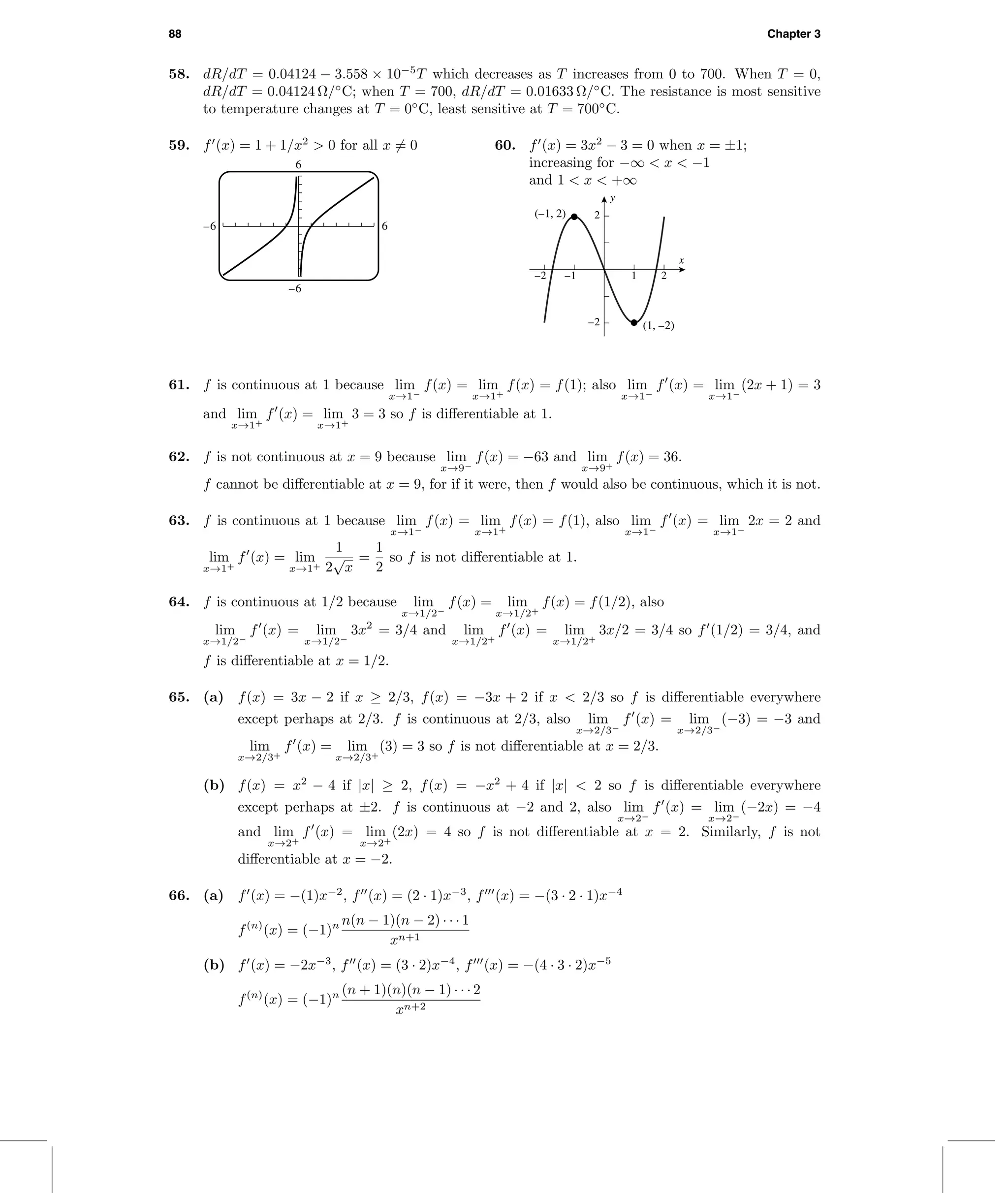
![Exercise Set 3.4 89
67. (a)
d2
dx2
[cf(x)] =
d
dx
d
dx
[cf(x)] =
d
dx
c
d
dx
[f(x)] = c
d
dx
d
dx
[f(x)] = c
d2
dx2
[f(x)]
d2
dx2
[f(x) + g(x)] =
d
dx
d
dx
[f(x) + g(x)] =
d
dx
d
dx
[f(x)] +
d
dx
[g(x)]
=
d2
dx2
[f(x)] +
d2
dx2
[g(x)]
(b) yes, by repeated application of the procedure illustrated in Part (a)
68. lim
h→0
f (2 + h) − f (2)
h
= f (2); f (x) = 8x7
− 2, f (x) = 56x6
, so f (2) = 56(26
) = 3584.
69. (a) f (x) = nxn−1
, f (x) = n(n − 1)xn−2
, f (x) = n(n − 1)(n − 2)xn−3
, . . .,
f(n)
(x) = n(n − 1)(n − 2) · · · 1
(b) from Part (a), f(k)
(x) = k(k − 1)(k − 2) · · · 1 so f(k+1)
(x) = 0 thus f(n)
(x) = 0 if n > k
(c) from Parts (a) and (b), f(n)
(x) = ann(n − 1)(n − 2) · · · 1
70. (a) If a function is differentiable at a point then it is continuous at that point, thus f is continuous
on (a, b) and consequently so is f.
(b) f and all its derivatives up to f(n−1)
(x) are continuous on (a, b)
71. Let g(x) = xn
, f(x) = (mx + b)n
. Use Exercise 48 in Section 3.2, but with f and g permuted. If
x0 = mx1 + b then Exercise 48 says that f is differentiable at x1 and f (x1) = mg (x0). Since
g (x0) = nxn−1
0 , the result follows.
72. f (x) = 2 · 2(2x + 3) = 8x + 12 73. f (x) = 3 · 3(3x − 1)2
= 81x2
− 54x + 9
74. f (x) = 1 · (−1)(x − 1)−2
= −1/(x − 1)2
75. f (x) = 2 · 3 · (−2)(2x + 1)−3
= −12/(2x + 1)3
76. f(x) =
x + 1 − 1
x + 1
= 1 −
1
x + 1
, and f (x) = −1(x + 1)−2
= −1/(x + 1)2
77. f(x) =
2x2
+ 4x + 2 + 1
(x + 1)2
= 2 +
1
(x + 1)2
, so f (x) = −2(x + 1)−3
= −2/(x + 1)3
EXERCISE SET 3.4
1. (a) f(x) = 2x2
+ x − 1, f (x) = 4x + 1
(b) f (x) = (x + 1) · (2) + (2x − 1) · (1) = 4x + 1
2. (a) f(x) = 3x4
+ 5x2
− 2, f (x) = 12x3
+ 10x
(b) f (x) = (3x2
− 1) · (2x) + (x2
+ 2) · (6x) = 12x3
+ 10x
3. (a) f(x) = x4
− 1, f (x) = 4x3
(b) f (x) = (x2
+ 1) · (2x) + (x2
− 1) · (2x) = 4x3
4. (a) f(x) = x3
+ 1, f (x) = 3x2
(b) f (x) = (x + 1)(2x − 1) + (x2
− x + 1) · (1) = 3x2](https://image.slidesharecdn.com/gabaritocompletoantoncalculo8edcaps0108-130504215818-phpapp02/75/Gabarito-completo-anton_calculo_8ed_caps_01_08-89-2048.jpg)

![Exercise Set 3.4 91
16.
dy
dx
= (2x7
− x2
)
d
dx
x − 1
x + 1
+
x − 1
x + 1
d
dx
(2x7
− x2
)
= (2x7
− x2
)
(x + 1)(1) − (x − 1)(1)
(x + 1)2
+
x − 1
x + 1
(14x6
− 2x)
= (2x7
− x2
) ·
2
(x + 1)2
+
x − 1
x + 1
(14x6
− 2x);
dy
dx x=1
= (2 − 1)
2
4
+ 0(14 − 2) =
1
2
17. f (1) = 0 18. f (1) = 1
19. (a) g (x) =
√
xf (x) +
1
2
√
x
f(x), g (4) = (2)(−5) +
1
4
(3) = −37/4
(b) g (x) =
xf (x) − f(x)
x2
, g (4) =
(4)(−5) − 3
16
= −23/16
20. (a) g (x) = 6x − 5f (x), g (3) = 6(3) − 5(4) = −2
(b) g (x) =
2f(x) − (2x + 1)f (x)
f2(x)
, g (3) =
2(−2) − 7(4)
(−2)2
= −8
21. (a) F (x) = 5f (x) + 2g (x), F (2) = 5(4) + 2(−5) = 10
(b) F (x) = f (x) − 3g (x), F (2) = 4 − 3(−5) = 19
(c) F (x) = f(x)g (x) + g(x)f (x), F (2) = (−1)(−5) + (1)(4) = 9
(d) F (x) = [g(x)f (x) − f(x)g (x)]/g2
(x), F (2) = [(1)(4) − (−1)(−5)]/(1)2
= −1
22. (a) F (x) = 6f (x) − 5g (x), F (π) = 6(−1) − 5(2) = −16
(b) F (x) = f(x) + g(x) + x(f (x) + g (x)), F (π) = 10 − 3 + π(−1 + 2) = 7 + π
(c) F (x) = 2f(x)g (x) + 2f (x)g(x) = 2(20) + 2(3) = 46
(d) F (x) =
(4 + g(x))f (x) − f(x)g (x)
(4 + g(x))2
=
(4 − 3)(−1) − 10(2)
(4 − 3)2
= −21
23.
dy
dx
=
2x(x + 2) − (x2
− 1)
(x + 2)2
,
dy
dx
= 0 if x2
+ 4x + 1 = 0. By the quadratic formula,
x =
−4 ±
√
16 − 4
2
= −2 ±
√
3. The tangent line is horizontal at x = −2 ±
√
3.
24.
dy
dx
=
2x(x − 1) − (x2
+ 1)
(x − 1)2
=
x2
− 2x − 1
(x − 1)2
. The tangent line is horizontal when it has slope 0, i.e.
x2
− 2x − 1 = 0 which, by the quadratic formula, has solutions x =
2 ±
√
4 + 4
2
= 1 ±
√
2, the
tangent line is horizontal when x = 1 ±
√
2.
25. The tangent line is parallel to the line y = x when it has slope 1.
dy
dx
=
2x(x + 1) − (x2
+ 1)
(x + 1)2
=
x2
+ 2x − 1
(x + 1)2
= 1 if x2
+2x−1 = (x+1)2
, which reduces to −1 = +1,
impossible. Thus the tangent line is never parallel to the line y = x.](https://image.slidesharecdn.com/gabaritocompletoantoncalculo8edcaps0108-130504215818-phpapp02/75/Gabarito-completo-anton_calculo_8ed_caps_01_08-91-2048.jpg)
![92 Chapter 3
26. The tangent line is perpendicular to the line y = x when the tangent line has slope −1.
y =
x + 2 + 1
x + 2
= 1 +
1
x + 2
, hence
dy
dx
= −
1
(x + 2)2
= −1 when (x + 2)2
= 1, x2
+ 4x + 3 = 0,
(x + 1)(x + 3) = 0, x = −1, −3. Thus the tangent line is perpendicular to the line y = x at the
points (−1, 2), (−3, 0).
27. Fix x0. The slope of the tangent line to the curve y =
1
x + 4
at the point (x0, 1/(x0 + 4)) is
given by
dy
dx
=
−1
(x + 4)2
x=x0
=
−1
(x0 + 4)2
. The tangent line to the curve at (x0, y0) thus has the
equation y − y0 =
−1
(x0 + 4)2
(x − x0), and this line passes through the origin if its constant term
y0 − x0
−1
(x0 + 4)2
is zero. Then
1
x0 + 4
=
−x0
(x0 + 4)2
, x0 + 4 = −x0, x0 = −2.
28. y =
2x + 5
x + 2
=
2x + 4 + 1
x + 2
= 2 +
1
x + 2
, and hence
dy
dx
=
−1
(x + 2)2
, thus the tangent line at the
point (x0, y0) is given by y − y0 =
−1
(x0 + 2)2
(x − x0) , where y0 = 2 +
1
x0 + 2
.
If this line is to pass through (0, 2), then
2 − y0 =
−1
(x0 + 2)2
(−x0),
−1
x0 + 2
=
x0
(x0 + 2)2
, −x0 − 2 = x0, x0 = −1
29. (b) They intersect when
1
x
=
1
2 − x
, x = 2 − x, x = 1, y = 1. The first curve has derivative
y = −
1
x2
, so the slope when x = 1 is m = −1. Second curve has derivative y =
1
(2 − x)2
so
the slope when x = 1 is m = 1. Since the two slopes are negative reciprocals of each other,
the tangent lines are perpendicular at the point (1, 1).
30. The curves intersect when a/(x − 1) = x2
− 2x + 1, or (x − 1)3
= a, x = 1 + a1/3
. They are
perpendicular when their slopes are negative reciprocals of each other, i.e.
−a
(x − 1)2
(2x − 2) = −1,
which has the solution x = 2a + 1. Solve x = 1 + a1/3
= 2a + 1, 2a2/3
= 1, a = 2−3/2
. Thus the
curves intersect and are perpendicular at the point (2a + 1, 1/2) provided a = 2−3/2
.
31. F (x) = xf (x) + f(x), F (x) = xf (x) + f (x) + f (x) = xf (x) + 2f (x)
32. (a) F (x) = xf (x) + 3f (x)
(b) Assume that Fn)
(x) = xf(n)
(x) + nf(n−1)
(x) for some n (for instance n = 3, as in part (a)).
Then F(n+1)
(x) = xf(n+1)
(x) + (1 + n)f(n)
(x) = xf(n+1)
(x) + (n + 1)f(n)
(x), which is an
inductive proof.
33. (f · g · h) = [(f · g) · h] = (f · g)h + h(f · g) = (f · g)h + h[fg + f g] = fgh + fg h + f gh
34. (f1f2 · · · fn) = (f1f2 · · · fn) + (f1f2 · · · fn) + · · · + (f1f2 · · · fn)](https://image.slidesharecdn.com/gabaritocompletoantoncalculo8edcaps0108-130504215818-phpapp02/75/Gabarito-completo-anton_calculo_8ed_caps_01_08-92-2048.jpg)
![Exercise Set 3.5 93
35. (a) 2(1 + x−1
)(x−3
+ 7) + (2x + 1)(−x−2
)(x−3
+ 7) + (2x + 1)(1 + x−1
)(−3x−4
)
(b) (x7
+ 2x − 3)3
= (x7
+ 2x − 3)(x7
+ 2x − 3)(x7
+ 2x − 3) so
d
dx
(x7
+ 2x − 3)3
= (7x6
+ 2)(x7
+ 2x − 3)(x7
+ 2x − 3)
+(x7
+ 2x − 3)(7x6
+ 2)(x7
+ 2x − 3)
+(x7
+ 2x − 3)(x7
+ 2x − 3)(7x6
+ 2)
= 3(7x6
+ 2)(x7
+ 2x − 3)2
36. (a) −5x−6
(x2
+ 2x)(4 − 3x)(2x9
+ 1) + x−5
(2x + 2)(4 − 3x)(2x9
+ 1)
+x−5
(x2
+ 2x)(−3)(2x9
+ 1) + x−5
(x2
+ 2x)(4 − 3x)(18x8
)
(b) (x2
+ 1)50
= (x2
+ 1)(x2
+ 1) · · · (x2
+ 1), where (x2
+ 1) occurs 50 times so
d
dx
(x2
+ 1)50
= [(2x)(x2
+ 1) · · · (x2
+ 1)] + [(x2
+ 1)(2x) · · · (x2
+ 1)]
+ · · · + [(x2
+ 1)(x2
+ 1) · · · (2x)]
= 2x(x2
+ 1)49
+ 2x(x2
+ 1)49
+ · · · + 2x(x2
+ 1)49
= 100x(x2
+ 1)49
because 2x(x2
+ 1)49
occurs 50 times.
37. By the product rule, g (x) is the sum of n terms, each containing n factors of the form
f (x)f(x)f(x) . . . f(x); the function f(x) occurs n − 1 times, and f (x) occurs once. Each of these
n terms is equal to f (x)(f(x))n−1
, and so g (x) = n(f(x))n−1
f (x).
38. g (x) = 10(x2
− 1)9
(2x) = 20x(x2
− 1)9
39. f(x) =
1
xn
so f (x) =
xn
· (0) − 1 · (nxn−1)
x2n
= −
n
xn+1
40. f(x) = g(x)h(x), f (x) = g (x)h(x) + g(x)h (x), solve for h : h (x) =
f (x) − g (x)h(x)
g(x)
, but
h = f/g so
d
dx
f(x)
g(x)
=
f (x)
g(x)
−
f(x)g (x)
g(x)2
=
f (x)g(x) − f(x)g (x)
g(x)2
EXERCISE SET 3.5
1. f (x) = −4 sin x + 2 cos x 2. f (x) =
−10
x3
+ cos x
3. f (x) = 4x2
sin x − 8x cos x 4. f (x) = 4 sin x cos x
5. f (x) =
sin x(5 + sin x) − cos x(5 − cos x)
(5 + sin x)2
=
1 + 5(sin x − cos x)
(5 + sin x)2
6. f (x) =
(x2
+ sin x) cos x − sin x(2x + cos x)
(x2 + sin x)2
=
x2
cos x − 2x sin x
(x2 + sin x)2
7. f (x) = sec x tan x −
√
2 sec2
x
8. f (x) = (x2
+ 1) sec x tan x + (sec x)(2x) = (x2
+ 1) sec x tan x + 2x sec x](https://image.slidesharecdn.com/gabaritocompletoantoncalculo8edcaps0108-130504215818-phpapp02/75/Gabarito-completo-anton_calculo_8ed_caps_01_08-93-2048.jpg)
![94 Chapter 3
9. f (x) = −4 csc x cot x + csc2
x 10. f (x) = − sin x − csc x + x csc x cot x
11. f (x) = sec x(sec2
x) + (tan x)(sec x tan x) = sec3
x + sec x tan2
x
12. f (x) = (csc x)(− csc2
x) + (cot x)(− csc x cot x) = − csc3
x − csc x cot2
x
13. f (x) =
(1 + csc x)(− csc2
x) − cot x(0 − csc x cot x)
(1 + csc x)2
=
csc x(− csc x − csc2
x + cot2
x)
(1 + csc x)2
but
1 + cot2
x = csc2
x (identity) thus cot2
x − csc2
x = −1 so
f (x) =
csc x(− csc x − 1)
(1 + csc x)2
= −
csc x
1 + csc x
14. f (x) =
(1 + tan x)(sec x tan x) − (sec x)(sec2
x)
(1 + tan x)2
=
sec x tan x + sec x tan2
x − sec3
x
(1 + tan x)2
=
sec x(tan x + tan2
x − sec2
x)
(1 + tan x)2
=
sec x(tan x − 1)
(1 + tan x)2
15. f(x) = sin2
x + cos2
x = 1 (identity) so f (x) = 0
16. f (x) = 2 sec x tan x sec x − 2 tan x sec2
x =
2 sin x
cos3 x
− 2
sin x
cos3 x
= 0
OR f(x) = sec2
x − tan2
x = 1 (identity), f (x) = 0
17. f(x) =
tan x
1 + x tan x
(because sin x sec x = (sin x)(1/ cos x) = tan x),
f (x) =
(1 + x tan x)(sec2
x) − tan x[x(sec2
x) + (tan x)(1)]
(1 + x tan x)2
=
sec2
x − tan2
x
(1 + x tan x)2
=
1
(1 + x tan x)2
(because sec2
x − tan2
x = 1)
18. f(x) =
(x2
+ 1) cot x
3 − cot x
(because cos x csc x = (cos x)(1/ sin x) = cot x),
f (x) =
(3 − cot x)[2x cot x − (x2
+ 1) csc2
x] − (x2
+ 1) cot x csc2
x
(3 − cot x)2
=
6x cot x − 2x cot2
x − 3(x2
+ 1) csc2
x
(3 − cot x)2
19. dy/dx = −x sin x + cos x, d2
y/dx2
= −x cos x − sin x − sin x = −x cos x − 2 sin x
20. dy/dx = − csc x cot x, d2
y/dx2
= −[(csc x)(− csc2
x) + (cot x)(− csc x cot x)] = csc3
x + csc x cot2
x
21. dy/dx = x(cos x) + (sin x)(1) − 3(− sin x) = x cos x + 4 sin x,
d2
y/dx2
= x(− sin x) + (cos x)(1) + 4 cos x = −x sin x + 5 cos x
22. dy/dx = x2
(− sin x) + (cos x)(2x) + 4 cos x = −x2
sin x + 2x cos x + 4 cos x,
d2
y/dx2
= −[x2
(cos x) + (sin x)(2x)] + 2[x(− sin x) + cos x] − 4 sin x = (2 − x2
) cos x − 4(x + 1) sin x
23. dy/dx = (sin x)(− sin x) + (cos x)(cos x) = cos2
x − sin2
x,
d2
y/dx2
= (cos x)(− sin x) + (cos x)(− sin x) − [(sin x)(cos x) + (sin x)(cos x)] = −4 sin x cos x](https://image.slidesharecdn.com/gabaritocompletoantoncalculo8edcaps0108-130504215818-phpapp02/75/Gabarito-completo-anton_calculo_8ed_caps_01_08-94-2048.jpg)
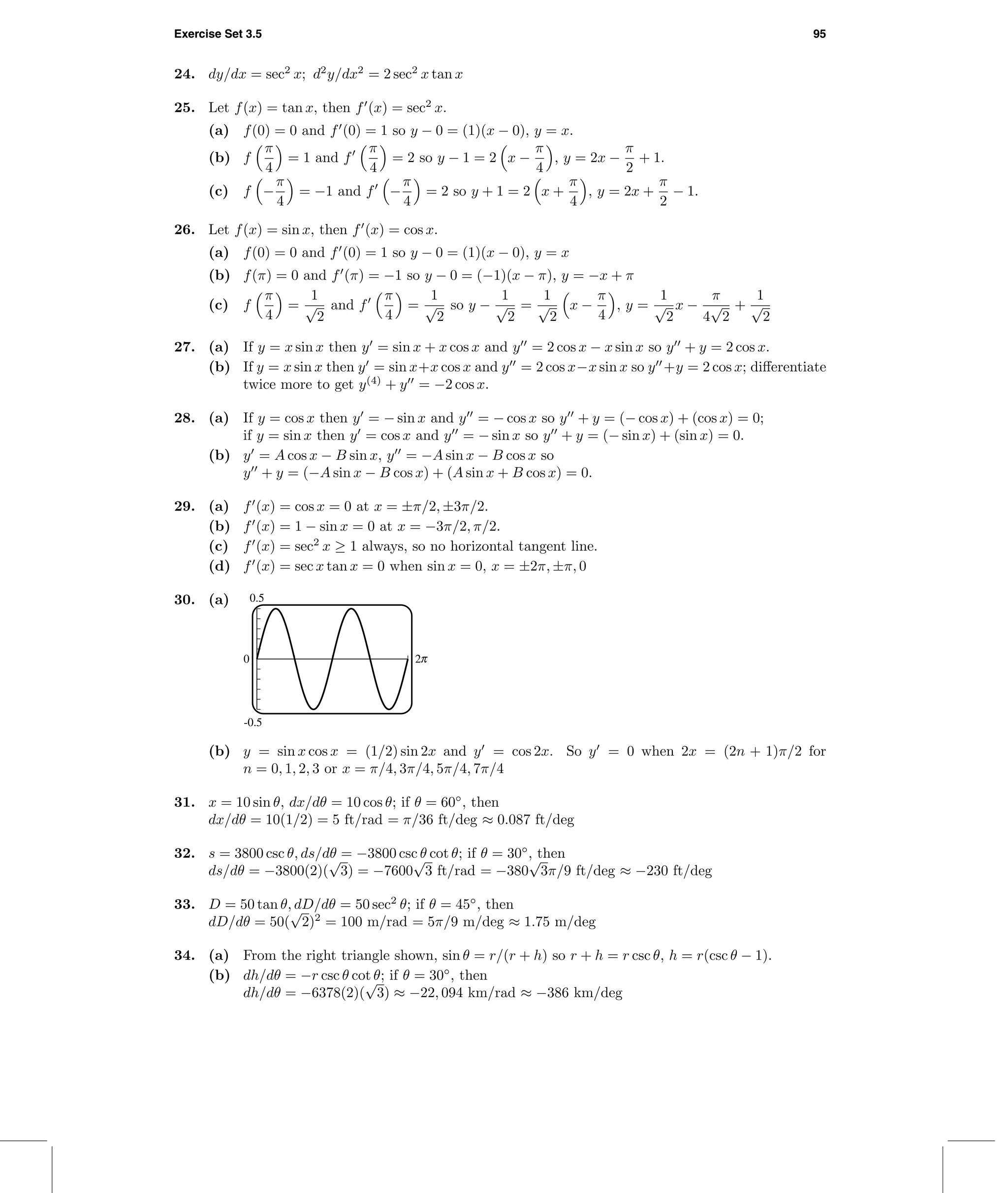
![96 Chapter 3
35. (a)
d4
dx4
sin x = sin x, so
d4k
dx4k
sin x = sin x;
d87
dx87
sin x =
d3
dx3
d4·21
dx4·21
sin x =
d3
dx3
sin x = − cos x
(b)
d100
dx100
cos x =
d4k
dx4k
cos x = cos x
36.
d
dx
[x sin x] = x cos x + sin x
d2
dx2
[x sin x] = −x sin x + 2 cos x
d3
dx3
[x sin x] = −x cos x − 3 sin x
d4
dx4
[x sin x] = x sin x − 4 cos x
By mathematical induction one can show
d4k
dx4k
[x sin x] = x sin x − (4k) cos x;
d4k+1
dx4k+1
[x sin x] = x cos x + (4k + 1) sin x;
d4k+2
dx4k+2
[x sin x] = −x sin x + (4k + 2) cos x;
d4k+3
dx4k+3
[x sin x] = −x cos x − (4k + 3) sin x;
Since 17 = 4 · 4 + 1,
d17
dx17
[x sin x] = x cos x + 17 sin x
37. f (x) = − sin x, f (x) = − cos x, f (x) = sin x, and f(4)
(x) = cos x with higher order derivatives
repeating this pattern, so f(n)
(x) = sin x for n = 3, 7, 11, . . .
38. f(x) = sin x, f (x) = cos x, f (x) = − sin x, f(4)
(x) = − cos x, f(5)
(x) = sin x, and the right-hand
sides continue with a period of 4, so that f(n)
(x) = sin x when n = 4k for some k > 0.
39. (a) all x (b) all x
(c) x = π/2 + nπ, n = 0, ±1, ±2, . . . (d) x = nπ, n = 0, ±1, ±2, . . .
(e) x = π/2 + nπ, n = 0, ±1, ±2, . . . (f) x = nπ, n = 0, ±1, ±2, . . .
(g) x = (2n + 1)π, n = 0, ±1, ±2, . . . (h) x = nπ/2, n = 0, ±1, ±2, . . .
(i) all x
40. (a)
d
dx
[cos x] = lim
h→0
cos(x + h) − cos x
h
= lim
h→0
cos x cos h − sin x sin h − cos x
h
= lim
h→0
cos x
cos h − 1
h
− sin x
sin h
h
= (cos x)(0) − (sin x)(1) = − sin x
(b)
d
dx
[cot x] =
d
dx
cos x
sin x
=
sin x(− sin x) − cos x(cos x)
sin2
x
=
− sin2
x − cos2
x
sin2
x
=
−1
sin2
x
= − csc2
x
(c)
d
dx
[sec x] =
d
dx
1
cos x
=
0 · cos x − (1)(− sin x)
cos2 x
=
sin x
cos2 x
= sec x tan x
(d)
d
dx
[csc x] =
d
dx
1
sin x
=
(sin x)(0) − (1)(cos x)
sin2
x
= −
cos x
sin2
x
= − csc x cot x](https://image.slidesharecdn.com/gabaritocompletoantoncalculo8edcaps0108-130504215818-phpapp02/75/Gabarito-completo-anton_calculo_8ed_caps_01_08-96-2048.jpg)
![Exercise Set 3.5 97
41.
d
dx
sin x = lim
w→x
sin w − sin x
w − x
= lim
w→x
2 sin w−x
2 cos w+x
2
w − x
= lim
w→x
sin w−x
2
w−x
2
cos
w + x
2
= 1 · cos x = cos x
42.
d
dx
[cos x] = lim
w→x
cos w − cos x
w − x
= lim
w→x
−2 sin(w−x
2 ) sin(w+x
2 )
w − x
= − lim
w→x
sin
w + x
2
lim
w→x
sin(w−x
2 )
w−x
2
= − sin x
43. (a) lim
h→0
tan h
h
= lim
h→0
sin h
cos h
h
= lim
h→0
sin h
h
cos h
=
1
1
= 1
(b)
d
dx
[tan x] = lim
h→0
tan(x + h) − tan x
h
= lim
h→0
tan x + tan h
1 − tan x tan h
− tan x
h
= lim
h→0
tan x + tan h − tan x + tan2
x tan h
h(1 − tan x tan h)
= lim
h→0
tan h(1 + tan2
x)
h(1 − tan x tan h)
= lim
h→0
tan h sec2
x
h(1 − tan x tan h)
= sec2
x lim
h→0
tan h
h
1 − tan x tan h
= sec2
x
lim
h→0
tan h
h
lim
h→0
(1 − tan x tan h)
= sec2
x
44. lim
x→0
tan(x + y) − tan y
x
= lim
h→0
tan(y + h) − tan y
h
=
d
dy
(tan y) = sec2
y
45.
d
dx
[cos kx] = lim
h→0
cos k(x + h) − cos kx
h
= k lim
kh→0
cos(kx + kh) − cos kx
kh
= −k sin kx
46. The position function is given by s = −4 cos πt, so by Exercise 45 the velocity is the derivative
ds
dt
= 4π sin πt. The position function shows that the top of the mass moves from a low point of
s = −4π to a high point of s = 4π, and passes through the origin when t = π/2, 3π/2, . . .. On the
first pass through the origin the velocity is v = 4π sin(π/2) = 4π.
47. Let t be the radian measure, then h =
180
π
t and cos h = cos t, sin h = sin t. Then
lim
h→0
cos h − 1
h
= lim
t→0
cos t − 1
180t/π
=
π
180
lim
t→0
cos t − 1
t
= 0
lim
h→0
sin h
h
= lim
t→0
sin t
180t/π
=
π
180
lim
t→0
sin t
t
=
π
180
(a)
d
dx
[sin x] = sin x lim
h→0
cos h − 1
h
+ cos x lim
h→0
sin h
h
= (sin x)(0) + (cos x)(π/180) =
π
180
cos x
(b)
d
dx
[cos x] = lim
h→0
cos(x + h) + cos x
h
= lim
h→0
cos(x) cos h − sin x sin h − cos x
h
= cos x lim
cos h − 1
h
− sin x × lim
sin h
h
= 0 − 1 · sin x = − sin x](https://image.slidesharecdn.com/gabaritocompletoantoncalculo8edcaps0108-130504215818-phpapp02/75/Gabarito-completo-anton_calculo_8ed_caps_01_08-97-2048.jpg)

![Exercise Set 3.6 99
18. f (x) = 4 + 20(sin3
x)
d
dx
(sin x) = 4 + 20 sin3
x cos x
19. f (x) = 2 cos(3
√
x)
d
dx
[cos(3
√
x)] = −2 cos(3
√
x) sin(3
√
x)
d
dx
(3
√
x) = −
3 cos(3
√
x) sin(3
√
x)
√
x
20. f (x) = 4 tan3
(x3
)
d
dx
[tan(x3
)] = 4 tan3
(x3
) sec2
(x3
)
d
dx
(x3
) = 12x2
tan3
(x3
) sec2
(x3
)
21. f (x) = 4 sec(x7
)
d
dx
[sec(x7
)] = 4 sec(x7
) sec(x7
) tan(x7
)
d
dx
(x7
) = 28x6
sec2
(x7
) tan(x7
)
22. f (x) = 3 cos2 x
x + 1
d
dx
cos
x
x + 1
= 3 cos2 x
x + 1
− sin
x
x + 1
(x + 1)(1) − x(1)
(x + 1)2
= −
3
(x + 1)2
cos2 x
x + 1
sin
x
x + 1
23. f (x) =
1
2 cos(5x)
d
dx
[cos(5x)] = −
5 sin(5x)
2 cos(5x)
24. f (x) =
1
2 3x − sin2
(4x)
d
dx
[3x − sin2
(4x)] =
3 − 8 sin(4x) cos(4x)
2 3x − sin2
(4x)
25. f (x) = −3 x + csc(x3
+ 3)
−4 d
dx
x + csc(x3
+ 3)
= −3 x + csc(x3
+ 3)
−4
1 − csc(x3
+ 3) cot(x3
+ 3)
d
dx
(x3
+ 3)
= −3 x + csc(x3
+ 3)
−4
1 − 3x2
csc(x3
+ 3) cot(x3
+ 3)
26. f (x) = −4 x4
− sec(4x2
− 2)
−5 d
dx
x4
− sec(4x2
− 2)
= −4 x4
− sec(4x2
− 2)
−5
4x3
− sec(4x2
− 2) tan(4x2
− 2)
d
dx
(4x2
− 2)
= −16x x4
− sec(4x2
− 2)
−5
x2
− 2 sec(4x2
− 2) tan(4x2
− 2)
27.
dy
dx
= x3
(2 sin 5x)
d
dx
(sin 5x) + 3x2
sin2
5x = 10x3
sin 5x cos 5x + 3x2
sin2
5x
28.
dy
dx
=
√
x 3 tan2
(
√
x) sec2
(
√
x)
1
2
√
x
+
1
2
√
x
tan3
(
√
x) =
3
2
tan2
(
√
x) sec2
(
√
x) +
1
2
√
x
tan3
(
√
x)
29.
dy
dx
= x5
sec
1
x
tan
1
x
d
dx
1
x
+ sec
1
x
(5x4
)
= x5
sec
1
x
tan
1
x
−
1
x2
+ 5x4
sec
1
x
= −x3
sec
1
x
tan
1
x
+ 5x4
sec
1
x](https://image.slidesharecdn.com/gabaritocompletoantoncalculo8edcaps0108-130504215818-phpapp02/75/Gabarito-completo-anton_calculo_8ed_caps_01_08-99-2048.jpg)
![100 Chapter 3
30.
dy
dx
=
sec(3x + 1) cos x − 3 sin x sec(3x + 1) tan(3x + 1)
sec2(3x + 1)
= cos x cos(3x + 1) − 3 sin x sin(3x + 1)
31.
dy
dx
= − sin(cos x)
d
dx
(cos x) = − sin(cos x)(− sin x) = sin(cos x) sin x
32.
dy
dx
= cos(tan 3x)
d
dx
(tan 3x) = 3 sec2
3x cos(tan 3x)
33.
dy
dx
= 3 cos2
(sin 2x)
d
dx
[cos(sin 2x)] = 3 cos2
(sin 2x)[− sin(sin 2x)]
d
dx
(sin 2x)
= −6 cos2
(sin 2x) sin(sin 2x) cos 2x
34.
dy
dx
=
(1 − cot x2
)(−2x csc x2
cot x2
) − (1 + csc x2
)(2x csc2
x2
)
(1 − cot x2)2
= −2x csc x2 1 + cot x2
+ csc x2
(1 − cot x2)2
35.
dy
dx
= (5x + 8)7 d
dx
(1 −
√
x)6
+ (1 −
√
x)6 d
dx
(5x + 8)7
= 6(5x + 8)7
(1 −
√
x)5 −1
2
√
x
+ 7 · 5(1 −
√
x)6
(5x + 8)6
=
−3
√
x
(5x + 8)7
(1 −
√
x)5
+ 35(1 −
√
x)6
(5x + 8)6
36.
dy
dx
= (x2
+ x)5 d
dx
sin8
x + (sin8
x)
d
dx
(x2
+ x)5
= 8(x2
+ x)5
sin7
x cos x + 5(sin8
x)(x2
+ x)4
(2x + 1)
37.
dy
dx
= 3
x − 5
2x + 1
2
d
dx
x − 5
2x + 1
= 3
x − 5
2x + 1
2
·
11
(2x + 1)2
=
33(x − 5)2
(2x + 1)4
38.
dy
dx
= 17
1 + x2
1 − x2
16
d
dx
1 + x2
1 − x2
= 17
1 + x2
1 − x2
16
(1 − x2
)(2x) − (1 + x2
)(−2x)
(1 − x2)2
= 17
1 + x2
1 − x2
16
4x
(1 − x2)2
=
68x(1 + x2
)16
(1 − x2)18
39.
dy
dx
=
(4x2
− 1)8
(3)(2x + 3)2
(2) − (2x + 3)3
(8)(4x2
− 1)7
(8x)
(4x2 − 1)16
=
2(2x + 3)2
(4x2
− 1)7
[3(4x2
− 1) − 32x(2x + 3)]
(4x2 − 1)16
= −
2(2x + 3)2
(52x2
+ 96x + 3)
(4x2 − 1)9
40.
dy
dx
= 12[1 + sin3
(x5
)]11 d
dx
[1 + sin3
(x5
)]
= 12[1 + sin3
(x5
)]11
3 sin2
(x5
)
d
dx
sin(x5
) = 180x4
[1 + sin3
(x5
)]11
sin2
(x5
) cos(x5
)
41.
dy
dx
= 5 x sin 2x + tan4
(x7
)
4 d
dx
x sin 2x tan4
(x7
)
= 5 x sin 2x + tan4
(x7
)
4
x cos 2x
d
dx
(2x) + sin 2x + 4 tan3
(x7
)
d
dx
tan(x7
)
= 5 x sin 2x + tan4
(x7
)
4
2x cos 2x + sin 2x + 28x6
tan3
(x7
) sec2
(x7
)](https://image.slidesharecdn.com/gabaritocompletoantoncalculo8edcaps0108-130504215818-phpapp02/75/Gabarito-completo-anton_calculo_8ed_caps_01_08-100-2048.jpg)

![102 Chapter 3
53.
dy
dx
=
(1 − x) + (1 + x)
(1 − x)2
=
2
(1 − x)2
= 2(1 − x)−2
and
d2
y
dx2
= −2(2)(−1)(1 − x)−3
= 4(1 − x)−3
54.
dy
dx
= x sec2 1
x
d
dx
1
x
+ tan
1
x
= −
1
x
sec2 1
x
+ tan
1
x
,
d2
y
dx2
= −
2
x
sec
1
x
d
dx
sec
1
x
+
1
x2
sec2 1
x
+ sec2 1
x
d
dx
1
x
=
2
x3
sec2 1
x
tan
1
x
55. y = cot3
(π − θ) = − cot3
θ so dy/dx = 3 cot2
θ csc2
θ
56. 6
au + b
cu + d
5
ad − bc
(cu + d)2
57.
d
dω
[a cos2
πω + b sin2
πω] = −2πa cos πω sin πω + 2πb sin πω cos πω
= π(b − a)(2 sin πω cos πω) = π(b − a) sin 2πω
58. 2 csc2
(π/3 − y) cot(π/3 − y)
59. (a) 2
–2 2
–2
(c) f (x) = x
−x
√
4 − x2
+ 4 − x2 =
4 − 2x2
√
4 − x2
2
–2 2
–6
(d) f(1) =
√
3 and f (1) =
2
√
3
so the tangent line has the equation y −
√
3 =
2
√
3
(x − 1).
3
0
0 2
60. (a) 0.5
0
^ 6
(c) f (x) = 2x cos(x2
) cos x − sin x sin(x2
)
1.2
–1.2
^ 6](https://image.slidesharecdn.com/gabaritocompletoantoncalculo8edcaps0108-130504215818-phpapp02/75/Gabarito-completo-anton_calculo_8ed_caps_01_08-102-2048.jpg)
![Exercise Set 3.6 103
(d) f(1) = sin 1 cos 1 and f (1) = 2 cos2
1 − sin2
1, so the tangent line has the equation
y − sin 1 cos 1 = (2 cos2
1 − sin2
1)(x − 1).
0.8
0
^ 6
61. (a) dy/dt = −Aω sin ωt, d2
y/dt2
= −Aω2
cos ωt = −ω2
y
(b) one complete oscillation occurs when ωt increases over an interval of length 2π, or if t increases
over an interval of length 2π/ω
(c) f = 1/T
(d) amplitude = 0.6 cm, T = 2π/15 s/oscillation, f = 15/(2π) oscillations/s
62. dy/dt = 3A cos 3t, d2
y/dt2
= −9A sin 3t, so −9A sin 3t + 2A sin 3t = 4 sin 3t,
−7A sin 3t = 4 sin 3t, −7A = 4, A = −4/7
63. f(x) =
4
3 x + 5, x < 0
−5
2 x + 5, x > 0
d
dx
x + f(x) =
7
2]
√
21x+45
, x < 0
− 3
2
√
−6x+20
, x > 0
=
7
√
6
24
when x = −1
64. 2 sin(π/6) = 1, so we can assume f(x) = −5
2 x + 5. Thus for sufficiently small values of |x − π/6|
we have
d
dx
[f(2 sin x)]
x=π/6
= f (2 sin x)
d
dx
2 sin x
x=π/6
= −
5
2
2 cos x
x=π/6
= −
5
2
2
√
3
2
= −
5
2
√
3
65. (a) p ≈ 10 lb/in2
, dp/dh ≈ −2 lb/in2
/mi
(b)
dp
dt
=
dp
dh
dh
dt
≈ (−2)(0.3) = −0.6 lb/in2
/s
66. (a) F =
45
cos θ + 0.3 sin θ
,
dF
dθ
= −
45(− sin θ + 0.3 cos θ)
(cos θ + 0.3 sin θ)2
;
if θ = 30◦
, then dF/dθ ≈ 10.5 lb/rad ≈ 0.18 lb/deg
(b)
dF
dt
=
dF
dθ
dθ
dt
≈ (0.18)(−0.5) = −0.09 lb/s
67. With u = sin x,
d
dx
(| sin x|) =
d
dx
(|u|) =
d
du
(|u|)
du
dx
=
d
du
(|u|) cos x =
cos x, u > 0
− cos x, u < 0
=
cos x, sin x > 0
− cos x, sin x < 0
=
cos x, 0 < x < π
− cos x, −π < x < 0
68.
d
dx
(cos x) =
d
dx
[sin(π/2 − x)] = − cos(π/2 − x) = − sin x](https://image.slidesharecdn.com/gabaritocompletoantoncalculo8edcaps0108-130504215818-phpapp02/75/Gabarito-completo-anton_calculo_8ed_caps_01_08-103-2048.jpg)
![104 Chapter 3
69. (a) For x = 0, |f(x)| ≤ |x|, and lim
x→0
|x| = 0, so by the Squeezing Theorem, lim
x→0
f(x) = 0.
(b) If f (0) were to exist, then the limit
f(x) − f(0)
x − 0
= sin(1/x) would have to exist, but it
doesn’t.
(c) For x = 0, f (x) = x cos
1
x
−
1
x2
+ sin
1
x
= −
1
x
cos
1
x
+ sin
1
x
(d) lim
x→0
f(x) − f(0)
x − 0
= lim
x→0
sin(1/x), which does not exist, thus f (0) does not exist.
70. (a) −x2
≤ x2
sin(1/x) ≤ x2
, so by the Squeezing Theorem lim
x→0
f(x) = 0.
(b) f (0) = lim
x→0
f(x) − f(0)
x − 0
= lim
x→0
x sin(1/x) = 0 by Exercise 69, Part a.
(c) For x = 0, f (x) = 2x sin(1/x) + x2
cos(1/x)(−1/x2
) = 2x sin(1/x) − cos(1/x)
(d) If f (x) were continuous at x = 0 then so would cos(1/x) = f (x) − 2x sin(1/x) be, since
2x sin(1/x) is continuous there. But cos(1/x) oscillates at x = 0.
71. (a) g (x) = 3[f(x)]2
f (x), g (2) = 3[f(2)]2
f (2) = 3(1)2
(7) = 21
(b) h (x) = f (x3
)(3x2
), h (2) = f (8)(12) = (−3)(12) = −36
72. F (x) = f (g(x))g (x) = 3(x2 − 1) + 4(2x) = 2x
√
3x2 + 1
73. F (x) = f (g(x))g (x) = f (
√
3x − 1)
3
2
√
3x − 1
=
√
3x − 1
(3x − 1) + 1
3
2
√
3x − 1
=
1
2x
74.
d
dx
[f(x2
)] = f (x2
)(2x), thus f (x2
)(2x) = x2
so f (x2
) = x/2 if x = 0
75.
d
dx
[f(3x)] = f (3x)
d
dx
(3x) = 3f (3x) = 6x, so f (3x) = 2x. Let u = 3x to get f (u) =
2
3
u;
d
dx
[f(x)] = f (x) =
2
3
x.
76. (a) If f(−x) = f(x), then
d
dx
[f(−x)] =
d
dx
[f(x)], f (−x)(−1) = f (x), f (−x) = −f (x) so
f is odd.
(b) If f(−x) = −f(x), then
d
dx
[f(−x)] = −
d
dx
[f(x)], f (−x)(−1) = −f (x), f (−x) = f (x) so
f is even.
77. For an even function, the graph is symmetric about the y-axis; the slope of the tangent line at
(a, f(a)) is the negative of the slope of the tangent line at (−a, f(−a)). For an odd function, the
graph is symmetric about the origin; the slope of the tangent line at (a, f(a)) is the same as the
slope of the tangent line at (−a, f(−a)).
y
x
f(x)
f'(x)
y
x
f(x)
f'(x)](https://image.slidesharecdn.com/gabaritocompletoantoncalculo8edcaps0108-130504215818-phpapp02/75/Gabarito-completo-anton_calculo_8ed_caps_01_08-104-2048.jpg)
![Exercise Set 3.7 105
78.
dy
dx
=
dy
du
du
dv
dv
dw
dw
dx
79.
d
dx
[f(g(h(x)))] =
d
dx
[f(g(u))], u = h(x)
=
d
du
[f(g(u))]
du
dx
= f (g(u))g (u)
du
dx
= f (g(h(x)))g (h(x))h (x)
EXERCISE SET 3.7
1.
dy
dt
= 3
dx
dt
(a)
dy
dt
= 3(2) = 6 (b) −1 = 3
dx
dt
,
dx
dt
= −
1
3
2.
dx
dt
+ 4
dy
dt
= 0
(a) 1 + 4
dy
dt
= 0 so
dy
dt
= −
1
4
when x = 2. (b)
dx
dt
+ 4(4) = 0 so
dx
dt
= −16 when x = 3.
3. 8x
dx
dt
+ 18y
dy
dt
= 0
(a) 8
1
2
√
2
· 3 + 18
1
3
√
2
dy
dt
= 0,
dy
dt
= −2 (b) 8
1
3
dx
dt
− 18
√
5
9
· 8 = 0,
dx
dt
= 6
√
5
4. 2x
dx
dt
+ 2y
dy
dt
= 2
dx
dt
+ 4
dy
dt
(a) 2 · 3(−5) + 2 · 1
dy
dt
= 2(−5) + 4
dy
dt
,
dy
dt
= −10
(b) 2(1 +
√
2)
dx
dt
+ 2(2 +
√
3) · 6 = 2
dx
dt
+ 4 · 6,
dx
dt
= −12
√
3
2
√
2
= −3
√
3
√
2
5. (b) A = x2
(c)
dA
dt
= 2x
dx
dt
(d) Find
dA
dt x=3
given that
dx
dt x=3
= 2. From Part (c),
dA
dt x=3
= 2(3)(2) = 12 ft2
/min.
6. (b) A = πr2
(c)
dA
dt
= 2πr
dr
dt
(d) Find
dA
dt r=5
given that
dr
dt r=5
= 2. From Part (c),
dA
dt r=5
= 2π(5)(2) = 20π cm2
/s.
7. (a) V = πr2
h, so
dV
dt
= π r2 dh
dt
+ 2rh
dr
dt
.
(b) Find
dV
dt h=6,
r=10
given that
dh
dt h=6,
r=10
= 1 and
dr
dt h=6,
r=10
= −1. From Part (a),
dV
dt h=6,
r=10
= π[102
(1) + 2(10)(6)(−1)] = −20π in3
/s; the volume is decreasing.](https://image.slidesharecdn.com/gabaritocompletoantoncalculo8edcaps0108-130504215818-phpapp02/75/Gabarito-completo-anton_calculo_8ed_caps_01_08-105-2048.jpg)


![Exercise Set 3.7 111
33. Find
dx
dt θ=π/4
given that
dθ
dt
=
2π
10
=
π
5
rad/s.
Then x = 4 tan θ (see figure) so
dx
dt
= 4 sec2
θ
dθ
dt
,
dx
dt θ=π/4
= 4 sec2 π
4
π
5
= 8π/5 km/s.
x
4
Ship
θ
34. If x, y, and z are as shown in the figure, then we want
dz
dt x=2,
y=4
given that
dx
dt
= −600 and
dy
dt x=2,
y=4
= −1200. But
z2
= x2
+ y2
so 2z
dz
dt
= 2x
dx
dt
+ 2y
dy
dt
,
dz
dt
=
1
z
x
dx
dt
+ y
dy
dt
.
When x = 2 and y = 4, z2
= 22
+ 42
= 20, z =
√
20 = 2
√
5 so
dz
dt x=2,
y=4
=
1
2
√
5
[2(−600) + 4(−1200)] = −
3000
√
5
= −600
√
5 mi/h;
the distance between missile and aircraft is decreasing at the rate of 600
√
5 mi/h.
AircraftP
Missile
x
y
z
35. We wish to find
dz
dt x=2,
y=4
given
dx
dt
= −600 and
dy
dt x=2,
y=4
= −1200 (see figure). From the law of cosines,
z2
= x2
+ y2
− 2xy cos 120◦
= x2
+ y2
− 2xy(−1/2)
= x2
+y2
+xy, so 2z
dz
dt
= 2x
dx
dt
+2y
dy
dt
+x
dy
dt
+y
dx
dt
,
dz
dt
=
1
2z
(2x + y)
dx
dt
+ (2y + x)
dy
dt
.
AircraftP
Missile
x
y
z
120º
When x = 2 and y = 4, z2
= 22
+ 42
+ (2)(4) = 28, so z =
√
28 = 2
√
7, thus
dz
dt x=2,
y=4
=
1
2(2
√
7)
[(2(2) + 4)(−600) + (2(4) + 2)(−1200)] = −
4200
√
7
= −600
√
7 mi/h;
the distance between missile and aircraft is decreasing at the rate of 600
√
7 mi/h.
36. (a) Let P be the point on the helicopter’s path that lies directly above the car’s path. Let x,
y, and z be the distances shown in the first figure. Find
dz
dt x=2,
y=0
given that
dx
dt
= −75 and
dy
dt
= 100. In order to find an equation relating x, y, and z, first draw the line segment
that joins the point P to the car, as shown in the second figure. Because triangle OPC is a
right triangle, it follows that PC has length x2 + (1/2)2; but triangle HPC is also a right
triangle so z2
= x2 + (1/2)2
2
+ y2
= x2
+ y2
+ 1/4 and 2z
dz
dt
= 2x
dx
dt
+ 2y
dy
dt
+ 0,](https://image.slidesharecdn.com/gabaritocompletoantoncalculo8edcaps0108-130504215818-phpapp02/75/Gabarito-completo-anton_calculo_8ed_caps_01_08-111-2048.jpg)
![112 Chapter 3
dz
dt
=
1
z
x
dx
dt
+ y
dy
dt
. Now, when x = 2 and y = 0, z2
= (2)2
+ (0)2
+ 1/4 = 17/4,
z =
√
17/2 so
dz
dt x=2,
y=0
=
1
(
√
17/2)
[2(−75) + 0(100)] = −300/
√
17 mi/h
West East
North
Car
Helicopter
x
z
y
Pmi1
2 C
H
x
O
z
y
Pmi1
2
(b) decreasing, because
dz
dt
< 0.
37. (a) We want
dy
dt x=1,
y=2
given that
dx
dt x=1,
y=2
= 6. For convenience, first rewrite the equation as
xy3
=
8
5
+
8
5
y2
then 3xy2 dy
dt
+ y3 dx
dt
=
16
5
y
dy
dt
,
dy
dt
=
y3
16
5
y − 3xy2
dx
dt
so
dy
dt x=1,
y=2
=
23
16
5
(2) − 3(1)22
(6) = −60/7 units/s.
(b) falling, because
dy
dt
< 0
38. Find
dx
dt (2,5)
given that
dy
dt (2,5)
= 2. Square and rearrange to get x3
= y2
− 17
so 3x2 dx
dt
= 2y
dy
dt
,
dx
dt
=
2y
3x2
dy
dt
,
dx
dt (2,5)
=
5
6
(2) =
5
3
units/s.
39. The coordinates of P are (x, 2x), so the distance between P and the point (3, 0) is
D = (x − 3)2 + (2x − 0)2 =
√
5x2 − 6x + 9. Find
dD
dt x=3
given that
dx
dt x=3
= −2.
dD
dt
=
5x − 3
√
5x2 − 6x + 9
dx
dt
, so
dD
dt x=3
=
12
√
36
(−2) = −4 units/s.
40. (a) Let D be the distance between P and (2, 0). Find
dD
dt x=3
given that
dx
dt x=3
= 4.
D = (x − 2)2 + y2 = (x − 2)2 + x =
√
x2 − 3x + 4 so
dD
dt
=
2x − 3
2
√
x2 − 3x + 4
;
dD
dt x=3
=
3
2
√
4
=
3
4
units/s.](https://image.slidesharecdn.com/gabaritocompletoantoncalculo8edcaps0108-130504215818-phpapp02/75/Gabarito-completo-anton_calculo_8ed_caps_01_08-112-2048.jpg)


![118 Chapter 3
31. (a) dy = (−1/x2
)dx = (−1)(−0.5) = 0.5 and
∆y = 1/(x + ∆x) − 1/x
= 1/(1 − 0.5) − 1/1 = 2 − 1 = 1
(b) y
x
1
2
0.5 1
dy=0.5
y∆ =1
32. (a) dy = (1/2
√
x)dx = (1/(2 · 3))(−1) = −1/6 ≈ −0.167 and
∆y =
√
x + ∆x −
√
x = 9 + (−1) −
√
9 =
√
8 − 3 ≈ −0.172
(b) y
x
3
8 9
dy = –0.167
∆y = –0.171
33. dy = 3x2
dx;
∆y = (x + ∆x)3
− x3
= x3
+ 3x2
∆x + 3x(∆x)2
+ (∆x)3
− x3
= 3x2
∆x + 3x(∆x)2
+ (∆x)3
34. dy = 8dx; ∆y = [8(x + ∆x) − 4] − [8x − 4] = 8∆x
35. dy = (2x − 2)dx;
∆y = [(x + ∆x)2
− 2(x + ∆x) + 1] − [x2
− 2x + 1]
= x2
+ 2x ∆x + (∆x)2
− 2x − 2∆x + 1 − x2
+ 2x − 1 = 2x ∆x + (∆x)2
− 2∆x
36. dy = cos x dx; ∆y = sin(x + ∆x) − sin x
37. (a) dy = (12x2
− 14x)dx
(b) dy = x d(cos x) + cos x dx = x(− sin x)dx + cos xdx = (−x sin x + cos x)dx
38. (a) dy = (−1/x2
)dx (b) dy = 5 sec2
x dx
39. (a) dy =
√
1 − x −
x
2
√
1 − x
dx =
2 − 3x
2
√
1 − x
dx
(b) dy = −17(1 + x)−18
dx
40. (a) dy =
(x3
− 1)d(1) − (1)d(x3
− 1)
(x3 − 1)2
=
(x3
− 1)(0) − (1)3x2
dx
(x3 − 1)2
= −
3x2
(x3 − 1)2
dx
(b) dy =
(2 − x)(−3x2
)dx − (1 − x3
)(−1)dx
(2 − x)2
=
2x3
− 6x2
+ 1
(2 − x)2
dx
41. dy =
3
2
√
3x − 2
dx, x = 2, dx = 0.03; ∆y ≈ dy =
3
4
(0.03) = 0.0225
42. dy =
x
√
x2 + 8
dx, x = 1, dx = −0.03; ∆y ≈ dy = (1/3)(−0.03) = −0.01](https://image.slidesharecdn.com/gabaritocompletoantoncalculo8edcaps0108-130504215818-phpapp02/75/Gabarito-completo-anton_calculo_8ed_caps_01_08-118-2048.jpg)


![Review Exercises Chapter 3 121
REVIEW EXERCISES CHAPTER 3
2. (a) msec =
f(4) − f(3)
4 − 3
=
(4)2
/2 − (3)2
/2
1
=
7
2
(b) mtan = lim
x1→3
f(x1) − f(3)
x1 − 3
= lim
x1→3
x2
1/2 − 9/2
x1 − 3
= lim
x1→3
x2
1 − 9
2(x1 − 3)
= lim
x1→3
(x1 + 3)(x1 − 3)
2(x1 − 3)
= lim
x1→3
x1 + 3
2
= 3
(c) mtan = lim
x1→x0
f(x1) − f(x0)
x1 − x0
= lim
x1→x0
x2
1/2 − x2
0/2
x1 − x0
= lim
x1→x0
x2
1 − x2
0
2(x1 − x0)
= lim
x1→x0
x1 + x0
2
= x0
(d)
x
y
Tangent
Secant
5
10
3. (a) mtan = lim
x1→x0
f(x1) − f(x0)
x1 − x0
= lim
x1→x0
(x2
1 + 1) − (x2
0 + 1)
x1 − x0
= lim
x1→x0
x2
1 − x2
0
x1 − x0
= lim
x1→x0
(x1 + x0) = 2x0
(b) mtan = 2(2) = 4
4. To average 60 mi/h one would have to complete the trip in two hours. At 50 mi/h, 100 miles are
completed after two hours. Thus time is up, and the speed for the remaining 20 miles would have
to be infinite.
5. vinst = lim
h→0
3(h + 1)2.5
+ 580h − 3
10h
= 58 +
1
10
d
dx
3x2.5
x=1
= 58 +
1
10
(2.5)(3)(1)1.5
= 58.75 ft/s
6. 164 ft/s
2500
0
1 20
7. (a) vave =
[3(3)2
+ 3] − [3(1)2
+ 1]
3 − 1
= 13 mi/h
(b) vinst = lim
t1→1
(3t2
1 + t1) − 4
t1 − 1
= lim
t1→1
(3t1 + 4)(t1 − 1)
t1 − 1
= lim
t1→1
(3t1 + 4) = 7 mi/h](https://image.slidesharecdn.com/gabaritocompletoantoncalculo8edcaps0108-130504215818-phpapp02/75/Gabarito-completo-anton_calculo_8ed_caps_01_08-121-2048.jpg)
![Review Exercises Chapter 3 123
17. f (x) =
6x2
+ 8x − 17
(3x + 2)2
18. f (x) =
(1 + x2
) sec2
x − 2x tan x
(1 + x2)2
19. (a)
dW
dt
= 200(t − 15); at t = 5,
dW
dt
= −2000; the water is running out at the rate of 2000
gal/min.
(b)
W(5) − W(0)
5 − 0
=
10000 − 22500
5
= −2500; the average rate of flow out is 2500 gal/min.
20. (a)
43
− 23
4 − 2
=
56
2
= 28 (b) (dV/d )| =5 = 3 2
=5
= 3(5)2
= 75
21. (a) f (x) = 2x, f (1.8) = 3.6
(b) f (x) = (x2
− 4x)/(x − 2)2
, f (3.5) ≈ −0.7777778
22. (a) f (x) = 3x2
− 2x, f (2.3) = 11.27
(b) f (x) = (1 − x2
)/(x2
+ 1)2
, f (−0.5) = 0.48
23. f is continuous at x = 1 because it is differentiable there, thus lim
h→0
f(1+h) = f(1) and so f(1) = 0
because lim
h→0
f(1 + h)
h
exists; f (1) = lim
h→0
f(1 + h) − f(1)
h
= lim
h→0
f(1 + h)
h
= 5.
24. f (x) = lim
h→0
f(x + h) − f(x)
h
= lim
h→0
f(x)f(h) − f(x)
h
= lim
h→0
f(x)[f(h) − 1]
h
= f(x) lim
h→0
f(h) − f(0)
h
= f(x)f (0) = f(x)
25. The equation of such a line has the form y = mx. The points (x0, y0) which lie on both the line and
the parabola and for which the slopes of both curves are equal satisfy y0 = mx0 = x3
0 −9x2
0 −16x0,
so that m = x2
0 − 9x0 − 16. By differentiating, the slope is also given by m = 3x2
0 − 18x0 − 16.
Equating, we have x2
0 −9x0 −16 = 3x2
0 −18x0 −16, or 2x2
0 −9x0 = 0. The root x0 = 0 corresponds
to m = −16, y0 = 0 and the root x0 = 9/2 corresponds to m = −145/4, y0 = −1305/8. So the line
y = −16x is tangent to the curve at the point (0, 0), and the line y = −145x/4 is tangent to the
curve at the point (9/2, −1305/8).
26. The slope of the line x + 4y = 10 is m1 = −1/4, so we set the negative reciprocal
4 = m2 =
d
dx
(2x3
− x2
) = 6x2
− 2x and obtain 6x2
− 2x − 4 = 0 with roots
x =
1 ±
√
1 + 24
6
= 1, −2/3.
27. The slope of the tangent line is the derivative
y = 2x
x= 1
2 (a+b)
= a + b. The slope of the secant is
a2
− b2
a − b
= a + b, so they are equal.
y
x
a ba+b
2
(a, a2)
(b, b2)](https://image.slidesharecdn.com/gabaritocompletoantoncalculo8edcaps0108-130504215818-phpapp02/75/Gabarito-completo-anton_calculo_8ed_caps_01_08-123-2048.jpg)


![127
CHAPTER 4
Derivatives of Logarithmic, Exponential, and
Inverse Trigonometric Functions
EXERCISE SET 4.1
1. y = (2x − 5)1/3
; dy/dx =
2
3
(2x − 5)−2/3
2. dy/dx =
1
3
2 + tan(x2
)
−2/3
sec2
(x2
)(2x) =
2
3
x sec2
(x2
) 2 + tan(x2
)
−2/3
3. dy/dx =
2
3
x + 1
x − 2
−1/3
x − 2 − (x + 1)
(x − 2)2
= −
2
(x + 1)1/3(x − 2)5/3
4. dy/dx =
1
2
x2
+ 1
x2 − 5
−1/2
d
dx
x2
+ 1
x2 − 5
=
1
2
x2
+ 1
x2 − 5
−1/2
−12x
(x2 − 5)2
= −
6x
(x2 − 5)3/2
√
x2 + 1
5. dy/dx = x3
−
2
3
(5x2
+ 1)−5/3
(10x) + 3x2
(5x2
+ 1)−2/3
=
1
3
x2
(5x2
+ 1)−5/3
(25x2
+ 9)
6. dy/dx = −
3
√
2x − 1
x2
+
1
x
2
3(2x − 1)2/3
=
−4x + 3
3x2(2x − 1)2/3
7. dy/dx =
5
2
[sin(3/x)]3/2
[cos(3/x)](−3/x2
) = −
15[sin(3/x)]3/2
cos(3/x)
2x2
8. dy/dx = −
1
2
cos(x3
)
−3/2
− sin(x3
) (3x2
) =
3
2
x2
sin(x3
) cos(x3
)
−3/2
9. (a) 1 + y + x
dy
dx
− 6x2
= 0,
dy
dx
=
6x2
− y − 1
x
(b) y =
2 + 2x3
− x
x
=
2
x
+ 2x2
− 1,
dy
dx
= −
2
x2
+ 4x
(c) From Part (a),
dy
dx
= 6x −
1
x
−
1
x
y = 6x −
1
x
−
1
x
2
x
+ 2x2
− 1 = 4x −
2
x2
10. (a)
1
2
y−1/2 dy
dx
− cos x = 0 or
dy
dx
= 2
√
y cos x
(b) y = (2 + sin x)2
= 4 + 4 sin x + sin2
x so
dy
dx
= 4 cos x + 2 sin x cos x
(c) from Part (a),
dy
dx
= 2
√
y cos x = 2 cos x(2 + sin x) = 4 cos x + 2 sin x cos x
11. 2x + 2y
dy
dx
= 0 so
dy
dx
= −
x
y
12. 3x2
+ 3y2 dy
dx
= 3y2
+ 6xy
dy
dx
,
dy
dx
=
3y2
− 3x
3y2 − 6xy
=
y2
− x2
y2 − 2xy
13. x2 dy
dx
+ 2xy + 3x(3y2
)
dy
dx
+ 3y3
− 1 = 0
(x2
+ 9xy2
)
dy
dx
= 1 − 2xy − 3y3
so
dy
dx
=
1 − 2xy − 3y3
x2 + 9xy2](https://image.slidesharecdn.com/gabaritocompletoantoncalculo8edcaps0108-130504215818-phpapp02/75/Gabarito-completo-anton_calculo_8ed_caps_01_08-127-2048.jpg)
![128 Chapter 4
14. x3
(2y)
dy
dx
+ 3x2
y2
− 5x2 dy
dx
− 10xy + 1 = 0
(2x3
y − 5x2
)
dy
dx
= 10xy − 3x2
y2
− 1 so
dy
dx
=
10xy − 3x2
y2
− 1
2x3y − 5x2
15. −
1
2x3/2
−
dy
dx
2y3/2
= 0,
dy
dx
= −
y3/2
x3/2
16. 2x =
(x − y)(1 + dy/dx) − (x + y)(1 − dy/dx)
(x − y)2
,
2x(x − y)2
= −2y + 2x
dy
dx
so
dy
dx
=
x(x − y)2
+ y
x
17. cos(x2
y2
) x2
(2y)
dy
dx
+ 2xy2
= 1,
dy
dx
=
1 − 2xy2
cos(x2
y2
)
2x2y cos(x2y2)
18. − sin(xy2
) y2
+ 2xy
dy
dx
=
dy
dx
,
dy
dx
= −
y2
sin(xy2
)
2xy sin(xy2) + 1
19. 3 tan2
(xy2
+ y) sec2
(xy2
+ y) 2xy
dy
dx
+ y2
+
dy
dx
= 1
so
dy
dx
=
1 − 3y2
tan2
(xy2
+ y) sec2
(xy2
+ y)
3(2xy + 1) tan2
(xy2 + y) sec2(xy2 + y)
20.
(1 + sec y)[3xy2
(dy/dx) + y3
] − xy3
(sec y tan y)(dy/dx)
(1 + sec y)2
= 4y3 dy
dx
,
multiply through by (1 + sec y)2
and solve for
dy
dx
to get
dy
dx
=
y(1 + sec y)
4y(1 + sec y)2 − 3x(1 + sec y) + xy sec y tan y
21. 4x − 6y
dy
dx
= 0,
dy
dx
=
2x
3y
, 4 − 6
dy
dx
2
− 6y
d2
y
dx2
= 0,
d2
y
dx2
= −
3 dy
dx
2
− 2
3y
=
2(3y2
− 2x2
)
9y3
= −
8
9y3
22.
dy
dx
= −
x2
y2
,
d2
y
dx2
= −
y2
(2x) − x2
(2ydy/dx)
y4
= −
2xy2
− 2x2
y(−x2
/y2
)
y4
= −
2x(y3
+ x3
)
y5
,
but x3
+ y3
= 1 so
d2
y
dx2
= −
2x
y5
23.
dy
dx
= −
y
x
,
d2
y
dx2
= −
x(dy/dx) − y(1)
x2
= −
x(−y/x) − y
x2
=
2y
x2
24. y + x
dy
dx
+ 2y
dy
dx
= 0,
dy
dx
= −
y
x + 2y
, 2
dy
dx
+ x
d2
y
dx2
+ 2
dy
dx
2
+ 2y
d2
y
dx2
= 0,
d2
y
dx2
=
2y(x + y)
(x + 2y)3
25.
dy
dx
= (1 + cos y)−1
,
d2
y
dx2
= −(1 + cos y)−2
(− sin y)
dy
dx
=
sin y
(1 + cos y)3](https://image.slidesharecdn.com/gabaritocompletoantoncalculo8edcaps0108-130504215818-phpapp02/75/Gabarito-completo-anton_calculo_8ed_caps_01_08-128-2048.jpg)
![Exercise Set 4.1 129
26.
dy
dx
=
cos y
1 + x sin y
,
d2
y
dx2
=
(1 + x sin y)(− sin y)(dy/dx) − (cos y)[(x cos y)(dy/dx) + sin y]
(1 + x sin y)2
= −
2 sin y cos y + (x cos y)(2 sin2
y + cos2
y)
(1 + x sin y)3
,
but x cos y = y, 2 sin y cos y = sin 2y, and sin2
y + cos2
y = 1 so
d2
y
dx2
= −
sin 2y + y(sin2
y + 1)
(1 + x sin y)3
27. By implicit differentiation, 2x + 2y(dy/dx) = 0,
dy
dx
= −
x
y
; at (1/2,
√
3/2),
dy
dx
= −
√
3/3; at
(1/2, −
√
3/2),
dy
dx
= +
√
3/3. Directly, at the upper point y =
√
1 − x2,
dy
dx
=
−x
√
1 − x2
=
−
1/2
3/4
= −1/
√
3 and at the lower point y = −
√
1 − x2,
dy
dx
=
x
√
1 − x2
= +1/
√
3.
28. If y2
− x + 1 = 0, then y =
√
x − 1 goes through the point (10, 3) so dy/dx = 1/(2
√
x − 1). By
implicit differentiation dy/dx = 1/(2y). In both cases, dy/dx|(10,3) = 1/6. Similarly y = −
√
x − 1
goes through (10, −3) so dy/dx = −1/(2
√
x − 1) = −1/6 which yields dy/dx = 1/(2y) = −1/6.
29. 4x3
+ 4y3 dy
dx
= 0, so
dy
dx
= −
x3
y3
= −
1
153/4
≈ −0.1312.
30. 3y2 dy
dx
+ x2 dy
dx
+ 2xy + 2x − 6y
dy
dx
= 0, so
dy
dx
= −2x
y + 1
3y2 + x2 − 6y
= 0 at x = 0
31. 4(x2
+ y2
) 2x + 2y
dy
dx
= 25 2x − 2y
dy
dx
,
dy
dx
=
x[25 − 4(x2
+ y2
)]
y[25 + 4(x2 + y2)]
; at (3, 1)
dy
dx
= −9/13
32.
2
3
x−1/3
+ y−1/3 dy
dx
= 0,
dy
dx
= −
y1/3
x1/3
=
√
3 at (−1, 3
√
3)
33. 4a3 da
dt
− 4t3
= 6 a2
+ 2at
da
dt
, solve for
da
dt
to get
da
dt
=
2t3
+ 3a2
2a3 − 6at
34.
1
2
u−1/2 du
dv
+
1
2
v−1/2
= 0 so
du
dv
= −
√
u
√
v
35. 2a2
ω
dω
dλ
+ 2b2
λ = 0 so
dω
dλ
= −
b2
λ
a2ω
36. 1 = (cos x)
dx
dy
so
dx
dy
=
1
cos x
= sec x](https://image.slidesharecdn.com/gabaritocompletoantoncalculo8edcaps0108-130504215818-phpapp02/75/Gabarito-completo-anton_calculo_8ed_caps_01_08-129-2048.jpg)
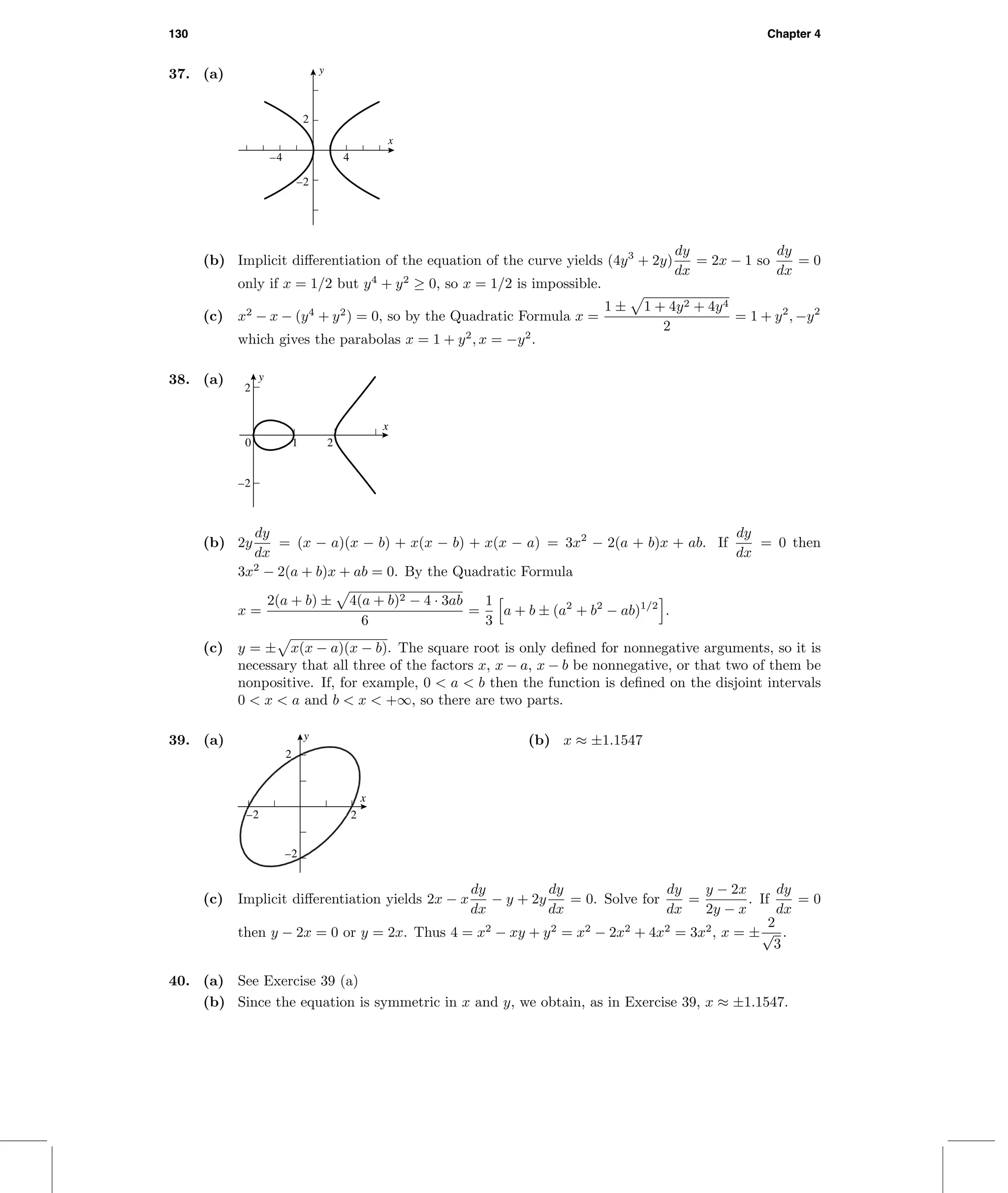


![134 Chapter 4
17.
2x(1 + log x) − x/(ln 10)
(1 + log x)2
18. 1/[x(ln 10)(1 + log x)2
]
19.
1
ln x
1
x
=
1
x ln x
20.
1
ln(ln(x))
1
ln x
1
x
21.
1
tan x
(sec2
x) = sec x csc x 22.
1
cos x
(− sin x) = − tan x
23. −
1
x
sin(ln x) 24. 2 sin(ln x) cos(ln x)
1
x
=
sin(2 ln x)
x
=
sin(ln x2
)
x
25.
1
ln 10 sin2
x
(2 sin x cos x) = 2
cot x
ln 10
26.
1
(ln 10)(1 − sin2
x)
(−2 sin x cos x) = −
2 sin x cos x
(ln 10) cos2 x
= −
2 tan x
ln 10
27.
d
dx
3 ln(x − 1) + 4 ln(x2
+ 1) =
3
x − 1
+
8x
x2 + 1
=
11x2
− 8x + 3
(x − 1)(x2 + 1)
28.
d
dx
[2 ln cos x +
1
2
ln(1 + x4
)] = −2 tan x +
2x3
1 + x4
29.
d
dx
ln cos x −
1
2
ln(4 − 3x2
) = − tan x +
3x
4 − 3x2
30.
d
dx
1
2
[ln(x − 1) − ln(x + 1)] =
1
2
1
x − 1
−
1
x + 1
31. ln |y| = ln |x| +
1
3
ln |1 + x2
|,
dy
dx
= x
3
1 + x2
1
x
+
2x
3(1 + x2)
32. ln |y| =
1
5
[ln |x − 1| − ln |x + 1|],
dy
dx
=
1
5
5 x − 1
x + 1
1
x − 1
−
1
x + 1
33. ln |y| =
1
3
ln |x2
− 8| +
1
2
ln |x3
+ 1| − ln |x6
− 7x + 5|
dy
dx
=
(x2
− 8)1/3
√
x3 + 1
x6 − 7x + 5
2x
3(x2 − 8)
+
3x2
2(x3 + 1)
−
6x5
− 7
x6 − 7x + 5
34. ln |y| = ln | sin x| + ln | cos x| + 3 ln | tan x| −
1
2
ln |x|
dy
dx
=
sin x cos x tan3
x
√
x
cot x − tan x +
3 sec2
x
tan x
−
1
2x
35. f (x) = exe−1
36. ln y = −
√
10 ln x,
1
y
dy
dx
= −
√
10
x
,
dy
dx
= −
√
10
x1+
√
10
37. (a) logx e =
ln e
ln x
=
1
ln x
,
d
dx
[logx e] = −
1
x(ln x)2
(b) logx 2 =
ln 2
ln x
,
d
dx
[logx 2] = −
ln 2
x(ln x)2](https://image.slidesharecdn.com/gabaritocompletoantoncalculo8edcaps0108-130504215818-phpapp02/75/Gabarito-completo-anton_calculo_8ed_caps_01_08-134-2048.jpg)
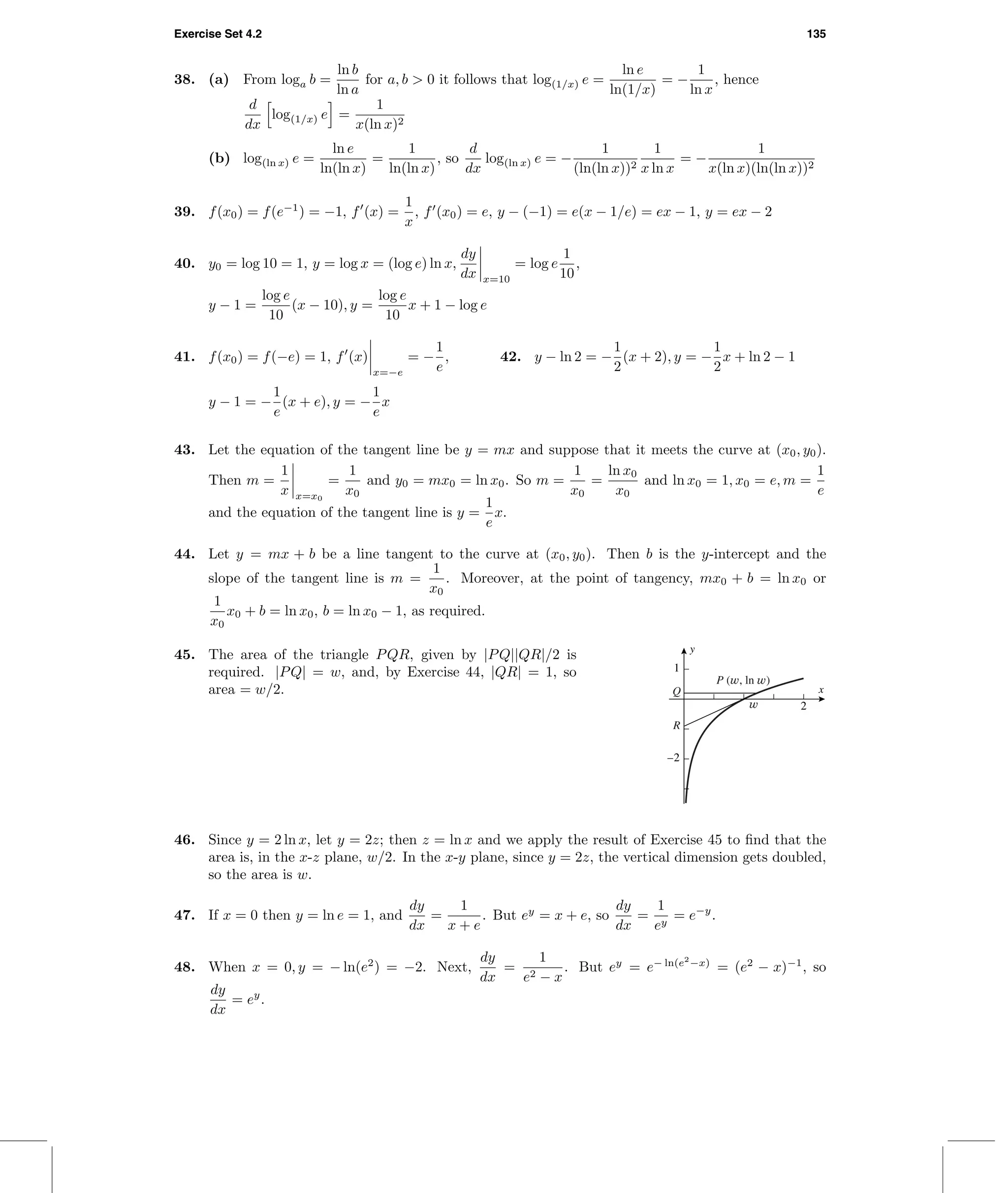
![136 Chapter 4
49. Let y = ln(x+a). Following Exercise 47 we get
dy
dx
=
1
x + a
= e−y
, and when x = 0, y = ln(a) = 0
if a = 1, so let a = 1, then y = ln(x + 1).
50. Let y = − ln(a − x), then
dy
dx
=
1
a − x
. But ey
=
1
a − x
, so
dy
dx
= ey
.
If x = 0 then y = − ln(a) = − ln 2 provided a = 2, so y = − ln(2 − x).
51. (a) f(x) = ln x; f (e2
) = lim
∆x→0
ln(e2
+ ∆x) − 2
∆x
=
d
dx
(ln x)
x=e2
=
1
x x=e2
= e−2
(b) f(w) = ln w; f (1) = lim
h→0
ln(1 + h) − ln 1
h
= lim
h→0
ln(1 + h)
h
=
1
w w=1
= 1
52. (a) Let f(x) = ln(cos x), then f(0) = ln(cos 0) = ln 1 = 0, so f (0) = lim
x→0
f(x) − f(0)
x
=
lim
x→0
ln(cos x)
x
, and f (0) = − tan 0 = 0.
(b) Let f(x) = x
√
2
, then f(1) = 1, so f (1) = lim
h→0
f(1 + h) − f(1)
h
= lim
h→0
(1 + h)
√
2
− 1
h
, and
f (x) =
√
2x
√
2−1
, f (1) =
√
2.
53.
d
dx
[logb x] = lim
h→0
logb(x + h) − logb(x)
h
= lim
h→0
1
h
logb
x + h
x
Theorem 1.6.2(b)
= lim
h→0
1
h
logb 1 +
h
x
= lim
v→0
1
vx
logb(1 + v) Let v = h/x and note that v → 0 as h → 0
=
1
x
lim
v→0
1
v
logb(1 + v) h and v are variable, whereas x is constant
=
1
x
lim
v→0
logb(1 + v)1/v
Theorem 1.6.2.(c)
=
1
x
logb lim
v→0
(1 + v)1/v
Theorem 2.5.5
=
1
x
logb e Formula 7 of Section 7.1
EXERCISE SET 4.3
1. (a) f (x) = 5x4
+ 3x2
+ 1 ≥ 1 so f is one-to-one on −∞ < x < +∞.
(b) f(1) = 3 so 1 = f−1
(3);
d
dx
f−1
(x) =
1
f (f−1(x))
, (f−1
) (3) =
1
f (1)
=
1
9
2. (a) f (x) = 3x2
+ 2ex
; for −1 < x < 1, f (x) ≥ 2e−1
= 2/e, and for |x| > 1, f (x) ≥ 3x2
≥ 3, so
f is increasing and one-to-one
(b) f(0) = 2 so 0 = f−1
(2);
d
dx
f−1
(x) =
1
f (f−1(x))
, (f−1
) (2) =
1
f (0)
=
1
2](https://image.slidesharecdn.com/gabaritocompletoantoncalculo8edcaps0108-130504215818-phpapp02/75/Gabarito-completo-anton_calculo_8ed_caps_01_08-136-2048.jpg)
![Exercise Set 4.3 137
3. f−1
(x) =
2
x
− 3, so directly
d
dx
f−1
(x) = −
2
x2
. Using Formula (1),
f (x) =
−2
(x + 3)2
, so
1
f (f−1(x))
= −(1/2)(f−1
(x) + 3)2
,
d
dx
f−1
(x) = −(1/2)
2
x
2
= −
2
x2
4. f−1
(x) =
ex
− 1
2
, so directly,
d
dx
f−1
(x) =
ex
2
. Next, f (x) =
2
2x + 1
, and using Formula (1),
d
dx
f−1
(x) =
2f−1
(x) + 1
2
=
ex
2
5. (a) f (x) = 2x + 8; f < 0 on (−∞, −4) and f > 0 on (−4, +∞); not enough information. By
inspection, f(1) = 10 = f(−9), so not one-to-one
(b) f (x) = 10x4
+ 3x2
+ 3 ≥ 3 > 0; f (x) is positive for all x, so f is one-to-one
(c) f (x) = 2 + cos x ≥ 1 > 0 for all x, so f is one-to-one
(d) f (x) = −(ln 2) 1
2
x
< 0 because ln 2 > 0, so f is one-to-one for all x.
6. (a) f (x) = 3x2
+ 6x = x(3x + 6) changes sign at x = −2, 0, so not enough information; by
observation (of the graph, and using some guesswork), f(−1 +
√
3) = −6 = f(−1 −
√
3), so
f is not one-to-one.
(b) f (x) = 5x4
+ 24x2
+ 2 ≥ 2 > 0; f is positive for all x, so f is one-to-one
(c) f (x) =
1
(x + 1)2
; f is one-to-one because:
if x1 < x2 < −1 then f > 0 on [x1, x2], so f(x1) = f(x2)
if −1 < x1 < x2 then f > 0 on [x1, x2], so f(x1) = f(x2)
if x1 < −1 < x2 then f(x1) > 1 > f(x2) since f(x) > 1 on (−∞, −1) and f(x) < 1 on
(−1, +∞)
(d) Note that f(x) is only defined for x > 0.
d
dx
logb x =
1
x ln b
, which is always negative
(0 < b < 1), so f is one-to-one.
7. y = f−1
(x), x = f(y) = 5y3
+ y − 7,
dx
dy
= 15y2
+ 1,
dy
dx
=
1
15y2 + 1
;
check: 1 = 15y2 dy
dx
+
dy
dx
,
dy
dx
=
1
15y2 + 1
8. y = f−1
(x), x = f(y) = 1/y2
,
dx
dy
= −2y−3
,
dy
dx
= −y3
/2;
check: 1 = −2y−3 dy
dx
,
dy
dx
= −y3
/2
9. y = f−1
(x), x = f(y) = 2y5
+ y3
+ 1,
dx
dy
= 10y4
+ 3y2
,
dy
dx
=
1
10y4 + 3y2
;
check: 1 = 10y4 dy
dx
+ 3y2 dy
dx
,
dy
dx
=
1
10y4 + 3y2
10. y = f−1
(x), x = f(y) = 5y − sin 2y,
dx
dy
= 5 − 2 cos 2y,
dy
dx
=
1
5 − 2 cos 2y
;
check: 1 = (5 − 2 cos 2y)
dy
dx
,
dy
dx
=
1
5 − 2 cos 2y](https://image.slidesharecdn.com/gabaritocompletoantoncalculo8edcaps0108-130504215818-phpapp02/75/Gabarito-completo-anton_calculo_8ed_caps_01_08-137-2048.jpg)
![138 Chapter 4
11. 7e7x
12. −10xe−5x2
13. x3
ex
+ 3x2
ex
= x2
ex
(x + 3) 14. −
1
x2
e1/x
15.
dy
dx
=
(ex
+ e−x
)(ex
+ e−x
) − (ex
− e−x
)(ex
− e−x
)
(ex + e−x)2
=
(e2x
+ 2 + e−2x
) − (e2x
− 2 + e−2x
)
(ex + e−x)2
= 4/(ex
+ e−x
)2
16. ex
cos(ex
)
17. (x sec2
x + tan x)ex tan x
18.
dy
dx
=
(ln x)ex
− ex
(1/x)
(ln x)2
=
ex
(x ln x − 1)
x(ln x)2
19. (1 − 3e3x
)e(x−e3x
)
20.
15
2
x2
(1 + 5x3
)−1/2
exp( 1 + 5x3)
21.
(x − 1)e−x
1 − xe−x
=
x − 1
ex − x
22.
1
cos(ex)
[− sin(ex
)]ex
= −ex
tan(ex
)
23. f (x) = 2x
ln 2; y = 2x
, ln y = x ln 2,
1
y
y = ln 2, y = y ln 2 = 2x
ln 2
24. f (x) = −3−x
ln 3; y = 3−x
, ln y = −x ln 3,
1
y
y = − ln 3, y = −y ln 3 = −3−x
ln 3
25. f (x) = πsin x
(ln π) cos x;
y = πsin x
, ln y = (sin x) ln π,
1
y
y = (ln π) cos x, y = πsin x
(ln π) cos x
26. f (x) = πx tan x
(ln π)(x sec2
x + tan x);
y = πx tan x
, ln y = (x tan x) ln π,
1
y
y = (ln π)(x sec2
x + tan x)
y = πx tan x
(ln π)(x sec2
x + tan x)
27. ln y = (ln x) ln(x3
− 2x),
1
y
dy
dx
=
3x2
− 2
x3 − 2x
ln x +
1
x
ln(x3
− 2x),
dy
dx
= (x3
− 2x)ln x 3x2
− 2
x3 − 2x
ln x +
1
x
ln(x3
− 2x)
28. ln y = (sin x) ln x,
1
y
dy
dx
=
sin x
x
+ (cos x) ln x,
dy
dx
= xsin x sin x
x
+ (cos x) ln x
29. ln y = (tan x) ln(ln x),
1
y
dy
dx
=
1
x ln x
tan x + (sec2
x) ln(ln x),
dy
dx
= (ln x)tan x tan x
x ln x
+ (sec2
x) ln(ln x)](https://image.slidesharecdn.com/gabaritocompletoantoncalculo8edcaps0108-130504215818-phpapp02/75/Gabarito-completo-anton_calculo_8ed_caps_01_08-138-2048.jpg)
![Exercise Set 4.3 139
30. ln y = (ln x) ln(x2
+ 3),
1
y
dy
dx
=
2x
x2 + 3
ln x +
1
x
ln(x2
+ 3),
dy
dx
= (x2
+ 3)ln x 2x
x2 + 3
ln x +
1
x
ln(x2
+ 3)
31. f (x) = exe−1
32. (a) because xx
is not of the form ax
where a is constant
(b) y = xx
, ln y = x ln x,
1
y
y = 1 + ln x, y = xx
(1 + ln x)
33.
3
1 − (3x)2
=
3
√
1 − 9x2
34. −
1/2
1 − x+1
2
2
= −
1
4 − (x + 1)2
35.
1
1 − 1/x2
(−1/x2
) = −
1
|x|
√
x2 − 1
36.
sin x
√
1 − cos2 x
=
sin x
| sin x|
=
1, sin x > 0
−1, sin x < 0
37.
3x2
1 + (x3)2
=
3x2
1 + x6
38.
5x4
|x5| (x5)2 − 1
=
5
|x|
√
x10 − 1
39. y = 1/ tan x = cot x, dy/dx = − csc2
x
40. y = (tan−1
x)−1
, dy/dx = −(tan−1
x)−2 1
1 + x2
41.
ex
|x|
√
x2 − 1
+ ex
sec−1
x 42. −
1
(cos−1 x)
√
1 − x2
43. 0 44.
3x2
(sin−1
x)2
√
1 − x2
+ 2x(sin−1
x)3
45. 0 46. −1/
√
e2x − 1
47. −
1
1 + x
1
2
x−1/2
= −
1
2(1 + x)
√
x
48. −
1
2
√
cot−1
x(1 + x2)
49. (a) Let x = f(y) = cot y, 0 < y < π, −∞ < x < +∞. Then f is differentiable and one-to-one
and f (f−1
(x)) = − csc2
(cot−1
x) = −x2
− 1 = 0, and
d
dx
[cot−1
x]
x=0
= lim
x→0
1
f (f−1(x))
= − lim
x→0
1
x2 + 1
= −1.
(b) If x = 0 then, from Exercise 50(a) of Section 1.5,
d
dx
cot−1
x =
d
dx
tan−1 1
x
= −
1
x2
1
1 + (1/x)2
= −
1
x2 + 1
. For x = 0, Part (a) shows the same;
thus for −∞ < x < +∞,
d
dx
[cot−1
x] = −
1
x2 + 1
.
(c) For −∞ < u < +∞, by the chain rule it follows that
d
dx
[cot−1
u] = −
1
u2 + 1
du
dx
.](https://image.slidesharecdn.com/gabaritocompletoantoncalculo8edcaps0108-130504215818-phpapp02/75/Gabarito-completo-anton_calculo_8ed_caps_01_08-139-2048.jpg)
![140 Chapter 4
50. (a) By the chain rule,
d
dx
[csc−1
x] =
d
dx
sin−1 1
x
= −
1
x2
1
1 − (1/x)2
=
−1
|x|
√
x2 − 1
(b) By the chain rule,
d
dx
[csc−1
u] =
du
dx
d
du
[csc−1
u] =
−1
|u|
√
u2 − 1
du
dx
51. x3
+ x tan−1
y = ey
, 3x2
+
x
1 + y2
y + tan−1
y = ey
y , y =
(3x2
+ tan−1
y)(1 + y2
)
(1 + y2)ey − x
52. sin−1
(xy) = cos−1
(x − y),
1
1 − x2y2
(xy + y) = −
1
1 − (x − y)2
(1 − y ),
y =
y 1 − (x − y)2 + 1 − x2y2
1 − x2y2 − x 1 − (x − y)2
53. (a) f(x) = x3
− 3x2
+ 2x = x(x − 1)(x − 2) so f(0) = f(1) = f(2) = 0 thus f is not one-to-one.
(b) f (x) = 3x2
− 6x + 2, f (x) = 0 when x =
6 ±
√
36 − 24
6
= 1 ±
√
3/3. f (x) > 0 (f is
increasing) if x < 1 −
√
3/3, f (x) < 0 (f is decreasing) if 1 −
√
3/3 < x < 1 +
√
3/3, so f(x)
takes on values less than f(1 −
√
3/3) on both sides of 1 −
√
3/3 thus 1 −
√
3/3 is the largest
value of k.
54. (a) f(x) = x3
(x − 2) so f(0) = f(2) = 0 thus f is not one to one.
(b) f (x) = 4x3
− 6x2
= 4x2
(x − 3/2), f (x) = 0 when x = 0 or 3/2; f is decreasing on (−∞, 3/2]
and increasing on [3/2, +∞) so 3/2 is the smallest value of k.
55. (a) f (x) = 4x3
+ 3x2
= (4x + 3)x2
= 0 only at x = 0. But on [0, 2], f has no sign change, so f
is one-to-one.
(b) F (x) = 2f (2g(x))g (x) so F (3) = 2f (2g(3))g (3). By inspection f(1) = 3, so
g(3) = f−1
(3) = 1 and g (3) = (f−1
) (3) = 1/f (f−1
(3)) = 1/f (1) = 1/7 because
f (x) = 4x3
+ 3x2
. Thus F (3) = 2f (2)(1/7) = 2(44)(1/7) = 88/7.
F(3) = f(2g(3)) = f(2·1) = f(2) = 24, so the line tangent to F(x) at (3, 25) has the equation
y − 25 = (88/7)(x − 3), y = (88/7)x − 89/7.
56. (a) f (x) = −e4−x2
2 +
1
x2
< 0 for all x > 0, so f is one-to-one.
(b) By inspection, f(2) = 1/2, so 2 = f−1
(1/2) = g(1/2). By inspection,
f (2) = − 2 +
1
4
= −
9
4
, and
F (1/2) = f ([g(x)]2
)
d
dx
[g(x)2
]
x=1/2
= f ([g(x)]2
)2g(x)g (x)
x=1/2
= f (22
)2 · 2
1
f (g(x)) x=1/2
= 4
f (4)
f (2)
= 4
e−12
(2 + 1
16 )
(2 + 1
4 )
=
33
9e12
=
11
3e12
57. (a) f (x) = kekx
, f (x) = k2
ekx
, f (x) = k3
ekx
, . . . , f(n)
(x) = kn
ekx
(b) g (x) = −ke−kx
, g (x) = k2
e−kx
, g (x) = −k3
e−kx
, . . . , g(n)
(x) = (−1)n
kn
e−kx
58.
dy
dt
= e−λt
(ωA cos ωt − ωB sin ωt) + (−λ)e−λt
(A sin ωt + B cos ωt)
= e−λt
[(ωA − λB) cos ωt − (ωB + λA) sin ωt]](https://image.slidesharecdn.com/gabaritocompletoantoncalculo8edcaps0108-130504215818-phpapp02/75/Gabarito-completo-anton_calculo_8ed_caps_01_08-140-2048.jpg)
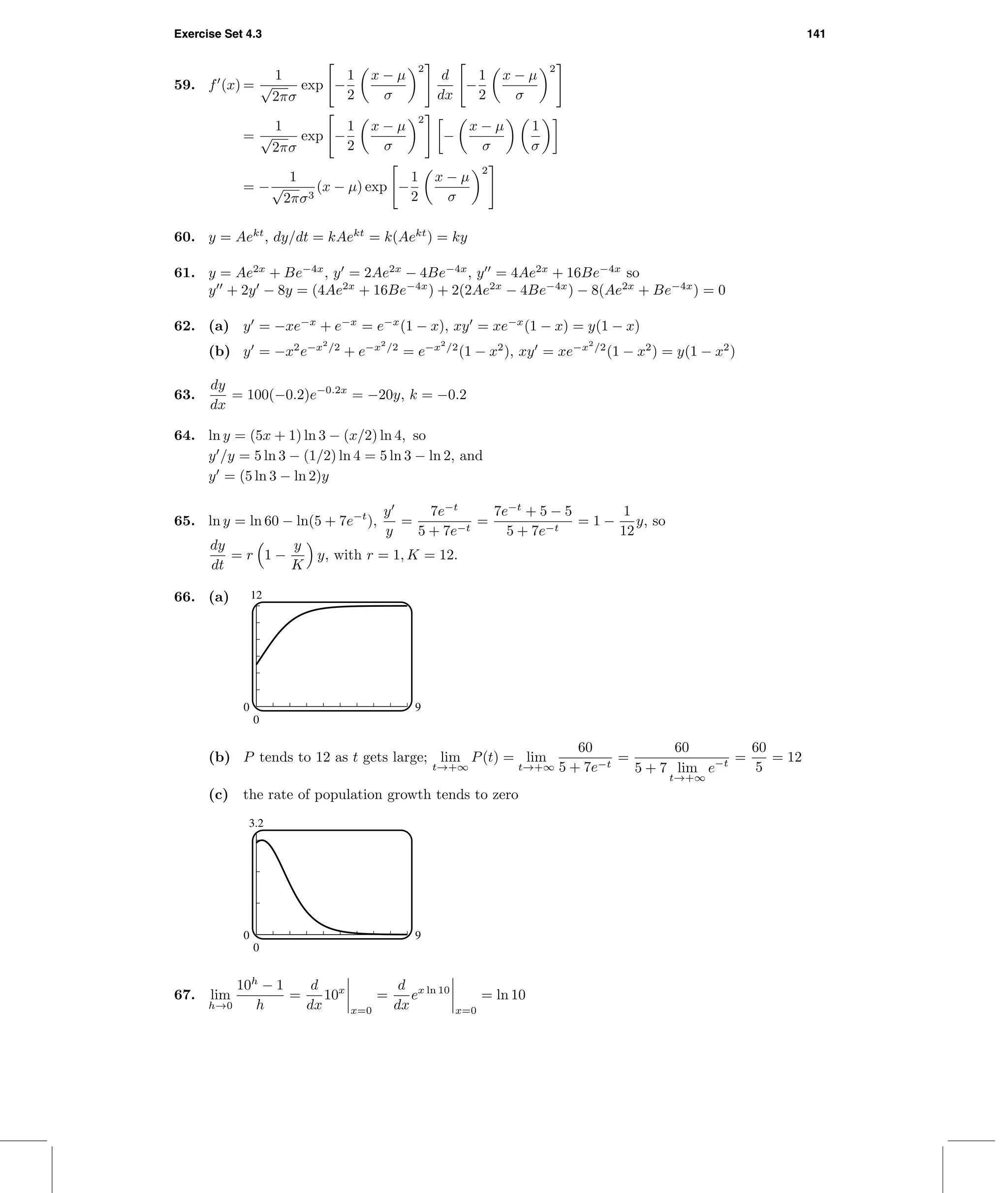
![142 Chapter 4
68. lim
h→0
tan−1
(1 + h) − π/4
h
=
d
dx
tan−1
x
x=1
=
1
1 + x2
x=1
=
1
2
69. lim
∆x→0
9[sin−1
(
√
3
2 + ∆x)]2
− π2
∆x
=
d
dx
(3 sin−1
x)2
x=
√
3/2
= 2(3 sin−1
x)
3
√
1 − x2
x=
√
3/2
= 2(3
π
3
)
3
1 − (3/4)
= 12π
70. lim
∆x→0
(2 + ∆x)(2+∆x)
− 4
∆x
=
d
dx
xx
x=2
=
d
dx
ex ln x
x=2
= (1 + ln x)ex ln x
x=2
= (1 + ln 2)22
= 4(1 + ln 2)
71. lim
w→2
3 sec−1
w − π
w − 2
=
d
dx
3 sec−1
x
x=2
=
3
|2|
√
22 − 1
=
√
3
2
72. lim
w→1
4(tan−1
w)w
− π
w − 1
=
d
dx
4(tan−1
x)x
x=1
=
d
dx
4ex ln tan−1
x
x=1
= 4(tan−1
x)x
ln tan−1
x + x
1/(1 + x2
)
tan−1
x x=1
= π ln(π/4) +
1
2
4
π
== 2 + π ln(π/4)
EXERCISE SET 4.4
1. (a) lim
x→2
x2
− 4
x2 + 2x − 8
= lim
x→2
(x − 2)(x + 2)
(x + 4)(x − 2)
= lim
x→2
x + 2
x + 4
=
2
3
(b) lim
x→+∞
2x − 5
3x + 7
=
2 − lim
x→+∞
5
x
3 + lim
x→+∞
7
x
=
2
3
2. (a)
sin x
tan x
= sin x
cos x
sin x
= cos x so lim
x→0
sin x
tan x
= lim
x→0
cos x = 1
(b)
x2
− 1
x3 − 1
=
(x − 1)(x + 1)
(x − 1)(x2 + x + 1)
=
x + 1
x2 + x + 1
so lim
x→1
x2
− 1
x3 − 1
=
2
3
3. Tf (x) = −2(x + 1), Tg(x) = −3(x + 1),
limit = 2/3
4. Tf (x) = − x −
π
2
, Tg(x) = − x −
π
2
limit = 1
5. lim
x→0
ex
cos x
= 1 6. lim
x→3
1
6x − 13
= 1/5
7. lim
θ→0
sec2
θ
1
= 1 8. lim
t→0
tet
+ et
−et
= −1
9. lim
x→π+
cos x
1
= −1 10. lim
x→0+
cos x
2x
= +∞
11. lim
x→+∞
1/x
1
= 0 12. lim
x→+∞
3e3x
2x
= lim
x→+∞
9e3x
2
= +∞](https://image.slidesharecdn.com/gabaritocompletoantoncalculo8edcaps0108-130504215818-phpapp02/75/Gabarito-completo-anton_calculo_8ed_caps_01_08-142-2048.jpg)
![Exercise Set 4.4 143
13. lim
x→0+
− csc2
x
1/x
= lim
x→0+
−x
sin2
x
= lim
x→0+
−1
2 sin x cos x
= −∞
14. lim
x→0+
−1/x
(−1/x2)e1/x
= lim
x→0+
x
e1/x
= 0
15. lim
x→+∞
100x99
ex
= lim
x→+∞
(100)(99)x98
ex
= · · · = lim
x→+∞
(100)(99)(98) · · · (1)
ex
= 0
16. lim
x→0+
cos x/ sin x
sec2 x/ tan x
= lim
x→0+
cos2
x = 1 17. lim
x→0
2/
√
1 − 4x2
1
= 2
18. lim
x→0
1 −
1
1 + x2
3x2
= lim
x→0
1
3(1 + x2)
=
1
3
19. lim
x→+∞
xe−x
= lim
x→+∞
x
ex
= lim
x→+∞
1
ex
= 0
20. lim
x→π
(x − π) tan(x/2) = lim
x→π
x − π
cot(x/2)
= lim
x→π
1
−(1/2) csc2(x/2)
= −2
21. lim
x→+∞
x sin(π/x) = lim
x→+∞
sin(π/x)
1/x
= lim
x→+∞
(−π/x2
) cos(π/x)
−1/x2
= lim
x→+∞
π cos(π/x) = π
22. lim
x→0+
tan x ln x = lim
x→0+
ln x
cot x
= lim
x→0+
1/x
− csc2 x
= lim
x→0+
− sin2
x
x
= lim
x→0+
−2 sin x cos x
1
= 0
23. lim
x→(π/2)−
sec 3x cos 5x = lim
x→(π/2)−
cos 5x
cos 3x
= lim
x→(π/2)−
−5 sin 5x
−3 sin 3x
=
−5(+1)
(−3)(−1)
= −
5
3
24. lim
x→π
(x − π) cot x = lim
x→π
x − π
tan x
= lim
x→π
1
sec2 x
= 1
25. y = (1 − 3/x)x
, lim
x→+∞
ln y = lim
x→+∞
ln(1 − 3/x)
1/x
= lim
x→+∞
−3
1 − 3/x
= −3, lim
x→+∞
y = e−3
26. y = (1 + 2x)−3/x
, lim
x→0
ln y = lim
x→0
−
3 ln(1 + 2x)
x
= lim
x→0
−
6
1 + 2x
= −6, lim
x→0
y = e−6
27. y = (ex
+ x)1/x
, lim
x→0
ln y = lim
x→0
ln(ex
+ x)
x
= lim
x→0
ex
+ 1
ex + x
= 2, lim
x→0
y = e2
28. y = (1 + a/x)bx
, lim
x→+∞
ln y = lim
x→+∞
b ln(1 + a/x)
1/x
= lim
x→+∞
ab
1 + a/x
= ab, lim
x→+∞
y = eab
29. y = (2 − x)tan(πx/2)
, lim
x→1
ln y = lim
x→1
ln(2 − x)
cot(πx/2)
= lim
x→1
2 sin2
(πx/2)
π(2 − x)
= 2/π, lim
x→1
y = e2/π
30. y = [cos(2/x)]x2
, lim
x→+∞
ln y = lim
x→+∞
ln cos(2/x)
1/x2
= lim
x→+∞
(−2/x2
)(− tan(2/x))
−2/x3
= lim
x→+∞
− tan(2/x)
1/x
= lim
x→+∞
(2/x2
) sec2
(2/x)
−1/x2
= −2, lim
x→+∞
y = e−2
31. lim
x→0
1
sin x
−
1
x
= lim
x→0
x − sin x
x sin x
= lim
x→0
1 − cos x
x cos x + sin x
= lim
x→0
sin x
2 cos x − x sin x
= 0](https://image.slidesharecdn.com/gabaritocompletoantoncalculo8edcaps0108-130504215818-phpapp02/75/Gabarito-completo-anton_calculo_8ed_caps_01_08-143-2048.jpg)
![144 Chapter 4
32. lim
x→0
1 − cos 3x
x2
= lim
x→0
3 sin 3x
2x
= lim
x→0
9
2
cos 3x =
9
2
33. lim
x→+∞
(x2
+ x) − x2
√
x2 + x + x
= lim
x→+∞
x
√
x2 + x + x
= lim
x→+∞
1
1 + 1/x + 1
= 1/2
34. lim
x→0
ex
− 1 − x
xex − x
= lim
x→0
ex
− 1
xex + ex − 1
= lim
x→0
ex
xex + 2ex
= 1/2
35. lim
x→+∞
[x − ln(x2
+ 1)] = lim
x→+∞
[ln ex
− ln(x2
+ 1)] = lim
x→+∞
ln
ex
x2 + 1
,
lim
x→+∞
ex
x2 + 1
= lim
x→+∞
ex
2x
= lim
x→+∞
ex
2
= +∞ so lim
x→+∞
[x − ln(x2
+ 1)] = +∞
36. lim
x→+∞
ln
x
1 + x
= lim
x→+∞
ln
1
1/x + 1
= ln(1) = 0
38. (a) lim
x→+∞
ln x
xn
= lim
x→+∞
1/x
nxn−1
= lim
x→+∞
1
nxn
= 0
(b) lim
x→+∞
xn
ln x
= lim
x→+∞
nxn−1
1/x
= lim
x→+∞
nxn
= +∞
39. (a) L’Hˆopital’s Rule does not apply to the problem lim
x→1
3x2
− 2x + 1
3x2 − 2x
because it is not a
0
0
form.
(b) lim
x→1
3x2
− 2x + 1
3x2 − 2x
= 2
40. L’Hˆopital’s Rule does not apply to the problem
e3x2
−12x+12
x4 − 16
, which is of the form
e0
0
, and from
which it follows that lim
x→2−
and lim
x→2+
exist, with values −∞ if x approaches 2 from the left and
+∞ if from the right. The general limit lim
x→2
does not exist.
41. lim
x→+∞
1/(x ln x)
1/(2
√
x)
= lim
x→+∞
2
√
x ln x
= 0 0.15
0
100 10000
42. y = xx
, lim
x→0+
ln y = lim
x→0+
ln x
1/x
= lim
x→0+
−x = 0, lim
x→0+
y = 1 1
0
0 0.5](https://image.slidesharecdn.com/gabaritocompletoantoncalculo8edcaps0108-130504215818-phpapp02/75/Gabarito-completo-anton_calculo_8ed_caps_01_08-144-2048.jpg)
![Exercise Set 4.4 145
25
19
0 0.5
43. y = (sin x)3/ ln x
,
lim
x→0+
ln y = lim
x→0+
3 ln sin x
ln x
= lim
x→0+
(3 cos x)
x
sin x
= 3,
lim
x→0+
y = e3
4.1
3.3
1.4 1.6
44. lim
x→π/2−
4 sec2
x
sec x tan x
= lim
x→π/2−
4
sin x
= 4
0
–16
0 3
45. ln x − ex
= ln x −
1
e−x
=
e−x
ln x − 1
e−x
;
lim
x→+∞
e−x
ln x = lim
x→+∞
ln x
ex
= lim
x→+∞
1/x
ex
= 0 by L’Hˆopital’s Rule,
so lim
x→+∞
[ln x − ex
] = lim
x→+∞
e−x
ln x − 1
e−x
= −∞
–0.6
–1.2
0 12
46. lim
x→+∞
[ln ex
− ln(1 + 2ex
)] = lim
x→+∞
ln
ex
1 + 2ex
= lim
x→+∞
ln
1
e−x + 2
= ln
1
2
;
horizontal asymptote y = − ln 2
1.02
1
100 10000
47. y = (ln x)1/x
,
lim
x→+∞
ln y = lim
x→+∞
ln(ln x)
x
= lim
x→+∞
1
x ln x
= 0;
lim
x→+∞
y = 1, y = 1 is the horizontal asymptote](https://image.slidesharecdn.com/gabaritocompletoantoncalculo8edcaps0108-130504215818-phpapp02/75/Gabarito-completo-anton_calculo_8ed_caps_01_08-145-2048.jpg)
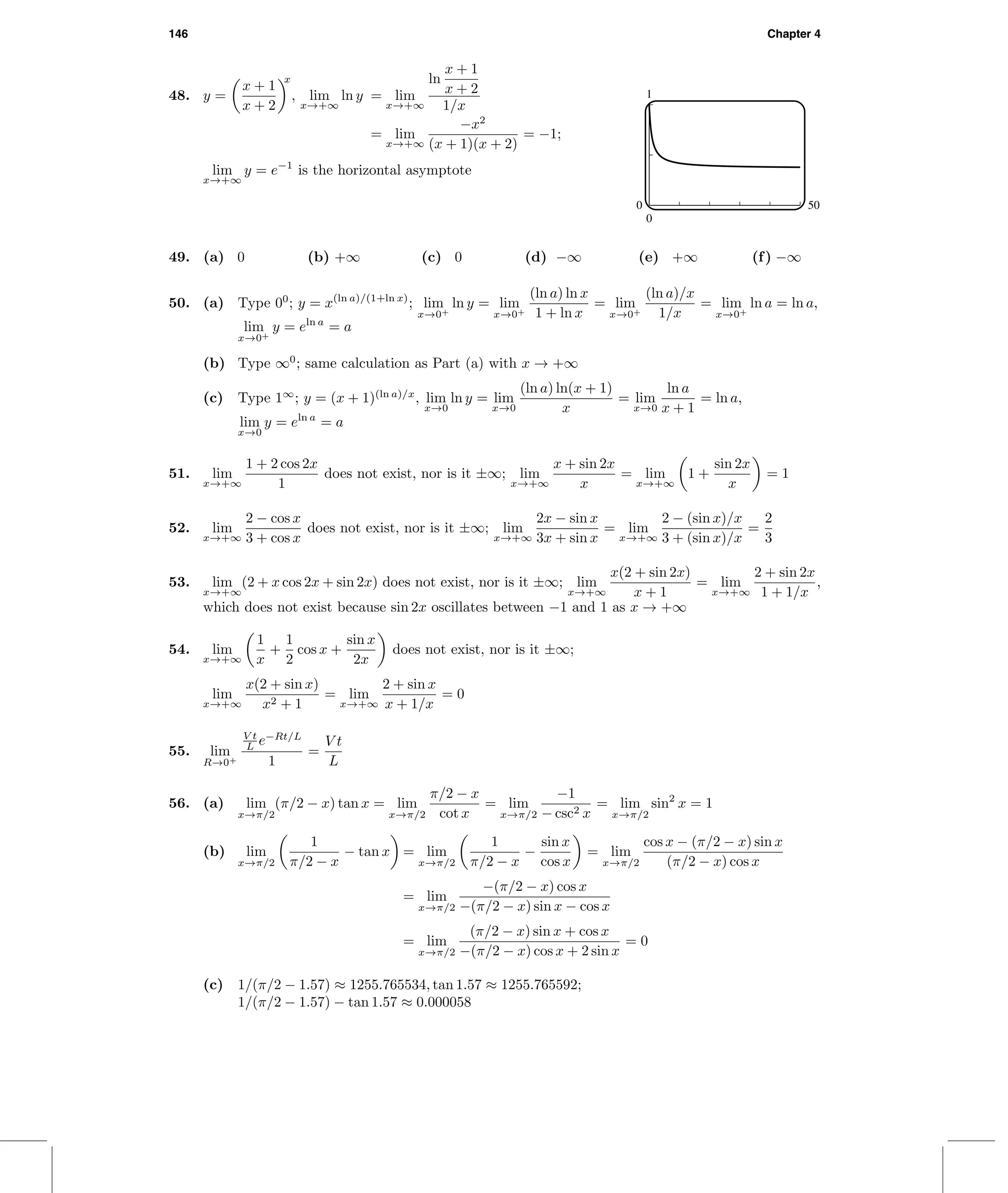
![Review Exercises Chapter 4 147
57. (b) lim
x→+∞
x(k1/x
− 1) = lim
t→0+
kt
− 1
t
= lim
t→0+
(ln k)kt
1
= ln k
(c) ln 0.3 = −1.20397, 1024 1024
√
0.3 − 1 = −1.20327;
ln 2 = 0.69315, 1024 1024
√
2 − 1 = 0.69338
58. If k = −1 then lim
x→0
(k + cos x) = k + 1 = 0, so lim
x→0
k + cos x
x2
= ±∞. Hence k = −1, and by the
rule lim
x→0
−1 + cos x
x2
= lim
x→0
− sin x
2x
= lim
x→0
− 2
cos x
2
= −
2
2
= −4 if = ±2
√
2.
59. (a) No; sin(1/x) oscillates as x → 0. (b) 0.05
–0.05
–0.35 0.35
(c) For the limit as x → 0+
use the Squeezing Theorem together with the inequalities
−x2
≤ x2
sin(1/x) ≤ x2
. For x → 0−
do the same; thus lim
x→0
f(x) = 0.
60. (a) Apply the rule to get lim
x→0
− cos(1/x) + 2x sin(1/x)
cos x
which does not exist (nor is it ±∞).
(b) Rewrite as lim
x→0
x
sin x
[x sin(1/x)], but lim
x→0
x
sin x
= lim
x→0
1
cos x
= 1 and lim
x→0
x sin(1/x) = 0,
thus lim
x→0
x
sin x
[x sin(1/x)] = (1)(0) = 0
61. lim
x→0+
sin(1/x)
(sin x)/x
, lim
x→0+
sin x
x
= 1 but lim
x→0+
sin(1/x) does not exist because sin(1/x) oscillates between
−1 and 1 as x → +∞, so lim
x→0+
x sin(1/x)
sin x
does not exist.
62. Since f(0) = g(0) = 0, then for x = a,
f(x)
g(x)
=
(f(x) − f(0)/(x − a)
(g(x) − g(0))/(x − a)
. Now take the limit:
lim
x→a
f(x)
g(x)
= lim
x→a
(f(x) − f(0)/(x − a)
(g(x) − g(0))/(x − a)
=
f (a)
g (a)
REVIEW EXERCISES CHAPTER 4
1.
1
4(6x − 5)3/4
(6) =
3
2(6x − 5)3/4
2.
1
3(x2 + x)2/3
(2x + 1) =
2x + 1
3(x2 + x)2/3
3. dy/dx =
3
2
x − 1
x + 2
1/2
d
dx
x − 1
x + 2
=
9
2(x + 2)2
x − 1
x + 2
1/2
4. dy/dx =
x2 4
3
(3 − 2x)1/3
(−2) − (3 − 2x)4/3
(2x)
x4
=
2(3 − 2x)1/3
(2x − 9)
3x3](https://image.slidesharecdn.com/gabaritocompletoantoncalculo8edcaps0108-130504215818-phpapp02/75/Gabarito-completo-anton_calculo_8ed_caps_01_08-147-2048.jpg)


![153
CHAPTER 5
The Derivative in Graphing and Applications
EXERCISE SET 5.1
1. (a) f > 0 and f > 0
y
x
(b) f > 0 and f < 0
y
x
(c) f < 0 and f > 0
y
x
(d) f < 0 and f < 0
y
x
2. (a) y
x
(b) y
x
(c) y
x
(d) y
x
3. A: dy/dx < 0, d2
y/dx2
> 0
B: dy/dx > 0, d2
y/dx2
< 0
C: dy/dx < 0, d2
y/dx2
< 0
4. A: dy/dx < 0, d2
y/dx2
< 0
B: dy/dx < 0, d2
y/dx2
> 0
C: dy/dx > 0, d2
y/dx2
< 0
5. An inflection point occurs when f changes sign: at x = −1, 0, 1 and 2.
6. (a) f(0) < f(1) since f > 0 on (0, 1). (b) f(1) > f(2) since f < 0 on (1, 2).
(c) f (0) > 0 by inspection. (d) f (1) = 0 by inspection.
(e) f (0) < 0 since f is decreasing there. (f) f (2) = 0 since f has a minimum there.
7. (a) [4, 6] (b) [1, 4] and [6, 7] (c) (1, 2) and (3, 5)
(d) (2, 3) and (5, 7) (e) x = 2, 3, 5](https://image.slidesharecdn.com/gabaritocompletoantoncalculo8edcaps0108-130504215818-phpapp02/75/Gabarito-completo-anton_calculo_8ed_caps_01_08-153-2048.jpg)
![154 Chapter 5
8. (1, 2) (2, 3) (3, 4) (4, 5) (5, 6) (6, 7)
f − − − + + −
f + − + + − −
9. (a) f is increasing on [1, 3] (b) f is decreasing on (−∞, 1], [3, +∞]
(c) f is concave up on (−∞, 2), (4, +∞) (d) f is concave down on (2, 4)
(e) points of inflection at x = 2, 4
10. (a) f is increasing on (−∞, +∞) (b) f is nowhere decreasing
(c) f is concave up on (−∞, 1), (3, +∞) (d) f is concave down on (1, 3)
(e) f has points of inflection at x = 1, 3
11. f (x) = 2(x − 3/2)
f (x) = 2
(a) [3/2, +∞) (b) (−∞, 3/2]
(c) (−∞, +∞) (d) nowhere
(e) none
12. f (x) = −2(2 + x)
f (x) = −2
(a) (−∞, −2] (b) [−2, +∞)
(c) nowhere (d) (−∞, +∞)
(e) none
13. f (x) = 6(2x + 1)2
f (x) = 24(2x + 1)
(a) (−∞, +∞) (b) nowhere
(c) (−1/2, +∞) (d) (−∞, −1/2)
(e) −1/2
14. f (x) = 3(4 − x2
)
f (x) = −6x
(a) [−2, 2] (b) (−∞, −2], [2, +∞)
(c) (−∞, 0) (d) (0, +∞)
(e) 0
15. f (x) = 12x2
(x − 1)
f (x) = 36x(x − 2/3)
(a) [1, +∞) (b) (−∞, 1]
(c) (−∞, 0), (2/3, +∞) (d) (0, 2/3)
(e) 0, 2/3
16. f (x) = x(4x2
− 15x + 18)
f (x) = 6(x − 1)(2x − 3)
(a) [0, +∞), (b) (−∞, 0]
(c) (−∞, 1), (3/2, +∞) (d) (1, 3/2)
(e) 1, 3/2
17. f (x) = −
3(x2
− 3x + 1)
(x2 − x + 1)3
f (x) =
6x(2x2
− 8x + 5)
(x2 − x + 1)4
(a) [3−
√
5
2 , 3+
√
5
2 ] (b) (−∞, 3−
√
5
2 ], [3+
√
5
2 , +∞)
(c) (0, 2 −
√
6
2 ), (2 +
√
6
2 , +∞) (d) (−∞, 0), (2 −
√
6
2 , 2 +
√
6
2 )
(e) 0, 2 −
√
6/2, 2 +
√
6/2
18. f (x) = −
x2
− 2
(x + 2)2
f (x) =
2x(x2
− 6)
(x + 2)3
(a) (−∞, −
√
2), (
√
2, +∞) (b) (−
√
2,
√
2)
(c) (−∞, −
√
6), (0,
√
6) (d) (−
√
6, 0), (
√
6, +∞)
(e) none
19. f (x) =
2x + 1
3(x2 + x + 1)2/3
f (x) = −
2(x + 2)(x − 1)
9(x2 + x + 1)5/3
(a) [−1/2, +∞) (b) (−∞, −1/2]
(c) (−2, 1) (d) (−∞, −2), (1, +∞)
(e) −2, 1](https://image.slidesharecdn.com/gabaritocompletoantoncalculo8edcaps0108-130504215818-phpapp02/75/Gabarito-completo-anton_calculo_8ed_caps_01_08-154-2048.jpg)
![Exercise Set 5.1 155
20. f (x) =
4(x − 1/4)
3x2/3
f (x) =
4(x + 1/2)
9x5/3
(a) [1/4, +∞) (b) (−∞, 1/4]
(c) (−∞, −1/2), (0, +∞) (d) (−1/2, 0)
(e) −1/2, 0
21. f (x) =
4(x2/3
− 1)
3x1/3
f (x) =
4(x5/3
+ x)
9x7/3
(a) [−1, 0], [1, +∞) (b) (−∞, −1], [0, 1]
(c) (−∞, 0), (0, +∞) (d) nowhere
(e) none
22. f (x) =
2
3
x−1/3
− 1
f (x) = −
2
9x4/3
(a) [−1, 0], [1, +∞) (b) (−∞, −1], [0, 1]
(c) (−∞, 0), (0, +∞) (d) nowhere
(e) none
23. f (x) = −xe−x2
/2
f (x) = (−1 + x2
)e−x2
/2
(a) (−∞, 0] (b) [0, +∞)
(c) (−∞, −1), (1, +∞) (d) (−1, 1)
(e) −1, 1
24. f (x) = (2x2
+ 1)ex2
f (x) = 2x(2x2
+ 3)ex2
(a) (−∞, +∞) (b) none
(c) (0, +∞) (d) (−∞, 0)
(e) 0
25. f (x) =
x
x2 + 4
f (x) = −
x2
− 4
(x2 + 4)2
(a) [0, +∞) (b) (−∞, 0]
(c) (−2, +2) (d) (−∞, −2), (2, +∞)
(e) −2, +2
26. f (x) = x2
(1 + 3 ln x)
f (x) = x(5 + 6 ln x)
(a) [e−1/3
, +∞) (b) (0, e−1/3
]
(c) (e−5/6
, +∞) (d) (0, e−5/6
)
(e) e−5/6
27. f (x) =
2x
1 + (x2 − 1)2
f (x) = −2
3x4
− 2x2
− 2
[1 + (x2 − 1)2]2
(a) [0 + ∞) (b) (−∞, 0]
(c) −
√
1+
√
7
√
3
, −
√
1−
√
7
√
3
,
√
1−
√
7
√
3
,
√
1+
√
7
√
3
(d) − ∞, −
√
1+
√
7
√
3
, −
√
1−
√
7
√
3
,
√
1−
√
7
√
3
,
√
1+
√
7
√
3
, +∞
(e) four: ±
1 ±
√
7
3
28. f (x) =
2
3x1/3
√
1 − x4/3
f (x) =
2 −1 + 3x4/3
9x4/3 1 − x4/3 3/2
(a) [0, 1]
(b) [−1, 0]
(c) (−1, −3−3/4
), (0, 3−3/4
, 1)
(d) (3−3/4
, 0), (3−3/4
(e) ±3−3/4](https://image.slidesharecdn.com/gabaritocompletoantoncalculo8edcaps0108-130504215818-phpapp02/75/Gabarito-completo-anton_calculo_8ed_caps_01_08-155-2048.jpg)
![156 Chapter 5
29. f (x) = cos x + sin x
f (x) = − sin x + cos x
(a) [−π/4, 3π/4] (b) (−π, −π/4], [3π/4, π)
(c) (−3π/4, π/4) (d) (−π, −3π/4), (π/4, π)
(e) −3π/4, π/4
1.5
–1.5
^ 6
30. f (x) = (2 tan2
x + 1) sec x
f (x) = sec x tan x(6 tan2
x + 5)
(a) [−π/2, π/2] (b) nowhere
(c) (0, π/2) (d) (−π/2, 0)
(e) 0
10
–10
^ 6
31. f (x) = −
1
2
sec2
(x/2)
f (x) = −
1
2
tan(x/2) sec2
(x/2))
(a) nowhere (b) (−π, π)
(c) (−π, 0) (d) (0, π)
(e) 0
10
–10
C c
32. f (x) = 2 − csc2
x
f (x) = 2 csc2
x cot x = 2
cos x
sin3
x
(a) [π/4, 3π/4] (b) (0, π/4], [3π/4, π)
(c) (0, π/2) (d) (π/2, π)
(e) π/2
8
–2
0 p
33. f(x) = 1 + sin 2x
f (x) = 2 cos 2x
f (x) = −4 sin 2x
(a) [−π, −3π/4], [−π/4, π/4], [3π/4, π]
(b) [−3π/4, −π/4], [π/4, 3π/4]
(c) (−π/2, 0), (π/2, π)
(d) (−π, −π/2), (0, π/2)
(e) −π/2, 0, π/2
2
0
C c
34. f (x) = 2 sin 4x
f (x) = 8 cos 4x
(a) (0, π/4], [π/2, 3π/4]
(b) [π/4, π/2], [3π/4, π]
(c) (0, π/8), (3π/8, 5π/8), (7π/8, π)
(d) (π/8, 3π/8), (5π/8, 7π/8)
(e) π/8, 3π/8, 5π/8, 7π/8
1
0
0 p](https://image.slidesharecdn.com/gabaritocompletoantoncalculo8edcaps0108-130504215818-phpapp02/75/Gabarito-completo-anton_calculo_8ed_caps_01_08-156-2048.jpg)
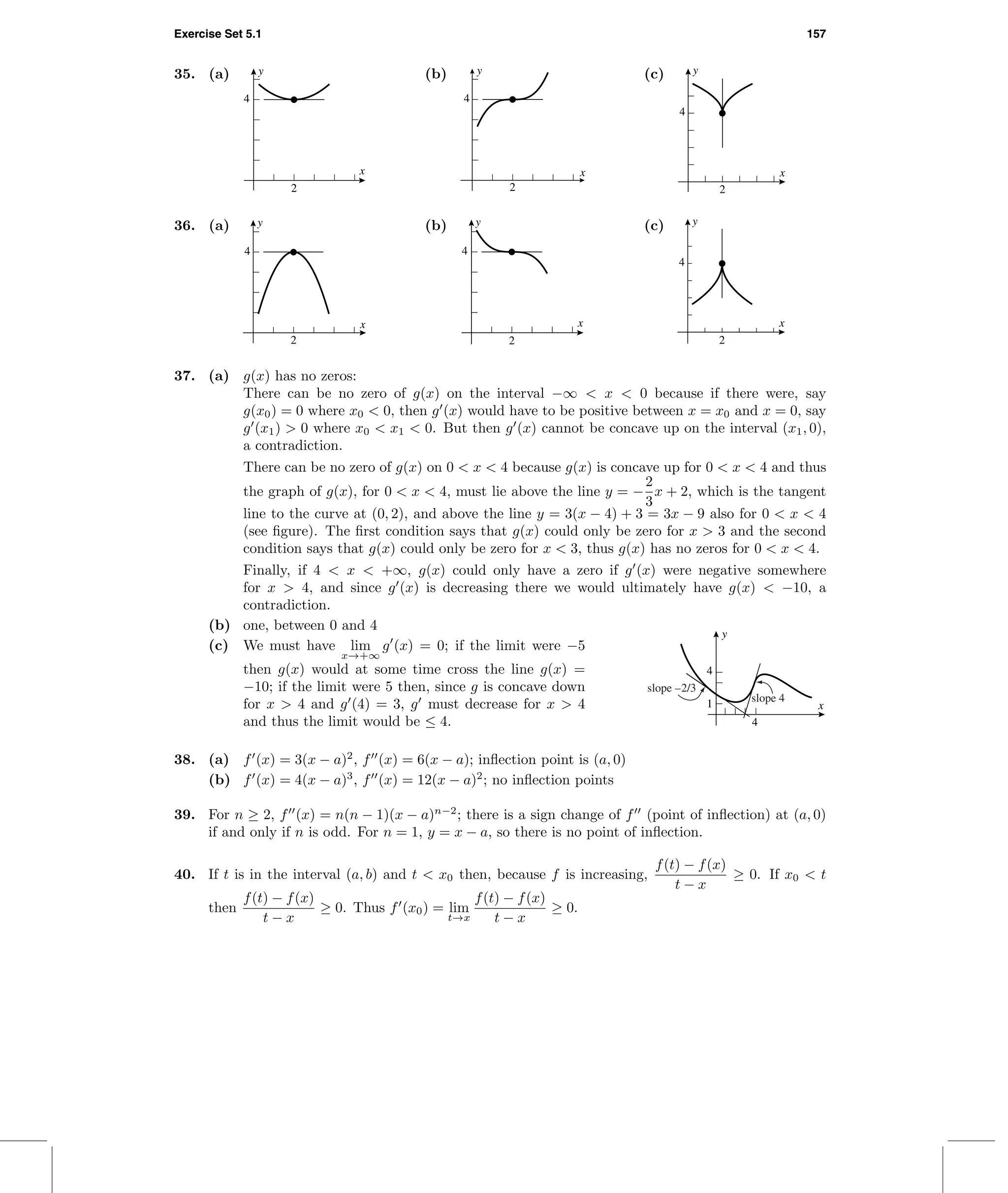
![158 Chapter 5
41. f (x) = 1/3 − 1/[3(1 + x)2/3
] so f is increasing on [0, +∞)
thus if x > 0, then f(x) > f(0) = 0, 1 + x/3 − 3
√
1 + x > 0,
3
√
1 + x < 1 + x/3.
2.5
0
0 10
42. f (x) = sec2
x − 1 so f is increasing on [0, π/2)
thus if 0 < x < π/2, then f(x) > f(0) = 0,
tan x − x > 0, x < tan x.
10
0
0 6
43. x ≥ sin x on [0, +∞): let f(x) = x − sin x.
Then f(0) = 0 and f (x) = 1 − cos x ≥ 0,
so f(x) is increasing on [0, +∞).
4
–1
0 4
44. Let f(x) = 1 − x2
/2 − cos x for x ≥ 0. Then f(0) = 0 and f (x) = −x + sin x. By Exercise 43,
f (x) ≤ 0 for x ≥ 0, so f(x) ≤ 0 for all x ≥ 0, that is, cos x ≥ 1 − x2
/2.
45. (a) Let f(x) = x − ln(x + 1) for x ≥ 0. Then f(0) = 0 and f (x) = 1 − 1/(x + 1) ≥ 0 for x ≥ 0,
so f is increasing for x ≥ 0 and thus ln(x + 1) ≤ x for x ≥ 0.
(b) Let g(x) = x − 1
2 x2
− ln(x + 1). Then g(0) = 0 and g (x) = 1 − x − 1/(x + 1) ≤ 0 for x ≥ 0
since 1 − x2
≤ 1. Thus g is decreasing and thus ln(x + 1) ≥ x − 1
2 x2
for x ≥ 0.
(c) 2
0
0 2
1.2
0
0 2
46. (a) Let h(x) = ex
− 1 − x for x ≥ 0. Then h(0) = 0 and h (x) = ex
− 1 ≥ 0 for x ≥ 0, so h(x) is
increasing.
(b) Let h(x) = ex
−1−x− 1
2 x2
. Then h(0) = 0 and h (x) = ex
−1−x. By Part (a), ex
−1−x ≥ 0
for x ≥ 0, so h(x) is increasing.](https://image.slidesharecdn.com/gabaritocompletoantoncalculo8edcaps0108-130504215818-phpapp02/75/Gabarito-completo-anton_calculo_8ed_caps_01_08-158-2048.jpg)
![Exercise Set 5.1 159
(c) 6
0
0 2
6
0
0 2
47. Points of inflection at x = −2, +2. Concave up
on (−5, −2) and (2, 5); concave down on (−2, 2).
Increasing on [−3.5829, 0.2513] and [3.3316, 5],
and decreasing on [−5, −3.5829] and [0.2513, 3.3316].
250
–250
–5 5
48. Points of inflection at x = ±1/
√
3. Concave up
on [−5, −1/
√
3] and [1/
√
3, 5], and concave down
on [−1/
√
3, 1/
√
3]. Increasing on [−5, 0]
and decreasing on [0, 5].
1
–2
–5 5
49. f (x) = 2
90x3
− 81x2
− 585x + 397
(3x2 − 5x + 8)3
. The denominator has complex roots, so is always positive;
hence the x-coordinates of the points of inflection of f(x) are the roots of the numerator (if it
changes sign). A plot of the numerator over [−5, 5] shows roots lying in [−3, −2], [0, 1], and [2, 3].
To six decimal places the roots are x = −2.464202, 0.662597, 2.701605.
50. f (x) =
2x5
+ 5x3
+ 14x2
+ 30x − 7
(x2 + 1)5/2
. Points of inflection will occur when the numerator changes
sign, since the denominator is always positive. A plot of y = 2x5
+5x3
+14x2
+30x−7 shows that
there is only one root and it lies in [0, 1]. To six decimal place the point of inflection is located at
x = 0.210970.
51. f(x1)−f(x2) = x2
1 −x2
2 = (x1 +x2)(x1 −x2) < 0 if x1 < x2 for x1, x2 in [0, +∞), so f(x1) < f(x2)
and f is thus increasing.
52. f(x1) − f(x2) =
1
x1
−
1
x2
=
x2 − x1
x1x2
> 0 if x1 < x2 for x1, x2 in (0, +∞), so f(x1) > f(x2) and
thus f is decreasing.
53. (a) If x1 < x2 where x1 and x2 are in I, then f(x1) < f(x2) and g(x1) < g(x2), so
f(x1) + g(x1) < f(x2) + g(x2), (f + g)(x1) < (f + g)(x2). Thus f + g is increasing on I.
(b) Case I: If f and g are ≥ 0 on I, and if x1 < x2 where x1 and x2 are in I, then
0 < f(x1) < f(x2) and 0 < g(x1) < g(x2), so f(x1)g(x1) < f(x2)g(x2),
(f · g)(x1) < (f · g)(x2). Thus f · g is increasing on I.
Case II: If f and g are not necessarily positive on I then no conclusion can be drawn: for
example, f(x) = g(x) = x are both increasing on (−∞, 0), but (f · g)(x) = x2
is
decreasing there.](https://image.slidesharecdn.com/gabaritocompletoantoncalculo8edcaps0108-130504215818-phpapp02/75/Gabarito-completo-anton_calculo_8ed_caps_01_08-159-2048.jpg)
![160 Chapter 5
54. (a) f and g are increasing functions on the interval. By Exercise 53, f + g is increasing.
(b) f and g are increasing functions on the interval. If f ≥ 0 and g ≥ 0 on the interval then
by Exercise 53, f · g is concave up on the interval.
If the requirement of nonnegativity is removed, then the conclusion may not be true: let
f(x) = g(x) = x2
on (−∞, 0). Each is concave up,
55. (a) f(x) = x, g(x) = 2x (b) f(x) = x, g(x) = x + 6 (c) f(x) = 2x, g(x) = x
56. (a) f(x) = ex
, g(x) = e2x
(b) f(x) = g(x) = x (c) f(x) = e2x
, g(x) = ex
57. (a) f (x) = 6ax + 2b = 6a x +
b
3a
, f (x) = 0 when x = −
b
3a
. f changes its direction of
concavity at x = −
b
3a
so −
b
3a
is an inflection point.
(b) If f(x) = ax3
+ bx2
+ cx + d has three x-intercepts, then it has three roots, say x1, x2 and
x3, so we can write f(x) = a(x − x1)(x − x2)(x − x3) = ax3
+ bx2
+ cx + d, from which it
follows that b = −a(x1 + x2 + x3). Thus −
b
3a
=
1
3
(x1 + x2 + x3), which is the average.
(c) f(x) = x(x2
− 3x + 2) = x(x − 1)(x − 2) so the intercepts are 0, 1, and 2 and the average is
1. f (x) = 6x − 6 = 6(x − 1) changes sign at x = 1.
58. f (x) = 6x + 2b, so the point of inflection is at x = −
b
3
. Thus an increase in b moves the point of
inflection to the left.
59. (a) Let x1 < x2 belong to (a, b). If both belong to (a, c] or both belong to [c, b) then we have
f(x1) < f(x2) by hypothesis. So assume x1 < c < x2. We know by hypothesis that
f(x1) < f(c), and f(c) < f(x2). We conclude that f(x1) < f(x2).
(b) Use the same argument as in Part (a), but with inequalities reversed.
60. By Theorem 5.1.2, f is increasing on any interval [(2n−1)π, 2(n+1)π] (n = 0, ±1, ±2, · · ·), because
f (x) = 1 + cos x > 0 on ((2n − 1)π, (2n + 1)π). By Exercise 59 (a) we can piece these intervals
together to show that f(x) is increasing on (−∞, +∞).
61. By Theorem 5.1.2, fis decreasing on any interval [(2nπ +π/2, 2(n+1)π +π/2] (n = 0, ±1, ±2, · · ·),
because f (x) = − sin x + 1 < 0 on (2nπ + π/2, 2(n + 1)π + π/2). By Exercise 59 (b) we can piece
these intervals together to show that f(x) is decreasing on (−∞, +∞).
62. By zooming on the graph of y (t), maximum increase is at x = −0.577 and maximum decrease is
at x = 0.577.
63.
t
1
2
y
infl pt
64.
t
1
2
y
no infl pts](https://image.slidesharecdn.com/gabaritocompletoantoncalculo8edcaps0108-130504215818-phpapp02/75/Gabarito-completo-anton_calculo_8ed_caps_01_08-160-2048.jpg)
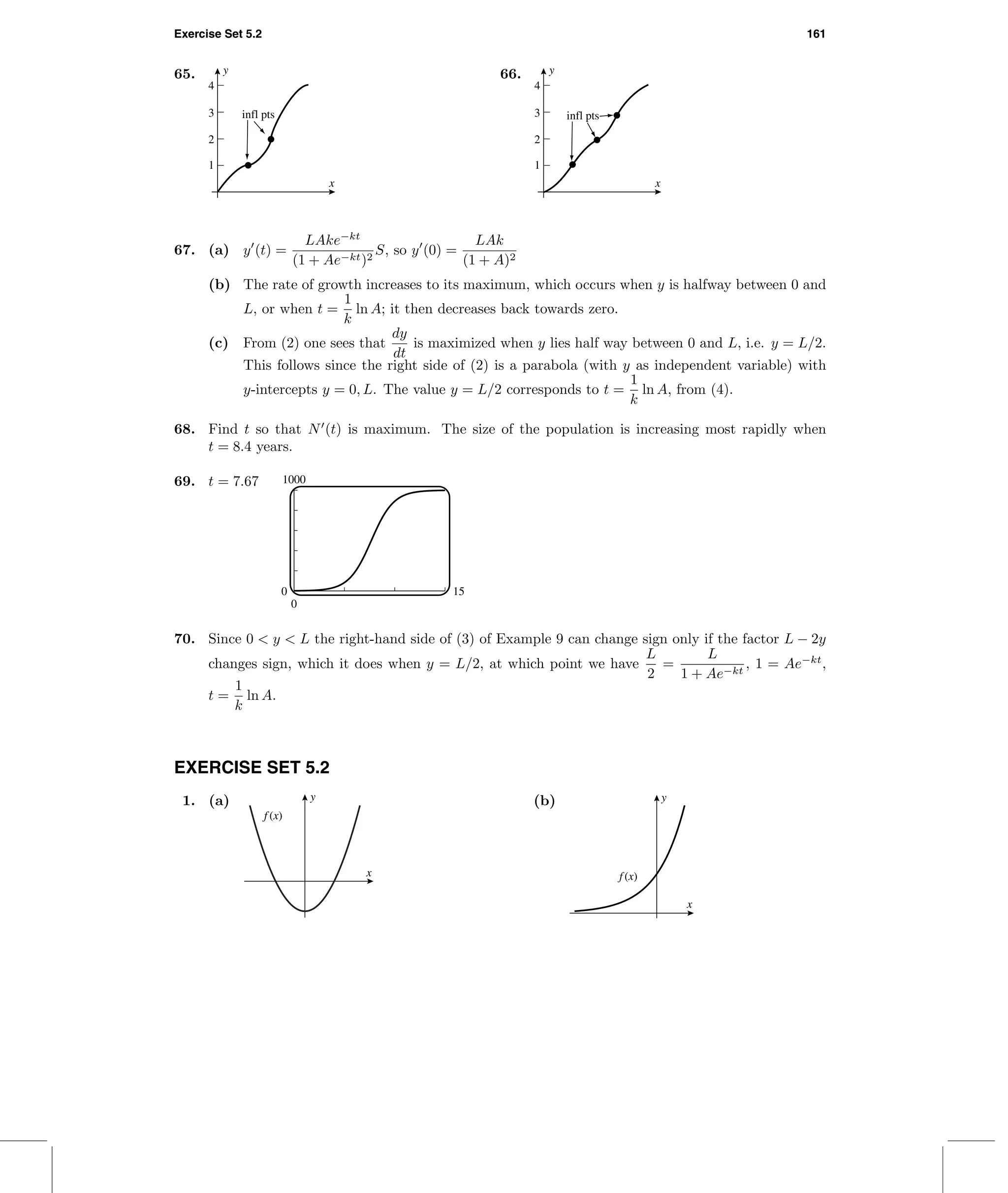
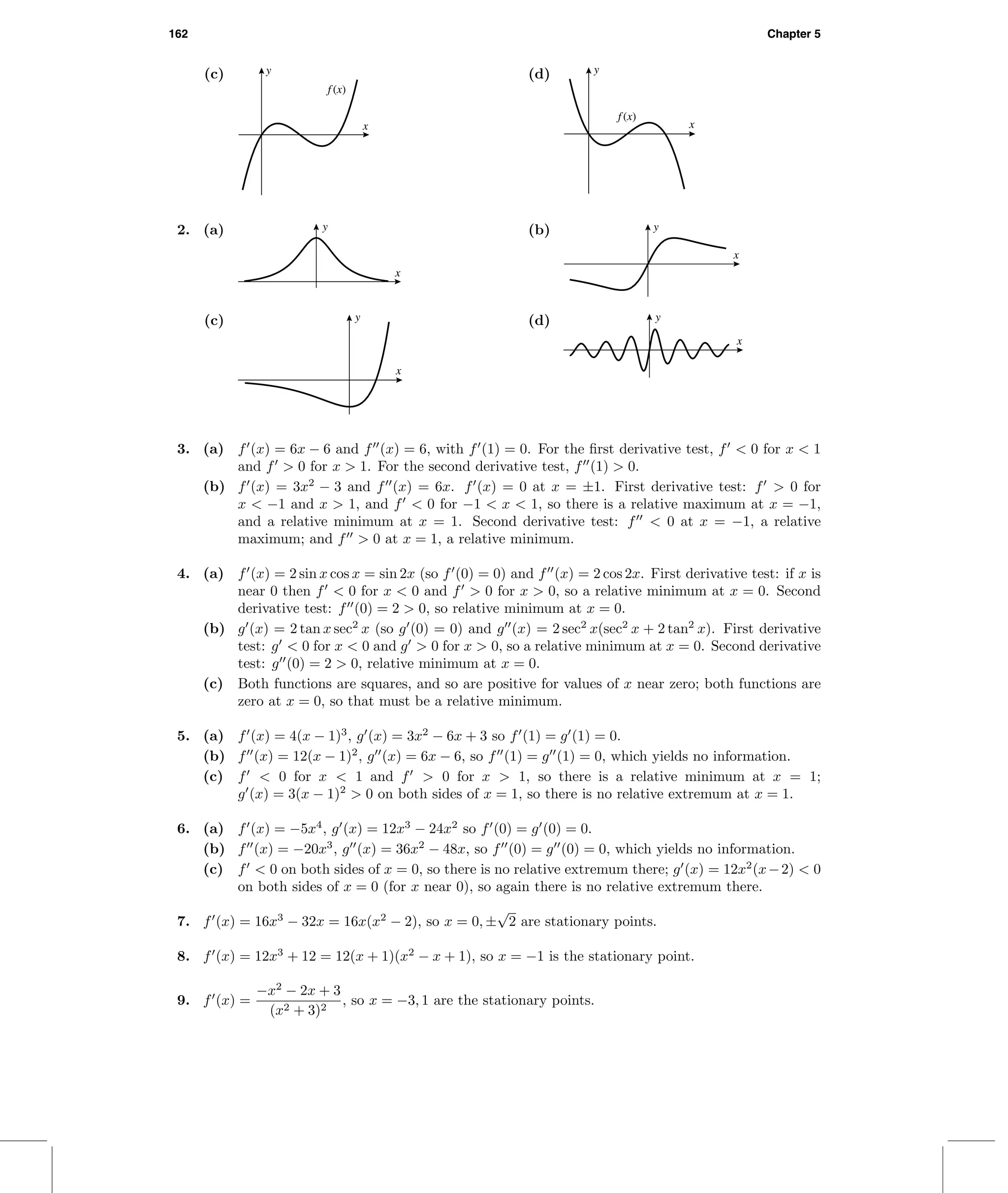




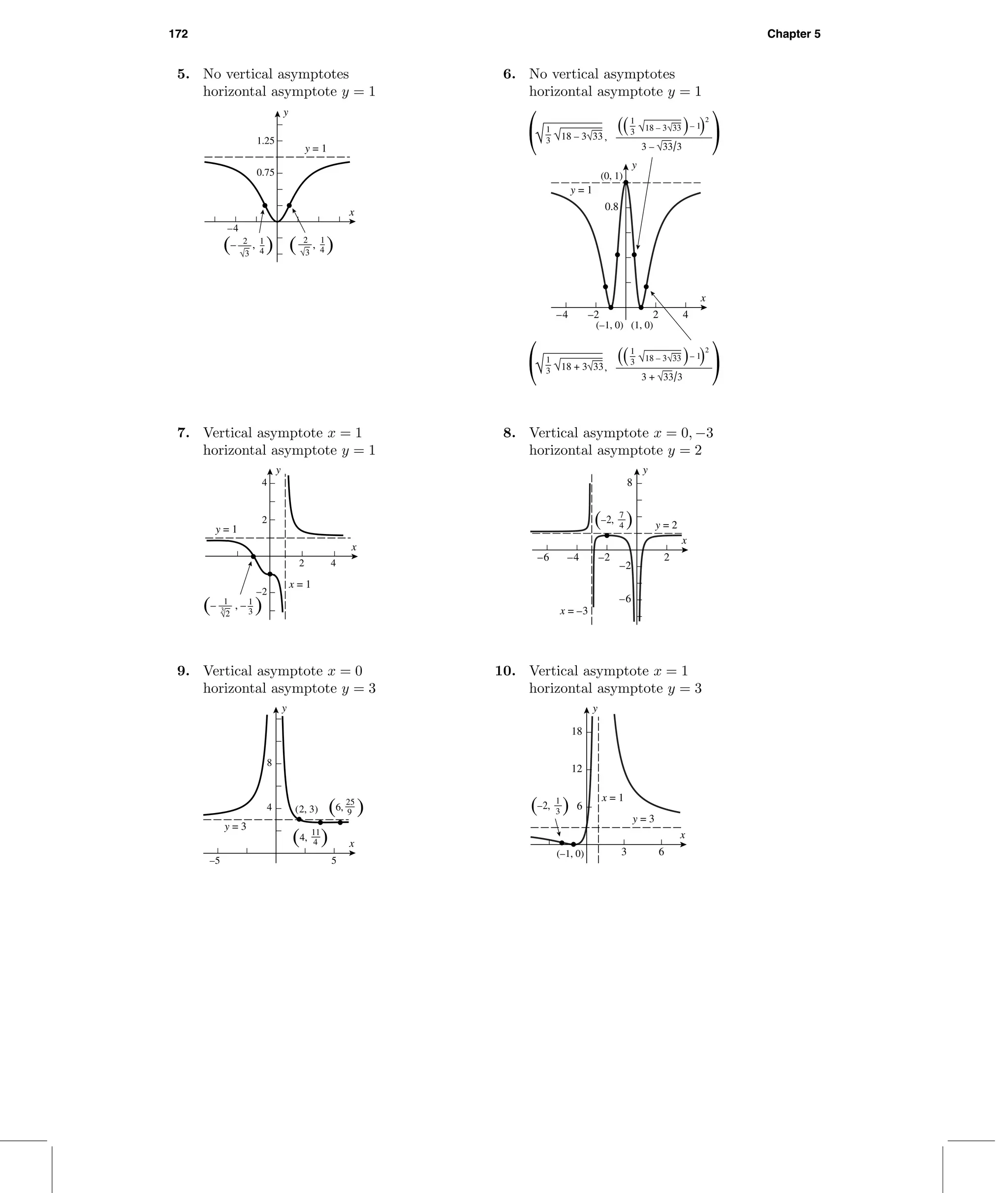
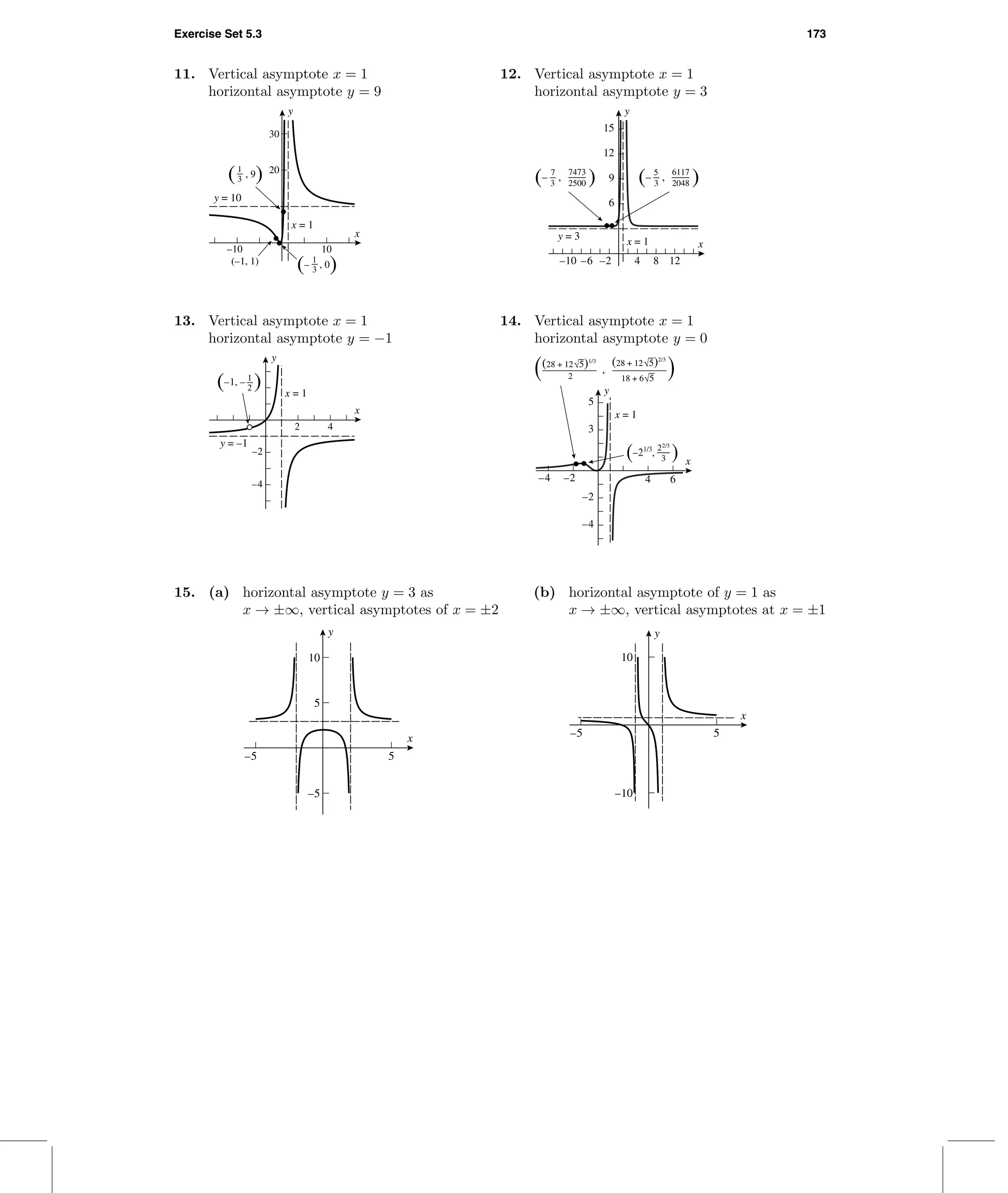

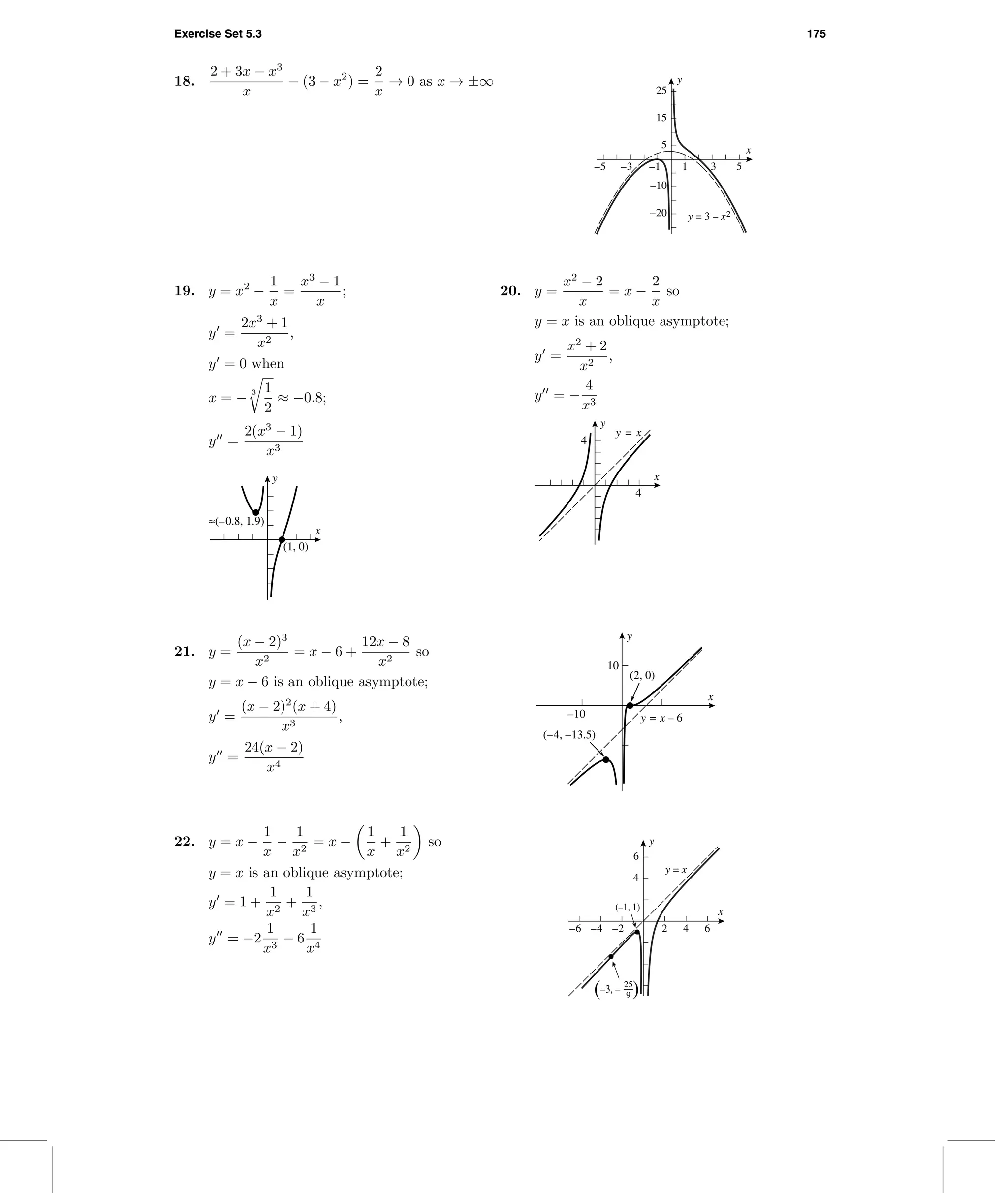


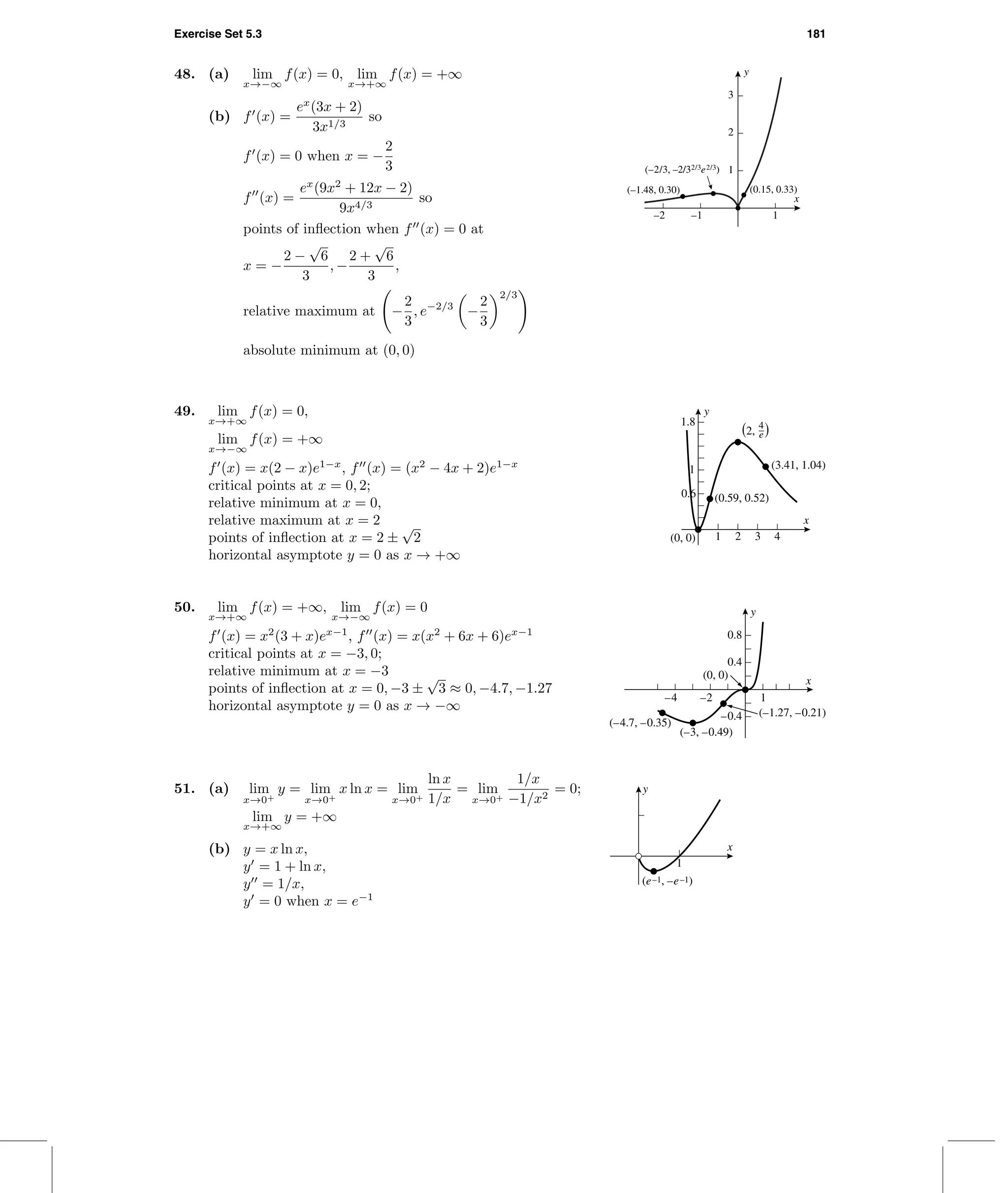

![Exercise Set 5.3 183
57. (a) 0.4
–0.2
–0.5 3
(b) y = (1 − bx)e−bx
, y = b2
(x − 2/b)e−bx
;
relative maximum at x = 1/b, y = 1/be;
point of inflection at x = 2/b, y = 2/be2
.
Increasing b moves the relative maximum
and the point of inflection to the left and
down, i.e. towards the origin.
58. (a) 1
0
–2 2
(b) y = −2bxe−bx2
,
y = 2b(−1 + 2bx2
)e−bx2
;
relative maximum at x = 0, y = 1; points
of inflection at x = ± 1/2b, y = 1/
√
e.
Increasing b moves the points of inflection
towards the y-axis; the relative maximum
doesn’t move.
59. (a) The oscillations of ex
cos x about zero in-
crease as x → +∞ so the limit does not
exist, and lim
x→−∞
ex
cos x = 0.
(b) y
x
–2
4
6
–2 –1 1 2
(0,1)
(1.52, 0.22)
(c) The curve y = eax
cos bx oscillates between y = eax
and y = −eax
. The frequency of
oscillation increases when b increases.
y
x
–5
5
–1 2
a = 1
b = 1
b = 2
b = 3
y
x
5
10
–1 0.5 1
b = 1
a = 1
a = 2
a = 3
60. (a) 10
0
0 6
(b) y =
n2
− 2x2
n
xn−1
e−x2
/n
,
y =
n4
− n3
− 4x2
n2
− 2x2
n + 4x4
n2
xn−2
e−x2
/n
,
relative maximum when x =
n
√
2
, y =
3
e
;
point of inflection when
x =
2n + 1 ±
√
8n + 1
4
n.
As n increases the maxima move up and
to the right; the points of inflection move
to the right.
61. (a) x = 1, 2.5, 4 and x = 3, the latter being a cusp
(b) (−∞, 1], [2.5, 3)
(c) relative maxima for x = 1, 3; relative minima for x = 2.5
(d) x = 0.8, 1.9, 4](https://image.slidesharecdn.com/gabaritocompletoantoncalculo8edcaps0108-130504215818-phpapp02/75/Gabarito-completo-anton_calculo_8ed_caps_01_08-183-2048.jpg)
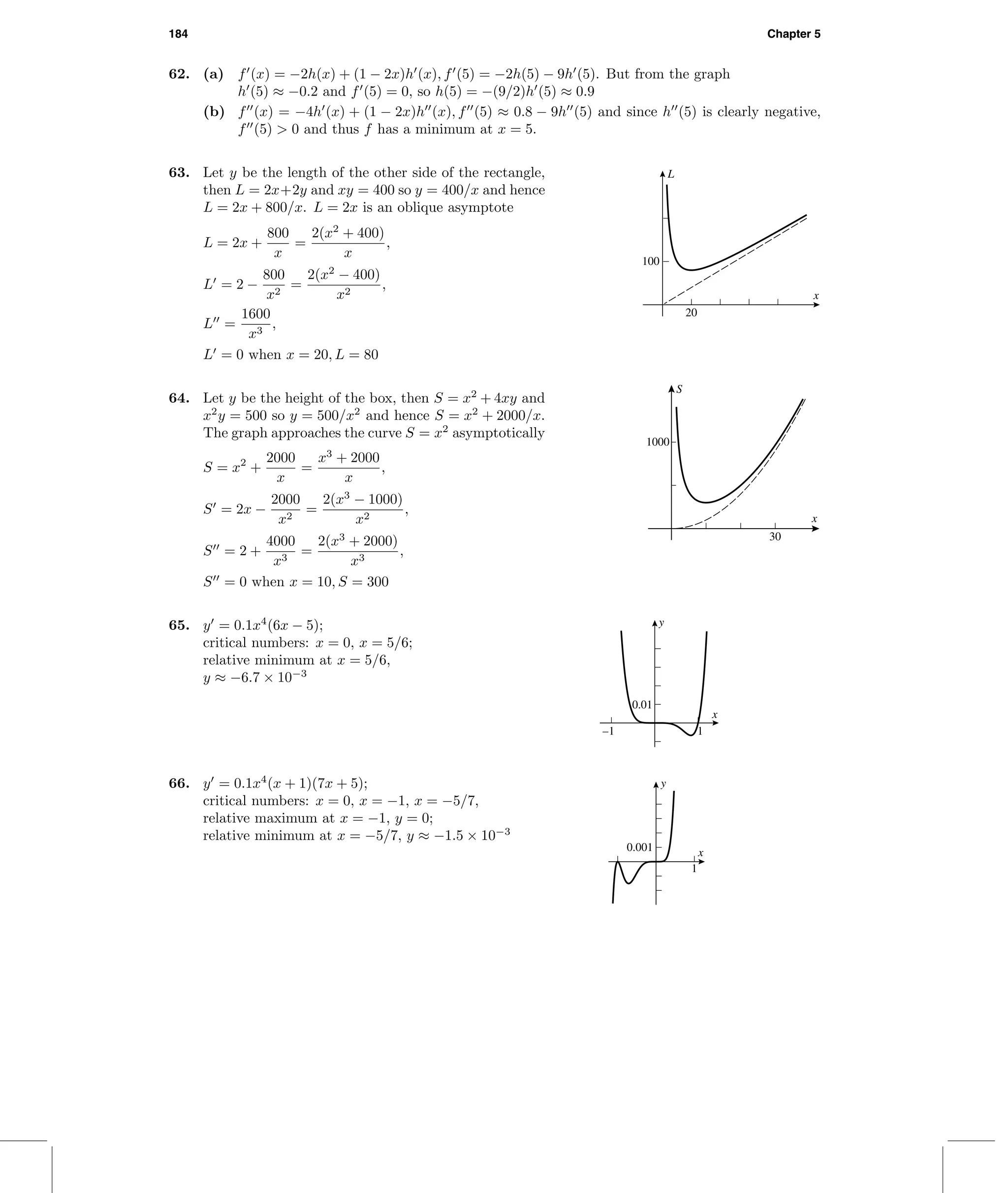

![186 Chapter 5
10. f (x) = 6x2
+ 6x − 12, f (x) = 0 when x = −2, 1; f(−3) = 9, f(−2) = 20, f(1) = −7, f(2) = 4, so
the minimum is −7 at x = 1 and the maximum is 20 at x = −2.
11. f (x) = 3/(4x2
+ 1)3/2
, no critical points; f(−1) = −3/
√
5, f(1) = 3/
√
5 so the maximum value is
3/
√
5 at x = 1 and the minimum value is −3/
√
5 at x = −1.
12. f (x) =
2(2x + 1)
3(x2 + x)1/3
, f (x) = 0 when x = −1/2 and f (x) does not exist when x = −1, 0;
f(−2) = 22/3
, f(−1) = 0, f(−1/2) = 4−2/3
, f(0) = 0, f(3) = 122/3
so the maximum value is 122/3
at x = 3 and the minimum value is 0 at x = −1, 0.
13. f (x) = 1 − 2 cos x, f (x) = 0 when x = π/3; then f(−π/4) = −π/4 +
√
2; f(π/3) = π/3 −√
3; f(π/2) = π/2−2, so f has a minimum of π/3−
√
3 at x = π/3 and a maximum of −π/4+
√
2
at x = −π/4.
14. f (x) = cos x + sin x, f (x) = 0 for x in (0, π) when x = 3π/4; f(0) = −1, f(3π/4) =
√
2, f(π) = 1
so the maximum value is
√
2 at x = 3π/4 and the minimum value is −1 at x = 0.
15. f(x) = 1 + |9 − x2
| =
10 − x2
, |x| ≤ 3
−8 + x2
, |x| > 3
, f (x) =
−2x, |x| < 3
2x, |x| > 3
thus f (x) = 0 when
x = 0, f (x) does not exist for x in (−5, 1) when x = −3 because lim
x→−3−
f (x) = lim
x→−3+
f (x) (see
Theorem preceding Exercise 61, Section 3.3); f(−5) = 17, f(−3) = 1, f(0) = 10, f(1) = 9 so the
maximum value is 17 at x = −5 and the minimum value is 1 at x = −3.
16. f(x) = |6 − 4x| =
6 − 4x, x ≤ 3/2
−6 + 4x, x > 3/2
, f (x) =
−4, x < 3/2
4, x > 3/2
, f (x) does not exist when
x = 3/2 thus 3/2 is the only critical point in (−3, 3); f(−3) = 18, f(3/2) = 0, f(3) = 6 so the
maximum value is 18 at x = −3 and the minimum value is 0 at x = 3/2.
17. f (x) = 2x − 1, f (x) = 0 when x = 1/2; f(1/2) = −9/4 and lim
x→±∞
f(x) = +∞. Thus f has a
minimum of −9/4 at x = 1/2 and no maximum.
18. f (x) = −4(x + 1); critical point x = −1. Maximum value f(−1) = 5, no minimum.
19. f (x) = 12x2
(1 − x); critical points x = 0, 1. Maximum value f(1) = 1, no minimum because
lim
x→+∞
f(x) = −∞.
20. f (x) = 4(x3
+ 1); critical point x = −1. Minimum value f(−1) = −3, no maximum.
21. No maximum or minimum because lim
x→+∞
f(x) = +∞ and lim
x→−∞
f(x) = −∞.
22. No maximum or minimum because lim
x→+∞
f(x) = +∞ and lim
x→−∞
f(x) = −∞.
23. lim
x→−1−
f(x) = −∞, so there is no absolute minimum on the interval;
f (x) = 0 at x ≈ −2.414213562, for which y ≈ −4.828427125. Also f(−5) = −13/2, so the
absolute maximum of f on the interval is y ≈ −4.828427125 taken at x ≈ −2.414213562.
24. lim
x→−1+
f(x) = −∞, so there is no absolute minimum on the interval.
f (x) = 3/(x + 1)2
> 0, so f is increasing on the interval (−1, 5] and the maximum must occur at
the endpoint x = 5 where f(5) = 1/2.](https://image.slidesharecdn.com/gabaritocompletoantoncalculo8edcaps0108-130504215818-phpapp02/75/Gabarito-completo-anton_calculo_8ed_caps_01_08-186-2048.jpg)

![188 Chapter 5
30. f (x) = −
x(x − 2)
(x2 − 2x + 2)2
, and for 1 ≤ x < +∞, f (x) = 0
when x = 2. Also lim
x→+∞
f(x) = 2 and f(2) = 5/2 and
f(1) = 2, hence f has an absolute minimum value of 2 at
x = 1 and an absolute maximum value of 5/2 at x = 2.
3
0
1 8
31. f (x) =
1 − 2 cos x
sin2
x
; f (x) = 0 on [π/4, 3π/4] only when
x = π/3. Then f(π/4) = 2
√
2 − 1, f(π/3) =
√
3 and
f(3π/4) = 2
√
2 + 1, so f has an absolute maximum value
of 2
√
2 + 1 at x = 3π/4 and an absolute minimum value of√
3 at x = π/3.
3
0
3 9
32. f (x) = 2 sin x cos x−sin x = sin x(2 cos x−1), f (x) = 0 for
x in (−π, π) when x = 0, ±π/3; f(−π) = −1, f(−π/3) =
5/4, f(0) = 1, f(π/3) = 5/4, f(π) = −1 so the maximum
value is 5/4 at x = ±π/3 and the minimum value is −1 at
x = ±π.
1.5
–1.5
C c
0.2
0
1 4
33. f (x) = x2
(3 − 2x)e−2x
, f (x) = 0 for x in [1, 4] when
x = 3/2; if x = 1, 3/2, 4, then f(x) = e−2
,
27
8
e−3
, 64e−8
;
critical point at x = 3/2; absolute maximum of
27
8
e−3
at
x = 3/2, absolute minimum of 64e−8
at x = 4
0.76
0.64
1 2.7
34. f (x) = (1 − ln 2x)/x2
, f (x) = 0 on [1, e] for x = e/2;
if x = 1, e/2, e then f(x) = ln 2, 2/e, (ln 2 + 1)/e;
absolute minimum of
1 + ln 2
e
at x = e,
absolute maximum of 2/e at x = e/2](https://image.slidesharecdn.com/gabaritocompletoantoncalculo8edcaps0108-130504215818-phpapp02/75/Gabarito-completo-anton_calculo_8ed_caps_01_08-188-2048.jpg)
![Exercise Set 5.4 189
3.0
–2.5
0 4
35. f (x) = −
3x2
− 10x + 3
x2 + 1
, f (x) = 0 when x =
1
3
, 3.
Then f(0) = 0, f
1
3
= 5 ln
10
9
− 1,
f(3) = 5 ln 10 − 9, f(4) = 5 ln 17 − 12 and thus f has an
absolute minimum of 5(ln 10 − ln 9) − 1 at x = 1/3 and an
absolute maximum of 5 ln 10 − 9 at x = 3.
20
–20
–2 2
36. f (x) = (x2
+ 2x − 1)ex
, f (x) = 0 at x = −2 +
√
2 and
x = −1−
√
2 (discard), f(−1+
√
2) = (2−2
√
2)e(−1+
√
2)
≈
−1.25, absolute maximum at x = 2, f(2) = 3e2
≈ 22.17,
absolute minimum at x = −1 +
√
2
37. f (x) = −[cos(cos x)] sin x; f (x) = 0 if sin x = 0 or if
cos(cos x) = 0. If sin x = 0, then x = π is the criti-
cal point in (0, 2π); cos(cos x) = 0 has no solutions be-
cause −1 ≤ cos x ≤ 1. Thus f(0) = sin(1), f(π) =
sin(−1) = − sin(1), and f(2π) = sin(1) so the maxi-
mum value is sin(1) ≈ 0.84147 and the minimum value
is − sin(1) ≈ −0.84147.
1
–1
0 o
38. f (x) = −[sin(sin x)] cos x; f (x) = 0 if cos x = 0 or if
sin(sin x) = 0. If cos x = 0, then x = π/2 is the critical
point in (0, π); sin(sin x) = 0 if sin x = 0, which gives no
critical points in (0, π). Thus f(0) = 1, f(π/2) = cos(1),
and f(π) = 1 so the maximum value is 1 and the minimum
value is cos(1) ≈ 0.54030.
1.5
0
0 c
39. f (x) =
4, x < 1
2x − 5, x > 1
so f (x) = 0 when x = 5/2, and f (x) does not exist when x = 1
because lim
x→1−
f (x) = lim
x→1+
f (x) (see Theorem preceding Exercise 61, Section 3.3); f(1/2) = 0,
f(1) = 2, f(5/2) = −1/4, f(7/2) = 3/4 so the maximum value is 2 and the minimum value is
−1/4.
40. f (x) = 2x + p which exists throughout the interval (0, 2) for all values of p so f (1) = 0 because
f(1) is an extreme value, thus 2 + p = 0, p = −2. f(1) = 3 so 12
+ (−2)(1) + q = 3, q = 4 thus
f(x) = x2
− 2x + 4 and f(0) = 4, f(2) = 4 so f(1) is the minimum value.
41. The period of f(x) is 2π, so check f(0) = 3, f(2π) = 3 and the critical points.
f (x) = −2 sin x − 2 sin 2x = −2 sin x(1 + 2 cos x) = 0 on [0, 2π] at x = 0, π, 2π and
x = 2π/3, 4π/3. Check f(π) = −1, f(2π/3) = −3/2, f(4π/3) = −3/2.
Thus f has an absolute maximum on (−∞, +∞) of 3 at x = 2kπ, k = 0, ±1, ±2, . . .
and an absolute minimum of −3/2 at x = 2kπ ± 2π/3, k = 0, ±1, ±2, . . ..](https://image.slidesharecdn.com/gabaritocompletoantoncalculo8edcaps0108-130504215818-phpapp02/75/Gabarito-completo-anton_calculo_8ed_caps_01_08-189-2048.jpg)
![190 Chapter 5
42. cos
x
3
has a period of 6π, and cos
x
2
a period of 4π, so f(x) has a period of 12π. Consider the
interval [0, 12π]. f (x) = − sin
x
3
− sin
x
2
, f (x) = 0 when sin
x
3
+ sin
x
2
= 0 thus, by use of
the trig identity sin a + sin b = 2 sin
a + b
2
cos
a − b
2
, 2 sin
5x
12
cos −
x
12
= 0 so sin
5x
12
= 0 or
cos
x
12
= 0. Solve sin
5x
12
= 0 to get x = 12π/5, 24π/5, 36π/5, 48π/5 and then solve cos
x
12
= 0
to get x = 6π. The corresponding values of f(x) are −4.0450, 1.5450, 1.5450, −4.0450, 1, 5, 5 so the
maximum value is 5 and the minimum value is −4.0450 (approximately).
43. Let f(x) = x − sin x, then f (x) = 1 − cos x and so f (x) = 0 when cos x = 1 which has no solution
for 0 < x < 2π thus the minimum value of f must occur at 0 or 2π. f(0) = 0, f(2π) = 2π so 0 is
the minimum value on [0, 2π] thus x − sin x ≥ 0, sin x ≤ x for all x in [0, 2π].
44. Let h(x) = cos x − 1 + x2
/2. Then h(0) = 0, and it is sufficient to show that h (x) ≥ 0 for
0 < x < 2π. But h (x) = − sin x + x ≥ 0 by Exercise 43.
45. Let m = slope at x, then m = f (x) = 3x2
− 6x + 5, dm/dx = 6x − 6; critical point for m is x = 1,
minimum value of m is f (1) = 2
46. (a) lim
x→0+
f(x) = +∞, lim
x→(π/2)−
f(x) = +∞, so f has no maximum value on the interval. By
table 5.4.3 f must have a minimum value.
(b) According to table 5.4.3, there is an absolute minimum value of f on (0, π/2). To find the
absolute minimum value, we examine the critical points (Theorem 5.4.3).
f (x) = sec x tan x − csc x cot x = 0 at x = π/4, where f(π/4) = 2
√
2, which must be the
absolute minimum value of f on the interval (0, π/2).
47. lim
x→+∞
f(x) = +∞, lim
x→8−
f(x) = +∞, so there is no absolute maximum value of f for x > 8. By
table 5.4.3 there must be a minimum. Since f (x) =
2x(−520 + 192x − 24x2
+ x3
)
(x − 8)3
, we must solve
a quartic equation to find the critical points. But it is easy to see that x = 0 and x = 10 are real
roots, and the other two are complex. Since x = 0 is not in the interval in question, we must have
an absolute minimum of f on (8, +∞) of 125 at x = 10.
48. (a)
dC
dt
=
K
a − b
ae−at
− be−bt
so
dC
dt
= 0 at t =
ln(a/b)
a − b
. This is the only stationary point and
C(0) = 0, lim
t→+∞
C(t) = 0, C(t) > 0 for 0 < t < +∞, so it is an absolute maximum.
(b) 0.7
0
0 10
49. The slope of the line is −1, and the slope of the tangent to y = −x2
is −2x so −2x = −1, x = 1/2.
The line lies above the curve so the vertical distance is given by F(x) = 2 − x + x2
; F(−1) = 4,
F(1/2) = 7/4, F(3/2) = 11/4. The point (1/2, −1/4) is closest, the point (−1, −1) farthest.](https://image.slidesharecdn.com/gabaritocompletoantoncalculo8edcaps0108-130504215818-phpapp02/75/Gabarito-completo-anton_calculo_8ed_caps_01_08-190-2048.jpg)
![Exercise Set 5.5 191
50. The slope of the line is 4/3; and the slope of the tangent to y = x3
is 3x2
so 3x2
= 4/3, x2
= 4/9,
x = ±2/3. The line lies below the curve so the vertical distance is given by F(x) = x3
− 4x/3 + 1;
F(−1) = 4/3, F(−2/3) = 43/27, F(2/3) = 11/27, F(1) = 2/3. The closest point is (2/3, 8/27),
the farthest is (−2/3, −8/27).
51. The absolute extrema of y(t) can occur at the endpoints t = 0, 12 or when dy/dt = 2 sin t = 0, i.e.
t = 0, 12, kπ, k = 1, 2, 3; the absolute maximum is y = 4 at t = π, 3π; the absolute minimum is
y = 0 at t = 0, 2π.
52. (a) The absolute extrema of y(t) can occur at the endpoints t = 0, 2π or when
dy/dt = 2 cos 2t − 4 sin t cos t = 2 cos 2t − 2 sin 2t = 0, t = 0, 2π, π/8, 5π/8, 9π/8, 13π/8;
the absolute maximum is y = 3.4142 at t = π/8, 9π/8; the absolute minimum is y = 0.5859
at t = 5π/8, 13π/8.
(b) The absolute extrema of x(t) occur at the endpoints t = 0, 2π or when
dx
dt
= −
2 sin t + 1
(2 + sin t)2
= 0, t = 7π/6, 11π/6. The absolute maximum is x = 0.5774 at t = 11π/6
and the absolute minimum is x = −0.5774 at t = 7π/6.
53. f (x) = 2ax + b; critical point is x = −
b
2a
f (x) = 2a > 0 so f −
b
2a
is the minimum value of f, but
f −
b
2a
= a −
b
2a
2
+ b −
b
2a
+ c =
−b2
+ 4ac
4a
thus f(x) ≥ 0 if and only if
f −
b
2a
≥ 0,
−b2
+ 4ac
4a
≥ 0, −b2
+ 4ac ≥ 0, b2
− 4ac ≤ 0
54. Use the proof given in the text, replacing “maximum” by “minimum” and “largest” by “smallest”
and reversing the order of all inequality symbols.
EXERCISE SET 5.5
1. If y = x + 1/x for 1/2 ≤ x ≤ 3/2 then dy/dx = 1 − 1/x2
= (x2
− 1)/x2
, dy/dx = 0 when x = 1. If
x = 1/2, 1, 3/2 then y = 5/2, 2, 13/6 so
(a) y is as small as possible when x = 1.
(b) y is as large as possible when x = 1/2.
2. Let x and y be nonnegative numbers and z the sum of their squares, then z = x2
+ y2
. But
x + y = 1, y = 1 − x so z = x2
+ (1 − x)2
= 2x2
− 2x + 1 for 0 ≤ x ≤ 1. dz/dx = 4x − 2, dz/dx = 0
when x = 1/2. If x = 0, 1/2, 1 then z = 1, 1/2, 1 so
(a) z is as large as possible when one number is 0 and the other is 1.
(b) z is as small as possible when both numbers are 1/2.
3. A = xy where x + 2y = 1000 so y = 500 − x/2 and
A = 500x − x2
/2 for x in [0, 1000]; dA/dx = 500 − x,
dA/dx = 0 when x = 500. If x = 0 or 1000 then A = 0,
if x = 500 then A = 125, 000 so the area is maximum
when x = 500 ft and y = 500 − 500/2 = 250 ft.
x
y
Stream](https://image.slidesharecdn.com/gabaritocompletoantoncalculo8edcaps0108-130504215818-phpapp02/75/Gabarito-completo-anton_calculo_8ed_caps_01_08-191-2048.jpg)
![192 Chapter 5
4. The triangle in the figure is determined by the two sides of
length a and b and the angle θ. Suppose that a + b = 1000.
Then h = a sin θ and area = Q = hb/2 = ab(sin θ)/2. This
expression is maximized by choosing θ = π/2 and thus Q =
ab/2 = a(1000 − a)/2, which is maximized by a = 500. Thus
the maximal area is obtained by a right isosceles triangle, where
the angle between two sides of 500 is the right angle.
A B
C
h
a
b
c
θ
5. Let x and y be the dimensions shown in the figure and A the
area, then A = xy subject to the cost condition 3(2x)+2(2y) =
6000, or y = 1500 − 3x/2. Thus A = x(1500 − 3x/2) = 1500x −
3x2
/2 for x in [0, 1000]. dA/dx = 1500 − 3x, dA/dx = 0 when
x = 500. If x = 0 or 1000 then A = 0, if x = 500 then
A = 375, 000 so the area is greatest when x = 500 ft and (from
y = 1500 − 3x/2) when y = 750 ft.
Heavy-duty
Standard
x
y
6. Let x and y be the dimensions shown in the figure and A the
area of the rectangle, then A = xy and, by similar triangles,
x/6 = (8 − y)/8, y = 8 − 4x/3 so A = x(8 − 4x/3) = 8x − 4x2
/3
for x in [0, 6]. dA/dx = 8 − 8x/3, dA/dx = 0 when x = 3. If
x = 0, 3, 6 then A = 0, 12, 0 so the area is greatest when x = 3
in and (from y = 8 − 4x/3) y = 4 in.
8
y
x
6
10
7. Let x, y, and z be as shown in the figure and A the area of the
rectangle, then A = xy and, by similar triangles, z/10 = y/6,
z = 5y/3; also x/10 = (8 − z)/8 = (8 − 5y/3)/8 thus y =
24/5 − 12x/25 so A = x(24/5 − 12x/25) = 24x/5 − 12x2
/25 for
x in [0, 10]. dA/dx = 24/5 − 24x/25, dA/dx = 0 when x = 5. If
x = 0, 5, 10 then A = 0, 12, 0 so the area is greatest when x = 5
in. and y = 12/5 in.
8
z
x
y
6
10
8. A = (2x)y = 2xy where y = 16 − x2
so A = 32x − 2x3
for
0 ≤ x ≤ 4; dA/dx = 32 − 6x2
, dA/dx = 0 when x = 4/
√
3. If
x = 0, 4/
√
3, 4 then A = 0, 256/(3
√
3), 0 so the area is largest
when x = 4/
√
3 and y = 32/3. The dimensions of the rectangle
with largest area are 8/
√
3 by 32/3.
–4 4
16
x
y
y
x
9. A = xy where x2
+ y2
= 202
= 400 so y =
√
400 − x2 and
A = x
√
400 − x2 for 0 ≤ x ≤ 20;
dA/dx = 2(200 − x2
)/
√
400 − x2, dA/dx = 0 when
x =
√
200 = 10
√
2. If x = 0, 10
√
2, 20 then A = 0, 200, 0 so the
area is maximum when x = 10
√
2 and y =
√
400 − 200 = 10
√
2.
x
y10](https://image.slidesharecdn.com/gabaritocompletoantoncalculo8edcaps0108-130504215818-phpapp02/75/Gabarito-completo-anton_calculo_8ed_caps_01_08-192-2048.jpg)
![Exercise Set 5.5 193
10. Let R denote the rectangle with corners (±8, ±10). Sup-
pose the lower left corner of the square S is at the point
(x0, y0) = (x0, −4x0). Let Q denote the desired region.
It is clear that Q will be a rectangle, and that its left and
bottom sides are subsets of the left and bottom sides of S. The
right and top edges of S will be subsets of the sides of R (if S
is big enough).
From the drawing it is evident that the area of Q is (8−x0)(10+
4x0) = −4x2
0 + 22x0 + 80. This function is maximized when
x0 = 11/4, for which the area of Q is 441/4.
The maximum possible area for Q is 441/4, taken when x0 = 11/4.
–6 2
–6
y = –4x
y = –4x
(x0, y0)
R
S
11. Let x = length of each side that uses the $1 per foot fencing,
y = length of each side that uses the $2 per foot fencing.
The cost is C = (1)(2x) + (2)(2y) = 2x + 4y, but A = xy = 3200 thus y = 3200/x so
C = 2x + 12800/x for x > 0,
dC/dx = 2 − 12800/x2
, dC/dx = 0 when x = 80, d2
C/dx2
> 0 so
C is least when x = 80, y = 40.
12. A = xy where 2x+2y = p so y = p/2−x and A = px/2−x2
for
x in [0, p/2]; dA/dx = p/2 − 2x, dA/dx = 0 when x = p/4. If
x = 0 or p/2 then A = 0, if x = p/4 then A = p2
/16 so the area
is maximum when x = p/4 and y = p/2 − p/4 = p/4, which is a
square. x
y
13. Let x and y be the dimensions of a rectangle; the perimeter is p = 2x + 2y. But A = xy thus
y = A/x so p = 2x + 2A/x for x > 0, dp/dx = 2 − 2A/x2
= 2(x2
− A)/x2
, dp/dx = 0 when
x =
√
A, d2
p/dx2
= 4A/x3
> 0 if x > 0 so p is a minimum when x =
√
A and y =
√
A and thus
the rectangle is a square.
14. With x, y, r, and s as shown in the figure, the sum of the
enclosed areas is A = πr2
+s2
where r =
x
2π
and s =
y
4
because
x is the circumference of the circle and y is the perimeter of the
square, thus A =
x2
4π
+
y2
16
. But x + y = 12, so y = 12 − x and
A =
x2
4π
+
(12 − x)2
16
=
π + 4
16π
x2
−
3
2
x + 9 for 0 ≤ x ≤ 12.
dA
dx
=
π + 4
8π
x −
3
2
,
dA
dx
= 0 when x =
12π
π + 4
. If x = 0,
12π
π + 4
, 12
then A = 9,
36
π + 4
,
36
π
so the sum of the enclosed areas is
x y
12
r s
cut
(a) a maximum when x = 12 in. (when all of the wire is used for the circle)
(b) a minimum when x = 12π/(π + 4) in.](https://image.slidesharecdn.com/gabaritocompletoantoncalculo8edcaps0108-130504215818-phpapp02/75/Gabarito-completo-anton_calculo_8ed_caps_01_08-193-2048.jpg)
![194 Chapter 5
15. (a)
dN
dt
= 250(20 − t)e−t/20
= 0 at t = 20, N(0) = 125,000, N(20) ≈ 161,788, and
N(100) ≈ 128,369; the absolute maximum is N = 161788 at t = 20, the absolute
minimum is N = 125,000 at t = 0.
(b) The absolute minimum of
dN
dt
occurs when
d2
N
dt2
= 12.5(t − 40)e−t/20
= 0, t = 40.
16. The area of the window is A = 2rh + πr2
/2, the perimeter
is p = 2r + 2h + πr thus h =
1
2
[p − (2 + π)r] so
A = r[p − (2 + π)r] + πr2
/2
= pr − (2 + π/2)r2
for 0 ≤ r ≤ p/(2 + π),
dA/dr = p − (4 + π)r, dA/dr = 0 when r = p/(4 + π) and
d2
A/dr2
< 0, so A is maximum when r = p/(4 + π). 2r
r
h
17. Let the box have dimensions x, x, y, with y ≥ x. The constraint is 4x + y ≤ 108, and the volume
V = x2
y. If we take y = 108 − 4x then V = x2
(108 − 4x) and dV/dx = 12x(−x + 18) with roots
x = 0, 18. The maximum value of V occurs at x = 18, y = 36 with V = 11, 664 in2
.
18. Let the box have dimensions x, x, y with x ≥ y. The constraint is x+2(x+y) ≤ 108, and the volume
V = x2
y. Take x = (108 − 2y)/3 = 36 − 2y/3, V = y(36 − 2y/3)2
, dV/dy = (4/3)y2
− 96y + 1296
with roots y = 18, 54. Then d2
V/dy2
= (8/3)y − 96 is negative for y = 18, so by the second
derivative test, V has a maximum of 10, 368 in2
at y = 18, x = 24.
19. Let x be the length of each side of a square, then V = x(3 − 2x)(8 − 2x) = 4x3
− 22x2
+ 24x
for 0 ≤ x ≤ 3/2; dV/dx = 12x2
− 44x + 24 = 4(3x − 2)(x − 3), dV/dx = 0 when x = 2/3 for
0 < x < 3/2. If x = 0, 2/3, 3/2 then V = 0, 200/27, 0 so the maximum volume is 200/27 ft3
.
20. Let x = length of each edge of base, y = height. The cost is
C = (cost of top and bottom) + (cost of sides) = (2)(2x2
) + (3)(4xy) = 4x2
+ 12xy, but
V = x2
y = 2250 thus y = 2250/x2
so C = 4x2
+ 27000/x for x > 0, dC/dx = 8x − 27000/x2
,
dC/dx = 0 when x = 3
√
3375 = 15, d2
C/dx2
> 0 so C is least when x = 15, y = 10.
21. Let x = length of each edge of base, y = height, k = $/cm2
for the sides. The cost is
C = (2k)(2x2
) + (k)(4xy) = 4k(x2
+ xy), but V = x2
y = 2000 thus y = 2000/x2
so
C = 4k(x2
+ 2000/x) for x > 0, dC/dx = 4k(2x − 2000/x2
), dC/dx = 0 when
x = 3
√
1000 = 10, d2
C/dx2
> 0 so C is least when x = 10, y = 20.
22. Let x and y be the dimensions shown in the figure and V the vol-
ume, then V = x2
y. The amount of material is to be 1000 ft2
,
thus (area of base) + (area of sides) = 1000, x2
+ 4xy = 1000,
y =
1000 − x2
4x
so V = x2 1000 − x2
4x
=
1
4
(1000x − x3
) for
0 < x ≤ 10
√
10.
dV
dx
=
1
4
(1000 − 3x2
),
dV
dx
= 0
when x = 1000/3 = 10 10/3.
If x = 0, 10 10/3, 10
√
10 then V = 0,
5000
3
10/3, 0;
the volume is greatest for x = 10 10/3 ft and y = 5 10/3 ft.
x
x
y](https://image.slidesharecdn.com/gabaritocompletoantoncalculo8edcaps0108-130504215818-phpapp02/75/Gabarito-completo-anton_calculo_8ed_caps_01_08-194-2048.jpg)

![196 Chapter 5
26. Let R and H be the radius and height of the cone, and
r and h the radius and height of the cylinder (see fig-
ure), then the volume of the cylinder is V = πr2
h.
By similar triangles (see figure)
H − h
H
=
r
R
thus
h =
H
R
(R − r) so V = π
H
R
(R − r)r2
= π
H
R
(Rr2
− r3
)
for 0 ≤ r ≤ R.
dV
dr
= π
H
R
(2Rr−3r2
) = π
H
R
r(2R−3r),
dV
dr
= 0 for 0 < r < R when r = 2R/3. If
r = 0, 2R/3, R then V = 0, 4πR2
H/27, 0 so the maxi-
mum volume is
4πR2
H
27
=
4
9
1
3
πR2
H =
4
9
· (volume of
cone).
R
r
H
h
27. From (13), S = 2πr2
+ 2πrh. But V = πr2
h thus h = V/(πr2
) and so S = 2πr2
+ 2V/r for r > 0.
dS/dr = 4πr − 2V/r2
, dS/dr = 0 if r = 3
V/(2π). Since d2
S/dr2
= 4π + 4V/r3
> 0, the minimum
surface area is achieved when r = 3
V/2π and so h = V/(πr2
) = [V/(πr3
)]r = 2r.
28. V = πr2
h where S = 2πr2
+ 2πrh so h =
S − 2πr2
2πr
, V =
1
2
(Sr − 2πr3
) for r > 0.
dV
dr
=
1
2
(S − 6πr2
) = 0 if r = S/(6π),
d2
V
dr2
= −6πr < 0 so V is maximum when
r = S/(6π) and h =
S − 2πr2
2πr
=
S − 2πr2
2πr2
r =
S − S/3
S/3
r = 2r, thus the height is equal to the
diameter of the base.
29. The surface area is S = πr2
+ 2πrh
where V = πr2
h = 500 so h = 500/(πr2
)
and S = πr2
+ 1000/r for r > 0;
dS/dr = 2πr − 1000/r2
= (2πr3
− 1000)/r2
,
dS/dr = 0 when r = 3
500/π, d2
S/dr2
> 0
for r > 0 so S is minimum when r = 3
500/π cm and
h =
500
πr2
=
500
π
π
500
2/3
= 3
500/π cm
r
h
30. The total area of material used is
A = Atop + Abottom + Aside = (2r)2
+ (2r)2
+ 2πrh = 8r2
+ 2πrh.
The volume is V = πr2
h thus h = V/(πr2
) so A = 8r2
+ 2V/r for r > 0,
dA/dr = 16r −2V/r2
= 2(8r3
−V )/r2
, dA/dr = 0 when r = 3
√
V /2. This is the only critical point,
d2
A/dr2
> 0 there so the least material is used when r = 3
√
V /2,
r
h
=
r
V/(πr2)
=
π
V
r3
and, for
r =
3
√
V /2,
r
h
=
π
V
V
8
=
π
8
.
31. Let x be the length of each side of the squares and y the height of the frame, then the volume is
V = x2
y. The total length of the wire is L thus 8x + 4y = L, y = (L − 8x)/4 so
V = x2
(L − 8x)/4 = (Lx2
− 8x3
)/4 for 0 ≤ x ≤ L/8. dV/dx = (2Lx − 24x2
)/4, dV/dx = 0 for
0 < x < L/8 when x = L/12. If x = 0, L/12, L/8 then V = 0, L3
/1728, 0 so the volume is greatest
when x = L/12 and y = L/12.](https://image.slidesharecdn.com/gabaritocompletoantoncalculo8edcaps0108-130504215818-phpapp02/75/Gabarito-completo-anton_calculo_8ed_caps_01_08-196-2048.jpg)
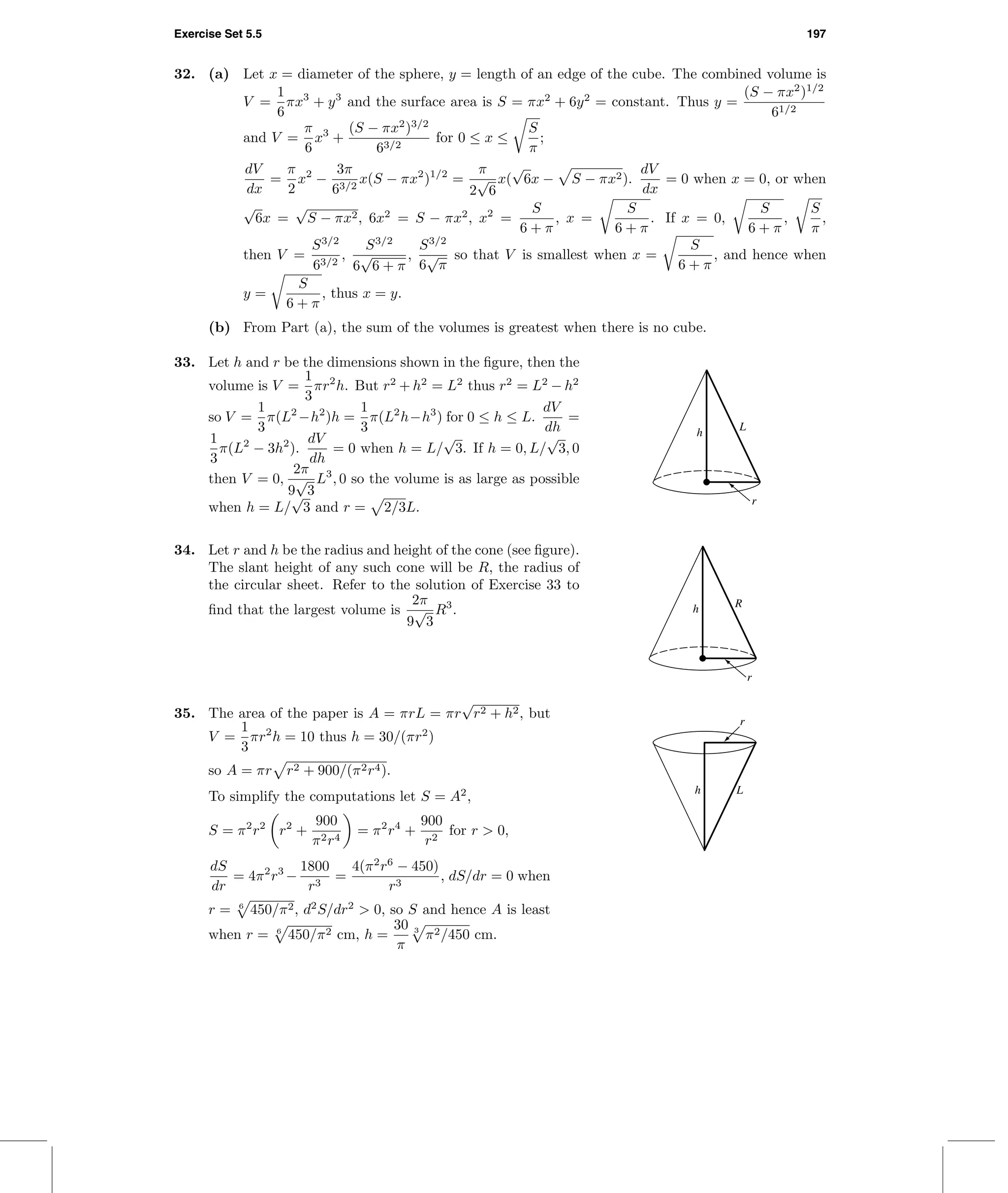
![198 Chapter 5
36. The area of the triangle is A =
1
2
hb. By similar trian-
gles (see figure)
b/2
h
=
R
√
h2 − 2Rh
, b =
2Rh
√
h2 − 2Rh
so A =
Rh2
√
h2 − 2Rh
for h > 2R,
dA
dh
=
Rh2
(h − 3R)
(h2 − 2Rh)3/2
,
dA
dh
= 0 for h > 2R when h = 3R, by the first deriva-
tive test A is minimum when h = 3R. If h = 3R then
b = 2
√
3R (the triangle is equilateral).
R
h − R
R
h
b
b/2
h2 − 2Rh
37. The volume of the cone is V =
1
3
πr2
h. By similar tri-
angles (see figure)
r
h
=
R
√
h2 − 2Rh
, r =
Rh
√
h2 − 2Rh
so V =
1
3
πR2 h3
h2 − 2Rh
=
1
3
πR2 h2
h − 2R
for h > 2R,
dV
dh
=
1
3
πR2 h(h − 4R)
(h − 2R)2
,
dV
dh
= 0 for h > 2R when
h = 4R, by the first derivative test V is minimum
when h = 4R. If h = 4R then r =
√
2R.
r
R
h − R
R
h
h2 − 2Rh
38. The area is (see figure)
A =
1
2
(2 sin θ)(4 + 4 cos θ)
= 4(sin θ + sin θ cos θ)
for 0 ≤ θ ≤ π/2;
dA/dθ = 4(cos θ − sin2
θ + cos2
θ)
= 4(cos θ − [1 − cos2
θ] + cos2
θ)
= 4(2 cos2
θ + cos θ − 1)
= 4(2 cos θ − 1)(cos θ + 1)
dA/dθ = 0 when θ = π/3 for 0 < θ < π/2. If θ = 0, π/3, π/2 then
A = 0, 3
√
3, 4 so the maximum area is 3
√
3.
4
2 cos θ
θ
4 cos θ
2 sin θ2
39. Let b and h be the dimensions shown in the figure,
then the cross-sectional area is A =
1
2
h(5 + b). But
h = 5 sin θ and b = 5 + 2(5 cos θ) = 5 + 10 cos θ so
A =
5
2
sin θ(10 + 10 cos θ) = 25 sin θ(1 + cos θ) for
0 ≤ θ ≤ π/2.
dA/dθ = −25 sin2
θ + 25 cos θ(1 + cos θ)
= 25(− sin2
θ + cos θ + cos2
θ)
= 25(−1 + cos2
θ + cos θ + cos2
θ)
= 25(2 cos2
θ + cos θ − 1) = 25(2 cos θ − 1)(cos θ + 1).
dA/dθ = 0 for 0 < θ < π/2 when cos θ = 1/2, θ = π/3.
If θ = 0, π/3, π/2 then A = 0, 75
√
3/4, 25 so the cross-
sectional area is greatest when θ = π/3.
b
5 cos θ
θ
55
5
h = 5 sin θ](https://image.slidesharecdn.com/gabaritocompletoantoncalculo8edcaps0108-130504215818-phpapp02/75/Gabarito-completo-anton_calculo_8ed_caps_01_08-198-2048.jpg)
![Exercise Set 5.5 199
40. I = k
cos φ
2
, k the constant of proportionality. If h is the height of the lamp above the table then
cos φ = h/ and =
√
h2 + r2 so I = k
h
3
= k
h
(h2 + r2)3/2
for h > 0,
dI
dh
= k
r2
− 2h2
(h2 + r2)5/2
,
dI
dh
= 0
when h = r/
√
2, by the first derivative test I is maximum when h = r/
√
2.
41. Let L, L1, and L2 be as shown in the figure, then
L = L1 + L2 = 8 csc θ + sec θ,
dL
dθ
= −8 csc θ cot θ + sec θ tan θ, 0 < θ < π/2
= −
8 cos θ
sin2
θ
+
sin θ
cos2 θ
=
−8 cos3
θ + sin3
θ
sin2
θ cos2 θ
;
dL
dθ
= 0 if sin3
θ = 8 cos3
θ, tan3
θ = 8, tan θ = 2 which gives
the absolute minimum for L because lim
θ→0+
L = lim
θ→π/2−
L = +∞.
If tan θ = 2, then csc θ =
√
5/2 and sec θ =
√
5 so L = 8(
√
5/2) +
√
5 = 5
√
5 ft.
1
8
θ
L2
L1
L
42. Let x = number of steers per acre
w = average market weight per steer
T = total market weight per acre
then T = xw where w = 2000 − 50(x − 20) = 3000 − 50x
so T = x(3000 − 50x) = 3000x − 50x2
for 0 ≤ x ≤ 60,
dT/dx = 3000 − 100x and dT/dx = 0 when x = 30. If x = 0, 30, 60 then T = 0, 45000, 0 so the
total market weight per acre is largest when 30 steers per acre are allowed.
43. (a) The daily profit is
P = (revenue) − (production cost) = 100x − (100, 000 + 50x + 0.0025x2
)
= −100, 000 + 50x − 0.0025x2
for 0 ≤ x ≤ 7000, so dP/dx = 50 − 0.005x and dP/dx = 0 when x = 10, 000. Because 10,000
is not in the interval [0, 7000], the maximum profit must occur at an endpoint. When x = 0,
P = −100, 000; when x = 7000, P = 127, 500 so 7000 units should be manufactured and sold
daily.
(b) Yes, because dP/dx > 0 when x = 7000 so profit is increasing at this production level.
(c) dP/dx = 15 when x = 7000, so P(7001) − P(7000) ≈ 15, and the marginal profit is $15.
44. (a) R(x) = px but p = 1000 − x so R(x) = (1000 − x)x
(b) P(x) = R(x) − C(x) = (1000 − x)x − (3000 + 20x) = −3000 + 980x − x2
(c) P (x) = 980 − 2x, P (x) = 0 for 0 < x < 500 when x = 490; test the points 0, 490, 500 to find
that the profit is a maximum when x = 490.
(d) P(490) = 237,100
(e) p = 1000 − x = 1000 − 490 = 510.
45. The profit is
P = (profit on nondefective) − (loss on defective) = 100(x − y) − 20y = 100x − 120y
but y = 0.01x + 0.00003x2
so P = 100x − 120(0.01x + 0.00003x2
) = 98.8x − 0.0036x2
for x > 0,
dP/dx = 98.8 − 0.0072x, dP/dx = 0 when x = 98.8/0.0072 ≈ 13, 722, d2
P/dx2
< 0 so the profit is
maximum at a production level of about 13,722 pounds.](https://image.slidesharecdn.com/gabaritocompletoantoncalculo8edcaps0108-130504215818-phpapp02/75/Gabarito-completo-anton_calculo_8ed_caps_01_08-199-2048.jpg)
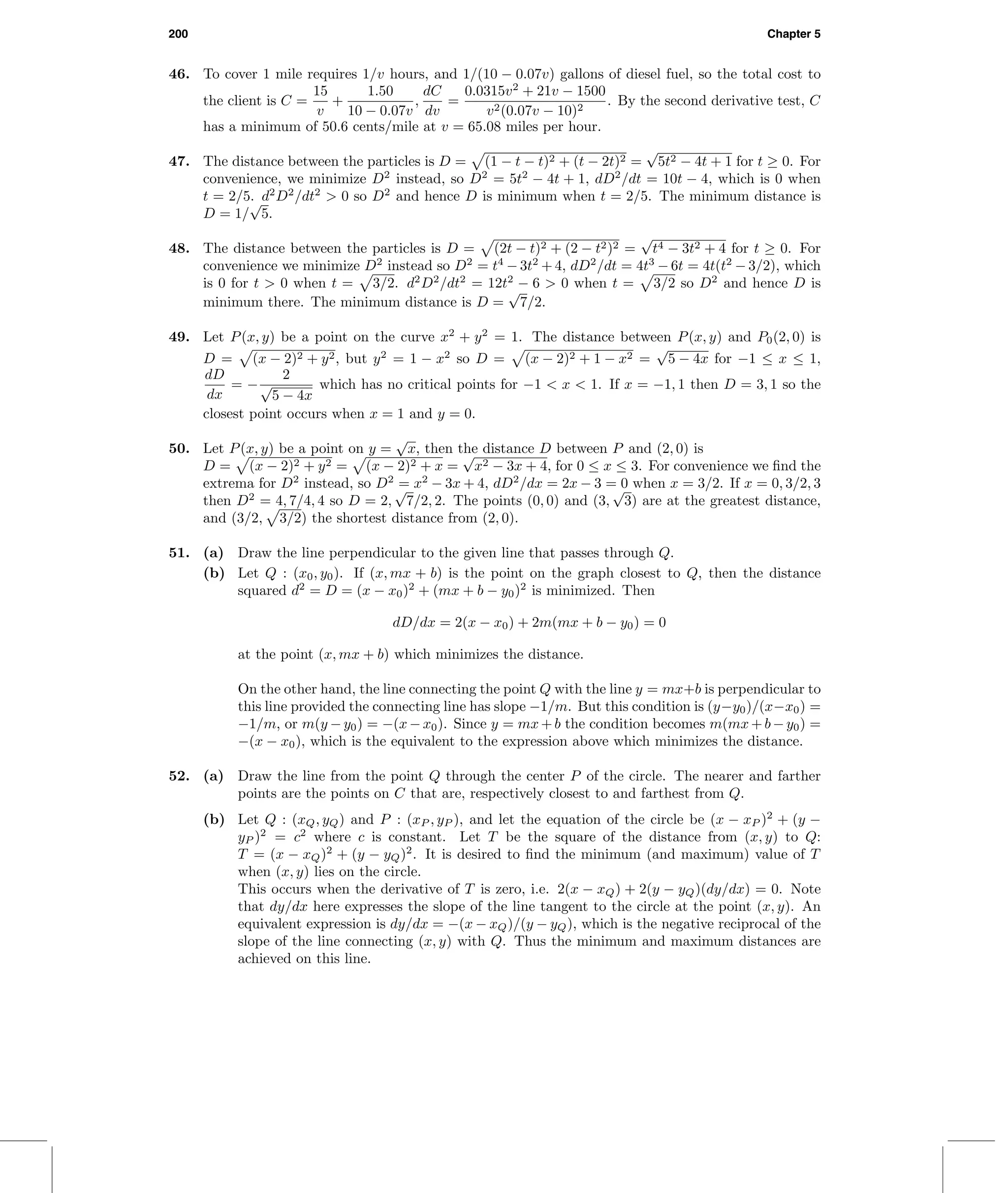
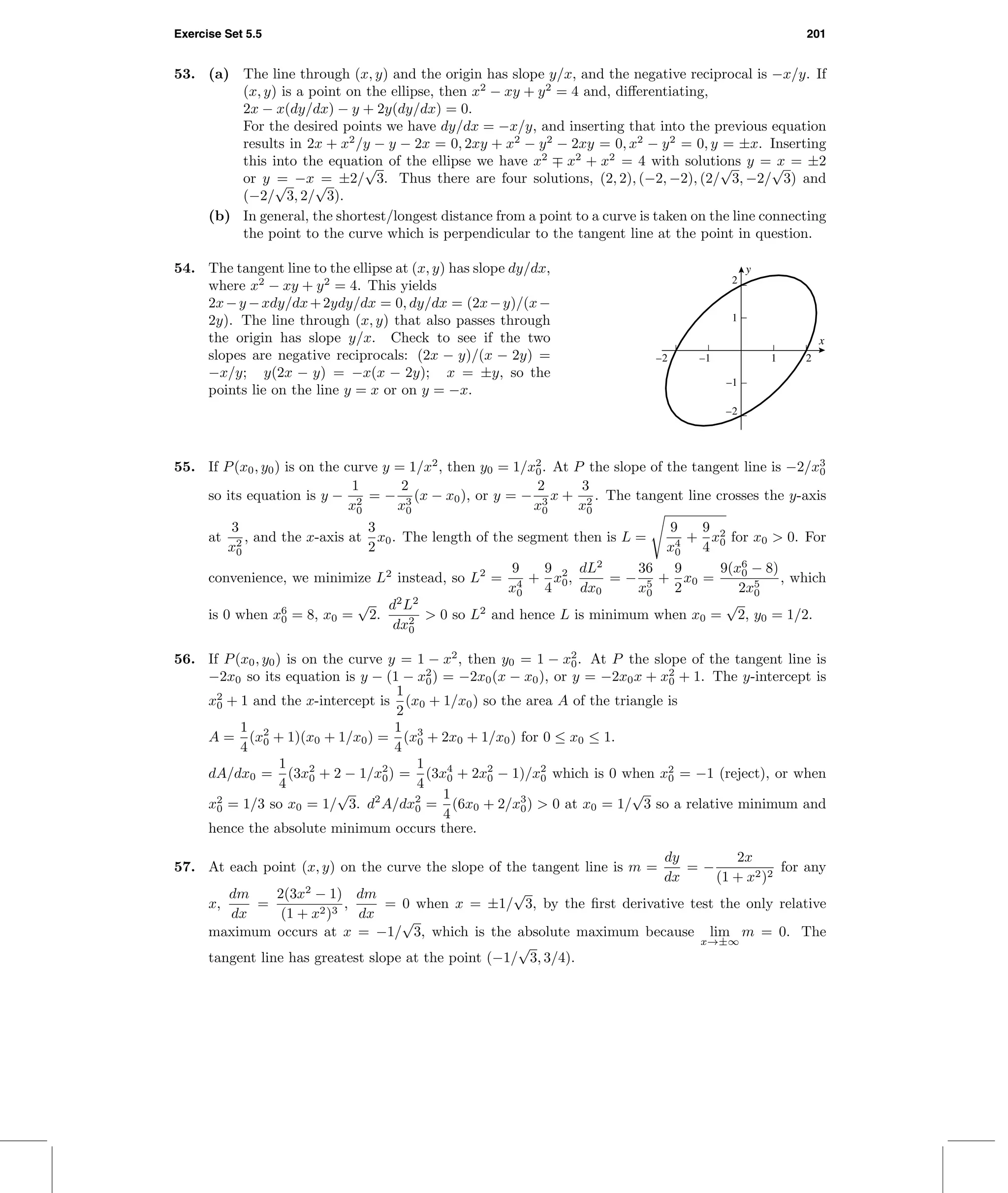
![202 Chapter 5
58. Let x be how far P is upstream from where the man
starts (see figure), then the total time to reach T is
t = (time from M to P) + (time from P to T)
=
√
x2 + 1
rR
+
1 − x
rW
for 0 ≤ x ≤ 1,
where rR and rW are the rates at which he can row
and walk, respectively.
M
TP
1
1
x
(a) t =
√
x2 + 1
3
+
1 − x
5
,
dt
dx
=
x
3
√
x2 + 1
−
1
5
so
dt
dx
= 0 when 5x = 3 x2 + 1,
25x2
= 9(x2
+ 1), x2
= 9/16, x = 3/4. If x = 0, 3/4, 1 then t = 8/15, 7/15,
√
2/3 so the time
is a minimum when x = 3/4 mile.
(b) t =
√
x2 + 1
4
+
1 − x
5
,
dt
dx
=
x
4
√
x2 + 1
−
1
5
so
dt
dx
= 0 when x = 4/3 which is not in the
interval [0, 1]. Check the endpoints to find that the time is a minimum when x = 1 (he should
row directly to the town).
59. With x and y as shown in the figure, the maximum
length of pipe will be the smallest value of L = x + y.
By similar triangles
y
8
=
x
√
x2 − 16
, y =
8x
√
x2 − 16
so
L = x +
8x
√
x2 − 16
for x > 4,
dL
dx
= 1 −
128
(x2 − 16)3/2
,
dL
dx
= 0 when
(x2
− 16)3/2
= 128
x2
− 16 = 1282/3
= 16(22/3
)
x2
= 16(1 + 22/3
)
x = 4(1 + 22/3
)1/2
,
d2
L/dx2
= 384x/(x2
− 16)5/2
> 0 if x > 4 so L is smallest when x = 4(1 + 22/3
)1/2
.
For this value of x, L = 4(1 + 22/3
)3/2
ft.
8
4
x
y
x2 – 16
60. s = (x1 − ¯x)2
+ (x2 − ¯x)2
+ · · · + (xn − ¯x)2
,
ds/d¯x = −2(x1 − ¯x) − 2(x2 − ¯x) − · · · − 2(xn − ¯x),
ds/d¯x = 0 when
(x1 − ¯x) + (x2 − ¯x) + · · · + (xn − ¯x) = 0
(x1 + x2 + · · · xn) − (¯x + ¯x + · · · + ¯x) = 0
(x1 + x2 + · · · + xn) − n¯x = 0
¯x =
1
n
(x1 + x2 + · · · + xn),
d2
s/d¯x2
= 2 + 2 + · · · + 2 = 2n > 0, so s is minimum when ¯x =
1
n
(x1 + x2 + · · · + xn).](https://image.slidesharecdn.com/gabaritocompletoantoncalculo8edcaps0108-130504215818-phpapp02/75/Gabarito-completo-anton_calculo_8ed_caps_01_08-202-2048.jpg)
![Exercise Set 5.5 203
61. Let x = distance from the weaker light source, I = the intensity at that point, and k the constant
of proportionality. Then
I =
kS
x2
+
8kS
(90 − x)2
if 0 < x < 90;
dI
dx
= −
2kS
x3
+
16kS
(90 − x)3
=
2kS[8x3
− (90 − x)3
]
x3(90 − x)3
= 18
kS(x − 30)(x2
+ 2700)
x3(x − 90)3
,
which is 0 when x = 30;
dI
dx
< 0 if x < 30, and
dI
dx
> 0 if x > 30, so the intensity is minimum at a
distance of 30 cm from the weaker source.
62. If f(x0) is a maximum then f(x) ≤ f(x0) for all x in some open interval containing x0 thus
f(x) ≤ f(x0) because
√
x is an increasing function, so f(x0) is a maximum of f(x) at x0.
The proof is similar for a minimum value, simply replace ≤ by ≥.
x
y
A(2, 1)
B(5, 4)
P(x, 0)
52
x – 2 5 – x
␣ 
63. θ = π − (α + β)
= π − cot−1
(x − 2) − cot−1 5 − x
4
,
dθ
dx
=
1
1 + (x − 2)2
+
−1/4
1 + (5 − x)2/16
= −
3(x2
− 2x − 7)
[1 + (x − 2)2][16 + (5 − x)2]
dθ/dx = 0 when x =
2 ±
√
4 + 28
2
= 1 ± 2
√
2,
only 1 + 2
√
2 is in [2, 5]; dθ/dx > 0 for x in [2, 1 + 2
√
2),
dθ/dx < 0 for x in (1 + 2
√
2, 5], θ is maximum when x = 1 + 2
√
2.
␣

x
10
2
64. θ = α − β
= cot−1
(x/12) − cot−1
(x/2)
dθ
dx
= −
12
144 + x2
+
2
4 + x2
=
10(24 − x2
)
(144 + x2)(4 + x2)
dθ/dx = 0 when x =
√
24 = 2
√
6, by
the first derivative test θ is
maximum there.
65. Let v = speed of light in the medium. The total time required for the light to travel from A to P
to B is
t = (total distance from A to P to B)/v =
1
v
( (c − x)2 + a2 + x2 + b2),
dt
dx
=
1
v
−
c − x
(c − x)2 + a2
+
x
√
x2 + b2
and
dt
dx
= 0 when
x
√
x2 + b2
=
c − x
(c − x)2 + a2
. But x/
√
x2 + b2 = sin θ2 and
(c − x)/ (c − x)2 + a2 = sin θ1 thus dt/dx = 0 when sin θ2 = sin θ1 so θ2 = θ1.](https://image.slidesharecdn.com/gabaritocompletoantoncalculo8edcaps0108-130504215818-phpapp02/75/Gabarito-completo-anton_calculo_8ed_caps_01_08-203-2048.jpg)


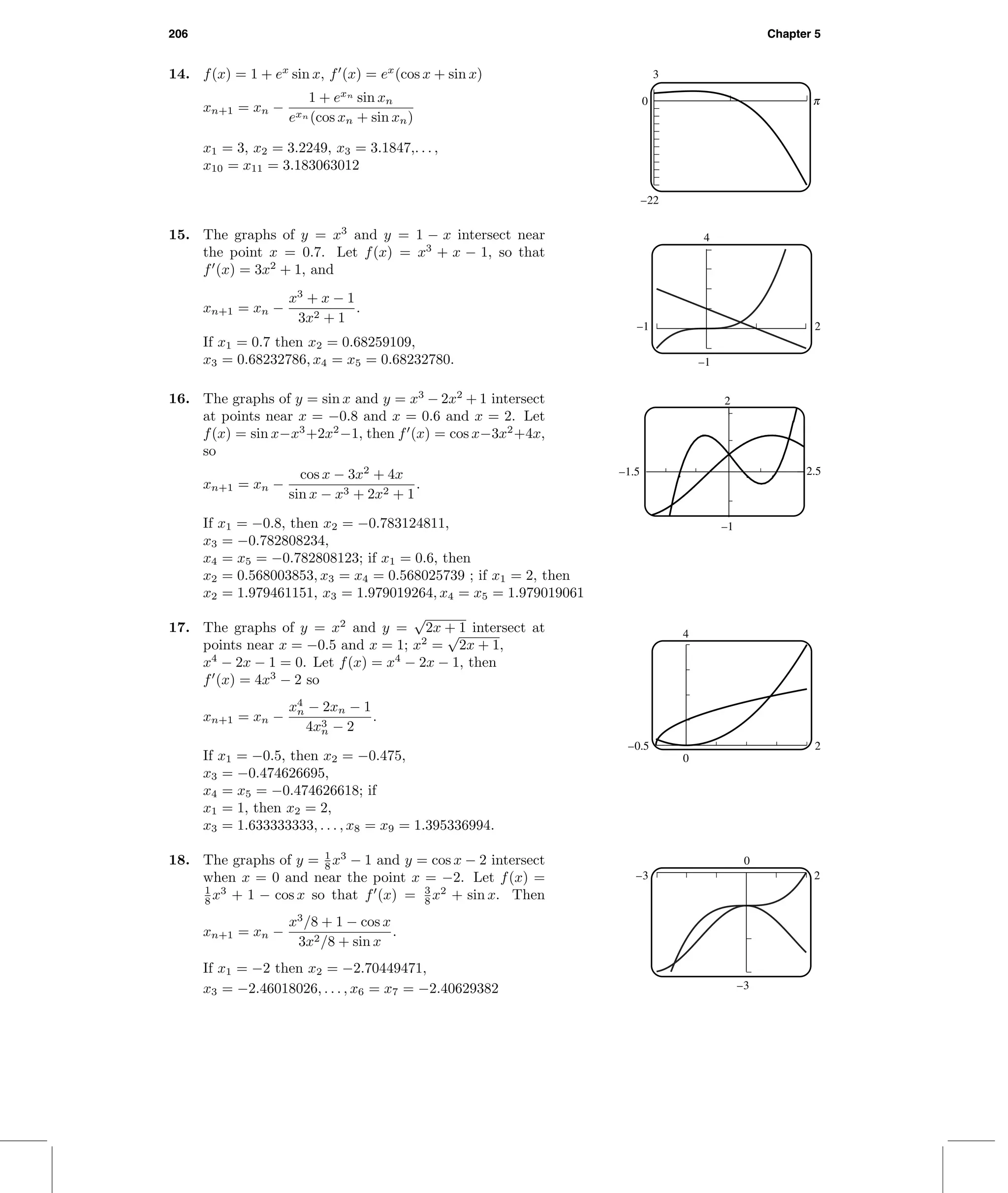


![Exercise Set 5.7 209
35. (a) x1 x2 x3 x4 x5 x6 x7 x8 x9 x10
0.5000 −0.7500 0.2917 −1.5685 −0.4654 0.8415 −0.1734 2.7970 1.2197 0.1999
(b) The sequence xn must diverge, since if it did converge then f(x) = x2
+ 1 = 0 would have a
solution. It seems the xn are oscillating back and forth in a quasi-cyclical fashion.
36. (a) xn+1 = xn, i.e. the constant sequence xn is generated.
(b) This is equivalent to f(xn) = 0 as in part (a).
(c) xn = xn+2 = xn+1 −
f(xn+1)
f (xn+1)
= xn −
f(xn)
f (xn)
−
f(xn+1)
f (xn+1)
, so f(xn+1) = −
f (xn+1)
f (xn)
f(xn)
37. (a) |xn+1 − xn| ≤ |xn+1 − c| + |c − xn| < 1/n + 1/n = 2/n
(b) The closed interval [c − 1, c + 1] contains all of the xn, since |xn − c| < 1/n. Let M be an
upper bound for |f (x)| on [c − 1, c + 1]. Since xn+1 = xn − f(xn)/f (xn) it follows that
|f(xn)| ≤ |f (xn)||xn+1 − xn| < M|xn+1 − xn| < 2M/n.
(c) Assume that f(c) = 0. The sequence xn converges to c, since |xn − c| < 1/n. By the
continuity of f, f(c) = f( lim
n→+∞
xn) = lim
n→+∞
f(xn).
Let = |f(c)|/2. Choose N such that |f(xn) − f(c)| < /2 for n > N. Then
|f(xn) − f(c)| < |f(c)|/2 for n > N, so −|f(c)|/2 < f(xn) − f(c) < |f(c)/2|.
If f(c) > 0 then f(xn) > f(c) − |f(c)|/2 = f(c)/2.
If f(c) < 0, then f(xn) < f(c) + |f(c)|/2 = −|f(c)|/2, or |f(xn)| > |f(c)|/2.
(d) From (b) it follows that lim
n→+∞
f(xn) = 0. From (c) it follows that if f(c) = 0 then
lim
n→+∞
f(xn) = 0, a contradiction. The conclusion, then, is that f(c) = 0.
EXERCISE SET 5.7
1. f(3) = f(5) = 0; f (x) = 2x − 8, 2c − 8 = 0, c = 4, f (4) = 0
2. f(0) = f(2) = 0, f (x) = 3x2
− 6x + 2, 3c2
− 6c + 2 = 0; c =
6 ±
√
36 − 24
6
= 1 ±
√
3/3
3. f(π/2) = f(3π/2) = 0, f (x) = − sin x, − sin c = 0, c = π
4. f(−1) = f(3) = 0; f (1) = 0; f (x) = 2(1 − x)/(4 + 2x − x2
); 2(1 − c) = 0, c = 1
5. f(0) = f(4) = 0, f (x) =
1
2
−
1
2
√
x
,
1
2
−
1
2
√
c
= 0, c = 1
6. f(1) = f(3) = 0, f (x) = −
2
x3
+
4
3x2
, −
2
c3
+
4
3c2
= 0, −6 + 4c = 0, c = 3/2
7. (f(5) − f(−3))/(5 − (−3)) = 1; f (x) = 2x − 1; 2c − 1 = 1, c = 1
8. f(−1) = −6, f(2) = 6, f (x) = 3x2
+ 1, 3c2
+ 1 =
6 − (−6)
2 − (−1)
= 4, c2
= 1, c = ±1 of which only
c = 1 is in (−1, 2)
9. f(0) = 1, f(3) = 2, f (x) =
1
2
√
x + 1
,
1
2
√
c + 1
=
2 − 1
3 − 0
=
1
3
,
√
c + 1 = 3/2, c + 1 = 9/4, c = 5/4
10. f(4) = 15/4, f(3) = 8/3, solve f (c) = (15/4−8/3)/1 = 13/12; f (x) = 1+1/x2
, f (c) = 1+1/c2
=
13/12, c2
= 12, c = ±2
√
3, but −2
√
3 is not in the interval, so c = 2
√
3.](https://image.slidesharecdn.com/gabaritocompletoantoncalculo8edcaps0108-130504215818-phpapp02/75/Gabarito-completo-anton_calculo_8ed_caps_01_08-209-2048.jpg)
![210 Chapter 5
11. f(−5) = 0, f(3) = 4, f (x) = −
x
√
25 − x2
, −
c
√
25 − c2
=
4 − 0
3 − (−5)
=
1
2
, −2c =
√
25 − c2,
4c2
= 25 − c2
, c2
= 5, c = −
√
5
(we reject c =
√
5 because it does not satisfy the equation −2c =
√
25 − c2)
12. f(2) = 1, f(5) = 1/4, f (x) = −1/(x − 1)2
, −
1
(c − 1)2
=
1/4 − 1
5 − 2
= −
1
4
, (c − 1)2
= 4, c − 1 = ±2,
c = −1 (reject), or c = 3
13. (a) f(−2) = f(1) = 0
The interval is [−2, 1]
(b) c = −1.29
6
–2
–2 1
(c) x0 = −1, x1 = −1.5, x2 = −1.32, x3 = −1.290, x4 = −1.2885843
14. (a) m =
f(−2) − f(1)
−2 − 1
=
0 + 3
−3
= −1 so y + 3 = −(x − 1), y = −x − 2
(b) f (x) = 3x2
− 4 = −1 has solutions x = ±1; discard x = 1, so c = −1
(c) y − (3) = −(x − (−1)) or y = −x + 2
(d) 4
–4
–3 2
15. (a) f (x) = sec2
x, sec2
c = 0 has no solution (b) tan x is not continuous on [0, π]
16. (a) f(−1) = 1, f(8) = 4, f (x) =
2
3
x−1/3
2
3
c−1/3
=
4 − 1
8 − (−1)
=
1
3
, c1/3
= 2, c = 8 which is not in (−1, 8).
(b) x2/3
is not differentiable at x = 0, which is in (−1, 8).
17. (a) Two x-intercepts of f determine two solutions a and b of f(x) = 0; by Rolle’s Theorem there
exists a point c between a and b such that f (c) = 0, i.e. c is an x-intercept for f .
(b) f(x) = sin x = 0 at x = nπ, and f (x) = cos x = 0 at x = nπ + π/2, which lies between nπ
and (n + 1)π, (n = 0, ±1, ±2, . . .)
18.
f(x1) − f(x0)
x1 − x0
is the average rate of change of y with respect to x on the interval [x0, x1]. By
the Mean-Value Theorem there is a value c in (x0, x1) such that the instantaneous rate of change
f (c) =
f(x1) − f(x0)
x1 − x0
.](https://image.slidesharecdn.com/gabaritocompletoantoncalculo8edcaps0108-130504215818-phpapp02/75/Gabarito-completo-anton_calculo_8ed_caps_01_08-210-2048.jpg)
![Exercise Set 5.7 211
19. Let s(t) be the position function of the automobile for 0 ≤ t ≤ 5, then by the Mean-Value Theorem
there is at least one point c in (0, 5) where
s (c) = v(c) = [s(5) − s(0)]/(5 − 0) = 4/5 = 0.8 mi/min = 48 mi/h.
20. Let T(t) denote the temperature at time with t = 0 denoting 11 AM, then T(0) = 76 and
T(12) = 52.
(a) By the Mean-Value Theorem there is a value c between 0 and 12 such that
T (c) = [T(12) − T(0)]/(12 − 0) = (52 − 76)/(12) = −2◦
F/h.
(b) Assume that T(t1) = 88◦
F where 0 < t1 < 12, then there is at least one point c in (t1, 12)
where T (c) = [T(12)−T(t1)]/(12−t1) = (52−88)/(12−t1) = −36/(12−t1). But 12−t1 < 12
so T (c) < −3◦
F.
21. Let f(t) and g(t) denote the distances from the first and second runners to the starting point,
and let h(t) = f(t) − g(t). Since they start (at t = 0) and finish (at t = t1) at the same time,
h(0) = h(t1) = 0, so by Rolle’s Theorem there is a time t2 for which h (t2) = 0, i.e. f (t2) = g (t2);
so they have the same velocity at time t2.
22. f(x) = x − (2 − x) ln(2 − x); solve f(x) = 0 in (0, 1). f(0) = −2 ln 2 < 0; f(1) = 1 > 0. By the
Intermediate-Value Theorem (Theorem 2.5.7) there exists x in (0, 1) such that f(x) = 0.
23. (a) By the Constant Difference Theorem f(x) − g(x) = k for some k; since f(x0) = g(x0), k = 0,
so f(x) = g(x) for all x.
(b) Set f(x) = sin2
x + cos2
x, g(x) = 1; then f (x) = 2 sin x cos x − 2 cos x sin x = 0 = g (x).
Since f(0) = 1 = g(0), f(x) = g(x) for all x.
24. (a) By the Constant Difference Theorem f(x) − g(x) = k for some k; since f(x0) − g(x0) = c,
k = c, so f(x) − g(x) = c for all x.
(b) Set f(x) = (x − 1)3
, g(x) = (x2
+ 3)(x − 3). Then
f (x) = 3(x − 1)2
, g (x) = (x2
+ 3) + 2x(x − 3) = 3x2
− 6x + 3 = 3(x2
− 2x + 1) = 3(x − 1)2
,
so f (x) = g (x) and hence f(x) − g(x) = k. Expand f(x) and g(x) to get
h(x) = f(x) − g(x) = (x3
− 3x2
+ 3x − 1) − (x3
− 3x2
+ 3x − 9) = 8.
(c) h(x) = x3
− 3x2
+ 3x − 1 − (x3
− 3x2
+ 3x − 9) = 8
25. By the Constant Difference Theorem it follows that f(x) = g(x) + c; since g(1) = 0 and f(1) = 2
we get c = 2; f(x) = xex
− ex
+ 2.
26. By the Constant Difference Theorem f(x) = tan−1
x + C and
2 = f(1) = tan−1
(1) + C = π/4 + C, C = 2 − π/4, f(x) = tan−1
x + 2 − π/4.
27. (a) If x, y belong to I and x < y then for some c in I,
f(y) − f(x)
y − x
= f (c),
so |f(x)−f(y)| = |f (c)||x−y| ≤ M|x−y|; if x > y exchange x and y; if x = y the inequality
also holds.
(b) f(x) = sin x, f (x) = cos x, |f (x)| ≤ 1 = M, so |f(x) − f(y)| ≤ |x − y| or
| sin x − sin y| ≤ |x − y|.
28. (a) If x, y belong to I and x < y then for some c in I,
f(y) − f(x)
y − x
= f (c),
so |f(x) − f(y)| = |f (c)||x − y| ≥ M|x − y|; if x > y exchange x and y; if
x = y the inequality also holds.
(b) If x and y belong to (−π/2, π/2) and f(x) = tan x, then |f (x)| = sec2
x ≥ 1 and
| tan x − tan y| ≥ |x − y|
(c) y lies in (−π/2, π/2) if and only if −y does; use Part (b) and replace y with −y](https://image.slidesharecdn.com/gabaritocompletoantoncalculo8edcaps0108-130504215818-phpapp02/75/Gabarito-completo-anton_calculo_8ed_caps_01_08-211-2048.jpg)
![212 Chapter 5
29. (a) Let f(x) =
√
x. By the Mean-Value Theorem there is a number c between x and y such that
√
y −
√
x
y − x
=
1
2
√
c
<
1
2
√
x
for c in (x, y), thus
√
y −
√
x <
y − x
2
√
x
(b) multiply through and rearrange to get
√
xy <
1
2
(x + y).
30. Suppose that f(x) has at least two distinct real solutions r1 and r2 in I. Then
f(r1) = f(r2) = 0 so by Rolle’s Theorem there is at least one number between r1 and r2 where
f (x) = 0, but this contradicts the assumption that f (x) = 0, so f(x) = 0 must have fewer than
two distinct solutions in I.
31. (a) If f(x) = x3
+ 4x − 1 then f (x) = 3x2
+ 4 is never zero, so by Exercise 30 f has at most one
real root; since f is a cubic polynomial it has at least one real root, so it has exactly one real
root.
(b) Let f(x) = ax3
+ bx2
+ cx + d. If f(x) = 0 has at least two distinct real solutions r1 and r2,
then f(r1) = f(r2) = 0 and by Rolle’s Theorem there is at least one number between r1 and
r2 where f (x) = 0. But f (x) = 3ax2
+ 2bx + c = 0 for
x = (−2b ±
√
4b2 − 12ac)/(6a) = (−b ±
√
b2 − 3ac)/(3a), which are not real if b2
− 3ac < 0
so f(x) = 0 must have fewer than two distinct real solutions.
32. f (x) =
1
2
√
x
,
1
2
√
c
=
√
4 −
√
3
4 − 3
= 2 −
√
3. But
1
4
<
1
2
√
c
<
1
2
√
3
for c in (3, 4) so
1
4
< 2 −
√
3 <
1
2
√
3
, 0.25 < 2 −
√
3 < 0.29, −1.75 < −
√
3 < −1.71, 1.71 <
√
3 < 1.75.
33. By the Mean-Value Theorem on the interval [0, x],
tan−1
x − tan−1
0
x − 0
=
tan−1
x
x
=
1
1 + c2
for c in (0, x), but
1
1 + x2
<
1
1 + c2
< 1 for c in (0, x) so
1
1 + x2
<
tan−1
x
x
< 1,
x
1 + x2
< tan−1
x < x.
34. (a)
d
dx
[f2
(x) − g2
(x)] = 2f(x)f (x) − 2g(x)g (x) = 2f(x)g(x) − 2g(x)f(x) = 0, so f2
− g2
is
constant.
(b) f (x) = 1
2 (ex
− e−x
) = g(x), g (x) = 1
2 (ex
+ e−x
) = f(x)
35. (a)
d
dx
[f2
(x) + g2
(x)] = 2f(x)f (x) + 2g(x)g (x) = 2f(x)g(x) + 2g(x)[−f(x)] = 0,
so f2
(x) + g2
(x) is constant.
(b) f(x) = sin x and g(x) = cos x
36. Let h = f − g, then h is continuous on [a, b], differentiable on (a, b), and h(a) = f(a) − g(a) = 0,
h(b) = f(b) − g(b) = 0. By Rolle’s Theorem there is some c in (a, b) where h (c) = 0. But
h (c) = f (c) − g (c) so f (c) − g (c) = 0, f (c) = g (c).
37. y
x
c
]](https://image.slidesharecdn.com/gabaritocompletoantoncalculo8edcaps0108-130504215818-phpapp02/75/Gabarito-completo-anton_calculo_8ed_caps_01_08-212-2048.jpg)


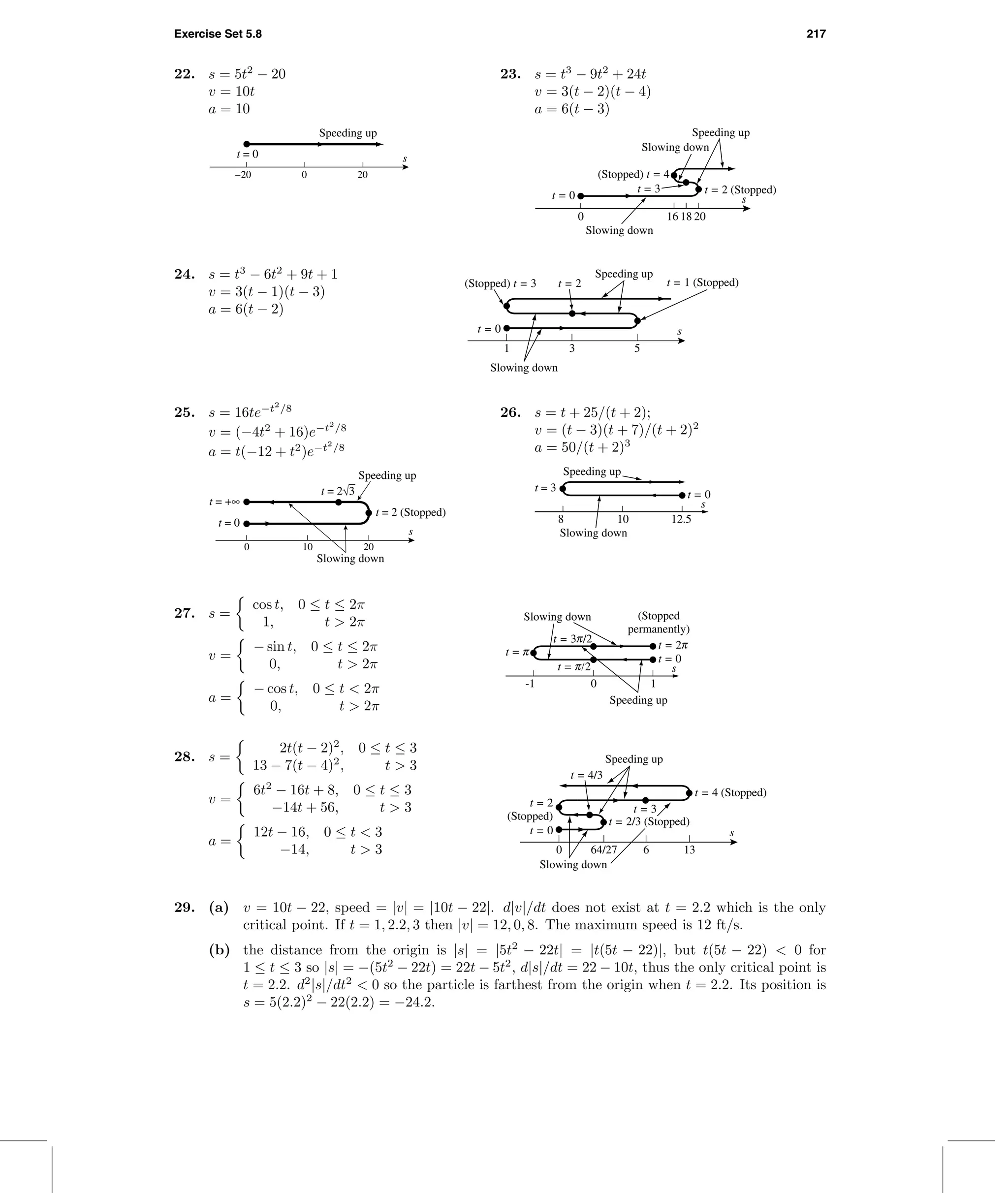
![218 Chapter 5
30. v = −
200t
(t2 + 12)2
, speed = |v| =
200t
(t2 + 12)2
for t ≥ 0.
d|v|
dt
=
600(4 − t2
)
(t2 + 12)3
= 0 when t = 2, which
is the only critical point in (0, +∞). By the first derivative test there is a relative maximum, and
hence an absolute maximum, at t = 2. The maximum speed is 25/16 ft/s to the left.
31. s = ln(3t2
− 12t + 13)
v =
6t − 12
3t2 − 12t + 13
a = −
6(3t2
− 12t + 11)
(3t2 − 12t + 13)2
(a) a = 0 when t = 2 ±
√
3/3;
s(2 −
√
3/3) = ln 2; s(2 +
√
3/3) = ln 2;
v(2 −
√
3/3 = −
√
3; v(2 +
√
3) =
√
3
(b) v = 0 when t = 2
s(2) = 0; a(2) = 6
32. s = t3
− 6t2
+ 1, v = 3t2
− 12t, a = 6t − 12.
(a) a = 0 when t = 2; s = −15, v = −12.
(b) v = 0 when 3t2
− 12t = 3t(t − 4) = 0, t = 0 or t = 4. If t = 0, then s = 1 and a = −12; if
t = 4, then s = −31 and a = 12.
33. (a) 1.5
0
0 5
(b) v =
2t
√
2t2 + 1
, lim
t→+∞
v =
2
√
2
=
√
2
34. (a) a =
dv
dt
=
dv
ds
ds
dt
= v
dv
ds
because v =
ds
dt
(b) v =
3
2
√
3t + 7
=
3
2s
;
dv
ds
= −
3
2s2
; a = −
9
4s3
= −9/500
35. (a) s1 = s2 if they collide, so 1
2 t2
− t + 3 = −1
4 t2
+ t + 1, 3
4 t2
− 2t + 2 = 0 which has no real
solution.
(b) Find the minimum value of D = |s1 − s2| = 3
4 t2
− 2t + 2 . From Part (a), 3
4 t2
− 2t + 2
is never zero, and for t = 0 it is positive, hence it is always positive, so D = 3
4 t2
− 2t + 2.
dD
dt
= 3
2 t − 2 = 0 when t = 4
3 .
d2
D
dt2
> 0 so D is minimum when t = 4
3 , D = 2
3 .
(c) v1 = t − 1, v2 = −
1
2
t + 1. v1 < 0 if 0 ≤ t < 1, v1 > 0 if t > 1; v2 < 0 if t > 2, v2 > 0 if
0 ≤ t < 2. They are moving in opposite directions during the intervals 0 ≤ t < 1 and t > 2.
36. (a) sA − sB = 20 − 0 = 20 ft
(b) sA = sB, 15t2
+ 10t + 20 = 5t2
+ 40t, 10t2
− 30t + 20 = 0, (t − 2)(t − 1) = 0, t = 1 or t = 2 s.
(c) vA = vB, 30t+10 = 10t+40, 20t = 30, t = 3/2 s. When t = 3/2, sA = 275/4 and sB = 285/4
so car B is ahead of car A.
37. r(t) = v2(t), r (t) = 2v(t)v (t)/[2 v(t)] = v(t)a(t)/|v(t)| so r (t) > 0 (speed is increasing) if v
and a have the same sign, and r (t) < 0 (speed is decreasing) if v and a have opposite signs.
If v(t) > 0 then r(t) = v(t) and r (t) = a(t), so if a(t) > 0 then the particle is speeding up and a
and v have the same sign; if a(t) < 0, then the particle is slowing down, and a and v have opposite
signs.](https://image.slidesharecdn.com/gabaritocompletoantoncalculo8edcaps0108-130504215818-phpapp02/75/Gabarito-completo-anton_calculo_8ed_caps_01_08-218-2048.jpg)
![Review Exercises 219
If v(t) < 0 then r(t) = −v(t), r (t) = −a(t), and if a(t) > 0 then the particle is speeding up and a
and v have opposite signs; if a(t) < 0 then the particle is slowing down and a and v have the same
sign.
REVIEW EXERCISES
3. f (x) = 2x − 5
f (x) = 2
(a) [5/2, +∞) (b) (−∞, 5/2]
(c) (−∞, +∞) (d) none
(e) none
4. f (x) = 4x(x2
− 4)
f (x) = 12(x2
− 4/3)
(a) [−2, 0], [2, +∞) (b) (−∞, −2], [0, 2]
(c) (−∞, −2/
√
3), (2/
√
3, +∞) (d) (−2/
√
3, 2/
√
3)
(e) −2/
√
3, 2/
√
3
5. f (x) =
4x
(x2 + 2)2
f (x) = −4
3x2
− 2
(x2 + 2)3
(a) [0, +∞) (b) (−∞, 0]
(c) (− 2/3, 2/3) (d) (−∞, − 2/3), ( 2/3, +∞)
(e) − 2/3, 2/3
6. f (x) = 1
3 (x + 2)−2/3
f (x) = −2
9 (x + 2)−5/3
(a) (−∞, +∞) (b) none
(c) (−∞, −2) (d) (−2, +∞)
(e) −2
7. f (x) =
4(x + 1)
3x2/3
f (x) =
4(x − 2)
9x5/3
(a) [−1, +∞) (b) (−∞, −1]
(c) (−∞, 0), (2, +∞) (d) (0, 2)
(e) 0, 2
8. f (x) =
4(x − 1/4)
3x2/3
f (x) =
4(x + 1/2)
9x5/3
(a) [1/4, +∞) (b) (−∞, 1/4]
(c) (−∞, −1/2), (0, +∞) (d) (−1/2, 0)
(e) −1/2, 0
9. f (x) = −
2x
ex2
f (x) =
2(2x2
− 1)
ex2
(a) (−∞, 0] (b) [0, +∞)
(c) (−∞, −
√
2/2), (
√
2/2, +∞) (d) (−
√
2/2,
√
2/2)
(e) −
√
2/2,
√
2/2
10. f (x) =
2x
1 + x4
f (x) = −
2(−1 + 3x4
)
(1 + x4)2
(a) [0, +∞) (b) (−∞, 0]
(c)(−1/31/4
, 1/31/4
) (d)(−∞, −1/31/4
), (1/31/4
, +∞)
(e)−1/31/4
, 1/31/4](https://image.slidesharecdn.com/gabaritocompletoantoncalculo8edcaps0108-130504215818-phpapp02/75/Gabarito-completo-anton_calculo_8ed_caps_01_08-219-2048.jpg)
![220 Chapter 5
11. f (x) = − sin x
f (x) = − cos x
(a) [π, 2π] (b) [0, π]
(c) (π/2, 3π/2) (d) (0, π/2), (3π/2, 2π)
(e) π/2, 3π/2
1
–1
0 o
12. f (x) = sec2
x
f (x) = 2 sec2
x tan x
(a) (−π/2, π/2) (b) none
(c) (0, π/2) (d) (−π/2, 0)
(e) 0
10
–10
^ 6
13. f (x) = cos 2x
f (x) = −2 sin 2x
(a) [0, π/4], [3π/4, π] (b) [π/4, 3π/4]
(c) (π/2, π) (d) (0, π/2)
(e) π/2
0.5
–0.5
0 p
14. f (x) = −2 cos x sin x − 2 cos x = −2 cos x(1 + sin x)
f (x) = 2 sin x (sin x + 1) − 2 cos2
x = 2 sin x(sin x + 1) − 2 + 2 sin2
x = 4(1 + sin x)(sin x − 1/2)
Note: 1 + sin x ≥ 0
(a) [π/2, 3π/2] (b) [0, π/2], [3π/2, 2π]
(c) (π/6, 5π/6) (d) (0, π/6), (5π/6, 2π)
(e) π/6, 5π/6
2
–2
0 o
15. (a)
2
4
x
y (b)
2
4
x
y (c)
2
4
x
y
16. (a) p(x) = x3
− x (b) p(x) = x4
− x2
(c) p(x) = x5
− x4
− x3
+ x2
(d) p(x) = x5
− x3
17. f (x) = 2ax + b; f (x) > 0 or f (x) < 0 on [0, +∞) if f (x) = 0 has no positive solution, so the
polynomial is always increasing or always decreasing on [0, +∞) provided −b/2a ≤ 0.](https://image.slidesharecdn.com/gabaritocompletoantoncalculo8edcaps0108-130504215818-phpapp02/75/Gabarito-completo-anton_calculo_8ed_caps_01_08-220-2048.jpg)
![Review Exercises 221
18. f (x) = 3ax2
+ 2bx + c; f (x) > 0 or f (x) < 0 on (−∞, +∞) if f (x) = 0 has no real solutions so
from the quadratic formula (2b)2
− 4(3a)c < 0, 4b2
− 12ac < 0, b2
− 3ac < 0. If b2
− 3ac = 0, then
f (x) = 0 has only one real solution at, say, x = c so f is always increasing or always decreasing
on both (−∞, c] and [c, +∞), and hence on (−∞, +∞) because f is continuous everywhere. Thus
f is always increasing or decreasing if b2
− 3ac ≤ 0.
19. The maximum increase in y
seems to occur near x = −1, y = 1/4.
–2 –1 1 2
0.25
0.5
x
y
20. y =
ax
1 + ax+k
y =
ax
ln a
(1 + ax+k)2
y = −
ax
(ln a)2
(ax+k
− 1)
(1 + ax+k)3
y = 0 when x = −k and y changes sign there
22. (a) False; an example is y =
x3
3
−
x2
2
on [−2, 2]; x = 0 is a relative maximum and x = 1 is a
relative minimum, but y = 0 is not the largest value of y on the interval, nor is y = −
1
6
the
smallest.
(b) true
(c) False; for example y = x3
on (−1, 1) which has a critical number but no relative extrema
24. (a) f (x) = 3x2
+ 6x − 9 = 3(x + 3)(x − 1), f (x) = 0 when x = −3, 1 (stationary points).
(b) f (x) = 4x(x2
− 3), f (x) = 0 when x = 0, ±
√
3 (stationary points).
25. (a) f (x) = (2 − x2
)/(x2
+ 2)2
, f (x) = 0 when x = ±
√
2 (stationary points).
(b) f (x) = 8x/(x2
+ 1)2
, f (x) = 0 when x = 0 (stationary point).
26. (a) f (x) =
4(x + 1)
3x2/3
, f (x) = 0 when x = −1 (stationary point), f (x) does not exist when
x = 0.
(b) f (x) =
4(x − 3/2)
3x2/3
, f (x) = 0 when x = 3/2 (stationary point), f (x) does not exist when
x = 0.
27. (a) f (x) =
7(x − 7)(x − 1)
3x2/3
; critical numbers at x = 0, 1, 7;
neither at x = 0, relative maximum at x = 1, relative minimum at x = 7 (First Derivative
Test)
(b) f (x) = 2 cos x(1 + 2 sin x); critical numbers at x = π/2, 3π/2, 7π/6, 11π/6;
relative maximum at x = π/2, 3π/2, relative minimum at x = 7π/6, 11π/6
(c) f (x) = 3 −
3
√
x − 1
2
; critical numbers at x = 5; relative maximum at x = 5
28. (a) f (x) =
x − 9
18x3/2
, f (x) =
27 − x
36x5/2
; critical number at x = 9;
f (9) > 0, relative minimum at x = 9](https://image.slidesharecdn.com/gabaritocompletoantoncalculo8edcaps0108-130504215818-phpapp02/75/Gabarito-completo-anton_calculo_8ed_caps_01_08-221-2048.jpg)
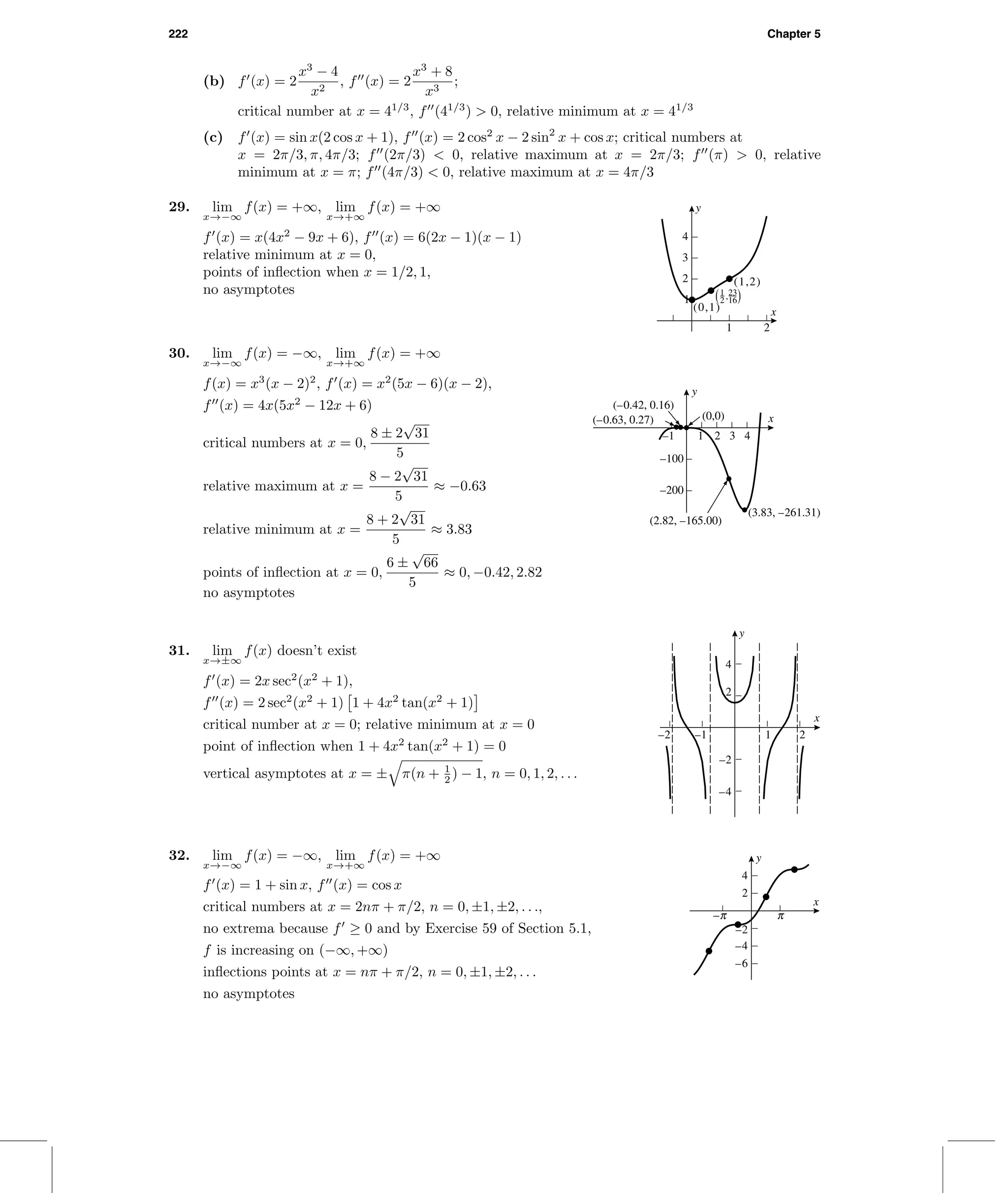


![Review Exercises 225
48. cos x − (sin y)
dy
dx
= 2
dy
dx
;
dy
dx
= 0 when cos x = 0. Use the first derivative test:
dy
dx
=
cos x
2 + sin y
and 2 + sin y > 0, so critical points when cos x = 0, relative maxima when x = 2nπ + π/2, relative
minima when x = 2nπ − π/2, n = 0, ±1, ±2, . . .
49. f(x) =
(2x − 1)(x2
+ x − 7)
(2x − 1)(3x2 + x − 1)
=
x2
+ x − 7
3x2 + x − 1
, x = 1/2
horizontal asymptote: y = 1/3,
vertical asymptotes: x = (−1 ±
√
13)/6
y
x
–5
5
–4 2 4
50. (a) f(x) =
(x − 2)(x2
+ x + 1)(x2
− 2)
(x − 2)(x2 − 2)2(x2 + 1)
=
x2
+ x + 1
(x2 − 2)(x2 + 1)
(b)
–1 1
5
x
y
x = ¤x = –¤
53. (a) If f has an absolute extremum at a point of (a, b) then it must, by Theorem 5.4.3, be at a
critical point of f; since f is differentiable on (a, b) the critical point is a stationary point.
(b) It could occur at a critical point which is not a stationary point: for example, f(x) = |x| on
[−1, 1] has an absolute minimum at x = 0 but is not differentiable there.
54. (a) f (x) = −1/x2
= 0, no critical points; by inspection M = −1/2 at x = −2; m = −1 at
x = −1
(b) f (x) = 3x2
− 4x3
= 0 at x = 0, 3/4; f(−1) = −2, f(0) = 0, f(3/4) = 27/256,
f(3/2) = −27/16, so m = −2 at x = −1, M = 27/256 at x = 3/4
(c) f (x) = 1 − sec2
x, f (x) = 0 for x in (−π/4, π/4) when x = 0; f(−π/4) = 1 − π/4, f(0) = 0,
f(π/4) = π/4 − 1 so the maximum value is 1 − π/4 at x = −π/4 and the minimum value is
π/4 − 1 at x = π/4.
(d) critical point at x = 2; m = −3 at x = 3, M = 0 at x = 2
55. (a) f (x) = 2x − 3; critical point x = 3/2. Minimum value f(3/2) = −13/4, no maximum.
(b) No maximum or minimum because lim
x→+∞
f(x) = +∞ and lim
x→−∞
f(x) = −∞.
(c) lim
x→0+
f(x) = lim
x→+∞
f(x) = +∞ and f (x) =
ex
(x − 2)
x3
, stationary point at x = 2; by
Theorem 5.4.4 f(x) has an absolute minimum at x = 2, and m = e2
/4.
(d) f (x) = (1 + ln x)xx
, critical point at x = 1/e; lim
x→0+
f(x) = lim
x→0+
ex ln x
= 1,
lim
x→+∞
f(x) = +∞; no absolute maximum, absolute minimum m = e−1/e
at x = 1/e
56. (a) f (x) = 10x3
(x − 2), critical points at x = 0, 2; lim
x→3−
f(x) = 88, so f(x) has no maximum;
m = −9 at x = 2
(b) lim
x→2−
f(x) = +∞ so no maximum; f (x) = 1/(x−2)2
, so f (x) is never zero, thus no minimum](https://image.slidesharecdn.com/gabaritocompletoantoncalculo8edcaps0108-130504215818-phpapp02/75/Gabarito-completo-anton_calculo_8ed_caps_01_08-225-2048.jpg)
![226 Chapter 5
(c) f (x) = 2
3 − x2
(x2 + 3)2
, critical point at x =
√
3. Since lim
x→0+
f(x) = 0, f(x) has no minimum,
and M =
√
3/3 at x =
√
3.
(d) f (x) =
x(7x − 12)
3(x − 2)2/3
, critical points at x = 12/7, 2; m = f(12/7) =
144
49
−
2
7
1/3
≈ −1.9356
at x = 12/7, M = 9 at x = 3
57. (a) (x2
− 1)2
can never be less than zero because it is the
square of x2
− 1; the minimum value is 0 for x = ±1,
no maximum because lim
x→+∞
f(x) = +∞.
10
0
–2 2
(b) f (x) = (1 − x2
)/(x2
+ 1)2
; critical point x = 1. Maxi-
mum value f(1) = 1/2, minimum value 0 because f(x)
is never less than zero on [0, +∞) and f(0) = 0.
0.5
0
0 20
(c) f (x) = 2 sec x tan x − sec2
x = (2 sin x − 1)/ cos2
x,
f (x) = 0 for x in (0, π/4) when x = π/6; f(0) = 2,
f(π/6) =
√
3, f(π/4) = 2
√
2−1 so the maximum value
is 2 at x = 0 and the minimum value is
√
3 at x = π/6.
2
1.5
0 3
(d) f (x) = 1/2 + 2x/(x2
+ 1),
f (x) = 0 on [−4, 0] for x = −2 ±
√
3
if x = −2 −
√
3, −2 +
√
3 then
f(x) = −1 −
√
3/2 + ln 4 + ln(2 +
√
3) ≈ 0.84,
−1 +
√
3/2 + ln 4 + ln(2 −
√
3) ≈ −0.06,
absolute maximum at x = −2 −
√
3,
absolute minimum at x = −2 +
√
3
1
–0.5
–4 0
58. Let f(x) = sin−1
x − x for 0 ≤ x ≤ 1. f(0) = 0 and f (x) =
1
√
1 − x2
− 1 =
1 −
√
1 − x2
√
1 − x2
. Note
that
√
1 − x2 ≤ 1, so f (x) ≥ 0. Thus we know that f is increasing. Since f(0) = 0, it follows that
f(x) ≥ 0 for 0 ≤ x ≤ 1.](https://image.slidesharecdn.com/gabaritocompletoantoncalculo8edcaps0108-130504215818-phpapp02/75/Gabarito-completo-anton_calculo_8ed_caps_01_08-226-2048.jpg)
![228 Chapter 5
65. x = −2.11491, 0.25410, 1.86081 66. x = 2.3561945
67. At the point of intersection, x3
= 0.5x − 1,
x3
− 0.5x + 1 = 0. Let f(x) = x3
− 0.5x + 1. By
graphing y = x3
and y = 0.5x − 1 it is evident that
there is only one point of intersection and it occurs
in the interval [−2, −1]; note that f(−2) < 0 and
f(−1) > 0. f (x) = 3x2
− 0.5 so
xn+1 = xn −
x3
n − 0.5x + 1
3x2
n − 0.5
;
x1 = −1, x2 = −1.2,
x3 = −1.166492147, . . . ,
x5 = x6 = −1.165373043
2
–2
–2 2
68. Solve φ − 0.0167 sin φ = 2π(90)/365 to get φ = 1.565978 so
r = 150 × 106
(1 − 0.0167 cos φ) = 149.988 × 10⁶
km.
69. Solve φ − 0.0934 sin φ = 2π(1)/1.88 to get φ = 3.325078 so
r = 228 × 106
(1 − 0.0934 cos φ) = 248.938 × 10⁶
km.
70. Yes; by the Mean-Value Theorem there is a point c in (a, b) such that f (c) =
f(b) − f(a)
b − a
= 0.
71. (a) yes; f (0) = 0
(b) no, f is not differentiable on (−1, 1)
(c) yes, f ( π/2) = 0
72. (a) no, f is not differentiable on (−2, 2)
(b) yes,
f(3) − f(2)
3 − 2
= −1 = f (1 +
√
2)
(c) lim
x→1−
f(x) = 2, lim
x→1+
f(x) = 2 so f is continuous on [0, 2]; lim
x→1−
f (x) = lim
x→1−
−2x = −2 and
lim
x→1+
f (x) = lim
x→1+
(−2/x2
) = −2, so f is differentiable on (0, 2);
and
f(2) − f(0)
2 − 0
= −1 = f (
√
2).
73. f(x) = x6
− 2x2
+ x satisfies f(0) = f(1) = 0, so by Rolle’s Theorem f (c) = 0 for some c in (0, 1).
74. If f (x) = g (x), then f(x) = g(x) + k. Let x = 1,
f(1) = g(1) + k = (1)3
− 4(1) + 6 + k = 3 + k = 2, so k = −1. f(x) = x3
− 4x + 5.
75. (a) If a = k, a constant, then v = kt + b where b is constant;
so the velocity changes sign at t = −b/k.
v
t
b
– b/ k](https://image.slidesharecdn.com/gabaritocompletoantoncalculo8edcaps0108-130504215818-phpapp02/75/Gabarito-completo-anton_calculo_8ed_caps_01_08-228-2048.jpg)
![230
CHAPTER 6
Integration
EXERCISE SET 6.1
1. Endpoints 0,
1
n
,
2
n
, . . . ,
n − 1
n
, 1; using right endpoints,
An =
1
n
+
2
n
+ · · · +
n − 1
n
+ 1
1
n
n 2 5 10 50 100
An 0.853553 0.749739 0.710509 0.676095 0.671463
2. Endpoints 0,
1
n
,
2
n
, . . . ,
n − 1
n
, 1; using right endpoints,
An =
n
n + 1
+
n
n + 2
+
n
n + 3
+ · · · +
n
2n − 1
+
1
2
1
n
n 2 5 10 50 100
An 0.583333 0.645635 0.668771 0.688172 0.690653
3. Endpoints 0,
π
n
,
2π
n
, . . . ,
(n − 1)π
n
, π; using right endpoints,
An = [sin(π/n) + sin(2π/n) + · · · + sin(π(n − 1)/n) + sin π]
π
n
n 2 5 10 50 100
An 1.57080 1.93376 1.98352 1.99935 1.99984
4. Endpoints 0,
π
2n
,
2π
2n
, . . . ,
(n − 1)π
2n
,
π
2
; using right endpoints,
An = [cos(π/2n) + cos(2π/2n) + · · · + cos((n − 1)π/2n) + cos(π/2)]
π
2n
n 2 5 10 50 100
An 0.555359 0.834683 0.919400 0.984204 0.992120
5. Endpoints 1,
n + 1
n
,
n + 2
n
, . . . ,
2n − 1
n
, 2; using right endpoints,
An =
n
n + 1
+
n
n + 2
+ · · · +
n
2n − 1
+
1
2
1
n
n 2 5 10 50 100
An 0.583333 0.645635 0.668771 0.688172 0.690653
6. Endpoints −
π
2
, −
π
2
+
π
n
, −
π
2
+
2π
n
, . . . , −
π
2
+
(n − 1)π
n
,
π
2
; using right endpoints,
An = cos −
π
2
+
π
n
+ cos −
π
2
+
2π
n
+ · · · + cos −
π
2
+
(n − 1)π
n
+ cos
π
2
π
n
n 2 5 10 50 100
An 1.57080 1.93376 1.98352 1.99936 1.99985](https://image.slidesharecdn.com/gabaritocompletoantoncalculo8edcaps0108-130504215818-phpapp02/75/Gabarito-completo-anton_calculo_8ed_caps_01_08-230-2048.jpg)
![232 Chapter 6
17. (x + 3)(x − 1) 18.
3
2
x(x − 2)
19. The area in Exercise 17 is always 3 less than the area in Exercise 15. The regions are identical
except that the area in Exercise 15 has the extra trapezoid with vertices at (0, 0), (1, 0), (0, 2), (1, 4)
(with area 3).
20. (a) The region in question is a trapezoid, and the area of a trapezoid is
1
2
(h1 + h2)w.
(b) From Part (a), A (x) =
1
2
[f(a) + f(x)] + (x − a)
1
2
f (x)
=
1
2
[f(a) + f(x)] + (x − a)
1
2
f(x) − f(a)
x − a
= f(x)
21. A(6) represents the area between x = 0 and x = 6; A(3) represents the area between x = 0
and x = 3; their difference A(6) − A(3) represents the area between x = 3 and x = 6, and
A(6) − A(3) =
1
3
(63
− 33
) = 63.
22. A(9) = 93
/3, A(−3) = (−3)3
/3, and the area between x = −3 and x = 9 is given by A(9)−A(−3) =
(93
− (−3)3
)/3 = 252.
23. f(x) = A (x) = 2x; 0 = A(a) = a2
− 4, so take a = 2 (or a = −2), A(x) = x2
− 4,
A (x) = 2x = f(x), so a = ±2, f(x) = 2x
24. f(x) = A (x) = 2x − 1, 0 = A(a) = a2
− a, so take a = 0 (or a = 1).
25. B is also the area between the graph of f(x) =
√
x and the interval [0, 1] on the y−axis, so A + B
is the area of the square.
26. If the plane is rotated about the line y = x then A becomes B and vice versa.
EXERCISE SET 6.2
1. (a)
x
√
1 + x2
dx = 1 + x2 + C (b) (x + 1)ex
dx = xex
+ C
2. (a)
d
dx
(sin x − x cos x + C) = cos x − cos x + x sin x = x sin x
(b)
d
dx
x
√
1 − x2
+ C =
√
1 − x2 + x2
/
√
1 − x2
1 − x2
=
1
(1 − x2)3/2
5.
d
dx
x3 + 5 =
3x2
2
√
x3 + 5
so
3x2
2
√
x3 + 5
dx = x3 + 5 + C
6.
d
dx
x
x2 + 3
=
3 − x2
(x2 + 3)2
so
3 − x2
(x2 + 3)2
dx =
x
x2 + 3
+ C
7.
d
dx
sin 2
√
x =
cos (2
√
x)
√
x
so
cos (2
√
x)
√
x
dx = sin 2
√
x + C
8.
d
dx
[sin x − x cos x] = x sin x so x sin x dx = sin x − x cos x + C](https://image.slidesharecdn.com/gabaritocompletoantoncalculo8edcaps0108-130504215818-phpapp02/75/Gabarito-completo-anton_calculo_8ed_caps_01_08-232-2048.jpg)
![Exercise Set 6.2 233
9. (a) x9
/9 + C (b)
7
12
x12/7
+ C (c)
2
9
x9/2
+ C
10. (a)
3
5
x5/3
+ C (b) −
1
5
x−5
+ C = −
1
5x5
+ C (c) 8x1/8
+ C
11. 5x +
2
3x5
dx = 5x dx +
2
3
1
x5
dx =
5
2
x2
+
2
3
−1
4
1
x4
C =
5
2
x2
−
1
6x4
+ C
12. x−1/2
− 3x7/5
+
1
9
dx = x−1/2
dx − 3 x7/5
dx +
1
9
dx = 2x1/2
− 3
5
12
x12/5
+
1
9
x + C
13. x−3
− 3x1/4
+ 8x2
dx = x−3
dx − 3 x1/4
dx + 8 x2
dx = −
1
2
x−2
−
12
5
x5/4
+
8
3
x3
+ C
14.
10
y3/4
− 3
√
y +
4
√
y
dy = 10
1
y3/4
dy − 3
√
y dy + 4
1
√
y
dy
= 10(4)y1/4
−
3
4
y4/3
+ 4(2)y1/2
+ C = 40y1/4
−
3
4
y4/3
+ 8
√
y + C
15. (x + x4
)dx = x2
/2 + x5
/5 + C 16. (4 + 4y2
+ y4
)dy = 4y +
4
3
y3
+
1
5
y5
+ C
17. x1/3
(4 − 4x + x2
)dx = (4x1/3
− 4x4/3
+ x7/3
)dx = 3x4/3
−
12
7
x7/3
+
3
10
x10/3
+ C
18. (2 − x + 2x2
− x3
)dx = 2x −
1
2
x2
+
2
3
x3
−
1
4
x4
+ C
19. (x + 2x−2
− x−4
)dx = x2
/2 − 2/x + 1/(3x3
) + C
20. (t−3
− 2)dt = −
1
2
t−2
− 2t + C 21.
2
x
+ 3ex
dx = 2 ln |x| + 3ex
+ C
22.
1
2
t−1
−
√
2et
dt =
1
2
ln |t| −
√
2et
+ C
23. [3 sin x − 2 sec2
x] dx = −3 cos x − 2 tan x + C
24. [csc2
t − sec t tan t] dt = − cot t − sec t + C
25. (sec2
x + sec x tan x)dx = tan x + sec x + C
26. csc x(sin x + cot x) dx = (1 + csc x cot x) dx = x − csc x + C
27.
sec θ
cos θ
dθ = sec2
θ dθ = tan θ + C 28. sin y dy = − cos y + C
29. sec x tan x dx = sec x + C 30. (φ + 2 csc2
φ)dφ = φ2
/2 − 2 cot φ + C](https://image.slidesharecdn.com/gabaritocompletoantoncalculo8edcaps0108-130504215818-phpapp02/75/Gabarito-completo-anton_calculo_8ed_caps_01_08-233-2048.jpg)


![Exercise Set 6.3 237
64. For x > 0,
d
dx
[sec−1
x] =
1
|x|
√
x2 − 1
, and for x < 0,
d
dx
[sec−1
|x|] =
d
dx
[sec−1
(−x)] = (−1)
1
|x|
√
x2 − 1
=
1
x
√
x2 − 1
which yields formula (14) in both cases.
65. v =
1087
2
√
273
T−1/2
dT =
1087
√
273
T1/2
+C, v(273) = 1087 = 1087+C so C = 0, v =
1087
√
273
T1/2
ft/s
66. dT/dx = C1, T = C1x + C2; T = 25 when x = 0 so C2 = 25, T = C1x + 25. T = 85 when x = 50
so 50C1 + 25 = 85, C1 = 1.2, T = 1.2x + 25
EXERCISE SET 6.3
1. (a) u23
du = u24
/24 + C = (x2
+ 1)24
/24 + C
(b) − u3
du = −u4
/4 + C = −(cos4
x)/4 + C
(c) 2 sin u du = −2 cos u + C = −2 cos
√
x + C
(d)
3
8
u−1/2
du =
3
4
u1/2
+ C =
3
4
4x2 + 5 + C
2. (a)
1
4
sec2
u du =
1
4
tan u + C =
1
4
tan(4x + 1) + C
(b)
1
4
u1/2
du =
1
6
u3/2
+ C =
1
6
(1 + 2y2
)3/2
+ C
(c)
1
π
u1/2
du =
2
3π
u3/2
+ C =
2
3π
sin3/2
(πθ) + C
(d) u4/5
du =
5
9
u9/5
+ C =
5
9
(x2
+ 7x + 3)9/5
+ C
3. (a) − u du = −
1
2
u2
+ C = −
1
2
cot2
x + C
(b) u9
du =
1
10
u10
+ C =
1
10
(1 + sin t)10
+ C
(c)
1
2
cos u du =
1
2
sin u + C =
1
2
sin 2x + C
(d)
1
2
sec2
u du =
1
2
tan u + C =
1
2
tan x2
+ C
4. (a) (u − 1)2
u1/2
du = (u5/2
− 2u3/2
+ u1/2
)du =
2
7
u7/2
−
4
5
u5/2
+
2
3
u3/2
+ C
=
2
7
(1 + x)7/2
−
4
5
(1 + x)5/2
+
2
3
(1 + x)3/2
+ C
(b) csc2
u du = − cot u + C = − cot(sin x) + C](https://image.slidesharecdn.com/gabaritocompletoantoncalculo8edcaps0108-130504215818-phpapp02/75/Gabarito-completo-anton_calculo_8ed_caps_01_08-237-2048.jpg)
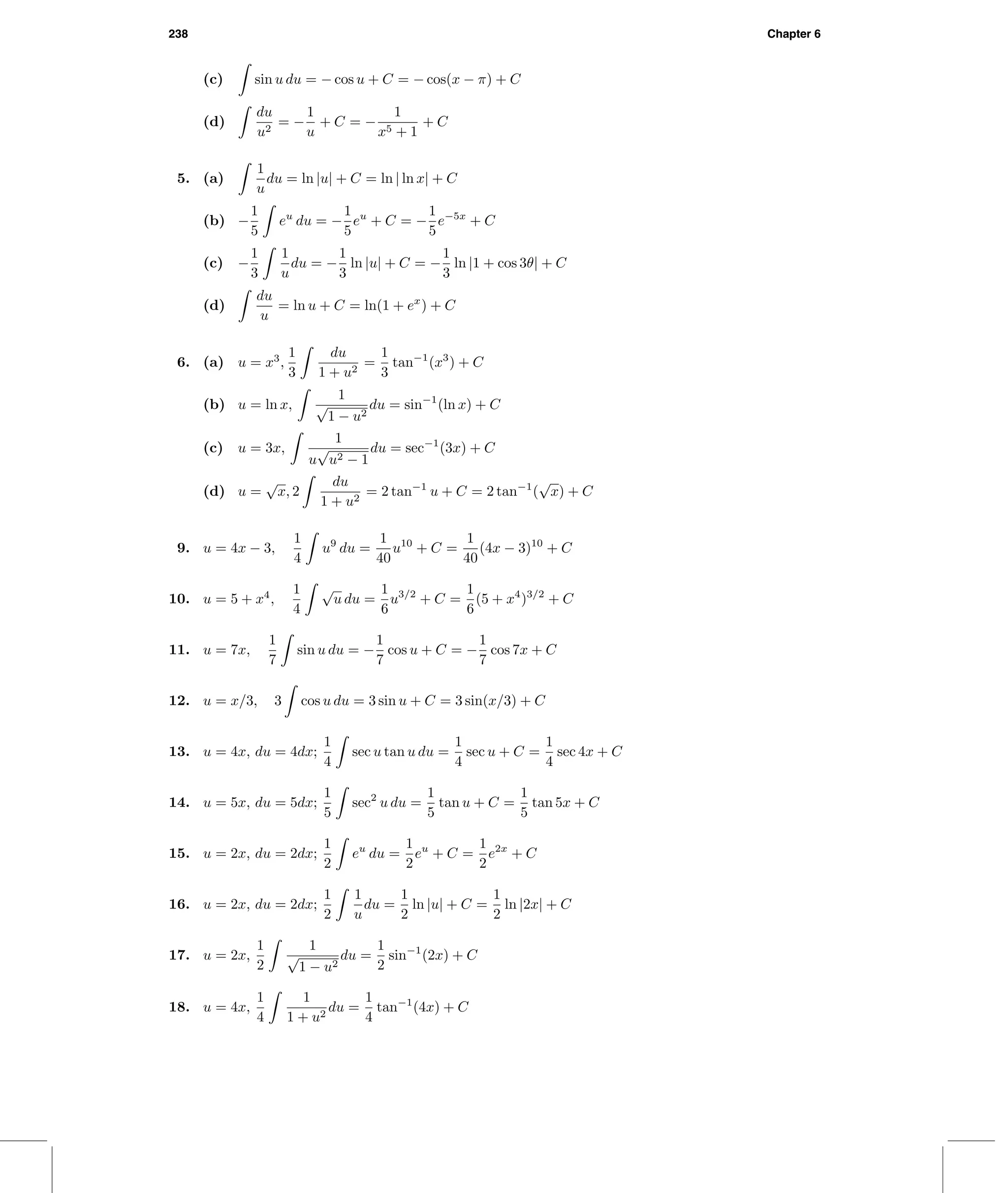
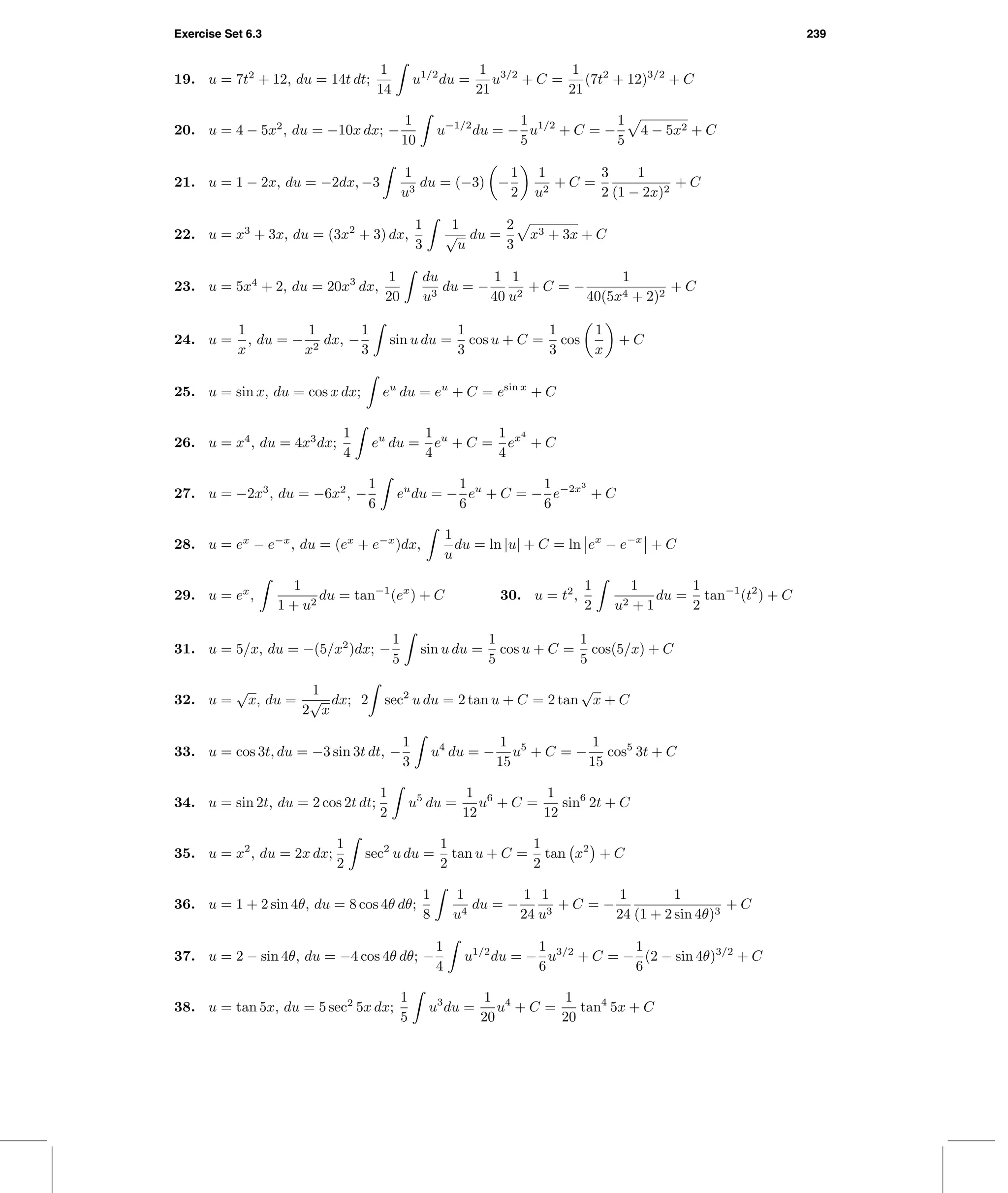
![240 Chapter 6
39. u = tan x,
1
√
1 − u2
du = sin−1
(tan x) + C
40. u = cos θ, −
1
u2 + 1
du = − tan−1
(cos θ) + C
41. u = sec 2x, du = 2 sec 2x tan 2x dx;
1
2
u2
du =
1
6
u3
+ C =
1
6
sec3
2x + C
42. u = sin θ, du = cos θ dθ; sin u du = − cos u + C = − cos(sin θ) + C
43. e−x
dx; u = −x, du = −dx; − eu
du = −eu
+ C = −e−x
+ C
44. ex/2
dx; u = x/2, du = dx/2; 2 eu
du = 2eu
+ C = 2ex/2
+ C = 2
√
ex + C
45. u = 2
√
x, du =
1
√
x
dx; ,
1
eu
du = −e−u
+ C = −e−2
√
x
+ C
46. u = 2y + 1, du =
1
√
2y + 1
dy; eu
du = eu
+ C = e
√
2y+1
+ C
47. u = 2y + 1, du = 2dy;
1
4
(u − 1)
1
√
u
du =
1
6
u3/2
−
1
2
√
u + C =
1
6
(2y + 1)3/2
−
1
2
2y + 1 + C
48. u = 4 − x, du = −dx;
− (4 − u)
√
u du = −
8
3
u3/2
+
2
5
u5/2
+ C =
2
5
(4 − x)5/2
−
8
3
(4 − x)3/2
+ C
49. sin2
2θ sin 2θ dθ = (1 − cos2
2θ) sin 2θ dθ; u = cos 2θ, du = −2 sin 2θ dθ,
−
1
2
(1 − u2
)du = −
1
2
u +
1
6
u3
+ C = −
1
2
cos 2θ +
1
6
cos3
2θ + C
50. sec2
3θ = tan2
3θ + 1, u = 3θ, du = 3dθ
sec4
3θ dθ =
1
3
(tan2
u + 1) sec2
u du =
1
9
tan3
u +
1
3
tan u + C =
1
9
tan3
3θ +
1
3
tan 3θ + C
51. 1 +
1
t
dt = t + ln |t| + C
52. e2 ln x
= eln x2
= x2
, x > 0, so e2 ln x
dx = x2
dx =
1
3
x3
+ C
53. ln(ex
) + ln(e−x
) = ln(ex
e−x
) = ln 1 = 0 so [ln(ex
) + ln(e−x
)]dx = C
54.
cos x
sin x
dx; u = sin x, du = cos xdx;
1
u
du = ln |u| + C = ln | sin x| + C
55. (a) sin−1
(x/3) + C (b) (1/
√
5) tan−1
(x/
√
5) + C (c) (1/
√
π) sec−1
(x/
√
π) + C](https://image.slidesharecdn.com/gabaritocompletoantoncalculo8edcaps0108-130504215818-phpapp02/75/Gabarito-completo-anton_calculo_8ed_caps_01_08-240-2048.jpg)
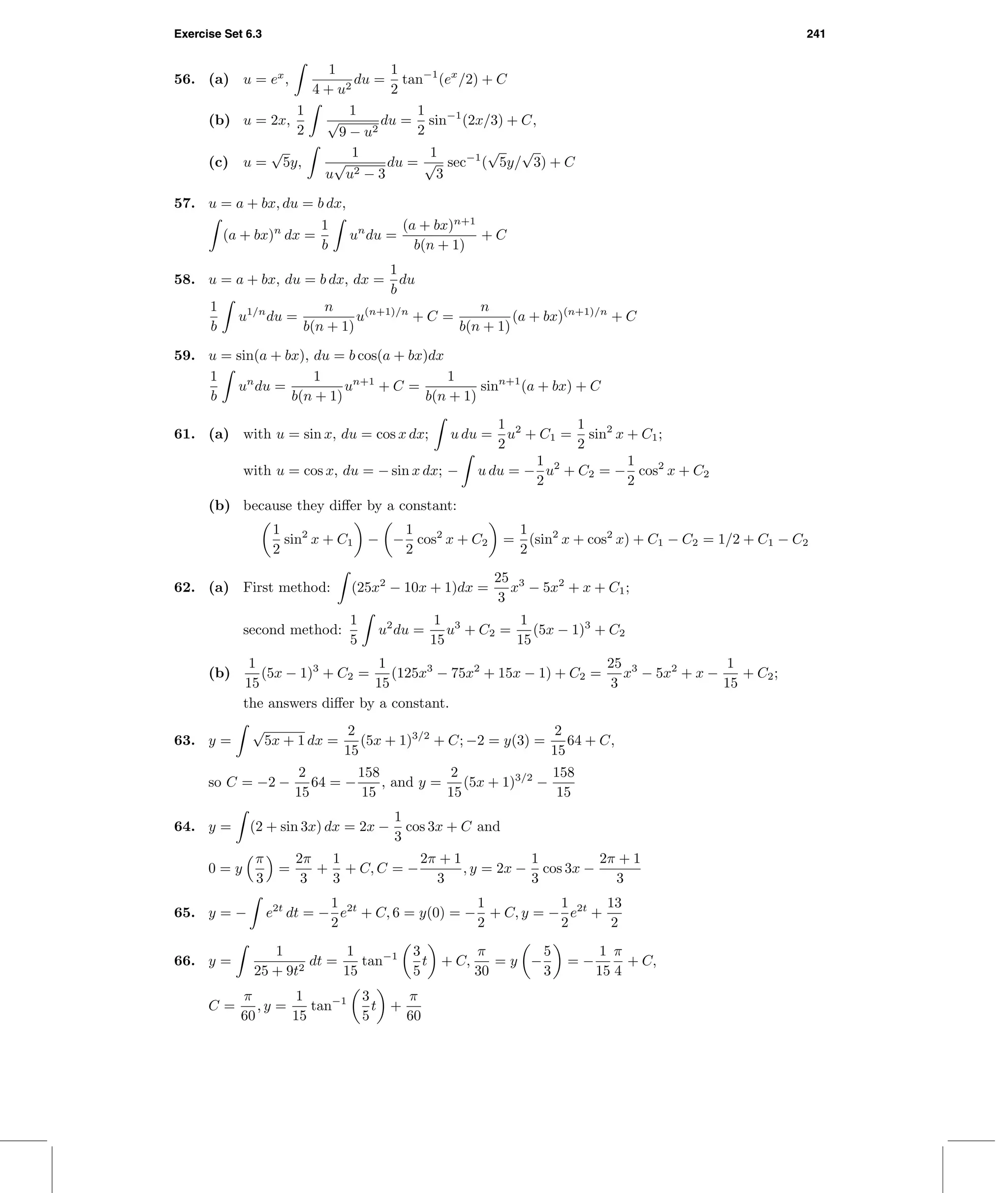

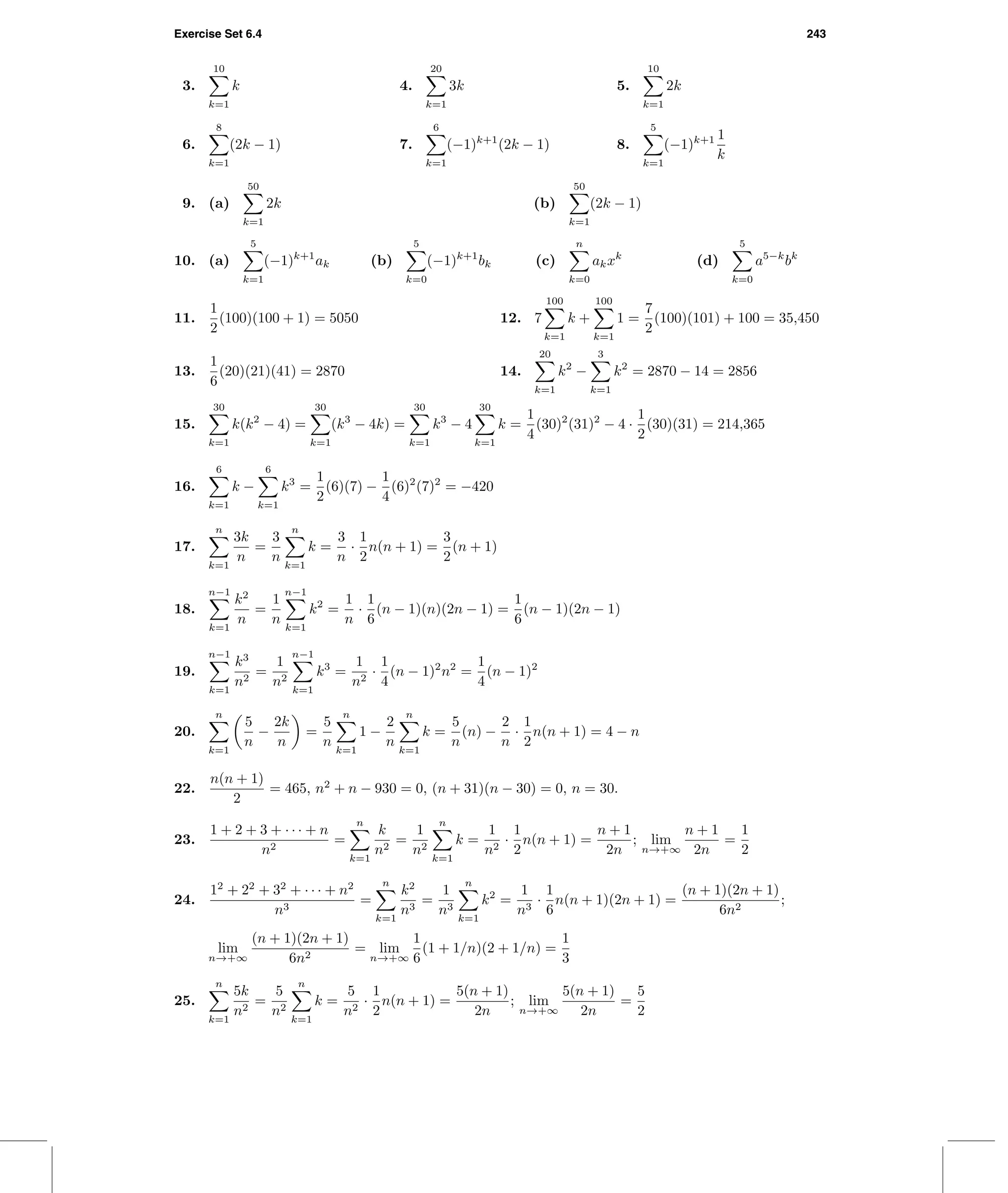
![244 Chapter 6
26.
n−1
k=1
2k2
n3
=
2
n3
n−1
k=1
k2
=
2
n3
·
1
6
(n − 1)(n)(2n − 1) =
(n − 1)(2n − 1)
3n2
;
lim
n→+∞
(n − 1)(2n − 1)
3n2
= lim
n→+∞
1
3
(1 − 1/n)(2 − 1/n) =
2
3
27. (a)
5
j=0
2j
(b)
6
j=1
2j−1
(c)
7
j=2
2j−2
28. (a)
5
k=1
(k + 4)2k+8
(b)
13
k=9
(k − 4)2k
29. (a) 2 +
3
n
4
3
n
, 2 +
6
n
4
3
n
, 2 +
9
n
4
3
n
, . . . , 2 +
3(n − 1)
n
4
3
n
, (2 + 3)4 3
n
When [2, 5] is subdivided into n equal intervals, the endpoints are 2, 2 +
3
n
, 2 + 2 ·
3
n
, 2 + 3 ·
3
n
, . . . , 2 + (n − 1)
3
n
, 2 + 3 = 5, and the right endpoint approximation to the area under the
curve y = x4
is given by the summands above.
(b)
n−1
k=0
2 + k ·
3
n
4
3
n
gives the left endpoint approximation.
30. n is the number of elements of the partition, x∗
k is an arbitrary point in the k-th interval,
k = 0, 1, 2, . . . , n − 1, n, and ∆x is the width of an interval in the partition.
In the usual definition of area, the parts above the curve are given a + sign, and the parts below
the curve are given a − sign. These numbers are then replaced with their absolute values and
summed.
In the definition of net signed area, the parts given above are summed without considering absolute
values. In this case there could be lots of cancellation of ’positive’ areas with ’negative’ areas.
31. Endpoints 2, 3, 4, 5, 6; ∆x = 1;
(a) Left endpoints:
4
k=1
f(x∗
k)∆x = 7 + 10 + 13 + 16 = 46
(b) Midpoints:
4
k=1
f(x∗
k)∆x = 8.5 + 11.5 + 14.5 + 17.5 = 52
(c) Right endpoints:
4
k=1
f(x∗
k)∆x = 10 + 13 + 16 + 19 = 58
32. Endpoints 1, 3, 5, 7, 9, ∆x = 2;
(a) Left endpoints:
4
k=1
f(x∗
k)∆x = 1 +
1
3
+
1
5
+
1
7
2 =
352
105
(b) Midpoints:
4
k=1
f(x∗
k)∆x =
1
2
+
1
4
+
1
6
+
1
8
2 =
25
12
(c) Right endpoints:
4
k=1
f(x∗
k)∆x =
1
3
+
1
5
+
1
7
+
1
9
2 =
496
315](https://image.slidesharecdn.com/gabaritocompletoantoncalculo8edcaps0108-130504215818-phpapp02/75/Gabarito-completo-anton_calculo_8ed_caps_01_08-244-2048.jpg)
![Exercise Set 6.4 245
33. Endpoints: 0, π/4, π/2, 3π/4, π; ∆x = π/4
(a) Left endpoints:
4
k=1
f(x∗
k)∆x = 1 +
√
2/2 + 0 −
√
2/2 (π/4) = π/4
(b) Midpoints:
4
k=1
f(x∗
k)∆x = [cos(π/8) + cos(3π/8) + cos(5π/8) + cos(7π/8)] (π/4)
= [cos(π/8) + cos(3π/8) − cos(3π/8) − cos(π/8)] (π/4) = 0
(c) Right endpoints:
4
k=1
f(x∗
k)∆x =
√
2/2 + 0 −
√
2/2 − 1 (π/4) = −π/4
34. Endpoints −1, 0, 1, 2, 3; ∆x = 1
(a)
4
k=1
f(x∗
k)∆x = −3 + 0 + 1 + 0 = −2 (b)
4
k=1
f(x∗
k)∆x = −
5
4
+
3
4
+
3
4
+
15
4
= 4
(c)
4
k=1
f(x∗
k)∆x = 0 + 1 + 0 − 3 = −2
35. (a) 0.718771403, 0.705803382, 0.698172179
(b) 0.668771403, 0.680803382, 0.688172179
(c) 0.692835360, 0.693069098, 0.693134682
36. (a) 0.761923639, 0.712712753, 0.684701150
(b) 0.584145862, 0.623823864, 0.649145594
(c) 0.663501867, 0.665867079, 0.666538346
37. (a) 4.884074734, 5.115572731, 5.248762738
(b) 5.684074734, 5.515572731, 5.408762738
(c) 5.34707029, 5.338362719, 5.334644416
38. (a) 0.919403170, 0.960215997, 0.984209789
(b) 1.076482803, 1.038755813, 1.015625715
(c) 1.001028824, 1.000257067, 1.000041125
39. ∆x =
3
n
, x∗
k = 1 +
3
n
k; f(x∗
k)∆x =
1
2
x∗
k∆x =
1
2
1 +
3
n
k
3
n
=
3
2
1
n
+
3
n2
k
n
k=1
f(x∗
k)∆x =
3
2
n
k=1
1
n
+
n
k=1
3
n2
k =
3
2
1 +
3
n2
·
1
2
n(n + 1) =
3
2
1 +
3
2
n + 1
n
A = lim
n→+∞
3
2
1 +
3
2
1 +
1
n
=
3
2
1 +
3
2
=
15
4
40. ∆x =
5
n
, x∗
k = 0 + k
5
n
; f(x∗
k)∆x = (5 − x∗
k)∆x = 5 −
5
n
k
5
n
=
25
n
−
25
n2
k
n
k=1
f(x∗
k)∆x =
n
k=1
25
n
−
25
n2
n
k=1
k = 25 −
25
n2
·
1
2
n(n + 1) = 25 −
25
2
n + 1
n
A = lim
n→+∞
25 −
25
2
1 +
1
n
= 25 −
25
2
=
25
2](https://image.slidesharecdn.com/gabaritocompletoantoncalculo8edcaps0108-130504215818-phpapp02/75/Gabarito-completo-anton_calculo_8ed_caps_01_08-245-2048.jpg)
![246 Chapter 6
41. ∆x =
3
n
, x∗
k = 0 + k
3
n
; f(x∗
k)∆x = 9 − 9
k2
n2
3
n
n
k=1
f(x∗
k)∆x =
n
k=1
9 − 9
k2
n2
3
n
=
27
n
n
k=1
1 −
k2
n2
= 27 −
27
n3
n
k=1
k2
A = lim
n→+∞
27 −
27
n3
n
k=1
k2
= 27 − 27
1
3
= 18
42. ∆x =
3
n
, x∗
k = k
3
n
f(x∗
k)∆x = 4 −
1
4
(x∗
k)2
∆x = 4 −
1
4
9k2
n2
3
n
=
12
n
−
27k2
4n3
n
k=1
f(x∗
k)∆x =
n
k=1
12
n
−
27
4n3
n
k=1
k2
= 12 −
27
4n3
·
1
6
n(n + 1)(2n + 1) = 12 −
9
8
(n + 1)(2n + 1)
n2
A = lim
n→+∞
12 −
9
8
1 +
1
n
2 +
1
n
= 12 −
9
8
(1)(2) = 39/4
43. ∆x =
4
n
, x∗
k = 2 + k
4
n
f(x∗
k)∆x = (x∗
k)3
∆x = 2 +
4
n
k
3
4
n
=
32
n
1 +
2
n
k
3
=
32
n
1 +
6
n
k +
12
n2
k2
+
8
n3
k3
n
k=1
f(x∗
k)∆x =
32
n
n
k=1
1 +
6
n
n
k=1
k +
12
n2
n
k=1
k2
+
8
n3
n
k=1
k3
=
32
n
n +
6
n
·
1
2
n(n + 1) +
12
n2
·
1
6
n(n + 1)(2n + 1) +
8
n3
·
1
4
n2
(n + 1)2
= 32 1 + 3
n + 1
n
+ 2
(n + 1)(2n + 1)
n2
+ 2
(n + 1)2
n2
A = lim
n→+∞
32 1 + 3 1 +
1
n
+ 2 1 +
1
n
2 +
1
n
+ 2 1 +
1
n
2
= 32[1 + 3(1) + 2(1)(2) + 2(1)2
] = 320
44. ∆x =
2
n
, x∗
k = −3 + k
2
n
; f(x∗
k)∆x = [1 − (x∗
k)3
]∆x = 1 − −3 +
2
n
k
3
2
n
=
2
n
28 −
54
n
k +
36
n2
k2
−
8
n3
k3
n
k=1
f(x∗
k)∆x =
2
n
28n − 27(n + 1) + 6
(n + 1)(2n + 1)
n
− 2
(n + 1)2
n
A = lim
n→+∞
2 28 − 27 1 +
1
n
+ 6 1 +
1
n
2 +
1
n
− 2 1 +
1
n
2
= 2(28 − 27 + 12 − 2) = 22](https://image.slidesharecdn.com/gabaritocompletoantoncalculo8edcaps0108-130504215818-phpapp02/75/Gabarito-completo-anton_calculo_8ed_caps_01_08-246-2048.jpg)


![Exercise Set 6.5 253
(c) −A1 + A2 = −
1
2
+ 8 = 15/2
–1
4
x
y
A1
A2
(d) −A1 + A2 = 0
–5
5
x
y
A1
A2
12. (a) A =
1
2
(1)(2) = 1
2
1
x
y
A
(b) A =
1
2
(2)(3/2 + 1/2) = 2
–1 1
1
x
y
A
(c) −A = −
1
2
(1/2)(1) = −1/4
2
1
x
y
A
(d) A1 − A2 = 1 − 1/4 = 3/4
2
1
x
y
A2
A1
13. (a) A = 2(5) = 10
y
x
1
2
5
A
(b) 0; A1 = A2 by symmetry
6
c x
y
A1
A2
(c) A1 + A2 =
1
2
(5)(5/2) +
1
2
(1)(1/2)
= 13/2
–1
5
2
x
y
3
2
A1
A2
(d)
1
2
[π(1)2
] = π/2
y
x
1
–1 1
A
14. (a) A = (6)(5) = 30
–10 –5
6
x
y
A
(b) −A1 + A2 = 0 because
A1 = A2 by symmetry
$
4
x
y
A1
A2](https://image.slidesharecdn.com/gabaritocompletoantoncalculo8edcaps0108-130504215818-phpapp02/75/Gabarito-completo-anton_calculo_8ed_caps_01_08-253-2048.jpg)

![Exercise Set 6.5 255
21.
5
1
f(x)dx =
5
0
f(x)dx −
1
0
f(x)dx = 1 − (−2) = 3
22.
−2
3
f(x)dx = −
3
−2
f(x)dx = −
1
−2
f(x)dx +
3
1
f(x)dx = −(2 − 6) = 4
23. 4
3
−1
dx − 5
3
−1
xdx = 4 · 4 − 5(−1/2 + (3 · 3)/2) = −4
24.
2
−2
dx − 3
2
−2
|x|dx = 4 · 1 − 3(2)(2 · 2)/2 = −8
25.
1
0
xdx + 2
1
0
1 − x2dx = 1/2 + 2(π/4) = (1 + π)/2
26.
0
−3
2dx +
0
−3
9 − x2dx = 2 · 3 + (π(3)2
)/4 = 6 + 9π/4
27. (a)
√
x > 0, 1 − x < 0 on [2, 3] so the integral is negative
(b) x2
> 0, 3 − cos x > 0 for all x so the integral is positive
28. (a) x4
> 0,
√
3 − x > 0 on [−3, −1] so the integral is positive
(b) x3
− 9 < 0, |x| + 1 > 0 on [−2, 2] so the integral is negative
29.
10
0
25 − (x − 5)2dx = π(5)2
/2 = 25π/2 30.
3
0
9 − (x − 3)2dx = π(3)2
/4 = 9π/4
31.
1
0
(3x + 1)dx = 5/2 32.
2
−2
4 − x2dx = π(2)2
/2 = 2π
33. (a) The graph of the integrand is the horizontal line y = C. At first, assume that C > 0. Then
the region is a rectangle of height C whose base extends from x = a to x = b. Thus
b
a
C dx = (area of rectangle) = C(b − a).
If C ≤ 0 then the rectangle lies below the axis and its integral is the negative area, i.e.
−|C|(b − a) = C(b − a).
(b) Since f(x) = C, the Riemann sum becomes
lim
max ∆xk→0
n
k=1
f(x∗
k)∆xk = lim
max ∆xk→0
n
k=1
C = lim
max ∆xk→0
C(b − a) = C(b − a).
By Definition 6.5.1,
b
a
f(x) dx = C(b − a).
34. (a) f is continuous on [−1, 1] so f is integrable there by Part (a) of Theorem 6.5.8
(b) |f(x)| ≤ 1 so f is bounded on [−1, 1], and f has one point of discontinuity, so by Part (b) of
Theorem 6.5.8 f is integrable on [−1, 1]
(c) f is not bounded on [-1,1] because lim
x→0
f(x) = +∞, so f is not integrable on [0,1]
(d) f(x) is discontinuous at the point x = 0 because lim
x→0
sin
1
x
does not exist. f is continuous
elsewhere. −1 ≤ f(x) ≤ 1 for x in [−1, 1] so f is bounded there. By Part (b), Theorem 6.5.8,
f is integrable on [−1, 1].](https://image.slidesharecdn.com/gabaritocompletoantoncalculo8edcaps0108-130504215818-phpapp02/75/Gabarito-completo-anton_calculo_8ed_caps_01_08-255-2048.jpg)
![256 Chapter 6
35. For any partition of [0, 1] we have
n
k=1
f(x∗
k)∆xk =
n
k=2
∆xk = 1 − ∆x1 or we have
n
k=1
f(x∗
k)∆xk =
n
k=1
∆xk = 1.
This is because f(x) = 1 for all x except possibly x∗
1, which lies in the interval [0, x1] and could be
0. In any event, since in the limit the maximum size of the ∆xk goes to zero, the two possibilities
are 1 in the limit, and thus
1
0
f(x) dx = 1.
36. Each subinterval of a partition of [a, b] contains both rational and irrational numbers. If all x∗
k are
chosen to be rational then
n
k=1
f(x∗
k)∆xk =
n
k=1
(1)∆xk =
n
k=1
∆xk = b − a so lim
max ∆xk→0
n
k=1
f(x∗
k)∆xk = b − a.
If all x∗
k are irrational then lim
max ∆xk→0
n
k=1
f(x∗
k)∆xk = 0. Thus f is not integrable on [a, b] because
the preceding limits are not equal.
37. On [0,
π
4
] the minimum value of the integrand is 0 and the maximum is sin
π
4
=
√
2
2
. On
π
4
,
5π
6
the minimum value is sin
5π
6
=
1
2
and the maximum is sin
π
2
= 1. On
5π
6
, π the
minimum value is 0 and the maximum value is
1
2
. Thus the minimum value of the Riemann sums
is 0 ·
π
4
+
1
2
·
7π
12
+ 0 ·
π
6
=
7π
24
, and the maximum is
√
2
2
·
π
4
+ 1 ·
7π
12
+
1
2
·
π
6
=
√
2
8
+
2
3
π.
38. For the smallest, find x∗
k so that f(x∗
k) is minimum on each subinterval: x∗
1 = 1, x∗
2 = 3/2, x∗
3 = 3
so (2)(1) + (7/4)(2) + (4)(1) = 9.5. For the largest, find x∗
k so that f(x∗
k) is maximum on each
subinterval: x∗
1 = 0, x∗
2 = 3, x∗
3 = 4 so (4)(1) + (4)(2) + (8)(1) = 20.
39. ∆xk =
4k2
n2
−
4(k − 1)2
n2
=
4
n2
(2k − 1), x∗
k =
4k2
n2
,
f(x∗
k) =
2k
n
, f(x∗
k)∆xk =
8k
n3
(2k − 1) =
8
n3
(2k2
− k),
n
k=1
f(x∗
k)∆xk =
8
n3
n
k=1
(2k2
− k) =
8
n3
1
3
n(n + 1)(2n + 1) −
1
2
n(n + 1) =
4
3
(n + 1)(4n − 1)
n2
,
lim
n→+∞
n
k=1
f(x∗
k)∆xk = lim
n→+∞
4
3
1 +
1
n
4 −
1
n
=
16
3
.
40. For any partition of [a, b] use the right endpoints to form the sum
n
k=1
f(x∗
k)∆xk. Since f(x∗
k) = 0
for each k, the sum is zero and so is
b
a
f(x) dx = lim
n→+∞
n
k=1
f(x∗
k)∆xk.](https://image.slidesharecdn.com/gabaritocompletoantoncalculo8edcaps0108-130504215818-phpapp02/75/Gabarito-completo-anton_calculo_8ed_caps_01_08-256-2048.jpg)
![Exercise Set 6.6 257
41. With f(x) = g(x) then f(x) − g(x) = 0 for a < x ≤ b. By Theorem 6.5.4(b)
b
a
f(x) dx =
b
a
[(f(x) − g(x) + g(x)]dx =
b
a
[f(x) − g(x)]dx +
b
a
g(x)dx.
But the first term on the right hand side is zero (from Exercise 40), so
b
a
f(x) dx =
b
a
g(x) dx
42. Choose any large positive integer N and any partition of [0, a]. Then choose x∗
1 in the first interval
so small that f(x∗
1)∆x1 > N. For example choose x∗
1 < ∆x1/N. Then with this partition and
choice of x∗
1,
n
k=1
f(x∗
k)∆xk > f(x∗
1)∆x1 > N. This shows that the sum is dependent on partition
and/or points, so Definition 6.5.1 is not satisfied.
EXERCISE SET 6.6
1. (a)
2
0
(2 − x)dx = (2x − x2
/2)
2
0
= 4 − 4/2 = 2
(b)
1
−1
2dx = 2x
1
−1
= 2(1) − 2(−1) = 4
(c)
3
1
(x + 1)dx = (x2
/2 + x)
3
1
= 9/2 + 3 − (1/2 + 1) = 6
2. (a)
5
0
xdx = x2
/2
5
0
= 25/2 (b)
9
3
5dx = 5x
9
3
= 5(9) − 5(3) = 30
(c)
2
−1
(x + 3)dx = (x2
/2 + 3x)
2
−1
= 4/2 + 6 − (1/2 − 3) = 21/2
3.
3
2
x3
dx = x4
/4
3
2
= 81/4 − 16/4 = 65/4 4.
1
−1
x4
dx = x5
/5
1
−1
= 1/5 − (−1)/5 = 2/5
5.
4
1
3
√
x dx = 2x3/2
4
1
= 16 − 2 = 14 6.
27
1
x−2/3
dx = 3x1/3
27
1
= 3(3 − 1) = 6
7.
ln 2
0
e2x
dx =
1
2
e2x
ln 2
0
=
1
2
(4 − 1) =
3
2
8.
5
1
1
x
dx = ln x
5
1
= ln 5 − ln 1 = ln 5
9.
1
−2
(x2
− 6x + 12) dx =
1
3
x3
− 3x2
+ 12x
1
−2
=
1
3
− 3 + 12 − −
8
3
− 12 − 24 = 48
10.
2
−1
4x(1 − x2
) dx = (2x2
− x4
)
2
−1
= 8 − 16 − (2 − 1) = −9
11.
4
1
1
x2
dx = −x−1
4
1
= −
1
4
+ 1 =
3
4
12.
2
1
x−6
dx = −
1
5x5
2
1
= 31/160
13.
4
5
x5/2
9
4
= 844/5 14.
4
1
1
x
√
x
dx = −
2
√
x
4
1
= −
2
2
+
2
1
= 1](https://image.slidesharecdn.com/gabaritocompletoantoncalculo8edcaps0108-130504215818-phpapp02/75/Gabarito-completo-anton_calculo_8ed_caps_01_08-257-2048.jpg)
![262 Chapter 6
57. −
x
cos x
58. |u|
59. F (x) =
√
x2 + 9, F (x) =
x
√
x2 + 9
(a) 0 (b) 5 (c)
4
5
60. F (x) = tan−1
x, F (x) =
1
1 + x2
(a) 0 (b) π/3 (c) 1/4
61. (a) F (x) =
x − 3
x2 + 7
= 0 when x = 3, which is a relative minimum, and hence the absolute
minimum, by the first derivative test.
(b) increasing on [3, +∞), decreasing on (−∞, 3]
(c) F (x) =
7 + 6x − x2
(x2 + 7)2
=
(7 − x)(1 + x)
(x2 + 7)2
; concave up on (−1, 7), concave down on (−∞, −1)
and on (7, +∞)
62. F
t
2
3
–20 –10 20
63. (a) (0, +∞) because f is continuous there and 1 is in (0, +∞)
(b) at x = 1 because F(1) = 0
64. (a) (−3, 3) because f is continuous there and 1 is in (−3, 3)
(b) at x = 1 because F(1) = 0
65. (a)
3
0
√
x dx =
2
3
x3/2
3
0
= 2
√
3 = f(x∗
)(3 − 0), so f(x∗
) =
2
√
3
, x∗
=
4
3
(b)
0
−12
(x2
+ x) dx =
1
3
x3
+
1
2
x2
0
−12
= 504, so f(x∗
)(0 − (−12)) = 504, x2
+ x = 42, x∗
= 6
66. (a) fave =
1
2π
π
−π
sin x dx = 0; sin x∗
= 0, x∗
= −π, 0, π
(b) fave =
1
2
3
1
1
x2
dx =
1
3
;
1
(x∗)2
=
1
3
, x∗
=
√
3
67.
√
2 ≤
√
x3 + 2 ≤
√
29, so 3
√
2 ≤
3
0
x3 + 2dx ≤ 3
√
29
68. Let f(x) = x sin x, f(0) = f(1) = 0, f (x) = sin x + x cos x = 0 when x = − tan x, x ≈ 2.0288,
so f has an absolute maximum at x ≈ 2.0288; f(2.0288) ≈ 1.8197, so 0 ≤ x sin x ≤ 1.82 and
0 ≤
π
0
x sin xdx ≤ 1.82π = 5.72](https://image.slidesharecdn.com/gabaritocompletoantoncalculo8edcaps0108-130504215818-phpapp02/75/Gabarito-completo-anton_calculo_8ed_caps_01_08-262-2048.jpg)
![Exercise Set 6.6 263
69. (a) cF(x)
b
a
= cF(b) − cF(a) = c[F(b) − F(a)] = c F(x)
b
a
(b) F(x) + G(x)
b
a
= [F(b) + G(b)] − [F(a) + G(a)]
= [F(b) − F(a)] + [G(b) − G(a)] = F(x)
b
a
+ G(x)
b
a
(c) F(x) − G(x)
b
a
= [F(b) − G(b)] − [F(a) − G(a)]
= [F(b) − F(a)] − [G(b) − G(a)] = F(x)
b
a
− G(x)
b
a
71. (a) the increase in height in inches, during the first ten years
(b) the change in the radius in centimeters, during the time interval t = 1 to t = 2 seconds
(c) the change in the speed of sound in ft/s, during an increase in temperature from t = 32◦
F
to t = 100◦
F
(d) the displacement of the particle in cm, during the time interval t = t1 to t = t2 seconds
72. (a)
1
0
V (t)dt gal
(b) the change f(x1) − f(x2) in the values of f over the interval
73. (a) amount of water = (rate of flow)(time) = 4t gal, total amount = 4(30) = 120 gal
(b) amount of water =
60
0
(4 + t/10)dt = 420 gal
(c) amount of water =
120
0
(10 +
√
t)dt = 1200 + 160
√
30 ≈ 2076.36 gal
74. (a) The maximum value of R occurs at 4:30 P.M. when t = 0.
(b)
60
0
100(1 − 0.0001t2
)dt = 5280 cars
75.
n
k=1
π
4n
sec2 πk
4n
=
n
k=1
f(x∗
k)∆x where f(x) = sec2
x, x∗
k =
πk
4n
and ∆x =
π
4n
for 0 ≤ x ≤
π
4
.
Thus lim
n→+∞
n
k=1
π
4n
sec2 πk
4n
= lim
n→+∞
n
k=1
f(x∗
k)∆x =
π/4
0
sec2
x dx = tan x
π/4
0
= 1
76.
n
n2 + k2
=
1
1 + k2/n2
1
n
so
n
k=1
n
n2 + k2
=
n
k=1
f(x∗
k)∆x where f(x) =
1
1 + x2
, x∗
k =
k
n
, and ∆x =
1
n
for 0 ≤ x ≤ 1. Thus lim
n→+∞
n
k=1
n
n2 + k2
= lim
n→+∞
n
k=1
f(x∗
k)∆x =
1
0
1
1 + x2
dx =
π
4
.
77. Let f be continuous on a closed interval [a, b] and let F be an antiderivative of f on [a, b]. By
Theorem 5.7.2,
F(b) − F(a)
b − a
= F (x∗
) for some x∗
in (a, b). By Theorem 6.6.1,
b
a
f(x) dx = F(b) − F(a), i.e.
b
a
f(x) dx = F (x∗
)(b − a) = f(x∗
)(b − a).](https://image.slidesharecdn.com/gabaritocompletoantoncalculo8edcaps0108-130504215818-phpapp02/75/Gabarito-completo-anton_calculo_8ed_caps_01_08-263-2048.jpg)

![Exercise Set 6.7 267
18. (a) s = cos
πt
3
dt =
3
π
sin
πt
3
+ C
s = 0 when t =
3
2
which gives C = −
3
π
so s =
3
π
sin
πt
3
−
3
π
a =
dv
dt
= −
π
3
sin
πt
3
; when t = 1 : s =
3
π
√
3
2
−
3
π
, v =
1
2
, a = −
π
3
√
3
2
(b) v = 4e2t−2
dt = 2e2t−2
+ C, v =
2
e2
− 3 when t = 0, hence C = −3 so v = 2e2t−2
− 3. Then
s(t) = v(t) dt = e2t−2
− 3t + C , s = e−2
when t = 0, so C = 0 and s(t) = e2t−2
− 3t.
When t = 1, s(1) = −2, v(1) = −1, a(1) = 4.
19. By inspection the velocity is positive for t > 0, and during the first second the particle is at most
5/2 cm from the starting position. For T > 1 the displacement of the particle during the time
interval [0, T] is given by
T
0
v(t) dt = 5/2 +
T
1
(6
√
t − 1/t) dt = 5/2 + (4t3/2
− ln t)
T
1
= −3/2 + 4T3/2
− ln T,
and the displacement equals 4 cm if 4T3/2
− ln T = 11/2, T ≈ 1.272 s
20. The displacement of the particle during the time interval [0, T] is given by
T
0
v(t)dt = 3 tan−1
T − 0.25T2
. The particle is 2 cm from its starting position when
3 tan−1
T − 0.25T2
= 2 or when 3 tan−1
T − 0.25T2
= −2; solve for T to get
T = 0.90, 2.51, and 4.95 s.
21. s(t) = (20t2
− 110t + 120) dt =
20
3
t3
− 55t2
+ 120t + C. But s = 0 when t = 0, so C = 0 and
s =
20
3
t3
− 55t2
+ 120t. Moreover, a(t) =
d
dt
v(t) = 40t − 110.
180
–40
0
130
–130
0
180
0
0 6
6
6
s(t) v(t) a(t)
22. a(t) = 4t − 30, v(t) = 2t2
− 30t + 3, s(t) =
2
3
t3
− 15t2
+ 3t − 5;
500
–110
1100
–1100
0
70
–30
0
0 25
25
25
s(t) v(t) a(t)](https://image.slidesharecdn.com/gabaritocompletoantoncalculo8edcaps0108-130504215818-phpapp02/75/Gabarito-completo-anton_calculo_8ed_caps_01_08-267-2048.jpg)
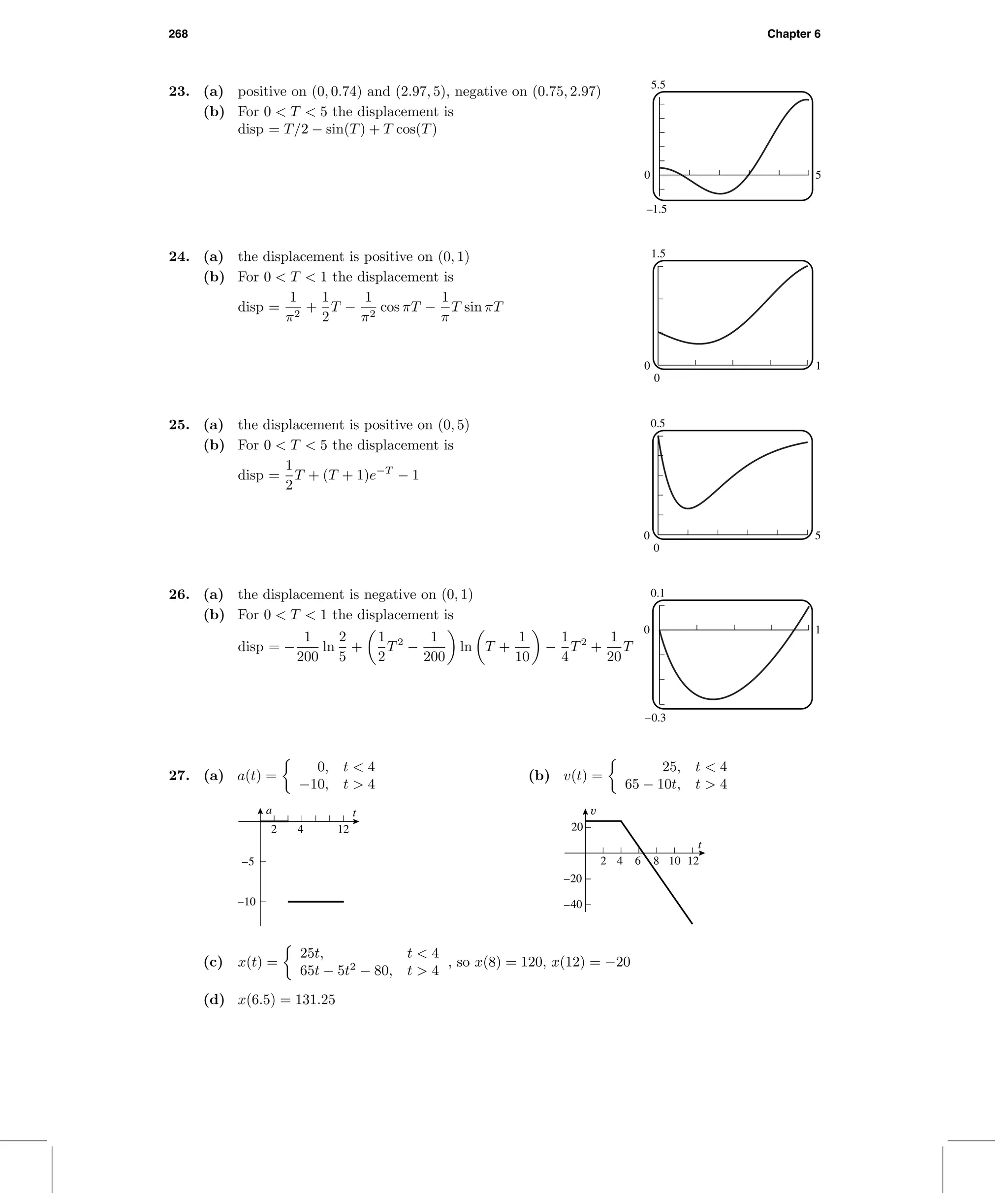


![272 Chapter 6
7. u = 2x − 1,
1
2
1
−1
u3
du = 0, because u3
is odd on [−1, 1].
8. u = 4 − 3x, −
1
3
−2
1
u8
du = −
1
27
u9
−2
1
= 19, or −
1
27
(4 − 3x)9
2
1
= 19
9. u = 1 + x,
9
1
(u − 1)u1/2
du =
9
1
(u3/2
− u1/2
)du =
2
5
u5/2
−
2
3
u3/2
9
1
= 1192/15,
or
2
5
(1 + x)5/2
−
2
3
(1 + x)3/2
8
0
= 1192/15
10. u = 1 − x,
4
1
(1 − u)
√
u du =
2
3
u3/2
−
2
5
u5/2
4
1
= −116/15 or
2
3
(1 − x)3/2
−
2
5
(1 − x)5/2
0
−3
= −116/15
11. u = x/2, 8
π/4
0
sin u du = −8 cos u
π/4
0
= 8 − 4
√
2, or − 8 cos(x/2)
π/2
0
= 8 − 4
√
2
12. u = 3x,
2
3
π/2
0
cos u du =
2
3
sin u
π/2
0
= 2/3, or
2
3
sin 3x
π/6
0
= 2/3
13. u = x2
+ 2,
1
2
3
6
u−3
du = −
1
4u2
3
6
= −1/48, or −
1
4
1
(x2 + 2)2
−1
−2
= −1/48
14. u =
1
4
x −
1
4
, 4
π/4
−π/4
sec2
u du = 4 tan u
π/4
−π/4
= 8, or 4 tan
1
4
x −
1
4
1+π
1−π
= 8
15. u = ex
+ 4, du = ex
dx, u = e− ln 3
+ 4 =
1
3
+ 4 =
13
3
when x = − ln 3
u = eln 3
+ 4 = 3 + 4 = 7 when x = ln 3,
7
13/3
1
u
du = ln u
7
13/3
= ln(7) − ln(13/3) = ln(21/13), or
ln(ex
+ 4)
ln 3
− ln 3
= ln 7 − ln(13/3) = ln 21/13
16. u = 3 − 4ex
, du = −4ex
dx, u = −1 when x = 0, u = −17 when x = ln 5
−
1
4
−17
−1
u du = −
1
8
u2
−17
−1
= −36, or −
1
8
(3 − 4ex
)2
ln 5
0
= −36
17. u =
√
x, 2
√
3
1
1
u2 + 1
du = 2 tan−1
u
√
3
1
= 2(tan−1
√
3 − tan−1
1) = 2(π/3 − π/4) = π/6 or
2 tan−1
√
x
3
1
= π/6](https://image.slidesharecdn.com/gabaritocompletoantoncalculo8edcaps0108-130504215818-phpapp02/75/Gabarito-completo-anton_calculo_8ed_caps_01_08-272-2048.jpg)
![Exercise Set 6.8 273
18. u = e−x
, −
√
3/2
1/2
1
√
1 − u2
du = − sin−1
u
√
3/2
1/2
= − sin−1
√
3
2
+ sin−1 1
2
= −
π
3
+
π
6
= −
π
6
or
− sin−1
e−x
ln(2/
√
3)
ln 2
= −
π
3
+
π
6
= −π/6
19.
1
3
5
−5
25 − u2 du =
1
3
1
2
π(5)2
=
25
6
π 20.
1
2
4
0
16 − u2 du =
1
2
1
4
π(4)2
= 2π
21. −
1
2
0
1
1 − u2 du =
1
2
1
0
1 − u2 du =
1
2
·
1
4
[π(1)2
] = π/8
22.
3
−3
9 − u2du = π(3)2
/2 =
9
2
π
23.
1
0
sin πxdx = −
1
π
cos πx
1
0
= −
1
π
(−1 − 1) = 2/π
24. A =
π/8
0
3 cos 2x dx =
3
2
sin 2x
π/8
0
= 3
√
2/4
25.
1
−1
9
(x + 2)2
dx = −9(x + 2)−1
1
−1
= −9
1
3
− 1 = 6
26. A =
1
0
dx
(3x + 1)2
= −
1
3(3x + 1)
1
0
=
1
4
27. A =
1/6
0
1
√
1 − 9x2
dx =
1
3
1/2
0
1
√
1 − u2
du =
1
3
sin−1
u
1/2
0
= π/18
28. x = sin y, A =
π/2
0
sin y dy = − cos y
π/2
0
= 1
29. u = 2x − 1,
1
2
9
1
1
√
u
du =
√
u
9
1
= 2 30.
2
15
(5x − 1)3/2
2
1
= 38/15
31.
2
3
(x3
+ 9)1/2
1
−1
=
2
3
(
√
10 − 2
√
2) 32. u = cos x + 1, b
1
0
u5
du =
b
6
33. u = x2
+ 4x + 7,
1
2
28
12
u−1/2
du = u1/2
28
12
=
√
28 −
√
12 = 2(
√
7 −
√
3)
34.
2
1
1
(x − 3)2
dx = −
1
x − 3
2
1
= 1/2
35. 2 sin2
x
π/4
0
= 1 36.
2
3
(tan x)3/2
π/4
0
= 2/3 37.
5
2
sin(x2
)
√
π
0
= 0](https://image.slidesharecdn.com/gabaritocompletoantoncalculo8edcaps0108-130504215818-phpapp02/75/Gabarito-completo-anton_calculo_8ed_caps_01_08-273-2048.jpg)

![Exercise Set 6.8 275
52. u = 1 − x,
1
0
xm
(1 − x)n
dx = −
0
1
(1 − u)m
un
du =
1
0
un
(1 − u)m
du =
1
0
xn
(1 − x)m
dx
53. sin x = cos(π/2 − x),
π/2
0
sinn
x dx =
π/2
0
cosn
(π/2 − x)dx = −
0
π/2
cosn
u du (u = π/2 − x)
=
π/2
0
cosn
u du =
π/2
0
cosn
x dx (by replacing u by x)
54. u = 1 − x, −
0
1
(1 − u)un
du =
1
0
(1 − u)un
du =
1
0
(un
− un+1
)du =
1
n + 1
−
1
n + 2
=
1
(n + 1)(n + 2)
55. y(t) = (802.137) e1.528t
dt = 524.959e1.528t
+ C; y(0) = 750 = 524.959 + C, C = 225.041,
y(t) = 524.959e1.528t
+ 225.041, y(12) = 48,233,500,000
56. s(t) = (25 + 10e−0.05t
)dt = 25t − 200e−0.05t
+ C
(a) s(10) − s(0) = 250 − 200(e−0.5
− 1) = 450 − 200/
√
e ≈ 328.69 ft
(b) yes; without it the distance would have been 250 ft
57.
k
0
e2x
dx = 3,
1
2
e2x
k
0
= 3,
1
2
(e2k
− 1) = 3, e2k
= 7, k =
1
2
ln 7
58. The area is given by
2
0
1/(1 + kx2
)dx = (1/
√
k) tan−1
(2
√
k) = 0.6; solve for k to get
k = 5.081435.
59. (a)
1
0
sin πxdx = 2/π
60. Let u = t − x, then du = −dx and
t
0
f(t − x)g(x)dx = −
0
t
f(u)g(t − u)du =
t
0
f(u)g(t − u)du;
the result follows by replacing u by x in the last integral.
61. (a) I = −
0
a
f(a − u)
f(a − u) + f(u)
du =
a
0
f(a − u) + f(u) − f(u)
f(a − u) + f(u)
du
=
a
0
du −
a
0
f(u)
f(a − u) + f(u)
du, I = a − I so 2I = a, I = a/2
(b) 3/2 (c) π/4
62. x =
1
u
, dx = −
1
u2
du, I =
1
−1
1
1 + 1/u2
(−1/u2
)du = −
1
−1
1
u2 + 1
du = −I so I = 0 which is
impossible because
1
1 + x2
is positive on [−1, 1]. The substitution u = 1/x is not valid because u
is not continuous for all x in [−1, 1].](https://image.slidesharecdn.com/gabaritocompletoantoncalculo8edcaps0108-130504215818-phpapp02/75/Gabarito-completo-anton_calculo_8ed_caps_01_08-275-2048.jpg)
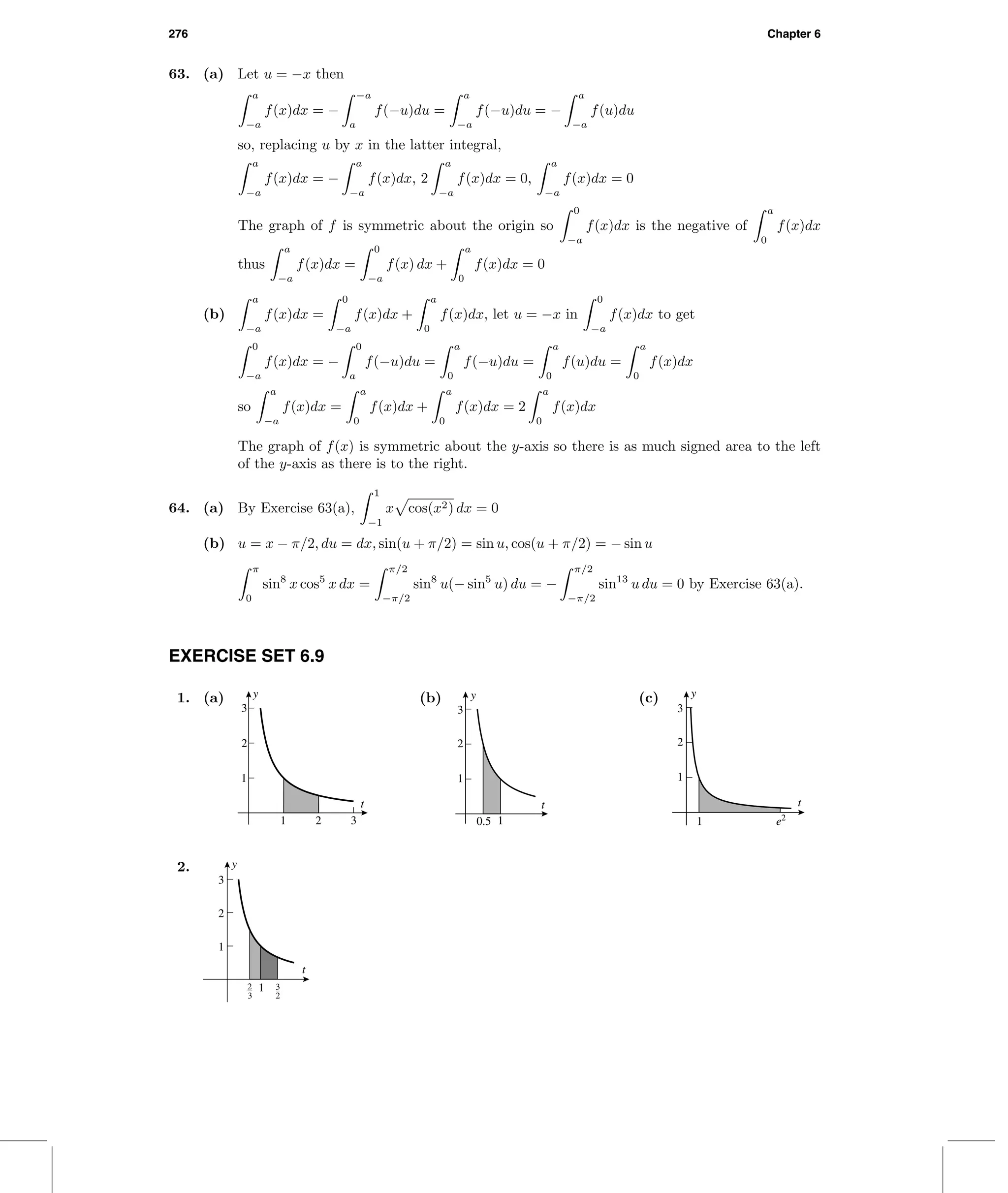

![278 Chapter 6
18. F (x) =
√
3x2 + 1, F (x) =
3x
√
3x2 + 1
(a) 0 (b)
√
13 (c) 6/
√
13
19. (a)
d
dx
x2
1
t
√
1 + tdt = x2
1 + x2(2x) = 2x3
1 + x2
(b)
x2
1
t
√
1 + tdt = −
2
3
(x2
+ 1)3/2
+
2
5
(x2
+ 1)5/2
−
4
√
2
15
20. (a)
d
dx
a
x
f(t)dt = −
d
dx
x
a
f(t)dt = −f(x)
(b)
d
dx
a
g(x)
f(t)dt = −
d
dx
g(x)
a
f(t)dt = −f(g(x))g (x)
21. (a) − cos x3
(b) −
tan2
x
1 + tan2
x
sec2
x = − tan2
x
22. (a) −
1
(x2 + 1)2
(b) − cos3 1
x
−
1
x2
=
cos3
(1/x)
x2
23. −3
3x − 1
9x2 + 1
+ 2x
x2
− 1
x4 + 1
24. If f is continuous on an open interval I and g(x), h(x), and a are in I then
g(x)
h(x)
f(t)dt =
a
h(x)
f(t)dt +
g(x)
a
f(t)dt = −
h(x)
a
f(t)dt +
g(x)
a
f(t)dt
so
d
dx
g(x)
h(x)
f(t)dt = −f(h(x))h (x) + f(g(x))g (x)
25. (a) sin2
(x3
)(3x2
) − sin2
(x2
)(2x) = 3x2
sin2
(x3
) − 2x sin2
(x2
)
(b)
1
1 + x
(1) −
1
1 − x
(−1) =
2
1 − x2
26. F (x) =
1
5x
(5)−
1
x
(1) = 0 so F(x) is constant on (0, +∞). F(1) = ln 5 so F(x) = ln 5 for all x > 0.
27. from geometry,
3
0
f(t)dt = 0,
5
3
f(t)dt = 6,
7
5
f(t)dt = 0; and
10
7
f(t)dt
=
10
7
(4t − 37)/3dt = −3
(a) F(0) = 0, F(3) = 0, F(5) = 6, F(7) = 6, F(10) = 3
(b) F is increasing where F = f is positive, so on [3/2, 6] and [37/4, 10], decreasing on [0, 3/2]
and [6, 37/4]
(c) critical points when F (x) = f(x) = 0, so x = 3/2, 6, 37/4; maximum 15/2 at x = 6, minimum
−9/4 at x = 3/2](https://image.slidesharecdn.com/gabaritocompletoantoncalculo8edcaps0108-130504215818-phpapp02/75/Gabarito-completo-anton_calculo_8ed_caps_01_08-278-2048.jpg)


![Review Exercise Set 283
26. (a) x∗
k = 0, 1, 2, 3, 4
4
k=1
f(x∗
k)∆x = e0
+ e1
+ e2
+ e3
+ e4
(1) = (1 − e5
)/(1 − e) = 85.791
(b) x∗
k = 1, 2, 3, 4, 5
4
k=1
f(x∗
k)∆x = e1
+ e2
+ e3
+ e4
+ e5
(1) = e(1 − e5
)/(1 − e) = 233.204
(c) x∗
k = 1/2, 3/2, 5/2, 7/2, 9/2
4
k=1
f(x∗
k)∆x = e1/2
+ e3/2
+ e5/2
+ e7/2
+ e9/2
(1) = e1/2
(1 − e5
)/(1 − e) = 141.446
27. lim
n→+∞
n
k=1
4
4k
n
−
4k
n
2
4
n
= lim
n→+∞
64
n3
n
k=1
(kn − k2
)
= lim
n→+∞
64
n3
n2
(n + 1)
2
−
n(n + 1)(2n + 1)
6
= lim
n→+∞
64
6n3
[n3
− n] =
32
3
28. lim
n→+∞
n
k=1
25(k − 1)
n
−
25(k − 1)2
n2
5
n
=
125
6
29. 0.351220577, 0.420535296, 0.386502483 30. 1.63379940, 1.805627583, 1.717566087
32. Since y = ex
and y = ln x are inverse functions, their graphs
are symmetric with respect to the line y = x; consequently the
areas A1 and A3 are equal (see figure). But A1 + A2 = e, so
e
1
ln xdx +
1
0
ex
dx = A2 + A3 = A2 + A1 = e
y
x
1
e
1 e
A3
A1
A2
33. (a)
1
2
+
1
4
=
3
4
(b) −1 −
1
2
= −
3
2
(c) 5 −1 −
3
4
= −
35
4
(d) −2
(e) not enough information (f) not enough information
34. (a)
1
2
+ 2 =
5
2
(b) not enough information
(c) not enough information (d) 4(2) − 3
1
2
=
13
2
35. (a)
1
−1
dx +
1
−1
1 − x2 dx = 2(1) + π(1)2
/2 = 2 + π/2
(b)
1
3
(x2
+ 1)3/2
3
0
− π(3)2
/4 =
1
3
(103/2
− 1) − 9π/4
(c) u = x2
, du = 2xdx;
1
2
1
0
1 − u2du =
1
2
π(1)2
/4 = π/8](https://image.slidesharecdn.com/gabaritocompletoantoncalculo8edcaps0108-130504215818-phpapp02/75/Gabarito-completo-anton_calculo_8ed_caps_01_08-283-2048.jpg)
![284 Chapter 6
36.
1
2
y
x
0.2
0.4
0.6
0.8
1
0.2 0.6 1
37. The rectangle with vertices (0, 0), (π, 0), (π, 1) and (0, 1) has area π and is much too large; so
is the triangle with vertices (0, 0), (π, 0) and (π, 1) which has area π/2; 1 − π is negative; so the
answer is 35π/128.
38. (a)
1
n
n
k=1
k
n
=
n
k=1
f(x∗
k)∆x where f(x) =
√
x, x∗
k = k/n, and ∆x = 1/n for 0 ≤ x ≤ 1. Thus
lim
n→+∞
1
n
n
k=1
k
n
=
1
0
x1/2
dx =
2
3
(b)
1
n
n
k=1
k
n
4
=
n
k=1
f(x∗
k)∆x where f(x) = x4
, x∗
k = k/n, and ∆x = 1/n for 0 ≤ x ≤ 1. Thus
lim
n→+∞
1
n
n
k=1
k
n
4
=
1
0
x4
dx =
1
5
(c)
n
k=1
ek/n
n
=
n
k=1
f(x∗
k)∆x where f(x) = ex
, x∗
k = k/n, and ∆x = 1/n for 0 ≤ x ≤ 1. Thus
lim
n→+∞
n
k=1
ek/n
n
= lim
n→+∞
n
k=1
f(x∗
k)∆x =
1
0
ex
dx = e − 1.
39. (a)
b
a
n
k=1
fk(x)dx =
n
k=1
b
a
fk(x)dx
(b) yes; substitute ckfk(x) for fk(x) in part (a), and then use
b
a
ckfk(x)dx = ck
b
a
fk(x)dx
from Theorem 6.5.4
40. f(x) = ex
, [a, b] = [0, 1], ∆x =
1
n
; lim
n→+∞
n
k=1
f(x∗
k)
1
n
=
1
0
ex
dx = e − 1
41. The left endpoint of the top boundary is ((b − a)/2, h) and the right endpoint of the top boundary
is ((b + a)/2, h) so
f(x) =
2hx/(b − a), x < (b − a)/2
h, (b − a)/2 < x < (b + a)/2
2h(x − b)/(a − b), x > (a + b)/2
The area of the trapezoid is given by
(b−a)/2
0
2hx
b − a
dx+
(b+a)/2
(b−a)/2
hdx+
b
(b+a)/2
2h(x − b)
a − b
dx = (b−a)h/4+ah+(b−a)h/4 = h(a+b)/2.](https://image.slidesharecdn.com/gabaritocompletoantoncalculo8edcaps0108-130504215818-phpapp02/75/Gabarito-completo-anton_calculo_8ed_caps_01_08-284-2048.jpg)
![Review Exercise Set 285
42. Since f(x) =
1
x
is positive and increasing on the interval [1, 2], the left endpoint approximation
overestimates the integral of
1
x
and the right endpoint approximation underestimates it.
(a) For n = 5 this becomes
0.2
1
1.2
+
1
1.4
+
1
1.6
+
1
1.8
+
1
2.0
<
2
1
1
x
dx < 0.2
1
1.0
+
1
1.2
+
1
1.4
+
1
1.6
+
1
1.8
(b) For general n the left endpoint approximation to
2
1
1
x
dx = ln 2 is
1
n
n
k=1
1
1 + (k − 1)/n
=
n
k=1
1
n + k − 1
=
n−1
k=0
1
n + k
and the right endpoint approximation is
n
k=1
1
n + k
. This yields
n
k=1
1
n + k
<
2
1
1
x
dx <
n−1
k=0
1
n + k
which is the desired inequality.
(c) By telescoping, the difference is
1
n
−
1
2n
=
1
2n
so
1
2n
≤ 0.1, n ≥ 5
(d) n ≥ 1, 000
43.
9
1
√
xdx =
2
3
x3/2
9
1
=
2
3
(27 − 1) = 52/3 44.
4
1
x−3/5
dx =
5
2
x2/5
4
1
=
5
2
(42/5
− 1)
45.
3
1
ex
dx = ex
3
1
= e3
− e 46.
e3
1
1
x
dx = ln x
e3
1
= 3 − ln 1 = 3
47.
1
3
x3
− 2x2
+ 7x
0
−3
= 48 48.
1
2
x2
+
1
5
x5
2
−1
= 81/10
49.
3
1
x−2
dx = −
1
x
3
1
= 2/3 50. 3x5/3
+
4
x
8
1
= 179/2
51.
1
2
x2
− sec x
1
0
= 3/2 − sec(1) 52. 6
√
t −
10
3
t3/2
+
2
√
t
4
1
= −55/3
53.
3/2
0
(3 − 2x)dx +
2
3/2
(2x − 3)dx = (3x − x2
)
3/2
0
+ (x2
− 3x)
2
3/2
= 9/4 + 1/4 = 5/2
54.
π/6
0
(1/2 − sin x) dx +
π/2
π/6
(sin x − 1/2) dx
= (x/2 + cos x)
π/6
0
− (cos x + x/2)
π/2
π/6
= (π/12 +
√
3/2) − 1 − π/4 + (
√
3/2 + π/12) =
√
3 − π/12 − 1
55. A =
2
1
(−x2
+ 3x − 2)dx = −
1
3
x3
+
3
2
x2
− 2x
2
1
= 1/6
56. With b = 1.618034, area =
b
0
(x + x2
+ x3
) dx ≈ 1.007514.
57. (a) x3
+ 1 (b) F(x) =
1
4
t4
+ t
x
1
=
1
4
x4
+ x −
5
4
; F (x) = x3
+ 1](https://image.slidesharecdn.com/gabaritocompletoantoncalculo8edcaps0108-130504215818-phpapp02/75/Gabarito-completo-anton_calculo_8ed_caps_01_08-285-2048.jpg)
![286 Chapter 6
58. (a) F (x) =
1
√
x
(b) F(x) = 2
√
t
x
4
= 2
√
x − 2; F (x) =
1
√
x
59. ex2
60.
x
cos x2
61. |x − 1|
62. cos
√
x 63.
cos x
1 + sin3
x
64.
(ln
√
x)2
2
√
x
66. (a) F (x) =
x2
− 3
x2 + 7
; increasing on (−∞, −
√
3], [
√
3, +∞), decreasing on [−
√
3,
√
3]
(b) F (x) =
20x
(x2 + 7)2
; concave down on (−∞, 0), concave up on (0, +∞)
(c) lim
x→±∞
F(x) = ∓∞, so F has no absolute extrema.
(d)
–4 4
–0.5
0.5
x
y
F(x)
67. F (x) =
1
1 + x2
+
1
1 + (1/x)2
(−1/x2
) = 0 so F is constant on (0, +∞).
68. (−3, 3) because f is continuous there and 1 is in (−3, 3)
69. (a) The domain is (−∞, +∞); F(x) is 0 if x = 1, positive if x > 1, and negative if x < 1, because
the integrand is positive, so the sign of the integral depends on the orientation (forwards or
backwards).
(b) The domain is [−2, 2]; F(x) is 0 if x = −1, positive if −1 < x ≤ 2, and negative if
−2 ≤ x < −1; same reasons as in Part (a).
70. F(x) =
x
−1
t
√
2 + t3
dt, F (x) =
x
√
2 + x3
, so F is increasing on [1, 3]; Fmax = F(3) ≈ 1.152082854
and Fmin = F(1) ≈ −0.07649493141
71. (a) fave =
1
3
3
0
x1/2
dx = 2
√
3/3;
√
x∗ = 2
√
3/3, x∗
=
4
3
(b) fave =
1
e − 1
e
1
1
x
dx =
1
e − 1
ln x
e
1
=
1
e − 1
;
1
x∗
=
1
e − 1
, x∗
= e − 1
72. Mar 1 to Jun 7 is 14 weeks, so w(t) =
t
0
s
7
ds =
t2
14
, so the weight on June 7 will be 14 gm.
73. If the acceleration a = const, then v(t) = at + v0, s(t) = 1
2 at2
+ v0t + s0.
74. (a) no, since the velocity curve is not a straight line
(b) 25 < t < 40 (c) 141.5 ft (d) 3.54 ft/s
(e) no since the velocity is positive and the acceleration is never negative
(f) need the position at any one given time (e.g. s0)](https://image.slidesharecdn.com/gabaritocompletoantoncalculo8edcaps0108-130504215818-phpapp02/75/Gabarito-completo-anton_calculo_8ed_caps_01_08-286-2048.jpg)
![288 Chapter 6
85. A = A1 + A2 =
1
0
(1 − x2
)dx +
3
1
(x2
− 1)dx = 2/3 + 20/3 = 22/3
86. A = A1 + A2 =
0
−1
1 −
√
x + 1 dx +
1
0
[
√
x + 1 − 1] dx
= x −
2
3
(x + 1)3/2
0
−1
+
2
3
(x + 1)3/2
− x
1
0
= −
2
3
+ 1 +
4
√
2
3
− 1 −
2
3
= 4
√
2 − 1
3
87. A = A1 + A2 =
1
1/2
1 − x
x
dx +
2
1
x − 1
x
dx = −
1
2
− ln 2 + (1 − ln 2) = 1/2
88. s(t) =
20
3
t3
− 50t2
+ 50t + s0, s(0) = 0 gives s0 = 0, so s(t) =
20
3
t3
− 50t2
+ 50t, a(t) = 40t − 100
150
–100
0
150
–100
0
50
0
0 6
6 6
s(t) v(t) a(t)
89. Take t = 0 when deceleration begins, then a = −10 so v = −10t + C1, but v = 88 when t = 0
which gives C1 = 88 thus v = −10t + 88, t ≥ 0
(a) v = 45 mi/h = 66 ft/s, 66 = −10t + 88, t = 2.2 s
(b) v = 0 (the car is stopped) when t = 8.8 s
s = v dt = (−10t + 88)dt = −5t2
+ 88t + C2, and taking s = 0 when t = 0, C2 = 0 so
s = −5t2
+ 88t. At t = 8.8, s = 387.2. The car travels 387.2 ft before coming to a stop.
90. dv/dt = 3, v = 3t + C1, but v = v0 when t = 0 so C1 = v0, v = 3t + v0. From ds/dt = v = 3t + v0
we get s = 3t2
/2 + v0t + C2 and, with s = 0 when t = 0, C2 = 0 so s = 3t2
/2 + v0t. s = 40 when
t = 4 thus 40 = 3(4)2
/2 + v0(4), v0 = 4 m/s
91. (a) Use the second and then the first of the given formulae to get
v2
= v2
0 − 2v0gt + g2
t2
= v2
0 − 2g(v0t − 1
2 gt2
) = v2
0 − 2g(s − s0).
(b) Add v0 to both sides of the second formula: 2v0 − gt = v0 + v, v0 − 1
2 gt = 1
2 (v0 + v);
from the first formula s = s0 + t(v0 − 1
2 gt) = s0 + 1
2 (v0 + v)t
(c) Add v to both sides of the second formula: 2v + gt = v0 + v, v + 1
2 gt = 1
2 (v0 + v); from
Part (b), s = s0 + 1
2 (v0 + v)t = s0 + vt + 1
2 gt2
92. v0 = 0 and g = 9.8, so v2
= −19.6(s − s0) (see Exercise 91); since v = 24 when s = 0 it follows
that 19.6s0 = 242
or s0 = 29.39 m.
93. u = 2x + 1,
1
2
3
1
u4
du =
1
10
u5
3
1
= 121/5, or
1
10
(2x + 1)5
1
0
= 121/5](https://image.slidesharecdn.com/gabaritocompletoantoncalculo8edcaps0108-130504215818-phpapp02/75/Gabarito-completo-anton_calculo_8ed_caps_01_08-288-2048.jpg)

![290
CHAPTER 7
Applications of the Definite Integral in
Geometry, Science, and Engineering
EXERCISE SET 7.1
1. A =
2
−1
(x2
+ 1 − x)dx = (x3
/3 + x − x2
/2)
2
−1
= 9/2
2. A =
4
0
(
√
x + x/4)dx = (2x3/2
/3 + x2
/8)
4
0
= 22/3
3. A =
2
1
(y − 1/y2
)dy = (y2
/2 + 1/y)
2
1
= 1
4. A =
2
0
(2 − y2
+ y)dy = (2y − y3
/3 + y2
/2)
2
0
= 10/3
5. (a) A =
4
0
(4x − x2
)dx = 32/3 (b) A =
16
0
(
√
y − y/4)dy = 32/3
5
1
(4, 16)
y = 4x
y = x2
x
y
(4, 4)
(1, –2)
x
y
y2 = 4x
y = 2x – 4
6. Eliminate x to get y2
= 4(y + 4)/2, y2
− 2y − 8 = 0,
(y − 4)(y + 2) = 0; y = −2, 4 with corresponding
values of x = 1, 4.
(a) A =
1
0
[2
√
x − (−2
√
x)]dx +
4
1
[2
√
x − (2x − 4)]dx
=
1
0
4
√
xdx +
4
1
(2
√
x − 2x + 4)dx = 8/3 + 19/3 = 9
(b) A =
4
−2
[(y/2 + 2) − y2
/4]dy = 9](https://image.slidesharecdn.com/gabaritocompletoantoncalculo8edcaps0108-130504215818-phpapp02/75/Gabarito-completo-anton_calculo_8ed_caps_01_08-290-2048.jpg)
![Exercise Set 7.1 291
7. A =
1
1/4
(
√
x − x2
)dx = 49/192
1
4
(1, 1)
x
y
y = x2
y = √x
8. A =
2
0
[0 − (x3
− 4x)]dx
=
2
0
(4x − x3
)dx = 4
2
x
y
y = 2x3 – 4x
9. A =
π/2
π/4
(0 − cos 2x)dx
= −
π/2
π/4
cos 2x dx = 1/2
3 6
–1
1
x
y
y = cos 2x
10. Equate sec2
x and 2 to get sec2
x = 2,
1
2
x
y
y = sec2 x
(#, 2) (3, 2)
sec x = ±
√
2, x = ±π/4
A =
π/4
−π/4
(2 − sec2
x)dx = π − 2
11. A =
3π/4
π/4
sin y dy =
√
2
3
9
x
y
x = sin y
12. A =
2
−1
[(x + 2) − x2
]dx = 9/2
(2, 4)
(–1, 1)
x
y
y = x2
x = y – 2
13. A =
ln 2
0
e2x
− ex
dx
=
1
2
e2x
− ex
ln 2
0
= 1/2
2
4
x
y
ln 2
y = e2x
y = ex
14. A =
e
1
dy
y
= ln y
e
1
= 1
1/e 1
1
e
x
y](https://image.slidesharecdn.com/gabaritocompletoantoncalculo8edcaps0108-130504215818-phpapp02/75/Gabarito-completo-anton_calculo_8ed_caps_01_08-291-2048.jpg)
![292 Chapter 7
15. A =
1
−1
2
1 + x2
− |x| dx
= 2
1
0
2
1 + x2
− x dx
= 4 tan−1
x − x2
1
0
= π − 1
–1 1
1
2
x
y
16.
1
√
1 − x2
= 2, x = ±
√
3
2
, so
A =
√
3/2
−
√
3/2
2 −
1
√
1 − x2
dx
= 2 − sin−1
x
√
3/2
−
√
3/2
= 2
√
3 − 2
3 π
0.5
1
1.5
2
x
y
2
3
– 2
3
1 – x2
1y =
y = 2
(–5, 8)
(5, 6)
y = 3 – x
y = 1 + x
y = – x + 71
5
x
y17. y = 2 + |x − 1| =
3 − x, x ≤ 1
1 + x, x ≥ 1
,
A =
1
−5
−
1
5
x + 7 − (3 − x) dx
+
5
1
−
1
5
x + 7 − (1 + x) dx
=
1
−5
4
5
x + 4 dx +
5
1
6 −
6
5
x dx
= 72/5 + 48/5 = 24
18. A =
2/5
0
(4x − x)dx
+
1
2/5
(−x + 2 − x)dx
=
2/5
0
3x dx +
1
2/5
(2 − 2x)dx = 3/5
(1, 1)
2
5
8
5( , )
x
y
y = 4x
y = x
y = –x + 2
19. A =
1
0
(x3
− 4x2
+ 3x)dx
+
3
1
[−(x3
− 4x2
+ 3x)]dx
= 5/12 + 32/12 = 37/12
4
–8
–1 4](https://image.slidesharecdn.com/gabaritocompletoantoncalculo8edcaps0108-130504215818-phpapp02/75/Gabarito-completo-anton_calculo_8ed_caps_01_08-292-2048.jpg)
![Exercise Set 7.1 293
9
–2
–1 3
20. Equate y = x3
− 2x2
and y = 2x2
− 3x
to get x3
− 4x2
+ 3x = 0,
x(x − 1)(x − 3) = 0; x = 0, 1, 3
with corresponding values of y = 0, −1.9.
A =
1
0
[(x3
− 2x2
) − (2x2
− 3x)]dx
+
3
1
[(2x3
− 3x) − (x3
− 2x2
)]dx
=
1
0
(x3
− 4x2
+ 3x)dx +
3
1
(−x3
+ 4x2
− 3x)dx
=
5
12
+
8
3
=
37
12
21. From the symmetry of the region
A = 2
5π/4
π/4
(sin x − cos x)dx = 4
√
2
1
–1
0 o
22. The region is symmetric about the origin so
A = 2
2
0
|x3
− 4x|dx = 8
3.1
–3.1
–3 3
23. A =
0
−1
(y3
− y)dy +
1
0
−(y3
− y)dy
= 1/2
1
–1
–1 1
24. A =
1
0
y3
− 4y2
+ 3y − (y2
− y) dy
+
4
1
y2
− y − (y3
− 4y2
+ 3y) dy
= 7/12 + 45/4 = 71/6
4.1
0
–2.2 12.1](https://image.slidesharecdn.com/gabaritocompletoantoncalculo8edcaps0108-130504215818-phpapp02/75/Gabarito-completo-anton_calculo_8ed_caps_01_08-293-2048.jpg)
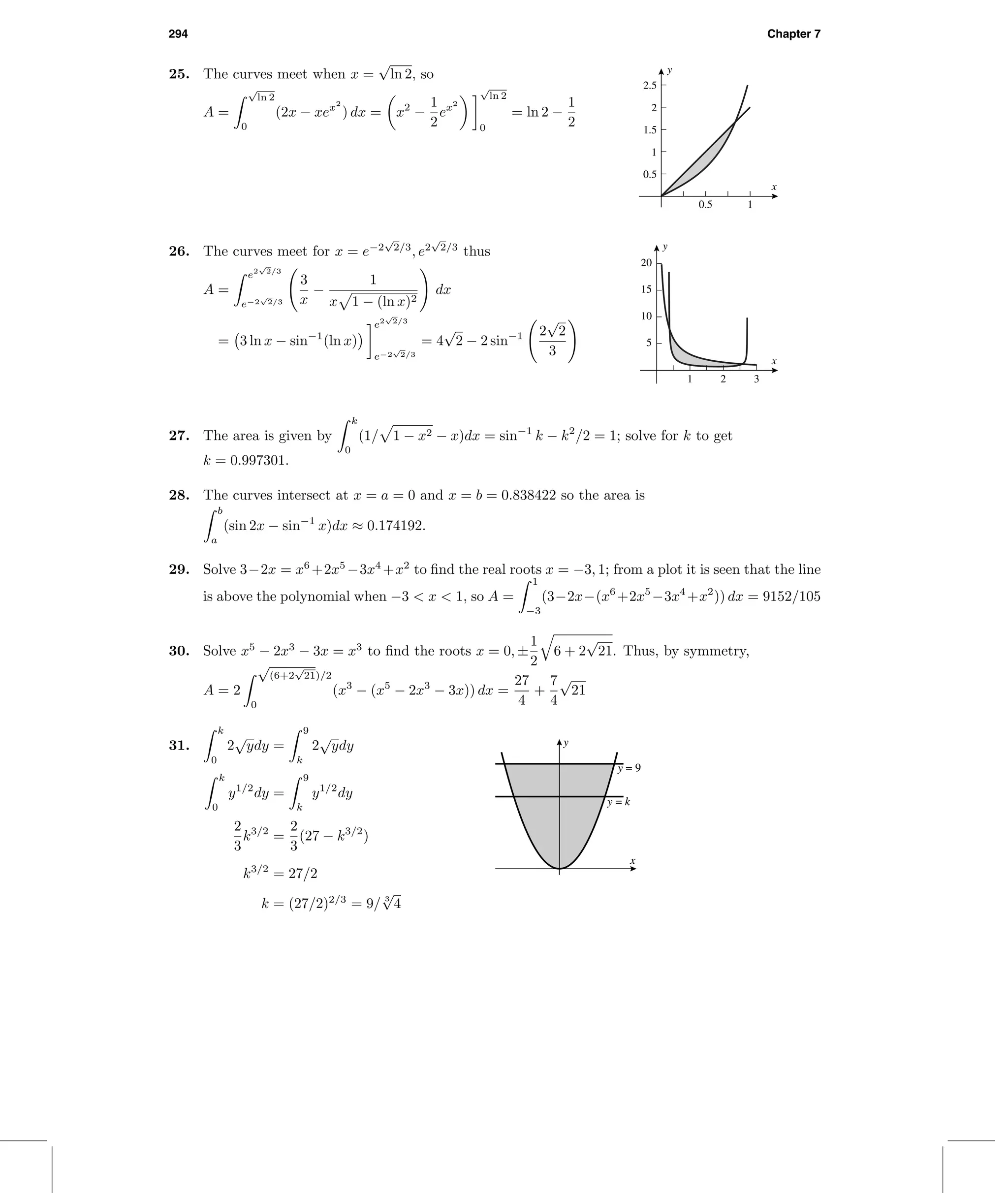
![Exercise Set 7.1 295
32.
k
0
x2
dx =
2
k
x2
dx
1
3
k3
=
1
3
(8 − k3
)
k3
= 4
k = 3
√
4
2
x
y
x = √y
x = k
33. (a) A =
2
0
(2x − x2
)dx = 4/3
(b) y = mx intersects y = 2x − x2
where mx = 2x − x2
, x2
+ (m − 2)x = 0, x(x + m − 2) = 0 so
x = 0 or x = 2 − m. The area below the curve and above the line is
2−m
0
(2x − x2
− mx)dx =
2−m
0
[(2 − m)x − x2
]dx =
1
2
(2 − m)x2
−
1
3
x3
2−m
0
=
1
6
(2 − m)3
so (2 − m)3
/6 = (1/2)(4/3) = 2/3, (2 − m)3
= 4, m = 2 − 3
√
4.
34. The line through (0, 0) and (5π/6, 1/2) is y =
3
5π
x;
A =
5π/6
0
sin x −
3
5π
x dx =
√
3
2
−
5
24
π + 1
c
1 1
2
c5
6( ),
x
y
y = sin x
35. The curves intersect at x = 0 and, by Newton’s Method, at x ≈ 2.595739080 = b, so
A ≈
b
0
(sin x − 0.2x)dx = − cos x + 0.1x2
b
0
≈ 1.180898334
36. By Newton’s Method, the points of intersection are at x ≈ ±0.824132312, so with
b = 0.824132312 we have A ≈ 2
b
0
(cos x − x2
)dx = 2(sin x − x3
/3)
b
0
≈ 1.094753609
37. By Newton’s Method the points of intersection are x = x1 ≈ 0.4814008713 and
x = x2 ≈ 2.363938870, and A ≈
x2
x1
ln x
x
− (x − 2) dx ≈ 1.189708441.
38. By Newton’s Method the points of intersection are x = ±x1 where x1 ≈ 0.6492556537, thus
A ≈ 2
x1
0
2
1 + x2
− 3 + 2 cos x dx ≈ 0.826247888
39. The x-coordinates of the points of intersection are a ≈ −0.423028 and b ≈ 1.725171; the area is
b
a
(2 sin x − x2
+ 1)dx ≈ 2.542696.
40. Let (a, k), where π/2 < a < π, be the coordinates of the point of intersection of y = k with
y = sin x. Thus k = sin a and if the shaded areas are equal,
a
0
(k − sin x)dx =
a
0
(sin a − sin x) dx = a sin a + cos a − 1 = 0
Solve for a to get a ≈ 2.331122, so k = sin a ≈ 0.724611.](https://image.slidesharecdn.com/gabaritocompletoantoncalculo8edcaps0108-130504215818-phpapp02/75/Gabarito-completo-anton_calculo_8ed_caps_01_08-295-2048.jpg)
![296 Chapter 7
41.
60
0
(v2(t) − v1(t)) dt = s2(60) − s2(0) − (s1(60) − s1(0)), but they are even at time t = 60, so
s2(60) = s1(60). Consequently the integral gives the difference s1(0)−s2(0) of their starting points
in meters.
42. Since a1(0) = a2(0) = 0, A =
T
0
(a2(t)−a1(t)) dt = v2(T)−v1(T) is the difference in the velocities
of the two cars at time T.
43. (a) It gives the area of the region that is between f and g when f(x) > g(x) minus the area of
the region between f and g when f(x) < g(x), for a ≤ x ≤ b.
(b) It gives the area of the region that is between f and g for a ≤ x ≤ b.
44. (b) lim
n→+∞
1
0
(x1/n
− x) dx = lim
n→+∞
n
n + 1
x(n+1)/n
−
x2
2
1
0
= lim
n→+∞
n
n + 1
−
1
2
= 1/2
a
a
x
y45. Solve x1/2
+ y1/2
= a1/2
for y to get
y = (a1/2
− x1/2
)2
= a − 2a1/2
x1/2
+ x
A =
a
0
(a − 2a1/2
x1/2
+ x)dx = a2
/6
46. Solve for y to get y = (b/a)
√
a2 − x2 for the upper half of the ellipse; make use of symmetry to
get A = 4
a
0
b
a
a2 − x2dx =
4b
a
a
0
a2 − x2dx =
4b
a
·
1
4
πa2
= πab.
47. Let A be the area between the curve and the x-axis and AR the area of the rectangle, then
A =
b
0
kxm
dx =
k
m + 1
xm+1
b
0
=
kbm+1
m + 1
, AR = b(kbm
) = kbm+1
, so A/AR = 1/(m + 1).
EXERCISE SET 7.2
1. V = π
3
−1
(3 − x)dx = 8π 2. V = π
1
0
[(2 − x2
)2
− x2
]dx
= π
1
0
(4 − 5x2
+ x4
)dx
= 38π/15
3. V = π
2
0
1
4
(3 − y)2
dy = 13π/6 4. V = π
2
1/2
(4 − 1/y2
)dy = 9π/2
5. V =
2
0
x4
dx = 32/5
2
x
y
y = x2](https://image.slidesharecdn.com/gabaritocompletoantoncalculo8edcaps0108-130504215818-phpapp02/75/Gabarito-completo-anton_calculo_8ed_caps_01_08-296-2048.jpg)
![Exercise Set 7.2 297
6. V =
π/3
π/4
sec2
x dx =
√
3 − 1
3 4
-2
-1
1
2
x
y
y = sec x
7. V = π
π/2
π/4
cos x dx = (1 −
√
2/2)π
3 6
–1
1
x
y
y = √cos x
8. V = π
1
0
[(x2
)2
− (x3
)2
]dx
= π
1
0
(x4
− x6
)dx = 2π/35
1
1 (1, 1)
y = x2
y = x3
x
y
9. V = π
4
−4
[(25 − x2
) − 9]dx
= 2π
4
0
(16 − x2
)dx = 256π/3
5
x
y
y = √25 – x2
y = 3
10. V = π
3
−3
(9 − x2
)2
dx
= π
3
−3
(81 − 18x2
+ x4
)dx = 1296π/5
–3 3
9
x
y
y = 9 – x2
11. V = π
4
0
[(4x)2
− (x2
)2
]dx
= π
4
0
(16x2
− x4
)dx = 2048π/15
4
16 (4, 16)
x
y
y = x2
y = 4x
12. V = π
π/4
0
(cos2
x − sin2
x)dx
= π
π/4
0
cos 2x dx = π/2
3
–1
1
x
y
y = cos x
y = sin x](https://image.slidesharecdn.com/gabaritocompletoantoncalculo8edcaps0108-130504215818-phpapp02/75/Gabarito-completo-anton_calculo_8ed_caps_01_08-297-2048.jpg)
![298 Chapter 7
13. V = π
ln 3
0
e2x
dx =
π
2
e2x
ln 3
0
= 4π 14. V = π
1
0
e−4x
dx =
π
4
(1 − e−4
)
1
–1
1
x
y
15. V =
2
−2
π
1
4 + x2
dx =
π
2
tan−1
(x/2)
2
−2
= π2
/4
16. V =
1
0
π
e6x
1 + e6x
dx =
π
6
ln(1 + e6x
)
1
0
=
π
6
(ln(1 + e6
) − ln 2)
17. V =
1
0
y1/3
2
dy =
3
5
0.25
0.75
0.25
0.75
x
y
18. V =
1
0
(1 − y2
)2
dy = 1 −
2
3
+
1
5
=
8
15
0.25
0.75
0.25
0.75
x
y
19. V = π
3
−1
(1 + y)dy = 8π
3
2
x
y
x = √1 + y
20. V = π
3
0
[22
− (y + 1)]dy
= π
3
0
(3 − y)dy = 9π/2
3 (2, 3)
x
y y = x2 – 1
x = √y + 1](https://image.slidesharecdn.com/gabaritocompletoantoncalculo8edcaps0108-130504215818-phpapp02/75/Gabarito-completo-anton_calculo_8ed_caps_01_08-298-2048.jpg)
![Exercise Set 7.2 299
21. V = π
3π/4
π/4
csc2
y dy = 2π
–2 –1 1 2
3
6
9
x
y
x = csc y
22. V = π
1
0
(y − y4
)dy = 3π/10
–1 1
–1
1
(1, 1)
x
y
x = √y
x = y2
23. V = π
2
−1
[(y + 2)2
− y4
]dy = 72π/5
(4, 2)
x
y
x = y2
x = y + 2
(1, –1)
24. V = π
1
−1
(2 + y2
)2
− (1 − y2
)2
dy
= π
1
−1
(3 + 6y2
)dy = 10π
1 2
–1
1
x
y x = 2 + y2
x = 1 – y2
25. V =
1
0
πe2y
dy =
π
2
e2
− 1 26. V =
2
0
π
1 + y2
dy = π tan−1
2
27. V = π
a
−a
b2
a2
(a2
− x2
)dx = 4πab2
/3
–a a
b
x
y
b
ay = √a2
– x2
28. V = π
2
b
1
x2
dx = π(1/b − 1/2);
π(1/b − 1/2) = 3, b = 2π/(π + 6)
29. V = π
0
−1
(x + 1)dx
+ π
1
0
[(x + 1) − 2x]dx
= π/2 + π/2 = π
–1 1
1
x
y
y = √2x
(1, √2)
y = √x + 1](https://image.slidesharecdn.com/gabaritocompletoantoncalculo8edcaps0108-130504215818-phpapp02/75/Gabarito-completo-anton_calculo_8ed_caps_01_08-299-2048.jpg)
![300 Chapter 7
30. V = π
4
0
x dx + π
6
4
(6 − x)2
dx
= 8π + 8π/3 = 32π/3
4 6
x
y
y = √x y = 6 – x
31. Partition the interval [a, b] with a = x0 < x1 < x2 < . . . < xn−1 < xn = b. Let x∗
k be an arbitrary
point of [xk−1, xk]. The disk in question is obtained by revolving about the line y = k the rectan-
gle for which xk−1 < x < xk, and y lies between y = k and y = f(x); the volume of this disk is
∆Vk = π(f(x∗
k) − k)2
∆xk, and the total volume is given by V = π
b
a
(f(x) − k)2
dx.
32. Assume for c < y < d that k ≤ v(y) ≤ w(y) (A similar proof holds for k ≥ v(y) ≥ w(y)). Partition
the interval [c, d] with
c = y0 < y1 < y2 < . . . < yn−1 < yn = d. Let y∗
k be an arbitrary point of [yk−1, yk]. The washer
in question is the region obtained by revolving the strip v(y∗
k) < x < w(y∗
k), yk−1 < y < yk about
the line x = k. The volume of this washer is ∆V = π[(v(y∗
k) − k)2
− (w(y∗
k) − k)2
]∆yk, and the
volume of the solid obtained by rotating R is
V = π
d
c
[(v(y) − k)2
− (w(y) − k)2
] dy
33. (a) Intuitively, it seems that a line segment which is revolved about a line which is perpendicular
to the line segment will generate a larger area, the farther it is from the line. This is because
the average point on the line segment will be revolved through a circle with a greater radius,
and thus sweeps out a larger circle.
Consider the line segment which connects a point (x, y) on the curve y =
√
3 − x to the point
(x, 0) beneath it. If this line segment is revolved around the x-axis we generate an area πy2
.
If on the other hand the segment is revolved around the line y = 2 then the area of the
resulting (infinitely thin) washer is π[22
−(2−y)2
]. So the question can be reduced to asking
whether y2
≥ [22
−(2−y)2
], y2
≥ 4y −y2
, or y ≥ 2. In the present case the curve y =
√
3 − x
always satisfies y ≤ 2, so V2 has the larger volume.
(b) The volume of the solid generated by revolving the area around the x-axis is
V1 = π
3
−1
(3 − x) dx = 8π, and the volume generated by revolving the area around the line
y = 2 is V2 = π
3
−1
[22
− (2 −
√
3 − x)2
] dx =
40
3
π
34. (a) In general, points in the region R are farther from the y-axis than they are from the line
x = 2.5, so by the reasoning in Exercise 33(a) the former should generate a larger volume
than the latter, i.e. the volume mentioned in Exercise 4 will be greater than that gotten by
revolving about the line x = 2.5.
(b) The original volume V1 of Exercise 4 is given by
V1 = π
2
1/2
(4 − 1/y2
) dy = 9π/2, and the other volume
V2 = π
2
1/2
1
y
− 2.5
2
− (2 − 2.5)2
dy =
21
2
− 10 ln 2 π ≈ 3.568528194π,
and thus V1 is the larger volume.](https://image.slidesharecdn.com/gabaritocompletoantoncalculo8edcaps0108-130504215818-phpapp02/75/Gabarito-completo-anton_calculo_8ed_caps_01_08-300-2048.jpg)
![Exercise Set 7.2 301
35. V = π
3
0
(9 − y2
)2
dy
= π
3
0
(81 − 18y2
+ y4
)dy
= 648π/5
9
3
x
y
x = y2
36. V = π
9
0
[32
− (3 −
√
x)2
]dx
= π
9
0
(6
√
x − x)dx
= 135π/2
9
x
y
y = √x
y = 3
1
1
x
y
x = y2
x = y
y = –1
37. V = π
1
0
[(
√
x + 1)2
− (x + 1)2
]dx
= π
1
0
(2
√
x − x − x2
)dx = π/2
38. V = π
1
0
[(y + 1)2
− (y2
+ 1)2
]dy
= π
1
0
(2y − y2
− y4
)dy = 7π/15
1
1
x
y
x = y2
x = y
x = –1
39. A(x) = π(x2
/4)2
= πx4
/16,
V =
20
0
(πx4
/16)dx = 40, 000π ft3
40. V = π
1
0
(x − x4
)dx = 3π/10
41. V =
1
0
(x − x2
)2
dx
=
1
0
(x2
− 2x3
+ x4
)dx = 1/30
Square
(1, 1)
1
y = x
y = x2
x
y
42. A(x) =
1
2
π
1
2
√
x
2
=
1
8
πx,
V =
4
0
1
8
πx dx = π
4
x
y
y = √x](https://image.slidesharecdn.com/gabaritocompletoantoncalculo8edcaps0108-130504215818-phpapp02/75/Gabarito-completo-anton_calculo_8ed_caps_01_08-301-2048.jpg)
![302 Chapter 7
43. On the upper half of the circle, y =
√
1 − x2, so:
(a) A(x) is the area of a semicircle of radius y, so
A(x) = πy2
/2 = π(1 − x2
)/2; V =
π
2
1
−1
(1 − x2
) dx = π
1
0
(1 − x2
) dx = 2π/3
1
–1
y = √1 – x2 x
y
y
(b) A(x) is the area of a square of side 2y, so
A(x) = 4y2
= 4(1 − x2
); V = 4
1
−1
(1 − x2
) dx = 8
1
0
(1 − x2
) dx = 16/3
1
–1
y = √1 – x2
x
y
2y
(c) A(x) is the area of an equilateral triangle with sides 2y, so
A(x) =
√
3
4
(2y)2
=
√
3y2
=
√
3(1 − x2
);
V =
1
−1
√
3(1 − x2
) dx = 2
√
3
1
0
(1 − x2
) dx = 4
√
3/3
x
y
1
–1
y = √1 – x2
2y
2y2y
44. The base of the dome is a hexagon of side r. An equation of the circle of radius r that lies in a
vertical x-y plane and passes through two opposite vertices of the base hexagon is x2
+ y2
= r2
.
A horizontal, hexagonal cross section at height y above the base has area
A(y) =
3
√
3
2
x2
=
3
√
3
2
(r2
− y2
), hence the volume is V =
r
0
3
√
3
2
(r2
− y2
) dy =
√
3r3
.
45. The two curves cross at x = b ≈ 1.403288534, so
V = π
b
0
((2x/π)2
− sin16
x) dx + π
π/2
b
(sin16
x − (2x/π)2
) dx ≈ 0.710172176.
46. Note that π2
sin x cos3
x = 4x2
for x = π/4. From the graph it is apparent that this is the first
positive solution, thus the curves don’t cross on (0, π/4) and
V = π
π/4
0
[(π2
sin x cos3
x)2
− (4x2
)2
] dx =
1
48
π5
+
17
2560
π6](https://image.slidesharecdn.com/gabaritocompletoantoncalculo8edcaps0108-130504215818-phpapp02/75/Gabarito-completo-anton_calculo_8ed_caps_01_08-302-2048.jpg)
![Exercise Set 7.2 303
47. V = π
e
1
(1 − (ln y)2
) dy = π
48. V =
tan 1
0
π[x2
− x2
tan−1
x] dx =
π
6
[tan2
1 − ln(1 + tan2
1)]
49. (a) V = π
r
r−h
(r2
− y2
) dy = π(rh2
− h3
/3) =
1
3
πh2
(3r − h)
r
h
r x
y
x2 + y2 = r2
(b) By the Pythagorean Theorem,
r2
= (r − h)2
+ ρ2
, 2hr = h2
+ ρ2
; from Part (a),
V =
πh
3
(3hr − h2
) =
πh
3
3
2
(h2
+ ρ2
) − h2
)
=
1
6
πh(h2
+ 3ρ2
)
50. Find the volume generated by revolving
the shaded region about the y-axis.
V = π
−10+h
−10
(100 − y2
)dy =
π
3
h2
(30 − h)
Find dh/dt when h = 5 given that dV/dt = 1/2.
V =
π
3
(30h2
− h3
),
dV
dt
=
π
3
(60h − 3h2
)
dh
dt
,
1
2
=
π
3
(300 − 75)
dh
dt
,
dh
dt
= 1/(150π) ft/min
10h – 10
–10
h
x
y
x = √100 – y2
51. (b) ∆x =
5
10
= 0.5; {y0, y1, · · · , y10} = {0, 2.00, 2.45, 2.45, 2.00, 1.46, 1.26, 1.25, 1.25, 1.25, 1.25};
left = π
9
i=0
yi
2
2
∆x ≈ 11.157;
right = π
10
i=1
yi
2
2
∆x ≈ 11.771; V ≈ average = 11.464 cm3
r
2
x
y
x = √r2 – y2
√3r
2
√3r
2
–
52. If x = r/2 then from y2
= r2
− x2
we get y = ±
√
3r/2
as limits of integration; for −
√
3 ≤ y ≤
√
3,
A(y) = π[(r2
− y2
) − r2
/4] = π(3r2
/4 − y2
), thus
V = π
√
3r/2
−
√
3r/2
(3r2
/4 − y2
)dy
= 2π
√
3r/2
0
(3r2
/4 − y2
)dy =
√
3πr3
/2](https://image.slidesharecdn.com/gabaritocompletoantoncalculo8edcaps0108-130504215818-phpapp02/75/Gabarito-completo-anton_calculo_8ed_caps_01_08-303-2048.jpg)
![304 Chapter 7
53. (a)
h
–4
x
y
0 ≤ h < 2
h – 4
(b)
–4
–2
h
2 ≤ h ≤ 4
h – 4
x
y
If the cherry is partially submerged then 0 ≤ h < 2 as shown in Figure (a); if it is totally sub-
merged then 2 ≤ h ≤ 4 as shown in Figure (b). The radius of the glass is 4 cm and that of the
cherry is 1 cm so points on the sections shown in the figures satisfy the equations x2
+ y2
= 16
and x2
+ (y + 3)2
= 1. We will find the volumes of the solids that are generated when the shaded
regions are revolved about the y-axis.
For 0 ≤ h < 2,
V = π
h−4
−4
[(16 − y2
) − (1 − (y + 3)2
)]dy = 6π
h−4
−4
(y + 4)dy = 3πh2
;
for 2 ≤ h ≤ 4,
V = π
−2
−4
[(16 − y2
) − (1 − (y + 3)2
)]dy + π
h−4
−2
(16 − y2
)dy
= 6π
−2
−4
(y + 4)dy + π
h−4
−2
(16 − y2
)dy = 12π +
1
3
π(12h2
− h3
− 40)
=
1
3
π(12h2
− h3
− 4)
so
V =
3πh2
if 0 ≤ h < 2
1
3
π(12h2
− h3
− 4) if 2 ≤ h ≤ 4
54. x = h ± r2 − y2,
V = π
r
−r
(h + r2 − y2)2
− (h − r2 − y2)2
dy
= 4πh
r
−r
r2 − y2dy
= 4πh
1
2
πr2
= 2π2
r2
h
x
y
(x – h2
) + y2
= r2
x
h
u
55. tan θ = h/x so h = x tan θ,
A(y) =
1
2
hx =
1
2
x2
tan θ =
1
2
(r2
− y2
) tan θ
because x2
= r2
− y2
,
V =
1
2
tan θ
r
−r
(r2
− y2
)dy
= tan θ
r
0
(r2
− y2
)dy =
2
3
r3
tan θ](https://image.slidesharecdn.com/gabaritocompletoantoncalculo8edcaps0108-130504215818-phpapp02/75/Gabarito-completo-anton_calculo_8ed_caps_01_08-304-2048.jpg)
![Exercise Set 7.3 305
56. A(x) = (x tan θ)(2 r2 − x2)
= 2(tan θ)x r2 − x2,
V = 2 tan θ
r
0
x r2 − x2dx
=
2
3
r3
tan θ
y
x
√r2 – x2
x tan u
57. Each cross section perpendicular to the
y-axis is a square so
A(y) = x2
= r2
− y2
,
1
8
V =
r
0
(r2
− y2
)dy
V = 8(2r3
/3) = 16r3
/3
r
x = √r2 – y2
x
y
58. The regular cylinder of radius r and height h has the same circular cross sections as do those of
the oblique clinder, so by Cavalieri’s Principle, they have the same volume: πr2
h.
EXERCISE SET 7.3
1. V =
2
1
2πx(x2
)dx = 2π
2
1
x3
dx = 15π/2
2. V =
√
2
0
2πx( 4 − x2 − x)dx = 2π
√
2
0
(x 4 − x2 − x2
)dx =
8π
3
(2 −
√
2)
3. V =
1
0
2πy(2y − 2y2
)dy = 4π
1
0
(y2
− y3
)dy = π/3
4. V =
2
0
2πy[y − (y2
− 2)]dy = 2π
2
0
(y2
− y3
+ 2y)dy = 16π/3
5. V =
1
0
2π(x)(x3
)dx
= 2π
1
0
x4
dx = 2π/5
–1 1
–1
1
x
y
y = x3
6. V =
9
4
2πx(
√
x)dx
= 2π
9
4
x3/2
dx = 844π/5
–9 –4 4 9
1
2
3
x
y
y = √x
7. V =
3
1
2πx(1/x)dx = 2π
3
1
dx = 4π
–3 –1 1 3
y = x
1
x
y](https://image.slidesharecdn.com/gabaritocompletoantoncalculo8edcaps0108-130504215818-phpapp02/75/Gabarito-completo-anton_calculo_8ed_caps_01_08-305-2048.jpg)
![306 Chapter 7
8. V =
√
π/2
0
2πx cos(x2
)dx = π/
√
2
√p
2
x
y
y = cos (x2
)
9. V =
2
1
2πx[(2x − 1) − (−2x + 3)]dx
= 8π
2
1
(x2
− x)dx = 20π/3
(2, 3)
(2, –1)
(1, 1)
x
y
10. V =
2
0
2πx(2x − x2
)dx
= 2π
2
0
(2x2
− x3
)dx =
8
3
π
2
x
y
y = 2x – x2
11. V = 2π
1
0
x
x2 + 1
dx
= π ln(x2
+ 1)
1
0
= π ln 2
–1 1
1
x
y
y = 1
x2 + 1
12. V =
√
3
1
2πxex2
dx = πex2
√
3
1
= π(e3
− e)
-√3 -1 1 √3
10
20
x
y
y = ex2
13. V =
1
0
2πy3
dy = π/2
1
x
y
x = y2
14. V =
3
2
2πy(2y)dy = 4π
3
2
y2
dy = 76π/3
2
3
x
y
x = 2y
15. V =
1
0
2πy(1 −
√
y)dy
= 2π
1
0
(y − y3/2
)dy = π/5 1
x
y
y = √x](https://image.slidesharecdn.com/gabaritocompletoantoncalculo8edcaps0108-130504215818-phpapp02/75/Gabarito-completo-anton_calculo_8ed_caps_01_08-306-2048.jpg)
![Exercise Set 7.3 307
16. V =
4
1
2πy(5 − y − 4/y)dy
= 2π
4
1
(5y − y2
− 4)dy = 9π
(1, 4)
(4, 1)
x
y
x = 5 – y
x = 4/y
17. V = 2π
2
1
xex
dx = 2π(x − 1)ex
2
1
= 2πe2
18. V = 2π
π/2
0
x cos xdx = π2
− 2π
19. The volume is given by 2π
k
0
x sin x dx = 2π(sin k − k cos k) = 8; solve for k to get
k = 1.736796.
20. (a)
b
a
2πx[f(x) − g(x)]dx (b)
d
c
2πy[f(y) − g(y)]dy
21. (a) V =
1
0
2πx(x3
− 3x2
+ 2x)dx = 7π/30
(b) much easier; the method of slicing would require that x be expressed in terms of y.
–1 1
x
y
y = x3
– 3x2
+ 2x
22. Let a = x0 < x1 < x2 < . . . < xn−1 < xn = b be a partition of [a, b]. Let x∗
k be the midpoint of
[xk−1, xk].Revolve the strip xk−1 < x < xk, 0 < y < f(x∗
k) about the line x = k. The result is a
cylindrical shell, a large coin with a very large hole through the center. The volume of the shell is
∆Vk = 2π(x−k)f(x∗
k)∆xk, just as the volume of a ring of average radius r, height y and thickness
h is 2πryh. Summing these volumes of cylindrical shells and taking the limit as max∆xk goes to
zero, we obtain V = 2π
b
a
(x − k)f(x) dx
23. V =
2
1
2π(x + 1)(1/x3
)dx
= 2π
2
1
(x−2
+ x−3
)dx = 7π/4
–1 x 21
x
y
y = 1/x3
x + 1
24. V =
1
0
2π(1 − y)y1/3
dy
= 2π
1
0
(y1/3
− y4/3
)dy = 9π/14
1
x
y
1 – y x = y1/3](https://image.slidesharecdn.com/gabaritocompletoantoncalculo8edcaps0108-130504215818-phpapp02/75/Gabarito-completo-anton_calculo_8ed_caps_01_08-307-2048.jpg)
![Exercise Set 7.4 309
EXERCISE SET 7.4
1. (a)
dy
dx
= 2, L =
2
1
√
1 + 4dx =
√
5
(b)
dx
dy
=
1
2
, L =
4
2
1 + 1/4 dy = 2
√
5/2 =
√
5
2.
dx
dt
= 1,
dy
dt
= 5, L =
1
0
12 + 52 dt =
√
26
3. f (x) =
9
2
x1/2
, 1 + [f (x)]2
= 1 +
81
4
x,
L =
1
0
1 + 81x/4 dx =
8
243
1 +
81
4
x
3/2 1
0
= (85
√
85 − 8)/243
4. g (y) = y(y2
+ 2)1/2
, 1 + [g (y)]2
= 1 + y2
(y2
+ 2) = y4
+ 2y2
+ 1 = (y2
+ 1)2
,
L =
1
0
(y2 + 1)2dy =
1
0
(y2
+ 1)dy = 4/3
5.
dy
dx
=
2
3
x−1/3
, 1 +
dy
dx
2
= 1 +
4
9
x−2/3
=
9x2/3
+ 4
9x2/3
,
L =
8
1
√
9x2/3 + 4
3x1/3
dx =
1
18
40
13
u1/2
du, u = 9x2/3
+ 4
=
1
27
u3/2
40
13
=
1
27
(40
√
40 − 13
√
13) =
1
27
(80
√
10 − 13
√
13)
or (alternate solution)
x = y3/2
,
dx
dy
=
3
2
y1/2
, 1 +
dx
dy
2
= 1 +
9
4
y =
4 + 9y
4
,
L =
1
2
4
1
4 + 9y dy =
1
18
40
13
u1/2
du =
1
27
(80
√
10 − 13
√
13)
6. f (x) =
1
4
x3
− x−3
, 1 + [f (x)]2
= 1 +
1
16
x6
−
1
2
+ x−6
=
1
16
x6
+
1
2
+ x−6
=
1
4
x3
+ x−3
2
,
L =
3
2
1
4
x3 + x−3
2
dx =
3
2
1
4
x3
+ x−3
dx = 595/144
7. x = g(y) =
1
24
y3
+ 2y−1
, g (y) =
1
8
y2
− 2y−2
,
1 + [g (y)]2
= 1 +
1
64
y4
−
1
2
+ 4y−4
=
1
64
y4
+
1
2
+ 4y−4
=
1
8
y2
+ 2y−2
2
,
L =
4
2
1
8
y2
+ 2y−2
dy = 17/6](https://image.slidesharecdn.com/gabaritocompletoantoncalculo8edcaps0108-130504215818-phpapp02/75/Gabarito-completo-anton_calculo_8ed_caps_01_08-309-2048.jpg)
![310 Chapter 7
8. g (y) =
1
2
y3
−
1
2
y−3
, 1 + [g (y)]2
= 1 +
1
4
y6
−
1
2
+
1
4
y−6
=
1
2
y3
+
1
2
y−3
2
,
L =
4
1
1
2
y3
+
1
2
y−3
dy = 2055/64
9. (dx/dt)2
+ (dy/dt)2
= (t2
)2
+ (t)2
= t2
(t2
+ 1), L =
1
0
t(t2
+ 1)1/2
dt = (2
√
2 − 1)/3
10. (dx/dt)2
+ (dy/dt)2
= [2(1 + t)]2
+ [3(1 + t)2
]2
= (1 + t)2
[4 + 9(1 + t)2
],
L =
1
0
(1 + t)[4 + 9(1 + t)2
]1/2
dt = (80
√
10 − 13
√
13)/27
11. (dx/dt)2
+ (dy/dt)2
= (−2 sin 2t)2
+ (2 cos 2t)2
= 4, L =
π/2
0
2 dt = π
12. (dx/dt)2
+ (dy/dt)2
= (− sin t + sin t + t cos t)2
+ (cos t − cos t + t sin t)2
= t2
,
L =
π
0
t dt = π2
/2
13. (dx/dt)2
+ (dy/dt)2
= [et
(cos t − sin t)]2
+ [et
(cos t + sin t)]2
= 2e2t
,
L =
π/2
0
√
2et
dt =
√
2(eπ/2
− 1)
14. (dx/dt)2
+ (dy/dt)2
= (2et
cos t)2
+ (−2et
sin t)2
= 4e2t
, L =
4
1
2et
dt = 2(e4
− e)
15. dy/dx =
sec x tan x
sec x
= tan x, 1 + (y )2 =
√
1 + tan2
x = sec x when 0 < x < π/4, so
L =
π/4
0
sec x dx = ln(1 +
√
2)
16. dy/dx =
cos x
sin x
= cot x, 1 + (y )2 =
√
1 + cot2
x = csc x when π/4 < x < π/2, so
L =
π/2
π/4
csc x dx = − ln(
√
2 − 1) = − ln
√
2 − 1
√
2 + 1
(
√
2 + 1) = ln(1 +
√
2)
17. (a)
(–1, 1)
(8, 4)
x
y (b) dy/dx does not exist at x = 0.
(c) x = g(y) = y3/2
, g (y) =
3
2
y1/2
,
L =
1
0
1 + 9y/4 dy (portion for − 1 ≤ x ≤ 0)
+
4
0
1 + 9y/4 dy (portion for 0 ≤ x ≤ 8)
=
8
27
13
8
√
13 − 1 +
8
27
(10
√
10 − 1) = (13
√
13 + 80
√
10 − 16)/27](https://image.slidesharecdn.com/gabaritocompletoantoncalculo8edcaps0108-130504215818-phpapp02/75/Gabarito-completo-anton_calculo_8ed_caps_01_08-310-2048.jpg)
![Exercise Set 7.4 311
18. For (4), express the curve y = f(x) in the parametric form x = t, y = f(t) so dx/dt = 1 and
dy/dt = f (t) = f (x) = dy/dx. For (5), express x = g(y) as x = g(t), y = t so
dx/dt = g (t) = g (y) = dx/dy and dy/dt = 1.
19. (a) The function y = f(x) = x2
is inverse to the function
x = g(y) =
√
y : f(g(y)) = y for 1/4 ≤ y ≤ 4, and
g(f(x)) = x for 1/2 ≤ x ≤ 2. Geometrically this
means that the graphs of y = f(x) and x = g(y) are
symmetric to each other with respect to the line y = x
and hence have the same arc length.
1 2 3 4
1
2
3
4
x
y
(b) L1 =
2
1/2
1 + (2x)2 dx and L2 =
4
1/4
1 +
1
2
√
x
2
dx
Make the change of variables x =
√
y in the first integral to obtain
L1 =
4
1/4
1 + (2
√
y)2
1
2
√
y
dy =
4
1/4
1
2
√
y
2
+ 1 dy = L2
(c) L1 =
2
1/2
1 + (2y)2 dy, L2 =
4
1/4
1 +
1
2
√
y
2
dy
(d) For L1, ∆x =
3
20
, xk =
1
2
+ k
3
20
=
3k + 10
20
, and thus
L1 ≈
10
k=1
(∆x)2 + [f(xk) − (f(xk−1)]2
=
10
k=1
3
20
2
+
(3k + 10)2 − (3k + 7)2
400
2
≈ 4.072396336
For L2, ∆x =
15
40
=
3
8
, xk =
1
4
+
3k
8
=
3k + 2
8
, and thus
L2 ≈
10
k=1
3
8
2
+
3k + 2
8
−
3k − 1
8
2
≈ 4.071626502
(e) The expression for L1 is better, perhaps because L1 has in general a smaller slope and so
approximations of the true slope are better.
(f) For L1, ∆x =
3
20
, the midpoint is x∗
k =
1
2
+ k −
1
2
3
20
=
6k + 17
40
, and thus
L1 ≈
10
k=1
3
20
1 + 2
6k + 17
40
2
≈ 4.072396336.
For L2, ∆x =
15
40
, and the midpoint is x∗
k =
1
4
+ k −
1
2
15
40
=
6k + 1
16
, and thus
L2 ≈
10
k=1
15
40
1 + 4
6k + 1
16
−1
≈ 4.066160149
(g) L1 =
2
1/2
1 + (2x)2 dx ≈ 4.0729, L2 =
4
1/4
1 +
1
2
√
x
2
dx ≈ 4.0729](https://image.slidesharecdn.com/gabaritocompletoantoncalculo8edcaps0108-130504215818-phpapp02/75/Gabarito-completo-anton_calculo_8ed_caps_01_08-311-2048.jpg)
![312 Chapter 7
20. (a) The function y = f(x) = x8/3
is inverse to the function
x = g(y) = y3/8
: f(g(y)) = y for 10−8
≤ y ≤ 1 and
g(f(x)) = x for 10−3
≤ x ≤ 1. Geometrically this
means that the graphs of y = f(x) and x = g(y) are
symmetric to each other with respect to the line y = x.
0.2 0.6 1
0.2
0.6
1
x
y
(b) L1 =
1
10−3
1 +
8
3
x5/3
2
dx,
L2 =
1
10−8
1 +
3
8
x−5/8
2
dx;
In the expression for L1 make the change of variable y = x8/3
. Then
L1 =
1
10−8
1 +
8
3
y5/8
2
3
8
y−5/8
dy =
1
10−8
3
8
y−5/8
2
+ 1 dy = L2
(c) L1 =
1
10−3
1 +
8
3
y5/3
2
dy, L2 =
1
10−8
1 +
3
8
y−5/8
2
dy;
(d) For L1, ∆x =
999
10000
, xk =
1
1000
+ k
999
10000
, and thus
L1 ≈
10
k=1
(∆x)2 + [f(xk) − f(xk−1)]2
=
10
k=1
999
10000
2
+
1
1000
+
999k
10000
8/3
−
1
1000
+
999(k − 1)
10000
8/3 2
≈ 1.524983407
For L2, ∆y =
99999999
1000000000
, yk = 10−8
+ k
99999999
1000000000
, and thus
L2 ≈
10
k=1
(∆y)2 + [g(yk) − g(yk−1)]
2
≈ 1.518667833
(e) The expression for L1 is better, perhaps because the second curve has a very steep slope for
small values of x, and approximations of such large numbers are less accurate.
(f) For L1, ∆x =
999
10000
, the midpoint is x∗
k = 10−3
+ k −
1
2
999
10000
, and thus
L1 ≈
10
k=1
999
10000
1 +
8
3
(x∗
k)5/3
2
≈ 1.524166463.
For L2, ∆y =
99999999
1000000000
, the midpoint is y∗
k = 10−8
+ k −
1
2
99999999
1000000000
and thus
L2 ≈
10
k=1
1 + (g (y∗
k)2 ∆y ≈ 1.347221106
(g) L1 =
1
10−3
1 +
8
3
x5/3
2
≈ 1.525898203, L2 =
1
10−8
1 +
3
8
y−5/8
2
dy ≈ 1.526898203](https://image.slidesharecdn.com/gabaritocompletoantoncalculo8edcaps0108-130504215818-phpapp02/75/Gabarito-completo-anton_calculo_8ed_caps_01_08-312-2048.jpg)
![Exercise Set 7.4 313
21. (a) The function y = f(x) = tan x is inverse to the func-
tion x = g(y) = tan−1
x : f(g(y)) = y for 0 ≤ y ≤
√
3,
and g(f(x)) = x for 0 ≤ x ≤ π/3. Geometrically this
means that the graphs of y = f(x) and x = g(y) are
symmetric to each other with respect to the line y = x.
0.5 1 1.5 2
0.5
1
1.5
2
x
y
(b) L1 =
π/3
0
1 + sec4 x dx, L2 =
√
3
0
1 +
1
(1 + x2)2
dx;
In the expression for L1 make the change of variable
y = tan x to obtain
L1 =
√
3
0
1 + ( 1 + y2)4
1
1 + y2
dy =
√
3
0
1
(1 + y2)2
+ 1 dy = L2
(c) L1 =
π/3
0
1 + sec4 y dy, L2 =
√
3
0
1 +
1
(1 + y2)2
dy;
(d) For L1, ∆xk =
π
30
, xk = k
π
30
, and thus
L1 ≈
10
k=1
(∆xk)2 + [f(xk) − (f(xk−1)]2
=
10
k=1
π
30
2
+ [tan(kπ/30) − tan((k − 1)π/30)]2 ≈ 2.056603923
For L2, ∆xk =
√
3
10
, xk = k
√
3
10
, and thus
L2 ≈
10
k=1
√
3
10
2
+ tan−1
k
√
3
10
− tan−1
(k − 1)
√
3
10
2
≈ 2.056724591
(e) The expression for L2 is slightly more accurate. The slope of tan x is on average greater than
the slope of tan−1
x as indicated in the graph in Part (a).
(f) For L1, ∆xk =
π
30
, the midpoint is x∗
k = k −
1
2
π
30
, and thus
L1 ≈
10
k=1
π
30
1 + sec4 k −
1
2
π
30
≈ 2.050944217.
For L2, ∆xk =
√
3
10
, and the midpoint is x∗
k = k −
1
2
√
3
10
, and thus
L2 ≈
10
k=1
√
3
10
1 +
1
((x∗
k)2 + 1)2
≈ 2.057065139
(g) L1 =
π/3
0
1 + sec4 x dx ≈ 2.0570
L2 =
√
3
0
1 +
1
(12 + y2)2
dx ≈ 2.0570](https://image.slidesharecdn.com/gabaritocompletoantoncalculo8edcaps0108-130504215818-phpapp02/75/Gabarito-completo-anton_calculo_8ed_caps_01_08-313-2048.jpg)
![314 Chapter 7
22. 0 ≤ m ≤ f (x) ≤ M, so m2
≤ [f (x)]2
≤ M2
, and 1 + m2
≤ 1 + [f (x)]2
≤ 1 + M2
; thus
√
1 + m2 ≤ 1 + [f (x)]2 ≤
√
1 + M2,
b
a
1 + m2dx ≤
b
a
1 + [f (x)]2dx ≤
b
a
1 + M2 dx, and
(b − a) 1 + m2 ≤ L ≤ (b − a) 1 + M2
23. f (x) = sec x tan x, 0 ≤ sec x tan x ≤ 2
√
3 for 0 ≤ x ≤ π/3 so
π
3
≤ L ≤
π
3
√
13.
24. The distance is
4.6
0
1 + (2.09 − 0.82x)2 dx ≈ 6.65 m
25. L =
π
0
1 + (k cos x)2 dx 1 2 1.84 1.83 1.832
3.8202 5.2704 5.0135 4.9977 5.0008
k
L
Experimentation yields the values in the table, which by the Intermediate-Value Theorem show
that the true solution k to L = 5 lies between k = 1.83 and k = 1.832, so k = 1.83 to two decimal
places.
26. (a)
100 200
–1.6
–1.2
–0.8
–0.4
x
y (b) The maximum deflection occurs at
x = 96 inches (the midpoint
of the beam) and is about 1.42 in.
(c) The length of the centerline is
192
0
1 + (dy/dx)2 dx = 192.026 in.
27. y = 0 at x = b = 30.585; distance =
b
0
1 + (12.54 − 0.82x)2 dx = 196.306 yd
28. (a) (dx/dθ)2
+ (dy/dθ)2
= (a(1 − cos θ))2
+ (a sin θ)2
= a2
(2 − 2 cos θ), so
L =
2π
0
(dx/dθ)2 + (dy/dθ)2 dθ = a
2π
0
2(1 − cos θ) dθ
29. (a) Use the interval 0 ≤ φ < 2π.
(b) (dx/dφ)2
+ (dy/dφ)2
= (−3a cos2
φ sin φ)2
+ (3a sin2
φ cos φ)2
= 9a2
cos2
φ sin2
φ(cos2
φ + sin2
φ) = (9a2
/4) sin2
2φ, so
L = (3a/2)
2π
0
| sin 2φ| dφ = 6a
π/2
0
sin 2φ dφ = −3a cos 2φ
π/2
0
= 6a
30. (dx/dt)2
+ (dy/dt)2
= (−a sin t)2
+ (b cos t)2
= a2
sin2
t + b2
cos2
t
= a2
(1 − cos2
t) + b2
cos2
t = a2
− (a2
− b2
) cos2
t
= a2
1 −
a2
− b2
a2
cos2
t = a2
[1 − k2
cos2
t],
L =
2π
0
a 1 − k2 cos2 t dt = 4a
π/2
0
1 − k2 cos2 t dt](https://image.slidesharecdn.com/gabaritocompletoantoncalculo8edcaps0108-130504215818-phpapp02/75/Gabarito-completo-anton_calculo_8ed_caps_01_08-314-2048.jpg)
![Exercise Set 7.5 315
31. (a) (dx/dt)2
+ (dy/dt)2
= 4 sin2
t + cos2
t = 4 sin2
t + (1 − sin2
t) = 1 + 3 sin2
t,
L =
2π
0
1 + 3 sin2
t dt = 4
π/2
0
1 + 3 sin2
t dt
(b) 9.69
(c) distance traveled =
4.8
1.5
1 + 3 sin2
t dt ≈ 5.16 cm
EXERCISE SET 7.5
1. S =
1
0
2π(7x)
√
1 + 49dx = 70π
√
2
1
0
x dx = 35π
√
2
2. f (x) =
1
2
√
x
, 1 + [f (x)]2
= 1 +
1
4x
S =
4
1
2π
√
x 1 +
1
4x
dx = 2π
4
1
x + 1/4dx = π(17
√
17 − 5
√
5)/6
3. f (x) = −x/
√
4 − x2, 1 + [f (x)]2
= 1 +
x2
4 − x2
=
4
4 − x2
,
S =
1
−1
2π 4 − x2(2/ 4 − x2)dx = 4π
1
−1
dx = 8π
4. y = f(x) = x3
for 1 ≤ x ≤ 2, f (x) = 3x2
,
S =
2
1
2πx3
1 + 9x4dx =
π
27
(1 + 9x4
)3/2
2
1
= 5π(29
√
145 − 2
√
10)/27
5. S =
2
0
2π(9y + 1)
√
82dy = 2π
√
82
2
0
(9y + 1)dy = 40π
√
82
6. g (y) = 3y2
, S =
1
0
2πy3
1 + 9y4dy = π(10
√
10 − 1)/27
7. g (y) = −y/ 9 − y2, 1 + [g (y)]2
=
9
9 − y2
, S =
2
−2
2π 9 − y2 ·
3
9 − y2
dy = 6π
2
−2
dy = 24π
8. g (y) = −(1 − y)−1/2
, 1 + [g (y)]2
=
2 − y
1 − y
,
S =
0
−1
2π(2 1 − y)
√
2 − y
√
1 − y
dy = 4π
0
−1
2 − y dy = 8π(3
√
3 − 2
√
2)/3
9. f (x) =
1
2
x−1/2
−
1
2
x1/2
, 1 + [f (x)]2
= 1 +
1
4
x−1
−
1
2
+
1
4
x =
1
2
x−1/2
+
1
2
x1/2
2
,
S =
3
1
2π x1/2
−
1
3
x3/2 1
2
x−1/2
+
1
2
x1/2
dx =
π
3
3
1
(3 + 2x − x2
)dx = 16π/9](https://image.slidesharecdn.com/gabaritocompletoantoncalculo8edcaps0108-130504215818-phpapp02/75/Gabarito-completo-anton_calculo_8ed_caps_01_08-315-2048.jpg)
![316 Chapter 7
10. f (x) = x2
−
1
4
x−2
, 1 + [f (x)]2
= 1 + x4
−
1
2
+
1
16
x−4
= x2
+
1
4
x−2
2
,
S =
2
1
2π
1
3
x3
+
1
4
x−1
x2
+
1
4
x−2
dx = 2π
2
1
1
3
x5
+
1
3
x +
1
16
x−3
dx = 515π/64
11. x = g(y) =
1
4
y4
+
1
8
y−2
, g (y) = y3
−
1
4
y−3
,
1 + [g (y)]2
= 1 + y6
−
1
2
+
1
16
y−6
= y3
+
1
4
y−3
2
,
S =
2
1
2π
1
4
y4
+
1
8
y−2
y3
+
1
4
y−3
dy =
π
16
2
1
(8y7
+ 6y + y−5
)dy = 16,911π/1024
12. x = g(y) =
√
16 − y; g (y) = −
1
2
√
16 − y
, 1 + [g (y)]2
=
65 − 4y
4(16 − y)
,
S =
15
0
2π 16 − y
65 − 4y
4(16 − y)
dy = π
15
0
65 − 4y dy = (65
√
65 − 5
√
5)
π
6
13. f (x) = cos x, 1 + [f (x)]2
= 1 + cos2
x,
S =
π
0
2π sin x 1 + cos2 x dx = 2π(
√
2 + ln(
√
2 + 1)) ≈ 14.42
14. x = g(y) = tan y, g (y) = sec2
y, 1 + [g (y)]2
= 1 + sec4
y;
S =
π/4
0
2π tan y 1 + sec4 y dy ≈ 3.84
15. f (x) = ex
, 1 + [f (x)]2
= 1 + e2x
, S =
1
0
2πex
1 + e2x dx ≈ 22.94
16. x = g(y) = ln y, g (y) = 1/y, 1 + [g (y)]2
= 1 + 1/y2
; S =
e
1
2π 1 + 1/y2 ln y dy ≈ 7.054965608
17. n = 20, a = 0, b = π, ∆x = (b − a)/20 = π/20, xk = kπ/20,
S ≈ π
20
k=1
[sin(k − 1)π/20 + sin kπ/20] (π/20)2 + [sin(k − 1)π/20 − sin kπ/20]2 ≈ 14.39394496
18. n = 20, a = 0, b = e, ∆x = (b − a)/20 = (1 − e)/20, xk = k(1 − e)/20,
S = π
e
1
[ln yk−1 + ln yk] (∆yk)2 + [ln yk−1 − ln yk]2 ≈ 7.052846891
19. Revolve the line segment joining the points (0, 0) and (h, r) about the x-axis. An equation of the
line segment is y = (r/h)x for 0 ≤ x ≤ h so
S =
h
0
2π(r/h)x 1 + r2/h2dx =
2πr
h2
r2 + h2
h
0
x dx = πr r2 + h2
20. f(x) =
√
r2 − x2, f (x) = −x/
√
r2 − x2, 1 + [f (x)]2
= r2
/(r2
− x2
),
S =
r
−r
2π r2 − x2(r/ r2 − x2)dx = 2πr
r
−r
dx = 4πr2](https://image.slidesharecdn.com/gabaritocompletoantoncalculo8edcaps0108-130504215818-phpapp02/75/Gabarito-completo-anton_calculo_8ed_caps_01_08-316-2048.jpg)
![Exercise Set 7.5 317
21. g(y) = r2 − y2, g (y) = −y/ r2 − y2, 1 + [g (y)]2
= r2
/(r2
− y2
),
(a) S =
r
r−h
2π r2 − y2 r2/(r2 − y2) dy = 2πr
r
r−h
dy = 2πrh
(b) From Part (a), the surface area common to two polar caps of height h1 > h2 is
2πrh1 − 2πrh2 = 2πr(h1 − h2).
22. (a) length of arc of sector = circumference of base of cone,
θ = 2πr, θ = 2πr/ ; S = area of sector =
1
2
2
(2πr/ ) = πr
(b) S = πr2 2 − πr1 1 = πr2( 1 + ) − πr1 1 = π[(r2 − r1) 1 + r2 ];
Using similar triangles 2/r2 = 1/r1, r1 2 = r2 1,
r1( 1 + ) = r2 1, (r2 − r1) 1 = r1
so S = π (r1 + r2 ) = π (r1 + r2) .
r1
r2
l2
l1
l
23. S =
b
a
2π[f(x) + k] 1 + [f (x)]2dx
24. 2πk 1 + [f (x)]2 ≤ 2πf(x) 1 + [f (x)]2 ≤ 2πK 1 + [f (x)]2, so
b
a
2πk 1 + [f (x)]2dx ≤
b
a
2πf(x) 1 + [f (x)]2dx ≤
b
a
2πK 1 + [f (x)]2dx,
2πk
b
a
1 + [f (x)]2dx ≤ S ≤ 2πK
b
a
1 + [f (x)]2dx, 2πkL ≤ S ≤ 2πKL
25. Note that 1 ≤ sec x ≤ 2 for 0 ≤ x ≤ π/3. Let L be the arc length of the curve y = tan x
for 0 < x < π/3. Then L =
π/3
0
1 + sec2 x dx, and by Exercise 24, and the inequaities above,
2πL ≤ S ≤ 4πL. But from the inequalities for sec x above, we can show that
√
2π/3 ≤ L ≤
√
5π/3.
Hence, combining the two sets of inequalities, 2π(
√
2π/3) ≤ 2πL ≤ S ≤ 4πL ≤ 4π
√
5π/3. To
obtain the inequalities in the text, observe that
2π2
3
< 2π
√
2π
3
≤ 2πL ≤ S ≤ 4πL ≤ 4π
√
5π
3
<
4π2
3
√
13.
26. (a) 1 ≤ 1 + [f (x)]2 so 2πf(x) ≤ 2πf(x) 1 + [f (x)]2,
b
a
2πf(x)dx ≤
b
a
2πf(x) 1 + [f (x)]2dx, 2π
b
a
f(x)dx ≤ S, 2πA ≤ S
(b) 2πA = S if f (x) = 0 for all x in [a, b] so f(x) is constant on [a, b].
27. Let a = t0 < t1 < . . . < tn−1 < tn = b be a partition of [a, b]. Then the lateral area of the frustum
of slant height = ∆x2
k + ∆y2
k and radii y(t1) and y(t2) is π(y(tk) + y(tk−1)) . Thus the area of
the frustum Sk is given by Sk = π(y(tk−1) + y(tk)) [(x(tk) − x(tk−1)]2 + [y(tk) − y(tk−1)]2 with
the limit as max ∆tk → 0 of S =
b
a
2πy(t) [x (t)2 + y (t)2 dt](https://image.slidesharecdn.com/gabaritocompletoantoncalculo8edcaps0108-130504215818-phpapp02/75/Gabarito-completo-anton_calculo_8ed_caps_01_08-317-2048.jpg)
![318 Chapter 7
28. Let a = t0 < t1 < . . . < tn−1 < tn = b be a partition of [a, b]. Then the lateral area of the frustum
of slant height = ∆x2
k + ∆y2
k and radii x(t1) and x(t2) is π(x(tk) + x(tk−1)) . Thus the area of
the frustum Sk is given by Sk = π(x(tk−1) + x(tk)) [(x(tk) − x(tk−1)]2 + [y(tk) − y(tk−1)]2 with
the limit as max ∆tk → 0 of S =
b
a
2πx(t) [x (t)2 + y (t)2 dt
29. x = 2t, y = 2, (x )2
+ (y )2
= 4t2
+ 4
S = 2π
4
0
(2t) 4t2 + 4dt = 8π
4
0
t t2 + 1dt =
8π
3
(17
√
17 − 1)
30. x = −2 cos t sin t, y = 5 cos t, (x )2
+ (y )2
= 4 cos2
t sin2
t + 25 cos2
t,
S = 2π
π/2
0
5 sin t 4 cos2 t sin2
t + 25 cos2 t dt =
π
6
(145
√
29 − 625)
31. x = 1, y = 4t, (x )2
+ (y )2
= 1 + 16t2
, S = 2π
1
0
t 1 + 16t2 dt =
π
24
(17
√
17 − 1)
32. x = −2 sin t cos t, y = 2 sin t cos t, (x )2
+ (y )2
= 8 sin2
t cos2
t
S = 2π
π/2
0
cos2
t 8 sin2
t cos2 t dt = 4
√
2π
π/2
0
cos3
t sin t dt =
√
2π
33. x = −r sin t, y = r cos t, (x )2
+ (y )2
= r2
,
S = 2π
π
0
r sin t
√
r2 dt = 2πr2
π
0
sin t dt = 4πr2
34.
dx
dφ
= a(1 − cos φ),
dy
dφ
= a sin φ,
dx
dφ
2
+
dy
dφ
2
= 2a2
(1 − cos φ)
S = 2π
2π
0
a(1 − cos φ) 2a2(1 − cos φ) dφ = 2
√
2πa2
2π
0
(1 − cos φ)3/2
dφ,
but 1 − cos φ = 2 sin2 φ
2
so (1 − cos φ)3/2
= 2
√
2 sin3 φ
2
for 0 ≤ φ ≤ π and, taking advantage of the
symmetry of the cycloid, S = 16πa2
π
0
sin3 φ
2
dφ = 64πa2
/3.
35. x = et
(cos t − sin t), y = et
(cos t + sin t), (x )2
+ (y )2
= 2e2t
S = 2π
π/2
0
(et
sin t)
√
2e2tdt = 2
√
2π
π/2
0
e2t
sin t dt
= 2
√
2π
1
5
e2t
(2 sin t − cos t)
π/2
0
=
2
√
2
5
π(2eπ
+ 1)
36. For (4), express the curve y = f(x) in the parametric form x = t, y = f(t) so dx/dt = 1 and
dy/dt = f (t) = f (x) = dy/dx. For (5), express x = g(y) as x = g(t), y = t so
dx/dt = g (t) = g (y) = dx/dy and dy/dt = 1.](https://image.slidesharecdn.com/gabaritocompletoantoncalculo8edcaps0108-130504215818-phpapp02/75/Gabarito-completo-anton_calculo_8ed_caps_01_08-318-2048.jpg)
![Exercise Set 7.6 319
EXERCISE SET 7.6
1. (a) fave =
1
4 − 0
4
0
2x dx = 4
(b) 2x∗
= 4, x∗
= 2
(c)
2 4
4
8
x
y
2. (a) fave =
1
2 − 0
2
0
x2
dx = 4/3
(b) (x∗
)2
= 4/3, x∗
= ±2/
√
3,
but only 2/
√
3 is in [0, 2]
(c)
2
4
x
y
2
3
3. fave =
1
3 − 1
3
1
3x dx =
3
4
x2
3
1
= 6
4. fave =
1
8 − (−1)
8
−1
x1/3
dx =
1
9
3
4
x4/3
8
−1
=
5
4
5. fave =
1
π
π
0
sin x dx = −
1
π
cos x
π
0
=
2
π
6. fave =
3
π
π/3
0
sec x tan x dx =
3
π
sec x
π/3
0
=
3
π
7. fave =
1
e − 1
e
1
1
x
dx =
1
e − 1
(ln e − ln 1) =
1
e − 1
8. fave =
1
1 + ln 5
ln 5
−1
ex
dx =
1
1 + ln 5
(5 − e−1
)
9. fave =
1
√
3 − 1
√
3
1
dx
1 + x2
=
1
√
3 − 1
tan−1
x
√
3
1
=
1
√
3 − 1
π
3
−
π
4
=
1
√
3 − 1
π
12
10. fave = 2
0
−1/2
dx
√
1 − x2
= 2 sin−1
x
0
−1/2
=
π
3
11.
1
2 − 0
2
0
x
(5x2 + 1)2
dx = −
1
2
1
10
1
5x2 + 1
2
0
=
1
21
12. fave =
1
1/4 − (−1/4)
1/4
−1/4
sec2
πxdx =
2
π
tan πx
1/4
−1/4
=
4
π
13. fave =
1
4
4
0
e−2x
dx = −
1
8
e−2x
4
0
=
1
8
(1 − e−8
)](https://image.slidesharecdn.com/gabaritocompletoantoncalculo8edcaps0108-130504215818-phpapp02/75/Gabarito-completo-anton_calculo_8ed_caps_01_08-319-2048.jpg)
![320 Chapter 7
14. fave =
2
ln 3
1
1/
√
3
du
1 + u2
=
2
ln 3
tan−1
u
1
1/
√
3
=
2
ln 3
π
4
−
π
6
=
π
6 ln 3
15. (a) 1
5 [f(0.4) + f(0.8) + f(1.2) + f(1.6) + f(2.0)] = 1
5 [0.48 + 1.92 + 4.32 + 7.68 + 12.00] = 5.28
(b)
1
20
3[(0.1)2
+ (0.2)2
+ . . . + (1.9)2
+ (2.0)2
] =
861
200
= 4.305
(c) fave =
1
2
2
0
3x2
dx =
1
2
x3
2
0
= 4
(d) Parts (a) and (b) can be interpreted as being two Riemann sums (n = 5, n = 20) for the
average, using right endpoints. Since f is increasing, these sums overestimate the integral.
16. (a)
4147
2520
≈ 1.645634921 (b)
388477567
232792560
≈ 1.668771403
(c) fave =
2
1
1 +
1
x
dx = (x + ln x)
2
1
= 1 + ln 2 ≈ 1.693147181
(d) Parts (a) and (b) can be interpreted as being two Riemann sums (n = 5, n = 10) for the
average, using right endpoints. Since f is decreasing, these sums underestimate the integral.
17. (a)
3
0
v(t) dt =
2
0
(1 − t) dt +
3
2
(t − 3) dt = −
1
2
, so vave = −
1
6
(b)
3
0
v(t) dt =
1
0
t dt +
2
1
dt +
3
2
(−2t + 5) dt =
1
2
+ 1 + 0 =
3
2
, so vave =
1
2
18. Find v = f(t) such that
5
0
f(t) dt = 10, f(t) ≥ 0, f (5) = f (0) = 0. Let f(t) = ct(5 − t); then
5
0
ct(5−t) dt =
5
2
ct2
−
1
3
ct3
5
0
= c
125
2
−
125
3
=
125c
6
= 10, c =
12
25
, so v = f(t) =
12
25
t(5−t)
satisfies all the conditions.
19. Linear means f(αx1 + βx2) = αf(x1) + βf(x2), so f
a + b
2
=
1
2
f(a) +
1
2
f(b) =
f(a) + f(b)
2
.
20. Suppose a(t) represents acceleration, and that a(t) = a0 for a ≤ t ≤ b. Then the velocity is given
by v(t) = a0t + v0, and the average velocity =
1
b − a
b
a
(a0t + v0) dt =
a0
2
(b + a) + v0, and the
velocity at the midpoint is v
a + b
2
= a0
a + b
2
+ v0 which proves the result.
21. (a) vave =
1
4 − 1
4
1
(3t3
+ 2)dt =
1
3
789
4
=
263
4
(b) vave =
s(4) − s(1)
4 − 1
=
100 − 7
3
= 31
22. (a) aave =
1
5 − 0
5
0
(t + 1)dt = 7/2
(b) aave =
v(π/4) − v(0)
π/4 − 0
=
√
2/2 − 1
π/4
= (2
√
2 − 4)/π](https://image.slidesharecdn.com/gabaritocompletoantoncalculo8edcaps0108-130504215818-phpapp02/75/Gabarito-completo-anton_calculo_8ed_caps_01_08-320-2048.jpg)
![Exercise Set 7.6 321
23. time to fill tank = (volume of tank)/(rate of filling) = [π(3)2
5]/(1) = 45π, weight of water in tank
at time t = (62.4) (rate of filling)(time) = 62.4t,
weightave =
1
45π
45π
0
62.4t dt = 1404π lb
24. (a) If x is the distance from the cooler end, then the temperature is T(x) = (15 + 1.5x)◦
C, and
Tave =
1
10 − 0
10
0
(15 + 1.5x)dx = 22.5◦
C
(b) By the Mean-Value Theorem for Integrals there exists x∗
in [0, 10] such that
f(x∗
) =
1
10 − 0
10
0
(15 + 1.5x)dx = 22.5, 15 + 1.5x∗
= 22.5, x∗
= 5
25.
30
0
100(1 − 0.0001t2
)dt = 2910 cars, so an average of
2910
30
= 97 cars/min.
26. Vave =
275000
10 − 0
10
0
e−0.17t
dt = −161764.7059e−0.17t
10
0
= $132, 212.96
27. (a)
1
7
[0.74 + 0.65 + 0.56 + 0.45 + 0.35 + 0.25 + 0.16] = 0.4514285714
(b)
1
7
7
0
[0.5 + 0.5 sin(0.213x + 2.481) dx = 0.4614
28. (a) J0(1) =
1
π
π
0
cos(sin t) dt (b) 0.7651976866
(c)
1 2 4 6 7 8
–0.5
0.5
1
y = J0(x)
x
y (d) J0(x) = 0 if x = 2.404826
29. Solve for k :
k
0
√
3x dx = 6k, so
√
3
2
3
x3/2
k
0
=
2
3
√
3k3/2
= 6k, k = (3
√
3)2
= 27
30. Solve for k :
1
2k
k
−k
dx
k2 + x2
= π, k =
1
2
31. (a) V 2
rms =
1
1/f − 0
1/f
0
V 2
p sin2
(2πft)dt =
1
2
fV 2
p
1/f
0
[1 − cos(4πft)]dt
=
1
2
fV 2
p t −
1
4πf
sin(4πft)
1/f
0
=
1
2
V 2
p , so Vrms = Vp/
√
2
(b) Vp/
√
2 = 120, Vp = 120
√
2 ≈ 169.7 V
32. w (t) = kt, w(t) = kt2
/2 + w0; wave =
1
26
52
26
(kt2
/2 + w0) dt =
1
26
k
6
t3
52
26
+ w0 =
2366
3
k + w0
Solve 2366k/3 + w0 = kt2
/2 + w0 for t, t = 2 · 2366/3, so t ≈ 39.716, so during the 40th week.](https://image.slidesharecdn.com/gabaritocompletoantoncalculo8edcaps0108-130504215818-phpapp02/75/Gabarito-completo-anton_calculo_8ed_caps_01_08-321-2048.jpg)

![Exercise Set 7.7 323
13. W =
6
0
(9 − x)ρ(25π)dx = 900πρ ft·lb
14. r/10 = x/15, r = 2x/3,
W =
10
0
(15 − x)62.4(4πx2
/9)dx
=
83.2
3
π
10
0
(15x2
− x3
)dx
= 208, 000π/3 ft·lb
15 – x
x
0
10
1510
r
3 – x
x
0
2
3
4
w(x)
15. w/4 = x/3, w = 4x/3,
W =
2
0
(3 − x)(9810)(4x/3)(6)dx
= 78480
2
0
(3x − x2
)dx
= 261, 600 J
3
2
0
–2
3 – x
x
w(x)
2
16. w = 2 4 − x2
W =
2
−2
(3 − x)(50)(2 4 − x2)(10)dx
= 3000
2
−2
4 − x2dx − 1000
2
−2
x 4 − x2dx
= 3000[π(2)2
/2] − 0 = 6000π ft·lb
0
10
9 10 – x
x
20 15
17. (a) W =
9
0
(10 − x)62.4(300)dx
= 18,720
9
0
(10 − x)dx
= 926,640 ft·lb
(b) to empty the pool in one hour would require
926,640/3600 = 257.4 ft·lb of work per second
so hp of motor = 257.4/550 = 0.468
18. W =
9
0
x(62.4)(300) dx = 18,720
9
0
x dx = (81/2)18,720 = 758,160 ft·lb
19. W =
100
0
15(100 − x)dx
= 75, 000 ft·lb
100
0
100 – x
x
Pulley
Chain](https://image.slidesharecdn.com/gabaritocompletoantoncalculo8edcaps0108-130504215818-phpapp02/75/Gabarito-completo-anton_calculo_8ed_caps_01_08-323-2048.jpg)
![324 Chapter 7
20. The total time of winding the rope is (20 ft)/(2 ft/s) = 10 s. During the time interval from time t
to time t + ∆t the work done is ∆W = F(t) · ∆x.
The distance ∆x = 2∆t, and the force F(t) is given by the weight w(t) of the bucket, rope and
water at time t. The bucket and its remaining water together weigh (3+20)−t/2 lb, and the rope
is 20 − 2t ft long and weighs 4(20 − 2t) oz or 5 − t/2 lb. Thus at time t the bucket, water and rope
together weigh w(t) = 23 − t/2 + 5 − t/2 = 28 − t lb.
The amount of work done in the time interval from time t to time t + ∆t is thus
∆W = (28 − t)2∆t, and the total work done is
W = lim
n→+∞
(28 − t)2∆t =
10
0
(28 − t)2 dt = 2(28t − t2
/2)
10
0
= 460 ft·lb.
3000
0
x
Rocket
21. When the rocket is x ft above the ground
total weight = weight of rocket + weight of fuel
= 3 + [40 − 2(x/1000)]
= 43 − x/500 tons,
W =
3000
0
(43 − x/500)dx = 120, 000 ft·tons
0–a ax
BA
22. Let F(x) be the force needed to hold
charge A at position x, then
F(x) =
c
(a − x)2
, F(−a) =
c
4a2
= k,
so c = 4a2
k.
W =
0
−a
4a2
k(a − x)−2
dx = 2ak J
23. (a) 150 = k/(4000)2
, k = 2.4 × 10⁹
, w(x) = k/x2
= 2,400,000,000/x2
lb
(b) 6000 = k/(4000)2
, k = 9.6 × 10¹⁰
, w(x) = 9.6 × 10¹⁰
/(x + 4000)2
lb
(c) W =
5000
4000
9.6(1010
)x−2
dx = 4,800,000 mi·lb = 2.5344 × 10¹⁰
ft·lb
24. (a) 20 = k/(1080)2
, k = 2.3328 × 10⁷
, weight = w(x + 1080) = 2.3328 · 107
/(x + 1080)2
lb
(b) W =
10.8
0
[2.3328 · 107
/(x + 1080)2
] dx = 213.86 mi·lb = 1,129,188 ft·lb
25. W =
1
2
mv2
f −
1
2
mv2
i =
1
2
4.00 × 10⁵
(v2
f − 202
). But W = F · d = (6.40 × 10⁵
) · (3.00 × 10³
), so
19.2 × 108
= 2.00 × 10⁵
v2
f − 8.00 × 10⁷
, 19200 = 2v2
f − 800, vf = 100 m/s.
26. W = F · d = (2.00 × 10⁵
)(2.00 × 10⁵
) = 4 × 10¹⁰
J; from the Work-Energy Relationship (5),
v2
f = 2W/m + v2
i = 8 · 1010
/(2 · 103
) + 108
≈ 11.832 m/s.
27. (a) The kinetic energy would have decreased by
1
2
mv2
=
1
2
4 · 106
(15000)2
= 4.5 × 10¹⁴
J
(b) (4.5 × 10¹⁴
)/(4.2 × 1015
) ≈ 0.107 (c)
1000
13
(0.107) ≈ 8.24 bombs](https://image.slidesharecdn.com/gabaritocompletoantoncalculo8edcaps0108-130504215818-phpapp02/75/Gabarito-completo-anton_calculo_8ed_caps_01_08-324-2048.jpg)

![326 Chapter 7
8. w(x) = 16 + 2u(x), but
u(x)
4
=
12 − x
8
so u(x) =
1
2
(12 − x),
w(x) = 16 + (12 − x) = 28 − x,
F =
12
4
62.4x(28 − x)dx
= 62.4
12
4
(28x − x2
)dx = 77,209.6 lb.
12
4
4
16
4
0
x
w(x)
u(x)
9. Yes: if ρ2 = 2ρ1 then F2 =
b
a
ρ2h(x)w(x) dx =
b
a
2ρ1h(x)w(x) dx = 2
b
a
ρ1h(x)w(x) dx = 2F1.
10. F =
2
0
50x(2 4 − x2)dx
= 100
2
0
x(4 − x2
)1/2
dx
= 800/3 lb
20
x
y
2√4 – x2
y = √4 – x2
0
x
x
√2a
√2a
√2a/2
w1(x)
w2(x)
aa
aa
11. Find the forces on the upper and lower halves and add them:
w1(x)
√
2a
=
x
√
2a/2
, w1(x) = 2x
F1 =
√
2a/2
0
ρx(2x)dx = 2ρ
√
2a/2
0
x2
dx =
√
2ρa3
/6,
w2(x)
√
2a
=
√
2a − x
√
2a/2
, w2(x) = 2(
√
2a − x)
F2 =
√
2a
√
2a/2
ρx[2(
√
2a − x)]dx = 2ρ
√
2a
√
2a/2
(
√
2ax − x2
)dx =
√
2ρa3
/3,
F = F1 + F2 =
√
2ρa3
/6 +
√
2ρa3
/3 = ρa3
/
√
2 lb
12. If a constant vertical force is applied to a flat plate which is horizontal and the magnitude of the
force is F, then, if the plate is tilted so as to form an angle θ with the vertical, the magnitude of
the force on the plate decreases to F cos θ.
Suppose that a flat surface is immersed, at an angle θ with the vertical, in a fluid of weight density
ρ, and that the submerged portion of the surface extends from x = a to x = b along an x-axis
whose positive diretion is not necessarily down, but is slanted.
Following the derivation of equation (8), we divide the interval [a, b] into n subintervals
a = x0 < x1 < . . . < xn−1 < xn = b. Then the magnitude Fk of the force on the plate satisfies the
inequalities ρh(xk−1)Ak cos θ ≤ Fk ≤ ρh(xk)Ak cos θ, or equivalently that
h(xk−1) ≤
Fk sec θ
ρAk
≤ h(xk). Following the argument in the text we arrive at the desired equation
F =
b
a
ρh(x)w(x) sec θ dx.](https://image.slidesharecdn.com/gabaritocompletoantoncalculo8edcaps0108-130504215818-phpapp02/75/Gabarito-completo-anton_calculo_8ed_caps_01_08-326-2048.jpg)

![Exercise Set 7.9 329
7. (a) y = sinh−1
x if and only if x = sinh y; 1 =
dy
dx
dx
dy
=
dy
dx
cosh y; so
d
dx
[sinh−1
x] =
dy
dx
=
1
cosh y
=
1
1 + sinh2
y
=
1
√
1 + x2
for all x.
(b) Let x ≥ 1. Then y = cosh−1
x if and only if x = cosh y; 1 =
dy
dx
dx
dy
=
dy
dx
sinh y, so
d
dx
[cosh−1
x] =
dy
dx
=
1
sinh y
=
1
cosh2
y − 1
=
1
x2 − 1
for x ≥ 1.
(c) Let −1 < x < 1. Then y = tanh−1
x if and only if x = tanh y; thus
1 =
dy
dx
dx
dy
=
dy
dx
sech2
y =
dy
dx
(1 − tanh2
y) = 1 − x2
, so
d
dx
[tanh−1
x] =
dy
dx
=
1
1 − x2
.
9. 4 cosh(4x − 8) 10. 4x3
sinh(x4
) 11. −
1
x
csch2
(ln x)
12. 2
sech2
2x
tanh 2x
13.
1
x2
csch(1/x) coth(1/x) 14. −2e2x
sech(e2x
) tanh(e2x
)
15.
2 + 5 cosh(5x) sinh(5x)
4x + cosh2
(5x)
16. 6 sinh2
(2x) cosh(2x)
17. x5/2
tanh(
√
x) sech2
(
√
x) + 3x2
tanh2
(
√
x)
18. −3 cosh(cos 3x) sin 3x 19.
1
1 + x2/9
1
3
= 1/ 9 + x2
20.
1
1 + 1/x2
(−1/x2
) = −
1
|x|
√
x2 + 1
21. 1/ (cosh−1
x)
√
x2 − 1
22. 1/ (sinh−1
x)2 − 1
√
1 + x2 23. −(tanh−1
x)−2
/(1 − x2
)
24. 2(coth−1
x)/(1 − x2
) 25.
sinh x
cosh2
x − 1
=
sinh x
| sinh x|
=
1, x > 0
−1, x < 0
26. (sech2
x)/ 1 + tanh2
x 27. −
ex
2x
√
1 − x
+ ex
sech−1
x
28. 10(1 + x csch−1
x)9
−
x
|x|
√
1 + x2
+ csch−1
x
31.
1
7
sinh7
x + C 32.
1
2
sinh(2x − 3) + C 33.
2
3
(tanh x)3/2
+ C
34. −
1
3
coth(3x) + C 35. ln(cosh x) + C 36. −
1
3
coth3
x + C
37. −
1
3
sech3
x
ln 3
ln 2
= 37/375 38. ln(cosh x)
ln 3
0
= ln 5 − ln 3
39. u = 3x,
1
3
1
√
1 + u2
du =
1
3
sinh−1
3x + C](https://image.slidesharecdn.com/gabaritocompletoantoncalculo8edcaps0108-130504215818-phpapp02/75/Gabarito-completo-anton_calculo_8ed_caps_01_08-329-2048.jpg)
![330 Chapter 7
40. x =
√
2u,
√
2
√
2u2 − 2
du =
1
√
u2 − 1
du = cosh−1
(x/
√
2) + C
41. u = ex
,
1
u
√
1 − u2
du = − sech−1
(ex
) + C
42. u = cos θ, −
1
√
1 + u2
du = − sinh−1
(cos θ) + C
43. u = 2x,
du
u
√
1 + u2
= −csch−1
|u| + C = −csch−1
|2x| + C
44. x = 5u/3,
5/3
√
25u2 − 25
du =
1
3
1
√
u2 − 1
du =
1
3
cosh−1
(3x/5) + C
45. tanh−1
x
1/2
0
= tanh−1
(1/2) − tanh−1
(0) =
1
2
ln
1 + 1/2
1 − 1/2
=
1
2
ln 3
46. sinh−1
t
√
3
0
= sinh−1
√
3 − sinh−1
0 = ln(
√
3 + 2)
49. A =
ln 3
0
sinh 2x dx =
1
2
cosh 2x
ln 3
0
=
1
2
[cosh(2 ln 3) − 1],
but cosh(2 ln 3) = cosh(ln 9) =
1
2
(eln 9
+ e− ln 9
) =
1
2
(9 + 1/9) = 41/9 so A =
1
2
[41/9 − 1] = 16/9.
50. V = π
ln 2
0
sech2
x dx = π tanh x
ln 2
0
= π tanh(ln 2) = 3π/5
51. V = π
5
0
(cosh2
2x − sinh2
2x)dx = π
5
0
dx = 5π
52.
1
0
cosh ax dx = 2,
1
a
sinh ax
1
0
= 2,
1
a
sinh a = 2, sinh a = 2a;
let f(a) = sinh a − 2a, then an+1 = an −
sinh an − 2an
cosh an − 2
, a1 = 2.2, . . . , a4 = a5 = 2.177318985.
53. y = sinh x, 1 + (y )2
= 1 + sinh2
x = cosh2
x
L =
ln 2
0
cosh x dx = sinh x
ln 2
0
= sinh(ln 2) =
1
2
(eln 2
− e− ln 2
) =
1
2
2 −
1
2
=
3
4
54. y = sinh(x/a), 1 + (y )2
= 1 + sinh2
(x/a) = cosh2
(x/a)
L =
x1
0
cosh(x/a)dx = a sinh(x/a)
x1
0
= a sinh(x1/a)
55. (a) lim
x→+∞
sinh x = lim
x→+∞
1
2
(ex
− e−x
) = +∞ − 0 = +∞
(b) lim
x→−∞
sinh x = lim
x→−∞
1
2
(ex
− e−x
) = 0 − ∞ = −∞
(c) lim
x→+∞
tanh x = lim
x→+∞
ex
− e−x
ex + e−x
= 1](https://image.slidesharecdn.com/gabaritocompletoantoncalculo8edcaps0108-130504215818-phpapp02/75/Gabarito-completo-anton_calculo_8ed_caps_01_08-330-2048.jpg)
![Exercise Set 7.9 331
(d) lim
x→−∞
tanh x = lim
x→−∞
ex
− e−x
ex + e−x
= −1
(e) lim
x→+∞
sinh−1
x = lim
x→+∞
ln(x + x2 + 1) = +∞
(f) lim
x→1−
tanh−1
x = lim
x→1−
1
2
[ln(1 + x) − ln(1 − x)] = +∞
56. lim
x→±∞
tanh x = lim
x→±∞
sinh x
cosh x
= lim
x→±∞
ex
− e−x
ex + e−x
= ±1
57. sinh(−x) =
1
2
(e−x
− ex
) = −
1
2
(ex
− e−x
) = − sinh x
cosh(−x) =
1
2
(e−x
+ ex
) =
1
2
(ex
+ e−x
) = cosh x
58. (a) cosh x + sinh x =
1
2
(ex
+ e−x
) +
1
2
(ex
− e−x
) = ex
(b) cosh x − sinh x =
1
2
(ex
+ e−x
) −
1
2
(ex
− e−x
) = e−x
(c) sinh x cosh y + cosh x sinh y =
1
4
(ex
− e−x
)(ey
+ e−y
) +
1
4
(ex
+ e−x
)(ey
− e−y
)
=
1
4
[(ex+y
− e−x+y
+ ex−y
− e−x−y
) + (ex+y
+ e−x+y
− ex−y
− e−x−y
)]
=
1
2
[e(x+y)
− e−(x+y)
] = sinh(x + y)
(d) Let y = x in Part (c).
(e) The proof is similar to Part (c), or: treat x as variable and y as constant, and differentiate
the result in Part (c) with respect to x.
(f) Let y = x in Part (e).
(g) Use cosh2
x = 1 + sinh2
x together with Part (f).
(h) Use sinh2
x = cosh2
x − 1 together with Part (f).
59. (a) Divide cosh2
x − sinh2
x = 1 by cosh2
x.
(b) tanh(x + y) =
sinh x cosh y + cosh x sinh y
cosh x cosh y + sinh x sinh y
=
sinh x
cosh x
+
sinh y
cosh y
1 +
sinh x sinh y
cosh x cosh y
=
tanh x + tanh y
1 + tanh x tanh y
(c) Let y = x in Part (b).
60. (a) Let y = cosh−1
x; then x = cosh y =
1
2
(ey
+ e−y
), ey
− 2x + e−y
= 0, e2y
− 2xey
+ 1 = 0,
ey
=
2x ±
√
4x2 − 4
2
= x ± x2 − 1. To determine which sign to take, note that y ≥ 0
so e−y
≤ ey
, x = (ey
+ e−y
)/2 ≤ (ey
+ ey
)/2 = ey
, hence ey
≥ x thus ey
= x +
√
x2 − 1,
y = cosh−1
x = ln(x +
√
x2 − 1).
(b) Let y = tanh−1
x; then x = tanh y =
ey
− e−y
ey + e−y
=
e2y
− 1
e2y + 1
, xe2y
+ x = e2y
− 1,
1 + x = e2y
(1 − x), e2y
= (1 + x)/(1 − x), 2y = ln
1 + x
1 − x
, y =
1
2
ln
1 + x
1 − x
.](https://image.slidesharecdn.com/gabaritocompletoantoncalculo8edcaps0108-130504215818-phpapp02/75/Gabarito-completo-anton_calculo_8ed_caps_01_08-331-2048.jpg)
![332 Chapter 7
61. (a)
d
dx
(cosh−1
x) =
1 + x/
√
x2 − 1
x +
√
x2 − 1
= 1/ x2 − 1
(b)
d
dx
(tanh−1
x) =
d
dx
1
2
(ln(1 + x) − ln(1 − x)) =
1
2
1
1 + x
+
1
1 − x
= 1/(1 − x2
)
62. Let y = sech−1
x then x = sech y = 1/ cosh y, cosh y = 1/x, y = cosh−1
(1/x); the proofs for the
remaining two are similar.
63. If |u| < 1 then, by Theorem 7.8.6,
du
1 − u2
= tanh−1
u + C.
For |u| > 1,
du
1 − u2
= coth−1
u + C = tanh−1
(1/u) + C.
64. (a)
d
dx
(sech−1
|x|) =
d
dx
(sech−1
√
x2) = −
1
√
x2
√
1 − x2
x
√
x2
= −
1
x
√
1 − x2
(b) Similar to solution of Part (a)
65. (a) lim
x→+∞
(cosh−1
x − ln x) = lim
x→+∞
[ln(x + x2 − 1) − ln x]
= lim
x→+∞
ln
x +
√
x2 − 1
x
= lim
x→+∞
ln(1 + 1 − 1/x2) = ln 2
(b) lim
x→+∞
cosh x
ex
= lim
x→+∞
ex
+ e−x
2ex
= lim
x→+∞
1
2
(1 + e−2x
) = 1/2
66. For |x| < 1, y = tanh−1
x is defined and dy/dx = 1/(1 − x2
) > 0; y = 2x/(1 − x2
)2
changes sign
at x = 0, so there is a point of inflection there.
67. Let x = −u/a,
1
√
u2 − a2
du = −
a
a
√
x2 − 1
dx = − cosh−1
x + C = − cosh−1
(−u/a) + C.
− cosh−1
(−u/a) = − ln(−u/a + u2/a2 − 1) = ln
a
−u +
√
u2 − a2
u +
√
u2 − a2
u +
√
u2 − a2
= ln u + u2 − a2 − ln a = ln |u + u2 − a2| + C1
so
1
√
u2 − a2
du = ln u + u2 − a2 + C2.
68. Using sinh x + cosh x = ex
(Exercise 58a), (sinh x + cosh x)n
= (ex
)n
= enx
= sinh nx + cosh nx.
69.
a
−a
etx
dx =
1
t
etx
a
−a
=
1
t
(eat
− e−at
) =
2 sinh at
t
for t = 0.
70. (a) y = sinh(x/a), 1 + (y )2
= 1 + sinh2
(x/a) = cosh2
(x/a)
L = 2
b
0
cosh(x/a) dx = 2a sinh(x/a)
b
0
= 2a sinh(b/a)
(b) The highest point is at x = b, the lowest at x = 0,
so S = a cosh(b/a) − a cosh(0) = a cosh(b/a) − a.](https://image.slidesharecdn.com/gabaritocompletoantoncalculo8edcaps0108-130504215818-phpapp02/75/Gabarito-completo-anton_calculo_8ed_caps_01_08-332-2048.jpg)
![Exercise Set 7.9 333
71. From Part (b) of Exercise 70, S = a cosh(b/a) − a so 30 = a cosh(200/a) − a. Let u = 200/a,
then a = 200/u so 30 = (200/u)[cosh u − 1], cosh u − 1 = 0.15u. If f(u) = cosh u − 0.15u − 1,
then un+1 = un −
cosh un − 0.15un − 1
sinh un − 0.15
; u1 = 0.3, . . . , u4 = u5 = 0.297792782 ≈ 200/a so
a ≈ 671.6079505. From Part (a), L = 2a sinh(b/a) ≈ 2(671.6079505) sinh(0.297792782) ≈ 405.9 ft.
72. From Part (a) of Exercise 70, L = 2a sinh(b/a) so 120 = 2a sinh(50/a), a sinh(50/a) = 60. Let
u = 50/a, then a = 50/u so (50/u) sinh u = 60, sinh u = 1.2u. If f(u) = sinh u − 1.2u, then
un+1 = un −
sinh un − 1.2un
cosh un − 1.2
; u1 = 1, . . . , u5 = u6 = 1.064868548 ≈ 50/a so a ≈ 46.95415231.
From Part (b), S = a cosh(b/a) − a ≈ 46.95415231[cosh(1.064868548) − 1] ≈ 29.2 ft.
73. Set a = 68.7672, b = 0.0100333, c = 693.8597, d = 299.2239.
(a) 650
0
–300 300
(b) L = 2
d
0
1 + a2b2 sinh2
bx dx
= 1480.2798 ft
(c) x = 283.6249 ft (d) 82◦
74. (a)
1
1
2
t
r (b) r = 1 when t ≈ 0.673080 s.
(c) dr/dt = 4.48 m/s.
75. (a) When the bow of the boat is at the point (x, y) and the person has walked a distance D,
then the person is located at the point (0, D), the line segment connecting (0, D) and (x, y)
has length a; thus a2
= x2
+ (D − y)2
, D = y +
√
a2 − x2 = a sech−1
(x/a).
(b) Find D when a = 15, x = 10: D = 15 sech−1
(10/15) = 15 ln
1 + 5/9
2/3
≈ 14.44 m.
(c) dy/dx = −
a2
x
√
a2 − x2
+
x
√
a2 − x2
=
1
√
a2 − x2
−
a2
x
+ x = −
1
x
a2 − x2,
1 + [y ]2
= 1 +
a2
− x2
x2
=
a2
x2
; with a = 15 and x = 5, L =
15
5
225
x2
dx = −
225
x
15
5
= 30 m.](https://image.slidesharecdn.com/gabaritocompletoantoncalculo8edcaps0108-130504215818-phpapp02/75/Gabarito-completo-anton_calculo_8ed_caps_01_08-333-2048.jpg)
![334 Chapter 7
REVIEW EXERCISE SET
6. (a) A =
2
0
(2 + x − x2
) dx (b) A =
2
0
√
y dy +
4
2
[(
√
y − (y − 2)] dy
(c) V = π
2
0
[(2 + x)2
− x4
] dx
(d) V = 2π
2
0
y
√
y dy + 2π
4
2
y[
√
y − (y − 2)] dy
(e) V = 2π
2
0
x(2 + x − x2
) dx (f) V = π
2
0
y dy +
4
2
π(y − (y − 2)2
) dy
(g) V = π
2
0
[(2 + x + 3)2
− (x2
+ 3)2
] dx (h) V = 2π
2
0
[2 + x − x2
](5 − x) dx
7. (a) A =
b
a
(f(x) − g(x)) dx +
c
b
(g(x) − f(x)) dx +
d
c
(f(x) − g(x)) dx
(b) A =
0
−1
(x3
− x) dx +
1
0
(x − x3
) dx +
2
1
(x3
− x) dx =
1
4
+
1
4
+
9
4
=
11
4
8. distance = |v| dt, so
(a) distance =
60
0
(3t − t2
/20) dt = 1800 ft.
(b) If T ≤ 60 then distance =
T
0
(3t − t2
/20) dt =
3
2
T2
−
1
60
T3
ft.
9. Find where the curves cross: set x3
= 4x2
, by observation x = 2 is a solution. Then
V = π
2
0
[(x2
+ 4)2
− (x3
)2
] dx =
4352
105
π.
10. V = 2
L/2
0
π
16R2
L4
(x2
− L2
/4)2
=
4π
15
LR2
11. V =
4
1
√
x −
1
√
x
2
dx = 2 ln 2 +
3
2
12. (a) π
1
0
(sin−1
x)2
dx. (b) 2π
π/2
0
y(1 − sin y)dy.
13. By implicit differentiation
dy
dx
= −
y
x
1/3
, so 1 +
dy
dx
2
= 1 +
y
x
2/3
=
x2/3
+ y2/3
x2/3
=
4
x2/3
,
L =
−1
−8
2
(−x)1/3
dx = 9.
14. (a) L =
ln 10
0
1 + (ex)2 dx (b) L =
10
1
1 +
1
y2
dy
15. A = 2π
16
9
√
25 − x 4 +
1
25 − x
dx = 653/2
− 373/2 π
6](https://image.slidesharecdn.com/gabaritocompletoantoncalculo8edcaps0108-130504215818-phpapp02/75/Gabarito-completo-anton_calculo_8ed_caps_01_08-334-2048.jpg)
![Review Exercise Set 335
16. (a) S =
8/27
0
2πx 1 + x−4/3 dx (b) S =
2
0
2π
y3
27
1 + y4/81 dy
(c) S =
2
0
π(y + 2) 1 + y4/81 dy
17. For 0 < x < 3 the area between the curve and the x-axis consists of two triangles of equal area
but of opposite signs, hence 0. For 3 < x < 5 the area is a rectangle of width 2 and height 3.
For 5 < x < 7 the area consists of two triangles of equal area but opposite sign, hence 0; and for
7 < x < 10 the curve is given by y = (4t − 37)/3 and
10
7
(4t − 37)/3 dt = −3. Thus the desired
average is
1
10
(0 + 6 + 0 − 3) = 0.3.
18. fave =
1
ln 2 − ln(1/2)
ln 2
ln(1/2)
(ex
+ e−x
) dx =
1
2 ln 2
ln 2
− ln 2
(ex
+ e−x
) dx =
3
2 ln 2
19. A cross section of the solid, perpendicular to the x-axis, has area equal to π(sec x)2
, and the average
of these cross sectional areas is given by A =
1
π/3
π/3
0
π(sec x)2
dx =
3
π
π tan x
π/3
0
= 3
√
3
20. The average rate of change of f over [a, b] is
1
b − a
b
a
f (x) dx; but this is precisely the same as
the average value of f over [a, b].
21. (a) F = kx,
1
2
= k
1
4
, k = 2, W =
1/4
0
kx dx = 1/16 J
(b) 25 =
L
0
kx dx = kL2
/2, L = 5 m
22. F = 30x + 2000, W =
150
0
(30x + 2000) dx = 15 · 1502
+ 2000 · 150 = 637,500 lb·ft
23. (a) F =
1
0
ρx3 dx N
0
4
2
h(x) = 1 + x
x
w(x)
(b) By similar triangles
w(x)
4
=
x
2
, w(x) = 2x, so
F =
4
1
ρ(1 + x)2x dx lb/ft2
.
(c) A formula for the parabola is y =
8
125
x2
− 10,
so F =
0
−10
9810|y|2
125
8
(y + 10) dy N.
24. y = a cosh ax, y = a2
sinh ax = a2
y](https://image.slidesharecdn.com/gabaritocompletoantoncalculo8edcaps0108-130504215818-phpapp02/75/Gabarito-completo-anton_calculo_8ed_caps_01_08-335-2048.jpg)



![342 Chapter 8
22. From Exercise 21 with a = −3, b = 5, x = θ, answer =
e−3θ
√
34
(−3 sin 5θ − 5 cos 5θ) + C
23. u = sin(ln x), dv = dx, du =
cos(ln x)
x
dx, v = x;
sin(ln x)dx = x sin(ln x) − cos(ln x)dx. Use u = cos(ln x), dv = dx to get
cos(ln x)dx = x cos(ln x) + sin(ln x)dx so
sin(ln x)dx = x sin(ln x) − x cos(ln x) − sin(ln x)dx,
sin(ln x)dx =
1
2
x[sin(ln x) − cos(ln x)] + C
24. u = cos(ln x), dv = dx, du = −
1
x
sin(ln x)dx, v = x;
cos(ln x)dx = x cos(ln x) + sin(ln x)dx. Use u = sin(ln x), dv = dx to get
sin(ln x)dx = x sin(ln x) − cos(ln x)dx so
cos(ln x)dx = x cos(ln x) + x sin(ln x) − cos(ln x)dx,
cos(ln x)dx =
1
2
x[cos(ln x) + sin(ln x)] + C
25. u = x, dv = sec2
x dx, du = dx, v = tan x;
x sec2
x dx = x tan x − tan x dx = x tan x −
sin x
cos x
dx = x tan x + ln | cos x| + C
26. u = x, dv = tan2
x dx = (sec2
x − 1)dx, du = dx, v = tan x − x;
x tan2
x dx = x tan x − x2
− (tan x − x)dx
= x tan x − x2
+ ln | cos x| +
1
2
x2
+ C = x tan x −
1
2
x2
+ ln | cos x| + C
27. u = x2
, dv = xex2
dx, du = 2x dx, v =
1
2
ex2
;
x3
ex2
dx =
1
2
x2
ex2
− xex2
dx =
1
2
x2
ex2
−
1
2
ex2
+ C
28. u = xex
, dv =
1
(x + 1)2
dx, du = (x + 1)ex
dx, v = −
1
x + 1
;
xex
(x + 1)2
dx = −
xex
x + 1
+ ex
dx = −
xex
x + 1
+ ex
+ C =
ex
x + 1
+ C
29. u = x, dv = e2x
dx, du = dx, v =
1
2
e2x
;
2
0
xe2x
dx =
1
2
xe2x
2
0
−
1
2
2
0
e2x
dx = e4
−
1
4
e2x
2
0
= e4
−
1
4
(e4
− 1) = (3e4
+ 1)/4](https://image.slidesharecdn.com/gabaritocompletoantoncalculo8edcaps0108-130504215818-phpapp02/75/Gabarito-completo-anton_calculo_8ed_caps_01_08-342-2048.jpg)
![Exercise Set 8.2 343
30. u = x, dv = e−5x
dx, du = dx, v = −
1
5
e−5x
;
1
0
xe−5x
dx = −
1
5
xe−5x
1
0
+
1
5
1
0
e−5x
dx
= −
1
5
e−5
−
1
25
e−5x
1
0
= −
1
5
e−5
−
1
25
(e−5
− 1) = (1 − 6e−5
)/25
31. u = ln x, dv = x2
dx, du =
1
x
dx, v =
1
3
x3
;
e
1
x2
ln x dx =
1
3
x3
ln x
e
1
−
1
3
e
1
x2
dx =
1
3
e3
−
1
9
x3
e
1
=
1
3
e3
−
1
9
(e3
− 1) = (2e3
+ 1)/9
32. u = ln x, dv =
1
x2
dx, du =
1
x
dx, v = −
1
x
;
e
√
e
ln x
x2
dx = −
1
x
ln x
e
√
e
+
e
√
e
1
x2
dx
= −
1
e
+
1
√
e
ln
√
e −
1
x
e
√
e
= −
1
e
+
1
2
√
e
−
1
e
+
1
√
e
=
3
√
e − 4
2e
33. u = ln(x + 2), dv = dx, du =
1
x + 2
dx, v = x;
1
−1
ln(x + 2)dx = x ln(x + 2)
1
−1
−
1
−1
x
x + 2
dx = ln 3 + ln 1 −
1
−1
1 −
2
x + 2
dx
= ln 3 − [x − 2 ln(x + 2)]
1
−1
= ln 3 − (1 − 2 ln 3) + (−1 − 2 ln 1) = 3 ln 3 − 2
34. u = sin−1
x, dv = dx, du =
1
√
1 − x2
dx, v = x;
√
3/2
0
sin−1
x dx = x sin−1
x
√
3/2
0
−
√
3/2
0
x
√
1 − x2
dx =
√
3
2
sin−1
√
3
2
+ 1 − x2
√
3/2
0
=
√
3
2
π
3
+
1
2
− 1 =
π
√
3
6
−
1
2
35. u = sec−1
√
θ, dv = dθ, du =
1
2θ
√
θ − 1
dθ, v = θ;
4
2
sec−1
√
θdθ = θ sec−1
√
θ
4
2
−
1
2
4
2
1
√
θ − 1
dθ = 4 sec−1
2 − 2 sec−1
√
2 −
√
θ − 1
4
2
= 4
π
3
− 2
π
4
−
√
3 + 1 =
5π
6
−
√
3 + 1
36. u = sec−1
x, dv = x dx, du =
1
x
√
x2 − 1
dx, v =
1
2
x2
;
2
1
x sec−1
x dx =
1
2
x2
sec−1
x
2
1
−
1
2
2
1
x
√
x2 − 1
dx
=
1
2
[(4)(π/3) − (1)(0)] −
1
2
x2 − 1
2
1
= 2π/3 −
√
3/2](https://image.slidesharecdn.com/gabaritocompletoantoncalculo8edcaps0108-130504215818-phpapp02/75/Gabarito-completo-anton_calculo_8ed_caps_01_08-343-2048.jpg)

![Exercise Set 8.2 345
42. Let q1(x), q2(x), q3(x) denote successive antiderivatives of q(x),
so that q3(x) = q2(x), q2(x) = q1(x), q1(x) = q(x). Let p(x) = ax2
+ bx + c.
Repeated Repeated
Differentiation Antidifferentiation
ax2
+ bx + c q(x)
+
2ax + b q1(x)
−
2a q2(x)
+
0 q3(x)
Then p(x)q(x) dx = (ax2
+ bx + c)q1(x) − (2ax + b)q2(x) + 2aq3(x) + C. Check:
d
dx
[(ax2
+bx + c)q1(x) − (2ax + b)q2(x) + 2aq3(x)]
= (2ax + b)q1(x) + (ax2
+ bx + c)q(x) − 2aq2(x) − (2ax + b)q1(x) + 2aq2(x) = p(x)q(x)
43. Repeated Repeated
Differentiation Antidifferentiation
3x2
− x + 2 e−x
+
6x − 1 −e−x
−
6 e−x
+
0 −e−x
(3x2
− x + 2)e−x
= −(3x2
− x + 2)e−x
− (6x − 1)e−x
− 6e−x
+ C = −e−x
[3x2
+ 5x + 7] + C
44. Repeated Repeated
Differentiation Antidifferentiation
x2
+ x + 1 sin x
+
2x + 1 − cos x
−
2 − sin x
+
0 cos x
(x2
+ x + 1) sin x dx = −(x2
+ x + 1) cos x + (2x + 1) sin x + 2 cos x + C
= −(x2
+ x − 1) cos x + (2x + 1) sin x + C](https://image.slidesharecdn.com/gabaritocompletoantoncalculo8edcaps0108-130504215818-phpapp02/75/Gabarito-completo-anton_calculo_8ed_caps_01_08-345-2048.jpg)

![Exercise Set 8.2 347
(b) u = x2 + 1, du =
x
√
x2 + 1
dx,
√
2
1
(u2
− 1) du =
1
3
u3
− u
√
2
1
=
2
3
√
2 −
√
2 −
1
3
+ 1 = −
1
3
√
2 +
2
3
.
49. (a) A =
e
1
ln x dx = (x ln x − x)
e
1
= 1
(b) V = π
e
1
(ln x)2
dx = π (x(ln x)2
− 2x ln x + 2x)
e
1
= π(e − 2)
50. A =
π/2
0
(x − x sin x)dx =
1
2
x2
π/2
0
−
π/2
0
x sin x dx =
π2
8
− (−x cos x + sin x)
π/2
0
= π2
/8 − 1
51. V = 2π
π
0
x sin x dx = 2π(−x cos x + sin x)
π
0
= 2π2
52. V = 2π
π/2
0
x cos x dx = 2π(cos x + x sin x)
π/2
0
= π(π − 2)
53. distance =
π
0
t3
sin tdt;
Repeated Repeated
Differentiation Antidifferentiation
t3
sin t
+
3t2
− cos t
−
6t − sin t
+
6 cos t
−
0 sin t
π
0
t3
sin t dx = [(−t3
cos t + 3t2
sin t + 6t cos t − 6 sin t)]
π
0
= π3
− 6π
54. u = 2t, dv = sin(kωt)dt, du = 2dt, v = −
1
kω
cos(kωt); the integrand is an even function of t so
π/ω
−π/ω
t sin(kωt) dt = 2
π/ω
0
t sin(kωt) dt = −
2
kω
t cos(kωt)
π/ω
0
+ 2
π/ω
0
1
kω
cos(kωt) dt
=
2π(−1)k+1
kω2
+
2
k2ω2
sin(kωt)
π/ω
0
=
2π(−1)k+1
kω2
55. (a) sin4
x dx = −
1
4
sin3
x cos x +
3
4
sin2
x dx
= −
1
4
sin3
x cos x +
3
4
−
1
2
sin x cos x +
1
2
x + C
= −
1
4
sin3
x cos x −
3
8
sin x cos x +
3
8
x + C](https://image.slidesharecdn.com/gabaritocompletoantoncalculo8edcaps0108-130504215818-phpapp02/75/Gabarito-completo-anton_calculo_8ed_caps_01_08-347-2048.jpg)


![352 Chapter 8
12. sin2
x cos4
x dx =
1
8
(1 − cos 2x)(1 + cos 2x)2
dx =
1
8
(1 − cos2
2x)(1 + cos 2x)dx
=
1
8
sin2
2x dx +
1
8
sin2
2x cos 2x dx =
1
16
(1 − cos 4x)dx +
1
48
sin3
2x
=
1
16
x −
1
64
sin 4x +
1
48
sin3
2x + C
13. sin 2x cos 3x dx =
1
2
(sin 5x − sin x)dx = −
1
10
cos 5x +
1
2
cos x + C
14. sin 3θ cos 2θdθ =
1
2
(sin 5θ + sin θ)dθ = −
1
10
cos 5θ −
1
2
cos θ + C
15. sin x cos(x/2)dx =
1
2
[sin(3x/2) + sin(x/2)]dx = −
1
3
cos(3x/2) − cos(x/2) + C
16. u = cos x, − u1/3
du = −
3
4
cos4/3
x + C
17.
π/2
0
cos3
x dx =
π/2
0
(1 − sin2
x) cos x dx
= sin x −
1
3
sin3
x
π/2
0
=
2
3
18.
π/2
0
sin2
(x/2) cos2
(x/2)dx =
1
4
π/2
0
sin2
x dx =
1
8
π/2
0
(1 − cos 2x)dx
=
1
8
x −
1
2
sin 2x
π/2
0
= π/16
19.
π/3
0
sin4
3x cos3
3x dx =
π/3
0
sin4
3x(1 − sin2
3x) cos 3x dx =
1
15
sin5
3x −
1
21
sin7
3x
π/3
0
= 0
20.
π
−π
cos2
5θ dθ =
1
2
π
−π
(1 + cos 10θ)dθ =
1
2
θ +
1
10
sin 10θ
π
−π
= π
21.
π/6
0
sin 4x cos 2x dx =
1
2
π/6
0
(sin 2x + sin 6x)dx = −
1
4
cos 2x −
1
12
cos 6x
π/6
0
= [(−1/4)(1/2) − (1/12)(−1)] − [−1/4 − 1/12] = 7/24
22.
2π
0
sin2
kx dx =
1
2
2π
0
(1 − cos 2kx)dx =
1
2
x −
1
2k
sin 2kx
2π
0
= π −
1
4k
sin 4πk (k = 0)
23.
1
2
tan(2x − 1) + C 24. −
1
5
ln | cos 5x| + C
25. u = e−x
, du = −e−x
dx; − tan u du = ln | cos u| + C = ln | cos(e−x
)| + C
26.
1
3
ln | sin 3x| + C 27.
1
4
ln | sec 4x + tan 4x| + C](https://image.slidesharecdn.com/gabaritocompletoantoncalculo8edcaps0108-130504215818-phpapp02/75/Gabarito-completo-anton_calculo_8ed_caps_01_08-352-2048.jpg)
![Exercise Set 8.3 353
28. u =
√
x, du =
1
2
√
x
dx; 2 sec u du = 2 ln | sec u + tan u| + C = 2 ln sec
√
x + tan
√
x + C
29. u = tan x, u2
du =
1
3
tan3
x + C
30. tan5
x(1 + tan2
x) sec2
x dx = (tan5
x + tan7
x) sec2
x dx =
1
6
tan6
x +
1
8
tan8
x + C
31. tan 4x(1 + tan2
4x) sec2
4x dx = (tan 4x + tan3
4x) sec2
4x dx =
1
8
tan2
4x +
1
16
tan4
4x + C
32. tan4
θ(1 + tan2
θ) sec2
θ dθ =
1
5
tan5
θ +
1
7
tan7
θ + C
33. sec4
x(sec2
x − 1) sec x tan x dx = (sec6
x − sec4
x) sec x tan x dx =
1
7
sec7
x −
1
5
sec5
x + C
34. (sec2
θ − 1)2
sec θ tan θdθ = (sec4
θ − 2 sec2
θ + 1) sec θ tan θdθ =
1
5
sec5
θ −
2
3
sec3
θ + sec θ + C
35. (sec2
x − 1)2
sec x dx = (sec5
x − 2 sec3
x + sec x)dx = sec5
x dx − 2 sec3
x dx + sec x dx
=
1
4
sec3
x tan x +
3
4
sec3
x dx − 2 sec3
x dx + ln | sec x + tan x|
=
1
4
sec3
x tan x −
5
4
1
2
sec x tan x +
1
2
ln | sec x + tan x| + ln | sec x + tan x| + C
=
1
4
sec3
x tan x −
5
8
sec x tan x +
3
8
ln | sec x + tan x| + C
36. [sec2
x − 1] sec3
x dx = [sec5
x − sec3
x]dx
=
1
4
sec3
x tan x +
3
4
sec3
x dx − sec3
x dx (equation (20))
=
1
4
sec3
x tan x −
1
4
sec3
x dx
=
1
4
sec3
x tan x −
1
8
sec x tan x −
1
8
ln | sec x + tan x| + C (equation (20), (22))
37. sec2
t(sec t tan t)dt =
1
3
sec3
t + C 38. sec4
x(sec x tan x)dx =
1
5
sec5
x + C
39. sec4
x dx = (1 + tan2
x) sec2
x dx = (sec2
x + tan2
x sec2
x)dx = tan x +
1
3
tan3
x + C
40. Using equation (20),
sec5
x dx =
1
4
sec3
x tan x +
3
4
sec3
x dx
=
1
4
sec3
x tan x +
3
8
sec x tan x +
3
8
ln | sec x + tan x| + C](https://image.slidesharecdn.com/gabaritocompletoantoncalculo8edcaps0108-130504215818-phpapp02/75/Gabarito-completo-anton_calculo_8ed_caps_01_08-353-2048.jpg)
![354 Chapter 8
41. u = 4x, use equation (19) to get
1
4
tan3
u du =
1
4
1
2
tan2
u + ln | cos u| + C =
1
8
tan2
4x +
1
4
ln | cos 4x| + C
42. Use equation (19) to get tan4
x dx =
1
3
tan3
x − tan x + x + C
43.
√
tan x(1 + tan2
x) sec2
x dx =
2
3
tan3/2
x +
2
7
tan7/2
x + C
44. sec1/2
x(sec x tan x)dx =
2
3
sec3/2
x + C
45.
π/8
0
(sec2
2x − 1)dx =
1
2
tan 2x − x
π/8
0
= 1/2 − π/8
46.
π/6
0
sec2
2θ(sec 2θ tan 2θ)dθ =
1
6
sec3
2θ
π/6
0
= (1/6)(2)3
− (1/6)(1) = 7/6
47. u = x/2,
2
π/4
0
tan5
u du =
1
2
tan4
u − tan2
u − 2 ln | cos u|
π/4
0
= 1/2 − 1 − 2 ln(1/
√
2) = −1/2 + ln 2
48. u = πx,
1
π
π/4
0
sec u tan u du =
1
π
sec u
π/4
0
= (
√
2 − 1)/π
49. (csc2
x − 1) csc2
x(csc x cot x)dx = (csc4
x − csc2
x)(csc x cot x)dx = −
1
5
csc5
x +
1
3
csc3
x + C
50.
cos2
3t
sin2
3t
·
1
cos 3t
dt = csc 3t cot 3t dt = −
1
3
csc 3t + C
51. (csc2
x − 1) cot x dx = csc x(csc x cot x)dx −
cos x
sin x
dx = −
1
2
csc2
x − ln | sin x| + C
52. (cot2
x + 1) csc2
x dx = −
1
3
cot3
x − cot x + C
53. (a)
2π
0
sin mx cos nx dx =
1
2
2π
0
[sin(m + n)x + sin(m − n)x]dx
= −
cos(m + n)x
2(m + n)
−
cos(m − n)x
2(m − n)
2π
0
but cos(m + n)x
2π
0
= 0, cos(m − n)x
2π
0
= 0.
(b)
2π
0
cos mx cos nx dx =
1
2
2π
0
[cos(m + n)x + cos(m − n)x]dx;
since m = n, evaluate sin at integer multiples of 2π to get 0.
(c)
2π
0
sin mx sin nx dx =
1
2
2π
0
[cos(m − n)x − cos(m + n)x] dx;
since m = n, evaluate sin at integer multiples of 2π to get 0.](https://image.slidesharecdn.com/gabaritocompletoantoncalculo8edcaps0108-130504215818-phpapp02/75/Gabarito-completo-anton_calculo_8ed_caps_01_08-354-2048.jpg)
![Exercise Set 8.3 355
54. (a)
2π
0
sin mx cos mx dx =
1
2
2π
0
sin 2mx dx = −
1
4m
cos 2mx
2π
0
= 0
(b)
2π
0
cos2
mx dx =
1
2
2π
0
(1 + cos 2mx) dx =
1
2
x +
1
2m
sin 2mx
2π
0
= π
(c)
2π
0
sin2
mx dx =
1
2
2π
0
(1 − cos 2mx) dx =
1
2
x −
1
2m
sin 2mx
2π
0
= π
55. y = tan x, 1 + (y )2
= 1 + tan2
x = sec2
x,
L =
π/4
0
√
sec2 x dx =
π/4
0
sec x dx = ln | sec x + tan x|
π/4
0
= ln(
√
2 + 1)
56. V = π
π/4
0
(1 − tan2
x)dx = π
π/4
0
(2 − sec2
x)dx = π(2x − tan x)
π/4
0
=
1
2
π(π − 2)
57. V = π
π/4
0
(cos2
x − sin2
x)dx = π
π/4
0
cos 2x dx =
1
2
π sin 2x
π/4
0
= π/2
58. V = π
π
0
sin2
x dx =
π
2
π
0
(1 − cos 2x)dx =
π
2
x −
1
2
sin 2x
π
0
= π2
/2
59. With 0 < α < β, D = Dβ−Dα =
L
2π
β
α
sec x dx =
L
2π
ln | sec x + tan x|
β
α
=
L
2π
ln
sec β + tan β
sec α + tan α
60. (a) D =
100
2π
ln(sec 25◦
+ tan 25◦
) = 7.18 cm
(b) D =
100
2π
ln
sec 50◦
+ tan 50◦
sec 30◦ + tan 30◦
= 7.34 cm
61. (a) csc x dx = sec(π/2 − x)dx = − ln | sec(π/2 − x) + tan(π/2 − x)| + C
= − ln | csc x + cot x| + C
(b) − ln | csc x + cot x| = ln
1
| csc x + cot x|
= ln
| csc x − cot x|
| csc2 x − cot2
x|
= ln | csc x − cot x|,
− ln | csc x + cot x| = − ln
1
sin x
+
cos x
sin x
= ln
sin x
1 + cos x
= ln
2 sin(x/2) cos(x/2)
2 cos2(x/2)
= ln | tan(x/2)|
62. sin x + cos x =
√
2 (1/
√
2) sin x + (1/
√
2) cos x
=
√
2 [sin x cos(π/4) + cos x sin(π/4)] =
√
2 sin(x + π/4),
dx
sin x + cos x
=
1
√
2
csc(x + π/4)dx = −
1
√
2
ln | csc(x + π/4) + cot(x + π/4)| + C
= −
1
√
2
ln
√
2 + cos x − sin x
sin x + cos x
+ C](https://image.slidesharecdn.com/gabaritocompletoantoncalculo8edcaps0108-130504215818-phpapp02/75/Gabarito-completo-anton_calculo_8ed_caps_01_08-355-2048.jpg)


![360 Chapter 8
31. y = 2x, 1 + (y )2
= 1 + 4x2
,
S = 2π
1
0
x2
1 + 4x2dx; x =
1
2
tan θ, dx =
1
2
sec2
θ dθ,
S =
π
4
tan−1
2
0
tan2
θ sec3
θ dθ =
π
4
tan−1
2
0
(sec2
θ − 1) sec3
θ dθ =
π
4
tan−1
2
0
(sec5
θ − sec3
θ)dθ
=
π
4
1
4
sec3
θ tan θ −
1
8
sec θ tan θ −
1
8
ln | sec θ + tan θ|
tan−1
2
0
=
π
32
[18
√
5 − ln(2 +
√
5)]
32. V = π
1
0
y2
1 − y2dy; y = sin θ, dy = cos θ dθ,
V = π
π/2
0
sin2
θ cos2
θ dθ =
π
4
π/2
0
sin2
2θ dθ =
π
8
π/2
0
(1 − cos 4θ)dθ =
π
8
θ −
1
4
sin 4θ
π/2
0
=
π2
16
33.
1
(x − 2)2 + 1
dx = tan−1
(x − 2) + C 34.
1
1 − (x − 1)2
dx = sin−1
(x − 1) + C
35.
1
4 − (x − 1)2
dx = sin−1 x − 1
2
+ C
36.
1
16(x + 1/2)2 + 1
dx =
1
4
1
(x + 2)2 + 1
dx =
1
4
tan−1
(4x + 2) + C
37.
1
(x − 3)2 + 1
dx = ln x − 3 + (x − 3)2 + 1 + C
38.
x
(x + 1)2 + 1
dx, let u = x + 1,
u − 1
u2 + 1
du =
u
u2 + 1
−
1
u2 + 1
du =
1
2
ln(u2
+ 1) − tan−1
u + C
=
1
2
ln(x2
+ 2x + 2) − tan−1
(x + 1) + C
39. 4 − (x + 1)2 dx, let x + 1 = 2 sin θ,
= 4 cos2
θ dθ = 2(1 + cos 2θ) dθ
= 2θ + sin 2θ + C = 2 sin−1 x + 1
2
+
1
2
(x + 1) 3 − 2x − x2 + C
40.
ex
(ex + 1/2)2 + 3/4
dx, let u = ex
+ 1/2,
1
u2 + 3/4
du = sinh−1
(2u/
√
3) + C = sinh−1 2ex
+ 1
√
3
+ C
Alternate solution: let ex
+ 1/2 =
√
3
2
tan θ,
sec θ dθ = ln | sec θ + tan θ| + C = ln
2
√
e2x + ex + 1
√
3
+
2ex
+ 1
√
3
+ C1
= ln(2 e2x + ex + 1 + 2ex
+ 1) + C](https://image.slidesharecdn.com/gabaritocompletoantoncalculo8edcaps0108-130504215818-phpapp02/75/Gabarito-completo-anton_calculo_8ed_caps_01_08-360-2048.jpg)



![Exercise Set 8.6 367
17. Formula (79):
√
4 − x2 − 2 ln
2 +
√
4 − x2
x
+ C
18. Formula (117): −
√
6x − x2
3x
+ C 19. Formula (38): −
1
14
sin(7x) +
1
2
sin x + C
20. Formula (40): −
1
14
cos(7x) +
1
6
cos(3x) + C
21. Formula (50):
x4
16
[4 ln x − 1] + C 22. Formula (50): −2
ln x + 2
√
x
23. Formula (42):
e−2x
13
(−2 sin(3x) − 3 cos(3x)) + C
24. Formula (43):
ex
5
(cos(2x) + 2 sin(2x)) + C
25. u = e2x
, du = 2e2x
dx, Formula (62):
1
2
u du
(4 − 3u)2
=
1
18
4
4 − 3e2x
+ ln 4 − 3e2x
+ C
26. u = cos 2x, du = −2 sin 2xdx, Formula (65): −
du
2u(3 − u)
= −
1
6
ln
cos 2x
3 − cos 2x
+ C
27. u = 3
√
x, du =
3
2
√
x
dx, Formula (68):
2
3
du
u2 + 4
=
1
3
tan−1 3
√
x
2
+ C
28. u = sin 4x, du = 4 cos 4xdx, Formula (68):
1
4
du
9 + u2
=
1
12
tan−1 sin 4x
3
+ C
29. u = 2x, du = 2dx, Formula (76):
1
2
du
√
u2 − 9
=
1
2
ln 2x + 4x2 − 9 + C
30. u =
√
2x2
, du = 2
√
2xdx, Formula (72):
1
2
√
2
u2 + 3 du =
x2
4
2x4 + 3 +
3
4
√
2
ln
√
2x2
+ 2x4 + 3 + C
31. u = 2x2
, du = 4xdx, u2
du = 16x5
dx, Formula (81):
1
4
u2
du
√
2 − u2
= −
x2
4
2 − 4x4 +
1
4
sin−1
(
√
2x2
) + C
32. u = 2x, du = 2dx, Formula (83): 2
du
u2
√
3 − u2
= −
1
3x
3 − 4x2 + C
33. u = ln x, du = dx/x, Formula (26): sin2
u du =
1
2
ln x +
1
4
sin(2 ln x) + C
34. u = e−2x
, du = −2e−2x
, Formula (27): −
1
2
cos2
u du = −
1
4
e−2x
−
1
8
sin 2e−2x
+ C
35. u = −2x, du = −2dx, Formula (51):
1
4
ueu
du =
1
4
(−2x − 1)e−2x
+ C](https://image.slidesharecdn.com/gabaritocompletoantoncalculo8edcaps0108-130504215818-phpapp02/75/Gabarito-completo-anton_calculo_8ed_caps_01_08-367-2048.jpg)
![368 Chapter 8
36. u = 3x+1, du = 3 dx, Formula (11):
1
3
ln u du =
1
3
(u ln u−u)+C =
1
3
(3x+1)[ln(3x+1)−1]+C
37. u = sin 3x, du = 3 cos 3x dx, Formula (67):
1
3
du
u(u + 1)2
=
1
3
1
1 + sin 3x
+ ln
sin 3x
1 + sin 3x
+ C
38. u = ln x, du =
1
x
dx, Formula (105):
u du
√
4u − 1
=
1
12
(2 ln x + 1)
√
4 ln x − 1 + C
39. u = 4x2
, du = 8xdx, Formula (70):
1
8
du
u2 − 1
=
1
16
ln
4x2
− 1
4x2 + 1
+ C
40. u = 2ex
, du = 2ex
dx, Formula (69):
1
2
du
3 − u2
=
1
4
√
3
ln
2ex
+
√
3
2ex −
√
3
+ C
41. u = 2ex
, du = 2ex
dx, Formula (74):
1
2
3 − u2 du =
1
4
u 3 − u2 +
3
4
sin−1
(u/
√
3) + C =
1
2
ex
3 − 4e2x +
3
4
sin−1
(2ex
/
√
3) + C
42. u = 3x, du = 3dx, Formula (80):
3
√
4 − u2du
u2
= −3
√
4 − u2
u
− 3 sin−1
(u/2) + C = −
√
4 − 9x2
x
− 3 sin−1
(3x/2) + C
43. u = 3x, du = 3dx, Formula (112):
1
3
5
3
u − u2 du =
1
6
u −
5
6
5
3
u − u2 +
25
216
sin−1 u − 5
5
+ C
=
18x − 5
36
5x − 9x2 +
25
216
sin−1 18x − 5
5
+ C
44. u =
√
5x, du =
√
5 dx, Formula (117):
du
u (u/
√
5) − u2
= −
(u/
√
5) − u2
u/(2
√
5)
+ C = −2
√
x − 5x2
x
+ C
45. u = 2x, du = 2dx, Formula (44):
u sin u du = (sin u − u cos u) + C = sin 2x − 2x cos 2x + C
46. u =
√
x, u2
= x, 2udu = dx, Formula (45): 2 u cos u du = 2 cos
√
x + 2
√
x sin
√
x + C
47. u = −
√
x, u2
= x, 2udu = dx, Formula (51): 2 ueu
du = −2(
√
x + 1)e−
√
x
+ C
48. u = 2 + x2
, du = 2x dx, Formula (11):
1
2
ln u du =
1
2
(u ln u − u) + C =
1
2
(2 + x2
) ln(2 + x2
) −
1
2
(2 + x2
) + C
49. x2
+ 6x − 7 = (x + 3)2
− 16; u = x + 3, du = dx, Formula (70):
du
u2 − 16
=
1
8
ln
u − 4
u + 4
+ C =
1
8
ln
x − 1
x + 7
+ C](https://image.slidesharecdn.com/gabaritocompletoantoncalculo8edcaps0108-130504215818-phpapp02/75/Gabarito-completo-anton_calculo_8ed_caps_01_08-368-2048.jpg)

![Exercise Set 8.6 371
72.
x
1
1
t
√
2t − 1
dt = 2 tan−1
√
2t − 1
x
1
(Formula (108), a = −1, b = 2)
= 2 tan−1
√
2x − 1 − tan−1
1 = 2 tan−1
√
2x − 1 − π/4 ,
2(tan−1
√
2x − 1 − π/4) = 1, tan−1
√
2x − 1 = 1/2 + π/4,
√
2x − 1 = tan(1/2 + π/4),
x = [1 + tan2
(1/2 + π/4)]/2 ≈ 6.307993516
73. A =
4
0
25 − x2 dx =
1
2
x 25 − x2 +
25
2
sin−1 x
5
4
0
(Formula (74), a = 5)
= 6 +
25
2
sin−1 4
5
≈ 17.59119023
74. A =
2
2/3
9x2 − 4 dx; u = 3x,
A =
1
3
6
2
u2 − 4 du =
1
3
1
2
u u2 − 4 − 2 ln u + u2 − 4
6
2
(Formula (73), a2
= 4)
=
1
3
3
√
32 − 2 ln(6 +
√
32) + 2 ln 2 = 4
√
2 −
2
3
ln(3 + 2
√
2) ≈ 4.481689467
75. A =
1
0
1
25 − 16x2
dx; u = 4x,
A =
1
4
4
0
1
25 − u2
du =
1
40
ln
u + 5
u − 5
4
0
=
1
40
ln 9 ≈ 0.054930614 (Formula (69), a = 5)
76. A =
4
1
√
x ln x dx =
4
9
x3/2 3
2
ln x − 1
4
1
(Formula (50), n = 1/2)
=
4
9
(12 ln 4 − 7) ≈ 4.282458815
77. V = 2π
π/2
0
x cos x dx = 2π(cos x + x sin x)
π/2
0
= π(π − 2) ≈ 3.586419094 (Formula (45))
78. V = 2π
8
4
x
√
x − 4 dx =
4π
15
(3x + 8)(x − 4)3/2
8
4
(Formula (102), a = −4, b = 1)
=
1024
15
π ≈ 214.4660585
79. V = 2π
3
0
xe−x
dx; u = −x,
V = 2π
−3
0
ueu
du = 2πeu
(u − 1)
−3
0
= 2π(1 − 4e−3
) ≈ 5.031899801 (Formula (51))
80. V = 2π
5
1
x ln x dx =
π
2
x2
(2 ln x − 1)
5
1
= π(25 ln 5 − 12) ≈ 88.70584621 (Formula (50), n = 1)](https://image.slidesharecdn.com/gabaritocompletoantoncalculo8edcaps0108-130504215818-phpapp02/75/Gabarito-completo-anton_calculo_8ed_caps_01_08-371-2048.jpg)
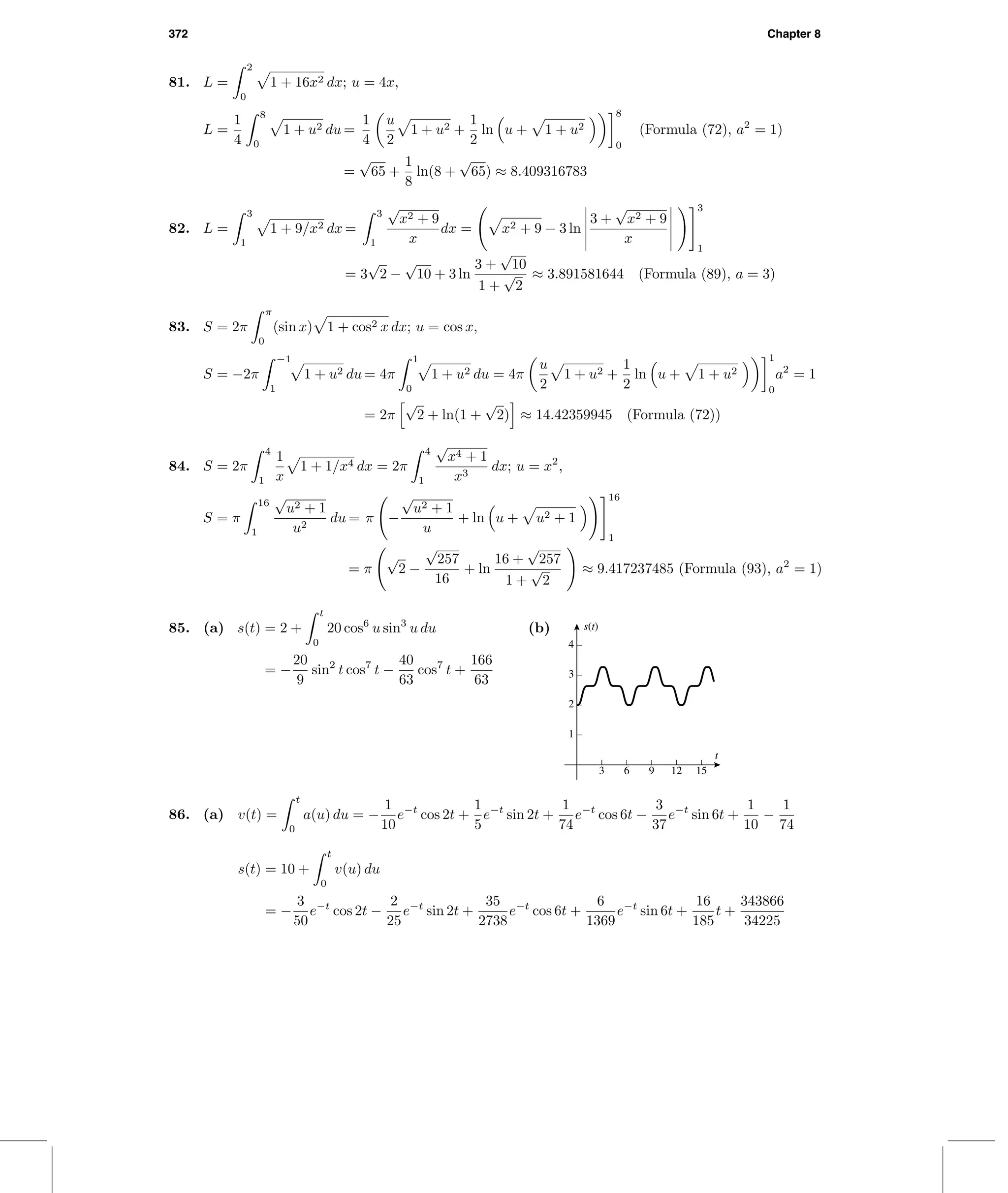
![Exercise Set 8.6 373
(b)
3 6 9 12 15
1
2
3
4
t
s(t)
87. (a) sec x dx =
1
cos x
dx =
2
1 − u2
du = ln
1 + u
1 − u
+ C = ln
1 + tan(x/2)
1 − tan(x/2)
+ C
= ln
cos(x/2) + sin(x/2)
cos(x/2) − sin(x/2)
cos(x/2) + sin(x/2)
cos(x/2) + sin(x/2)
+ C = ln
1 + sin x
cos x
+ C
= ln |sec x + tan x| + C
(b) tan
π
4
+
x
2
=
tan
π
4
+ tan
x
2
1 − tan
π
4
tan
x
2
=
1 + tan
x
2
1 − tan
x
2
88. csc x dx =
1
sin x
dx = 1/u du = ln | tan(x/2)| + C but
ln | tan(x/2)| =
1
2
ln
sin2
(x/2)
cos2(x/2)
=
1
2
ln
(1 − cos x)/2
(1 + cos x)/2
=
1
2
ln
1 − cos x
1 + cos x
; also,
1 − cos x
1 + cos x
=
1 − cos2
x
(1 + cos x)2
=
1
(csc x + cot x)2
so
1
2
ln
1 − cos x
1 + cos x
= − ln | csc x + cot x|
89. Let u = tanh(x/2) then cosh(x/2) = 1/ sech(x/2) = 1/ 1 − tanh2
(x/2) = 1/
√
1 − u2,
sinh(x/2) = tanh(x/2) cosh(x/2) = u/
√
1 − u2, so sinh x = 2 sinh(x/2) cosh(x/2) = 2u/(1 − u2
),
cosh x = cosh2
(x/2) + sinh2
(x/2) = (1 + u2
)/(1 − u2
), x = 2 tanh−1
u, dx = [2/(1 − u2
)]du;
dx
2 cosh x + sinh x
=
1
u2 + u + 1
du =
2
√
3
tan−1 2u + 1
√
3
+ C =
2
√
3
tan−1 2 tanh(x/2) + 1
√
3
+ C.
90. Let u = x4
to get
1
4
1
√
1 − u2
du =
1
4
sin−1
u + C =
1
4
sin−1
(x4
) + C.
91. (cos32
x sin30
x − cos30
x sin32
x)dx = cos30
x sin30
x(cos2
x − sin2
x)dx
=
1
230
sin30
2x cos 2x dx =
sin31
2x
31(231)
+ C
92. x − x2 − 4dx =
1
√
2
(
√
x + 2 −
√
x − 2)dx =
√
2
3
[(x + 2)3/2
− (x − 2)3/2
] + C
93.
1
x10(1 + x−9)
dx = −
1
9
1
u
du = −
1
9
ln |u| + C = −
1
9
ln |1 + x−9
| + C](https://image.slidesharecdn.com/gabaritocompletoantoncalculo8edcaps0108-130504215818-phpapp02/75/Gabarito-completo-anton_calculo_8ed_caps_01_08-373-2048.jpg)


![376 Chapter 8
19. g(X0) = aX2
0 + bX0 + c = 4a + 2b + c = f(X0) = 1/X0 = 1/2; similarly
9a + 3b + c = 1/3, 16a + 4b + c = 1/4. Three equations in three unknowns, with solution
a = 1/24, b = −3/8, c = 13/12, g(x) = x2
/24 − 3x/8 + 13/12.
4
2
g(x) dx =
4
2
x2
24
−
3x
8
+
13
12
dx =
25
36
∆x
3
[f(X0) + 4f(X1) + f(X2)] =
1
3
1
2
+
4
3
+
1
4
=
25
36
20. Suppose g(x) = ax2
+ bx + c passes through the points (0, f(0)) = (0, 0), (m, f(m)) = (1/6, 1/4),
and (1/3, f(2m)) = (1/3, 3/4). Then g(0) = c = 0, 1/4 = g(1/6) = a/36 + b/6, and
3/4 = g(1/3) = a/9 + b/3, with solution a = 9/2, b = 3/4 or g(x) = 9x2
/2 + 3x/4. Then
(∆x/3)(Y0 + 4Y1O + Y2) = (1/18)(0 + 4(1/4) + 3/4) = 7/72, and
1/3
0
g(x) dx = (3/2)x3
+ (3/8)x2
1/3
0
= 1/18 + 1/24 = 7/72
21. 0.746824948,
0.746824133
22. 1.236098366,
1.236067977
23. 1.511518747,
1.515927142
24. 2.418388347,
2.418399152
25. 0.805376152,
0.804776489
26. 1.536963087,
1.544294774
27. (a) 3.142425985, |EM | ≈ 0.000833331
(b) 3.139925989, |ET | ≈ 0.001666665
(c) 3.141592614, |ES| ≈ 0.000000040
28. (a) 3.152411433, |EM | ≈ 0.010818779
(b) 3.104518326, |ET | ≈ 0.037074328
(c) 3.127008159, |ES| ≈ 0.014584495
29. S14 = 0.693147984, |ES| ≈ 0.000000803 = 8.03 × 10⁻⁷
; the method used in Example 6 results
in a value of n which ensures that the magnitude of the error will be less than 10−6
, this is not
necessarily the smallest value of n.
30. (a) underestimates, because the graph of cos x2
is concave down on the interval (0, 1)
(b) overestimates, because the graph of cos x2
is concave up on the interval (3/2, 2)
31. f(x) = x sin x, f (x) = 2 cos x − x sin x, |f (x)| ≤ 2| cos x| + |x| | sin x| ≤ 2 + 2 = 4 so K2 ≤ 4,
n >
(8)(4)
(24)(10−4)
1/2
≈ 115.5; n = 116 (a smaller n might suffice)
32. f(x) = ecos x
, f (x) = (sin2
x)ecos x
− (cos x)ecos x
, |f (x)| ≤ ecos x
(sin2
x + | cos x|) ≤ 2e so
K2 ≤ 2e, n >
(1)(2e)
(24)(10−4)
1/2
≈ 47.6; n = 48 (a smaller n might suffice)
33. f(x) = x
√
x, f (x) =
3
4
√
x
, lim
x→0+
|f (x)| = +∞
34. f(x) = sin
√
x, f (x) = −
√
x sin
√
x + cos
√
x
4x3/2
, lim
x→0+
|f (x)| = +∞
35. L =
π/2
−π/2
1 + sin2
x dx ≈ 3.820187623 36. L =
3
1
1 + 1/x4 dx ≈ 2.146822803](https://image.slidesharecdn.com/gabaritocompletoantoncalculo8edcaps0108-130504215818-phpapp02/75/Gabarito-completo-anton_calculo_8ed_caps_01_08-376-2048.jpg)
![Exercise Set 8.7 377
37.
20
0
v dt ≈
15
(3)(6)
[0 + 4(35.2) + 2(60.1) + 4(79.2) + 2(90.9) + 4(104.1) + 114.4] ≈ 1078 ft
38. 0
0
1
0.02
2
0.08
3
0.20
4
0.40
t
a
5
0.60
6
0.70
7
0.60
8
0
8
0
a dt ≈
8
(3)(8)
[0 + 4(0.02) + 2(0.08) + 4(0.20) + 2(0.40) + 4(0.60) + 2(0.70) + 4(0.60) + 0]
≈ 2.7 cm/s
39.
180
0
v dt ≈
180
(3)(6)
[0.00 + 4(0.03) + 2(0.08) + 4(0.16) + 2(0.27) + 4(0.42) + 0.65] = 37.9 mi
40.
1800
0
(1/v)dx ≈
1800
(3)(6)
1
3100
+
4
2908
+
2
2725
+
4
2549
+
2
2379
+
4
2216
+
1
2059
≈ 0.71 s
41. V =
16
0
πr2
dy = π
16
0
r2
dy ≈ π
16
(3)(4)
[(8.5)2
+ 4(11.5)2
+ 2(13.8)2
+ 4(15.4)2
+ (16.8)2
]
≈ 9270 cm3
≈ 9.3 L
42. A =
600
0
h dx ≈
600
(3)(6)
[0 + 4(7) + 2(16) + 4(24) + 2(25) + 4(16) + 0] = 9000 ft2
,
V = 75A ≈ 75(9000) = 675, 000 ft3
43. (a) The maximum value of |f (x)| is approximately 3.8442
(b) n = 18
(c) 0.9047406684
44. (a) The maximum value of |f (x)| is approximately 1.46789
(b) n = 8
(c) 1.112830350
45. (a) The maximum value of |f(4)
(x)| is approximately 42.5518.
(b) n = 4
(c) 0.9045241594
46. (a) The maximum value of |f(4)
(x)| is approximately 7.02267.
(b) n = 4
(c) 1.111442702
47. (a) Left endpoint approximation ≈
b − a
n
[y0 + y1 + . . . + yn−2 + yn−1]
Right endpoint approximation ≈
b − a
n
[y1 + y2 + . . . + yn−1 + yn]
Average of the two =
b − a
n
1
2
[y0 + 2y1 + 2y2 + . . . + 2yn−2 + 2yn−1 + yn]](https://image.slidesharecdn.com/gabaritocompletoantoncalculo8edcaps0108-130504215818-phpapp02/75/Gabarito-completo-anton_calculo_8ed_caps_01_08-377-2048.jpg)
![378 Chapter 8
(b) Area of trapezoid = (xk+1 − xk)
yk + yk+1
2
. If we sum from k = 0
to k = n − 1 then we get the right hand side of (2).
y
x
1
x xk
yk
k+1
yk+1
2
3
48. right endpoint, trapezoidal, midpoint, left endpoint
49. Given g(x) = Ax2
+ Bx + C, suppose ∆x = 1 and m = 0. Then set Y0 = g(−1), Y1 = g(0),
Y2 = g(1). Also Y0 = g(−1) = A − B + C, Y1 = g(0) = C, Y2 = g(1) = A + B + C, with solution
C = Y1, B = 1
2 (Y2 − Y0), and A = 1
2 (Y0 + Y2) − Y1.
Then
1
−1
g(x) dx = 2
1
0
(Ax2
+ C) dx =
2
3
A + 2C =
1
3
(Y0 + Y2) −
2
3
Y1 + 2Y1 =
1
3
(Y0 + 4Y1 + Y2),
which is exactly what one gets applying the Simpson’s Rule.
The general case with the interval (m − ∆x, m + ∆x) and values Y0, Y1, Y2, can be converted by
the change of variables z =
x − m
∆x
. Set g(x) = h(z) = h((x − m)/∆x) to get dx = ∆x dz and
∆x
m+∆x
m−∆x
h(z) dz =
1
−1
g(x) dx. Finally, Y0 = g(m − ∆x) = h(−1),
Y1 = g(m) = h(0), Y2 = g(m + ∆x) = h(1).
50. From Exercise 49 we know, for i = 0, 1, . . . , n − 1 that
x2i+2
x2i
gi(x) dx =
1
3
b − a
2n
[y2i + 4y2i+1 + y2i+2],
because
b − a
2n
is the width of the partition and acts as ∆x in Exercise 49.
Summing over all the subintervals note that y0 and y2n are only listed once; so
b
a
f(x) dx =
n−1
i=0
x2i+2
x2i
gi(x) dx
=
1
3
b − a
2n
[y0 + 4y1 + 2y2 + 4y3 + . . . + 4y2n−2 + 2y2n−1 + y2n]
EXERCISE SET 8.8
1. (a) improper; infinite discontinuity at x = 3
(b) continuous integrand, not improper
(c) improper; infinite discontinuity at x = 0
(d) improper; infinite interval of integration
(e) improper; infinite interval of integration and infinite discontinuity at x = 1
(f) continuous integrand, not improper
2. (a) improper if p > 0 (b) improper if 1 ≤ p ≤ 2
(c) integrand is continuous for all p, not improper](https://image.slidesharecdn.com/gabaritocompletoantoncalculo8edcaps0108-130504215818-phpapp02/75/Gabarito-completo-anton_calculo_8ed_caps_01_08-378-2048.jpg)
![Exercise Set 8.8 379
3. lim
→+∞
−
1
2
e−2x
0
=
1
2
lim
→+∞
(−e−2
+ 1) =
1
2
4. lim
→+∞
1
2
ln(1 + x2
)
−1
= lim
→+∞
1
2
[ln(1 + 2
) − ln 2] = +∞, divergent
5. lim
→+∞
−2 coth−1
x
3
= lim
→+∞
2 coth−1
3 − 2 coth−1
= 2 coth−1
3
6. lim
→+∞
−
1
2
e−x2
0
= lim
→+∞
1
2
−e− 2
+ 1 = 1/2
7. lim
→+∞
−
1
2 ln2
x e
= lim
→+∞
−
1
2 ln2 +
1
2
=
1
2
8. lim
→+∞
2
√
ln x
2
= lim
→+∞
(2
√
ln − 2
√
ln 2) = +∞, divergent
9. lim
→−∞
−
1
4(2x − 1)2
0
= lim
→−∞
1
4
[−1 + 1/(2 − 1)2
] = −1/4
10. lim
→−∞
1
3
tan−1 x
3
3
= lim
→−∞
1
3
π
4
− tan−1
3
=
1
3
[π/4 − (−π/2)] = π/4
11. lim
→−∞
1
3
e3x
0
= lim
→−∞
1
3
−
1
3
e3
=
1
3
12. lim
→−∞
−
1
2
ln(3 − 2ex
)
0
= lim
→−∞
1
2
ln(3 − 2e ) =
1
2
ln 3
13.
+∞
−∞
x dx converges if
0
−∞
x dx and
+∞
0
x dx both converge; it diverges if either (or both)
diverges.
+∞
0
x dx = lim
→+∞
1
2
x2
0
= lim
→+∞
1
2
2
= +∞ so
+∞
−∞
x dx is divergent.
14.
+∞
0
x
√
x2 + 2
dx = lim
→+∞
x2 + 2
0
= lim
→+∞
( 2 + 2 −
√
2) = +∞
so
∞
−∞
x
√
x2 + 2
dx is divergent.
15.
+∞
0
x
(x2 + 3)2
dx = lim
→+∞
−
1
2(x2 + 3) 0
= lim
→+∞
1
2
[−1/( 2
+ 3) + 1/3] =
1
6
,
similarly
0
−∞
x
(x2 + 3)2
dx = −1/6 so
∞
−∞
x
(x2 + 3)2
dx = 1/6 + (−1/6) = 0](https://image.slidesharecdn.com/gabaritocompletoantoncalculo8edcaps0108-130504215818-phpapp02/75/Gabarito-completo-anton_calculo_8ed_caps_01_08-379-2048.jpg)
![380 Chapter 8
16.
+∞
0
e−t
1 + e−2t
dt = lim
→+∞
− tan−1
(e−t
)
0
= lim
→+∞
− tan−1
(e−
) +
π
4
=
π
4
,
0
−∞
e−t
1 + e−2t
dt = lim
→−∞
− tan−1
(e−t
)
0
= lim
→−∞
−
π
4
+ tan−1
(e−
) =
π
4
,
+∞
−∞
e−t
1 + e−2t
dt =
π
4
+
π
4
=
π
2
17. lim
→4−
−
1
x − 4 0
= lim
→4−
−
1
− 4
−
1
4
= +∞, divergent
18. lim
→0+
3
2
x2/3
8
= lim
→0+
3
2
(4 − 2/3
) = 6
19. lim
→π/2−
− ln(cos x)
0
= lim
→π/2−
− ln(cos ) = +∞, divergent
20. lim
→4−
−2
√
4 − x
0
= lim
→4−
2(−
√
4 − + 2) = 4
21. lim
→1−
sin−1
x
0
= lim
→1−
sin−1
= π/2
22. lim
→−3+
− 9 − x2
1
= lim
→−3+
(−
√
8 + 9 − 2) = −
√
8
23. lim
→π/3+
√
1 − 2 cos x
π/2
= lim
→π/3+
(1 −
√
1 − 2 cos ) = 1
24. lim
→π/4−
− ln(1 − tan x)
0
= lim
→π/4−
− ln(1 − tan ) = +∞, divergent
25.
2
0
dx
x − 2
= lim
→2−
ln |x − 2|
0
= lim
→2−
(ln | − 2| − ln 2) = −∞, divergent
26.
2
0
dx
x2
= lim
→0+
−1/x
2
= lim
→0+
(−1/2 + 1/ ) = +∞ so
2
−2
dx
x2
is divergent
27.
8
0
x−1/3
dx = lim
→0+
3
2
x2/3
8
= lim
→0+
3
2
(4 − 2/3
) = 6,
0
−1
x−1/3
dx = lim
→0−
3
2
x2/3
−1
= lim
→0−
3
2
( 2/3
− 1) = −3/2
so
8
−1
x−1/3
dx = 6 + (−3/2) = 9/2
28.
1
0
dx
(x − 1)2/3
= lim
→1−
3(x − 1)1/3
0
= lim
→1−
3[( − 1)1/3
− (−1)1/3
] = 3](https://image.slidesharecdn.com/gabaritocompletoantoncalculo8edcaps0108-130504215818-phpapp02/75/Gabarito-completo-anton_calculo_8ed_caps_01_08-380-2048.jpg)


![384 Chapter 8
57. (a) L{f(t)} =
+∞
0
te−st
dt = lim
→+∞
−(t/s + 1/s2
)e−st
0
=
1
s2
(b) L{f(t)} =
+∞
0
t2
e−st
dt = lim
→+∞
−(t2
/s + 2t/s2
+ 2/s3
)e−st
0
=
2
s3
(c) L{f(t)} =
+∞
3
e−st
dt = lim
→+∞
−
1
s
e−st
3
=
e−3s
s
58. 10 100 1000 10,000
0.8862269 0.8862269 0.8862269 0.8862269
59. (a) u =
√
ax, du =
√
a dx, 2
+∞
0
e−ax2
dx =
2
√
a
+∞
0
e−u2
du = π/a
(b) x =
√
2σu, dx =
√
2σ du,
2
√
2πσ
+∞
0
e−x2
/2σ2
dx =
2
√
π
+∞
0
e−u2
du = 1
60. (a)
3
0
e−x2
dx ≈ 0.8862;
√
π/2 ≈ 0.8862
(b)
+∞
0
e−x2
dx =
3
0
e−x2
dx +
+∞
3
e−x2
dx so E =
+∞
3
e−x2
dx <
+∞
3
xe−x2
dx =
1
2
e−9
< 7 × 10⁻⁵
61. (a)
4
0
1
x6 + 1
dx ≈ 1.047; π/3 ≈ 1.047
(b)
+∞
0
1
x6 + 1
dx =
4
0
1
x6 + 1
dx +
+∞
4
1
x6 + 1
dx so
E =
+∞
4
1
x6 + 1
dx <
+∞
4
1
x6
dx =
1
5(4)5
< 2 × 10⁻⁴
62. If p = 0, then
+∞
0
(1)dx = lim
→+∞
x
0
= +∞,
if p = 0, then
+∞
0
epx
dx = lim
→+∞
1
p
epx
0
= lim
→+∞
1
p
(ep
− 1) =
−1/p, p < 0
+∞, p > 0
.
63. If p = 1, then
1
0
dx
x
= lim
→0+
ln x
1
= +∞;
if p = 1, then
1
0
dx
xp
= lim
→0+
x1−p
1 − p
1
= lim
→0+
[(1 − 1−p
)/(1 − p)] =
1/(1 − p), p < 1
+∞, p > 1
.
64. u =
√
1 − x, u2
= 1 − x, 2u du = −dx;
−2
0
1
2 − u2 du = 2
1
0
2 − u2 du = u 2 − u2 + 2 sin−1
(u/
√
2)
1
0
=
√
2 + π/2
65. 2
1
0
cos(u2
)du ≈ 1.809
66. −2
0
1
sin(1 − u2
)du = 2
1
0
sin(1 − u2
)du ≈ 1.187](https://image.slidesharecdn.com/gabaritocompletoantoncalculo8edcaps0108-130504215818-phpapp02/75/Gabarito-completo-anton_calculo_8ed_caps_01_08-384-2048.jpg)
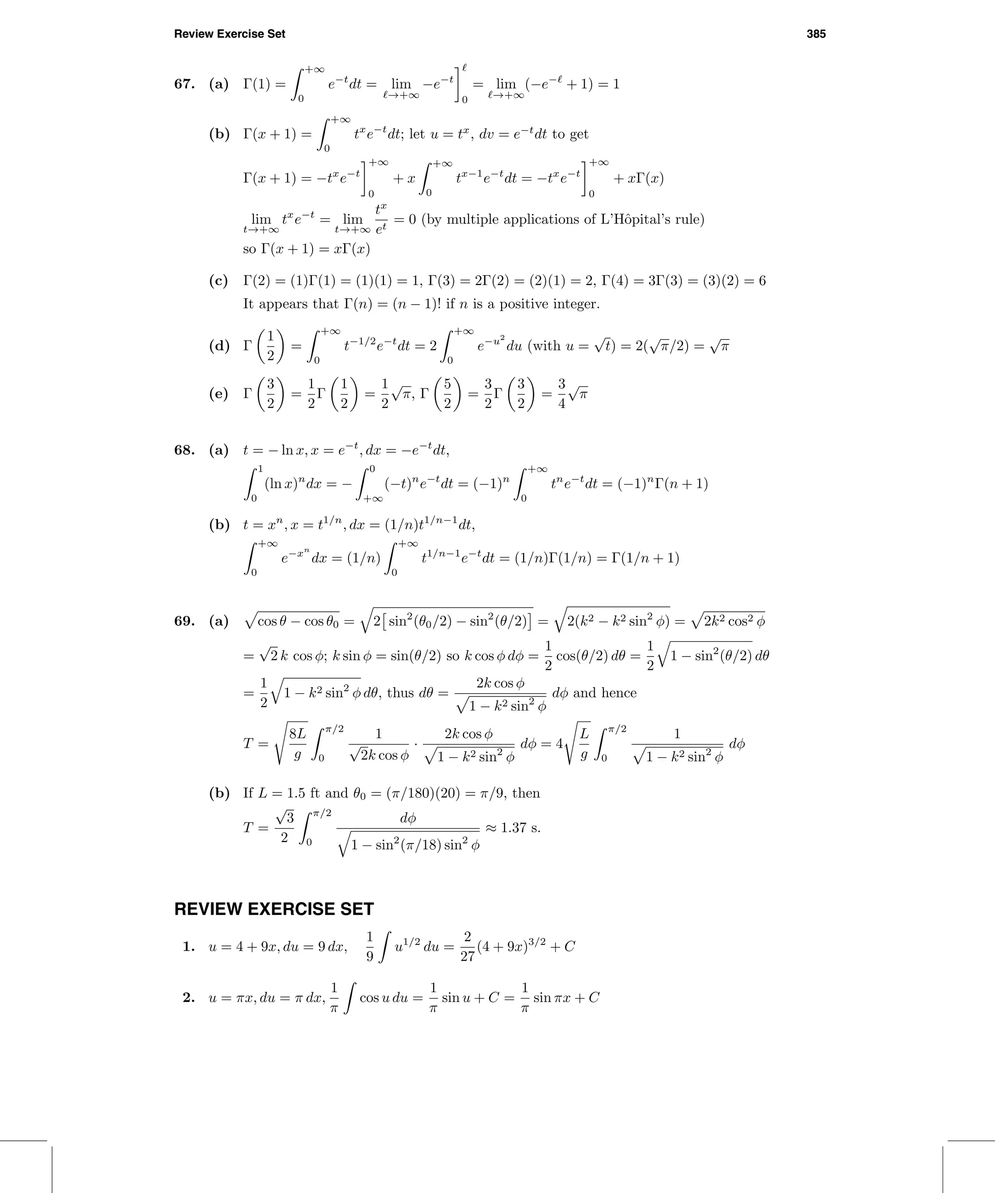
![386 Chapter 8
3. u = cos θ, − u1/2
du = −
2
3
cos3/2
θ + C
4. u = ln x, du =
dx
x
,
du
u
= ln |u| + C = ln |ln x| + C
5. u = tan(x2
),
1
2
u2
du =
1
6
tan3
(x2
) + C
6. u =
√
x, x = u2
, dx = 2u du,
2
3
0
u2
u2 + 9
du = 2
3
0
1 −
9
u2 + 9
du = 2u − 6 tan−1 u
3
3
0
= 6 −
3
2
π
7. (a) With u =
√
x:
1
√
x
√
2 − x
dx = 2
1
√
2 − u2
du = 2 sin−1
(u/
√
2) + C = 2 sin−1
( x/2) + C;
with u =
√
2 − x :
1
√
x
√
2 − x
dx = −2
1
√
2 − u2
du = −2 sin−1
(u/
√
2) + C = −2 sin−1
(
√
2 − x/
√
2) + C1;
completing the square:
1
1 − (x − 1)2
dx = sin−1
(x − 1) + C.
(b) In the three results in Part (a) the antiderivatives differ by a constant, in particular
2 sin−1
( x/2) = π − 2 sin−1
(
√
2 − x/
√
2) = π/2 + sin−1
(x − 1).
8. (a) u = x2
, dv =
x
√
x2 + 1
dx, du = 2x dx, v =
√
x2 + 1;
1
0
x3
√
x2 + 1
dx = x2
x2 + 1
1
0
− 2
1
0
x(x2
+ 1)1/2
dx
=
√
2 −
2
3
(x2
+ 1)3/2
1
0
=
√
2 −
2
3
[2
√
2 − 1] = (2 −
√
2)/3
(b) u2
= x2
+ 1, x2
= u2
− 1, 2x dx = 2u du, x dx = u du;
1
0
x3
√
x2 + 1
dx =
1
0
x2
√
x2 + 1
x dx =
√
2
1
u2
− 1
u
u du
=
√
2
1
(u2
− 1)du =
1
3
u3
− u
√
2
1
= (2 −
√
2)/3
9. u = x, dv = e−x
dx, du = dx, v = −e−x
;
xe−x
dx = −xe−x
+ e−x
dx = −xe−x
− e−x
+ C
10. u = x, dv = sin 2x dx, du = dx, v = −
1
2
cos 2x;
x sin 2x dx = −
1
2
x cos 2x +
1
2
cos 2x dx = −
1
2
x cos 2x +
1
4
sin 2x + C](https://image.slidesharecdn.com/gabaritocompletoantoncalculo8edcaps0108-130504215818-phpapp02/75/Gabarito-completo-anton_calculo_8ed_caps_01_08-386-2048.jpg)
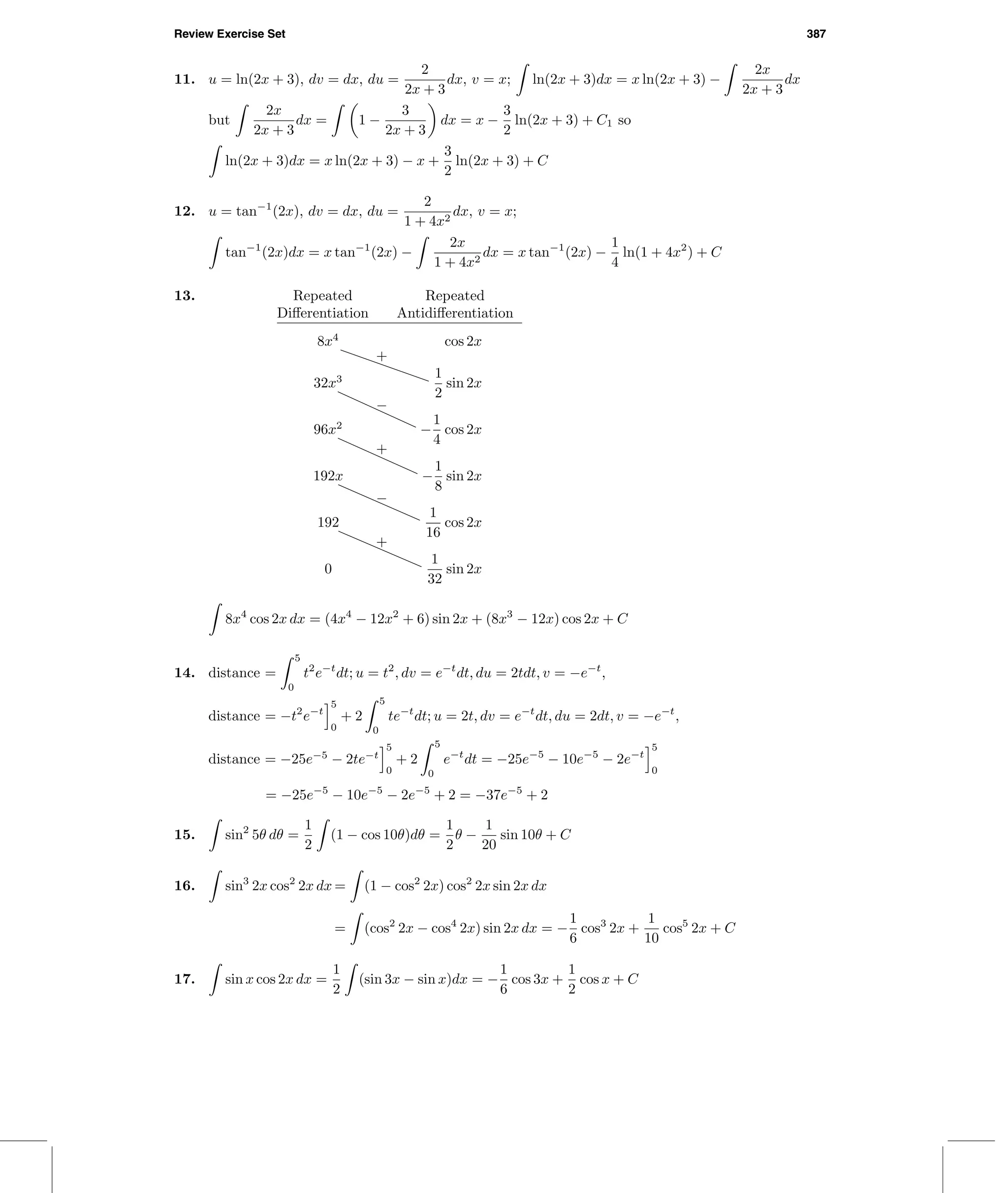
![388 Chapter 8
18.
π/6
0
sin 2x cos 4x dx =
1
2
π/6
0
(sin 6x − sin 2x)dx = −
1
12
cos 6x +
1
4
cos 2x
π/6
0
= [(−1/12)(−1) + (1/4)(1/2)] − [−1/12 + 1/4] = 1/24
19. u = 2x,
sin4
2x dx =
1
2
sin4
u du =
1
2
−
1
4
sin3
u cos u +
3
4
sin2
u du
= −
1
8
sin3
u cos u +
3
8
−
1
2
sin u cos u +
1
2
du
= −
1
8
sin3
u cos u −
3
16
sin u cos u +
3
16
u + C
= −
1
8
sin3
2x cos 2x −
3
16
sin 2x cos 2x +
3
8
x + C
20. u = x2
,
x cos5
(x2
)dx =
1
2
cos5
u du =
1
2
(cos u)(1 − sin2
u)2
du
=
1
2
cos u du − cos u sin2
u du +
1
2
cos u sin4
u du
=
1
2
sin u −
1
3
sin3
u +
1
10
sin5
u + C
=
1
2
sin(x2
) −
1
3
sin3
(x2
) +
1
10
sin5
(x2
) + C
21. x = 3 sin θ, dx = 3 cos θ dθ,
9 sin2
θ dθ =
9
2
(1 − cos 2θ)dθ =
9
2
θ −
9
4
sin 2θ + C =
9
2
θ −
9
2
sin θ cos θ + C
=
9
2
sin−1
(x/3) −
1
2
x 9 − x2 + C
22. x = 4 sin θ, dx = 4 cos θ dθ,
1
16
1
sin2
θ
dθ =
1
16
csc2
θ dθ = −
1
16
cot θ + C = −
√
16 − x2
16x
+ C
23. x = sec θ, dx = sec θ tan θ dθ, sec θ dθ = ln | sec θ + tan θ| + C = ln x + x2 − 1 + C
24. x = 5 sec θ, dx = 5 sec θ tan θ dθ,
25 sec3
θ dθ =
25
2
sec θ tan θ +
25
2
ln | sec θ + tan θ| + C1
=
1
2
x x2 − 25 +
25
2
ln |x + x2 − 25| + C](https://image.slidesharecdn.com/gabaritocompletoantoncalculo8edcaps0108-130504215818-phpapp02/75/Gabarito-completo-anton_calculo_8ed_caps_01_08-388-2048.jpg)


![Review Exercise Set 391
46. (a) n >
(8)(8)
(24)(10−6)
1/2
≈ 1632.99; n = 1633 (b) n >
(8)(8)
(12)(10−6)
1/2
≈ 2309.4; n = 2310
(c) n >
(32)(384)
(180)(10−6)
1/4
≈ 90.9; n = 92
47. lim
→+∞
(−e−x
)
0
= lim
→+∞
(−e−
+ 1) = 1
48. lim
→−∞
1
2
tan−1 x
2
2
= lim
→−∞
1
2
π
4
− tan−1
2
=
1
2
[π/4 − (−π/2)] = 3π/8
49. lim
→9−
−2
√
9 − x
0
= lim
→9−
2(−
√
9 − + 3) = 6
50.
1
0
1
2x − 1
dx =
1/2
0
1
2x − 1
dx +
1
1/2
1
2x − 1
dx = lim
→1/2−
1
2
ln(2x − 1) + lim
→1/2+
1
2
ln(2x − 1) + C
neither limit exists hence the integral diverges
51. A =
+∞
e
ln x − 1
x2
dx = lim
→+∞
c −
ln x
x e
= 1/e
52. V = 2π
+∞
0
xe−x
dx = 2π lim
→+∞
−e−x
(x + 1)
0
= 2π lim
→+∞
1 − e−
( + 1)
but lim
→+∞
e−
( + 1) = lim
→+∞
+ 1
e
= lim
→+∞
1
e
= 0 so V = 2π
53.
+∞
0
dx
x2 + a2
= lim
→+∞
1
a
tan−1
(x/a)
0
= lim
→+∞
1
a
tan−1
( /a) =
π
2a
= 1, a = π/2
54. (a) integration by parts, u = x, dv = sin x dx (b) u-substitution: u = sin x
(c) reduction formula (d) u-substitution: u = tan x
(e) u-substitution: u = x3
+ 1 (f) u-substitution: u = x + 1
(g) integration by parts: dv = dx, u = tan−1
x (h) trigonometric substitution: x = 2 sin θ
(i) u-substitution: u = 4 − x2
55. x =
√
3 tan θ, dx =
√
3 sec2
θ dθ,
1
3
1
sec θ
dθ =
1
3
cos θ dθ =
1
3
sin θ + C =
x
3
√
3 + x2
+ C
56. u = x, dv = cos 3x dx, du = dx, v =
1
3
sin 3x;
x cos 3x dx =
1
3
x sin 3x −
1
3
sin 3x dx =
1
3
x sin 3x +
1
9
cos 3x + C
57. Use Endpaper Formula (31) to get tan7
θ dθ =
1
6
tan6
θ −
1
4
tan4
θ +
1
2
tan2
θ + ln | cos θ| + C.
58.
cos θ
(sin θ − 3)2 + 3
dθ, let u = sin θ − 3,
1
u2 + 3
du =
1
√
3
f tan−1
[(sin θ − 3)/
√
3] + C](https://image.slidesharecdn.com/gabaritocompletoantoncalculo8edcaps0108-130504215818-phpapp02/75/Gabarito-completo-anton_calculo_8ed_caps_01_08-391-2048.jpg)
![392 Chapter 8
59. sin2
2t cos3
2t dt = sin2
2t(1 − sin2
2t) cos 2t dt = (sin2
2t − sin4
2t) cos 2t dt
=
1
6
sin3
2t −
1
10
sin5
2t + C
60.
3
0
1
(x − 3)2
dx = lim
→3−
0
1
(x − 3)2
dx = lim
→3−
−
1
x − 3 0
which is clearly divergent,
so the integral diverges.
61. u = e2x
, dv = cos 3x dx, du = 2e2x
dx, v =
1
3
sin 3x;
e2x
cos 3x dx =
1
3
e2x
sin 3x −
2
3
e2x
sin 3x dx. Use u = e2x
, dv = sin 3x dx to get
e2x
sin 3x dx = −
1
3
e2x
cos 3x +
2
3
e2x
cos 3x dx so
e2x
cos 3x dx =
1
3
e2x
sin 3x +
2
9
e2x
cos 3x −
4
9
e2x
cos 3x dx,
13
9
e2x
cos 3x dx =
1
9
e2x
(3 sin 3x+2 cos 3x)+C1, e2x
cos 3x dx =
1
13
e2x
(3 sin 3x+2 cos 3x)+C
62. x = (1/
√
2) sin θ, dx = (1/
√
2) cos θ dθ,
1
√
2
π/2
−π/2
cos4
θ dθ =
1
√
2
1
4
cos3
θ sin θ
π/2
−π/2
+
3
4
π/2
−π/2
cos2
θ dθ
=
3
4
√
2
1
2
cos θ sin θ
π/2
−π/2
+
1
2
π/2
−π/2
dθ =
3
4
√
2
1
2
π =
3π
8
√
2
63.
1
(x − 1)(x + 2)(x − 3)
=
A
x − 1
+
B
x + 2
+
C
x − 3
; A = −
1
6
, B =
1
15
, C =
1
10
so
−
1
6
1
x − 1
dx +
1
15
1
x + 2
dx +
1
10
1
x − 3
dx
= −
1
6
ln |x − 1| +
1
15
ln |x + 2| +
1
10
ln |x − 3| + C
64. x =
2
3
sin θ, dx =
2
3
cos θ dθ,
1
24
π/6
0
1
cos3 θ
dθ =
1
24
π/6
0
sec3
θ dθ =
1
48
sec θ tan θ +
1
48
ln | sec θ + tan θ|
π/6
0
=
1
48
[(2/
√
3)(1/
√
3) + ln |2/
√
3 + 1/
√
3|] =
1
48
2
3
+
1
2
ln 3
65. u =
√
x − 4, x = u2
+ 4, dx = 2u du,
2
0
2u2
u2 + 4
du = 2
2
0
1 −
4
u2 + 4
du = 2u − 4 tan−1
(u/2)
2
0
= 4 − π](https://image.slidesharecdn.com/gabaritocompletoantoncalculo8edcaps0108-130504215818-phpapp02/75/Gabarito-completo-anton_calculo_8ed_caps_01_08-392-2048.jpg)


