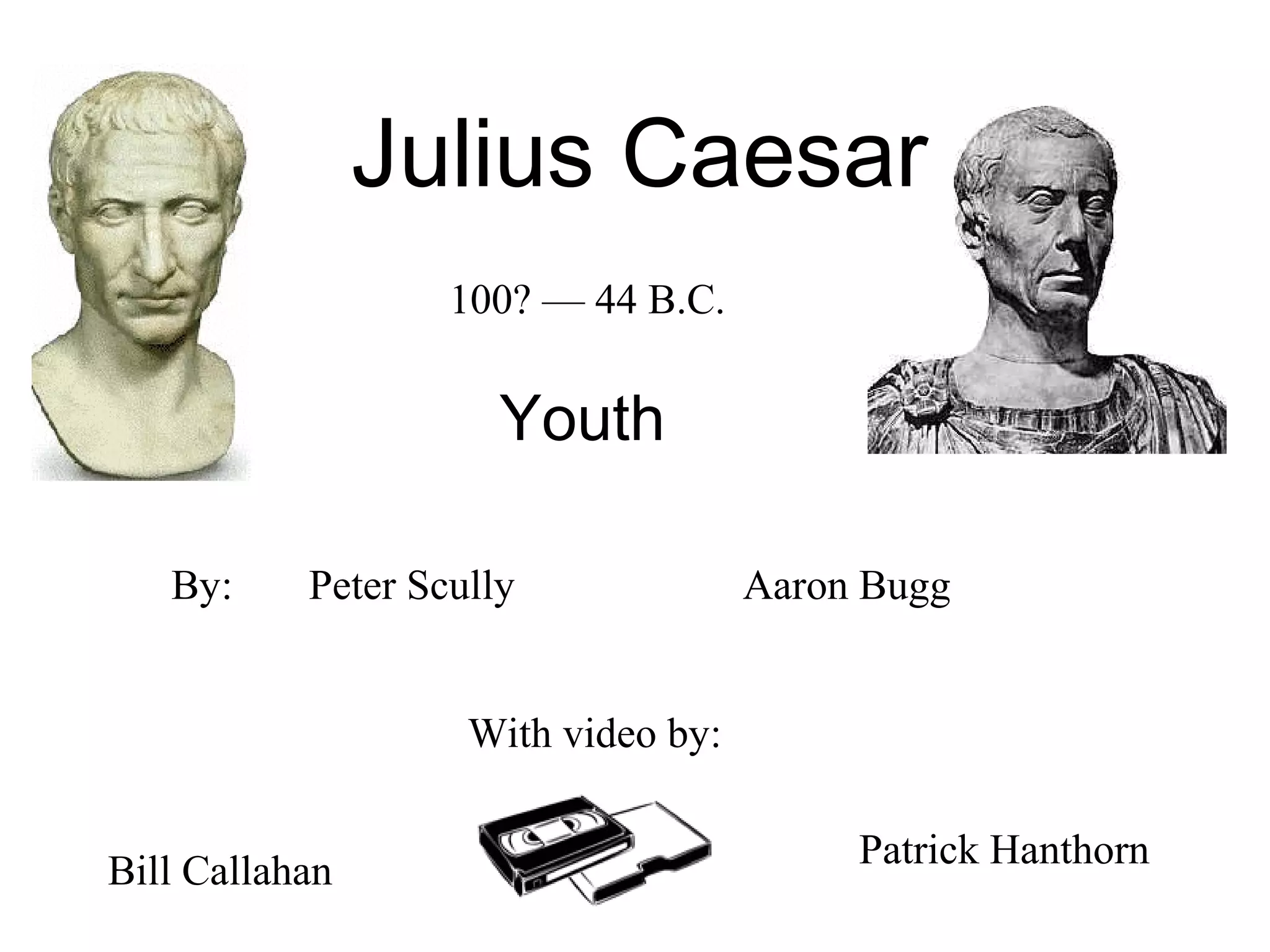
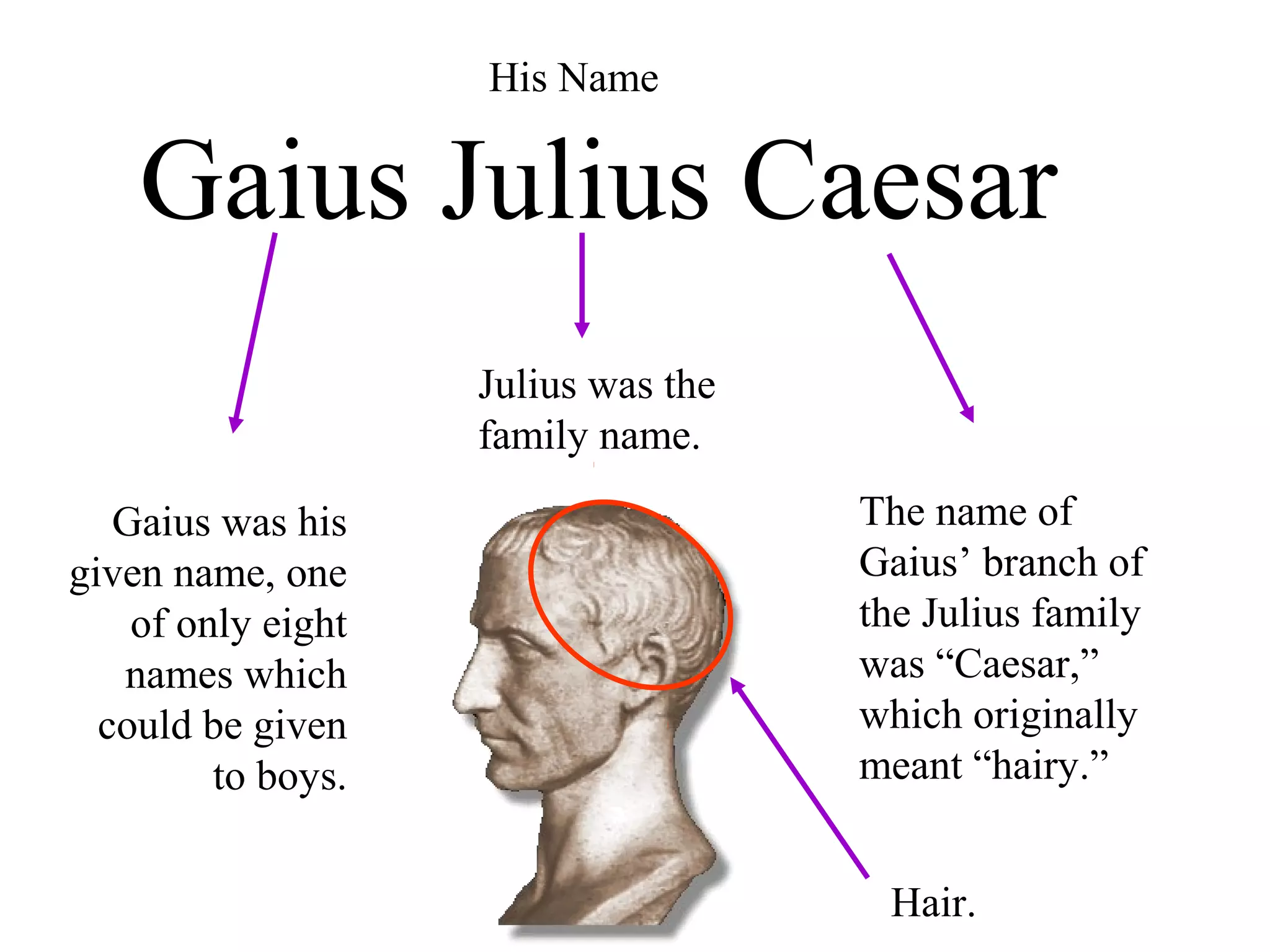


Julius Caesar
Youth
Peter Scully
With video by:
Aaron Bugg
Bill Callahan
Patrick Hanthorn
By:
100? — 44 B.C.
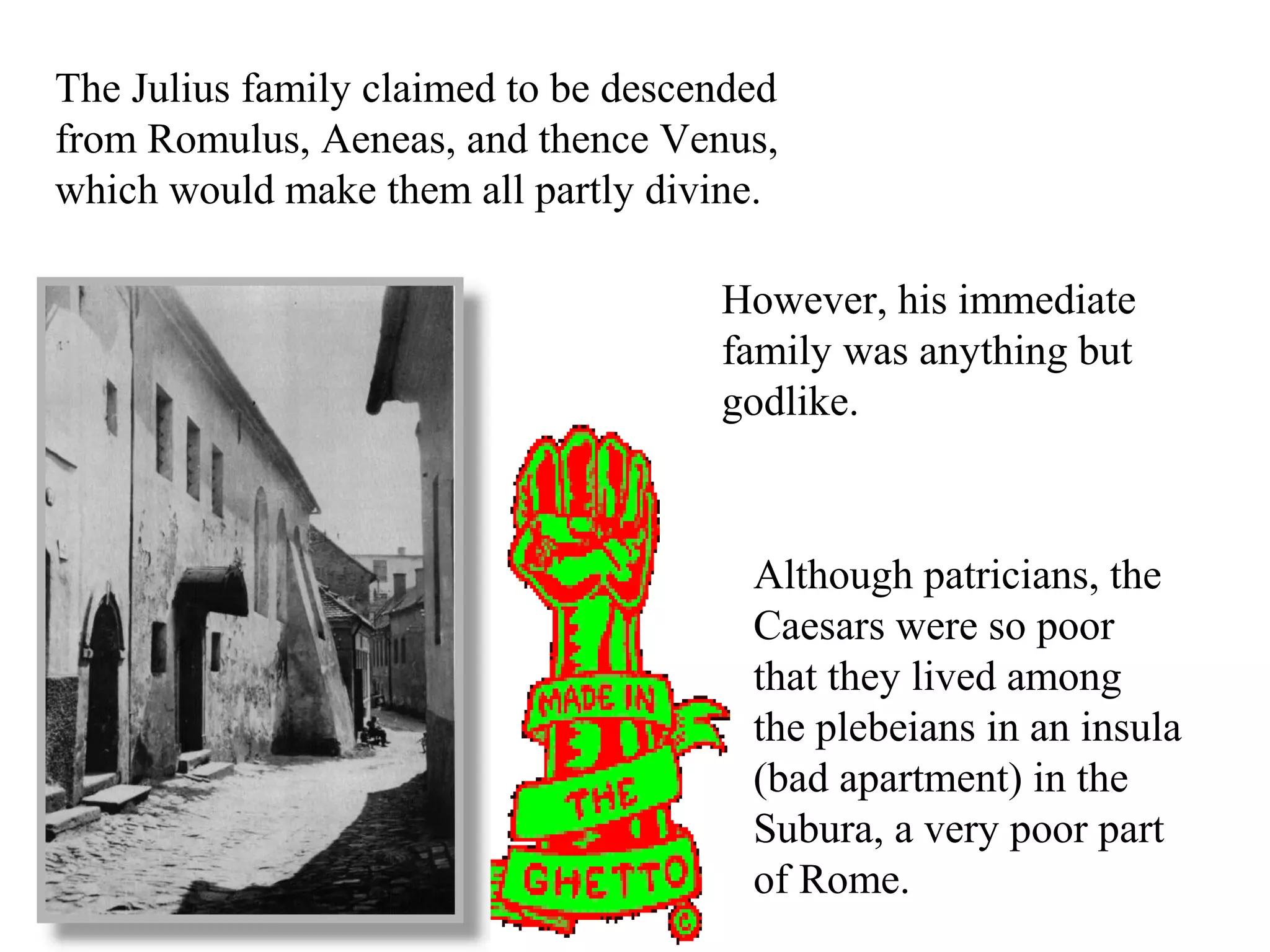
Gaius was his
given name, one
of only eight
names which
could be given
to boys.
Julius was the
family name.
The name of
Gaius’ branch of
the Julius family
was “Caesar,”
which originally
meant “hairy.”
Gaius Julius Caesar
His Name
Hair.
The Julius family claimed to be descended
from Romulus, Aeneas, and thence Venus,
which would make them all partly divine.
However, his immediate
family was anything but
godlike.
Although patricians, the
Caesars were so poor
that they lived among
the plebeians in an insula
(bad apartment) in the
Subura, a very poor part
of Rome.
For all of his political
ties, there had been no
consul in Caesar’s
immediate family for
years.
The Caesars had a
good name among
the upper class,
but that was all.
Young Caesar would
have associated with
both plebeians and
patricians.
Thus he would have been
ambitious, but would have
realized that one needs both the
senate and the people to
become truly powerful.
Apart from this, Caesar
had a healthy family life.
Historians say that he had
a very good mother,
Aurelia, whom he loved
very much.
His father was
something of a
nobody, though he
did serve as praetor,
and he died when
Caesar was 15.
It is likely that Caesar
was beaten as a child,
but this was not
uncommon, as strict
obedience was extremely
important to the Roman
family at the time.
He did have some very
prominent relatives,
however.
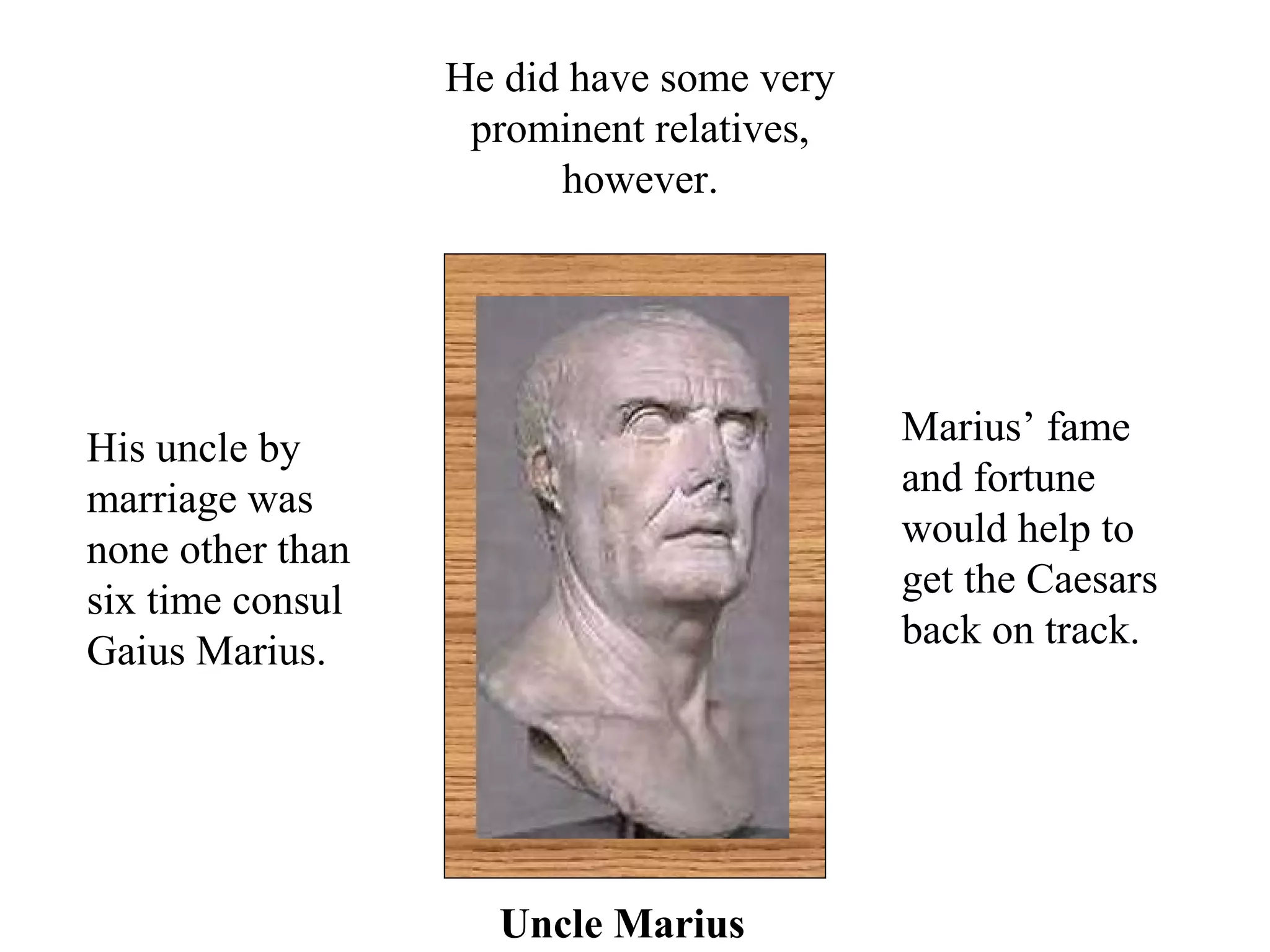
His uncle by
marriage was
none other than
six time consul
Gaius Marius.
Marius’ fame
and fortune
would help to
get the Caesars
back on track.
Uncle Marius
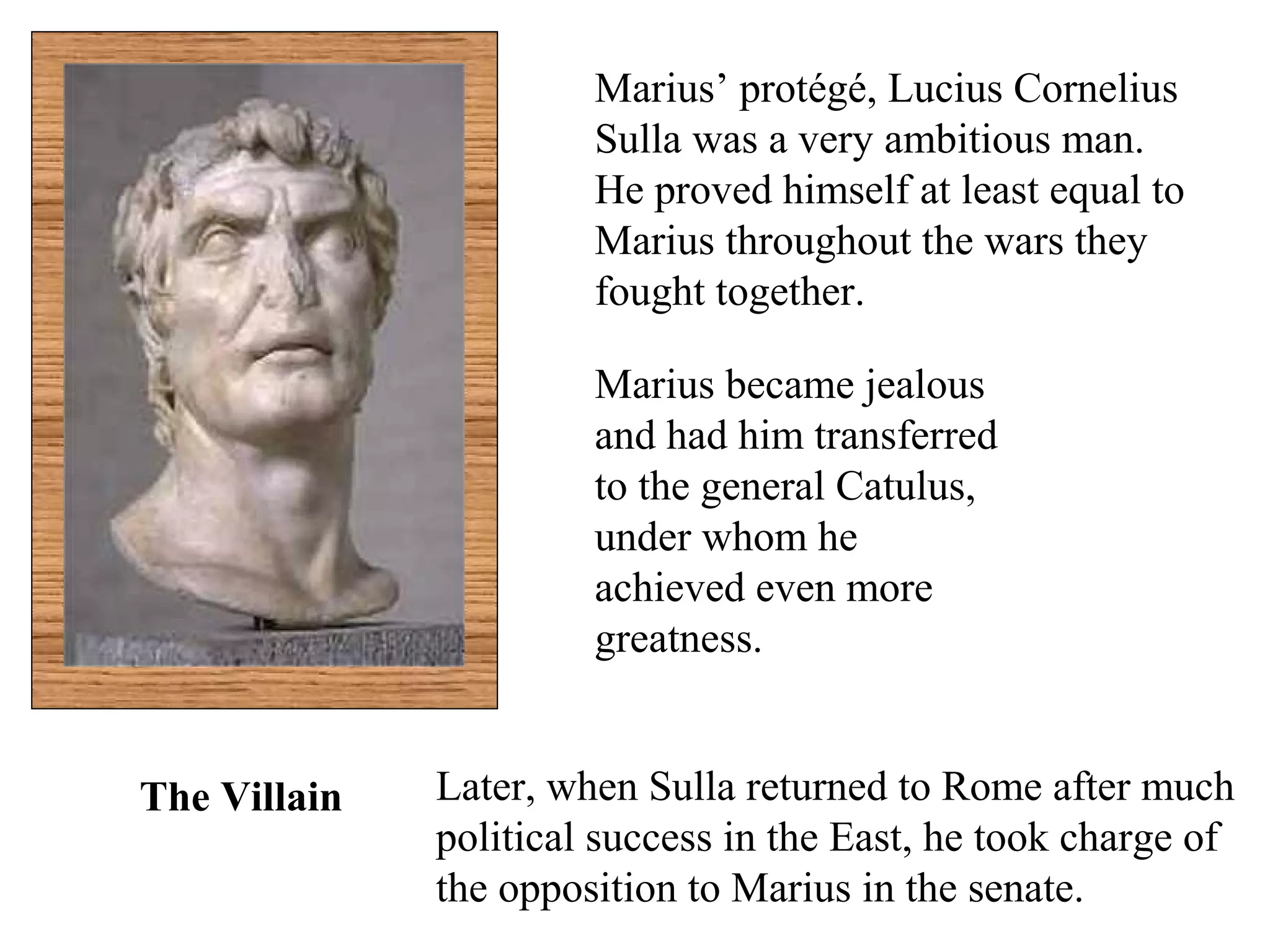
Marius’ protégé, Lucius Cornelius
Sulla was a very ambitious man.
He proved himself at least equal to
Marius throughout the wars they
fought together.
Marius became jealous
and had him transferred
to the general Catulus,
under whom he
achieved even more
greatness.
Later, when Sulla returned to Rome after much
political success in the East, he took charge of
the opposition to Marius in the senate.
The Villain
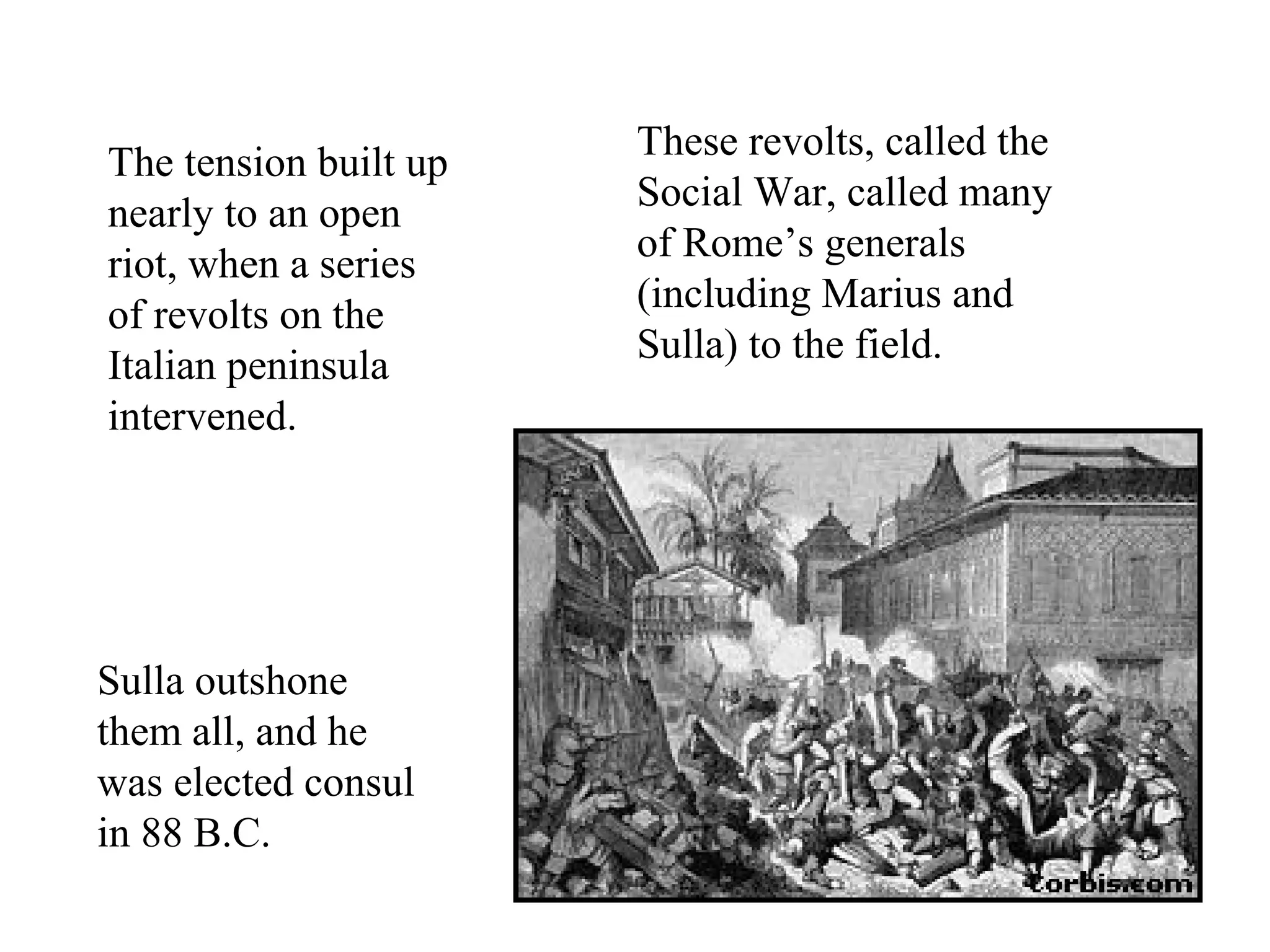
The tension built up
nearly to an open
riot, when a series
of revolts on the
Italian peninsula
intervened.
These revolts, called the
Social War, called many
of Rome’s generals
(including Marius and
Sulla) to the field.
Sulla outshone
them all, and he
was elected consul
in 88 B.C.
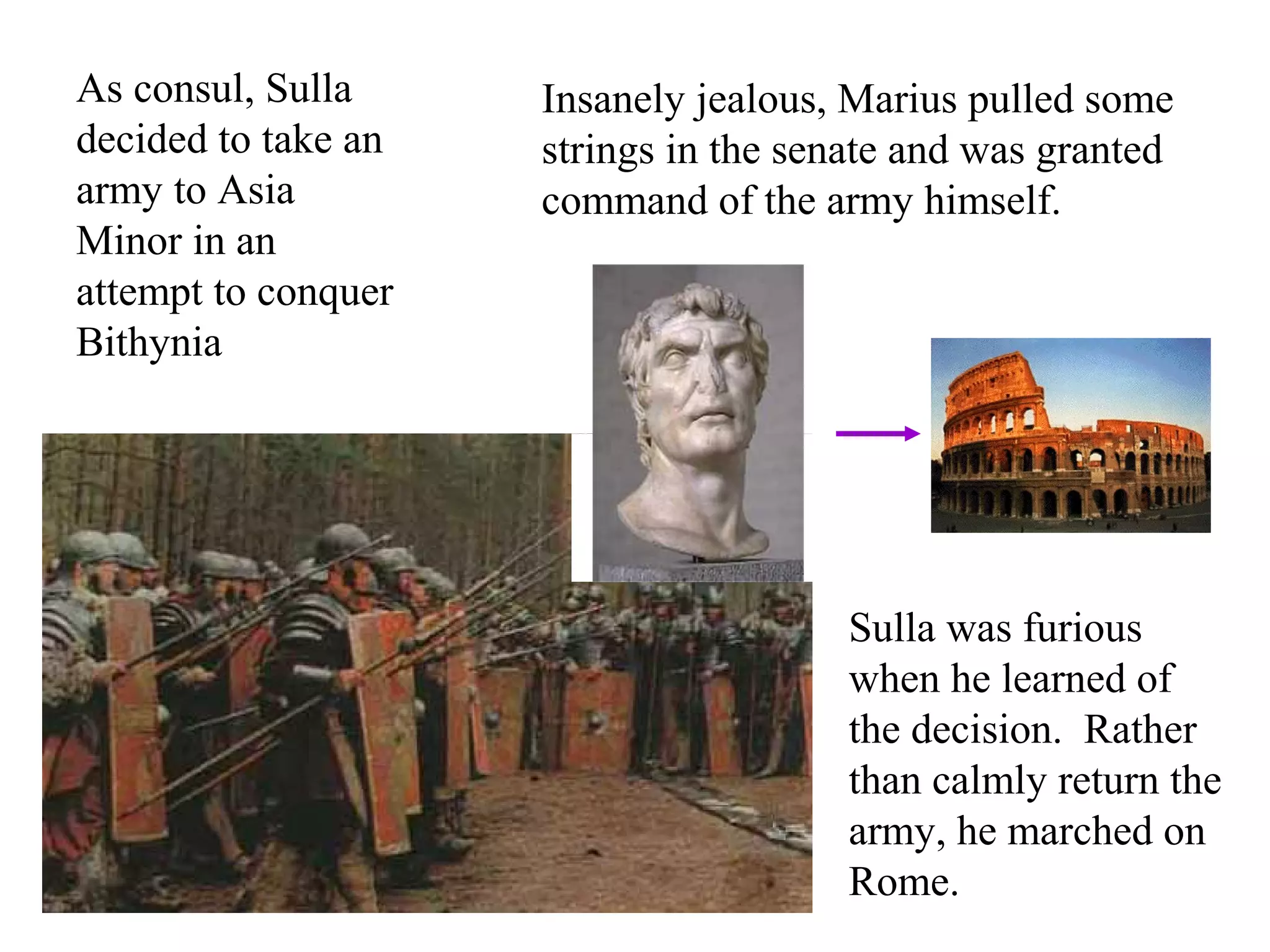
As consul, Sulla
decided to take an
army to Asia
Minor in an
attempt to conquer
Bithynia
Insanely jealous, Marius pulled some
strings in the senate and was granted
command of the army himself.
Sulla was furious
when he learned of
the decision. Rather
than calmly return the
army, he marched on
Rome.
In 87 B.C., Marius and his ally
Cinna captured Rome and
massacred many of Sulla’s
supporters. Sulla went into exile.
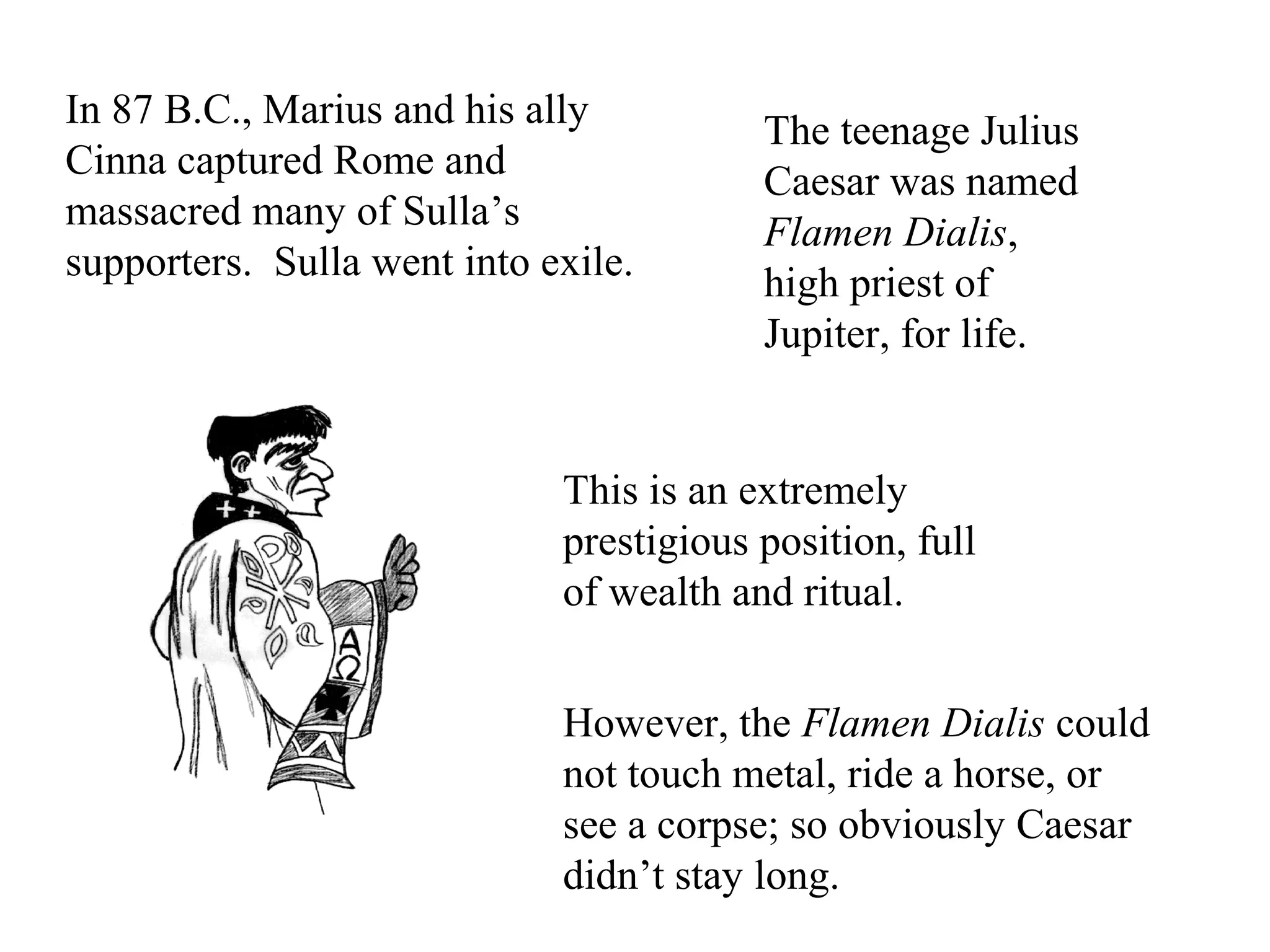
The teenage Julius
Caesar was named
Flamen Dialis,
high priest of
Jupiter, for life.
This is an extremely
prestigious position, full
of wealth and ritual.
However, the Flamen Dialis could
not touch metal, ride a horse, or
see a corpse; so obviously Caesar
didn’t stay long.
Marius was elected
consul for the seventh
and final time, along
with his ally, Cinna.
Shortly after, Marius
died. Cinna took
over the faction
against Sulla.
Caesar married
Cinna’s daughter,
Cornelia, making
him the son in
law of Sulla’s
worst enemy.
Caesar was in a
dangerous position.
With Marius dead,
he would have to be
careful and protect
himself from Sulla.
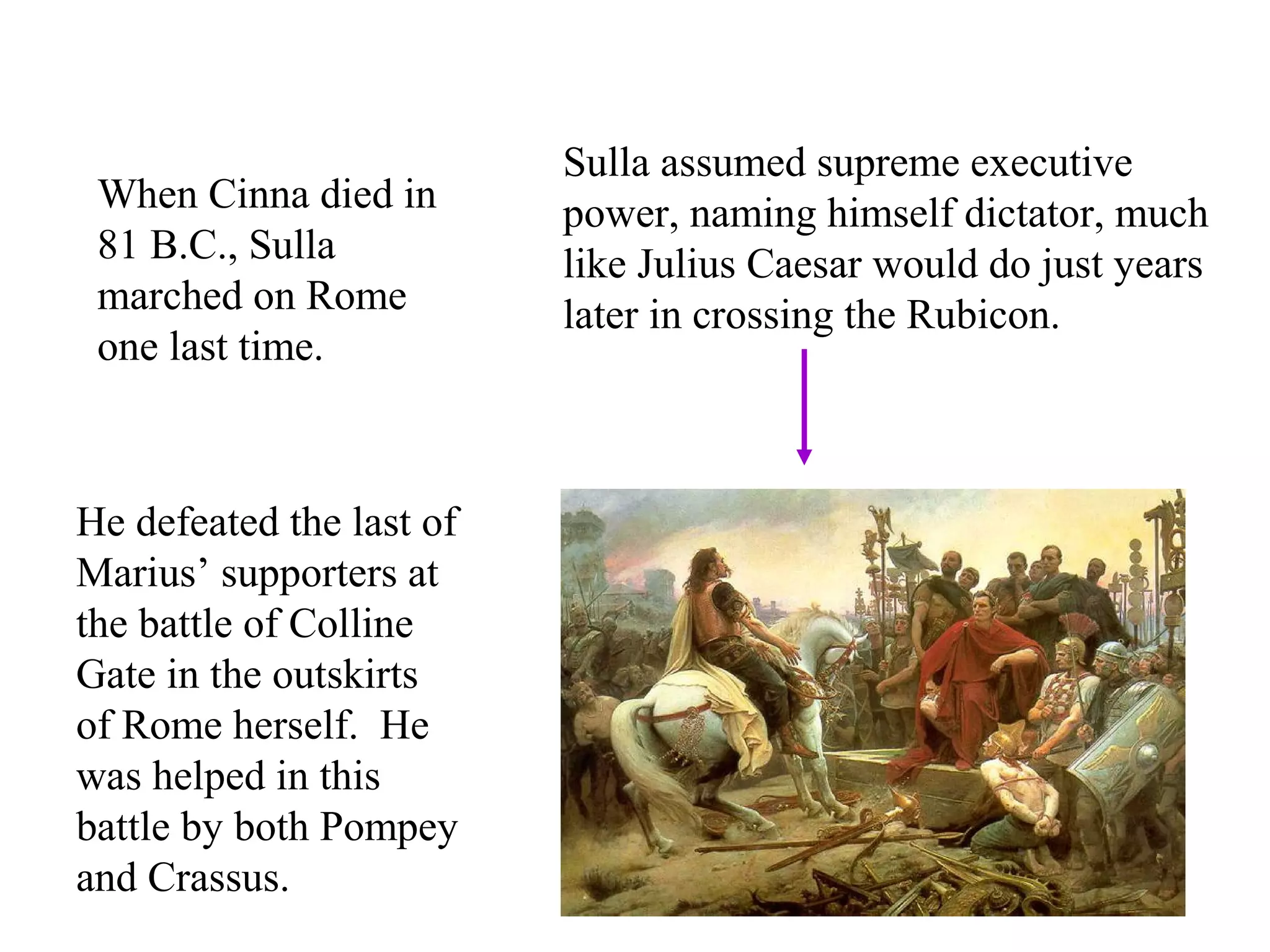
When Cinna died in
81 B.C., Sulla
marched on Rome
one last time.
He defeated the last of
Marius’ supporters at
the battle of Colline
Gate in the outskirts
of Rome herself. He
was helped in this
battle by both Pompey
and Crassus.
Sulla assumed supreme executive
power, naming himself dictator, much
like Julius Caesar would do just years
later in crossing the Rubicon.
Sulla, now dictator, demanded
publicly that Caesar divorce
Cornelia. Caesar refused. Sulla
stripped Caesar of the title
Flamen Dialis and impounded
Cornelia’s dowry.
Caesar’s friends and
relatives among the Vestal
Virgins persuaded Sulla not
to kill Caesar.
“In releasing Julius
Caesar, the world will
one day find him more
dangerous than Gaius
Marius.”
Although Sulla
reportedly said:
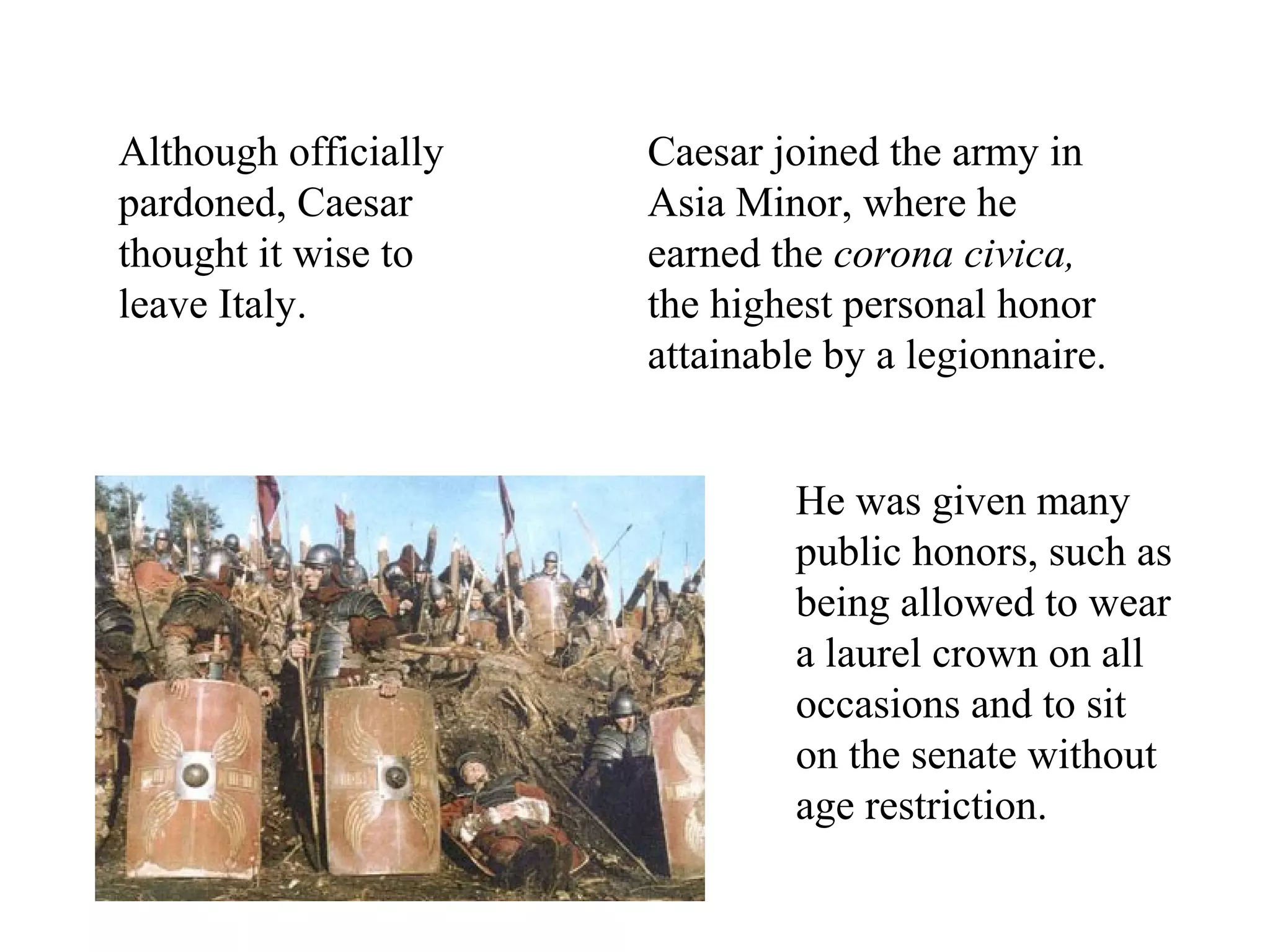
Caesar joined the army in
Asia Minor, where he
earned the corona civica,
the highest personal honor
attainable by a legionnaire.
He was given many
public honors, such as
being allowed to wear
a laurel crown on all
occasions and to sit
on the senate without
age restriction.
Although officially
pardoned, Caesar
thought it wise to
leave Italy.
There was a rumor among
the Roman troops of the
region that Caesar was gay.
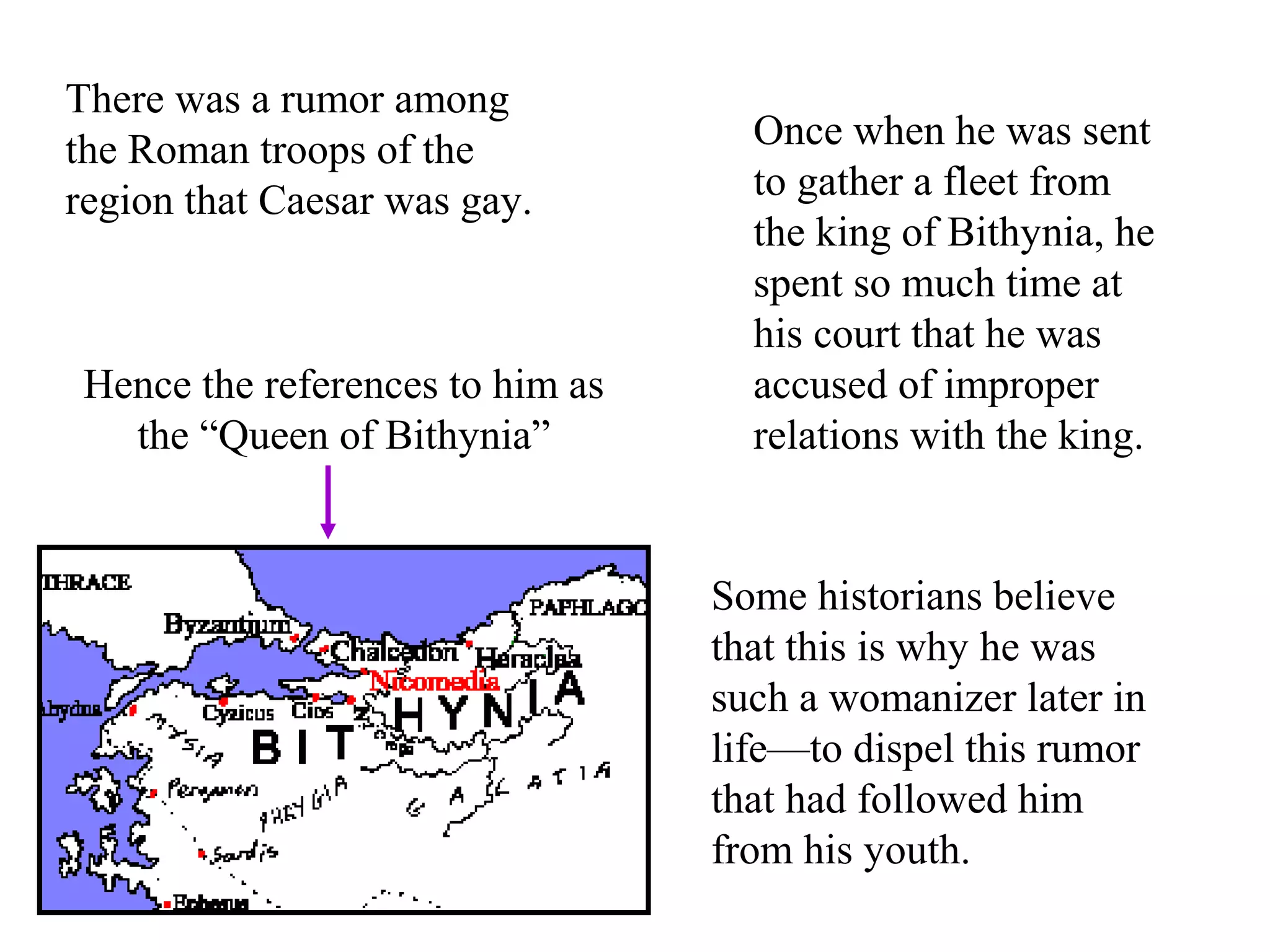
Once when he was sent
to gather a fleet from
the king of Bithynia, he
spent so much time at
his court that he was
accused of improper
relations with the king.
Hence the references to him as
the “Queen of Bithynia”
Some historians believe
that this is why he was
such a womanizer later in
life—to dispel this rumor
that had followed him
from his youth.
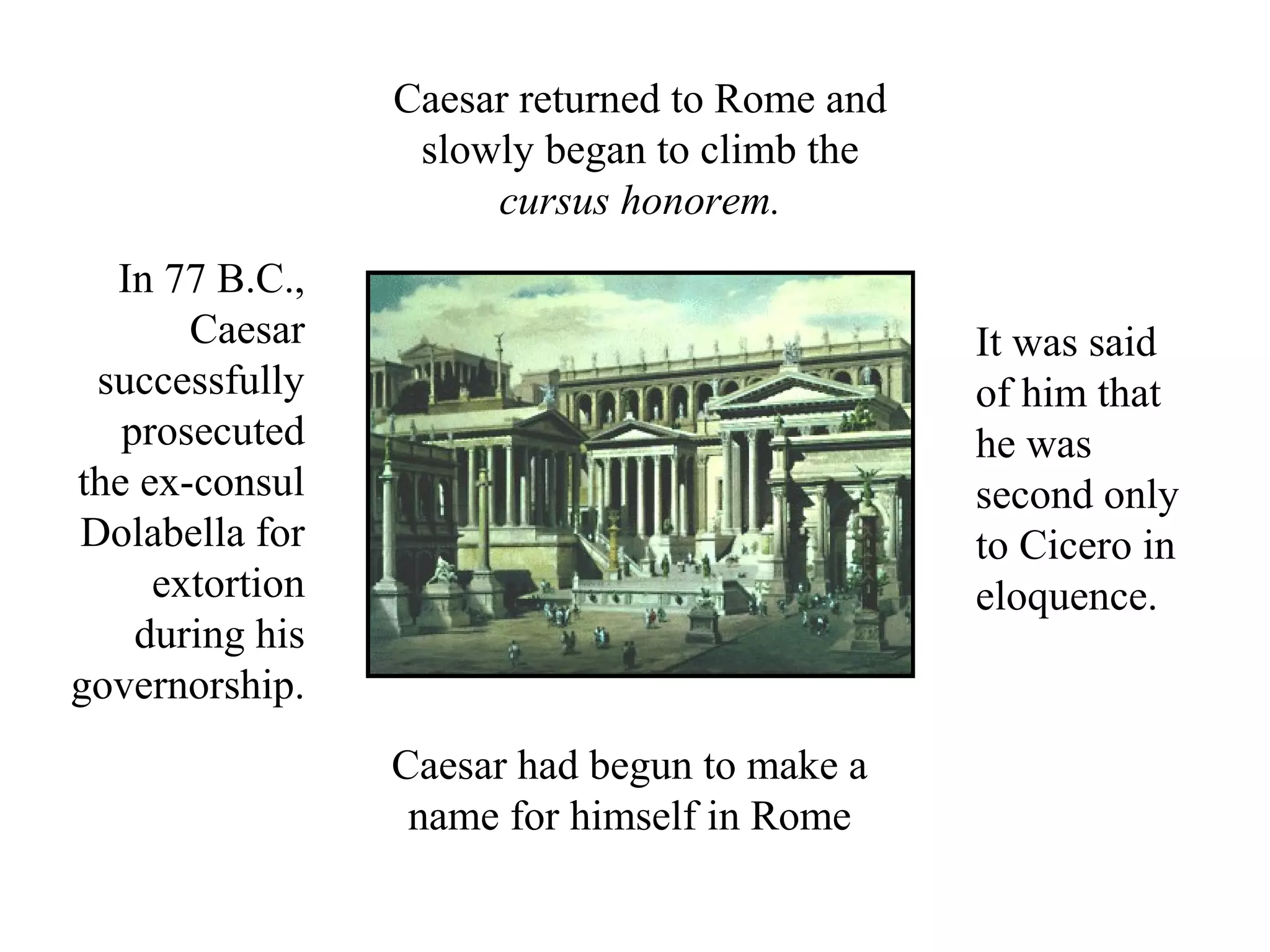
Caesar returned to Rome and
slowly began to climb the
cursus honorem.
It was said
of him that
he was
second only
to Cicero in
eloquence.
In 77 B.C.,
Caesar
successfully
prosecuted
the ex-consul
Dolabella for
extortion
during his
governorship.
Caesar had begun to make a
name for himself in Rome
Sorry.
Mediterranean
And now a story to illustrate the type of man Caesar had become.
On his way to
Rhodes to
study rhetoric
in 76 B.C.,
Caesar was
captured by
pirates.
While waiting
for the ransom
money to
arrive, he was
friendly with
his captors.
Immediately on his release Caesar saw to it that
the pirates were hunted down and crucified.
“Ancient Rome Video I.” The History
Channel series, hosted by Joe
Mantegna.
Fuller, JFC. Julius Caesar, Man,
Soldier, and Tyrant. Reprint ed. Da
Capo publications, 1991.
http://heraklia.fws1.com/early_life/index.html

Caesar

  • 1.
    Julius Caesar Youth Peter Scully Withvideo by: Aaron Bugg Bill Callahan Patrick Hanthorn By: 100? — 44 B.C.
  • 2.
    Gaius was his givenname, one of only eight names which could be given to boys. Julius was the family name. The name of Gaius’ branch of the Julius family was “Caesar,” which originally meant “hairy.” Gaius Julius Caesar His Name Hair.
  • 3.
    The Julius familyclaimed to be descended from Romulus, Aeneas, and thence Venus, which would make them all partly divine. However, his immediate family was anything but godlike. Although patricians, the Caesars were so poor that they lived among the plebeians in an insula (bad apartment) in the Subura, a very poor part of Rome.
  • 4.
    For all ofhis political ties, there had been no consul in Caesar’s immediate family for years. The Caesars had a good name among the upper class, but that was all. Young Caesar would have associated with both plebeians and patricians. Thus he would have been ambitious, but would have realized that one needs both the senate and the people to become truly powerful.
  • 5.
    Apart from this,Caesar had a healthy family life. Historians say that he had a very good mother, Aurelia, whom he loved very much. His father was something of a nobody, though he did serve as praetor, and he died when Caesar was 15. It is likely that Caesar was beaten as a child, but this was not uncommon, as strict obedience was extremely important to the Roman family at the time.
  • 6.
    He did havesome very prominent relatives, however. His uncle by marriage was none other than six time consul Gaius Marius. Marius’ fame and fortune would help to get the Caesars back on track. Uncle Marius
  • 7.
    Marius’ protégé, LuciusCornelius Sulla was a very ambitious man. He proved himself at least equal to Marius throughout the wars they fought together. Marius became jealous and had him transferred to the general Catulus, under whom he achieved even more greatness. Later, when Sulla returned to Rome after much political success in the East, he took charge of the opposition to Marius in the senate. The Villain
  • 8.
    The tension builtup nearly to an open riot, when a series of revolts on the Italian peninsula intervened. These revolts, called the Social War, called many of Rome’s generals (including Marius and Sulla) to the field. Sulla outshone them all, and he was elected consul in 88 B.C.
  • 9.
    As consul, Sulla decidedto take an army to Asia Minor in an attempt to conquer Bithynia Insanely jealous, Marius pulled some strings in the senate and was granted command of the army himself. Sulla was furious when he learned of the decision. Rather than calmly return the army, he marched on Rome.
  • 10.
    In 87 B.C.,Marius and his ally Cinna captured Rome and massacred many of Sulla’s supporters. Sulla went into exile. The teenage Julius Caesar was named Flamen Dialis, high priest of Jupiter, for life. This is an extremely prestigious position, full of wealth and ritual. However, the Flamen Dialis could not touch metal, ride a horse, or see a corpse; so obviously Caesar didn’t stay long.
  • 11.
    Marius was elected consulfor the seventh and final time, along with his ally, Cinna. Shortly after, Marius died. Cinna took over the faction against Sulla. Caesar married Cinna’s daughter, Cornelia, making him the son in law of Sulla’s worst enemy. Caesar was in a dangerous position. With Marius dead, he would have to be careful and protect himself from Sulla.
  • 12.
    When Cinna diedin 81 B.C., Sulla marched on Rome one last time. He defeated the last of Marius’ supporters at the battle of Colline Gate in the outskirts of Rome herself. He was helped in this battle by both Pompey and Crassus. Sulla assumed supreme executive power, naming himself dictator, much like Julius Caesar would do just years later in crossing the Rubicon.
  • 13.
    Sulla, now dictator,demanded publicly that Caesar divorce Cornelia. Caesar refused. Sulla stripped Caesar of the title Flamen Dialis and impounded Cornelia’s dowry. Caesar’s friends and relatives among the Vestal Virgins persuaded Sulla not to kill Caesar. “In releasing Julius Caesar, the world will one day find him more dangerous than Gaius Marius.” Although Sulla reportedly said:
  • 14.
    Caesar joined thearmy in Asia Minor, where he earned the corona civica, the highest personal honor attainable by a legionnaire. He was given many public honors, such as being allowed to wear a laurel crown on all occasions and to sit on the senate without age restriction. Although officially pardoned, Caesar thought it wise to leave Italy.
  • 15.
    There was arumor among the Roman troops of the region that Caesar was gay. Once when he was sent to gather a fleet from the king of Bithynia, he spent so much time at his court that he was accused of improper relations with the king. Hence the references to him as the “Queen of Bithynia” Some historians believe that this is why he was such a womanizer later in life—to dispel this rumor that had followed him from his youth.
  • 16.
    Caesar returned toRome and slowly began to climb the cursus honorem. It was said of him that he was second only to Cicero in eloquence. In 77 B.C., Caesar successfully prosecuted the ex-consul Dolabella for extortion during his governorship. Caesar had begun to make a name for himself in Rome
  • 17.
    Sorry. Mediterranean And now astory to illustrate the type of man Caesar had become.
  • 18.
    On his wayto Rhodes to study rhetoric in 76 B.C., Caesar was captured by pirates. While waiting for the ransom money to arrive, he was friendly with his captors. Immediately on his release Caesar saw to it that the pirates were hunted down and crucified.
  • 19.
    “Ancient Rome VideoI.” The History Channel series, hosted by Joe Mantegna. Fuller, JFC. Julius Caesar, Man, Soldier, and Tyrant. Reprint ed. Da Capo publications, 1991. http://heraklia.fws1.com/early_life/index.html