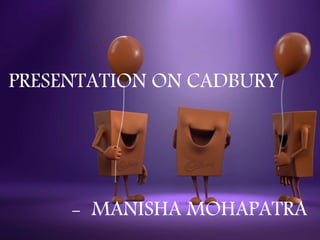
PRESENTATION ON CADBURY
- MANISHA MOHAPATRA
ABOUT COMPANY
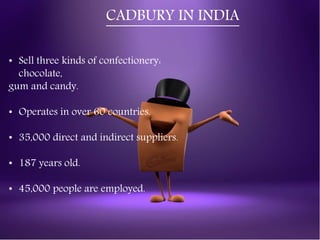
• Sell three kinds of confectionery:
chocolate,
gum and candy.
• Operates in over 60 countries.
• 35,000 direct and indirect suppliers.
• 187 years old.
• 45,000 people are employed.
CADBURY IN INDIA
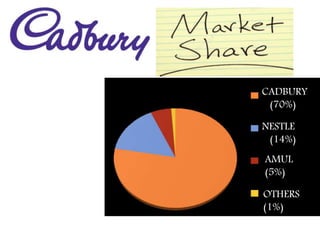
CADBURY (70%)
CADBURY (70%)
CADBURY
(70%)
NESTLE
(14%)
AMUL
(5%)
OTHERS
(1%)
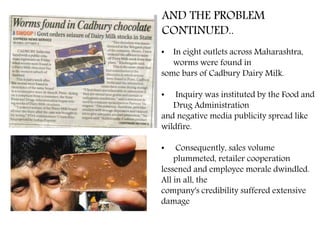
• In eight outlets across Maharashtra,
worms were found in
some bars of Cadbury Dairy Milk.
• Inquiry was instituted by the Food and
Drug Administration
and negative media publicity spread like
wildfire.
• Consequently, sales volume
plummeted, retailer cooperation
lessened and employee morale dwindled.
All in all, the
company's credibility suffered extensive
damage
AND THE PROBLEM
CONTINUED..
• Reputation and credibility was under intense scrutiny.
• Sales volumes came down drastically in the first 10 weeks.
• Employee morale – especially that of the sales team – was
shaken.
• Due to which media coverage touched close to 1000 clips in
print and 120 on TV news channels.
• People even assumed that every chocolate could be
contaminated.
CRISIS
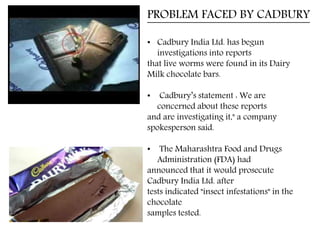
• Cadbury India Ltd. has begun
investigations into reports
that live worms were found in its Dairy
Milk chocolate bars.
• Cadbury’s statement : We are
concerned about these reports
and are investigating it," a company
spokesperson said.
• The Maharashtra Food and Drugs
Administration (FDA) had
announced that it would prosecute
Cadbury India Ltd. after
tests indicated "insect infestations" in the
chocolate
samples tested.
PROBLEM FACED BY CADBURY
• To Restore confidence in the key stakeholders.
• Build back credibility.
• Make customer believe about safety.
• To increase the sales.
• To Restore confidence in the key
stakeholders.
• Build back credibility.
• Make customer believe about
safety.
• To increase the sales.
CHALLENGES
In response to the crisis, Cadbury therefore
developed
three key messages:-
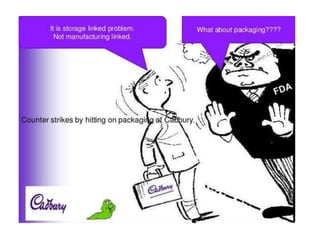
1. Infestation was a storage problem;
2. It was safe to eat Cadbury chocolates; and
3. Consumers must exercise the same care in
purchasing a
chocolate as they would when buying any food
item.
OBJECTIVES
 They did not deny the fact of worms being present in
the
Chocolates
 Project Vishwas
 Advertisement featuring Amitabh Bachchan.
 Revamping of packaging of Dairy Milk having metallic
poly flow.
STEPS TAKEN TO ACHIEVE THE OBJECTIVES
Using IMC elements to overcome from
this problem
• Advertising
The company began its multi-pronged
campaign on key print,
broadcast and electronic media, to regain its
lost credibility and
almost re-established the category.
• Message strategy
It decided to convey that the root of the
problem was as the
distribution end, that any food item could
face similar infestation,
and yet Cadbury would take initiatives to
check the problem.
• Identification of four stakeholders the
consumers, its
employees, the media, and the
government authorities (i.e.
the FDA)
• Situation with FDA would improve as
the company was
strictly adhering to food safety laws
• Attention from media would fade as
media would lose
interest and find other stories to cover
WHAT AND HOW TO BE DONE?
 Packaging
 Project “Vishwas”
 Two advertisements featuring Amitabh
Bachchan
 Media conferences
 Platform of BQC
 Retail monitoring and education
Program
 Toll free numbers and emails to the
retailers
IMPLEMENTATION OF ACTIONS
Internal Actions
 Letters from MD to the
Employees
 Employees were asked to
go to the markets and
check for themselves
 Series of town hall
meetings were held
 Regular email updates
External Actions
o A plan involving distribution and retail channels to ensure
the quality of products.
o Quality control managers and 300 sales staff checked over
50,000 retail outlets in Maharashtra and replaced all
questionable stocks.
o Built awareness among retailers on storage requirements for
chocolates.
o Provided assistance in improving and strengthening
packaging of company’s range of products.
PROJECT VISHWAS
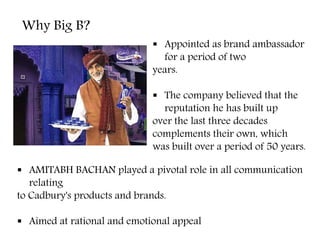
Why Big B?
 Appointed as brand ambassador
for a period of two
years.
 The company believed that the
reputation he has built up
over the last three decades
complements their own, which
was built over a period of 50 years.
 AMITABH BACHAN played a pivotal role in all communication
relating
to Cadbury's products and brands.
 Aimed at rational and emotional appeal
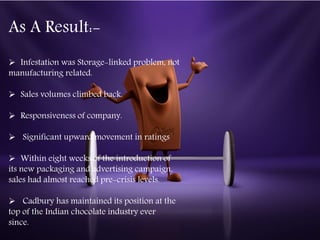
 Infestation was Storage-linked problem, not
manufacturing related.
 Sales volumes climbed back.
 Responsiveness of company.
 Significant upward movement in ratings
 Within eight weeks of the introduction of
its new packaging and advertising campaign,
sales had almost reached pre-crisis levels.
 Cadbury has maintained its position at the
top of the Indian chocolate industry ever
since.
As A Result:-
 Through timely and consistent marketing communications
Cadbury succeeded in solving a daunting business crisis.
 With a 360-degree communications approach that targeted various
audiences, Cadbury could quickly control and offset the negative word of
mouth it had received.
 By integrating a variety of tools like press release and
conferences, consumer advertising, trade advertising,
point-of-purchase communications, packaging initiatives,
email communications and the like, all focusing on the same
problem, Cadbury could communicate a unified message and
get audiences to appreciate the efforts it had taken to
minimize instances of future occurrences.
CONCLUSION

Cadbury

  • 1.
    PRESENTATION ON CADBURY -MANISHA MOHAPATRA
  • 2.
  • 4.
    • Sell threekinds of confectionery: chocolate, gum and candy. • Operates in over 60 countries. • 35,000 direct and indirect suppliers. • 187 years old. • 45,000 people are employed. CADBURY IN INDIA
  • 5.
  • 8.
    • In eightoutlets across Maharashtra, worms were found in some bars of Cadbury Dairy Milk. • Inquiry was instituted by the Food and Drug Administration and negative media publicity spread like wildfire. • Consequently, sales volume plummeted, retailer cooperation lessened and employee morale dwindled. All in all, the company's credibility suffered extensive damage AND THE PROBLEM CONTINUED..
  • 9.
    • Reputation andcredibility was under intense scrutiny. • Sales volumes came down drastically in the first 10 weeks. • Employee morale – especially that of the sales team – was shaken. • Due to which media coverage touched close to 1000 clips in print and 120 on TV news channels. • People even assumed that every chocolate could be contaminated. CRISIS
  • 10.
    • Cadbury IndiaLtd. has begun investigations into reports that live worms were found in its Dairy Milk chocolate bars. • Cadbury’s statement : We are concerned about these reports and are investigating it," a company spokesperson said. • The Maharashtra Food and Drugs Administration (FDA) had announced that it would prosecute Cadbury India Ltd. after tests indicated "insect infestations" in the chocolate samples tested. PROBLEM FACED BY CADBURY
  • 12.
    • To Restoreconfidence in the key stakeholders. • Build back credibility. • Make customer believe about safety. • To increase the sales. • To Restore confidence in the key stakeholders. • Build back credibility. • Make customer believe about safety. • To increase the sales. CHALLENGES
  • 13.
    In response tothe crisis, Cadbury therefore developed three key messages:- 1. Infestation was a storage problem; 2. It was safe to eat Cadbury chocolates; and 3. Consumers must exercise the same care in purchasing a chocolate as they would when buying any food item. OBJECTIVES
  • 14.
     They didnot deny the fact of worms being present in the Chocolates  Project Vishwas  Advertisement featuring Amitabh Bachchan.  Revamping of packaging of Dairy Milk having metallic poly flow. STEPS TAKEN TO ACHIEVE THE OBJECTIVES
  • 15.
    Using IMC elementsto overcome from this problem • Advertising The company began its multi-pronged campaign on key print, broadcast and electronic media, to regain its lost credibility and almost re-established the category. • Message strategy It decided to convey that the root of the problem was as the distribution end, that any food item could face similar infestation, and yet Cadbury would take initiatives to check the problem.
  • 16.
    • Identification offour stakeholders the consumers, its employees, the media, and the government authorities (i.e. the FDA) • Situation with FDA would improve as the company was strictly adhering to food safety laws • Attention from media would fade as media would lose interest and find other stories to cover WHAT AND HOW TO BE DONE?
  • 17.
     Packaging  Project“Vishwas”  Two advertisements featuring Amitabh Bachchan  Media conferences  Platform of BQC  Retail monitoring and education Program  Toll free numbers and emails to the retailers IMPLEMENTATION OF ACTIONS Internal Actions  Letters from MD to the Employees  Employees were asked to go to the markets and check for themselves  Series of town hall meetings were held  Regular email updates External Actions
  • 18.
    o A planinvolving distribution and retail channels to ensure the quality of products. o Quality control managers and 300 sales staff checked over 50,000 retail outlets in Maharashtra and replaced all questionable stocks. o Built awareness among retailers on storage requirements for chocolates. o Provided assistance in improving and strengthening packaging of company’s range of products. PROJECT VISHWAS
  • 19.
    Why Big B? Appointed as brand ambassador for a period of two years.  The company believed that the reputation he has built up over the last three decades complements their own, which was built over a period of 50 years.  AMITABH BACHAN played a pivotal role in all communication relating to Cadbury's products and brands.  Aimed at rational and emotional appeal
  • 20.
     Infestation wasStorage-linked problem, not manufacturing related.  Sales volumes climbed back.  Responsiveness of company.  Significant upward movement in ratings  Within eight weeks of the introduction of its new packaging and advertising campaign, sales had almost reached pre-crisis levels.  Cadbury has maintained its position at the top of the Indian chocolate industry ever since. As A Result:-
  • 21.
     Through timelyand consistent marketing communications Cadbury succeeded in solving a daunting business crisis.  With a 360-degree communications approach that targeted various audiences, Cadbury could quickly control and offset the negative word of mouth it had received.  By integrating a variety of tools like press release and conferences, consumer advertising, trade advertising, point-of-purchase communications, packaging initiatives, email communications and the like, all focusing on the same problem, Cadbury could communicate a unified message and get audiences to appreciate the efforts it had taken to minimize instances of future occurrences. CONCLUSION