

Computer Aided Diagnosis
using
Support Vector Machine
Jin Sung Kim
Radiation Detection & Medical Imaging Lab
Lab Seminar, 2005. 6. 2.
Contents
• Introduction
 Computer Aided Diagnosis (CAD)
 CAD in process
• Support Vector Machine
 What is SVM
– Basic idea, Why OHP
 Non-linear Separable Case
– Non-Linear SVM
 Multi-class Classification
 Application in CAD
• Conclusion
• Further Study
• Reference
2
Contents
• Introduction
 Computer Aided Diagnosis (CAD)
 CAD in process
• Support Vector Machine
 What is SVM
– Basic idea, Why OHP
 Non-linear Separable Case
– Non-Linear SVM
 Multi-class Classification
 Application in CAD
• Conclusion
• Further Study
• Reference
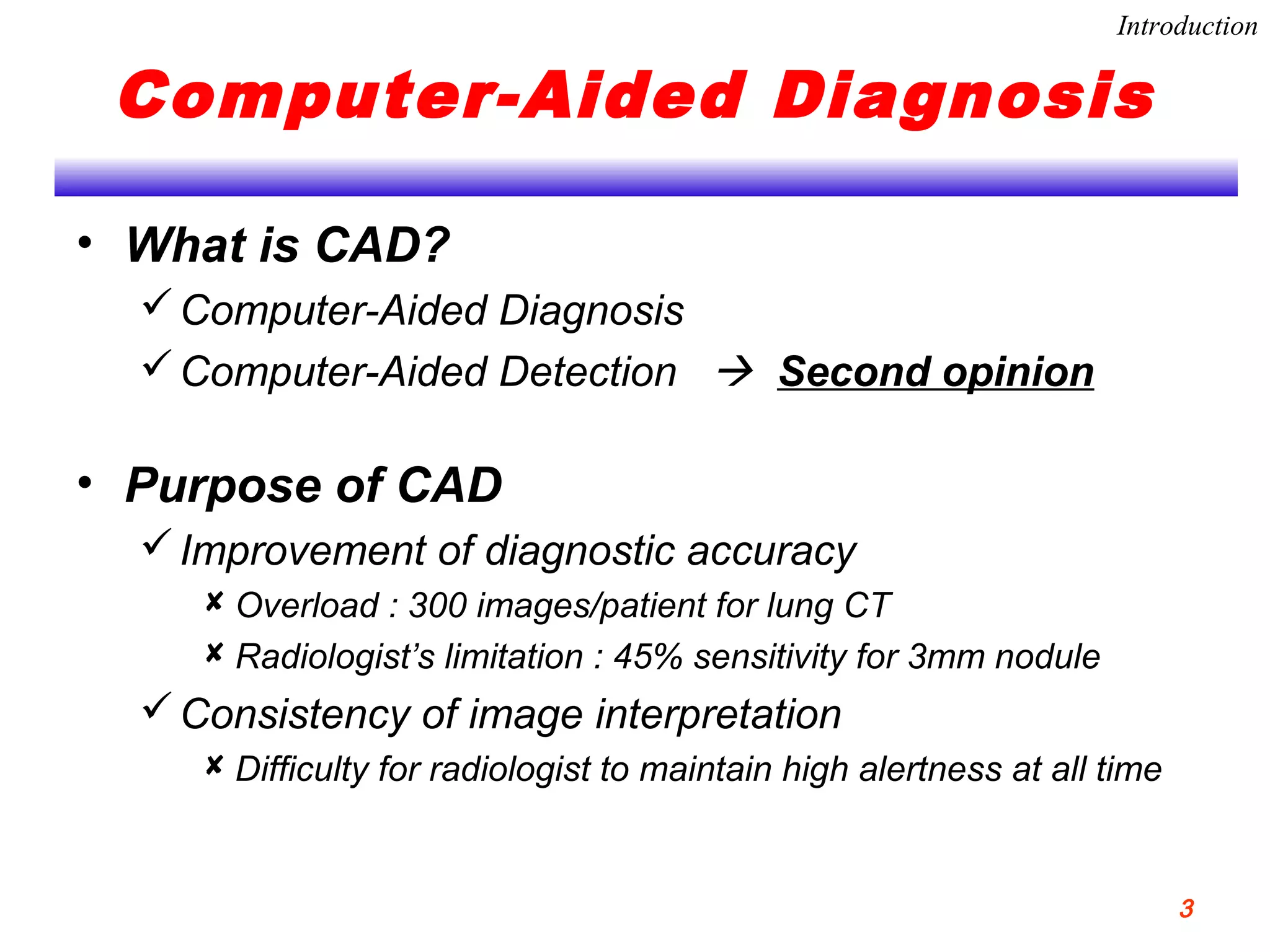
Computer-Aided Diagnosis
• What is CAD?
Computer-Aided Diagnosis
Computer-Aided Detection  Second opinion
• Purpose of CAD
Improvement of diagnostic accuracy
 Overload : 300 images/patient for lung CT
 Radiologist’s limitation : 45% sensitivity for 3mm nodule
Consistency of image interpretation
 Difficulty for radiologist to maintain high alertness at all time
Introduction
3
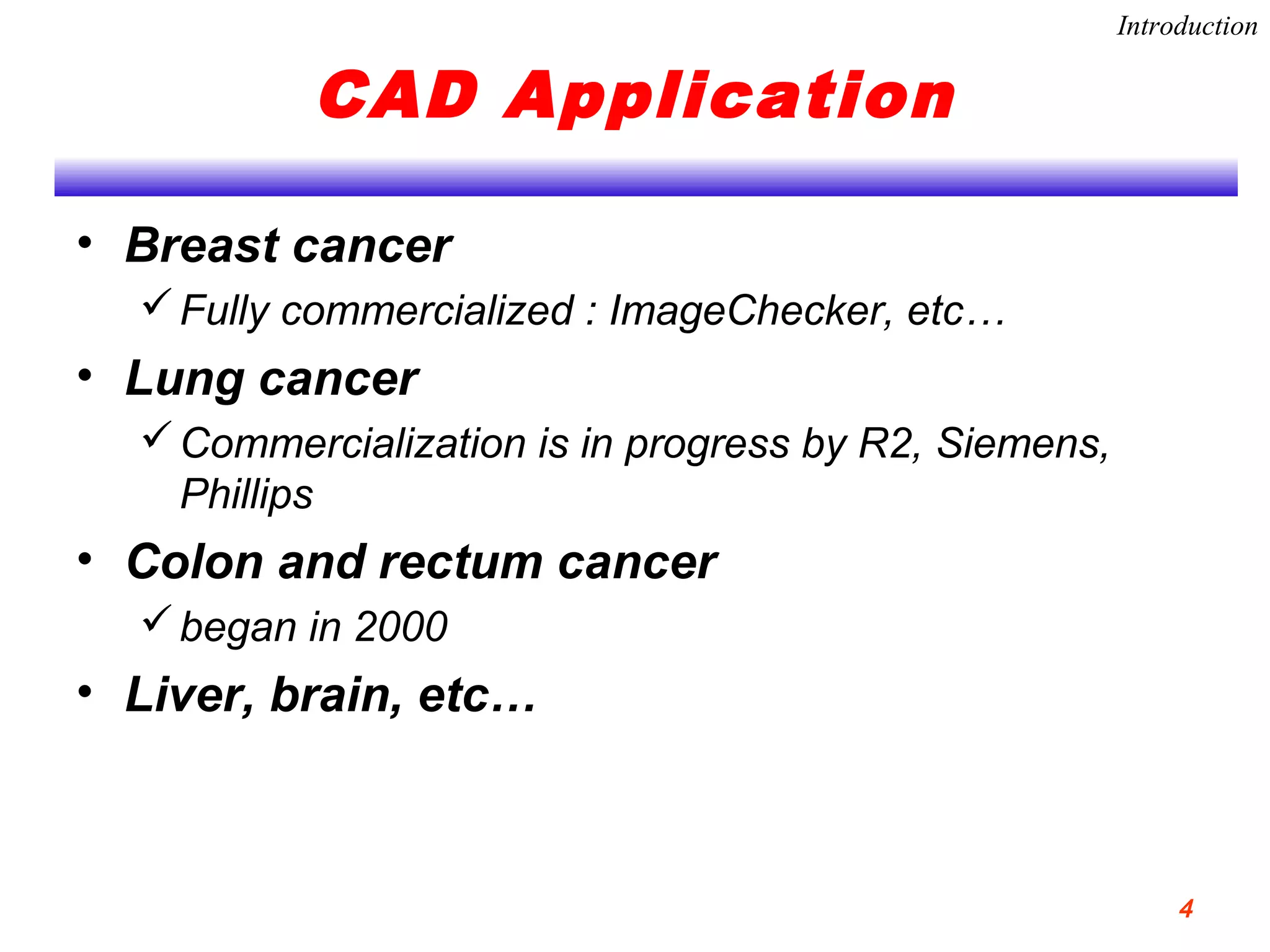
CAD Application
• Breast cancer
Fully commercialized : ImageChecker, etc…
• Lung cancer
Commercialization is in progress by R2, Siemens,
Phillips
• Colon and rectum cancer
began in 2000
• Liver, brain, etc…
Introduction
4
CAD in Process
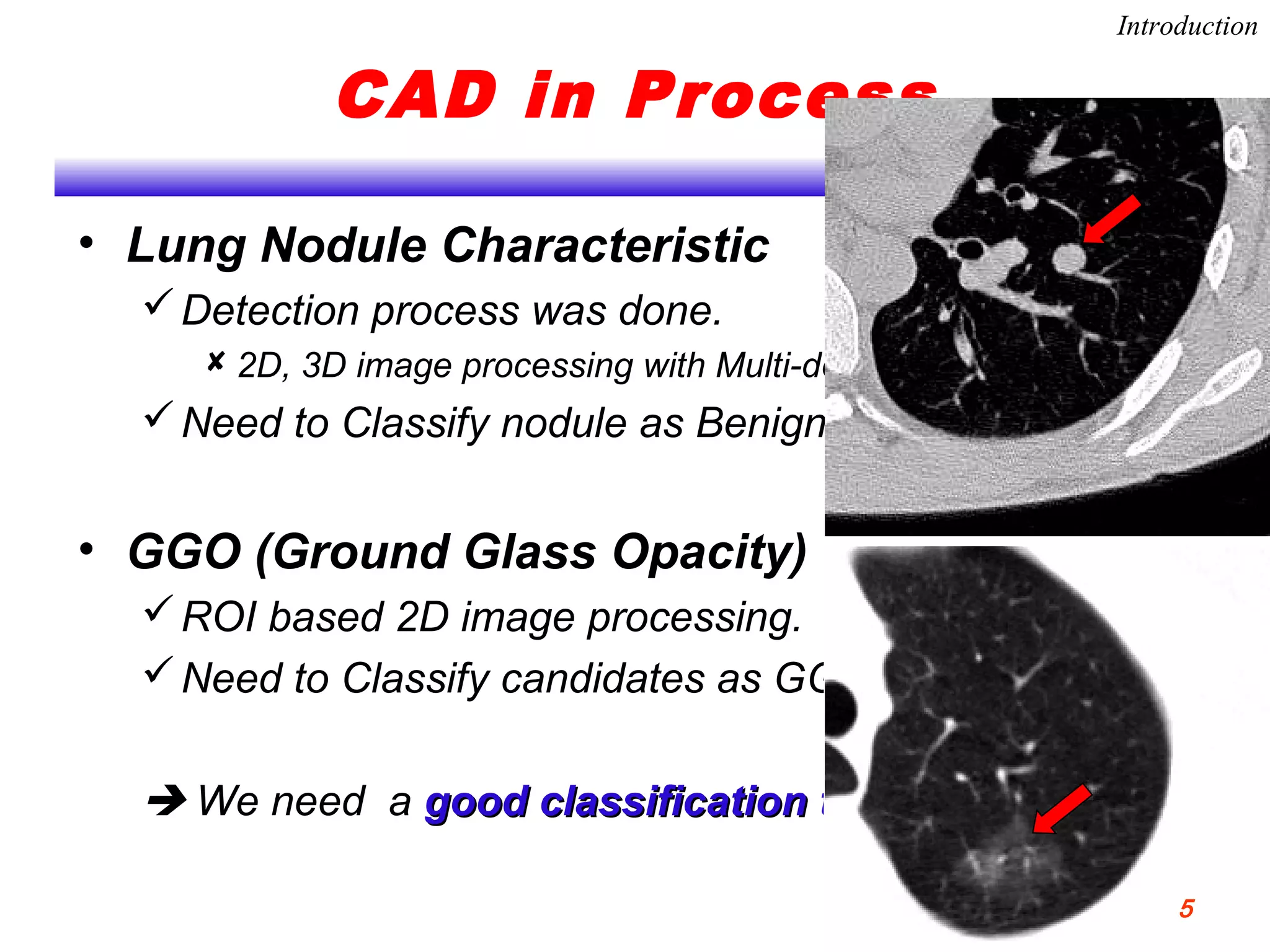
• Lung Nodule Characteristic
Detection process was done.
 2D, 3D image processing with Multi-detector CT.
Need to Classify nodule as Benign or Malignant.
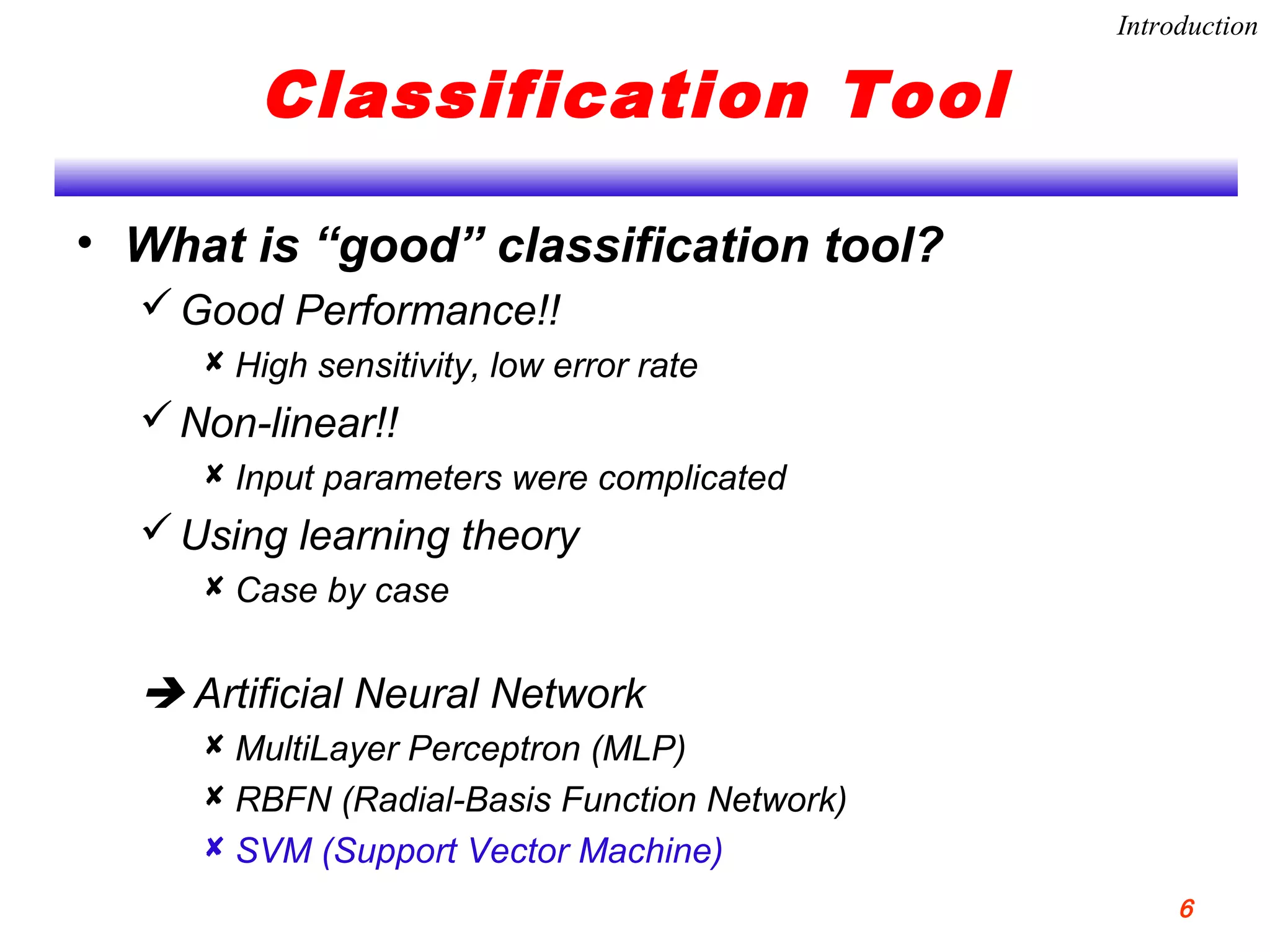
• GGO (Ground Glass Opacity)
ROI based 2D image processing.
Need to Classify candidates as GGO or Nodule
 We need a good classification toolgood classification tool !!!
Introduction
5
Classification Tool
• What is “good” classification tool?
Good Performance!!
 High sensitivity, low error rate
Non-linear!!
 Input parameters were complicated
Using learning theory
 Case by case
 Artificial Neural Network
 MultiLayer Perceptron (MLP)
 RBFN (Radial-Basis Function Network)
 SVM (Support Vector Machine)
Introduction
6
Contents
• Introduction
 Computer Aided Diagnosis
 CAD in process
• Support Vector Machine
 What is SVM
– Basic idea, Why OHP
 Non-linear Separable Case
– Non-Linear SVM
 Multi-class Classification
 Application in CAD
• Conclusion
• Further Study
• Reference
Support Vector Machine
SVM
Invented by Vapnik, 1995
Simple, and always trained to find global optimum
Used for pattern recognition, regression, and linear
operator inversion
Considered too slow at the beginning, but now for most
application this problem is overcome due to late 1990’s
Small number of parameters choice – easy to use
Support Vector Machine
7
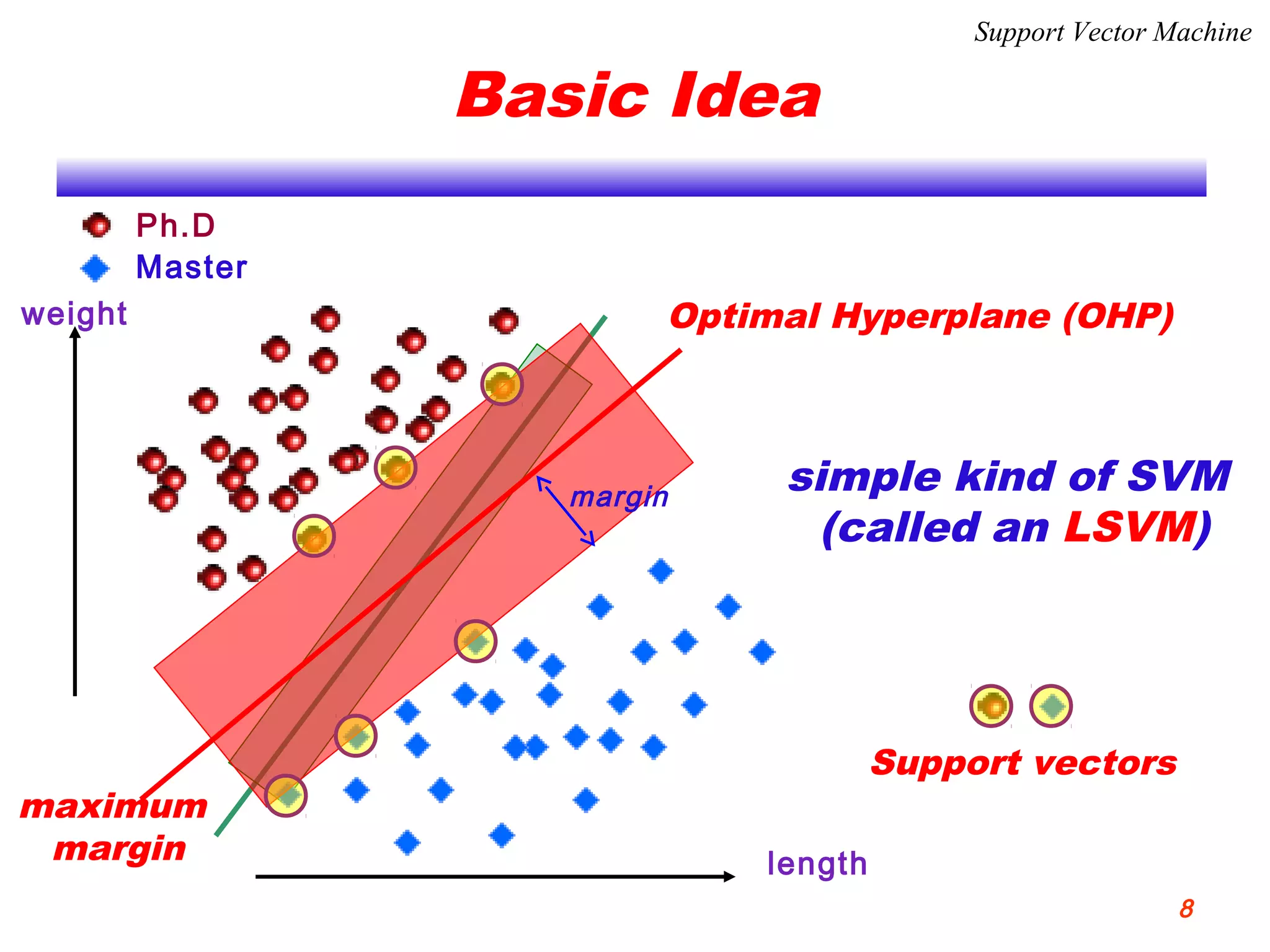
Basic Idea
length
weight Optimal Hyperplane (OHP)
simple kind of SVM
(called an LSVM)
margin
Support vectors
maximum
margin
Ph.D
Master
Support Vector Machine
8
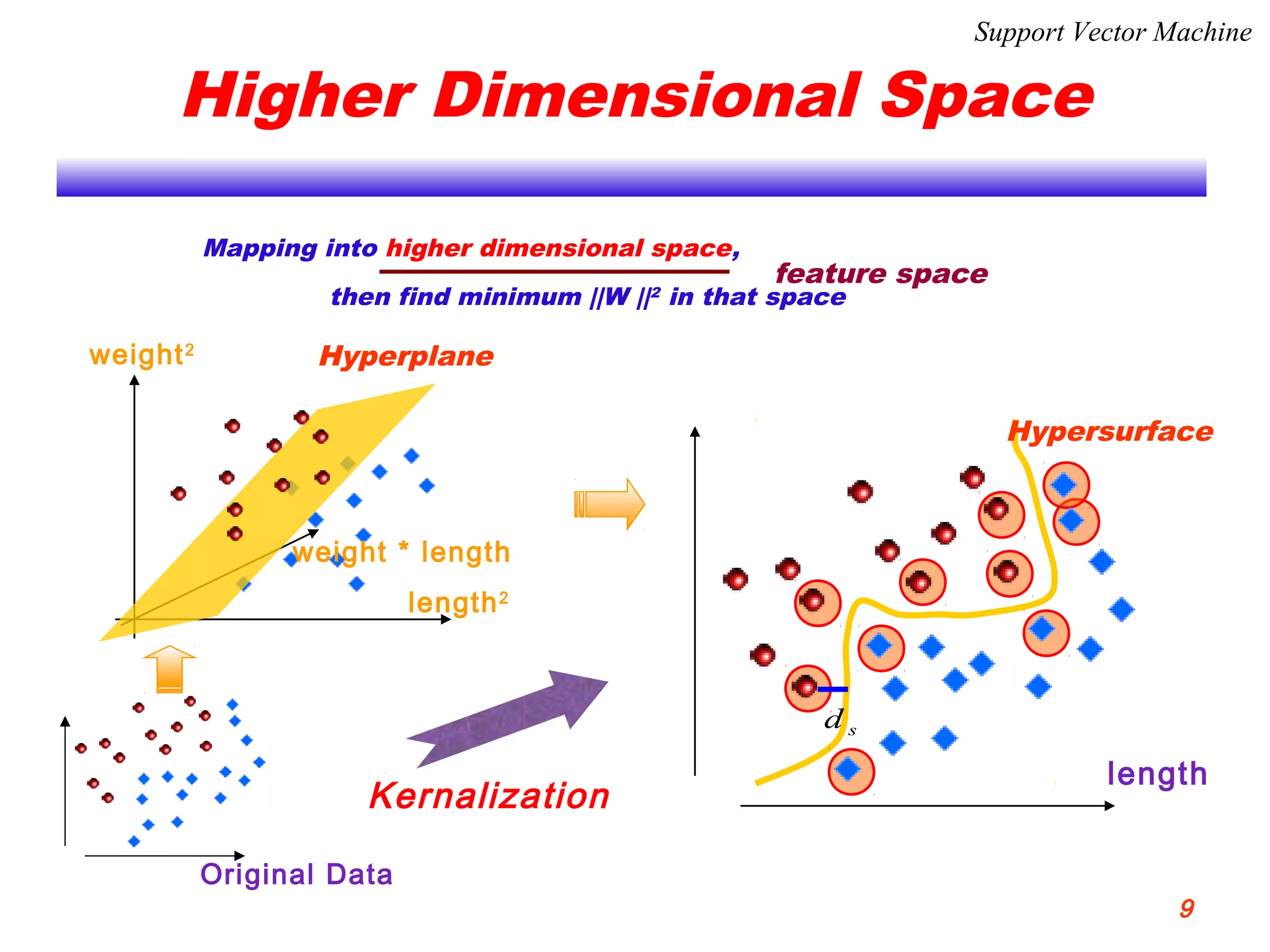
Higher Dimensional Space
Mapping into higher dimensional space,
then find minimum ||W ||2
in that space
feature space
weight2
length2
weight * length
Hypersurface
length
sd
Kernalization
Hyperplane
Original Data
Support Vector Machine
9
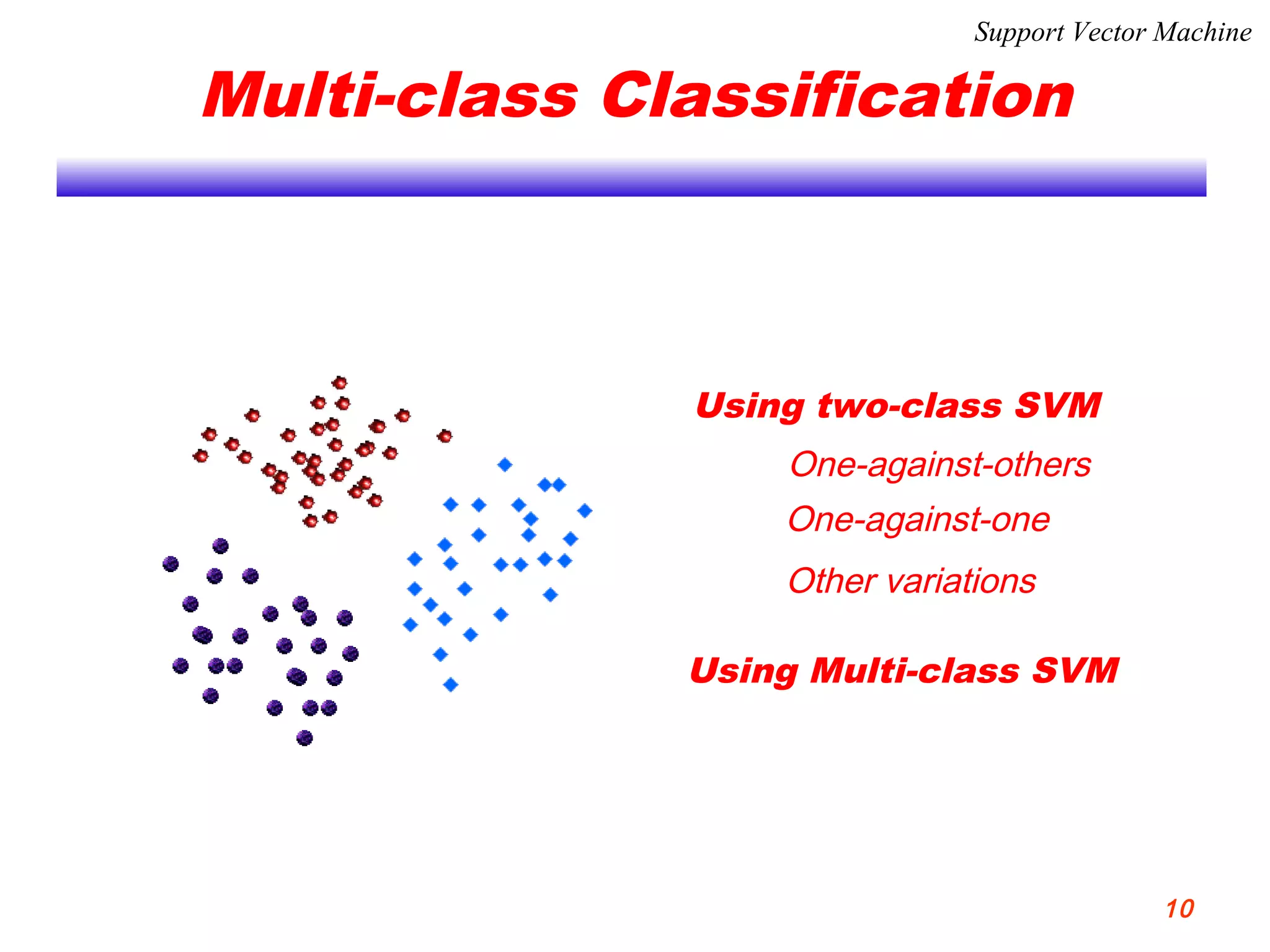
Multi-class Classification
Using Multi-class SVM
Using two-class SVM
One-against-others
One-against-one
Other variations
Support Vector Machine
10
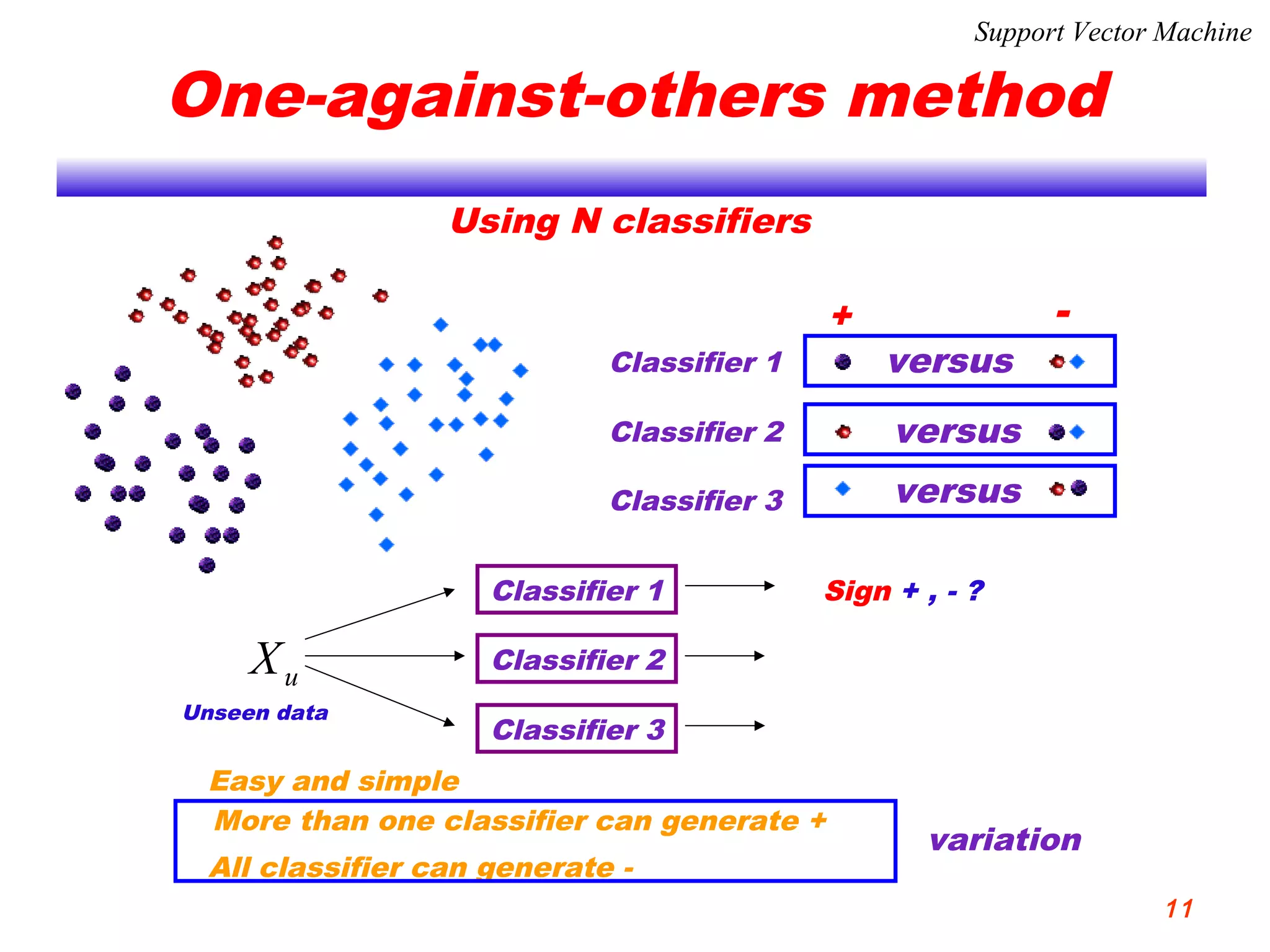
One-against-others method
Using N classifiers
-
versus
+
Classifier 1
versusClassifier 2
versusClassifier 3
uX
Unseen data
Classifier 2
Classifier 3
Classifier 1 Sign + , - ?
More than one classifier can generate +
All classifier can generate -
Easy and simple
variation
Support Vector Machine
11
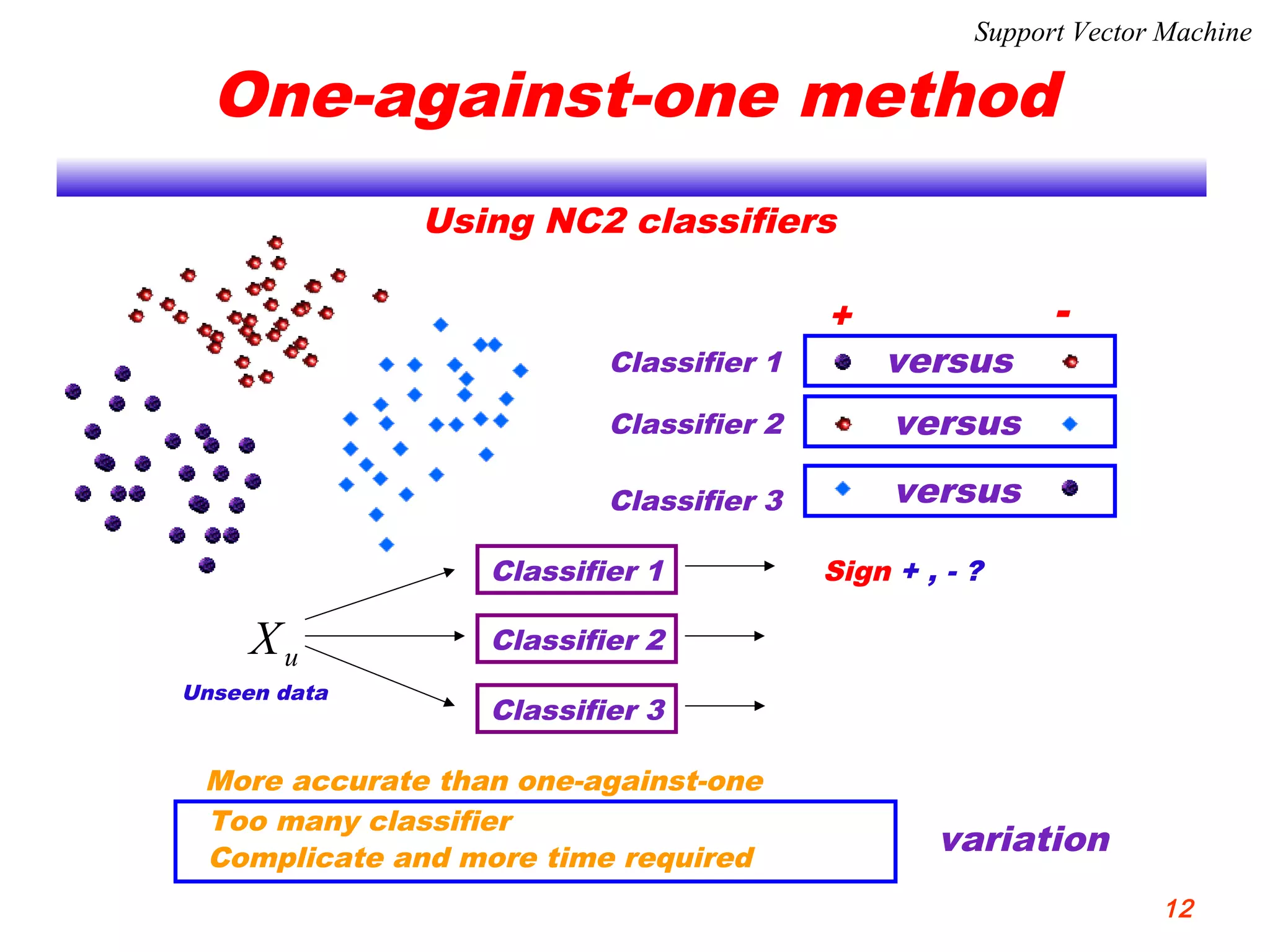
One-against-one method
Using NC2 classifiers
versus
+ -
Classifier 1
versusClassifier 2
versusClassifier 3
Unseen data
Classifier 1
Classifier 2
Classifier 3
uX
Sign + , - ?
Too many classifier
Complicate and more time required
More accurate than one-against-one
variation
Support Vector Machine
12
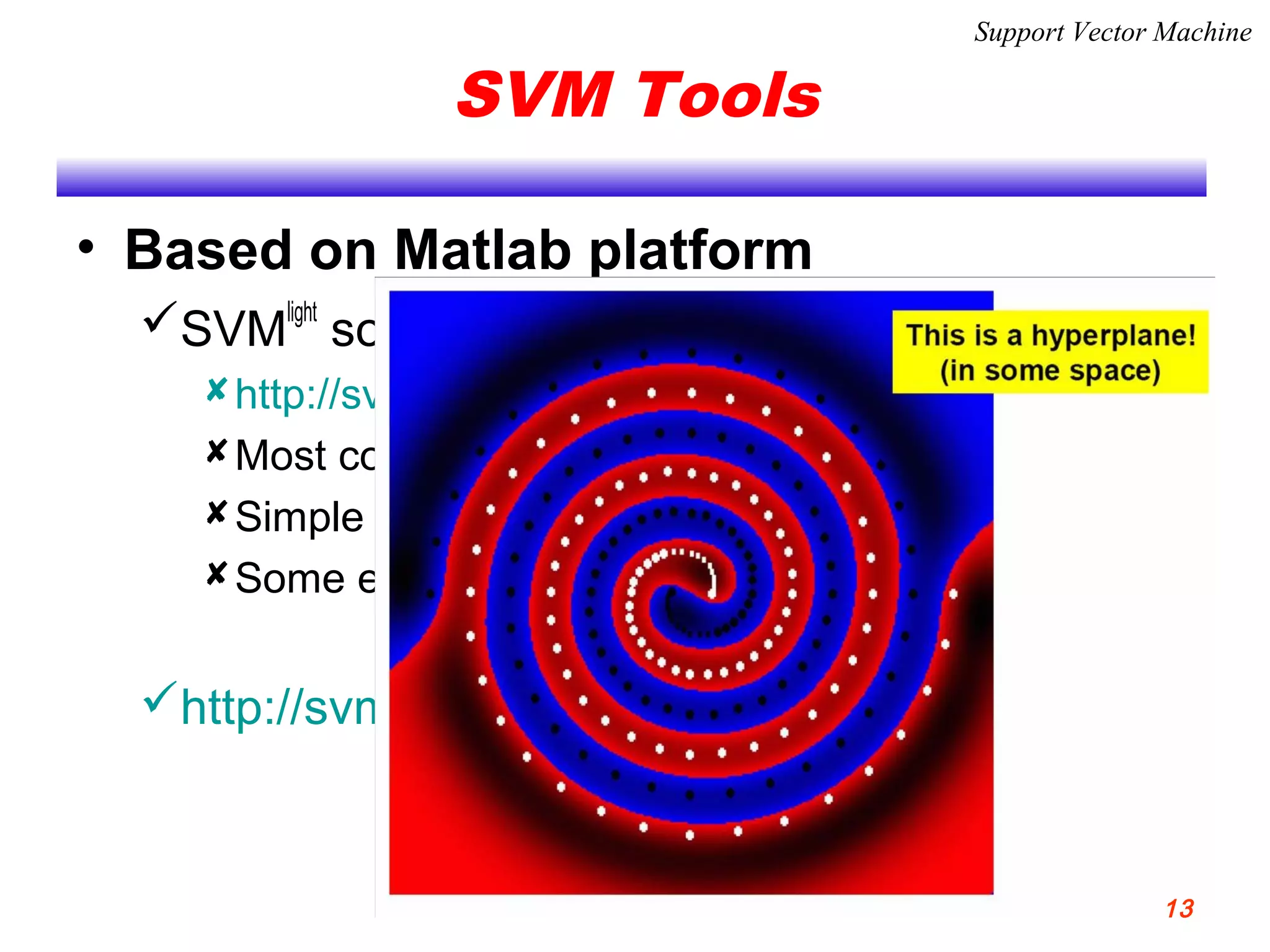
SVM Tools
• Based on Matlab platform
SVM
light
software
http://svmlight.joachims.org
Most common, powerful tool
Simple and easy to use
Some example in “Next Seminar”
http://svm.dcs.rhbnc.ac.uk/
Support Vector Machine
13
Application
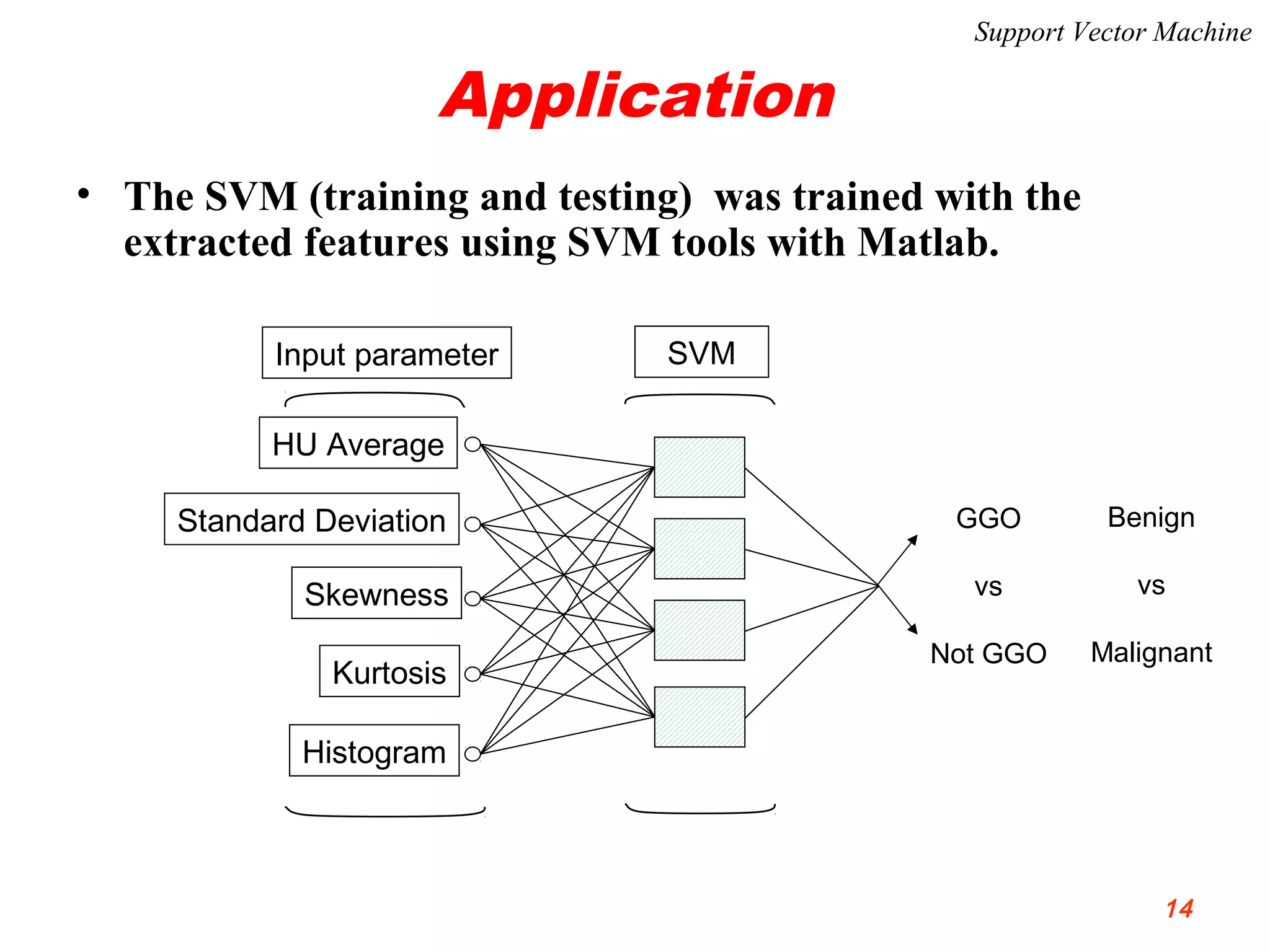
• The SVM (training and testing) was trained with the
extracted features using SVM tools with Matlab.
Skewness
Standard Deviation
Kurtosis
HU Average
Histogram
Input parameter SVM
Methods
GGO
vs
Not GGO
Benign
vs
Malignant
Support Vector Machine
14
Contents
• Introduction
 Computer Aided Diagnosis
 Objective
• Support Vector Machine
 What is SVM
– Basic idea, Why OHP
 Non-linear Separable Case
– Non-Linear SVM
 Multi-class Classification
 Application in CAD
• Conclusion
• Further Study
• Reference
Conclusion
• Computer aided detection was performed
with lung disease.
(Nodule, GGO)
• We need a good classification tool for
diagnosis as second opinion.
• SVM is simple, and always trained to find
global optimum for classification.
• With SVM, CAD will present better
performance for diagnostic opinion.
Conclusion
15
Contents
• Introduction
 Computer Aided Diagnosis
 Objective
• Support Vector Machine
 What is SVM
– Basic idea, Why OHP
 Non-linear Separable Case
– Non-Linear SVM
 Multi-class Classification
 Application in CAD
• Conclusion
• Further Study
• Reference
Further Study
• SVM development in matlab
• Classification of Nodule Characteristics
Automatic extraction & detection
Use the HU, shape of nodule in ROI
• Classification of GGO nodule
Use many 2D textures analysis
• Result in 2 month (I hope)
16
Reference
 “An Introduction to Lagrange Multipliers”, Steuard Jensen http://
home.uchicago.edu/~sbjensen/Tutorials/Lagrange.html
 “Linear Algebra and Its Applications,” David C. Lay, 1999, second edition
 “Some Mathematical Tools for Machine Learning,” Chris Burges,
August, 2003
 “Statistical Learning and VC Theory,” Peter Bartlett, ISCAS, May
2001
 “A Tutorial on Support Vector Machines for Pattern Recognition,”
Christopher J.C. Burges, Data Mining and Knowledge Discover,
1998
 “Support Vector Learning,” B. Schölkopf, Ph. D. Thesis, 1997
 “Kernel methods: a survey of current techniques,” Colin Campbell, 2002
Reference
Thank you for your attention!

CAD using SVM

  • 1.
    Computer Aided Diagnosis using SupportVector Machine Jin Sung Kim Radiation Detection & Medical Imaging Lab Lab Seminar, 2005. 6. 2.
  • 2.
    Contents • Introduction  ComputerAided Diagnosis (CAD)  CAD in process • Support Vector Machine  What is SVM – Basic idea, Why OHP  Non-linear Separable Case – Non-Linear SVM  Multi-class Classification  Application in CAD • Conclusion • Further Study • Reference 2
  • 3.
    Contents • Introduction  ComputerAided Diagnosis (CAD)  CAD in process • Support Vector Machine  What is SVM – Basic idea, Why OHP  Non-linear Separable Case – Non-Linear SVM  Multi-class Classification  Application in CAD • Conclusion • Further Study • Reference
  • 4.
    Computer-Aided Diagnosis • Whatis CAD? Computer-Aided Diagnosis Computer-Aided Detection  Second opinion • Purpose of CAD Improvement of diagnostic accuracy  Overload : 300 images/patient for lung CT  Radiologist’s limitation : 45% sensitivity for 3mm nodule Consistency of image interpretation  Difficulty for radiologist to maintain high alertness at all time Introduction 3
  • 5.
    CAD Application • Breastcancer Fully commercialized : ImageChecker, etc… • Lung cancer Commercialization is in progress by R2, Siemens, Phillips • Colon and rectum cancer began in 2000 • Liver, brain, etc… Introduction 4
  • 6.
    CAD in Process •Lung Nodule Characteristic Detection process was done.  2D, 3D image processing with Multi-detector CT. Need to Classify nodule as Benign or Malignant. • GGO (Ground Glass Opacity) ROI based 2D image processing. Need to Classify candidates as GGO or Nodule  We need a good classification toolgood classification tool !!! Introduction 5
  • 7.
    Classification Tool • Whatis “good” classification tool? Good Performance!!  High sensitivity, low error rate Non-linear!!  Input parameters were complicated Using learning theory  Case by case  Artificial Neural Network  MultiLayer Perceptron (MLP)  RBFN (Radial-Basis Function Network)  SVM (Support Vector Machine) Introduction 6
  • 8.
    Contents • Introduction  ComputerAided Diagnosis  CAD in process • Support Vector Machine  What is SVM – Basic idea, Why OHP  Non-linear Separable Case – Non-Linear SVM  Multi-class Classification  Application in CAD • Conclusion • Further Study • Reference
  • 9.
    Support Vector Machine SVM Inventedby Vapnik, 1995 Simple, and always trained to find global optimum Used for pattern recognition, regression, and linear operator inversion Considered too slow at the beginning, but now for most application this problem is overcome due to late 1990’s Small number of parameters choice – easy to use Support Vector Machine 7
  • 10.
    Basic Idea length weight OptimalHyperplane (OHP) simple kind of SVM (called an LSVM) margin Support vectors maximum margin Ph.D Master Support Vector Machine 8
  • 11.
    Higher Dimensional Space Mappinginto higher dimensional space, then find minimum ||W ||2 in that space feature space weight2 length2 weight * length Hypersurface length sd Kernalization Hyperplane Original Data Support Vector Machine 9
  • 12.
    Multi-class Classification Using Multi-classSVM Using two-class SVM One-against-others One-against-one Other variations Support Vector Machine 10
  • 13.
    One-against-others method Using Nclassifiers - versus + Classifier 1 versusClassifier 2 versusClassifier 3 uX Unseen data Classifier 2 Classifier 3 Classifier 1 Sign + , - ? More than one classifier can generate + All classifier can generate - Easy and simple variation Support Vector Machine 11
  • 14.
    One-against-one method Using NC2classifiers versus + - Classifier 1 versusClassifier 2 versusClassifier 3 Unseen data Classifier 1 Classifier 2 Classifier 3 uX Sign + , - ? Too many classifier Complicate and more time required More accurate than one-against-one variation Support Vector Machine 12
  • 15.
    SVM Tools • Basedon Matlab platform SVM light software http://svmlight.joachims.org Most common, powerful tool Simple and easy to use Some example in “Next Seminar” http://svm.dcs.rhbnc.ac.uk/ Support Vector Machine 13
  • 16.
    Application • The SVM(training and testing) was trained with the extracted features using SVM tools with Matlab. Skewness Standard Deviation Kurtosis HU Average Histogram Input parameter SVM Methods GGO vs Not GGO Benign vs Malignant Support Vector Machine 14
  • 17.
    Contents • Introduction  ComputerAided Diagnosis  Objective • Support Vector Machine  What is SVM – Basic idea, Why OHP  Non-linear Separable Case – Non-Linear SVM  Multi-class Classification  Application in CAD • Conclusion • Further Study • Reference
  • 18.
    Conclusion • Computer aideddetection was performed with lung disease. (Nodule, GGO) • We need a good classification tool for diagnosis as second opinion. • SVM is simple, and always trained to find global optimum for classification. • With SVM, CAD will present better performance for diagnostic opinion. Conclusion 15
  • 19.
    Contents • Introduction  ComputerAided Diagnosis  Objective • Support Vector Machine  What is SVM – Basic idea, Why OHP  Non-linear Separable Case – Non-Linear SVM  Multi-class Classification  Application in CAD • Conclusion • Further Study • Reference
  • 20.
    Further Study • SVMdevelopment in matlab • Classification of Nodule Characteristics Automatic extraction & detection Use the HU, shape of nodule in ROI • Classification of GGO nodule Use many 2D textures analysis • Result in 2 month (I hope) 16
  • 21.
    Reference  “An Introductionto Lagrange Multipliers”, Steuard Jensen http:// home.uchicago.edu/~sbjensen/Tutorials/Lagrange.html  “Linear Algebra and Its Applications,” David C. Lay, 1999, second edition  “Some Mathematical Tools for Machine Learning,” Chris Burges, August, 2003  “Statistical Learning and VC Theory,” Peter Bartlett, ISCAS, May 2001  “A Tutorial on Support Vector Machines for Pattern Recognition,” Christopher J.C. Burges, Data Mining and Knowledge Discover, 1998  “Support Vector Learning,” B. Schölkopf, Ph. D. Thesis, 1997  “Kernel methods: a survey of current techniques,” Colin Campbell, 2002 Reference
  • 22.
    Thank you foryour attention!

Editor's Notes

  • #2 Good evening lady and gentleman! My name is Jin Sung Kim. The title of seminar is CAD using SVM. I know you are not familiar with CAD and SVM. In my seminar, I will explain two terms for you in briefly.
  • #3 Here is the contents. In introduction, I’m going to give short explanation about CAD and show some process in my work. SVM is a kind of classification tool and I think this SVM tool is necessary in my research (CAD). So I’m going to tell you about SVM concept; What is SVM? it’s characteristics, finally application of SVM method in CAD. And I’ll summary my seminar through conclusion and further study.
  • #4 First, Introduction. As I told you, I’m going to explain about CAD.
  • #5 What is the CAD? 20 years ago, people used the CAD term as Computer-Aided Diagnosis. Some people wish that computer can replace the role of the Medical Doctor and it will happen someday!. But, nowdays We use the CAD as Computer-Aided Detection. Because the final decision in diagnostic situation is the share of Medical Doctor. They use the results of CAD as second opinion. Anyhow, we can detect and diagnosis some disease with computer in various field. We call that kinds of work as Computer-Aided Detection or Diagnosis. Purpose of CAD. What is the purpose of CAD? We can answer two main solutions for that question. The first answer is improvement of diagnostic accuracy. MD always complains their daily overload work. And that’s true specially Radiologist, and Korea. Radiologist have to examine over 50 patients a day. They spent a day in front of computer and saw thousand images on monitor or films. For example, one Lung CT scan give them over 300 images per patient. The overload of radiologist is related to low accuracy of diagnosis. And another problem is the limitation of human’s eye and condition. As we know the radiologist is not a superman. He is just normal person. They can not see the small object in the monitor or film. They miss some disease!. Actually radiologist give us just 45% sensitivity for smaller than 3mm nodule. But with computer we can solve these problems. Computer does not complain their overload and computer can detect the 1mm object in the image. Second problem is the consistency of interpretation. It is too difficult to preserve the consistency between different radiologists because of their background. But computer can maintain the consistency all the time. With these reasons, many groups started their CAD research and showed some results.
  • #6 CAD application goes on increasing year by year. There are commercial products for Breast Mammography and Chest Lung cancer detection. And CAD has so many research topics in according to disease, Modality, image processing method, etc. OK. I’m going to finish the overview of CAD in this page.
  • #7 Actually What I am doing in lab is CAD for lung cancer. Nowdays I am working on two different but similar research topics. The first one is about lung nodule characteristic and another topic is GGO. For Nodule Characteristics, the detection of lung nodule process was done using 2D, 3D image processing in Matlab. And I have plan to classify the detected nodule as benign or malignant. For GGO detection, this research is based on ROI texture analysis. I need a classification method using calculated texture. After the detection process, I need a good classification tool. I was looking for several method.
  • #8 Then, what is the good! Classification tool? In diagnostic, “good tool” requires good performance, non-linear method, learning theory as human. So, I studied ANN and found three leading methods in ANN. I’ll skip this part. MLP, RBFN, SVM. They have their own advantage and disadvantage. But the latest literature reports SVM is better than other ANN tools. So I decide SVM as classification tool in my research.
  • #9 So, I am going to explain about SVM. Actually SVM has many equation but I’ll show the concept of SVM.
  • #11 Here is the basic idea of SVM. There are two group. Ph.D and Master. As you see, there exist some gap! Many master want to be a Ph.D. Anyway we want to separated these two groups. How can you draw a line between two group? Here is the first line. With this line we can classify two group. But there is the best line to separate two group. We call this line as hyperplane. SVM find a best hyperplan has maximum margin from two groups. We call that hyperplane as the optimal hyperplane. And the point at the maximum margin is the support vector. So there are six support vectors in this picture. This case is most simple case using SVM. The group is linear separable system. We call this Linear SVM. Now we are going to look at more complex case.
  • #12 In this figure, we can not draw a hypersuface with a straight line. SVM uses a different technique to solve this problem. With some mathematic they change the coordinates with some kernal. After that they find the optimal hyperplane like this. And inverse the hyperplane to the hypersurface in original coordinate. Then we can get the hypersuface and support vector in original figure. We call this process as kernalization of SVM.
  • #13 Up to now, we solved two-class SVM. Then How can we solve the multi-class with SVM? We can separate the multi group based on two-class SVM. The first method is one-against-others, the other method is on-against-one technique. So let’s look at these method.
  • #14 One-against-others method. It is a very simple technique. We use just N classifiers to solve N class group. For example, we have 3 class to separate. The first classifier can distinguish the professor from others. The second classifier can classify Ph.D from others. The third one can separate master from the others. With these 3 classifiers, we can find optimal hyperplane for unseen data. But, sometimes one-against-others method make a mistake.
  • #15 One-against-one method, Comparing to one-against-others methods, this technique has a lot of classifier. If we have N class, SVM needs N combination 2 classifiers. But except the number of classifier, the process is same as the one-against-others method. With training classifier, unseen data is classified among N class. This method is more accurate than one-against-others but, need more time.
  • #16 Ok. SVM is good tool for classification. Then what am I suppose to do? I am going to use the SVM with my research. Actually SVM software which is certificated by many researcher is opened on the internet. SVM light is powerful and common in this area. So I’m studying the software for my application. I hope I can show you the result in my next seminar. And If you want to examine SVM performance, visit the website. You can confirm the ability of SVM.
  • #17 This figure shows the use of SVM in Computer-aided diagnosis. After detection of disease, we classify the detected object as GGO or normal. And benign or malignant.
  • #18 Here is the conclusion
  • #20 In Further Study.
  • #21 I need to develop the SVM with matlab platform. As I told you, I have two research topic to use the classification tool. So I am going to apply the SVM to both research topic. The nodule characteristics and GGO nodule. I hope I can show a good result in 2 month and submit papers with this research.
  • #23 Thank you for your attention.