- BASED ON HISTORICAL TRIP OBSERVATION
CAB TRAVEL TIME PREDICTI N
PROBLEM DEFINITION
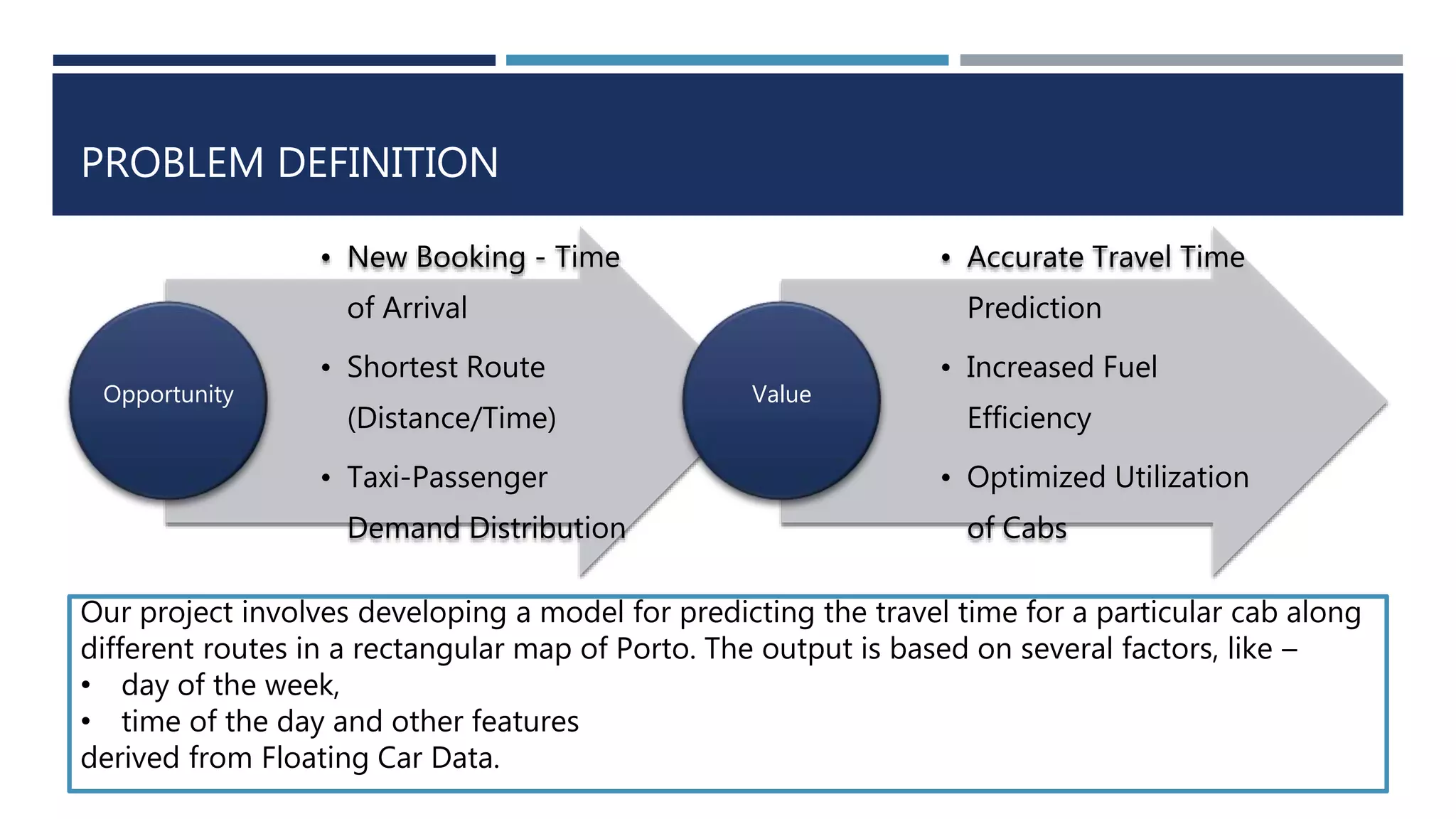
• New Booking - Time
of Arrival
• Shortest Route
(Distance/Time)
• Taxi-Passenger
Demand Distribution
Opportunity
• Accurate Travel Time
Prediction
• Increased Fuel
Efficiency
• Optimized Utilization
of Cabs
Value
Our project involves developing a model for predicting the travel time for a particular cab along
different routes in a rectangular map of Porto. The output is based on several factors, like –
• day of the week,
• time of the day and other features
derived from Floating Car Data.
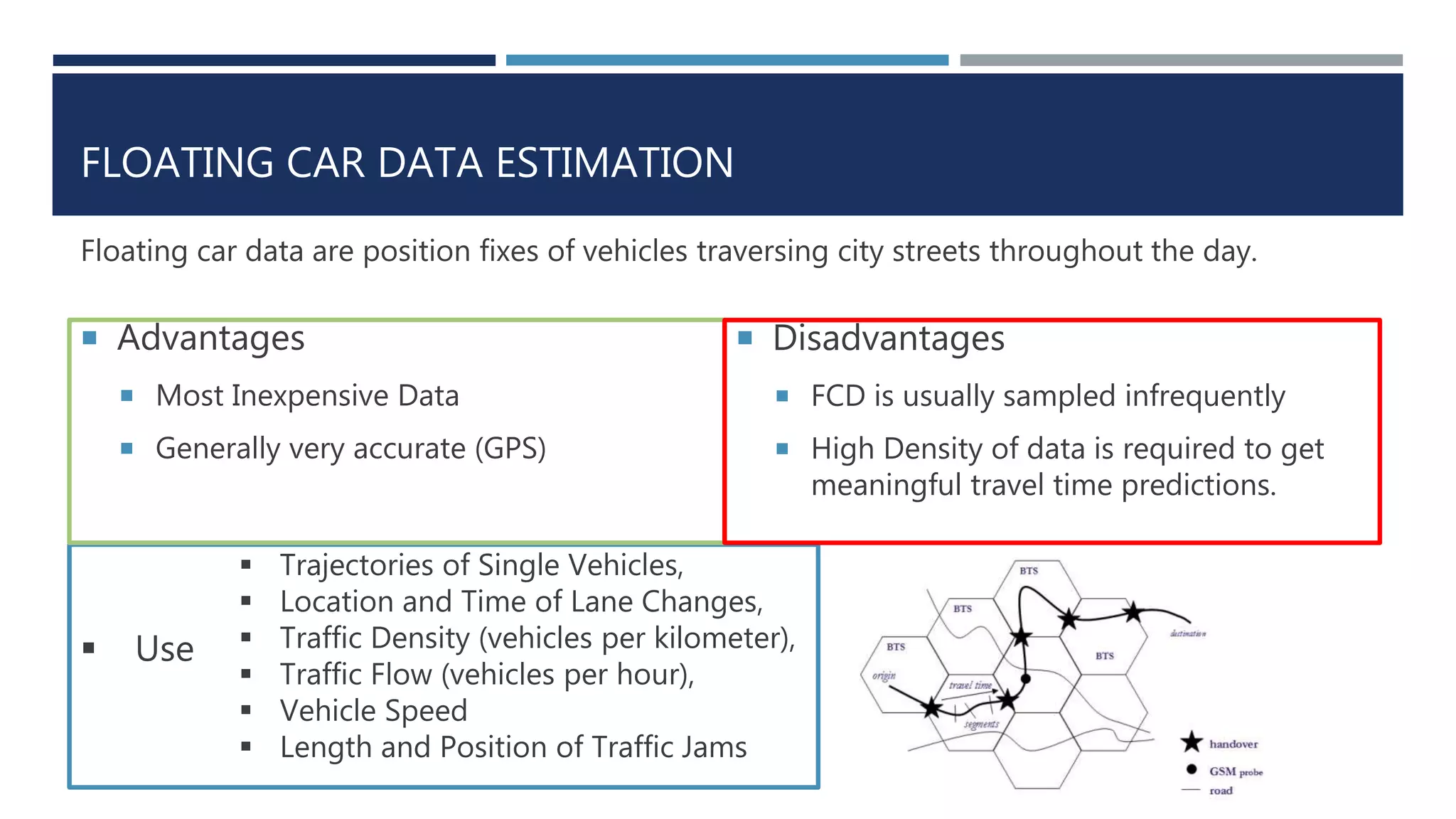
FLOATING CAR DATA ESTIMATION
 Advantages
 Most Inexpensive Data
 Generally very accurate (GPS)
 Disadvantages
 FCD is usually sampled infrequently
 High Density of data is required to get
meaningful travel time predictions.
Floating car data are position fixes of vehicles traversing city streets throughout the day.
 Trajectories of Single Vehicles,
 Location and Time of Lane Changes,
 Traffic Density (vehicles per kilometer),
 Traffic Flow (vehicles per hour),
 Vehicle Speed
 Length and Position of Traffic Jams
 Use
DATA DESCRIPTION
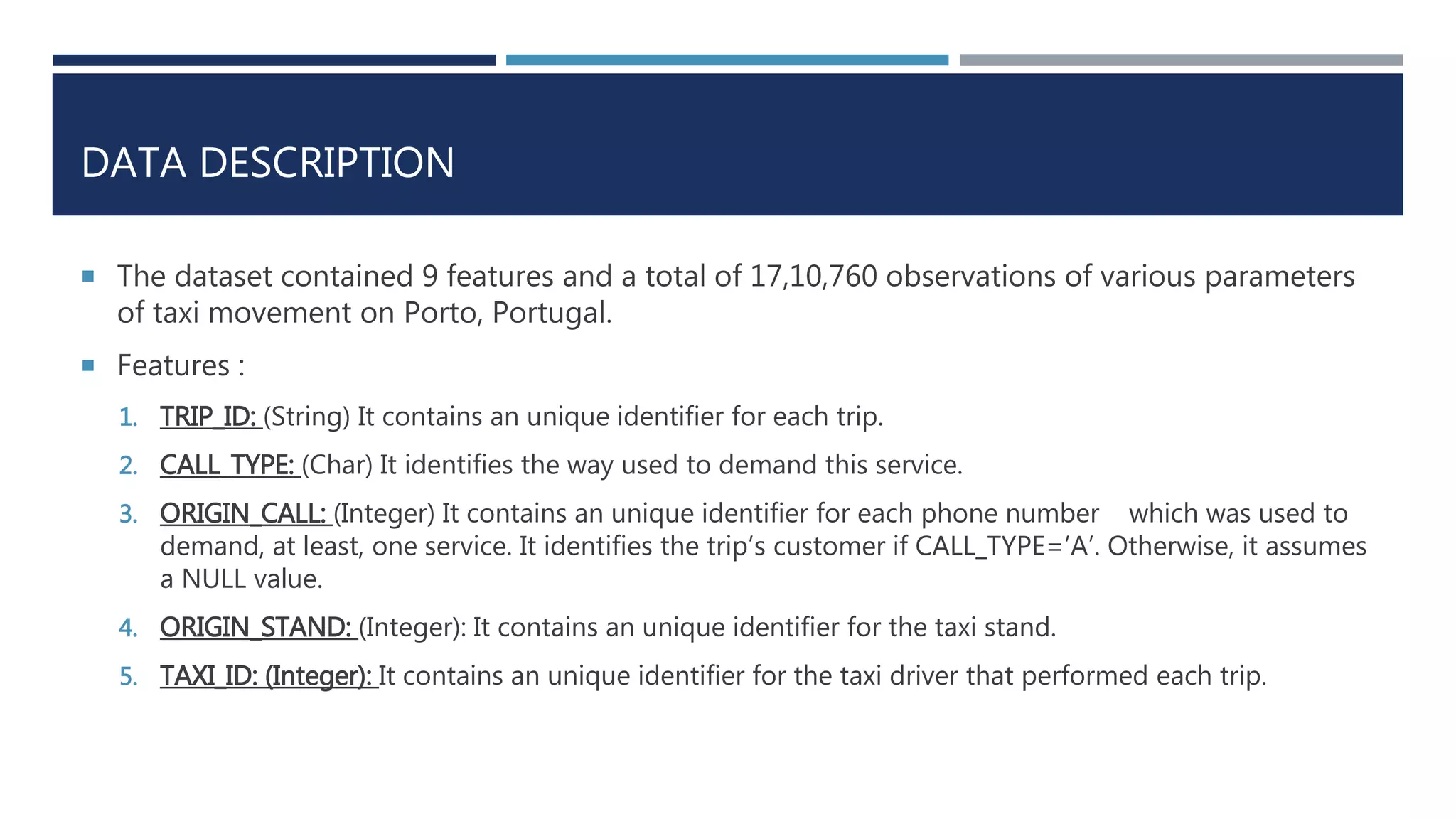
 The dataset contained 9 features and a total of 17,10,760 observations of various parameters
of taxi movement on Porto, Portugal.
 Features :
1. TRIP_ID: (String) It contains an unique identifier for each trip.
2. CALL_TYPE: (Char) It identifies the way used to demand this service.
3. ORIGIN_CALL: (Integer) It contains an unique identifier for each phone number which was used to
demand, at least, one service. It identifies the trip’s customer if CALL_TYPE=’A’. Otherwise, it assumes
a NULL value.
4. ORIGIN_STAND: (Integer): It contains an unique identifier for the taxi stand.
5. TAXI_ID: (Integer): It contains an unique identifier for the taxi driver that performed each trip.
DATA DESCRIPTION
 The dataset contained 9 features and a total of 17,10,760 observations of various parameters
of taxi movement on Porto, Portugal.
 Features :
6. TIMESTAMP: (Integer) Unix Timestamp (in seconds). It identifies the trip’s start.
7. DAYTYPE: (Char) It identifies the type of the day in which the trip starts. (Holiday, Day before Holiday,
Weekday)
8. MISSING_DATA: (Boolean) It is FALSE when the GPS data stream is complete and TRUE whenever one
(or more) locations are missing.
9. POLYLINE: (String): It contains a list of GPS coordinates (i.e. WGS84 format) mapped as a string. Each
pair of coordinates is of the form [LONGITUDE, LATITUDE].
 For Prediction of Time we have considered Timestamp and Polyline.
 The rows having missing value are not considered in our calculations.
PREDICTION ARCHITECTURE
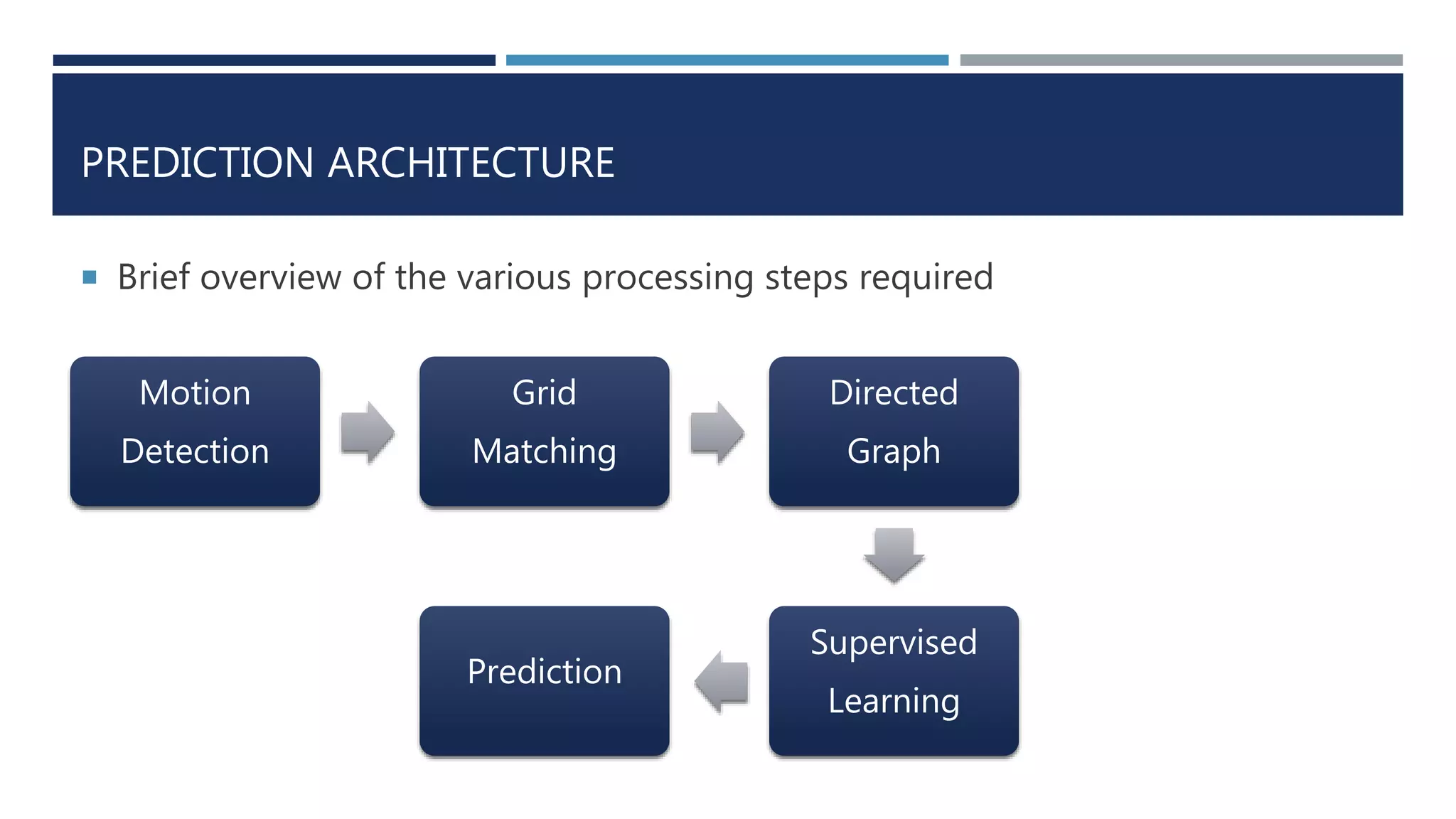
 Brief overview of the various processing steps required
Motion
Detection
Grid
Matching
Directed
Graph
Supervised
Learning
Prediction
PREDICTION ARCHITECTURE
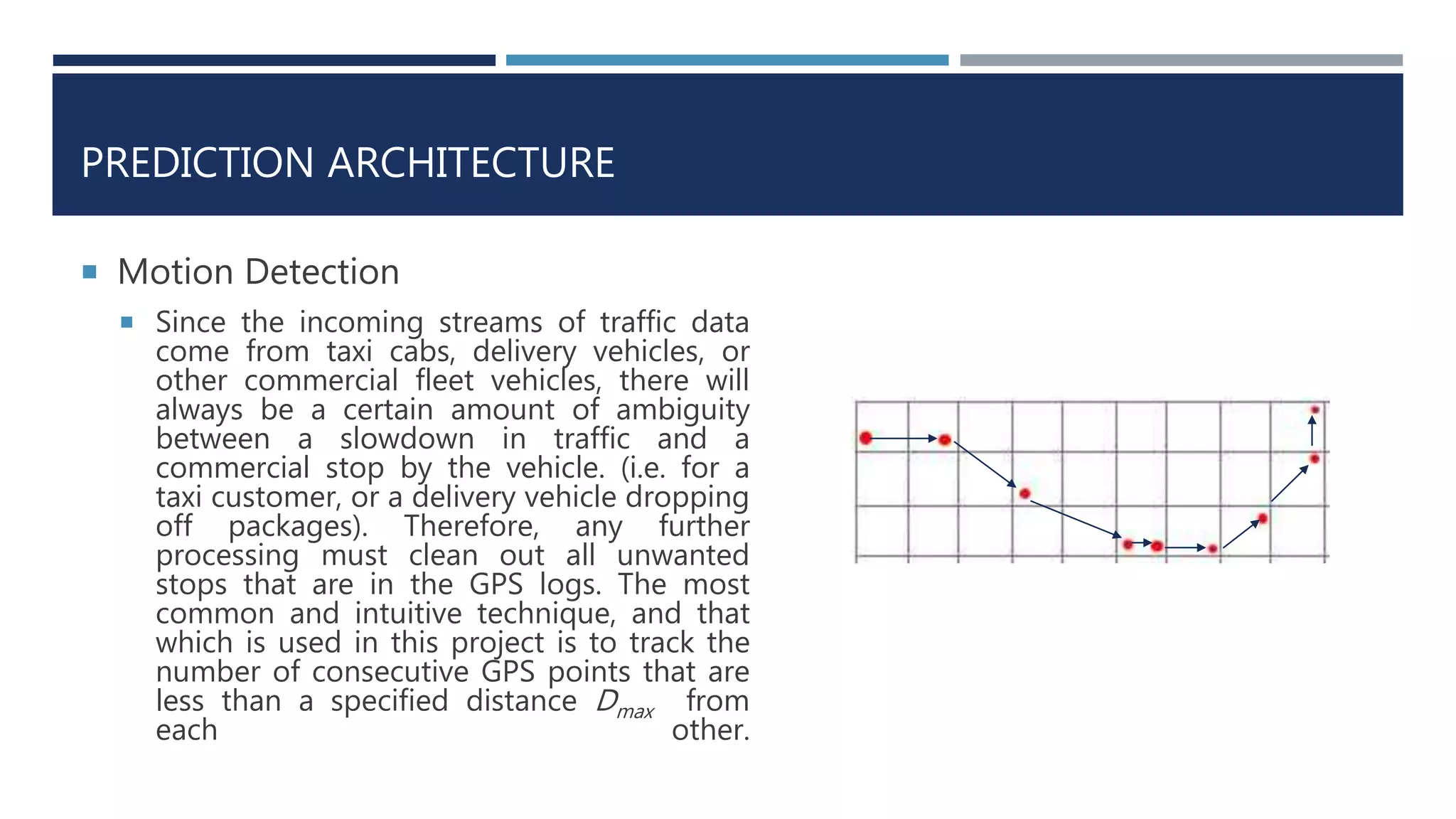
 Motion Detection
 Since the incoming streams of traffic data
come from taxi cabs, delivery vehicles, or
other commercial fleet vehicles, there will
always be a certain amount of ambiguity
between a slowdown in traffic and a
commercial stop by the vehicle. (i.e. for a
taxi customer, or a delivery vehicle dropping
off packages). Therefore, any further
processing must clean out all unwanted
stops that are in the GPS logs. The most
common and intuitive technique, and that
which is used in this project is to track the
number of consecutive GPS points that are
less than a specified distance Dmax from
each other.
PREDICTION ARCHITECTURE
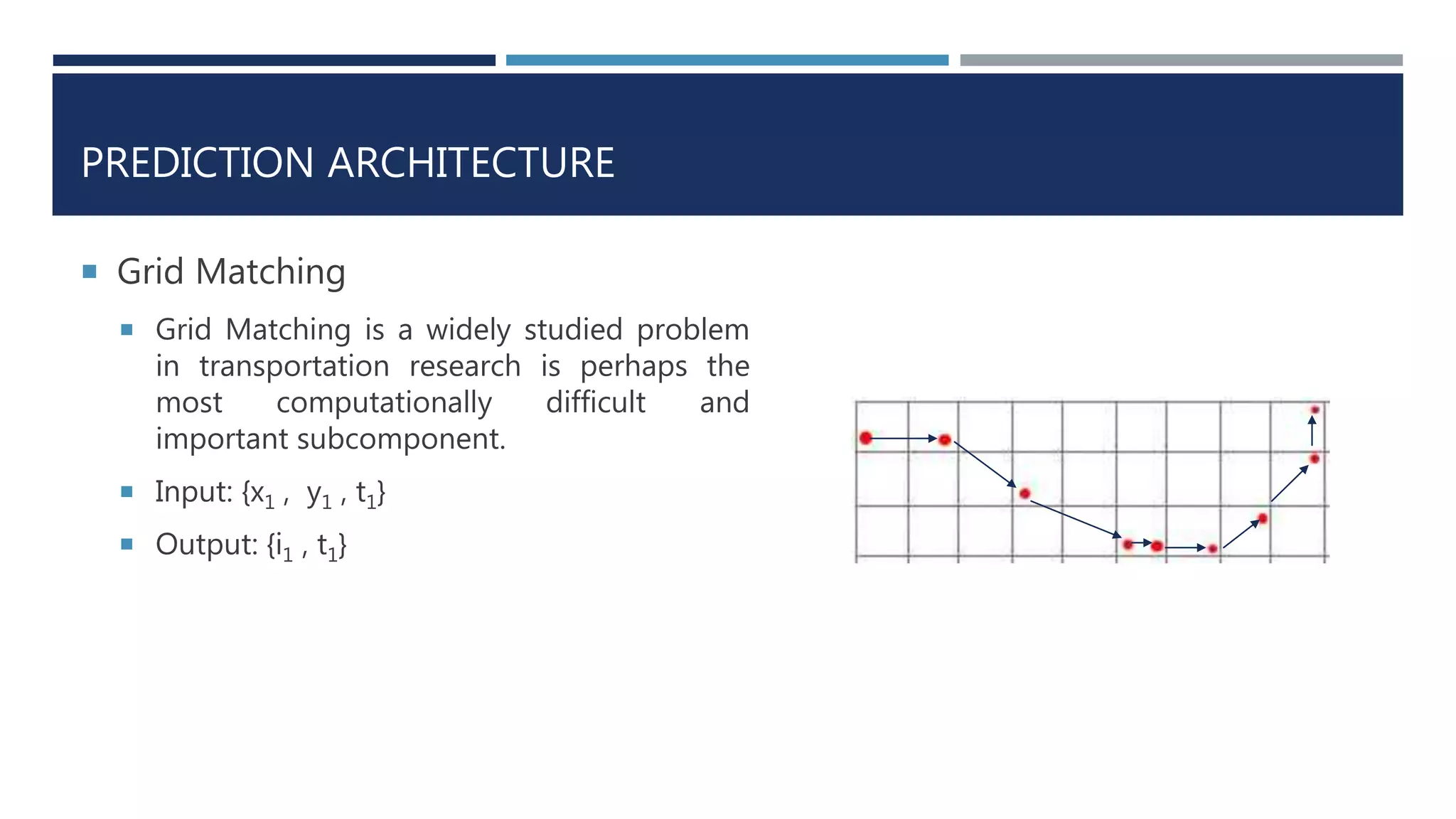
 Grid Matching
 Grid Matching is a widely studied problem
in transportation research is perhaps the
most computationally difficult and
important subcomponent.
 Input: {x1 , y1 , t1}
 Output: {i1 , t1}
PREDICTION ARCHITECTURE
 Several distance measure:
Manhattan Distance, Block Distance, Minkowski distance, Haversine Distance.
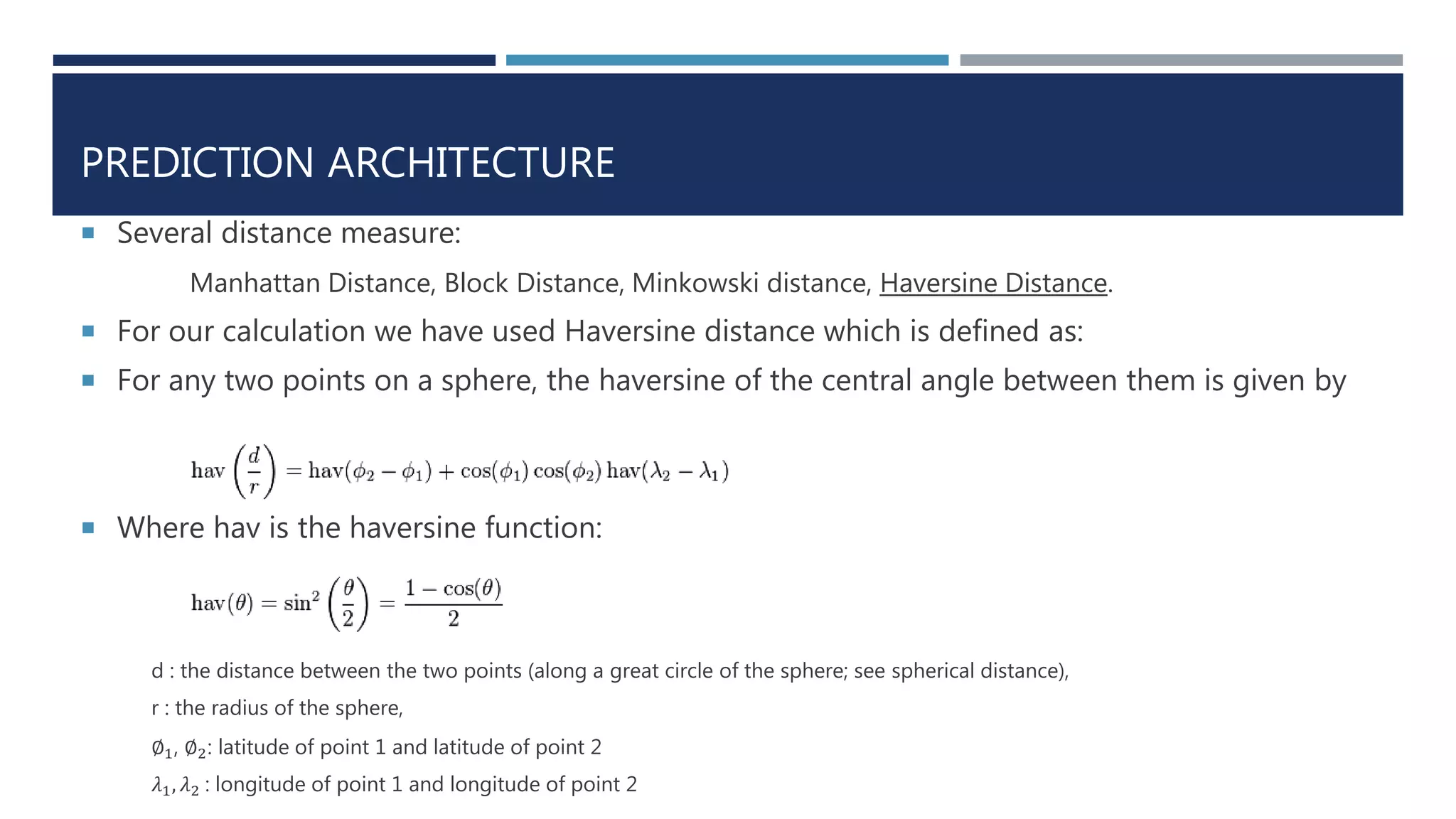
 For our calculation we have used Haversine distance which is defined as:
 For any two points on a sphere, the haversine of the central angle between them is given by
 Where hav is the haversine function:
d : the distance between the two points (along a great circle of the sphere; see spherical distance),
r : the radius of the sphere,
∅1, ∅2: latitude of point 1 and latitude of point 2
𝜆1, 𝜆2 : longitude of point 1 and longitude of point 2
PREDICTION ARCHITECTURE
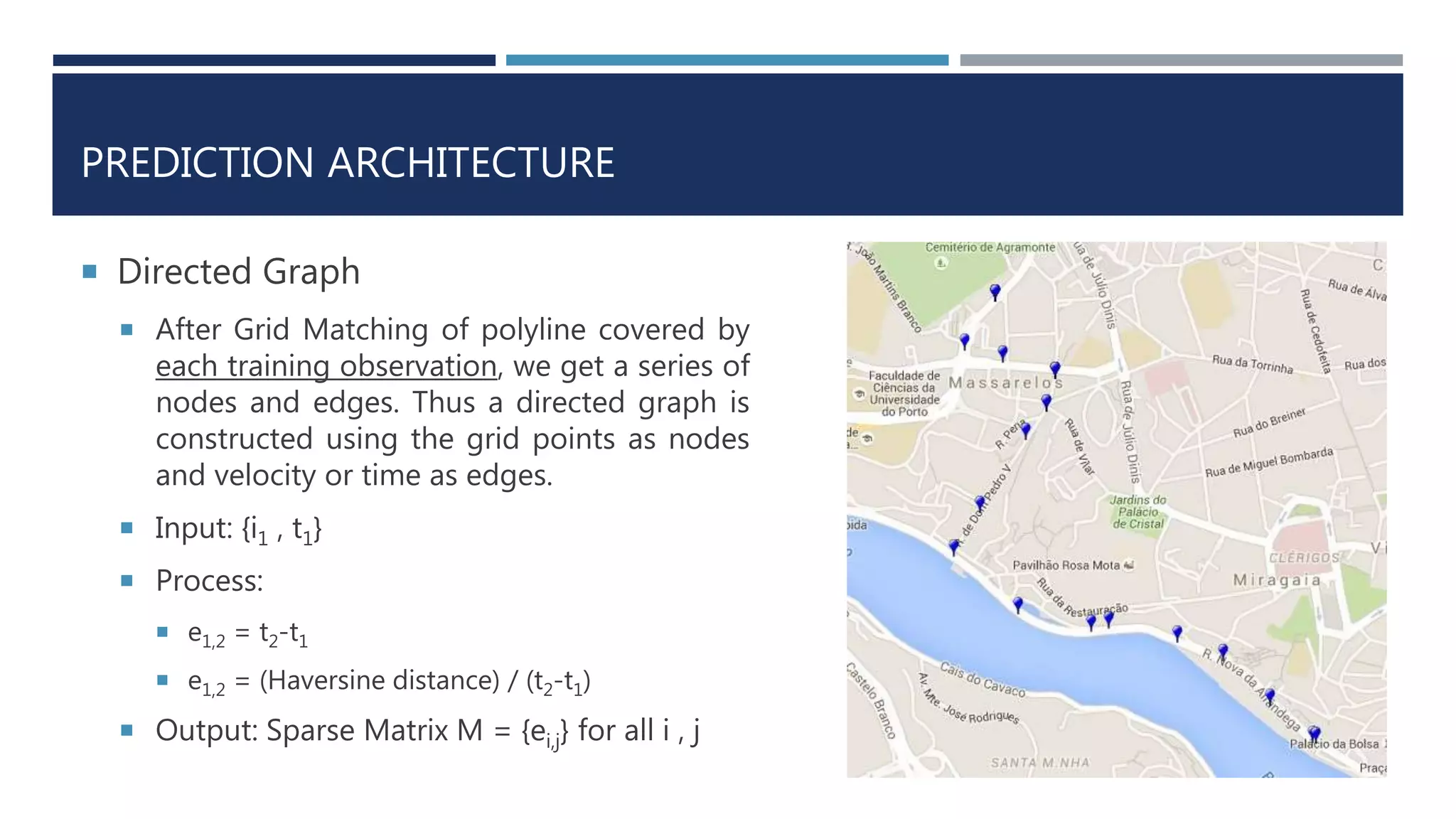
 Directed Graph
 After Grid Matching of polyline covered by
each training observation, we get a series of
nodes and edges. Thus a directed graph is
constructed using the grid points as nodes
and velocity or time as edges.
 Input: {i1 , t1}
 Process:
 e1,2 = t2-t1
 e1,2 = (Haversine distance) / (t2-t1)
 Output: Sparse Matrix M = {ei,j} for all i , j
PREDICTION ARCHITECTURE
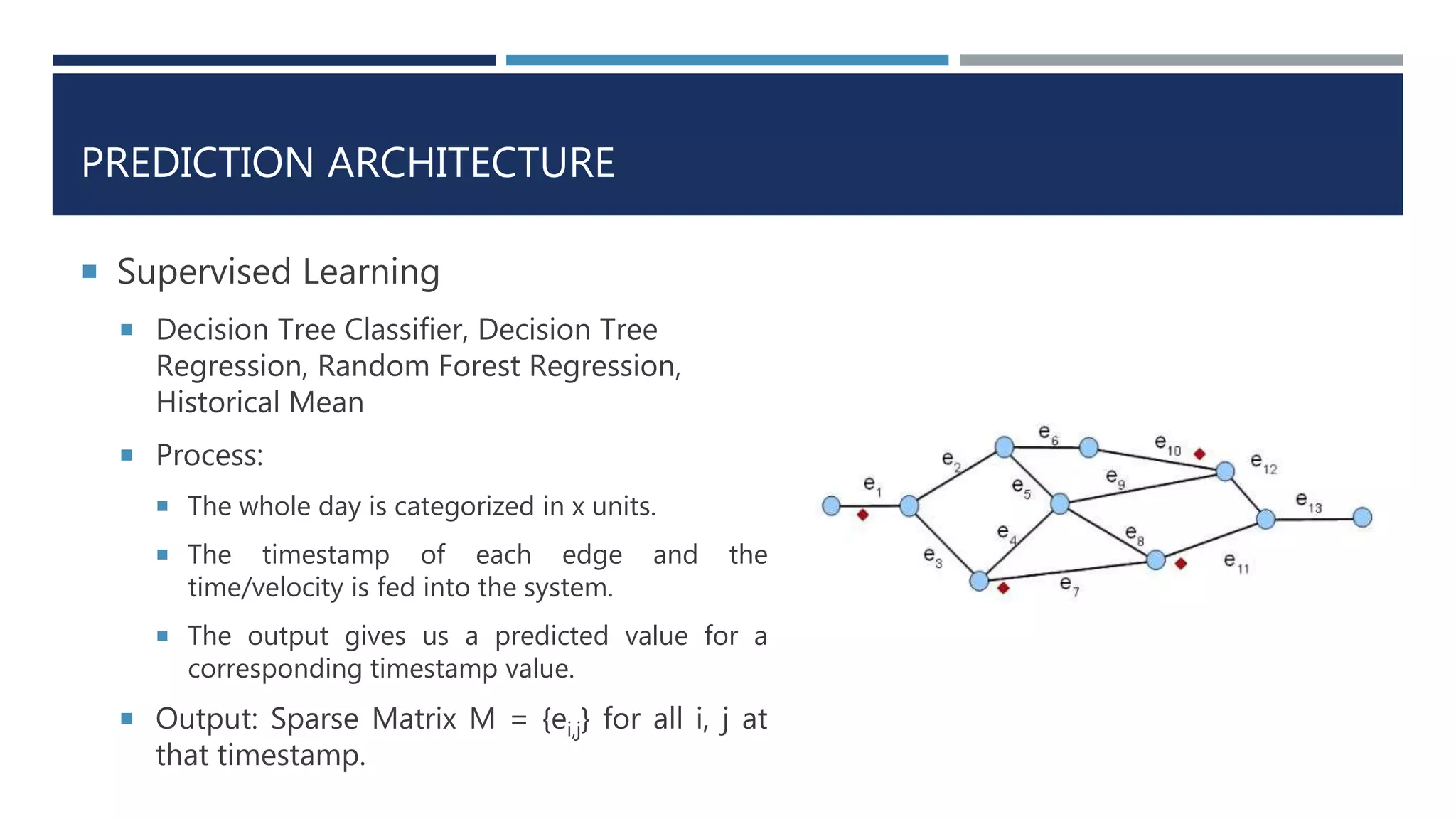
 Supervised Learning
 Decision Tree Classifier, Decision Tree
Regression, Random Forest Regression,
Historical Mean
 Process:
 The whole day is categorized in x units.
 The timestamp of each edge and the
time/velocity is fed into the system.
 The output gives us a predicted value for a
corresponding timestamp value.
 Output: Sparse Matrix M = {ei,j} for all i, j at
that timestamp.
PREDICTION ARCHITECTURE
 Decision Tree Classification:
 Classification trees work just like regression trees, only they try to predict a discrete
category (the class), rather than a numerical value. The response variable Y is categorical,
so we can use information theory to measure how much we learn about it from knowing
the value of another discrete variable A:
I[Y | A] = 𝑎 P A = a ∗ I[Y | A = a]
Where, I[Y | A = a] = H[Y ] − H[Y | A = a]
 The definitions of entropy H[Y ] and conditional entropy H[Y |A = a].
H[Y | A = a] = - 𝑘 𝑝 𝑎𝑘 log2 𝑝 𝑎𝑘
PREDICTION ARCHITECTURE
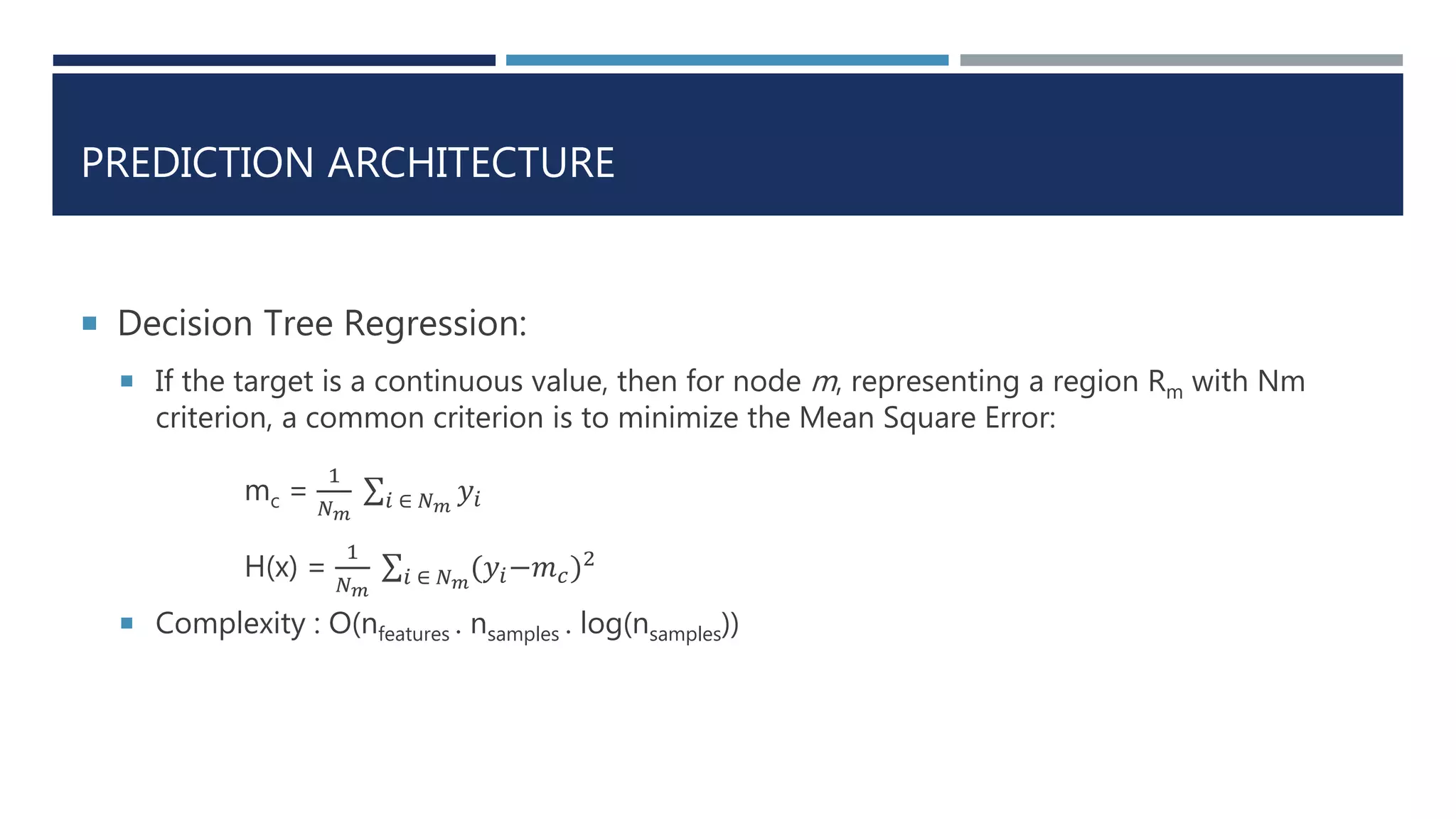
 Decision Tree Regression:
 If the target is a continuous value, then for node m, representing a region Rm with Nm
criterion, a common criterion is to minimize the Mean Square Error:
mc =
1
𝑁 𝑚
𝑖 ∈ 𝑁 𝑚
𝑦𝑖
H(x) =
1
𝑁 𝑚
𝑖 ∈ 𝑁 𝑚
(𝑦𝑖−𝑚 𝑐)2
 Complexity : O(nfeatures . nsamples . log(nsamples))
PREDICTION ARCHITECTURE
 Random Forest Regression:
 Here, each tree in the ensemble is built from a sample drawn with replacement (i.e., a
bootstrap sample) from the training set.
 Disadvantage: In addition, when splitting a node during the construction of the tree, the
split that is chosen is no longer the best split among all features. Instead, the split that is
picked is the best split among a random subset of the features. As a result of this
randomness, the bias of the forest usually slightly increases (with respect to the bias of a
single non-random tree)
 Advantage: But, due to averaging, its variance also decreases, usually more than
compensating for the increase in bias, hence yielding an overall better model.
PREDICTION ARCHITECTURE
 Gradient Tree Boosting:
 Gradient Tree Boosting or Gradient Boosted Regression Trees (GBRT) is a generalization of
boosting to arbitrary differentiable loss functions.
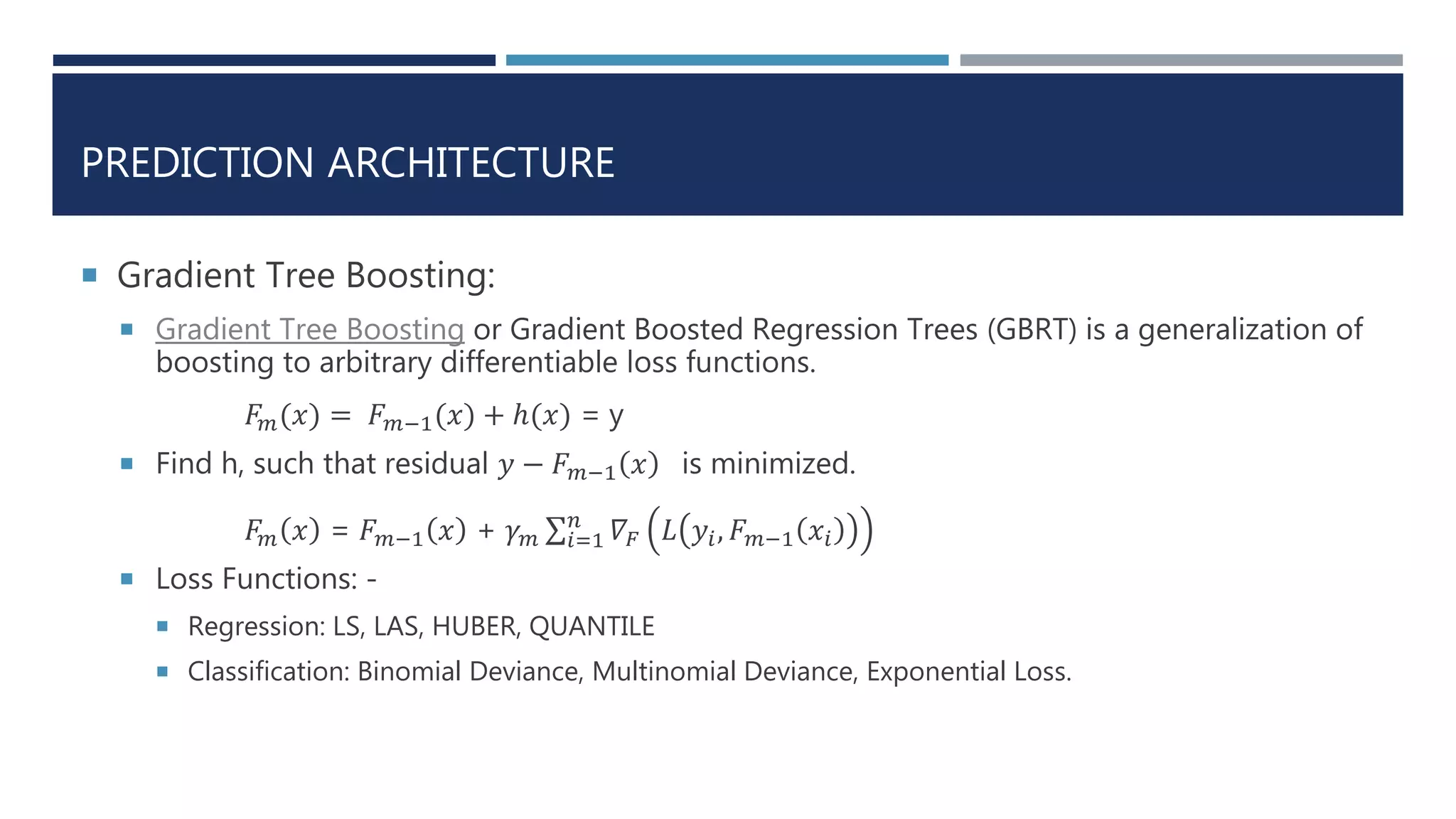
𝐹𝑚(𝑥) = 𝐹 𝑚−1(𝑥) + ℎ(𝑥) = y
 Find h, such that residual 𝑦 − 𝐹 𝑚−1 𝑥 is minimized.
𝐹𝑚 𝑥 = 𝐹 𝑚−1 𝑥 + 𝛾 𝑚 𝑖=1
𝑛
𝛻𝐹 𝐿 𝑦𝑖, 𝐹 𝑚−1 𝑥𝑖
 Loss Functions: -
 Regression: LS, LAS, HUBER, QUANTILE
 Classification: Binomial Deviance, Multinomial Deviance, Exponential Loss.
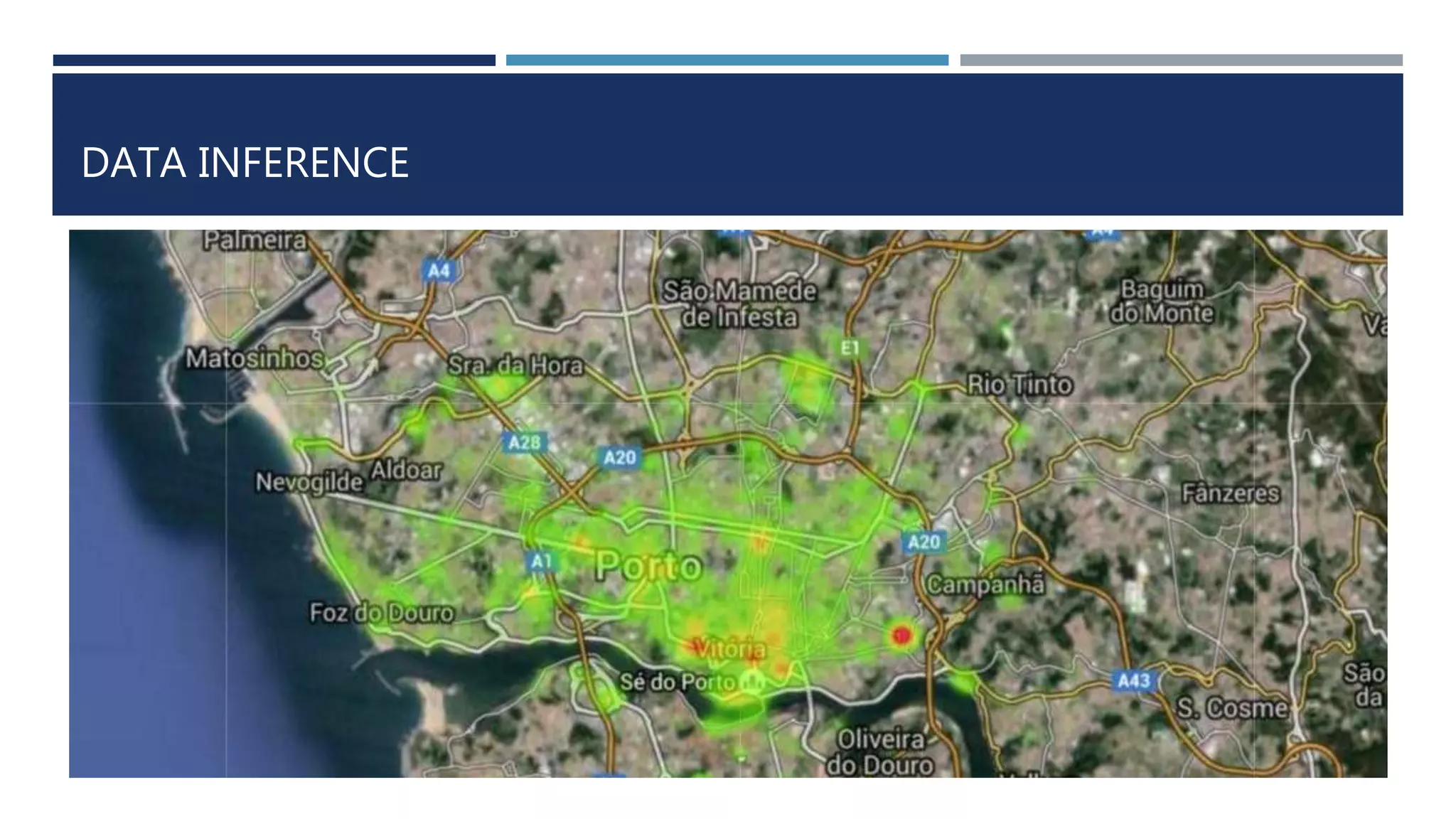
DATA INFERENCE
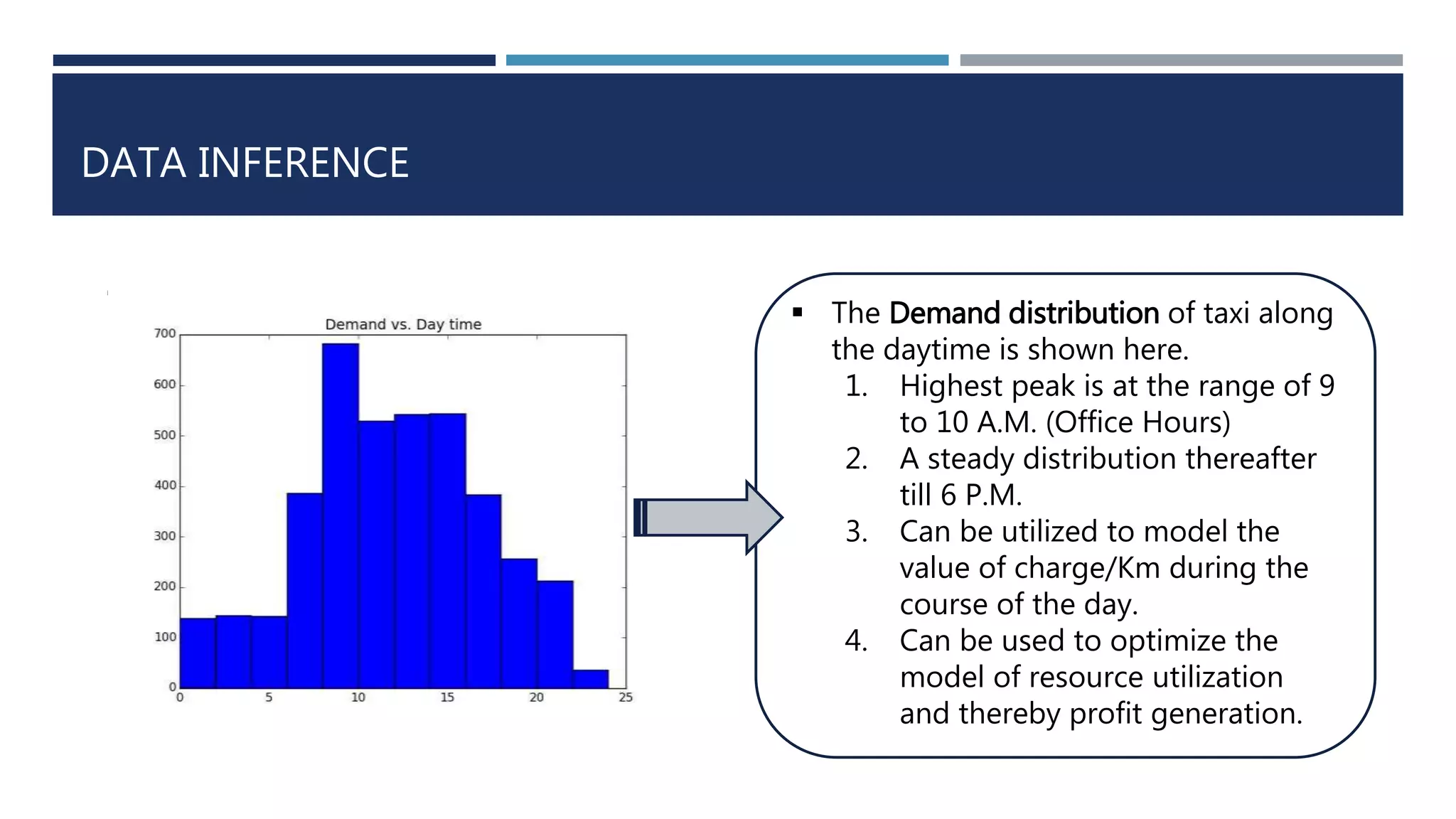
 The Demand distribution of taxi along
the daytime is shown here.
1. Highest peak is at the range of 9
to 10 A.M. (Office Hours)
2. A steady distribution thereafter
till 6 P.M.
3. Can be utilized to model the
value of charge/Km during the
course of the day.
4. Can be used to optimize the
model of resource utilization
and thereby profit generation.
DATA INFERENCE
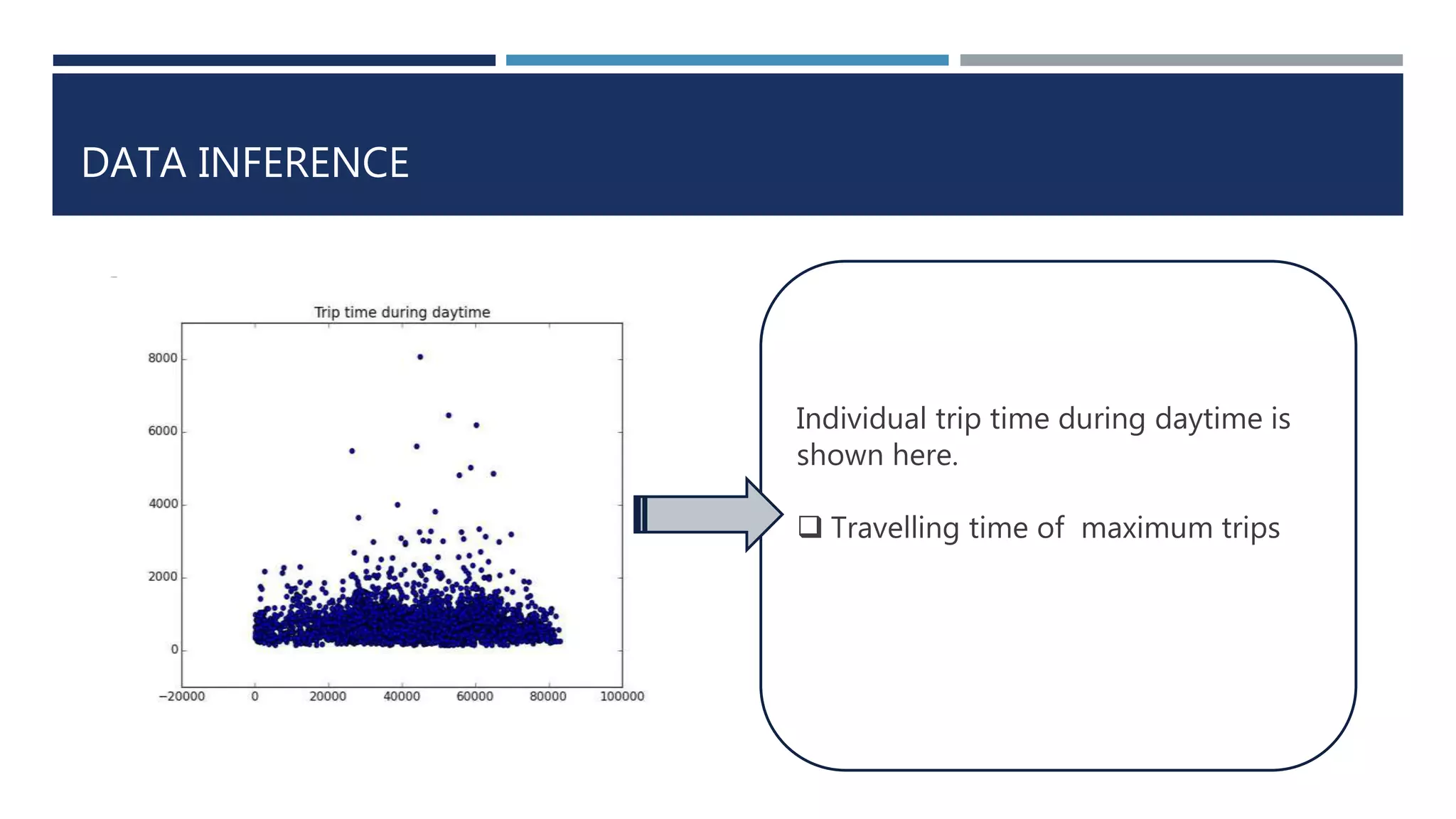
Individual trip time during daytime is
shown here.
 Travelling time of maximum trips
are within half an hour.
DATA INFERENCE
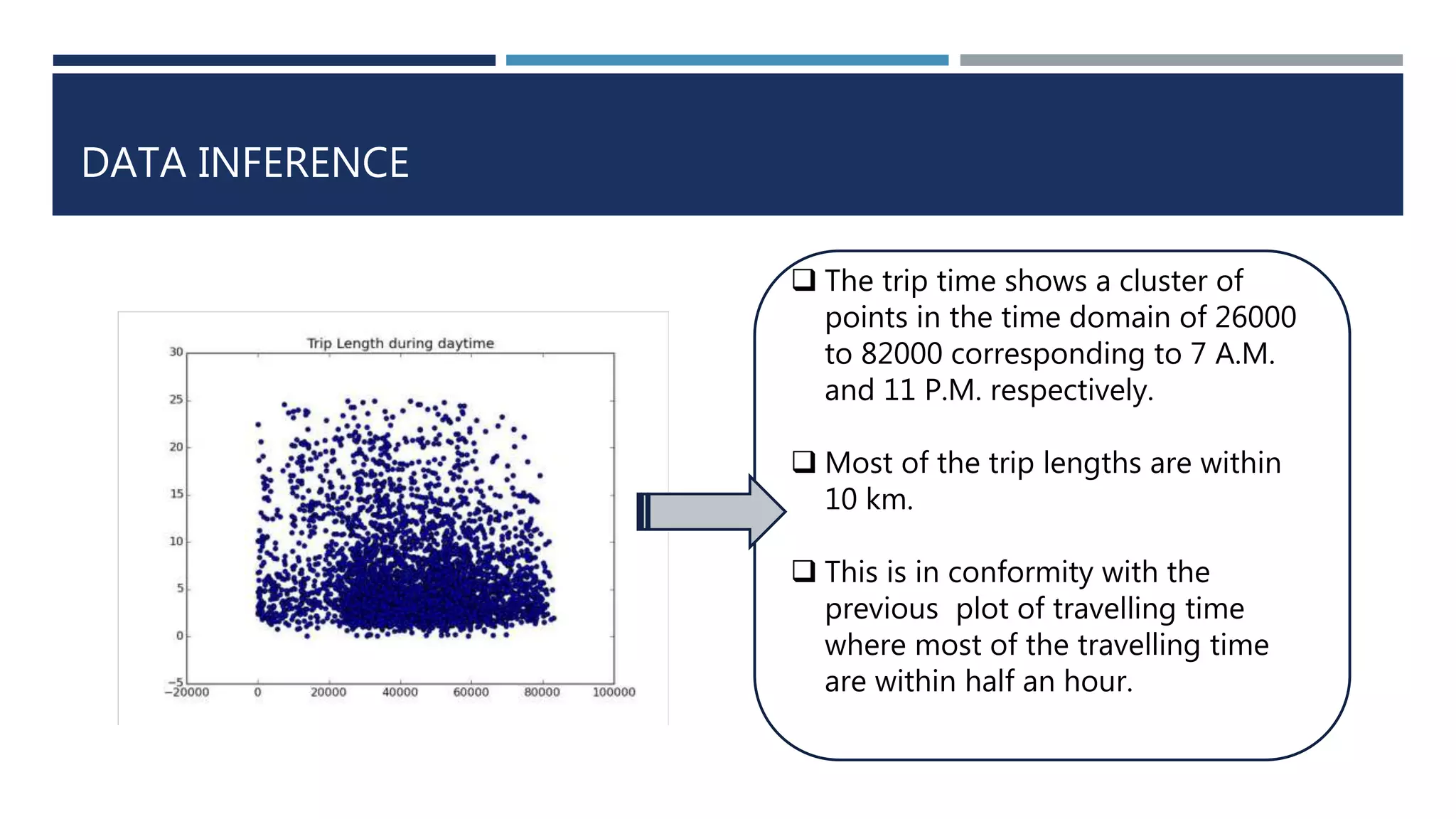
 The trip time shows a cluster of
points in the time domain of 26000
to 82000 corresponding to 7 A.M.
and 11 P.M. respectively.
 Most of the trip lengths are within
10 km.
 This is in conformity with the
previous plot of travelling time
where most of the travelling time
are within half an hour.
DATA INFERENCE
DATA INFERENCE
 Top 5 important road segments of the city are
 [[41.162292, -8.60787], [41.162031, -8.60571]]
 [[41.16258, -8.61003], [41.162292, -8.60787]]
 [[41.163291, -8.6157], [41.163021, -8.613639]]
 [[41.163525, -8.617644], [41.163291, -8.6157]]
 [[41.163768, -8.619678], [41.163525, -8.617644]]
 0.0772321809805613, 0.07708869873451546, 0.07441287173742973, 0.07212227668575326,
0.06932519386480848
Rank Segment Centrality
1 [41.162292, -8.60787], [41.162031, -
8.60571]
0.0772321809805613
2 [41.16258, -8.61003], [41.162292, -8.60787] 0.0770886987345154
6
3 [41.163291, -8.6157], [41.163021, -
8.613639]
0.0744128717374297
3
4 [41.163525, -8.617644], [41.163291, -
8.6157]
0.0721222766857532
6
DATA INFERENCE
Rank Geo-Location Centrality
1 [41.162031, -8.60571] 0.08277015940786502
2 [41.162292, -8.60787] 0.07877967724696255
3 [41.16258, -8.61003] 0.07775467831692078
4 [41.163021, -
8.613639]
0.07690847152899795
5 [41.163291, -8.6157] 0.07608514260606453
PERFORMANCE EVALUATION
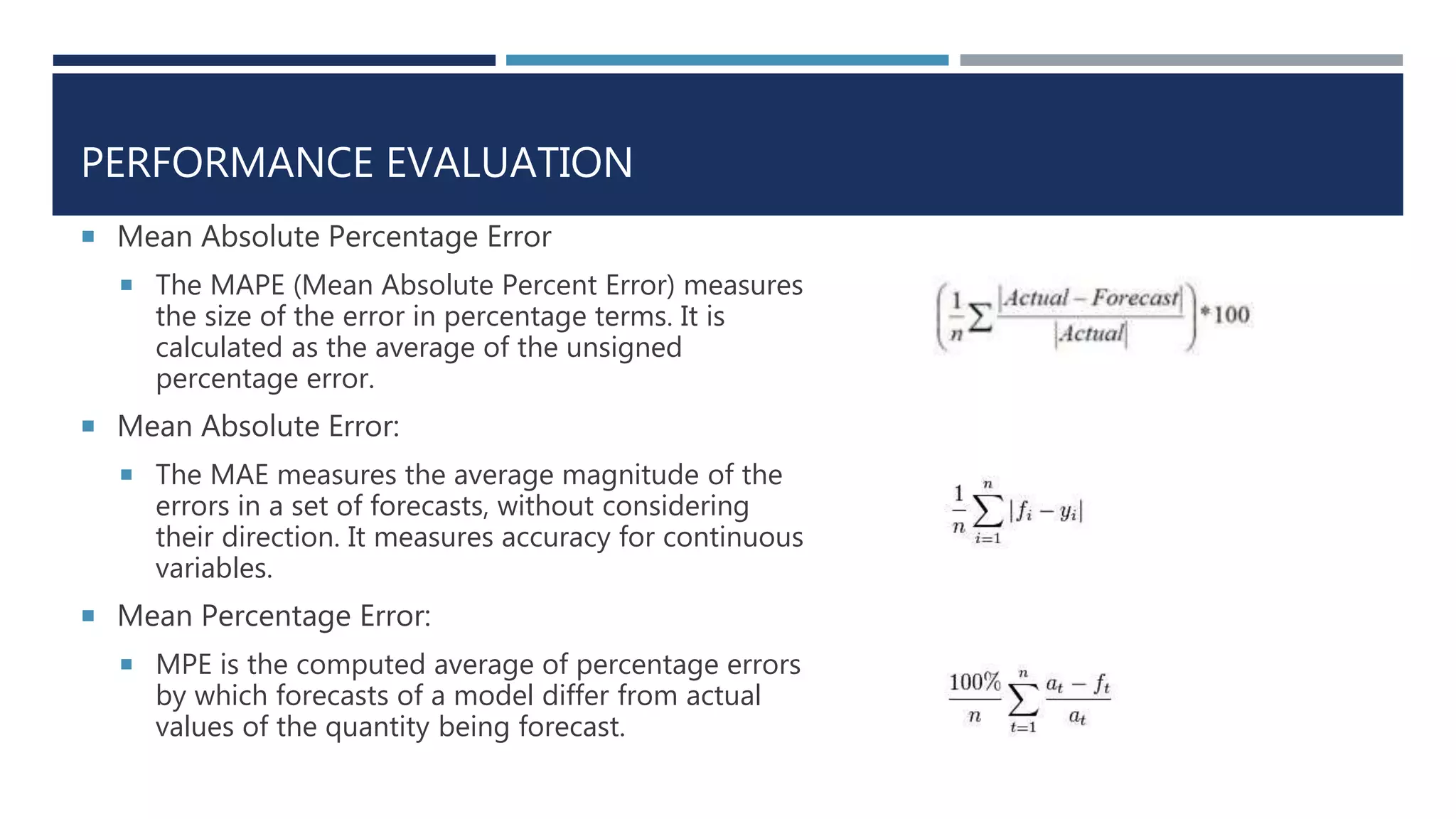
 Mean Absolute Percentage Error
 The MAPE (Mean Absolute Percent Error) measures
the size of the error in percentage terms. It is
calculated as the average of the unsigned
percentage error.
 Mean Absolute Error:
 The MAE measures the average magnitude of the
errors in a set of forecasts, without considering
their direction. It measures accuracy for continuous
variables.
 Mean Percentage Error:
 MPE is the computed average of percentage errors
by which forecasts of a model differ from actual
values of the quantity being forecast.
HYPOTHESIS TESTING (P-VALUE CALCULATION)
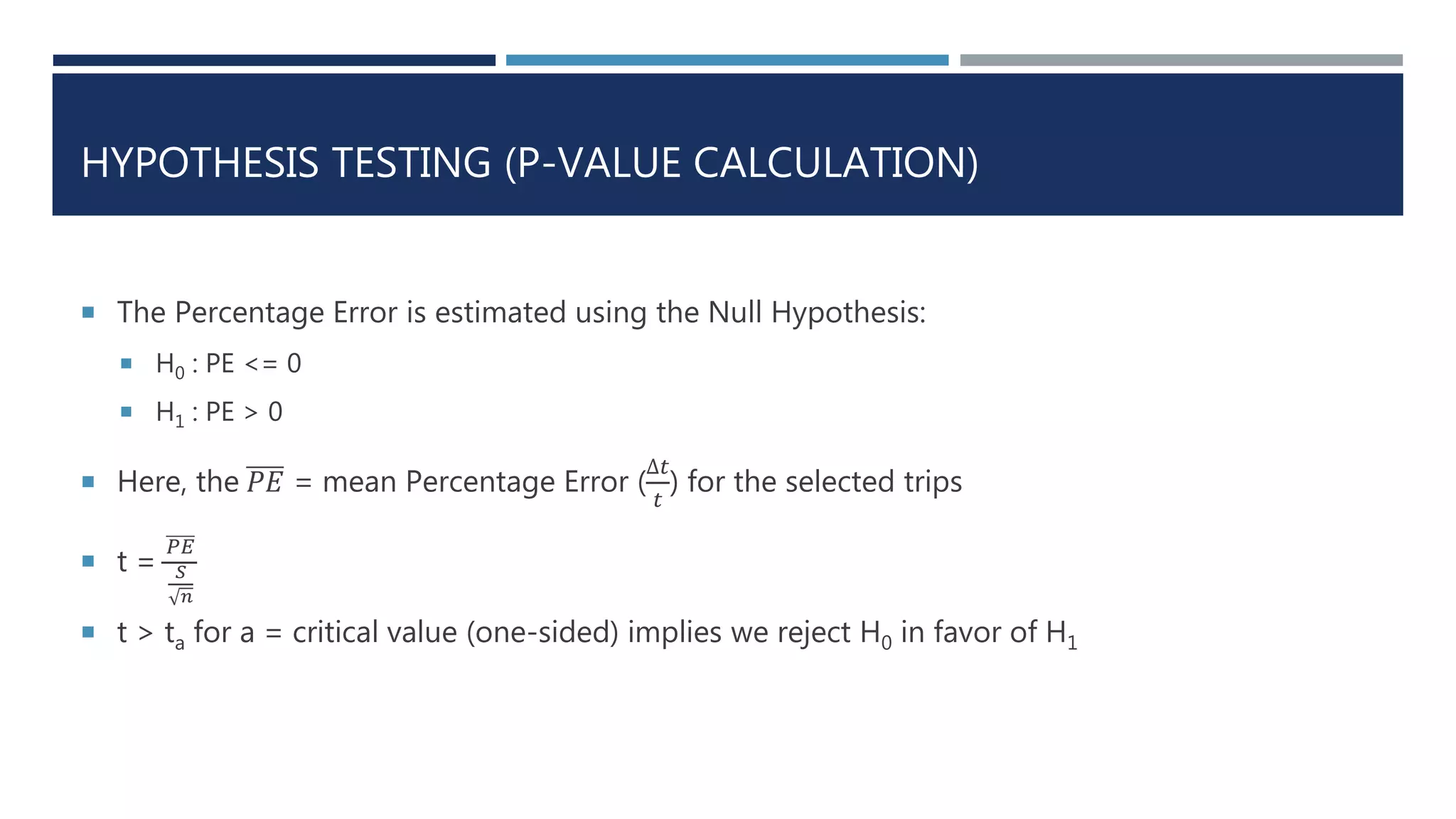
 The Percentage Error is estimated using the Null Hypothesis:
 H0 : PE <= 0
 H1 : PE > 0
 Here, the 𝑃𝐸 = mean Percentage Error (
∆𝑡
𝑡
) for the selected trips
 t =
𝑃𝐸
𝑆
𝑛
 t > ta for a = critical value (one-sided) implies we reject H0 in favor of H1
PERFORMANCE EVALUATION
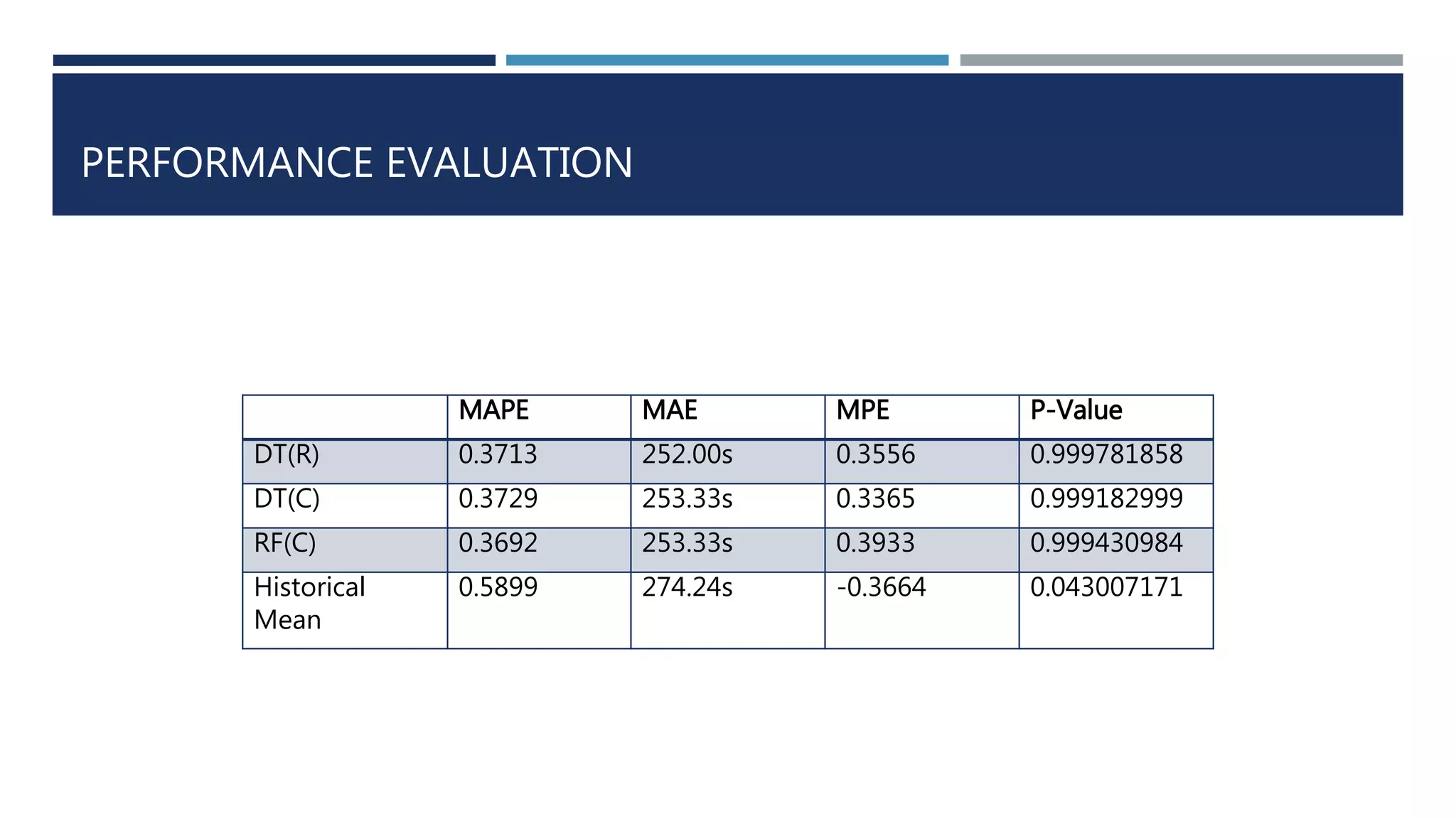
MAPE MAE MPE P-Value
DT(R) 0.3713 252.00s 0.3556 0.999781858
DT(C) 0.3729 253.33s 0.3365 0.999182999
RF(C) 0.3692 253.33s 0.3933 0.999430984
Historical
Mean
0.5899 274.24s -0.3664 0.043007171
PERFORMANCE EVALUATION
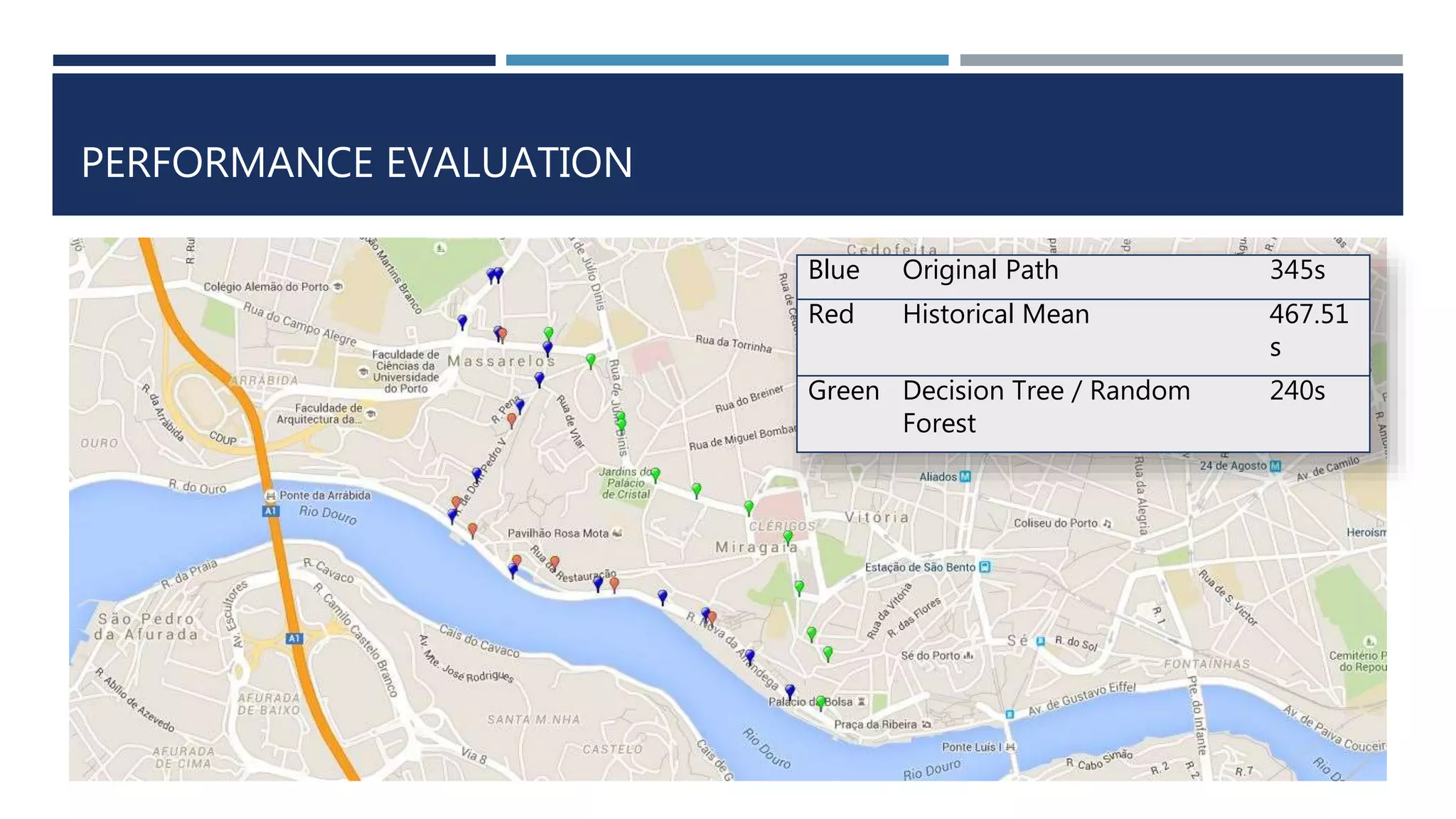
Blue Original Path 345s
Red Historical Mean 467.51
s
Green Decision Tree / Random
Forest
240s
PERFORMANCE EVALUATION
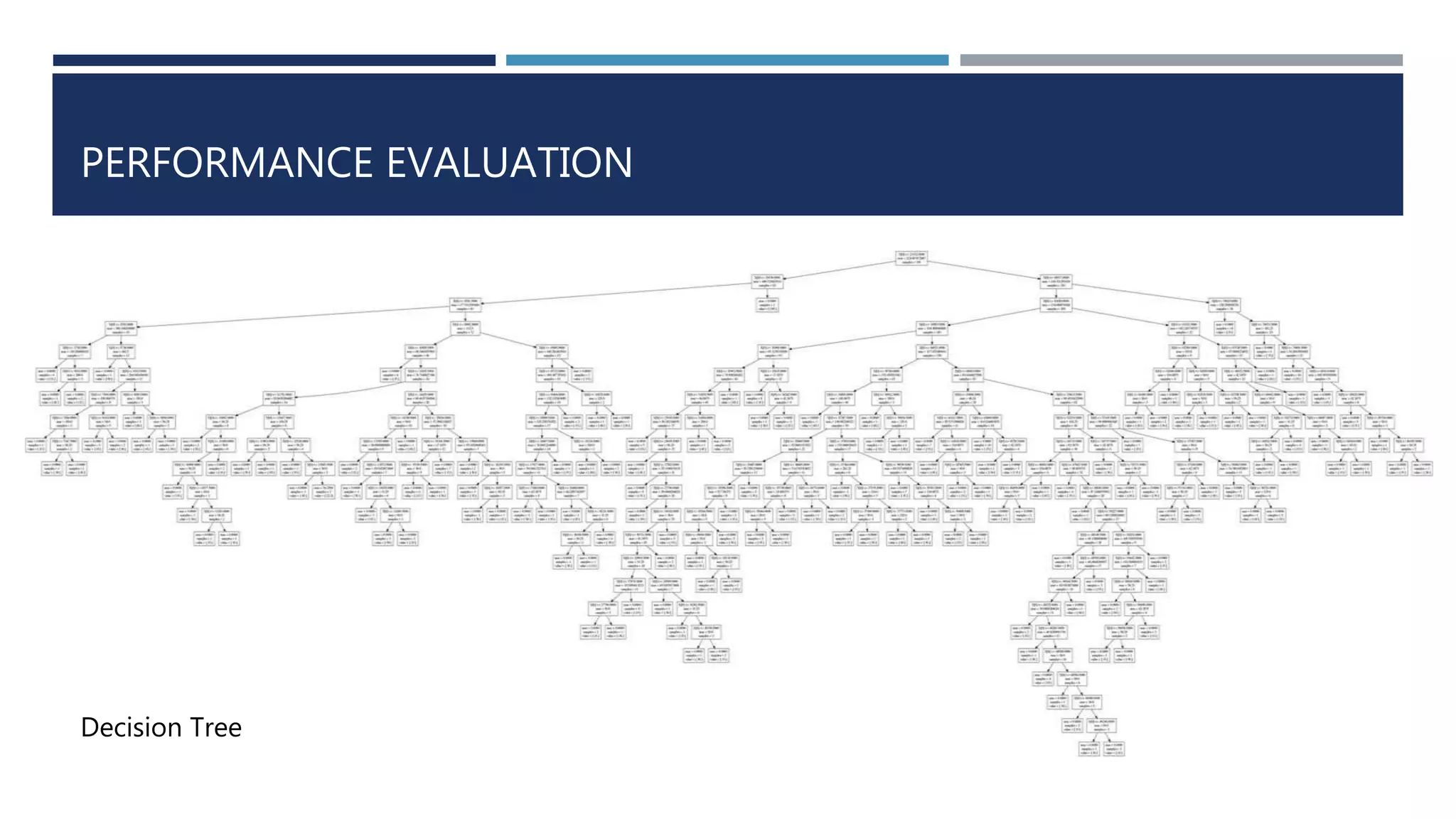
Decision Tree
FUTURE VALUE ADDITION
 Apply an incremental ARIMA model to each segment for a specific time of the day (Data
needed)
 Use Map Matching Technique to position the standard points on the road accurately.
 Real Time Traffic Map (travelling route management, traffic signal optimization etc.)
 Optimization of our approach in order to reduce model error.
 To make this prediction real time and make better visualization of prediction.
 Implement it locally.
 Consolidate the Features in an Application
REFERENCES
 http://arxiv.org/pdf/1012.4249.pdf
 http://arxiv.org/pdf/1509.05257.pdf
 https://en.wikipedia.org/wiki/Haversine_formula
 http://toc.proceedings.com/04373webtoc.pdf
 http://www.ivt.ethz.ch/oev/ped2012/vpl/publications/reports/ab379.pdf
 https://www.kaggle.com/c/pkdd-15-taxi-trip-time-prediction-ii
 http://www.galitshmueli.com/data-mining-project/predicting-customer-cancellation-cab-bookings-
yourcabscom
 http://scikit-learn.org/stable/modules/ensemble.html
 https://www.scribblemaps.com/create/#id=srin&lat=41.1619705&lng=-
8.60570389999998&z=14&t=road
THANK YOU

Cab travel time prediction using ensemble models

  • 1.
    - BASED ONHISTORICAL TRIP OBSERVATION CAB TRAVEL TIME PREDICTI N
  • 2.
    PROBLEM DEFINITION • NewBooking - Time of Arrival • Shortest Route (Distance/Time) • Taxi-Passenger Demand Distribution Opportunity • Accurate Travel Time Prediction • Increased Fuel Efficiency • Optimized Utilization of Cabs Value Our project involves developing a model for predicting the travel time for a particular cab along different routes in a rectangular map of Porto. The output is based on several factors, like – • day of the week, • time of the day and other features derived from Floating Car Data.
  • 3.
    FLOATING CAR DATAESTIMATION  Advantages  Most Inexpensive Data  Generally very accurate (GPS)  Disadvantages  FCD is usually sampled infrequently  High Density of data is required to get meaningful travel time predictions. Floating car data are position fixes of vehicles traversing city streets throughout the day.  Trajectories of Single Vehicles,  Location and Time of Lane Changes,  Traffic Density (vehicles per kilometer),  Traffic Flow (vehicles per hour),  Vehicle Speed  Length and Position of Traffic Jams  Use
  • 4.
    DATA DESCRIPTION  Thedataset contained 9 features and a total of 17,10,760 observations of various parameters of taxi movement on Porto, Portugal.  Features : 1. TRIP_ID: (String) It contains an unique identifier for each trip. 2. CALL_TYPE: (Char) It identifies the way used to demand this service. 3. ORIGIN_CALL: (Integer) It contains an unique identifier for each phone number which was used to demand, at least, one service. It identifies the trip’s customer if CALL_TYPE=’A’. Otherwise, it assumes a NULL value. 4. ORIGIN_STAND: (Integer): It contains an unique identifier for the taxi stand. 5. TAXI_ID: (Integer): It contains an unique identifier for the taxi driver that performed each trip.
  • 5.
    DATA DESCRIPTION  Thedataset contained 9 features and a total of 17,10,760 observations of various parameters of taxi movement on Porto, Portugal.  Features : 6. TIMESTAMP: (Integer) Unix Timestamp (in seconds). It identifies the trip’s start. 7. DAYTYPE: (Char) It identifies the type of the day in which the trip starts. (Holiday, Day before Holiday, Weekday) 8. MISSING_DATA: (Boolean) It is FALSE when the GPS data stream is complete and TRUE whenever one (or more) locations are missing. 9. POLYLINE: (String): It contains a list of GPS coordinates (i.e. WGS84 format) mapped as a string. Each pair of coordinates is of the form [LONGITUDE, LATITUDE].  For Prediction of Time we have considered Timestamp and Polyline.  The rows having missing value are not considered in our calculations.
  • 6.
    PREDICTION ARCHITECTURE  Briefoverview of the various processing steps required Motion Detection Grid Matching Directed Graph Supervised Learning Prediction
  • 7.
    PREDICTION ARCHITECTURE  MotionDetection  Since the incoming streams of traffic data come from taxi cabs, delivery vehicles, or other commercial fleet vehicles, there will always be a certain amount of ambiguity between a slowdown in traffic and a commercial stop by the vehicle. (i.e. for a taxi customer, or a delivery vehicle dropping off packages). Therefore, any further processing must clean out all unwanted stops that are in the GPS logs. The most common and intuitive technique, and that which is used in this project is to track the number of consecutive GPS points that are less than a specified distance Dmax from each other.
  • 8.
    PREDICTION ARCHITECTURE  GridMatching  Grid Matching is a widely studied problem in transportation research is perhaps the most computationally difficult and important subcomponent.  Input: {x1 , y1 , t1}  Output: {i1 , t1}
  • 9.
    PREDICTION ARCHITECTURE  Severaldistance measure: Manhattan Distance, Block Distance, Minkowski distance, Haversine Distance.  For our calculation we have used Haversine distance which is defined as:  For any two points on a sphere, the haversine of the central angle between them is given by  Where hav is the haversine function: d : the distance between the two points (along a great circle of the sphere; see spherical distance), r : the radius of the sphere, ∅1, ∅2: latitude of point 1 and latitude of point 2 𝜆1, 𝜆2 : longitude of point 1 and longitude of point 2
  • 10.
    PREDICTION ARCHITECTURE  DirectedGraph  After Grid Matching of polyline covered by each training observation, we get a series of nodes and edges. Thus a directed graph is constructed using the grid points as nodes and velocity or time as edges.  Input: {i1 , t1}  Process:  e1,2 = t2-t1  e1,2 = (Haversine distance) / (t2-t1)  Output: Sparse Matrix M = {ei,j} for all i , j
  • 11.
    PREDICTION ARCHITECTURE  SupervisedLearning  Decision Tree Classifier, Decision Tree Regression, Random Forest Regression, Historical Mean  Process:  The whole day is categorized in x units.  The timestamp of each edge and the time/velocity is fed into the system.  The output gives us a predicted value for a corresponding timestamp value.  Output: Sparse Matrix M = {ei,j} for all i, j at that timestamp.
  • 12.
    PREDICTION ARCHITECTURE  DecisionTree Classification:  Classification trees work just like regression trees, only they try to predict a discrete category (the class), rather than a numerical value. The response variable Y is categorical, so we can use information theory to measure how much we learn about it from knowing the value of another discrete variable A: I[Y | A] = 𝑎 P A = a ∗ I[Y | A = a] Where, I[Y | A = a] = H[Y ] − H[Y | A = a]  The definitions of entropy H[Y ] and conditional entropy H[Y |A = a]. H[Y | A = a] = - 𝑘 𝑝 𝑎𝑘 log2 𝑝 𝑎𝑘
  • 13.
    PREDICTION ARCHITECTURE  DecisionTree Regression:  If the target is a continuous value, then for node m, representing a region Rm with Nm criterion, a common criterion is to minimize the Mean Square Error: mc = 1 𝑁 𝑚 𝑖 ∈ 𝑁 𝑚 𝑦𝑖 H(x) = 1 𝑁 𝑚 𝑖 ∈ 𝑁 𝑚 (𝑦𝑖−𝑚 𝑐)2  Complexity : O(nfeatures . nsamples . log(nsamples))
  • 14.
    PREDICTION ARCHITECTURE  RandomForest Regression:  Here, each tree in the ensemble is built from a sample drawn with replacement (i.e., a bootstrap sample) from the training set.  Disadvantage: In addition, when splitting a node during the construction of the tree, the split that is chosen is no longer the best split among all features. Instead, the split that is picked is the best split among a random subset of the features. As a result of this randomness, the bias of the forest usually slightly increases (with respect to the bias of a single non-random tree)  Advantage: But, due to averaging, its variance also decreases, usually more than compensating for the increase in bias, hence yielding an overall better model.
  • 15.
    PREDICTION ARCHITECTURE  GradientTree Boosting:  Gradient Tree Boosting or Gradient Boosted Regression Trees (GBRT) is a generalization of boosting to arbitrary differentiable loss functions. 𝐹𝑚(𝑥) = 𝐹 𝑚−1(𝑥) + ℎ(𝑥) = y  Find h, such that residual 𝑦 − 𝐹 𝑚−1 𝑥 is minimized. 𝐹𝑚 𝑥 = 𝐹 𝑚−1 𝑥 + 𝛾 𝑚 𝑖=1 𝑛 𝛻𝐹 𝐿 𝑦𝑖, 𝐹 𝑚−1 𝑥𝑖  Loss Functions: -  Regression: LS, LAS, HUBER, QUANTILE  Classification: Binomial Deviance, Multinomial Deviance, Exponential Loss.
  • 16.
    DATA INFERENCE  TheDemand distribution of taxi along the daytime is shown here. 1. Highest peak is at the range of 9 to 10 A.M. (Office Hours) 2. A steady distribution thereafter till 6 P.M. 3. Can be utilized to model the value of charge/Km during the course of the day. 4. Can be used to optimize the model of resource utilization and thereby profit generation.
  • 17.
    DATA INFERENCE Individual triptime during daytime is shown here.  Travelling time of maximum trips are within half an hour.
  • 18.
    DATA INFERENCE  Thetrip time shows a cluster of points in the time domain of 26000 to 82000 corresponding to 7 A.M. and 11 P.M. respectively.  Most of the trip lengths are within 10 km.  This is in conformity with the previous plot of travelling time where most of the travelling time are within half an hour.
  • 19.
  • 20.
    DATA INFERENCE  Top5 important road segments of the city are  [[41.162292, -8.60787], [41.162031, -8.60571]]  [[41.16258, -8.61003], [41.162292, -8.60787]]  [[41.163291, -8.6157], [41.163021, -8.613639]]  [[41.163525, -8.617644], [41.163291, -8.6157]]  [[41.163768, -8.619678], [41.163525, -8.617644]]  0.0772321809805613, 0.07708869873451546, 0.07441287173742973, 0.07212227668575326, 0.06932519386480848 Rank Segment Centrality 1 [41.162292, -8.60787], [41.162031, - 8.60571] 0.0772321809805613 2 [41.16258, -8.61003], [41.162292, -8.60787] 0.0770886987345154 6 3 [41.163291, -8.6157], [41.163021, - 8.613639] 0.0744128717374297 3 4 [41.163525, -8.617644], [41.163291, - 8.6157] 0.0721222766857532 6
  • 21.
    DATA INFERENCE Rank Geo-LocationCentrality 1 [41.162031, -8.60571] 0.08277015940786502 2 [41.162292, -8.60787] 0.07877967724696255 3 [41.16258, -8.61003] 0.07775467831692078 4 [41.163021, - 8.613639] 0.07690847152899795 5 [41.163291, -8.6157] 0.07608514260606453
  • 22.
    PERFORMANCE EVALUATION  MeanAbsolute Percentage Error  The MAPE (Mean Absolute Percent Error) measures the size of the error in percentage terms. It is calculated as the average of the unsigned percentage error.  Mean Absolute Error:  The MAE measures the average magnitude of the errors in a set of forecasts, without considering their direction. It measures accuracy for continuous variables.  Mean Percentage Error:  MPE is the computed average of percentage errors by which forecasts of a model differ from actual values of the quantity being forecast.
  • 23.
    HYPOTHESIS TESTING (P-VALUECALCULATION)  The Percentage Error is estimated using the Null Hypothesis:  H0 : PE <= 0  H1 : PE > 0  Here, the 𝑃𝐸 = mean Percentage Error ( ∆𝑡 𝑡 ) for the selected trips  t = 𝑃𝐸 𝑆 𝑛  t > ta for a = critical value (one-sided) implies we reject H0 in favor of H1
  • 24.
    PERFORMANCE EVALUATION MAPE MAEMPE P-Value DT(R) 0.3713 252.00s 0.3556 0.999781858 DT(C) 0.3729 253.33s 0.3365 0.999182999 RF(C) 0.3692 253.33s 0.3933 0.999430984 Historical Mean 0.5899 274.24s -0.3664 0.043007171
  • 25.
    PERFORMANCE EVALUATION Blue OriginalPath 345s Red Historical Mean 467.51 s Green Decision Tree / Random Forest 240s
  • 26.
  • 27.
    FUTURE VALUE ADDITION Apply an incremental ARIMA model to each segment for a specific time of the day (Data needed)  Use Map Matching Technique to position the standard points on the road accurately.  Real Time Traffic Map (travelling route management, traffic signal optimization etc.)  Optimization of our approach in order to reduce model error.  To make this prediction real time and make better visualization of prediction.  Implement it locally.  Consolidate the Features in an Application
  • 28.
    REFERENCES  http://arxiv.org/pdf/1012.4249.pdf  http://arxiv.org/pdf/1509.05257.pdf https://en.wikipedia.org/wiki/Haversine_formula  http://toc.proceedings.com/04373webtoc.pdf  http://www.ivt.ethz.ch/oev/ped2012/vpl/publications/reports/ab379.pdf  https://www.kaggle.com/c/pkdd-15-taxi-trip-time-prediction-ii  http://www.galitshmueli.com/data-mining-project/predicting-customer-cancellation-cab-bookings- yourcabscom  http://scikit-learn.org/stable/modules/ensemble.html  https://www.scribblemaps.com/create/#id=srin&lat=41.1619705&lng=- 8.60570389999998&z=14&t=road
  • 29.