Existence and Uniqueness of Algebraic Closure: Artin’s
Proof
Ayan Sengupta
March 15, 2015
Ayan Sengupta March 15, 2015 1 / 16
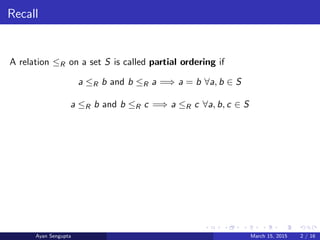
Recall
A relation ≤R on a set S is called partial ordering if
a ≤R b and b ≤R a =⇒ a = b ∀a, b ∈ S
a ≤R b and b ≤R c =⇒ a ≤R c ∀a, b, c ∈ S
Ayan Sengupta March 15, 2015 2 / 16
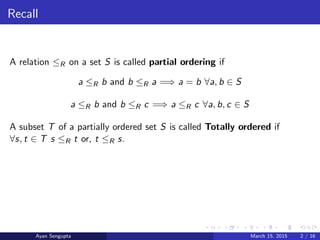
Recall
A relation ≤R on a set S is called partial ordering if
a ≤R b and b ≤R a =⇒ a = b ∀a, b ∈ S
a ≤R b and b ≤R c =⇒ a ≤R c ∀a, b, c ∈ S
A subset T of a partially ordered set S is called Totally ordered if
∀s, t ∈ T s ≤R t or, t ≤R s.
Ayan Sengupta March 15, 2015 2 / 16
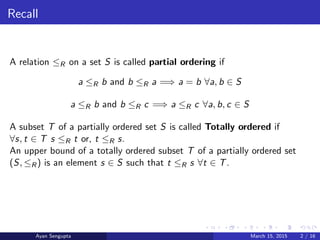
Recall
A relation ≤R on a set S is called partial ordering if
a ≤R b and b ≤R a =⇒ a = b ∀a, b ∈ S
a ≤R b and b ≤R c =⇒ a ≤R c ∀a, b, c ∈ S
A subset T of a partially ordered set S is called Totally ordered if
∀s, t ∈ T s ≤R t or, t ≤R s.
An upper bound of a totally ordered subset T of a partially ordered set
(S, ≤R) is an element s ∈ S such that t ≤R s ∀t ∈ T.
Ayan Sengupta March 15, 2015 2 / 16
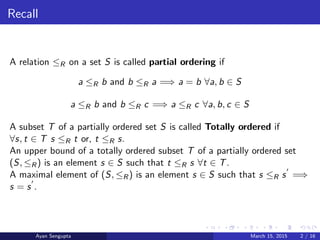
Recall
A relation ≤R on a set S is called partial ordering if
a ≤R b and b ≤R a =⇒ a = b ∀a, b ∈ S
a ≤R b and b ≤R c =⇒ a ≤R c ∀a, b, c ∈ S
A subset T of a partially ordered set S is called Totally ordered if
∀s, t ∈ T s ≤R t or, t ≤R s.
An upper bound of a totally ordered subset T of a partially ordered set
(S, ≤R) is an element s ∈ S such that t ≤R s ∀t ∈ T.
A maximal element of (S, ≤R) is an element s ∈ S such that s ≤R s =⇒
s = s .
Ayan Sengupta March 15, 2015 2 / 16
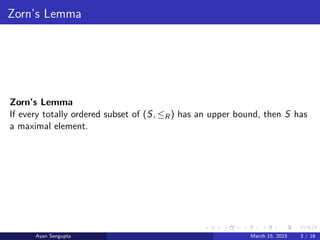
Zorn’s Lemma
Zorn’s Lemma
If every totally ordered subset of (S, ≤R) has an upper bound, then S has
a maximal element.
Ayan Sengupta March 15, 2015 3 / 16
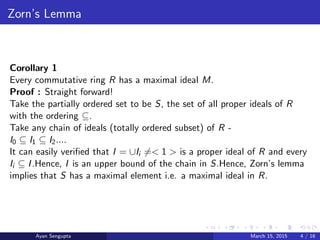
Zorn’s Lemma
Corollary 1
Every commutative ring R has a maximal ideal M.
Proof : Straight forward!
Take the partially ordered set to be S, the set of all proper ideals of R
with the ordering ⊆.
Take any chain of ideals (totally ordered subset) of R -
I0 ⊆ I1 ⊆ I2....
It can easily verified that I = ∪Ii =< 1 > is a proper ideal of R and every
Ii ⊆ I.Hence, I is an upper bound of the chain in S.Hence, Zorn’s lemma
implies that S has a maximal element i.e. a maximal ideal in R.
Ayan Sengupta March 15, 2015 4 / 16
Some Definitions
Definition : Algebraically Closed Field
every f (x) ∈ F[x] of degree ≥ 1 has a root in F.
Quick fact :
To show a field algebraically closed it is sufficient to show that every
monic polynomial over it has a root in it.
Ayan Sengupta March 15, 2015 5 / 16
Some Definitions
Definition : Algebraically Closed Field
every f (x) ∈ F[x] of degree ≥ 1 has a root in F.
Quick fact :
To show a field algebraically closed it is sufficient to show that every
monic polynomial over it has a root in it.
Definition : Algebraic Closure
E ⊇ F is said to be algebraic closure of F if E is algebraic over F and E is
algebraically closed.
e.g. - C is the algebraic closure of R.
Ayan Sengupta March 15, 2015 5 / 16
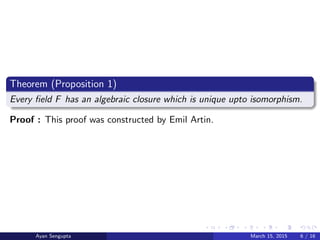
Theorem (Proposition 1)
Every field F has an algebraic closure which is unique upto isomorphism.
Proof : This proof was constructed by Emil Artin.
Ayan Sengupta March 15, 2015 6 / 16
Existence of Algebraic Closure
S = {f (x) ∈ F[x]| f is monic }. For each element f (x) in S we assign an
indeterminant xf .
Consider the ring F[S], the polynomial ring with indeterminants xf .
Consider the ideal I =< f (xf ) >f ∈S in F[S].
Ayan Sengupta March 15, 2015 7 / 16
Existence of Algebraic Closure
S = {f (x) ∈ F[x]| f is monic }. For each element f (x) in S we assign an
indeterminant xf .
Consider the ring F[S], the polynomial ring with indeterminants xf .
Consider the ideal I =< f (xf ) >f ∈S in F[S].
Claim : I =< 1 >.
Ayan Sengupta March 15, 2015 7 / 16
Existence of Algebraic Closure
S = {f (x) ∈ F[x]| f is monic }. For each element f (x) in S we assign an
indeterminant xf .
Consider the ring F[S], the polynomial ring with indeterminants xf .
Consider the ideal I =< f (xf ) >f ∈S in F[S].
Claim : I =< 1 >.
Suppose I =< 1 >. Then
r
i=1
gi .fki
(xfki
) = 1 (1)
for some indexing ki and gi ∈ F[S]. Now, we have r polynomials fki
for
i = 1, 2, ...r. Take F0 = F[S]. If fk1 is irreducible in F0 then take
F1 = F0/ < fk1 >.
Else F1 = F0.
In this way we can generate Fr such that every polynomial fk1 , fk2 , ...fkr has
a root in it.
Ayan Sengupta March 15, 2015 7 / 16
Existence of Algebraic Closure
Precisely, if the image of xfki
in Fi−1[S]/ < fki
> is ¯xfki
, then
f ( ¯xfki
) = ¯f (xfki
) = 0 in Fi .
In Fr , if we substitute xfki
by ¯xfki
in equation (1) then we get
1 =
r
i=1
gi .fki
( ¯xfki
) = 0 (2)
Ayan Sengupta March 15, 2015 8 / 16
Existence of Algebraic Closure
Precisely, if the image of xfki
in Fi−1[S]/ < fki
> is ¯xfki
, then
f ( ¯xfki
) = ¯f (xfki
) = 0 in Fi .
In Fr , if we substitute xfki
by ¯xfki
in equation (1) then we get
1 =
r
i=1
gi .fki
( ¯xfki
) = 0 (2)
contradiction.
Hence our claim is verified.
Now, as I = 1 we can conclude from the above corollary that some
maximal ideal m of F[S] contains I.
Ayan Sengupta March 15, 2015 8 / 16
Existence of Algebraic Closure
Precisely, if the image of xfki
in Fi−1[S]/ < fki
> is ¯xfki
, then
f ( ¯xfki
) = ¯f (xfki
) = 0 in Fi .
In Fr , if we substitute xfki
by ¯xfki
in equation (1) then we get
1 =
r
i=1
gi .fki
( ¯xfki
) = 0 (2)
contradiction.
Hence our claim is verified.
Now, as I = 1 we can conclude from the above corollary that some
maximal ideal m of F[S] contains I.
Now we take E0 = F[S] and E1 = E0/m.
Ayan Sengupta March 15, 2015 8 / 16
Existence of Algebraic Closure
Precisely, if the image of xfki
in Fi−1[S]/ < fki
> is ¯xfki
, then
f ( ¯xfki
) = ¯f (xfki
) = 0 in Fi .
In Fr , if we substitute xfki
by ¯xfki
in equation (1) then we get
1 =
r
i=1
gi .fki
( ¯xfki
) = 0 (2)
contradiction.
Hence our claim is verified.
Now, as I = 1 we can conclude from the above corollary that some
maximal ideal m of F[S] contains I.
Now we take E0 = F[S] and E1 = E0/m.
In E1 every f (x) ∈ S has a root. Moreover, in E1 every f (x) ∈ F[x] has a
root. (Precisely, roots are ¯xf )
Ayan Sengupta March 15, 2015 8 / 16
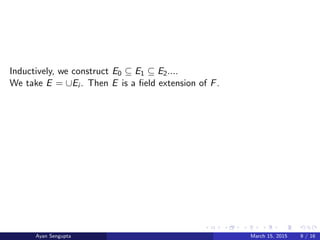
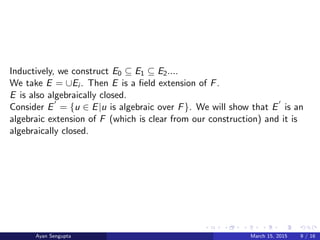
Inductively, we construct E0 ⊆ E1 ⊆ E2....
We take E = ∪Ei . Then E is a field extension of F.
Ayan Sengupta March 15, 2015 9 / 16
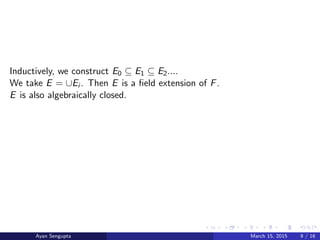
Inductively, we construct E0 ⊆ E1 ⊆ E2....
We take E = ∪Ei . Then E is a field extension of F.
E is also algebraically closed.
Ayan Sengupta March 15, 2015 9 / 16
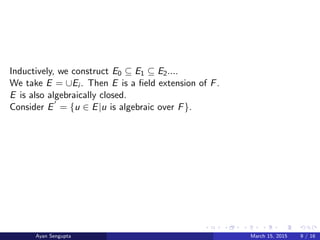
Inductively, we construct E0 ⊆ E1 ⊆ E2....
We take E = ∪Ei . Then E is a field extension of F.
E is also algebraically closed.
Consider E = {u ∈ E|u is algebraic over F}.
Ayan Sengupta March 15, 2015 9 / 16
Inductively, we construct E0 ⊆ E1 ⊆ E2....
We take E = ∪Ei . Then E is a field extension of F.
E is also algebraically closed.
Consider E = {u ∈ E|u is algebraic over F}. We will show that E is an
algebraic extension of F (which is clear from our construction) and it is
algebraically closed.
Ayan Sengupta March 15, 2015 9 / 16
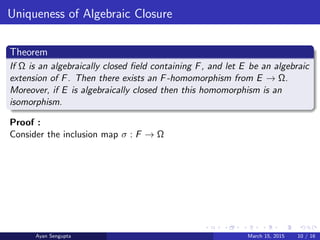
Uniqueness of Algebraic Closure
Theorem
If Ω is an algebraically closed field containing F, and let E be an algebraic
extension of F. Then there exists an F-homomorphism from E → Ω.
Moreover, if E is algebraically closed then this homomorphism is an
isomorphism.
Proof :
Consider the inclusion map σ : F → Ω
Ayan Sengupta March 15, 2015 10 / 16
Uniqueness of Algebraic Closure
Theorem
If Ω is an algebraically closed field containing F, and let E be an algebraic
extension of F. Then there exists an F-homomorphism from E → Ω.
Moreover, if E is algebraically closed then this homomorphism is an
isomorphism.
Proof :
Consider the inclusion map σ : F → Ω
Now, if E = F[α1, α2, ...αn] then, we can construct our F-homomorphism
¯σ as follows:
for each αi take the minimal polynomial over F. Let αi is a root of the
minimal polynomial in Ω then ¯σ(αi ) = αi
Ayan Sengupta March 15, 2015 10 / 16
Uniqueness of Algebraic Closure
Theorem
If Ω is an algebraically closed field containing F, and let E be an algebraic
extension of F. Then there exists an F-homomorphism from E → Ω.
Moreover, if E is algebraically closed then this homomorphism is an
isomorphism.
Proof :
Consider the inclusion map σ : F → Ω
Now, if E = F[α1, α2, ...αn] then, we can construct our F-homomorphism
¯σ as follows:
for each αi take the minimal polynomial over F. Let αi is a root of the
minimal polynomial in Ω then ¯σ(αi ) = αi
It is clear that this procedure will give us a homomorphism ¯σ : E → Ω
such that ¯σ|F = σ.
Ayan Sengupta March 15, 2015 10 / 16
Uniqueness of Algebraic Closure
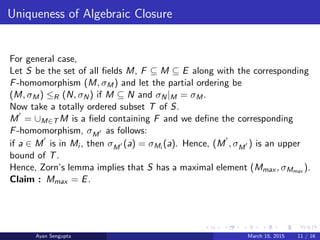
For general case,
Let S be the set of all fields M, F ⊆ M ⊆ E along with the corresponding
F-homomorphism (M, σM) and let the partial ordering be
(M, σM) ≤R (N, σN) if M ⊆ N and σN|M = σM.
Now take a totally ordered subset T of S.
M = ∪M∈T M is a field containing F and we define the corresponding
F-homomorphism, σM as follows:
if a ∈ M is in Mi , then σM (a) = σMi
(a). Hence, (M , σM ) is an upper
bound of T.
Hence, Zorn’s lemma implies that S has a maximal element (Mmax , σMmax ).
Claim : Mmax = E.
Ayan Sengupta March 15, 2015 11 / 16
Uniqueness of Algebraic Closure
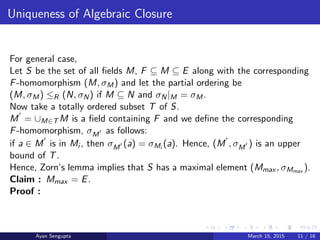
For general case,
Let S be the set of all fields M, F ⊆ M ⊆ E along with the corresponding
F-homomorphism (M, σM) and let the partial ordering be
(M, σM) ≤R (N, σN) if M ⊆ N and σN|M = σM.
Now take a totally ordered subset T of S.
M = ∪M∈T M is a field containing F and we define the corresponding
F-homomorphism, σM as follows:
if a ∈ M is in Mi , then σM (a) = σMi
(a). Hence, (M , σM ) is an upper
bound of T.
Hence, Zorn’s lemma implies that S has a maximal element (Mmax , σMmax ).
Claim : Mmax = E.
Proof :
Ayan Sengupta March 15, 2015 11 / 16
Uniqueness of Algebraic Closure
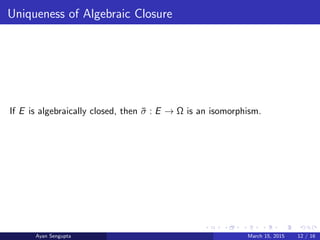
If E is algebraically closed, then ¯σ : E → Ω is an isomorphism.
Ayan Sengupta March 15, 2015 12 / 16
Any Questions ?
Ayan Sengupta March 15, 2015 13 / 16
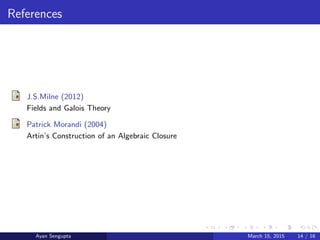
References
J.S.Milne (2012)
Fields and Galois Theory
Patrick Morandi (2004)
Artin’s Construction of an Algebraic Closure
Ayan Sengupta March 15, 2015 14 / 16
Thank you
Ayan Sengupta March 15, 2015 15 / 16

Existence and Uniqueness of Algebraic Closure

  • 1.
    Existence and Uniquenessof Algebraic Closure: Artin’s Proof Ayan Sengupta March 15, 2015 Ayan Sengupta March 15, 2015 1 / 16
  • 2.
    Recall A relation ≤Ron a set S is called partial ordering if a ≤R b and b ≤R a =⇒ a = b ∀a, b ∈ S a ≤R b and b ≤R c =⇒ a ≤R c ∀a, b, c ∈ S Ayan Sengupta March 15, 2015 2 / 16
  • 3.
    Recall A relation ≤Ron a set S is called partial ordering if a ≤R b and b ≤R a =⇒ a = b ∀a, b ∈ S a ≤R b and b ≤R c =⇒ a ≤R c ∀a, b, c ∈ S A subset T of a partially ordered set S is called Totally ordered if ∀s, t ∈ T s ≤R t or, t ≤R s. Ayan Sengupta March 15, 2015 2 / 16
  • 4.
    Recall A relation ≤Ron a set S is called partial ordering if a ≤R b and b ≤R a =⇒ a = b ∀a, b ∈ S a ≤R b and b ≤R c =⇒ a ≤R c ∀a, b, c ∈ S A subset T of a partially ordered set S is called Totally ordered if ∀s, t ∈ T s ≤R t or, t ≤R s. An upper bound of a totally ordered subset T of a partially ordered set (S, ≤R) is an element s ∈ S such that t ≤R s ∀t ∈ T. Ayan Sengupta March 15, 2015 2 / 16
  • 5.
    Recall A relation ≤Ron a set S is called partial ordering if a ≤R b and b ≤R a =⇒ a = b ∀a, b ∈ S a ≤R b and b ≤R c =⇒ a ≤R c ∀a, b, c ∈ S A subset T of a partially ordered set S is called Totally ordered if ∀s, t ∈ T s ≤R t or, t ≤R s. An upper bound of a totally ordered subset T of a partially ordered set (S, ≤R) is an element s ∈ S such that t ≤R s ∀t ∈ T. A maximal element of (S, ≤R) is an element s ∈ S such that s ≤R s =⇒ s = s . Ayan Sengupta March 15, 2015 2 / 16
  • 6.
    Zorn’s Lemma Zorn’s Lemma Ifevery totally ordered subset of (S, ≤R) has an upper bound, then S has a maximal element. Ayan Sengupta March 15, 2015 3 / 16
  • 7.
    Zorn’s Lemma Corollary 1 Everycommutative ring R has a maximal ideal M. Proof : Straight forward! Take the partially ordered set to be S, the set of all proper ideals of R with the ordering ⊆. Take any chain of ideals (totally ordered subset) of R - I0 ⊆ I1 ⊆ I2.... It can easily verified that I = ∪Ii =< 1 > is a proper ideal of R and every Ii ⊆ I.Hence, I is an upper bound of the chain in S.Hence, Zorn’s lemma implies that S has a maximal element i.e. a maximal ideal in R. Ayan Sengupta March 15, 2015 4 / 16
  • 8.
    Some Definitions Definition :Algebraically Closed Field every f (x) ∈ F[x] of degree ≥ 1 has a root in F. Quick fact : To show a field algebraically closed it is sufficient to show that every monic polynomial over it has a root in it. Ayan Sengupta March 15, 2015 5 / 16
  • 9.
    Some Definitions Definition :Algebraically Closed Field every f (x) ∈ F[x] of degree ≥ 1 has a root in F. Quick fact : To show a field algebraically closed it is sufficient to show that every monic polynomial over it has a root in it. Definition : Algebraic Closure E ⊇ F is said to be algebraic closure of F if E is algebraic over F and E is algebraically closed. e.g. - C is the algebraic closure of R. Ayan Sengupta March 15, 2015 5 / 16
  • 10.
    Theorem (Proposition 1) Everyfield F has an algebraic closure which is unique upto isomorphism. Proof : This proof was constructed by Emil Artin. Ayan Sengupta March 15, 2015 6 / 16
  • 11.
    Existence of AlgebraicClosure S = {f (x) ∈ F[x]| f is monic }. For each element f (x) in S we assign an indeterminant xf . Consider the ring F[S], the polynomial ring with indeterminants xf . Consider the ideal I =< f (xf ) >f ∈S in F[S]. Ayan Sengupta March 15, 2015 7 / 16
  • 12.
    Existence of AlgebraicClosure S = {f (x) ∈ F[x]| f is monic }. For each element f (x) in S we assign an indeterminant xf . Consider the ring F[S], the polynomial ring with indeterminants xf . Consider the ideal I =< f (xf ) >f ∈S in F[S]. Claim : I =< 1 >. Ayan Sengupta March 15, 2015 7 / 16
  • 13.
    Existence of AlgebraicClosure S = {f (x) ∈ F[x]| f is monic }. For each element f (x) in S we assign an indeterminant xf . Consider the ring F[S], the polynomial ring with indeterminants xf . Consider the ideal I =< f (xf ) >f ∈S in F[S]. Claim : I =< 1 >. Suppose I =< 1 >. Then r i=1 gi .fki (xfki ) = 1 (1) for some indexing ki and gi ∈ F[S]. Now, we have r polynomials fki for i = 1, 2, ...r. Take F0 = F[S]. If fk1 is irreducible in F0 then take F1 = F0/ < fk1 >. Else F1 = F0. In this way we can generate Fr such that every polynomial fk1 , fk2 , ...fkr has a root in it. Ayan Sengupta March 15, 2015 7 / 16
  • 14.
    Existence of AlgebraicClosure Precisely, if the image of xfki in Fi−1[S]/ < fki > is ¯xfki , then f ( ¯xfki ) = ¯f (xfki ) = 0 in Fi . In Fr , if we substitute xfki by ¯xfki in equation (1) then we get 1 = r i=1 gi .fki ( ¯xfki ) = 0 (2) Ayan Sengupta March 15, 2015 8 / 16
  • 15.
    Existence of AlgebraicClosure Precisely, if the image of xfki in Fi−1[S]/ < fki > is ¯xfki , then f ( ¯xfki ) = ¯f (xfki ) = 0 in Fi . In Fr , if we substitute xfki by ¯xfki in equation (1) then we get 1 = r i=1 gi .fki ( ¯xfki ) = 0 (2) contradiction. Hence our claim is verified. Now, as I = 1 we can conclude from the above corollary that some maximal ideal m of F[S] contains I. Ayan Sengupta March 15, 2015 8 / 16
  • 16.
    Existence of AlgebraicClosure Precisely, if the image of xfki in Fi−1[S]/ < fki > is ¯xfki , then f ( ¯xfki ) = ¯f (xfki ) = 0 in Fi . In Fr , if we substitute xfki by ¯xfki in equation (1) then we get 1 = r i=1 gi .fki ( ¯xfki ) = 0 (2) contradiction. Hence our claim is verified. Now, as I = 1 we can conclude from the above corollary that some maximal ideal m of F[S] contains I. Now we take E0 = F[S] and E1 = E0/m. Ayan Sengupta March 15, 2015 8 / 16
  • 17.
    Existence of AlgebraicClosure Precisely, if the image of xfki in Fi−1[S]/ < fki > is ¯xfki , then f ( ¯xfki ) = ¯f (xfki ) = 0 in Fi . In Fr , if we substitute xfki by ¯xfki in equation (1) then we get 1 = r i=1 gi .fki ( ¯xfki ) = 0 (2) contradiction. Hence our claim is verified. Now, as I = 1 we can conclude from the above corollary that some maximal ideal m of F[S] contains I. Now we take E0 = F[S] and E1 = E0/m. In E1 every f (x) ∈ S has a root. Moreover, in E1 every f (x) ∈ F[x] has a root. (Precisely, roots are ¯xf ) Ayan Sengupta March 15, 2015 8 / 16
  • 18.
    Inductively, we constructE0 ⊆ E1 ⊆ E2.... We take E = ∪Ei . Then E is a field extension of F. Ayan Sengupta March 15, 2015 9 / 16
  • 19.
    Inductively, we constructE0 ⊆ E1 ⊆ E2.... We take E = ∪Ei . Then E is a field extension of F. E is also algebraically closed. Ayan Sengupta March 15, 2015 9 / 16
  • 20.
    Inductively, we constructE0 ⊆ E1 ⊆ E2.... We take E = ∪Ei . Then E is a field extension of F. E is also algebraically closed. Consider E = {u ∈ E|u is algebraic over F}. Ayan Sengupta March 15, 2015 9 / 16
  • 21.
    Inductively, we constructE0 ⊆ E1 ⊆ E2.... We take E = ∪Ei . Then E is a field extension of F. E is also algebraically closed. Consider E = {u ∈ E|u is algebraic over F}. We will show that E is an algebraic extension of F (which is clear from our construction) and it is algebraically closed. Ayan Sengupta March 15, 2015 9 / 16
  • 22.
    Uniqueness of AlgebraicClosure Theorem If Ω is an algebraically closed field containing F, and let E be an algebraic extension of F. Then there exists an F-homomorphism from E → Ω. Moreover, if E is algebraically closed then this homomorphism is an isomorphism. Proof : Consider the inclusion map σ : F → Ω Ayan Sengupta March 15, 2015 10 / 16
  • 23.
    Uniqueness of AlgebraicClosure Theorem If Ω is an algebraically closed field containing F, and let E be an algebraic extension of F. Then there exists an F-homomorphism from E → Ω. Moreover, if E is algebraically closed then this homomorphism is an isomorphism. Proof : Consider the inclusion map σ : F → Ω Now, if E = F[α1, α2, ...αn] then, we can construct our F-homomorphism ¯σ as follows: for each αi take the minimal polynomial over F. Let αi is a root of the minimal polynomial in Ω then ¯σ(αi ) = αi Ayan Sengupta March 15, 2015 10 / 16
  • 24.
    Uniqueness of AlgebraicClosure Theorem If Ω is an algebraically closed field containing F, and let E be an algebraic extension of F. Then there exists an F-homomorphism from E → Ω. Moreover, if E is algebraically closed then this homomorphism is an isomorphism. Proof : Consider the inclusion map σ : F → Ω Now, if E = F[α1, α2, ...αn] then, we can construct our F-homomorphism ¯σ as follows: for each αi take the minimal polynomial over F. Let αi is a root of the minimal polynomial in Ω then ¯σ(αi ) = αi It is clear that this procedure will give us a homomorphism ¯σ : E → Ω such that ¯σ|F = σ. Ayan Sengupta March 15, 2015 10 / 16
  • 25.
    Uniqueness of AlgebraicClosure For general case, Let S be the set of all fields M, F ⊆ M ⊆ E along with the corresponding F-homomorphism (M, σM) and let the partial ordering be (M, σM) ≤R (N, σN) if M ⊆ N and σN|M = σM. Now take a totally ordered subset T of S. M = ∪M∈T M is a field containing F and we define the corresponding F-homomorphism, σM as follows: if a ∈ M is in Mi , then σM (a) = σMi (a). Hence, (M , σM ) is an upper bound of T. Hence, Zorn’s lemma implies that S has a maximal element (Mmax , σMmax ). Claim : Mmax = E. Ayan Sengupta March 15, 2015 11 / 16
  • 26.
    Uniqueness of AlgebraicClosure For general case, Let S be the set of all fields M, F ⊆ M ⊆ E along with the corresponding F-homomorphism (M, σM) and let the partial ordering be (M, σM) ≤R (N, σN) if M ⊆ N and σN|M = σM. Now take a totally ordered subset T of S. M = ∪M∈T M is a field containing F and we define the corresponding F-homomorphism, σM as follows: if a ∈ M is in Mi , then σM (a) = σMi (a). Hence, (M , σM ) is an upper bound of T. Hence, Zorn’s lemma implies that S has a maximal element (Mmax , σMmax ). Claim : Mmax = E. Proof : Ayan Sengupta March 15, 2015 11 / 16
  • 27.
    Uniqueness of AlgebraicClosure If E is algebraically closed, then ¯σ : E → Ω is an isomorphism. Ayan Sengupta March 15, 2015 12 / 16
  • 28.
    Any Questions ? AyanSengupta March 15, 2015 13 / 16
  • 29.
    References J.S.Milne (2012) Fields andGalois Theory Patrick Morandi (2004) Artin’s Construction of an Algebraic Closure Ayan Sengupta March 15, 2015 14 / 16
  • 30.
    Thank you Ayan SenguptaMarch 15, 2015 15 / 16