Industry​ ​Project​ ​1​ ​–​ ​UpGrad
Introduction
The​ ​convenience​ ​of​ ​an​ ​online​ ​degree​ ​has​ ​a​ ​wide​ ​appeal.​ ​With​ ​advances​ ​in​ ​technology​ ​and​ ​our
increased​ ​dependence​ ​on​ ​all​ ​things​ ​digital​ ​has​ ​led​ ​to​ ​a​ ​huge​ ​surge​ ​in​ ​online​ ​learning.​ ​With​ ​a
variety​ ​of​ ​courses​ ​to​ ​choose​ ​from​ ​–​ ​includes​ ​certifications​ ​and​ ​degrees,​ ​interactive​ ​and
engaging​ ​platforms​ ​as​ ​support,​ ​and​ ​convenience​ ​as​ ​the​ ​prime​ ​factor,​ ​many​ ​students​ ​today
prefer​ ​e-learning​ ​to​ ​the​ ​traditional​ ​classroom​ ​education.​ ​In​ ​2016,​ ​the​ ​e-learning​ ​market​ ​was
worth​ ​$166.5​ ​billion,​ ​and​ ​is​ ​estimated​ ​to​ ​reach​ ​$255​ ​billion​ ​by​ ​2017​ ​(​www.weforum.org​).
With​ ​there​ ​being​ ​several​ ​perks​ ​in​ ​the​ ​e-learning​ ​domain,​ ​there​ ​is​ ​however,​ ​the​ ​growing​ ​need​ ​to
try​ ​and​ ​provide​ ​an​ ​exceptional​ ​user​ ​experience​ ​to​ ​students​ ​which​ ​sometimes​ ​does​ ​raise​ ​the
question​ ​–​ ​is​ ​e-learning​ ​better​ ​than​ ​the​ ​traditional​ ​face-2-face​ ​classroom​ ​learning​ ​or​ ​not?​ ​With
several​ ​pros​ ​such​ ​as​ ​face-to-face​ ​interactions​ ​and​ ​effective​ ​discussions​ ​and​ ​interactions,​ ​on​ ​the
traditional​ ​side,​ ​companies​ ​in​ ​the​ ​MOOC​ ​space​ ​are​ ​constantly​ ​trying​ ​their​ ​best​ ​to​ ​enhance​ ​their
platform​ ​with​ ​features​ ​to​ ​try​ ​and​ ​provide​ ​a​ ​blend​ ​of​ ​both​ ​worlds​ ​in​ ​the​ ​entire​ ​e-learning
experience.
Objective
The​ ​objective​ ​of​ ​this​ ​assignment​ ​is​ ​to​ ​try​ ​and​ ​find​ ​out​ ​what​ ​students​ ​are​ ​looking​ ​for​ ​when​ ​they​ ​do
choose​ ​to​ ​go​ ​in​ ​for​ ​an​ ​online​ ​course.​ ​What​ ​would​ ​assist​ ​in​ ​their​ ​learning​ ​experience​ ​and​ ​how​ ​can​ ​this​ ​be
provided​ ​to​ ​garner​ ​maximum​ ​benefits​ ​from​ ​the​ ​platform.
Hypothesis
● Online​ ​courses​ ​are​ ​gaining​ ​popularity​ ​and​ ​many​ ​users’​ ​especially​ ​working​ ​professionals
are​ ​interested​ ​in​ ​getting​ ​an​ ​online​ ​certification​ ​course
● They​ ​enroll​ ​in​ ​online​ ​courses​ ​for​ ​varied​ ​reasons​ ​such​ ​as​ ​up-skill,​ ​securing​ ​a​ ​better​ ​job,
new​ ​prospects​ ​etc.
● Interaction​ ​and​ ​engagement​ ​form​ ​a​ ​key​ ​part​ ​of​ ​the​ ​e-learning​ ​platform​ ​and​ ​users​ ​are​ ​in
need​ ​of​ ​innovative​ ​and​ ​intuitive​ ​features​ ​to​ ​help​ ​with​ ​their​ ​learning.
___________________________________________________________________
Group​ ​members
Dattatrey​ ​Kulkarni​ ​(​idattatrey@gmail.com​)
Nisha​ ​Sashidharan​ ​(​nisha_sas@hotmail.co.uk​)
Ravikiran​ ​Sastry​ ​(​ravikiran.sastry@gmail.com​)
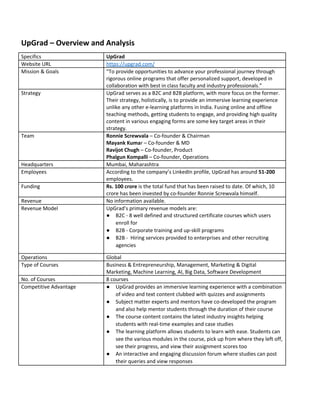
UpGrad​ ​–​ ​Overview​ ​and​ ​Analysis
Specifics UpGrad
Website​ ​URL https://upgrad.com/
Mission​ ​&​ ​Goals “To​ ​provide​ ​opportunities​ ​to​ ​advance​ ​your​ ​professional​ ​journey​ ​through
rigorous​ ​online​ ​programs​ ​that​ ​offer​ ​personalized​ ​support,​ ​developed​ ​in
collaboration​ ​with​ ​best​ ​in​ ​class​ ​faculty​ ​and​ ​industry​ ​professionals.”
Strategy UpGrad​ ​serves​ ​as​ ​a​ ​B2C​ ​and​ ​B2B​ ​platform,​ ​with​ ​more​ ​focus​ ​on​ ​the​ ​former.
Their​ ​strategy,​ ​holistically,​ ​is​ ​to​ ​provide​ ​an​ ​immersive​ ​learning​ ​experience
unlike​ ​any​ ​other​ ​e-learning​ ​platforms​ ​in​ ​India.​ ​Fusing​ ​online​ ​and​ ​offline
teaching​ ​methods,​ ​getting​ ​students​ ​to​ ​engage,​ ​and​ ​providing​ ​high​ ​quality
content​ ​in​ ​various​ ​engaging​ ​forms​ ​are​ ​some​ ​key​ ​target​ ​areas​ ​in​ ​their
strategy.
Team Ronnie​ ​Screwvala​​ ​–​ ​Co-founder​ ​&​ ​Chairman
Mayank​ ​Kuma​r​ ​–​ ​Co-founder​ ​&​ ​MD
Ravijot​ ​Chugh​ ​​–​ ​Co-founder,​ ​Product
Phalgun​ ​Kompalli​​ ​–​ ​Co-founder,​ ​Operations
Headquarters Mumbai,​ ​Maharashtra
Employees According​ ​to​ ​the​ ​company’s​ ​LinkedIn​ ​profile,​ ​UpGrad​ ​has​ ​around​ ​​51-200
employees.
Funding Rs.​ ​100​ ​crore​​ ​is​ ​the​ ​total​ ​fund​ ​that​ ​has​ ​been​ ​raised​ ​to​ ​date.​ ​Of​ ​which,​ ​10
crore​ ​has​ ​been​ ​invested​ ​by​ ​co-founder​ ​Ronnie​ ​Screwvala​ ​himself.
Revenue No​ ​information​ ​available.
Revenue​ ​Model UpGrad’s​ ​primary​ ​revenue​ ​models​ ​are:
● B2C​ ​-​ ​8​ ​well​ ​defined​ ​and​ ​structured​ ​certificate​ ​courses​ ​which​ ​users
enroll​ ​for
● B2B​ ​-​ ​Corporate​ ​training​ ​and​ ​up-skill​ ​programs
● B2B​ ​-​ ​​ ​Hiring​ ​services​ ​provided​ ​to​ ​enterprises​ ​and​ ​other​ ​recruiting
agencies
Operations Global
Type​ ​of​ ​Courses Business​ ​&​ ​Entrepreneurship,​ ​Management,​ ​Marketing​ ​&​ ​Digital
Marketing,​ ​Machine​ ​Learning,​ ​AI,​ ​Big​ ​Data,​ ​Software​ ​Development
No.​ ​of​ ​Courses 8​ ​courses
Competitive​ ​Advantage ● UpGrad​ ​provides​ ​an​ ​immersive​ ​learning​ ​experience​ ​with​ ​a​ ​combination
of​ ​video​ ​and​ ​text​ ​content​ ​clubbed​ ​with​ ​quizzes​ ​and​ ​assignments
● Subject​ ​matter​ ​experts​ ​and​ ​mentors​ ​have​ ​co-developed​ ​the​ ​program
and​ ​also​ ​help​ ​mentor​ ​students​ ​through​ ​the​ ​duration​ ​of​ ​their​ ​course
● The​ ​course​ ​content​ ​contains​ ​the​ ​latest​ ​industry​ ​insights​ ​helping
students​ ​with​ ​real-time​ ​examples​ ​and​ ​case​ ​studies
● The​ ​learning​ ​platform​ ​allows​ ​students​ ​to​ ​learn​ ​with​ ​ease.​ ​Students​ ​can
see​ ​the​ ​various​ ​modules​ ​in​ ​the​ ​course,​ ​pick​ ​up​ ​from​ ​where​ ​they​ ​left​ ​off,
see​ ​their​ ​progress,​ ​and​ ​view​ ​their​ ​assignment​ ​scores​ ​too
● An​ ​interactive​ ​and​ ​engaging​ ​discussion​ ​forum​ ​where​ ​studies​ ​can​ ​post
their​ ​queries​ ​and​ ​view​ ​responses
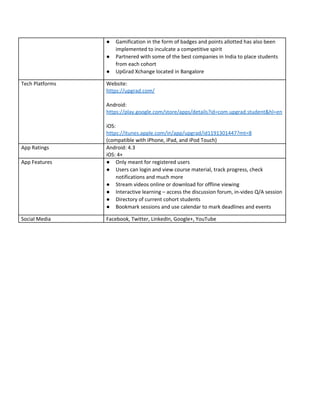
● Gamification​ ​in​ ​the​ ​form​ ​of​ ​badges​ ​and​ ​points​ ​allotted​ ​has​ ​also​ ​been
implemented​ ​to​ ​inculcate​ ​a​ ​competitive​ ​spirit
● Partnered​ ​with​ ​some​ ​of​ ​the​ ​best​ ​companies​ ​in​ ​India​ ​to​ ​place​ ​students
from​ ​each​ ​cohort
● UpGrad​ ​Xchange​ ​located​ ​in​ ​Bangalore
Tech​ ​Platforms Website:
https://upgrad.com/
Android:
https://play.google.com/store/apps/details?id=com.upgrad.student&hl=en
iOS:
https://itunes.apple.com/in/app/upgrad/id1191301447?mt=8
(compatible​ ​with​ ​iPhone,​ ​iPad,​ ​and​ ​iPod​ ​Touch)
App​ ​Ratings Android:​ ​4.3
iOS:​ ​4+
App​ ​Features ● Only​ ​meant​ ​for​ ​registered​ ​users
● Users​ ​can​ ​login​ ​and​ ​view​ ​course​ ​material,​ ​track​ ​progress,​ ​check
notifications​ ​and​ ​much​ ​more
● Stream​ ​videos​ ​online​ ​or​ ​download​ ​for​ ​offline​ ​viewing
● Interactive​ ​learning​ ​–​ ​access​ ​the​ ​discussion​ ​forum,​ ​in-video​ ​Q/A​ ​session
● Directory​ ​of​ ​current​ ​cohort​ ​students
● Bookmark​ ​sessions​ ​and​ ​use​ ​calendar​ ​to​ ​mark​ ​deadlines​ ​and​ ​events
Social​ ​Media Facebook,​ ​Twitter,​ ​LinkedIn,​ ​Google+,​ ​YouTube
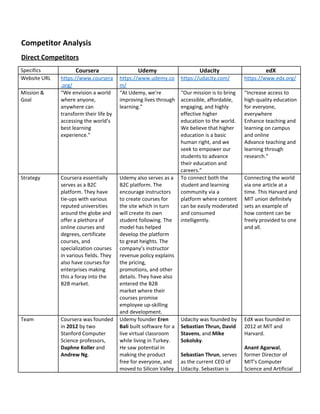
Competitor​ ​Analysis
Direct​ ​Competitors
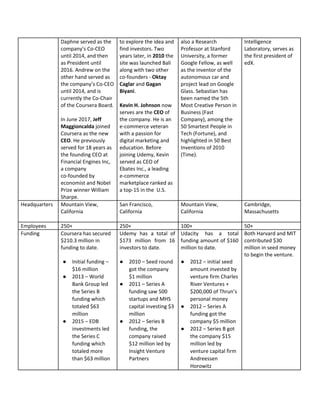
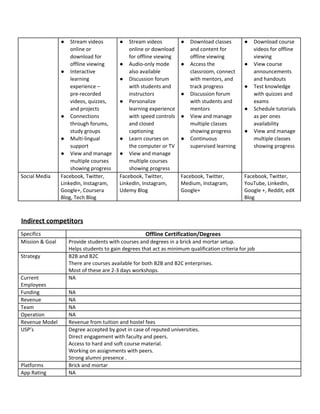
Specifics Coursera Udemy Udacity edX
Website​ ​URL https://www.coursera
.org/
https://www.udemy.co
m/
https://udacity.com/ https://www.edx.org/
Mission​ ​&
Goal
“We​ ​envision​ ​a​ ​world
where​ ​anyone,
anywhere​ ​can
transform​ ​their​ ​life​ ​by
accessing​ ​the​ ​world’s
best​ ​learning
experience.”
“At​ ​Udemy,​ ​we’re
improving​ ​lives​ ​through
learning.”
“Our​ ​mission​ ​is​ ​to​ ​bring
accessible,​ ​affordable,
engaging,​ ​and​ ​highly
effective​ ​higher
education​ ​to​ ​the​ ​world.
We​ ​believe​ ​that​ ​higher
education​ ​is​ ​a​ ​basic
human​ ​right,​ ​and​ ​we
seek​ ​to​ ​empower​ ​our
students​ ​to​ ​advance
their​ ​education​ ​and
careers.”
“Increase​ ​access​ ​to
high-quality​ ​education
for​ ​everyone,
everywhere
Enhance​ ​teaching​ ​and
learning​ ​on​ ​campus
and​ ​online
Advance​ ​teaching​ ​and
learning​ ​through
research.”
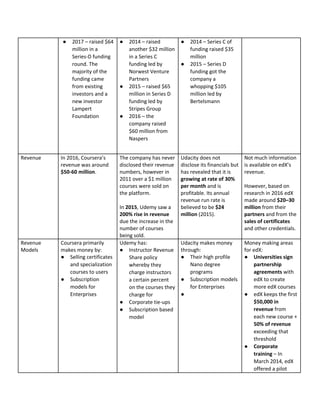
Strategy Coursera​ ​essentially
serves​ ​as​ ​a​ ​B2C
platform.​ ​They​ ​have
tie-ups​ ​with​ ​various
reputed​ ​universities
around​ ​the​ ​globe​ ​and
offer​ ​a​ ​plethora​ ​of
online​ ​courses​ ​and
degrees,​ ​certificate
courses,​ ​and
specialization​ ​courses
in​ ​various​ ​fields.​ ​They
also​ ​have​ ​courses​ ​for
enterprises​ ​making
this​ ​a​ ​foray​ ​into​ ​the
B2B​ ​market.
Udemy​ ​also​ ​serves​ ​as​ ​a
B2C​ ​platform.​ ​The
encourage​ ​instructors
to​ ​create​ ​courses​ ​for
the​ ​site​ ​which​ ​in​ ​turn
will​ ​create​ ​its​ ​own
student​ ​following.​ ​The
model​ ​has​ ​helped
develop​ ​the​ ​platform
to​ ​great​ ​heights.​ ​The
company’s​ ​instructor
revenue​ ​policy​ ​explains
the​ ​pricing,
promotions,​ ​and​ ​other
details.​ ​They​ ​have​ ​also
entered​ ​the​ ​B2B
market​ ​where​ ​their
courses​ ​promise
employee​ ​up-skilling
and​ ​development.
To​ ​connect​ ​both​ ​the
student​ ​and​ ​learning
community​ ​via​ ​a
platform​ ​where​ ​content
can​ ​be​ ​easily​ ​moderated
and​ ​consumed
intelligently.
Connecting​ ​the​ ​world
via​ ​one​ ​article​ ​at​ ​a
time.​ ​This​ ​Harvard​ ​and
MIT​ ​union​ ​definitely
sets​ ​an​ ​example​ ​of
how​ ​content​ ​can​ ​be
freely​ ​provided​ ​to​ ​one
and​ ​all.
Team Coursera​ ​was​ ​founded
in​ ​​2012​​ ​by​ ​two
Stanford​ ​Computer
Science​ ​professors,
Daphne​ ​Koller​​ ​and
Andrew​ ​Ng​.
Udemy​ ​founder​ ​​Eren
Bali​​ ​built​ ​software​ ​for​ ​a
live​ ​virtual​ ​classroom
while​ ​living​ ​in​ ​Turkey.
He​ ​saw​ ​potential​ ​in
making​ ​the​ ​product
free​ ​for​ ​everyone,​ ​and
moved​ ​to​ ​Silicon​ ​Valley
Udacity​ ​was​ ​founded​ ​by
Sebastian​ ​Thrun,​ ​David
Stavens​,​ ​and​ ​​Mike
Sokolsky​.
Sebastian​ ​Thrun​,​ ​serves
as​ ​the​ ​current​ ​CEO​ ​of
Udacity.​ ​Sebastian​ ​is
EdX​ ​was​ ​founded​ ​in
2012​ ​at​ ​MIT​ ​and
Harvard.
Anant​ ​Agarwal​,
former​ ​Director​ ​of
MIT's​ ​Computer
Science​ ​and​ ​Artificial
Daphne​ ​served​ ​as​ ​the
company’s​ ​Co-CEO
until​ ​2014,​ ​and​ ​then
as​ ​President​ ​until
2016.​ ​Andrew​ ​on​ ​the
other​ ​hand​ ​served​ ​as
the​ ​company’s​ ​Co-CEO
until​ ​2014,​ ​and​ ​is
currently​ ​the​ ​Co-Chair
of​ ​the​ ​Coursera​ ​Board.
In​ ​June​ ​2017,​ ​​Jeff
Maggioncalda​ ​​joined
Coursera​ ​as​ ​the​ ​new
CEO​.​ ​He​ ​previously
served​ ​for​ ​18​ ​years​ ​as
the​ ​founding​ ​CEO​ ​at
Financial​ ​Engines​ ​Inc,
a​ ​company
co-founded​ ​by
economist​ ​and​ ​Nobel
Prize​ ​winner​ ​William
Sharpe.
to​ ​explore​ ​the​ ​idea​ ​and
find​ ​investors.​ ​Two
years​ ​later,​ ​in​ ​​2010​​ ​the
site​ ​was​ ​launched​ ​Bali
along​ ​with​ ​two​ ​other
co-founders​ ​-​ ​​Oktay
Caglar​​ ​and​ ​​Gagan
Biyani​.
Kevin​ ​H.​ ​Johnson​​ ​now
serves​ ​are​ ​the​ ​​CEO​​ ​of
the​ ​company.​ ​He​ ​is​ ​an
e-commerce​ ​veteran
with​ ​a​ ​passion​ ​for
digital​ ​marketing​ ​and
education.​ ​Before
joining​ ​Udemy,​ ​Kevin
served​ ​as​ ​CEO​ ​of
Ebates​ ​Inc.,​ ​a​ ​leading
e-commerce
marketplace​ ​ranked​ ​as
a​ ​top-15​ ​in​ ​the​ ​​ ​U.S.
also​ ​a​ ​Research
Professor​ ​at​ ​Stanford
University,​ ​a​ ​former
Google​ ​Fellow,​ ​as​ ​well
as​ ​the​ ​inventor​ ​of​ ​the
autonomous​ ​car​ ​and
project​ ​lead​ ​on​ ​Google
Glass.​ ​Sebastian​ ​has
been​ ​named​ ​the​ ​5th
Most​ ​Creative​ ​Person​ ​in
Business​ ​(Fast
Company),​ ​among​ ​the
50​ ​Smartest​ ​People​ ​in
Tech​ ​(Fortune),​ ​and
highlighted​ ​in​ ​50​ ​Best
Inventions​ ​of​ ​2010
(Time).
Intelligence
Laboratory,​ ​serves​ ​as
the​ ​first​ ​president​ ​of
edX.
Headquarters Mountain​ ​View,
California
San​ ​Francisco,
California
Mountain​ ​View,
California
Cambridge,
Massachusetts
Employees 250+ 250+ 100+ 50+
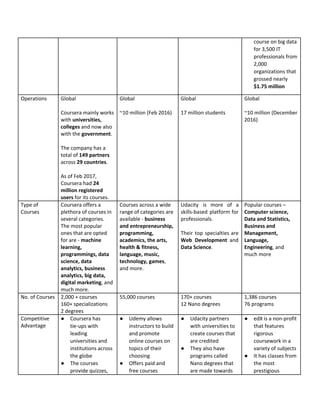
Funding Coursera​ ​has​ ​secured
$210.3​ ​million​ ​in
funding​ ​to​ ​date.
● Initial​ ​funding​ ​–
$16​ ​million
● 2013​ ​–​ ​World
Bank​ ​Group​ ​led
the​ ​Series​ ​B
funding​ ​which
totaled​ ​$63
million
● 2015​ ​–​ ​EDB
investments​ ​led
the​ ​Series​ ​C
funding​ ​which
totaled​ ​more
than​ ​$63​ ​million
Udemy has a total of
$173 million from 16
investors​ ​to​ ​date.
● 2010​ ​–​ ​Seed​ ​round
got​ ​the​ ​company
$1​ ​million
● 2011​ ​–​ ​Series​ ​A
funding​ ​saw​ ​500
startups​ ​and​ ​MHS
capital​ ​investing​ ​$3
million
● 2012​ ​–​ ​Series​ ​B
funding,​ ​the
company​ ​raised
$12​ ​million​ ​led​ ​by
Insight​ ​Venture
Partners
Udacity has a total
funding amount of $160
million​ ​to​ ​date.
● 2012​ ​–​ ​initial​ ​seed
amount​ ​invested​ ​by
venture​ ​firm​ ​Charles
River​ ​Ventures​ ​+
$200,000​ ​of​ ​Thrun’s
personal​ ​money
● 2012​ ​–​ ​Series​ ​A
funding​ ​got​ ​the
company​ ​$5​ ​million
● 2012​ ​–​ ​Series​ ​B​ ​got
the​ ​company​ ​$15
million​ ​led​ ​by
venture​ ​capital​ ​firm
Andreessen
Horowitz
Both​ ​Harvard​ ​and​ ​MIT
contributed​ ​$30
million​ ​in​ ​seed​ ​money
to​ ​begin​ ​the​ ​venture.
● 2017​ ​–​ ​raised​ ​$64
million​ ​in​ ​a
Series-D​ ​funding
round.​ ​The
majority​ ​of​ ​the
funding​ ​came
from​ ​existing
investors​ ​and​ ​a
new​ ​investor
Lampert
Foundation
● 2014​ ​–​ ​raised
another​ ​$32​ ​million
in​ ​a​ ​Series​ ​C
funding​ ​led​ ​by
Norwest​ ​Venture
Partners
● 2015​ ​–​ ​raised​ ​$65
million​ ​in​ ​Series​ ​D
funding​ ​led​ ​by
Stripes​ ​Group
● 2016​ ​–​ ​the
company​ ​raised
$60​ ​million​ ​from
Naspers
● 2014​ ​–​ ​Series​ ​C​ ​of
funding​ ​raised​ ​$35
million
● 2015​ ​–​ ​Series​ ​D
funding​ ​got​ ​the
company​ ​a
whopping​ ​$105
million​ ​led​ ​by
Bertelsmann
Revenue In​ ​2016,​ ​Coursera’s
revenue​ ​was​ ​around
$50-60​ ​million​.
The​ ​company​ ​has​ ​never
disclosed​ ​their​ ​revenue
numbers,​ ​however​ ​in
2011​ ​over​ ​a​ ​$1​ ​million
courses​ ​were​ ​sold​ ​on
the​ ​platform.
In​ ​​2015​,​ ​Udemy​ ​saw​ ​a
200%​ ​rise​ ​in​ ​revenue
due​ ​the​ ​increase​ ​in​ ​the
number​ ​of​ ​courses
being​ ​sold.
Udacity​ ​does​ ​not
disclose​ ​its​ ​financials​ ​but
has​ ​revealed​ ​that​ ​it​ ​is
growing​ ​at​ ​rate​ ​of​ ​30%
per​ ​month​​ ​and​ ​is
profitable.​ ​Its​ ​annual
revenue​ ​run​ ​rate​ ​is
believed​ ​to​ ​be​ ​​$24
million​ ​​(2015).
Not​ ​much​ ​information
is​ ​available​ ​on​ ​edX’s
revenue.
However,​ ​based​ ​on
research​ ​in​ ​2016​ ​edX
made​ ​around​ ​​$20–30
million​​ ​from​ ​their
partners​​ ​and​ ​from​ ​the
sales​ ​of​ ​certificates
and​ ​other​ ​credentials.
Revenue
Models
Coursera​ ​primarily
makes​ ​money​ ​by:
● Selling​ ​certificates
and​ ​specialization
courses​ ​to​ ​users
● Subscription
models​ ​for
Enterprises
Udemy​ ​has:
● Instructor​ ​Revenue
Share​ ​policy
whereby​ ​they
charge​ ​instructors
a​ ​certain​ ​percent
on​ ​the​ ​courses​ ​they
charge​ ​for
● Corporate​ ​tie-ups
● Subscription​ ​based
model
Udacity​ ​makes​ ​money
through:
● Their​ ​high​ ​profile
Nano​ ​degree
programs
● Subscription​ ​models
for​ ​Enterprises
●
Money​ ​making​ ​areas
for​ ​edX:
● Universities​ ​sign
partnership
agreements​​ ​with
edX​ ​to​ ​create
more​ ​edX​ ​courses
● edX​ ​keeps​ ​the​ ​first
$50,000​ ​in
revenue​​ ​from
each​ ​new​ ​course​ ​+
50%​ ​of​ ​revenue
exceeding​ ​that
threshold
● Corporate
training​​ ​–​ ​In
March​ ​2014,​ ​edX
offered​ ​a​ ​pilot
course​ ​on​ ​big​ ​data
for​ ​3,500​ ​IT
professionals​ ​from
2,000
organizations​ ​that
grossed​ ​nearly
$1.75​ ​million
Operations Global
Coursera​ ​mainly​ ​works
with​ ​​universities,
colleges​​ ​and​ ​now​ ​also
with​ ​the​ ​​government​.
The​ ​company​ ​has​ ​a
total​ ​of​ ​​149​ ​partners
across​ ​​29​ ​countries​.
As​ ​of​ ​Feb​ ​2017,
Coursera​ ​had​ ​​24
million​ ​registered
users​ ​​for​ ​its​ ​courses.
Global
~10​ ​million​ ​(Feb​ ​2016)
Global
17​ ​million​ ​students
Global
~10 million (December
2016)
Type​ ​of
Courses
Coursera​ ​offers​ ​a
plethora​ ​of​ ​courses​ ​in
several​ ​categories.
The​ ​most​ ​popular
ones​ ​that​ ​are​ ​opted
for​ ​are​ ​-​ ​​machine
learning,
programmings,​ ​data
science,​ ​data
analytics,​ ​business
analytics,​ ​big​ ​data,
digital​ ​marketing​,​ ​and
much​ ​more.
Courses​ ​across​ ​a​ ​wide
range​ ​of​ ​categories​ ​are
available​ ​-​ ​​business
and​ ​entrepreneurship,
programming,
academics,​ ​the​ ​arts,
health​ ​&​ ​fitness,
language,​ ​music,
technology,​ ​games​,
and​ ​more.
Udacity is more of a
skills-based platform for
professionals.
Their top specialties are
Web Development and
Data​ ​Science​.
Popular​ ​courses​ ​–
Computer​ ​science,
Data​ ​and​ ​Statistics,
Business​ ​and
Management,
Language,
Engineering​,​ ​and
much​ ​more
No.​ ​of​ ​Courses 2,000​ ​+​ ​courses
160+​ ​specializations
2​ ​degrees
55,000​ ​courses 170+​ ​courses
12​ ​Nano​ ​degrees
1,386​ ​courses
76​ ​programs
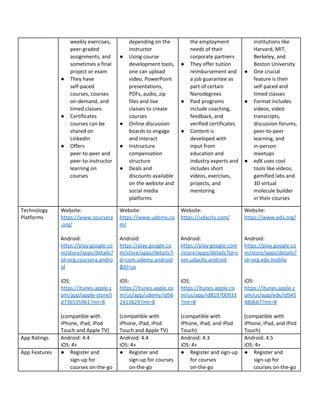
Competitive
Advantage
● Coursera​ ​has
tie-ups​ ​with
leading
universities​ ​and
institutions​ ​across
the​ ​globe
● The​ ​courses
provide​ ​quizzes,
● Udemy​ ​allows
instructors​ ​to​ ​build
and​ ​promote
online​ ​courses​ ​on
topics​ ​of​ ​their
choosing
● Offers​ ​paid​ ​and
free​ ​courses
● Udacity​ ​partners
with​ ​universities​ ​to
create​ ​courses​ ​that
are​ ​credited
● They​ ​also​ ​have
programs​ ​called
Nano​ ​degrees​ ​that
are​ ​made​ ​towards
● edX​ ​is​ ​a​ ​non-profit
that​ ​features
rigorous
coursework​ ​in​ ​a
variety​ ​of​ ​subjects
● It​ ​has​ ​classes​ ​from
the​ ​most
prestigious
weekly​ ​exercises,
peer-graded
assignments,​ ​and
sometimes​ ​a​ ​final
project​ ​or​ ​exam
● They​ ​have
self-paced
courses,​ ​courses
on-demand,​ ​and
timed​ ​classes.
● Certificates
courses​ ​can​ ​be
shared​ ​on
LinkedIn
● Offers
peer-to-peer​ ​and
peer-to-instructor
learning​ ​on
courses
depending​ ​on​ ​the
instructor
● Using​ ​course
development​ ​tools,
one​ ​can​ ​upload
video,​ ​PowerPoint
presentations,
PDFs,​ ​audio,​ ​zip
files​ ​and​ ​live
classes​ ​to​ ​create
courses
● Online​ ​discussion
boards​ ​to​ ​engage
and​ ​interact
● Instructure
compensation
structure
● Deals​ ​and
discounts​ ​available
on​ ​the​ ​website​ ​and
social​ ​media
platforms
the​ ​employment
needs​ ​of​ ​their
corporate​ ​partners
● They​ ​offer​ ​tuition
reimbursement​ ​and
a​ ​job​ ​guarantee​ ​as
part​ ​of​ ​certain
Nanodegrees
● Paid​ ​programs
include​ ​coaching,
feedback,​ ​and
verified​ ​certificates
● Content​ ​is
developed​ ​with
input​ ​from
education​ ​and
industry​ ​experts​ ​and
includes​ ​short
videos,​ ​exercises,
projects,​ ​and
mentoring
institutions​ ​like
Harvard,​ ​MIT,
Berkeley,​ ​and
Boston​ ​University
● One​ ​crucial
feature​ ​is​ ​their
self-paced​ ​and
timed​ ​classes
● Format​ ​includes
videos,​ ​video
transcripts,
discussion​ ​forums,
peer-to-peer
learning,​ ​and
in-person
meetups
● edX​ ​uses​ ​cool
tools​ ​like​ ​videos,
gamified​ ​labs​ ​and
3D​ ​virtual
molecule​ ​builder
in​ ​their​ ​courses
Technology
Platforms
Website:
https://www.coursera
.org/
Android:
https://play.google.co
m/store/apps/details?
id=org.coursera.andro
id
iOS:
https://itunes.apple.c
om/app/apple-store/i
d736535961?mt=8
(compatible​ ​with
iPhone,​ ​iPad,​ ​iPod
Touch​ ​and​ ​Apple​ ​TV)
Website:
https://www.udemy.co
m/
Android:
https://play.google.co
m/store/apps/details?i
d=com.udemy.android
&hl=us
iOS:
https://itunes.apple.co
m/us/app/udemy/id56
2413829?mt=8
(compatible​ ​with
iPhone,​ ​iPad,​ ​iPod
Touch​ ​and​ ​Apple​ ​TV)
Website:
https://udacity.com/
Android:
https://play.google.com
/store/apps/details?id=c
om.udacity.android
iOS:
https://itunes.apple.co
m/us/app/id819700933
?mt=8
(compatible​ ​with
iPhone,​ ​iPad,​ ​and​ ​iPod
Touch)
Website:
https://www.edx.org/
Android:
https://play.google.co
m/store/apps/details?
id=org.edx.mobile
iOS:
https://itunes.apple.c
om/us/app/edx/id945
480667?mt=8
(compatible​ ​with
iPhone,​ ​iPad,​ ​and​ ​iPod
Touch)
App​ ​Ratings Android:​ ​4.4
iOS:​ ​4+
Android:​ ​4.4
iOS:​ ​4+
Android:​ ​4.3
iOS:​ ​4+
Android:​ ​4.5
iOS:​ ​4+
App​ ​Features ● Register​ ​and
sign-up​ ​for
courses​ ​on-the-go
● Register​ ​and
sign-up​ ​for​ ​courses
on-the-go
● Register​ ​and​ ​sign-up
for​ ​courses
on-the-go
● Register​ ​and
sign-up​ ​for
courses​ ​on-the-go
● Stream​ ​videos
online​ ​or
download​ ​for
offline​ ​viewing
● Interactive
learning
experience​ ​–
pre-recorded
videos,​ ​quizzes,
and​ ​projects
● Connections
through​ ​forums,
study​ ​groups
● Multi-lingual
support
● View​ ​and​ ​manage
multiple​ ​courses
showing​ ​progress
● Stream​ ​videos
online​ ​or​ ​download
for​ ​offline​ ​viewing
● Audio-only​ ​mode
also​ ​available
● Discussion​ ​forum
with​ ​students​ ​and
instructors
● Personalize
learning​ ​experience
with​ ​speed​ ​controls
and​ ​closed
captioning
● Learn​ ​courses​ ​on
the​ ​computer​ ​or​ ​TV
● View​ ​and​ ​manage
multiple​ ​courses
showing​ ​progress
● Download​ ​classes
and​ ​content​ ​for
offline​ ​viewing
● Access​ ​the
classroom,​ ​connect
with​ ​mentors,​ ​and
track​ ​progress
● Discussion​ ​forum
with​ ​students​ ​and
mentors
● View​ ​and​ ​manage
multiple​ ​classes
showing​ ​progress
● Continuous
supervised​ ​learning
● Download​ ​course
videos​ ​for​ ​offline
viewing
● View​ ​course
announcements
and​ ​handouts
● Test​ ​knowledge
with​ ​quizzes​ ​and
exams
● Schedule​ ​tutorials
as​ ​per​ ​ones
availability
● View​ ​and​ ​manage
multiple​ ​classes
showing​ ​progress
Social​ ​Media Facebook,​ ​Twitter,
LinkedIn,​ ​Instagram,
Google+,​ ​Coursera
Blog,​ ​Tech​ ​Blog
Facebook,​ ​Twitter,
LinkedIn,​ ​Instagram,
Udemy​ ​Blog
Facebook,​ ​Twitter,
Medium,​ ​Instagram,
Google+
Facebook,​ ​Twitter,
YouTube,​ ​LinkedIn,
Google​ ​+,​ ​Reddit,​ ​edX
Blog
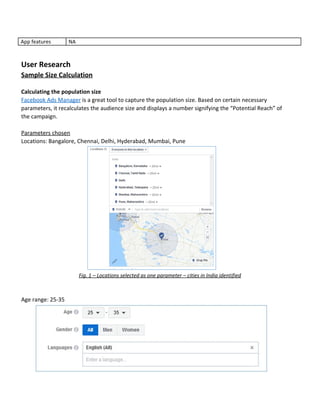
Indirect​ ​competitors
Specifics Offline​ ​Certification/Degrees
Mission​ ​&​ ​Goal Provide​ ​students​ ​with​ ​courses​ ​and​ ​degrees​ ​in​ ​a​ ​brick​ ​and​ ​mortar​ ​setup.
Helps​ ​students​ ​to​ ​gain​ ​degrees​ ​that​ ​act​ ​as​ ​minimum​ ​qualification​ ​criteria​ ​for​ ​job
Strategy B2B​ ​and​ ​B2C
There​ ​are​ ​courses​ ​available​ ​for​ ​both​ ​B2B​ ​and​ ​B2C​ ​enterprises.
Most​ ​of​ ​these​ ​are​ ​2-3​ ​days​ ​workshops.
Current
Employees
NA
Funding NA
Revenue NA
Team NA
Operation NA
Revenue​ ​Model Revenue​ ​from​ ​tuition​ ​and​ ​hostel​ ​fees
USP’s Degree​ ​accepted​ ​by​ ​govt​ ​in​ ​case​ ​of​ ​reputed​ ​universities.
Direct​ ​engagement​ ​with​ ​faculty​ ​and​ ​peers.
Access​ ​to​ ​hard​ ​and​ ​soft​ ​course​ ​material.
Working​ ​on​ ​assignments​ ​with​ ​peers.
Strong​ ​alumni​ ​presence​ ​.
Platforms Brick​ ​and​ ​mortar
App​ ​Rating NA
App​ ​features NA
User​ ​Research
Sample​ ​Size​ ​Calculation
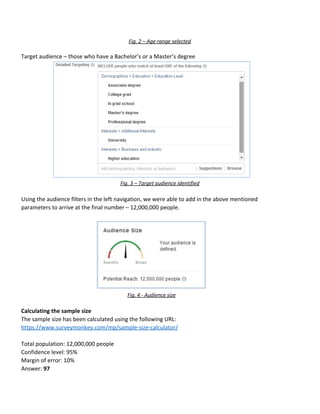
Calculating​ ​the​ ​population​ ​size
Facebook​ ​Ads​ ​Manager​​ ​is​ ​a​ ​great​ ​tool​ ​to​ ​capture​ ​the​ ​population​ ​size.​ ​Based​ ​on​ ​certain​ ​necessary
parameters,​ ​it​ ​recalculates​ ​the​ ​audience​ ​size​ ​and​ ​displays​ ​a​ ​number​ ​signifying​ ​the​ ​“Potential​ ​Reach”​ ​of
the​ ​campaign.
Parameters​ ​chosen
Locations:​ ​Bangalore,​ ​Chennai,​ ​Delhi,​ ​Hyderabad,​ ​Mumbai,​ ​Pune
Fig.​ ​1​ ​–​ ​Locations​ ​selected​ ​as​ ​one​ ​parameter​ ​–​ ​cities​ ​in​ ​India​ ​identified
Age​ ​range:​ ​25-35
Fig.​ ​2​ ​–​ ​Age​ ​range​ ​selected
Target​ ​audience​ ​–​ ​those​ ​who​ ​have​ ​a​ ​Bachelor’s​ ​or​ ​a​ ​Master’s​ ​degree
Fig.​ ​3​ ​–​ ​Target​ ​audience​ ​identified
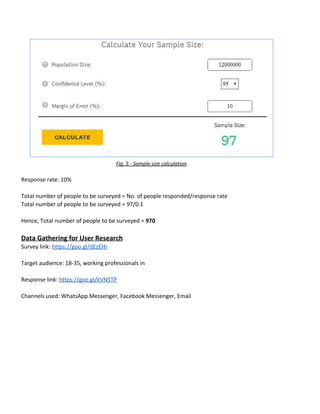
Using​ ​the​ ​audience​ ​filters​ ​in​ ​the​ ​left​ ​navigation,​ ​we​ ​were​ ​able​ ​to​ ​add​ ​in​ ​the​ ​above​ ​mentioned
parameters​ ​to​ ​arrive​ ​at​ ​the​ ​final​ ​number​ ​–​ ​12,000,000​ ​people.
Fig.​ ​4​ ​-​ ​Audience​ ​size
Calculating​ ​the​ ​sample​ ​size
The​ ​sample​ ​size​ ​has​ ​been​ ​calculated​ ​using​ ​the​ ​following​ ​URL:
https://www.surveymonkey.com/mp/sample-size-calculator/
Total​ ​population:​ ​12,000,000​ ​people
Confidence​ ​level:​ ​95%
Margin​ ​of​ ​error:​ ​10%
Answer:​ ​​97
Fig.​ ​5​ ​-​ ​Sample​ ​size​ ​calculation
Response​ ​rate:​ ​10%
Total​ ​number​ ​of​ ​people​ ​to​ ​be​ ​surveyed​ ​=​ ​No.​ ​of​ ​people​ ​responded/response​ ​rate
Total​ ​number​ ​of​ ​people​ ​to​ ​be​ ​surveyed​ ​=​ ​97/0.1
Hence,​ ​Total​ ​number​ ​of​ ​people​ ​to​ ​be​ ​surveyed​ ​=​ ​​970
Data​ ​Gathering​ ​for​ ​User​ ​Research
Survey​ ​link:​ ​​https://goo.gl/dEzEHr
Target​ ​audience:​ ​18-35,​ ​working​ ​professionals​ ​in
Response​ ​link:​ ​​https://goo.gl/kVN5TP
Channels​ ​used:​ ​WhatsApp​ ​Messenger,​ ​Facebook​ ​Messenger,​ ​Email
User​ ​Research​ ​Analysis
The​ ​user​ ​research​ ​conducted​ ​was​ ​primarily​ ​done​ ​using​ ​a​ ​survey​ ​questionnaire.​ ​Based​ ​on​ ​the​ ​objective
and​ ​hypothesis​ ​of​ ​the​ ​project,​ ​certain​ ​questions​ ​were​ ​formulated.​ ​Based​ ​on​ ​the​ ​responses​ ​received,
the​ ​following​ ​observations​ ​have​ ​been​ ​made.
Age
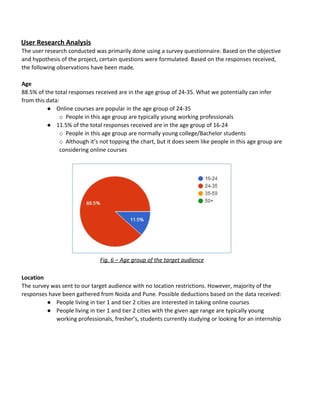
88.5%​ ​of​ ​the​ ​total​ ​responses​ ​received​ ​are​ ​in​ ​the​ ​age​ ​group​ ​of​ ​24-35.​ ​What​ ​we​ ​potentially​ ​can​ ​infer
from​ ​this​ ​data:
● Online​ ​courses​ ​are​ ​popular​ ​in​ ​the​ ​age​ ​group​ ​of​ ​24-35
o​​ ​​ ​​ ​​People​ ​in​ ​this​ ​age​ ​group​ ​are​ ​typically​ ​young​ ​working​ ​professionals
● 11.5%​ ​of​ ​the​ ​total​ ​responses​ ​received​ ​are​ ​in​ ​the​ ​age​ ​group​ ​of​ ​16-24
o​​ ​​ ​​ ​​People​ ​in​ ​this​ ​age​ ​group​ ​are​ ​normally​ ​young​ ​college/Bachelor​ ​students
o​​ ​​ ​​ ​​Although​ ​it’s​ ​not​ ​topping​ ​the​ ​chart,​ ​but​ ​it​ ​does​ ​seem​ ​like​ ​people​ ​in​ ​this​ ​age​ ​group​ ​are
considering​ ​online​ ​courses
Fig.​ ​6​ ​–​ ​Age​ ​group​ ​of​ ​the​ ​target​ ​audience
Location
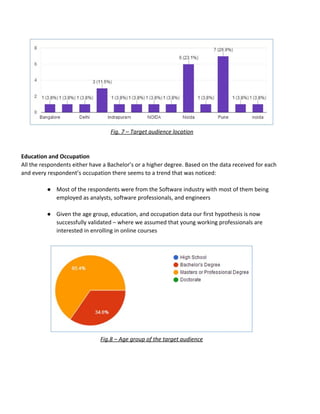
The​ ​survey​ ​was​ ​sent​ ​to​ ​our​ ​target​ ​audience​ ​with​ ​no​ ​location​ ​restrictions.​ ​However,​ ​majority​ ​of​ ​the
responses​ ​have​ ​been​ ​gathered​ ​from​ ​Noida​ ​and​ ​Pune.​ ​Possible​ ​deductions​ ​based​ ​on​ ​the​ ​data​ ​received:
● People​ ​living​ ​in​ ​tier​ ​1​ ​and​ ​tier​ ​2​ ​cities​ ​are​ ​interested​ ​in​ ​taking​ ​online​ ​courses
● People​ ​living​ ​in​ ​tier​ ​1​ ​and​ ​tier​ ​2​ ​cities​ ​with​ ​the​ ​given​ ​age​ ​range​ ​are​ ​typically​ ​young
working​ ​professionals,​ ​fresher’s,​ ​students​ ​currently​ ​studying​ ​or​ ​looking​ ​for​ ​an​ ​internship
Fig.​ ​7​ ​–​ ​Target​ ​audience​ ​location
Education​ ​and​ ​Occupation
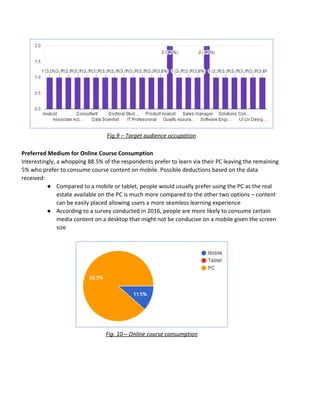
All​ ​the​ ​respondents​ ​either​ ​have​ ​a​ ​Bachelor’s​ ​or​ ​a​ ​higher​ ​degree.​ ​Based​ ​on​ ​the​ ​data​ ​received​ ​for​ ​each
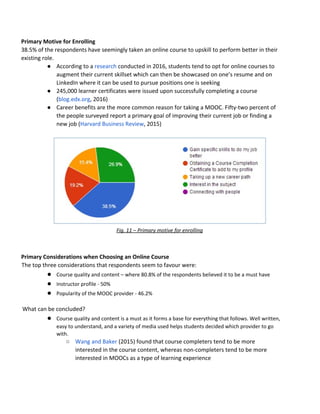
and​ ​every​ ​respondent’s​ ​occupation​ ​there​ ​seems​ ​to​ ​a​ ​trend​ ​that​ ​was​ ​noticed:
● Most​ ​of​ ​the​ ​respondents​ ​were​ ​from​ ​the​ ​Software​ ​industry​ ​with​ ​most​ ​of​ ​them​ ​being
employed​ ​as​ ​analysts,​ ​software​ ​professionals,​ ​and​ ​engineers
● Given​ ​the​ ​age​ ​group,​ ​education,​ ​and​ ​occupation​ ​data​ ​our​ ​first​ ​hypothesis​ ​is​ ​now
successfully​ ​validated​ ​–​ ​where​ ​we​ ​assumed​ ​that​ ​young​ ​working​ ​professionals​ ​are
interested​ ​in​ ​enrolling​ ​in​ ​online​ ​courses
Fig.8​ ​–​ ​Age​ ​group​ ​of​ ​the​ ​target​ ​audience
Fig.9​ ​–​ ​Target​ ​audience​ ​occupation
Preferred​ ​Medium​ ​for​ ​Online​ ​Course​ ​Consumption
Interestingly,​ ​a​ ​whopping​ ​88.5%​ ​of​ ​the​ ​respondents​ ​prefer​ ​to​ ​learn​ ​via​ ​their​ ​PC​ ​leaving​ ​the​ ​remaining
5%​ ​who​ ​prefer​ ​to​ ​consume​ ​course​ ​content​ ​on​ ​mobile.​ ​Possible​ ​deductions​ ​based​ ​on​ ​the​ ​data
received:
● Compared​ ​to​ ​a​ ​mobile​ ​or​ ​tablet,​ ​people​ ​would​ ​usually​ ​prefer​ ​using​ ​the​ ​PC​ ​as​ ​the​ ​real
estate​ ​available​ ​on​ ​the​ ​PC​ ​is​ ​much​ ​more​ ​compared​ ​to​ ​the​ ​other​ ​two​ ​options​ ​–​ ​content
can​ ​be​ ​easily​ ​placed​ ​allowing​ ​users​ ​a​ ​more​ ​seamless​ ​learning​ ​experience
● According​ ​to​ ​a​ ​survey​ ​conducted​ ​in​ ​2016,​ ​people​ ​are​ ​more​ ​likely​ ​to​ ​consume​ ​certain
media​ ​content​ ​on​ ​a​ ​desktop​ ​that​ ​might​ ​not​ ​be​ ​conducive​ ​on​ ​a​ ​mobile​ ​given​ ​the​ ​screen
size
Fig.​ ​10​ ​–​ ​Online​ ​course​ ​consumption
Primary​ ​Motive​ ​for​ ​Enrolling
38.5%​ ​of​ ​the​ ​respondents​ ​have​ ​seemingly​ ​taken​ ​an​ ​online​ ​course​ ​to​ ​upskill​ ​to​ ​perform​ ​better​ ​in​ ​their
existing​ ​role.
● According​ ​to​ ​a​​ ​​research​​ ​conducted​ ​in​ ​2016,​ ​students​ ​tend​ ​to​ ​opt​ ​for​ ​online​ ​courses​ ​to
augment​ ​their​ ​current​ ​skillset​ ​which​ ​can​ ​then​ ​be​ ​showcased​ ​on​ ​one’s​ ​resume​ ​and​ ​on
LinkedIn​ ​where​ ​it​ ​can​ ​be​ ​used​ ​to​ ​pursue​ ​positions​ ​one​ ​is​ ​seeking
● 245,000​ ​learner​ ​certificates​ ​were​ ​issued​ ​upon​ ​successfully​ ​completing​ ​a​ ​course
(​blog.edx.org​,​ ​2016)
● Career​ ​benefits​ ​are​ ​the​ ​more​ ​common​ ​reason​ ​for​ ​taking​ ​a​ ​MOOC.​ ​Fifty-two​ ​percent​ ​of
the​ ​people​ ​surveyed​ ​report​ ​a​ ​primary​ ​goal​ ​of​ ​improving​ ​their​ ​current​ ​job​ ​or​ ​finding​ ​a
new​ ​job​ ​(​Harvard​ ​Business​ ​Review​,​ ​2015)
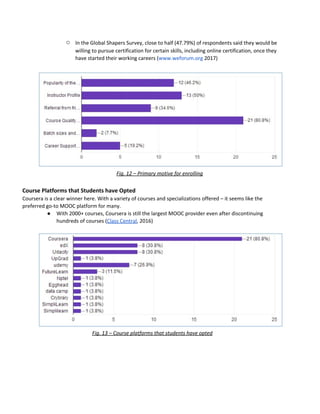
Fig.​ ​11​ ​–​ ​Primary​ ​motive​ ​for​ ​enrolling
Primary​ ​Considerations​ ​when​ ​Choosing​ ​an​ ​Online​ ​Course
The​ ​top​ ​three​ ​considerations​ ​that​ ​respondents​ ​seem​ ​to​ ​favour​ ​were:
● Course​ ​quality​ ​and​ ​content​ ​–​ ​where​ ​80.8%​ ​of​ ​the​ ​respondents​ ​believed​ ​it​ ​to​ ​be​ ​a​ ​must​ ​have
● Instructor​ ​profile​ ​-​ ​50%
● Popularity​ ​of​ ​the​ ​MOOC​ ​provider​ ​-​ ​46.2%
What​ ​can​ ​be​ ​concluded?
● Course​ ​quality​ ​and​ ​content​ ​is​ ​a​ ​must​ ​as​ ​it​ ​forms​ ​a​ ​base​ ​for​ ​everything​ ​that​ ​follows.​ ​Well​ ​written,
easy​ ​to​ ​understand,​ ​and​ ​a​ ​variety​ ​of​ ​media​ ​used​ ​helps​ ​students​ ​decided​ ​which​ ​provider​ ​to​ ​go
with.
○ Wang​ ​and​ ​Baker​​ ​(2015)​ ​found​ ​that​ ​course​ ​completers​ ​tend​ ​to​ ​be​ ​more
interested​ ​in​ ​the​ ​course​ ​content,​ ​whereas​ ​non-completers​ ​tend​ ​to​ ​be​ ​more
interested​ ​in​ ​MOOCs​ ​as​ ​a​ ​type​ ​of​ ​learning​ ​experience
○ In​ ​the​ ​Global​ ​Shapers​ ​Survey,​ ​close​ ​to​ ​half​ ​(47.79%)​ ​of​ ​respondents​ ​said​ ​they​ ​would​ ​be
willing​ ​to​ ​pursue​ ​certification​ ​for​ ​certain​ ​skills,​ ​including​ ​online​ ​certification,​ ​once​ ​they
have​ ​started​ ​their​ ​working​ ​careers​​ ​(​www.weforum.org​​ ​2017)
Fig.​ ​12​ ​–​ ​Primary​ ​motive​ ​for​ ​enrolling
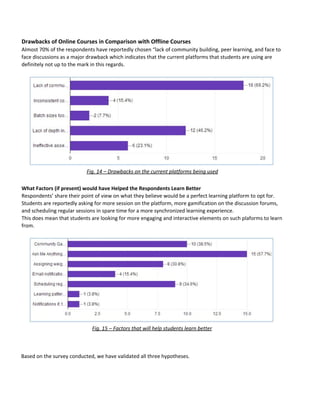
Course​ ​Platforms​ ​that​ ​Students​ ​have​ ​Opted
Coursera​ ​is​ ​a​ ​clear​ ​winner​ ​here.​ ​With​ ​a​ ​variety​ ​of​ ​courses​ ​and​ ​specializations​ ​offered​ ​–​ ​it​ ​seems​ ​like​ ​the
preferred​ ​go-to​ ​MOOC​ ​platform​ ​for​ ​many.
● With​ ​2000+​ ​courses,​ ​Coursera​ ​is​ ​still​ ​the​ ​largest​ ​MOOC​ ​provider​ ​even​ ​after​ ​discontinuing
hundreds​ ​of​ ​courses​ ​(​Class​ ​Central​,​ ​2016)
Fig.​ ​13​ ​–​ ​Course​ ​platforms​ ​that​ ​students​ ​have​ ​opted
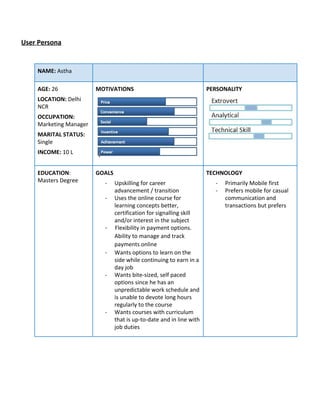
Drawbacks​ ​of​ ​Online​ ​Courses​ ​in​ ​Comparison​ ​with​ ​Offline​ ​Courses
Almost​ ​70%​ ​of​ ​the​ ​respondents​ ​have​ ​reportedly​ ​chosen​ ​“lack​ ​of​ ​community​ ​building,​ ​peer​ ​learning,​ ​and​ ​face​ ​to
face​ ​discussions​ ​as​ ​a​ ​major​ ​drawback​ ​which​ ​indicates​ ​that​ ​the​ ​current​ ​platforms​ ​that​ ​students​ ​are​ ​using​ ​are
definitely​ ​not​ ​up​ ​to​ ​the​ ​mark​ ​in​ ​this​ ​regards.
Fig.​ ​14​ ​–​ ​Drawbacks​ ​on​ ​the​ ​current​ ​platforms​ ​being​ ​used
What​ ​Factors​ ​(if​ ​present)​ ​would​ ​have​ ​Helped​ ​the​ ​Respondents​ ​Learn​ ​Better
Respondents’​ ​share​ ​their​ ​point​ ​of​ ​view​ ​on​ ​what​ ​they​ ​believe​ ​would​ ​be​ ​a​ ​perfect​ ​learning​ ​platform​ ​to​ ​opt​ ​for.
Students​ ​are​ ​reportedly​ ​asking​ ​for​ ​more​ ​session​ ​on​ ​the​ ​platform,​ ​more​ ​gamification​ ​on​ ​the​ ​discussion​ ​forums,
and​ ​scheduling​ ​regular​ ​sessions​ ​in​ ​spare​ ​time​ ​for​ ​a​ ​more​ ​synchronized​ ​learning​ ​experience.
This​ ​does​ ​mean​ ​that​ ​students​ ​are​ ​looking​ ​for​ ​more​ ​engaging​ ​and​ ​interactive​ ​elements​ ​on​ ​such​ ​plaforms​ ​to​ ​learn
from.
Fig.​ ​15​ ​–​ ​Factors​ ​that​ ​will​ ​help​ ​students​ ​learn​ ​better
Based​ ​on​ ​the​ ​survey​ ​conducted,​ ​we​ ​have​ ​validated​ ​all​ ​three​ ​hypotheses.
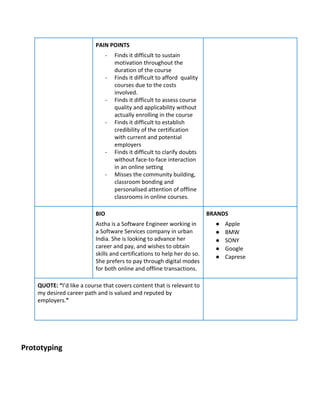
User​ ​Persona
NAME:​​ ​Astha
AGE:​ ​​26
LOCATION:​ ​​Delhi
NCR
OCCUPATION:
Marketing​ ​Manager
MARITAL​ ​STATUS:
Single
INCOME:​ ​​10​ ​L
MOTIVATIONS PERSONALITY
EDUCATION​:
Masters​ ​Degree
GOALS
- Upskilling​ ​for​ ​career
advancement​ ​/​ ​transition
- Uses​ ​the​ ​online​ ​course​ ​for
learning​ ​concepts​ ​better,
certification​ ​for​ ​signalling​ ​skill
and/or​ ​interest​ ​in​ ​the​ ​subject
- Flexibility​ ​in​ ​payment​ ​options.
Ability​ ​to​ ​manage​ ​and​ ​track
payments​ ​online
- Wants​ ​options​ ​to​ ​learn​ ​on​ ​the
side​ ​while​ ​continuing​ ​to​ ​earn​ ​in​ ​a
day​ ​job
- Wants​ ​bite-sized,​ ​self​ ​paced
options​ ​since​ ​he​ ​has​ ​an
unpredictable​ ​work​ ​schedule​ ​and
is​ ​unable​ ​to​ ​devote​ ​long​ ​hours
regularly​ ​to​ ​the​ ​course
- Wants​ ​courses​ ​with​ ​curriculum
that​ ​is​ ​up-to-date​ ​and​ ​in​ ​line​ ​with
job​ ​duties
TECHNOLOGY
- Primarily​ ​Mobile​ ​first
- Prefers​ ​mobile​ ​for​ ​casual
communication​ ​and
transactions​ ​but​ ​prefers
PAIN​ ​POINTS
- Finds​ ​it​ ​difficult​ ​to​ ​sustain
motivation​ ​throughout​ ​the
duration​ ​of​ ​the​ ​course
- Finds​ ​it​ ​difficult​ ​to​ ​afford​ ​​ ​quality
courses​ ​due​ ​to​ ​the​ ​costs
involved.
- Finds​ ​it​ ​difficult​ ​to​ ​assess​ ​course
quality​ ​and​ ​applicability​ ​without
actually​ ​enrolling​ ​in​ ​the​ ​course
- Finds​ ​it​ ​difficult​ ​to​ ​establish
credibility​ ​of​ ​the​ ​certification
with​ ​current​ ​and​ ​potential
employers
- Finds​ ​it​ ​difficult​ ​to​ ​clarify​ ​doubts
without​ ​face-to-face​ ​interaction
in​ ​an​ ​online​ ​setting
- Misses​ ​the​ ​community​ ​building,
classroom​ ​bonding​ ​and
personalised​ ​attention​ ​of​ ​offline
classrooms​ ​in​ ​online​ ​courses.
BIO
Astha​ ​is​ ​a​ ​Software​ ​Engineer​ ​working​ ​in
a​ ​Software​ ​Services​ ​company​ ​in​ ​urban
India.​ ​She​ ​is​ ​looking​ ​to​ ​advance​ ​her
career​ ​and​ ​pay,​ ​and​ ​wishes​ ​to​ ​obtain
skills​ ​and​ ​certifications​ ​to​ ​help​ ​her​ ​do​ ​so.
She​ ​prefers​ ​to​ ​pay​ ​through​ ​digital​ ​modes
for​ ​both​ ​online​ ​and​ ​offline​ ​transactions.
BRANDS
● Apple
● BMW
● SONY
● Google
● Caprese
QUOTE:​ ​“​I’d​ ​like​ ​a​ ​course​ ​that​ ​covers​ ​content​ ​that​ ​is​ ​relevant​ ​to
my​ ​desired​ ​career​ ​path​ ​and​ ​is​ ​valued​ ​and​ ​reputed​ ​by
employers.​”
Prototyping
From the user research, we see that most students do not participate actively in an online
forum​ ​setting​ ​primarily​ ​due​ ​to​ ​3​ ​reasons:
● Apathy​ ​towards​ ​fellow​ ​students​ ​whom​ ​they​ ​do​ ​not​ ​know​ ​in​ ​person
● Asynchronous​ ​nature​ ​of​ ​the​ ​online​ ​learning​ ​experience
● Lack​ ​of​ ​credibility​ ​in​ ​the​ ​responses​ ​on​ ​discussion​ ​forums
Our suggested solution to all of these issues is setting up ​Timed Discussion Sessions with
industry​ ​experts​ ​on​ ​the​ ​forums.
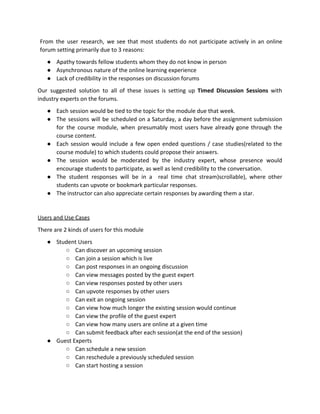
● Each​ ​session​ ​would​ ​be​ ​tied​ ​to​ ​the​ ​topic​ ​for​ ​the​ ​module​ ​due​ ​that​ ​week.
● The sessions will be scheduled on a Saturday, a day before the assignment submission
for the course module, when presumably most users have already gone through the
course​ ​content.
● Each session would include a few open ended questions / case studies(related to the
course​ ​module)​ ​to​ ​which​ ​students​ ​could​ ​propose​ ​their​ ​answers.
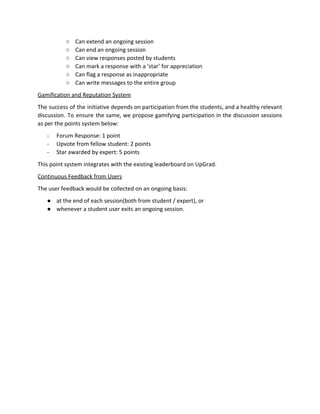
● The session would be moderated by the industry expert, whose presence would
encourage​ ​students​ ​to​ ​participate,​ ​as​ ​well​ ​as​ ​lend​ ​credibility​ ​to​ ​the​ ​conversation.
● The student responses will be in a real time chat stream)scrollable), where other
students​ ​can​ ​upvote​ ​or​ ​bookmark​ ​particular​ ​responses.
● The​ ​instructor​ ​can​ ​also​ ​appreciate​ ​certain​ ​responses​ ​by​ ​awarding​ ​them​ ​a​ ​star.
Users​ ​and​ ​Use​ ​Cases
There​ ​are​ ​2​ ​kinds​ ​of​ ​users​ ​for​ ​this​ ​module
● Student​ ​Users
○ Can​ ​discover​ ​an​ ​upcoming​ ​session
○ Can​ ​join​ ​a​ ​session​ ​which​ ​is​ ​live
○ Can​ ​post​ ​responses​ ​in​ ​an​ ​ongoing​ ​discussion
○ Can​ ​view​ ​messages​ ​posted​ ​by​ ​the​ ​guest​ ​expert
○ Can​ ​view​ ​responses​ ​posted​ ​by​ ​other​ ​users
○ Can​ ​upvote​ ​responses​ ​by​ ​other​ ​users
○ Can​ ​exit​ ​an​ ​ongoing​ ​session
○ Can​ ​view​ ​how​ ​much​ ​longer​ ​the​ ​existing​ ​session​ ​would​ ​continue
○ Can​ ​view​ ​the​ ​profile​ ​of​ ​the​ ​guest​ ​expert
○ Can​ ​view​ ​how​ ​many​ ​users​ ​are​ ​online​ ​at​ ​a​ ​given​ ​time
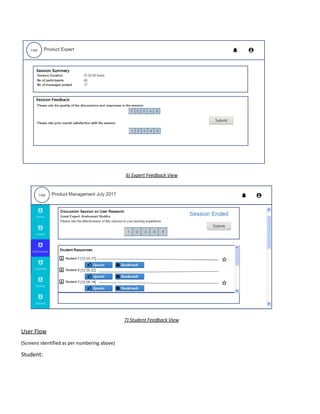
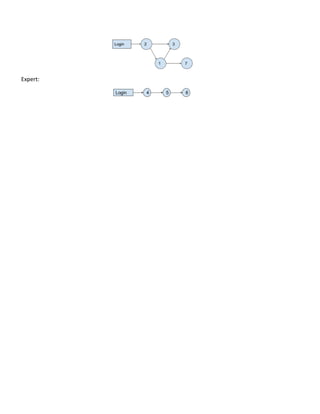
○ Can​ ​submit​ ​feedback​ ​after​ ​each​ ​session(at​ ​the​ ​end​ ​of​ ​the​ ​session)
● Guest​ ​Experts
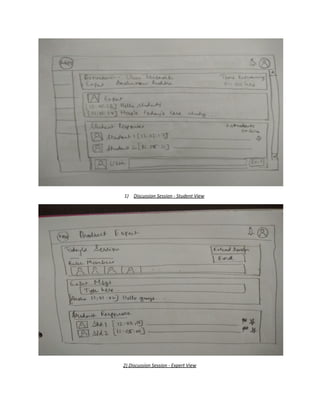
○ Can​ ​schedule​ ​a​ ​new​ ​session
○ Can​ ​reschedule​ ​a​ ​previously​ ​scheduled​ ​session
○ Can​ ​start​ ​hosting​ ​a​ ​session
○ Can​ ​extend​ ​an​ ​ongoing​ ​session
○ Can​ ​end​ ​an​ ​ongoing​ ​session
○ Can​ ​view​ ​responses​ ​posted​ ​by​ ​students
○ Can​ ​mark​ ​a​ ​response​ ​with​ ​a​ ​‘star’​ ​for​ ​appreciation
○ Can​ ​flag​ ​a​ ​response​ ​as​ ​inappropriate
○ Can​ ​write​ ​messages​ ​to​ ​the​ ​entire​ ​group
Gamification​ ​and​ ​Reputation​ ​System
The success of the initiative depends on participation from the students, and a healthy relevant
discussion. To ensure the same, we propose gamifying participation in the discussion sessions
as​ ​per​ ​the​ ​points​ ​system​ ​below:
- Forum​ ​Response:​ ​1​ ​point
- Upvote​ ​from​ ​fellow​ ​student:​ ​2​ ​points
- Star​ ​awarded​ ​by​ ​expert:​ ​5​ ​points
This​ ​point​ ​system​ ​integrates​ ​with​ ​the​ ​existing​ ​leaderboard​ ​on​ ​UpGrad.
Continuous​ ​Feedback​ ​from​ ​Users
The​ ​user​ ​feedback​ ​would​ ​be​ ​collected​ ​on​ ​an​ ​ongoing​ ​basis:
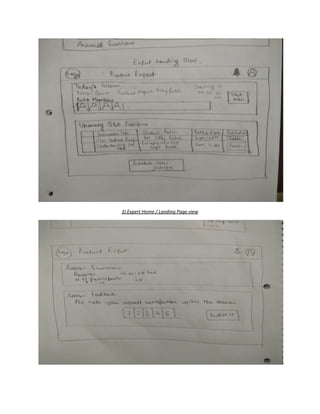
● at​ ​the​ ​end​ ​of​ ​each​ ​session(both​ ​from​ ​student​ ​/​ ​expert),​ ​or
● whenever​ ​a​ ​student​ ​user​ ​exits​ ​an​ ​ongoing​ ​session.
1) Discussion​ ​Session​ ​-​ ​Student​ ​View
2)​ ​Discussion​ ​Session​ ​-​ ​Expert​ ​View
3)​ ​Expert​ ​Home​ ​/​ ​Landing​ ​Page​ ​view
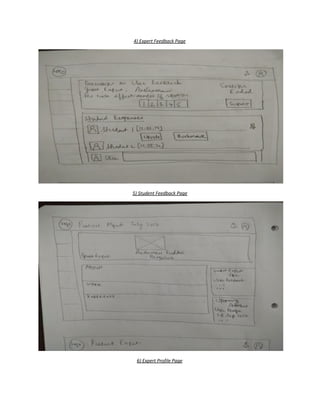
4)​ ​Expert​ ​Feedback​ ​Page
5)​ ​Student​ ​Feedback​ ​Page
6)​ ​Expert​ ​Profile​ ​Page
Usability​ ​Testing​ ​Feedback
Technique​ ​Used:​ ​Quick​ ​and​ ​Dirty​ ​Technique
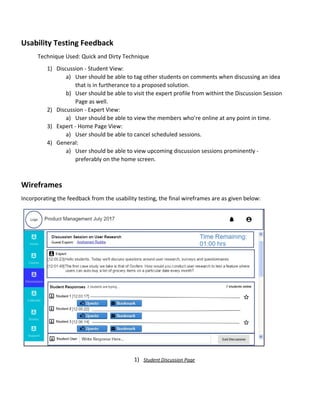
1) Discussion​ ​-​ ​Student​ ​View:
a) User​ ​should​ ​be​ ​able​ ​to​ ​tag​ ​other​ ​students​ ​on​ ​comments​ ​when​ ​discussing​ ​an​ ​idea
that​ ​is​ ​in​ ​furtherance​ ​to​ ​a​ ​proposed​ ​solution.
b) User​ ​should​ ​be​ ​able​ ​to​ ​visit​ ​the​ ​expert​ ​profile​ ​from​ ​withint​ ​the​ ​Discussion​ ​Session
Page​ ​as​ ​well.
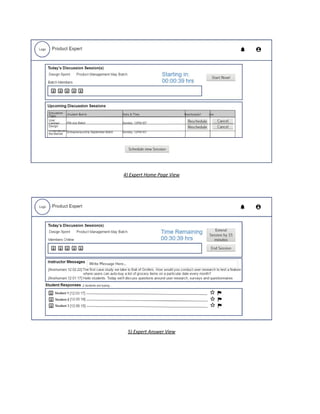
2) Discussion​ ​-​ ​Expert​ ​View:
a) User​ ​should​ ​be​ ​able​ ​to​ ​view​ ​the​ ​members​ ​who’re​ ​online​ ​at​ ​any​ ​point​ ​in​ ​time.
3) Expert​ ​-​ ​Home​ ​Page​ ​View:
a) User​ ​should​ ​be​ ​able​ ​to​ ​cancel​ ​scheduled​ ​sessions.
4) General:
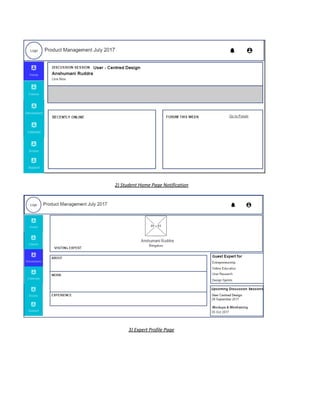
a) User​ ​should​ ​be​ ​able​ ​to​ ​view​ ​upcoming​ ​discussion​ ​sessions​ ​prominently​ ​-
preferably​ ​on​ ​the​ ​home​ ​screen.
Wireframes
Incorporating​ ​the​ ​feedback​ ​from​ ​the​ ​usability​ ​testing,​ ​the​ ​final​ ​wireframes​ ​are​ ​as​ ​given​ ​below:
1) Student​ ​Discussion​ ​Page
2)​ ​Student​ ​Home​ ​Page​ ​Notification
3)​ ​Expert​ ​Profile​ ​Page
4)​ ​Expert​ ​Home​ ​Page​ ​View
5)​ ​Expert​ ​Answer​ ​View
6)​ ​Expert​ ​Feedback​ ​View
7)​ ​Student​ ​Feedback​ ​View
User​ ​Flow
(Screens​ ​identified​ ​as​ ​per​ ​numbering​ ​above)
Student:
​ ​
Expert:

Upgrad industry project part 1

  • 1.
    Industry​ ​Project​ ​1​​–​ ​UpGrad Introduction The​ ​convenience​ ​of​ ​an​ ​online​ ​degree​ ​has​ ​a​ ​wide​ ​appeal.​ ​With​ ​advances​ ​in​ ​technology​ ​and​ ​our increased​ ​dependence​ ​on​ ​all​ ​things​ ​digital​ ​has​ ​led​ ​to​ ​a​ ​huge​ ​surge​ ​in​ ​online​ ​learning.​ ​With​ ​a variety​ ​of​ ​courses​ ​to​ ​choose​ ​from​ ​–​ ​includes​ ​certifications​ ​and​ ​degrees,​ ​interactive​ ​and engaging​ ​platforms​ ​as​ ​support,​ ​and​ ​convenience​ ​as​ ​the​ ​prime​ ​factor,​ ​many​ ​students​ ​today prefer​ ​e-learning​ ​to​ ​the​ ​traditional​ ​classroom​ ​education.​ ​In​ ​2016,​ ​the​ ​e-learning​ ​market​ ​was worth​ ​$166.5​ ​billion,​ ​and​ ​is​ ​estimated​ ​to​ ​reach​ ​$255​ ​billion​ ​by​ ​2017​ ​(​www.weforum.org​). With​ ​there​ ​being​ ​several​ ​perks​ ​in​ ​the​ ​e-learning​ ​domain,​ ​there​ ​is​ ​however,​ ​the​ ​growing​ ​need​ ​to try​ ​and​ ​provide​ ​an​ ​exceptional​ ​user​ ​experience​ ​to​ ​students​ ​which​ ​sometimes​ ​does​ ​raise​ ​the question​ ​–​ ​is​ ​e-learning​ ​better​ ​than​ ​the​ ​traditional​ ​face-2-face​ ​classroom​ ​learning​ ​or​ ​not?​ ​With several​ ​pros​ ​such​ ​as​ ​face-to-face​ ​interactions​ ​and​ ​effective​ ​discussions​ ​and​ ​interactions,​ ​on​ ​the traditional​ ​side,​ ​companies​ ​in​ ​the​ ​MOOC​ ​space​ ​are​ ​constantly​ ​trying​ ​their​ ​best​ ​to​ ​enhance​ ​their platform​ ​with​ ​features​ ​to​ ​try​ ​and​ ​provide​ ​a​ ​blend​ ​of​ ​both​ ​worlds​ ​in​ ​the​ ​entire​ ​e-learning experience. Objective The​ ​objective​ ​of​ ​this​ ​assignment​ ​is​ ​to​ ​try​ ​and​ ​find​ ​out​ ​what​ ​students​ ​are​ ​looking​ ​for​ ​when​ ​they​ ​do choose​ ​to​ ​go​ ​in​ ​for​ ​an​ ​online​ ​course.​ ​What​ ​would​ ​assist​ ​in​ ​their​ ​learning​ ​experience​ ​and​ ​how​ ​can​ ​this​ ​be provided​ ​to​ ​garner​ ​maximum​ ​benefits​ ​from​ ​the​ ​platform. Hypothesis ● Online​ ​courses​ ​are​ ​gaining​ ​popularity​ ​and​ ​many​ ​users’​ ​especially​ ​working​ ​professionals are​ ​interested​ ​in​ ​getting​ ​an​ ​online​ ​certification​ ​course ● They​ ​enroll​ ​in​ ​online​ ​courses​ ​for​ ​varied​ ​reasons​ ​such​ ​as​ ​up-skill,​ ​securing​ ​a​ ​better​ ​job, new​ ​prospects​ ​etc. ● Interaction​ ​and​ ​engagement​ ​form​ ​a​ ​key​ ​part​ ​of​ ​the​ ​e-learning​ ​platform​ ​and​ ​users​ ​are​ ​in need​ ​of​ ​innovative​ ​and​ ​intuitive​ ​features​ ​to​ ​help​ ​with​ ​their​ ​learning. ___________________________________________________________________ Group​ ​members Dattatrey​ ​Kulkarni​ ​(​idattatrey@gmail.com​) Nisha​ ​Sashidharan​ ​(​nisha_sas@hotmail.co.uk​) Ravikiran​ ​Sastry​ ​(​ravikiran.sastry@gmail.com​)
  • 2.
    UpGrad​ ​–​ ​Overview​​and​ ​Analysis Specifics UpGrad Website​ ​URL https://upgrad.com/ Mission​ ​&​ ​Goals “To​ ​provide​ ​opportunities​ ​to​ ​advance​ ​your​ ​professional​ ​journey​ ​through rigorous​ ​online​ ​programs​ ​that​ ​offer​ ​personalized​ ​support,​ ​developed​ ​in collaboration​ ​with​ ​best​ ​in​ ​class​ ​faculty​ ​and​ ​industry​ ​professionals.” Strategy UpGrad​ ​serves​ ​as​ ​a​ ​B2C​ ​and​ ​B2B​ ​platform,​ ​with​ ​more​ ​focus​ ​on​ ​the​ ​former. Their​ ​strategy,​ ​holistically,​ ​is​ ​to​ ​provide​ ​an​ ​immersive​ ​learning​ ​experience unlike​ ​any​ ​other​ ​e-learning​ ​platforms​ ​in​ ​India.​ ​Fusing​ ​online​ ​and​ ​offline teaching​ ​methods,​ ​getting​ ​students​ ​to​ ​engage,​ ​and​ ​providing​ ​high​ ​quality content​ ​in​ ​various​ ​engaging​ ​forms​ ​are​ ​some​ ​key​ ​target​ ​areas​ ​in​ ​their strategy. Team Ronnie​ ​Screwvala​​ ​–​ ​Co-founder​ ​&​ ​Chairman Mayank​ ​Kuma​r​ ​–​ ​Co-founder​ ​&​ ​MD Ravijot​ ​Chugh​ ​​–​ ​Co-founder,​ ​Product Phalgun​ ​Kompalli​​ ​–​ ​Co-founder,​ ​Operations Headquarters Mumbai,​ ​Maharashtra Employees According​ ​to​ ​the​ ​company’s​ ​LinkedIn​ ​profile,​ ​UpGrad​ ​has​ ​around​ ​​51-200 employees. Funding Rs.​ ​100​ ​crore​​ ​is​ ​the​ ​total​ ​fund​ ​that​ ​has​ ​been​ ​raised​ ​to​ ​date.​ ​Of​ ​which,​ ​10 crore​ ​has​ ​been​ ​invested​ ​by​ ​co-founder​ ​Ronnie​ ​Screwvala​ ​himself. Revenue No​ ​information​ ​available. Revenue​ ​Model UpGrad’s​ ​primary​ ​revenue​ ​models​ ​are: ● B2C​ ​-​ ​8​ ​well​ ​defined​ ​and​ ​structured​ ​certificate​ ​courses​ ​which​ ​users enroll​ ​for ● B2B​ ​-​ ​Corporate​ ​training​ ​and​ ​up-skill​ ​programs ● B2B​ ​-​ ​​ ​Hiring​ ​services​ ​provided​ ​to​ ​enterprises​ ​and​ ​other​ ​recruiting agencies Operations Global Type​ ​of​ ​Courses Business​ ​&​ ​Entrepreneurship,​ ​Management,​ ​Marketing​ ​&​ ​Digital Marketing,​ ​Machine​ ​Learning,​ ​AI,​ ​Big​ ​Data,​ ​Software​ ​Development No.​ ​of​ ​Courses 8​ ​courses Competitive​ ​Advantage ● UpGrad​ ​provides​ ​an​ ​immersive​ ​learning​ ​experience​ ​with​ ​a​ ​combination of​ ​video​ ​and​ ​text​ ​content​ ​clubbed​ ​with​ ​quizzes​ ​and​ ​assignments ● Subject​ ​matter​ ​experts​ ​and​ ​mentors​ ​have​ ​co-developed​ ​the​ ​program and​ ​also​ ​help​ ​mentor​ ​students​ ​through​ ​the​ ​duration​ ​of​ ​their​ ​course ● The​ ​course​ ​content​ ​contains​ ​the​ ​latest​ ​industry​ ​insights​ ​helping students​ ​with​ ​real-time​ ​examples​ ​and​ ​case​ ​studies ● The​ ​learning​ ​platform​ ​allows​ ​students​ ​to​ ​learn​ ​with​ ​ease.​ ​Students​ ​can see​ ​the​ ​various​ ​modules​ ​in​ ​the​ ​course,​ ​pick​ ​up​ ​from​ ​where​ ​they​ ​left​ ​off, see​ ​their​ ​progress,​ ​and​ ​view​ ​their​ ​assignment​ ​scores​ ​too ● An​ ​interactive​ ​and​ ​engaging​ ​discussion​ ​forum​ ​where​ ​studies​ ​can​ ​post their​ ​queries​ ​and​ ​view​ ​responses
  • 3.
    ● Gamification​ ​in​​the​ ​form​ ​of​ ​badges​ ​and​ ​points​ ​allotted​ ​has​ ​also​ ​been implemented​ ​to​ ​inculcate​ ​a​ ​competitive​ ​spirit ● Partnered​ ​with​ ​some​ ​of​ ​the​ ​best​ ​companies​ ​in​ ​India​ ​to​ ​place​ ​students from​ ​each​ ​cohort ● UpGrad​ ​Xchange​ ​located​ ​in​ ​Bangalore Tech​ ​Platforms Website: https://upgrad.com/ Android: https://play.google.com/store/apps/details?id=com.upgrad.student&hl=en iOS: https://itunes.apple.com/in/app/upgrad/id1191301447?mt=8 (compatible​ ​with​ ​iPhone,​ ​iPad,​ ​and​ ​iPod​ ​Touch) App​ ​Ratings Android:​ ​4.3 iOS:​ ​4+ App​ ​Features ● Only​ ​meant​ ​for​ ​registered​ ​users ● Users​ ​can​ ​login​ ​and​ ​view​ ​course​ ​material,​ ​track​ ​progress,​ ​check notifications​ ​and​ ​much​ ​more ● Stream​ ​videos​ ​online​ ​or​ ​download​ ​for​ ​offline​ ​viewing ● Interactive​ ​learning​ ​–​ ​access​ ​the​ ​discussion​ ​forum,​ ​in-video​ ​Q/A​ ​session ● Directory​ ​of​ ​current​ ​cohort​ ​students ● Bookmark​ ​sessions​ ​and​ ​use​ ​calendar​ ​to​ ​mark​ ​deadlines​ ​and​ ​events Social​ ​Media Facebook,​ ​Twitter,​ ​LinkedIn,​ ​Google+,​ ​YouTube
  • 4.
    Competitor​ ​Analysis Direct​ ​Competitors SpecificsCoursera Udemy Udacity edX Website​ ​URL https://www.coursera .org/ https://www.udemy.co m/ https://udacity.com/ https://www.edx.org/ Mission​ ​& Goal “We​ ​envision​ ​a​ ​world where​ ​anyone, anywhere​ ​can transform​ ​their​ ​life​ ​by accessing​ ​the​ ​world’s best​ ​learning experience.” “At​ ​Udemy,​ ​we’re improving​ ​lives​ ​through learning.” “Our​ ​mission​ ​is​ ​to​ ​bring accessible,​ ​affordable, engaging,​ ​and​ ​highly effective​ ​higher education​ ​to​ ​the​ ​world. We​ ​believe​ ​that​ ​higher education​ ​is​ ​a​ ​basic human​ ​right,​ ​and​ ​we seek​ ​to​ ​empower​ ​our students​ ​to​ ​advance their​ ​education​ ​and careers.” “Increase​ ​access​ ​to high-quality​ ​education for​ ​everyone, everywhere Enhance​ ​teaching​ ​and learning​ ​on​ ​campus and​ ​online Advance​ ​teaching​ ​and learning​ ​through research.” Strategy Coursera​ ​essentially serves​ ​as​ ​a​ ​B2C platform.​ ​They​ ​have tie-ups​ ​with​ ​various reputed​ ​universities around​ ​the​ ​globe​ ​and offer​ ​a​ ​plethora​ ​of online​ ​courses​ ​and degrees,​ ​certificate courses,​ ​and specialization​ ​courses in​ ​various​ ​fields.​ ​They also​ ​have​ ​courses​ ​for enterprises​ ​making this​ ​a​ ​foray​ ​into​ ​the B2B​ ​market. Udemy​ ​also​ ​serves​ ​as​ ​a B2C​ ​platform.​ ​The encourage​ ​instructors to​ ​create​ ​courses​ ​for the​ ​site​ ​which​ ​in​ ​turn will​ ​create​ ​its​ ​own student​ ​following.​ ​The model​ ​has​ ​helped develop​ ​the​ ​platform to​ ​great​ ​heights.​ ​The company’s​ ​instructor revenue​ ​policy​ ​explains the​ ​pricing, promotions,​ ​and​ ​other details.​ ​They​ ​have​ ​also entered​ ​the​ ​B2B market​ ​where​ ​their courses​ ​promise employee​ ​up-skilling and​ ​development. To​ ​connect​ ​both​ ​the student​ ​and​ ​learning community​ ​via​ ​a platform​ ​where​ ​content can​ ​be​ ​easily​ ​moderated and​ ​consumed intelligently. Connecting​ ​the​ ​world via​ ​one​ ​article​ ​at​ ​a time.​ ​This​ ​Harvard​ ​and MIT​ ​union​ ​definitely sets​ ​an​ ​example​ ​of how​ ​content​ ​can​ ​be freely​ ​provided​ ​to​ ​one and​ ​all. Team Coursera​ ​was​ ​founded in​ ​​2012​​ ​by​ ​two Stanford​ ​Computer Science​ ​professors, Daphne​ ​Koller​​ ​and Andrew​ ​Ng​. Udemy​ ​founder​ ​​Eren Bali​​ ​built​ ​software​ ​for​ ​a live​ ​virtual​ ​classroom while​ ​living​ ​in​ ​Turkey. He​ ​saw​ ​potential​ ​in making​ ​the​ ​product free​ ​for​ ​everyone,​ ​and moved​ ​to​ ​Silicon​ ​Valley Udacity​ ​was​ ​founded​ ​by Sebastian​ ​Thrun,​ ​David Stavens​,​ ​and​ ​​Mike Sokolsky​. Sebastian​ ​Thrun​,​ ​serves as​ ​the​ ​current​ ​CEO​ ​of Udacity.​ ​Sebastian​ ​is EdX​ ​was​ ​founded​ ​in 2012​ ​at​ ​MIT​ ​and Harvard. Anant​ ​Agarwal​, former​ ​Director​ ​of MIT's​ ​Computer Science​ ​and​ ​Artificial
  • 5.
    Daphne​ ​served​ ​as​​the company’s​ ​Co-CEO until​ ​2014,​ ​and​ ​then as​ ​President​ ​until 2016.​ ​Andrew​ ​on​ ​the other​ ​hand​ ​served​ ​as the​ ​company’s​ ​Co-CEO until​ ​2014,​ ​and​ ​is currently​ ​the​ ​Co-Chair of​ ​the​ ​Coursera​ ​Board. In​ ​June​ ​2017,​ ​​Jeff Maggioncalda​ ​​joined Coursera​ ​as​ ​the​ ​new CEO​.​ ​He​ ​previously served​ ​for​ ​18​ ​years​ ​as the​ ​founding​ ​CEO​ ​at Financial​ ​Engines​ ​Inc, a​ ​company co-founded​ ​by economist​ ​and​ ​Nobel Prize​ ​winner​ ​William Sharpe. to​ ​explore​ ​the​ ​idea​ ​and find​ ​investors.​ ​Two years​ ​later,​ ​in​ ​​2010​​ ​the site​ ​was​ ​launched​ ​Bali along​ ​with​ ​two​ ​other co-founders​ ​-​ ​​Oktay Caglar​​ ​and​ ​​Gagan Biyani​. Kevin​ ​H.​ ​Johnson​​ ​now serves​ ​are​ ​the​ ​​CEO​​ ​of the​ ​company.​ ​He​ ​is​ ​an e-commerce​ ​veteran with​ ​a​ ​passion​ ​for digital​ ​marketing​ ​and education.​ ​Before joining​ ​Udemy,​ ​Kevin served​ ​as​ ​CEO​ ​of Ebates​ ​Inc.,​ ​a​ ​leading e-commerce marketplace​ ​ranked​ ​as a​ ​top-15​ ​in​ ​the​ ​​ ​U.S. also​ ​a​ ​Research Professor​ ​at​ ​Stanford University,​ ​a​ ​former Google​ ​Fellow,​ ​as​ ​well as​ ​the​ ​inventor​ ​of​ ​the autonomous​ ​car​ ​and project​ ​lead​ ​on​ ​Google Glass.​ ​Sebastian​ ​has been​ ​named​ ​the​ ​5th Most​ ​Creative​ ​Person​ ​in Business​ ​(Fast Company),​ ​among​ ​the 50​ ​Smartest​ ​People​ ​in Tech​ ​(Fortune),​ ​and highlighted​ ​in​ ​50​ ​Best Inventions​ ​of​ ​2010 (Time). Intelligence Laboratory,​ ​serves​ ​as the​ ​first​ ​president​ ​of edX. Headquarters Mountain​ ​View, California San​ ​Francisco, California Mountain​ ​View, California Cambridge, Massachusetts Employees 250+ 250+ 100+ 50+ Funding Coursera​ ​has​ ​secured $210.3​ ​million​ ​in funding​ ​to​ ​date. ● Initial​ ​funding​ ​– $16​ ​million ● 2013​ ​–​ ​World Bank​ ​Group​ ​led the​ ​Series​ ​B funding​ ​which totaled​ ​$63 million ● 2015​ ​–​ ​EDB investments​ ​led the​ ​Series​ ​C funding​ ​which totaled​ ​more than​ ​$63​ ​million Udemy has a total of $173 million from 16 investors​ ​to​ ​date. ● 2010​ ​–​ ​Seed​ ​round got​ ​the​ ​company $1​ ​million ● 2011​ ​–​ ​Series​ ​A funding​ ​saw​ ​500 startups​ ​and​ ​MHS capital​ ​investing​ ​$3 million ● 2012​ ​–​ ​Series​ ​B funding,​ ​the company​ ​raised $12​ ​million​ ​led​ ​by Insight​ ​Venture Partners Udacity has a total funding amount of $160 million​ ​to​ ​date. ● 2012​ ​–​ ​initial​ ​seed amount​ ​invested​ ​by venture​ ​firm​ ​Charles River​ ​Ventures​ ​+ $200,000​ ​of​ ​Thrun’s personal​ ​money ● 2012​ ​–​ ​Series​ ​A funding​ ​got​ ​the company​ ​$5​ ​million ● 2012​ ​–​ ​Series​ ​B​ ​got the​ ​company​ ​$15 million​ ​led​ ​by venture​ ​capital​ ​firm Andreessen Horowitz Both​ ​Harvard​ ​and​ ​MIT contributed​ ​$30 million​ ​in​ ​seed​ ​money to​ ​begin​ ​the​ ​venture.
  • 6.
    ● 2017​ ​–​​raised​ ​$64 million​ ​in​ ​a Series-D​ ​funding round.​ ​The majority​ ​of​ ​the funding​ ​came from​ ​existing investors​ ​and​ ​a new​ ​investor Lampert Foundation ● 2014​ ​–​ ​raised another​ ​$32​ ​million in​ ​a​ ​Series​ ​C funding​ ​led​ ​by Norwest​ ​Venture Partners ● 2015​ ​–​ ​raised​ ​$65 million​ ​in​ ​Series​ ​D funding​ ​led​ ​by Stripes​ ​Group ● 2016​ ​–​ ​the company​ ​raised $60​ ​million​ ​from Naspers ● 2014​ ​–​ ​Series​ ​C​ ​of funding​ ​raised​ ​$35 million ● 2015​ ​–​ ​Series​ ​D funding​ ​got​ ​the company​ ​a whopping​ ​$105 million​ ​led​ ​by Bertelsmann Revenue In​ ​2016,​ ​Coursera’s revenue​ ​was​ ​around $50-60​ ​million​. The​ ​company​ ​has​ ​never disclosed​ ​their​ ​revenue numbers,​ ​however​ ​in 2011​ ​over​ ​a​ ​$1​ ​million courses​ ​were​ ​sold​ ​on the​ ​platform. In​ ​​2015​,​ ​Udemy​ ​saw​ ​a 200%​ ​rise​ ​in​ ​revenue due​ ​the​ ​increase​ ​in​ ​the number​ ​of​ ​courses being​ ​sold. Udacity​ ​does​ ​not disclose​ ​its​ ​financials​ ​but has​ ​revealed​ ​that​ ​it​ ​is growing​ ​at​ ​rate​ ​of​ ​30% per​ ​month​​ ​and​ ​is profitable.​ ​Its​ ​annual revenue​ ​run​ ​rate​ ​is believed​ ​to​ ​be​ ​​$24 million​ ​​(2015). Not​ ​much​ ​information is​ ​available​ ​on​ ​edX’s revenue. However,​ ​based​ ​on research​ ​in​ ​2016​ ​edX made​ ​around​ ​​$20–30 million​​ ​from​ ​their partners​​ ​and​ ​from​ ​the sales​ ​of​ ​certificates and​ ​other​ ​credentials. Revenue Models Coursera​ ​primarily makes​ ​money​ ​by: ● Selling​ ​certificates and​ ​specialization courses​ ​to​ ​users ● Subscription models​ ​for Enterprises Udemy​ ​has: ● Instructor​ ​Revenue Share​ ​policy whereby​ ​they charge​ ​instructors a​ ​certain​ ​percent on​ ​the​ ​courses​ ​they charge​ ​for ● Corporate​ ​tie-ups ● Subscription​ ​based model Udacity​ ​makes​ ​money through: ● Their​ ​high​ ​profile Nano​ ​degree programs ● Subscription​ ​models for​ ​Enterprises ● Money​ ​making​ ​areas for​ ​edX: ● Universities​ ​sign partnership agreements​​ ​with edX​ ​to​ ​create more​ ​edX​ ​courses ● edX​ ​keeps​ ​the​ ​first $50,000​ ​in revenue​​ ​from each​ ​new​ ​course​ ​+ 50%​ ​of​ ​revenue exceeding​ ​that threshold ● Corporate training​​ ​–​ ​In March​ ​2014,​ ​edX offered​ ​a​ ​pilot
  • 7.
    course​ ​on​ ​big​​data for​ ​3,500​ ​IT professionals​ ​from 2,000 organizations​ ​that grossed​ ​nearly $1.75​ ​million Operations Global Coursera​ ​mainly​ ​works with​ ​​universities, colleges​​ ​and​ ​now​ ​also with​ ​the​ ​​government​. The​ ​company​ ​has​ ​a total​ ​of​ ​​149​ ​partners across​ ​​29​ ​countries​. As​ ​of​ ​Feb​ ​2017, Coursera​ ​had​ ​​24 million​ ​registered users​ ​​for​ ​its​ ​courses. Global ~10​ ​million​ ​(Feb​ ​2016) Global 17​ ​million​ ​students Global ~10 million (December 2016) Type​ ​of Courses Coursera​ ​offers​ ​a plethora​ ​of​ ​courses​ ​in several​ ​categories. The​ ​most​ ​popular ones​ ​that​ ​are​ ​opted for​ ​are​ ​-​ ​​machine learning, programmings,​ ​data science,​ ​data analytics,​ ​business analytics,​ ​big​ ​data, digital​ ​marketing​,​ ​and much​ ​more. Courses​ ​across​ ​a​ ​wide range​ ​of​ ​categories​ ​are available​ ​-​ ​​business and​ ​entrepreneurship, programming, academics,​ ​the​ ​arts, health​ ​&​ ​fitness, language,​ ​music, technology,​ ​games​, and​ ​more. Udacity is more of a skills-based platform for professionals. Their top specialties are Web Development and Data​ ​Science​. Popular​ ​courses​ ​– Computer​ ​science, Data​ ​and​ ​Statistics, Business​ ​and Management, Language, Engineering​,​ ​and much​ ​more No.​ ​of​ ​Courses 2,000​ ​+​ ​courses 160+​ ​specializations 2​ ​degrees 55,000​ ​courses 170+​ ​courses 12​ ​Nano​ ​degrees 1,386​ ​courses 76​ ​programs Competitive Advantage ● Coursera​ ​has tie-ups​ ​with leading universities​ ​and institutions​ ​across the​ ​globe ● The​ ​courses provide​ ​quizzes, ● Udemy​ ​allows instructors​ ​to​ ​build and​ ​promote online​ ​courses​ ​on topics​ ​of​ ​their choosing ● Offers​ ​paid​ ​and free​ ​courses ● Udacity​ ​partners with​ ​universities​ ​to create​ ​courses​ ​that are​ ​credited ● They​ ​also​ ​have programs​ ​called Nano​ ​degrees​ ​that are​ ​made​ ​towards ● edX​ ​is​ ​a​ ​non-profit that​ ​features rigorous coursework​ ​in​ ​a variety​ ​of​ ​subjects ● It​ ​has​ ​classes​ ​from the​ ​most prestigious
  • 8.
    weekly​ ​exercises, peer-graded assignments,​ ​and sometimes​​a​ ​final project​ ​or​ ​exam ● They​ ​have self-paced courses,​ ​courses on-demand,​ ​and timed​ ​classes. ● Certificates courses​ ​can​ ​be shared​ ​on LinkedIn ● Offers peer-to-peer​ ​and peer-to-instructor learning​ ​on courses depending​ ​on​ ​the instructor ● Using​ ​course development​ ​tools, one​ ​can​ ​upload video,​ ​PowerPoint presentations, PDFs,​ ​audio,​ ​zip files​ ​and​ ​live classes​ ​to​ ​create courses ● Online​ ​discussion boards​ ​to​ ​engage and​ ​interact ● Instructure compensation structure ● Deals​ ​and discounts​ ​available on​ ​the​ ​website​ ​and social​ ​media platforms the​ ​employment needs​ ​of​ ​their corporate​ ​partners ● They​ ​offer​ ​tuition reimbursement​ ​and a​ ​job​ ​guarantee​ ​as part​ ​of​ ​certain Nanodegrees ● Paid​ ​programs include​ ​coaching, feedback,​ ​and verified​ ​certificates ● Content​ ​is developed​ ​with input​ ​from education​ ​and industry​ ​experts​ ​and includes​ ​short videos,​ ​exercises, projects,​ ​and mentoring institutions​ ​like Harvard,​ ​MIT, Berkeley,​ ​and Boston​ ​University ● One​ ​crucial feature​ ​is​ ​their self-paced​ ​and timed​ ​classes ● Format​ ​includes videos,​ ​video transcripts, discussion​ ​forums, peer-to-peer learning,​ ​and in-person meetups ● edX​ ​uses​ ​cool tools​ ​like​ ​videos, gamified​ ​labs​ ​and 3D​ ​virtual molecule​ ​builder in​ ​their​ ​courses Technology Platforms Website: https://www.coursera .org/ Android: https://play.google.co m/store/apps/details? id=org.coursera.andro id iOS: https://itunes.apple.c om/app/apple-store/i d736535961?mt=8 (compatible​ ​with iPhone,​ ​iPad,​ ​iPod Touch​ ​and​ ​Apple​ ​TV) Website: https://www.udemy.co m/ Android: https://play.google.co m/store/apps/details?i d=com.udemy.android &hl=us iOS: https://itunes.apple.co m/us/app/udemy/id56 2413829?mt=8 (compatible​ ​with iPhone,​ ​iPad,​ ​iPod Touch​ ​and​ ​Apple​ ​TV) Website: https://udacity.com/ Android: https://play.google.com /store/apps/details?id=c om.udacity.android iOS: https://itunes.apple.co m/us/app/id819700933 ?mt=8 (compatible​ ​with iPhone,​ ​iPad,​ ​and​ ​iPod Touch) Website: https://www.edx.org/ Android: https://play.google.co m/store/apps/details? id=org.edx.mobile iOS: https://itunes.apple.c om/us/app/edx/id945 480667?mt=8 (compatible​ ​with iPhone,​ ​iPad,​ ​and​ ​iPod Touch) App​ ​Ratings Android:​ ​4.4 iOS:​ ​4+ Android:​ ​4.4 iOS:​ ​4+ Android:​ ​4.3 iOS:​ ​4+ Android:​ ​4.5 iOS:​ ​4+ App​ ​Features ● Register​ ​and sign-up​ ​for courses​ ​on-the-go ● Register​ ​and sign-up​ ​for​ ​courses on-the-go ● Register​ ​and​ ​sign-up for​ ​courses on-the-go ● Register​ ​and sign-up​ ​for courses​ ​on-the-go
  • 9.
    ● Stream​ ​videos online​​or download​ ​for offline​ ​viewing ● Interactive learning experience​ ​– pre-recorded videos,​ ​quizzes, and​ ​projects ● Connections through​ ​forums, study​ ​groups ● Multi-lingual support ● View​ ​and​ ​manage multiple​ ​courses showing​ ​progress ● Stream​ ​videos online​ ​or​ ​download for​ ​offline​ ​viewing ● Audio-only​ ​mode also​ ​available ● Discussion​ ​forum with​ ​students​ ​and instructors ● Personalize learning​ ​experience with​ ​speed​ ​controls and​ ​closed captioning ● Learn​ ​courses​ ​on the​ ​computer​ ​or​ ​TV ● View​ ​and​ ​manage multiple​ ​courses showing​ ​progress ● Download​ ​classes and​ ​content​ ​for offline​ ​viewing ● Access​ ​the classroom,​ ​connect with​ ​mentors,​ ​and track​ ​progress ● Discussion​ ​forum with​ ​students​ ​and mentors ● View​ ​and​ ​manage multiple​ ​classes showing​ ​progress ● Continuous supervised​ ​learning ● Download​ ​course videos​ ​for​ ​offline viewing ● View​ ​course announcements and​ ​handouts ● Test​ ​knowledge with​ ​quizzes​ ​and exams ● Schedule​ ​tutorials as​ ​per​ ​ones availability ● View​ ​and​ ​manage multiple​ ​classes showing​ ​progress Social​ ​Media Facebook,​ ​Twitter, LinkedIn,​ ​Instagram, Google+,​ ​Coursera Blog,​ ​Tech​ ​Blog Facebook,​ ​Twitter, LinkedIn,​ ​Instagram, Udemy​ ​Blog Facebook,​ ​Twitter, Medium,​ ​Instagram, Google+ Facebook,​ ​Twitter, YouTube,​ ​LinkedIn, Google​ ​+,​ ​Reddit,​ ​edX Blog Indirect​ ​competitors Specifics Offline​ ​Certification/Degrees Mission​ ​&​ ​Goal Provide​ ​students​ ​with​ ​courses​ ​and​ ​degrees​ ​in​ ​a​ ​brick​ ​and​ ​mortar​ ​setup. Helps​ ​students​ ​to​ ​gain​ ​degrees​ ​that​ ​act​ ​as​ ​minimum​ ​qualification​ ​criteria​ ​for​ ​job Strategy B2B​ ​and​ ​B2C There​ ​are​ ​courses​ ​available​ ​for​ ​both​ ​B2B​ ​and​ ​B2C​ ​enterprises. Most​ ​of​ ​these​ ​are​ ​2-3​ ​days​ ​workshops. Current Employees NA Funding NA Revenue NA Team NA Operation NA Revenue​ ​Model Revenue​ ​from​ ​tuition​ ​and​ ​hostel​ ​fees USP’s Degree​ ​accepted​ ​by​ ​govt​ ​in​ ​case​ ​of​ ​reputed​ ​universities. Direct​ ​engagement​ ​with​ ​faculty​ ​and​ ​peers. Access​ ​to​ ​hard​ ​and​ ​soft​ ​course​ ​material. Working​ ​on​ ​assignments​ ​with​ ​peers. Strong​ ​alumni​ ​presence​ ​. Platforms Brick​ ​and​ ​mortar App​ ​Rating NA
  • 10.
    App​ ​features NA User​​Research Sample​ ​Size​ ​Calculation Calculating​ ​the​ ​population​ ​size Facebook​ ​Ads​ ​Manager​​ ​is​ ​a​ ​great​ ​tool​ ​to​ ​capture​ ​the​ ​population​ ​size.​ ​Based​ ​on​ ​certain​ ​necessary parameters,​ ​it​ ​recalculates​ ​the​ ​audience​ ​size​ ​and​ ​displays​ ​a​ ​number​ ​signifying​ ​the​ ​“Potential​ ​Reach”​ ​of the​ ​campaign. Parameters​ ​chosen Locations:​ ​Bangalore,​ ​Chennai,​ ​Delhi,​ ​Hyderabad,​ ​Mumbai,​ ​Pune Fig.​ ​1​ ​–​ ​Locations​ ​selected​ ​as​ ​one​ ​parameter​ ​–​ ​cities​ ​in​ ​India​ ​identified Age​ ​range:​ ​25-35
  • 11.
    Fig.​ ​2​ ​–​​Age​ ​range​ ​selected Target​ ​audience​ ​–​ ​those​ ​who​ ​have​ ​a​ ​Bachelor’s​ ​or​ ​a​ ​Master’s​ ​degree Fig.​ ​3​ ​–​ ​Target​ ​audience​ ​identified Using​ ​the​ ​audience​ ​filters​ ​in​ ​the​ ​left​ ​navigation,​ ​we​ ​were​ ​able​ ​to​ ​add​ ​in​ ​the​ ​above​ ​mentioned parameters​ ​to​ ​arrive​ ​at​ ​the​ ​final​ ​number​ ​–​ ​12,000,000​ ​people. Fig.​ ​4​ ​-​ ​Audience​ ​size Calculating​ ​the​ ​sample​ ​size The​ ​sample​ ​size​ ​has​ ​been​ ​calculated​ ​using​ ​the​ ​following​ ​URL: https://www.surveymonkey.com/mp/sample-size-calculator/ Total​ ​population:​ ​12,000,000​ ​people Confidence​ ​level:​ ​95% Margin​ ​of​ ​error:​ ​10% Answer:​ ​​97
  • 12.
    Fig.​ ​5​ ​-​​Sample​ ​size​ ​calculation Response​ ​rate:​ ​10% Total​ ​number​ ​of​ ​people​ ​to​ ​be​ ​surveyed​ ​=​ ​No.​ ​of​ ​people​ ​responded/response​ ​rate Total​ ​number​ ​of​ ​people​ ​to​ ​be​ ​surveyed​ ​=​ ​97/0.1 Hence,​ ​Total​ ​number​ ​of​ ​people​ ​to​ ​be​ ​surveyed​ ​=​ ​​970 Data​ ​Gathering​ ​for​ ​User​ ​Research Survey​ ​link:​ ​​https://goo.gl/dEzEHr Target​ ​audience:​ ​18-35,​ ​working​ ​professionals​ ​in Response​ ​link:​ ​​https://goo.gl/kVN5TP Channels​ ​used:​ ​WhatsApp​ ​Messenger,​ ​Facebook​ ​Messenger,​ ​Email
  • 13.
    User​ ​Research​ ​Analysis The​​user​ ​research​ ​conducted​ ​was​ ​primarily​ ​done​ ​using​ ​a​ ​survey​ ​questionnaire.​ ​Based​ ​on​ ​the​ ​objective and​ ​hypothesis​ ​of​ ​the​ ​project,​ ​certain​ ​questions​ ​were​ ​formulated.​ ​Based​ ​on​ ​the​ ​responses​ ​received, the​ ​following​ ​observations​ ​have​ ​been​ ​made. Age 88.5%​ ​of​ ​the​ ​total​ ​responses​ ​received​ ​are​ ​in​ ​the​ ​age​ ​group​ ​of​ ​24-35.​ ​What​ ​we​ ​potentially​ ​can​ ​infer from​ ​this​ ​data: ● Online​ ​courses​ ​are​ ​popular​ ​in​ ​the​ ​age​ ​group​ ​of​ ​24-35 o​​ ​​ ​​ ​​People​ ​in​ ​this​ ​age​ ​group​ ​are​ ​typically​ ​young​ ​working​ ​professionals ● 11.5%​ ​of​ ​the​ ​total​ ​responses​ ​received​ ​are​ ​in​ ​the​ ​age​ ​group​ ​of​ ​16-24 o​​ ​​ ​​ ​​People​ ​in​ ​this​ ​age​ ​group​ ​are​ ​normally​ ​young​ ​college/Bachelor​ ​students o​​ ​​ ​​ ​​Although​ ​it’s​ ​not​ ​topping​ ​the​ ​chart,​ ​but​ ​it​ ​does​ ​seem​ ​like​ ​people​ ​in​ ​this​ ​age​ ​group​ ​are considering​ ​online​ ​courses Fig.​ ​6​ ​–​ ​Age​ ​group​ ​of​ ​the​ ​target​ ​audience Location The​ ​survey​ ​was​ ​sent​ ​to​ ​our​ ​target​ ​audience​ ​with​ ​no​ ​location​ ​restrictions.​ ​However,​ ​majority​ ​of​ ​the responses​ ​have​ ​been​ ​gathered​ ​from​ ​Noida​ ​and​ ​Pune.​ ​Possible​ ​deductions​ ​based​ ​on​ ​the​ ​data​ ​received: ● People​ ​living​ ​in​ ​tier​ ​1​ ​and​ ​tier​ ​2​ ​cities​ ​are​ ​interested​ ​in​ ​taking​ ​online​ ​courses ● People​ ​living​ ​in​ ​tier​ ​1​ ​and​ ​tier​ ​2​ ​cities​ ​with​ ​the​ ​given​ ​age​ ​range​ ​are​ ​typically​ ​young working​ ​professionals,​ ​fresher’s,​ ​students​ ​currently​ ​studying​ ​or​ ​looking​ ​for​ ​an​ ​internship
  • 14.
    Fig.​ ​7​ ​–​​Target​ ​audience​ ​location Education​ ​and​ ​Occupation All​ ​the​ ​respondents​ ​either​ ​have​ ​a​ ​Bachelor’s​ ​or​ ​a​ ​higher​ ​degree.​ ​Based​ ​on​ ​the​ ​data​ ​received​ ​for​ ​each and​ ​every​ ​respondent’s​ ​occupation​ ​there​ ​seems​ ​to​ ​a​ ​trend​ ​that​ ​was​ ​noticed: ● Most​ ​of​ ​the​ ​respondents​ ​were​ ​from​ ​the​ ​Software​ ​industry​ ​with​ ​most​ ​of​ ​them​ ​being employed​ ​as​ ​analysts,​ ​software​ ​professionals,​ ​and​ ​engineers ● Given​ ​the​ ​age​ ​group,​ ​education,​ ​and​ ​occupation​ ​data​ ​our​ ​first​ ​hypothesis​ ​is​ ​now successfully​ ​validated​ ​–​ ​where​ ​we​ ​assumed​ ​that​ ​young​ ​working​ ​professionals​ ​are interested​ ​in​ ​enrolling​ ​in​ ​online​ ​courses Fig.8​ ​–​ ​Age​ ​group​ ​of​ ​the​ ​target​ ​audience
  • 15.
    Fig.9​ ​–​ ​Target​​audience​ ​occupation Preferred​ ​Medium​ ​for​ ​Online​ ​Course​ ​Consumption Interestingly,​ ​a​ ​whopping​ ​88.5%​ ​of​ ​the​ ​respondents​ ​prefer​ ​to​ ​learn​ ​via​ ​their​ ​PC​ ​leaving​ ​the​ ​remaining 5%​ ​who​ ​prefer​ ​to​ ​consume​ ​course​ ​content​ ​on​ ​mobile.​ ​Possible​ ​deductions​ ​based​ ​on​ ​the​ ​data received: ● Compared​ ​to​ ​a​ ​mobile​ ​or​ ​tablet,​ ​people​ ​would​ ​usually​ ​prefer​ ​using​ ​the​ ​PC​ ​as​ ​the​ ​real estate​ ​available​ ​on​ ​the​ ​PC​ ​is​ ​much​ ​more​ ​compared​ ​to​ ​the​ ​other​ ​two​ ​options​ ​–​ ​content can​ ​be​ ​easily​ ​placed​ ​allowing​ ​users​ ​a​ ​more​ ​seamless​ ​learning​ ​experience ● According​ ​to​ ​a​ ​survey​ ​conducted​ ​in​ ​2016,​ ​people​ ​are​ ​more​ ​likely​ ​to​ ​consume​ ​certain media​ ​content​ ​on​ ​a​ ​desktop​ ​that​ ​might​ ​not​ ​be​ ​conducive​ ​on​ ​a​ ​mobile​ ​given​ ​the​ ​screen size Fig.​ ​10​ ​–​ ​Online​ ​course​ ​consumption
  • 16.
    Primary​ ​Motive​ ​for​​Enrolling 38.5%​ ​of​ ​the​ ​respondents​ ​have​ ​seemingly​ ​taken​ ​an​ ​online​ ​course​ ​to​ ​upskill​ ​to​ ​perform​ ​better​ ​in​ ​their existing​ ​role. ● According​ ​to​ ​a​​ ​​research​​ ​conducted​ ​in​ ​2016,​ ​students​ ​tend​ ​to​ ​opt​ ​for​ ​online​ ​courses​ ​to augment​ ​their​ ​current​ ​skillset​ ​which​ ​can​ ​then​ ​be​ ​showcased​ ​on​ ​one’s​ ​resume​ ​and​ ​on LinkedIn​ ​where​ ​it​ ​can​ ​be​ ​used​ ​to​ ​pursue​ ​positions​ ​one​ ​is​ ​seeking ● 245,000​ ​learner​ ​certificates​ ​were​ ​issued​ ​upon​ ​successfully​ ​completing​ ​a​ ​course (​blog.edx.org​,​ ​2016) ● Career​ ​benefits​ ​are​ ​the​ ​more​ ​common​ ​reason​ ​for​ ​taking​ ​a​ ​MOOC.​ ​Fifty-two​ ​percent​ ​of the​ ​people​ ​surveyed​ ​report​ ​a​ ​primary​ ​goal​ ​of​ ​improving​ ​their​ ​current​ ​job​ ​or​ ​finding​ ​a new​ ​job​ ​(​Harvard​ ​Business​ ​Review​,​ ​2015) Fig.​ ​11​ ​–​ ​Primary​ ​motive​ ​for​ ​enrolling Primary​ ​Considerations​ ​when​ ​Choosing​ ​an​ ​Online​ ​Course The​ ​top​ ​three​ ​considerations​ ​that​ ​respondents​ ​seem​ ​to​ ​favour​ ​were: ● Course​ ​quality​ ​and​ ​content​ ​–​ ​where​ ​80.8%​ ​of​ ​the​ ​respondents​ ​believed​ ​it​ ​to​ ​be​ ​a​ ​must​ ​have ● Instructor​ ​profile​ ​-​ ​50% ● Popularity​ ​of​ ​the​ ​MOOC​ ​provider​ ​-​ ​46.2% What​ ​can​ ​be​ ​concluded? ● Course​ ​quality​ ​and​ ​content​ ​is​ ​a​ ​must​ ​as​ ​it​ ​forms​ ​a​ ​base​ ​for​ ​everything​ ​that​ ​follows.​ ​Well​ ​written, easy​ ​to​ ​understand,​ ​and​ ​a​ ​variety​ ​of​ ​media​ ​used​ ​helps​ ​students​ ​decided​ ​which​ ​provider​ ​to​ ​go with. ○ Wang​ ​and​ ​Baker​​ ​(2015)​ ​found​ ​that​ ​course​ ​completers​ ​tend​ ​to​ ​be​ ​more interested​ ​in​ ​the​ ​course​ ​content,​ ​whereas​ ​non-completers​ ​tend​ ​to​ ​be​ ​more interested​ ​in​ ​MOOCs​ ​as​ ​a​ ​type​ ​of​ ​learning​ ​experience
  • 17.
    ○ In​ ​the​​Global​ ​Shapers​ ​Survey,​ ​close​ ​to​ ​half​ ​(47.79%)​ ​of​ ​respondents​ ​said​ ​they​ ​would​ ​be willing​ ​to​ ​pursue​ ​certification​ ​for​ ​certain​ ​skills,​ ​including​ ​online​ ​certification,​ ​once​ ​they have​ ​started​ ​their​ ​working​ ​careers​​ ​(​www.weforum.org​​ ​2017) Fig.​ ​12​ ​–​ ​Primary​ ​motive​ ​for​ ​enrolling Course​ ​Platforms​ ​that​ ​Students​ ​have​ ​Opted Coursera​ ​is​ ​a​ ​clear​ ​winner​ ​here.​ ​With​ ​a​ ​variety​ ​of​ ​courses​ ​and​ ​specializations​ ​offered​ ​–​ ​it​ ​seems​ ​like​ ​the preferred​ ​go-to​ ​MOOC​ ​platform​ ​for​ ​many. ● With​ ​2000+​ ​courses,​ ​Coursera​ ​is​ ​still​ ​the​ ​largest​ ​MOOC​ ​provider​ ​even​ ​after​ ​discontinuing hundreds​ ​of​ ​courses​ ​(​Class​ ​Central​,​ ​2016) Fig.​ ​13​ ​–​ ​Course​ ​platforms​ ​that​ ​students​ ​have​ ​opted
  • 18.
    Drawbacks​ ​of​ ​Online​​Courses​ ​in​ ​Comparison​ ​with​ ​Offline​ ​Courses Almost​ ​70%​ ​of​ ​the​ ​respondents​ ​have​ ​reportedly​ ​chosen​ ​“lack​ ​of​ ​community​ ​building,​ ​peer​ ​learning,​ ​and​ ​face​ ​to face​ ​discussions​ ​as​ ​a​ ​major​ ​drawback​ ​which​ ​indicates​ ​that​ ​the​ ​current​ ​platforms​ ​that​ ​students​ ​are​ ​using​ ​are definitely​ ​not​ ​up​ ​to​ ​the​ ​mark​ ​in​ ​this​ ​regards. Fig.​ ​14​ ​–​ ​Drawbacks​ ​on​ ​the​ ​current​ ​platforms​ ​being​ ​used What​ ​Factors​ ​(if​ ​present)​ ​would​ ​have​ ​Helped​ ​the​ ​Respondents​ ​Learn​ ​Better Respondents’​ ​share​ ​their​ ​point​ ​of​ ​view​ ​on​ ​what​ ​they​ ​believe​ ​would​ ​be​ ​a​ ​perfect​ ​learning​ ​platform​ ​to​ ​opt​ ​for. Students​ ​are​ ​reportedly​ ​asking​ ​for​ ​more​ ​session​ ​on​ ​the​ ​platform,​ ​more​ ​gamification​ ​on​ ​the​ ​discussion​ ​forums, and​ ​scheduling​ ​regular​ ​sessions​ ​in​ ​spare​ ​time​ ​for​ ​a​ ​more​ ​synchronized​ ​learning​ ​experience. This​ ​does​ ​mean​ ​that​ ​students​ ​are​ ​looking​ ​for​ ​more​ ​engaging​ ​and​ ​interactive​ ​elements​ ​on​ ​such​ ​plaforms​ ​to​ ​learn from. Fig.​ ​15​ ​–​ ​Factors​ ​that​ ​will​ ​help​ ​students​ ​learn​ ​better Based​ ​on​ ​the​ ​survey​ ​conducted,​ ​we​ ​have​ ​validated​ ​all​ ​three​ ​hypotheses.
  • 19.
    User​ ​Persona NAME:​​ ​Astha AGE:​​​26 LOCATION:​ ​​Delhi NCR OCCUPATION: Marketing​ ​Manager MARITAL​ ​STATUS: Single INCOME:​ ​​10​ ​L MOTIVATIONS PERSONALITY EDUCATION​: Masters​ ​Degree GOALS - Upskilling​ ​for​ ​career advancement​ ​/​ ​transition - Uses​ ​the​ ​online​ ​course​ ​for learning​ ​concepts​ ​better, certification​ ​for​ ​signalling​ ​skill and/or​ ​interest​ ​in​ ​the​ ​subject - Flexibility​ ​in​ ​payment​ ​options. Ability​ ​to​ ​manage​ ​and​ ​track payments​ ​online - Wants​ ​options​ ​to​ ​learn​ ​on​ ​the side​ ​while​ ​continuing​ ​to​ ​earn​ ​in​ ​a day​ ​job - Wants​ ​bite-sized,​ ​self​ ​paced options​ ​since​ ​he​ ​has​ ​an unpredictable​ ​work​ ​schedule​ ​and is​ ​unable​ ​to​ ​devote​ ​long​ ​hours regularly​ ​to​ ​the​ ​course - Wants​ ​courses​ ​with​ ​curriculum that​ ​is​ ​up-to-date​ ​and​ ​in​ ​line​ ​with job​ ​duties TECHNOLOGY - Primarily​ ​Mobile​ ​first - Prefers​ ​mobile​ ​for​ ​casual communication​ ​and transactions​ ​but​ ​prefers
  • 20.
    PAIN​ ​POINTS - Finds​​it​ ​difficult​ ​to​ ​sustain motivation​ ​throughout​ ​the duration​ ​of​ ​the​ ​course - Finds​ ​it​ ​difficult​ ​to​ ​afford​ ​​ ​quality courses​ ​due​ ​to​ ​the​ ​costs involved. - Finds​ ​it​ ​difficult​ ​to​ ​assess​ ​course quality​ ​and​ ​applicability​ ​without actually​ ​enrolling​ ​in​ ​the​ ​course - Finds​ ​it​ ​difficult​ ​to​ ​establish credibility​ ​of​ ​the​ ​certification with​ ​current​ ​and​ ​potential employers - Finds​ ​it​ ​difficult​ ​to​ ​clarify​ ​doubts without​ ​face-to-face​ ​interaction in​ ​an​ ​online​ ​setting - Misses​ ​the​ ​community​ ​building, classroom​ ​bonding​ ​and personalised​ ​attention​ ​of​ ​offline classrooms​ ​in​ ​online​ ​courses. BIO Astha​ ​is​ ​a​ ​Software​ ​Engineer​ ​working​ ​in a​ ​Software​ ​Services​ ​company​ ​in​ ​urban India.​ ​She​ ​is​ ​looking​ ​to​ ​advance​ ​her career​ ​and​ ​pay,​ ​and​ ​wishes​ ​to​ ​obtain skills​ ​and​ ​certifications​ ​to​ ​help​ ​her​ ​do​ ​so. She​ ​prefers​ ​to​ ​pay​ ​through​ ​digital​ ​modes for​ ​both​ ​online​ ​and​ ​offline​ ​transactions. BRANDS ● Apple ● BMW ● SONY ● Google ● Caprese QUOTE:​ ​“​I’d​ ​like​ ​a​ ​course​ ​that​ ​covers​ ​content​ ​that​ ​is​ ​relevant​ ​to my​ ​desired​ ​career​ ​path​ ​and​ ​is​ ​valued​ ​and​ ​reputed​ ​by employers.​” Prototyping
  • 21.
    From the userresearch, we see that most students do not participate actively in an online forum​ ​setting​ ​primarily​ ​due​ ​to​ ​3​ ​reasons: ● Apathy​ ​towards​ ​fellow​ ​students​ ​whom​ ​they​ ​do​ ​not​ ​know​ ​in​ ​person ● Asynchronous​ ​nature​ ​of​ ​the​ ​online​ ​learning​ ​experience ● Lack​ ​of​ ​credibility​ ​in​ ​the​ ​responses​ ​on​ ​discussion​ ​forums Our suggested solution to all of these issues is setting up ​Timed Discussion Sessions with industry​ ​experts​ ​on​ ​the​ ​forums. ● Each​ ​session​ ​would​ ​be​ ​tied​ ​to​ ​the​ ​topic​ ​for​ ​the​ ​module​ ​due​ ​that​ ​week. ● The sessions will be scheduled on a Saturday, a day before the assignment submission for the course module, when presumably most users have already gone through the course​ ​content. ● Each session would include a few open ended questions / case studies(related to the course​ ​module)​ ​to​ ​which​ ​students​ ​could​ ​propose​ ​their​ ​answers. ● The session would be moderated by the industry expert, whose presence would encourage​ ​students​ ​to​ ​participate,​ ​as​ ​well​ ​as​ ​lend​ ​credibility​ ​to​ ​the​ ​conversation. ● The student responses will be in a real time chat stream)scrollable), where other students​ ​can​ ​upvote​ ​or​ ​bookmark​ ​particular​ ​responses. ● The​ ​instructor​ ​can​ ​also​ ​appreciate​ ​certain​ ​responses​ ​by​ ​awarding​ ​them​ ​a​ ​star. Users​ ​and​ ​Use​ ​Cases There​ ​are​ ​2​ ​kinds​ ​of​ ​users​ ​for​ ​this​ ​module ● Student​ ​Users ○ Can​ ​discover​ ​an​ ​upcoming​ ​session ○ Can​ ​join​ ​a​ ​session​ ​which​ ​is​ ​live ○ Can​ ​post​ ​responses​ ​in​ ​an​ ​ongoing​ ​discussion ○ Can​ ​view​ ​messages​ ​posted​ ​by​ ​the​ ​guest​ ​expert ○ Can​ ​view​ ​responses​ ​posted​ ​by​ ​other​ ​users ○ Can​ ​upvote​ ​responses​ ​by​ ​other​ ​users ○ Can​ ​exit​ ​an​ ​ongoing​ ​session ○ Can​ ​view​ ​how​ ​much​ ​longer​ ​the​ ​existing​ ​session​ ​would​ ​continue ○ Can​ ​view​ ​the​ ​profile​ ​of​ ​the​ ​guest​ ​expert ○ Can​ ​view​ ​how​ ​many​ ​users​ ​are​ ​online​ ​at​ ​a​ ​given​ ​time ○ Can​ ​submit​ ​feedback​ ​after​ ​each​ ​session(at​ ​the​ ​end​ ​of​ ​the​ ​session) ● Guest​ ​Experts ○ Can​ ​schedule​ ​a​ ​new​ ​session ○ Can​ ​reschedule​ ​a​ ​previously​ ​scheduled​ ​session ○ Can​ ​start​ ​hosting​ ​a​ ​session
  • 22.
    ○ Can​ ​extend​​an​ ​ongoing​ ​session ○ Can​ ​end​ ​an​ ​ongoing​ ​session ○ Can​ ​view​ ​responses​ ​posted​ ​by​ ​students ○ Can​ ​mark​ ​a​ ​response​ ​with​ ​a​ ​‘star’​ ​for​ ​appreciation ○ Can​ ​flag​ ​a​ ​response​ ​as​ ​inappropriate ○ Can​ ​write​ ​messages​ ​to​ ​the​ ​entire​ ​group Gamification​ ​and​ ​Reputation​ ​System The success of the initiative depends on participation from the students, and a healthy relevant discussion. To ensure the same, we propose gamifying participation in the discussion sessions as​ ​per​ ​the​ ​points​ ​system​ ​below: - Forum​ ​Response:​ ​1​ ​point - Upvote​ ​from​ ​fellow​ ​student:​ ​2​ ​points - Star​ ​awarded​ ​by​ ​expert:​ ​5​ ​points This​ ​point​ ​system​ ​integrates​ ​with​ ​the​ ​existing​ ​leaderboard​ ​on​ ​UpGrad. Continuous​ ​Feedback​ ​from​ ​Users The​ ​user​ ​feedback​ ​would​ ​be​ ​collected​ ​on​ ​an​ ​ongoing​ ​basis: ● at​ ​the​ ​end​ ​of​ ​each​ ​session(both​ ​from​ ​student​ ​/​ ​expert),​ ​or ● whenever​ ​a​ ​student​ ​user​ ​exits​ ​an​ ​ongoing​ ​session.
  • 23.
    1) Discussion​ ​Session​​-​ ​Student​ ​View 2)​ ​Discussion​ ​Session​ ​-​ ​Expert​ ​View
  • 24.
    3)​ ​Expert​ ​Home​​/​ ​Landing​ ​Page​ ​view
  • 25.
    4)​ ​Expert​ ​Feedback​​Page 5)​ ​Student​ ​Feedback​ ​Page 6)​ ​Expert​ ​Profile​ ​Page
  • 26.
    Usability​ ​Testing​ ​Feedback Technique​​Used:​ ​Quick​ ​and​ ​Dirty​ ​Technique 1) Discussion​ ​-​ ​Student​ ​View: a) User​ ​should​ ​be​ ​able​ ​to​ ​tag​ ​other​ ​students​ ​on​ ​comments​ ​when​ ​discussing​ ​an​ ​idea that​ ​is​ ​in​ ​furtherance​ ​to​ ​a​ ​proposed​ ​solution. b) User​ ​should​ ​be​ ​able​ ​to​ ​visit​ ​the​ ​expert​ ​profile​ ​from​ ​withint​ ​the​ ​Discussion​ ​Session Page​ ​as​ ​well. 2) Discussion​ ​-​ ​Expert​ ​View: a) User​ ​should​ ​be​ ​able​ ​to​ ​view​ ​the​ ​members​ ​who’re​ ​online​ ​at​ ​any​ ​point​ ​in​ ​time. 3) Expert​ ​-​ ​Home​ ​Page​ ​View: a) User​ ​should​ ​be​ ​able​ ​to​ ​cancel​ ​scheduled​ ​sessions. 4) General: a) User​ ​should​ ​be​ ​able​ ​to​ ​view​ ​upcoming​ ​discussion​ ​sessions​ ​prominently​ ​- preferably​ ​on​ ​the​ ​home​ ​screen. Wireframes Incorporating​ ​the​ ​feedback​ ​from​ ​the​ ​usability​ ​testing,​ ​the​ ​final​ ​wireframes​ ​are​ ​as​ ​given​ ​below: 1) Student​ ​Discussion​ ​Page
  • 27.
    2)​ ​Student​ ​Home​​Page​ ​Notification 3)​ ​Expert​ ​Profile​ ​Page
  • 28.
    4)​ ​Expert​ ​Home​​Page​ ​View 5)​ ​Expert​ ​Answer​ ​View
  • 29.
    6)​ ​Expert​ ​Feedback​​View 7)​ ​Student​ ​Feedback​ ​View User​ ​Flow (Screens​ ​identified​ ​as​ ​per​ ​numbering​ ​above) Student:
  • 30.