ENGINEERING EXPLORATION –
22IT150
Modelling, Testing and Final Outputs
1
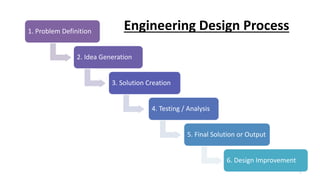
Engineering Design Process
2
1. Problem Definition
2. Idea Generation
3. Solution Creation
4. Testing / Analysis
5. Final Solution or Output
6. Design Improvement
Testing / Analysis
• Modelling
• Predictive Analysis
• Testing
3
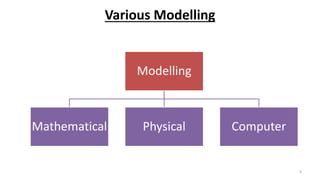
Various Modelling
4
Modelling
Mathematical Physical Computer
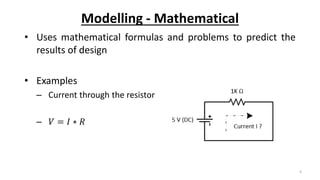
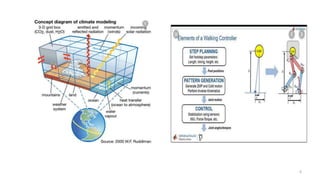
Modelling - Mathematical
• Uses mathematical formulas and problems to predict the
results of design
• Examples
– Current through the resistor
– 𝑉 = 𝐼 ∗ 𝑅
5
6
Modelling - Physical
• 3-D replicas of the final design of a solution
• Used to illustrate the design, test the design, or experiment
with materials
• Falls under 2 categories
– Mock-up
– Prototype
7
Modelling - Physical
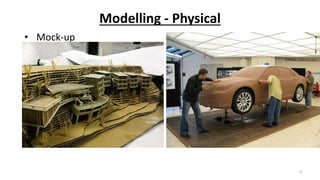
• Mock-up
– Either full size or scaled do increase or decrease the size of the
object
– Usually created with paper, cardboard, foamboard
– Used to simulate the appearance of the final product
– Not a working model
8
Modelling - Physical
• Mock-up
9
Modelling - Physical
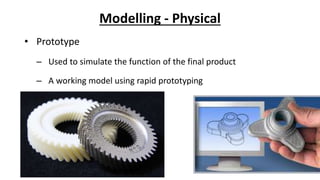
• Prototype
– Used to simulate the function of the final product
– A working model using rapid prototyping
10
Predictive Analysis
• Predict the future events using factors such as
– Statistics & Probability
– Models
– Mathematical & scientific principles
11
Testing
• To determine the usefulness of the product
• Criteria for testing
– Function
– Fit
– Aesthetics
– Safety
– Environmental Impact
12
Testing – Criteria
• Function
– Test the working of the product
– Whether the product solves the problem of concern ?
– Does the product meet the minimum requirements ?
– Will the design / product withstand daily use ?
– Etc.……
13
Testing – Criteria
• Fit
– Whether the product works with production and customer needs ?
• Eg: Inability to place the power switch in the specific location in the mobile phone
• Aesthetics
– Visually appealing
– Will consumers purchase the product based on its appearance ?
– Size, color, few others
14
Testing – Criteria
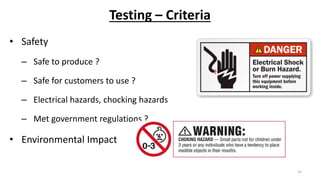
• Safety
– Safe to produce ?
– Safe for customers to use ?
– Electrical hazards, chocking hazards
– Met government regulations ?
• Environmental Impact
15
Testing – Criteria
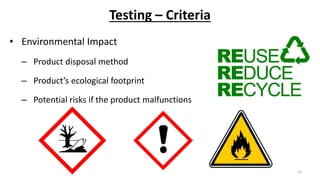
• Environmental Impact
– Product disposal method
– Product’s ecological footprint
– Potential risks if the product malfunctions
16
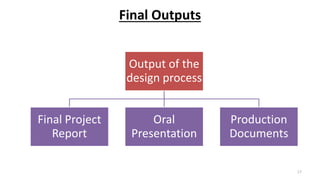
Final Outputs
17
Output of the
design process
Final Project
Report
Oral
Presentation
Production
Documents
Final Outputs - Final Project Report
• Summarizes the design process for management and potential customers
• Content of Final Project Report
– Title, Lead Engineer’s information, design team
– Problem Statement (Both Technical & Non-Technical)
– Design Goals
– Alternate Design (which is not used)
– Strength & weakness of the product
– Tradeoffs
– Product assembly & manufacturing information
– Summary of testing information
– Information about function, fit, aesthetics, safety & environmental impacts
– Final design through detailed drawings, mathematical models and prototypes
– Maintenance and expected life of the product
18
Final Outputs - Oral Presentation
• Spoken delivery of a report to an audience
19
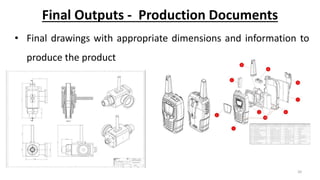
Final Outputs - Production Documents
• Final drawings with appropriate dimensions and information to
produce the product
20
Design Improvements
• Final step in the design process
• THERE IS ALWAYS A SCOPE FOR IMPROVEMENT
• Improvements based on feedback from design team,
management team, production team and CUSTOMERS
• Reverse Engineering can be used
21
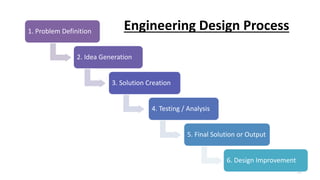
Engineering Design Process
22
1. Problem Definition
2. Idea Generation
3. Solution Creation
4. Testing / Analysis
5. Final Solution or Output
6. Design Improvement

C6ModelingTestingFinalOutputs.pptx

  • 1.
  • 2.
    Engineering Design Process 2 1.Problem Definition 2. Idea Generation 3. Solution Creation 4. Testing / Analysis 5. Final Solution or Output 6. Design Improvement
  • 3.
    Testing / Analysis •Modelling • Predictive Analysis • Testing 3
  • 4.
  • 5.
    Modelling - Mathematical •Uses mathematical formulas and problems to predict the results of design • Examples – Current through the resistor – 𝑉 = 𝐼 ∗ 𝑅 5
  • 6.
  • 7.
    Modelling - Physical •3-D replicas of the final design of a solution • Used to illustrate the design, test the design, or experiment with materials • Falls under 2 categories – Mock-up – Prototype 7
  • 8.
    Modelling - Physical •Mock-up – Either full size or scaled do increase or decrease the size of the object – Usually created with paper, cardboard, foamboard – Used to simulate the appearance of the final product – Not a working model 8
  • 9.
  • 10.
    Modelling - Physical •Prototype – Used to simulate the function of the final product – A working model using rapid prototyping 10
  • 11.
    Predictive Analysis • Predictthe future events using factors such as – Statistics & Probability – Models – Mathematical & scientific principles 11
  • 12.
    Testing • To determinethe usefulness of the product • Criteria for testing – Function – Fit – Aesthetics – Safety – Environmental Impact 12
  • 13.
    Testing – Criteria •Function – Test the working of the product – Whether the product solves the problem of concern ? – Does the product meet the minimum requirements ? – Will the design / product withstand daily use ? – Etc.…… 13
  • 14.
    Testing – Criteria •Fit – Whether the product works with production and customer needs ? • Eg: Inability to place the power switch in the specific location in the mobile phone • Aesthetics – Visually appealing – Will consumers purchase the product based on its appearance ? – Size, color, few others 14
  • 15.
    Testing – Criteria •Safety – Safe to produce ? – Safe for customers to use ? – Electrical hazards, chocking hazards – Met government regulations ? • Environmental Impact 15
  • 16.
    Testing – Criteria •Environmental Impact – Product disposal method – Product’s ecological footprint – Potential risks if the product malfunctions 16
  • 17.
    Final Outputs 17 Output ofthe design process Final Project Report Oral Presentation Production Documents
  • 18.
    Final Outputs -Final Project Report • Summarizes the design process for management and potential customers • Content of Final Project Report – Title, Lead Engineer’s information, design team – Problem Statement (Both Technical & Non-Technical) – Design Goals – Alternate Design (which is not used) – Strength & weakness of the product – Tradeoffs – Product assembly & manufacturing information – Summary of testing information – Information about function, fit, aesthetics, safety & environmental impacts – Final design through detailed drawings, mathematical models and prototypes – Maintenance and expected life of the product 18
  • 19.
    Final Outputs -Oral Presentation • Spoken delivery of a report to an audience 19
  • 20.
    Final Outputs -Production Documents • Final drawings with appropriate dimensions and information to produce the product 20
  • 21.
    Design Improvements • Finalstep in the design process • THERE IS ALWAYS A SCOPE FOR IMPROVEMENT • Improvements based on feedback from design team, management team, production team and CUSTOMERS • Reverse Engineering can be used 21
  • 22.
    Engineering Design Process 22 1.Problem Definition 2. Idea Generation 3. Solution Creation 4. Testing / Analysis 5. Final Solution or Output 6. Design Improvement